$20.00 (US)
EXOTIC DVM 
V O L U M E 1 1 
I S S U E 3 
contents 
23 
32 
A P R A C T I C A L R E S O U R C E F O R C L I N I C I A N S 
10 
William G. V. Lewis 
Observations from the Field 
7 A Case of Feline Infectious Peritonitis-like Disease in a Juvenile 
Ferret in Norway - Paula B. Brynildsen, DVM and Olivia Kershaw, DVM 
10 Umbilical Hernias in Rabbits - William G. V. Lewis, BVSc, 
CertZooMed, MRCVS 
Case Reports P e e r R e v i e w e d 
13 Proventricular Intussusception in an Indian Peafowl - 
David Perpiñán, LV, MSc; Jamie N. Henningson, DVM and 
Douglas L. Armstrong, DVM 
17 Pulmonary Carcinoma in a Captive Fennec Fox - 
Jennifer N. Niemuth, DVM; Seth N. Ghantous, DVM, Dipl ACVIM and 
Scott M. Averill, MS, DVM, Dipl ACVS 
Clinician’s Notebook P e e r R e v i e w e d 
19 Surgical Correction of a Rectal Prolapse in a Pet Skunk - 
Vittorio Capello, DVM and Angela Lennox, DVM, Dipl ABVP (Avian) 
23 Ultrasound-guided Liver Biopsy in an Argentine Boa - 
Daniel J. Gray, DVM 
Small Mammals As I See Them 
26 Neurologic Damage to the Spinal Cord of a Rabbit, Repair of 
Aural Hematoma in a Rabbit, Guinea Pig Intubation, 
Chinchilla Dental Health, Small Mammal Suture Material - 
Vittorio Capello, DVM, Dipl ECZM (Small Mammal) 
Ferrets As I See Them 
29 The Collapsing Ferret - Cathy Johnson-Delaney, DVM, 
Dipl ABVP (Avian) 
Exotic Animal Care 
32 Sugar Gliders - David M. Brust, DVM 
Departments 
3 Special Report: Exotic DVM of the Year 
4 Exotic DVM News 
43 E 
Call for Papers 
44 For Your Bookshelf 
47 em 
Exotic Marketplace 
48 Tools 
Daniel J. Gray 
Cover photo: Susan Orosz, PhD, DVM, Dipl ABVP (Avian), Dipl ECZM (Avian) 
www.asgv.org 
19 
Kevin Bowman
32 EXOTIC DVM VOLUME 11 ISSUE 3 
WHAT EVERY VETERINARIAN NEEDS TO KNOW ABOUT 
Sugar Gliders 
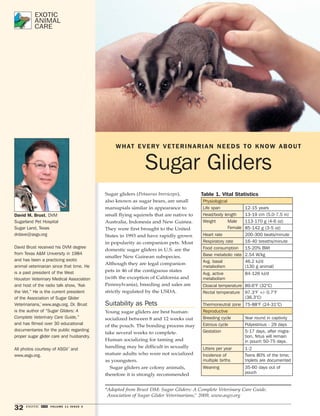
Sugar gliders (Petaurus breviceps), 
also known as sugar bears, are small 
marsupials similar in appearance to 
small flying squirrels that are native to 
Australia, Indonesia and New Guinea. 
They were first brought to the United 
States in 1993 and have rapidly grown 
in popularity as companion pets. Most 
domestic sugar gliders in U.S. are the 
smaller New Guinean subspecies. 
Although they are legal companion 
pets in 46 of the contiguous states 
(with the exception of California and 
Pennsylvania), breeding and sales are 
strictly regulated by the USDA. 
Suitability as Pets 
Young sugar gliders are best human-socialized 
between 8 and 12 weeks out 
of the pouch. The bonding process may 
take several weeks to complete. 
Human socializing for taming and 
handling may be difficult in sexually 
mature adults who were not socialized 
as youngsters. 
Sugar gliders are colony animals, 
therefore it is strongly recommended 
EXOTIC 
ANIMAL 
CARE 
David M. Brust, DVM 
Sugarland Pet Hospital 
Sugar Land, Texas 
drdave@asgv.org 
David Brust received his DVM degree 
from Texas A&M University in 1984 
and has been a practicing exotic 
animal veterinarian since that time. He 
is a past president of the West 
Houston Veterinary Medical Association 
and host of the radio talk show, “Ask 
the Vet.” He is the current president 
of the Association of Sugar Glider 
Veterinarians,™ www.asgv.org. Dr. Brust 
is the author of “Sugar Gliders: A 
Complete Veterinary Care Guide,” 
and has filmed over 30 educational 
documentaries for the public regarding 
proper sugar glider care and husbandry. 
All photos courtesy of ASGV™ and 
www.asgv.org. 
Table 1. Vital Statistics 
Physiological 
Life span 12-15 years 
Head/body length 13-19 cm (5.0-7.5 in) 
Weight Male 
Female 
113-170 g (4-6 oz) 
85-142 g (3-5 oz) 
Heart rate 200-300 beats/minute 
Respiratory rate 16-40 breaths/minute 
Food consumption 15-20% BWt 
Base metabolic rate 2.54 W/kg 
Avg. basal 
46.2 kJ/d 
metabolism 
(130 g animal) 
Avg. active 
metabolism 
84-126 kJ/d 
Cloacal temperature 89.6°F (32°C) 
Rectal temperature 97.3°F +/- 0.7°F 
(36.3°C) 
Thermoneutral zone 75-88°F (24-31°C) 
Reproductive 
Breeding cycle Year round in captivity 
Estrous cycle Polyestrous - 29 days 
Gestation 5-17 days, after migra-tion, 
fetus will remain 
in pouch 50-75 days. 
Litters per year 1-2 
Incidence of 
multiple births 
Twins 80% of the time; 
triplets are documented 
Weaning 35-60 days out of 
pouch 
*Adapted from Brust DM: Sugar Gliders: A Complete Veterinary Care Guide. 
Association of Sugar Glider Veterinarians,™ 2009, www.asgv.org
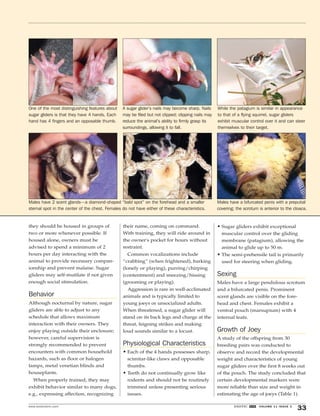
One of the most distinguishing features about 
sugar gliders is that they have 4 hands. Each 
hand has 4 fingers and an opposable thumb. 
A sugar glider’s nails may become sharp. Nails 
may be filed but not clipped; clipping nails may 
reduce the animal’s ability to firmly grasp its 
surroundings, allowing it to fall. 
Males have 2 scent glands—a diamond-shaped “bald spot” on the forehead and a smaller 
sternal spot in the center of the chest. Females do not have either of these characteristics. 
they should be housed in groups of 
two or more whenever possible. If 
housed alone, owners must be 
advised to spend a minimum of 2 
hours per day interacting with the 
animal to provide necessary compan-ionship 
and prevent malaise. Sugar 
gliders may self-mutilate if not given 
enough social stimulation. 
Behavior 
Although nocturnal by nature, sugar 
gliders are able to adjust to any 
schedule that allows maximum 
interaction with their owners. They 
enjoy playing outside their enclosure; 
however, careful supervision is 
strongly recommended to prevent 
encounters with common household 
hazards, such as floor or halogen 
lamps, metal venetian blinds and 
houseplants. 
When properly trained, they may 
exhibit behavior similar to many dogs, 
e.g., expressing affection, recognizing 
their name, coming on command. 
With training, they will ride around in 
the owner's pocket for hours without 
restraint. 
Common vocalizations include 
“crabbing” (when frightened), barking 
(lonely or playing), purring/chirping 
(contentment) and sneezing/hissing 
(grooming or playing). 
Aggression is rare in well-acclimated 
animals and is typically limited to 
young joeys or unsocialized adults. 
When threatened, a sugar glider will 
stand on its back legs and charge at the 
threat, feigning strikes and making 
loud sounds similar to a locust. 
Physiological Characteristics 
• Each of the 4 hands possesses sharp, 
scimitar-like claws and opposable 
thumbs. 
• Teeth do not continually grow like 
rodents and should not be routinely 
trimmed unless presenting serious 
issues. 
While the patagium is similar in appearance 
to that of a flying squirrel, sugar gliders 
exhibit muscular control over it and can steer 
themselves to their target. 
Males have a bifurcated penis with a preputial 
covering; the scrotum is anterior to the cloaca. 
• Sugar gliders exhibit exceptional 
muscular control over the gliding 
membrane (patagium), allowing the 
animal to glide up to 50 m. 
• The semi-prehensile tail is primarily 
used for steering when gliding. 
Sexing 
Males have a large pendulous scrotum 
and a bifurcated penis. Prominent 
scent glands are visible on the fore-head 
and chest. Females exhibit a 
ventral pouch (marsupium) with 4 
internal teats. 
Growth of Joey 
A study of the offspring from 30 
breeding pairs was conducted to 
observe and record the developmental 
weight and characteristics of young 
sugar gliders over the first 8 weeks out 
of the pouch. The study concluded that 
certain developmental markers were 
more reliable than size and weight in 
estimating the age of joeys (Table 1). 
www.exoticdvm.com EXOTIC DVM VOLUME 11 ISSUE 3 33
EXOTIC ANIMAL CARE 
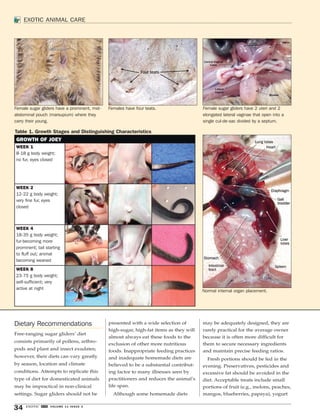
Female sugar gliders have a prominent, mid-abdominal 
pouch (marsupium) where they 
carry their young. 
Table 1. Growth Stages and Distinguishing Characteristics 
Dietary Recommendations 
Free-ranging sugar gliders’ diet 
consists primarily of pollens, arthro-pods 
and plant and insect exudates; 
however, their diets can vary greatly 
by season, location and climate 
conditions. Attempts to replicate this 
type of diet for domesticated animals 
may be impractical in non-clinical 
settings. Sugar gliders should not be 
34 EXOTIC DVM VOLUME 11 ISSUE 3 
presented with a wide selection of 
high-sugar, high-fat items as they will 
almost always eat these foods to the 
exclusion of other more nutritious 
foods. Inappropriate feeding practices 
and inadequate homemade diets are 
believed to be a substantial contribut-ing 
factor to many illnesses seen by 
practitioners and reduces the animal’s 
life span. 
Although some homemade diets 
may be adequately designed, they are 
rarely practical for the average owner 
because it is often more difficult for 
them to secure necessary ingredients 
and maintain precise feeding ratios. 
Fresh portions should be fed in the 
evening. Preservatives, pesticides and 
excessive fat should be avoided in the 
diet. Acceptable treats include small 
portions of fruit (e.g., melons, peaches, 
mangos, blueberries, papaya), yogurt 
GROWTH OF JOEY 
WEEK 1 
8-18 g body weight; 
no fur, eyes closed 
WEEK 2 
12-22 g body weight; 
very fine fur, eyes 
closed 
WEEK 4 
18-35 g body weight; 
fur-becoming more 
prominent; tail starting 
to fluff out; animal 
becoming weaned 
WEEK 8 
23-75 g body weight; 
self-sufficient; very 
active at night 
Female sugar gliders have 2 uteri and 2 
elongated lateral vaginae that open into a 
single cul-de-sac divided by a septum. 
Females have four teats. 
Normal internal organ placement.
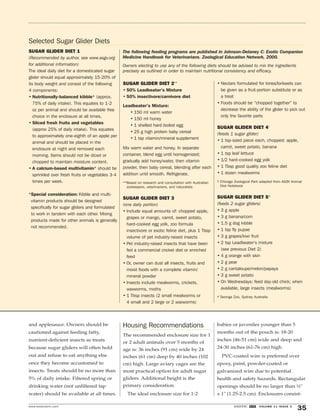
Selected Sugar Glider Diets 
SUGAR GLIDER DIET 1 
(Recommended by author, see www.asgv.org 
for additional information) 
The ideal daily diet for a domesticated sugar 
glider should equal approximately 15-20% of 
its body weight and consist of the following 
4 components: 
• Nutritionally-balanced kibble* (approx. 
75% of daily intake). This equates to 1-2 
oz per animal and should be available free 
choice in the enclosure at all times. 
• Sliced fresh fruits and vegetables 
(approx 25% of daily intake). This equates 
to approximately one-eighth of an apple per 
animal and should be placed in the 
enclosure at night and removed each 
morning. Items should not be diced or 
chopped to maintain moisture content. 
• A calcium-based multivitamin* should be 
sprinkled over fresh fruits or vegetables 3-4 
times per week. 
*Special consideration: Kibble and multi-vitamin 
products should be designed 
specifically for sugar gliders and formulated 
to work in tandem with each other. Mixing 
products made for other animals is generally 
not recommended. 
The following feeding programs are published in Johnson-Delaney C: Exotic Companion 
Medicine Handbook for Veterinarians. Zoological Education Network, 2000. 
Owners electing to use any of the following diets should be advised to mix the ingredients 
precisely as outlined in order to maintain nutritional consistency and efficacy. 
SUGAR GLIDER DIET 2** 
• 50% Leadbeater’s Mixture 
• 50% insectivore/carnivore diet 
Leadbeater’s Mixture: 
• 150 ml warm water 
• 150 ml honey 
• 1 shelled hard-boiled egg 
• 25 g high protein baby cereal 
• 1 tsp vitamin/mineral supplement 
Mix warm water and honey. In separate 
container, blend egg until homogenized; 
gradually add honey/water, then vitamin 
powder, then baby cereal, blending after each 
addition until smooth. Refrigerate. 
**Based on research and consultation with Australian 
zookeepers, veterinarians, and naturalists 
SUGAR GLIDER DIET 3 
(one daily portion) 
• Include equal amounts of: chopped apple, 
grapes or mango, carrot, sweet potato, 
hard-cooked egg yolk, zoo formula 
insectivore or exotic feline diet, plus 1 Tbsp 
volume of pet industry-raised insects 
• Pet industry-raised insects that have been 
fed a commercial cricket diet or enriched 
feed 
• Or, owner can dust all insects, fruits and 
moist foods with a complete vitamin/ 
mineral powder 
• Insects include mealworms, crickets, 
waxworms, moths 
• 1 Tbsp insects (2 small mealworms or 
4 small and 2 large or 2 waxworms) 
• Nectars formulated for lories/lorikeets can 
be given as a fruit-portion substitute or as 
a treat 
• Foods should be “chopped together” to 
decrease the ability of the glider to pick out 
only the favorite parts 
SUGAR GLIDER DIET 4† 
(feeds 1 sugar glider) 
• 1 tsp-sized piece each, chopped: apple, 
carrot, sweet potato, banana 
• 1 tsp leaf lettuce 
• 1/2 hard-cooked egg yolk 
• 1 Tbsp good quality zoo feline diet 
• 1 dozen mealworms 
† Chicago Zoological Park adapted from AAZK Animal 
Diet Notebook 
SUGAR GLIDER DIET 5# 
(feeds 2 sugar gliders) 
• 3 g apple 
• 3 g banana/corn 
• 1.5 g dog kibble 
• 1 tsp fly pupae 
• 3 g grapes/kiwi fruit 
• 2 tsp Leadbeater’s mixture 
(see previous Diet 2) 
• 4 g orange with skin 
• 2 g pear 
• 2 g cantaloupe/melon/papaya 
• 3 g sweet potato 
• On Wednesdays: feed day-old chick; when 
available, large insects (mealworms) 
# Taronga Zoo, Sydney Australia 
and applesauce. Owners should be 
cautioned against feeding fatty, 
nutrient-deficient insects as treats 
because sugar gliders will often hold 
out and refuse to eat anything else 
once they become accustomed to 
insects. Treats should be no more than 
5% of daily intake. Filtered spring or 
drinking water (not unfiltered tap 
water) should be available at all times. 
Housing Recommendations 
The recommended enclosure size for 1 
or 2 adult animals over 5 months of 
age is: 36 inches (91 cm) wide by 24 
inches (61 cm) deep by 40 inches (102 
cm) high. Large aviary cages are the 
most practical option for adult sugar 
gliders. Additional height is the 
primary consideration. 
The ideal enclosure size for 1-2 
babies or juveniles younger than 5 
months out of the pouch is: 18-20 
inches (46-51 cm) wide and deep and 
24-30 inches (61-76 cm) high. 
PVC-coated wire is preferred over 
epoxy, paint, powder-coated or 
galvanized wire due to potential 
health and safety hazards. Rectangular 
openings should be no larger than ½" 
x 1" (1.25-2.5 cm). Enclosures consist- 
www.exoticdvm.com EXOTIC DVM VOLUME 11 ISSUE 3 35
ing primarily of vertical bars (e.g., bird 
cages) are not recommended for 
babies or juveniles, as soft tissue tears 
may develop between the digits from 
sliding down the bars. 
A removable plastic waste tray 
should be at least 1" (2.5 cm) from the 
floor of the enclosure. Paper lining is 
preferred over wood shavings. Daily 
removal of feces and soiled papers 
and general cleaning of an enclosure 
and all supplies are recommended as 
well as a quarterly sterilization of the 
housing and accessories. 
Important considerations for 
placement of the enclosure in the 
home include environmental tempera-ture, 
noise levels, odor, lighting and 
the social nature of the animal. 
The ideal temperature range in the 
home for a healthy animal is 75-80°F 
(24-27°C). Nighttime temperature 
should not drop below 70°F (21°C). 
The use of a supplemental heat source 
is strongly recommended. A conven-tional 
heat rock is preferable to a heat 
lamp or UV lighting, especially during 
the bonding period, as it allows the 
animal to efficiently self-thermoregu-late 
throughout the day regardless of 
temperature variations. Alternatively, 
ceramic heat emitters positioned with 
a linen towel or surgical huck towel 
can be used for regulating the heat. 
36 EXOTIC DVM VOLUME 11 ISSUE 3 
Food and water bowls and food 
items may be placed inside an 
enclosed dining area to avoid contami-nation 
and unnecessary waste. The 
use of both a conventional water 
bottle and a weighted secondary 
water dish is recommended. 
Environmental Enrichment 
Sugar gliders enjoy most traditional 
pet toys. Any item with loose strings 
or wires that could entangle the 
animal should be avoided. Solid 
exercise wheels provide an important 
opportunity for necessary exercise. 
Traditional hamster or rodent wheels 
should be avoided due to hazards 
associated with the prehensile tail. 
Rope and/or wooden toys should be 
replaced every 3-4 months. 
Plants and branches are recom-mended 
to promote leaping and 
climbing. Quality artificial plants are 
preferred to natural fauna due to 
health and sanitary considerations. 
Varied sizes of branches of nontoxic 
trees can be used (for a list of safe 
plants go to www.asgv.org). These 
should be removed and cleaned every 
2-3 weeks and must be thoroughly 
rinsed. A preferable alternative to 
foliage is 1-inch plastic chain, available 
at home improvement centers. 
Grooming 
Bathing is not required. Sugar gliders 
will routinely groom themselves and 
each other. Effective topical sprays 
and waste tray additives are commer-cially 
available. 
Restraint 
Manual restraint is best accomplished 
using either a surgical huck towel or 
fleece bonding pouch as a glove. 
These animals should not be scruffed 
or held by the tail. Sugar gliders can 
be transported to the clinic in a 
zippered, fleece pouch. 
Sedation 
Sedation is usually required for a 
clinical examination or diagnostic 
sampling. Isoflurane may be used at 
5% for induction, using a large face 
mask as an induction chamber, and 
1-3% for maintenance with a small 
face mask. A non-rebreathing circuit 
should be used for both induction and 
maintenance. If isoflurane is used for 
induction, application of a topical 
methylcellulose eye lubricant should 
be used. Alternatively, sugar gliders 
may be sedated first with administra-tion 
of an anxiolytic, such as midazo-lam 
(0.3-0.5 mg/kg IM). The use of an 
electrocardiogram (ECG) may be use-ful 
to help monitor the animal if it is 
EXOTIC ANIMAL CARE 
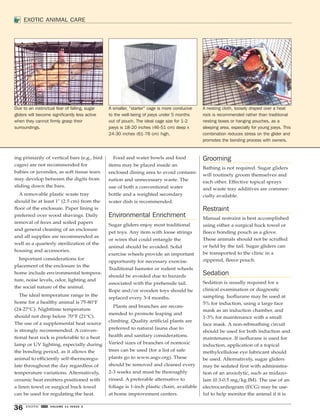
A smaller, “starter” cage is more conducive 
to the well-being of joeys under 5 months 
out of pouch. The ideal cage size for 1-2 
joeys is 18-20 inches (46-51 cm) deep x 
24-30 inches (61-76 cm) high. 
Due to an instinctual fear of falling, sugar 
gliders will become significantly less active 
when they cannot firmly grasp their 
surroundings. 
A nesting cloth, loosely draped over a heat 
rock is recommended rather than traditional 
nesting boxes or hanging pouches, as a 
sleeping area, especially for young joeys. This 
combination reduces stress on the glider and 
promotes the bonding process with owners.
Solid-construction (not wire mesh) exercise 
wheels provide a good source of environmen-tal 
enrichment and exercise for sugar gliders. 
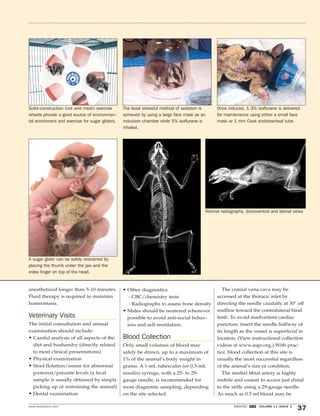
A sugar glider can be safely restrained by 
placing the thumb under the jaw and the 
index finger on top of the head. 
anesthetized longer than 5-10 minutes. 
Fluid therapy is required to maintain 
homeostasis. 
Veterinary Visits 
The initial consultation and annual 
examination should include: 
• Careful analysis of all aspects of the 
diet and husbandry (directly related 
to most clinical presentations) 
• Physical examination 
• Stool flotation/smear for abnormal 
protozoa/parasite levels (a fecal 
sample is usually obtained by simply 
picking up or restraining the animal) 
• Dental examination 
The least stressful method of sedation is 
achieved by using a large face mask as an 
induction chamber while 5% isoflurane is 
inhaled. 
Normal radiographs, dorsoventral and lateral views 
• Other diagnostics 
- CBC/chemistry tests 
- Radiographs to assess bone density 
• Males should be neutered whenever 
possible to avoid anti-social behav-iors 
and self-mutilation. 
Blood Collection 
Only small volumes of blood may 
safely be drawn, up to a maximum of 
1% of the animal’s body weight in 
grams. A 1-mL tuberculin (or 0.5-mL 
insulin) syringe, with a 25- to 29- 
gauge needle, is recommended for 
most diagnostic sampling, depending 
on the site selected. 
Once induced, 1-3% isoflurane is delivered 
for maintenance using either a small face 
mask or 1 mm Cook endotracheal tube. 
The cranial vena cava may be 
accessed at the thoracic inlet by 
directing the needle caudally at 30° off 
midline toward the contralateral hind 
limb. To avoid inadvertent cardiac 
puncture, insert the needle halfway of 
its length as the vessel is superficial in 
location. (View instructional collection 
videos at www.asgv.org.) With prac-tice, 
blood collection at this site is 
usually the most successful regardless 
of the animal’s size or condition. 
The medial tibial artery is highly 
mobile and easiest to access just distal 
to the stifle using a 29-gauge needle. 
As much as 0.5 ml blood may be 
www.exoticdvm.com EXOTIC DVM VOLUME 11 ISSUE 3 37
Table 2. Hematologic Reference Ranges 
for Domestic Sugar Gliders 
obtained from each side. 
Cardiac puncture and orbital 
bleeding are not recommended. 
Injection Sites 
• Intravenous: Cephalic or lateral 
saphenous veins, using a 25-gauge 
needle 
• Intramuscular: Quadriceps, epaxial 
muscles of the neck and biceps/tri-ceps, 
using a 25-gauge needle. Avoid 
the use of medications that sting. 
38 EXOTIC DVM VOLUME 11 ISSUE 3 
• Subcutaneous: Dorsal midline of 
the thorax, using a 25-gauge needle. 
Check for pooling in the patagium. 
Most Common Disorders 
• Malnutrition, which may be 
expressed as hind-limb paralysis, 
blindness, dehydration, cataracts, 
metabolic bone disease and seizures 
• Obesity 
• Intestinal parasites 
• Hair loss, typically resulting from 
poor nutrition and vitamin intake 
• Pneumonia, including discharge 
from the eyes/nose 
• Diarrhea, resulting from a change in 
diet, inappropriate diet containing 
too high sugar content, bacterial 
overgrowths, Giardia, Crypto-sporidia 
or Clostridium sp. 
• Stress-related diseases, including 
self-mutilation (particularly solitary 
animals), cannibalism of young and 
eating disorders 
EXOTIC ANIMAL CARE 
The techniques used for administering fluids in 
sugar gliders are the same as in other small 
mammals; however, care should be taken not 
to administer fluids laterally, as they can pool 
in the patagium, resulting in slow absorption 
and discomfort to the patient. 
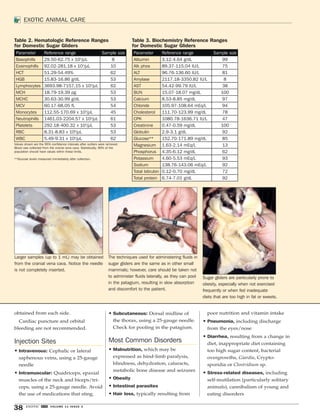
Larger samples (up to 1 mL) may be obtained 
from the cranial vena cava. Notice the needle 
is not completely inserted. 
Sugar gliders are particularly prone to 
obesity, especially when not exercised 
frequently or when fed inadequate 
diets that are too high in fat or sweets. 
Parameter Reference range Sample size 
Basophills 29.50-62.75 x 10³/μL 8 
Eosinophills 92.02-281.18 x 10³/μL 10 
HCT 51.29-54.49% 62 
HGB 15.83-16.86 g/dL 53 
Lymphocytes 3693.98-7157.15 x 103/μL 62 
MCH 18.79-19.39 pg 53 
MCHC 30.63-30.99 g/dL 53 
MCV 60.17-68.05 fL 54 
Monocytes 112.55-170.69 x 10³/μL 45 
Neutrophills 1461.03-2204.57 x 103/μL 61 
Platelets 292.18-400.32 x 10³/μL 53 
RBC 8.31-8.83 x 10⁶/μL 53 
WBC 5.49-9.31 x 10³/μL 62 
Table 3. Biochemistry Reference Ranges 
for Domestic Sugar Gliders 
Parameter Reference range Sample size 
Albumin 3.12-4.64 g/dL 99 
Alk phos 89.37-115.04 IU/L 75 
ALT 96.76-136.60 IU/L 81 
Amylase 2117.18-3350.82 IU/L 8 
AST 54.42-99.79 IU/L 38 
BUN 15.07-18.07 mg/dL 100 
Calcium 8.53-8.85 mg/dL 97 
Chloride 105.97-108.64 mEq/L 94 
Cholesterol 111.70-123.99 mg/dL 78 
CPK 1080.78-1636.71 IU/L 47 
Creatinine 0.47-0.59 mg/dL 100 
Globulin 2.9-3.1 g/dL 92 
Glucose** 152.70-171.89 mg/dL 85 
Magnesium 1.63-2.14 mEq/L 13 
Phosphorus 4.35-6.12 mg/dL 62 
Potassium 4.60-5.53 mEq/L 93 
Sodium 138.76-143.06 mEq/L 92 
Total bilirubin 0.12-0.70 mg/dL 72 
Total protein 6.74-7.01 g/dL 92 
Values shown are the 95% confidence intervals after outliers were removed. 
Blood was collected from the cranial vena cava. Statistically, 90% of the 
population should have values within these limits. 
**Glucose levels measured immediately after collection.
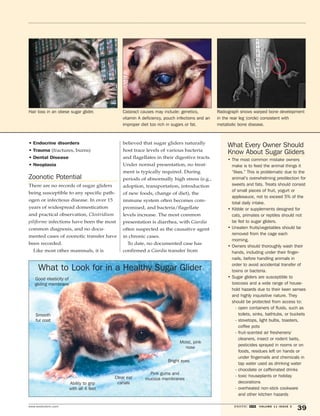
Hair loss in an obese sugar glider. Cataract causes may include: genetics, 
• Endocrine disorders 
• Trauma (fractures, burns) 
• Dental Disease 
• Neoplasia 
Zoonotic Potential 
There are no records of sugar gliders 
being susceptible to any specific path-ogen 
or infectious disease. In over 15 
years of widespread domestication 
and practical observation, Clostridium 
piliforme infections have been the most 
common diagnosis, and no docu-mented 
cases of zoonotic transfer have 
been recorded. 
Like most other mammals, it is 
vitamin A deficiency, pouch infections and an 
improper diet too rich in sugars or fat. 
believed that sugar gliders naturally 
host trace levels of various bacteria 
and flagellates in their digestive tracts. 
Under normal presentation, no treat-ment 
is typically required. During 
periods of abnormally high stress (e.g., 
adoption, transportation, introduction 
of new foods, change of diet), the 
immune system often becomes com-promised, 
and bacteria/flagellate 
levels increase. The most common 
presentation is diarrhea, with Giardia 
often suspected as the causative agent 
in chronic cases. 
To date, no documented case has 
confirmed a Giardia transfer from 
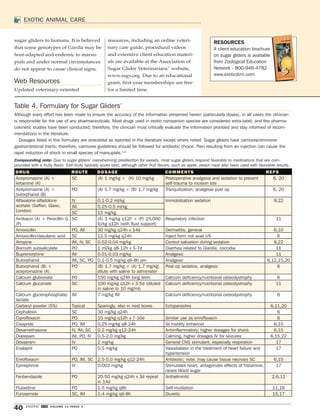
Radiograph shows warped bone development 
in the rear leg (circle) consistent with 
metabolic bone disease. 
What to Look for in a Healthy Sugar Glider 
Ability to grip 
with all 4 feet 
Good elasticity of 
gliding membrane 
Smooth 
fur coat 
Moist, pink 
nose 
Bright eyes 
Pink gums and 
Clear ear mucous membranes 
canals 
What Every Owner Should 
Know About Sugar Gliders 
• The most common mistake owners 
make is to feed the animal things it 
“likes.” This is problematic due to the 
animal’s overwhelming predilection for 
sweets and fats. Treats should consist 
of small pieces of fruit, yogurt or 
applesauce, not to exceed 5% of the 
total daily intake. 
• Kibble or supplements designed for 
cats, primates or reptiles should not 
be fed to sugar gliders. 
• Uneaten fruits/vegetables should be 
removed from the cage each 
morning. 
• Owners should thoroughly wash their 
hands, including under their finger-nails, 
before handling animals in 
order to avoid accidental transfer of 
toxins or bacteria. 
• Sugar gliders are susceptible to 
toxicosis and a wide range of house-hold 
hazards due to their keen senses 
and highly inquisitive nature. They 
should be protected from access to: 
- open containers of fluids, such as 
toilets, sinks, bathtubs, or buckets 
- stovetops, light bulbs, toasters, 
coffee pots 
- fruit-scented air fresheners/ 
cleaners, insect or rodent baits, 
pesticides sprayed in rooms or on 
foods, residues left on hands or 
under fingernails and chemicals in 
tap water used as drinking water 
- chocolate or caffeinated drinks 
- toxic houseplants or holiday 
decorations 
- overheated non-stick cookware 
and other kitchen hazards 
www.exoticdvm.com EXOTIC DVM VOLUME 11 ISSUE 3 39
EXOTIC ANIMAL CARE 
sugar gliders to humans. It is believed 
that some genotypes of Giardia may be 
host-adapted and endemic to marsu-pials 
and under normal circumstances 
do not appear to cause clinical signs. 
Web Resources 
Updated veterinary-oriented 
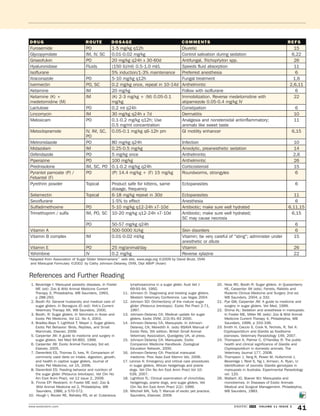
Table 4. Formulary for Sugar Gliders* 
RESOURCES 
A client education brochure 
on sugar gliders is available 
from Zoological Education 
Network - 800-946-4782 
www.exoticdvm.com 
Although every effort has been made to ensure the accuracy of the information presented herein (particularly doses), in all cases the clinician 
is responsible for the use of any pharmaceuticals. Most drugs used in exotic companion species are considered extra-label, and few pharma-cokinetic 
studies have been conducted; therefore, the clinician must critically evaluate the information provided and stay informed of recom-mendations 
in the literature. 
Dosages listed in this formulary are anecdotal as reported in the literature except where noted. Sugar gliders have carnivore/omnivore 
gastrointestinal tracts; therefore, carnivore guidelines should be followed for antibiotic choice. Pain resulting from an injection can cause the 
rapid induction of shock in small species of marsupials.9,15 
40 EXOTIC DVM VOLUME 11 ISSUE 3 
resources, including an online veteri-nary 
care guide, procedural videos 
and extensive client education materi-als 
are available at the Association of 
Sugar Glider Veterinarians™ website, 
www.asgv.org. Due to an educational 
grant, first-year memberships are free 
for a limited time. 
Compounding note: Due to sugar gliders’ overwhelming predilection for sweets, most sugar gliders respond favorably to medications that are com-pounded 
with a fruity flavor. Tutti-fruity typically works best, although other fruit flavors, such as apple, peach have also been used with favorable results. 
DRUG ROUTE DOSAGE COMMENTS REFS 
Acepromazine (A) + 
SC (A) 1 mg/kg + (K) 10 mg/kg Postoperative analgesia and sedation to prevent 
ketamine (K) 
self-trauma to incision site 
6, 20 
Acepromazine (A) + 
butorphanol (B) 
PO (A) 1.7 mg/kg + (B) 1.7 mg/kg Tranquilization, analgesia post op 6, 20 
Alfaxalone-alfadolone 
acetate (Saffan, Glaxo, 
London) 
IV 0.1-0.2 ml/kg Immobilization sedation 9,22 
IM 0.25-0.5 ml/kg 
SC 15 mg/kg 
Amikacin (A) + Penicillin G 
(P) 
SC (A) 3 mg/kg q12h + (P) 25,000 
IU/kg q12h (with fluid support) 
Respiratory infection 11 
Amoxicillin PO, IM 30 mg/kg q24h x 14d Dermatitis, general 6,10 
Amoxicillin/clavulanic acid SC 12.5 mg/kg q24h Inject form not avail US 6 
Atropine IM, IV, SC 0.02-0.04 mg/kg Control salivation during sedation 9,22 
Bismuth subsalicylate PO 1 ml/kg q8-12h x 5-7d Diarrhea related to Giardia, coccidia 11 
Buprenorphine IM 0.01-0.03 mg/kg Analgesic 11 
Butorphanol IM, SC, PO 0.1-0.5 mg/kg q6-8h prn Analgesic 6,12,15,20 
Butorphanol (B) + 
PO (B) 1.7 mg/kg + (A) 1.7 mg/kg; 
Post-op sedative, analgesic 6 
acepromazine (A) 
dilute with saline to administer 
Calcium glubionate PO 150 mg/kg q24h long term Calcium deficiency/nutritional osteodystrophy 6 
Calcium gluconate SC 100 mg/kg q12h x 3-5d (diluted 
in saline to 10 mg/ml) 
Calcium deficiency/nutritional osteodystrophy 11 
Calcium glycerophosphate/ 
lactate 
IM 7 mg/kg IM Calcium deficiency/nutritional osteodystrophy 6 
Carbaryl powder (5%) Topical Sparingly, also in nest boxes Ectoparasites 6,11,20 
Cephalexin SC 30 mg/kg q24h 6 
Ciprofloxacin PO 10 mg/kg q12h x 7-10d Similar use as enrofloxacin 6 
Cisapride PO, IM 0.25 mg/kg q8-24h GI motility enhancer 6,15 
Dexamethasone IV, IM, SC 0.2 mg/kg q12-24h Antiinflammatory; higher dosages for shock 6,15 
Diazepam IM, PO, IV 0.5-2.0 mg/kg Calming, higher dosages IV for seizures 6,15,22 
Doxapram IV 2 mg/kg General CNS stimulant, especially respiration 17 
Enalapril PO 0.5 mg/kg Vasodialator in the treatment of heart failure and 
hypertension 
17 
Enrofloxacin PO, IM, SC 2.5-5.0 mg/kg q12-24h Antibiotic; note: may cause tissue necrosis SC 6,15 
Epinephrine IV 0.003 mg/kg Stimulates heart, antagonizes effects of histamine, 
raises blood sugar 
17 
Fenbendazole PO 20-50 mg/kg q24h x 3d repeat 
in 14d 
Anthelmintic 2,6,11 
Fluoxetine PO 1-5 mg/kg q8h Self-mutilation 11,16 
Furosemide SC, IM 1-4 mg/kg q6-8h Diuretic 15,17
DRUG ROUTE DOSAGE COMMENTS REFS 
Furosemide PO 1-5 mg/kg q12h Diuretic 15 
Glycopyrrolate IM, IV, SC 0.01-0.02 mg/kg Control salivation during sedation 6,22 
Griseofulvin PO 20 mg/kg q24h x 30-60d Antifungal, Trichophyton spp. 26 
Hyaluronidase Fluids (150 IU/ml) 0.5-1.0 ml/L Speeds fluid absorption 11 
Isoflurane 5% induction/1-3% maintenance Preferred anesthesia 6 
Itraconazole PO 5-10 mg/kg q12h Fungal treatment 1,6 
Ivermectin PO, SC 0.2 mg/kg once, repeat in 10-14d Anthelmintic 2,6,11 
Ketamine IM 20 mg/kg Follow with isoflurane 6 
Ketamine (K) + 
IM (K) 2-3 mg/kg + (M) 0.05-0.1 
medetomidine (M) 
mg/kg 
Lactulose PO 0.2 ml q24h Constipation 6 
Lincomycin IM 30 mg/kg q24h x 7d Dermatitis 10 
Meloxicam PO 0.1-0.2 mg/kg q12h; Use 
0.5 mg/ml concentration 
Metoclopramide IV, IM, SC, 
PO 
0.05-0.1 mg/kg q6-12h prn GI motility enhancer 6,15 
Metronidazole PO 80 mg/kg q24h Infection 10 
Midazolam IM 0.25-0.5 mg/kg Anxiolytic, preanesthetic sedation 14 
Oxfendazole PO 5 mg/kg once Anthelmintic 2,6 
Piperazine PO 100 mg/kg Anthelmintic 26 
Prednisolone IM, SC, PO 0.1-0.2 mg/kg q24h Corticosteroid 15 
Pyrantel pamoate (P) / 
PO (P) 14.4 mg/kg + (F) 15 mg/kg Roundworms, strongyles 6 
Febantel (F) 
Pyrethrin powder Topical Product safe for kittens, same 
dosage, frequency 
Selamectin Topical 6-18 mg/kg repeat in 30d Ectoparasites 11 
Sevoflurane 1-5% to effect Anesthesia 6 
Sulfadimethoxine PO 5-10 mg/kg q12-24h x7-10d Antibiotic; make sure well hydrated 6,11,15 
Trimethoprim / sulfa IM, PO, SC 10-20 mg/kg q12-24h x7-10d Antibiotic; make sure well hydrated; 
PO 50-57 mg/kg q24h 6 
Vitamin A 500-5000 IU/kg Skin disorders 6 
Vitamin B complex IM 0.01-0.02 ml/kg Vitamin; be very careful of “sting”; administer under 
Vitamin E PO 25 mg/animal/day Vitamin 26 
Yohimbine IV 0.2 mg/kg Reverse xylazine 22 
*Adapted from Association of Sugar Glider Veterinarians’™ web site, www.asgv.org ©2009 by David Brust, DVM 
and Marsupial Formulary ©2002 by Cathy Johnson-Delaney, DVM, Dipl ABVP (Avian) 
References and Further Reading 
1. Beveridge I: Marsupial parasitic diseases. In Fowler 
ME (ed): Zoo & Wild Animal Medicine Current 
Therapy 3, Philadelphia, WB Saunders, 1993, 
p 288-293. 
2. Booth RJ: General husbandry and medical care of 
sugar gliders. In Bonagura JD (ed): Kirk’s Current 
Veterinary Therapy XIII. WB Saunders, 2000. 
3. Booth, R: Sugar gliders. In Seminars in Avian and 
Exotic Pet Medicine, Vol 12, No 4, 2003. 
4. Bradley-Bays T, Lightfoot T, Mayer J: Sugar gliders. 
Exotic Pet Behavior: Birds, Reptiles, and Small 
Mammals. Elsevier, 2006. 
5. Carpenter JW: A guide to medicine and surgery in 
sugar gliders. Vet Med 94:893, 1999. 
6. Carpenter JW: Exotic Animal Formulary 3rd ed. 
Elsevier, 2005. 
7. Dierenfeld ES, Thomas D, Ives, R: Comparison of 
commonly used diets on intake, digestion, growth, 
and health in captive sugar gliders, Journal of 
Exotic Pet Medicine, vol 15, 2006. 
8. Dierenfeld ES: Feeding behavior and nutrition of 
the sugar glider (Petaurus breviceps). Vet Clin No 
Am Exot Anim Pract, vol 12 issue 2, 2009. 
9. Finnie EP: Restraint. In Fowler ME (ed): Zoo & 
Wild Animal Medicine ed 2, Philadelphia, WB 
Saunders, 1986, p 570-572. 
10. Hough I, Reuter RE, Rahaley RS, et al: Cutaneous 
Immobilization. Reverse medetomidine with 
atipamezole 0.05-0.4 mg/kg IV 
Analgesia and nonsteroidal antiinflammatory; 
animals like sweet taste 
Ectoparasites 6 
SC may cause necrosis 
anesthetic or dilute 
lymphosarcoma in a sugar glider. Aust Vet J 
69:93-94, 1992. 
11. Johnson D: Diagnosing and treating sugar gliders. 
Western Veterinary Conference. Las Vegas 2004. 
12. Johnson SD: Orchiectomy of the mature sugar 
glider (Petaurus breviceps). Exotic Pet Pract 2:71, 
1997. 
13. Johnson-Delaney CA: Medical update for sugar 
gliders. Exotic DVM, 2(3):91-93 2000. 
14. Johnson-Delaney CA, Marsupials. In Johnson- 
Delaney, CA; Meredith A. (eds) BSAVA Manual of 
Exotic Pets, 5th edition. British Small Animal 
Veterinary Association, Quedgeley UK, at press. 
15. Johnson-Delaney CA: Marsupials. Exotic 
Companion Medicine Handbook. Zoological 
Education Network, 2000. 
16. Johnson-Delaney CA: Practical marsupial 
medicine. Proc Asso Exot Mamm Vet, 2006. 
17. Lennox A: Emergency and critical care procedures 
in sugar gliders, African hedgehogs and prairie 
dogs. Vet Clin No Am Exot Anim Pract Vol 10: 
539, 2007. 
18. Lightfoot TL: Clinical examination of chinchillas, 
hedgehogs, prairie dogs, and sugar gliders, Vet 
Clin No Am Exot Anim Pract 2(2): 1999. 
19. Mitchell MA, Tully T: Manual of exotic pet practice. 
Saunders, Elservier. 2009. 
22 
11 
6,15 
15 
20. Ness RD, Booth R: Sugar gliders. In Quesenberry 
KE, Carpenter JW (eds): Ferrets, Rabbits and 
Rodents Clinical Medicine and Surgery 2nd ed. 
WB Saunders, 2004, p 332. 
21. Pye GW, Carpenter JW: A guide to medicine and 
surgery in sugar gliders. Vet Med, 1999. 
22. Shima AL: Sedation and anesthesia in marsupials. 
In Fowler ME, Miller RE (eds): Zoo & Wild Animal 
Medicine Current Therapy 4, Philadelphia, WB 
Saunders, 1999, p 333-336. 
23. Smith H, Caccio S, Cook N, Nichols, R, Tait A: 
Cryptosporidium and Giardia as foodborne 
zoonoses. Veterinary Parasitology 149, 2007. 
24. Thompson A, Palmer C, O’Handley R: The public 
health and clinical significance of Giardia and 
Cryptosporidium in domestic animals. The 
Veterinary Journal 177, 2008. 
25. Thompson J, Yang R, Power M, Hufschmid J, 
Beveridge I, Reid S, Ng J, Armson, A, Ryan, U: 
Identification of zoonotic Giardia genotypes in 
marsupials in Australia. Experimental Parasitology 
vol. 120. 
26. Wallach JD, Boever WJ: Marsupialia and 
monotremes. In Diseases of Exotic Animals 
Medical and Surgical Management. Philadelphia, 
WB Saunders, 1983. 
www.exoticdvm.com EXOTIC DVM VOLUME 11 ISSUE 3 41
Transitioning your 
Sugar Bears 
to a Healthy & 
Nutritious Diet! 
(Portions of this special report are reprinted with permission from: 
“Sugar Gliders: A Complete Veterinary Care Guide” © 2009 Association of Sugar Glider Veterinarians™. All 
Rights Reserved. For more information, go to: www.ASGV.org ) 
It has been estimated that over 90% of all problems Vets see in our little buddies are directly related to 
improper diet – and “in most cases these problems can be traced back to complicated, homemade 
diets found on the Internet…” 
The simple fact is that there’s a lot of misinformation and hype out on the internet about which diets are 
best for Sugar Bears/Gliders – and this can get very confusing for owners. For example, on many 
unregulated “Sugar Glider” websites, there is an almost fanatical, deeply-held conviction among a core 
of amateur enthusiasts that nothing can be too “good for the glider”, and therefore it must be catered to, 
and provided with, a wide variety of food items to choose from. Anything less, and the animal is 
somehow being abused or malnourished. In recent years, 
these self-proclaimed experts have inundated the internet with their 
emphatic and frequently unsupported recommendations of certain 
feeding programs (as well as almost every other area of Sugar Glider 
husbandry). In many cases, these so-called “experts” have 
only raised a small number of gliders themselves – and 
with no veterinary training whatsoever spend their entire 
day on a handful of Sugar Glider chatrooms dispensing 
“wisdom” to well-meaning new owners - and 
aggressively attacking anyone who disagrees with them. 
This “blind leading the blind” mentality has dominated 
the Internet for the past decade – and significantly 
contributed to the majority of health issues commonly seen 
by Veterinarians to this day. 
To be clear, the diet we recommend (Glide-R-Chow™, Glide-A-Mins™, fresh fruits & veggies) has been 
developed and refined by top Vets and licensed animal-care experts over more than a decade – and 
has proven to consistently produce tens of thousands of wonderful, healthy Sugar Bears . Even so, if 
you adopt animals from other people that aren’t used to our diet – or get “off-track” a little bit when 
feeding your own little guys (which is easy), it’s important to get them all on the right diet as soon as 
possible. As such, the following page of information (published by Association of Sugar Glider 
Veterinarians™) has some great general diet tips and instructions for staying on track! 
(reprinted with permission from: “Sugar Gliders: A Complete Veterinary Care Guide” 
© 2009 Association of Sugar Glider Veterinarians™. All Rights Reserved. For more information, go to: www.ASGV.org ) 
“Transitioning your Gliders to a Nutritious and Healthy Diet” 
Due to the animal’s extreme predilection for sweets, transitioning a sugar glider to the proper diet can be 
challenging. Once a patient that has become accustomed to a “junk food” diet, they will often hold out for the sweet 
foods they like – and refuse to eat more nutritious items. 
Transitioning must therefore occur gradually, by mixing more nutritious items into their current diet. This is usually 
best accomplished by grinding up the pelleted kibble into a fine powder - and adding increased amounts over the 
course of approximately 30 days. If the patient eats around the powder, mixing in a blender may be necessary until 
they become accustomed to the taste. As the levels of nutritious food are increased – and the sugary, fat items are 
decreased – eventually the patient can successfully be transitioned onto the correct diet. 
When transitioning an obese patient to the proper diet, practitioners should caution clients to go slowly – and to 
actually “follow through” with the transition. Often, the underlying problem originally began with the owner wanting to 
feed the animal what it “likes” – so the critical importance of transferring to a proper diet, (and the consequences of 
not doing so), must be stressed. 
Owners of young joeys (8-16 weeks out of pouch) should be extremely careful when transitioning to a new diet. As 
with most animals, a sudden change in diet can put their entire physiology under severe stress – and this is 
especially true for babies. Young sugar gliders often develop chronic diarrhea and die rapidly from dehydration (and 
other stress-induced complications) due to owners abruptly changing their diet. 
DIETARY WARNING: 
Contrary to commonly available information in lay publications and on the internet, the majority of a sugar 
glider’s daily diet should not consist of fruits, vegetables, or “live” foods (such as mealworms or crickets). 
Such items contain excessively high levels of sugar and fat which can result in obesity, osteoporosis, periodontal 
disease and wide range of related disorders. 
Additionally, Sugar Gliders should not be presented with a wide selection of foods at mealtime. Experience 
has shown that, when offered such items in this manner, sugar gliders will tend to gorge themselves on 
sweet and fatty items – to the exclusion of healthier, nutritionally-balanced foods. 
The detrimental effects of this behavior cannot be overemphasized enough – and requires continual 
proactive management by owners – as it is believed to be a substantial contributing factor to many 
illnesses seen by practitioners. 
The above issues are often made worse by owners who mistakenly believe that a particular food is good for the 
glider – just because they happen to “like” it. One effective way to communicate the seriousness of this problem to 
owners is by comparing sugar gliders to human children – because in many ways, their dietary behaviors are quite 
similar. For example: 
- They love sweets – and prefer them over almost anything else. 
- If presented with a meal that includes sweets – and healthy food – they will almost always gorge 
themselves on sweets first – to the exclusion of nutritious items. 
- Once their system has become accustomed (ie. addicted) to getting sweets, they will often stubbornly 
hold out for them – refusing to eat other foods. 
- The physiological affects are similar, and include obesity, decreased energy/activity levels, periodontal 
disease, etc.. However, of particular importance to gliders is the relatively rapid onset of calcium-related 
deficiencies – often resulting in seizures, hind-limb paralysis, and death.
How do I know if my baby is sick?... 
Hey there :-) 
Virgil here again with another "Tip-o-the-Day"!... 
Since the topic of today’s email is related to health, by law it’s important to stop for a second and 
remind you of the following. :-) 
*************************** DISCLAIMER ****************************** 
All the information provided to our customers and published on the Pocket Pets website has been 
reviewed and approved by multiple licensed animal care professionals and at least one Licensed Doctor 
of Veterinary Medicine - all of whom specialize in Sugar Bears (also known as sugar gliders). Pocket 
Pets, and its directors, employees or agents are not licensed veterinarians and nothing associated with 
this communication is to be construed as - or relied upon - as veterinary advice. As such, you are 
strongly encouraged to consult with a licensed Veterinarian who specializes in Sugar Bears/Gliders 
regarding any specific health issues, questions or concerns. 
************************************************************************ 
Ok, now that we’ve got all that “legal stuff” out of the way, let’s dive into today’s topic. :-) 
As we've already covered in the Quick Start Audio CD and a couple previous emails, Sugar Bears (also 
known as sugar gliders) - in general - are not really prone to any particular illness or disease. However, 
as tiny babies, the two most common things they are susceptible to are dehydration - and hypothermia. 
Since we've already covered both these topics already, in this email we're going to focus on giving you 
some very specific tips on: 
1) Warning signs to look for, and 
2) Tips for HOW to deal with anything that might come up... 
Before we get started here, it’s important to briefly remind you of the importance of always keeping 
your babies nice and snuggly-warm; especially during the first few weeks you have them. The simple 
fact is that most of us can’t keep the room where our baby’s play and sleep at above 75 degrees, so if at 
all possible, you’ll want to make sure and get a good, quality heat lamp – to go along WITH their heat 
rock – for at least the first few weeks they are in their new home. With baby sugar bears especially, in 
the rare case that they would start to exhibit any signs of sickness – giving them plenty of heat right 
away is a big MUST – so that they don’t have to waste any of their valuable energy just trying to stay 
warm. For more specific information on: 1) why this is important, 2) where to get the right lamp & 
bulb, and 3) why NOT to use a space heater near your babies cage, check out the free report entitled: 
“Keeping Healthy” on the front page of our website at www.SugarBears.com . 
Ok, keeping all this in mind, let’s dive in and start with the topic of dehydration. When it comes to this 
topic, the thing we always tell customers is to always ASSUME your baby is dehydrated for the first 
few weeks you have them (even though they're not). This way, it automatically kind of "pre-empts" 
anything that might happen while they are still tiny like this - and you will have the "peace of mind" of 
knowing that your baby's welfare is well in-hand.
Now, right off the bat, you should already be mixing your baby's water bottle with a 50/50 mixture of 
Gatorade (or apple juice) and purified bottled water. Any citrus flavor will usually work fine. If you 
don't want to use apple juice or Gatorade, you can also substitute Pedialite (made for human babies) 
because it doesn't have the high-fructose corn syrup contained in Gatorade - but either works equally 
well in most circumstances. About the only thing you have to do is switch out this mixture every other 
day or so, in order to keep it fresh. :-) 
Secondly, for the first 6 weeks you have them, the ONLY fruit you should feed them is apples. 
NOTHING else. No matter how tempting it is to watch them eat other stuff - save that for later in their 
lives. The basic reason for this is simply that baby sugar bears get MOST of their liquids from their 
apples - and apples contain PECTIN - which is a VERY important digestive agent for their little 
tummies. Remember, as little babies, their tummies don't have all the necessary digestive enzymes yet 
that they need to eat other foods - so it's best to play it SAFE for the FIRST SIX WEEKS – and stick 
religiously to the diet we lay out for you. 
The basic rule of thumb here is that baby sugar bears are a lot like little kids – especially when it comes 
to their eating habits. In other words, if you give them sweet, FUN stuff all day to eat - they'll definitely 
eat it. However, that doesn't mean it's GOOD for them. 
For example, every year we get FAR TOO MANY frantic emails and calls from new parents, saying 
things like: "Help, my baby is throwing up"...or "has severe diarrhea" ..etc..etc.. In almost EVERY case 
when we dig into what's happening, these well-meaning moms/dads got some CRAZY information off 
some credible-LOOKING website or chat room that told them sugar gliders LOVE this kind of food - 
or that our diet is terrible and that they should immediately switch their baby to a different diet – 
etc..etc... The problem is that by the time they figure out they got BAD advice, their little baby's 
digestive system is all out of whack - and it could easily die in less than a day or two. 
WARNING REGARDING CHANGING DIETS: Suddenly changing a diet that any animal has become 
accustomed to over time can be very dangerous. This is true for almost any animal, but it is especially 
important for young baby Sugar Bears, whose tiny digestive systems are very delicate at this young 
age. Changing a baby’s diet automatically forces their entire digestive system into a state of extreme 
stress - as its digestive system is suddenly forced to cope with and process a whole range of strange 
foods it has never experienced before. This stress extends all the way down to the cellular level – 
causing every system in the baby’s body to effectively go into “crisis mode”. Once this happens, the 
baby will often develop diarrhea very quickly – and it can die as a direct result of JUST changing their 
diet. It’s essentially the same principle as how a full-grown dog or cat will usually get diarrhea if you 
switch their brand of food – except that these little darlings only weigh a couple OUNCES at this age – 
and subjecting their entire body to such an extremely high level of unnecessary stress can be deadly. 
Bottom line... The diet that is laid out for you in the audio CD and these Special Reports has been 
designed – and approved – by multiple Doctors of Veterinary Medicine who specialize in these 
animals; and all our babies are already used to eating it. PLEASE stick to this exact diet FOR AT 
LEAST THE FIRST SIX WEEKS - and you're little darling(s) will get off to a GREAT start :-) 
Now, having said all that, it's important to understand that Sugar Bears, like almost all mammals, 
typically host trace levels of various bacteria and/or parasites (such as Giardia) in their digestive 
systems. Many of these organisms are believed to naturally exist in sugar bears, in much the same way 
as we humans have thousands of organisms that normally live in our digestive tracts. Under everyday
circumstances, they normally don't cause any significant harm to the animal, and don't require 
treatment. HOWEVER, under periods of stress (like the kind associated with traveling across the 
country and moving to a new family) it can SOMETIMES "bloom" inside their digestive tracts and 
cause a wide range of problems; including severe dehydration. 
Luckily, in most cases, both dehydration and Giardia are very easy to handle just by doing the two 
things outlined above. In addition, starting today (and for the next 4-6 weeks) if you would like, you 
could ALSO do the following. 
1) Get a cup of blueberry or peach flavored yogurt. This is like "crack" to most baby sugar bears and 
they can't resist it :-) Just like kids, some sugar bears will only like certain flavors, so before you move 
on to the next step, be sure to FIRST find a flavor that your baby(ies) like.... Once you've found a 
flavor they like, THEN 
2) ***VERY IMPORTANT*** Mix a small amount of BOTH: 1) Kaopectate (or Peptobismol) and 2) 
Glide-a-Mins into the yogurt. Use about 1/2 TEASPOON of Kaopectate (or Peptobismol) - and 1 
TEASPOON of Glide-a-Mins per standard-sized cup of yogurt. It’s VERY important to mix this 
together thoroughly, and not put too much of either into the yogurt. The tiny amount of Kaopectate (or 
Peptobismol) will help combat any digestive stress they might be feeling, and it usually helps keep 
Giardia and diarrhea from becoming a problem. The Glide-a-Mins have a specially-formulated mixture 
of good digestive bacteria and enzymes that - along with the yogurt - will help 'jump-start' their little 
digestive systems. After you make it, keep this mixture refrigerated, and just give it out as follows: 
3) Dip your finger in the mixture and let them lick it off. Give them about a HALF-teaspoon - per baby 
- every day for the first 3-4 weeks. Not only does this little "exercise" ensure that you KNOW they are 
getting their vitamins (in addition to the other two methods laid out in the other Special Reports) - but it 
is also a FANTASTIC way to speed up the whole bonding process (because to them, you kinda become 
the "ice-cream man")! 
For example, as we will be covering in other upcoming emails, whenever you get TWO baby sugar 
bears at one time, they NEVER - EVER - bond at the same rate. In fact, it always seems like one bonds 
to you almost instantly - and the other "hates" you. Even though this is never the case - it sure FEELS 
like it, when one is crawling right into your hand practically from day one - and the other is crying 
constantly and nipping at you whenever you come near the cage. The truth is they BOTH will 
eventually get to the same "place" of trust and love - but they just never get there at the same rate. 
The "problem" in this type of situation is usually that a new mom or dad naturally gravitates towards 
spending more time with the loving baby - and less with the scared, aggressive one. In reality, it's the 
scared one that needs even MORE love and attention to "break through" their defenses - but even if you 
KNOW the whole "tough guy" thing is just an "act" - that chattering noise and nipping can be pretty 
intimidating sometimes. You just have to "push" through the fear and be persistent :-) 
In any event, whether your baby is completely docile...super-aggressive....or somewhere in between - 
the "yogurt on the fingertips trick" is one of the FASTEST ways to get them to bond with you. The 
reason is simply that if/when they DO nip at you - they will pull back a mouthful of what tastes like 
REALLY good "ice cream" to them - and if you keep this up for a couple weeks, it WILL transition 
even the most aggressive little baby (like my own personal pet Bandit was) from nipping...to 
licking...to eventually loving :-)
4) Take a small bottle-cap (from a drinking water bottle) and fill it about HALF full every day with the 
yogurt/Glide-a-Min mixture. This is roughly about HALF a teaspoon. Just put it in their cage (or dining 
room assuming that you've already made one) every night just before you go to bed - and take whatever 
is left out of the cage first thing in the morning. 
Keeping all the above in mind, the primary signs of a baby sugar bear being sick or dehydrated are 
simply that: 
1) they are very lethargic or "wobbling" when they walk, 
2) they have diarrhea for more than a day or so, 
3) their stool is "sticky" (possibly a sign of a Giardia "bloom"), and/or 
4) they are not eating their apple. 
If you notice anything like this, be sure to email us right away...title the email something like 
"HEALTH EMERGENCY"...and give us the specifics of what is happening. These emails - while rare - 
are our TOP PRIORITY - and we will ALWAYS try to get back to you immediately. However, if you 
feel the situation is serious - or for some unknown reason you do not hear back from us within a couple 
hours - don't hesitate for a second to take the sick baby to a vet right away. 
Having said that, if you should notice that your baby suddenly starts "wobbling"(which again is usually 
a sign of severe dehydration), TIME is of the essence. Therefore, in addition to getting them to a Vet 
ASAP, the most important thing is to get them eating and drinking IMMEDIATELY. Giving them a half 
a slice of canned peach (or applesauce or fruit cocktail if they don’t like the peach) - with lots of syrup - 
will usually help give them a much-needed boost of energy, but that's just a start... 
In addition, the following is a special "EMERGENCY RESCUE MIX" that we've found works 
wonders in a very short period of time. It was developed by a Vet specifically to counteract the above 
symptoms (pretty much regardless of the cause) and we've seen near-miraculous turnarounds even in 
severe cases of Giardia or dehydration when it is caught early enough - and given often. It only takes 
about 5 minutes to throw together - and to make it you will need: 
******************************* 
EMERGENCY RESCUE MIX (ERM): 
1) 10 TABLEspoons of warm water (bottled of course - Remember to NEVER give your baby city or 
tap water because of potential "spikes" in chlorine levels.) 
2) 10 TABLEspoons of honey 
3) 1 hard-boiled egg (still in the shell) 
4) 20 pellets of Glide-R-Chow, and 
5) 1 TEAspoon of Glide-A-Mins 
INSTRUCTIONS: 
a) Using a blender, thoroughly mix the warm water, honey, and Glid-A-Mins. 
b) In a separate bowl, crush the Glide-R-Chow into fine powder. 
c) Place the hard-boiled egg (still in the shell)in the bowl with the powder, and crush it by hand into the
smallest chunks you can. 
d) Scrape the the egg/powder mix into the bowl containing the water mixture, making sure to scrape 
out as much of it as possible. 
e) Stir everything together by hand, and then blend for approximately 3-5 minutes using an electric 
blender. Start on low - and increase the speed until the entire mixture is completely chopped up and 
liquefied. 
f) Serve approximately 2-4 TABLEspoons of this mixture to the potentially-sick sugar bear evenly 
THROUGHOUT the course of each day. They probably won't be able to eat all this, but you should 
begin to notice an improvement within the first few hours, and two full batches of this mix will 
normally help get almost any sick sugar bear "out of the woods". Keep refrigerated or frozen until 
served. 
******************************** 
Now, we'll warn you right off the bat that even the most "finicky" sugar bear (even the rare ones that 
won't eat the yogurt/pepto mix) will usually go absolutely NUTS the first time their little tongue tastes 
this "heavenly concoction" - so be prepared for a surprisingly enthusiastic response when you give it to 
them :-) In fact, this makes it a PERFECT food for them to lick off your finger while they are sick. 
Over the days you administer this mix, ALSO continue to give them their normal standard diet of 
apples, Chow, and bread as outlined in previous emails. They will almost always eat this mix before 
anything else, (which should be about 50% of their overall diet while they are sick), but this way they 
will have PLENTY of other nourishment to heal their little body. 
Now, if you happen to be one of those "extra cautious" parents who wants to be prepared for anything, 
you can go ahead and whip up a batch of this and just keep it in the freezer. Hopefully you'll never need 
it, but this way it's ready just in case. Also, even if they aren't sick, you can still feed a LITTLE bit of 
this mix to them once every 2-3 WEEKS or so as a "super-treat". They'll LOVE it, but only feed it to 
them as an OCCASIONAL treat. 
While this "Emergency Rescue Mix" is GREAT for nursing a potentially-sick baby back to health, if it 
becomes a main part of their diet for more than 30 days, they WILL probably start to develop a very 
musky odor that is extremely hard to get rid of. Therefore, if you find it necessary to give them this 
mix, it's usually best to discontinue it as soon as they have been acting normally for 5-7 days with firm 
stools :-) 
Now, in the rare case where your sugar bear will NOT eat the ERM, immediately try giving them the 
individual parts of it separately (ie. egg, honey, etc..). If they STILL don't like it, the best thing is to 
probably get them to a Vet RIGHT away - because this usually means that whatever is wrong has 
already gotten to the point where only medication will help. 
As we've said in previous emails, dehydration in a small baby sugar bear (or a severe Giardia "bloom") 
can kill it within a day or two - so it's always better to be safe than sorry. Therefore, if you are EVER in 
any doubt, ALWAYS err on the side of caution and take a sick baby to the Vet. They will easily be able 
to tell if the baby is dehydrated, and a quick fecal-exam (called a "float") will tell them if bacteria or 
parasites are the problem. Although identifying the specific type of bacteria or parasite can sometimes 
be almost impossible without extensive testing, in most cases a couple simple, inexpensive tests will
quickly tell your Vet exactly what needs to be done. 
That being said, when looking for a good Vet, here are a few important considerations that can save you 
a LOT of money. 
First, in almost every situation, your normal neighborhood Vet (that already sees hamsters & gerbils) 
can easily work on Sugar Bears (aka Sugar Gliders) – even if they’ve never seen one before. This is 
simply because the process for treating diarrhea, dehydration or intestinal bacteria/parasites is identical 
to virtually any other small mammal. 
Now, in many cases if you call ahead to their office, they may tell you they do not work on these 
animals. However, it’s been our experience that if you simply “show up” at their office with your baby 
– armed with the following three printouts: 
1) This Special Report, 
2) The Special Report “Transitioning your Sugar Bears to a Healthy & Nutritious Diet”, and 
3) The Veterinary article "What Every Veterinarian Needs to Know about Sugar Gliders" 
they will at least take a look at them for you. You can print all this information out at one time simply 
by going to the link provided below, and once your vet sees everything they will know exactly what to 
do. :-) 
Also, always ask if your Veterinarian is a member of the Association of Sugar Glider Veterinarians™ 
(www.ASGV.org ). As we have mentioned in previous emails, the ASGV™ is a “vets-only” association 
that is free to all licensed Doctors of Veterinary Medicine. If for some reason your Vet is not already a 
member, just ask them to join. The ASGV™ is always on the cutting edge of veterinary medicine for 
these little guys – so by going to a member Vet you can rest assured that they will be up to date on all 
the latest dietary and care information you might ever need. :-) 
Now having said that, if your baby is exhibiting any of the symptoms outlined above, in most cases 
your Vet can quickly determine the source of the problem by simply doing a quick fecal check (or 
“float”). Once this is done, the typical treatment consists of: 
1) Giving the baby a quick "Hydro" shot (to push much-needed liquids into their system), 
2) Giving them an ongoing oral medication for a few days; like either Albon (a banana-flavored paste 
that also goes by the scientific name: Sulfadimethoxine), Panacur (scientific name: Fenbendazole) or 
Flagyl (scientific name: Metronidazole). For example, the typical dosage for administering Flagyl is 25 
mg/kg orally, twice a day for 7-10 days. 
3) Giving them an anti-diarrheal medication like Endosorb. 
4) Possibly an additional hydro shot every other day for the next week or so (depending on how severe 
the dehydration was) 
In any event, any Vet will always be familiar with one – or all - of the above procedures and 
medications; and once they read the above reports you bring in with you, they will quickly know both 
the appropriate medicine and dosages for your particular situation. Again, for much more detailed 
information on how to treat this – or any kind of medication condition in these animals – simply ask
them to go to www.ASGV.org and join the Association of Sugar Glider Veterinarians™. Tell them they 
can find something called a “Formulary” - and all treatment information - on that site (they will know 
what that means). Also, once they are members they can speak directly with some of the top Vets in the 
world who specialize in these little guys, and get any other answers they might need right over the 
phone. :-) 
From there, all you have to do is just follow their instructions. :-) 
All of the above very standard stuff for treating small mammals, and the good news is that even if they 
need to do all of the above things – the total cost is normally only between $50-$100 for everything. :-) 
IMPORTANT NOTE ON MEDICATIONS: One of the most common mistakes people make when 
giving their animals prescribed medications is that they stop giving it to the animal before the medicine 
runs out. For example, even if the baby's stools become firm, always finish any prescribed medications 
exactly as outlined by your Vet, because that will prevent any reoccurrence down the road. :-) 
All that being said, while we are still on the subject of potential illnesses, one more quick thing I want 
to cover is about the importance of washing your hands both before - and after - playing with your new 
little darling(s). 
First off, it's very important to always wash your hands BEFORE taking your babies out of their cage. 
This is because there's a pretty good chance that - during the course of your ordinary day - there might 
still be toxins and other residues left on your hands or underneath your fingernails that could potentially 
hurt your sugar bears if they lick it. Remember, sugar bears have a GREAT sense of smell, and if they 
sense something strange on your hands or underneath your fingernails, they will probably try to check 
it out :-) 
Now, as far as washing your hands afterwards goes, this is always a good thing to do immediately after 
handling ANY pet. In all our research, even though we've never been able to find even ONE SINGLE 
verifiable, documented case of a sugar bear ever passing along an illness to a human, it's still always 
strongly recommended to wash your hands after handling ANY pet - including sugar bears. Most 
household pets, including: dogs, cats, birds, and reptiles routinely pass along all kinds of sicknesses to 
humans - and studies have shown that in almost every case where this has happened, the whole thing 
probably could have been avoided by owners simply washing their hands. Therefore, getting in this 
habit both before - and after - handling your pets is always a good idea :-) 
****************** ONE LAST THING ******************** 
About the only other kind of non-life-threatening "illness" (if you can call it that) which baby sugar 
bears can occasionally come down with is an eye infection. Usually when this happens, it's simply the 
result of accidentally scratching their eye while cleaning themselves. Like everything else covered so 
far, this is an easy problem to detect - and very simple to treat... 
Basically, you can tell if an eye infection is starting when all of a sudden one of your baby's eyes swells 
shut – gets crusty - or noticeably turns either blueish or a milky white. If this happens, it's pretty easy to 
treat using a warm, wet cloth and a substance called "triple antibiotic".. 
Triple antibiotic can be found on the shelves of Walgreens, CVS, Wal-Mart, and Target. It's in the First 
Aid Section. If your baby's eye is matted shut, just take a warm, moist cloth and gently rub the
"matting" off the eye until it opens. Then, if it's not blueish or milky white in color - just wait a few 
hours and see if it closes again. 
If it does, (or the eye is already blueish or milky white in color), just put a TINY bit of triple-antibiotic 
directly on the problem eye twice a day. Always wipe the eye clean with a warm, wet cloth each time 
before re-applying. It will probably take a few days to see a change, and it may turn a milky white 
before it starts to get better - but it should take care of the problem if you just keep it up... Again, if in 
doubt, don't hesitate to take them to a Vet. They should be able to identify the problem very easily :-) 
Now, having said that, it’s important to point out that there is a BIG difference between having a simple 
eye “infection” or a much more serious problem called an “abscess”. An abscess is simply an infection 
(usually caused by getting a small cut inside their mouth) that is under the skin – and while it is rare - 
with sugar bears it usually first appears as some sort of “bump” on their face. If you do happen to 
notice a “bump” or “lump” ANYWHERE on your sugar bear’s face (not on the eye itself) – take it to 
your Vet immediately. 
Again, while rare, an abscess can get very serious – very quickly – because it can spread into their 
sinus cavities and respiratory tract and quickly cause death if not treated as soon as it is noticed. 
Fortunately, it’s extremely rare that something like this might happen, and it is usually a very simple, 
inexpensive problem to treat – as long as it is caught early. :-) 
*************************************************** 
One last reminder in case you end up needing to take your baby to a Vet… Again, be sure to PRINT 
OUT: 1) this report, 2) the special report entitled: “Transitioning your Sugar Bears to a Healthy & 
Nutritious Diet”, and 3) the Veterinary Article entitled: "What Every Veterinarian Needs to Know about 
Sugar Gilders" - and BRING THEM WITH YOU to the Vet. 
All this information can be found in the “Health & Safety Reports” section of the Family Circle, and 
you can also pull them all up in one place by simply pasting the following link into your browser: 
www.sugargliderinfo.org/Vet_info.pdf 
Bringing all this with you to ANY vet - no matter how often they see these little guys - will often save 
you a lot of valuable time & trouble when you right in the middle of an urgent health emergency. For 
example, as we state in several other reports, unfortunately many Vets who don’t see Sugar 
Bears/Gliders on a regular basis are still relying on very outdated dietary information that has not been 
updated for many years. If this is the case, you can bet that they probably will not be familiar with our 
diet – and they may immediately conclude that you are not feeding your baby(ies) correctly. Therefore, 
by printing out all the above information and taking it with you to the Vet - (as well as asking them to 
join the ASGV™) - it will save you a lot of time; and your Vet will be reassured that all aspects of our 
care and diet are in fact OPTIMAL for these little guys. :-) 
Well, that's about it for now! Like I said at the beginning of this email, if you follow the precautionary 
instructions exactly as we've laid out above for the first few weeks of their lives - you will be WAY 
ahead of the game and probably NEVER have a health problem with your new little addition(s). We 
just love these little guys SO much that we always want to go waaaaaay OUT of our way to be extra 
safe :-)
You'll find that the "yogurt" trick is especially rewarding when they start licking it off your fingers and 
you begin to notice how much more quickly they are bonding - so HAVE FUN with all this! 
As always, if you have any other questions on this topic - or anything else - make SURE to log-in to the 
"Family Circle" Section of our website, WWW.SUGARBEARS.COM. In addition to all the other 
Special Reports and Instructional Video Clips – you will also find a VERY helpful publication entitled: 
“Quick Medical Reference Guide: A-Z”! This covers a wide range of other, less-common health issues 
that can happen to these little darlings. 
You'll be pleasantly surprised at just how much helpful information, (including SEVEN additional 
"Health & Safety" Reports), is right there in the Family Circle - at your fingertips - 24 hours a day :-) 
Sincerely, 
Virgil Klunder 
Executive Director - PocketPets
SPECIAL REPORT: 
Quick 
Medical 
Reference 
Guide: 
A-Z 
The following is intended to be a quick reference guide to a wide range of 
issues that can happen – but are not common – among Sugar Gliders. For 
detailed, step-by-step answers to the most common ailments, refer to 
the Day 4 Special Report: “How do I know if my baby is sick?..” 
**NOW FOR THE LEGAL DISCLAIMER STUFF ** Even though the pro’s 
here at Pocket Pets have years of experience raising tens of thousands of 
Gliders – we aren’t “Vets” – and therefore cannot give out “Veterinary 
advice”. Therefore, you are always encouraged to consult a local Vet who 
has experience with Sugar Gliders for any urgent health needs. 
OK, Let’s Dive In!… 
© Copyright 2007 GRE, Inc. – All Rights Reserved. Characters used with permission.
Aflatoxicosis: 
A hepatic (liver) disease caused by ingestion of aflatoxins, which are toxic 
metabolites produced by certain fungi in/on foods and feeds. At highest risk for 
contamination are corn, peanuts, and cottonseed. Aflatoxins are also carcinogenic 
(cancer causing). Sugar gliders can contract aflatoxicosis by eating crickets who have 
been fed contaminated corn, or eating peanuts. 
Causes: 
Ingesting contaminated corn, peanuts, or insects who have ingested 
contaminated feed 
Prevention: 
Do not feed your gliders insects 
Do not feed your gliders peanuts 
Research: 
Cornell University Animal Science Department 
Signs and Symptoms: 
Loss of appetite 
Anemia 
Jaundice 
Lethargy 
Gastrointestinal dysfunction (bowel problems, diarrhea) 
Treatment: 
If caught in time, aflatoxicosis is reversible 
Seek veterinary care immediately. Once a sugar glider shows symptoms, 
death can occur within HOURS 
Calcium Deficiency 
Because many fruits, vegetables and proteins in a glider diet have low calcium to 
phosphorous ratios, many gliders experience calcium deficiency, which can lead to 
HIND LEG PARALYSIS, a potentially fatal disease. 
Prevention: 
Make sure they are eating their Glide-A-Mins™ every other day as outlined 
in the Special Reports (link to my baby won’t eat his food or vitamins). If 
they won’t lick them off the apple, mix them into a flavor of yogurt you 
already know they like – or applesauce – or peach syrup from canned 
peaches… Whatever it takes to “trick” them into getting their vitamins. 
Feed a well-balanced, nutritious diet of Glide-R-Chow™ and Glide-A-Mins™ 
Research: 
USDA Nutrient Database: Find out calcium/phosphorous ratios 
© Copyright 2007 GRE, Inc. – All Rights Reserved. Characters used with permission.
Cat Food Complications: 
The two major and potentially fatal complications gliders experience from eating cat 
food are “Lumpy Jaw” and Intestinal Blockage. Diets that are high in cat food also 
lead to Calcium Deficiency, liver problems, and, in some cases, death. 
Prevention: 
NEVER feed cat food 
Constipation: 
Constipation is passage of small amounts of hard, dry bowel movements. It may be 
difficult and painful to have a bowel movement. 
Causes: 
Not enough fiber in diet 
Not enough liquids 
Use of pain medications 
Lack of exercise 
Stress 
Gastrointestinal dysfunction 
Poor diet overall 
Prevention: 
Provide a well-balanced, nutritious diet of Glide-R-Chow™ & Glide-A-Mins™ 
Provide fresh water at all times for your gliders 
Provide enough exercise for your gliders 
Monitor glider fecal matter to insure that stools are healthy 
Signs and Symptoms: 
Straining or crying when having a bowel movement 
Decrease or lack of bowel movements 
Treatment: 
Baby food prunes, and orange juice may work as a temporary solution until 
veterinary assistance can be obtained 
Small amounts of mineral oil have also been effective in treating glider 
constipation 
Seek veterinary care as soon as possible 
© Copyright 2007 GRE, Inc. – All Rights Reserved. Characters used with permission.
Contact Dermatitis (HUMANS): 
A HUMAN condition, which is an inflammation of the skin caused by direct contact 
with a foreign substance. In this case, it would be the paws of your gliders. 
Causes: 
A history of allergies 
The severity can vary with an individual over time 
The skin reacts to the gliders paws as allergens and triggers an immune 
response that inflames the skin 
Although there may be no initial reaction, repeated exposure can develop 
sensitivity 
Prevention: 
Wear long sleeves when handling your gliders if you suspect you have an 
allergy 
Wash skin surfaces thoroughly after handling your gliders 
Research: 
Medline Plus Medical Encyclopedia: Contact Dermatitis 
Hendrick Health System Access Med Health Information Library: Dermatitis 
Signs and Symptoms: 
A red rash limited to the area of skin that has come in contact with glider 
paws 
Itching of the skin in exposed areas 
Swelling in the area that had contact with the paws 
Blisters or pimple-like rash 
Tenderness or warmth in exposed area 
Treatment: 
Thoroughly wash exposed area with water to remove irritants 
File down Glider’s nails with EZ-TRIM™ Nail Trimming Insert 
Apply Hydrocortisone Cream to the affected area, being careful not to 
overrnedicate 
Dehydration: 
Occurs when the body does not have enough fluids to function at an optimal level. 
Any dehydration is a life-threatening situation and the condition is fatal, but 
reversible if caught in time. 
Causes: 
Fluid loss (usually through vomiting or diarrhea) 
Fluid loss due to excessive urination (as in diabetes or kidney disease) 
Strenuous activity 
Appetite loss associated with acute illness 
© Copyright 2007 GRE, Inc. – All Rights Reserved. Characters used with permission.
Inadequate water supply 
Prevention: 
Always provide fresh water / Pedialyte / Gatorade mix for your gliders at all 
times. Do not ever use tap water. Bottled water only. 
Add an open container of water if in doubt (weighted ash tray works well) 
Always thoroughly wash food and check for safety before giving it to your 
gliders 
At the first sign of any problems with your glider, seek veterinary care 
Research: 
Medline Plus Medical Encyclopedia: Dehydration 
Hendrick Health System Access Med Health Information Library: Dehydration 
"Sugar Gliders: Gotta' Love 'Em", Kevin Schargen, Former President, ISGA, 
Critters Magazine 
Signs and Symptoms: 
Loss of fluid through vomiting or diarrhea 
SEIZURES and/or WOBBLING 
If the skin on the back stands up when you pinch it, your glider is 
dehydrated 
Delayed capillary refill time (when you press on the gums of your glider with 
your finger, the spot remains white for an extended period of time) 
Membranes lining mouth and nose lose moisture 
Decreased or absent urine output 
Constipation 
Deep or rapid breathing 
Sunken eyes 
Lethargy 
Treatment: 
Immediately print out Day 4 Special Report: “How do I know if my baby is 
sick?..” Follow instructions. 
Administer water or Pedialyte using eye-dropper or a needle-less syringe 
Seek medical attention immediately! This is an emergency situation. A glider 
can dehydrate completely and die in a matter of twelve hours 
Depression: 
Depression is a term that people commonly use to refer to states involving sadness, 
dejection, lack of self-esteem, and lack of energy. In sugar gliders, depression can 
lead to mental illness, self-mutilation, and death. Severe, persistent depressed mood 
and loss of interest or pleasure in normal activities, accompanied by decreased 
energy, changes in sleep and appetite, and feelings of guilt or hopelessness are all 
signs of depression and/or mental illness. 
Causes: 
Keeping a lone sugar glider without playing with it on a regular basis 
Owner neglect 
Prolonged illness 
© Copyright 2007 GRE, Inc. – All Rights Reserved. Characters used with permission.
Loss of a companion 
Prevention: 
Keep more than one sugar glider – or play with them regularly 
Provide your gliders with toys, a large enough cage, and play with them 
Provide your glider with a healthy, well-balanced diet 
Provide your glider with annual or bi-annual check ups at the vet to 
alleviate, treat, and/or prevent illness 
Research: 
Medline Plus: Depression 
"Sugar Gliders: Gotta' Love 'Em", Kevin Schargen, Former President, ISGA, 
Critters Magazine 
Signs and Symptoms: 
Loss of interest in playing 
Decreased activity 
Change in sleeping patterns 
Decreased communications: no barking 
Treatment: 
Lots of love, bonding time, and attention 
Provide a glider companion for your glider 
Ensure that the glider has an enriching environment 
Diarrhea: 
The passage of an increased amount of stool. Mild diarrhea is considered to be the 
passage of a few loose or mushy stools. Severe diarrhea is the passage of many 
watery or unformed stools. 
Causes: 
Viral or bacterial infection 
Stress of moving to a new home 
Parasites: Typically a Giardia “bloom” 
Malabsorption (lactose intolerance, intolerance to specific foods, milk protein 
intolerance) 
Bowel disease 
Prevention: 
Provide your glider with a healthy, well-balanced diet of Glide-R-Chow™ & 
Glide-A-Mins™ 
Avoid trying new, “fun” foods. Test new treats ONE at a time after you have 
had them for a minimum of 6 weeks. 
Keep cages well-cleaned 
Remove any uneaten food as soon as possible from the cage 
Carefully monitor stools when offering gliders a new food item. Discontinue if 
watery stools appear 
© Copyright 2007 GRE, Inc. – All Rights Reserved. Characters used with permission.
Research: 
Medline Plus: Diarrhea 
Signs and Symptoms: 
Loose bowel movements 
Treatment: 
Immediately print out Day 4 Special Report: “How do I know if my baby is 
sick?..” Follow instructions. Check to see if the diarrhea is diet-related 
(citrus fruits, pumpkin, and milk products are common culprits) 
If diarrhea is bad, administer Pedialyte to prevent dehydration 
Seek veterinary attention to rule out such causes as internal parasites or 
bacterial infection. 
Ears “Wilting” or drying up: 
Although rare, there are a handful of reasons why a Sugar Glider’s ears 
might “wilt” or dry up. One reason are injuries caused from scratching at 
tiny mites inside the ear. 
The most common cause for ears drying up is a fungal infection. Aspergillis 
fungus is the most common culprit. If caught early, a vet can treat it with an 
antifungal medication. This fungus can also produce urinary tract symptoms, 
such as blood in the urine, and respiratory symptoms similar to colds. In 
those cases, systemic antifungals are needed. 
Should you notice this condition, the best treatment is to take the animal to 
a vet and check for either mites or a fungal infection. 
Giardiasis (Giardia “bloom”): 
A diarrheal illness caused by Giardia intestinalis (also known as Giardia lamblia), a 
one-celled, microscopic parasite that lives in the intestine of people and animals. The 
parasite is protected by an outer shell that allows it to survive in the environment for 
long periods of time. All Sugar Gliders carry Giardia as a natural part of their 
digestive sytem. It can remain dormant for up to six months, and only manifest 
systems when the glider becomes stressed. If this happens, diarrhea can set in – 
and death can occur within hours. There has never been a single documented case 
of a Glider ever passing Giardia along to humans. 
Causes: 
The parasite is passed in the stool of an infected person or animal 
Accidentally swallowing something that has come in contact with the stool of 
a person or animal infected with Giardia 
All Gliders naturally carry dormant Giardia as a part of their digestive 
system. It only becomes a problem when it “blooms” in their stomachs 
under prolonged periods of stress. This makes them feel “full”, and they 
stop eating/drinking. 
© Copyright 2007 GRE, Inc. – All Rights Reserved. Characters used with permission.
Prevention: 
Always thoroughly wash your hands 
Always thoroughly wash and/or peel fruits and vegetables before feeding 
them to gliders 
Do not use or ingest water that may be fecally contaminated 
Research: 
Medline Plus: Giardiasis 
CDC Giardiasis Fact Sheet 
Signs and Symptoms: 
Change in behavior 
Lameness 
Diarrhea 
Vomiting 
Yellow tint to belly (Jaundice), indicating liver problems 
Green color to stools 
Dehydration 
Treatment: 
Immediately print out Day 4 Special Report: “How do I know if my baby is 
sick?..” Follow instructions. 
Seek veterinary care if case is severe – or no improvement is noticed. 
Quarantine the animal with symptoms. Giardiasis is HIGHLY contagious to 
other Gliders. 
Take special care with other animals and yourself. Wash your hands 
thoroughly after handling the infected glider and keep hands away from your 
mouth 
Clean other glider cages 
Thoroughly sterilize the cage and everything in it using Squeak-E-Clean™ 
Sterilize the cage and items again a week after improvement is noticed. 
Hind Leg Paralysis 
A common symptom of nutritional secondary hyperparathyroidism, hind leg paralysis 
(HLP) is not a disease in and of itself. Low calcium levels result in calcium being 
leached from bone to compensate for low calcium in the bloodstream. This condition 
is fatal if not treated, but, in many cases, reversible. 
Causes: 
Inadequate calcium absorption due to poor diet (low calcium, high 
phosphate, low Vitamin D) leads the glider's body to produce increased 
parathyroid hormone, which removes calcium from the bones 
Prevention: 
Feed a well-balanced, nutritious diet of Glide-R-Chow™ and Glide-A-Mins 
™ 
© Copyright 2007 GRE, Inc. – All Rights Reserved. Characters used with permission.
Make sure they are eating their Glide-A-Mins™ every other day as 
outlined in the Special Reports (link to my baby won’t eat his food or 
vitamins). If they won’t lick them off the apple, mix them into a flavor 
of yogurt you already know they like – or applesauce – or peach syrup 
from canned peaches… Whatever it takes to “trick” them into getting 
their vitamins. 
Maintain a positive calcium to phosphorous ratio in the overall diet 
Research: 
The Pet Place: Nutritional Secondary Hyperparathyroidism 
Bristol BioMed Image Archive: Nutritional Secondary 
Hyperparathyroidism 
Hind Leg Paralysis in Sugar Gliders: A Personal Experience 
Signs and Symptoms: 
Paralysis 
Lethargy 
Limping 
Fractured bones 
Tremors 
Weakness 
Loss of use of hind legs or favoring one leg 
Poor gripping ability 
Treatment: 
If caught in time, this disease is reversible 
Immediately print out Day 4 Special Report: “How do I know if my baby 
is sick?..” Follow instructions. Seek veterinary care immediately if no 
improvement is noticed. 
Intestinal Blockage 
The partial or complete mechanical blockage of the small or large intestine. The 
bowel is physically blocked. This most often occurs in sugar gliders when a foreign 
body is present in the intestines (such as wood, seeds, or millet), blocking the 
bowel. 
Causes: 
A foreign body, such as seed husks, seeds, millet, or wood, physically 
blocks the intestines, allowing fecal matter to build up in the intestines 
Prevention: 
Always feed your glider a healthy, well-balanced diet of Glide-R-Chow™ 
& Glide-A-Mins™ 
Never give gliders inexpensive dry cat food 
Moisten dry foods for easier digestion 
Steer clear of seeds, nuts and other dry foods 
© Copyright 2007 GRE, Inc. – All Rights Reserved. Characters used with permission.
Research: 
"Sugar Gliders: Gotta' Love 'Em", Kevin Schargen, former President, 
ISGA, Critters Magazine 
Signs and Symptoms: 
Abdominal fullness, bloating, or swelling 
Vomiting 
Diarrhea (if blockage is not complete) 
Breath odor 
Absence of passage of stool (when blockage is complete) 
Treatment: 
Seek veterinary care immediately! If blockage is complete, surgery will 
be needed 
Lumpy Jaw (Impacted Salivary Gland) 
Lumpy jaw, or actinomycosis is an infection primarily caused by the bacterium 
Actinomyces israelii. Infection most often occurs in the face and neck region and is 
characterized by the presence of a slowly enlarging, hard lump. It produces 
abscesses and can also infect the lungs and intestinal tract and other parts of the 
body and can lead to gangrene and other complications. It is fatal if left untreated. 
Causes: 
Bacteria are introduced into the facial tissues by trauma, surgery, or 
infection. The most common cause in gliders is dental abscess 
Prevention: 
Moisten dry, hard foods before feeding them to your gliders 
Do not feed low quality cat food to your gliders 
Research: 
Pawprint Online: Sugar Gliders 101 
Medline Plus: Actinomycosis 
Signs and Symptoms: 
A swelling or hard lump appears on face, neck or chest 
Weight Loss 
Discharge draining out of the eye 
Treatment: 
Seek veterinary care immediately! To eradicate the bacteria, your glider 
will probably need a prescription medication 
© Copyright 2007 GRE, Inc. – All Rights Reserved. Characters used with permission.
Stress 
Stress is defined as an organism's total response to environmental demands or 
pressures. When stress was first studied in the 1950s, the term was used to denote 
both the causes and the experienced effects of these pressures. More recently, 
however, the word stressor has been used for the stimulus that provokes a stress 
response. In gliders, stress can be fatal. 
Causes: 
Actual danger 
Grief or loss of a loved one (human or glider) 
Loneliness 
Illness 
Poor diet 
Thyroid problems 
Low blood sugar 
Sudden change in environment, diet, or companionship 
Prevention: 
Provide your gliders with a healthy, well-balanced diet 
Keep gliders in a pair if you cannot play with it on a regular basis 
Keep gliders in a large enough cage 
When a glider has experienced a change, give him extra attention and 
love, and watch closely for any sign of illness 
Give your gliders an hour or two of playtime each night 
Research: 
Common Diseases in Sugar Gliders 
Pawprint Online: Lonely Glider's Club 
Signs and Symptoms: 
Diarrhea 
Vomiting 
Loss of appetite 
Change in sleeping habits 
Self-mutilation 
Treatment: 
If your glider is experiencing any illness brought on by stress, seek 
veterinary care immediately 
Spend lots of extra quality time with your glider 
© Copyright 2007 GRE, Inc. – All Rights Reserved. Characters used with permission.
If the stress is coming because the glider is new to your home, make 
sure the glider has familiar surroundings (old pouch, same cage). Even 
if the pouch/cage is old or dirty, keep at least one item that is familiar 
and change slowly 
Toxicity Issues: Plants 
See the following: 
Special Report: Day 27 - "What kind of PLANTS are safe for my baby(ies)?.." 
Prevention: 
Do not expose your glider to any toxic plants 
Do not give your gliders live tree branches unless you know they are 1) 
glider safe, and 2) uncontaminated from pesticides or chemicals 
Trichomoniasis 
A bacterial disease caused by a flagellate organism known as trichomonas. 
Trichomonads are usually pear-shaped and posses anterior flagella with a recurrent 
anterior fagellum which is attached to the body as an undulating membrane. 
Trichonomas can infect birds, cattle, dogs, carts, rodents, primates, and humans, 
among other species. 
Causes: 
Ingesting food or water contaminated with the trichonomas organism 
Prevention: 
Provide fresh, BOTTLED water at all times for your gliders 
Always wash raw foods thoroughly before offering it to your gliders 
Always wash your hands before you prepare food for your gliders and 
before handling your gliders 
Research: 
Trichonomads Tutorial 
Ask the Vet: Trichonomas 
University of Missouri College of Veternary Medicine: Trichonomas 
Diagnostics of Veterinary Endoparasitic Disease 
Signs and Symptoms: 
Weight loss 
Vomiting 
Diarrhea 
Change in fecal matter: feces may be golden in color, undigested food 
may be passed with feces, mucus may be present in feces 
Dehydration 
Loss of appetite 
Treatment: 
© Copyright 2007 GRE, Inc. – All Rights Reserved. Characters used with permission.
Quarantine the infected animal, and clean and wash the cage, toys, and 
anything with which the glider may have come in contact 
Seek veterinary care immediately. The vet will need to do a a direct 
fecal smear to test for the presence of the trichonomas organism, and 
prescription medication will probably be given to kill the bacteria. 
Closely monitor other gliders who may have also been exposed to the 
organism. To be safe, get them all tested for the presence of 
trichonomas. 
The information provided herein should not be used during any medical emergency or for the 
diagnosis or treatment of any medical condition. A licensed veterinarian should be consulted for 
diagnosis and treatment of any and all medical conditions 
© Copyright 2007 GRE, Inc. – All Rights Reserved. Characters used with permission.

Vet info

  • 1.
  • 2.
    EXOTIC DVM VO L U M E 1 1 I S S U E 3 contents 23 32 A P R A C T I C A L R E S O U R C E F O R C L I N I C I A N S 10 William G. V. Lewis Observations from the Field 7 A Case of Feline Infectious Peritonitis-like Disease in a Juvenile Ferret in Norway - Paula B. Brynildsen, DVM and Olivia Kershaw, DVM 10 Umbilical Hernias in Rabbits - William G. V. Lewis, BVSc, CertZooMed, MRCVS Case Reports P e e r R e v i e w e d 13 Proventricular Intussusception in an Indian Peafowl - David Perpiñán, LV, MSc; Jamie N. Henningson, DVM and Douglas L. Armstrong, DVM 17 Pulmonary Carcinoma in a Captive Fennec Fox - Jennifer N. Niemuth, DVM; Seth N. Ghantous, DVM, Dipl ACVIM and Scott M. Averill, MS, DVM, Dipl ACVS Clinician’s Notebook P e e r R e v i e w e d 19 Surgical Correction of a Rectal Prolapse in a Pet Skunk - Vittorio Capello, DVM and Angela Lennox, DVM, Dipl ABVP (Avian) 23 Ultrasound-guided Liver Biopsy in an Argentine Boa - Daniel J. Gray, DVM Small Mammals As I See Them 26 Neurologic Damage to the Spinal Cord of a Rabbit, Repair of Aural Hematoma in a Rabbit, Guinea Pig Intubation, Chinchilla Dental Health, Small Mammal Suture Material - Vittorio Capello, DVM, Dipl ECZM (Small Mammal) Ferrets As I See Them 29 The Collapsing Ferret - Cathy Johnson-Delaney, DVM, Dipl ABVP (Avian) Exotic Animal Care 32 Sugar Gliders - David M. Brust, DVM Departments 3 Special Report: Exotic DVM of the Year 4 Exotic DVM News 43 E Call for Papers 44 For Your Bookshelf 47 em Exotic Marketplace 48 Tools Daniel J. Gray Cover photo: Susan Orosz, PhD, DVM, Dipl ABVP (Avian), Dipl ECZM (Avian) www.asgv.org 19 Kevin Bowman
  • 3.
    32 EXOTIC DVMVOLUME 11 ISSUE 3 WHAT EVERY VETERINARIAN NEEDS TO KNOW ABOUT Sugar Gliders Sugar gliders (Petaurus breviceps), also known as sugar bears, are small marsupials similar in appearance to small flying squirrels that are native to Australia, Indonesia and New Guinea. They were first brought to the United States in 1993 and have rapidly grown in popularity as companion pets. Most domestic sugar gliders in U.S. are the smaller New Guinean subspecies. Although they are legal companion pets in 46 of the contiguous states (with the exception of California and Pennsylvania), breeding and sales are strictly regulated by the USDA. Suitability as Pets Young sugar gliders are best human-socialized between 8 and 12 weeks out of the pouch. The bonding process may take several weeks to complete. Human socializing for taming and handling may be difficult in sexually mature adults who were not socialized as youngsters. Sugar gliders are colony animals, therefore it is strongly recommended EXOTIC ANIMAL CARE David M. Brust, DVM Sugarland Pet Hospital Sugar Land, Texas drdave@asgv.org David Brust received his DVM degree from Texas A&M University in 1984 and has been a practicing exotic animal veterinarian since that time. He is a past president of the West Houston Veterinary Medical Association and host of the radio talk show, “Ask the Vet.” He is the current president of the Association of Sugar Glider Veterinarians,™ www.asgv.org. Dr. Brust is the author of “Sugar Gliders: A Complete Veterinary Care Guide,” and has filmed over 30 educational documentaries for the public regarding proper sugar glider care and husbandry. All photos courtesy of ASGV™ and www.asgv.org. Table 1. Vital Statistics Physiological Life span 12-15 years Head/body length 13-19 cm (5.0-7.5 in) Weight Male Female 113-170 g (4-6 oz) 85-142 g (3-5 oz) Heart rate 200-300 beats/minute Respiratory rate 16-40 breaths/minute Food consumption 15-20% BWt Base metabolic rate 2.54 W/kg Avg. basal 46.2 kJ/d metabolism (130 g animal) Avg. active metabolism 84-126 kJ/d Cloacal temperature 89.6°F (32°C) Rectal temperature 97.3°F +/- 0.7°F (36.3°C) Thermoneutral zone 75-88°F (24-31°C) Reproductive Breeding cycle Year round in captivity Estrous cycle Polyestrous - 29 days Gestation 5-17 days, after migra-tion, fetus will remain in pouch 50-75 days. Litters per year 1-2 Incidence of multiple births Twins 80% of the time; triplets are documented Weaning 35-60 days out of pouch *Adapted from Brust DM: Sugar Gliders: A Complete Veterinary Care Guide. Association of Sugar Glider Veterinarians,™ 2009, www.asgv.org
  • 4.
    One of themost distinguishing features about sugar gliders is that they have 4 hands. Each hand has 4 fingers and an opposable thumb. A sugar glider’s nails may become sharp. Nails may be filed but not clipped; clipping nails may reduce the animal’s ability to firmly grasp its surroundings, allowing it to fall. Males have 2 scent glands—a diamond-shaped “bald spot” on the forehead and a smaller sternal spot in the center of the chest. Females do not have either of these characteristics. they should be housed in groups of two or more whenever possible. If housed alone, owners must be advised to spend a minimum of 2 hours per day interacting with the animal to provide necessary compan-ionship and prevent malaise. Sugar gliders may self-mutilate if not given enough social stimulation. Behavior Although nocturnal by nature, sugar gliders are able to adjust to any schedule that allows maximum interaction with their owners. They enjoy playing outside their enclosure; however, careful supervision is strongly recommended to prevent encounters with common household hazards, such as floor or halogen lamps, metal venetian blinds and houseplants. When properly trained, they may exhibit behavior similar to many dogs, e.g., expressing affection, recognizing their name, coming on command. With training, they will ride around in the owner's pocket for hours without restraint. Common vocalizations include “crabbing” (when frightened), barking (lonely or playing), purring/chirping (contentment) and sneezing/hissing (grooming or playing). Aggression is rare in well-acclimated animals and is typically limited to young joeys or unsocialized adults. When threatened, a sugar glider will stand on its back legs and charge at the threat, feigning strikes and making loud sounds similar to a locust. Physiological Characteristics • Each of the 4 hands possesses sharp, scimitar-like claws and opposable thumbs. • Teeth do not continually grow like rodents and should not be routinely trimmed unless presenting serious issues. While the patagium is similar in appearance to that of a flying squirrel, sugar gliders exhibit muscular control over it and can steer themselves to their target. Males have a bifurcated penis with a preputial covering; the scrotum is anterior to the cloaca. • Sugar gliders exhibit exceptional muscular control over the gliding membrane (patagium), allowing the animal to glide up to 50 m. • The semi-prehensile tail is primarily used for steering when gliding. Sexing Males have a large pendulous scrotum and a bifurcated penis. Prominent scent glands are visible on the fore-head and chest. Females exhibit a ventral pouch (marsupium) with 4 internal teats. Growth of Joey A study of the offspring from 30 breeding pairs was conducted to observe and record the developmental weight and characteristics of young sugar gliders over the first 8 weeks out of the pouch. The study concluded that certain developmental markers were more reliable than size and weight in estimating the age of joeys (Table 1). www.exoticdvm.com EXOTIC DVM VOLUME 11 ISSUE 3 33
  • 5.
    EXOTIC ANIMAL CARE Female sugar gliders have a prominent, mid-abdominal pouch (marsupium) where they carry their young. Table 1. Growth Stages and Distinguishing Characteristics Dietary Recommendations Free-ranging sugar gliders’ diet consists primarily of pollens, arthro-pods and plant and insect exudates; however, their diets can vary greatly by season, location and climate conditions. Attempts to replicate this type of diet for domesticated animals may be impractical in non-clinical settings. Sugar gliders should not be 34 EXOTIC DVM VOLUME 11 ISSUE 3 presented with a wide selection of high-sugar, high-fat items as they will almost always eat these foods to the exclusion of other more nutritious foods. Inappropriate feeding practices and inadequate homemade diets are believed to be a substantial contribut-ing factor to many illnesses seen by practitioners and reduces the animal’s life span. Although some homemade diets may be adequately designed, they are rarely practical for the average owner because it is often more difficult for them to secure necessary ingredients and maintain precise feeding ratios. Fresh portions should be fed in the evening. Preservatives, pesticides and excessive fat should be avoided in the diet. Acceptable treats include small portions of fruit (e.g., melons, peaches, mangos, blueberries, papaya), yogurt GROWTH OF JOEY WEEK 1 8-18 g body weight; no fur, eyes closed WEEK 2 12-22 g body weight; very fine fur, eyes closed WEEK 4 18-35 g body weight; fur-becoming more prominent; tail starting to fluff out; animal becoming weaned WEEK 8 23-75 g body weight; self-sufficient; very active at night Female sugar gliders have 2 uteri and 2 elongated lateral vaginae that open into a single cul-de-sac divided by a septum. Females have four teats. Normal internal organ placement.
  • 6.
    Selected Sugar GliderDiets SUGAR GLIDER DIET 1 (Recommended by author, see www.asgv.org for additional information) The ideal daily diet for a domesticated sugar glider should equal approximately 15-20% of its body weight and consist of the following 4 components: • Nutritionally-balanced kibble* (approx. 75% of daily intake). This equates to 1-2 oz per animal and should be available free choice in the enclosure at all times. • Sliced fresh fruits and vegetables (approx 25% of daily intake). This equates to approximately one-eighth of an apple per animal and should be placed in the enclosure at night and removed each morning. Items should not be diced or chopped to maintain moisture content. • A calcium-based multivitamin* should be sprinkled over fresh fruits or vegetables 3-4 times per week. *Special consideration: Kibble and multi-vitamin products should be designed specifically for sugar gliders and formulated to work in tandem with each other. Mixing products made for other animals is generally not recommended. The following feeding programs are published in Johnson-Delaney C: Exotic Companion Medicine Handbook for Veterinarians. Zoological Education Network, 2000. Owners electing to use any of the following diets should be advised to mix the ingredients precisely as outlined in order to maintain nutritional consistency and efficacy. SUGAR GLIDER DIET 2** • 50% Leadbeater’s Mixture • 50% insectivore/carnivore diet Leadbeater’s Mixture: • 150 ml warm water • 150 ml honey • 1 shelled hard-boiled egg • 25 g high protein baby cereal • 1 tsp vitamin/mineral supplement Mix warm water and honey. In separate container, blend egg until homogenized; gradually add honey/water, then vitamin powder, then baby cereal, blending after each addition until smooth. Refrigerate. **Based on research and consultation with Australian zookeepers, veterinarians, and naturalists SUGAR GLIDER DIET 3 (one daily portion) • Include equal amounts of: chopped apple, grapes or mango, carrot, sweet potato, hard-cooked egg yolk, zoo formula insectivore or exotic feline diet, plus 1 Tbsp volume of pet industry-raised insects • Pet industry-raised insects that have been fed a commercial cricket diet or enriched feed • Or, owner can dust all insects, fruits and moist foods with a complete vitamin/ mineral powder • Insects include mealworms, crickets, waxworms, moths • 1 Tbsp insects (2 small mealworms or 4 small and 2 large or 2 waxworms) • Nectars formulated for lories/lorikeets can be given as a fruit-portion substitute or as a treat • Foods should be “chopped together” to decrease the ability of the glider to pick out only the favorite parts SUGAR GLIDER DIET 4† (feeds 1 sugar glider) • 1 tsp-sized piece each, chopped: apple, carrot, sweet potato, banana • 1 tsp leaf lettuce • 1/2 hard-cooked egg yolk • 1 Tbsp good quality zoo feline diet • 1 dozen mealworms † Chicago Zoological Park adapted from AAZK Animal Diet Notebook SUGAR GLIDER DIET 5# (feeds 2 sugar gliders) • 3 g apple • 3 g banana/corn • 1.5 g dog kibble • 1 tsp fly pupae • 3 g grapes/kiwi fruit • 2 tsp Leadbeater’s mixture (see previous Diet 2) • 4 g orange with skin • 2 g pear • 2 g cantaloupe/melon/papaya • 3 g sweet potato • On Wednesdays: feed day-old chick; when available, large insects (mealworms) # Taronga Zoo, Sydney Australia and applesauce. Owners should be cautioned against feeding fatty, nutrient-deficient insects as treats because sugar gliders will often hold out and refuse to eat anything else once they become accustomed to insects. Treats should be no more than 5% of daily intake. Filtered spring or drinking water (not unfiltered tap water) should be available at all times. Housing Recommendations The recommended enclosure size for 1 or 2 adult animals over 5 months of age is: 36 inches (91 cm) wide by 24 inches (61 cm) deep by 40 inches (102 cm) high. Large aviary cages are the most practical option for adult sugar gliders. Additional height is the primary consideration. The ideal enclosure size for 1-2 babies or juveniles younger than 5 months out of the pouch is: 18-20 inches (46-51 cm) wide and deep and 24-30 inches (61-76 cm) high. PVC-coated wire is preferred over epoxy, paint, powder-coated or galvanized wire due to potential health and safety hazards. Rectangular openings should be no larger than ½" x 1" (1.25-2.5 cm). Enclosures consist- www.exoticdvm.com EXOTIC DVM VOLUME 11 ISSUE 3 35
  • 7.
    ing primarily ofvertical bars (e.g., bird cages) are not recommended for babies or juveniles, as soft tissue tears may develop between the digits from sliding down the bars. A removable plastic waste tray should be at least 1" (2.5 cm) from the floor of the enclosure. Paper lining is preferred over wood shavings. Daily removal of feces and soiled papers and general cleaning of an enclosure and all supplies are recommended as well as a quarterly sterilization of the housing and accessories. Important considerations for placement of the enclosure in the home include environmental tempera-ture, noise levels, odor, lighting and the social nature of the animal. The ideal temperature range in the home for a healthy animal is 75-80°F (24-27°C). Nighttime temperature should not drop below 70°F (21°C). The use of a supplemental heat source is strongly recommended. A conven-tional heat rock is preferable to a heat lamp or UV lighting, especially during the bonding period, as it allows the animal to efficiently self-thermoregu-late throughout the day regardless of temperature variations. Alternatively, ceramic heat emitters positioned with a linen towel or surgical huck towel can be used for regulating the heat. 36 EXOTIC DVM VOLUME 11 ISSUE 3 Food and water bowls and food items may be placed inside an enclosed dining area to avoid contami-nation and unnecessary waste. The use of both a conventional water bottle and a weighted secondary water dish is recommended. Environmental Enrichment Sugar gliders enjoy most traditional pet toys. Any item with loose strings or wires that could entangle the animal should be avoided. Solid exercise wheels provide an important opportunity for necessary exercise. Traditional hamster or rodent wheels should be avoided due to hazards associated with the prehensile tail. Rope and/or wooden toys should be replaced every 3-4 months. Plants and branches are recom-mended to promote leaping and climbing. Quality artificial plants are preferred to natural fauna due to health and sanitary considerations. Varied sizes of branches of nontoxic trees can be used (for a list of safe plants go to www.asgv.org). These should be removed and cleaned every 2-3 weeks and must be thoroughly rinsed. A preferable alternative to foliage is 1-inch plastic chain, available at home improvement centers. Grooming Bathing is not required. Sugar gliders will routinely groom themselves and each other. Effective topical sprays and waste tray additives are commer-cially available. Restraint Manual restraint is best accomplished using either a surgical huck towel or fleece bonding pouch as a glove. These animals should not be scruffed or held by the tail. Sugar gliders can be transported to the clinic in a zippered, fleece pouch. Sedation Sedation is usually required for a clinical examination or diagnostic sampling. Isoflurane may be used at 5% for induction, using a large face mask as an induction chamber, and 1-3% for maintenance with a small face mask. A non-rebreathing circuit should be used for both induction and maintenance. If isoflurane is used for induction, application of a topical methylcellulose eye lubricant should be used. Alternatively, sugar gliders may be sedated first with administra-tion of an anxiolytic, such as midazo-lam (0.3-0.5 mg/kg IM). The use of an electrocardiogram (ECG) may be use-ful to help monitor the animal if it is EXOTIC ANIMAL CARE A smaller, “starter” cage is more conducive to the well-being of joeys under 5 months out of pouch. The ideal cage size for 1-2 joeys is 18-20 inches (46-51 cm) deep x 24-30 inches (61-76 cm) high. Due to an instinctual fear of falling, sugar gliders will become significantly less active when they cannot firmly grasp their surroundings. A nesting cloth, loosely draped over a heat rock is recommended rather than traditional nesting boxes or hanging pouches, as a sleeping area, especially for young joeys. This combination reduces stress on the glider and promotes the bonding process with owners.
  • 8.
    Solid-construction (not wiremesh) exercise wheels provide a good source of environmen-tal enrichment and exercise for sugar gliders. A sugar glider can be safely restrained by placing the thumb under the jaw and the index finger on top of the head. anesthetized longer than 5-10 minutes. Fluid therapy is required to maintain homeostasis. Veterinary Visits The initial consultation and annual examination should include: • Careful analysis of all aspects of the diet and husbandry (directly related to most clinical presentations) • Physical examination • Stool flotation/smear for abnormal protozoa/parasite levels (a fecal sample is usually obtained by simply picking up or restraining the animal) • Dental examination The least stressful method of sedation is achieved by using a large face mask as an induction chamber while 5% isoflurane is inhaled. Normal radiographs, dorsoventral and lateral views • Other diagnostics - CBC/chemistry tests - Radiographs to assess bone density • Males should be neutered whenever possible to avoid anti-social behav-iors and self-mutilation. Blood Collection Only small volumes of blood may safely be drawn, up to a maximum of 1% of the animal’s body weight in grams. A 1-mL tuberculin (or 0.5-mL insulin) syringe, with a 25- to 29- gauge needle, is recommended for most diagnostic sampling, depending on the site selected. Once induced, 1-3% isoflurane is delivered for maintenance using either a small face mask or 1 mm Cook endotracheal tube. The cranial vena cava may be accessed at the thoracic inlet by directing the needle caudally at 30° off midline toward the contralateral hind limb. To avoid inadvertent cardiac puncture, insert the needle halfway of its length as the vessel is superficial in location. (View instructional collection videos at www.asgv.org.) With prac-tice, blood collection at this site is usually the most successful regardless of the animal’s size or condition. The medial tibial artery is highly mobile and easiest to access just distal to the stifle using a 29-gauge needle. As much as 0.5 ml blood may be www.exoticdvm.com EXOTIC DVM VOLUME 11 ISSUE 3 37
  • 9.
    Table 2. HematologicReference Ranges for Domestic Sugar Gliders obtained from each side. Cardiac puncture and orbital bleeding are not recommended. Injection Sites • Intravenous: Cephalic or lateral saphenous veins, using a 25-gauge needle • Intramuscular: Quadriceps, epaxial muscles of the neck and biceps/tri-ceps, using a 25-gauge needle. Avoid the use of medications that sting. 38 EXOTIC DVM VOLUME 11 ISSUE 3 • Subcutaneous: Dorsal midline of the thorax, using a 25-gauge needle. Check for pooling in the patagium. Most Common Disorders • Malnutrition, which may be expressed as hind-limb paralysis, blindness, dehydration, cataracts, metabolic bone disease and seizures • Obesity • Intestinal parasites • Hair loss, typically resulting from poor nutrition and vitamin intake • Pneumonia, including discharge from the eyes/nose • Diarrhea, resulting from a change in diet, inappropriate diet containing too high sugar content, bacterial overgrowths, Giardia, Crypto-sporidia or Clostridium sp. • Stress-related diseases, including self-mutilation (particularly solitary animals), cannibalism of young and eating disorders EXOTIC ANIMAL CARE The techniques used for administering fluids in sugar gliders are the same as in other small mammals; however, care should be taken not to administer fluids laterally, as they can pool in the patagium, resulting in slow absorption and discomfort to the patient. Larger samples (up to 1 mL) may be obtained from the cranial vena cava. Notice the needle is not completely inserted. Sugar gliders are particularly prone to obesity, especially when not exercised frequently or when fed inadequate diets that are too high in fat or sweets. Parameter Reference range Sample size Basophills 29.50-62.75 x 10³/μL 8 Eosinophills 92.02-281.18 x 10³/μL 10 HCT 51.29-54.49% 62 HGB 15.83-16.86 g/dL 53 Lymphocytes 3693.98-7157.15 x 103/μL 62 MCH 18.79-19.39 pg 53 MCHC 30.63-30.99 g/dL 53 MCV 60.17-68.05 fL 54 Monocytes 112.55-170.69 x 10³/μL 45 Neutrophills 1461.03-2204.57 x 103/μL 61 Platelets 292.18-400.32 x 10³/μL 53 RBC 8.31-8.83 x 10⁶/μL 53 WBC 5.49-9.31 x 10³/μL 62 Table 3. Biochemistry Reference Ranges for Domestic Sugar Gliders Parameter Reference range Sample size Albumin 3.12-4.64 g/dL 99 Alk phos 89.37-115.04 IU/L 75 ALT 96.76-136.60 IU/L 81 Amylase 2117.18-3350.82 IU/L 8 AST 54.42-99.79 IU/L 38 BUN 15.07-18.07 mg/dL 100 Calcium 8.53-8.85 mg/dL 97 Chloride 105.97-108.64 mEq/L 94 Cholesterol 111.70-123.99 mg/dL 78 CPK 1080.78-1636.71 IU/L 47 Creatinine 0.47-0.59 mg/dL 100 Globulin 2.9-3.1 g/dL 92 Glucose** 152.70-171.89 mg/dL 85 Magnesium 1.63-2.14 mEq/L 13 Phosphorus 4.35-6.12 mg/dL 62 Potassium 4.60-5.53 mEq/L 93 Sodium 138.76-143.06 mEq/L 92 Total bilirubin 0.12-0.70 mg/dL 72 Total protein 6.74-7.01 g/dL 92 Values shown are the 95% confidence intervals after outliers were removed. Blood was collected from the cranial vena cava. Statistically, 90% of the population should have values within these limits. **Glucose levels measured immediately after collection.
  • 10.
    Hair loss inan obese sugar glider. Cataract causes may include: genetics, • Endocrine disorders • Trauma (fractures, burns) • Dental Disease • Neoplasia Zoonotic Potential There are no records of sugar gliders being susceptible to any specific path-ogen or infectious disease. In over 15 years of widespread domestication and practical observation, Clostridium piliforme infections have been the most common diagnosis, and no docu-mented cases of zoonotic transfer have been recorded. Like most other mammals, it is vitamin A deficiency, pouch infections and an improper diet too rich in sugars or fat. believed that sugar gliders naturally host trace levels of various bacteria and flagellates in their digestive tracts. Under normal presentation, no treat-ment is typically required. During periods of abnormally high stress (e.g., adoption, transportation, introduction of new foods, change of diet), the immune system often becomes com-promised, and bacteria/flagellate levels increase. The most common presentation is diarrhea, with Giardia often suspected as the causative agent in chronic cases. To date, no documented case has confirmed a Giardia transfer from Radiograph shows warped bone development in the rear leg (circle) consistent with metabolic bone disease. What to Look for in a Healthy Sugar Glider Ability to grip with all 4 feet Good elasticity of gliding membrane Smooth fur coat Moist, pink nose Bright eyes Pink gums and Clear ear mucous membranes canals What Every Owner Should Know About Sugar Gliders • The most common mistake owners make is to feed the animal things it “likes.” This is problematic due to the animal’s overwhelming predilection for sweets and fats. Treats should consist of small pieces of fruit, yogurt or applesauce, not to exceed 5% of the total daily intake. • Kibble or supplements designed for cats, primates or reptiles should not be fed to sugar gliders. • Uneaten fruits/vegetables should be removed from the cage each morning. • Owners should thoroughly wash their hands, including under their finger-nails, before handling animals in order to avoid accidental transfer of toxins or bacteria. • Sugar gliders are susceptible to toxicosis and a wide range of house-hold hazards due to their keen senses and highly inquisitive nature. They should be protected from access to: - open containers of fluids, such as toilets, sinks, bathtubs, or buckets - stovetops, light bulbs, toasters, coffee pots - fruit-scented air fresheners/ cleaners, insect or rodent baits, pesticides sprayed in rooms or on foods, residues left on hands or under fingernails and chemicals in tap water used as drinking water - chocolate or caffeinated drinks - toxic houseplants or holiday decorations - overheated non-stick cookware and other kitchen hazards www.exoticdvm.com EXOTIC DVM VOLUME 11 ISSUE 3 39
  • 11.
    EXOTIC ANIMAL CARE sugar gliders to humans. It is believed that some genotypes of Giardia may be host-adapted and endemic to marsu-pials and under normal circumstances do not appear to cause clinical signs. Web Resources Updated veterinary-oriented Table 4. Formulary for Sugar Gliders* RESOURCES A client education brochure on sugar gliders is available from Zoological Education Network - 800-946-4782 www.exoticdvm.com Although every effort has been made to ensure the accuracy of the information presented herein (particularly doses), in all cases the clinician is responsible for the use of any pharmaceuticals. Most drugs used in exotic companion species are considered extra-label, and few pharma-cokinetic studies have been conducted; therefore, the clinician must critically evaluate the information provided and stay informed of recom-mendations in the literature. Dosages listed in this formulary are anecdotal as reported in the literature except where noted. Sugar gliders have carnivore/omnivore gastrointestinal tracts; therefore, carnivore guidelines should be followed for antibiotic choice. Pain resulting from an injection can cause the rapid induction of shock in small species of marsupials.9,15 40 EXOTIC DVM VOLUME 11 ISSUE 3 resources, including an online veteri-nary care guide, procedural videos and extensive client education materi-als are available at the Association of Sugar Glider Veterinarians™ website, www.asgv.org. Due to an educational grant, first-year memberships are free for a limited time. Compounding note: Due to sugar gliders’ overwhelming predilection for sweets, most sugar gliders respond favorably to medications that are com-pounded with a fruity flavor. Tutti-fruity typically works best, although other fruit flavors, such as apple, peach have also been used with favorable results. DRUG ROUTE DOSAGE COMMENTS REFS Acepromazine (A) + SC (A) 1 mg/kg + (K) 10 mg/kg Postoperative analgesia and sedation to prevent ketamine (K) self-trauma to incision site 6, 20 Acepromazine (A) + butorphanol (B) PO (A) 1.7 mg/kg + (B) 1.7 mg/kg Tranquilization, analgesia post op 6, 20 Alfaxalone-alfadolone acetate (Saffan, Glaxo, London) IV 0.1-0.2 ml/kg Immobilization sedation 9,22 IM 0.25-0.5 ml/kg SC 15 mg/kg Amikacin (A) + Penicillin G (P) SC (A) 3 mg/kg q12h + (P) 25,000 IU/kg q12h (with fluid support) Respiratory infection 11 Amoxicillin PO, IM 30 mg/kg q24h x 14d Dermatitis, general 6,10 Amoxicillin/clavulanic acid SC 12.5 mg/kg q24h Inject form not avail US 6 Atropine IM, IV, SC 0.02-0.04 mg/kg Control salivation during sedation 9,22 Bismuth subsalicylate PO 1 ml/kg q8-12h x 5-7d Diarrhea related to Giardia, coccidia 11 Buprenorphine IM 0.01-0.03 mg/kg Analgesic 11 Butorphanol IM, SC, PO 0.1-0.5 mg/kg q6-8h prn Analgesic 6,12,15,20 Butorphanol (B) + PO (B) 1.7 mg/kg + (A) 1.7 mg/kg; Post-op sedative, analgesic 6 acepromazine (A) dilute with saline to administer Calcium glubionate PO 150 mg/kg q24h long term Calcium deficiency/nutritional osteodystrophy 6 Calcium gluconate SC 100 mg/kg q12h x 3-5d (diluted in saline to 10 mg/ml) Calcium deficiency/nutritional osteodystrophy 11 Calcium glycerophosphate/ lactate IM 7 mg/kg IM Calcium deficiency/nutritional osteodystrophy 6 Carbaryl powder (5%) Topical Sparingly, also in nest boxes Ectoparasites 6,11,20 Cephalexin SC 30 mg/kg q24h 6 Ciprofloxacin PO 10 mg/kg q12h x 7-10d Similar use as enrofloxacin 6 Cisapride PO, IM 0.25 mg/kg q8-24h GI motility enhancer 6,15 Dexamethasone IV, IM, SC 0.2 mg/kg q12-24h Antiinflammatory; higher dosages for shock 6,15 Diazepam IM, PO, IV 0.5-2.0 mg/kg Calming, higher dosages IV for seizures 6,15,22 Doxapram IV 2 mg/kg General CNS stimulant, especially respiration 17 Enalapril PO 0.5 mg/kg Vasodialator in the treatment of heart failure and hypertension 17 Enrofloxacin PO, IM, SC 2.5-5.0 mg/kg q12-24h Antibiotic; note: may cause tissue necrosis SC 6,15 Epinephrine IV 0.003 mg/kg Stimulates heart, antagonizes effects of histamine, raises blood sugar 17 Fenbendazole PO 20-50 mg/kg q24h x 3d repeat in 14d Anthelmintic 2,6,11 Fluoxetine PO 1-5 mg/kg q8h Self-mutilation 11,16 Furosemide SC, IM 1-4 mg/kg q6-8h Diuretic 15,17
  • 12.
    DRUG ROUTE DOSAGECOMMENTS REFS Furosemide PO 1-5 mg/kg q12h Diuretic 15 Glycopyrrolate IM, IV, SC 0.01-0.02 mg/kg Control salivation during sedation 6,22 Griseofulvin PO 20 mg/kg q24h x 30-60d Antifungal, Trichophyton spp. 26 Hyaluronidase Fluids (150 IU/ml) 0.5-1.0 ml/L Speeds fluid absorption 11 Isoflurane 5% induction/1-3% maintenance Preferred anesthesia 6 Itraconazole PO 5-10 mg/kg q12h Fungal treatment 1,6 Ivermectin PO, SC 0.2 mg/kg once, repeat in 10-14d Anthelmintic 2,6,11 Ketamine IM 20 mg/kg Follow with isoflurane 6 Ketamine (K) + IM (K) 2-3 mg/kg + (M) 0.05-0.1 medetomidine (M) mg/kg Lactulose PO 0.2 ml q24h Constipation 6 Lincomycin IM 30 mg/kg q24h x 7d Dermatitis 10 Meloxicam PO 0.1-0.2 mg/kg q12h; Use 0.5 mg/ml concentration Metoclopramide IV, IM, SC, PO 0.05-0.1 mg/kg q6-12h prn GI motility enhancer 6,15 Metronidazole PO 80 mg/kg q24h Infection 10 Midazolam IM 0.25-0.5 mg/kg Anxiolytic, preanesthetic sedation 14 Oxfendazole PO 5 mg/kg once Anthelmintic 2,6 Piperazine PO 100 mg/kg Anthelmintic 26 Prednisolone IM, SC, PO 0.1-0.2 mg/kg q24h Corticosteroid 15 Pyrantel pamoate (P) / PO (P) 14.4 mg/kg + (F) 15 mg/kg Roundworms, strongyles 6 Febantel (F) Pyrethrin powder Topical Product safe for kittens, same dosage, frequency Selamectin Topical 6-18 mg/kg repeat in 30d Ectoparasites 11 Sevoflurane 1-5% to effect Anesthesia 6 Sulfadimethoxine PO 5-10 mg/kg q12-24h x7-10d Antibiotic; make sure well hydrated 6,11,15 Trimethoprim / sulfa IM, PO, SC 10-20 mg/kg q12-24h x7-10d Antibiotic; make sure well hydrated; PO 50-57 mg/kg q24h 6 Vitamin A 500-5000 IU/kg Skin disorders 6 Vitamin B complex IM 0.01-0.02 ml/kg Vitamin; be very careful of “sting”; administer under Vitamin E PO 25 mg/animal/day Vitamin 26 Yohimbine IV 0.2 mg/kg Reverse xylazine 22 *Adapted from Association of Sugar Glider Veterinarians’™ web site, www.asgv.org ©2009 by David Brust, DVM and Marsupial Formulary ©2002 by Cathy Johnson-Delaney, DVM, Dipl ABVP (Avian) References and Further Reading 1. Beveridge I: Marsupial parasitic diseases. In Fowler ME (ed): Zoo & Wild Animal Medicine Current Therapy 3, Philadelphia, WB Saunders, 1993, p 288-293. 2. Booth RJ: General husbandry and medical care of sugar gliders. In Bonagura JD (ed): Kirk’s Current Veterinary Therapy XIII. WB Saunders, 2000. 3. Booth, R: Sugar gliders. In Seminars in Avian and Exotic Pet Medicine, Vol 12, No 4, 2003. 4. Bradley-Bays T, Lightfoot T, Mayer J: Sugar gliders. Exotic Pet Behavior: Birds, Reptiles, and Small Mammals. Elsevier, 2006. 5. Carpenter JW: A guide to medicine and surgery in sugar gliders. Vet Med 94:893, 1999. 6. Carpenter JW: Exotic Animal Formulary 3rd ed. Elsevier, 2005. 7. Dierenfeld ES, Thomas D, Ives, R: Comparison of commonly used diets on intake, digestion, growth, and health in captive sugar gliders, Journal of Exotic Pet Medicine, vol 15, 2006. 8. Dierenfeld ES: Feeding behavior and nutrition of the sugar glider (Petaurus breviceps). Vet Clin No Am Exot Anim Pract, vol 12 issue 2, 2009. 9. Finnie EP: Restraint. In Fowler ME (ed): Zoo & Wild Animal Medicine ed 2, Philadelphia, WB Saunders, 1986, p 570-572. 10. Hough I, Reuter RE, Rahaley RS, et al: Cutaneous Immobilization. Reverse medetomidine with atipamezole 0.05-0.4 mg/kg IV Analgesia and nonsteroidal antiinflammatory; animals like sweet taste Ectoparasites 6 SC may cause necrosis anesthetic or dilute lymphosarcoma in a sugar glider. Aust Vet J 69:93-94, 1992. 11. Johnson D: Diagnosing and treating sugar gliders. Western Veterinary Conference. Las Vegas 2004. 12. Johnson SD: Orchiectomy of the mature sugar glider (Petaurus breviceps). Exotic Pet Pract 2:71, 1997. 13. Johnson-Delaney CA: Medical update for sugar gliders. Exotic DVM, 2(3):91-93 2000. 14. Johnson-Delaney CA, Marsupials. In Johnson- Delaney, CA; Meredith A. (eds) BSAVA Manual of Exotic Pets, 5th edition. British Small Animal Veterinary Association, Quedgeley UK, at press. 15. Johnson-Delaney CA: Marsupials. Exotic Companion Medicine Handbook. Zoological Education Network, 2000. 16. Johnson-Delaney CA: Practical marsupial medicine. Proc Asso Exot Mamm Vet, 2006. 17. Lennox A: Emergency and critical care procedures in sugar gliders, African hedgehogs and prairie dogs. Vet Clin No Am Exot Anim Pract Vol 10: 539, 2007. 18. Lightfoot TL: Clinical examination of chinchillas, hedgehogs, prairie dogs, and sugar gliders, Vet Clin No Am Exot Anim Pract 2(2): 1999. 19. Mitchell MA, Tully T: Manual of exotic pet practice. Saunders, Elservier. 2009. 22 11 6,15 15 20. Ness RD, Booth R: Sugar gliders. In Quesenberry KE, Carpenter JW (eds): Ferrets, Rabbits and Rodents Clinical Medicine and Surgery 2nd ed. WB Saunders, 2004, p 332. 21. Pye GW, Carpenter JW: A guide to medicine and surgery in sugar gliders. Vet Med, 1999. 22. Shima AL: Sedation and anesthesia in marsupials. In Fowler ME, Miller RE (eds): Zoo & Wild Animal Medicine Current Therapy 4, Philadelphia, WB Saunders, 1999, p 333-336. 23. Smith H, Caccio S, Cook N, Nichols, R, Tait A: Cryptosporidium and Giardia as foodborne zoonoses. Veterinary Parasitology 149, 2007. 24. Thompson A, Palmer C, O’Handley R: The public health and clinical significance of Giardia and Cryptosporidium in domestic animals. The Veterinary Journal 177, 2008. 25. Thompson J, Yang R, Power M, Hufschmid J, Beveridge I, Reid S, Ng J, Armson, A, Ryan, U: Identification of zoonotic Giardia genotypes in marsupials in Australia. Experimental Parasitology vol. 120. 26. Wallach JD, Boever WJ: Marsupialia and monotremes. In Diseases of Exotic Animals Medical and Surgical Management. Philadelphia, WB Saunders, 1983. www.exoticdvm.com EXOTIC DVM VOLUME 11 ISSUE 3 41
  • 13.
    Transitioning your SugarBears to a Healthy & Nutritious Diet! (Portions of this special report are reprinted with permission from: “Sugar Gliders: A Complete Veterinary Care Guide” © 2009 Association of Sugar Glider Veterinarians™. All Rights Reserved. For more information, go to: www.ASGV.org ) It has been estimated that over 90% of all problems Vets see in our little buddies are directly related to improper diet – and “in most cases these problems can be traced back to complicated, homemade diets found on the Internet…” The simple fact is that there’s a lot of misinformation and hype out on the internet about which diets are best for Sugar Bears/Gliders – and this can get very confusing for owners. For example, on many unregulated “Sugar Glider” websites, there is an almost fanatical, deeply-held conviction among a core of amateur enthusiasts that nothing can be too “good for the glider”, and therefore it must be catered to, and provided with, a wide variety of food items to choose from. Anything less, and the animal is somehow being abused or malnourished. In recent years, these self-proclaimed experts have inundated the internet with their emphatic and frequently unsupported recommendations of certain feeding programs (as well as almost every other area of Sugar Glider husbandry). In many cases, these so-called “experts” have only raised a small number of gliders themselves – and with no veterinary training whatsoever spend their entire day on a handful of Sugar Glider chatrooms dispensing “wisdom” to well-meaning new owners - and aggressively attacking anyone who disagrees with them. This “blind leading the blind” mentality has dominated the Internet for the past decade – and significantly contributed to the majority of health issues commonly seen by Veterinarians to this day. To be clear, the diet we recommend (Glide-R-Chow™, Glide-A-Mins™, fresh fruits & veggies) has been developed and refined by top Vets and licensed animal-care experts over more than a decade – and has proven to consistently produce tens of thousands of wonderful, healthy Sugar Bears . Even so, if you adopt animals from other people that aren’t used to our diet – or get “off-track” a little bit when feeding your own little guys (which is easy), it’s important to get them all on the right diet as soon as possible. As such, the following page of information (published by Association of Sugar Glider Veterinarians™) has some great general diet tips and instructions for staying on track! 
  • 14.
    (reprinted with permissionfrom: “Sugar Gliders: A Complete Veterinary Care Guide” © 2009 Association of Sugar Glider Veterinarians™. All Rights Reserved. For more information, go to: www.ASGV.org ) “Transitioning your Gliders to a Nutritious and Healthy Diet” Due to the animal’s extreme predilection for sweets, transitioning a sugar glider to the proper diet can be challenging. Once a patient that has become accustomed to a “junk food” diet, they will often hold out for the sweet foods they like – and refuse to eat more nutritious items. Transitioning must therefore occur gradually, by mixing more nutritious items into their current diet. This is usually best accomplished by grinding up the pelleted kibble into a fine powder - and adding increased amounts over the course of approximately 30 days. If the patient eats around the powder, mixing in a blender may be necessary until they become accustomed to the taste. As the levels of nutritious food are increased – and the sugary, fat items are decreased – eventually the patient can successfully be transitioned onto the correct diet. When transitioning an obese patient to the proper diet, practitioners should caution clients to go slowly – and to actually “follow through” with the transition. Often, the underlying problem originally began with the owner wanting to feed the animal what it “likes” – so the critical importance of transferring to a proper diet, (and the consequences of not doing so), must be stressed. Owners of young joeys (8-16 weeks out of pouch) should be extremely careful when transitioning to a new diet. As with most animals, a sudden change in diet can put their entire physiology under severe stress – and this is especially true for babies. Young sugar gliders often develop chronic diarrhea and die rapidly from dehydration (and other stress-induced complications) due to owners abruptly changing their diet. DIETARY WARNING: Contrary to commonly available information in lay publications and on the internet, the majority of a sugar glider’s daily diet should not consist of fruits, vegetables, or “live” foods (such as mealworms or crickets). Such items contain excessively high levels of sugar and fat which can result in obesity, osteoporosis, periodontal disease and wide range of related disorders. Additionally, Sugar Gliders should not be presented with a wide selection of foods at mealtime. Experience has shown that, when offered such items in this manner, sugar gliders will tend to gorge themselves on sweet and fatty items – to the exclusion of healthier, nutritionally-balanced foods. The detrimental effects of this behavior cannot be overemphasized enough – and requires continual proactive management by owners – as it is believed to be a substantial contributing factor to many illnesses seen by practitioners. The above issues are often made worse by owners who mistakenly believe that a particular food is good for the glider – just because they happen to “like” it. One effective way to communicate the seriousness of this problem to owners is by comparing sugar gliders to human children – because in many ways, their dietary behaviors are quite similar. For example: - They love sweets – and prefer them over almost anything else. - If presented with a meal that includes sweets – and healthy food – they will almost always gorge themselves on sweets first – to the exclusion of nutritious items. - Once their system has become accustomed (ie. addicted) to getting sweets, they will often stubbornly hold out for them – refusing to eat other foods. - The physiological affects are similar, and include obesity, decreased energy/activity levels, periodontal disease, etc.. However, of particular importance to gliders is the relatively rapid onset of calcium-related deficiencies – often resulting in seizures, hind-limb paralysis, and death.
  • 15.
    How do Iknow if my baby is sick?... Hey there :-) Virgil here again with another "Tip-o-the-Day"!... Since the topic of today’s email is related to health, by law it’s important to stop for a second and remind you of the following. :-) *************************** DISCLAIMER ****************************** All the information provided to our customers and published on the Pocket Pets website has been reviewed and approved by multiple licensed animal care professionals and at least one Licensed Doctor of Veterinary Medicine - all of whom specialize in Sugar Bears (also known as sugar gliders). Pocket Pets, and its directors, employees or agents are not licensed veterinarians and nothing associated with this communication is to be construed as - or relied upon - as veterinary advice. As such, you are strongly encouraged to consult with a licensed Veterinarian who specializes in Sugar Bears/Gliders regarding any specific health issues, questions or concerns. ************************************************************************ Ok, now that we’ve got all that “legal stuff” out of the way, let’s dive into today’s topic. :-) As we've already covered in the Quick Start Audio CD and a couple previous emails, Sugar Bears (also known as sugar gliders) - in general - are not really prone to any particular illness or disease. However, as tiny babies, the two most common things they are susceptible to are dehydration - and hypothermia. Since we've already covered both these topics already, in this email we're going to focus on giving you some very specific tips on: 1) Warning signs to look for, and 2) Tips for HOW to deal with anything that might come up... Before we get started here, it’s important to briefly remind you of the importance of always keeping your babies nice and snuggly-warm; especially during the first few weeks you have them. The simple fact is that most of us can’t keep the room where our baby’s play and sleep at above 75 degrees, so if at all possible, you’ll want to make sure and get a good, quality heat lamp – to go along WITH their heat rock – for at least the first few weeks they are in their new home. With baby sugar bears especially, in the rare case that they would start to exhibit any signs of sickness – giving them plenty of heat right away is a big MUST – so that they don’t have to waste any of their valuable energy just trying to stay warm. For more specific information on: 1) why this is important, 2) where to get the right lamp & bulb, and 3) why NOT to use a space heater near your babies cage, check out the free report entitled: “Keeping Healthy” on the front page of our website at www.SugarBears.com . Ok, keeping all this in mind, let’s dive in and start with the topic of dehydration. When it comes to this topic, the thing we always tell customers is to always ASSUME your baby is dehydrated for the first few weeks you have them (even though they're not). This way, it automatically kind of "pre-empts" anything that might happen while they are still tiny like this - and you will have the "peace of mind" of knowing that your baby's welfare is well in-hand.
  • 16.
    Now, right offthe bat, you should already be mixing your baby's water bottle with a 50/50 mixture of Gatorade (or apple juice) and purified bottled water. Any citrus flavor will usually work fine. If you don't want to use apple juice or Gatorade, you can also substitute Pedialite (made for human babies) because it doesn't have the high-fructose corn syrup contained in Gatorade - but either works equally well in most circumstances. About the only thing you have to do is switch out this mixture every other day or so, in order to keep it fresh. :-) Secondly, for the first 6 weeks you have them, the ONLY fruit you should feed them is apples. NOTHING else. No matter how tempting it is to watch them eat other stuff - save that for later in their lives. The basic reason for this is simply that baby sugar bears get MOST of their liquids from their apples - and apples contain PECTIN - which is a VERY important digestive agent for their little tummies. Remember, as little babies, their tummies don't have all the necessary digestive enzymes yet that they need to eat other foods - so it's best to play it SAFE for the FIRST SIX WEEKS – and stick religiously to the diet we lay out for you. The basic rule of thumb here is that baby sugar bears are a lot like little kids – especially when it comes to their eating habits. In other words, if you give them sweet, FUN stuff all day to eat - they'll definitely eat it. However, that doesn't mean it's GOOD for them. For example, every year we get FAR TOO MANY frantic emails and calls from new parents, saying things like: "Help, my baby is throwing up"...or "has severe diarrhea" ..etc..etc.. In almost EVERY case when we dig into what's happening, these well-meaning moms/dads got some CRAZY information off some credible-LOOKING website or chat room that told them sugar gliders LOVE this kind of food - or that our diet is terrible and that they should immediately switch their baby to a different diet – etc..etc... The problem is that by the time they figure out they got BAD advice, their little baby's digestive system is all out of whack - and it could easily die in less than a day or two. WARNING REGARDING CHANGING DIETS: Suddenly changing a diet that any animal has become accustomed to over time can be very dangerous. This is true for almost any animal, but it is especially important for young baby Sugar Bears, whose tiny digestive systems are very delicate at this young age. Changing a baby’s diet automatically forces their entire digestive system into a state of extreme stress - as its digestive system is suddenly forced to cope with and process a whole range of strange foods it has never experienced before. This stress extends all the way down to the cellular level – causing every system in the baby’s body to effectively go into “crisis mode”. Once this happens, the baby will often develop diarrhea very quickly – and it can die as a direct result of JUST changing their diet. It’s essentially the same principle as how a full-grown dog or cat will usually get diarrhea if you switch their brand of food – except that these little darlings only weigh a couple OUNCES at this age – and subjecting their entire body to such an extremely high level of unnecessary stress can be deadly. Bottom line... The diet that is laid out for you in the audio CD and these Special Reports has been designed – and approved – by multiple Doctors of Veterinary Medicine who specialize in these animals; and all our babies are already used to eating it. PLEASE stick to this exact diet FOR AT LEAST THE FIRST SIX WEEKS - and you're little darling(s) will get off to a GREAT start :-) Now, having said all that, it's important to understand that Sugar Bears, like almost all mammals, typically host trace levels of various bacteria and/or parasites (such as Giardia) in their digestive systems. Many of these organisms are believed to naturally exist in sugar bears, in much the same way as we humans have thousands of organisms that normally live in our digestive tracts. Under everyday
  • 17.
    circumstances, they normallydon't cause any significant harm to the animal, and don't require treatment. HOWEVER, under periods of stress (like the kind associated with traveling across the country and moving to a new family) it can SOMETIMES "bloom" inside their digestive tracts and cause a wide range of problems; including severe dehydration. Luckily, in most cases, both dehydration and Giardia are very easy to handle just by doing the two things outlined above. In addition, starting today (and for the next 4-6 weeks) if you would like, you could ALSO do the following. 1) Get a cup of blueberry or peach flavored yogurt. This is like "crack" to most baby sugar bears and they can't resist it :-) Just like kids, some sugar bears will only like certain flavors, so before you move on to the next step, be sure to FIRST find a flavor that your baby(ies) like.... Once you've found a flavor they like, THEN 2) ***VERY IMPORTANT*** Mix a small amount of BOTH: 1) Kaopectate (or Peptobismol) and 2) Glide-a-Mins into the yogurt. Use about 1/2 TEASPOON of Kaopectate (or Peptobismol) - and 1 TEASPOON of Glide-a-Mins per standard-sized cup of yogurt. It’s VERY important to mix this together thoroughly, and not put too much of either into the yogurt. The tiny amount of Kaopectate (or Peptobismol) will help combat any digestive stress they might be feeling, and it usually helps keep Giardia and diarrhea from becoming a problem. The Glide-a-Mins have a specially-formulated mixture of good digestive bacteria and enzymes that - along with the yogurt - will help 'jump-start' their little digestive systems. After you make it, keep this mixture refrigerated, and just give it out as follows: 3) Dip your finger in the mixture and let them lick it off. Give them about a HALF-teaspoon - per baby - every day for the first 3-4 weeks. Not only does this little "exercise" ensure that you KNOW they are getting their vitamins (in addition to the other two methods laid out in the other Special Reports) - but it is also a FANTASTIC way to speed up the whole bonding process (because to them, you kinda become the "ice-cream man")! For example, as we will be covering in other upcoming emails, whenever you get TWO baby sugar bears at one time, they NEVER - EVER - bond at the same rate. In fact, it always seems like one bonds to you almost instantly - and the other "hates" you. Even though this is never the case - it sure FEELS like it, when one is crawling right into your hand practically from day one - and the other is crying constantly and nipping at you whenever you come near the cage. The truth is they BOTH will eventually get to the same "place" of trust and love - but they just never get there at the same rate. The "problem" in this type of situation is usually that a new mom or dad naturally gravitates towards spending more time with the loving baby - and less with the scared, aggressive one. In reality, it's the scared one that needs even MORE love and attention to "break through" their defenses - but even if you KNOW the whole "tough guy" thing is just an "act" - that chattering noise and nipping can be pretty intimidating sometimes. You just have to "push" through the fear and be persistent :-) In any event, whether your baby is completely docile...super-aggressive....or somewhere in between - the "yogurt on the fingertips trick" is one of the FASTEST ways to get them to bond with you. The reason is simply that if/when they DO nip at you - they will pull back a mouthful of what tastes like REALLY good "ice cream" to them - and if you keep this up for a couple weeks, it WILL transition even the most aggressive little baby (like my own personal pet Bandit was) from nipping...to licking...to eventually loving :-)
  • 18.
    4) Take asmall bottle-cap (from a drinking water bottle) and fill it about HALF full every day with the yogurt/Glide-a-Min mixture. This is roughly about HALF a teaspoon. Just put it in their cage (or dining room assuming that you've already made one) every night just before you go to bed - and take whatever is left out of the cage first thing in the morning. Keeping all the above in mind, the primary signs of a baby sugar bear being sick or dehydrated are simply that: 1) they are very lethargic or "wobbling" when they walk, 2) they have diarrhea for more than a day or so, 3) their stool is "sticky" (possibly a sign of a Giardia "bloom"), and/or 4) they are not eating their apple. If you notice anything like this, be sure to email us right away...title the email something like "HEALTH EMERGENCY"...and give us the specifics of what is happening. These emails - while rare - are our TOP PRIORITY - and we will ALWAYS try to get back to you immediately. However, if you feel the situation is serious - or for some unknown reason you do not hear back from us within a couple hours - don't hesitate for a second to take the sick baby to a vet right away. Having said that, if you should notice that your baby suddenly starts "wobbling"(which again is usually a sign of severe dehydration), TIME is of the essence. Therefore, in addition to getting them to a Vet ASAP, the most important thing is to get them eating and drinking IMMEDIATELY. Giving them a half a slice of canned peach (or applesauce or fruit cocktail if they don’t like the peach) - with lots of syrup - will usually help give them a much-needed boost of energy, but that's just a start... In addition, the following is a special "EMERGENCY RESCUE MIX" that we've found works wonders in a very short period of time. It was developed by a Vet specifically to counteract the above symptoms (pretty much regardless of the cause) and we've seen near-miraculous turnarounds even in severe cases of Giardia or dehydration when it is caught early enough - and given often. It only takes about 5 minutes to throw together - and to make it you will need: ******************************* EMERGENCY RESCUE MIX (ERM): 1) 10 TABLEspoons of warm water (bottled of course - Remember to NEVER give your baby city or tap water because of potential "spikes" in chlorine levels.) 2) 10 TABLEspoons of honey 3) 1 hard-boiled egg (still in the shell) 4) 20 pellets of Glide-R-Chow, and 5) 1 TEAspoon of Glide-A-Mins INSTRUCTIONS: a) Using a blender, thoroughly mix the warm water, honey, and Glid-A-Mins. b) In a separate bowl, crush the Glide-R-Chow into fine powder. c) Place the hard-boiled egg (still in the shell)in the bowl with the powder, and crush it by hand into the
  • 19.
    smallest chunks youcan. d) Scrape the the egg/powder mix into the bowl containing the water mixture, making sure to scrape out as much of it as possible. e) Stir everything together by hand, and then blend for approximately 3-5 minutes using an electric blender. Start on low - and increase the speed until the entire mixture is completely chopped up and liquefied. f) Serve approximately 2-4 TABLEspoons of this mixture to the potentially-sick sugar bear evenly THROUGHOUT the course of each day. They probably won't be able to eat all this, but you should begin to notice an improvement within the first few hours, and two full batches of this mix will normally help get almost any sick sugar bear "out of the woods". Keep refrigerated or frozen until served. ******************************** Now, we'll warn you right off the bat that even the most "finicky" sugar bear (even the rare ones that won't eat the yogurt/pepto mix) will usually go absolutely NUTS the first time their little tongue tastes this "heavenly concoction" - so be prepared for a surprisingly enthusiastic response when you give it to them :-) In fact, this makes it a PERFECT food for them to lick off your finger while they are sick. Over the days you administer this mix, ALSO continue to give them their normal standard diet of apples, Chow, and bread as outlined in previous emails. They will almost always eat this mix before anything else, (which should be about 50% of their overall diet while they are sick), but this way they will have PLENTY of other nourishment to heal their little body. Now, if you happen to be one of those "extra cautious" parents who wants to be prepared for anything, you can go ahead and whip up a batch of this and just keep it in the freezer. Hopefully you'll never need it, but this way it's ready just in case. Also, even if they aren't sick, you can still feed a LITTLE bit of this mix to them once every 2-3 WEEKS or so as a "super-treat". They'll LOVE it, but only feed it to them as an OCCASIONAL treat. While this "Emergency Rescue Mix" is GREAT for nursing a potentially-sick baby back to health, if it becomes a main part of their diet for more than 30 days, they WILL probably start to develop a very musky odor that is extremely hard to get rid of. Therefore, if you find it necessary to give them this mix, it's usually best to discontinue it as soon as they have been acting normally for 5-7 days with firm stools :-) Now, in the rare case where your sugar bear will NOT eat the ERM, immediately try giving them the individual parts of it separately (ie. egg, honey, etc..). If they STILL don't like it, the best thing is to probably get them to a Vet RIGHT away - because this usually means that whatever is wrong has already gotten to the point where only medication will help. As we've said in previous emails, dehydration in a small baby sugar bear (or a severe Giardia "bloom") can kill it within a day or two - so it's always better to be safe than sorry. Therefore, if you are EVER in any doubt, ALWAYS err on the side of caution and take a sick baby to the Vet. They will easily be able to tell if the baby is dehydrated, and a quick fecal-exam (called a "float") will tell them if bacteria or parasites are the problem. Although identifying the specific type of bacteria or parasite can sometimes be almost impossible without extensive testing, in most cases a couple simple, inexpensive tests will
  • 20.
    quickly tell yourVet exactly what needs to be done. That being said, when looking for a good Vet, here are a few important considerations that can save you a LOT of money. First, in almost every situation, your normal neighborhood Vet (that already sees hamsters & gerbils) can easily work on Sugar Bears (aka Sugar Gliders) – even if they’ve never seen one before. This is simply because the process for treating diarrhea, dehydration or intestinal bacteria/parasites is identical to virtually any other small mammal. Now, in many cases if you call ahead to their office, they may tell you they do not work on these animals. However, it’s been our experience that if you simply “show up” at their office with your baby – armed with the following three printouts: 1) This Special Report, 2) The Special Report “Transitioning your Sugar Bears to a Healthy & Nutritious Diet”, and 3) The Veterinary article "What Every Veterinarian Needs to Know about Sugar Gliders" they will at least take a look at them for you. You can print all this information out at one time simply by going to the link provided below, and once your vet sees everything they will know exactly what to do. :-) Also, always ask if your Veterinarian is a member of the Association of Sugar Glider Veterinarians™ (www.ASGV.org ). As we have mentioned in previous emails, the ASGV™ is a “vets-only” association that is free to all licensed Doctors of Veterinary Medicine. If for some reason your Vet is not already a member, just ask them to join. The ASGV™ is always on the cutting edge of veterinary medicine for these little guys – so by going to a member Vet you can rest assured that they will be up to date on all the latest dietary and care information you might ever need. :-) Now having said that, if your baby is exhibiting any of the symptoms outlined above, in most cases your Vet can quickly determine the source of the problem by simply doing a quick fecal check (or “float”). Once this is done, the typical treatment consists of: 1) Giving the baby a quick "Hydro" shot (to push much-needed liquids into their system), 2) Giving them an ongoing oral medication for a few days; like either Albon (a banana-flavored paste that also goes by the scientific name: Sulfadimethoxine), Panacur (scientific name: Fenbendazole) or Flagyl (scientific name: Metronidazole). For example, the typical dosage for administering Flagyl is 25 mg/kg orally, twice a day for 7-10 days. 3) Giving them an anti-diarrheal medication like Endosorb. 4) Possibly an additional hydro shot every other day for the next week or so (depending on how severe the dehydration was) In any event, any Vet will always be familiar with one – or all - of the above procedures and medications; and once they read the above reports you bring in with you, they will quickly know both the appropriate medicine and dosages for your particular situation. Again, for much more detailed information on how to treat this – or any kind of medication condition in these animals – simply ask
  • 21.
    them to goto www.ASGV.org and join the Association of Sugar Glider Veterinarians™. Tell them they can find something called a “Formulary” - and all treatment information - on that site (they will know what that means). Also, once they are members they can speak directly with some of the top Vets in the world who specialize in these little guys, and get any other answers they might need right over the phone. :-) From there, all you have to do is just follow their instructions. :-) All of the above very standard stuff for treating small mammals, and the good news is that even if they need to do all of the above things – the total cost is normally only between $50-$100 for everything. :-) IMPORTANT NOTE ON MEDICATIONS: One of the most common mistakes people make when giving their animals prescribed medications is that they stop giving it to the animal before the medicine runs out. For example, even if the baby's stools become firm, always finish any prescribed medications exactly as outlined by your Vet, because that will prevent any reoccurrence down the road. :-) All that being said, while we are still on the subject of potential illnesses, one more quick thing I want to cover is about the importance of washing your hands both before - and after - playing with your new little darling(s). First off, it's very important to always wash your hands BEFORE taking your babies out of their cage. This is because there's a pretty good chance that - during the course of your ordinary day - there might still be toxins and other residues left on your hands or underneath your fingernails that could potentially hurt your sugar bears if they lick it. Remember, sugar bears have a GREAT sense of smell, and if they sense something strange on your hands or underneath your fingernails, they will probably try to check it out :-) Now, as far as washing your hands afterwards goes, this is always a good thing to do immediately after handling ANY pet. In all our research, even though we've never been able to find even ONE SINGLE verifiable, documented case of a sugar bear ever passing along an illness to a human, it's still always strongly recommended to wash your hands after handling ANY pet - including sugar bears. Most household pets, including: dogs, cats, birds, and reptiles routinely pass along all kinds of sicknesses to humans - and studies have shown that in almost every case where this has happened, the whole thing probably could have been avoided by owners simply washing their hands. Therefore, getting in this habit both before - and after - handling your pets is always a good idea :-) ****************** ONE LAST THING ******************** About the only other kind of non-life-threatening "illness" (if you can call it that) which baby sugar bears can occasionally come down with is an eye infection. Usually when this happens, it's simply the result of accidentally scratching their eye while cleaning themselves. Like everything else covered so far, this is an easy problem to detect - and very simple to treat... Basically, you can tell if an eye infection is starting when all of a sudden one of your baby's eyes swells shut – gets crusty - or noticeably turns either blueish or a milky white. If this happens, it's pretty easy to treat using a warm, wet cloth and a substance called "triple antibiotic".. Triple antibiotic can be found on the shelves of Walgreens, CVS, Wal-Mart, and Target. It's in the First Aid Section. If your baby's eye is matted shut, just take a warm, moist cloth and gently rub the
  • 22.
    "matting" off theeye until it opens. Then, if it's not blueish or milky white in color - just wait a few hours and see if it closes again. If it does, (or the eye is already blueish or milky white in color), just put a TINY bit of triple-antibiotic directly on the problem eye twice a day. Always wipe the eye clean with a warm, wet cloth each time before re-applying. It will probably take a few days to see a change, and it may turn a milky white before it starts to get better - but it should take care of the problem if you just keep it up... Again, if in doubt, don't hesitate to take them to a Vet. They should be able to identify the problem very easily :-) Now, having said that, it’s important to point out that there is a BIG difference between having a simple eye “infection” or a much more serious problem called an “abscess”. An abscess is simply an infection (usually caused by getting a small cut inside their mouth) that is under the skin – and while it is rare - with sugar bears it usually first appears as some sort of “bump” on their face. If you do happen to notice a “bump” or “lump” ANYWHERE on your sugar bear’s face (not on the eye itself) – take it to your Vet immediately. Again, while rare, an abscess can get very serious – very quickly – because it can spread into their sinus cavities and respiratory tract and quickly cause death if not treated as soon as it is noticed. Fortunately, it’s extremely rare that something like this might happen, and it is usually a very simple, inexpensive problem to treat – as long as it is caught early. :-) *************************************************** One last reminder in case you end up needing to take your baby to a Vet… Again, be sure to PRINT OUT: 1) this report, 2) the special report entitled: “Transitioning your Sugar Bears to a Healthy & Nutritious Diet”, and 3) the Veterinary Article entitled: "What Every Veterinarian Needs to Know about Sugar Gilders" - and BRING THEM WITH YOU to the Vet. All this information can be found in the “Health & Safety Reports” section of the Family Circle, and you can also pull them all up in one place by simply pasting the following link into your browser: www.sugargliderinfo.org/Vet_info.pdf Bringing all this with you to ANY vet - no matter how often they see these little guys - will often save you a lot of valuable time & trouble when you right in the middle of an urgent health emergency. For example, as we state in several other reports, unfortunately many Vets who don’t see Sugar Bears/Gliders on a regular basis are still relying on very outdated dietary information that has not been updated for many years. If this is the case, you can bet that they probably will not be familiar with our diet – and they may immediately conclude that you are not feeding your baby(ies) correctly. Therefore, by printing out all the above information and taking it with you to the Vet - (as well as asking them to join the ASGV™) - it will save you a lot of time; and your Vet will be reassured that all aspects of our care and diet are in fact OPTIMAL for these little guys. :-) Well, that's about it for now! Like I said at the beginning of this email, if you follow the precautionary instructions exactly as we've laid out above for the first few weeks of their lives - you will be WAY ahead of the game and probably NEVER have a health problem with your new little addition(s). We just love these little guys SO much that we always want to go waaaaaay OUT of our way to be extra safe :-)
  • 23.
    You'll find thatthe "yogurt" trick is especially rewarding when they start licking it off your fingers and you begin to notice how much more quickly they are bonding - so HAVE FUN with all this! As always, if you have any other questions on this topic - or anything else - make SURE to log-in to the "Family Circle" Section of our website, WWW.SUGARBEARS.COM. In addition to all the other Special Reports and Instructional Video Clips – you will also find a VERY helpful publication entitled: “Quick Medical Reference Guide: A-Z”! This covers a wide range of other, less-common health issues that can happen to these little darlings. You'll be pleasantly surprised at just how much helpful information, (including SEVEN additional "Health & Safety" Reports), is right there in the Family Circle - at your fingertips - 24 hours a day :-) Sincerely, Virgil Klunder Executive Director - PocketPets
  • 24.
    SPECIAL REPORT: Quick Medical Reference Guide: A-Z The following is intended to be a quick reference guide to a wide range of issues that can happen – but are not common – among Sugar Gliders. For detailed, step-by-step answers to the most common ailments, refer to the Day 4 Special Report: “How do I know if my baby is sick?..” **NOW FOR THE LEGAL DISCLAIMER STUFF ** Even though the pro’s here at Pocket Pets have years of experience raising tens of thousands of Gliders – we aren’t “Vets” – and therefore cannot give out “Veterinary advice”. Therefore, you are always encouraged to consult a local Vet who has experience with Sugar Gliders for any urgent health needs. OK, Let’s Dive In!… © Copyright 2007 GRE, Inc. – All Rights Reserved. Characters used with permission.
  • 25.
    Aflatoxicosis: A hepatic(liver) disease caused by ingestion of aflatoxins, which are toxic metabolites produced by certain fungi in/on foods and feeds. At highest risk for contamination are corn, peanuts, and cottonseed. Aflatoxins are also carcinogenic (cancer causing). Sugar gliders can contract aflatoxicosis by eating crickets who have been fed contaminated corn, or eating peanuts. Causes: Ingesting contaminated corn, peanuts, or insects who have ingested contaminated feed Prevention: Do not feed your gliders insects Do not feed your gliders peanuts Research: Cornell University Animal Science Department Signs and Symptoms: Loss of appetite Anemia Jaundice Lethargy Gastrointestinal dysfunction (bowel problems, diarrhea) Treatment: If caught in time, aflatoxicosis is reversible Seek veterinary care immediately. Once a sugar glider shows symptoms, death can occur within HOURS Calcium Deficiency Because many fruits, vegetables and proteins in a glider diet have low calcium to phosphorous ratios, many gliders experience calcium deficiency, which can lead to HIND LEG PARALYSIS, a potentially fatal disease. Prevention: Make sure they are eating their Glide-A-Mins™ every other day as outlined in the Special Reports (link to my baby won’t eat his food or vitamins). If they won’t lick them off the apple, mix them into a flavor of yogurt you already know they like – or applesauce – or peach syrup from canned peaches… Whatever it takes to “trick” them into getting their vitamins. Feed a well-balanced, nutritious diet of Glide-R-Chow™ and Glide-A-Mins™ Research: USDA Nutrient Database: Find out calcium/phosphorous ratios © Copyright 2007 GRE, Inc. – All Rights Reserved. Characters used with permission.
  • 26.
    Cat Food Complications: The two major and potentially fatal complications gliders experience from eating cat food are “Lumpy Jaw” and Intestinal Blockage. Diets that are high in cat food also lead to Calcium Deficiency, liver problems, and, in some cases, death. Prevention: NEVER feed cat food Constipation: Constipation is passage of small amounts of hard, dry bowel movements. It may be difficult and painful to have a bowel movement. Causes: Not enough fiber in diet Not enough liquids Use of pain medications Lack of exercise Stress Gastrointestinal dysfunction Poor diet overall Prevention: Provide a well-balanced, nutritious diet of Glide-R-Chow™ & Glide-A-Mins™ Provide fresh water at all times for your gliders Provide enough exercise for your gliders Monitor glider fecal matter to insure that stools are healthy Signs and Symptoms: Straining or crying when having a bowel movement Decrease or lack of bowel movements Treatment: Baby food prunes, and orange juice may work as a temporary solution until veterinary assistance can be obtained Small amounts of mineral oil have also been effective in treating glider constipation Seek veterinary care as soon as possible © Copyright 2007 GRE, Inc. – All Rights Reserved. Characters used with permission.
  • 27.
    Contact Dermatitis (HUMANS): A HUMAN condition, which is an inflammation of the skin caused by direct contact with a foreign substance. In this case, it would be the paws of your gliders. Causes: A history of allergies The severity can vary with an individual over time The skin reacts to the gliders paws as allergens and triggers an immune response that inflames the skin Although there may be no initial reaction, repeated exposure can develop sensitivity Prevention: Wear long sleeves when handling your gliders if you suspect you have an allergy Wash skin surfaces thoroughly after handling your gliders Research: Medline Plus Medical Encyclopedia: Contact Dermatitis Hendrick Health System Access Med Health Information Library: Dermatitis Signs and Symptoms: A red rash limited to the area of skin that has come in contact with glider paws Itching of the skin in exposed areas Swelling in the area that had contact with the paws Blisters or pimple-like rash Tenderness or warmth in exposed area Treatment: Thoroughly wash exposed area with water to remove irritants File down Glider’s nails with EZ-TRIM™ Nail Trimming Insert Apply Hydrocortisone Cream to the affected area, being careful not to overrnedicate Dehydration: Occurs when the body does not have enough fluids to function at an optimal level. Any dehydration is a life-threatening situation and the condition is fatal, but reversible if caught in time. Causes: Fluid loss (usually through vomiting or diarrhea) Fluid loss due to excessive urination (as in diabetes or kidney disease) Strenuous activity Appetite loss associated with acute illness © Copyright 2007 GRE, Inc. – All Rights Reserved. Characters used with permission.
  • 28.
    Inadequate water supply Prevention: Always provide fresh water / Pedialyte / Gatorade mix for your gliders at all times. Do not ever use tap water. Bottled water only. Add an open container of water if in doubt (weighted ash tray works well) Always thoroughly wash food and check for safety before giving it to your gliders At the first sign of any problems with your glider, seek veterinary care Research: Medline Plus Medical Encyclopedia: Dehydration Hendrick Health System Access Med Health Information Library: Dehydration "Sugar Gliders: Gotta' Love 'Em", Kevin Schargen, Former President, ISGA, Critters Magazine Signs and Symptoms: Loss of fluid through vomiting or diarrhea SEIZURES and/or WOBBLING If the skin on the back stands up when you pinch it, your glider is dehydrated Delayed capillary refill time (when you press on the gums of your glider with your finger, the spot remains white for an extended period of time) Membranes lining mouth and nose lose moisture Decreased or absent urine output Constipation Deep or rapid breathing Sunken eyes Lethargy Treatment: Immediately print out Day 4 Special Report: “How do I know if my baby is sick?..” Follow instructions. Administer water or Pedialyte using eye-dropper or a needle-less syringe Seek medical attention immediately! This is an emergency situation. A glider can dehydrate completely and die in a matter of twelve hours Depression: Depression is a term that people commonly use to refer to states involving sadness, dejection, lack of self-esteem, and lack of energy. In sugar gliders, depression can lead to mental illness, self-mutilation, and death. Severe, persistent depressed mood and loss of interest or pleasure in normal activities, accompanied by decreased energy, changes in sleep and appetite, and feelings of guilt or hopelessness are all signs of depression and/or mental illness. Causes: Keeping a lone sugar glider without playing with it on a regular basis Owner neglect Prolonged illness © Copyright 2007 GRE, Inc. – All Rights Reserved. Characters used with permission.
  • 29.
    Loss of acompanion Prevention: Keep more than one sugar glider – or play with them regularly Provide your gliders with toys, a large enough cage, and play with them Provide your glider with a healthy, well-balanced diet Provide your glider with annual or bi-annual check ups at the vet to alleviate, treat, and/or prevent illness Research: Medline Plus: Depression "Sugar Gliders: Gotta' Love 'Em", Kevin Schargen, Former President, ISGA, Critters Magazine Signs and Symptoms: Loss of interest in playing Decreased activity Change in sleeping patterns Decreased communications: no barking Treatment: Lots of love, bonding time, and attention Provide a glider companion for your glider Ensure that the glider has an enriching environment Diarrhea: The passage of an increased amount of stool. Mild diarrhea is considered to be the passage of a few loose or mushy stools. Severe diarrhea is the passage of many watery or unformed stools. Causes: Viral or bacterial infection Stress of moving to a new home Parasites: Typically a Giardia “bloom” Malabsorption (lactose intolerance, intolerance to specific foods, milk protein intolerance) Bowel disease Prevention: Provide your glider with a healthy, well-balanced diet of Glide-R-Chow™ & Glide-A-Mins™ Avoid trying new, “fun” foods. Test new treats ONE at a time after you have had them for a minimum of 6 weeks. Keep cages well-cleaned Remove any uneaten food as soon as possible from the cage Carefully monitor stools when offering gliders a new food item. Discontinue if watery stools appear © Copyright 2007 GRE, Inc. – All Rights Reserved. Characters used with permission.
  • 30.
    Research: Medline Plus:Diarrhea Signs and Symptoms: Loose bowel movements Treatment: Immediately print out Day 4 Special Report: “How do I know if my baby is sick?..” Follow instructions. Check to see if the diarrhea is diet-related (citrus fruits, pumpkin, and milk products are common culprits) If diarrhea is bad, administer Pedialyte to prevent dehydration Seek veterinary attention to rule out such causes as internal parasites or bacterial infection. Ears “Wilting” or drying up: Although rare, there are a handful of reasons why a Sugar Glider’s ears might “wilt” or dry up. One reason are injuries caused from scratching at tiny mites inside the ear. The most common cause for ears drying up is a fungal infection. Aspergillis fungus is the most common culprit. If caught early, a vet can treat it with an antifungal medication. This fungus can also produce urinary tract symptoms, such as blood in the urine, and respiratory symptoms similar to colds. In those cases, systemic antifungals are needed. Should you notice this condition, the best treatment is to take the animal to a vet and check for either mites or a fungal infection. Giardiasis (Giardia “bloom”): A diarrheal illness caused by Giardia intestinalis (also known as Giardia lamblia), a one-celled, microscopic parasite that lives in the intestine of people and animals. The parasite is protected by an outer shell that allows it to survive in the environment for long periods of time. All Sugar Gliders carry Giardia as a natural part of their digestive sytem. It can remain dormant for up to six months, and only manifest systems when the glider becomes stressed. If this happens, diarrhea can set in – and death can occur within hours. There has never been a single documented case of a Glider ever passing Giardia along to humans. Causes: The parasite is passed in the stool of an infected person or animal Accidentally swallowing something that has come in contact with the stool of a person or animal infected with Giardia All Gliders naturally carry dormant Giardia as a part of their digestive system. It only becomes a problem when it “blooms” in their stomachs under prolonged periods of stress. This makes them feel “full”, and they stop eating/drinking. © Copyright 2007 GRE, Inc. – All Rights Reserved. Characters used with permission.
  • 31.
    Prevention: Always thoroughlywash your hands Always thoroughly wash and/or peel fruits and vegetables before feeding them to gliders Do not use or ingest water that may be fecally contaminated Research: Medline Plus: Giardiasis CDC Giardiasis Fact Sheet Signs and Symptoms: Change in behavior Lameness Diarrhea Vomiting Yellow tint to belly (Jaundice), indicating liver problems Green color to stools Dehydration Treatment: Immediately print out Day 4 Special Report: “How do I know if my baby is sick?..” Follow instructions. Seek veterinary care if case is severe – or no improvement is noticed. Quarantine the animal with symptoms. Giardiasis is HIGHLY contagious to other Gliders. Take special care with other animals and yourself. Wash your hands thoroughly after handling the infected glider and keep hands away from your mouth Clean other glider cages Thoroughly sterilize the cage and everything in it using Squeak-E-Clean™ Sterilize the cage and items again a week after improvement is noticed. Hind Leg Paralysis A common symptom of nutritional secondary hyperparathyroidism, hind leg paralysis (HLP) is not a disease in and of itself. Low calcium levels result in calcium being leached from bone to compensate for low calcium in the bloodstream. This condition is fatal if not treated, but, in many cases, reversible. Causes: Inadequate calcium absorption due to poor diet (low calcium, high phosphate, low Vitamin D) leads the glider's body to produce increased parathyroid hormone, which removes calcium from the bones Prevention: Feed a well-balanced, nutritious diet of Glide-R-Chow™ and Glide-A-Mins ™ © Copyright 2007 GRE, Inc. – All Rights Reserved. Characters used with permission.
  • 32.
    Make sure theyare eating their Glide-A-Mins™ every other day as outlined in the Special Reports (link to my baby won’t eat his food or vitamins). If they won’t lick them off the apple, mix them into a flavor of yogurt you already know they like – or applesauce – or peach syrup from canned peaches… Whatever it takes to “trick” them into getting their vitamins. Maintain a positive calcium to phosphorous ratio in the overall diet Research: The Pet Place: Nutritional Secondary Hyperparathyroidism Bristol BioMed Image Archive: Nutritional Secondary Hyperparathyroidism Hind Leg Paralysis in Sugar Gliders: A Personal Experience Signs and Symptoms: Paralysis Lethargy Limping Fractured bones Tremors Weakness Loss of use of hind legs or favoring one leg Poor gripping ability Treatment: If caught in time, this disease is reversible Immediately print out Day 4 Special Report: “How do I know if my baby is sick?..” Follow instructions. Seek veterinary care immediately if no improvement is noticed. Intestinal Blockage The partial or complete mechanical blockage of the small or large intestine. The bowel is physically blocked. This most often occurs in sugar gliders when a foreign body is present in the intestines (such as wood, seeds, or millet), blocking the bowel. Causes: A foreign body, such as seed husks, seeds, millet, or wood, physically blocks the intestines, allowing fecal matter to build up in the intestines Prevention: Always feed your glider a healthy, well-balanced diet of Glide-R-Chow™ & Glide-A-Mins™ Never give gliders inexpensive dry cat food Moisten dry foods for easier digestion Steer clear of seeds, nuts and other dry foods © Copyright 2007 GRE, Inc. – All Rights Reserved. Characters used with permission.
  • 33.
    Research: "Sugar Gliders:Gotta' Love 'Em", Kevin Schargen, former President, ISGA, Critters Magazine Signs and Symptoms: Abdominal fullness, bloating, or swelling Vomiting Diarrhea (if blockage is not complete) Breath odor Absence of passage of stool (when blockage is complete) Treatment: Seek veterinary care immediately! If blockage is complete, surgery will be needed Lumpy Jaw (Impacted Salivary Gland) Lumpy jaw, or actinomycosis is an infection primarily caused by the bacterium Actinomyces israelii. Infection most often occurs in the face and neck region and is characterized by the presence of a slowly enlarging, hard lump. It produces abscesses and can also infect the lungs and intestinal tract and other parts of the body and can lead to gangrene and other complications. It is fatal if left untreated. Causes: Bacteria are introduced into the facial tissues by trauma, surgery, or infection. The most common cause in gliders is dental abscess Prevention: Moisten dry, hard foods before feeding them to your gliders Do not feed low quality cat food to your gliders Research: Pawprint Online: Sugar Gliders 101 Medline Plus: Actinomycosis Signs and Symptoms: A swelling or hard lump appears on face, neck or chest Weight Loss Discharge draining out of the eye Treatment: Seek veterinary care immediately! To eradicate the bacteria, your glider will probably need a prescription medication © Copyright 2007 GRE, Inc. – All Rights Reserved. Characters used with permission.
  • 34.
    Stress Stress isdefined as an organism's total response to environmental demands or pressures. When stress was first studied in the 1950s, the term was used to denote both the causes and the experienced effects of these pressures. More recently, however, the word stressor has been used for the stimulus that provokes a stress response. In gliders, stress can be fatal. Causes: Actual danger Grief or loss of a loved one (human or glider) Loneliness Illness Poor diet Thyroid problems Low blood sugar Sudden change in environment, diet, or companionship Prevention: Provide your gliders with a healthy, well-balanced diet Keep gliders in a pair if you cannot play with it on a regular basis Keep gliders in a large enough cage When a glider has experienced a change, give him extra attention and love, and watch closely for any sign of illness Give your gliders an hour or two of playtime each night Research: Common Diseases in Sugar Gliders Pawprint Online: Lonely Glider's Club Signs and Symptoms: Diarrhea Vomiting Loss of appetite Change in sleeping habits Self-mutilation Treatment: If your glider is experiencing any illness brought on by stress, seek veterinary care immediately Spend lots of extra quality time with your glider © Copyright 2007 GRE, Inc. – All Rights Reserved. Characters used with permission.
  • 35.
    If the stressis coming because the glider is new to your home, make sure the glider has familiar surroundings (old pouch, same cage). Even if the pouch/cage is old or dirty, keep at least one item that is familiar and change slowly Toxicity Issues: Plants See the following: Special Report: Day 27 - "What kind of PLANTS are safe for my baby(ies)?.." Prevention: Do not expose your glider to any toxic plants Do not give your gliders live tree branches unless you know they are 1) glider safe, and 2) uncontaminated from pesticides or chemicals Trichomoniasis A bacterial disease caused by a flagellate organism known as trichomonas. Trichomonads are usually pear-shaped and posses anterior flagella with a recurrent anterior fagellum which is attached to the body as an undulating membrane. Trichonomas can infect birds, cattle, dogs, carts, rodents, primates, and humans, among other species. Causes: Ingesting food or water contaminated with the trichonomas organism Prevention: Provide fresh, BOTTLED water at all times for your gliders Always wash raw foods thoroughly before offering it to your gliders Always wash your hands before you prepare food for your gliders and before handling your gliders Research: Trichonomads Tutorial Ask the Vet: Trichonomas University of Missouri College of Veternary Medicine: Trichonomas Diagnostics of Veterinary Endoparasitic Disease Signs and Symptoms: Weight loss Vomiting Diarrhea Change in fecal matter: feces may be golden in color, undigested food may be passed with feces, mucus may be present in feces Dehydration Loss of appetite Treatment: © Copyright 2007 GRE, Inc. – All Rights Reserved. Characters used with permission.
  • 36.
    Quarantine the infectedanimal, and clean and wash the cage, toys, and anything with which the glider may have come in contact Seek veterinary care immediately. The vet will need to do a a direct fecal smear to test for the presence of the trichonomas organism, and prescription medication will probably be given to kill the bacteria. Closely monitor other gliders who may have also been exposed to the organism. To be safe, get them all tested for the presence of trichonomas. The information provided herein should not be used during any medical emergency or for the diagnosis or treatment of any medical condition. A licensed veterinarian should be consulted for diagnosis and treatment of any and all medical conditions © Copyright 2007 GRE, Inc. – All Rights Reserved. Characters used with permission.