Professional Services Policy
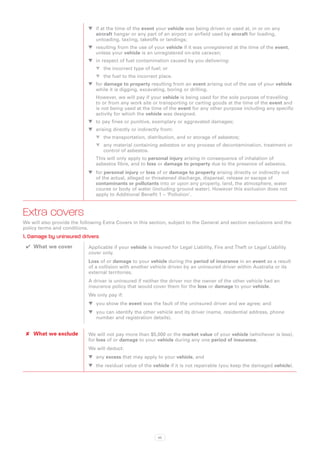
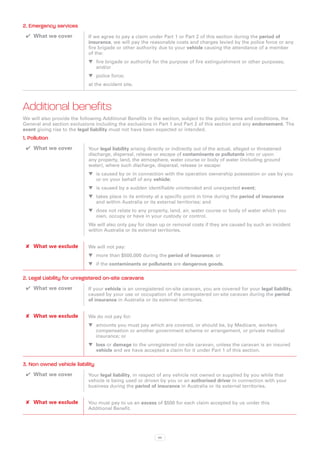
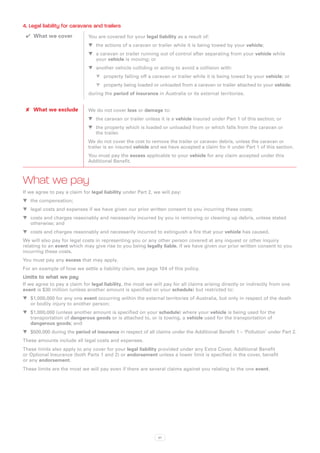
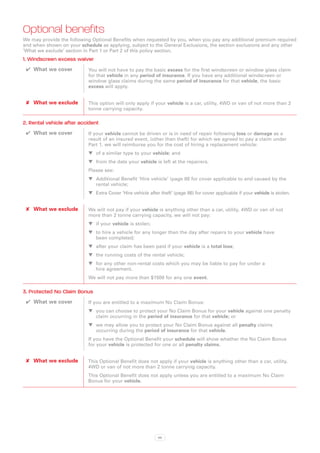
Tailored Insurance for Professional Offices and Surgeries
Product Disclosure Statement and Policy Wording
Professional Services Policy
        Welcome to Vero Enterprise                                                                          ii
        Who is the insurer?                                                                                 ii
        How to contact us                                                                                   ii
        About this Product Disclosure Statement and Policy Wording                                          ii
Part A – Policy summary                                                                                     iii
Part B – Your rights and responsibilities                                                                  iv
        Duty of Disclosure                                                                                 iv
        Not meeting your responsibilities                                                                  iv
        Cooling off period                                                                                 iv
        The amount of your premium                                                                         iv
        Paying your premiums                                                                               iv
        Claims made and notified basis of cover                                                             v
        Excessv
        Fraudulent claims                                                                                   v
        Privacy statement                                                                                   v
        Complaints resolution                                                                              vii
        Financial Claims Scheme                                                                            vii
        General Insurance Code of Practice                                                                viii
        Terrorism Insurance Act 2003                                                                      viii
        Updating information                                                                              viii
Part C – Information for some policyholders only                                                           ix
        The amount you pay for sections 1A, 1B or 1C (for a home building) or section 9 (for vehicles)     ix
        How various factors may affect your premium                                                        ix
        Premium discounts                                                                                   x
        Excessesxi
Part D – Your policy terms and conditions                                                                  xii
        Important information about your insurance policy                                                  xii
        In this insurance policy:                                                                          xii
        Our contract with you                                                                              xii
        Paying by monthly instalments                                                                      xii
        How the Goods and Services Tax (GST) affects this insurance                                        xii
        General policy conditions                                                                         xiii
        General claims conditions                                                                         xiv
        General exclusions                                                                               xvii
        When we may refuse a claim                                                                       xviii
        Inflation protection                                                                             xviii
        Cancelling your policy                                                                           xviii
        General definitions                                                                               xix
Section 1A – Property damage                                                                                1
Section 1B – Theft                                                                                         16
Section 1C – Glass                                                                                        23
Section 1D – Breakdown of machinery, computer equipment and electronic equipment                          26
Section 1E – Restoration of computer data                                                                  31
Section 1F – Computers – Increased costs of working                                                       32
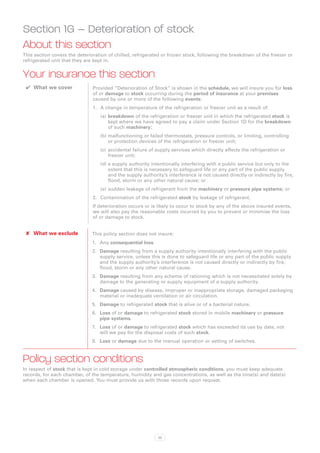
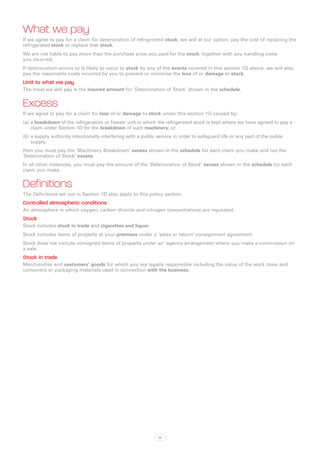
Section 1G – Deterioration of stock                                                                       33
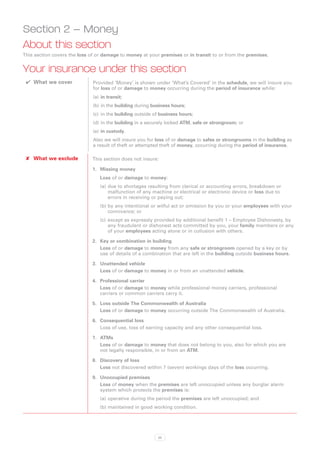
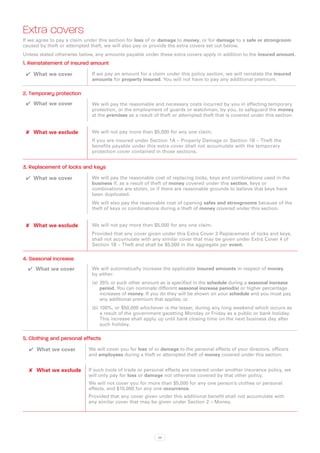
Section 2 – Money                                                                                         35
Section 3 – Portable and valuable items                                                                   40
Section 4 – Management liability                                                                          43
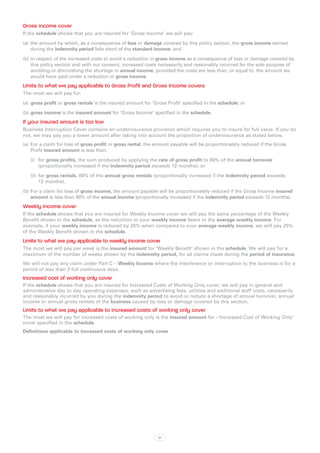
Section 5 – Business interruption                                                                         57
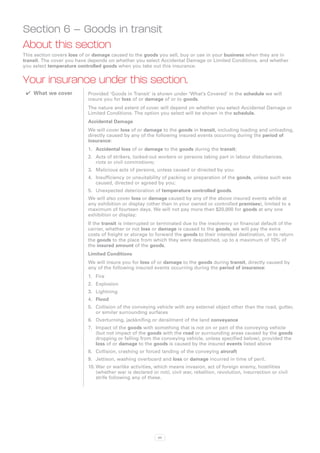
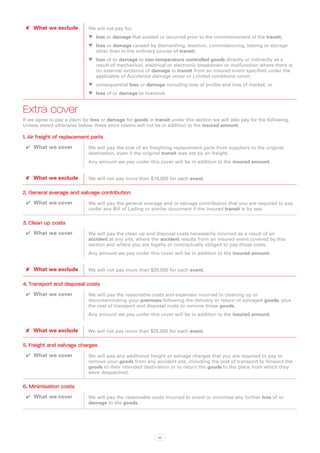
Section 6 – Goods in transit                                                                              65
Section 7 – Legal liability                                                                               69
Section 8 – Tax Probe®                                                                                    78
Section 9 – Commercial motor (including choice of repairer provisions)                                    82
                                                           i
Welcome to Vero Enterprise
Vero Insurance Limited ABN 48 005 297 807 is one of Australia’s largest intermediated general insurance companies
and is a member of the Suncorp Group of companies.
Vero offers tailored solutions and superior claims management to its large range of customers, with insurance
products in property, small business, commercial motor, professional indemnity, construction and engineering,
liability, travel, marine and personal insurance.
With a strong network of brokers, agents and corporate partners, Vero is Suncorp’s primary intermediated Commercial
Insurance brand nationally. Our specialist knowledge, combined with the scope of the Suncorp Group, ensures Vero is
a powerful brand in today’s competitive insurance market.
Vero Enterprise is a division of Vero Insurance Limited. Vero Enterprise provides small business owners with insurance
packages that offer a range of covers including property, liability and commercial motor.
Vero Enterprise policies are written in plain English. We aim to keep all your dealings with Vero Enterprise simple
and straightforward.
Who is the insurer?
Vero Insurance Limited ABN 48 005 297 807, AFS Licence No. 230859 is the insurer and issuer of this insurance policy
and is the issuer of this Product Disclosure Statement (PDS).
How to contact us
You may contact us by:
WW Telephone:	 1300 888 071
WW Email:	      via the “contact us” page on our website www.vero.com.au
WW Mail:	Vero Insurance Limited
          GPO Box 2068
          Adelaide SA 5001


About this Product Disclosure Statement and
Policy Wording
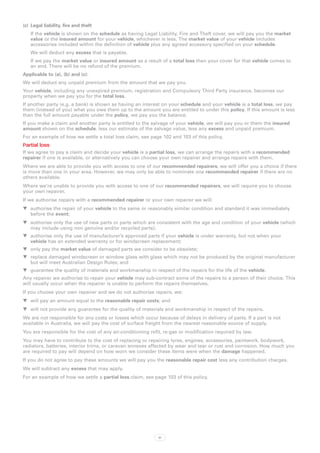
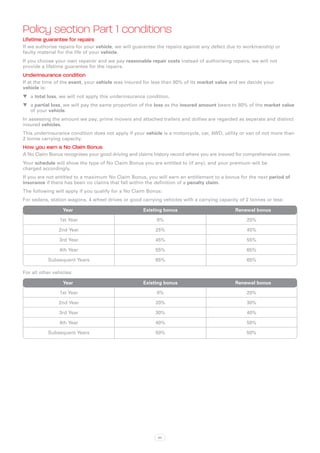
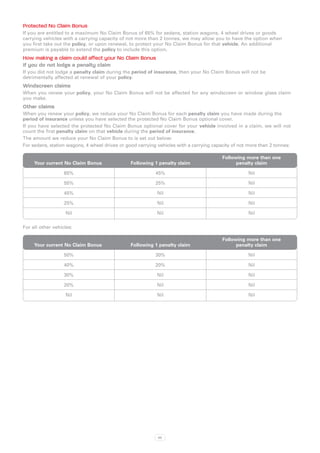
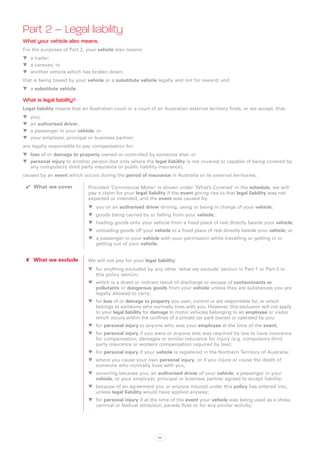
We are required to give you a Product Disclosure Statement (PDS) if you are insuring vehicles (not exceeding 2 tonnes)
under Section 9 or a home building under Sections 1A, 1B or 1C and you are:
WW an individual; or
WW a small business, having:
   WW in the case of a non-manufacturing business, less than 20 employees; or
   WW in the case of a manufacturing business, less than 100 employees.
This PDS and Policy Wording consists of 4 parts:
WW Part A contains your Policy Summary. You can use this summary, together with your insurance adviser, to decide
   which sections you need for you business.
WW Part B contains information about your rights and responsibilities, the General Insurance Code of Practice and how
   to contact us if you have a question or complaint. Part B applies to all sections and should be read by all persons
   who take out this policy.
WW Part C contains Information for certain persons insuring vehicles or a home building. This part only applies to you if
   you are insuring vehicles (not exceeding 2 tonnes) under Section 9 or a home building under Sections 1A, 1B or 1C
   and you are an individual or a small business.
WW Part D contains your the policy terms and conditions. It applies to all persons who take out this policy.
To understand the full terms and conditions of your policy, you must read the Your rights and responsibilities (Part B)
and your Vero Enterprise Professional Services Policy terms and conditions (Part D).
If you are insuring vehicles under Section 9 or a home building under policy Sections 1A, 1B or 1C and you are an
individual or a small business, you should also read Part C.


                                                            ii
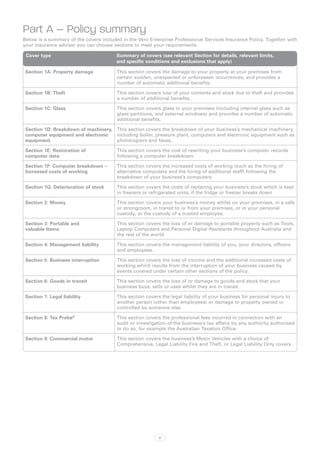
Part A – Policy summary
Below is a summary of the covers included in the Vero Enterprise Professional Services Insurance Policy. Together with
your insurance adviser you can choose sections to meet your requirements.

 Cover type	                            S
                                         ummary of covers (see relevant Section for details, relevant limits,
                                        and specific conditions and exclusions that apply)

 Section 1A: Property damage            This section covers the damage to your property at your premises from
                                        certain sudden, unexpected or unforeseen occurrences, and provides a
                                        number of automatic additional benefits.

 Section 1B: Theft                      This section covers loss of your contents and stock due to theft and provides
                                        a number of additional benefits.

 Section 1C: Glass                      This section covers glass in your premises (including internal glass such as
                                        glass partitions, and external windows) and provides a number of automatic
                                        additional benefits.

 Section 1D: Breakdown of machinery, This section covers the breakdown of your business’s mechanical machinery
 computer equipment and electronic   including boiler, pressure plant, computers and electronic equipment such as
 equipment                           photocopiers and faxes.

 Section 1E: Restoration of             This section covers the cost of rewriting your business’s computer records
 computer data                          following a computer breakdown.

 Section 1F: Computer breakdown –       This section covers the increased costs of working (such as the hiring of
 Increased costs of working             alternative computers and the hiring of additional staff) following the
                                        breakdown of your business’s computers

 Section 1G: Deterioration of stock     This section covers the costs of replacing your business’s stock which is kept
                                        in freezers or refrigerated units, if the fridge or freezer breaks down

 Section 2: Money                       This section covers your business’s money whilst on your premises, in a safe
                                        or strongroom, in transit to or from your premises, or in your personal
                                        custody, or the custody of a trusted employee.

 Section 3: Portable and                This section covers the loss of or damage to portable property such as Tools,
 valuable Items                         Laptop Computers and Personal Digital Assistants throughout Australia and
                                        the rest of the world.

 Section 4: Management liability        This section covers the management liability of you, your directors, officers
                                        and employees.

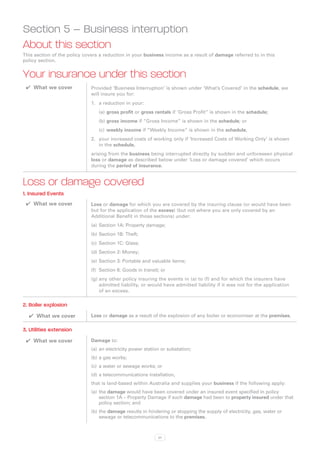
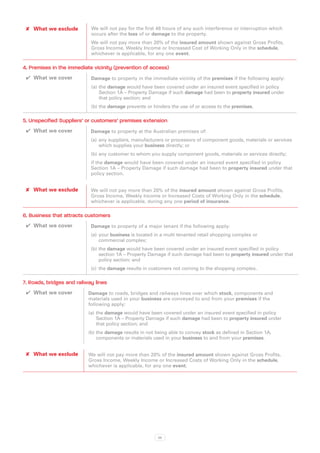
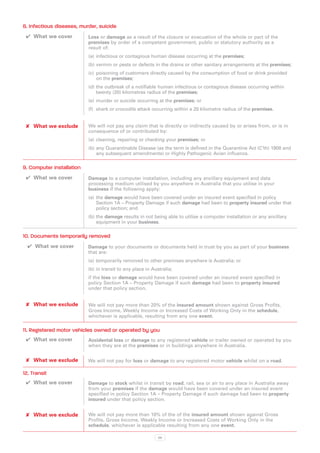
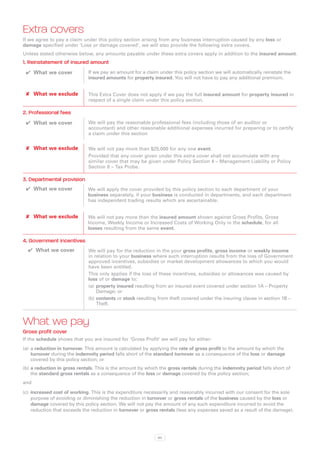
 Section 5: Business interruption       This section covers the loss of income and the additional increased costs of
                                        working which results from the interruption of your business caused by
                                        events covered under certain other sections of the policy.

 Section 6: Goods in transit            This section covers the loss of or damage to goods and stock that your
                                        business buys, sells or uses whilst they are in transit.

 Section 7: Legal liability             This section covers the legal liability of your business for personal injury to
                                        another person (other than employees) or damage to property owned or
                                        controlled by someone else.

 Section 8: Tax Probe®                  This section covers the professional fees incurred in connection with an
                                        audit or investigation of the business’s tax affairs by any authority authorised
                                        to do so, for example the Australian Taxation Office.

 Section 9: Commercial motor            This section covers the business’s Motor Vehicles with a choice of
                                        Comprehensive, Legal Liability Fire and Theft, or Legal Liability Only covers.


                                                           iii
Part B – Your rights and responsibilities
Duty of Disclosure
You must comply with your Duty of Disclosure when you apply for insurance with us and each time you renew or alter
your cover.
You have a duty of disclosure to tell us everything you know or should know, that is relevant to our decision to insure
anyone under the policy, including you, and on what terms.
It includes matters we specifically ask about when you apply for a policy, or renew or alter your policy, and any other
matters which might affect whether we insure you and on what terms.
The information you tell us can affect:
WW the amount of your premium and your excess
WW if we will insure you
WW if special conditions will apply to your policy.
You do not need to tell us of anything which:
WW reduces the chances of you making a claim
WW we should know about because of the business we are in or
WW we tell you we do not want to know.
If you are unsure it is better to tell us. If you do not tell us something which you know or should know is relevant, we
might reduce a claim, refuse to pay a claim, cancel your policy or, if fraud is involved we can treat the policy as if it
had never existed.
The duty of disclosure applies to every person or organisation insured under the policy. If you fail to comply with your
duty of disclosure we may be entitled to reduce our liability under the contract in respect of a claim or may cancel the
contract. If your non-disclosure is fraudulent, we may also have the option of avoiding the contract from its beginning.


Not meeting your responsibilities
If you do not meet with your responsibilities outlined in your policy, or if you do not tell us everything relevant to our
decision whether or not to insure you, or if you mislead us, we can refuse to pay a claim or reduce the amount we pay
or cancel your policy.
If fraud is involved, we can treat your policy as if it never existed.


Cooling off period
You have the right to cancel and return the insurance policy or a section of the policy by notifying us in writing within
30 days of the date it was issued to you (“cooling off period”), unless you have a claim under the policy within the
cooling off period.
If you cancel it in this time, we will return the amount you have paid.
In addition, if you vary your policy and add a section, you have the right to cancel that section within 30 days of the
date it was added by notifying us in writing (“additional cooling off period”) unless you make a claim under that
section within the additional cooling off period. If it is cancelled in this time, we will return the amount you have paid
for that section.
To cancel at other times, please see “Cancelling Your Policy” on pages xviii and xix.


The amount of your premium
The premium is the amount you pay us for this insurance. It includes stamp duty, GST, other government charges and
fire services levy (FSL) that applies. Your premium is shown on your schedule.
In addition to the factors we use to calculate your premium, the discounts you qualify for also affect your premium. Your
premium includes any discounts you qualify for and these are applied before adding applicable government charges.
The premium does not include any service or administration fee charged to you by your insurance intermediary.
We might advertise special offers and benefits from time to time. If we have a special offer available that is not in this
PDS, we can give you a separate terms and conditions brochure about the offer if you ask us. These offers might be
short-term and we can withdraw them at anytime.


Paying your premiums
We will tell you how much you have to pay and how much time you have for payment.
You must pay your premium by the due date. For the first period of insurance, if you do not pay the premium owing
by the due date, we can cancel your policy as set out in “Cancelling your Policy” on pages xviii and xix.


                                                               iv
For renewal policies, if you do not pay your premium by the due date, then the renewal policy will not commence and
your cover will end at the expiry of the previous period of insurance.


Claims made and notified basis of cover
Policy Section 4 – Management Liability (excluding Optional cover Employee Dishonesty) is issued on a ‘claims made
and notified’ basis. This means that Section 4 (excluding Optional cover Employee Dishonesty) responds to:
(a)	 claims first made against you during the period of insurance and notified to us during the period of insurance,
     provided that you were not aware at any time prior to the policy inception of circumstances which would have put a
     reasonable person in your position on notice that a claim may be made against him/her; and:
(b)	written notification of facts pursuant to section 40(3) of the Insurance Contracts Act 1984. The facts that you may decide
    to notify are those which might give rise to a claim against you. Such notification must be given as soon as reasonably
    practicable after you become aware of the facts and prior to the time at which the policy expires. If you give written
    notification of facts the policy will respond even though a claim arising from those facts is made against you after the
    policy has expired. For your information, s40(3) of the Insurance Contracts Act 1984 is set out below;
“S40(3) Where the insured gave notice in writing to the insurer of facts that might give rise to claim against the insured
as soon as was reasonably practicable after the insured became aware of those facts but before the insurance cover
provided by the contract expired, the insurer is not relieved of liability under the contract in respect of the claim when
made by reason only that it was made after the expiration of the period of insurance cover provided by the contract.”
When the period of insurance expires, no new notification of claims or facts can be made on Section 4 – Management
Liability (excluding Optional cover Employee Dishonesty) of the expired policy even though the event giving rise to the
claim against you may have occurred during the period of insurance. An exception to this is under the Automatic
Discovery Period Additional Benefit in Section 4, if any, under which some cover for new notification of claims or facts
is available.


Excess
This is the amount you have to pay if you suffer loss, damage or liability which leads to a claim under your policy.
The amount and type of excess that applies to your policy is shown either in Part D of this booklet or on your schedule.
If you claim under more than one section of your policy for one incident or event, then you only pay the highest
excess that applies unless expressly stated otherwise in the policy. For example, Additional Benefits may have their
own excess which are in addition to any excess that may apply to a claim.


Fraudulent claims
If you or anyone acting on your behalf or with your knowledge makes a claim that is false or causes loss or damage
deliberately, we may do one or more of the following:
WW refuse to pay a claim
WW cancel your policy
WW take legal action against you.


Privacy statement
Vero Insurance Limited is a member of the Suncorp Group (the ‘Group’).
The Privacy Act 1988 (Cth) requires us to inform you that:
Purpose of collection
Personal information is information about an identifiable individual and includes facts or an opinion about you which
identifies you or by which your identity can be reasonably determined. The collection of your personal information is
essential to enable us to conduct our business of offering and providing you with our range of financial products
and services.
We collect personal information for the purposes of:
WW identifying you when you do business with us;
WW establishing your requirements and providing the appropriate product or service;
WW setting up, administering and managing our products and services;
WW assessing and investigating, and if accepted managing a claim made by you under one or more of our products;
WW improving our financial products and services, including training and developing our staff and representatives.
We may be required by Anti-Money Laundering/Counter Terrorism Financing legislation to collect your personal information.
Consequences if personal information is not provided
If we request personal information about you and you do not provide it, we may not be able to provide you with the
financial product or service that you request, provide insurance cover, manage or pay any claim under an insurance
policy, manage your product or provide any benefits, or provide you with the full range of services we offer.

                                                              v
Disclosure
We use and disclose your personal information for the purposes we collected it.
We may also use and disclose your personal information for a secondary purpose related to the purpose for which we
collected it, where you would reasonably expect us to use or disclose your personal information for that secondary
purpose. In the case of sensitive information, any secondary purpose, use or disclosure will be directly related to the
purpose of collection.
When necessary and in connection with purposes listed above, we may disclose your personal information to and/or
collect your personal information from:
WW other companies within the Group;
WW where required or authorised under our relationship with our joint venture companies;
WW information technology providers, including hardware and software vendors and consultants such as programmers;
WW customer research organisations;
WW intermediaries including a representative acting on your behalf, other Australian Financial Services Licensee or our
   authorised representatives and our agents;
WW where you are an insured person and not the policy holder, we will disclose to the policy holder;
WW government, law enforcement or statutory bodies;
WW the Financial Ombudsman Service;
WW other insurers, financial institutions, insurance and claims reference agencies, credit agencies, loss assessors,
   financial or investigative service providers;
WW legal and other professional advisers;
WW hospitals, medical and health professionals;
WW research and development service providers;
WW printers and mail service and delivery providers for the mailing of statements, insurance policy documents and
   marketing material;
WW imaging and document management services; and
WW other service providers.
Disclosure overseas
There are also instances where we may have to send your personal information overseas or collect personal
information from overseas.
These instances include:
WW sending your personal information to companies in the Group;
WW when you have asked us to do so;
WW when we are authorised or required by law to do so;
WW when we have outsourced a business activity or function to an overseas service provider with whom we have a
   contractual arrangement; or
WW certain electronic transactions
WW when it is necessary in order to facilitate a transaction on your behalf.
We will only send your personal information overseas or collect personal information about you from overseas for the
purposes in this statement and in compliance with the privacy regime.
Access
You can request access to the personal information we hold about you by contacting us.
In some circumstances, we are able to deny your request for access to personal information. If we deny your request
for access, we will tell you why.
If accessing your personal information will take an extended period of time, we will inform you of the likely delay.
For more detailed requests for access to personal information, for example, access to information held in archives, a
fee may be charged to cover the associated cost of retrieval and supplying this information.
Marketing
We would like to use and disclose your personal information to keep you up to date with the range of products and
services available from us and other companies within the Group. Generally, our companies will use and disclose your
personal information for the Group’s marketing purposes.
If you do not want us to use and disclose your personal information for the purpose of marketing products and
services to you, you should contact us and tell us.
Contact
Please contact us to:
WW change your mind at any time about receiving marketing material;
WW request access to the personal information we hold about you; or
WW obtain more information about our privacy practices by asking for a copy of our Privacy Policy;
                                                             vi
You can contact us by sending a letter to;
The Privacy Officer
GPO Box 3999
Sydney NSW 2001
Our Privacy Policy can also be found on our website at http://www.vero.com.au/vero/privacy-policy


Complaints resolution
We are committed to:
WW listening to what you tell us;
WW being accurate and honest in telling you about our products and services;
WW communicating with you clearly; and
WW resolving any complaints or concerns you have in a fair, transparent and timely manner.
If you have a complaint concerning this product or our services, please tell the people who provided your initial
service or contact us by:
WW Telephone:	 1800 689 762
WW Mail:	      Reply Paid 1453 Customer Relations Unit RE058,
   	           GPO Box 1453 Brisbane QLD 4001 or
WW Email:	customer.relations@suncorp.com.au

What we will do to resolve your complaint
When you first let us know about your complaint or concern, we will review your complaint, consider the facts and
attempt to resolve your complaint by the end of the next working day.
If we cannot resolve your complaint to your satisfaction within 5 working days we will contact you to agree reasonable
alternative time frames. We will endeavour to send you our final decision within 15 working days from the date you
first made your complaint, provided we have all necessary information and have completed any investigations
required. If you are still unsatisfied with the final outcome at your request we can refer your complaint to our Internal
Dispute Resolution (IDR) team. Our IDR team will review your dispute, and respond to the dispute within 15 working
days of your complaint being referred to them provided they receive all necessary information and have completed
any investigation required.
What if you are not satisfied with our final IDR decision?
We expect our procedures will provide you with a fair and prompt resolution to your complaint. If however you are not
satisfied with our final decision or if we have not been able to resolve the complaint to your satisfaction within 45 days
you may be able to take the complaint to the Financial Ombudsman Service (“the FOS”).
The FOS is an independent external dispute resolution scheme and its service is free to our customers.
You can contact the FOS by:
WW Telephone:	 1300 780 808
WW Mail:	Financial Ombudsman Service
          GPO Box 3
          Melbourne VIC 3001.
WW Email:	     info@fos.org.au; or
WW Website:	www.fos.org.au
The FOS will tell you if they can help you, as their services are not available to all customers.
We agree to accept a FOS decision however you have the right to take legal action if you do not accept their decision.
If you want more information on the FOS, please ask us for a brochure.


Financial Claims Scheme
This policy may be a ‘protected policy’ under the Federal Government’s Financial Claims Scheme (FCS) which is
administered by the Australian Prudential Regulation Authority (APRA).
The FCS only applies in the extremely unlikely event of an insurer becoming insolvent and the Federal Treasurer
making a declaration that the FCS will apply to that insurer.
The FCS entitles certain persons, who have valid claims connected with certain protected policies issued by that
insurer to be paid certain amounts by APRA.
Information about the FCS can be obtained from APRA by:
WW Telephone:	 1300 55 88 49
WW Website:	www.apra.gov.au


                                                             vii
General Insurance Code of Practice
We support and adhere to the General Insurance Code of Practice. A copy of the Code can be obtained from the
Insurance Council of Australia by:
WW Telephone: 	 (02) 9253 5100 or
WW Website:		    www.ica.com.au


Terrorism Insurance Act 2003
Some sections of this policy exclude cover for losses as a result of terrorism.
In the event that damage to property occurs and the cause of the damage is declared a terrorist incident by the
responsible Minister, then you may be afforded protection within the limits of indemnity of this policy by virtue of the
Terrorism Insurance Act 2003. The operation of this Act may also serve to reduce the settlement of your loss to a
percentage of the otherwise recoverable loss. In the event that the settlement is reduced then this will be at the
direction of the Minister.
A more detailed explanation of the operation of the Terrorism Insurance Act 2003 can be obtained at www.arpc.gov.au.


Updating information
The information in this PDS and policy wording was current at the date of preparation. Vero may update some of the
information in the PDS and policy wording that is not materially adverse from time to time without needing to notify
you. You can obtain a copy of updated information by contacting us. We will give you a free paper copy of any
updates if you request them. If it becomes necessary, we will issue a supplementary or replacement PDS.


                                                            viii
Part C – Information for some policyholders only
This part applies to you if you chose cover for:
WW vehicles (not exceeding 2 tonnes) under section 9; or
WW a home building under Sections 1A (Fire and Defined Events Property Damage), 1B (Theft) or 1C (Glass),
and you are an individual or a small business.
You need to read this part if it applies to you.
Home building means a building which is used or intended to be used principally and primarily as a place of residence.
An example of what is considered a home building is where the building is a commercial premise but you may also
live in the building, or you rent part of the building for residential use.
If the building is only used by you for residential purposes, it cannot be insured under this policy.


The amount you pay for sections 1A, 1B or 1C
(for a home building) or section 9 (for vehicles)
The premium is the amount you pay us for this insurance. The premium payable by you will be shown on your
schedule. Premiums include applicable Commonwealth and state taxes and charges. These include the Goods and
Services Tax and stamp duty. The amount of these taxes and charges will be shown on your schedule.
If you change your policy you may be entitled to a partial refund of premium or be required to pay an additional premium.


How various factors may affect your premium
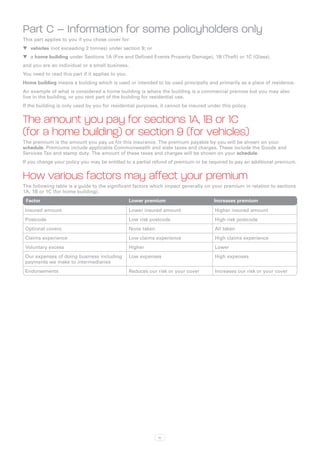
The following table is a guide to the significant factors which impact generally on your premium in relation to sections
1A, 1B or 1C (for home building).
 Factor	                                           Lower premium	                     Increases premium
 Insured amount                                    Lower insured amount               Higher insured amount
 Postcode                                          Low risk postcode                  High risk postcode
 Optional covers                                   None taken                         All taken
 Claims experience                                 Low claims experience              High claims experience
 Voluntary excess                                  Higher                             Lower
 Our expenses of doing business including          Low expenses                       High expenses
 payments we make to intermediaries
 Endorsements                                      Reduces our risk or your cover     Increases our risk or your cover


                                                                ix
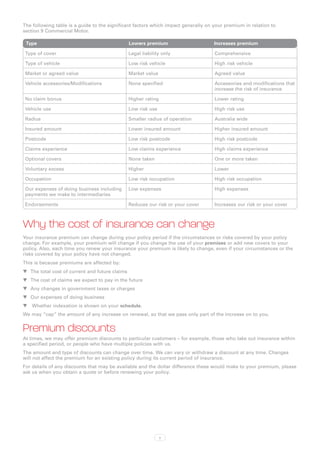
The following table is a guide to the significant factors which impact generally on your premium in relation to
section 9 Commercial Motor.

 Type	                                           Lowers premium	                    Increases premium

 Type of cover                                   Legal liability only               Comprehensive

 Type of vehicle                                 Low risk vehicle                   High risk vehicle

 Market or agreed value                          Market value                       Agreed value

 Vehicle accessories/Modifications               None specified                     Accessories and modifications that
                                                                                    increase the risk of insurance

 No claim bonus                                  Higher rating                      Lower rating

 Vehicle use                                     Low risk use                       High risk use

 Radius                                          Smaller radius of operation        Australia wide

 Insured amount                                  Lower insured amount               Higher insured amount

 Postcode                                        Low risk postcode                  High risk postcode

 Claims experience                               Low claims experience              High claims experience

 Optional covers                                 None taken                         One or more taken

 Voluntary excess                                Higher                             Lower

 Occupation                                      Low risk occupation                High risk occupation

 Our expenses of doing business including        Low expenses                       High expenses
 payments we make to intermediaries

 Endorsements                                    Reduces our risk or your cover     Increases our risk or your cover


Why the cost of insurance can change
Your insurance premium can change during your policy period if the circumstances or risks covered by your policy
change. For example, your premium will change if you change the use of your premises or add new covers to your
policy. Also, each time you renew your insurance your premium is likely to change, even if your circumstances or the
risks covered by your policy have not changed.
This is because premiums are affected by:
WW The total cost of current and future claims
WW The cost of claims we expect to pay in the future
WW Any changes in government taxes or charges
WW Our expenses of doing business
WW Whether indexation is shown on your schedule.
We may “cap” the amount of any increase on renewal, so that we pass only part of the increase on to you.


Premium discounts
At times, we may offer premium discounts to particular customers – for example, those who take out insurance within
a specified period, or people who have multiple policies with us.
The amount and type of discounts can change over time. We can vary or withdraw a discount at any time. Changes
will not affect the premium for an existing policy during its current period of insurance.
For details of any discounts that may be available and the dollar difference these would make to your premium, please
ask us when you obtain a quote or before renewing your policy.


                                                                 x
Excesses
If you make a claim you may be required to pay one or more excesses. The description of those excesses and the
circumstances in which they are applied are shown in the relevant policy wording in Part D of this booklet under
‘Excess’ or in the schedule.
Sections 1A, 1B and 1C: Excesses
The amount of excess applying to each of these sections is shown on your schedule. We take into consideration a
number of factors when setting the amount of your excess, such as:
WW your occupation;
WW any voluntary excess that we may allow you to choose;
WW your claims history; and
WW any additional risk factors that are unusual or unique to your business circumstances.
Section 9: Excesses
There are a number of excesses which apply to this section. The amount of each excess (other than the basic excess)
is shown in the policy wording that applies to section 9 in Part D of this booklet. The amount of the basic excess will
be shown on your schedule.
We take into consideration a number of factors when setting the amount of your basic excess, such as:
WW the make, model and type of vehicle being insured, including modifications made to the vehicle;
WW any voluntary excess that we may allow you to choose;
WW the age and driving experience of people who will be driving the vehicle;
WW the insured amount of the vehicle;
WW where and how the vehicle is used;
WW the type of cover chosen;
WW the place where your vehicle is garaged;
WW your previous insurance and claims history; and
WW Optional cover, extra covers, additional benefits and endorsements.


                                                           xi
Part D – Your policy terms and conditions
Important information about your insurance policy
Your insurance policy is made up of this policy wording, any endorsements and the schedule which shows the insured
amounts, the premium and any relevant government charges.
You should read the schedule and the policy wording together, to tell you what we cover, what we exclude, what we
pay to settle claims and other important information. Each section of this policy contains some exclusions, and there
are also some general exclusions which are listed on pages xvii and xviii, and which apply to the whole policy.


In this insurance policy:
Unless otherwise expressly defined in a section of the policy, you/your means the policyholder named in the schedule.
We/our/us means Vero Insurance Limited ABN 48 005 297 807, trading as Vero Enterprise.
Some other words used in this policy have special defined meanings. These words are in bold. The words we have
defined are listed in the either the “General Definitions” section on pages xix to xxii or in the Definitions section in the
applicable policy section.
The headings and grey shaded areas in each section are not part of the policy itself. Their purpose is to provide you
with a general guide about the content of the text.


Our contract with you
Your insurance policy is a legal contract between you and us. The contract is based on the information you gave us
when you applied for the insurance, and any subsequent information which you have supplied.
We will provide cover for the sections of the policy shown under “What’s Covered” on your schedule for the period
of insurance.
You must pay the premium, including relevant government charges for the period of insurance and comply with all of
the policy conditions.


Paying by monthly instalments
If we agree that you can pay us the total amount in a number of payments instead of all at once, this is called paying
by instalments.
If you are a month (or more) late in paying an instalment, we may cancel your policy (see “Cancelling your policy” on
pages xviii and xix).
We will not pay a claim if at the date of the event you are claiming for, you are 14 days (or more) late in paying
an instalment.


How the Goods and Services Tax (GST)
affects this insurance
In the premium, we will charge you an amount on account of GST.
You must inform us of the extent to which you are entitled to an input tax credit (ITC) for that GST amount each time
that you make a claim under this policy.
Despite the other provisions of this insurance (including provisions in the policy wording, the schedule and any
endorsement), our liability to you will be calculated taking into account:
(a)	 any input tax credit to which you are entitled for any acquisition which is relevant to your claim, or which you would
     have been entitled were you to have made a relevant acquisition; and
(b)	also for claims for business interruption only, the GST exclusive amount of any supply made by your business which is
    relevant to your claim.
In respect of loss of or damage to your vehicle, if your vehicle is a total loss and you have chosen the agreed value
option, we will not deduct any input tax credit entitlement from the amount of the agreed value shown in the schedule.
This outline of the effect of the GST on your policy is for general information only. You should not rely on this
information without first seeking expert advice on the application of the GST to your particular circumstances.


                                                               xii
General policy conditions
These conditions apply to all sections of this policy.
1. Change to risk
Our decision to insure you, and the premium that we charge you, is based on information provided by you about your
business, and the risks to be insured under this policy. Your insurance, including the amount of premium, may be
affected if any of the facts or circumstances that existed at the start of the policy change during the period of
insurance, including, for example:
(a)	 the nature of or type of business carried on by you or your tenants;
(b)	other circumstances that affect the premises or the property insured in such a way as to increase the risk of damage
    or losses;
(c)	 your interest in the policy ceases, including by operation of law;
(d)	the business is wound up or carried on by an insolvency practitioner or permanently discontinued;
(e)	 details of any conversion or modification to your vehicle made by someone other than the manufacturer. For example,
     if you give your vehicle wide tyres or wheels, or lower its suspension;
(f)	 if there is anyone under the age of 25 years who is likely to be a regular driver of the vehicle;
(g)	change of your address, your vehicle, your vehicle’s garage postcode or the way you use your vehicle.
You must immediately notify us of any changes to (a), (b), (c), (d), (e), (f) or (g) or any other changes that may increase
the risk insured under your policy.
If you are a property owner insuring buildings that you lease, our decision to insure you and the premium we charge
you will take into account information about your tenants and how the building is used that you tell us when you
apply for a policy with us, during the period of insurance and at each renewal. For this reason it is important that you
tell us as soon as these things change.
For example, if your building has three tenants (an accountant’s office, a jeans retailer and a sandwich bar) we will
calculate your fire premium on the sandwich bar, as it is more hazardous than either of the other two occupations. If
during the period of insurance the sandwich bar closes down and a menswear shop open, then you must notify us of
the change and we will calculate your fire premium either using the jeans retailer or menswear occupation.
If we agree to continue to insure you after you have told us of the changes you tell us about we will confirm this
in writing. In some cases, we may only agree to continue to insure you under this policy if you agree to pay us
additional premium.
2. The amount of cover
If you are not entitled to an input tax credit on your policy premium, all insured amounts and limits of liability stated
in your policy are GST inclusive (unless your policy states otherwise).
If you are entitled to an input tax credit on any part of the policy premium, the insured amount and limits of liability
stated in your policy are exclusive of any input tax credit which you are or would be entitled to claim.
3. Reasonable care and reducing risk
You must take reasonable steps to ensure that you and your tenants:
(a)	 maintain buildings, structures, fixtures, fittings, furnishings, appliances, vehicles, machinery, implements and plant in
     sound condition to minimise or avoid theft, loss or damage;
(b)	ensure that only competent employees are employed;
(c)	 avoid or minimise loss of or damage to property or injury to other people;
(d)	comply with all statutory obligations, by-laws, regulations, public authority requirements and safety requirements;
(e)	 obtain certificates of inspection for all equipment required by any statute or regulations to be certified; and
(f)	 comply, at your expense, with all our recommendations to prevent or minimise theft, loss or damage.
You must
(a)	 take all reasonable steps to prevent loss of or damage to your vehicle;
(b)	take all reasonable care to prevent injury to another person or damage or another persons property;
(c)	 comply with all laws and safety requirements imposed by any authority or by state or national legislation; and
(d)	keep all vehicles in a roadworthy condition.
4. Hazardous or dangerous goods
When hazardous or dangerous goods are used by the business or stored at premises shown on the schedule, then
such goods must be stored and used strictly in accordance with all statutory obligations, by-laws, regulations, public
authority requirements and safety requirements.


                                                                xiii
5. Interested parties
You must tell us in writing of the interest of all interested parties (for example, banks or lessors) when you want their
interest in any item insured under this policy covered. If a person is not named or noted on the policy, they are not
insured and cannot make a claim. This means we will need to record the interest of the interested party for those
interests to be covered.
The interested parties must comply with all the terms and conditions of your policy, including without limitation, the
obligation to notify us and give us details of any other insurance that insures any risk insured by this policy.
6. Transfer of interest
No interest in this policy can be transferred without our written consent.
7. Unoccupancy
You must ensure that any building at the premises does not stay unoccupied, or if you are the building owner,
untenanted, for a continuous period of 60 days or more. To have been occupied, the business premises must have been
used for business purposes for at least two consecutive days. You are not insured while the building is unoccupied for a
period of 60 days or more, unless we agree to insure you. If any building will or is likely to be unoccupied or untenanted
for such a period, you must notify us immediately. If you notify us that the premises will be unoccupied or untenanted
for a continuous period of 60 days or more and we agree to continue to insure you under this policy during the period
where the building is unoccupied or untenanted, we will tell you in writing. You may be required to pay an additional
premium and we may apply different conditions and impose a higher excess if we agree to this.
8. Changes in or waivers of the policy
No changes in the policy will be valid unless agreed in writing by us.
No waiver of any requirements of any section shall be valid unless it is given to you in writing.
9. Multiple insured parties
Except as expressly provided in Section 4 – Management Liability and Section 7 – Legal Liability, where there is more
than one person or organisation insured under this policy,
(a)	 any notice given by us under this policy to any one of you shown on the schedule will be deemed to be notice given to
     all of you;
(b)	any misrepresentation or fraudulent actions or statements made by any person or organisation will be deemed to be
    made by all of you; and
(c)	 any claim made by any person or organisation will be deemed to be a claim made by all of you.
10. Keeping us up to date
You must tell us at the commencement of your policy and at each renewal if any authorised driver of your vehicle,
including you, has:
(a)	 had a licence endorsed, suspended or cancelled in the past 5 years;
(b)	has been charged or convicted of any criminal offence relating to arson, drugs, firearms, burglary, housebreaking,
    theft, robbery, receiving stolen goods, fraud, criminal or wilful damage or injury, assault to anyone;
(c)	 has been charged with or convicted of any motor offence or motor infringement (but not parking fines).


General claims conditions
To enable us to process a claim under any section of this policy the following conditions apply.
1. Cooperation
You must co-operate with us fully in any investigation, negotiation, defence or settlement of any claim.
This may include attending court to give evidence.
2. Minimise loss
You must:
(a)	 take all reasonable precautions to minimise or prevent further loss, damage, injury or illness; and
(b)	take all reasonable steps to recover lost or stolen property.
3. Notify claim
You must:
(a)	 notify the police immediately following a theft or burglary or if any property is misappropriated, lost or
     maliciously damaged;
(b)	notify us as soon as possible and give us all the known details of the event including the police event number if
    available; and
(c)	 immediately send us any legal document or other communication you receive about the event.


                                                               xiv
4. Retain all damaged property
You must:
(a)	 retain and preserve all damaged property for our inspection prior to authorisation of repairs unless alterations and
     repairs are immediately necessary, for safety reasons or to minimise or prevent further loss, damage or injury. If
     repairs are necessarily carried out without our prior approval, you are still required where reasonably practical, to
     retain and preserve all damaged property for our inspection; and,
(b)	endeavour to preserve all property, products, plant and all other things that may assist us in investigating or defending
    a claim against you, including assisting in determining if there are rights of recovery against another entity or person.
5. Our rights of possession
We, our employees or our agents have the right to enter any building or area where loss or damage has occurred and
take possession of property insured or require the property insured to be delivered to us. We will deal with this
property in a reasonable manner.
6. Provide proof of ownership
You must supply us with all the information and documentation that we request to prove your ownership or legal
responsibility for the property insured and its value.
We will decide what is acceptable proof of ownership and value based on the property insured for which you are
claiming, the age of the item and its value at the time of loss or damage.
Examples of the type of documentation that may be required include, but is not limited to:
WW Tax invoices and/or receipts for property insured.
WW Photographs of the property insured.
WW Copies of any relevant contracts or agreements.
WW Statutory declaration verifying the details of your claim and any other matters connected with it.
WW Quotes for replacement items.
WW Vehicle log books.
WW Valuations or warranties.
We understand you may not keep such information for every business item you own, especially if items are recorded
in your books of account. You or your accountant may have records for tax purposes and these may be sufficient to
prove ownership.
7. Proof of fraud or dishonesty
In the event of a claim, you must supply us with all records and documents that may assist us in substantiating and
investigating the act of fraud or dishonesty and your rights of recovery. This includes but is not limited to all records
(including computer, electronic and accounting records), video and audio recordings, working papers, internal
memoranda, police reports, accounting records and audit documents.
8. Notification of other insurance
If there is any other insurance that insures any risk insured by this policy, you are required to notify us and give us
details of the other insurance
9. Admitting liability
You must not admit liability for any loss, damage or injury, or settle or attempt to settle or defend any claim without
our written consent.
10. Not authorise repair or replacement
You must not authorise the repair or replacement of anything without our agreement.
Motor vehicle claims
WW Contact our Vero First Response Unit as soon as possible soon on 1300 888 073. We’re available 24 hours a day.
   Our staff will advise you whether to bring your vehicle to one of our assessing centres or take it to a repairer. We
   can help with any other arrangements necessary to get you back on the road as quickly as possible.
WW If your vehicle is involved in an event, you should obtain the full names, addresses and phone numbers of all
   drivers and passengers involved and any witnesses to the event. You will also need to obtain the vehicle
   registration numbers and insurance details of all vehicles involved. If damage is caused to building and other
   property please provide details of the address and owners names.
WW If you get demands, a notice of prosecution, details of any inquest or similar communications from other parties
   involved in an event, you must tell us immediately. If you delay in telling us, we may not cover any legal or other
   costs that result from that delay.
WW You must let us inspect and, if necessary, move your vehicle before repairs begin.
WW You must not accept any payment (including excess payments) from anyone unless we agree first.


                                                              xv
11. Conduct of claims
We:
(a)	 may appoint legal or other representatives to assist in the conduct of a claim;
(b)	shall have the right and full discretion to conduct claims; and
(c)	 reserve the right to negotiate and settle any claim on terms we consider appropriate.
12. Excess
What is an excess?
The first amount of each and every claim that you are required to pay before the application of any limits by the policy.
The amount of the excesses and the circumstances that each excess applies to are shown on the schedule or set out in
the applicable section. We will tell you how to pay your excess and who to pay it to. In some cases, we will direct you
to pay the excess directly to a supplier or repairer.
Full payment prior to settlement
Any excess that is applied to a claim must be paid in full prior to settlement of that claim.
What if you do not pay the excess upon request?
We have no liability to you under this policy until you have paid the excess.
If the excess has been requested but remains unpaid we may:
(a)	 decline to settle the claim pending full payment of the excess; or
(b)	deduct the excess from the settlement.
Some Optional Insurances or Additional Benefits have their own excess which are in addition to any other excess that
may apply to a claim.
When multiple excesses apply, you might have to pay more than one type of excess when you make a claim.
Except as otherwise expressly provided, if more than one excess can be applied to one occurrence then you will only
need to pay the highest excess.
13. Claims settlement
(a)	 ITC entitlement
   If any event occurs which gives or may give rise to a claim you must tell us your entitlement to input tax credits
   for your insurance premium if you are registered, or should be registered, for GST purposes. If you did not tell
   us your entitlement or the information you give us is incorrect, we will not cover you for any resulting fines,
   penalties or tax charges.
(b)	Cash payments
   Any cash payments made to you under this policy will be based on costs including GST. However, if you are, or
   would be, entitled to claim any input tax credits for the repair or replacement of the property insured or for other
   things insured by the policy we will reduce our payment to you by the amount of your input tax credits entitlement.
(c)	 Discharge of our liabilities
   If, at any time, we pay you the insured amount for any claim under this policy, the future conduct of the claim then
   becomes your responsibility. We may also pay any extra covers, additional benefits or optional insurance that are
   expressed to be in addition to the insured amount.
(d)	Salvage
   After we have settled a claim by replacing a damaged item, if we so elect, the damaged or lost property (other than
   a building) becomes ours.
(e)	 Claims preparation expenses
   We will pay for accountant, claims consultants, surveyors, architects, engineers and other professional fees
   necessarily and reasonably incurred for the preparation of a valid claim made under this policy other than under
   Section 5 – Business Interruption, Section 4 – Management Liability or Section 8 – Tax Probe®.
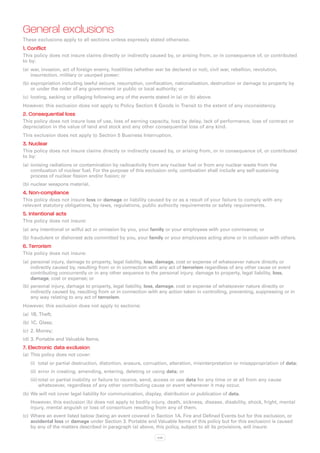
   The most we will pay is the lesser of $20,000 or 25% of the total amount payable under the applicable section
   other than Section 5 – Business Interruption, Section 4 – Management Liability or Section 8 – Tax Probe® as a
   result of an event.
14. Rights of recovery
We have the right to take action or institute legal proceedings, in your name, for the recovery of payments made and
expenses incurred in relation to any claim insured by this policy, against any person, company or entity legally liable
to you in respect of that claim.
You must provide us with full information and all reasonable assistance in the recovery of those payments or expenses.
You must not enter into any agreement or make any admissions that have the effect of limiting or excluding your
rights and our rights to recover payments and expenses without first obtaining our approval in writing to do so.
15. Subrogation agreements
If another person is, or could have been, liable to compensate you for any loss, damage or legal liability otherwise
covered by the policy, but you have agreed with that person either before or after the loss, damage or legal liability
occurred that you would not seek to recover any moneys from that person, we will not cover you under the policy for
any such loss, damage or legal liability.
                                                               xvi
General exclusions
These exclusions apply to all sections unless expressly stated otherwise.
1. Conflict
This policy does not insure claims directly or indirectly caused by, or arising from, or in consequence of, or contributed
to by:
(a)	 war, invasion, act of foreign enemy, hostilities (whether war be declared or not), civil war, rebellion, revolution,
     insurrection, military or usurped power;
(b)	expropriation including lawful seizure, resumption, confiscation, nationalisation, destruction or damage to property by
    or under the order of any government or public or local authority; or
(c)	 looting, sacking or pillaging following any of the events stated in (a) or (b) above.
However, this exclusion does not apply to Policy Section 6 Goods in Transit to the extent of any inconsistency.
2. Consequential loss
This policy does not insure loss of use, loss of earning capacity, loss by delay, lack of performance, loss of contract or
depreciation in the value of land and stock and any other consequential loss of any kind.
This exclusion does not apply to Section 5 Business Interruption.
3. Nuclear
This policy does not insure claims directly or indirectly caused by, or arising from, or in consequence of, or contributed
to by:
(a)	 ionising radiations or contamination by radioactivity from any nuclear fuel or from any nuclear waste from the
     combustion of nuclear fuel. For the purpose of this exclusion only, combustion shall include any self-sustaining
     process of nuclear fission and/or fusion; or
(b)	nuclear weapons material.
4. Non-compliance
This policy does not insure loss or damage or liability caused by or as a result of your failure to comply with any
relevant statutory obligations, by-laws, regulations, public authority requirements or safety requirements.
5. Intentional acts
This policy does not insure:
(a)	 any intentional or wilful act or omission by you, your family or your employees with your connivance; or
(b)	fraudulent or dishonest acts committed by you, your family or your employees acting alone or in collusion with others.
6. Terrorism
This policy does not insure:
(a)	 personal injury, damage to property, legal liability, loss, damage, cost or expense of whatsoever nature directly or
     indirectly caused by, resulting from or in connection with any act of terrorism regardless of any other cause or event
     contributing concurrently or in any other sequence to the personal injury, damage to property, legal liability, loss,
     damage, cost or expense; or
(b)	personal injury, damage to property, legal liability, loss, damage, cost or expense of whatsoever nature directly or
    indirectly caused by, resulting from or in connection with any action taken in controlling, preventing, suppressing or in
    any way relating to any act of terrorism.
However, this exclusion does not apply to sections:
(a)	 1B. Theft;
(b)	1C. Glass;
(c)	 2. Money;
(d)	3. Portable and Valuable Items.
7. Electronic data exclusion
(a)	 This policy does not cover:
   (i)	 total or partial destruction, distortion, erasure, corruption, alteration, misinterpretation or misappropriation of data;
   (ii)	 error in creating, amending, entering, deleting or using data; or
   (iii)	total or partial inability or failure to receive, send, access or use data for any time or at all from any cause
         whatsoever, regardless of any other contributing cause or event whenever it may occur.
(b)	We will not cover legal liability for communication, display, distribution or publication of data.
   However, this exclusion (b) does not apply to bodily injury, death, sickness, disease, disability, shock, fright, mental
   injury, mental anguish or loss of consortium resulting from any of them.
(c)	 Where an event listed below (being an event covered in Section 1A. Fire and Defined Events but for this exclusion, or
     accidental loss or damage under Section 3. Portable and Valuable Items of this policy but for this exclusion) is caused
     by any of the matters described in paragraph (a) above, this policy, subject to all its provisions, will insure:

                                                                xvii
(i)	 loss of or damage to insured property directly caused by the event, or
   (ii)	 consequential loss insured by this policy.
   This exclusion does not apply where an event listed below (being an event covered under Section 1A Fire and
   Defined Events but for this exclusion or accidental loss or damage under Section 3 Portable and Valuable Items) or
   Theft of data under section 1B – Theft (solely where such theft is accompanied by theft of the computer hardware,
   firmware, medium, microchip, integrated circuit or similar device containing such data) caused any of the matters
   described in paragraph (a) above.
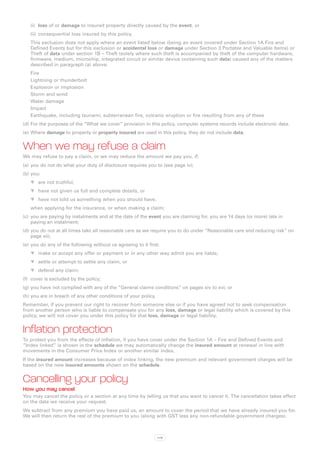
   Fire
   Lightning or thunderbolt
   Explosion or implosion
   Storm and wind
   Water damage
   Impact
   Earthquake, including tsunami, subterranean fire, volcanic eruption or fire resulting from any of these
(d)	For the purposes of the “What we cover” provision in this policy, computer systems records include electronic data.
(e)	 Where damage to property or property insured are used in this policy, they do not include data.


When we may refuse a claim
We may refuse to pay a claim, or we may reduce the amount we pay you, if:
(a)	 you do not do what your duty of disclosure requires you to (see page iv);
(b)	you:
   WW are not truthful,
   WW have not given us full and complete details, or
   WW have not told us something when you should have,
   when applying for the insurance, or when making a claim;
(c)	 you are paying by instalments and at the date of the event you are claiming for, you are 14 days (or more) late in
     paying an instalment;
(d)	you do not at all times take all reasonable care as we require you to do under “Reasonable care and reducing risk” on
    page xiii;
(e)	 you do any of the following without us agreeing to it first:
   WW make or accept any offer or payment or in any other way admit you are liable,
   WW settle or attempt to settle any claim, or
   WW defend any claim;
(f)	 cover is excluded by the policy;
(g)	you have not complied with any of the “General claims conditions” on pages xiv to xvi; or
(h)	you are in breach of any other conditions of your policy.
Remember, if you prevent our right to recover from someone else or if you have agreed not to seek compensation
from another person who is liable to compensate you for any loss, damage or legal liability which is covered by this
policy, we will not cover you under this policy for that loss, damage or legal liability.


Inflation protection
To protect you from the effects of inflation, if you have cover under the Section 1A – Fire and Defined Events and
“Index linked” is shown in the schedule we may automatically change the insured amount at renewal in line with
movements in the Consumer Price Index or another similar index.
If the insured amount increases because of index linking, the new premium and relevant government charges will be
based on the new insured amounts shown on the schedule.


Cancelling your policy
How you may cancel
You may cancel the policy or a section at any time by telling us that you want to cancel it. The cancellation takes effect
on the date we receive your request.
We subtract from any premium you have paid us, an amount to cover the period that we have already insured you for.
We will then return the rest of the premium to you (along with GST less any non-refundable government charges).


                                                                xviii
How we may cancel
We may only cancel a policy when the law says we can.
We will cancel your policy by telling you so in writing, either in person or by post to your last known address.
We will return the premium that you have paid for the rest of the period of insurance less any non-refundable
government charges.
Paying by instalments
If we agree that you can pay your total amount in a number of payments instead of all at once, this is paying by instalments.
If you are one month (or more) late in paying an instalment, we may cancel your policy following the procedure under
‘How you may cancel’ above.
If we pay out a claim for the full insured amount on your building, that cover ends. Any section, Extra cover,
Additional benefit or Optional cover for that building also ends. If your policy ends for this reason, we do not refund
any premium for an unexpired period of insurance. If you have been paying premiums by monthly direct debit
instalments, we will deduct the remaining instalment premiums due for the unexpired period of insurance from the
amount we pay for the claim.


General definitions
Unless defined differently in individual sections, these definitions apply to all sections.
Accidental
Unexpected and unintended from your standpoint.
Aircraft
Anything made or intended to fly or move in or through the air or space other than model aircraft. Aircraft
includes hovercraft.
Animal(s)
Any living creatures including but not limited to livestock, birds, fish, vermin, insects.
Business
The business(es) shown and described on the schedule.
Building(s)
The building(s) at the premises.
Building(s) includes:
(a)	 sheds with a concrete floor and fixed to foundations at the premises;
(b)	customised and modified shipping containers or transportable buildings permanently located at the premises used as
    workshops, lunchrooms or storage which are permanently fixed to the ground with electrical or plumbing services as
    necessary at the premises;
(c)	 shipping containers in which the stock your business distributes is delivered to your premises and from which
     merchandise is either being loaded into, unloaded from or stored in before dispatch, provided the container doors are
     secured when unattended with padlocks with a security rating under AS 4145.4 (or any subsequent amendment) of 6
     or above and the padlocked container is fully enclosed by a locked cyclone fenced area at the premises after hours;
(d)	walls, foundations, storage tanks, awnings, exterior lights, masts, antennae and aerials, fixed external signs, walls,
    gates, fencing, pavements, roads and other structural improvements pertaining to the building(s); or
(e)	 property owner’s fixtures and fittings, floor coverings plant, plumbing or wiring services that are within the building.
Building(s) do not include land, including topsoil and fill and dams, landscaping, reservoirs or canals.
Canada
The Dominion of Canada and its respective territories, protectorates or dependencies.
Cigarettes and liquor
Cigarettes, cigars, tobacco, liquor and spirits sold by you in the business.
Computer virus
A corrupting, harmful, or otherwise unauthorised piece of code that infiltrates your computer equipment, including a
set of unauthorised instructions, programmatic or otherwise, that propagates itself through your computer equipment.
Computer virus includes “trojan horses”, “worms” and “time or logic bombs”.
Customers’ goods
Goods that do not belong to you, but:
(a)	 belong to your customers and are in your physical or legal control because the business repairs, services, maintains, or
     stores those goods before or after it repairs, services or maintains the goods;
(b)	have been purchased by your customers and are in your physical or legal control awaiting delivery; or,
(c)	 are items at the premises that you have accepted responsibility to insure under a formal agreement.


                                                               xix
Data
Facts, concepts and information converted to a form usable for communications, display, distribution, interpretation or
processing by electronic and electromechanical data processing or electronically controlled equipment and include
programmes, software and other coded instructions for such equipment.
Damage or damaged
Sudden and unforeseen physical damage or destruction.
Electronic equipment
Any electronic equipment including, but not limited to mobile phones, laptops, palm pilots, computers, scanners,
printers, word processors, electronic processing systems, photocopiers, facsimile machines, electronic cash registers,
electronic scales and electronic testing or analysing equipment used by you in the business.
Electronic equipment does not include electronic equipment that is stock.
Endorsement
Documentary evidence of an alteration to the policy which forms part of the policy.
Event or events
One incident or all incidents of a series consequent on, or attributable to, one source or original cause.
Excess
The amount which is payable by you for each claim made under this policy.
Family
WW your spouse, your partner or your de facto who lives with you,
WW your parents and parents-in-law,
WW your children and children of your spouse, partner or defacto (not being your children) who live with you,
WW your brothers and sisters.
For the purposes of this definition “you” and “your” refers to the directors, owners and officers of the insured.
Flood
The covering of normally dry land by water that has escaped or been released from the normal confines any of the
following:
(a)	 a lake (whether or not it has been altered or modified);
(b)	a river (whether or not it has been altered or modified);
(c)	 a creek (whether or not it has been altered or modified);
(d)	another natural watercourse (whether or not it has been altered or modified);
(e)	 a reservoir;
(f)	 a canal;
(g)	a dam.
Fungus/fungi
Fungi is a group of simple plants that have no chlorophyll. They include but are not limited to mold, mildew, and
yeast. Fungi also includes spores.
Glass
(a)	 fixed glass forming part of or fixed to the exterior of the building including glass in fixed signs; or
(b)	fixed internal glass including fixed glass in furniture, counters, shelving and showcases, fixed and hanging mirrors,
    vitreous china and ceramic including but not limited to fixed washbasins, sinks, toilet pans and cisterns, contained
    within the building.
Home building
A building which is used or intended to be used, principally and primarily as a place of residence.
Hovercraft
Any vessel craft or thing made or intended to float on or in or travel on or through the atmosphere or water on a
cushion of air provided by a downward blast.
Input tax credit
The amount you are entitled to claim as a credit against GST that you have paid.
Insured/you/your
Any person, company or legal entity shown on the schedule as the policyholder.
Insured amount
The maximum amount that will be paid under a section or part of a section of the policy as specified in the schedule.
The insured amount will vary depending upon your requirements in relation to each section.


                                                                 xx
Loss/losses
Sudden or unforeseen physical loss.
Machinery
Except in relation to Sections 1D and 1G, any mechanical or electrical equipment, that generates, transmits or utilises
mechanical or electrical power, any electronic machine, device or instrument, but not including:
(a)	 any vehicle or mobile equipment;
(b)	any watercraft or aircraft;
(c)	 any elevator or escalator but not excluding any electrical or electronic equipment used with such apparatus; or
(d)	any buried piping, any drainage piping, any sprinkler piping and its accessory equipment.
Media
Material on which data is recorded or stored, such as magnetic tapes, hard drives, cartridges, dongles, CD’s, DVD’s,
USB’s, flash drives, memory cards or floppy disks, or other storage types, but Media does not include paper records.
Money
Except as provided in Section 4 – Management Liability, cash, bank notes, currency notes, negotiable cheques,
negotiable securities, travellers’ cheques, debit and credit card vouchers, discount house vouchers, money orders,
postal orders, unused postage stamps, revenue stamps, lottery tickets, stored value cards, public transport boarding
tickets, authorised gift vouchers, valuable documents (but limited to certificates of stock, bonds, coupons and all other
types of securities) and the contents of franking machines.
Money does not include collectable items (for example coin or stamp collections) or anticipated revenue.
Please note that this definition applies to all sections, with the exception of section 4 – Management Liability.
Obsolete stock
Stock (as defined in the applicable section of the policy) which can no longer be sold for its full value, for example
stock which is out-of-season fashion, superseded computers or perishable goods beyond their used by date.
Period of insurance
The period of time shown on the schedule during which insurance is provided under this policy.
Policy
Your insurance contract which consists of this PDS, any SPDS we may give you, any endorsements and your schedule.
Pollutants
Any solids, liquids, gaseous or thermal irritants or contaminants, including but not limited to, smoke, vapour, soot,
fumes, odour or any other air emission, acids, alkalis, chemicals, waste materials, waste water, oil or oil products,
infectious biological or medical waste, asbestos, electric or magnetic or electro-magnetic fuels, noise and any ionising
radiations or contamination by radioactivity.
Premises
The places listed in the schedule at which and from which you operate your business.
The premises includes buildings and land within the legal boundaries.
Product Disclosure Statement (PDS)
PDS is the name of this document and it contains the terms of your insurance cover. It tells you what cover we
provide, details of costs and excesses and other important information. It should be read together with your schedule,
any endorsements and any SPDS that we may give you.
Property insured
means the property as described in the schedule in respect of each policy section.
Road
Any surveyed or unsurveyed land dedicated to public use, according to law, as a road (including a footpath or median
strip. It also includes a toll road or a bridge which is open to the public and used as a road.
Safe or strongroom
A container or structure which has been specifically designed for the safe storage of money or valuables and is
designed to resist unauthorised opening by hand-held or power operated tools.
A safe is not:
(a)	 an ATM;
(b)	a cash tin;
(c)	 a locked drawer in a filing cabinet or desk; or
(d)	a burglary resistant container weighing less than 20 kilograms that is not fixed by dynabolts to the wall or floor of
    the premises.
Schedule
The record of the particulars of your insurance which forms part of this policy. The schedule is issued when we have
accepted your insurance. At each renewal of your policy, the renewal schedule becomes your current schedule.
Updated schedules or endorsements may also be sent to you showing alterations to your policy.


                                                              xxi
Supplementary Product Disclosure Statement (SPDS)
An SPDS updates or adds to the information in the PDS.
Terrorism
An act, including but not limited to the use of force or violence (or threat of force or violence) by any person or group
of people acting alone, or on behalf of or in connection with any organisation or government, that from its nature or
context are done for, or in connection with, political, religious, ideological ethnic or similar reasons with the intention
to influence any government or put the public or any section of the public in fear.
United States
The United States of America and its respective territories, protectorates and dependencies.
Vehicle
Except in relation to Section 9 – Commercial Motor, any type of machine on wheels or on caterpillar tracks (including
any trailer, caravan or other apparatus attached to the machine) made or intended to be propelled other than by
manual or animal power.
Watercraft
Anything made or intended to float or travel on or through water other than model boats.
We/us/our
Vero Insurance Limited ABN 48 005 297 807, AFS Licence No. 230859.
You/your/insured
Any person, company or legal entity shown on the schedule as the policyholder.


                                                             xxii
Section 1A – Property damage
About this section
This section of the policy covers physical loss of or damage to your property from a variety of causes including but not
limited to events such as fire, lightning and explosion. We do not cover the theft or breakdown of your property under
this section.


Your insurance under this section
 ✔✔ What we cover            Provided ‘Property Damage’ is shown under ‘What’s Covered’ in the schedule, we will
                             insure you for loss of or damage occurring during the period of insurance to buildings,
                             contents, stock or specified items, at your premises.

 ✘✘ What we exclude          We will not pay for loss or damage:
                             WW which is insurable under any other section of the policy whether effected or not, or
                             WW which is excluded under any other section of the policy.
                             We will not pay for loss or damage caused by:
                             WW fraud or theft by you, your directors, partners, employees, officers or anyone else
                                who has an interest in the property;
                             WW any unexplained inventory shortage or disappearance of property;
                             WW or induced by trickery;
                             WW the incorrect siting of buildings as a result of an error in architectural design or
                                specification, faulty workmanship, or noncompliance with the requirements of any
                                government, or statutory authority;
                             WW the cessation of work whether total or partial, interruption, or retarding of any
                                process or operation as part of an industrial dispute;
                             WW demolitions or modifications ordered by any government or statutory authority as a
                                result of your failure, or the failure of your agents to comply with any lawful
                                requirement;
                             WW erosion, landslide, mudslide, rockslide,
                             WW subsidence, seepage, settling, shrinkage, or expansion of earth, vibration or other
                                earth movement, unless damage is caused by or arises directly from an earthquake,
                                subterranean fire or volcanic eruption;
                             WW flood,
                             WW the sea including tidal wave, storm surge or high water, unless damage is caused by
                                or arises directly from a tsunami;
                             WW faulty or inadequate packing or storage;
                             WW any faults or defects known to you or to any employee whose knowledge in law
                                would be deemed to be your knowledge, and not disclosed to us at the time the
                                insurance was arranged, extended, varied, renewed or reinstated;
                             WW pollution or contamination unless it is sudden and unforeseen;
                             WW kidnapping, bomb threat, threat of contamination, hoax, extortion or any attempt at
                                any of these; or
                             WW the gaining of access by any person other than you or your employees to your
                                computer systems via data communication media;
                             WW a named cyclone (being a cyclone named by the Bureau of Meteorology) where the
                                damage occurs within 72 hours from the commencement of this policy.


                                                            1
We will not pay for loss or damage caused to buildings, contents, stock or specified
items damaged by a named cyclone and added to your policy (which includes increasing
insured amounts) within 72 hours of the loss or damage occurring.
We will also not pay for loss or damage caused by:
WW spontaneous combustion, fermentation,
WW heating or any process involving the application of heat;
WW faulty materials or workmanship or error in design or latent defect;
WW gradually operating causes including but not limited to wear and tear, gradual
   deterioration, disease, fading, tree roots, evaporation, change in flavour, colour,
   or texture;
WW scratching, denting, chipping, marring, developing flaws, restoration, normal upkeep
   or making good;
WW animals;
WW atmospheric moisture, rot, mould, mildew, fungus, rust, corrosion, oxidation,
   variations in temperature, action of light,
WW stain or smoke from industrial operations;
WW mechanical, hydraulic, electrical breakdown or electronic failure or malfunction;
WW testing, intentional overloading or experiments of any kind; or fusion of any nature
   except as provided by Additional Cover 5 Fusion of small electrical motors;
the exclusions in the paragraph above only apply to the item, appliance, machine, unit or
structure immediately affected and shall not extend to loss of or damage to any other
property that would otherwise be covered under this section.
We will not pay for loss of or damage to:
WW glass or signs, other than loss or damage caused by fire, lightning, explosion,
   implosion, earthquake, impact by vehicles or animals, aircraft and other aerial devices
   and/or articles dropped from them, riots or civil commotion, wind or water;
WW money or negotiable instruments;
WW property where the loss or damage was caused during the course of its processing
   or manufacture;
WW property in the open air unless such property is a permanent structure designed to
   function without the protection of walls or roof;
WW boilers and pressure plant (except boilers and pressure plant for domestic purposes)
   resulting from it’s own explosion.
The following conditions apply in respect of the event of Earthquake, tsunami,
subterranean fire or volcanic eruption, or fire resulting from any of these, during any
period of 72 consecutive hours:
(a)	 We will not cover the first $20,000 or 1% of the total of the insured amounts specified in
     the schedule that relate to the damaged property at the premises for each claim for
     this event, whichever is the lower.
   For example, if the insured amount in the schedule for ‘Buildings’ is $1,000,000 and
   the insured amount for ‘Contents’ is $500,000 and the earthquake causes damage to
   the buildings and contents, you will be required to contribute the first $15,000 (1% of
   $1,500,000) of a claim as this amount is less than $20,000.
(b)	You will only be required to pay one excess for damage that results from these events
    during any period of 72 consecutive hours.
(c)	 Damage arising from an insured event that occurs more than 72 hours after the event
     will be considered to be a separate event in which case an additional excess will
     be required.


                                2
Extra covers
If we agree to pay a claim under this section, we will also provide the following extra covers.
Unless stated otherwise below, any amounts payable under these extra covers apply in addition to the
insured amount.

1. Reinstatement of insured amount
 ✔✔ What we cover            If we pay an amount for a claim under this policy section we will automatically reinstate the
                             insured amounts for property insured. You will not have to pay any additional premium.


 ✘✘ What we exclude          This Extra Cover does not apply if we pay the full ‘Building’ insured amount under this
                             section in respect of a single claim.

2. Rewriting of records
 ✔✔ What we cover            Where documents or data are lost or damaged in the event that gave rise to your claim,
                             we will pay the reasonable costs of restoring the data stored on media or the cost of
                             clerical labour actually, necessarily and reasonably incurred in rewriting, restoring or
                             recreating the records or documents.

 ✘✘ What we exclude          We will not pay more than $50,000 or the unexhausted portion of the contents insured
                             amount for Section 1A – Property Damage, whichever is the higher, for loss or damage.

3. Cost of tracing the source of water damage
 ✔✔ What we cover            We will cover the reasonable cost of searching for the unknown cause of:
                             (a)	the discharge or leaking of water from any damaged pipe, water system (including
                                 a fire protection system such as a sprinkler system), tanks or drains installed in and
                                 servicing the building; or
                             (b)	water from a damaged water main in the immediate vicinity of the building at the
                                 premises.
                             We will also pay for:
                             (a)	the reasonable costs of removing water and any incidental cleaning operations; and
                             (b)	if water is discharged from a fire protection system, any expenses incurred by you
                                 for the attendance of the fire brigade for the purpose of shutting off the water supply
                                 following an accidental discharge of water from a fire protection system.

 ✘✘ What we exclude          We will not pay more than $25,000 for all exploratory costs incurred during any one
                             period of insurance.
                             We will not cover the cost of repair or replacement of the defective part or parts of the
                             pipe or water system that caused the damage.

4. Professional fees
 ✔✔ What we cover            We will pay the reasonable cost of surveyors’, architects’ and other professional fees for
                             estimates, plans, specifications, quantities, tenders and supervision, incurred in the
                             repair or replacement of lost or damaged buildings that are covered by your claim.

 ✘✘ What we exclude          We will not pay more than $25,000 or the unexhausted portion of the insured amount
                             relating to the damaged buildings whichever is higher, for any one insured event,
                             subject to the Under-insurance provision in this section.
                             We will not pay any claim under this extra cover if your schedule shows the building as
                             being insured for ‘Indemnity’.


                                                            3
5. Removal of debris
 ✔✔ What we cover          We will pay the reasonable costs of removal, storage and disposal of debris or the
                           demolition, dismantling, shoring up, propping, underpinning or other temporary repairs
                           incurred by you.

 ✘✘ What we exclude        We will not pay more than $50,000 for any one insured event. Additionally if the
                           combined insured amount for this section has not been otherwise exhausted, we will
                           pay up to the remainder of the unexhausted amount, subject to the Under-insurance
                           provision in this section.
                           We will not pay for the costs of removing debris if:
                           (a)	 the liability to remove, store or dispose of debris has arisen as a result of any
                                agreement made by you, unless liability would have attached in the absence of such
                                agreement; or
                           (b)	the debris is itself a contaminant or pollutant that does not form part of the construction
                               material of the building.

6. Loss of land value
 ✔✔ What we cover          If we pay for a claim for loss or damage to a building at the premises, we will pay for
                           any reduction in land value that results from the decision by any legal authority not to
                           allow rebuilding or only to allow partial rebuilding of that building at the premises.

 ✘✘ What we exclude        We will not pay more than:
                           (a)	 10% of the building insured amount shown on the schedule; or
                           (b)	$100,000;
                           whichever is the lesser.
                           For example, if the insured amount for the building is $900,000, we will not pay more
                           than $90,000 (10% of $900,000), as this amount is less than $100,000).

7. Mortgage discharge costs
 ✔✔ What we cover          The reasonable legal costs associated with the discharge of a mortgage or mortgages on
                           building(s) following settlement of a claim under this section for the building(s) on a
                           total loss basis.

 ✘✘ What we exclude        We will not pay more than $30,000 in total during any one period of insurance.

8. Environmental upgrade
 ✔✔ What we cover          The additional costs incurred if you elect to repair or replace property insured that is lost
                           or damaged in the period of insurance and which is covered by your claim, using, or
                           with, environmental technology, products, or materials, that improve the energy or
                           water efficiency of the property.

 ✘✘ What we exclude        We will not pay more than 10% of the amount we would otherwise have paid to repair
                           or replace the property that is being upgraded.
                           (For example, your building, insured for $1,000,000, is destroyed and when it is
                           reinstated, you are required to comply with local building regulations. You also
                           decide to add solar energy capture technology, not required by the regulations, to
                           power the building. We will pay up to $100,000 for the costs of the solar energy
                           capture technology).

9. Floating stock
 ✔✔ What we cover          Where we pay a claim for loss or damage of stock at the premises, we will pay more
                           than the stock insured amount at that premises to account for the temporary transfer of
                           stock between premises provided that:
                           (a)	 there are at least two premises specified on the schedule and an insured amount has
                                been separately specified on the schedule for stock at each premises insured under this
                                section, including the affected premises; and
                           (b)	you transfer the stock between premises as a usual business practice.


                                                           4
✘✘ What we exclude         We only pay for loss or damage to stock from the event that gave rise to the claim.
                            We will not pay a claim under this extra cover where stock levels in excess of the
                            insured amount at a premises have been temporarily located at that premises for a
                            period exceeding 90 days and where we have not agreed in writing to this.
                            We will not pay more than the total of the stock sums insured for all premises.

10. Catastrophe inflation protection
 ✔✔ What we cover           If we agree to pay a claim for damage to your building that is a direct result of a
                            catastrophe, we will pay up to an additional 20% of the insured amount for buildings for
                            any additional costs incurred in rebuilding that can be directly attributed to increases in
                            the price of services and materials as a direct result of the catastrophe.
                            For example, if your insured amount for buildings was $1,000,000 we would pay up to
                            an extra $200,000 (20% of $1,000,000). However, this extra cover does not operate to
                            increase the total insured amount for the purposes of calculating the application of any
                            extra cover or additional benefits or the Underinsurance provision in this section.

 ✘✘ What we exclude         We will not pay more than the increased building costs which are actually incurred by
                            you as a direct result of the catastrophe.
                            We will not pay any claim under this extra cover if you choose not to rebuild the
                            buildings (or any part of them) at the premises shown on your schedule. We will not
                            increase the insured amount to pay for damage to any property other than buildings.
                            We will not pay any claim under this extra cover if your schedule shows the building as
                            being insured for ‘Indemnity’.

11. Directors’ and employees’ tools of trade and personal effects
 ✔✔ What we cover           We will pay for loss of or damage to directors’ and employees’ tools of trade and
                            personal effects caused by an insured event as if they were contents.

 ✘✘ What we exclude         We will not pay more than $5,000 for any one person’s tools of trade and personal
                            effects for any one insured event. Any amount we pay for this extra cover will not be in
                            addition to the contents insured amount.
                            If such tools of trade or personal effects are covered under another insurance policy, we
                            will only pay for loss or damage not otherwise covered by that other policy.

12. Capital additions
 ✔✔ What we cover           If we pay for a claim for loss or damage to a building or contents at the premises and:
                            (a)	 buildings, or part of them, are in the process of being constructed, erected, altered or
                                 added to; or
                            (b)	contents are in the process of being installed or modified;
                            we will pay for loss or damage to the new additions or installations caused by the same event.

 ✘✘ What we exclude         We will not cover you for any loss or damage caused by or arising out of storm, wind
                            and rain (including snow, sleet or hail):
                            (a)	 for a building we will not pay more than:
                               (i)	 $ 500,000; or
                               (ii)	 20% of the building insured amount,
                               whichever is the lesser amount; or
                            (b)	for a contents we will not pay more than:
                               (i)	 $ 100,000; or
                               (ii)	 20% of the contents insured amount,
                               whichever is the lesser amount.
                            For example, in the case of buildings at the premises that are insured for $1,100,000 and
                            the building is being altered, we will not pay more than $220,000 (20% of $1,100,000) as
                            this amount is less than $500,000.
                            If your business is retail, and the contents of your rented shop are insured for $150,000
                            and you are refitting the shop shelving and service counters, we will not pay more than
                            $30,000 (20% of $150,000), as this amount is less than $100,000.

                                                            5
13. Undamaged foundations
 ✔✔ What we cover            If the building foundations at the premises are not damaged by an insured event that
                             causes other damage to the building but a government or statutory authority requires
                             reinstatement of the building to be carried out on another site, the foundations will be
                             considered as destroyed.

14. Seasonal increase period/s
 ✔✔ What we cover            We will automatically increase the insured amount in respect of stock by 35% or such
                             other amount as specified in the schedule during a seasonal increase period.
                             You can nominate different seasonal increase period(s) or higher percentage increases of
                             stock. If you do they will be shown on your schedule and you must pay any additional
                             premium that applies.


 ✘✘ What we exclude          We will not pay more than the loss or damage to your stock from the event that gave
                             rise to the claim.


Additional benefits
We will also provide the following additional benefits in this section, subject to the General exclusions and all of the
exclusions in this policy section, unless provided otherwise.
Unless stated otherwise below, any amounts payable under these additional benefits apply in addition to the
insured amount.

1. Prevention of loss or damage
 ✔✔ What we cover            We will cover you for the necessary costs that you incur:
                             (a)	 to extinguish a fire occurring during the period of insurance on or in the vicinity of your
                                  premises which causes or threatens loss of or damage to your property insured;
                             (b)	to prevent or diminish imminent damage to your property insured by any other insured
                                 event covered by your policy; or
                             (c)	 for the temporary protection and safety of your property at the premises necessitated
                                  by damage from an insured event occurring during the period of insurance, including
                                  the employment of security services.

 ✘✘ What we exclude          We will not pay more than $25,000 for all claims under this additional benefit during any
                             one period of insurance.
                             If you are insured under Section 1B – Theft or Section 2 – Money, the benefits payable
                             under this additional benefit shall not be cumulative with the temporary protection cover
                             contained in those sections and shall be $25,000 for all claims under this additional
                             benefit during any one period of insurance.
                             We will not pay for:
                             (a)	 any fines penalties, or liability incurred by you; or
                             (b)	any loss or damage to your property
                             under this Additional Benefit.

2. Temporary removal of property
 ✔✔ What we cover            We will pay for loss or damage in the period of insurance to property insured while:
                             (a)	 temporarily removed from the premises,
                             (b)	in transit to or from the premises by road, railway, inland waterway or air, or
                             (a)	 stored at a temporary storage facility, self storage unit or bulk storage facility.


                                                               6
✘✘ What we exclude       We will not pay more than 20% of the stock and contents insured amount for stock and
                          contents for any one claim under this additional benefit.
                          We will not pay more than $20,000 for any one claim under this additional benefit in respect
                          of buildings, landlord’s plant and machinery normally attached to the buildings but not used
                          for any purpose of trade, and landlord’s fixtures and fittings attached to the building.
                          We will not pay for loss of or damage to:
                          (a)	 property located outside Australia at the time of loss or damage; or
                          (b)	property that had been removed for a period greater than 90 days at the time of loss
                              or damage;
                          (c)	 stock of a brittle nature including but not limited to glass, pottery and china, unless
                               caused by fire or as direct result of collision or overturning of the conveying vehicle;
                          (d)	stock or contents in open vehicles caused by wind, water hail or storm unless the stock
                              is appropriately protected by vehicle sheets such as tarpaulins;
                          (e)	 stock in transit as a result of packing which was inadequate to withstand normal
                               handling during transit;
                          (f)	 directors’ and employees’ tools of trade and personal effects;
                          (g)	motor vehicles, except for fork lift trucks and similar appliances that are used for
                              hauling or conveying goods at the premises; or
                          (h)	stock that you have consigned to another person for sale.

3. Damage to business records away from the premises
 ✔✔ What we cover         We will pay the reasonable costs incurred due to loss or damage to computer system
                          records, documents, manuscripts, plans, drawings, designs and business books of every
                          description used for the purposes of your business if they are lost or damaged in a
                          vehicle accident or stolen from a locked vehicle in the period of insurance.

4. Landscaping
 ✔✔ What we cover         We will pay for loss of or damage to landscaping at the premises during the period
                          of insurance.
                          Landscaping includes trees, shrubs, plants and lawns.

 ✘✘ What we exclude       We will not pay more than $10,000 for any one insured event..
                          We will not pay for any loss of or damage to landscaping which occurs as a result of:
                          (a)	 storm, wind and rain (including snow, sleet or hail);
                          (b)	malicious acts (including by vandals and thieves); or
                          (c)	 animals.

5. Damage to glass in vacant buildings
 ✔✔ What we cover         If you own but do not occupy any buildings shown as insured under this section at a
                          premises, we will cover you for the following costs directly related to the breakage of
                          glass in the period of insurance in a rentable area of the building that is vacant at the
                          time of the breakage:
                          (a)	 the cost of temporary shuttering, pending replacement of the broken glass;
                          (b)	the costs incurred in replacing reflective materials and burglar alarm tapes and
                              connections attached to the glass;
                          (c)	 the cost incurred in repairing or replacing damage to window, door or showcase frames
                               and their fittings, but not to bars, grilles or shutters; or
                          (d)	the cost incurred in repairing or replacing tiles on shop and office fronts and around
                              the glass.


                                                           7
✘✘ What we exclude           We will not pay more than $5,000 during any one period of insurance for all claims
                              under this additional benefit.
                              We will not cover you for any breakage:
                              (a)	 of glass caused by or arising out of fire or the application of heat;
                              (b)	of glass:
                                 (i)	 when in transit or whilst being fitted into position or removed from its fitting;
                                 (ii)	 in light fittings;
                                 (iii)	that is cracked or imperfect prior to breakage;
                                 (iv)	that is not fit for the purpose intended; or
                                 (v)	 that is in a glasshouse.
                              We will not pay for the breakage of:
                              (a)	 tiles on shopfronts and office fronts, other than around the broken glass; or
                              (b)	plastic or perspex signs.
                              We will not cover any claims under this additional benefit if:
                              (a)	 you have selected Section 1C – Glass of the policy;
                              (b)	your insured building is leased to a tenant; or
                              (c)	 the premises has remained unoccupied or untenanted for a continuous period longer
                                   than 60 days and we have not agreed to in writing to this during the period of insurance.
                              The excess that applies to this additional benefit is:
                              (a)	 the excess shown on the schedule; or
                              (b)	$500
                              whichever is the higher.

6. Fusion of small electric motors
 ✔✔ What we cover             The burn out of electric motors which form part of buildings or contents insured under
                              this section during the period of insurance, if the burn out is caused by or directly due to
                              the electric current.

 ✘✘ What we exclude           We will not pay for burn out of electric motors greater than 1.8 kilowatts
                              (2.5 horse power).
                              If an electric motor cannot be replaced, we will pay the replacement cost of an
                              equivalent motor or motor in a sealed unit of the same specification and standard
                              available today. We will not pay for replacement of the whole appliance or content.

7. Refrigerated stock/foods
 ✔✔ What we cover             Loss of or damage to foods or stock at the premises during the period of insurance
                              caused by one or more of the following events:
                              (a)	 a change in temperature as a result of:
                                 (i)	 the breakdown of the refrigeration or freezer unit in which the refrigerated food or
                                      stock is kept;
                                 (ii)	 malfunctioning or failed thermostats, pressure controls, or limiting/controlling
                                       protection devices;
                                 (iii)	accidental failure of public supply services;
                                 or
                                 (iv)	sudden leak of refrigerant from the refrigeration or freezer unit in which the
                                      refrigerated food or stock is kept;
                              (b)	contamination of the refrigerated food or stock by leakage of refrigerant.


                                                                 8
✘✘ What we exclude         Loss of or damage resulting from a public supply authority intentionally interfering with
                            the public supply service, unless this is done to safeguard life or any part of the public
                            supply.
                            Loss or damage resulting from any scheme of rationing which is not necessitated solely
                            by damage to the generating or supply equipment of a supply authority.
                            Loss or damage caused by disease, improper storage, damaged packaging material or
                            inadequate storage.
                            Loss of or damage to refrigerated food or stock which is stored in mobile machinery.
                            Loss of or damage to refrigerated food or stock which has exceeded its use by date.
                            We will not pay more than:
                            (a)	 $5,000 per event; or
                            (b)	the amount shown in the schedule as “refrigerated foods/stocks”;
                            whichever is the greater.

8. Theft of external property
 ✔✔ What we cover           If you own but do not occupy a building shown as insured under this section at a
                            premises, we will cover you for the theft in the period of insurance of plant, plumbing or
                            wiring services that are not part of that building but which are securely attached (by
                            means other than the connection to a power point) to the building structure.

 ✘✘ What we exclude         We will not cover you for more than $5,000 in the aggregate during the period of
                            insurance for all claims under this additional benefit.
                            We will not pay for any loss or damage caused by your family or your tenants.
                            We will not pay any claims under this additional benefit if you have selected
                            Section 1B – Theft

9. Temporary cover for new premises
 ✔✔ What we cover           We will cover you for loss or damage occurring during the period of insurance to any
                            new premises that you occupy, as if that premises was shown on the schedule as an
                            insured premises, provided that:
                            (a)	 you first occupy the new premises during the period of insurance;
                            (b)	the business carried on at or from the new premises is the same as shown on the
                                schedule;
                            (c)	 the property at the new premises is of the same nature as the buildings, contents and
                                 stock located at a premises and would have been covered if they were located at a
                                 premise; and
                            (d)	the buildings at the new premises are constructed of the same materials as the
                                buildings at any premises, and have the same or superior protection systems as those
                                at a premise.

 ✘✘ What we exclude         We will not cover you for more than 20% of the highest total insured amount for any
                            premises shown on the schedule.
                            For example, if you insure two existing premises, one which has insured amounts for all
                            property insured totalling $1,000,000 and the other which has insured amounts for all
                            property insured totalling $2,000,000, then any new premises will be covered for up to
                            $400,000 (20% of $2,000,000, the higher of the two insured amounts for all property
                            insured at a premises).
                            We will not cover you under this additional benefit for any loss or damage at the new
                            premises that occurs more than 30 days after you first occupy the new premises.


                                                           9
Section conditions
These conditions apply to all covers and claims under section 1A – Fire and Defined Event of this policy.
1. Under-insurance
In the event of loss or damage covered under this section:
(a)	 for claims settled on a reinstatement or replacement basis, we will be liable for no greater proportion of the loss or
     damage than the total insured amount as specified in the schedule for all property insured, at the premises where the
     loss or damage occurs, bears to 80% of the cost (net of any input tax credit that you could claim) which would have
     been incurred in reinstatement at the time when the policy was entered into, if the whole of the property insured had
     been destroyed at that time; or
(b)	for claims settled on an indemnity basis, we will be liable for no greater proportion of the loss or damage than the total
    insured amount specified in the schedule for all property, at the premises where the loss or damage occurs, bears to
    80% of the indemnity value (less any Goods and Services Tax component of that value) of all of the property at the
    time when the policy was entered into.
This condition does not apply if the amount of any loss or damage (net of any input tax credit that you could claim) is
less than 5% of the total insured amount specified on the schedule for all property at the premises where the loss or
damage occurs.
See the worked dollar example below for an example of how underinsurance will apply to reduce the amount we will
pay for claims under your policy.
2. Sprinklers and fire alarm systems
All fire protection systems (either manual or automatic sprinkler or alarm systems) in the building(s) and which you
own or have responsibility for maintaining must be maintained in accordance with the Australian Standards
Maintenance Series (A.S. 1851 or any subsequent amendments).
3. Indexation
If shown on the schedule that indexation applies, we will automatically adjust all insured amounts shown on the
schedule each year according to the most appropriate price index (as determined by us) and any other relevant indices
published by the Australian Bureau of Statistics.
The premium you pay will be based on the adjusted insured amounts shown on the schedule.


                                                              10
Worked dollar examples
The following worked dollar examples are designed to assist you in understanding some of the important benefits in
this section and how claims are calculated. The examples do not cover all scenarios or all benefits and do not form
part of your policy terms and conditions. The following examples should be used for general guidance only.

 You have cover for a building that is used as both a hairdressing salon and your residence. For this reason it is a
 home building. Indemnity is not shown on your schedule, so you have cover on a replacement value basis. The
 total insured amount on the schedule is shown as $400,000 (the total of the insured amounts shown on your
 schedule for the building of $380,000, contents of $10,000 and stock of $10,000 and there are no specified items)
 and the excess shown on the schedule is $250.
 When setting the building insured amount, you must consider the costs to remove debris and payment of any
 architect fees. The building is damaged in a storm and we assess the cost of repairs to be $50,000.

 How much we pay                             Further information

 Cost of repairing the storm       $50,000   We normally decide the building is repairable if the cost of repairing the
 damage to your building                     building is less than the insured amount (in this example the insured
                                             amount for buildings is $380,000).

 Removal of debris               +$30,000    Removal of debris +$30,000 In addition to the damage to the building,
                                             the storm has created building debris that requires cleaning up and
                                             removal. The most we will pay under the removal of debris benefit is
                                             the higher of $25,000 or any unexhausted amount of the insured
                                             amount in respect of the damaged property. However, as the total
                                             insured amount has not been exhausted and is greater than $25,000, we
                                             will pay the debris cost of $30,000.

 Less excess                         -$250   We deduct this from the amount we pay. We may require you to pay
                                             this amount directly to the repairer.

 Total claim                       $79,750   We normally pay this amount directly to the repairer.

 Underinsurance on a partial loss
 In the above example, if the actual replacement value of the building, contents and stock at the time the policy was
 entered into was $580,000 but you had only insured the building, contents and stock for $400,000 the amount we
 pay will be reduced in accordance with the underinsurance condition in this section.
 The amount we would pay will be calculated as follows:

                                                $400,000
 Total claim of $80,000   x                                                    = $68,965 less $250 excess = $68,715
                                             (80% x $580,000)


 You have cover for a building that is used as both a cafe and your residence. For this reason it is a home building.
 Indemnity is not shown on your schedule so you have cover on a replacement value basis. The insured amount on
 the schedule for buildings is shown as $2,500,000 and the excess shown on your schedule is $250. The building is
 damaged in an earthquake and we assess the cost of repairs to be $1,000,000.

 Cost of repairing the          $1,000,000   We normally decide the building is repairable if the cost of repairing the
 damage to your building                     building is less than the insured amount (in this example the insured
 that arose from the                         amount is $2,500,000).
 earthquake

 Removal of debris                 $40,000   In addition to the damage to the building, the storm has created building
                                             debris that requires cleaning up and removal. The most we will pay
                                             under the removal of debris benefit is $25,000 in addition to any
                                             unexhausted amount of the total insured amount. However, as the total
                                             insured amount has not been exhausted, we will pay up to any
                                             unexhausted amount remaining from the total insured amount.

 Less excess                      -$10,400   Since the damage is caused by an earthquake, an excess of 1% of the
                                             insured amount of the loss or damage (up to a maximum of $20,000) applies.
                                             In this example 1% of the insured amount of the loss to the buildings is
                                             $10,400. We may ask you to pay this amount directly to the repairers.

 Total Claim                    $1,029,600   We normally pay this amount directly to the repairers.


                                                           11
What we pay
The maximum we will pay for any one claim, other than a claim for a specified item, under this section is the amount
shown on the schedule or adjusted in accordance with this section, whichever is the higher.
The maximum we will pay for each specified item is the insured amount shown in the schedule for that item.
For contents that are works of art, antiques or curios we will only pay the value of the item up to a maximum of
$10,000 for each item.
For any item of contents or for any specified item that is part of a pair or set, the limit applies to the pair or set.
1. Building(s), specified items or contents
Reinstatement or replacement
Unless the schedule shows you are insured for ‘Indemnity’ then, when buildings, specified items or contents are lost
or destroyed we will, at our option:
(a)	 rebuild the buildings at the premises shown on your schedule or at another site;
(b)	replace contents or specified items with similar property;
(c)	 pay you the amount shown on the proof of purchase for specified items;
(d)	pay you the amount of a valuation by the Auctioneers and Valuers Association of Australia for specified items of works
    of art, antiques and curios; or
(e)	 pay the cost of rebuilding or replacing the buildings, specified items or contents.
If the buildings, specified items or contents are damaged, then we will, at our option:
(a)	 repair or replace the buildings, specified items or contents; or
(b)	pay the cost of repairing or replacing the buildings, specified items or contents .
Reinstatement or replacement is subject to the following conditions:
(a)	 the work of rebuilding, replacing or repairing must be commenced and completed by you within a reasonable time
     otherwise the amount we pay will be the indemnity value of the property. This means we will reduce the amount we
     pay you to take into account age, wear, tear and depreciation.
(b)	when rebuilding at another site, we will not pay more than we would pay to rebuild at the premises.
(c)	 when any property is damaged, but not destroyed, we will not pay more than the amount that we could have been
     called upon to pay for if that property had been destroyed.
(d)	we will only pay to return the property to a condition substantially the same as, but not better or more extensive
    than, its condition when new, using building materials readily available and in common use in The Commonwealth
    of Australia.
2. Indemnity
If your schedule shows you are insured for ‘Indemnity’ then, for any loss of or damage to building or contents we will,
at our option:
(a)	 repair, reinstate or replace the building or contents;
(b)	pay you the market value of the building or contents at the time of its loss or damage; or
(c)	 pay the cost of repair or replacement.
In all cases, where appropriate, we will reduce the amount we pay you to take into account age, wear, tear
and depreciation.
3. Extra costs of reinstatement: Building is not a heritage building
If you are insured under this section on a reinstatement or replacement basis, we will also pay the extra cost of
reinstatement or replacement of buildings which are necessarily incurred to comply with the requirements of any Act
of Parliament or regulation or any by-law or regulation of any municipal or other statutory authority, other than those
relating to heritage status of the building.
The following conditions apply:
(a)	 the work of reinstatement must be commenced and completed within a reasonable time; and
(b)	the amount payable will not include any additional costs in complying with any requirement that you had been
    required to comply with before the loss or damage occurred.
If the cost of reinstatement of the building insured is less than 50% of what would have been the cost of reinstatement
if that building had been totally destroyed, then the amount we will pay will:
(a)	 be limited to the extra cost necessarily incurred in reinstating the damaged portion of the building only;
(b)	not include any extra cost in relation to any portion of the building which is not damaged; and
(c)	 will not exceed, in any event, the amount that we would have paid if that building had been totally destroyed.


                                                                 12
4. Extra costs of reinstatement: Heritage building
If you are insured under this section on a reinstatement or replacement basis for loss of or damage to any building
that is subject to any heritage listing or protection and you choose to rebuild, replace or repair the building at the
same location, we will pay the extra cost of repairing, replacing, or reinstating the building, that are related to
obtaining special materials or employing specialised labour to match up or reproduce unique or distinctive ornamental
or architectural features of the building to comply with standards imposed by lawful heritage protection authority.
We will not pay more than the cost necessary to rebuild, replace or repair any such heritage listed building to a
reasonably equivalent appearance and capacity using original design and suitable modern equivalent materials, if the
original materials are not available.
The following conditions apply:
(a)	 the work of reinstatement must be commenced and completed within a reasonable time; and
(b)	the amount payable will not include any additional costs in complying with any requirement that you had been
    required to comply with before the loss or damage occurred.
5. Loss of floor space
If a building insured under this section on a reinstatement or replacement basis can only be rebuilt with a reduced
floor space as a result of:
(a)	 an Act of Parliament or regulations; or
(b)	a by-law or regulation of any Municipal or other statutory authority;
We will, in addition to reinstating or replacing the building on the basis set out above for the building with a reduced
floor space, pay you the difference between:
(a)	 the actual cost of rebuilding the building with the reduced floor space; and
(b)	the estimated cost of rebuilding the building with the floor space it had at the time of its destruction.
6. Stock and customers’ goods
If stock or customers’ goods are lost or damaged, we will, at our option:
(a)	 pay the market value of the stock or customers’ goods at the time of the loss or damage up to but not exceeding the
     insured amount for stock under the Fire and Defined Events section in the schedule;
(b)	pay you the market value of obsolete stock or its purchase price (net of GST), whichever is the lesser, but no more
    than the original cost to you;
(c)	 replace or repair the stock or customers’ goods with property or materials equal to or of a similar standard and
     specification as the stock or customers’ goods at the time it was lost or damaged; or
(d)	pay the cost of repair or replacement of the lost or damaged stock or customers’ goods.
7. Branded stock
We will not sell branded stock as salvage without your consent.
If you do not agree to us selling the branded stock as salvage, we will pay the market value of the stock after brands,
labels or names have been removed.


Excess
You must pay the excess shown on the schedule that applies to a claim under this section.
If you are making a claim for loss or damage:
(a)	 caused by an act committed by your tenants, the excess for each claim is $500 or the excess shown on the schedule
     (whichever is higher);
(b)	covered under Additional Benefit 5 – Damage to glass in vacant buildings, the excess for each claim is $500 or the
    excess shown on the schedule (whichever is higher).
Refer to page 2 for the conditions and excess that apply to earthquake, tsunami, subterranean fire or volcanic eruption,
or fire resulting from any of these.


                                                               13
Definitions
The following words have the following meanings for this section only. You should also refer to the General Definitions
section starting on page [xix].
Catastrophe
A large scale destructive event, in the area the property insured is located, which either:
(a)	 the Insurance Council of Australia has declared to be an ‘insurance catastrophe event’; or
(b)	as a consequence of the event, the relevant government authority has declared a state of emergency.
Contents
Business and office furniture, tools of trade and equipment used by you in the business.
Contents includes:
(a)	 unused stationery and printed books;
(b)	where you are a tenant of a leased or rented premises:
   (i)	 property owner’s fixtures and fittings, window blinds and floor coverings for which you are liable under the
        terms of a lease or similar agreement;
   (ii)	 fixtures and fittings installed by you for your use in the business; and
   (iii)	installed fixtures and fittings, window blinds, cool rooms, awnings, CCTV and other security systems, exterior
         lights, masts, antennae and aerials, fixed external signs and air conditioning units including external
         compressors and pipes at your premises;
(c)	 money up to $500;
(d)	plant and machinery, unregistered forklifts and hoists, communications systems, fixtures and fittings, signs
    and awnings;
(e)	 computers, word processors, printers, scanners and other peripheral equipment and other electronic equipment or
     electronic data processing systems;
(f)	 digital or analogue telecommunication transmission and receiving equipment, lighting facilities, televisions, audio
     visual amplification or surveillance equipment and office machines;
(g)	data, media, records, documents, manuscripts, plans, drawings, designs and business books, but only for the value of
    these materials in their unused or uninstalled state or as blank stationery;
(h)	current patterns, models, moulds, dies and lasts used in the business but limited, unless repaired or replaced, to the
    value stated in your financial records at the time of damage; or
(i)	 works of art, antiques or curios.
Contents does not include:
(a)	 stock;
(b)	specified items;
(c)	 directors’ and employees’ tools of trade and personal effects;
(d)	jewellery, precious metals or stones, bullion or furs;
(e)	 vehicles registered for road use, caravans, trailers, watercraft, aircraft, hovercraft, rolling stock and locomotives or
     their accessories;
(f)	 live animals;
(g)	plants, shrubs, lawns, growing crops, pastures and standing timber; or
(h)	customers’ goods other than customers’ records and documents held or created by you as part of your business.
Employee
Any person while employed by you in the business who you compensate by salary, wages or commission and have
the right at all times to govern, control and direct in the performance of their work.
Employee does not include:
(a)	 Any broker, factor, consignee or contractor;
(b)	Any member of your family; or
(c)	 Any partner, director or trustee unless that person is also your employee.
Property
The property means buildings, contents, stock and specified items at the premises.


                                                                14
Seasonal increase period
Any period of time during the period of insurance that has stock levels at least 35% higher than stock levels at other
times during the period of insurance.
The total number of days we will allow as seasonal increase periods is 120 days during any one period of insurance
unless a different period is shown in the schedule. You do not have to tell us what the dates of the periods are, but ,if
you make a claim under this section then your financial records over at least the previous 2 years must substantiate
the period as a seasonal increase period. If the business is less than 2 years old, you can use the financial records of
your business from the date of commencement until the date of the loss or damage to substantiate your claim.
Specified items
Each item of property that is specifically described on the schedule for Section 1A.
Stock
Stock includes stock in trade and cigarettes and liquor.
Stock includes items of property at your premises under a ‘sales or return’ consignment agreement.
Stock does not include consigned items of property under an ‘agency arrangement where you make a commission on
a sale.
Stock in trade
Merchandise and customers’ goods for which you are legally responsible including the value of the work done and
containers or packaging materials used in connection with the business.


                                                            15
Section 1B – Theft
About this section
This section covers the loss of your contents, stock and cigarettes and liquor at your buildings from theft, attempted
theft, armed hold up or an actual or threatened assault.


Your insurance under this section
 ✔✔ What we cover           Provided ‘Theft’ is shown under ‘What’s Covered’ in the schedule we will insure you for
                            loss or damage occurring during the period of insurance of your contents, stock, and
                            cigarettes and liquor at your buildings caused by one or more of the following:
                            1.	 Theft


 ✘✘ What we exclude         This section does not insure:
                            1.	 Theft by you, your employees or family
                               Loss of or damage to property insured caused by you, your employees or any
                               member of your family.

                            2.	 Certain property
                               Loss of or damage to:
                               (a)	money where the loss or damage is greater than $250;
                               (b)	jewellery, precious metals or stones, bullion or furs unless these items form part
                                   of your stock;
                               (c)	 motor vehicles, except for fork lift trucks and similar appliances that are used for
                                    hauling or conveying goods at the buildings;
                               (d)	live animals; or
                               (e)	 plants, shrubs, landscaping materials or growing crops, pastures or standing timber.

                            3.	 Glass
                               The breakage of glass, washbasins, sinks, toilet pans or cisterns, or the cost of
                               replacing sign writing, ornamentation, reflective materials and burglar alarm tapes
                               attached to broken glass.

                            4.	 Open space
                               Except as expressly provided by Additional Benefit 2 – Theft of External Property, loss
                               of or damage of property insured from any open space, whether fenced or unfenced,
                               outside the walls of the building.
                            5.	 Certain events
                               Loss or damage:
                               (a)	resulting from or as a consequence of fire; or
                               (b)	arising during or as a consequence of earthquake, subterranean fire, riot or
                                   civil commotion,
                               unless you are able to prove that the loss or damage occurred independently of
                               these events.
                            6.	 Consequential loss
                               Loss of use, loss of earning capacity and any other consequential loss.


                                                            16
Extra covers
If we agree to pay a claim under this section for loss or damage caused by theft, we will also pay or provide the extra
covers set out below.
Any amounts payable under these extra covers do not apply in addition to the insured amount specified in the schedule.
1. Reinstatement of insured amount
 ✔✔ What we cover            If we pay an amount for a claim under this policy section we will automatically reinstate the
                             insured amounts for property insured. You will not have to pay any additional premium.

2. Included damage to rented buildings
 ✔✔ What we cover            We will pay for damage to the buildings that you occupy as a tenant if you are legally
                             liable for that damage under your tenancy agreement, provided that the damage is due
                             to theft following actual forcible and violent entry to or exit from the buildings which
                             occurs during the period of insurance.

 ✘✘ What we exclude          We will not pay more than $5,000 for any one claim.

3. Temporary protection
 ✔✔ What we cover            We will pay the reasonable and necessary costs of temporary protection incurred, or the
                             employment of guards or watchman by you, for the safety and protection of the
                             building pending repair of damage to the building caused by a theft.


 ✘✘ What we exclude          We will not pay more than $5,000 for any one claim.
                             If you are insured under Section 1A – Property Damage or Section 2 – Money, the
                             benefits payable under this extra cover shall not be cumulative with the temporary
                             protection cover contained in those sections.

4. Replacement of locks and keys
 ✔✔ What we cover            We will pay the reasonable cost of replacing locks, keys and combinations used in the
                             business if, as a result of the theft, keys or combinations are stolen, or if there are
                             reasonable grounds to believe that keys have been duplicated.
                             We will also pay the reasonable cost of opening safes and strongrooms because of the
                             theft of keys or combinations during a theft.


 ✘✘ What we exclude          We will not pay more than $5,000 for any one claim.
                             Provided that any cover given under this Extra Cover 4 Replacement of locks and keys,
                             shall not accumulate with any similar cover that may be given under Extra Cover 3 of
                             Section 2 – Money.

5. Directors and employees tools of trade and personal effects
 ✔✔ What we cover            We will pay for loss of or damage to directors’ and employees’ tools of trade and
                             personal effects caused by theft as if they were contents.


 ✘✘ What we exclude          We will not pay more than $5,000 for any one person’s tools of trade and personal
                             effects and $10,000 overall in respect of any one claim. This applies in addition to the
                             insured amount.
                             If such tools of trade or personal effects are covered under another insurance policy, we
                             will only pay for loss or damage not otherwise covered by that other policy.
                             Provided that any cover given under this extra cover shall not accumulate with any
                             corresponding cover that may be given under Section 2 – Money.


                                                            17
6. Seasonal increase period/s
 ✔✔ What we cover            We will automatically increase the insured amount in respect of stock by 35% or such
                             other amount as is specified in the schedule during a seasonal increase period.
                             You can nominate different seasonal increase period(s) or higher percentage increases
                             of stock. If you do they will be shown on your schedule and you must pay any
                             additional premium that applies.

7. Rewriting of documents
 ✔✔ What we cover            We will pay for any reasonable labour costs incurred in reproducing or making good
                             documents that are stolen.


 ✘✘ What we exclude          We will not pay more than $25,000 during any one period of insurance.

8. Environmental upgrade
 ✔✔ What we cover            The additional costs incurred if you elect to repair or replace property insured that is
                             lost, destroyed or damaged in the period of insurance and which is covered by your
                             claim, using, or with, environmental technology, products, or materials, that improve the
                             energy or water efficiency of the property.


 ✘✘ What we exclude          We will not pay more than 10% of the amount we would otherwise have paid to repair
                             or replace the property that is being upgraded. (For example your computer insured for
                             $5,000 is stolen and when it is replaced you wish to replace it with a more energy
                             efficient model to building. We will pay up to $5,500 for the costs of the new more
                             efficient computers).


Additional benefits
We will also provide the following additional benefits in this section subject to the General exclusions and all of the
exclusions in this policy section, unless provided otherwise.
Any amounts payable under these additional benefits do not apply in addition to the insured amount specified in
the schedule.

1. Theft of external property
 ✔✔ What we cover            We will cover you for loss or damage occurring during the period of insurance to
                             electronic equipment or contents that are securely and permanently affixed (by means
                             other than the connection to a power point) to the outside of the building as a result of
                             theft or any attempt at theft.
                             We will treat such items as contents or electronic equipment as applicable, for the item.


 ✘✘ What we exclude          We will not cover you for more than:
                             (a)	 $5,000; or
                             (b)	the contents insured amount,
                             whichever is the lesser during the period of insurance.

2. Employee dishonesty
 ✔✔ What we cover            We will cover you for loss to stock, contents or electronic equipment as a direct result of
                             employee dishonesty during the period of insurance if discovered within 31 days of the
                             employee dishonesty occurring.


                                                            18
✘✘ What we exclude       This additional benefit does not cover:
                          (a)	 any loss arising from the conduct of an employee after you have knowledge of or
                               information about any prior act of fraud or dishonesty by the employee;
                          (b)	any loss arising from the conduct of an employee outside The Commonwealth of Australia;
                          (c)	 any loss where you are unable to identify which employee is responsible;
                          (d)	any loss or part of a loss arising from the conduct of an employee, where the proof of
                              the loss, either as to its occurrence or as to its amount, is dependent upon an inventory
                              stock take or a profit and loss calculation;
                          (e)	 fraud or dishonesty committed by your family; or
                          (f)	 fraud or dishonesty committed by any of your employees committed with
                               your connivance.
                          We will not cover you for more than:
                          (a)	 $5,000 for any one act of employee dishonesty; and
                          (b)	$10,000 in total for all claims for employee dishonesty during the period of insurance.
                          We will not cover any claims under this additional benefit if you are insured under the
                          optional cover – Employee Dishonesty in Section 4 – Management Liability and further
                          provided that any cover given under this additional benefit shall not accumulate with any
                          similar cover that may be given under Section 2 – Money.

3. Developing security images
 ✔✔ What we cover         We will cover you for the cost of developing images stored on media from security cameras
                          following a theft or attempted theft at the buildings during the period of insurance.


 ✘✘ What we exclude       Provided that any cover given under this additional benefit shall not accumulate with any
                          similar cover that may be given under Section 2 – Money.

4. Funeral expenses
 ✔✔ What we cover         We will cover you for burial or cremation costs if any director, employee, officer or
                          business partner sustains a fatal injury provided:
                          (a)	 their death directly results from an assault that occurs during a theft or attempted theft
                               in the period of insurance of property insured owned by you or for which you are legally
                               responsible; and
                          (b)	the death occurs within 6 months of the assault.


 ✘✘ What we exclude       We will not cover you for more than $10,000, to be paid to the estate of the deceased person.
                          Provided that any cover given under this additional benefit shall not accumulate with any
                          similar cover that may be given under Section 2 – Money.

5. Temporary cover for new premises
 ✔✔ What we cover         Loss of stock or contents at any new premises which you first occupy during the period
                          of insurance, as if that premises was shown on the schedule as the insured premises,
                          provided that:
                          (a)	 the business carried on at or from the premises is the same as shown on the current
                               schedule;
                          (b)	only stock or contents that would have been covered if it were located at the buildings,
                              will be covered at the new premises; and
                          (c)	 the new premises has the same or better protection systems as are contained in
                               the buildings.
                          You must provide us with full details of the new premises. If we agree to cover stock or
                          contents at the new premises, you must pay any additional premium we ask for.


                                                          19
✘✘ What we exclude      For any event covered by this additional benefit, we will not pay more than 20% of the
                         insured amount for stock or contents (as the case may be) shown in the schedule.
                         Loss of any contents or stock which does not belong to you, or for which you are not
                         legally responsible.
                         Stock which consists of tobacco, tobacco products, cigars, cigarettes or alcoholic
                         beverages.
                         We will not pay any benefit if:
                         (a)	 you have owned or leased the new premises for more than 30 days; or
                         (b)	we have not agreed to cover the new premises under this policy.

6. Temporary removal of property
 ✔✔ What we cover        Loss of or damage to stock or contents while temporarily removed from the premises or
                         while in transit to or from the premises during the period of insurance by road, railway,
                         inland waterway or air.


 ✘✘ What we exclude      For any event covered by this additional benefit, we will not pay more than 20% of the
                         insured amount for stock or contents (as the case may be) shown in the schedule.
                         We will not pay if the Event is excluded under the policy.
                         We will not pay for:
                         (a)	 Theft from an unattended vehicle, unless all of the doors and windows of the vehicle are
                              closed and locked with any alarm or immobiliser activated; or
                         (b)	Theft from the open air or from an open vehicle;
                         (c)	 Stock or contents which has been removed for more than ninety (90) consecutive days,
                              unless we have agreed in writing during the period of insurance that the stock or
                              contents in question could be removed for a longer period and that period has not
                              been exceeded.
                         Loss due to dishonesty or insolvency of persons to whom the goods are entrusted.

7. Damage to a safe or strongroom
 ✔✔ What we cover        We will cover you for loss or damage to the safe or strongroom in the premises as a
                         result of attempted theft or theft of stock kept inside the safe or strongroom during the
                         period of insurance.


 ✘✘ What we exclude      Any amount payable under this Additional benefit will not be in addition to the insured
                         amount for this section.
                         If you are insured under Section 2 – Money and you are entitled to claim for damage to
                         the safe or strongroom under that section, we will not pay any claim under this
                         Additional Benefit.


                                                           20
Section conditions
These conditions apply to this section.
1. Monitored burglar alarms
If you own or have responsibility for operating and maintaining a burglar alarm for the purposes of the business, the
alarm system must be tested and used in accordance with the manufacturers’ specifications. The burglar alarm must
be activated whilst the building is unoccupied.
Testing and use includes resistance checking the battery, alarm detection coverage and transmission to the
monitoring station.
2. Valuables
You must ensure that all stock that is precious stones, gold and silver articles, jewellery, watches trinkets, stamps,
coins and personal ornaments, which are individually of the value of $500 or more are contained in a securely locked
safe or strongroom during your non-business hours.


What we pay
The most we will pay for one event is the insured amount shown on the schedule or if a limit applies, the applicable
limit shown in this policy section.
At our option, we will:
(a)	 with respect to stock:
   (i)	 pay you the market value of the stock at the time of the loss or damage;
   (ii)	 pay you the value of obsolete stock or its purchase price, whichever is the lesser, but no more than the original
         cost to you;
   (iii)	replace or repair the stock with property or materials equal to or of a similar standard and specification as the
         stock before it was damaged; or
   (iv)	pay the cost of repair or replacement of the stock.
(b)	with respect to contents:
   (i)	 repair or replace the contents; or
   (ii)	 pay you the cost of repair or replacement of the contents.
(c)	 For contents that are works of art, antiques or curios we will only pay the value of the item up to a maximum of
     $10,000 for each item.


Excess
You must pay the usual excess of $250 or the excess shown on the schedule (whichever is the higher) that applies to a
claim under this section.
The excess that applies to additional benefit 2 is the higher of the excess shown on the schedule or $200.


Definitions
The following words have the following meanings for this section only. You should also refer to the General Definitions
section starting on page [xix].
Contents
Business and office furniture and equipment used by you in the business and includes:
(a)	 unused stationery and printed books;
(b)	plant and machinery, communications systems, fixtures and fittings and floor coverings owned by the tenant;
(c)	 computer systems, data, media, records, documents, manuscripts, plans, drawings, designs and business books, but
     only for the value of these materials in their unused or uninstalled state or as blank stationery together with the cost of
     restoring the data stored on media or the cost of clerical labour actually, necessarily and reasonably incurred in
     rewriting, restoring or recreating the records;
(d)	current patterns, models, moulds and dies used in the business but limited, unless repaired or replaced, to the value
    stated in your financial records at the time of damage; and
(e)	 works of art, antiques and curios.
Contents does not include:
(a)	 stock;
(b)	cigarettes and liquor; or
(c)	 directors’ and employees’ tools of trade and personal effects.


                                                               21
Employee
Any person while employed by you in the business who you compensate by salary, wages or commission and have
the right at all times to govern, control and direct in the performance of their work.
Employee does not include:
(a)	 Any broker, factor, consignee or contractor;
(b)	Any member of your family; or
(c)	 Any partner, director or trustee unless that person is also your employee.
Seasonal increase period/s
Any period of time during the period of insurance that has at least 35% increased stock levels compared to other times
during the period of insurance.
The total number of days we will allow as seasonal increase periods is 120 days during any one period of insurance.
You do not have to tell us what the dates of the periods are, but, if you make a claim under this section then your
financial records over at least the previous 2 years must substantiate the period as a seasonal increase period. If the
business is less than 2 years, we will use the financial records of your business from the date of commencement until
the date of the loss of or damage to substantiate your claim.
Stock
Merchandise, stock in trade, raw materials or work in progress and packing materials used by you in the business.
Stock also includes customers’ goods.
Stock includes items of property at the buildings under a ‘sales or return’ consignment agreement.
Stock does not include consigned items of property under an ‘agency’ arrangement where you make a commission on
a sale.
Stock in trade
Merchandise and customers’ goods for which you are legally responsible including the value of the work done and
containers or packaging materials used in connection with the business.


                                                              22
Section 1C – Glass
About this section
This section covers loss of or damage to glass at the premises.


Your insurance under this section
 ✔✔ What we cover             Provided “Glass” is shown under “What’s Covered” in the schedule we will insure you
                              for loss of or damage to glass which you own or for which you are legally responsible,
                              occurring during the period of insurance at the premises.


 ✘✘ What we exclude           This section does not insure:

                              1.	 Heat
                                  Loss of or damage to glass caused by or arising out of fire or the application of heat.

                              2.	 Some types of glass
                                  Glass:
                                  (a)	when in transit or whilst being fitted into position or removed from its fitting;
                                  (b)	forming part of stock in trade or merchandise;
                                  (c)	 in light fittings;
                                  (d)	that is cracked or imperfect prior to loss or damage;
                                  (e)	that is not fit for the purpose intended; or
                                  (f)	 that is in a glasshouse, conservatory or the like, radio, television, computer
                                       screen or any domestic item normally carried by hand such as a vase, crystal,
                                       china ware or glass in a photo frame.
                              3.	 Tiles
                                  Breakage of tiles on shopfronts and office fronts, other than around the broken glass.

                              4.	 Consequential loss
                                  Loss of use, loss of earning capacity and any other consequential loss.


Extra covers
If we agree to pay a claim under this section for loss of or damage to glass, we will also provide the extra cover set
out below.
Any amounts payable under these extra covers apply in addition to the replacement value.
1. Costs
  ✔✔ What we cover           We will pay for the following costs provided they are reasonably incurred by you, during
                             the period of insurance and are directly related to breakage of the glass covered under
                             this section:
                             (a)	 the cost of temporary shuttering necessary to secure otherwise exposed stock or
                                  contents pending replacement of the broken glass;
                             (b)	the costs incurred in replacing sign-writing, ornamentation, reflective materials and
                                 burglar alarm tapes and connections attached to the glass;
                             (c)	 the cost value (excluding profit of any kind) of your stock spoiled by the broken glass;
                             (d)	the cost incurred in repairing or replacing damage to window, door or showcase frames
                                 and their fittings;
                             (e)	 the cost incurred in repairing or replacing tiles on shop and office fronts and
                                  immediately around the broken glass; or
                             (f)	 the cost of after hours services, express delivery and labour at overtime rates in relation
                                  to the repair and replacement of broken glass.


 ✘✘ What we exclude           We will not cover you for the cost of repairing or replacing bars, grilles or shutters.
                              We will not pay more than $8,000 in total for any one event under this Extra Cover.


                                                             23
2. Window tinting
  ✔✔ What we cover              We will pay the cost of replacing any window tinting or window tinting film.

 ✘✘ What we exclude             We will not pay more than $5,000 for any one event under this Extra Cover.


Additional benefit
We will also provide the following additional benefit in this section, subject to the General exclusions and all of the
exclusions in this policy section, unless provided otherwise. Any amounts payable under this Additional benefit apply
in addition to the insured amount specified in the schedule.
1. Broken signs costs
 ✔✔ What we cover               We will cover you for loss of or damage to plastic or perspex signs at the premises if
                                they are lost or damaged during the period of insurance.


 ✘✘ What we exclude             We will not pay more than $8,000 for one claim under this additional benefit.


What we pay
We will pay for the cost of replacement of broken glass with glass of similar manufacture and quality. We will also pay
the extra cost necessarily incurred to comply with the minimum requirements of any statutory authority when
replacing the glass.
We will not pay to comply with any requirements that were issued prior to the loss of, or damage to, glass.


Excess
The excess that applies is shown on the schedule.


Worked dollar examples
The following worked dollar example is designed to assist you in understanding some of the important benefits in this
policy section and how claims are calculated. The examples do not cover all scenarios or all benefits and do not form
part of your policy terms and conditions. The following examples should be used for general guidance only.

 You have cover for a building that is used as both a cafe and residence. For this reason it is a home building. The
 excess is $100. The window glass in the cafe and the perspex sign out on the front are broken after rocks are
 thrown at them. We assess the cost of replacing the glass to be $1,500, the cost of replacing the damaged sign
 writing to be $500 and the cost of replacing the damaged perspex sign to be $1,000.

 How much we pay                               Further information

 Cost of replacing the glass          $1,500   We pay the cost of replacing the glass.

 Cost of re-applying the sign          $500    The damaged window had signage painted on it.
 writing
                                               We assess the cost of re-painting the signage to be $500.

 Cost of replacing the                $1,000   The cost to replace the damaged sign is covered under the additional
 damaged perspex sign                          benefit Broken Signs Costs and we will pay $1,000.

 Less excess                          - $100   We deduct this from the amount we pay.
                                               We may require you to pay this amount directly to the glass repairer.

 Total claim                          $2,900   We normally pay this amount directly to the repairers.


                                                            24
Definitions
The following words have the following meanings for this policy section only. You should also refer to the General
Definitions section starting on page [xix].
Contents
Business and office furniture, tools of trade and equipment used by you in the business.
Contents includes:
(a)	 unused stationery and printed books;
(b)	where you are a tenant of a leased or rented premises:
(c)	 property owner’s fixtures and fittings, window blinds and floor coverings for which you are liable under the terms of a
     lease or similar agreement;
(d)	fixtures and fittings installed by you for your use in the business; and
(e)	 installed fixtures and fittings, window blinds, cool rooms, awnings, CCTV and other security systems, exterior lights,
     masts, antennae and aerials, fixed external signs and air conditioning units including external compressors and pipes
     at your premises;
(f)	 money up to $500;
(g)	plant and machinery, unregistered forklifts and hoists, communications systems, fixtures and fittings, signs
    and awnings;
(h)	computers, word processors, printers, scanners and other peripheral equipment and other electronic equipment or
    electronic data processing systems;
(i)	 digital or analogue telecommunication transmission and receiving equipment, lighting facilities, televisions, audio
     visual amplification or surveillance equipment and office machines;
(j)	 data, media, records, documents, manuscripts, plans, drawings, designs and business books, but only for the value of
     these materials in their unused or uninstalled state or as blank stationery;
(k)	 current patterns, models, moulds, dies and lasts used in the business but limited, unless repaired or replaced, to the
     value stated in your financial records at the time of damage; or
(l)	 works of art, antiques or curios.
Contents does not include:
(a)	 stock;
(b)	specified items;
(c)	 directors’ and employees’ tools of trade and personal effects;
(d)	jewellery, precious metals or stones, bullion or furs;
(e)	 vehicles registered for road use, caravans, trailers, watercraft, aircraft, hovercraft, rolling stock and locomotives or
     their accessories;
(f)	 live animals;
(g)	plants, shrubs, lawns, growing crops, pastures and standing timber; or
(h)	customers’ goods other than customers’ records and documents held or created by you as part of your business.
Glass
(a)	 fixed glass forming part of or fixed to the exterior of the building including glass in fixed signs; or
(b)	fixed internal glass including fixed glass in furniture, counters, shelving and showcases, fixed and hanging mirrors,
    vitreous china and ceramic including but not limited to fixed washbasins, sinks, toilet pans and cisterns, contained
    within the building.
Stock
WW Stock includes stock in trade and cigarettes and liquor.
WW Stock includes items of property at your premises under a ‘sales or return’ consignment agreement.
WW Stock does not include consigned items of property under an ‘agency arrangement where you make a commission
   on a sale.
Stock in trade
WW Merchandise and customers’ goods for which you are legally responsible including the value of the work done and
   containers or packaging materials used in connection with the business.


                                                                25
Section 1D – Breakdown of machinery, computer
equipment and electronic equipment
About this section
This section covers the breakdown of machinery (including boilers and pressure plant), computer equipment and
electronic equipment at your premises.


Your insurance under this section
  ✔✔ What we cover          Provided Machinery Breakdown, Computer Breakdown and Electronic Equipment
                            Breakdown’ is shown under ‘What’s covered’ in the schedule, we will insure you for
                            loss or damage as a result of a breakdown at your premises to an item of:
                            (a)	 machinery, if “machinery breakdown” is shown in the schedule;
                            (b)	computer equipment, if “computer breakdown” is shown in the schedule; or
                            (c)	 electronic equipment, if “electronic equipment breakdown” is shown in the schedule;
                            which requires repair or replacement before it can continue operating normally and
                            provided the loss or damage occurs during the period of insurance.


  ✘✘ What we exclude
                            We will not cover you for:
                            1.	 The cost of repair or replacement of expendable items.
                            2.	 Breakdown or any loss or damage caused by any crack, fracture, blister, lamination,
                                flaw or grooving which has not penetrated completely through the entire thickness
                                of the material of the machinery.
                            3.	 The costs incurred in repairing wear and tear or gradual deterioration including:
                                (a)	wear and tear due to normal operation;
                                (b)	wearing or wasting away of material caused by normal operation or resulting
                                    from atmospheric conditions, rust, erosion, or oxidation;
                                (c)	 damage to a safety or protective device caused by its own operation;
                                (d)	the chipping or scratching of painted or polished surfaces; or
                                (e)	slowly developing deformation or distortion.
                            4.	 The cost of carrying out of normal maintenance, such as the tightening of loose
                                parts, recalibration or adjustments.
                            5.	 Breakdown of machinery, computer equipment or electronic equipment which you
                                knew or reasonably should have known to be defective before the breakdown
                                occurred.
                            6.	 Any consequential loss.
                            7.	 Loss or damage caused directly or indirectly from fire, smoke or soot, extinguishing
                                of a fire or subsequent demolition, lightning, hail, wind, rain, storm, flood, impact
                                by aircraft or other aerial devices, theft or attempted theft, malicious damage,
                                earthquake, subsidence, landslip earth movement, subterranean fire, volcanic
                                eruption, impact by land vehicles or watercraft.
                            8.	 Breakdown, loss or damage caused by explosion or implosion, other than:
                                (a)	the sudden and violent rending of any boilers and pressure plant or pressure
                                    pipe systems by force of internal fluid pressure of ignited flue gases, but
                                    excluding other chemical action; or
                                (b)	the bursting or disruption of turbines, compressors, engine cylinders, hydraulic
                                    cylinders, flywheels or other parts subject to centrifugal force, transformers,
                                    switches or oil immersed switch gear.
                            9.	 Breakdown, loss or damage caused during the course of maintenance, inspection,
                                repair, alteration, modification or overhaul.
                            10.	Breakdown, loss or damage caused during installation, erection or relocation.
                            11.	 Damage to foundations, brickwork, and refractory materials other than as a result
                                of breakdown.


                                                          26
12.	Breakdown, loss or damage arising out of plant being subjected to tests involving
                                    abnormal stresses or arising out of plant being deliberately overloaded.
                                13.	Breakdown, loss or damage caused by a deliberate act, neglect or omission on
                                    your part.
                                14.	Breakdown, loss or damage for which the manufacturer or supplier or other parties
                                    are responsible under a maintenance or warranty agreement.
                                15.	The cost of alterations, improvements or overhauls unless it is required for the
                                    repair or replacement.
                                16.	The costs associated with modifying the machinery so that it operates with a more
                                    ozone friendly refrigerant gas as required by the United Nations Environmental
                                    Programme Montreal Protocol with respect to substances which deplete the ozone
                                    layer (“UNEP”).
                                17.	Breakdown, loss or damage as a result of dual lifting.
                                18.	Air conditioners unless your schedule shows they are covered.
                                19.	Breakdown of machinery, computer equipment or electronic equipment which is
                                    useless or obsolete to your business.
                                20.	Loss or damage caused by or arising out of pollution, contamination or a hazardous
                                    substance, however caused, except as provided for in extra cover 4.


Extra covers
If we agree to pay a claim for loss or damage covered by a breakdown covered by this section 1D, under this section
we will also provide the following extra covers.
Extra Covers 1, 2 and 4 are included in, and shall not be in addition to, the insured amount for the breakdown of
machinery, computer equipment or electronic equipment.
1. Loss of or damage to property caused by flying fragments
Loss of or damage to other property that results from flying fragments from the broken machinery, computer
equipment or electronic equipment.
2. Costs of joints, gaskets, drivebelts
The reasonable costs of replacing joints, gaskets, seams, drivebelts, filters, chains, brickwork, foundation or
refractories, seals, shaft seals, flexible drives or flexible pipes, soft rollers, refrigerant, brine or other transfer media
which are necessary for the repair.
3. Additional costs
The reasonable costs of:
(a)	 hiring temporary replacement machinery, computer equipment or electronic equipment but no other associated costs
     such as, but not limited to, installation and storage costs;
(b)	effecting temporary repairs;
(c)	 overtime work required for carrying out the repairs;
(d)	express freight services; and
(e)	 consultants fees.
We will not pay more than $25,000 in total for these additional costs for each event. This Extra Cover 3 is in addition to
the insured amount for breakdown of machinery, computer equipment or electronic equipment.
4. Hazardous substances
If a hazardous substance is involved in or released by a breakdown of machinery, computer equipment or electronic
equipment which is covered by this policy section, we shall pay the increase in cost to repair, replace, clean up or
dispose of, the damaged machinery, computer equipment or electronic equipment.
The maximum we will pay under this extra cover is $25,000 for each claim.


Additional benefits
The cover provided by Section 1D – Breakdown of Machinery, Computer Equipment and Electronic Equipment is
extended to cover the following loss or damage occurring during the period of insurance subject to the General
exclusions and all of the exclusions in this policy section:
1. Laptop computers, notebooks, or mobile electronic equipment away from premises
Breakdown of your laptop computer equipment or mobile electronic equipment anywhere in Australia if either
‘Computer Breakdown’ or ‘Electronic Equipment’, as applicable, is shown in the schedule and the laptop computer
equipment or mobile electronic equipment is specified in the schedule under Section 3 Portable and Valuable Items.


                                                               27
Policy section conditions
1. Adherence to statutory requirements
If machinery, computer equipment or electronic equipment must be licensed under statutory obligations, by-laws,
regulations, public authority requirements or safety requirements, you must obtain any licenses as required and use
such machinery, computer equipment and electronic equipment as specified in the license.
2. Inspection
We or our authorised representatives have the right to make inspections of machinery, computer equipment or
electronic equipment at any reasonable time. Neither this right to make inspections nor making them is an
undertaking to you or others that the machinery, computer equipment or electronic equipment is safe and not
hazardous or injurious to health.
3. Obligation to prevent loss
If we or our authorised representative discovers machinery, computer equipment or electronic equipment in or
exposed to a dangerous condition, you must comply with any direction provided by us or our representatives to
prevent loss. If you do not comply within 30 days of receiving the direction, we may refuse to pay a claim and cancel
your policy.
4. One breakdown
If either:
(a)	 a breakdown of machinery, computer equipment or electronic equipment causes the breakdown of other machinery,
     computer equipment or electronic equipment; or
(b)	a series of breakdowns occur at the same time as a result of the same cause,
they will all be considered as one breakdown for the purpose of applying the excess, the insured amounts and any
other limit or sub-limit in this policy section.


What we pay
If we agree to pay a claim for breakdown of machinery, computer equipment or electronic equipment we will at our
option repair, rebuild or replace any damaged item or pay for the cost of repairing, rebuilding or replacing. If we
decide to replace the damaged item, we will replace the damaged property with similar property of a like kind,
capacity, size, quality and function.
If we agree that you can carry out the repairs at the premises or at a workshop owned by you, we will pay the actual
costs of materials and wages incurred plus a reasonable overhead mark-up, provided that a qualified person carries
out the repairs.
If it is necessary to replace parts that are unavailable, we will not pay more than the estimated cost of similar parts
currently available. If similar parts are unavailable, we will not pay more than the manufacturers, or suppliers, latest
list price. We will not pay any cost of repairing or replacing any part or parts of a piece of machinery, computer
equipment or electronic equipment which is greater than the cost of repairing or replacing the entire piece of such
machinery, computer equipment or electronic equipment.
If the work of repairing, rebuilding or replacing the item is not commenced and carried out within a reasonable time
period after the breakdown, we will not be liable to pay more than the cost necessary to repair, rebuild or replace the
item at the time the breakdown occurred.
Where the breakdown is confined to a part of a machine or structure, we will not pay more than the cost of repairing
or replacing that part plus the cost of dismantling and erecting the structure.
Depreciation applied for replacement of computers
If we decide to pay you the cost to replace a laptop computer, notebook or desktop computer rather than repair it, we will
apply depreciation based on the age of the computer, but not as a result of improvements in technology or functionality.
We will apply depreciation at the rate of 10% per annum for each year from the date of manufacture, subject to a
maximum reduction of 80% of the installed current replacement cost.
Limit to what we pay
The most we will pay for breakdown of:
(a)	 machinery is the ‘Machinery Breakdown’ insured amount;
(b)	computer equipment is the ‘Computer Breakdown’ insured amount; and
(c)	 electronic equipment is the ‘Electronic Equipment Breakdown’ insured amount.


Excess
Without limiting Policy Section Condition 4 – One Breakdown above, you must pay the amount of any excess shown in
the schedule for each claim you make.


                                                            28
Definitions
These Definitions apply to this policy section 1D and to policy sections 1E, 1F and 1G.
Air conditioner
An appliance, system, or mechanism designed to extract heat from an area via a refrigeration cycle. Its purpose in a
building is to provide comfort during either hot or cold weather.
Boilers and pressure plant
Those parts of the permanent structure of the machinery owned by you or for which you are legally responsible which
are subject to internal steam gas or fluid pressure (other than atmospheric pressure) including:
(a)	 fittings and direct attachments which are connected to the permanent structure without intervening valve or cock;
(b)	Supporting structures of the machinery described above (other than foundations, masonry or brickwork) such as
    furnace doors, access doors, external combustion chambers smoke boxes and casings; and
(c)	 Metal parts of pressure and water gauges and their connections to the permanent structure.
Breakdown
A sudden, accidental and unforeseen failure of machinery, computer equipment or electronic equipment resulting in
physical damage to such of machinery, computer equipment or electronic equipment which requires the repair or
replacement of all or part of the of machinery, computer equipment or electronic equipment before normal operation
of it can be resumed and may include, but is not limited to the actual breaking, seizing, deformation or burning out
sufficient to prevent the item undertaking its normal operation and necessitating repair or replacement.
Breakdown does not mean:
(a)	 depletion, deterioration, corrosion or erosion of material;
(b)	wear and tear;
(c)	 vibration or misalignment;
(d)	the functioning of any safety device or protective device; or
(e)	 the failure of a structure or foundation supporting the equipment or a part of the equipment.
Computer equipment
Electronic data processing equipment comprising a central processing unit with flexible programming ability, video
display units, printers, hard disks, floppy disk drives, micro diskettes including read or write heads, electro or
mechanical motors and passive components, but does not include software.
Consequential loss
Loss of use, loss of earning capacity and any other consequential loss of any kind, including loss, damage, cost or
expense caused directly or indirectly by or resulting from:
(a)	 delay or interruption of the business;
(b)	lack of power, light, heat, steam or refrigeration; or
(c)	 any other indirect result or consequence of a breakdown.
Domestic type hot water systems
Any heating or hot water system of any kind used for domestic purposes not exceeding 500 litres and normally
operating at a temperature not exceeding ninety nine degrees Celsius (99°C).
Electronic equipment
Telecommunication transmission and receiving equipment, electronic research, diagnostic or electro-medical
equipment, lighting facilities, audio visual, amplification and surveillance equipment, and office machines owned by
you or for which you are legally responsible.
Expendable items
(a)	 Electrical and electronic glass bulbs, tubes, x-ray tubes, contacts, fuses and heating elements; or
(b)	Tracks, rails, wear plates, cutting edges, tools, dies, engraved cylinders, moulds, patterns, shear pins, filters, chains,
    belts, tyres, tracks or conveyor belts and any other part or parts which require periodic replacement.
Hazardous substance
Any:
(a)	 pollutant, contaminant or other substance declared by a government authority to be hazardous to health or the
     environment; or
(b)	form of fungus including any spores or toxins created or produced by or emanating from such fungus, whether or not
    allergic, pathogenic or toxigenic.


                                                                   29
Machinery
Any item or component of an item that is owned by you or for which you are legally responsible including electronic
and other integral parts which generates, contains, controls, transmits, receives, transforms, or utilises any form or
source of energy or power.
Machinery includes boilers and pressure plant. Machinery includes air conditioners only when your schedule shows
that they are covered.
Machinery does not include computer equipment, or electronic equipment, coin/card operated machines, lifts and
escalators, storage tanks and vats, stationary and mobile pressure vessels containing explosive gases, domestic type
hot water systems, mobile plant, ducting, reticulating electrical wiring, water and gas piping and any other machinery
not installed or used.
Pressure pipe systems
In respect of boilers and pressure plant any pressure pipe systems with valves, fittings, traps and separators which
contain steam condensate, gas or fluids under pressure (other than atmospheric pressure) and which is generated in
whole or in part within the machinery specified in the schedule, including any feed water piping between such boiler
and its feed pump or injector, but not including any such pipe systems which form part of any other vessel or
apparatus. In respect of refrigeration and air-conditioning machinery specified in the schedule the interconnecting coils
and pipework containing transfer media.


                                                           30
Section 1E – Restoration of computer data
About this section
This section covers the rewriting of your computer records following a breakdown of the computer which we have
agreed to pay a claim for under section 1D – Breakdown.


Your insurance under this section
  ✔✔ What we cover             We will insure you for the costs of restoring data stored on media if:
                               (a)	 we have agreed to pay a claim under Section 1D for repair or replacement of the
                                    computer equipment;
                               (b)	the data is lost or distorted during the period of insurance as a direct result of the
                                   breakdown covered under Section 1D;
                               (c)	 the media which contains the data is at the premises, is at a location away from the
                                    premises where copies of media are stored, is temporarily at an alternative location
                                    for processing purposes or is in transit between any of these locations; and
                               (d)	“Restoration of Data” is shown under “Computer Breakdown” in the schedule.


  ✘✘ What we exclude           This policy section does not insure:
                               (a)	 Loss or distortion of data due to defects in the media.
                               (b)	Any consequential loss.
                               (c)	 Restoration of data other than that:
                                   (i)	 lost or distorted after the most recent functional back-up; or
                                   (ii)	 created more than 5 working days before the loss or damage took place,
                                   whichever is the shorter period.
                               (d)	Expenses or costs incurred in connection with the loss or distortion of data if they are
                                   not incurred within 12 months of the breakdown.
                               (e)	 Loss or damage of, or distortion to, data caused by a computer virus.
                               (f)	 Loss or damage of, or distortion to, data caused by or resulting from the partial or
                                    total failure, malfunction or loss of use of any electronic equipment, computer system,
                                    information repository, microchip, integrated circuit or other similar device due to:
                                   (i)	 the erasure, destruction, corruption, misappropriation or misinterpretation of
                                        data;
                                   (ii)	 any error in creating, amending, entering, deleting or using data;
                                   (iii)	the inability to receive, transmit or use data; or
                                   (iv)	the functioning or malfunctioning of the internet, intranet, local area networks,
                                        virtual private networks or similar facility, or of any internet address, website or
                                        similar facility,
                               Except to the extent that such loss, damage or distortion results solely from the
                               breakdown of computer equipment covered under Section 1D.


What we pay
If we agree to pay a claim, we will pay the costs incurred in restoring the lost or distorted electronic data to a
condition equivalent to that existing prior to the breakdown. Data may be reproduced in an updated form if the cost of
doing so is no greater than that of reinstatement in its original form.
Limits to what we pay
We will not pay more than the insured amount for ‘Restoration of Data’ shown in the schedule.


Definitions
The Definitions set out in Section 1D also apply to this policy section.


                                                              31
Section 1F – Computers – Increased costs of working
About this section
This section covers the increased costs which you incur, such as the hiring of alternative computers, following the
breakdown of computers which we have agreed to pay a claim for under section 1D – Breakdown


Your insurance under this section
 ✔✔ What we cover           We will insure you for the increased costs of operating your business, including hiring
                            computers, transport costs, additional personnel and working at an off-site back up
                            facility if:
                            (a)	 we have agreed to pay a claim under Section 1D for repair or replacement of
                                 computer equipment;
                            (b)	the increased costs of working occur during the period of insurance and are a direct
                                result of the breakdown covered under Section 1D;
                            (c)	 we agree in advance to pay the increased costs of working; and,
                            (d)	“Increase costs of working” is shown under “Computer Breakdown” in the schedule.


 ✘✘ What we exclude         This policy section does not insure:
                            (a)	 Costs incurred in respect of the first 2 working days following the breakdown of your
                                 computer equipment.
                            (b)	Fines or liability incurred for breach of contract or for late or incomplete orders or for any
                                loss of bonus or any kind of penalties.
                            (c)	 Any increased costs that are not necessary and reasonable to minimise any interruption
                                 to the business.
                            (d)	Any consequential loss.
                            (e)	 Costs incurred after 90 days from the date of loss or damage.
                            (f)	 Expenses that are incurred in the replacement of the media.
                            (g)	The cost of reinstating the data contained on the media.


What we pay
If we agree to pay a claim, we will pay the actual amount of the increased costs of working, less the charges and
expenses of the business that cease or are reduced as a consequence of the loss or damage.
Limits to what we pay
We will not pay more than the insured amount for ‘Increase Cost of Working’ shown in the schedule.


Excess
You must pay the amount of any excess shown in the schedule for each claim you make.


Definitions
The Definitions set out in Section 1D also apply to this policy section.


                                                             32
Section 1G – Deterioration of stock
About this section
This section covers the deterioration of chilled, refrigerated or frozen stock, following the breakdown of the freezer or
refrigerated unit that they are kept in.


Your insurance this section
 ✔✔ What we cover              Provided “Deterioration of Stock” is shown in the schedule, we will insure you for loss
                               of or damage to stock occurring during the period of insurance at your premises
                               caused by one or more of the following events:
                               1.	 A change in temperature of the refrigeration or freezer unit as a result of:
                                  (a)	breakdown of the refrigeration or freezer unit in which the refrigerated stock is
                                      kept where we have agreed to pay a claim under Section 1D for the breakdown
                                      of such machinery;
                                  (b)	malfunctioning or failed thermostats, pressure controls, or limiting, controlling
                                      or protection devices of the refrigeration or freezer unit;
                                  (c)	 accidental failure of supply services which directly affects the refrigeration or
                                       freezer unit;
                                  (d)	a supply authority intentionally interfering with a public service but only to the
                                      extent that this is necessary to safeguard life or any part of the public supply
                                      and the supply authority’s interference is not caused directly or indirectly by fire,
                                      flood, storm or any other natural cause; or
                                  (e)	sudden leakage of refrigerant from the machinery or pressure pipe systems; or
                               2.	 Contamination of the refrigerated stock by leakage of refrigerant.
                               If deterioration occurs or is likely to occur to stock by any of the above insured events,
                               we will also pay the reasonable costs incurred by you to prevent or minimise the loss
                               of or damage to stock.


 ✘✘ What we exclude            This policy section does not insure:
                               1.	 Any consequential loss.
                               2.	 Damage resulting from a supply authority intentionally interfering with the public
                                   supply service, unless this is done to safeguard life or any part of the public supply
                                   and the supply authority’s interference is not caused directly or indirectly by fire,
                                   flood, storm or any other natural cause.
                               3.	 Damage resulting from any scheme of rationing which is not necessitated solely by
                                   damage to the generating or supply equipment of a supply authority.
                               4.	 Damage caused by disease, improper or inappropriate storage, damaged packaging
                                   material or inadequate ventilation or air circulation.
                               5.	 Damage to refrigerated stock that is alive or of a bacterial nature.
                               6.	 Loss of or damage to refrigerated stock stored in mobile machinery or pressure
                                   pipe systems.
                               7.	 Loss of or damage to refrigerated stock which has exceeded its use by date, not
                                   will we pay for the disposal costs of such stock.
                               8.	 Loss or damage due to the manual operation or setting of switches.


Policy section conditions
In respect of stock that is kept in cold storage under controlled atmospheric conditions, you must keep adequate
records, for each chamber, of the temperature, humidity and gas concentrations, as well as the time(s) and date(s)
when each chamber is opened. You must provide us with those records upon request.


                                                             33
What we pay
If we agree to pay for a claim for deterioration of refrigerated stock, we will at our option, pay the cost of replacing the
refrigerated stock or replace that stock.
We are not liable to pay more than the purchase price you paid for the stock, together with any handling costs
you incurred.
If deterioration occurs or is likely to occur to stock by any of the events covered in this section 1G above, we will also
pay the reasonable costs incurred by you to prevent or minimise the loss of or damage to stock.
Limit to what we pay
The most we will pay is the insured amount for ‘Deterioration of Stock’ shown in the schedule.


Excess
If we agree to pay for a claim for loss of or damage to stock under this section 1G caused by:
(a)	 a breakdown of the refrigeration or freezer unit in which the refrigerated stock is kept where we have agreed to pay a
     claim under Section 1D for the breakdown of such machinery; or
(b)	a supply authority intentionally interfering with a public service in order to safeguard life or any part of the public
    supply,
then you must pay the ‘Machinery Breakdown’ excess shown in the schedule for each claim you make and not the
‘Deterioration of Stock’ excess.
In all other instances, you must pay the amount of the ‘Deterioration of Stock’ excess shown in the schedule for each
claim you make.


Definitions
The Definitions set out in Section 1D also apply to this policy section.
Controlled atmospheric conditions
An atmosphere in which oxygen, carbon dioxide and nitrogen concentrations are regulated.
Stock
Stock includes stock in trade and cigarettes and liquor.
Stock includes items of property at your premises under a ‘sales or return’ consignment agreement.
Stock does not include consigned items of property under an ‘agency arrangement where you make a commission on
a sale.
Stock in trade
Merchandise and customers’ goods for which you are legally responsible including the value of the work done and
containers or packaging materials used in connection with the business.


                                                               34
Section 2 – Money
About this section
This section covers the loss of or damage to money at your premises or in transit to or from the premises.


Your insurance under this section
 ✔✔ What we cover             Provided ‘Money’ is shown under ‘What’s Covered’ in the schedule, we will insure you
                              for loss of or damage to money occurring during the period of insurance while:
                              (a)	 in transit;
                              (b)	in the building during business hours;
                              (c)	 in the building outside of business hours;
                              (d)	in the building in a securely locked ATM, safe or strongroom; or
                              (e)	 in custody.
                              Also we will insure you for loss of or damage to safes or strongrooms in the building as
                              a result of theft or attempted theft of money, occurring during the period of insurance.

 ✘✘ What we exclude           This section does not insure:

                              1.	 Missing money
                                 Loss of or damage to money:
                                 (a)	due to shortages resulting from clerical or accounting errors, breakdown or
                                     malfunction of any machine or electrical or electronic device or loss due to
                                     errors in receiving or paying out;
                                 (b)	by any intentional or wilful act or omission by you or your employees with your
                                     connivance; or
                                 (c)	 except as expressly provided by additional benefit 1 – Employee Dishonesty, by
                                      any fraudulent or dishonest acts committed by you, your family members or any
                                      of your employees acting alone or in collusion with others.

                              2.	 Key or combination in building
                                  Loss of or damage to money from any safe or strongroom opened by a key or by
                                  use of details of a combination that are left in the building outside business hours.

                              3.	 Unattended vehicle
                                  Loss of or damage to money in or from an unattended vehicle.

                              4.	 Professional carrier
                                  Loss of or damage to money while professional money carriers, professional
                                  carriers or common carriers carry it.

                              5.	 Loss outside The Commonwealth of Australia
                                  Loss of or damage to money occurring outside The Commonwealth of Australia.

                              6.	 Consequential loss
                                  Loss of use, loss of earning capacity and any other consequential loss.

                              7.	 ATMs
                                  Loss of or damage to money that does not belong to you, also for which you are
                                  not legally responsible, in or from an ATM.

                              8.	 Discovery of loss
                                  Loss not discovered within 7 (seven) workings days of the loss occurring.

                              9.	 Unoccupied premises
                                  Loss of money when the premises are left unoccupied unless any burglar alarm
                                  system which protects the premises is:
                                 (a)	operative during the period the premises are left unoccupied; and
                                 (b)	maintained in good working condition.


                                                            35
Extra covers
If we agree to pay a claim under this section for loss of or damage to money, or for damage to a safe or strongroom
caused by theft or attempted theft, we will also pay or provide the extra covers set out below.
Unless stated otherwise below, any amounts payable under these extra covers apply in addition to the insured amount.
1. Reinstatement of insured amount
 ✔✔ What we cover            If we pay an amount for a claim under this policy section, we will reinstate the insured
                             amounts for property insured. You will not have to pay any additional premium.

2. Temporary protection
 ✔✔ What we cover            We will pay the reasonable and necessary costs incurred by you in effecting temporary
                             protection, or the employment of guards or watchman, by you, to safeguard the money
                             at the premises as a result of theft or attempted theft that is covered under this section.


 ✘✘ What we exclude          We will not pay more than $5,000 for any one claim.
                             If you are insured under Section 1A – Property Damage or Section 1B – Theft the
                             benefits payable under this extra cover shall not accumulate with the temporary
                             protection cover contained in those sections.


3. Replacement of locks and keys
 ✔✔ What we cover            We will pay the reasonable cost of replacing locks, keys and combinations used in the
                             business if, as a result of theft of money covered under this section, keys or
                             combinations are stolen, or if there are reasonable grounds to believe that keys have
                             been duplicated.
                             We will also pay the reasonable cost of opening safes and strongrooms because of the
                             theft of keys or combinations during a theft of money covered under this section.


 ✘✘ What we exclude          We will not pay more than $5,000 for any one claim.
                             Provided that any cover given under this Extra Cover 3 Replacement of locks and keys,
                             shall not accumulate with any similar cover that may be given under Extra Cover 4 of
                             Section 1B – Theft and shall be $5,000 in the aggregate per event.

4. Seasonal increase
  ✔✔ What we cover           We will automatically increase the applicable insured amounts in respect of money
                             by either:
                             (a)	 35% or such other amount as is specified in the schedule during a seasonal increase
                                  period. You can nominate different seasonal increase period(s) or higher percentage
                                  increases of money. If you do they will be shown on your schedule and you must pay
                                  any additional premium that applies; or
                             (b)	100%, or $50,000 whichever is the lesser, during any long weekend which occurs as
                                 a result of the government gazetting Monday or Friday as a public or bank holiday.
                                 This increase shall apply up until bank closing time on the next business day after
                                 such holiday.

5. Clothing and personal effects
  ✔✔ What we cover          We will cover you for loss of or damage to the personal effects of your directors, officers
                            and employees during a theft or attempted theft of money covered under this section.


  ✘✘ What we exclude        If such tools of trade or personal effects are covered under another insurance policy, we
                            will only pay for loss or damage not otherwise covered by that other policy.
                            We will not cover you for more than $5,000 for any one person’s clothes or personal
                            effects, and $10,000 for any one occurrence.
                            Provided that any cover given under this additional benefit shall not accumulate with
                            any similar cover that may be given under Section 2 – Money.


                                                           36
Additional benefits
We will also provide the following additional benefits in this section, subject to the General exclusions and all of the
exclusions in this policy section, unless provided otherwise.
Unless stated otherwise below, any amounts payable under these additional benefits apply in addition to the insured amount.
1. Employee dishonesty
 ✔✔ What we cover              We will cover you for loss of money as a direct result of employee dishonesty
                               during the period of insurance if discovered within 31 days of the employee
                               dishonesty occurring.


 ✘✘ What we exclude            This additional benefit does not cover:
                               (a)	 any loss arising from the conduct of an employee after you have knowledge of or
                                    information about any prior act of fraud or dishonesty by the employee;
                               (b)	any loss arising from the conduct of an employee outside The Commonwealth
                                   of Australia;
                               (c)	 any loss where you are unable to identify which employee is responsible;
                               (d)	any loss or part of a loss arising from the conduct of an employee, where the proof of
                                   the loss, either as to its occurrence or as to its amount, is dependent upon an
                                   inventory stock take or a profit and loss calculation;
                               (e)	 fraud or dishonesty committed by your family; or
                               (f)	 fraud or dishonesty committed by any of your employees committed with
                                    your connivance.
                               We will not pay more than:
                               (a)	 $5,000 for any one occurrence; and
                               (b)	$10,000 in total for all claims for employee dishonesty during the period of insurance.
                               We will not pay any claims under this additional benefit if you are insured under
                               Section 4 – Management Liability and further provided that any cover given under this
                               additional benefit shall not accumulate with any similar cover that may be given under
                               Section 1B – Theft.

2. Funeral expenses
 ✔✔ What we cover              We will cover you for any burial or cremation costs if any director, employee, officer or
                               business partner sustains a fatal injury provided:
                               (a)	 their death directly results from an assault that occurs during a theft or attempted theft
                                    of money owned by you or for which you are legally responsible in the period of
                                    insurance; and
                               (b)	the death occurs within 6 months of the assault.


  ✘✘ What we exclude           We will not cover you for more than $10,000 to be paid the estate of the deceased person.
                               Provided that any cover given under this additional benefit shall not accumulate with
                               any similar cover that may be given under Section 1B – Theft.

3. Travellers’ money
  ✔✔ What we cover             We will cover you for loss of money during the period of insurance in your custody,or
                               in the custody of an employee, whilst travelling on business anywhere in the world.


  ✘✘ What we exclude           We will not pay more than:
                               (a)	 $5,000 in total for any one event; and,
                               (b)	$10,000 in the aggregate during the period of insurance.

4. Counterfeit Money
  ✔✔ What we cover             We will cover the loss sustained by you due to the acceptance in good faith of
                               counterfeit Australian currency notes during the period of insurance.


  ✘✘ What we exclude           We will not pay more than $500 in any one period of insurance.


                                                              37
5. Developing security images
  ✔✔ What we cover               We will cover you for the cost of developing images stored on media from security
                                 cameras following a theft or attempted theft of money covered under this section.


  ✘✘ What we exclude             Provided that any cover given under this extra cover shall not accumulate with any
                                 similar cover that may be given under Section 1B – Theft.


What we pay
We will pay you the amount of any money that is lost or damaged.
If we agree to pay a claim for loss of or damage to money (other than certificates of stock, bonds, coupons and all
other types of securities or travellers cheques) we will pay the amount of money lost or damaged.
In the case of any certificates of stock, bonds, coupons and all other types of securities the amount of the securities
will be calculated as follows:
(a)	 if the securities can with our approval be replaced, the cost of replacement paid or payable by you; or
(b)	otherwise, the greater of:
   (i)	 the price for which you purchased them, or
   (ii)	 	he closing market value on the last business day prior to the date of discovery by you of the loss, or
         t
   (iii)	destruction of the securities, or if the time of discovery by you is after the close of the market, their closing
         market value on the day of discovery by you.
In the case of a loss of subscription, conversion or redemption privileges through the loss of any security, the value of
such privileges will be the value immediately preceding the expiration of the subscription, conversion or redemption,
in the currency in which the loss was sustained.
Losses sustained in currencies other than Australian dollars will be calculated by converting the amount of loss to
Australian dollars at the market rate at the time of settlement of the loss or such other rates as may have been expressly
agreed with us. If there is no market price or value on the relevant day, then the value shall be agreed between you and
us, or in default, we and you shall submit to mediation and be bound by the decision of the mediator.
In the case of travellers cheques, discount house vouchers or lottery tickets, the amount will be calculated at the
original purchase price incurred by you.
If the safe or strongroom is lost or damaged, we will, at our option:
(a)	 repair the safe or strongroom;
(b)	replace the safe or strongroom with an item of a specification equal to but not better or more extensive than it was
    when new;
(c)	 if the loss or damage is confined to part of the safe or strongroom, repair or pay you the cost of repair of that part plus
     the cost of any necessary dismantling and reassembling; or
(d)	pay you the cost of repairing or replacing the safe or strongroom.
We will not pay costs of alterations, improvements or overhauls carried out when the lost or damaged safe or
strongroom is repaired or replaced.
The maximum amount we will pay, in respect of:
(a)	 money in transit at the time of the loss or damage is the ‘money in transit’ insured amount;
(b)	money on the premises during business hours at the time of the loss or damage is the ‘money on the premises during
    business hours’ insured amount;
(c)	 money on the premises outside business hours at the time of the loss or damage is the ‘money on the premises
     outside business hours’ insured amount;
(d)	money in a locked safe or strongroom at the time of the loss or damage is the ‘money in locked safe or strongroom’
    insured amount;
(e)	 money on the premises outside business hours is $3,000 plus any additional amount shown on the schedule;
(f)	 money in private residence is $3,000 plus any additional amount shown on the schedule; or
(g)	money in custody at the time of the loss or damage is the ‘money in private residence’ insured amount.


Excess
The excess that applies is shown on the schedule.


                                                               38
Definitions
The following words have the following meanings for this section only. You should also refer to the General Definitions
section starting on page xix.
ATM
Automatic teller machine which is a burglar resistant unit designed for the safe storage and disbursement of bank
notes which resists fire and attack by hand-held or power operated tools.
Business hours
The normal working and office hours of the business (including overtime) during which you, your directors, officers,
partners or employees are in the building for the purposes of the business.
Employee
Any person while employed by you in the business who you compensate by salary, wages or commission and have
the right at all times to govern, control and direct in the performance of their work.
Employee does not include:
(a)	 Any broker, factor, consignee or contractor;
(b)	Any member of your family; or
Any partner, director or trustee unless that person is also your employee.
In custody
In your custody and control at your private residence or in the custody and control of persons authorised by you at
their private residences until the next business day when the monies can be deposited in the bank.
In transit
During a journey to or from the premises to anywhere in The Commonwealth of Australia until the next business day
when the monies can be deposited in the bank.
Money contained in the night safe or ATM of any bank where you normally transact business is ‘in transit’
whilst deposited.
Wages and salaries collected from the bank but not paid to employees is ‘in transit’ until it is physically in the control
of employees.
Seasonal increase period
Any period of time during the period of insurance that has at least 35% increased amount of money compared to other
times during the period of insurance.
The total number of days we will allow as seasonal increase periods is 120 days during any one period of insurance,
unless a different period is shown in the schedule. You do not have to tell us what the dates of the periods are, but ,if
you make a claim under this section then your financial records over at least the previous 2 years must substantiate
the period as a seasonal increase period. If the business is less than 2 years old, we will use the financial records of
your business from the date of commencement until the date of the loss or damage to substantiate your claim.


                                                             39
Section 3 – Portable and valuable items
About this section
This section covers portable or valuable items that you usually carry around with you in the course of your business
anywhere in the world. Any individual item worth more than $2,500 must always be specified.


Your insurance under this section
  ✔✔ What we cover            Provided ‘Portable and Valuable Items’ is shown under ‘What’s Covered’ in the
                              schedule we will insure you for accidental loss of or damage to insured property
                              occurring anywhere in the world during the period of insurance.


  ✘✘ What we exclude          This section does not cover:
                              (a)	 any unspecified item of property unless your schedule shows that you have cover for
                                   unspecified items.
                              (b)	loss or damage caused by or arising out of:
                                 (i)	     the actual process of cleaning, maintenance, overhaul, repair or renovation,
                                          alteration, addition or undergoing a trade process;
                                 (ii)	    wear and tear, fading, gradual deterioration or developing flaws, normal
                                          upkeep or making good, or any gradual cause;
                                 (iii)	   moths, termites or other insects or vermin;
                                 (iv)	    scratching, biting or chewing by any animal;
                                 (v)	     chipping, scratching, denting or marring that does not materially affect the
                                          use or operation of the insured property;
                                 (vi)	    change in colour, loss of weight, change in flavour, texture or finish;
                                 (vii)	 he action of light, atmospheric conditions, any form of fungus or variations
                                        t
                                        or extremes of temperature, rust or oxidation, wet or dry rot, corrosion,
                                        inherent vice or latent defect;
                                 (viii)	  echanical, hydraulic, electrical or electronic breakdown, burn-out, failure,
                                         m
                                         malfunction or derangement of any equipment or device;
                                 (ix)	    soot or smoke from industrial operations (other than sudden and unforeseen
                                          resultant damage);
                                 (x)	     any faults or defects in any item of insured property that you or any of your
                                          employees knew about before taking out this section;
                                 (xi)	    unexplained inventory shortage, disappearance resulting from clerical or
                                          accounting errors, or shortage in the supply or delivery of materials;
                                 (xii)	 testing, experimentation, intentional overloading, misuse or abuse;
                                 (xiii)	 cracking, scratching or breakage of glass or fragile items;
                                 (xiv)	 detention, confiscation or disappearances by customs or any lawful authority;
                                 (xv)	 the sea, including tidal wave tsunami, storm surge or high water;
                                 (xvi)	 flood;
                                 (xvii)	 spontaneous combustion, fermentation or heating;
                                 (xviii)	persons taking part in riots or civil commotion; or
                                 (xix)	 faulty materials or faulty workmanship.
                              (c)	 loss or damage to any item worth more than $2,500 unless it is a specified item;
                              (d)	loss of or damage to money or documents of any kind;
                              (e)	 loss of or damage to tools of trade, sporting equipment, guns or musical instruments
                                   while they are in use;
                              (f)	 loss of or damage to insured property undergoing any process involving the
                                   application of heat;


                                                             40
(g)	loss of use, loss of earning capacity and any other consequential loss;
                               (h)	loss of or damage to insured property as a result of:
                                  (i)	 total or partial destruction, distortion, erasure, corruption, alteration,
                                       misinterpretation or misappropriation of data;
                                  (ii)	 breakdown or malfunction of the processing system including operator error or
                                        omission in creating, amending, loading, deleting or using data; or
                                  (iii)	total or partial inability or failure to receive, send, access or use data for any
                                        time or at all;
                               (i)	 you for any loss of or damage caused by or arising out of theft:
                                  (i)	 committed by any member of your family or by any employee of yours or
                                       committed by any person whilst lawfully at your premises; or
                                  (ii)	 of unattended insured property in the open air.
                               (j)	 you for any loss or damage caused by or arising out of theft from any building or
                                    vehicle unless the insured property was:
                                  (i)	 securely locked in the vehicle and the theft was consequent upon forcible and
                                       violent entry to the vehicle;
                                  (ii)	 securely and permanently affixed to a building or vehicle and theft is
                                        consequent upon forcible and violent removal of the insured property;
                                  (iii)	securely chained to a vehicle by a steel chain having a link diameter of 10mm or
                                        greater and a padlock with a security rating under AS 4145.4 (or any subsequent
                                        amendment) of 6 (or its equivalent) or above;
                                  (iv)	securely locked in a building or any part of the building and the theft is
                                       consequent upon forcible and violent entry to the building or that part of the
                                       building. However we will not cover any theft:
                                      WW committed by any person while lawfully at your premises; or
                                      WW of insured property which is unattended in areas of the building accessible
                                         by the general public; or
                                  (v)	 stolen as a consequence of armed holdup or the threat of physical violence.


Extra covers
If we agree to pay a claim for loss of or damage to your insured property we will also pay for the following extra covers.
1. Reinstatement of insured amount
 ✔✔ What we cover              If we pay an amount for a claim under this policy section we will automatically
                               reinstate the insured amounts for insured property. You will not have to pay any
                               additional premium.


Additional benefits
We will also provide the following additional benefits in this section, subject to the General exclusions and all of the
exclusions in this policy section, unless provided otherwise.
Any amounts payable under these additional benefits apply in addition to the insured amount.
1. Theft of other equipment
  ✔✔ What we cover            We will cover you for theft of any insured property not belonging to you but in your
                              physical or legal control for the purposes of your business occurring during the period
                              of insurance anywhere in the world.


                                                             41
✘✘ What we exclude             This additional benefit does not cover theft committed by any member of your family or
                                by any employee of yours or committed by any person whilst lawfully at your premises.
                                We will not cover you under this additional benefit unless the insured property was:
                                (a)	 in a securely locked vehicle and the theft was consequent upon forcible and violent
                                     entry to the vehicle;
                                (b)	securely and permanently affixed to a building or vehicle and theft is consequent upon
                                    forcible and violent removal of the insured property;
                                (c)	 in a vehicle and was securely chained to that vehicle by a steel chain having a link
                                     diameter of 10mm or greater and a padlock with a security rating under AS 4145.4 (or
                                     any subsequent amendment) of 6 (or its equivalent) or above;
                                (d)	in your private residence or the private residence of your employee who had been
                                    authorised by you to have the custody and control of the insured property. However
                                    we will not cover any theft by a tenant; or
                                (e)	 securely locked in a building or any part of the building and the theft is consequent
                                     upon forcible and violent entry to the building or that part of the building.
                                We will not cover any theft:
                                   (i)	 committed by any person while lawfully in the building; or
                                   (ii)	 of insured property which is unattended in areas of the building; or
                                (f)	 stolen as a consequence of armed hold-up or the threat of physical violence.
                                We will not cover you for more than $2,000 in any one period of insurance under this
                                additional benefit.


What we pay
At our option, we will:
(a)	 repair or replace the item of property (including carry case and usual accessories) to a condition equal to but not better
     or more extensive than its condition when new; or
(b)	pay the cost to repair or replace the property.
When the loss or damage is confined to a part or component of the insured property, we will only pay for that part or
component plus the cost of any necessary dismantling and reassembling.
If we replace or pay the cost of replacing any item of property you no longer have any cover for that item or the
replacement item.
(a)	 The maximum amount we will pay in respect of each specified item is the insured amount for that item.
(b)	The maximum amount we will pay in respect of any one unspecified item is $2,500.
(c)	 The maximum we will pay during the period of insurance for all claims in respect of any particular group or class of
     unspecified items is the insured amount for that group or class of unspecified property set out in the schedule.


Excess
The excess that applies is shown on the schedule.


Definitions
The following words have the following meanings for this section only. You should also refer to the General Definitions
section starting on page xix.
Insured property
Specified items and/or unspecified items, as shown in your schedule.
Specified items
Each item of property that is specifically described on the schedule. Any item worth more than $2,500 must be specified.
Unspecified items
Each item of property which is not a specified item but which is part of a group or class of property described
generally on the schedule. The group or class described may include hand tools and hand held power tools.
Unspecified items does not include any item worth more than $2,500.


                                                               42
Section 4 – Management liability
About this section
This section covers the management liability of you, your directors, officers and employees. The cover in this section
(apart from the Optional Cover – Employee Dishonesty) is issued on a claims made and notified basis, which is
discussed further on page v.
You can also choose to take out the Employee Dishonesty Optional Cover which will cover you for theft of your
property or money by any of your employees which occurs during the period of insurance.


Your Insurance under this section
 ✔✔ What we cover             Provided ‘Management Liability’ is shown under ‘What’s Covered’ in the schedule we
                              will insure you for loss above the excess resulting from claims first made against you
                              and notified to us during the period of insurance (or discovery period, if applicable).


 ✘✘ What we exclude           This section does not cover:
                              1.	 Bodily injury and property damage
                              Loss resulting from claims:
                              (a)	 for bodily injury, any form of psychiatric, psychological or mental injury, illness,
                                   disease or death of any person;
                              (b)	for damage to or destruction of any tangible property including any resulting
                                  consequent loss of use.
                              This Exclusion will not apply in respect of any actual or alleged psychiatric,
                              psychological or mental injury alleged in any claim by any insured person resulting
                              from any employment wrongful act.
                              2.	 Dishonest or criminal intent or improper conduct
                              Loss resulting from claims against you arising directly or indirectly from or in respect
                              of:
                              (a)	 any wrongful act committed by you with wilful, reckless, dishonest, fraudulent,
                                   malicious or criminal intent; or
                              (b)	an insured person or trustee improperly using their position to gain an advantage for
                                  themselves or someone else or to cause a detriment to the company or the
                                  superannuation fund; or
                              (c)	 an insured person or trustee improperly using information obtained as a result of their
                                   position to gain an advantage for themselves or someone else or to cause a detriment
                                   to the company or the superannuation fund,
                              in each case only if established by formal written admission by you or final adjudication
                              of a judicial or arbitral tribunal.
                              For the purpose of this Exclusion, the fact that one of you has committed or is alleged
                              to have committed the conduct described in a, b or c above will not be imputed to any
                              other of you.
                              This Exclusion does not apply to Optional Cover – Employee Dishonesty.
                              3.	 Known claims and circumstances
                              Loss resulting from claims arising directly or indirectly from or in respect of any fact,
                              event, circumstance or wrongful act:
                              (a)	 known to you at the inception of this policy and which a reasonable person in the
                                   circumstances might reasonably expect to give rise to a claim;
                              (b)	which has been or should reasonably have been the subject of any written notice given
                                  under any policy of which this policy is a direct or indirect renewal or replacement; or
                              (c)	 alleged in, discovered in, relating to or underlying any claim made against you prior to
                                   the inception of the commencement of the period of insurance.


                                                             43
✘✘ What we exclude   4.	 Company v insured
                     Loss, other than defence costs, resulting from any claim brought by or on behalf of the
                     company except for any claim:
                     (a)	 brought as a statutory derivative action, but not voluntarily solicited or assisted by the
                          company;
                     (b)	by or at the direction of any liquidator, administrator, or receiver or equivalent in any
                         jurisdiction; or
                     (c)	 by the company pursuant to Section 50 of the Australian Securities and Investments
                          Commission Act 2001.
                     This Exclusion does not apply to Optional Cover – Employee Dishonesty.
                     5.	 Contractual liability
                     Loss resulting from claims against the company arising directly or indirectly from or in
                     respect of any actual or alleged breach of contract, except that this exclusion will not
                     apply in respect of a claim for an employment wrongful act.
                     6.	 Pollution
                     Loss resulting from claims arising directly or indirectly from or in respect of pollution.
                     7.	 Intellectual property rights
                     Loss resulting from claims against the company arising directly or indirectly from or in
                     respect of any alleged or actual breach of any other party’s intellectual property rights,
                     or infringement or violation of any trade secret.
                     8.	 Restrictive trade practices
                     Loss resulting from claims against the company arising directly or indirectly from or in
                     respect of any alleged or actual restrictive trade practices including but not limited to,
                     Part IV of the Competition and Consumer Act 2010 (Commonwealth) or similar
                     legislation in other jurisdictions, or tortious interference with any other party’s business
                     or contractual relationships.
                     9.	 Professional services
                     Loss resulting from claims arising directly or indirectly from or in respect of:
                     (a)	 any breach of duty in respect of any professional services or professional advice by
                          you; or
                     (b)	any breach of any contract for the provision of professional services or professional
                         advice by you;
                     except that this Exclusion will not apply in respect of any actual or alleged professional
                     services or professional advice which is provided by an insured person when acting
                     solely in their capacity as an insured person, or in circumstances where such
                     professional services or professional advice is provided to you and not to third parties
                     in the course of the company’s professional business.
                     10.	Public capital raisings
                     Loss resulting from claims arising directly or indirectly from or in respect of any public
                     offer for the raising of capital by debt or equity, including but not limited to any
                     prospectus.
                     11.	Jurisdiction limits
                     (a)	 any action brought or instituted against you or any judgment obtained against you
                          (whether or not such judgment is enforced by the courts of The Commonwealth of
                          Australia or New Zealand) in any country other than The Commonwealth of Australia
                          or New Zealand, regardless of whether you are represented by a branch or by an
                          employee domiciled in that country or by a company, firm or individual holding your
                          power of attorney.
                     However, this exclusion (a) does not apply to actions and judgments arising from
                     business visits (but not manual labour or supervision of manual labour) by travelling
                     directors and employees of the company normally resident in the Commonwealth of
                     Australia or New Zealand, to any country other than the United States or Canada; or


                                                    44
✘✘ What we exclude           (b)	any actions brought or instituted against you or any judgment obtained against you
                                  (whether or not such judgement is enforced by the courts of The Commonwealth of
                                  Australia or New Zealand) within the United States or Canada.
                              However, this exclusion (b) does not apply to any recognition or enforcement action
                              brought or instituted within the Commonwealth of Australia or New Zealand relating to
                              a judgement obtained against you within the United States or Canada arising from
                              business visits (but not manual labour or supervision of manual labour) by travelling
                              directors and employees of the company normally resident in the Commonwealth of
                              Australia or New Zealand.
                              12.	Retroactive date
                              Loss resulting from any wrongful act occurring or committed prior to the retroactive
                              date.
                              13.	Subrogation waiver
                              Any liability incurred solely by reason of the you entering into a deed or agreement
                              excluding, limiting or delaying the legal rights of recovery against another.
                              14.	Occupational health and safety law
                              Loss resulting from claims arising directly or indirectly from or in respect of any breach
                              of occupational health and safety law.


Additional benefits
We will also provide the following additional benefits in this section, subject to the General exclusions and all of the
exclusions in this policy section, unless provided otherwise.
Any amounts payable under these additional benefits do not apply in addition to the insured amount specified in the
schedule.
1. Advancement of defence costs and representation expenses
 ✔✔ What we cover             We will advance defence costs and, representation expenses covered under this section
                              including under Additional Benefit 5 – Occupational Health and Safety Expenses and
                              Additional Benefit 6 – Pollution Expenses.
                              However, if and to the extent that you are not entitled to cover for loss under the terms
                              of this section, then we will cease to advance defence costs and representation
                              expenses and any amounts previously advanced shall be repaid to us by you within
                              thirty days following a request by us for such repayment.
                              If a claim alleges a wrongful act or illegal or improper conduct as described in
                              Exclusion 2 – Dishonest or Criminal Intent / Improper Conduct, then we will advance
                              defence costs and representation expenses in respect of such claim.
                              Provided that if it is found by way of an admission by you, judgment or adjudication
                              that you did commit such wrongful act or engage in such illegal or improper conduct,
                              then any amounts previously advanced shall be repaid to us within thirty days
                              following the request for repayment.

2. Continuity
 ✔✔ What we cover             In the absence of fraudulent non-disclosure or fraudulent misrepresentation, where a
                              claim that would otherwise be covered by this section is excluded by Exclusion 3 –
                              Known Claims and Circumstances, then cover is provided under this section, provided
                              that:
                              (a)	 you were insured against the wrongful act by us at the time when you first became
                                   aware of such fact, event, circumstance or wrongful act and have since been insured
                                   continuously by us, under a policy of which this policy section is a replacement; and
                              (b)	no related claim has been made against you prior to the period of insurance.
                              The cover provided under this Additional Benefit will be in accordance with this section,
                              except that:
                              (a)	 if the excess applicable to the section in force at the time when you first became aware
                                   of such fact, event, circumstance or wrongful act is higher than the excess specified in
                                   the schedule, then that higher amount will be deemed to be the excess specified in the
                                   schedule in respect of such claim; and
                              (b)	if the insured amount applicable to the section in force at the time when you became
                                  aware of such fact, event, circumstance or wrongful act is lower than the insured
                                  amount specified in the schedule, then that lower amount will be deemed to be the
                                  insured amount in respect of such claim.

                                                            45
3. Acquisition or creation of new subsidiaries
 ✔✔ What we cover           If, during the period of insurance, the policyholder acquires or creates a new subsidiary
                            that has total assets (by reference to the new subsidiary’s most recent financial
                            statements as at the time of acquisition or creation) that are no greater than the total
                            assets of the policyholder (by reference to the policyholder’s most recent financial
                            statements as at the time of acquisition or creation), then the definition of company will
                            be extended to include the new subsidiary with effect from the date of acquisition or
                            creation of such subsidiary by the policyholder.


 ✘✘ What we exclude         The definition of company will not be extended to include any new subsidiary acquired
                            or created by the policyholder that:
                            (a)	 has any of its securities listed on any exchange in the United States; or
                            (b)	is domiciled or incorporated in the United States.

4. Outside directorships
 ✔✔ What we cover           This policy section is extended to include as an insured person a person who, at the
                            written request of the company was prior to the period of insurance, or is during or
                            after the period of insurance a director or officer of, or occupies a position of equivalent
                            status in, any non-profit outside entity or outside entity.
                            Any cover afforded under this additional benefit will be specifically excess of:
                            (a)	 any indemnity; or
                            (b)	any insurance contract specified by endorsement,
                            available from or through the non-profit outside entity or outside entity.

5. Occupational health and safety expenses
 ✔✔ What we cover           Subject to the provisions of Additional Benefit 1 – Advancement of Defence Costs and
                            Representation Expenses and notwithstanding Exclusion 1 – Bodily Injury and Property
                            Damage or Exclusion 14 – Occupational Health and Safety law we will pay on behalf of
                            you:
                            (a)	 defence costs incurred in defending claims (other than a civil claim for compensation
                                 or damages) first made against you and notified to us during the period of insurance,
                                 based upon occupational health and safety law which results from a wrongful act; and
                            (b)	representation expenses, where the subject matter of the official investigation,
                                examination, inquiry or other proceedings is occupational health and safety law.
                            For the purposes of this Additional Benefit 5 – representation expenses also includes
                            necessary and reasonable costs, charges and expenses (other than regular or overtime
                            wages, salaries, fees or benefits of an insured person) incurred with our prior consent,
                            in representing and assisting you at a visit from an inspector of a workplace health and
                            safety authority in connection with and following a workplace safety incident, provided
                            that notice of the visit is given to you and is notified to us during the period of
                            insurance.
                            The cover provided under this Additional Benefit 5 will only apply to claims made in the
                            jurisdictions of Australia and New Zealand and pursuant to the laws of Australia or New
                            Zealand.
                            If there is an entitlement to payment under Additional Benefit 6 – Pollution Expenses
                            then there is no entitlement to payment under this Additional Benefit.

6. Pollution expenses
 ✔✔ What we cover           Subject to the provisions of Additional Benefit 1 – Advancement of Defence Costs and
                            Representation Expenses, and notwithstanding Exclusion 1 – Bodily Injury and Property
                            Damage or Exclusion 6 – Pollution, we will pay on behalf of you:
                            (a)	 defence costs incurred in defending claims (other than a civil claim for compensation
                                 or damages) first made against you and notified to us during the period of insurance,
                                 based on pollution which results from a wrongful act; and
                            (b)	representation expenses, where the subject matter of the official investigation is
                                pollution.
                            The cover provided under this Additional Benefit will only apply to claims made in the
                            jurisdictions of Australia and New Zealand and pursuant to the laws of Australia or New
                            Zealand.

                                                           46
7. Emergency costs
 ✔✔ What we cover            If, due to an emergency, you are unable to request our prior written consent to the
                             incurring of defence costs or representation expenses in respect of claims covered
                             under the terms of this section, then you may incur reasonable defence costs and
                             representation expenses without our prior written consent until such time as you
                             contact or reasonably could have contacted us.

8. Personal tax liability
 ✔✔ What we cover            The definition of loss is extended to include any personal liability an insured person
                             incurs with respect to unpaid taxes of an insolvent company.
                             Our liability under this Additional Benefit will not exceed $25,000 per period of
                             insurance.

9. Public relations expenses
 ✔✔ What we cover            The definition of loss is extended to include the reasonable costs, charges, fees and
                             expenses of a public relations firm or consultant incurred with our prior consent which
                             you engage to prevent or limit the adverse effects or negative publicity which results
                             from or is anticipated to result from a claim.
                             Our liability under this Additional Benefit will not exceed $25,000 per period of
                             insurance.

10. Business crisis consultant fees
 ✔✔ What we cover            We will pay on behalf of the company, business crisis consultant fees incurred by the
                             company in responding to a business crisis event that first occurs during the period of
                             insurance.


 ✘✘ What we exclude          We will not pay more than $25,000 per business crisis event.

11. Spouses and legal representatives
 ✔✔ What we cover            If an insured person dies or becomes legally incapable, insolvent or bankrupt, then this
                             policy section will cover loss resulting from claims first made against the insured
                             person’s estate, heirs, executors or other legal representatives during the period of
                             insurance.
                             Provided that the estate, heirs, executors or other legal representatives must comply
                             with the terms of this policy section.
                             If a claim against an insured person includes a claim against that insured person’s
                             spouse solely by reason of:
                             (a)	 the spouse’s legal status as a spouse of the insured person, or
                             (b)	the spouse’s ownership interest in property which the claimant seeks as recovery for
                                 claims made against the insured person,
                             then all loss for which the spouse becomes legally liable that would otherwise be
                             covered by this policy section will be treated for the purposes of this policy section as
                             loss, except to the extent the claim alleges any act, error or omission by the insured
                             person’s spouse.

12. Retired directors and officers
 ✔✔ What we cover            In the event that this policy section is neither renewed nor replaced for any reason,
                             other than for non-payment of premium, then any director or officer who retires from
                             all paid employment and office with a company during the period of insurance, but
                             prior to any merger or acquisition, shall be entitled to an automatic discovery period of
                             84 months following expiry of the period of insurance.


                                                           47
13. Automatic discovery period
 ✔✔ What we cover            In the event that this policy section is neither renewed nor replaced for any reason
                             other than for non-payment of premium, and provided that no merger or acquisition
                             has occurred, the policyholder will be entitled to a discovery period of 90 days at no
                             additional premium.
                             Discovery periods are non-cancellable, and any claim made during a discovery period
                             will be deemed to have been first made during the immediately preceding period of
                             insurance.
                             The entitlement to a discovery period will not increase or reinstate the insured amount.


Optional insurance
The following cover is optional and is available if you choose it and pay an additional premium. The optional cover
you have chosen will be set out in the schedule.
Employee dishonesty
 ✔✔ What we cover            Provided ‘Employee Dishonesty’ is shown under ‘What’s Covered’ in the schedule we
                             will pay you for fidelity loss that occurs during the period of insurance.
                             A series of related, continuous or repeated acts of fraud or dishonesty (whether by any
                             one employee or any number of employees in collusion) will be treated as a single act
                             of fraud or dishonesty even if committed during more than one period of insurance.
                             However, if the act of fraud or dishonesty is committed during more than one period of
                             insurance you shall be entitled to elect in which of these periods of insurance the act of
                             fraud or dishonesty shall be deemed to have occurred. The maximum amount of
                             insurance will be determined by the insured amount that applied in the elected period
                             of insurance.


 ✘✘ What we exclude          We will not cover you for any fidelity loss arising from any act of dishonesty committed
                             more than 12 months before the inception of this section.
                             We will not cover you for more than the lesser of the:
                             (a)	 insured amount shown in the schedule; or
                             (b)	the amount that would have been recoverable under the previous policy had it
                                 continued in force until the discovery of the loss.
                             This optional cover does not cover you for:
                             (a)	 any fidelity loss arising from the conduct of an employee, discovered later than:
                                 (i)	 12 months after the expiry of the period of insurance; or
                                 (ii)	 12 months after the termination of employment of the relevant employee(s).
                                 	   whichever occurs first;
                             (b)	any fidelity loss arising from the conduct of an employee after you have knowledge of
                                 or information about any prior act of fraud or dishonesty by the employee;
                             (c)	 fidelity loss arising from the conduct of an employee outside of Australia or New
                                  Zealand;
                             (d)	fidelity loss or part of a fidelity loss where the proof of the fidelity loss is solely
                                 dependent upon an inventory stock take or a profit and loss calculation;
                             (e)	 fraud or dishonesty by any of your employees committed with your connivance;
                             (f)	 indirect or consequential loss of any kind, including but not limited to loss of use or
                                  loss of earning capacity; or
                             (g)	fidelity loss arising directly or indirectly from or in respect of the actual or alleged theft
                                 of confidential information or intellectual property.


                                                             48
We will also pay:

1. Claims preparation costs
 ✔✔ What we cover               If we agree to pay a claim under this optional cover we will also pay for the reasonable
                                cost of auditors’ fees and other reasonable expenses incurred by you with our consent,
                                for the preparation of claims under this optional cover.


 ✘✘ What we exclude             We will not pay more than $25,000 for claims preparation costs during any one period
                                of insurance.
                                Any amounts payable for claims preparation costs do not apply in addition to the
                                insured amount applicable to this optional cover.

2. Welfare, social or sporting club cover
 ✔✔ What we cover               The term ‘you’ is extended to include any welfare, social or sporting club formed with
                                your knowledge and consent which is exclusively for the benefit of employees and their
                                families.
                                Unless stated otherwise below, any amounts payable in respect of this extension of the
                                term ‘you’ do not apply in addition to the insured amount applicable to this optional
                                cover.


Policy section conditions
These conditions apply to all covers and claims under this section 4 unless otherwise stated.
1. Acquisition, merger or winding up of policyholder
If, during the period of insurance, any of the following events occur:
(a)	 a merger or acquisition of the policyholder; or
(b)	the appointment of a receiver, controller, administrator or liquidator to the policyholder or, the commencement of a
    scheme of arrangement or compromise or a winding up process in respect of the policyholder,
then this policy section will remain in force until the expiry of the period of insurance, but only in respect of loss
resulting from claims based on wrongful acts committed or alleged to have been committed prior to the events
described in a or b above.
2. Severability and imputation
For the purposes of this policy section, any knowledge or information possessed by any past, present or future chief
executive officer, chief operating officer, chief financial officer, chief legal officer (or similar positions) or chairman of
the board of directors shall be imputed to the company.
The proposal made to us prior to entering into this policy shall be construed as separate applications for cover by each
of you and, except as provided for above, no information provided by or representation made by one, shall be
imputed to another.
No breach of this policy section or knowledge or information possessed by one of you shall be imputed to another
except as provided for above.
3. Related claims
For the purpose of the calculation of the insured amount, any sub-limit or excess, all related claims will be deemed to
be one claim and cover for all related claims will be provided as follows:
(a)	 if the first related claim is first made during this period of insurance and notified to us during this period of insurance
     or any applicable discovery period, then cover for all subsequent related claims will only be provided under this policy;
     and
(b)	if the first related claim was first made and notified to us during a period prior to this period of insurance, during which
    you had cover with us, then cover for all related claims will only be provided under that earlier policy with us, subject
    to the terms, excess and insured amount of that earlier policy; and
(c)	 if the first related claim was first made during a period prior to this period of insurance, during which you did not have
     cover with us, then no cover for any related claim will be provided under this policy.
4. Notification
The policyholder must give to us notification of any claim made against you, or any loss, as soon as reasonably
practicable within the period of insurance.
Each notification of a claim must include so far as practicable:
(a)	 the identity of the claimant or potential claimant; and
(b)	the nature of the claim; and
(c)	 the likely quantum of the claim.

                                                               49
The policyholder must provide us notification of any business crisis event as soon as reasonably practicable and
during the period of insurance. Each notification of a business crisis event must include a full description of the event.
The policyholder must provide us with such further information and documentation as we may reasonably require.
5. Claims conduct
We are entitled to take over and conduct in your name the defence or settlement of any claim and will have full
discretion in the conduct of any proceedings and in the settlement of any claim.
We reserve entirely our rights under this policy, including our right to agree or deny cover while we assess a claim or
conduct a defence. Our rights under this policy are not affected if we do not conduct the defence.
Neither you nor we will be required to contest or litigate any claim if, in the opinion of Senior Counsel, reasonable
attempts should be made to settle the claim. The Senior Counsel shall be mutually agreed upon, or in the absence of
such agreement, as nominated by the President of the NSW Bar Association. The cost to obtain the opinion will be
advanced by us and treated as defence costs.
Senior Counsel shall provide the opinion in writing. In formulating the opinion Senior Counsel shall consider
commercial matters including the amount of the claim, the actual and potential loss (including defence costs) that may
reasonably be incurred in contesting the claim, the liability prospects and the prospect of recovering costs against the
claimant in the event that the defence is successful. Senior Counsel shall also provide a settlement range within which
reasonable attempts should be made to settle the claim.
If it is the opinion of Senior Counsel that reasonable attempts should be made to settle the claim, you shall not object
to our attempt to do so.
6. Settlement
You must not settle or offer to settle any claim, incur any defence costs, or representation expenses or otherwise
assume any contractual obligation or admit any liability in respect of any claim without our prior written consent.
If you object to a proposal by us to settle or compromise any claim payable under this policy section and wish to
contest or litigate the matter, then you may so elect, but our liability in respect of any such claim so contested or
litigated will not exceed the amount for which, but for such election, it could have been settled or compromised by us,
together with defence costs payable in accordance with the terms of this policy section and incurred up to the time of
such election.
7. Allocation of loss
This Claims Condition applies to any part of any loss resulting from a claim which is in respect:
(a)	 of one of you only; or
(b)	of more than one of you, whether jointly or severally; or
(c)	 of one or more of you and one or more persons or entities who is or are not covered under this policy section, whether
     jointly or severally,
and which is partly covered and partly not covered under this policy section, (together ‘Loss to be Allocated’). We must
determine a fair and reasonable allocation of the covered part of the Loss to be Allocated among the relevant insureds
and us having regard to the extent of each insured’s comparative responsibility for the Loss to be Allocated.
Our consideration of what is fair and reasonable should include without limitation, the following factors:
(a)	 the nature of the claim against each insured;
(b)	the issues of fact and law in relation to each insured;
(c)	 the content and the manner of the conduct of any defence of the claim;
(d)	the relative degree of personal responsibility for the loss;
(e)	 the extent to which the insured’s responsibility for the loss is joint, several or shared;
(f)	 the extent to which any person or entity, other than that insured, would obtain a benefit from the payment by us;
(g)	the extent to which the loss is solely of that insured;
(h)	the extent to which the issues in the claim against that insured are in common with the issues in the claim against any
    other person or entity;
(i)	 the extent to which the loss is partly covered and partly not covered under this policy section;
(j)	 in the event of a settlement, the likely comparative responsibility had the settlement not occurred.
If you wish to dispute our determination of the allocation, each party agrees that the dispute must be referred for
expert determination in accordance with the Australian Commercial Disputes Centre (“ACDC”) Mediation Guidelines,
to an expert agreed by the parties, or if the parties do not agree on an expert, an expert nominated by the then current
CEO of ACDC or the CEO’s nominee.


                                                                   50
Each party agrees to sign an agreement with the expert that confirms the following:
(a)	 each party will pay an equal share of the fees for the appointed expert (to be charged at the expert’s usual rate); and
(b)	the expert may:
   (i)	 consider relevant industry practice;
   (ii)	 consider all information presented to the expert by either party;
   (iii)	request more information from either party;
   (iv)	request a meeting with the parties (to which they may bring their lawyers); and
(c)	 the expert must decide within thirty days after the agreement is signed, and need not give reasons; and
(d)	the expert’s decision will be binding on the parties and final; and
(e)	 the expert will exclude all liability of the expert to either party (including liability for negligence) to the full extent
     permitted by law.
This allocation applies for all purposes under this policy section including the Additional Benefit 1 – Advancement of
Defence Costs and Representation Expenses and the Policy Section Condition 8 – Subrogation and Recoveries.
Any allocation of loss will not apply to or create a presumption with respect to the allocation of other loss on account
of such claim.
This provision overrides the Complaints Resolution provision contained in Part B with respect to our determination of
the allocation, to the extent of any inconsistency.
8. Subrogation and recoveries
Provision of information and assistance
You agree to provide us with all information, evidence, documentation, assistance and co-operation and to execute
such documents, including signed statements and affidavits, which we reasonably request in the exercise of our rights
of recovery.
You will at all times and at your own cost use reasonable endeavours to do and concur in doing everything reasonably
practicable to assist in the exercise of your rights of recovery.
All recoveries
All recoveries obtained by you from other parties will be allocated, after the settlement of any claim under this policy
section as follows:
(a)	 firstly, to the benefit of you to reduce or extinguish the amount of your loss to the extent that it would have been paid
     under this policy section but for the fact that such loss exceeds the sum of the insured amount, and the excess where
     applicable; and
(b)	secondly, to the benefit of us for all sums paid in settlement of loss arising under this policy; and
(c)	 thirdly, to the benefit of you for the excess under this policy section.
All recoveries will be applied as herein only after deduction of the reasonable cost of obtaining such recovery. All
recoveries made prior to settlement of any claim under this policy section will be held for the benefit of us and applied
as stated herein after settlement if any is made.
Recoveries do not include any amount recovered from insurance, suretyship, reinsurance, security or indemnity taken
for the benefit of us.
9. Authorisation
The policyholder is the agent for each of you and each of you is bound by any statement, act or omission of the
policyholder for all purposes under this policy section, subject to the Claims Conduct Condition and the Severability
and Imputation Conditions.
If the policyholder is more than one entity, then the first entity listed in the policy schedule will be deemed to be the
policyholder.
10. Confidentiality
You must not disclose the existence or terms of this policy section, including without limitation the insured amount,
the nature of the insurance or the premium payable to any person who is not insured except where:
(a)	 you are required by law or stock exchange rules to do so; or
(b)	we provide our prior written consent to such disclosure.
11. Governing law
The construction, interpretation and meaning of the terms of this policy section will be determined in accordance with
the laws of the Commonwealth of Australia and the State or Territory where the policy was issued. Any disputes
relating to the construction, interpretation and meaning of the terms of this policy will be submitted to the exclusive
jurisdiction of the courts of the Commonwealth of Australia.
12. Interpretation the singular includes the plural and vice versa.
A reference to any legislation or legislative provision includes any statutory modification or re-enactment of, or
legislative provision substituted for, and any subordinate legislation issued under, that legislation or legislative
provision (whether of the Commonwealth of Australia or elsewhere).

                                                                   51
What we pay
Our liability to you under this section in respect of loss resulting from claims first made against you and notified to us
during the period of insurance (or the discovery period, if applicable) will not exceed the ‘Management Liability’
insured amount in the aggregate for all loss covered under the policy section during the period of insurance.
Except as provided by the Optional Cover – Employee Dishonesty, we have no liability for any amount above the
‘Management Liability’ insured amount.
Any discovery period will not increase or reinstate the ‘Management Liability’ insured amount or any Sub-limit of
Liability, which will be our maximum liability for the period of insurance and discovery period, combined.
In respect of the Optional Cover – Employee Dishonesty, we will:
(a)	 pay you the amount of lost money; or
(b)	at our option, replace lost covered property or pay the market value of the covered property.
Notwithstanding that the act of fraud or dishonesty may have been committed during more than one period of
insurance, the maximum amount we will pay for all claims under Optional Cover – Employee Dishonesty in the period of
insurance is the ‘Employee dishonesty’ insured amount.
Retroactive cover for optional cover – Employee dishonesty
If the Employee Dishonesty Optional Insurance replaces any previous fraud and dishonesty policy held by you that is
terminated, cancelled or allowed to expire at the time of the replacement, we will cover any fidelity loss that is within
the period of cover of the consecutive previous policy provided that:
(a)	 the fidelity loss is not covered by the consecutive previous policy;
(b)	the fidelity loss would have been recoverable by you under the consecutive previous policy except for the fact that the
    time within which to discover any fidelity loss had expired; and
(c)	 the fidelity loss would have been covered under this section if this section had been in force when the acts or defaults
     causing the fidelity loss were committed.


Excess
The excess that applies to Management Liability only is shown on the schedule and applies to each claim under this
section.
 If you also select Optional Cover – Employee Dishonesty the excess that applies to ‘Employee Dishonesty’ will apply
in addition to any excess applicable to Management Liability.
You are liable for the amount of loss or fidelity loss up to the excess for each claim under this section.
The excess is deducted from loss payable before the application of the ‘Management Liability’ insured amount or, in
respect of the Optional Cover – Employee Dishonesty, from fidelity loss payable before the application of the
‘Employee dishonesty’ insured amount.


Definitions
The following words have the following meanings for this policy section only. You should also refer to the General
Definitions section starting on page xix.
Benefits
(a)	 fringe benefits and perquisites; or
(b)	amounts due or payments made in connection with superannuation or an employee benefit plan or pension
    scheme; or
(c)	 share or stock options or any other right to purchase, acquire or sell shares or stock; or
(d)	bonuses, or employee or management incentive schemes or similar.
Business crisis consultant fees
The reasonable costs, charges, fees and expenses of an independent management consultant engaged to minimise the
effect of the business crisis event, but only during the first thirty days immediately following the business crisis event.
Business crisis event
Any one of the following unforeseen events which, in the reasonable opinion of the Managing Director (or equivalent)
of the company, if left unmanaged has the potential to lead to an imminent decrease of 30% or more of the company’s
consolidated revenues:
(a)	 the loss of a major customer or contract of the company; or
(b)	the sudden and unexpected death or injury of any insured person; or
(c)	 the unexpected imposition of a tax bill; or
(d)	the unexpected recall of any product manufactured, distributed or sold by company; or
(e)	 the illegal tampering with or contamination of any product manufactured, distributed or sold by the company.

                                                               52
Claim
(a)	 a written communication, including electronic communications, to you, containing a demand for compensation or
     damages, alleging an act, error, omission, conduct, facts or circumstances that may constitute a wrongful act; or
(b)	a civil proceeding commenced against you by the service of a written complaint, summons, statement of claim, writ or
    similar pleading or an arbitral process, cross-claim, or counter claim against you alleging an act, error, omission,
    conduct, facts or circumstances that may constitute a wrongful act; or
(c)	 any criminal proceeding commenced against you by a summons or charge arising from a wrongful act; or
(d)	any official investigation.
Company
(a)	 the policyholder; and
(b)	subsidiaries of the policyholder prior to or as at the commencement of the period of insurance, but cover only applies
    in respect of wrongful acts committed or alleged to have been committed subsequent to the acquisition or creation of
    such subsidiary.
Covered property
Tangible property other than money.
Defence costs
Reasonable costs, fees and expenses incurred by you in defending, investigating or settling claims.
Director
Any natural person who was prior to the period of insurance, or is during or after the period of insurance a validly
appointed director (as defined in the Corporations Act 2001 or any equivalent provision in the jurisdiction in which the
company is incorporated) of the company.
Discovered/Discovery
When you first become aware of facts which would cause a reasonable person in the circumstances to believe that
fidelity loss has occurred, or is likely to occur, regardless of when the act or acts causing or contributing to such
fidelity loss occurred and even though the exact amount or details of the fidelity loss may not then be known.
Discovery period
A period of time immediately following the expiration of the period of insurance during which written notice may be
given to us of a claim first made after the expiry of the period of insurance, and based on wrongful acts occurring
prior to the expiry of the period of insurance.
Employee
Any natural person who was prior to the period of insurance, or is during or after the period of insurance an employee
of the company, (which will include trainees, casual, part‑time, seasonal, temporary, voluntary and work experience
personnel) acting in such capacity, but excludes directors and independent contractors.
Employment wrongful acts
Any employment related act, error, omission, conduct constituting actual, constructive or alleged:
(a)	 wrongful dismissal, discharge or termination of employment;
(b)	wrongful failure to employ or promote;
(c)	 wrongful deprivation of career opportunity;
(d)	misleading representation or advertising in respect of employment;
(e)	 wrongful disciplinary action;
(f)	 negligent employee evaluation;
(g)	wrongful demotion;
(h)	breach of employment contract;
(i)	 sexual or workplace harassment (including the creation of a workplace environment conducive to such harassment);
(j)	 wrongful discrimination;
(k)	 failure to grant tenure; or
(l)	 invasion of privacy or defamation;
committed by you in respect of employees or prospective employees of the company.
Fidelity loss
Direct financial or physical loss of money or covered property belonging to you, or leased by you or in your care,
custody or control, and caused by any dishonest or fraudulent act committed by an employee (whether acting alone or
in collusion with any other person) while working for you in connection with the business.


                                                            53
Fidelity loss does not mean:
(a)	 regular or overtime wages, salaries, fees or benefits earned in the normal course of employment; or
(b)	damages of any type, including but not limited to punitive, exemplary or aggravated damages.
(c)	 Securities
(d)	Shares, stocks, bearer instruments, derivatives, bonds, warrants, debentures, units in shares, units in trusts (including
    any evidence of indebtedness or other equity or debt security), rights under a depositary receipt or other securities (or
    interests therein) of whatever nature.
Insured person
Any natural person who was prior to the period of insurance, or is during or after the period of insurance a director,
officer or employee of the company.
Loss
(a)	 any amount, whether determined by judgment, verdict or award for which you are legally liable to pay including
     compensation orders, pre- and post-judgement interest, awards of costs or settlements including claimant’s costs;
(b)	defence costs;
(c)	 representation expenses;
(d)	reasonable expenses incurred by you with our prior written consent, solely to investigate, prove and substantiate the
    amount of the claim;
(e)	 fines and penalties, to the extent allowed by law;
(f)	 with respect to any claim for an employment wrongful act:
(g)	in the event of an order to reinstate or re-employ an employee, the cost to you of complying with any order to pay
    salary or wages, or damages calculated by reference to salary or wages, to an employee for the period from the date of
    the purported dismissal or termination to the date on which the court, tribunal or similar body delivered its judgement
    to the parties but does not mean employee entitlements or benefits.
Loss does not mean:
(a)	 any amount that we are prohibited from paying under the laws applicable to this policy;
(b)	any amount representing a profit or advantage to which you are not legally entitled;
(c)	 with respect to any claim for an employment wrongful act:
   (i)	 any amounts payable in respect of a specified contractual obligation
   (ii)	 compensation payable in respect of contractual or statutory notice periods
   (iii)	future salary or wages if the company was ordered to reinstate an employee but does not;
   (iv)	salary or wages earned prior to the date of termination; or
   (v)	 benefits.
Management wrongful acts
Any act, error, omission, conduct, misstatement, misleading statement, neglect or breach of duty, trust, contract,
warranty of authority, statute or confidentiality, actually or allegedly committed by:
(a)	 the company; or
(b)	a director or officer of the company, or as the holder of a position of equivalent status in, any non-profit outside entity
    or outside entity, in that capacity; or
(c)	 a trustee of a superannuation fund in that capacity,
but does not include an Employment wrongful act.
Merger or acquisition
(a)	 the policyholder or the company consolidating with, merging into or selling all or substantially all of its assets such
     that the policyholder or the company is not the surviving entity; or
(b)	any entity obtaining control of the policyholder or the company.
Money
Cash, bank notes, currency notes, negotiable cheques, negotiable securities, travellers’ cheques, debit and credit card
vouchers, discount house vouchers, money orders, postal orders, unused postage stamps, revenue stamps, lottery
tickets, stored value cards, public transport boarding tickets,authorised gift vouchers, valuable documents (but limited
to certificates of stock, bonds, coupons and all other types of securities) and the contents of franking machines; or
Any superannuation fund or pension fund formed by you and exclusively for the benefit of employees but does not
include any scheme that is administered by a professional funds manager.
Non-profit outside entity
Any non-profit organisation of any kind that is exempt from the payment of income tax, other than a subsidiary.


                                                               54
Officer
Any natural person who was prior to the period of insurance, or is during or after the period of insurance:
(a)	 a company secretary of the company; or
(b)	a person:
   (i)	 who makes, or participates in making, decisions that affect the whole, or a substantial part, of the business of
        the company; or
   (ii)	 who has the capacity to affect significantly the company’s financial standing; or
   (iii)	in accordance with whose instructions or wishes the directors of the company are accustomed to act (excluding
         advice given by the person in the proper performance of functions attaching to the person’s professional
         capacity or their business relationship with the directors or the company),
other than:
(a)	 a receiver, or receiver and manager; or
(b)	an administrator or an administrator of a deed of company arrangement; or
(c)	 a liquidator; or
(d)	a trustee or other person administering a compromise or arrangement made between the company and someone else.
Official investigation
Any formal investigation, examination, inquiry, or other formal proceeding into the affairs of the company or the
conduct of directors, officers, employees and trustees in that capacity, as ordered or commissioned by any
authoritative or governmental body that has legal authority to conduct such a proceeding, and in which the company
and directors, officers and employees in that capacity, are required or requested to attend or produce documents.
An official investigation is deemed to have started when you are first required or requested to attend or
produce documents.
Outside entity
Any company, other than a subsidiary, that:
(a)	 is not domiciled or incorporated in the United States;
(b)	is not a bank, building society, credit union, stockbroker, venture capital company, private equity company, insurance
    or reinsurance company, investment manager, fund manager or similar entity; and
(c)	 does not have any of its securities listed on an exchange.
Policy committee
A prescribed policy committee for the purposes of Part 9 of the Superannuation Industry (Supervision) Act 1993.
Policyholder
The person or entity named as such in the schedule.
Pollution
(a)	 the actual, alleged or threatened discharge, release, escape, seepage, migration or disposal of pollutants into or on real
     or personal property, water or the atmosphere; or
(b)	any direction or request to test for, monitor, clean up, treat, detoxify or neutralise pollutants.
Proposal
The signed proposal form and declaration completed in respect of this policy, including any renewal declaration and
any information supplied by the company about any matter or risk the subject of or relevant to this insurance or
policy.
Related claims
All claims arising directly or indirectly from or in respect of the same or causally related or continuous or repeated
wrongful acts whether committed by one or more of you and whether directed to or affecting one or more than one
person or legal entity.
Representation expenses
Reasonable costs, fees and expenses of preparing for, attending, cooperating with, or being represented at an official
investigation.
Retroactive date
The date specified as such in the schedule.
Spouse
A lawful spouse, domestic partner (including same sex partner) or any person deriving similar status by reason of the
common law or statute.


                                                                55
Subsidiary
(a)	 a subsidiary of the policyholder as defined in the Corporations Act 2001; or
(b)	any body corporate in which the policyholder:
   (i)	 controls the composition of the board of the body corporate; or
   (ii)	 is in a position to cast, or control the casting of, more than one-half of the maximum number of votes that
         might be cast at a general meeting of the body corporate; or holds more than one-half of the issued share
         capital of the first body (excluding any part of that issued share capital that carries no right to participate
         beyond a specified amount in a distribution of either profits or capital); or
(c)	 any body corporate which is a subsidiary of a body corporate described in a or b above; or
(d)	any other body corporate whose accounts are consolidated into those of the policyholder in accordance with the
    relevant Australian Accounting Standard.
Superannuation fund
A corporate superannuation fund established for the benefit of employees of the company, but excludes any industry,
master or self managed superannuation fund.
Trustee
Any insured person who:
(a)	 was prior to the period of insurance, or is during or after the period of insurance
   (i)	 duly appointed trustee of the superannuation fund; or
   (ii)	 member of the policy committee of the superannuation fund, to the extent that such person’s activities concern
         the administration of that superannuation fund as is contemplated under the Superannuation Industry
         (Supervision) Act 1993; or
(b)	was prior to or at the commencement of the period of insurance a trustee of the superannuation fund duly appointed
    by a court or regulatory body or pursuant to statute.
Wrongful act
Management wrongful act or employment wrongful act.
You
(a)	 the company;
(b)	an insured person; and
(c)	 a trustee.


                                                               56
Section 5 – Business interruption
About this section
This section of the policy covers a reduction in your business income as a result of damage referred to in this
policy section.


Your insurance under this section
 ✔✔ What we cover             Provided ‘Business Interruption’ is shown under ‘What’s Covered’ in the schedule, we
                              will insure you for:
                              1.	 a reduction in your:
                                 (a)	gross profit or gross rentals if ‘Gross Profit” is shown in the schedule;
                                 (b)	gross income if “Gross Income” is shown in the schedule; or
                                 (c)	 weekly income if “Weekly Income” is shown in the schedule,
                              2.	 your increased costs of working only if ‘Increased Costs of Working Only’ is shown
                                  in the schedule,
                              arising from the business being interrupted directly by sudden and unforeseen physical
                              loss or damage as described below under ‘Loss or damage covered’ which occurs
                              during the period of insurance.


Loss or damage covered
1. Insured Events
 ✔✔ What we cover             Loss or damage for which you are covered by the insuring clause (or would have been
                              but for the application of the excess) (but not where you are only covered by an
                              Additional Benefit in those sections) under:
                              (a)	 Section 1A: Property damage;
                              (b)	Section 1B: Theft;
                              (c)	 Section 1C: Glass;
                              (d)	Section 2: Money;
                              (e)	 Section 3: Portable and valuable items;
                              (f)	 Section 6: Goods in transit; or
                              (g)	any other policy insuring the events in (a) to (f) and for which the insurers have
                                  admitted liability, or would have admitted liability if it was not for the application
                                  of an excess.

2. Boiler explosion
  ✔✔ What we cover            Loss or damage as a result of the explosion of any boiler or economiser at the premises.

3. Utilities extension
 ✔✔ What we cover             Damage to:
                              (a)	 an electricity power station or substation;
                              (b)	a gas works;
                              (c)	 a water or sewage works; or
                              (d)	a telecommunications installation,
                              that is land-based within Australia and supplies your business if the following apply:
                              (a)	 the damage would have been covered under an insured event specified in policy
                                   section 1A – Property Damage if such damage had been to property insured under that
                                   policy section; and
                              (b)	the damage results in hindering or stopping the supply of electricity, gas, water or
                                  sewage or telecommunications to the premises.


                                                              57
✘✘ What we exclude         We will not pay for the first 48 hours of any such interference or interruption which
                            occurs after the loss of or damage to the property.
                            We will not pay more than 20% of the insured amount shown against Gross Profits,
                            Gross Income, Weekly Income or Increased Cost of Working Only in the schedule,
                            whichever is applicable, for any one event.

4. Premises in the immediate vicinity (prevention of access)
 ✔✔ What we cover           Damage to property in the immediate vicinity of the premises if the following apply:
                            (a)	 the damage would have been covered under an insured event specified in policy
                                 Section 1A – Property Damage if such damage had been to property insured under
                                 that policy section; and
                            (b)	the damage prevents or hinders the use of or access to the premises.

5. Unspecified Suppliers’ or customers’ premises extension
 ✔✔ What we cover           Damage to property at the Australian premises of:
                            (a)	 any suppliers, manufacturers or processors of component goods, materials or services
                                 which supplies your business directly; or
                            (b)	any customer to whom you supply component goods, materials or services directly;
                            if the damage would have been covered under an insured event specified in policy
                            Section 1A – Property Damage if such damage had been to property insured under that
                            policy section.


 ✘✘ What we exclude         We will not pay more than 20% of the insured amount shown against Gross Profits,
                            Gross Income, Weekly Income or Increased Costs of Working Only in the schedule,
                            whichever is applicable, during any one period of insurance.

6. Business that attracts customers
 ✔✔ What we cover           Damage to property of a major tenant if the following apply:
                            (a)	 your business is located in a multi tenanted retail shopping complex or
                                 commercial complex;
                            (b)	the damage would have been covered under an insured event specified in policy
                                section 1A – Property Damage if such damage had been to property insured under that
                                policy section; and
                            (c)	 the damage results in customers not coming to the shopping complex.

7. Roads, bridges and railway lines
 ✔✔ What we cover          Damage to roads, bridges and railways lines over which stock, components and
                           materials used in your business are conveyed to and from your premises if the
                           following apply:
                           (a)	 the damage would have been covered under an insured event specified in policy
                                Section 1A – Property Damage if such damage had been to property insured under
                                that policy section; and
                           (b)	the damage results in not being able to convey stock as defined in Section 1A,
                               components or materials used in your business to and from your premises.


 ✘✘ What we exclude        We will not pay more than 20% of the insured amount shown against Gross Profits,
                           Gross Income, Weekly Income or Increased Costs of Working Only in the schedule,
                           whichever is applicable, for any one event.


                                                          58
8. Infectious diseases, murder, suicide
 ✔✔ What we cover          Loss or damage as a result of the closure or evacuation of the whole or part of the
                           premises by order of a competent government, public or statutory authority as a
                           result of:
                           (a)	 infectious or contagious human disease occurring at the premises;
                           (b)	vermin or pests or defects in the drains or other sanitary arrangements at the premises;
                           (c)	 poisoning of customers directly caused by the consumption of food or drink provided
                                on the premises;
                           (d)	the outbreak of a notifiable human infectious or contagious disease occurring within
                               twenty (20) kilometres radius of the premises;
                           (e)	 murder or suicide occurring at the premises; or
                           (f)	 shark or crocodile attack occurring within a 20 kilometre radius of the premises.


 ✘✘ What we exclude        We will not pay any claim that is directly or indirectly caused by or arises from, or is in
                           consequence of or contributed by:
                           (a)	 cleaning, repairing or checking your premises; or
                           (b)	any Quarantinable Disease (as the term is defined in the Quarantine Act (C’th) 1908 and
                               any subsequent amendments) or Highly Pathogenic Avian influenza.

9. Computer installation
 ✔✔ What we cover          Damage to a computer installation, including any ancillary equipment and data
                           processing medium utilised by you anywhere in Australia that you utilise in your
                           business if the following apply:
                           (a)	 the damage would have been covered under an insured event specified in policy
                                Section 1A – Property Damage if such damage had been to property insured under that
                                policy section; and
                           (b)	the damage results in not being able to utilise a computer installation or any ancillary
                               equipment in your business.

10. Documents temporarily removed
  ✔✔ What we cover         Damage to your documents or documents held in trust by you as part of your business
                           that are:
                           (a)	 temporarily removed to other premises anywhere is Australia; or
                           (b)	in transit to any place in Australia;
                           if the loss or damage would have been covered under an insured event specified in
                           policy Section 1A – Property Damage if such damage had been to property insured
                           under that policy section.


 ✘✘ What we exclude        We will not pay more than 20% of the insured amount shown against Gross Profits,
                           Gross Income, Weekly Income or Increased Costs of Working Only in the schedule,
                           whichever is applicable, resulting from any one event.

11. Registered motor vehicles owned or operated by you
 ✔✔ What we cover          Accidental loss or damage to any registered vehicle or trailer owned or operated by you
                           when they are at the premises or in buildings anywhere in Australia.


 ✘✘ What we exclude        We will not pay for loss or damage to any registered motor vehicle whilst on a road.

12. Transit
 ✔✔ What we cover          Damage to stock whilst in transit by road, rail, sea or air to any place in Australia away
                           from your premises if the damage would have been covered under an insured event
                           specified in policy Section 1A – Property Damage if such damage had been to property
                           insured under that policy section.


 ✘✘ What we exclude        We will not pay more than 10% of the of the insured amount shown against Gross
                           Profits, Gross Income, Weekly Income or Increased Costs of Working Only in the
                           schedule, whichever is applicable resulting from any one event.

                                                             59
Extra covers
If we agree to pay a claim under this policy section arising from any business interruption caused by any loss or
damage specified under ‘Loss or damage covered’, we will also provide the following extra covers.
Unless stated otherwise below, any amounts payable under these extra covers apply in addition to the insured amount.
1. Reinstatement of insured amount
 ✔✔ What we cover            If we pay an amount for a claim under this policy section we will automatically reinstate the
                             insured amounts for property insured. You will not have to pay any additional premium.


 ✘✘ What we exclude          This Extra Cover does not apply if we pay the full insured amount for property insured in
                             respect of a single claim under this policy section.

2. Professional fees
 ✔✔ What we cover            We will pay the reasonable professional fees (including those of an auditor or
                             accountant) and other reasonable additional expenses incurred for preparing or to certify
                             a claim under this section


 ✘✘ What we exclude          We will not pay more than $25,000 for any one event.
                             Provided that any cover given under this extra cover shall not accumulate with any
                             similar cover that may be given under Policy Section 4 – Management Liability or Policy
                             Section 8 – Tax Probe.

3. Departmental provision
 ✔✔ What we cover            We will apply the cover provided by this policy section to each department of your
                             business separately, if your business is conducted in departments, and each department
                             has independent trading results which are ascertainable.


 ✘✘ What we exclude          We will not pay more than the insured amount shown against Gross Profits, Gross
                             Income, Weekly Income or Increased Costs of Working Only in the schedule, for all
                             losses resulting from the same event.

4. Government incentives
  ✔✔ What we cover           We will pay for the reduction in the your gross profits, gross income or weekly income
                             in relation to your business where such interruption results from the loss of Government
                             approved incentives, subsidies or market development allowances to which you would
                             have been entitled.
                             This only applies if the loss of these incentives, subsidies or allowances was caused by
                             loss of or damage to:
                             (a)	 property insured resulting from an insured event covered under section 1A – Property
                                  Damage; or
                             (b)	contents or stock resulting from theft covered under the insuring clause in section 1B –
                                  Theft.


What we pay
Gross profit cover
If the schedule shows that you are insured for ‘Gross Profit’ we will pay for either:
(a)	 a reduction in turnover. This amount is calculated by applying the rate of gross profit to the amount by which the
     turnover during the indemnity period falls short of the standard turnover as a consequence of the loss or damage
     covered by this policy section; or
(b)	a reduction in gross rentals. This is the amount by which the gross rentals during the indemnity period falls short of
    the standard gross rentals as a consequence of the loss or damage covered by this policy section;
and

(c)	 increased cost of working. This is the expenditure necessarily and reasonably incurred with our consent for the sole
     purpose of avoiding or diminishing the reduction in turnover or gross rentals of the business caused by the loss or
     damage covered by this policy section. We will not pay the amount of any such expenditure incurred to avoid the
     reduction that exceeds the reduction in turnover or gross rentals (less any expenses saved as a result of the damage).


                                                             60
Gross income cover
If the schedule shows that you are insured for ‘Gross Income’ we will pay:

(a)	 the amount by which, as a consequence of loss or damage covered by this policy section, the gross income earned
     during the indemnity period falls short of the standard income; and

(b)	in respect of the increased costs to avoid a reduction in gross income as a consequence of loss or damage covered by
    this policy section and with our consent, increased costs necessarily and reasonably incurred for the sole purpose of
    avoiding or diminishing the shortage in annual income, provided the costs are less than, or equal to, the amount we
    would have paid under a reduction in gross income.
Limits to what we pay applicable to Gross Profit and Gross Income covers
The most we will pay for:

(a)	 gross profit or gross rentals is the insured amount for ‘Gross Profit’ specified in the schedule; or

(b)	gross income is the insured amount for ‘Gross Income’ specified in the schedule.
If your insured amount is too low
Business Interruption Cover contains an underinsurance provision which requires you to insure for full value. If you do
not, we may pay you a lower amount after taking into account the proportion of underinsurance as stated below.
(a)	 For a claim for loss of gross profit or gross rental, the amount payable will be proportionately reduced if the Gross
     Profit insured amount is less than:

   (i)	 for gross profits, the sum produced by applying the rate of gross profit to 80% of the annual turnover
        (proportionally increased if the indemnity period exceeds 12 months); or

   (ii)	 for gross rentals, 80% of the annual gross rentals (proportionally increased if the indemnity period exceeds
         12 months).

(b)	For a claim for loss of gross income, the amount payable will be proportionately reduced if the Gross Income insured
    amount is less than 80% of the annual income (proportionally increased if the indemnity period exceeds 12 months).
Weekly Income cover
If the schedule shows that you are insured for Weekly Income cover we will pay the same percentage of the Weekly
Benefit shown in the schedule, as the reduction in your weekly income bears to the average weekly income. For
example, if your weekly income is reduced by 25% when compared to your average weekly income, we will pay 25%
of the Weekly Benefit shown in the schedule.
Limits to what we pay applicable to weekly income cover
The most we will pay per week is the insured amount for ‘Weekly Benefit’ shown in the schedule. We will pay for a
maximum of the number of weeks shown by the indemnity period, for all claims made during the period of insurance.
We will not pay any claim under Part C – Weekly Income where the interference or interruption to the business is for a
period of less than 3 full continuous days.
Increased cost of working only cover
If the schedule shows that you are insured for Increased Costs of Working Only cover, we will pay in general and
administrative day to day operating expenses, such as advertising fees, utilities and additional staff costs, necessarily
and reasonably incurred by you during the indemnity period to avoid or reduce a shortage of annual turnover, annual
income or annual gross rentals of the business caused by loss or damage covered by this section.
Limits to what we pay applicable to increased costs of working only cover
The most we will pay for increased costs of working only is the insured amount for –‘Increased Cost of Working Only’
cover specified in the schedule.
Definitions applicable to increased costs of working only cover


                                                                61
Policy section conditions
These conditions apply to all covers and claims under policy section 5.

1. End of indemnity period
The indemnity period will end at the time any of the following happen:
(a)	 you form the intention of ceasing to carry on the business or a part of it;
(b)	the proprietary interest in the business or a part of it changes;
(c)	 you dispose of or permanently discontinue the business or a part of it;
(d)	you become a bankrupt, or enter into a scheme of arrangement or compromise or composition with creditors;
(e)	 you are placed in liquidation or provisional liquidation, or under official management or administration, or enter into a
     scheme of arrangement; or
(f)	 a receiver, or a receiver and manager, is appointed to any of your assets,
if any of these occur before either the business ceases to be affected by the loss or damage or the period shown in the
schedule ends, unless we agree in writing to extend the indemnity period.

2. Other factors when calculating reduction in gross income, gross profit, or weekly income
In deciding the amount by which your gross income, gross profits, or weekly income has been reduced or how much
is payable under the Increased Costs of Working Only cover, we will consider:
(a)	 Savings to the business
We will reduce the amount we will pay by the amount saved during the indemnity period for expenses of the business
which cease or are reduced as a consequence of the loss or damage covered by this policy section.
(b)	Other events and trends
We will take into account any events or trends which your business is affected by, whether before or after, the
interruption took place and adjust the applicable of the standard turnover, standard income, standard gross rentals or
average weekly income accordingly to reflect the likely gross profits, gross income, gross rentals or weekly income of
the business during the indemnity period.
(c)	 Alternative trading
We will take into account, any other trading that you carry out or which is carried out on your behalf, or for your
benefit at any other premises.
(d)	Accumulated stocks
We will take into account any run down of accumulated stock which is carried out to postpone any reduction or
shortage of gross profits, gross income or weekly income.
(e)	 New business
We will use the results of your business to the date of the loss or damage as the basis to settle your claim if the loss or
damage covered under this policy section occurs before the end of the first financial year of your business.


                                                                62
Optional insurances – Applicable to gross profit cover
and gross income cover of this section
We will provide the following optional insurance when requested by you, when you pay any additional premium
required and when shown on your schedule as applying.
Any amounts payable under these optional insurances do not apply in addition to the insured amount.

1. Outstanding accounts receivable
 ✔✔ What we cover           We will pay the amounts which you cannot recover from your debtors following
                            damage to your debt records if:
                            WW the damage is caused by an insured event covered under the Property Damage
                               section of this policy or by the Theft or Glass section insuring clauses (but not
                               where you are only covered by an Additional Benefit under those sections), and for
                               which we have admitted liability, and
                            WW as soon as possible at the end of each month, you record and store at your
                               accountant or auditor, or alternative premises, the total of the outstanding accounts
                               receivable and keep these figures for a period of 12 months.
                            We will pay the difference between:
                            WW the outstanding accounts receivable, and
                            WW the total of the amount received or traced in respect of the outstanding
                               accounts receivable.
                            We will also pay the additional expenditure incurred with our consent in tracing and
                            establishing outstanding accounts receivable, after the insured event has occurred.


 ✘✘ What we exclude         We will not pay more than the insured amount for `Outstanding Accounts Receivable’
                            shown in the schedule for any one claim.
                            If your insured amount is too low
                            If, when the insured event happens, the insured amount shown for outstanding accounts
                            receivable in the schedule is less than the outstanding accounts receivable, then we will
                            only pay for a pro-rata proportion of your outstanding accounts receivable claim.

2. Additional increased cost of working
 ✔✔ What we cover           We will cover you for the additional expenditure reasonably incurred by you during the
                            indemnity period for all costs not otherwise recoverable that are necessarily incurred for
                            the resumption or maintenance of normal business operations or services following loss
                            or damage covered by this policy section.
                            This insured amount will be in addition to the increased cost of working provision
                            contained in the Gross Profit or Gross Income cover, or the Increased Costs of Working
                            Only cover.


 ✘✘ What we exclude         We will not cover you for more than the insured amount shown on the schedule for
                            ‘Additional increased costs of working’ for any one claim.


Definitions
Annual income
The gross income during the 12 months immediately before the date the damage or loss occurred or if the business
has been operating for less than one year at the date of the loss or damage, the proportional equivalent, for a period
of 12 months, of the gross income realised during the period between the commencement of the business and the
date of the damage.
Annual gross rentals
The gross rentals during the 12 months immediately before the date of the damage or if the business has been
operating for less than one year at the date of the loss or damage, the proportional equivalent, for a period of 12
months, of the gross rental realised during the period between the commencement of the business and the date of
the damage.
Annual turnover
The turnover during the 12 months immediately before the date of the damage.

                                                           63
Average weekly income
The average weekly income for the 12 months preceding the date of the damage. If the business has not yet
completed the first financial year, then the average weekly gross income for the period which it has operated for.
Gross income
The money paid or payable to you for goods sold or services rendered, less the purchase price of stock defined in
Section 1A.
Gross profit
The turnover less the net cost of goods, materials and services relating to the turnover.
Gross rentals
The money paid or payable to you by tenants in respect of the rental of the premises and for services rendered by you
or on your behalf in connection with the rental.
Indemnity period
The period beginning when the loss or damage took place, and ending on the earlier of the date:
(a)	 when the business is no longer affected by the loss or damage;
(b)	that any of the circumstances referred to in Policy Section Condition ‘End of Indemnity Period’ occurs; or
(c)	 the indemnity period ends, as shown in the schedule.
Outstanding accounts receivable
The total amount owed to your business by customers as at the end of the month immediately prior to the date of the
damage, adjusted for:
(a)	 bad debts;
(b)	amounts debited (or invoiced but not yet debited) and credited (including credit notes and cash not passed through the
    books at the time of the damage) to customers’ accounts in the period between the date to which the last statement
    relates, and the time of the damage; and
(c)	 any abnormal condition of trade which had, or could have had, a material effect on the business.
Rate of gross profit
The rate of gross profit, expressed as a percentage, earned on the turnover during either:
(a)	 the financial year immediately before the date of the loss or damage; or
(b)	if the business has been operating for less than one year at the date of the loss or damage, the period between the
    date of commencement of the business and the date of the damage.
Standard gross rentals
The gross rentals during that period, which corresponds to the indemnity period in either:
(a)	 the 12 months immediately before the date of the damage; or
(b)	if the business has been operating for less than one year at the date of the loss or damage, the proportional equivalent,
   for a period equal to the indemnity period, of the gross rentals realised during the period between the
   commencement of the business and the date of the damage.
Standard income
The gross income during that period which corresponds to the indemnity period, in the 12 months before the damage
occurred or if the business has been operating for less than one year at the date of the loss or damage, the
proportional equivalent, for a period of 12 months, of the gross income realised during the period between the
commencement of the business and the date of the damage.
Standard turnover
The turnover during that period which corresponds to the indemnity period in either:
(a)	 the 12 months immediately before the date of the damage; or
(b)	if the business has been operating for less than one year at the date of the loss or damage, the proportional equivalent,
    for a period equal to the indemnity period, of the turnover realised during the period between the commencement of
    the business and the date of the damage.
Turnover
The money paid or payable to you for goods sold and delivered, work done, services rendered in the course of the
business at the premises.
Weekly benefit
The amount shown in the schedule.
Weekly income
The gross income received by you for each week the business is in operation, during the indemnity period.


                                                             64
Section 6 – Goods in transit
About this section
This section covers loss of or damage caused to the goods you sell, buy or use in your business when they are in
transit. The cover you have depends on whether you select Accidental Damage or Limited Conditions, and whether
you select temperature controlled goods when you take out this insurance.


Your insurance under this section.
 ✔✔ What we cover          Provided ‘Goods in Transit’ is shown under ‘What’s Covered’ in the schedule we will
                           insure you for loss of or damage of or to goods.
                           The nature and extent of cover will depend on whether you select Accidental Damage or
                           Limited Conditions. The option you select will be shown in the schedule.
                           Accidental Damage
                           We will cover loss of or damage to the goods in transit, including loading and unloading,
                           directly caused by any of the following insured events occurring during the period of
                           insurance:
                           1.	 Accidental loss of or damage to the goods during the transit;
                           2.	 Acts of strikers, locked-out workers or persons taking part in labour disturbances,
                               riots or civil commotions;
                           3.	 Malicious acts of persons, unless caused or directed by you;
                           4.	 Insufficiency or unsuitability of packing or preparation of the goods, unless such was
                               caused, directed or agreed by you;
                           5.	 Unexpected deterioration of temperature controlled goods.
                           We will also cover loss or damage caused by any of the above insured events while at
                           any exhibition or display (other than in your owned or controlled premises), limited to a
                           maximum of fourteen days. We will not pay more than $20,000 for goods at any one
                           exhibition or display;
                           If the transit is interrupted or terminated due to the insolvency or financial default of the
                           carrier, whether or not loss or damage is caused to the goods, we will pay the extra
                           costs of freight or storage to forward the goods to their intended destination, or to return
                           the goods to the place from which they were despatched, up to a maximum of 10% of
                           the insured amount of the goods.
                           Limited Conditions
                           We will insure you for loss of or damage to the goods during transit, directly caused by
                           any of the following insured events occurring during the period of insurance:
                           1.	 Fire
                           2.	 Explosion
                           3.	 Lightning
                           4.	 Flood
                           5.	 Collision of the conveying vehicle with any external object other than the road, gutter,
                               or similar surrounding surfaces
                           6.	 Overturning, jackknifing or derailment of the land conveyance
                           7.	 Impact of the goods with something that is not on or part of the conveying vehicle
                               (but not impact of the goods with the road or surrounding areas caused by the goods
                               dropping or falling from the conveying vehicle, unless specified below), provided the
                               loss of or damage to the goods is caused by the insured events listed above
                           8.	 Collision, crashing or forced landing of the conveying aircraft
                           9.	 Jettison, washing overboard and loss or damage incurred in time of peril.
                           10.	War or warlike activities, which means invasion, act of foreign enemy, hostilities
                               (whether war is declared or not), civil war, rebellion, revolution, insurrection or civil
                               strife following any of these.


                                                           65
✘✘ What we exclude          We will not pay for:
                             WW loss or damage that existed or occurred prior to the commencement of the transit;
                             WW loss or damage caused by dismantling, erection, commissioning, testing or storage
                                other than in the ordinary course of transit;
                             WW loss of or damage to non-temperature controlled goods directly or indirectly as a
                                result of mechanical, electrical or electronic breakdown or malfunction where there is
                                no external evidence of damage in transit from an insured event specified under the
                                applicable of Accidental damage cover or Limited conditions cover;
                             WW consequential loss or damage including loss of profits and loss of market; or
                             WW loss of or damage to livestock.


Extra cover
If we agree to pay a claim for loss or damage for goods in transit under this section we will also pay for the following.
Unless stated otherwise below, these extra covers will not be in addition to the insured amount.

1. Air freight of replacement parts
 ✔✔ What we cover            We will pay the cost of air freighting replacement parts from suppliers to the original
                             destination, even if the original transit was not by air freight.
                             Any amount we pay under this cover will be in addition to the insured amount.


 ✘✘ What we exclude          We will not pay more than $10,000 for each event.

2. General average and salvage contribution
 ✔✔ What we cover            We will pay the general average and or salvage contribution that you are required to pay
                             under any Bill of Lading or similar document if the insured transit is by sea.

3. Clean up costs
 ✔✔ What we cover            We will pay the clean up and disposal costs necessarily incurred as a result of an
                             accident at any site, where the accident results from an insured event covered by this
                             section and where you are legally or contractually obliged to pay those costs.
                             Any amount we pay under this cover will be in addition to the insured amount.


 ✘✘ What we exclude          We will not pay more than $25,000 for each event.

4. Transport and disposal costs
 ✔✔ What we cover            We will pay the reasonable costs and expenses incurred in cleaning up or
                             decontaminating your premises following the delivery or return of salvaged goods, plus
                             the cost of transport and disposal costs to remove those goods.
                             Any amount we pay under this cover will be in addition to the insured amount.


 ✘✘ What we exclude          We will not pay more than $25,000 for each event.

5. Freight and salvage charges
 ✔✔ What we cover            We will pay any additional freight or salvage charges that you are required to pay to
                             remove your goods from any accident site, including the cost of transport to forward the
                             goods to their intended destination or to return the goods to the place from which they
                             were despatched.

6. Minimisation costs
 ✔✔ What we cover            We will pay the reasonable costs incurred to avoid or minimise any further loss of or
                             damage to the goods.


                                                             66
7. Buyer and seller protection
 ✔✔ What we cover             If, as a buyer or seller, you retain a contingent financial interest in the goods in transit, to
                              the extent that:
                              (a)	 the goods are lost or damaged, and the loss or damage would be covered under this
                                   transit cover;
                              (b)	the other party under the terms of sale is legally liable to pay you for the goods or for
                                  the loss or damage, but fails to do so;
                              (c)	 you have taken all reasonable steps to safeguard the goods and to recover payment
                                   from the other party; and
                              (d)	you have not disclosed to any party interested in the goods the existence of this cover;
                              we will insure the goods for loss or damage covered by the insured events detailed in
                              this section.


What we pay
What we pay for loss of or damage to non temperature controlled goods
For loss of or damage to plant, machinery, computers and the like up to five years old
At our option we will pay:
(a)	 the cost of repairing or reinstating the goods to a condition equal to but no better or more extensive than when new
     (including the reasonable costs of any necessary overtime);
(b)	in the case of a purchase or sale, the purchase or sale price plus the cost of packing and transport; or
(c)	 in the case of movement of return goods (inwards or outwards), stock transfers, and movement of goods other than
     for the reason of purchase or sale, the new replacement cost or, if not available, as near as possible to the same make,
     model and specifications as is available,
whichever is the lesser.
For loss of or damage to plant, machinery, computers and the like more than five years old
At our option we will pay:
(a)	 the cost of repairing or reinstating the goods to a condition equal to but no better or more extensive than its condition
     immediately prior to the loss or damage (including the reasonable cost of any necessary overtime);
(b)	in the case of a purchase or sale, the purchase or sale price plus the cost of packing and transport; or
(c)	 in the case of movement of return goods (inwards or outwards), stock transfers, and movement of goods other than
     for the reason of purchase or sale, we will pay the greater of the written down book value in your books of account or
     the current market value whichever is the lesser.
For loss of or damage to non temperature controlled goods other than plant, machinery, computers and the like
At our option we will pay the lesser of:
(a)	 the cost of repairing or reinstating the goods to a condition equal to but no better or more extensive than its condition
     immediately prior to the loss or damage (including the reasonable cost of any necessary overtime), or
(b)	the invoice value covering the goods while in transit (including freight if separately invoiced to the receiver of the
    goods), or if there is no invoice value, the cost of replacing the goods with similar of the same age and condition or as
    near as possible to that age and condition.
For loss of or damage to temperature controlled goods other than plant, machinery, computers and the like
We will pay the lesser of:
(a)	 the cost to re-condition the goods (including the reasonable costs of any necessary overtime), or
(b)	the invoice value covering the goods while in transit (including freight if separately invoiced to the receiver of the
    goods), or if there is no invoice value, the cost of replacing the goods with similar goods of the same quality or as near
    as possible to that quality, whichever is the lesser.
Brands and labels
For any damaged goods bearing identifying brands or labels or other permanent markings, the goods may be retained
by you to dispose of as you see fit, provided a reasonable allowance is agreed for the value of the goods and this
allowance is deducted from the claim settlement. Where only the labels or packaging are affected, we will pay you
only the cost to recondition or replace those labels or packaging.
Limits to what we pay
The most we will pay for:
WW all goods in any one conveyance is the insured amount shown in the schedule.
WW trade samples in transit in your or your employee’s care, custody and control, is $10,000 any one claim or series of
   claims arising from any one event.
WW shipping containers in your care, custody or control, to the extent that you are legally liable to pay for any loss of
   or damage to them is $20,000.
The limits shown in the schedule and the extra cover limits referred to in this section apply to any one claim or series
of claims arising from any one event.
                                                              67
Excess
You must pay the amount of any excess shown in the schedule for each claim you make.


Definitions
The following words have the following meanings for this section only. You should also refer to the General Definitions
section starting on page xix.
Conveyance
Any ship, vessel, aircraft, postal service (except in the case of temperature controlled goods), rail and road vehicle
used to transport the goods.
Goods
Your goods that you sell, buy or use in your business being the following:
WW non-temperature controlled goods if shown on the schedule
WW temperature controlled goods if shown on the schedule
WW trade samples
WW return insured goods
WW stock transfers
WW retail and sales packaging; or
WW shipping containers in your care, custody or control.
Non temperature controlled goods
Goods belonging to you which are not temperature controlled goods.
Temperature controlled goods
Goods belonging to you that require a controlled temperature environment for transit.
Transit
The transportation of goods by a conveyance within Australia.
Transit includes:
WW any period where the goods are “shut out” from the conveyance or intended destination
WW for non temperature controlled goods while in any packer’s or unpacker’s premises for a period of up to three
   months for the purpose of packing or unpacking.
Transit does not include any period of storage other than in the ordinary course of transit.
Each insured transit commences in respect of each item of goods when the item is first moved for the purpose of
loading on to the conveying vehicle for transit to a destination outside the premises.
For non temperature controlled goods, the transit terminates:
WW when each item of goods are delivered to the intended destination either in the receiver’s premises or such other
   place as the receiver may instruct, or
WW seventy two hours after unloading from the final conveying vehicle whichever occurs first.
For temperature controlled goods, the transit terminates when each item of goods is delivered to the intended
destination either in the receiver’s premises or such other place as the receiver may instruct, whichever occurs first.


                                                            68
Section 7 – Legal liability
About this section
This section of the policy covers your legal liability for personal injury to another person (other than employees) or
damage to property owned or controlled by someone else, or advertising liability. Property damage, personal injury or
advertising liability which gives rise to legal liability must happen during the period of insurance and be caused by an
occurrence in connection with the business.
This section will also cover you for your legal liability for personal injury or property damage caused by your products
if you have chosen Products Liability..


Your insurance under this section
   ✔✔ What We Cover           Provided ‘Legal Liability” is shown under ‘What’s Covered’ in the schedule, we will
                              insure you for your legal liability. Provided “Products Liability” is shown under ‘What’s
                              Covered’ in the schedule, we will also insure you for your legal liability caused by
                              products in connection with your business.


What is legal liability?
Legal liability means that a court finds, or we accept, that you are legally responsible to pay compensation for:
(a)	 property damage in respect of property owned or controlled by someone else;
(b)	personal injury to another person; or
(c)	 advertising liability,
which,
(a)	 happens during the period of insurance;
(b)	results from an occurrence in connection with the business;
(c)	 occurs within the geographic limitations; and
(d)	was not intended or expected by you.


Policy section exclusions
 ✘✘ What we exclude           This policy section (including the Additional Benefits) does not insure you for liability
                              arising directly or indirectly out of or caused by, through, or in connection with, or for:
                              1.	 Types of advertising liability
                              In respect of advertising liability:
                              (a)	 an act, error or omission that occurs prior to the first period of insurance of this section
                                   of your policy;
                              (b)	statements made at your direction in the knowledge that such statements are false;
                              (c)	 the failure of performance of contract but this exclusion shall not apply to claims for
                                   unauthorised appropriation of advertising ideas contrary to an implied contract;
                              (d)	any incorrect description of products or services;
                              (e)	 any mistake in advertised price of products or services;
                              (f)	 failure of your products or services to conform with advertised performance, quality,
                                   fitness or durability;
                              (g)	the export of products to or business visits by your directors, executives and employees
                                  to the United States and Canada; or
                              (h)	your business’s involvement in publishing, broadcasting, telecasting, internet publishing,
                                  newspaper or magazine publishing.
                              2.	 Pollution
                              (a)	 the discharge, dispersal, release or escape of pollutants into or upon land, the
                                   atmosphere or water unless such discharge, dispersal, release or escape is sudden,
                                   identifiable, unexpected and unintended from your standpoint and takes place in its
                                   entirety at a specific time and place;
                              (b)	the cost of preventing, removing, nullifying or cleaning up any contamination or pollution
                                  as a consequence of the discharge, dispersal, release or escape of any pollutants.


                                                               69
However paragraphs (a) and (b) do not apply to personal injury, property damage,
removal, nullifying or cleaning up costs which are consequent upon a sudden,
identifiable, unexpected and unintended happening which takes place in its entirety at a
specific time and place, or
(c)	 the actual, alleged or threatened discharge, dispersal, release, seepage, migration or
     escape of pollutants caused by any of your products that has been discarded, dumped,
     abandoned or thrown away by others.
3.	 Asbestos
(a)	 the inhalation of (including the fear of inhalation of, or exposure to) asbestos, asbestos
     fibres or derivatives of asbestos;
(b)	property damage, or loss of use or diminution in value of property, arising directly or
    indirectly, out of or caused by, through or in connection with asbestos, asbestos fibres or
    derivatives of asbestos; or
(c)	 the cost of cleaning up, removing, treating, controlling, storing or disposing of asbestos,
     asbestos fibres or derivatives of asbestos or any other associated expenses.
4.	 Employers liability
(a)	 personal injury to any of your employees arising out of or in the course of their
     employment in your business;
(b)	personal injury to any person who is pursuant to any statute relating to workers’
    compensation deemed to be an employee of yours or in respect of which you are
    entitled to seek indemnity under any policy of insurance required to be taken out
    pursuant to any statute relating to workers’ compensation whether or not you are a party
    to such contract of insurance; or
(c)	 imposed by the provisions of any workers’ compensation or accident compensation
     statute, or any industrial award or agreement or determination.
However this exclusion does not apply to claims for loss of consortium by the spouse of
any of your employees or the spouse of any person who is pursuant to any statute
relating to workers’ compensation deemed to be an employee of yours.
5.	 Vehicles
The ownership, use, legal possession, or legal control by you or of any vehicle or any
attachment to such vehicle:
(a)	 which is registered;
(b)	in respect of which registration or insurance is required by virtue of any legislation
    relating to vehicles; or
(c)	 in respect of which compulsory liability insurance or statutory indemnity is required by
     virtue of any legislation (whether or not insurance is affected).
However this exclusion will not apply to the cover provided by additional benefit 3.
6.	 Aircraft and watercraft
(a)	 the ownership, legal possession, legal control or use by you or the use on your behalf of:
   (i)	 any aircraft;
   (ii)	 any watercraft exceeding eight (8) metres in length unless such a watercraft is
         owned and operated by others and used by you for business entertainment;
(b)	the selling or manufacturing of aircraft or the manufacture, assembly and/or supply of
    any products that are used with your knowledge in aircraft;
(c)	 the leasing, hiring or chartering of aircraft to or from you;
(d)	the repair, service or maintenance of aircraft or aircraft products or the installation of any
    products into aircraft unless such repair, service, maintenance or installation does not
    affect the operational capabilities or safety of the aircraft and this policy section has been
    endorsed accordingly; or
(e)	 the repair, service or maintenance of watercraft exceeding eight (8) metres in length or
     the installation of any products into watercraft exceeding eight (8) metres in length
     unless such repair, service, maintenance or installation does not affect the navigation,
     propulsion or safety of such watercraft.
7.	 Professional duty
(a)	 a breach of any professional duty owed by you or anyone for whose breaches of such
     duty you may be legally liable;
(b)	the performance of treatment to humans or animal for beautification, cosmetic
    enhancement or to remedy illness, mental or physical deficiency, disease or injury;
(c)	 the prescribing of activities, pharmaceuticals, medical or herbal remedies to improve
     performance or appearance, or to alleviate pain, illness, mental or physical deficiency,
     disease or injury; or
                                 70
(d)	dispensing of drugs, medicines, pharmaceutical supplies or artificial aids.
However, this exclusion does not apply to the rendering of or failure to render first aid.
8.	 Fines, penalties and punitive damages
Fines, penalties, liquidated damages, punitive, exemplary, multiple or aggravated
damages however imposed.
9.	 Product and known defects
(a)	 damage to your products if that damage is attributable to any defect in them or their
     harmful nature or unsuitability.
(b)	any defect or deficiency in your products of which you or your agents have knowledge
    or have reason to suspect at the time when your products pass from your actual
    physical custody or from the actual physical custody of any person under your control.
10.	Product recall
The withdrawal, recall, inspection, repair, replacement or loss of use of your products or
of any property of which they form a part, if your products are withdrawn from the
market or from use because of any known or suspected defect or deficiency in them.
11.	Loss of use
The loss of use of tangible property which has not been physically damaged or destroyed
resulting from:
(a)	 delay in or lack of performance by you or on your behalf of any contract or agreement;
     or
(b)	the failure of your products or work performed by you to meet the level of performance,
    quality, fitness or durability expressly or impliedly warranted or represented by you.
    However, this paragraph (b) does not apply to loss of use of other tangible property
    resulting from sudden and accidental physical damage to or destruction of your
    products after your products have been put to use by any person or organisation other
    than yourself.
12.	Faulty workmanship
The cost of performing, completing, correcting or improving any work undertaken by you
or on your behalf. However, this exclusion does not apply in respect of liability for
personal injury or property damage resulting from faulty or defective workmanship.
13.	Building works
The erection, demolition of and/or alteration or addition to buildings or structures by you
or on your behalf except where the completed value of such work does not exceed
$500,000 in total.
14.	Defective design
Any defective or deficient design or error in formula or in specification provided by you
for a fee.
15.	Aircraft landing areas
The use of any land, property or structure as an airport, aircraft hangar or aircraft landing
area, where such airport, aircraft hangar or aircraft landing area:
(a)	 is required by law to be issued with a licence permitting regular public transport
     operations of aircraft having a maximum passenger seating capacity of more than 30; or
(b)	has more than 1,000 flight movements per year.
16.	Jurisdiction limits
(a)	any action brought or instituted against you or any judgment obtained against you
    (whether or not such judgment is enforced by the courts of The Commonwealth of
    Australia or New Zealand) in any country other than The Commonwealth of Australia
    or New Zealand, regardless of whether you are represented by a branch or by an
    employee domiciled in that country or by a company, firm or individual holding your
    power of attorney.
However, this exclusion (a) does not apply to actions and judgments arising from
business visits (but not manual labour or supervision of manual labour and not in respect
of advertising liability arising from business visits to the United States or Canada) by
travelling directors and employees of the named insured normally resident in the
Commonwealth of Australia or New Zealand, to any country other than the United States
or Canada; or
(b)	any actions brought or instituted against you or any judgment obtained against you
    (whether or not such judgement is enforced by the courts of The Commonwealth of
    Australia or New Zealand) within the United States or Canada.

                                71
However, this exclusion (b) does not apply to any recognition or enforcement action
brought or instituted within the Commonwealth of Australia or New Zealand relating to a
judgement obtained against you within the United States or Canada arising from
business visits (but not manual labour or supervision of manual labour and not in respect
of advertising liability arising from business visits to the United States or Canada) by
travelling directors and employees of the named insured normally resident in the
Commonwealth of Australia or New Zealand.
17.	Preventing our right of recovery
Any amount you are unable to recover because of a contract or agreement that you have
entered into which excludes or limits your rights to recover that amount.
18.	Contractual liability
Any liability assumed under any contract or agreement. However, this exclusion does not
apply to:
(a)	 liability which would have been implied or imposed by law in the absence of such
     contract or agreement;
(b)	liability assumed under those contracts specified in the schedule;
(c)	 liability assumed under any written lease of, or agreement for the rental of real
     property, where such lease or agreement does not include an obligation by you to
     insure such property;
(d)	liability assumed under a written contract with a public authority for the supply to you of
    water, gas, electricity or communication services except where such contract is a contract
    by which you agree to perform work for or on behalf of that public authority; or
(e)	 the cover provided by Additional Benefit 4 – Interested Parties.
Paragraphs (c) and (d) do not apply to liability assumed by you under the relevant lease,
contract or agreement to indemnify a party in respect of an act or omission for which it is
wholly responsible, unless such liability would otherwise have been implied or imposed
on you by law.
19.	Internet and computer operations
(a)	 your internet operations; or
(b)	any liability for property damage to data and media arising directly or indirectly out of or
    caused by, through or in connection with:
   (i)	 the use of any computer hardware or software;
   (ii)	 the provision of computer or telecommunications services by you or on your
         behalf; or
   (iii)	any loss or damage caused by any computer virus.
However, this exclusion does not apply to personal injury or property damage arising out
of any material prepared by the manufacturer in respect of product use, safety
instructions or warnings which is reproduced on your website.
20.	Libel or slander
The publication or utterance of a libel, slander or defamation:
(a)	 made prior to the commencement of the period of insurance;
(b)	made by you or at your direction with the knowledge that it is false; or
(c)	 related to advertising, publishing, printing, broadcasting or telecasting activities
     conducted by you or on your behalf.
21.	Property in physical or legal control
Loss of or damage to
(a)	 property owned, leased or rented by you; or
(b)	property in your physical or legal control.
However this exclusion will not apply to the cover provided by additional benefit 2 –
property in your physical or legal control or paragraphs (f) and (g) of additional benefit 3
– vehicles.
22.	Hot work
Flame cutting, flame heating, arc or gas welding, metal grinding or any similar operation
in which welding, metal grinding or cutting equipment is used, except where such use is
carried out in strict compliance with all relevant statutes and Australian Standards 1674.1
and 1674.2 (or any subsequent amendments).


                                 72
23.	Underground works
                             Any underground works including digging, trenching or excavation unless you can
                             establish that you and your employees have strictly complied with the relevant
                             regulations and Australian Standards in carrying out this work, including making all
                             searches of underground services before undertaking any underground works.
                             24.	Weakening of support to property
                             Damage to any land, property or building or contents of that building caused by or
                             arising out of any:
                             (a)	 vibration of that land, property or building; or
                             (b)	removal or weakening of support of that land, property or building.
                             25.	Molestation
                             The molestation of, the interference with, the mental abuse or the physical abuse of any
                             person by:
                             (a)	 you;
                             (b)	any employee; or
                             (c)	 any person performing any voluntary work or service for you or on your behalf.
                             26.	Products Liability
                             Your products unless ‘Products Liability’ is shown in the schedule.


Extra covers
Legal costs
If we agree to pay a claim under this section, we will pay all charges, expenses and legal costs incurred by us or by
you, with our written consent, in the settlement or defence of a claim for compensation made against you covered
under this section.


Additional benefits
We will also provide the following additional benefits in this policy section, subject to the General exclusions and all of
the exclusions in this policy section, unless provided otherwise. All loss, damage or injury that is covered by these
Additional Benefits must occur during the period of insurance.
Unless stated otherwise below, any amounts payable under these additional benefits do not apply in addition to the
‘Public Liability’ insured amount or the ‘Product Liability’ insured amount.

1. First aid costs
  ✔✔ What we cover           We will pay any expenses incurred by you for first aid to others at the time of an
                             occurrence during the period of insurance which gives rise to legal liability covered by
                             this policy section.

2. Property in care, custody and control
  ✔✔ What we cover           Under this additional benefit, we will pay a claim for your legal liability (as if the words
                             “owned or controlled by someone else” were deleted from the definition of ‘Legal Liability’):
                             (a)	 to any customer, principal or person for whom you perform work in the course of the
                                  business for:
                                (i)	 the cost of replacing keys or security cards which are damaged, destroyed, lost or
                                     stolen whilst in your physical or legal control or that of another person or entity
                                     who undertakes or has undertaken work on your behalf;
                                (ii)	 the cost of replacing, recalibrating or re-keying locks, locking mechanisms or other
                                      security devices which results from the damage, destruction, loss or theft of keys
                                      or security cards whilst in your physical or legal control or that of another person
                                      or entity who undertakes or has undertaken work on your behalf; or
                                (iii)	the loss of use of keys, security cards, locks, locking mechanism or other security
                                      devices caused by the damage, destruction, loss or theft of keys or security cards
                                      whilst in your physical or legal control or that of another person or entity who
                                      undertakes or has undertaken work on your behalf,
                                subject to:
                                WW a maximum of $5,000 in respect of any one occurrence and in the aggregate any
                                    one period of insurance unless some other sub-limit is specified in the schedule or
                                    attached by endorsement; and

                                                              73
WW you contribute an amount of $500 as the first payment of any claim in addition to
                            any excess specified elsewhere in this policy section or schedule.
                     (b)	for property damage to premises which are leased or rented by you for the purpose of
                         carrying on your business and the liability does not arise from your failure to insure the
                         premises as required in the lease or rental agreement;
                     (c)	 for property damage to or loss of employees’ and directors’ property to the extent it is
                          not otherwise covered under Section 1A – Property Damage;
                     (d)	for property damage to premises temporarily occupied by you for the purpose of
                         carrying out work in connection with the business or damage to or loss of the contents
                         of such premises; or
                     (e)	 for property damage to or loss of property not owned by you but in your physical or
                          legal control (other than property referred to in subparagraphs (a) through to (d) of this
                          Additional Benefit and (f) and (g) of the Additional Benefit 3. Vehicles), subject to a
                          maximum of $250,000 any one occurrence or any other greater amount set out in the
                          schedule.
                     This Additional Benefit 2 overrides Policy Section Exclusion 21 – Property in physical or
                     legal control to the extent of any inconsistency.

3. Vehicles
  ✔✔ What we cover   Under this Additional Benefit, we will pay a claim for your legal liability (as if the words
                     “owned or controlled by someone else” were deleted from the definition of ‘Legal
                     Liability’) for :
                     (a)	 personal injury arising out of an occurrence which is partially (to the extent of that part)
                          or totally outside the indemnity afforded under such compulsory liability insurance or
                          other legislation relating to vehicles and where the reason the occurrence is outside the
                          indemnity afforded by compulsory liability insurance or statutory indemnity does not
                          involve a breach by you of legislation relating to vehicles;
                     (b)	property damage arising out of and during loading or unloading of goods to or from
                         any vehicle in the course of the business;
                     (c)	 property damage caused by the operation or use of any vehicle which is principally
                          designed for lifting, lowering, loading or unloading any goods and is not also a road
                          transport vehicle whilst being operated or used by you or on your behalf in the course
                          of the business;
                     (d)	property damage caused by the use of any tool or plant forming part of or attached to
                         or used in connection with any vehicle other than when travelling to or from any work
                         site or transporting or carting goods;
                     (e)	 for loss of or damage to vehicles (not belonging to you or used by you or on your
                          behalf) in your physical or legal control where such loss or damage occurs whilst any
                          such vehicle is in a car park owned or operated by you provided that as part of your
                          business you do not operate such car park for reward;
                     (f)	 property damage to vehicles not belonging to you or used by you or on your behalf but
                          in your physical or legal control as part of your business;
                     (g)	property damage caused by the use of any vehicle not belonging to you but in your
                         physical or legal control whilst being driven or moved as part of your business;
                     Provided that in relation to paragraphs (e) to (g):
                     (i)	 the damage results from an occurrence taking place on your premises and the vehicle is
                          under the control of a driver with a licence that is valid in Australia in relation to the
                          class of vehicle;
                     (ii)	 liability is subject to a maximum of $250,000 any one occurrence unless some other sub-
                           limit is specified in the schedule or attached by endorsement; and,
                     (iii)	we will not be liable for the first:
                         WW $1,000 when the vehicle is being driven by a person under 25 years of age; or
                         WW $250 when the vehicle is being driven by a person who has not held a driving
                             licence in relation to the class of vehicle for two or more consecutive years.
                     These excesses are cumulative to the extent that one or more of the above
                     circumstances apply and they are also in addition to the amount of any other applicable
                     excess specified in this policy section or the schedule.
                     This Additional Benefit 3 overrides Policy Section Exclusion 5 – ‘Vehicles’ and
                     Policy Section Exclusion 21 – Property in physical or legal control, to the extent of
                     any inconsistency.

                                                         74
4. Interested parties
 ✔✔ What we cover            We will pay a claim for legal liability that any interested party noted on the schedule
                             may incur in the following circumstances:
                             A court finds, or we accept, that the interested party is legally responsible to pay
                             compensation and legal costs for:
                             (a)  roperty damage in respect of property owned or controlled by someone else; or
                                 p
                             (b) personal injury to another person;
                             which,
                             (a)	 happens during the period of insurance;
                             (b)	results directly from your acts, errors or omissions in the carrying out of work or
                                 services in connection with your business;
                             (c)	 occurs within the geographic limitations; and
                             (d)	was not intended or expected by you or the interested party.
                             Such liability will be limited:
                             (a) o the extent required by any undertaking or contract entered into between you and
                                 t
                                 the interested party;
                             (b) only where such liability would exist in the absence of such an undertaking or
                                 
                                 contract; and
                             (c) the legal liability is not otherwise excluded under this section or any of the General
                                  Exclusions listed on pages xvii and xviii.

5. Representation Costs
 ✔✔ What we cover           We will pay the costs of representing you at an inquest or in any court of summary
                            jurisdiction relating to an occurrence during the period of insurance which may give rise
                            to legal liability covered under this policy section, if you have notified us in advance and
                            we have given our prior written consent to your incurring these costs.


Policy section conditions
These conditions apply to this policy section.

1. Joint insureds
Where you are comprised of more than one party we will deal with any claim as though a separate policy had been
issued to each one of those parties, provided that nothing in this clause shall operate to require us to pay more than
the insured amount shown in the schedule.
We agree to waive all rights of subrogation or action which we may have against any such entity in relation to matters
covered by this section.

2. Reasonable care
You must:
(a)	 exercise reasonable care to avoid and minimise personal injury or property damage, which includes taking reasonable
     measures to maintain all premises, fittings and plant in sound condition; and
(b)	at your own expense take reasonable action to trace, recall or modify any, or all, of your products containing any
    defect or problem of which you have knowledge, or reason to suspect. This includes any compulsory recall or ban
    imposed by a government or statutory agency.

3. Inspection of property
We will be permitted to, but not obliged to, inspect the operations or property of your business at any time. Our
inspection, or lack of inspection, does not constitute a recognition, admission or waiver of rights by us that any
property or operation of your business is safe.


                                                               75
What we pay
Public liability
Subject to the limits that apply to products liability claims, we will pay up to the ‘Public Liability’ insured amount for
any claim or series of claims for personal injury, property damage or advertising liability caused by or arising out of
one occurrence or series of occurrences arising out of one original cause.
Unless stated otherwise, the additional benefits are not in addition to the ‘Public Liability’ insured amount or the
‘Products Liability’ insured amount.
Products liability
We will pay, in the aggregate, up to the ‘Products Liability’ insured amount for your legal liability caused by your
products arising out of any occurrences that happen during the period of insurance.
Legal costs
Unless stated otherwise, any amounts payable under Extra Cover – Legal Costs are in addition to the ‘Public Liability’
insured amount or the ‘Products Liability’ insured amount.
Subject to the terms and conditions of Policy Section Exclusion 16 – ‘Jurisdiction Limits’ paragraph (b); for any claim
arising from a recognition or enforcement action brought or instituted within The Commonwealth of Australia or New
Zealand relating to a judgment obtained against you within the United States or Canada arising from business visits
(but not manual labour or supervision of manual labour and not in respect of advertising liability arising from business
visits to the United States or Canada) by travelling directors and employees of the named insured normally resident in
the Commonwealth of Australia or New Zealand, the insured amount is inclusive of the Extra Cover – Legal Costs and
the Additional Benefits.
Application of insured amount to claims that exceed the limit
If we pay the insured amount in respect of any claim or series of claims we will not be obliged to defend any legal
action against you. We will have no further liability under this section with respect to the claim or series of claims
(including legal costs) except for additional benefits incurred by you with our permission prior to the date of payment.
If a payment exceeding the insured amount has to be made to dispose of a claim, or legal action against you, our
liability to pay any additional benefits will be limited to that proportion of those additional benefits as the insured
amount bears to the amount paid to dispose of the claim or legal action.


Excess
The excess that applies is shown on the schedule and other excesses set out in this policy section may also apply.


Definitions
The following words have the following meanings for this policy section only.
Advertising liability
(a)	 Any infringement of copyright or passing off of title or slogan; or
(b)	Unfair competition, piracy, idea misappropriation contrary to an implied contract; or
(c)	 Invasion of privacy committed or alleged to have been committed during the period of insurance in any advertisement,
     publicity article, broadcast or telecast and caused by or arising out of your advertising activities.
Geographic limitations
(a)	 anywhere in The Commonwealth of Australia or New Zealand; and
(b)	elsewhere in the world but only in respect of:
   (i)	 business visits by directors and employees of the named insured normally resident in The Commonwealth of
        Australia or New Zealand, other than directors or employees who are engaged in or supervising manual labour
        during such visits and not in respect of advertising liability arising from business visits to the United States or
        Canada; or
   (ii)	 your products exported from The Commonwealth of Australia or New Zealand, other than your products
         exported to the United States or Canada.
Internet operations
(a)	 use of electronic mail systems by you or your employees, including part time and temporary staff, and others within
     your business or others communicating with your business by electronic mail;
(b)	access through your network to the world wide web or a public internet site by you or your employees, including part
    time and temporary staff, and others within your business;
(c)	 access to your intranet (internal company information and computing resources) which is made available through the
     world wide web for your customers or others outside your business; and
(d)	the operation and maintenance of your website.


                                                               76
Manual labour
Work primarily involving physical exertion, but does not include activities associated with marketing, promotion,
demonstration or selling.
Named insured
The person, company or legal entity shown as the insured on the schedule.
Occurrence
An event neither expected nor intended from your standpoint including continuous or repeated exposure to
substantially the same general conditions.
Personal injury
(a)	 bodily injury, death, sickness, disease, disability, shock, fright, mental anguish, mental injury or loss of consortium;
(b)	false arrest, false imprisonment, wrongful eviction, wrongful detention or malicious prosecution;
(c)	 libel, slander, defamation of character or invasion of right of privacy; or
(d)	assault and battery not committed by you or at your direction unless committed for the purpose of preventing or
    eliminating danger to persons or property.
Product or products
Anything (after it has ceased to be in your possession or control) including its packaging or container which is
manufactured, grown, extracted, produced, processed, assembled, constructed, erected, installed, repaired, serviced,
treated, sold, supplied, resupplied, or distributed in or from Australia or its external territories by you in the normal
course of the business, and also including design formula or specification, directions, markings instructions or
warnings given or omitted to be given by you in connection with such products.
The term includes anything (including any component, packaging or container of or for such thing) which by operation
of a law of the Commonwealth of Australia you are deemed to have manufactured.
Property damage
(a)	 physical damage to or destruction of tangible property (which includes loss of property) including the loss of use of the
     property damaged or destroyed; or
(b)	loss of use of tangible property which has not been physically damaged or destroyed provided such loss of use is
    caused by physical damage to or loss or destruction of other tangible property.
Tangible property does not include electronic data.
You, your, yours, yourself
The term ‘you’ means:
(a)	 your personal representatives in the event of your death;
(b)	all subsidiary companies (now or hereafter constituted) of the named insured which are incorporated within the
    Commonwealths of Australia or New Zealand and which carry on your business;
(c)	 any director, executive officer, employee, partner or shareholder of the named insured or the companies as designated
     in paragraph (b) but only whilst acting within the scope of their duties in such capacity;
(d)	voluntary workers but only whilst acting within the scope of their duties in such capacity;
(e)	 any principal in respect of the liability of such principal arising out of the performance by the named insured or the
     companies as designated in paragraph (b) of any contract or agreement for the performance of work for such principal;
(f)	 any employee, office bearer or member of social, sports, fire fighting or welfare organisations, canteen and first aid
     facilities formed with the consent of the named insured, the companies as designated in paragraph (b) or the persons
     as designated in paragraph (c); and (g). where the named insured is a club or association, any member of such club or
     association, but only whilst engaged as a member in activities organised by the club or association.


                                                                 77
Section 8 – Tax Probe®
About this section
This section covers the professional fees such as accountant’s fees incurred by you in connection with an audit, review
or investigation of your business’s tax affairs by the Australian Taxation Office, or by a Commonwealth, State or
Territory department, body or agency.


Your Insurance under this Section
  ✔✔ What we cover          Provided that ‘Tax Probe’ is shown under ‘What’s Covered’ in the schedule we will insure
                            you for professional fees reasonably and necessarily incurred by you in connection with
                            an official tax audit by an authority, which is commenced and notified to us during the
                            period of insurance.
                            The nature and extent of cover under this Section 8 will depend on whether you select:
                            (a)	 Business Audit Only – With Investigation Cover (which provides cover under this section
                                 excluding Extra Cover – Directors’ Personal Tax Returns) ; or
                            (b)	Business AND Directors Audit – With Investigation Cover (which provides cover under
                                this section including Extra Cover – Directors’ Personal Tax Returns); or
                            (c)	 Individual cover (which provides cover under this section for insureds who are not
                                 companies excluding Extra Cover – Directors’ Personal Tax Returns).
                            The cover you select will be shown on your schedule.


  ✘✘ What we exclude        This section does not cover:
                            (a)	 any claim or claims caused by or arising out of any income return that has not been
                                 prepared or reviewed prior to dispatch by your tax agent. However, this exclusion does
                                 not apply to any return for:
                               (i)	 prescribed sales tax;
                               (ii)	 income derived from any payment under a contract of employment of service
                                     between you and any other person, company or entity, other than when that payment
                                     is paid by a company for which you are a director or have a controlling interest;
                               (iii)	income derived from any payment from superannuation, pension or other
                                     retirement benefit; or
                               (iv)	income derived from personal investments that you are not wholly or mainly
                                    dependent on;
                            (b)	you:
                               (i)	 if you bring about a tax audit through your failure to lodge taxation or any other
                                    return within the time limit prescribed by statute or through any extension of time
                                    granted by the authority;
                               (ii)	 	f you make a statement to the authority or your tax agent that omits a material
                                     i
                                     particular or is false or misleading; or
                               (iii)	if you bring about a tax audit by your failure to pay all taxes by the due date or
                                     within any extension of time granted by the authority;
                            (c)	 the amount of any fine or penalty that you may be ordered to pay by any authority or
                                 court;
                            (d)	any amount that you are unable to recover because of a contract or agreement that you
                                have entered into that excludes or limits your rights to recover that amount;
                            (e)	 any tax return prepared:
                               (i)	 by a person who ordinarily resides outside Australia and its external territories;
                               (ii)	 for a company, firm or entity which operates outside Australia and its
                                     external territories;
                            (f)	 any claim arising from any tax audit for which notice or information was received by
                                 you or your tax agent before the inception of this section;
                            (g)	any claim or claims caused by or arising out of any inquiry from an authority which is
                                not related to either an identified intention to conduct a tax audit or is not directed at
                                obtaining information or data for a possible future tax audit;


                                                            78
(h)	any claim or claims caused by or arising out of any fraudulent act or fraudulent
                                 omission or statement made to an authority.
                                This exclusion does not apply when a false or misleading statement results from:
                                (i)	 you being misled by the authority, when you did not and could not be expected to
                                     know that statement was false or misleading; or
                                (ii)	 a matter which you can demonstrate to our satisfaction to be a contentious matter;
                             (i)	 any claim or claims caused by or arising out of any improper, unwarranted or unjustified
                                  refusal or failure to comply with any request made by the authority.
                                This exclusion does not apply when, in accordance with professional advice, you
                                refuse or fail to comply with an authorisation under section 263 of the Income Tax
                                Assessment Act 1936 or under section 264 of the Income Tax Assessment Act 1936;
                                or,
                             (j)	 any claim or claims caused by or arising out of any act committed deliberately or with
                                  wilful intent by you.
                             (k)	 any tax audit conducted by the Australian Prudential Regulation Authority;
                             (l)	 any tax audit where a return has been prepared lodged or submitted dishonestly or
                                  fraudulently, and where the supporting documents have been falsely created or
                                  collected;
                             (m)	 ny tax audit where the Australian Taxation Office, or where another tax agent assesses
                                a
                                your behaviour as being a case of deliberate evasion or recklessness;
                             (n)	any routine enquiries, or enquiries from the tax agent which are not identified as being
                                 either preliminary to, or relating to an tax audit of a return;
                             (o)	professional fees that are:
                                (i)	 associated with any criminal prosecution;
                                (ii)	 associated with any return lodged outside Australia, its states or territories;
                                (iii)	in respect of any person or organisation ordinarily resident outside Australia, its
                                      states or territories;
                             (p)	any:
                                (i)	 amounts sought by any amended notice of assessment;
                                (ii)	 additional tax, duty government impost or the like; or
                                (iii)	costs in legally pursuing or defending any legal actions against you or initiated by
                                      you (unless it is at our discretion);
                             (q)	any tax audit that includes a refund or claim for tax or duty relief arising out of an
                                 arrangement, facility, financial structure or the like adopted for the principal purpose of
                                 obtaining that refund or relief, unless the arrangement has received prior written
                                 approval from the relevant government or government authority or agency before being
                                 offered to you or the general public.
                             (r)	 any form of activity involving a periodic review relevant to you maintaining industry
                                  status, licence, compliance, membership, any form of occupational health and safety
                                  compliance, similar requirements;
                             (s)	 any form of activity involving a review of how the professional firm assisting you
                                  undertakes its professional duty;
                             (t)	 any form of practice or procedural audit of any of your files;
                             (u)	any activity involving a statutory authority
                             (v)	 any activity agency gathering information or data that is not part of a formal tax audit;
                                  or
                             (w)	any activity involved in the familiarisation, education, training, application,
                                 implementation, process or operation of any amendments or changes to existing or the
                                 introduction of new statutory or industry regulation.


Extra covers
If we agree to pay a claim for professional fees under this section we will also pay for the following extra covers.
1. Reinstatement of insured amount
 ✔✔ What we cover            If we pay an amount for a claim under this policy section we will automatically reinstate
                             the insured amounts under this section. You will not have to pay any additional premium.


                                                               79
2. Directors’ personal tax returns
 ✔✔ What we cover              If your schedule shows that you have selected ‘Business and Directors Audit – with
                               Investigation Cover’ and you are a company and the director(s) work full-time in the
                               business, we will also pay for professional fees reasonably and necessarily incurred by
                               each director in connection with an audit by an authority of the director’s personal
                               income tax returns that are lodged with that authority which is commenced and notified
                               to us during the period of insurance.
                               This extra cover only covers an audit of a director’s personal income tax return that was
                               prepared by the same tax agent who prepared the income tax return for the business in
                               that same year.


 ✘✘ What we exclude            The amounts payable under this Extra Cover are included in, and do not apply in addition
                               to, the ‘’Business and Directors Audit – with Investigation Cover’ insured amount.
                               This Extra Cover will not apply if your schedule shows that you have selected Business
                               Audit Only – With Investigation Cover or Individual Cover.

3. Travel and accommodation expenses
 ✔✔ What we cover              We will reimburse you for travel and accommodation expenses incurred by you or your
                               employees if they are reasonably and necessarily incurred to substantiate the claim.


Policy section conditions
These conditions apply to this section.
1. Authority matters
(a)	 you must make a full and complete statement of the total income and profits or gains of a capital nature derived by
     you and of any deductions or capital losses during each tax year;
(b)	you must be registered for GST purposes, if required by the operation of legislation; and
(c)	 all correspondence, requests and inquiries from the authority must be dealt with within an acceptable time, taking all
     reasonable steps to minimise cost and delay.
2. Claims
For any claim:
(a)	 you must notify us within 30 days of the first notice of a tax audit;
(b)	you must keep us fully informed of all developments as they occur;
(c)	 you shall take all necessary and reasonable steps to minimise any delays and costs incurred or likely to be incurred;
(d)	we have the right to directly access your tax agent and lawyers and any documented advice they have given you
    relevant to the tax audit; and
(e)	 your tax agent will assist us with any matter we may pursue with the authority.


What we pay
Subject to the Reinstatement of Insured Amount Extra Cover, if the schedule shows the cover is:
(a)	 Business Audit Only – With Investigation Cover, the most we will pay for a claim during the period of insurance relating
     to a tax audit is the insured amount shown on the schedule, or
(b)	Business AND Directors Audit – With Investigation Cover, the most we will pay for a claim during the period of
    insurance relating to a tax audit of:
   (i)	 the policyholder named in the schedule or any company, firm, partnership or trust in which the policyholder
        named in the schedule holds 50% or more ownership, interest or shareholding; and
   (ii)	 each director named in the schedule,
is the insured amount shown on the schedule; or
(c)	 Individual Cover, the most we will pay for a claim during the period of insurance relating to a tax audit of all individuals
     named in the schedule as policyholders is the insured amount shown on the schedule.


Excess
The excess that applies is shown on the schedule.


                                                                80
Definitions
The following words have the following meanings for this section only. You should also refer to the General Definitions
section starting on page xix.
Authority
The Australian Taxation Office, a revenue office of an Australian State or Territory; a Commonwealth, State or Territory
government department, body or agency which is duly authorised to conduct a tax audit.
Designated tax
Any tax assessable in accordance with the provisions, as amended, of the:
(a)	 Income Tax Assessment Act 1936 (Cth);
(b)	Income Tax Assessment Act 1997 (Cth);
(c)	 Fringe Benefits Tax Assessment Act 1986 (Cth);
(d)	A New Tax System (Goods and Services Tax) Act 1999 (Cth);
(e)	 Superannuation Guarantee (Administration) Act 1992 (Cth);
(f)	 Termination Payments Tax (Assessment and Collection Act ) 1997 (Cth);
(g)	Sales Tax Assessment Act 1930 (Cth);
(h)	Sales Tax Assessment Act 1992 (Cth); or
(i)	 any legislation of an Australian State or Territory relating to payroll tax.
Professional fees
Fees, costs and disbursements payable to a tax agent or professional person (other than you) in connection with a tax
audit by an authority.
Professional fees does not mean any fees, costs or disbursements:
(a)	 that relate to any subsequent objection lodged with the authority in respect of a tax audit;
(b)	incurred after the tax audit has been completed; or
(c)	 incurred after 12 months from the commencement date of the tax audit other than when you can demonstrate to our
     satisfaction that the delay in completing the tax audit was caused primarily by the authority.
Return
Any return legally required to be, and is actually lodged with, an Australian Commonwealth, Federal or State
government or government authority or agency by you or on your behalf.
Tax agent
Any person who is recognised by the authority as a registered tax agent, as appropriate to the type of designated tax,
who prepares returns and statements required by that authority in respect of your liability to pay a designated tax,
including supervision of the preparation of, and review prior to dispatch of, those returns and statements.
Tax agent does not mean you or a person working for you under a contract of employment.
Tax audit
(a)	 The audit of a return submitted by you or on your behalf in respect of your liability to pay any designated tax
     (including the amount of tax payable) following lodgement of a return for that designated tax; or
(b)	Any official inquiry, investigation, examination or review in respect of your liability to pay any designated tax
    (including the amount of tax payable) following lodgement of a return for that designated tax.
If an official inquiry, investigation, examination or review referred to in paragraph (b) above escalates or results in
an audit as referred to in paragraph (a) above, then this would be viewed as one tax audit for the purposes of this
policy section.
For the purpose of this section:
(a)	 the tax audit commences at the time you or your professional adviser first receive notice of either an audit under
     paragraph (a) or an inquiry, investigation, examination or review, under paragraph (b).
(b)	the tax audit is complete when:
   (i)	 the auditor has given written notice to that effect;
   (ii)	 	he auditor notifies us that it has made a concluded decision about your returns;
         t
   (iii)	when the auditor has issued an assessment or amended assessment of your returns; or
   (iv)	in the absence of i, ii or iii where your professional adviser declares in writing that such an audit has been concluded.
(c)	 “You” includes any company, firm, partnership or trust in which you hold a 50% or more ownership, interest
     or shareholding.


                                                                 81
Section 9 – Commercial motor
About this section
This section covers your vehicles. You can choose between three different types of cover for each vehicle you insure –
Comprehensive; Legal liability, fire and theft; and Legal liability only. The cover you have selected will be displayed
next to each vehicle on the schedule.


Cover options
There are three different types of cover for vehicles. Not all types of cover are available for all types of vehicles.
The option you have chosen is shown on your schedule and is detailed below.

 Cover option	                                   Description of cover provided

  Comprehensive                                  Part 1, insured events 1 to 5 (inclusive) apply
                                                 Part 2 applies
  Legal liability, fire and theft                Part 1, insured events 1 to 4 (inclusive) only apply
                                                 Part 2 applies
  Legal liability only                           Part 1 does not apply
                                                 Part 2 applies


You can ask us at any time to change the cover option for any vehicle and if we agree, there may be an additional
premium or a refund of premium.


Cover for additional vehicles
We automatically provide cover for any additional vehicle you acquire, purchase or lease during the period of insurance.
You must tell us about the additional vehicle within 30 days of getting it and pay any extra premium we ask for.
If we are unable to continue covering the additional vehicle, we will tell you and give you 5 working days from the
date we tell you so you can organise to insure the vehicle elsewhere. Cover on the additional vehicle will then end at
4pm 5 days after we have told you we are unable to continue covering the additional vehicle.
If you have only one type of cover option for your vehicles, we will automatically provide that cover option for an
additional vehicle you get during the period of insurance (unless you tell us you want another cover option).
If you have vehicles insured with us for more than one type of cover option, we will automatically provide the cover
option with the better cover for an additional vehicle you get during the period of insurance (unless you tell us you
want another cover option).
The insured amount of any additional vehicle will be its market value. However, unless a higher amount is shown on
your schedule for additional vehicles or we have agreed to insure an additional vehicle that is similar for a higher
amount, the most we will pay for an insured claim for loss or damage to an additional vehicle is:
WW $100,000 if your vehicle is a motorcycle, caravan, car, 4WD, utility or van of not more than 2 tonne carrying capacity.
WW $300,000 for any other vehicle type.
The most we will pay for an insured claim for legal liability arising from the use of an additional vehicle is the relevant
amount stated in Part 2 of this section.


                                                              82
Your insurance under this section
Part 1 – Loss or damage to your vehicle
✔✔ What we cover     Provided ‘Commercial Motor’ is shown under ‘What’s covered’ in the schedule and your
                     vehicle is insured for Comprehensive or Legal Liability, Fire and Theft Cover, we will pay
                     for loss of or damage to your vehicle occurring in Australia or its external territories and
                     caused by one of the following insured events during the period of insurance.
                     1.	 Fire
                     2.	 Explosion
                     3.	 Lightning
                     4.	 Theft or attempted theft
                     5.	 Any other cause


✘✘ What we exclude   We will not pay for:
                     1.	 Loss or damage to tyres
                     loss or damage to tyres caused by punctures, bursts, road cuts or the application
                     of brakes.
                     2.	 Vehicle deterioration
                     loss or damage due to wear and tear, corrosion, rusting or depreciation.
                     3.	 Accessories
                     any vehicle accessories other than those:
                     WW supplied by the manufacturer of your vehicle as original equipment;
                     WW stated within the definition of ’vehicle’, or
                     WW specified accessories shown on your schedule.
                     4.	 Failure or breakdown
                     structural, mechanical, electrical, or electronic failure or breakdown.
                     5.	 Safeguarding your vehicle
                     loss or damage caused by you failing to take reasonable steps to protect, prevent or
                     diminish further loss or damage to your vehicle after:
                     WW it breaks down;
                     WW it is damaged in an event; or
                     WW you have been notified that your stolen vehicle has been found.
                     6.	 Incorrect fuel or additive
                     loss or damage to your vehicle due to using incorrect fuel or additive.
                     7.	 Engine, gearbox and transmission
                     damage to your vehicle’s engine, gearbox or transmission because it was driven in a
                     damaged condition after an event unless we agree that you could not reasonably have
                     known that the damage was occurring.
                     8.	 Lawful seizure
                     loss or damage caused by or arising from any person or organisation who lawfully
                     takes possession of your vehicle.
                     9.	 Accidental damage
                     loss or damage caused by event 5 under ‘What we cover’, if your vehicle is insured for
                     Legal Liability, Fire and Theft only.


                                                      83
Extra covers
If as a result of an insured event we agree to pay a claim under this Part 1, we will also provide the following Extra
Covers in relation to that claim:

1. New vehicle after total loss
 ✔✔ What we cover            Applicable if your vehicle is insured for Comprehensive cover only and:
                             WW it is a motorcycle, car, 4WD, utility or van of not more than 2 tonne carrying capacity,
                                prime mover, trailer or rigid body truck, and
                             WW we decide that because of the event it is a total loss,
                             if you are the first registered owner of your vehicle you can choose to accept a new
                             replacement vehicle of the same make, model and series if:
                             WW the loss or damage occurred within 2 years of the date of your vehicle’s original
                                registration;
                             WW the replacement vehicle is available in Australia; and
                             WW anyone who provided finance for your vehicle agrees in writing.
                             We will also pay all on-road costs.


 ✘✘ What we exclude          This Extra Cover does not apply if your vehicle:
                             WW has a stock, tanker or vacuum application,
                             WW is a concrete agitator vehicle;
                             WW is a garbage compactor;
                             WW is a concrete pumping truck or trailer;
                             WW is any other specialised rigid vehicle body type; or
                             WW is insured for agreed value.
                             If your vehicle is a prime mover, trailer or rigid body truck we will not pay more than
                             112.5% of the insured amount of your vehicle.

2. Personal effects
 ✔✔ What we cover            Applicable if your vehicle is insured for Comprehensive cover only
                             We will pay the reasonable costs of repair or replacement if the personal effects belonging
                             to you or the authorised driver, are damaged or lost as a result of your vehicle being:
                             WW damaged as a result of the insured event; or
                             WW stolen as a result of forcible entry to your vehicle.


 ✘✘ What we exclude          We will not pay:
                             WW more than $1,000 for any one event; or
                             WW if such personal effects are insured under another policy.

3. Funeral expenses
 ✔✔ What we cover            Applicable if your vehicle is insured for Comprehensive cover only
                             If the driver of your vehicle sustains a fatal injury during the insured event, we will pay the:
                             WW burial or cremation costs of the deceased driver;
                             WW travel costs within Australia or its external territories for the deceased driver or any
                                member of the deceased driver’s immediate family.
                             This benefit will not be reduced by any accident compensation.


 ✘✘ What we exclude          We will not pay more than $5,000 in total for any one event.
                             We will not pay if the driver dies:
                             WW more than 12 months from the date of the event, or
                             WW because the driver committed suicide.
                             We will not pay if we have paid an amount for the ‘Personal accident’ Extra Cover.

                                                             84
4. Personal accident
 ✔✔ What we cover      Applicable if your vehicle is insured for Comprehensive cover only
                       We will pay $5,000 if your vehicle was being driven by you or any authorised driver and,
                       as a direct and sole result of the insured event, the driver:
                       WW permanently and totally loses sight in one or both eyes, or
                       WW permanently and totally loses the efficient use of one or both hands or feet.
                       We pay the driver.


 ✘✘ What we exclude    We will not pay more than $5,000 in total any one insured event.
                       We will not pay if the permanent and total loss happens:
                       WW more than 12 months from the date of the event; or
                       WW because the driver attempted to commit suicide.
                       We will not pay if we have paid an amount for the ‘Funeral expenses’ Extra Cover.

5. Emergency repairs
 ✔✔ What we cover      Applicable if your vehicle is insured for Comprehensive cover only
                       We will pay reasonable costs of emergency repairs incurred by you if they are necessary
                       in order to get your vehicle to your destination or a repairer after the insured event.
                       If you need emergency repairs we give you the authority to arrange these matters on our
                       behalf. You must produce tax invoices and receipts for all costs if we ask for them.


 ✘✘ What we exclude    For any one event, we will not pay more than:
                       $500 if your vehicle is a motorcycle, car, 4WD, utility or van of not more than 2 tonne
                       carrying capacity, or
                       $3,000 if your vehicle is any other type of vehicle.

6. Emergency travel
 ✔✔ What we cover      Applicable if your vehicle is insured for Comprehensive cover only
                       If your vehicle is unroadworthy or unsafe to drive following the insured event we will
                       pay the reasonable travel expenses incurred by:
                       WW you or the authorised driver; and
                       WW any occupants of your vehicle at the time of the event.
                       If you need emergency travel we give you the authority to arrange these matters on our
                       behalf. You must produce tax invoices and receipts for all costs if we ask for them.


 ✘✘ What we exclude    We will not pay more than $1,250 in total for any one event.

7. Emergency accommodation
 ✔✔ What we cover      Applicable if your vehicle is insured for Comprehensive cover only
                       We will pay reasonable costs for temporary accommodation:
                       WW for you or the authorised driver if the insured event was more than 100km from your
                          home or the authorised driver’s home and your vehicle was unroadworthy or unsafe
                          to drive.
                       WW if your vehicle is an unregistered on-site caravan and it is damaged by an insured
                          event, provided that the unregistered on-site caravan is your only home and you can’t
                          live in it as a result of the event.
                       If you need emergency or temporary accommodation we give you the authority to
                       arrange these matters on our behalf. You must produce tax invoices and receipts for all
                       costs if we ask for them.


 ✘✘ What we exclude    We will not pay more than $1,250 for any one event.


                                                      85
8. Removal of debris
 ✔✔ What we cover              Applicable if your vehicle is insured for Comprehensive cover only
                               If you are liable to pay the cost of cleaning up or removing goods that have fallen off
                               your vehicle because it was in a collision or it overturned, we will pay those reasonable
                               costs. You must provide invoices or other proof of payment of costs if we ask for them.


 ✘✘ What we exclude            We will not pay more than $25,000 for any one event.

9. Vehicle modifications
 ✔✔ What we cover              Applicable if your vehicle is insured for Comprehensive cover only
                               We will pay the reasonable costs of modifying the vehicle for any driver of your vehicle
                               who is permanently disabled following the insured event.


 ✘✘ What we exclude            We will not pay more than $3,000 for any one event.

10. Towing and storage
 ✔✔ What we cover              We will pay the reasonable and necessary costs of towing your vehicle when as a result
                               of an event your vehicle cannot be driven to;
                               WW our nearest assessing centre,
                               WW a recommended repairer that we nominate, or
                               WW a repairer we agree to.
                               We will also pay the reasonable costs of storing your vehicle.


 ✘✘ What we exclude            We do not cover:
                               WW storage costs for any period after your claim is settled; or
                               WW the cost of towing or storage of your vehicle if it is insured for Legal Liability Fire
                                  and Theft cover only and the event was not fire, explosion, lightening, theft or
                                  attempted theft.

11. Hire vehicle after theft
 ✔✔ What we cover              We will pay the reasonable cost incurred by you of hiring a vehicle of a similar make and
                               model to your vehicle for up to 30 days if your vehicle is stolen and either not found or
                               is found but is not drivable. This benefit stops before the 30 day limit if and when:
                               WW your vehicle is returned undamaged;
                               WW we repair your vehicle and return it you; or
                               WW we have settled your claim.
                               You are responsible for all running costs and extras of the hire vehicle, including paying
                               the deposit, security bond, fuel and any upgrade costs. You are responsible for paying all
                               costs for any period you continue to use the hire vehicle after this benefit stops.
                               If you withdraw your claim or we refuse to accept it, you might have to refund us any
                               payments for the hire vehicle we have already made.
                               Please see the Additional Benefit ‘Hired Vehicle’ on page 88 for details of the cover
                               provided under this policy when you hire a motorcycle, car, 4WD, utility or van of not
                               more than 2 tonne carrying capacity.


 ✘✘ What we exclude            We will not pay more than $3,000 for any one event.


                                                               86
12. Lease payout – motorcycle, car, 4WD, utility or van of not more than 2 tonne carrying capacity
 ✔✔ What we cover          Applicable if your vehicle is insured for Comprehensive cover only, and is a
                           motorcycle, car, 4WD, utility or van of not more than 2 tonne carrying capacity.
                           We will pay the difference when the amount owing by you under a lease or a hire
                           purchase agreement is greater than the market value of your vehicle if we decide the
                           vehicle is a total loss.
                           We will deduct:
                           WW any amounts or interest in arrears at the time of the loss or damage; and
                           WW discounts in respect of finance charges or interest for the unexpired term of the
                              financial agreement.


 ✘✘ What we exclude        We will not pay more than 20% of the market value of your vehicle.
                           We will not pay under this Extra Cover:
                           WW if your vehicle is insured for agreed value;
                           WW if your vehicle was purchased via a personal loan or line of credit; or
                           WW when the loss or damage to your vehicle was caused by fire or theft.


13. Lease payout – vehicle other than those referred to in Extra Cover 12
 ✔✔ What we cover          Applicable if your vehicle is insured for Comprehensive cover only and is not a
                           vehicle referred to in Extra Cover 12.
                           We will pay the difference when the amount owing by you under a lease or hire purchase
                           agreement is greater than the market value of your vehicle if we decide your vehicle is a
                           total loss.
                           We will deduct:
                           WW any amounts or interest in arrears at the time of the loss or damage; and
                           WW discounts in respect of finance charges or interest for the unexpired term of the
                              financial agreement.


 ✘✘ What we exclude        We will not pay more than 12.5% of the insured amount of your vehicle.
                           We will not pay under this Extra Cover:
                           WW when the loss or damage to your vehicle was caused by fire or theft, or
                           WW if your vehicle was purchased via a personal loan or line of credit.


                                                          87
Additional benefits
Your policy is extended to include the following Additional Benefits if your vehicle has Comprehensive cover. All of the
terms, conditions and exclusions of this policy apply to the Additional Benefits unless otherwise specified including
without limitation the exclusions applicable to Part 1 and Part 2 of this section.

1. Two-wheel or box trailer
 ✔✔ What we cover             When your two-wheel or box trailer is attached to or being towed by your vehicle, we
                              will cover loss or damage to your trailer caused by an event in the period of insurance.


 ✘✘ What we exclude           We will not pay more than $1,000 for any one event. If we agree, you can insure your
                              trailer for more if you insure it as a separate insured vehicle under your policy.
                              No excess is applicable for any claim accepted under this Additional Benefit.

2. Locks and keys
 ✔✔ What we cover             We will pay the cost of replacing the keys or re-coding your vehicle’s locks if during the
                              period of insurance, the keys to your vehicle:
                              WW have been stolen (even if your vehicle was not);
                              WW have been damaged or lost after an event as a result of which we have paid a claim
                                 under Part 1 of this section; or
                              WW may have been duplicated and there is reasonable grounds to believe so.


 ✘✘ What we exclude           We will not pay more than $3,000 for any one event.
                              You must pay the basic excess applicable to your vehicle for any claim accepted under
                              this Additional Benefit.

3. Hired vehicle
 ✔✔ What we cover             If you hire a motorcycle, car, 4WD, utility or van of not more than 2 tonne
                              carrying capacity:
                              (a)	 but do not insure it with the hiring company, we will pay for:
                                 WW theft, loss of or damage to that hire vehicle during the period of insurance; and
                                 WW your legal liability for another person’s personal injury or damage to another
                                     person’s property in the period of insurance which you or an authorised driver
                                     cause while you or an authorised driver are driving or in control of the hire
                                     vehicle.
                              (b)	and you did insure the hire vehicle with the hiring company for theft, loss or damage or
                                  legal liability, we will pay any excess you are required to pay to the hiring company
                                  under that insurance for theft, loss or damage to that hire vehicle during the period of
                                  insurance.


 ✘✘ What we exclude           We will not pay more than:
                              (a)	 $40,000 for the theft, loss or damage to the hire vehicle; or
                              (b)	the hire vehicle excess,
                              whichever applies, any one event.
                              Please refer to page 97 of this policy for how we will settle any other claim for your legal
                              liability under this Additional Benefit.
                              You must pay to us an excess of $500 (unless another amount is shown on any
                              endorsement) for any claim accepted by us under this Additional Benefit.


                                                               88
4. Recovery costs – no damage
 ✔✔ What we cover          We will pay the reasonable cost of removing your vehicle to a place of safety following it
                           becoming immobilised, bogged or stranded in the period of insurance even if there is no
                           damage to your vehicle.
                           You must pay:
                           WW for the recovery costs after recovery, and
                           WW provide tax invoices and receipts for all costs if we ask for them.


 ✘✘ What we exclude        We will not pay more than $5,000 in total for any one event.
                           This Additional Benefit does not apply if your vehicle is immobilised, bogged or stranded
                           solely as a result of vehicle failure or breakdown.
                           You must pay the basic excess applicable to your vehicle for any claim accepted under
                           this Additional Benefit.

5. Theft of certain vehicle accessories
 ✔✔ What we cover          If any of the following accessories that would normally be attached to or in or on your
                           vehicle are stolen in the period of insurance we will pay the reasonable cost to replace
                           them, even if the theft occurs while they are not attached to your vehicle or if they are
                           not shown on your schedule:

                           � Buckets	           � Chain trencher	    � Hammer	     � Laser 	          � Pallet forks
                           � Post hole borer	   � Ramps	             � Ripper	     � Rock breaker	    � Sweeper


 ✘✘ What we exclude        We will not cover these accessories if:
                           WW you do not give us evidence to satisfy us that the insured amount reflects the value
                              of your vehicle plus the accessories, and
                           WW you cannot prove you owned the accessories.
                           You must pay the basic excess applicable to your vehicle for any claim accepted under
                           this Additional Benefit, unless you have already paid the excess applicable to your
                           vehicle because it was also stolen in the event.

6. Vehicles being test driven by you
 ✔✔ What we cover          If a vehicle is being demonstrated to you or test driven by you or your authorised driver
                           during the period of insurance, we will cover your legal liability for:
                           WW theft, loss of or damage to that vehicle; or
                           WW another person’s personal injury or property damage in connection with the use of
                              that vehicle.


 ✘✘ What we exclude        We will not pay:
                           WW more than $100,000 for theft of, loss or damage to the demonstration or test driven
                              vehicle;
                           WW if the demonstration or test driven vehicle is a customers vehicle or being test driven
                              for the purposes of repair, restoration or modification.
                           No excess is payable for any claim accepted under this Additional Benefit.


                                                          89
7. Non-owned trailer in control
 ✔✔ What we cover            Only applicable if your vehicle is a prime mover or rigid body truck of 2 tonne carrying
                             capacity or more
                             We will pay for loss of or damage in the period of insurance to a trailer you do not own,
                             lease or hire when:
                             WW the trailer was in your legal possession or control at the time the loss or damage
                                occurs; and
                             WW you or an authorised driver were using it in conjunction with your vehicle.


 ✘✘ What we exclude          We will not pay:
                             WW more than $50,000 for any one event, regardless of the number of trailers your
                                vehicle may have under its control at the time of the event,
                             WW for loss or damage to goods or property being carried in the trailer, or
                             WW if the trailer is a tanker, tipper, convertible, refrigerated, freezer or chiller trailer.
                             You must pay to us an excess of $2,500 for any claim accepted by us under this
                             Additional Benefit. This excess is additional to any excess payable for your vehicle.
                             If you ask us we may allow you to increase the maximum we will pay and remove the
                             restrictions relating to the type of trailers that are in your lawful custody or control. If we
                             agree to your request, an extra premium will be payable.
                             We will not backdate any request.


What we pay
If we agree to pay a claim under Part 1, we will either pay you for a partial loss or a total loss. This is determined by
the extent of the loss or damage, the cost of repair or replacement and the value of your vehicle.
If we agree to pay a claim for legal liability under any Additional Benefit in this Part, the “Limits to what we pay” in
Part 2 of this section will apply.
Total loss
If we accept a claim and decide your vehicle is a total loss and the conditions applying to Extra Cover 1 – ‘New
vehicle after total loss’ are met you can choose to accept a new replacement vehicle of the same make, model and
series as your vehicle.
If Extra Cover 1 – ‘New vehicle after total loss’ does not apply we will settle your claim one of the following ways:
(a)	 Market value or insured amount
   If the vehicle is shown on the schedule as having market value, and the insured amount does not show a figure in
   dollars, we will pay you the market value of your vehicle.
   If the vehicle is shown on the schedule as having a market value, and the insured amount does show a figure in
   dollars, we will pay you the lesser of the market value or the insured amount.
   The market value or insured amount of your vehicle includes accessories defined as your vehicle plus any agreed
   accessory specified on your schedule.
   We will deduct any excess that is payable from the amount we pay.
   If we pay the market value or insured amount as a result of a total loss then your cover for that vehicle comes to
   an end. There will be no refund of the premium.
(b)	Agreed value
   If the vehicle is shown on the schedule as having agreed value, we will pay you the insured amount shown on the
   schedule for your vehicle. This insured amount for your vehicle includes accessories defined as your vehicle plus
   any agreed accessory specified on you schedule.
   The agreed value shown on your schedule is the most we will pay for theft, loss or damage to your vehicle.
   We will deduct any excess that is payable from the agreed value.
   If we pay the agreed value as a result of a total loss then your cover for that vehicle comes to an end. There will be
   no refund of the premium.


                                                               90
(c)	 Legal liability, fire and theft
   If the vehicle is shown on the schedule as having Legal Liability, Fire and Theft cover, we will pay you the market
   value or the insured amount for your vehicle, whichever is less. The market value of your vehicle includes
   accessories included within the definition of vehicle plus any agreed accessory specified on your schedule.
   We will deduct any excess that is payable.
   If we pay the market value or insured amount as a result of a total loss then your cover for that vehicle comes to
   an end. There will be no refund of the premium.
Applicable to (a), (b) and (c):
We will deduct any unpaid premium from the amount that we pay you.
Your vehicle, including any unexpired premium, registration and Compulsory Third Party insurance, becomes our
property when we pay you for the total loss.
If another party (e.g. a bank) is shown as having an interest on your schedule and your vehicle is a total loss, we pay
them (instead of you) what you owe them up to the amount you are entitled to under this policy. If this amount is less
than the full amount payable under the policy, we pay you the balance.
If you make a claim and another party is entitled to the salvage of your vehicle, we will pay you or them the insured
amount shown on the schedule, less our estimate of the salvage value, less any excess and unpaid premium.
For an example of how we settle a total loss claim, see page 102 and 103 of this policy.
Partial loss
If we agree to pay a claim and decide your vehicle is a partial loss, we can arrange the repairs with a recommended
repairer if one is available, or alternatively you can choose your own repairer and arrange repairs with them.
Where we are able to provide you with access to one of our recommended repairers, we will offer you a choice if there
is more than one in your area. However, we may only be able to nominate one recommended repairer if there are no
others available.
Where we‘re unable to provide you with access to one of our recommended repairers, we will require you to choose
your own repairer.
If we authorise repairs with a recommended repairer or your own repairer we will:
WW authorise the repair of your vehicle to the same or reasonably similar condition and standard it was immediately
   before the event;
WW authorise only the use of new parts or parts which are consistent with the age and condition of your vehicle (which
   may include using non genuine and/or recycled parts);
WW authorise only the use of manufacturer’s approved parts if your vehicle is under warranty, but not when your
   vehicle has an extended warranty or for windscreen replacement;
WW only pay the market value of damaged parts we consider to be obsolete;
WW replace damaged windscreen or window glass with glass which may not be produced by the original manufacturer
   but will meet Australian Design Rules; and
WW guarantee the quality of materials and workmanship in respect of the repairs for the life of the vehicle.
Any repairer we authorise to repair your vehicle may sub-contract some of the repairs to a person of their choice. This
will usually occur when the repairer is unable to perform the repairs themselves.
If you choose your own repairer and we do not authorise repairs, we:
WW will pay an amount equal to the reasonable repair costs; and
WW will not provide any guarantee for the quality of materials and workmanship in respect of the repairs.
We are not responsible for any costs or losses which occur because of delays in delivery of parts. If a part is not
available in Australia, we will pay the cost of surface freight from the nearest reasonable source of supply.
You are responsible for the cost of any air-conditioning refit, re-gas or modification required by law.
You may have to contribute to the cost of replacing or repairing tyres, engines, accessories, paintwork, bodywork,
radiators, batteries, interior trims, or caravan annexes affected by wear and tear or rust and corrosion. How much you
are required to pay will depend on how worn we consider these items were when the damage happened.
If you do not agree to pay these amounts we will pay you the reasonable repair cost less any contribution charges.
We will subtract any excess that may apply.
For an example of how we settle a partial loss claim, see page 103 of this policy.


                                                            91
Policy section Part 1 conditions
Lifetime guarantee for repairs
If we authorise repairs for your vehicle, we will guarantee the repairs against any defect due to workmanship or
faulty material for the life of your vehicle.
If you choose your own repairer and we pay reasonable repair costs instead of authorising repairs, we will not
provide a lifetime guarantee for the repairs.
Underinsurance condition
If at the time of the event, your vehicle was insured for less than 80% of its market value and we decide your
vehicle is:
WW a total loss, we will not apply this underinsurance condition.
WW a partial loss, we will pay the same proportion of the loss as the insured amount bears to 80% of the market value
   of your vehicle.
In assessing the amount we pay, prime movers and attached trailers and dollies are regarded as separate and distinct
insured vehicles.
This underinsurance condition does not apply if your vehicle is a motorcycle, car, 4WD, utility or van of not more than
2 tonne carrying capacity.
How you earn a No Claim Bonus
A No Claim Bonus recognises your good driving and claims history record where you are insured for comprehensive cover.
Your schedule will show the type of No Claim Bonus you are entitled to (if any), and your premium will be
charged accordingly.
If you are not entitled to a maximum No Claim Bonus, you will earn an entitlement to a bonus for the next period of
insurance if there has been no claims that fall within the definition of a penalty claim.
The following will apply if you qualify for a No Claim Bonus:
For sedans, station wagons, 4 wheel drives or good carrying vehicles with a carrying capacity of 2 tonnes or less:

 	                Year	                              Existing bonus	                         Renewal bonus

                 1st Year                                  0%                                     25%

                2nd Year                                  25%                                     45%

                3rd Year                                  45%                                     55%

                 4th Year                                 55%                                     65%

           Subsequent Years                               65%                                     65%

For all other vehicles:

 	                Year	                              Existing bonus	                         Renewal bonus

                 1st Year                                  0%                                     20%

                2nd Year                                  20%                                     30%

                3rd Year                                  30%                                     40%

                 4th Year                                 40%                                     50%

           Subsequent Years                               50%                                     50%


                                                           92
Protected No Claim Bonus
If you are entitled to a maximum No Claim Bonus of 65% for sedans, station wagons, 4 wheel drives or goods
carrying vehicles with a carrying capacity of not more than 2 tonnes, we may allow you to have the option when
you first take out the policy, or upon renewal, to protect your No Claim Bonus for that vehicle. An additional
premium is payable to extend the policy to include this option.
How making a claim could affect your No Claim Bonus
If you do not lodge a penalty claim
If you did not lodge a penalty claim during the period of insurance, then your No Claim Bonus will not be
detrimentally affected at renewal of your policy.
Windscreen claims
When you renew your policy, your No Claim Bonus will not be affected for any windscreen or window glass claim
you make.
Other claims
When you renew your policy, we reduce your No Claim Bonus for each penalty claim you have made during the
period of insurance unless you have selected the protected No Claim Bonus optional cover.
If you have selected the protected No Claim Bonus optional cover for your vehicle involved in a claim, we will not
count the first penalty claim on that vehicle during the period of insurance.
The amount we reduce your No Claim Bonus to is set out below:
For sedans, station wagons, 4 wheel drives or good carrying vehicles with a carrying capacity of not more than 2 tonnes:

 			                                                                                     Following more than one
 	 Your current No Claim Bonus	 Following 1 penalty claim	                                     penalty claim

                   65%                                     45%                                      Nil

                   55%                                     25%                                      Nil

                   45%                                      Nil                                     Nil

                   25%                                      Nil                                     Nil

                   Nil                                      Nil                                     Nil

For all other vehicles:

 			                                                                                     Following more than one
 	 Your current No Claim Bonus	 Following 1 penalty claim	                                     penalty claim

                   50%                                     30%                                      Nil

                   40%                                     20%                                      Nil

                   30%                                      Nil                                     Nil

                   20%                                      Nil                                     Nil

                   Nil                                      Nil                                     Nil


                                                            93
Part 2 – Legal liability
What your vehicle also means.
For the purposes of Part 2, your vehicle also means:
WW a trailer;
WW a caravan; or
WW another vehicle which has broken down;
that is being towed by your vehicle or a substitute vehicle legally and not for reward; and
WW a substitute vehicle.

What is legal liability?
Legal liability means that an Australian court or a court of an Australian external territory finds, or we accept, that:
WW   you;
WW   an authorised driver;
WW   a passenger in your vehicle; or
WW   your employer, principal or business partner;
are legally responsible to pay compensation for:
WW loss of or damage to property owned or controlled by someone else; or
WW personal injury to another person (but only where the legal liability is not covered or capable of being covered by
   any compulsory third party insurance or public liability insurance),
caused by an event which occurs during the period of insurance in Australia or its external territories.

 ✔✔ What we cover             Provided ‘Commercial Motor’ is shown under ‘What’s Covered’ in the schedule, we will
                              pay a claim for your legal liability if the event giving rise to that legal liability was not
                              expected or intended, and the event was caused by:
                              WW you or an authorised driver driving, using or being in charge of your vehicle;
                              WW goods being carried by or falling from your vehicle;
                              WW loading goods onto your vehicle from a fixed place of rest directly beside your vehicle;
                              WW unloading goods off your vehicle to a fixed place of rest directly beside your vehicle; or
                              WW a passenger in your vehicle with your permission while travelling or getting in or
                                 getting out of your vehicle.


 ✘✘ What we exclude           We will not pay for your legal liability:
                              WW for anything excluded by any other ‘what we exclude’ section in Part 1 or Part 2 in
                                 this policy section;
                              WW which is a direct or indirect result of discharge or escape of contaminants or
                                 pollutants or dangerous goods from your vehicle unless they are substances you are
                                 legally allowed to carry;
                              WW for loss of or damage to property you own, control or are responsible for, or which
                                 belongs to someone who normally lives with you. However, this exclusion will not apply
                                 to your legal liability for damage to motor vehicles belonging to an employee or visitor
                                 which occurs within the confines of a private car park owned or operated by you;
                              WW for personal injury to anyone who was your employee at the time of the event;
                              WW for personal injury if you were or anyone else was required by law to have insurance
                                 for compensation, damages or similar insurance for injury (e.g. compulsory third
                                 party insurance or workers compensation required by law);
                              WW for personal injury if your vehicle is registered in the Northern Territory of Australia;
                              WW where you cause your own personal injury, or if you injure or cause the death of
                                 someone who normally lives with you;
                              WW occurring because you, an authorised driver of your vehicle, a passenger in your
                                 vehicle, or your employer, principal or business partner agreed to accept liability;
                              WW because of an agreement you or anyone insured under this policy has entered into,
                                 unless legal liability would have applied anyway;
                              WW for personal injury if at the time of the event your vehicle was being used as a show,
                                 carnival or festival attraction, parade float or for any similar activity;


                                                              94
WW if at the time of the event your vehicle was being driven or used at, in or on any
                               aircraft hangar or any part of an airport or airfield used by aircraft for loading,
                               unloading, taxiing, takeoffs or landings;
                            WW resulting from the use of your vehicle if it was unregistered at the time of the event,
                               unless your vehicle is an unregistered on-site caravan;
                            WW in respect of fuel contamination caused by you delivering:
                                WW the incorrect type of fuel; or
                                WW the fuel to the incorrect place.
                            WW for damage to property resulting from an event arising out of the use of your vehicle
                               while it is digging, excavating, boring or drilling.
                                However, we will pay if your vehicle is being used for the sole purpose of travelling
                                to or from any work site or transporting or carting goods at the time of the event and
                                is not being used at the time of the event for any other purpose including any specific
                                activity for which the vehicle was designed.
                            WW to pay fines or punitive, exemplary or aggravated damages;
                            WW arising directly or indirectly from:
                                WW the transportation, distribution, and or storage of asbestos;
                                WW any material containing asbestos or any process of decontamination, treatment or
                                   control of asbestos.
                                This will only apply to personal injury arising in consequence of inhalation of
                                asbestos fibre, and to loss or damage to property due to the presence of asbestos.
                            WW for personal injury or loss of or damage to property arising directly or indirectly out
                               of the actual, alleged or threatened discharge, dispersal, release or escape of
                               contaminants or pollutants into or upon any property, land, the atmosphere, water
                               course or body of water (including ground water). However this exclusion does not
                               apply to Additional Benefit 1 – ‘Pollution’.


Extra covers
We will also provide the following Extra Covers in this section, subject to the General and section exclusions and the
policy terms and conditions.
1. Damage by uninsured drivers
 ✔✔ What we cover           Applicable if your vehicle is insured for Legal Liability, Fire and Theft or Legal Liability
                            cover only.
                            Loss of or damage to your vehicle during the period of insurance in an event as a result
                            of a collision with another vehicle driven by an uninsured driver within Australia or its
                            external territories.
                            A driver is uninsured if neither the driver nor the owner of the other vehicle had an
                            insurance policy that would cover them for the loss or damage to your vehicle.
                            We only pay if:
                            WW you show the event was the fault of the uninsured driver and we agree; and
                            WW you can identify the other vehicle and its driver (name, residential address, phone
                               number and registration details).


 ✘✘ What we exclude         We will not pay more than $5,000 or the market value of your vehicle (whichever is less),
                            for loss of or damage to your vehicle during any one period of insurance.
                            We will deduct:
                            WW any excess that may apply to your vehicle, and
                            WW the residual value of the vehicle if it is not repairable (you keep the damaged vehicle).


                                                            95
2. Emergency services
 ✔✔ What we cover           If we agree to pay a claim under Part 1 or Part 2 of this section during the period of
                            insurance, we will pay the reasonable costs and charges levied by the police force or any
                            fire brigade or other authority due to your vehicle causing the attendance of a member
                            of the:
                            WW fire brigade or authority for the purpose of fire extinguishment or other purposes;
                               and/or
                            WW police force;
                            at the accident site.


Additional benefits
We will also provide the following Additional Benefits in the section, subject to the policy terms and conditions, the
General and section exclusions including the exclusions in Part 1 and Part 2 of this section and any endorsement. The
event giving rise to the legal liability must not have been expected or intended.
1. Pollution
 ✔✔ What we cover           Your legal liability arising directly or indirectly out of the actual, alleged or threatened
                            discharge, dispersal, release or escape of contaminants or pollutants into or upon
                            any property, land, the atmosphere, water course or body of water (including ground
                            water), where such discharge, dispersal, release or escape:
                            WW is caused by or in connection with the operation ownership possession or use by you
                               or on your behalf of any vehicle;
                            WW is caused by a sudden identifiable unintended and unexpected event;
                            WW takes place in its entirety at a specific point in time during the period of insurance
                               and within Australia or its external territories; and
                            WW does not relate to any property, land, air, water course or body of water which you
                               own, occupy or have in your custody or control.
                            We will also only pay for clean up or removal costs if they are caused by such an incident
                            within Australia or its external territories.


 ✘✘ What we exclude         We will not pay:
                            WW more than $500,000 during the period of insurance; or
                            WW if the contaminants or pollutants are dangerous goods.

2. Legal Liability for unregistered on-site caravans
 ✔✔ What we cover           If your vehicle is an unregistered on-site caravan, you are covered for your legal liability,
                            caused by your use or occupation of the unregistered on-site caravan during the period
                            of insurance in Australia or its external territories.


 ✘✘ What we exclude         We do not pay for:
                            WW amounts you must pay which are covered, or should be, by Medicare, workers
                               compensation or another government scheme or arrangement, or private medical
                               insurance; or
                            WW loss or damage to the unregistered on-site caravan, unless the caravan is an insured
                               vehicle and we have accepted a claim for it under Part 1 of this section.

3. Non owned vehicle liability
 ✔✔ What we cover           Your legal liability, in respect of any vehicle not owned or supplied by you while that
                            vehicle is being used or driven by you or an authorised driver in connection with your
                            business during the period of insurance in Australia or its external territories.


 ✘✘ What we exclude         You must pay to us an excess of $500 for each claim accepted by us under this
                            Additional Benefit.


                                                             96
4. Legal liability for caravans and trailers
 ✔✔ What we cover             You are covered for your legal liability as a result of:
                              WW the actions of a caravan or trailer while it is being towed by your vehicle;
                              WW a caravan or trailer running out of control after separating from your vehicle while
                                 your vehicle is moving; or
                              WW another vehicle colliding or acting to avoid a collision with:
                                 WW property falling off a caravan or trailer while it is being towed by your vehicle; or
                                 WW property being loaded or unloaded from a caravan or trailer attached to your vehicle;
                              during the period of insurance in Australia or its external territories.


 ✘✘ What we exclude           We do not cover loss or damage to:
                              WW the caravan or trailer unless it is a vehicle insured under Part 1 of this section; or
                              WW the property which is loaded or unloaded from or which falls from the caravan or
                                 the trailer.
                              We do not cover the cost to remove the trailer or caravan debris, unless the caravan or
                              trailer is an insured vehicle and we have accepted a claim for it under Part 1 of this section.
                              You must pay the excess applicable to your vehicle for any claim accepted under this
                              Additional Benefit.


What we pay
If we agree to pay a claim for legal liability under Part 2, we will pay:
WW the compensation;
WW legal costs and expenses if we have given our prior written consent to you incurring these costs;
WW costs and charges reasonably and necessarily incurred by you in removing or cleaning up debris, unless stated
   otherwise; and
WW costs and charges reasonably and necessarily incurred to extinguish a fire that your vehicle has caused.
We will also pay for legal costs in representing you or any other person covered at any inquest or other inquiry
relating to an event which may give rise to you being legally liable, if we have given our prior written consent to you
incurring these costs.
You must pay any excess that may apply.
For an example of how we settle a liability claim, see page 104 of this policy.
Limits to what we pay
If we agree to pay a claim for legal liability, the most we will pay for all claims arising directly or indirectly from one
event is $30 million (unless another amount is specified on your schedule) but restricted to:
WW $1,000,000 for any one event occurring within the external territories of Australia, but only in respect of the death
   or bodily injury to another person;
WW $1,000,000 (unless another amount is specified on your schedule) where your vehicle is being used for the
   transportation of dangerous goods or is attached to, or is towing, a vehicle used for the transportation of
   dangerous goods; and
WW $500,000 during the period of insurance in respect of all claims under the Additional Benefit 1 – ‘Pollution’ under Part 2.
These amounts include all legal costs and expenses.
These limits also apply to any cover for your legal liability provided under any Extra Cover, Additional Benefit
or Optional Insurance (both Parts 1 and 2) or endorsement unless a lower limit is specified in the cover, benefit
or any endorsement.
These limits are the most we will pay even if there are several claims against you relating to the one event.


                                                              97
Optional benefits
We may provide the following Optional Benefits when requested by you, when you pay any additional premium required
and when shown on your schedule as applying, subject to the General Exclusions, the section exclusions and any other
‘What we exclude’ section in Part 1 or Part 2 of this policy section.
1. Windscreen excess waiver
 ✔✔ What we cover          You will not have to pay the basic excess for the first windscreen or window glass claim
                           for that vehicle in any period of insurance. If you have any additional windscreen or
                           window glass claims during the same period of insurance for that vehicle, the basic
                           excess will apply.


 ✘✘ What we exclude        This option will only apply if your vehicle is a car, utility, 4WD or van of not more than 2
                           tonne carrying capacity.

2. Rental vehicle after accident
 ✔✔ What we cover          If your vehicle cannot be driven or is in need of repair following loss or damage as a
                           result of an insured event, (other than theft) for which we agreed to pay a claim under
                           Part 1, we will reimburse you for the cost of hiring a replacement vehicle:
                           WW of a similar type to your vehicle; and
                           WW from the date your vehicle is left at the repairers.
                           Please see:
                           WW Additional Benefit ‘Hire vehicle’ (page 88 for cover applicable to and caused by the
                              rental vehicle;
                           WW Extra Cover ‘Hire vehicle after theft’ (page 86) for cover applicable if your vehicle is stolen.


 ✘✘ What we exclude        We will not pay if your vehicle is anything other than a car, utility, 4WD or van of not
                           more than 2 tonne carrying capacity, we will not pay:
                           WW if your vehicle is stolen;
                           WW to hire a vehicle for any longer than the day after repairs to your vehicle have
                              been completed;
                           WW after your claim has been paid if your vehicle is a total loss;
                           WW the running costs of the rental vehicle;
                           WW for any other non-rental costs which you may be liable to pay for under a
                              hire agreement.
                           We will not pay more than $1500 for any one event.

3. Protected No Claim Bonus
 ✔✔ What we cover          If you are entitled to a maximum No Claim Bonus:
                           WW you can choose to protect your No Claim Bonus for your vehicle against one penalty
                              claim occurring in the period of insurance for that vehicle; or
                           WW we may allow you to protect your No Claim Bonus against all penalty claims
                              occurring during the period of insurance for that vehicle.
                           If you have the Optional Benefit your schedule will show whether the No Claim Bonus
                           for your vehicle is protected for one or all penalty claims.


 ✘✘ What we exclude        This Optional Benefit does not apply if your vehicle is anything other than a car, utility,
                           4WD or van of not more than 2 tonne carrying capacity.
                           This Optional Benefit does not apply unless you are entitled to a maximum No Claim
                           Bonus for your vehicle.


                                                             98
4. Damage to towed vehicles
 ✔✔ What we cover            Only available if your vehicle is a registered tow truck.
                             WW we will pay all amounts you become legally liable to pay as damages for loss or
                                damage to any vehicle being towed, retrieved or carried by your vehicle, in the
                                period of insurance in Australia or its external territories.


 ✘✘ What we exclude          We will not pay:
                             WW more than $150,000 any one event for loss or damage to any vehicle/s being towed,
                                retrieved or carried by your vehicle, or
                             WW if your vehicle and the vehicle being towed, retrieved or carried are not being
                                operated within the provisions of any law relating to the use of a tow truck.


Excess
An excess is the amount you might have to pay if you claim. Excesses are cumulative and apply to all claims, unless
otherwise stated. If you also claim under another policy section for one event the excesses payable under this policy
section apply in addition to all other excesses.
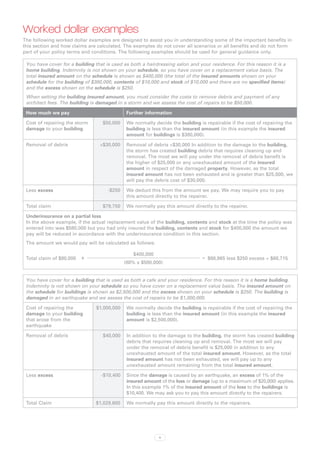
For each event, or series of events arising from the one originating cause you will bear the amount of the excess in
respect of each and every insured vehicle, unless stated otherwise.
The basic excess is shown on your schedule. The amounts for any other excesses (or where the amounts can be found
in this policy) are detailed below on pages 99 and 100. You might have to pay more than one type of excess when you
claim. You must pay the excesses in full.
We will decide if you pay the excess to us (when we ask for it) or to the repairer when you pick up your vehicle after it
has been repaired. We can also choose to deduct the excess from the amount we pay you.
You don’t pay any excess when your vehicle is a motorcycle, car, 4WD, utility or van of not more than 2 tonne
carrying capacity and:
WW another vehicle is involved in the event, and we agree the driver of your vehicle was not at fault, and you can identify
   the other vehicle and the other driver responsible (name, residential address, phone number and vehicle registration
   details); or
WW no other vehicle is involved in the event, and we agree the driver of your vehicle was not at fault, and you can
   identify another person at fault (name, residential address and phone number) and prove that they were at fault.
Types of excesses
Basic excess
The basic excess is the amount shown on your schedule.
Age or inexperienced drivers excess
An age or inexperienced driver excess applies if a driver under 25 or an inexperienced driver was in charge of your
vehicle at the time of an event. This excess will not apply to glass, damage while parked, fire, malicious damage, theft
or storm claims.
If we accept a claim where the driver was less that 25 years of age or was an inexperienced driver, the following age
or inexperienced driver excesses will apply to the claim when:
WW the vehicle is a car, 4WD, utility or van of not more than 2 tonne carrying capacity:
   WW for drivers under 21 years of age $500
   WW for drivers 21 year of age or older $300
   WW for inexperienced drivers $250
WW the vehicle is a prime mover and;
   WW the insured amount for the prime mover is less than $100,000 or it is insured for Legal Liability only – the age or
      inexperienced driver excess is $2,500 or $3,500 if the prime mover was towing more than one trailer at the time
      of the event.
   WW the insured amount for the prime mover is $100,000 or more, but not more than $200,000 – the age or
      inexperienced driver excess is $10,000 or $15,000 if the prime mover was towing more than one trailer at the
      time of the event.
   WW the insured amount for the prime mover is more than $200,000 – the age or inexperienced driver excess is
      $25,000 or $37,500 if the prime mover was towing more than one trailer at the time of the event.
WW the vehicle is not a car, 4WD, utility, van of not more than 2 tonne carrying capacity or prime mover the age or
   inexperienced driver excess is $750.
You must pay these age or inexperienced driver excess in addition to any other excess for your vehicle that may be
payable. For the purposes of the application of these age or inexperienced driver excess, a dolly is considered a trailer.
                                                            99
Tipping excess
A tipping excess applies if your vehicle is a trailer or rigid body truck and it is damaged while the tipping hoist is partly or
fully extended. The tipping excess is $1,000 and you pay this in addition to any other excess payable for your vehicle.
Theft excess
A theft excess of $2,500 applies to each claim for theft or damage occasioned by theft of:
WW your skid steer loader, excavator, loader, backhoe or bobcat, or
WW any of their accessories, whether these accessories are attached to your vehicle at the time of the theft or damage
   or not.
You pay this in addition to any other excess for your vehicle that may be applicable.
Endorsement excess
An endorsement excess may apply if you have endorsements to your policy. Any endorsement excess applicable to
your policy will be shown in the endorsement wording.
You pay the endorsement excess shown in the endorsement wording in addition to any other excess for your vehicle
that may be payable.
Radius excess
A radius excess applies if we accept a claim for loss or damage to your vehicle or legal liability and at the time of the
event, your vehicle was on a journey to or from a destination beyond the maximum radius of operation shown on
your schedule measured from your vehicles garaged postcode shown on your schedule.
The radius excess is:
WW $500 if your vehicle is a truck or bus,
WW $2,500 if your vehicle is a trailer which at the time of the event was being towed by a prime mover or $500 if being
   towed by a truck, or
WW $7,500 if your vehicle is a prime mover.
You pay the radius excess in addition to any other excess for your vehicle that may be payable.
Additional benefit excesses
Please refer to pages 88 and 90 for the amount of any excess you might have to pay if you make a claim under any
Additional Benefit in Part 1 of this section.
Application of excess involving trailer and towing vehicle
If a trailer being towed by your vehicle damages the property of another person and:
WW only the trailer was damaged, the excess for the towing vehicle will apply; or
WW there is no damage to either the trailer or towing vehicle, the excess for the towing vehicle will apply.


Policy section exclusions
You are not covered under this section for an event occurring when your vehicle is being driven by, or is in the
charge of, someone who:
WW was under the influence of, or had their judgement affected by, any alcohol or drug;
WW had more than the legal limit of alcohol in their breath or blood, as shown by analysis;
WW refused to take a test for alcohol or drugs; or
WW was not licensed, not correctly licensed or not complying with the conditions of their licence.
We will cover you if you were not the driver or person in charge of your vehicle at the time of the event and you
can satisfy us that you did not know, and could not have reasonably known, of any of the above circumstances.
If we pay a claim we can recover those costs from the person who was driving or in charge of your vehicle, unless the
law prohibits recovery by us.
You are not covered under this section:
WW if you or an authorised driver does something or neglects to do something that is not in accordance with this policy
   or does not give us the information or assistance that we ask for;
WW for theft of or malicious damage to your vehicle when anyone insured under this policy has not taken reasonable
   care to prevent this loss or damage;


                                                              100
WW for financial loss:
   WW occurring because you cannot use your vehicle;
   WW because your vehicle’s value was less after being repaired; or
   WW because your vehicle’s working life has been reduced;
WW for loss of or damage to a drill rod or bit attached to your vehicle while the drill rod or bit is being used for its
   designed purpose. For the purposes of this exclusion, a drill rod or bit includes any part attaching to or forming
   part of the drill rod or bit including but not limited to pipes, guides, filters, gaskets, plugs, caps, beacon housings,
   tool heads, nozzles and/or any other electronic mechanism;
WW for the cost to repair or replace burnt out electric motors or wiring of appliances in your caravan;
WW for damage to your caravan, caravan annexe, trailer or personal effects caused by biting, chewing or scratching by
   an animal or bird;
WW for damage to your caravan, caravan annexe or personal effects caused by any tenant;
WW if your unregistered on-site caravan is unoccupied for 60 consecutive days. (If you want cover over 60 days, you
   need to ask us for an extension of time and we must agree in writing. We might charge an extra premium or
   impose special terms.);
WW for loss or damage to your caravan caused by the sea or high water;
WW for loss or damage or legal liability caused or contributed to by or arising from any biological, bacterial, viral, germ,
   chemical or poisonous contaminants or pollutants (except for any cover provided under Additional Benefit 1 –
   ‘Pollution’ on page 96) or any looting or rioting following these occurrences;
WW for theft by anyone who has hired or leased your vehicle or who has taken it as security for a debt;
WW for any loss, damage or legal liability caused by any person or organisation who lawfully destroys or takes away
   your ownership or control of any property or vehicles covered under this section,
WW for any loss, damage or legal liability which happens before the period of insurance or which arises from an event
   before the period of insurance starts unless specifically stated otherwise,
WW for an event that occurs outside Australia or its external territories.
We will not pay a claim for loss, damage or legal liability under this section:
WW if another person is, or could have been, liable to compensate you for such loss, damage or legal liability, but you
   have agreed with that person either before or after the loss, damage or legal liability occurred that you would not
   seek to recover any moneys from that person;
WW if the event that is the subject of the claim was intentionally or recklessly caused by you or the driver of your
   vehicle or someone acting with your or their express or implied consent; or
WW if excluded by any endorsement.
You are not covered under this section if, at the time of an event, your vehicle was:
WW damaged, unsafe or unroadworthy. However, this exclusion will not apply if you prove that the unroadworthy or
   unsafe condition of your vehicle:
   WW did not cause or contribute to the loss, damage or legal liability being incurred, or
   WW could not reasonably have been detected by you;
WW being used in a race, contest, trial, test, hill climb or any similar activity;
WW being used on a competition race track, circuit, course or arena;
WW being used by you for illegal purposes;
WW carrying passengers for payment or reward unless it was a car pool, child care arrangement or fare paying
   passenger bus;
WW carrying a greater number of passengers than it was designed for or is allowable according to law;
WW conveying, towing, lifting or carrying a load not secured according to law;
WW conveying, towing, lifting or carrying a load in excess of that which was designed for or is allowable according
   to law;
WW being used to move dangerous goods or substances that pollute or contaminate unless this was done legally;
WW travelling on railway lines; or
WW being operated, transported or driven in an underground mine or mining shaft (but we will cover you if your
   vehicle was being used for open cut mining).


                                                                101
Worked dollar examples
The following worked dollar examples are designed to assist in the understanding of some of the important benefits in
this section and how claims are calculated. The examples do not cover all scenarios or all benefits and do not form
part of your policy terms and conditions. The following should be used as a general guide only. You should consider
all examples as each example covers different benefits and scenarios.
Example: Total loss — Market value
 A car that has a carrying capacity of not more than 2 tonnes is comprehensively insured for market value. The basic
 excess is $500. The vehicle is damaged in an accident and we assess the cost of repair to be $20,000.
 The market value is determined as follows:
 The vehicle is an 8 year old sedan in poor condition. A motor vehicle guide records the value is $20,000 for good
 condition. We assess the market value to be $15,000 (GST inclusive).
 The vehicle contains no modifications or accessories and we decide it is a total loss.

 How much we pay                            Further information

 Market value                    $15,000    The vehicle is a total loss with a market value of $15,000. We normally
                                            decide a vehicle is a total loss if the complete repair cost exceeds its
                                            market value less salvage value.

 Less ITC                        - $1,364   If you are registered for GST and entitled to an Input Tax Credit (ITC) we
                                            will deduct this entitlement. In this example you are entitled to a full Input
                                            Tax Credit (100%). We will not deduct this entitlement if your vehicle is
                                            insured for Agreed Value.

 Less outstanding premium          - $300   If you paid your insurance by pay by the month instalments, we will
                                            deduct the remaining instalments for the period of insurance. In this
                                            example, there are three $100 per month instalments remaining when
                                            total loss occurs.

 Less excess                       - $500   Only the basic excess applies in this example. We deduct this from the
                                            amount we pay to you.

 Total claim                     $12,836    We would normally pay this amount directly to you in a total loss situation.

 Plus lease payout                $2,200    If, instead of owning your vehicle outright, your vehicle was purchased
                                            under a finance lease and the amount owing was $17,200 (excluding any
                                            payments in arrears and resulting interest), we will pay the difference
                                            between the amount owing under the finance arrangement and the
                                            market value ($17,200 – $15,000). This Extra Cover has a limit of 20% of
                                            the market value ($3,000).

 Less ITC                          - $200   In this example you are entitled to a full Input Tax Credit (100%).

 Total claim                     $14,836    We would normally pay the claim directly to your financier and not to you
                                            in circumstances of a lease payout. You pay your financier any amounts
                                            left owing.

 If the vehicle in the above example was less than 2 years old at the time of the event, instead of paying the claim
 above you can choose to accept a replacement vehicle including similar accessories and parts plus on-road costs
 e.g. registration, compulsory third party, pre-delivery. You must pay the excess to the dealership that has provided
 the replacement vehicle or us.

 If the vehicle salvage is valued at $1000, the salvage becomes our property and we are entitled to keep the $1000
 proceeds of its sale plus any registration and compulsory third party insurance refund. This does not affect the
 calculations above unless you obtain these refunds directly in which case we will deduct these costs from the total
 claim above.


                                                           102
Example: Total loss – Agreed value

 A utility that has a carrying capacity of not more than 2 tonnes is comprehensively insured for an agreed value of
 $45,000. The vehicle is damaged in an accident that we agree was not your fault and you have identified the at fault
 party and provided all their details that we require.
 We assess the cost of repair of your vehicle to be $40,000. We decide it is a total loss. The vehicle is not subject to
 finance. The basic excess is $500.

 How much we pay                             Further information

 Agreed value                     $45,000    The vehicle is a total loss with an agreed value of $45,000. We normally
                                             decide a vehicle is a total loss if the complete repair cost exceeds its
                                             agreed value less salvage value.

 Less ITC                              $0    We do not deduct any ITC when your vehicle is comprehensively insured
                                             for agreed value.

 Less excess                           $0    No basic excess applies in this example as the accident was not your fault
                                             and you have provided all the details of the at fault party that we require.

 Total claim                      $45,000    We would normally pay the Total claim amount directly to you in a total
                                             loss situation, unless your vehicle is subject to finance.

 If the vehicle salvage is valued at $10,000, the salvage becomes our property and we are entitled to keep the
 $10,000 proceeds of its sale plus any registration and compulsory third party insurance refund. This does not affect
 the calculations above unless these refunds are paid to you directly in which case we will deduct these costs from
 the total claim above.

Example: Partial loss

 A car that has a carrying capacity of not more than 2 tonnes is comprehensively insured for market value. The
 vehicle is stolen and subsequently recovered, damaged, 25 days later. We assess the cost of repairs to be $5,500.
 The basic excess is $500.

 How much we pay                             Further information

 Damage to vehicle                 $5,500    We normally decide a vehicle is repairable if the cost of repairs is
                                             significantly less than the market value.

 Less excess                        - $500   Only the basic excess applies in this example. We normally require you
                                             to pay the excess directly to the repairer.

 Total claim                       $5,000    We would normally pay this amount directly to the repairer in a partial
                                             loss situation.

 If personal effects to the value of $350 are also stolen during the theft:

 Plus personal effects             + $350    Personal effects cover is limited to $1,000 per event. This extra cover’s
                                             sub-limit is in addition to the market value of the vehicle.

 Total claim                       $5,350    We normally pay the $350 for personal effects to you (and the remaining
                                             $5,000 directly to the repairer).

 If a replacement vehicle of a similar type for a cost of $100 per day is arranged by us:

 Plus vehicle hire cost          + $2,500    The cost per day times the number of days from the date of theft until the
                                             date of recovery is 25 x $100. This benefit has a limit of up to 30 days and
                                             we will not pay more than $3,000.
                                             Note: This benefit would not apply if the vehicle was damaged in an
                                             accident instead of stolen, unless you also selected optional benefit 2
                                             ‘Rental vehicle following accident’.

  Total claim                      $7,850    We normally pay the $2,500 for vehicle hire directly to the hire company
                                             (the $350 to you and the $5,000 to the repairer).


                                                             103
Example: Legal liability

 A vehicle is insured for Legal Liability cover. The vehicle is involved in an accident and the other driver claims that
 the driver of your vehicle has a legal liability for the accident. The damage to the other vehicle would be assessed
 by a court at $12,500. There is a basic excess of $500 on your policy. The legal costs to defend your legal liability
 are $3000.

 How much we pay                             Further information

   Damage to other vehicle        $12,500    We normally pay the cost of repairs directly to the third-party claimant.

   Less excess                      - $500   Only the basic excess applies in this example. We normally require you
                                             to pay this amount to us before we act on your behalf.

   Plus our legal costs          + $3,000    We incur and do not charge you for these costs providing you have paid
                                             your excess prior to legal costs being incurred.

   Total claim                    $15,000

 If the driver of your vehicle was not at fault and the driver of the other vehicle was at fault but was not insured, and
 you provide us with the details of the other driver. The basic excess is $500. For the purposes of this example it is
 assumed that your vehicle is not comprehensively insured:

 Damage by uninsured               $4,500    Your vehicle is not covered for own damage because Legal Liability
 drivers Extra Cover                         Only cover was purchased. However, the ‘damage by uninsured drivers’
                                             Extra Cover provides limited cover in these circumstances for up to
                                             $5,000.
                                             For the purposes of this example, we assess that the damage to your
                                             vehicle will cost more than its market value of $4,500. We decide it is
                                             not repairable.

 Less ITC                       - $409.09    If you are registered for GST and entitled to an Input Tax Credit (ITC) we
                                             will deduct this entitlement. In this example you are entitled to a full
                                             Input Tax Credit (100%).

 Less excess                        - $500   Only the basic excess applies in this example. We deduct this from the
                                             amount we pay you.

 Less residual value of             - $500   The remaining value of your damaged vehicle. We deduct this from the
 wreck                                       amount we pay you.

 Total claim                    $3,090.91    We normally pay this directly to you. You will keep the damaged vehicle.


Definitions
The following words have the following meanings for this section only. You should also refer to the General Definitions
section starting on page xix.

Agreed value
The amount we agree to insure your vehicle for, as shown on the schedule.
Authorised driver
A person controlling, driving or using your vehicle with your consent.
Contaminants or pollutants
Includes smoke, vapours, soot, fumes, acids, alkalis, toxic chemicals, liquids or gases, waste materials, or other
irritants and other contaminants or pollutants. Contaminants or pollutants do not include dangerous goods.
Damage to property
1.	 physical loss of or damage to or destruction of tangible property including resultant loss of use; or
2.	 loss of use of tangible property which has not been physically damaged or destroyed provided such loss of use is
    caused by an event.
Dangerous goods
1.	 substances which are shown in the Australian Code for the Transport of Dangerous Goods by Road or Rail;
2.	 liquid fuels, liquefied or compressed gases, toxic chemicals, acids, organic peroxides or corrosives;
3.	 infectious, explosive radioactive or oxidising substances; or
4.	 substances with a flashpoint of below twenty two point seven degrees Celsius (22.7°C).
Emergency repairs
Minor repairs which are essential for you to be able to drive your vehicle safely from an accident or event causing damage.

                                                            104
Employee
Any person:
1.	 engaged in your business under a contract of service or apprenticeship, or
2.	 supplied to you pursuant to a contract of labour hire.
Inexperienced driver
A person who is 25 years or over and has not held a drivers licence for that class of vehicle being driven at the time of
the event for the past 2 consecutive years.
Market value
The amount we calculate the market would pay for your vehicle. It takes into account the age, make, model, kilometres
travelled and condition of your vehicle immediately before the loss or damage. We might use recognised industry
publications to calculate the amount.
Partial loss
When we decide at our option, to repair your vehicle, replace any part of it or reimburse you for the loss or damage to
it. In this case, we will not treat your vehicle as a total loss.
Penalty claim
An event or claim where we consider you to be at fault, or a claim where we are not able to recover the costs of
repairing or replacing your vehicle.
Personal effects
Clothing and personal belonging normally worn or carried but excluding personal computers, non-fixed GPS units,
musical instruments, curios, works of art money or credit cards.
Personal injury
Death, bodily injury, sickness, disease, disability, shock, fright, mental injury, mental anguish, or loss of consortium
resulting from any of them.
Reasonable repair costs
If you choose your own repairer, we will pay the amount we consider to be reasonable repair costs taking into account:
1.	 your repairers quote with any adjustments or reduction recommendation by an experienced motor vehicle assessor
    we appoint, and
2.	 a quote we may choose to obtain from one of our recommended repairers.
Recommended repairer
A repairer who has been appointed by us as a recommended repairer because we have assessed the repairer as
capable of meeting our strict standards of quality workmanship, timeliness, efficiency and cost effectiveness.
Substitute vehicle
A vehicle which does not belong to you and which you, your spouse, defacto partner or an employee are using while
your vehicle is not in use because your vehicle is unroadworthy or undergoing repair.
Total loss
When your vehicle is stolen and not recovered, or is damaged so badly it would cost more to repair than the value of
your vehicle.
Value of your vehicle
The market value or agreed value, whichever is shown in your schedule.
Vehicle
The vehicle(s) described on your schedule. The following accessories will also be insured if they are attached to or in
or on your vehicle: baby capsule/car seat – bicycle carriers – binders – bonnet protector – built in refrigerator – built in
television – bull bar – caravan annexe – cargo carrier – CB an/or 2 way radio – chains – cruise control – dash mats –
decorative wheel trims – driving lights – fire extinguishers – fixed GPS units – floor mats – gates – headlamp guards –
motor cycle helmets – gloves – or associated riding clothing up to a total of $500 (if we pay a claim covering your
motorcycle) – mud flaps – paint protection – panel/rust protection – pin striping – decals – protective mouldings – rear
louvre sunshade – registration plate covers – ring feeder – seat covers – side steps for a 4WD – sign writing – sleeping
box – sound system (fitted as standard by manufacturer) – spear wheel cover – steering locks – tarpaulins – tools
supplied as standard by the manufacturer or similar replacement – tow bars – weather shield – winch. It also includes
other vehicle accessories or modifications if we have agreed to insure them as part of your vehicle and they are shown
on your schedule.


                                                             105
This page left blank intentionally


               106
Vero Insurance Limited ABN 48 005 297 807
PDS Date Prepared 25 May 2012
V6408 V6 25/05/12 A

Vero Office Pack PDS

  • 1.
    Professional Services Policy TailoredInsurance for Professional Offices and Surgeries Product Disclosure Statement and Policy Wording
  • 3.
    Professional Services Policy Welcome to Vero Enterprise ii Who is the insurer? ii How to contact us ii About this Product Disclosure Statement and Policy Wording ii Part A – Policy summary iii Part B – Your rights and responsibilities iv Duty of Disclosure iv Not meeting your responsibilities iv Cooling off period iv The amount of your premium iv Paying your premiums iv Claims made and notified basis of cover v Excessv Fraudulent claims v Privacy statement v Complaints resolution vii Financial Claims Scheme vii General Insurance Code of Practice viii Terrorism Insurance Act 2003 viii Updating information viii Part C – Information for some policyholders only ix The amount you pay for sections 1A, 1B or 1C (for a home building) or section 9 (for vehicles) ix How various factors may affect your premium ix Premium discounts x Excessesxi Part D – Your policy terms and conditions xii Important information about your insurance policy xii In this insurance policy: xii Our contract with you xii Paying by monthly instalments xii How the Goods and Services Tax (GST) affects this insurance xii General policy conditions xiii General claims conditions xiv General exclusions xvii When we may refuse a claim xviii Inflation protection xviii Cancelling your policy xviii General definitions xix Section 1A – Property damage 1 Section 1B – Theft 16 Section 1C – Glass 23 Section 1D – Breakdown of machinery, computer equipment and electronic equipment 26 Section 1E – Restoration of computer data 31 Section 1F – Computers – Increased costs of working 32 Section 1G – Deterioration of stock 33 Section 2 – Money 35 Section 3 – Portable and valuable items 40 Section 4 – Management liability 43 Section 5 – Business interruption 57 Section 6 – Goods in transit 65 Section 7 – Legal liability 69 Section 8 – Tax Probe® 78 Section 9 – Commercial motor (including choice of repairer provisions) 82 i
  • 4.
    Welcome to VeroEnterprise Vero Insurance Limited ABN 48 005 297 807 is one of Australia’s largest intermediated general insurance companies and is a member of the Suncorp Group of companies. Vero offers tailored solutions and superior claims management to its large range of customers, with insurance products in property, small business, commercial motor, professional indemnity, construction and engineering, liability, travel, marine and personal insurance. With a strong network of brokers, agents and corporate partners, Vero is Suncorp’s primary intermediated Commercial Insurance brand nationally. Our specialist knowledge, combined with the scope of the Suncorp Group, ensures Vero is a powerful brand in today’s competitive insurance market. Vero Enterprise is a division of Vero Insurance Limited. Vero Enterprise provides small business owners with insurance packages that offer a range of covers including property, liability and commercial motor. Vero Enterprise policies are written in plain English. We aim to keep all your dealings with Vero Enterprise simple and straightforward. Who is the insurer? Vero Insurance Limited ABN 48 005 297 807, AFS Licence No. 230859 is the insurer and issuer of this insurance policy and is the issuer of this Product Disclosure Statement (PDS). How to contact us You may contact us by: WW Telephone: 1300 888 071 WW Email: via the “contact us” page on our website www.vero.com.au WW Mail: Vero Insurance Limited GPO Box 2068 Adelaide SA 5001 About this Product Disclosure Statement and Policy Wording We are required to give you a Product Disclosure Statement (PDS) if you are insuring vehicles (not exceeding 2 tonnes) under Section 9 or a home building under Sections 1A, 1B or 1C and you are: WW an individual; or WW a small business, having: WW in the case of a non-manufacturing business, less than 20 employees; or WW in the case of a manufacturing business, less than 100 employees. This PDS and Policy Wording consists of 4 parts: WW Part A contains your Policy Summary. You can use this summary, together with your insurance adviser, to decide which sections you need for you business. WW Part B contains information about your rights and responsibilities, the General Insurance Code of Practice and how to contact us if you have a question or complaint. Part B applies to all sections and should be read by all persons who take out this policy. WW Part C contains Information for certain persons insuring vehicles or a home building. This part only applies to you if you are insuring vehicles (not exceeding 2 tonnes) under Section 9 or a home building under Sections 1A, 1B or 1C and you are an individual or a small business. WW Part D contains your the policy terms and conditions. It applies to all persons who take out this policy. To understand the full terms and conditions of your policy, you must read the Your rights and responsibilities (Part B) and your Vero Enterprise Professional Services Policy terms and conditions (Part D). If you are insuring vehicles under Section 9 or a home building under policy Sections 1A, 1B or 1C and you are an individual or a small business, you should also read Part C. ii
  • 5.
    Part A –Policy summary Below is a summary of the covers included in the Vero Enterprise Professional Services Insurance Policy. Together with your insurance adviser you can choose sections to meet your requirements. Cover type S ummary of covers (see relevant Section for details, relevant limits, and specific conditions and exclusions that apply) Section 1A: Property damage This section covers the damage to your property at your premises from certain sudden, unexpected or unforeseen occurrences, and provides a number of automatic additional benefits. Section 1B: Theft This section covers loss of your contents and stock due to theft and provides a number of additional benefits. Section 1C: Glass This section covers glass in your premises (including internal glass such as glass partitions, and external windows) and provides a number of automatic additional benefits. Section 1D: Breakdown of machinery, This section covers the breakdown of your business’s mechanical machinery computer equipment and electronic including boiler, pressure plant, computers and electronic equipment such as equipment photocopiers and faxes. Section 1E: Restoration of This section covers the cost of rewriting your business’s computer records computer data following a computer breakdown. Section 1F: Computer breakdown – This section covers the increased costs of working (such as the hiring of Increased costs of working alternative computers and the hiring of additional staff) following the breakdown of your business’s computers Section 1G: Deterioration of stock This section covers the costs of replacing your business’s stock which is kept in freezers or refrigerated units, if the fridge or freezer breaks down Section 2: Money This section covers your business’s money whilst on your premises, in a safe or strongroom, in transit to or from your premises, or in your personal custody, or the custody of a trusted employee. Section 3: Portable and This section covers the loss of or damage to portable property such as Tools, valuable Items Laptop Computers and Personal Digital Assistants throughout Australia and the rest of the world. Section 4: Management liability This section covers the management liability of you, your directors, officers and employees. Section 5: Business interruption This section covers the loss of income and the additional increased costs of working which results from the interruption of your business caused by events covered under certain other sections of the policy. Section 6: Goods in transit This section covers the loss of or damage to goods and stock that your business buys, sells or uses whilst they are in transit. Section 7: Legal liability This section covers the legal liability of your business for personal injury to another person (other than employees) or damage to property owned or controlled by someone else. Section 8: Tax Probe® This section covers the professional fees incurred in connection with an audit or investigation of the business’s tax affairs by any authority authorised to do so, for example the Australian Taxation Office. Section 9: Commercial motor This section covers the business’s Motor Vehicles with a choice of Comprehensive, Legal Liability Fire and Theft, or Legal Liability Only covers. iii
  • 6.
    Part B –Your rights and responsibilities Duty of Disclosure You must comply with your Duty of Disclosure when you apply for insurance with us and each time you renew or alter your cover. You have a duty of disclosure to tell us everything you know or should know, that is relevant to our decision to insure anyone under the policy, including you, and on what terms. It includes matters we specifically ask about when you apply for a policy, or renew or alter your policy, and any other matters which might affect whether we insure you and on what terms. The information you tell us can affect: WW the amount of your premium and your excess WW if we will insure you WW if special conditions will apply to your policy. You do not need to tell us of anything which: WW reduces the chances of you making a claim WW we should know about because of the business we are in or WW we tell you we do not want to know. If you are unsure it is better to tell us. If you do not tell us something which you know or should know is relevant, we might reduce a claim, refuse to pay a claim, cancel your policy or, if fraud is involved we can treat the policy as if it had never existed. The duty of disclosure applies to every person or organisation insured under the policy. If you fail to comply with your duty of disclosure we may be entitled to reduce our liability under the contract in respect of a claim or may cancel the contract. If your non-disclosure is fraudulent, we may also have the option of avoiding the contract from its beginning. Not meeting your responsibilities If you do not meet with your responsibilities outlined in your policy, or if you do not tell us everything relevant to our decision whether or not to insure you, or if you mislead us, we can refuse to pay a claim or reduce the amount we pay or cancel your policy. If fraud is involved, we can treat your policy as if it never existed. Cooling off period You have the right to cancel and return the insurance policy or a section of the policy by notifying us in writing within 30 days of the date it was issued to you (“cooling off period”), unless you have a claim under the policy within the cooling off period. If you cancel it in this time, we will return the amount you have paid. In addition, if you vary your policy and add a section, you have the right to cancel that section within 30 days of the date it was added by notifying us in writing (“additional cooling off period”) unless you make a claim under that section within the additional cooling off period. If it is cancelled in this time, we will return the amount you have paid for that section. To cancel at other times, please see “Cancelling Your Policy” on pages xviii and xix. The amount of your premium The premium is the amount you pay us for this insurance. It includes stamp duty, GST, other government charges and fire services levy (FSL) that applies. Your premium is shown on your schedule. In addition to the factors we use to calculate your premium, the discounts you qualify for also affect your premium. Your premium includes any discounts you qualify for and these are applied before adding applicable government charges. The premium does not include any service or administration fee charged to you by your insurance intermediary. We might advertise special offers and benefits from time to time. If we have a special offer available that is not in this PDS, we can give you a separate terms and conditions brochure about the offer if you ask us. These offers might be short-term and we can withdraw them at anytime. Paying your premiums We will tell you how much you have to pay and how much time you have for payment. You must pay your premium by the due date. For the first period of insurance, if you do not pay the premium owing by the due date, we can cancel your policy as set out in “Cancelling your Policy” on pages xviii and xix. iv
  • 7.
    For renewal policies,if you do not pay your premium by the due date, then the renewal policy will not commence and your cover will end at the expiry of the previous period of insurance. Claims made and notified basis of cover Policy Section 4 – Management Liability (excluding Optional cover Employee Dishonesty) is issued on a ‘claims made and notified’ basis. This means that Section 4 (excluding Optional cover Employee Dishonesty) responds to: (a) claims first made against you during the period of insurance and notified to us during the period of insurance, provided that you were not aware at any time prior to the policy inception of circumstances which would have put a reasonable person in your position on notice that a claim may be made against him/her; and: (b) written notification of facts pursuant to section 40(3) of the Insurance Contracts Act 1984. The facts that you may decide to notify are those which might give rise to a claim against you. Such notification must be given as soon as reasonably practicable after you become aware of the facts and prior to the time at which the policy expires. If you give written notification of facts the policy will respond even though a claim arising from those facts is made against you after the policy has expired. For your information, s40(3) of the Insurance Contracts Act 1984 is set out below; “S40(3) Where the insured gave notice in writing to the insurer of facts that might give rise to claim against the insured as soon as was reasonably practicable after the insured became aware of those facts but before the insurance cover provided by the contract expired, the insurer is not relieved of liability under the contract in respect of the claim when made by reason only that it was made after the expiration of the period of insurance cover provided by the contract.” When the period of insurance expires, no new notification of claims or facts can be made on Section 4 – Management Liability (excluding Optional cover Employee Dishonesty) of the expired policy even though the event giving rise to the claim against you may have occurred during the period of insurance. An exception to this is under the Automatic Discovery Period Additional Benefit in Section 4, if any, under which some cover for new notification of claims or facts is available. Excess This is the amount you have to pay if you suffer loss, damage or liability which leads to a claim under your policy. The amount and type of excess that applies to your policy is shown either in Part D of this booklet or on your schedule. If you claim under more than one section of your policy for one incident or event, then you only pay the highest excess that applies unless expressly stated otherwise in the policy. For example, Additional Benefits may have their own excess which are in addition to any excess that may apply to a claim. Fraudulent claims If you or anyone acting on your behalf or with your knowledge makes a claim that is false or causes loss or damage deliberately, we may do one or more of the following: WW refuse to pay a claim WW cancel your policy WW take legal action against you. Privacy statement Vero Insurance Limited is a member of the Suncorp Group (the ‘Group’). The Privacy Act 1988 (Cth) requires us to inform you that: Purpose of collection Personal information is information about an identifiable individual and includes facts or an opinion about you which identifies you or by which your identity can be reasonably determined. The collection of your personal information is essential to enable us to conduct our business of offering and providing you with our range of financial products and services. We collect personal information for the purposes of: WW identifying you when you do business with us; WW establishing your requirements and providing the appropriate product or service; WW setting up, administering and managing our products and services; WW assessing and investigating, and if accepted managing a claim made by you under one or more of our products; WW improving our financial products and services, including training and developing our staff and representatives. We may be required by Anti-Money Laundering/Counter Terrorism Financing legislation to collect your personal information. Consequences if personal information is not provided If we request personal information about you and you do not provide it, we may not be able to provide you with the financial product or service that you request, provide insurance cover, manage or pay any claim under an insurance policy, manage your product or provide any benefits, or provide you with the full range of services we offer. v
  • 8.
    Disclosure We use anddisclose your personal information for the purposes we collected it. We may also use and disclose your personal information for a secondary purpose related to the purpose for which we collected it, where you would reasonably expect us to use or disclose your personal information for that secondary purpose. In the case of sensitive information, any secondary purpose, use or disclosure will be directly related to the purpose of collection. When necessary and in connection with purposes listed above, we may disclose your personal information to and/or collect your personal information from: WW other companies within the Group; WW where required or authorised under our relationship with our joint venture companies; WW information technology providers, including hardware and software vendors and consultants such as programmers; WW customer research organisations; WW intermediaries including a representative acting on your behalf, other Australian Financial Services Licensee or our authorised representatives and our agents; WW where you are an insured person and not the policy holder, we will disclose to the policy holder; WW government, law enforcement or statutory bodies; WW the Financial Ombudsman Service; WW other insurers, financial institutions, insurance and claims reference agencies, credit agencies, loss assessors, financial or investigative service providers; WW legal and other professional advisers; WW hospitals, medical and health professionals; WW research and development service providers; WW printers and mail service and delivery providers for the mailing of statements, insurance policy documents and marketing material; WW imaging and document management services; and WW other service providers. Disclosure overseas There are also instances where we may have to send your personal information overseas or collect personal information from overseas. These instances include: WW sending your personal information to companies in the Group; WW when you have asked us to do so; WW when we are authorised or required by law to do so; WW when we have outsourced a business activity or function to an overseas service provider with whom we have a contractual arrangement; or WW certain electronic transactions WW when it is necessary in order to facilitate a transaction on your behalf. We will only send your personal information overseas or collect personal information about you from overseas for the purposes in this statement and in compliance with the privacy regime. Access You can request access to the personal information we hold about you by contacting us. In some circumstances, we are able to deny your request for access to personal information. If we deny your request for access, we will tell you why. If accessing your personal information will take an extended period of time, we will inform you of the likely delay. For more detailed requests for access to personal information, for example, access to information held in archives, a fee may be charged to cover the associated cost of retrieval and supplying this information. Marketing We would like to use and disclose your personal information to keep you up to date with the range of products and services available from us and other companies within the Group. Generally, our companies will use and disclose your personal information for the Group’s marketing purposes. If you do not want us to use and disclose your personal information for the purpose of marketing products and services to you, you should contact us and tell us. Contact Please contact us to: WW change your mind at any time about receiving marketing material; WW request access to the personal information we hold about you; or WW obtain more information about our privacy practices by asking for a copy of our Privacy Policy; vi
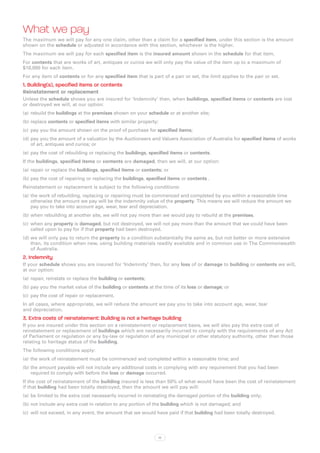
  • 9.
    You can contactus by sending a letter to; The Privacy Officer GPO Box 3999 Sydney NSW 2001 Our Privacy Policy can also be found on our website at http://www.vero.com.au/vero/privacy-policy Complaints resolution We are committed to: WW listening to what you tell us; WW being accurate and honest in telling you about our products and services; WW communicating with you clearly; and WW resolving any complaints or concerns you have in a fair, transparent and timely manner. If you have a complaint concerning this product or our services, please tell the people who provided your initial service or contact us by: WW Telephone: 1800 689 762 WW Mail: Reply Paid 1453 Customer Relations Unit RE058, GPO Box 1453 Brisbane QLD 4001 or WW Email: customer.relations@suncorp.com.au What we will do to resolve your complaint When you first let us know about your complaint or concern, we will review your complaint, consider the facts and attempt to resolve your complaint by the end of the next working day. If we cannot resolve your complaint to your satisfaction within 5 working days we will contact you to agree reasonable alternative time frames. We will endeavour to send you our final decision within 15 working days from the date you first made your complaint, provided we have all necessary information and have completed any investigations required. If you are still unsatisfied with the final outcome at your request we can refer your complaint to our Internal Dispute Resolution (IDR) team. Our IDR team will review your dispute, and respond to the dispute within 15 working days of your complaint being referred to them provided they receive all necessary information and have completed any investigation required. What if you are not satisfied with our final IDR decision? We expect our procedures will provide you with a fair and prompt resolution to your complaint. If however you are not satisfied with our final decision or if we have not been able to resolve the complaint to your satisfaction within 45 days you may be able to take the complaint to the Financial Ombudsman Service (“the FOS”). The FOS is an independent external dispute resolution scheme and its service is free to our customers. You can contact the FOS by: WW Telephone: 1300 780 808 WW Mail: Financial Ombudsman Service GPO Box 3 Melbourne VIC 3001. WW Email: info@fos.org.au; or WW Website: www.fos.org.au The FOS will tell you if they can help you, as their services are not available to all customers. We agree to accept a FOS decision however you have the right to take legal action if you do not accept their decision. If you want more information on the FOS, please ask us for a brochure. Financial Claims Scheme This policy may be a ‘protected policy’ under the Federal Government’s Financial Claims Scheme (FCS) which is administered by the Australian Prudential Regulation Authority (APRA). The FCS only applies in the extremely unlikely event of an insurer becoming insolvent and the Federal Treasurer making a declaration that the FCS will apply to that insurer. The FCS entitles certain persons, who have valid claims connected with certain protected policies issued by that insurer to be paid certain amounts by APRA. Information about the FCS can be obtained from APRA by: WW Telephone: 1300 55 88 49 WW Website: www.apra.gov.au vii
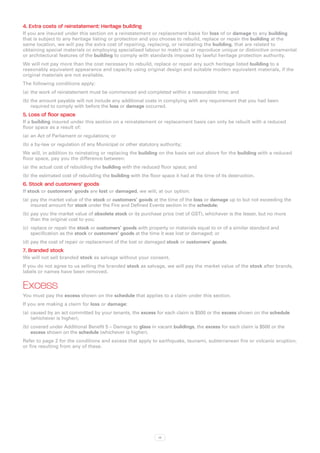
  • 10.
    General Insurance Codeof Practice We support and adhere to the General Insurance Code of Practice. A copy of the Code can be obtained from the Insurance Council of Australia by: WW Telephone: (02) 9253 5100 or WW Website: www.ica.com.au Terrorism Insurance Act 2003 Some sections of this policy exclude cover for losses as a result of terrorism. In the event that damage to property occurs and the cause of the damage is declared a terrorist incident by the responsible Minister, then you may be afforded protection within the limits of indemnity of this policy by virtue of the Terrorism Insurance Act 2003. The operation of this Act may also serve to reduce the settlement of your loss to a percentage of the otherwise recoverable loss. In the event that the settlement is reduced then this will be at the direction of the Minister. A more detailed explanation of the operation of the Terrorism Insurance Act 2003 can be obtained at www.arpc.gov.au. Updating information The information in this PDS and policy wording was current at the date of preparation. Vero may update some of the information in the PDS and policy wording that is not materially adverse from time to time without needing to notify you. You can obtain a copy of updated information by contacting us. We will give you a free paper copy of any updates if you request them. If it becomes necessary, we will issue a supplementary or replacement PDS. viii
  • 11.
    Part C –Information for some policyholders only This part applies to you if you chose cover for: WW vehicles (not exceeding 2 tonnes) under section 9; or WW a home building under Sections 1A (Fire and Defined Events Property Damage), 1B (Theft) or 1C (Glass), and you are an individual or a small business. You need to read this part if it applies to you. Home building means a building which is used or intended to be used principally and primarily as a place of residence. An example of what is considered a home building is where the building is a commercial premise but you may also live in the building, or you rent part of the building for residential use. If the building is only used by you for residential purposes, it cannot be insured under this policy. The amount you pay for sections 1A, 1B or 1C (for a home building) or section 9 (for vehicles) The premium is the amount you pay us for this insurance. The premium payable by you will be shown on your schedule. Premiums include applicable Commonwealth and state taxes and charges. These include the Goods and Services Tax and stamp duty. The amount of these taxes and charges will be shown on your schedule. If you change your policy you may be entitled to a partial refund of premium or be required to pay an additional premium. How various factors may affect your premium The following table is a guide to the significant factors which impact generally on your premium in relation to sections 1A, 1B or 1C (for home building). Factor Lower premium Increases premium Insured amount Lower insured amount Higher insured amount Postcode Low risk postcode High risk postcode Optional covers None taken All taken Claims experience Low claims experience High claims experience Voluntary excess Higher Lower Our expenses of doing business including Low expenses High expenses payments we make to intermediaries Endorsements Reduces our risk or your cover Increases our risk or your cover ix
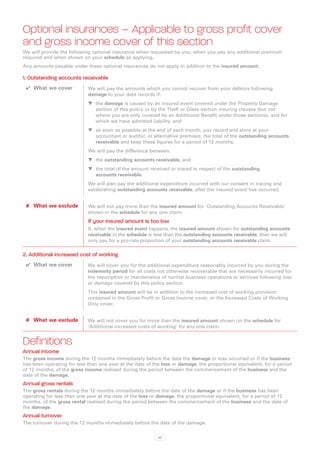
  • 12.
    The following tableis a guide to the significant factors which impact generally on your premium in relation to section 9 Commercial Motor. Type Lowers premium Increases premium Type of cover Legal liability only Comprehensive Type of vehicle Low risk vehicle High risk vehicle Market or agreed value Market value Agreed value Vehicle accessories/Modifications None specified Accessories and modifications that increase the risk of insurance No claim bonus Higher rating Lower rating Vehicle use Low risk use High risk use Radius Smaller radius of operation Australia wide Insured amount Lower insured amount Higher insured amount Postcode Low risk postcode High risk postcode Claims experience Low claims experience High claims experience Optional covers None taken One or more taken Voluntary excess Higher Lower Occupation Low risk occupation High risk occupation Our expenses of doing business including Low expenses High expenses payments we make to intermediaries Endorsements Reduces our risk or your cover Increases our risk or your cover Why the cost of insurance can change Your insurance premium can change during your policy period if the circumstances or risks covered by your policy change. For example, your premium will change if you change the use of your premises or add new covers to your policy. Also, each time you renew your insurance your premium is likely to change, even if your circumstances or the risks covered by your policy have not changed. This is because premiums are affected by: WW The total cost of current and future claims WW The cost of claims we expect to pay in the future WW Any changes in government taxes or charges WW Our expenses of doing business WW Whether indexation is shown on your schedule. We may “cap” the amount of any increase on renewal, so that we pass only part of the increase on to you. Premium discounts At times, we may offer premium discounts to particular customers – for example, those who take out insurance within a specified period, or people who have multiple policies with us. The amount and type of discounts can change over time. We can vary or withdraw a discount at any time. Changes will not affect the premium for an existing policy during its current period of insurance. For details of any discounts that may be available and the dollar difference these would make to your premium, please ask us when you obtain a quote or before renewing your policy. x
  • 13.
    Excesses If you makea claim you may be required to pay one or more excesses. The description of those excesses and the circumstances in which they are applied are shown in the relevant policy wording in Part D of this booklet under ‘Excess’ or in the schedule. Sections 1A, 1B and 1C: Excesses The amount of excess applying to each of these sections is shown on your schedule. We take into consideration a number of factors when setting the amount of your excess, such as: WW your occupation; WW any voluntary excess that we may allow you to choose; WW your claims history; and WW any additional risk factors that are unusual or unique to your business circumstances. Section 9: Excesses There are a number of excesses which apply to this section. The amount of each excess (other than the basic excess) is shown in the policy wording that applies to section 9 in Part D of this booklet. The amount of the basic excess will be shown on your schedule. We take into consideration a number of factors when setting the amount of your basic excess, such as: WW the make, model and type of vehicle being insured, including modifications made to the vehicle; WW any voluntary excess that we may allow you to choose; WW the age and driving experience of people who will be driving the vehicle; WW the insured amount of the vehicle; WW where and how the vehicle is used; WW the type of cover chosen; WW the place where your vehicle is garaged; WW your previous insurance and claims history; and WW Optional cover, extra covers, additional benefits and endorsements. xi
  • 14.
    Part D –Your policy terms and conditions Important information about your insurance policy Your insurance policy is made up of this policy wording, any endorsements and the schedule which shows the insured amounts, the premium and any relevant government charges. You should read the schedule and the policy wording together, to tell you what we cover, what we exclude, what we pay to settle claims and other important information. Each section of this policy contains some exclusions, and there are also some general exclusions which are listed on pages xvii and xviii, and which apply to the whole policy. In this insurance policy: Unless otherwise expressly defined in a section of the policy, you/your means the policyholder named in the schedule. We/our/us means Vero Insurance Limited ABN 48 005 297 807, trading as Vero Enterprise. Some other words used in this policy have special defined meanings. These words are in bold. The words we have defined are listed in the either the “General Definitions” section on pages xix to xxii or in the Definitions section in the applicable policy section. The headings and grey shaded areas in each section are not part of the policy itself. Their purpose is to provide you with a general guide about the content of the text. Our contract with you Your insurance policy is a legal contract between you and us. The contract is based on the information you gave us when you applied for the insurance, and any subsequent information which you have supplied. We will provide cover for the sections of the policy shown under “What’s Covered” on your schedule for the period of insurance. You must pay the premium, including relevant government charges for the period of insurance and comply with all of the policy conditions. Paying by monthly instalments If we agree that you can pay us the total amount in a number of payments instead of all at once, this is called paying by instalments. If you are a month (or more) late in paying an instalment, we may cancel your policy (see “Cancelling your policy” on pages xviii and xix). We will not pay a claim if at the date of the event you are claiming for, you are 14 days (or more) late in paying an instalment. How the Goods and Services Tax (GST) affects this insurance In the premium, we will charge you an amount on account of GST. You must inform us of the extent to which you are entitled to an input tax credit (ITC) for that GST amount each time that you make a claim under this policy. Despite the other provisions of this insurance (including provisions in the policy wording, the schedule and any endorsement), our liability to you will be calculated taking into account: (a) any input tax credit to which you are entitled for any acquisition which is relevant to your claim, or which you would have been entitled were you to have made a relevant acquisition; and (b) also for claims for business interruption only, the GST exclusive amount of any supply made by your business which is relevant to your claim. In respect of loss of or damage to your vehicle, if your vehicle is a total loss and you have chosen the agreed value option, we will not deduct any input tax credit entitlement from the amount of the agreed value shown in the schedule. This outline of the effect of the GST on your policy is for general information only. You should not rely on this information without first seeking expert advice on the application of the GST to your particular circumstances. xii
  • 15.
    General policy conditions Theseconditions apply to all sections of this policy. 1. Change to risk Our decision to insure you, and the premium that we charge you, is based on information provided by you about your business, and the risks to be insured under this policy. Your insurance, including the amount of premium, may be affected if any of the facts or circumstances that existed at the start of the policy change during the period of insurance, including, for example: (a) the nature of or type of business carried on by you or your tenants; (b) other circumstances that affect the premises or the property insured in such a way as to increase the risk of damage or losses; (c) your interest in the policy ceases, including by operation of law; (d) the business is wound up or carried on by an insolvency practitioner or permanently discontinued; (e) details of any conversion or modification to your vehicle made by someone other than the manufacturer. For example, if you give your vehicle wide tyres or wheels, or lower its suspension; (f) if there is anyone under the age of 25 years who is likely to be a regular driver of the vehicle; (g) change of your address, your vehicle, your vehicle’s garage postcode or the way you use your vehicle. You must immediately notify us of any changes to (a), (b), (c), (d), (e), (f) or (g) or any other changes that may increase the risk insured under your policy. If you are a property owner insuring buildings that you lease, our decision to insure you and the premium we charge you will take into account information about your tenants and how the building is used that you tell us when you apply for a policy with us, during the period of insurance and at each renewal. For this reason it is important that you tell us as soon as these things change. For example, if your building has three tenants (an accountant’s office, a jeans retailer and a sandwich bar) we will calculate your fire premium on the sandwich bar, as it is more hazardous than either of the other two occupations. If during the period of insurance the sandwich bar closes down and a menswear shop open, then you must notify us of the change and we will calculate your fire premium either using the jeans retailer or menswear occupation. If we agree to continue to insure you after you have told us of the changes you tell us about we will confirm this in writing. In some cases, we may only agree to continue to insure you under this policy if you agree to pay us additional premium. 2. The amount of cover If you are not entitled to an input tax credit on your policy premium, all insured amounts and limits of liability stated in your policy are GST inclusive (unless your policy states otherwise). If you are entitled to an input tax credit on any part of the policy premium, the insured amount and limits of liability stated in your policy are exclusive of any input tax credit which you are or would be entitled to claim. 3. Reasonable care and reducing risk You must take reasonable steps to ensure that you and your tenants: (a) maintain buildings, structures, fixtures, fittings, furnishings, appliances, vehicles, machinery, implements and plant in sound condition to minimise or avoid theft, loss or damage; (b) ensure that only competent employees are employed; (c) avoid or minimise loss of or damage to property or injury to other people; (d) comply with all statutory obligations, by-laws, regulations, public authority requirements and safety requirements; (e) obtain certificates of inspection for all equipment required by any statute or regulations to be certified; and (f) comply, at your expense, with all our recommendations to prevent or minimise theft, loss or damage. You must (a) take all reasonable steps to prevent loss of or damage to your vehicle; (b) take all reasonable care to prevent injury to another person or damage or another persons property; (c) comply with all laws and safety requirements imposed by any authority or by state or national legislation; and (d) keep all vehicles in a roadworthy condition. 4. Hazardous or dangerous goods When hazardous or dangerous goods are used by the business or stored at premises shown on the schedule, then such goods must be stored and used strictly in accordance with all statutory obligations, by-laws, regulations, public authority requirements and safety requirements. xiii
  • 16.
    5. Interested parties Youmust tell us in writing of the interest of all interested parties (for example, banks or lessors) when you want their interest in any item insured under this policy covered. If a person is not named or noted on the policy, they are not insured and cannot make a claim. This means we will need to record the interest of the interested party for those interests to be covered. The interested parties must comply with all the terms and conditions of your policy, including without limitation, the obligation to notify us and give us details of any other insurance that insures any risk insured by this policy. 6. Transfer of interest No interest in this policy can be transferred without our written consent. 7. Unoccupancy You must ensure that any building at the premises does not stay unoccupied, or if you are the building owner, untenanted, for a continuous period of 60 days or more. To have been occupied, the business premises must have been used for business purposes for at least two consecutive days. You are not insured while the building is unoccupied for a period of 60 days or more, unless we agree to insure you. If any building will or is likely to be unoccupied or untenanted for such a period, you must notify us immediately. If you notify us that the premises will be unoccupied or untenanted for a continuous period of 60 days or more and we agree to continue to insure you under this policy during the period where the building is unoccupied or untenanted, we will tell you in writing. You may be required to pay an additional premium and we may apply different conditions and impose a higher excess if we agree to this. 8. Changes in or waivers of the policy No changes in the policy will be valid unless agreed in writing by us. No waiver of any requirements of any section shall be valid unless it is given to you in writing. 9. Multiple insured parties Except as expressly provided in Section 4 – Management Liability and Section 7 – Legal Liability, where there is more than one person or organisation insured under this policy, (a) any notice given by us under this policy to any one of you shown on the schedule will be deemed to be notice given to all of you; (b) any misrepresentation or fraudulent actions or statements made by any person or organisation will be deemed to be made by all of you; and (c) any claim made by any person or organisation will be deemed to be a claim made by all of you. 10. Keeping us up to date You must tell us at the commencement of your policy and at each renewal if any authorised driver of your vehicle, including you, has: (a) had a licence endorsed, suspended or cancelled in the past 5 years; (b) has been charged or convicted of any criminal offence relating to arson, drugs, firearms, burglary, housebreaking, theft, robbery, receiving stolen goods, fraud, criminal or wilful damage or injury, assault to anyone; (c) has been charged with or convicted of any motor offence or motor infringement (but not parking fines). General claims conditions To enable us to process a claim under any section of this policy the following conditions apply. 1. Cooperation You must co-operate with us fully in any investigation, negotiation, defence or settlement of any claim. This may include attending court to give evidence. 2. Minimise loss You must: (a) take all reasonable precautions to minimise or prevent further loss, damage, injury or illness; and (b) take all reasonable steps to recover lost or stolen property. 3. Notify claim You must: (a) notify the police immediately following a theft or burglary or if any property is misappropriated, lost or maliciously damaged; (b) notify us as soon as possible and give us all the known details of the event including the police event number if available; and (c) immediately send us any legal document or other communication you receive about the event. xiv
  • 17.
    4. Retain alldamaged property You must: (a) retain and preserve all damaged property for our inspection prior to authorisation of repairs unless alterations and repairs are immediately necessary, for safety reasons or to minimise or prevent further loss, damage or injury. If repairs are necessarily carried out without our prior approval, you are still required where reasonably practical, to retain and preserve all damaged property for our inspection; and, (b) endeavour to preserve all property, products, plant and all other things that may assist us in investigating or defending a claim against you, including assisting in determining if there are rights of recovery against another entity or person. 5. Our rights of possession We, our employees or our agents have the right to enter any building or area where loss or damage has occurred and take possession of property insured or require the property insured to be delivered to us. We will deal with this property in a reasonable manner. 6. Provide proof of ownership You must supply us with all the information and documentation that we request to prove your ownership or legal responsibility for the property insured and its value. We will decide what is acceptable proof of ownership and value based on the property insured for which you are claiming, the age of the item and its value at the time of loss or damage. Examples of the type of documentation that may be required include, but is not limited to: WW Tax invoices and/or receipts for property insured. WW Photographs of the property insured. WW Copies of any relevant contracts or agreements. WW Statutory declaration verifying the details of your claim and any other matters connected with it. WW Quotes for replacement items. WW Vehicle log books. WW Valuations or warranties. We understand you may not keep such information for every business item you own, especially if items are recorded in your books of account. You or your accountant may have records for tax purposes and these may be sufficient to prove ownership. 7. Proof of fraud or dishonesty In the event of a claim, you must supply us with all records and documents that may assist us in substantiating and investigating the act of fraud or dishonesty and your rights of recovery. This includes but is not limited to all records (including computer, electronic and accounting records), video and audio recordings, working papers, internal memoranda, police reports, accounting records and audit documents. 8. Notification of other insurance If there is any other insurance that insures any risk insured by this policy, you are required to notify us and give us details of the other insurance 9. Admitting liability You must not admit liability for any loss, damage or injury, or settle or attempt to settle or defend any claim without our written consent. 10. Not authorise repair or replacement You must not authorise the repair or replacement of anything without our agreement. Motor vehicle claims WW Contact our Vero First Response Unit as soon as possible soon on 1300 888 073. We’re available 24 hours a day. Our staff will advise you whether to bring your vehicle to one of our assessing centres or take it to a repairer. We can help with any other arrangements necessary to get you back on the road as quickly as possible. WW If your vehicle is involved in an event, you should obtain the full names, addresses and phone numbers of all drivers and passengers involved and any witnesses to the event. You will also need to obtain the vehicle registration numbers and insurance details of all vehicles involved. If damage is caused to building and other property please provide details of the address and owners names. WW If you get demands, a notice of prosecution, details of any inquest or similar communications from other parties involved in an event, you must tell us immediately. If you delay in telling us, we may not cover any legal or other costs that result from that delay. WW You must let us inspect and, if necessary, move your vehicle before repairs begin. WW You must not accept any payment (including excess payments) from anyone unless we agree first. xv
  • 18.
    11. Conduct ofclaims We: (a) may appoint legal or other representatives to assist in the conduct of a claim; (b) shall have the right and full discretion to conduct claims; and (c) reserve the right to negotiate and settle any claim on terms we consider appropriate. 12. Excess What is an excess? The first amount of each and every claim that you are required to pay before the application of any limits by the policy. The amount of the excesses and the circumstances that each excess applies to are shown on the schedule or set out in the applicable section. We will tell you how to pay your excess and who to pay it to. In some cases, we will direct you to pay the excess directly to a supplier or repairer. Full payment prior to settlement Any excess that is applied to a claim must be paid in full prior to settlement of that claim. What if you do not pay the excess upon request? We have no liability to you under this policy until you have paid the excess. If the excess has been requested but remains unpaid we may: (a) decline to settle the claim pending full payment of the excess; or (b) deduct the excess from the settlement. Some Optional Insurances or Additional Benefits have their own excess which are in addition to any other excess that may apply to a claim. When multiple excesses apply, you might have to pay more than one type of excess when you make a claim. Except as otherwise expressly provided, if more than one excess can be applied to one occurrence then you will only need to pay the highest excess. 13. Claims settlement (a) ITC entitlement If any event occurs which gives or may give rise to a claim you must tell us your entitlement to input tax credits for your insurance premium if you are registered, or should be registered, for GST purposes. If you did not tell us your entitlement or the information you give us is incorrect, we will not cover you for any resulting fines, penalties or tax charges. (b) Cash payments Any cash payments made to you under this policy will be based on costs including GST. However, if you are, or would be, entitled to claim any input tax credits for the repair or replacement of the property insured or for other things insured by the policy we will reduce our payment to you by the amount of your input tax credits entitlement. (c) Discharge of our liabilities If, at any time, we pay you the insured amount for any claim under this policy, the future conduct of the claim then becomes your responsibility. We may also pay any extra covers, additional benefits or optional insurance that are expressed to be in addition to the insured amount. (d) Salvage After we have settled a claim by replacing a damaged item, if we so elect, the damaged or lost property (other than a building) becomes ours. (e) Claims preparation expenses We will pay for accountant, claims consultants, surveyors, architects, engineers and other professional fees necessarily and reasonably incurred for the preparation of a valid claim made under this policy other than under Section 5 – Business Interruption, Section 4 – Management Liability or Section 8 – Tax Probe®. The most we will pay is the lesser of $20,000 or 25% of the total amount payable under the applicable section other than Section 5 – Business Interruption, Section 4 – Management Liability or Section 8 – Tax Probe® as a result of an event. 14. Rights of recovery We have the right to take action or institute legal proceedings, in your name, for the recovery of payments made and expenses incurred in relation to any claim insured by this policy, against any person, company or entity legally liable to you in respect of that claim. You must provide us with full information and all reasonable assistance in the recovery of those payments or expenses. You must not enter into any agreement or make any admissions that have the effect of limiting or excluding your rights and our rights to recover payments and expenses without first obtaining our approval in writing to do so. 15. Subrogation agreements If another person is, or could have been, liable to compensate you for any loss, damage or legal liability otherwise covered by the policy, but you have agreed with that person either before or after the loss, damage or legal liability occurred that you would not seek to recover any moneys from that person, we will not cover you under the policy for any such loss, damage or legal liability. xvi
  • 19.
    General exclusions These exclusionsapply to all sections unless expressly stated otherwise. 1. Conflict This policy does not insure claims directly or indirectly caused by, or arising from, or in consequence of, or contributed to by: (a) war, invasion, act of foreign enemy, hostilities (whether war be declared or not), civil war, rebellion, revolution, insurrection, military or usurped power; (b) expropriation including lawful seizure, resumption, confiscation, nationalisation, destruction or damage to property by or under the order of any government or public or local authority; or (c) looting, sacking or pillaging following any of the events stated in (a) or (b) above. However, this exclusion does not apply to Policy Section 6 Goods in Transit to the extent of any inconsistency. 2. Consequential loss This policy does not insure loss of use, loss of earning capacity, loss by delay, lack of performance, loss of contract or depreciation in the value of land and stock and any other consequential loss of any kind. This exclusion does not apply to Section 5 Business Interruption. 3. Nuclear This policy does not insure claims directly or indirectly caused by, or arising from, or in consequence of, or contributed to by: (a) ionising radiations or contamination by radioactivity from any nuclear fuel or from any nuclear waste from the combustion of nuclear fuel. For the purpose of this exclusion only, combustion shall include any self-sustaining process of nuclear fission and/or fusion; or (b) nuclear weapons material. 4. Non-compliance This policy does not insure loss or damage or liability caused by or as a result of your failure to comply with any relevant statutory obligations, by-laws, regulations, public authority requirements or safety requirements. 5. Intentional acts This policy does not insure: (a) any intentional or wilful act or omission by you, your family or your employees with your connivance; or (b) fraudulent or dishonest acts committed by you, your family or your employees acting alone or in collusion with others. 6. Terrorism This policy does not insure: (a) personal injury, damage to property, legal liability, loss, damage, cost or expense of whatsoever nature directly or indirectly caused by, resulting from or in connection with any act of terrorism regardless of any other cause or event contributing concurrently or in any other sequence to the personal injury, damage to property, legal liability, loss, damage, cost or expense; or (b) personal injury, damage to property, legal liability, loss, damage, cost or expense of whatsoever nature directly or indirectly caused by, resulting from or in connection with any action taken in controlling, preventing, suppressing or in any way relating to any act of terrorism. However, this exclusion does not apply to sections: (a) 1B. Theft; (b) 1C. Glass; (c) 2. Money; (d) 3. Portable and Valuable Items. 7. Electronic data exclusion (a) This policy does not cover: (i) total or partial destruction, distortion, erasure, corruption, alteration, misinterpretation or misappropriation of data; (ii) error in creating, amending, entering, deleting or using data; or (iii) total or partial inability or failure to receive, send, access or use data for any time or at all from any cause whatsoever, regardless of any other contributing cause or event whenever it may occur. (b) We will not cover legal liability for communication, display, distribution or publication of data. However, this exclusion (b) does not apply to bodily injury, death, sickness, disease, disability, shock, fright, mental injury, mental anguish or loss of consortium resulting from any of them. (c) Where an event listed below (being an event covered in Section 1A. Fire and Defined Events but for this exclusion, or accidental loss or damage under Section 3. Portable and Valuable Items of this policy but for this exclusion) is caused by any of the matters described in paragraph (a) above, this policy, subject to all its provisions, will insure: xvii
  • 20.
    (i) loss ofor damage to insured property directly caused by the event, or (ii) consequential loss insured by this policy. This exclusion does not apply where an event listed below (being an event covered under Section 1A Fire and Defined Events but for this exclusion or accidental loss or damage under Section 3 Portable and Valuable Items) or Theft of data under section 1B – Theft (solely where such theft is accompanied by theft of the computer hardware, firmware, medium, microchip, integrated circuit or similar device containing such data) caused any of the matters described in paragraph (a) above. Fire Lightning or thunderbolt Explosion or implosion Storm and wind Water damage Impact Earthquake, including tsunami, subterranean fire, volcanic eruption or fire resulting from any of these (d) For the purposes of the “What we cover” provision in this policy, computer systems records include electronic data. (e) Where damage to property or property insured are used in this policy, they do not include data. When we may refuse a claim We may refuse to pay a claim, or we may reduce the amount we pay you, if: (a) you do not do what your duty of disclosure requires you to (see page iv); (b) you: WW are not truthful, WW have not given us full and complete details, or WW have not told us something when you should have, when applying for the insurance, or when making a claim; (c) you are paying by instalments and at the date of the event you are claiming for, you are 14 days (or more) late in paying an instalment; (d) you do not at all times take all reasonable care as we require you to do under “Reasonable care and reducing risk” on page xiii; (e) you do any of the following without us agreeing to it first: WW make or accept any offer or payment or in any other way admit you are liable, WW settle or attempt to settle any claim, or WW defend any claim; (f) cover is excluded by the policy; (g) you have not complied with any of the “General claims conditions” on pages xiv to xvi; or (h) you are in breach of any other conditions of your policy. Remember, if you prevent our right to recover from someone else or if you have agreed not to seek compensation from another person who is liable to compensate you for any loss, damage or legal liability which is covered by this policy, we will not cover you under this policy for that loss, damage or legal liability. Inflation protection To protect you from the effects of inflation, if you have cover under the Section 1A – Fire and Defined Events and “Index linked” is shown in the schedule we may automatically change the insured amount at renewal in line with movements in the Consumer Price Index or another similar index. If the insured amount increases because of index linking, the new premium and relevant government charges will be based on the new insured amounts shown on the schedule. Cancelling your policy How you may cancel You may cancel the policy or a section at any time by telling us that you want to cancel it. The cancellation takes effect on the date we receive your request. We subtract from any premium you have paid us, an amount to cover the period that we have already insured you for. We will then return the rest of the premium to you (along with GST less any non-refundable government charges). xviii
  • 21.
    How we maycancel We may only cancel a policy when the law says we can. We will cancel your policy by telling you so in writing, either in person or by post to your last known address. We will return the premium that you have paid for the rest of the period of insurance less any non-refundable government charges. Paying by instalments If we agree that you can pay your total amount in a number of payments instead of all at once, this is paying by instalments. If you are one month (or more) late in paying an instalment, we may cancel your policy following the procedure under ‘How you may cancel’ above. If we pay out a claim for the full insured amount on your building, that cover ends. Any section, Extra cover, Additional benefit or Optional cover for that building also ends. If your policy ends for this reason, we do not refund any premium for an unexpired period of insurance. If you have been paying premiums by monthly direct debit instalments, we will deduct the remaining instalment premiums due for the unexpired period of insurance from the amount we pay for the claim. General definitions Unless defined differently in individual sections, these definitions apply to all sections. Accidental Unexpected and unintended from your standpoint. Aircraft Anything made or intended to fly or move in or through the air or space other than model aircraft. Aircraft includes hovercraft. Animal(s) Any living creatures including but not limited to livestock, birds, fish, vermin, insects. Business The business(es) shown and described on the schedule. Building(s) The building(s) at the premises. Building(s) includes: (a) sheds with a concrete floor and fixed to foundations at the premises; (b) customised and modified shipping containers or transportable buildings permanently located at the premises used as workshops, lunchrooms or storage which are permanently fixed to the ground with electrical or plumbing services as necessary at the premises; (c) shipping containers in which the stock your business distributes is delivered to your premises and from which merchandise is either being loaded into, unloaded from or stored in before dispatch, provided the container doors are secured when unattended with padlocks with a security rating under AS 4145.4 (or any subsequent amendment) of 6 or above and the padlocked container is fully enclosed by a locked cyclone fenced area at the premises after hours; (d) walls, foundations, storage tanks, awnings, exterior lights, masts, antennae and aerials, fixed external signs, walls, gates, fencing, pavements, roads and other structural improvements pertaining to the building(s); or (e) property owner’s fixtures and fittings, floor coverings plant, plumbing or wiring services that are within the building. Building(s) do not include land, including topsoil and fill and dams, landscaping, reservoirs or canals. Canada The Dominion of Canada and its respective territories, protectorates or dependencies. Cigarettes and liquor Cigarettes, cigars, tobacco, liquor and spirits sold by you in the business. Computer virus A corrupting, harmful, or otherwise unauthorised piece of code that infiltrates your computer equipment, including a set of unauthorised instructions, programmatic or otherwise, that propagates itself through your computer equipment. Computer virus includes “trojan horses”, “worms” and “time or logic bombs”. Customers’ goods Goods that do not belong to you, but: (a) belong to your customers and are in your physical or legal control because the business repairs, services, maintains, or stores those goods before or after it repairs, services or maintains the goods; (b) have been purchased by your customers and are in your physical or legal control awaiting delivery; or, (c) are items at the premises that you have accepted responsibility to insure under a formal agreement. xix
  • 22.
    Data Facts, concepts andinformation converted to a form usable for communications, display, distribution, interpretation or processing by electronic and electromechanical data processing or electronically controlled equipment and include programmes, software and other coded instructions for such equipment. Damage or damaged Sudden and unforeseen physical damage or destruction. Electronic equipment Any electronic equipment including, but not limited to mobile phones, laptops, palm pilots, computers, scanners, printers, word processors, electronic processing systems, photocopiers, facsimile machines, electronic cash registers, electronic scales and electronic testing or analysing equipment used by you in the business. Electronic equipment does not include electronic equipment that is stock. Endorsement Documentary evidence of an alteration to the policy which forms part of the policy. Event or events One incident or all incidents of a series consequent on, or attributable to, one source or original cause. Excess The amount which is payable by you for each claim made under this policy. Family WW your spouse, your partner or your de facto who lives with you, WW your parents and parents-in-law, WW your children and children of your spouse, partner or defacto (not being your children) who live with you, WW your brothers and sisters. For the purposes of this definition “you” and “your” refers to the directors, owners and officers of the insured. Flood The covering of normally dry land by water that has escaped or been released from the normal confines any of the following: (a) a lake (whether or not it has been altered or modified); (b) a river (whether or not it has been altered or modified); (c) a creek (whether or not it has been altered or modified); (d) another natural watercourse (whether or not it has been altered or modified); (e) a reservoir; (f) a canal; (g) a dam. Fungus/fungi Fungi is a group of simple plants that have no chlorophyll. They include but are not limited to mold, mildew, and yeast. Fungi also includes spores. Glass (a) fixed glass forming part of or fixed to the exterior of the building including glass in fixed signs; or (b) fixed internal glass including fixed glass in furniture, counters, shelving and showcases, fixed and hanging mirrors, vitreous china and ceramic including but not limited to fixed washbasins, sinks, toilet pans and cisterns, contained within the building. Home building A building which is used or intended to be used, principally and primarily as a place of residence. Hovercraft Any vessel craft or thing made or intended to float on or in or travel on or through the atmosphere or water on a cushion of air provided by a downward blast. Input tax credit The amount you are entitled to claim as a credit against GST that you have paid. Insured/you/your Any person, company or legal entity shown on the schedule as the policyholder. Insured amount The maximum amount that will be paid under a section or part of a section of the policy as specified in the schedule. The insured amount will vary depending upon your requirements in relation to each section. xx
  • 23.
    Loss/losses Sudden or unforeseenphysical loss. Machinery Except in relation to Sections 1D and 1G, any mechanical or electrical equipment, that generates, transmits or utilises mechanical or electrical power, any electronic machine, device or instrument, but not including: (a) any vehicle or mobile equipment; (b) any watercraft or aircraft; (c) any elevator or escalator but not excluding any electrical or electronic equipment used with such apparatus; or (d) any buried piping, any drainage piping, any sprinkler piping and its accessory equipment. Media Material on which data is recorded or stored, such as magnetic tapes, hard drives, cartridges, dongles, CD’s, DVD’s, USB’s, flash drives, memory cards or floppy disks, or other storage types, but Media does not include paper records. Money Except as provided in Section 4 – Management Liability, cash, bank notes, currency notes, negotiable cheques, negotiable securities, travellers’ cheques, debit and credit card vouchers, discount house vouchers, money orders, postal orders, unused postage stamps, revenue stamps, lottery tickets, stored value cards, public transport boarding tickets, authorised gift vouchers, valuable documents (but limited to certificates of stock, bonds, coupons and all other types of securities) and the contents of franking machines. Money does not include collectable items (for example coin or stamp collections) or anticipated revenue. Please note that this definition applies to all sections, with the exception of section 4 – Management Liability. Obsolete stock Stock (as defined in the applicable section of the policy) which can no longer be sold for its full value, for example stock which is out-of-season fashion, superseded computers or perishable goods beyond their used by date. Period of insurance The period of time shown on the schedule during which insurance is provided under this policy. Policy Your insurance contract which consists of this PDS, any SPDS we may give you, any endorsements and your schedule. Pollutants Any solids, liquids, gaseous or thermal irritants or contaminants, including but not limited to, smoke, vapour, soot, fumes, odour or any other air emission, acids, alkalis, chemicals, waste materials, waste water, oil or oil products, infectious biological or medical waste, asbestos, electric or magnetic or electro-magnetic fuels, noise and any ionising radiations or contamination by radioactivity. Premises The places listed in the schedule at which and from which you operate your business. The premises includes buildings and land within the legal boundaries. Product Disclosure Statement (PDS) PDS is the name of this document and it contains the terms of your insurance cover. It tells you what cover we provide, details of costs and excesses and other important information. It should be read together with your schedule, any endorsements and any SPDS that we may give you. Property insured means the property as described in the schedule in respect of each policy section. Road Any surveyed or unsurveyed land dedicated to public use, according to law, as a road (including a footpath or median strip. It also includes a toll road or a bridge which is open to the public and used as a road. Safe or strongroom A container or structure which has been specifically designed for the safe storage of money or valuables and is designed to resist unauthorised opening by hand-held or power operated tools. A safe is not: (a) an ATM; (b) a cash tin; (c) a locked drawer in a filing cabinet or desk; or (d) a burglary resistant container weighing less than 20 kilograms that is not fixed by dynabolts to the wall or floor of the premises. Schedule The record of the particulars of your insurance which forms part of this policy. The schedule is issued when we have accepted your insurance. At each renewal of your policy, the renewal schedule becomes your current schedule. Updated schedules or endorsements may also be sent to you showing alterations to your policy. xxi
  • 24.
    Supplementary Product DisclosureStatement (SPDS) An SPDS updates or adds to the information in the PDS. Terrorism An act, including but not limited to the use of force or violence (or threat of force or violence) by any person or group of people acting alone, or on behalf of or in connection with any organisation or government, that from its nature or context are done for, or in connection with, political, religious, ideological ethnic or similar reasons with the intention to influence any government or put the public or any section of the public in fear. United States The United States of America and its respective territories, protectorates and dependencies. Vehicle Except in relation to Section 9 – Commercial Motor, any type of machine on wheels or on caterpillar tracks (including any trailer, caravan or other apparatus attached to the machine) made or intended to be propelled other than by manual or animal power. Watercraft Anything made or intended to float or travel on or through water other than model boats. We/us/our Vero Insurance Limited ABN 48 005 297 807, AFS Licence No. 230859. You/your/insured Any person, company or legal entity shown on the schedule as the policyholder. xxii
  • 25.
    Section 1A –Property damage About this section This section of the policy covers physical loss of or damage to your property from a variety of causes including but not limited to events such as fire, lightning and explosion. We do not cover the theft or breakdown of your property under this section. Your insurance under this section ✔✔ What we cover Provided ‘Property Damage’ is shown under ‘What’s Covered’ in the schedule, we will insure you for loss of or damage occurring during the period of insurance to buildings, contents, stock or specified items, at your premises. ✘✘ What we exclude We will not pay for loss or damage: WW which is insurable under any other section of the policy whether effected or not, or WW which is excluded under any other section of the policy. We will not pay for loss or damage caused by: WW fraud or theft by you, your directors, partners, employees, officers or anyone else who has an interest in the property; WW any unexplained inventory shortage or disappearance of property; WW or induced by trickery; WW the incorrect siting of buildings as a result of an error in architectural design or specification, faulty workmanship, or noncompliance with the requirements of any government, or statutory authority; WW the cessation of work whether total or partial, interruption, or retarding of any process or operation as part of an industrial dispute; WW demolitions or modifications ordered by any government or statutory authority as a result of your failure, or the failure of your agents to comply with any lawful requirement; WW erosion, landslide, mudslide, rockslide, WW subsidence, seepage, settling, shrinkage, or expansion of earth, vibration or other earth movement, unless damage is caused by or arises directly from an earthquake, subterranean fire or volcanic eruption; WW flood, WW the sea including tidal wave, storm surge or high water, unless damage is caused by or arises directly from a tsunami; WW faulty or inadequate packing or storage; WW any faults or defects known to you or to any employee whose knowledge in law would be deemed to be your knowledge, and not disclosed to us at the time the insurance was arranged, extended, varied, renewed or reinstated; WW pollution or contamination unless it is sudden and unforeseen; WW kidnapping, bomb threat, threat of contamination, hoax, extortion or any attempt at any of these; or WW the gaining of access by any person other than you or your employees to your computer systems via data communication media; WW a named cyclone (being a cyclone named by the Bureau of Meteorology) where the damage occurs within 72 hours from the commencement of this policy. 1
  • 26.
    We will notpay for loss or damage caused to buildings, contents, stock or specified items damaged by a named cyclone and added to your policy (which includes increasing insured amounts) within 72 hours of the loss or damage occurring. We will also not pay for loss or damage caused by: WW spontaneous combustion, fermentation, WW heating or any process involving the application of heat; WW faulty materials or workmanship or error in design or latent defect; WW gradually operating causes including but not limited to wear and tear, gradual deterioration, disease, fading, tree roots, evaporation, change in flavour, colour, or texture; WW scratching, denting, chipping, marring, developing flaws, restoration, normal upkeep or making good; WW animals; WW atmospheric moisture, rot, mould, mildew, fungus, rust, corrosion, oxidation, variations in temperature, action of light, WW stain or smoke from industrial operations; WW mechanical, hydraulic, electrical breakdown or electronic failure or malfunction; WW testing, intentional overloading or experiments of any kind; or fusion of any nature except as provided by Additional Cover 5 Fusion of small electrical motors; the exclusions in the paragraph above only apply to the item, appliance, machine, unit or structure immediately affected and shall not extend to loss of or damage to any other property that would otherwise be covered under this section. We will not pay for loss of or damage to: WW glass or signs, other than loss or damage caused by fire, lightning, explosion, implosion, earthquake, impact by vehicles or animals, aircraft and other aerial devices and/or articles dropped from them, riots or civil commotion, wind or water; WW money or negotiable instruments; WW property where the loss or damage was caused during the course of its processing or manufacture; WW property in the open air unless such property is a permanent structure designed to function without the protection of walls or roof; WW boilers and pressure plant (except boilers and pressure plant for domestic purposes) resulting from it’s own explosion. The following conditions apply in respect of the event of Earthquake, tsunami, subterranean fire or volcanic eruption, or fire resulting from any of these, during any period of 72 consecutive hours: (a) We will not cover the first $20,000 or 1% of the total of the insured amounts specified in the schedule that relate to the damaged property at the premises for each claim for this event, whichever is the lower. For example, if the insured amount in the schedule for ‘Buildings’ is $1,000,000 and the insured amount for ‘Contents’ is $500,000 and the earthquake causes damage to the buildings and contents, you will be required to contribute the first $15,000 (1% of $1,500,000) of a claim as this amount is less than $20,000. (b) You will only be required to pay one excess for damage that results from these events during any period of 72 consecutive hours. (c) Damage arising from an insured event that occurs more than 72 hours after the event will be considered to be a separate event in which case an additional excess will be required. 2
  • 27.
    Extra covers If weagree to pay a claim under this section, we will also provide the following extra covers. Unless stated otherwise below, any amounts payable under these extra covers apply in addition to the insured amount. 1. Reinstatement of insured amount ✔✔ What we cover If we pay an amount for a claim under this policy section we will automatically reinstate the insured amounts for property insured. You will not have to pay any additional premium. ✘✘ What we exclude This Extra Cover does not apply if we pay the full ‘Building’ insured amount under this section in respect of a single claim. 2. Rewriting of records ✔✔ What we cover Where documents or data are lost or damaged in the event that gave rise to your claim, we will pay the reasonable costs of restoring the data stored on media or the cost of clerical labour actually, necessarily and reasonably incurred in rewriting, restoring or recreating the records or documents. ✘✘ What we exclude We will not pay more than $50,000 or the unexhausted portion of the contents insured amount for Section 1A – Property Damage, whichever is the higher, for loss or damage. 3. Cost of tracing the source of water damage ✔✔ What we cover We will cover the reasonable cost of searching for the unknown cause of: (a) the discharge or leaking of water from any damaged pipe, water system (including a fire protection system such as a sprinkler system), tanks or drains installed in and servicing the building; or (b) water from a damaged water main in the immediate vicinity of the building at the premises. We will also pay for: (a) the reasonable costs of removing water and any incidental cleaning operations; and (b) if water is discharged from a fire protection system, any expenses incurred by you for the attendance of the fire brigade for the purpose of shutting off the water supply following an accidental discharge of water from a fire protection system. ✘✘ What we exclude We will not pay more than $25,000 for all exploratory costs incurred during any one period of insurance. We will not cover the cost of repair or replacement of the defective part or parts of the pipe or water system that caused the damage. 4. Professional fees ✔✔ What we cover We will pay the reasonable cost of surveyors’, architects’ and other professional fees for estimates, plans, specifications, quantities, tenders and supervision, incurred in the repair or replacement of lost or damaged buildings that are covered by your claim. ✘✘ What we exclude We will not pay more than $25,000 or the unexhausted portion of the insured amount relating to the damaged buildings whichever is higher, for any one insured event, subject to the Under-insurance provision in this section. We will not pay any claim under this extra cover if your schedule shows the building as being insured for ‘Indemnity’. 3
  • 28.
    5. Removal ofdebris ✔✔ What we cover We will pay the reasonable costs of removal, storage and disposal of debris or the demolition, dismantling, shoring up, propping, underpinning or other temporary repairs incurred by you. ✘✘ What we exclude We will not pay more than $50,000 for any one insured event. Additionally if the combined insured amount for this section has not been otherwise exhausted, we will pay up to the remainder of the unexhausted amount, subject to the Under-insurance provision in this section. We will not pay for the costs of removing debris if: (a) the liability to remove, store or dispose of debris has arisen as a result of any agreement made by you, unless liability would have attached in the absence of such agreement; or (b) the debris is itself a contaminant or pollutant that does not form part of the construction material of the building. 6. Loss of land value ✔✔ What we cover If we pay for a claim for loss or damage to a building at the premises, we will pay for any reduction in land value that results from the decision by any legal authority not to allow rebuilding or only to allow partial rebuilding of that building at the premises. ✘✘ What we exclude We will not pay more than: (a) 10% of the building insured amount shown on the schedule; or (b) $100,000; whichever is the lesser. For example, if the insured amount for the building is $900,000, we will not pay more than $90,000 (10% of $900,000), as this amount is less than $100,000). 7. Mortgage discharge costs ✔✔ What we cover The reasonable legal costs associated with the discharge of a mortgage or mortgages on building(s) following settlement of a claim under this section for the building(s) on a total loss basis. ✘✘ What we exclude We will not pay more than $30,000 in total during any one period of insurance. 8. Environmental upgrade ✔✔ What we cover The additional costs incurred if you elect to repair or replace property insured that is lost or damaged in the period of insurance and which is covered by your claim, using, or with, environmental technology, products, or materials, that improve the energy or water efficiency of the property. ✘✘ What we exclude We will not pay more than 10% of the amount we would otherwise have paid to repair or replace the property that is being upgraded. (For example, your building, insured for $1,000,000, is destroyed and when it is reinstated, you are required to comply with local building regulations. You also decide to add solar energy capture technology, not required by the regulations, to power the building. We will pay up to $100,000 for the costs of the solar energy capture technology). 9. Floating stock ✔✔ What we cover Where we pay a claim for loss or damage of stock at the premises, we will pay more than the stock insured amount at that premises to account for the temporary transfer of stock between premises provided that: (a) there are at least two premises specified on the schedule and an insured amount has been separately specified on the schedule for stock at each premises insured under this section, including the affected premises; and (b) you transfer the stock between premises as a usual business practice. 4
  • 29.
    ✘✘ What weexclude We only pay for loss or damage to stock from the event that gave rise to the claim. We will not pay a claim under this extra cover where stock levels in excess of the insured amount at a premises have been temporarily located at that premises for a period exceeding 90 days and where we have not agreed in writing to this. We will not pay more than the total of the stock sums insured for all premises. 10. Catastrophe inflation protection ✔✔ What we cover If we agree to pay a claim for damage to your building that is a direct result of a catastrophe, we will pay up to an additional 20% of the insured amount for buildings for any additional costs incurred in rebuilding that can be directly attributed to increases in the price of services and materials as a direct result of the catastrophe. For example, if your insured amount for buildings was $1,000,000 we would pay up to an extra $200,000 (20% of $1,000,000). However, this extra cover does not operate to increase the total insured amount for the purposes of calculating the application of any extra cover or additional benefits or the Underinsurance provision in this section. ✘✘ What we exclude We will not pay more than the increased building costs which are actually incurred by you as a direct result of the catastrophe. We will not pay any claim under this extra cover if you choose not to rebuild the buildings (or any part of them) at the premises shown on your schedule. We will not increase the insured amount to pay for damage to any property other than buildings. We will not pay any claim under this extra cover if your schedule shows the building as being insured for ‘Indemnity’. 11. Directors’ and employees’ tools of trade and personal effects ✔✔ What we cover We will pay for loss of or damage to directors’ and employees’ tools of trade and personal effects caused by an insured event as if they were contents. ✘✘ What we exclude We will not pay more than $5,000 for any one person’s tools of trade and personal effects for any one insured event. Any amount we pay for this extra cover will not be in addition to the contents insured amount. If such tools of trade or personal effects are covered under another insurance policy, we will only pay for loss or damage not otherwise covered by that other policy. 12. Capital additions ✔✔ What we cover If we pay for a claim for loss or damage to a building or contents at the premises and: (a) buildings, or part of them, are in the process of being constructed, erected, altered or added to; or (b) contents are in the process of being installed or modified; we will pay for loss or damage to the new additions or installations caused by the same event. ✘✘ What we exclude We will not cover you for any loss or damage caused by or arising out of storm, wind and rain (including snow, sleet or hail): (a) for a building we will not pay more than: (i) $ 500,000; or (ii) 20% of the building insured amount, whichever is the lesser amount; or (b) for a contents we will not pay more than: (i) $ 100,000; or (ii) 20% of the contents insured amount, whichever is the lesser amount. For example, in the case of buildings at the premises that are insured for $1,100,000 and the building is being altered, we will not pay more than $220,000 (20% of $1,100,000) as this amount is less than $500,000. If your business is retail, and the contents of your rented shop are insured for $150,000 and you are refitting the shop shelving and service counters, we will not pay more than $30,000 (20% of $150,000), as this amount is less than $100,000. 5
  • 30.
    13. Undamaged foundations ✔✔ What we cover If the building foundations at the premises are not damaged by an insured event that causes other damage to the building but a government or statutory authority requires reinstatement of the building to be carried out on another site, the foundations will be considered as destroyed. 14. Seasonal increase period/s ✔✔ What we cover We will automatically increase the insured amount in respect of stock by 35% or such other amount as specified in the schedule during a seasonal increase period. You can nominate different seasonal increase period(s) or higher percentage increases of stock. If you do they will be shown on your schedule and you must pay any additional premium that applies. ✘✘ What we exclude We will not pay more than the loss or damage to your stock from the event that gave rise to the claim. Additional benefits We will also provide the following additional benefits in this section, subject to the General exclusions and all of the exclusions in this policy section, unless provided otherwise. Unless stated otherwise below, any amounts payable under these additional benefits apply in addition to the insured amount. 1. Prevention of loss or damage ✔✔ What we cover We will cover you for the necessary costs that you incur: (a) to extinguish a fire occurring during the period of insurance on or in the vicinity of your premises which causes or threatens loss of or damage to your property insured; (b) to prevent or diminish imminent damage to your property insured by any other insured event covered by your policy; or (c) for the temporary protection and safety of your property at the premises necessitated by damage from an insured event occurring during the period of insurance, including the employment of security services. ✘✘ What we exclude We will not pay more than $25,000 for all claims under this additional benefit during any one period of insurance. If you are insured under Section 1B – Theft or Section 2 – Money, the benefits payable under this additional benefit shall not be cumulative with the temporary protection cover contained in those sections and shall be $25,000 for all claims under this additional benefit during any one period of insurance. We will not pay for: (a) any fines penalties, or liability incurred by you; or (b) any loss or damage to your property under this Additional Benefit. 2. Temporary removal of property ✔✔ What we cover We will pay for loss or damage in the period of insurance to property insured while: (a) temporarily removed from the premises, (b) in transit to or from the premises by road, railway, inland waterway or air, or (a) stored at a temporary storage facility, self storage unit or bulk storage facility. 6
  • 31.
    ✘✘ What weexclude We will not pay more than 20% of the stock and contents insured amount for stock and contents for any one claim under this additional benefit. We will not pay more than $20,000 for any one claim under this additional benefit in respect of buildings, landlord’s plant and machinery normally attached to the buildings but not used for any purpose of trade, and landlord’s fixtures and fittings attached to the building. We will not pay for loss of or damage to: (a) property located outside Australia at the time of loss or damage; or (b) property that had been removed for a period greater than 90 days at the time of loss or damage; (c) stock of a brittle nature including but not limited to glass, pottery and china, unless caused by fire or as direct result of collision or overturning of the conveying vehicle; (d) stock or contents in open vehicles caused by wind, water hail or storm unless the stock is appropriately protected by vehicle sheets such as tarpaulins; (e) stock in transit as a result of packing which was inadequate to withstand normal handling during transit; (f) directors’ and employees’ tools of trade and personal effects; (g) motor vehicles, except for fork lift trucks and similar appliances that are used for hauling or conveying goods at the premises; or (h) stock that you have consigned to another person for sale. 3. Damage to business records away from the premises ✔✔ What we cover We will pay the reasonable costs incurred due to loss or damage to computer system records, documents, manuscripts, plans, drawings, designs and business books of every description used for the purposes of your business if they are lost or damaged in a vehicle accident or stolen from a locked vehicle in the period of insurance. 4. Landscaping ✔✔ What we cover We will pay for loss of or damage to landscaping at the premises during the period of insurance. Landscaping includes trees, shrubs, plants and lawns. ✘✘ What we exclude We will not pay more than $10,000 for any one insured event.. We will not pay for any loss of or damage to landscaping which occurs as a result of: (a) storm, wind and rain (including snow, sleet or hail); (b) malicious acts (including by vandals and thieves); or (c) animals. 5. Damage to glass in vacant buildings ✔✔ What we cover If you own but do not occupy any buildings shown as insured under this section at a premises, we will cover you for the following costs directly related to the breakage of glass in the period of insurance in a rentable area of the building that is vacant at the time of the breakage: (a) the cost of temporary shuttering, pending replacement of the broken glass; (b) the costs incurred in replacing reflective materials and burglar alarm tapes and connections attached to the glass; (c) the cost incurred in repairing or replacing damage to window, door or showcase frames and their fittings, but not to bars, grilles or shutters; or (d) the cost incurred in repairing or replacing tiles on shop and office fronts and around the glass. 7
  • 32.
    ✘✘ What weexclude We will not pay more than $5,000 during any one period of insurance for all claims under this additional benefit. We will not cover you for any breakage: (a) of glass caused by or arising out of fire or the application of heat; (b) of glass: (i) when in transit or whilst being fitted into position or removed from its fitting; (ii) in light fittings; (iii) that is cracked or imperfect prior to breakage; (iv) that is not fit for the purpose intended; or (v) that is in a glasshouse. We will not pay for the breakage of: (a) tiles on shopfronts and office fronts, other than around the broken glass; or (b) plastic or perspex signs. We will not cover any claims under this additional benefit if: (a) you have selected Section 1C – Glass of the policy; (b) your insured building is leased to a tenant; or (c) the premises has remained unoccupied or untenanted for a continuous period longer than 60 days and we have not agreed to in writing to this during the period of insurance. The excess that applies to this additional benefit is: (a) the excess shown on the schedule; or (b) $500 whichever is the higher. 6. Fusion of small electric motors ✔✔ What we cover The burn out of electric motors which form part of buildings or contents insured under this section during the period of insurance, if the burn out is caused by or directly due to the electric current. ✘✘ What we exclude We will not pay for burn out of electric motors greater than 1.8 kilowatts (2.5 horse power). If an electric motor cannot be replaced, we will pay the replacement cost of an equivalent motor or motor in a sealed unit of the same specification and standard available today. We will not pay for replacement of the whole appliance or content. 7. Refrigerated stock/foods ✔✔ What we cover Loss of or damage to foods or stock at the premises during the period of insurance caused by one or more of the following events: (a) a change in temperature as a result of: (i) the breakdown of the refrigeration or freezer unit in which the refrigerated food or stock is kept; (ii) malfunctioning or failed thermostats, pressure controls, or limiting/controlling protection devices; (iii) accidental failure of public supply services; or (iv) sudden leak of refrigerant from the refrigeration or freezer unit in which the refrigerated food or stock is kept; (b) contamination of the refrigerated food or stock by leakage of refrigerant. 8
  • 33.
    ✘✘ What weexclude Loss of or damage resulting from a public supply authority intentionally interfering with the public supply service, unless this is done to safeguard life or any part of the public supply. Loss or damage resulting from any scheme of rationing which is not necessitated solely by damage to the generating or supply equipment of a supply authority. Loss or damage caused by disease, improper storage, damaged packaging material or inadequate storage. Loss of or damage to refrigerated food or stock which is stored in mobile machinery. Loss of or damage to refrigerated food or stock which has exceeded its use by date. We will not pay more than: (a) $5,000 per event; or (b) the amount shown in the schedule as “refrigerated foods/stocks”; whichever is the greater. 8. Theft of external property ✔✔ What we cover If you own but do not occupy a building shown as insured under this section at a premises, we will cover you for the theft in the period of insurance of plant, plumbing or wiring services that are not part of that building but which are securely attached (by means other than the connection to a power point) to the building structure. ✘✘ What we exclude We will not cover you for more than $5,000 in the aggregate during the period of insurance for all claims under this additional benefit. We will not pay for any loss or damage caused by your family or your tenants. We will not pay any claims under this additional benefit if you have selected Section 1B – Theft 9. Temporary cover for new premises ✔✔ What we cover We will cover you for loss or damage occurring during the period of insurance to any new premises that you occupy, as if that premises was shown on the schedule as an insured premises, provided that: (a) you first occupy the new premises during the period of insurance; (b) the business carried on at or from the new premises is the same as shown on the schedule; (c) the property at the new premises is of the same nature as the buildings, contents and stock located at a premises and would have been covered if they were located at a premise; and (d) the buildings at the new premises are constructed of the same materials as the buildings at any premises, and have the same or superior protection systems as those at a premise. ✘✘ What we exclude We will not cover you for more than 20% of the highest total insured amount for any premises shown on the schedule. For example, if you insure two existing premises, one which has insured amounts for all property insured totalling $1,000,000 and the other which has insured amounts for all property insured totalling $2,000,000, then any new premises will be covered for up to $400,000 (20% of $2,000,000, the higher of the two insured amounts for all property insured at a premises). We will not cover you under this additional benefit for any loss or damage at the new premises that occurs more than 30 days after you first occupy the new premises. 9
  • 34.
    Section conditions These conditionsapply to all covers and claims under section 1A – Fire and Defined Event of this policy. 1. Under-insurance In the event of loss or damage covered under this section: (a) for claims settled on a reinstatement or replacement basis, we will be liable for no greater proportion of the loss or damage than the total insured amount as specified in the schedule for all property insured, at the premises where the loss or damage occurs, bears to 80% of the cost (net of any input tax credit that you could claim) which would have been incurred in reinstatement at the time when the policy was entered into, if the whole of the property insured had been destroyed at that time; or (b) for claims settled on an indemnity basis, we will be liable for no greater proportion of the loss or damage than the total insured amount specified in the schedule for all property, at the premises where the loss or damage occurs, bears to 80% of the indemnity value (less any Goods and Services Tax component of that value) of all of the property at the time when the policy was entered into. This condition does not apply if the amount of any loss or damage (net of any input tax credit that you could claim) is less than 5% of the total insured amount specified on the schedule for all property at the premises where the loss or damage occurs. See the worked dollar example below for an example of how underinsurance will apply to reduce the amount we will pay for claims under your policy. 2. Sprinklers and fire alarm systems All fire protection systems (either manual or automatic sprinkler or alarm systems) in the building(s) and which you own or have responsibility for maintaining must be maintained in accordance with the Australian Standards Maintenance Series (A.S. 1851 or any subsequent amendments). 3. Indexation If shown on the schedule that indexation applies, we will automatically adjust all insured amounts shown on the schedule each year according to the most appropriate price index (as determined by us) and any other relevant indices published by the Australian Bureau of Statistics. The premium you pay will be based on the adjusted insured amounts shown on the schedule. 10
  • 35.
    Worked dollar examples Thefollowing worked dollar examples are designed to assist you in understanding some of the important benefits in this section and how claims are calculated. The examples do not cover all scenarios or all benefits and do not form part of your policy terms and conditions. The following examples should be used for general guidance only. You have cover for a building that is used as both a hairdressing salon and your residence. For this reason it is a home building. Indemnity is not shown on your schedule, so you have cover on a replacement value basis. The total insured amount on the schedule is shown as $400,000 (the total of the insured amounts shown on your schedule for the building of $380,000, contents of $10,000 and stock of $10,000 and there are no specified items) and the excess shown on the schedule is $250. When setting the building insured amount, you must consider the costs to remove debris and payment of any architect fees. The building is damaged in a storm and we assess the cost of repairs to be $50,000. How much we pay Further information Cost of repairing the storm $50,000 We normally decide the building is repairable if the cost of repairing the damage to your building building is less than the insured amount (in this example the insured amount for buildings is $380,000). Removal of debris +$30,000 Removal of debris +$30,000 In addition to the damage to the building, the storm has created building debris that requires cleaning up and removal. The most we will pay under the removal of debris benefit is the higher of $25,000 or any unexhausted amount of the insured amount in respect of the damaged property. However, as the total insured amount has not been exhausted and is greater than $25,000, we will pay the debris cost of $30,000. Less excess -$250 We deduct this from the amount we pay. We may require you to pay this amount directly to the repairer. Total claim $79,750 We normally pay this amount directly to the repairer. Underinsurance on a partial loss In the above example, if the actual replacement value of the building, contents and stock at the time the policy was entered into was $580,000 but you had only insured the building, contents and stock for $400,000 the amount we pay will be reduced in accordance with the underinsurance condition in this section. The amount we would pay will be calculated as follows: $400,000 Total claim of $80,000 x = $68,965 less $250 excess = $68,715 (80% x $580,000) You have cover for a building that is used as both a cafe and your residence. For this reason it is a home building. Indemnity is not shown on your schedule so you have cover on a replacement value basis. The insured amount on the schedule for buildings is shown as $2,500,000 and the excess shown on your schedule is $250. The building is damaged in an earthquake and we assess the cost of repairs to be $1,000,000. Cost of repairing the $1,000,000 We normally decide the building is repairable if the cost of repairing the damage to your building building is less than the insured amount (in this example the insured that arose from the amount is $2,500,000). earthquake Removal of debris $40,000 In addition to the damage to the building, the storm has created building debris that requires cleaning up and removal. The most we will pay under the removal of debris benefit is $25,000 in addition to any unexhausted amount of the total insured amount. However, as the total insured amount has not been exhausted, we will pay up to any unexhausted amount remaining from the total insured amount. Less excess -$10,400 Since the damage is caused by an earthquake, an excess of 1% of the insured amount of the loss or damage (up to a maximum of $20,000) applies. In this example 1% of the insured amount of the loss to the buildings is $10,400. We may ask you to pay this amount directly to the repairers. Total Claim $1,029,600 We normally pay this amount directly to the repairers. 11
  • 36.
    What we pay Themaximum we will pay for any one claim, other than a claim for a specified item, under this section is the amount shown on the schedule or adjusted in accordance with this section, whichever is the higher. The maximum we will pay for each specified item is the insured amount shown in the schedule for that item. For contents that are works of art, antiques or curios we will only pay the value of the item up to a maximum of $10,000 for each item. For any item of contents or for any specified item that is part of a pair or set, the limit applies to the pair or set. 1. Building(s), specified items or contents Reinstatement or replacement Unless the schedule shows you are insured for ‘Indemnity’ then, when buildings, specified items or contents are lost or destroyed we will, at our option: (a) rebuild the buildings at the premises shown on your schedule or at another site; (b) replace contents or specified items with similar property; (c) pay you the amount shown on the proof of purchase for specified items; (d) pay you the amount of a valuation by the Auctioneers and Valuers Association of Australia for specified items of works of art, antiques and curios; or (e) pay the cost of rebuilding or replacing the buildings, specified items or contents. If the buildings, specified items or contents are damaged, then we will, at our option: (a) repair or replace the buildings, specified items or contents; or (b) pay the cost of repairing or replacing the buildings, specified items or contents . Reinstatement or replacement is subject to the following conditions: (a) the work of rebuilding, replacing or repairing must be commenced and completed by you within a reasonable time otherwise the amount we pay will be the indemnity value of the property. This means we will reduce the amount we pay you to take into account age, wear, tear and depreciation. (b) when rebuilding at another site, we will not pay more than we would pay to rebuild at the premises. (c) when any property is damaged, but not destroyed, we will not pay more than the amount that we could have been called upon to pay for if that property had been destroyed. (d) we will only pay to return the property to a condition substantially the same as, but not better or more extensive than, its condition when new, using building materials readily available and in common use in The Commonwealth of Australia. 2. Indemnity If your schedule shows you are insured for ‘Indemnity’ then, for any loss of or damage to building or contents we will, at our option: (a) repair, reinstate or replace the building or contents; (b) pay you the market value of the building or contents at the time of its loss or damage; or (c) pay the cost of repair or replacement. In all cases, where appropriate, we will reduce the amount we pay you to take into account age, wear, tear and depreciation. 3. Extra costs of reinstatement: Building is not a heritage building If you are insured under this section on a reinstatement or replacement basis, we will also pay the extra cost of reinstatement or replacement of buildings which are necessarily incurred to comply with the requirements of any Act of Parliament or regulation or any by-law or regulation of any municipal or other statutory authority, other than those relating to heritage status of the building. The following conditions apply: (a) the work of reinstatement must be commenced and completed within a reasonable time; and (b) the amount payable will not include any additional costs in complying with any requirement that you had been required to comply with before the loss or damage occurred. If the cost of reinstatement of the building insured is less than 50% of what would have been the cost of reinstatement if that building had been totally destroyed, then the amount we will pay will: (a) be limited to the extra cost necessarily incurred in reinstating the damaged portion of the building only; (b) not include any extra cost in relation to any portion of the building which is not damaged; and (c) will not exceed, in any event, the amount that we would have paid if that building had been totally destroyed. 12
  • 37.
    4. Extra costsof reinstatement: Heritage building If you are insured under this section on a reinstatement or replacement basis for loss of or damage to any building that is subject to any heritage listing or protection and you choose to rebuild, replace or repair the building at the same location, we will pay the extra cost of repairing, replacing, or reinstating the building, that are related to obtaining special materials or employing specialised labour to match up or reproduce unique or distinctive ornamental or architectural features of the building to comply with standards imposed by lawful heritage protection authority. We will not pay more than the cost necessary to rebuild, replace or repair any such heritage listed building to a reasonably equivalent appearance and capacity using original design and suitable modern equivalent materials, if the original materials are not available. The following conditions apply: (a) the work of reinstatement must be commenced and completed within a reasonable time; and (b) the amount payable will not include any additional costs in complying with any requirement that you had been required to comply with before the loss or damage occurred. 5. Loss of floor space If a building insured under this section on a reinstatement or replacement basis can only be rebuilt with a reduced floor space as a result of: (a) an Act of Parliament or regulations; or (b) a by-law or regulation of any Municipal or other statutory authority; We will, in addition to reinstating or replacing the building on the basis set out above for the building with a reduced floor space, pay you the difference between: (a) the actual cost of rebuilding the building with the reduced floor space; and (b) the estimated cost of rebuilding the building with the floor space it had at the time of its destruction. 6. Stock and customers’ goods If stock or customers’ goods are lost or damaged, we will, at our option: (a) pay the market value of the stock or customers’ goods at the time of the loss or damage up to but not exceeding the insured amount for stock under the Fire and Defined Events section in the schedule; (b) pay you the market value of obsolete stock or its purchase price (net of GST), whichever is the lesser, but no more than the original cost to you; (c) replace or repair the stock or customers’ goods with property or materials equal to or of a similar standard and specification as the stock or customers’ goods at the time it was lost or damaged; or (d) pay the cost of repair or replacement of the lost or damaged stock or customers’ goods. 7. Branded stock We will not sell branded stock as salvage without your consent. If you do not agree to us selling the branded stock as salvage, we will pay the market value of the stock after brands, labels or names have been removed. Excess You must pay the excess shown on the schedule that applies to a claim under this section. If you are making a claim for loss or damage: (a) caused by an act committed by your tenants, the excess for each claim is $500 or the excess shown on the schedule (whichever is higher); (b) covered under Additional Benefit 5 – Damage to glass in vacant buildings, the excess for each claim is $500 or the excess shown on the schedule (whichever is higher). Refer to page 2 for the conditions and excess that apply to earthquake, tsunami, subterranean fire or volcanic eruption, or fire resulting from any of these. 13
  • 38.
    Definitions The following wordshave the following meanings for this section only. You should also refer to the General Definitions section starting on page [xix]. Catastrophe A large scale destructive event, in the area the property insured is located, which either: (a) the Insurance Council of Australia has declared to be an ‘insurance catastrophe event’; or (b) as a consequence of the event, the relevant government authority has declared a state of emergency. Contents Business and office furniture, tools of trade and equipment used by you in the business. Contents includes: (a) unused stationery and printed books; (b) where you are a tenant of a leased or rented premises: (i) property owner’s fixtures and fittings, window blinds and floor coverings for which you are liable under the terms of a lease or similar agreement; (ii) fixtures and fittings installed by you for your use in the business; and (iii) installed fixtures and fittings, window blinds, cool rooms, awnings, CCTV and other security systems, exterior lights, masts, antennae and aerials, fixed external signs and air conditioning units including external compressors and pipes at your premises; (c) money up to $500; (d) plant and machinery, unregistered forklifts and hoists, communications systems, fixtures and fittings, signs and awnings; (e) computers, word processors, printers, scanners and other peripheral equipment and other electronic equipment or electronic data processing systems; (f) digital or analogue telecommunication transmission and receiving equipment, lighting facilities, televisions, audio visual amplification or surveillance equipment and office machines; (g) data, media, records, documents, manuscripts, plans, drawings, designs and business books, but only for the value of these materials in their unused or uninstalled state or as blank stationery; (h) current patterns, models, moulds, dies and lasts used in the business but limited, unless repaired or replaced, to the value stated in your financial records at the time of damage; or (i) works of art, antiques or curios. Contents does not include: (a) stock; (b) specified items; (c) directors’ and employees’ tools of trade and personal effects; (d) jewellery, precious metals or stones, bullion or furs; (e) vehicles registered for road use, caravans, trailers, watercraft, aircraft, hovercraft, rolling stock and locomotives or their accessories; (f) live animals; (g) plants, shrubs, lawns, growing crops, pastures and standing timber; or (h) customers’ goods other than customers’ records and documents held or created by you as part of your business. Employee Any person while employed by you in the business who you compensate by salary, wages or commission and have the right at all times to govern, control and direct in the performance of their work. Employee does not include: (a) Any broker, factor, consignee or contractor; (b) Any member of your family; or (c) Any partner, director or trustee unless that person is also your employee. Property The property means buildings, contents, stock and specified items at the premises. 14
  • 39.
    Seasonal increase period Anyperiod of time during the period of insurance that has stock levels at least 35% higher than stock levels at other times during the period of insurance. The total number of days we will allow as seasonal increase periods is 120 days during any one period of insurance unless a different period is shown in the schedule. You do not have to tell us what the dates of the periods are, but ,if you make a claim under this section then your financial records over at least the previous 2 years must substantiate the period as a seasonal increase period. If the business is less than 2 years old, you can use the financial records of your business from the date of commencement until the date of the loss or damage to substantiate your claim. Specified items Each item of property that is specifically described on the schedule for Section 1A. Stock Stock includes stock in trade and cigarettes and liquor. Stock includes items of property at your premises under a ‘sales or return’ consignment agreement. Stock does not include consigned items of property under an ‘agency arrangement where you make a commission on a sale. Stock in trade Merchandise and customers’ goods for which you are legally responsible including the value of the work done and containers or packaging materials used in connection with the business. 15
  • 40.
    Section 1B –Theft About this section This section covers the loss of your contents, stock and cigarettes and liquor at your buildings from theft, attempted theft, armed hold up or an actual or threatened assault. Your insurance under this section ✔✔ What we cover Provided ‘Theft’ is shown under ‘What’s Covered’ in the schedule we will insure you for loss or damage occurring during the period of insurance of your contents, stock, and cigarettes and liquor at your buildings caused by one or more of the following: 1. Theft ✘✘ What we exclude This section does not insure: 1. Theft by you, your employees or family Loss of or damage to property insured caused by you, your employees or any member of your family. 2. Certain property Loss of or damage to: (a) money where the loss or damage is greater than $250; (b) jewellery, precious metals or stones, bullion or furs unless these items form part of your stock; (c) motor vehicles, except for fork lift trucks and similar appliances that are used for hauling or conveying goods at the buildings; (d) live animals; or (e) plants, shrubs, landscaping materials or growing crops, pastures or standing timber. 3. Glass The breakage of glass, washbasins, sinks, toilet pans or cisterns, or the cost of replacing sign writing, ornamentation, reflective materials and burglar alarm tapes attached to broken glass. 4. Open space Except as expressly provided by Additional Benefit 2 – Theft of External Property, loss of or damage of property insured from any open space, whether fenced or unfenced, outside the walls of the building. 5. Certain events Loss or damage: (a) resulting from or as a consequence of fire; or (b) arising during or as a consequence of earthquake, subterranean fire, riot or civil commotion, unless you are able to prove that the loss or damage occurred independently of these events. 6. Consequential loss Loss of use, loss of earning capacity and any other consequential loss. 16
  • 41.
    Extra covers If weagree to pay a claim under this section for loss or damage caused by theft, we will also pay or provide the extra covers set out below. Any amounts payable under these extra covers do not apply in addition to the insured amount specified in the schedule. 1. Reinstatement of insured amount ✔✔ What we cover If we pay an amount for a claim under this policy section we will automatically reinstate the insured amounts for property insured. You will not have to pay any additional premium. 2. Included damage to rented buildings ✔✔ What we cover We will pay for damage to the buildings that you occupy as a tenant if you are legally liable for that damage under your tenancy agreement, provided that the damage is due to theft following actual forcible and violent entry to or exit from the buildings which occurs during the period of insurance. ✘✘ What we exclude We will not pay more than $5,000 for any one claim. 3. Temporary protection ✔✔ What we cover We will pay the reasonable and necessary costs of temporary protection incurred, or the employment of guards or watchman by you, for the safety and protection of the building pending repair of damage to the building caused by a theft. ✘✘ What we exclude We will not pay more than $5,000 for any one claim. If you are insured under Section 1A – Property Damage or Section 2 – Money, the benefits payable under this extra cover shall not be cumulative with the temporary protection cover contained in those sections. 4. Replacement of locks and keys ✔✔ What we cover We will pay the reasonable cost of replacing locks, keys and combinations used in the business if, as a result of the theft, keys or combinations are stolen, or if there are reasonable grounds to believe that keys have been duplicated. We will also pay the reasonable cost of opening safes and strongrooms because of the theft of keys or combinations during a theft. ✘✘ What we exclude We will not pay more than $5,000 for any one claim. Provided that any cover given under this Extra Cover 4 Replacement of locks and keys, shall not accumulate with any similar cover that may be given under Extra Cover 3 of Section 2 – Money. 5. Directors and employees tools of trade and personal effects ✔✔ What we cover We will pay for loss of or damage to directors’ and employees’ tools of trade and personal effects caused by theft as if they were contents. ✘✘ What we exclude We will not pay more than $5,000 for any one person’s tools of trade and personal effects and $10,000 overall in respect of any one claim. This applies in addition to the insured amount. If such tools of trade or personal effects are covered under another insurance policy, we will only pay for loss or damage not otherwise covered by that other policy. Provided that any cover given under this extra cover shall not accumulate with any corresponding cover that may be given under Section 2 – Money. 17
  • 42.
    6. Seasonal increaseperiod/s ✔✔ What we cover We will automatically increase the insured amount in respect of stock by 35% or such other amount as is specified in the schedule during a seasonal increase period. You can nominate different seasonal increase period(s) or higher percentage increases of stock. If you do they will be shown on your schedule and you must pay any additional premium that applies. 7. Rewriting of documents ✔✔ What we cover We will pay for any reasonable labour costs incurred in reproducing or making good documents that are stolen. ✘✘ What we exclude We will not pay more than $25,000 during any one period of insurance. 8. Environmental upgrade ✔✔ What we cover The additional costs incurred if you elect to repair or replace property insured that is lost, destroyed or damaged in the period of insurance and which is covered by your claim, using, or with, environmental technology, products, or materials, that improve the energy or water efficiency of the property. ✘✘ What we exclude We will not pay more than 10% of the amount we would otherwise have paid to repair or replace the property that is being upgraded. (For example your computer insured for $5,000 is stolen and when it is replaced you wish to replace it with a more energy efficient model to building. We will pay up to $5,500 for the costs of the new more efficient computers). Additional benefits We will also provide the following additional benefits in this section subject to the General exclusions and all of the exclusions in this policy section, unless provided otherwise. Any amounts payable under these additional benefits do not apply in addition to the insured amount specified in the schedule. 1. Theft of external property ✔✔ What we cover We will cover you for loss or damage occurring during the period of insurance to electronic equipment or contents that are securely and permanently affixed (by means other than the connection to a power point) to the outside of the building as a result of theft or any attempt at theft. We will treat such items as contents or electronic equipment as applicable, for the item. ✘✘ What we exclude We will not cover you for more than: (a) $5,000; or (b) the contents insured amount, whichever is the lesser during the period of insurance. 2. Employee dishonesty ✔✔ What we cover We will cover you for loss to stock, contents or electronic equipment as a direct result of employee dishonesty during the period of insurance if discovered within 31 days of the employee dishonesty occurring. 18
  • 43.
    ✘✘ What weexclude This additional benefit does not cover: (a) any loss arising from the conduct of an employee after you have knowledge of or information about any prior act of fraud or dishonesty by the employee; (b) any loss arising from the conduct of an employee outside The Commonwealth of Australia; (c) any loss where you are unable to identify which employee is responsible; (d) any loss or part of a loss arising from the conduct of an employee, where the proof of the loss, either as to its occurrence or as to its amount, is dependent upon an inventory stock take or a profit and loss calculation; (e) fraud or dishonesty committed by your family; or (f) fraud or dishonesty committed by any of your employees committed with your connivance. We will not cover you for more than: (a) $5,000 for any one act of employee dishonesty; and (b) $10,000 in total for all claims for employee dishonesty during the period of insurance. We will not cover any claims under this additional benefit if you are insured under the optional cover – Employee Dishonesty in Section 4 – Management Liability and further provided that any cover given under this additional benefit shall not accumulate with any similar cover that may be given under Section 2 – Money. 3. Developing security images ✔✔ What we cover We will cover you for the cost of developing images stored on media from security cameras following a theft or attempted theft at the buildings during the period of insurance. ✘✘ What we exclude Provided that any cover given under this additional benefit shall not accumulate with any similar cover that may be given under Section 2 – Money. 4. Funeral expenses ✔✔ What we cover We will cover you for burial or cremation costs if any director, employee, officer or business partner sustains a fatal injury provided: (a) their death directly results from an assault that occurs during a theft or attempted theft in the period of insurance of property insured owned by you or for which you are legally responsible; and (b) the death occurs within 6 months of the assault. ✘✘ What we exclude We will not cover you for more than $10,000, to be paid to the estate of the deceased person. Provided that any cover given under this additional benefit shall not accumulate with any similar cover that may be given under Section 2 – Money. 5. Temporary cover for new premises ✔✔ What we cover Loss of stock or contents at any new premises which you first occupy during the period of insurance, as if that premises was shown on the schedule as the insured premises, provided that: (a) the business carried on at or from the premises is the same as shown on the current schedule; (b) only stock or contents that would have been covered if it were located at the buildings, will be covered at the new premises; and (c) the new premises has the same or better protection systems as are contained in the buildings. You must provide us with full details of the new premises. If we agree to cover stock or contents at the new premises, you must pay any additional premium we ask for. 19
  • 44.
    ✘✘ What weexclude For any event covered by this additional benefit, we will not pay more than 20% of the insured amount for stock or contents (as the case may be) shown in the schedule. Loss of any contents or stock which does not belong to you, or for which you are not legally responsible. Stock which consists of tobacco, tobacco products, cigars, cigarettes or alcoholic beverages. We will not pay any benefit if: (a) you have owned or leased the new premises for more than 30 days; or (b) we have not agreed to cover the new premises under this policy. 6. Temporary removal of property ✔✔ What we cover Loss of or damage to stock or contents while temporarily removed from the premises or while in transit to or from the premises during the period of insurance by road, railway, inland waterway or air. ✘✘ What we exclude For any event covered by this additional benefit, we will not pay more than 20% of the insured amount for stock or contents (as the case may be) shown in the schedule. We will not pay if the Event is excluded under the policy. We will not pay for: (a) Theft from an unattended vehicle, unless all of the doors and windows of the vehicle are closed and locked with any alarm or immobiliser activated; or (b) Theft from the open air or from an open vehicle; (c) Stock or contents which has been removed for more than ninety (90) consecutive days, unless we have agreed in writing during the period of insurance that the stock or contents in question could be removed for a longer period and that period has not been exceeded. Loss due to dishonesty or insolvency of persons to whom the goods are entrusted. 7. Damage to a safe or strongroom ✔✔ What we cover We will cover you for loss or damage to the safe or strongroom in the premises as a result of attempted theft or theft of stock kept inside the safe or strongroom during the period of insurance. ✘✘ What we exclude Any amount payable under this Additional benefit will not be in addition to the insured amount for this section. If you are insured under Section 2 – Money and you are entitled to claim for damage to the safe or strongroom under that section, we will not pay any claim under this Additional Benefit. 20
  • 45.
    Section conditions These conditionsapply to this section. 1. Monitored burglar alarms If you own or have responsibility for operating and maintaining a burglar alarm for the purposes of the business, the alarm system must be tested and used in accordance with the manufacturers’ specifications. The burglar alarm must be activated whilst the building is unoccupied. Testing and use includes resistance checking the battery, alarm detection coverage and transmission to the monitoring station. 2. Valuables You must ensure that all stock that is precious stones, gold and silver articles, jewellery, watches trinkets, stamps, coins and personal ornaments, which are individually of the value of $500 or more are contained in a securely locked safe or strongroom during your non-business hours. What we pay The most we will pay for one event is the insured amount shown on the schedule or if a limit applies, the applicable limit shown in this policy section. At our option, we will: (a) with respect to stock: (i) pay you the market value of the stock at the time of the loss or damage; (ii) pay you the value of obsolete stock or its purchase price, whichever is the lesser, but no more than the original cost to you; (iii) replace or repair the stock with property or materials equal to or of a similar standard and specification as the stock before it was damaged; or (iv) pay the cost of repair or replacement of the stock. (b) with respect to contents: (i) repair or replace the contents; or (ii) pay you the cost of repair or replacement of the contents. (c) For contents that are works of art, antiques or curios we will only pay the value of the item up to a maximum of $10,000 for each item. Excess You must pay the usual excess of $250 or the excess shown on the schedule (whichever is the higher) that applies to a claim under this section. The excess that applies to additional benefit 2 is the higher of the excess shown on the schedule or $200. Definitions The following words have the following meanings for this section only. You should also refer to the General Definitions section starting on page [xix]. Contents Business and office furniture and equipment used by you in the business and includes: (a) unused stationery and printed books; (b) plant and machinery, communications systems, fixtures and fittings and floor coverings owned by the tenant; (c) computer systems, data, media, records, documents, manuscripts, plans, drawings, designs and business books, but only for the value of these materials in their unused or uninstalled state or as blank stationery together with the cost of restoring the data stored on media or the cost of clerical labour actually, necessarily and reasonably incurred in rewriting, restoring or recreating the records; (d) current patterns, models, moulds and dies used in the business but limited, unless repaired or replaced, to the value stated in your financial records at the time of damage; and (e) works of art, antiques and curios. Contents does not include: (a) stock; (b) cigarettes and liquor; or (c) directors’ and employees’ tools of trade and personal effects. 21
  • 46.
    Employee Any person whileemployed by you in the business who you compensate by salary, wages or commission and have the right at all times to govern, control and direct in the performance of their work. Employee does not include: (a) Any broker, factor, consignee or contractor; (b) Any member of your family; or (c) Any partner, director or trustee unless that person is also your employee. Seasonal increase period/s Any period of time during the period of insurance that has at least 35% increased stock levels compared to other times during the period of insurance. The total number of days we will allow as seasonal increase periods is 120 days during any one period of insurance. You do not have to tell us what the dates of the periods are, but, if you make a claim under this section then your financial records over at least the previous 2 years must substantiate the period as a seasonal increase period. If the business is less than 2 years, we will use the financial records of your business from the date of commencement until the date of the loss of or damage to substantiate your claim. Stock Merchandise, stock in trade, raw materials or work in progress and packing materials used by you in the business. Stock also includes customers’ goods. Stock includes items of property at the buildings under a ‘sales or return’ consignment agreement. Stock does not include consigned items of property under an ‘agency’ arrangement where you make a commission on a sale. Stock in trade Merchandise and customers’ goods for which you are legally responsible including the value of the work done and containers or packaging materials used in connection with the business. 22
  • 47.
    Section 1C –Glass About this section This section covers loss of or damage to glass at the premises. Your insurance under this section ✔✔ What we cover Provided “Glass” is shown under “What’s Covered” in the schedule we will insure you for loss of or damage to glass which you own or for which you are legally responsible, occurring during the period of insurance at the premises. ✘✘ What we exclude This section does not insure: 1. Heat Loss of or damage to glass caused by or arising out of fire or the application of heat. 2. Some types of glass Glass: (a) when in transit or whilst being fitted into position or removed from its fitting; (b) forming part of stock in trade or merchandise; (c) in light fittings; (d) that is cracked or imperfect prior to loss or damage; (e) that is not fit for the purpose intended; or (f) that is in a glasshouse, conservatory or the like, radio, television, computer screen or any domestic item normally carried by hand such as a vase, crystal, china ware or glass in a photo frame. 3. Tiles Breakage of tiles on shopfronts and office fronts, other than around the broken glass. 4. Consequential loss Loss of use, loss of earning capacity and any other consequential loss. Extra covers If we agree to pay a claim under this section for loss of or damage to glass, we will also provide the extra cover set out below. Any amounts payable under these extra covers apply in addition to the replacement value. 1. Costs ✔✔ What we cover We will pay for the following costs provided they are reasonably incurred by you, during the period of insurance and are directly related to breakage of the glass covered under this section: (a) the cost of temporary shuttering necessary to secure otherwise exposed stock or contents pending replacement of the broken glass; (b) the costs incurred in replacing sign-writing, ornamentation, reflective materials and burglar alarm tapes and connections attached to the glass; (c) the cost value (excluding profit of any kind) of your stock spoiled by the broken glass; (d) the cost incurred in repairing or replacing damage to window, door or showcase frames and their fittings; (e) the cost incurred in repairing or replacing tiles on shop and office fronts and immediately around the broken glass; or (f) the cost of after hours services, express delivery and labour at overtime rates in relation to the repair and replacement of broken glass. ✘✘ What we exclude We will not cover you for the cost of repairing or replacing bars, grilles or shutters. We will not pay more than $8,000 in total for any one event under this Extra Cover. 23
  • 48.
    2. Window tinting ✔✔ What we cover We will pay the cost of replacing any window tinting or window tinting film. ✘✘ What we exclude We will not pay more than $5,000 for any one event under this Extra Cover. Additional benefit We will also provide the following additional benefit in this section, subject to the General exclusions and all of the exclusions in this policy section, unless provided otherwise. Any amounts payable under this Additional benefit apply in addition to the insured amount specified in the schedule. 1. Broken signs costs ✔✔ What we cover We will cover you for loss of or damage to plastic or perspex signs at the premises if they are lost or damaged during the period of insurance. ✘✘ What we exclude We will not pay more than $8,000 for one claim under this additional benefit. What we pay We will pay for the cost of replacement of broken glass with glass of similar manufacture and quality. We will also pay the extra cost necessarily incurred to comply with the minimum requirements of any statutory authority when replacing the glass. We will not pay to comply with any requirements that were issued prior to the loss of, or damage to, glass. Excess The excess that applies is shown on the schedule. Worked dollar examples The following worked dollar example is designed to assist you in understanding some of the important benefits in this policy section and how claims are calculated. The examples do not cover all scenarios or all benefits and do not form part of your policy terms and conditions. The following examples should be used for general guidance only. You have cover for a building that is used as both a cafe and residence. For this reason it is a home building. The excess is $100. The window glass in the cafe and the perspex sign out on the front are broken after rocks are thrown at them. We assess the cost of replacing the glass to be $1,500, the cost of replacing the damaged sign writing to be $500 and the cost of replacing the damaged perspex sign to be $1,000. How much we pay Further information Cost of replacing the glass $1,500 We pay the cost of replacing the glass. Cost of re-applying the sign $500 The damaged window had signage painted on it. writing We assess the cost of re-painting the signage to be $500. Cost of replacing the $1,000 The cost to replace the damaged sign is covered under the additional damaged perspex sign benefit Broken Signs Costs and we will pay $1,000. Less excess - $100 We deduct this from the amount we pay. We may require you to pay this amount directly to the glass repairer. Total claim $2,900 We normally pay this amount directly to the repairers. 24
  • 49.
    Definitions The following wordshave the following meanings for this policy section only. You should also refer to the General Definitions section starting on page [xix]. Contents Business and office furniture, tools of trade and equipment used by you in the business. Contents includes: (a) unused stationery and printed books; (b) where you are a tenant of a leased or rented premises: (c) property owner’s fixtures and fittings, window blinds and floor coverings for which you are liable under the terms of a lease or similar agreement; (d) fixtures and fittings installed by you for your use in the business; and (e) installed fixtures and fittings, window blinds, cool rooms, awnings, CCTV and other security systems, exterior lights, masts, antennae and aerials, fixed external signs and air conditioning units including external compressors and pipes at your premises; (f) money up to $500; (g) plant and machinery, unregistered forklifts and hoists, communications systems, fixtures and fittings, signs and awnings; (h) computers, word processors, printers, scanners and other peripheral equipment and other electronic equipment or electronic data processing systems; (i) digital or analogue telecommunication transmission and receiving equipment, lighting facilities, televisions, audio visual amplification or surveillance equipment and office machines; (j) data, media, records, documents, manuscripts, plans, drawings, designs and business books, but only for the value of these materials in their unused or uninstalled state or as blank stationery; (k) current patterns, models, moulds, dies and lasts used in the business but limited, unless repaired or replaced, to the value stated in your financial records at the time of damage; or (l) works of art, antiques or curios. Contents does not include: (a) stock; (b) specified items; (c) directors’ and employees’ tools of trade and personal effects; (d) jewellery, precious metals or stones, bullion or furs; (e) vehicles registered for road use, caravans, trailers, watercraft, aircraft, hovercraft, rolling stock and locomotives or their accessories; (f) live animals; (g) plants, shrubs, lawns, growing crops, pastures and standing timber; or (h) customers’ goods other than customers’ records and documents held or created by you as part of your business. Glass (a) fixed glass forming part of or fixed to the exterior of the building including glass in fixed signs; or (b) fixed internal glass including fixed glass in furniture, counters, shelving and showcases, fixed and hanging mirrors, vitreous china and ceramic including but not limited to fixed washbasins, sinks, toilet pans and cisterns, contained within the building. Stock WW Stock includes stock in trade and cigarettes and liquor. WW Stock includes items of property at your premises under a ‘sales or return’ consignment agreement. WW Stock does not include consigned items of property under an ‘agency arrangement where you make a commission on a sale. Stock in trade WW Merchandise and customers’ goods for which you are legally responsible including the value of the work done and containers or packaging materials used in connection with the business. 25
  • 50.
    Section 1D –Breakdown of machinery, computer equipment and electronic equipment About this section This section covers the breakdown of machinery (including boilers and pressure plant), computer equipment and electronic equipment at your premises. Your insurance under this section ✔✔ What we cover Provided Machinery Breakdown, Computer Breakdown and Electronic Equipment Breakdown’ is shown under ‘What’s covered’ in the schedule, we will insure you for loss or damage as a result of a breakdown at your premises to an item of: (a) machinery, if “machinery breakdown” is shown in the schedule; (b) computer equipment, if “computer breakdown” is shown in the schedule; or (c) electronic equipment, if “electronic equipment breakdown” is shown in the schedule; which requires repair or replacement before it can continue operating normally and provided the loss or damage occurs during the period of insurance. ✘✘ What we exclude We will not cover you for: 1. The cost of repair or replacement of expendable items. 2. Breakdown or any loss or damage caused by any crack, fracture, blister, lamination, flaw or grooving which has not penetrated completely through the entire thickness of the material of the machinery. 3. The costs incurred in repairing wear and tear or gradual deterioration including: (a) wear and tear due to normal operation; (b) wearing or wasting away of material caused by normal operation or resulting from atmospheric conditions, rust, erosion, or oxidation; (c) damage to a safety or protective device caused by its own operation; (d) the chipping or scratching of painted or polished surfaces; or (e) slowly developing deformation or distortion. 4. The cost of carrying out of normal maintenance, such as the tightening of loose parts, recalibration or adjustments. 5. Breakdown of machinery, computer equipment or electronic equipment which you knew or reasonably should have known to be defective before the breakdown occurred. 6. Any consequential loss. 7. Loss or damage caused directly or indirectly from fire, smoke or soot, extinguishing of a fire or subsequent demolition, lightning, hail, wind, rain, storm, flood, impact by aircraft or other aerial devices, theft or attempted theft, malicious damage, earthquake, subsidence, landslip earth movement, subterranean fire, volcanic eruption, impact by land vehicles or watercraft. 8. Breakdown, loss or damage caused by explosion or implosion, other than: (a) the sudden and violent rending of any boilers and pressure plant or pressure pipe systems by force of internal fluid pressure of ignited flue gases, but excluding other chemical action; or (b) the bursting or disruption of turbines, compressors, engine cylinders, hydraulic cylinders, flywheels or other parts subject to centrifugal force, transformers, switches or oil immersed switch gear. 9. Breakdown, loss or damage caused during the course of maintenance, inspection, repair, alteration, modification or overhaul. 10. Breakdown, loss or damage caused during installation, erection or relocation. 11. Damage to foundations, brickwork, and refractory materials other than as a result of breakdown. 26
  • 51.
    12. Breakdown, loss ordamage arising out of plant being subjected to tests involving abnormal stresses or arising out of plant being deliberately overloaded. 13. Breakdown, loss or damage caused by a deliberate act, neglect or omission on your part. 14. Breakdown, loss or damage for which the manufacturer or supplier or other parties are responsible under a maintenance or warranty agreement. 15. The cost of alterations, improvements or overhauls unless it is required for the repair or replacement. 16. The costs associated with modifying the machinery so that it operates with a more ozone friendly refrigerant gas as required by the United Nations Environmental Programme Montreal Protocol with respect to substances which deplete the ozone layer (“UNEP”). 17. Breakdown, loss or damage as a result of dual lifting. 18. Air conditioners unless your schedule shows they are covered. 19. Breakdown of machinery, computer equipment or electronic equipment which is useless or obsolete to your business. 20. Loss or damage caused by or arising out of pollution, contamination or a hazardous substance, however caused, except as provided for in extra cover 4. Extra covers If we agree to pay a claim for loss or damage covered by a breakdown covered by this section 1D, under this section we will also provide the following extra covers. Extra Covers 1, 2 and 4 are included in, and shall not be in addition to, the insured amount for the breakdown of machinery, computer equipment or electronic equipment. 1. Loss of or damage to property caused by flying fragments Loss of or damage to other property that results from flying fragments from the broken machinery, computer equipment or electronic equipment. 2. Costs of joints, gaskets, drivebelts The reasonable costs of replacing joints, gaskets, seams, drivebelts, filters, chains, brickwork, foundation or refractories, seals, shaft seals, flexible drives or flexible pipes, soft rollers, refrigerant, brine or other transfer media which are necessary for the repair. 3. Additional costs The reasonable costs of: (a) hiring temporary replacement machinery, computer equipment or electronic equipment but no other associated costs such as, but not limited to, installation and storage costs; (b) effecting temporary repairs; (c) overtime work required for carrying out the repairs; (d) express freight services; and (e) consultants fees. We will not pay more than $25,000 in total for these additional costs for each event. This Extra Cover 3 is in addition to the insured amount for breakdown of machinery, computer equipment or electronic equipment. 4. Hazardous substances If a hazardous substance is involved in or released by a breakdown of machinery, computer equipment or electronic equipment which is covered by this policy section, we shall pay the increase in cost to repair, replace, clean up or dispose of, the damaged machinery, computer equipment or electronic equipment. The maximum we will pay under this extra cover is $25,000 for each claim. Additional benefits The cover provided by Section 1D – Breakdown of Machinery, Computer Equipment and Electronic Equipment is extended to cover the following loss or damage occurring during the period of insurance subject to the General exclusions and all of the exclusions in this policy section: 1. Laptop computers, notebooks, or mobile electronic equipment away from premises Breakdown of your laptop computer equipment or mobile electronic equipment anywhere in Australia if either ‘Computer Breakdown’ or ‘Electronic Equipment’, as applicable, is shown in the schedule and the laptop computer equipment or mobile electronic equipment is specified in the schedule under Section 3 Portable and Valuable Items. 27
  • 52.
    Policy section conditions 1.Adherence to statutory requirements If machinery, computer equipment or electronic equipment must be licensed under statutory obligations, by-laws, regulations, public authority requirements or safety requirements, you must obtain any licenses as required and use such machinery, computer equipment and electronic equipment as specified in the license. 2. Inspection We or our authorised representatives have the right to make inspections of machinery, computer equipment or electronic equipment at any reasonable time. Neither this right to make inspections nor making them is an undertaking to you or others that the machinery, computer equipment or electronic equipment is safe and not hazardous or injurious to health. 3. Obligation to prevent loss If we or our authorised representative discovers machinery, computer equipment or electronic equipment in or exposed to a dangerous condition, you must comply with any direction provided by us or our representatives to prevent loss. If you do not comply within 30 days of receiving the direction, we may refuse to pay a claim and cancel your policy. 4. One breakdown If either: (a) a breakdown of machinery, computer equipment or electronic equipment causes the breakdown of other machinery, computer equipment or electronic equipment; or (b) a series of breakdowns occur at the same time as a result of the same cause, they will all be considered as one breakdown for the purpose of applying the excess, the insured amounts and any other limit or sub-limit in this policy section. What we pay If we agree to pay a claim for breakdown of machinery, computer equipment or electronic equipment we will at our option repair, rebuild or replace any damaged item or pay for the cost of repairing, rebuilding or replacing. If we decide to replace the damaged item, we will replace the damaged property with similar property of a like kind, capacity, size, quality and function. If we agree that you can carry out the repairs at the premises or at a workshop owned by you, we will pay the actual costs of materials and wages incurred plus a reasonable overhead mark-up, provided that a qualified person carries out the repairs. If it is necessary to replace parts that are unavailable, we will not pay more than the estimated cost of similar parts currently available. If similar parts are unavailable, we will not pay more than the manufacturers, or suppliers, latest list price. We will not pay any cost of repairing or replacing any part or parts of a piece of machinery, computer equipment or electronic equipment which is greater than the cost of repairing or replacing the entire piece of such machinery, computer equipment or electronic equipment. If the work of repairing, rebuilding or replacing the item is not commenced and carried out within a reasonable time period after the breakdown, we will not be liable to pay more than the cost necessary to repair, rebuild or replace the item at the time the breakdown occurred. Where the breakdown is confined to a part of a machine or structure, we will not pay more than the cost of repairing or replacing that part plus the cost of dismantling and erecting the structure. Depreciation applied for replacement of computers If we decide to pay you the cost to replace a laptop computer, notebook or desktop computer rather than repair it, we will apply depreciation based on the age of the computer, but not as a result of improvements in technology or functionality. We will apply depreciation at the rate of 10% per annum for each year from the date of manufacture, subject to a maximum reduction of 80% of the installed current replacement cost. Limit to what we pay The most we will pay for breakdown of: (a) machinery is the ‘Machinery Breakdown’ insured amount; (b) computer equipment is the ‘Computer Breakdown’ insured amount; and (c) electronic equipment is the ‘Electronic Equipment Breakdown’ insured amount. Excess Without limiting Policy Section Condition 4 – One Breakdown above, you must pay the amount of any excess shown in the schedule for each claim you make. 28
  • 53.
    Definitions These Definitions applyto this policy section 1D and to policy sections 1E, 1F and 1G. Air conditioner An appliance, system, or mechanism designed to extract heat from an area via a refrigeration cycle. Its purpose in a building is to provide comfort during either hot or cold weather. Boilers and pressure plant Those parts of the permanent structure of the machinery owned by you or for which you are legally responsible which are subject to internal steam gas or fluid pressure (other than atmospheric pressure) including: (a) fittings and direct attachments which are connected to the permanent structure without intervening valve or cock; (b) Supporting structures of the machinery described above (other than foundations, masonry or brickwork) such as furnace doors, access doors, external combustion chambers smoke boxes and casings; and (c) Metal parts of pressure and water gauges and their connections to the permanent structure. Breakdown A sudden, accidental and unforeseen failure of machinery, computer equipment or electronic equipment resulting in physical damage to such of machinery, computer equipment or electronic equipment which requires the repair or replacement of all or part of the of machinery, computer equipment or electronic equipment before normal operation of it can be resumed and may include, but is not limited to the actual breaking, seizing, deformation or burning out sufficient to prevent the item undertaking its normal operation and necessitating repair or replacement. Breakdown does not mean: (a) depletion, deterioration, corrosion or erosion of material; (b) wear and tear; (c) vibration or misalignment; (d) the functioning of any safety device or protective device; or (e) the failure of a structure or foundation supporting the equipment or a part of the equipment. Computer equipment Electronic data processing equipment comprising a central processing unit with flexible programming ability, video display units, printers, hard disks, floppy disk drives, micro diskettes including read or write heads, electro or mechanical motors and passive components, but does not include software. Consequential loss Loss of use, loss of earning capacity and any other consequential loss of any kind, including loss, damage, cost or expense caused directly or indirectly by or resulting from: (a) delay or interruption of the business; (b) lack of power, light, heat, steam or refrigeration; or (c) any other indirect result or consequence of a breakdown. Domestic type hot water systems Any heating or hot water system of any kind used for domestic purposes not exceeding 500 litres and normally operating at a temperature not exceeding ninety nine degrees Celsius (99°C). Electronic equipment Telecommunication transmission and receiving equipment, electronic research, diagnostic or electro-medical equipment, lighting facilities, audio visual, amplification and surveillance equipment, and office machines owned by you or for which you are legally responsible. Expendable items (a) Electrical and electronic glass bulbs, tubes, x-ray tubes, contacts, fuses and heating elements; or (b) Tracks, rails, wear plates, cutting edges, tools, dies, engraved cylinders, moulds, patterns, shear pins, filters, chains, belts, tyres, tracks or conveyor belts and any other part or parts which require periodic replacement. Hazardous substance Any: (a) pollutant, contaminant or other substance declared by a government authority to be hazardous to health or the environment; or (b) form of fungus including any spores or toxins created or produced by or emanating from such fungus, whether or not allergic, pathogenic or toxigenic. 29
  • 54.
    Machinery Any item orcomponent of an item that is owned by you or for which you are legally responsible including electronic and other integral parts which generates, contains, controls, transmits, receives, transforms, or utilises any form or source of energy or power. Machinery includes boilers and pressure plant. Machinery includes air conditioners only when your schedule shows that they are covered. Machinery does not include computer equipment, or electronic equipment, coin/card operated machines, lifts and escalators, storage tanks and vats, stationary and mobile pressure vessels containing explosive gases, domestic type hot water systems, mobile plant, ducting, reticulating electrical wiring, water and gas piping and any other machinery not installed or used. Pressure pipe systems In respect of boilers and pressure plant any pressure pipe systems with valves, fittings, traps and separators which contain steam condensate, gas or fluids under pressure (other than atmospheric pressure) and which is generated in whole or in part within the machinery specified in the schedule, including any feed water piping between such boiler and its feed pump or injector, but not including any such pipe systems which form part of any other vessel or apparatus. In respect of refrigeration and air-conditioning machinery specified in the schedule the interconnecting coils and pipework containing transfer media. 30
  • 55.
    Section 1E –Restoration of computer data About this section This section covers the rewriting of your computer records following a breakdown of the computer which we have agreed to pay a claim for under section 1D – Breakdown. Your insurance under this section ✔✔ What we cover We will insure you for the costs of restoring data stored on media if: (a) we have agreed to pay a claim under Section 1D for repair or replacement of the computer equipment; (b) the data is lost or distorted during the period of insurance as a direct result of the breakdown covered under Section 1D; (c) the media which contains the data is at the premises, is at a location away from the premises where copies of media are stored, is temporarily at an alternative location for processing purposes or is in transit between any of these locations; and (d) “Restoration of Data” is shown under “Computer Breakdown” in the schedule. ✘✘ What we exclude This policy section does not insure: (a) Loss or distortion of data due to defects in the media. (b) Any consequential loss. (c) Restoration of data other than that: (i) lost or distorted after the most recent functional back-up; or (ii) created more than 5 working days before the loss or damage took place, whichever is the shorter period. (d) Expenses or costs incurred in connection with the loss or distortion of data if they are not incurred within 12 months of the breakdown. (e) Loss or damage of, or distortion to, data caused by a computer virus. (f) Loss or damage of, or distortion to, data caused by or resulting from the partial or total failure, malfunction or loss of use of any electronic equipment, computer system, information repository, microchip, integrated circuit or other similar device due to: (i) the erasure, destruction, corruption, misappropriation or misinterpretation of data; (ii) any error in creating, amending, entering, deleting or using data; (iii) the inability to receive, transmit or use data; or (iv) the functioning or malfunctioning of the internet, intranet, local area networks, virtual private networks or similar facility, or of any internet address, website or similar facility, Except to the extent that such loss, damage or distortion results solely from the breakdown of computer equipment covered under Section 1D. What we pay If we agree to pay a claim, we will pay the costs incurred in restoring the lost or distorted electronic data to a condition equivalent to that existing prior to the breakdown. Data may be reproduced in an updated form if the cost of doing so is no greater than that of reinstatement in its original form. Limits to what we pay We will not pay more than the insured amount for ‘Restoration of Data’ shown in the schedule. Definitions The Definitions set out in Section 1D also apply to this policy section. 31
  • 56.
    Section 1F –Computers – Increased costs of working About this section This section covers the increased costs which you incur, such as the hiring of alternative computers, following the breakdown of computers which we have agreed to pay a claim for under section 1D – Breakdown Your insurance under this section ✔✔ What we cover We will insure you for the increased costs of operating your business, including hiring computers, transport costs, additional personnel and working at an off-site back up facility if: (a) we have agreed to pay a claim under Section 1D for repair or replacement of computer equipment; (b) the increased costs of working occur during the period of insurance and are a direct result of the breakdown covered under Section 1D; (c) we agree in advance to pay the increased costs of working; and, (d) “Increase costs of working” is shown under “Computer Breakdown” in the schedule. ✘✘ What we exclude This policy section does not insure: (a) Costs incurred in respect of the first 2 working days following the breakdown of your computer equipment. (b) Fines or liability incurred for breach of contract or for late or incomplete orders or for any loss of bonus or any kind of penalties. (c) Any increased costs that are not necessary and reasonable to minimise any interruption to the business. (d) Any consequential loss. (e) Costs incurred after 90 days from the date of loss or damage. (f) Expenses that are incurred in the replacement of the media. (g) The cost of reinstating the data contained on the media. What we pay If we agree to pay a claim, we will pay the actual amount of the increased costs of working, less the charges and expenses of the business that cease or are reduced as a consequence of the loss or damage. Limits to what we pay We will not pay more than the insured amount for ‘Increase Cost of Working’ shown in the schedule. Excess You must pay the amount of any excess shown in the schedule for each claim you make. Definitions The Definitions set out in Section 1D also apply to this policy section. 32
  • 57.
    Section 1G –Deterioration of stock About this section This section covers the deterioration of chilled, refrigerated or frozen stock, following the breakdown of the freezer or refrigerated unit that they are kept in. Your insurance this section ✔✔ What we cover Provided “Deterioration of Stock” is shown in the schedule, we will insure you for loss of or damage to stock occurring during the period of insurance at your premises caused by one or more of the following events: 1. A change in temperature of the refrigeration or freezer unit as a result of: (a) breakdown of the refrigeration or freezer unit in which the refrigerated stock is kept where we have agreed to pay a claim under Section 1D for the breakdown of such machinery; (b) malfunctioning or failed thermostats, pressure controls, or limiting, controlling or protection devices of the refrigeration or freezer unit; (c) accidental failure of supply services which directly affects the refrigeration or freezer unit; (d) a supply authority intentionally interfering with a public service but only to the extent that this is necessary to safeguard life or any part of the public supply and the supply authority’s interference is not caused directly or indirectly by fire, flood, storm or any other natural cause; or (e) sudden leakage of refrigerant from the machinery or pressure pipe systems; or 2. Contamination of the refrigerated stock by leakage of refrigerant. If deterioration occurs or is likely to occur to stock by any of the above insured events, we will also pay the reasonable costs incurred by you to prevent or minimise the loss of or damage to stock. ✘✘ What we exclude This policy section does not insure: 1. Any consequential loss. 2. Damage resulting from a supply authority intentionally interfering with the public supply service, unless this is done to safeguard life or any part of the public supply and the supply authority’s interference is not caused directly or indirectly by fire, flood, storm or any other natural cause. 3. Damage resulting from any scheme of rationing which is not necessitated solely by damage to the generating or supply equipment of a supply authority. 4. Damage caused by disease, improper or inappropriate storage, damaged packaging material or inadequate ventilation or air circulation. 5. Damage to refrigerated stock that is alive or of a bacterial nature. 6. Loss of or damage to refrigerated stock stored in mobile machinery or pressure pipe systems. 7. Loss of or damage to refrigerated stock which has exceeded its use by date, not will we pay for the disposal costs of such stock. 8. Loss or damage due to the manual operation or setting of switches. Policy section conditions In respect of stock that is kept in cold storage under controlled atmospheric conditions, you must keep adequate records, for each chamber, of the temperature, humidity and gas concentrations, as well as the time(s) and date(s) when each chamber is opened. You must provide us with those records upon request. 33
  • 58.
    What we pay Ifwe agree to pay for a claim for deterioration of refrigerated stock, we will at our option, pay the cost of replacing the refrigerated stock or replace that stock. We are not liable to pay more than the purchase price you paid for the stock, together with any handling costs you incurred. If deterioration occurs or is likely to occur to stock by any of the events covered in this section 1G above, we will also pay the reasonable costs incurred by you to prevent or minimise the loss of or damage to stock. Limit to what we pay The most we will pay is the insured amount for ‘Deterioration of Stock’ shown in the schedule. Excess If we agree to pay for a claim for loss of or damage to stock under this section 1G caused by: (a) a breakdown of the refrigeration or freezer unit in which the refrigerated stock is kept where we have agreed to pay a claim under Section 1D for the breakdown of such machinery; or (b) a supply authority intentionally interfering with a public service in order to safeguard life or any part of the public supply, then you must pay the ‘Machinery Breakdown’ excess shown in the schedule for each claim you make and not the ‘Deterioration of Stock’ excess. In all other instances, you must pay the amount of the ‘Deterioration of Stock’ excess shown in the schedule for each claim you make. Definitions The Definitions set out in Section 1D also apply to this policy section. Controlled atmospheric conditions An atmosphere in which oxygen, carbon dioxide and nitrogen concentrations are regulated. Stock Stock includes stock in trade and cigarettes and liquor. Stock includes items of property at your premises under a ‘sales or return’ consignment agreement. Stock does not include consigned items of property under an ‘agency arrangement where you make a commission on a sale. Stock in trade Merchandise and customers’ goods for which you are legally responsible including the value of the work done and containers or packaging materials used in connection with the business. 34
  • 59.
    Section 2 –Money About this section This section covers the loss of or damage to money at your premises or in transit to or from the premises. Your insurance under this section ✔✔ What we cover Provided ‘Money’ is shown under ‘What’s Covered’ in the schedule, we will insure you for loss of or damage to money occurring during the period of insurance while: (a) in transit; (b) in the building during business hours; (c) in the building outside of business hours; (d) in the building in a securely locked ATM, safe or strongroom; or (e) in custody. Also we will insure you for loss of or damage to safes or strongrooms in the building as a result of theft or attempted theft of money, occurring during the period of insurance. ✘✘ What we exclude This section does not insure: 1. Missing money Loss of or damage to money: (a) due to shortages resulting from clerical or accounting errors, breakdown or malfunction of any machine or electrical or electronic device or loss due to errors in receiving or paying out; (b) by any intentional or wilful act or omission by you or your employees with your connivance; or (c) except as expressly provided by additional benefit 1 – Employee Dishonesty, by any fraudulent or dishonest acts committed by you, your family members or any of your employees acting alone or in collusion with others. 2. Key or combination in building Loss of or damage to money from any safe or strongroom opened by a key or by use of details of a combination that are left in the building outside business hours. 3. Unattended vehicle Loss of or damage to money in or from an unattended vehicle. 4. Professional carrier Loss of or damage to money while professional money carriers, professional carriers or common carriers carry it. 5. Loss outside The Commonwealth of Australia Loss of or damage to money occurring outside The Commonwealth of Australia. 6. Consequential loss Loss of use, loss of earning capacity and any other consequential loss. 7. ATMs Loss of or damage to money that does not belong to you, also for which you are not legally responsible, in or from an ATM. 8. Discovery of loss Loss not discovered within 7 (seven) workings days of the loss occurring. 9. Unoccupied premises Loss of money when the premises are left unoccupied unless any burglar alarm system which protects the premises is: (a) operative during the period the premises are left unoccupied; and (b) maintained in good working condition. 35
  • 60.
    Extra covers If weagree to pay a claim under this section for loss of or damage to money, or for damage to a safe or strongroom caused by theft or attempted theft, we will also pay or provide the extra covers set out below. Unless stated otherwise below, any amounts payable under these extra covers apply in addition to the insured amount. 1. Reinstatement of insured amount ✔✔ What we cover If we pay an amount for a claim under this policy section, we will reinstate the insured amounts for property insured. You will not have to pay any additional premium. 2. Temporary protection ✔✔ What we cover We will pay the reasonable and necessary costs incurred by you in effecting temporary protection, or the employment of guards or watchman, by you, to safeguard the money at the premises as a result of theft or attempted theft that is covered under this section. ✘✘ What we exclude We will not pay more than $5,000 for any one claim. If you are insured under Section 1A – Property Damage or Section 1B – Theft the benefits payable under this extra cover shall not accumulate with the temporary protection cover contained in those sections. 3. Replacement of locks and keys ✔✔ What we cover We will pay the reasonable cost of replacing locks, keys and combinations used in the business if, as a result of theft of money covered under this section, keys or combinations are stolen, or if there are reasonable grounds to believe that keys have been duplicated. We will also pay the reasonable cost of opening safes and strongrooms because of the theft of keys or combinations during a theft of money covered under this section. ✘✘ What we exclude We will not pay more than $5,000 for any one claim. Provided that any cover given under this Extra Cover 3 Replacement of locks and keys, shall not accumulate with any similar cover that may be given under Extra Cover 4 of Section 1B – Theft and shall be $5,000 in the aggregate per event. 4. Seasonal increase ✔✔ What we cover We will automatically increase the applicable insured amounts in respect of money by either: (a) 35% or such other amount as is specified in the schedule during a seasonal increase period. You can nominate different seasonal increase period(s) or higher percentage increases of money. If you do they will be shown on your schedule and you must pay any additional premium that applies; or (b) 100%, or $50,000 whichever is the lesser, during any long weekend which occurs as a result of the government gazetting Monday or Friday as a public or bank holiday. This increase shall apply up until bank closing time on the next business day after such holiday. 5. Clothing and personal effects ✔✔ What we cover We will cover you for loss of or damage to the personal effects of your directors, officers and employees during a theft or attempted theft of money covered under this section. ✘✘ What we exclude If such tools of trade or personal effects are covered under another insurance policy, we will only pay for loss or damage not otherwise covered by that other policy. We will not cover you for more than $5,000 for any one person’s clothes or personal effects, and $10,000 for any one occurrence. Provided that any cover given under this additional benefit shall not accumulate with any similar cover that may be given under Section 2 – Money. 36
  • 61.
    Additional benefits We willalso provide the following additional benefits in this section, subject to the General exclusions and all of the exclusions in this policy section, unless provided otherwise. Unless stated otherwise below, any amounts payable under these additional benefits apply in addition to the insured amount. 1. Employee dishonesty ✔✔ What we cover We will cover you for loss of money as a direct result of employee dishonesty during the period of insurance if discovered within 31 days of the employee dishonesty occurring. ✘✘ What we exclude This additional benefit does not cover: (a) any loss arising from the conduct of an employee after you have knowledge of or information about any prior act of fraud or dishonesty by the employee; (b) any loss arising from the conduct of an employee outside The Commonwealth of Australia; (c) any loss where you are unable to identify which employee is responsible; (d) any loss or part of a loss arising from the conduct of an employee, where the proof of the loss, either as to its occurrence or as to its amount, is dependent upon an inventory stock take or a profit and loss calculation; (e) fraud or dishonesty committed by your family; or (f) fraud or dishonesty committed by any of your employees committed with your connivance. We will not pay more than: (a) $5,000 for any one occurrence; and (b) $10,000 in total for all claims for employee dishonesty during the period of insurance. We will not pay any claims under this additional benefit if you are insured under Section 4 – Management Liability and further provided that any cover given under this additional benefit shall not accumulate with any similar cover that may be given under Section 1B – Theft. 2. Funeral expenses ✔✔ What we cover We will cover you for any burial or cremation costs if any director, employee, officer or business partner sustains a fatal injury provided: (a) their death directly results from an assault that occurs during a theft or attempted theft of money owned by you or for which you are legally responsible in the period of insurance; and (b) the death occurs within 6 months of the assault. ✘✘ What we exclude We will not cover you for more than $10,000 to be paid the estate of the deceased person. Provided that any cover given under this additional benefit shall not accumulate with any similar cover that may be given under Section 1B – Theft. 3. Travellers’ money ✔✔ What we cover We will cover you for loss of money during the period of insurance in your custody,or in the custody of an employee, whilst travelling on business anywhere in the world. ✘✘ What we exclude We will not pay more than: (a) $5,000 in total for any one event; and, (b) $10,000 in the aggregate during the period of insurance. 4. Counterfeit Money ✔✔ What we cover We will cover the loss sustained by you due to the acceptance in good faith of counterfeit Australian currency notes during the period of insurance. ✘✘ What we exclude We will not pay more than $500 in any one period of insurance. 37
  • 62.
    5. Developing securityimages ✔✔ What we cover We will cover you for the cost of developing images stored on media from security cameras following a theft or attempted theft of money covered under this section. ✘✘ What we exclude Provided that any cover given under this extra cover shall not accumulate with any similar cover that may be given under Section 1B – Theft. What we pay We will pay you the amount of any money that is lost or damaged. If we agree to pay a claim for loss of or damage to money (other than certificates of stock, bonds, coupons and all other types of securities or travellers cheques) we will pay the amount of money lost or damaged. In the case of any certificates of stock, bonds, coupons and all other types of securities the amount of the securities will be calculated as follows: (a) if the securities can with our approval be replaced, the cost of replacement paid or payable by you; or (b) otherwise, the greater of: (i) the price for which you purchased them, or (ii) he closing market value on the last business day prior to the date of discovery by you of the loss, or t (iii) destruction of the securities, or if the time of discovery by you is after the close of the market, their closing market value on the day of discovery by you. In the case of a loss of subscription, conversion or redemption privileges through the loss of any security, the value of such privileges will be the value immediately preceding the expiration of the subscription, conversion or redemption, in the currency in which the loss was sustained. Losses sustained in currencies other than Australian dollars will be calculated by converting the amount of loss to Australian dollars at the market rate at the time of settlement of the loss or such other rates as may have been expressly agreed with us. If there is no market price or value on the relevant day, then the value shall be agreed between you and us, or in default, we and you shall submit to mediation and be bound by the decision of the mediator. In the case of travellers cheques, discount house vouchers or lottery tickets, the amount will be calculated at the original purchase price incurred by you. If the safe or strongroom is lost or damaged, we will, at our option: (a) repair the safe or strongroom; (b) replace the safe or strongroom with an item of a specification equal to but not better or more extensive than it was when new; (c) if the loss or damage is confined to part of the safe or strongroom, repair or pay you the cost of repair of that part plus the cost of any necessary dismantling and reassembling; or (d) pay you the cost of repairing or replacing the safe or strongroom. We will not pay costs of alterations, improvements or overhauls carried out when the lost or damaged safe or strongroom is repaired or replaced. The maximum amount we will pay, in respect of: (a) money in transit at the time of the loss or damage is the ‘money in transit’ insured amount; (b) money on the premises during business hours at the time of the loss or damage is the ‘money on the premises during business hours’ insured amount; (c) money on the premises outside business hours at the time of the loss or damage is the ‘money on the premises outside business hours’ insured amount; (d) money in a locked safe or strongroom at the time of the loss or damage is the ‘money in locked safe or strongroom’ insured amount; (e) money on the premises outside business hours is $3,000 plus any additional amount shown on the schedule; (f) money in private residence is $3,000 plus any additional amount shown on the schedule; or (g) money in custody at the time of the loss or damage is the ‘money in private residence’ insured amount. Excess The excess that applies is shown on the schedule. 38
  • 63.
    Definitions The following wordshave the following meanings for this section only. You should also refer to the General Definitions section starting on page xix. ATM Automatic teller machine which is a burglar resistant unit designed for the safe storage and disbursement of bank notes which resists fire and attack by hand-held or power operated tools. Business hours The normal working and office hours of the business (including overtime) during which you, your directors, officers, partners or employees are in the building for the purposes of the business. Employee Any person while employed by you in the business who you compensate by salary, wages or commission and have the right at all times to govern, control and direct in the performance of their work. Employee does not include: (a) Any broker, factor, consignee or contractor; (b) Any member of your family; or Any partner, director or trustee unless that person is also your employee. In custody In your custody and control at your private residence or in the custody and control of persons authorised by you at their private residences until the next business day when the monies can be deposited in the bank. In transit During a journey to or from the premises to anywhere in The Commonwealth of Australia until the next business day when the monies can be deposited in the bank. Money contained in the night safe or ATM of any bank where you normally transact business is ‘in transit’ whilst deposited. Wages and salaries collected from the bank but not paid to employees is ‘in transit’ until it is physically in the control of employees. Seasonal increase period Any period of time during the period of insurance that has at least 35% increased amount of money compared to other times during the period of insurance. The total number of days we will allow as seasonal increase periods is 120 days during any one period of insurance, unless a different period is shown in the schedule. You do not have to tell us what the dates of the periods are, but ,if you make a claim under this section then your financial records over at least the previous 2 years must substantiate the period as a seasonal increase period. If the business is less than 2 years old, we will use the financial records of your business from the date of commencement until the date of the loss or damage to substantiate your claim. 39
  • 64.
    Section 3 –Portable and valuable items About this section This section covers portable or valuable items that you usually carry around with you in the course of your business anywhere in the world. Any individual item worth more than $2,500 must always be specified. Your insurance under this section ✔✔ What we cover Provided ‘Portable and Valuable Items’ is shown under ‘What’s Covered’ in the schedule we will insure you for accidental loss of or damage to insured property occurring anywhere in the world during the period of insurance. ✘✘ What we exclude This section does not cover: (a) any unspecified item of property unless your schedule shows that you have cover for unspecified items. (b) loss or damage caused by or arising out of: (i) the actual process of cleaning, maintenance, overhaul, repair or renovation, alteration, addition or undergoing a trade process; (ii) wear and tear, fading, gradual deterioration or developing flaws, normal upkeep or making good, or any gradual cause; (iii) moths, termites or other insects or vermin; (iv) scratching, biting or chewing by any animal; (v) chipping, scratching, denting or marring that does not materially affect the use or operation of the insured property; (vi) change in colour, loss of weight, change in flavour, texture or finish; (vii) he action of light, atmospheric conditions, any form of fungus or variations t or extremes of temperature, rust or oxidation, wet or dry rot, corrosion, inherent vice or latent defect; (viii) echanical, hydraulic, electrical or electronic breakdown, burn-out, failure, m malfunction or derangement of any equipment or device; (ix) soot or smoke from industrial operations (other than sudden and unforeseen resultant damage); (x) any faults or defects in any item of insured property that you or any of your employees knew about before taking out this section; (xi) unexplained inventory shortage, disappearance resulting from clerical or accounting errors, or shortage in the supply or delivery of materials; (xii) testing, experimentation, intentional overloading, misuse or abuse; (xiii) cracking, scratching or breakage of glass or fragile items; (xiv) detention, confiscation or disappearances by customs or any lawful authority; (xv) the sea, including tidal wave tsunami, storm surge or high water; (xvi) flood; (xvii) spontaneous combustion, fermentation or heating; (xviii) persons taking part in riots or civil commotion; or (xix) faulty materials or faulty workmanship. (c) loss or damage to any item worth more than $2,500 unless it is a specified item; (d) loss of or damage to money or documents of any kind; (e) loss of or damage to tools of trade, sporting equipment, guns or musical instruments while they are in use; (f) loss of or damage to insured property undergoing any process involving the application of heat; 40
  • 65.
    (g) loss of use,loss of earning capacity and any other consequential loss; (h) loss of or damage to insured property as a result of: (i) total or partial destruction, distortion, erasure, corruption, alteration, misinterpretation or misappropriation of data; (ii) breakdown or malfunction of the processing system including operator error or omission in creating, amending, loading, deleting or using data; or (iii) total or partial inability or failure to receive, send, access or use data for any time or at all; (i) you for any loss of or damage caused by or arising out of theft: (i) committed by any member of your family or by any employee of yours or committed by any person whilst lawfully at your premises; or (ii) of unattended insured property in the open air. (j) you for any loss or damage caused by or arising out of theft from any building or vehicle unless the insured property was: (i) securely locked in the vehicle and the theft was consequent upon forcible and violent entry to the vehicle; (ii) securely and permanently affixed to a building or vehicle and theft is consequent upon forcible and violent removal of the insured property; (iii) securely chained to a vehicle by a steel chain having a link diameter of 10mm or greater and a padlock with a security rating under AS 4145.4 (or any subsequent amendment) of 6 (or its equivalent) or above; (iv) securely locked in a building or any part of the building and the theft is consequent upon forcible and violent entry to the building or that part of the building. However we will not cover any theft: WW committed by any person while lawfully at your premises; or WW of insured property which is unattended in areas of the building accessible by the general public; or (v) stolen as a consequence of armed holdup or the threat of physical violence. Extra covers If we agree to pay a claim for loss of or damage to your insured property we will also pay for the following extra covers. 1. Reinstatement of insured amount ✔✔ What we cover If we pay an amount for a claim under this policy section we will automatically reinstate the insured amounts for insured property. You will not have to pay any additional premium. Additional benefits We will also provide the following additional benefits in this section, subject to the General exclusions and all of the exclusions in this policy section, unless provided otherwise. Any amounts payable under these additional benefits apply in addition to the insured amount. 1. Theft of other equipment ✔✔ What we cover We will cover you for theft of any insured property not belonging to you but in your physical or legal control for the purposes of your business occurring during the period of insurance anywhere in the world. 41
  • 66.
    ✘✘ What weexclude This additional benefit does not cover theft committed by any member of your family or by any employee of yours or committed by any person whilst lawfully at your premises. We will not cover you under this additional benefit unless the insured property was: (a) in a securely locked vehicle and the theft was consequent upon forcible and violent entry to the vehicle; (b) securely and permanently affixed to a building or vehicle and theft is consequent upon forcible and violent removal of the insured property; (c) in a vehicle and was securely chained to that vehicle by a steel chain having a link diameter of 10mm or greater and a padlock with a security rating under AS 4145.4 (or any subsequent amendment) of 6 (or its equivalent) or above; (d) in your private residence or the private residence of your employee who had been authorised by you to have the custody and control of the insured property. However we will not cover any theft by a tenant; or (e) securely locked in a building or any part of the building and the theft is consequent upon forcible and violent entry to the building or that part of the building. We will not cover any theft: (i) committed by any person while lawfully in the building; or (ii) of insured property which is unattended in areas of the building; or (f) stolen as a consequence of armed hold-up or the threat of physical violence. We will not cover you for more than $2,000 in any one period of insurance under this additional benefit. What we pay At our option, we will: (a) repair or replace the item of property (including carry case and usual accessories) to a condition equal to but not better or more extensive than its condition when new; or (b) pay the cost to repair or replace the property. When the loss or damage is confined to a part or component of the insured property, we will only pay for that part or component plus the cost of any necessary dismantling and reassembling. If we replace or pay the cost of replacing any item of property you no longer have any cover for that item or the replacement item. (a) The maximum amount we will pay in respect of each specified item is the insured amount for that item. (b) The maximum amount we will pay in respect of any one unspecified item is $2,500. (c) The maximum we will pay during the period of insurance for all claims in respect of any particular group or class of unspecified items is the insured amount for that group or class of unspecified property set out in the schedule. Excess The excess that applies is shown on the schedule. Definitions The following words have the following meanings for this section only. You should also refer to the General Definitions section starting on page xix. Insured property Specified items and/or unspecified items, as shown in your schedule. Specified items Each item of property that is specifically described on the schedule. Any item worth more than $2,500 must be specified. Unspecified items Each item of property which is not a specified item but which is part of a group or class of property described generally on the schedule. The group or class described may include hand tools and hand held power tools. Unspecified items does not include any item worth more than $2,500. 42
  • 67.
    Section 4 –Management liability About this section This section covers the management liability of you, your directors, officers and employees. The cover in this section (apart from the Optional Cover – Employee Dishonesty) is issued on a claims made and notified basis, which is discussed further on page v. You can also choose to take out the Employee Dishonesty Optional Cover which will cover you for theft of your property or money by any of your employees which occurs during the period of insurance. Your Insurance under this section ✔✔ What we cover Provided ‘Management Liability’ is shown under ‘What’s Covered’ in the schedule we will insure you for loss above the excess resulting from claims first made against you and notified to us during the period of insurance (or discovery period, if applicable). ✘✘ What we exclude This section does not cover: 1. Bodily injury and property damage Loss resulting from claims: (a) for bodily injury, any form of psychiatric, psychological or mental injury, illness, disease or death of any person; (b) for damage to or destruction of any tangible property including any resulting consequent loss of use. This Exclusion will not apply in respect of any actual or alleged psychiatric, psychological or mental injury alleged in any claim by any insured person resulting from any employment wrongful act. 2. Dishonest or criminal intent or improper conduct Loss resulting from claims against you arising directly or indirectly from or in respect of: (a) any wrongful act committed by you with wilful, reckless, dishonest, fraudulent, malicious or criminal intent; or (b) an insured person or trustee improperly using their position to gain an advantage for themselves or someone else or to cause a detriment to the company or the superannuation fund; or (c) an insured person or trustee improperly using information obtained as a result of their position to gain an advantage for themselves or someone else or to cause a detriment to the company or the superannuation fund, in each case only if established by formal written admission by you or final adjudication of a judicial or arbitral tribunal. For the purpose of this Exclusion, the fact that one of you has committed or is alleged to have committed the conduct described in a, b or c above will not be imputed to any other of you. This Exclusion does not apply to Optional Cover – Employee Dishonesty. 3. Known claims and circumstances Loss resulting from claims arising directly or indirectly from or in respect of any fact, event, circumstance or wrongful act: (a) known to you at the inception of this policy and which a reasonable person in the circumstances might reasonably expect to give rise to a claim; (b) which has been or should reasonably have been the subject of any written notice given under any policy of which this policy is a direct or indirect renewal or replacement; or (c) alleged in, discovered in, relating to or underlying any claim made against you prior to the inception of the commencement of the period of insurance. 43
  • 68.
    ✘✘ What weexclude 4. Company v insured Loss, other than defence costs, resulting from any claim brought by or on behalf of the company except for any claim: (a) brought as a statutory derivative action, but not voluntarily solicited or assisted by the company; (b) by or at the direction of any liquidator, administrator, or receiver or equivalent in any jurisdiction; or (c) by the company pursuant to Section 50 of the Australian Securities and Investments Commission Act 2001. This Exclusion does not apply to Optional Cover – Employee Dishonesty. 5. Contractual liability Loss resulting from claims against the company arising directly or indirectly from or in respect of any actual or alleged breach of contract, except that this exclusion will not apply in respect of a claim for an employment wrongful act. 6. Pollution Loss resulting from claims arising directly or indirectly from or in respect of pollution. 7. Intellectual property rights Loss resulting from claims against the company arising directly or indirectly from or in respect of any alleged or actual breach of any other party’s intellectual property rights, or infringement or violation of any trade secret. 8. Restrictive trade practices Loss resulting from claims against the company arising directly or indirectly from or in respect of any alleged or actual restrictive trade practices including but not limited to, Part IV of the Competition and Consumer Act 2010 (Commonwealth) or similar legislation in other jurisdictions, or tortious interference with any other party’s business or contractual relationships. 9. Professional services Loss resulting from claims arising directly or indirectly from or in respect of: (a) any breach of duty in respect of any professional services or professional advice by you; or (b) any breach of any contract for the provision of professional services or professional advice by you; except that this Exclusion will not apply in respect of any actual or alleged professional services or professional advice which is provided by an insured person when acting solely in their capacity as an insured person, or in circumstances where such professional services or professional advice is provided to you and not to third parties in the course of the company’s professional business. 10. Public capital raisings Loss resulting from claims arising directly or indirectly from or in respect of any public offer for the raising of capital by debt or equity, including but not limited to any prospectus. 11. Jurisdiction limits (a) any action brought or instituted against you or any judgment obtained against you (whether or not such judgment is enforced by the courts of The Commonwealth of Australia or New Zealand) in any country other than The Commonwealth of Australia or New Zealand, regardless of whether you are represented by a branch or by an employee domiciled in that country or by a company, firm or individual holding your power of attorney. However, this exclusion (a) does not apply to actions and judgments arising from business visits (but not manual labour or supervision of manual labour) by travelling directors and employees of the company normally resident in the Commonwealth of Australia or New Zealand, to any country other than the United States or Canada; or 44
  • 69.
    ✘✘ What weexclude (b) any actions brought or instituted against you or any judgment obtained against you (whether or not such judgement is enforced by the courts of The Commonwealth of Australia or New Zealand) within the United States or Canada. However, this exclusion (b) does not apply to any recognition or enforcement action brought or instituted within the Commonwealth of Australia or New Zealand relating to a judgement obtained against you within the United States or Canada arising from business visits (but not manual labour or supervision of manual labour) by travelling directors and employees of the company normally resident in the Commonwealth of Australia or New Zealand. 12. Retroactive date Loss resulting from any wrongful act occurring or committed prior to the retroactive date. 13. Subrogation waiver Any liability incurred solely by reason of the you entering into a deed or agreement excluding, limiting or delaying the legal rights of recovery against another. 14. Occupational health and safety law Loss resulting from claims arising directly or indirectly from or in respect of any breach of occupational health and safety law. Additional benefits We will also provide the following additional benefits in this section, subject to the General exclusions and all of the exclusions in this policy section, unless provided otherwise. Any amounts payable under these additional benefits do not apply in addition to the insured amount specified in the schedule. 1. Advancement of defence costs and representation expenses ✔✔ What we cover We will advance defence costs and, representation expenses covered under this section including under Additional Benefit 5 – Occupational Health and Safety Expenses and Additional Benefit 6 – Pollution Expenses. However, if and to the extent that you are not entitled to cover for loss under the terms of this section, then we will cease to advance defence costs and representation expenses and any amounts previously advanced shall be repaid to us by you within thirty days following a request by us for such repayment. If a claim alleges a wrongful act or illegal or improper conduct as described in Exclusion 2 – Dishonest or Criminal Intent / Improper Conduct, then we will advance defence costs and representation expenses in respect of such claim. Provided that if it is found by way of an admission by you, judgment or adjudication that you did commit such wrongful act or engage in such illegal or improper conduct, then any amounts previously advanced shall be repaid to us within thirty days following the request for repayment. 2. Continuity ✔✔ What we cover In the absence of fraudulent non-disclosure or fraudulent misrepresentation, where a claim that would otherwise be covered by this section is excluded by Exclusion 3 – Known Claims and Circumstances, then cover is provided under this section, provided that: (a) you were insured against the wrongful act by us at the time when you first became aware of such fact, event, circumstance or wrongful act and have since been insured continuously by us, under a policy of which this policy section is a replacement; and (b) no related claim has been made against you prior to the period of insurance. The cover provided under this Additional Benefit will be in accordance with this section, except that: (a) if the excess applicable to the section in force at the time when you first became aware of such fact, event, circumstance or wrongful act is higher than the excess specified in the schedule, then that higher amount will be deemed to be the excess specified in the schedule in respect of such claim; and (b) if the insured amount applicable to the section in force at the time when you became aware of such fact, event, circumstance or wrongful act is lower than the insured amount specified in the schedule, then that lower amount will be deemed to be the insured amount in respect of such claim. 45
  • 70.
    3. Acquisition orcreation of new subsidiaries ✔✔ What we cover If, during the period of insurance, the policyholder acquires or creates a new subsidiary that has total assets (by reference to the new subsidiary’s most recent financial statements as at the time of acquisition or creation) that are no greater than the total assets of the policyholder (by reference to the policyholder’s most recent financial statements as at the time of acquisition or creation), then the definition of company will be extended to include the new subsidiary with effect from the date of acquisition or creation of such subsidiary by the policyholder. ✘✘ What we exclude The definition of company will not be extended to include any new subsidiary acquired or created by the policyholder that: (a) has any of its securities listed on any exchange in the United States; or (b) is domiciled or incorporated in the United States. 4. Outside directorships ✔✔ What we cover This policy section is extended to include as an insured person a person who, at the written request of the company was prior to the period of insurance, or is during or after the period of insurance a director or officer of, or occupies a position of equivalent status in, any non-profit outside entity or outside entity. Any cover afforded under this additional benefit will be specifically excess of: (a) any indemnity; or (b) any insurance contract specified by endorsement, available from or through the non-profit outside entity or outside entity. 5. Occupational health and safety expenses ✔✔ What we cover Subject to the provisions of Additional Benefit 1 – Advancement of Defence Costs and Representation Expenses and notwithstanding Exclusion 1 – Bodily Injury and Property Damage or Exclusion 14 – Occupational Health and Safety law we will pay on behalf of you: (a) defence costs incurred in defending claims (other than a civil claim for compensation or damages) first made against you and notified to us during the period of insurance, based upon occupational health and safety law which results from a wrongful act; and (b) representation expenses, where the subject matter of the official investigation, examination, inquiry or other proceedings is occupational health and safety law. For the purposes of this Additional Benefit 5 – representation expenses also includes necessary and reasonable costs, charges and expenses (other than regular or overtime wages, salaries, fees or benefits of an insured person) incurred with our prior consent, in representing and assisting you at a visit from an inspector of a workplace health and safety authority in connection with and following a workplace safety incident, provided that notice of the visit is given to you and is notified to us during the period of insurance. The cover provided under this Additional Benefit 5 will only apply to claims made in the jurisdictions of Australia and New Zealand and pursuant to the laws of Australia or New Zealand. If there is an entitlement to payment under Additional Benefit 6 – Pollution Expenses then there is no entitlement to payment under this Additional Benefit. 6. Pollution expenses ✔✔ What we cover Subject to the provisions of Additional Benefit 1 – Advancement of Defence Costs and Representation Expenses, and notwithstanding Exclusion 1 – Bodily Injury and Property Damage or Exclusion 6 – Pollution, we will pay on behalf of you: (a) defence costs incurred in defending claims (other than a civil claim for compensation or damages) first made against you and notified to us during the period of insurance, based on pollution which results from a wrongful act; and (b) representation expenses, where the subject matter of the official investigation is pollution. The cover provided under this Additional Benefit will only apply to claims made in the jurisdictions of Australia and New Zealand and pursuant to the laws of Australia or New Zealand. 46
  • 71.
    7. Emergency costs ✔✔ What we cover If, due to an emergency, you are unable to request our prior written consent to the incurring of defence costs or representation expenses in respect of claims covered under the terms of this section, then you may incur reasonable defence costs and representation expenses without our prior written consent until such time as you contact or reasonably could have contacted us. 8. Personal tax liability ✔✔ What we cover The definition of loss is extended to include any personal liability an insured person incurs with respect to unpaid taxes of an insolvent company. Our liability under this Additional Benefit will not exceed $25,000 per period of insurance. 9. Public relations expenses ✔✔ What we cover The definition of loss is extended to include the reasonable costs, charges, fees and expenses of a public relations firm or consultant incurred with our prior consent which you engage to prevent or limit the adverse effects or negative publicity which results from or is anticipated to result from a claim. Our liability under this Additional Benefit will not exceed $25,000 per period of insurance. 10. Business crisis consultant fees ✔✔ What we cover We will pay on behalf of the company, business crisis consultant fees incurred by the company in responding to a business crisis event that first occurs during the period of insurance. ✘✘ What we exclude We will not pay more than $25,000 per business crisis event. 11. Spouses and legal representatives ✔✔ What we cover If an insured person dies or becomes legally incapable, insolvent or bankrupt, then this policy section will cover loss resulting from claims first made against the insured person’s estate, heirs, executors or other legal representatives during the period of insurance. Provided that the estate, heirs, executors or other legal representatives must comply with the terms of this policy section. If a claim against an insured person includes a claim against that insured person’s spouse solely by reason of: (a) the spouse’s legal status as a spouse of the insured person, or (b) the spouse’s ownership interest in property which the claimant seeks as recovery for claims made against the insured person, then all loss for which the spouse becomes legally liable that would otherwise be covered by this policy section will be treated for the purposes of this policy section as loss, except to the extent the claim alleges any act, error or omission by the insured person’s spouse. 12. Retired directors and officers ✔✔ What we cover In the event that this policy section is neither renewed nor replaced for any reason, other than for non-payment of premium, then any director or officer who retires from all paid employment and office with a company during the period of insurance, but prior to any merger or acquisition, shall be entitled to an automatic discovery period of 84 months following expiry of the period of insurance. 47
  • 72.
    13. Automatic discoveryperiod ✔✔ What we cover In the event that this policy section is neither renewed nor replaced for any reason other than for non-payment of premium, and provided that no merger or acquisition has occurred, the policyholder will be entitled to a discovery period of 90 days at no additional premium. Discovery periods are non-cancellable, and any claim made during a discovery period will be deemed to have been first made during the immediately preceding period of insurance. The entitlement to a discovery period will not increase or reinstate the insured amount. Optional insurance The following cover is optional and is available if you choose it and pay an additional premium. The optional cover you have chosen will be set out in the schedule. Employee dishonesty ✔✔ What we cover Provided ‘Employee Dishonesty’ is shown under ‘What’s Covered’ in the schedule we will pay you for fidelity loss that occurs during the period of insurance. A series of related, continuous or repeated acts of fraud or dishonesty (whether by any one employee or any number of employees in collusion) will be treated as a single act of fraud or dishonesty even if committed during more than one period of insurance. However, if the act of fraud or dishonesty is committed during more than one period of insurance you shall be entitled to elect in which of these periods of insurance the act of fraud or dishonesty shall be deemed to have occurred. The maximum amount of insurance will be determined by the insured amount that applied in the elected period of insurance. ✘✘ What we exclude We will not cover you for any fidelity loss arising from any act of dishonesty committed more than 12 months before the inception of this section. We will not cover you for more than the lesser of the: (a) insured amount shown in the schedule; or (b) the amount that would have been recoverable under the previous policy had it continued in force until the discovery of the loss. This optional cover does not cover you for: (a) any fidelity loss arising from the conduct of an employee, discovered later than: (i) 12 months after the expiry of the period of insurance; or (ii) 12 months after the termination of employment of the relevant employee(s). whichever occurs first; (b) any fidelity loss arising from the conduct of an employee after you have knowledge of or information about any prior act of fraud or dishonesty by the employee; (c) fidelity loss arising from the conduct of an employee outside of Australia or New Zealand; (d) fidelity loss or part of a fidelity loss where the proof of the fidelity loss is solely dependent upon an inventory stock take or a profit and loss calculation; (e) fraud or dishonesty by any of your employees committed with your connivance; (f) indirect or consequential loss of any kind, including but not limited to loss of use or loss of earning capacity; or (g) fidelity loss arising directly or indirectly from or in respect of the actual or alleged theft of confidential information or intellectual property. 48
  • 73.
    We will alsopay: 1. Claims preparation costs ✔✔ What we cover If we agree to pay a claim under this optional cover we will also pay for the reasonable cost of auditors’ fees and other reasonable expenses incurred by you with our consent, for the preparation of claims under this optional cover. ✘✘ What we exclude We will not pay more than $25,000 for claims preparation costs during any one period of insurance. Any amounts payable for claims preparation costs do not apply in addition to the insured amount applicable to this optional cover. 2. Welfare, social or sporting club cover ✔✔ What we cover The term ‘you’ is extended to include any welfare, social or sporting club formed with your knowledge and consent which is exclusively for the benefit of employees and their families. Unless stated otherwise below, any amounts payable in respect of this extension of the term ‘you’ do not apply in addition to the insured amount applicable to this optional cover. Policy section conditions These conditions apply to all covers and claims under this section 4 unless otherwise stated. 1. Acquisition, merger or winding up of policyholder If, during the period of insurance, any of the following events occur: (a) a merger or acquisition of the policyholder; or (b) the appointment of a receiver, controller, administrator or liquidator to the policyholder or, the commencement of a scheme of arrangement or compromise or a winding up process in respect of the policyholder, then this policy section will remain in force until the expiry of the period of insurance, but only in respect of loss resulting from claims based on wrongful acts committed or alleged to have been committed prior to the events described in a or b above. 2. Severability and imputation For the purposes of this policy section, any knowledge or information possessed by any past, present or future chief executive officer, chief operating officer, chief financial officer, chief legal officer (or similar positions) or chairman of the board of directors shall be imputed to the company. The proposal made to us prior to entering into this policy shall be construed as separate applications for cover by each of you and, except as provided for above, no information provided by or representation made by one, shall be imputed to another. No breach of this policy section or knowledge or information possessed by one of you shall be imputed to another except as provided for above. 3. Related claims For the purpose of the calculation of the insured amount, any sub-limit or excess, all related claims will be deemed to be one claim and cover for all related claims will be provided as follows: (a) if the first related claim is first made during this period of insurance and notified to us during this period of insurance or any applicable discovery period, then cover for all subsequent related claims will only be provided under this policy; and (b) if the first related claim was first made and notified to us during a period prior to this period of insurance, during which you had cover with us, then cover for all related claims will only be provided under that earlier policy with us, subject to the terms, excess and insured amount of that earlier policy; and (c) if the first related claim was first made during a period prior to this period of insurance, during which you did not have cover with us, then no cover for any related claim will be provided under this policy. 4. Notification The policyholder must give to us notification of any claim made against you, or any loss, as soon as reasonably practicable within the period of insurance. Each notification of a claim must include so far as practicable: (a) the identity of the claimant or potential claimant; and (b) the nature of the claim; and (c) the likely quantum of the claim. 49
  • 74.
    The policyholder mustprovide us notification of any business crisis event as soon as reasonably practicable and during the period of insurance. Each notification of a business crisis event must include a full description of the event. The policyholder must provide us with such further information and documentation as we may reasonably require. 5. Claims conduct We are entitled to take over and conduct in your name the defence or settlement of any claim and will have full discretion in the conduct of any proceedings and in the settlement of any claim. We reserve entirely our rights under this policy, including our right to agree or deny cover while we assess a claim or conduct a defence. Our rights under this policy are not affected if we do not conduct the defence. Neither you nor we will be required to contest or litigate any claim if, in the opinion of Senior Counsel, reasonable attempts should be made to settle the claim. The Senior Counsel shall be mutually agreed upon, or in the absence of such agreement, as nominated by the President of the NSW Bar Association. The cost to obtain the opinion will be advanced by us and treated as defence costs. Senior Counsel shall provide the opinion in writing. In formulating the opinion Senior Counsel shall consider commercial matters including the amount of the claim, the actual and potential loss (including defence costs) that may reasonably be incurred in contesting the claim, the liability prospects and the prospect of recovering costs against the claimant in the event that the defence is successful. Senior Counsel shall also provide a settlement range within which reasonable attempts should be made to settle the claim. If it is the opinion of Senior Counsel that reasonable attempts should be made to settle the claim, you shall not object to our attempt to do so. 6. Settlement You must not settle or offer to settle any claim, incur any defence costs, or representation expenses or otherwise assume any contractual obligation or admit any liability in respect of any claim without our prior written consent. If you object to a proposal by us to settle or compromise any claim payable under this policy section and wish to contest or litigate the matter, then you may so elect, but our liability in respect of any such claim so contested or litigated will not exceed the amount for which, but for such election, it could have been settled or compromised by us, together with defence costs payable in accordance with the terms of this policy section and incurred up to the time of such election. 7. Allocation of loss This Claims Condition applies to any part of any loss resulting from a claim which is in respect: (a) of one of you only; or (b) of more than one of you, whether jointly or severally; or (c) of one or more of you and one or more persons or entities who is or are not covered under this policy section, whether jointly or severally, and which is partly covered and partly not covered under this policy section, (together ‘Loss to be Allocated’). We must determine a fair and reasonable allocation of the covered part of the Loss to be Allocated among the relevant insureds and us having regard to the extent of each insured’s comparative responsibility for the Loss to be Allocated. Our consideration of what is fair and reasonable should include without limitation, the following factors: (a) the nature of the claim against each insured; (b) the issues of fact and law in relation to each insured; (c) the content and the manner of the conduct of any defence of the claim; (d) the relative degree of personal responsibility for the loss; (e) the extent to which the insured’s responsibility for the loss is joint, several or shared; (f) the extent to which any person or entity, other than that insured, would obtain a benefit from the payment by us; (g) the extent to which the loss is solely of that insured; (h) the extent to which the issues in the claim against that insured are in common with the issues in the claim against any other person or entity; (i) the extent to which the loss is partly covered and partly not covered under this policy section; (j) in the event of a settlement, the likely comparative responsibility had the settlement not occurred. If you wish to dispute our determination of the allocation, each party agrees that the dispute must be referred for expert determination in accordance with the Australian Commercial Disputes Centre (“ACDC”) Mediation Guidelines, to an expert agreed by the parties, or if the parties do not agree on an expert, an expert nominated by the then current CEO of ACDC or the CEO’s nominee. 50
  • 75.
    Each party agreesto sign an agreement with the expert that confirms the following: (a) each party will pay an equal share of the fees for the appointed expert (to be charged at the expert’s usual rate); and (b) the expert may: (i) consider relevant industry practice; (ii) consider all information presented to the expert by either party; (iii) request more information from either party; (iv) request a meeting with the parties (to which they may bring their lawyers); and (c) the expert must decide within thirty days after the agreement is signed, and need not give reasons; and (d) the expert’s decision will be binding on the parties and final; and (e) the expert will exclude all liability of the expert to either party (including liability for negligence) to the full extent permitted by law. This allocation applies for all purposes under this policy section including the Additional Benefit 1 – Advancement of Defence Costs and Representation Expenses and the Policy Section Condition 8 – Subrogation and Recoveries. Any allocation of loss will not apply to or create a presumption with respect to the allocation of other loss on account of such claim. This provision overrides the Complaints Resolution provision contained in Part B with respect to our determination of the allocation, to the extent of any inconsistency. 8. Subrogation and recoveries Provision of information and assistance You agree to provide us with all information, evidence, documentation, assistance and co-operation and to execute such documents, including signed statements and affidavits, which we reasonably request in the exercise of our rights of recovery. You will at all times and at your own cost use reasonable endeavours to do and concur in doing everything reasonably practicable to assist in the exercise of your rights of recovery. All recoveries All recoveries obtained by you from other parties will be allocated, after the settlement of any claim under this policy section as follows: (a) firstly, to the benefit of you to reduce or extinguish the amount of your loss to the extent that it would have been paid under this policy section but for the fact that such loss exceeds the sum of the insured amount, and the excess where applicable; and (b) secondly, to the benefit of us for all sums paid in settlement of loss arising under this policy; and (c) thirdly, to the benefit of you for the excess under this policy section. All recoveries will be applied as herein only after deduction of the reasonable cost of obtaining such recovery. All recoveries made prior to settlement of any claim under this policy section will be held for the benefit of us and applied as stated herein after settlement if any is made. Recoveries do not include any amount recovered from insurance, suretyship, reinsurance, security or indemnity taken for the benefit of us. 9. Authorisation The policyholder is the agent for each of you and each of you is bound by any statement, act or omission of the policyholder for all purposes under this policy section, subject to the Claims Conduct Condition and the Severability and Imputation Conditions. If the policyholder is more than one entity, then the first entity listed in the policy schedule will be deemed to be the policyholder. 10. Confidentiality You must not disclose the existence or terms of this policy section, including without limitation the insured amount, the nature of the insurance or the premium payable to any person who is not insured except where: (a) you are required by law or stock exchange rules to do so; or (b) we provide our prior written consent to such disclosure. 11. Governing law The construction, interpretation and meaning of the terms of this policy section will be determined in accordance with the laws of the Commonwealth of Australia and the State or Territory where the policy was issued. Any disputes relating to the construction, interpretation and meaning of the terms of this policy will be submitted to the exclusive jurisdiction of the courts of the Commonwealth of Australia. 12. Interpretation the singular includes the plural and vice versa. A reference to any legislation or legislative provision includes any statutory modification or re-enactment of, or legislative provision substituted for, and any subordinate legislation issued under, that legislation or legislative provision (whether of the Commonwealth of Australia or elsewhere). 51
  • 76.
    What we pay Ourliability to you under this section in respect of loss resulting from claims first made against you and notified to us during the period of insurance (or the discovery period, if applicable) will not exceed the ‘Management Liability’ insured amount in the aggregate for all loss covered under the policy section during the period of insurance. Except as provided by the Optional Cover – Employee Dishonesty, we have no liability for any amount above the ‘Management Liability’ insured amount. Any discovery period will not increase or reinstate the ‘Management Liability’ insured amount or any Sub-limit of Liability, which will be our maximum liability for the period of insurance and discovery period, combined. In respect of the Optional Cover – Employee Dishonesty, we will: (a) pay you the amount of lost money; or (b) at our option, replace lost covered property or pay the market value of the covered property. Notwithstanding that the act of fraud or dishonesty may have been committed during more than one period of insurance, the maximum amount we will pay for all claims under Optional Cover – Employee Dishonesty in the period of insurance is the ‘Employee dishonesty’ insured amount. Retroactive cover for optional cover – Employee dishonesty If the Employee Dishonesty Optional Insurance replaces any previous fraud and dishonesty policy held by you that is terminated, cancelled or allowed to expire at the time of the replacement, we will cover any fidelity loss that is within the period of cover of the consecutive previous policy provided that: (a) the fidelity loss is not covered by the consecutive previous policy; (b) the fidelity loss would have been recoverable by you under the consecutive previous policy except for the fact that the time within which to discover any fidelity loss had expired; and (c) the fidelity loss would have been covered under this section if this section had been in force when the acts or defaults causing the fidelity loss were committed. Excess The excess that applies to Management Liability only is shown on the schedule and applies to each claim under this section. If you also select Optional Cover – Employee Dishonesty the excess that applies to ‘Employee Dishonesty’ will apply in addition to any excess applicable to Management Liability. You are liable for the amount of loss or fidelity loss up to the excess for each claim under this section. The excess is deducted from loss payable before the application of the ‘Management Liability’ insured amount or, in respect of the Optional Cover – Employee Dishonesty, from fidelity loss payable before the application of the ‘Employee dishonesty’ insured amount. Definitions The following words have the following meanings for this policy section only. You should also refer to the General Definitions section starting on page xix. Benefits (a) fringe benefits and perquisites; or (b) amounts due or payments made in connection with superannuation or an employee benefit plan or pension scheme; or (c) share or stock options or any other right to purchase, acquire or sell shares or stock; or (d) bonuses, or employee or management incentive schemes or similar. Business crisis consultant fees The reasonable costs, charges, fees and expenses of an independent management consultant engaged to minimise the effect of the business crisis event, but only during the first thirty days immediately following the business crisis event. Business crisis event Any one of the following unforeseen events which, in the reasonable opinion of the Managing Director (or equivalent) of the company, if left unmanaged has the potential to lead to an imminent decrease of 30% or more of the company’s consolidated revenues: (a) the loss of a major customer or contract of the company; or (b) the sudden and unexpected death or injury of any insured person; or (c) the unexpected imposition of a tax bill; or (d) the unexpected recall of any product manufactured, distributed or sold by company; or (e) the illegal tampering with or contamination of any product manufactured, distributed or sold by the company. 52
  • 77.
    Claim (a) a writtencommunication, including electronic communications, to you, containing a demand for compensation or damages, alleging an act, error, omission, conduct, facts or circumstances that may constitute a wrongful act; or (b) a civil proceeding commenced against you by the service of a written complaint, summons, statement of claim, writ or similar pleading or an arbitral process, cross-claim, or counter claim against you alleging an act, error, omission, conduct, facts or circumstances that may constitute a wrongful act; or (c) any criminal proceeding commenced against you by a summons or charge arising from a wrongful act; or (d) any official investigation. Company (a) the policyholder; and (b) subsidiaries of the policyholder prior to or as at the commencement of the period of insurance, but cover only applies in respect of wrongful acts committed or alleged to have been committed subsequent to the acquisition or creation of such subsidiary. Covered property Tangible property other than money. Defence costs Reasonable costs, fees and expenses incurred by you in defending, investigating or settling claims. Director Any natural person who was prior to the period of insurance, or is during or after the period of insurance a validly appointed director (as defined in the Corporations Act 2001 or any equivalent provision in the jurisdiction in which the company is incorporated) of the company. Discovered/Discovery When you first become aware of facts which would cause a reasonable person in the circumstances to believe that fidelity loss has occurred, or is likely to occur, regardless of when the act or acts causing or contributing to such fidelity loss occurred and even though the exact amount or details of the fidelity loss may not then be known. Discovery period A period of time immediately following the expiration of the period of insurance during which written notice may be given to us of a claim first made after the expiry of the period of insurance, and based on wrongful acts occurring prior to the expiry of the period of insurance. Employee Any natural person who was prior to the period of insurance, or is during or after the period of insurance an employee of the company, (which will include trainees, casual, part‑time, seasonal, temporary, voluntary and work experience personnel) acting in such capacity, but excludes directors and independent contractors. Employment wrongful acts Any employment related act, error, omission, conduct constituting actual, constructive or alleged: (a) wrongful dismissal, discharge or termination of employment; (b) wrongful failure to employ or promote; (c) wrongful deprivation of career opportunity; (d) misleading representation or advertising in respect of employment; (e) wrongful disciplinary action; (f) negligent employee evaluation; (g) wrongful demotion; (h) breach of employment contract; (i) sexual or workplace harassment (including the creation of a workplace environment conducive to such harassment); (j) wrongful discrimination; (k) failure to grant tenure; or (l) invasion of privacy or defamation; committed by you in respect of employees or prospective employees of the company. Fidelity loss Direct financial or physical loss of money or covered property belonging to you, or leased by you or in your care, custody or control, and caused by any dishonest or fraudulent act committed by an employee (whether acting alone or in collusion with any other person) while working for you in connection with the business. 53
  • 78.
    Fidelity loss doesnot mean: (a) regular or overtime wages, salaries, fees or benefits earned in the normal course of employment; or (b) damages of any type, including but not limited to punitive, exemplary or aggravated damages. (c) Securities (d) Shares, stocks, bearer instruments, derivatives, bonds, warrants, debentures, units in shares, units in trusts (including any evidence of indebtedness or other equity or debt security), rights under a depositary receipt or other securities (or interests therein) of whatever nature. Insured person Any natural person who was prior to the period of insurance, or is during or after the period of insurance a director, officer or employee of the company. Loss (a) any amount, whether determined by judgment, verdict or award for which you are legally liable to pay including compensation orders, pre- and post-judgement interest, awards of costs or settlements including claimant’s costs; (b) defence costs; (c) representation expenses; (d) reasonable expenses incurred by you with our prior written consent, solely to investigate, prove and substantiate the amount of the claim; (e) fines and penalties, to the extent allowed by law; (f) with respect to any claim for an employment wrongful act: (g) in the event of an order to reinstate or re-employ an employee, the cost to you of complying with any order to pay salary or wages, or damages calculated by reference to salary or wages, to an employee for the period from the date of the purported dismissal or termination to the date on which the court, tribunal or similar body delivered its judgement to the parties but does not mean employee entitlements or benefits. Loss does not mean: (a) any amount that we are prohibited from paying under the laws applicable to this policy; (b) any amount representing a profit or advantage to which you are not legally entitled; (c) with respect to any claim for an employment wrongful act: (i) any amounts payable in respect of a specified contractual obligation (ii) compensation payable in respect of contractual or statutory notice periods (iii) future salary or wages if the company was ordered to reinstate an employee but does not; (iv) salary or wages earned prior to the date of termination; or (v) benefits. Management wrongful acts Any act, error, omission, conduct, misstatement, misleading statement, neglect or breach of duty, trust, contract, warranty of authority, statute or confidentiality, actually or allegedly committed by: (a) the company; or (b) a director or officer of the company, or as the holder of a position of equivalent status in, any non-profit outside entity or outside entity, in that capacity; or (c) a trustee of a superannuation fund in that capacity, but does not include an Employment wrongful act. Merger or acquisition (a) the policyholder or the company consolidating with, merging into or selling all or substantially all of its assets such that the policyholder or the company is not the surviving entity; or (b) any entity obtaining control of the policyholder or the company. Money Cash, bank notes, currency notes, negotiable cheques, negotiable securities, travellers’ cheques, debit and credit card vouchers, discount house vouchers, money orders, postal orders, unused postage stamps, revenue stamps, lottery tickets, stored value cards, public transport boarding tickets,authorised gift vouchers, valuable documents (but limited to certificates of stock, bonds, coupons and all other types of securities) and the contents of franking machines; or Any superannuation fund or pension fund formed by you and exclusively for the benefit of employees but does not include any scheme that is administered by a professional funds manager. Non-profit outside entity Any non-profit organisation of any kind that is exempt from the payment of income tax, other than a subsidiary. 54
  • 79.
    Officer Any natural personwho was prior to the period of insurance, or is during or after the period of insurance: (a) a company secretary of the company; or (b) a person: (i) who makes, or participates in making, decisions that affect the whole, or a substantial part, of the business of the company; or (ii) who has the capacity to affect significantly the company’s financial standing; or (iii) in accordance with whose instructions or wishes the directors of the company are accustomed to act (excluding advice given by the person in the proper performance of functions attaching to the person’s professional capacity or their business relationship with the directors or the company), other than: (a) a receiver, or receiver and manager; or (b) an administrator or an administrator of a deed of company arrangement; or (c) a liquidator; or (d) a trustee or other person administering a compromise or arrangement made between the company and someone else. Official investigation Any formal investigation, examination, inquiry, or other formal proceeding into the affairs of the company or the conduct of directors, officers, employees and trustees in that capacity, as ordered or commissioned by any authoritative or governmental body that has legal authority to conduct such a proceeding, and in which the company and directors, officers and employees in that capacity, are required or requested to attend or produce documents. An official investigation is deemed to have started when you are first required or requested to attend or produce documents. Outside entity Any company, other than a subsidiary, that: (a) is not domiciled or incorporated in the United States; (b) is not a bank, building society, credit union, stockbroker, venture capital company, private equity company, insurance or reinsurance company, investment manager, fund manager or similar entity; and (c) does not have any of its securities listed on an exchange. Policy committee A prescribed policy committee for the purposes of Part 9 of the Superannuation Industry (Supervision) Act 1993. Policyholder The person or entity named as such in the schedule. Pollution (a) the actual, alleged or threatened discharge, release, escape, seepage, migration or disposal of pollutants into or on real or personal property, water or the atmosphere; or (b) any direction or request to test for, monitor, clean up, treat, detoxify or neutralise pollutants. Proposal The signed proposal form and declaration completed in respect of this policy, including any renewal declaration and any information supplied by the company about any matter or risk the subject of or relevant to this insurance or policy. Related claims All claims arising directly or indirectly from or in respect of the same or causally related or continuous or repeated wrongful acts whether committed by one or more of you and whether directed to or affecting one or more than one person or legal entity. Representation expenses Reasonable costs, fees and expenses of preparing for, attending, cooperating with, or being represented at an official investigation. Retroactive date The date specified as such in the schedule. Spouse A lawful spouse, domestic partner (including same sex partner) or any person deriving similar status by reason of the common law or statute. 55
  • 80.
    Subsidiary (a) a subsidiaryof the policyholder as defined in the Corporations Act 2001; or (b) any body corporate in which the policyholder: (i) controls the composition of the board of the body corporate; or (ii) is in a position to cast, or control the casting of, more than one-half of the maximum number of votes that might be cast at a general meeting of the body corporate; or holds more than one-half of the issued share capital of the first body (excluding any part of that issued share capital that carries no right to participate beyond a specified amount in a distribution of either profits or capital); or (c) any body corporate which is a subsidiary of a body corporate described in a or b above; or (d) any other body corporate whose accounts are consolidated into those of the policyholder in accordance with the relevant Australian Accounting Standard. Superannuation fund A corporate superannuation fund established for the benefit of employees of the company, but excludes any industry, master or self managed superannuation fund. Trustee Any insured person who: (a) was prior to the period of insurance, or is during or after the period of insurance (i) duly appointed trustee of the superannuation fund; or (ii) member of the policy committee of the superannuation fund, to the extent that such person’s activities concern the administration of that superannuation fund as is contemplated under the Superannuation Industry (Supervision) Act 1993; or (b) was prior to or at the commencement of the period of insurance a trustee of the superannuation fund duly appointed by a court or regulatory body or pursuant to statute. Wrongful act Management wrongful act or employment wrongful act. You (a) the company; (b) an insured person; and (c) a trustee. 56
  • 81.
    Section 5 –Business interruption About this section This section of the policy covers a reduction in your business income as a result of damage referred to in this policy section. Your insurance under this section ✔✔ What we cover Provided ‘Business Interruption’ is shown under ‘What’s Covered’ in the schedule, we will insure you for: 1. a reduction in your: (a) gross profit or gross rentals if ‘Gross Profit” is shown in the schedule; (b) gross income if “Gross Income” is shown in the schedule; or (c) weekly income if “Weekly Income” is shown in the schedule, 2. your increased costs of working only if ‘Increased Costs of Working Only’ is shown in the schedule, arising from the business being interrupted directly by sudden and unforeseen physical loss or damage as described below under ‘Loss or damage covered’ which occurs during the period of insurance. Loss or damage covered 1. Insured Events ✔✔ What we cover Loss or damage for which you are covered by the insuring clause (or would have been but for the application of the excess) (but not where you are only covered by an Additional Benefit in those sections) under: (a) Section 1A: Property damage; (b) Section 1B: Theft; (c) Section 1C: Glass; (d) Section 2: Money; (e) Section 3: Portable and valuable items; (f) Section 6: Goods in transit; or (g) any other policy insuring the events in (a) to (f) and for which the insurers have admitted liability, or would have admitted liability if it was not for the application of an excess. 2. Boiler explosion ✔✔ What we cover Loss or damage as a result of the explosion of any boiler or economiser at the premises. 3. Utilities extension ✔✔ What we cover Damage to: (a) an electricity power station or substation; (b) a gas works; (c) a water or sewage works; or (d) a telecommunications installation, that is land-based within Australia and supplies your business if the following apply: (a) the damage would have been covered under an insured event specified in policy section 1A – Property Damage if such damage had been to property insured under that policy section; and (b) the damage results in hindering or stopping the supply of electricity, gas, water or sewage or telecommunications to the premises. 57
  • 82.
    ✘✘ What weexclude We will not pay for the first 48 hours of any such interference or interruption which occurs after the loss of or damage to the property. We will not pay more than 20% of the insured amount shown against Gross Profits, Gross Income, Weekly Income or Increased Cost of Working Only in the schedule, whichever is applicable, for any one event. 4. Premises in the immediate vicinity (prevention of access) ✔✔ What we cover Damage to property in the immediate vicinity of the premises if the following apply: (a) the damage would have been covered under an insured event specified in policy Section 1A – Property Damage if such damage had been to property insured under that policy section; and (b) the damage prevents or hinders the use of or access to the premises. 5. Unspecified Suppliers’ or customers’ premises extension ✔✔ What we cover Damage to property at the Australian premises of: (a) any suppliers, manufacturers or processors of component goods, materials or services which supplies your business directly; or (b) any customer to whom you supply component goods, materials or services directly; if the damage would have been covered under an insured event specified in policy Section 1A – Property Damage if such damage had been to property insured under that policy section. ✘✘ What we exclude We will not pay more than 20% of the insured amount shown against Gross Profits, Gross Income, Weekly Income or Increased Costs of Working Only in the schedule, whichever is applicable, during any one period of insurance. 6. Business that attracts customers ✔✔ What we cover Damage to property of a major tenant if the following apply: (a) your business is located in a multi tenanted retail shopping complex or commercial complex; (b) the damage would have been covered under an insured event specified in policy section 1A – Property Damage if such damage had been to property insured under that policy section; and (c) the damage results in customers not coming to the shopping complex. 7. Roads, bridges and railway lines ✔✔ What we cover Damage to roads, bridges and railways lines over which stock, components and materials used in your business are conveyed to and from your premises if the following apply: (a) the damage would have been covered under an insured event specified in policy Section 1A – Property Damage if such damage had been to property insured under that policy section; and (b) the damage results in not being able to convey stock as defined in Section 1A, components or materials used in your business to and from your premises. ✘✘ What we exclude We will not pay more than 20% of the insured amount shown against Gross Profits, Gross Income, Weekly Income or Increased Costs of Working Only in the schedule, whichever is applicable, for any one event. 58
  • 83.
    8. Infectious diseases,murder, suicide ✔✔ What we cover Loss or damage as a result of the closure or evacuation of the whole or part of the premises by order of a competent government, public or statutory authority as a result of: (a) infectious or contagious human disease occurring at the premises; (b) vermin or pests or defects in the drains or other sanitary arrangements at the premises; (c) poisoning of customers directly caused by the consumption of food or drink provided on the premises; (d) the outbreak of a notifiable human infectious or contagious disease occurring within twenty (20) kilometres radius of the premises; (e) murder or suicide occurring at the premises; or (f) shark or crocodile attack occurring within a 20 kilometre radius of the premises. ✘✘ What we exclude We will not pay any claim that is directly or indirectly caused by or arises from, or is in consequence of or contributed by: (a) cleaning, repairing or checking your premises; or (b) any Quarantinable Disease (as the term is defined in the Quarantine Act (C’th) 1908 and any subsequent amendments) or Highly Pathogenic Avian influenza. 9. Computer installation ✔✔ What we cover Damage to a computer installation, including any ancillary equipment and data processing medium utilised by you anywhere in Australia that you utilise in your business if the following apply: (a) the damage would have been covered under an insured event specified in policy Section 1A – Property Damage if such damage had been to property insured under that policy section; and (b) the damage results in not being able to utilise a computer installation or any ancillary equipment in your business. 10. Documents temporarily removed ✔✔ What we cover Damage to your documents or documents held in trust by you as part of your business that are: (a) temporarily removed to other premises anywhere is Australia; or (b) in transit to any place in Australia; if the loss or damage would have been covered under an insured event specified in policy Section 1A – Property Damage if such damage had been to property insured under that policy section. ✘✘ What we exclude We will not pay more than 20% of the insured amount shown against Gross Profits, Gross Income, Weekly Income or Increased Costs of Working Only in the schedule, whichever is applicable, resulting from any one event. 11. Registered motor vehicles owned or operated by you ✔✔ What we cover Accidental loss or damage to any registered vehicle or trailer owned or operated by you when they are at the premises or in buildings anywhere in Australia. ✘✘ What we exclude We will not pay for loss or damage to any registered motor vehicle whilst on a road. 12. Transit ✔✔ What we cover Damage to stock whilst in transit by road, rail, sea or air to any place in Australia away from your premises if the damage would have been covered under an insured event specified in policy Section 1A – Property Damage if such damage had been to property insured under that policy section. ✘✘ What we exclude We will not pay more than 10% of the of the insured amount shown against Gross Profits, Gross Income, Weekly Income or Increased Costs of Working Only in the schedule, whichever is applicable resulting from any one event. 59
  • 84.
    Extra covers If weagree to pay a claim under this policy section arising from any business interruption caused by any loss or damage specified under ‘Loss or damage covered’, we will also provide the following extra covers. Unless stated otherwise below, any amounts payable under these extra covers apply in addition to the insured amount. 1. Reinstatement of insured amount ✔✔ What we cover If we pay an amount for a claim under this policy section we will automatically reinstate the insured amounts for property insured. You will not have to pay any additional premium. ✘✘ What we exclude This Extra Cover does not apply if we pay the full insured amount for property insured in respect of a single claim under this policy section. 2. Professional fees ✔✔ What we cover We will pay the reasonable professional fees (including those of an auditor or accountant) and other reasonable additional expenses incurred for preparing or to certify a claim under this section ✘✘ What we exclude We will not pay more than $25,000 for any one event. Provided that any cover given under this extra cover shall not accumulate with any similar cover that may be given under Policy Section 4 – Management Liability or Policy Section 8 – Tax Probe. 3. Departmental provision ✔✔ What we cover We will apply the cover provided by this policy section to each department of your business separately, if your business is conducted in departments, and each department has independent trading results which are ascertainable. ✘✘ What we exclude We will not pay more than the insured amount shown against Gross Profits, Gross Income, Weekly Income or Increased Costs of Working Only in the schedule, for all losses resulting from the same event. 4. Government incentives ✔✔ What we cover We will pay for the reduction in the your gross profits, gross income or weekly income in relation to your business where such interruption results from the loss of Government approved incentives, subsidies or market development allowances to which you would have been entitled. This only applies if the loss of these incentives, subsidies or allowances was caused by loss of or damage to: (a) property insured resulting from an insured event covered under section 1A – Property Damage; or (b) contents or stock resulting from theft covered under the insuring clause in section 1B – Theft. What we pay Gross profit cover If the schedule shows that you are insured for ‘Gross Profit’ we will pay for either: (a) a reduction in turnover. This amount is calculated by applying the rate of gross profit to the amount by which the turnover during the indemnity period falls short of the standard turnover as a consequence of the loss or damage covered by this policy section; or (b) a reduction in gross rentals. This is the amount by which the gross rentals during the indemnity period falls short of the standard gross rentals as a consequence of the loss or damage covered by this policy section; and (c) increased cost of working. This is the expenditure necessarily and reasonably incurred with our consent for the sole purpose of avoiding or diminishing the reduction in turnover or gross rentals of the business caused by the loss or damage covered by this policy section. We will not pay the amount of any such expenditure incurred to avoid the reduction that exceeds the reduction in turnover or gross rentals (less any expenses saved as a result of the damage). 60
  • 85.
    Gross income cover Ifthe schedule shows that you are insured for ‘Gross Income’ we will pay: (a) the amount by which, as a consequence of loss or damage covered by this policy section, the gross income earned during the indemnity period falls short of the standard income; and (b) in respect of the increased costs to avoid a reduction in gross income as a consequence of loss or damage covered by this policy section and with our consent, increased costs necessarily and reasonably incurred for the sole purpose of avoiding or diminishing the shortage in annual income, provided the costs are less than, or equal to, the amount we would have paid under a reduction in gross income. Limits to what we pay applicable to Gross Profit and Gross Income covers The most we will pay for: (a) gross profit or gross rentals is the insured amount for ‘Gross Profit’ specified in the schedule; or (b) gross income is the insured amount for ‘Gross Income’ specified in the schedule. If your insured amount is too low Business Interruption Cover contains an underinsurance provision which requires you to insure for full value. If you do not, we may pay you a lower amount after taking into account the proportion of underinsurance as stated below. (a) For a claim for loss of gross profit or gross rental, the amount payable will be proportionately reduced if the Gross Profit insured amount is less than: (i) for gross profits, the sum produced by applying the rate of gross profit to 80% of the annual turnover (proportionally increased if the indemnity period exceeds 12 months); or (ii) for gross rentals, 80% of the annual gross rentals (proportionally increased if the indemnity period exceeds 12 months). (b) For a claim for loss of gross income, the amount payable will be proportionately reduced if the Gross Income insured amount is less than 80% of the annual income (proportionally increased if the indemnity period exceeds 12 months). Weekly Income cover If the schedule shows that you are insured for Weekly Income cover we will pay the same percentage of the Weekly Benefit shown in the schedule, as the reduction in your weekly income bears to the average weekly income. For example, if your weekly income is reduced by 25% when compared to your average weekly income, we will pay 25% of the Weekly Benefit shown in the schedule. Limits to what we pay applicable to weekly income cover The most we will pay per week is the insured amount for ‘Weekly Benefit’ shown in the schedule. We will pay for a maximum of the number of weeks shown by the indemnity period, for all claims made during the period of insurance. We will not pay any claim under Part C – Weekly Income where the interference or interruption to the business is for a period of less than 3 full continuous days. Increased cost of working only cover If the schedule shows that you are insured for Increased Costs of Working Only cover, we will pay in general and administrative day to day operating expenses, such as advertising fees, utilities and additional staff costs, necessarily and reasonably incurred by you during the indemnity period to avoid or reduce a shortage of annual turnover, annual income or annual gross rentals of the business caused by loss or damage covered by this section. Limits to what we pay applicable to increased costs of working only cover The most we will pay for increased costs of working only is the insured amount for –‘Increased Cost of Working Only’ cover specified in the schedule. Definitions applicable to increased costs of working only cover 61
  • 86.
    Policy section conditions Theseconditions apply to all covers and claims under policy section 5. 1. End of indemnity period The indemnity period will end at the time any of the following happen: (a) you form the intention of ceasing to carry on the business or a part of it; (b) the proprietary interest in the business or a part of it changes; (c) you dispose of or permanently discontinue the business or a part of it; (d) you become a bankrupt, or enter into a scheme of arrangement or compromise or composition with creditors; (e) you are placed in liquidation or provisional liquidation, or under official management or administration, or enter into a scheme of arrangement; or (f) a receiver, or a receiver and manager, is appointed to any of your assets, if any of these occur before either the business ceases to be affected by the loss or damage or the period shown in the schedule ends, unless we agree in writing to extend the indemnity period. 2. Other factors when calculating reduction in gross income, gross profit, or weekly income In deciding the amount by which your gross income, gross profits, or weekly income has been reduced or how much is payable under the Increased Costs of Working Only cover, we will consider: (a) Savings to the business We will reduce the amount we will pay by the amount saved during the indemnity period for expenses of the business which cease or are reduced as a consequence of the loss or damage covered by this policy section. (b) Other events and trends We will take into account any events or trends which your business is affected by, whether before or after, the interruption took place and adjust the applicable of the standard turnover, standard income, standard gross rentals or average weekly income accordingly to reflect the likely gross profits, gross income, gross rentals or weekly income of the business during the indemnity period. (c) Alternative trading We will take into account, any other trading that you carry out or which is carried out on your behalf, or for your benefit at any other premises. (d) Accumulated stocks We will take into account any run down of accumulated stock which is carried out to postpone any reduction or shortage of gross profits, gross income or weekly income. (e) New business We will use the results of your business to the date of the loss or damage as the basis to settle your claim if the loss or damage covered under this policy section occurs before the end of the first financial year of your business. 62
  • 87.
    Optional insurances –Applicable to gross profit cover and gross income cover of this section We will provide the following optional insurance when requested by you, when you pay any additional premium required and when shown on your schedule as applying. Any amounts payable under these optional insurances do not apply in addition to the insured amount. 1. Outstanding accounts receivable ✔✔ What we cover We will pay the amounts which you cannot recover from your debtors following damage to your debt records if: WW the damage is caused by an insured event covered under the Property Damage section of this policy or by the Theft or Glass section insuring clauses (but not where you are only covered by an Additional Benefit under those sections), and for which we have admitted liability, and WW as soon as possible at the end of each month, you record and store at your accountant or auditor, or alternative premises, the total of the outstanding accounts receivable and keep these figures for a period of 12 months. We will pay the difference between: WW the outstanding accounts receivable, and WW the total of the amount received or traced in respect of the outstanding accounts receivable. We will also pay the additional expenditure incurred with our consent in tracing and establishing outstanding accounts receivable, after the insured event has occurred. ✘✘ What we exclude We will not pay more than the insured amount for `Outstanding Accounts Receivable’ shown in the schedule for any one claim. If your insured amount is too low If, when the insured event happens, the insured amount shown for outstanding accounts receivable in the schedule is less than the outstanding accounts receivable, then we will only pay for a pro-rata proportion of your outstanding accounts receivable claim. 2. Additional increased cost of working ✔✔ What we cover We will cover you for the additional expenditure reasonably incurred by you during the indemnity period for all costs not otherwise recoverable that are necessarily incurred for the resumption or maintenance of normal business operations or services following loss or damage covered by this policy section. This insured amount will be in addition to the increased cost of working provision contained in the Gross Profit or Gross Income cover, or the Increased Costs of Working Only cover. ✘✘ What we exclude We will not cover you for more than the insured amount shown on the schedule for ‘Additional increased costs of working’ for any one claim. Definitions Annual income The gross income during the 12 months immediately before the date the damage or loss occurred or if the business has been operating for less than one year at the date of the loss or damage, the proportional equivalent, for a period of 12 months, of the gross income realised during the period between the commencement of the business and the date of the damage. Annual gross rentals The gross rentals during the 12 months immediately before the date of the damage or if the business has been operating for less than one year at the date of the loss or damage, the proportional equivalent, for a period of 12 months, of the gross rental realised during the period between the commencement of the business and the date of the damage. Annual turnover The turnover during the 12 months immediately before the date of the damage. 63
  • 88.
    Average weekly income Theaverage weekly income for the 12 months preceding the date of the damage. If the business has not yet completed the first financial year, then the average weekly gross income for the period which it has operated for. Gross income The money paid or payable to you for goods sold or services rendered, less the purchase price of stock defined in Section 1A. Gross profit The turnover less the net cost of goods, materials and services relating to the turnover. Gross rentals The money paid or payable to you by tenants in respect of the rental of the premises and for services rendered by you or on your behalf in connection with the rental. Indemnity period The period beginning when the loss or damage took place, and ending on the earlier of the date: (a) when the business is no longer affected by the loss or damage; (b) that any of the circumstances referred to in Policy Section Condition ‘End of Indemnity Period’ occurs; or (c) the indemnity period ends, as shown in the schedule. Outstanding accounts receivable The total amount owed to your business by customers as at the end of the month immediately prior to the date of the damage, adjusted for: (a) bad debts; (b) amounts debited (or invoiced but not yet debited) and credited (including credit notes and cash not passed through the books at the time of the damage) to customers’ accounts in the period between the date to which the last statement relates, and the time of the damage; and (c) any abnormal condition of trade which had, or could have had, a material effect on the business. Rate of gross profit The rate of gross profit, expressed as a percentage, earned on the turnover during either: (a) the financial year immediately before the date of the loss or damage; or (b) if the business has been operating for less than one year at the date of the loss or damage, the period between the date of commencement of the business and the date of the damage. Standard gross rentals The gross rentals during that period, which corresponds to the indemnity period in either: (a) the 12 months immediately before the date of the damage; or (b) if the business has been operating for less than one year at the date of the loss or damage, the proportional equivalent, for a period equal to the indemnity period, of the gross rentals realised during the period between the commencement of the business and the date of the damage. Standard income The gross income during that period which corresponds to the indemnity period, in the 12 months before the damage occurred or if the business has been operating for less than one year at the date of the loss or damage, the proportional equivalent, for a period of 12 months, of the gross income realised during the period between the commencement of the business and the date of the damage. Standard turnover The turnover during that period which corresponds to the indemnity period in either: (a) the 12 months immediately before the date of the damage; or (b) if the business has been operating for less than one year at the date of the loss or damage, the proportional equivalent, for a period equal to the indemnity period, of the turnover realised during the period between the commencement of the business and the date of the damage. Turnover The money paid or payable to you for goods sold and delivered, work done, services rendered in the course of the business at the premises. Weekly benefit The amount shown in the schedule. Weekly income The gross income received by you for each week the business is in operation, during the indemnity period. 64
  • 89.
    Section 6 –Goods in transit About this section This section covers loss of or damage caused to the goods you sell, buy or use in your business when they are in transit. The cover you have depends on whether you select Accidental Damage or Limited Conditions, and whether you select temperature controlled goods when you take out this insurance. Your insurance under this section. ✔✔ What we cover Provided ‘Goods in Transit’ is shown under ‘What’s Covered’ in the schedule we will insure you for loss of or damage of or to goods. The nature and extent of cover will depend on whether you select Accidental Damage or Limited Conditions. The option you select will be shown in the schedule. Accidental Damage We will cover loss of or damage to the goods in transit, including loading and unloading, directly caused by any of the following insured events occurring during the period of insurance: 1. Accidental loss of or damage to the goods during the transit; 2. Acts of strikers, locked-out workers or persons taking part in labour disturbances, riots or civil commotions; 3. Malicious acts of persons, unless caused or directed by you; 4. Insufficiency or unsuitability of packing or preparation of the goods, unless such was caused, directed or agreed by you; 5. Unexpected deterioration of temperature controlled goods. We will also cover loss or damage caused by any of the above insured events while at any exhibition or display (other than in your owned or controlled premises), limited to a maximum of fourteen days. We will not pay more than $20,000 for goods at any one exhibition or display; If the transit is interrupted or terminated due to the insolvency or financial default of the carrier, whether or not loss or damage is caused to the goods, we will pay the extra costs of freight or storage to forward the goods to their intended destination, or to return the goods to the place from which they were despatched, up to a maximum of 10% of the insured amount of the goods. Limited Conditions We will insure you for loss of or damage to the goods during transit, directly caused by any of the following insured events occurring during the period of insurance: 1. Fire 2. Explosion 3. Lightning 4. Flood 5. Collision of the conveying vehicle with any external object other than the road, gutter, or similar surrounding surfaces 6. Overturning, jackknifing or derailment of the land conveyance 7. Impact of the goods with something that is not on or part of the conveying vehicle (but not impact of the goods with the road or surrounding areas caused by the goods dropping or falling from the conveying vehicle, unless specified below), provided the loss of or damage to the goods is caused by the insured events listed above 8. Collision, crashing or forced landing of the conveying aircraft 9. Jettison, washing overboard and loss or damage incurred in time of peril. 10. War or warlike activities, which means invasion, act of foreign enemy, hostilities (whether war is declared or not), civil war, rebellion, revolution, insurrection or civil strife following any of these. 65
  • 90.
    ✘✘ What weexclude We will not pay for: WW loss or damage that existed or occurred prior to the commencement of the transit; WW loss or damage caused by dismantling, erection, commissioning, testing or storage other than in the ordinary course of transit; WW loss of or damage to non-temperature controlled goods directly or indirectly as a result of mechanical, electrical or electronic breakdown or malfunction where there is no external evidence of damage in transit from an insured event specified under the applicable of Accidental damage cover or Limited conditions cover; WW consequential loss or damage including loss of profits and loss of market; or WW loss of or damage to livestock. Extra cover If we agree to pay a claim for loss or damage for goods in transit under this section we will also pay for the following. Unless stated otherwise below, these extra covers will not be in addition to the insured amount. 1. Air freight of replacement parts ✔✔ What we cover We will pay the cost of air freighting replacement parts from suppliers to the original destination, even if the original transit was not by air freight. Any amount we pay under this cover will be in addition to the insured amount. ✘✘ What we exclude We will not pay more than $10,000 for each event. 2. General average and salvage contribution ✔✔ What we cover We will pay the general average and or salvage contribution that you are required to pay under any Bill of Lading or similar document if the insured transit is by sea. 3. Clean up costs ✔✔ What we cover We will pay the clean up and disposal costs necessarily incurred as a result of an accident at any site, where the accident results from an insured event covered by this section and where you are legally or contractually obliged to pay those costs. Any amount we pay under this cover will be in addition to the insured amount. ✘✘ What we exclude We will not pay more than $25,000 for each event. 4. Transport and disposal costs ✔✔ What we cover We will pay the reasonable costs and expenses incurred in cleaning up or decontaminating your premises following the delivery or return of salvaged goods, plus the cost of transport and disposal costs to remove those goods. Any amount we pay under this cover will be in addition to the insured amount. ✘✘ What we exclude We will not pay more than $25,000 for each event. 5. Freight and salvage charges ✔✔ What we cover We will pay any additional freight or salvage charges that you are required to pay to remove your goods from any accident site, including the cost of transport to forward the goods to their intended destination or to return the goods to the place from which they were despatched. 6. Minimisation costs ✔✔ What we cover We will pay the reasonable costs incurred to avoid or minimise any further loss of or damage to the goods. 66
  • 91.
    7. Buyer andseller protection ✔✔ What we cover If, as a buyer or seller, you retain a contingent financial interest in the goods in transit, to the extent that: (a) the goods are lost or damaged, and the loss or damage would be covered under this transit cover; (b) the other party under the terms of sale is legally liable to pay you for the goods or for the loss or damage, but fails to do so; (c) you have taken all reasonable steps to safeguard the goods and to recover payment from the other party; and (d) you have not disclosed to any party interested in the goods the existence of this cover; we will insure the goods for loss or damage covered by the insured events detailed in this section. What we pay What we pay for loss of or damage to non temperature controlled goods For loss of or damage to plant, machinery, computers and the like up to five years old At our option we will pay: (a) the cost of repairing or reinstating the goods to a condition equal to but no better or more extensive than when new (including the reasonable costs of any necessary overtime); (b) in the case of a purchase or sale, the purchase or sale price plus the cost of packing and transport; or (c) in the case of movement of return goods (inwards or outwards), stock transfers, and movement of goods other than for the reason of purchase or sale, the new replacement cost or, if not available, as near as possible to the same make, model and specifications as is available, whichever is the lesser. For loss of or damage to plant, machinery, computers and the like more than five years old At our option we will pay: (a) the cost of repairing or reinstating the goods to a condition equal to but no better or more extensive than its condition immediately prior to the loss or damage (including the reasonable cost of any necessary overtime); (b) in the case of a purchase or sale, the purchase or sale price plus the cost of packing and transport; or (c) in the case of movement of return goods (inwards or outwards), stock transfers, and movement of goods other than for the reason of purchase or sale, we will pay the greater of the written down book value in your books of account or the current market value whichever is the lesser. For loss of or damage to non temperature controlled goods other than plant, machinery, computers and the like At our option we will pay the lesser of: (a) the cost of repairing or reinstating the goods to a condition equal to but no better or more extensive than its condition immediately prior to the loss or damage (including the reasonable cost of any necessary overtime), or (b) the invoice value covering the goods while in transit (including freight if separately invoiced to the receiver of the goods), or if there is no invoice value, the cost of replacing the goods with similar of the same age and condition or as near as possible to that age and condition. For loss of or damage to temperature controlled goods other than plant, machinery, computers and the like We will pay the lesser of: (a) the cost to re-condition the goods (including the reasonable costs of any necessary overtime), or (b) the invoice value covering the goods while in transit (including freight if separately invoiced to the receiver of the goods), or if there is no invoice value, the cost of replacing the goods with similar goods of the same quality or as near as possible to that quality, whichever is the lesser. Brands and labels For any damaged goods bearing identifying brands or labels or other permanent markings, the goods may be retained by you to dispose of as you see fit, provided a reasonable allowance is agreed for the value of the goods and this allowance is deducted from the claim settlement. Where only the labels or packaging are affected, we will pay you only the cost to recondition or replace those labels or packaging. Limits to what we pay The most we will pay for: WW all goods in any one conveyance is the insured amount shown in the schedule. WW trade samples in transit in your or your employee’s care, custody and control, is $10,000 any one claim or series of claims arising from any one event. WW shipping containers in your care, custody or control, to the extent that you are legally liable to pay for any loss of or damage to them is $20,000. The limits shown in the schedule and the extra cover limits referred to in this section apply to any one claim or series of claims arising from any one event. 67
  • 92.
    Excess You must paythe amount of any excess shown in the schedule for each claim you make. Definitions The following words have the following meanings for this section only. You should also refer to the General Definitions section starting on page xix. Conveyance Any ship, vessel, aircraft, postal service (except in the case of temperature controlled goods), rail and road vehicle used to transport the goods. Goods Your goods that you sell, buy or use in your business being the following: WW non-temperature controlled goods if shown on the schedule WW temperature controlled goods if shown on the schedule WW trade samples WW return insured goods WW stock transfers WW retail and sales packaging; or WW shipping containers in your care, custody or control. Non temperature controlled goods Goods belonging to you which are not temperature controlled goods. Temperature controlled goods Goods belonging to you that require a controlled temperature environment for transit. Transit The transportation of goods by a conveyance within Australia. Transit includes: WW any period where the goods are “shut out” from the conveyance or intended destination WW for non temperature controlled goods while in any packer’s or unpacker’s premises for a period of up to three months for the purpose of packing or unpacking. Transit does not include any period of storage other than in the ordinary course of transit. Each insured transit commences in respect of each item of goods when the item is first moved for the purpose of loading on to the conveying vehicle for transit to a destination outside the premises. For non temperature controlled goods, the transit terminates: WW when each item of goods are delivered to the intended destination either in the receiver’s premises or such other place as the receiver may instruct, or WW seventy two hours after unloading from the final conveying vehicle whichever occurs first. For temperature controlled goods, the transit terminates when each item of goods is delivered to the intended destination either in the receiver’s premises or such other place as the receiver may instruct, whichever occurs first. 68
  • 93.
    Section 7 –Legal liability About this section This section of the policy covers your legal liability for personal injury to another person (other than employees) or damage to property owned or controlled by someone else, or advertising liability. Property damage, personal injury or advertising liability which gives rise to legal liability must happen during the period of insurance and be caused by an occurrence in connection with the business. This section will also cover you for your legal liability for personal injury or property damage caused by your products if you have chosen Products Liability.. Your insurance under this section ✔✔ What We Cover Provided ‘Legal Liability” is shown under ‘What’s Covered’ in the schedule, we will insure you for your legal liability. Provided “Products Liability” is shown under ‘What’s Covered’ in the schedule, we will also insure you for your legal liability caused by products in connection with your business. What is legal liability? Legal liability means that a court finds, or we accept, that you are legally responsible to pay compensation for: (a) property damage in respect of property owned or controlled by someone else; (b) personal injury to another person; or (c) advertising liability, which, (a) happens during the period of insurance; (b) results from an occurrence in connection with the business; (c) occurs within the geographic limitations; and (d) was not intended or expected by you. Policy section exclusions ✘✘ What we exclude This policy section (including the Additional Benefits) does not insure you for liability arising directly or indirectly out of or caused by, through, or in connection with, or for: 1. Types of advertising liability In respect of advertising liability: (a) an act, error or omission that occurs prior to the first period of insurance of this section of your policy; (b) statements made at your direction in the knowledge that such statements are false; (c) the failure of performance of contract but this exclusion shall not apply to claims for unauthorised appropriation of advertising ideas contrary to an implied contract; (d) any incorrect description of products or services; (e) any mistake in advertised price of products or services; (f) failure of your products or services to conform with advertised performance, quality, fitness or durability; (g) the export of products to or business visits by your directors, executives and employees to the United States and Canada; or (h) your business’s involvement in publishing, broadcasting, telecasting, internet publishing, newspaper or magazine publishing. 2. Pollution (a) the discharge, dispersal, release or escape of pollutants into or upon land, the atmosphere or water unless such discharge, dispersal, release or escape is sudden, identifiable, unexpected and unintended from your standpoint and takes place in its entirety at a specific time and place; (b) the cost of preventing, removing, nullifying or cleaning up any contamination or pollution as a consequence of the discharge, dispersal, release or escape of any pollutants. 69
  • 94.
    However paragraphs (a)and (b) do not apply to personal injury, property damage, removal, nullifying or cleaning up costs which are consequent upon a sudden, identifiable, unexpected and unintended happening which takes place in its entirety at a specific time and place, or (c) the actual, alleged or threatened discharge, dispersal, release, seepage, migration or escape of pollutants caused by any of your products that has been discarded, dumped, abandoned or thrown away by others. 3. Asbestos (a) the inhalation of (including the fear of inhalation of, or exposure to) asbestos, asbestos fibres or derivatives of asbestos; (b) property damage, or loss of use or diminution in value of property, arising directly or indirectly, out of or caused by, through or in connection with asbestos, asbestos fibres or derivatives of asbestos; or (c) the cost of cleaning up, removing, treating, controlling, storing or disposing of asbestos, asbestos fibres or derivatives of asbestos or any other associated expenses. 4. Employers liability (a) personal injury to any of your employees arising out of or in the course of their employment in your business; (b) personal injury to any person who is pursuant to any statute relating to workers’ compensation deemed to be an employee of yours or in respect of which you are entitled to seek indemnity under any policy of insurance required to be taken out pursuant to any statute relating to workers’ compensation whether or not you are a party to such contract of insurance; or (c) imposed by the provisions of any workers’ compensation or accident compensation statute, or any industrial award or agreement or determination. However this exclusion does not apply to claims for loss of consortium by the spouse of any of your employees or the spouse of any person who is pursuant to any statute relating to workers’ compensation deemed to be an employee of yours. 5. Vehicles The ownership, use, legal possession, or legal control by you or of any vehicle or any attachment to such vehicle: (a) which is registered; (b) in respect of which registration or insurance is required by virtue of any legislation relating to vehicles; or (c) in respect of which compulsory liability insurance or statutory indemnity is required by virtue of any legislation (whether or not insurance is affected). However this exclusion will not apply to the cover provided by additional benefit 3. 6. Aircraft and watercraft (a) the ownership, legal possession, legal control or use by you or the use on your behalf of: (i) any aircraft; (ii) any watercraft exceeding eight (8) metres in length unless such a watercraft is owned and operated by others and used by you for business entertainment; (b) the selling or manufacturing of aircraft or the manufacture, assembly and/or supply of any products that are used with your knowledge in aircraft; (c) the leasing, hiring or chartering of aircraft to or from you; (d) the repair, service or maintenance of aircraft or aircraft products or the installation of any products into aircraft unless such repair, service, maintenance or installation does not affect the operational capabilities or safety of the aircraft and this policy section has been endorsed accordingly; or (e) the repair, service or maintenance of watercraft exceeding eight (8) metres in length or the installation of any products into watercraft exceeding eight (8) metres in length unless such repair, service, maintenance or installation does not affect the navigation, propulsion or safety of such watercraft. 7. Professional duty (a) a breach of any professional duty owed by you or anyone for whose breaches of such duty you may be legally liable; (b) the performance of treatment to humans or animal for beautification, cosmetic enhancement or to remedy illness, mental or physical deficiency, disease or injury; (c) the prescribing of activities, pharmaceuticals, medical or herbal remedies to improve performance or appearance, or to alleviate pain, illness, mental or physical deficiency, disease or injury; or 70
  • 95.
    (d) dispensing of drugs,medicines, pharmaceutical supplies or artificial aids. However, this exclusion does not apply to the rendering of or failure to render first aid. 8. Fines, penalties and punitive damages Fines, penalties, liquidated damages, punitive, exemplary, multiple or aggravated damages however imposed. 9. Product and known defects (a) damage to your products if that damage is attributable to any defect in them or their harmful nature or unsuitability. (b) any defect or deficiency in your products of which you or your agents have knowledge or have reason to suspect at the time when your products pass from your actual physical custody or from the actual physical custody of any person under your control. 10. Product recall The withdrawal, recall, inspection, repair, replacement or loss of use of your products or of any property of which they form a part, if your products are withdrawn from the market or from use because of any known or suspected defect or deficiency in them. 11. Loss of use The loss of use of tangible property which has not been physically damaged or destroyed resulting from: (a) delay in or lack of performance by you or on your behalf of any contract or agreement; or (b) the failure of your products or work performed by you to meet the level of performance, quality, fitness or durability expressly or impliedly warranted or represented by you. However, this paragraph (b) does not apply to loss of use of other tangible property resulting from sudden and accidental physical damage to or destruction of your products after your products have been put to use by any person or organisation other than yourself. 12. Faulty workmanship The cost of performing, completing, correcting or improving any work undertaken by you or on your behalf. However, this exclusion does not apply in respect of liability for personal injury or property damage resulting from faulty or defective workmanship. 13. Building works The erection, demolition of and/or alteration or addition to buildings or structures by you or on your behalf except where the completed value of such work does not exceed $500,000 in total. 14. Defective design Any defective or deficient design or error in formula or in specification provided by you for a fee. 15. Aircraft landing areas The use of any land, property or structure as an airport, aircraft hangar or aircraft landing area, where such airport, aircraft hangar or aircraft landing area: (a) is required by law to be issued with a licence permitting regular public transport operations of aircraft having a maximum passenger seating capacity of more than 30; or (b) has more than 1,000 flight movements per year. 16. Jurisdiction limits (a) any action brought or instituted against you or any judgment obtained against you (whether or not such judgment is enforced by the courts of The Commonwealth of Australia or New Zealand) in any country other than The Commonwealth of Australia or New Zealand, regardless of whether you are represented by a branch or by an employee domiciled in that country or by a company, firm or individual holding your power of attorney. However, this exclusion (a) does not apply to actions and judgments arising from business visits (but not manual labour or supervision of manual labour and not in respect of advertising liability arising from business visits to the United States or Canada) by travelling directors and employees of the named insured normally resident in the Commonwealth of Australia or New Zealand, to any country other than the United States or Canada; or (b) any actions brought or instituted against you or any judgment obtained against you (whether or not such judgement is enforced by the courts of The Commonwealth of Australia or New Zealand) within the United States or Canada. 71
  • 96.
    However, this exclusion(b) does not apply to any recognition or enforcement action brought or instituted within the Commonwealth of Australia or New Zealand relating to a judgement obtained against you within the United States or Canada arising from business visits (but not manual labour or supervision of manual labour and not in respect of advertising liability arising from business visits to the United States or Canada) by travelling directors and employees of the named insured normally resident in the Commonwealth of Australia or New Zealand. 17. Preventing our right of recovery Any amount you are unable to recover because of a contract or agreement that you have entered into which excludes or limits your rights to recover that amount. 18. Contractual liability Any liability assumed under any contract or agreement. However, this exclusion does not apply to: (a) liability which would have been implied or imposed by law in the absence of such contract or agreement; (b) liability assumed under those contracts specified in the schedule; (c) liability assumed under any written lease of, or agreement for the rental of real property, where such lease or agreement does not include an obligation by you to insure such property; (d) liability assumed under a written contract with a public authority for the supply to you of water, gas, electricity or communication services except where such contract is a contract by which you agree to perform work for or on behalf of that public authority; or (e) the cover provided by Additional Benefit 4 – Interested Parties. Paragraphs (c) and (d) do not apply to liability assumed by you under the relevant lease, contract or agreement to indemnify a party in respect of an act or omission for which it is wholly responsible, unless such liability would otherwise have been implied or imposed on you by law. 19. Internet and computer operations (a) your internet operations; or (b) any liability for property damage to data and media arising directly or indirectly out of or caused by, through or in connection with: (i) the use of any computer hardware or software; (ii) the provision of computer or telecommunications services by you or on your behalf; or (iii) any loss or damage caused by any computer virus. However, this exclusion does not apply to personal injury or property damage arising out of any material prepared by the manufacturer in respect of product use, safety instructions or warnings which is reproduced on your website. 20. Libel or slander The publication or utterance of a libel, slander or defamation: (a) made prior to the commencement of the period of insurance; (b) made by you or at your direction with the knowledge that it is false; or (c) related to advertising, publishing, printing, broadcasting or telecasting activities conducted by you or on your behalf. 21. Property in physical or legal control Loss of or damage to (a) property owned, leased or rented by you; or (b) property in your physical or legal control. However this exclusion will not apply to the cover provided by additional benefit 2 – property in your physical or legal control or paragraphs (f) and (g) of additional benefit 3 – vehicles. 22. Hot work Flame cutting, flame heating, arc or gas welding, metal grinding or any similar operation in which welding, metal grinding or cutting equipment is used, except where such use is carried out in strict compliance with all relevant statutes and Australian Standards 1674.1 and 1674.2 (or any subsequent amendments). 72
  • 97.
    23. Underground works Any underground works including digging, trenching or excavation unless you can establish that you and your employees have strictly complied with the relevant regulations and Australian Standards in carrying out this work, including making all searches of underground services before undertaking any underground works. 24. Weakening of support to property Damage to any land, property or building or contents of that building caused by or arising out of any: (a) vibration of that land, property or building; or (b) removal or weakening of support of that land, property or building. 25. Molestation The molestation of, the interference with, the mental abuse or the physical abuse of any person by: (a) you; (b) any employee; or (c) any person performing any voluntary work or service for you or on your behalf. 26. Products Liability Your products unless ‘Products Liability’ is shown in the schedule. Extra covers Legal costs If we agree to pay a claim under this section, we will pay all charges, expenses and legal costs incurred by us or by you, with our written consent, in the settlement or defence of a claim for compensation made against you covered under this section. Additional benefits We will also provide the following additional benefits in this policy section, subject to the General exclusions and all of the exclusions in this policy section, unless provided otherwise. All loss, damage or injury that is covered by these Additional Benefits must occur during the period of insurance. Unless stated otherwise below, any amounts payable under these additional benefits do not apply in addition to the ‘Public Liability’ insured amount or the ‘Product Liability’ insured amount. 1. First aid costs ✔✔ What we cover We will pay any expenses incurred by you for first aid to others at the time of an occurrence during the period of insurance which gives rise to legal liability covered by this policy section. 2. Property in care, custody and control ✔✔ What we cover Under this additional benefit, we will pay a claim for your legal liability (as if the words “owned or controlled by someone else” were deleted from the definition of ‘Legal Liability’): (a) to any customer, principal or person for whom you perform work in the course of the business for: (i) the cost of replacing keys or security cards which are damaged, destroyed, lost or stolen whilst in your physical or legal control or that of another person or entity who undertakes or has undertaken work on your behalf; (ii) the cost of replacing, recalibrating or re-keying locks, locking mechanisms or other security devices which results from the damage, destruction, loss or theft of keys or security cards whilst in your physical or legal control or that of another person or entity who undertakes or has undertaken work on your behalf; or (iii) the loss of use of keys, security cards, locks, locking mechanism or other security devices caused by the damage, destruction, loss or theft of keys or security cards whilst in your physical or legal control or that of another person or entity who undertakes or has undertaken work on your behalf, subject to: WW a maximum of $5,000 in respect of any one occurrence and in the aggregate any one period of insurance unless some other sub-limit is specified in the schedule or attached by endorsement; and 73
  • 98.
    WW you contributean amount of $500 as the first payment of any claim in addition to any excess specified elsewhere in this policy section or schedule. (b) for property damage to premises which are leased or rented by you for the purpose of carrying on your business and the liability does not arise from your failure to insure the premises as required in the lease or rental agreement; (c) for property damage to or loss of employees’ and directors’ property to the extent it is not otherwise covered under Section 1A – Property Damage; (d) for property damage to premises temporarily occupied by you for the purpose of carrying out work in connection with the business or damage to or loss of the contents of such premises; or (e) for property damage to or loss of property not owned by you but in your physical or legal control (other than property referred to in subparagraphs (a) through to (d) of this Additional Benefit and (f) and (g) of the Additional Benefit 3. Vehicles), subject to a maximum of $250,000 any one occurrence or any other greater amount set out in the schedule. This Additional Benefit 2 overrides Policy Section Exclusion 21 – Property in physical or legal control to the extent of any inconsistency. 3. Vehicles ✔✔ What we cover Under this Additional Benefit, we will pay a claim for your legal liability (as if the words “owned or controlled by someone else” were deleted from the definition of ‘Legal Liability’) for : (a) personal injury arising out of an occurrence which is partially (to the extent of that part) or totally outside the indemnity afforded under such compulsory liability insurance or other legislation relating to vehicles and where the reason the occurrence is outside the indemnity afforded by compulsory liability insurance or statutory indemnity does not involve a breach by you of legislation relating to vehicles; (b) property damage arising out of and during loading or unloading of goods to or from any vehicle in the course of the business; (c) property damage caused by the operation or use of any vehicle which is principally designed for lifting, lowering, loading or unloading any goods and is not also a road transport vehicle whilst being operated or used by you or on your behalf in the course of the business; (d) property damage caused by the use of any tool or plant forming part of or attached to or used in connection with any vehicle other than when travelling to or from any work site or transporting or carting goods; (e) for loss of or damage to vehicles (not belonging to you or used by you or on your behalf) in your physical or legal control where such loss or damage occurs whilst any such vehicle is in a car park owned or operated by you provided that as part of your business you do not operate such car park for reward; (f) property damage to vehicles not belonging to you or used by you or on your behalf but in your physical or legal control as part of your business; (g) property damage caused by the use of any vehicle not belonging to you but in your physical or legal control whilst being driven or moved as part of your business; Provided that in relation to paragraphs (e) to (g): (i) the damage results from an occurrence taking place on your premises and the vehicle is under the control of a driver with a licence that is valid in Australia in relation to the class of vehicle; (ii) liability is subject to a maximum of $250,000 any one occurrence unless some other sub- limit is specified in the schedule or attached by endorsement; and, (iii) we will not be liable for the first: WW $1,000 when the vehicle is being driven by a person under 25 years of age; or WW $250 when the vehicle is being driven by a person who has not held a driving licence in relation to the class of vehicle for two or more consecutive years. These excesses are cumulative to the extent that one or more of the above circumstances apply and they are also in addition to the amount of any other applicable excess specified in this policy section or the schedule. This Additional Benefit 3 overrides Policy Section Exclusion 5 – ‘Vehicles’ and Policy Section Exclusion 21 – Property in physical or legal control, to the extent of any inconsistency. 74
  • 99.
    4. Interested parties ✔✔ What we cover We will pay a claim for legal liability that any interested party noted on the schedule may incur in the following circumstances: A court finds, or we accept, that the interested party is legally responsible to pay compensation and legal costs for: (a) roperty damage in respect of property owned or controlled by someone else; or p (b) personal injury to another person; which, (a) happens during the period of insurance; (b) results directly from your acts, errors or omissions in the carrying out of work or services in connection with your business; (c) occurs within the geographic limitations; and (d) was not intended or expected by you or the interested party. Such liability will be limited: (a) o the extent required by any undertaking or contract entered into between you and t the interested party; (b) only where such liability would exist in the absence of such an undertaking or contract; and (c) the legal liability is not otherwise excluded under this section or any of the General Exclusions listed on pages xvii and xviii. 5. Representation Costs ✔✔ What we cover We will pay the costs of representing you at an inquest or in any court of summary jurisdiction relating to an occurrence during the period of insurance which may give rise to legal liability covered under this policy section, if you have notified us in advance and we have given our prior written consent to your incurring these costs. Policy section conditions These conditions apply to this policy section. 1. Joint insureds Where you are comprised of more than one party we will deal with any claim as though a separate policy had been issued to each one of those parties, provided that nothing in this clause shall operate to require us to pay more than the insured amount shown in the schedule. We agree to waive all rights of subrogation or action which we may have against any such entity in relation to matters covered by this section. 2. Reasonable care You must: (a) exercise reasonable care to avoid and minimise personal injury or property damage, which includes taking reasonable measures to maintain all premises, fittings and plant in sound condition; and (b) at your own expense take reasonable action to trace, recall or modify any, or all, of your products containing any defect or problem of which you have knowledge, or reason to suspect. This includes any compulsory recall or ban imposed by a government or statutory agency. 3. Inspection of property We will be permitted to, but not obliged to, inspect the operations or property of your business at any time. Our inspection, or lack of inspection, does not constitute a recognition, admission or waiver of rights by us that any property or operation of your business is safe. 75
  • 100.
    What we pay Publicliability Subject to the limits that apply to products liability claims, we will pay up to the ‘Public Liability’ insured amount for any claim or series of claims for personal injury, property damage or advertising liability caused by or arising out of one occurrence or series of occurrences arising out of one original cause. Unless stated otherwise, the additional benefits are not in addition to the ‘Public Liability’ insured amount or the ‘Products Liability’ insured amount. Products liability We will pay, in the aggregate, up to the ‘Products Liability’ insured amount for your legal liability caused by your products arising out of any occurrences that happen during the period of insurance. Legal costs Unless stated otherwise, any amounts payable under Extra Cover – Legal Costs are in addition to the ‘Public Liability’ insured amount or the ‘Products Liability’ insured amount. Subject to the terms and conditions of Policy Section Exclusion 16 – ‘Jurisdiction Limits’ paragraph (b); for any claim arising from a recognition or enforcement action brought or instituted within The Commonwealth of Australia or New Zealand relating to a judgment obtained against you within the United States or Canada arising from business visits (but not manual labour or supervision of manual labour and not in respect of advertising liability arising from business visits to the United States or Canada) by travelling directors and employees of the named insured normally resident in the Commonwealth of Australia or New Zealand, the insured amount is inclusive of the Extra Cover – Legal Costs and the Additional Benefits. Application of insured amount to claims that exceed the limit If we pay the insured amount in respect of any claim or series of claims we will not be obliged to defend any legal action against you. We will have no further liability under this section with respect to the claim or series of claims (including legal costs) except for additional benefits incurred by you with our permission prior to the date of payment. If a payment exceeding the insured amount has to be made to dispose of a claim, or legal action against you, our liability to pay any additional benefits will be limited to that proportion of those additional benefits as the insured amount bears to the amount paid to dispose of the claim or legal action. Excess The excess that applies is shown on the schedule and other excesses set out in this policy section may also apply. Definitions The following words have the following meanings for this policy section only. Advertising liability (a) Any infringement of copyright or passing off of title or slogan; or (b) Unfair competition, piracy, idea misappropriation contrary to an implied contract; or (c) Invasion of privacy committed or alleged to have been committed during the period of insurance in any advertisement, publicity article, broadcast or telecast and caused by or arising out of your advertising activities. Geographic limitations (a) anywhere in The Commonwealth of Australia or New Zealand; and (b) elsewhere in the world but only in respect of: (i) business visits by directors and employees of the named insured normally resident in The Commonwealth of Australia or New Zealand, other than directors or employees who are engaged in or supervising manual labour during such visits and not in respect of advertising liability arising from business visits to the United States or Canada; or (ii) your products exported from The Commonwealth of Australia or New Zealand, other than your products exported to the United States or Canada. Internet operations (a) use of electronic mail systems by you or your employees, including part time and temporary staff, and others within your business or others communicating with your business by electronic mail; (b) access through your network to the world wide web or a public internet site by you or your employees, including part time and temporary staff, and others within your business; (c) access to your intranet (internal company information and computing resources) which is made available through the world wide web for your customers or others outside your business; and (d) the operation and maintenance of your website. 76
  • 101.
    Manual labour Work primarilyinvolving physical exertion, but does not include activities associated with marketing, promotion, demonstration or selling. Named insured The person, company or legal entity shown as the insured on the schedule. Occurrence An event neither expected nor intended from your standpoint including continuous or repeated exposure to substantially the same general conditions. Personal injury (a) bodily injury, death, sickness, disease, disability, shock, fright, mental anguish, mental injury or loss of consortium; (b) false arrest, false imprisonment, wrongful eviction, wrongful detention or malicious prosecution; (c) libel, slander, defamation of character or invasion of right of privacy; or (d) assault and battery not committed by you or at your direction unless committed for the purpose of preventing or eliminating danger to persons or property. Product or products Anything (after it has ceased to be in your possession or control) including its packaging or container which is manufactured, grown, extracted, produced, processed, assembled, constructed, erected, installed, repaired, serviced, treated, sold, supplied, resupplied, or distributed in or from Australia or its external territories by you in the normal course of the business, and also including design formula or specification, directions, markings instructions or warnings given or omitted to be given by you in connection with such products. The term includes anything (including any component, packaging or container of or for such thing) which by operation of a law of the Commonwealth of Australia you are deemed to have manufactured. Property damage (a) physical damage to or destruction of tangible property (which includes loss of property) including the loss of use of the property damaged or destroyed; or (b) loss of use of tangible property which has not been physically damaged or destroyed provided such loss of use is caused by physical damage to or loss or destruction of other tangible property. Tangible property does not include electronic data. You, your, yours, yourself The term ‘you’ means: (a) your personal representatives in the event of your death; (b) all subsidiary companies (now or hereafter constituted) of the named insured which are incorporated within the Commonwealths of Australia or New Zealand and which carry on your business; (c) any director, executive officer, employee, partner or shareholder of the named insured or the companies as designated in paragraph (b) but only whilst acting within the scope of their duties in such capacity; (d) voluntary workers but only whilst acting within the scope of their duties in such capacity; (e) any principal in respect of the liability of such principal arising out of the performance by the named insured or the companies as designated in paragraph (b) of any contract or agreement for the performance of work for such principal; (f) any employee, office bearer or member of social, sports, fire fighting or welfare organisations, canteen and first aid facilities formed with the consent of the named insured, the companies as designated in paragraph (b) or the persons as designated in paragraph (c); and (g). where the named insured is a club or association, any member of such club or association, but only whilst engaged as a member in activities organised by the club or association. 77
  • 102.
    Section 8 –Tax Probe® About this section This section covers the professional fees such as accountant’s fees incurred by you in connection with an audit, review or investigation of your business’s tax affairs by the Australian Taxation Office, or by a Commonwealth, State or Territory department, body or agency. Your Insurance under this Section ✔✔ What we cover Provided that ‘Tax Probe’ is shown under ‘What’s Covered’ in the schedule we will insure you for professional fees reasonably and necessarily incurred by you in connection with an official tax audit by an authority, which is commenced and notified to us during the period of insurance. The nature and extent of cover under this Section 8 will depend on whether you select: (a) Business Audit Only – With Investigation Cover (which provides cover under this section excluding Extra Cover – Directors’ Personal Tax Returns) ; or (b) Business AND Directors Audit – With Investigation Cover (which provides cover under this section including Extra Cover – Directors’ Personal Tax Returns); or (c) Individual cover (which provides cover under this section for insureds who are not companies excluding Extra Cover – Directors’ Personal Tax Returns). The cover you select will be shown on your schedule. ✘✘ What we exclude This section does not cover: (a) any claim or claims caused by or arising out of any income return that has not been prepared or reviewed prior to dispatch by your tax agent. However, this exclusion does not apply to any return for: (i) prescribed sales tax; (ii) income derived from any payment under a contract of employment of service between you and any other person, company or entity, other than when that payment is paid by a company for which you are a director or have a controlling interest; (iii) income derived from any payment from superannuation, pension or other retirement benefit; or (iv) income derived from personal investments that you are not wholly or mainly dependent on; (b) you: (i) if you bring about a tax audit through your failure to lodge taxation or any other return within the time limit prescribed by statute or through any extension of time granted by the authority; (ii) f you make a statement to the authority or your tax agent that omits a material i particular or is false or misleading; or (iii) if you bring about a tax audit by your failure to pay all taxes by the due date or within any extension of time granted by the authority; (c) the amount of any fine or penalty that you may be ordered to pay by any authority or court; (d) any amount that you are unable to recover because of a contract or agreement that you have entered into that excludes or limits your rights to recover that amount; (e) any tax return prepared: (i) by a person who ordinarily resides outside Australia and its external territories; (ii) for a company, firm or entity which operates outside Australia and its external territories; (f) any claim arising from any tax audit for which notice or information was received by you or your tax agent before the inception of this section; (g) any claim or claims caused by or arising out of any inquiry from an authority which is not related to either an identified intention to conduct a tax audit or is not directed at obtaining information or data for a possible future tax audit; 78
  • 103.
    (h) any claim orclaims caused by or arising out of any fraudulent act or fraudulent omission or statement made to an authority. This exclusion does not apply when a false or misleading statement results from: (i) you being misled by the authority, when you did not and could not be expected to know that statement was false or misleading; or (ii) a matter which you can demonstrate to our satisfaction to be a contentious matter; (i) any claim or claims caused by or arising out of any improper, unwarranted or unjustified refusal or failure to comply with any request made by the authority. This exclusion does not apply when, in accordance with professional advice, you refuse or fail to comply with an authorisation under section 263 of the Income Tax Assessment Act 1936 or under section 264 of the Income Tax Assessment Act 1936; or, (j) any claim or claims caused by or arising out of any act committed deliberately or with wilful intent by you. (k) any tax audit conducted by the Australian Prudential Regulation Authority; (l) any tax audit where a return has been prepared lodged or submitted dishonestly or fraudulently, and where the supporting documents have been falsely created or collected; (m) ny tax audit where the Australian Taxation Office, or where another tax agent assesses a your behaviour as being a case of deliberate evasion or recklessness; (n) any routine enquiries, or enquiries from the tax agent which are not identified as being either preliminary to, or relating to an tax audit of a return; (o) professional fees that are: (i) associated with any criminal prosecution; (ii) associated with any return lodged outside Australia, its states or territories; (iii) in respect of any person or organisation ordinarily resident outside Australia, its states or territories; (p) any: (i) amounts sought by any amended notice of assessment; (ii) additional tax, duty government impost or the like; or (iii) costs in legally pursuing or defending any legal actions against you or initiated by you (unless it is at our discretion); (q) any tax audit that includes a refund or claim for tax or duty relief arising out of an arrangement, facility, financial structure or the like adopted for the principal purpose of obtaining that refund or relief, unless the arrangement has received prior written approval from the relevant government or government authority or agency before being offered to you or the general public. (r) any form of activity involving a periodic review relevant to you maintaining industry status, licence, compliance, membership, any form of occupational health and safety compliance, similar requirements; (s) any form of activity involving a review of how the professional firm assisting you undertakes its professional duty; (t) any form of practice or procedural audit of any of your files; (u) any activity involving a statutory authority (v) any activity agency gathering information or data that is not part of a formal tax audit; or (w) any activity involved in the familiarisation, education, training, application, implementation, process or operation of any amendments or changes to existing or the introduction of new statutory or industry regulation. Extra covers If we agree to pay a claim for professional fees under this section we will also pay for the following extra covers. 1. Reinstatement of insured amount ✔✔ What we cover If we pay an amount for a claim under this policy section we will automatically reinstate the insured amounts under this section. You will not have to pay any additional premium. 79
  • 104.
    2. Directors’ personaltax returns ✔✔ What we cover If your schedule shows that you have selected ‘Business and Directors Audit – with Investigation Cover’ and you are a company and the director(s) work full-time in the business, we will also pay for professional fees reasonably and necessarily incurred by each director in connection with an audit by an authority of the director’s personal income tax returns that are lodged with that authority which is commenced and notified to us during the period of insurance. This extra cover only covers an audit of a director’s personal income tax return that was prepared by the same tax agent who prepared the income tax return for the business in that same year. ✘✘ What we exclude The amounts payable under this Extra Cover are included in, and do not apply in addition to, the ‘’Business and Directors Audit – with Investigation Cover’ insured amount. This Extra Cover will not apply if your schedule shows that you have selected Business Audit Only – With Investigation Cover or Individual Cover. 3. Travel and accommodation expenses ✔✔ What we cover We will reimburse you for travel and accommodation expenses incurred by you or your employees if they are reasonably and necessarily incurred to substantiate the claim. Policy section conditions These conditions apply to this section. 1. Authority matters (a) you must make a full and complete statement of the total income and profits or gains of a capital nature derived by you and of any deductions or capital losses during each tax year; (b) you must be registered for GST purposes, if required by the operation of legislation; and (c) all correspondence, requests and inquiries from the authority must be dealt with within an acceptable time, taking all reasonable steps to minimise cost and delay. 2. Claims For any claim: (a) you must notify us within 30 days of the first notice of a tax audit; (b) you must keep us fully informed of all developments as they occur; (c) you shall take all necessary and reasonable steps to minimise any delays and costs incurred or likely to be incurred; (d) we have the right to directly access your tax agent and lawyers and any documented advice they have given you relevant to the tax audit; and (e) your tax agent will assist us with any matter we may pursue with the authority. What we pay Subject to the Reinstatement of Insured Amount Extra Cover, if the schedule shows the cover is: (a) Business Audit Only – With Investigation Cover, the most we will pay for a claim during the period of insurance relating to a tax audit is the insured amount shown on the schedule, or (b) Business AND Directors Audit – With Investigation Cover, the most we will pay for a claim during the period of insurance relating to a tax audit of: (i) the policyholder named in the schedule or any company, firm, partnership or trust in which the policyholder named in the schedule holds 50% or more ownership, interest or shareholding; and (ii) each director named in the schedule, is the insured amount shown on the schedule; or (c) Individual Cover, the most we will pay for a claim during the period of insurance relating to a tax audit of all individuals named in the schedule as policyholders is the insured amount shown on the schedule. Excess The excess that applies is shown on the schedule. 80
  • 105.
    Definitions The following wordshave the following meanings for this section only. You should also refer to the General Definitions section starting on page xix. Authority The Australian Taxation Office, a revenue office of an Australian State or Territory; a Commonwealth, State or Territory government department, body or agency which is duly authorised to conduct a tax audit. Designated tax Any tax assessable in accordance with the provisions, as amended, of the: (a) Income Tax Assessment Act 1936 (Cth); (b) Income Tax Assessment Act 1997 (Cth); (c) Fringe Benefits Tax Assessment Act 1986 (Cth); (d) A New Tax System (Goods and Services Tax) Act 1999 (Cth); (e) Superannuation Guarantee (Administration) Act 1992 (Cth); (f) Termination Payments Tax (Assessment and Collection Act ) 1997 (Cth); (g) Sales Tax Assessment Act 1930 (Cth); (h) Sales Tax Assessment Act 1992 (Cth); or (i) any legislation of an Australian State or Territory relating to payroll tax. Professional fees Fees, costs and disbursements payable to a tax agent or professional person (other than you) in connection with a tax audit by an authority. Professional fees does not mean any fees, costs or disbursements: (a) that relate to any subsequent objection lodged with the authority in respect of a tax audit; (b) incurred after the tax audit has been completed; or (c) incurred after 12 months from the commencement date of the tax audit other than when you can demonstrate to our satisfaction that the delay in completing the tax audit was caused primarily by the authority. Return Any return legally required to be, and is actually lodged with, an Australian Commonwealth, Federal or State government or government authority or agency by you or on your behalf. Tax agent Any person who is recognised by the authority as a registered tax agent, as appropriate to the type of designated tax, who prepares returns and statements required by that authority in respect of your liability to pay a designated tax, including supervision of the preparation of, and review prior to dispatch of, those returns and statements. Tax agent does not mean you or a person working for you under a contract of employment. Tax audit (a) The audit of a return submitted by you or on your behalf in respect of your liability to pay any designated tax (including the amount of tax payable) following lodgement of a return for that designated tax; or (b) Any official inquiry, investigation, examination or review in respect of your liability to pay any designated tax (including the amount of tax payable) following lodgement of a return for that designated tax. If an official inquiry, investigation, examination or review referred to in paragraph (b) above escalates or results in an audit as referred to in paragraph (a) above, then this would be viewed as one tax audit for the purposes of this policy section. For the purpose of this section: (a) the tax audit commences at the time you or your professional adviser first receive notice of either an audit under paragraph (a) or an inquiry, investigation, examination or review, under paragraph (b). (b) the tax audit is complete when: (i) the auditor has given written notice to that effect; (ii) he auditor notifies us that it has made a concluded decision about your returns; t (iii) when the auditor has issued an assessment or amended assessment of your returns; or (iv) in the absence of i, ii or iii where your professional adviser declares in writing that such an audit has been concluded. (c) “You” includes any company, firm, partnership or trust in which you hold a 50% or more ownership, interest or shareholding. 81
  • 106.
    Section 9 –Commercial motor About this section This section covers your vehicles. You can choose between three different types of cover for each vehicle you insure – Comprehensive; Legal liability, fire and theft; and Legal liability only. The cover you have selected will be displayed next to each vehicle on the schedule. Cover options There are three different types of cover for vehicles. Not all types of cover are available for all types of vehicles. The option you have chosen is shown on your schedule and is detailed below. Cover option Description of cover provided Comprehensive Part 1, insured events 1 to 5 (inclusive) apply Part 2 applies Legal liability, fire and theft Part 1, insured events 1 to 4 (inclusive) only apply Part 2 applies Legal liability only Part 1 does not apply Part 2 applies You can ask us at any time to change the cover option for any vehicle and if we agree, there may be an additional premium or a refund of premium. Cover for additional vehicles We automatically provide cover for any additional vehicle you acquire, purchase or lease during the period of insurance. You must tell us about the additional vehicle within 30 days of getting it and pay any extra premium we ask for. If we are unable to continue covering the additional vehicle, we will tell you and give you 5 working days from the date we tell you so you can organise to insure the vehicle elsewhere. Cover on the additional vehicle will then end at 4pm 5 days after we have told you we are unable to continue covering the additional vehicle. If you have only one type of cover option for your vehicles, we will automatically provide that cover option for an additional vehicle you get during the period of insurance (unless you tell us you want another cover option). If you have vehicles insured with us for more than one type of cover option, we will automatically provide the cover option with the better cover for an additional vehicle you get during the period of insurance (unless you tell us you want another cover option). The insured amount of any additional vehicle will be its market value. However, unless a higher amount is shown on your schedule for additional vehicles or we have agreed to insure an additional vehicle that is similar for a higher amount, the most we will pay for an insured claim for loss or damage to an additional vehicle is: WW $100,000 if your vehicle is a motorcycle, caravan, car, 4WD, utility or van of not more than 2 tonne carrying capacity. WW $300,000 for any other vehicle type. The most we will pay for an insured claim for legal liability arising from the use of an additional vehicle is the relevant amount stated in Part 2 of this section. 82
  • 107.
    Your insurance underthis section Part 1 – Loss or damage to your vehicle ✔✔ What we cover Provided ‘Commercial Motor’ is shown under ‘What’s covered’ in the schedule and your vehicle is insured for Comprehensive or Legal Liability, Fire and Theft Cover, we will pay for loss of or damage to your vehicle occurring in Australia or its external territories and caused by one of the following insured events during the period of insurance. 1. Fire 2. Explosion 3. Lightning 4. Theft or attempted theft 5. Any other cause ✘✘ What we exclude We will not pay for: 1. Loss or damage to tyres loss or damage to tyres caused by punctures, bursts, road cuts or the application of brakes. 2. Vehicle deterioration loss or damage due to wear and tear, corrosion, rusting or depreciation. 3. Accessories any vehicle accessories other than those: WW supplied by the manufacturer of your vehicle as original equipment; WW stated within the definition of ’vehicle’, or WW specified accessories shown on your schedule. 4. Failure or breakdown structural, mechanical, electrical, or electronic failure or breakdown. 5. Safeguarding your vehicle loss or damage caused by you failing to take reasonable steps to protect, prevent or diminish further loss or damage to your vehicle after: WW it breaks down; WW it is damaged in an event; or WW you have been notified that your stolen vehicle has been found. 6. Incorrect fuel or additive loss or damage to your vehicle due to using incorrect fuel or additive. 7. Engine, gearbox and transmission damage to your vehicle’s engine, gearbox or transmission because it was driven in a damaged condition after an event unless we agree that you could not reasonably have known that the damage was occurring. 8. Lawful seizure loss or damage caused by or arising from any person or organisation who lawfully takes possession of your vehicle. 9. Accidental damage loss or damage caused by event 5 under ‘What we cover’, if your vehicle is insured for Legal Liability, Fire and Theft only. 83
  • 108.
    Extra covers If asa result of an insured event we agree to pay a claim under this Part 1, we will also provide the following Extra Covers in relation to that claim: 1. New vehicle after total loss ✔✔ What we cover Applicable if your vehicle is insured for Comprehensive cover only and: WW it is a motorcycle, car, 4WD, utility or van of not more than 2 tonne carrying capacity, prime mover, trailer or rigid body truck, and WW we decide that because of the event it is a total loss, if you are the first registered owner of your vehicle you can choose to accept a new replacement vehicle of the same make, model and series if: WW the loss or damage occurred within 2 years of the date of your vehicle’s original registration; WW the replacement vehicle is available in Australia; and WW anyone who provided finance for your vehicle agrees in writing. We will also pay all on-road costs. ✘✘ What we exclude This Extra Cover does not apply if your vehicle: WW has a stock, tanker or vacuum application, WW is a concrete agitator vehicle; WW is a garbage compactor; WW is a concrete pumping truck or trailer; WW is any other specialised rigid vehicle body type; or WW is insured for agreed value. If your vehicle is a prime mover, trailer or rigid body truck we will not pay more than 112.5% of the insured amount of your vehicle. 2. Personal effects ✔✔ What we cover Applicable if your vehicle is insured for Comprehensive cover only We will pay the reasonable costs of repair or replacement if the personal effects belonging to you or the authorised driver, are damaged or lost as a result of your vehicle being: WW damaged as a result of the insured event; or WW stolen as a result of forcible entry to your vehicle. ✘✘ What we exclude We will not pay: WW more than $1,000 for any one event; or WW if such personal effects are insured under another policy. 3. Funeral expenses ✔✔ What we cover Applicable if your vehicle is insured for Comprehensive cover only If the driver of your vehicle sustains a fatal injury during the insured event, we will pay the: WW burial or cremation costs of the deceased driver; WW travel costs within Australia or its external territories for the deceased driver or any member of the deceased driver’s immediate family. This benefit will not be reduced by any accident compensation. ✘✘ What we exclude We will not pay more than $5,000 in total for any one event. We will not pay if the driver dies: WW more than 12 months from the date of the event, or WW because the driver committed suicide. We will not pay if we have paid an amount for the ‘Personal accident’ Extra Cover. 84
  • 109.
    4. Personal accident ✔✔ What we cover Applicable if your vehicle is insured for Comprehensive cover only We will pay $5,000 if your vehicle was being driven by you or any authorised driver and, as a direct and sole result of the insured event, the driver: WW permanently and totally loses sight in one or both eyes, or WW permanently and totally loses the efficient use of one or both hands or feet. We pay the driver. ✘✘ What we exclude We will not pay more than $5,000 in total any one insured event. We will not pay if the permanent and total loss happens: WW more than 12 months from the date of the event; or WW because the driver attempted to commit suicide. We will not pay if we have paid an amount for the ‘Funeral expenses’ Extra Cover. 5. Emergency repairs ✔✔ What we cover Applicable if your vehicle is insured for Comprehensive cover only We will pay reasonable costs of emergency repairs incurred by you if they are necessary in order to get your vehicle to your destination or a repairer after the insured event. If you need emergency repairs we give you the authority to arrange these matters on our behalf. You must produce tax invoices and receipts for all costs if we ask for them. ✘✘ What we exclude For any one event, we will not pay more than: $500 if your vehicle is a motorcycle, car, 4WD, utility or van of not more than 2 tonne carrying capacity, or $3,000 if your vehicle is any other type of vehicle. 6. Emergency travel ✔✔ What we cover Applicable if your vehicle is insured for Comprehensive cover only If your vehicle is unroadworthy or unsafe to drive following the insured event we will pay the reasonable travel expenses incurred by: WW you or the authorised driver; and WW any occupants of your vehicle at the time of the event. If you need emergency travel we give you the authority to arrange these matters on our behalf. You must produce tax invoices and receipts for all costs if we ask for them. ✘✘ What we exclude We will not pay more than $1,250 in total for any one event. 7. Emergency accommodation ✔✔ What we cover Applicable if your vehicle is insured for Comprehensive cover only We will pay reasonable costs for temporary accommodation: WW for you or the authorised driver if the insured event was more than 100km from your home or the authorised driver’s home and your vehicle was unroadworthy or unsafe to drive. WW if your vehicle is an unregistered on-site caravan and it is damaged by an insured event, provided that the unregistered on-site caravan is your only home and you can’t live in it as a result of the event. If you need emergency or temporary accommodation we give you the authority to arrange these matters on our behalf. You must produce tax invoices and receipts for all costs if we ask for them. ✘✘ What we exclude We will not pay more than $1,250 for any one event. 85
  • 110.
    8. Removal ofdebris ✔✔ What we cover Applicable if your vehicle is insured for Comprehensive cover only If you are liable to pay the cost of cleaning up or removing goods that have fallen off your vehicle because it was in a collision or it overturned, we will pay those reasonable costs. You must provide invoices or other proof of payment of costs if we ask for them. ✘✘ What we exclude We will not pay more than $25,000 for any one event. 9. Vehicle modifications ✔✔ What we cover Applicable if your vehicle is insured for Comprehensive cover only We will pay the reasonable costs of modifying the vehicle for any driver of your vehicle who is permanently disabled following the insured event. ✘✘ What we exclude We will not pay more than $3,000 for any one event. 10. Towing and storage ✔✔ What we cover We will pay the reasonable and necessary costs of towing your vehicle when as a result of an event your vehicle cannot be driven to; WW our nearest assessing centre, WW a recommended repairer that we nominate, or WW a repairer we agree to. We will also pay the reasonable costs of storing your vehicle. ✘✘ What we exclude We do not cover: WW storage costs for any period after your claim is settled; or WW the cost of towing or storage of your vehicle if it is insured for Legal Liability Fire and Theft cover only and the event was not fire, explosion, lightening, theft or attempted theft. 11. Hire vehicle after theft ✔✔ What we cover We will pay the reasonable cost incurred by you of hiring a vehicle of a similar make and model to your vehicle for up to 30 days if your vehicle is stolen and either not found or is found but is not drivable. This benefit stops before the 30 day limit if and when: WW your vehicle is returned undamaged; WW we repair your vehicle and return it you; or WW we have settled your claim. You are responsible for all running costs and extras of the hire vehicle, including paying the deposit, security bond, fuel and any upgrade costs. You are responsible for paying all costs for any period you continue to use the hire vehicle after this benefit stops. If you withdraw your claim or we refuse to accept it, you might have to refund us any payments for the hire vehicle we have already made. Please see the Additional Benefit ‘Hired Vehicle’ on page 88 for details of the cover provided under this policy when you hire a motorcycle, car, 4WD, utility or van of not more than 2 tonne carrying capacity. ✘✘ What we exclude We will not pay more than $3,000 for any one event. 86
  • 111.
    12. Lease payout– motorcycle, car, 4WD, utility or van of not more than 2 tonne carrying capacity ✔✔ What we cover Applicable if your vehicle is insured for Comprehensive cover only, and is a motorcycle, car, 4WD, utility or van of not more than 2 tonne carrying capacity. We will pay the difference when the amount owing by you under a lease or a hire purchase agreement is greater than the market value of your vehicle if we decide the vehicle is a total loss. We will deduct: WW any amounts or interest in arrears at the time of the loss or damage; and WW discounts in respect of finance charges or interest for the unexpired term of the financial agreement. ✘✘ What we exclude We will not pay more than 20% of the market value of your vehicle. We will not pay under this Extra Cover: WW if your vehicle is insured for agreed value; WW if your vehicle was purchased via a personal loan or line of credit; or WW when the loss or damage to your vehicle was caused by fire or theft. 13. Lease payout – vehicle other than those referred to in Extra Cover 12 ✔✔ What we cover Applicable if your vehicle is insured for Comprehensive cover only and is not a vehicle referred to in Extra Cover 12. We will pay the difference when the amount owing by you under a lease or hire purchase agreement is greater than the market value of your vehicle if we decide your vehicle is a total loss. We will deduct: WW any amounts or interest in arrears at the time of the loss or damage; and WW discounts in respect of finance charges or interest for the unexpired term of the financial agreement. ✘✘ What we exclude We will not pay more than 12.5% of the insured amount of your vehicle. We will not pay under this Extra Cover: WW when the loss or damage to your vehicle was caused by fire or theft, or WW if your vehicle was purchased via a personal loan or line of credit. 87
  • 112.
    Additional benefits Your policyis extended to include the following Additional Benefits if your vehicle has Comprehensive cover. All of the terms, conditions and exclusions of this policy apply to the Additional Benefits unless otherwise specified including without limitation the exclusions applicable to Part 1 and Part 2 of this section. 1. Two-wheel or box trailer ✔✔ What we cover When your two-wheel or box trailer is attached to or being towed by your vehicle, we will cover loss or damage to your trailer caused by an event in the period of insurance. ✘✘ What we exclude We will not pay more than $1,000 for any one event. If we agree, you can insure your trailer for more if you insure it as a separate insured vehicle under your policy. No excess is applicable for any claim accepted under this Additional Benefit. 2. Locks and keys ✔✔ What we cover We will pay the cost of replacing the keys or re-coding your vehicle’s locks if during the period of insurance, the keys to your vehicle: WW have been stolen (even if your vehicle was not); WW have been damaged or lost after an event as a result of which we have paid a claim under Part 1 of this section; or WW may have been duplicated and there is reasonable grounds to believe so. ✘✘ What we exclude We will not pay more than $3,000 for any one event. You must pay the basic excess applicable to your vehicle for any claim accepted under this Additional Benefit. 3. Hired vehicle ✔✔ What we cover If you hire a motorcycle, car, 4WD, utility or van of not more than 2 tonne carrying capacity: (a) but do not insure it with the hiring company, we will pay for: WW theft, loss of or damage to that hire vehicle during the period of insurance; and WW your legal liability for another person’s personal injury or damage to another person’s property in the period of insurance which you or an authorised driver cause while you or an authorised driver are driving or in control of the hire vehicle. (b) and you did insure the hire vehicle with the hiring company for theft, loss or damage or legal liability, we will pay any excess you are required to pay to the hiring company under that insurance for theft, loss or damage to that hire vehicle during the period of insurance. ✘✘ What we exclude We will not pay more than: (a) $40,000 for the theft, loss or damage to the hire vehicle; or (b) the hire vehicle excess, whichever applies, any one event. Please refer to page 97 of this policy for how we will settle any other claim for your legal liability under this Additional Benefit. You must pay to us an excess of $500 (unless another amount is shown on any endorsement) for any claim accepted by us under this Additional Benefit. 88
  • 113.
    4. Recovery costs– no damage ✔✔ What we cover We will pay the reasonable cost of removing your vehicle to a place of safety following it becoming immobilised, bogged or stranded in the period of insurance even if there is no damage to your vehicle. You must pay: WW for the recovery costs after recovery, and WW provide tax invoices and receipts for all costs if we ask for them. ✘✘ What we exclude We will not pay more than $5,000 in total for any one event. This Additional Benefit does not apply if your vehicle is immobilised, bogged or stranded solely as a result of vehicle failure or breakdown. You must pay the basic excess applicable to your vehicle for any claim accepted under this Additional Benefit. 5. Theft of certain vehicle accessories ✔✔ What we cover If any of the following accessories that would normally be attached to or in or on your vehicle are stolen in the period of insurance we will pay the reasonable cost to replace them, even if the theft occurs while they are not attached to your vehicle or if they are not shown on your schedule: � Buckets � Chain trencher � Hammer � Laser � Pallet forks � Post hole borer � Ramps � Ripper � Rock breaker � Sweeper ✘✘ What we exclude We will not cover these accessories if: WW you do not give us evidence to satisfy us that the insured amount reflects the value of your vehicle plus the accessories, and WW you cannot prove you owned the accessories. You must pay the basic excess applicable to your vehicle for any claim accepted under this Additional Benefit, unless you have already paid the excess applicable to your vehicle because it was also stolen in the event. 6. Vehicles being test driven by you ✔✔ What we cover If a vehicle is being demonstrated to you or test driven by you or your authorised driver during the period of insurance, we will cover your legal liability for: WW theft, loss of or damage to that vehicle; or WW another person’s personal injury or property damage in connection with the use of that vehicle. ✘✘ What we exclude We will not pay: WW more than $100,000 for theft of, loss or damage to the demonstration or test driven vehicle; WW if the demonstration or test driven vehicle is a customers vehicle or being test driven for the purposes of repair, restoration or modification. No excess is payable for any claim accepted under this Additional Benefit. 89
  • 114.
    7. Non-owned trailerin control ✔✔ What we cover Only applicable if your vehicle is a prime mover or rigid body truck of 2 tonne carrying capacity or more We will pay for loss of or damage in the period of insurance to a trailer you do not own, lease or hire when: WW the trailer was in your legal possession or control at the time the loss or damage occurs; and WW you or an authorised driver were using it in conjunction with your vehicle. ✘✘ What we exclude We will not pay: WW more than $50,000 for any one event, regardless of the number of trailers your vehicle may have under its control at the time of the event, WW for loss or damage to goods or property being carried in the trailer, or WW if the trailer is a tanker, tipper, convertible, refrigerated, freezer or chiller trailer. You must pay to us an excess of $2,500 for any claim accepted by us under this Additional Benefit. This excess is additional to any excess payable for your vehicle. If you ask us we may allow you to increase the maximum we will pay and remove the restrictions relating to the type of trailers that are in your lawful custody or control. If we agree to your request, an extra premium will be payable. We will not backdate any request. What we pay If we agree to pay a claim under Part 1, we will either pay you for a partial loss or a total loss. This is determined by the extent of the loss or damage, the cost of repair or replacement and the value of your vehicle. If we agree to pay a claim for legal liability under any Additional Benefit in this Part, the “Limits to what we pay” in Part 2 of this section will apply. Total loss If we accept a claim and decide your vehicle is a total loss and the conditions applying to Extra Cover 1 – ‘New vehicle after total loss’ are met you can choose to accept a new replacement vehicle of the same make, model and series as your vehicle. If Extra Cover 1 – ‘New vehicle after total loss’ does not apply we will settle your claim one of the following ways: (a) Market value or insured amount If the vehicle is shown on the schedule as having market value, and the insured amount does not show a figure in dollars, we will pay you the market value of your vehicle. If the vehicle is shown on the schedule as having a market value, and the insured amount does show a figure in dollars, we will pay you the lesser of the market value or the insured amount. The market value or insured amount of your vehicle includes accessories defined as your vehicle plus any agreed accessory specified on your schedule. We will deduct any excess that is payable from the amount we pay. If we pay the market value or insured amount as a result of a total loss then your cover for that vehicle comes to an end. There will be no refund of the premium. (b) Agreed value If the vehicle is shown on the schedule as having agreed value, we will pay you the insured amount shown on the schedule for your vehicle. This insured amount for your vehicle includes accessories defined as your vehicle plus any agreed accessory specified on you schedule. The agreed value shown on your schedule is the most we will pay for theft, loss or damage to your vehicle. We will deduct any excess that is payable from the agreed value. If we pay the agreed value as a result of a total loss then your cover for that vehicle comes to an end. There will be no refund of the premium. 90
  • 115.
    (c) Legal liability,fire and theft If the vehicle is shown on the schedule as having Legal Liability, Fire and Theft cover, we will pay you the market value or the insured amount for your vehicle, whichever is less. The market value of your vehicle includes accessories included within the definition of vehicle plus any agreed accessory specified on your schedule. We will deduct any excess that is payable. If we pay the market value or insured amount as a result of a total loss then your cover for that vehicle comes to an end. There will be no refund of the premium. Applicable to (a), (b) and (c): We will deduct any unpaid premium from the amount that we pay you. Your vehicle, including any unexpired premium, registration and Compulsory Third Party insurance, becomes our property when we pay you for the total loss. If another party (e.g. a bank) is shown as having an interest on your schedule and your vehicle is a total loss, we pay them (instead of you) what you owe them up to the amount you are entitled to under this policy. If this amount is less than the full amount payable under the policy, we pay you the balance. If you make a claim and another party is entitled to the salvage of your vehicle, we will pay you or them the insured amount shown on the schedule, less our estimate of the salvage value, less any excess and unpaid premium. For an example of how we settle a total loss claim, see page 102 and 103 of this policy. Partial loss If we agree to pay a claim and decide your vehicle is a partial loss, we can arrange the repairs with a recommended repairer if one is available, or alternatively you can choose your own repairer and arrange repairs with them. Where we are able to provide you with access to one of our recommended repairers, we will offer you a choice if there is more than one in your area. However, we may only be able to nominate one recommended repairer if there are no others available. Where we‘re unable to provide you with access to one of our recommended repairers, we will require you to choose your own repairer. If we authorise repairs with a recommended repairer or your own repairer we will: WW authorise the repair of your vehicle to the same or reasonably similar condition and standard it was immediately before the event; WW authorise only the use of new parts or parts which are consistent with the age and condition of your vehicle (which may include using non genuine and/or recycled parts); WW authorise only the use of manufacturer’s approved parts if your vehicle is under warranty, but not when your vehicle has an extended warranty or for windscreen replacement; WW only pay the market value of damaged parts we consider to be obsolete; WW replace damaged windscreen or window glass with glass which may not be produced by the original manufacturer but will meet Australian Design Rules; and WW guarantee the quality of materials and workmanship in respect of the repairs for the life of the vehicle. Any repairer we authorise to repair your vehicle may sub-contract some of the repairs to a person of their choice. This will usually occur when the repairer is unable to perform the repairs themselves. If you choose your own repairer and we do not authorise repairs, we: WW will pay an amount equal to the reasonable repair costs; and WW will not provide any guarantee for the quality of materials and workmanship in respect of the repairs. We are not responsible for any costs or losses which occur because of delays in delivery of parts. If a part is not available in Australia, we will pay the cost of surface freight from the nearest reasonable source of supply. You are responsible for the cost of any air-conditioning refit, re-gas or modification required by law. You may have to contribute to the cost of replacing or repairing tyres, engines, accessories, paintwork, bodywork, radiators, batteries, interior trims, or caravan annexes affected by wear and tear or rust and corrosion. How much you are required to pay will depend on how worn we consider these items were when the damage happened. If you do not agree to pay these amounts we will pay you the reasonable repair cost less any contribution charges. We will subtract any excess that may apply. For an example of how we settle a partial loss claim, see page 103 of this policy. 91
  • 116.
    Policy section Part1 conditions Lifetime guarantee for repairs If we authorise repairs for your vehicle, we will guarantee the repairs against any defect due to workmanship or faulty material for the life of your vehicle. If you choose your own repairer and we pay reasonable repair costs instead of authorising repairs, we will not provide a lifetime guarantee for the repairs. Underinsurance condition If at the time of the event, your vehicle was insured for less than 80% of its market value and we decide your vehicle is: WW a total loss, we will not apply this underinsurance condition. WW a partial loss, we will pay the same proportion of the loss as the insured amount bears to 80% of the market value of your vehicle. In assessing the amount we pay, prime movers and attached trailers and dollies are regarded as separate and distinct insured vehicles. This underinsurance condition does not apply if your vehicle is a motorcycle, car, 4WD, utility or van of not more than 2 tonne carrying capacity. How you earn a No Claim Bonus A No Claim Bonus recognises your good driving and claims history record where you are insured for comprehensive cover. Your schedule will show the type of No Claim Bonus you are entitled to (if any), and your premium will be charged accordingly. If you are not entitled to a maximum No Claim Bonus, you will earn an entitlement to a bonus for the next period of insurance if there has been no claims that fall within the definition of a penalty claim. The following will apply if you qualify for a No Claim Bonus: For sedans, station wagons, 4 wheel drives or good carrying vehicles with a carrying capacity of 2 tonnes or less: Year Existing bonus Renewal bonus 1st Year 0% 25% 2nd Year 25% 45% 3rd Year 45% 55% 4th Year 55% 65% Subsequent Years 65% 65% For all other vehicles: Year Existing bonus Renewal bonus 1st Year 0% 20% 2nd Year 20% 30% 3rd Year 30% 40% 4th Year 40% 50% Subsequent Years 50% 50% 92
  • 117.
    Protected No ClaimBonus If you are entitled to a maximum No Claim Bonus of 65% for sedans, station wagons, 4 wheel drives or goods carrying vehicles with a carrying capacity of not more than 2 tonnes, we may allow you to have the option when you first take out the policy, or upon renewal, to protect your No Claim Bonus for that vehicle. An additional premium is payable to extend the policy to include this option. How making a claim could affect your No Claim Bonus If you do not lodge a penalty claim If you did not lodge a penalty claim during the period of insurance, then your No Claim Bonus will not be detrimentally affected at renewal of your policy. Windscreen claims When you renew your policy, your No Claim Bonus will not be affected for any windscreen or window glass claim you make. Other claims When you renew your policy, we reduce your No Claim Bonus for each penalty claim you have made during the period of insurance unless you have selected the protected No Claim Bonus optional cover. If you have selected the protected No Claim Bonus optional cover for your vehicle involved in a claim, we will not count the first penalty claim on that vehicle during the period of insurance. The amount we reduce your No Claim Bonus to is set out below: For sedans, station wagons, 4 wheel drives or good carrying vehicles with a carrying capacity of not more than 2 tonnes: Following more than one Your current No Claim Bonus Following 1 penalty claim penalty claim 65% 45% Nil 55% 25% Nil 45% Nil Nil 25% Nil Nil Nil Nil Nil For all other vehicles: Following more than one Your current No Claim Bonus Following 1 penalty claim penalty claim 50% 30% Nil 40% 20% Nil 30% Nil Nil 20% Nil Nil Nil Nil Nil 93
  • 118.
    Part 2 –Legal liability What your vehicle also means. For the purposes of Part 2, your vehicle also means: WW a trailer; WW a caravan; or WW another vehicle which has broken down; that is being towed by your vehicle or a substitute vehicle legally and not for reward; and WW a substitute vehicle. What is legal liability? Legal liability means that an Australian court or a court of an Australian external territory finds, or we accept, that: WW you; WW an authorised driver; WW a passenger in your vehicle; or WW your employer, principal or business partner; are legally responsible to pay compensation for: WW loss of or damage to property owned or controlled by someone else; or WW personal injury to another person (but only where the legal liability is not covered or capable of being covered by any compulsory third party insurance or public liability insurance), caused by an event which occurs during the period of insurance in Australia or its external territories. ✔✔ What we cover Provided ‘Commercial Motor’ is shown under ‘What’s Covered’ in the schedule, we will pay a claim for your legal liability if the event giving rise to that legal liability was not expected or intended, and the event was caused by: WW you or an authorised driver driving, using or being in charge of your vehicle; WW goods being carried by or falling from your vehicle; WW loading goods onto your vehicle from a fixed place of rest directly beside your vehicle; WW unloading goods off your vehicle to a fixed place of rest directly beside your vehicle; or WW a passenger in your vehicle with your permission while travelling or getting in or getting out of your vehicle. ✘✘ What we exclude We will not pay for your legal liability: WW for anything excluded by any other ‘what we exclude’ section in Part 1 or Part 2 in this policy section; WW which is a direct or indirect result of discharge or escape of contaminants or pollutants or dangerous goods from your vehicle unless they are substances you are legally allowed to carry; WW for loss of or damage to property you own, control or are responsible for, or which belongs to someone who normally lives with you. However, this exclusion will not apply to your legal liability for damage to motor vehicles belonging to an employee or visitor which occurs within the confines of a private car park owned or operated by you; WW for personal injury to anyone who was your employee at the time of the event; WW for personal injury if you were or anyone else was required by law to have insurance for compensation, damages or similar insurance for injury (e.g. compulsory third party insurance or workers compensation required by law); WW for personal injury if your vehicle is registered in the Northern Territory of Australia; WW where you cause your own personal injury, or if you injure or cause the death of someone who normally lives with you; WW occurring because you, an authorised driver of your vehicle, a passenger in your vehicle, or your employer, principal or business partner agreed to accept liability; WW because of an agreement you or anyone insured under this policy has entered into, unless legal liability would have applied anyway; WW for personal injury if at the time of the event your vehicle was being used as a show, carnival or festival attraction, parade float or for any similar activity; 94
  • 119.
    WW if atthe time of the event your vehicle was being driven or used at, in or on any aircraft hangar or any part of an airport or airfield used by aircraft for loading, unloading, taxiing, takeoffs or landings; WW resulting from the use of your vehicle if it was unregistered at the time of the event, unless your vehicle is an unregistered on-site caravan; WW in respect of fuel contamination caused by you delivering: WW the incorrect type of fuel; or WW the fuel to the incorrect place. WW for damage to property resulting from an event arising out of the use of your vehicle while it is digging, excavating, boring or drilling. However, we will pay if your vehicle is being used for the sole purpose of travelling to or from any work site or transporting or carting goods at the time of the event and is not being used at the time of the event for any other purpose including any specific activity for which the vehicle was designed. WW to pay fines or punitive, exemplary or aggravated damages; WW arising directly or indirectly from: WW the transportation, distribution, and or storage of asbestos; WW any material containing asbestos or any process of decontamination, treatment or control of asbestos. This will only apply to personal injury arising in consequence of inhalation of asbestos fibre, and to loss or damage to property due to the presence of asbestos. WW for personal injury or loss of or damage to property arising directly or indirectly out of the actual, alleged or threatened discharge, dispersal, release or escape of contaminants or pollutants into or upon any property, land, the atmosphere, water course or body of water (including ground water). However this exclusion does not apply to Additional Benefit 1 – ‘Pollution’. Extra covers We will also provide the following Extra Covers in this section, subject to the General and section exclusions and the policy terms and conditions. 1. Damage by uninsured drivers ✔✔ What we cover Applicable if your vehicle is insured for Legal Liability, Fire and Theft or Legal Liability cover only. Loss of or damage to your vehicle during the period of insurance in an event as a result of a collision with another vehicle driven by an uninsured driver within Australia or its external territories. A driver is uninsured if neither the driver nor the owner of the other vehicle had an insurance policy that would cover them for the loss or damage to your vehicle. We only pay if: WW you show the event was the fault of the uninsured driver and we agree; and WW you can identify the other vehicle and its driver (name, residential address, phone number and registration details). ✘✘ What we exclude We will not pay more than $5,000 or the market value of your vehicle (whichever is less), for loss of or damage to your vehicle during any one period of insurance. We will deduct: WW any excess that may apply to your vehicle, and WW the residual value of the vehicle if it is not repairable (you keep the damaged vehicle). 95
  • 120.
    2. Emergency services ✔✔ What we cover If we agree to pay a claim under Part 1 or Part 2 of this section during the period of insurance, we will pay the reasonable costs and charges levied by the police force or any fire brigade or other authority due to your vehicle causing the attendance of a member of the: WW fire brigade or authority for the purpose of fire extinguishment or other purposes; and/or WW police force; at the accident site. Additional benefits We will also provide the following Additional Benefits in the section, subject to the policy terms and conditions, the General and section exclusions including the exclusions in Part 1 and Part 2 of this section and any endorsement. The event giving rise to the legal liability must not have been expected or intended. 1. Pollution ✔✔ What we cover Your legal liability arising directly or indirectly out of the actual, alleged or threatened discharge, dispersal, release or escape of contaminants or pollutants into or upon any property, land, the atmosphere, water course or body of water (including ground water), where such discharge, dispersal, release or escape: WW is caused by or in connection with the operation ownership possession or use by you or on your behalf of any vehicle; WW is caused by a sudden identifiable unintended and unexpected event; WW takes place in its entirety at a specific point in time during the period of insurance and within Australia or its external territories; and WW does not relate to any property, land, air, water course or body of water which you own, occupy or have in your custody or control. We will also only pay for clean up or removal costs if they are caused by such an incident within Australia or its external territories. ✘✘ What we exclude We will not pay: WW more than $500,000 during the period of insurance; or WW if the contaminants or pollutants are dangerous goods. 2. Legal Liability for unregistered on-site caravans ✔✔ What we cover If your vehicle is an unregistered on-site caravan, you are covered for your legal liability, caused by your use or occupation of the unregistered on-site caravan during the period of insurance in Australia or its external territories. ✘✘ What we exclude We do not pay for: WW amounts you must pay which are covered, or should be, by Medicare, workers compensation or another government scheme or arrangement, or private medical insurance; or WW loss or damage to the unregistered on-site caravan, unless the caravan is an insured vehicle and we have accepted a claim for it under Part 1 of this section. 3. Non owned vehicle liability ✔✔ What we cover Your legal liability, in respect of any vehicle not owned or supplied by you while that vehicle is being used or driven by you or an authorised driver in connection with your business during the period of insurance in Australia or its external territories. ✘✘ What we exclude You must pay to us an excess of $500 for each claim accepted by us under this Additional Benefit. 96
  • 121.
    4. Legal liabilityfor caravans and trailers ✔✔ What we cover You are covered for your legal liability as a result of: WW the actions of a caravan or trailer while it is being towed by your vehicle; WW a caravan or trailer running out of control after separating from your vehicle while your vehicle is moving; or WW another vehicle colliding or acting to avoid a collision with: WW property falling off a caravan or trailer while it is being towed by your vehicle; or WW property being loaded or unloaded from a caravan or trailer attached to your vehicle; during the period of insurance in Australia or its external territories. ✘✘ What we exclude We do not cover loss or damage to: WW the caravan or trailer unless it is a vehicle insured under Part 1 of this section; or WW the property which is loaded or unloaded from or which falls from the caravan or the trailer. We do not cover the cost to remove the trailer or caravan debris, unless the caravan or trailer is an insured vehicle and we have accepted a claim for it under Part 1 of this section. You must pay the excess applicable to your vehicle for any claim accepted under this Additional Benefit. What we pay If we agree to pay a claim for legal liability under Part 2, we will pay: WW the compensation; WW legal costs and expenses if we have given our prior written consent to you incurring these costs; WW costs and charges reasonably and necessarily incurred by you in removing or cleaning up debris, unless stated otherwise; and WW costs and charges reasonably and necessarily incurred to extinguish a fire that your vehicle has caused. We will also pay for legal costs in representing you or any other person covered at any inquest or other inquiry relating to an event which may give rise to you being legally liable, if we have given our prior written consent to you incurring these costs. You must pay any excess that may apply. For an example of how we settle a liability claim, see page 104 of this policy. Limits to what we pay If we agree to pay a claim for legal liability, the most we will pay for all claims arising directly or indirectly from one event is $30 million (unless another amount is specified on your schedule) but restricted to: WW $1,000,000 for any one event occurring within the external territories of Australia, but only in respect of the death or bodily injury to another person; WW $1,000,000 (unless another amount is specified on your schedule) where your vehicle is being used for the transportation of dangerous goods or is attached to, or is towing, a vehicle used for the transportation of dangerous goods; and WW $500,000 during the period of insurance in respect of all claims under the Additional Benefit 1 – ‘Pollution’ under Part 2. These amounts include all legal costs and expenses. These limits also apply to any cover for your legal liability provided under any Extra Cover, Additional Benefit or Optional Insurance (both Parts 1 and 2) or endorsement unless a lower limit is specified in the cover, benefit or any endorsement. These limits are the most we will pay even if there are several claims against you relating to the one event. 97
  • 122.
    Optional benefits We mayprovide the following Optional Benefits when requested by you, when you pay any additional premium required and when shown on your schedule as applying, subject to the General Exclusions, the section exclusions and any other ‘What we exclude’ section in Part 1 or Part 2 of this policy section. 1. Windscreen excess waiver ✔✔ What we cover You will not have to pay the basic excess for the first windscreen or window glass claim for that vehicle in any period of insurance. If you have any additional windscreen or window glass claims during the same period of insurance for that vehicle, the basic excess will apply. ✘✘ What we exclude This option will only apply if your vehicle is a car, utility, 4WD or van of not more than 2 tonne carrying capacity. 2. Rental vehicle after accident ✔✔ What we cover If your vehicle cannot be driven or is in need of repair following loss or damage as a result of an insured event, (other than theft) for which we agreed to pay a claim under Part 1, we will reimburse you for the cost of hiring a replacement vehicle: WW of a similar type to your vehicle; and WW from the date your vehicle is left at the repairers. Please see: WW Additional Benefit ‘Hire vehicle’ (page 88 for cover applicable to and caused by the rental vehicle; WW Extra Cover ‘Hire vehicle after theft’ (page 86) for cover applicable if your vehicle is stolen. ✘✘ What we exclude We will not pay if your vehicle is anything other than a car, utility, 4WD or van of not more than 2 tonne carrying capacity, we will not pay: WW if your vehicle is stolen; WW to hire a vehicle for any longer than the day after repairs to your vehicle have been completed; WW after your claim has been paid if your vehicle is a total loss; WW the running costs of the rental vehicle; WW for any other non-rental costs which you may be liable to pay for under a hire agreement. We will not pay more than $1500 for any one event. 3. Protected No Claim Bonus ✔✔ What we cover If you are entitled to a maximum No Claim Bonus: WW you can choose to protect your No Claim Bonus for your vehicle against one penalty claim occurring in the period of insurance for that vehicle; or WW we may allow you to protect your No Claim Bonus against all penalty claims occurring during the period of insurance for that vehicle. If you have the Optional Benefit your schedule will show whether the No Claim Bonus for your vehicle is protected for one or all penalty claims. ✘✘ What we exclude This Optional Benefit does not apply if your vehicle is anything other than a car, utility, 4WD or van of not more than 2 tonne carrying capacity. This Optional Benefit does not apply unless you are entitled to a maximum No Claim Bonus for your vehicle. 98
  • 123.
    4. Damage totowed vehicles ✔✔ What we cover Only available if your vehicle is a registered tow truck. WW we will pay all amounts you become legally liable to pay as damages for loss or damage to any vehicle being towed, retrieved or carried by your vehicle, in the period of insurance in Australia or its external territories. ✘✘ What we exclude We will not pay: WW more than $150,000 any one event for loss or damage to any vehicle/s being towed, retrieved or carried by your vehicle, or WW if your vehicle and the vehicle being towed, retrieved or carried are not being operated within the provisions of any law relating to the use of a tow truck. Excess An excess is the amount you might have to pay if you claim. Excesses are cumulative and apply to all claims, unless otherwise stated. If you also claim under another policy section for one event the excesses payable under this policy section apply in addition to all other excesses. For each event, or series of events arising from the one originating cause you will bear the amount of the excess in respect of each and every insured vehicle, unless stated otherwise. The basic excess is shown on your schedule. The amounts for any other excesses (or where the amounts can be found in this policy) are detailed below on pages 99 and 100. You might have to pay more than one type of excess when you claim. You must pay the excesses in full. We will decide if you pay the excess to us (when we ask for it) or to the repairer when you pick up your vehicle after it has been repaired. We can also choose to deduct the excess from the amount we pay you. You don’t pay any excess when your vehicle is a motorcycle, car, 4WD, utility or van of not more than 2 tonne carrying capacity and: WW another vehicle is involved in the event, and we agree the driver of your vehicle was not at fault, and you can identify the other vehicle and the other driver responsible (name, residential address, phone number and vehicle registration details); or WW no other vehicle is involved in the event, and we agree the driver of your vehicle was not at fault, and you can identify another person at fault (name, residential address and phone number) and prove that they were at fault. Types of excesses Basic excess The basic excess is the amount shown on your schedule. Age or inexperienced drivers excess An age or inexperienced driver excess applies if a driver under 25 or an inexperienced driver was in charge of your vehicle at the time of an event. This excess will not apply to glass, damage while parked, fire, malicious damage, theft or storm claims. If we accept a claim where the driver was less that 25 years of age or was an inexperienced driver, the following age or inexperienced driver excesses will apply to the claim when: WW the vehicle is a car, 4WD, utility or van of not more than 2 tonne carrying capacity: WW for drivers under 21 years of age $500 WW for drivers 21 year of age or older $300 WW for inexperienced drivers $250 WW the vehicle is a prime mover and; WW the insured amount for the prime mover is less than $100,000 or it is insured for Legal Liability only – the age or inexperienced driver excess is $2,500 or $3,500 if the prime mover was towing more than one trailer at the time of the event. WW the insured amount for the prime mover is $100,000 or more, but not more than $200,000 – the age or inexperienced driver excess is $10,000 or $15,000 if the prime mover was towing more than one trailer at the time of the event. WW the insured amount for the prime mover is more than $200,000 – the age or inexperienced driver excess is $25,000 or $37,500 if the prime mover was towing more than one trailer at the time of the event. WW the vehicle is not a car, 4WD, utility, van of not more than 2 tonne carrying capacity or prime mover the age or inexperienced driver excess is $750. You must pay these age or inexperienced driver excess in addition to any other excess for your vehicle that may be payable. For the purposes of the application of these age or inexperienced driver excess, a dolly is considered a trailer. 99
  • 124.
    Tipping excess A tippingexcess applies if your vehicle is a trailer or rigid body truck and it is damaged while the tipping hoist is partly or fully extended. The tipping excess is $1,000 and you pay this in addition to any other excess payable for your vehicle. Theft excess A theft excess of $2,500 applies to each claim for theft or damage occasioned by theft of: WW your skid steer loader, excavator, loader, backhoe or bobcat, or WW any of their accessories, whether these accessories are attached to your vehicle at the time of the theft or damage or not. You pay this in addition to any other excess for your vehicle that may be applicable. Endorsement excess An endorsement excess may apply if you have endorsements to your policy. Any endorsement excess applicable to your policy will be shown in the endorsement wording. You pay the endorsement excess shown in the endorsement wording in addition to any other excess for your vehicle that may be payable. Radius excess A radius excess applies if we accept a claim for loss or damage to your vehicle or legal liability and at the time of the event, your vehicle was on a journey to or from a destination beyond the maximum radius of operation shown on your schedule measured from your vehicles garaged postcode shown on your schedule. The radius excess is: WW $500 if your vehicle is a truck or bus, WW $2,500 if your vehicle is a trailer which at the time of the event was being towed by a prime mover or $500 if being towed by a truck, or WW $7,500 if your vehicle is a prime mover. You pay the radius excess in addition to any other excess for your vehicle that may be payable. Additional benefit excesses Please refer to pages 88 and 90 for the amount of any excess you might have to pay if you make a claim under any Additional Benefit in Part 1 of this section. Application of excess involving trailer and towing vehicle If a trailer being towed by your vehicle damages the property of another person and: WW only the trailer was damaged, the excess for the towing vehicle will apply; or WW there is no damage to either the trailer or towing vehicle, the excess for the towing vehicle will apply. Policy section exclusions You are not covered under this section for an event occurring when your vehicle is being driven by, or is in the charge of, someone who: WW was under the influence of, or had their judgement affected by, any alcohol or drug; WW had more than the legal limit of alcohol in their breath or blood, as shown by analysis; WW refused to take a test for alcohol or drugs; or WW was not licensed, not correctly licensed or not complying with the conditions of their licence. We will cover you if you were not the driver or person in charge of your vehicle at the time of the event and you can satisfy us that you did not know, and could not have reasonably known, of any of the above circumstances. If we pay a claim we can recover those costs from the person who was driving or in charge of your vehicle, unless the law prohibits recovery by us. You are not covered under this section: WW if you or an authorised driver does something or neglects to do something that is not in accordance with this policy or does not give us the information or assistance that we ask for; WW for theft of or malicious damage to your vehicle when anyone insured under this policy has not taken reasonable care to prevent this loss or damage; 100
  • 125.
    WW for financialloss: WW occurring because you cannot use your vehicle; WW because your vehicle’s value was less after being repaired; or WW because your vehicle’s working life has been reduced; WW for loss of or damage to a drill rod or bit attached to your vehicle while the drill rod or bit is being used for its designed purpose. For the purposes of this exclusion, a drill rod or bit includes any part attaching to or forming part of the drill rod or bit including but not limited to pipes, guides, filters, gaskets, plugs, caps, beacon housings, tool heads, nozzles and/or any other electronic mechanism; WW for the cost to repair or replace burnt out electric motors or wiring of appliances in your caravan; WW for damage to your caravan, caravan annexe, trailer or personal effects caused by biting, chewing or scratching by an animal or bird; WW for damage to your caravan, caravan annexe or personal effects caused by any tenant; WW if your unregistered on-site caravan is unoccupied for 60 consecutive days. (If you want cover over 60 days, you need to ask us for an extension of time and we must agree in writing. We might charge an extra premium or impose special terms.); WW for loss or damage to your caravan caused by the sea or high water; WW for loss or damage or legal liability caused or contributed to by or arising from any biological, bacterial, viral, germ, chemical or poisonous contaminants or pollutants (except for any cover provided under Additional Benefit 1 – ‘Pollution’ on page 96) or any looting or rioting following these occurrences; WW for theft by anyone who has hired or leased your vehicle or who has taken it as security for a debt; WW for any loss, damage or legal liability caused by any person or organisation who lawfully destroys or takes away your ownership or control of any property or vehicles covered under this section, WW for any loss, damage or legal liability which happens before the period of insurance or which arises from an event before the period of insurance starts unless specifically stated otherwise, WW for an event that occurs outside Australia or its external territories. We will not pay a claim for loss, damage or legal liability under this section: WW if another person is, or could have been, liable to compensate you for such loss, damage or legal liability, but you have agreed with that person either before or after the loss, damage or legal liability occurred that you would not seek to recover any moneys from that person; WW if the event that is the subject of the claim was intentionally or recklessly caused by you or the driver of your vehicle or someone acting with your or their express or implied consent; or WW if excluded by any endorsement. You are not covered under this section if, at the time of an event, your vehicle was: WW damaged, unsafe or unroadworthy. However, this exclusion will not apply if you prove that the unroadworthy or unsafe condition of your vehicle: WW did not cause or contribute to the loss, damage or legal liability being incurred, or WW could not reasonably have been detected by you; WW being used in a race, contest, trial, test, hill climb or any similar activity; WW being used on a competition race track, circuit, course or arena; WW being used by you for illegal purposes; WW carrying passengers for payment or reward unless it was a car pool, child care arrangement or fare paying passenger bus; WW carrying a greater number of passengers than it was designed for or is allowable according to law; WW conveying, towing, lifting or carrying a load not secured according to law; WW conveying, towing, lifting or carrying a load in excess of that which was designed for or is allowable according to law; WW being used to move dangerous goods or substances that pollute or contaminate unless this was done legally; WW travelling on railway lines; or WW being operated, transported or driven in an underground mine or mining shaft (but we will cover you if your vehicle was being used for open cut mining). 101
  • 126.
    Worked dollar examples Thefollowing worked dollar examples are designed to assist in the understanding of some of the important benefits in this section and how claims are calculated. The examples do not cover all scenarios or all benefits and do not form part of your policy terms and conditions. The following should be used as a general guide only. You should consider all examples as each example covers different benefits and scenarios. Example: Total loss — Market value A car that has a carrying capacity of not more than 2 tonnes is comprehensively insured for market value. The basic excess is $500. The vehicle is damaged in an accident and we assess the cost of repair to be $20,000. The market value is determined as follows: The vehicle is an 8 year old sedan in poor condition. A motor vehicle guide records the value is $20,000 for good condition. We assess the market value to be $15,000 (GST inclusive). The vehicle contains no modifications or accessories and we decide it is a total loss. How much we pay Further information Market value $15,000 The vehicle is a total loss with a market value of $15,000. We normally decide a vehicle is a total loss if the complete repair cost exceeds its market value less salvage value. Less ITC - $1,364 If you are registered for GST and entitled to an Input Tax Credit (ITC) we will deduct this entitlement. In this example you are entitled to a full Input Tax Credit (100%). We will not deduct this entitlement if your vehicle is insured for Agreed Value. Less outstanding premium - $300 If you paid your insurance by pay by the month instalments, we will deduct the remaining instalments for the period of insurance. In this example, there are three $100 per month instalments remaining when total loss occurs. Less excess - $500 Only the basic excess applies in this example. We deduct this from the amount we pay to you. Total claim $12,836 We would normally pay this amount directly to you in a total loss situation. Plus lease payout $2,200 If, instead of owning your vehicle outright, your vehicle was purchased under a finance lease and the amount owing was $17,200 (excluding any payments in arrears and resulting interest), we will pay the difference between the amount owing under the finance arrangement and the market value ($17,200 – $15,000). This Extra Cover has a limit of 20% of the market value ($3,000). Less ITC - $200 In this example you are entitled to a full Input Tax Credit (100%). Total claim $14,836 We would normally pay the claim directly to your financier and not to you in circumstances of a lease payout. You pay your financier any amounts left owing. If the vehicle in the above example was less than 2 years old at the time of the event, instead of paying the claim above you can choose to accept a replacement vehicle including similar accessories and parts plus on-road costs e.g. registration, compulsory third party, pre-delivery. You must pay the excess to the dealership that has provided the replacement vehicle or us. If the vehicle salvage is valued at $1000, the salvage becomes our property and we are entitled to keep the $1000 proceeds of its sale plus any registration and compulsory third party insurance refund. This does not affect the calculations above unless you obtain these refunds directly in which case we will deduct these costs from the total claim above. 102
  • 127.
    Example: Total loss– Agreed value A utility that has a carrying capacity of not more than 2 tonnes is comprehensively insured for an agreed value of $45,000. The vehicle is damaged in an accident that we agree was not your fault and you have identified the at fault party and provided all their details that we require. We assess the cost of repair of your vehicle to be $40,000. We decide it is a total loss. The vehicle is not subject to finance. The basic excess is $500. How much we pay Further information Agreed value $45,000 The vehicle is a total loss with an agreed value of $45,000. We normally decide a vehicle is a total loss if the complete repair cost exceeds its agreed value less salvage value. Less ITC $0 We do not deduct any ITC when your vehicle is comprehensively insured for agreed value. Less excess $0 No basic excess applies in this example as the accident was not your fault and you have provided all the details of the at fault party that we require. Total claim $45,000 We would normally pay the Total claim amount directly to you in a total loss situation, unless your vehicle is subject to finance. If the vehicle salvage is valued at $10,000, the salvage becomes our property and we are entitled to keep the $10,000 proceeds of its sale plus any registration and compulsory third party insurance refund. This does not affect the calculations above unless these refunds are paid to you directly in which case we will deduct these costs from the total claim above. Example: Partial loss A car that has a carrying capacity of not more than 2 tonnes is comprehensively insured for market value. The vehicle is stolen and subsequently recovered, damaged, 25 days later. We assess the cost of repairs to be $5,500. The basic excess is $500. How much we pay Further information Damage to vehicle $5,500 We normally decide a vehicle is repairable if the cost of repairs is significantly less than the market value. Less excess - $500 Only the basic excess applies in this example. We normally require you to pay the excess directly to the repairer. Total claim $5,000 We would normally pay this amount directly to the repairer in a partial loss situation. If personal effects to the value of $350 are also stolen during the theft: Plus personal effects + $350 Personal effects cover is limited to $1,000 per event. This extra cover’s sub-limit is in addition to the market value of the vehicle. Total claim $5,350 We normally pay the $350 for personal effects to you (and the remaining $5,000 directly to the repairer). If a replacement vehicle of a similar type for a cost of $100 per day is arranged by us: Plus vehicle hire cost + $2,500 The cost per day times the number of days from the date of theft until the date of recovery is 25 x $100. This benefit has a limit of up to 30 days and we will not pay more than $3,000. Note: This benefit would not apply if the vehicle was damaged in an accident instead of stolen, unless you also selected optional benefit 2 ‘Rental vehicle following accident’. Total claim $7,850 We normally pay the $2,500 for vehicle hire directly to the hire company (the $350 to you and the $5,000 to the repairer). 103
  • 128.
    Example: Legal liability A vehicle is insured for Legal Liability cover. The vehicle is involved in an accident and the other driver claims that the driver of your vehicle has a legal liability for the accident. The damage to the other vehicle would be assessed by a court at $12,500. There is a basic excess of $500 on your policy. The legal costs to defend your legal liability are $3000. How much we pay Further information Damage to other vehicle $12,500 We normally pay the cost of repairs directly to the third-party claimant. Less excess - $500 Only the basic excess applies in this example. We normally require you to pay this amount to us before we act on your behalf. Plus our legal costs + $3,000 We incur and do not charge you for these costs providing you have paid your excess prior to legal costs being incurred. Total claim $15,000 If the driver of your vehicle was not at fault and the driver of the other vehicle was at fault but was not insured, and you provide us with the details of the other driver. The basic excess is $500. For the purposes of this example it is assumed that your vehicle is not comprehensively insured: Damage by uninsured $4,500 Your vehicle is not covered for own damage because Legal Liability drivers Extra Cover Only cover was purchased. However, the ‘damage by uninsured drivers’ Extra Cover provides limited cover in these circumstances for up to $5,000. For the purposes of this example, we assess that the damage to your vehicle will cost more than its market value of $4,500. We decide it is not repairable. Less ITC - $409.09 If you are registered for GST and entitled to an Input Tax Credit (ITC) we will deduct this entitlement. In this example you are entitled to a full Input Tax Credit (100%). Less excess - $500 Only the basic excess applies in this example. We deduct this from the amount we pay you. Less residual value of - $500 The remaining value of your damaged vehicle. We deduct this from the wreck amount we pay you. Total claim $3,090.91 We normally pay this directly to you. You will keep the damaged vehicle. Definitions The following words have the following meanings for this section only. You should also refer to the General Definitions section starting on page xix. Agreed value The amount we agree to insure your vehicle for, as shown on the schedule. Authorised driver A person controlling, driving or using your vehicle with your consent. Contaminants or pollutants Includes smoke, vapours, soot, fumes, acids, alkalis, toxic chemicals, liquids or gases, waste materials, or other irritants and other contaminants or pollutants. Contaminants or pollutants do not include dangerous goods. Damage to property 1. physical loss of or damage to or destruction of tangible property including resultant loss of use; or 2. loss of use of tangible property which has not been physically damaged or destroyed provided such loss of use is caused by an event. Dangerous goods 1. substances which are shown in the Australian Code for the Transport of Dangerous Goods by Road or Rail; 2. liquid fuels, liquefied or compressed gases, toxic chemicals, acids, organic peroxides or corrosives; 3. infectious, explosive radioactive or oxidising substances; or 4. substances with a flashpoint of below twenty two point seven degrees Celsius (22.7°C). Emergency repairs Minor repairs which are essential for you to be able to drive your vehicle safely from an accident or event causing damage. 104
  • 129.
    Employee Any person: 1. engagedin your business under a contract of service or apprenticeship, or 2. supplied to you pursuant to a contract of labour hire. Inexperienced driver A person who is 25 years or over and has not held a drivers licence for that class of vehicle being driven at the time of the event for the past 2 consecutive years. Market value The amount we calculate the market would pay for your vehicle. It takes into account the age, make, model, kilometres travelled and condition of your vehicle immediately before the loss or damage. We might use recognised industry publications to calculate the amount. Partial loss When we decide at our option, to repair your vehicle, replace any part of it or reimburse you for the loss or damage to it. In this case, we will not treat your vehicle as a total loss. Penalty claim An event or claim where we consider you to be at fault, or a claim where we are not able to recover the costs of repairing or replacing your vehicle. Personal effects Clothing and personal belonging normally worn or carried but excluding personal computers, non-fixed GPS units, musical instruments, curios, works of art money or credit cards. Personal injury Death, bodily injury, sickness, disease, disability, shock, fright, mental injury, mental anguish, or loss of consortium resulting from any of them. Reasonable repair costs If you choose your own repairer, we will pay the amount we consider to be reasonable repair costs taking into account: 1. your repairers quote with any adjustments or reduction recommendation by an experienced motor vehicle assessor we appoint, and 2. a quote we may choose to obtain from one of our recommended repairers. Recommended repairer A repairer who has been appointed by us as a recommended repairer because we have assessed the repairer as capable of meeting our strict standards of quality workmanship, timeliness, efficiency and cost effectiveness. Substitute vehicle A vehicle which does not belong to you and which you, your spouse, defacto partner or an employee are using while your vehicle is not in use because your vehicle is unroadworthy or undergoing repair. Total loss When your vehicle is stolen and not recovered, or is damaged so badly it would cost more to repair than the value of your vehicle. Value of your vehicle The market value or agreed value, whichever is shown in your schedule. Vehicle The vehicle(s) described on your schedule. The following accessories will also be insured if they are attached to or in or on your vehicle: baby capsule/car seat – bicycle carriers – binders – bonnet protector – built in refrigerator – built in television – bull bar – caravan annexe – cargo carrier – CB an/or 2 way radio – chains – cruise control – dash mats – decorative wheel trims – driving lights – fire extinguishers – fixed GPS units – floor mats – gates – headlamp guards – motor cycle helmets – gloves – or associated riding clothing up to a total of $500 (if we pay a claim covering your motorcycle) – mud flaps – paint protection – panel/rust protection – pin striping – decals – protective mouldings – rear louvre sunshade – registration plate covers – ring feeder – seat covers – side steps for a 4WD – sign writing – sleeping box – sound system (fitted as standard by manufacturer) – spear wheel cover – steering locks – tarpaulins – tools supplied as standard by the manufacturer or similar replacement – tow bars – weather shield – winch. It also includes other vehicle accessories or modifications if we have agreed to insure them as part of your vehicle and they are shown on your schedule. 105
  • 130.
    This page leftblank intentionally 106
  • 132.
    Vero Insurance LimitedABN 48 005 297 807 PDS Date Prepared 25 May 2012 V6408 V6 25/05/12 A