XAR 602
VERNACULAR ARCHITECTURE
UNIT-II – APPROACHES AND CONCEPTS
Different approaches and concepts to the study of vernacular architecture:
An overview – Aesthetical, Architectural and Anthropological studies in detail
Lecture and Presentation by:
Prof. Joseph Fernando, PMIST
Ar. S. Bala Hari Krishnan, Asst. Professor, PMIST
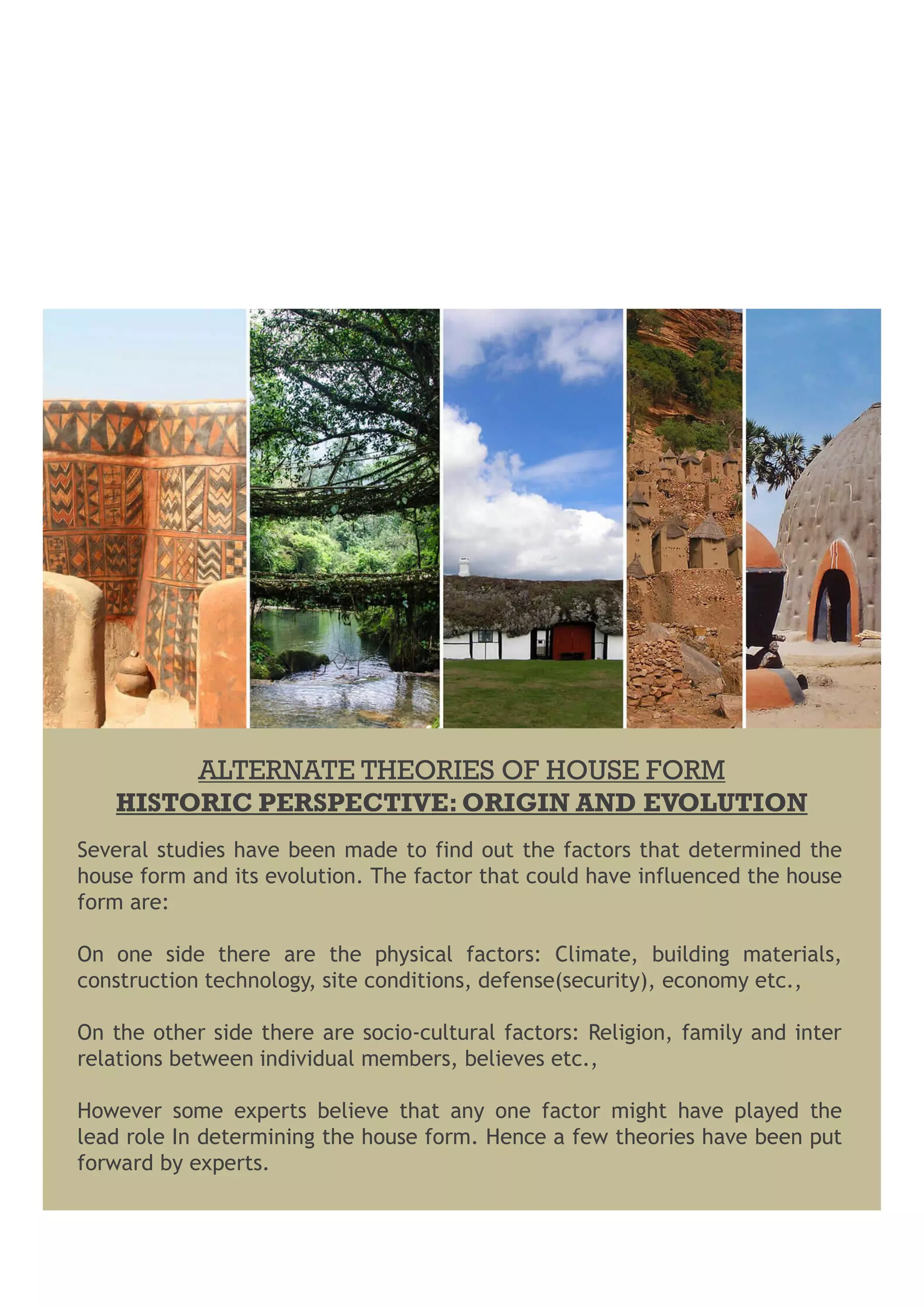
Several studies have been made to find out the factors that determined the
house form and its evolution. The factor that could have influenced the house
form are:
On one side there are the physical factors: Climate, building materials,
construction technology, site conditions, defense(security), economy etc.,
On the other side there are socio-cultural factors: Religion, family and inter
relations between individual members, believes etc.,
However some experts believe that any one factor might have played the
lead role In determining the house form. Hence a few theories have been put
forward by experts.
ALTERNATE THEORIES OF HOUSE FORM
HISTORIC PERSPECTIVE:ORIGIN AND EVOLUTION
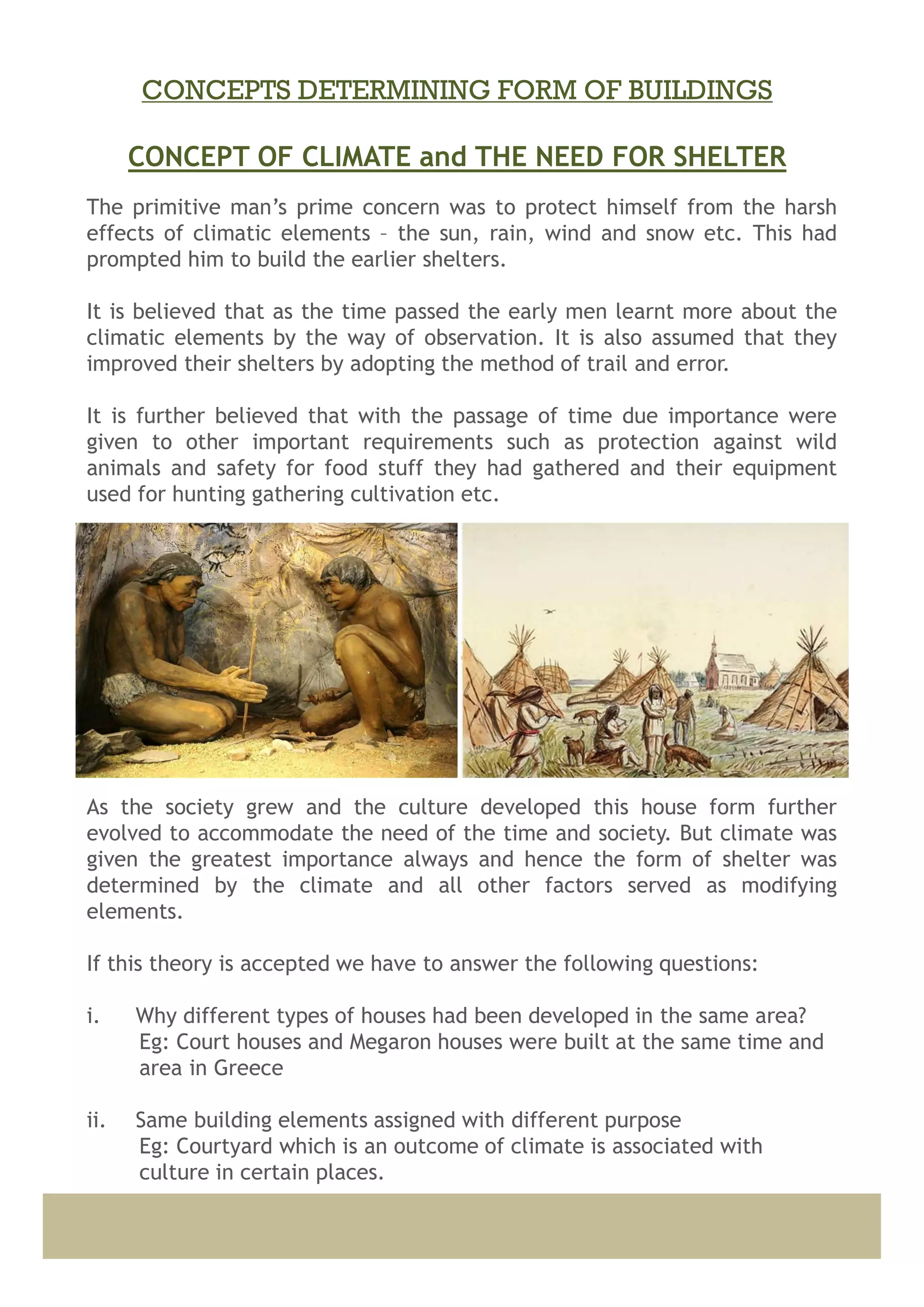
The primitive man’s prime concern was to protect himself from the harsh
effects of climatic elements – the sun, rain, wind and snow etc. This had
prompted him to build the earlier shelters.
It is believed that as the time passed the early men learnt more about the
climatic elements by the way of observation. It is also assumed that they
improved their shelters by adopting the method of trail and error.
It is further believed that with the passage of time due importance were
given to other important requirements such as protection against wild
animals and safety for food stuff they had gathered and their equipment
used for hunting gathering cultivation etc.
As the society grew and the culture developed this house form further
evolved to accommodate the need of the time and society. But climate was
given the greatest importance always and hence the form of shelter was
determined by the climate and all other factors served as modifying
elements.
If this theory is accepted we have to answer the following questions:
i. Why different types of houses had been developed in the same area?
Eg: Court houses and Megaron houses were built at the same time and
area in Greece
ii. Same building elements assigned with different purpose
Eg: Courtyard which is an outcome of climate is associated with
culture in certain places.
CONCEPT OF CLIMATE and THE NEED FOR SHELTER
CONCEPTS DETERMINING FORM OF BUILDINGS
The first person to put forward this theory was Abbe Marc Antoine Laugier
(head of a French monastery). In the year 1753 he published his essay entitled
“Essai Sur I’architecture” in French. In this essay he essentially wrote about:
“Universal natural architecture”. In this article he discusses about his concept
of Primodial primitive hut – the first hut ever to be built.
He explains his theory by narrating an imaginary incident: The first man on
the earth (Adam) found the direct sun rays hitting him. Soon he found a group
of trees and moved under them. The shadows casted by the trees gave him
comfort. But his happiness did not last long, because it started raining heavily.
The trees could not provide adequate protection from rain.
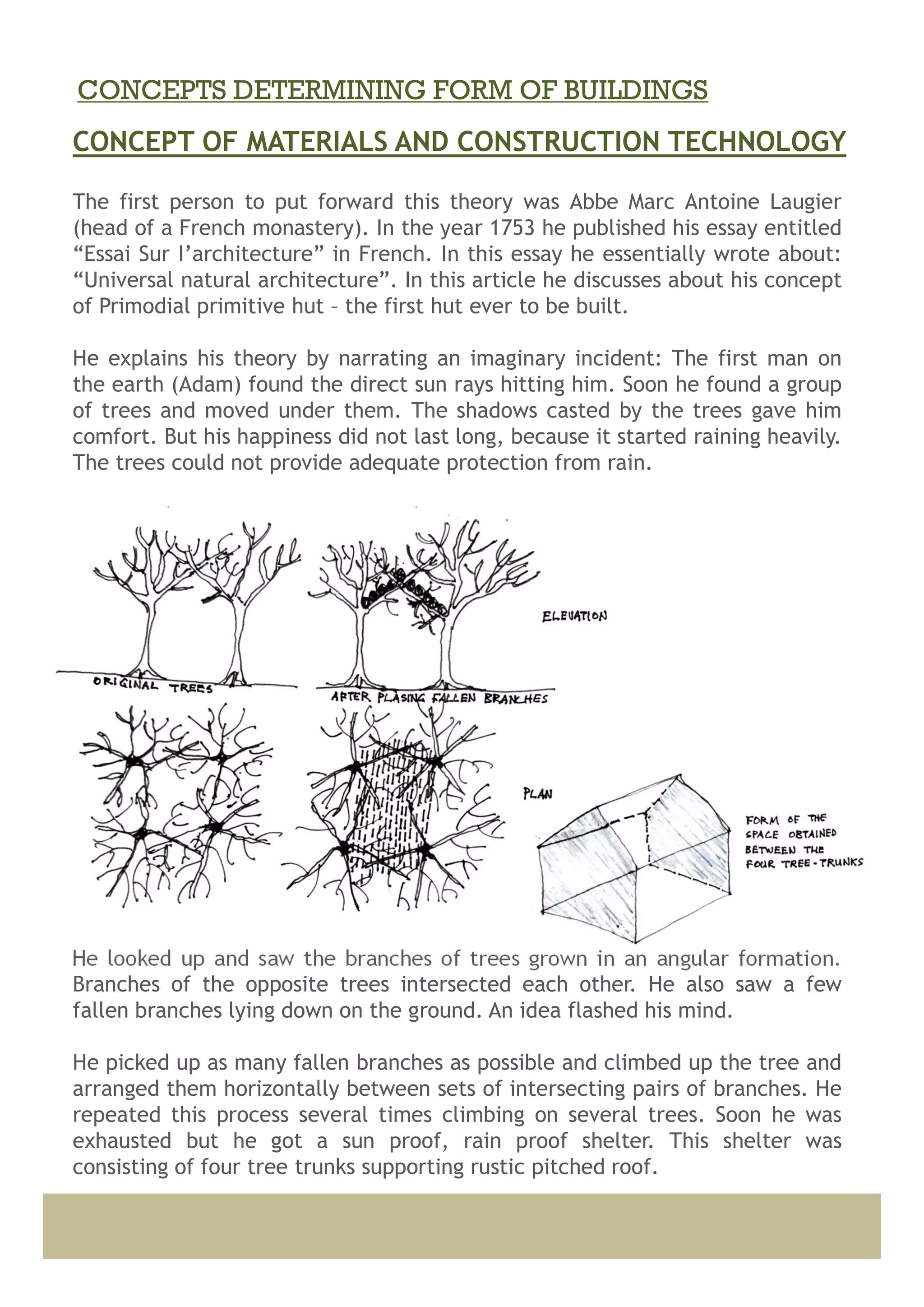
He looked up and saw the branches of trees grown in an angular formation.
Branches of the opposite trees intersected each other. He also saw a few
fallen branches lying down on the ground. An idea flashed his mind.
He picked up as many fallen branches as possible and climbed up the tree and
arranged them horizontally between sets of intersecting pairs of branches. He
repeated this process several times climbing on several trees. Soon he was
exhausted but he got a sun proof, rain proof shelter. This shelter was
consisting of four tree trunks supporting rustic pitched roof.
CONCEPT OF MATERIALS AND CONSTRUCTION TECHNOLOGY
CONCEPTS DETERMINING FORM OF BUILDINGS
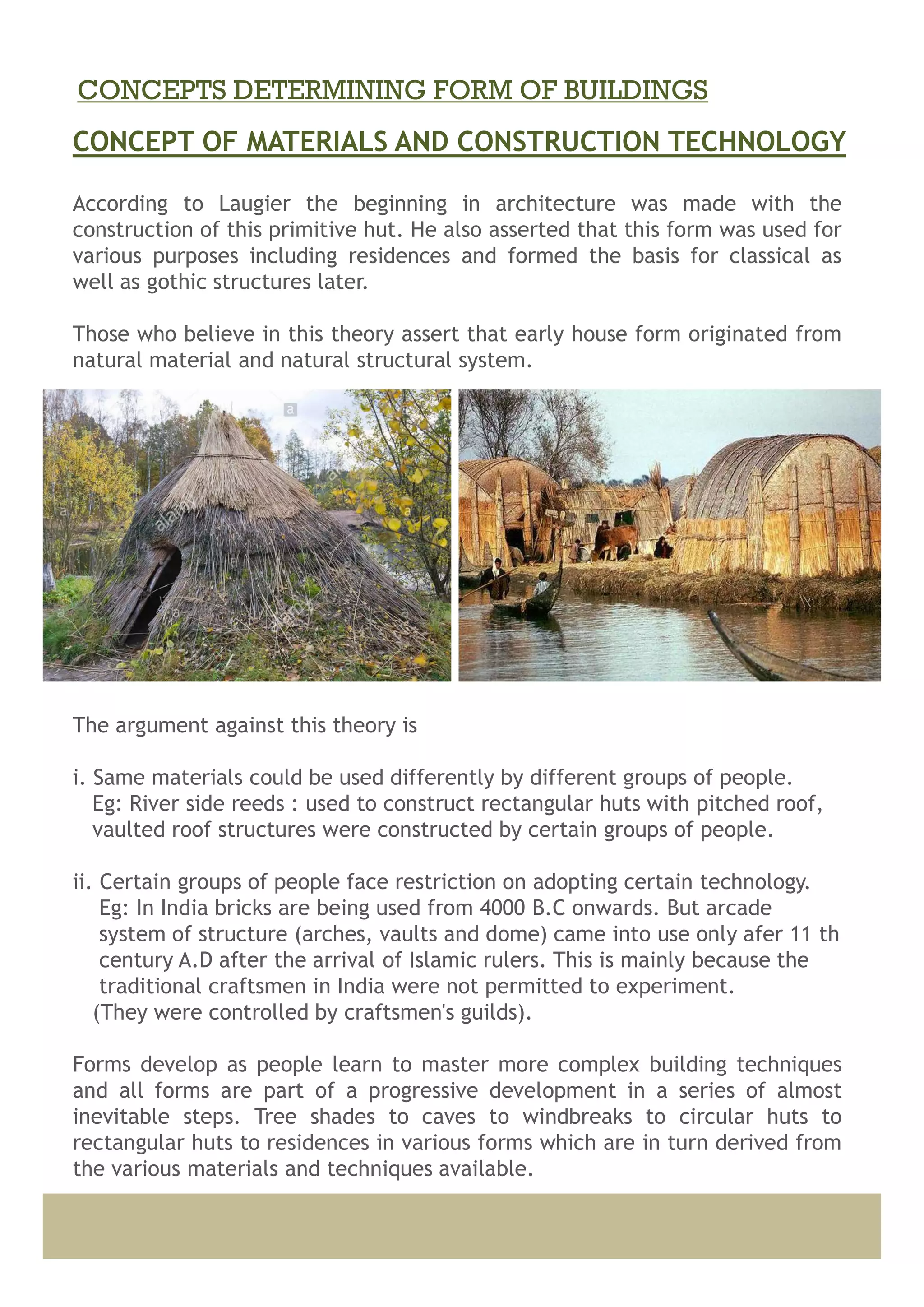
According to Laugier the beginning in architecture was made with the
construction of this primitive hut. He also asserted that this form was used for
various purposes including residences and formed the basis for classical as
well as gothic structures later.
Those who believe in this theory assert that early house form originated from
natural material and natural structural system.
The argument against this theory is
i. Same materials could be used differently by different groups of people.
Eg: River side reeds : used to construct rectangular huts with pitched roof,
vaulted roof structures were constructed by certain groups of people.
ii. Certain groups of people face restriction on adopting certain technology.
Eg: In India bricks are being used from 4000 B.C onwards. But arcade
system of structure (arches, vaults and dome) came into use only afer 11 th
century A.D after the arrival of Islamic rulers. This is mainly because the
traditional craftsmen in India were not permitted to experiment.
(They were controlled by craftsmen's guilds).
Forms develop as people learn to master more complex building techniques
and all forms are part of a progressive development in a series of almost
inevitable steps. Tree shades to caves to windbreaks to circular huts to
rectangular huts to residences in various forms which are in turn derived from
the various materials and techniques available.
CONCEPT OF MATERIALS AND CONSTRUCTION TECHNOLOGY
CONCEPTS DETERMINING FORM OF BUILDINGS
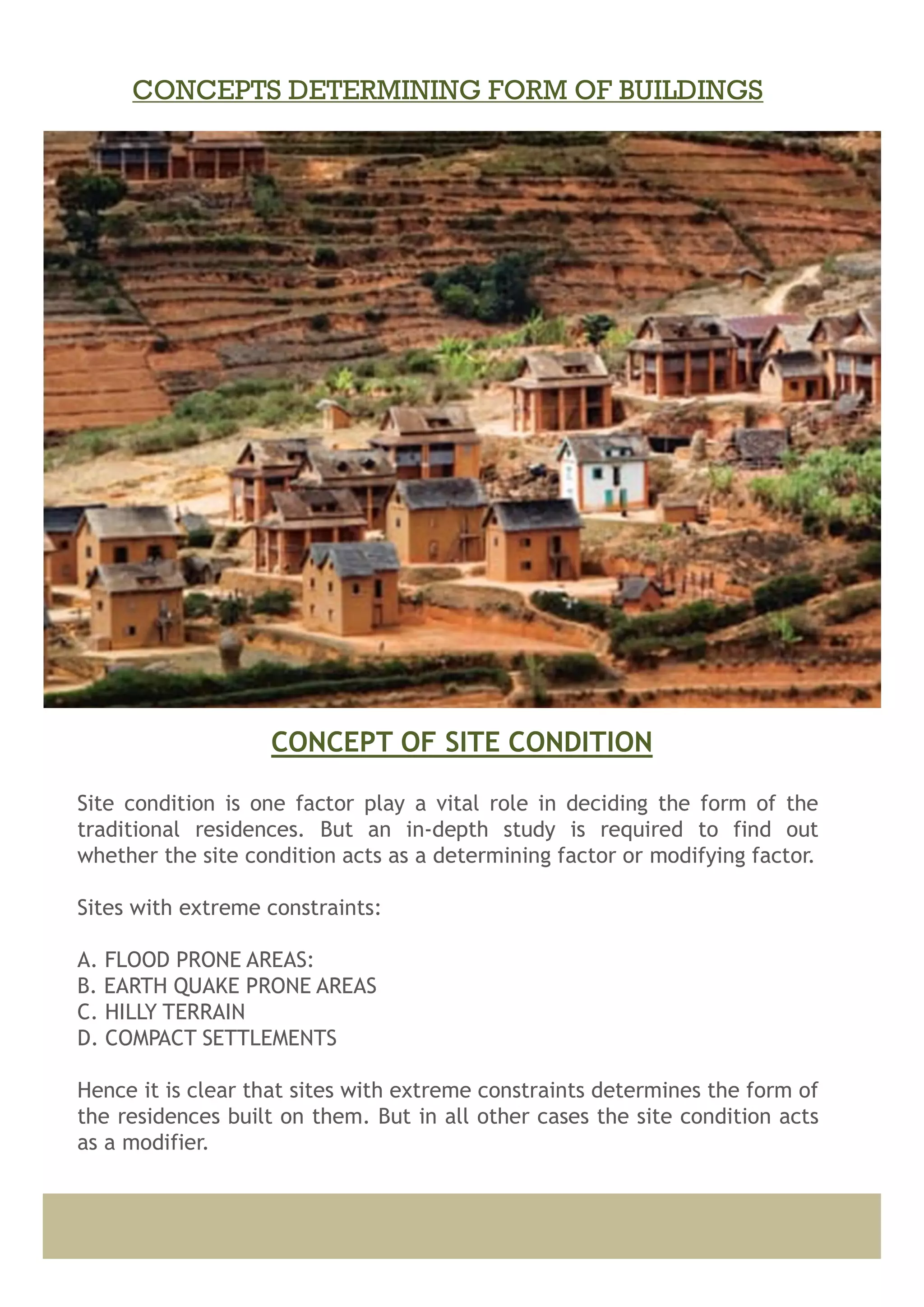
Site condition is one factor play a vital role in deciding the form of the
traditional residences. But an in-depth study is required to find out
whether the site condition acts as a determining factor or modifying factor.
Sites with extreme constraints:
A. FLOOD PRONE AREAS:
B. EARTH QUAKE PRONE AREAS
C. HILLY TERRAIN
D. COMPACT SETTLEMENTS
Hence it is clear that sites with extreme constraints determines the form of
the residences built on them. But in all other cases the site condition acts
as a modifier.
CONCEPT OF SITE CONDITION
CONCEPTS DETERMINING FORM OF BUILDINGS
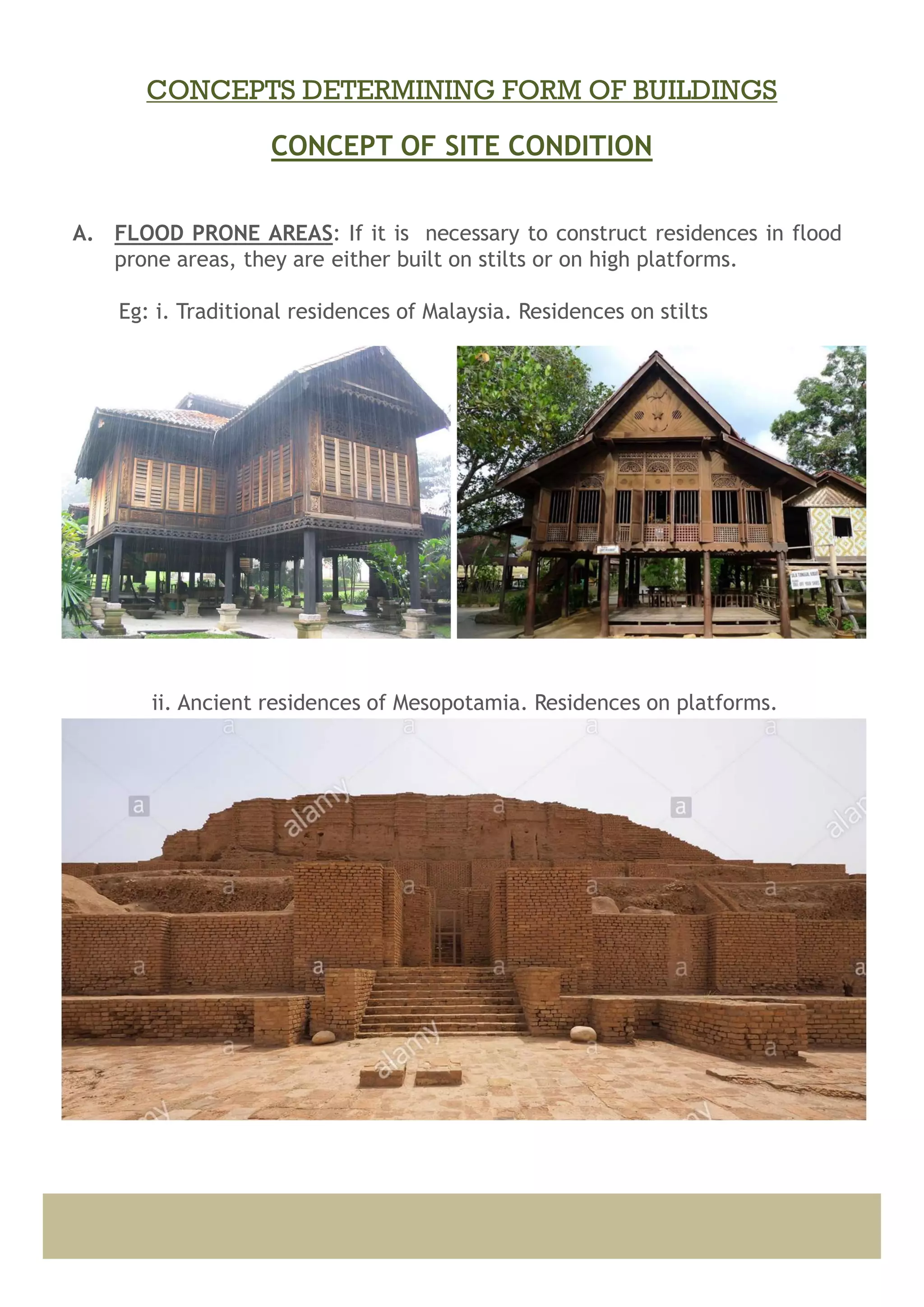
A. FLOOD PRONE AREAS: If it is necessary to construct residences in flood
prone areas, they are either built on stilts or on high platforms.
Eg: i. Traditional residences of Malaysia. Residences on stilts
ii. Ancient residences of Mesopotamia. Residences on platforms.
CONCEPT OF SITE CONDITION
CONCEPTS DETERMINING FORM OF BUILDINGS
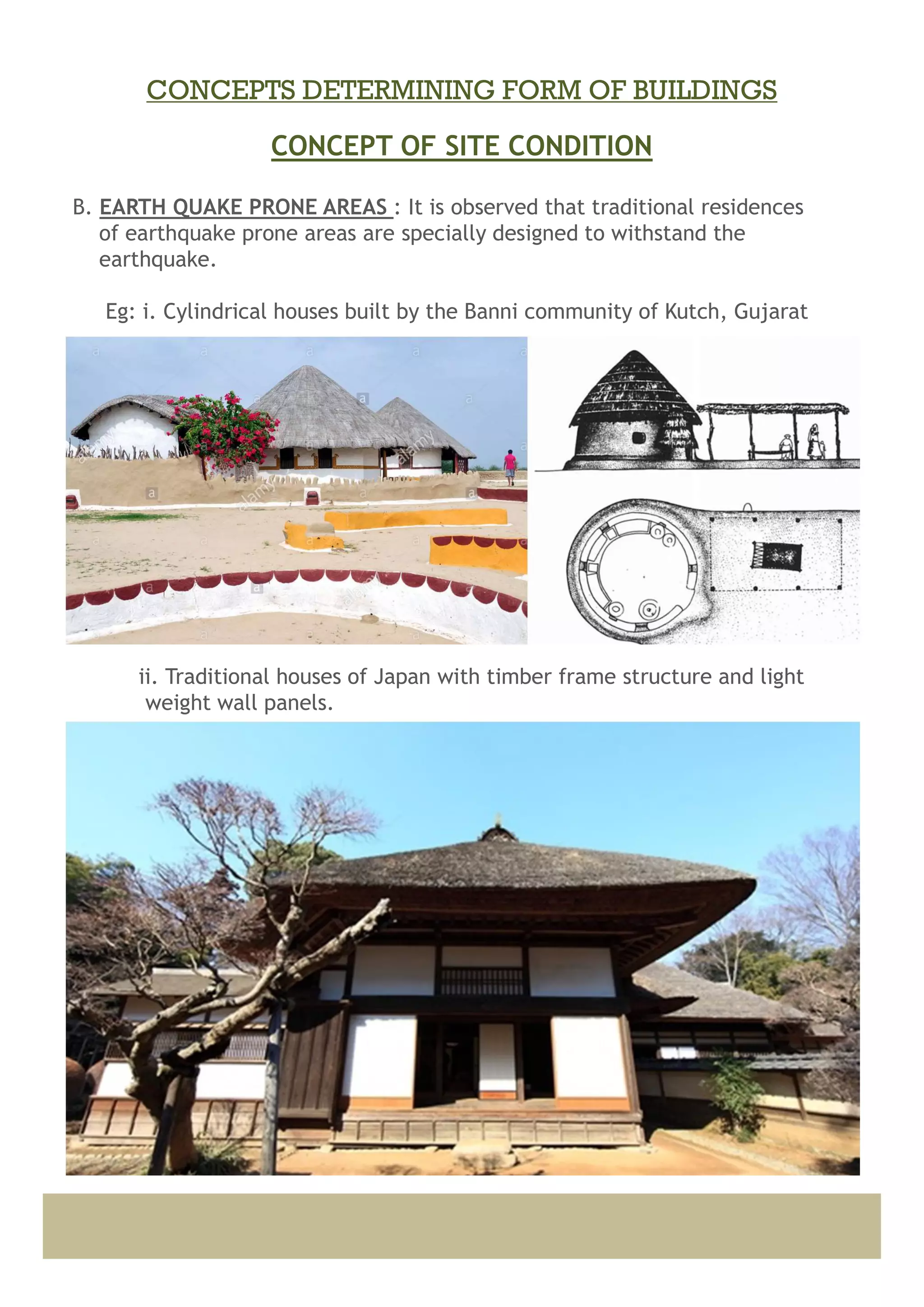
B. EARTH QUAKE PRONE AREAS : It is observed that traditional residences
of earthquake prone areas are specially designed to withstand the
earthquake.
Eg: i. Cylindrical houses built by the Banni community of Kutch, Gujarat
ii. Traditional houses of Japan with timber frame structure and light
weight wall panels.
CONCEPT OF SITE CONDITION
CONCEPTS DETERMINING FORM OF BUILDINGS
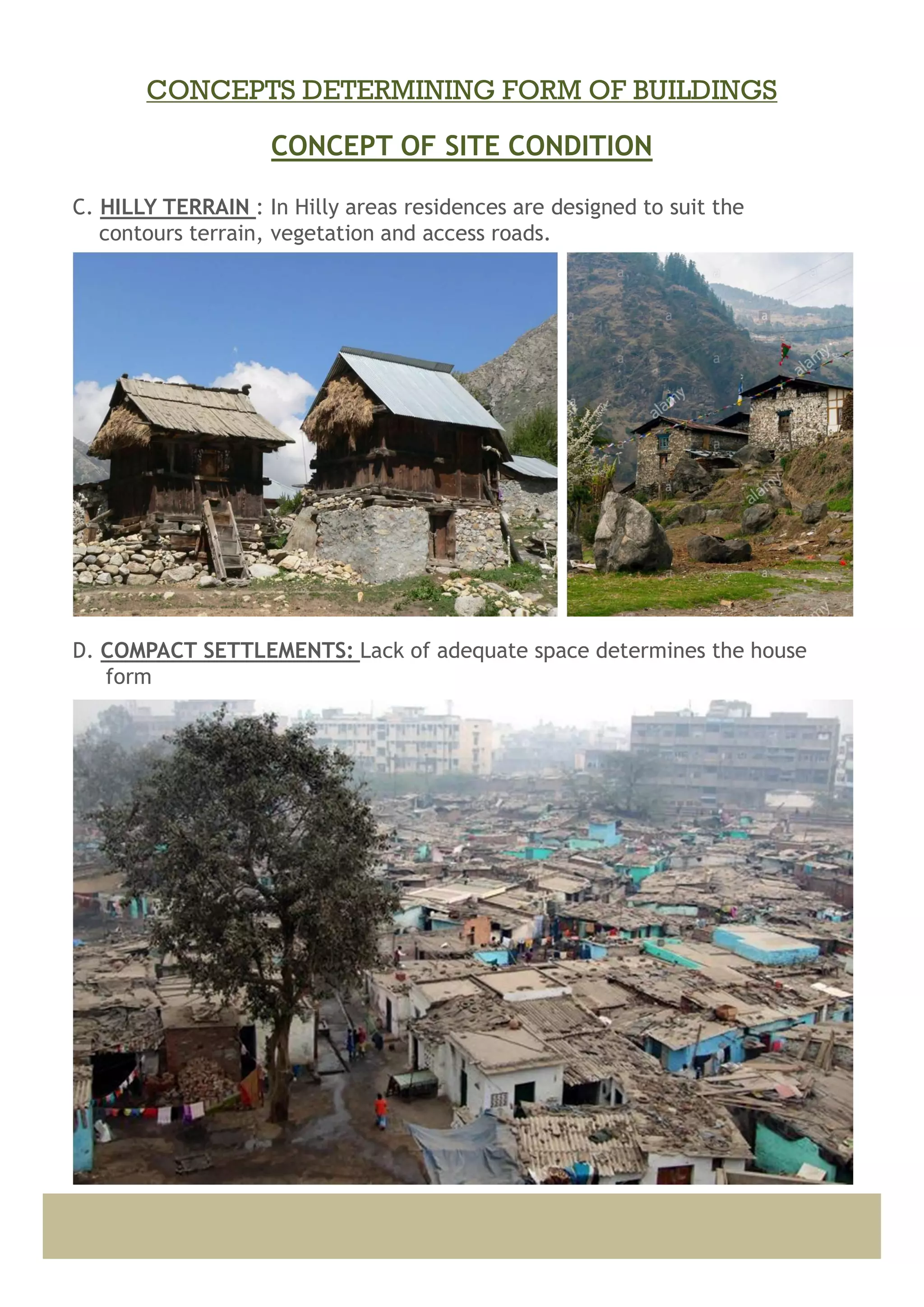
C. HILLY TERRAIN : In Hilly areas residences are designed to suit the
contours terrain, vegetation and access roads.
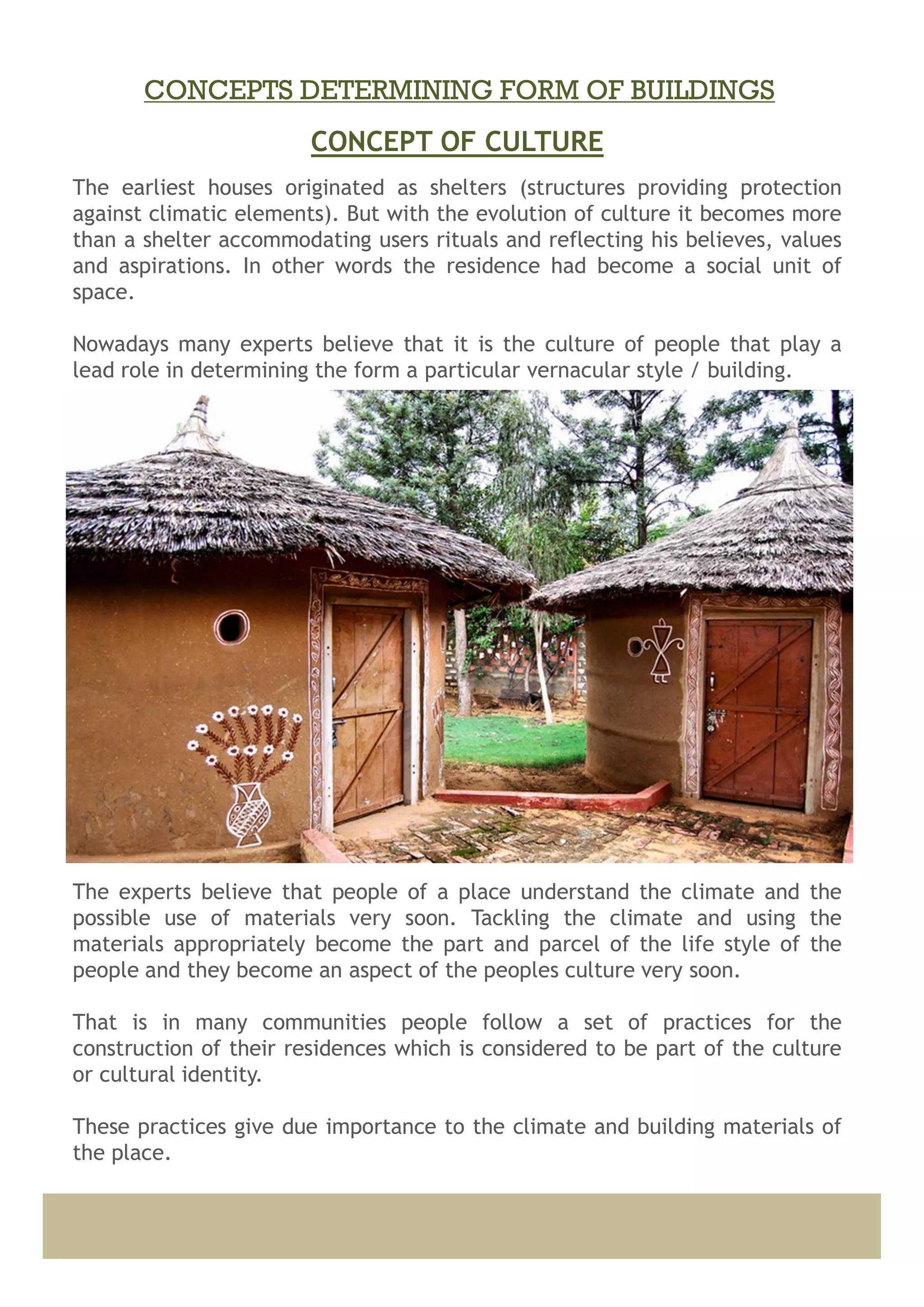
D. COMPACT SETTLEMENTS: Lack of adequate space determines the house
form
CONCEPT OF SITE CONDITION
CONCEPTS DETERMINING FORM OF BUILDINGS
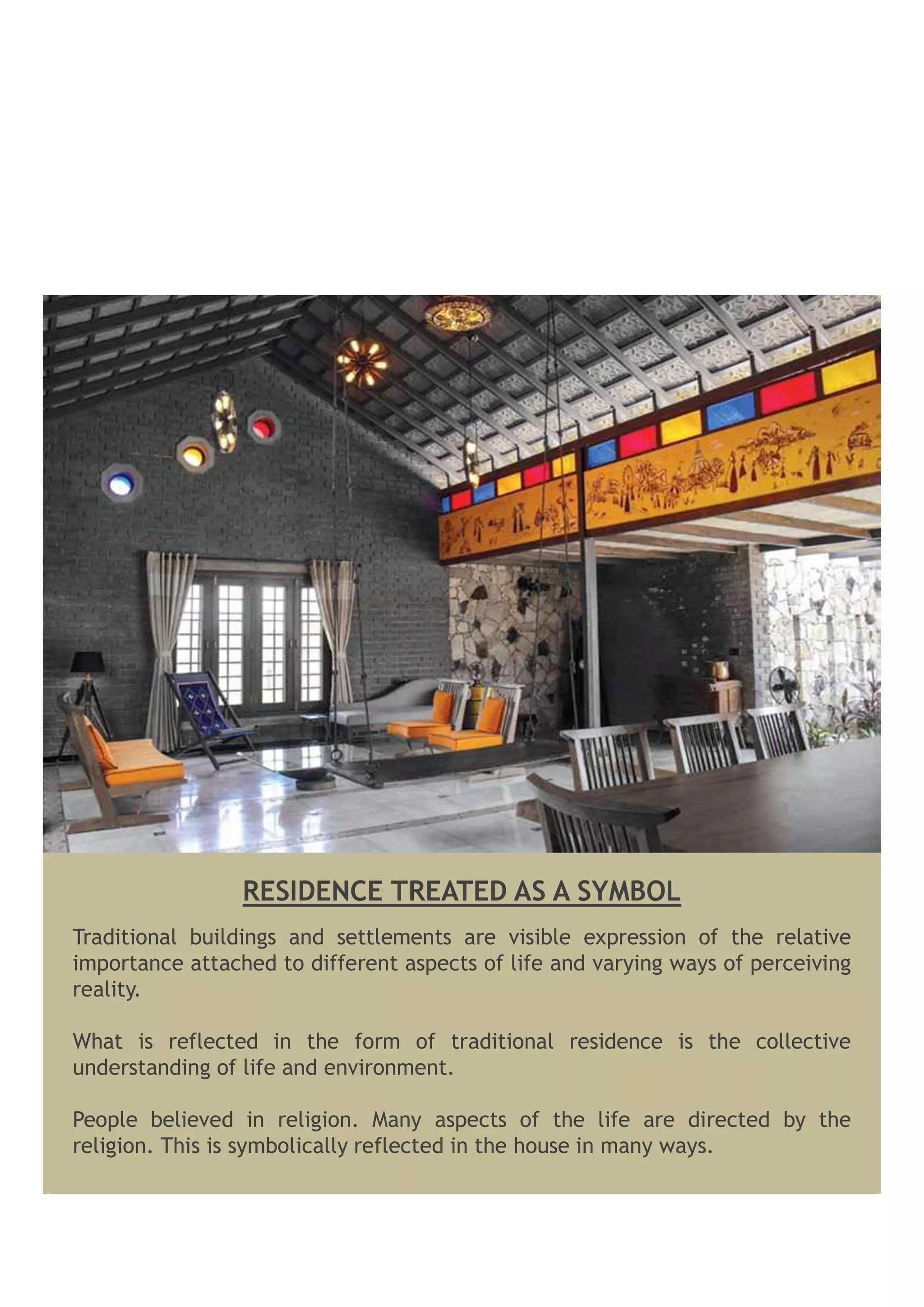
The earliest houses originated as shelters (structures providing protection
against climatic elements). But with the evolution of culture it becomes more
than a shelter accommodating users rituals and reflecting his believes, values
and aspirations. In other words the residence had become a social unit of
space.
Nowadays many experts believe that it is the culture of people that play a
lead role in determining the form a particular vernacular style / building.
This is not to deny the impact of climate of the place and the building
materials available there.
The experts believe that people of a place understand the climate and the
possible use of materials very soon. Tackling the climate and using the
materials appropriately become the part and parcel of the life style of the
people and they become an aspect of the peoples culture very soon.
That is in many communities people follow a set of practices for the
construction of their residences which is considered to be part of the culture
or cultural identity.
These practices give due importance to the climate and building materials of
the place.
CONCEPT OF CULTURE
CONCEPTS DETERMINING FORM OF BUILDINGS
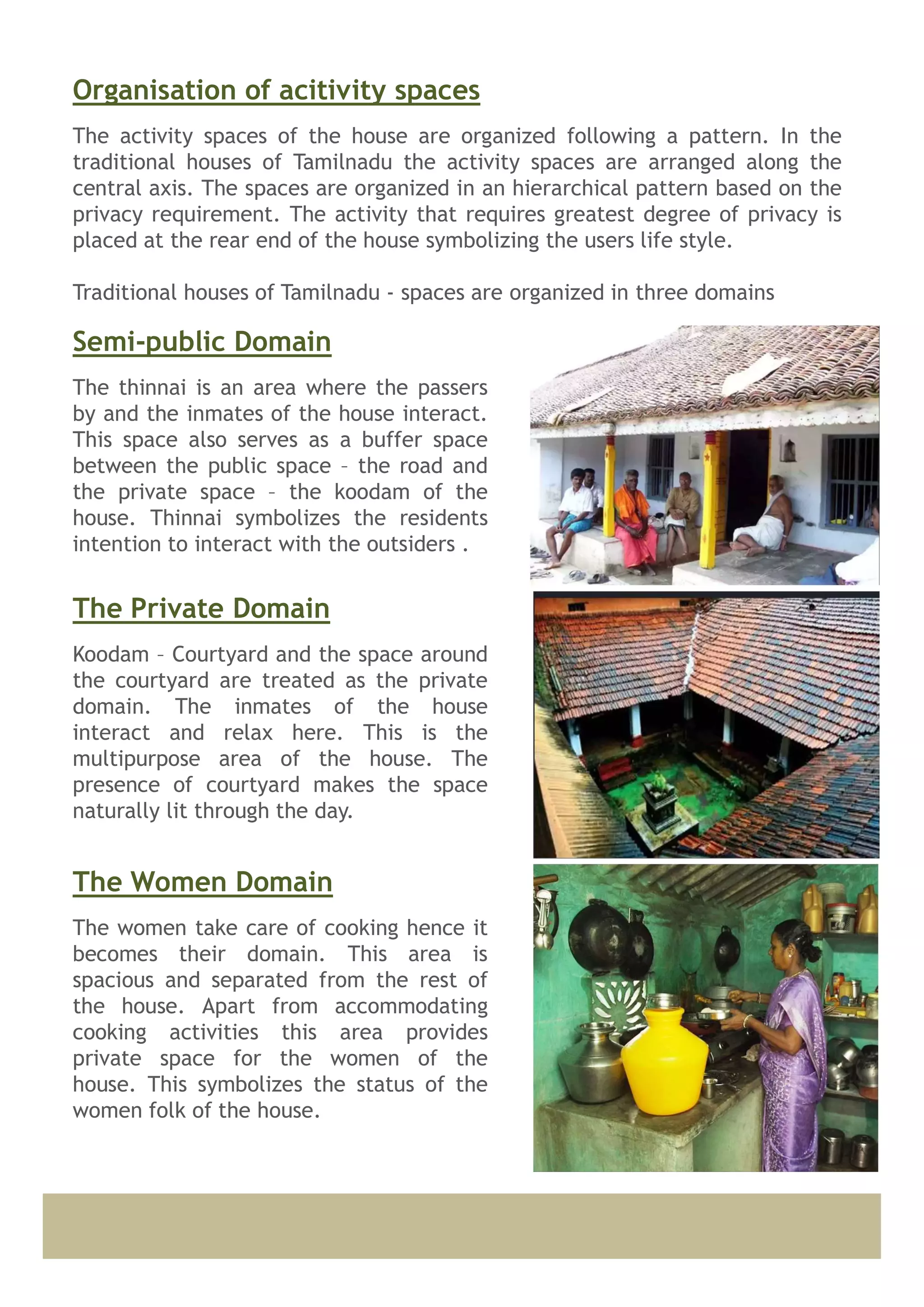
Traditional buildings and settlements are visible expression of the relative
importance attached to different aspects of life and varying ways of perceiving
reality.
What is reflected in the form of traditional residence is the collective
understanding of life and environment.
People believed in religion. Many aspects of the life are directed by the
religion. This is symbolically reflected in the house in many ways.
RESIDENCE TREATED AS A SYMBOL
The activity spaces of the house are organized following a pattern. In the
traditional houses of Tamilnadu the activity spaces are arranged along the
central axis. The spaces are organized in an hierarchical pattern based on the
privacy requirement. The activity that requires greatest degree of privacy is
placed at the rear end of the house symbolizing the users life style.
Traditional houses of Tamilnadu - spaces are organized in three domains
Organisation of acitivity spaces
The thinnai is an area where the passers
by and the inmates of the house interact.
This space also serves as a buffer space
between the public space – the road and
the private space – the koodam of the
house. Thinnai symbolizes the residents
intention to interact with the outsiders .
Semi-public Domain
Koodam – Courtyard and the space around
the courtyard are treated as the private
domain. The inmates of the house
interact and relax here. This is the
multipurpose area of the house. The
presence of courtyard makes the space
naturally lit through the day.
The Private Domain
The women take care of cooking hence it
becomes their domain. This area is
spacious and separated from the rest of
the house. Apart from accommodating
cooking activities this area provides
private space for the women of the
house. This symbolizes the status of the
women folk of the house.
The Women Domain
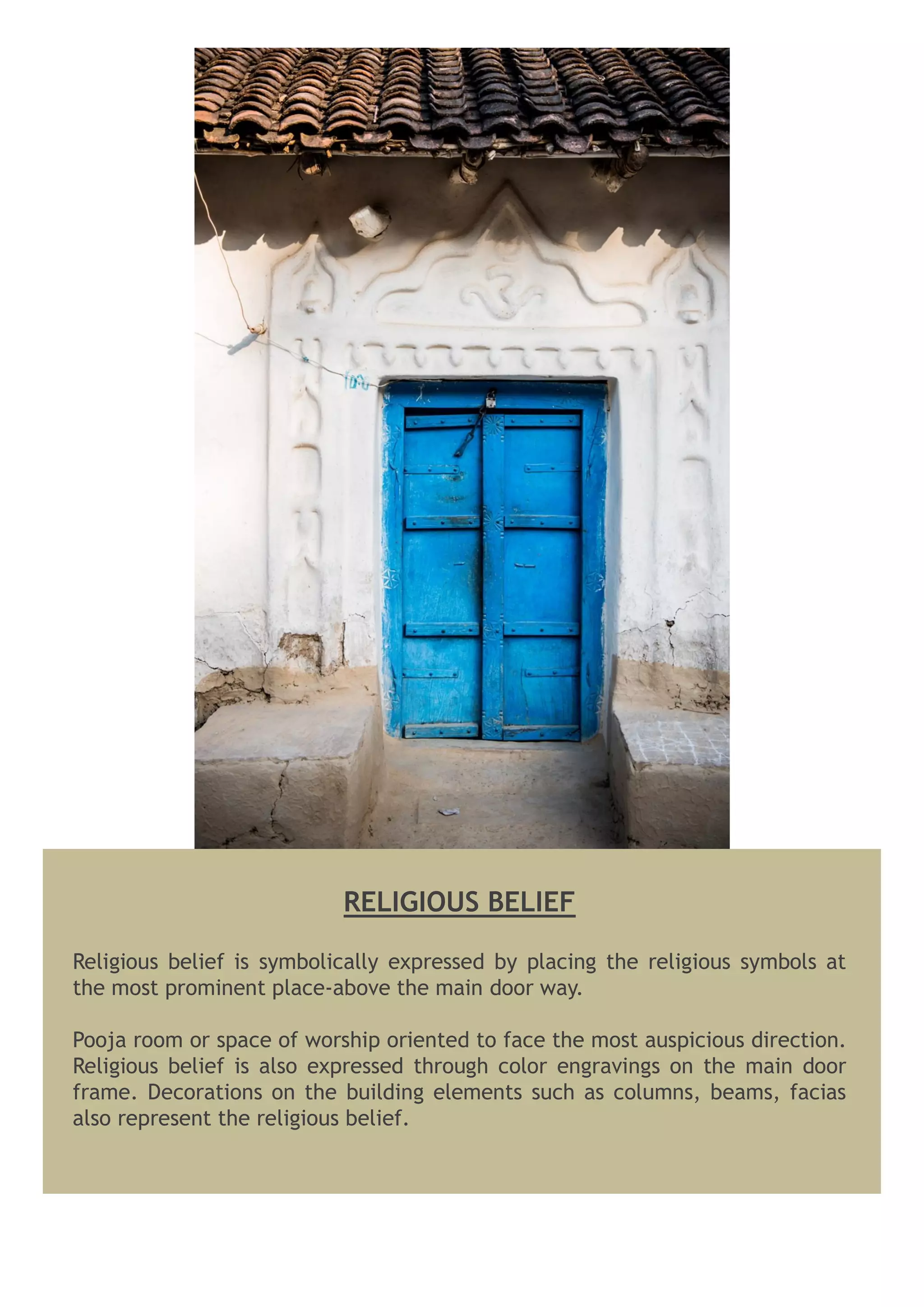
Religious belief is symbolically expressed by placing the religious symbols at
the most prominent place-above the main door way.
Pooja room or space of worship oriented to face the most auspicious direction.
Religious belief is also expressed through color engravings on the main door
frame. Decorations on the building elements such as columns, beams, facias
also represent the religious belief.
RELIGIOUS BELIEF
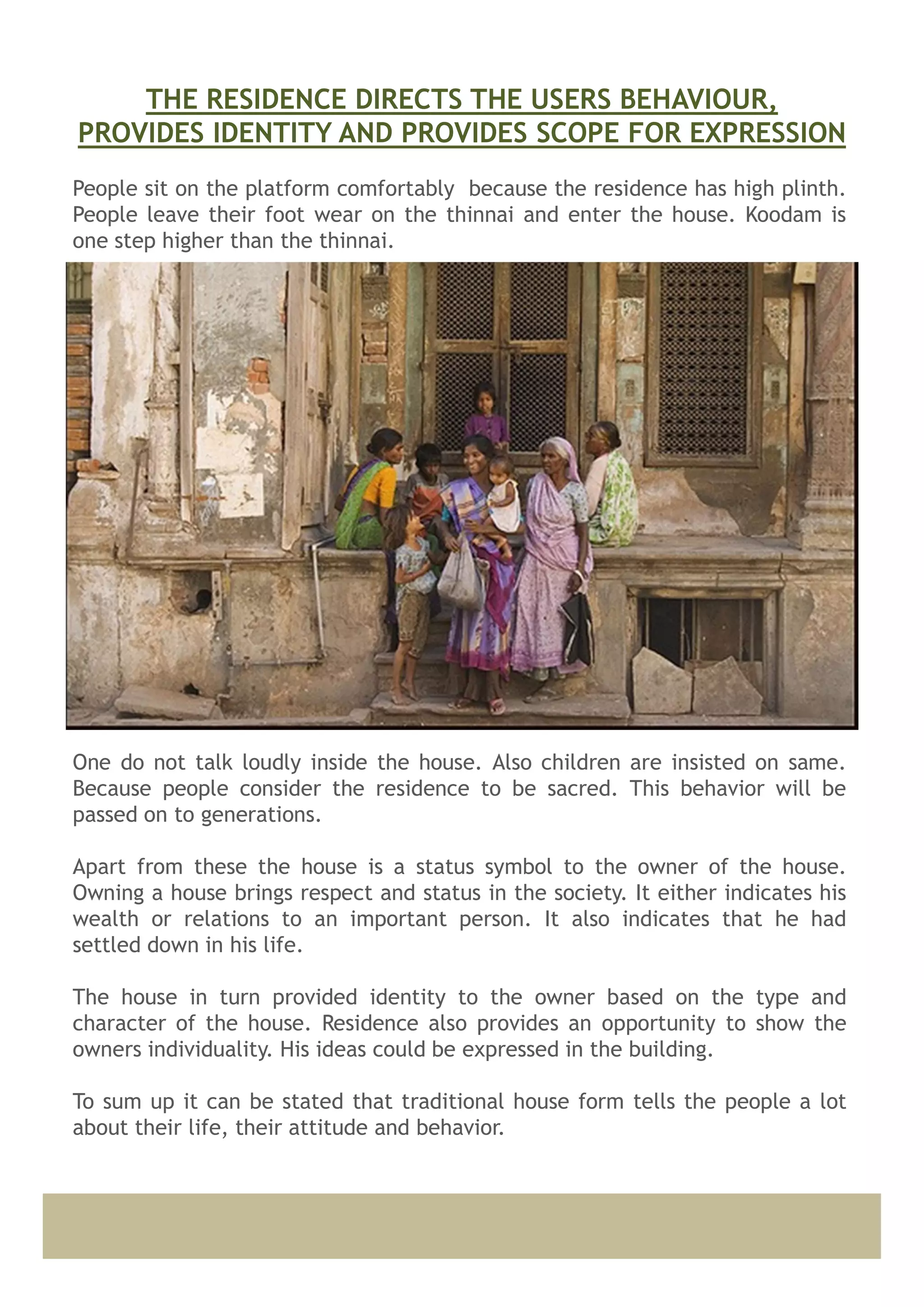
People sit on the platform comfortably because the residence has high plinth.
People leave their foot wear on the thinnai and enter the house. Koodam is
one step higher than the thinnai.
One do not talk loudly inside the house. Also children are insisted on same.
Because people consider the residence to be sacred. This behavior will be
passed on to generations.
Apart from these the house is a status symbol to the owner of the house.
Owning a house brings respect and status in the society. It either indicates his
wealth or relations to an important person. It also indicates that he had
settled down in his life.
The house in turn provided identity to the owner based on the type and
character of the house. Residence also provides an opportunity to show the
owners individuality. His ideas could be expressed in the building.
To sum up it can be stated that traditional house form tells the people a lot
about their life, their attitude and behavior.
THE RESIDENCE DIRECTS THE USERS BEHAVIOUR,
PROVIDES IDENTITY AND PROVIDES SCOPE FOR EXPRESSION

Vernacular architecture approaches and concepts

  • 1.
    XAR 602 VERNACULAR ARCHITECTURE UNIT-II– APPROACHES AND CONCEPTS Different approaches and concepts to the study of vernacular architecture: An overview – Aesthetical, Architectural and Anthropological studies in detail Lecture and Presentation by: Prof. Joseph Fernando, PMIST Ar. S. Bala Hari Krishnan, Asst. Professor, PMIST
  • 2.
    Several studies havebeen made to find out the factors that determined the house form and its evolution. The factor that could have influenced the house form are: On one side there are the physical factors: Climate, building materials, construction technology, site conditions, defense(security), economy etc., On the other side there are socio-cultural factors: Religion, family and inter relations between individual members, believes etc., However some experts believe that any one factor might have played the lead role In determining the house form. Hence a few theories have been put forward by experts. ALTERNATE THEORIES OF HOUSE FORM HISTORIC PERSPECTIVE:ORIGIN AND EVOLUTION
  • 3.
    The primitive man’sprime concern was to protect himself from the harsh effects of climatic elements – the sun, rain, wind and snow etc. This had prompted him to build the earlier shelters. It is believed that as the time passed the early men learnt more about the climatic elements by the way of observation. It is also assumed that they improved their shelters by adopting the method of trail and error. It is further believed that with the passage of time due importance were given to other important requirements such as protection against wild animals and safety for food stuff they had gathered and their equipment used for hunting gathering cultivation etc. As the society grew and the culture developed this house form further evolved to accommodate the need of the time and society. But climate was given the greatest importance always and hence the form of shelter was determined by the climate and all other factors served as modifying elements. If this theory is accepted we have to answer the following questions: i. Why different types of houses had been developed in the same area? Eg: Court houses and Megaron houses were built at the same time and area in Greece ii. Same building elements assigned with different purpose Eg: Courtyard which is an outcome of climate is associated with culture in certain places. CONCEPT OF CLIMATE and THE NEED FOR SHELTER CONCEPTS DETERMINING FORM OF BUILDINGS
  • 4.
    The first personto put forward this theory was Abbe Marc Antoine Laugier (head of a French monastery). In the year 1753 he published his essay entitled “Essai Sur I’architecture” in French. In this essay he essentially wrote about: “Universal natural architecture”. In this article he discusses about his concept of Primodial primitive hut – the first hut ever to be built. He explains his theory by narrating an imaginary incident: The first man on the earth (Adam) found the direct sun rays hitting him. Soon he found a group of trees and moved under them. The shadows casted by the trees gave him comfort. But his happiness did not last long, because it started raining heavily. The trees could not provide adequate protection from rain. He looked up and saw the branches of trees grown in an angular formation. Branches of the opposite trees intersected each other. He also saw a few fallen branches lying down on the ground. An idea flashed his mind. He picked up as many fallen branches as possible and climbed up the tree and arranged them horizontally between sets of intersecting pairs of branches. He repeated this process several times climbing on several trees. Soon he was exhausted but he got a sun proof, rain proof shelter. This shelter was consisting of four tree trunks supporting rustic pitched roof. CONCEPT OF MATERIALS AND CONSTRUCTION TECHNOLOGY CONCEPTS DETERMINING FORM OF BUILDINGS
  • 5.
    According to Laugierthe beginning in architecture was made with the construction of this primitive hut. He also asserted that this form was used for various purposes including residences and formed the basis for classical as well as gothic structures later. Those who believe in this theory assert that early house form originated from natural material and natural structural system. The argument against this theory is i. Same materials could be used differently by different groups of people. Eg: River side reeds : used to construct rectangular huts with pitched roof, vaulted roof structures were constructed by certain groups of people. ii. Certain groups of people face restriction on adopting certain technology. Eg: In India bricks are being used from 4000 B.C onwards. But arcade system of structure (arches, vaults and dome) came into use only afer 11 th century A.D after the arrival of Islamic rulers. This is mainly because the traditional craftsmen in India were not permitted to experiment. (They were controlled by craftsmen's guilds). Forms develop as people learn to master more complex building techniques and all forms are part of a progressive development in a series of almost inevitable steps. Tree shades to caves to windbreaks to circular huts to rectangular huts to residences in various forms which are in turn derived from the various materials and techniques available. CONCEPT OF MATERIALS AND CONSTRUCTION TECHNOLOGY CONCEPTS DETERMINING FORM OF BUILDINGS
  • 6.
    Site condition isone factor play a vital role in deciding the form of the traditional residences. But an in-depth study is required to find out whether the site condition acts as a determining factor or modifying factor. Sites with extreme constraints: A. FLOOD PRONE AREAS: B. EARTH QUAKE PRONE AREAS C. HILLY TERRAIN D. COMPACT SETTLEMENTS Hence it is clear that sites with extreme constraints determines the form of the residences built on them. But in all other cases the site condition acts as a modifier. CONCEPT OF SITE CONDITION CONCEPTS DETERMINING FORM OF BUILDINGS
  • 7.
    A. FLOOD PRONEAREAS: If it is necessary to construct residences in flood prone areas, they are either built on stilts or on high platforms. Eg: i. Traditional residences of Malaysia. Residences on stilts ii. Ancient residences of Mesopotamia. Residences on platforms. CONCEPT OF SITE CONDITION CONCEPTS DETERMINING FORM OF BUILDINGS
  • 8.
    B. EARTH QUAKEPRONE AREAS : It is observed that traditional residences of earthquake prone areas are specially designed to withstand the earthquake. Eg: i. Cylindrical houses built by the Banni community of Kutch, Gujarat ii. Traditional houses of Japan with timber frame structure and light weight wall panels. CONCEPT OF SITE CONDITION CONCEPTS DETERMINING FORM OF BUILDINGS
  • 9.
    C. HILLY TERRAIN: In Hilly areas residences are designed to suit the contours terrain, vegetation and access roads. D. COMPACT SETTLEMENTS: Lack of adequate space determines the house form CONCEPT OF SITE CONDITION CONCEPTS DETERMINING FORM OF BUILDINGS
  • 10.
    The earliest housesoriginated as shelters (structures providing protection against climatic elements). But with the evolution of culture it becomes more than a shelter accommodating users rituals and reflecting his believes, values and aspirations. In other words the residence had become a social unit of space. Nowadays many experts believe that it is the culture of people that play a lead role in determining the form a particular vernacular style / building. This is not to deny the impact of climate of the place and the building materials available there. The experts believe that people of a place understand the climate and the possible use of materials very soon. Tackling the climate and using the materials appropriately become the part and parcel of the life style of the people and they become an aspect of the peoples culture very soon. That is in many communities people follow a set of practices for the construction of their residences which is considered to be part of the culture or cultural identity. These practices give due importance to the climate and building materials of the place. CONCEPT OF CULTURE CONCEPTS DETERMINING FORM OF BUILDINGS
  • 11.
    Traditional buildings andsettlements are visible expression of the relative importance attached to different aspects of life and varying ways of perceiving reality. What is reflected in the form of traditional residence is the collective understanding of life and environment. People believed in religion. Many aspects of the life are directed by the religion. This is symbolically reflected in the house in many ways. RESIDENCE TREATED AS A SYMBOL
  • 12.
    The activity spacesof the house are organized following a pattern. In the traditional houses of Tamilnadu the activity spaces are arranged along the central axis. The spaces are organized in an hierarchical pattern based on the privacy requirement. The activity that requires greatest degree of privacy is placed at the rear end of the house symbolizing the users life style. Traditional houses of Tamilnadu - spaces are organized in three domains Organisation of acitivity spaces The thinnai is an area where the passers by and the inmates of the house interact. This space also serves as a buffer space between the public space – the road and the private space – the koodam of the house. Thinnai symbolizes the residents intention to interact with the outsiders . Semi-public Domain Koodam – Courtyard and the space around the courtyard are treated as the private domain. The inmates of the house interact and relax here. This is the multipurpose area of the house. The presence of courtyard makes the space naturally lit through the day. The Private Domain The women take care of cooking hence it becomes their domain. This area is spacious and separated from the rest of the house. Apart from accommodating cooking activities this area provides private space for the women of the house. This symbolizes the status of the women folk of the house. The Women Domain
  • 13.
    Religious belief issymbolically expressed by placing the religious symbols at the most prominent place-above the main door way. Pooja room or space of worship oriented to face the most auspicious direction. Religious belief is also expressed through color engravings on the main door frame. Decorations on the building elements such as columns, beams, facias also represent the religious belief. RELIGIOUS BELIEF
  • 14.
    People sit onthe platform comfortably because the residence has high plinth. People leave their foot wear on the thinnai and enter the house. Koodam is one step higher than the thinnai. One do not talk loudly inside the house. Also children are insisted on same. Because people consider the residence to be sacred. This behavior will be passed on to generations. Apart from these the house is a status symbol to the owner of the house. Owning a house brings respect and status in the society. It either indicates his wealth or relations to an important person. It also indicates that he had settled down in his life. The house in turn provided identity to the owner based on the type and character of the house. Residence also provides an opportunity to show the owners individuality. His ideas could be expressed in the building. To sum up it can be stated that traditional house form tells the people a lot about their life, their attitude and behavior. THE RESIDENCE DIRECTS THE USERS BEHAVIOUR, PROVIDES IDENTITY AND PROVIDES SCOPE FOR EXPRESSION