Presented by-
Rakesh kumar(A10)
Risso (A08)
Dubay
Akash joshi
Adish sood
Ar.
BALKRISNA
VITHALDAS
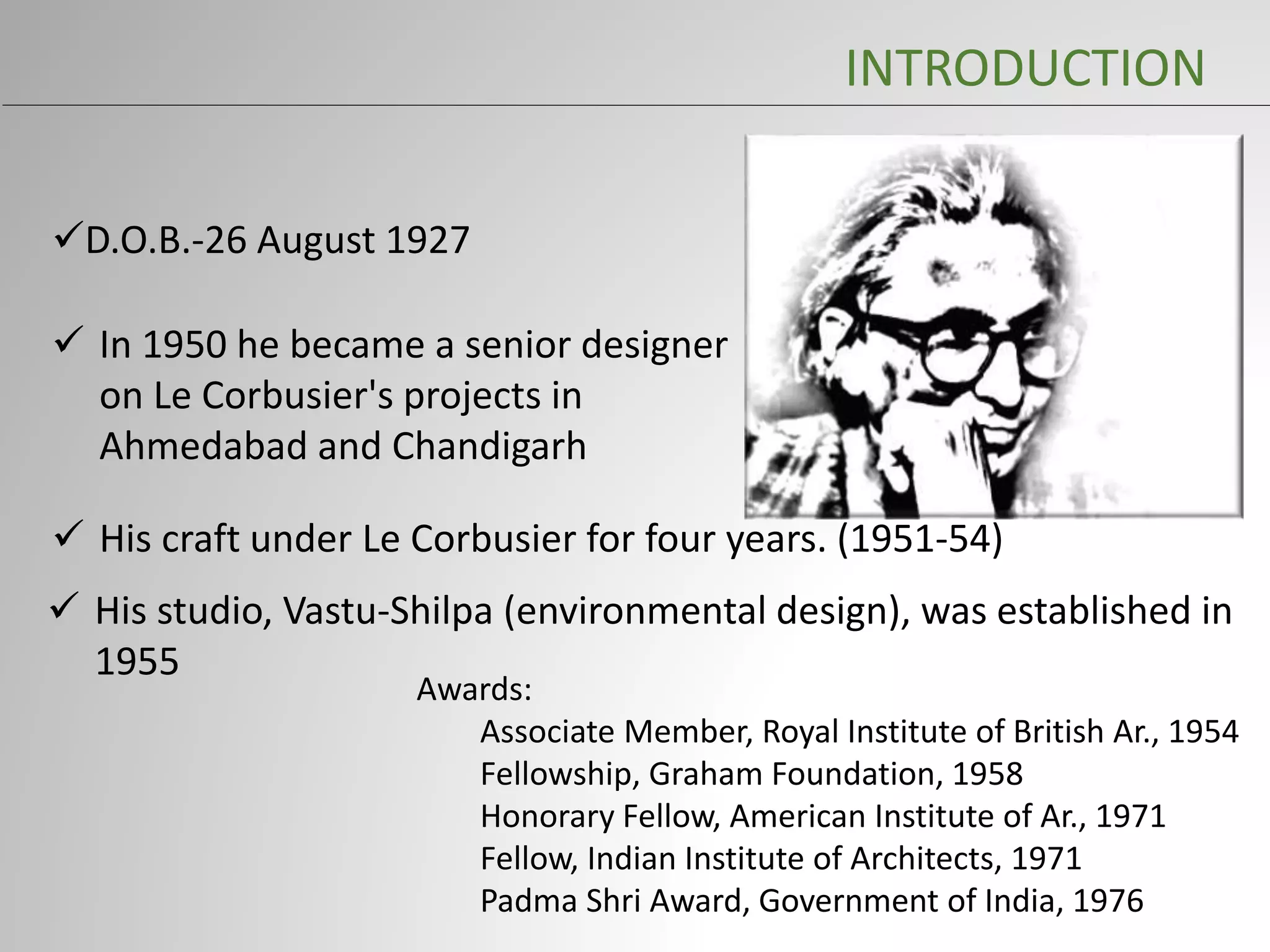
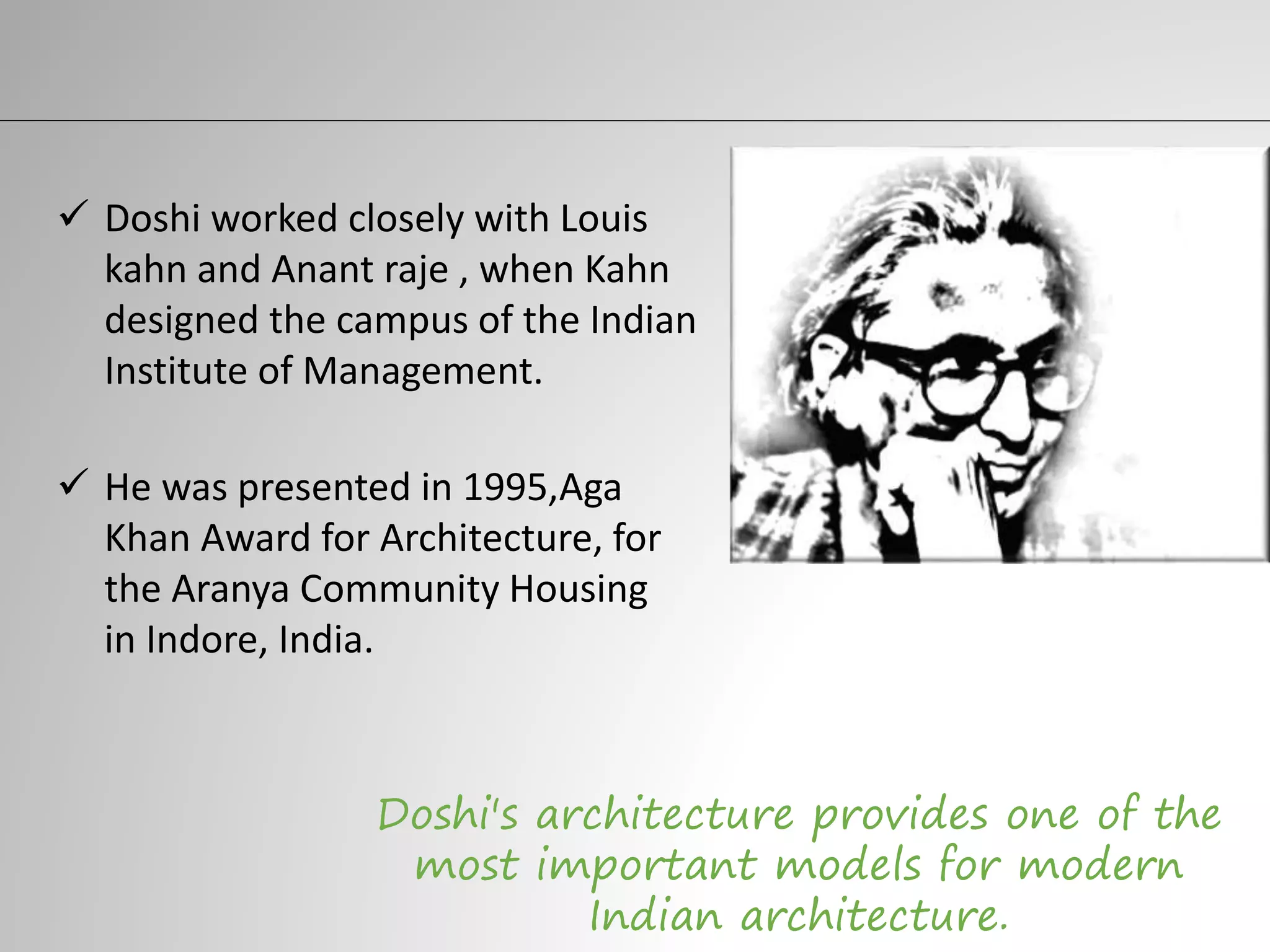
DOSHI
D.O.B.-26 August 1927
Awards:
Associate Member, Royal Institute of British Ar., 1954
Fellowship, Graham Foundation, 1958
Honorary Fellow, American Institute of Ar., 1971
Fellow, Indian Institute of Architects, 1971
Padma Shri Award, Government of India, 1976
 In 1950 he became a senior designer
on Le Corbusier's projects in
Ahmedabad and Chandigarh
 His craft under Le Corbusier for four years. (1951-54)
 His studio, Vastu-Shilpa (environmental design), was established in
1955
INTRODUCTION
 Doshi worked closely with Louis
kahn and Anant raje , when Kahn
designed the campus of the Indian
Institute of Management.
Doshi's architecture provides one of the
most important models for modern
Indian architecture.
 He was presented in 1995,Aga
Khan Award for Architecture, for
the Aranya Community Housing
in Indore, India.
IMPORTANT BUILDING
 SANGATH VASTU SHILPA FOUNDATION
 CEPT UNIVERSITY
 GANDHI LABOUR INSTITUE
 NIFT,NEW DELHI
 TAGORE HALL,AHMEDABAD
 ARANYA LOW COST HOUSING-INDOR
 IIM UDAIPUR
 HUSSAIN- DOSHI GUFA
 IIM BANGALOR
 INSTITUTE OF INDOLOGY,AHMEDABAD
Works Of B.V.Doshi
IIM BANGLORE
NIFT DELHI
SANGATH
HUSAIN – DOSHI GUFA
L
I
B
R
A
R
Y
PRINCIPLES
Doshi's work has consistently revolved around the interrelationship of
indoor and outdoor space.
The success of any project depends
on effective construction,
contracting, logistic planning and
co-ordination
Doshi applies Modernists concepts
to an Indian context
Doshi followed it in his architecture
by providing openness in buildings
through colonnades, pergolas,
porticos, sky lights etc.
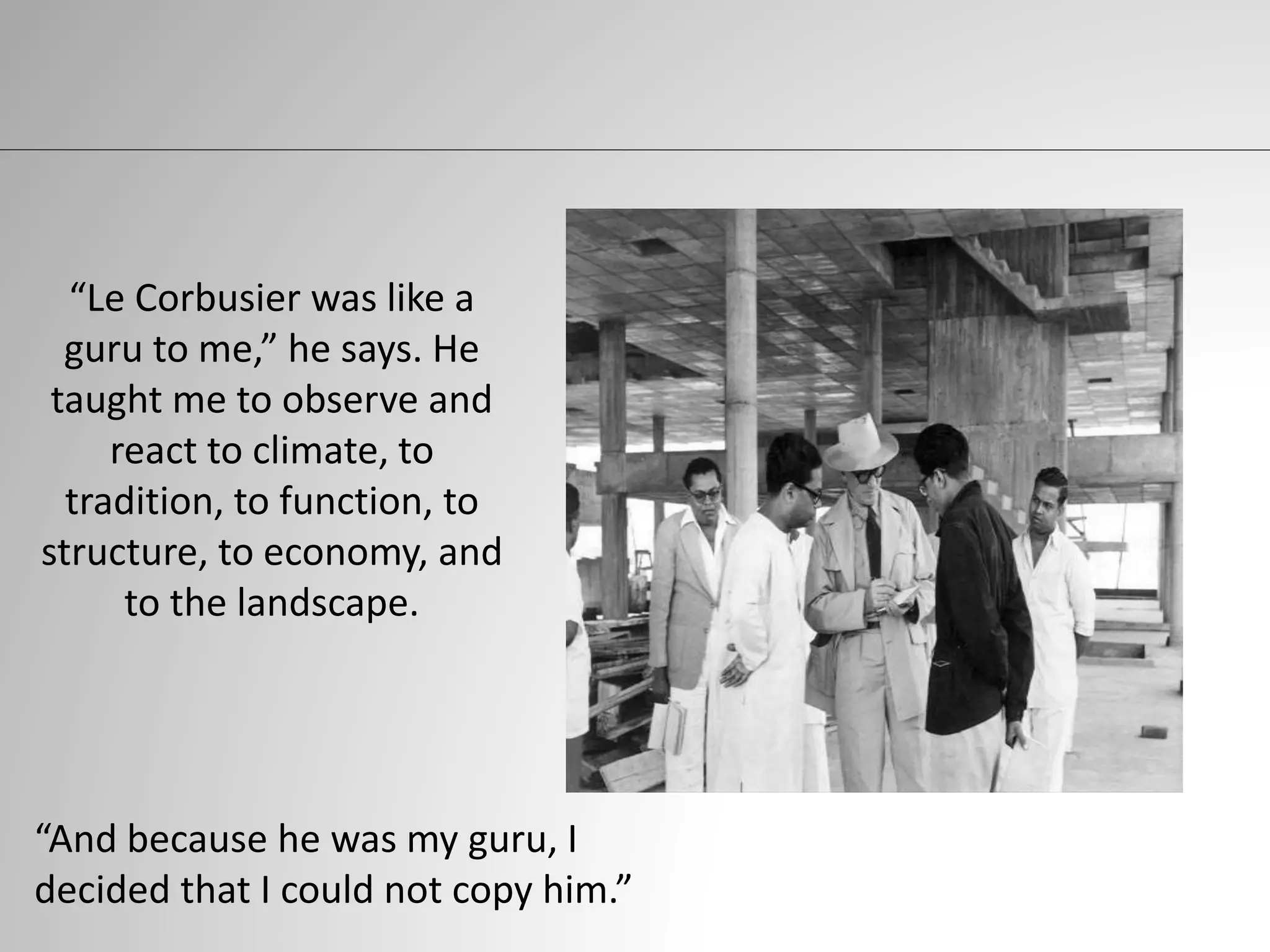
“Le Corbusier was like a
guru to me,” he says. He
taught me to observe and
react to climate, to
tradition, to function, to
structure, to economy, and
to the landscape.
“And because he was my guru, I
decided that I could not copy him.”
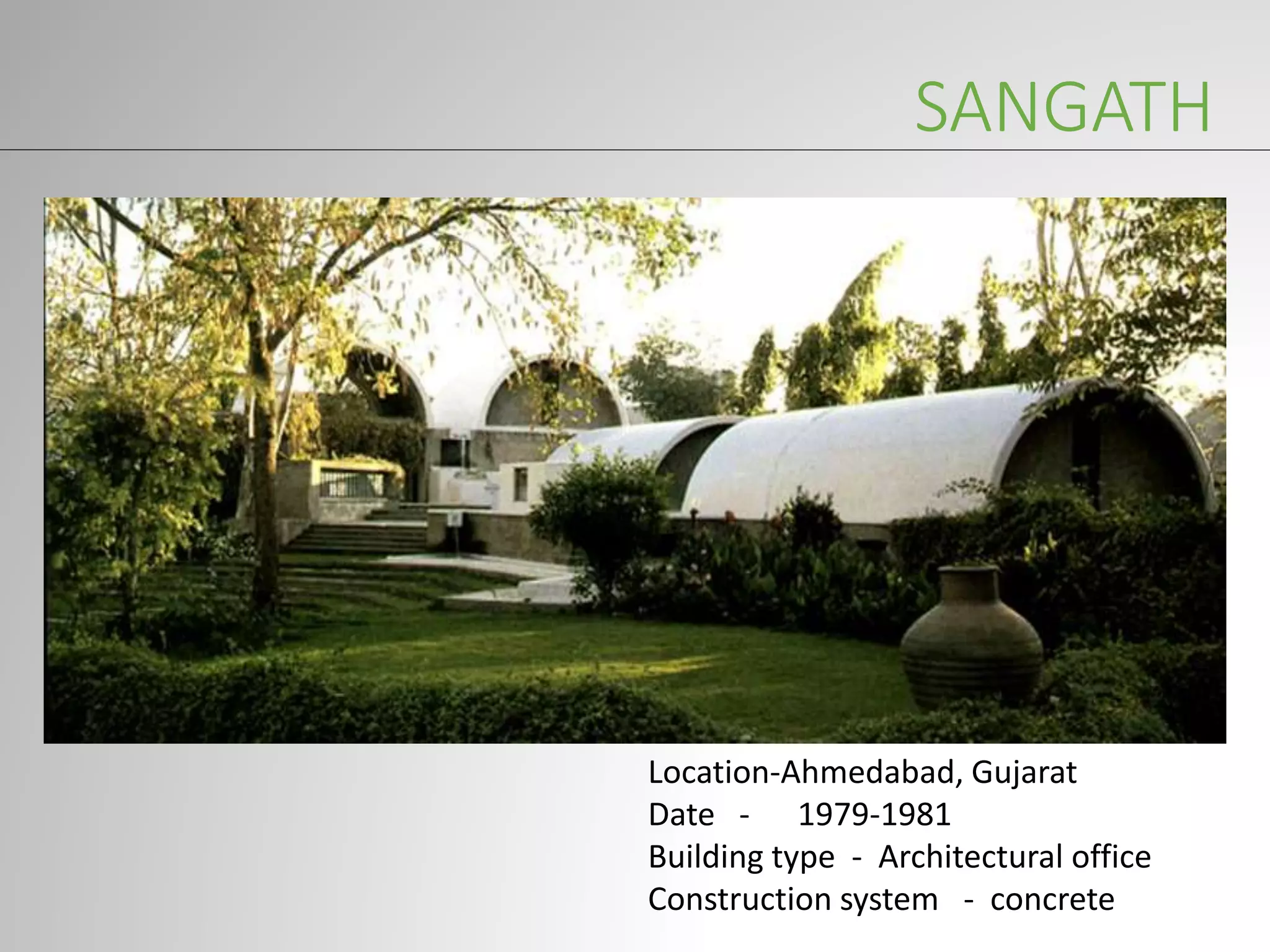
SANGATH
Location-Ahmedabad, Gujarat
Date - 1979-1981
Building type - Architectural office
Construction system - concrete
 At Sangath, the architect’s design studio.
 It’s include reception areas, office spaces, workshop, , library,
conference room, and other ancillary space.
 In Ahmedabad, the summer temperature reaches 45 °C and the heat is very
intense.
 Natural comfort conditions can be achieved by protecting spaces from the
heat and glare of the sun.
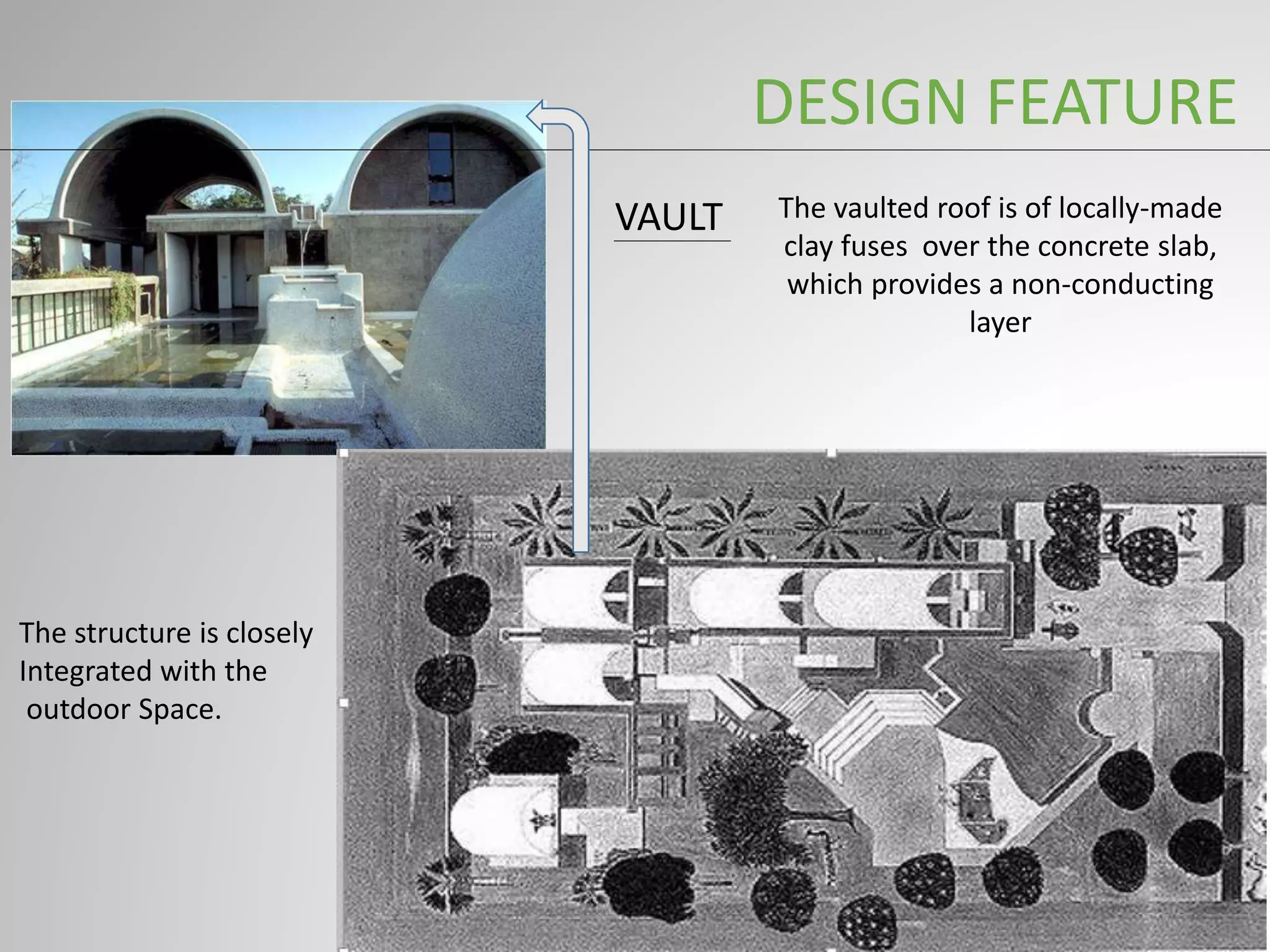
PLAN
SECTION
Subterranean spaces
The building is largely buried under the ground to use earth
masses for natural insulation.
DESIGN FEATURE
VAULT The vaulted roof is of locally-made
clay fuses over the concrete slab,
which provides a non-conducting
layer
The structure is closely
Integrated with the
outdoor Space.
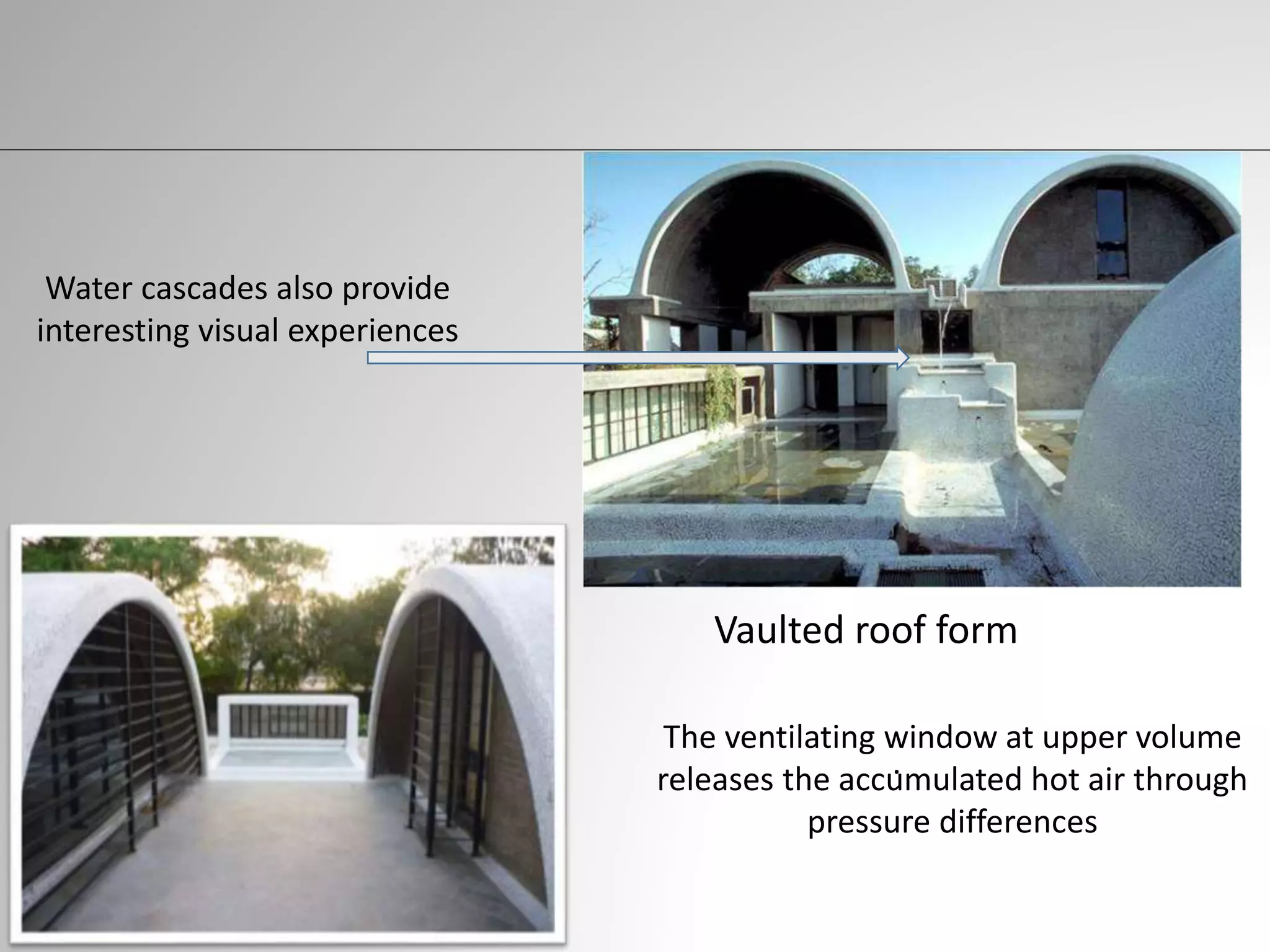
Water cascades also provide
interesting visual experiences
.
Vaulted roof form
The ventilating window at upper volume
releases the accumulated hot air through
pressure differences
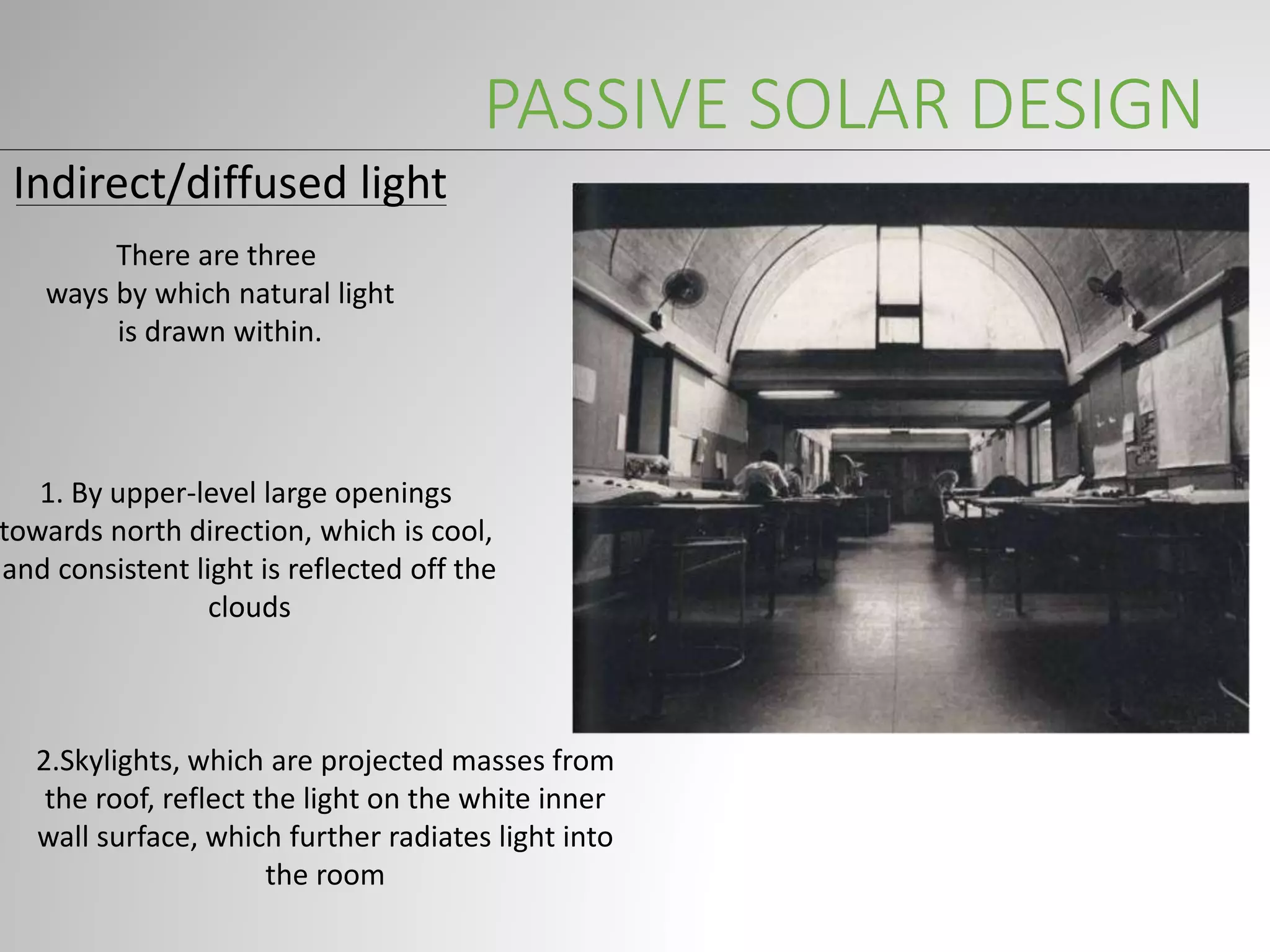
PASSIVE SOLAR DESIGN
Indirect/diffused light
There are three
ways by which natural light
is drawn within.
1. By upper-level large openings
towards north direction, which is cool,
and consistent light is reflected off the
clouds
2.Skylights, which are projected masses from
the roof, reflect the light on the white inner
wall surface, which further radiates light into
the room
3.Innermost spaces are lit up through
small cutouts in the roof slab, which are
then filled with hollow glass blocks that
take away the glare and transmit diffused
light .
LANDSCAPING
Terracotta pots and sculpture
Water channels
Rainwater and overflow of pumped water from
the roof tank are harnessed through roof
channels that run through a series of cascading
tanks and water channels to finally culminate
in a pond from where it is recycled back or
used for irrigating vegetation
POND
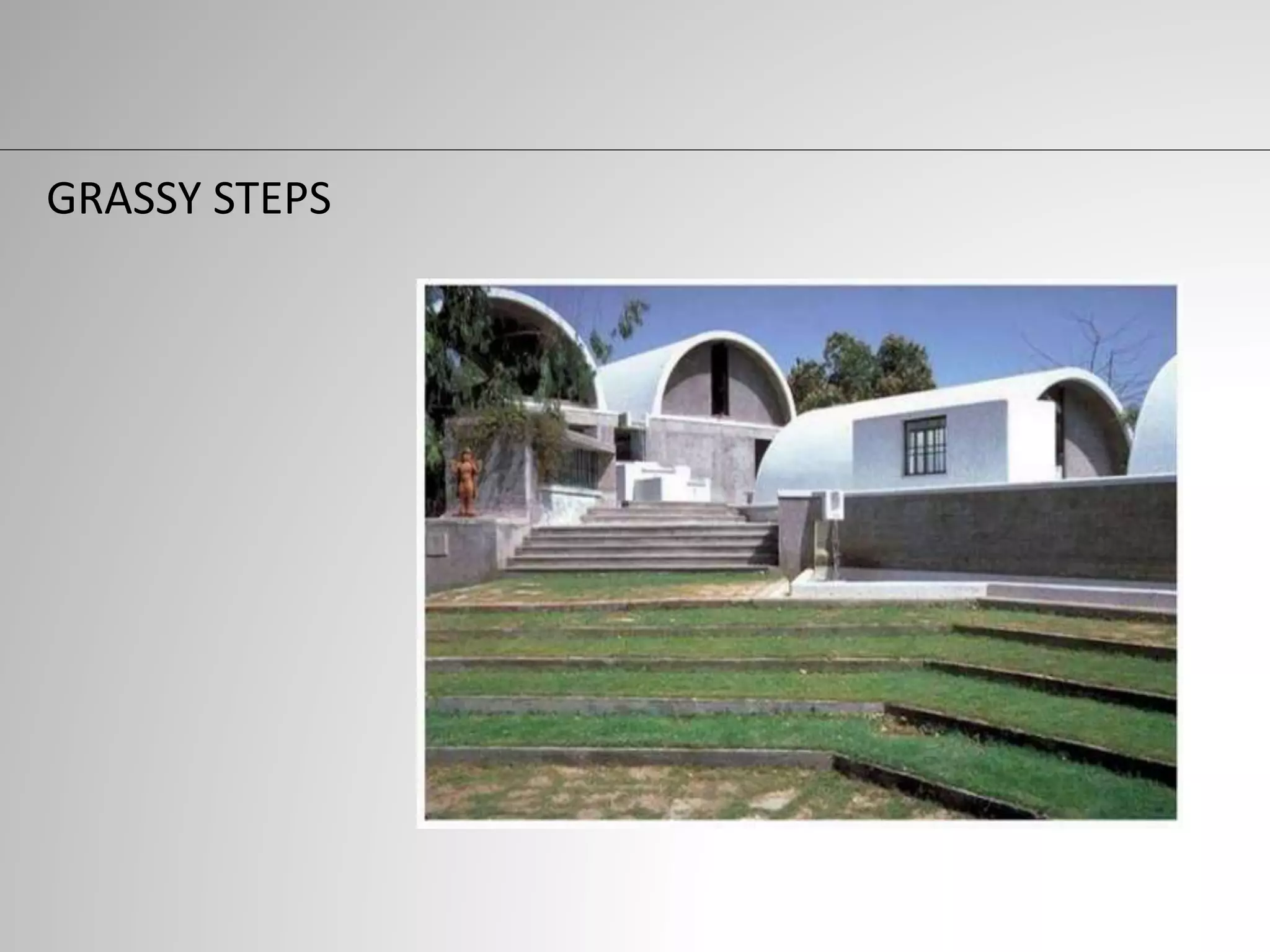
GRASSY STEPS
 Sandwiched construction of vault
The vaulted roof is of locally-made clay fuses
over the concrete slab, which provides a
non-conducting layer.
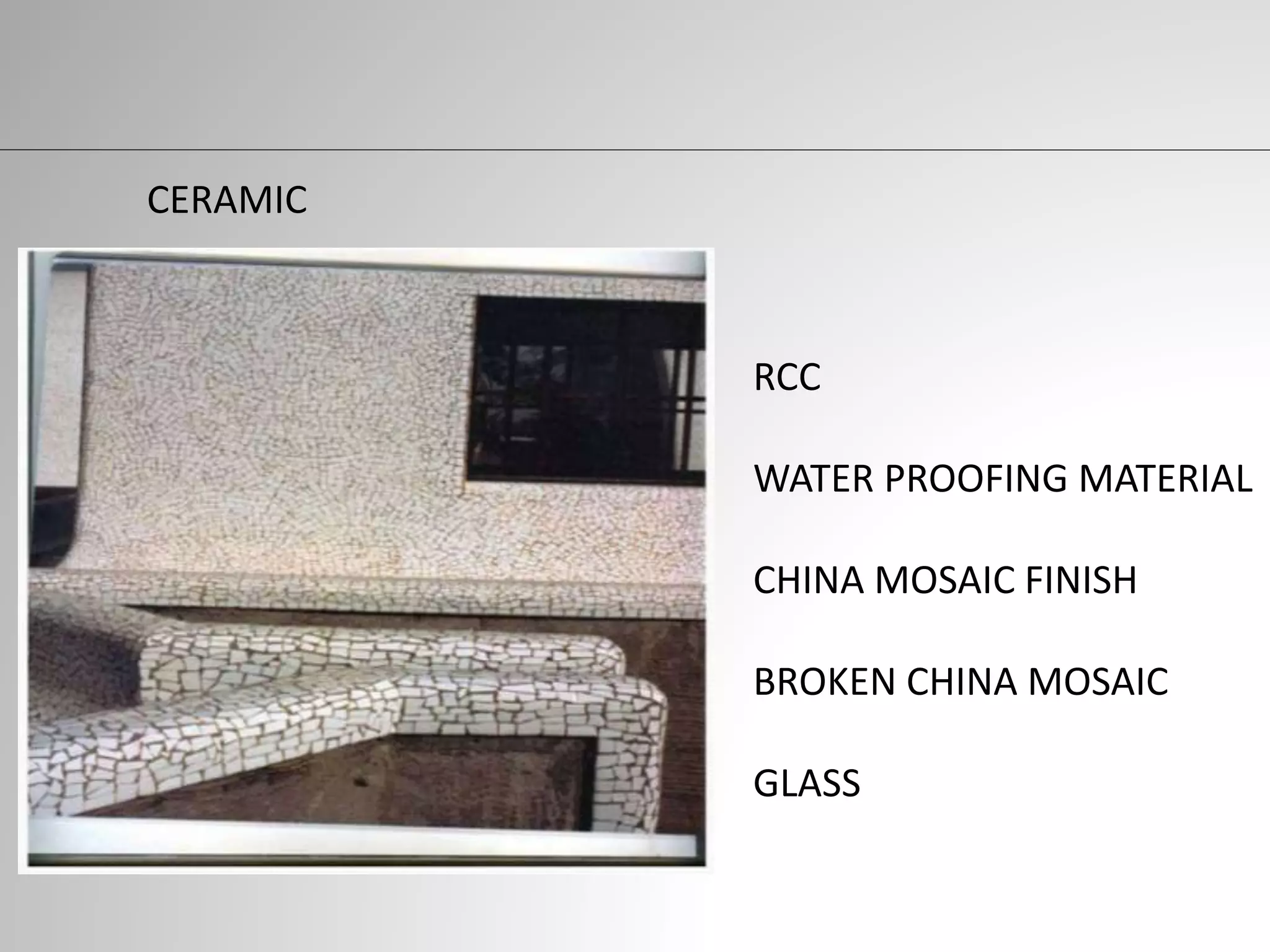
The top finish of China mosaic glazed
tiles further adds to the insulation.
Being white and glossy it reflects sun
while being made from clay it retards the
heat transmission.
MATERIAL AND CONSTRUCTION
 Use of secondary waste material
 Exposed natural finishes
The concrete of slabs and wall surfaces
are kept bare unplastered as final visual
finishes, which provide a natural look and
save on finishing material quantity
CERAMIC
RCC
WATER PROOFING MATERIAL
CHINA MOSAIC FINISH
BROKEN CHINA MOSAIC
GLASS
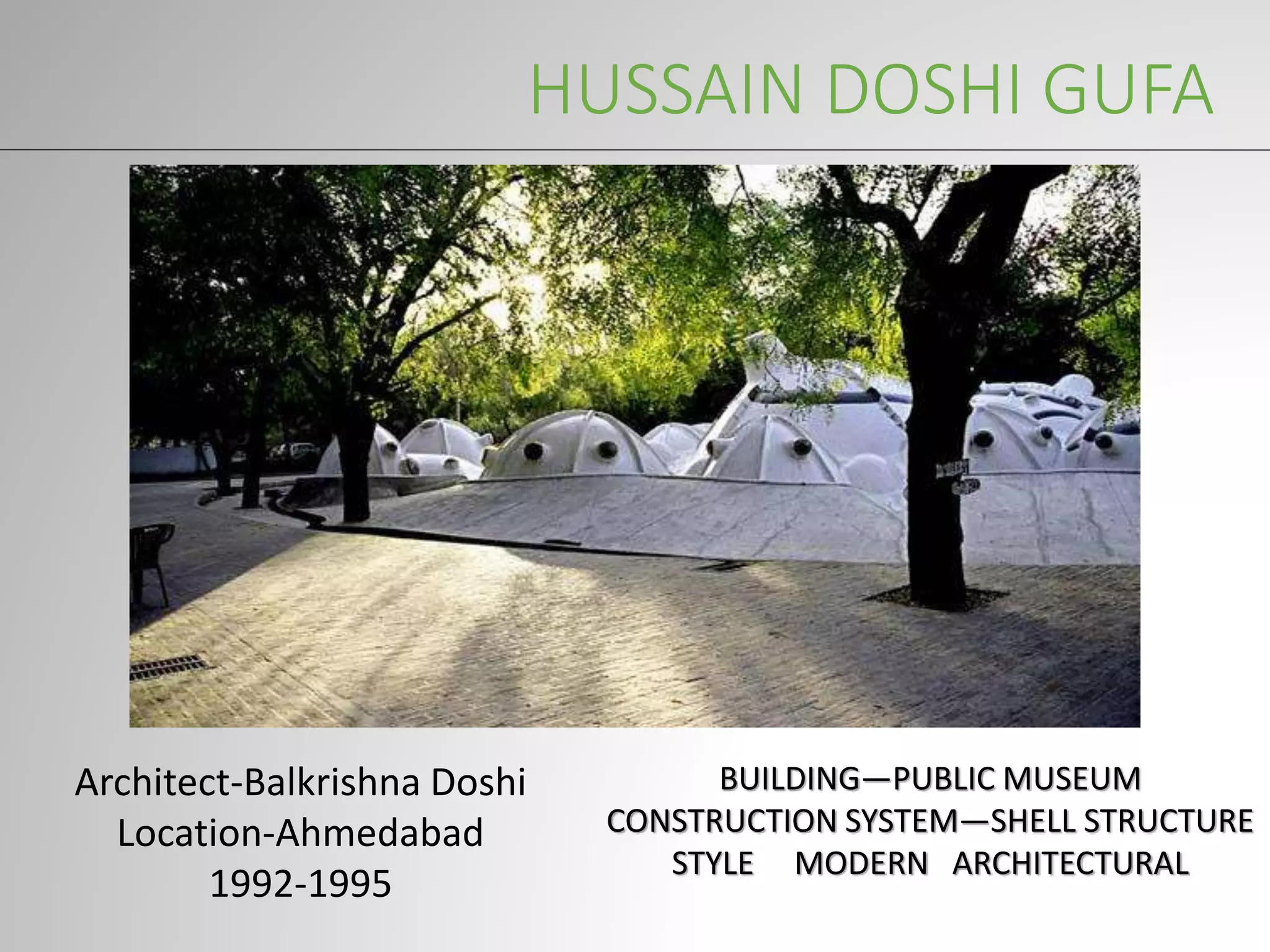
HUSSAIN DOSHI GUFA
Architect-Balkrishna Doshi
Location-Ahmedabad
1992-1995
BUILDING—PUBLIC MUSEUM
CONSTRUCTION SYSTEM—SHELL STRUCTURE
STYLE MODERN ARCHITECTURAL
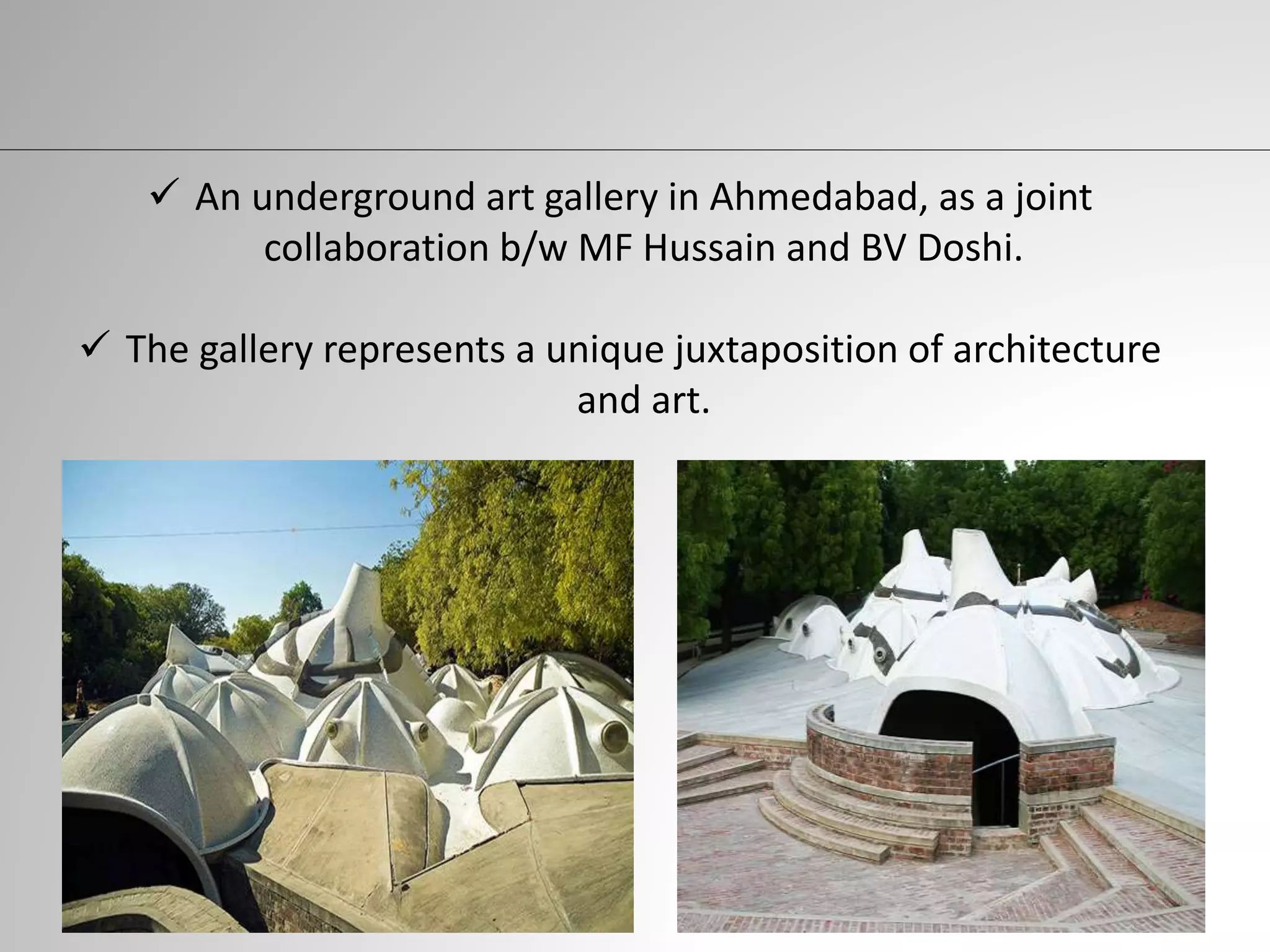
 An underground art gallery in Ahmedabad, as a joint
collaboration b/w MF Hussain and BV Doshi.
 The gallery represents a unique juxtaposition of architecture
and art.
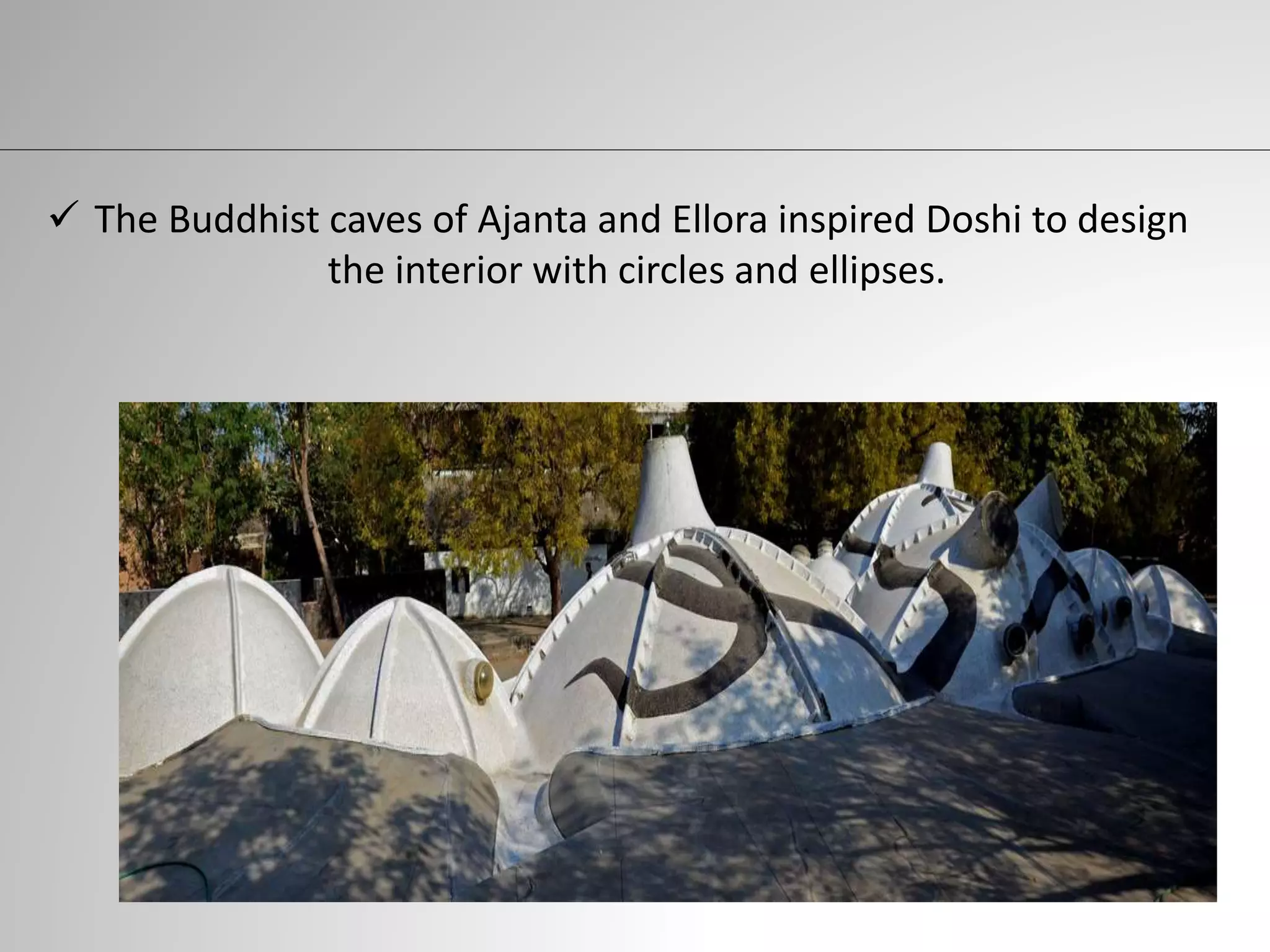
 The mosaic tiles on the roof are similar to found on the
roof of the Jain temples,Girnar.
The domes are inspired by the shells of tortoises and by
soap bubbles.
INSPIRATION
 The mosaic snake is from Hindu mythology.
 The Buddhist caves of Ajanta and Ellora inspired Doshi to design
the interior with circles and ellipses.
PLAN
 The references for the Gufa are elemental and primeval. The
circle, mountains, historical precedents as Caves (Karli, Ajanta),
Stupas etc.
The interior is divided by tree trunks or columns similar to
those found at Stonehenge.
The entire design is made up of circles and ellipses.
SECTION
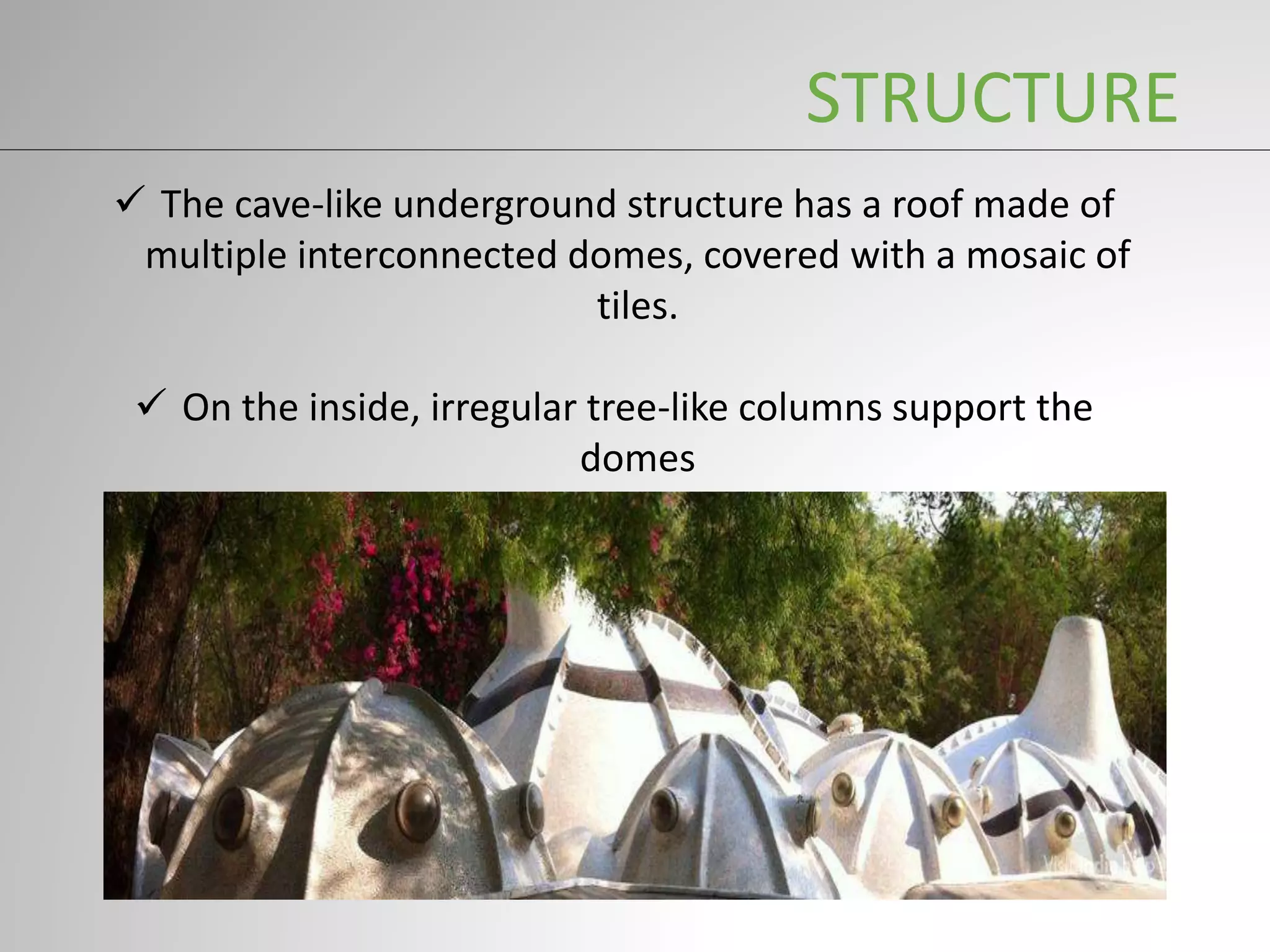
 The cave-like underground structure has a roof made of
multiple interconnected domes, covered with a mosaic of
tiles.
 On the inside, irregular tree-like columns support the
domes
STRUCTURE
 The structure is specifically oriented
to let in the maximum amount of
heat & light to give the interior a
golden glow.
 Light comes in as shafts through a few circular openings
in the dome, the diffused light adding to the mystic
ambience
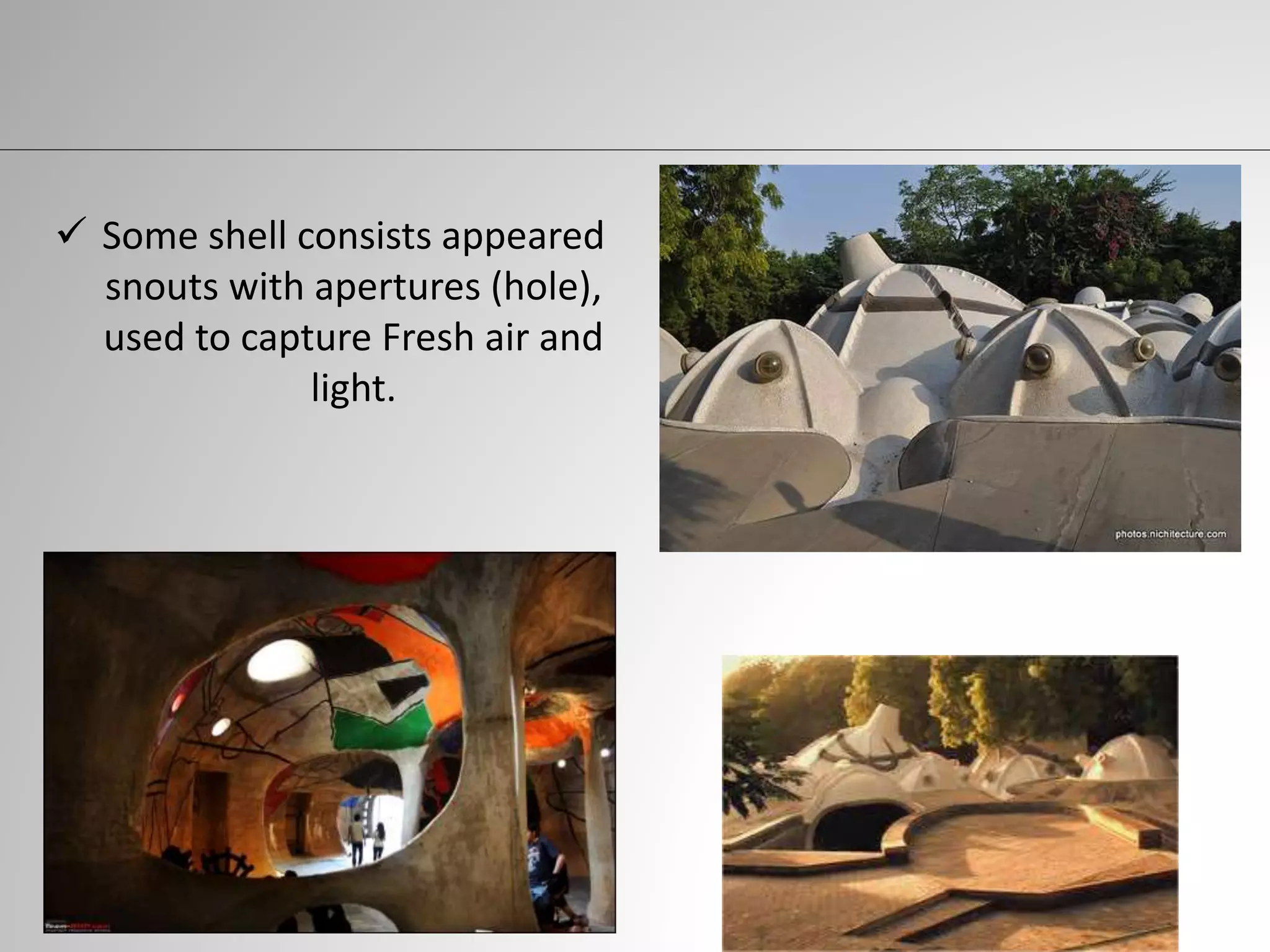
 Some shell consists appeared
snouts with apertures (hole),
used to capture Fresh air and
light.
 From the exterior, the Gufa looks more like a work of art, a
sculpture of domed shells finished in dazzling china mosaic,
complete with a black serpentine imagery snaking across the
surfaces.
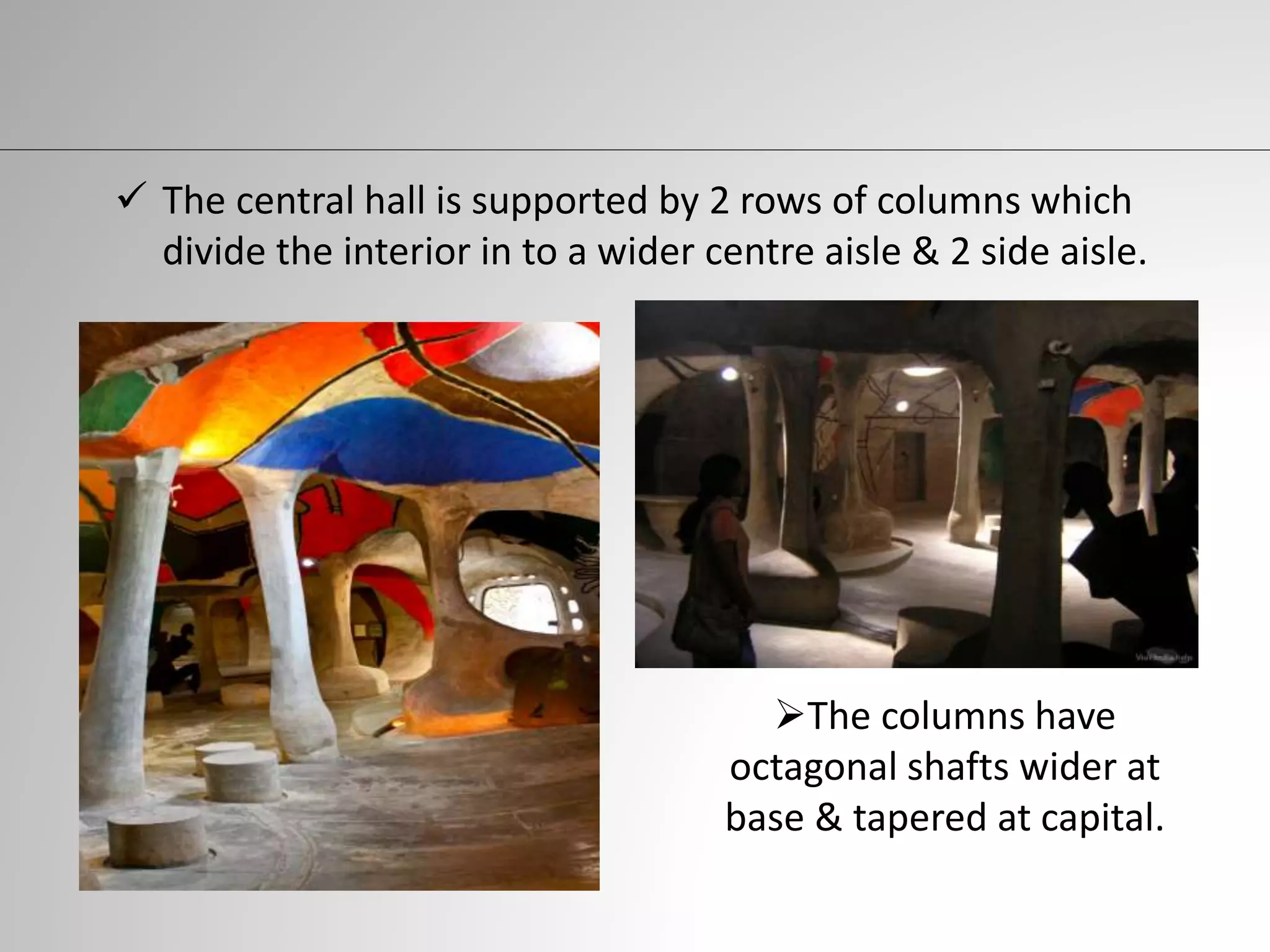
 The central hall is supported by 2 rows of columns which
divide the interior in to a wider centre aisle & 2 side aisle.
The columns have
octagonal shafts wider at
base & tapered at capital.
 Ferro cement was used to create the
undulating walls and domes, which also
helped in reducing the total load of the
structure.
 Waste tiles were used on top of the
external dome.
MATERIAL
 CERAMIC
 RCC

BV doshi design

  • 1.
    Presented by- Rakesh kumar(A10) Risso(A08) Dubay Akash joshi Adish sood Ar. BALKRISNA VITHALDAS DOSHI
  • 2.
    D.O.B.-26 August 1927 Awards: AssociateMember, Royal Institute of British Ar., 1954 Fellowship, Graham Foundation, 1958 Honorary Fellow, American Institute of Ar., 1971 Fellow, Indian Institute of Architects, 1971 Padma Shri Award, Government of India, 1976  In 1950 he became a senior designer on Le Corbusier's projects in Ahmedabad and Chandigarh  His craft under Le Corbusier for four years. (1951-54)  His studio, Vastu-Shilpa (environmental design), was established in 1955 INTRODUCTION
  • 3.
     Doshi workedclosely with Louis kahn and Anant raje , when Kahn designed the campus of the Indian Institute of Management. Doshi's architecture provides one of the most important models for modern Indian architecture.  He was presented in 1995,Aga Khan Award for Architecture, for the Aranya Community Housing in Indore, India.
  • 4.
    IMPORTANT BUILDING  SANGATHVASTU SHILPA FOUNDATION  CEPT UNIVERSITY  GANDHI LABOUR INSTITUE  NIFT,NEW DELHI  TAGORE HALL,AHMEDABAD  ARANYA LOW COST HOUSING-INDOR  IIM UDAIPUR  HUSSAIN- DOSHI GUFA  IIM BANGALOR  INSTITUTE OF INDOLOGY,AHMEDABAD
  • 5.
    Works Of B.V.Doshi IIMBANGLORE NIFT DELHI SANGATH HUSAIN – DOSHI GUFA L I B R A R Y
  • 6.
    PRINCIPLES Doshi's work hasconsistently revolved around the interrelationship of indoor and outdoor space. The success of any project depends on effective construction, contracting, logistic planning and co-ordination Doshi applies Modernists concepts to an Indian context Doshi followed it in his architecture by providing openness in buildings through colonnades, pergolas, porticos, sky lights etc.
  • 7.
    “Le Corbusier waslike a guru to me,” he says. He taught me to observe and react to climate, to tradition, to function, to structure, to economy, and to the landscape. “And because he was my guru, I decided that I could not copy him.”
  • 8.
    SANGATH Location-Ahmedabad, Gujarat Date -1979-1981 Building type - Architectural office Construction system - concrete
  • 9.
     At Sangath,the architect’s design studio.  It’s include reception areas, office spaces, workshop, , library, conference room, and other ancillary space.
  • 10.
     In Ahmedabad,the summer temperature reaches 45 °C and the heat is very intense.  Natural comfort conditions can be achieved by protecting spaces from the heat and glare of the sun. PLAN
  • 11.
    SECTION Subterranean spaces The buildingis largely buried under the ground to use earth masses for natural insulation.
  • 12.
    DESIGN FEATURE VAULT Thevaulted roof is of locally-made clay fuses over the concrete slab, which provides a non-conducting layer The structure is closely Integrated with the outdoor Space.
  • 13.
    Water cascades alsoprovide interesting visual experiences . Vaulted roof form The ventilating window at upper volume releases the accumulated hot air through pressure differences
  • 14.
    PASSIVE SOLAR DESIGN Indirect/diffusedlight There are three ways by which natural light is drawn within. 1. By upper-level large openings towards north direction, which is cool, and consistent light is reflected off the clouds 2.Skylights, which are projected masses from the roof, reflect the light on the white inner wall surface, which further radiates light into the room
  • 15.
    3.Innermost spaces arelit up through small cutouts in the roof slab, which are then filled with hollow glass blocks that take away the glare and transmit diffused light .
  • 16.
    LANDSCAPING Terracotta pots andsculpture Water channels Rainwater and overflow of pumped water from the roof tank are harnessed through roof channels that run through a series of cascading tanks and water channels to finally culminate in a pond from where it is recycled back or used for irrigating vegetation POND
  • 17.
  • 18.
     Sandwiched constructionof vault The vaulted roof is of locally-made clay fuses over the concrete slab, which provides a non-conducting layer. The top finish of China mosaic glazed tiles further adds to the insulation. Being white and glossy it reflects sun while being made from clay it retards the heat transmission. MATERIAL AND CONSTRUCTION
  • 19.
     Use ofsecondary waste material  Exposed natural finishes The concrete of slabs and wall surfaces are kept bare unplastered as final visual finishes, which provide a natural look and save on finishing material quantity
  • 20.
    CERAMIC RCC WATER PROOFING MATERIAL CHINAMOSAIC FINISH BROKEN CHINA MOSAIC GLASS
  • 21.
    HUSSAIN DOSHI GUFA Architect-BalkrishnaDoshi Location-Ahmedabad 1992-1995 BUILDING—PUBLIC MUSEUM CONSTRUCTION SYSTEM—SHELL STRUCTURE STYLE MODERN ARCHITECTURAL
  • 22.
     An undergroundart gallery in Ahmedabad, as a joint collaboration b/w MF Hussain and BV Doshi.  The gallery represents a unique juxtaposition of architecture and art.
  • 24.
     The mosaictiles on the roof are similar to found on the roof of the Jain temples,Girnar. The domes are inspired by the shells of tortoises and by soap bubbles. INSPIRATION  The mosaic snake is from Hindu mythology.
  • 25.
     The Buddhistcaves of Ajanta and Ellora inspired Doshi to design the interior with circles and ellipses.
  • 26.
    PLAN  The referencesfor the Gufa are elemental and primeval. The circle, mountains, historical precedents as Caves (Karli, Ajanta), Stupas etc.
  • 27.
    The interior isdivided by tree trunks or columns similar to those found at Stonehenge. The entire design is made up of circles and ellipses. SECTION
  • 28.
     The cave-likeunderground structure has a roof made of multiple interconnected domes, covered with a mosaic of tiles.  On the inside, irregular tree-like columns support the domes STRUCTURE
  • 29.
     The structureis specifically oriented to let in the maximum amount of heat & light to give the interior a golden glow.  Light comes in as shafts through a few circular openings in the dome, the diffused light adding to the mystic ambience
  • 30.
     Some shellconsists appeared snouts with apertures (hole), used to capture Fresh air and light.
  • 31.
     From theexterior, the Gufa looks more like a work of art, a sculpture of domed shells finished in dazzling china mosaic, complete with a black serpentine imagery snaking across the surfaces.
  • 32.
     The centralhall is supported by 2 rows of columns which divide the interior in to a wider centre aisle & 2 side aisle. The columns have octagonal shafts wider at base & tapered at capital.
  • 33.
     Ferro cementwas used to create the undulating walls and domes, which also helped in reducing the total load of the structure.  Waste tiles were used on top of the external dome. MATERIAL  CERAMIC  RCC