Current Opportunities - Venture Capital in Chile
January 2015
Content
1. What Do We Understand by Venture Capital? 03
2. Venture Capital History in Chile 05
3. General Overview of the VC&PE industries in Chile 07
4. Current Opportunities 11
5. Execution Alternatives 13
1. What do we understand by Venture Capital?
4
-Incubators
-Universities
1. What do we understand by Venture Capital?
1.1 Brief Description of Venture Capital
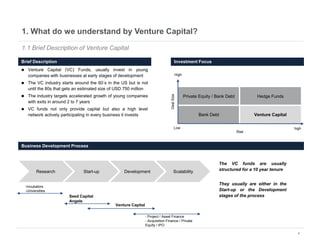
 Venture Capital (VC) Funds, usually invest in young
companies with businesses at early stages of development
 The VC industry starts around the 60´s in the US but is not
until the 80s that gets an estimated size of USD 750 million
 The industry targets accelerated growth of young companies
with exits in around 2 to 7 years
 VC funds not only provide capital but also a high level
network actively participating in every business it invests
Business Development Process
Brief Description Investment Focus
Private Equity / Bank Debt Hedge Funds
Bank Debt Venture Capital
High
highLow
DealSize
Risk
Research Start-up Development Scalability
Venture Capital
- Project / Asset Finance
- Acquisition Finance / Private
Equity / IPO
The VC funds are usually
structured for a 10 year tenure
They usually are either in the
Start-up or the Development
stages of the processSeed Capital
Angels
2. Venture Capital History in Chile
6
2. Venture Capital History in Chile
1997
Incentive Program
Investment Funds
(F1 Line)
2005
Incentive Program
Investment Funds
Risk Capital
(F2 Line)
2006
Incentive Program
Investment Funds
Risk Capital
(F3 Line)
2008
Direct investment
in Investment
Funds Program
(K1 Line)
2010
Re-design of the
incentive
programs
Start-Up Chile in
launched
2011
Fénix Program
2012
Early Stages
Incentive Program
(FT Line)
2.1 Timeline Overview
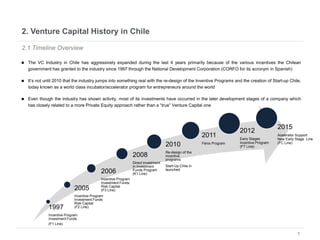
 The VC Industry in Chile has aggressively expanded during the last 4 years primarily because of the various incentives the Chilean
government has granted to the industry since 1997 through the National Development Corporation (CORFO for its acronym in Spanish)
 It’s not until 2010 that the industry jumps into something real with the re-design of the Inventive Programs and the creation of Start-up Chile,
today known as a world class incubator/accelerator program for entrepreneurs around the world
 Even though the industry has shown activity, most of its investments have occurred in the later development stages of a company which
has closely related to a more Private Equity approach rather than a “true” Venture Capital one
2015
Acelerator Support
New Early Stage Line
(FC Line)
3. General Overview of the VC&PE Industries in Chile
8
3. General Overview of the VC&PE Industries in Chile
3.1 General Description
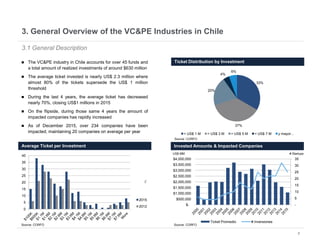
 The VC&PE industry in Chile accounts for over 45 funds and
a total amount of realized investments of around $630 million
 The average ticket invested is nearly US$ 2.3 million where
almost 80% of the tickets supersede the US$ 1 million
threshold
 During the last 4 years, the average ticket has decreased
nearly 70%, closing US$1 millions in 2015
 On the flipside, during those same 4 years the amount of
impacted companies has rapidly increased
 As of December 2015, over 234 companies have been
impacted, maintaining 20 companies on average per year
Average Ticket per Investment
Ticket Distribution by Investment
Source: CORFOSource: CORFO
Invested Amounts & Impacted Companies
Source: CORFO
US$ MM # Startups
-
5
10
15
20
25
30
35
$-
$500,000
$1,000,000
$1,500,000
$2,000,000
$2,500,000
$3,000,000
$3,500,000
$4,000,000
Ticket Promedio # Inversiones
0
5
10
15
20
25
30
35
40
2015
2012
33%
37%
20%
4%
6%
> US$ 1 M > US$ 3 M > US$ 5 M > US$ 7 M y mayor...
9
3. General Overview of the VC&PE Industries in Chile
3.1 General Description (cont.’)
Aproved Lines by Corfo per Year
Fund Size Distribution
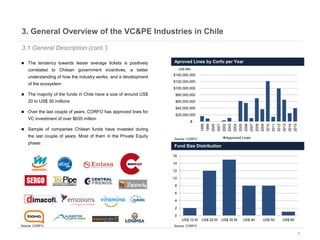
 The tendency towards lesser average tickets is positively
correlated to Chilean government incentives, a better
understanding of how the industry works, and a development
of the ecosystem
 The majority of the funds in Chile have a size of around US$
20 to US$ 30 millions
 Over the last couple of years, CORFO has approved lines for
VC investment of over $635 million
 Sample of companies Chilean funds have invested during
the last couple of years. Most of them in the Private Equity
phase:
Source: CORFO
Source: CORFO
US$ MM
Source: CORFO
$ 5M $ 10M $ 15M $ 20M $ 25M $ 30M $ 35M
$-
$20,000,000
$40,000,000
$60,000,000
$80,000,000
$100,000,000
$120,000,000
$140,000,000
1998
1999
2000
2001
2002
2003
2004
2005
2006
2007
2008
2009
2010
2011
2012
2013
2014
2015
Approved Lines
0
2
4
6
8
10
12
14
16
US$ 10 M US$ 20 M US$ 30 M US$ 40 US$ 50 US$ 60
10
3. General Overview of the VC&PE Industries in Chile
3.2 Industry Players
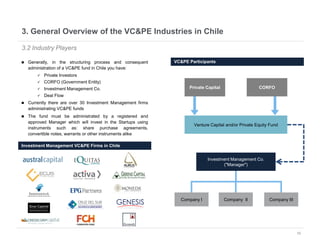
 Generally, in the structuring process and consequent
administration of a VC&PE fund in Chile you have:
 Private Investors
 CORFO (Government Entity)
 Investment Management Co.
 Deal Flow
 Currently there are over 30 Investment Management firms
administrating VC&PE funds
 The fund must be administrated by a registered and
approved Manager which will invest in the Startups using
instruments such as: share purchase agreements,
convertible notes, warrants or other instruments alike
Private Capital CORFO
Venture Capital and/or Private Equity Fund
Investment Management Co.
("Manager")
Company I Company II Company III
VC&PE Participants
Investment Management VC&PE Firms in Chile
4. Current Opportunities in Chile for Venture Capitalists
12
4. Current Opportunities in Chile for Venture Capitalists
4.1 Local Investment & Deal Flow
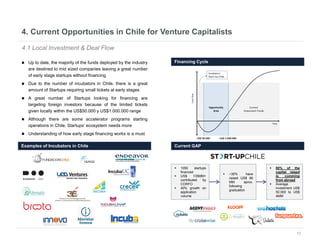
 Up to date, the majority of the funds deployed by the industry
are destined to mid sized companies leaving a great number
of early stage startups without financing
 Due to the number of incubators in Chile, there is a great
amount of Startups requiring small tickets at early stages
 A great number of Startups looking for financing are
targeting foreign investors because of the limited tickets
given locally within the US$50.000 y US$1.000.000 range
 Although there are some accelerator programs starting
operations in Chile, Startups’ ecosystem needs more
 Understanding of how early stage financing works is a must
Examples of Incubators in Chile Current GAP
Financing Cycle
 1050 startups
financed
 US$ 135MM+
contributed by
CORFO
 40% growth on
application
volume
 ~35% have
raised US$ 96
MM aprox.
following
graduation
 80% of the
capital raised
is comming
from abroad
 Average
investment US$
50.000 to US$
4MM
5. Execution Alternatives
14
5. Execution Alternatives
5.1 Opportunity Description
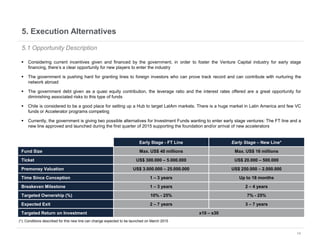
 Considering current incentives given and financed by the government, in order to foster the Venture Capital industry for early stage
financing, there’s a clear opportunity for new players to enter the industry
 The government is pushing hard for granting lines to foreign investors who can prove track record and can contribute with nurturing the
network abroad
 The government debt given as a quasi equity contribution, the leverage ratio and the interest rates offered are a great opportunity for
diminishing associated risks to this type of funds
 Chile is considered to be a good place for setting up a Hub to target LatAm markets. There is a huge market in Latin America and few VC
funds or Accelerator programs competing
 Currently, the government is giving two possible alternatives for Investment Funds wanting to enter early stage ventures: The FT line and a
new line approved and launched during the first quarter of 2015 supporting the foundation and/or arrival of new accelerators
Early Stage - FT Line Early Stage – New Line*
Fund Size Max. US$ 40 millions Max. US$ 16 millions
Ticket US$ 300.000 – 5.000.000 US$ 20.000 – 500.000
Premoney Valuation US$ 3.000.000 – 25.000.000 US$ 250.000 – 2.000.000
Time Since Conception 1 – 3 years Up to 18 months
Breakeven Milestone 1 – 3 years 2 – 4 years
Targeted Ownership (%) 10% - 25% 7% - 25%
Expected Exit 2 – 7 years 3 – 7 years
Targeted Return on Investment x10 – x30
(*): Conditions described for this new line can change expected to be launched on March 2015
15
5. Execution Alternatives
5.2 Summary of Main Aspects for Execution
Amount
Debt to Capital
FT Line New Line (Mar-15)
Up to 2,5% Up to 2,5%
(+ 1,5% OPEX)
UF 50.000 – 350.000 UF 50.000 – 300.000
Max. 2:1 Max. 3:1
Admin Fee*
Interest Rate BCU + 2% BCU + 4%
Tenure 10 years 8 years
Prepayment No additional Costs
Approval Time 90 business days
Dividends Maintaining Debt to Capital ratio
Other
Characteristics
 Option to increase /
decrease 25% the line
 24 and 60 months for
investing 30% and 60%
of the approved line
respectively
 Same as FT plus
additional subsidies
such as $130k per year
 $16k bonus plus $6k on
the following 4 years of
a realized investment
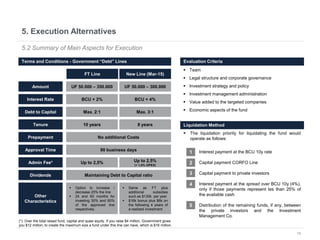
(*): Over the total raised fund, capital and quasi equity. If you raise $4 million, Government gives
you $12 million, to create the maximum size a fund under this line can have, which is $16 million.
Terms and Conditions - Government “Debt” Lines
 The liquidation priority for liquidating the fund would
operate as follows:
 Interest payment at the BCU 10y rate
 Capital payment CORFO Line
 Capital payment to private investors
 Interest payment at the spread over BCU 10y (4%),
only if those payments represent les than 25% of
the available cash
 Distribution of the remaining funds, if any, between
the private investors and the Investment
Management Co.
Liquidation Method
1
2
3
4
5
Evaluation Criteria
 Team
 Legal structure and corporate governance
 Investment strategy and policy
 Investment management administration
 Value added to the targeted companies
 Economic aspects of the fund
6. Understanding the Accelerator Model
17
6. Understanding the Accelerator Model
6.1 Main Characteristics of an Accelerator Program
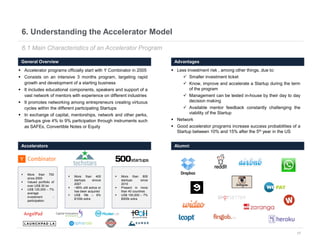
 Accelerator programs officially start with Y Combinator in 2005
 Consists on an intensive 3 months program, targeting rapid
growth and development of a starting business
 It includes educational components, speakers and support of a
vast network of mentors with experience on different industries
 It promotes networking among entrepreneurs creating virtuous
cycles within the different participating Startups
 In exchange of capital, mentorships, network and other perks,
Startups give 4% to 9% participation through instruments such
as SAFEs, Convertible Notes or Equity
General Overview
Alumni
Advantages
Accelerators
 Less investment risk , among other things, due to:
 Smaller investment ticket
 Know, improve and accelerate a Startup during the term
of the program
 Management can be tested in-house by their day to day
decision making
 Available mentor feedback constantly challenging the
viability of the Startup
 Network
 Good accelerator programs increase success probabilities of a
Startup between 10% and 15% after the 5th year in the US
 More than 700
since 2005
 Valued portfolio of
over US$ 30 bn
 US$ 120,000 – 7%
average
investment -
participation
 More than 400
startups sincce
2007
 ~89% still active or
has been acquired
 US$ 18k – 6%
$100k extra
 More than 800
startups since
2010
 Present in more
than 40 countries
 US$ 100,000 – 7%
$500k extra
18
6. Understanding the Accelerator Model (Cont.’)
6.1 Main Characteristics of an Accelerator Program (Cont.’)
Accelerator's Ecosystem Results
Company
Estimated Returm*
Seed Capital Last VC
Zynga 860x 4x
Groupon 410x 5x
Twitter 316x 4x
MySQL 103x 3x
DropBox 16x 6x
AirBnB 53x 3x
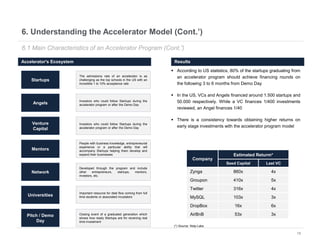
 According to US statistics, 80% of the startups graduating from
an accelerator program should achieve financing rounds on
the following 3 to 6 months from Demo Day
 In the US, VCs and Angels financed around 1.500 startups and
50.000 respectively. While a VC finances 1/400 investments
reviewed, an Angel finances 1/40
 There is a consistency towards obtaining higher returns on
early stage investments with the accelerator program model
(*) Source: Nxtp.Labs
Startups
Angels
Venture
Capital
Network
Mentors
Universities
Pitch / Demo
Day
The admissions rate of an accelerator is as
challenging as the top schools in the US with an
incredible 1 to 10% acceptance rate
Investors who could follow Startups during the
accelerator program or after the Demo Day
Investors who could follow Startups during the
accelerator program or after the Demo Day
Developed through the program and include
other entrepreneurs, startups, mentors,
investors, etc.
People with business knowledge, entrepreneurial
experience or a particular ability that will
accompany Startups helping them develop and
expand their businesses
Important resource for deal flow coming from full
time students or associated incubators
Closing event of a graduated generation which
shows how ready Startups are for receiving real
time investment
19
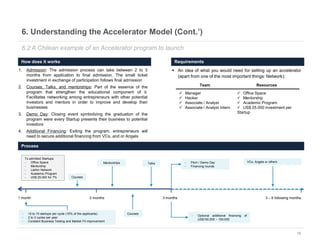
 An idea of what you would need for setting up an accelerator
(apart from one of the most important things: Network):
6. Understanding the Accelerator Model (Cont.’)
6.2 A Chilean example of an Accelerator program to launch
How does it works Requirements
Process
1 month 2 months 3 months 3 – 6 following months
To admitted Startups:
- Office Space
- Mentorship
- LatAm Network
- Academic Program
- US$ 25.000 for 7%
Team Resources
 Manager
 Hacker
 Associate / Analyst
 Associate / Analyst Intern
 Office Space
 Mentorship
 Academic Program
 US$ 25.000 investment per
Startup
- 10 to 15 startups per cycle (10% of the applicants)
- 2 to 3 cycles per year
- Constant Business Testing and Market Fit improvement
Mentorships
Courses
Talks - Pitch / Demo Day
- Financing rounds
- Optional additional financing of
US$100.000 – 150.000
1. Admission: The admission process can take between 2 to 3
months from application to final admission. The small ticket
investment in exchange of participation follows final admission
2. Courses, Talks, and mentorships: Part of the essence of the
program that strengthen the educational component of it.
Facilitates networking among entrepreneurs with other potential
investors and mentors in order to improve and develop their
businesses
3. Demo Day: Closing event symbolizing the graduation of the
program were every Startup presents their business to potential
investors
4. Additional Financing: Exiting the program, entrepreneurs will
need to secure additional financing from VCs, and or Angels
VCs, Angels or others
Courses

Venture Capital in Chile 2016

  • 1.
    Current Opportunities -Venture Capital in Chile January 2015
  • 2.
    Content 1. What DoWe Understand by Venture Capital? 03 2. Venture Capital History in Chile 05 3. General Overview of the VC&PE industries in Chile 07 4. Current Opportunities 11 5. Execution Alternatives 13
  • 3.
    1. What dowe understand by Venture Capital?
  • 4.
    4 -Incubators -Universities 1. What dowe understand by Venture Capital? 1.1 Brief Description of Venture Capital  Venture Capital (VC) Funds, usually invest in young companies with businesses at early stages of development  The VC industry starts around the 60´s in the US but is not until the 80s that gets an estimated size of USD 750 million  The industry targets accelerated growth of young companies with exits in around 2 to 7 years  VC funds not only provide capital but also a high level network actively participating in every business it invests Business Development Process Brief Description Investment Focus Private Equity / Bank Debt Hedge Funds Bank Debt Venture Capital High highLow DealSize Risk Research Start-up Development Scalability Venture Capital - Project / Asset Finance - Acquisition Finance / Private Equity / IPO The VC funds are usually structured for a 10 year tenure They usually are either in the Start-up or the Development stages of the processSeed Capital Angels
  • 5.
    2. Venture CapitalHistory in Chile
  • 6.
    6 2. Venture CapitalHistory in Chile 1997 Incentive Program Investment Funds (F1 Line) 2005 Incentive Program Investment Funds Risk Capital (F2 Line) 2006 Incentive Program Investment Funds Risk Capital (F3 Line) 2008 Direct investment in Investment Funds Program (K1 Line) 2010 Re-design of the incentive programs Start-Up Chile in launched 2011 Fénix Program 2012 Early Stages Incentive Program (FT Line) 2.1 Timeline Overview  The VC Industry in Chile has aggressively expanded during the last 4 years primarily because of the various incentives the Chilean government has granted to the industry since 1997 through the National Development Corporation (CORFO for its acronym in Spanish)  It’s not until 2010 that the industry jumps into something real with the re-design of the Inventive Programs and the creation of Start-up Chile, today known as a world class incubator/accelerator program for entrepreneurs around the world  Even though the industry has shown activity, most of its investments have occurred in the later development stages of a company which has closely related to a more Private Equity approach rather than a “true” Venture Capital one 2015 Acelerator Support New Early Stage Line (FC Line)
  • 7.
    3. General Overviewof the VC&PE Industries in Chile
  • 8.
    8 3. General Overviewof the VC&PE Industries in Chile 3.1 General Description  The VC&PE industry in Chile accounts for over 45 funds and a total amount of realized investments of around $630 million  The average ticket invested is nearly US$ 2.3 million where almost 80% of the tickets supersede the US$ 1 million threshold  During the last 4 years, the average ticket has decreased nearly 70%, closing US$1 millions in 2015  On the flipside, during those same 4 years the amount of impacted companies has rapidly increased  As of December 2015, over 234 companies have been impacted, maintaining 20 companies on average per year Average Ticket per Investment Ticket Distribution by Investment Source: CORFOSource: CORFO Invested Amounts & Impacted Companies Source: CORFO US$ MM # Startups - 5 10 15 20 25 30 35 $- $500,000 $1,000,000 $1,500,000 $2,000,000 $2,500,000 $3,000,000 $3,500,000 $4,000,000 Ticket Promedio # Inversiones 0 5 10 15 20 25 30 35 40 2015 2012 33% 37% 20% 4% 6% > US$ 1 M > US$ 3 M > US$ 5 M > US$ 7 M y mayor...
  • 9.
    9 3. General Overviewof the VC&PE Industries in Chile 3.1 General Description (cont.’) Aproved Lines by Corfo per Year Fund Size Distribution  The tendency towards lesser average tickets is positively correlated to Chilean government incentives, a better understanding of how the industry works, and a development of the ecosystem  The majority of the funds in Chile have a size of around US$ 20 to US$ 30 millions  Over the last couple of years, CORFO has approved lines for VC investment of over $635 million  Sample of companies Chilean funds have invested during the last couple of years. Most of them in the Private Equity phase: Source: CORFO Source: CORFO US$ MM Source: CORFO $ 5M $ 10M $ 15M $ 20M $ 25M $ 30M $ 35M $- $20,000,000 $40,000,000 $60,000,000 $80,000,000 $100,000,000 $120,000,000 $140,000,000 1998 1999 2000 2001 2002 2003 2004 2005 2006 2007 2008 2009 2010 2011 2012 2013 2014 2015 Approved Lines 0 2 4 6 8 10 12 14 16 US$ 10 M US$ 20 M US$ 30 M US$ 40 US$ 50 US$ 60
  • 10.
    10 3. General Overviewof the VC&PE Industries in Chile 3.2 Industry Players  Generally, in the structuring process and consequent administration of a VC&PE fund in Chile you have:  Private Investors  CORFO (Government Entity)  Investment Management Co.  Deal Flow  Currently there are over 30 Investment Management firms administrating VC&PE funds  The fund must be administrated by a registered and approved Manager which will invest in the Startups using instruments such as: share purchase agreements, convertible notes, warrants or other instruments alike Private Capital CORFO Venture Capital and/or Private Equity Fund Investment Management Co. ("Manager") Company I Company II Company III VC&PE Participants Investment Management VC&PE Firms in Chile
  • 11.
    4. Current Opportunitiesin Chile for Venture Capitalists
  • 12.
    12 4. Current Opportunitiesin Chile for Venture Capitalists 4.1 Local Investment & Deal Flow  Up to date, the majority of the funds deployed by the industry are destined to mid sized companies leaving a great number of early stage startups without financing  Due to the number of incubators in Chile, there is a great amount of Startups requiring small tickets at early stages  A great number of Startups looking for financing are targeting foreign investors because of the limited tickets given locally within the US$50.000 y US$1.000.000 range  Although there are some accelerator programs starting operations in Chile, Startups’ ecosystem needs more  Understanding of how early stage financing works is a must Examples of Incubators in Chile Current GAP Financing Cycle  1050 startups financed  US$ 135MM+ contributed by CORFO  40% growth on application volume  ~35% have raised US$ 96 MM aprox. following graduation  80% of the capital raised is comming from abroad  Average investment US$ 50.000 to US$ 4MM
  • 13.
  • 14.
    14 5. Execution Alternatives 5.1Opportunity Description  Considering current incentives given and financed by the government, in order to foster the Venture Capital industry for early stage financing, there’s a clear opportunity for new players to enter the industry  The government is pushing hard for granting lines to foreign investors who can prove track record and can contribute with nurturing the network abroad  The government debt given as a quasi equity contribution, the leverage ratio and the interest rates offered are a great opportunity for diminishing associated risks to this type of funds  Chile is considered to be a good place for setting up a Hub to target LatAm markets. There is a huge market in Latin America and few VC funds or Accelerator programs competing  Currently, the government is giving two possible alternatives for Investment Funds wanting to enter early stage ventures: The FT line and a new line approved and launched during the first quarter of 2015 supporting the foundation and/or arrival of new accelerators Early Stage - FT Line Early Stage – New Line* Fund Size Max. US$ 40 millions Max. US$ 16 millions Ticket US$ 300.000 – 5.000.000 US$ 20.000 – 500.000 Premoney Valuation US$ 3.000.000 – 25.000.000 US$ 250.000 – 2.000.000 Time Since Conception 1 – 3 years Up to 18 months Breakeven Milestone 1 – 3 years 2 – 4 years Targeted Ownership (%) 10% - 25% 7% - 25% Expected Exit 2 – 7 years 3 – 7 years Targeted Return on Investment x10 – x30 (*): Conditions described for this new line can change expected to be launched on March 2015
  • 15.
    15 5. Execution Alternatives 5.2Summary of Main Aspects for Execution Amount Debt to Capital FT Line New Line (Mar-15) Up to 2,5% Up to 2,5% (+ 1,5% OPEX) UF 50.000 – 350.000 UF 50.000 – 300.000 Max. 2:1 Max. 3:1 Admin Fee* Interest Rate BCU + 2% BCU + 4% Tenure 10 years 8 years Prepayment No additional Costs Approval Time 90 business days Dividends Maintaining Debt to Capital ratio Other Characteristics  Option to increase / decrease 25% the line  24 and 60 months for investing 30% and 60% of the approved line respectively  Same as FT plus additional subsidies such as $130k per year  $16k bonus plus $6k on the following 4 years of a realized investment (*): Over the total raised fund, capital and quasi equity. If you raise $4 million, Government gives you $12 million, to create the maximum size a fund under this line can have, which is $16 million. Terms and Conditions - Government “Debt” Lines  The liquidation priority for liquidating the fund would operate as follows:  Interest payment at the BCU 10y rate  Capital payment CORFO Line  Capital payment to private investors  Interest payment at the spread over BCU 10y (4%), only if those payments represent les than 25% of the available cash  Distribution of the remaining funds, if any, between the private investors and the Investment Management Co. Liquidation Method 1 2 3 4 5 Evaluation Criteria  Team  Legal structure and corporate governance  Investment strategy and policy  Investment management administration  Value added to the targeted companies  Economic aspects of the fund
  • 16.
    6. Understanding theAccelerator Model
  • 17.
    17 6. Understanding theAccelerator Model 6.1 Main Characteristics of an Accelerator Program  Accelerator programs officially start with Y Combinator in 2005  Consists on an intensive 3 months program, targeting rapid growth and development of a starting business  It includes educational components, speakers and support of a vast network of mentors with experience on different industries  It promotes networking among entrepreneurs creating virtuous cycles within the different participating Startups  In exchange of capital, mentorships, network and other perks, Startups give 4% to 9% participation through instruments such as SAFEs, Convertible Notes or Equity General Overview Alumni Advantages Accelerators  Less investment risk , among other things, due to:  Smaller investment ticket  Know, improve and accelerate a Startup during the term of the program  Management can be tested in-house by their day to day decision making  Available mentor feedback constantly challenging the viability of the Startup  Network  Good accelerator programs increase success probabilities of a Startup between 10% and 15% after the 5th year in the US  More than 700 since 2005  Valued portfolio of over US$ 30 bn  US$ 120,000 – 7% average investment - participation  More than 400 startups sincce 2007  ~89% still active or has been acquired  US$ 18k – 6% $100k extra  More than 800 startups since 2010  Present in more than 40 countries  US$ 100,000 – 7% $500k extra
  • 18.
    18 6. Understanding theAccelerator Model (Cont.’) 6.1 Main Characteristics of an Accelerator Program (Cont.’) Accelerator's Ecosystem Results Company Estimated Returm* Seed Capital Last VC Zynga 860x 4x Groupon 410x 5x Twitter 316x 4x MySQL 103x 3x DropBox 16x 6x AirBnB 53x 3x  According to US statistics, 80% of the startups graduating from an accelerator program should achieve financing rounds on the following 3 to 6 months from Demo Day  In the US, VCs and Angels financed around 1.500 startups and 50.000 respectively. While a VC finances 1/400 investments reviewed, an Angel finances 1/40  There is a consistency towards obtaining higher returns on early stage investments with the accelerator program model (*) Source: Nxtp.Labs Startups Angels Venture Capital Network Mentors Universities Pitch / Demo Day The admissions rate of an accelerator is as challenging as the top schools in the US with an incredible 1 to 10% acceptance rate Investors who could follow Startups during the accelerator program or after the Demo Day Investors who could follow Startups during the accelerator program or after the Demo Day Developed through the program and include other entrepreneurs, startups, mentors, investors, etc. People with business knowledge, entrepreneurial experience or a particular ability that will accompany Startups helping them develop and expand their businesses Important resource for deal flow coming from full time students or associated incubators Closing event of a graduated generation which shows how ready Startups are for receiving real time investment
  • 19.
    19  An ideaof what you would need for setting up an accelerator (apart from one of the most important things: Network): 6. Understanding the Accelerator Model (Cont.’) 6.2 A Chilean example of an Accelerator program to launch How does it works Requirements Process 1 month 2 months 3 months 3 – 6 following months To admitted Startups: - Office Space - Mentorship - LatAm Network - Academic Program - US$ 25.000 for 7% Team Resources  Manager  Hacker  Associate / Analyst  Associate / Analyst Intern  Office Space  Mentorship  Academic Program  US$ 25.000 investment per Startup - 10 to 15 startups per cycle (10% of the applicants) - 2 to 3 cycles per year - Constant Business Testing and Market Fit improvement Mentorships Courses Talks - Pitch / Demo Day - Financing rounds - Optional additional financing of US$100.000 – 150.000 1. Admission: The admission process can take between 2 to 3 months from application to final admission. The small ticket investment in exchange of participation follows final admission 2. Courses, Talks, and mentorships: Part of the essence of the program that strengthen the educational component of it. Facilitates networking among entrepreneurs with other potential investors and mentors in order to improve and develop their businesses 3. Demo Day: Closing event symbolizing the graduation of the program were every Startup presents their business to potential investors 4. Additional Financing: Exiting the program, entrepreneurs will need to secure additional financing from VCs, and or Angels VCs, Angels or others Courses