Vedic Maths
Introduction
●
What is Mathematics?
●
Mathematics is a subject of numbers, shapes,
data, measurements and also logical activities.
●
How do you find solution to math problems?
Maths problems can be
●
Written and solved
●
Are observed, visualized and solved
●
Mentally calculated
●
Solved using figures, instruments
●
Solved by finding patterns
●
What are patterns?
●
Patterns are arrangements / sequence of
numbers, symbols.
●
What is Vedic maths?
●
In Vedic maths we watch for patterns and made
short tricks and formulas, so instead of working
many steps, can arrive at solution with just one
line step answer.
●
But for In school, In exams students have to
use traditional method and write all steps to
fetch good marks, and also use vedic maths
approach (one line solution to just verify your
answers quickly).
●
Vedic maths also useful in competitive exams,
to do sums quickly in short span of time.
●
Vedc maths is practiced by teacher practitioner.
●
And practiced by Students
●
What we learn in vedic maths?
●
Vedic method contains general method and
specific method to solve math problems.
●
Using vedic method problems can be solved in
just one line.
●
We learn to do calculations without the aid of
learning material.
●
But while learning these methods we write
notes and learn. Then in application and
implementation we do it mentally.
●
In school and In exams, we have to solve problems with all the
steps written down on paper, to get good marks.
●
If 6th step goes wrong, then 7th step on-wards all steps will go
wrong and final answer will also be wrong. To check whether you
have arrived at correct answer you need to verify answer using
another method, where vedic maths will be useful.
●
Vedic maths can be used as one line step verification tool to
check answer arrived is right or wrong, without taking much time.
●
Vedic maths is helpful for competitive exams so
solve problems quickly.
●
Vedic maths can be practiced by teacher
practitioner and students.
Vedic Maths
●
Relating to the Vedas or the ancient form of
Sanskrit in which they are written.
●
The term veda means “knowledge”
●
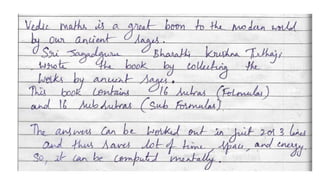
Between 1911 and 1918 Ad, Indian
Mathematian, devised vedic maths system,
then in 1965 he made his discoveries public in
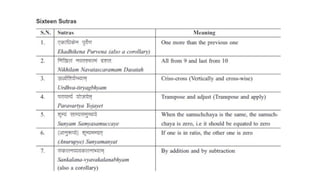
book titled vedic mathematics. It consists of 16
sutras and subsutras.
Fastest & Easiest Methods
●
Vedic maths can be classified in 4 levels.
●
Basic level (6th to 7th grade students)
●
Intermediate level (8th grade students)
●
Advance level by (9th grade students)
●
Ultimate level for Post
graduates/Teachers/Researchers
Basic level
Calculate mentally fast:
●
Addition
●
Subtraction
●
Multiplication
●
Division
●
Squaring
●
Cubing
Intermediate level
●
Square root
●
Cube root
●
Time
●
Fractions
●
Magic Square
●
Dates
●
HCF and LCM
Advance Level
●
Partial Fractions
●
Algebra
●
Factorization
●
Linear equation
●
Quadratic equation
●
HCF in Algebra
●
Simultaneous equation
●
Bi quadratic equation
●
Cubic equation
●
Integration and differentiation
Ultimate Level
●
How vedic maths applied in vedic computing
●
Applications of vedic maths in Cryptography,
Machine Learning, Computer Vision, Computer
Architecture, Signal processing.
●
Easier to write algorithm (step by step
instructions) and computation faster.
Vedic maths introduction for starting course

Vedic maths introduction for starting course

  • 1.
  • 2.
  • 3.
    ● Mathematics is asubject of numbers, shapes, data, measurements and also logical activities.
  • 4.
    ● How do youfind solution to math problems?
  • 5.
    Maths problems canbe ● Written and solved ● Are observed, visualized and solved ● Mentally calculated ● Solved using figures, instruments ● Solved by finding patterns
  • 6.
  • 7.
    ● Patterns are arrangements/ sequence of numbers, symbols.
  • 8.
    ● What is Vedicmaths? ● In Vedic maths we watch for patterns and made short tricks and formulas, so instead of working many steps, can arrive at solution with just one line step answer.
  • 9.
    ● But for Inschool, In exams students have to use traditional method and write all steps to fetch good marks, and also use vedic maths approach (one line solution to just verify your answers quickly).
  • 10.
    ● Vedic maths alsouseful in competitive exams, to do sums quickly in short span of time. ● Vedc maths is practiced by teacher practitioner. ● And practiced by Students
  • 11.
    ● What we learnin vedic maths? ● Vedic method contains general method and specific method to solve math problems. ● Using vedic method problems can be solved in just one line.
  • 12.
    ● We learn todo calculations without the aid of learning material. ● But while learning these methods we write notes and learn. Then in application and implementation we do it mentally.
  • 13.
    ● In school andIn exams, we have to solve problems with all the steps written down on paper, to get good marks. ● If 6th step goes wrong, then 7th step on-wards all steps will go wrong and final answer will also be wrong. To check whether you have arrived at correct answer you need to verify answer using another method, where vedic maths will be useful. ● Vedic maths can be used as one line step verification tool to check answer arrived is right or wrong, without taking much time.
  • 14.
    ● Vedic maths ishelpful for competitive exams so solve problems quickly. ● Vedic maths can be practiced by teacher practitioner and students.
  • 15.
    Vedic Maths ● Relating tothe Vedas or the ancient form of Sanskrit in which they are written. ● The term veda means “knowledge”
  • 16.
    ● Between 1911 and1918 Ad, Indian Mathematian, devised vedic maths system, then in 1965 he made his discoveries public in book titled vedic mathematics. It consists of 16 sutras and subsutras.
  • 20.
    Fastest & EasiestMethods ● Vedic maths can be classified in 4 levels. ● Basic level (6th to 7th grade students) ● Intermediate level (8th grade students) ● Advance level by (9th grade students) ● Ultimate level for Post graduates/Teachers/Researchers
  • 21.
    Basic level Calculate mentallyfast: ● Addition ● Subtraction ● Multiplication ● Division ● Squaring ● Cubing
  • 22.
    Intermediate level ● Square root ● Cuberoot ● Time ● Fractions ● Magic Square ● Dates ● HCF and LCM
  • 23.
    Advance Level ● Partial Fractions ● Algebra ● Factorization ● Linearequation ● Quadratic equation ● HCF in Algebra ● Simultaneous equation ● Bi quadratic equation ● Cubic equation ● Integration and differentiation
  • 24.
    Ultimate Level ● How vedicmaths applied in vedic computing ● Applications of vedic maths in Cryptography, Machine Learning, Computer Vision, Computer Architecture, Signal processing. ● Easier to write algorithm (step by step instructions) and computation faster.