Vanguard research
Vanguard’s guide to
financial wellness
Small steps can make a big difference
in achieving your goals
Why financial wellness?
Managing multiple short- and long-term financial goals can feel
overwhelming at times. Sixty-five percent of Americans
surveyed say that money is a significant source of stress. This
guide provides a three-step financial wellness framework for
determining the next best actions people could take to bring
them closer to their goals, no matter where they are in their
financial journey.
● Step 1: Take control of your finances. This will enable households to
create an effective budget and take advantage of high-reward
opportunities, such as paying the minimum on all debts, taking full
advantage of employer match opportunities, and paying down high-
interest debt such as payday loans and credit cards.
● Step 2: Prepare for the unexpected. Households can benefit from
setting aside emergency savings to cover modest, unexpected
expenses; creating a contingency fund in case of job loss; and
evaluating insurance and legal-document needs.
● Step 3. Make progress toward your goals. It is possible to invest
more in tax-advantaged accounts (retirement, health, and
education) and in taxable accounts for pre-retirement-age goals
(home, car, and vacations, among others) while paying down lower-
interest debt (student loans, mortgage, and car loans), and even to
consider gifting strategies.
How to use this guide
This financial wellness guide aims to cover topics that most investors
will face at some point, regardless of their financial status. The next
best actions it provides are meant to be put into practice consistently
and continuously, as some of them may take time to complete. This
guide focuses primarily on households’ accumulation phase, before
retirement. For guidance on decision-making in retirement, see Jaconetti
et al. (2021). For an overview of how Vanguard thinks about creating goals,
see Vanguard's Principles for Investing Success (2020).
3
Contents
Introduction...................................................................................................................................................................... 4
Step 1: Take control of your finances..........................................................................................................................7
Create a budget that works for you....................................................................................................................7
Maximize your employer-matched savings.........................................................................................................9
Meet minimum payments on debt.....................................................................................................................10
Pay down high-interest debt................................................................................................................................12
Step 2: Prepare for the unexpected......................................................................................................................... 15
Set aside emergency savings.............................................................................................................................. 15
Help protect against significant risks with insurance....................................................................................18
Get key legal documents in place........................................................................................................................26
Step 3: Make progress toward your goals...............................................................................................................32
Increase savings in tax-advantaged accounts.................................................................................................33
Retirement...........................................................................................................................................................36
Health care......................................................................................................................................................... 38
Education............................................................................................................................................................ 40
Add flexibility with taxable accounts.................................................................................................................41
Pay off lower-interest debt..................................................................................................................................42
Consider investing in others through gifts.......................................................................................................45
Conclusion...................................................................................................................................................................... 48
References...................................................................................................................................................................... 48
Appendix 1. About the Vanguard Capital Markets Model...................................................................................51
Appendix 2. 529 college savings plans......................................................................................................................51
Authors
Paulo Costa,
Ph.D.
Clifford S. Felton,
CFP®, CFA
4
Introduction
Vanguard’s mission is “to take a stand for all
investors, to treat them fairly, and to give them
the best chance for investment success.” To
achieve that success, investors need to be able to
allocate their budgets to pay current bills, tackle
debt, prepare for unexpected circumstances, and
invest to achieve goals. According to a Federal
Reserve Board survey, more than three-quarters
of U.S. families report having debt, and 45% of
families carry credit card debt, with an average
debt of $6,300 (Bhutta et al., 2020). Among the
families surveyed, 36% indicated they could not
cover an emergency expense of $400. More than
40% had not been able to save money over the
previous year.
Personal finances also affect people emotionally.
Sixty-five percent of Americans surveyed say
money is a significant source of stress (American
Psychological Association, 2022). For people under
age 43, that figure jumps to 82%. Americans say
personal finance issues affect their mental health,
physical health, sleep, self-esteem, relationships
at home, and work productivity and attendance
(PwC, 2022). For many of us, the prospect of
saving for retirement can be overwhelming when
considering current spending needs and
outstanding debt payments. This can lead to
inertia, which in turn can have adverse financial
planning consequences later in life.
These factors likely deter people from having the
best chance for investment success and from
realizing the ultimate objective of achieving their
financial goals. We created this financial wellness
guide and accompanying framework because
giving investors the best chance for investment
success also entails helping people to allocate
their budgets to concurrently pay bills, tackle
debt, save money, and invest. Together, these lay
out a path to financial independence, which
results in the financial flexibility to meet both
short- and long-term goals. By helping to improve
households’ financial situation, we can make an
impact not only on people’s well-being financially
but also in life and at work. We define financial
wellness as follows:
Financial wellness is the objective financial
situation of a person, household, or family. It
is the ability to meet current and near-term
financial obligations and to be on track to
meet future goals.
Understanding one’s ‘next best actions’
is a critical part of financial planning
People naturally want to achieve their goals in the
best way possible. When dealing with multiple
goals, though, knowing what to do next may be a
complex problem and may lead to confusion—or
worse, to inaction. In addition, life is uncertain
and goals may change over time. For these
reasons, instead of trying to figure out a “perfect
plan,” we seek to answer the following question:
Given your goals and objective financial situation,
what are the next best actions to take in your
financial life?
Our framework is designed to guide you toward
these areas of focus in your financial life to improve
your well-being. This guide aims to highlight
common financial wellness focus areas and how to
approach tackling them using suggested action
steps. For some, this guide may not be detailed
enough to address your specific needs. In those
situations, it may be best to consult with a
financial planning professional for more guidance.
5
How our work compares with the Consumer Financial Protection Bureau's
Our financial wellness definition and framework are based on the Consumer Financial Protection
Bureau’s work on financial well-being. The CFPB defines that term as “a state of being wherein a person
can fully meet current and ongoing financial obligations, can feel secure in their financial future, and is
able to make choices that allow enjoyment of life” (CFPB, 2015). The CFPB also says that “financial
well-being can be defined as a state wherein you:
• have control over day-to-day, month-to-month finances;
• have the capacity to absorb a financial shock;
• are on track to meet your financial goals; and
• have the financial freedom to make the choices that allow you to enjoy life.”
Our work differs from the CFPB’s approach in two important ways. First, our three-step financial
wellness framework provides explicit guidance on specific actions we recommend that people take to
achieve their desired financial goals; these include budgeting, paying down debt, following investing
principles, having insurance, and establishing legal documents. The CFPB (2015 and 2017), on the other
hand, focuses on the definition of financial well-being, the creation of a score for it, and factors that
could relate to that score. However, the CFPB does not provide specific actions or financial guidance on
what to do to achieve financial well-being.
Second, our framework stops short of considering people’s subjective perceptions about their finances
as part of our guidance. Although we believe that financial wellness has downstream effects on
subjective perception, we focus on people’s objective financial situation. In fact, the CFPB (2018) shows
that someone’s objective financial situation is the strongest predictor of their financial well-being
score. For this reason, we concentrate on objective actions that are within a person’s control.
Financial wellness is grounded
in three key desired outcomes
Although the specifics will vary by household,
starting down the path to financial wellness by
taking a few small steps at a time can help set
you up for a more sustainable and successful
financial future. By providing comprehensive
financial wellness guidance, as presented in our
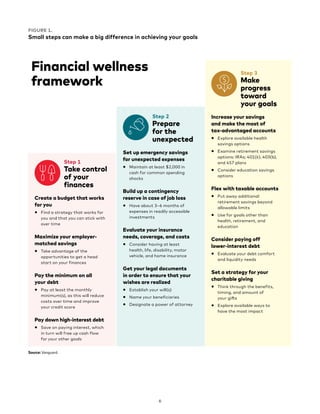
framework shown in Figure 1, we expect outcomes
for households to be:
1. To identify opportunities to get finances under
control through effective budgeting;
2. To meet unexpected expenses and protect
against unanticipated life events;
3. To increase investment capacity and the
probability of meeting financial goals.
Some steps that you may be able to take today
could be contributing more to your employer
plan to maximize your match, making an
additional payment on credit card debt, or
setting aside money for unexpected future
expenses. Each of these actions adds financial
flexibility to balance your current and future
goals or expenses, which in turn builds financial
confidence and freedom.
6
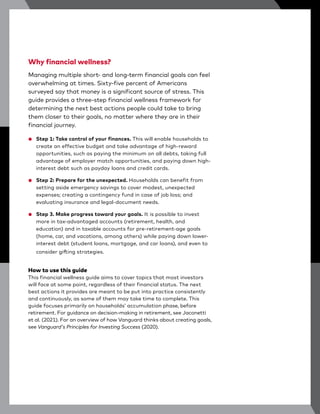
FIGURE 1.
Small steps can make a big difference in achieving your goals
Financial wellness
framework

Step 1
Take control
of your
finances
Create a budget that works
for you
• Find a strategy that works for
you and that you can stick with
over time
Maximize your employer-
matched savings
• Take advantage of the
opportunities to get a head
start on your finances
Pay the minimum on all
your debt
• Pay at least the monthly
minimum(s), as this will reduce
costs over time and improve
your credit score
Pay down high-interest debt
• Save on paying interest, which
in turn will free up cash flow
for your other goals

Step 2
Prepare
for the
unexpected
Set up emergency savings
for unexpected expenses
• Maintain at least $2,000 in
cash for common spending
shocks
Build up a contingency
reserve in case of job loss
• Have about 3–6 months of
expenses in readily accessible
investments
Evaluate your insurance
needs, coverage, and costs
• Consider having at least
health, life, disability, motor
vehicle, and home insurance
Get your legal documents
in order to ensure that your
wishes are realized
• Establish your will(s)
• Name your beneficiaries
• Designate a power of attorney

Step 3
Make
progress
toward
your goals
Increase your savings
and make the most of
tax-advantaged accounts
• Explore available health
savings options
• Examine retirement savings
options: IRAs; 401(k), 403(b),
and 457 plans
• Consider education savings
options
Flex with taxable accounts
• Put away additional
retirement savings beyond
allowable limits
• Use for goals other than
health, retirement, and
education
Consider paying off
lower-interest debt
• Evaluate your debt comfort
and liquidity needs
Set a strategy for your
charitable giving
• Think through the benefits,
timing, and amount of
your gifts
• Explore available ways to
have the most impact
Source: Vanguard.
7
		 Step 1
		 
Take control
of your finances
Knowing where your money is going is key for the
path toward financial wellness. For this reason, we
start with how to think about budgeting. While
first mentioned here, budgeting is a key tool
throughout the framework and is important for
enabling goal success. Then we can start to put
together a sequence of actions to help improve
your financial situation. Although households may
be at different points in their financial journeys,
this section helps you identify common, high-value
opportunities to improve your personal financial
situation.
Create a budget that works for you
Recent research shows that over 60% of
American households live paycheck to paycheck,
indicating that households may have difficulty
achieving their financial goals (PYMNTS and
LendingClub, 2022).
A budget is a “tool for awareness,” as Richards
(2015) puts it. People need to know where their
money is going and make sure it is in line with their
goals. Some people like budgeting; some don’t. No
matter the sentiment toward it, the way people
spend their money should align with their goals in
order to achieve successful outcomes.
An effective budget is one your household sticks
to while being able to save toward your goals.
Start by focusing on meeting current needs and
using the remaining amount across the topics in
our framework. Some people may have the
capacity to save today, while others may need to
focus on controlling spending. To help households
find the budgeting strategy that fits their style,
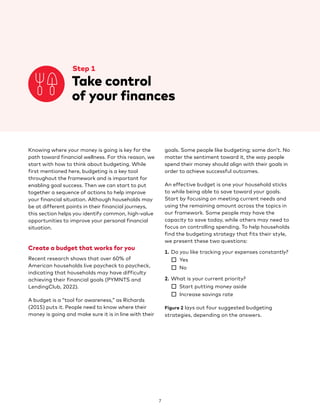
we present these two questions:
1. Do you like tracking your expenses constantly?
☐ Yes
☐ No
2. What is your current priority?
☐ Start putting money aside
☐ Increase savings rate
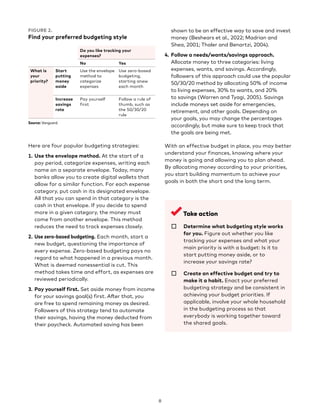
Figure 2 lays out four suggested budgeting
strategies, depending on the answers.
8
FIGURE 2.
Find your preferred budgeting style
Do you like tracking your
expenses?
No Yes
What is
your
priority?
Start
putting
money
aside
Use the envelope
method to
categorize
expenses
Use zero-based
budgeting,
starting anew
each month
Increase
savings
rate
Pay yourself
first
Follow a rule of
thumb, such as
the 50/30/20
rule
Source: Vanguard.
Here are four popular budgeting strategies:
1. Use the envelope method. At the start of a
pay period, categorize expenses, writing each
name on a separate envelope. Today, many
banks allow you to create digital wallets that
allow for a similar function. For each expense
category, put cash in its designated envelope.
All that you can spend in that category is the
cash in that envelope. If you decide to spend
more in a given category, the money must
come from another envelope. This method
reduces the need to track expenses closely.
2. Use zero-based budgeting. Each month, start a
new budget, questioning the importance of
every expense. Zero-based budgeting pays no
regard to what happened in a previous month.
What is deemed nonessential is cut. This
method takes time and effort, as expenses are
reviewed periodically.
3. Pay yourself first. Set aside money from income
for your savings goal(s) first. After that, you
are free to spend remaining money as desired.
Followers of this strategy tend to automate
their savings, having the money deducted from
their paycheck. Automated saving has been
shown to be an effective way to save and invest
money (Beshears et al., 2022; Madrian and
Shea, 2001; Thaler and Benartzi, 2004).
4. Follow a needs/wants/savings approach.
Allocate money to three categories: living
expenses, wants, and savings. Accordingly,
followers of this approach could use the popular
50/30/20 method by allocating 50% of income
to living expenses, 30% to wants, and 20%
to savings (Warren and Tyagi, 2005). Savings
include moneys set aside for emergencies,
retirement, and other goals. Depending on
your goals, you may change the percentages
accordingly, but make sure to keep track that
the goals are being met.
With an effective budget in place, you may better
understand your finances, knowing where your
money is going and allowing you to plan ahead.
By allocating money according to your priorities,
you start building momentum to achieve your
goals in both the short and the long term.
Take action
☐ 
Determine what budgeting style works
for you. Figure out whether you like
tracking your expenses and what your
main priority is with a budget: Is it to
start putting money aside, or to
increase your savings rate?
☐ 
Create an effective budget and try to
make it a habit. Enact your preferred
budgeting strategy and be consistent in
achieving your budget priorities. If
applicable, involve your whole household
in the budgeting process so that
everybody is working together toward
the shared goals.
9
Maximize your employer-matched savings
To encourage employees to save for retirement,
many employers offer matching contributions to
savings put into employer retirement plans. Other
types of employer-matched savings are also
becoming more common, such as Health Savings
Accounts (HSAs), student loan payments,
emergency savings, and even 529 plans. Most
employers match, in whole or in part, a
percentage of contributions to such plans or
accounts, while others match contributions up to
a given dollar amount. For brevity, our discussion
focuses on employer-matched retirement savings
into a vehicle such as a 401(k) plan.
Employer-matched savings give workers a sizable
head start in saving for retirement, as the match
is essentially free money from employers. The
return on the dollar invested is high. We find,
1 See Vanguard (2022), page 17, for information on the frequency of use of different employer-match formulas.
however, that many workers are not maxing out
their plan contributions; 31% of retirement plan
participants contribute below their employer
match rates, thus leaving money on the table
(Vanguard, 2022). Financial Engines (2015)
estimates that workers leave $24 billion unsaved
by not fully matching their employer contribution.
By taking advantage of and maximizing employer
matching, workers can make significant progress
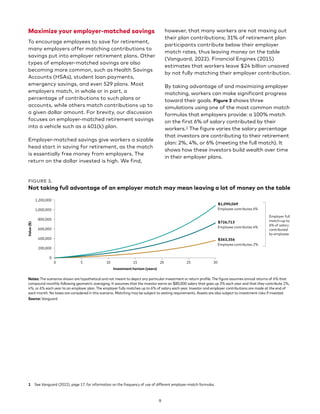
toward their goals. Figure 3 shows three
simulations using one of the most common match
formulas that employers provide: a 100% match
on the first 6% of salary contributed by their
workers.1 The figure varies the salary percentage
that investors are contributing to their retirement
plan: 2%, 4%, or 6% (meeting the full match). It
shows how these investors build wealth over time
in their employer plans.
FIGURE 3.
Not taking full advantage of an employer match may mean leaving a lot of money on the table
$363,356
Employee contributes 2%
$726,713
Employee contributes 4%
$1,090,069
Employee contributes 6%
Value
($)
Investment horizon (years)
0
600,000
400,000
200,000
800,000
1,000,000
1,200,000
5 10 15 20 25 30
0
Employer full
match=up to
6% of salary
contributed
by employee
Notes: The scenarios shown are hypothetical and not meant to depict any particular investment or return profile. The figure assumes annual returns of 6% that
compound monthly following geometric averaging. It assumes that the investor earns an $80,000 salary that goes up 3% each year and that they contribute 2%,
4%, or 6% each year to an employer plan. The employer fully matches up to 6% of salary each year. Investor and employer contributions are made at the end of
each month. No taxes are considered in this scenario. Matching may be subject to vesting requirements. Assets are also subject to investment risks if invested.
Source: Vanguard.
10
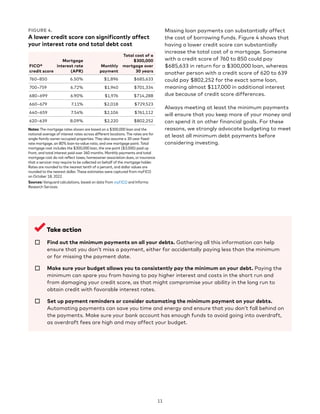
What becomes evident in Figure 3 is that not
contributing up to the full employer match is
costly for the future. In the scenarios shown,
investors who contribute 6% of their salary to
take advantage of the 6% match—thus
effectively contributing 12% of their salaries to
their employer plan—will reach $1,090,069 in
retirement savings over 30 years, with half that
value ($545,034.50) coming from the employer
contribution and its investment growth. But if
investors meet only 2% of the possible 6%
match—effectively contributing 4% of their
salaries—their plan savings over 30 years will total
$363,356, or $726,713 less than had they received
the full match. In a nutshell, investors can leave
substantial wealth on the table by not fully
meeting the employer match.
Take action
☐ 
Find out the details of your employer
plan match. This information is usually
accessible on a company’s intranet or
through its human resources
department.
☐ 
Make room in your budget to contribute
and earn the full match. An employer
match is akin to an immediate return
on your money.
2 Throughout this guide, debt is used interchangeably for loan debt and credit card debt.
Meet minimum payments on debt
Paying down debt is also a top priority for many
households. The average U.S. household holds
multiple types of debt, most commonly
mortgages, student loans, auto loans, and credit
card debt.2 Dealing with multiple debts at once
can be overwhelming, especially considering the
competing needs to invest toward other financial
goals. Where should households start when
paying down debt? We recommend budgeting to
make the minimum payments due on all your
household debts, for two main reasons.
First, when you miss a payment, unpaid interest
is typically added to the outstanding principal
balance, increasing both the total amount due
and the total future interest due. The lender may
also charge late penalties and other fees, further
straining your household budget.
Second, by not paying the minimum due on a
credit or loan balance, households become late on
the payment after the lender’s grace period,
opening the door to being reported to credit
bureaus. Once a late payment notice reaches
those bureaus, your credit score decreases,
affecting your future ability to obtain lower
interest rates or even obtain credit at all,
depending on the score. According to Demyanyk
(2017), a missed loan payment can decrease a
credit score by 51 points. In addition, a late
payment notice can stay in a credit report for up
to seven years, with a potentially long-lasting
effect on a household’s finances. A lower credit
score could drive up a household’s interest rates
and future borrowing costs far beyond the
current impacts, especially with longer-term loans
such as mortgages (Figure 4).
11
FIGURE 4.
A lower credit score can significantly affect
your interest rate and total debt cost
FICO®
credit score
Mortgage
interest rate
(APR)
Monthly
payment
Total cost of a
$300,000
mortgage over
30 years
760–850 6.50% $1,896 $685,633
700–759 6.72% $1,940 $701,334
680–699 6.90% $1,976 $714,288
660–679 7.11% $2,018 $729,523
640–659 7.54% $2,106 $761,112
620–639 8.09% $2,220 $802,252
Notes: The mortgage rates shown are based on a $300,000 loan and the
national average of interest rates across different locations. The rates are for
single-family owner-occupied properties. They also assume a 30-year fixed-
rate mortgage, an 80% loan-to-value ratio, and one mortgage point. Total
mortgage cost includes the $300,000 loan, the one point ($3,000) paid up
front, and total interest paid over 360 months. Monthly payments and total
mortgage cost do not reflect taxes, homeowner association dues, or insurance
that a servicer may require to be collected on behalf of the mortgage holder.
Rates are rounded to the nearest tenth of a percent, and dollar values are
rounded to the nearest dollar. These estimates were captured from myFICO
on October 18, 2022.
Sources: Vanguard calculations, based on data from myFICO and Informa
Research Services.
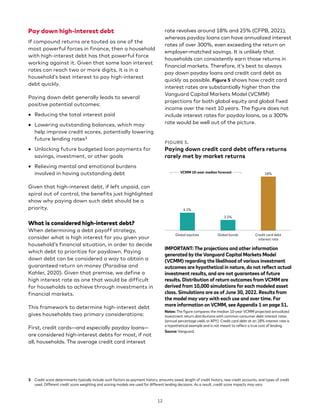
Missing loan payments can substantially affect
the cost of borrowing funds. Figure 4 shows that
having a lower credit score can substantially
increase the total cost of a mortgage. Someone
with a credit score of 760 to 850 could pay
$685,633 in return for a $300,000 loan, whereas
another person with a credit score of 620 to 639
could pay $802,252 for the exact same loan,
meaning almost $117,000 in additional interest
due because of credit score differences.
Always meeting at least the minimum payments
will ensure that you keep more of your money and
can spend it on other financial goals. For these
reasons, we strongly advocate budgeting to meet
at least all minimum debt payments before
considering investing.
Take action
☐ 
Find out the minimum payments on all your debts. Gathering all this information can help
ensure that you don’t miss a payment, either for accidentally paying less than the minimum
or for missing the payment date.
☐ 
Make sure your budget allows you to consistently pay the minimum on your debt. Paying the
minimum can spare you from having to pay higher interest and costs in the short run and
from damaging your credit score, as that might compromise your ability in the long run to
obtain credit with favorable interest rates.
☐ 
Set up payment reminders or consider automating the minimum payment on your debts.
Automating payments can save you time and energy and ensure that you don’t fall behind on
the payments. Make sure your bank account has enough funds to avoid going into overdraft,
as overdraft fees are high and may affect your budget.
12
Pay down high-interest debt
If compound returns are touted as one of the
most powerful forces in finance, then a household
with high-interest debt has that powerful force
working against it. Given that some loan interest
rates can reach two or more digits, it is in a
household’s best interest to pay high-interest
debt quickly.
Paying down debt generally leads to several
positive potential outcomes:
• Reducing the total interest paid
• Lowering outstanding balances, which may
help improve credit scores, potentially lowering
future lending rates3
• Unlocking future budgeted loan payments for
savings, investment, or other goals
• Relieving mental and emotional burdens
involved in having outstanding debt
Given that high-interest debt, if left unpaid, can
spiral out of control, the benefits just highlighted
show why paying down such debt should be a
priority.
What is considered high-interest debt?
When determining a debt payoff strategy,
consider what is high interest for you given your
household’s financial situation, in order to decide
which debt to prioritize for paydown. Paying
down debt can be considered a way to obtain a
guaranteed return on money (Paradise and
Kahler, 2020). Given that premise, we define a
high interest rate as one that would be difficult
for households to achieve through investments in
financial markets.
This framework to determine high-interest debt
gives households two primary considerations:
First, credit cards—and especially payday loans—
are considered high-interest debts for most, if not
all, households. The average credit card interest
3 Credit score determinants typically include such factors as payment history, amounts owed, length of credit history, new credit accounts, and types of credit
used. Different credit score weighting and scoring models are used for different lending decisions. As a result, credit score impacts may vary.
rate revolves around 18% and 25% (CFPB, 2021),
whereas payday loans can have annualized interest
rates of over 300%, even exceeding the return on
employer-matched savings. It is unlikely that
households can consistently earn those returns in
financial markets. Therefore, it’s best to always
pay down payday loans and credit card debt as
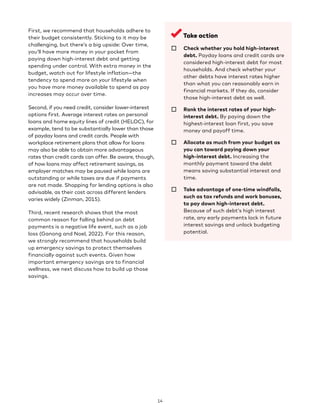
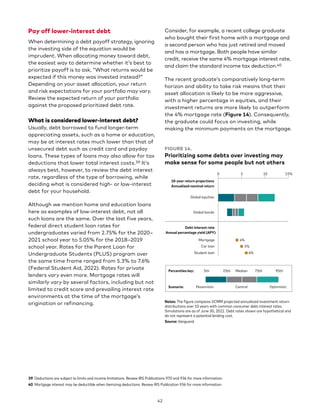
quickly as possible. Figure 5 shows how credit card
interest rates are substantially higher than the
Vanguard Capital Markets Model (VCMM)
projections for both global equity and global fixed
income over the next 10 years. The figure does not
include interest rates for payday loans, as a 300%
rate would be well out of the picture.
FIGURE 5.
Paying down credit card debt offers returns
rarely met by market returns
6.1%
3.5%
Global equities Global bonds
18%
Credit card debt
interest rate
VCMM 10-year median forecast
IMPORTANT: The projections and other information
generated by the Vanguard Capital Markets Model
(VCMM) regarding the likelihood of various investment
outcomes are hypothetical in nature, do not reflect actual
investment results, and are not guarantees of future
results. Distribution of return outcomes from VCMM are
derived from 10,000 simulations for each modeled asset
class. Simulations are as of June 30, 2022. Results from
the model may vary with each use and over time. For
more information on VCMM, see Appendix 1 on page 51.
Notes: The figure compares the median 10-year VCMM projected annualized
investment return distributions with common consumer debt interest rates
(annual percentage yield, or APY). Credit card debt at an 18% interest rate is
a hypothetical example and is not meant to reflect a true cost of lending.
Source: Vanguard.
13
Second, beyond credit card and payday loans,
placing the high-interest-debt label on other
debts may vary depending on each household’s
other outstanding debt rates and risk tolerance.
Take, for example, two people, Pat and Chris.
Both are already meeting their available
employer match, and each has an outstanding
car loan at a 5% rate. Pat is younger and has an
aggressive all-equities investment allocation,
while Chris is nearing retirement and has a
portfolio entirely invested in bonds. Pat’s equity-
heavy investments have a greater potential to
outperform the car loan rate. Pat may not
consider that 5% rate high and instead could
prioritize it later on. Chris, however, is much less
likely to expect to outperform the loan rate, given
their more conservative all-bond investment
allocation. So Chris could see the 5% rate as high
and should consider prioritizing that debt.
Finally, consider household debt aversion. Debt
savings are fixed returns, while investing returns
are naturally uncertain. Sometimes even when
investing appears more likely to outperform the
debt rate, paying down debt can make sense.
Although there may be lost investment
opportunity, if other goals are on track, trading off
some inefficiencies for improving well-being and
ensuring peace of mind may be reasonable. In
either case, be diligent in not reestablishing these
high-cost debts; instead, budget future savings
toward achieving your other financial goals.
How to consider paying down
high-interest debt
Mathematically, paying down high-interest debt
first should always produce the lowest total
amount of interest paid, saving the investor the
most money, especially when extra cash is
available to pay more than the minimum
payments. By reducing the interest paid, investors
also minimize the time it takes to pay down the
debt. The method of paying down high-interest
debt first is sometimes called debt avalanche.
This strategy entails ranking debts by interest
rate and allocating additional payments, above
required minimums, from the highest-rate debt to
the lowest. Once the first debt is paid off, those
payments are added to the second debt until
that is paid off. This continues until all prioritized
debts are paid off. The avalanche method aims to
minimize the total interest paid, keeping more
money in the investor’s pocket.
When debt is paid off early (in whole or in part),
future interest savings are locked in, so paying
down high-interest debt will unlock higher future
savings potential in your budget.
How can you avoid falling back
on high-interest debt?
Once a high-interest debt is paid off, your budget
will have more flexibility. Use this flexibility to try
to steer clear of high-interest debt. Research has
shown that short-term, high-interest debt takes a
toll in both a person’s productivity and their
well-being, so it is best to avoid such debt
whenever possible (Carrell and Zinman, 2014;
Sweet, Kuzawa, and McDade, 2018). For these
reasons, try to avoid high-cost financing options
like payday loans and use credit cards responsibly
by paying off the statement balance before
interest starts accruing. A CFPB analysis found
that 80% of people who get a payday loan either
roll it over or get another such loan within 14 days
(Burke et al., 2014). High-interest debt has
substantially higher rates than financial
investments typically return, so falling back on it
can undo a lot of a household’s progress. We
offer three suggestions to avoid falling back on
high-interest debt or defaulting on a loan.
First, we recommend that households adhere to
their budget consistently. Sticking to it may be
challenging, but there’s a big upside: Over time,
you’ll have more money in your pocket from
paying down high-interest debt and getting
spending under control. With extra money in the
budget, watch out for lifestyle inflation—the
tendency to spend more on your lifestyle when
you have more money available to spend as pay
increases may occur over time.
Second, if you need credit, consider lower-interest
options first. Average interest rates on personal
loans and home equity lines of credit (HELOC), for
example, tend to be substantially lower than those
of payday loans and credit cards. People with
workplace retirement plans that allow for loans
may also be able to obtain more advantageous
rates than credit cards can offer. Be aware, though,
of how loans may affect retirement savings, as
employer matches may be paused while loans are
outstanding or while taxes are due if payments
are not made. Shopping for lending options is also
advisable, as their cost across different lenders
varies widely (Zinman, 2015).
Third, recent research shows that the most
common reason for falling behind on debt
payments is a negative life event, such as a job
loss (Ganong and Noel, 2022). For this reason,
we strongly recommend that households build
up emergency savings to protect themselves
financially against such events. Given how
important emergency savings are to financial
wellness, we next discuss how to build up those
savings.
Take action
☐ 
Check whether you hold high-interest
debt. Payday loans and credit cards are
considered high-interest debt for most
households. And check whether your
other debts have interest rates higher
than what you can reasonably earn in
financial markets. If they do, consider
those high-interest debt as well.
☐ 
Rank the interest rates of your high-
interest debt. By paying down the
highest-interest loan first, you save
money and payoff time.
☐ 
Allocate as much from your budget as
you can toward paying down your
high-interest debt. Increasing the
monthly payment toward the debt
means saving substantial interest and
time.
☐ 
Take advantage of one-time windfalls,
such as tax refunds and work bonuses,
to pay down high-interest debt.
Because of such debt’s high interest
rate, any early payments lock in future
interest savings and unlock budgeting
potential.
14
Step 2
		 
Prepare for
the unexpected
With finances under control, as one’s wealth
grows, so does the need for protecting it. Similar
to how using asset allocation can protect against
investment risk, there are several actions you can
take to help protect your valuable financial
resources. We’ll now review a few valuable risk-
control tools that can help mitigate life’s
uncertainties—from spending shocks to car
accidents to job losses to untimely death—and
keep your goals on track or close to it.
Set aside emergency savings
Uncertainty is a given in both life and investing. An
effective way to help hedge against some financial
uncertainties is to establish savings for when an
inevitable or unlikely event occurs. Research from
the CFPB (2022) finds that people who report
having no emergency savings are more likely to
overdraw their checking accounts, rely on high-
cost loans (such as payday, credit card, and title
loans), and withdraw money from their retirement
accounts. Each of these actions results in
additional costs on top of any unexpected needs
and affects other financial goals.
Emergency savings can ensure that you have
some cushions in place to help mitigate the
potential impacts of such events on your budget,
financial plans, and goals. As research by Pew
Charitable Trusts (2015) has also shown, these
destabilizing shocks can affect family balance
sheets not only at the time an event occurs but
also for months afterward.
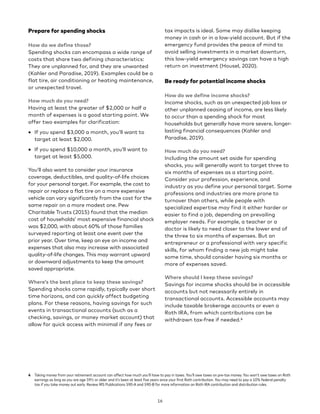
Vanguard recommends that when you think about
emergency savings, first evaluate your household’s
liquidity. We define liquidity as the ability to convert
an investment into cash quickly and cheaply
(Kahler and Paradise, 2019). Figure 6 provides
guidance in setting aside emergency savings.
FIGURE 6.
Emergency savings help safeguard
household spending and income
Emergency savings: Managing your
household’s liquidity needs
Spending protection Income protection
Examples A flat tire, heating
maintenance, or
unexpected travel
Unexpected job loss
How much
do I need
saved?
At least the greater
of $2,000 or half a
month of expenses
Generally, three to
six months of
expenses
Where
should I keep
these
savings?
Checking or savings
accounts or money
market funds for
quick access
Taxable accounts or
even a Roth IRA, as
contributions can
be withdrawn tax-
free if needed
Source: Vanguard.
15
Prepare for spending shocks
How do we define those?
Spending shocks can encompass a wide range of
costs that share two defining characteristics:
They are unplanned for, and they are unwanted
(Kahler and Paradise, 2019). Examples could be a
flat tire, air conditioning or heating maintenance,
or unexpected travel.
How much do you need?
Having at least the greater of $2,000 or half a
month of expenses is a good starting point. We
offer two examples for clarification:
• If you spend $3,000 a month, you’ll want to
target at least $2,000.
• If you spend $10,000 a month, you’ll want to
target at least $5,000.
You’ll also want to consider your insurance
coverage, deductibles, and quality-of-life choices
for your personal target. For example, the cost to
repair or replace a flat tire on a more expensive
vehicle can vary significantly from the cost for the
same repair on a more modest one. Pew
Charitable Trusts (2015) found that the median
cost of households’ most expensive financial shock
was $2,000, with about 60% of those families
surveyed reporting at least one event over the
prior year. Over time, keep an eye on income and
expenses that also may increase with associated
quality-of-life changes. This may warrant upward
or downward adjustments to keep the amount
saved appropriate.
Where’s the best place to keep these savings?
Spending shocks come rapidly, typically over short
time horizons, and can quickly affect budgeting
plans. For these reasons, having savings for such
events in transactional accounts (such as a
checking, savings, or money market account) that
allow for quick access with minimal if any fees or
4 Taking money from your retirement account can affect how much you’ll have to pay in taxes. You’ll owe taxes on pre-tax money. You won’t owe taxes on Roth
earnings as long as you are age 59½ or older and it’s been at least five years since your first Roth contribution. You may need to pay a 10% federal penalty
tax if you take money out early. Review IRS Publications 590-A and 590-B for more information on Roth IRA contribution and distribution rules.
tax impacts is ideal. Some may dislike keeping
money in cash or in a low-yield account. But if the
emergency fund provides the peace of mind to
avoid selling investments in a market downturn,
this low-yield emergency savings can have a high
return on investment (Housel, 2020).
Be ready for potential income shocks
How do we define income shocks?
Income shocks, such as an unexpected job loss or
other unplanned ceasing of income, are less likely
to occur than a spending shock for most
households but generally have more severe, longer-
lasting financial consequences (Kahler and
Paradise, 2019).
How much do you need?
Including the amount set aside for spending
shocks, you will generally want to target three to
six months of expenses as a starting point.
Consider your profession, experience, and
industry as you define your personal target. Some
professions and industries are more prone to
turnover than others, while people with
specialized expertise may find it either harder or
easier to find a job, depending on prevailing
employer needs. For example, a teacher or a
doctor is likely to need closer to the lower end of
the three to six months of expenses. But an
entrepreneur or a professional with very specific
skills, for whom finding a new job might take
some time, should consider having six months or
more of expenses saved.
Where should I keep these savings?
Savings for income shocks should be in accessible
accounts but not necessarily entirely in
transactional accounts. Accessible accounts may
include taxable brokerage accounts or even a
Roth IRA, from which contributions can be
withdrawn tax-free if needed.4
16
When considering where to invest these savings,
examine not only your job characteristics but also
your household structure and spending flexibility.
Being the sole income earner or having a large
percentage of your budget going to necessary
expenses (such as food and utilities) may mean
leaning more toward transactional than
accessible accounts. For those who invest this
portion of savings, also consider adjusting your
target amount based on the investment
allocation and expected volatility.
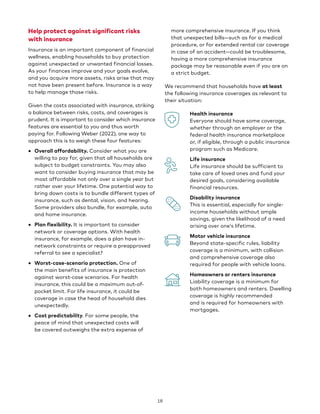
Take action
☐ 
Understand your typical monthly spending and identify available savings. By knowing this
information, you can identify shortfalls or excesses.
☐ 
Establish or maintain savings for spending shocks. Given the likelihood of such expenses,
saving for them should be a priority. Place the savings in transactional accounts such as
checking and savings accounts or money market funds.
☐ 
Establish or maintain savings for income shocks. With savings set aside for spending shocks,
work to build up savings for income shocks. Place these savings in accessible accounts from
which you could withdraw assets, such as a taxable brokerage account or Roth IRA.
17
Help protect against significant risks
with insurance
Insurance is an important component of financial
wellness, enabling households to buy protection
against unexpected or unwanted financial losses.
As your finances improve and your goals evolve,
and you acquire more assets, risks arise that may
not have been present before. Insurance is a way
to help manage those risks.
Given the costs associated with insurance, striking
a balance between risks, costs, and coverages is
prudent. It is important to consider which insurance
features are essential to you and thus worth
paying for. Following Weber (2022), one way to
approach this is to weigh these four features:
• Overall affordability. Consider what you are
willing to pay for, given that all households are
subject to budget constraints. You may also
want to consider buying insurance that may be
most affordable not only over a single year but
rather over your lifetime. One potential way to
bring down costs is to bundle different types of
insurance, such as dental, vision, and hearing.
Some providers also bundle, for example, auto
and home insurance.
• Plan flexibility. It is important to consider
network or coverage options. With health
insurance, for example, does a plan have in-
network constraints or require a preapproved
referral to see a specialist?
• Worst-case-scenario protection. One of
the main benefits of insurance is protection
against worst-case scenarios. For health
insurance, this could be a maximum out-of-
pocket limit. For life insurance, it could be
coverage in case the head of household dies
unexpectedly.
• Cost predictability. For some people, the
peace of mind that unexpected costs will
be covered outweighs the extra expense of
more comprehensive insurance. If you think
that unexpected bills—such as for a medical
procedure, or for extended rental car coverage
in case of an accident—could be troublesome,
having a more comprehensive insurance
package may be reasonable even if you are on
a strict budget.
We recommend that households have at least
the following insurance coverages as relevant to
their situation:
• Health insurance
Everyone should have some coverage,
whether through an employer or the
federal health insurance marketplace
or, if eligible, through a public insurance
program such as Medicare.
• Life insurance
Life insurance should be sufficient to
take care of loved ones and fund your
desired goals, considering available
financial resources.
• Disability insurance
This is essential, especially for single-
income households without ample
savings, given the likelihood of a need
arising over one’s lifetime.
• Motor vehicle insurance
Beyond state-specific rules, liability
coverage is a minimum, with collision
and comprehensive coverage also
required for people with vehicle loans.
• Homeowners or renters insurance
Liability coverage is a minimum for
both homeowners and renters. Dwelling
coverage is highly recommended
and is required for homeowners with
mortgages.
18
Given that most households have limited financial
resources—especially if either a planned or an
unplanned expense occurs—insurance can be used
strategically to ensure a level of protection to help
limit the possibility that an event may derail your
financial security or plan. In the next section, we
review common types of insurance and cost levers
to consider. Be aware that insurance rules and
required coverage minimums vary significantly by
insurance type and state. Some insurers may also
offer bundling options or discounts (for example,
for home and vehicle coverage, or for life and
disability coverage) that could lower costs for the
insured. Review your policy or policies with a
qualified insurance agent to help determine the
appropriate coverage for your situation.
As we discuss different types of insurance,
understand that not all coverage options may be
available. For example, with health or disability
insurance, you may be limited by what your plan
offers. We recommend that you consider your
options and make full use of employer-sponsored
plan options.
Health insurance
With health care costs seemingly always rising—
reported U.S. health spending totaled $4.1 trillion
in 2020, or 19.7% of U.S. GDP—having health
insurance is especially valuable to protect against
high-loss events. Such insurance can aid in
protecting against negative financial outcomes due
to expected or unexpected expenses (Centers for
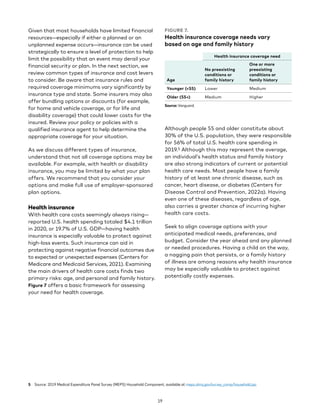
Medicare and Medicaid Services, 2021). Examining
the main drivers of health care costs finds two
primary risks: age, and personal and family history.
Figure 7 offers a basic framework for assessing
your need for health coverage.
5 Source: 2019 Medical Expenditure Panel Survey (MEPS) Household Component, available at meps.ahrq.gov/survey_comp/household.jsp.
FIGURE 7.
Health insurance coverage needs vary
based on age and family history
Health insurance coverage need
Age
No preexisting
conditions or
family history
One or more
preexisting
conditions or
family history
Younger (55) Lower Medium
Older (55+) Medium Higher
Source: Vanguard.
Although people 55 and older constitute about
30% of the U.S. population, they were responsible
for 56% of total U.S. health care spending in
2019.5 Although this may represent the average,
an individual’s health status and family history
are also strong indicators of current or potential
health care needs. Most people have a family
history of at least one chronic disease, such as
cancer, heart disease, or diabetes (Centers for
Disease Control and Prevention, 2022a). Having
even one of these diseases, regardless of age,
also carries a greater chance of incurring higher
health care costs.
Seek to align coverage options with your
anticipated medical needs, preferences, and
budget. Consider the year ahead and any planned
or needed procedures. Having a child on the way,
a nagging pain that persists, or a family history
of illness are among reasons why health insurance
may be especially valuable to protect against
potentially costly expenses.
19
Some people may think their health is good
enough that insurance might not be needed, but
catastrophic risks such as car accidents and sports
injuries are real risks that should not go ignored.
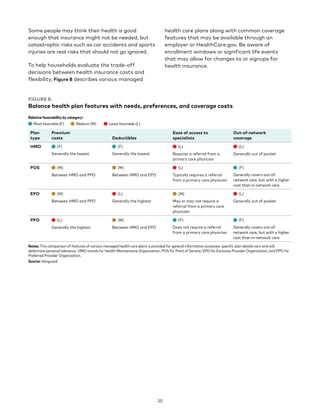
To help households evaluate the trade-off
decisions between health insurance costs and
flexibility, Figure 8 describes various managed
health care plans along with common coverage
features that may be available through an
employer or HealthCare.gov. Be aware of
enrollment windows or significant life events
that may allow for changes to or signups for
health insurance.
FIGURE 8.
Balance health plan features with needs, preferences, and coverage costs
Relative favorability by category:
Most favorable (F) Medium (M) Least favorable (L)
Plan
type
Premium
costs Deductibles
Ease of access to
specialists
Out-of-network
coverage
HMO (F)
Generally the lowest
(F)
Generally the lowest
(L)
Requires a referral from a
primary care physician
(L)
Generally out of pocket
POS (M)
Between HMO and PPO
(M)
Between HMO and EPO
(L)
Typically requires a referral
from a primary care physician
(F)
Generally covers out-of-
network care, but with a higher
cost than in-network care
EPO (M)
Between HMO and PPO
(L)
Generally the highest
(M)
May or may not require a
referral from a primary care
physician
(L)
Generally out of pocket
PPO (L)
Generally the highest
(M)
Between HMO and EPO
(F)
Does not require a referral
from a primary care physician
(F)
Generally covers out-of-
network care, but with a higher
cost than in-network care
Notes: This comparison of features of various managed health care plans is provided for general information purposes; specific plan details vary and will
determine personal relevance. HMO stands for Health Maintenance Organization, POS for Point of Service, EPO for Exclusive Provider Organization, and PPO for
Preferred Provider Organization.
Source: Vanguard.
20
For households that may be willing to bear the risk
of higher deductibles, and thus pay more out of
pocket, each plan type shown in Figure 8 may be
offered with a High Deductible Health Plan
(HDHP) option. Deductibles are higher for HDHPs,
so their monthly premiums are typically lower than
those for lower-deductible plans. An HDHP also
allows for use of a Health Savings Account (HSA)
to save for future health care costs or even to use
today for an unexpected out-of-pocket need
(Kahler, Clarke, and Bruno, 2020). Many employers
offer health care plans that allow for HSA
contributions and are increasingly offering free
and/or matching contributions to incentivize
participation (Ascensus Savings Trends, 2022).
If you are eligible for Medicare or approaching
eligibility, there are health insurance options to
consider based on your personal needs and
preferences (Weber, 2022).
Take action
☐ 
Examine your current coverage and
evaluate whether it meets your needs.
Understand where shortfalls may exist
or where some coverage might not be
necessary.
☐ 
Prepare for enrollment windows. Get
ready for these by creating an inventory
of required medications, expected
costs, and potential forthcoming
treatments.
☐ 
Select a plan that balances costs with
your desired coverage. Evaluate your
coverage options and choose a plan
that meets most of your criteria.
21
Life insurance
Another less obvious risk that many overlook is
untimely death. That can place exceptional strain
on family finances, reducing—or, in the worst
case, eliminating—household income. Although
the COVID-19 pandemic made households more
aware of the need for life insurance—with 31% of
U.S. adults saying the pandemic made them
more likely to buy it—only 52% had some form of
life insurance in 2021, down from 63% in 2011
(Wood, Leyes, and Scanlon, 2021). Optimal life
insurance planning should focus on obtaining
sufficient coverage for your current and future
needs from reliable providers at a cost-effective
price (Lobel and Mizuta, forthcoming).
Planning for life insurance is not so different from
planning for achieving your financial goals. First,
inventory those goals and how much their
financing relies on income and future savings
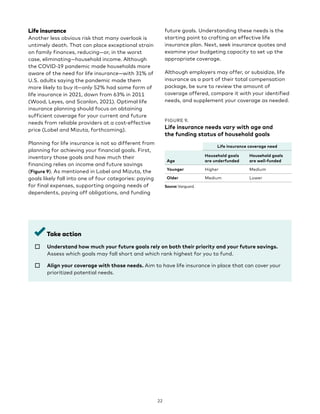
(Figure 9). As mentioned in Lobel and Mizuta, the
goals likely fall into one of four categories: paying
for final expenses, supporting ongoing needs of
dependents, paying off obligations, and funding
future goals. Understanding these needs is the
starting point to crafting an effective life
insurance plan. Next, seek insurance quotes and
examine your budgeting capacity to set up the
appropriate coverage.
Although employers may offer, or subsidize, life
insurance as a part of their total compensation
package, be sure to review the amount of
coverage offered, compare it with your identified
needs, and supplement your coverage as needed.
FIGURE 9.
Life insurance needs vary with age and
the funding status of household goals
Life insurance coverage need
Age
Household goals
are underfunded
Household goals
are well-funded
Younger Higher Medium
Older Medium Lower
Source: Vanguard.
Take action
☐ 
Understand how much your future goals rely on both their priority and your future savings.
Assess which goals may fall short and which rank highest for you to fund.
☐ 
Align your coverage with those needs. Aim to have life insurance in place that can cover your
prioritized potential needs.
22
Disability insurance
Human capital—the ability to work to earn
income—is one of a household’s largest financial
resources. Although most people understand the
need for health and life insurance, the sudden
inability to work does not often cross our minds.
Households therefore must protect against the
possibility of becoming disabled and unable to
earn income. For example, a 30-year-old who
makes $50,000 a year after taxes, assuming no
raises or bonuses over the next 35 years, would
earn $1.75 million over that time. That is a
significant level of assets to leave unprotected.
People in higher-risk jobs, such as construction
and medical workers, or in highly specialized jobs,
such as surgeons, where a disability may impair
the ability to work should consider disability
insurance. Employers may offer some form of
disability coverage as an employee benefit. If
yours does, review the plan details to ensure that
you understand the coverage and that it is
appropriate for your circumstances. Supplement
it with additional private coverage as needed. For
households that have only one income earner—or
that have two income earners but could not cover
all their household expenses on one salary alone—
establishing coverage is more urgent.
People underestimate the probability of becoming
disabled. Social Security Administration data from
June 2020 showed that those born in 2000 had a
12.7% chance of dying before their full retirement
age (67), versus a 25.3% chance of becoming
disabled (Maleh and Bosley, 2020). People also
seem aware of disability risks, yet many do not
seem to act. Based on 2021 data, only 14% of
Americans say they have disability insurance, yet
48% of Americans acknowledge they may need it,
and 45% of families would face financial hardship
within six months if a primary wage earner became
disabled and unable to earn income (LIMRA, 2021).
6 SSDI is based on lifetime earnings. More information is available at www.ssa.gov/benefits/disability/.
People also may be aware of, or plan to rely on,
federal programs—such as Social Security—that
are available for those with disabilities, but they
are often unaware of the strict requirements for
meeting Social Security’s disability definition. In
2018, according to the CDC, 26% of adults 18 or
older reported having a disability (Centers for
Disease Control and Prevention, 2022b). That same
year, only about 20% of those with a disability
qualified for Social Security Disability Income
(SSDI) support (Erickson, Lee, and von Schrader,
2022). And even for someone who qualifies, SSDI
rarely covers predisability income entirely.6 Others
may plan to rely on workers’ compensation, but
that covers only on-the-job injuries.
Take action
☐ 
Understand how much your future
goals rely on both their priority and
your future income. Assess which goals
may fall short if you become disabled
and how much the shortfall would be.
☐ 
Examine your current coverage and its
features. Determine what disability
insurance may be available through an
employer and understand your
coverage amounts, durations, and
conditions.
☐ 
Fill any gaps with supplemental
coverage. If your existing coverage is
insufficient and there are no other
assets or other income to provide for
the household in case of disability, seek
additional coverage.
23
Motor vehicle insurance
Nearly every state requires some sort of
insurance for motor vehicle owners. There may,
though, be hidden risks, or there may be
opportunities to review and adjust your coverage
to ensure the appropriate level. One way to think
about coverage is to split the options into two
types: liability and everything else.
Liability insurance covers damage done to others
and their property but not to the policyholder or
to the policyholder’s vehicle or passengers.
Although nearly every state requires liability
insurance, the minimum required coverage varies
in amount ($5,000 to $100,000) and type (bodily
injury and/or property). With Kelley Blue Book
(2022a, 2022b) reporting that Americans in 2021
paid on average over $47,000 for new cars and
$28,000 for used cars, most states’ minimum
policies could leave $5,000 to $22,000 or more for
the policyholder to pay out of pocket for at-fault
damages to others’ property. Besides property
damages, ensuing medical costs could easily run
higher than the minimum coverage amounts,
given that inpatient hospitalization costs
following a motor vehicle accident average
$57,000 (Cantalin, 2022).
The “everything else” category includes various
types of coverage for the policyholder, such as
collision, comprehensive, personal injury
protection (PIP), uninsured/underinsured motorist
(UM), and business-use (ride-sharing) coverage.
Collision and comprehensive both cover the
policyholder’s property (for example, for damage
from accidents or vandalism) and are typically
required when taking out a loan to fund a vehicle
purchase. Once the loan is paid off, this coverage
can be cut back if the policyholder sets aside
enough money to potentially repair or replace a
vehicle. PIP adds coverage for bodily harm and
other expenses for the policyholder and
passengers. UM coverage can be helpful even
when not required, given an Insurance Research
Council estimate, based on claims data, that
12.6% of motorists in 2019 were uninsured
(Insurance Information Institute, 2021).
Motor vehicle insurance can also cover several
other expenses such as for breakdowns, roadside
assistance, or rental cars while repairs are
underway, but be aware of the costs and
potential for redundant coverage. Finally,
rideshare drivers, such as for Uber or DoorDash,
should not forget to add business-use coverage,
as many policies will not cover accidents and
related damages without it.
Take action
☐ 
Examine your current insurance
coverage(s) and understand what may
and may not be covered as well as how
much is covered. Understand where
your coverage may fall short or be
redundant.
☐ 
Align coverage with your needs. Make
sure your coverage and goals are
aligned with your budget, balancing
costs with needs.
24
Homeowners or renters insurance
Households with a mortgage are generally
required to have homeowners’ insurance, whereas
renters insurance is not usually required of
renters. Not all coverage is created equal, nor are
all damages covered. Most homeowner policies,
for example, do not cover damage from flooding
or earthquakes. Always consider the cost of your
home and of renovations when reviewing your
coverage.
Like motor vehicle insurance, homeowners and
renters insurance can be thought of as liability
coverage and everything else. Every household
should at least be insured for liability. This will
provide financial protection not only for injuries
that non-occupants might sustain on your
property, but also for accidental damages you
may cause elsewhere. For example, if you are in
an art showroom and accidentally knock over an
expensive vase, liability coverage could help
protect you.
In this case, the “everything else” category
includes your dwelling, other structures on your
property, and your personal property. For owners
with mortgages, dwelling coverage is required; it
covers the repair or replacement of damage done
to the residence. Make sure coverage is at least
100% of your home’s replacement cost should an
event result in a total loss. People who may seek
to rebuild can also add on inflation protection
against rising home costs.7
7 Some providers may also offer extended replacement coverage or guaranteed replacement cost options.
8 This example is for illustration purposes only. Typically, with replacement value coverage, the insurer will first pay out items at actual cash value and then
request receipts before making a second payment up to replacement value. Replacement costs will be governed by the insurance company policy and are
subject to those calculations.
Insurance companies have no way to know about
any improvements made to your property unless
you tell them. If improvements have been
completed recently, it is a good time to check
whether increasing your coverage is appropriate.
Finally, most dwelling coverage does not apply to
unattached structures, such as sheds and detached
garages. If you have such assets, then depending on
their value, adding “other structures coverage will
protect them. Knowing what is and isn’t covered
can ensure that you’re prepared for the unexpected.
Look around your home and start calculating
what your appliances, clothes, electronics, and
furniture would cost to replace. We often forget
to value the belongings that we see every day.
Personal property coverage is therefore highly
recommended if you’d be unable to pay for
replacing items that may be lost or damaged
during a covered event. Like dwelling coverage,
personal property coverage has important
criteria for how damaged property is valued and
replaced. Actual cost means the current value of
an item, while replacement cost means the value
of a comparable item (or repair to the original
item) with no deduction for depreciation.8
Although premiums are higher for replacement
cost coverage than for actual cost coverage, the
former generally allows for an adequate
replacement for damaged or lost items. Consider
the trade-offs between higher premiums and your
potential desire or ability to replace possessions.
Take action
☐ 
Examine your current insurance coverage(s) and understand what may and may not be
covered as well as how much is covered. Determine where you may have shortfalls or
redundant coverages.
☐ 
Align coverage with your needs. Make sure your coverage and goals are in line with your
budget, balancing costs with needs.
25
Get key legal documents in place
Many people think that setting up legal
documents, such as a will or a power of attorney,
is only for extremely wealthy or elderly people, but
such misconceptions can put anyone’s financial
and other goals at risk. These documents are
valuable for every household, giving you more
confidence that your loved ones will be taken care
of and your wishes will be followed.
This section reviews some common components
of estate planning that we encourage everyone to
consider. It examines how they can help protect
your goals, preferences, and wishes to help
identify potential areas of risk and guide you
toward actions to resolve them. Establishing
these documents may not be top of mind, but not
having them in place may make it difficult, if not
impossible, to ensure that your various goals are
achieved. Consulting with an attorney on each of
the relevant topics is always best before acting
on any of them.
Beneficiaries
In addition to account titling, you can use
beneficiary designations to establish who receives
your assets after death. Retirement accounts—
such as 401(k), 403(b), and 457 plans; IRAs;
insurance contracts; annuities; and defined
benefit plans, such as pensions—commonly have
options for electing beneficiaries.9 If an account
offers such elections, it’s best to use them to
ensure that those assets reach your chosen
person(s), charity or charities, and/or
organization(s). For another layer of protection,
be sure to set up both primary and secondary
(contingent) beneficiaries.
9 Payable on Death or Transfer on Death accounts are not included here, as assets in such accounts are still subject to deceased creditor claims. This means
that when a person dies with debt, it opens up a window for creditors to claim the unpaid debt.
10 Check with your chosen organization(s) to make sure they can receive the assets. Sometimes inheriting a financial account means the organization must
open an account at the institution where the assets are held, if the organization does not already have one.
11 This does not protect against creditor claims on liabilities jointly held with the deceased person or creditors of the beneficiary. Proof of death is typically
required before assets are accessible for beneficiaries, though many large institutions use electronic systems to help ease this verification process.
Why are beneficiary elections important?
Beneficiary designations overrule any will
instructions and bypass the probate legal process,
with the specified assets going directly to any
person(s) named, or designated by relationship,
and/or to the named charity or charities or
organization(s).10 This helps to protect assets from
creditors of the estate and generally eliminates
the need for beneficiaries to wait for the probate
process to end before receiving the assets.11
What to watch out for?
Courts rarely overrule beneficiary elections, so
keeping this information up to date is crucial to
ensuring that your assets reach the appropriate
designee(s). Review your designations periodically,
especially if you use relationship-based ones, and
especially when major life events happen (such as
marriage, childbirth, adoption, divorce, or a death
in the family), as those may warrant changes to
your designation preferences. Explicitly naming
beneficiaries is typically best to avoid possible
issues but requires diligence to update them
over time.
Take action
☐ 
Examine and update your beneficiary
elections. Are those elections still
appropriate given your financial
objectives? Checking and updating
this information typically requires
minimal time.
26
Account titling
Account titling designates who owns an account,
who can control and distribute its assets during
the lifetime of the owner(s), and who receives the
assets upon the death of the owner(s).12
Account titling accomplishes two main goals for
households. First, it specifies who owns an
account or asset. Second, it determines how the
account or asset is handled should the owner(s)
die. Typically, these titles are associated with
financial accounts (banking, investments, and
loans) and other assets such as a home or car,
and they are established when the account is
opened or the asset is acquired. Consider account
titles carefully, as choosing the improper type
may have unintended consequences.
12 Account titling options vary by state. Some options are required, while others may not be recognized by certain states.
Aligning account titling options with your household
members’ preferences and wishes will allow them
to understand how their assets will treated upon
their death to help advance their goals. Using these
account titles can be a way to share ownership of
assets and liabilities. Each account titling option
has its benefits and drawbacks.
Take action
☐ 
Review your account titles and compare
them with your financial objectives. Will
the desired person(s) receive the assets?
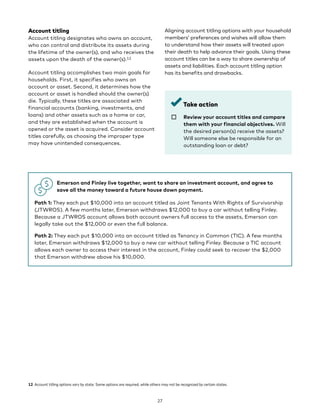
Will someone else be responsible for an
outstanding loan or debt?

Emerson and Finley live together, want to share an investment account, and agree to
save all the money toward a future house down payment.
Path 1: They each put $10,000 into an account titled as Joint Tenants With Rights of Survivorship
(JTWROS). A few months later, Emerson withdraws $12,000 to buy a car without telling Finley.
Because a JTWROS account allows both account owners full access to the assets, Emerson can
legally take out the $12,000 or even the full balance.
Path 2: They each put $10,000 into an account titled as Tenancy in Common (TIC). A few months
later, Emerson withdraws $12,000 to buy a new car without telling Finley. Because a TIC account
allows each owner to access their interest in the account, Finley could seek to recover the $2,000
that Emerson withdrew above his $10,000.
27
Last will and testament
A 2021 Gallup survey found that less than half of
American adults—46%—have a will (Jones, 2021).
Although many may think their assets may be
insufficient to warrant creating one, a will provides
crucial instructions for one’s final wishes—including
provisions for more than just assets—and can have
far-reaching impacts on the people or causes
closest to them.
A last will and testament allows for control of
who oversees a deceased person’s estate, who
receives the estate assets, and who takes
responsibility for any dependents (including
pets).13 If you die without a last will and
testament in place—known as dying intestate—
federal, state, and/or local law will typically make
these determinations for you. Given that these
agencies have no idea what your goals and
objectives are or were, having a last will and
testament is highly recommended for everyone.
A last will and testament also accomplishes a few
important tasks. Naming an executor is arguably
one of a will’s key components. The executor will
supervise and handle several duties relating to
the instructions laid out in the will.14 Although
you may wish to consider your relationship with
your prospective executor, choosing that person is
not an easy task, and you should not be motivated
solely by emotions when making this decision. Be
sure to talk to the person you have in mind and
make sure they agree with taking on the
responsibility. You also may elect to choose a
professional advisor as your executor. This option,
though, may cost more and take more time, as the
advisor will want to make sure that all decisions
are made appropriately in line with your desires.
13 This list is not meant to be exhaustive.
14 Executor requirements vary by state; check with local laws before deciding on your designation.
15 Pets are considered property, and property cannot own another piece of property. Assets should not be left directly to pets but instead can fund a trust for
their benefit and care.
Also name the desired beneficiary or beneficiaries
for any probate assets; this specifies who receives
them. Such assets are typically items that would
otherwise lack a beneficiary designation or
account titling structure to handle the transition
of the items, such as furniture, electronics,
jewelry, and art.
Finally, name a guardian for minor children, elderly
parents, and pets as well as for any property left
to them on their behalf.15 This ensures that the
proper person is responsible for looking after
those who are closest to you and most vulnerable.
Be sure to discuss the guardianship with your
prospective designee(s) to make sure they are
willing and able to take on the role. When there is
no will or specified designee, courts generally
choose the closest biological relative, based on the
best interest of the dependent(s). This may or may
not end up being aligned with your wishes.
Although often an attorney is not required to draft
a last will and testament, it is best to work with
one to ensure that the document addresses and
covers your goals and objectives. The last will and
testament should be typed, signed, and dated. Not
all states require that it be notarized, but doing so
helps prove the document’s legitimacy and may
help to limit future legal challenges. Also required
when signing a will is that you be of sound mind
and not acting under duress; otherwise, the
document will be considered invalid. This issue can
catch many people off guard if a sudden death or
incapacitation happens, making it too late to
establish a will.
28
As with the other items discussed so far, make
sure to update any last will and testament as
changes to your life circumstances warrant.
Costs to establish the document vary. Revisions
generally cost less, depending on the magnitude
of the changes requested.
Take action
☐ 
Inventory and review any existing last
wills and testaments.
☐ 
Identify any deficiencies and act to
establish documents or revise existing
ones. Are your account structures
appropriate for your goals? Has your
family grown? Have your goals and
objectives changed?
☐ 
Make sure that documents are easy to
find and that a trusted person can
access them. Without someone
knowing about or having access to the
estate documents, the work to set
them up will be wasted.
16 Once the principal—the person delegating authority—dies, any POAs are nullified and no longer valid.
17 There are also nondurable POAs, but they generally are less commonly used in estate planning.
Power of attorney (POA) and living wills
Untimely deaths happen, but disability and
incapacitation are far more likely to occur.
Although not all disabilities result in
incapacitation, the CDC reports that about one
in four adults have some type of disability that
impedes their daily activities (Centers for Disease
Control and Prevention, 2020). This highlights the
need to have documents in place to allow other
people to make decisions should an unexpected
injury or accident occur. Having a power of
attorney in place can establish trusted persons to
help carry out your desires when you may be
unable to do so.16
What is a POA? This document authorizes one or
more people to make specified decisions in your
stead. When considering POAs, think about two
components: When do you want to give over the
authority, and what decisions do you want your
POAs to govern?
For estate planning, the when typically comes in
two forms: durable and springing (Figure 10).17
FIGURE 10.
Key differences between two types
of power of attorney
POA Type
Durable Springing
When it takes
effect
Immediately upon
its signing
When the
principal is
incapacitated, or
when a specified
event occurs
Benefits It is effective both
before and during
the principal’s
incapacitation
The principal
maintains decision
power until the
triggering event
occurs
Disadvantages The principal may
not want to give
over decision-
making power
before the need
develops
The granting of
decision power
could be delayed
while proof of
incapacitation is
established
Source: Vanguard.
29
Once the timing is determined, the what generally
follows. POAs can be very specific or broad,
based on your desires, but they all accomplish one
thing: establishing a trusted person or persons to
make important decisions when you cannot do so
(Figure 11).
FIGURE 11.
Power-of-attorney categories and
decision power
General
POA
Medical
POA
Financial
POA
Authority over:
• Bill-paying
• Banking
• Retirement benefits
• Tax filing
Authority over:
• Medications
• Treatments
• Surgery
• End-of-life care
Authority over all other
decisions allowed by law:
• For example, living
decisions, such as
hiring caregivers or
choosing a residence
Source: Vanguard.
What is a living will? A living will outlines medical
treatments that you would and wouldn’t want
used to keep you alive, as well as other medical
decision preferences. Living wills are more limited
than POAs; they apply only to decisions about
life-sustaining treatment in the event of a
terminal illness or injury.
How can you use a POA and living will together?
The POA gives decision-making power to a
specific person or persons. Adding a living will
ensures that your medical decisions are not
overruled by the POA or a doctor. For people with
strong convictions about the treatment(s) they
would like to receive in dire scenarios, a living will
can be especially valuable to add another layer of
control over care at those times.
Take action
☐ 
Inventory any existing POAs and
living wills.
☐ 
Identify any deficiencies and revise
existing documents or establish new
ones. Has your household grown? Are
your account structures appropriate for
your goals? Have your goals and
objectives changed?
☐ 
Make sure that your documents are
easy to find and that a trusted person
can access them. Without someone
knowing about or having access to
them, the work to set up these estate
documents will be wasted.
30
Trusts
A trust is a specific type of account titling that
allows for holding and distributing assets on
behalf of the beneficiary or beneficiaries. Not
every household needs to establish one, but a
trust can serve a wide variety of purposes and
desires. Given the breadth of reasons that trusts
may be considered for both during-life and
post-life planning, we focus here only on the
additional components that a trust offers
compared with a last will and testament.
• More control over asset disposition
Trusts allow for establishing start dates, end
dates, and conditions for distributing assets to
beneficiaries. This can be especially helpful for
setting up asset distributions to support minor
children as they grow and develop financial
responsibility, or for setting up special needs
trusts to take care of disabled children or
parents, or even pets, in your absence.
• Avoidance of probate
Trusts can be used to pass assets to
beneficiaries outside the probate process,
although other options (such as account
titling, transfer-on-death/payable-on-death
designations, and the naming of beneficiaries)
are also available to avoid going through
probate.
Consulting an attorney is highly recommended;
expect costs for establishing a trust to be higher
than a will.
Take action
☐ 
Inventory any trusts that may already be in place. Find any existing trust documents you
may have.
☐ 
Identify deficiencies and act to establish documents or revise existing ones. Is a trust
structure appropriate for your goals? Do you have a strong desire or reason to have more
control over asset disposition to beneficiaries?
31
Step 3
		 
Make progress
toward your goals
For households to achieve their long-term financial
goals, it is wise to first remove impediments to
attaining them. Our first step guided households
to get their finances under control by setting up an
effective budget that helped them take advantage
of high-reward opportunities, such as paying down
high-interest debt, maximizing their employer plan
match, and making minimum payments on all
debts. Our second step advised households to
protect against unexpected events, such as
spending shocks or unemployment.
Now we turn to longer-term goals, which we
divide into four categories:
• Retirement, education, and health. Households
should consider saving more in tax-advantaged
accounts to fund a comfortable retirement,
pay for education, and cover health expenses
now or in the future.
• Home, vehicle, vacation, and early retirement.
Households are advised to consider using
taxable accounts to save for shorter-term
goals—such as house and vehicle down
payments, vacation, and early retirement—
given the flexibility such accounts provide.
• Paydown of lower-interest debt. We highlight
the importance of paying down lower-interest
debt. We also highlight when holding debt may
make sense for investors.
• Charitable giving. Finally, we use the term
“investing in others” to reflect the charitable
inclination of many households and their
wishes to pass down assets to loved ones.
Making progress toward any of these goals is
likely to provide benefits beyond the financial
value of achieving them. Securing a comfortable
retirement, making the final payment on a
mortgage, and helping others are certainly
important for most households. Although we
present these goals in a given order, consider
prioritizing what you believe will provide the most
satisfaction to your household. When it comes to
household finances, one size does not fit all.
32
Increase savings in tax-advantaged
accounts
In this section, we highlight how increasing your
savings and using tax-advantaged investment
accounts are critical factors for investing success.
Although the notion of investing for retirement
can be overwhelming at times given its enormity
and uncertainty, we help break down the
challenge by showing how even incremental steps
now can make a big difference in the future,
particularly when you consider the power of
compounding in tax-advantaged accounts.
Savings and investing
The media report on market returns every day.
Naturally, many people tend to associate
investment success with strong investment
returns. But even if someone were to follow the
most successful investment strategy every year, it
would not deliver much in dollar amounts if the
person did not have much money invested
(Clements, 2016). A 20% gain only turns $1.00 into
$1.20, but it turns $1 million into $1.2 million.
The nearly $200,000 difference in outcome
highlights the importance of saving and
investing money.
To show how saving and investing affect
investment success, we simulate three households’
behavior to evaluate the importance of the
following savings goals on investment outcomes:
• the initial amount invested
• monthly contributions
• increases in monthly contributions over time
In our example, all three households opened an
investment account to fund a goal in 30 years.
The first household initially contributed $10,000
to the account. The second household built on the
first one but added a monthly contribution of
$500 to the account. And the third household
built on the second one but increased the $500
monthly contribution by 5% every year. For
simplicity, we will assume a fixed rate of return of
6% a year, compounded monthly. Figure 12 shows
their investment outcomes.
FIGURE 12.
Increasing monthly investment contributions can dramatically affect household outcomes
$57,435
$10,000 starting balance,
no further contributions
$544,691
$10,000 starting balance +
$500 monthly contributions
$933,573
$10,000 starting balance +
$500 initial monthly contributions +
5% annual increase in contributions
Value
($)
Investment horizon (years)
0
600,000
400,000
200,000
800,000
1,000,000
5 10 15 20 25 30
0
The earlier one starts to invest
consistently, the more one harvests
the reward of compounding.
The third household
reached a balance of
$117,724 after 10 years
After 20 years, the
household had
accumulated $373,416
After 30 years, its
wealth climbed to
$933,573
Notes: The scenario shown is hypothetical for illustration purposes only; it does not predict or represent any particular investment product or its expected returns.
The figure assumes annual returns of 6%. Monthly returns are assumed to be the geometric averages of these values. Contributions are per month and made at
the end of each period. Balances reflect the value at the end of each period. The figure does not account for any taxes.
Source: Vanguard.
33
The first household, which contributed $10,000
initially to the account with no further investment
in it, ends up with $57,435 in 30 years. The second
household, which invested $10,000 initially and
then $500 a month for 30 years, amasses
$544,691 in wealth. Compared with the first
household, the second household added almost
$500,000 in wealth through its monthly
contributions. The third household, which
contributed $10,000 initially and increased its
monthly $500 investment by 5% every year, ends
up with $933,573. Compared with the second
household, the third household ends up with
almost $400,000 more in wealth because of its
yearly increases in contributions. This illustrates
how consistency is key for long-term investment
success, along with the power of starting to
save early.
18 See Vanguard (2020) for more details on how fund costs affect investors’ balances.
Tax-advantaged accounts
Households can neither control nor predict
market performance, but they can control
investment costs. Two of the largest costs are
fund expense ratios and taxes. Vanguard has
popularized the use of low-cost, broadly
diversified funds. This guide presumes that these
types of funds are used for investing.18
Taxes are another large household expense.
However, tax-advantaged account options can
encourage saving for some of a household’s largest
financial goals, such as retirement, education, and
health care. When possible, households should
make use of tax-advantaged accounts. Figure 13
summarizes the tax benefits they provide as well
as some constraints on their use.
We next evaluate how to best use these tax-
advantaged accounts for retirement, health care,
and education savings.
34
FIGURE 13.
Tax-advantaged accounts offer many benefits for investing, but with some constraints
Account
type
Best
purpose
Taxability of
contributions
Investment
growth
Taxability of
withdrawals Considerations
Roth IRA or
employer
plan
Retirement Taxable Tax-deferred Tax-free • 
For 2023, IRA holders are allowed to make
contributions of up to $6,500, or up to $7,500 for
people 50 or older.
• 
Roth IRA contributions may be withdrawn from the
account without penalty or taxation.* Roth
withdrawals from employer plans are always pro rata
from contributions and earnings.
• 
For 2023, employer plans generally allow contributions
of up to $22,500 for 401(k), 403(b), and most 457
plans. For people 50 or older, additional catch-up
contributions of up to $7,500 may be available. Other
special catch-up rules for 403(b) plans may also apply.
• 
Some plans may allow employees to contribute up to
$66,000 by making after-tax contributions.
• 
In most cases, withdrawals before age 59½ incur
ordinary income tax on pre-tax contributions as well
as on all earnings, with an additional 10% federal
penalty tax (457 plan withdrawals are penalty-free).‡
Traditional
IRA or
employer
plan
Retirement Pre-tax† Tax-deferred Taxable
Health
Savings
Account
(HSA)
Health and/or
retirement
Pre-tax Tax-deferred Tax-free§ • 
For 2023, contribution limits are $3,850 for an
individual and $7,750 for a family.
• 
People 55 or older may make an additional catch-up
contribution of up to $1,000.
• 
Money can be used at any time or invested for later use.
• 
Once the owner is 65 or older, withdrawals can be
taken for any reason and will be taxed the same way
traditional IRAs would.
Flexible
Spending
Account
(FSA)
Health Pre-tax Not available Tax-free§ • 
For 2023, contribution limits are $3,050 for an
individual and $6,100 for a family.
• 
The money contributed cannot be invested, and little
of it can be transferred from year to year.
• Unused funds return to the plan.
529 college
savings plan
Education Taxable Tax-deferred Tax-free§ • 
Contributions are considered gifts. The 2023 annual
gift limit is $17,000 per beneficiary per donor.**
• 
In most cases, contributions are deductible from state
income taxes.
* Review IRS Publication 590-B for more information on withdrawals.
† Contributions may not always be deductible. To learn more, review IRA Deduction Limits at www.irs.gov/retirement-plans/ira-deduction-limits.
‡ There are exceptions, which vary by account type, that may allow for a waiver from the 10% penalty for withdrawals before age 59½.
§ Distributions must be offset by qualified expenses to avoid possible taxation and/or penalties.
** 
Other methods such as split gifting and superfunding may allow for additional contributions to be made without gift-tax consequences. Consult a qualified
tax professional for more information. States also have varying aggregate lifetime contribution limits per beneficiary to 529 plans; review plan rules for more
information. Also see Appendix 2 on page 51.
Source: Vanguard.
35
Retirement
Saving for retirement is likely one of the largest
and most common goals for many households.
With defined benefit (DB) retirement plans
having largely given way to defined contribution
(DC) plans, the task of saving for retirement has
fallen on participants. People over 65 report that
Social Security provides only about 30% of their
aggregate income, so saving and investing for
retirement has become an important task for
workers (Dushi and Trenkamp, 2021). With that
expected shortfall, investors are encouraged to
set aside savings to fund a comfortable
retirement.
Employer-sponsored plans
Employer plans can be an especially effective way
to save for retirement because many plans offer
either employer matching or employer
contributions that can increase savings. It’s
generally best to contribute enough to earn the
full match and any available nonelective
contributions should your budget allow.19
Also, plans allow employees to contribute up to
$22,500 (for tax year 2023) for 401(k), 403(b), and
most 457 plans, with additional catch-up
contribution limits for people who are 50 or older at
the end of the calendar year.20 All plans allow for
pre-tax contributions (which reduce an employee’s
taxable income), and many also offer Roth
contributions (which are made with already taxed
dollars but allow for tax-free withdrawals later).
19 Matching and nonelective employer contributions vary by plan and may be limited by law. Consult plan documents for more information.
20 Some plans may allow for after-tax contributions and have higher employee limits on contributions overall. Catch-up contribution limits also vary by plan
type. Consult plan documents for more information.
21 Investments in target-date funds are subject to the risks of their underlying funds. The year in the fund name refers to the approximate year (the target
date) when an investor in the fund would retire and leave the work force. The fund will gradually shift its emphasis from more aggressive investments to
more conservative ones based on its target date. An investment in target date funds is not guaranteed at any time, including on or after the target date.
22 Terms for plan loans or hardship withdrawals vary by plan. Consult plan documents for more information.
23 Review IRS Publication 590-A for additional important information on contribution rules and limits.
24 Review IRS Publication 590-B for additional important information on distribution rules.
Be sure to review a plan’s investment options and
set up an asset allocation that aligns with the
appropriate risks and objectives while considering
costs. Many plans have options such as target-
date funds, which are an attractive way to build a
low-cost diversified portfolio whose risk profile
changes over time.21 Managed account advice may
be another option to help select a personalized
asset allocation, as access to such offerings have
expanded in recent years. Also consider plan
withdrawal rules in case an emergency occurs or
unexpected needs arise before retirement, as plan
assets are generally more difficult to access while
you are still employed.22
Individual Retirement Arrangement (IRA)
IRAs are another favorable option for retirement
savings. They allow for investors to contribute up
to $6,500 per year, plus an additional $1,000 in
catch-up contributions for people who are 50 or
older at the end of the calendar year.23
If you are eligible to make Roth IRA contributions
and are already meeting any available employer
match, a Roth IRA is likely the next best place to
contribute your money, given the ability to access
it if needed, as contributions may be withdrawn
free of income taxes or penalties. IRAs can hold
nearly any type of investment, such as mutual
funds, ETFs, or individual securities.24 This can
help control investment costs and provide more
flexibility for accessing funds later if needed. Top
off remaining retirement savings with unmatched
employer plan contributions if available.
36
Health Savings Account (HSA)
HSAs can be used as a way to save for
retirement. They not only are powerful tools to
use for more immediate health care costs but
also provide substantial tax advantages when
saved for such costs in retirement. People who
are enrolled in a High Deductible Health Plan
(HDHP) and meet other contribution rules can
put away up to $3,850 for oneself only or up to
$7,750 for family HSAs for 2023. Those 55 or
older can also make catch-up contributions of up
to $1,000. (For more on HSAs, see page 38.)
HSA contributions that are made but not spent in
the current year can be invested and carry over
year to year indefinitely. Whether tomorrow or in
30 years, those contributions and earnings can be
taken out tax-free for qualified medical
expenses.25 And once the owner is 65 or older,
withdrawals can be taken for any reason and be
taxed as traditional IRAs would be.
25 You can only use your HSA for medical costs that are covered. Otherwise, you may have to pay income tax on the money you take out. And if you're under age
65, you may also face a 20% federal penalty tax. Review IRS Publication 969 for more information on HSA distribution rules.
26 Withdrawals from a Roth IRA are tax-free if you are over age 59½ and have held the account for at least five years; withdrawals taken prior to age 59½ or
five years may be subject to ordinary income tax or a 10% federal penalty tax, or both. (A separate five-year period applies for each conversion and begins on
the first day of the year in which the conversion contribution is made.)
Take action
☐ 
Contribute enough to your employer
retirement plan to earn the entire
match. The return on your contribution
is equivalent to a guaranteed return on
your money.
☐ 
Contribute, if eligible, to a Roth IRA.
You’ll never be taxed or pay penalties on
withdrawals of your Roth IRA
contributions, and after age 59½ you
won’t be taxed on earnings. A Roth also
won’t be subject to required minimum
distributions (RMDs) during the account
owner’s lifetime.26
☐ 
Increase contributions to your employer
retirement plan. Consider contributing
more to it if you’re able. One way is to
use an auto-escalation feature, in which
your plan automatically increases your
contribution amount yearly.
37
Health care
Running out of money for health care during
retirement is a concern for 30% of workers
(Bearden, 2022). Part of the concern may stem
from understanding that people tend to spend
more on health care as they age, in addition to
medical costs rising faster than broader inflation
measures. In fact, medical care inflation has
grown at an average annualized rate of 3.22%,
compared with 2.46% for the broader inflation
measure—the Consumer Price Index for All Urban
Consumers (CPI-U)—since HSAs were introduced
in December 2003.27 With medical costs
consistently rising, being strategic when saving
for health care is ever more important.
Many may not realize there are health care-
specific savings accounts that offer significant
tax advantages today and into the future, which
eliminate the need to rely solely on checking and
savings accounts or retirement accounts. Saving
for health care generally takes two forms: saving
for near-term expenses and for future ones. It is
important that investors are prepared in case
they need the funds to spend on health care.
Health Savings Account (HSA)
HSAs are flexible for both near-term and long-
term needs. For 2023, people who are enrolled in
a High Deductible Health Plan (HDHP) and meet
other contribution rules can put away, pre-tax, up
to $3,850 for oneself only and up to $7,750 for
27 Vanguard calculations, based on data from the U.S. Bureau of Labor Statistics and the Organisation for Economic Co-operation and Development from
December 2003 through March 2022.
28 Review IRS Publication 969 for additional important information. Most states, except California and New Jersey, allow HSA contributions, growth, and
distributions to avoid being taxed, but rules are always subject to legislative changes. Contributions may also be exempt from Federal Insurance
Contributions Act (FICA) taxes—which are used to fund Social Security and Medicare—if contributions are made through payroll deductions with an employer
Section 125 cafeteria plan. Review plan documents for more information.
29 Review IRS Publication 502 for additional important information regarding qualified expenses.
30 Additional FICA tax savings may be available if contributions are made through payroll deductions with an employer Section 125 cafeteria plan. Review plan
documents for more information.
family HSAs.28 Catch-up contributions of up to
$1,000 are also available for those 55 or older.
And later withdrawals for qualified medical
expenses are then tax-free.29
What do these tax features mean? Think of it as an
increase in spending power equal to the taxes you
would have otherwise paid. Say you have saved
$1,000 of income in an HSA and have a marginal
federal tax rate of 22%; that means saving $220 in
taxes you would have owed had that money gone
into a checking or savings account.30 And that
$1,000 can later be withdrawn for qualified
medical expenses, with no taxes due.
HSA contributions, then, can be used as a
transactional account to cover eligible expenses
today or as an investment account to save for
future health care costs (including Medicare
premiums), or as a little of both (Kahler, Clarke,
and Bruno, 2020). Employer matching or
nondiscretionary contributions may be available
to provide even more value and savings.
Despite its advantageous tax treatments, an
HSA may not be an investor’s best choice when
paying for health care expenses, for two reasons.
First, HSAs may not be available for some
investors. Second, even when they are, investors
may prefer having a low-deductible health plan,
which would make them ineligible to use the HSA.
Consider your personal situation when deciding the
best way to pay and save for health care expenses.
38
Flexible Spending Account (FSA)
For employees who may not have an HDHP, a
health care FSA can also allow you to save pre-tax
money (up to $3,050 for 2023) to spend on eligible
unreimbursed medical expenses, including
copayments, dental work, eyeglasses and contact
lenses, and prescriptions.31 If you have an HDHP
with a limited FSA, those expenses are restricted
to eligible dental and vision care only.
There are important caveats to remember. Most
FSAs require that the expenses be reviewed
before being reimbursed, so be sure to have
accessible cash on hand while you wait for the
reimbursements to go through.
In addition, by law, money put into FSAs cannot
be invested or generate any earnings, and there
are limits on how much money in an FSA can
carry over into future years (for example, up to
$610 for 2023, or a grace period into the first few
months of the next year, subject to plan rules).
Any remaining amounts above the carryover limit,
or if unused within a grace period, are forfeited
back to the plan. So FSAs are good for near-term
expected health care costs, but the carryover
limits also make these accounts ineffective for
long-term planning.
31 Review IRS Publications 969 and 502 for additional important information.
Take action
☐ 
Consider using an HSA if an HDHP
makes sense for you. An HSA has a
triple tax benefit when used for
qualified medical expenses. If you can
pay for health care expenses out of
pocket, the account can grow tax-free.
Even using it as a transactional account
is advantageous because of the tax
benefits.
☐ 
Consider using an FSA if you anticipate
medical expenses and have no access to
an HSA. Just make sure to use the
money in the FSA within the designated
time frame. Any remaining amounts
above the allowable carryover are
forfeited back to the plan.
39
Education
Planning for educational costs is top of mind for
many parents and individuals. This is not surprising
given that college tuition has been rising over the
last decade by about 3% per year.32 Given this rapid
increase in prices, households should be strategic
about how to save for educational expenses.
529 plans
A 529 plan is a tax-advantaged account
specifically intended to fund qualified education
expenses. Money invested in a 529 grows tax-
deferred, and later qualified distributions are
tax-free. Some states also allow for tax
deductions or credits on contributions. As work by
Kahler and Bruno (2021) has shown, 529 plans
are one of the most tax-efficient ways to pay for
college costs. However, data from Sallie Mae and
Ipsos (2021) indicate that funding from 529 plans
covered only 11% of total college costs, even
though these accounts could be used for up to
about 90% of expected 2021–2022 enrollment-
weighted costs.33
What should you consider about 529 plans?
Withdrawals are tax-free if used for a limited
range of qualified college expenses. These include
32 Vanguard calculations, based on data from the College Board (2022).
33 Vanguard calculations, based on data from the College Board (2022).
34 Review IRS Publication 970 for important information.
tuition and fees, books and supplies, computer
software, internet access, room and board,
special needs equipment, and even student loans
(with a $10,000 lifetime limit on loans). Certain
states also allow tax-free withdawals of up to
$10,000 per year for K–12 tuition and fees. If you
take a nonqualified withdrawal, a 10% penalty
plus income taxes apply to the earnings portion
of the withdrawal.
What if you cannot use all the money saved in the
529? Several options may allow you to avoid taxes
and penalties, such as transferring ownership to
a relative of the child who is the plan’s named
beneficiary.34 For more information about 529
plans, see Appendix 2 on page 51.
Take action
☐ 
Consider opening a 529 account. Most
states offer a tax benefit when
contributions are made to a 529 plan.
Remember, anybody can contribute to a
529, not just the beneficiary’s parents
or grandparents.
40
Add flexibility with taxable accounts
Taxable accounts are the most flexible in terms of
accessibility, as you can take withdrawals at any
time without added tax penalties. This allows you
to use money for nearly any purpose without
having to worry about extra costs or needing to
meet certain criteria to avoid tax penalties.
People using taxable accounts can also choose
from a nearly endless supply of investments in
the market. However, income and capital gains
distributions incur annual taxes, as do any gains
when you sell shares.35 On the other hand, the
taxation of such accounts also enables you to use
tax-loss harvesting strategies that may help
mitigate these potential drags on after-tax
performance.36,37,38
What goals should taxable accounts
be used for?
The flexibility of taxable accounts makes them
ideal for a multitude of goals. For shorter-term
objectives, such accounts should have
35 Review IRS Form 1040, Schedule D, Publication 550, and Form 8960 for more information.
36 See Paradise, Khang, and Dickson (2021) for Vanguard's position on tax-loss harvesting.
37 Review IRS Publication 550 for additional important information on wash sales.
38 Tax-loss harvesting involves certain risks, including, among others, the risk that the new investment could have higher costs than the original investment and
could introduce portfolio tracking error into your accounts. There may also be unintended tax implications. We recommend that you carefully review the terms
of the consent agreement and consult a tax advisor before taking action.
conservative investments, as preserving your
principal is important. For intermediate-term
goals, you can use a taxable account—such as a
blend of stocks, bonds, and cash—for a house
down payment or a car.
Taxable accounts can also be used for many
long-term goals. Some households may find them
to be a desirable vehicle for saving more than
allowable limits on retirement or health care or
education accounts, using more aggressive
investment allocations. And by investing in
taxable accounts, you gain tax diversification—
the ability to strategically withdraw spending
money in the future (for, say, retirement or
college costs) while minimizing the tax and
penalty impacts.
When you need flexibility, a taxable account may
be just what you’re looking for.
Take action
☐ 
Consider a taxable account for the flexibility it provides. Although this type of account does
not offer tax benefits, it does provide flexibility. Households can use it to save for short-term
goals or early retirement, or as a vehicle for saving more than the amounts allowed in tax-
advantaged accounts for retirement, health, and education.
41
Pay off lower-interest debt
When determining a debt payoff strategy, ignoring
the investing side of the equation would be
imprudent. When allocating money toward debt,
the easiest way to determine whether it’s best to
prioritize payoff is to ask, “What returns would be
expected if this money was invested instead?”
Depending on your asset allocation, your return
and risk expectations for your portfolio may vary.
Review the expected return of your portfolio
against the proposed prioritized debt rate.
What is considered lower-interest debt?
Usually, debt borrowed to fund longer-term
appreciating assets, such as a home or education,
may be at interest rates much lower than that of
unsecured debt such as credit card and payday
loans. These types of loans may also allow for tax
deductions that lower total interest costs.39 It’s
always best, however, to review the debt interest
rate, regardless of the type of borrowing, while
deciding what is considered high- or low-interest
debt for your household.
Although we mention home and education loans
here as examples of low-interest debt, not all
such loans are the same. Over the last five years,
federal direct student loan rates for
undergraduates varied from 2.75% for the 2020–
2021 school year to 5.05% for the 2018–2019
school year. Rates for the Parent Loan for
Undergraduate Students (PLUS) program over
the same time frame ranged from 5.3% to 7.6%
(Federal Student Aid, 2022). Rates for private
lenders vary even more. Mortgage rates will
similarly vary by several factors, including but not
limited to credit score and prevailing interest rate
environments at the time of the mortgage’s
origination or refinancing.
39 Deductions are subject to limits and income limitations. Review IRS Publications 970 and 936 for more information.
40 Mortgage interest may be deductible when itemizing deductions. Review IRS Publication 936 for more information.
Consider, for example, a recent college graduate
who bought their first home with a mortgage and
a second person who has just retired and moved
and has a mortgage. Both people have similar
credit, receive the same 4% mortgage interest rate,
and claim the standard income tax deduction.40
The recent graduate’s comparatively long-term
horizon and ability to take risk means that their
asset allocation is likely to be more aggressive,
with a higher percentage in equities, and their
investment returns are more likely to outperform
the 4% mortgage rate (Figure 14). Consequently,
the graduate could focus on investing, while
making the minimum payments on the mortgage.
FIGURE 14.
Prioritizing some debts over investing may
make sense for some people but not others
Global bonds
Global equities
5th 95th
Optimistic
Central
Pessimistic
Percentiles key:
Scenario:
75th
25th Median
Annualized nominal return
Annual percentage yield (APY)
10-year return projections
Debt interest rate
0 5 10 15%
Student loan
Car loan
Mortgage 4%
5%
6%
Notes: The figure compares VCMM projected annualized investment return
distributions over 10 years with common consumer debt interest rates.
Simulations are as of June 30, 2022. Debt rates shown are hypothetical and
do not represent a potential lending cost.
Source: Vanguard.
42
The retiree typically has a more conservative asset
allocation, given the need to preserve rather than
grow assets at this phase, with a larger portion of
their portfolio in bonds. In this case, investing is less
likely to outperform putting money toward paying
off the mortgage. So the retiree could focus on
paying down the mortgage debt, as paying down
a loan is a guaranteed return on the money.
Paying down lower-interest loans should also
follow the avalanche method, meaning that
investors should start making additional
payments toward the debt with the highest
interest rates. Depending on your life stage and
investment trade-offs, you can choose to either
pay down lower-interest debt, using money
previously allocated to investing, or to rely on your
budget and one-time windfalls to accelerate the
paydown strategy.
Other factors to consider
The potential for maximizing after-tax wealth is
not the only consideration when paying down
debt. Two more factors should be weighed:
liquidity preferences and behavioral
considerations (Paradise and Kahler, 2020).
First, once cash is used to pay off debt, in whole
or in part, that money is generally inaccessible
going forward.41 With lower-interest debts, there
may be less value in giving up accessible funds to
accelerate payoff, especially if you have other
competing short-term needs. For households with
less flexible budgets and upcoming underfunded
obligations, it may be reasonable to forgo
accelerating payoff toward lower-interest loans
to make sure you have money on hand when
needed to fund other goals. Weigh the flexibility
of those needs against the additional interest
41 Mortgages are the most likely exception to this rule, but accessing property equity requires taking out an additional loan or loans.
costs, as returns over very short time frames are
unlikely to meaningfully affect goal success,
assuming appropriate asset allocations.
Second, don’t dismiss behavioral considerations
either. Households that are averse to debt, have
healthy balance sheets, and are on track for their
other goals can afford to be more flexible with
prioritizing paying off lower-interest debt.
Although investing instead of paying off debt
may result in higher net worth, the trade-off for
peace of mind may not materially affect your
other goal outcomes.
Overall when it comes to debt, eliminating high-
interest debt should be a priority. When paying
down lower-interest debt, keep in mind
investment trade-offs as well as behavioral
considerations and your liquidity preferences.
What’s most important is that the decision to
pay down debt brings households closer to
achieving financial goals.
When does debt make sense for investors?
Not all debts are the same. Some households
carry debt in credit cards or personal loans to
finance short-term expenses, such as taking a
vacation or balancing an unbalanced budget for a
few months. Since these types of debt do not
require collateral, they usually charge high
interest rates because of the risk the debtor
takes when lending the money.
We do not recommend taking on debt to finance
short-term expenses. For such needs, we suggest
looking for funds in your budget before
committing to an unsecured, higher-interest loan.
In case of emergencies, setting aside emergency
savings will likely help in avoiding short-term debt.
43
On the other hand, households often take out
loans to finance long-term investable assets, such
as housing and education (human capital).
Households may consider taking on debt to
finance these costs because, for housing,
consumers build equity over time when paying
down a mortgage. For education, a college degree
may make a substantial difference in lifetime
earnings—the median college graduate earns
$1.28 million throughout their career, compared
with about $630,000 for a high school graduate
(Broady and Hershbein, 2020). If you’re considering
debt for investments in housing or education, we
still suggest you research the debt’s suitability
before making any final decisions. Two main
potential issues come to mind:
• First, make sure the investment opportunity
will provide the returns to justify the debt.
With education loans, to ensure that your
expectation is realistic, check whether the
chosen institution is accredited and how much
its graduates earn.
• Second, make sure the debt repayment fits into
your household’s budget, so you can reasonably
make the loan payments without compromising
the ability to do other things in life.
These points are important when determining
whether taking on debt to finance investments
will be a wise long-term decision.
Take action
☐ 
Pay off debt, starting with your
highest-interest debt. Paying the
higher-interest debt first will save on
interest.
☐ 
Evaluate your debt comfort. At times,
the peace of mind of paying down debt
outweighs the benefit of investing extra
cash flow that could earn a higher
return in the market. If this is true for
you, consider directing more money
toward paying down debt.
☐ 
Evaluate your liquidity needs. Having
cash on hand may also be important for
your peace of mind. Directing more
money toward paying debt forgoes
liquidity in the short term. Evaluate
whether you need cash in the short
term.
44
Consider investing in others through gifts
If your household is charitably inclined, you may
be using, or considering using, your wealth to
make a positive impact on the people and/or
organizations you most care about. While doing
so, you may be able to take advantage of
potential tax benefits.
But keep two things in mind: First, although
donations to qualified organizations offer
potential tax benefits, it is rare that those
benefits exceed the total cost of the gift.42 And
second, giving away assets today means that, in
most cases, they won’t be available for current or
future use, and that may affect your ability to
achieve other financial goals.
Gifts to individuals: Ensuring that your
assets directly help people you know
Personal gifts of cash or noncash assets made
today may not save you taxes today, but they can
be an effective way to give. With the 2023 annual
federal gift tax exclusion of $17,000 for
individuals and $34,000 for married couples, you
can make a potentially significant impact without
incurring additional taxes.43
Impactful gifting examples may include:
• making 529 plan contributions for a child or
grandchild
• establishing a UGMA/UTMA account for a
minor to use later in life
• contributing to an ABLE account for an eligible
disabled person44
• paying off a debt for a loved one or helping
them financially.
42 See the IRS’s research tool at apps.irs.gov/app/eos; certain religious organizations or governmental agencies may not be listed in its database. If such
information is missing, review IRS Publication 526, which outlines qualification criteria.
43 Review IRS Form 709 for important tax considerations. Connecticut is currently the only state that assesses gift taxes on gifts that exceed the federal
lifetime estate and gift tax exemption.
44 Review IRS Publication 907 for important considerations.
45 Estate taxes are levied by Connecticut, the District of Columbia, Hawaii, Illinois, Maine, Maryland, Massachusetts, Minnesota, New York state, Oregon, Rhode
Island, Vermont, and Washington state. Inheritance taxes are levied by Iowa, Kentucky, Maryland, Nebraska, New Jersey, and Pennsylvania.
46 IRS Publication 526 outlines qualification and deduction criteria. Deduction limits vary depending on the type of property given and the type of organization
you give it to.
Future estate and/or inheritance taxes
For households with significant assets that may be
subject to estate taxes, the 2023 federal lifetime
estate and gift tax exemption is $12.92 million for
an individual or $25.84 million for a married couple.
The personal gifts just mentioned can be a way to
accelerate current giving to reduce your assets and
thus reduce potential future federal estate taxes
(which are currently assessed at rates up to 40%).
Certain states also levy separate estate taxes on
household estates, or inheritance taxes on the
beneficiaries, or—in Maryland—both, on bequests.45
Given the complexity of these strategies, and
likely other considerations, we strongly encourage
you to consult with an attorney, a tax accountant,
and a financial planner before pursuing gifting
with these objectives. For a more in-depth review
of Vanguard's thoughts on charitable giving, see
Harbron, Shin, and Greene (2022).
Gifts to charity: Making a positive impact
while potentially lowering taxes
Cash donations
Households that itemize deductions on tax returns
can donate cash to any qualified organization and
may be able to deduct up to 60% of their adjusted
gross income (AGI).46 So if your AGI was $100,000,
you would have up to a $60,000 deduction
available to go toward reducing your tax liability.
If you are charitably inclined, this deduction can
be a significant benefit in addition to helping one
or more organizations that resonate with your
convictions and beliefs. Remember to keep a
record or receipt from the charity for when you
file your taxes, and be sure to make any
contributions before the calendar year ends.
45
Noncash donations
Households can also make noncash donations.
Long-term appreciated assets, held for at least
one year, such as stocks or property can be
appealing to donate, as they are deductible at
fair market value, up to 30% of your adjusted
gross income.47 This enables you to transfer
low-basis assets and avoid having to pay taxes on
any gains you may have. For noncash assets,
proof of value is generally needed. Publicly traded
assets such as stocks, bonds, mutual funds, and
ETFs make valuation easy given that pricing is
easily obtainable. For assets that may be less
easy to value, such as a home or art, a
professional appraisal is required. For any gifted
asset, check with the charity beforehand to make
sure it can receive and handle the asset;
otherwise, the charity may not be able to derive
the intended benefit(s).
Donor-advised funds (DAFs)
DAFs are a popular way to give cash and noncash
donations and receive an immediate tax
deduction. Once you have funded a DAF, you may
recommend an investment strategy for your
account, in order to grow the assets over time,
and may recommend grants to the qualified
organizations you wish to support. You can share
management responsibilities with other people
you designate, and those can continue after your
death if you so choose.
Qualified charitable distributions (QCDs)
If you are charitably inclined, at least 70½, and
confident about your assets meeting your
retirement needs, QCDs are a great way to
47 IRS Publication 526 outlines qualification and deduction criteria. Deduction limits vary depending on the type of property given and the type of organization
you give it to.
48 Review IRS Publication 590-B for more information.
49 Higher-income Medicare beneficiaries are subject to surcharges on their premium. There is a two-year lookback period for income considered in determining
Medicare premiums.
support causes you care about while lowering
your potential tax liability.48 Although QCDs are
not tax-deductible, they are not treated as
income if you took a withdrawal or RMD. In other
words, taking QCDs can help satisfy your RMDs
while keeping your income lower, resulting in
potentially lower Social Security taxation now
and lower future Medicare premiums, than if you
first take an RMD and then donate the
proceeds.49
For 2023, the maximum annual exclusion is
$100,000 per person. That means a couple could
each make QCDs of up to $100,000 from their
respective eligible accounts. Make sure the
distribution is made out to the charity rather
than the account owner, to avoid any
disqualification issues.
Complex topics: Trusts and
other legal structures
Certain trust structures can serve both present
and future giving as well as donor, bequest, and/
or charitable purposes. Given that trusts (such as
charitable lead or remainder trusts) and other
structures (such as private foundations) can be
complex, we mention them here only for general
awareness. If you are seeking those more
advanced strategies, you are strongly encouraged
to first consult with an attorney, a tax
accountant, and a financial planner to identify
relevant options for you.
46
Bequests: Gifting at the end of life
A bequest is simply a gift left to a person or
charity after your death. This allows you to retain
use of the gift during your lifetime. For people who
may not have excessive assets or are concerned
about needing them during life, leaving the gift as
a bequest can be an appropriate option.
You won’t receive an income tax deduction when
a bequest is documented, as it is not gifted until
your death. When your estate or trust distributes
the gift, it can claim a deduction on the estate or
trust tax return for the full distribution amount.50
For many financial accounts, such as employer
retirement plans, IRAs, and insurance policies, you
can designate beneficiaries—specified persons
50 This is called a distributable net income (DNI) deduction. Estates and trusts get a deduction for distributions of income to beneficiaries, not for specific
charitable deductions.
and/or organizations, along with bequest
percentages—to receive those assets upon your
death. Remember to keep beneficiary
designations up to date, as life changes and your
wishes may evolve over time. And make sure to
leave a way to inform your beneficiaries—usually
beforehand, or through your will if you’re not
comfortable telling them during your lifetime.
Otherwise, those assets may never reach their
intended recipients.
If you have bequest preferences for particular
assets (if, for example, you want a certain child to
inherit your art collection), make sure to mention
those specifics in a will or trust.
Take action
☐ 
Think through the benefits, timing, and amount of your gifts. There is much good to do in this
world. Think about how you can maximize the impact of your gift.
47
Conclusion
Achieving financial wellness is important given the
numerous benefits it provides. Having an effective
budget and being in control of your finances
enables you to take advantage of your employer
match opportunity, pay the minimum on all your
debt, and pay down high-interest debt. Being
prepared for the unexpected allows you to take
comfort knowing that despite the curveballs that
life may have in store, your family and loved ones
are taken care of thanks to your having adequate
emergency savings, insurance, and legal documents
in place. Finally, making progress toward your goals
allows you to build wealth, realize those goals, and
more comfortably enjoy life.
A majority of households say money is a
significant source of stress. We believe that by
focusing on the actions that are within our
control, this financial wellness guide will help
households improve not only their financial
situation but also their overall holistic well-being.
References
American Psychological Association, 2022. Stress
in America: Money, Inflation, War Pile on to Nation
Stuck in COVID-19 Survival Mode; available at
www.apa.org/news/press/releases/stress/2022/
march-2022-survival-mode.
Ascensus Savings Trends, 2022. Inside Health Savings
Accounts: HSA Assets Continue to Grow; available at
pulse.ascensus.com/healthsavings.html.
Bearden, Bridget, 2022. Retiree Reflections.
Washington, D.C.: Employee Benefit Research
Institute; available at www.ebri.org/docs/default-
source/ebri-issue-brief/ebri_ib_561_retrefl-
16june22.pdf?sfvrsn=347a382f_8.
Beshears, John, James J. Choi, David Laibson,
Brigitte C. Madrian, and William L. Skimmyhorn,
2022. Borrowing to Save? The Impact of Automatic
Enrollment on Debt. The Journal of Finance 77(1):
403–447.
Bhutta, Neil, Jesse Bricker, Andrew C. Chang, Lisa
J. Dettling, Sarena F. Goodman, Alice Henriques
Volz, Joanne W. Hsu, Kevin B. Moore, Sarah Reber,
and Richard Windle, 2020. Changes in U.S. Family
Finances From 2016 to 2019: Evidence From the
Survey of Consumer Finances. Federal Reserve
Bulletin 106(5): 1–42.
Broady, Kristen, and Brad Hershbein, 2020.
Major Decisions: What Graduates Earn Over
Their Lifetimes. Washington, D.C.: The Brookings
Institution; available at www.brookings.edu/blog/
up-front/2020/10/08/major-decisions-what-
graduates-earn-over-their-lifetimes/.
Burke, Kathleen, Jonathan Lanning, Jesse Leary,
and Jialan Wang, 2014. CFPB Data Point: Payday
Lending. Consumer Financial Protection Bureau;
available at files.consumerfinance.gov/f/
201403_cfpb_report_payday-lending.pdf.
Cantalin, Jim R., 2022. What Is the Average
Cost of Hospital Bills Following a Car Accident?
Brown  Crouppen, P.C.; available at
www.brownandcrouppen.com/blog/what-is-the-
average-cost-of-hospital-bills-following-a-car-
accident/.
Carrell, Scott, and Jonathan Zinman, 2014. In
Harm’s Way? Payday Loan Access and Military
Personnel Performance. The Review of Financial
Studies 27(9): 2805–2840.
Centers for Disease Control and Prevention,
2022a. Family Health History: The Basics;
available at www.cdc.gov/genomics/famhistory/
famhist_basics.htm.
Centers for Disease Control and Prevention, National
Center on Birth Defects and Developmental
Disabilities, 2022b. Disability and Health Data
System data; available at dhds.cdc.gov.
Centers for Disease Control and Prevention, National
Center on Birth Defects and Developmental
Disabilities, 2020. Disability Impacts All of Us; available
at www.cdc.gov/ncbddd/disabilityandhealth/
infographic-disability-impacts-all.html.
Centers for Medicare and Medicaid Services,
2021. National Health Expenditure Accounts
Historical; available at www.cms.gov/Research-
Statistics-Data-and-Systems/Statistics-Trends-
and-Reports/NationalHealthExpendData/
NationalHealthAccountsHistorical.
48
Clements, Jonathan, 2016. How to Think About
Money. Jonathan Clements LLC, page 81.
College Board, 2022. Trends in Higher Education:
Trends in College Pricing; available at research.
collegeboard.org/trends/college-pricing.
Consumer Financial Protection Bureau, 2015.
Financial Well-Being: The Goal of Financial
Education; available at files.consumerfinance.gov/
f/201501_cfpb_report_financial-well-being.pdf.
Consumer Financial Protection Bureau, 2017.
Financial Well-Being in America; available at
files.consumerfinance.gov/f/documents/
201709_cfpb_financial-well-being-in-America.pdf.
Consumer Financial Protection Bureau, 2018.
Pathways to Financial Well-Being: The Role of Financial
Capability; available at files.consumerfinance.gov/f/
documents/bcfp_financial-well-being_pathways-role-
financial-capability_research-brief.pdf.
Consumer Financial Protection Bureau, 2021.
The Consumer Credit Card Market; available
at files.consumerfinance.gov/f/documents/
cfpb_consumer-credit-card-market-report_2021.pdf.
Consumer Financial Protection Bureau, 2022.
Emergency Savings and Financial Security: Insights
from the Making Ends Meet Survey and Consumer
Credit Panel; available at files.consumerfinance.gov/f/
documents/cfpb_mem_emergency-savings-financial-
security_report_2022-3.pdf.
Demyanyk, Yuliya, 2017. The Impact of Missed
Payments and Foreclosures on Credit Scores. The
Quarterly Review of Economics and Finance 64:
108–119.
Dushi, Irena, and Brad Trenkamp, 2021. Improving
the Measurement of Retirement Income of the Aged
Population. Social Security Office of Retirement
and Disability Policy, ORES Working Paper No.
116; available at www.ssa.gov/policy/docs/
workingpapers/wp116.html.
Erickson, W., C. Lee, and S. von Schrader,
2022. Disability Statistics From the American
Community Survey (ACS). Ithaca, N.Y.: Cornell
University Yang-Tan Institute; available by going
to www.disabilitystatistics.org/reports/
acs.cfm?statistic=1 and clicking Search.
Federal Student Aid, U.S. Department of Education,
2022. Interest Rates and Fees for Student Loans;
available at studentaid.gov/understand-aid/types/
loans/interest-rates#older-rates.
Financial Engines, 2015. American Employees:
Are You Leaving Money on the Table? Available at
financialengines.wordpress.com/2015/05/12/
employer_match_results/.
Ganong, Peter, and Pascal J. Noel, 2022. Why Do
Borrowers Default on Mortgages? Working Paper
No. 27585. Cambridge, Mass.: National Bureau of
Economic Research.
Harbron, Garrett, Alisa Shin, and Ashley Greene,
2022. Charitable Giving: Three Elements of a
Successful Plan. Valley Forge, Pa.: The Vanguard
Group.
Housel, Morgan, 2020. The Psychology of Money:
Timeless Lessons on Wealth, Greed, and Happiness.
Harriman House.
Insurance Information Institute, 2021. Facts +
Statistics: Uninsured Motorists; available at
www.iii.org/fact-statistic/facts-statistics-
uninsured-motorists.
Jaconetti, Colleen M., Jonathan Kahler, Kelly
McShane, and Nathan Zahm, 2021. Vanguard’s
Roadmap to Financial Security: A Framework for
Decision-Making in Retirement. Valley Forge, Pa.: The
Vanguard Group.
Jones, Jeffrey M., 2021. How Many Americans Have
a Will? Gallup.com; available at news.gallup.com/
poll/351500/how-many-americans-have-will.aspx.
Kahler, Jonathan R., and Thomas Paradise, 2019.
Break Glass in Case of Emergency: Managing
Household Liquidity. Valley Forge, Pa.: The Vanguard
Group.
Kahler, Jonathan R., Andrew Clarke, and Maria A.
Bruno, 2020. HSAs: An Off-Label Prescription for
Retirement Saving. Valley Forge, Pa.: The Vanguard
Group.
Kahler, Jonathan R., and Maria A. Bruno, 2021.
Tackling the Tuition Bill: Managing Higher Education
Expenses. Valley Forge, Pa.: The Vanguard Group.
49
Kelley Blue Book, 2022a. Average New Car Price
Tops $47,000; available at www.kbb.com/car-news/
average-new-car-price-tops-47000/.
Kelley Blue Book, 2022b. Average Used Car Price
Now Over $28,000; available at www.kbb.com/
car-news/average-used-car-price-now-over-28000/.
LIMRA, 2021. Disability Insurance Awareness
Month: An Opportunity to Learn About Important
Insurance Coverage; available at www.loma.org/en/
news/industry-trends/2021/disability-insurance-
awareness-month-an-opportunity-to-learn-about-
important-insurance-coverage/.
Lobel, Hank, and Matthew Mizuta, forthcoming.
The Meaning of Life (Insurance): A Framework for
Determining Basic Life Insurance Needs. Valley
Forge, Pa.: The Vanguard Group.
Madrian, Brigitte C., and Dennis F. Shea, 2001. The
Power of Suggestion: Inertia in 401(k) Participation
and Savings Behavior. The Quarterly Journal of
Economics 116(4): 1149–1187.
Maleh, Johanna, and Tiffany Bosley, 2020. Disability
and Death Probability Tables for Insured Workers
Born in 2000, actuarial note 2020.6. Baltimore, Md.:
Social Security Administration, Office of the Chief
Actuary; available at www.ssa.gov/oact/NOTES/
ran6/an2020-6.pdf.
Paradise, Thomas, and Jonathan R. Kahler, 2020.
What to Do With Your Next Dollar: A Quantitative
Framework. Valley Forge, Pa.: The Vanguard Group.
Paradise, Thomas, Kevin Khang, and Joel M.
Dickson, 2021. Your Mileage May Vary: Setting
Realistic Tax-Loss Harvesting Expectations. Valley
Forge, Pa.: The Vanguard Group.
Pew Charitable Trusts, 2015. How Do Families
Cope With Financial Shocks?; available at
www.pewtrusts.org/~/media/assets/2015/10/
emergency-savings-report-1_artfinal.pdf.
PwC, 2022. 2022 PwC Employee Financial Wellness
Survey; available at www.pwc.com/us/en/services/
consulting/business-transformation/library/
employee-financial-wellness-survey.html.
PYMNTS and LendingClub, 2022. New Reality Check:
The Paycheck-to-Paycheck Report: The High Earners
Edition; available at www.pymnts.com/wp-content/
uploads/2022/05/PYMNTS-New-Reality-Check-
June-2022.pdf.
Richards, Carl, 2015. The One-Page Financial Plan:
A Simple Way to Be Smart About Your Money.
Portfolio/Penguin.
Sallie Mae and Ipsos, 2021. How America Pays for
College 2021; available at www.salliemae.com/
content/dam/slm/writtencontent/Research/
HowAmericaPaysforCollege2021.pdf.
Sweet, Elizabeth, Christopher W. Kuzawa, and
Thomas W. McDade, 2018. Short-Term Lending:
Payday Loans as Risk Factors for Anxiety,
Inflammation and Poor Health. SSM-Population
Health 5: 114–121.
Thaler, Richard H., and Shlomo Benartzi, 2004. Save
More Tomorrow™: Using Behavioral Economics
to Increase Employee Saving. Journal of Political
Economy 112(S1): S164–S187.
Vanguard, 2020. Vanguard’s Principles for Investing
Success. Valley Forge, Pa.: The Vanguard Group.
Vanguard, 2022. How America Saves 2022. Valley
Forge, Pa.: The Vanguard Group.
Vasan, Ashwin, and Wei Zhang, 2022. Americans
Pay $120 Billion in Credit Card Interest and Fees
Each Year. Consumer Financial Protection Bureau;
available at www.consumerfinance.gov/about-us/
blog/americans-pay-120-billion-in-credit-card-
interest-and-fees-each-year/.
Warren, Elizabeth, and Amelia Warren Tyagi, 2005.
All Your Worth: The Ultimate Lifetime Money Plan.
New York, N.Y.: Simon  Schuster.
Weber, Stephen M., 2022. To B or Not to B: Making
Sense of Medicare’s Alphabet Soup. Valley Forge,
Pa.: The Vanguard Group.
Wood, Stephen, Maggie Leyes, and James T.
Scanlon, 2021. 2021 Insurance Barometer Study.
LIMRA; available at www.limra.com/en/research/
research-abstracts-public/2021/2021-insurance-
barometer-study/.
Zinman, Jonathan, 2015. Household Debt: Facts,
Puzzles, Theories, and Policies. Annual Review of
Economics 7: 251–276.
50
Appendix 1. About the Vanguard Capital
Markets Model
IMPORTANT: The projections and other
information generated by the Vanguard Capital
Markets Model regarding the likelihood of various
investment outcomes are hypothetical in nature,
do not reflect actual investment results, and are
not guarantees of future results. VCMM results
will vary with each use and over time. VCMM
results presented are as of June 30, 2022.
The VCMM projections are based on a statistical
analysis of historical data. Future returns may
behave differently from the historical patterns
captured in the VCMM. More important, the
VCMM may be underestimating extreme
negative scenarios unobserved in the historical
period on which the model estimation is based.
Our simulations of market returns assume an
investor invests 60% of their equity sub-asset
allocation to U.S. equities and 40% to non-U.S.
equities. For bonds, our simulations assume
sub-asset allocations of 70% to U.S. bonds and
30% to non-U.S. bonds.
The Vanguard Capital Markets Model® is a
proprietary financial simulation tool developed
and maintained by Vanguard’s primary investment
research and advice teams. The model forecasts
distributions of future returns for a wide array of
broad asset classes. Those asset classes include
U.S. and international equity markets, several
maturities of the U.S. Treasury and corporate
fixed income markets, international fixed income
markets, U.S. money markets, commodities, and
certain alternative investment strategies. The
theoretical and empirical foundation for the
Vanguard Capital Markets Model is that the
returns of various asset classes reflect the
compensation investors require for bearing
different types of systematic risk (beta). At the
core of the model are estimates of the dynamic
statistical relationship between risk factors and
asset returns, obtained from statistical analysis
based on available monthly financial and economic
data from as early as 1960. Using a system of
estimated equations, the model then applies a
Monte Carlo simulation method to project the
estimated interrelationships among risk factors
and asset classes as well as uncertainty and
randomness over time. The model generates a
large set of simulated outcomes for each asset
class over several time horizons. Forecasts are
obtained by computing measures of central
tendency in these simulations. Results produced by
the tool will vary with each use and over time.
Appendix 2. 529 college savings plans
For more information about any 529 savings plan,
contact the plan provider to obtain a Program
Description, which includes investment
objectives, risks, charges, expenses, and other
information; read and consider it carefully before
investing. If you are not a taxpayer of the state
offering the plan, consider before investing
whether your or the designated beneficiary’s
home state offers any state tax or other benefits
that are only available for investments in such
state’s qualified tuition program. Other state
benefits may include financial aid, scholarship
funds, and protection from creditors. Vanguard
Marketing Corporation serves as distributor and
underwriter for some 529 plans.
51
Connect with Vanguard®
vanguard.com
All investing is subject to risk, including the possible loss of the money you invest. We recommend
that you consult a tax or financial advisor about your individual situation. Diversification does not
ensure a profit or protect against a loss.
CFA® is a registered trademark owned by CFA Institute.
Certified Financial Planner Board of Standards Inc. owns the certification marks CFP®,
CERTIFIED FINANCIAL PLANNER™, in the U.S., which it awards to individuals who successfully
complete CFP Board’s initial and ongoing certification requirements.
© 2022 The Vanguard Group, Inc.
All rights reserved.
ISGGTFW 112022

Vanguard's Guide to Financial Wellness.pdf

  • 1.
    Vanguard research Vanguard’s guideto financial wellness Small steps can make a big difference in achieving your goals
  • 2.
    Why financial wellness? Managingmultiple short- and long-term financial goals can feel overwhelming at times. Sixty-five percent of Americans surveyed say that money is a significant source of stress. This guide provides a three-step financial wellness framework for determining the next best actions people could take to bring them closer to their goals, no matter where they are in their financial journey. ● Step 1: Take control of your finances. This will enable households to create an effective budget and take advantage of high-reward opportunities, such as paying the minimum on all debts, taking full advantage of employer match opportunities, and paying down high- interest debt such as payday loans and credit cards. ● Step 2: Prepare for the unexpected. Households can benefit from setting aside emergency savings to cover modest, unexpected expenses; creating a contingency fund in case of job loss; and evaluating insurance and legal-document needs. ● Step 3. Make progress toward your goals. It is possible to invest more in tax-advantaged accounts (retirement, health, and education) and in taxable accounts for pre-retirement-age goals (home, car, and vacations, among others) while paying down lower- interest debt (student loans, mortgage, and car loans), and even to consider gifting strategies. How to use this guide This financial wellness guide aims to cover topics that most investors will face at some point, regardless of their financial status. The next best actions it provides are meant to be put into practice consistently and continuously, as some of them may take time to complete. This guide focuses primarily on households’ accumulation phase, before retirement. For guidance on decision-making in retirement, see Jaconetti et al. (2021). For an overview of how Vanguard thinks about creating goals, see Vanguard's Principles for Investing Success (2020).
  • 3.
    3 Contents Introduction...................................................................................................................................................................... 4 Step 1:Take control of your finances..........................................................................................................................7 Create a budget that works for you....................................................................................................................7 Maximize your employer-matched savings.........................................................................................................9 Meet minimum payments on debt.....................................................................................................................10 Pay down high-interest debt................................................................................................................................12 Step 2: Prepare for the unexpected......................................................................................................................... 15 Set aside emergency savings.............................................................................................................................. 15 Help protect against significant risks with insurance....................................................................................18 Get key legal documents in place........................................................................................................................26 Step 3: Make progress toward your goals...............................................................................................................32 Increase savings in tax-advantaged accounts.................................................................................................33 Retirement...........................................................................................................................................................36 Health care......................................................................................................................................................... 38 Education............................................................................................................................................................ 40 Add flexibility with taxable accounts.................................................................................................................41 Pay off lower-interest debt..................................................................................................................................42 Consider investing in others through gifts.......................................................................................................45 Conclusion...................................................................................................................................................................... 48 References...................................................................................................................................................................... 48 Appendix 1. About the Vanguard Capital Markets Model...................................................................................51 Appendix 2. 529 college savings plans......................................................................................................................51 Authors Paulo Costa, Ph.D. Clifford S. Felton, CFP®, CFA
  • 4.
    4 Introduction Vanguard’s mission is“to take a stand for all investors, to treat them fairly, and to give them the best chance for investment success.” To achieve that success, investors need to be able to allocate their budgets to pay current bills, tackle debt, prepare for unexpected circumstances, and invest to achieve goals. According to a Federal Reserve Board survey, more than three-quarters of U.S. families report having debt, and 45% of families carry credit card debt, with an average debt of $6,300 (Bhutta et al., 2020). Among the families surveyed, 36% indicated they could not cover an emergency expense of $400. More than 40% had not been able to save money over the previous year. Personal finances also affect people emotionally. Sixty-five percent of Americans surveyed say money is a significant source of stress (American Psychological Association, 2022). For people under age 43, that figure jumps to 82%. Americans say personal finance issues affect their mental health, physical health, sleep, self-esteem, relationships at home, and work productivity and attendance (PwC, 2022). For many of us, the prospect of saving for retirement can be overwhelming when considering current spending needs and outstanding debt payments. This can lead to inertia, which in turn can have adverse financial planning consequences later in life. These factors likely deter people from having the best chance for investment success and from realizing the ultimate objective of achieving their financial goals. We created this financial wellness guide and accompanying framework because giving investors the best chance for investment success also entails helping people to allocate their budgets to concurrently pay bills, tackle debt, save money, and invest. Together, these lay out a path to financial independence, which results in the financial flexibility to meet both short- and long-term goals. By helping to improve households’ financial situation, we can make an impact not only on people’s well-being financially but also in life and at work. We define financial wellness as follows: Financial wellness is the objective financial situation of a person, household, or family. It is the ability to meet current and near-term financial obligations and to be on track to meet future goals. Understanding one’s ‘next best actions’ is a critical part of financial planning People naturally want to achieve their goals in the best way possible. When dealing with multiple goals, though, knowing what to do next may be a complex problem and may lead to confusion—or worse, to inaction. In addition, life is uncertain and goals may change over time. For these reasons, instead of trying to figure out a “perfect plan,” we seek to answer the following question: Given your goals and objective financial situation, what are the next best actions to take in your financial life? Our framework is designed to guide you toward these areas of focus in your financial life to improve your well-being. This guide aims to highlight common financial wellness focus areas and how to approach tackling them using suggested action steps. For some, this guide may not be detailed enough to address your specific needs. In those situations, it may be best to consult with a financial planning professional for more guidance.
  • 5.
    5 How our workcompares with the Consumer Financial Protection Bureau's Our financial wellness definition and framework are based on the Consumer Financial Protection Bureau’s work on financial well-being. The CFPB defines that term as “a state of being wherein a person can fully meet current and ongoing financial obligations, can feel secure in their financial future, and is able to make choices that allow enjoyment of life” (CFPB, 2015). The CFPB also says that “financial well-being can be defined as a state wherein you: • have control over day-to-day, month-to-month finances; • have the capacity to absorb a financial shock; • are on track to meet your financial goals; and • have the financial freedom to make the choices that allow you to enjoy life.” Our work differs from the CFPB’s approach in two important ways. First, our three-step financial wellness framework provides explicit guidance on specific actions we recommend that people take to achieve their desired financial goals; these include budgeting, paying down debt, following investing principles, having insurance, and establishing legal documents. The CFPB (2015 and 2017), on the other hand, focuses on the definition of financial well-being, the creation of a score for it, and factors that could relate to that score. However, the CFPB does not provide specific actions or financial guidance on what to do to achieve financial well-being. Second, our framework stops short of considering people’s subjective perceptions about their finances as part of our guidance. Although we believe that financial wellness has downstream effects on subjective perception, we focus on people’s objective financial situation. In fact, the CFPB (2018) shows that someone’s objective financial situation is the strongest predictor of their financial well-being score. For this reason, we concentrate on objective actions that are within a person’s control. Financial wellness is grounded in three key desired outcomes Although the specifics will vary by household, starting down the path to financial wellness by taking a few small steps at a time can help set you up for a more sustainable and successful financial future. By providing comprehensive financial wellness guidance, as presented in our framework shown in Figure 1, we expect outcomes for households to be: 1. To identify opportunities to get finances under control through effective budgeting; 2. To meet unexpected expenses and protect against unanticipated life events; 3. To increase investment capacity and the probability of meeting financial goals. Some steps that you may be able to take today could be contributing more to your employer plan to maximize your match, making an additional payment on credit card debt, or setting aside money for unexpected future expenses. Each of these actions adds financial flexibility to balance your current and future goals or expenses, which in turn builds financial confidence and freedom.
  • 6.
    6 FIGURE 1. Small stepscan make a big difference in achieving your goals Financial wellness framework Step 1 Take control of your finances Create a budget that works for you • Find a strategy that works for you and that you can stick with over time Maximize your employer- matched savings • Take advantage of the opportunities to get a head start on your finances Pay the minimum on all your debt • Pay at least the monthly minimum(s), as this will reduce costs over time and improve your credit score Pay down high-interest debt • Save on paying interest, which in turn will free up cash flow for your other goals Step 2 Prepare for the unexpected Set up emergency savings for unexpected expenses • Maintain at least $2,000 in cash for common spending shocks Build up a contingency reserve in case of job loss • Have about 3–6 months of expenses in readily accessible investments Evaluate your insurance needs, coverage, and costs • Consider having at least health, life, disability, motor vehicle, and home insurance Get your legal documents in order to ensure that your wishes are realized • Establish your will(s) • Name your beneficiaries • Designate a power of attorney Step 3 Make progress toward your goals Increase your savings and make the most of tax-advantaged accounts • Explore available health savings options • Examine retirement savings options: IRAs; 401(k), 403(b), and 457 plans • Consider education savings options Flex with taxable accounts • Put away additional retirement savings beyond allowable limits • Use for goals other than health, retirement, and education Consider paying off lower-interest debt • Evaluate your debt comfort and liquidity needs Set a strategy for your charitable giving • Think through the benefits, timing, and amount of your gifts • Explore available ways to have the most impact Source: Vanguard.
  • 7.
    7 Step 1 Take control of your finances Knowing where your money is going is key for the path toward financial wellness. For this reason, we start with how to think about budgeting. While first mentioned here, budgeting is a key tool throughout the framework and is important for enabling goal success. Then we can start to put together a sequence of actions to help improve your financial situation. Although households may be at different points in their financial journeys, this section helps you identify common, high-value opportunities to improve your personal financial situation. Create a budget that works for you Recent research shows that over 60% of American households live paycheck to paycheck, indicating that households may have difficulty achieving their financial goals (PYMNTS and LendingClub, 2022). A budget is a “tool for awareness,” as Richards (2015) puts it. People need to know where their money is going and make sure it is in line with their goals. Some people like budgeting; some don’t. No matter the sentiment toward it, the way people spend their money should align with their goals in order to achieve successful outcomes. An effective budget is one your household sticks to while being able to save toward your goals. Start by focusing on meeting current needs and using the remaining amount across the topics in our framework. Some people may have the capacity to save today, while others may need to focus on controlling spending. To help households find the budgeting strategy that fits their style, we present these two questions: 1. Do you like tracking your expenses constantly? ☐ Yes ☐ No 2. What is your current priority? ☐ Start putting money aside ☐ Increase savings rate Figure 2 lays out four suggested budgeting strategies, depending on the answers.
  • 8.
    8 FIGURE 2. Find yourpreferred budgeting style Do you like tracking your expenses? No Yes What is your priority? Start putting money aside Use the envelope method to categorize expenses Use zero-based budgeting, starting anew each month Increase savings rate Pay yourself first Follow a rule of thumb, such as the 50/30/20 rule Source: Vanguard. Here are four popular budgeting strategies: 1. Use the envelope method. At the start of a pay period, categorize expenses, writing each name on a separate envelope. Today, many banks allow you to create digital wallets that allow for a similar function. For each expense category, put cash in its designated envelope. All that you can spend in that category is the cash in that envelope. If you decide to spend more in a given category, the money must come from another envelope. This method reduces the need to track expenses closely. 2. Use zero-based budgeting. Each month, start a new budget, questioning the importance of every expense. Zero-based budgeting pays no regard to what happened in a previous month. What is deemed nonessential is cut. This method takes time and effort, as expenses are reviewed periodically. 3. Pay yourself first. Set aside money from income for your savings goal(s) first. After that, you are free to spend remaining money as desired. Followers of this strategy tend to automate their savings, having the money deducted from their paycheck. Automated saving has been shown to be an effective way to save and invest money (Beshears et al., 2022; Madrian and Shea, 2001; Thaler and Benartzi, 2004). 4. Follow a needs/wants/savings approach. Allocate money to three categories: living expenses, wants, and savings. Accordingly, followers of this approach could use the popular 50/30/20 method by allocating 50% of income to living expenses, 30% to wants, and 20% to savings (Warren and Tyagi, 2005). Savings include moneys set aside for emergencies, retirement, and other goals. Depending on your goals, you may change the percentages accordingly, but make sure to keep track that the goals are being met. With an effective budget in place, you may better understand your finances, knowing where your money is going and allowing you to plan ahead. By allocating money according to your priorities, you start building momentum to achieve your goals in both the short and the long term. Take action ☐ Determine what budgeting style works for you. Figure out whether you like tracking your expenses and what your main priority is with a budget: Is it to start putting money aside, or to increase your savings rate? ☐ Create an effective budget and try to make it a habit. Enact your preferred budgeting strategy and be consistent in achieving your budget priorities. If applicable, involve your whole household in the budgeting process so that everybody is working together toward the shared goals.
  • 9.
    9 Maximize your employer-matchedsavings To encourage employees to save for retirement, many employers offer matching contributions to savings put into employer retirement plans. Other types of employer-matched savings are also becoming more common, such as Health Savings Accounts (HSAs), student loan payments, emergency savings, and even 529 plans. Most employers match, in whole or in part, a percentage of contributions to such plans or accounts, while others match contributions up to a given dollar amount. For brevity, our discussion focuses on employer-matched retirement savings into a vehicle such as a 401(k) plan. Employer-matched savings give workers a sizable head start in saving for retirement, as the match is essentially free money from employers. The return on the dollar invested is high. We find, 1 See Vanguard (2022), page 17, for information on the frequency of use of different employer-match formulas. however, that many workers are not maxing out their plan contributions; 31% of retirement plan participants contribute below their employer match rates, thus leaving money on the table (Vanguard, 2022). Financial Engines (2015) estimates that workers leave $24 billion unsaved by not fully matching their employer contribution. By taking advantage of and maximizing employer matching, workers can make significant progress toward their goals. Figure 3 shows three simulations using one of the most common match formulas that employers provide: a 100% match on the first 6% of salary contributed by their workers.1 The figure varies the salary percentage that investors are contributing to their retirement plan: 2%, 4%, or 6% (meeting the full match). It shows how these investors build wealth over time in their employer plans. FIGURE 3. Not taking full advantage of an employer match may mean leaving a lot of money on the table $363,356 Employee contributes 2% $726,713 Employee contributes 4% $1,090,069 Employee contributes 6% Value ($) Investment horizon (years) 0 600,000 400,000 200,000 800,000 1,000,000 1,200,000 5 10 15 20 25 30 0 Employer full match=up to 6% of salary contributed by employee Notes: The scenarios shown are hypothetical and not meant to depict any particular investment or return profile. The figure assumes annual returns of 6% that compound monthly following geometric averaging. It assumes that the investor earns an $80,000 salary that goes up 3% each year and that they contribute 2%, 4%, or 6% each year to an employer plan. The employer fully matches up to 6% of salary each year. Investor and employer contributions are made at the end of each month. No taxes are considered in this scenario. Matching may be subject to vesting requirements. Assets are also subject to investment risks if invested. Source: Vanguard.
  • 10.
    10 What becomes evidentin Figure 3 is that not contributing up to the full employer match is costly for the future. In the scenarios shown, investors who contribute 6% of their salary to take advantage of the 6% match—thus effectively contributing 12% of their salaries to their employer plan—will reach $1,090,069 in retirement savings over 30 years, with half that value ($545,034.50) coming from the employer contribution and its investment growth. But if investors meet only 2% of the possible 6% match—effectively contributing 4% of their salaries—their plan savings over 30 years will total $363,356, or $726,713 less than had they received the full match. In a nutshell, investors can leave substantial wealth on the table by not fully meeting the employer match. Take action ☐ Find out the details of your employer plan match. This information is usually accessible on a company’s intranet or through its human resources department. ☐ Make room in your budget to contribute and earn the full match. An employer match is akin to an immediate return on your money. 2 Throughout this guide, debt is used interchangeably for loan debt and credit card debt. Meet minimum payments on debt Paying down debt is also a top priority for many households. The average U.S. household holds multiple types of debt, most commonly mortgages, student loans, auto loans, and credit card debt.2 Dealing with multiple debts at once can be overwhelming, especially considering the competing needs to invest toward other financial goals. Where should households start when paying down debt? We recommend budgeting to make the minimum payments due on all your household debts, for two main reasons. First, when you miss a payment, unpaid interest is typically added to the outstanding principal balance, increasing both the total amount due and the total future interest due. The lender may also charge late penalties and other fees, further straining your household budget. Second, by not paying the minimum due on a credit or loan balance, households become late on the payment after the lender’s grace period, opening the door to being reported to credit bureaus. Once a late payment notice reaches those bureaus, your credit score decreases, affecting your future ability to obtain lower interest rates or even obtain credit at all, depending on the score. According to Demyanyk (2017), a missed loan payment can decrease a credit score by 51 points. In addition, a late payment notice can stay in a credit report for up to seven years, with a potentially long-lasting effect on a household’s finances. A lower credit score could drive up a household’s interest rates and future borrowing costs far beyond the current impacts, especially with longer-term loans such as mortgages (Figure 4).
  • 11.
    11 FIGURE 4. A lowercredit score can significantly affect your interest rate and total debt cost FICO® credit score Mortgage interest rate (APR) Monthly payment Total cost of a $300,000 mortgage over 30 years 760–850 6.50% $1,896 $685,633 700–759 6.72% $1,940 $701,334 680–699 6.90% $1,976 $714,288 660–679 7.11% $2,018 $729,523 640–659 7.54% $2,106 $761,112 620–639 8.09% $2,220 $802,252 Notes: The mortgage rates shown are based on a $300,000 loan and the national average of interest rates across different locations. The rates are for single-family owner-occupied properties. They also assume a 30-year fixed- rate mortgage, an 80% loan-to-value ratio, and one mortgage point. Total mortgage cost includes the $300,000 loan, the one point ($3,000) paid up front, and total interest paid over 360 months. Monthly payments and total mortgage cost do not reflect taxes, homeowner association dues, or insurance that a servicer may require to be collected on behalf of the mortgage holder. Rates are rounded to the nearest tenth of a percent, and dollar values are rounded to the nearest dollar. These estimates were captured from myFICO on October 18, 2022. Sources: Vanguard calculations, based on data from myFICO and Informa Research Services. Missing loan payments can substantially affect the cost of borrowing funds. Figure 4 shows that having a lower credit score can substantially increase the total cost of a mortgage. Someone with a credit score of 760 to 850 could pay $685,633 in return for a $300,000 loan, whereas another person with a credit score of 620 to 639 could pay $802,252 for the exact same loan, meaning almost $117,000 in additional interest due because of credit score differences. Always meeting at least the minimum payments will ensure that you keep more of your money and can spend it on other financial goals. For these reasons, we strongly advocate budgeting to meet at least all minimum debt payments before considering investing. Take action ☐ Find out the minimum payments on all your debts. Gathering all this information can help ensure that you don’t miss a payment, either for accidentally paying less than the minimum or for missing the payment date. ☐ Make sure your budget allows you to consistently pay the minimum on your debt. Paying the minimum can spare you from having to pay higher interest and costs in the short run and from damaging your credit score, as that might compromise your ability in the long run to obtain credit with favorable interest rates. ☐ Set up payment reminders or consider automating the minimum payment on your debts. Automating payments can save you time and energy and ensure that you don’t fall behind on the payments. Make sure your bank account has enough funds to avoid going into overdraft, as overdraft fees are high and may affect your budget.
  • 12.
    12 Pay down high-interestdebt If compound returns are touted as one of the most powerful forces in finance, then a household with high-interest debt has that powerful force working against it. Given that some loan interest rates can reach two or more digits, it is in a household’s best interest to pay high-interest debt quickly. Paying down debt generally leads to several positive potential outcomes: • Reducing the total interest paid • Lowering outstanding balances, which may help improve credit scores, potentially lowering future lending rates3 • Unlocking future budgeted loan payments for savings, investment, or other goals • Relieving mental and emotional burdens involved in having outstanding debt Given that high-interest debt, if left unpaid, can spiral out of control, the benefits just highlighted show why paying down such debt should be a priority. What is considered high-interest debt? When determining a debt payoff strategy, consider what is high interest for you given your household’s financial situation, in order to decide which debt to prioritize for paydown. Paying down debt can be considered a way to obtain a guaranteed return on money (Paradise and Kahler, 2020). Given that premise, we define a high interest rate as one that would be difficult for households to achieve through investments in financial markets. This framework to determine high-interest debt gives households two primary considerations: First, credit cards—and especially payday loans— are considered high-interest debts for most, if not all, households. The average credit card interest 3 Credit score determinants typically include such factors as payment history, amounts owed, length of credit history, new credit accounts, and types of credit used. Different credit score weighting and scoring models are used for different lending decisions. As a result, credit score impacts may vary. rate revolves around 18% and 25% (CFPB, 2021), whereas payday loans can have annualized interest rates of over 300%, even exceeding the return on employer-matched savings. It is unlikely that households can consistently earn those returns in financial markets. Therefore, it’s best to always pay down payday loans and credit card debt as quickly as possible. Figure 5 shows how credit card interest rates are substantially higher than the Vanguard Capital Markets Model (VCMM) projections for both global equity and global fixed income over the next 10 years. The figure does not include interest rates for payday loans, as a 300% rate would be well out of the picture. FIGURE 5. Paying down credit card debt offers returns rarely met by market returns 6.1% 3.5% Global equities Global bonds 18% Credit card debt interest rate VCMM 10-year median forecast IMPORTANT: The projections and other information generated by the Vanguard Capital Markets Model (VCMM) regarding the likelihood of various investment outcomes are hypothetical in nature, do not reflect actual investment results, and are not guarantees of future results. Distribution of return outcomes from VCMM are derived from 10,000 simulations for each modeled asset class. Simulations are as of June 30, 2022. Results from the model may vary with each use and over time. For more information on VCMM, see Appendix 1 on page 51. Notes: The figure compares the median 10-year VCMM projected annualized investment return distributions with common consumer debt interest rates (annual percentage yield, or APY). Credit card debt at an 18% interest rate is a hypothetical example and is not meant to reflect a true cost of lending. Source: Vanguard.
  • 13.
    13 Second, beyond creditcard and payday loans, placing the high-interest-debt label on other debts may vary depending on each household’s other outstanding debt rates and risk tolerance. Take, for example, two people, Pat and Chris. Both are already meeting their available employer match, and each has an outstanding car loan at a 5% rate. Pat is younger and has an aggressive all-equities investment allocation, while Chris is nearing retirement and has a portfolio entirely invested in bonds. Pat’s equity- heavy investments have a greater potential to outperform the car loan rate. Pat may not consider that 5% rate high and instead could prioritize it later on. Chris, however, is much less likely to expect to outperform the loan rate, given their more conservative all-bond investment allocation. So Chris could see the 5% rate as high and should consider prioritizing that debt. Finally, consider household debt aversion. Debt savings are fixed returns, while investing returns are naturally uncertain. Sometimes even when investing appears more likely to outperform the debt rate, paying down debt can make sense. Although there may be lost investment opportunity, if other goals are on track, trading off some inefficiencies for improving well-being and ensuring peace of mind may be reasonable. In either case, be diligent in not reestablishing these high-cost debts; instead, budget future savings toward achieving your other financial goals. How to consider paying down high-interest debt Mathematically, paying down high-interest debt first should always produce the lowest total amount of interest paid, saving the investor the most money, especially when extra cash is available to pay more than the minimum payments. By reducing the interest paid, investors also minimize the time it takes to pay down the debt. The method of paying down high-interest debt first is sometimes called debt avalanche. This strategy entails ranking debts by interest rate and allocating additional payments, above required minimums, from the highest-rate debt to the lowest. Once the first debt is paid off, those payments are added to the second debt until that is paid off. This continues until all prioritized debts are paid off. The avalanche method aims to minimize the total interest paid, keeping more money in the investor’s pocket. When debt is paid off early (in whole or in part), future interest savings are locked in, so paying down high-interest debt will unlock higher future savings potential in your budget. How can you avoid falling back on high-interest debt? Once a high-interest debt is paid off, your budget will have more flexibility. Use this flexibility to try to steer clear of high-interest debt. Research has shown that short-term, high-interest debt takes a toll in both a person’s productivity and their well-being, so it is best to avoid such debt whenever possible (Carrell and Zinman, 2014; Sweet, Kuzawa, and McDade, 2018). For these reasons, try to avoid high-cost financing options like payday loans and use credit cards responsibly by paying off the statement balance before interest starts accruing. A CFPB analysis found that 80% of people who get a payday loan either roll it over or get another such loan within 14 days (Burke et al., 2014). High-interest debt has substantially higher rates than financial investments typically return, so falling back on it can undo a lot of a household’s progress. We offer three suggestions to avoid falling back on high-interest debt or defaulting on a loan.
  • 14.
    First, we recommendthat households adhere to their budget consistently. Sticking to it may be challenging, but there’s a big upside: Over time, you’ll have more money in your pocket from paying down high-interest debt and getting spending under control. With extra money in the budget, watch out for lifestyle inflation—the tendency to spend more on your lifestyle when you have more money available to spend as pay increases may occur over time. Second, if you need credit, consider lower-interest options first. Average interest rates on personal loans and home equity lines of credit (HELOC), for example, tend to be substantially lower than those of payday loans and credit cards. People with workplace retirement plans that allow for loans may also be able to obtain more advantageous rates than credit cards can offer. Be aware, though, of how loans may affect retirement savings, as employer matches may be paused while loans are outstanding or while taxes are due if payments are not made. Shopping for lending options is also advisable, as their cost across different lenders varies widely (Zinman, 2015). Third, recent research shows that the most common reason for falling behind on debt payments is a negative life event, such as a job loss (Ganong and Noel, 2022). For this reason, we strongly recommend that households build up emergency savings to protect themselves financially against such events. Given how important emergency savings are to financial wellness, we next discuss how to build up those savings. Take action ☐ Check whether you hold high-interest debt. Payday loans and credit cards are considered high-interest debt for most households. And check whether your other debts have interest rates higher than what you can reasonably earn in financial markets. If they do, consider those high-interest debt as well. ☐ Rank the interest rates of your high- interest debt. By paying down the highest-interest loan first, you save money and payoff time. ☐ Allocate as much from your budget as you can toward paying down your high-interest debt. Increasing the monthly payment toward the debt means saving substantial interest and time. ☐ Take advantage of one-time windfalls, such as tax refunds and work bonuses, to pay down high-interest debt. Because of such debt’s high interest rate, any early payments lock in future interest savings and unlock budgeting potential. 14
  • 15.
    Step 2 Preparefor the unexpected With finances under control, as one’s wealth grows, so does the need for protecting it. Similar to how using asset allocation can protect against investment risk, there are several actions you can take to help protect your valuable financial resources. We’ll now review a few valuable risk- control tools that can help mitigate life’s uncertainties—from spending shocks to car accidents to job losses to untimely death—and keep your goals on track or close to it. Set aside emergency savings Uncertainty is a given in both life and investing. An effective way to help hedge against some financial uncertainties is to establish savings for when an inevitable or unlikely event occurs. Research from the CFPB (2022) finds that people who report having no emergency savings are more likely to overdraw their checking accounts, rely on high- cost loans (such as payday, credit card, and title loans), and withdraw money from their retirement accounts. Each of these actions results in additional costs on top of any unexpected needs and affects other financial goals. Emergency savings can ensure that you have some cushions in place to help mitigate the potential impacts of such events on your budget, financial plans, and goals. As research by Pew Charitable Trusts (2015) has also shown, these destabilizing shocks can affect family balance sheets not only at the time an event occurs but also for months afterward. Vanguard recommends that when you think about emergency savings, first evaluate your household’s liquidity. We define liquidity as the ability to convert an investment into cash quickly and cheaply (Kahler and Paradise, 2019). Figure 6 provides guidance in setting aside emergency savings. FIGURE 6. Emergency savings help safeguard household spending and income Emergency savings: Managing your household’s liquidity needs Spending protection Income protection Examples A flat tire, heating maintenance, or unexpected travel Unexpected job loss How much do I need saved? At least the greater of $2,000 or half a month of expenses Generally, three to six months of expenses Where should I keep these savings? Checking or savings accounts or money market funds for quick access Taxable accounts or even a Roth IRA, as contributions can be withdrawn tax- free if needed Source: Vanguard. 15
  • 16.
    Prepare for spendingshocks How do we define those? Spending shocks can encompass a wide range of costs that share two defining characteristics: They are unplanned for, and they are unwanted (Kahler and Paradise, 2019). Examples could be a flat tire, air conditioning or heating maintenance, or unexpected travel. How much do you need? Having at least the greater of $2,000 or half a month of expenses is a good starting point. We offer two examples for clarification: • If you spend $3,000 a month, you’ll want to target at least $2,000. • If you spend $10,000 a month, you’ll want to target at least $5,000. You’ll also want to consider your insurance coverage, deductibles, and quality-of-life choices for your personal target. For example, the cost to repair or replace a flat tire on a more expensive vehicle can vary significantly from the cost for the same repair on a more modest one. Pew Charitable Trusts (2015) found that the median cost of households’ most expensive financial shock was $2,000, with about 60% of those families surveyed reporting at least one event over the prior year. Over time, keep an eye on income and expenses that also may increase with associated quality-of-life changes. This may warrant upward or downward adjustments to keep the amount saved appropriate. Where’s the best place to keep these savings? Spending shocks come rapidly, typically over short time horizons, and can quickly affect budgeting plans. For these reasons, having savings for such events in transactional accounts (such as a checking, savings, or money market account) that allow for quick access with minimal if any fees or 4 Taking money from your retirement account can affect how much you’ll have to pay in taxes. You’ll owe taxes on pre-tax money. You won’t owe taxes on Roth earnings as long as you are age 59½ or older and it’s been at least five years since your first Roth contribution. You may need to pay a 10% federal penalty tax if you take money out early. Review IRS Publications 590-A and 590-B for more information on Roth IRA contribution and distribution rules. tax impacts is ideal. Some may dislike keeping money in cash or in a low-yield account. But if the emergency fund provides the peace of mind to avoid selling investments in a market downturn, this low-yield emergency savings can have a high return on investment (Housel, 2020). Be ready for potential income shocks How do we define income shocks? Income shocks, such as an unexpected job loss or other unplanned ceasing of income, are less likely to occur than a spending shock for most households but generally have more severe, longer- lasting financial consequences (Kahler and Paradise, 2019). How much do you need? Including the amount set aside for spending shocks, you will generally want to target three to six months of expenses as a starting point. Consider your profession, experience, and industry as you define your personal target. Some professions and industries are more prone to turnover than others, while people with specialized expertise may find it either harder or easier to find a job, depending on prevailing employer needs. For example, a teacher or a doctor is likely to need closer to the lower end of the three to six months of expenses. But an entrepreneur or a professional with very specific skills, for whom finding a new job might take some time, should consider having six months or more of expenses saved. Where should I keep these savings? Savings for income shocks should be in accessible accounts but not necessarily entirely in transactional accounts. Accessible accounts may include taxable brokerage accounts or even a Roth IRA, from which contributions can be withdrawn tax-free if needed.4 16
  • 17.
    When considering whereto invest these savings, examine not only your job characteristics but also your household structure and spending flexibility. Being the sole income earner or having a large percentage of your budget going to necessary expenses (such as food and utilities) may mean leaning more toward transactional than accessible accounts. For those who invest this portion of savings, also consider adjusting your target amount based on the investment allocation and expected volatility. Take action ☐ Understand your typical monthly spending and identify available savings. By knowing this information, you can identify shortfalls or excesses. ☐ Establish or maintain savings for spending shocks. Given the likelihood of such expenses, saving for them should be a priority. Place the savings in transactional accounts such as checking and savings accounts or money market funds. ☐ Establish or maintain savings for income shocks. With savings set aside for spending shocks, work to build up savings for income shocks. Place these savings in accessible accounts from which you could withdraw assets, such as a taxable brokerage account or Roth IRA. 17
  • 18.
    Help protect againstsignificant risks with insurance Insurance is an important component of financial wellness, enabling households to buy protection against unexpected or unwanted financial losses. As your finances improve and your goals evolve, and you acquire more assets, risks arise that may not have been present before. Insurance is a way to help manage those risks. Given the costs associated with insurance, striking a balance between risks, costs, and coverages is prudent. It is important to consider which insurance features are essential to you and thus worth paying for. Following Weber (2022), one way to approach this is to weigh these four features: • Overall affordability. Consider what you are willing to pay for, given that all households are subject to budget constraints. You may also want to consider buying insurance that may be most affordable not only over a single year but rather over your lifetime. One potential way to bring down costs is to bundle different types of insurance, such as dental, vision, and hearing. Some providers also bundle, for example, auto and home insurance. • Plan flexibility. It is important to consider network or coverage options. With health insurance, for example, does a plan have in- network constraints or require a preapproved referral to see a specialist? • Worst-case-scenario protection. One of the main benefits of insurance is protection against worst-case scenarios. For health insurance, this could be a maximum out-of- pocket limit. For life insurance, it could be coverage in case the head of household dies unexpectedly. • Cost predictability. For some people, the peace of mind that unexpected costs will be covered outweighs the extra expense of more comprehensive insurance. If you think that unexpected bills—such as for a medical procedure, or for extended rental car coverage in case of an accident—could be troublesome, having a more comprehensive insurance package may be reasonable even if you are on a strict budget. We recommend that households have at least the following insurance coverages as relevant to their situation: • Health insurance Everyone should have some coverage, whether through an employer or the federal health insurance marketplace or, if eligible, through a public insurance program such as Medicare. • Life insurance Life insurance should be sufficient to take care of loved ones and fund your desired goals, considering available financial resources. • Disability insurance This is essential, especially for single- income households without ample savings, given the likelihood of a need arising over one’s lifetime. • Motor vehicle insurance Beyond state-specific rules, liability coverage is a minimum, with collision and comprehensive coverage also required for people with vehicle loans. • Homeowners or renters insurance Liability coverage is a minimum for both homeowners and renters. Dwelling coverage is highly recommended and is required for homeowners with mortgages. 18
  • 19.
    Given that mosthouseholds have limited financial resources—especially if either a planned or an unplanned expense occurs—insurance can be used strategically to ensure a level of protection to help limit the possibility that an event may derail your financial security or plan. In the next section, we review common types of insurance and cost levers to consider. Be aware that insurance rules and required coverage minimums vary significantly by insurance type and state. Some insurers may also offer bundling options or discounts (for example, for home and vehicle coverage, or for life and disability coverage) that could lower costs for the insured. Review your policy or policies with a qualified insurance agent to help determine the appropriate coverage for your situation. As we discuss different types of insurance, understand that not all coverage options may be available. For example, with health or disability insurance, you may be limited by what your plan offers. We recommend that you consider your options and make full use of employer-sponsored plan options. Health insurance With health care costs seemingly always rising— reported U.S. health spending totaled $4.1 trillion in 2020, or 19.7% of U.S. GDP—having health insurance is especially valuable to protect against high-loss events. Such insurance can aid in protecting against negative financial outcomes due to expected or unexpected expenses (Centers for Medicare and Medicaid Services, 2021). Examining the main drivers of health care costs finds two primary risks: age, and personal and family history. Figure 7 offers a basic framework for assessing your need for health coverage. 5 Source: 2019 Medical Expenditure Panel Survey (MEPS) Household Component, available at meps.ahrq.gov/survey_comp/household.jsp. FIGURE 7. Health insurance coverage needs vary based on age and family history Health insurance coverage need Age No preexisting conditions or family history One or more preexisting conditions or family history Younger (55) Lower Medium Older (55+) Medium Higher Source: Vanguard. Although people 55 and older constitute about 30% of the U.S. population, they were responsible for 56% of total U.S. health care spending in 2019.5 Although this may represent the average, an individual’s health status and family history are also strong indicators of current or potential health care needs. Most people have a family history of at least one chronic disease, such as cancer, heart disease, or diabetes (Centers for Disease Control and Prevention, 2022a). Having even one of these diseases, regardless of age, also carries a greater chance of incurring higher health care costs. Seek to align coverage options with your anticipated medical needs, preferences, and budget. Consider the year ahead and any planned or needed procedures. Having a child on the way, a nagging pain that persists, or a family history of illness are among reasons why health insurance may be especially valuable to protect against potentially costly expenses. 19
  • 20.
    Some people maythink their health is good enough that insurance might not be needed, but catastrophic risks such as car accidents and sports injuries are real risks that should not go ignored. To help households evaluate the trade-off decisions between health insurance costs and flexibility, Figure 8 describes various managed health care plans along with common coverage features that may be available through an employer or HealthCare.gov. Be aware of enrollment windows or significant life events that may allow for changes to or signups for health insurance. FIGURE 8. Balance health plan features with needs, preferences, and coverage costs Relative favorability by category: Most favorable (F) Medium (M) Least favorable (L) Plan type Premium costs Deductibles Ease of access to specialists Out-of-network coverage HMO (F) Generally the lowest (F) Generally the lowest (L) Requires a referral from a primary care physician (L) Generally out of pocket POS (M) Between HMO and PPO (M) Between HMO and EPO (L) Typically requires a referral from a primary care physician (F) Generally covers out-of- network care, but with a higher cost than in-network care EPO (M) Between HMO and PPO (L) Generally the highest (M) May or may not require a referral from a primary care physician (L) Generally out of pocket PPO (L) Generally the highest (M) Between HMO and EPO (F) Does not require a referral from a primary care physician (F) Generally covers out-of- network care, but with a higher cost than in-network care Notes: This comparison of features of various managed health care plans is provided for general information purposes; specific plan details vary and will determine personal relevance. HMO stands for Health Maintenance Organization, POS for Point of Service, EPO for Exclusive Provider Organization, and PPO for Preferred Provider Organization. Source: Vanguard. 20
  • 21.
    For households thatmay be willing to bear the risk of higher deductibles, and thus pay more out of pocket, each plan type shown in Figure 8 may be offered with a High Deductible Health Plan (HDHP) option. Deductibles are higher for HDHPs, so their monthly premiums are typically lower than those for lower-deductible plans. An HDHP also allows for use of a Health Savings Account (HSA) to save for future health care costs or even to use today for an unexpected out-of-pocket need (Kahler, Clarke, and Bruno, 2020). Many employers offer health care plans that allow for HSA contributions and are increasingly offering free and/or matching contributions to incentivize participation (Ascensus Savings Trends, 2022). If you are eligible for Medicare or approaching eligibility, there are health insurance options to consider based on your personal needs and preferences (Weber, 2022). Take action ☐ Examine your current coverage and evaluate whether it meets your needs. Understand where shortfalls may exist or where some coverage might not be necessary. ☐ Prepare for enrollment windows. Get ready for these by creating an inventory of required medications, expected costs, and potential forthcoming treatments. ☐ Select a plan that balances costs with your desired coverage. Evaluate your coverage options and choose a plan that meets most of your criteria. 21
  • 22.
    Life insurance Another lessobvious risk that many overlook is untimely death. That can place exceptional strain on family finances, reducing—or, in the worst case, eliminating—household income. Although the COVID-19 pandemic made households more aware of the need for life insurance—with 31% of U.S. adults saying the pandemic made them more likely to buy it—only 52% had some form of life insurance in 2021, down from 63% in 2011 (Wood, Leyes, and Scanlon, 2021). Optimal life insurance planning should focus on obtaining sufficient coverage for your current and future needs from reliable providers at a cost-effective price (Lobel and Mizuta, forthcoming). Planning for life insurance is not so different from planning for achieving your financial goals. First, inventory those goals and how much their financing relies on income and future savings (Figure 9). As mentioned in Lobel and Mizuta, the goals likely fall into one of four categories: paying for final expenses, supporting ongoing needs of dependents, paying off obligations, and funding future goals. Understanding these needs is the starting point to crafting an effective life insurance plan. Next, seek insurance quotes and examine your budgeting capacity to set up the appropriate coverage. Although employers may offer, or subsidize, life insurance as a part of their total compensation package, be sure to review the amount of coverage offered, compare it with your identified needs, and supplement your coverage as needed. FIGURE 9. Life insurance needs vary with age and the funding status of household goals Life insurance coverage need Age Household goals are underfunded Household goals are well-funded Younger Higher Medium Older Medium Lower Source: Vanguard. Take action ☐ Understand how much your future goals rely on both their priority and your future savings. Assess which goals may fall short and which rank highest for you to fund. ☐ Align your coverage with those needs. Aim to have life insurance in place that can cover your prioritized potential needs. 22
  • 23.
    Disability insurance Human capital—theability to work to earn income—is one of a household’s largest financial resources. Although most people understand the need for health and life insurance, the sudden inability to work does not often cross our minds. Households therefore must protect against the possibility of becoming disabled and unable to earn income. For example, a 30-year-old who makes $50,000 a year after taxes, assuming no raises or bonuses over the next 35 years, would earn $1.75 million over that time. That is a significant level of assets to leave unprotected. People in higher-risk jobs, such as construction and medical workers, or in highly specialized jobs, such as surgeons, where a disability may impair the ability to work should consider disability insurance. Employers may offer some form of disability coverage as an employee benefit. If yours does, review the plan details to ensure that you understand the coverage and that it is appropriate for your circumstances. Supplement it with additional private coverage as needed. For households that have only one income earner—or that have two income earners but could not cover all their household expenses on one salary alone— establishing coverage is more urgent. People underestimate the probability of becoming disabled. Social Security Administration data from June 2020 showed that those born in 2000 had a 12.7% chance of dying before their full retirement age (67), versus a 25.3% chance of becoming disabled (Maleh and Bosley, 2020). People also seem aware of disability risks, yet many do not seem to act. Based on 2021 data, only 14% of Americans say they have disability insurance, yet 48% of Americans acknowledge they may need it, and 45% of families would face financial hardship within six months if a primary wage earner became disabled and unable to earn income (LIMRA, 2021). 6 SSDI is based on lifetime earnings. More information is available at www.ssa.gov/benefits/disability/. People also may be aware of, or plan to rely on, federal programs—such as Social Security—that are available for those with disabilities, but they are often unaware of the strict requirements for meeting Social Security’s disability definition. In 2018, according to the CDC, 26% of adults 18 or older reported having a disability (Centers for Disease Control and Prevention, 2022b). That same year, only about 20% of those with a disability qualified for Social Security Disability Income (SSDI) support (Erickson, Lee, and von Schrader, 2022). And even for someone who qualifies, SSDI rarely covers predisability income entirely.6 Others may plan to rely on workers’ compensation, but that covers only on-the-job injuries. Take action ☐ Understand how much your future goals rely on both their priority and your future income. Assess which goals may fall short if you become disabled and how much the shortfall would be. ☐ Examine your current coverage and its features. Determine what disability insurance may be available through an employer and understand your coverage amounts, durations, and conditions. ☐ Fill any gaps with supplemental coverage. If your existing coverage is insufficient and there are no other assets or other income to provide for the household in case of disability, seek additional coverage. 23
  • 24.
    Motor vehicle insurance Nearlyevery state requires some sort of insurance for motor vehicle owners. There may, though, be hidden risks, or there may be opportunities to review and adjust your coverage to ensure the appropriate level. One way to think about coverage is to split the options into two types: liability and everything else. Liability insurance covers damage done to others and their property but not to the policyholder or to the policyholder’s vehicle or passengers. Although nearly every state requires liability insurance, the minimum required coverage varies in amount ($5,000 to $100,000) and type (bodily injury and/or property). With Kelley Blue Book (2022a, 2022b) reporting that Americans in 2021 paid on average over $47,000 for new cars and $28,000 for used cars, most states’ minimum policies could leave $5,000 to $22,000 or more for the policyholder to pay out of pocket for at-fault damages to others’ property. Besides property damages, ensuing medical costs could easily run higher than the minimum coverage amounts, given that inpatient hospitalization costs following a motor vehicle accident average $57,000 (Cantalin, 2022). The “everything else” category includes various types of coverage for the policyholder, such as collision, comprehensive, personal injury protection (PIP), uninsured/underinsured motorist (UM), and business-use (ride-sharing) coverage. Collision and comprehensive both cover the policyholder’s property (for example, for damage from accidents or vandalism) and are typically required when taking out a loan to fund a vehicle purchase. Once the loan is paid off, this coverage can be cut back if the policyholder sets aside enough money to potentially repair or replace a vehicle. PIP adds coverage for bodily harm and other expenses for the policyholder and passengers. UM coverage can be helpful even when not required, given an Insurance Research Council estimate, based on claims data, that 12.6% of motorists in 2019 were uninsured (Insurance Information Institute, 2021). Motor vehicle insurance can also cover several other expenses such as for breakdowns, roadside assistance, or rental cars while repairs are underway, but be aware of the costs and potential for redundant coverage. Finally, rideshare drivers, such as for Uber or DoorDash, should not forget to add business-use coverage, as many policies will not cover accidents and related damages without it. Take action ☐ Examine your current insurance coverage(s) and understand what may and may not be covered as well as how much is covered. Understand where your coverage may fall short or be redundant. ☐ Align coverage with your needs. Make sure your coverage and goals are aligned with your budget, balancing costs with needs. 24
  • 25.
    Homeowners or rentersinsurance Households with a mortgage are generally required to have homeowners’ insurance, whereas renters insurance is not usually required of renters. Not all coverage is created equal, nor are all damages covered. Most homeowner policies, for example, do not cover damage from flooding or earthquakes. Always consider the cost of your home and of renovations when reviewing your coverage. Like motor vehicle insurance, homeowners and renters insurance can be thought of as liability coverage and everything else. Every household should at least be insured for liability. This will provide financial protection not only for injuries that non-occupants might sustain on your property, but also for accidental damages you may cause elsewhere. For example, if you are in an art showroom and accidentally knock over an expensive vase, liability coverage could help protect you. In this case, the “everything else” category includes your dwelling, other structures on your property, and your personal property. For owners with mortgages, dwelling coverage is required; it covers the repair or replacement of damage done to the residence. Make sure coverage is at least 100% of your home’s replacement cost should an event result in a total loss. People who may seek to rebuild can also add on inflation protection against rising home costs.7 7 Some providers may also offer extended replacement coverage or guaranteed replacement cost options. 8 This example is for illustration purposes only. Typically, with replacement value coverage, the insurer will first pay out items at actual cash value and then request receipts before making a second payment up to replacement value. Replacement costs will be governed by the insurance company policy and are subject to those calculations. Insurance companies have no way to know about any improvements made to your property unless you tell them. If improvements have been completed recently, it is a good time to check whether increasing your coverage is appropriate. Finally, most dwelling coverage does not apply to unattached structures, such as sheds and detached garages. If you have such assets, then depending on their value, adding “other structures coverage will protect them. Knowing what is and isn’t covered can ensure that you’re prepared for the unexpected. Look around your home and start calculating what your appliances, clothes, electronics, and furniture would cost to replace. We often forget to value the belongings that we see every day. Personal property coverage is therefore highly recommended if you’d be unable to pay for replacing items that may be lost or damaged during a covered event. Like dwelling coverage, personal property coverage has important criteria for how damaged property is valued and replaced. Actual cost means the current value of an item, while replacement cost means the value of a comparable item (or repair to the original item) with no deduction for depreciation.8 Although premiums are higher for replacement cost coverage than for actual cost coverage, the former generally allows for an adequate replacement for damaged or lost items. Consider the trade-offs between higher premiums and your potential desire or ability to replace possessions. Take action ☐ Examine your current insurance coverage(s) and understand what may and may not be covered as well as how much is covered. Determine where you may have shortfalls or redundant coverages. ☐ Align coverage with your needs. Make sure your coverage and goals are in line with your budget, balancing costs with needs. 25
  • 26.
    Get key legaldocuments in place Many people think that setting up legal documents, such as a will or a power of attorney, is only for extremely wealthy or elderly people, but such misconceptions can put anyone’s financial and other goals at risk. These documents are valuable for every household, giving you more confidence that your loved ones will be taken care of and your wishes will be followed. This section reviews some common components of estate planning that we encourage everyone to consider. It examines how they can help protect your goals, preferences, and wishes to help identify potential areas of risk and guide you toward actions to resolve them. Establishing these documents may not be top of mind, but not having them in place may make it difficult, if not impossible, to ensure that your various goals are achieved. Consulting with an attorney on each of the relevant topics is always best before acting on any of them. Beneficiaries In addition to account titling, you can use beneficiary designations to establish who receives your assets after death. Retirement accounts— such as 401(k), 403(b), and 457 plans; IRAs; insurance contracts; annuities; and defined benefit plans, such as pensions—commonly have options for electing beneficiaries.9 If an account offers such elections, it’s best to use them to ensure that those assets reach your chosen person(s), charity or charities, and/or organization(s). For another layer of protection, be sure to set up both primary and secondary (contingent) beneficiaries. 9 Payable on Death or Transfer on Death accounts are not included here, as assets in such accounts are still subject to deceased creditor claims. This means that when a person dies with debt, it opens up a window for creditors to claim the unpaid debt. 10 Check with your chosen organization(s) to make sure they can receive the assets. Sometimes inheriting a financial account means the organization must open an account at the institution where the assets are held, if the organization does not already have one. 11 This does not protect against creditor claims on liabilities jointly held with the deceased person or creditors of the beneficiary. Proof of death is typically required before assets are accessible for beneficiaries, though many large institutions use electronic systems to help ease this verification process. Why are beneficiary elections important? Beneficiary designations overrule any will instructions and bypass the probate legal process, with the specified assets going directly to any person(s) named, or designated by relationship, and/or to the named charity or charities or organization(s).10 This helps to protect assets from creditors of the estate and generally eliminates the need for beneficiaries to wait for the probate process to end before receiving the assets.11 What to watch out for? Courts rarely overrule beneficiary elections, so keeping this information up to date is crucial to ensuring that your assets reach the appropriate designee(s). Review your designations periodically, especially if you use relationship-based ones, and especially when major life events happen (such as marriage, childbirth, adoption, divorce, or a death in the family), as those may warrant changes to your designation preferences. Explicitly naming beneficiaries is typically best to avoid possible issues but requires diligence to update them over time. Take action ☐ Examine and update your beneficiary elections. Are those elections still appropriate given your financial objectives? Checking and updating this information typically requires minimal time. 26
  • 27.
    Account titling Account titlingdesignates who owns an account, who can control and distribute its assets during the lifetime of the owner(s), and who receives the assets upon the death of the owner(s).12 Account titling accomplishes two main goals for households. First, it specifies who owns an account or asset. Second, it determines how the account or asset is handled should the owner(s) die. Typically, these titles are associated with financial accounts (banking, investments, and loans) and other assets such as a home or car, and they are established when the account is opened or the asset is acquired. Consider account titles carefully, as choosing the improper type may have unintended consequences. 12 Account titling options vary by state. Some options are required, while others may not be recognized by certain states. Aligning account titling options with your household members’ preferences and wishes will allow them to understand how their assets will treated upon their death to help advance their goals. Using these account titles can be a way to share ownership of assets and liabilities. Each account titling option has its benefits and drawbacks. Take action ☐ Review your account titles and compare them with your financial objectives. Will the desired person(s) receive the assets? Will someone else be responsible for an outstanding loan or debt? Emerson and Finley live together, want to share an investment account, and agree to save all the money toward a future house down payment. Path 1: They each put $10,000 into an account titled as Joint Tenants With Rights of Survivorship (JTWROS). A few months later, Emerson withdraws $12,000 to buy a car without telling Finley. Because a JTWROS account allows both account owners full access to the assets, Emerson can legally take out the $12,000 or even the full balance. Path 2: They each put $10,000 into an account titled as Tenancy in Common (TIC). A few months later, Emerson withdraws $12,000 to buy a new car without telling Finley. Because a TIC account allows each owner to access their interest in the account, Finley could seek to recover the $2,000 that Emerson withdrew above his $10,000. 27
  • 28.
    Last will andtestament A 2021 Gallup survey found that less than half of American adults—46%—have a will (Jones, 2021). Although many may think their assets may be insufficient to warrant creating one, a will provides crucial instructions for one’s final wishes—including provisions for more than just assets—and can have far-reaching impacts on the people or causes closest to them. A last will and testament allows for control of who oversees a deceased person’s estate, who receives the estate assets, and who takes responsibility for any dependents (including pets).13 If you die without a last will and testament in place—known as dying intestate— federal, state, and/or local law will typically make these determinations for you. Given that these agencies have no idea what your goals and objectives are or were, having a last will and testament is highly recommended for everyone. A last will and testament also accomplishes a few important tasks. Naming an executor is arguably one of a will’s key components. The executor will supervise and handle several duties relating to the instructions laid out in the will.14 Although you may wish to consider your relationship with your prospective executor, choosing that person is not an easy task, and you should not be motivated solely by emotions when making this decision. Be sure to talk to the person you have in mind and make sure they agree with taking on the responsibility. You also may elect to choose a professional advisor as your executor. This option, though, may cost more and take more time, as the advisor will want to make sure that all decisions are made appropriately in line with your desires. 13 This list is not meant to be exhaustive. 14 Executor requirements vary by state; check with local laws before deciding on your designation. 15 Pets are considered property, and property cannot own another piece of property. Assets should not be left directly to pets but instead can fund a trust for their benefit and care. Also name the desired beneficiary or beneficiaries for any probate assets; this specifies who receives them. Such assets are typically items that would otherwise lack a beneficiary designation or account titling structure to handle the transition of the items, such as furniture, electronics, jewelry, and art. Finally, name a guardian for minor children, elderly parents, and pets as well as for any property left to them on their behalf.15 This ensures that the proper person is responsible for looking after those who are closest to you and most vulnerable. Be sure to discuss the guardianship with your prospective designee(s) to make sure they are willing and able to take on the role. When there is no will or specified designee, courts generally choose the closest biological relative, based on the best interest of the dependent(s). This may or may not end up being aligned with your wishes. Although often an attorney is not required to draft a last will and testament, it is best to work with one to ensure that the document addresses and covers your goals and objectives. The last will and testament should be typed, signed, and dated. Not all states require that it be notarized, but doing so helps prove the document’s legitimacy and may help to limit future legal challenges. Also required when signing a will is that you be of sound mind and not acting under duress; otherwise, the document will be considered invalid. This issue can catch many people off guard if a sudden death or incapacitation happens, making it too late to establish a will. 28
  • 29.
    As with theother items discussed so far, make sure to update any last will and testament as changes to your life circumstances warrant. Costs to establish the document vary. Revisions generally cost less, depending on the magnitude of the changes requested. Take action ☐ Inventory and review any existing last wills and testaments. ☐ Identify any deficiencies and act to establish documents or revise existing ones. Are your account structures appropriate for your goals? Has your family grown? Have your goals and objectives changed? ☐ Make sure that documents are easy to find and that a trusted person can access them. Without someone knowing about or having access to the estate documents, the work to set them up will be wasted. 16 Once the principal—the person delegating authority—dies, any POAs are nullified and no longer valid. 17 There are also nondurable POAs, but they generally are less commonly used in estate planning. Power of attorney (POA) and living wills Untimely deaths happen, but disability and incapacitation are far more likely to occur. Although not all disabilities result in incapacitation, the CDC reports that about one in four adults have some type of disability that impedes their daily activities (Centers for Disease Control and Prevention, 2020). This highlights the need to have documents in place to allow other people to make decisions should an unexpected injury or accident occur. Having a power of attorney in place can establish trusted persons to help carry out your desires when you may be unable to do so.16 What is a POA? This document authorizes one or more people to make specified decisions in your stead. When considering POAs, think about two components: When do you want to give over the authority, and what decisions do you want your POAs to govern? For estate planning, the when typically comes in two forms: durable and springing (Figure 10).17 FIGURE 10. Key differences between two types of power of attorney POA Type Durable Springing When it takes effect Immediately upon its signing When the principal is incapacitated, or when a specified event occurs Benefits It is effective both before and during the principal’s incapacitation The principal maintains decision power until the triggering event occurs Disadvantages The principal may not want to give over decision- making power before the need develops The granting of decision power could be delayed while proof of incapacitation is established Source: Vanguard. 29
  • 30.
    Once the timingis determined, the what generally follows. POAs can be very specific or broad, based on your desires, but they all accomplish one thing: establishing a trusted person or persons to make important decisions when you cannot do so (Figure 11). FIGURE 11. Power-of-attorney categories and decision power General POA Medical POA Financial POA Authority over: • Bill-paying • Banking • Retirement benefits • Tax filing Authority over: • Medications • Treatments • Surgery • End-of-life care Authority over all other decisions allowed by law: • For example, living decisions, such as hiring caregivers or choosing a residence Source: Vanguard. What is a living will? A living will outlines medical treatments that you would and wouldn’t want used to keep you alive, as well as other medical decision preferences. Living wills are more limited than POAs; they apply only to decisions about life-sustaining treatment in the event of a terminal illness or injury. How can you use a POA and living will together? The POA gives decision-making power to a specific person or persons. Adding a living will ensures that your medical decisions are not overruled by the POA or a doctor. For people with strong convictions about the treatment(s) they would like to receive in dire scenarios, a living will can be especially valuable to add another layer of control over care at those times. Take action ☐ Inventory any existing POAs and living wills. ☐ Identify any deficiencies and revise existing documents or establish new ones. Has your household grown? Are your account structures appropriate for your goals? Have your goals and objectives changed? ☐ Make sure that your documents are easy to find and that a trusted person can access them. Without someone knowing about or having access to them, the work to set up these estate documents will be wasted. 30
  • 31.
    Trusts A trust isa specific type of account titling that allows for holding and distributing assets on behalf of the beneficiary or beneficiaries. Not every household needs to establish one, but a trust can serve a wide variety of purposes and desires. Given the breadth of reasons that trusts may be considered for both during-life and post-life planning, we focus here only on the additional components that a trust offers compared with a last will and testament. • More control over asset disposition Trusts allow for establishing start dates, end dates, and conditions for distributing assets to beneficiaries. This can be especially helpful for setting up asset distributions to support minor children as they grow and develop financial responsibility, or for setting up special needs trusts to take care of disabled children or parents, or even pets, in your absence. • Avoidance of probate Trusts can be used to pass assets to beneficiaries outside the probate process, although other options (such as account titling, transfer-on-death/payable-on-death designations, and the naming of beneficiaries) are also available to avoid going through probate. Consulting an attorney is highly recommended; expect costs for establishing a trust to be higher than a will. Take action ☐ Inventory any trusts that may already be in place. Find any existing trust documents you may have. ☐ Identify deficiencies and act to establish documents or revise existing ones. Is a trust structure appropriate for your goals? Do you have a strong desire or reason to have more control over asset disposition to beneficiaries? 31
  • 32.
    Step 3 Makeprogress toward your goals For households to achieve their long-term financial goals, it is wise to first remove impediments to attaining them. Our first step guided households to get their finances under control by setting up an effective budget that helped them take advantage of high-reward opportunities, such as paying down high-interest debt, maximizing their employer plan match, and making minimum payments on all debts. Our second step advised households to protect against unexpected events, such as spending shocks or unemployment. Now we turn to longer-term goals, which we divide into four categories: • Retirement, education, and health. Households should consider saving more in tax-advantaged accounts to fund a comfortable retirement, pay for education, and cover health expenses now or in the future. • Home, vehicle, vacation, and early retirement. Households are advised to consider using taxable accounts to save for shorter-term goals—such as house and vehicle down payments, vacation, and early retirement— given the flexibility such accounts provide. • Paydown of lower-interest debt. We highlight the importance of paying down lower-interest debt. We also highlight when holding debt may make sense for investors. • Charitable giving. Finally, we use the term “investing in others” to reflect the charitable inclination of many households and their wishes to pass down assets to loved ones. Making progress toward any of these goals is likely to provide benefits beyond the financial value of achieving them. Securing a comfortable retirement, making the final payment on a mortgage, and helping others are certainly important for most households. Although we present these goals in a given order, consider prioritizing what you believe will provide the most satisfaction to your household. When it comes to household finances, one size does not fit all. 32
  • 33.
    Increase savings intax-advantaged accounts In this section, we highlight how increasing your savings and using tax-advantaged investment accounts are critical factors for investing success. Although the notion of investing for retirement can be overwhelming at times given its enormity and uncertainty, we help break down the challenge by showing how even incremental steps now can make a big difference in the future, particularly when you consider the power of compounding in tax-advantaged accounts. Savings and investing The media report on market returns every day. Naturally, many people tend to associate investment success with strong investment returns. But even if someone were to follow the most successful investment strategy every year, it would not deliver much in dollar amounts if the person did not have much money invested (Clements, 2016). A 20% gain only turns $1.00 into $1.20, but it turns $1 million into $1.2 million. The nearly $200,000 difference in outcome highlights the importance of saving and investing money. To show how saving and investing affect investment success, we simulate three households’ behavior to evaluate the importance of the following savings goals on investment outcomes: • the initial amount invested • monthly contributions • increases in monthly contributions over time In our example, all three households opened an investment account to fund a goal in 30 years. The first household initially contributed $10,000 to the account. The second household built on the first one but added a monthly contribution of $500 to the account. And the third household built on the second one but increased the $500 monthly contribution by 5% every year. For simplicity, we will assume a fixed rate of return of 6% a year, compounded monthly. Figure 12 shows their investment outcomes. FIGURE 12. Increasing monthly investment contributions can dramatically affect household outcomes $57,435 $10,000 starting balance, no further contributions $544,691 $10,000 starting balance + $500 monthly contributions $933,573 $10,000 starting balance + $500 initial monthly contributions + 5% annual increase in contributions Value ($) Investment horizon (years) 0 600,000 400,000 200,000 800,000 1,000,000 5 10 15 20 25 30 0 The earlier one starts to invest consistently, the more one harvests the reward of compounding. The third household reached a balance of $117,724 after 10 years After 20 years, the household had accumulated $373,416 After 30 years, its wealth climbed to $933,573 Notes: The scenario shown is hypothetical for illustration purposes only; it does not predict or represent any particular investment product or its expected returns. The figure assumes annual returns of 6%. Monthly returns are assumed to be the geometric averages of these values. Contributions are per month and made at the end of each period. Balances reflect the value at the end of each period. The figure does not account for any taxes. Source: Vanguard. 33
  • 34.
    The first household,which contributed $10,000 initially to the account with no further investment in it, ends up with $57,435 in 30 years. The second household, which invested $10,000 initially and then $500 a month for 30 years, amasses $544,691 in wealth. Compared with the first household, the second household added almost $500,000 in wealth through its monthly contributions. The third household, which contributed $10,000 initially and increased its monthly $500 investment by 5% every year, ends up with $933,573. Compared with the second household, the third household ends up with almost $400,000 more in wealth because of its yearly increases in contributions. This illustrates how consistency is key for long-term investment success, along with the power of starting to save early. 18 See Vanguard (2020) for more details on how fund costs affect investors’ balances. Tax-advantaged accounts Households can neither control nor predict market performance, but they can control investment costs. Two of the largest costs are fund expense ratios and taxes. Vanguard has popularized the use of low-cost, broadly diversified funds. This guide presumes that these types of funds are used for investing.18 Taxes are another large household expense. However, tax-advantaged account options can encourage saving for some of a household’s largest financial goals, such as retirement, education, and health care. When possible, households should make use of tax-advantaged accounts. Figure 13 summarizes the tax benefits they provide as well as some constraints on their use. We next evaluate how to best use these tax- advantaged accounts for retirement, health care, and education savings. 34
  • 35.
    FIGURE 13. Tax-advantaged accountsoffer many benefits for investing, but with some constraints Account type Best purpose Taxability of contributions Investment growth Taxability of withdrawals Considerations Roth IRA or employer plan Retirement Taxable Tax-deferred Tax-free • For 2023, IRA holders are allowed to make contributions of up to $6,500, or up to $7,500 for people 50 or older. • Roth IRA contributions may be withdrawn from the account without penalty or taxation.* Roth withdrawals from employer plans are always pro rata from contributions and earnings. • For 2023, employer plans generally allow contributions of up to $22,500 for 401(k), 403(b), and most 457 plans. For people 50 or older, additional catch-up contributions of up to $7,500 may be available. Other special catch-up rules for 403(b) plans may also apply. • Some plans may allow employees to contribute up to $66,000 by making after-tax contributions. • In most cases, withdrawals before age 59½ incur ordinary income tax on pre-tax contributions as well as on all earnings, with an additional 10% federal penalty tax (457 plan withdrawals are penalty-free).‡ Traditional IRA or employer plan Retirement Pre-tax† Tax-deferred Taxable Health Savings Account (HSA) Health and/or retirement Pre-tax Tax-deferred Tax-free§ • For 2023, contribution limits are $3,850 for an individual and $7,750 for a family. • People 55 or older may make an additional catch-up contribution of up to $1,000. • Money can be used at any time or invested for later use. • Once the owner is 65 or older, withdrawals can be taken for any reason and will be taxed the same way traditional IRAs would. Flexible Spending Account (FSA) Health Pre-tax Not available Tax-free§ • For 2023, contribution limits are $3,050 for an individual and $6,100 for a family. • The money contributed cannot be invested, and little of it can be transferred from year to year. • Unused funds return to the plan. 529 college savings plan Education Taxable Tax-deferred Tax-free§ • Contributions are considered gifts. The 2023 annual gift limit is $17,000 per beneficiary per donor.** • In most cases, contributions are deductible from state income taxes. * Review IRS Publication 590-B for more information on withdrawals. † Contributions may not always be deductible. To learn more, review IRA Deduction Limits at www.irs.gov/retirement-plans/ira-deduction-limits. ‡ There are exceptions, which vary by account type, that may allow for a waiver from the 10% penalty for withdrawals before age 59½. § Distributions must be offset by qualified expenses to avoid possible taxation and/or penalties. ** Other methods such as split gifting and superfunding may allow for additional contributions to be made without gift-tax consequences. Consult a qualified tax professional for more information. States also have varying aggregate lifetime contribution limits per beneficiary to 529 plans; review plan rules for more information. Also see Appendix 2 on page 51. Source: Vanguard. 35
  • 36.
    Retirement Saving for retirementis likely one of the largest and most common goals for many households. With defined benefit (DB) retirement plans having largely given way to defined contribution (DC) plans, the task of saving for retirement has fallen on participants. People over 65 report that Social Security provides only about 30% of their aggregate income, so saving and investing for retirement has become an important task for workers (Dushi and Trenkamp, 2021). With that expected shortfall, investors are encouraged to set aside savings to fund a comfortable retirement. Employer-sponsored plans Employer plans can be an especially effective way to save for retirement because many plans offer either employer matching or employer contributions that can increase savings. It’s generally best to contribute enough to earn the full match and any available nonelective contributions should your budget allow.19 Also, plans allow employees to contribute up to $22,500 (for tax year 2023) for 401(k), 403(b), and most 457 plans, with additional catch-up contribution limits for people who are 50 or older at the end of the calendar year.20 All plans allow for pre-tax contributions (which reduce an employee’s taxable income), and many also offer Roth contributions (which are made with already taxed dollars but allow for tax-free withdrawals later). 19 Matching and nonelective employer contributions vary by plan and may be limited by law. Consult plan documents for more information. 20 Some plans may allow for after-tax contributions and have higher employee limits on contributions overall. Catch-up contribution limits also vary by plan type. Consult plan documents for more information. 21 Investments in target-date funds are subject to the risks of their underlying funds. The year in the fund name refers to the approximate year (the target date) when an investor in the fund would retire and leave the work force. The fund will gradually shift its emphasis from more aggressive investments to more conservative ones based on its target date. An investment in target date funds is not guaranteed at any time, including on or after the target date. 22 Terms for plan loans or hardship withdrawals vary by plan. Consult plan documents for more information. 23 Review IRS Publication 590-A for additional important information on contribution rules and limits. 24 Review IRS Publication 590-B for additional important information on distribution rules. Be sure to review a plan’s investment options and set up an asset allocation that aligns with the appropriate risks and objectives while considering costs. Many plans have options such as target- date funds, which are an attractive way to build a low-cost diversified portfolio whose risk profile changes over time.21 Managed account advice may be another option to help select a personalized asset allocation, as access to such offerings have expanded in recent years. Also consider plan withdrawal rules in case an emergency occurs or unexpected needs arise before retirement, as plan assets are generally more difficult to access while you are still employed.22 Individual Retirement Arrangement (IRA) IRAs are another favorable option for retirement savings. They allow for investors to contribute up to $6,500 per year, plus an additional $1,000 in catch-up contributions for people who are 50 or older at the end of the calendar year.23 If you are eligible to make Roth IRA contributions and are already meeting any available employer match, a Roth IRA is likely the next best place to contribute your money, given the ability to access it if needed, as contributions may be withdrawn free of income taxes or penalties. IRAs can hold nearly any type of investment, such as mutual funds, ETFs, or individual securities.24 This can help control investment costs and provide more flexibility for accessing funds later if needed. Top off remaining retirement savings with unmatched employer plan contributions if available. 36
  • 37.
    Health Savings Account(HSA) HSAs can be used as a way to save for retirement. They not only are powerful tools to use for more immediate health care costs but also provide substantial tax advantages when saved for such costs in retirement. People who are enrolled in a High Deductible Health Plan (HDHP) and meet other contribution rules can put away up to $3,850 for oneself only or up to $7,750 for family HSAs for 2023. Those 55 or older can also make catch-up contributions of up to $1,000. (For more on HSAs, see page 38.) HSA contributions that are made but not spent in the current year can be invested and carry over year to year indefinitely. Whether tomorrow or in 30 years, those contributions and earnings can be taken out tax-free for qualified medical expenses.25 And once the owner is 65 or older, withdrawals can be taken for any reason and be taxed as traditional IRAs would be. 25 You can only use your HSA for medical costs that are covered. Otherwise, you may have to pay income tax on the money you take out. And if you're under age 65, you may also face a 20% federal penalty tax. Review IRS Publication 969 for more information on HSA distribution rules. 26 Withdrawals from a Roth IRA are tax-free if you are over age 59½ and have held the account for at least five years; withdrawals taken prior to age 59½ or five years may be subject to ordinary income tax or a 10% federal penalty tax, or both. (A separate five-year period applies for each conversion and begins on the first day of the year in which the conversion contribution is made.) Take action ☐ Contribute enough to your employer retirement plan to earn the entire match. The return on your contribution is equivalent to a guaranteed return on your money. ☐ Contribute, if eligible, to a Roth IRA. You’ll never be taxed or pay penalties on withdrawals of your Roth IRA contributions, and after age 59½ you won’t be taxed on earnings. A Roth also won’t be subject to required minimum distributions (RMDs) during the account owner’s lifetime.26 ☐ Increase contributions to your employer retirement plan. Consider contributing more to it if you’re able. One way is to use an auto-escalation feature, in which your plan automatically increases your contribution amount yearly. 37
  • 38.
    Health care Running outof money for health care during retirement is a concern for 30% of workers (Bearden, 2022). Part of the concern may stem from understanding that people tend to spend more on health care as they age, in addition to medical costs rising faster than broader inflation measures. In fact, medical care inflation has grown at an average annualized rate of 3.22%, compared with 2.46% for the broader inflation measure—the Consumer Price Index for All Urban Consumers (CPI-U)—since HSAs were introduced in December 2003.27 With medical costs consistently rising, being strategic when saving for health care is ever more important. Many may not realize there are health care- specific savings accounts that offer significant tax advantages today and into the future, which eliminate the need to rely solely on checking and savings accounts or retirement accounts. Saving for health care generally takes two forms: saving for near-term expenses and for future ones. It is important that investors are prepared in case they need the funds to spend on health care. Health Savings Account (HSA) HSAs are flexible for both near-term and long- term needs. For 2023, people who are enrolled in a High Deductible Health Plan (HDHP) and meet other contribution rules can put away, pre-tax, up to $3,850 for oneself only and up to $7,750 for 27 Vanguard calculations, based on data from the U.S. Bureau of Labor Statistics and the Organisation for Economic Co-operation and Development from December 2003 through March 2022. 28 Review IRS Publication 969 for additional important information. Most states, except California and New Jersey, allow HSA contributions, growth, and distributions to avoid being taxed, but rules are always subject to legislative changes. Contributions may also be exempt from Federal Insurance Contributions Act (FICA) taxes—which are used to fund Social Security and Medicare—if contributions are made through payroll deductions with an employer Section 125 cafeteria plan. Review plan documents for more information. 29 Review IRS Publication 502 for additional important information regarding qualified expenses. 30 Additional FICA tax savings may be available if contributions are made through payroll deductions with an employer Section 125 cafeteria plan. Review plan documents for more information. family HSAs.28 Catch-up contributions of up to $1,000 are also available for those 55 or older. And later withdrawals for qualified medical expenses are then tax-free.29 What do these tax features mean? Think of it as an increase in spending power equal to the taxes you would have otherwise paid. Say you have saved $1,000 of income in an HSA and have a marginal federal tax rate of 22%; that means saving $220 in taxes you would have owed had that money gone into a checking or savings account.30 And that $1,000 can later be withdrawn for qualified medical expenses, with no taxes due. HSA contributions, then, can be used as a transactional account to cover eligible expenses today or as an investment account to save for future health care costs (including Medicare premiums), or as a little of both (Kahler, Clarke, and Bruno, 2020). Employer matching or nondiscretionary contributions may be available to provide even more value and savings. Despite its advantageous tax treatments, an HSA may not be an investor’s best choice when paying for health care expenses, for two reasons. First, HSAs may not be available for some investors. Second, even when they are, investors may prefer having a low-deductible health plan, which would make them ineligible to use the HSA. Consider your personal situation when deciding the best way to pay and save for health care expenses. 38
  • 39.
    Flexible Spending Account(FSA) For employees who may not have an HDHP, a health care FSA can also allow you to save pre-tax money (up to $3,050 for 2023) to spend on eligible unreimbursed medical expenses, including copayments, dental work, eyeglasses and contact lenses, and prescriptions.31 If you have an HDHP with a limited FSA, those expenses are restricted to eligible dental and vision care only. There are important caveats to remember. Most FSAs require that the expenses be reviewed before being reimbursed, so be sure to have accessible cash on hand while you wait for the reimbursements to go through. In addition, by law, money put into FSAs cannot be invested or generate any earnings, and there are limits on how much money in an FSA can carry over into future years (for example, up to $610 for 2023, or a grace period into the first few months of the next year, subject to plan rules). Any remaining amounts above the carryover limit, or if unused within a grace period, are forfeited back to the plan. So FSAs are good for near-term expected health care costs, but the carryover limits also make these accounts ineffective for long-term planning. 31 Review IRS Publications 969 and 502 for additional important information. Take action ☐ Consider using an HSA if an HDHP makes sense for you. An HSA has a triple tax benefit when used for qualified medical expenses. If you can pay for health care expenses out of pocket, the account can grow tax-free. Even using it as a transactional account is advantageous because of the tax benefits. ☐ Consider using an FSA if you anticipate medical expenses and have no access to an HSA. Just make sure to use the money in the FSA within the designated time frame. Any remaining amounts above the allowable carryover are forfeited back to the plan. 39
  • 40.
    Education Planning for educationalcosts is top of mind for many parents and individuals. This is not surprising given that college tuition has been rising over the last decade by about 3% per year.32 Given this rapid increase in prices, households should be strategic about how to save for educational expenses. 529 plans A 529 plan is a tax-advantaged account specifically intended to fund qualified education expenses. Money invested in a 529 grows tax- deferred, and later qualified distributions are tax-free. Some states also allow for tax deductions or credits on contributions. As work by Kahler and Bruno (2021) has shown, 529 plans are one of the most tax-efficient ways to pay for college costs. However, data from Sallie Mae and Ipsos (2021) indicate that funding from 529 plans covered only 11% of total college costs, even though these accounts could be used for up to about 90% of expected 2021–2022 enrollment- weighted costs.33 What should you consider about 529 plans? Withdrawals are tax-free if used for a limited range of qualified college expenses. These include 32 Vanguard calculations, based on data from the College Board (2022). 33 Vanguard calculations, based on data from the College Board (2022). 34 Review IRS Publication 970 for important information. tuition and fees, books and supplies, computer software, internet access, room and board, special needs equipment, and even student loans (with a $10,000 lifetime limit on loans). Certain states also allow tax-free withdawals of up to $10,000 per year for K–12 tuition and fees. If you take a nonqualified withdrawal, a 10% penalty plus income taxes apply to the earnings portion of the withdrawal. What if you cannot use all the money saved in the 529? Several options may allow you to avoid taxes and penalties, such as transferring ownership to a relative of the child who is the plan’s named beneficiary.34 For more information about 529 plans, see Appendix 2 on page 51. Take action ☐ Consider opening a 529 account. Most states offer a tax benefit when contributions are made to a 529 plan. Remember, anybody can contribute to a 529, not just the beneficiary’s parents or grandparents. 40
  • 41.
    Add flexibility withtaxable accounts Taxable accounts are the most flexible in terms of accessibility, as you can take withdrawals at any time without added tax penalties. This allows you to use money for nearly any purpose without having to worry about extra costs or needing to meet certain criteria to avoid tax penalties. People using taxable accounts can also choose from a nearly endless supply of investments in the market. However, income and capital gains distributions incur annual taxes, as do any gains when you sell shares.35 On the other hand, the taxation of such accounts also enables you to use tax-loss harvesting strategies that may help mitigate these potential drags on after-tax performance.36,37,38 What goals should taxable accounts be used for? The flexibility of taxable accounts makes them ideal for a multitude of goals. For shorter-term objectives, such accounts should have 35 Review IRS Form 1040, Schedule D, Publication 550, and Form 8960 for more information. 36 See Paradise, Khang, and Dickson (2021) for Vanguard's position on tax-loss harvesting. 37 Review IRS Publication 550 for additional important information on wash sales. 38 Tax-loss harvesting involves certain risks, including, among others, the risk that the new investment could have higher costs than the original investment and could introduce portfolio tracking error into your accounts. There may also be unintended tax implications. We recommend that you carefully review the terms of the consent agreement and consult a tax advisor before taking action. conservative investments, as preserving your principal is important. For intermediate-term goals, you can use a taxable account—such as a blend of stocks, bonds, and cash—for a house down payment or a car. Taxable accounts can also be used for many long-term goals. Some households may find them to be a desirable vehicle for saving more than allowable limits on retirement or health care or education accounts, using more aggressive investment allocations. And by investing in taxable accounts, you gain tax diversification— the ability to strategically withdraw spending money in the future (for, say, retirement or college costs) while minimizing the tax and penalty impacts. When you need flexibility, a taxable account may be just what you’re looking for. Take action ☐ Consider a taxable account for the flexibility it provides. Although this type of account does not offer tax benefits, it does provide flexibility. Households can use it to save for short-term goals or early retirement, or as a vehicle for saving more than the amounts allowed in tax- advantaged accounts for retirement, health, and education. 41
  • 42.
    Pay off lower-interestdebt When determining a debt payoff strategy, ignoring the investing side of the equation would be imprudent. When allocating money toward debt, the easiest way to determine whether it’s best to prioritize payoff is to ask, “What returns would be expected if this money was invested instead?” Depending on your asset allocation, your return and risk expectations for your portfolio may vary. Review the expected return of your portfolio against the proposed prioritized debt rate. What is considered lower-interest debt? Usually, debt borrowed to fund longer-term appreciating assets, such as a home or education, may be at interest rates much lower than that of unsecured debt such as credit card and payday loans. These types of loans may also allow for tax deductions that lower total interest costs.39 It’s always best, however, to review the debt interest rate, regardless of the type of borrowing, while deciding what is considered high- or low-interest debt for your household. Although we mention home and education loans here as examples of low-interest debt, not all such loans are the same. Over the last five years, federal direct student loan rates for undergraduates varied from 2.75% for the 2020– 2021 school year to 5.05% for the 2018–2019 school year. Rates for the Parent Loan for Undergraduate Students (PLUS) program over the same time frame ranged from 5.3% to 7.6% (Federal Student Aid, 2022). Rates for private lenders vary even more. Mortgage rates will similarly vary by several factors, including but not limited to credit score and prevailing interest rate environments at the time of the mortgage’s origination or refinancing. 39 Deductions are subject to limits and income limitations. Review IRS Publications 970 and 936 for more information. 40 Mortgage interest may be deductible when itemizing deductions. Review IRS Publication 936 for more information. Consider, for example, a recent college graduate who bought their first home with a mortgage and a second person who has just retired and moved and has a mortgage. Both people have similar credit, receive the same 4% mortgage interest rate, and claim the standard income tax deduction.40 The recent graduate’s comparatively long-term horizon and ability to take risk means that their asset allocation is likely to be more aggressive, with a higher percentage in equities, and their investment returns are more likely to outperform the 4% mortgage rate (Figure 14). Consequently, the graduate could focus on investing, while making the minimum payments on the mortgage. FIGURE 14. Prioritizing some debts over investing may make sense for some people but not others Global bonds Global equities 5th 95th Optimistic Central Pessimistic Percentiles key: Scenario: 75th 25th Median Annualized nominal return Annual percentage yield (APY) 10-year return projections Debt interest rate 0 5 10 15% Student loan Car loan Mortgage 4% 5% 6% Notes: The figure compares VCMM projected annualized investment return distributions over 10 years with common consumer debt interest rates. Simulations are as of June 30, 2022. Debt rates shown are hypothetical and do not represent a potential lending cost. Source: Vanguard. 42
  • 43.
    The retiree typicallyhas a more conservative asset allocation, given the need to preserve rather than grow assets at this phase, with a larger portion of their portfolio in bonds. In this case, investing is less likely to outperform putting money toward paying off the mortgage. So the retiree could focus on paying down the mortgage debt, as paying down a loan is a guaranteed return on the money. Paying down lower-interest loans should also follow the avalanche method, meaning that investors should start making additional payments toward the debt with the highest interest rates. Depending on your life stage and investment trade-offs, you can choose to either pay down lower-interest debt, using money previously allocated to investing, or to rely on your budget and one-time windfalls to accelerate the paydown strategy. Other factors to consider The potential for maximizing after-tax wealth is not the only consideration when paying down debt. Two more factors should be weighed: liquidity preferences and behavioral considerations (Paradise and Kahler, 2020). First, once cash is used to pay off debt, in whole or in part, that money is generally inaccessible going forward.41 With lower-interest debts, there may be less value in giving up accessible funds to accelerate payoff, especially if you have other competing short-term needs. For households with less flexible budgets and upcoming underfunded obligations, it may be reasonable to forgo accelerating payoff toward lower-interest loans to make sure you have money on hand when needed to fund other goals. Weigh the flexibility of those needs against the additional interest 41 Mortgages are the most likely exception to this rule, but accessing property equity requires taking out an additional loan or loans. costs, as returns over very short time frames are unlikely to meaningfully affect goal success, assuming appropriate asset allocations. Second, don’t dismiss behavioral considerations either. Households that are averse to debt, have healthy balance sheets, and are on track for their other goals can afford to be more flexible with prioritizing paying off lower-interest debt. Although investing instead of paying off debt may result in higher net worth, the trade-off for peace of mind may not materially affect your other goal outcomes. Overall when it comes to debt, eliminating high- interest debt should be a priority. When paying down lower-interest debt, keep in mind investment trade-offs as well as behavioral considerations and your liquidity preferences. What’s most important is that the decision to pay down debt brings households closer to achieving financial goals. When does debt make sense for investors? Not all debts are the same. Some households carry debt in credit cards or personal loans to finance short-term expenses, such as taking a vacation or balancing an unbalanced budget for a few months. Since these types of debt do not require collateral, they usually charge high interest rates because of the risk the debtor takes when lending the money. We do not recommend taking on debt to finance short-term expenses. For such needs, we suggest looking for funds in your budget before committing to an unsecured, higher-interest loan. In case of emergencies, setting aside emergency savings will likely help in avoiding short-term debt. 43
  • 44.
    On the otherhand, households often take out loans to finance long-term investable assets, such as housing and education (human capital). Households may consider taking on debt to finance these costs because, for housing, consumers build equity over time when paying down a mortgage. For education, a college degree may make a substantial difference in lifetime earnings—the median college graduate earns $1.28 million throughout their career, compared with about $630,000 for a high school graduate (Broady and Hershbein, 2020). If you’re considering debt for investments in housing or education, we still suggest you research the debt’s suitability before making any final decisions. Two main potential issues come to mind: • First, make sure the investment opportunity will provide the returns to justify the debt. With education loans, to ensure that your expectation is realistic, check whether the chosen institution is accredited and how much its graduates earn. • Second, make sure the debt repayment fits into your household’s budget, so you can reasonably make the loan payments without compromising the ability to do other things in life. These points are important when determining whether taking on debt to finance investments will be a wise long-term decision. Take action ☐ Pay off debt, starting with your highest-interest debt. Paying the higher-interest debt first will save on interest. ☐ Evaluate your debt comfort. At times, the peace of mind of paying down debt outweighs the benefit of investing extra cash flow that could earn a higher return in the market. If this is true for you, consider directing more money toward paying down debt. ☐ Evaluate your liquidity needs. Having cash on hand may also be important for your peace of mind. Directing more money toward paying debt forgoes liquidity in the short term. Evaluate whether you need cash in the short term. 44
  • 45.
    Consider investing inothers through gifts If your household is charitably inclined, you may be using, or considering using, your wealth to make a positive impact on the people and/or organizations you most care about. While doing so, you may be able to take advantage of potential tax benefits. But keep two things in mind: First, although donations to qualified organizations offer potential tax benefits, it is rare that those benefits exceed the total cost of the gift.42 And second, giving away assets today means that, in most cases, they won’t be available for current or future use, and that may affect your ability to achieve other financial goals. Gifts to individuals: Ensuring that your assets directly help people you know Personal gifts of cash or noncash assets made today may not save you taxes today, but they can be an effective way to give. With the 2023 annual federal gift tax exclusion of $17,000 for individuals and $34,000 for married couples, you can make a potentially significant impact without incurring additional taxes.43 Impactful gifting examples may include: • making 529 plan contributions for a child or grandchild • establishing a UGMA/UTMA account for a minor to use later in life • contributing to an ABLE account for an eligible disabled person44 • paying off a debt for a loved one or helping them financially. 42 See the IRS’s research tool at apps.irs.gov/app/eos; certain religious organizations or governmental agencies may not be listed in its database. If such information is missing, review IRS Publication 526, which outlines qualification criteria. 43 Review IRS Form 709 for important tax considerations. Connecticut is currently the only state that assesses gift taxes on gifts that exceed the federal lifetime estate and gift tax exemption. 44 Review IRS Publication 907 for important considerations. 45 Estate taxes are levied by Connecticut, the District of Columbia, Hawaii, Illinois, Maine, Maryland, Massachusetts, Minnesota, New York state, Oregon, Rhode Island, Vermont, and Washington state. Inheritance taxes are levied by Iowa, Kentucky, Maryland, Nebraska, New Jersey, and Pennsylvania. 46 IRS Publication 526 outlines qualification and deduction criteria. Deduction limits vary depending on the type of property given and the type of organization you give it to. Future estate and/or inheritance taxes For households with significant assets that may be subject to estate taxes, the 2023 federal lifetime estate and gift tax exemption is $12.92 million for an individual or $25.84 million for a married couple. The personal gifts just mentioned can be a way to accelerate current giving to reduce your assets and thus reduce potential future federal estate taxes (which are currently assessed at rates up to 40%). Certain states also levy separate estate taxes on household estates, or inheritance taxes on the beneficiaries, or—in Maryland—both, on bequests.45 Given the complexity of these strategies, and likely other considerations, we strongly encourage you to consult with an attorney, a tax accountant, and a financial planner before pursuing gifting with these objectives. For a more in-depth review of Vanguard's thoughts on charitable giving, see Harbron, Shin, and Greene (2022). Gifts to charity: Making a positive impact while potentially lowering taxes Cash donations Households that itemize deductions on tax returns can donate cash to any qualified organization and may be able to deduct up to 60% of their adjusted gross income (AGI).46 So if your AGI was $100,000, you would have up to a $60,000 deduction available to go toward reducing your tax liability. If you are charitably inclined, this deduction can be a significant benefit in addition to helping one or more organizations that resonate with your convictions and beliefs. Remember to keep a record or receipt from the charity for when you file your taxes, and be sure to make any contributions before the calendar year ends. 45
  • 46.
    Noncash donations Households canalso make noncash donations. Long-term appreciated assets, held for at least one year, such as stocks or property can be appealing to donate, as they are deductible at fair market value, up to 30% of your adjusted gross income.47 This enables you to transfer low-basis assets and avoid having to pay taxes on any gains you may have. For noncash assets, proof of value is generally needed. Publicly traded assets such as stocks, bonds, mutual funds, and ETFs make valuation easy given that pricing is easily obtainable. For assets that may be less easy to value, such as a home or art, a professional appraisal is required. For any gifted asset, check with the charity beforehand to make sure it can receive and handle the asset; otherwise, the charity may not be able to derive the intended benefit(s). Donor-advised funds (DAFs) DAFs are a popular way to give cash and noncash donations and receive an immediate tax deduction. Once you have funded a DAF, you may recommend an investment strategy for your account, in order to grow the assets over time, and may recommend grants to the qualified organizations you wish to support. You can share management responsibilities with other people you designate, and those can continue after your death if you so choose. Qualified charitable distributions (QCDs) If you are charitably inclined, at least 70½, and confident about your assets meeting your retirement needs, QCDs are a great way to 47 IRS Publication 526 outlines qualification and deduction criteria. Deduction limits vary depending on the type of property given and the type of organization you give it to. 48 Review IRS Publication 590-B for more information. 49 Higher-income Medicare beneficiaries are subject to surcharges on their premium. There is a two-year lookback period for income considered in determining Medicare premiums. support causes you care about while lowering your potential tax liability.48 Although QCDs are not tax-deductible, they are not treated as income if you took a withdrawal or RMD. In other words, taking QCDs can help satisfy your RMDs while keeping your income lower, resulting in potentially lower Social Security taxation now and lower future Medicare premiums, than if you first take an RMD and then donate the proceeds.49 For 2023, the maximum annual exclusion is $100,000 per person. That means a couple could each make QCDs of up to $100,000 from their respective eligible accounts. Make sure the distribution is made out to the charity rather than the account owner, to avoid any disqualification issues. Complex topics: Trusts and other legal structures Certain trust structures can serve both present and future giving as well as donor, bequest, and/ or charitable purposes. Given that trusts (such as charitable lead or remainder trusts) and other structures (such as private foundations) can be complex, we mention them here only for general awareness. If you are seeking those more advanced strategies, you are strongly encouraged to first consult with an attorney, a tax accountant, and a financial planner to identify relevant options for you. 46
  • 47.
    Bequests: Gifting atthe end of life A bequest is simply a gift left to a person or charity after your death. This allows you to retain use of the gift during your lifetime. For people who may not have excessive assets or are concerned about needing them during life, leaving the gift as a bequest can be an appropriate option. You won’t receive an income tax deduction when a bequest is documented, as it is not gifted until your death. When your estate or trust distributes the gift, it can claim a deduction on the estate or trust tax return for the full distribution amount.50 For many financial accounts, such as employer retirement plans, IRAs, and insurance policies, you can designate beneficiaries—specified persons 50 This is called a distributable net income (DNI) deduction. Estates and trusts get a deduction for distributions of income to beneficiaries, not for specific charitable deductions. and/or organizations, along with bequest percentages—to receive those assets upon your death. Remember to keep beneficiary designations up to date, as life changes and your wishes may evolve over time. And make sure to leave a way to inform your beneficiaries—usually beforehand, or through your will if you’re not comfortable telling them during your lifetime. Otherwise, those assets may never reach their intended recipients. If you have bequest preferences for particular assets (if, for example, you want a certain child to inherit your art collection), make sure to mention those specifics in a will or trust. Take action ☐ Think through the benefits, timing, and amount of your gifts. There is much good to do in this world. Think about how you can maximize the impact of your gift. 47
  • 48.
    Conclusion Achieving financial wellnessis important given the numerous benefits it provides. Having an effective budget and being in control of your finances enables you to take advantage of your employer match opportunity, pay the minimum on all your debt, and pay down high-interest debt. Being prepared for the unexpected allows you to take comfort knowing that despite the curveballs that life may have in store, your family and loved ones are taken care of thanks to your having adequate emergency savings, insurance, and legal documents in place. Finally, making progress toward your goals allows you to build wealth, realize those goals, and more comfortably enjoy life. A majority of households say money is a significant source of stress. We believe that by focusing on the actions that are within our control, this financial wellness guide will help households improve not only their financial situation but also their overall holistic well-being. References American Psychological Association, 2022. Stress in America: Money, Inflation, War Pile on to Nation Stuck in COVID-19 Survival Mode; available at www.apa.org/news/press/releases/stress/2022/ march-2022-survival-mode. Ascensus Savings Trends, 2022. Inside Health Savings Accounts: HSA Assets Continue to Grow; available at pulse.ascensus.com/healthsavings.html. Bearden, Bridget, 2022. Retiree Reflections. Washington, D.C.: Employee Benefit Research Institute; available at www.ebri.org/docs/default- source/ebri-issue-brief/ebri_ib_561_retrefl- 16june22.pdf?sfvrsn=347a382f_8. Beshears, John, James J. Choi, David Laibson, Brigitte C. Madrian, and William L. Skimmyhorn, 2022. Borrowing to Save? The Impact of Automatic Enrollment on Debt. The Journal of Finance 77(1): 403–447. Bhutta, Neil, Jesse Bricker, Andrew C. Chang, Lisa J. Dettling, Sarena F. Goodman, Alice Henriques Volz, Joanne W. Hsu, Kevin B. Moore, Sarah Reber, and Richard Windle, 2020. Changes in U.S. Family Finances From 2016 to 2019: Evidence From the Survey of Consumer Finances. Federal Reserve Bulletin 106(5): 1–42. Broady, Kristen, and Brad Hershbein, 2020. Major Decisions: What Graduates Earn Over Their Lifetimes. Washington, D.C.: The Brookings Institution; available at www.brookings.edu/blog/ up-front/2020/10/08/major-decisions-what- graduates-earn-over-their-lifetimes/. Burke, Kathleen, Jonathan Lanning, Jesse Leary, and Jialan Wang, 2014. CFPB Data Point: Payday Lending. Consumer Financial Protection Bureau; available at files.consumerfinance.gov/f/ 201403_cfpb_report_payday-lending.pdf. Cantalin, Jim R., 2022. What Is the Average Cost of Hospital Bills Following a Car Accident? Brown Crouppen, P.C.; available at www.brownandcrouppen.com/blog/what-is-the- average-cost-of-hospital-bills-following-a-car- accident/. Carrell, Scott, and Jonathan Zinman, 2014. In Harm’s Way? Payday Loan Access and Military Personnel Performance. The Review of Financial Studies 27(9): 2805–2840. Centers for Disease Control and Prevention, 2022a. Family Health History: The Basics; available at www.cdc.gov/genomics/famhistory/ famhist_basics.htm. Centers for Disease Control and Prevention, National Center on Birth Defects and Developmental Disabilities, 2022b. Disability and Health Data System data; available at dhds.cdc.gov. Centers for Disease Control and Prevention, National Center on Birth Defects and Developmental Disabilities, 2020. Disability Impacts All of Us; available at www.cdc.gov/ncbddd/disabilityandhealth/ infographic-disability-impacts-all.html. Centers for Medicare and Medicaid Services, 2021. National Health Expenditure Accounts Historical; available at www.cms.gov/Research- Statistics-Data-and-Systems/Statistics-Trends- and-Reports/NationalHealthExpendData/ NationalHealthAccountsHistorical. 48
  • 49.
    Clements, Jonathan, 2016.How to Think About Money. Jonathan Clements LLC, page 81. College Board, 2022. Trends in Higher Education: Trends in College Pricing; available at research. collegeboard.org/trends/college-pricing. Consumer Financial Protection Bureau, 2015. Financial Well-Being: The Goal of Financial Education; available at files.consumerfinance.gov/ f/201501_cfpb_report_financial-well-being.pdf. Consumer Financial Protection Bureau, 2017. Financial Well-Being in America; available at files.consumerfinance.gov/f/documents/ 201709_cfpb_financial-well-being-in-America.pdf. Consumer Financial Protection Bureau, 2018. Pathways to Financial Well-Being: The Role of Financial Capability; available at files.consumerfinance.gov/f/ documents/bcfp_financial-well-being_pathways-role- financial-capability_research-brief.pdf. Consumer Financial Protection Bureau, 2021. The Consumer Credit Card Market; available at files.consumerfinance.gov/f/documents/ cfpb_consumer-credit-card-market-report_2021.pdf. Consumer Financial Protection Bureau, 2022. Emergency Savings and Financial Security: Insights from the Making Ends Meet Survey and Consumer Credit Panel; available at files.consumerfinance.gov/f/ documents/cfpb_mem_emergency-savings-financial- security_report_2022-3.pdf. Demyanyk, Yuliya, 2017. The Impact of Missed Payments and Foreclosures on Credit Scores. The Quarterly Review of Economics and Finance 64: 108–119. Dushi, Irena, and Brad Trenkamp, 2021. Improving the Measurement of Retirement Income of the Aged Population. Social Security Office of Retirement and Disability Policy, ORES Working Paper No. 116; available at www.ssa.gov/policy/docs/ workingpapers/wp116.html. Erickson, W., C. Lee, and S. von Schrader, 2022. Disability Statistics From the American Community Survey (ACS). Ithaca, N.Y.: Cornell University Yang-Tan Institute; available by going to www.disabilitystatistics.org/reports/ acs.cfm?statistic=1 and clicking Search. Federal Student Aid, U.S. Department of Education, 2022. Interest Rates and Fees for Student Loans; available at studentaid.gov/understand-aid/types/ loans/interest-rates#older-rates. Financial Engines, 2015. American Employees: Are You Leaving Money on the Table? Available at financialengines.wordpress.com/2015/05/12/ employer_match_results/. Ganong, Peter, and Pascal J. Noel, 2022. Why Do Borrowers Default on Mortgages? Working Paper No. 27585. Cambridge, Mass.: National Bureau of Economic Research. Harbron, Garrett, Alisa Shin, and Ashley Greene, 2022. Charitable Giving: Three Elements of a Successful Plan. Valley Forge, Pa.: The Vanguard Group. Housel, Morgan, 2020. The Psychology of Money: Timeless Lessons on Wealth, Greed, and Happiness. Harriman House. Insurance Information Institute, 2021. Facts + Statistics: Uninsured Motorists; available at www.iii.org/fact-statistic/facts-statistics- uninsured-motorists. Jaconetti, Colleen M., Jonathan Kahler, Kelly McShane, and Nathan Zahm, 2021. Vanguard’s Roadmap to Financial Security: A Framework for Decision-Making in Retirement. Valley Forge, Pa.: The Vanguard Group. Jones, Jeffrey M., 2021. How Many Americans Have a Will? Gallup.com; available at news.gallup.com/ poll/351500/how-many-americans-have-will.aspx. Kahler, Jonathan R., and Thomas Paradise, 2019. Break Glass in Case of Emergency: Managing Household Liquidity. Valley Forge, Pa.: The Vanguard Group. Kahler, Jonathan R., Andrew Clarke, and Maria A. Bruno, 2020. HSAs: An Off-Label Prescription for Retirement Saving. Valley Forge, Pa.: The Vanguard Group. Kahler, Jonathan R., and Maria A. Bruno, 2021. Tackling the Tuition Bill: Managing Higher Education Expenses. Valley Forge, Pa.: The Vanguard Group. 49
  • 50.
    Kelley Blue Book,2022a. Average New Car Price Tops $47,000; available at www.kbb.com/car-news/ average-new-car-price-tops-47000/. Kelley Blue Book, 2022b. Average Used Car Price Now Over $28,000; available at www.kbb.com/ car-news/average-used-car-price-now-over-28000/. LIMRA, 2021. Disability Insurance Awareness Month: An Opportunity to Learn About Important Insurance Coverage; available at www.loma.org/en/ news/industry-trends/2021/disability-insurance- awareness-month-an-opportunity-to-learn-about- important-insurance-coverage/. Lobel, Hank, and Matthew Mizuta, forthcoming. The Meaning of Life (Insurance): A Framework for Determining Basic Life Insurance Needs. Valley Forge, Pa.: The Vanguard Group. Madrian, Brigitte C., and Dennis F. Shea, 2001. The Power of Suggestion: Inertia in 401(k) Participation and Savings Behavior. The Quarterly Journal of Economics 116(4): 1149–1187. Maleh, Johanna, and Tiffany Bosley, 2020. Disability and Death Probability Tables for Insured Workers Born in 2000, actuarial note 2020.6. Baltimore, Md.: Social Security Administration, Office of the Chief Actuary; available at www.ssa.gov/oact/NOTES/ ran6/an2020-6.pdf. Paradise, Thomas, and Jonathan R. Kahler, 2020. What to Do With Your Next Dollar: A Quantitative Framework. Valley Forge, Pa.: The Vanguard Group. Paradise, Thomas, Kevin Khang, and Joel M. Dickson, 2021. Your Mileage May Vary: Setting Realistic Tax-Loss Harvesting Expectations. Valley Forge, Pa.: The Vanguard Group. Pew Charitable Trusts, 2015. How Do Families Cope With Financial Shocks?; available at www.pewtrusts.org/~/media/assets/2015/10/ emergency-savings-report-1_artfinal.pdf. PwC, 2022. 2022 PwC Employee Financial Wellness Survey; available at www.pwc.com/us/en/services/ consulting/business-transformation/library/ employee-financial-wellness-survey.html. PYMNTS and LendingClub, 2022. New Reality Check: The Paycheck-to-Paycheck Report: The High Earners Edition; available at www.pymnts.com/wp-content/ uploads/2022/05/PYMNTS-New-Reality-Check- June-2022.pdf. Richards, Carl, 2015. The One-Page Financial Plan: A Simple Way to Be Smart About Your Money. Portfolio/Penguin. Sallie Mae and Ipsos, 2021. How America Pays for College 2021; available at www.salliemae.com/ content/dam/slm/writtencontent/Research/ HowAmericaPaysforCollege2021.pdf. Sweet, Elizabeth, Christopher W. Kuzawa, and Thomas W. McDade, 2018. Short-Term Lending: Payday Loans as Risk Factors for Anxiety, Inflammation and Poor Health. SSM-Population Health 5: 114–121. Thaler, Richard H., and Shlomo Benartzi, 2004. Save More Tomorrow™: Using Behavioral Economics to Increase Employee Saving. Journal of Political Economy 112(S1): S164–S187. Vanguard, 2020. Vanguard’s Principles for Investing Success. Valley Forge, Pa.: The Vanguard Group. Vanguard, 2022. How America Saves 2022. Valley Forge, Pa.: The Vanguard Group. Vasan, Ashwin, and Wei Zhang, 2022. Americans Pay $120 Billion in Credit Card Interest and Fees Each Year. Consumer Financial Protection Bureau; available at www.consumerfinance.gov/about-us/ blog/americans-pay-120-billion-in-credit-card- interest-and-fees-each-year/. Warren, Elizabeth, and Amelia Warren Tyagi, 2005. All Your Worth: The Ultimate Lifetime Money Plan. New York, N.Y.: Simon Schuster. Weber, Stephen M., 2022. To B or Not to B: Making Sense of Medicare’s Alphabet Soup. Valley Forge, Pa.: The Vanguard Group. Wood, Stephen, Maggie Leyes, and James T. Scanlon, 2021. 2021 Insurance Barometer Study. LIMRA; available at www.limra.com/en/research/ research-abstracts-public/2021/2021-insurance- barometer-study/. Zinman, Jonathan, 2015. Household Debt: Facts, Puzzles, Theories, and Policies. Annual Review of Economics 7: 251–276. 50
  • 51.
    Appendix 1. Aboutthe Vanguard Capital Markets Model IMPORTANT: The projections and other information generated by the Vanguard Capital Markets Model regarding the likelihood of various investment outcomes are hypothetical in nature, do not reflect actual investment results, and are not guarantees of future results. VCMM results will vary with each use and over time. VCMM results presented are as of June 30, 2022. The VCMM projections are based on a statistical analysis of historical data. Future returns may behave differently from the historical patterns captured in the VCMM. More important, the VCMM may be underestimating extreme negative scenarios unobserved in the historical period on which the model estimation is based. Our simulations of market returns assume an investor invests 60% of their equity sub-asset allocation to U.S. equities and 40% to non-U.S. equities. For bonds, our simulations assume sub-asset allocations of 70% to U.S. bonds and 30% to non-U.S. bonds. The Vanguard Capital Markets Model® is a proprietary financial simulation tool developed and maintained by Vanguard’s primary investment research and advice teams. The model forecasts distributions of future returns for a wide array of broad asset classes. Those asset classes include U.S. and international equity markets, several maturities of the U.S. Treasury and corporate fixed income markets, international fixed income markets, U.S. money markets, commodities, and certain alternative investment strategies. The theoretical and empirical foundation for the Vanguard Capital Markets Model is that the returns of various asset classes reflect the compensation investors require for bearing different types of systematic risk (beta). At the core of the model are estimates of the dynamic statistical relationship between risk factors and asset returns, obtained from statistical analysis based on available monthly financial and economic data from as early as 1960. Using a system of estimated equations, the model then applies a Monte Carlo simulation method to project the estimated interrelationships among risk factors and asset classes as well as uncertainty and randomness over time. The model generates a large set of simulated outcomes for each asset class over several time horizons. Forecasts are obtained by computing measures of central tendency in these simulations. Results produced by the tool will vary with each use and over time. Appendix 2. 529 college savings plans For more information about any 529 savings plan, contact the plan provider to obtain a Program Description, which includes investment objectives, risks, charges, expenses, and other information; read and consider it carefully before investing. If you are not a taxpayer of the state offering the plan, consider before investing whether your or the designated beneficiary’s home state offers any state tax or other benefits that are only available for investments in such state’s qualified tuition program. Other state benefits may include financial aid, scholarship funds, and protection from creditors. Vanguard Marketing Corporation serves as distributor and underwriter for some 529 plans. 51
  • 52.
    Connect with Vanguard® vanguard.com Allinvesting is subject to risk, including the possible loss of the money you invest. We recommend that you consult a tax or financial advisor about your individual situation. Diversification does not ensure a profit or protect against a loss. CFA® is a registered trademark owned by CFA Institute. Certified Financial Planner Board of Standards Inc. owns the certification marks CFP®, CERTIFIED FINANCIAL PLANNER™, in the U.S., which it awards to individuals who successfully complete CFP Board’s initial and ongoing certification requirements. © 2022 The Vanguard Group, Inc. All rights reserved. ISGGTFW 112022