VALUE MANAGEMENT (QSB 60203)
Title: Case Study Report on Project implementing Value Management in the Construction Industry
Group members Student ID
Siong Jia Yii 0318239
Tan Jia Yi 0319476
Tan Kiah Chun 0324414
Lee Ren Jet 0319058
Ngah Yea Zhe 0323204
Yap Jia En 0319550
Yeo Dor Een 0316224
INTRODUCTION
INTRO TO VM
Process which seeks to achieve value for money (Provide
necessary function at lowest cost with required quality)
A service which maximizes the functional development
from concept to completion(compare & audit decision
against value system determined by client)
Norton (1995) describes VM as a systematic, multi-
disciplinary effort directed towards analysing the functions
of projects for the purpose of achieving the best value at
the lowest overall life cycle costs.
.
PURPOSE OF
VALUE
MANAGEMENT
i. VM promotes systems thinking
ii. Establishes customer’s needs
iii. Value Management Change Proposal (VMCP)
iv. Encourages staff development.
v. Promotes partnering
vi. Vehicle for change
vii. identifies unnecessary costs, which then can be removed
BRIEF
DESCRIPTION
OF PROJECT
 Tranquil Residence is the proposed apartment building
project implemented for the study.
 The project is located at Subang Jaya, Petaling District,
Selangor.
 The development consists of eight storeys which are
residential units from first to eighth floors and one storey
car park at the basement.
 All units are being provided with 3 bedrooms and 3
bathrooms.
SUMMARY OF PROBLEM
SUMMARY
OF PROBLEM
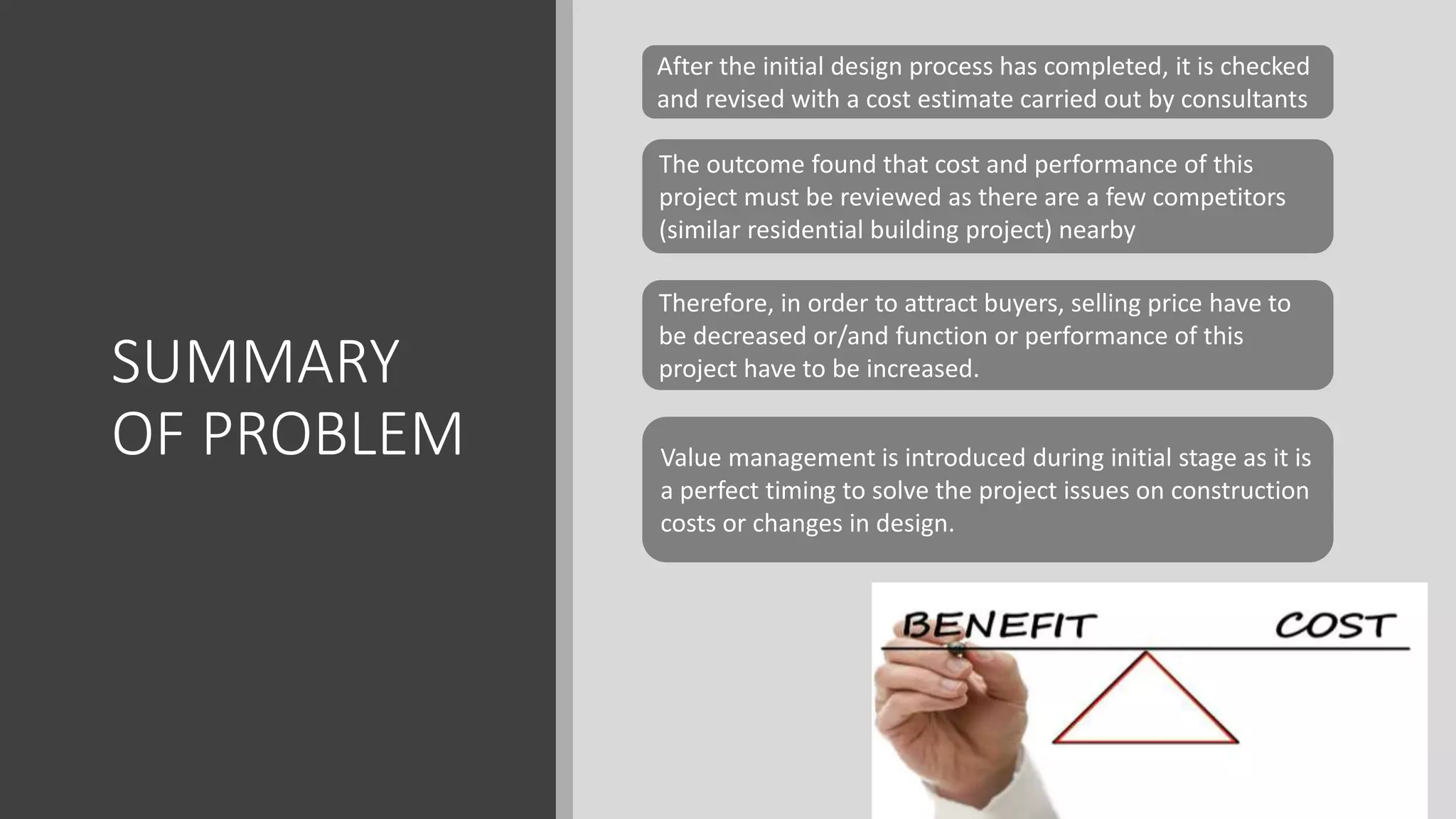
After the initial design process has completed, it is checked
and revised with a cost estimate carried out by consultants
The outcome found that cost and performance of this
project must be reviewed as there are a few competitors
(similar residential building project) nearby
Therefore, in order to attract buyers, selling price have to
be decreased or/and function or performance of this
project have to be increased.
Value management is introduced during initial stage as it is
a perfect timing to solve the project issues on construction
costs or changes in design.
VM TOOLS AND TECHNIQUE
Functional Approach, Priority Setting Matrix, Smart Value Tree
PRIORITY
SETTING
MATRIX
Client has many consideration on the selection of material
Through this tool, client can rank their priority of choice
based on cost, quality, time taken to complete and
etcetera.
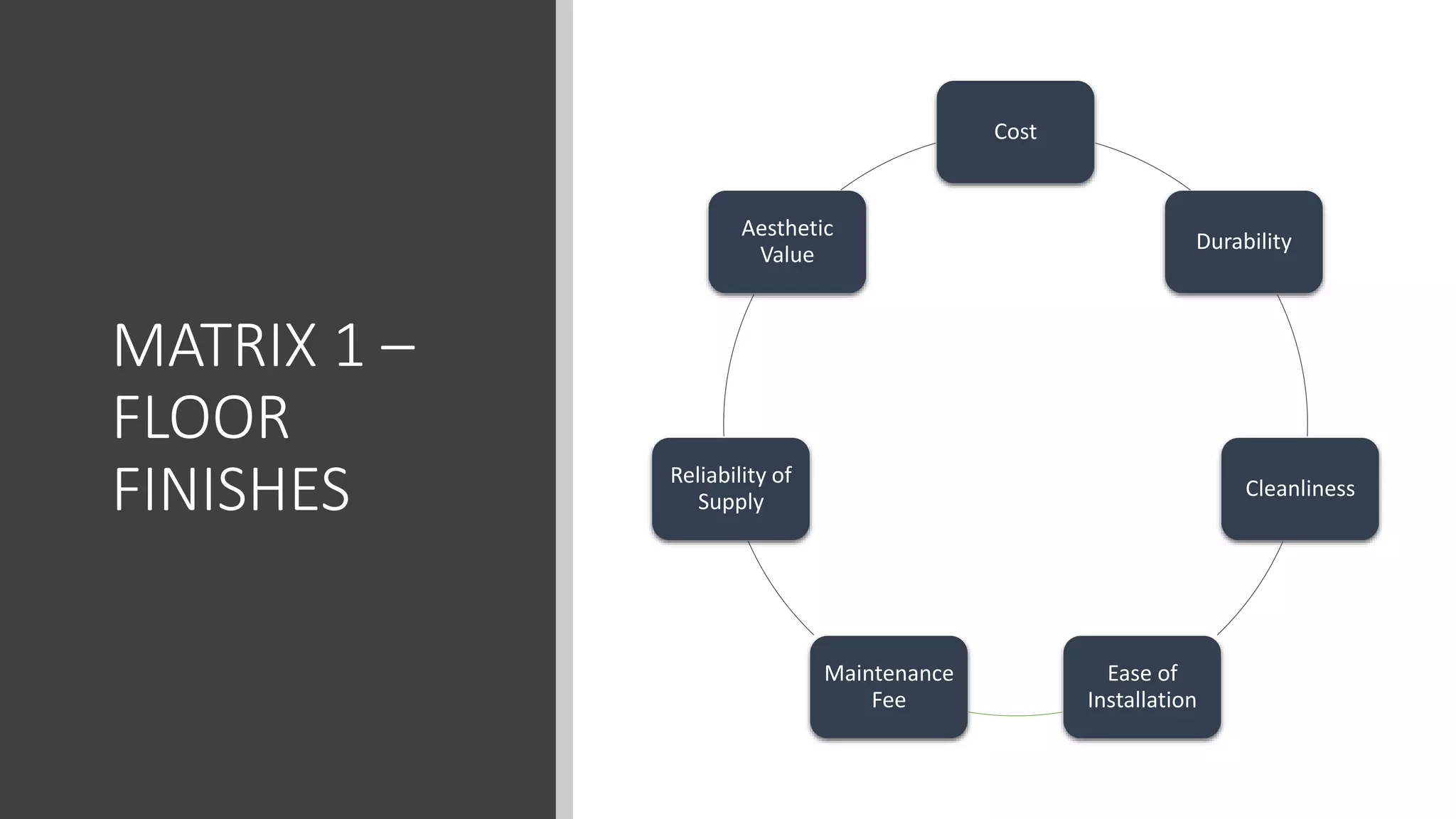
MATRIX 1 –
FLOOR
FINISHES
Cost
Durability
Cleanliness
Ease of
Installation
Maintenance
Fee
Reliability of
Supply
Aesthetic
Value
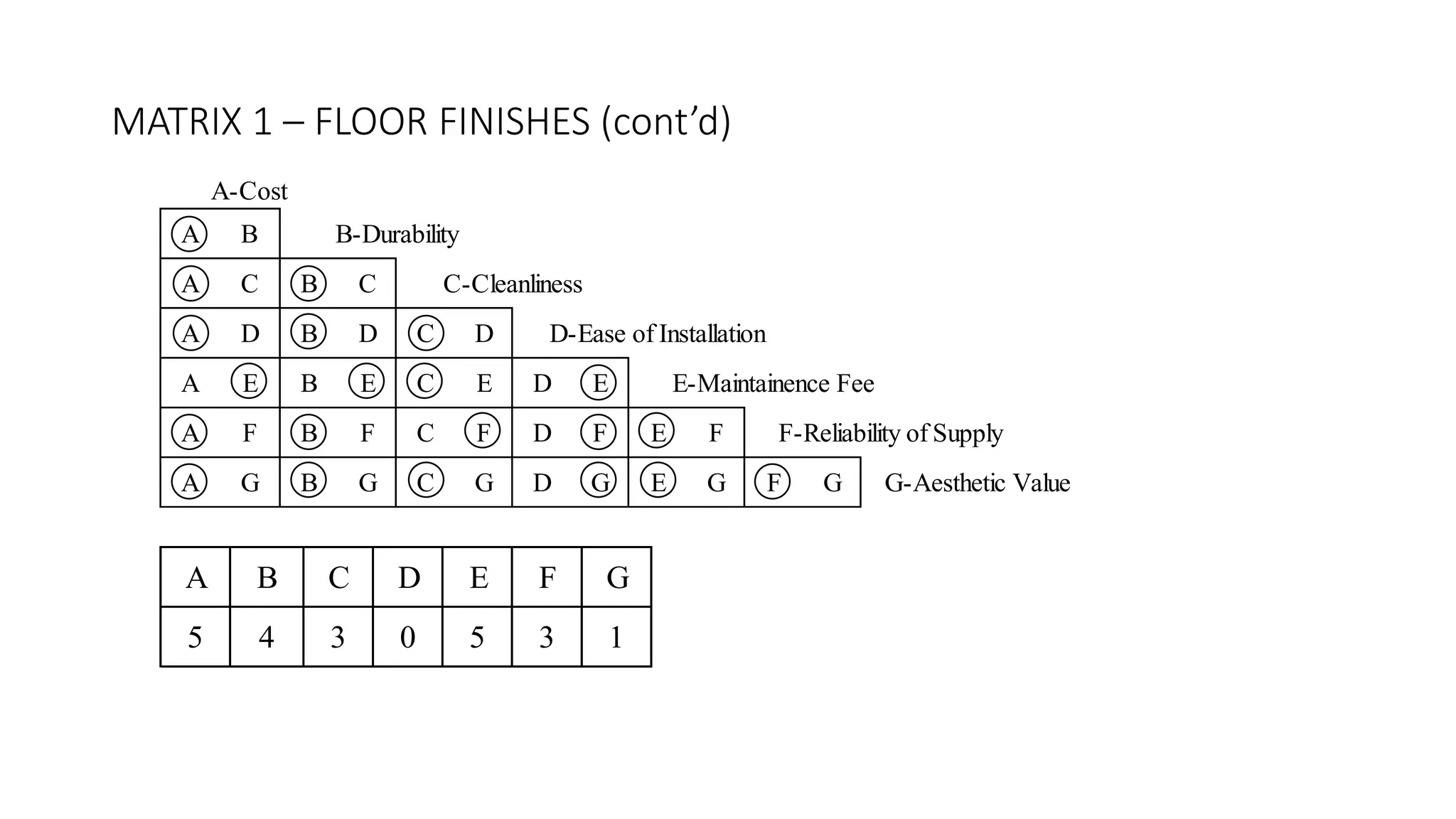
A B
A C B C
A D B D C D
A E B E C E D E
A F B F C F D F E F
A G B G C G D G E G F G
A-Cost
B-Durability
F-Reliability of Supply
G-Aesthetic Value
C-Cleanliness
E-Maintainence Fee
D-Ease of Installation
A B C D E F G
5 4 3 0 5 3 1
MATRIX 1 – FLOOR FINISHES (cont’d)
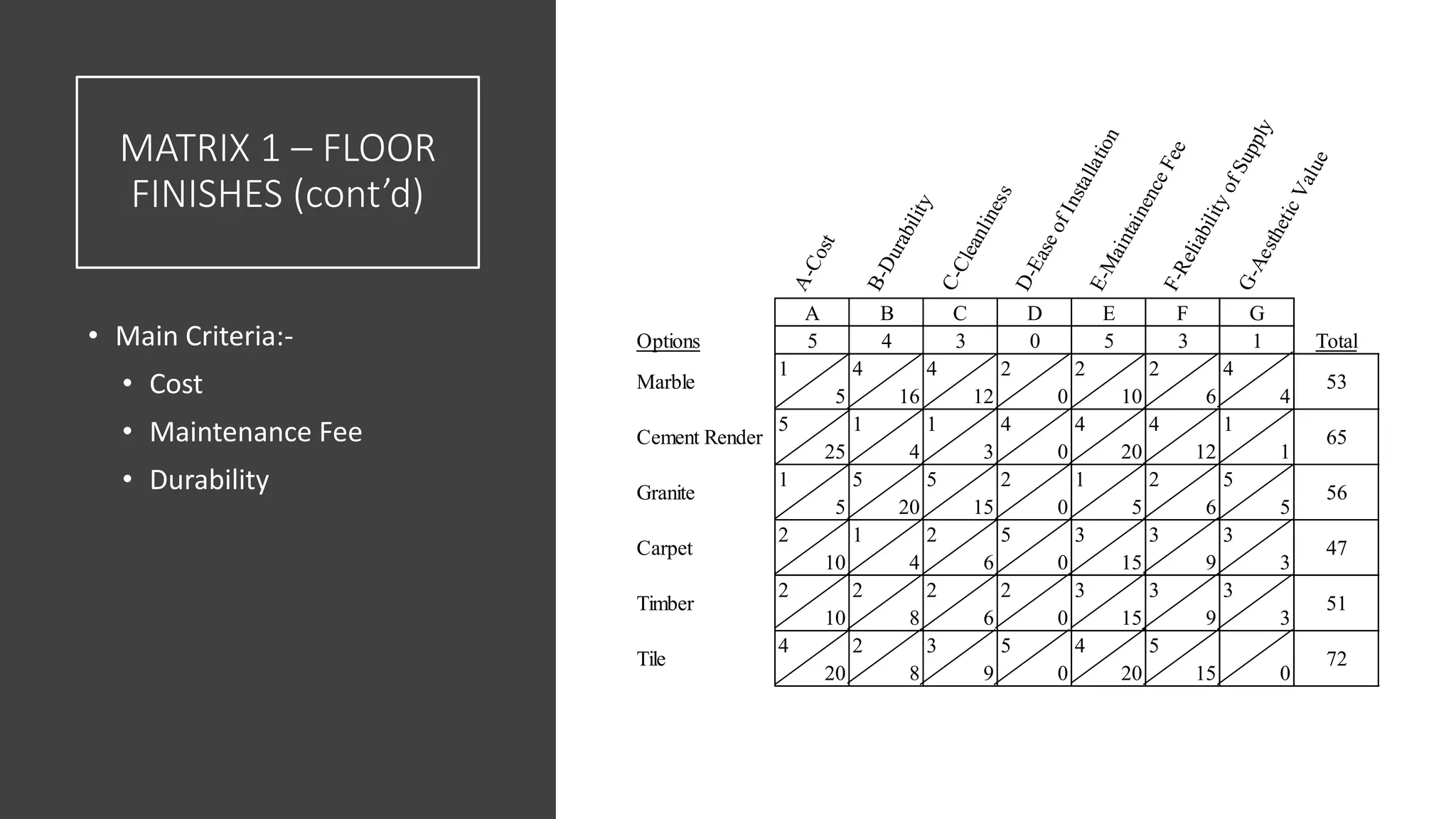
A-Cost
B-Durability
C-Cleanliness
D-EaseofInstallation
E-MaintainenceFeeF-ReliabilityofSupply
G-AestheticValue
A B C D E F G
Options 5 4 3 0 5 3 1 Total
1 4 4 2 2 2 4
5 16 12 0 10 6 4
5 1 1 4 4 4 1
25 4 3 0 20 12 1
1 5 5 2 1 2 5
5 20 15 0 5 6 5
2 1 2 5 3 3 3
10 4 6 0 15 9 3
2 2 2 2 3 3 3
10 8 6 0 15 9 3
4 2 3 5 4 5
20 8 9 0 20 15 0
Timber
Tile
Marble
Cement Render
Granite
Carpet
72
53
65
56
47
51
MATRIX 1 – FLOOR
FINISHES (cont’d)
• Main Criteria:-
• Cost
• Maintenance Fee
• Durability
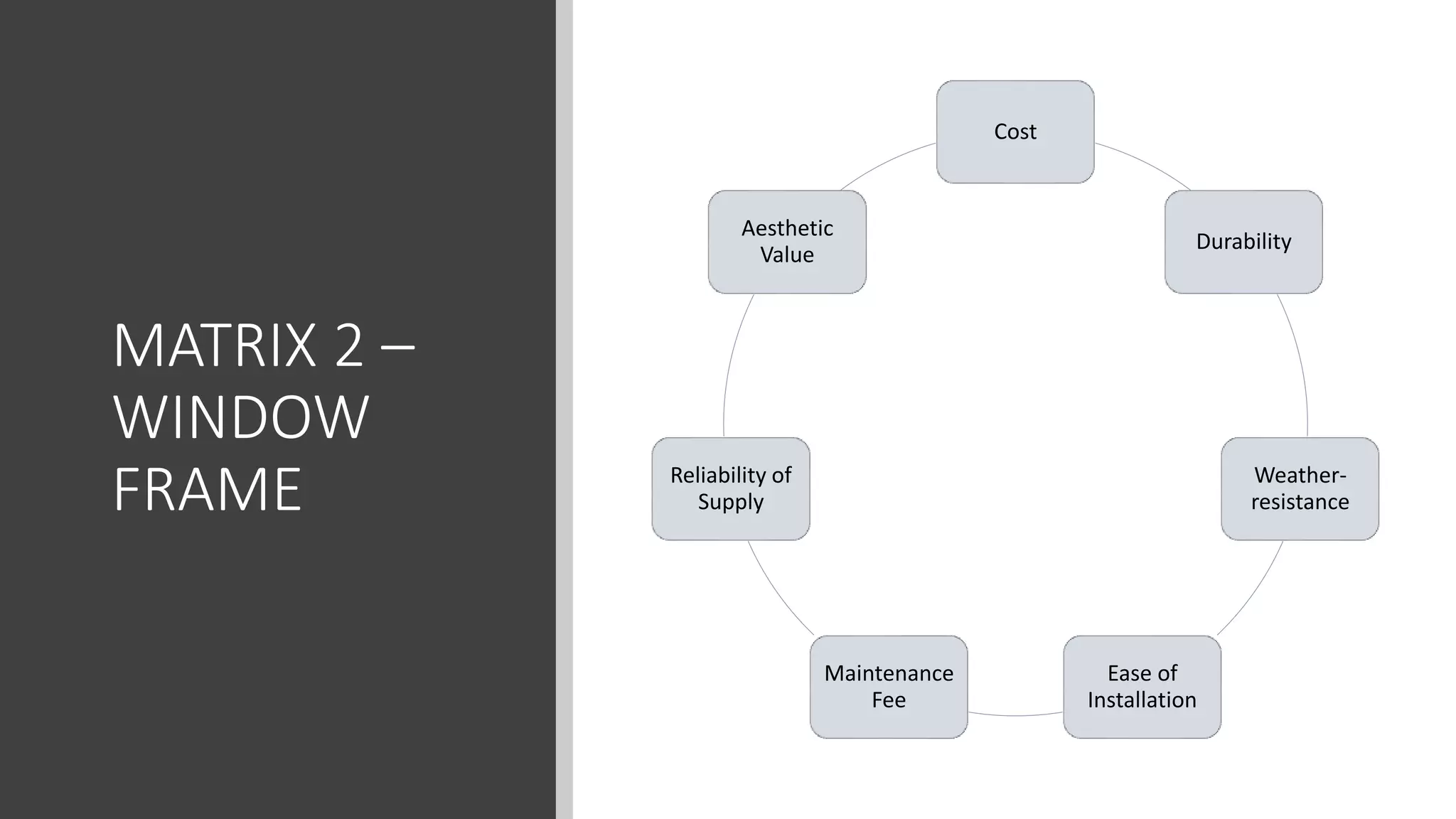
MATRIX 2 –
WINDOW
FRAME
Cost
Durability
Weather-
resistance
Ease of
Installation
Maintenance
Fee
Reliability of
Supply
Aesthetic
Value
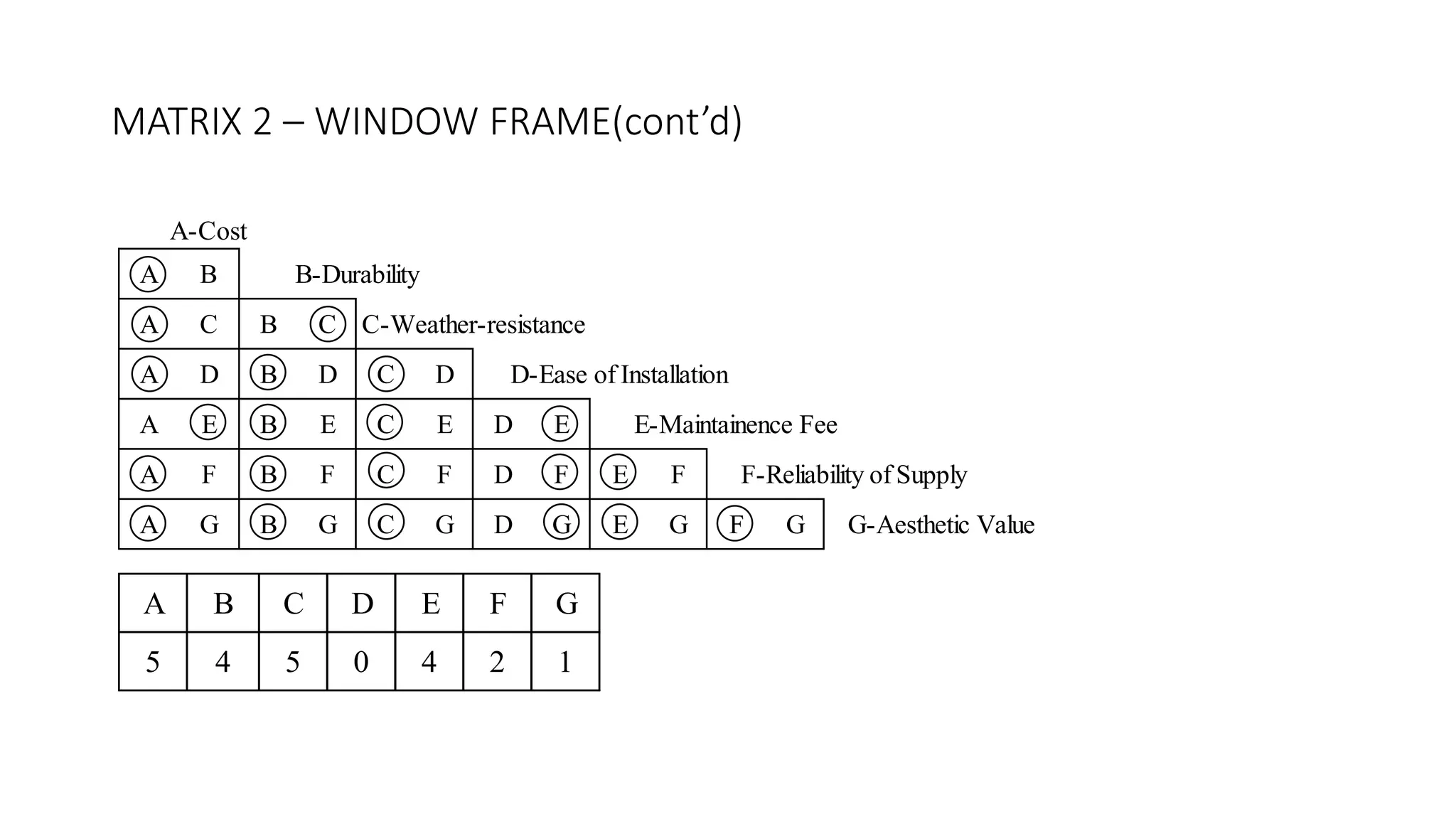
MATRIX 2 – WINDOW FRAME(cont’d)
A B
A C B C
A D B D C D
A E B E C E D E
A F B F C F D F E F
A G B G C G D G E G F G G-Aesthetic Value
A-Cost
B-Durability
C-Weather-resistance
D-Ease of Installation
E-Maintainence Fee
F-Reliability of Supply
A B C D E F G
5 4 5 0 4 2 1
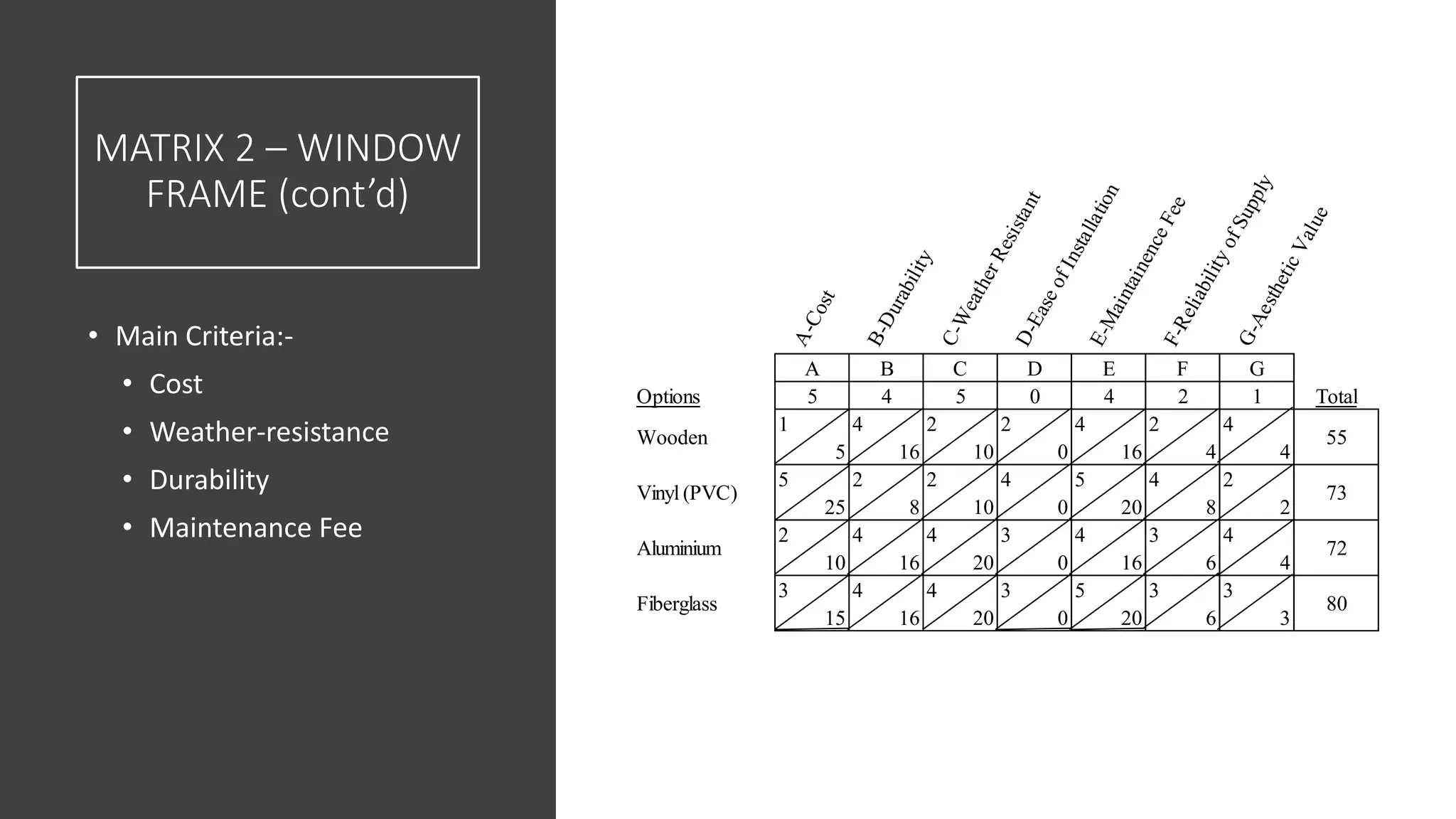
A-Cost
B-Durability
C-WeatherResistant
D-EaseofInstallation
E-MaintainenceFeeF-ReliabilityofSupply
G-AestheticValue
A B C D E F G
Options 5 4 5 0 4 2 1 Total
1 4 2 2 4 2 4
5 16 10 0 16 4 4
5 2 2 4 5 4 2
25 8 10 0 20 8 2
2 4 4 3 4 3 4
10 16 20 0 16 6 4
3 4 4 3 5 3 3
15 16 20 0 20 6 3
Fiberglass 80
Wooden 55
Vinyl (PVC) 73
Aluminium 72
MATRIX 2 – WINDOW
FRAME (cont’d)
• Main Criteria:-
• Cost
• Weather-resistance
• Durability
• Maintenance Fee
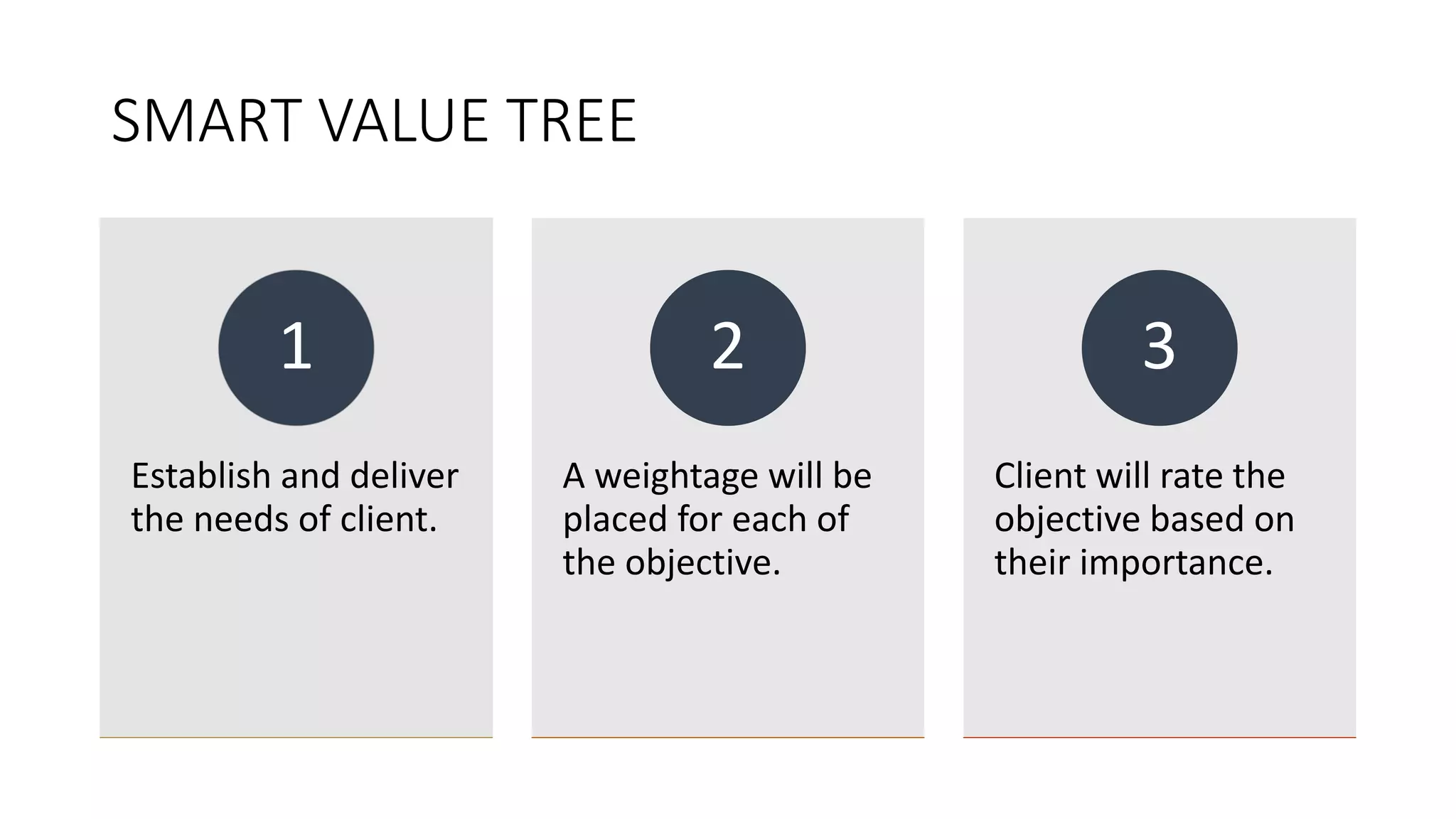
SMART VALUE TREE
Establish and deliver
the needs of client.
1
A weightage will be
placed for each of
the objective.
2
Client will rate the
objective based on
their importance.
3
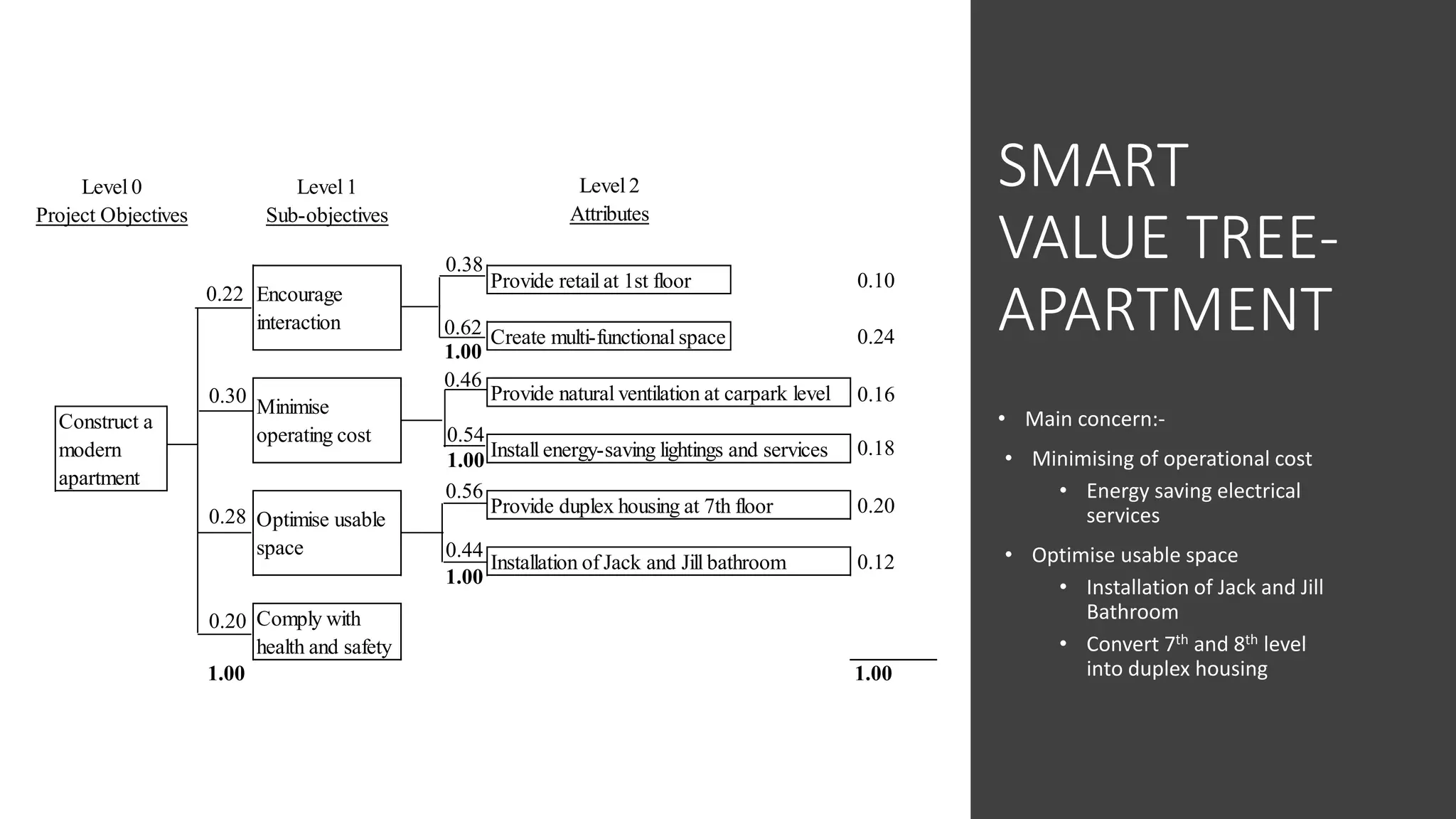
Level 0 Level 1
Project Objectives Sub-objectives
Provide retail at 1st floor
Create multi-functional space
Provide natural ventilation at carpark level
Install energy-saving lightings and services
Provide duplex housing at 7th floor
Installation of Jack and Jill bathroom
Comply with
health and safety
Optimise usable
space
Encourage
interaction
Minimise
operating cost
Construct a
modern
apartment
Level 2
Attributes
0.30
0.28
0.20
0.22
0.38
0.62
0.46
0.54
0.56
0.44
1.00
1.00
1.00
1.00
0.18
0.16
0.24
0.12
0.20
0.10
1.00
SMART
VALUE TREE-
APARTMENT
• Main concern:-
• Minimising of operational cost
• Energy saving electrical
services
• Optimise usable space
• Installation of Jack and Jill
Bathroom
• Convert 7th and 8th level
into duplex housing
FUNCTIONAL
APPROACH
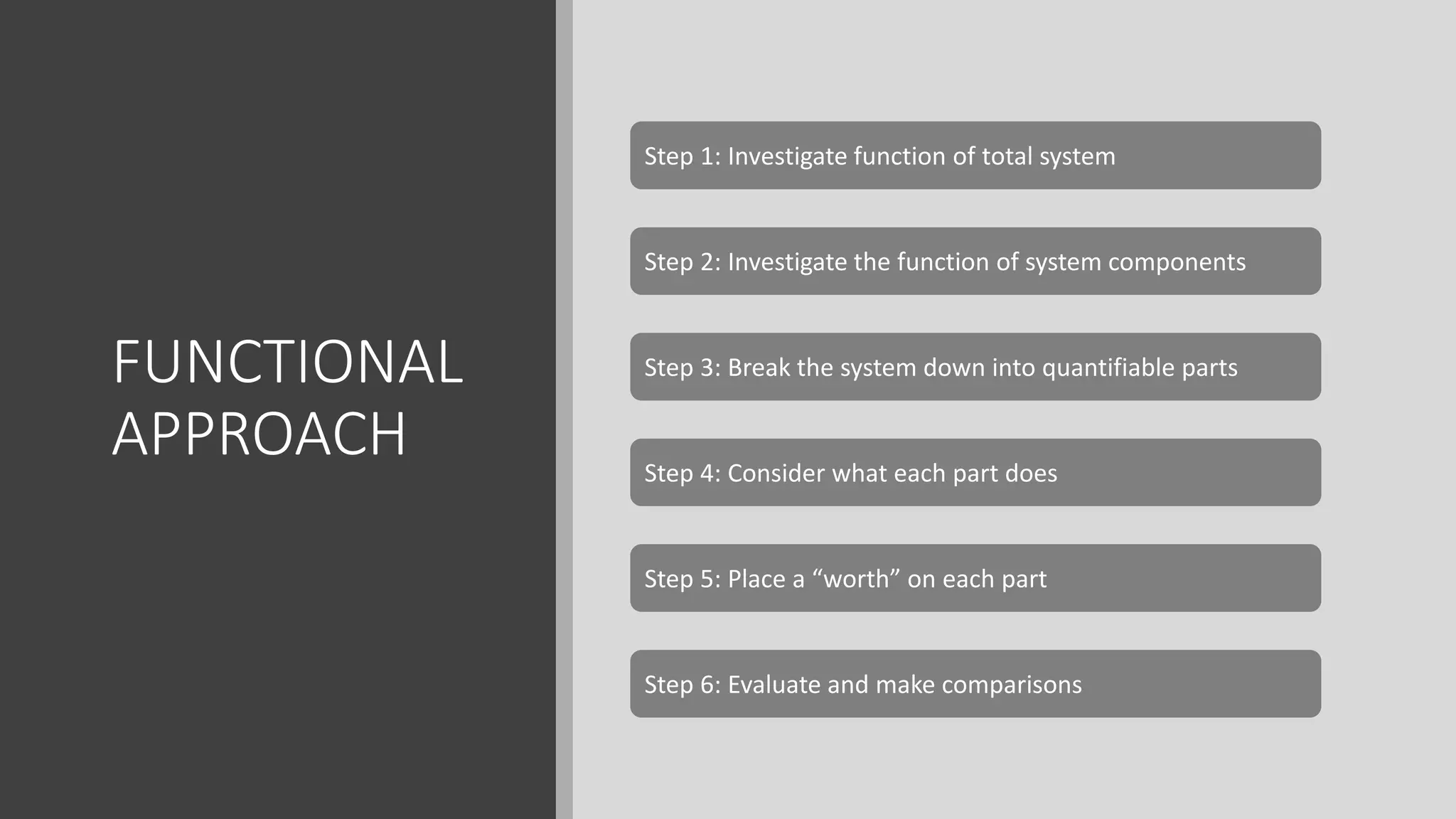
Step 1: Investigate function of total system
Step 2: Investigate the function of system components
Step 3: Break the system down into quantifiable parts
Step 4: Consider what each part does
Step 5: Place a “worth” on each part
Step 6: Evaluate and make comparisons
Functional Approach
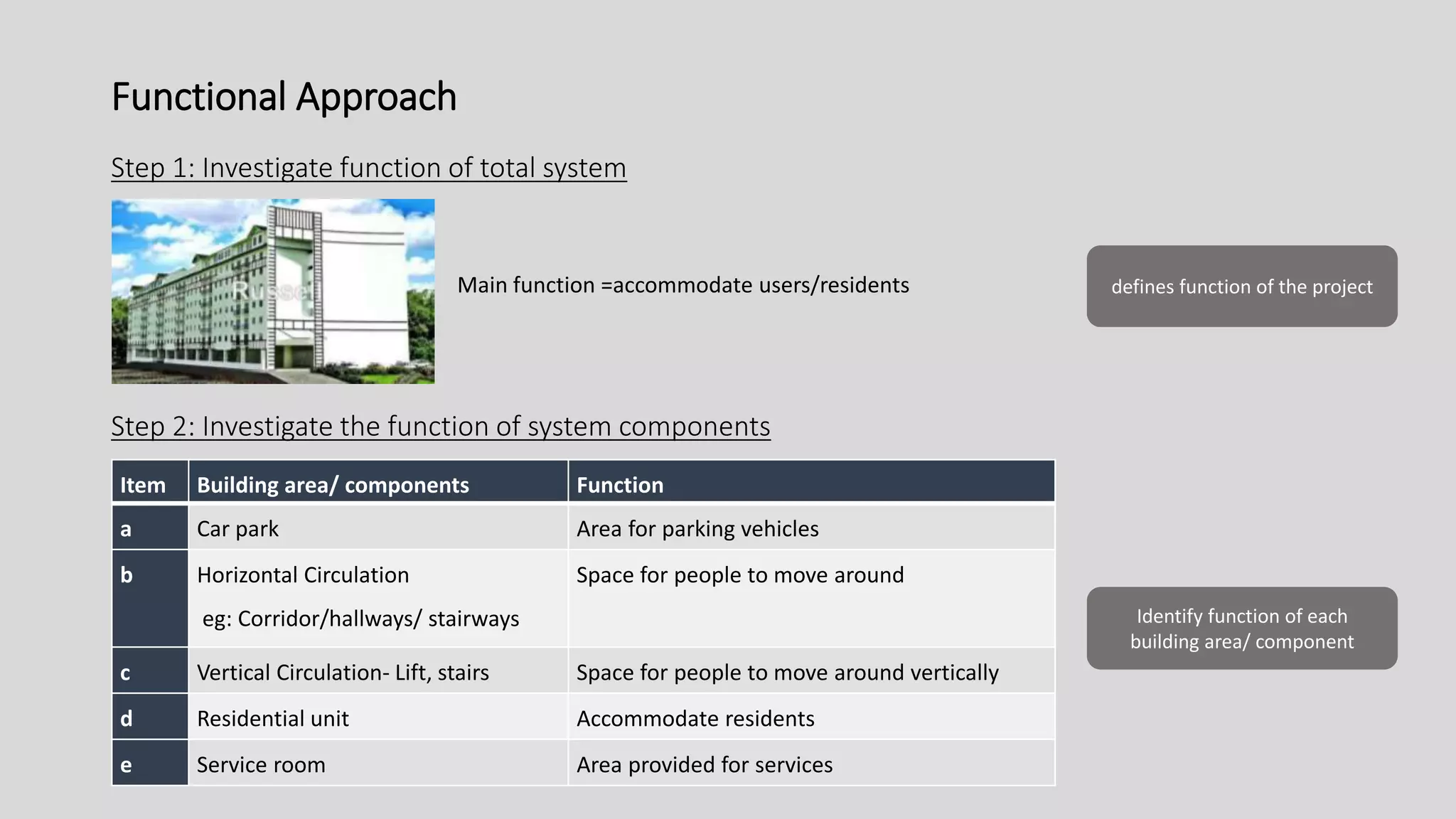
Step 1: Investigate function of total system
Step 2: Investigate the function of system components
Item Building area/ components Function
a Car park Area for parking vehicles
b Horizontal Circulation
eg: Corridor/hallways/ stairways
Space for people to move around
c Vertical Circulation- Lift, stairs Space for people to move around vertically
d Residential unit Accommodate residents
e Service room Area provided for services
Main function =accommodate users/residents defines function of the project
Identify function of each
building area/ component
Functional Approach
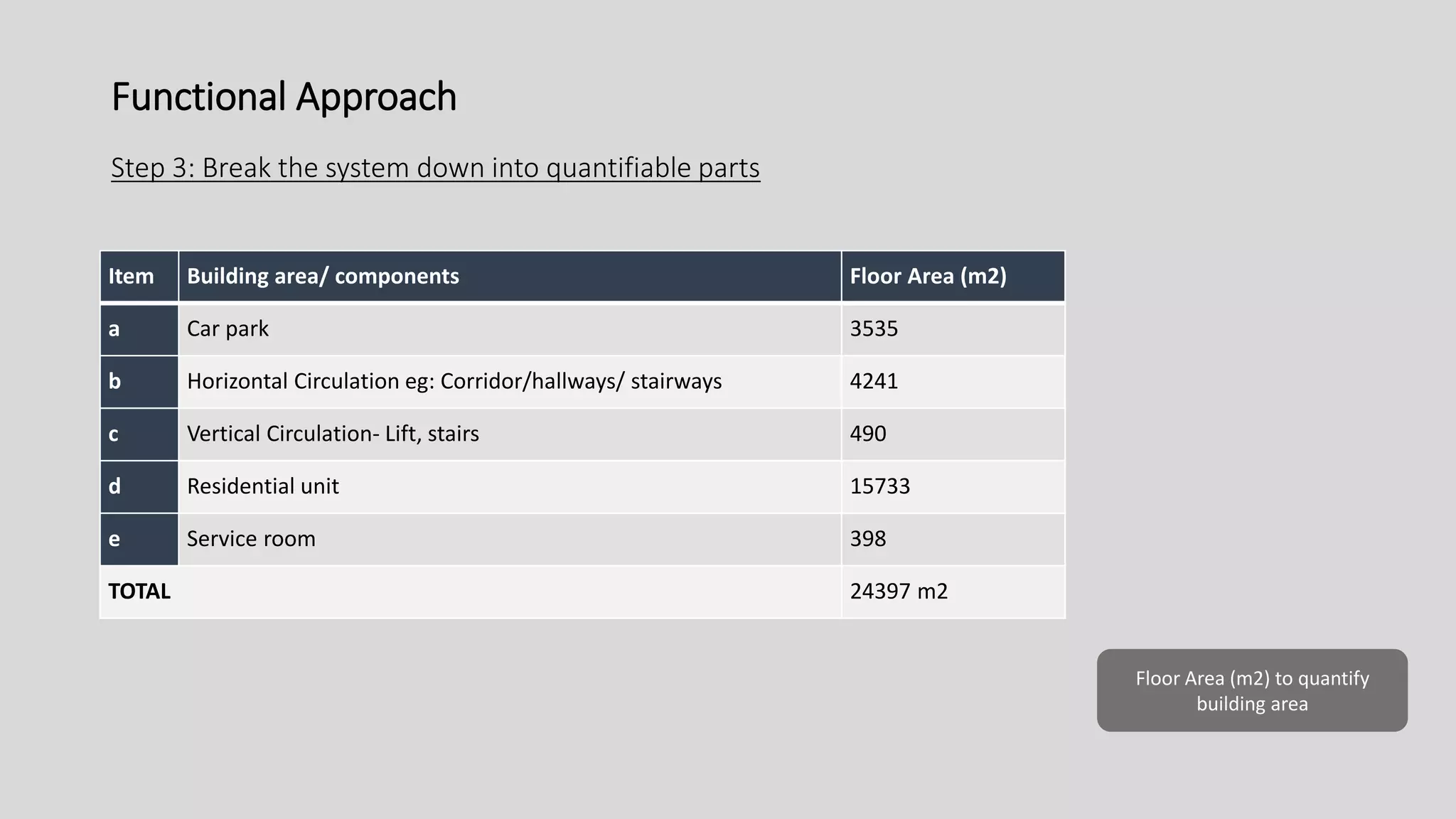
Step 3: Break the system down into quantifiable parts
Floor Area (m2) to quantify
building area
Item Building area/ components Floor Area (m2)
a Car park 3535
b Horizontal Circulation eg: Corridor/hallways/ stairways 4241
c Vertical Circulation- Lift, stairs 490
d Residential unit 15733
e Service room 398
TOTAL 24397 m2
Functional Approach
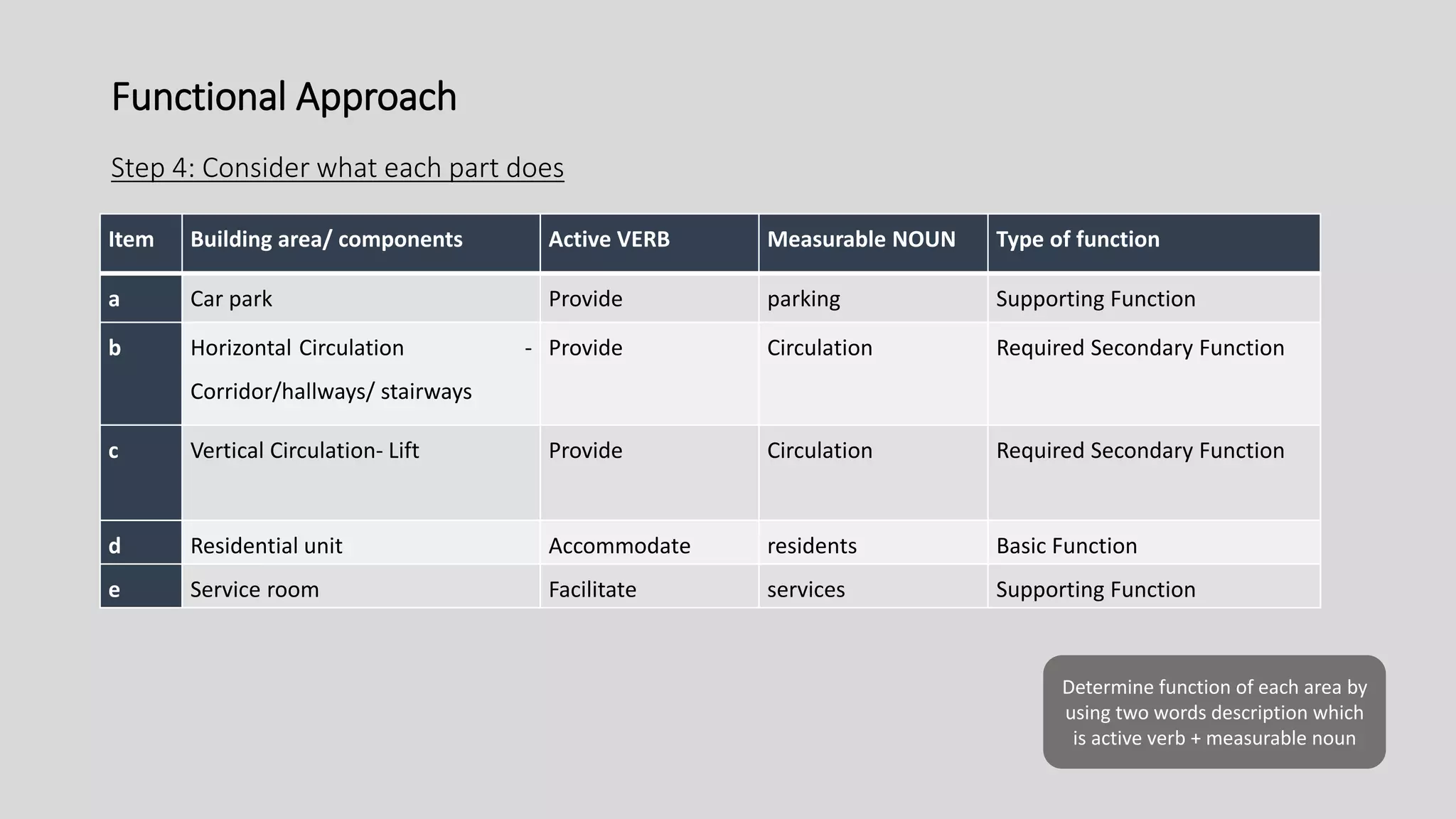
Step 4: Consider what each part does
Determine function of each area by
using two words description which
is active verb + measurable noun
Item Building area/ components Active VERB Measurable NOUN Type of function
a Car park Provide parking Supporting Function
b Horizontal Circulation -
Corridor/hallways/ stairways
Provide Circulation Required Secondary Function
c Vertical Circulation- Lift Provide Circulation Required Secondary Function
d Residential unit Accommodate residents Basic Function
e Service room Facilitate services Supporting Function
Functional Approach
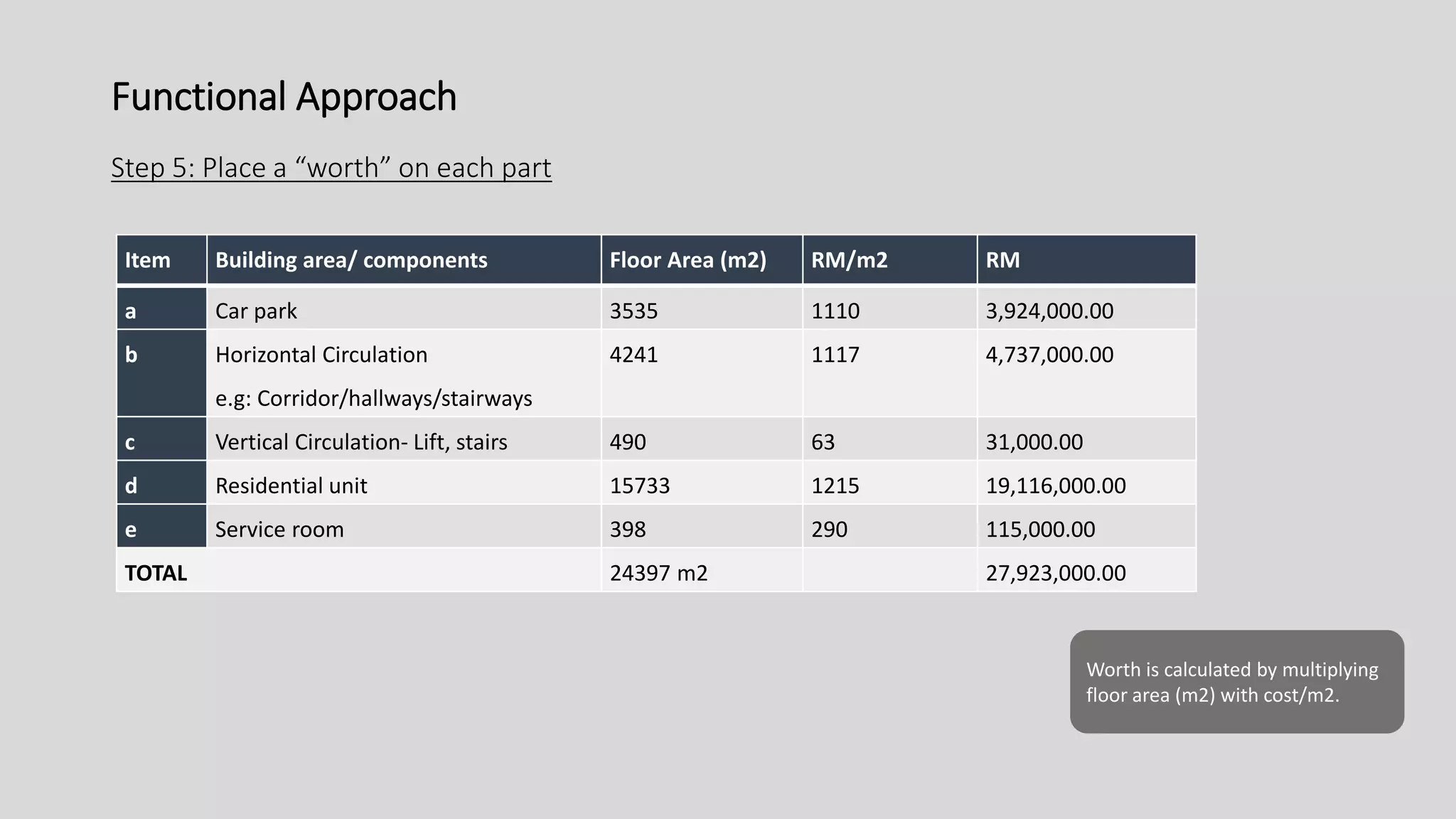
Step 5: Place a “worth” on each part
Worth is calculated by multiplying
floor area (m2) with cost/m2.
Item Building area/ components Floor Area (m2) RM/m2 RM
a Car park 3535 1110 3,924,000.00
b Horizontal Circulation
e.g: Corridor/hallways/stairways
4241 1117 4,737,000.00
c Vertical Circulation- Lift, stairs 490 63 31,000.00
d Residential unit 15733 1215 19,116,000.00
e Service room 398 290 115,000.00
TOTAL 24397 m2 27,923,000.00
Functional Approach
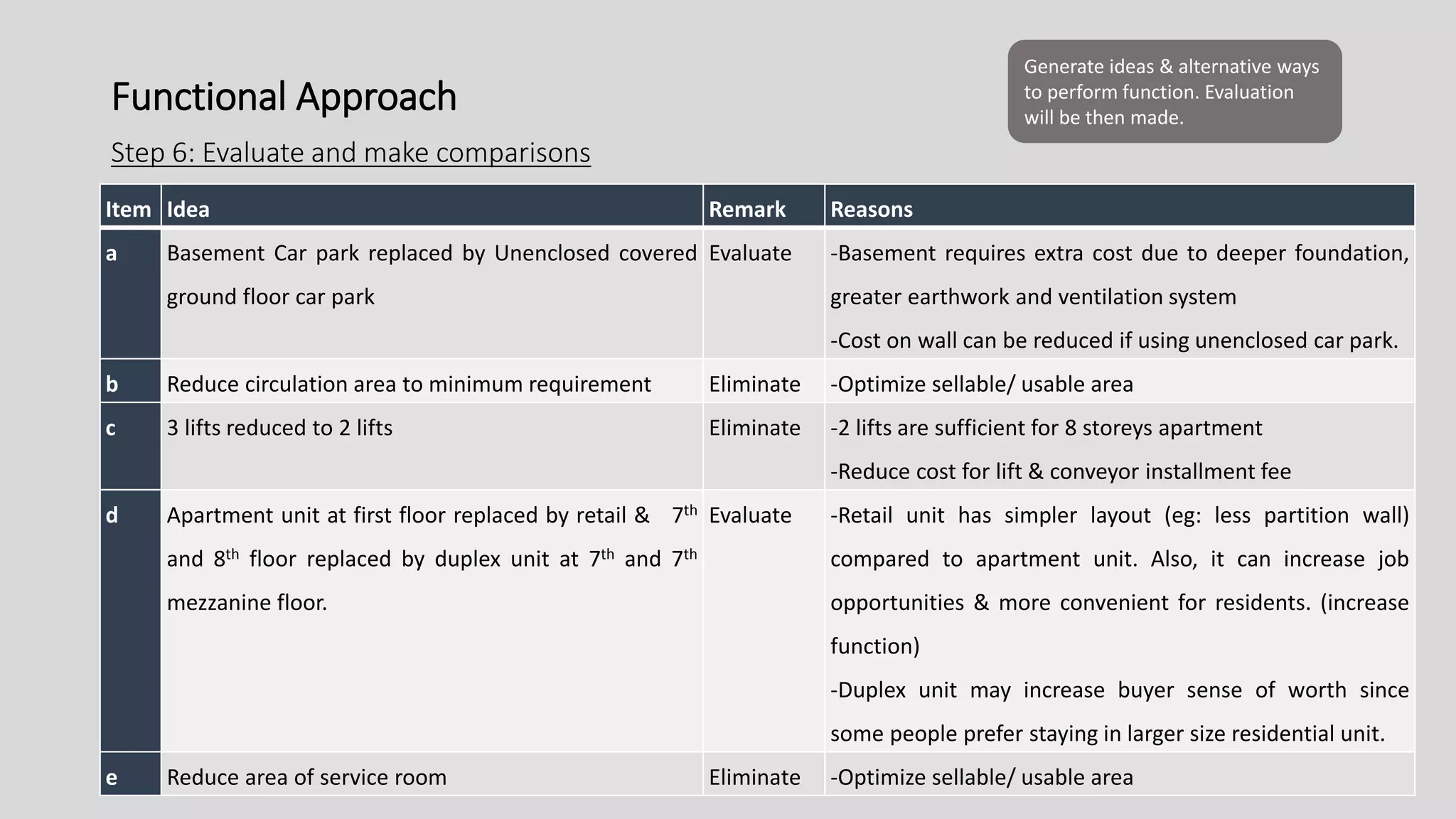
Step 6: Evaluate and make comparisons
Generate ideas & alternative ways
to perform function. Evaluation
will be then made.
Item Idea Remark Reasons
a Basement Car park replaced by Unenclosed covered
ground floor car park
Evaluate -Basement requires extra cost due to deeper foundation,
greater earthwork and ventilation system
-Cost on wall can be reduced if using unenclosed car park.
b Reduce circulation area to minimum requirement Eliminate -Optimize sellable/ usable area
c 3 lifts reduced to 2 lifts Eliminate -2 lifts are sufficient for 8 storeys apartment
-Reduce cost for lift & conveyor installment fee
d Apartment unit at first floor replaced by retail & 7th
and 8th floor replaced by duplex unit at 7th and 7th
mezzanine floor.
Evaluate -Retail unit has simpler layout (eg: less partition wall)
compared to apartment unit. Also, it can increase job
opportunities & more convenient for residents. (increase
function)
-Duplex unit may increase buyer sense of worth since
some people prefer staying in larger size residential unit.
e Reduce area of service room Eliminate -Optimize sellable/ usable area
SKETCHES SHOWING PROPOSED
CHANGES OF DESIGN
Changes in Typical Apartment unit floor plan, Retail, Duplex
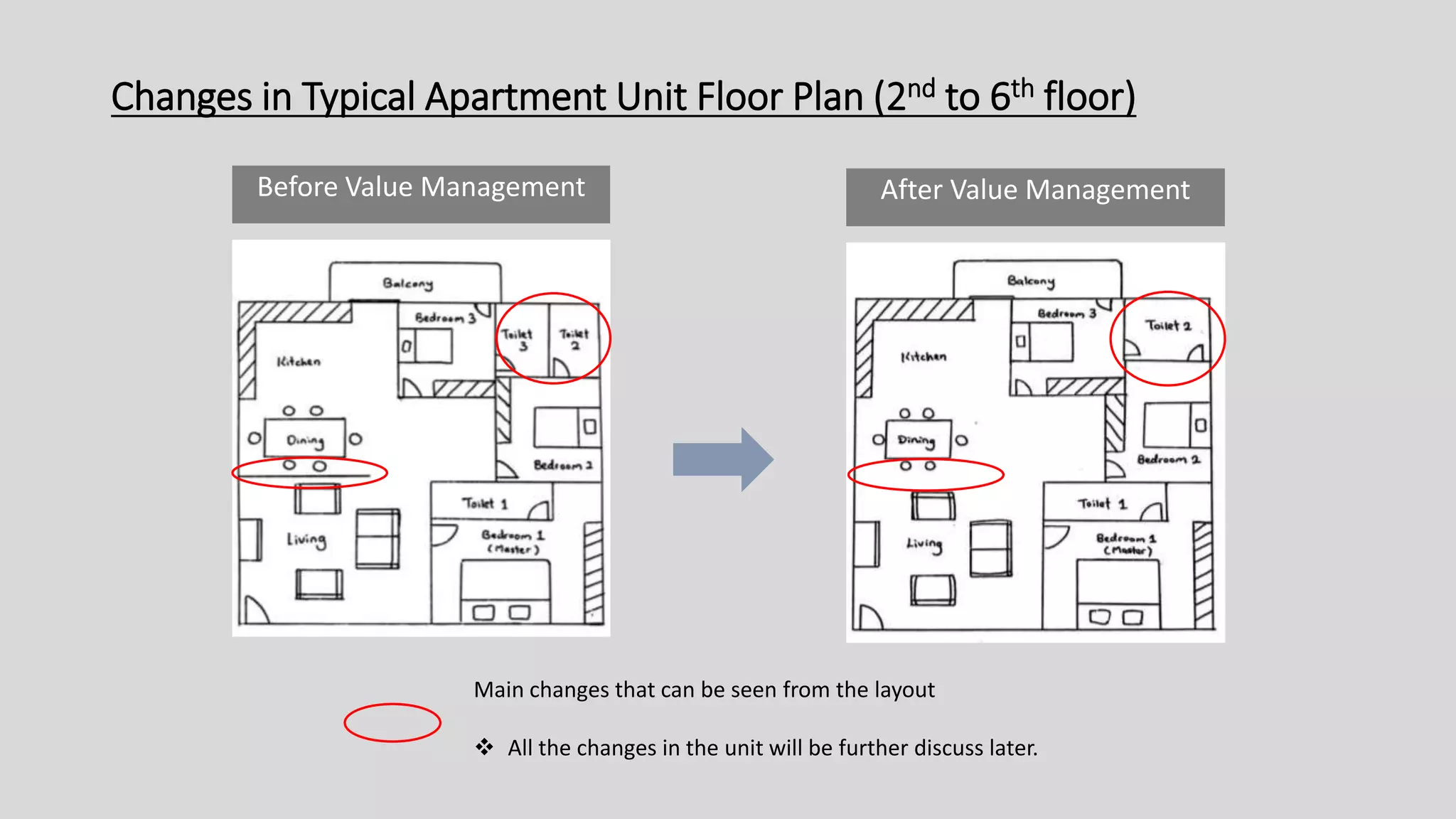
Changes in Typical Apartment Unit Floor Plan (2nd to 6th floor)
Before Value Management After Value Management
Main changes that can be seen from the layout
 All the changes in the unit will be further discuss later.
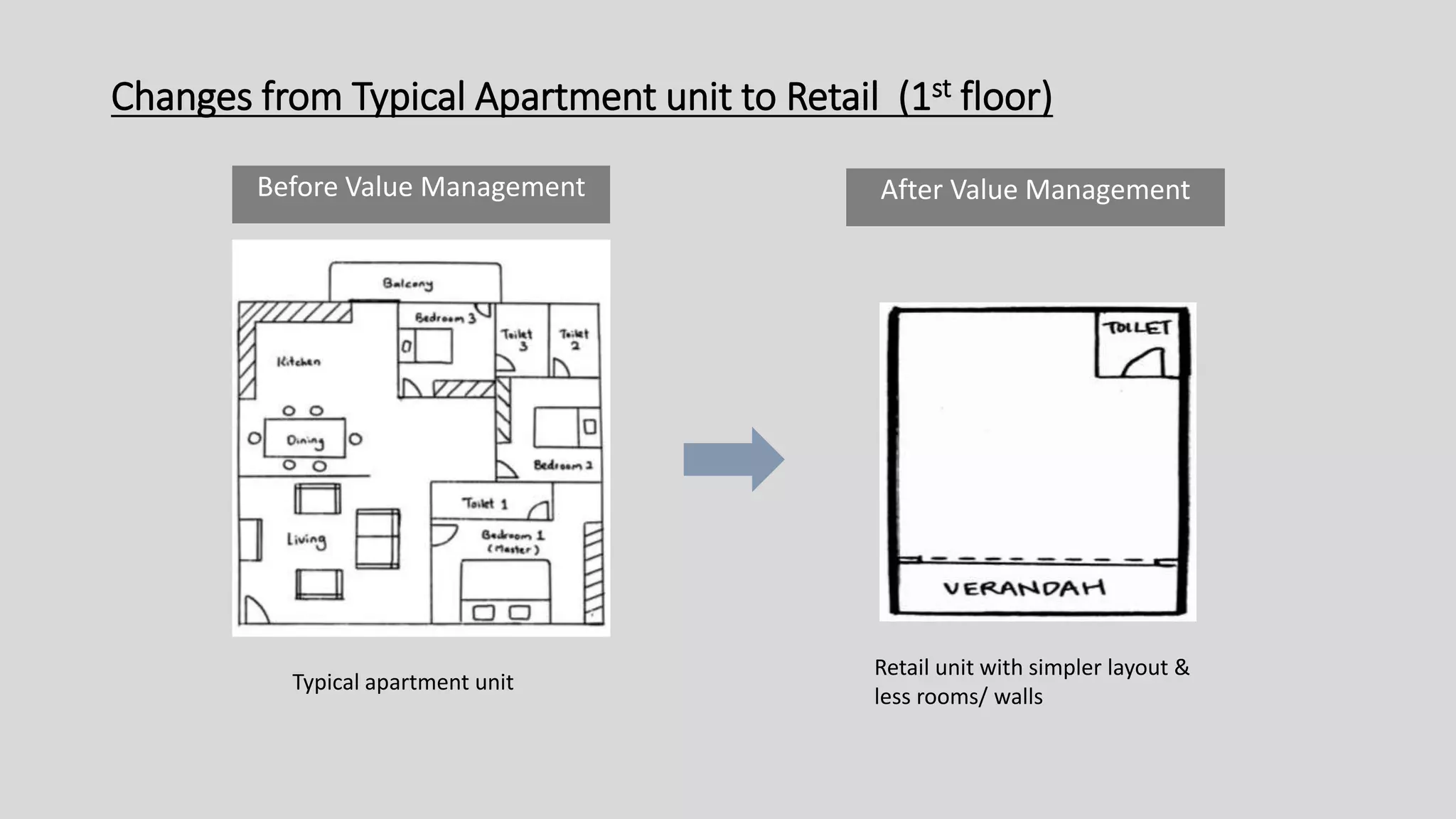
Changes from Typical Apartment unit to Retail (1st floor)
Before Value Management After Value Management
Typical apartment unit
Retail unit with simpler layout &
less rooms/ walls
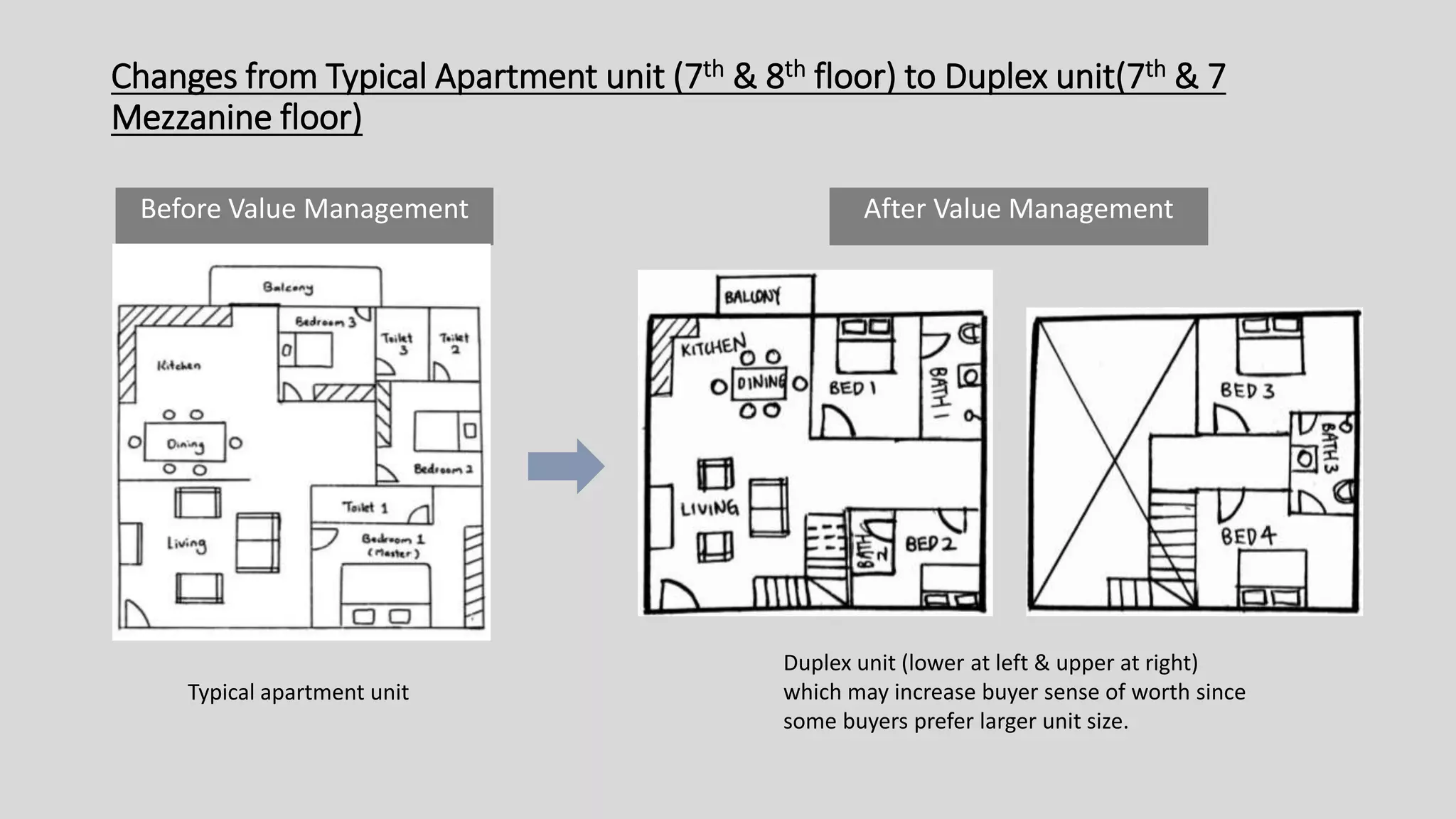
Changes from Typical Apartment unit (7th & 8th floor) to Duplex unit(7th & 7
Mezzanine floor)
Before Value Management After Value Management
Typical apartment unit
Duplex unit (lower at left & upper at right)
which may increase buyer sense of worth since
some buyers prefer larger unit size.
TECHNICAL DATA SUPPORTING
SELECTION OF ALTERNATIVES
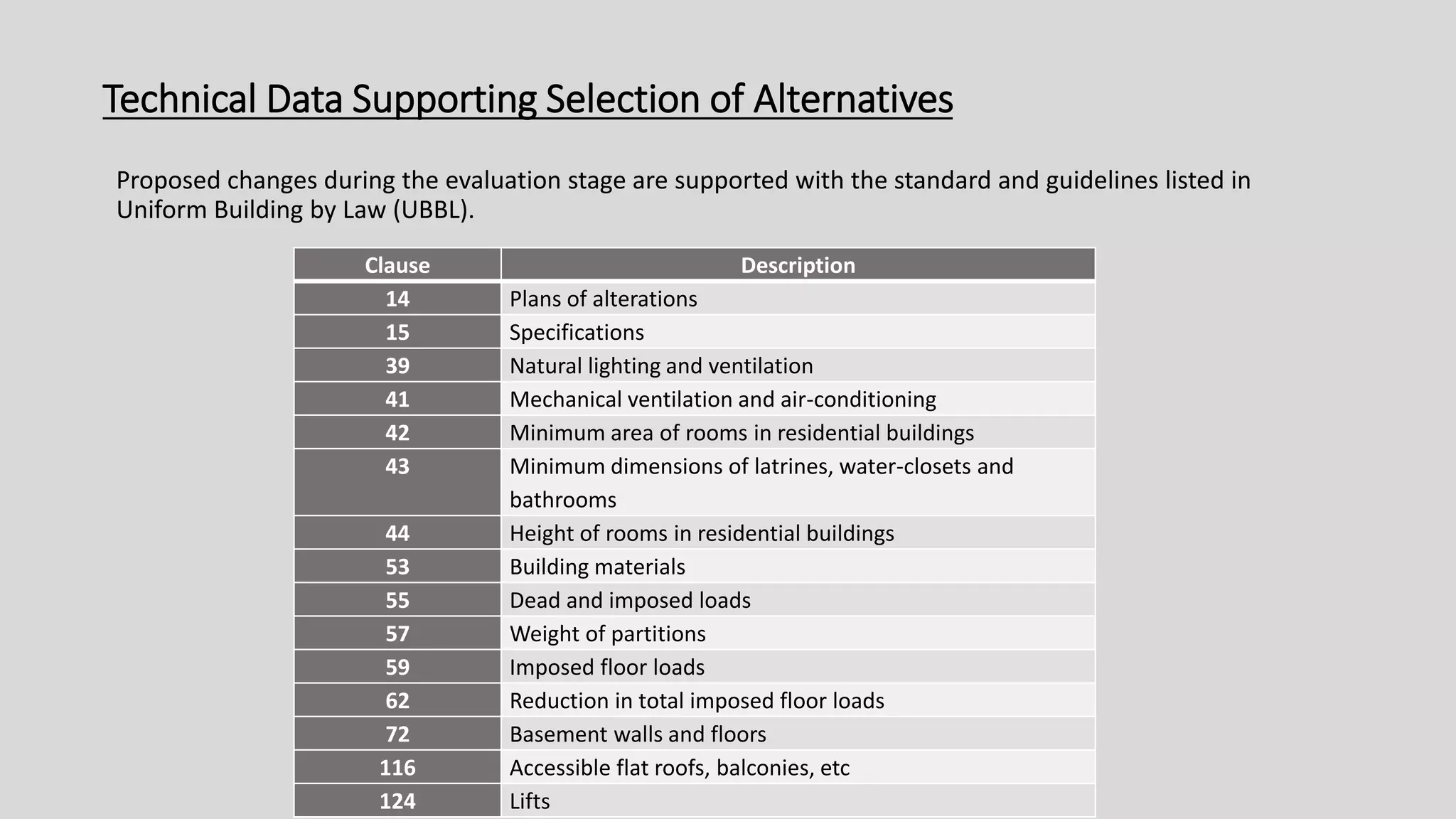
Technical Data Supporting Selection of Alternatives
Proposed changes during the evaluation stage are supported with the standard and guidelines listed in
Uniform Building by Law (UBBL).
Clause Description
14 Plans of alterations
15 Specifications
39 Natural lighting and ventilation
41 Mechanical ventilation and air-conditioning
42 Minimum area of rooms in residential buildings
43 Minimum dimensions of latrines, water-closets and
bathrooms
44 Height of rooms in residential buildings
53 Building materials
55 Dead and imposed loads
57 Weight of partitions
59 Imposed floor loads
62 Reduction in total imposed floor loads
72 Basement walls and floors
116 Accessible flat roofs, balconies, etc
124 Lifts
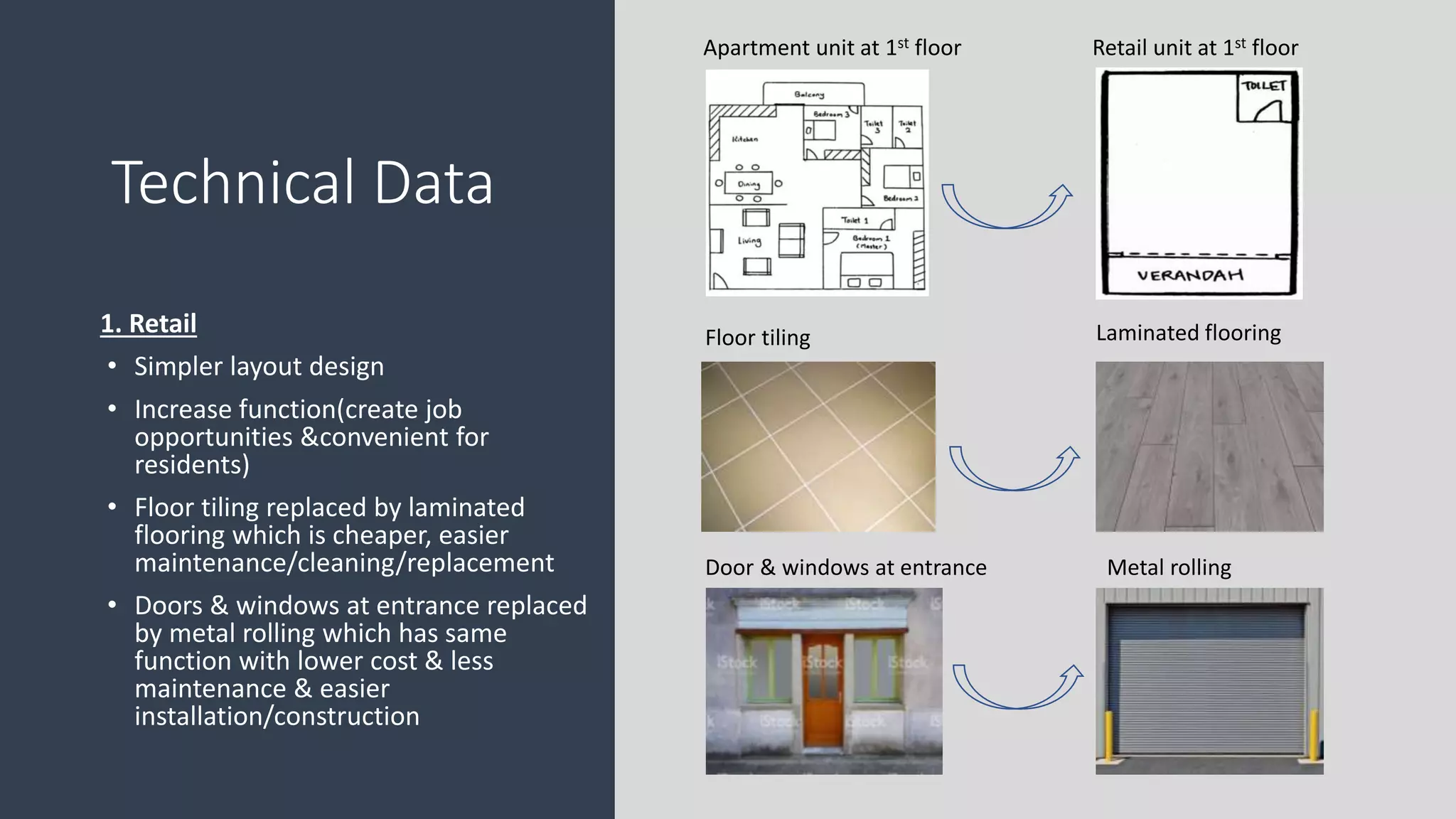
1. Retail
• Simpler layout design
• Increase function(create job
opportunities &convenient for
residents)
• Floor tiling replaced by laminated
flooring which is cheaper, easier
maintenance/cleaning/replacement
• Doors & windows at entrance replaced
by metal rolling which has same
function with lower cost & less
maintenance & easier
installation/construction
Technical Data
Apartment unit at 1st floor Retail unit at 1st floor
Floor tiling Laminated flooring
Door & windows at entrance Metal rolling
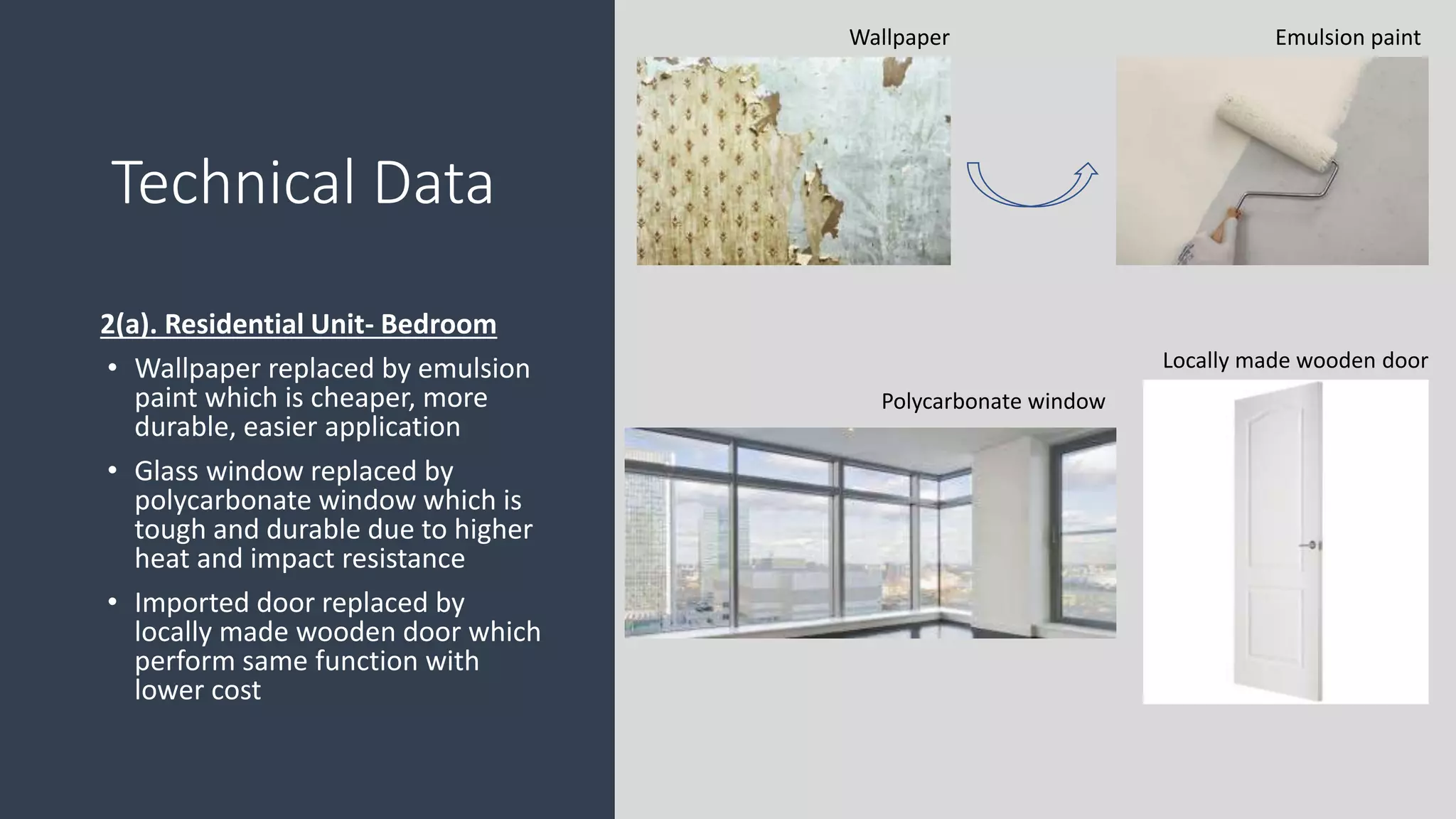
2(a). Residential Unit- Bedroom
• Wallpaper replaced by emulsion
paint which is cheaper, more
durable, easier application
• Glass window replaced by
polycarbonate window which is
tough and durable due to higher
heat and impact resistance
• Imported door replaced by
locally made wooden door which
perform same function with
lower cost
Technical Data
Wallpaper Emulsion paint
Polycarbonate window
Locally made wooden door
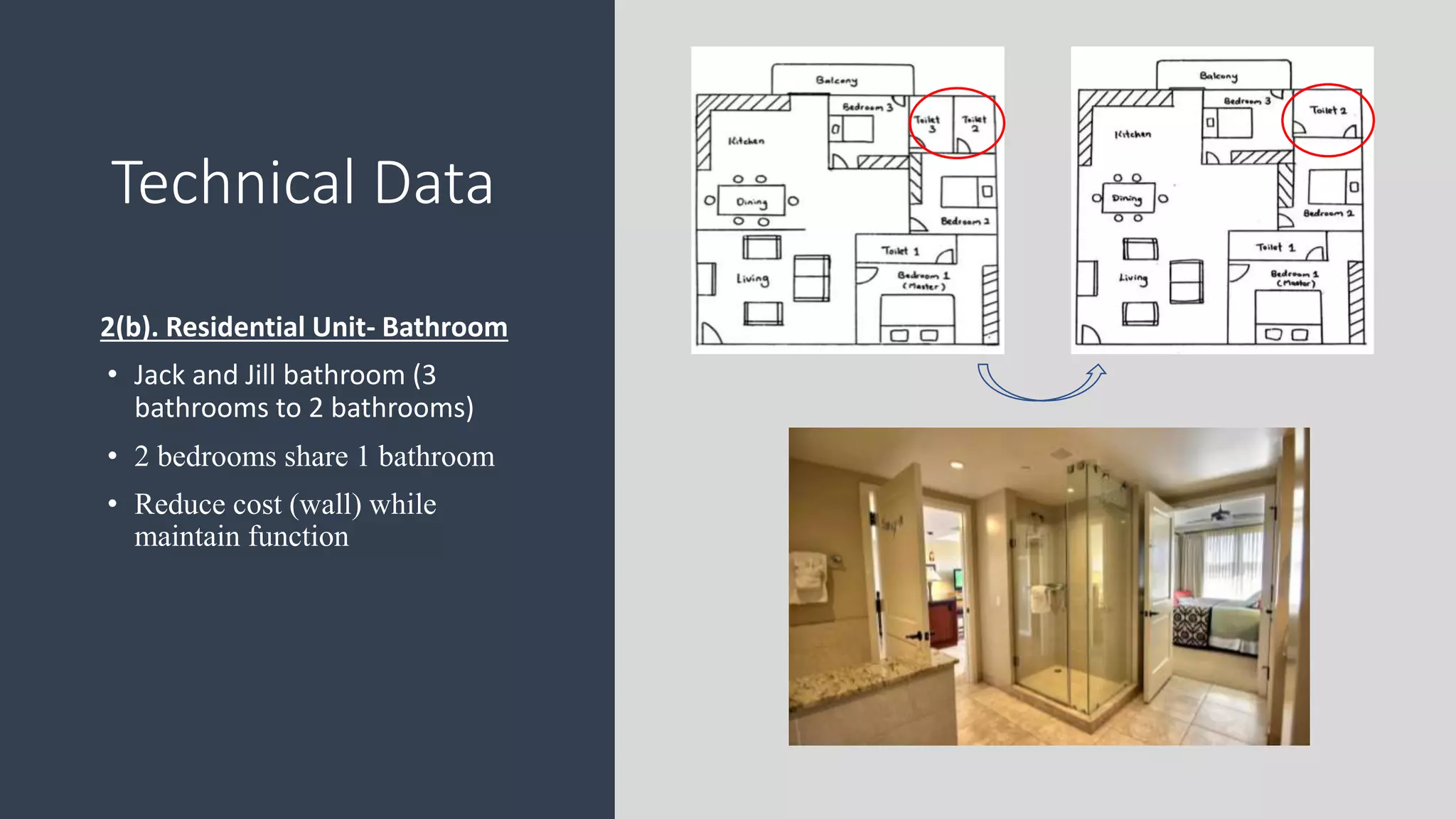
2(b). Residential Unit- Bathroom
• Jack and Jill bathroom (3
bathrooms to 2 bathrooms)
• 2 bedrooms share 1 bathroom
• Reduce cost (wall) while
maintain function
Technical Data
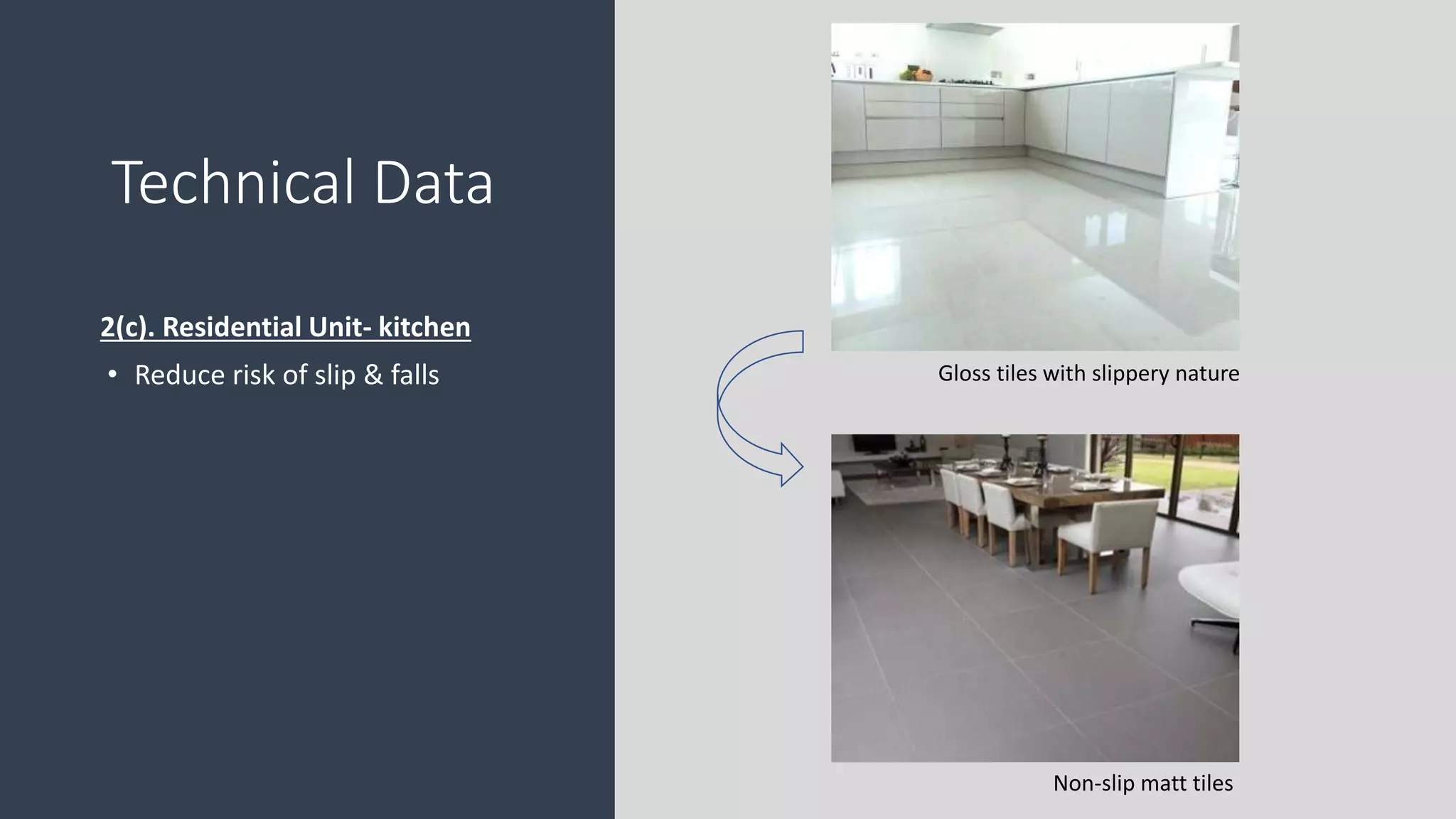
2(c). Residential Unit- kitchen
• Reduce risk of slip & falls
Technical Data
Gloss tiles with slippery nature
Non-slip matt tiles
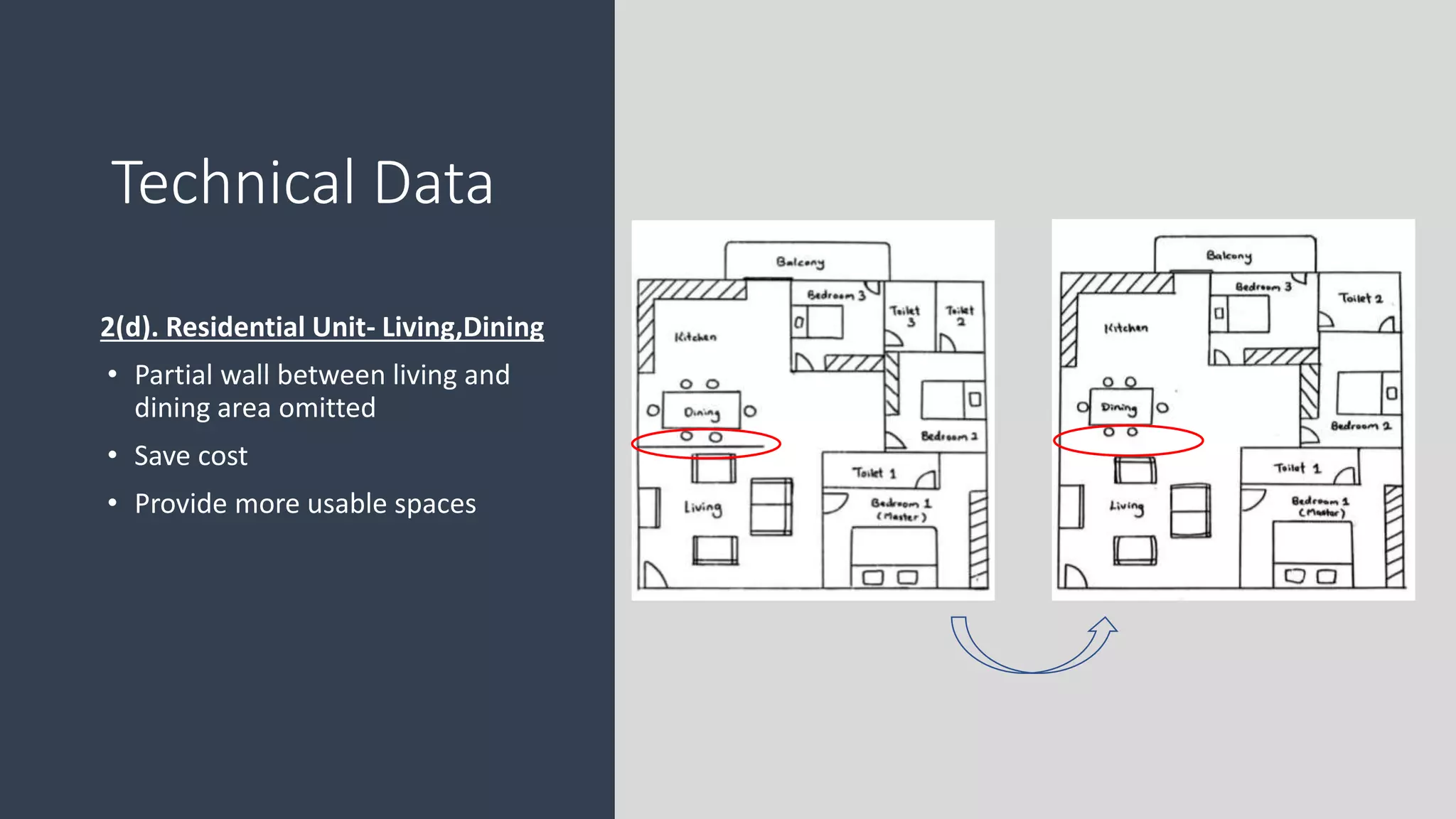
2(d). Residential Unit- Living,Dining
• Partial wall between living and
dining area omitted
• Save cost
• Provide more usable spaces
Technical Data
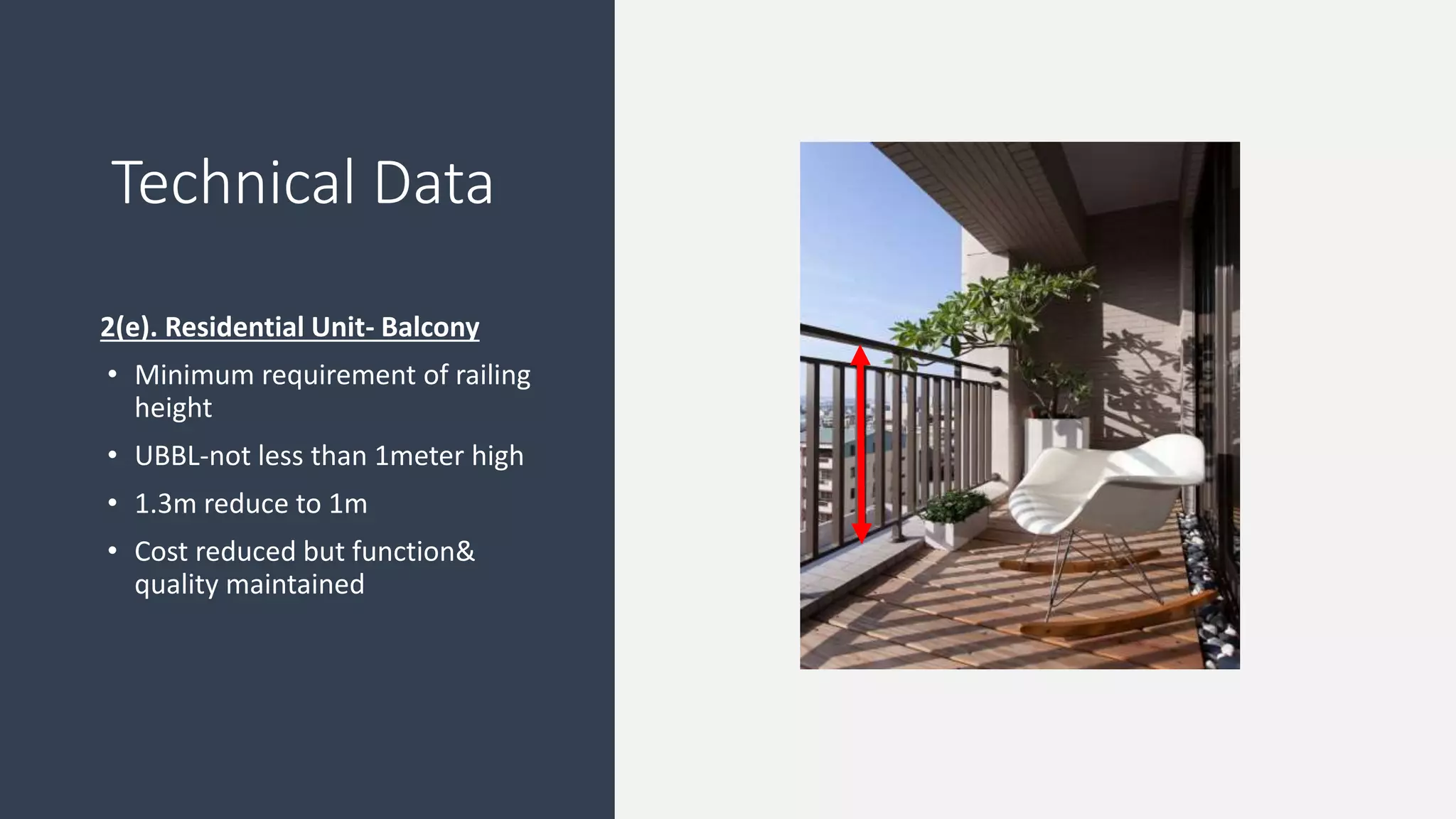
2(e). Residential Unit- Balcony
• Minimum requirement of railing
height
• UBBL-not less than 1meter high
• 1.3m reduce to 1m
• Cost reduced but function&
quality maintained
Technical Data
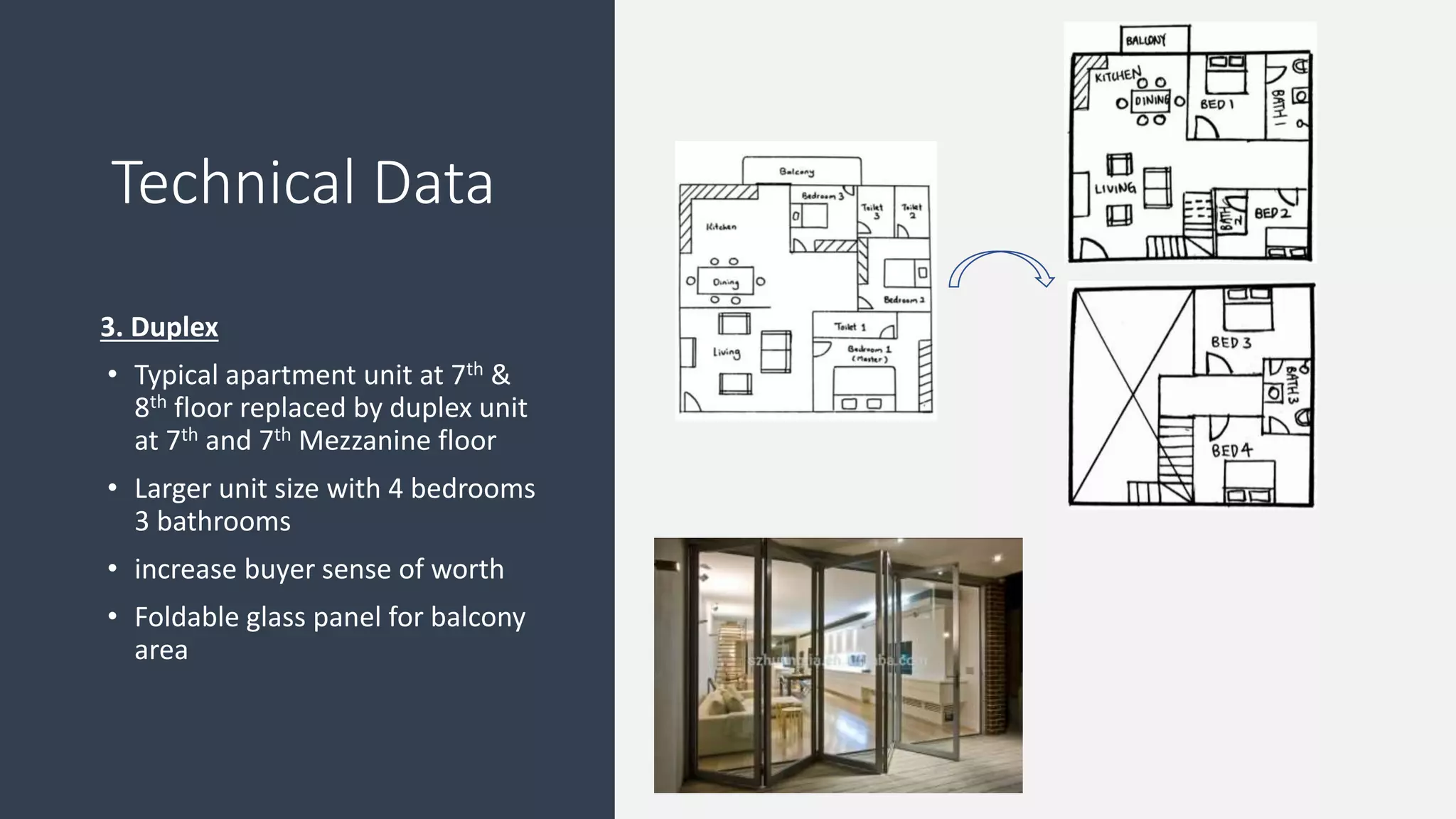
3. Duplex
• Typical apartment unit at 7th &
8th floor replaced by duplex unit
at 7th and 7th Mezzanine floor
• Larger unit size with 4 bedrooms
3 bathrooms
• increase buyer sense of worth
• Foldable glass panel for balcony
area
Technical Data
Technical Data
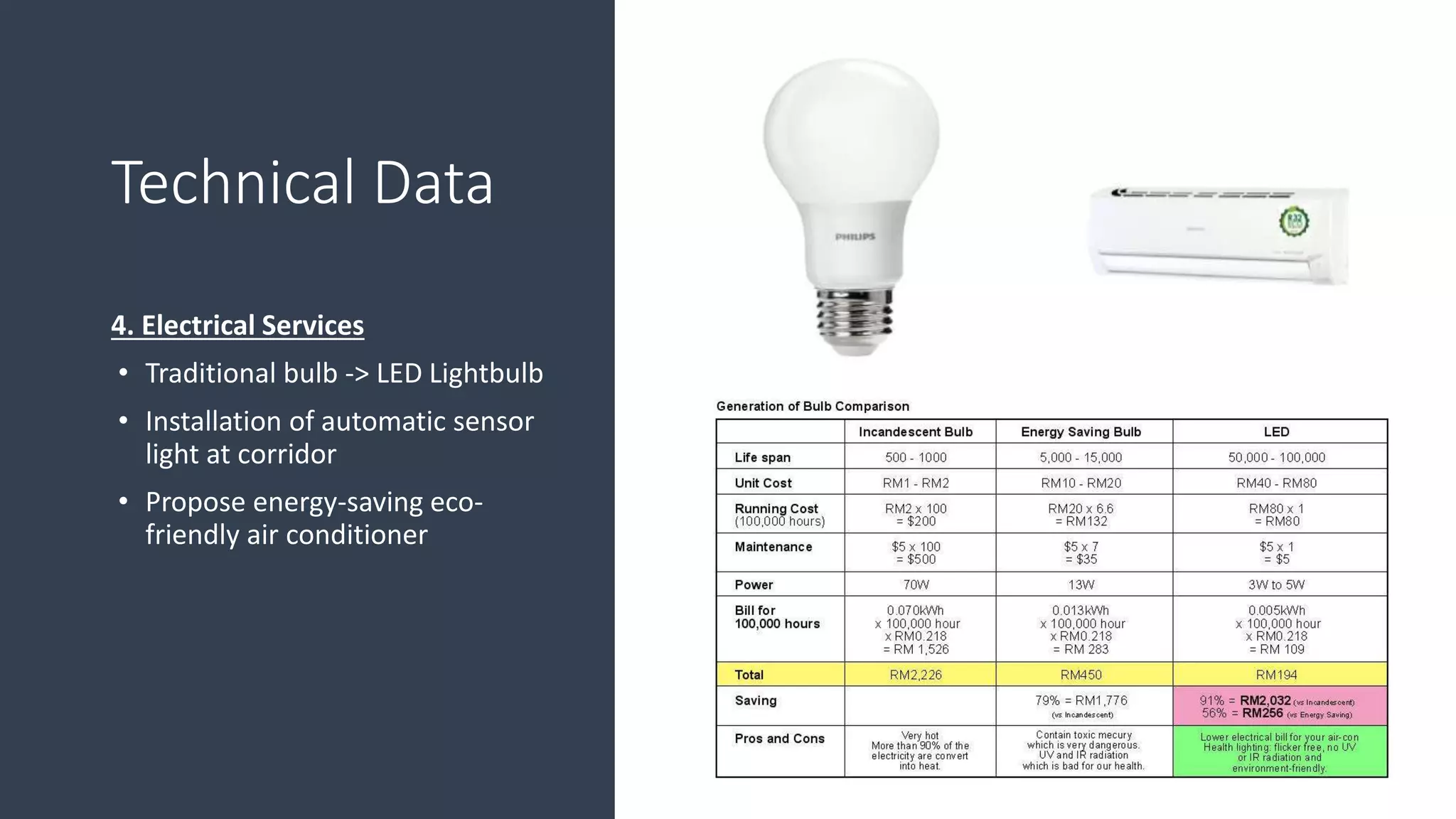
4. Electrical Services
• Traditional bulb -> LED Lightbulb
• Installation of automatic sensor
light at corridor
• Propose energy-saving eco-
friendly air conditioner
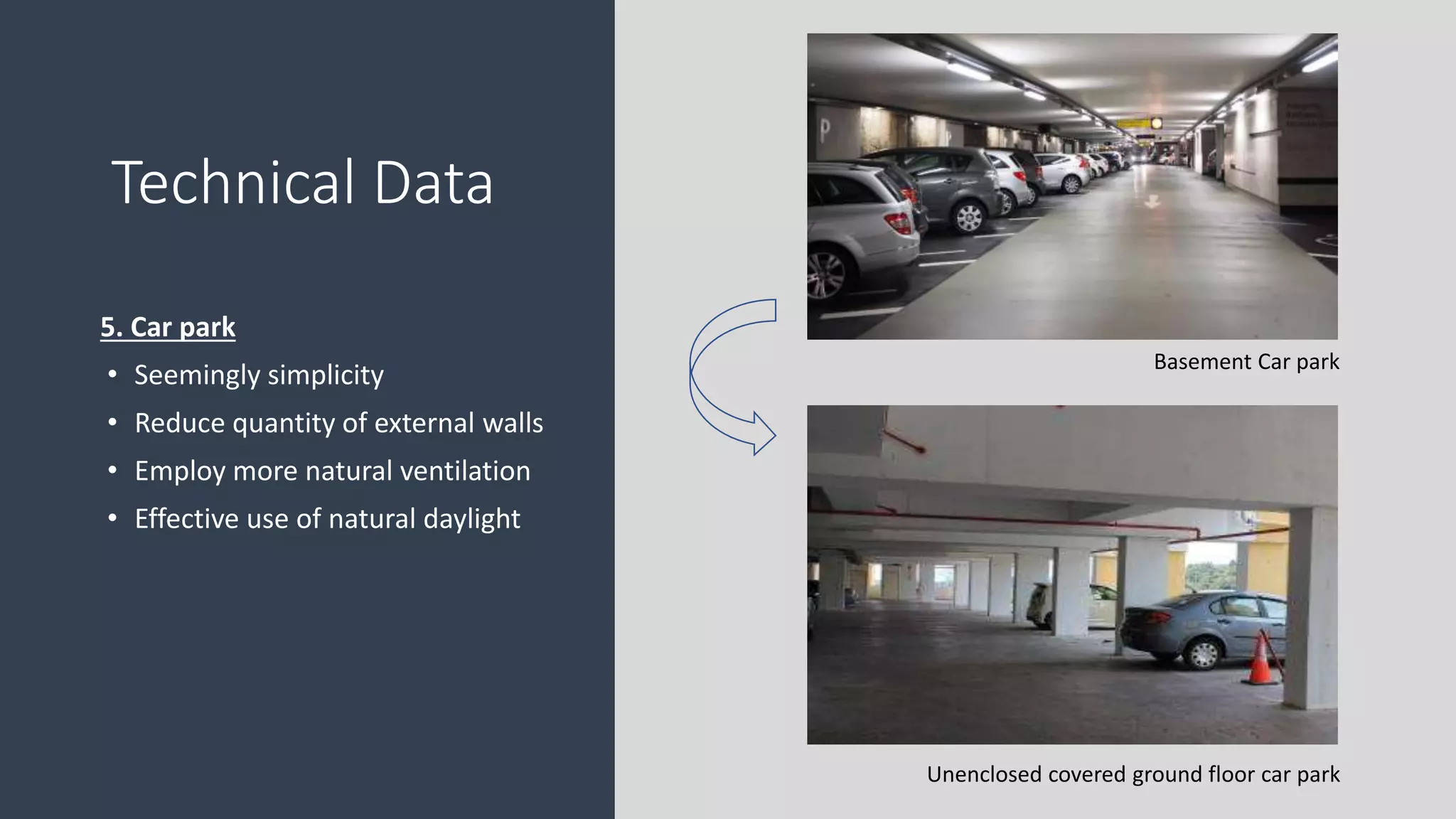
5. Car park
• Seemingly simplicity
• Reduce quantity of external walls
• Employ more natural ventilation
• Effective use of natural daylight
Technical Data
Basement Car park
Unenclosed covered ground floor car park
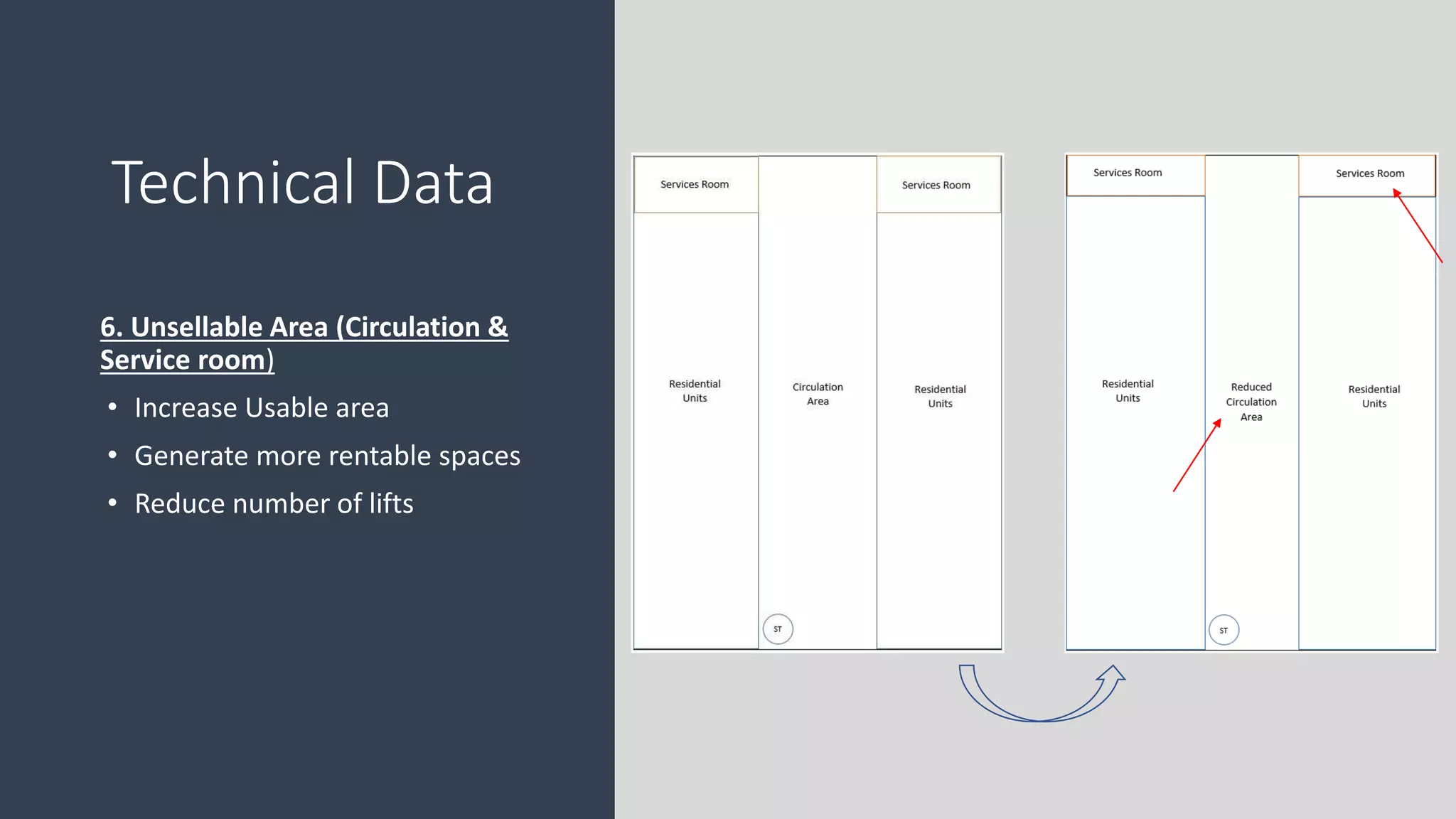
6. Unsellable Area (Circulation &
Service room)
• Increase Usable area
• Generate more rentable spaces
• Reduce number of lifts
Technical Data
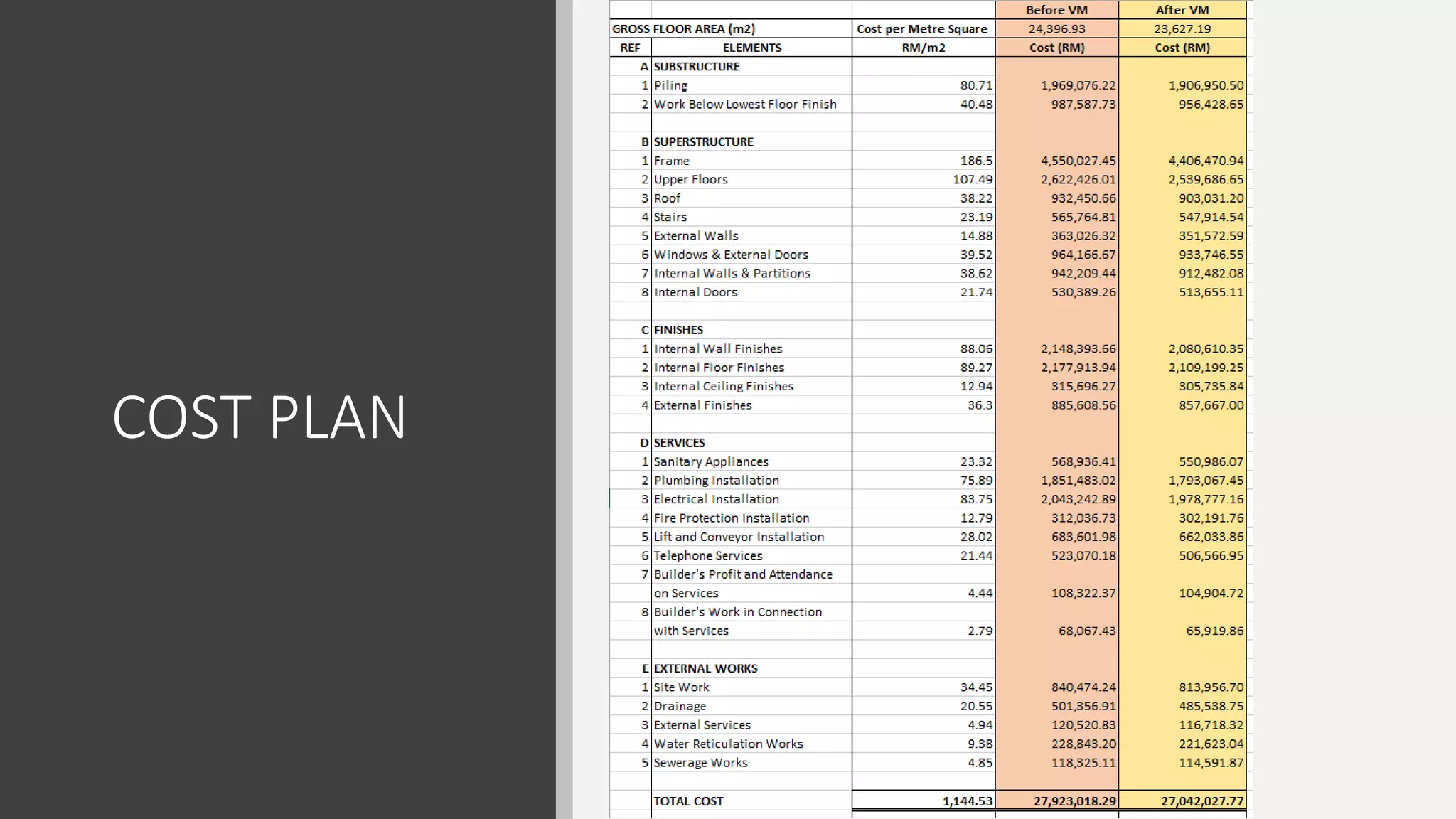
COST PLAN
COST PLAN
ACTION PLAN
ACTION PLAN
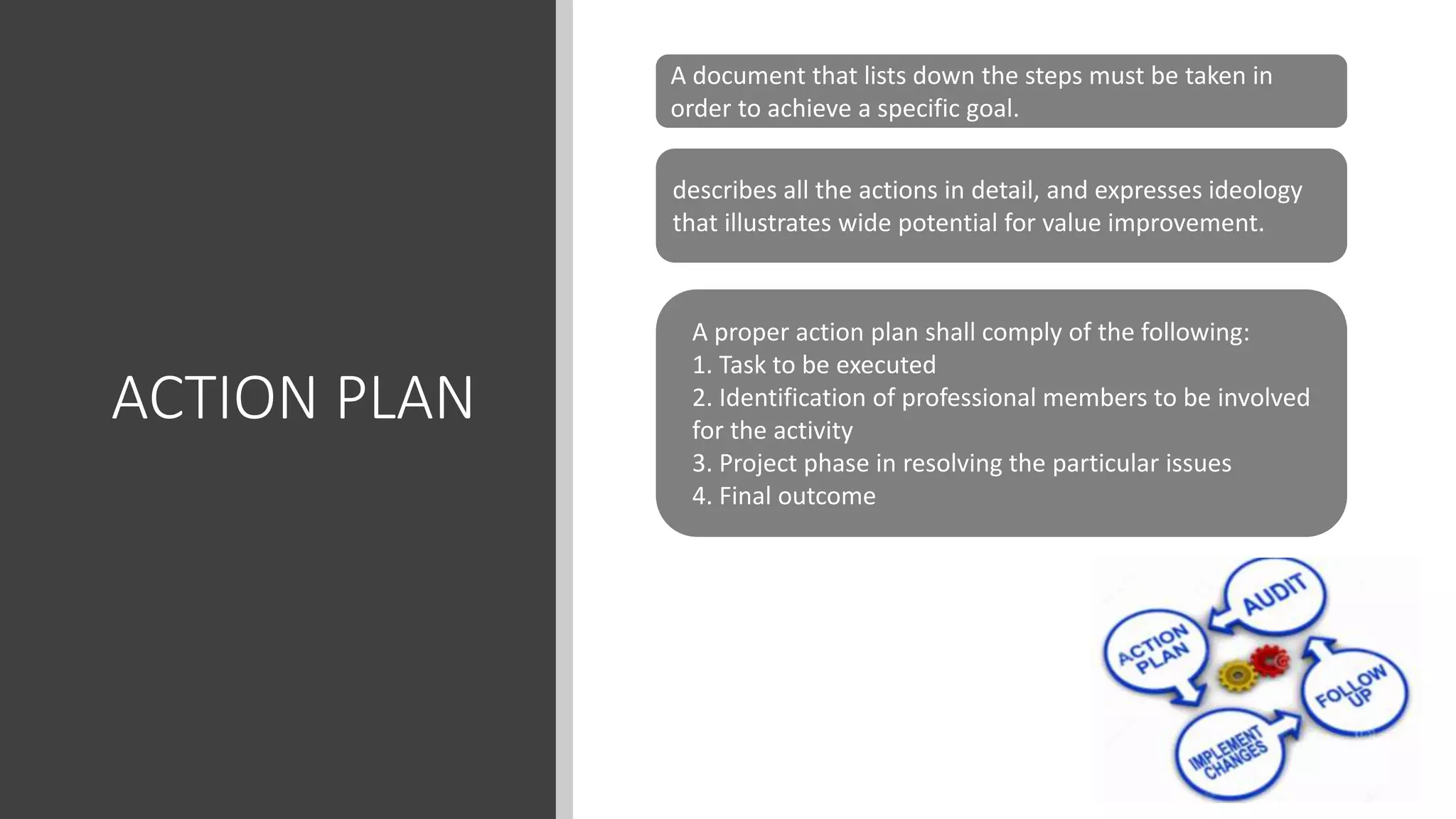
A document that lists down the steps must be taken in
order to achieve a specific goal.
describes all the actions in detail, and expresses ideology
that illustrates wide potential for value improvement.
A proper action plan shall comply of the following:
1. Task to be executed
2. Identification of professional members to be involved
for the activity
3. Project phase in resolving the particular issues
4. Final outcome
ACTION PLAN
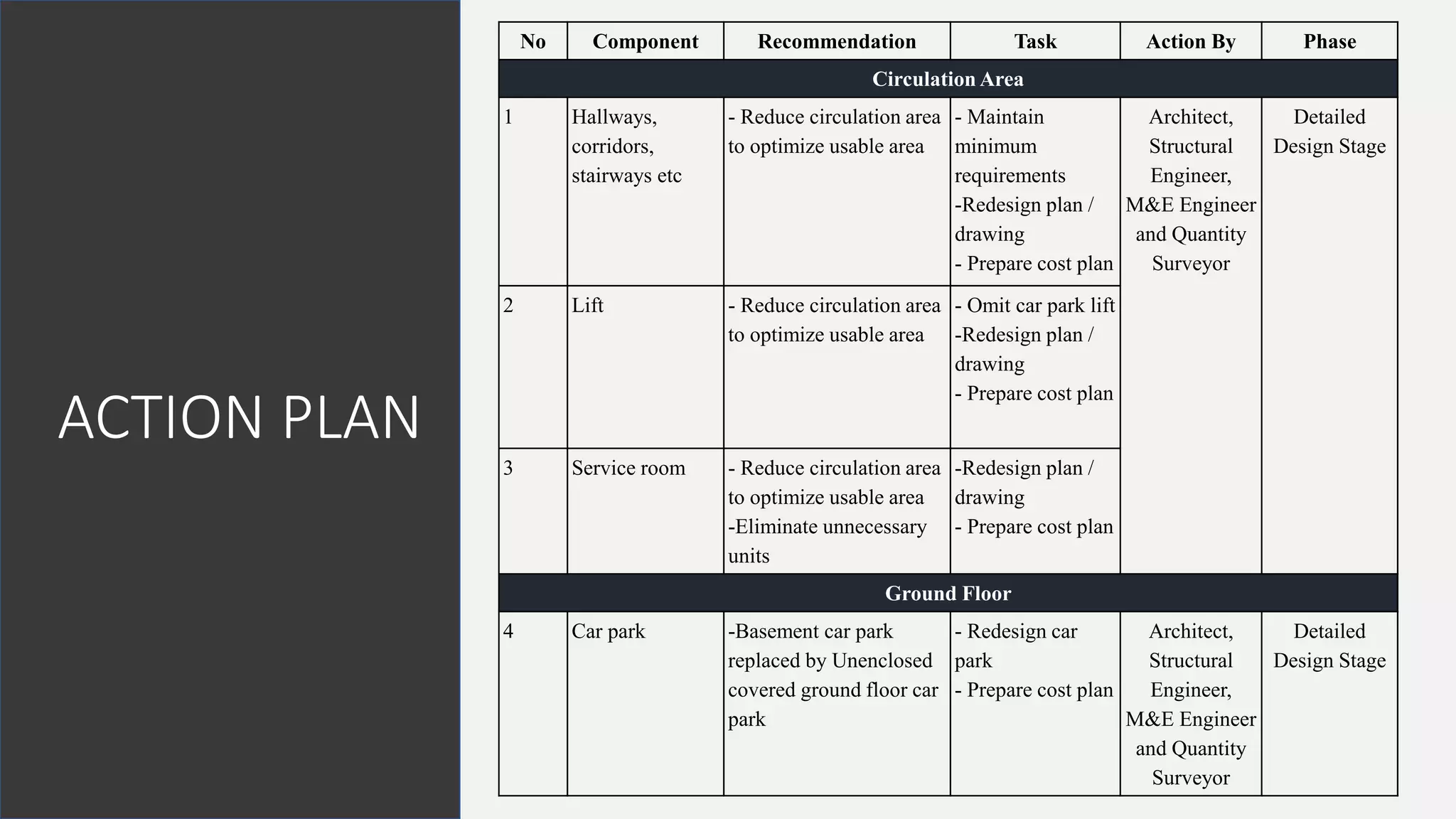
No Component Recommendation Task Action By Phase
Circulation Area
1 Hallways,
corridors,
stairways etc
- Reduce circulation area
to optimize usable area
- Maintain
minimum
requirements
-Redesign plan /
drawing
- Prepare cost plan
Architect,
Structural
Engineer,
M&E Engineer
and Quantity
Surveyor
Detailed
Design Stage
2 Lift - Reduce circulation area
to optimize usable area
- Omit car park lift
-Redesign plan /
drawing
- Prepare cost plan
3 Service room - Reduce circulation area
to optimize usable area
-Eliminate unnecessary
units
-Redesign plan /
drawing
- Prepare cost plan
Ground Floor
4 Car park -Basement car park
replaced by Unenclosed
covered ground floor car
park
- Redesign car
park
- Prepare cost plan
Architect,
Structural
Engineer,
M&E Engineer
and Quantity
Surveyor
Detailed
Design Stage
ACTION PLAN
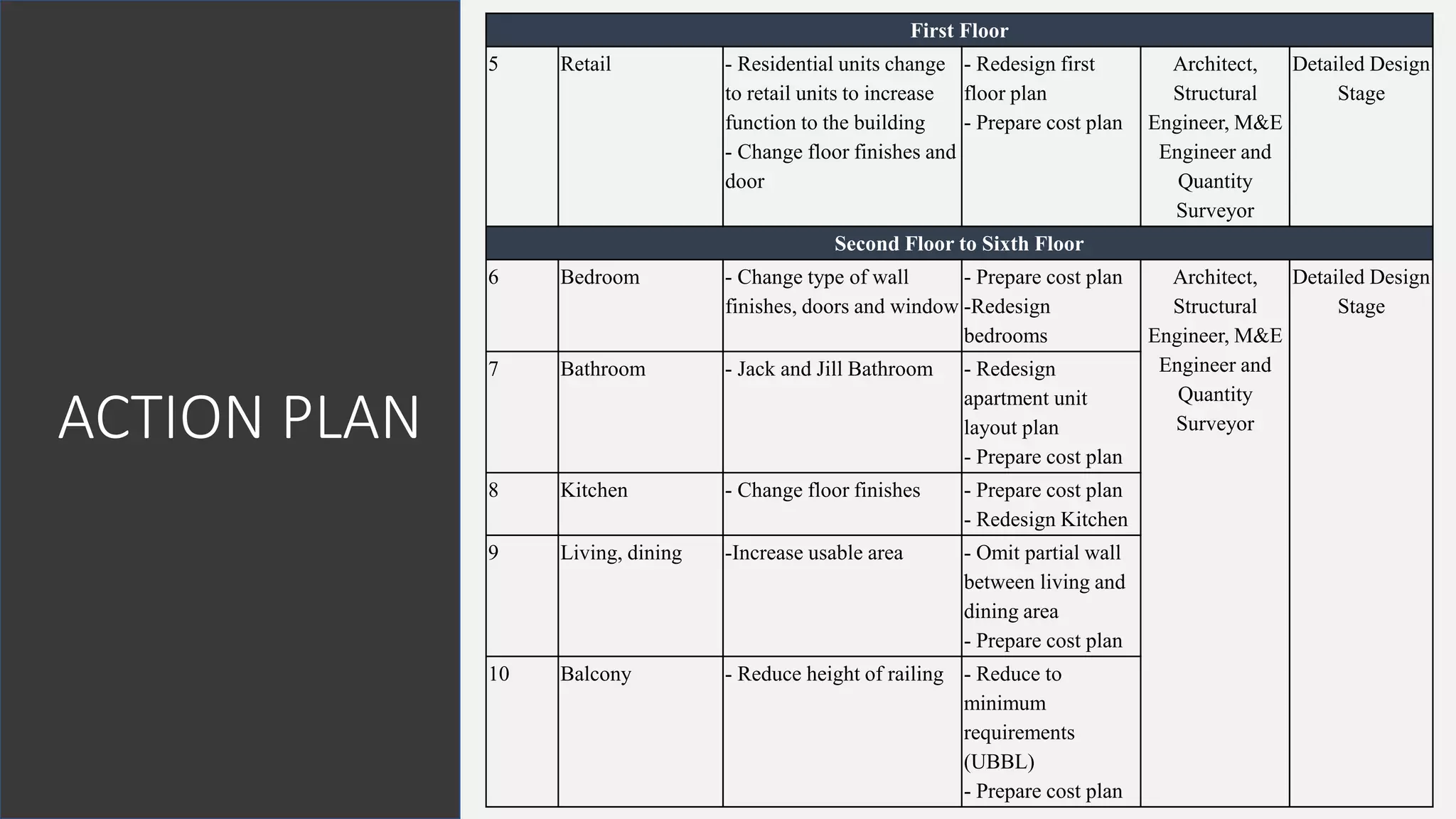
First Floor
5 Retail - Residential units change
to retail units to increase
function to the building
- Change floor finishes and
door
- Redesign first
floor plan
- Prepare cost plan
Architect,
Structural
Engineer, M&E
Engineer and
Quantity
Surveyor
Detailed Design
Stage
Second Floor to Sixth Floor
6 Bedroom - Change type of wall
finishes, doors and window
- Prepare cost plan
-Redesign
bedrooms
Architect,
Structural
Engineer, M&E
Engineer and
Quantity
Surveyor
Detailed Design
Stage
7 Bathroom - Jack and Jill Bathroom - Redesign
apartment unit
layout plan
- Prepare cost plan
8 Kitchen - Change floor finishes - Prepare cost plan
- Redesign Kitchen
9 Living, dining -Increase usable area - Omit partial wall
between living and
dining area
- Prepare cost plan
10 Balcony - Reduce height of railing - Reduce to
minimum
requirements
(UBBL)
- Prepare cost plan
ACTION PLAN
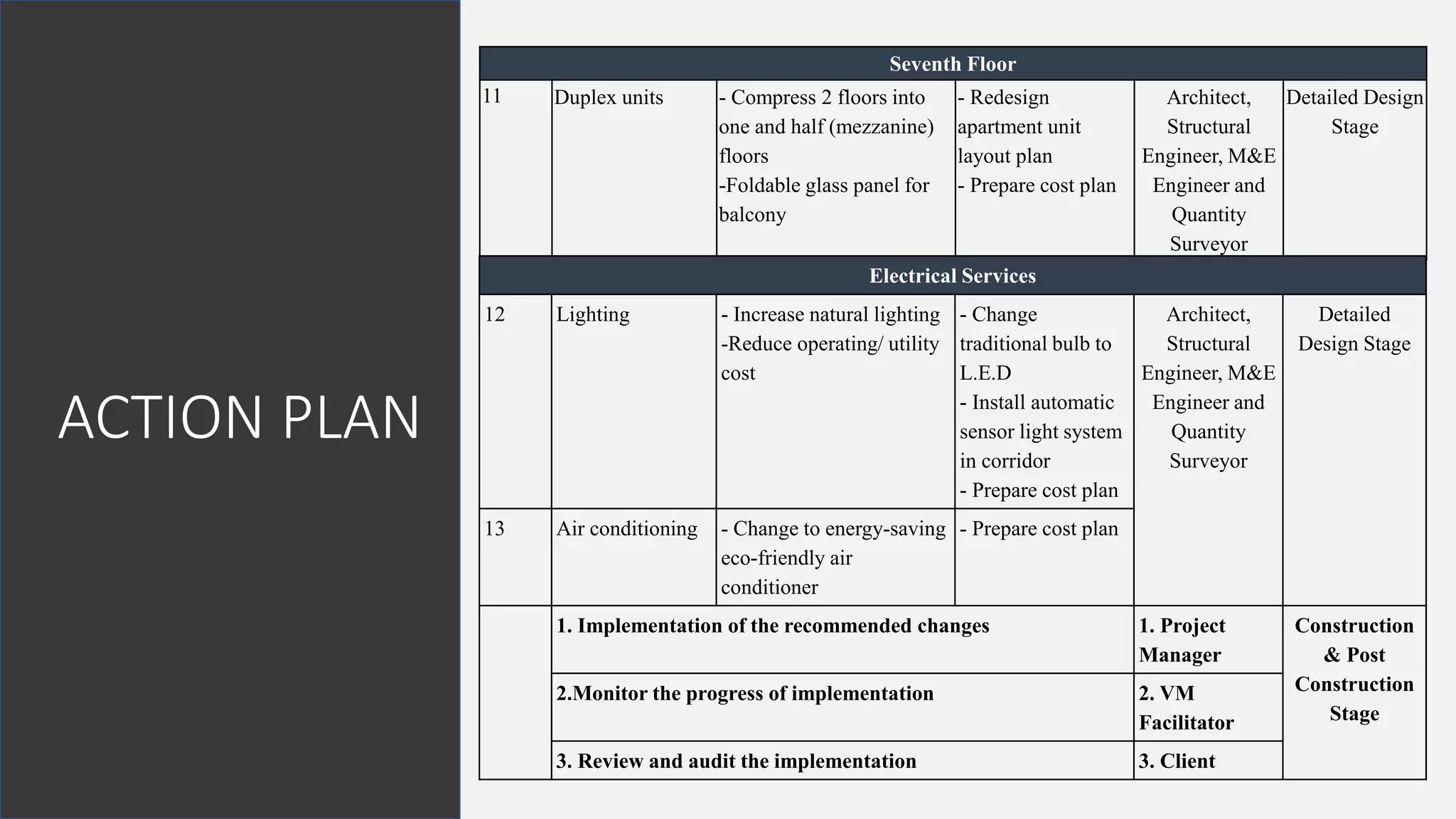
Seventh Floor
11 Duplex units - Compress 2 floors into
one and half (mezzanine)
floors
-Foldable glass panel for
balcony
- Redesign
apartment unit
layout plan
- Prepare cost plan
Architect,
Structural
Engineer, M&E
Engineer and
Quantity
Surveyor
Detailed Design
Stage
Electrical Services
12 Lighting - Increase natural lighting
-Reduce operating/ utility
cost
- Change
traditional bulb to
L.E.D
- Install automatic
sensor light system
in corridor
- Prepare cost plan
Architect,
Structural
Engineer, M&E
Engineer and
Quantity
Surveyor
Detailed
Design Stage
13 Air conditioning - Change to energy-saving
eco-friendly air
conditioner
- Prepare cost plan
1. Implementation of the recommended changes 1. Project
Manager
Construction
& Post
Construction
Stage
2.Monitor the progress of implementation 2. VM
Facilitator
3. Review and audit the implementation 3. Client
CONCLUSION
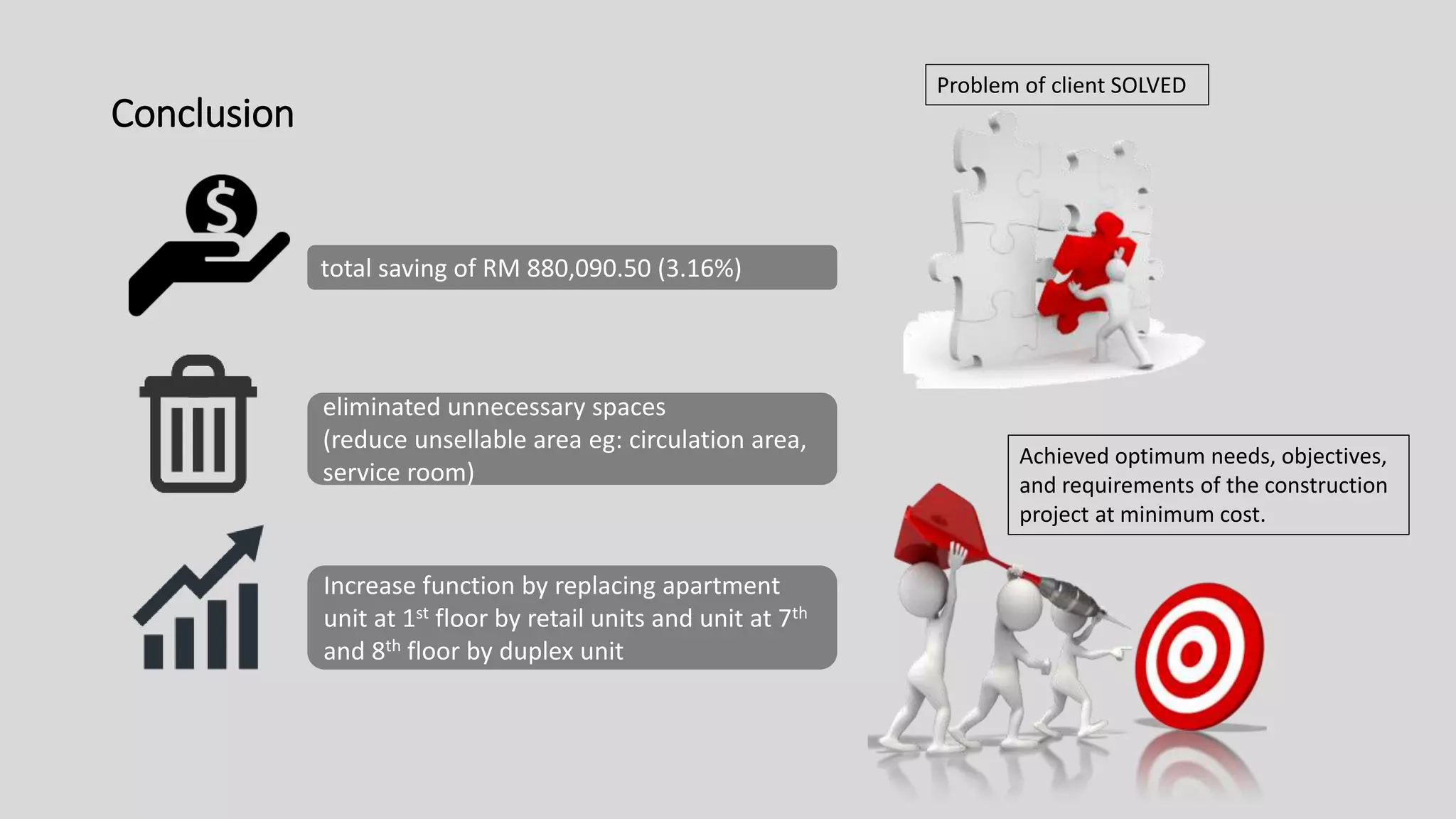
total saving of RM 880,090.50 (3.16%)
eliminated unnecessary spaces
(reduce unsellable area eg: circulation area,
service room)
Increase function by replacing apartment
unit at 1st floor by retail units and unit at 7th
and 8th floor by duplex unit
Conclusion
Problem of client SOLVED
Achieved optimum needs, objectives,
and requirements of the construction
project at minimum cost.

Value management presentation slides

  • 1.
    VALUE MANAGEMENT (QSB60203) Title: Case Study Report on Project implementing Value Management in the Construction Industry Group members Student ID Siong Jia Yii 0318239 Tan Jia Yi 0319476 Tan Kiah Chun 0324414 Lee Ren Jet 0319058 Ngah Yea Zhe 0323204 Yap Jia En 0319550 Yeo Dor Een 0316224
  • 2.
  • 3.
    INTRO TO VM Processwhich seeks to achieve value for money (Provide necessary function at lowest cost with required quality) A service which maximizes the functional development from concept to completion(compare & audit decision against value system determined by client) Norton (1995) describes VM as a systematic, multi- disciplinary effort directed towards analysing the functions of projects for the purpose of achieving the best value at the lowest overall life cycle costs. .
  • 4.
    PURPOSE OF VALUE MANAGEMENT i. VMpromotes systems thinking ii. Establishes customer’s needs iii. Value Management Change Proposal (VMCP) iv. Encourages staff development. v. Promotes partnering vi. Vehicle for change vii. identifies unnecessary costs, which then can be removed
  • 5.
    BRIEF DESCRIPTION OF PROJECT  TranquilResidence is the proposed apartment building project implemented for the study.  The project is located at Subang Jaya, Petaling District, Selangor.  The development consists of eight storeys which are residential units from first to eighth floors and one storey car park at the basement.  All units are being provided with 3 bedrooms and 3 bathrooms.
  • 6.
  • 7.
    SUMMARY OF PROBLEM After theinitial design process has completed, it is checked and revised with a cost estimate carried out by consultants The outcome found that cost and performance of this project must be reviewed as there are a few competitors (similar residential building project) nearby Therefore, in order to attract buyers, selling price have to be decreased or/and function or performance of this project have to be increased. Value management is introduced during initial stage as it is a perfect timing to solve the project issues on construction costs or changes in design.
  • 8.
    VM TOOLS ANDTECHNIQUE Functional Approach, Priority Setting Matrix, Smart Value Tree
  • 9.
    PRIORITY SETTING MATRIX Client has manyconsideration on the selection of material Through this tool, client can rank their priority of choice based on cost, quality, time taken to complete and etcetera.
  • 10.
    MATRIX 1 – FLOOR FINISHES Cost Durability Cleanliness Easeof Installation Maintenance Fee Reliability of Supply Aesthetic Value
  • 11.
    A B A CB C A D B D C D A E B E C E D E A F B F C F D F E F A G B G C G D G E G F G A-Cost B-Durability F-Reliability of Supply G-Aesthetic Value C-Cleanliness E-Maintainence Fee D-Ease of Installation A B C D E F G 5 4 3 0 5 3 1 MATRIX 1 – FLOOR FINISHES (cont’d)
  • 12.
    A-Cost B-Durability C-Cleanliness D-EaseofInstallation E-MaintainenceFeeF-ReliabilityofSupply G-AestheticValue A B CD E F G Options 5 4 3 0 5 3 1 Total 1 4 4 2 2 2 4 5 16 12 0 10 6 4 5 1 1 4 4 4 1 25 4 3 0 20 12 1 1 5 5 2 1 2 5 5 20 15 0 5 6 5 2 1 2 5 3 3 3 10 4 6 0 15 9 3 2 2 2 2 3 3 3 10 8 6 0 15 9 3 4 2 3 5 4 5 20 8 9 0 20 15 0 Timber Tile Marble Cement Render Granite Carpet 72 53 65 56 47 51 MATRIX 1 – FLOOR FINISHES (cont’d) • Main Criteria:- • Cost • Maintenance Fee • Durability
  • 13.
    MATRIX 2 – WINDOW FRAME Cost Durability Weather- resistance Easeof Installation Maintenance Fee Reliability of Supply Aesthetic Value
  • 14.
    MATRIX 2 –WINDOW FRAME(cont’d) A B A C B C A D B D C D A E B E C E D E A F B F C F D F E F A G B G C G D G E G F G G-Aesthetic Value A-Cost B-Durability C-Weather-resistance D-Ease of Installation E-Maintainence Fee F-Reliability of Supply A B C D E F G 5 4 5 0 4 2 1
  • 15.
    A-Cost B-Durability C-WeatherResistant D-EaseofInstallation E-MaintainenceFeeF-ReliabilityofSupply G-AestheticValue A B CD E F G Options 5 4 5 0 4 2 1 Total 1 4 2 2 4 2 4 5 16 10 0 16 4 4 5 2 2 4 5 4 2 25 8 10 0 20 8 2 2 4 4 3 4 3 4 10 16 20 0 16 6 4 3 4 4 3 5 3 3 15 16 20 0 20 6 3 Fiberglass 80 Wooden 55 Vinyl (PVC) 73 Aluminium 72 MATRIX 2 – WINDOW FRAME (cont’d) • Main Criteria:- • Cost • Weather-resistance • Durability • Maintenance Fee
  • 16.
    SMART VALUE TREE Establishand deliver the needs of client. 1 A weightage will be placed for each of the objective. 2 Client will rate the objective based on their importance. 3
  • 17.
    Level 0 Level1 Project Objectives Sub-objectives Provide retail at 1st floor Create multi-functional space Provide natural ventilation at carpark level Install energy-saving lightings and services Provide duplex housing at 7th floor Installation of Jack and Jill bathroom Comply with health and safety Optimise usable space Encourage interaction Minimise operating cost Construct a modern apartment Level 2 Attributes 0.30 0.28 0.20 0.22 0.38 0.62 0.46 0.54 0.56 0.44 1.00 1.00 1.00 1.00 0.18 0.16 0.24 0.12 0.20 0.10 1.00 SMART VALUE TREE- APARTMENT • Main concern:- • Minimising of operational cost • Energy saving electrical services • Optimise usable space • Installation of Jack and Jill Bathroom • Convert 7th and 8th level into duplex housing
  • 18.
    FUNCTIONAL APPROACH Step 1: Investigatefunction of total system Step 2: Investigate the function of system components Step 3: Break the system down into quantifiable parts Step 4: Consider what each part does Step 5: Place a “worth” on each part Step 6: Evaluate and make comparisons
  • 19.
    Functional Approach Step 1:Investigate function of total system Step 2: Investigate the function of system components Item Building area/ components Function a Car park Area for parking vehicles b Horizontal Circulation eg: Corridor/hallways/ stairways Space for people to move around c Vertical Circulation- Lift, stairs Space for people to move around vertically d Residential unit Accommodate residents e Service room Area provided for services Main function =accommodate users/residents defines function of the project Identify function of each building area/ component
  • 20.
    Functional Approach Step 3:Break the system down into quantifiable parts Floor Area (m2) to quantify building area Item Building area/ components Floor Area (m2) a Car park 3535 b Horizontal Circulation eg: Corridor/hallways/ stairways 4241 c Vertical Circulation- Lift, stairs 490 d Residential unit 15733 e Service room 398 TOTAL 24397 m2
  • 21.
    Functional Approach Step 4:Consider what each part does Determine function of each area by using two words description which is active verb + measurable noun Item Building area/ components Active VERB Measurable NOUN Type of function a Car park Provide parking Supporting Function b Horizontal Circulation - Corridor/hallways/ stairways Provide Circulation Required Secondary Function c Vertical Circulation- Lift Provide Circulation Required Secondary Function d Residential unit Accommodate residents Basic Function e Service room Facilitate services Supporting Function
  • 22.
    Functional Approach Step 5:Place a “worth” on each part Worth is calculated by multiplying floor area (m2) with cost/m2. Item Building area/ components Floor Area (m2) RM/m2 RM a Car park 3535 1110 3,924,000.00 b Horizontal Circulation e.g: Corridor/hallways/stairways 4241 1117 4,737,000.00 c Vertical Circulation- Lift, stairs 490 63 31,000.00 d Residential unit 15733 1215 19,116,000.00 e Service room 398 290 115,000.00 TOTAL 24397 m2 27,923,000.00
  • 23.
    Functional Approach Step 6:Evaluate and make comparisons Generate ideas & alternative ways to perform function. Evaluation will be then made. Item Idea Remark Reasons a Basement Car park replaced by Unenclosed covered ground floor car park Evaluate -Basement requires extra cost due to deeper foundation, greater earthwork and ventilation system -Cost on wall can be reduced if using unenclosed car park. b Reduce circulation area to minimum requirement Eliminate -Optimize sellable/ usable area c 3 lifts reduced to 2 lifts Eliminate -2 lifts are sufficient for 8 storeys apartment -Reduce cost for lift & conveyor installment fee d Apartment unit at first floor replaced by retail & 7th and 8th floor replaced by duplex unit at 7th and 7th mezzanine floor. Evaluate -Retail unit has simpler layout (eg: less partition wall) compared to apartment unit. Also, it can increase job opportunities & more convenient for residents. (increase function) -Duplex unit may increase buyer sense of worth since some people prefer staying in larger size residential unit. e Reduce area of service room Eliminate -Optimize sellable/ usable area
  • 24.
    SKETCHES SHOWING PROPOSED CHANGESOF DESIGN Changes in Typical Apartment unit floor plan, Retail, Duplex
  • 25.
    Changes in TypicalApartment Unit Floor Plan (2nd to 6th floor) Before Value Management After Value Management Main changes that can be seen from the layout  All the changes in the unit will be further discuss later.
  • 26.
    Changes from TypicalApartment unit to Retail (1st floor) Before Value Management After Value Management Typical apartment unit Retail unit with simpler layout & less rooms/ walls
  • 27.
    Changes from TypicalApartment unit (7th & 8th floor) to Duplex unit(7th & 7 Mezzanine floor) Before Value Management After Value Management Typical apartment unit Duplex unit (lower at left & upper at right) which may increase buyer sense of worth since some buyers prefer larger unit size.
  • 28.
  • 29.
    Technical Data SupportingSelection of Alternatives Proposed changes during the evaluation stage are supported with the standard and guidelines listed in Uniform Building by Law (UBBL). Clause Description 14 Plans of alterations 15 Specifications 39 Natural lighting and ventilation 41 Mechanical ventilation and air-conditioning 42 Minimum area of rooms in residential buildings 43 Minimum dimensions of latrines, water-closets and bathrooms 44 Height of rooms in residential buildings 53 Building materials 55 Dead and imposed loads 57 Weight of partitions 59 Imposed floor loads 62 Reduction in total imposed floor loads 72 Basement walls and floors 116 Accessible flat roofs, balconies, etc 124 Lifts
  • 30.
    1. Retail • Simplerlayout design • Increase function(create job opportunities &convenient for residents) • Floor tiling replaced by laminated flooring which is cheaper, easier maintenance/cleaning/replacement • Doors & windows at entrance replaced by metal rolling which has same function with lower cost & less maintenance & easier installation/construction Technical Data Apartment unit at 1st floor Retail unit at 1st floor Floor tiling Laminated flooring Door & windows at entrance Metal rolling
  • 31.
    2(a). Residential Unit-Bedroom • Wallpaper replaced by emulsion paint which is cheaper, more durable, easier application • Glass window replaced by polycarbonate window which is tough and durable due to higher heat and impact resistance • Imported door replaced by locally made wooden door which perform same function with lower cost Technical Data Wallpaper Emulsion paint Polycarbonate window Locally made wooden door
  • 32.
    2(b). Residential Unit-Bathroom • Jack and Jill bathroom (3 bathrooms to 2 bathrooms) • 2 bedrooms share 1 bathroom • Reduce cost (wall) while maintain function Technical Data
  • 33.
    2(c). Residential Unit-kitchen • Reduce risk of slip & falls Technical Data Gloss tiles with slippery nature Non-slip matt tiles
  • 34.
    2(d). Residential Unit-Living,Dining • Partial wall between living and dining area omitted • Save cost • Provide more usable spaces Technical Data
  • 35.
    2(e). Residential Unit-Balcony • Minimum requirement of railing height • UBBL-not less than 1meter high • 1.3m reduce to 1m • Cost reduced but function& quality maintained Technical Data
  • 36.
    3. Duplex • Typicalapartment unit at 7th & 8th floor replaced by duplex unit at 7th and 7th Mezzanine floor • Larger unit size with 4 bedrooms 3 bathrooms • increase buyer sense of worth • Foldable glass panel for balcony area Technical Data
  • 37.
    Technical Data 4. ElectricalServices • Traditional bulb -> LED Lightbulb • Installation of automatic sensor light at corridor • Propose energy-saving eco- friendly air conditioner
  • 38.
    5. Car park •Seemingly simplicity • Reduce quantity of external walls • Employ more natural ventilation • Effective use of natural daylight Technical Data Basement Car park Unenclosed covered ground floor car park
  • 39.
    6. Unsellable Area(Circulation & Service room) • Increase Usable area • Generate more rentable spaces • Reduce number of lifts Technical Data
  • 40.
  • 41.
  • 42.
  • 43.
    ACTION PLAN A documentthat lists down the steps must be taken in order to achieve a specific goal. describes all the actions in detail, and expresses ideology that illustrates wide potential for value improvement. A proper action plan shall comply of the following: 1. Task to be executed 2. Identification of professional members to be involved for the activity 3. Project phase in resolving the particular issues 4. Final outcome
  • 44.
    ACTION PLAN No ComponentRecommendation Task Action By Phase Circulation Area 1 Hallways, corridors, stairways etc - Reduce circulation area to optimize usable area - Maintain minimum requirements -Redesign plan / drawing - Prepare cost plan Architect, Structural Engineer, M&E Engineer and Quantity Surveyor Detailed Design Stage 2 Lift - Reduce circulation area to optimize usable area - Omit car park lift -Redesign plan / drawing - Prepare cost plan 3 Service room - Reduce circulation area to optimize usable area -Eliminate unnecessary units -Redesign plan / drawing - Prepare cost plan Ground Floor 4 Car park -Basement car park replaced by Unenclosed covered ground floor car park - Redesign car park - Prepare cost plan Architect, Structural Engineer, M&E Engineer and Quantity Surveyor Detailed Design Stage
  • 45.
    ACTION PLAN First Floor 5Retail - Residential units change to retail units to increase function to the building - Change floor finishes and door - Redesign first floor plan - Prepare cost plan Architect, Structural Engineer, M&E Engineer and Quantity Surveyor Detailed Design Stage Second Floor to Sixth Floor 6 Bedroom - Change type of wall finishes, doors and window - Prepare cost plan -Redesign bedrooms Architect, Structural Engineer, M&E Engineer and Quantity Surveyor Detailed Design Stage 7 Bathroom - Jack and Jill Bathroom - Redesign apartment unit layout plan - Prepare cost plan 8 Kitchen - Change floor finishes - Prepare cost plan - Redesign Kitchen 9 Living, dining -Increase usable area - Omit partial wall between living and dining area - Prepare cost plan 10 Balcony - Reduce height of railing - Reduce to minimum requirements (UBBL) - Prepare cost plan
  • 46.
    ACTION PLAN Seventh Floor 11Duplex units - Compress 2 floors into one and half (mezzanine) floors -Foldable glass panel for balcony - Redesign apartment unit layout plan - Prepare cost plan Architect, Structural Engineer, M&E Engineer and Quantity Surveyor Detailed Design Stage Electrical Services 12 Lighting - Increase natural lighting -Reduce operating/ utility cost - Change traditional bulb to L.E.D - Install automatic sensor light system in corridor - Prepare cost plan Architect, Structural Engineer, M&E Engineer and Quantity Surveyor Detailed Design Stage 13 Air conditioning - Change to energy-saving eco-friendly air conditioner - Prepare cost plan 1. Implementation of the recommended changes 1. Project Manager Construction & Post Construction Stage 2.Monitor the progress of implementation 2. VM Facilitator 3. Review and audit the implementation 3. Client
  • 47.
  • 48.
    total saving ofRM 880,090.50 (3.16%) eliminated unnecessary spaces (reduce unsellable area eg: circulation area, service room) Increase function by replacing apartment unit at 1st floor by retail units and unit at 7th and 8th floor by duplex unit Conclusion Problem of client SOLVED Achieved optimum needs, objectives, and requirements of the construction project at minimum cost.

Editor's Notes

  • #4 Read underlined part enough gua
  • #5 Brief through
  • #19 Read title only
  • #26 Brief through
  • #30 “These are the relevant UBBL clauses …” don’t need read one by one
  • #45 Read heading
  • #46 Read heading
  • #47 Read heading