Construction Management Chair
COTM 5133
COST ENGINEERING
Chapter 5
Introduction toValue Engineering
Minweyelt Ejigu
December 2017/2018
Outline
Outline
Introduction to Value Engineering
1. Value Engineering, VE
2. Stage of Value Engineering
application
2
1.Value Engineering, VE
 Value Engineering may be defined as ‘the conscious
systematic application of a set of techniques that identify
needed functions, establish values for these functions and
develop alternatives to perform these functions for
minimum cost.’
 Value Engineering as a creative, organized approach that
can be applied to the different systems/components of the
project, aiming to optimize cost without sacrificing
quality.
 However it is about taking a wider view and looking at
the selection of materials, plant, equipment and processes
to see if a more cost-effective solution exists that will
achieve the same project objectives.
3
1.Value Engineering, VE
Value Engineering is concerned with
maximizing value, not just reducing costs, it
seeks optimum solutions to remove unnecessary
waste and reduce life cycle costs while
improving function, quality and sustainability.
Unnecessary waste might include; unnecessary
cost, materials, resources, energy, water, time,
plant, lead-in times, transportation, maintenance,
replacement and disposal activity.
4
1. Value Engineering, VE
Purpose of VE
 Value Engineering; the most sound is ‘an
evaluation of alternative construction materials
and systems to save money without major effect
on program, maintenance, or appearance, chosen
on a priority basis’.
 In general, Value Engineering is used to:
 Determine the best design alternatives for Projects,
 Reduce cost
 Improve quality, increase reliability and availability, and
customer satisfaction,
 Improve organizational performance,
 Improve schedule and reduce risk, and
 Identify problems and develop recommended solutions.
5
1. Value Engineering, VE
 When presenting value engineering options to a client, our team
categorizes each option according to our key considerations during
value engineering:
 Cost Reduction – A less expensive alternative to a specified product or
system, which may or may not include a difference in quality;
 Value Added – A higher quality product that may or may not carry a
higher price but will bring added value to the project;
 Life-Cycle Analysis – During our review of products and systems, we
typically identify options that will allow us to strike the proper balance
between initial construction cost and long-term operational costs;
 Maintainability – We review the building from the perspective of the
owner’s maintenance staff and recommend products that can produce
long-term savings through reduced maintenance costs.
6
2. Stages of VE Application
Value Engineering may be implemented
throughout the different project phases,
starting from the conceptual planning
phase until to the construction phase.
However, Value Engineering applied at
the early phases of a project, especially
during the design phase, will realize the
greatest benefit.
7
2. Stages of VE Application
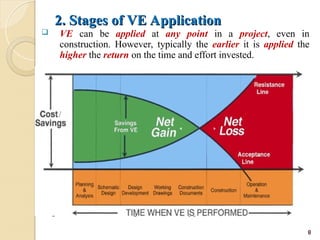
 VE can be applied at any point in a project, even in
construction. However, typically the earlier it is applied the
higher the return on the time and effort invested.
Fig 2.1 Potential Savings from VE Application
8
2. Stages of VE Application
Planning
 At the Planning stage of development, there are
additional benefits to be derived from a VE Workshop.
 An independent team can:
 Review the program;
 Perform a functional analysis of the facility;
 Obtain the owner/users definition of value;
 Define the key criteria and objectives for the project;
 Verify/validate the proposed program;
 Review master plan utility options (e.g. Central Utility
Plant versus individual systems);
 Offer alternative solutions (square meters needs per
function, adjacency solutions, etc.); and
 Verify if the budget is adequate for the developed
program.
9
2. Stages of VE Application
Design
 This is the stage that most VE participants are used to
becoming involved, when the design has at least made it
to the schematic stage. The primary tool available to the
VE team is the Workshop - typically a 40-hour session
(or less for smaller or less complex projects).
 The Workshop is an opportunity to bring the design team
and client together to review the proposed design
solutions, the cost estimate, and proposed
implementation schedule and approach, with a view to
implementing the best value for the money.
 The definition of what is good value on any particular
project will change from client to client and project to
project.
10
2. Stages of VE Application
Construction
 During this phase value engineering is still possible through
the use of Value Engineering Change Proposals (VECP).
 Contractors can be provided monetary incentives to propose
solutions that offer enhanced value to the owner, and share
in the financial benefits realized.
 Clearly the owner must consider contractor-generated
proposals very carefully, from a life-cycle and liability
perspective.
 The A/E team must be brought in to the decision-making
process to agree to the proposed change as not having any
negative impact on the overall design and building function.
 The evaluation of a VECP is treated similarly to any change
order during construction, with issues such as schedule and
productivity impacts being considered along with the
perceived cost savings generated.
11
THANK YOU!
12

those Value Engineering for construction projects

  • 1.
    Construction Management Chair ConstructionManagement Chair COTM 5133 COST ENGINEERING Chapter 5 Introduction toValue Engineering Minweyelt Ejigu December 2017/2018
  • 2.
    Outline Outline Introduction to ValueEngineering 1. Value Engineering, VE 2. Stage of Value Engineering application 2
  • 3.
    1.Value Engineering, VE 1.ValueEngineering, VE  Value Engineering may be defined as ‘the conscious systematic application of a set of techniques that identify needed functions, establish values for these functions and develop alternatives to perform these functions for minimum cost.’  Value Engineering as a creative, organized approach that can be applied to the different systems/components of the project, aiming to optimize cost without sacrificing quality.  However it is about taking a wider view and looking at the selection of materials, plant, equipment and processes to see if a more cost-effective solution exists that will achieve the same project objectives. 3
  • 4.
    1.Value Engineering, VE 1.ValueEngineering, VE Value Engineering is concerned with maximizing value, not just reducing costs, it seeks optimum solutions to remove unnecessary waste and reduce life cycle costs while improving function, quality and sustainability. Unnecessary waste might include; unnecessary cost, materials, resources, energy, water, time, plant, lead-in times, transportation, maintenance, replacement and disposal activity. 4
  • 5.
    1. Value Engineering,VE 1. Value Engineering, VE Purpose of VE  Value Engineering; the most sound is ‘an evaluation of alternative construction materials and systems to save money without major effect on program, maintenance, or appearance, chosen on a priority basis’.  In general, Value Engineering is used to:  Determine the best design alternatives for Projects,  Reduce cost  Improve quality, increase reliability and availability, and customer satisfaction,  Improve organizational performance,  Improve schedule and reduce risk, and  Identify problems and develop recommended solutions. 5
  • 6.
    1. Value Engineering,VE 1. Value Engineering, VE  When presenting value engineering options to a client, our team categorizes each option according to our key considerations during value engineering:  Cost Reduction – A less expensive alternative to a specified product or system, which may or may not include a difference in quality;  Value Added – A higher quality product that may or may not carry a higher price but will bring added value to the project;  Life-Cycle Analysis – During our review of products and systems, we typically identify options that will allow us to strike the proper balance between initial construction cost and long-term operational costs;  Maintainability – We review the building from the perspective of the owner’s maintenance staff and recommend products that can produce long-term savings through reduced maintenance costs. 6
  • 7.
    2. Stages ofVE Application 2. Stages of VE Application Value Engineering may be implemented throughout the different project phases, starting from the conceptual planning phase until to the construction phase. However, Value Engineering applied at the early phases of a project, especially during the design phase, will realize the greatest benefit. 7
  • 8.
    2. Stages ofVE Application 2. Stages of VE Application  VE can be applied at any point in a project, even in construction. However, typically the earlier it is applied the higher the return on the time and effort invested. Fig 2.1 Potential Savings from VE Application 8
  • 9.
    2. Stages ofVE Application 2. Stages of VE Application Planning  At the Planning stage of development, there are additional benefits to be derived from a VE Workshop.  An independent team can:  Review the program;  Perform a functional analysis of the facility;  Obtain the owner/users definition of value;  Define the key criteria and objectives for the project;  Verify/validate the proposed program;  Review master plan utility options (e.g. Central Utility Plant versus individual systems);  Offer alternative solutions (square meters needs per function, adjacency solutions, etc.); and  Verify if the budget is adequate for the developed program. 9
  • 10.
    2. Stages ofVE Application 2. Stages of VE Application Design  This is the stage that most VE participants are used to becoming involved, when the design has at least made it to the schematic stage. The primary tool available to the VE team is the Workshop - typically a 40-hour session (or less for smaller or less complex projects).  The Workshop is an opportunity to bring the design team and client together to review the proposed design solutions, the cost estimate, and proposed implementation schedule and approach, with a view to implementing the best value for the money.  The definition of what is good value on any particular project will change from client to client and project to project. 10
  • 11.
    2. Stages ofVE Application 2. Stages of VE Application Construction  During this phase value engineering is still possible through the use of Value Engineering Change Proposals (VECP).  Contractors can be provided monetary incentives to propose solutions that offer enhanced value to the owner, and share in the financial benefits realized.  Clearly the owner must consider contractor-generated proposals very carefully, from a life-cycle and liability perspective.  The A/E team must be brought in to the decision-making process to agree to the proposed change as not having any negative impact on the overall design and building function.  The evaluation of a VECP is treated similarly to any change order during construction, with issues such as schedule and productivity impacts being considered along with the perceived cost savings generated. 11
  • 12.