Value Addition And Processing
of Agriproducts: Opportunities
        and Challenges
                           BY:

                     Surabhi Mishra
Department of Biochemical Engineering and Food Technology,
                     H.B.T.I., Kanpur
SUMMARY
   Present scenario of agriculture in India
   Post harvest losses & the global picture
   Value- added agriculture
   Strategies for “value addition”
   Agri-business
   Subsectors of agri-business
   Emerging areas of agri-business
   Policy initiatives and taxation policies
   Supporting institutions
   Indian corporates in agri-business
   An example of corporate-farming: Harrisons Malayalam Ltd
   Present scenario problems
   Key strategies at national level
   Conclusions
•   Food production in the country is adequate but
    it is not accessible to all.
•   Inadequate income earned by about 25%
    population
•   High post harvest losses on farm and in the
    supply chain linking farmers to markets
    (estimated annual loss of Rs. 44,000 crore)
•   Inadequate livelihood opportunities in the
    production catchments and rural sector
•   High level of food wastage due to shortage of
    storage spaces
•   Mismatch between agri-exports and agri-
    imports
•   Huge quantities of under-utilized crop residues
    and processing by-products leading to loss of
    income and environmental sustainability
•   Low levels of agro-processing and value
    addition
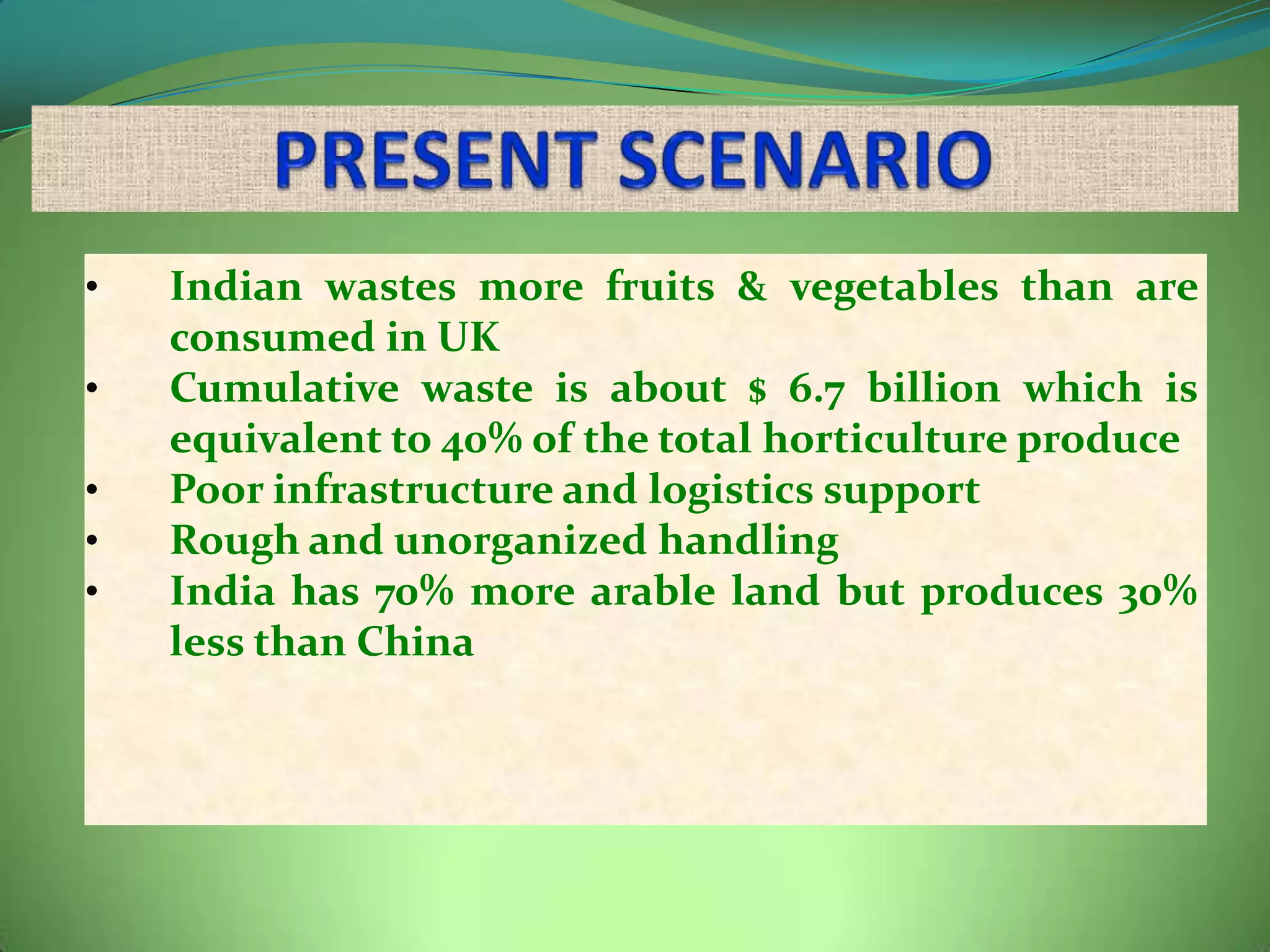
•   Indian wastes more fruits & vegetables than are
    consumed in UK
•   Cumulative waste is about $ 6.7 billion which is
    equivalent to 40% of the total horticulture produce
•   Poor infrastructure and logistics support
•   Rough and unorganized handling
•   India has 70% more arable land but produces 30%
    less than China
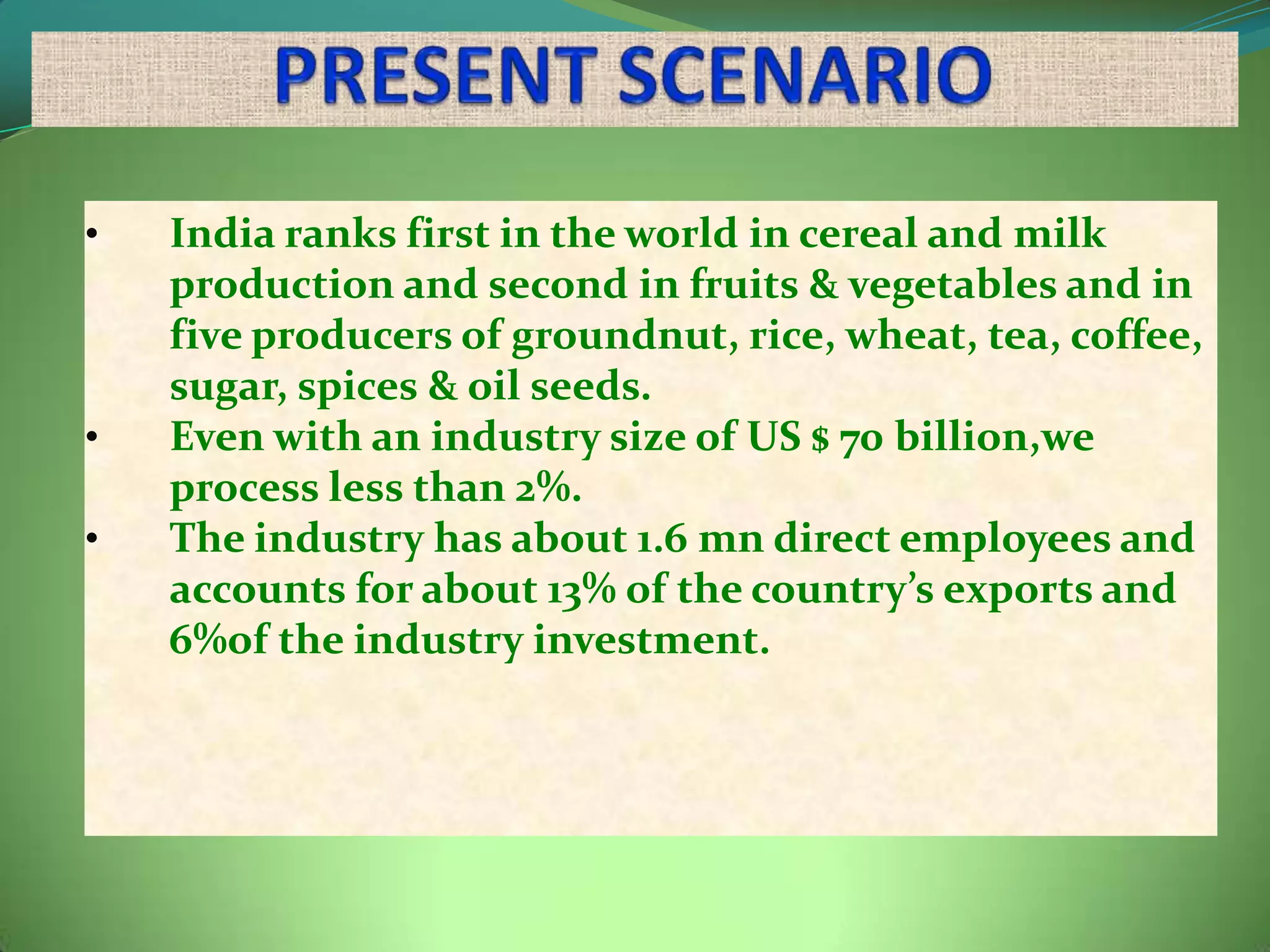
•   India ranks first in the world in cereal and milk
    production and second in fruits & vegetables and in
    five producers of groundnut, rice, wheat, tea, coffee,
    sugar, spices & oil seeds.
•   Even with an industry size of US $ 70 billion,we
    process less than 2%.
•   The industry has about 1.6 mn direct employees and
    accounts for about 13% of the country’s exports and
    6%of the industry investment.
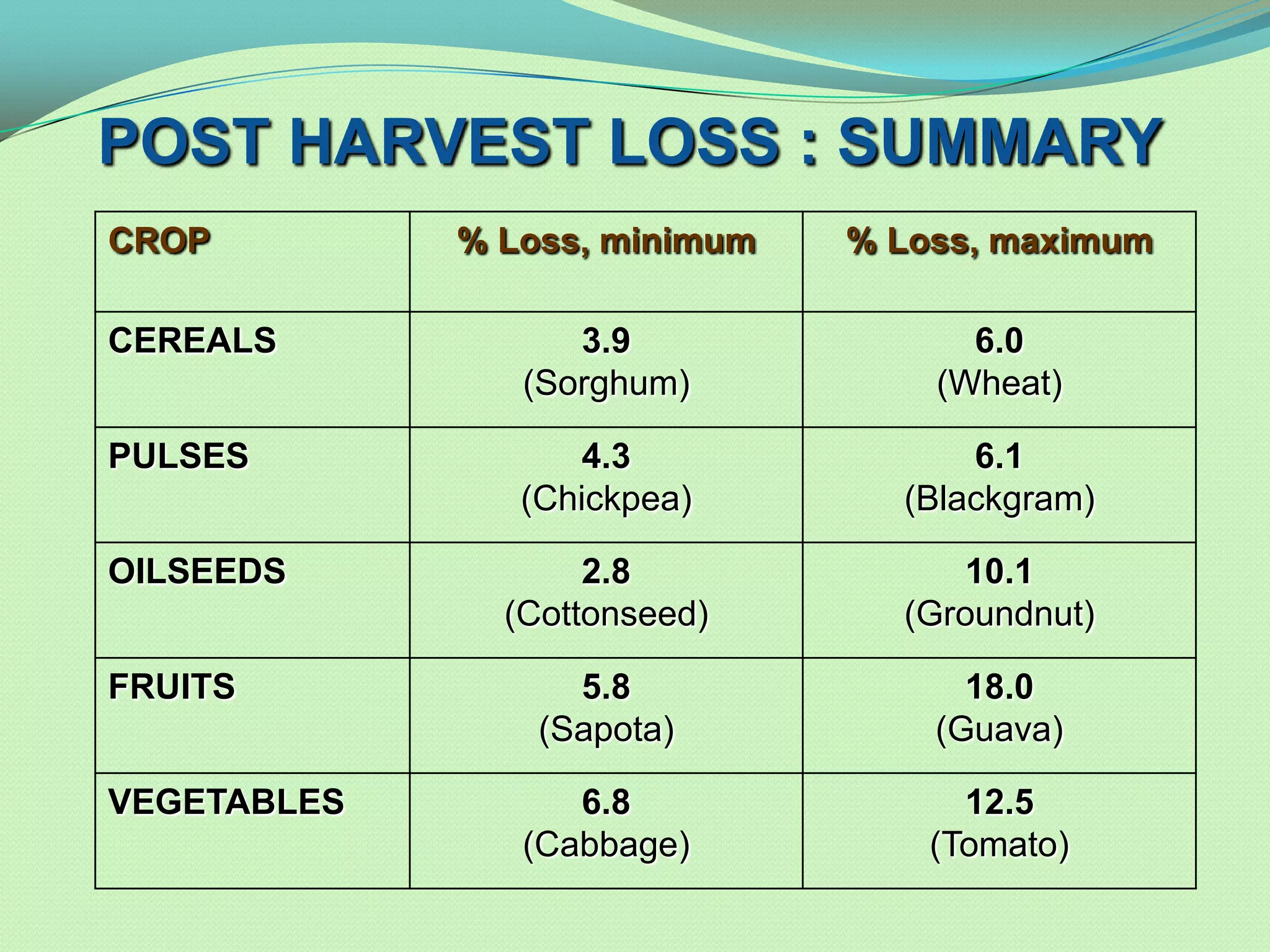
POST HARVEST LOSS : SUMMARY
CROP         % Loss, minimum   % Loss, maximum

CEREALS            3.9               6.0
                (Sorghum)          (Wheat)

PULSES             4.3               6.1
                (Chickpea)       (Blackgram)

OILSEEDS            2.8             10.1
               (Cottonseed)      (Groundnut)

FRUITS             5.8               18.0
                 (Sapota)          (Guava)

VEGETABLES         6.8               12.5
                (Cabbage)          (Tomato)
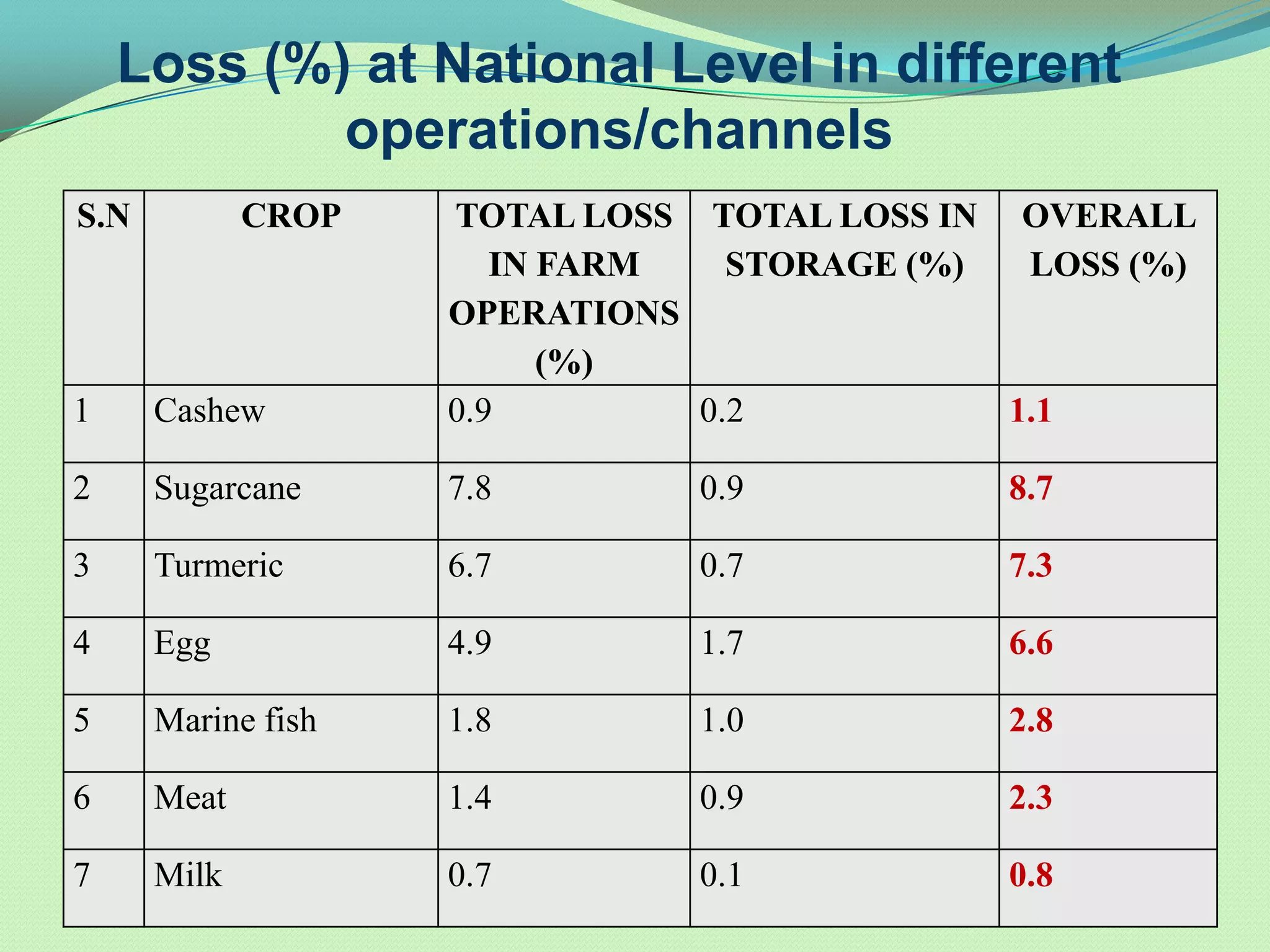
Loss (%) at National Level in different
            operations/channels
S.N          CROP   TOTAL LOSS TOTAL LOSS IN OVERALL
                       IN FARM   STORAGE (%)  LOSS (%)
                    OPERATIONS
                          (%)
1     Cashew        0.9        0.2           1.1

2     Sugarcane     7.8        0.9           8.7

3     Turmeric      6.7        0.7           7.3

4     Egg           4.9        1.7           6.6

5     Marine fish   1.8        1.0           2.8

6     Meat          1.4        0.9           2.3

7     Milk          0.7        0.1           0.8
•High income countries add US$ 180 worth of value to one
tonne of agricultural produce
•98% of agricultural produce in high income countries
undergoes industrial processing
•About 30% only is processed in developing countries
•Average value added per tonne in developing countries is
only US$ 40


              If we realize with honesty we will have to
      accept that Post harvest processing and value addition is
              about 1.5 percent in India as against 30%
             post harvest processing in some countries
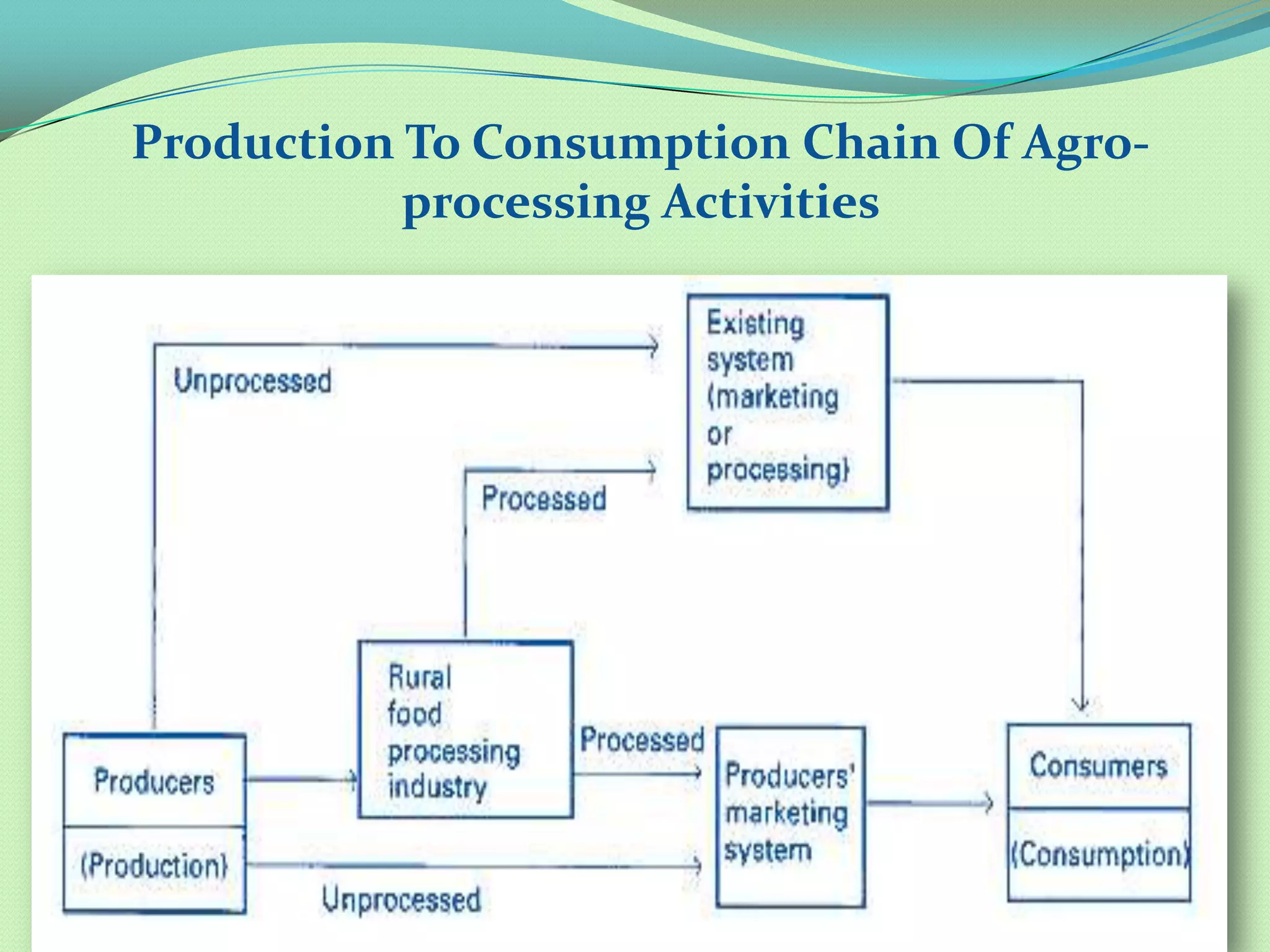
Production To Consumption Chain Of Agro-
               processing Activities


Production to consumption chain of agro-processing activities
• Primary/ secondary processing of main produce
• By-products utilization
• Supply/cold chain management
• Custom hiring services
• Product quality and safety
• Marketing
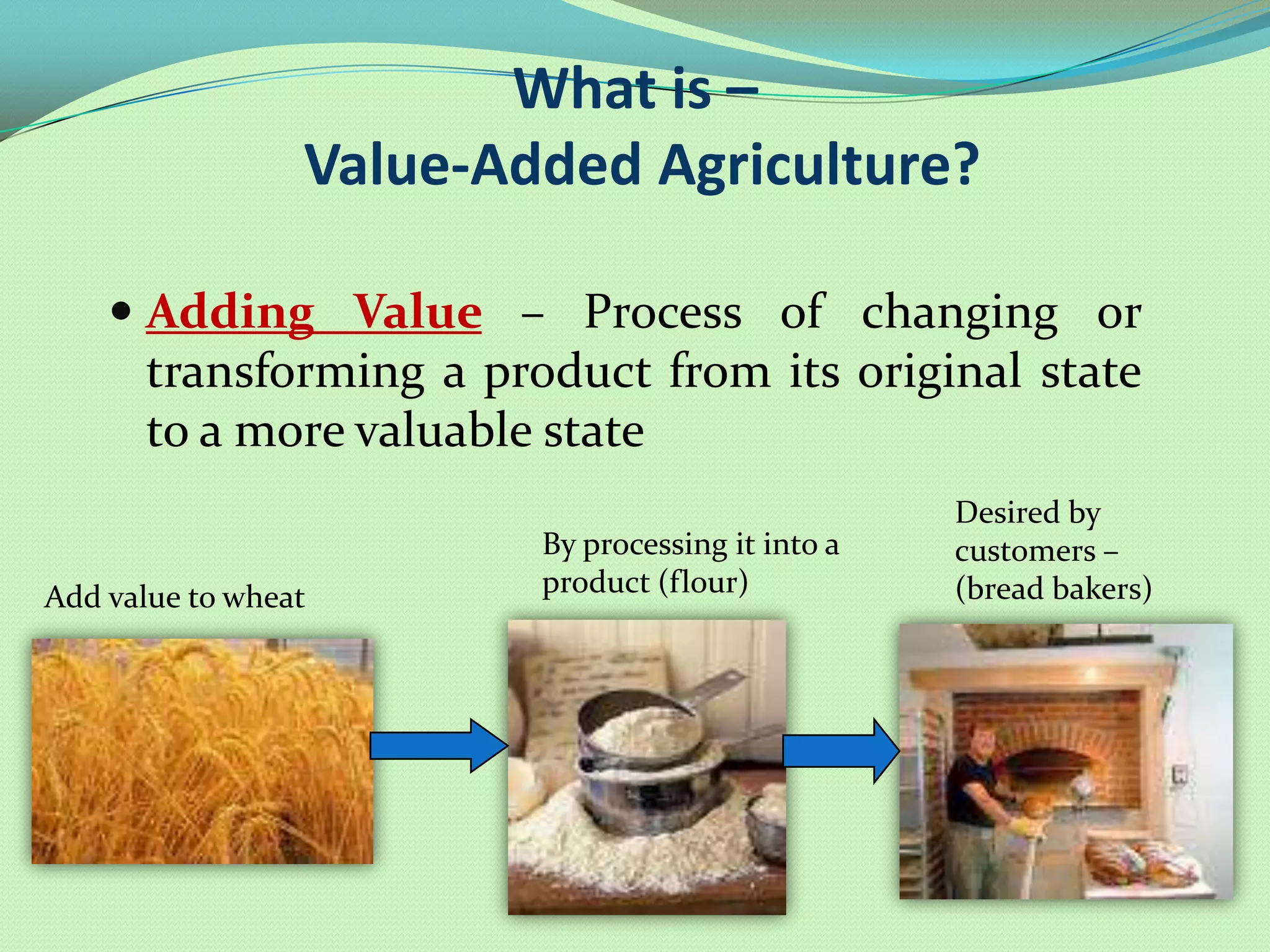
What is –
                 Value-Added Agriculture?

     Adding Value – Process of changing or
      transforming a product from its original state
      to a more valuable state
                                                   Desired by
                         By processing it into a   customers –
Add value to wheat       product (flour)           (bread bakers)
•   Expanding the level of processing in the food grains,
    fruits & vegetables and dairy sectors on priority,
•   Raising the level of processing from primary/ secondary
    to secondary/ tertiary for all commodities,
•   Modernizing the food processing sectors using the
    efficient equipment and processes for cost
    competitiveness and better quality products,
•   Ensuring adequate training of workers, supervisors and
    managers in food processing industries to ensure
    efficient operations and product quality,
•   Providing skills and knowledge to farmers for ensuring
    quality of produce through adoption of GAP, and
•   Promoting seamless value chain including post harvest
    management and value addition in production
    catchments to obviate the quantitative and qualitative
    losses.
 Adding value to products can be accomplished in a
  number of different ways, but generally falls into
  one of two main types:
   Creating Value
       Innovation
       Industrial Innovation

   Capturing Value
       Coordination
CREATING VALUE
 Occurs with actual or perceived value to a customer for
 a superior product or service

       Innovative new products
       Enhance a product’s characteristics
       Enhance services
       Create brand names
       Develop unique customer experiences
CAPTURING VALUE
 Changing the distribution of value in the food/fiber
 production chain.
   Meant to ‘capture’ more of the consumer dollar through:

       Direct Marketing

       Vertical Integration

       Producer Alliances
       Cooperative Efforts
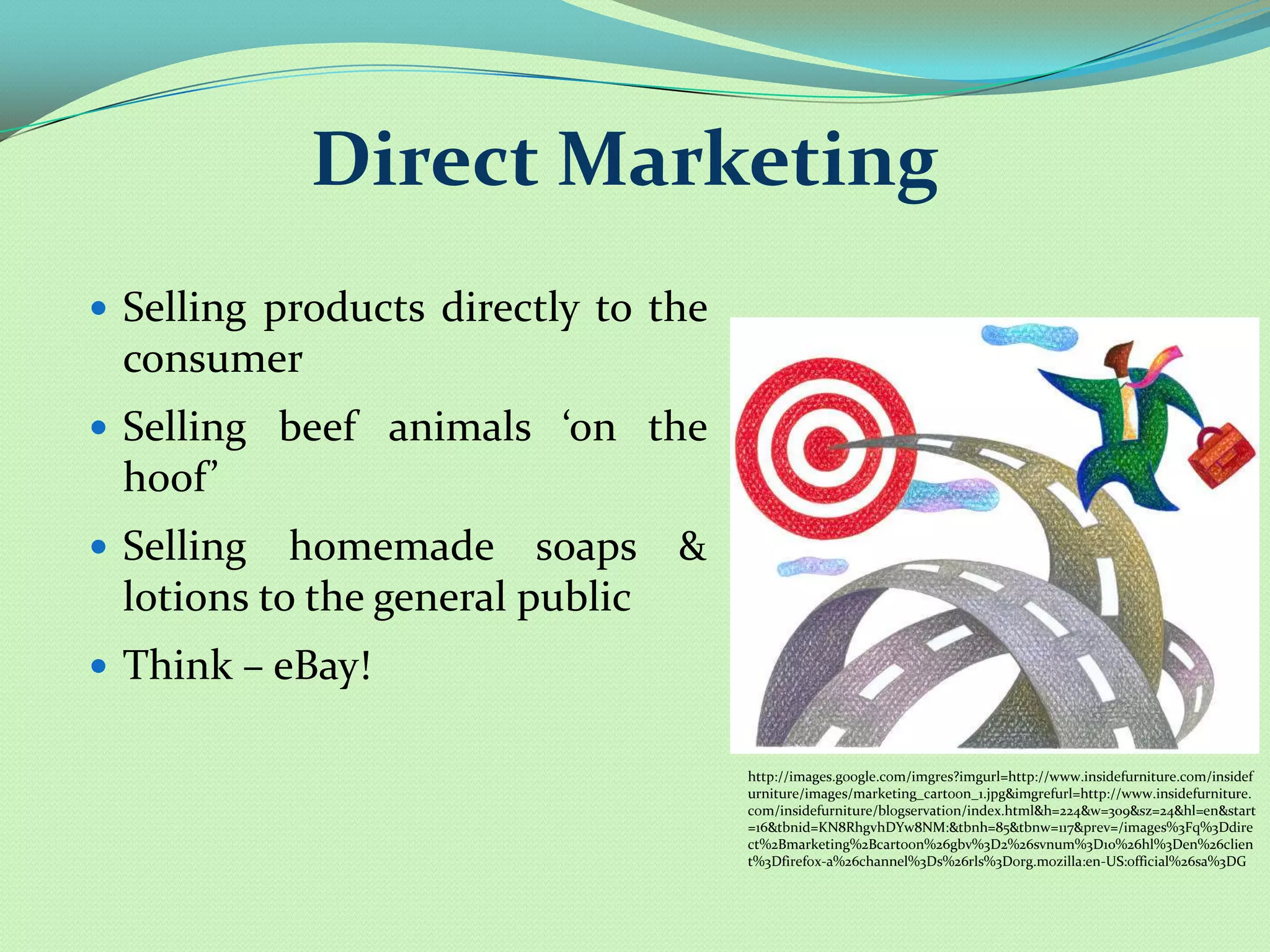
Direct Marketing
 Selling products directly to the
 consumer
 Selling beef animals ‘on the
 hoof’
 Selling  homemade soaps &
 lotions to the general public
 Think – eBay!

                                     http://images.google.com/imgres?imgurl=http://www.insidefurniture.com/insidef
                                     urniture/images/marketing_cartoon_1.jpg&imgrefurl=http://www.insidefurniture.
                                     com/insidefurniture/blogservation/index.html&h=224&w=309&sz=24&hl=en&start
                                     =16&tbnid=KN8RhgvhDYw8NM:&tbnh=85&tbnw=117&prev=/images%3Fq%3Ddire
                                     ct%2Bmarketing%2Bcartoon%26gbv%3D2%26svnum%3D10%26hl%3Den%26clien
                                     t%3Dfirefox-a%26channel%3Ds%26rls%3Dorg.mozilla:en-US:official%26sa%3DG
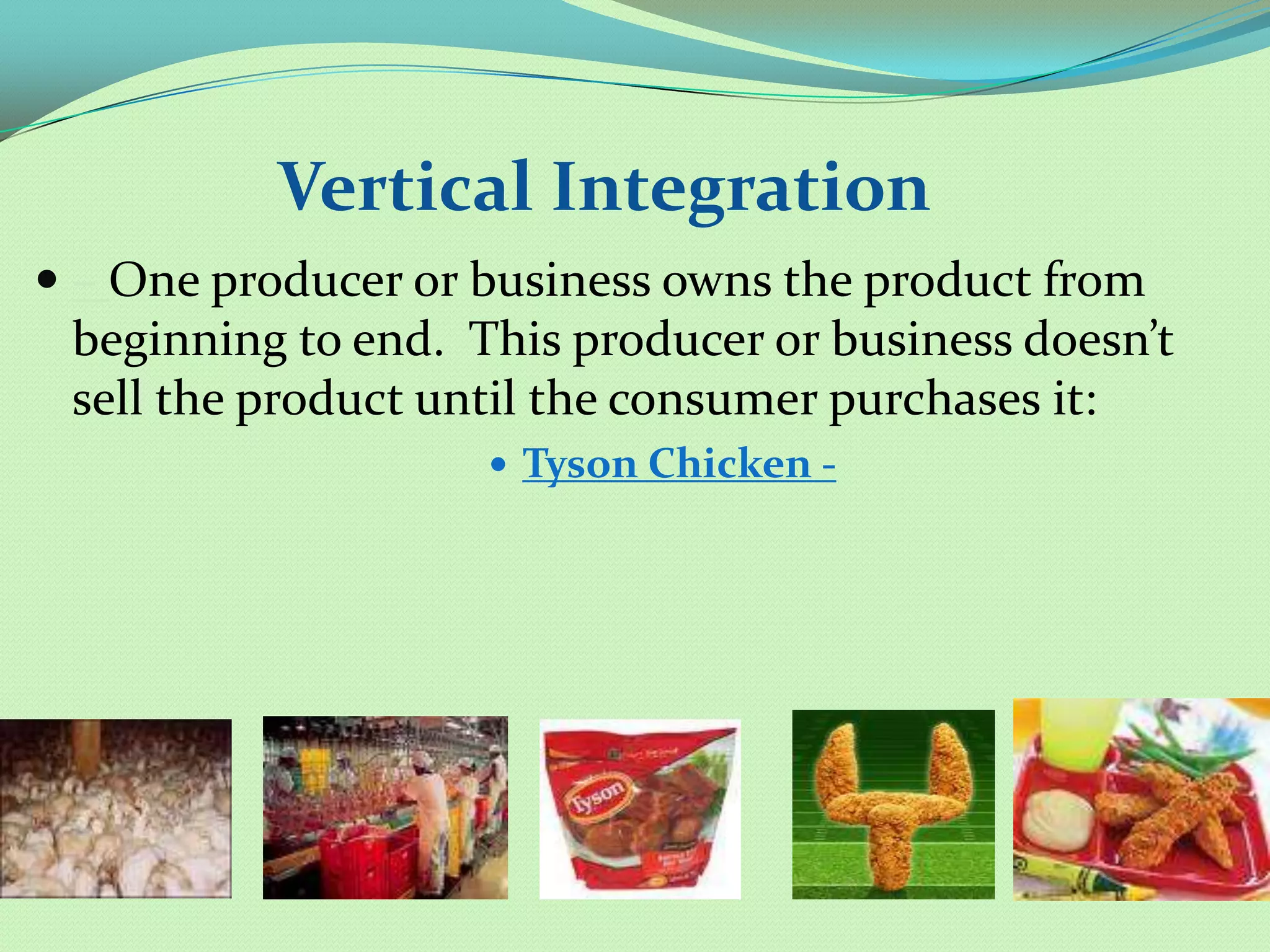
Vertical Integration
 – One producer or business owns the product from
 beginning to end. This producer or business doesn’t
 sell the product until the consumer purchases it:
                     Tyson Chicken -
Producer Alliances
 Individuals / companies from the same level of the
  food chain consolidate in order to produce and
  market a superior product
Cooperative Efforts
 Individuals or companies pool their products in
 order to increase bargaining power.
6 Key Strategies for Adding
Value

 Form value
 Location value
 Time value
 Ownership/Possession value
 Information value
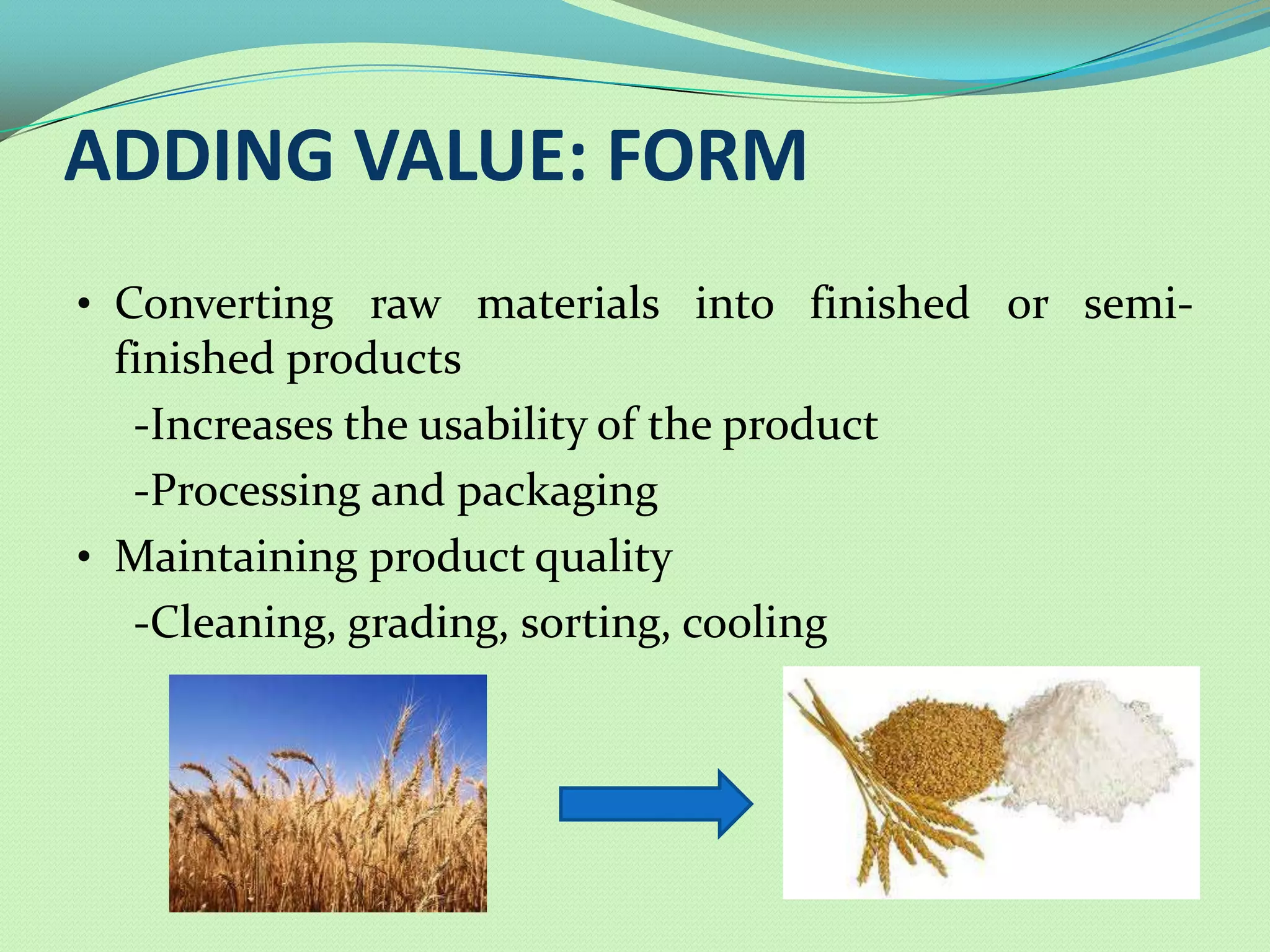
ADDING VALUE: FORM
• Converting raw materials into finished or semi-
  finished products
   -Increases the usability of the product
   -Processing and packaging
• Maintaining product quality
   -Cleaning, grading, sorting, cooling
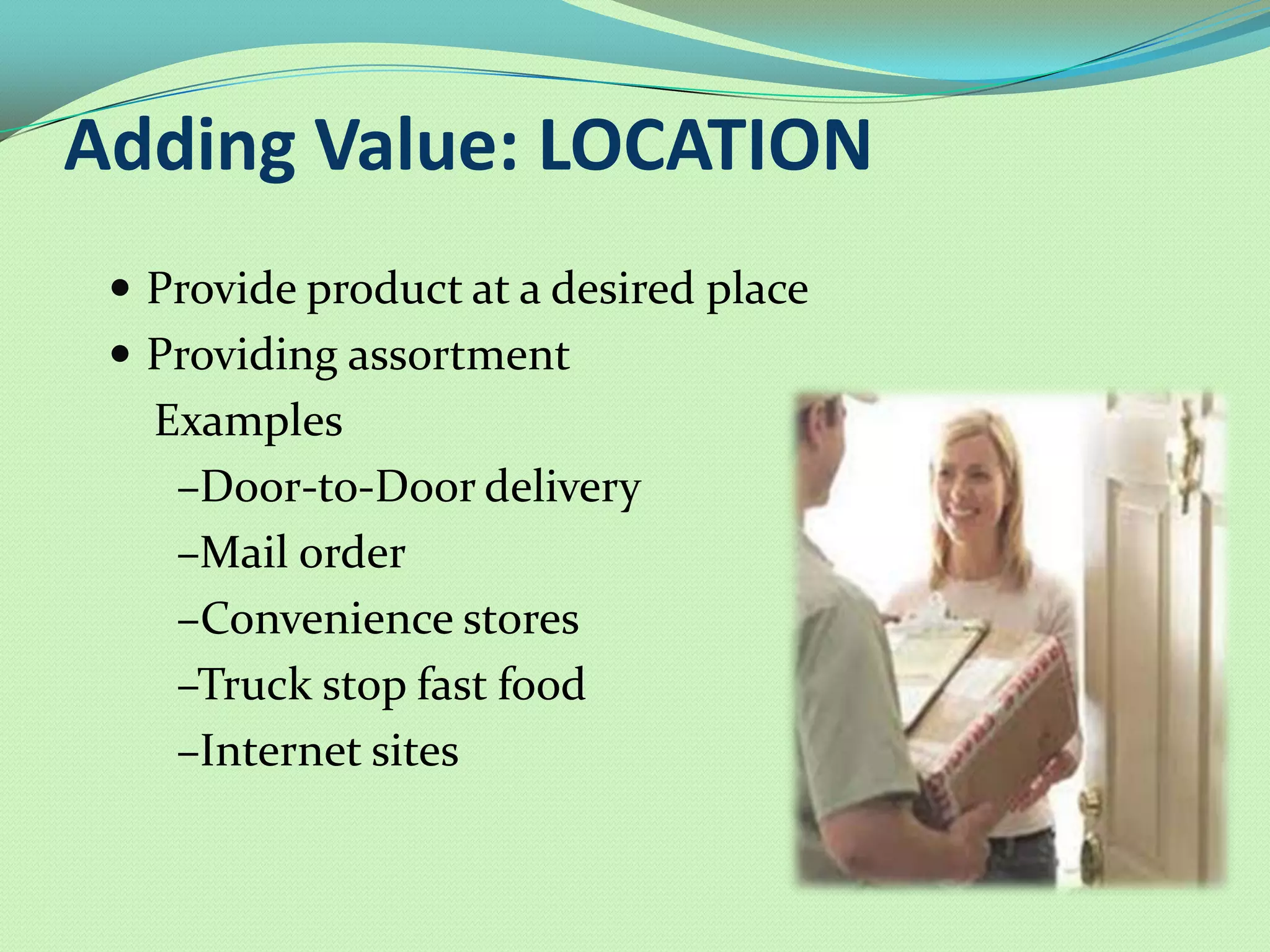
Adding Value: LOCATION
  Provide product at a desired place
  Providing assortment
   Examples
    –Door-to-Door delivery
    –Mail order
    –Convenience stores
    –Truck stop fast food
    –Internet sites
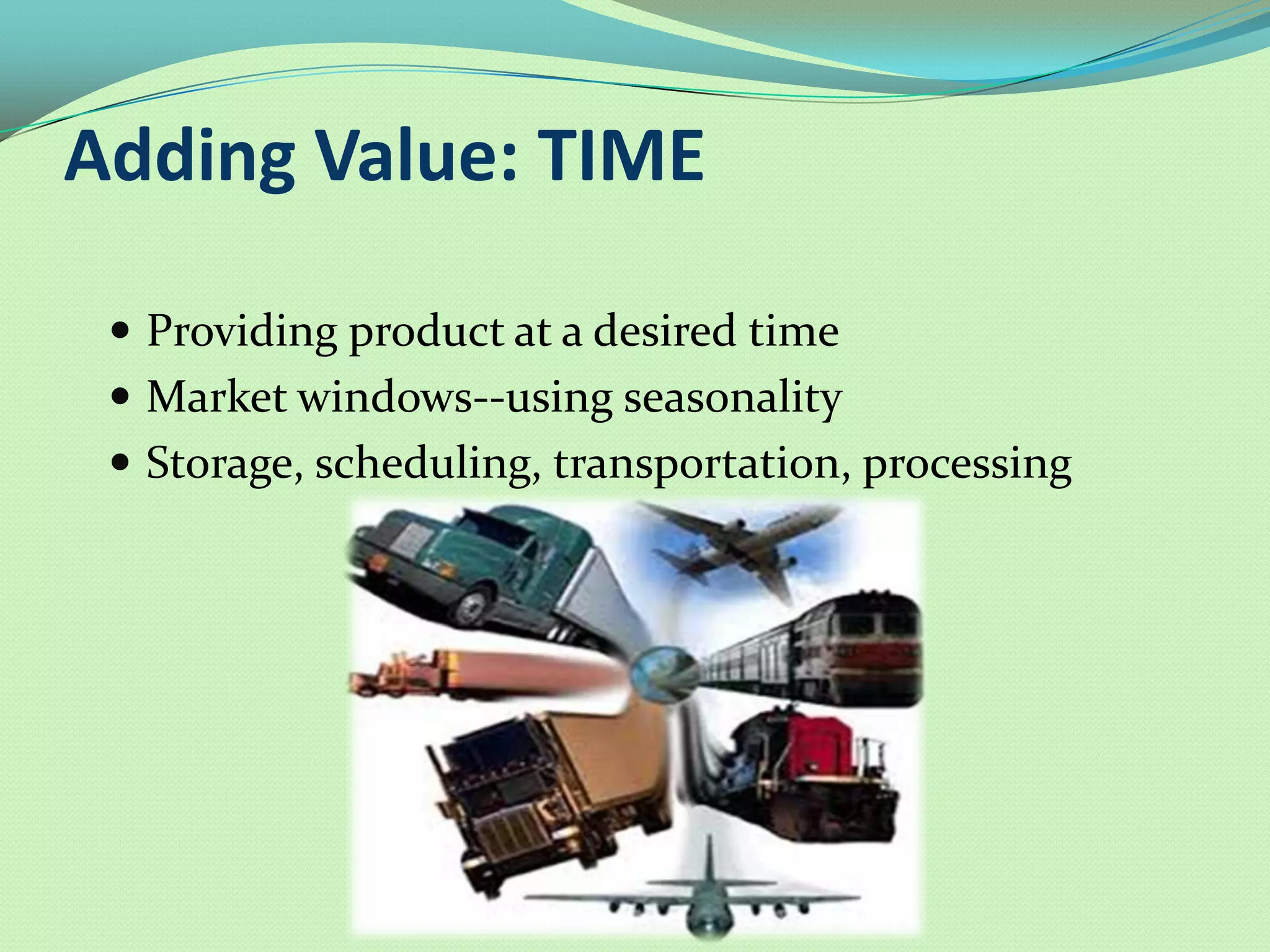
Adding Value: TIME

  Providing product at a desired time
  Market windows--using seasonality
  Storage, scheduling, transportation, processing
Adding Value: OWNERSHIP or
POSSESSION
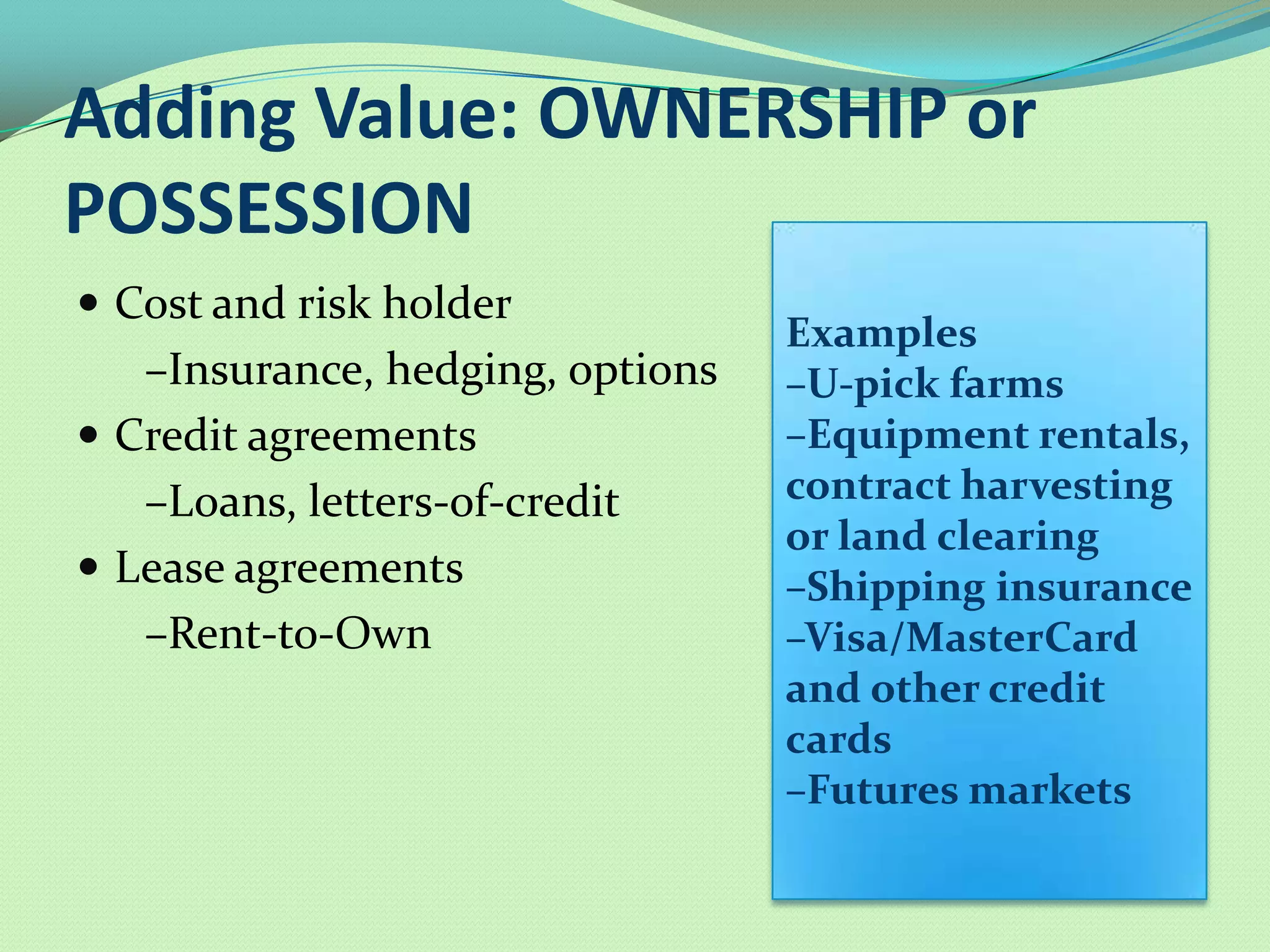
 Cost and risk holder
                                  Examples
   –Insurance, hedging, options   –U-pick farms
 Credit agreements               –Equipment rentals,
   –Loans, letters-of-credit      contract harvesting
                                  or land clearing
 Lease agreements                –Shipping insurance
   –Rent-to-Own                   –Visa/MasterCard
                                  and other credit
                                  cards
                                  –Futures markets
Adding Value: INFORMATION
 To inform & educate
 To persuade
 Done through marketing functions–Advertising,
 promotion, packaging, and labeling Examples
                                     –Weekly ads
                                     –Labels and brands
                                     –Geographic
                                     identity
                                     –Packaging
                                     –Third party
                                     certification
                                     –Point-of-purchase
                                     materials
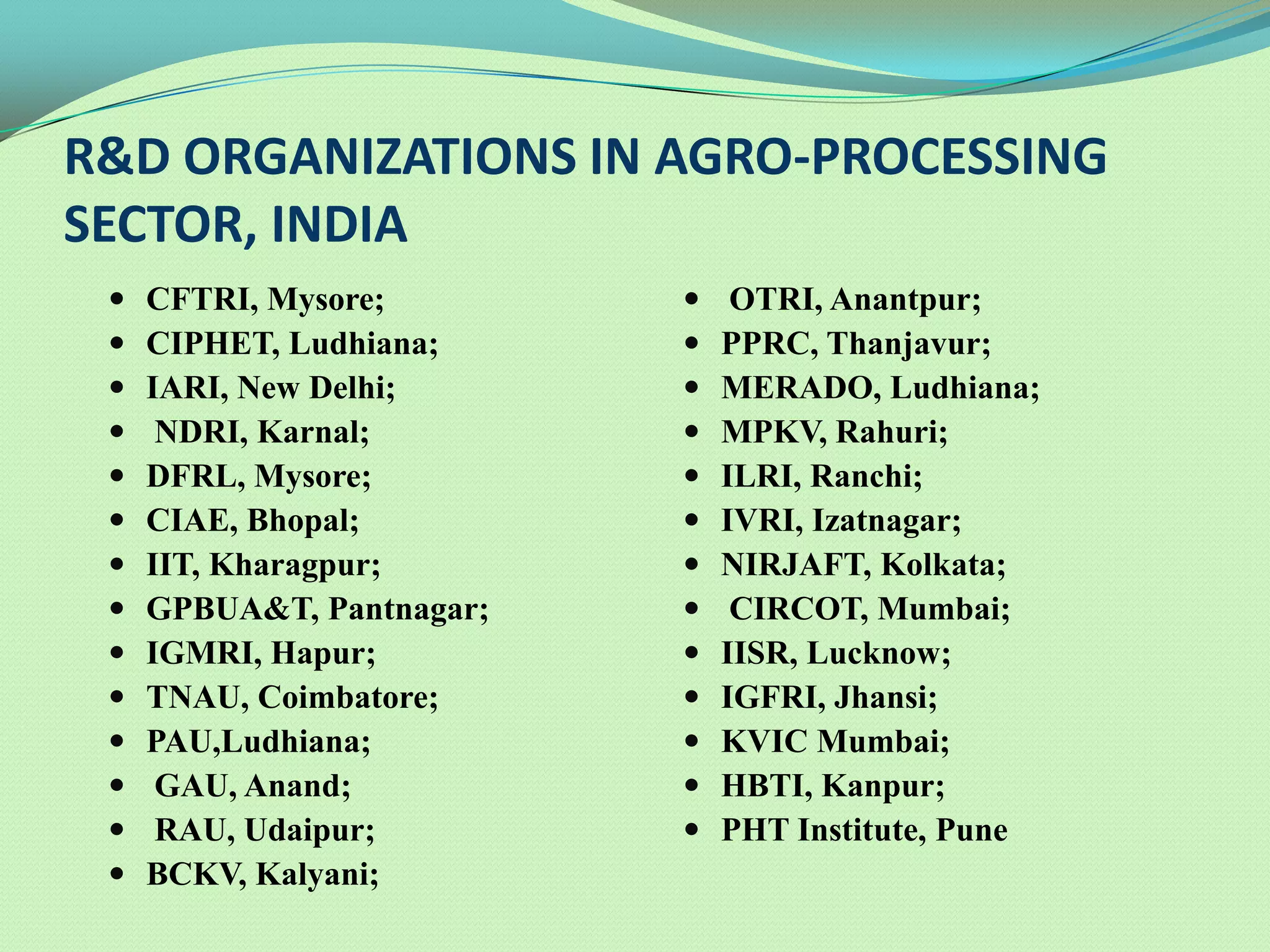
R&D ORGANIZATIONS IN AGRO-PROCESSING
SECTOR, INDIA
    CFTRI, Mysore;            OTRI, Anantpur;
    CIPHET, Ludhiana;        PPRC, Thanjavur;
    IARI, New Delhi;         MERADO, Ludhiana;
     NDRI, Karnal;           MPKV, Rahuri;
    DFRL, Mysore;            ILRI, Ranchi;
    CIAE, Bhopal;            IVRI, Izatnagar;
    IIT, Kharagpur;          NIRJAFT, Kolkata;
    GPBUA&T, Pantnagar;       CIRCOT, Mumbai;
    IGMRI, Hapur;            IISR, Lucknow;
    TNAU, Coimbatore;        IGFRI, Jhansi;
    PAU,Ludhiana;            KVIC Mumbai;
     GAU, Anand;             HBTI, Kanpur;
     RAU, Udaipur;           PHT Institute, Pune
    BCKV, Kalyani;
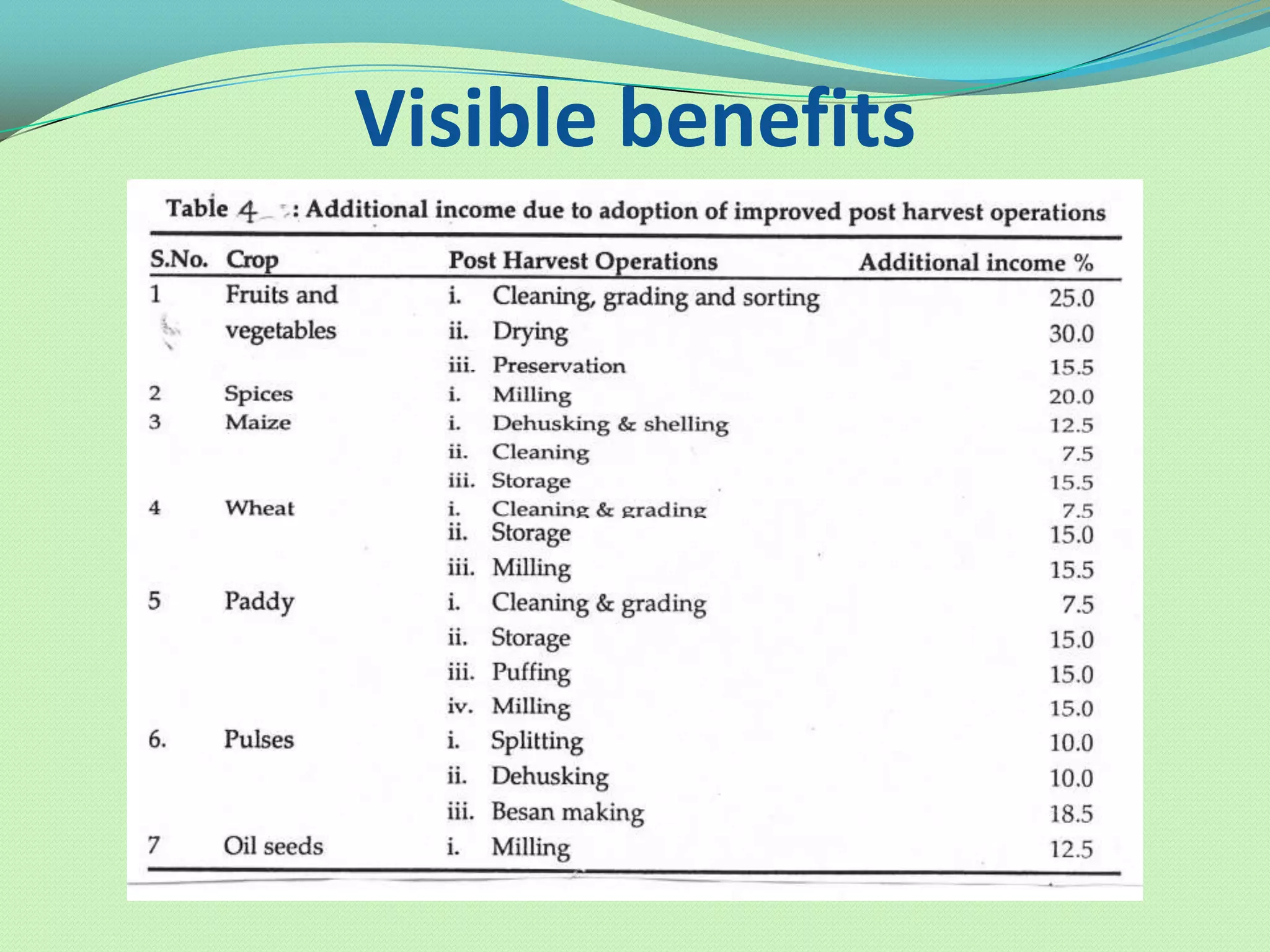
Visible benefits
WHAT IS AGRI-BUSINESS?
 John H. Davis (1955) “Agribusiness is emerging as a
 specialized branch of knowledge in the field of
 management sciences. In this context, agribusiness
 can be defined as science and practice of activities,
 with backward and forward linkages, related to
 production, processing, marketing, trade, and
 distribution of raw and processed food, feed and fibre,
 including supply of inputs and services for these
 activities”
Agribusiness Concept revolves around activities of
commercialization of agriculture, which refers to market
orientation of agricultural production and marketing
process. Transition from subsistence to commercial
agriculture. The agribusiness system is made of
thousands of businesses ranging from the small
producers to large corporations It is the management
that drives and directs the firms , farms and food
companies that come together in the whole agribusiness
system. Each of these businesses have managers
responsible for assuring successful completion of the
functions, tasks and activities.
 The agribusiness system includes many facets:
 Not      only production (e.g., farmers, hatchery
    managers), also
   Organizations which provide inputs (e.g., fry,
    chemicals, feed)
   Processes the output (e.g., processing plants)
   Manufacturers (e.g., shrimp              microwavable
    products)
   Transporters/Sellers/Brokers (e.g., retail grocery
    stores, seafood wholesalers, etc.)
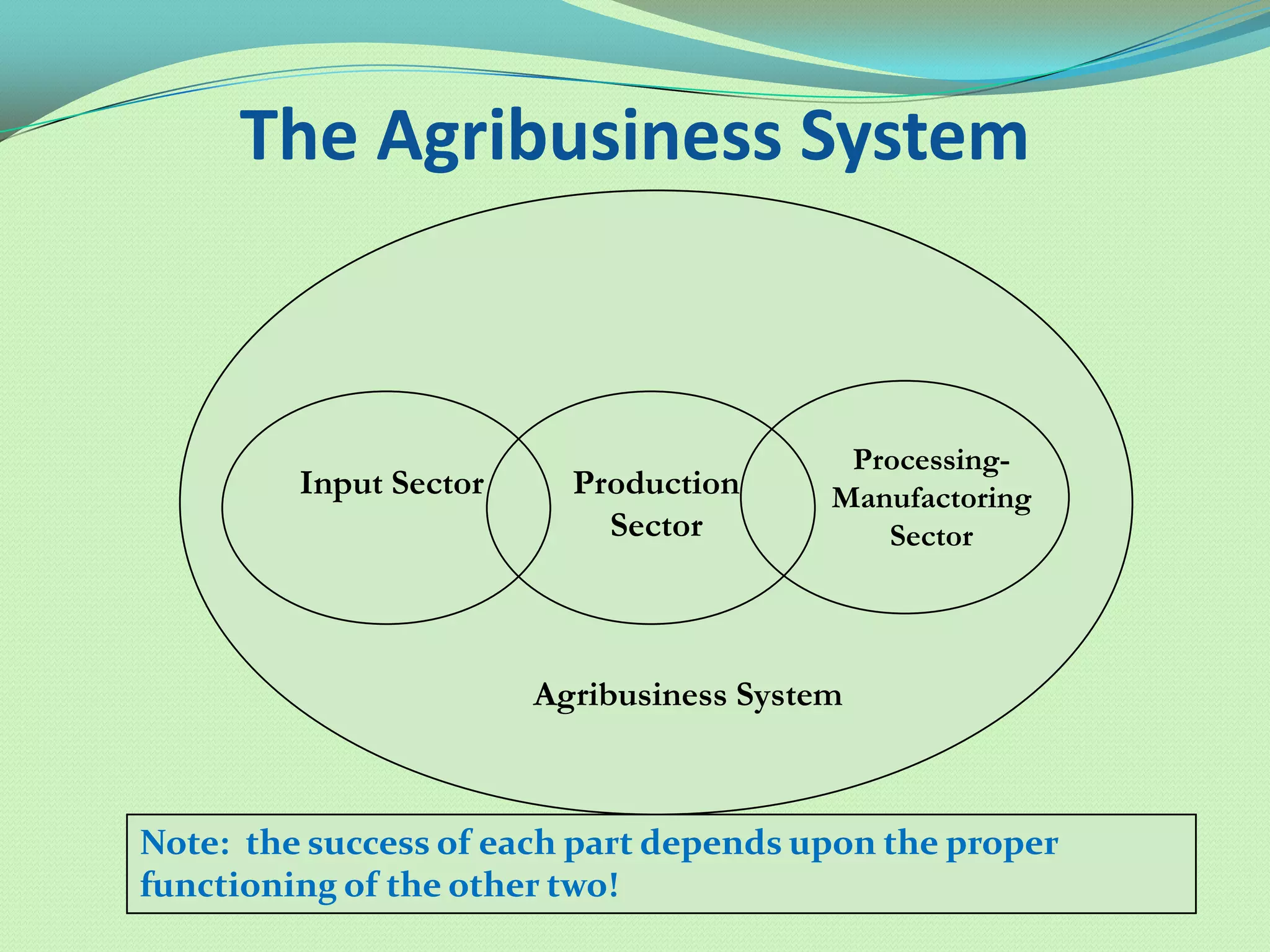
The Agribusiness System


                                           Processing-
         Input Sector     Production      Manufactoring
                            Sector           Sector


                        Agribusiness System


Note: the success of each part depends upon the proper
functioning of the other two!
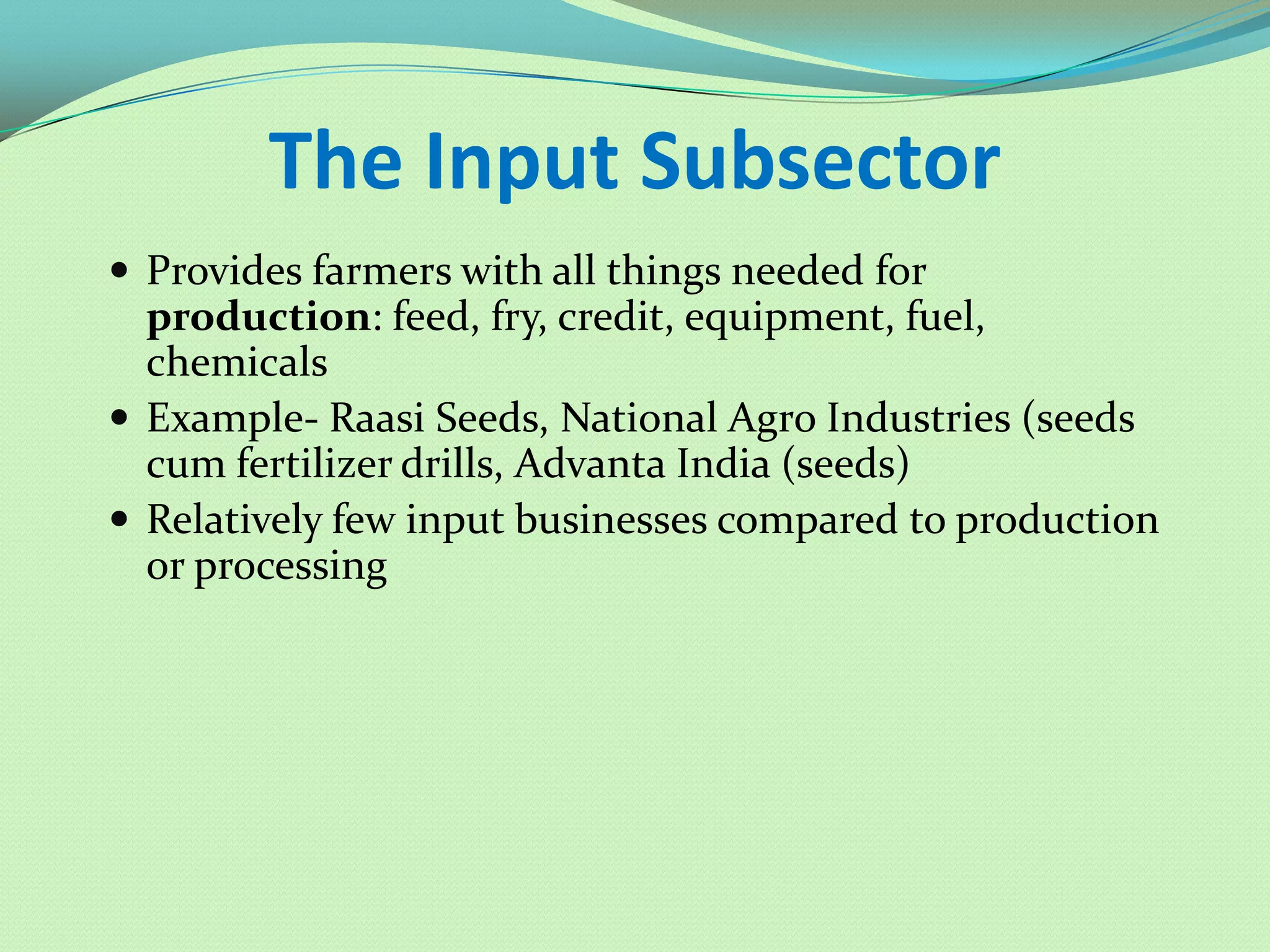
The Input Subsector
 Provides farmers with all things needed for
  production: feed, fry, credit, equipment, fuel,
  chemicals
 Example- Raasi Seeds, National Agro Industries (seeds
  cum fertilizer drills, Advanta India (seeds)
 Relatively few input businesses compared to production
  or processing
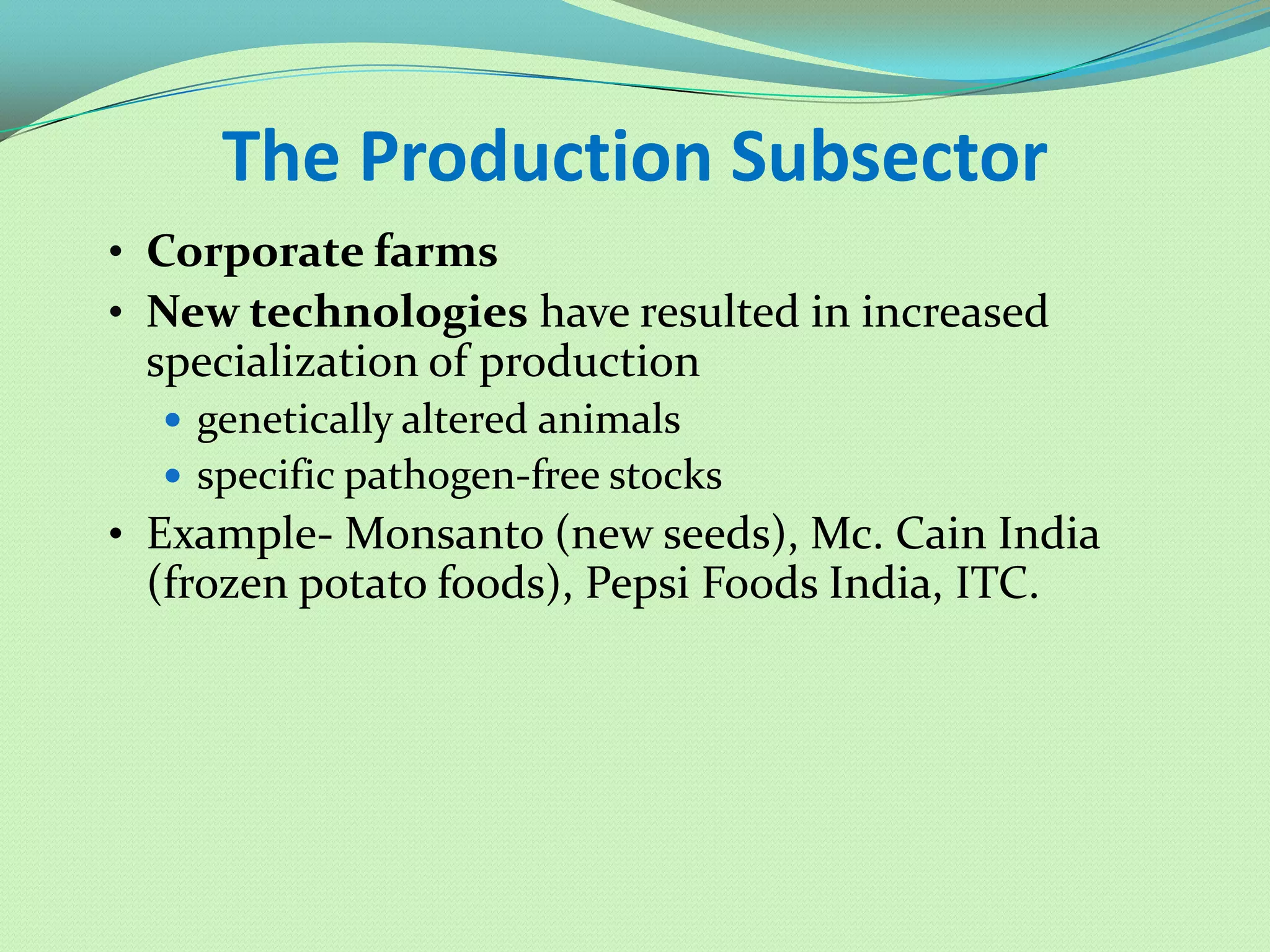
The Production Subsector
• Corporate farms
• New technologies have resulted in increased
 specialization of production
   genetically altered animals
   specific pathogen-free stocks
• Example- Monsanto (new seeds), Mc. Cain India
 (frozen potato foods), Pepsi Foods India, ITC.
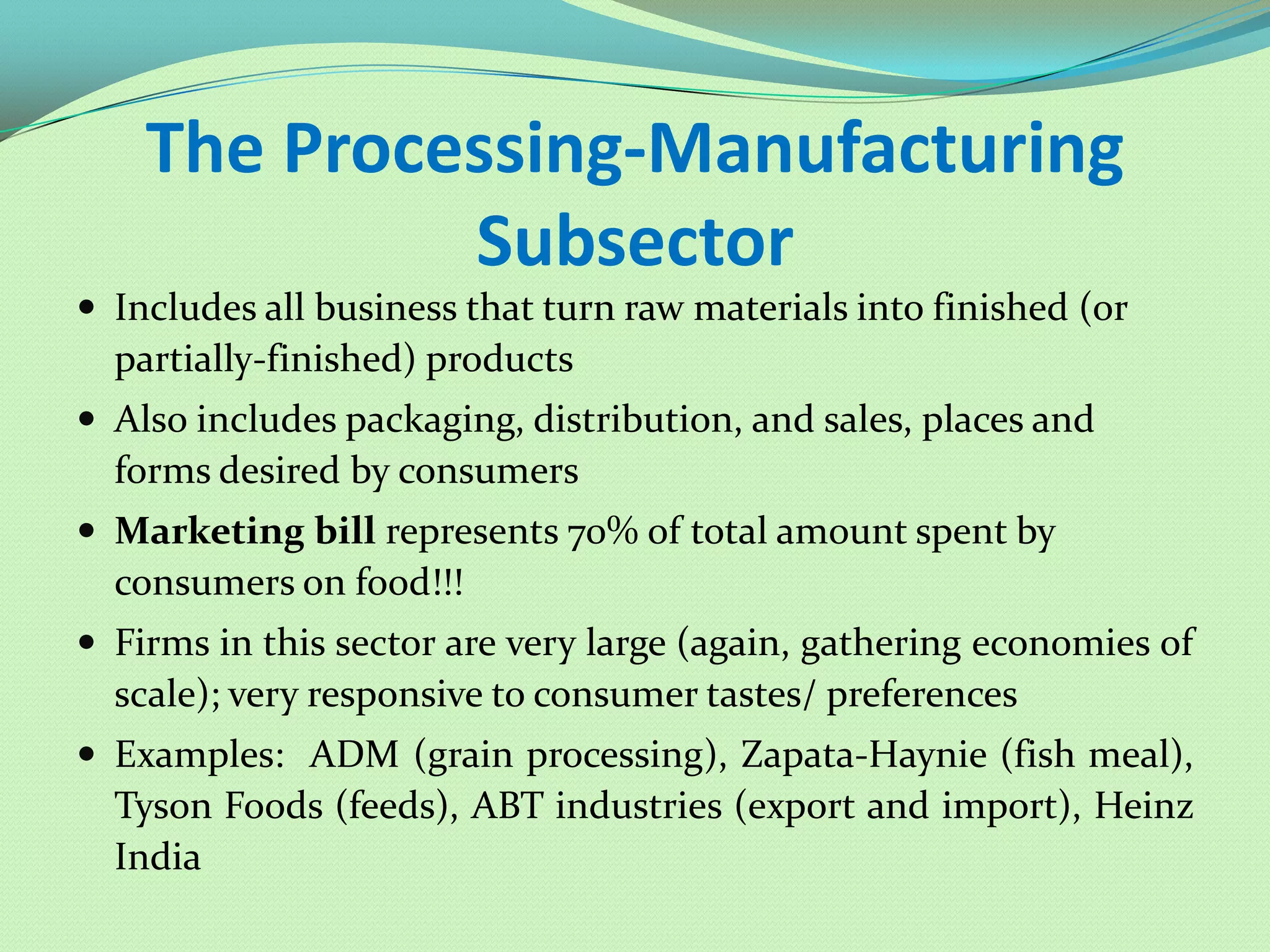
The Processing-Manufacturing
             Subsector
 Includes all business that turn raw materials into finished (or
  partially-finished) products
 Also includes packaging, distribution, and sales, places and
  forms desired by consumers
 Marketing bill represents 70% of total amount spent by
  consumers on food!!!
 Firms in this sector are very large (again, gathering economies of
  scale); very responsive to consumer tastes/ preferences
 Examples: ADM (grain processing), Zapata-Haynie (fish meal),
  Tyson Foods (feeds), ABT industries (export and import), Heinz
  India
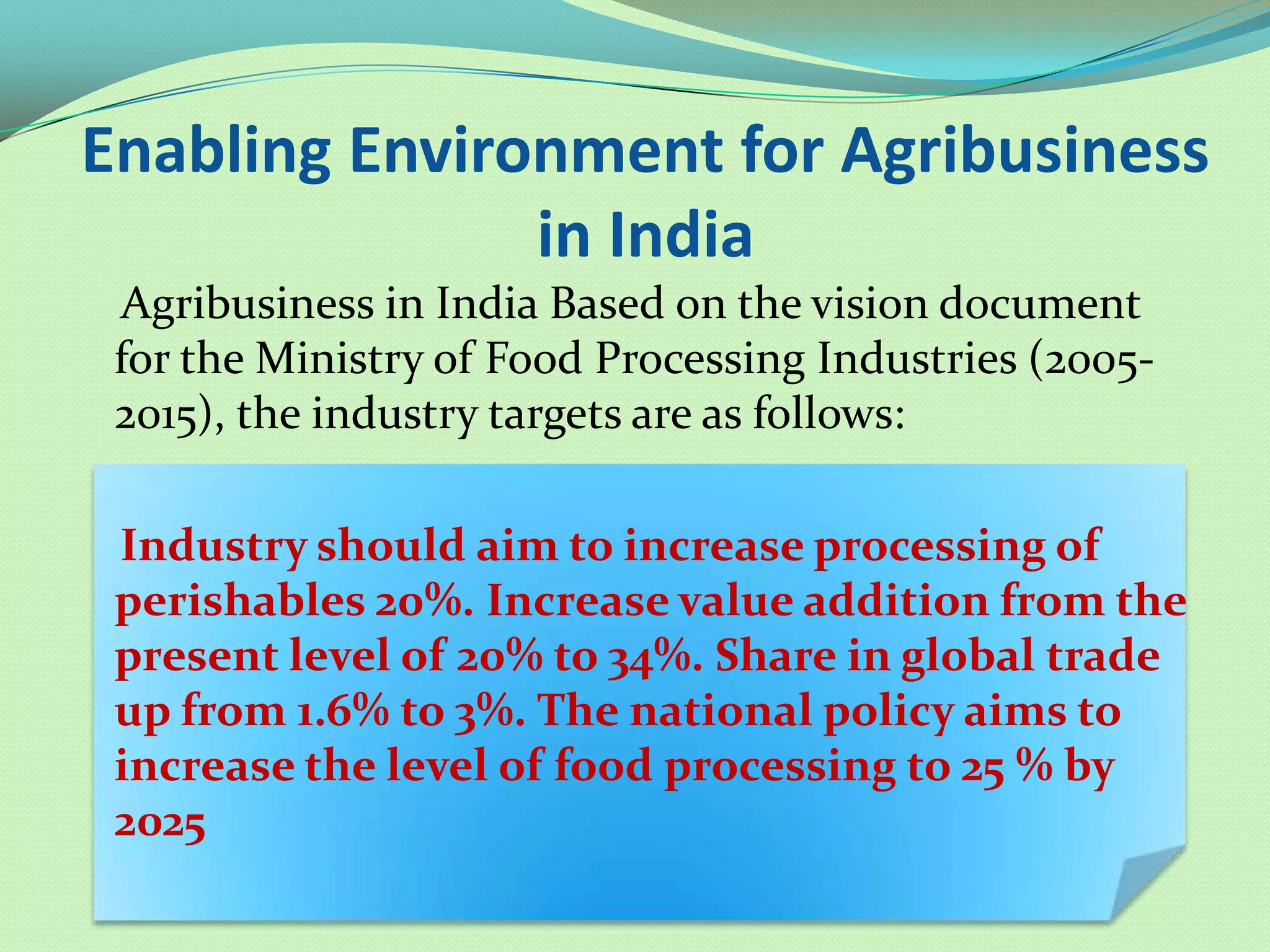
Enabling Environment for Agribusiness
               in India
 Agribusiness in India Based on the vision document
 for the Ministry of Food Processing Industries (2005-
 2015), the industry targets are as follows:

 Industry should aim to increase processing of
 perishables 20%. Increase value addition from the
 present level of 20% to 34%. Share in global trade
 up from 1.6% to 3%. The national policy aims to
 increase the level of food processing to 25 % by
 2025
Emerging Sectors in Agribusiness
 IT in agriculture and rural development
 Post Harvest management and value addition
 Horticulture and food products marketing
 NGOs in agriculture and rural development
 Agriculture Extension Services
 Consulting and other knowledge based activities
 Biotechnology research and commercialization
 Corporate farming and farm management
 Agriculture supply chain management
 Rural and agri-foods retailing
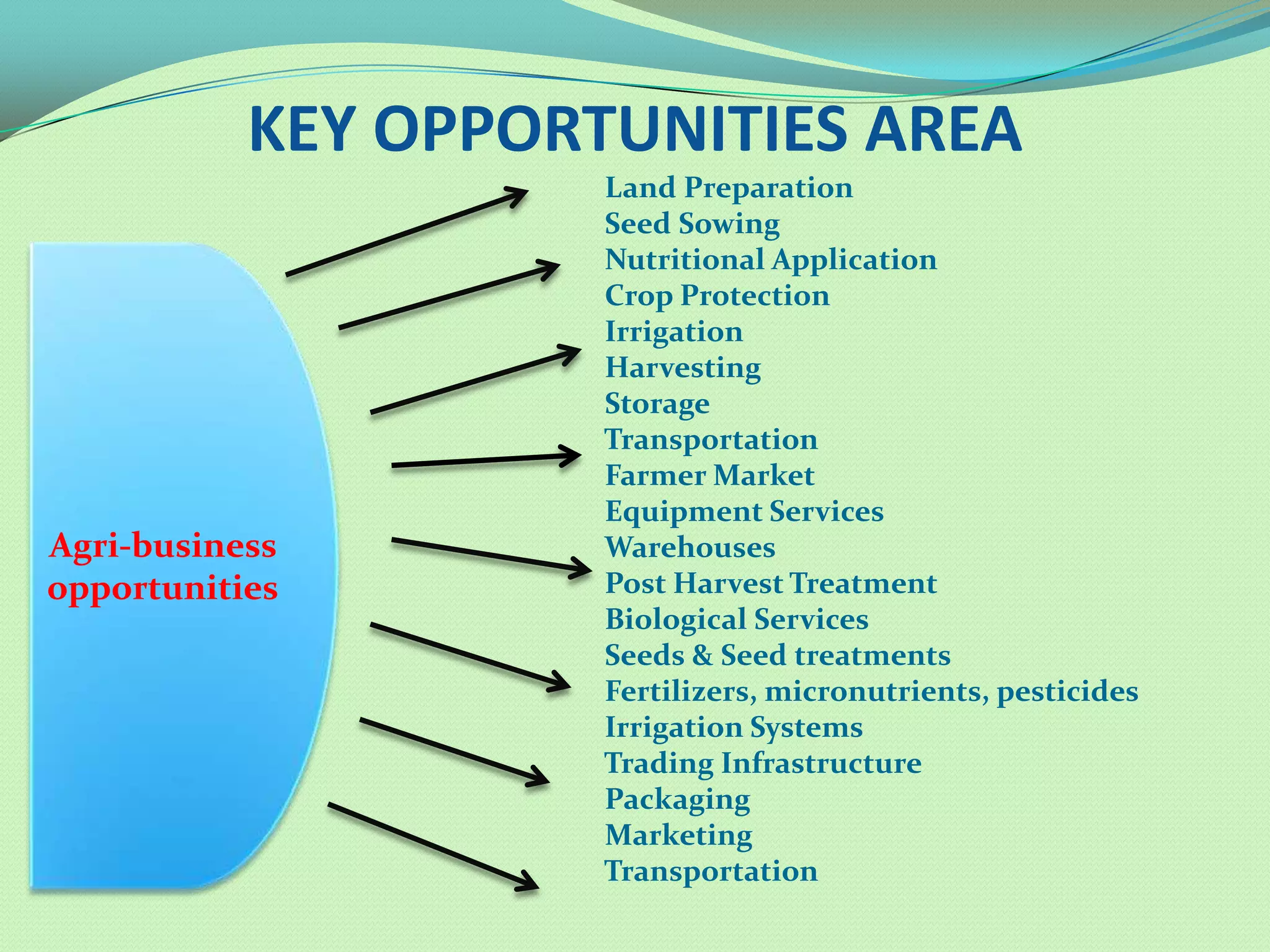
KEY OPPORTUNITIES AREA
                     Land Preparation
                     Seed Sowing
                     Nutritional Application
                     Crop Protection
                     Irrigation
                     Harvesting
                     Storage
                     Transportation
                     Farmer Market
                     Equipment Services
Agri-business        Warehouses
opportunities        Post Harvest Treatment
                     Biological Services
                     Seeds & Seed treatments
                     Fertilizers, micronutrients, pesticides
                     Irrigation Systems
                     Trading Infrastructure
                     Packaging
                     Marketing
                     Transportation
POLICY INTIATIVES
 Use of foreign brand names is now freely
  permitted.
 After the enactment of the proposed Food Safety
  and Standards Bill, 2005 in India, the food
 processing sector would be governed by only one
 law and one regulator, instead of 13 different laws
TAXATION POLICIES
 A 100 percent tax deduction on profits for five years
  and 25 percent for the next five years especially to the
  upcoming agro-processing industries.
 The government has proposed a comprehensive goods
  and services tax (GST) by 2010. This will serve to
  integrate the economy and make India a single
  common market. Industry players are of the opinion
  that the GST will provide a relief to the food and
  beverages sector against the multiple taxes imposed at
  various levels today.
 Duty-free import of goods for development, operation,
    and maintenance of SEZ units
    100-percent income tax exemption on exports from
    SEZ units for the first 5 years, 50-percent exemption
    for years 6-10, and a 50-percent exemption of
    reinvested export profits for years 11-15
   External commercial borrowing by SEZ units up to
    $500 million/year, without restriction, through
    recognized banking channels
   Exemption from central Government sales and service
    taxes
   Exemption from State sales taxes and other State levies
SUPPORTING INSTITUTIONS
 APEDA- Agricultural And Processed Food Products Export
  Development Authority
 Small Farmers Agri-business Consortium
    -ENTERPRENUERIAL TRAINING INSTITUTE
     • Agri-Clinics And Agri-business Centers
     • IIE, Guwahati
     • NISIET, Hyderabad
     • NIESBUD, New Delhi
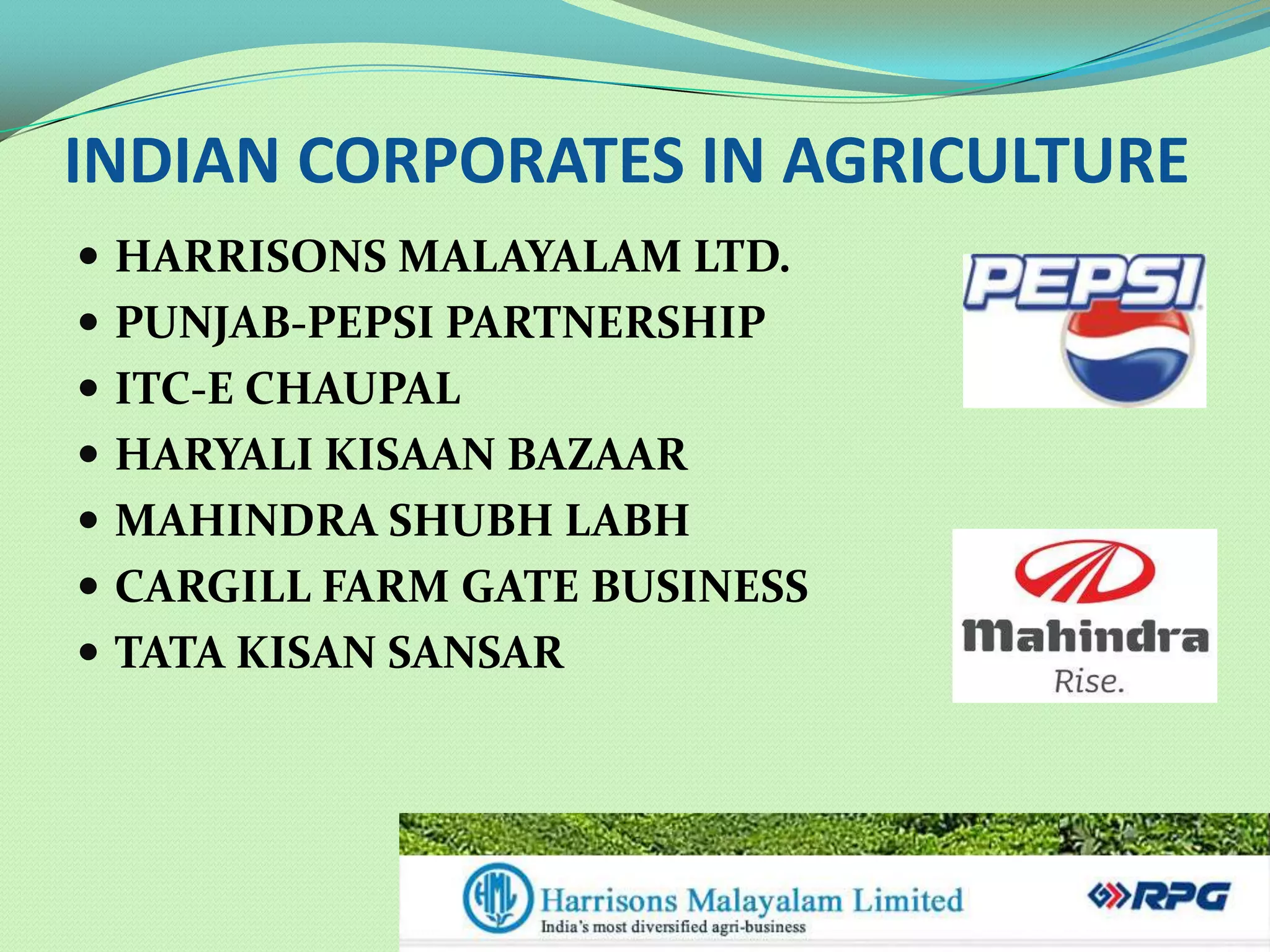
INDIAN CORPORATES IN AGRICULTURE
 HARRISONS MALAYALAM LTD.
 PUNJAB-PEPSI PARTNERSHIP
 ITC-E CHAUPAL
 HARYALI KISAAN BAZAAR
 MAHINDRA SHUBH LABH
 CARGILL FARM GATE BUSINESS
 TATA KISAN SANSAR
AN EXAMPLE OF AGRIBUSINESS-CONTRACT
              FARMING
  A contract to purchase a specified quantity of produce
  at a pre-agreed price
 Fixed price
 Market linked price
 Quality of produce specified in contract or benchmarked to
  certain agreed standards
 Penalty for default usually specified in the contract but
  rarely enforced
 Relationship generally built on Trust
Harrisons Malayalam Ltd.
 HML’s predecessors Malayalam Plantations Limited and
    Harrisons & Crosfield Limited sterling companies
    incorporated in England – history of 150 years.
   In 1979, these companies incorporated as Indian
    Companies under the names Malayalam Plantations
    (India) Limited and Harrisons & Crosfield (India) Limited.
   In 1984, the two companies merged to form Harrisons
    Malayalam Limited. HML became part of the RPG Group
    in the year 1989.
   RPG Group - one of India’s largest industrial
    conglomerates, with over 20 companies in its fold, spread
    over 6 business sectors with an annual turnover over USD
    3.25 Billion
    Winner of the maximum number of awards at “The
    Golden Leaf India awards” (TGLIA) for quality teas
Vital Statistics
 Largest plantation company based in South India.
 Single Largest Private Sector Employer in Kerala.
 HML has 25000 hectares of land under its fold 6000
  hectares - in Tea, 8000 hectares - in Rubber
 Single largest producer of Natural Rubber in the Country,
  Second largest producer of Tea in South India.
 Largest Corporate grower of Pineapple Presence and other
  horticulture crops – banana, passion fruit, cocoa, coconut,
  arecanut and spices
 Largest exporter of Tea in South India
 – Some Important customers : Twinings – UK, Saralee –
  Netherlands, Elink Schurmann – Rotterdam, May Co –
  Russia, Baeshan – Saudi Arabia , A F Jones – Sri Lanka
THE HML WAY:
 Caring for People and environment
 An equal Opportunity employer with 7700 men and 8800
    women workforce
   Winner of FICCI awards thrice for corporate initiatives in family
    welfare as a result of its Comprehensive Labour Welfare Scheme
   Aimed at improving the quality of life of the employees and their
    dependents.
   Pioneer in corporate social responsibility in Kerala with
    initiatives such as “ Rakshita ” a centre for development of
    children and adults with multiple disabilities
   Providing free medical aid for underprivileged in Rural Kerala.
   The only company in this sector to bag the Kerala State Pollution
    control award for its factory on more than one occasion
    emphasizing the responsibility and initiative taken by the
    company in preserving the natural resources for future
    generation.
PRESENT SCENARIO PROBLEMS
 Increasing nutritional requirements and decreasing
    available land
   Shortage of food grains
   Declining rate of food production and increasing
    population
   Decreasing crop productivity
   One of the Largest producers of fruits, vegetables,
    meat, milk, eggs, fish but low cost producers, low
    farmer incomes, poor exports, lack of storage
   India’s current share in world trade of processed foods
    is only 1.6%
KEY STRATEGIES AT NATIONAL LEVEL
• Develop national comparative advantage
• Development appropriate policy network
• Development appropriate marketing and management
    skills network
•   Establish comprehensive rural financial market
•   Create market driven agricultural technologies
•   Develop alternate investment to expand rural well-
    being
•   Enhance sustainable use of resources
CONCLUSIONS
 Indian Agribusiness is at an interesting crossroads facing huge
    growth opportunities.
   It must gear up for and facilitate agriculture revolution through
    farmer- corporate partnership.
   Focus on market orientation is must.
   Reduce loss through bringing all operations on single platform.
   Need for wealth creation for farmers & investors, infrastructure
    development ,critical commitment and discipline could provide
   Global leadership.
    Transformation from seller-buyer relation to strategic
    partnership between corporate and farmer for a win-win
    outcome.
    Exposing traditional Indian agriculture to modern
    technologies, creating large scale processed food manufacturing
    and food chain facilities and consequently generate employment
    and export earnings.
THANK YOU

value addition and processing of agri-products

  • 1.
    Value Addition AndProcessing of Agriproducts: Opportunities and Challenges BY: Surabhi Mishra Department of Biochemical Engineering and Food Technology, H.B.T.I., Kanpur
  • 2.
    SUMMARY  Present scenario of agriculture in India  Post harvest losses & the global picture  Value- added agriculture  Strategies for “value addition”  Agri-business  Subsectors of agri-business  Emerging areas of agri-business  Policy initiatives and taxation policies  Supporting institutions  Indian corporates in agri-business  An example of corporate-farming: Harrisons Malayalam Ltd  Present scenario problems  Key strategies at national level  Conclusions
  • 3.
    Food production in the country is adequate but it is not accessible to all. • Inadequate income earned by about 25% population • High post harvest losses on farm and in the supply chain linking farmers to markets (estimated annual loss of Rs. 44,000 crore) • Inadequate livelihood opportunities in the production catchments and rural sector
  • 4.
    High level of food wastage due to shortage of storage spaces • Mismatch between agri-exports and agri- imports • Huge quantities of under-utilized crop residues and processing by-products leading to loss of income and environmental sustainability • Low levels of agro-processing and value addition
  • 5.
    Indian wastes more fruits & vegetables than are consumed in UK • Cumulative waste is about $ 6.7 billion which is equivalent to 40% of the total horticulture produce • Poor infrastructure and logistics support • Rough and unorganized handling • India has 70% more arable land but produces 30% less than China
  • 6.
    India ranks first in the world in cereal and milk production and second in fruits & vegetables and in five producers of groundnut, rice, wheat, tea, coffee, sugar, spices & oil seeds. • Even with an industry size of US $ 70 billion,we process less than 2%. • The industry has about 1.6 mn direct employees and accounts for about 13% of the country’s exports and 6%of the industry investment.
  • 7.
    POST HARVEST LOSS: SUMMARY CROP % Loss, minimum % Loss, maximum CEREALS 3.9 6.0 (Sorghum) (Wheat) PULSES 4.3 6.1 (Chickpea) (Blackgram) OILSEEDS 2.8 10.1 (Cottonseed) (Groundnut) FRUITS 5.8 18.0 (Sapota) (Guava) VEGETABLES 6.8 12.5 (Cabbage) (Tomato)
  • 8.
    Loss (%) atNational Level in different operations/channels S.N CROP TOTAL LOSS TOTAL LOSS IN OVERALL IN FARM STORAGE (%) LOSS (%) OPERATIONS (%) 1 Cashew 0.9 0.2 1.1 2 Sugarcane 7.8 0.9 8.7 3 Turmeric 6.7 0.7 7.3 4 Egg 4.9 1.7 6.6 5 Marine fish 1.8 1.0 2.8 6 Meat 1.4 0.9 2.3 7 Milk 0.7 0.1 0.8
  • 9.
    •High income countriesadd US$ 180 worth of value to one tonne of agricultural produce •98% of agricultural produce in high income countries undergoes industrial processing •About 30% only is processed in developing countries •Average value added per tonne in developing countries is only US$ 40 If we realize with honesty we will have to accept that Post harvest processing and value addition is about 1.5 percent in India as against 30% post harvest processing in some countries
  • 10.
    Production To ConsumptionChain Of Agro- processing Activities Production to consumption chain of agro-processing activities
  • 11.
    • Primary/ secondaryprocessing of main produce • By-products utilization • Supply/cold chain management • Custom hiring services • Product quality and safety • Marketing
  • 12.
    What is – Value-Added Agriculture?  Adding Value – Process of changing or transforming a product from its original state to a more valuable state Desired by By processing it into a customers – Add value to wheat product (flour) (bread bakers)
  • 13.
    Expanding the level of processing in the food grains, fruits & vegetables and dairy sectors on priority, • Raising the level of processing from primary/ secondary to secondary/ tertiary for all commodities, • Modernizing the food processing sectors using the efficient equipment and processes for cost competitiveness and better quality products, • Ensuring adequate training of workers, supervisors and managers in food processing industries to ensure efficient operations and product quality, • Providing skills and knowledge to farmers for ensuring quality of produce through adoption of GAP, and • Promoting seamless value chain including post harvest management and value addition in production catchments to obviate the quantitative and qualitative losses.
  • 14.
     Adding valueto products can be accomplished in a number of different ways, but generally falls into one of two main types:  Creating Value  Innovation  Industrial Innovation  Capturing Value  Coordination
  • 15.
    CREATING VALUE  Occurswith actual or perceived value to a customer for a superior product or service  Innovative new products  Enhance a product’s characteristics  Enhance services  Create brand names  Develop unique customer experiences
  • 16.
    CAPTURING VALUE  Changingthe distribution of value in the food/fiber production chain.  Meant to ‘capture’ more of the consumer dollar through:  Direct Marketing  Vertical Integration  Producer Alliances  Cooperative Efforts
  • 17.
    Direct Marketing  Sellingproducts directly to the consumer  Selling beef animals ‘on the hoof’  Selling homemade soaps & lotions to the general public  Think – eBay! http://images.google.com/imgres?imgurl=http://www.insidefurniture.com/insidef urniture/images/marketing_cartoon_1.jpg&imgrefurl=http://www.insidefurniture. com/insidefurniture/blogservation/index.html&h=224&w=309&sz=24&hl=en&start =16&tbnid=KN8RhgvhDYw8NM:&tbnh=85&tbnw=117&prev=/images%3Fq%3Ddire ct%2Bmarketing%2Bcartoon%26gbv%3D2%26svnum%3D10%26hl%3Den%26clien t%3Dfirefox-a%26channel%3Ds%26rls%3Dorg.mozilla:en-US:official%26sa%3DG
  • 18.
    Vertical Integration  –One producer or business owns the product from beginning to end. This producer or business doesn’t sell the product until the consumer purchases it:  Tyson Chicken -
  • 19.
    Producer Alliances  Individuals/ companies from the same level of the food chain consolidate in order to produce and market a superior product
  • 20.
    Cooperative Efforts  Individualsor companies pool their products in order to increase bargaining power.
  • 21.
    6 Key Strategiesfor Adding Value  Form value  Location value  Time value  Ownership/Possession value  Information value
  • 22.
    ADDING VALUE: FORM •Converting raw materials into finished or semi- finished products -Increases the usability of the product -Processing and packaging • Maintaining product quality -Cleaning, grading, sorting, cooling
  • 23.
    Adding Value: LOCATION  Provide product at a desired place  Providing assortment Examples –Door-to-Door delivery –Mail order –Convenience stores –Truck stop fast food –Internet sites
  • 24.
    Adding Value: TIME  Providing product at a desired time  Market windows--using seasonality  Storage, scheduling, transportation, processing
  • 25.
    Adding Value: OWNERSHIPor POSSESSION  Cost and risk holder Examples –Insurance, hedging, options –U-pick farms  Credit agreements –Equipment rentals, –Loans, letters-of-credit contract harvesting or land clearing  Lease agreements –Shipping insurance –Rent-to-Own –Visa/MasterCard and other credit cards –Futures markets
  • 26.
    Adding Value: INFORMATION To inform & educate  To persuade  Done through marketing functions–Advertising, promotion, packaging, and labeling Examples –Weekly ads –Labels and brands –Geographic identity –Packaging –Third party certification –Point-of-purchase materials
  • 27.
    R&D ORGANIZATIONS INAGRO-PROCESSING SECTOR, INDIA  CFTRI, Mysore;  OTRI, Anantpur;  CIPHET, Ludhiana;  PPRC, Thanjavur;  IARI, New Delhi;  MERADO, Ludhiana;  NDRI, Karnal;  MPKV, Rahuri;  DFRL, Mysore;  ILRI, Ranchi;  CIAE, Bhopal;  IVRI, Izatnagar;  IIT, Kharagpur;  NIRJAFT, Kolkata;  GPBUA&T, Pantnagar;  CIRCOT, Mumbai;  IGMRI, Hapur;  IISR, Lucknow;  TNAU, Coimbatore;  IGFRI, Jhansi;  PAU,Ludhiana;  KVIC Mumbai;  GAU, Anand;  HBTI, Kanpur;  RAU, Udaipur;  PHT Institute, Pune  BCKV, Kalyani;
  • 28.
  • 29.
    WHAT IS AGRI-BUSINESS? John H. Davis (1955) “Agribusiness is emerging as a specialized branch of knowledge in the field of management sciences. In this context, agribusiness can be defined as science and practice of activities, with backward and forward linkages, related to production, processing, marketing, trade, and distribution of raw and processed food, feed and fibre, including supply of inputs and services for these activities”
  • 30.
    Agribusiness Concept revolvesaround activities of commercialization of agriculture, which refers to market orientation of agricultural production and marketing process. Transition from subsistence to commercial agriculture. The agribusiness system is made of thousands of businesses ranging from the small producers to large corporations It is the management that drives and directs the firms , farms and food companies that come together in the whole agribusiness system. Each of these businesses have managers responsible for assuring successful completion of the functions, tasks and activities.
  • 31.
     The agribusinesssystem includes many facets:  Not only production (e.g., farmers, hatchery managers), also  Organizations which provide inputs (e.g., fry, chemicals, feed)  Processes the output (e.g., processing plants)  Manufacturers (e.g., shrimp microwavable products)  Transporters/Sellers/Brokers (e.g., retail grocery stores, seafood wholesalers, etc.)
  • 32.
    The Agribusiness System Processing- Input Sector Production Manufactoring Sector Sector Agribusiness System Note: the success of each part depends upon the proper functioning of the other two!
  • 33.
    The Input Subsector Provides farmers with all things needed for production: feed, fry, credit, equipment, fuel, chemicals  Example- Raasi Seeds, National Agro Industries (seeds cum fertilizer drills, Advanta India (seeds)  Relatively few input businesses compared to production or processing
  • 34.
    The Production Subsector •Corporate farms • New technologies have resulted in increased specialization of production  genetically altered animals  specific pathogen-free stocks • Example- Monsanto (new seeds), Mc. Cain India (frozen potato foods), Pepsi Foods India, ITC.
  • 35.
    The Processing-Manufacturing Subsector  Includes all business that turn raw materials into finished (or partially-finished) products  Also includes packaging, distribution, and sales, places and forms desired by consumers  Marketing bill represents 70% of total amount spent by consumers on food!!!  Firms in this sector are very large (again, gathering economies of scale); very responsive to consumer tastes/ preferences  Examples: ADM (grain processing), Zapata-Haynie (fish meal), Tyson Foods (feeds), ABT industries (export and import), Heinz India
  • 36.
    Enabling Environment forAgribusiness in India Agribusiness in India Based on the vision document for the Ministry of Food Processing Industries (2005- 2015), the industry targets are as follows: Industry should aim to increase processing of perishables 20%. Increase value addition from the present level of 20% to 34%. Share in global trade up from 1.6% to 3%. The national policy aims to increase the level of food processing to 25 % by 2025
  • 37.
    Emerging Sectors inAgribusiness  IT in agriculture and rural development  Post Harvest management and value addition  Horticulture and food products marketing  NGOs in agriculture and rural development  Agriculture Extension Services  Consulting and other knowledge based activities  Biotechnology research and commercialization  Corporate farming and farm management  Agriculture supply chain management  Rural and agri-foods retailing
  • 38.
    KEY OPPORTUNITIES AREA Land Preparation Seed Sowing Nutritional Application Crop Protection Irrigation Harvesting Storage Transportation Farmer Market Equipment Services Agri-business Warehouses opportunities Post Harvest Treatment Biological Services Seeds & Seed treatments Fertilizers, micronutrients, pesticides Irrigation Systems Trading Infrastructure Packaging Marketing Transportation
  • 39.
    POLICY INTIATIVES  Useof foreign brand names is now freely permitted.  After the enactment of the proposed Food Safety and Standards Bill, 2005 in India, the food processing sector would be governed by only one law and one regulator, instead of 13 different laws
  • 40.
    TAXATION POLICIES  A100 percent tax deduction on profits for five years and 25 percent for the next five years especially to the upcoming agro-processing industries.  The government has proposed a comprehensive goods and services tax (GST) by 2010. This will serve to integrate the economy and make India a single common market. Industry players are of the opinion that the GST will provide a relief to the food and beverages sector against the multiple taxes imposed at various levels today.
  • 41.
     Duty-free importof goods for development, operation, and maintenance of SEZ units  100-percent income tax exemption on exports from SEZ units for the first 5 years, 50-percent exemption for years 6-10, and a 50-percent exemption of reinvested export profits for years 11-15  External commercial borrowing by SEZ units up to $500 million/year, without restriction, through recognized banking channels  Exemption from central Government sales and service taxes  Exemption from State sales taxes and other State levies
  • 42.
    SUPPORTING INSTITUTIONS  APEDA-Agricultural And Processed Food Products Export Development Authority  Small Farmers Agri-business Consortium -ENTERPRENUERIAL TRAINING INSTITUTE • Agri-Clinics And Agri-business Centers • IIE, Guwahati • NISIET, Hyderabad • NIESBUD, New Delhi
  • 43.
    INDIAN CORPORATES INAGRICULTURE  HARRISONS MALAYALAM LTD.  PUNJAB-PEPSI PARTNERSHIP  ITC-E CHAUPAL  HARYALI KISAAN BAZAAR  MAHINDRA SHUBH LABH  CARGILL FARM GATE BUSINESS  TATA KISAN SANSAR
  • 44.
    AN EXAMPLE OFAGRIBUSINESS-CONTRACT FARMING A contract to purchase a specified quantity of produce at a pre-agreed price  Fixed price  Market linked price  Quality of produce specified in contract or benchmarked to certain agreed standards  Penalty for default usually specified in the contract but rarely enforced  Relationship generally built on Trust
  • 45.
    Harrisons Malayalam Ltd. HML’s predecessors Malayalam Plantations Limited and Harrisons & Crosfield Limited sterling companies incorporated in England – history of 150 years.  In 1979, these companies incorporated as Indian Companies under the names Malayalam Plantations (India) Limited and Harrisons & Crosfield (India) Limited.  In 1984, the two companies merged to form Harrisons Malayalam Limited. HML became part of the RPG Group in the year 1989.  RPG Group - one of India’s largest industrial conglomerates, with over 20 companies in its fold, spread over 6 business sectors with an annual turnover over USD 3.25 Billion  Winner of the maximum number of awards at “The Golden Leaf India awards” (TGLIA) for quality teas
  • 46.
    Vital Statistics  Largestplantation company based in South India.  Single Largest Private Sector Employer in Kerala.  HML has 25000 hectares of land under its fold 6000 hectares - in Tea, 8000 hectares - in Rubber  Single largest producer of Natural Rubber in the Country, Second largest producer of Tea in South India.  Largest Corporate grower of Pineapple Presence and other horticulture crops – banana, passion fruit, cocoa, coconut, arecanut and spices  Largest exporter of Tea in South India – Some Important customers : Twinings – UK, Saralee – Netherlands, Elink Schurmann – Rotterdam, May Co – Russia, Baeshan – Saudi Arabia , A F Jones – Sri Lanka
  • 47.
    THE HML WAY: Caring for People and environment  An equal Opportunity employer with 7700 men and 8800 women workforce  Winner of FICCI awards thrice for corporate initiatives in family welfare as a result of its Comprehensive Labour Welfare Scheme  Aimed at improving the quality of life of the employees and their dependents.  Pioneer in corporate social responsibility in Kerala with initiatives such as “ Rakshita ” a centre for development of children and adults with multiple disabilities  Providing free medical aid for underprivileged in Rural Kerala.  The only company in this sector to bag the Kerala State Pollution control award for its factory on more than one occasion emphasizing the responsibility and initiative taken by the company in preserving the natural resources for future generation.
  • 48.
    PRESENT SCENARIO PROBLEMS Increasing nutritional requirements and decreasing available land  Shortage of food grains  Declining rate of food production and increasing population  Decreasing crop productivity  One of the Largest producers of fruits, vegetables, meat, milk, eggs, fish but low cost producers, low farmer incomes, poor exports, lack of storage  India’s current share in world trade of processed foods is only 1.6%
  • 49.
    KEY STRATEGIES ATNATIONAL LEVEL • Develop national comparative advantage • Development appropriate policy network • Development appropriate marketing and management skills network • Establish comprehensive rural financial market • Create market driven agricultural technologies • Develop alternate investment to expand rural well- being • Enhance sustainable use of resources
  • 50.
    CONCLUSIONS  Indian Agribusinessis at an interesting crossroads facing huge growth opportunities.  It must gear up for and facilitate agriculture revolution through farmer- corporate partnership.  Focus on market orientation is must.  Reduce loss through bringing all operations on single platform.  Need for wealth creation for farmers & investors, infrastructure development ,critical commitment and discipline could provide  Global leadership.  Transformation from seller-buyer relation to strategic partnership between corporate and farmer for a win-win outcome.  Exposing traditional Indian agriculture to modern technologies, creating large scale processed food manufacturing and food chain facilities and consequently generate employment and export earnings.
  • 51.