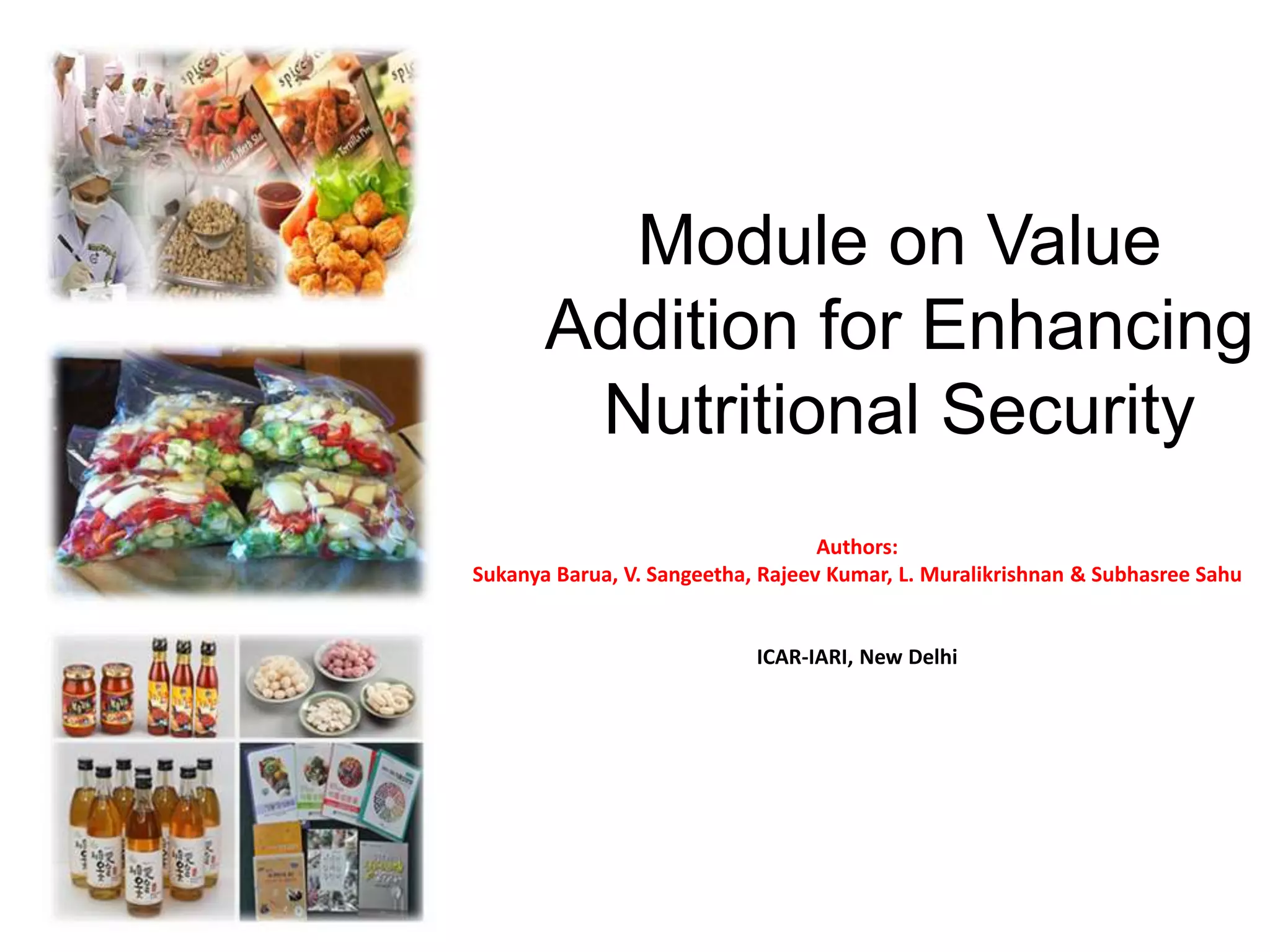
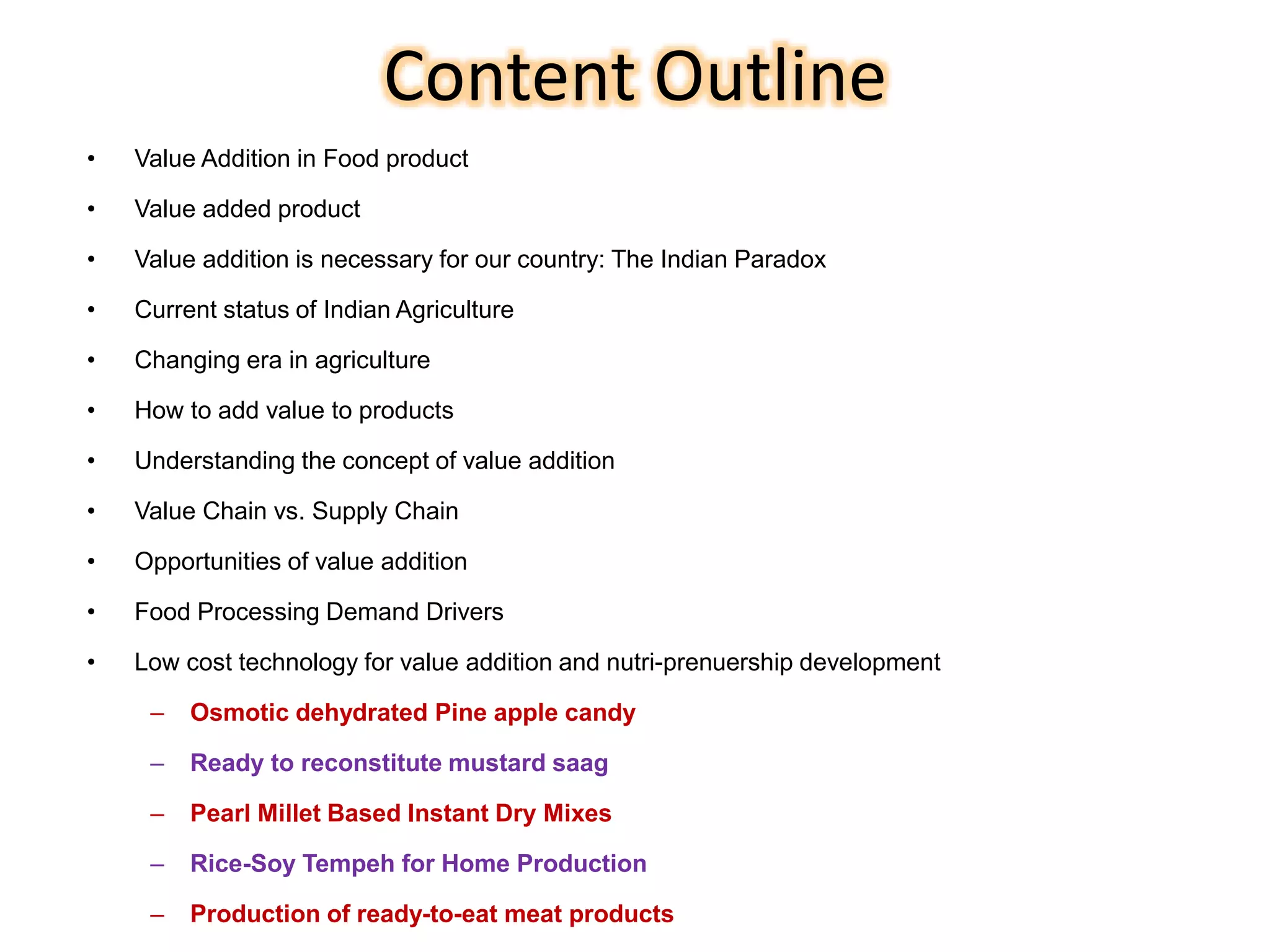
Module on Value
Addition for Enhancing
Nutritional Security
Authors:
Sukanya Barua, V. Sangeetha, Rajeev Kumar, L. Muralikrishnan & Subhasree Sahu
ICAR-IARI, New Delhi
Content Outline
• Value Addition in Food product
• Value added product
• Value addition is necessary for our country: The Indian Paradox
• Current status of Indian Agriculture
• Changing era in agriculture
• How to add value to products
• Understanding the concept of value addition
• Value Chain vs. Supply Chain
• Opportunities of value addition
• Food Processing Demand Drivers
• Low cost technology for value addition and nutri-prenuership development
– Osmotic dehydrated Pine apple candy
– Ready to reconstitute mustard saag
– Pearl Millet Based Instant Dry Mixes
– Rice-Soy Tempeh for Home Production
– Production of ready-to-eat meat products
What is Value addition in food product?
Value-added food processing is
something that you do to help
earn more money from
your farm products. For
example, as a farmer, you
process raw
fruits or vegetables into a
finished product that you can
sell
Some people package value-
added foods and
some people sell fresh value-
added foods
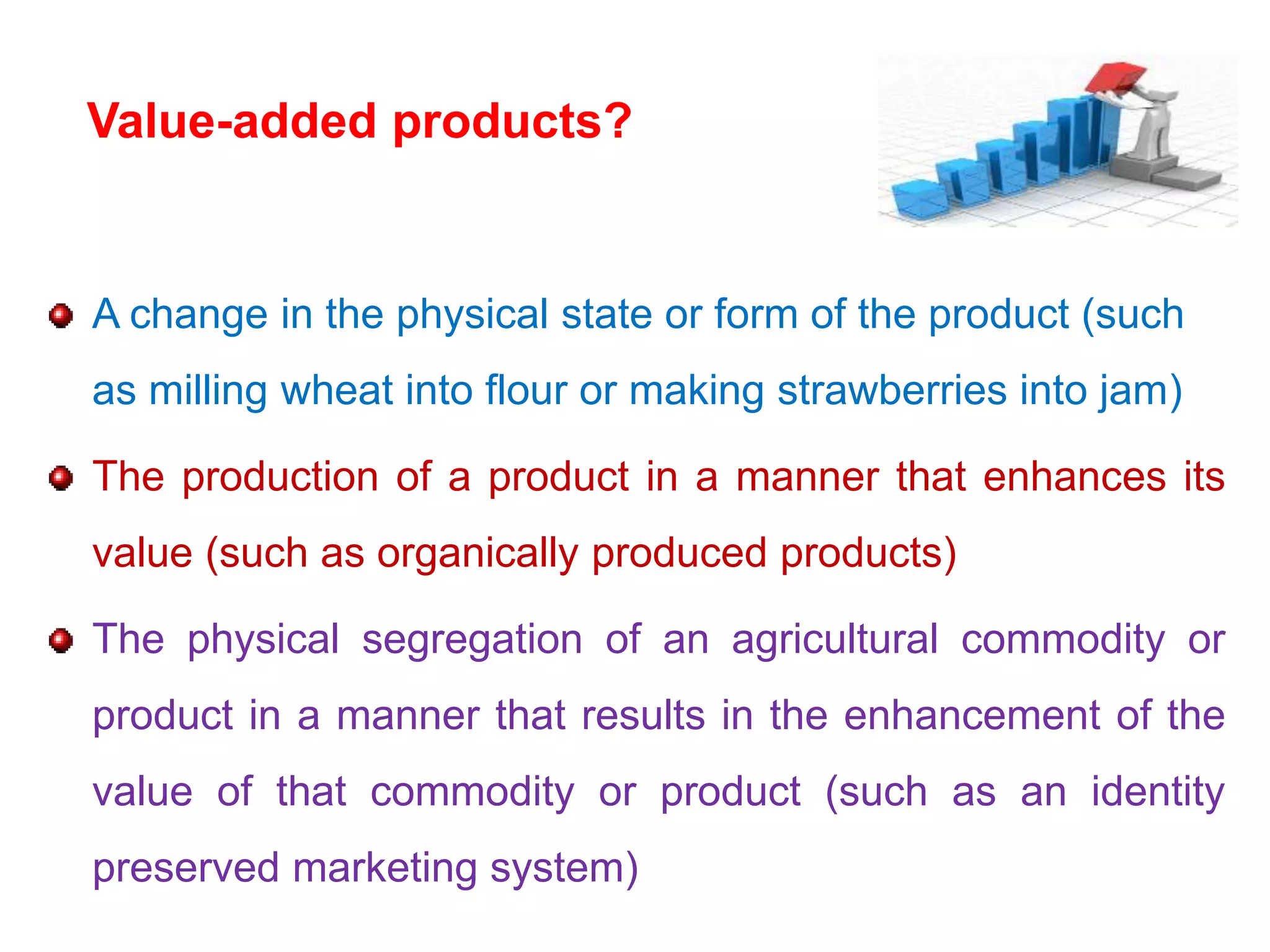
A change in the physical state or form of the product (such
as milling wheat into flour or making strawberries into jam)
The production of a product in a manner that enhances its
value (such as organically produced products)
The physical segregation of an agricultural commodity or
product in a manner that results in the enhancement of the
value of that commodity or product (such as an identity
preserved marketing system)
Value-added products?
Why value addition is necessary for our
country?
We are top of the producers among many
commodities in the world
Yet our share in World food trade is only 1.6%
The post harvest losses of fruits and vegetables are
estimated to be 25-40%, amounting to more than
Rs. 30,000 crores…
Yet less than 2% is processed! (30% and 80%
Thailand and Malaysia respectively)
The Indian Paradox…
Cont…
We have a middle class of 250-300 million people
with adequate purchasing power to buy
manufactured goods
Yet value addition to agricultural product is less than
7% (23,45 and 188% in China, Phillipines and U.K.)
More than 220 Million tons of food grain production
Yet more than 130 million people to go to bed
hungry everyday
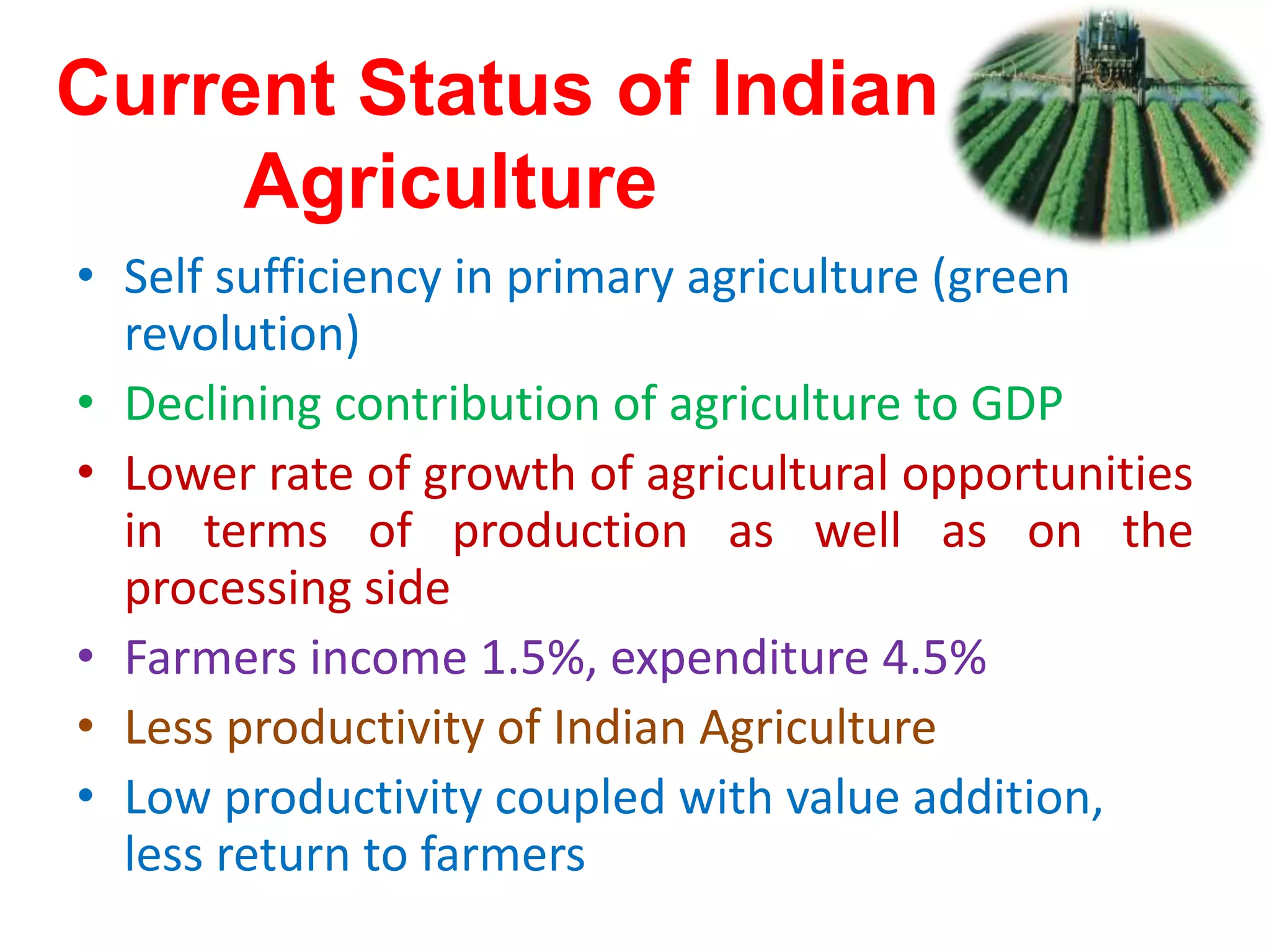
Current Status of Indian
Agriculture
• Self sufficiency in primary agriculture (green
revolution)
• Declining contribution of agriculture to GDP
• Lower rate of growth of agricultural opportunities
in terms of production as well as on the
processing side
• Farmers income 1.5%, expenditure 4.5%
• Less productivity of Indian Agriculture
• Low productivity coupled with value addition,
less return to farmers
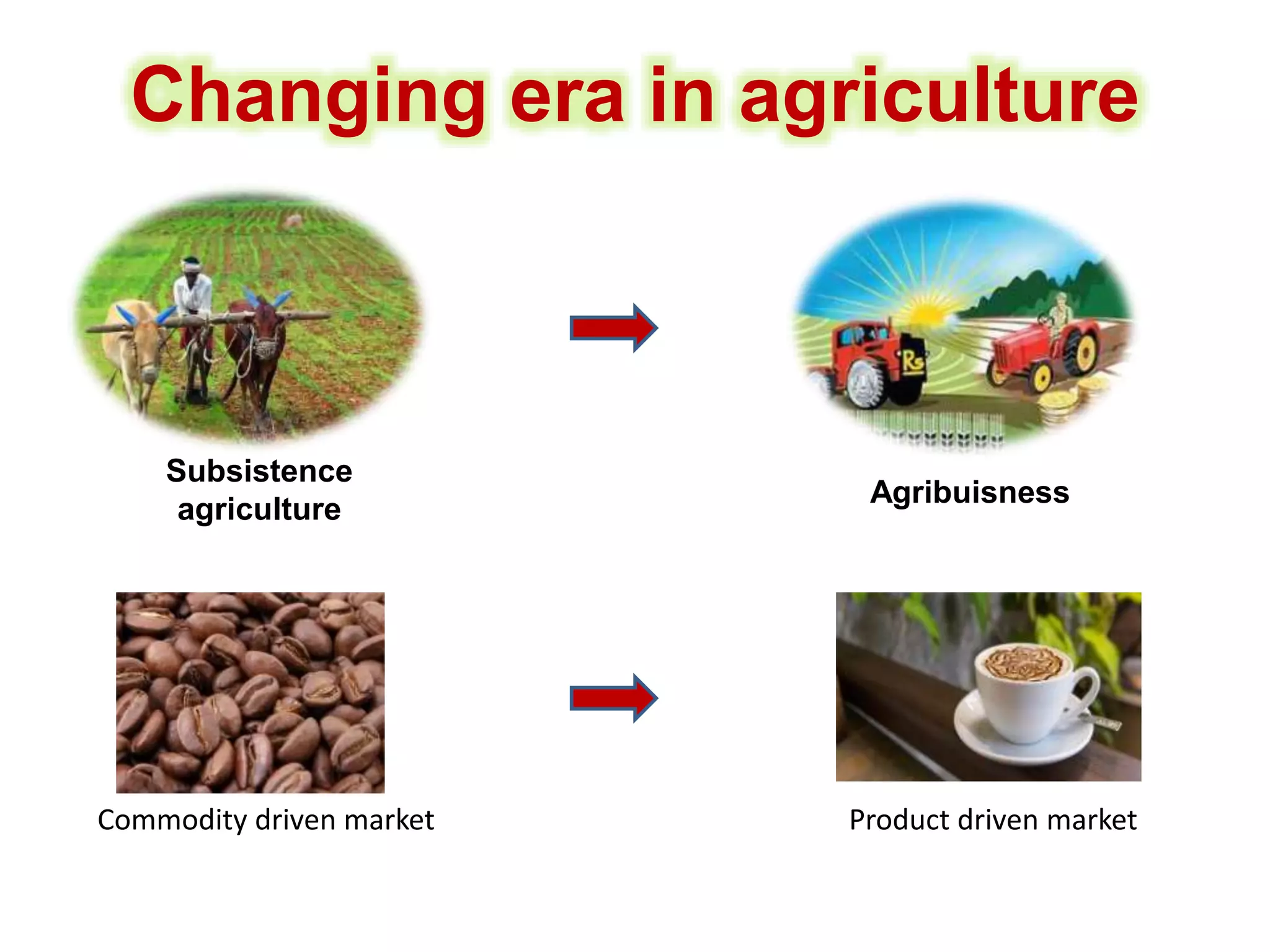
Changing era in agriculture
Subsistence
agriculture
Agribuisness
Commodity driven market Product driven market
Cont…
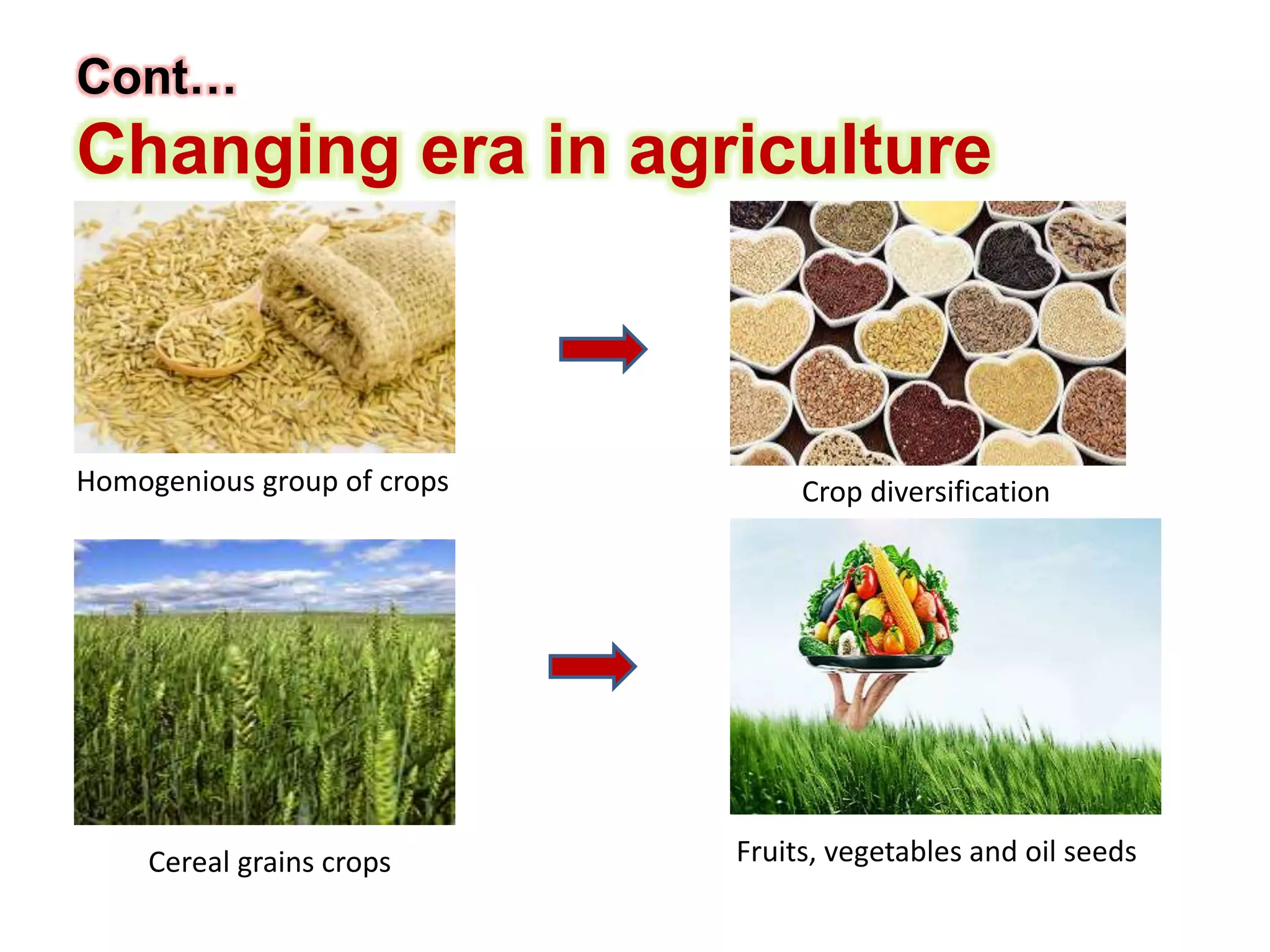
Changing era in agriculture
Homogenious group of crops Crop diversification
Cereal grains crops Fruits, vegetables and oil seeds
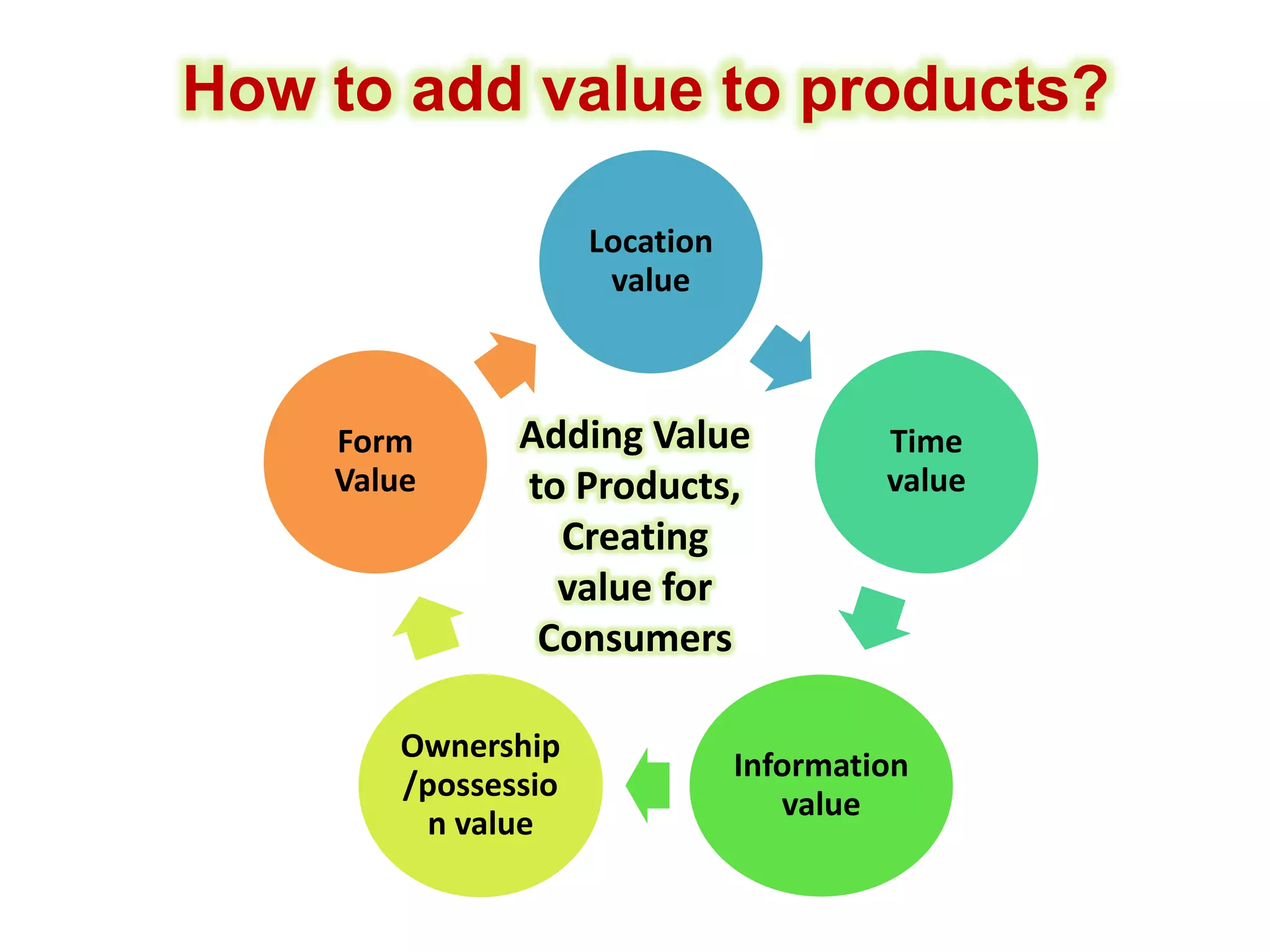
Location
value
Time
value
Information
value
Ownership
/possessio
n value
Form
Value
Adding Value
to Products,
Creating
value for
Consumers
How to add value to products?
Understanding the concept of
Value addition
• It is a production/marketing strategy driven by
customer needs and preferences
• Incremental value, higher price
• Nature of certain business relationships among
interacting food business enterprises- Supply
Chain
• Approaches to Value addition: Innovation or co-
ordination
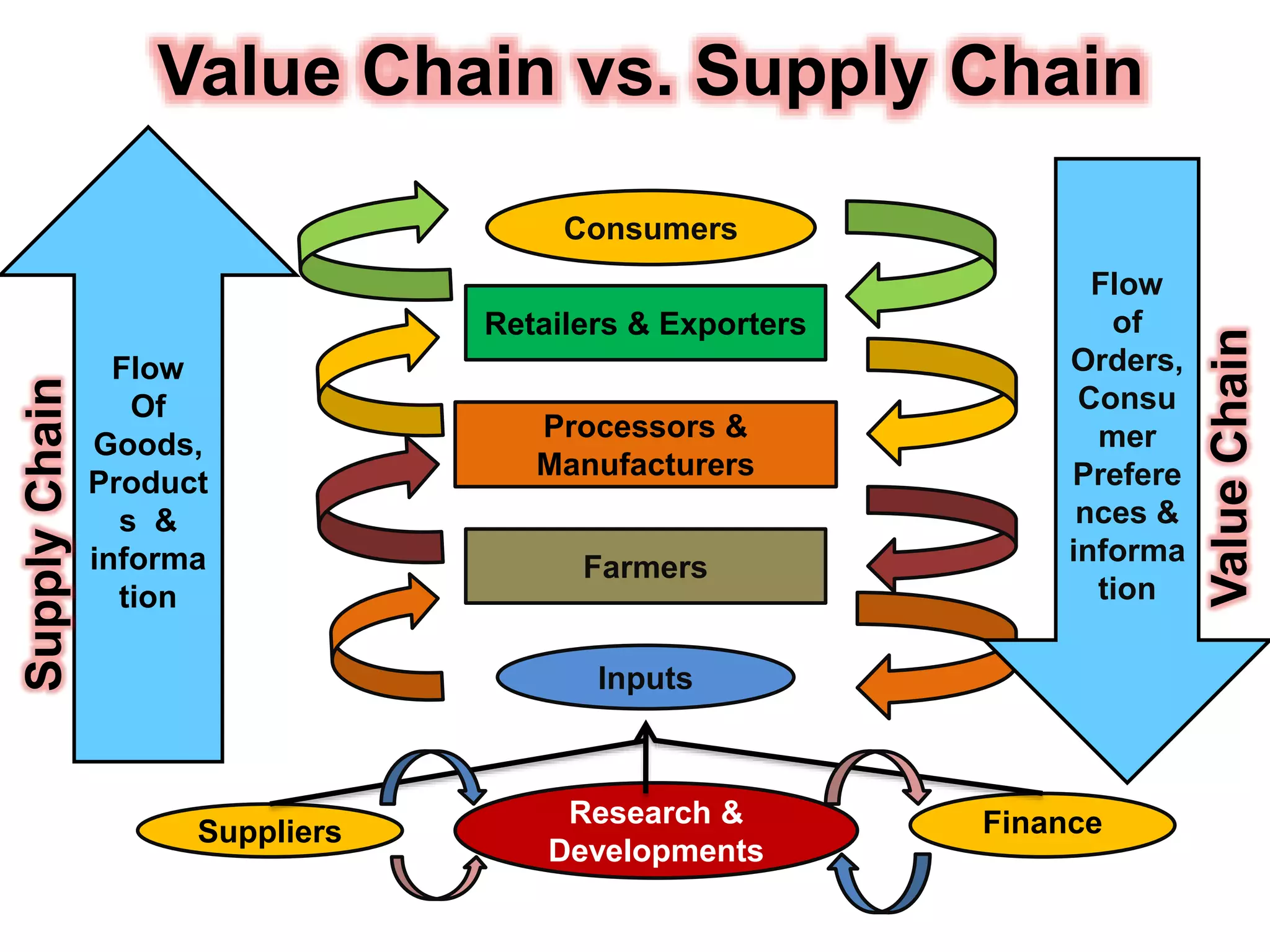
Value Chain vs. Supply Chain
Consumers
Retailers & Exporters
Processors &
Manufacturers
Farmers
Inputs
Research &
Developments
Suppliers Finance
Flow
Of
Goods,
Product
s &
informa
tion
Flow
of
Orders,
Consu
mer
Prefere
nces &
informa
tion
Supply
Chain
Value
Chain
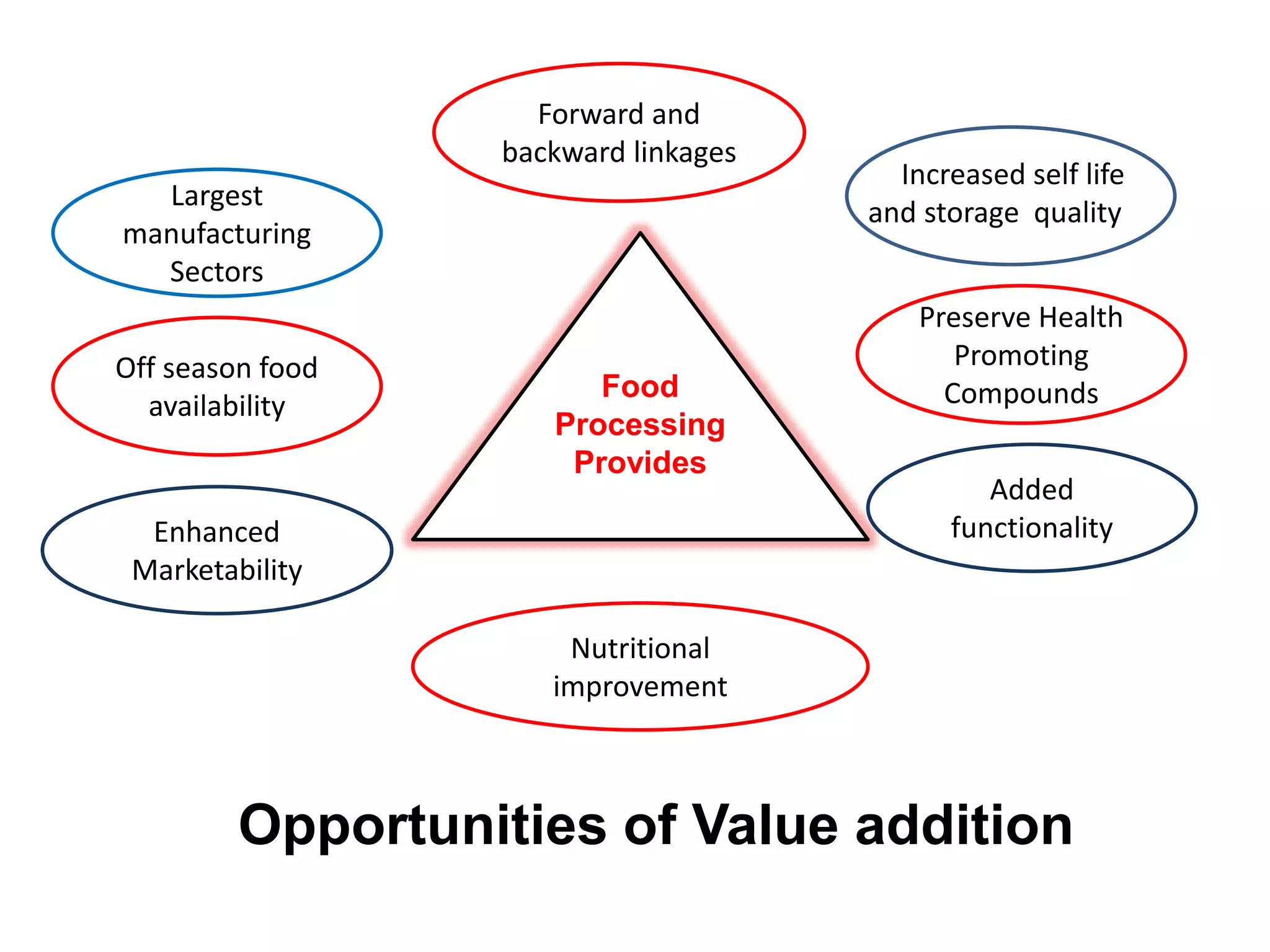
Food
Processing
Provides
Increased self life
and storage quality
Preserve Health
Promoting
Compounds
Added
functionality
Nutritional
improvement
Enhanced
Marketability
Off season food
availability
Largest
manufacturing
Sectors
Forward and
backward linkages
Opportunities of Value addition
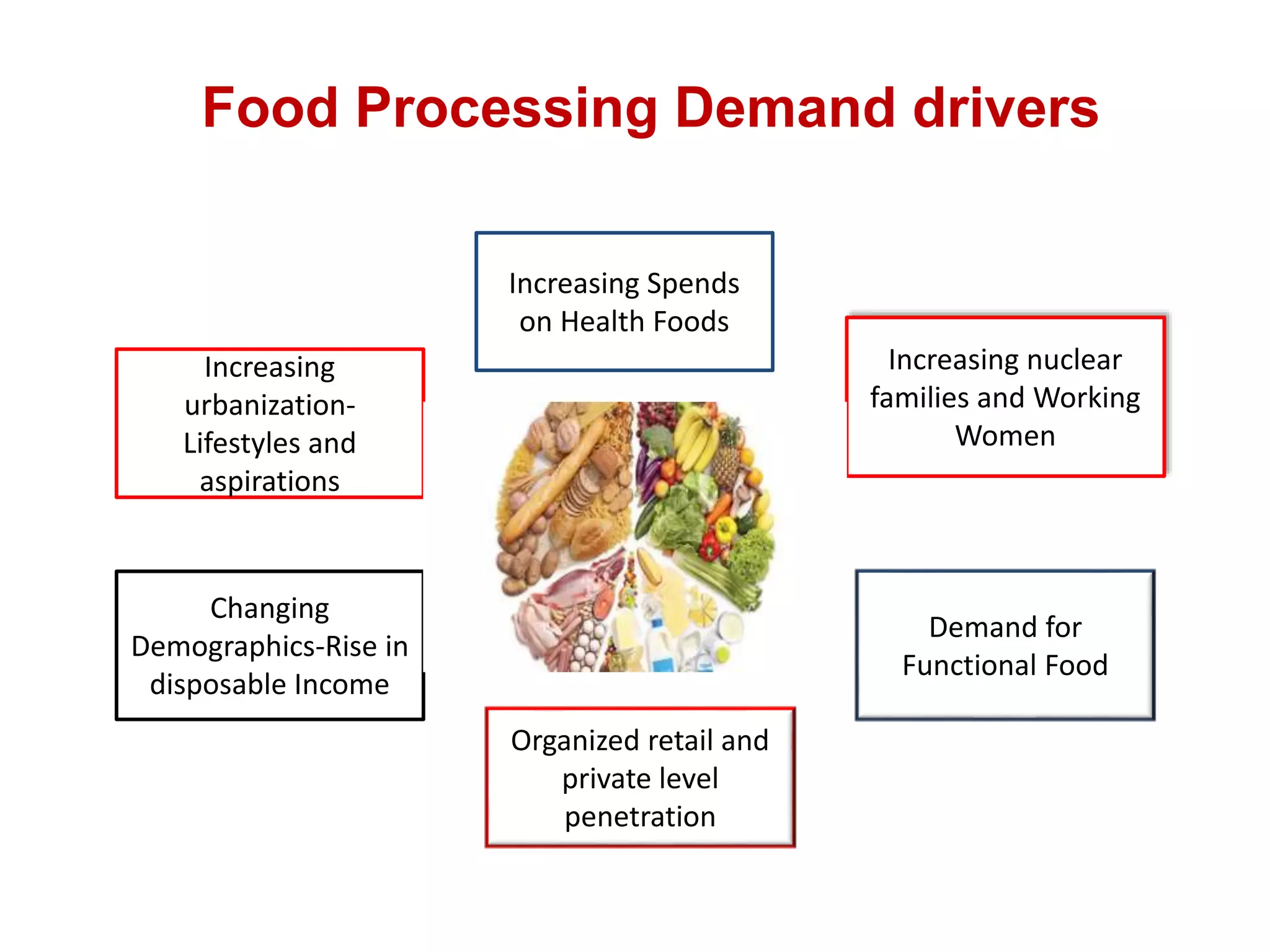
Food Processing Demand drivers
Increasing Spends
on Health Foods
Increasing nuclear
families and Working
Women
Demand for
Functional Food
Organized retail and
private level
penetration
Changing
Demographics-Rise in
disposable Income
Increasing
urbanization-
Lifestyles and
aspirations
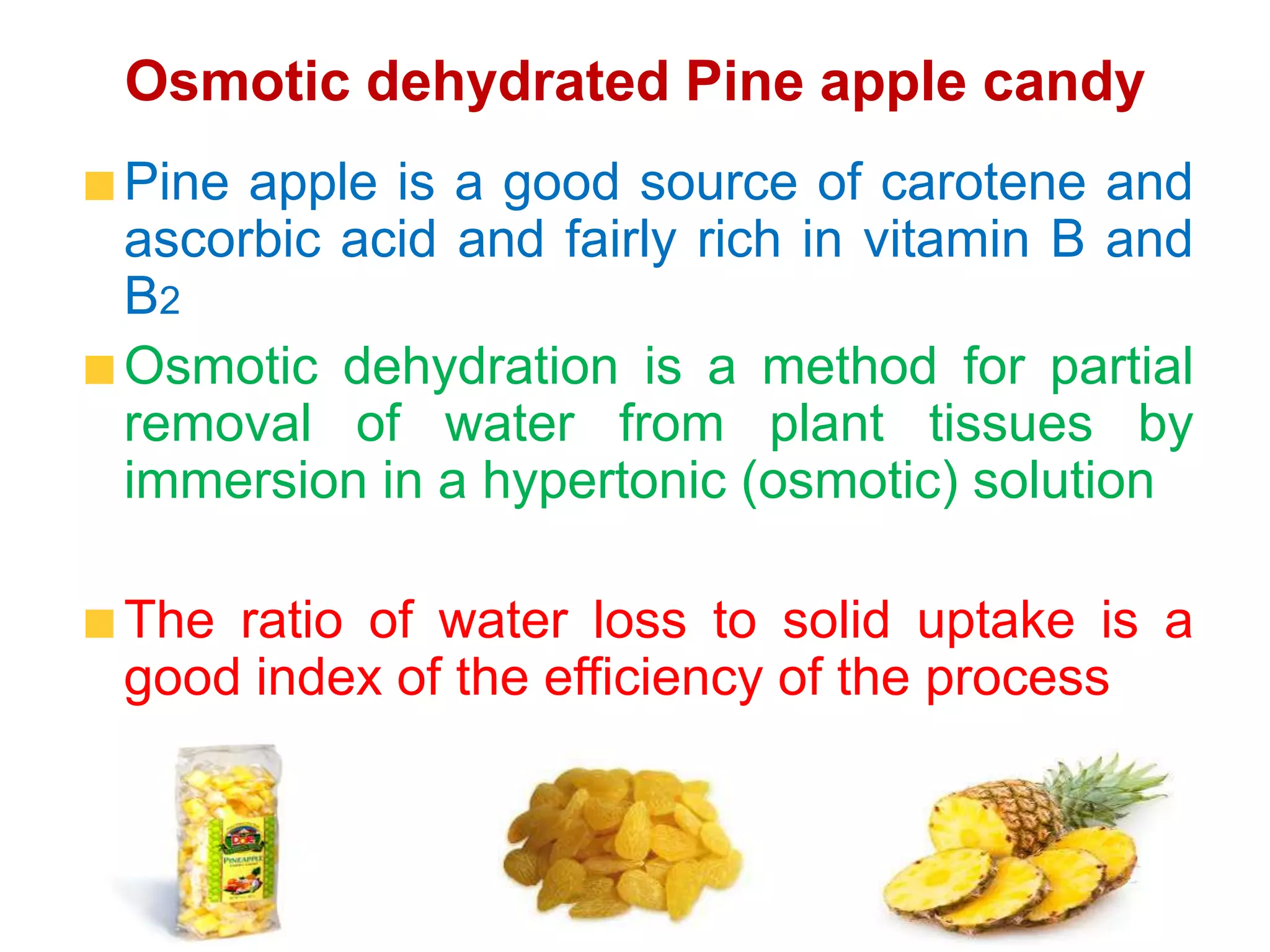
Osmotic dehydrated Pine apple candy
Pine apple is a good source of carotene and
ascorbic acid and fairly rich in vitamin B and
B2
Osmotic dehydration is a method for partial
removal of water from plant tissues by
immersion in a hypertonic (osmotic) solution
The ratio of water loss to solid uptake is a
good index of the efficiency of the process
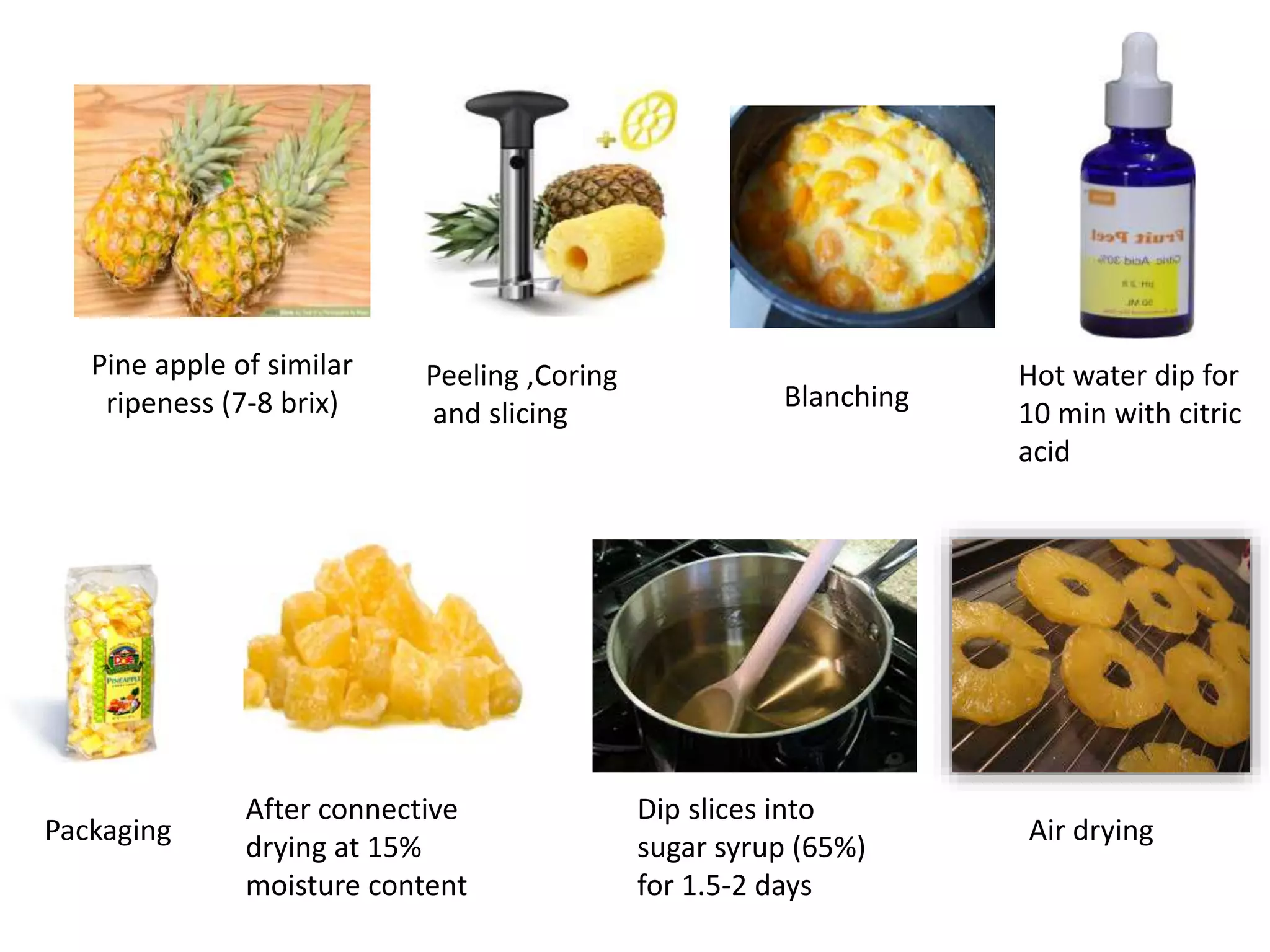
Pine apple of similar
ripeness (7-8 brix)
Peeling ,Coring
and slicing
Blanching
Hot water dip for
10 min with citric
acid
Air drying
Dip slices into
sugar syrup (65%)
for 1.5-2 days
After connective
drying at 15%
moisture content
Packaging
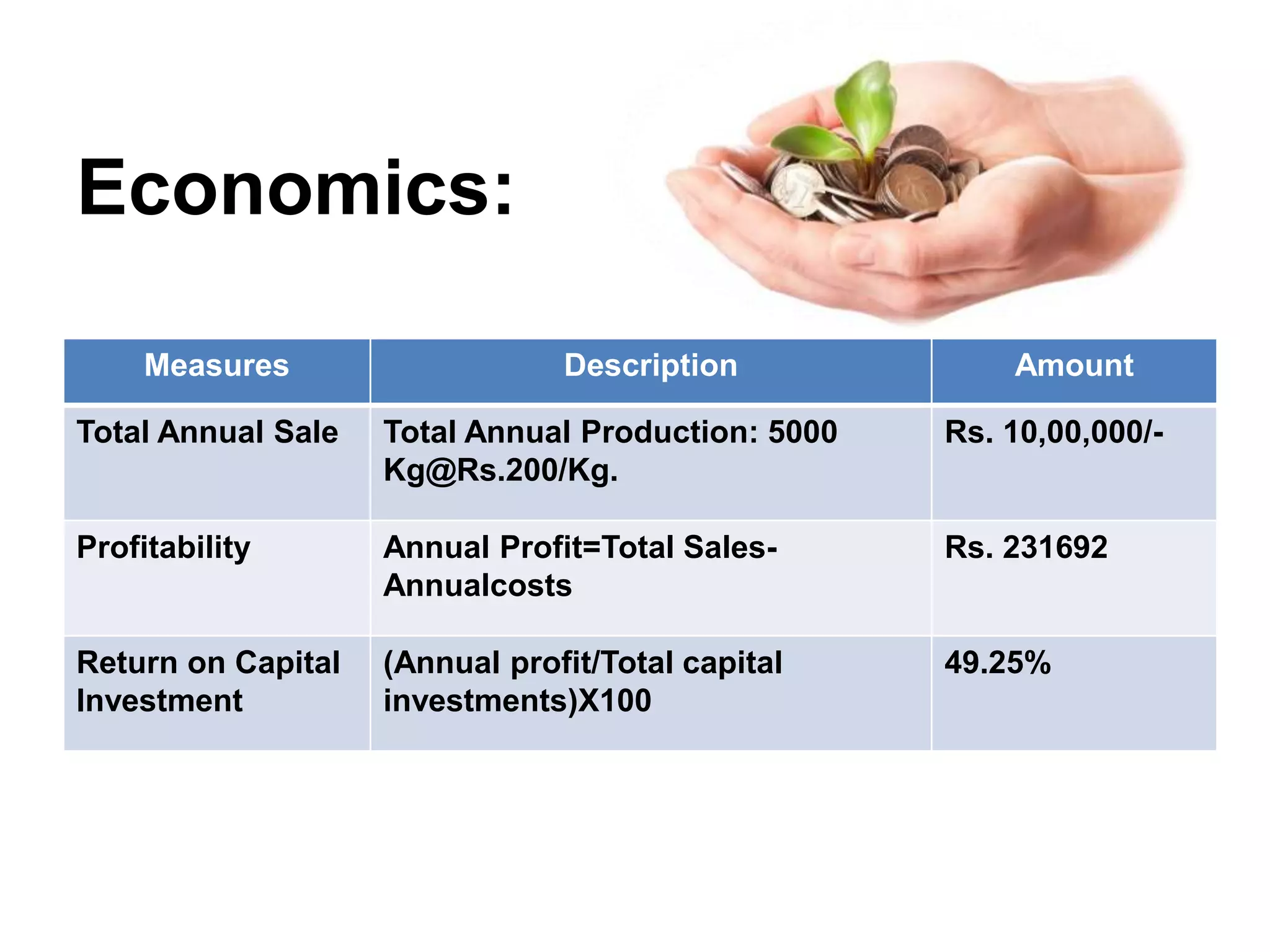
Economics:
Measures Description Amount
Total Annual Sale Total Annual Production: 5000
Kg@Rs.200/Kg.
Rs. 10,00,000/-
Profitability Annual Profit=Total Sales-
Annualcosts
Rs. 231692
Return on Capital
Investment
(Annual profit/Total capital
investments)X100
49.25%
For equipments and enterprise
establishment, please contact
• Director, Central Institute of Post-Harvest
Engineering and Technology (CIPHET), P.O: Punjab
Agricultural University, Ludhiana-141004
(Punjab). Ph.:0161-2313102, Fax: 0161-2308670.
Website: www.ciphet.in
• B. Sen Berry and Company 65/11, New Rohtak
Road, Karol Bagh, New Delhi -110005, Ph: 011-
65702298, 28712130, Fax: 011-28720553
• Bajaj Process Pack Mascinen Pvt. Ltd, Plot No.
7/20 and 7/27, Jai Lakshmi instrumental Estate,
Side IV, Sahibabad Industrial area, Ghaziabad
(UP).
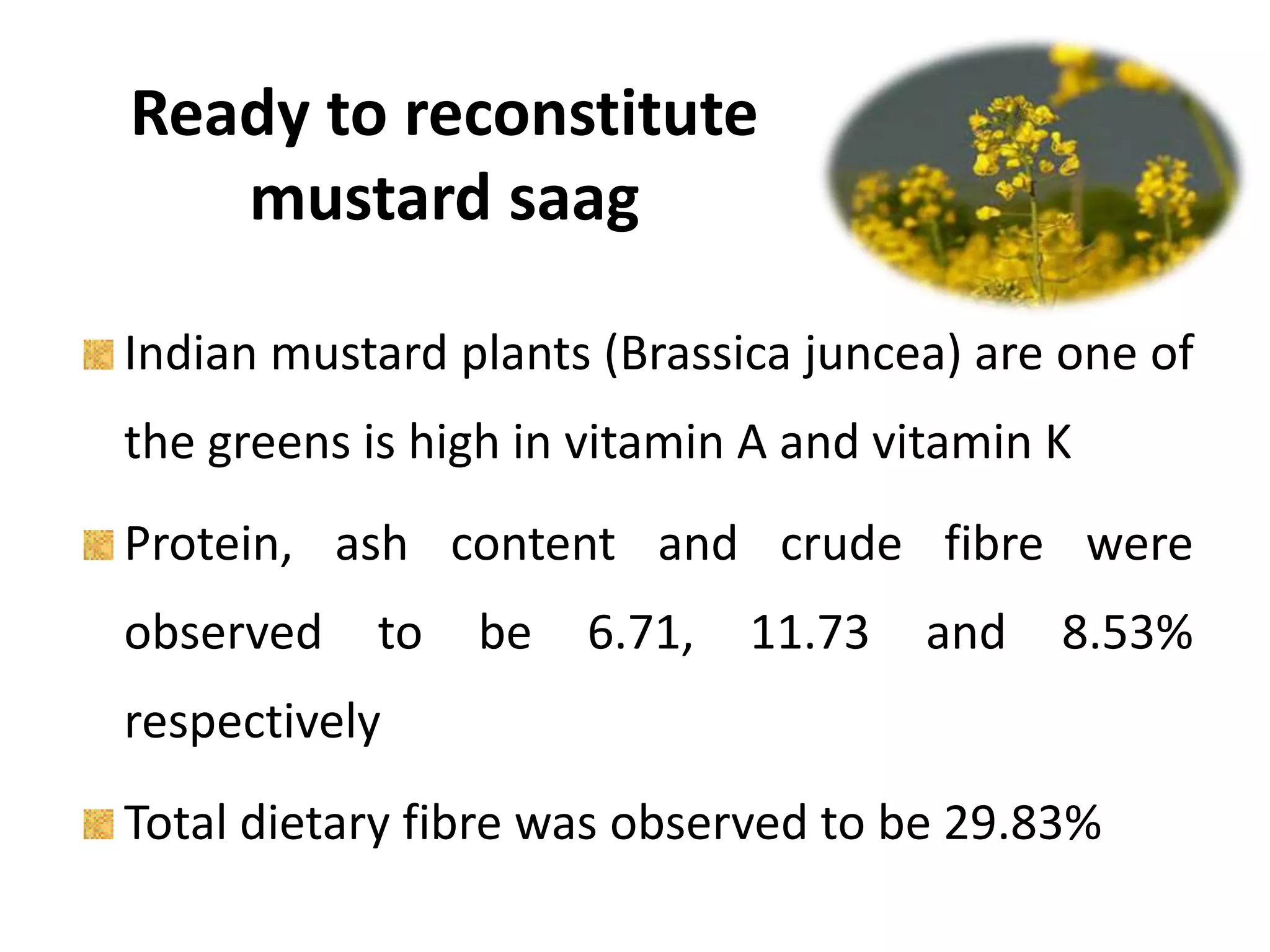
Ready to reconstitute
mustard saag
Indian mustard plants (Brassica juncea) are one of
the greens is high in vitamin A and vitamin K
Protein, ash content and crude fibre were
observed to be 6.71, 11.73 and 8.53%
respectively
Total dietary fibre was observed to be 29.83%
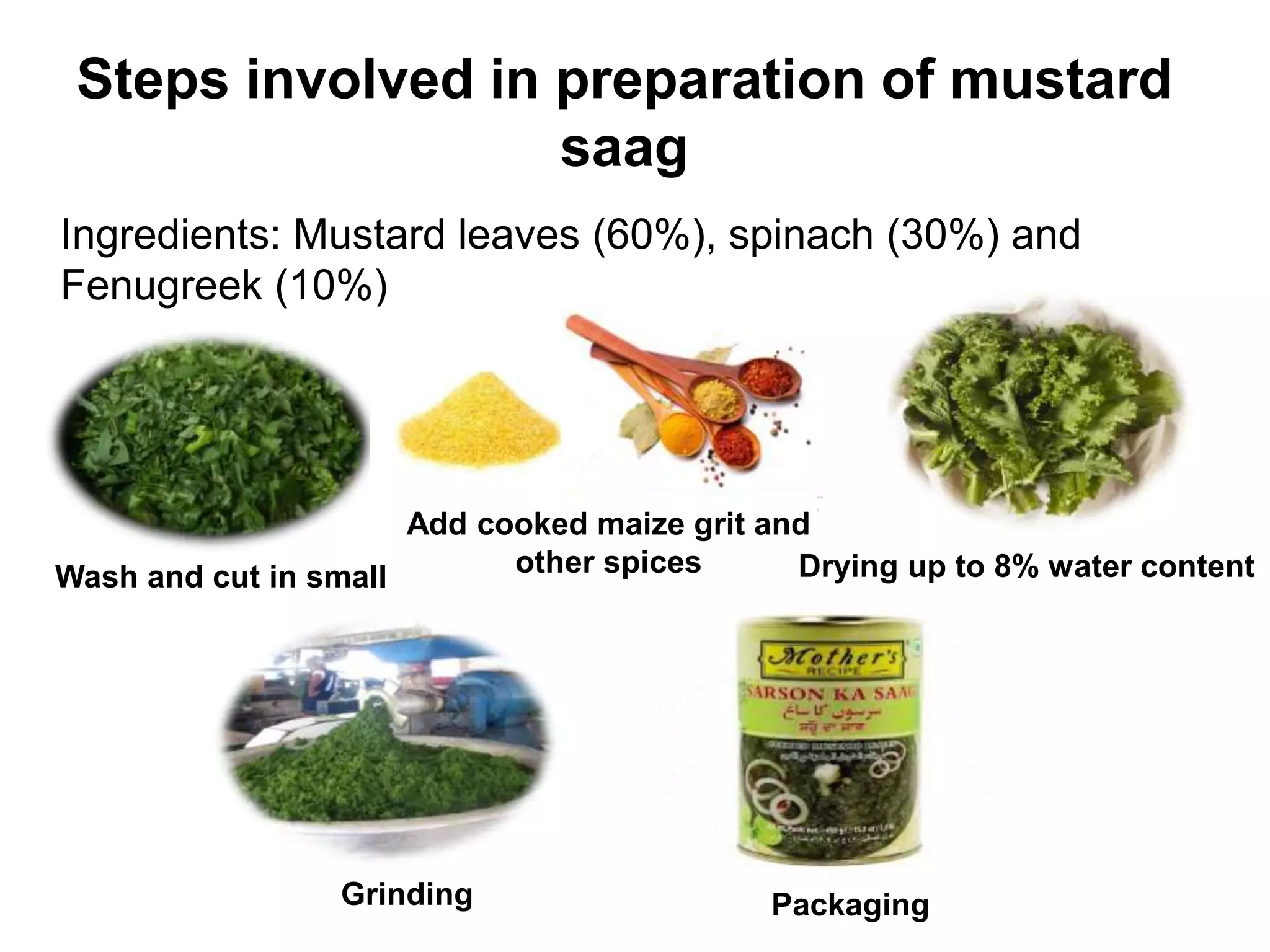
Steps involved in preparation of mustard
saag
Ingredients: Mustard leaves (60%), spinach (30%) and
Fenugreek (10%)
Wash and cut in small
Add cooked maize grit and
other spices Drying up to 8% water content
Grinding Packaging
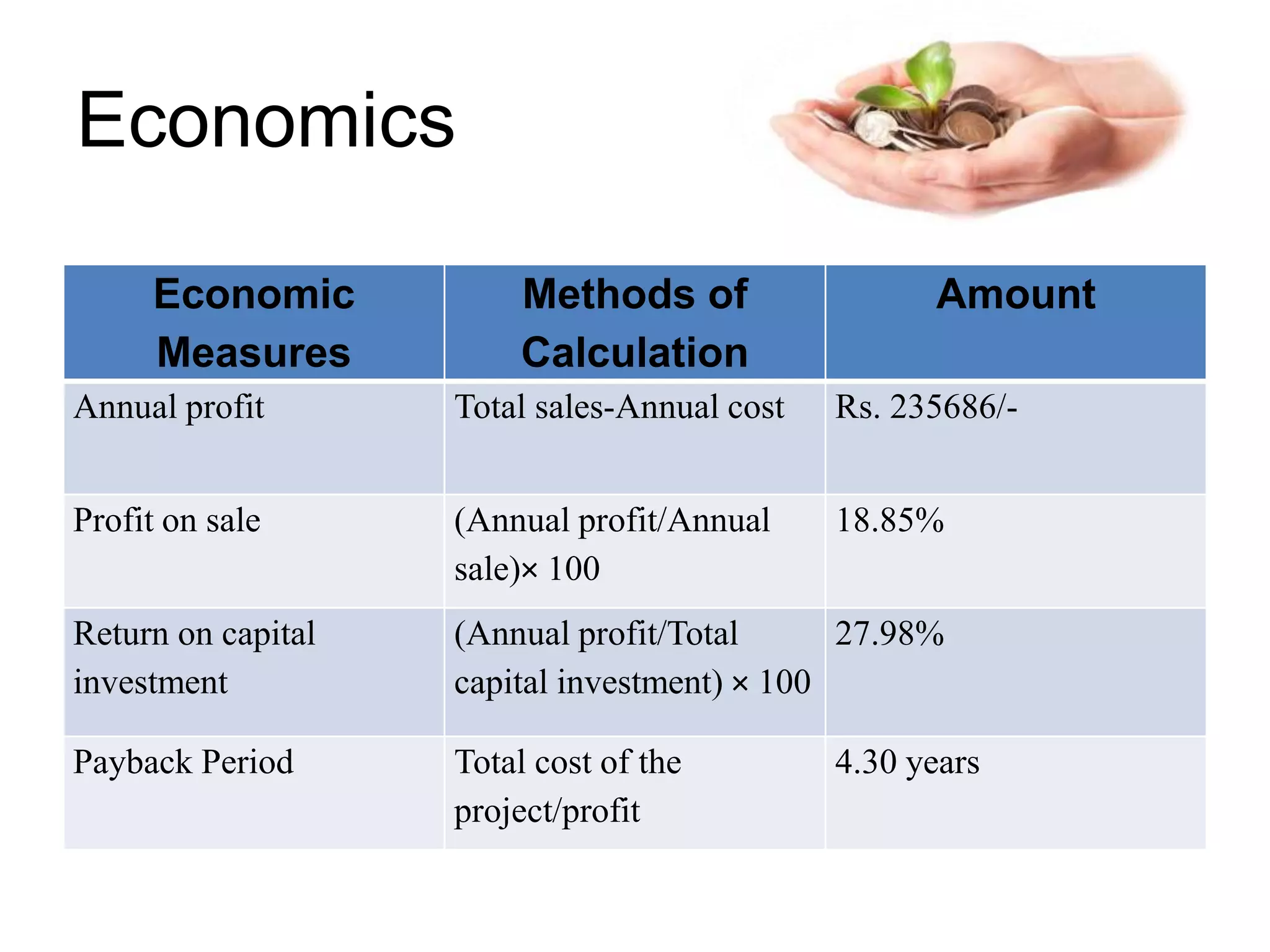
Economics
Economic
Measures
Methods of
Calculation
Amount
Annual profit Total sales-Annual cost Rs. 235686/-
Profit on sale (Annual profit/Annual
sale)× 100
18.85%
Return on capital
investment
(Annual profit/Total
capital investment) × 100
27.98%
Payback Period Total cost of the
project/profit
4.30 years
For equipments and enterprise
establishment, please contact
• Director, Central Institute of Post-Harvest
Engineering and Technology (CIPHET), P.O: Punjab
Agricultural University, Ludhiana-141004
(Punjab). Ph.:0161-2313102, Fax: 0161-2308670.
Website: www.ciphet.in.
• Bajaj Processpack Maschinen Pvt. Ltd, 2/27 Jai
Lakshmi Industrial Estate Site IV, Sahibabad
Industrial Area, Dist: Ghaziabad (U.P).
• D.P. Pulveriser Industries, Modi & Modi Building
No. 2,76 Nagindas Master Road, Fort, Mumbai-
400 023, Tel no. 022-22674901.
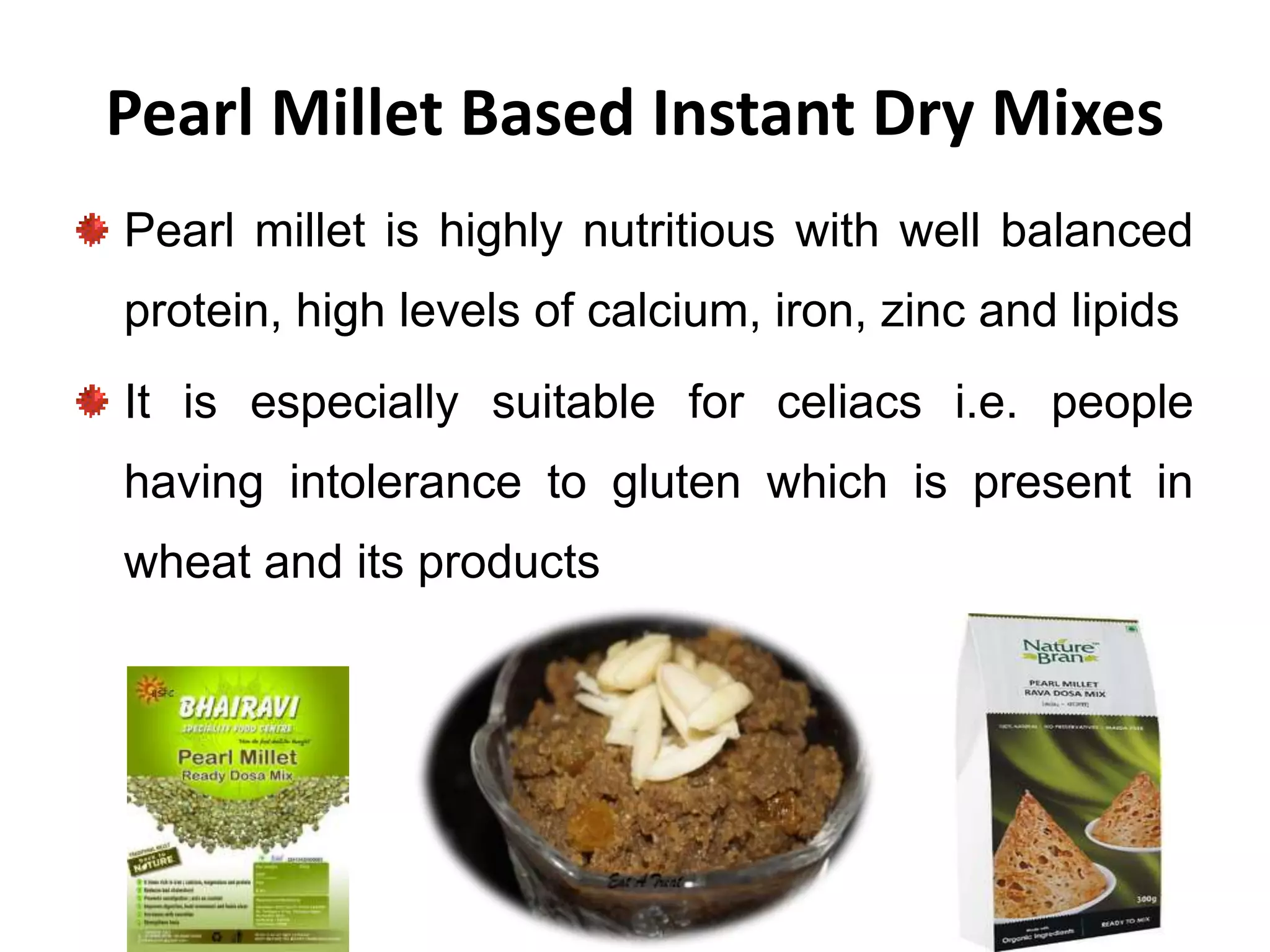
Pearl Millet Based Instant Dry Mixes
Pearl millet is highly nutritious with well balanced
protein, high levels of calcium, iron, zinc and lipids
It is especially suitable for celiacs i.e. people
having intolerance to gluten which is present in
wheat and its products
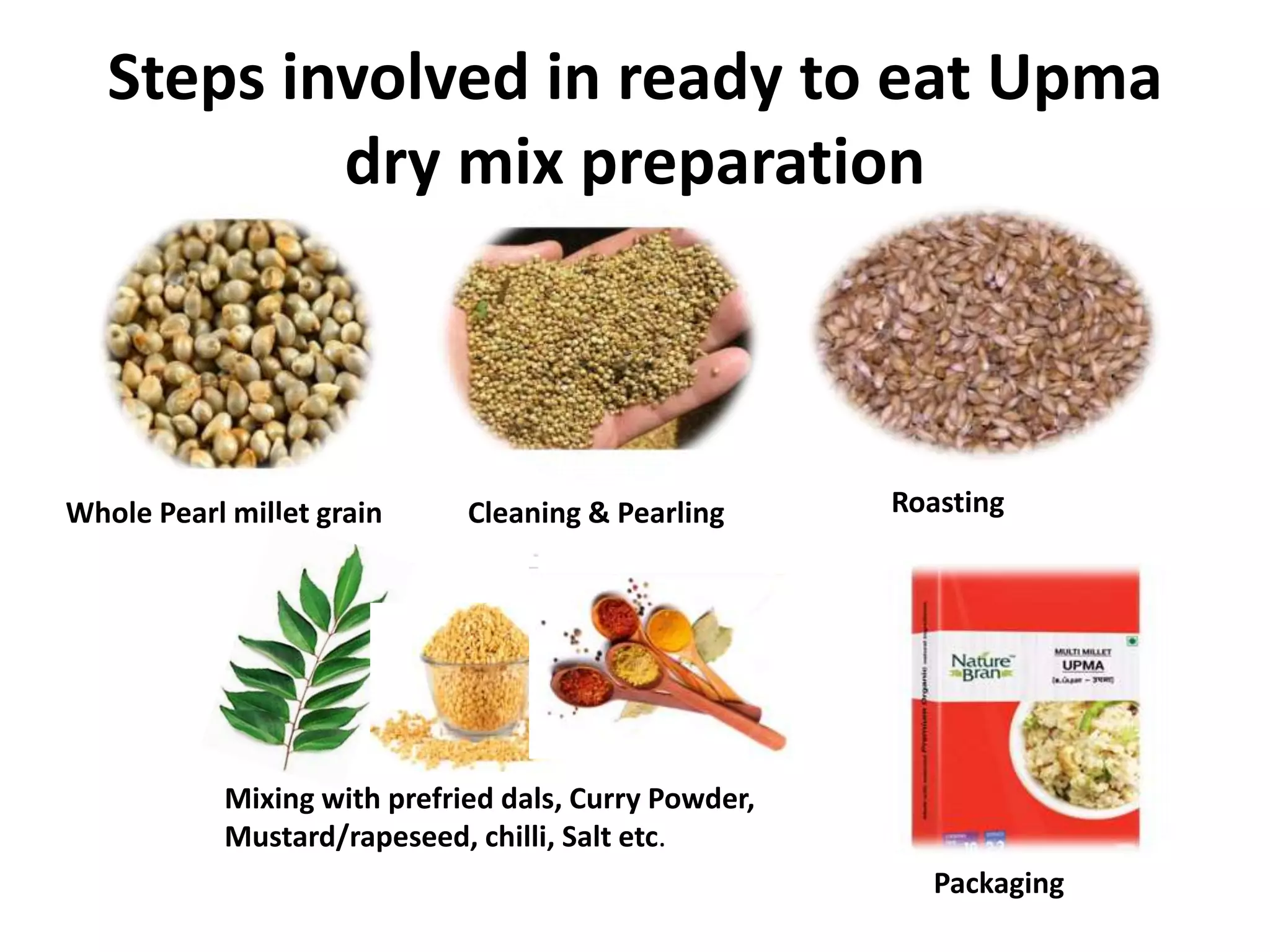
Steps involved in ready to eat Upma
dry mix preparation
Whole Pearl millet grain Cleaning & Pearling Roasting
Mixing with prefried dals, Curry Powder,
Mustard/rapeseed, chilli, Salt etc.
Packaging
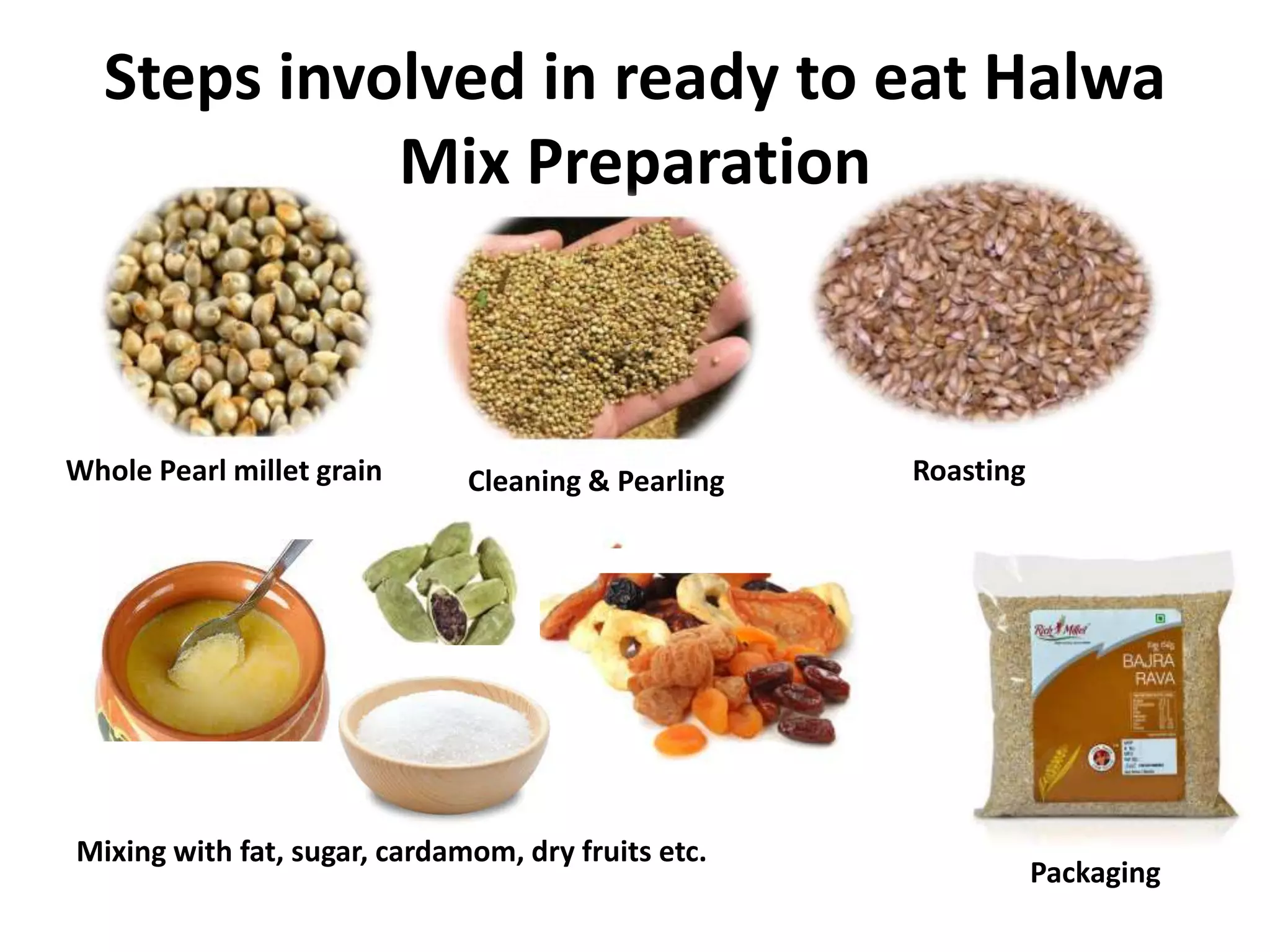
Steps involved in ready to eat Halwa
Mix Preparation
Whole Pearl millet grain Cleaning & Pearling Roasting
Packaging
Mixing with fat, sugar, cardamom, dry fruits etc.
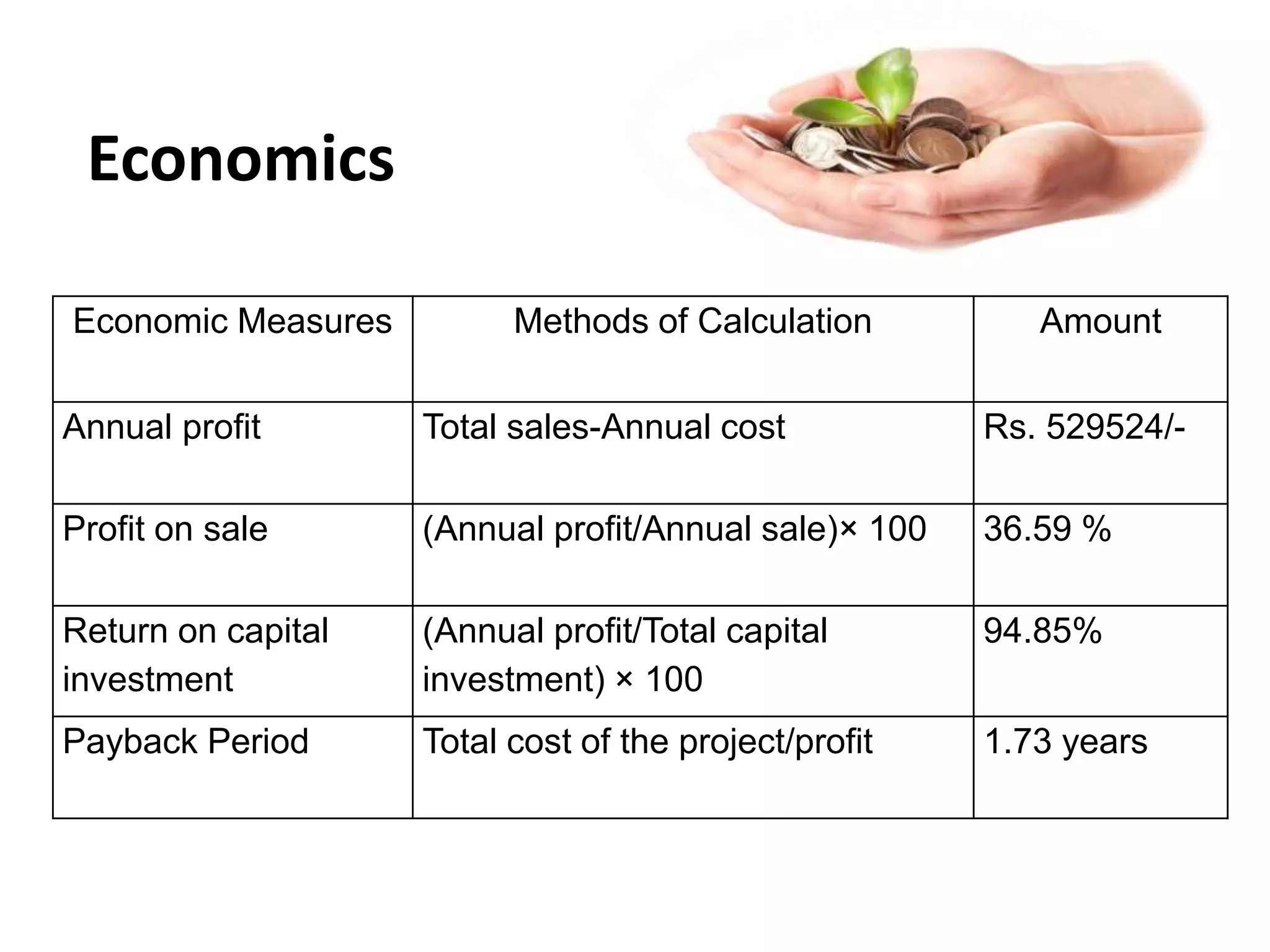
Economics
Economic Measures Methods of Calculation Amount
Annual profit Total sales-Annual cost Rs. 529524/-
Profit on sale (Annual profit/Annual sale)× 100 36.59 %
Return on capital
investment
(Annual profit/Total capital
investment) × 100
94.85%
Payback Period Total cost of the project/profit 1.73 years
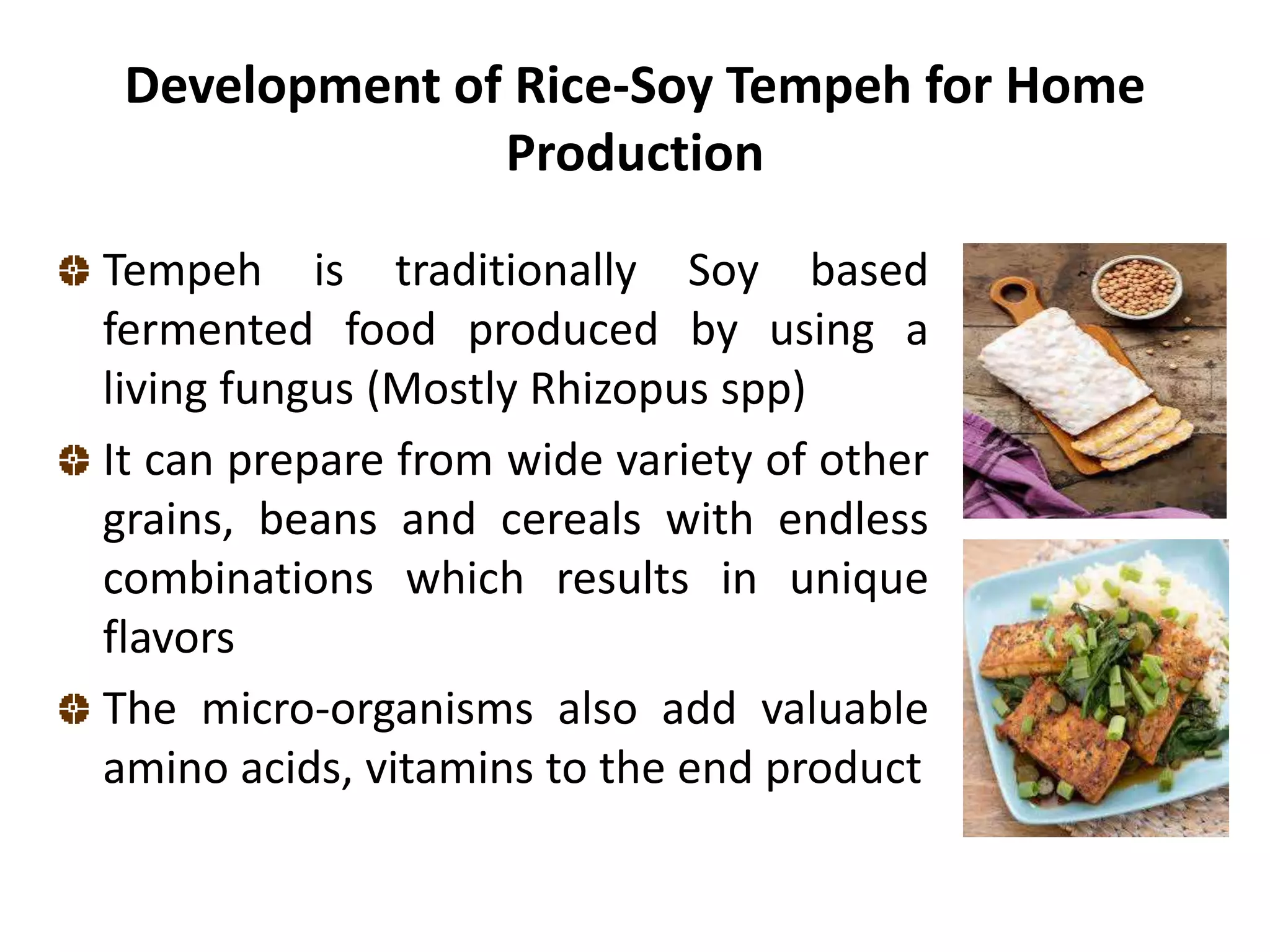
Development of Rice-Soy Tempeh for Home
Production
Tempeh is traditionally Soy based
fermented food produced by using a
living fungus (Mostly Rhizopus spp)
It can prepare from wide variety of other
grains, beans and cereals with endless
combinations which results in unique
flavors
The micro-organisms also add valuable
amino acids, vitamins to the end product
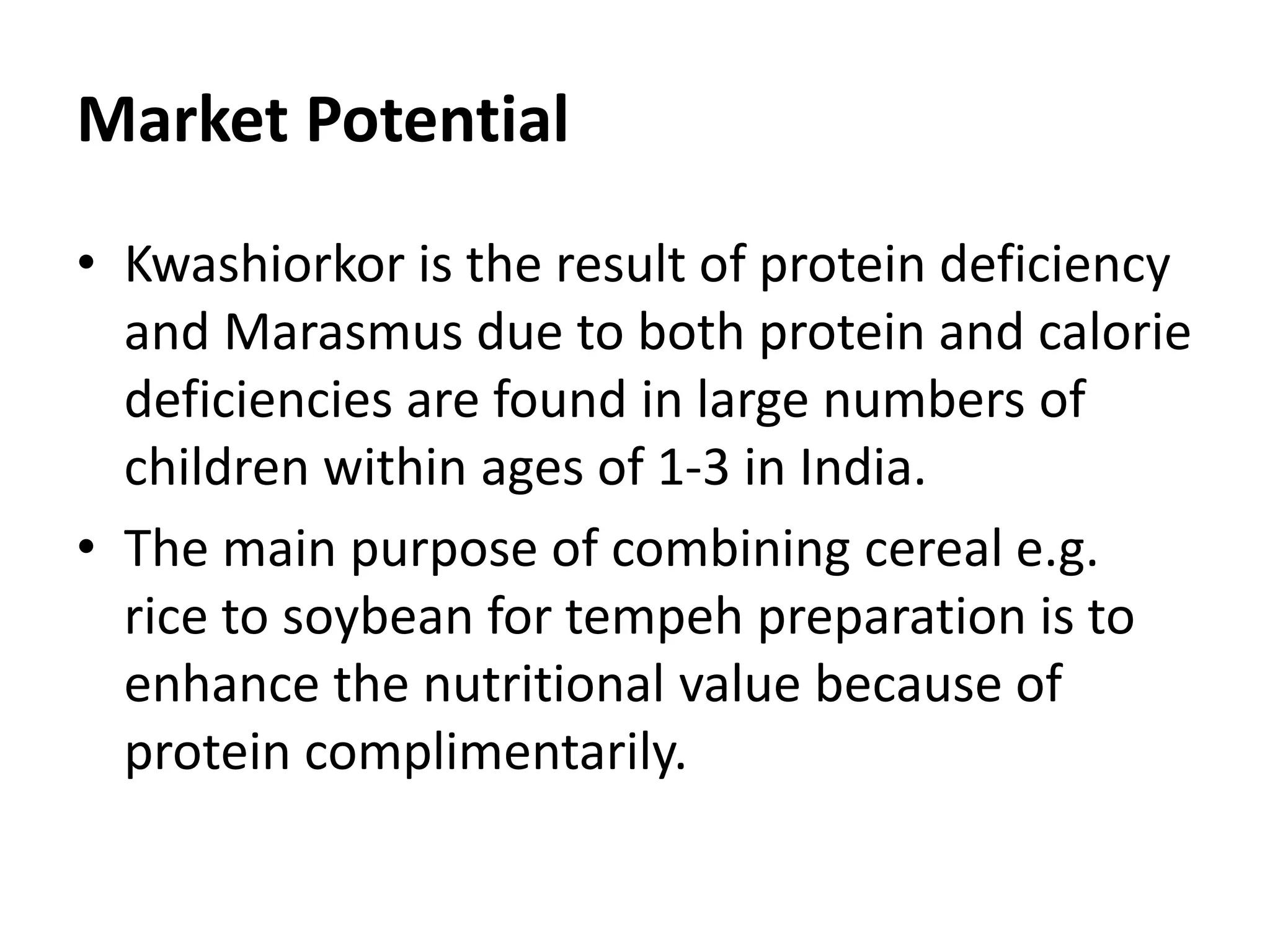
Market Potential
• Kwashiorkor is the result of protein deficiency
and Marasmus due to both protein and calorie
deficiencies are found in large numbers of
children within ages of 1-3 in India.
• The main purpose of combining cereal e.g.
rice to soybean for tempeh preparation is to
enhance the nutritional value because of
protein complimentarily.
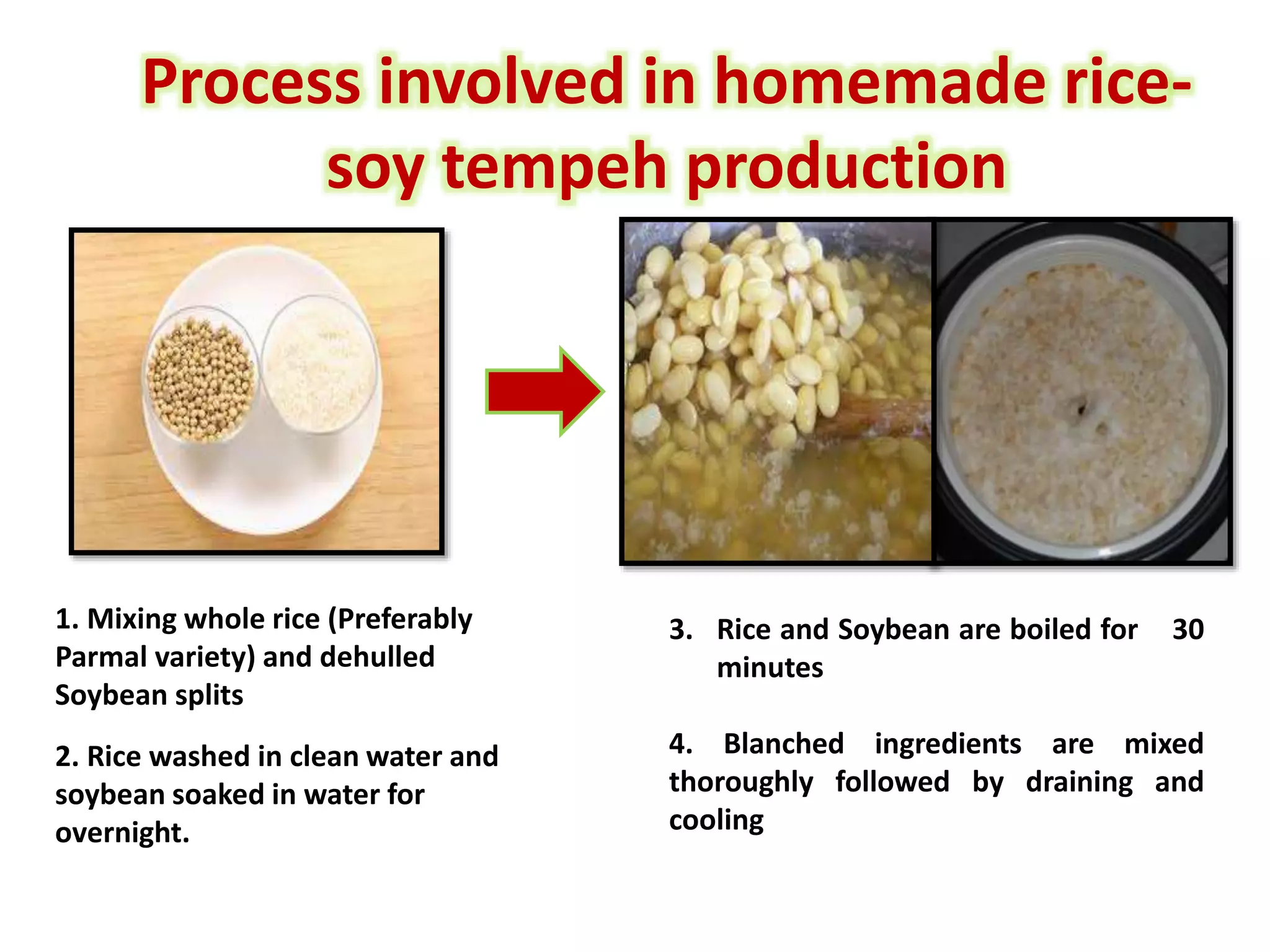
1. Mixing whole rice (Preferably
Parmal variety) and dehulled
Soybean splits
2. Rice washed in clean water and
soybean soaked in water for
overnight.
3. Rice and Soybean are boiled for 30
minutes
4. Blanched ingredients are mixed
thoroughly followed by draining and
cooling
Process involved in homemade rice-
soy tempeh production
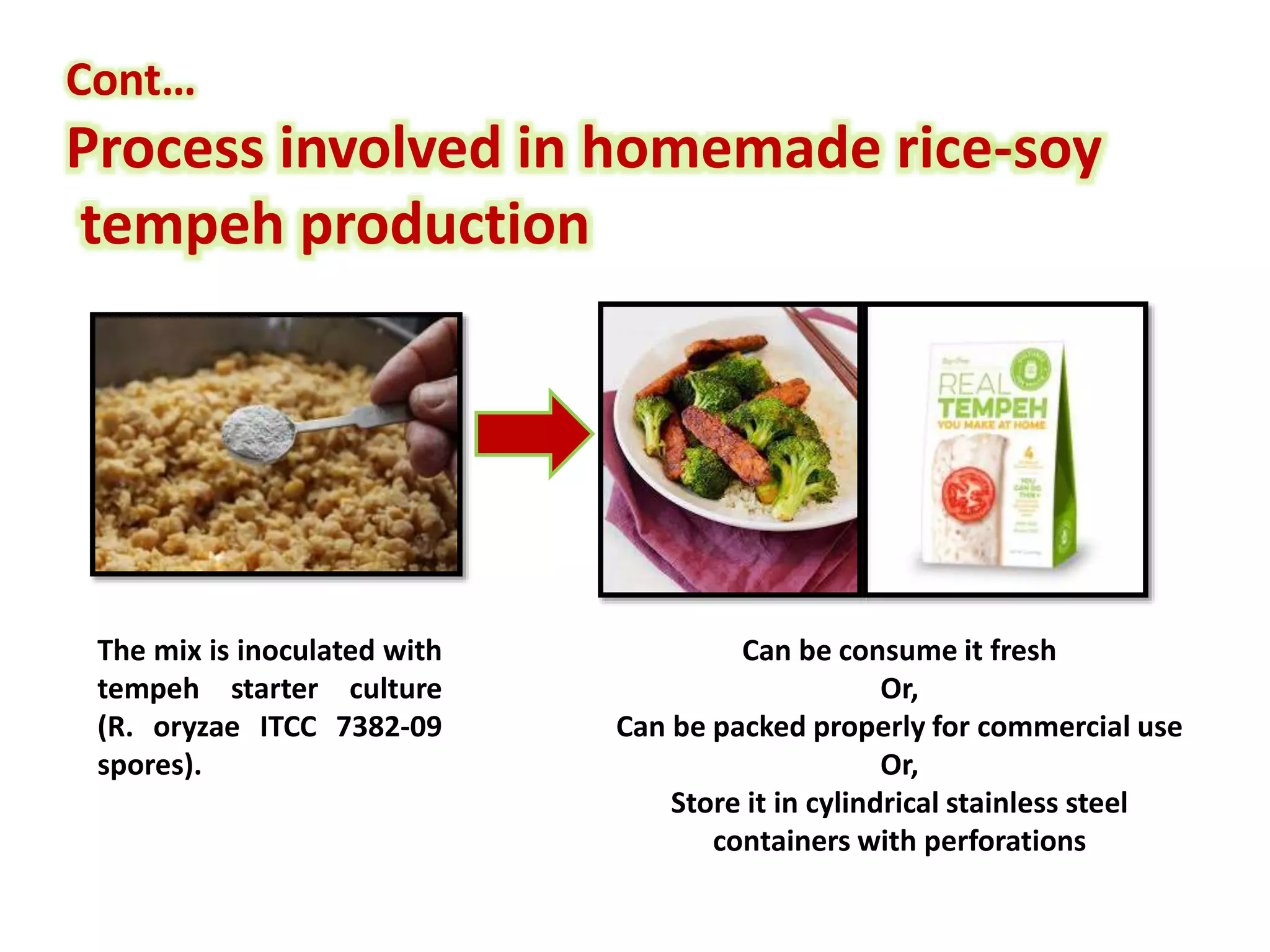
The mix is inoculated with
tempeh starter culture
(R. oryzae ITCC 7382-09
spores).
Can be consume it fresh
Or,
Can be packed properly for commercial use
Or,
Store it in cylindrical stainless steel
containers with perforations
Cont…
Process involved in homemade rice-soy
tempeh production
Preservation of tempeh
Freshly made, raw tempeh remains edible for few days
at room temperature
It can be preserved by sun drying
5% final moisture in dried rice-soy tempeh found suitable
for storage in freezer
Mushroom smell is usually a characteristic aroma of
fresh tempeh while alcoholic aroma is a feature of an
deteriorating tempeh. Shelf life up to six month if store in
freezer
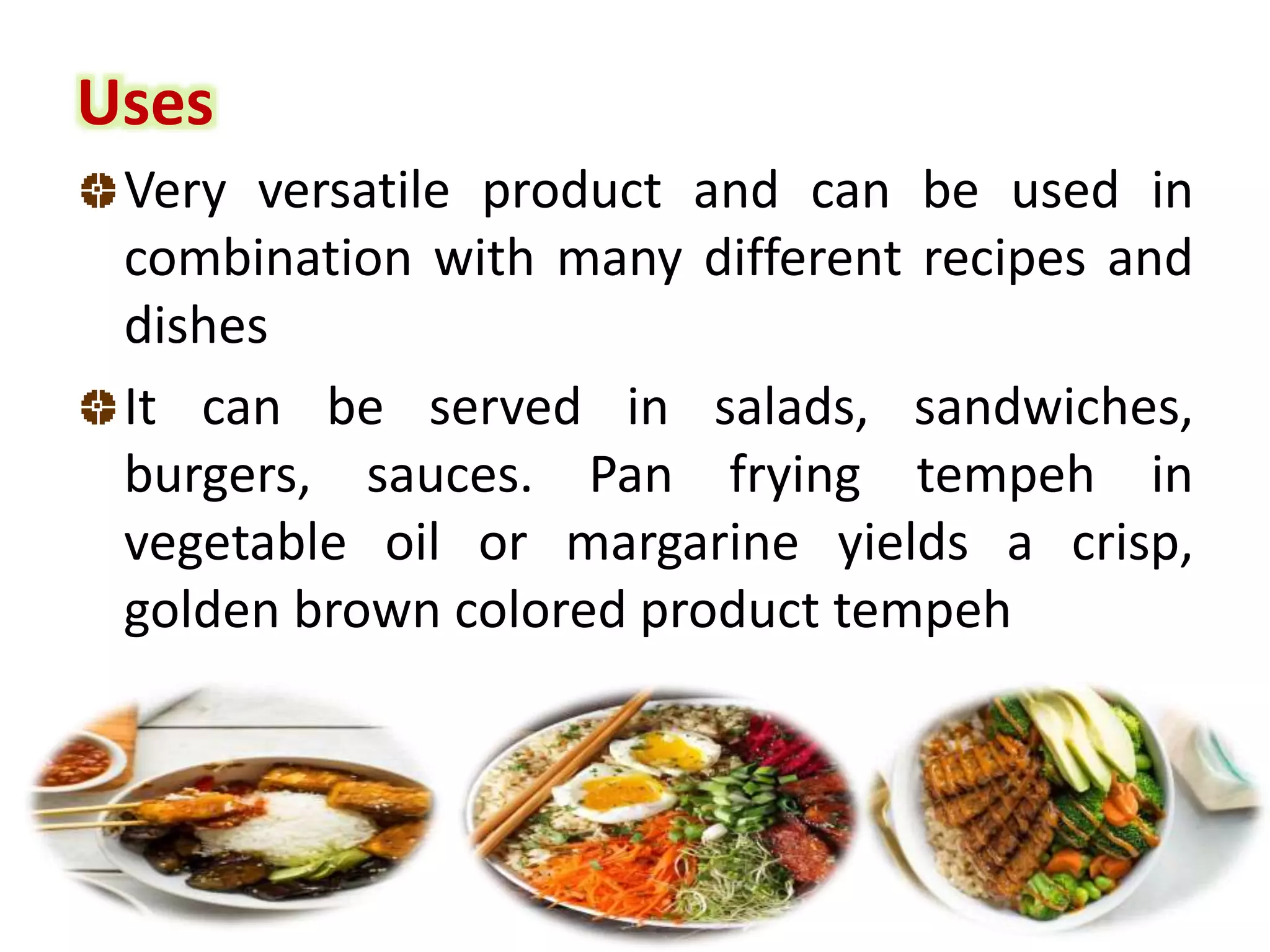
Uses
Very versatile product and can be used in
combination with many different recipes and
dishes
It can be served in salads, sandwiches,
burgers, sauces. Pan frying tempeh in
vegetable oil or margarine yields a crisp,
golden brown colored product tempeh
Development of ready-to-eat meat
products using a simple technology
The present market demand of meat for
present population would be 7.7 Million tones
per year against the present production of
6.04 Million tones per year
In India only 5 % meat is processed. So, there
is immense scope to value addition
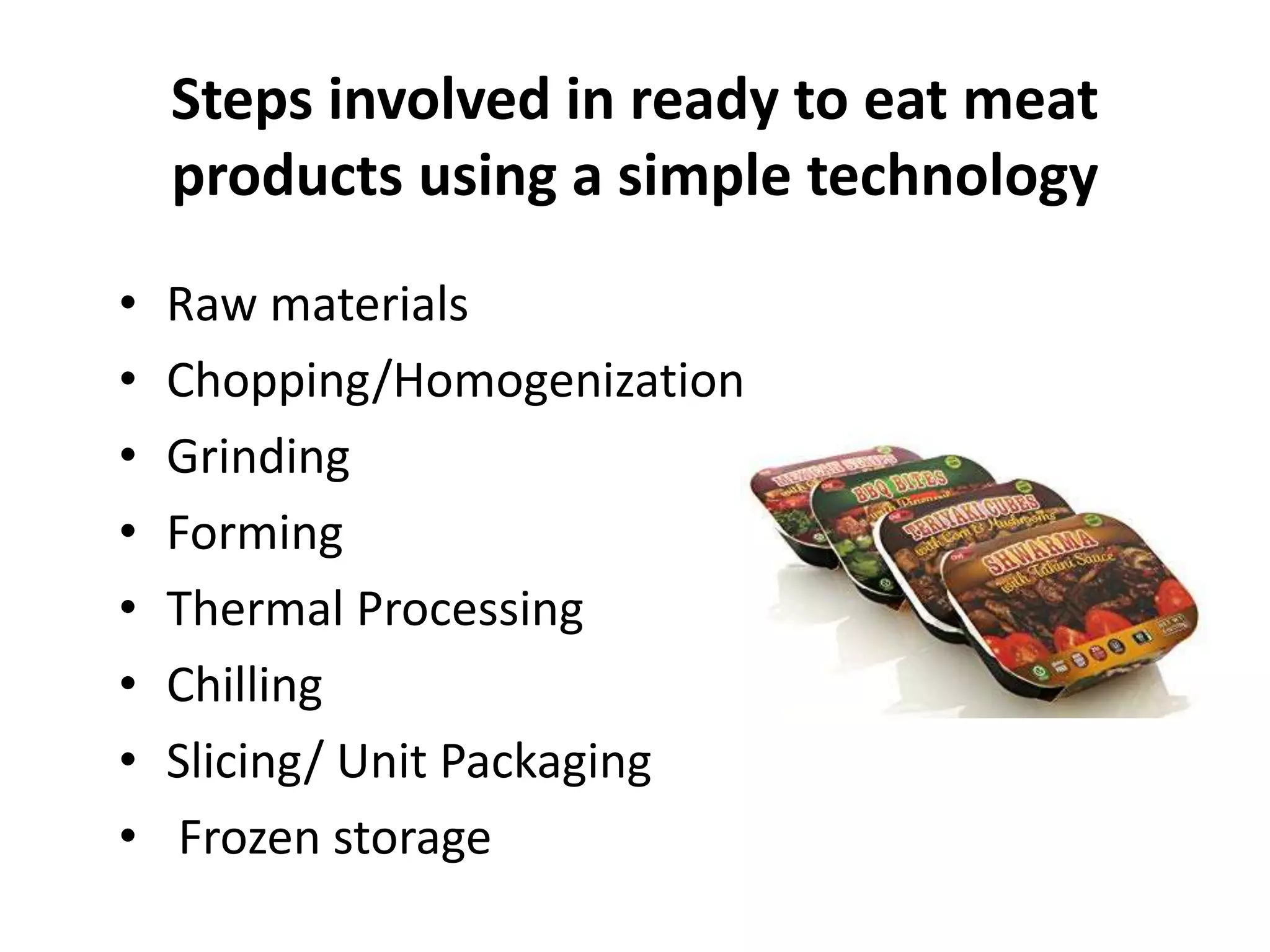
Steps involved in ready to eat meat
products using a simple technology
• Raw materials
• Chopping/Homogenization
• Grinding
• Forming
• Thermal Processing
• Chilling
• Slicing/ Unit Packaging
• Frozen storage
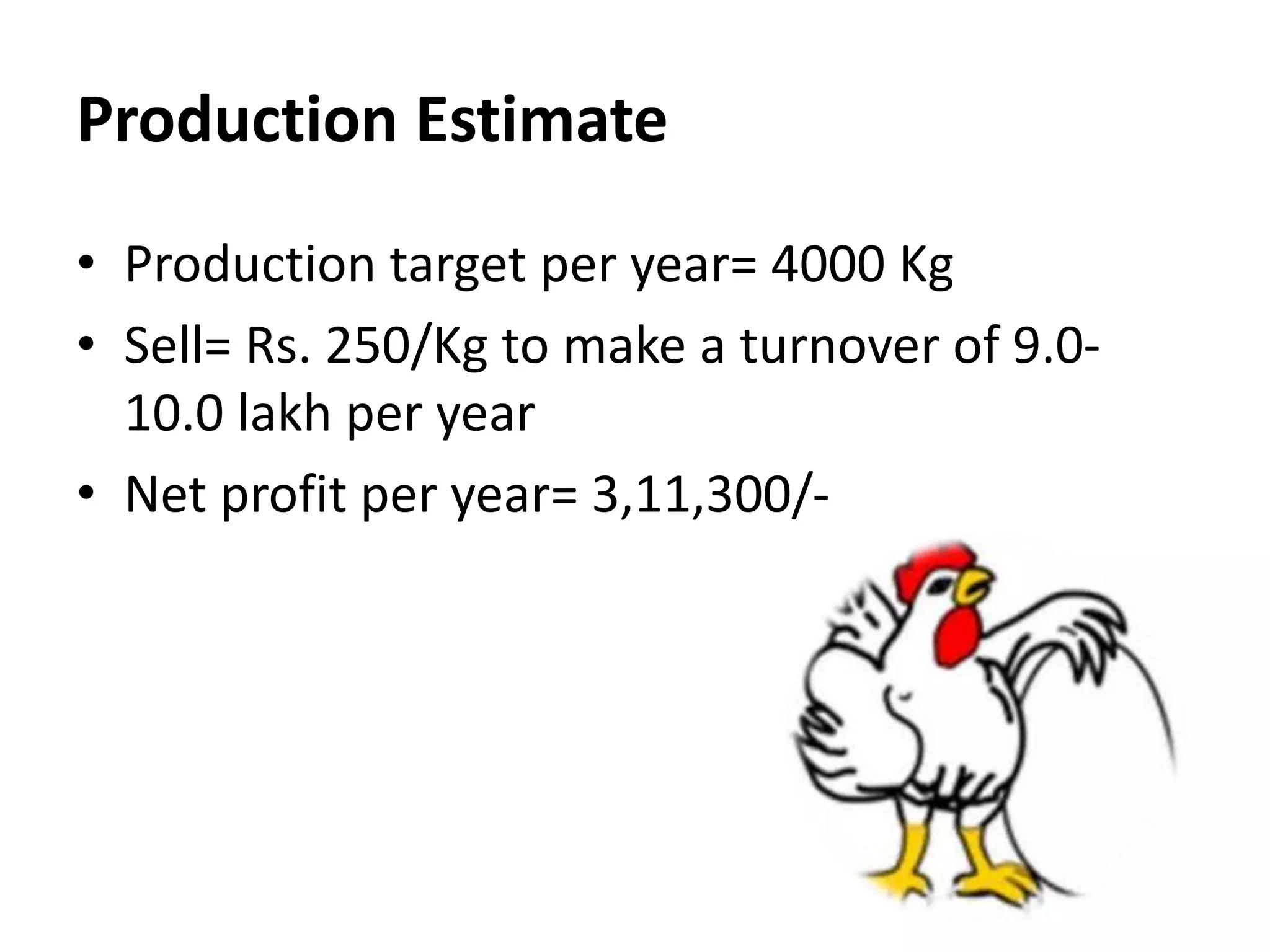
Production Estimate
• Production target per year= 4000 Kg
• Sell= Rs. 250/Kg to make a turnover of 9.0-
10.0 lakh per year
• Net profit per year= 3,11,300/-
Module on value addition.pptx

Module on value addition.pptx

  • 1.
    Module on Value Additionfor Enhancing Nutritional Security Authors: Sukanya Barua, V. Sangeetha, Rajeev Kumar, L. Muralikrishnan & Subhasree Sahu ICAR-IARI, New Delhi
  • 2.
    Content Outline • ValueAddition in Food product • Value added product • Value addition is necessary for our country: The Indian Paradox • Current status of Indian Agriculture • Changing era in agriculture • How to add value to products • Understanding the concept of value addition • Value Chain vs. Supply Chain • Opportunities of value addition • Food Processing Demand Drivers • Low cost technology for value addition and nutri-prenuership development – Osmotic dehydrated Pine apple candy – Ready to reconstitute mustard saag – Pearl Millet Based Instant Dry Mixes – Rice-Soy Tempeh for Home Production – Production of ready-to-eat meat products
  • 3.
    What is Valueaddition in food product? Value-added food processing is something that you do to help earn more money from your farm products. For example, as a farmer, you process raw fruits or vegetables into a finished product that you can sell Some people package value- added foods and some people sell fresh value- added foods
  • 4.
    A change inthe physical state or form of the product (such as milling wheat into flour or making strawberries into jam) The production of a product in a manner that enhances its value (such as organically produced products) The physical segregation of an agricultural commodity or product in a manner that results in the enhancement of the value of that commodity or product (such as an identity preserved marketing system) Value-added products?
  • 5.
    Why value additionis necessary for our country? We are top of the producers among many commodities in the world Yet our share in World food trade is only 1.6% The post harvest losses of fruits and vegetables are estimated to be 25-40%, amounting to more than Rs. 30,000 crores… Yet less than 2% is processed! (30% and 80% Thailand and Malaysia respectively) The Indian Paradox…
  • 6.
    Cont… We have amiddle class of 250-300 million people with adequate purchasing power to buy manufactured goods Yet value addition to agricultural product is less than 7% (23,45 and 188% in China, Phillipines and U.K.) More than 220 Million tons of food grain production Yet more than 130 million people to go to bed hungry everyday
  • 7.
    Current Status ofIndian Agriculture • Self sufficiency in primary agriculture (green revolution) • Declining contribution of agriculture to GDP • Lower rate of growth of agricultural opportunities in terms of production as well as on the processing side • Farmers income 1.5%, expenditure 4.5% • Less productivity of Indian Agriculture • Low productivity coupled with value addition, less return to farmers
  • 8.
    Changing era inagriculture Subsistence agriculture Agribuisness Commodity driven market Product driven market
  • 9.
    Cont… Changing era inagriculture Homogenious group of crops Crop diversification Cereal grains crops Fruits, vegetables and oil seeds
  • 10.
    Location value Time value Information value Ownership /possessio n value Form Value Adding Value toProducts, Creating value for Consumers How to add value to products?
  • 11.
    Understanding the conceptof Value addition • It is a production/marketing strategy driven by customer needs and preferences • Incremental value, higher price • Nature of certain business relationships among interacting food business enterprises- Supply Chain • Approaches to Value addition: Innovation or co- ordination
  • 12.
    Value Chain vs.Supply Chain Consumers Retailers & Exporters Processors & Manufacturers Farmers Inputs Research & Developments Suppliers Finance Flow Of Goods, Product s & informa tion Flow of Orders, Consu mer Prefere nces & informa tion Supply Chain Value Chain
  • 13.
    Food Processing Provides Increased self life andstorage quality Preserve Health Promoting Compounds Added functionality Nutritional improvement Enhanced Marketability Off season food availability Largest manufacturing Sectors Forward and backward linkages Opportunities of Value addition
  • 14.
    Food Processing Demanddrivers Increasing Spends on Health Foods Increasing nuclear families and Working Women Demand for Functional Food Organized retail and private level penetration Changing Demographics-Rise in disposable Income Increasing urbanization- Lifestyles and aspirations
  • 16.
    Osmotic dehydrated Pineapple candy Pine apple is a good source of carotene and ascorbic acid and fairly rich in vitamin B and B2 Osmotic dehydration is a method for partial removal of water from plant tissues by immersion in a hypertonic (osmotic) solution The ratio of water loss to solid uptake is a good index of the efficiency of the process
  • 18.
    Pine apple ofsimilar ripeness (7-8 brix) Peeling ,Coring and slicing Blanching Hot water dip for 10 min with citric acid Air drying Dip slices into sugar syrup (65%) for 1.5-2 days After connective drying at 15% moisture content Packaging
  • 19.
    Economics: Measures Description Amount TotalAnnual Sale Total Annual Production: 5000 Kg@Rs.200/Kg. Rs. 10,00,000/- Profitability Annual Profit=Total Sales- Annualcosts Rs. 231692 Return on Capital Investment (Annual profit/Total capital investments)X100 49.25%
  • 20.
    For equipments andenterprise establishment, please contact • Director, Central Institute of Post-Harvest Engineering and Technology (CIPHET), P.O: Punjab Agricultural University, Ludhiana-141004 (Punjab). Ph.:0161-2313102, Fax: 0161-2308670. Website: www.ciphet.in • B. Sen Berry and Company 65/11, New Rohtak Road, Karol Bagh, New Delhi -110005, Ph: 011- 65702298, 28712130, Fax: 011-28720553 • Bajaj Process Pack Mascinen Pvt. Ltd, Plot No. 7/20 and 7/27, Jai Lakshmi instrumental Estate, Side IV, Sahibabad Industrial area, Ghaziabad (UP).
  • 21.
    Ready to reconstitute mustardsaag Indian mustard plants (Brassica juncea) are one of the greens is high in vitamin A and vitamin K Protein, ash content and crude fibre were observed to be 6.71, 11.73 and 8.53% respectively Total dietary fibre was observed to be 29.83%
  • 22.
    Steps involved inpreparation of mustard saag Ingredients: Mustard leaves (60%), spinach (30%) and Fenugreek (10%) Wash and cut in small Add cooked maize grit and other spices Drying up to 8% water content Grinding Packaging
  • 23.
    Economics Economic Measures Methods of Calculation Amount Annual profitTotal sales-Annual cost Rs. 235686/- Profit on sale (Annual profit/Annual sale)× 100 18.85% Return on capital investment (Annual profit/Total capital investment) × 100 27.98% Payback Period Total cost of the project/profit 4.30 years
  • 24.
    For equipments andenterprise establishment, please contact • Director, Central Institute of Post-Harvest Engineering and Technology (CIPHET), P.O: Punjab Agricultural University, Ludhiana-141004 (Punjab). Ph.:0161-2313102, Fax: 0161-2308670. Website: www.ciphet.in. • Bajaj Processpack Maschinen Pvt. Ltd, 2/27 Jai Lakshmi Industrial Estate Site IV, Sahibabad Industrial Area, Dist: Ghaziabad (U.P). • D.P. Pulveriser Industries, Modi & Modi Building No. 2,76 Nagindas Master Road, Fort, Mumbai- 400 023, Tel no. 022-22674901.
  • 25.
    Pearl Millet BasedInstant Dry Mixes Pearl millet is highly nutritious with well balanced protein, high levels of calcium, iron, zinc and lipids It is especially suitable for celiacs i.e. people having intolerance to gluten which is present in wheat and its products
  • 26.
    Steps involved inready to eat Upma dry mix preparation Whole Pearl millet grain Cleaning & Pearling Roasting Mixing with prefried dals, Curry Powder, Mustard/rapeseed, chilli, Salt etc. Packaging
  • 27.
    Steps involved inready to eat Halwa Mix Preparation Whole Pearl millet grain Cleaning & Pearling Roasting Packaging Mixing with fat, sugar, cardamom, dry fruits etc.
  • 28.
    Economics Economic Measures Methodsof Calculation Amount Annual profit Total sales-Annual cost Rs. 529524/- Profit on sale (Annual profit/Annual sale)× 100 36.59 % Return on capital investment (Annual profit/Total capital investment) × 100 94.85% Payback Period Total cost of the project/profit 1.73 years
  • 29.
    Development of Rice-SoyTempeh for Home Production Tempeh is traditionally Soy based fermented food produced by using a living fungus (Mostly Rhizopus spp) It can prepare from wide variety of other grains, beans and cereals with endless combinations which results in unique flavors The micro-organisms also add valuable amino acids, vitamins to the end product
  • 30.
    Market Potential • Kwashiorkoris the result of protein deficiency and Marasmus due to both protein and calorie deficiencies are found in large numbers of children within ages of 1-3 in India. • The main purpose of combining cereal e.g. rice to soybean for tempeh preparation is to enhance the nutritional value because of protein complimentarily.
  • 31.
    1. Mixing wholerice (Preferably Parmal variety) and dehulled Soybean splits 2. Rice washed in clean water and soybean soaked in water for overnight. 3. Rice and Soybean are boiled for 30 minutes 4. Blanched ingredients are mixed thoroughly followed by draining and cooling Process involved in homemade rice- soy tempeh production
  • 32.
    The mix isinoculated with tempeh starter culture (R. oryzae ITCC 7382-09 spores). Can be consume it fresh Or, Can be packed properly for commercial use Or, Store it in cylindrical stainless steel containers with perforations Cont… Process involved in homemade rice-soy tempeh production
  • 33.
    Preservation of tempeh Freshlymade, raw tempeh remains edible for few days at room temperature It can be preserved by sun drying 5% final moisture in dried rice-soy tempeh found suitable for storage in freezer Mushroom smell is usually a characteristic aroma of fresh tempeh while alcoholic aroma is a feature of an deteriorating tempeh. Shelf life up to six month if store in freezer
  • 34.
    Uses Very versatile productand can be used in combination with many different recipes and dishes It can be served in salads, sandwiches, burgers, sauces. Pan frying tempeh in vegetable oil or margarine yields a crisp, golden brown colored product tempeh
  • 35.
    Development of ready-to-eatmeat products using a simple technology The present market demand of meat for present population would be 7.7 Million tones per year against the present production of 6.04 Million tones per year In India only 5 % meat is processed. So, there is immense scope to value addition
  • 36.
    Steps involved inready to eat meat products using a simple technology • Raw materials • Chopping/Homogenization • Grinding • Forming • Thermal Processing • Chilling • Slicing/ Unit Packaging • Frozen storage
  • 37.
    Production Estimate • Productiontarget per year= 4000 Kg • Sell= Rs. 250/Kg to make a turnover of 9.0- 10.0 lakh per year • Net profit per year= 3,11,300/-