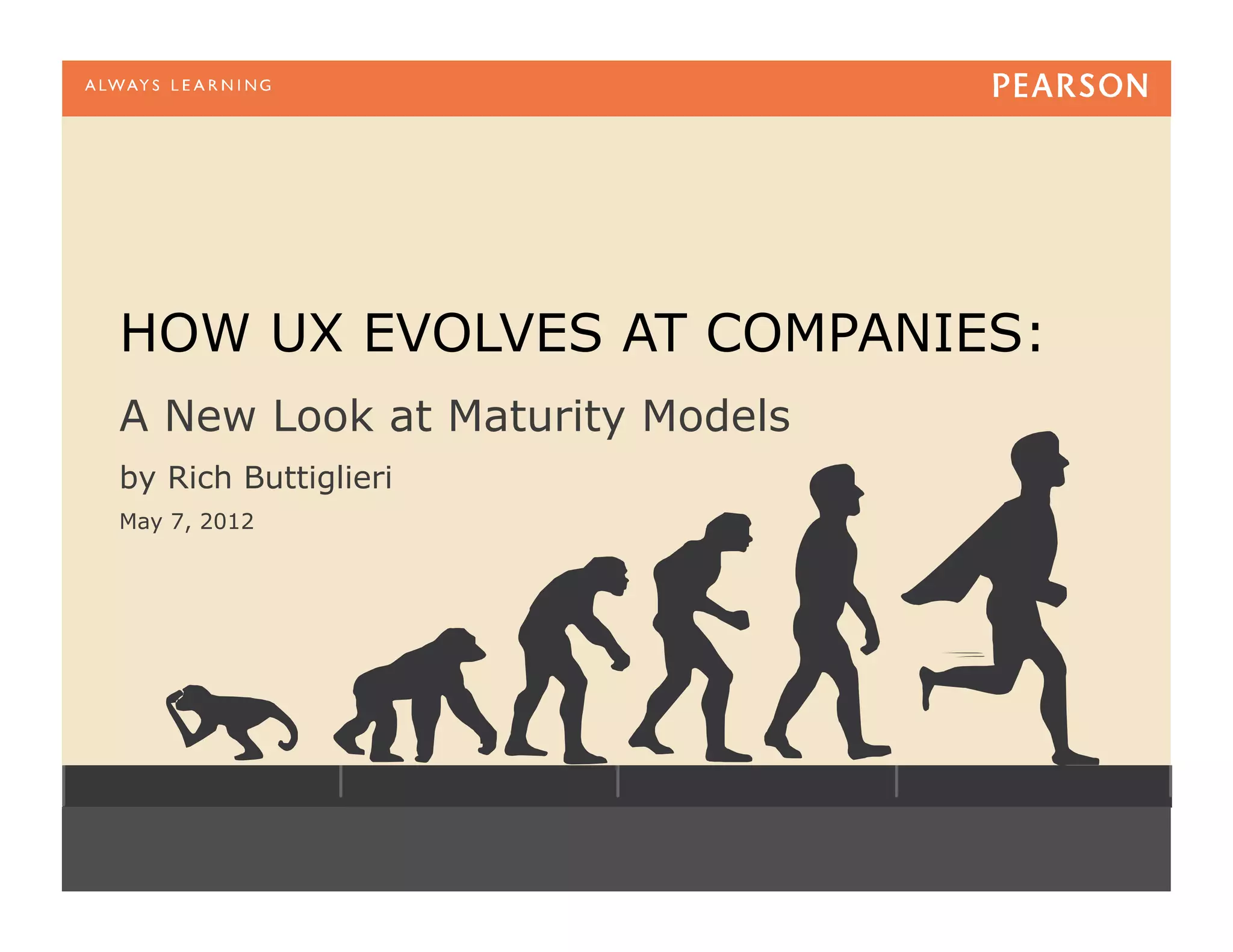
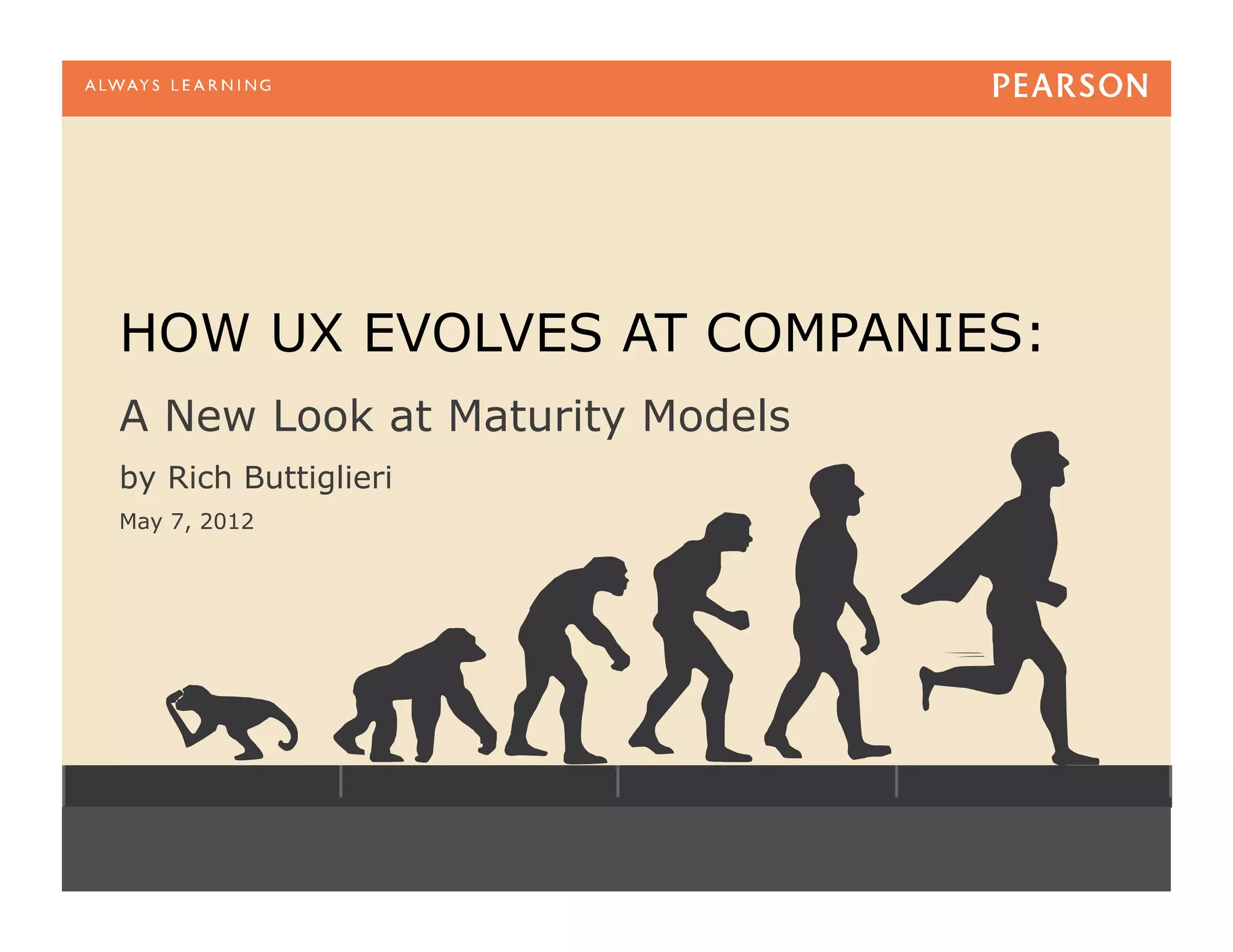
HOW UX EVOLVES AT COMPANIES:
A New Look at Maturity Models
by Rich Buttiglieri
May 7, 2012
Why UX Maturity Model?
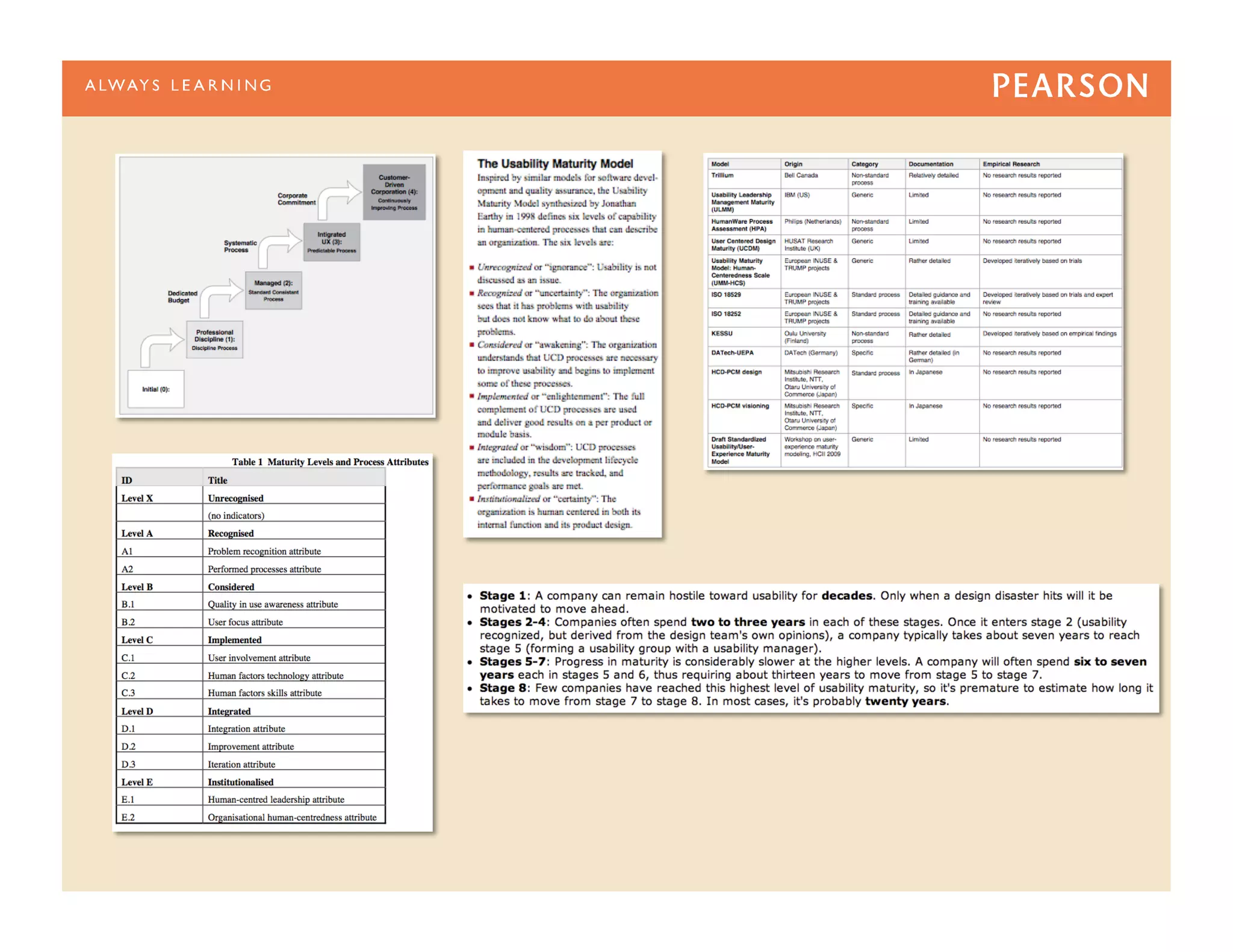
Lots of published UX maturity models:


•  Enterprise   Usability Maturity, J. Ashley & K. Desmond(2010)
•  Usability   Maturity Models, T. Jokela (2010)
•  Corporate    UX Maturity, S. Van Tyne (2007)
•  Corporate    Usability Maturity Model, J. Nielsen (2006)
•  Usability   Maturity Model, J. Earthy (1998)
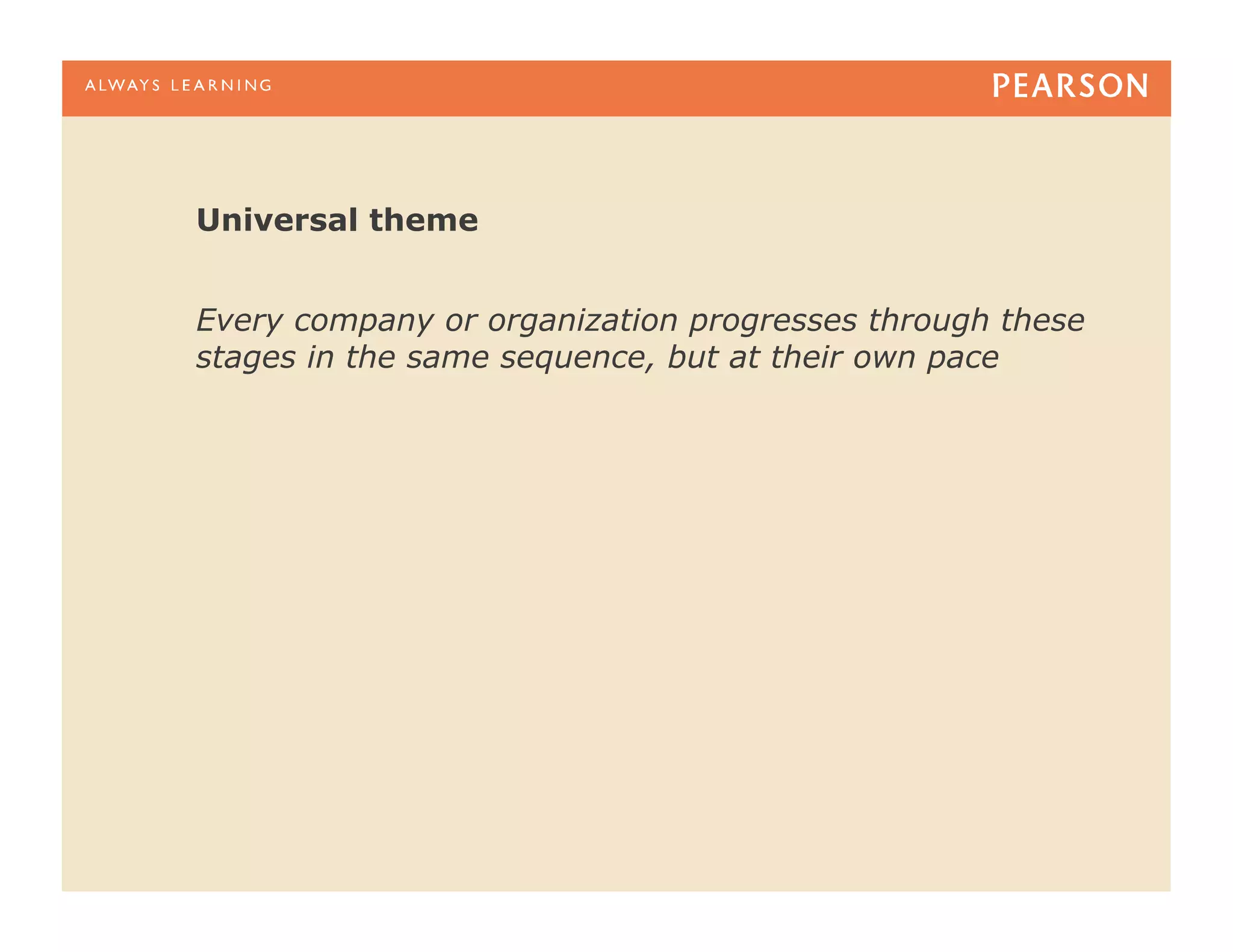
Universal theme


Every company or organization progresses through these
stages in the same sequence, but at their own pace
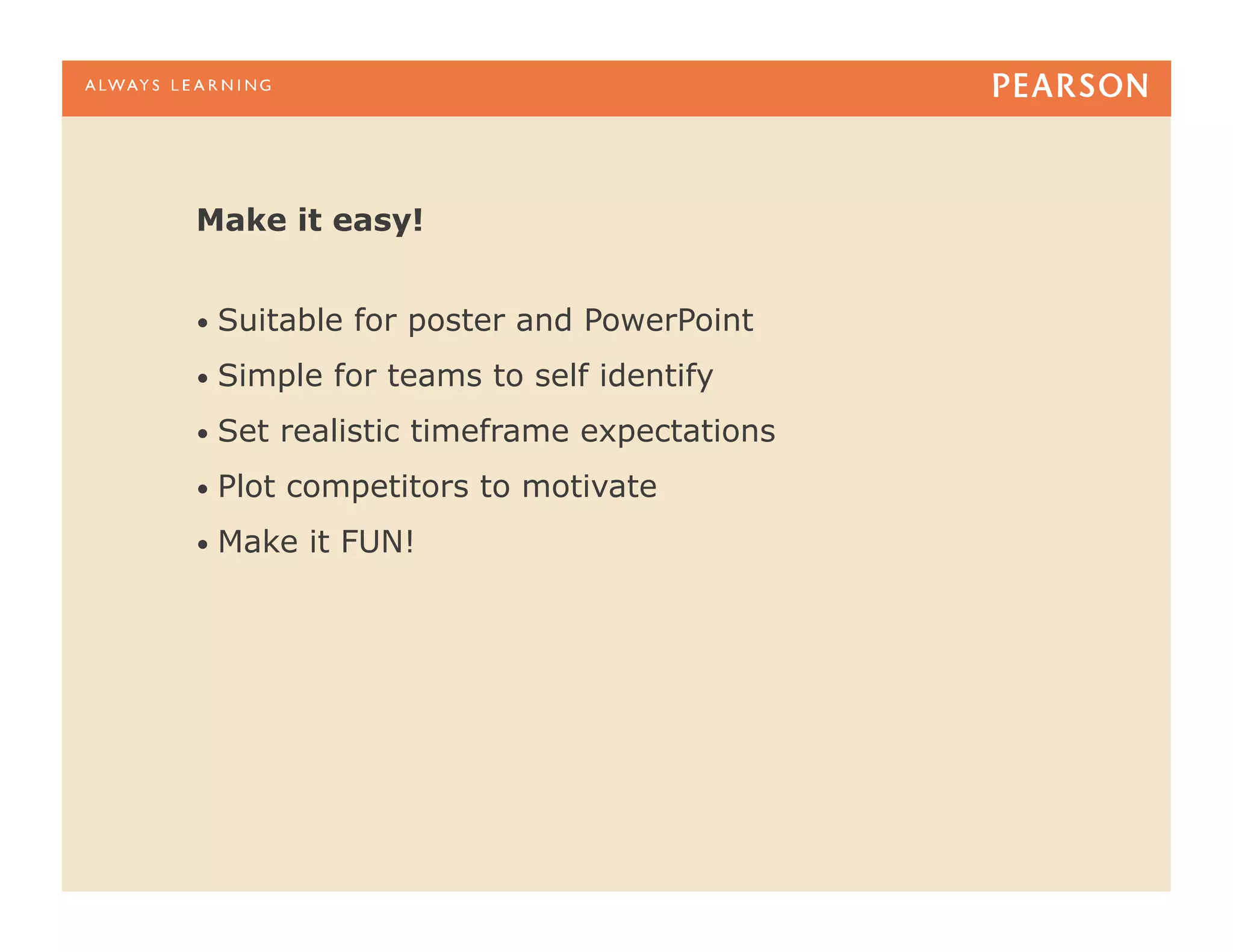
Make it easy!


•  Suitable   for poster and PowerPoint
•  Simple    for teams to self identify
•  Set    realistic timeframe expectations
•  Plot   competitors to motivate
•  Make    it FUN!
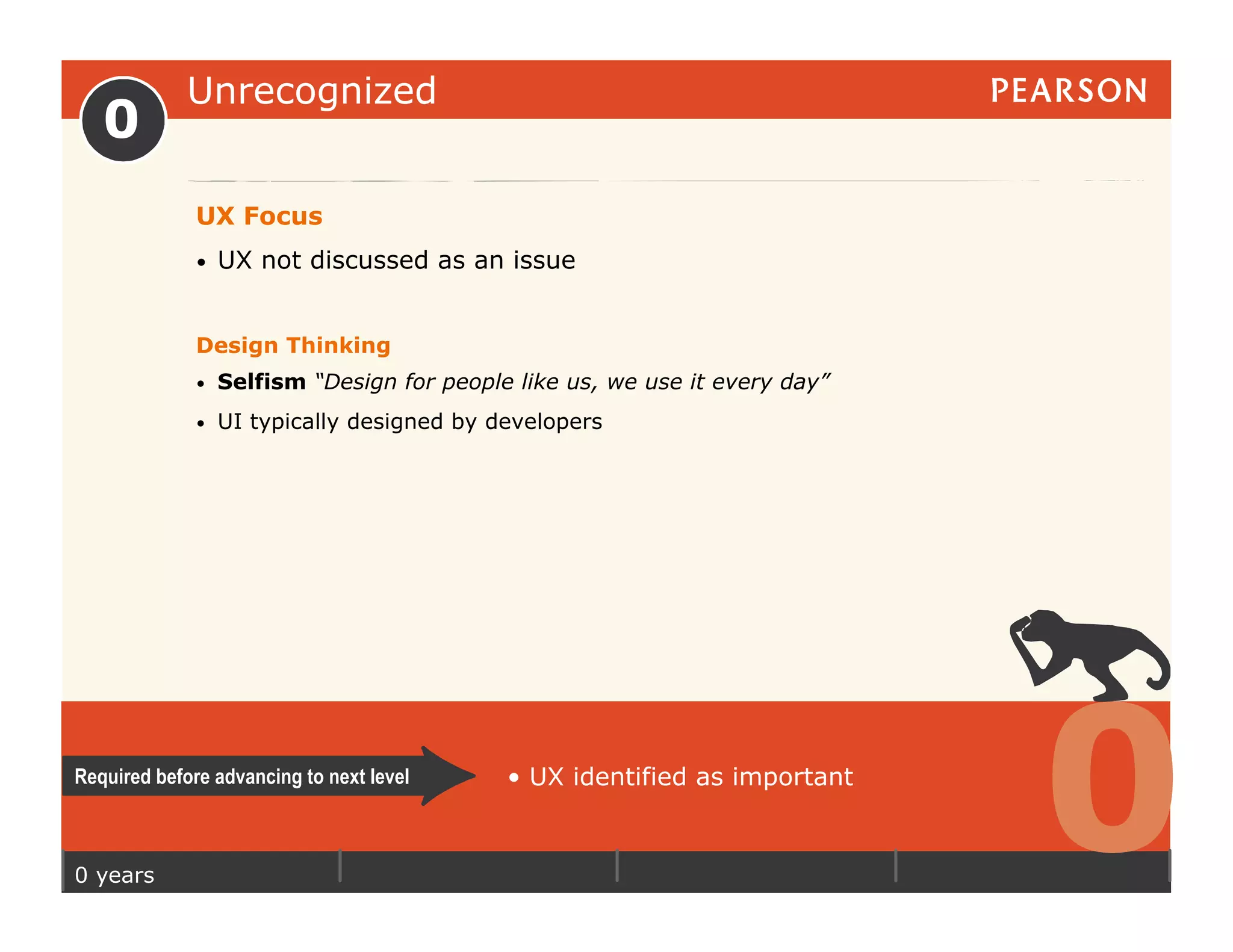
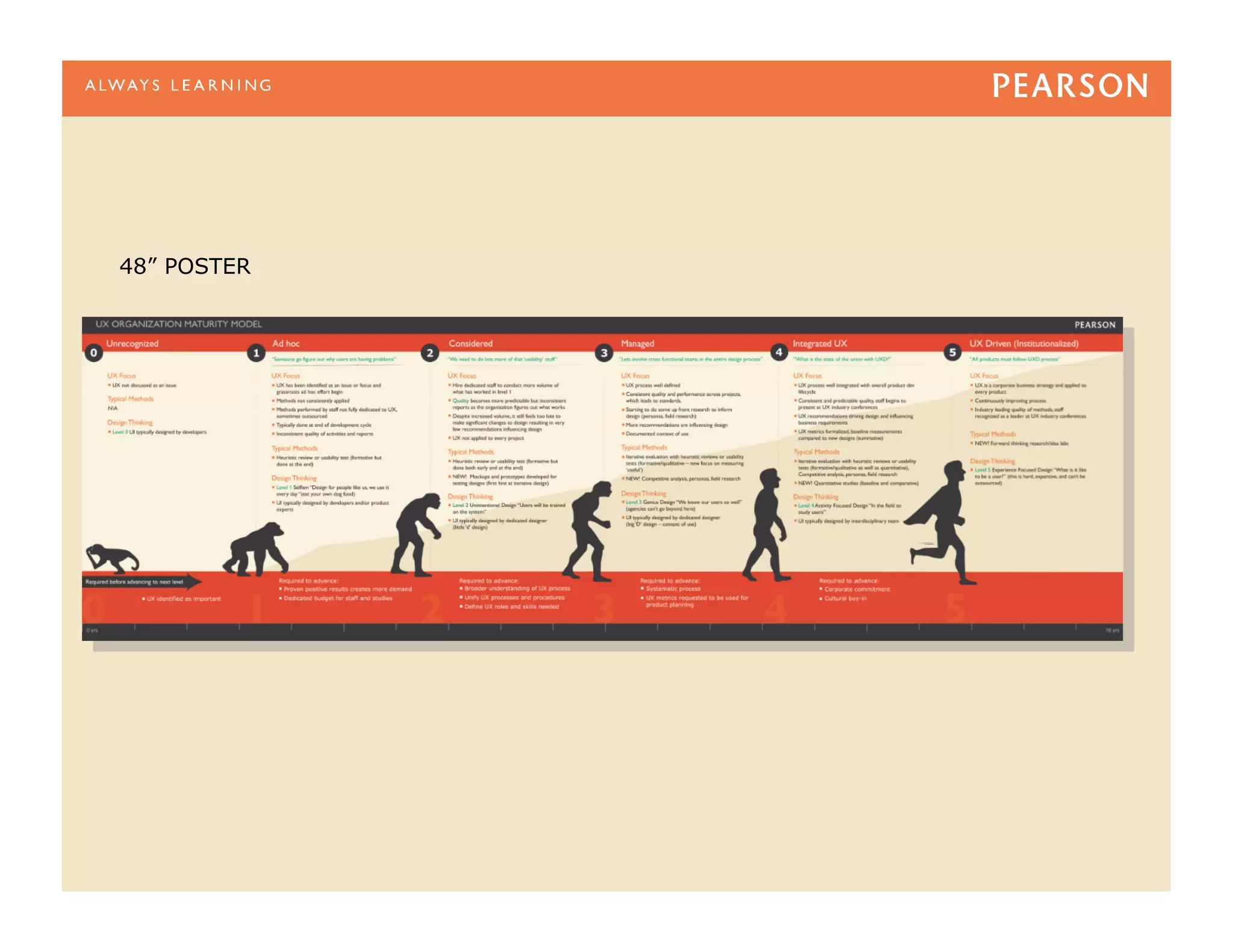
Unrecognized
   0
              UX Focus
              •    UX not discussed as an issue


              Design Thinking
              •    Selfism “Design for people like us, we use it every day”
              •    UI typically designed by developers


Required before advancing to next level


0 years
                                             •  UX identified as important

                                                                              0
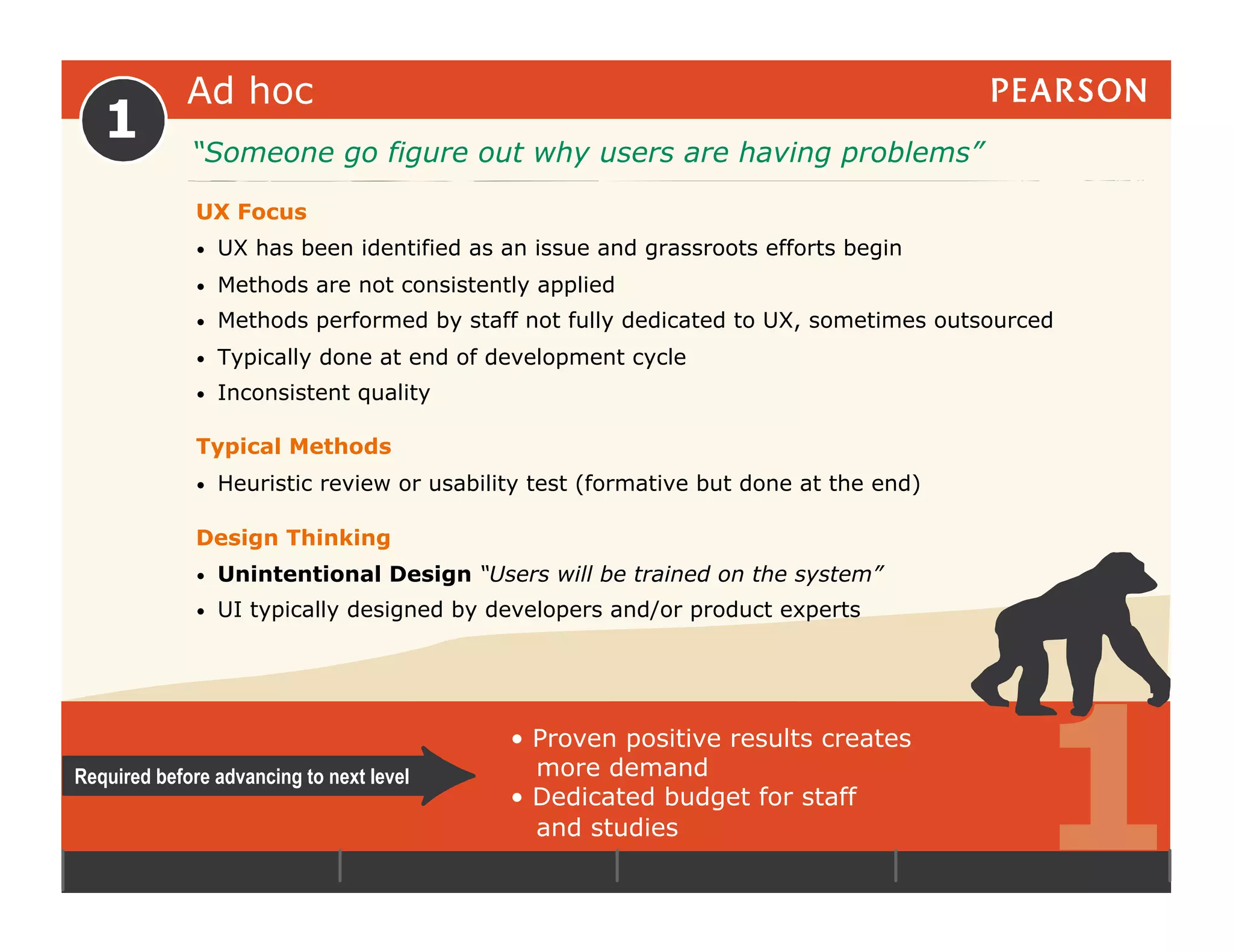
Ad hoc
   1         “Someone go figure out why users are having problems”

              UX Focus
              •    UX has been identified as an issue and grassroots efforts begin
              •    Methods are not consistently applied
              •    Methods performed by staff not fully dedicated to UX, sometimes outsourced
              •    Typically done at end of development cycle
              •    Inconsistent quality

              Typical Methods
              •    Heuristic review or usability test (formative but done at the end)

              Design Thinking
              •    Unintentional Design “Users will be trained on the system”
              •    UI typically designed by developers and/or product experts


                                                                                           1
                                              •  Proven positive results creates
Required before advancing to next level          more demand
                                              •  Dedicated budget for staff
                                                 and studies
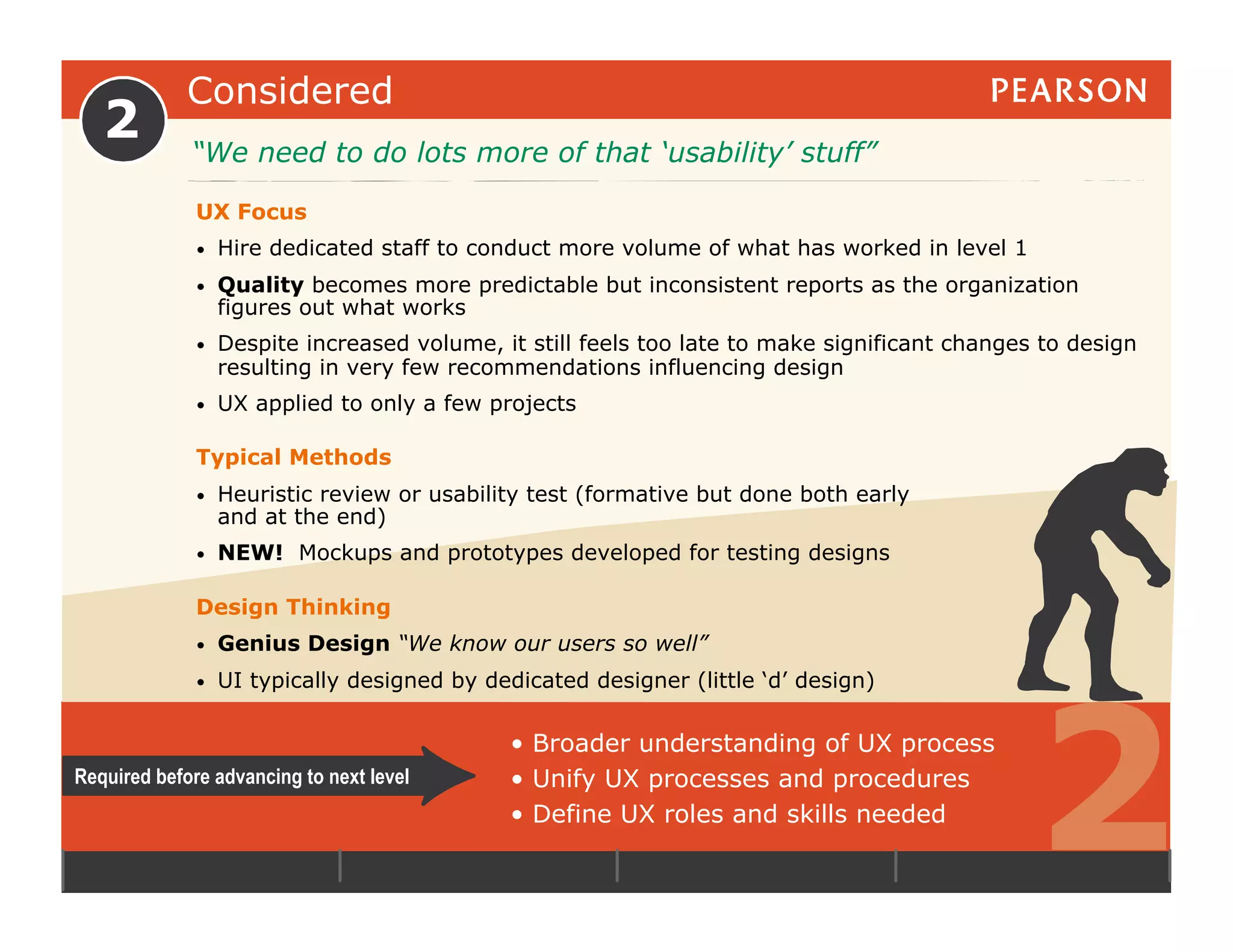
Considered
   2         “We need to do lots more of that ‘usability’ stuff”

              UX Focus
              •    Hire dedicated staff to conduct more volume of what has worked in level 1
              •    Quality becomes more predictable but inconsistent reports as the organization
                   figures out what works
              •    Despite increased volume, it still feels too late to make significant changes to design
                   resulting in very few recommendations influencing design
              •    UX applied to only a few projects

              Typical Methods
              •    Heuristic review or usability test (formative but done both early
                   and at the end)
              •    NEW! Mockups and prototypes developed for testing designs

              Design Thinking
              •    Genius Design “We know our users so well”


                                                                                                2
              •    UI typically designed by dedicated designer (little ‘d’ design)

                                               •  Broader understanding of UX process
Required before advancing to next level        •  Unify UX processes and procedures
                                               •  Define UX roles and skills needed
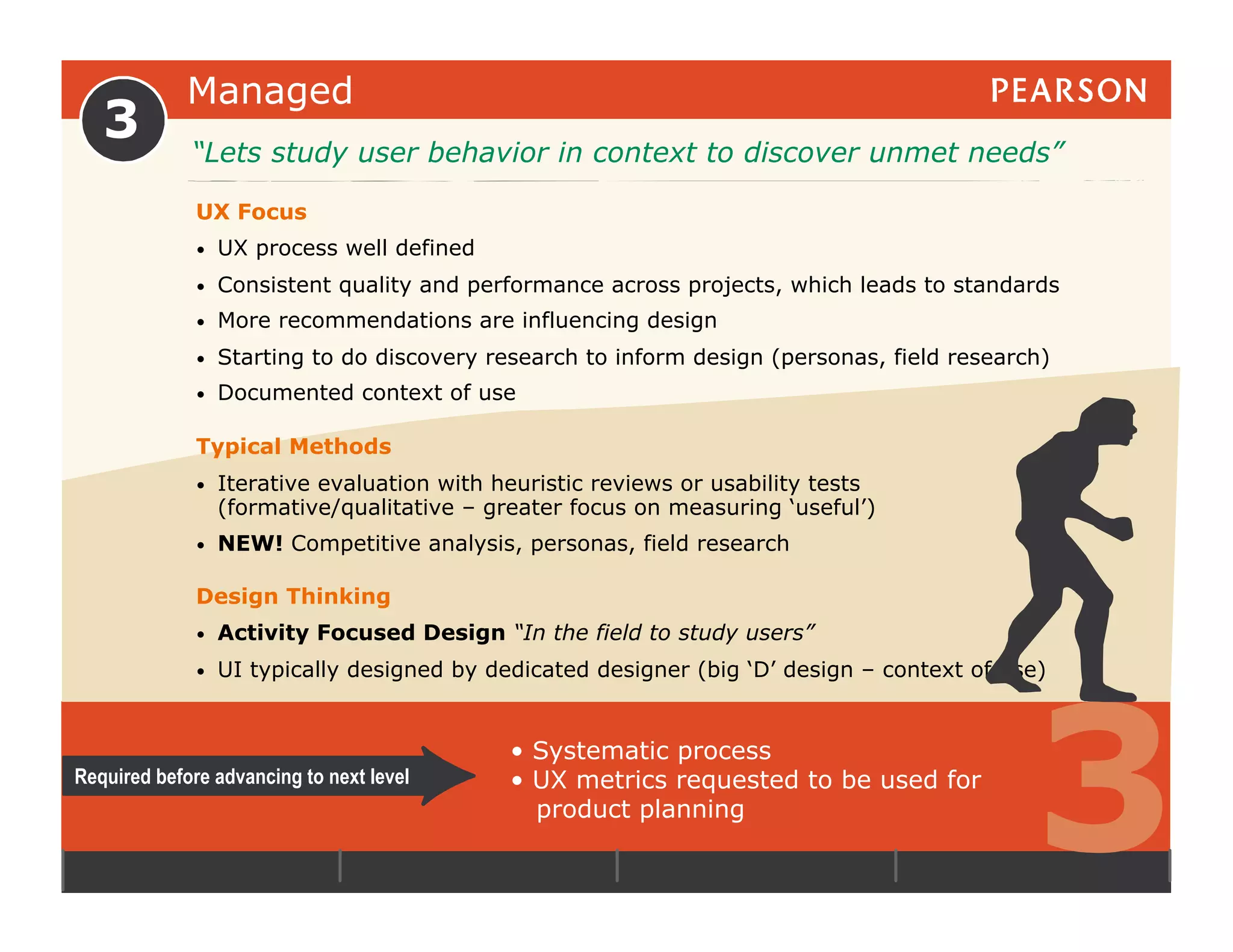
Managed
   3         “Lets study user behavior in context to discover unmet needs”

              UX Focus
              •    UX process well defined
              •    Consistent quality and performance across projects, which leads to standards
              •    More recommendations are influencing design
              •    Starting to do discovery research to inform design (personas, field research)
              •    Documented context of use

              Typical Methods
              •    Iterative evaluation with heuristic reviews or usability tests
                   (formative/qualitative – greater focus on measuring ‘useful’)
              •    NEW! Competitive analysis, personas, field research

              Design Thinking
              •    Activity Focused Design “In the field to study users”


                                                                                              3
              •    UI typically designed by dedicated designer (big ‘D’ design – context of use)


                                              •  Systematic process
Required before advancing to next level       •  UX metrics requested to be used for
                                                 product planning
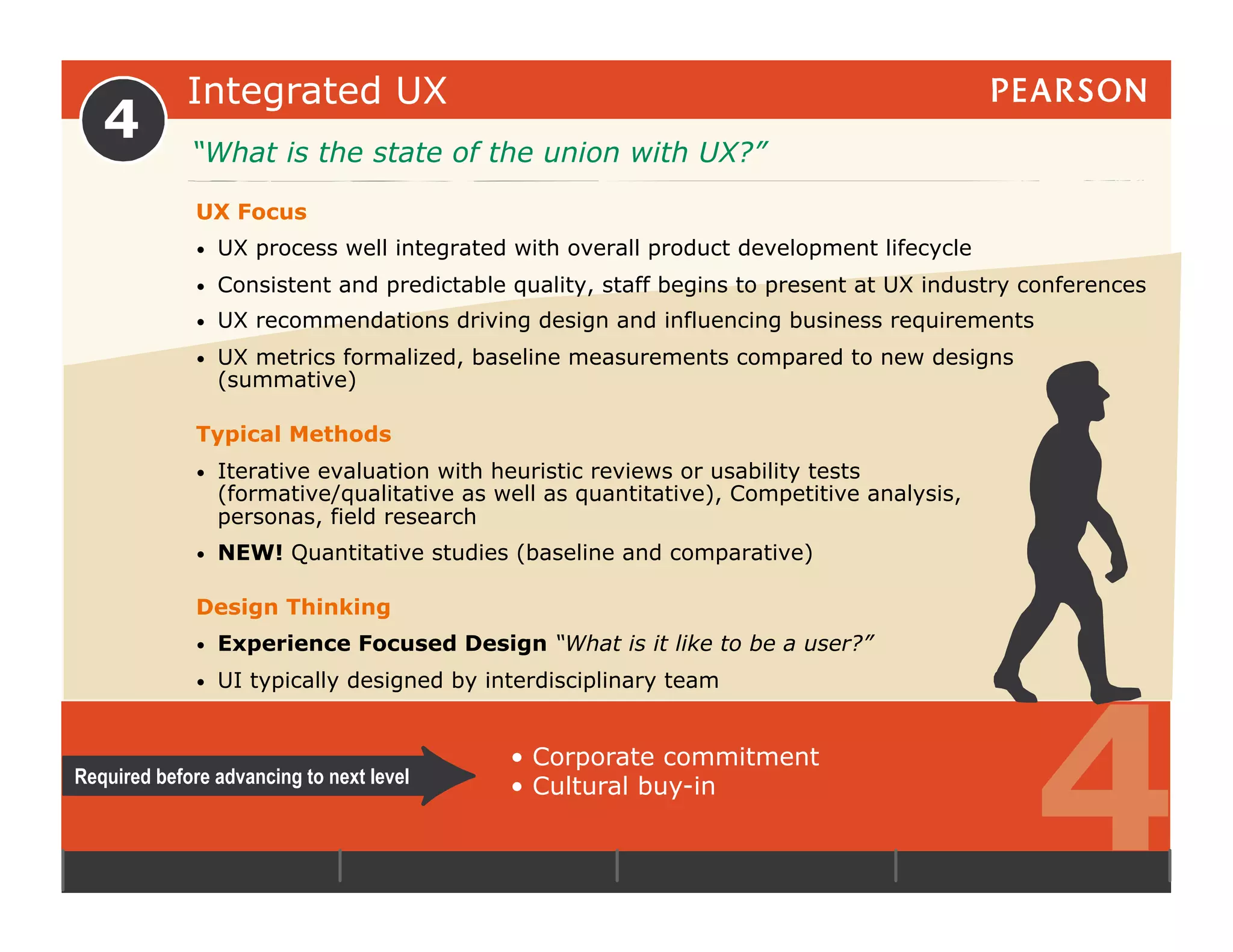
Integrated UX
   4         “What is the state of the union with UX?”

              UX Focus
              •    UX process well integrated with overall product development lifecycle
              •    Consistent and predictable quality, staff begins to present at UX industry conferences
              •    UX recommendations driving design and influencing business requirements
              •    UX metrics formalized, baseline measurements compared to new designs
                   (summative)

              Typical Methods
              •    Iterative evaluation with heuristic reviews or usability tests
                   (formative/qualitative as well as quantitative), Competitive analysis,
                   personas, field research
              •    NEW! Quantitative studies (baseline and comparative)

              Design Thinking
              •    Experience Focused Design “What is it like to be a user?”


                                                                                              4
              •    UI typically designed by interdisciplinary team


                                              •  Corporate commitment
Required before advancing to next level       •  Cultural buy-in
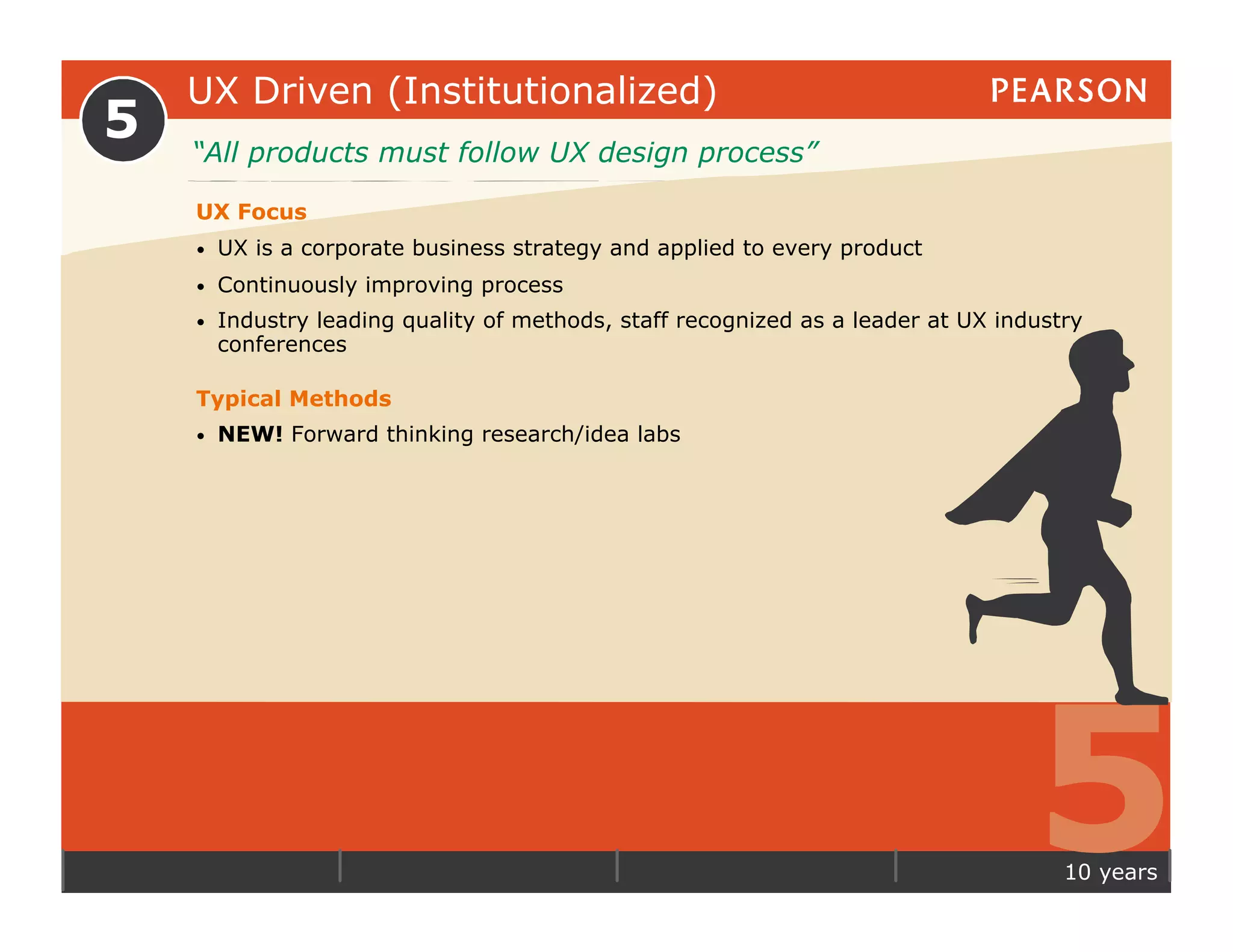
UX Driven (Institutionalized)
5   “All products must follow UX design process”

    UX Focus
    •    UX is a corporate business strategy and applied to every product
    •    Continuously improving process
    •    Industry leading quality of methods, staff recognized as a leader at UX industry
         conferences

    Typical Methods
    •    NEW! Forward thinking research/idea labs


                                                                                    5  10 years
48” POSTER
HOW UX EVOLVES AT COMPANIES:
A New Look at Maturity Models
by Rich Buttiglieri
May 7, 2012

How User Experience Evolves in a Company - a New Look at UX Maturity Models

  • 1.
    HOW UX EVOLVESAT COMPANIES: A New Look at Maturity Models by Rich Buttiglieri May 7, 2012
  • 2.
  • 3.
    Lots of publishedUX maturity models: •  Enterprise Usability Maturity, J. Ashley & K. Desmond(2010) •  Usability Maturity Models, T. Jokela (2010) •  Corporate UX Maturity, S. Van Tyne (2007) •  Corporate Usability Maturity Model, J. Nielsen (2006) •  Usability Maturity Model, J. Earthy (1998)
  • 5.
    Universal theme Every companyor organization progresses through these stages in the same sequence, but at their own pace
  • 6.
    Make it easy! • Suitable for poster and PowerPoint •  Simple for teams to self identify •  Set realistic timeframe expectations •  Plot competitors to motivate •  Make it FUN!
  • 7.
    Unrecognized 0 UX Focus •  UX not discussed as an issue Design Thinking •  Selfism “Design for people like us, we use it every day” •  UI typically designed by developers Required before advancing to next level 0 years •  UX identified as important 0
  • 8.
    Ad hoc 1 “Someone go figure out why users are having problems” UX Focus •  UX has been identified as an issue and grassroots efforts begin •  Methods are not consistently applied •  Methods performed by staff not fully dedicated to UX, sometimes outsourced •  Typically done at end of development cycle •  Inconsistent quality Typical Methods •  Heuristic review or usability test (formative but done at the end) Design Thinking •  Unintentional Design “Users will be trained on the system” •  UI typically designed by developers and/or product experts 1 •  Proven positive results creates Required before advancing to next level more demand •  Dedicated budget for staff and studies
  • 9.
    Considered 2 “We need to do lots more of that ‘usability’ stuff” UX Focus •  Hire dedicated staff to conduct more volume of what has worked in level 1 •  Quality becomes more predictable but inconsistent reports as the organization figures out what works •  Despite increased volume, it still feels too late to make significant changes to design resulting in very few recommendations influencing design •  UX applied to only a few projects Typical Methods •  Heuristic review or usability test (formative but done both early and at the end) •  NEW! Mockups and prototypes developed for testing designs Design Thinking •  Genius Design “We know our users so well” 2 •  UI typically designed by dedicated designer (little ‘d’ design) •  Broader understanding of UX process Required before advancing to next level •  Unify UX processes and procedures •  Define UX roles and skills needed
  • 10.
    Managed 3 “Lets study user behavior in context to discover unmet needs” UX Focus •  UX process well defined •  Consistent quality and performance across projects, which leads to standards •  More recommendations are influencing design •  Starting to do discovery research to inform design (personas, field research) •  Documented context of use Typical Methods •  Iterative evaluation with heuristic reviews or usability tests (formative/qualitative – greater focus on measuring ‘useful’) •  NEW! Competitive analysis, personas, field research Design Thinking •  Activity Focused Design “In the field to study users” 3 •  UI typically designed by dedicated designer (big ‘D’ design – context of use) •  Systematic process Required before advancing to next level •  UX metrics requested to be used for product planning
  • 11.
    Integrated UX 4 “What is the state of the union with UX?” UX Focus •  UX process well integrated with overall product development lifecycle •  Consistent and predictable quality, staff begins to present at UX industry conferences •  UX recommendations driving design and influencing business requirements •  UX metrics formalized, baseline measurements compared to new designs (summative) Typical Methods •  Iterative evaluation with heuristic reviews or usability tests (formative/qualitative as well as quantitative), Competitive analysis, personas, field research •  NEW! Quantitative studies (baseline and comparative) Design Thinking •  Experience Focused Design “What is it like to be a user?” 4 •  UI typically designed by interdisciplinary team •  Corporate commitment Required before advancing to next level •  Cultural buy-in
  • 12.
    UX Driven (Institutionalized) 5 “All products must follow UX design process” UX Focus •  UX is a corporate business strategy and applied to every product •  Continuously improving process •  Industry leading quality of methods, staff recognized as a leader at UX industry conferences Typical Methods •  NEW! Forward thinking research/idea labs 5 10 years
  • 13.
  • 14.
    HOW UX EVOLVESAT COMPANIES: A New Look at Maturity Models by Rich Buttiglieri May 7, 2012