UTILITY THEORY
4-1
4-2
The Economic
Explanation
• Prices and income are just as relevant
to consumption decisions as more
basic desires and preferences.
• Demand – The ability and willingness
to buy specific quantities of a good at
alternative prices in a given time
period, ceteris paribus.
LO-1
4-3
Determinants of
Demand
• Tastes - desire for this and other goods
– If a study says ice cream is good for you,
the demand for ice cream would increase.
LO-1
4-4
• Income (of the consumer):
– If you won the lottery you might buy more
ice cream.
– The demand for ice cream would
increase, shifting the demand curve to the
right.

Determinants of
Demand
LO-1
4-5
• Expectations (for income, prices,
tastes)
– If you knew you were going to get rich
soon you might deplete savings to buy
more ice cream now.
– This would increase the demand for ice
cream.
Determinants of
Demand
LO-1
4-6
• Other goods (their availability and
price):
– If the price of chocolate candy bars
increased, you might buy ice cream
instead of a candy bar.
– This would increase the demand for ice
cream.
Determinants of
Demand
LO-1
4-7
• The number of consumers in the
market:
– If the number of buyers in the ice cream
market increased, the market demand for
ice cream would increase.
Determinants of
Demand
LO-1
4-8
Market Demand
• The total quantities of a good or
service people are willing and able to
buy at alternative prices in a given time
period.
• Market demand is the sum of all
individual demands.
LO-1
4-9
Utility Theory
• Economists assume that the more
pleasure a product gives, the higher
price buyers are willing to pay.
• Students who like butter are willing to
pay more for buttered popcorn than
non-buttered popcorn because it offers
more total utility.
LO-1
4-10
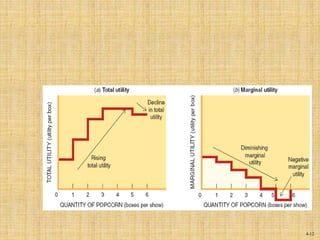
Total Utility
• Utility is the pleasure or satisfaction
obtained from a good or service.
• Total utility is the amount of
satisfaction obtained from entire
consumption of a product.
LO-1
4-11
Marginal Utility
• Marginal utility is the change in total
utility obtained by consuming one
additional (marginal) unit of a good or
service.
Marginal utility =
change in total utility
change in quantity
LO-1
4-12
4-13
Law of Diminishing
Marginal Utility
• The marginal utility of a good declines
as more of it is consumed in a given
time period.
• Suppose a student who enjoys
popcorn can eat all he/she wants for
free.
– The first box consumed is very rewarding.
– The third box is decent, etc.
– After eating the sixth box, she gets sick.
LO-1
4-14
• As long as the marginal utility is
positive, the consumer receives
additional satisfaction and total utility
increases.
• Additional quantities of a good yield
increasingly smaller increments of
satisfaction.
Law of Diminishing
Marginal Utility
LO-1
4-15
• An absolute measure of utility is not
possible because the perception of
satisfaction differs among individuals.
• Diminishing marginal utility is a
common experience.
• It is a sufficient basis for economic
predictions of consumer behavior.
Utility Theory
LO-1
4-16
Price and Quantity
• Many forces determine how much we
are willing to buy.
• Economists focus on the relationship
between price and quantity rather than
trying to explain all the forces at once.
– This is the ceteris paribus (all other things
equal) assumption.
LO-1
4-17
Law of Demand
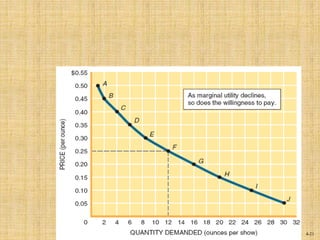
• The concepts of marginal utility and
ceteris paribus explain the downward
slope of the demand curve.
• With given income, tastes,
expectations, and prices of other goods
and services, people are willing to buy
additional quantities of a good only if its
price falls.
LO-1
4-18
• The higher the marginal utility, the
more you are willing to pay.
• Diminishing marginal utility explains
why price must decrease in order for
you to continue to buy a good or
service.
Law of Demand
LO-1
4-19
• According to the law of demand, the
quantity of a good demanded in a
given time period increases as its price
falls, ceteris paribus.
Law of Demand
LO-1
4-20
Demand Curve
• The quantities of a good a consumer is
willing and able to buy at alternative
prices in a given time period, ceteris
paribus.
LO-1
4-21
4-22
Price Elasticity
• The response of consumers to a
change in price is measured by the
price elasticity of demand.
LO-2
4-23
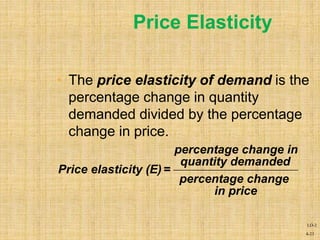
• The price elasticity of demand is the
percentage change in quantity
demanded divided by the percentage
change in price.
Price elasticity (E)=
percentage change in
quantity demanded
percentage change
in price
Price Elasticity
LO-2
4-24
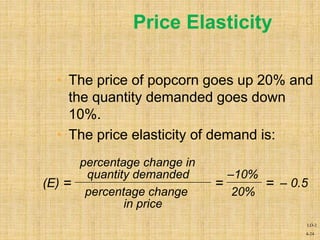
• The price of popcorn goes up 20% and
the quantity demanded goes down
10%.
• The price elasticity of demand is:
(E) =
percentage change in
quantity demanded
percentage change
in price
=
–10%
20%
– 0.5
=
Price Elasticity
LO-2
4-25
Elastic versus
Inelastic Demand
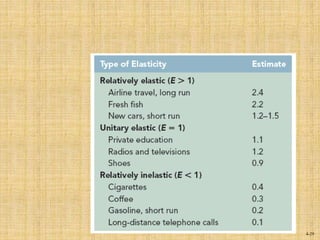
• Demand can be elastic, inelastic, or
unitary elastic.
LO-2
4-26
Elastic Demand
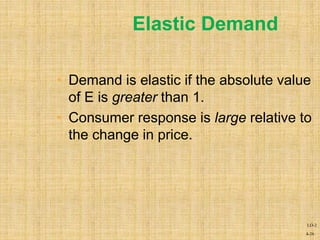
• Demand is elastic if the absolute value
of E is greater than 1.
• Consumer response is large relative to
the change in price.
LO-2
4-27
Inelastic Demand
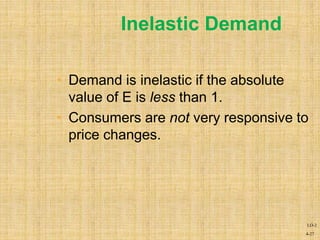
• Demand is inelastic if the absolute
value of E is less than 1.
• Consumers are not very responsive to
price changes.
LO-2
4-28
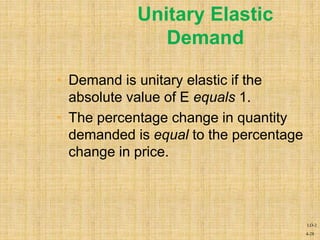
Unitary Elastic
Demand
• Demand is unitary elastic if the
absolute value of E equals 1.
• The percentage change in quantity
demanded is equal to the percentage
change in price.
LO-2
4-29
4-30
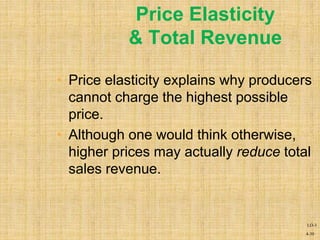
Price Elasticity
& Total Revenue
• Price elasticity explains why producers
cannot charge the highest possible
price.
• Although one would think otherwise,
higher prices may actually reduce total
sales revenue.
LO-3
4-31
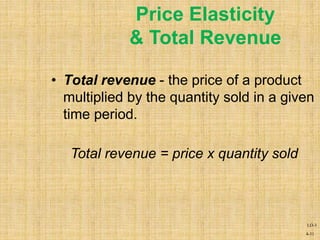
• Total revenue - the price of a product
multiplied by the quantity sold in a given
time period.
Total revenue = price x quantity sold
Price Elasticity
& Total Revenue
LO-3
4-32
Elasticity and
Total Revenue
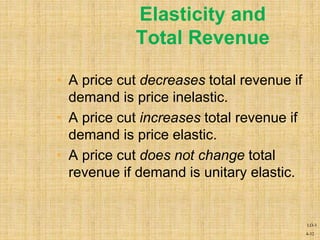
• A price cut decreases total revenue if
demand is price inelastic.
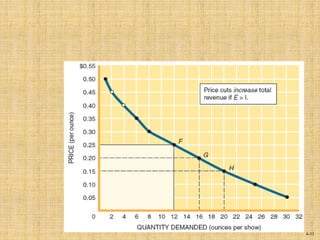
• A price cut increases total revenue if
demand is price elastic.
• A price cut does not change total
revenue if demand is unitary elastic.
LO-3
4-33
4-34
Determinants of
Price Elasticity
• Differences in price elasticity are
explained by several factors:
– Whether the Good is a Necessity or
Luxury
– The Availability of Substitutes
– The Price Relative to Income
LO-4
4-35
Necessities versus
Luxuries
• Some goods are so critical to our
everyday life that we regard them as
necessities.
• Demand for necessities is relatively
inelastic.
LO-4
4-36
• A luxury good is something we’d like
to have but aren’t likely to buy unless
our income jumps or the price declines
sharply.
• Demand for luxury goods is relatively
elastic.
Necessities versus
Luxuries
LO-4
4-37
Availability of
Substitutes
• The greater the availability of
substitutes, the higher the price
elasticity of demand.
• The smaller the availability of
substitutes, the lower the price
elasticity of demand.
LO-4
4-38
Price Relative
to Income
• If the price of a product is very high
relative to the consumer’s income, the
demand will tend to be elastic.
• If the price of a product is very low
relative to the consumer’s income, the
demand will tend to be inelastic.
LO-4
4-39
Substitute &
Complementary Goods
• Substitute Goods:
– The demand for a good increases when
the price of a substitute for the good goes
up.
• Complementary Goods:
– The demand for a good decreases when
the price of a complement to the good
goes up.
LO-4
4-40
Changes in Income
• Income is a determinant of demand.
• We illustrate income changes with
shifts of the demand curve.
LO-4
4-41
Are Wants Created?
• Advertising is not the only reason
consumption has increased.
• Personality and social interaction
dynamics have changed how much we
consume.
• A successful advertising campaign is
one that shifts the demand curve to the
right.
LO-5
THANK YOU
4-42

Utility Theory.ppt

  • 1.
  • 2.
    4-2 The Economic Explanation • Pricesand income are just as relevant to consumption decisions as more basic desires and preferences. • Demand – The ability and willingness to buy specific quantities of a good at alternative prices in a given time period, ceteris paribus. LO-1
  • 3.
    4-3 Determinants of Demand • Tastes- desire for this and other goods – If a study says ice cream is good for you, the demand for ice cream would increase. LO-1
  • 4.
    4-4 • Income (ofthe consumer): – If you won the lottery you might buy more ice cream. – The demand for ice cream would increase, shifting the demand curve to the right. Determinants of Demand LO-1
  • 5.
    4-5 • Expectations (forincome, prices, tastes) – If you knew you were going to get rich soon you might deplete savings to buy more ice cream now. – This would increase the demand for ice cream. Determinants of Demand LO-1
  • 6.
    4-6 • Other goods(their availability and price): – If the price of chocolate candy bars increased, you might buy ice cream instead of a candy bar. – This would increase the demand for ice cream. Determinants of Demand LO-1
  • 7.
    4-7 • The numberof consumers in the market: – If the number of buyers in the ice cream market increased, the market demand for ice cream would increase. Determinants of Demand LO-1
  • 8.
    4-8 Market Demand • Thetotal quantities of a good or service people are willing and able to buy at alternative prices in a given time period. • Market demand is the sum of all individual demands. LO-1
  • 9.
    4-9 Utility Theory • Economistsassume that the more pleasure a product gives, the higher price buyers are willing to pay. • Students who like butter are willing to pay more for buttered popcorn than non-buttered popcorn because it offers more total utility. LO-1
  • 10.
    4-10 Total Utility • Utilityis the pleasure or satisfaction obtained from a good or service. • Total utility is the amount of satisfaction obtained from entire consumption of a product. LO-1
  • 11.
    4-11 Marginal Utility • Marginalutility is the change in total utility obtained by consuming one additional (marginal) unit of a good or service. Marginal utility = change in total utility change in quantity LO-1
  • 12.
  • 13.
    4-13 Law of Diminishing MarginalUtility • The marginal utility of a good declines as more of it is consumed in a given time period. • Suppose a student who enjoys popcorn can eat all he/she wants for free. – The first box consumed is very rewarding. – The third box is decent, etc. – After eating the sixth box, she gets sick. LO-1
  • 14.
    4-14 • As longas the marginal utility is positive, the consumer receives additional satisfaction and total utility increases. • Additional quantities of a good yield increasingly smaller increments of satisfaction. Law of Diminishing Marginal Utility LO-1
  • 15.
    4-15 • An absolutemeasure of utility is not possible because the perception of satisfaction differs among individuals. • Diminishing marginal utility is a common experience. • It is a sufficient basis for economic predictions of consumer behavior. Utility Theory LO-1
  • 16.
    4-16 Price and Quantity •Many forces determine how much we are willing to buy. • Economists focus on the relationship between price and quantity rather than trying to explain all the forces at once. – This is the ceteris paribus (all other things equal) assumption. LO-1
  • 17.
    4-17 Law of Demand •The concepts of marginal utility and ceteris paribus explain the downward slope of the demand curve. • With given income, tastes, expectations, and prices of other goods and services, people are willing to buy additional quantities of a good only if its price falls. LO-1
  • 18.
    4-18 • The higherthe marginal utility, the more you are willing to pay. • Diminishing marginal utility explains why price must decrease in order for you to continue to buy a good or service. Law of Demand LO-1
  • 19.
    4-19 • According tothe law of demand, the quantity of a good demanded in a given time period increases as its price falls, ceteris paribus. Law of Demand LO-1
  • 20.
    4-20 Demand Curve • Thequantities of a good a consumer is willing and able to buy at alternative prices in a given time period, ceteris paribus. LO-1
  • 21.
  • 22.
    4-22 Price Elasticity • Theresponse of consumers to a change in price is measured by the price elasticity of demand. LO-2
  • 23.
    4-23 • The priceelasticity of demand is the percentage change in quantity demanded divided by the percentage change in price. Price elasticity (E)= percentage change in quantity demanded percentage change in price Price Elasticity LO-2
  • 24.
    4-24 • The priceof popcorn goes up 20% and the quantity demanded goes down 10%. • The price elasticity of demand is: (E) = percentage change in quantity demanded percentage change in price = –10% 20% – 0.5 = Price Elasticity LO-2
  • 25.
    4-25 Elastic versus Inelastic Demand •Demand can be elastic, inelastic, or unitary elastic. LO-2
  • 26.
    4-26 Elastic Demand • Demandis elastic if the absolute value of E is greater than 1. • Consumer response is large relative to the change in price. LO-2
  • 27.
    4-27 Inelastic Demand • Demandis inelastic if the absolute value of E is less than 1. • Consumers are not very responsive to price changes. LO-2
  • 28.
    4-28 Unitary Elastic Demand • Demandis unitary elastic if the absolute value of E equals 1. • The percentage change in quantity demanded is equal to the percentage change in price. LO-2
  • 29.
  • 30.
    4-30 Price Elasticity & TotalRevenue • Price elasticity explains why producers cannot charge the highest possible price. • Although one would think otherwise, higher prices may actually reduce total sales revenue. LO-3
  • 31.
    4-31 • Total revenue- the price of a product multiplied by the quantity sold in a given time period. Total revenue = price x quantity sold Price Elasticity & Total Revenue LO-3
  • 32.
    4-32 Elasticity and Total Revenue •A price cut decreases total revenue if demand is price inelastic. • A price cut increases total revenue if demand is price elastic. • A price cut does not change total revenue if demand is unitary elastic. LO-3
  • 33.
  • 34.
    4-34 Determinants of Price Elasticity •Differences in price elasticity are explained by several factors: – Whether the Good is a Necessity or Luxury – The Availability of Substitutes – The Price Relative to Income LO-4
  • 35.
    4-35 Necessities versus Luxuries • Somegoods are so critical to our everyday life that we regard them as necessities. • Demand for necessities is relatively inelastic. LO-4
  • 36.
    4-36 • A luxurygood is something we’d like to have but aren’t likely to buy unless our income jumps or the price declines sharply. • Demand for luxury goods is relatively elastic. Necessities versus Luxuries LO-4
  • 37.
    4-37 Availability of Substitutes • Thegreater the availability of substitutes, the higher the price elasticity of demand. • The smaller the availability of substitutes, the lower the price elasticity of demand. LO-4
  • 38.
    4-38 Price Relative to Income •If the price of a product is very high relative to the consumer’s income, the demand will tend to be elastic. • If the price of a product is very low relative to the consumer’s income, the demand will tend to be inelastic. LO-4
  • 39.
    4-39 Substitute & Complementary Goods •Substitute Goods: – The demand for a good increases when the price of a substitute for the good goes up. • Complementary Goods: – The demand for a good decreases when the price of a complement to the good goes up. LO-4
  • 40.
    4-40 Changes in Income •Income is a determinant of demand. • We illustrate income changes with shifts of the demand curve. LO-4
  • 41.
    4-41 Are Wants Created? •Advertising is not the only reason consumption has increased. • Personality and social interaction dynamics have changed how much we consume. • A successful advertising campaign is one that shifts the demand curve to the right. LO-5
  • 42.