



1
|
Using Your Voice
Presentation Skills
MTL Course Topics
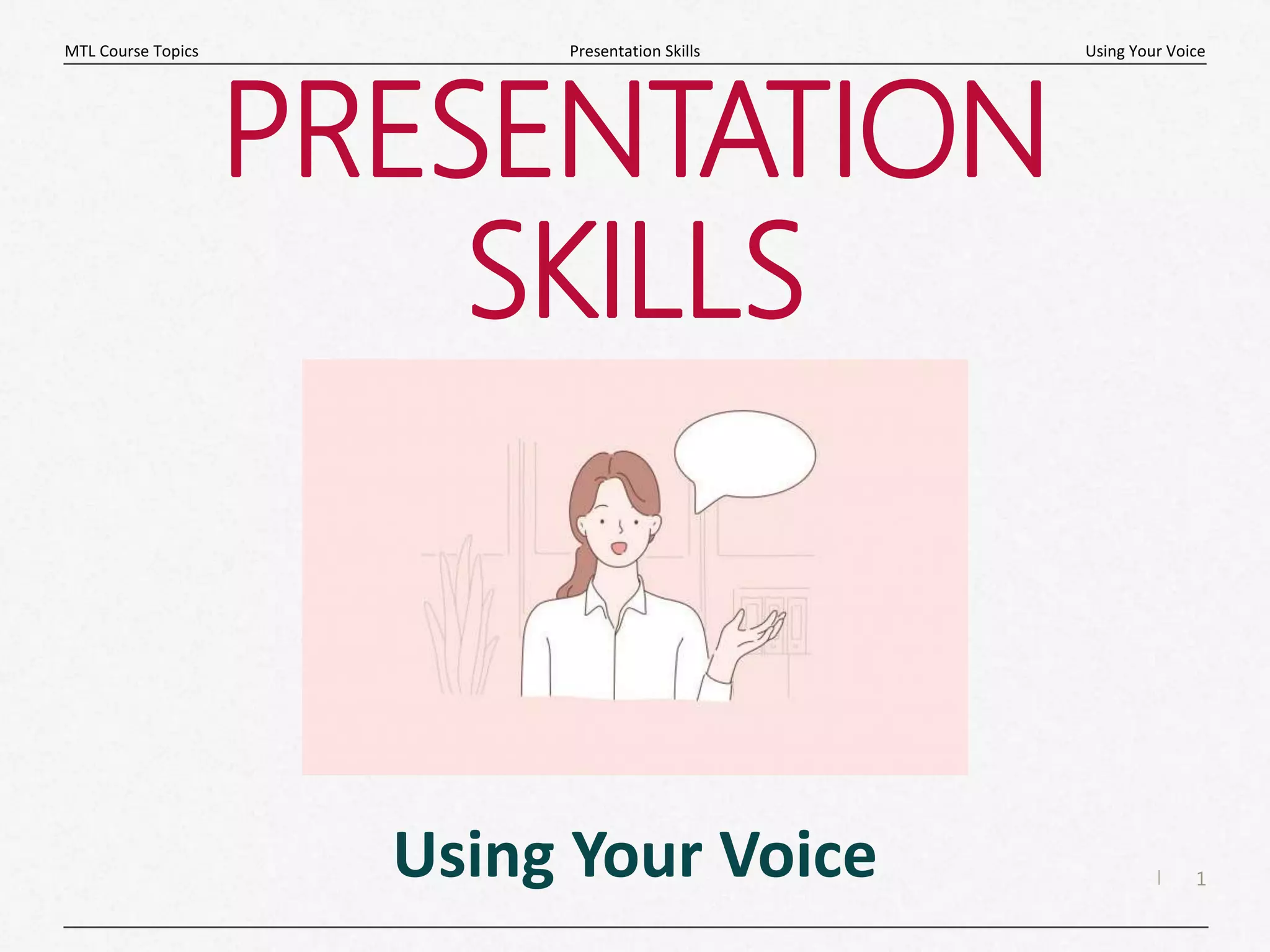
PRESENTATION
SKILLS
Using Your Voice
2
|
Using Your Voice
Presentation Skills
MTL Course Topics
The Course Topics series from Manage Train Learn is a large collection of topics that will help you as a learner
to quickly and easily master a range of skills in your everyday working life and life outside work. If you are a
trainer, they are perfect for adding to your classroom courses and online learning plans.
COURSE TOPICS FROM MTL
The written content in this Slide Topic belongs exclusively to Manage Train Learn and may only be reprinted
either by attribution to Manage Train Learn or with the express written permission of Manage Train Learn.
They are designed as a series of numbered
slides. As with all programmes on Slide
Topics, these slides are fully editable and
can be used in your own programmes,
royalty-free. Your only limitation is that
you may not re-publish or sell these slides
as your own.
Copyright Manage Train Learn 2020
onwards.
Attribution: All images are from sources
which do not require attribution and may
be used for commercial uses. Sources
include pixabay, unsplash, and freepik.
These images may also be those which are
in the public domain, out of copyright, for
fair use, or allowed under a Creative
Commons license.
3
|
Using Your Voice
Presentation Skills
MTL Course Topics
ARE YOU READY?
OK, LET’S START!
4
|
Using Your Voice
Presentation Skills
MTL Course Topics
INTRODUCTION
Few people appreciate and use the vast range of colour,
texture and meaning in their voices. It can sometimes come
as a shock when they hear themselves tape-recorded for
the first time and discover their tone, flatness and lack of
range. However, with awareness of what we can do with our
voice, practice and conscious effort, the voice can be turned
into a versatile presentational instrument.
5
|
Using Your Voice
Presentation Skills
MTL Course Topics
USING YOUR VOICE
There are a number of ways we can adjust the way our voice
sounds.
Here are ten of the most important for the presenter:
1. volume: loud or quiet?
2. pace: quick or slow?
3. pitch: high or low?
4. articulation: clear or garbled?
5. resonance: deep or shallow?
6. tone: monotone or multi-tone?
7. phrasing: do we speak in phrases or in sentences?
8. pauses: are our pauses at natural stops?
9. inflection: does our voice rise and fall with the sense of
our words?
10. accents: is our accent natural or false?
6
|
Using Your Voice
Presentation Skills
MTL Course Topics
VOLUME: LOUD OR QUIET?
Voice volume and projection are the two means by which
your message reaches everyone in the room.
Good volume and projection are the result of using the
breath. Some people speak on the inward breath which
loses the voice in the intake of air; some on a held breath
which creates tension.
The best way to speak and project is on the outward breath.
If, when you breathe in, you fill not just the lungs and chest
but also the diaphragm (the area of the abdomen below the
tummy), you will have the maximum exhaling breath with
which to speak.
Always aim to project your voice to the back of the room, so
that it hits and rebounds off the rear wall. This kind of voice
projection comes as much from your mind as it does from
your voice.
7
|
Using Your Voice
Presentation Skills
MTL Course Topics
HOW TO PROJECT YOUR VOICE
On sixminutes.com, Kate Peters says that speaking louder is
not about just increasing your volume. It is about working
on the three components of voice projection: personality;
passion; and strong vocal physique.
1. Personality. Your voice reveals who you are and is the
unique imprint of what and how you are thinking. If you are
not confident, it will show in your voice; and if you are at
ease, that will show too.
2. Passion. Kate Peters says that passion is the power of
intention aligned with content and personality. When you
know why you are saying what you are saying, everything
aligns and your vocal power becomes clear.
3. Strong Vocal Physique. Strong vocal physique is the
ability to produce a resonant sound and to have a good
command of breathing technique. If you want to project
your voice, take a deep breath and develop an awareness of
resonance inside yourself and around yourself.
8
|
Using Your Voice
Presentation Skills
MTL Course Topics
PACE: QUICK OR SLOW?
We each have a natural speaking pace which reflects the
flow of thoughts and feelings in our brains. Women, for
example, tend to speak more quickly than men because
their feelings flow more freely.
Since we speak at the pace that suits us, it is difficult to
realise that this may not be a pace that suits others. When
some people in an audience fidget, while others appear
calm and attuned, it is probably because some are tuned in
to your speaking rate while others are not.
In a prepared speech, we can compensate for the different
paces in an audience by varying the rates at which we
speak: sometimes speeding up, for example when building
to a climax and sometimes slowing down when we require
emphasis, solemnity or suspense.
9
|
Using Your Voice
Presentation Skills
MTL Course Topics
PACE AND EFFECT
The rates at which we speak are related to the impressions
we want to create in others:
1. if you want the audience to get a mental picture, talk
quite quickly
2. if you want the audience to hear internally, speak
slower and deeper
3. if you want the audience to get into the feelings, speak
even slower still and deeper.
The Greek orator, Demosthenes, had two favourite ways to
rehearse his speeches. He would stand in front of a mirror
with pebbles in his mouth to practise speaking clearly; and
he would stand on the seashore and declaim his speeches
above the sound of the waves to practise speaking at
different rates and volumes.
10
|
Using Your Voice
Presentation Skills
MTL Course Topics
PITCH: HIGH OR LOW?
Pitch is the degree of acuteness in the voice. A low and slow
pitch can indicate gravity; a high and fast pitch can indicate
excitement.
To get a sense of the different levels of pitch, try these
sentences out loud. Read them first from top to bottom,
then from bottom to top and then randomly.
High pitch: "It's a wonderful day!"
Middle pitch with inflection on "lovely": "It's a lovely day!"
Middle pitch: "It's a nice day!"
Lower pitch: "It's a miserable day!"
Lower pitch still: "It's a horrid day!"
11
|
Using Your Voice
Presentation Skills
MTL Course Topics
ARTICULATION
Articulation is a form of gymnastics between the tip of the
tongue, the teeth and the lips. If your audience hears "50%"
when you pronounced a gabbled "15%", it could make a big
difference to the meaning of your presentation! Similar
confusion can arise if you do not distinguish between "m"
and "n", between "f" and "s" or the last parts of words.
Loosening up with exercises and tongue-twisters is good
preparation before a presentation. You could try each of
these six times:
The Leith police dismisseth us.
She sells sea shells on the sea-shore.
Red leather, yellow leather.
Many men have many minds.
Gig whip (said quickly)
12
|
Using Your Voice
Presentation Skills
MTL Course Topics
ENUNCIATION
To enunciate means to speak clearly. This means making
sure that an audience hears every sound and letter of your
words.
Here are three exercises which help to improve enunciation.
Exercise 1. Repeat: "the tip of the tongue, the teeth and the
lips" three times without gabbling.
Exercise 2. Practise exaggerated enunciation in front of a
mirror. Remember people understand by watching your lips
as well as hearing your words.
Exercise 3. Practise opening the mouth a little wider when
pronouncing vowels. Practise biting into the consonants P, B,
T, D, K and G, as in P,P,P; P,P,P; P,P,P Pah...; B, B, B; B, B, B; B,
B, B Bah...; and so on.
13
|
Using Your Voice
Presentation Skills
MTL Course Topics
RESONANCE
Resonance is the sound made when your breath
reverberates in the empty spaces inside you. It gives a
deeper, stronger quality to your voice. If you are speaking in
a large room without a microphone, resonance will enable
you to fill up the space without straining.
In this exercise, you can feel resonance by placing both
hands on each part of your body and pronouncing the
sound as deeply as you can.
Place your hands…
• on your tummy and say "Oh"
• on your abdomen and say "Ah"
• on your breastbone and say "Ah"
• on your throat and say "I"
• on the top of your head and say "Ee"
• on your head and tummy and say "Oi"
• on your tummy and say "Oh"
14
|
Using Your Voice
Presentation Skills
MTL Course Topics
TONE
Tone is a musical expression which includes tempo, pitch,
timbre and emphasis. We usually refer to a person's range
of speaking tones in the same way as we speak of the range
of tones of a musical instrument.
Most English speakers have just two or three tones of the
musical scale (some are monotone). The Welsh and West
Highlanders of Scotland on the other hand use at least an
octave and a half.
Speech is more interesting and enjoyable to listen to when
we use a wide variety of tones.
15
|
Using Your Voice
Presentation Skills
MTL Course Topics
THE RIGHT TONE
There is a famous piece of research in communication that
says you tell others more in your tone of voice than in your
choice of words. If you are calling your children to dinner
from another room, they will know at once whether you are
angry because they are late, excited because the meal
smells great, or indifferent because you're just passing on a
message.
It's the same with your presentations. If you take out all
context and meaning from what you say, it is like reading
from the phone book. There will be no emotion, no attempt
to communicate, no message, no you. It will be monotone.
As a speaker, you cannot apply tones to what you say
mechanically. Tone emerges as a result of you knowing what
you want to communicate. It must be clear in your mind.
Think about the way a child talks animatedly when you ask
them about their day when they come out of school as
opposed to the day after. It's because the experiences they
are re-telling are fresh in their minds.
16
|
Using Your Voice
Presentation Skills
MTL Course Topics
PHRASING
If the unit of writing is the word, the unit of speaking is the
phrase.
A speech can be broken into chunks of phrases which carry
individual pieces of meaning. When we deliver our speech,
it is necessary to speak in phrases rather than separate
words so that we convey the whole meaning.
Phrases and their meanings make sense to listeners through
the pauses between each phrase.
Newscasters and broadcasters are expert at phrasing...
"Here is the news (pause)...Early today...."
17
|
Using Your Voice
Presentation Skills
MTL Course Topics
PAUSES
A pause should be a planned and definite act and should not
be filled with "ums", "ers" and "basically’s" or a look of
embarrassment.
1. Audiences appreciate pauses. It lets them catch up and
helps them to think. It is a way of building interest and
suspense.
2. Pauses allow you time to collect your thoughts which
are always just a little ahead of your words
3. Pauses are natural punctuation marks. If you are
keeping pace with your audience, you know just how
long to pause to keep them interested.
The great pianist Arthur Schnabel said: "The notes I handle
no better than many pianists. But the pauses between the
notes...that's where the art resides."
18
|
Using Your Voice
Presentation Skills
MTL Course Topics
INFLECTION
Inflection is the way our voice rises and falls at the end of
phrases to signal to listeners an underlying meaning.
1. if the voice stays level at the end of a phrase, it implies a
statement
2. if the voice rises at the end of a phrase, it gives the
effect of a question or an expectation of more to come
3. if the voice falls at the end of a statement, it implies a
command or end.
A good example of inflection is the reading of football
results:
Hull 3 Bradford 1; Plymouth Argyle 3 Oldham 4.
19
|
Using Your Voice
Presentation Skills
MTL Course Topics
EMPHASIS
Changing the emphasis of the words we use in a sentence
can completely alter the meaning of what we say.
Say the sentences below putting the emphasis on the
underlined words and notice how the meaning changes:
I should accept that job (rather than you)
I should accept that job (it's better than anything else)
I should accept that job (rather than criticise it)
I should accept that job (rather than a different one)
I should accept that job (I have contempt for it).
Where we put the emphasis can seriously change what
others hear. Ask someone the riddle: "How many animals of
each species did Moses take in the Ark?" with the emphasis
on "of each species". Most people will answer "2" because
they hear "of each species" not the trick word "Moses". The
answer, of course, is that Moses took no animals into the
Ark, Noah did.
20
|
Using Your Voice
Presentation Skills
MTL Course Topics
ACCENTS
In our more open and egalitarian times, regional dialects
and accents are no longer regarded as an indication of
breeding, education and background. They may even be
regarded as an asset.
It is more likely you will be treated with suspicion if you put
on a false accent. People may believe you are trying to be
someone you are not. So have confidence in the natural
sounds and tones of your own regional accent without
hiding it.
When they were recruiting sales staff, First Direct, a
telephone access bank, gave priority to applicants with
Yorkshire vowels after a survey showed that the flat homely
sounds of Bradford, Halifax and Wakefield inspired an image
of trustworthiness and friendly professionalism.
21
|
Using Your Voice
Presentation Skills
MTL Course Topics
THAT’S
IT!
WELL DONE!
22
|
Using Your Voice
Presentation Skills
MTL Course Topics
THANK YOU
This has been a Slide Topic from Manage Train Learn

Using Your Voice

  • 1.
    1 | Using Your Voice PresentationSkills MTL Course Topics PRESENTATION SKILLS Using Your Voice
  • 2.
    2 | Using Your Voice PresentationSkills MTL Course Topics The Course Topics series from Manage Train Learn is a large collection of topics that will help you as a learner to quickly and easily master a range of skills in your everyday working life and life outside work. If you are a trainer, they are perfect for adding to your classroom courses and online learning plans. COURSE TOPICS FROM MTL The written content in this Slide Topic belongs exclusively to Manage Train Learn and may only be reprinted either by attribution to Manage Train Learn or with the express written permission of Manage Train Learn. They are designed as a series of numbered slides. As with all programmes on Slide Topics, these slides are fully editable and can be used in your own programmes, royalty-free. Your only limitation is that you may not re-publish or sell these slides as your own. Copyright Manage Train Learn 2020 onwards. Attribution: All images are from sources which do not require attribution and may be used for commercial uses. Sources include pixabay, unsplash, and freepik. These images may also be those which are in the public domain, out of copyright, for fair use, or allowed under a Creative Commons license.
  • 3.
    3 | Using Your Voice PresentationSkills MTL Course Topics ARE YOU READY? OK, LET’S START!
  • 4.
    4 | Using Your Voice PresentationSkills MTL Course Topics INTRODUCTION Few people appreciate and use the vast range of colour, texture and meaning in their voices. It can sometimes come as a shock when they hear themselves tape-recorded for the first time and discover their tone, flatness and lack of range. However, with awareness of what we can do with our voice, practice and conscious effort, the voice can be turned into a versatile presentational instrument.
  • 5.
    5 | Using Your Voice PresentationSkills MTL Course Topics USING YOUR VOICE There are a number of ways we can adjust the way our voice sounds. Here are ten of the most important for the presenter: 1. volume: loud or quiet? 2. pace: quick or slow? 3. pitch: high or low? 4. articulation: clear or garbled? 5. resonance: deep or shallow? 6. tone: monotone or multi-tone? 7. phrasing: do we speak in phrases or in sentences? 8. pauses: are our pauses at natural stops? 9. inflection: does our voice rise and fall with the sense of our words? 10. accents: is our accent natural or false?
  • 6.
    6 | Using Your Voice PresentationSkills MTL Course Topics VOLUME: LOUD OR QUIET? Voice volume and projection are the two means by which your message reaches everyone in the room. Good volume and projection are the result of using the breath. Some people speak on the inward breath which loses the voice in the intake of air; some on a held breath which creates tension. The best way to speak and project is on the outward breath. If, when you breathe in, you fill not just the lungs and chest but also the diaphragm (the area of the abdomen below the tummy), you will have the maximum exhaling breath with which to speak. Always aim to project your voice to the back of the room, so that it hits and rebounds off the rear wall. This kind of voice projection comes as much from your mind as it does from your voice.
  • 7.
    7 | Using Your Voice PresentationSkills MTL Course Topics HOW TO PROJECT YOUR VOICE On sixminutes.com, Kate Peters says that speaking louder is not about just increasing your volume. It is about working on the three components of voice projection: personality; passion; and strong vocal physique. 1. Personality. Your voice reveals who you are and is the unique imprint of what and how you are thinking. If you are not confident, it will show in your voice; and if you are at ease, that will show too. 2. Passion. Kate Peters says that passion is the power of intention aligned with content and personality. When you know why you are saying what you are saying, everything aligns and your vocal power becomes clear. 3. Strong Vocal Physique. Strong vocal physique is the ability to produce a resonant sound and to have a good command of breathing technique. If you want to project your voice, take a deep breath and develop an awareness of resonance inside yourself and around yourself.
  • 8.
    8 | Using Your Voice PresentationSkills MTL Course Topics PACE: QUICK OR SLOW? We each have a natural speaking pace which reflects the flow of thoughts and feelings in our brains. Women, for example, tend to speak more quickly than men because their feelings flow more freely. Since we speak at the pace that suits us, it is difficult to realise that this may not be a pace that suits others. When some people in an audience fidget, while others appear calm and attuned, it is probably because some are tuned in to your speaking rate while others are not. In a prepared speech, we can compensate for the different paces in an audience by varying the rates at which we speak: sometimes speeding up, for example when building to a climax and sometimes slowing down when we require emphasis, solemnity or suspense.
  • 9.
    9 | Using Your Voice PresentationSkills MTL Course Topics PACE AND EFFECT The rates at which we speak are related to the impressions we want to create in others: 1. if you want the audience to get a mental picture, talk quite quickly 2. if you want the audience to hear internally, speak slower and deeper 3. if you want the audience to get into the feelings, speak even slower still and deeper. The Greek orator, Demosthenes, had two favourite ways to rehearse his speeches. He would stand in front of a mirror with pebbles in his mouth to practise speaking clearly; and he would stand on the seashore and declaim his speeches above the sound of the waves to practise speaking at different rates and volumes.
  • 10.
    10 | Using Your Voice PresentationSkills MTL Course Topics PITCH: HIGH OR LOW? Pitch is the degree of acuteness in the voice. A low and slow pitch can indicate gravity; a high and fast pitch can indicate excitement. To get a sense of the different levels of pitch, try these sentences out loud. Read them first from top to bottom, then from bottom to top and then randomly. High pitch: "It's a wonderful day!" Middle pitch with inflection on "lovely": "It's a lovely day!" Middle pitch: "It's a nice day!" Lower pitch: "It's a miserable day!" Lower pitch still: "It's a horrid day!"
  • 11.
    11 | Using Your Voice PresentationSkills MTL Course Topics ARTICULATION Articulation is a form of gymnastics between the tip of the tongue, the teeth and the lips. If your audience hears "50%" when you pronounced a gabbled "15%", it could make a big difference to the meaning of your presentation! Similar confusion can arise if you do not distinguish between "m" and "n", between "f" and "s" or the last parts of words. Loosening up with exercises and tongue-twisters is good preparation before a presentation. You could try each of these six times: The Leith police dismisseth us. She sells sea shells on the sea-shore. Red leather, yellow leather. Many men have many minds. Gig whip (said quickly)
  • 12.
    12 | Using Your Voice PresentationSkills MTL Course Topics ENUNCIATION To enunciate means to speak clearly. This means making sure that an audience hears every sound and letter of your words. Here are three exercises which help to improve enunciation. Exercise 1. Repeat: "the tip of the tongue, the teeth and the lips" three times without gabbling. Exercise 2. Practise exaggerated enunciation in front of a mirror. Remember people understand by watching your lips as well as hearing your words. Exercise 3. Practise opening the mouth a little wider when pronouncing vowels. Practise biting into the consonants P, B, T, D, K and G, as in P,P,P; P,P,P; P,P,P Pah...; B, B, B; B, B, B; B, B, B Bah...; and so on.
  • 13.
    13 | Using Your Voice PresentationSkills MTL Course Topics RESONANCE Resonance is the sound made when your breath reverberates in the empty spaces inside you. It gives a deeper, stronger quality to your voice. If you are speaking in a large room without a microphone, resonance will enable you to fill up the space without straining. In this exercise, you can feel resonance by placing both hands on each part of your body and pronouncing the sound as deeply as you can. Place your hands… • on your tummy and say "Oh" • on your abdomen and say "Ah" • on your breastbone and say "Ah" • on your throat and say "I" • on the top of your head and say "Ee" • on your head and tummy and say "Oi" • on your tummy and say "Oh"
  • 14.
    14 | Using Your Voice PresentationSkills MTL Course Topics TONE Tone is a musical expression which includes tempo, pitch, timbre and emphasis. We usually refer to a person's range of speaking tones in the same way as we speak of the range of tones of a musical instrument. Most English speakers have just two or three tones of the musical scale (some are monotone). The Welsh and West Highlanders of Scotland on the other hand use at least an octave and a half. Speech is more interesting and enjoyable to listen to when we use a wide variety of tones.
  • 15.
    15 | Using Your Voice PresentationSkills MTL Course Topics THE RIGHT TONE There is a famous piece of research in communication that says you tell others more in your tone of voice than in your choice of words. If you are calling your children to dinner from another room, they will know at once whether you are angry because they are late, excited because the meal smells great, or indifferent because you're just passing on a message. It's the same with your presentations. If you take out all context and meaning from what you say, it is like reading from the phone book. There will be no emotion, no attempt to communicate, no message, no you. It will be monotone. As a speaker, you cannot apply tones to what you say mechanically. Tone emerges as a result of you knowing what you want to communicate. It must be clear in your mind. Think about the way a child talks animatedly when you ask them about their day when they come out of school as opposed to the day after. It's because the experiences they are re-telling are fresh in their minds.
  • 16.
    16 | Using Your Voice PresentationSkills MTL Course Topics PHRASING If the unit of writing is the word, the unit of speaking is the phrase. A speech can be broken into chunks of phrases which carry individual pieces of meaning. When we deliver our speech, it is necessary to speak in phrases rather than separate words so that we convey the whole meaning. Phrases and their meanings make sense to listeners through the pauses between each phrase. Newscasters and broadcasters are expert at phrasing... "Here is the news (pause)...Early today...."
  • 17.
    17 | Using Your Voice PresentationSkills MTL Course Topics PAUSES A pause should be a planned and definite act and should not be filled with "ums", "ers" and "basically’s" or a look of embarrassment. 1. Audiences appreciate pauses. It lets them catch up and helps them to think. It is a way of building interest and suspense. 2. Pauses allow you time to collect your thoughts which are always just a little ahead of your words 3. Pauses are natural punctuation marks. If you are keeping pace with your audience, you know just how long to pause to keep them interested. The great pianist Arthur Schnabel said: "The notes I handle no better than many pianists. But the pauses between the notes...that's where the art resides."
  • 18.
    18 | Using Your Voice PresentationSkills MTL Course Topics INFLECTION Inflection is the way our voice rises and falls at the end of phrases to signal to listeners an underlying meaning. 1. if the voice stays level at the end of a phrase, it implies a statement 2. if the voice rises at the end of a phrase, it gives the effect of a question or an expectation of more to come 3. if the voice falls at the end of a statement, it implies a command or end. A good example of inflection is the reading of football results: Hull 3 Bradford 1; Plymouth Argyle 3 Oldham 4.
  • 19.
    19 | Using Your Voice PresentationSkills MTL Course Topics EMPHASIS Changing the emphasis of the words we use in a sentence can completely alter the meaning of what we say. Say the sentences below putting the emphasis on the underlined words and notice how the meaning changes: I should accept that job (rather than you) I should accept that job (it's better than anything else) I should accept that job (rather than criticise it) I should accept that job (rather than a different one) I should accept that job (I have contempt for it). Where we put the emphasis can seriously change what others hear. Ask someone the riddle: "How many animals of each species did Moses take in the Ark?" with the emphasis on "of each species". Most people will answer "2" because they hear "of each species" not the trick word "Moses". The answer, of course, is that Moses took no animals into the Ark, Noah did.
  • 20.
    20 | Using Your Voice PresentationSkills MTL Course Topics ACCENTS In our more open and egalitarian times, regional dialects and accents are no longer regarded as an indication of breeding, education and background. They may even be regarded as an asset. It is more likely you will be treated with suspicion if you put on a false accent. People may believe you are trying to be someone you are not. So have confidence in the natural sounds and tones of your own regional accent without hiding it. When they were recruiting sales staff, First Direct, a telephone access bank, gave priority to applicants with Yorkshire vowels after a survey showed that the flat homely sounds of Bradford, Halifax and Wakefield inspired an image of trustworthiness and friendly professionalism.
  • 21.
    21 | Using Your Voice PresentationSkills MTL Course Topics THAT’S IT! WELL DONE!
  • 22.
    22 | Using Your Voice PresentationSkills MTL Course Topics THANK YOU This has been a Slide Topic from Manage Train Learn