Using Images in Academic Work
          LBRY 3020
            3/7/13
         Jennifer Mayer
Overview
•   Why use images in your work?
•   Sources for images
•   Issues and challenges of image use
•   Different ways to use images
Why use images in your work?
• People are increasingly visual
• Research: picture superiority effect (Paivio, 1990;
  Kosslyn, 1981; Nelson, 1979)
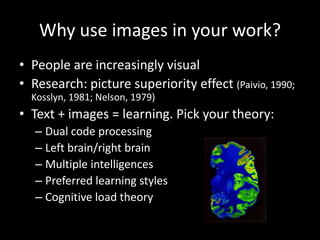
• Text + images = learning. Pick your theory:
   – Dual code processing
   – Left brain/right brain
   – Multiple intelligences
   – Preferred learning styles
   – Cognitive load theory
Images may be used to . . .
•   Add appeal
•   Add emotional impact
•   Communicate information concisely
•   Illustrate a concept
•   Promote critical thinking
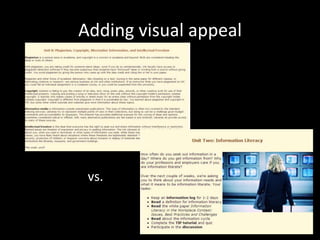
Adding visual appeal


 vs.
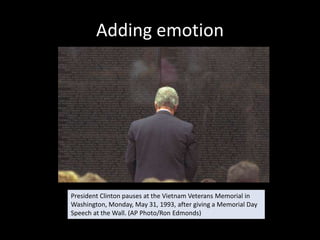
Adding emotion


President Clinton pauses at the Vietnam Veterans Memorial in
Washington, Monday, May 31, 1993, after giving a Memorial Day
Speech at the Wall. (AP Photo/Ron Edmonds)
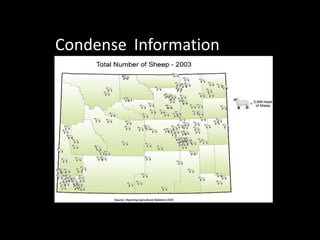
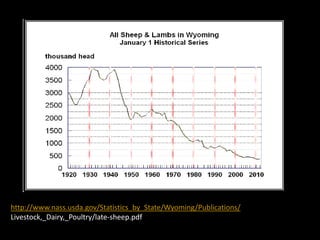
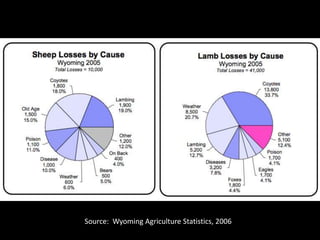
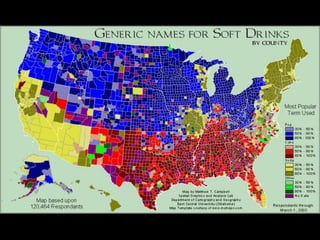
Condense Information
http://www.nass.usda.gov/Statistics_by_State/Wyoming/Publications/
Livestock,_Dairy,_Poultry/late-sheep.pdf
Source: Wyoming Agriculture Statistics, 2006
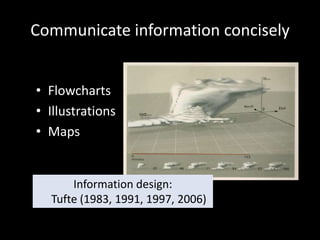
Communicate information concisely


• Flowcharts
• Illustrations
• Maps


      Information design:
  Tufte (1983, 1991, 1997, 2006)
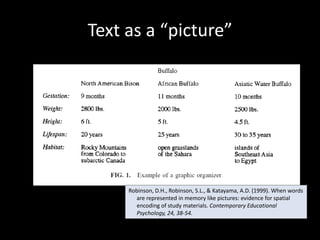
Text as a “picture”


     Robinson, D.H., Robinson, S.L., & Katayama, A.D. (1999). When words
       are represented in memory like pictures: evidence for spatial
       encoding of study materials. Contemporary Educational
       Psychology, 24, 38-54.
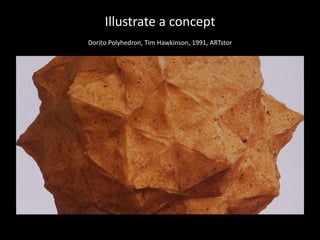
Illustrate a concept
Dorito Polyhedron, Tim Hawkinson, 1991, ARTstor
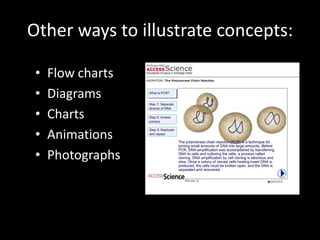
Other ways to illustrate concepts:

 •   Flow charts
 •   Diagrams
 •   Charts
 •   Animations
 •   Photographs
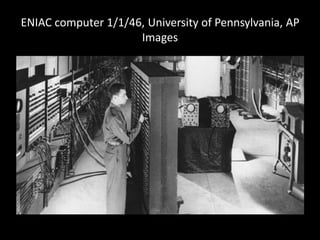
ENIAC computer 1/1/46, University of Pennsylvania, AP
                     Images
Media Literacy


BMW magazine advertisement, 2008-2009
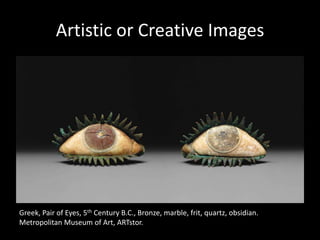
Artistic or Creative Images


Greek, Pair of Eyes, 5th Century B.C., Bronze, marble, frit, quartz, obsidian.
Metropolitan Museum of Art, ARTstor.
Sources for Images
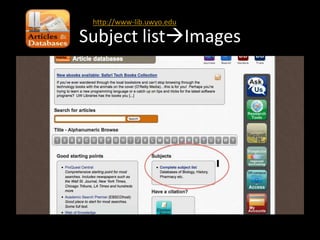
http://www-lib.uwyo.edu

Subject listImages
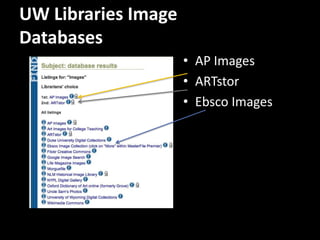
UW Libraries Image
Databases
                     • AP Images
                     • ARTstor
                     • Ebsco Images
Open access sites
• Wikimedia
  Commonshttp://commons.wikimedia.org
• Flickrhttp://www.flickr.com/creativecommo
  ns/
• Digital collections, Wyoming-related
http://digital.uwyo.edu/
• Boston U. Library images on the web:
http://www.bu.edu/library/instruction/findi
mages/
Issues and Challenges
• Quality, features
• Copyright
http://www.bu.edu/library/instruction/findimag
es/copyright.html
• Citing images
http://www.libraries.uc.edu/libraries/daap/reso
urces/visualresources/how_to/cite_image.html
References
•   Lohr, Linda L. Creating Graphics for Learning and
    Performance, 2003.

•   Mayer, Jennifer and Cheryl Goldenstein. “Academic
    Libraries Supporting Visual Culture: A Survey of Image
    Access and Use.” Art Documentation 28.1 (Spring 2009):
    16-28.

• Tufte, Edward R. Beautiful Evidence. Cheshire, Conn:
  Graphics Press, 2006. Print.

Using images

  • 1.
    Using Images inAcademic Work LBRY 3020 3/7/13 Jennifer Mayer
  • 2.
    Overview • Why use images in your work? • Sources for images • Issues and challenges of image use • Different ways to use images
  • 3.
    Why use imagesin your work? • People are increasingly visual • Research: picture superiority effect (Paivio, 1990; Kosslyn, 1981; Nelson, 1979) • Text + images = learning. Pick your theory: – Dual code processing – Left brain/right brain – Multiple intelligences – Preferred learning styles – Cognitive load theory
  • 4.
    Images may beused to . . . • Add appeal • Add emotional impact • Communicate information concisely • Illustrate a concept • Promote critical thinking
  • 5.
  • 6.
    Adding emotion President Clintonpauses at the Vietnam Veterans Memorial in Washington, Monday, May 31, 1993, after giving a Memorial Day Speech at the Wall. (AP Photo/Ron Edmonds)
  • 7.
  • 8.
  • 9.
  • 11.
    Communicate information concisely •Flowcharts • Illustrations • Maps Information design: Tufte (1983, 1991, 1997, 2006)
  • 12.
    Text as a“picture” Robinson, D.H., Robinson, S.L., & Katayama, A.D. (1999). When words are represented in memory like pictures: evidence for spatial encoding of study materials. Contemporary Educational Psychology, 24, 38-54.
  • 13.
    Illustrate a concept DoritoPolyhedron, Tim Hawkinson, 1991, ARTstor
  • 14.
    Other ways toillustrate concepts: • Flow charts • Diagrams • Charts • Animations • Photographs
  • 15.
    ENIAC computer 1/1/46,University of Pennsylvania, AP Images
  • 16.
    Media Literacy BMW magazineadvertisement, 2008-2009
  • 17.
    Artistic or CreativeImages Greek, Pair of Eyes, 5th Century B.C., Bronze, marble, frit, quartz, obsidian. Metropolitan Museum of Art, ARTstor.
  • 18.
  • 19.
  • 20.
    UW Libraries Image Databases • AP Images • ARTstor • Ebsco Images
  • 21.
    Open access sites •Wikimedia Commonshttp://commons.wikimedia.org • Flickrhttp://www.flickr.com/creativecommo ns/ • Digital collections, Wyoming-related http://digital.uwyo.edu/ • Boston U. Library images on the web: http://www.bu.edu/library/instruction/findi mages/
  • 22.
    Issues and Challenges •Quality, features • Copyright http://www.bu.edu/library/instruction/findimag es/copyright.html • Citing images http://www.libraries.uc.edu/libraries/daap/reso urces/visualresources/how_to/cite_image.html
  • 23.
    References • Lohr, Linda L. Creating Graphics for Learning and Performance, 2003. • Mayer, Jennifer and Cheryl Goldenstein. “Academic Libraries Supporting Visual Culture: A Survey of Image Access and Use.” Art Documentation 28.1 (Spring 2009): 16-28. • Tufte, Edward R. Beautiful Evidence. Cheshire, Conn: Graphics Press, 2006. Print.

Editor's Notes

  • #12 Tufte here and charts easier to read