Threshold Concepts &
Information Literacy
A (very brief) introduction…
http://library.artstor.org.arts.idm.oclc.org/library/secure/ViewImages?id=%2FDNCeCtIKzM9JS46fg%3D%3D&userId=gDdPeTM%3D&zoomparams=
Unknown photographer (1962) Searching The Library [b&w photograph]. Available at http://quest.eb.com.arts.idm.oclc.org/#/search/library-books/4/115_3803797
Outline
• What are Threshold
Concepts?
• How might they be relevant
for us as librarians?
Unknown photographer (1962) Searching The Library [b&w
photograph]. Available at
http://quest.eb.com.arts.idm.oclc.org/#/search/library-
books/4/115_3803797
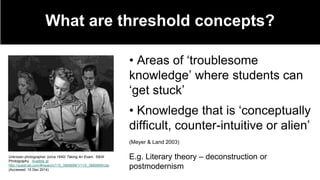
What are threshold concepts?
• Areas of ‘troublesome
knowledge’ where students can
‘get stuck’
• Knowledge that is ‘conceptually
difficult, counter-intuitive or alien’
(Meyer & Land 2003)
E.g. Literary theory – deconstruction or
postmodernism
Unknown photographer (circa 1940) Taking An Exam. B&W
Photography. Availble at
http://quest.eb.com/#/search/115_3869899/1/115_3869899/cite
(Accessed: 15 Dec 2014)
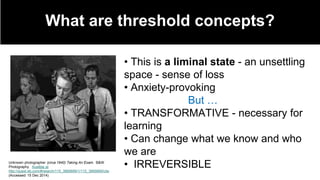
What are threshold concepts?
• This is a liminal state - an unsettling
space - sense of loss
• Anxiety-provoking
But …
• TRANSFORMATIVE - necessary for
learning
• Can change what we know and who
we are
• IRREVERSIBLEUnknown photographer (circa 1940) Taking An Exam. B&W
Photography. Availble at
http://quest.eb.com/#/search/115_3869899/1/115_3869899/cite
(Accessed: 15 Dec 2014)
Threshold Concepts &
Information Literacy
Information literacy as a
‘different way of seeing’
(Ray Land LILAC April 2015)
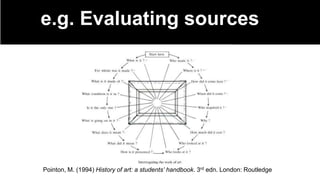
e.g. Evaluating sources
Pointon, M. (1994) History of art: a students’ handbook. 3rd edn. London: Routledge
• Authority is constructed and
contextual
• Information creation is a process
• Information has value
• Research as inquiry
• Scholarship as conversation
• Searching as strategic exploration
Martineau, L. (2014) A is for Alphabet [acrylic on card]
Available at
http://www.bridgemaneducation.com.arts.idm.oclc.org/I
mageView.aspx?result=45&balid=957182
2015 ACRL Information Literacy
Framework
Some final thoughts…
• Threshold spaces are
revelatory rather than sudden. It
takes time…
• Threshold concepts as a
possible ‘way in’ with academic
staff
• The library as a liminal spaceUnknown photographer (1962) Searching The Library [b&w
photograph]. Available at
http://quest.eb.com.arts.idm.oclc.org/#/search/library-
books/4/115_3803797
References
r.collingwood@lcc.arts.ac.uk
ACRL Framework for Information Literacy for Higher Education (2015)
Available at http://www.ala.org/acrl/standards/ilframework
Meyer, J. & Land, R. (2003) Threshold Concepts and Troublesome Knowledge: Linkages
to Ways of Thinking and Practising within the Disciplines. Edinburgh: School of Education,
University of Edinburgh. Available at http://www.etl.tla.ed.ac.uk/docs/ETLreport4.pdf
Pointon, M. (1994) History of art: a students’ handbook. 3rd edn. London: Routledge
More resources here:
http://www.ala.org/acrl/sites/ala.org.acrl/files/content/aboutacrl/directoryofleadership/sections/is/iswebsite/projpub
s/fivethings/5Things2014.pdf

Threshold concepts & information literacy

  • 1.
    Threshold Concepts & InformationLiteracy A (very brief) introduction… http://library.artstor.org.arts.idm.oclc.org/library/secure/ViewImages?id=%2FDNCeCtIKzM9JS46fg%3D%3D&userId=gDdPeTM%3D&zoomparams= Unknown photographer (1962) Searching The Library [b&w photograph]. Available at http://quest.eb.com.arts.idm.oclc.org/#/search/library-books/4/115_3803797
  • 2.
    Outline • What areThreshold Concepts? • How might they be relevant for us as librarians? Unknown photographer (1962) Searching The Library [b&w photograph]. Available at http://quest.eb.com.arts.idm.oclc.org/#/search/library- books/4/115_3803797
  • 3.
    What are thresholdconcepts? • Areas of ‘troublesome knowledge’ where students can ‘get stuck’ • Knowledge that is ‘conceptually difficult, counter-intuitive or alien’ (Meyer & Land 2003) E.g. Literary theory – deconstruction or postmodernism Unknown photographer (circa 1940) Taking An Exam. B&W Photography. Availble at http://quest.eb.com/#/search/115_3869899/1/115_3869899/cite (Accessed: 15 Dec 2014)
  • 4.
    What are thresholdconcepts? • This is a liminal state - an unsettling space - sense of loss • Anxiety-provoking But … • TRANSFORMATIVE - necessary for learning • Can change what we know and who we are • IRREVERSIBLEUnknown photographer (circa 1940) Taking An Exam. B&W Photography. Availble at http://quest.eb.com/#/search/115_3869899/1/115_3869899/cite (Accessed: 15 Dec 2014)
  • 5.
    Threshold Concepts & InformationLiteracy Information literacy as a ‘different way of seeing’ (Ray Land LILAC April 2015)
  • 6.
    e.g. Evaluating sources Pointon,M. (1994) History of art: a students’ handbook. 3rd edn. London: Routledge
  • 7.
    • Authority isconstructed and contextual • Information creation is a process • Information has value • Research as inquiry • Scholarship as conversation • Searching as strategic exploration Martineau, L. (2014) A is for Alphabet [acrylic on card] Available at http://www.bridgemaneducation.com.arts.idm.oclc.org/I mageView.aspx?result=45&balid=957182 2015 ACRL Information Literacy Framework
  • 8.
    Some final thoughts… •Threshold spaces are revelatory rather than sudden. It takes time… • Threshold concepts as a possible ‘way in’ with academic staff • The library as a liminal spaceUnknown photographer (1962) Searching The Library [b&w photograph]. Available at http://quest.eb.com.arts.idm.oclc.org/#/search/library- books/4/115_3803797
  • 9.
    References r.collingwood@lcc.arts.ac.uk ACRL Framework forInformation Literacy for Higher Education (2015) Available at http://www.ala.org/acrl/standards/ilframework Meyer, J. & Land, R. (2003) Threshold Concepts and Troublesome Knowledge: Linkages to Ways of Thinking and Practising within the Disciplines. Edinburgh: School of Education, University of Edinburgh. Available at http://www.etl.tla.ed.ac.uk/docs/ETLreport4.pdf Pointon, M. (1994) History of art: a students’ handbook. 3rd edn. London: Routledge More resources here: http://www.ala.org/acrl/sites/ala.org.acrl/files/content/aboutacrl/directoryofleadership/sections/is/iswebsite/projpub s/fivethings/5Things2014.pdf

Editor's Notes

  • #2 Today I thought I’d talk about something that was one of the themes of the LILAC conference in Newcastle a couple of weeks ago – threshold concepts.   First I’ll say that I’m by no means an expert on this. It’s something which is providing me with a new way of thinking about library education rather than something I’ve actually put into practice, but I thought it worth sharing with others in case it’s of interest. Those that were at LILAC will already know about this, so apologies!
  • #3 I want to talk briefly about two things:   What are Threshold Concepts? And, most importantly, how might they be relevant for us? TCs might provide librarians with new, interesting ways to think about library education, and may even provide us with a ‘way in’ with academic staff.
  • #4 Put basically, threshold concepts are areas of ‘troublesome knowledge’ where students can get stuck, or concepts or ideas that they can find it difficult to understand.   Each discipline has them e.g. in literary theory examples might be deconstruction or postmodernism. These ideas might be difficult for students to grasp because they are super-complex, conceptually difficult, or involve troublesome language.  
  • #5 Students moving from one space of understanding into another will pass through this threshold space where new things have to be integrated and others have to be let go of. This suspended state is known as a liminal state. In liminal states there is an oscillation- you might understand something for 10 seconds and then lose it again. This can be extremely stressful and students might sometimes use mimicry as a way of coping with this.   This is actually something I’m experiencing at the moment because I’m currently learning guitar and struggling with music theory. I’ve realised I’m in this liminal space and often find myself ‘getting it’ and then it disappears again. I even sometimes pretend to understand something in my lessons because I’m embarrassed by this. It’s reminded me what an anxiety-provoking state this can be.   But the crucial thing is that this anxiety is actually necessary to learning. Threshold concepts are transformative. Learning needs to be anxiety-provoking in order to take us into these new, uncertain places. Threshold concepts are also often irreversible and can be profound, changing what we know as well as who we are e.g. learning about feminist theory might change the way a student looks at life or their future.  
  • #6 So how does this relate to teaching in libraries? Well, we might can ask ourselves what these troublesome areas might be in terms of information literacy. This might help us to transform students’ relationship to information and knowledge. Ray Land spoke at the conference about how our discipline has troublesome areas just as any other – and that information literacy can also be transformative and lead to ‘a different way of seeing'
  • #7 For example, one of the areas where students might struggle is in evaluating resources and thinking critically. At LCC we are looking at ways in which we can bring this more into our information skills sessions. Previously much of the focus has been on searching resources rather than evaluating them. We are looking at incorporating this visual wheel. It is from a book on art history by Pointon, but the same questions might be applied to evaluating resources and thinking critically in library research.
  • #8 Threshold concepts have been such an influential idea that ACRL have this year used them to rethink their framework for teaching information literacy. They identified these 6 troublesome areas related to IL.    For example, scholarship as conversation- Although joining a conversation may require some mimicry, where students talk about other voices before they speak their own mind, it's also really important for students to see that they have a voice. They are participants and the creators of knowledge as well as recipients.   This framework also moves away from the idea of standards, skills and outcomes and research as a linear, sequential process beginning with identifying the information need. Instead it is an alphabetical list of core concepts which sees research as cyclical, with the information need often developing as we search.
  • #9 A few final thoughts… One problem with this is how do we implement this as it’s so conceptual. What came across at the conference is that it shouldn’t be about teaching the new framework. Instead these should be aspirational goals that we are aiming towards and keeping in mind in what we do. Threshold spaces are revelatory but not necessarily sudden. So it might not be an eureka moment, but might come together slowly and develop over time, with experience. It's not going to happen in a one hour info skills session, but we can contribute.  Threshold concepts might also be a way of initiating conversations with academic staff - saying "this is what we've been thinking about. What do you see as stuck places and breakthrough moments with students?” This might help us to think about how to best deliver information skills and support students in the research process. Some of the librarians at LCC are currently looking at initiating this conversation with CTS tutors. One of the other ideas that came up at LILAC was the library as a liminal space, a “palace of ambiguity”. It’s interesting to think of libraries as symbolic of these in-between places, where students can enter these areas of discovery and ambiguity. threshold concepts might also help us to remember that libraries can be intimidating, uncertain, places for some students, but also that we have an opportunity to help students, explore and ask questions and discover new things.  
  • #10  Meyer, Jan, and Ray Land. 2003. Threshold Concepts and Troublesome Knowledge: Linkages to Ways of Thinking and Practising within the Disciplines . Edinburgh: School of Education, University of Edinburgh. http://www.etl.t la.ed.ac.uk/docs/ETLreport4.pd More resources here http://www.ala.org/acrl/sites/ala.org.acrl/files/content/aboutacrl/directoryofleadership/sections/is/iswebsite/projpubs/fivethings/5Things2014.pdf