Requirements Capture using UML Use Cases Venkat Srinivasan Dept. of CSE Saranathan college of Engineering, Trichy
Contents Requirements Capture Building Blocks of a Use Case Diagram Actors Use Cases Relationships between Actors Relationships between Use Cases Terminology Flow of Events Scenarios Get more mileage from your Use Cases Use Case DOs and DON’Ts
Requirements Collection “Requirements” are the raison-d-être of any software development project Defines and delineates user-requirements Defines the functionality to be provided  Identifies the goals to be achieved. Must be precisely and completely understood by the team providing the solution User requirements (and team members) keep changing; requirements must therefore be well-documented
Requirements Collection A thorough and unambiguous understanding of the requirements is vital to ensure that everyone knows what they are doing and why Must be reviewed, reviewed again and reviewed yet again before the design and implementation begins Involves the participation of domain-experts to ensure that the requirements have been correctly understood captures the “WHAT” of the problem-domain.
Requirements Capture with UML Use Case Diagrams Captures the problem-domain in terms of functionality to be provided (Use Cases), and the “roles” (Actors) for whom these functions are performed. An abstraction of the problem-domain and a vehicle to facilitate a clear, well-articulated and unambiguous understanding of the problem-domain.
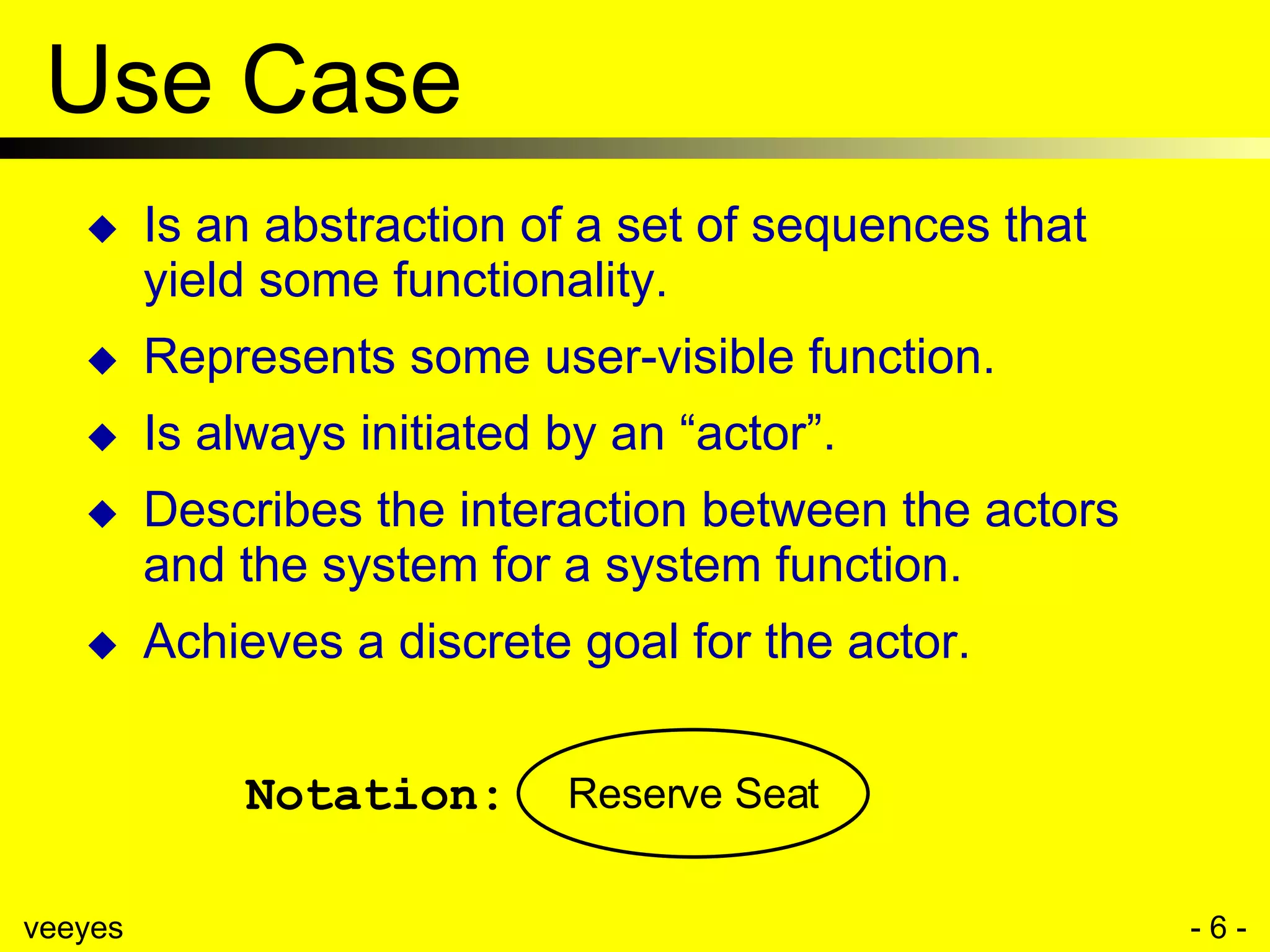
Use Case Is an abstraction of a set of sequences that yield some functionality. Represents some user-visible function. Is always initiated by an “actor”. Describes the interaction between the actors and the system for a system function. Achieves a discrete goal for the actor. Notation: Reserve Seat
Finding Use Cases What functions does the system perform? What functions do the “actors” require? What input/output does the system need? What  verbs  are used to describe the system? The Reservation Clerk  makes a booking   using the system, based on the...  The Airport Manager can  make an entry for a new flight . He can also  modify flight details , provided...
Use Case - Example Indian Railways provides for advance reservation on all long-distance travel. The passenger seeking reservation of berth or seats should purchase the tickets from Railway Reservation Offices or Authorised Travel Agency only. To make an advance booking, the passenger is expected to fill in a prescribed application form and submit it to the reservation counter with the appropriate amount. Advanced Reservations are made up to 60 days in advance for all trains, for all classes exclusive of the day of departure of trains. An individual can book only up to six passengers on one requisition form provided all passengers are for the same destination and for the same train.
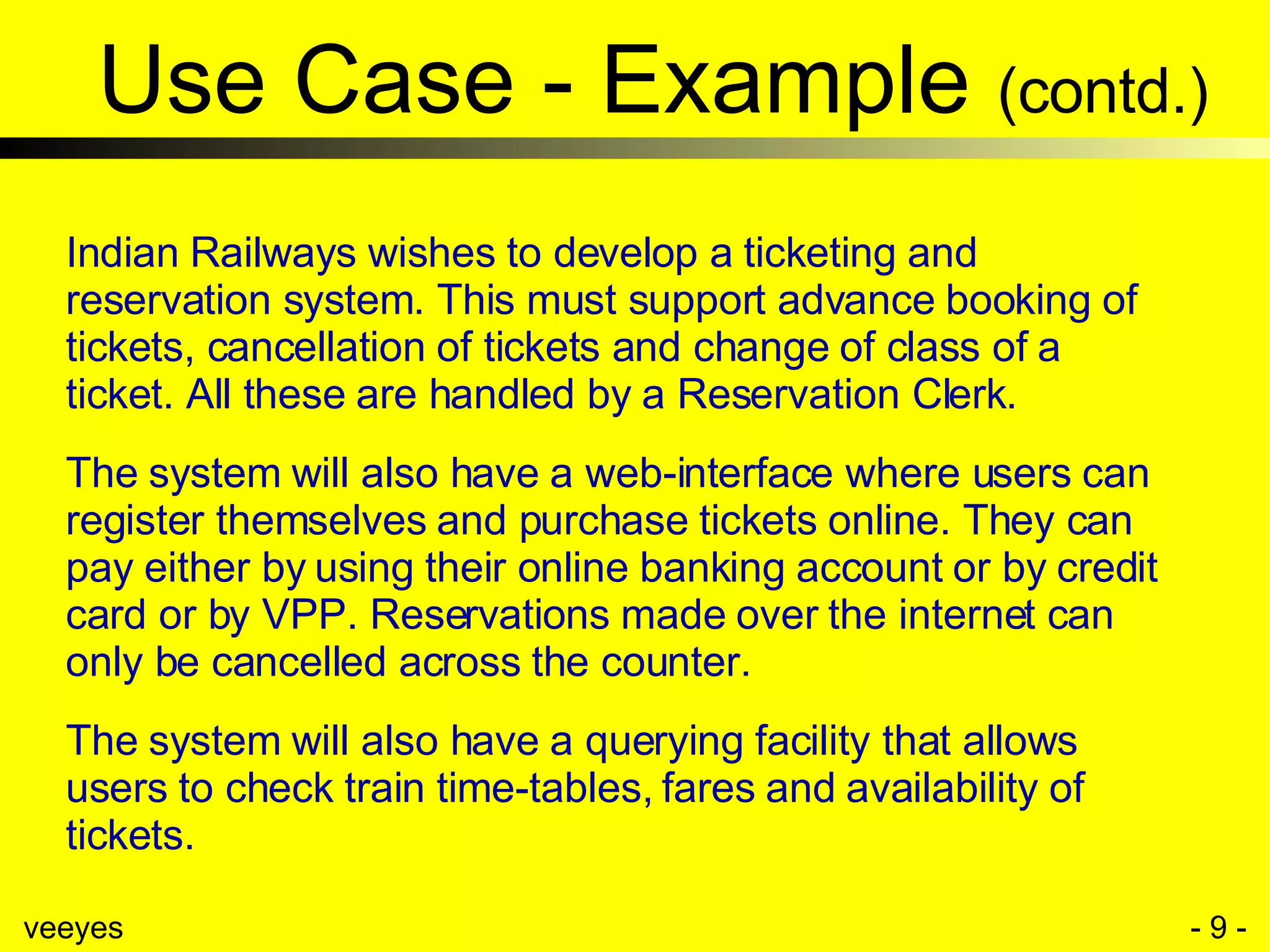
Use Case - Example  (contd.) Indian Railways wishes to develop a ticketing and reservation system. This must support advance booking of tickets, cancellation of tickets and change of class of a ticket. All these are handled by a Reservation Clerk. The system will also have a web-interface where users can register themselves and purchase tickets online. They can pay either by using their online banking account or by credit card or by VPP. Reservations made over the internet can only be cancelled across the counter. The system will also have a querying facility that allows users to check train time-tables, fares and availability of tickets.
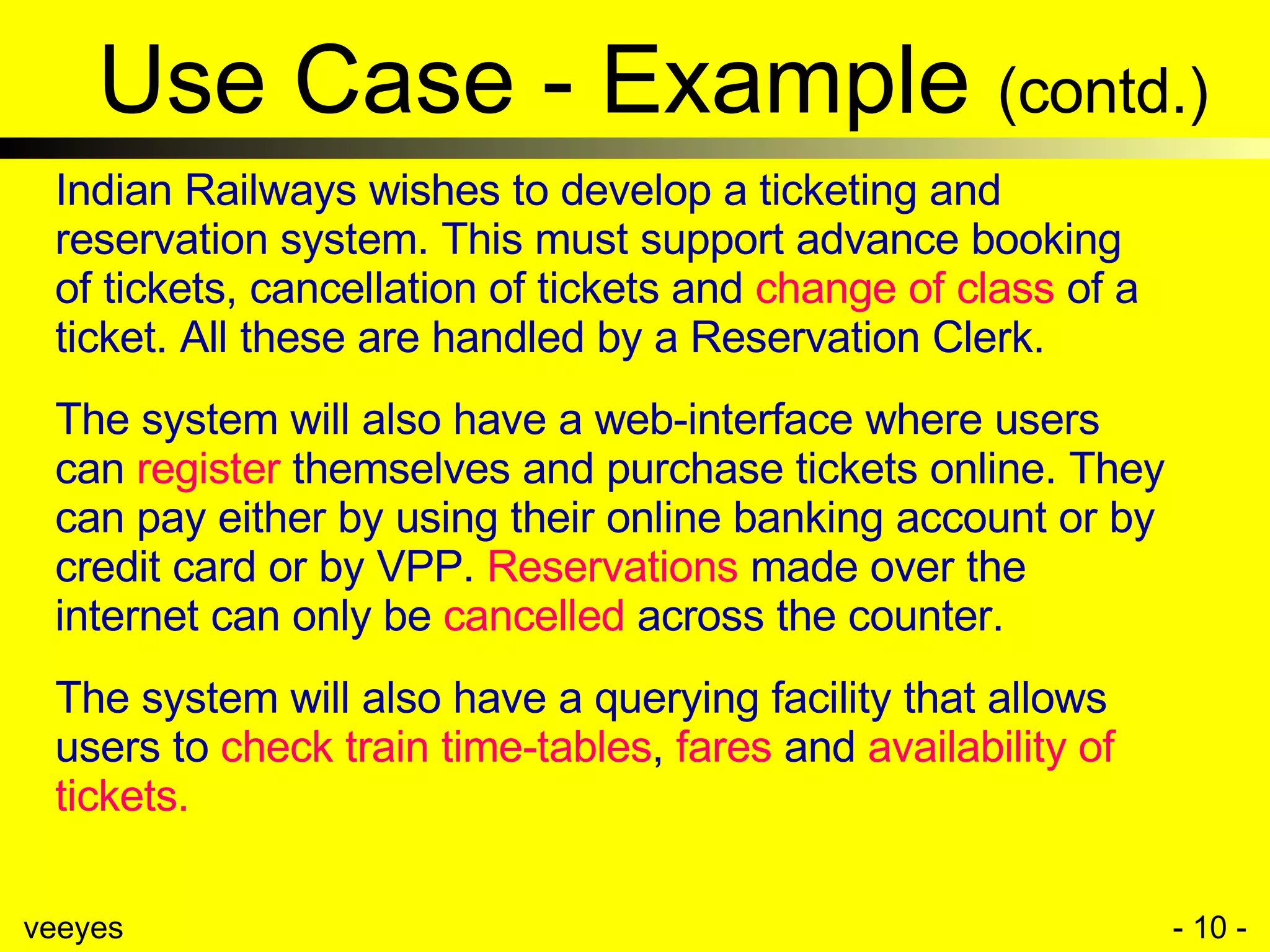
Use Case - Example  (contd.) Indian Railways wishes to develop a ticketing and reservation system. This must support advance booking of tickets, cancellation of tickets and  change of class  of a ticket. All these are handled by a Reservation Clerk. The system will also have a web-interface where users can  register  themselves and purchase tickets online. They can pay either by using their online banking account or by credit card or by VPP.  Reservations  made over the internet can only be  cancelled  across the counter. The system will also have a querying facility that allows users to  check train time-tables ,  fares  and  availability of tickets.
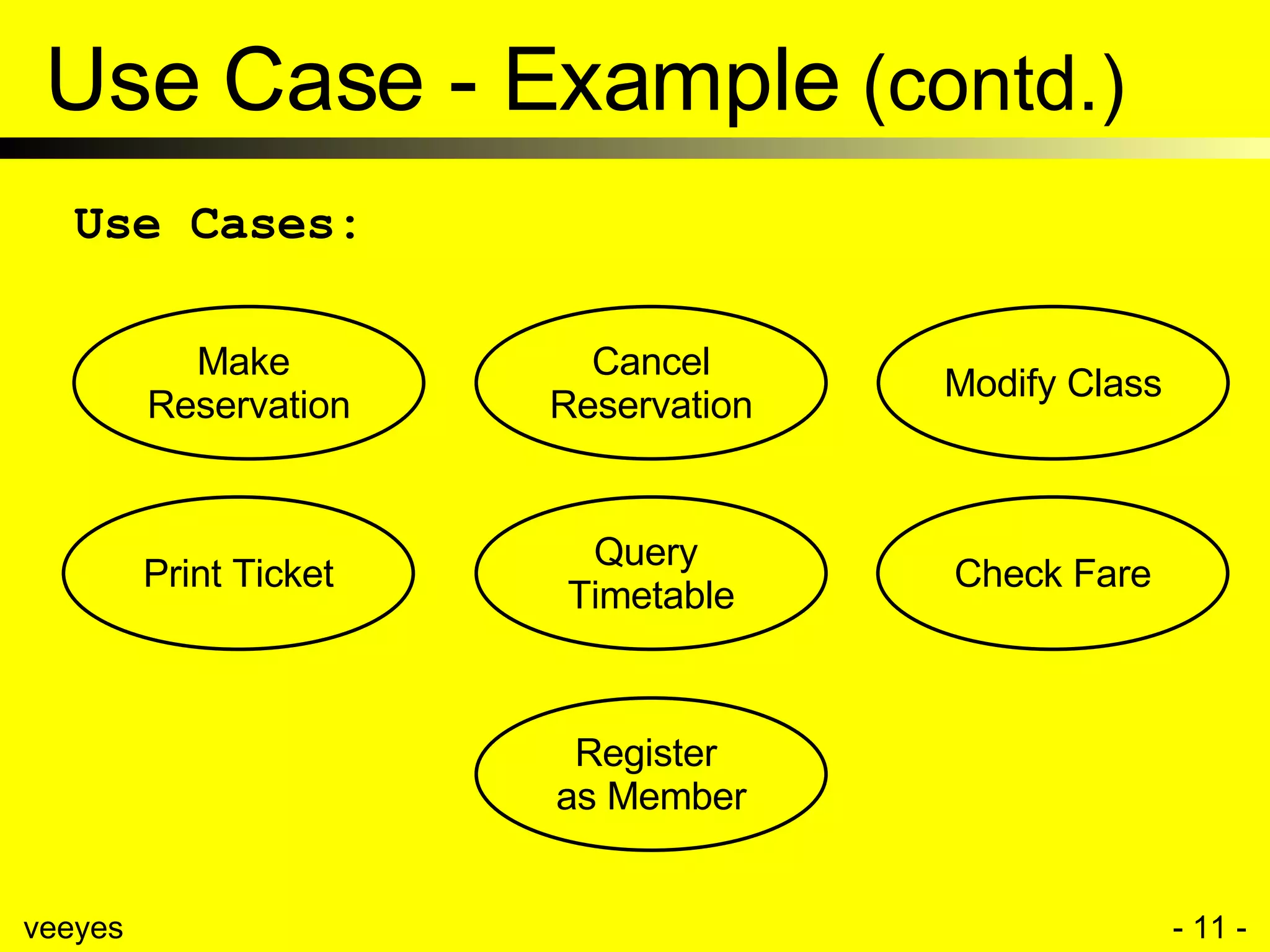
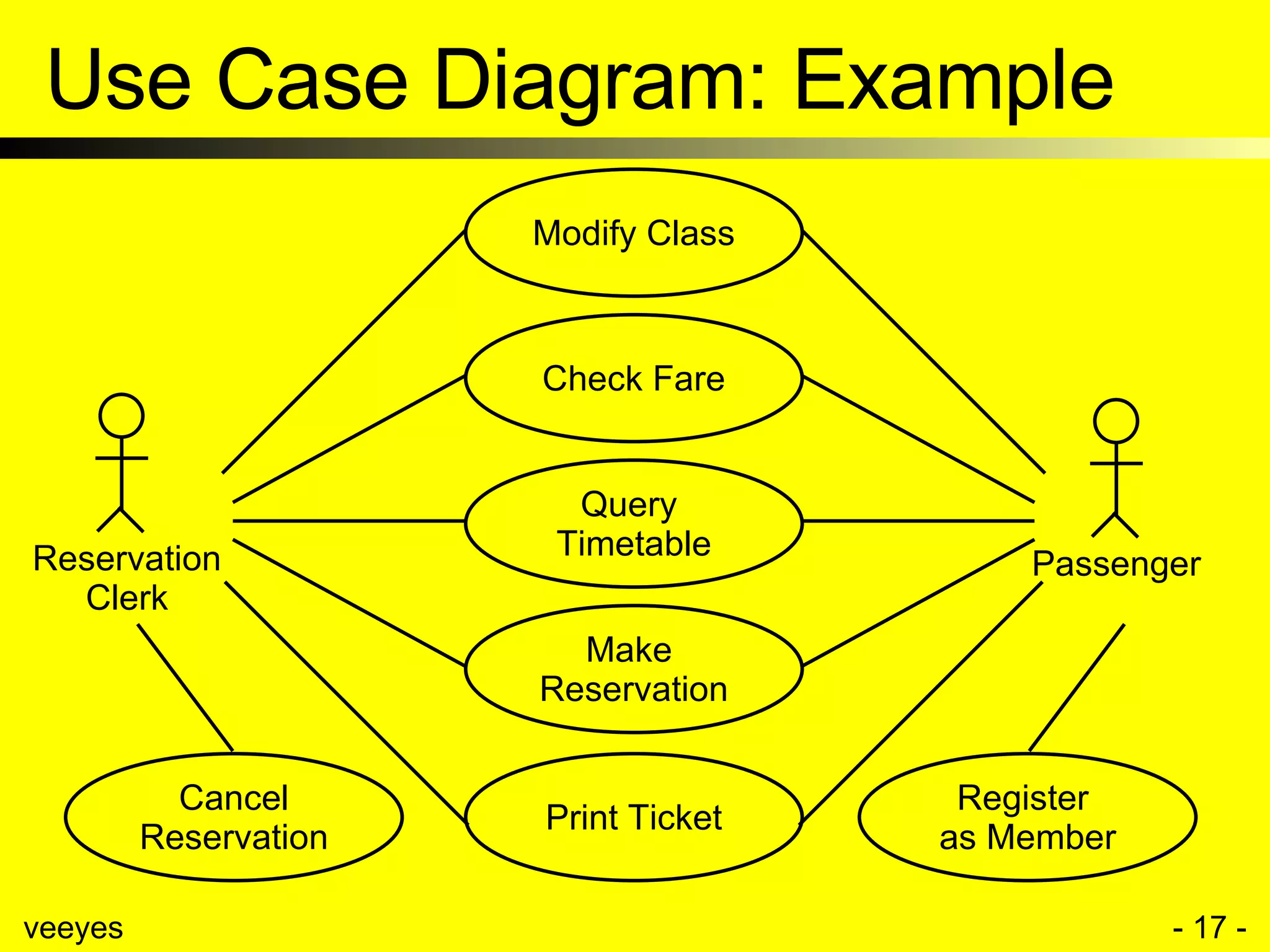
Use Case - Example  (contd.) Use Cases: Make  Reservation Cancel Reservation Modify Class Print Ticket Query  Timetable Check Fare Register  as Member
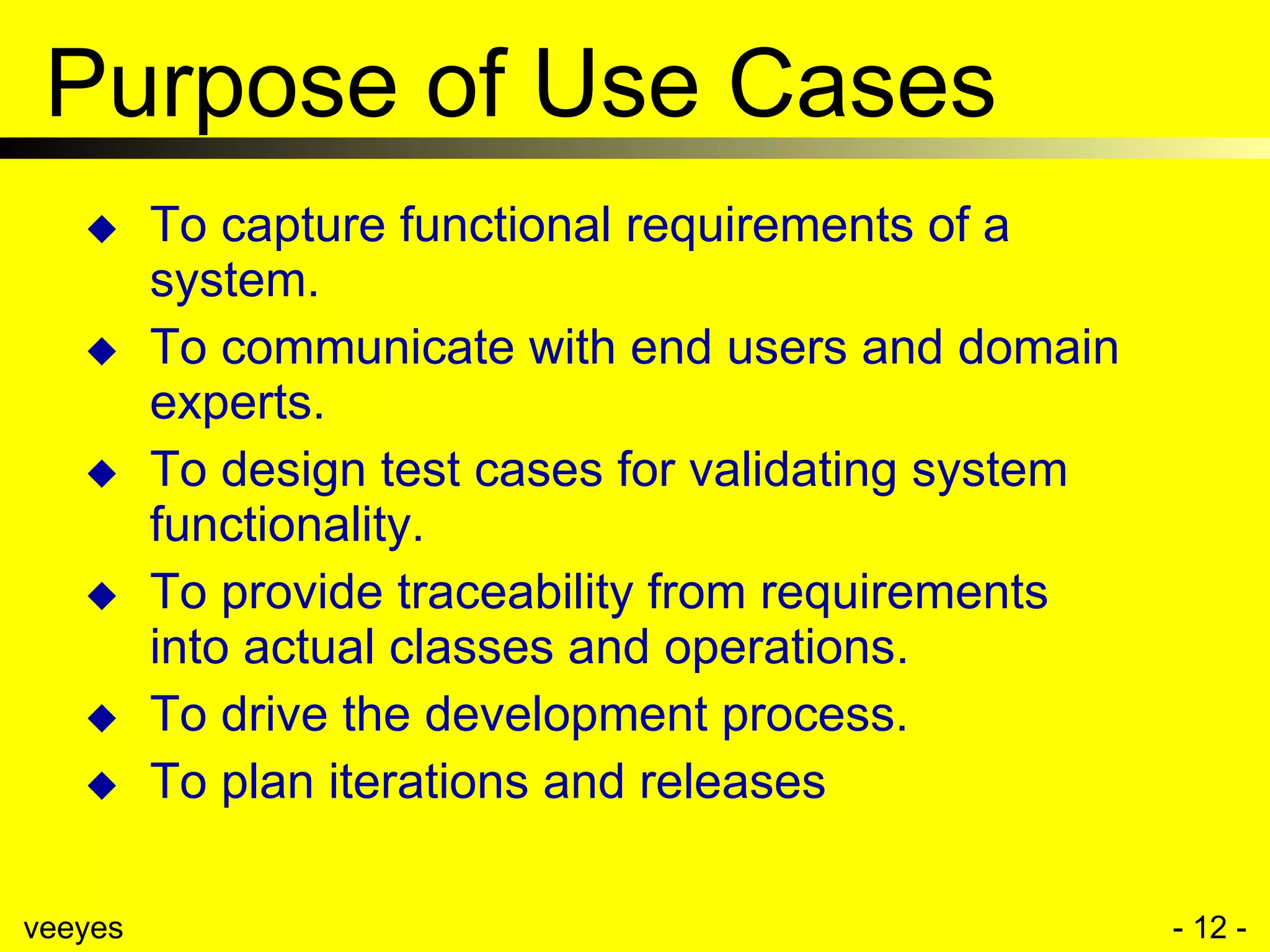
Purpose of Use Cases To capture functional requirements of a system. To communicate with end users and domain experts. To design test cases for validating system functionality. To provide traceability from requirements into actual classes and operations. To drive the development process. To plan iterations and releases
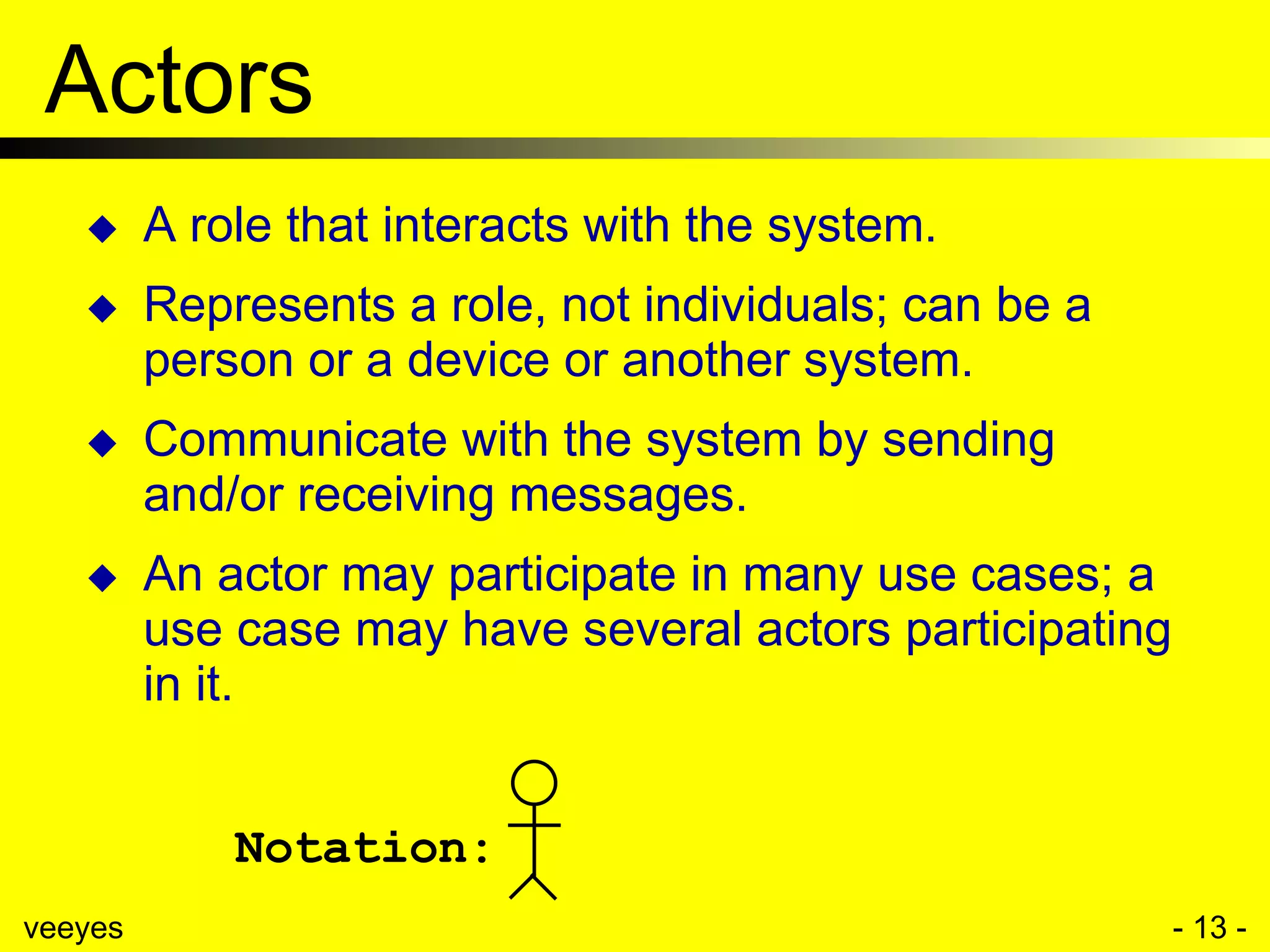
Actors A role that interacts with the system. Represents a role, not individuals; can be a person or a device or another system. Communicate with the system by sending and/or receiving messages. An actor may participate in many use cases; a use case may have several actors participating in it. Notation:
Finding Actors Who uses the main functionality of the system? Which hardware devices the system needs to handle? Which other systems does the system need to interact with? What  nouns / subjects   are used to describe the system? The  Reservation Clerk  makes a booking using the system, based on the...  A  user  must login in order to save his itinerary
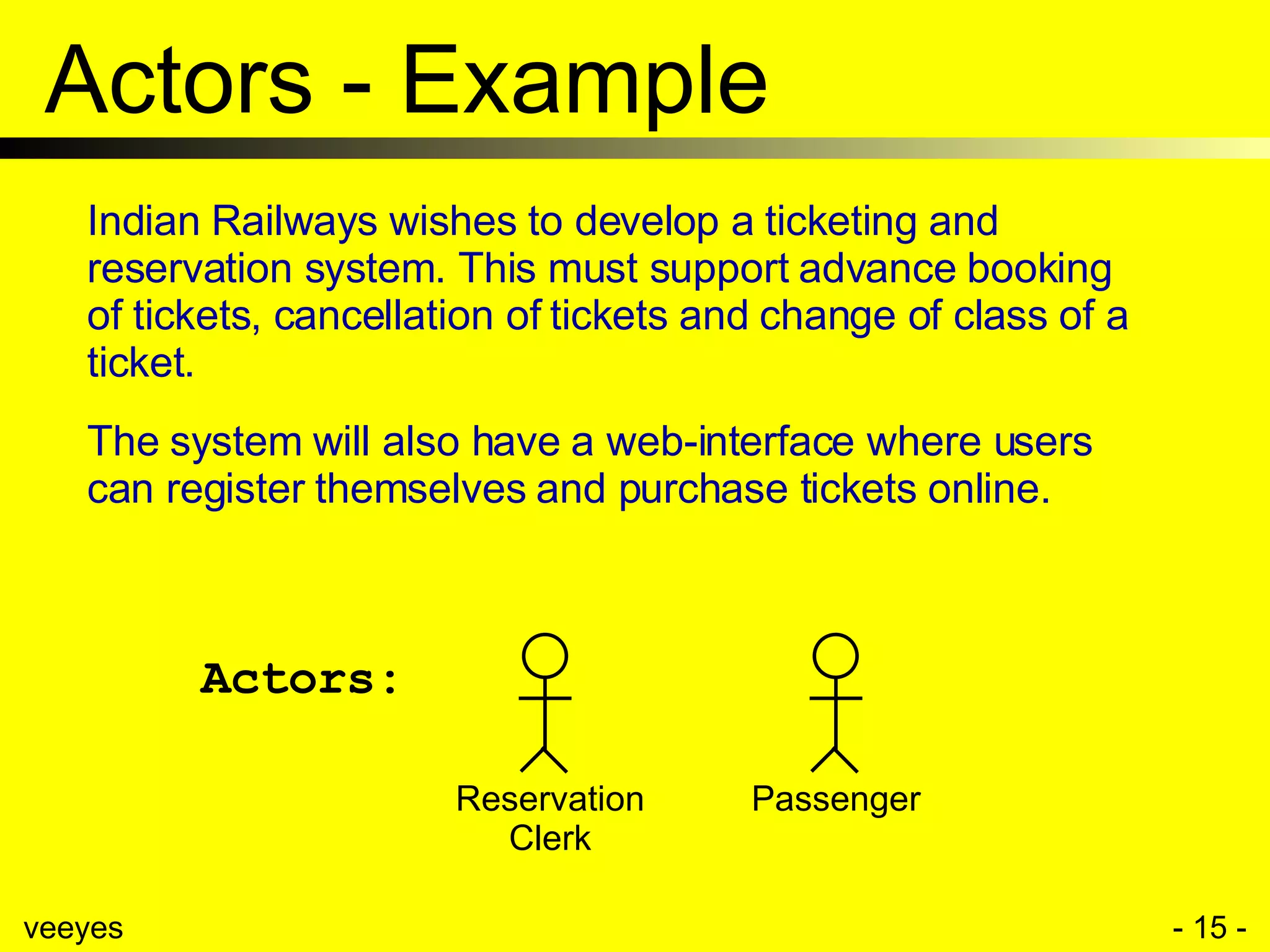
Actors - Example Indian Railways wishes to develop a ticketing and reservation system. This must support advance booking of tickets, cancellation of tickets and change of class of a ticket. The system will also have a web-interface where users can register themselves and purchase tickets online. Actors: Reservation Clerk Passenger
Use Case Diagram A graphical representation of the Use Cases of a system, its actors, and the interaction between them. It depicts the system boundary. Diagram Model elements Actors Use cases Relationships between Actors and Use Cases between Use Cases  between Actors
Use Case Diagram: Example Make  Reservation Modify Class Print Ticket Query  Timetable Check Fare Reservation Clerk Passenger Cancel Reservation Register  as Member
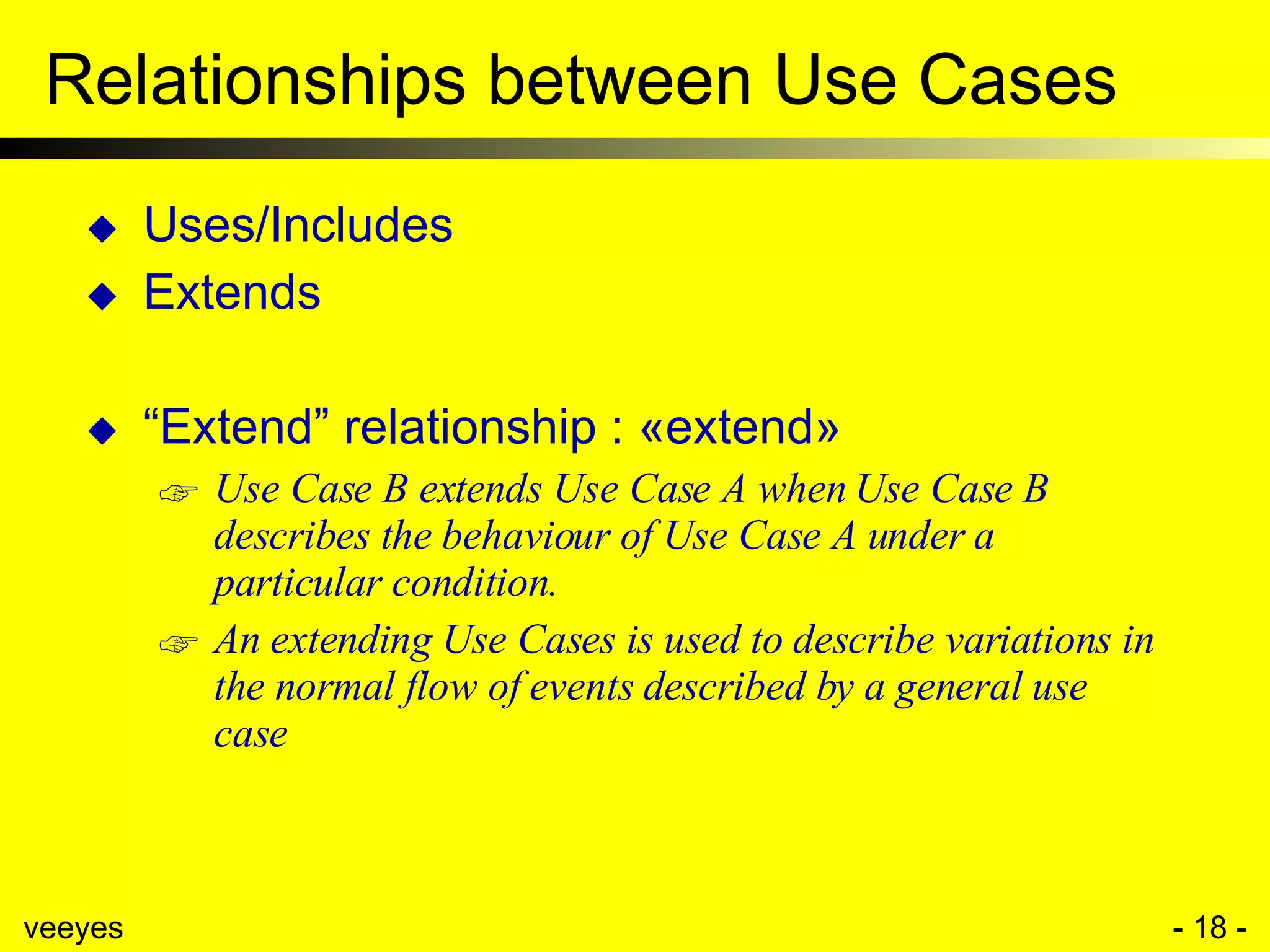
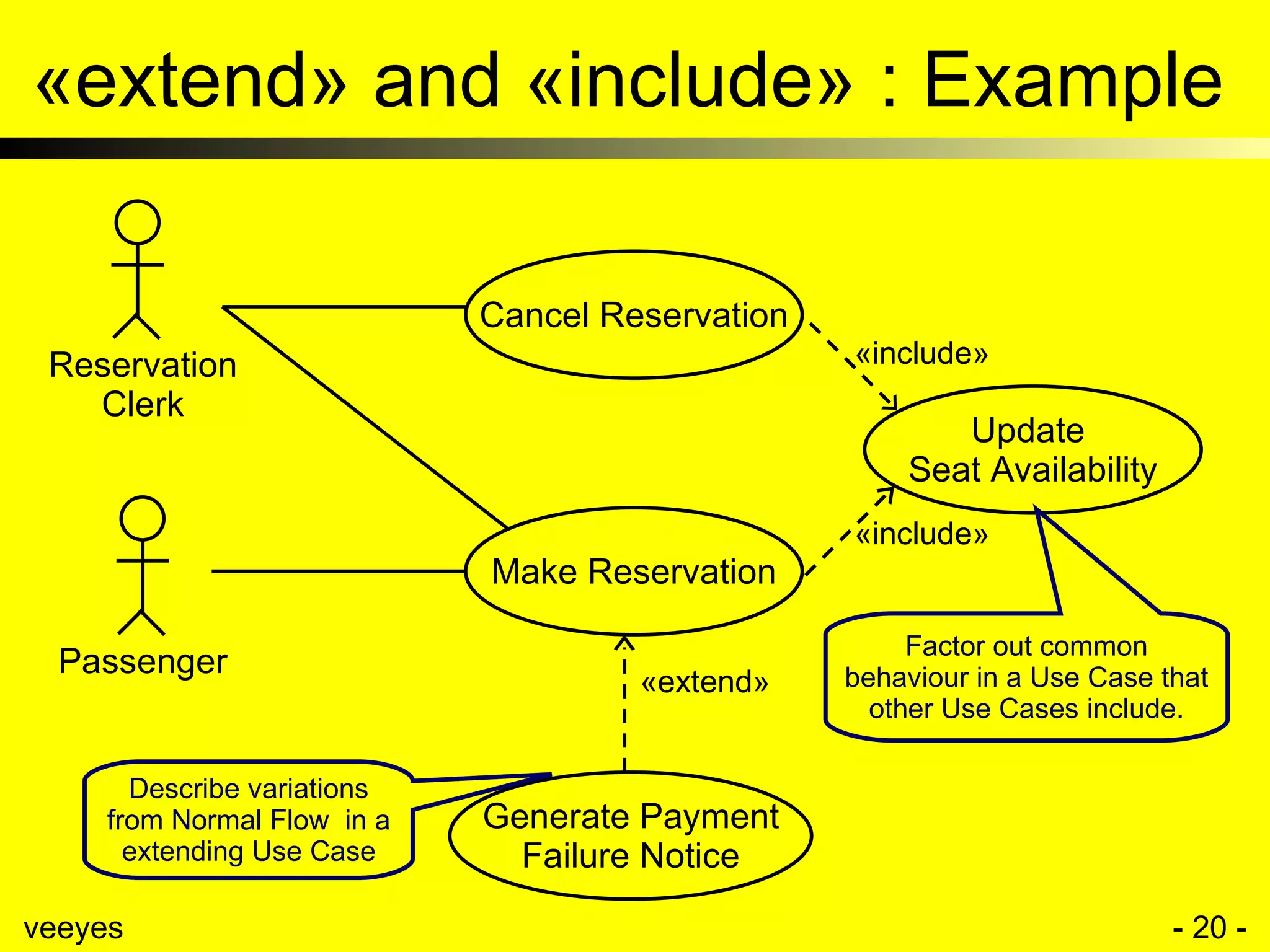
Relationships between Use Cases Uses/Includes Extends “ Extend” relationship : «extend» Use Case B extends Use Case A when Use Case B describes the behaviour of Use Case A under a particular condition. An extending Use Cases is used to describe variations in the normal flow of events described by a general use case
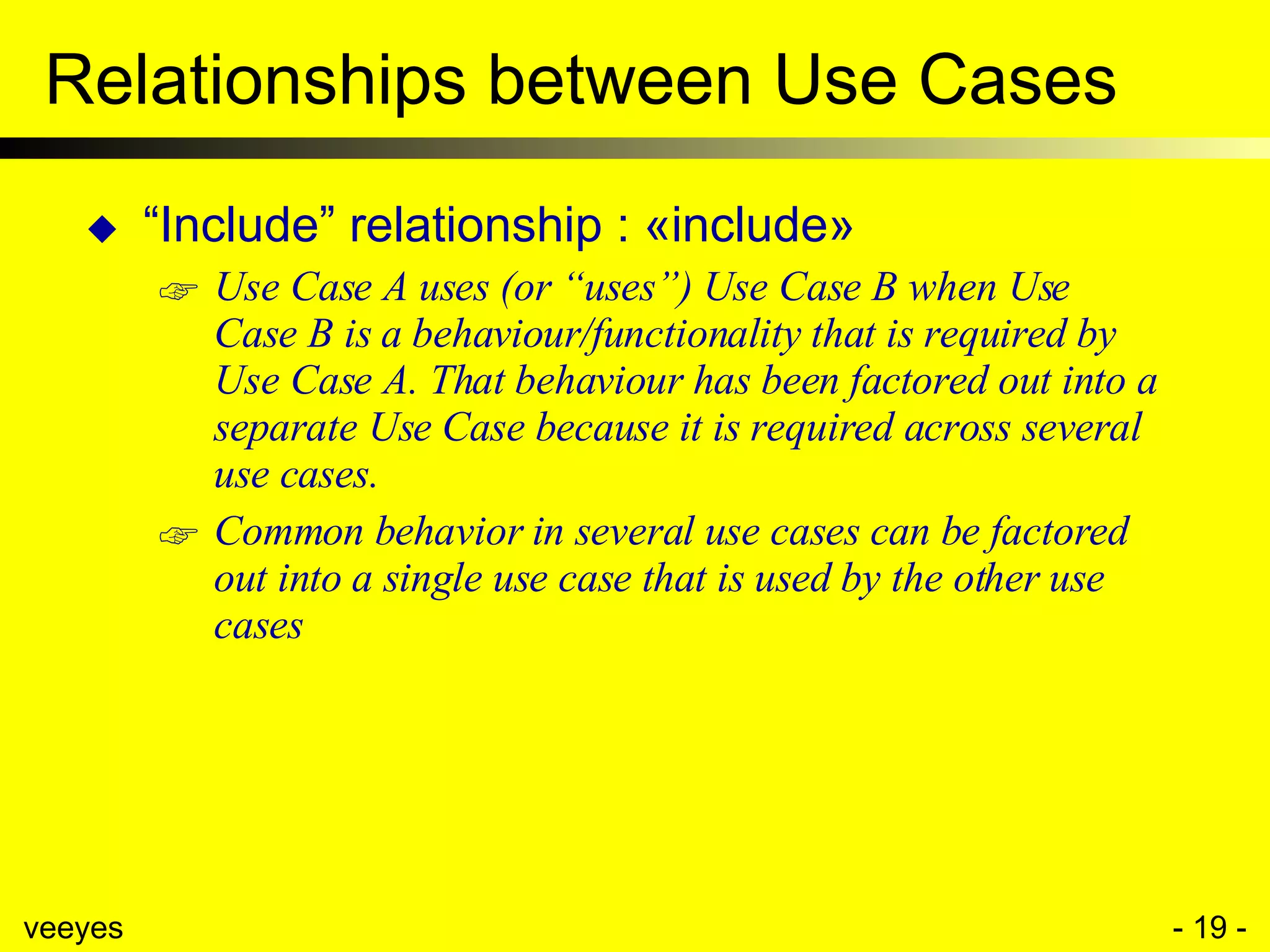
Relationships between Use Cases “ Include” relationship : «include» Use Case A uses (or “uses”) Use Case B when Use Case B is a behaviour/functionality that is required by Use Case A. That behaviour has been factored out into a separate Use Case because it is required across several use cases. Common behavior in several use cases can be factored out into a single use case that is used by the other use cases
«extend» and «include» : Example Make Reservation Cancel Reservation Update  Seat Availability Factor out common behaviour in a Use Case that other Use Cases include. Describe variations from Normal Flow  in a extending Use Case Reservation Clerk Passenger «include» «include» Generate Payment Failure Notice «extend»
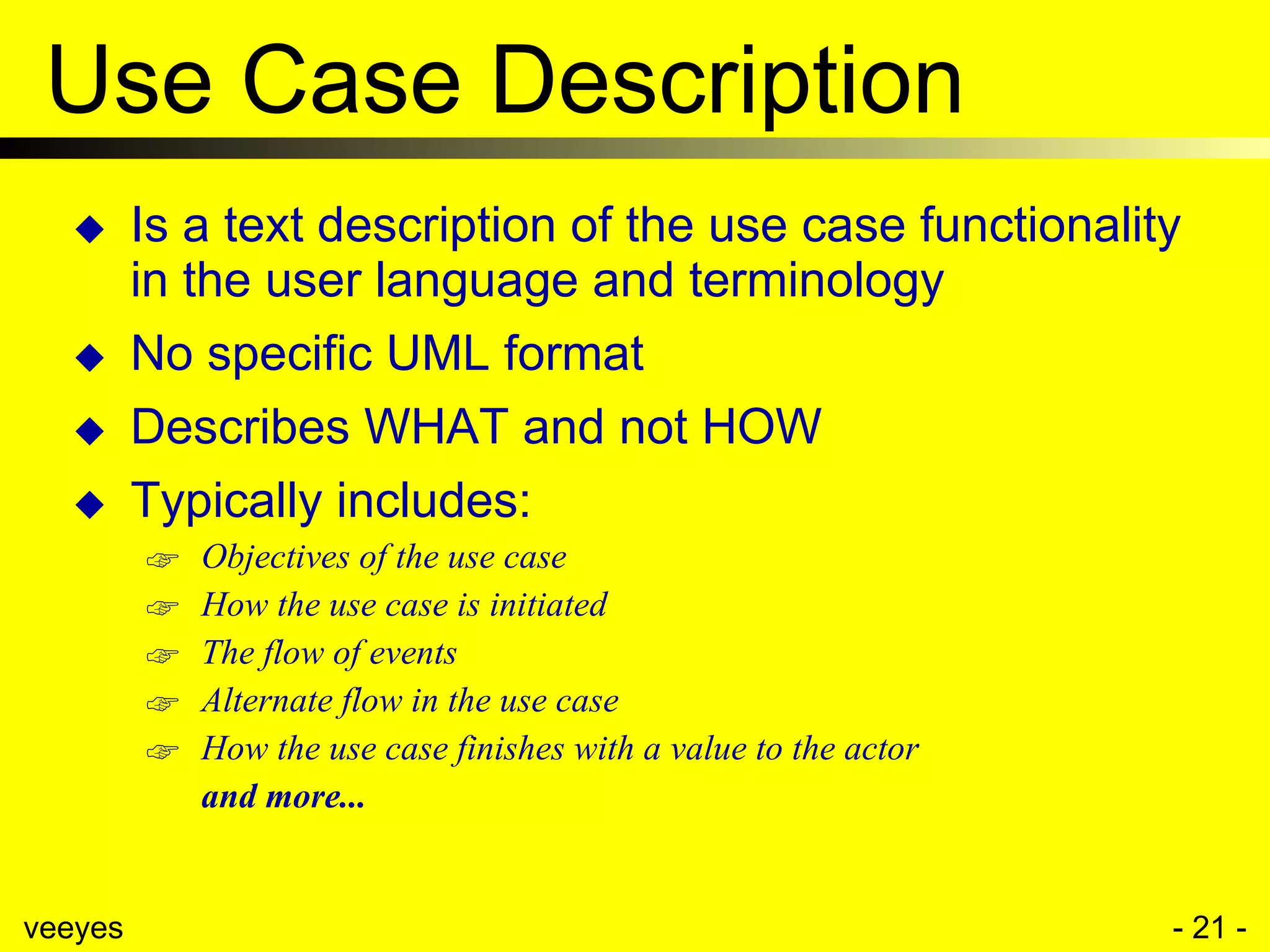
Use Case Description Is a text description of the use case functionality in the user language and terminology No specific UML format Describes WHAT and not HOW Typically includes: Objectives of the use case How the use case is initiated The flow of events Alternate flow in the use case How the use case finishes with a value to the actor and more...
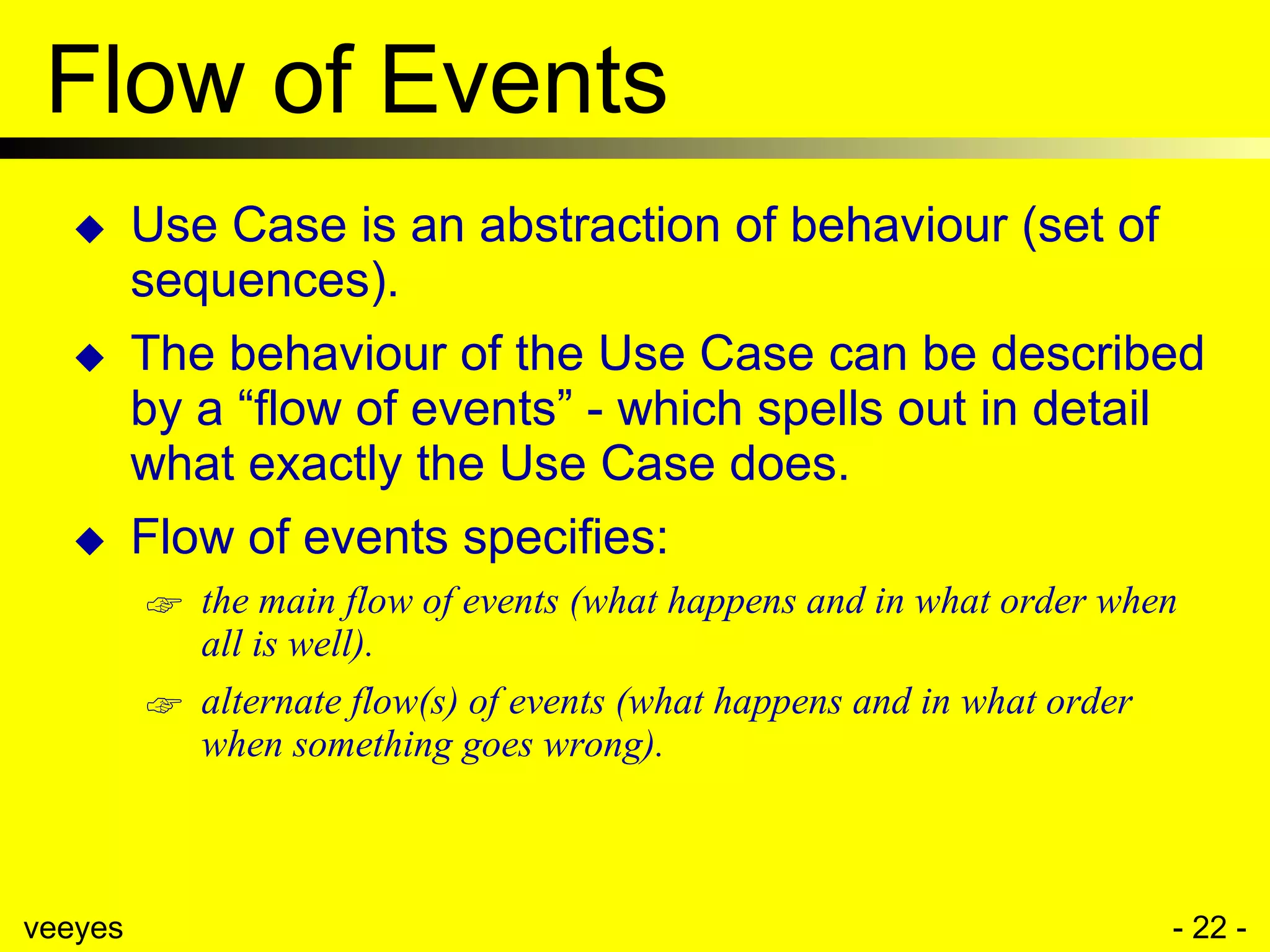
Flow of Events Use Case is an abstraction of behaviour (set of sequences). The behaviour of the Use Case can be described by a “flow of events” - which spells out in detail what exactly the Use Case does. Flow of events specifies: the main flow of events (what happens and in what order when all is well). alternate flow(s) of events (what happens and in what order when something goes wrong).
Use Cases and Scenarios A Use Case actually describes a set of sequences [of actions]. Each sequence represents one possible flow of actions in using the system. Each sequence is called a Scenario. A Scenario is basically one instance of a use case. a Scenario is to a Use Case, what an Object is to a Class.
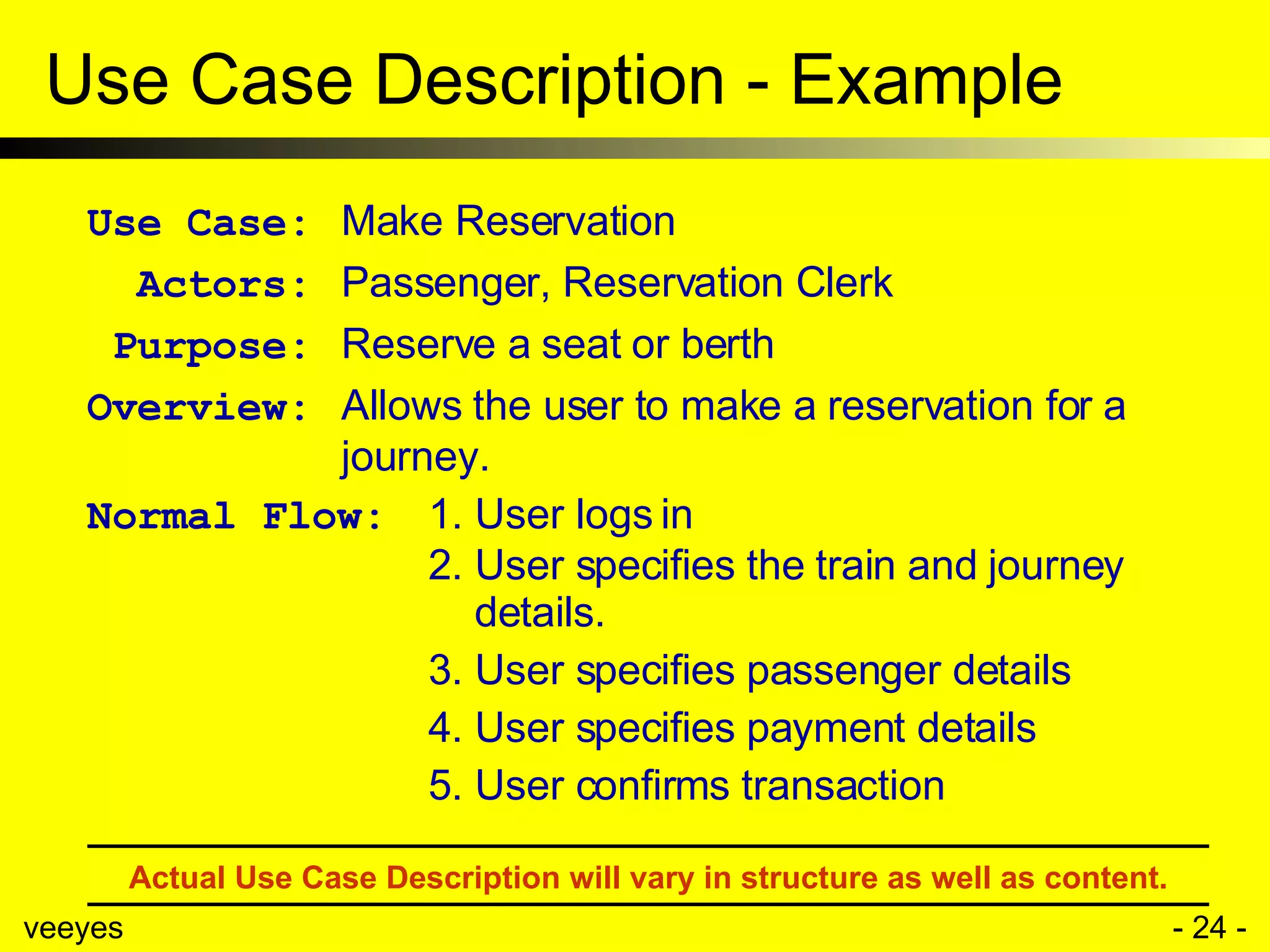
Use Case Description - Example Use Case: Make Reservation Actors:   Passenger, Reservation Clerk Purpose: Reserve a seat or berth Overview: Allows the user to make a reservation for a journey. Normal Flow: 1. User logs in 2. User specifies the train and journey   details. 3. User specifies passenger details 4. User specifies payment details 5. User confirms transaction Actual Use Case Description will vary in structure as well as content.
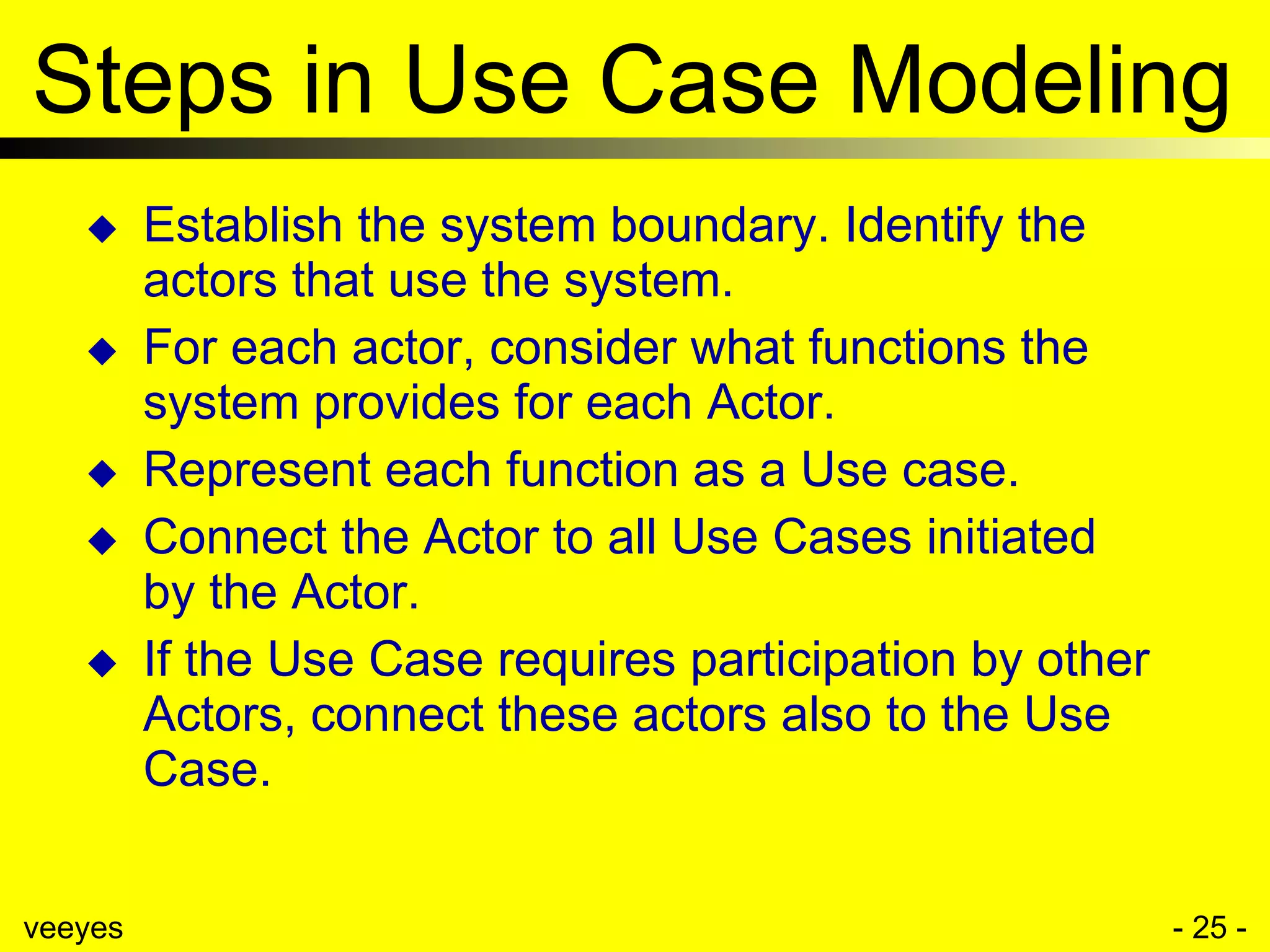
Steps in Use Case Modeling Establish the system boundary. Identify the actors that use the system. For each actor, consider what functions the system provides for each Actor.  Represent each function as a Use case.  Connect the Actor to all Use Cases initiated by the Actor. If the Use Case requires participation by other Actors, connect these actors also to the Use Case.
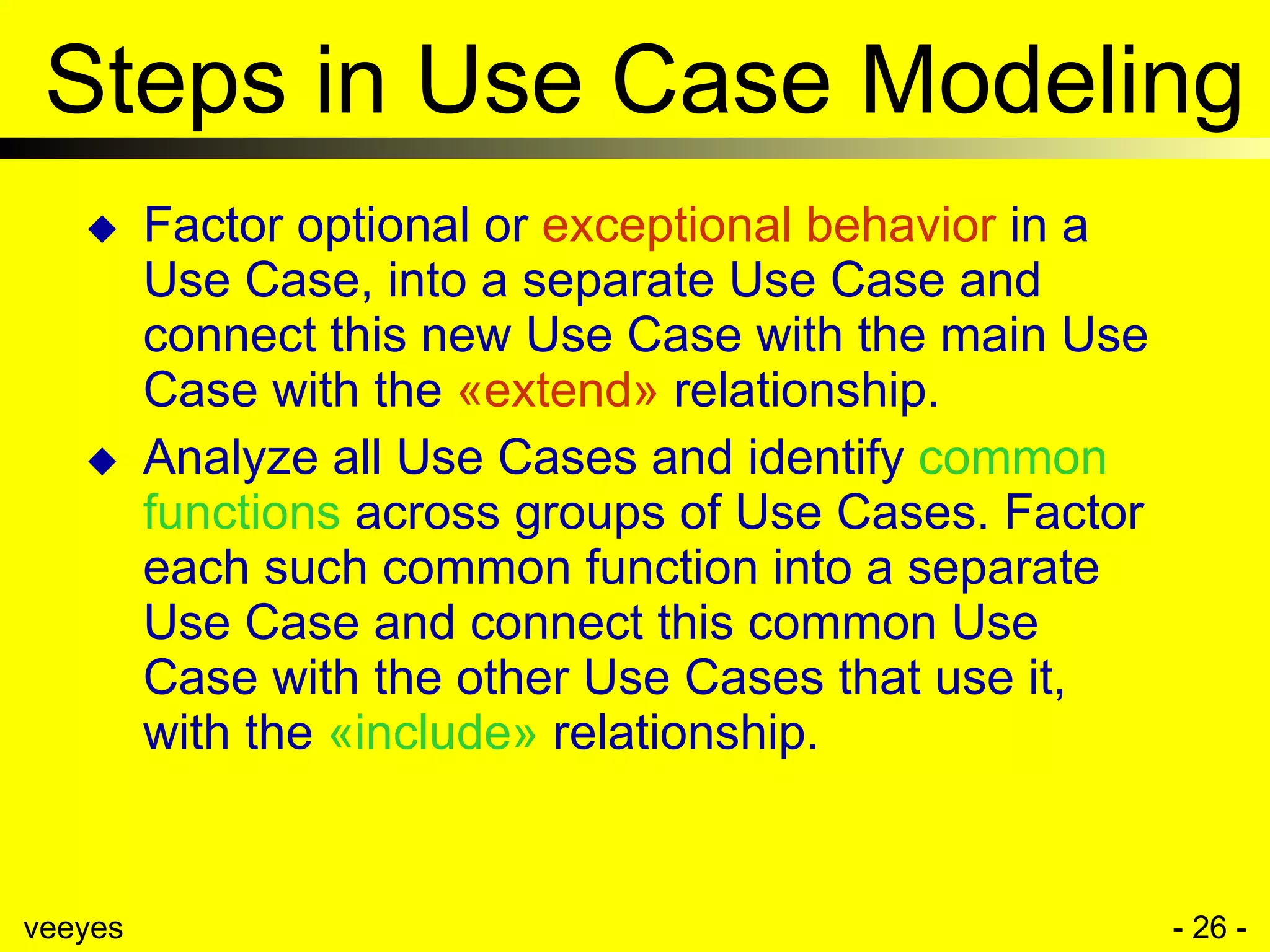
Steps in Use Case Modeling Factor optional or  exceptional behavior  in a Use Case, into a separate Use Case and connect this new Use Case with the main Use Case with the  «extend»  relationship. Analyze all Use Cases and identify  common functions   across groups of Use Cases. Factor each such common function into a separate Use Case and connect this common Use Case with the other Use Cases that use it, with the  «include»  relationship.
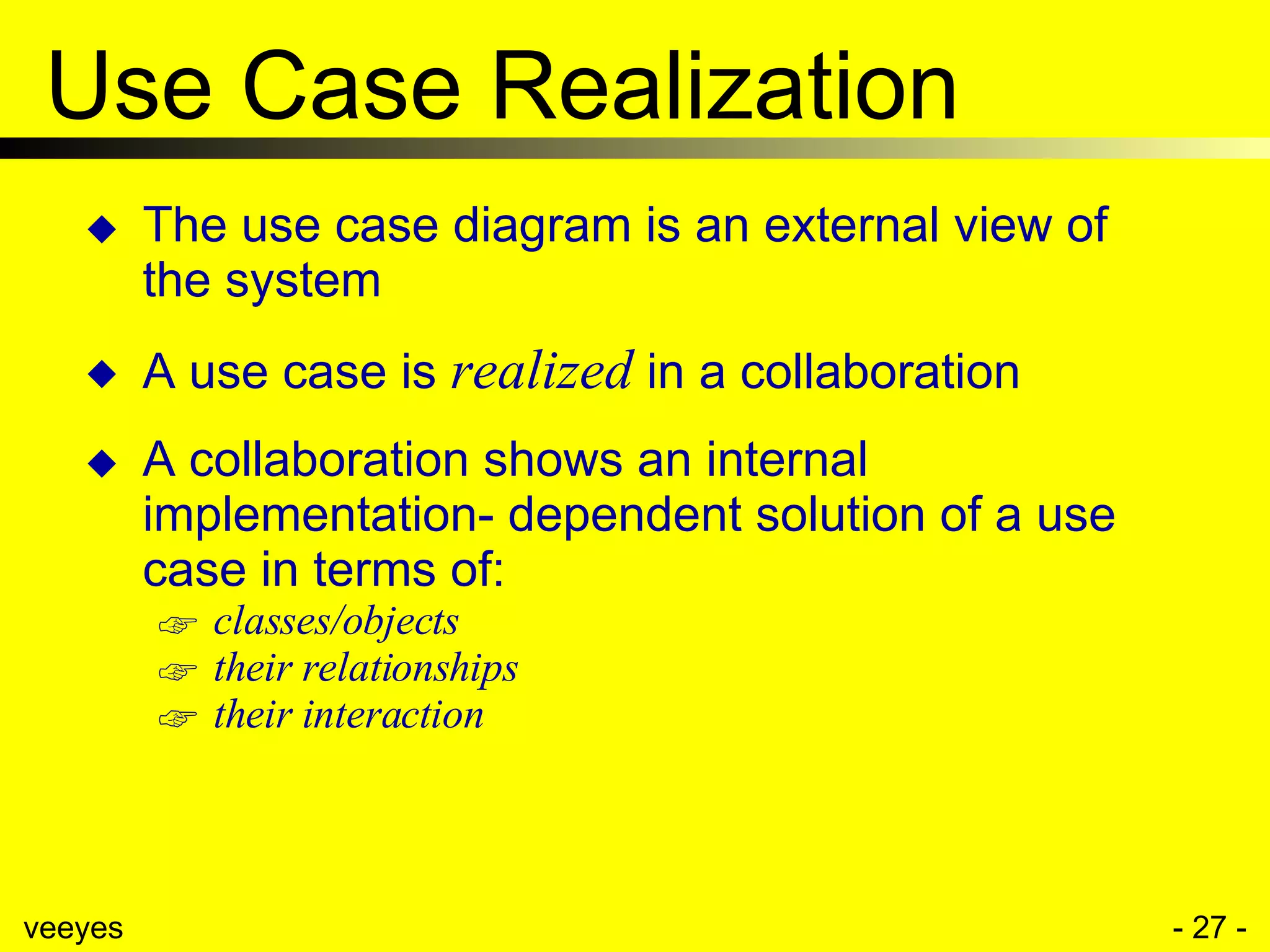
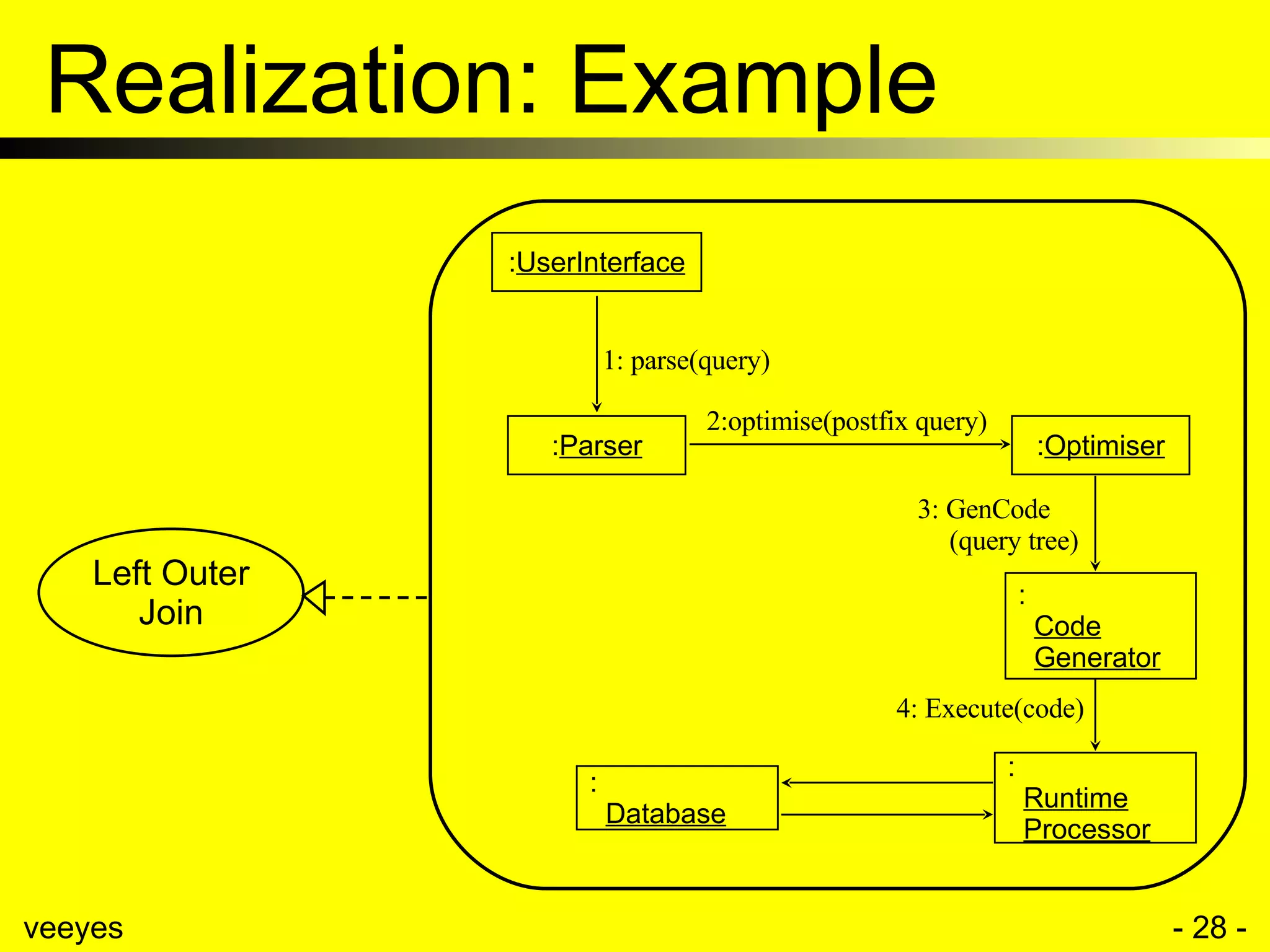
Use Case Realization The use case diagram is an external view of the system A use case is  realized  in a collaboration A collaboration shows an internal implementation- dependent solution of a use case in terms of: classes/objects their relationships their interaction
Realization: Example Left Outer Join : UserInterface : Parser : Code Generator : Optimiser 1: parse(query) 2:optimise(postfix query) 3: GenCode (query tree) : Runtime Processor 4: Execute(code) : Database
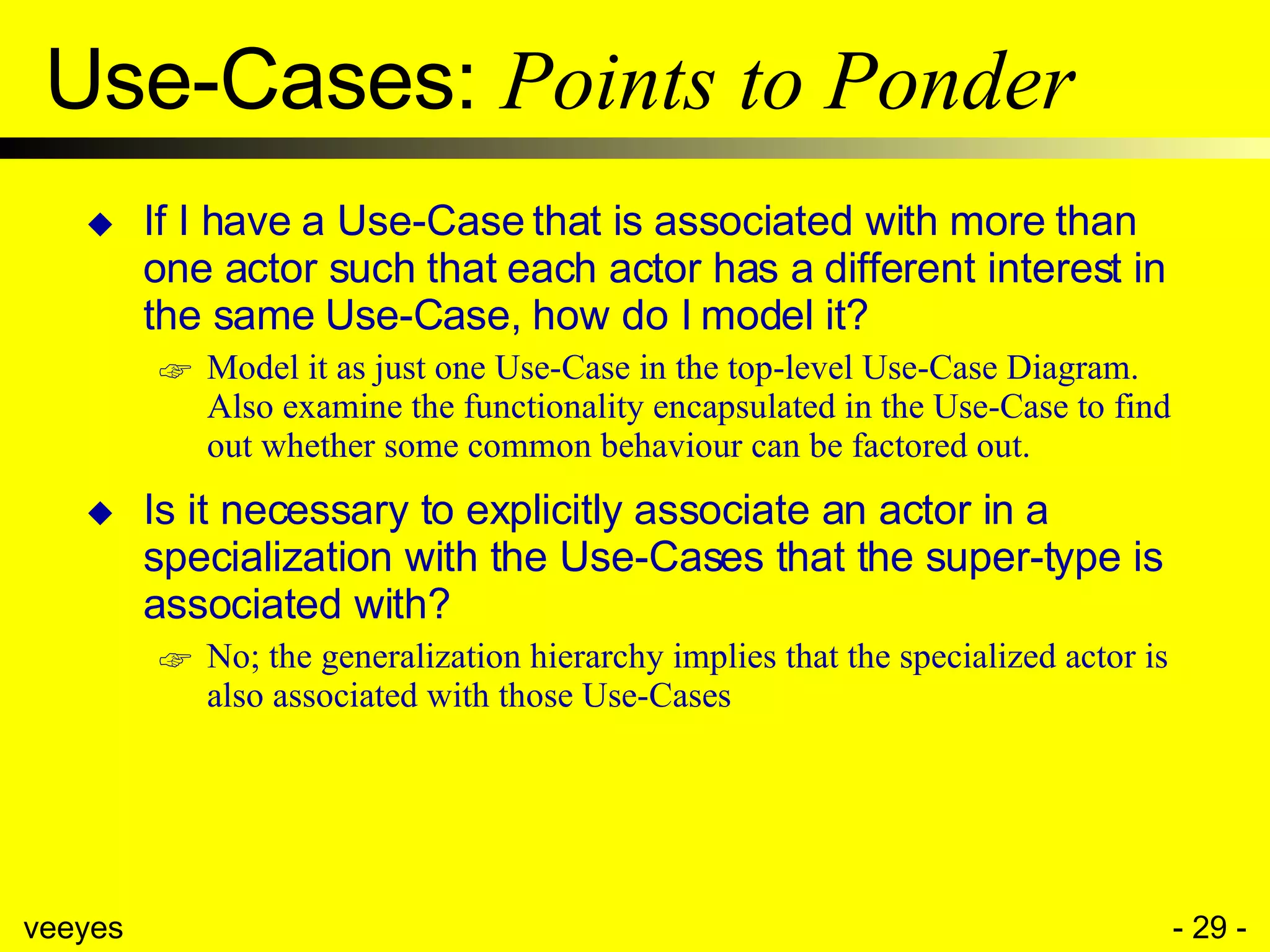
Use-Cases:  Points to Ponder If I have a Use-Case that is associated with more than one actor such that each actor has a different interest in the same Use-Case, how do I model it? Model it as just one Use-Case in the top-level Use-Case Diagram. Also examine the functionality encapsulated in the Use-Case to find out whether some common behaviour can be factored out. Is it necessary to explicitly associate an actor in a specialization with the Use-Cases that the super-type is associated with? No; the generalization hierarchy implies that the specialized actor is also associated with those Use-Cases
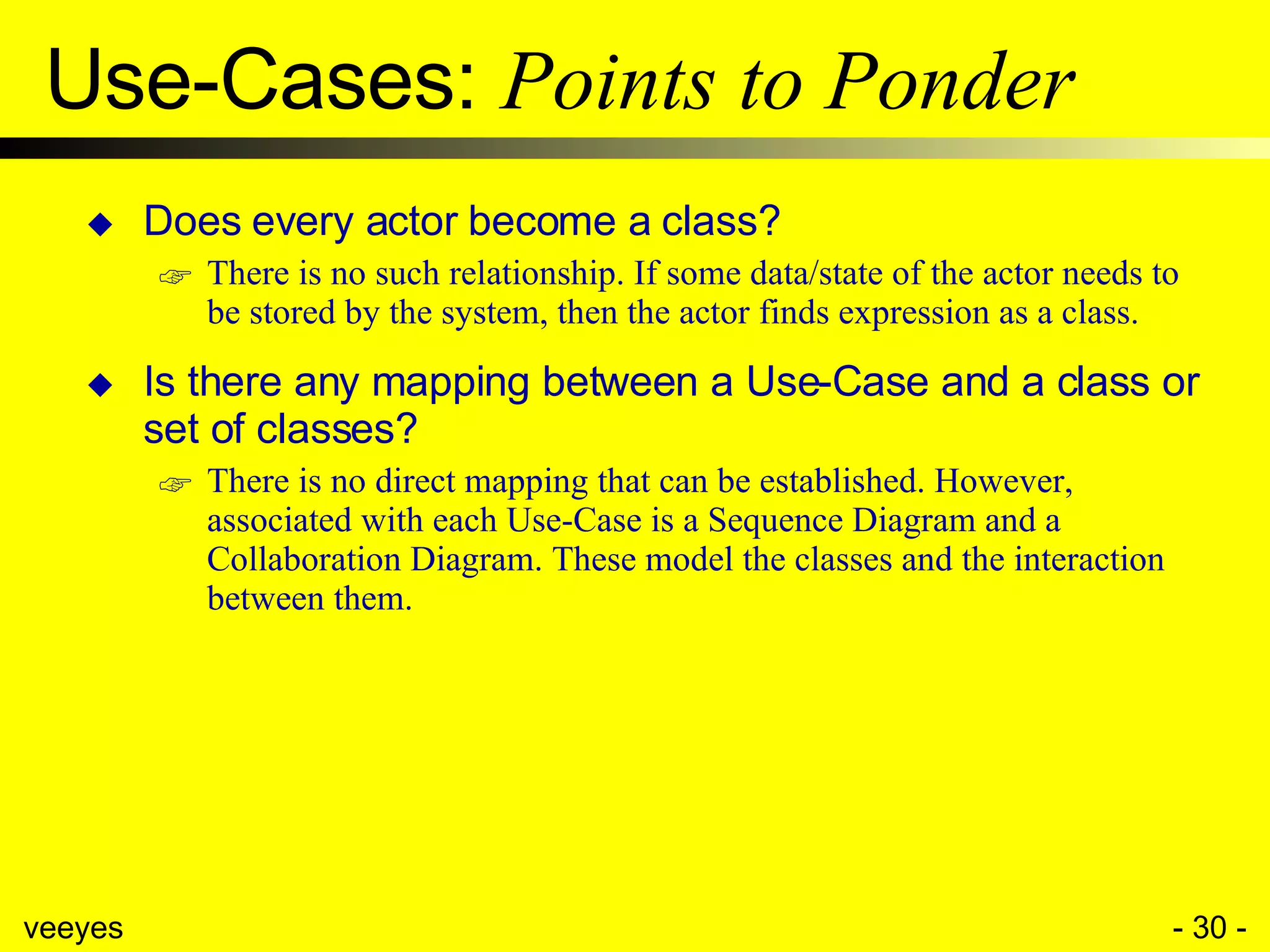
Use-Cases:  Points to Ponder Does every actor become a class? There is no such relationship. If some data/state of the actor needs to be stored by the system, then the actor finds expression as a class. Is there any mapping between a Use-Case and a class or set of classes? There is no direct mapping that can be established. However, associated with each Use-Case is a Sequence Diagram and a Collaboration Diagram. These model the classes and the interaction between them.
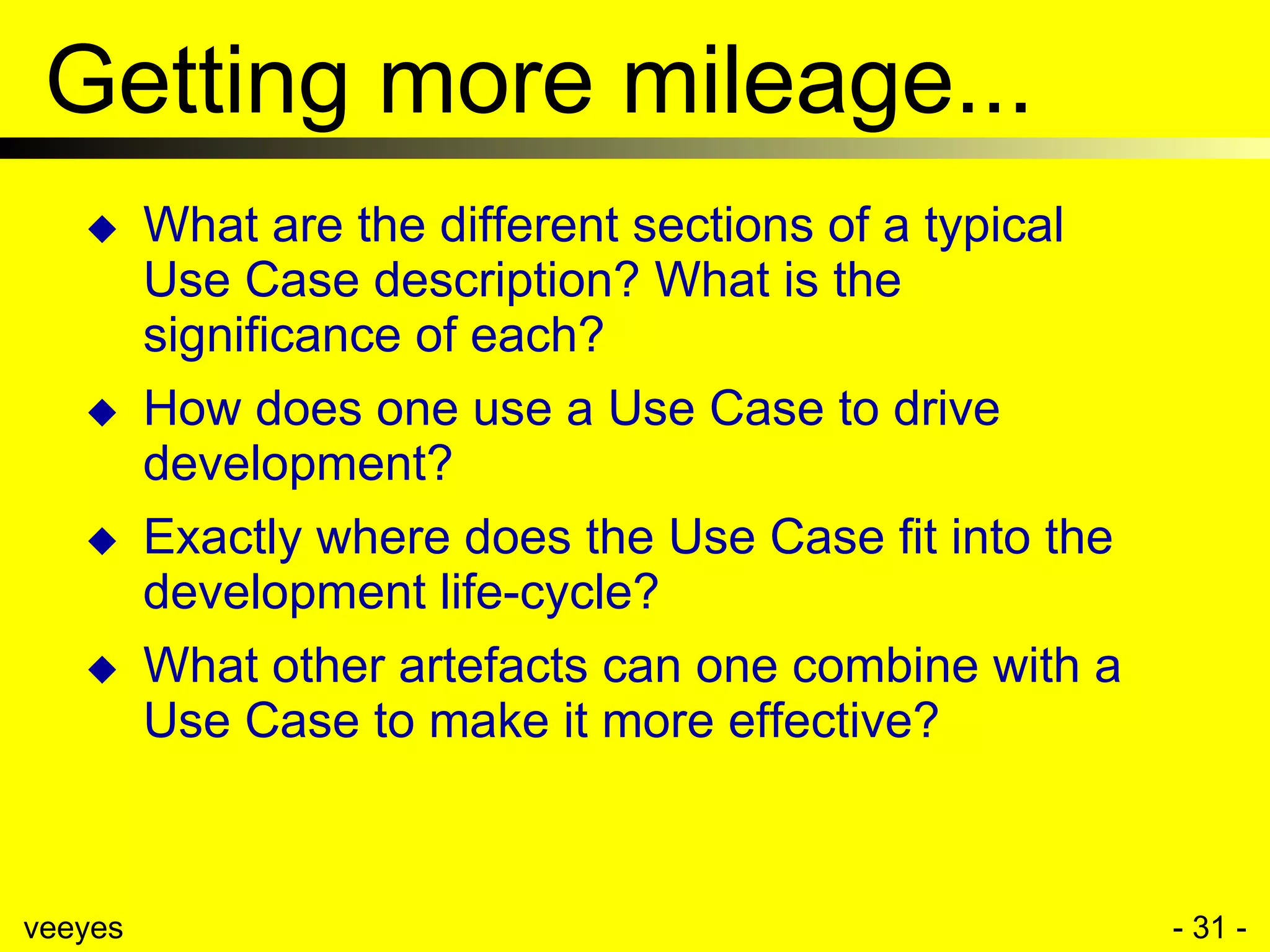
Getting more mileage... What are the different sections of a typical Use Case description? What is the significance of each? How does one use a Use Case to drive development? Exactly where does the Use Case fit into the development life-cycle? What other artefacts can one combine with a Use Case to make it more effective?
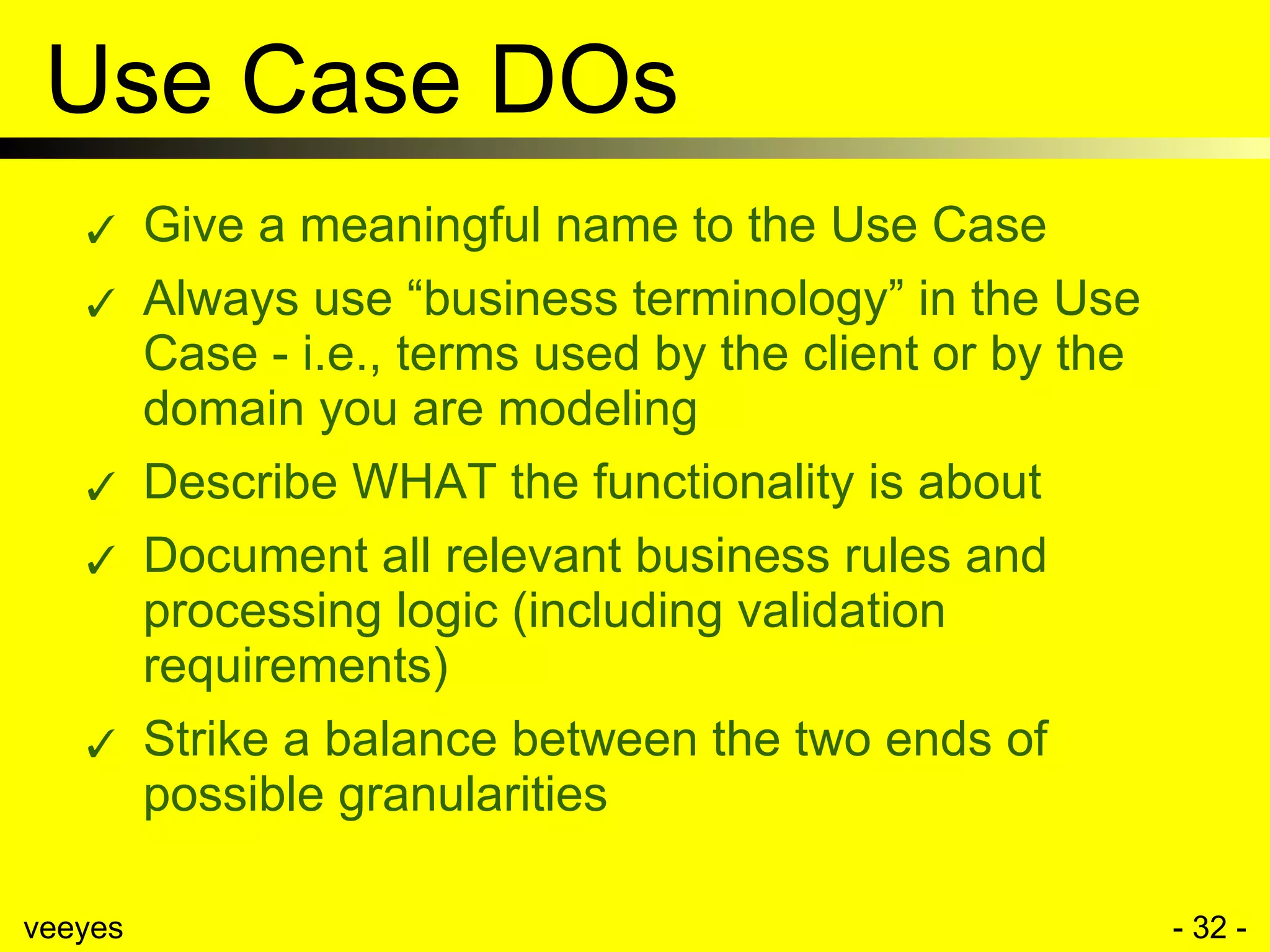
Use Case DOs Give a meaningful name to the Use Case Always use “business terminology” in the Use Case - i.e., terms used by the client or by the domain you are modeling Describe WHAT the functionality is about Document all relevant business rules and processing logic (including validation requirements) Strike a balance between the two ends of possible granularities
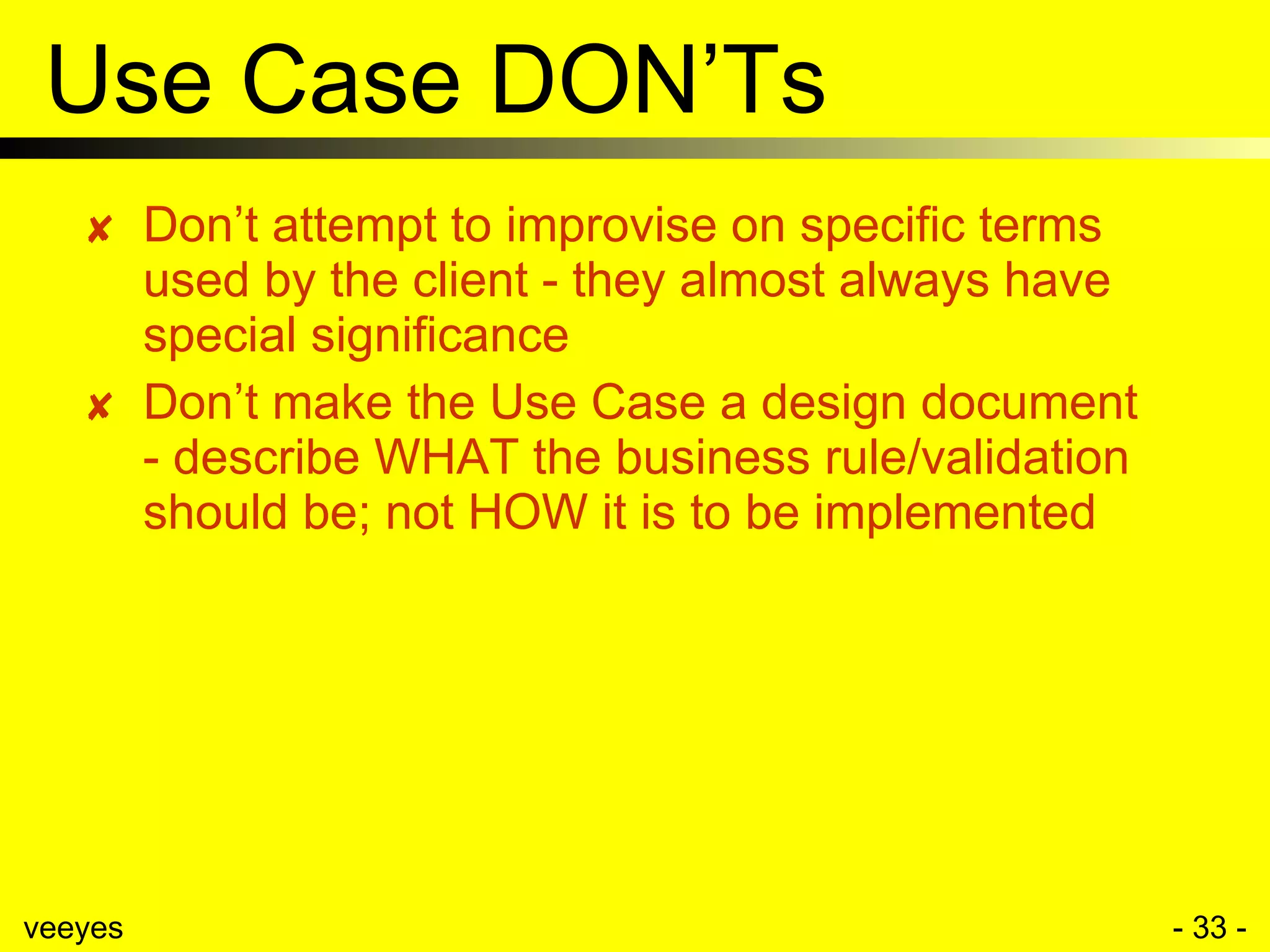
Use Case DON’Ts Don’t attempt to improvise on specific terms used by the client - they almost always have special significance Don’t make the Use Case a design document - describe WHAT the business rule/validation should be; not HOW it is to be implemented
Summary Requirements elicitation is the stepping stone to the project. Requirements must clearly and completely understood by the entire project team. Must be reviewed for semantic correctness and completeness. Requirements elicitation must focus on the WHAT of the system and must be documented in the user’s vocabulary.
Summary Use Case Diagrams are the UML mechanism for requirements capture. Use Case Diagrams are a graphical presentation of the “actors” in the domain and the “use cases” initiated by them. “Use cases” are abstractions of discrete behaviour exhibited by the system; perform a specific goal for an “actor”. An “actor” is an abstraction of a role played by anyone or anything interacting with the system.
Summary A use case is essentially a set of sequence of actions. A specific sequence of this set of sequences is called a “scenario”. A “scenario” is documented as “Flow of Events”; each use case has a “main flow of events” and “alternate flow of events”. Common behaviour across use cases can be factored out and is then either “used”/“included” or “extended” by other use cases.
Summary Recommendations for making Use Cases more effective in the SDLC: Decide on the level of granularity for your Use Cases Create a screen design to accompany the Use Case Produce a “Form Definition Matrix” for “form-heavy” or “form-driven” applications Walking a client/user through a Use Case by using the screen to explain the system’s behaviour is an effective way of getting requirements validated by the user.
References  The Unified Modeling Language User Guide Grady Booch, James Rumbaugh, Ivar Jacobson Addison-Wesley (International Student Edition)  The Unified Modeling Language Reference Guide Grady Booch, James Rumbaugh, Ivar Jacobson Addison-Wesley (International Student Edition)
References  The Unified Software Development Process Grady Booch, James Rumbaugh, Ivar Jacobson Pearson Education  UML 1.5 Specification http://www.omg.org

Use Case Modeling

  • 1.
    Requirements Capture usingUML Use Cases Venkat Srinivasan Dept. of CSE Saranathan college of Engineering, Trichy
  • 2.
    Contents Requirements CaptureBuilding Blocks of a Use Case Diagram Actors Use Cases Relationships between Actors Relationships between Use Cases Terminology Flow of Events Scenarios Get more mileage from your Use Cases Use Case DOs and DON’Ts
  • 3.
    Requirements Collection “Requirements”are the raison-d-être of any software development project Defines and delineates user-requirements Defines the functionality to be provided Identifies the goals to be achieved. Must be precisely and completely understood by the team providing the solution User requirements (and team members) keep changing; requirements must therefore be well-documented
  • 4.
    Requirements Collection Athorough and unambiguous understanding of the requirements is vital to ensure that everyone knows what they are doing and why Must be reviewed, reviewed again and reviewed yet again before the design and implementation begins Involves the participation of domain-experts to ensure that the requirements have been correctly understood captures the “WHAT” of the problem-domain.
  • 5.
    Requirements Capture withUML Use Case Diagrams Captures the problem-domain in terms of functionality to be provided (Use Cases), and the “roles” (Actors) for whom these functions are performed. An abstraction of the problem-domain and a vehicle to facilitate a clear, well-articulated and unambiguous understanding of the problem-domain.
  • 6.
    Use Case Isan abstraction of a set of sequences that yield some functionality. Represents some user-visible function. Is always initiated by an “actor”. Describes the interaction between the actors and the system for a system function. Achieves a discrete goal for the actor. Notation: Reserve Seat
  • 7.
    Finding Use CasesWhat functions does the system perform? What functions do the “actors” require? What input/output does the system need? What verbs are used to describe the system? The Reservation Clerk makes a booking using the system, based on the... The Airport Manager can make an entry for a new flight . He can also modify flight details , provided...
  • 8.
    Use Case -Example Indian Railways provides for advance reservation on all long-distance travel. The passenger seeking reservation of berth or seats should purchase the tickets from Railway Reservation Offices or Authorised Travel Agency only. To make an advance booking, the passenger is expected to fill in a prescribed application form and submit it to the reservation counter with the appropriate amount. Advanced Reservations are made up to 60 days in advance for all trains, for all classes exclusive of the day of departure of trains. An individual can book only up to six passengers on one requisition form provided all passengers are for the same destination and for the same train.
  • 9.
    Use Case -Example (contd.) Indian Railways wishes to develop a ticketing and reservation system. This must support advance booking of tickets, cancellation of tickets and change of class of a ticket. All these are handled by a Reservation Clerk. The system will also have a web-interface where users can register themselves and purchase tickets online. They can pay either by using their online banking account or by credit card or by VPP. Reservations made over the internet can only be cancelled across the counter. The system will also have a querying facility that allows users to check train time-tables, fares and availability of tickets.
  • 10.
    Use Case -Example (contd.) Indian Railways wishes to develop a ticketing and reservation system. This must support advance booking of tickets, cancellation of tickets and change of class of a ticket. All these are handled by a Reservation Clerk. The system will also have a web-interface where users can register themselves and purchase tickets online. They can pay either by using their online banking account or by credit card or by VPP. Reservations made over the internet can only be cancelled across the counter. The system will also have a querying facility that allows users to check train time-tables , fares and availability of tickets.
  • 11.
    Use Case -Example (contd.) Use Cases: Make Reservation Cancel Reservation Modify Class Print Ticket Query Timetable Check Fare Register as Member
  • 12.
    Purpose of UseCases To capture functional requirements of a system. To communicate with end users and domain experts. To design test cases for validating system functionality. To provide traceability from requirements into actual classes and operations. To drive the development process. To plan iterations and releases
  • 13.
    Actors A rolethat interacts with the system. Represents a role, not individuals; can be a person or a device or another system. Communicate with the system by sending and/or receiving messages. An actor may participate in many use cases; a use case may have several actors participating in it. Notation:
  • 14.
    Finding Actors Whouses the main functionality of the system? Which hardware devices the system needs to handle? Which other systems does the system need to interact with? What nouns / subjects are used to describe the system? The Reservation Clerk makes a booking using the system, based on the... A user must login in order to save his itinerary
  • 15.
    Actors - ExampleIndian Railways wishes to develop a ticketing and reservation system. This must support advance booking of tickets, cancellation of tickets and change of class of a ticket. The system will also have a web-interface where users can register themselves and purchase tickets online. Actors: Reservation Clerk Passenger
  • 16.
    Use Case DiagramA graphical representation of the Use Cases of a system, its actors, and the interaction between them. It depicts the system boundary. Diagram Model elements Actors Use cases Relationships between Actors and Use Cases between Use Cases between Actors
  • 17.
    Use Case Diagram:Example Make Reservation Modify Class Print Ticket Query Timetable Check Fare Reservation Clerk Passenger Cancel Reservation Register as Member
  • 18.
    Relationships between UseCases Uses/Includes Extends “ Extend” relationship : «extend» Use Case B extends Use Case A when Use Case B describes the behaviour of Use Case A under a particular condition. An extending Use Cases is used to describe variations in the normal flow of events described by a general use case
  • 19.
    Relationships between UseCases “ Include” relationship : «include» Use Case A uses (or “uses”) Use Case B when Use Case B is a behaviour/functionality that is required by Use Case A. That behaviour has been factored out into a separate Use Case because it is required across several use cases. Common behavior in several use cases can be factored out into a single use case that is used by the other use cases
  • 20.
    «extend» and «include»: Example Make Reservation Cancel Reservation Update Seat Availability Factor out common behaviour in a Use Case that other Use Cases include. Describe variations from Normal Flow in a extending Use Case Reservation Clerk Passenger «include» «include» Generate Payment Failure Notice «extend»
  • 21.
    Use Case DescriptionIs a text description of the use case functionality in the user language and terminology No specific UML format Describes WHAT and not HOW Typically includes: Objectives of the use case How the use case is initiated The flow of events Alternate flow in the use case How the use case finishes with a value to the actor and more...
  • 22.
    Flow of EventsUse Case is an abstraction of behaviour (set of sequences). The behaviour of the Use Case can be described by a “flow of events” - which spells out in detail what exactly the Use Case does. Flow of events specifies: the main flow of events (what happens and in what order when all is well). alternate flow(s) of events (what happens and in what order when something goes wrong).
  • 23.
    Use Cases andScenarios A Use Case actually describes a set of sequences [of actions]. Each sequence represents one possible flow of actions in using the system. Each sequence is called a Scenario. A Scenario is basically one instance of a use case. a Scenario is to a Use Case, what an Object is to a Class.
  • 24.
    Use Case Description- Example Use Case: Make Reservation Actors: Passenger, Reservation Clerk Purpose: Reserve a seat or berth Overview: Allows the user to make a reservation for a journey. Normal Flow: 1. User logs in 2. User specifies the train and journey details. 3. User specifies passenger details 4. User specifies payment details 5. User confirms transaction Actual Use Case Description will vary in structure as well as content.
  • 25.
    Steps in UseCase Modeling Establish the system boundary. Identify the actors that use the system. For each actor, consider what functions the system provides for each Actor. Represent each function as a Use case. Connect the Actor to all Use Cases initiated by the Actor. If the Use Case requires participation by other Actors, connect these actors also to the Use Case.
  • 26.
    Steps in UseCase Modeling Factor optional or exceptional behavior in a Use Case, into a separate Use Case and connect this new Use Case with the main Use Case with the «extend» relationship. Analyze all Use Cases and identify common functions across groups of Use Cases. Factor each such common function into a separate Use Case and connect this common Use Case with the other Use Cases that use it, with the «include» relationship.
  • 27.
    Use Case RealizationThe use case diagram is an external view of the system A use case is realized in a collaboration A collaboration shows an internal implementation- dependent solution of a use case in terms of: classes/objects their relationships their interaction
  • 28.
    Realization: Example LeftOuter Join : UserInterface : Parser : Code Generator : Optimiser 1: parse(query) 2:optimise(postfix query) 3: GenCode (query tree) : Runtime Processor 4: Execute(code) : Database
  • 29.
    Use-Cases: Pointsto Ponder If I have a Use-Case that is associated with more than one actor such that each actor has a different interest in the same Use-Case, how do I model it? Model it as just one Use-Case in the top-level Use-Case Diagram. Also examine the functionality encapsulated in the Use-Case to find out whether some common behaviour can be factored out. Is it necessary to explicitly associate an actor in a specialization with the Use-Cases that the super-type is associated with? No; the generalization hierarchy implies that the specialized actor is also associated with those Use-Cases
  • 30.
    Use-Cases: Pointsto Ponder Does every actor become a class? There is no such relationship. If some data/state of the actor needs to be stored by the system, then the actor finds expression as a class. Is there any mapping between a Use-Case and a class or set of classes? There is no direct mapping that can be established. However, associated with each Use-Case is a Sequence Diagram and a Collaboration Diagram. These model the classes and the interaction between them.
  • 31.
    Getting more mileage...What are the different sections of a typical Use Case description? What is the significance of each? How does one use a Use Case to drive development? Exactly where does the Use Case fit into the development life-cycle? What other artefacts can one combine with a Use Case to make it more effective?
  • 32.
    Use Case DOsGive a meaningful name to the Use Case Always use “business terminology” in the Use Case - i.e., terms used by the client or by the domain you are modeling Describe WHAT the functionality is about Document all relevant business rules and processing logic (including validation requirements) Strike a balance between the two ends of possible granularities
  • 33.
    Use Case DON’TsDon’t attempt to improvise on specific terms used by the client - they almost always have special significance Don’t make the Use Case a design document - describe WHAT the business rule/validation should be; not HOW it is to be implemented
  • 34.
    Summary Requirements elicitationis the stepping stone to the project. Requirements must clearly and completely understood by the entire project team. Must be reviewed for semantic correctness and completeness. Requirements elicitation must focus on the WHAT of the system and must be documented in the user’s vocabulary.
  • 35.
    Summary Use CaseDiagrams are the UML mechanism for requirements capture. Use Case Diagrams are a graphical presentation of the “actors” in the domain and the “use cases” initiated by them. “Use cases” are abstractions of discrete behaviour exhibited by the system; perform a specific goal for an “actor”. An “actor” is an abstraction of a role played by anyone or anything interacting with the system.
  • 36.
    Summary A usecase is essentially a set of sequence of actions. A specific sequence of this set of sequences is called a “scenario”. A “scenario” is documented as “Flow of Events”; each use case has a “main flow of events” and “alternate flow of events”. Common behaviour across use cases can be factored out and is then either “used”/“included” or “extended” by other use cases.
  • 37.
    Summary Recommendations formaking Use Cases more effective in the SDLC: Decide on the level of granularity for your Use Cases Create a screen design to accompany the Use Case Produce a “Form Definition Matrix” for “form-heavy” or “form-driven” applications Walking a client/user through a Use Case by using the screen to explain the system’s behaviour is an effective way of getting requirements validated by the user.
  • 38.
    References  TheUnified Modeling Language User Guide Grady Booch, James Rumbaugh, Ivar Jacobson Addison-Wesley (International Student Edition)  The Unified Modeling Language Reference Guide Grady Booch, James Rumbaugh, Ivar Jacobson Addison-Wesley (International Student Edition)
  • 39.
    References  TheUnified Software Development Process Grady Booch, James Rumbaugh, Ivar Jacobson Pearson Education  UML 1.5 Specification http://www.omg.org