ISB SUMMER SCHOOL 2013: NEUROERGONOMICS
AND PLACEMAKING
URBAN DESIGN AND
MAKING A SPACE A
PLACE
Menno Cramer and Katie Donaghyg y
SPACE TO PLACE
Social Interaction
Social Comfortability
PersonalisationPersonalisation
THE PHYSICAL ENVIRONMENT
DELIVERS STIMULI WHICH INFLUENCES
USERSUSERS.
Knowledge of this allows for appropriate
design decisionsdesign decisions
PLACES SHOULD EVOLVE
NATURALLY AND ORGANICALLY
“sound appreciation of the context of a projectsound appreciation of the context of a project
site or area. This includes its history, its
existing townscape and appearance itsexisting townscape and appearance, its
planning status and its social and economic
role both current and potential The contextrole – both current and potential. The context
should also include the client’s objectives for
the site or area” (Tibbalds 2001 p 20)the site or area” (Tibbalds, 2001, p.20).
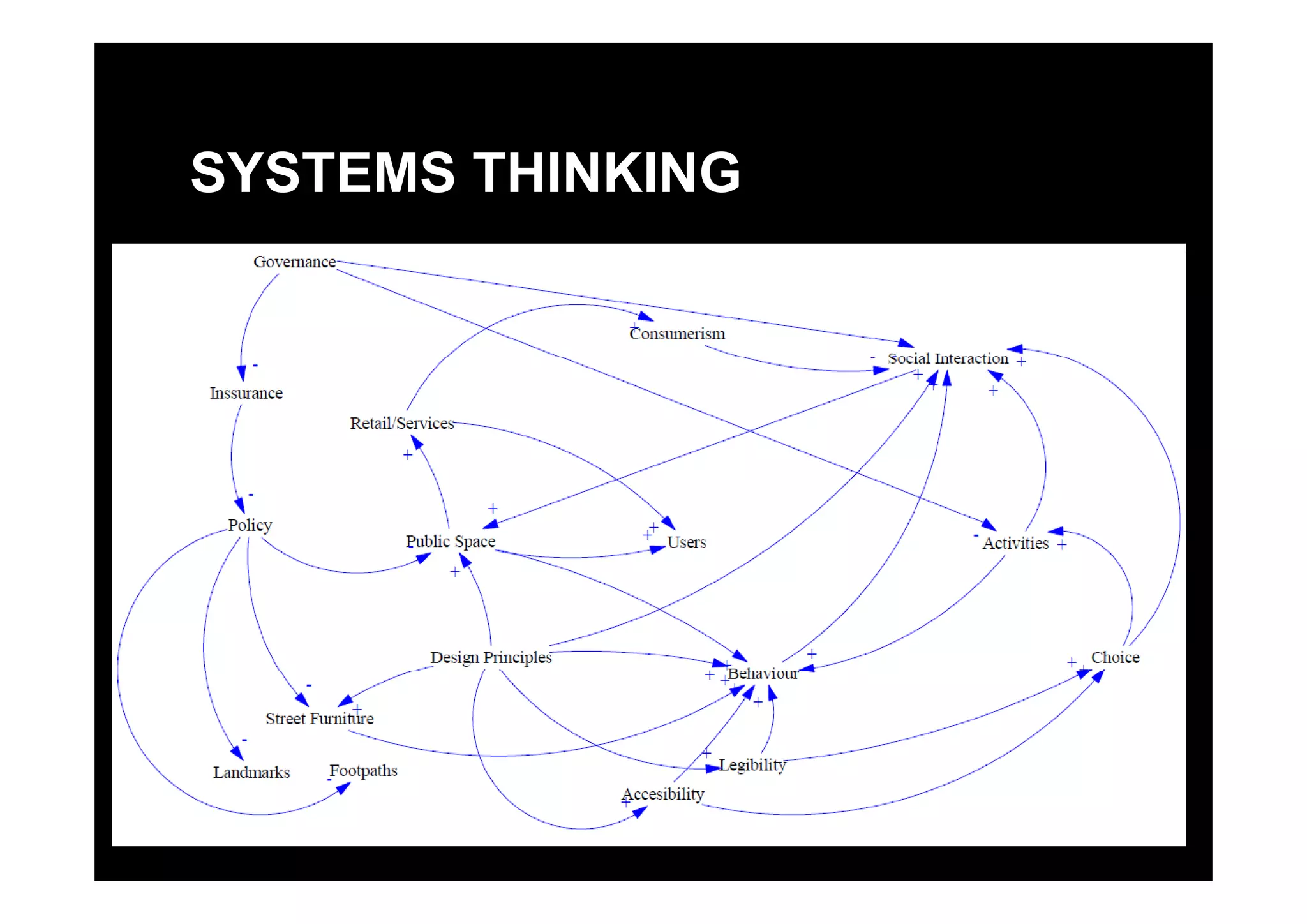
SYSTEMS THINKING
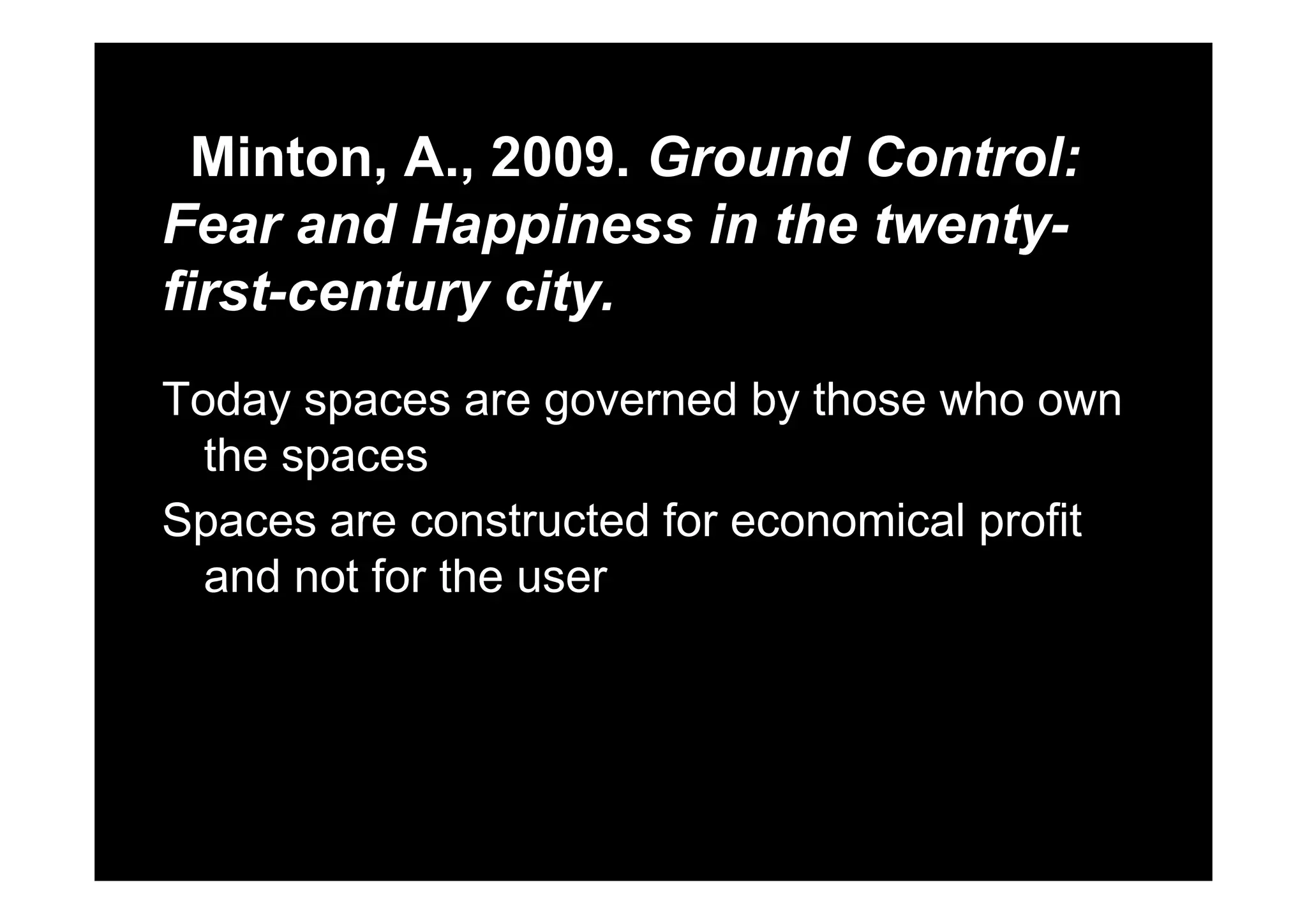
Minton A 2009 Ground Control:Minton, A., 2009. Ground Control:
Fear and Happiness in the twenty-pp y
first-century city.
Today spaces are governed by those who own
the spacesthe spaces
Spaces are constructed for economical profit
d t f thand not for the user
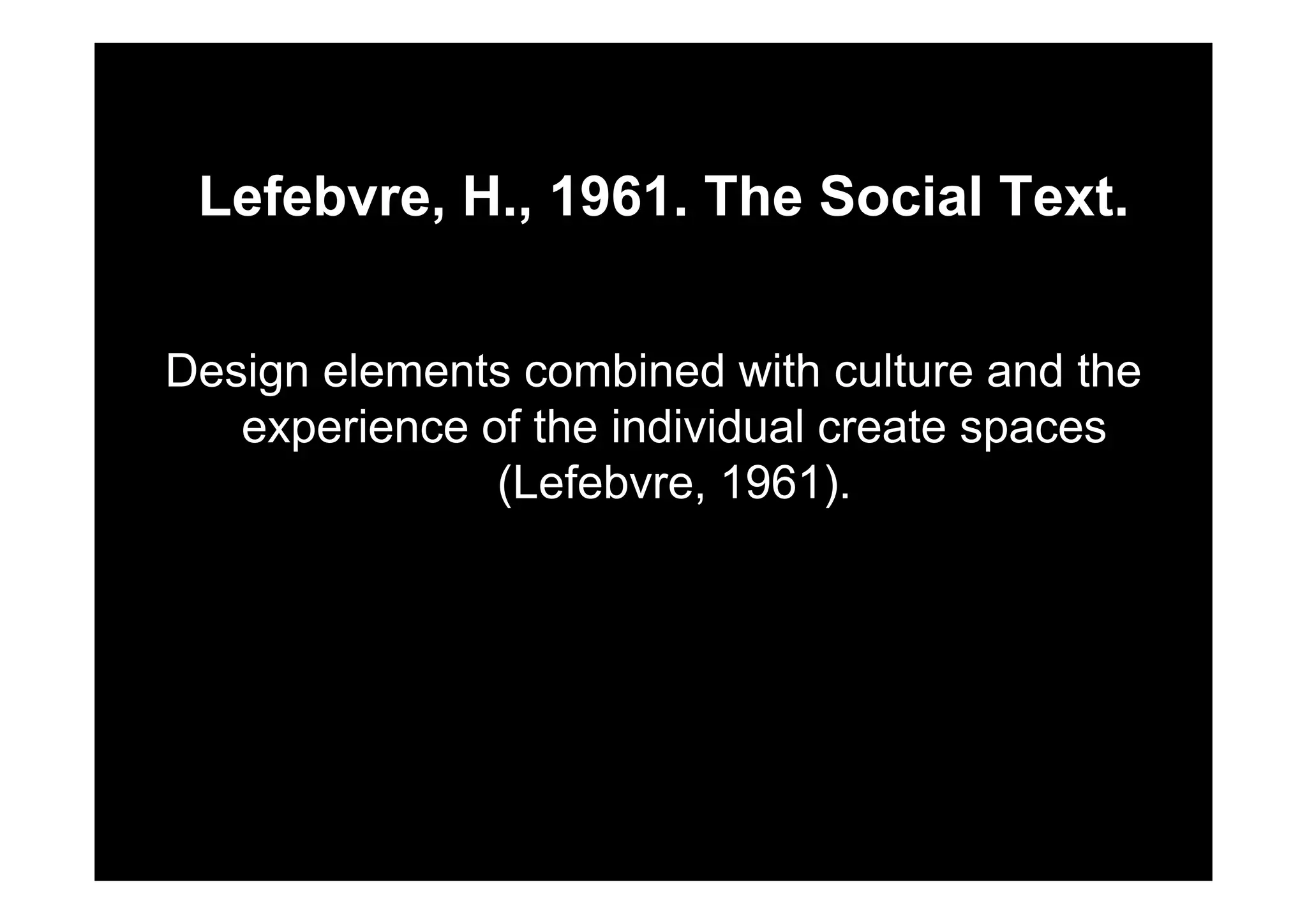
Lefebvre, H., 1961. The Social Text.
D i l t bi d ith lt d thDesign elements combined with culture and the
experience of the individual create spaces
(Lefebvre, 1961).
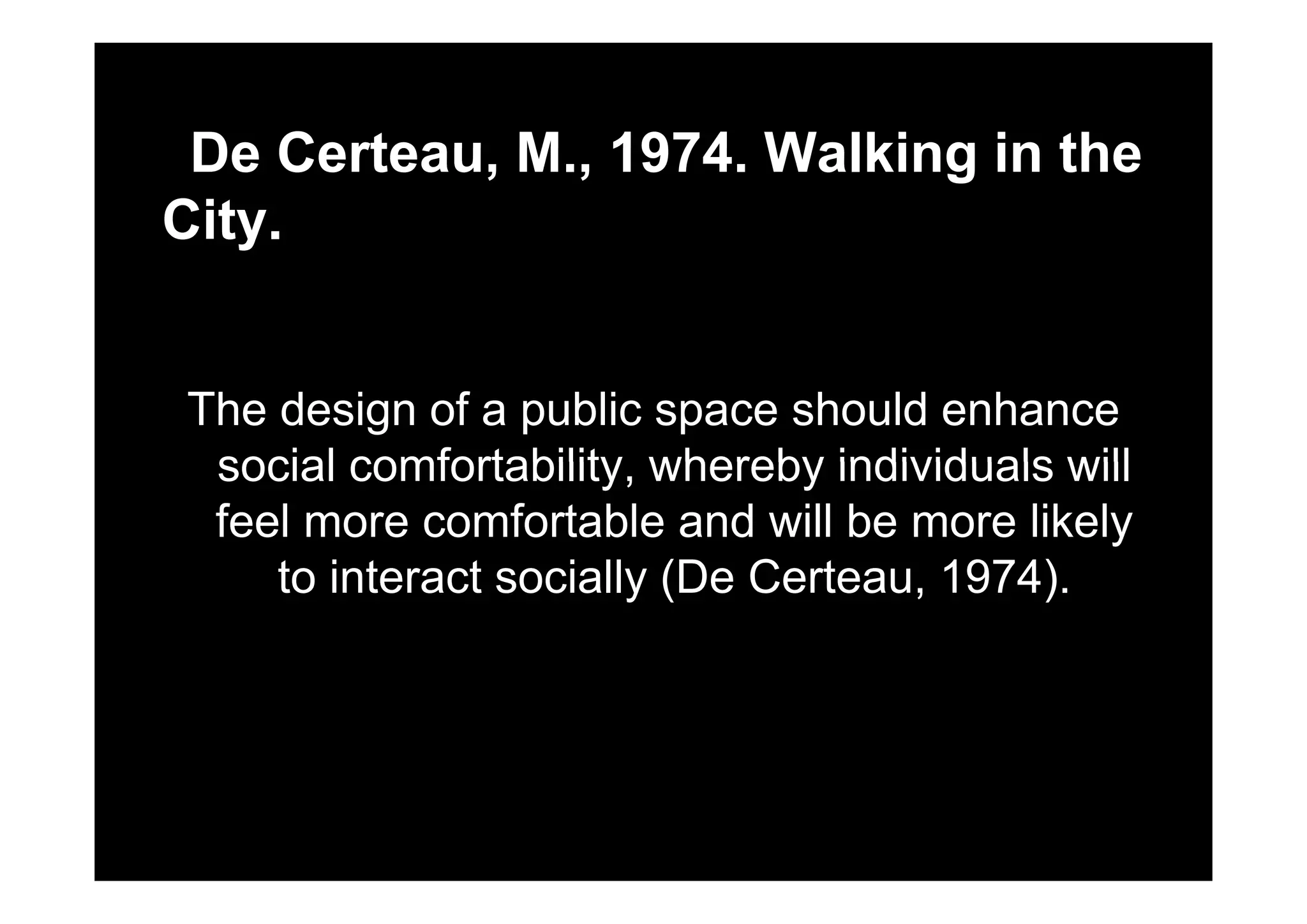
De Certeau M 1974 Walking in theDe Certeau, M., 1974. Walking in the
City.
The design of a public space should enhance
social comfortability whereby individuals willsocial comfortability, whereby individuals will
feel more comfortable and will be more likely
t i t t i ll (D C t 1974)to interact socially (De Certeau, 1974).
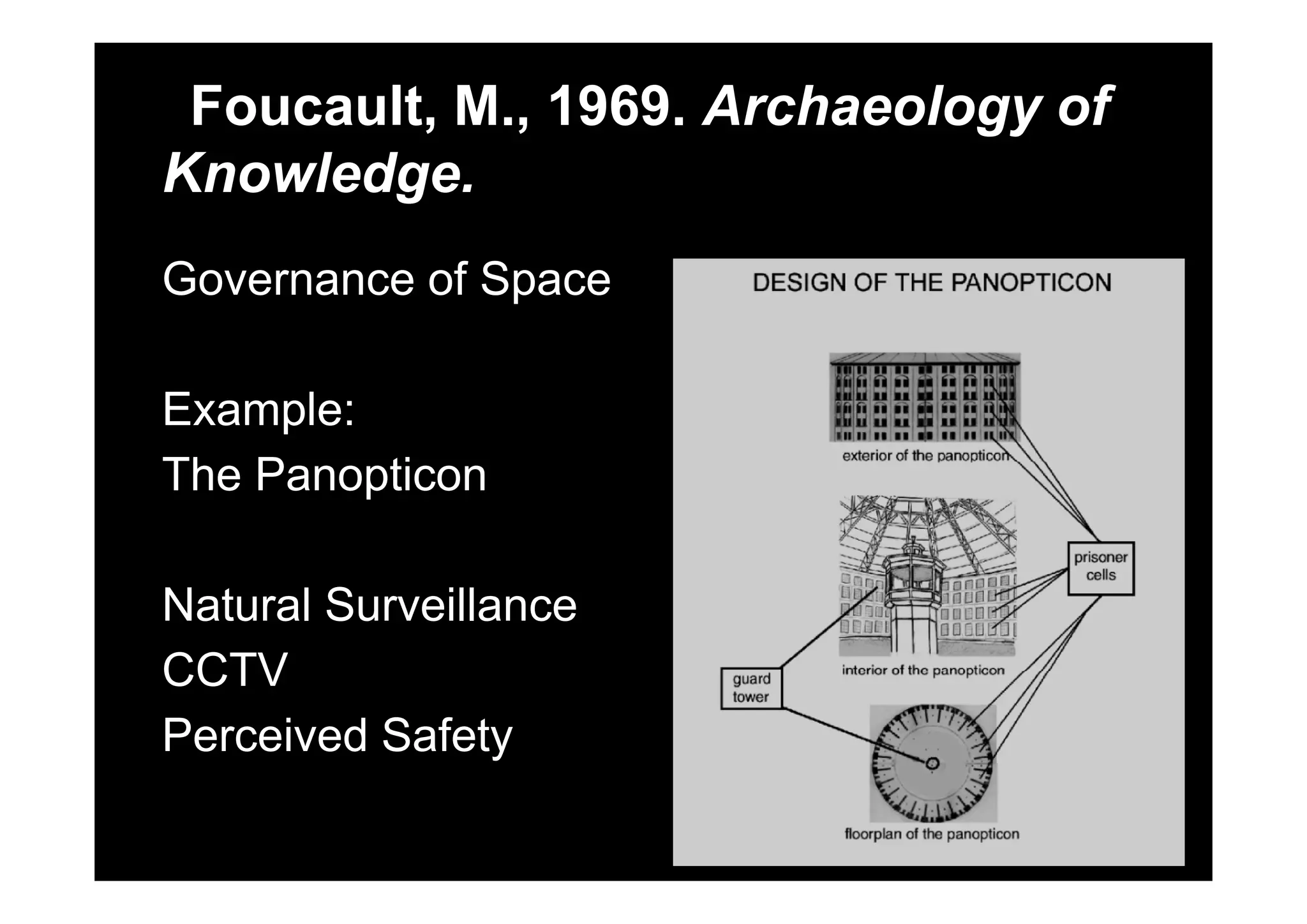
Foucault, M., 1969. Archaeology of
Knowledge.
Governance of Space
Example:
Th P tiThe Panopticon
Natural Surveillance
CCTVCCTV
Perceived Safety
Thwaites, K. and Simkins, I., 2007., , ,
Experimental Landscape: an
approach to people place andapproach to people, place and
space.
Assigning labels to places according to whoAssigning labels to places according to who
frequents it and what happens there creates
places hich become their rep tation ratherplaces which become their reputation rather
than existing as a separate entity (Thwaites
d Si ki 2007)and Simkins, 2007).
Gehl, J., 2011. Life between
buildings: using public space.buildings: using public space.
It is important to ha e spaces in cities that areIt is important to have spaces in cities that are
on a small scale that people can relate to,
th th thi b i t l f thrather than everything being too large for the
individual to handle and to become a part of
(Jan Gehl, 2011).
Policy as a Restriction?
or policy as an opportunity?
o cy as a est ct o
p y pp y
POLICY FRAMEWORK
Policy predefines the necessity for certain characteristics to
be present and others not to be, it predefines a margin of
what the built environment will look like subject to
development objectives and funding opportunitiesdevelopment objectives and funding opportunities.
P li d i h d i d d hPolicy drives the way spaces are designed, and the
outcome of that design affects the way people behave
and the subsequent amount of social cohesion whichand the subsequent amount of social cohesion which
can occur.
THE USER
The user should be at the center of the design,
it is through the user and their use of spaceg p
that one may create places.
The human is the designers tool - Jan Gehl
MAGNETS
Magnets are more than simply landmarks,
because they embody meaning and elicit anbecause they embody meaning and elicit an
emotional response and an action (Carmona
d Ti d ll 2007)and Tiesdell, 2007).
MAGNETS
SEMIOTICS
Individuals - a part of the production of space
Signs - elements we attach meaning to
Symbols - elements which have meaning
As individuals we rely on familiar signs or symbols to
transfer meaning into a space (Barthes, 1968).
As users of a space we also become subjects and objectsAs users of a space we also become subjects and objects
whereby we may observe the doing of others and others
may observe us, and this creates the social production of
space (Lefebvre, 1961).
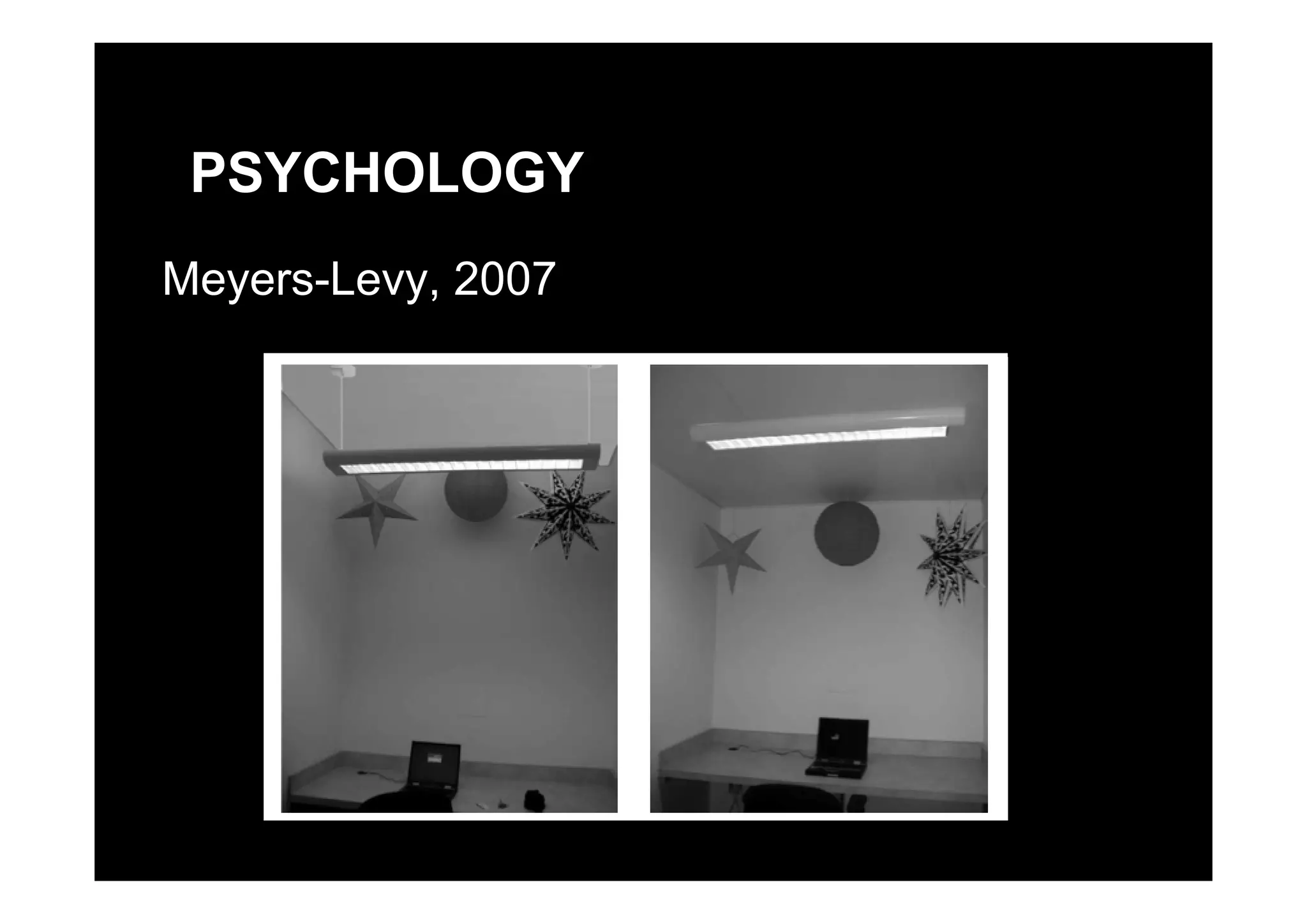
PSYCHOLOGY
Places are crucially significant in the satisfaction of
biological, social, psychological and cultural needs they
are therefore considered meaningful to the processes ofare therefore considered meaningful to the processes of
self-identity (Aronson, Wilson, and Akert, 2010; Minton,
2009).2009).
As users we seek the confirmation from others that whatAs users we seek the confirmation from others that what
we are doing is socially acceptable (Aronson et al.
2010). Users will therefore seek places to sit or hang on2010). Users will therefore seek places to sit or hang on
the edges of spaces or at other appropriate locations
where they may have a decent view of the space
(Bentley et al., 1985; Gehl, 2001).
THE RELATIONSHIP
It is the sum of the physical design of a public space, the
users, their activities, the social and cultural
circumstances which together form a space withcircumstances which together form a space with
meaning (Thwaites and Simkins, 2007).
The experience of a place being influenced by culture will
guide the choices user’s make in spaces through whichguide the choices user s make in spaces, through which
elements of the built environment should reflect diversity
in culture in order to bring people together (Israel, 2003).in culture in order to bring people together (Israel, 2003).
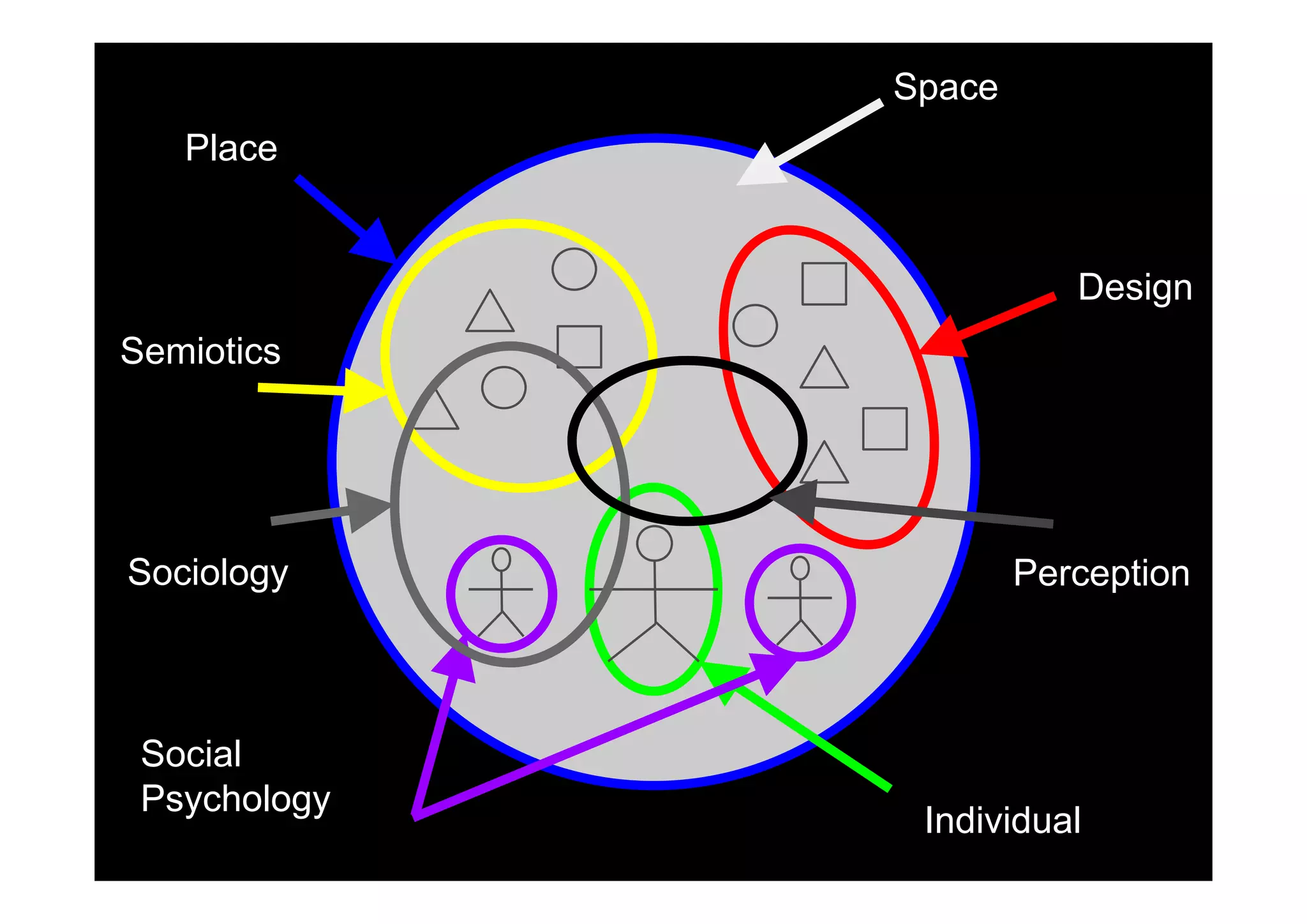
Place
Space
Place
Design
SemioticsSemiotics
Sociology PerceptionSociology Perception
Social
Individual
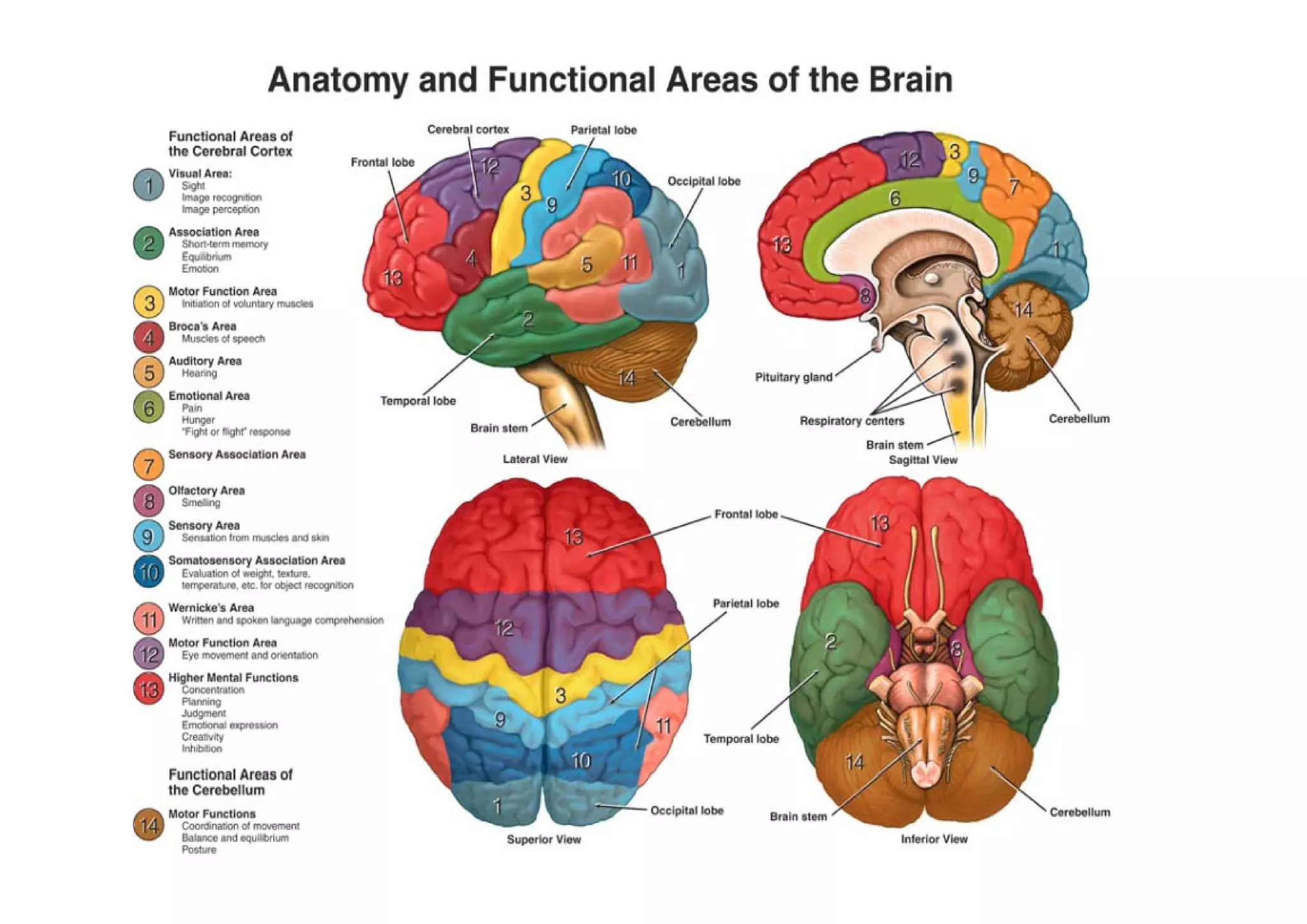
Psychology
PSYCHOLOGY
Meyers-Levy, 2007
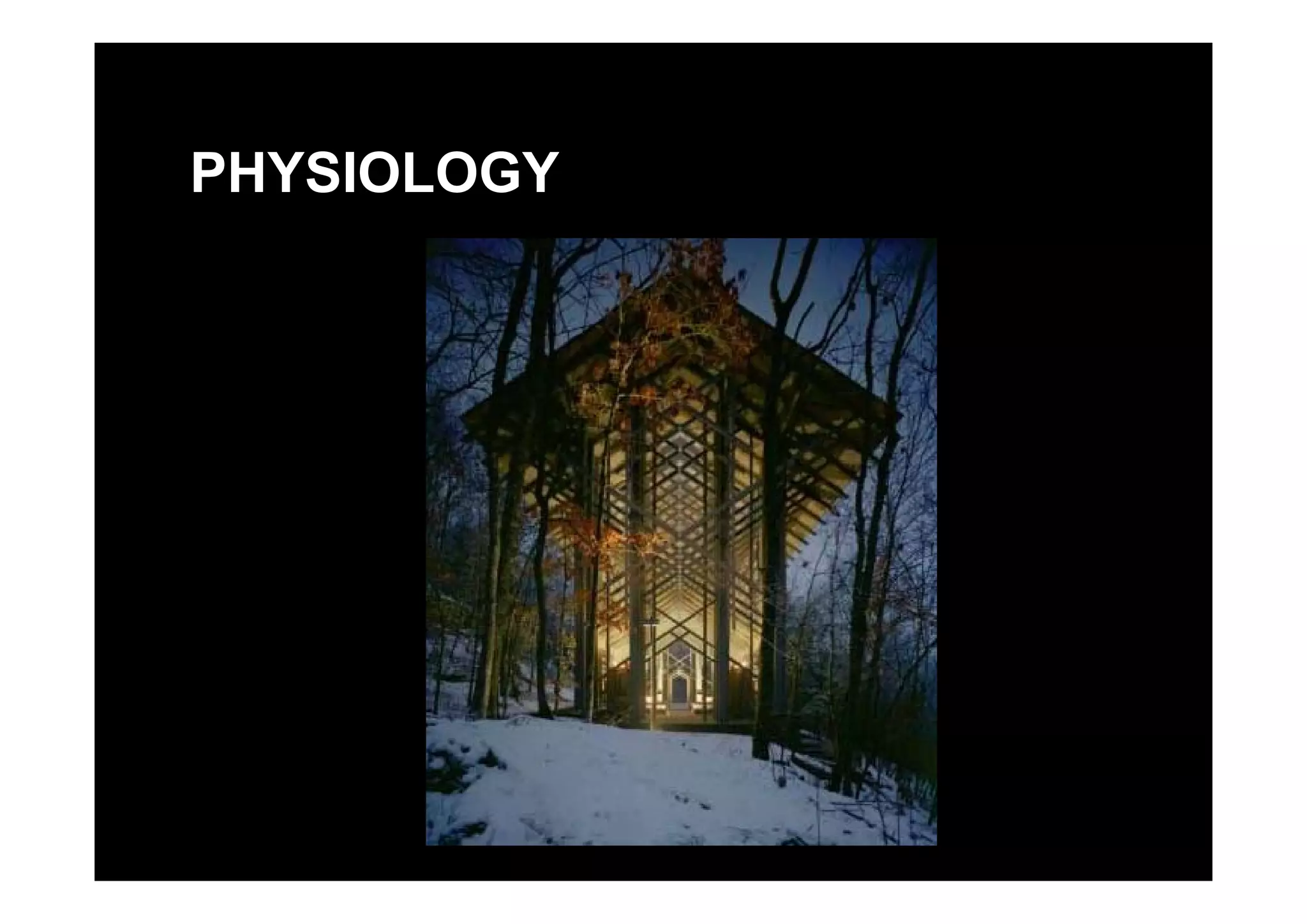
PHYSIOLOGY
https://dl-
web dropbox cweb.dropbox.c
om/get/Camer
a%20Uploads/
2013-07-
2%2012 08 152%2012.08.15
.jpg?w=AABR
Vf4xeoBF98Tu
EcqR8FWyeb
BVsiiExulVq9PBVsiiExulVq9P
74qSBYg
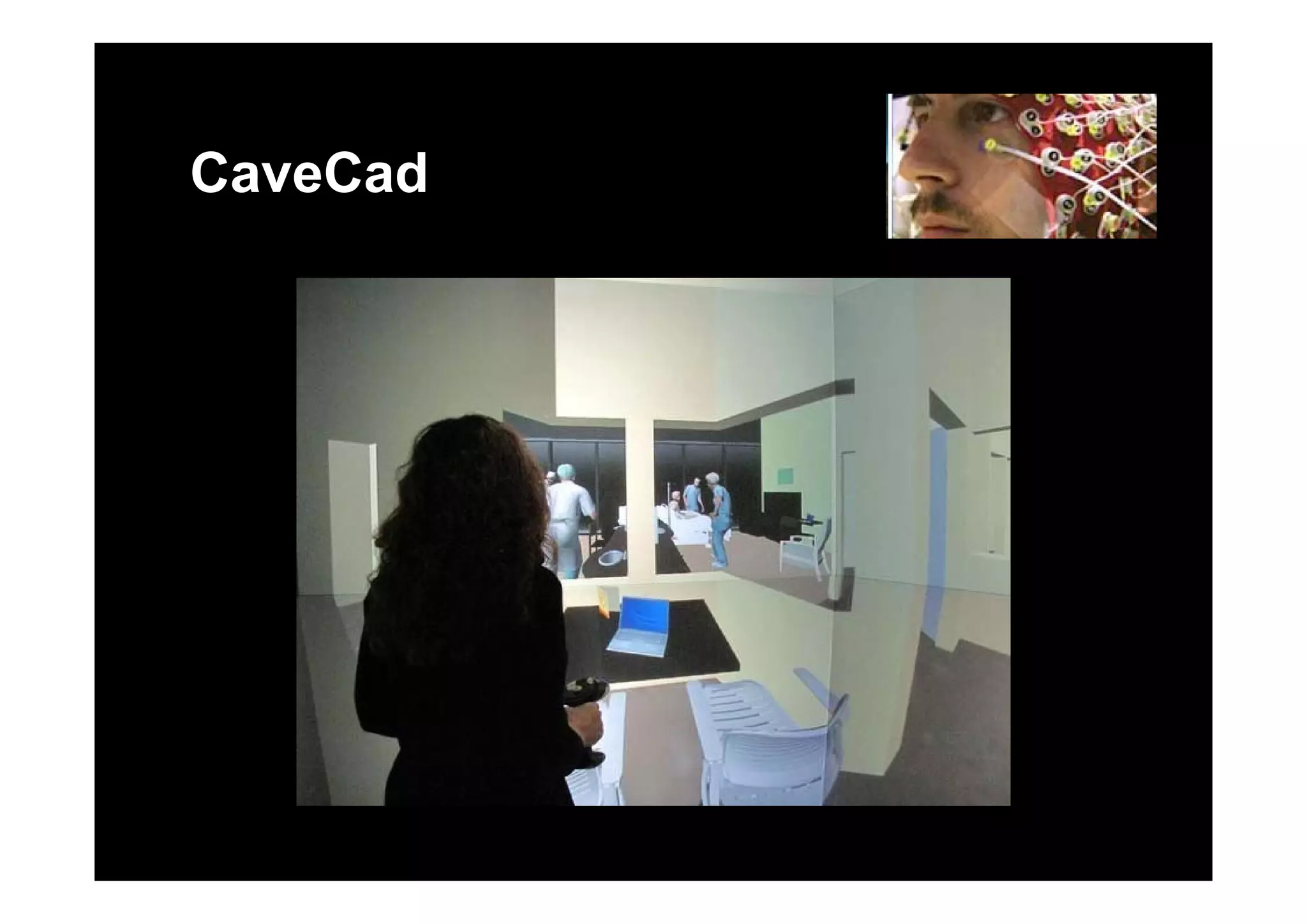
CaveCad
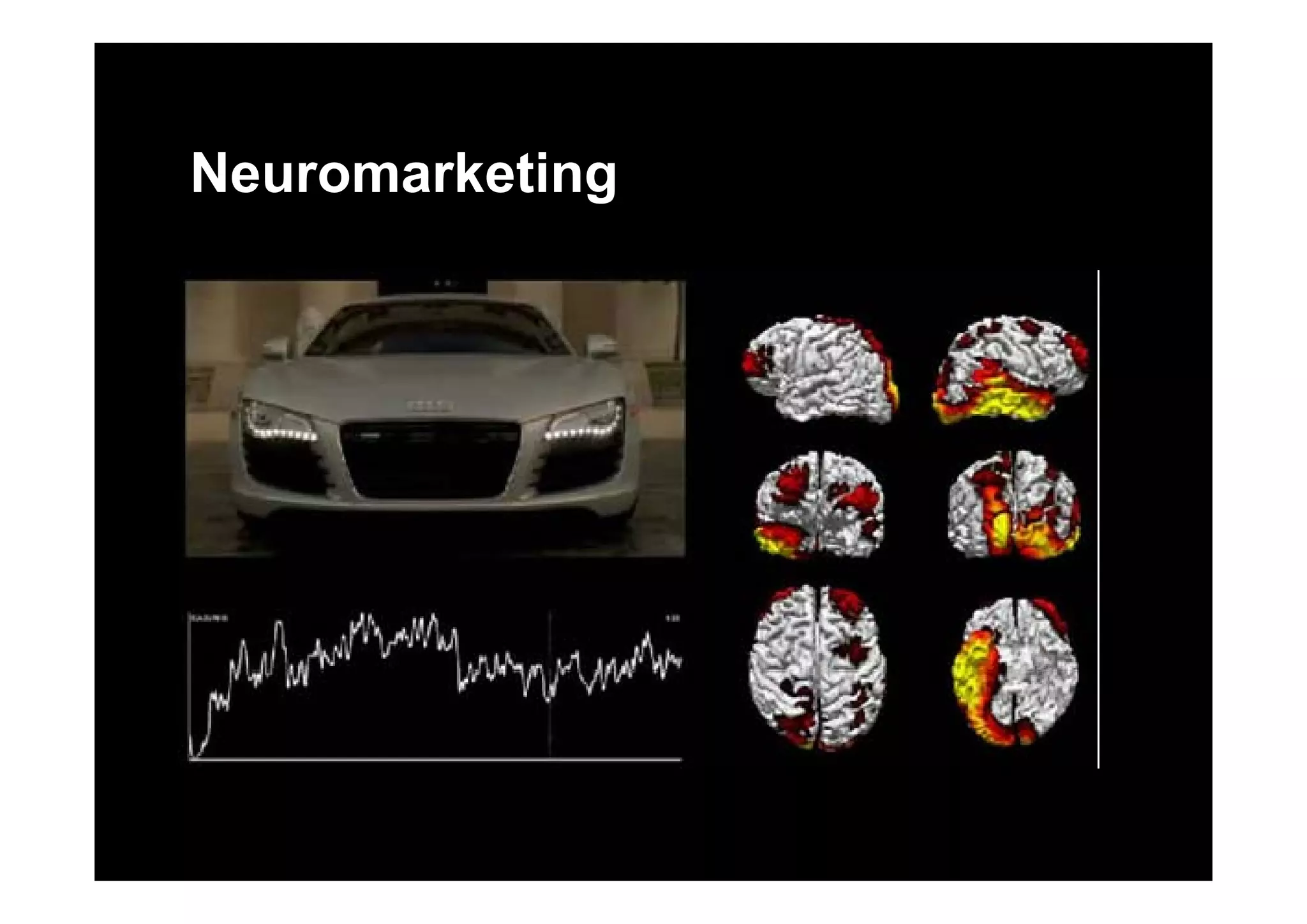
Neuromarketing
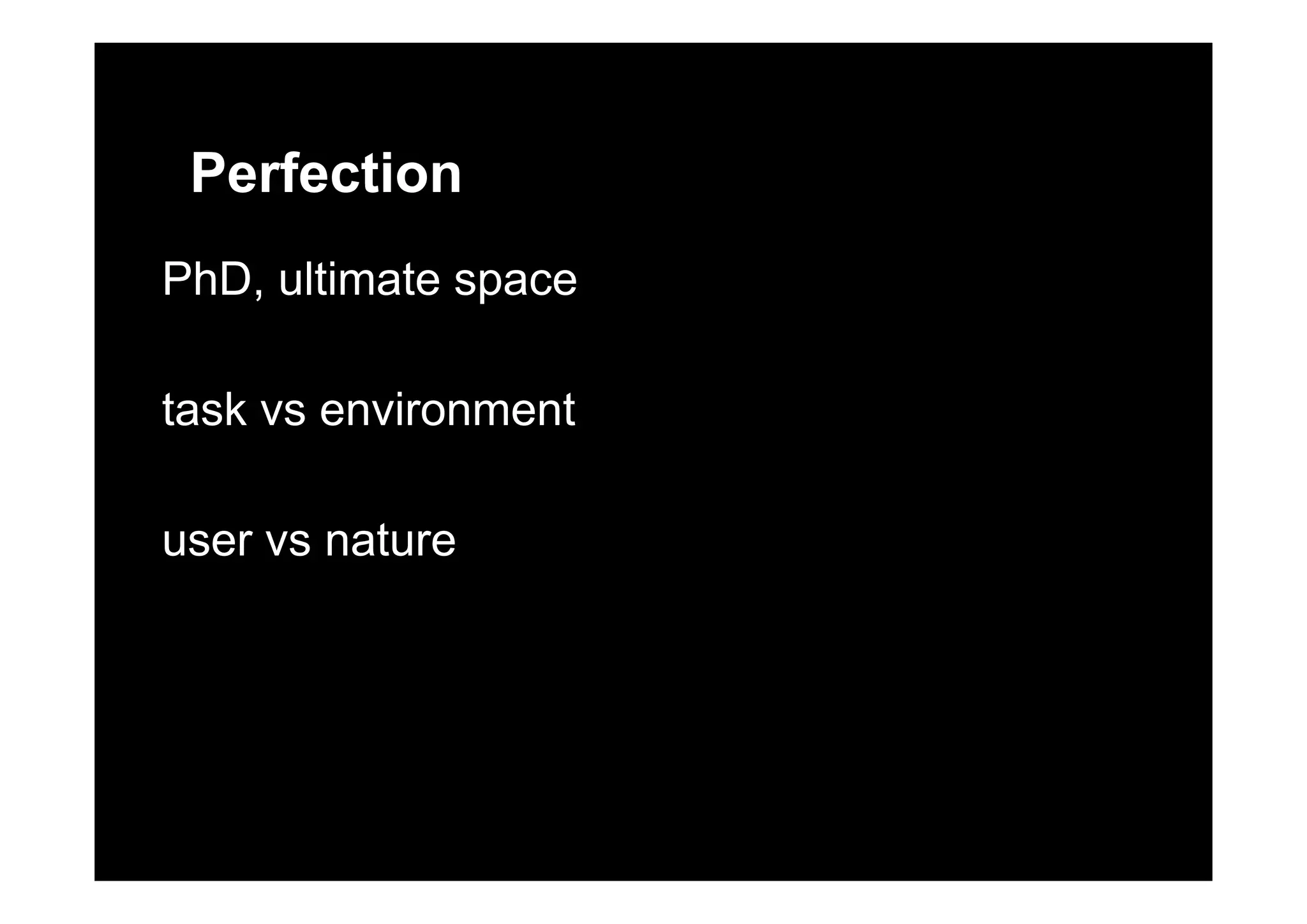
Perfection
PhD, ultimate space
task vs environment
user vs nature
Study
How the built environment can contribute to the
attenuation of a stress response?
stress:stress:
stimulus content
stimulus valencestimulus valence
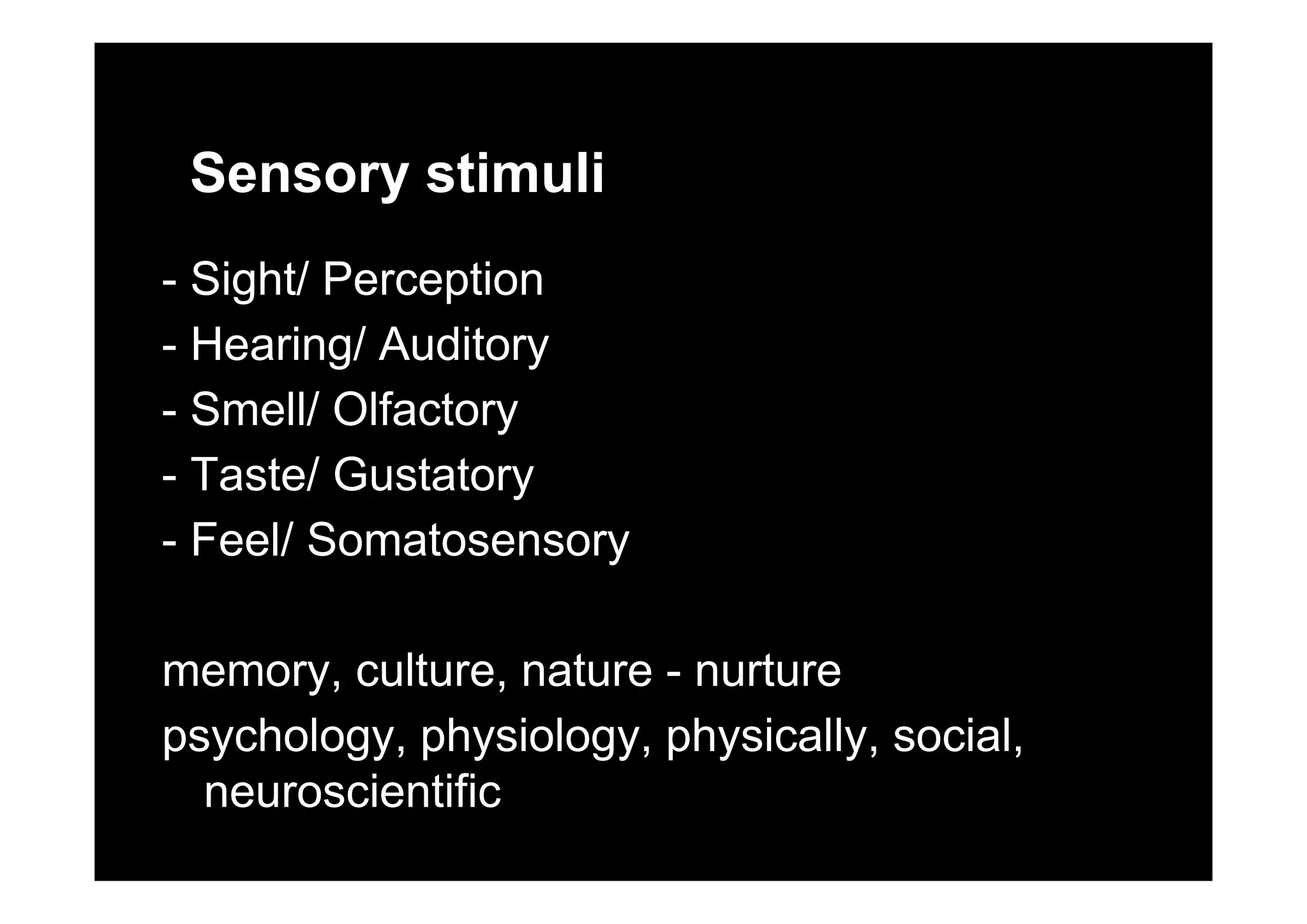
Sensory stimuli
- Sight/ Perception
- Hearing/ AuditoryHearing/ Auditory
- Smell/ Olfactory
T t / G t t- Taste/ Gustatory
- Feel/ Somatosensory
memory culture nature nurturememory, culture, nature - nurture
psychology, physiology, physically, social,
i tifineuroscientific
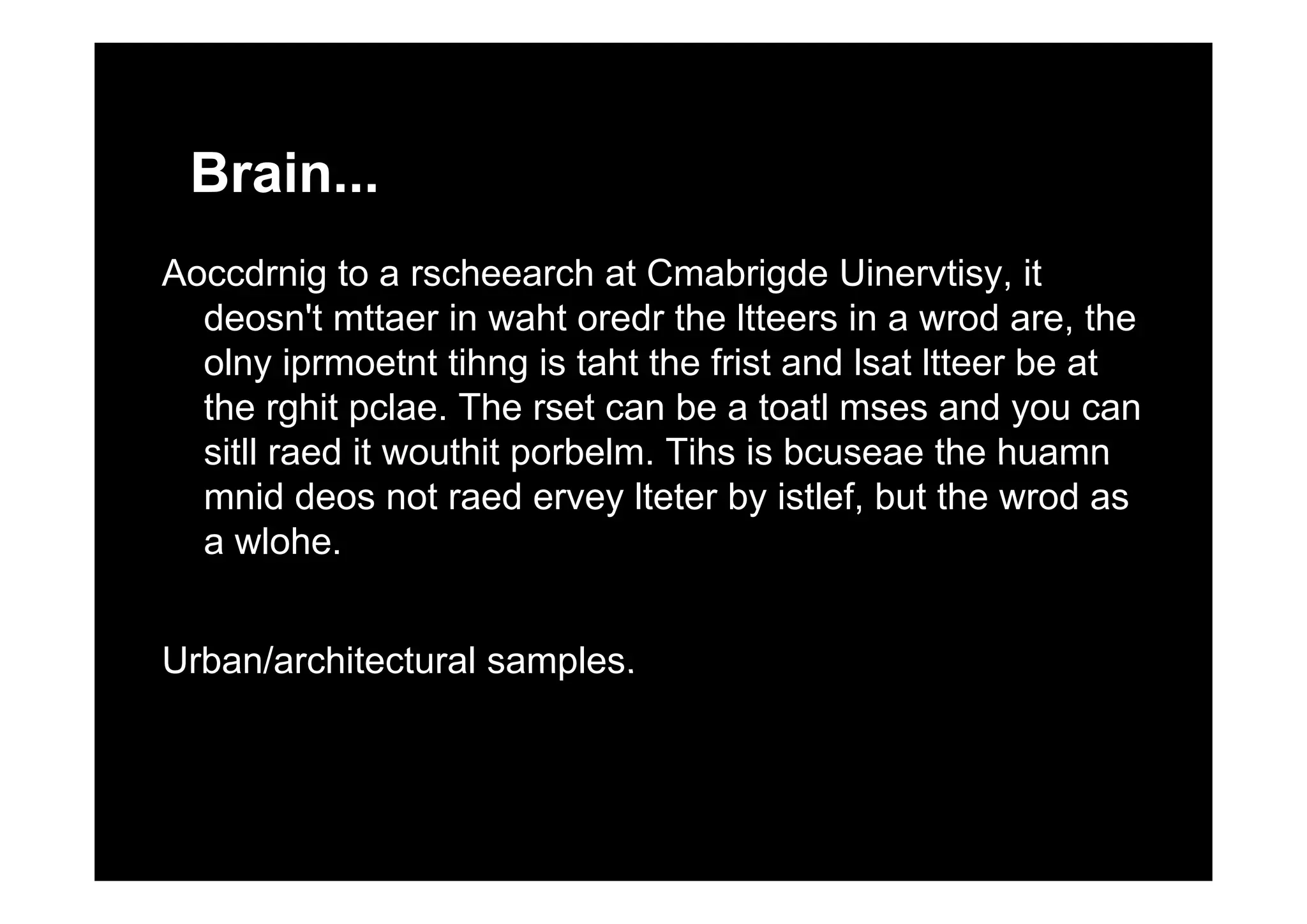
Brain...
Aoccdrnig to a rscheearch at Cmabrigde Uinervtisy, it
deosn't mttaer in waht oredr the ltteers in a wrod are, the
olny iprmoetnt tihng is taht the frist and lsat ltteer be atolny iprmoetnt tihng is taht the frist and lsat ltteer be at
the rghit pclae. The rset can be a toatl mses and you can
sitll raed it wouthit porbelm. Tihs is bcuseae the huamnsitll raed it wouthit porbelm. Tihs is bcuseae the huamn
mnid deos not raed ervey lteter by istlef, but the wrod as
a wlohe.
Urban/architectural samples.Urban/architectural samples.
Valence
a - b
You - MeYou Me
SOME EXAMPLESSO S
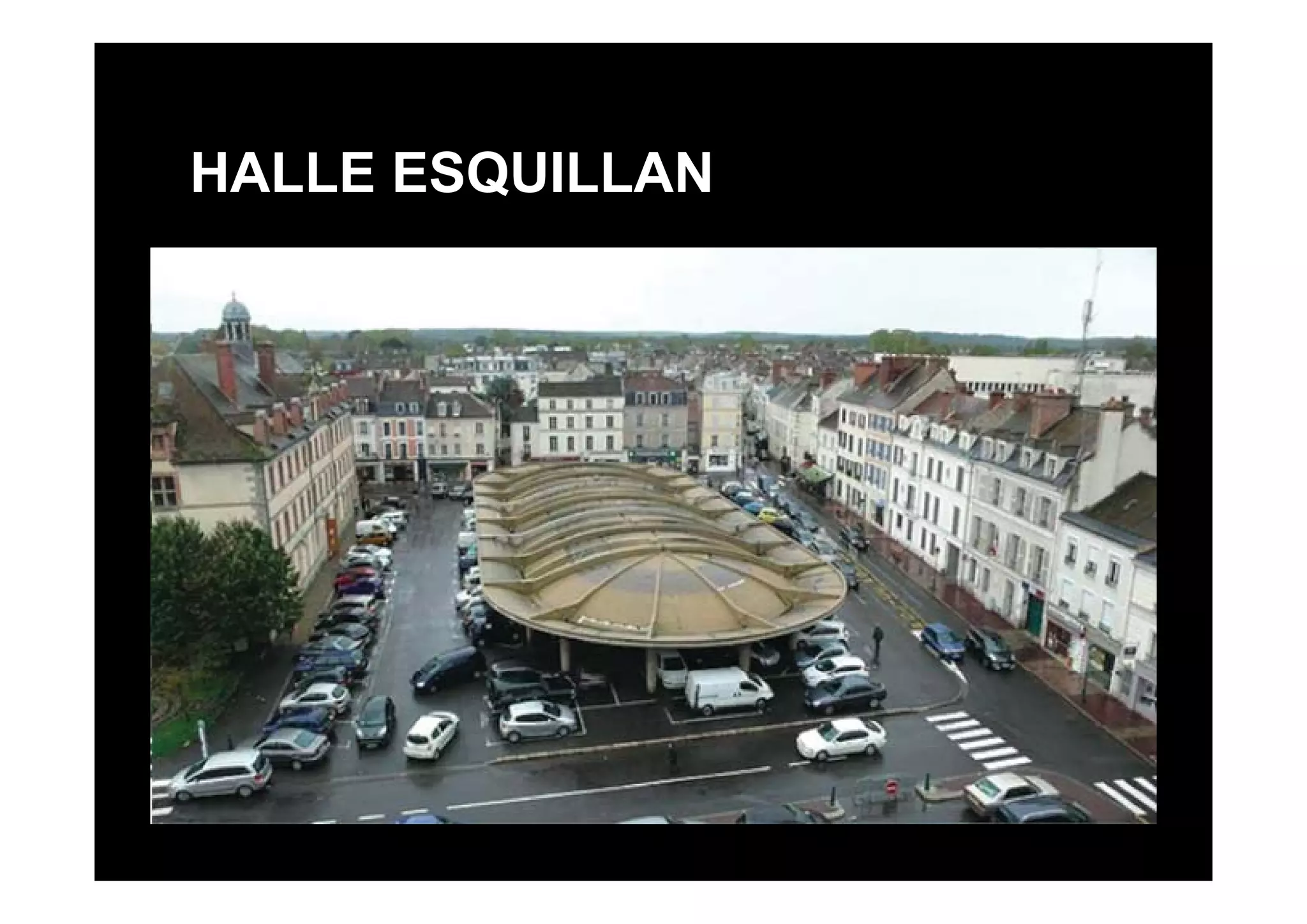
HALLE ESQUILLAN
http://www.spp
ef.fr/wp-
content/uloads
2012/11/Fontai
nebleau-
halle8.jpg
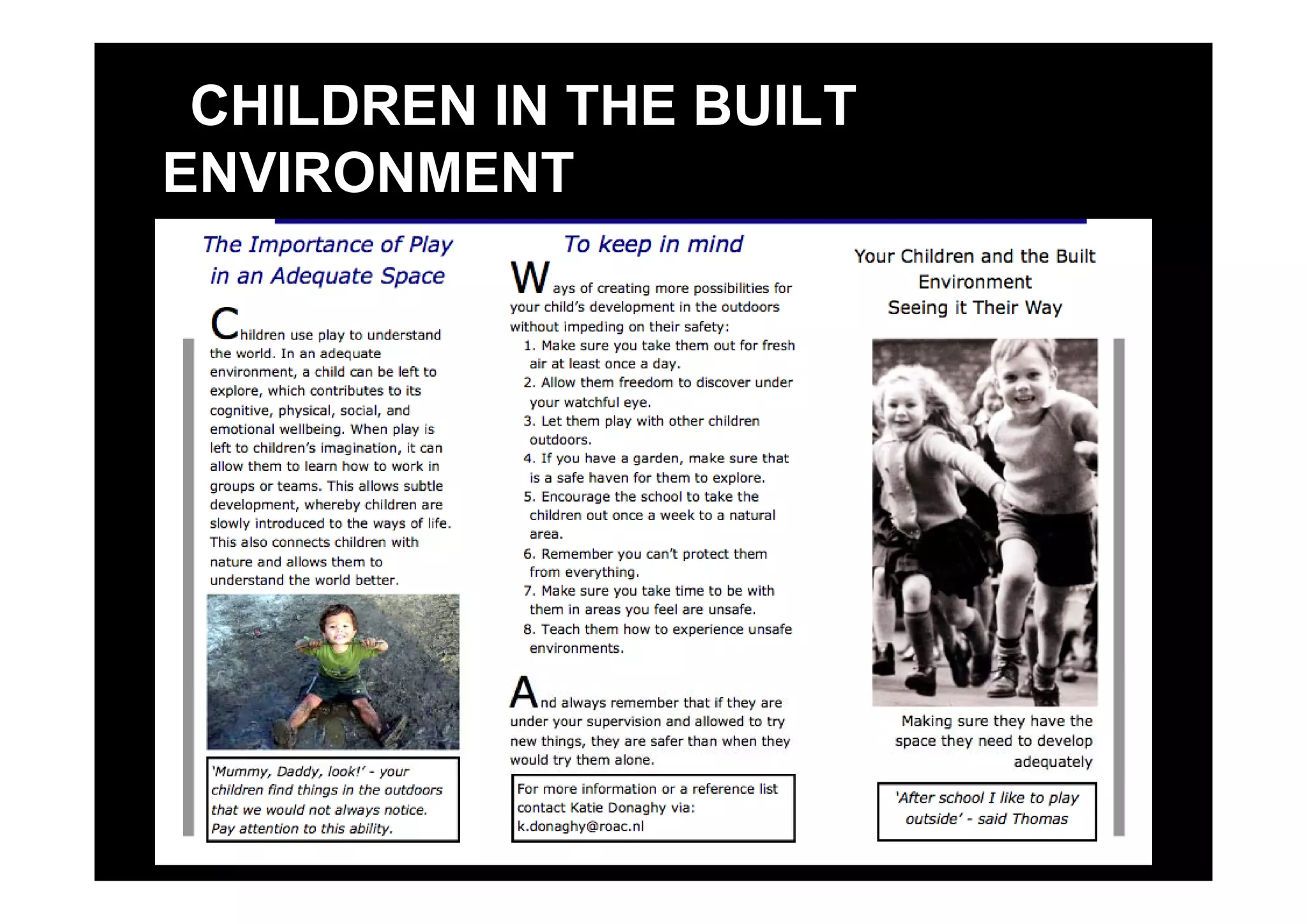
CHILDREN IN THE BUILT
ENVIRONMENT
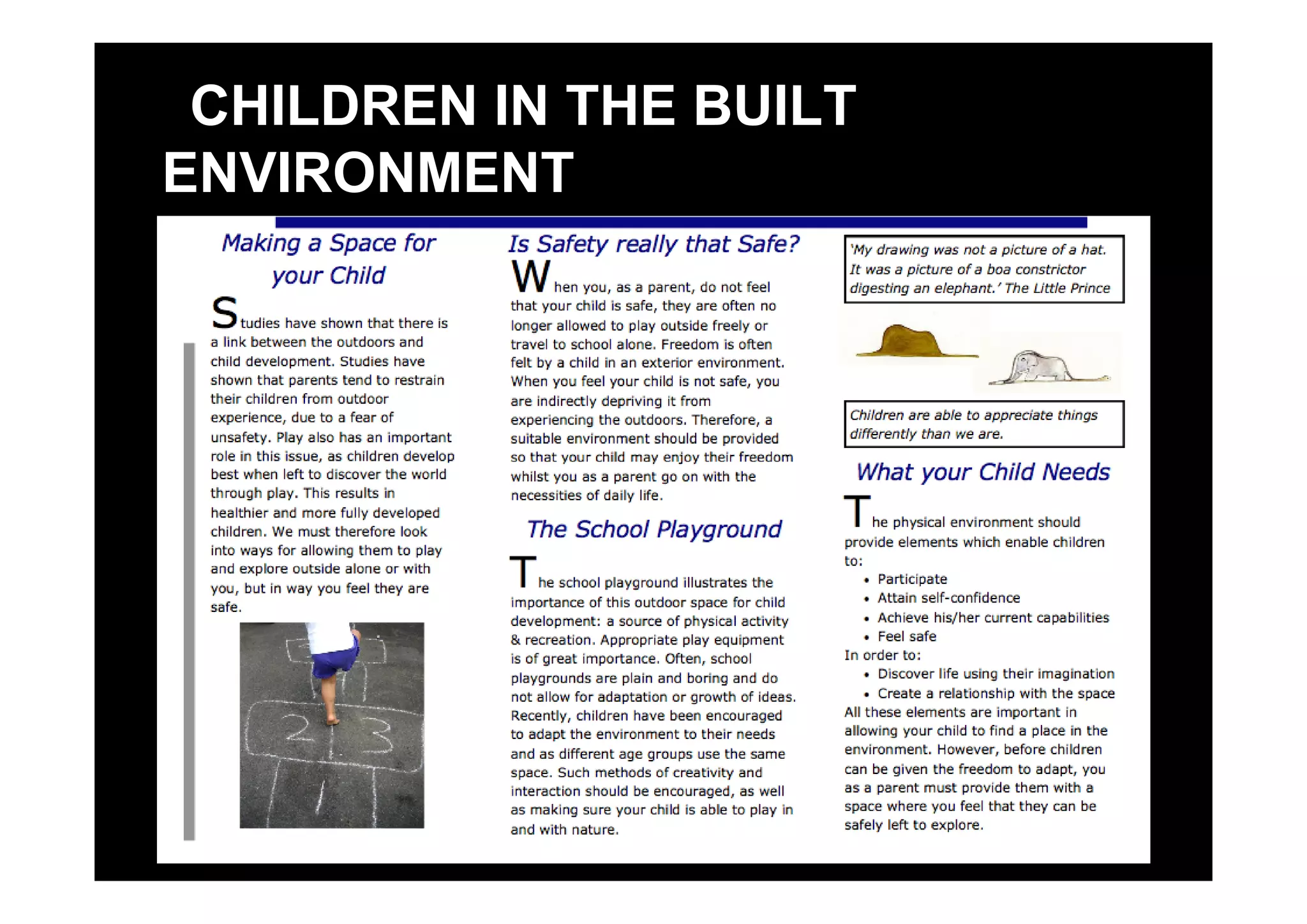
CHILDREN IN THE BUILT
ENVIRONMENT
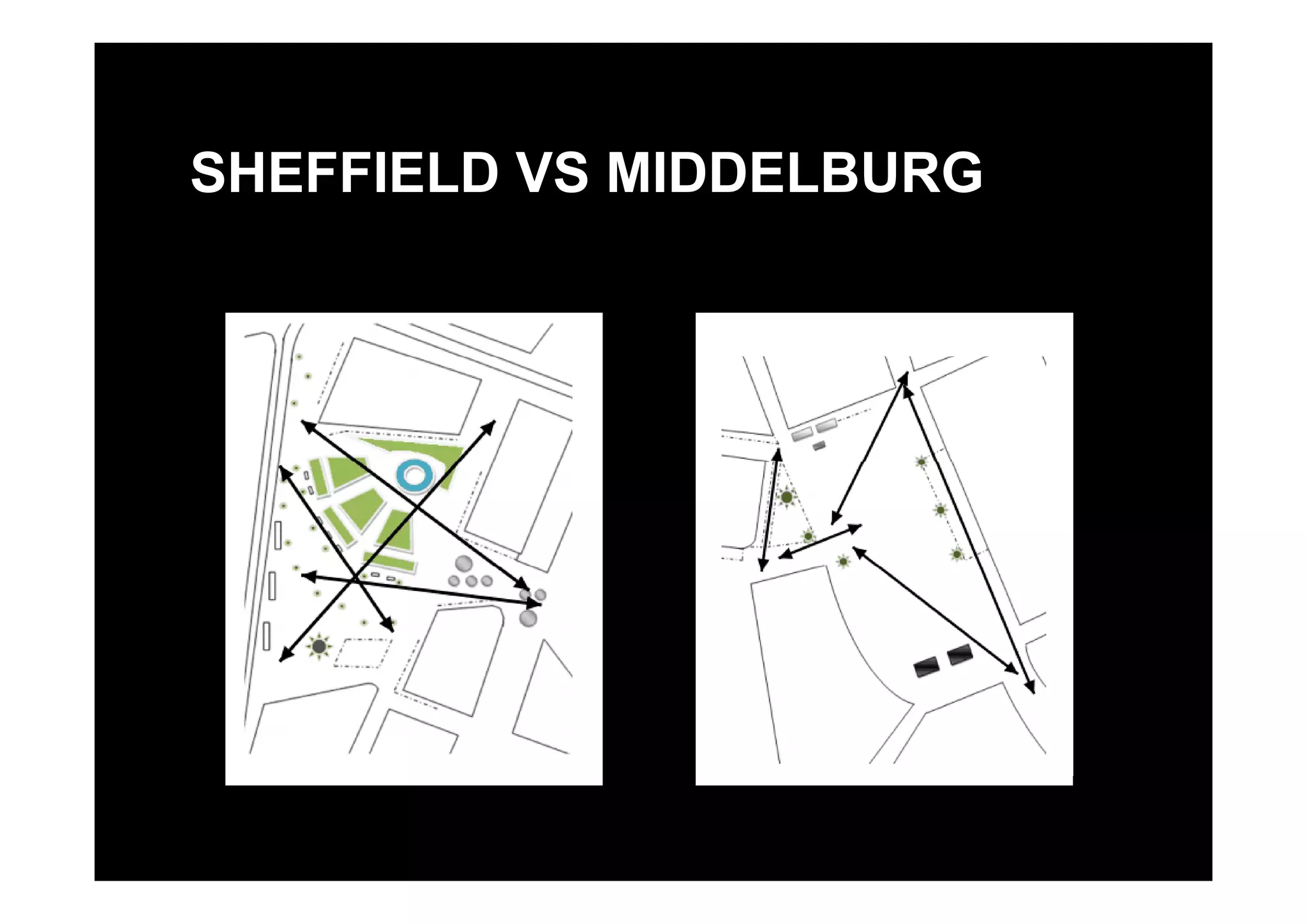
SHEFFIELD VS MIDDELBURG
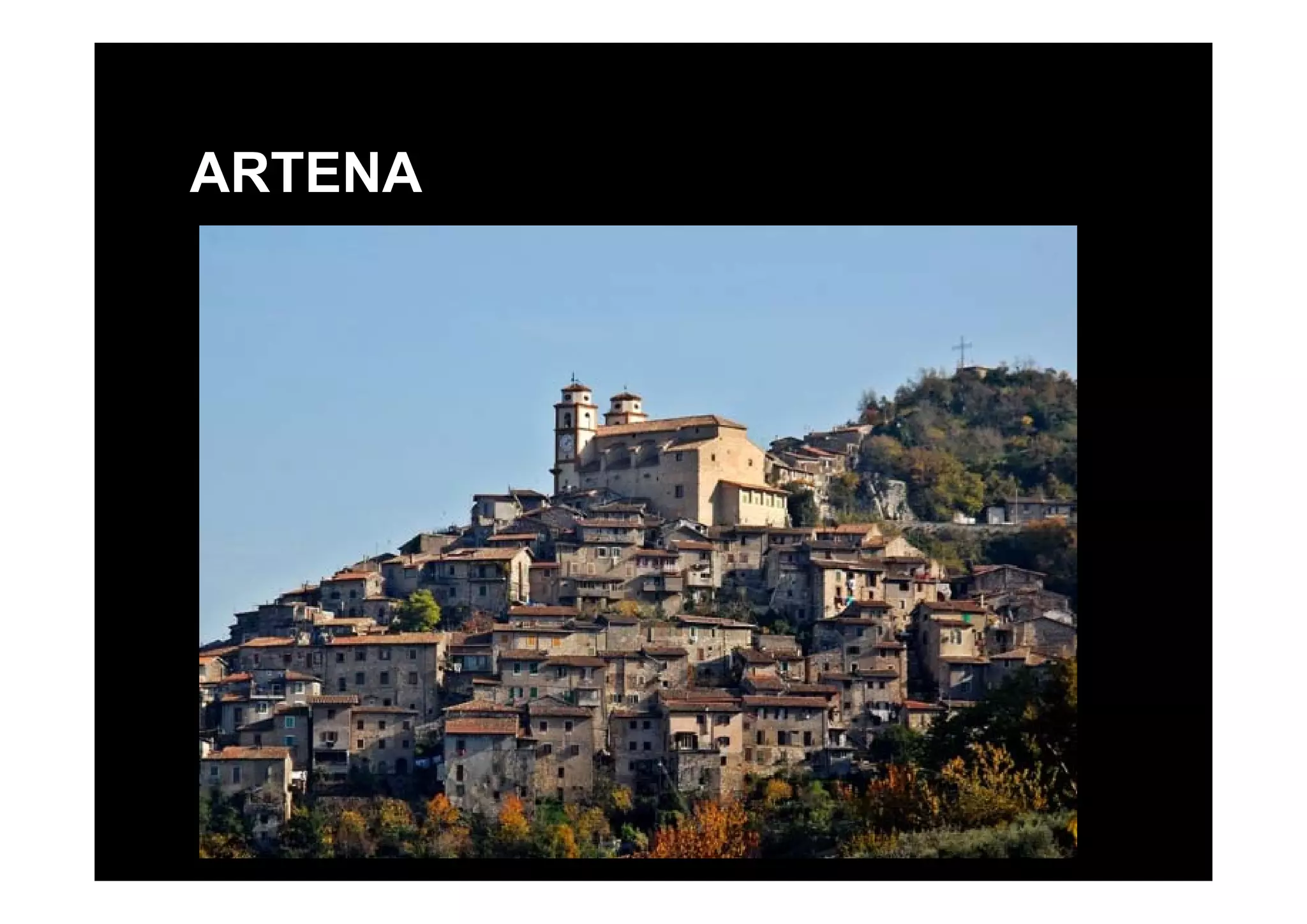
ARTENA
Artena
Familiar place
positive or negative
Reflect on how this feeling emerges.
How to alter this?
WORKSHOP
Elements in spaces you are familiar with which
make you feel good?y g
(mood, state, physical, physiological)
WORKSHOP
Elements in spaces you are familiar with which
make you feel good?y g
(mood, state, physical, physiological)
What?
Why?
WORKSHOP
Decision making - what tools can you use?Decision making what tools can you use?
(conscious, unconscious)
WORKSHOP

URBAN DESIGN AND MAKING A SPACE A PLACE by Menno Cramer and Katie Donaghy

  • 1.
    ISB SUMMER SCHOOL2013: NEUROERGONOMICS AND PLACEMAKING URBAN DESIGN AND MAKING A SPACE A PLACE Menno Cramer and Katie Donaghyg y
  • 2.
    SPACE TO PLACE SocialInteraction Social Comfortability PersonalisationPersonalisation
  • 3.
    THE PHYSICAL ENVIRONMENT DELIVERSSTIMULI WHICH INFLUENCES USERSUSERS. Knowledge of this allows for appropriate design decisionsdesign decisions
  • 4.
    PLACES SHOULD EVOLVE NATURALLYAND ORGANICALLY “sound appreciation of the context of a projectsound appreciation of the context of a project site or area. This includes its history, its existing townscape and appearance itsexisting townscape and appearance, its planning status and its social and economic role both current and potential The contextrole – both current and potential. The context should also include the client’s objectives for the site or area” (Tibbalds 2001 p 20)the site or area” (Tibbalds, 2001, p.20).
  • 5.
  • 6.
    Minton A 2009Ground Control:Minton, A., 2009. Ground Control: Fear and Happiness in the twenty-pp y first-century city. Today spaces are governed by those who own the spacesthe spaces Spaces are constructed for economical profit d t f thand not for the user
  • 7.
    Lefebvre, H., 1961.The Social Text. D i l t bi d ith lt d thDesign elements combined with culture and the experience of the individual create spaces (Lefebvre, 1961).
  • 8.
    De Certeau M1974 Walking in theDe Certeau, M., 1974. Walking in the City. The design of a public space should enhance social comfortability whereby individuals willsocial comfortability, whereby individuals will feel more comfortable and will be more likely t i t t i ll (D C t 1974)to interact socially (De Certeau, 1974).
  • 9.
    Foucault, M., 1969.Archaeology of Knowledge. Governance of Space Example: Th P tiThe Panopticon Natural Surveillance CCTVCCTV Perceived Safety
  • 10.
    Thwaites, K. andSimkins, I., 2007., , , Experimental Landscape: an approach to people place andapproach to people, place and space. Assigning labels to places according to whoAssigning labels to places according to who frequents it and what happens there creates places hich become their rep tation ratherplaces which become their reputation rather than existing as a separate entity (Thwaites d Si ki 2007)and Simkins, 2007).
  • 11.
    Gehl, J., 2011.Life between buildings: using public space.buildings: using public space. It is important to ha e spaces in cities that areIt is important to have spaces in cities that are on a small scale that people can relate to, th th thi b i t l f thrather than everything being too large for the individual to handle and to become a part of (Jan Gehl, 2011).
  • 12.
    Policy as aRestriction? or policy as an opportunity? o cy as a est ct o p y pp y
  • 13.
    POLICY FRAMEWORK Policy predefinesthe necessity for certain characteristics to be present and others not to be, it predefines a margin of what the built environment will look like subject to development objectives and funding opportunitiesdevelopment objectives and funding opportunities. P li d i h d i d d hPolicy drives the way spaces are designed, and the outcome of that design affects the way people behave and the subsequent amount of social cohesion whichand the subsequent amount of social cohesion which can occur.
  • 14.
    THE USER The usershould be at the center of the design, it is through the user and their use of spaceg p that one may create places. The human is the designers tool - Jan Gehl
  • 15.
    MAGNETS Magnets are morethan simply landmarks, because they embody meaning and elicit anbecause they embody meaning and elicit an emotional response and an action (Carmona d Ti d ll 2007)and Tiesdell, 2007).
  • 16.
  • 17.
    SEMIOTICS Individuals - apart of the production of space Signs - elements we attach meaning to Symbols - elements which have meaning As individuals we rely on familiar signs or symbols to transfer meaning into a space (Barthes, 1968). As users of a space we also become subjects and objectsAs users of a space we also become subjects and objects whereby we may observe the doing of others and others may observe us, and this creates the social production of space (Lefebvre, 1961).
  • 18.
    PSYCHOLOGY Places are cruciallysignificant in the satisfaction of biological, social, psychological and cultural needs they are therefore considered meaningful to the processes ofare therefore considered meaningful to the processes of self-identity (Aronson, Wilson, and Akert, 2010; Minton, 2009).2009). As users we seek the confirmation from others that whatAs users we seek the confirmation from others that what we are doing is socially acceptable (Aronson et al. 2010). Users will therefore seek places to sit or hang on2010). Users will therefore seek places to sit or hang on the edges of spaces or at other appropriate locations where they may have a decent view of the space (Bentley et al., 1985; Gehl, 2001).
  • 19.
    THE RELATIONSHIP It isthe sum of the physical design of a public space, the users, their activities, the social and cultural circumstances which together form a space withcircumstances which together form a space with meaning (Thwaites and Simkins, 2007). The experience of a place being influenced by culture will guide the choices user’s make in spaces through whichguide the choices user s make in spaces, through which elements of the built environment should reflect diversity in culture in order to bring people together (Israel, 2003).in culture in order to bring people together (Israel, 2003).
  • 20.
  • 21.
  • 22.
  • 23.
    https://dl- web dropbox cweb.dropbox.c om/get/Camer a%20Uploads/ 2013-07- 2%201208 152%2012.08.15 .jpg?w=AABR Vf4xeoBF98Tu EcqR8FWyeb BVsiiExulVq9PBVsiiExulVq9P 74qSBYg
  • 27.
  • 28.
  • 29.
    Perfection PhD, ultimate space taskvs environment user vs nature
  • 30.
    Study How the builtenvironment can contribute to the attenuation of a stress response? stress:stress: stimulus content stimulus valencestimulus valence
  • 34.
    Sensory stimuli - Sight/Perception - Hearing/ AuditoryHearing/ Auditory - Smell/ Olfactory T t / G t t- Taste/ Gustatory - Feel/ Somatosensory memory culture nature nurturememory, culture, nature - nurture psychology, physiology, physically, social, i tifineuroscientific
  • 35.
    Brain... Aoccdrnig to arscheearch at Cmabrigde Uinervtisy, it deosn't mttaer in waht oredr the ltteers in a wrod are, the olny iprmoetnt tihng is taht the frist and lsat ltteer be atolny iprmoetnt tihng is taht the frist and lsat ltteer be at the rghit pclae. The rset can be a toatl mses and you can sitll raed it wouthit porbelm. Tihs is bcuseae the huamnsitll raed it wouthit porbelm. Tihs is bcuseae the huamn mnid deos not raed ervey lteter by istlef, but the wrod as a wlohe. Urban/architectural samples.Urban/architectural samples.
  • 36.
  • 37.
  • 38.
  • 39.
    CHILDREN IN THEBUILT ENVIRONMENT
  • 40.
    CHILDREN IN THEBUILT ENVIRONMENT
  • 41.
  • 42.
  • 43.
    Artena Familiar place positive ornegative Reflect on how this feeling emerges. How to alter this?
  • 44.
    WORKSHOP Elements in spacesyou are familiar with which make you feel good?y g (mood, state, physical, physiological)
  • 45.
    WORKSHOP Elements in spacesyou are familiar with which make you feel good?y g (mood, state, physical, physiological) What? Why?
  • 46.
    WORKSHOP Decision making -what tools can you use?Decision making what tools can you use? (conscious, unconscious)
  • 47.