Unified Payments Interface
What is UPI?
● Unified Payments Interface, or UPI, as we like to call it, is a
real-time payment system developed by NPCI, launched in
2016.
● It allows instant money transfers between bank accounts via
mobile devices using a UPI ID or mobile number.
● It Instantly transfers money 24/7, including weekends and
holidays.
● It Works through Virtual Payment Addresses (VPAs), eliminating
the need for bank details.
● It Offers Quick Transactions and no transaction fees!
Every single of us uses UPI!
India Before UPI
● Online transfers required account numbers, IFSC
codes, and were limited to bank hours.
● Some transactions took hours or days to process,
causing delays.
● India was very cash-dependent, especially in
rural areas with limited digital payments.
● Many people were unbanked, with low digital
literacy and access to payment systems.
● Card and online transactions had fees, people
had to pay short fees to make even small
payments.
Why UPI?
● UPI was designed to make digital payments seamless and instant,
removing the complexities of traditional online banking.
● UPI aimed to reduce India’s reliance on cash and promote a digital
economy.
● UPI was created to provide a common platform where users could transfer
money across different banks without needing to know bank details.
● UPI was designed for 24/7 real-time money
transfers, overcoming the delays of
traditional systems like NEFT and RTGS,
which operated only during bank hours.
How UPI grew
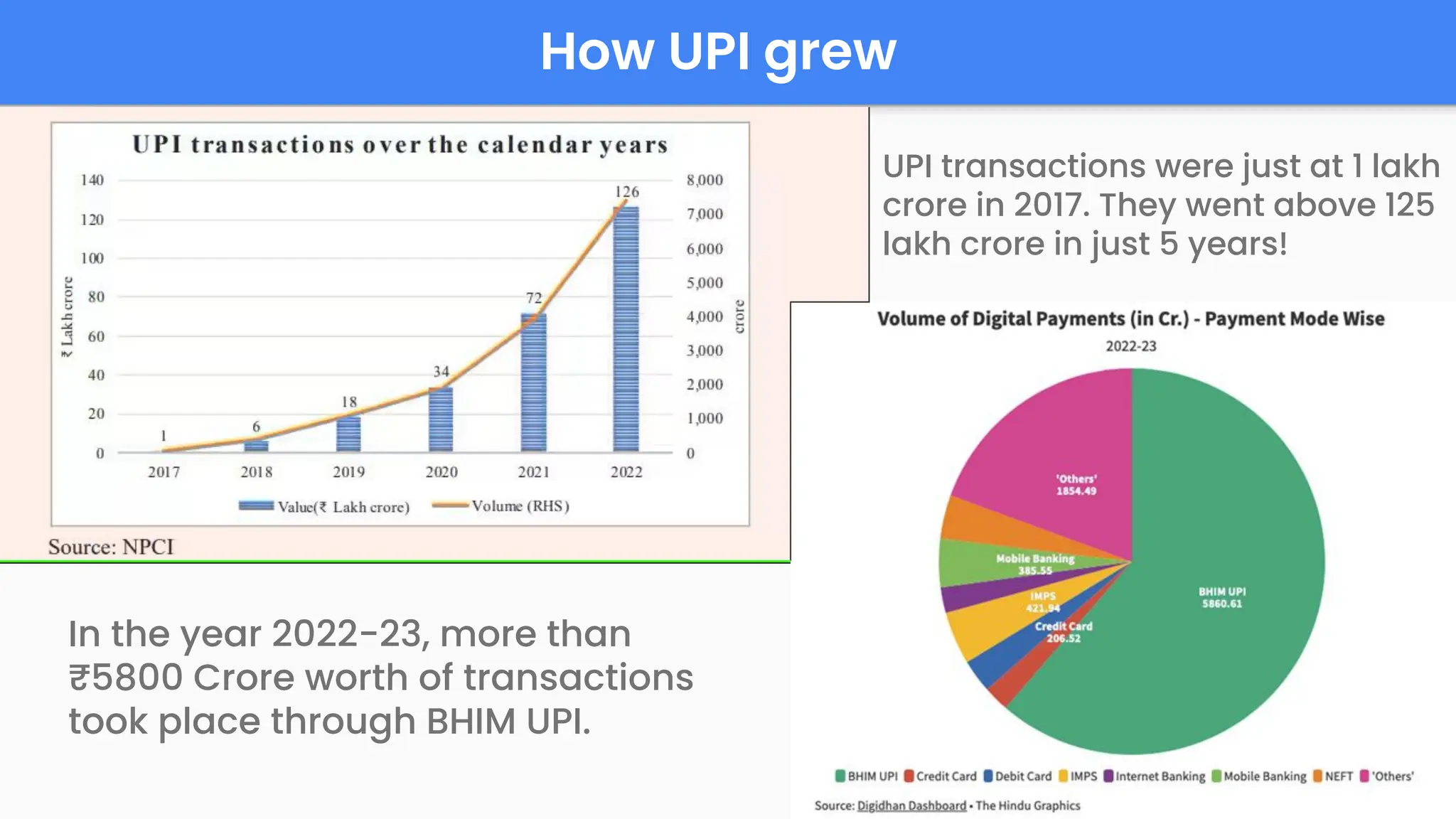
UPI transactions were just at 1 lakh
crore in 2017. They went above 125
lakh crore in just 5 years!
In the year 2022-23, more than
₹5800 Crore worth of transactions
took place through BHIM UPI.
How UPI grew
How did UPI grow so suddenly and rapidly?
● The 2016 demonetization campaign led to a surge in digital transactions,
driving people to adopt UPI as a cashless alternative.
● UPI gained traction among merchants, from large retailers to small businesses,
enhancing its usability in everyday transactions.
● Integration with popular mobile payment apps like Google
Pay, PhonePe, and Paytm made UPI accessible and easy to
use for consumers.
● The increase in smartphone usage and internet
connectivity enabled more users to access UPI services.
● Strong security measures, including two-factor
authentication, built user trust in the system.
● Continuous updates, including features like UPI AutoPay,
UPI Lite, and linking credit cards, kept the platform relevant
and user-friendly.
Plus points of UPI
Why is UPI so good?
● UPI has a simple design which means easier navigation for everyone.
● UPI can perform instant money transfers available 24/7 without delays.
● Uses a UPI ID or mobile number instead of complex account info.
● Users can ink and manage several bank accounts in one app.
● Users can make payments anytime, anywhere, directly from their
smartphone.
● UPI enables users without
formal banking access to
engage in digital
transactions.
Evolution of UPI
Security Features
● Requires a Mobile PIN (MPIN) in
addition to the UPI ID for added
security.
● Instant notifications for every
transaction to detect
unauthorized activities.
● Allows transactions without
exposing bank account
numbers.
● Automatic logout after
inactivity to reduce
unauthorized access.
Innovations in UPI
● AutoPay:Automatic recurring
payments for bills.
● UPI Lite: Offline transactions
for small payments.
● Credit cards can be linked in
UPI for seamless and easier
payments.
● UPI now can facilitate
payments using voice
commands.
Future of UPI
● UPI has facilitated cross-border payments for international transactions
in some countries.
● Offline transactions will be possible, enabling payments without internet.
● Utilizing AI to analyze transactional data for better fraud prevention.
● Collaborations with global
payment platforms to
increase functionality.
● Campaigns to include
unbanked populations in
digital payments.
● Complying with changing
regulations to maintain
trust.
Arthaay Sawant
Harsh Rane
Siddhant Shah
Mandar Patil
Runali Pawar
Nandini Yeligeti
Thank you!

UPI presentation .pdf

  • 1.
  • 2.
    What is UPI? ●Unified Payments Interface, or UPI, as we like to call it, is a real-time payment system developed by NPCI, launched in 2016. ● It allows instant money transfers between bank accounts via mobile devices using a UPI ID or mobile number. ● It Instantly transfers money 24/7, including weekends and holidays. ● It Works through Virtual Payment Addresses (VPAs), eliminating the need for bank details. ● It Offers Quick Transactions and no transaction fees! Every single of us uses UPI!
  • 3.
    India Before UPI ●Online transfers required account numbers, IFSC codes, and were limited to bank hours. ● Some transactions took hours or days to process, causing delays. ● India was very cash-dependent, especially in rural areas with limited digital payments. ● Many people were unbanked, with low digital literacy and access to payment systems. ● Card and online transactions had fees, people had to pay short fees to make even small payments.
  • 4.
    Why UPI? ● UPIwas designed to make digital payments seamless and instant, removing the complexities of traditional online banking. ● UPI aimed to reduce India’s reliance on cash and promote a digital economy. ● UPI was created to provide a common platform where users could transfer money across different banks without needing to know bank details. ● UPI was designed for 24/7 real-time money transfers, overcoming the delays of traditional systems like NEFT and RTGS, which operated only during bank hours.
  • 5.
    How UPI grew UPItransactions were just at 1 lakh crore in 2017. They went above 125 lakh crore in just 5 years! In the year 2022-23, more than ₹5800 Crore worth of transactions took place through BHIM UPI.
  • 6.
    How UPI grew Howdid UPI grow so suddenly and rapidly? ● The 2016 demonetization campaign led to a surge in digital transactions, driving people to adopt UPI as a cashless alternative. ● UPI gained traction among merchants, from large retailers to small businesses, enhancing its usability in everyday transactions. ● Integration with popular mobile payment apps like Google Pay, PhonePe, and Paytm made UPI accessible and easy to use for consumers. ● The increase in smartphone usage and internet connectivity enabled more users to access UPI services. ● Strong security measures, including two-factor authentication, built user trust in the system. ● Continuous updates, including features like UPI AutoPay, UPI Lite, and linking credit cards, kept the platform relevant and user-friendly.
  • 7.
    Plus points ofUPI Why is UPI so good? ● UPI has a simple design which means easier navigation for everyone. ● UPI can perform instant money transfers available 24/7 without delays. ● Uses a UPI ID or mobile number instead of complex account info. ● Users can ink and manage several bank accounts in one app. ● Users can make payments anytime, anywhere, directly from their smartphone. ● UPI enables users without formal banking access to engage in digital transactions.
  • 8.
    Evolution of UPI SecurityFeatures ● Requires a Mobile PIN (MPIN) in addition to the UPI ID for added security. ● Instant notifications for every transaction to detect unauthorized activities. ● Allows transactions without exposing bank account numbers. ● Automatic logout after inactivity to reduce unauthorized access. Innovations in UPI ● AutoPay:Automatic recurring payments for bills. ● UPI Lite: Offline transactions for small payments. ● Credit cards can be linked in UPI for seamless and easier payments. ● UPI now can facilitate payments using voice commands.
  • 9.
    Future of UPI ●UPI has facilitated cross-border payments for international transactions in some countries. ● Offline transactions will be possible, enabling payments without internet. ● Utilizing AI to analyze transactional data for better fraud prevention. ● Collaborations with global payment platforms to increase functionality. ● Campaigns to include unbanked populations in digital payments. ● Complying with changing regulations to maintain trust.
  • 10.
    Arthaay Sawant Harsh Rane SiddhantShah Mandar Patil Runali Pawar Nandini Yeligeti Thank you!