Types Of Clipping
Path
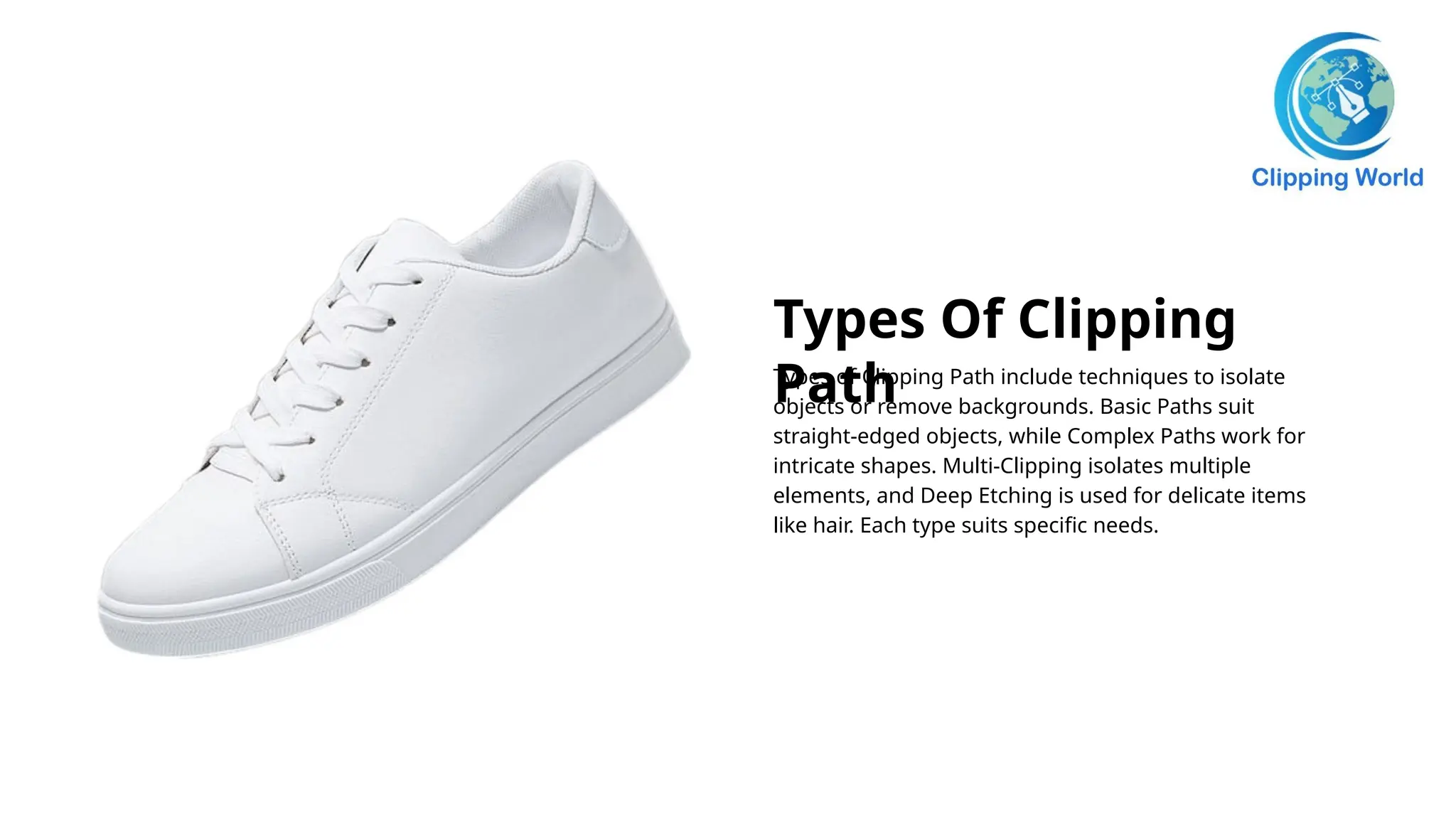
Types of Clipping Path include techniques to isolate
objects or remove backgrounds. Basic Paths suit
straight-edged objects, while Complex Paths work for
intricate shapes. Multi-Clipping isolates multiple
elements, and Deep Etching is used for delicate items
like hair. Each type suits specific needs.
Introduction to Clipping Path
What is a Clipping Path?
A Clipping Path is a vector-based technique used in image editing to isolate an object from
its background. It involves drawing a path (or outline) around the object using tools like the
Pen Tool in Adobe Photoshop. Once the path is defined, the object can be separated from
its background or manipulated independently.
www.clippingworld.co
m
Definition & Purpose
The main purpose of a clipping path is to cut out an object from its background with
precision. It allows editors to modify the image, add new backgrounds, or use the isolated
object in other compositions. Clipping paths are particularly useful for e-commerce,
advertising, and photography.
Importance in Photo Editing
Clipping paths play a crucial role in photo editing by enhancing image quality and
versatility. They help create clean, professional-looking visuals by removing distracting
backgrounds and isolating objects. This is essential for product photography, marketing
materials, and branding, as it ensures the focus remains on the subject, making images
more engaging and visually appealing.
Why Clipping Path Services
Matter?
Enhances Image Quality for E-
commerce, Photography, Branding, etc.
Clipping Path Services are essential for achieving high-quality,
professional images. They play a crucial role in enhancing image
clarity, ensuring that the object stands out while removing distracting
elements like backgrounds.
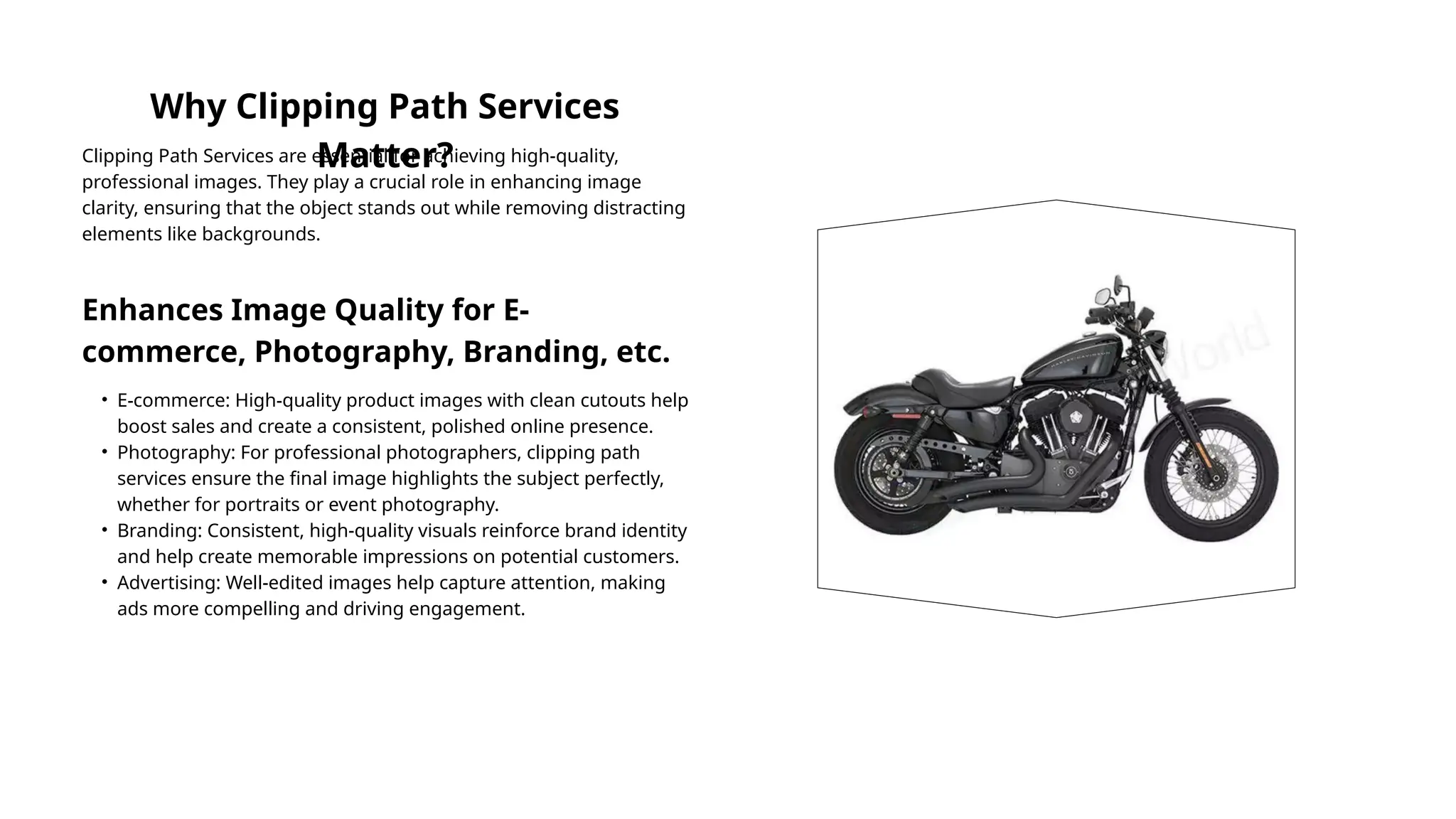
• E-commerce: High-quality product images with clean cutouts help
boost sales and create a consistent, polished online presence.
• Photography: For professional photographers, clipping path
services ensure the final image highlights the subject perfectly,
whether for portraits or event photography.
• Branding: Consistent, high-quality visuals reinforce brand identity
and help create memorable impressions on potential customers.
• Advertising: Well-edited images help capture attention, making
ads more compelling and driving engagement.
Types of Clipping Path
Basic Clipping Path
Complex Clipping Path
Multi-Clipping Path
Deep Etching (Image Masking)
Silhouette Clipping Path
Path for Shadow or Reflection
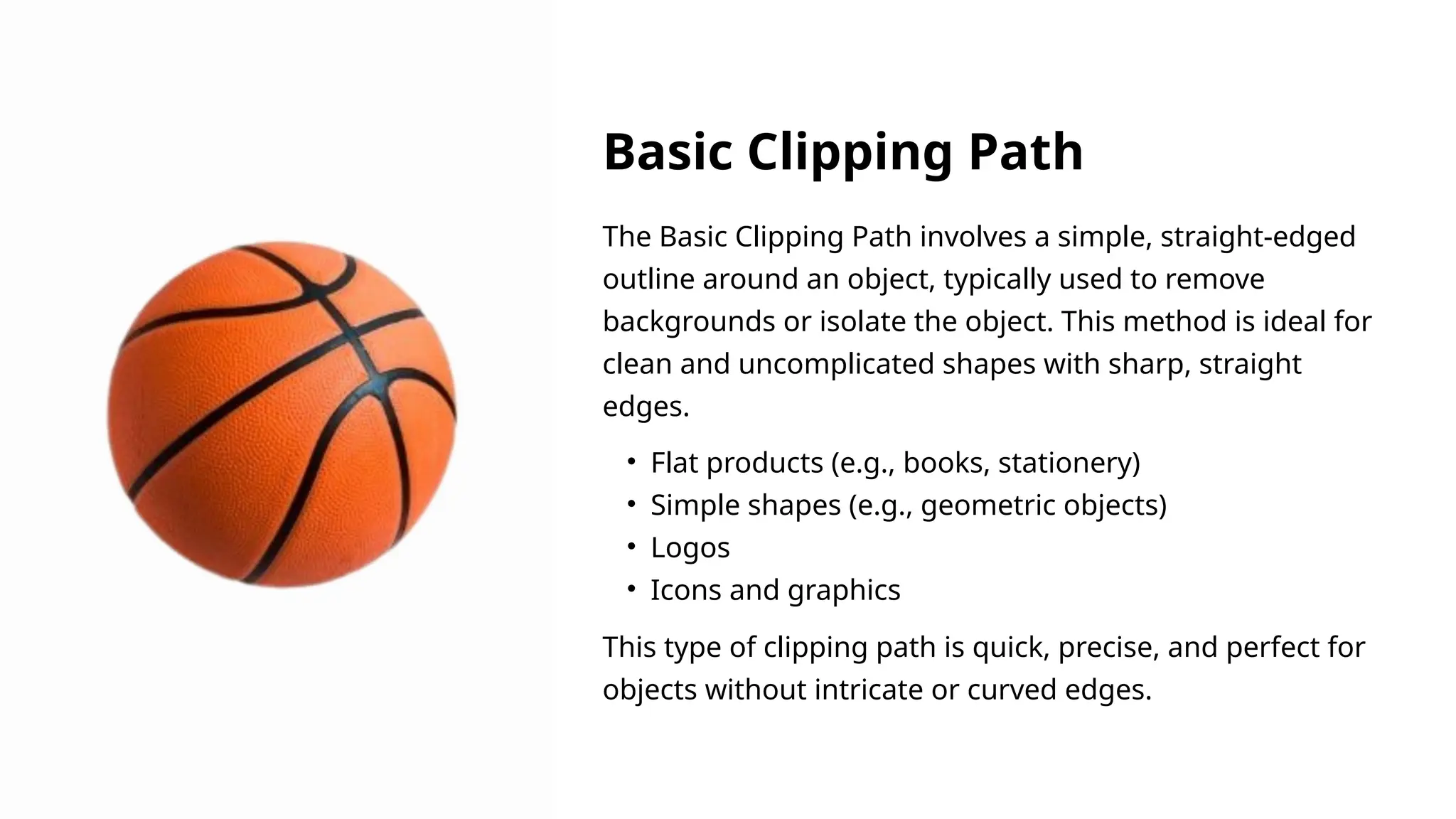
The Basic Clipping Path involves a simple, straight-edged
outline around an object, typically used to remove
backgrounds or isolate the object. This method is ideal for
clean and uncomplicated shapes with sharp, straight
edges.
This type of clipping path is quick, precise, and perfect for
objects without intricate or curved edges.
• Flat products (e.g., books, stationery)
• Simple shapes (e.g., geometric objects)
• Logos
• Icons and graphics
Basic Clipping Path
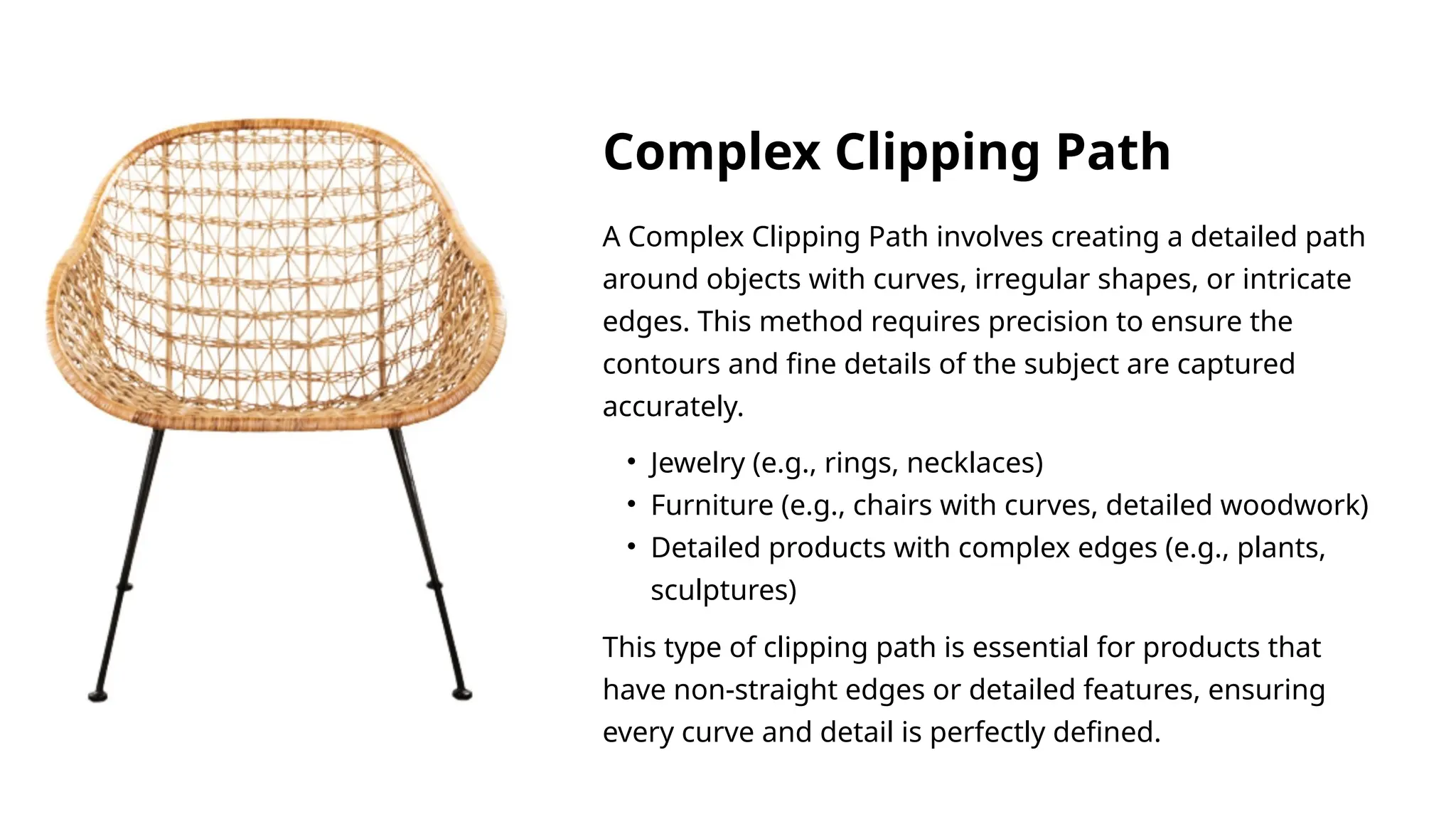
A Complex Clipping Path involves creating a detailed path
around objects with curves, irregular shapes, or intricate
edges. This method requires precision to ensure the
contours and fine details of the subject are captured
accurately.
This type of clipping path is essential for products that
have non-straight edges or detailed features, ensuring
every curve and detail is perfectly defined.
• Jewelry (e.g., rings, necklaces)
• Furniture (e.g., chairs with curves, detailed woodwork)
• Detailed products with complex edges (e.g., plants,
sculptures)
Complex Clipping Path
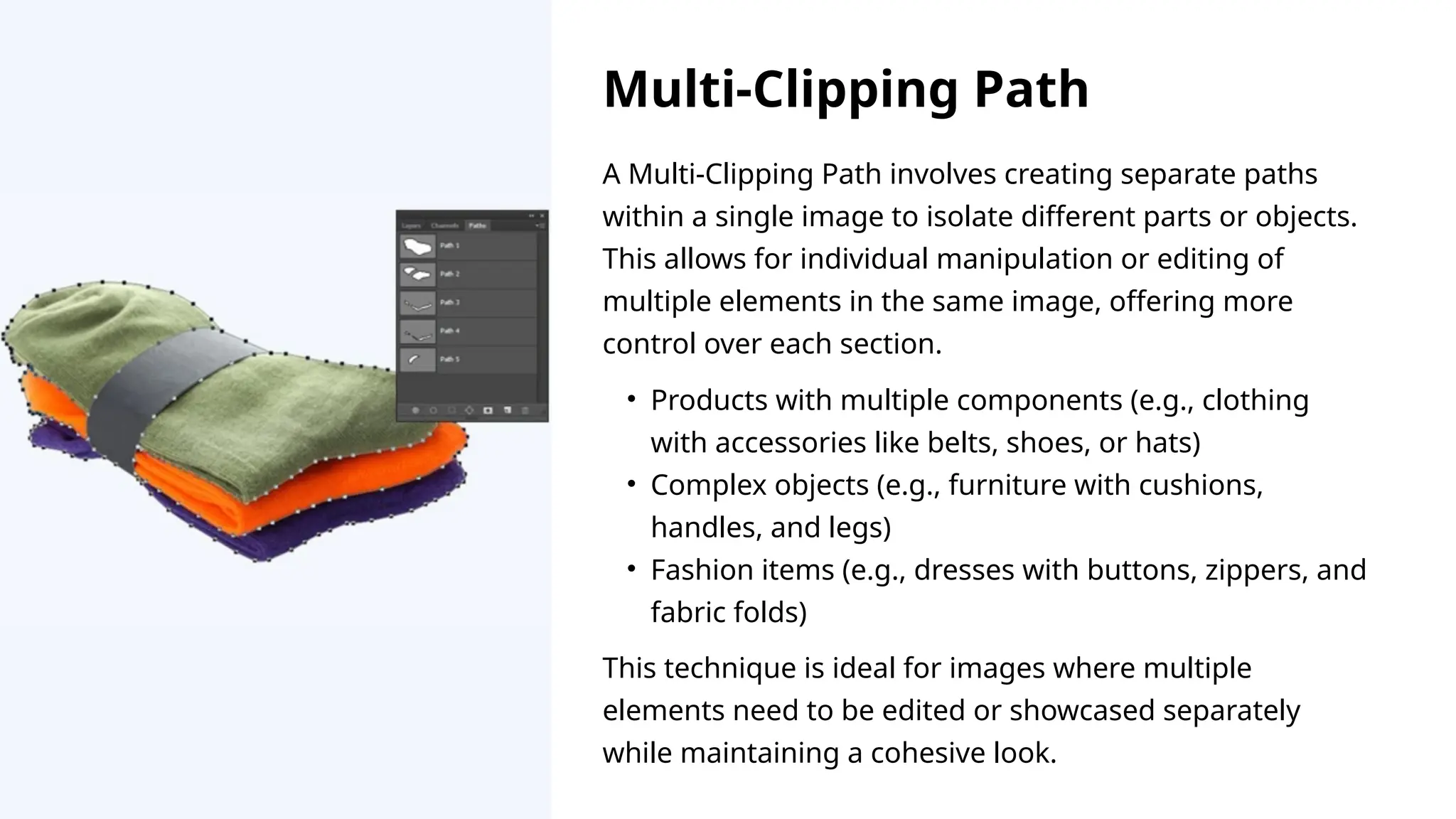
A Multi-Clipping Path involves creating separate paths
within a single image to isolate different parts or objects.
This allows for individual manipulation or editing of
multiple elements in the same image, offering more
control over each section.
This technique is ideal for images where multiple
elements need to be edited or showcased separately
while maintaining a cohesive look.
• Products with multiple components (e.g., clothing
with accessories like belts, shoes, or hats)
• Complex objects (e.g., furniture with cushions,
handles, and legs)
• Fashion items (e.g., dresses with buttons, zippers, and
fabric folds)
Multi-Clipping Path
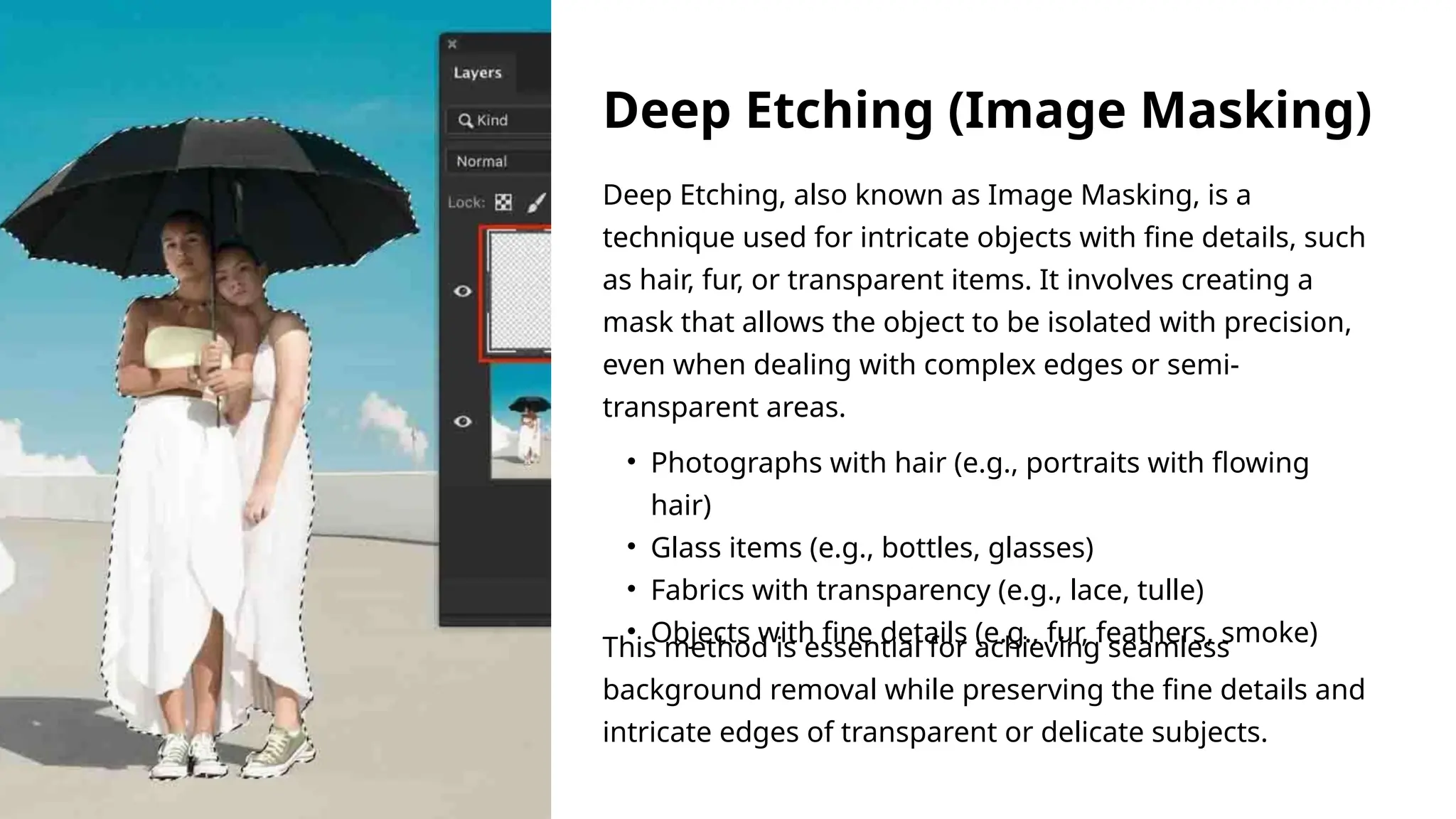
Deep Etching, also known as Image Masking, is a
technique used for intricate objects with fine details, such
as hair, fur, or transparent items. It involves creating a
mask that allows the object to be isolated with precision,
even when dealing with complex edges or semi-
transparent areas.
This method is essential for achieving seamless
background removal while preserving the fine details and
intricate edges of transparent or delicate subjects.
• Photographs with hair (e.g., portraits with flowing
hair)
• Glass items (e.g., bottles, glasses)
• Fabrics with transparency (e.g., lace, tulle)
• Objects with fine details (e.g., fur, feathers, smoke)
Deep Etching (Image Masking)
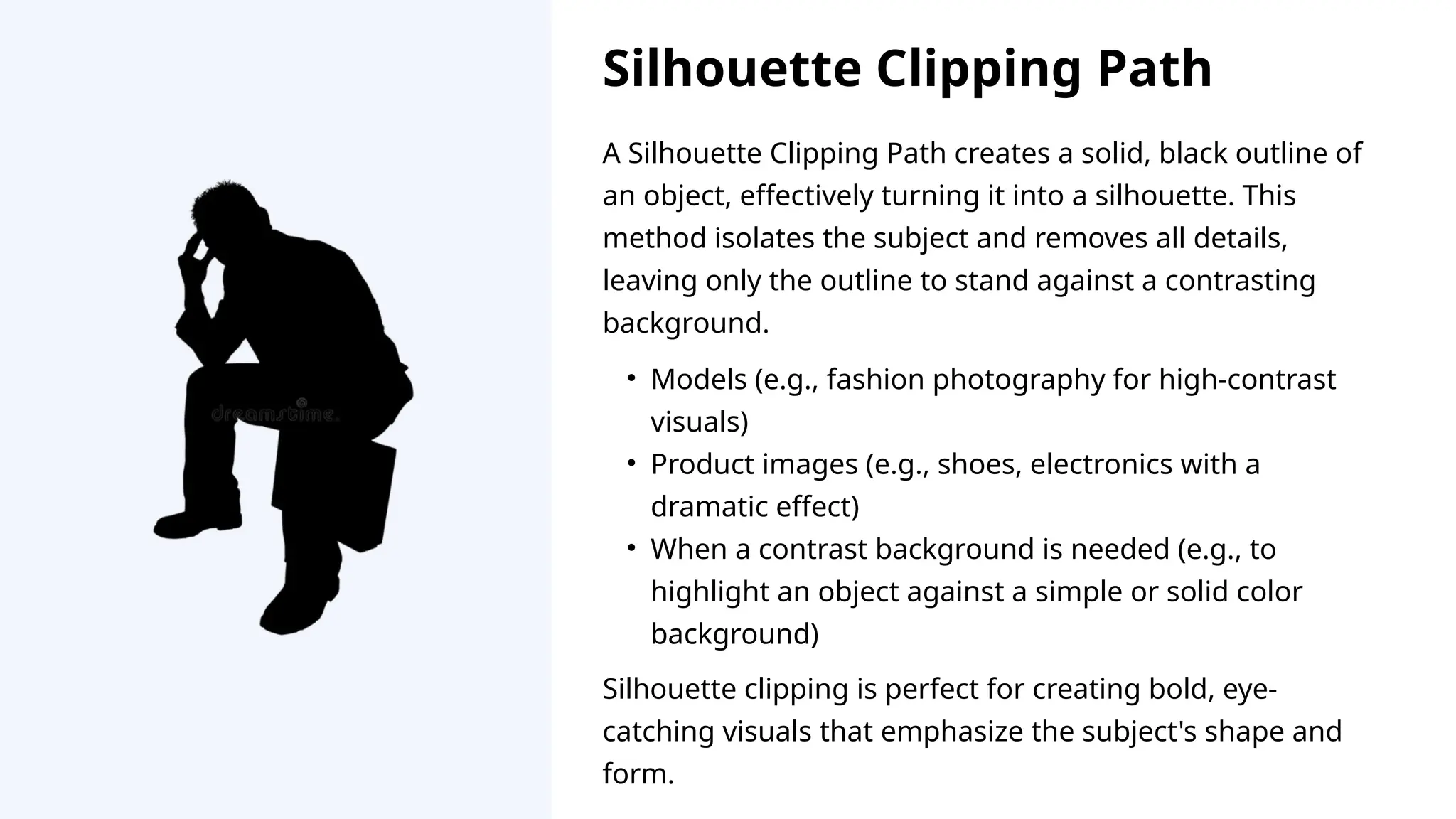
A Silhouette Clipping Path creates a solid, black outline of
an object, effectively turning it into a silhouette. This
method isolates the subject and removes all details,
leaving only the outline to stand against a contrasting
background.
Silhouette clipping is perfect for creating bold, eye-
catching visuals that emphasize the subject's shape and
form.
• Models (e.g., fashion photography for high-contrast
visuals)
• Product images (e.g., shoes, electronics with a
dramatic effect)
• When a contrast background is needed (e.g., to
highlight an object against a simple or solid color
background)
Silhouette Clipping Path
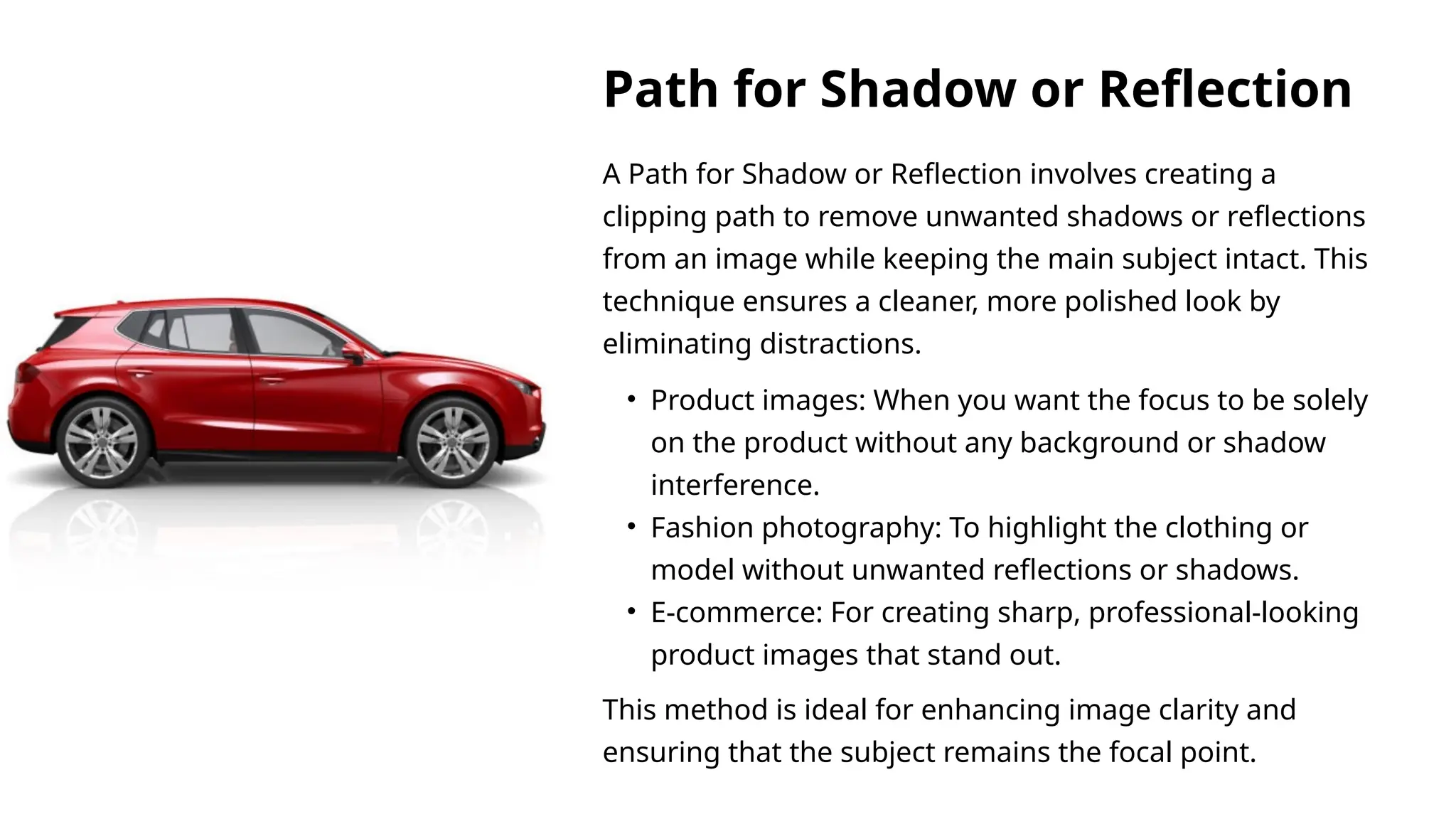
A Path for Shadow or Reflection involves creating a
clipping path to remove unwanted shadows or reflections
from an image while keeping the main subject intact. This
technique ensures a cleaner, more polished look by
eliminating distractions.
This method is ideal for enhancing image clarity and
ensuring that the subject remains the focal point.
• Product images: When you want the focus to be solely
on the product without any background or shadow
interference.
• Fashion photography: To highlight the clothing or
model without unwanted reflections or shadows.
• E-commerce: For creating sharp, professional-looking
product images that stand out.
Path for Shadow or Reflection
49 East Dewey Avenue,
Wharton, New Jersey, NJ 07885
MAILING ADDRESS
info@clippingworld.com
EMAIL ADDRESS
+1 973 607-3131
PHONE NUMBER
www.clippingworld.com
WEBSITE
THANK
YOU

Unlock Image Editing: Explore Different Clipping Path Types

  • 1.
    Types Of Clipping Path Typesof Clipping Path include techniques to isolate objects or remove backgrounds. Basic Paths suit straight-edged objects, while Complex Paths work for intricate shapes. Multi-Clipping isolates multiple elements, and Deep Etching is used for delicate items like hair. Each type suits specific needs.
  • 2.
    Introduction to ClippingPath What is a Clipping Path? A Clipping Path is a vector-based technique used in image editing to isolate an object from its background. It involves drawing a path (or outline) around the object using tools like the Pen Tool in Adobe Photoshop. Once the path is defined, the object can be separated from its background or manipulated independently. www.clippingworld.co m Definition & Purpose The main purpose of a clipping path is to cut out an object from its background with precision. It allows editors to modify the image, add new backgrounds, or use the isolated object in other compositions. Clipping paths are particularly useful for e-commerce, advertising, and photography. Importance in Photo Editing Clipping paths play a crucial role in photo editing by enhancing image quality and versatility. They help create clean, professional-looking visuals by removing distracting backgrounds and isolating objects. This is essential for product photography, marketing materials, and branding, as it ensures the focus remains on the subject, making images more engaging and visually appealing.
  • 3.
    Why Clipping PathServices Matter? Enhances Image Quality for E- commerce, Photography, Branding, etc. Clipping Path Services are essential for achieving high-quality, professional images. They play a crucial role in enhancing image clarity, ensuring that the object stands out while removing distracting elements like backgrounds. • E-commerce: High-quality product images with clean cutouts help boost sales and create a consistent, polished online presence. • Photography: For professional photographers, clipping path services ensure the final image highlights the subject perfectly, whether for portraits or event photography. • Branding: Consistent, high-quality visuals reinforce brand identity and help create memorable impressions on potential customers. • Advertising: Well-edited images help capture attention, making ads more compelling and driving engagement.
  • 4.
    Types of ClippingPath Basic Clipping Path Complex Clipping Path Multi-Clipping Path Deep Etching (Image Masking) Silhouette Clipping Path Path for Shadow or Reflection
  • 5.
    The Basic ClippingPath involves a simple, straight-edged outline around an object, typically used to remove backgrounds or isolate the object. This method is ideal for clean and uncomplicated shapes with sharp, straight edges. This type of clipping path is quick, precise, and perfect for objects without intricate or curved edges. • Flat products (e.g., books, stationery) • Simple shapes (e.g., geometric objects) • Logos • Icons and graphics Basic Clipping Path
  • 6.
    A Complex ClippingPath involves creating a detailed path around objects with curves, irregular shapes, or intricate edges. This method requires precision to ensure the contours and fine details of the subject are captured accurately. This type of clipping path is essential for products that have non-straight edges or detailed features, ensuring every curve and detail is perfectly defined. • Jewelry (e.g., rings, necklaces) • Furniture (e.g., chairs with curves, detailed woodwork) • Detailed products with complex edges (e.g., plants, sculptures) Complex Clipping Path
  • 7.
    A Multi-Clipping Pathinvolves creating separate paths within a single image to isolate different parts or objects. This allows for individual manipulation or editing of multiple elements in the same image, offering more control over each section. This technique is ideal for images where multiple elements need to be edited or showcased separately while maintaining a cohesive look. • Products with multiple components (e.g., clothing with accessories like belts, shoes, or hats) • Complex objects (e.g., furniture with cushions, handles, and legs) • Fashion items (e.g., dresses with buttons, zippers, and fabric folds) Multi-Clipping Path
  • 8.
    Deep Etching, alsoknown as Image Masking, is a technique used for intricate objects with fine details, such as hair, fur, or transparent items. It involves creating a mask that allows the object to be isolated with precision, even when dealing with complex edges or semi- transparent areas. This method is essential for achieving seamless background removal while preserving the fine details and intricate edges of transparent or delicate subjects. • Photographs with hair (e.g., portraits with flowing hair) • Glass items (e.g., bottles, glasses) • Fabrics with transparency (e.g., lace, tulle) • Objects with fine details (e.g., fur, feathers, smoke) Deep Etching (Image Masking)
  • 9.
    A Silhouette ClippingPath creates a solid, black outline of an object, effectively turning it into a silhouette. This method isolates the subject and removes all details, leaving only the outline to stand against a contrasting background. Silhouette clipping is perfect for creating bold, eye- catching visuals that emphasize the subject's shape and form. • Models (e.g., fashion photography for high-contrast visuals) • Product images (e.g., shoes, electronics with a dramatic effect) • When a contrast background is needed (e.g., to highlight an object against a simple or solid color background) Silhouette Clipping Path
  • 10.
    A Path forShadow or Reflection involves creating a clipping path to remove unwanted shadows or reflections from an image while keeping the main subject intact. This technique ensures a cleaner, more polished look by eliminating distractions. This method is ideal for enhancing image clarity and ensuring that the subject remains the focal point. • Product images: When you want the focus to be solely on the product without any background or shadow interference. • Fashion photography: To highlight the clothing or model without unwanted reflections or shadows. • E-commerce: For creating sharp, professional-looking product images that stand out. Path for Shadow or Reflection
  • 11.
    49 East DeweyAvenue, Wharton, New Jersey, NJ 07885 MAILING ADDRESS info@clippingworld.com EMAIL ADDRESS +1 973 607-3131 PHONE NUMBER www.clippingworld.com WEBSITE THANK YOU