- not allstudents
perform at the
same level
- do not perform
well and repeat
a grade
- enter the
school system at
an early age
- very rural,
remote
communities
- not many
teachers or
students
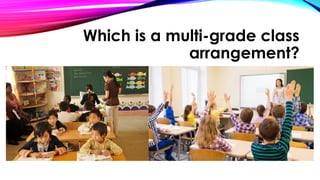
- one class, one
teacher, different
grade levels
Where are theyfound?
•Developing countries
•Also found in other countries
- Peru - Vietnam - India
- Sri Lanka - England - the United States
- Norway - the Caribbean - Columbia
- Samoa
Why do multigradesexist?
• Required not by choice but through force of circumstances
• Reflection of extreme socio-economic constraints
• Small population
• Do not have the adequate resources to hire additional
teachers
• Limited classrooms
• Lack of essential support
• Unable to buy materials or equipment
16.
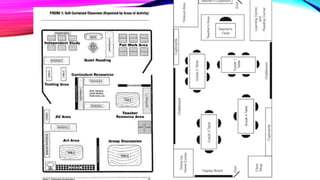
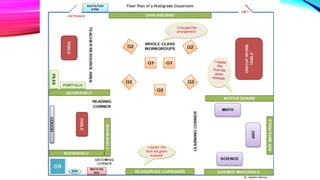
How do youset your
classroom in a multigrade
setup?
19.
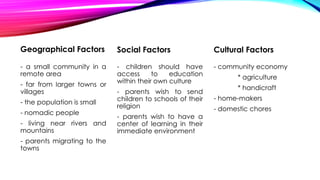
Geographical Factors SocialFactors Cultural Factors
- a small community in a
remote area
- far from larger towns or
villages
- the population is small
- nomadic people
- living near rivers and
mountains
- parents migrating to the
towns
- children should have
access to education
within their own culture
- parents wish to send
children to schools of their
religion
- parents wish to have a
center of learning in their
immediate environment
- community economy
* agriculture
* handicraft
- home-makers
- domestic chores
20.
How do smallschools
contribute to educating
the community?
21.
- increase thelevels of functional literacy and
numeracy
- provide the opportunity for each student to
go on to secondary education
- prepare students for a variety of post-primary
choices
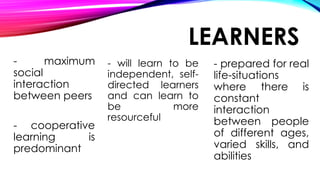
LEARNERS
- maximum
social
interaction
between peers
-cooperative
learning is
predominant
- will learn to be
independent, self-
directed learners
and can learn to
be more
resourceful
- prepared for real
life-situations
where there is
constant
interaction
between people
of different ages,
varied skills, and
abilities
24.
TEACHER
- can makethe
most of inter-
age, multi level
situation to
facilitate
learning
process
- can get to know
students more and
carefully assess
their needs and
adopt
appropriate
teaching
strategies
- can innovate
and experiment
with different age
groups and deal
with curriculum
content across
subject areas
25.
TEACHER
- shares
responsibility for
facilitating
learningwith
pupils, parents,
other community
members
- more opportunities for
activity-centered,
experience-based
approaches rather than
whole group,
lecture/drill/route methods of
teaching
26.
COMMUNITY
- efficient meansof
providing educational
services to thinly
populated areas and
remote communities
- efficient means
to using limited
educational
resources
27.
COMMUNITY
- maintaining smallbarrio schools help to
build and sustain the identity of the
community and the cultural life of the people
in the community
LEARNERS
- requires morediscipline,
greater concentration and
more focus in order to benefit
from effective strategies e.g.
peer teaching, group work, self
directed learning
- less reliance on
direct supervision by
the teacher
30.
LEARNERS
- requires moreinitiative
and resourceful to
function effectively in a
multigrade class
- may receive less
individual attention from
a less experienced
teacher or one who is not
well-trained in multigrade
teaching
31.
TEACHERS
- The Curriculum
-Planning for delivery
- Attitude
- Isolation due to
geographical location
- Disadvantaged local
environment
- Learners at different
learning levels
- Teacher frustration