THE CHALLENGES OF
MULTIGRADE
TEACHING
WHY MULTIGRADE CLASSES EXIST?
 Multigrade classes were organized as a matter of necessity for
remote barangays where the number of children enrolled could
not meet the required number to organize a single grade class
and assign the necessary teacher for each class.
 Distance of the barrio and small number of students for each
class.
 Shortage of funds teachers and school buildings.
HOW COULD I
DEAL MY
PUPILS
TODAY?
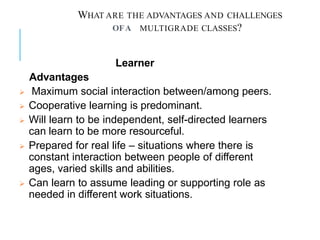
WHAT ARE THE ADVANTAGES AND CHALLENGES
MULTIGRADE CLASSES?
OFA
Learner
Advantages
 Maximum social interaction between/among peers.
 Cooperative learning is predominant.
 Will learn to be independent, self-directed learners
can learn to be more resourceful.
 Prepared for real life – situations where there is
constant interaction between people of different
ages, varied skills and abilities.
 Can learn to assume leading or supporting role as
needed in different work situations.
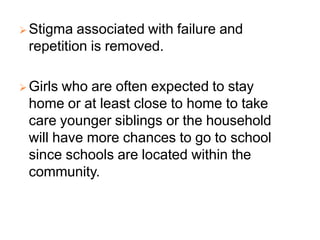
 Stigma associated with failure and
repetition is removed.
 Girls who are often expected to stay
home or at least close to home to take
care younger siblings or the household
will have more chances to go to school
since schools are located within the
community.
CHALLENGES
Requires more discipline, greater
concentration and more focus in order to
benefit from effective strategies e.g peer
teaching, group work, self directed learning.
Less reliance on direct supervision by
teacher.
Requires more initiative and resourceful to
function effectively in a multigrade class.
May receive less individual attention from a
less experienced teacher or one who is not
well-trained in multigrade teaching.
TEACHERS
Advantages
 Can make the most of
inter-age, multi-level
situation to facilitate
learning processes.
 Can get to know
students more and
carefully asses their
needs and adopt
appropriate teaching
strategies.
Challenges
 Requires more preparation
of curriculum learning
materials.
 Requires more careful study
of learner’s developmental
characteristics across the
age levels involved in the
class, approaches and
strategies that are effective
and viable within a
multigrade class.
 Can innovate and
experiment with different
age groups and deal with
curriculum content across
subject areas.
 Shares responsibility for
facilitating learning with
pupils, parents, other
community members.
 More opportunities for
activity – centered,
experience – based
approaches rather than
whole group,
lecture/drill/rote methods of
teaching.
 More investment in
organization of the
classroom as learning
environment.
 More meticulous and
systematic record keeping
to keep track of student
progress, curriculum
development and
implementation is
required.
COMMUNITY AND SCHOOL SYSTEM
Advantages
1. Efficient means of providing educational services to
thinly populated areas and remote communities.
2. Efficient means of using limited educational resources
such as trained teachers, classrooms, and materials.
3. Maintaining small barrio schools help to build and
sustain the identity of the community and the cultural
life of the people in the community.
CHALLENGE
S
Student achievement may be poor if programs
do not have the required resources and teachers
are not properly trained.
Requires investment in training of teachers,
supervisors and administrative personnel to
prepare them for the demands of multigrade
teaching and administration of multigrade schools.
WHAT DOES EFFECTIVE MULTIGRADE
TEACHING INVOLVE?
Systematic, well-organized and planned
instructional delivery and grouping.
Awell – managed classroom that is conducive
to learning because the necessary resources are
available and the necessary discipline among the
students has been developed so that they can
focus on learning.
Acooperative learning environment where self-
directed learning is balanced with teacher –
directed activities, peer teaching and group work.
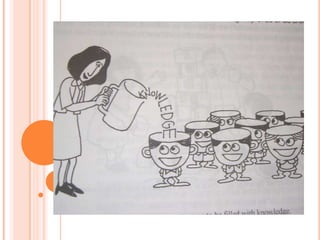
Ateacher who is well – prepared to actually serve
as a FACILITATOR of learning rather than as the only
source of knowledge in the classroom and who is well –
prepared to apply a variety of instructional strategies
and techniques to suit the varied needs of learners.
Awell – designed curriculum that allows for and
encourages integration of subject matter areas and a
variety of activities as learning experiences for the
students.
BASIC PRINCIPLES OF MULTIGRADE TEACHING
 Children are unique.
 Children can learn best from experience.
 Children can and do learn well from one another.
 The role of teacher in a classroom involves setting
– up and managing a learning environment that will
be conducive to learning and teaching.
 The implementation of the school curriculum must
take into consideration the varied abilities, levels
and interests within particular group.
 The value of any educational program will be
judged according to how well it is able to achieve
the goals of the program – whether the children
actually learn what they are expected to learn and
how well they have learned.
 Inter – aging or the combination of children of
different ages is more respectful of individual needs
of learners and reflects real – life.
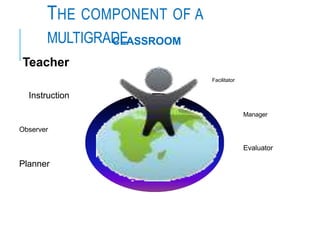
THE COMPONENT OF A
MULTIGRADE
CLASSROOM
Teacher
Facilitator
Instruction
Manager
Observer
Evaluator
Planner
HOW CHILDREN LEARN
BEST AND HOW
TEACHERS TEACH EFFECTIVELY
 Methods Teachers Frequently Use
 Lecture
 Recitation
 Discussion
 Direct Instruction
 Individualized Instruction and independent Study
 Grouping as an Instructional Strategy
 Self Directed Learner
 Peer Teaching
CLASSROOM MANAGEMENT PRACTICES AS BEST STRATEGIES FOR
AN EFFECTIVE MULTIGRADE TEACHING
INSTRUCTI
ONS
 Provides different lesson in every subject for the two
grade level.
 Plans learning activities to suit pupils’ ability and
interest.
 Divide class into small group and individual group within
a day.
 Time management is shown by alternating whole group
periods with small group activities and individual work
within a day.
 Prepares different sets of test by grade.
 Provides pupils with necessary materials to work
independently after whole group or small group
instruction.
 Allows one grade to work or read independently or
in group while discussing lessons to other grade
level.
 Treats two grade level as one in the class with
different activities suited to their level.
Pupil Management
 Assign seats for individual whole group activity.
 Schedules classroom routine such as flag ceremony,
attendance taking, and classroom maintenance activity.
 Provides attendance chart to be filled up by pupils as soon as
they arrive in class.
 Prepares daily/weekly job chart for the children to accomplish.
 Establish clear class routines such as passing of papers,
falling in line and doing individual/group works.
 Provide an access to all pupils.
 Involve children in classroom maintenance by using the “Job
Chart”.
 Allows pupils to sit by grade level facing to their own
blackboard.
 Schedules daily routines and activities.
Discipline
1. Sets classroom rules and regulations for the
children to follow.
2. Talks privately to the disruptive pupils.
3. Explains classroom rules clearly.
4. Imposes rules in passing or checking papers,
quizzes and assignments.
5. Treats pupils with justice and fairness.
6. Assign pupil secretary to monitor class behavior.
7. Requires pupils to fall in line before entering and
leaving the classroom.
8. Checks then accomplishments for daily routinary
activities.
9. Treats pupil with justice and fairness.
CLASSROOM ATMOSPHERE
 Blackboards are in opposite walls of the classroom.
 Classroom lay out is flexible to cater indoor game.
 Desks/chairs are lighter capable to be moved and
can be moved freely for group activities.
 Furniture and equipments are in movable type
capable for arranging and rearranging.
 Learning materials are properly arranged and
prepared by teachers.
 Provides a variety of arrangements throughout the
year.
 Arranges furniture in such a way it provide for
convenient flow.
 Labels the areas of the classrooms and containers
of materials for the children to easily learn its usage
and function.
 Classroom is attractively and neatly arranged.
 Maintain cleanliness and orderliness inside the
classroom.
 All parts of the room are well ventilated
THANK YOU , GOOD
LUCK!
God bless!!!!!
See you in the workforce in the near future………………

Lesson 3-Multigrade Class.pptx

  • 1.
  • 2.
    WHY MULTIGRADE CLASSESEXIST?  Multigrade classes were organized as a matter of necessity for remote barangays where the number of children enrolled could not meet the required number to organize a single grade class and assign the necessary teacher for each class.  Distance of the barrio and small number of students for each class.  Shortage of funds teachers and school buildings.
  • 3.
    HOW COULD I DEALMY PUPILS TODAY?
  • 4.
    WHAT ARE THEADVANTAGES AND CHALLENGES MULTIGRADE CLASSES? OFA Learner Advantages  Maximum social interaction between/among peers.  Cooperative learning is predominant.  Will learn to be independent, self-directed learners can learn to be more resourceful.  Prepared for real life – situations where there is constant interaction between people of different ages, varied skills and abilities.  Can learn to assume leading or supporting role as needed in different work situations.
  • 5.
     Stigma associatedwith failure and repetition is removed.  Girls who are often expected to stay home or at least close to home to take care younger siblings or the household will have more chances to go to school since schools are located within the community.
  • 7.
    CHALLENGES Requires more discipline,greater concentration and more focus in order to benefit from effective strategies e.g peer teaching, group work, self directed learning. Less reliance on direct supervision by teacher. Requires more initiative and resourceful to function effectively in a multigrade class. May receive less individual attention from a less experienced teacher or one who is not well-trained in multigrade teaching.
  • 8.
    TEACHERS Advantages  Can makethe most of inter-age, multi-level situation to facilitate learning processes.  Can get to know students more and carefully asses their needs and adopt appropriate teaching strategies. Challenges  Requires more preparation of curriculum learning materials.  Requires more careful study of learner’s developmental characteristics across the age levels involved in the class, approaches and strategies that are effective and viable within a multigrade class.
  • 9.
     Can innovateand experiment with different age groups and deal with curriculum content across subject areas.  Shares responsibility for facilitating learning with pupils, parents, other community members.  More opportunities for activity – centered, experience – based approaches rather than whole group, lecture/drill/rote methods of teaching.  More investment in organization of the classroom as learning environment.  More meticulous and systematic record keeping to keep track of student progress, curriculum development and implementation is required.
  • 10.
    COMMUNITY AND SCHOOLSYSTEM Advantages 1. Efficient means of providing educational services to thinly populated areas and remote communities. 2. Efficient means of using limited educational resources such as trained teachers, classrooms, and materials. 3. Maintaining small barrio schools help to build and sustain the identity of the community and the cultural life of the people in the community.
  • 11.
    CHALLENGE S Student achievement maybe poor if programs do not have the required resources and teachers are not properly trained. Requires investment in training of teachers, supervisors and administrative personnel to prepare them for the demands of multigrade teaching and administration of multigrade schools.
  • 12.
    WHAT DOES EFFECTIVEMULTIGRADE TEACHING INVOLVE? Systematic, well-organized and planned instructional delivery and grouping. Awell – managed classroom that is conducive to learning because the necessary resources are available and the necessary discipline among the students has been developed so that they can focus on learning. Acooperative learning environment where self- directed learning is balanced with teacher – directed activities, peer teaching and group work.
  • 13.
    Ateacher who iswell – prepared to actually serve as a FACILITATOR of learning rather than as the only source of knowledge in the classroom and who is well – prepared to apply a variety of instructional strategies and techniques to suit the varied needs of learners. Awell – designed curriculum that allows for and encourages integration of subject matter areas and a variety of activities as learning experiences for the students.
  • 14.
    BASIC PRINCIPLES OFMULTIGRADE TEACHING  Children are unique.  Children can learn best from experience.  Children can and do learn well from one another.  The role of teacher in a classroom involves setting – up and managing a learning environment that will be conducive to learning and teaching.  The implementation of the school curriculum must take into consideration the varied abilities, levels and interests within particular group.
  • 15.
     The valueof any educational program will be judged according to how well it is able to achieve the goals of the program – whether the children actually learn what they are expected to learn and how well they have learned.  Inter – aging or the combination of children of different ages is more respectful of individual needs of learners and reflects real – life.
  • 16.
    THE COMPONENT OFA MULTIGRADE CLASSROOM Teacher Facilitator Instruction Manager Observer Evaluator Planner
  • 18.
    HOW CHILDREN LEARN BESTAND HOW TEACHERS TEACH EFFECTIVELY  Methods Teachers Frequently Use  Lecture  Recitation  Discussion  Direct Instruction  Individualized Instruction and independent Study  Grouping as an Instructional Strategy  Self Directed Learner  Peer Teaching
  • 19.
    CLASSROOM MANAGEMENT PRACTICESAS BEST STRATEGIES FOR AN EFFECTIVE MULTIGRADE TEACHING INSTRUCTI ONS  Provides different lesson in every subject for the two grade level.  Plans learning activities to suit pupils’ ability and interest.  Divide class into small group and individual group within a day.  Time management is shown by alternating whole group periods with small group activities and individual work within a day.  Prepares different sets of test by grade.
  • 20.
     Provides pupilswith necessary materials to work independently after whole group or small group instruction.  Allows one grade to work or read independently or in group while discussing lessons to other grade level.  Treats two grade level as one in the class with different activities suited to their level.
  • 21.
    Pupil Management  Assignseats for individual whole group activity.  Schedules classroom routine such as flag ceremony, attendance taking, and classroom maintenance activity.  Provides attendance chart to be filled up by pupils as soon as they arrive in class.  Prepares daily/weekly job chart for the children to accomplish.  Establish clear class routines such as passing of papers, falling in line and doing individual/group works.  Provide an access to all pupils.  Involve children in classroom maintenance by using the “Job Chart”.  Allows pupils to sit by grade level facing to their own blackboard.  Schedules daily routines and activities.
  • 22.
    Discipline 1. Sets classroomrules and regulations for the children to follow. 2. Talks privately to the disruptive pupils. 3. Explains classroom rules clearly. 4. Imposes rules in passing or checking papers, quizzes and assignments. 5. Treats pupils with justice and fairness. 6. Assign pupil secretary to monitor class behavior. 7. Requires pupils to fall in line before entering and leaving the classroom. 8. Checks then accomplishments for daily routinary activities. 9. Treats pupil with justice and fairness.
  • 23.
    CLASSROOM ATMOSPHERE  Blackboardsare in opposite walls of the classroom.  Classroom lay out is flexible to cater indoor game.  Desks/chairs are lighter capable to be moved and can be moved freely for group activities.  Furniture and equipments are in movable type capable for arranging and rearranging.  Learning materials are properly arranged and prepared by teachers.  Provides a variety of arrangements throughout the year.
  • 24.
     Arranges furniturein such a way it provide for convenient flow.  Labels the areas of the classrooms and containers of materials for the children to easily learn its usage and function.  Classroom is attractively and neatly arranged.  Maintain cleanliness and orderliness inside the classroom.  All parts of the room are well ventilated
  • 25.
    THANK YOU ,GOOD LUCK! God bless!!!!! See you in the workforce in the near future………………