Masonry
2
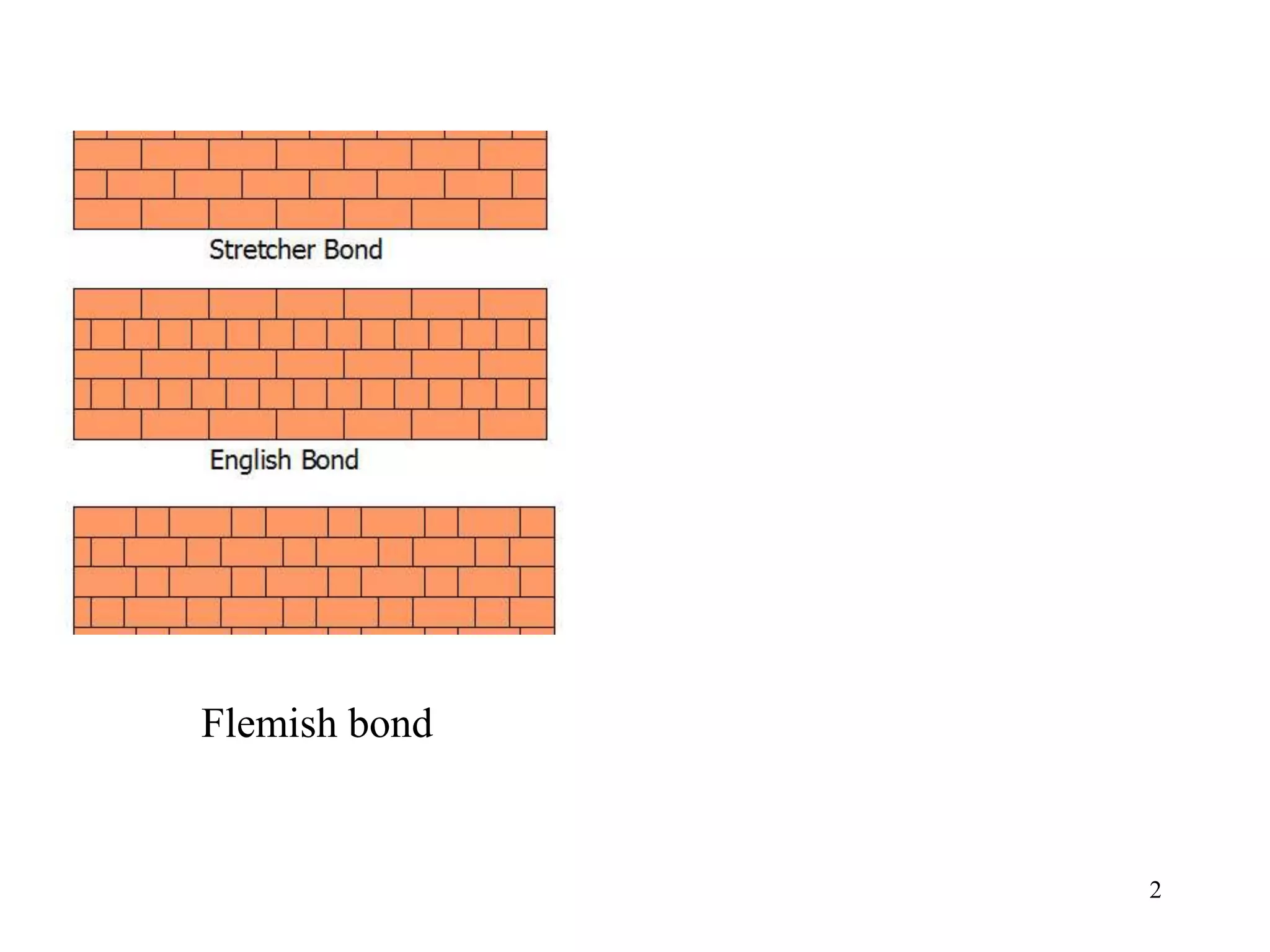
Flemish bond
STONE AND REINFORCED MASONRY
4
STONE AND REINFORCED MASONRY - OVERVIEW
 TYPES OF ROCKS USED IN STONE MASONRY
 QUARRYING AND PRODUCING OF BUILDING STONES
 TYPES OF STONE MASONRY WALLS AND THEIR
CONSTRUCTION
 PRECAST CONCRETE MASONRY AND CONSTRUCTION
OF WALLS
6
Stone vs Brick
 Similarities:
– Both stacked
– Mortar Joints
 Differences:
– Shape:
»Brick molded - Stone Cut and Carved
– Physical Properties:
»Brick made/controlled – Stone provided by nature
TYPES OF ROCKS USED IN STONE MASONRY
 Stone Masonry: Building stones obtained by quarrying from the rocky strata
of earth and reducing it to the required shapes and sizes for construction
 Types of rock: (i) Igneous - Formed as a result of cooling of the molten
rock to solid state - It is nonporous, hard, strong and durable - Granite: Consists
mainly of quartz, feldspar, mica, and other colored minerals; colors include
black, gray, red, pink, brown, buff, and green - Serpentine: Main ingredient is
serpentine; color ranges from olive green to greenish black, is fine grained and
dense - Basalt: Color ranges from gray to black; used mainly for paving stones
and retaining walls - (ii) Sedimentary: Sediments deposited by the action of
water or wind gets consolidated to a rock - Sandstone: Sedimentary rock
composed of sand sized grains made of silica, iron oxide and clay - Colors
include gray, brown, light brown, buff, russet, red, copper, and purple - Shale:
Derived from clays and silts; weak along planes and is in thin laminations - High
in limestone and color varies from black to red, yellow, and blue
8
Granite
 Non-porous, hard, strong, durable
 Color Range
 Surface Textures
 Sources
 Primary Uses
 Shale
 Limestone
 Metamorphic
 Marble
TYPES OF ROCKS USED IN STONE MASONRY (Cont’d)
10
Limestone & Sandstone
 Porous, relatively weak
 Color Range
 Surface Textures
 Sources
 Primary Uses
- Quartzite
Schist:
Slate:
10TYPES OF ROCKS USED IN STONE MASONRY
(Cont’d)
12
Metamorphic Rock
Marble
Slate
13
Slate Flooring
 Produced by blasting or cutting -
QUARRYING AND PRODUCING BUILDING STONES
15
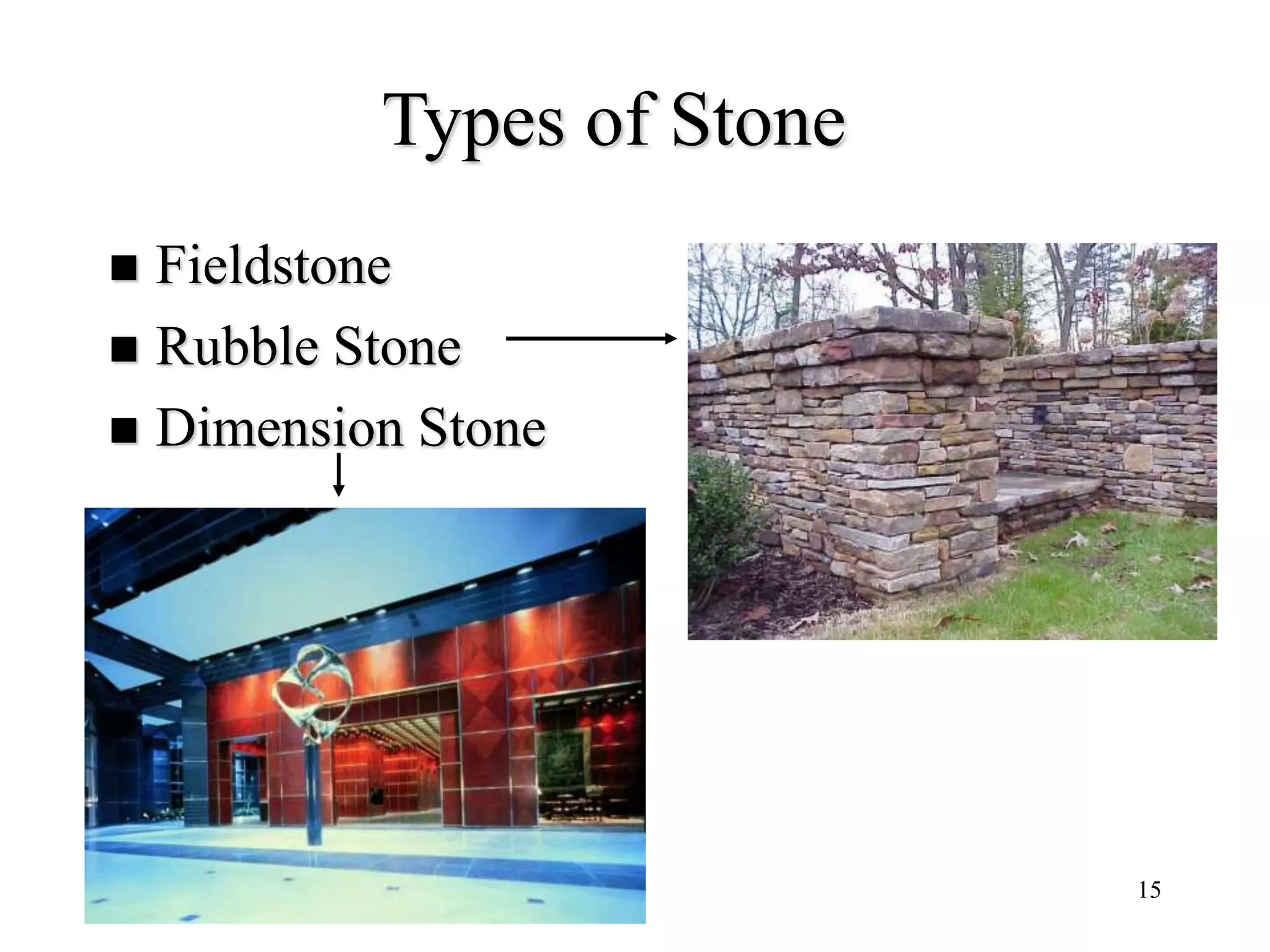
Types of Stone
 Fieldstone
 Rubble Stone
 Dimension Stone
16
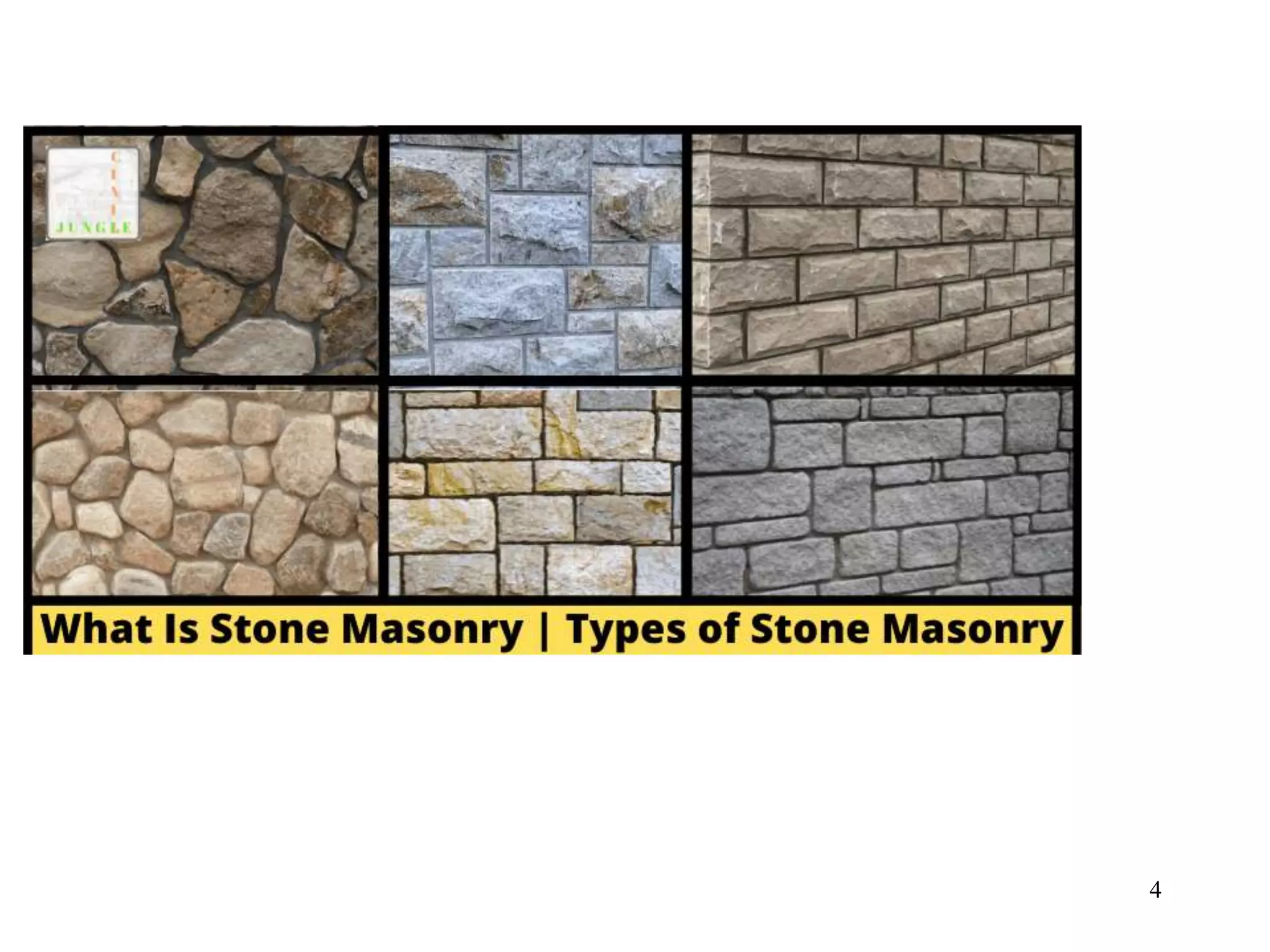
Stone Masonry Patterns
Laid in Mortar
 Rubble (Unsquare pieces)
 Ashlar (Square Pieces)
 Coursed or Random
 Orientation
17
 10.4.1 Types of Stone Masonry Walls: (i) Solid masonry wall made
by laying stone masonry over a prepared bed of mortar, and proceeding in a similar manner
to increase the height; (ii) Composite wall made of an outer wall of large stone slabs,
attached to a backing of structural frame or brick/concrete masonry wall; and (iii) Cavity
wall made by two different types of masonry wall separated by a cavity, which is either
insulated or empty and connected together by metal ties
 10.4.2 Laying of stone masonry blocks in a wall: (a) Rubble
Masonry - Composed of unsquared pieces of stones; mason has to choose carefully each
stone so that it can fit into the available space - (b) Ashlar masonry - Made of
squared pieces of stones; mason has to carefully lift the heavy stones by a hoist and lower it
into place - (c) Coursed stone masonry: has continuous horizontal joints - (d)
Uncoursed or random masonry : Does not have defined bedding planes for the
wall
10.4 TYPES OF STONE MASONRY WALLS AND THEIR
CONSTRUCTION
19
10.5 PRECAST CONCRETE MASONRY AND
CONSTRUCTION OF WALLS
 10.5.1 Precast Concrete Masonry Blocks: Manufactured by vibrating a
stiff concrete mixture into metal molds, immediately turning it out wet onto a
rack (so that the mold can be reused immediately) at a rate of 1000 or more units
per hour - Racks are cured at an accelerated rate by subjecting them to steam,
either at the atmospheric pressure or for faster curing at higher pressure. After the
units are steam cured, the units are dried to a specific moisture content, and
bundled in wooded crates for shipping to the construction site
 Made in varying sizes and shapes: Standard hollow blocks -
4”x8”x16” long or 4”x8”x8” - 6”x8”x8” or 8”x8”x8”, 10”x8”x16”, or 10”x8”x8”
, 12”x8”x16” or 12”x8”x8” - Other shapes: Channel bond beam, Low-web
beam, Solid unit, Capping unit, A-block, H block, Header unit, Control joint unit,
Single Bullnose, etc.
21
Concrete Masonry Units
 Manufacturing Process
 Configurations
 Testing Standards
22
Spanning Concrete Block
Openings
 Steel Lintels
 Block Lintels - Reinforced Bond Beam
 Precast Reinforced Concrete Lintel
23
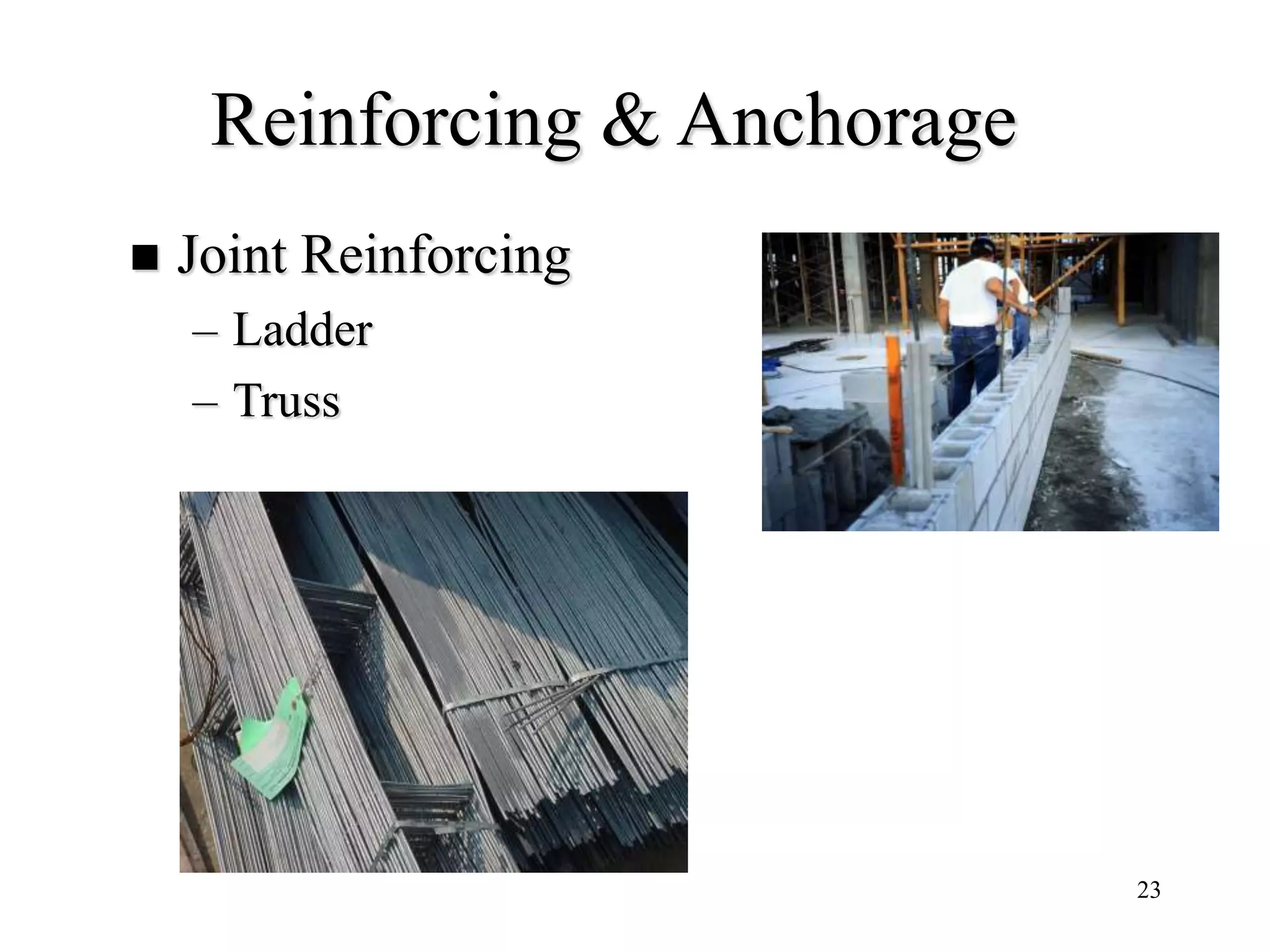
Reinforcing & Anchorage
 Joint Reinforcing
– Ladder
– Truss
10.5 PRECAST CONCRETE MASONRY AND
CONSTRUCTION OF WALLS (Cont’d)
 - Masonry grades: N - Grade; For general use above or below grade; S
grade: Above grade use only; Types : Type I - Moisture-controlled units for
use where drying shrinkage of units would cause cracking in concrete masonry;
Type II - Non-moisture-controlled units - weights: Normal, medium and light
weights
 10.5.2 Laying of Concrete Blocks in Walls:
 Mortar used in stone masonry is identical to the one used earlier in brick
masonry construction
 Only the face shells of the block are mortared with the webs unsupported
 Often reinforced with steel to increase its load bearing capacity and its
resistance to cracking
 Concrete masonry is often reinforced with horizontal reinforcement steel,
introduced as welded grids of small diameter steel rods, that are laid onto the
bed joints, at the desired vertical intervals.
25
System Properties
 Sizes: 10 foot lengths;
width should be 2” less
than wall
 Shapes: ladder & truss
 Configurations: Many
variations
 Materials: Steel with
various finishes and
gauges
Ladder
Truss
26
Installation of Mortar Bead
27
Tooled Joints
28
Control Joint

Unit IV Masonry Introduction.ppt

  • 1.
  • 2.
  • 3.
  • 4.
  • 5.
    STONE AND REINFORCEDMASONRY - OVERVIEW  TYPES OF ROCKS USED IN STONE MASONRY  QUARRYING AND PRODUCING OF BUILDING STONES  TYPES OF STONE MASONRY WALLS AND THEIR CONSTRUCTION  PRECAST CONCRETE MASONRY AND CONSTRUCTION OF WALLS
  • 6.
    6 Stone vs Brick Similarities: – Both stacked – Mortar Joints  Differences: – Shape: »Brick molded - Stone Cut and Carved – Physical Properties: »Brick made/controlled – Stone provided by nature
  • 7.
    TYPES OF ROCKSUSED IN STONE MASONRY  Stone Masonry: Building stones obtained by quarrying from the rocky strata of earth and reducing it to the required shapes and sizes for construction  Types of rock: (i) Igneous - Formed as a result of cooling of the molten rock to solid state - It is nonporous, hard, strong and durable - Granite: Consists mainly of quartz, feldspar, mica, and other colored minerals; colors include black, gray, red, pink, brown, buff, and green - Serpentine: Main ingredient is serpentine; color ranges from olive green to greenish black, is fine grained and dense - Basalt: Color ranges from gray to black; used mainly for paving stones and retaining walls - (ii) Sedimentary: Sediments deposited by the action of water or wind gets consolidated to a rock - Sandstone: Sedimentary rock composed of sand sized grains made of silica, iron oxide and clay - Colors include gray, brown, light brown, buff, russet, red, copper, and purple - Shale: Derived from clays and silts; weak along planes and is in thin laminations - High in limestone and color varies from black to red, yellow, and blue
  • 8.
    8 Granite  Non-porous, hard,strong, durable  Color Range  Surface Textures  Sources  Primary Uses
  • 9.
     Shale  Limestone Metamorphic  Marble TYPES OF ROCKS USED IN STONE MASONRY (Cont’d)
  • 10.
    10 Limestone & Sandstone Porous, relatively weak  Color Range  Surface Textures  Sources  Primary Uses
  • 11.
    - Quartzite Schist: Slate: 10TYPES OFROCKS USED IN STONE MASONRY (Cont’d)
  • 12.
  • 13.
  • 14.
     Produced byblasting or cutting - QUARRYING AND PRODUCING BUILDING STONES
  • 15.
    15 Types of Stone Fieldstone  Rubble Stone  Dimension Stone
  • 16.
    16 Stone Masonry Patterns Laidin Mortar  Rubble (Unsquare pieces)  Ashlar (Square Pieces)  Coursed or Random  Orientation
  • 17.
  • 18.
     10.4.1 Typesof Stone Masonry Walls: (i) Solid masonry wall made by laying stone masonry over a prepared bed of mortar, and proceeding in a similar manner to increase the height; (ii) Composite wall made of an outer wall of large stone slabs, attached to a backing of structural frame or brick/concrete masonry wall; and (iii) Cavity wall made by two different types of masonry wall separated by a cavity, which is either insulated or empty and connected together by metal ties  10.4.2 Laying of stone masonry blocks in a wall: (a) Rubble Masonry - Composed of unsquared pieces of stones; mason has to choose carefully each stone so that it can fit into the available space - (b) Ashlar masonry - Made of squared pieces of stones; mason has to carefully lift the heavy stones by a hoist and lower it into place - (c) Coursed stone masonry: has continuous horizontal joints - (d) Uncoursed or random masonry : Does not have defined bedding planes for the wall 10.4 TYPES OF STONE MASONRY WALLS AND THEIR CONSTRUCTION
  • 19.
  • 20.
    10.5 PRECAST CONCRETEMASONRY AND CONSTRUCTION OF WALLS  10.5.1 Precast Concrete Masonry Blocks: Manufactured by vibrating a stiff concrete mixture into metal molds, immediately turning it out wet onto a rack (so that the mold can be reused immediately) at a rate of 1000 or more units per hour - Racks are cured at an accelerated rate by subjecting them to steam, either at the atmospheric pressure or for faster curing at higher pressure. After the units are steam cured, the units are dried to a specific moisture content, and bundled in wooded crates for shipping to the construction site  Made in varying sizes and shapes: Standard hollow blocks - 4”x8”x16” long or 4”x8”x8” - 6”x8”x8” or 8”x8”x8”, 10”x8”x16”, or 10”x8”x8” , 12”x8”x16” or 12”x8”x8” - Other shapes: Channel bond beam, Low-web beam, Solid unit, Capping unit, A-block, H block, Header unit, Control joint unit, Single Bullnose, etc.
  • 21.
    21 Concrete Masonry Units Manufacturing Process  Configurations  Testing Standards
  • 22.
    22 Spanning Concrete Block Openings Steel Lintels  Block Lintels - Reinforced Bond Beam  Precast Reinforced Concrete Lintel
  • 23.
    23 Reinforcing & Anchorage Joint Reinforcing – Ladder – Truss
  • 24.
    10.5 PRECAST CONCRETEMASONRY AND CONSTRUCTION OF WALLS (Cont’d)  - Masonry grades: N - Grade; For general use above or below grade; S grade: Above grade use only; Types : Type I - Moisture-controlled units for use where drying shrinkage of units would cause cracking in concrete masonry; Type II - Non-moisture-controlled units - weights: Normal, medium and light weights  10.5.2 Laying of Concrete Blocks in Walls:  Mortar used in stone masonry is identical to the one used earlier in brick masonry construction  Only the face shells of the block are mortared with the webs unsupported  Often reinforced with steel to increase its load bearing capacity and its resistance to cracking  Concrete masonry is often reinforced with horizontal reinforcement steel, introduced as welded grids of small diameter steel rods, that are laid onto the bed joints, at the desired vertical intervals.
  • 25.
    25 System Properties  Sizes:10 foot lengths; width should be 2” less than wall  Shapes: ladder & truss  Configurations: Many variations  Materials: Steel with various finishes and gauges Ladder Truss
  • 26.
  • 27.
  • 28.

Editor's Notes

  • #3 https://www.youtube.com/watch?v=TCnqDm5Oqrc