Unit, Integration, and Functional Testing: 4
main points of difference
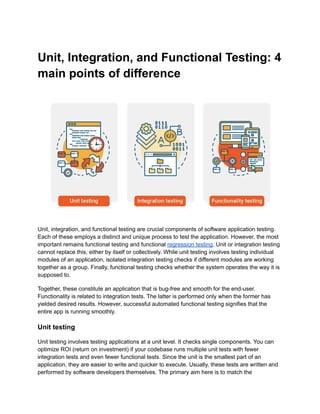
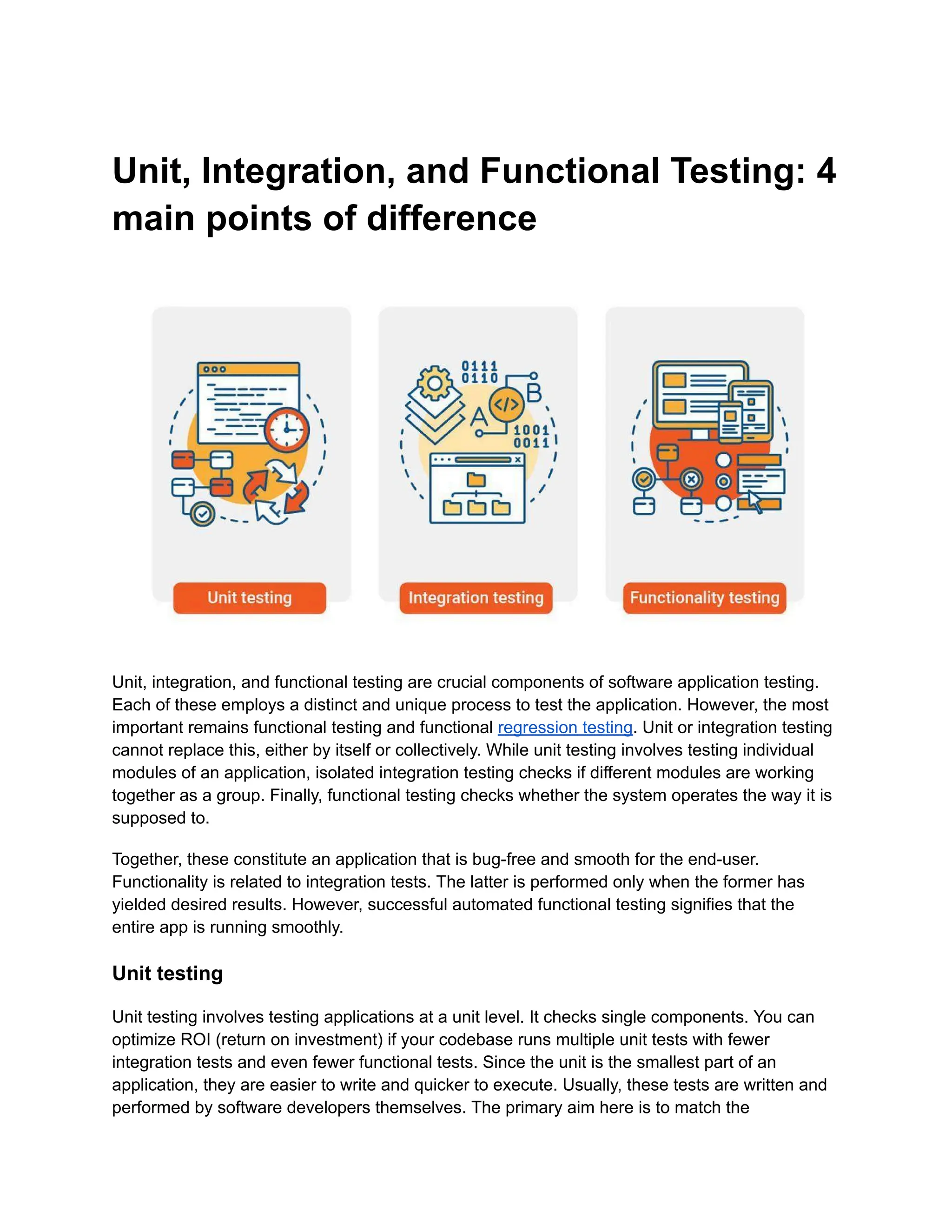
Unit, integration, and functional testing are crucial components of software application testing.
Each of these employs a distinct and unique process to test the application. However, the most
important remains functional testing and functional regression testing. Unit or integration testing
cannot replace this, either by itself or collectively. While unit testing involves testing individual
modules of an application, isolated integration testing checks if different modules are working
together as a group. Finally, functional testing checks whether the system operates the way it is
supposed to.
Together, these constitute an application that is bug-free and smooth for the end-user.
Functionality is related to integration tests. The latter is performed only when the former has
yielded desired results. However, successful automated functional testing signifies that the
entire app is running smoothly.
Unit testing
Unit testing involves testing applications at a unit level. It checks single components. You can
optimize ROI (return on investment) if your codebase runs multiple unit tests with fewer
integration tests and even fewer functional tests. Since the unit is the smallest part of an
application, they are easier to write and quicker to execute. Usually, these tests are written and
performed by software developers themselves. The primary aim here is to match the
requirements to the unit's behavior. This kind of testing is usually done before integration testing
using white box testing techniques. Some of the most popular unit testing tools used for different
languages are JUnit of Java Framework, PHPUnit of PHP framework, and NUnit of .Net
framework.
Unit testing has several benefits, for instance:
● It checks whether or not there is correct output for valid input.
● It also checks for failures that occur with invalid input.
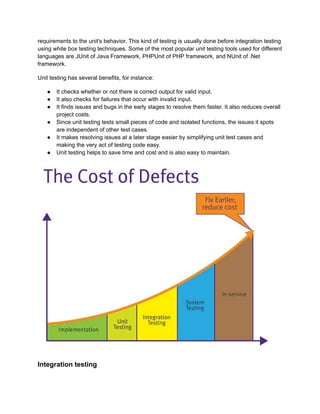
● It finds issues and bugs in the early stages to resolve them faster. It also reduces overall
project costs.
● Since unit testing tests small pieces of code and isolated functions, the issues it spots
are independent of other test cases.
● It makes resolving issues at a later stage easier by simplifying unit test cases and
making the very act of testing code easy.
● Unit testing helps to save time and cost and is also easy to maintain.
Integration testing
Integration testing, as mentioned before, tests if the different parts of a system can work
together and how well they work in synthesis. Various modules of such an ecosystem are
merged to facilitate integration testing procedures. The purpose of this is to check the overall
performance and reliability. This is performed on modules that have already undergone unit
testing. It then defines if the combination of these elements can provide the desired output or
not.
There are three types of approaches to integration testing as are as follows:
The Big Bang Approach
● Here, the modules are integrated and tested as a whole if the entire system is ready for
such an integration. This is different from system testing. While system testing is for the
ecosystem, integration testing checks only the modules. The Big Bang Approach lets
you test everything simultaneously, thereby preserving resources. However, it could be
challenging to identify specific errors.
The Top-Down Approach
● Here, different modules or units are combined is tested using a top-to-bottom approach.
First, the units are tested individually by writing test STUBS. Lower levels are then
integrated in sequential order until the last one is compiled and tested. Experts believe
that it is the most organic way of organizing a test because it is similar to the way things
happen in real-life situations. The primary issue is that functionality is constantly tested
at the end. It could mean going back and fixing issues through functional regression
testing.
The Bottom-Up Approach
Modules are tested from the bottom to the topmost level in the bottom-up approach. Simulator
programs called DRIVERS facilitate this process. The bottom-up approach helps to detect bugs
at lower levels. It enables the team to function as expected.
Functionality testing
Automated functional testing is a black-box testing technique that ensures the overall operability
of the application. This checks if a desirable output is generated out of a specific input. Test
cases are then written based on the requirements and scenarios and then implemented. The
number of tests can vary based on the nature of the software. Each test case comprises the test
summary, prerequisites, input steps, test data, expected output, and notes (if any).
The two forms of automated functional testing are as follows:
● Requirement-based: The test cases are created based on the app's demands.
● Business scenario-based: The tests are customized to align with the business strategy.
Functional regression testing tests, or rather re-tests applications when new and improved
features are added, and functions are modified for existing applications. It also checks if the
older attributes and functionalities work well with the upgrades. While functional testing can
assure all operations are working flawlessly, functional regression testing comes into play only
when the team has published a new build that aims to fix bugs or debug new updates.
The benefits of functional regression testing include the following:
● It plays an integral role in agile environments where every sprint is crucial. Functional
regression testing makes sure that previous and current releases all work together
seamlessly.
● It helps to identify bugs in the software. Regression tests make software resistant to
discrepancies. Such procedures provide support to testing and QA teams to deliver fast
results.
● It helps retain the integrity of an application despite new additions.
● Regressive testing helps to shorten the overall testing lifecycle.
● These tests help achieve a higher Customer Satisfaction Index (CSI) and can eventually
be considered crucial for expanding business.
● They help reduce calls for incidents in production. Thus, the cost of the overall project
reduces.
The main differences between the three
The differences between unit testing, integration testing, and functionality testing can be divided
into the following categories:
● Purpose: Unit testing checks the most basic unit of the application, each module,
individually. Integration testing checks two or more modules combined to perform tasks.
Functional automation testing tests the behavior of the application when it functions as a
whole.
● Complexity: Unit testing is simple in its language and is easy to write since it includes
the smallest of codes. While integration testing is slightly more complex compared to unit
tests, functionality testing constitutes the most complicated of the batch.
● Testing techniques: Unit testing involves white box testing techniques. Functionality
regression testing consists of only black-box testing techniques. Integration testing uses
both black and white box techniques- also called grey-box testing.
● Errors covered: Unit tests can cover issues that occur with frequency in different
modules. It nullifies the chance of any problem going unnoticed. In the case of
integration testing, the errors covered include bugs that occur when integrating various
modules. Issue escape is a rare occurrence. For automated functionality testing, issues
that hinder the performance of an application are identified. Scenario-based problems
are also tested here. There is the most chance of issue escape here because the list of
tests to be run is infinite.
A focus on functional vs. unit testing
When examining functional vs. unit testing, it’s crucial to understand their distinct roles within the
software testing lifecycle. Unit testing concentrates on testing individual components or
functions of the software in isolation. Developers use unit tests to ensure specific parts of the
code, such as methods or classes, work as expected. These tests are highly granular, quick to
execute and help catch bugs early in development, ensuring the internal logic of the code
functions correctly without dependencies.
In contrast, functional testing evaluates the software's performance by testing its functionality in
real-world scenarios. It assesses the application's workflow, interactions, and behavior to ensure
the software meets user requirements. Unlike unit tests, functional tests simulate user
experiences to ensure the software operates as intended.
The difference between functional vs. unit testing lies in their scope: unit testing ensures the
correctness of individual components, while functional testing verifies the application's overall
functionality. When choosing between functional vs. unit testing, it’s essential to recognize that
both testing types are necessary to deliver reliable, high-quality software. However, they serve
different purposes at various stages of development.
Functional Testing Vs. Unit Testing Vs. Integration
Testing
Criteria Functional Testing Unit Testing Integration Testing
Purpose Validate that the entire
application works as intended
according to user
requirements.
Ensure that
individual units or
functions work
correctly.
Verify that different
units work together as
expected.
Complexity High, as it involves the entire
system and user scenarios.
Low, focusing on
small, isolated
pieces of code.
Medium, as it involves
multiple units and their
interactions.
Testing
Technique
Black-box testing. White-box testing. Both black-box and
white-box testing.
Errors
Covered
Logical, workflow, and
system-level errors.
Syntax, logical, and
isolated functional
errors.
Interface errors, data
flow issues, and
interaction problems.
Conclusion
To conclude, we must understand that these processes are interconnected and correlated. Unit
testing is imperative to ensure that your software is working seamlessly. Unit testing facilitates
flawless paths and lines of code. This, in turn, must be followed by integration tests to make
sure that separate units can work together cohesively. Finally, all of the above must be followed
by functional tests to deliver a polished app. Functional regression testing also needs to be
performed if the application in question is an existing software where updates are being
implemented.
Article Source:
This article was originally published on:
https://www.headspin.io/blog/unit-integration-and-functional-testing-4-main-points-of-difference

Unit, Integration, and Functional Testing_ 4 main points of difference.pdf

  • 1.
    Unit, Integration, andFunctional Testing: 4 main points of difference Unit, integration, and functional testing are crucial components of software application testing. Each of these employs a distinct and unique process to test the application. However, the most important remains functional testing and functional regression testing. Unit or integration testing cannot replace this, either by itself or collectively. While unit testing involves testing individual modules of an application, isolated integration testing checks if different modules are working together as a group. Finally, functional testing checks whether the system operates the way it is supposed to. Together, these constitute an application that is bug-free and smooth for the end-user. Functionality is related to integration tests. The latter is performed only when the former has yielded desired results. However, successful automated functional testing signifies that the entire app is running smoothly. Unit testing Unit testing involves testing applications at a unit level. It checks single components. You can optimize ROI (return on investment) if your codebase runs multiple unit tests with fewer integration tests and even fewer functional tests. Since the unit is the smallest part of an application, they are easier to write and quicker to execute. Usually, these tests are written and performed by software developers themselves. The primary aim here is to match the
  • 2.
    requirements to theunit's behavior. This kind of testing is usually done before integration testing using white box testing techniques. Some of the most popular unit testing tools used for different languages are JUnit of Java Framework, PHPUnit of PHP framework, and NUnit of .Net framework. Unit testing has several benefits, for instance: ● It checks whether or not there is correct output for valid input. ● It also checks for failures that occur with invalid input. ● It finds issues and bugs in the early stages to resolve them faster. It also reduces overall project costs. ● Since unit testing tests small pieces of code and isolated functions, the issues it spots are independent of other test cases. ● It makes resolving issues at a later stage easier by simplifying unit test cases and making the very act of testing code easy. ● Unit testing helps to save time and cost and is also easy to maintain. Integration testing
  • 3.
    Integration testing, asmentioned before, tests if the different parts of a system can work together and how well they work in synthesis. Various modules of such an ecosystem are merged to facilitate integration testing procedures. The purpose of this is to check the overall performance and reliability. This is performed on modules that have already undergone unit testing. It then defines if the combination of these elements can provide the desired output or not. There are three types of approaches to integration testing as are as follows: The Big Bang Approach ● Here, the modules are integrated and tested as a whole if the entire system is ready for such an integration. This is different from system testing. While system testing is for the ecosystem, integration testing checks only the modules. The Big Bang Approach lets you test everything simultaneously, thereby preserving resources. However, it could be challenging to identify specific errors. The Top-Down Approach ● Here, different modules or units are combined is tested using a top-to-bottom approach. First, the units are tested individually by writing test STUBS. Lower levels are then integrated in sequential order until the last one is compiled and tested. Experts believe that it is the most organic way of organizing a test because it is similar to the way things happen in real-life situations. The primary issue is that functionality is constantly tested at the end. It could mean going back and fixing issues through functional regression testing. The Bottom-Up Approach Modules are tested from the bottom to the topmost level in the bottom-up approach. Simulator programs called DRIVERS facilitate this process. The bottom-up approach helps to detect bugs at lower levels. It enables the team to function as expected. Functionality testing Automated functional testing is a black-box testing technique that ensures the overall operability of the application. This checks if a desirable output is generated out of a specific input. Test cases are then written based on the requirements and scenarios and then implemented. The number of tests can vary based on the nature of the software. Each test case comprises the test summary, prerequisites, input steps, test data, expected output, and notes (if any). The two forms of automated functional testing are as follows: ● Requirement-based: The test cases are created based on the app's demands. ● Business scenario-based: The tests are customized to align with the business strategy.
  • 4.
    Functional regression testingtests, or rather re-tests applications when new and improved features are added, and functions are modified for existing applications. It also checks if the older attributes and functionalities work well with the upgrades. While functional testing can assure all operations are working flawlessly, functional regression testing comes into play only when the team has published a new build that aims to fix bugs or debug new updates. The benefits of functional regression testing include the following: ● It plays an integral role in agile environments where every sprint is crucial. Functional regression testing makes sure that previous and current releases all work together seamlessly. ● It helps to identify bugs in the software. Regression tests make software resistant to discrepancies. Such procedures provide support to testing and QA teams to deliver fast results. ● It helps retain the integrity of an application despite new additions. ● Regressive testing helps to shorten the overall testing lifecycle. ● These tests help achieve a higher Customer Satisfaction Index (CSI) and can eventually be considered crucial for expanding business. ● They help reduce calls for incidents in production. Thus, the cost of the overall project reduces. The main differences between the three The differences between unit testing, integration testing, and functionality testing can be divided into the following categories: ● Purpose: Unit testing checks the most basic unit of the application, each module, individually. Integration testing checks two or more modules combined to perform tasks. Functional automation testing tests the behavior of the application when it functions as a whole. ● Complexity: Unit testing is simple in its language and is easy to write since it includes the smallest of codes. While integration testing is slightly more complex compared to unit tests, functionality testing constitutes the most complicated of the batch. ● Testing techniques: Unit testing involves white box testing techniques. Functionality regression testing consists of only black-box testing techniques. Integration testing uses both black and white box techniques- also called grey-box testing. ● Errors covered: Unit tests can cover issues that occur with frequency in different modules. It nullifies the chance of any problem going unnoticed. In the case of integration testing, the errors covered include bugs that occur when integrating various modules. Issue escape is a rare occurrence. For automated functionality testing, issues that hinder the performance of an application are identified. Scenario-based problems are also tested here. There is the most chance of issue escape here because the list of tests to be run is infinite.
  • 5.
    A focus onfunctional vs. unit testing When examining functional vs. unit testing, it’s crucial to understand their distinct roles within the software testing lifecycle. Unit testing concentrates on testing individual components or functions of the software in isolation. Developers use unit tests to ensure specific parts of the code, such as methods or classes, work as expected. These tests are highly granular, quick to execute and help catch bugs early in development, ensuring the internal logic of the code functions correctly without dependencies. In contrast, functional testing evaluates the software's performance by testing its functionality in real-world scenarios. It assesses the application's workflow, interactions, and behavior to ensure the software meets user requirements. Unlike unit tests, functional tests simulate user experiences to ensure the software operates as intended. The difference between functional vs. unit testing lies in their scope: unit testing ensures the correctness of individual components, while functional testing verifies the application's overall functionality. When choosing between functional vs. unit testing, it’s essential to recognize that both testing types are necessary to deliver reliable, high-quality software. However, they serve different purposes at various stages of development. Functional Testing Vs. Unit Testing Vs. Integration Testing Criteria Functional Testing Unit Testing Integration Testing Purpose Validate that the entire application works as intended according to user requirements. Ensure that individual units or functions work correctly. Verify that different units work together as expected. Complexity High, as it involves the entire system and user scenarios. Low, focusing on small, isolated pieces of code. Medium, as it involves multiple units and their interactions. Testing Technique Black-box testing. White-box testing. Both black-box and white-box testing. Errors Covered Logical, workflow, and system-level errors. Syntax, logical, and isolated functional errors. Interface errors, data flow issues, and interaction problems. Conclusion
  • 6.
    To conclude, wemust understand that these processes are interconnected and correlated. Unit testing is imperative to ensure that your software is working seamlessly. Unit testing facilitates flawless paths and lines of code. This, in turn, must be followed by integration tests to make sure that separate units can work together cohesively. Finally, all of the above must be followed by functional tests to deliver a polished app. Functional regression testing also needs to be performed if the application in question is an existing software where updates are being implemented. Article Source: This article was originally published on: https://www.headspin.io/blog/unit-integration-and-functional-testing-4-main-points-of-difference