PL/SQL
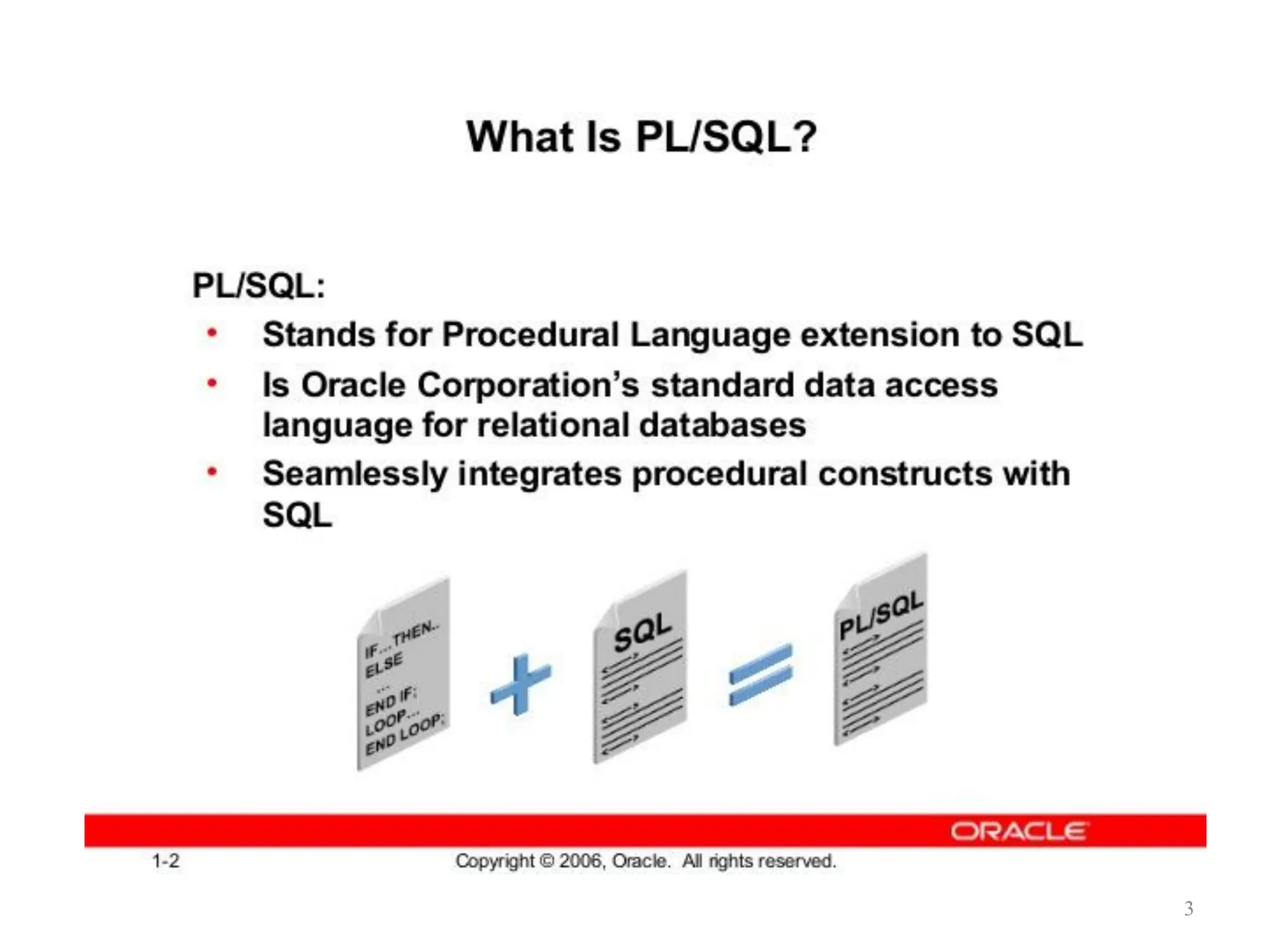
PL/SQL stands for Procedural
Language extension of SQL.
By
MOHD MIRZA
OCP(Oracle Certified Professional)
1
2
3
4
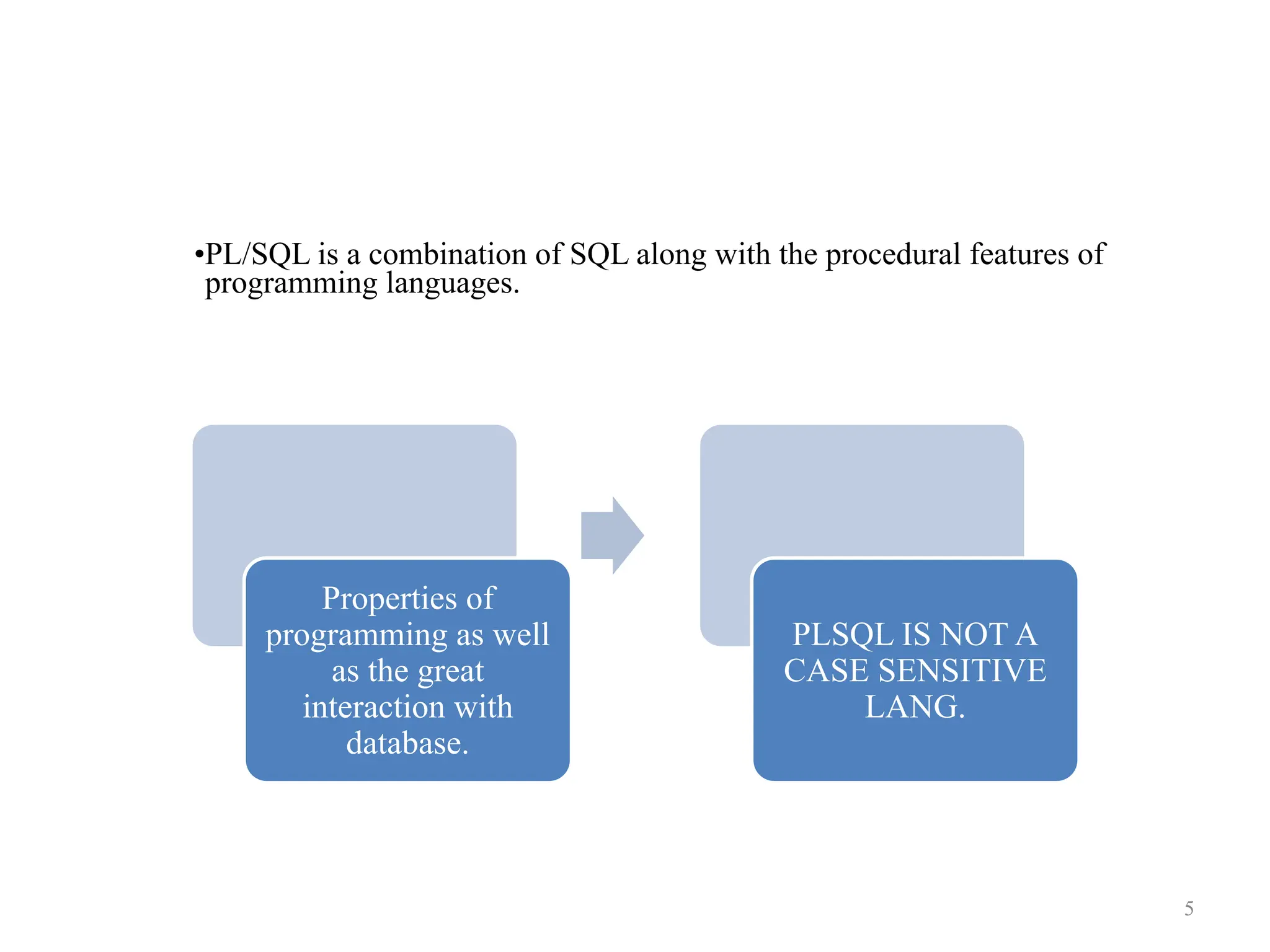
•PL/SQL is a combination of SQL along with the procedural features of
programming languages.
Properties of
programming as well
as the great
interaction with
database.
PLSQL IS NOT A
CASE SENSITIVE
LANG.
5
ZCOER, Department of Computer
Engineering
6
7
8
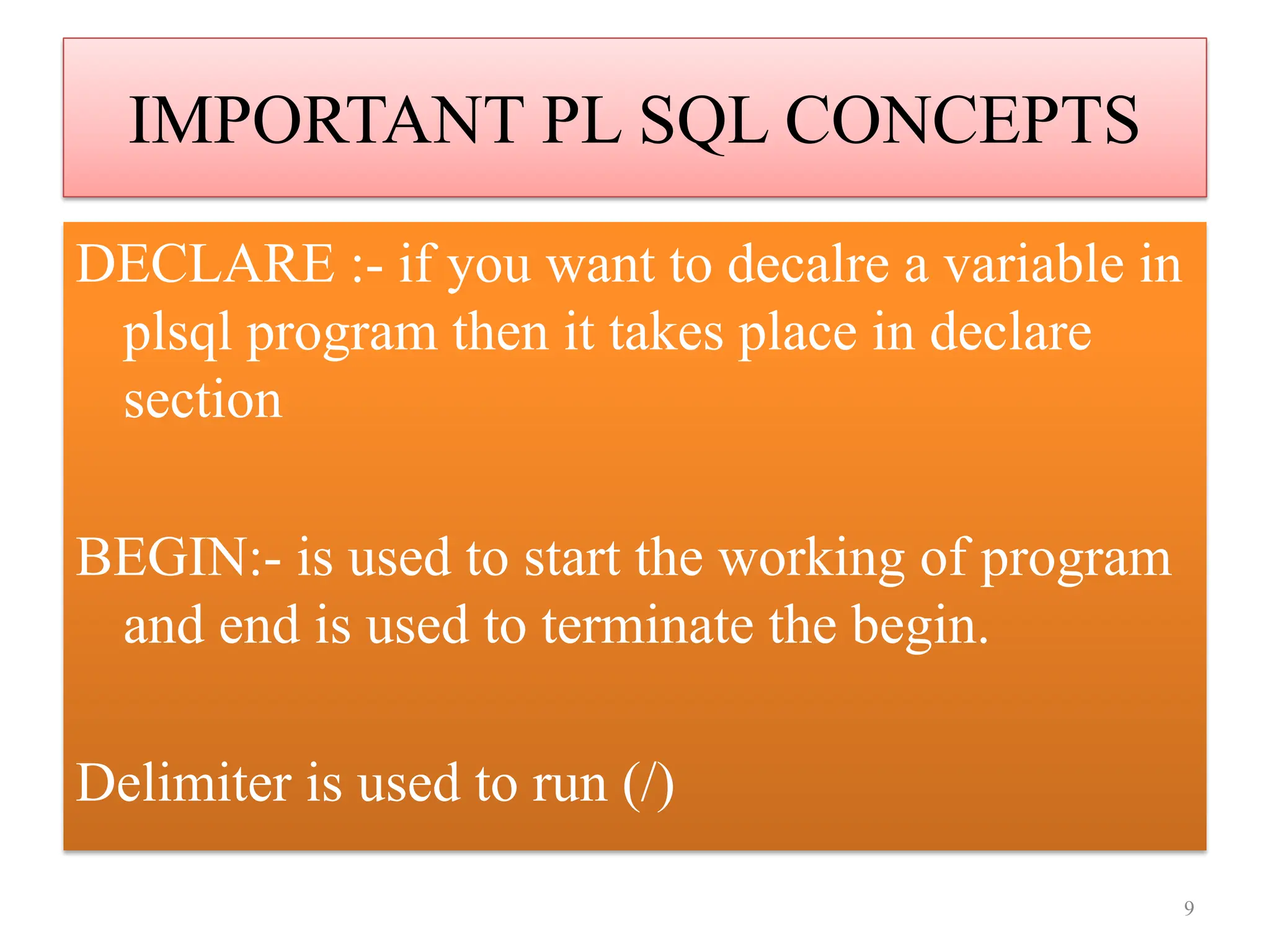
IMPORTANT PL SQL CONCEPTS
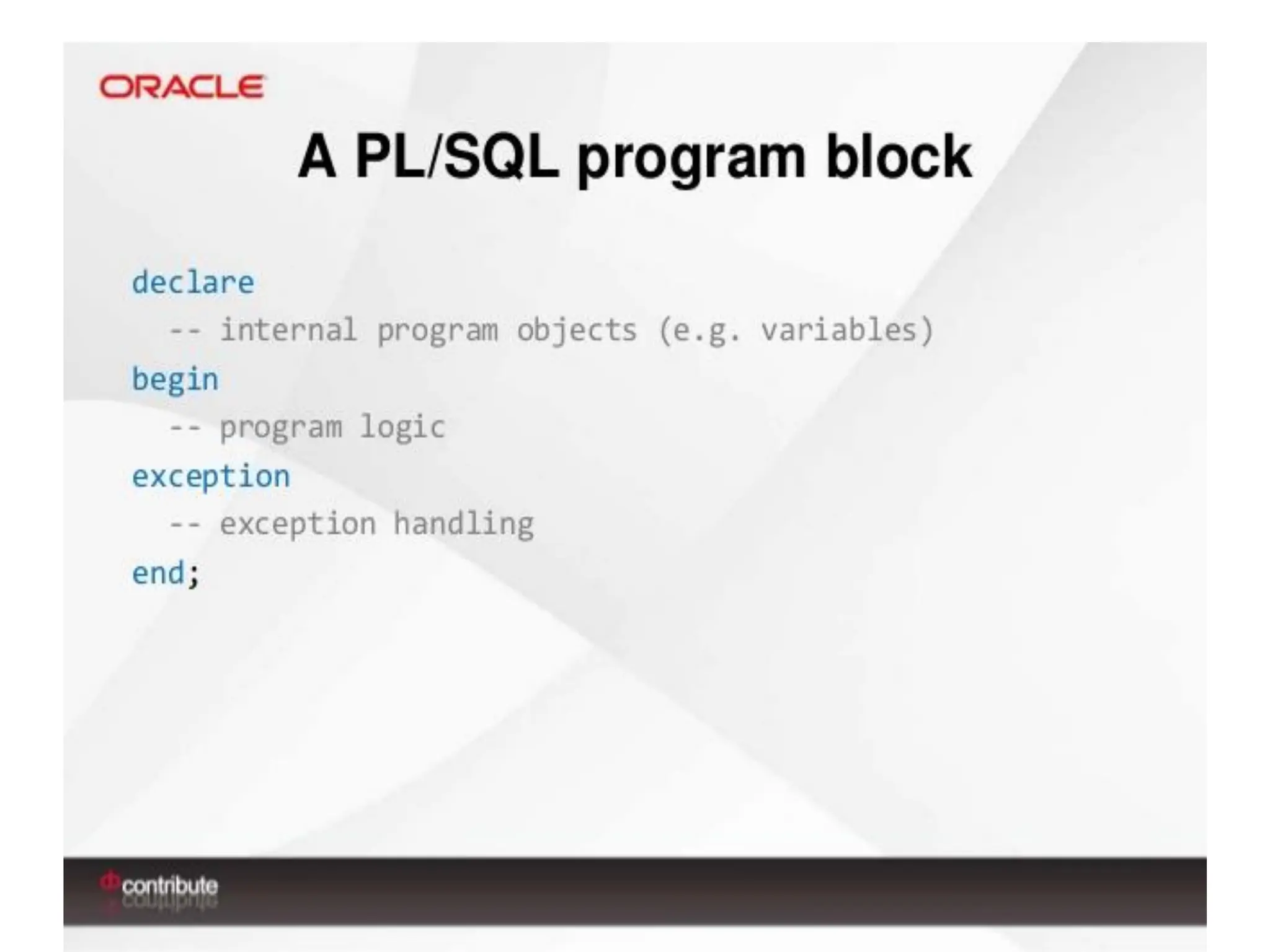
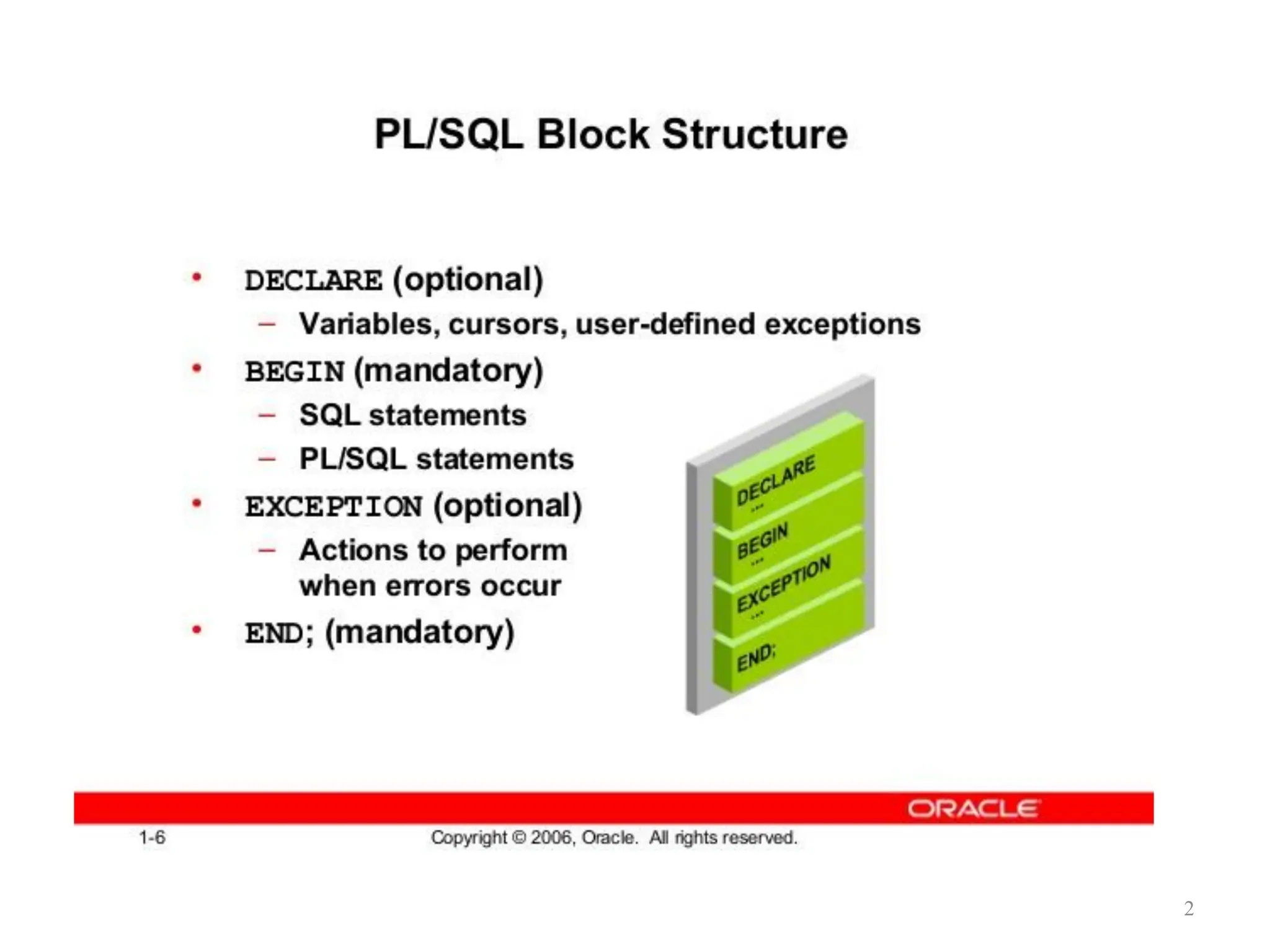
DECLARE :- if you want to decalre a variable in
plsql program then it takes place in declare
section
BEGIN:- is used to start the working of program
and end is used to terminate the begin.
Delimiter is used to run (/)
9
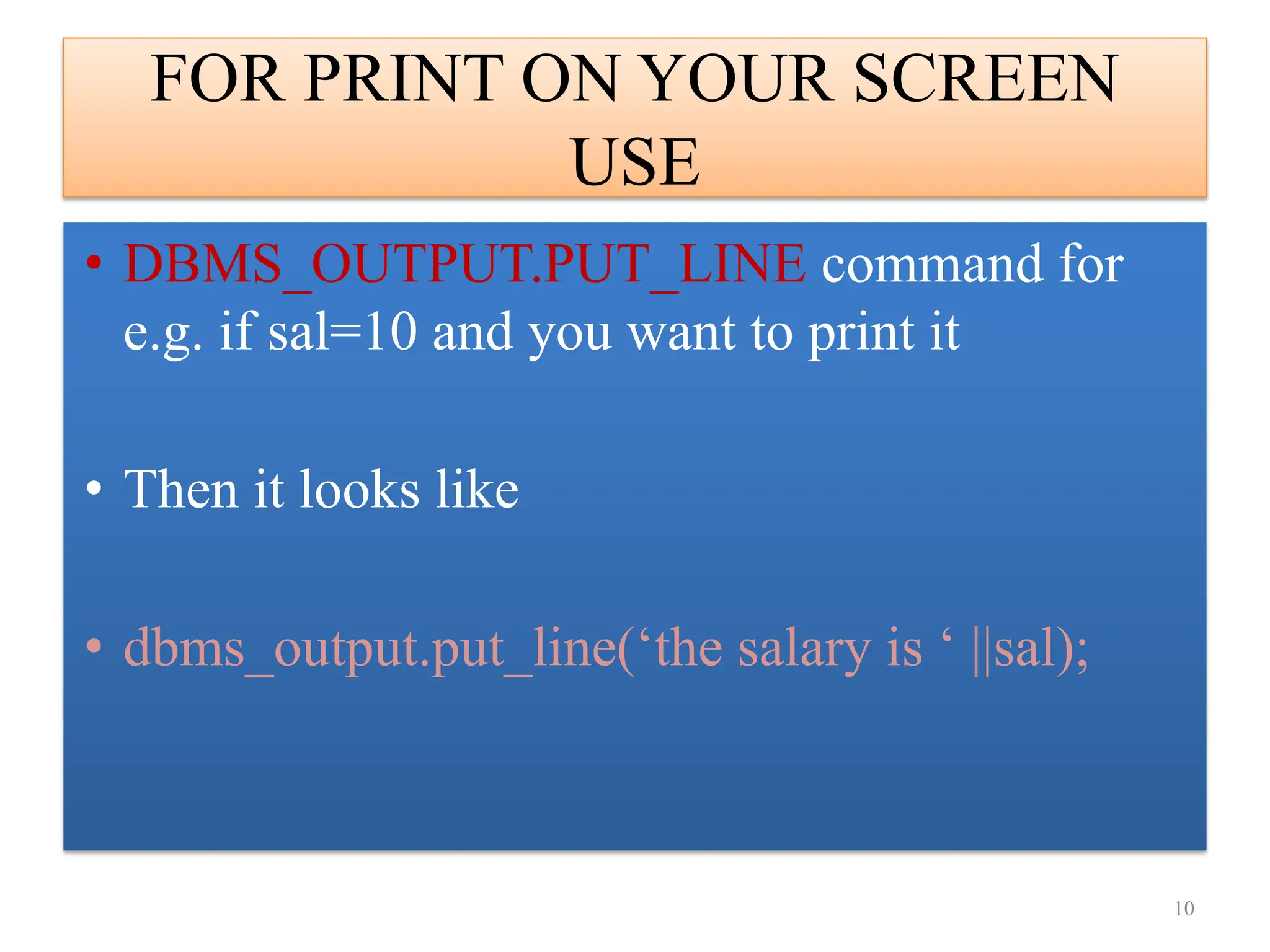
FOR PRINT ON YOUR SCREEN
USE
• DBMS_OUTPUT.PUT_LINE command for
e.g. if sal=10 and you want to print it
• Then it looks like
• dbms_output.put_line(‘the salary is ‘ ||sal);
10
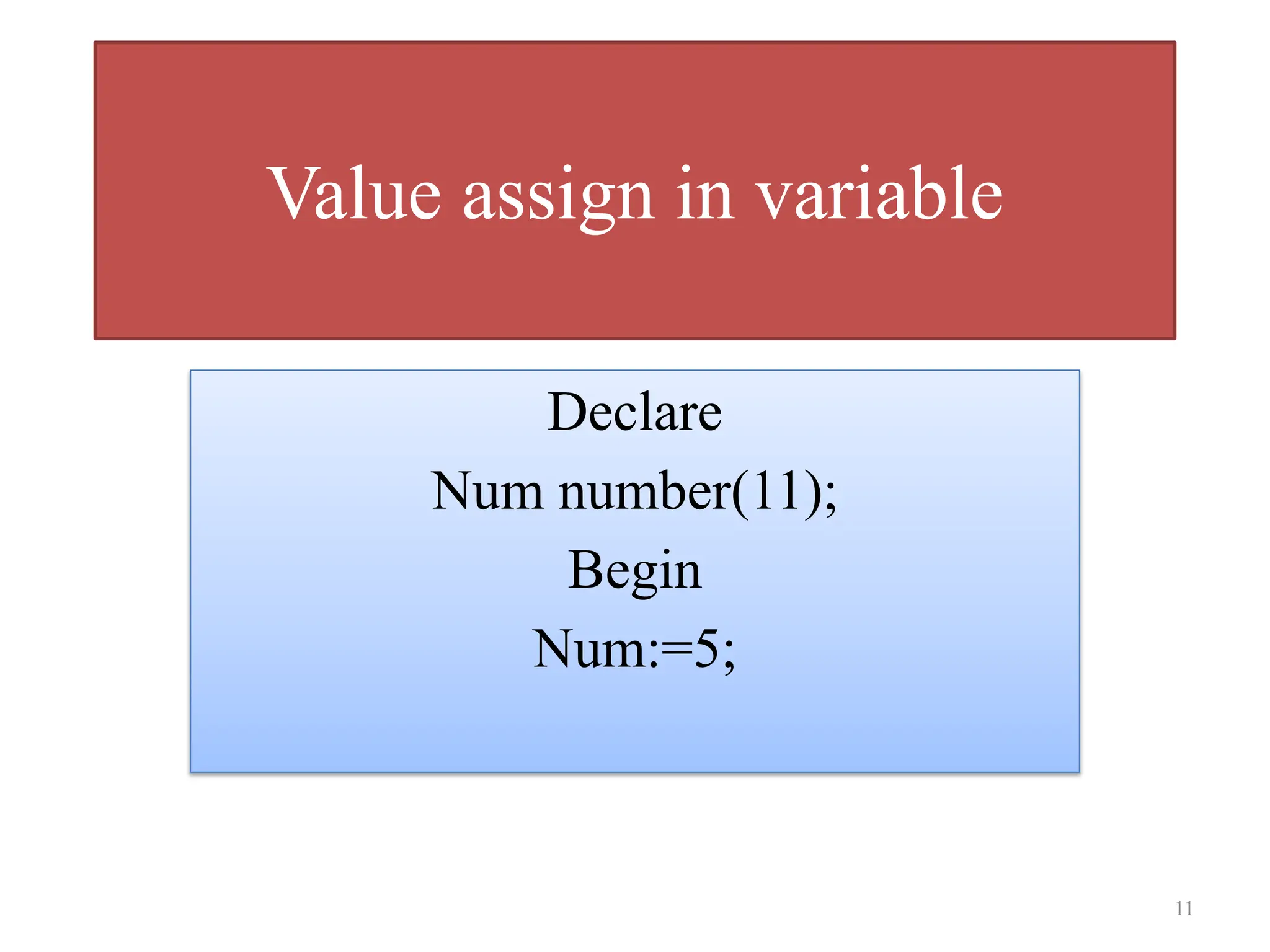
Value assign in variable
Declare
Num number(11);
Begin
Num:=5;
11
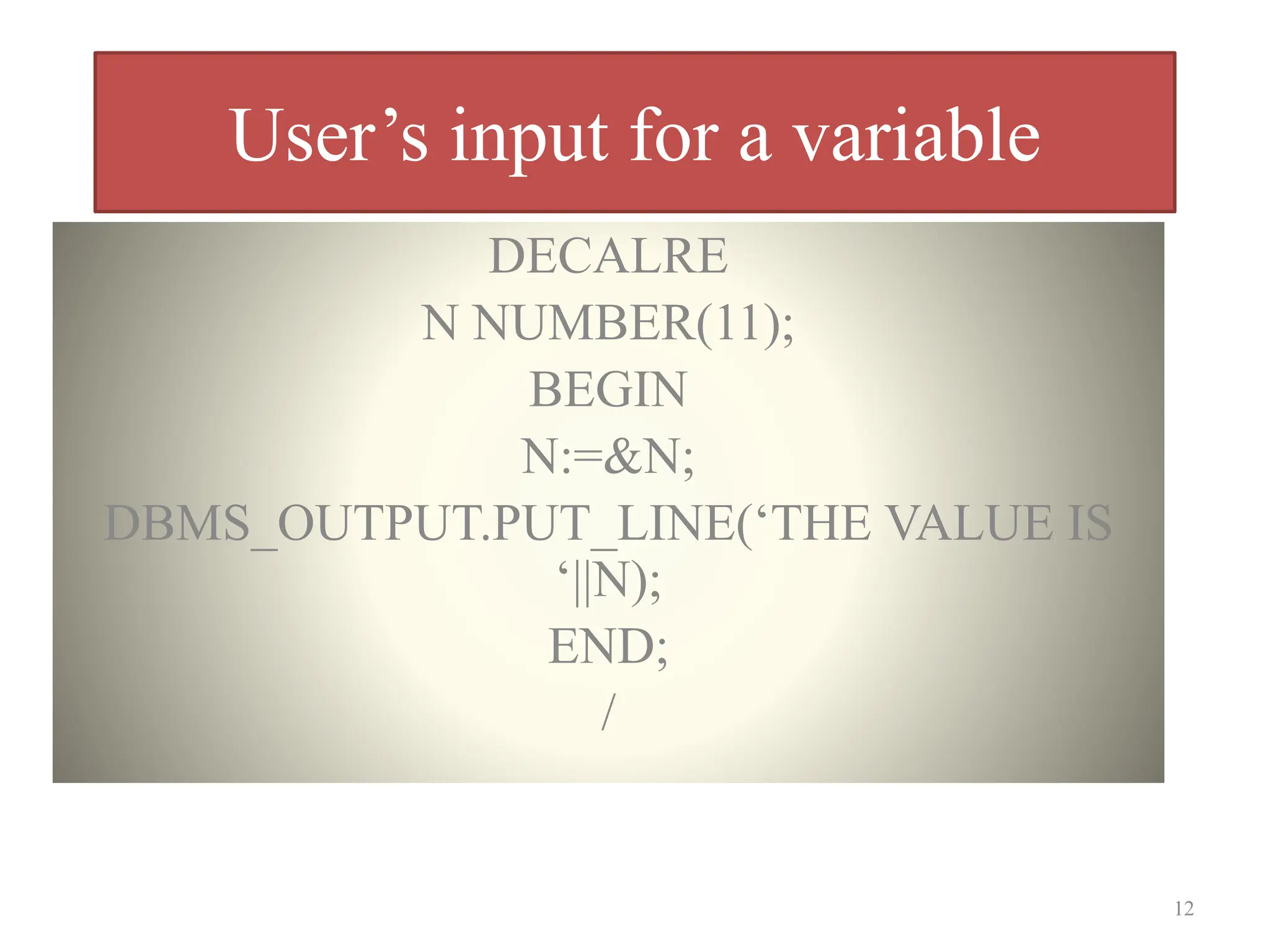
User’s input for a variable
DECALRE
N NUMBER(11);
BEGIN
N:=&N;
DBMS_OUTPUT.PUT_LINE(‘THE VALUE IS
‘||N);
END;
/
12
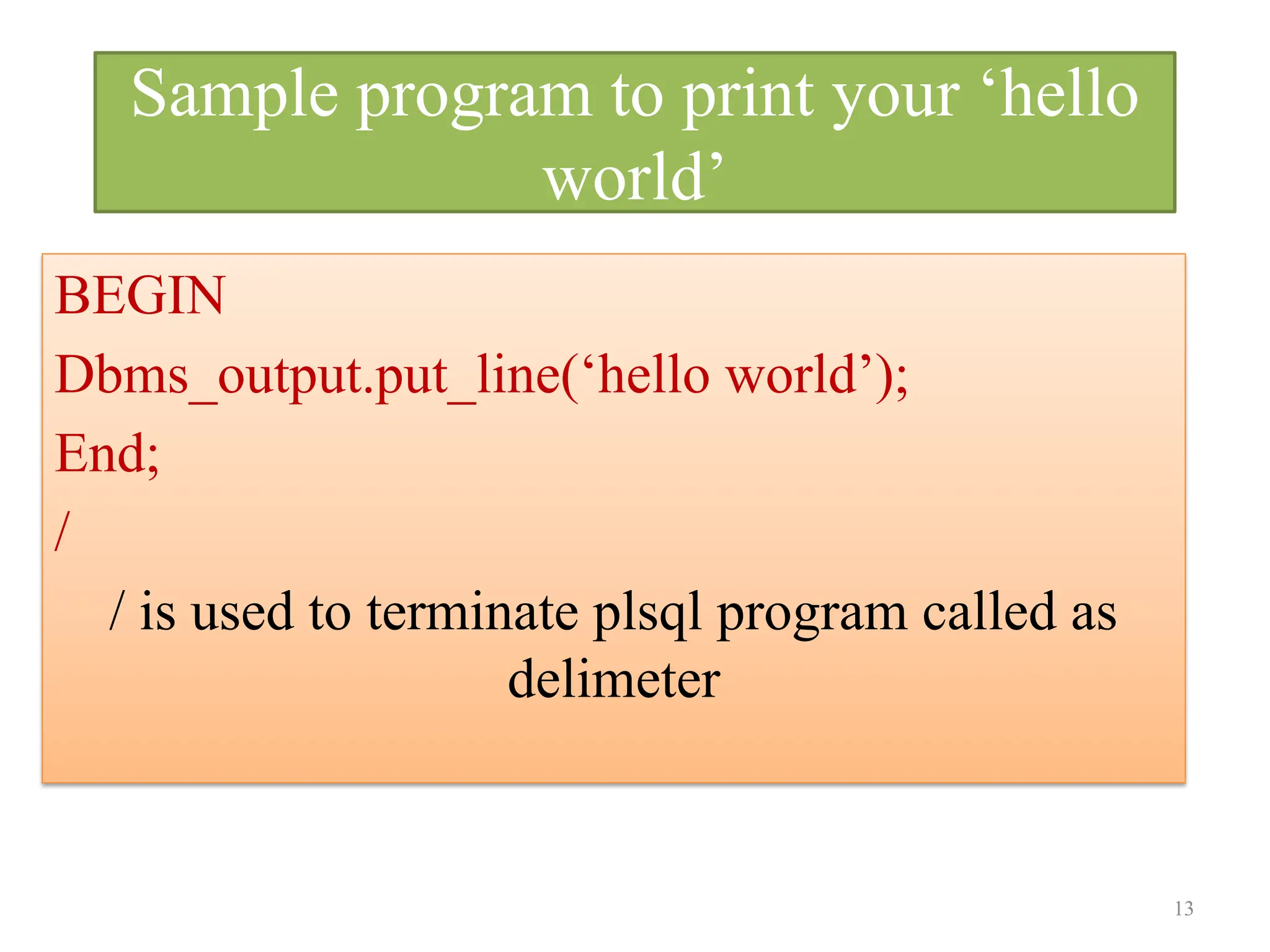
Sample program to print your ‘hello
world’
BEGIN
Dbms_output.put_line(‘hello world’);
End;
/
/ is used to terminate plsql program called as
delimeter
13
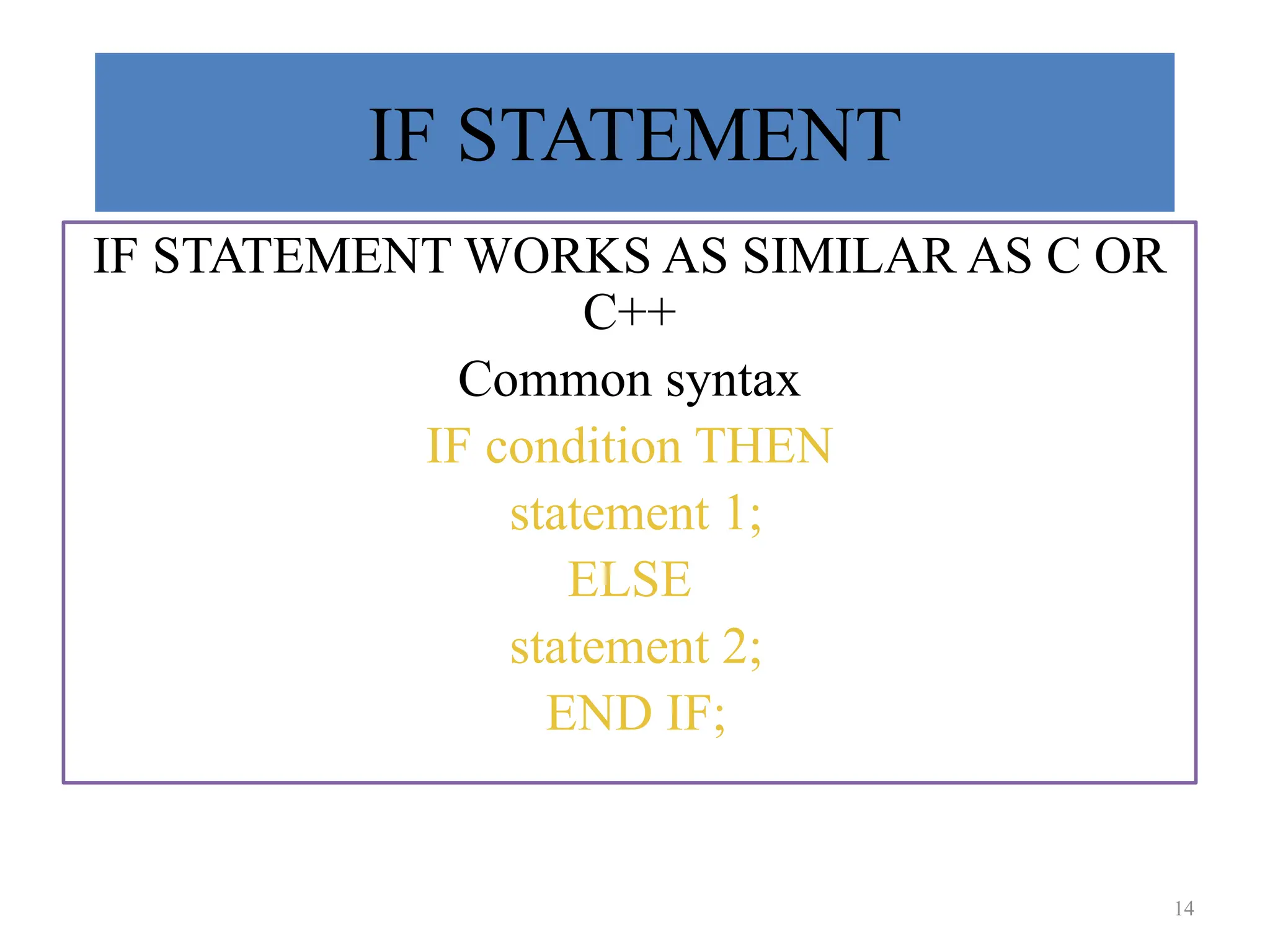
IF STATEMENT
IF STATEMENT WORKS AS SIMILAR AS C OR
C++
Common syntax
IF condition THEN
statement 1;
ELSE
statement 2;
END IF;
14
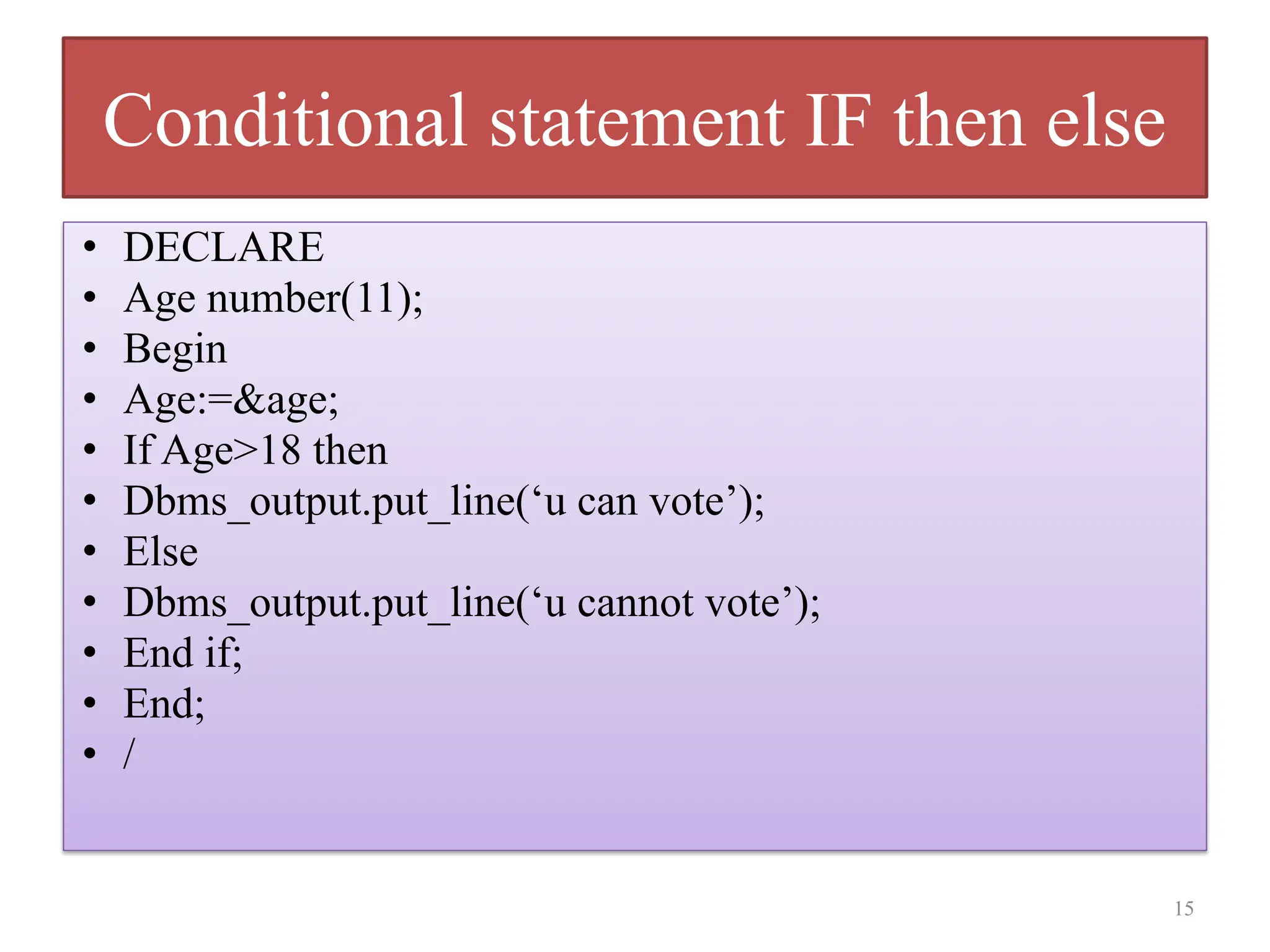
Conditional statement IF then else
• DECLARE
• Age number(11);
• Begin
• Age:=&age;
• If Age>18 then
• Dbms_output.put_line(‘u can vote’);
• Else
• Dbms_output.put_line(‘u cannot vote’);
• End if;
• End;
• /
15
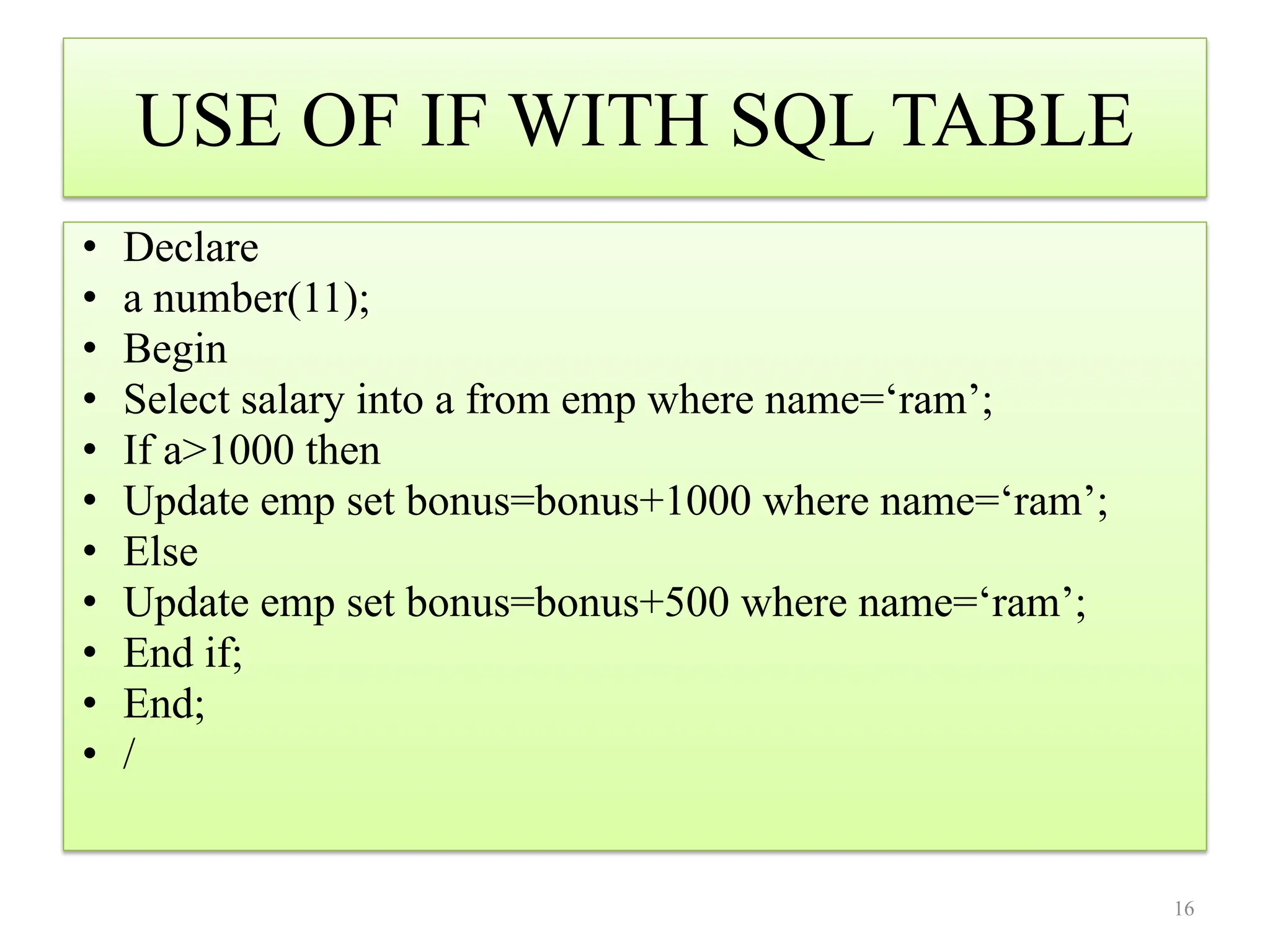
USE OF IF WITH SQL TABLE
• Declare
• a number(11);
• Begin
• Select salary into a from emp where name=‘ram’;
• If a>1000 then
• Update emp set bonus=bonus+1000 where name=‘ram’;
• Else
• Update emp set bonus=bonus+500 where name=‘ram’;
• End if;
• End;
• /
16
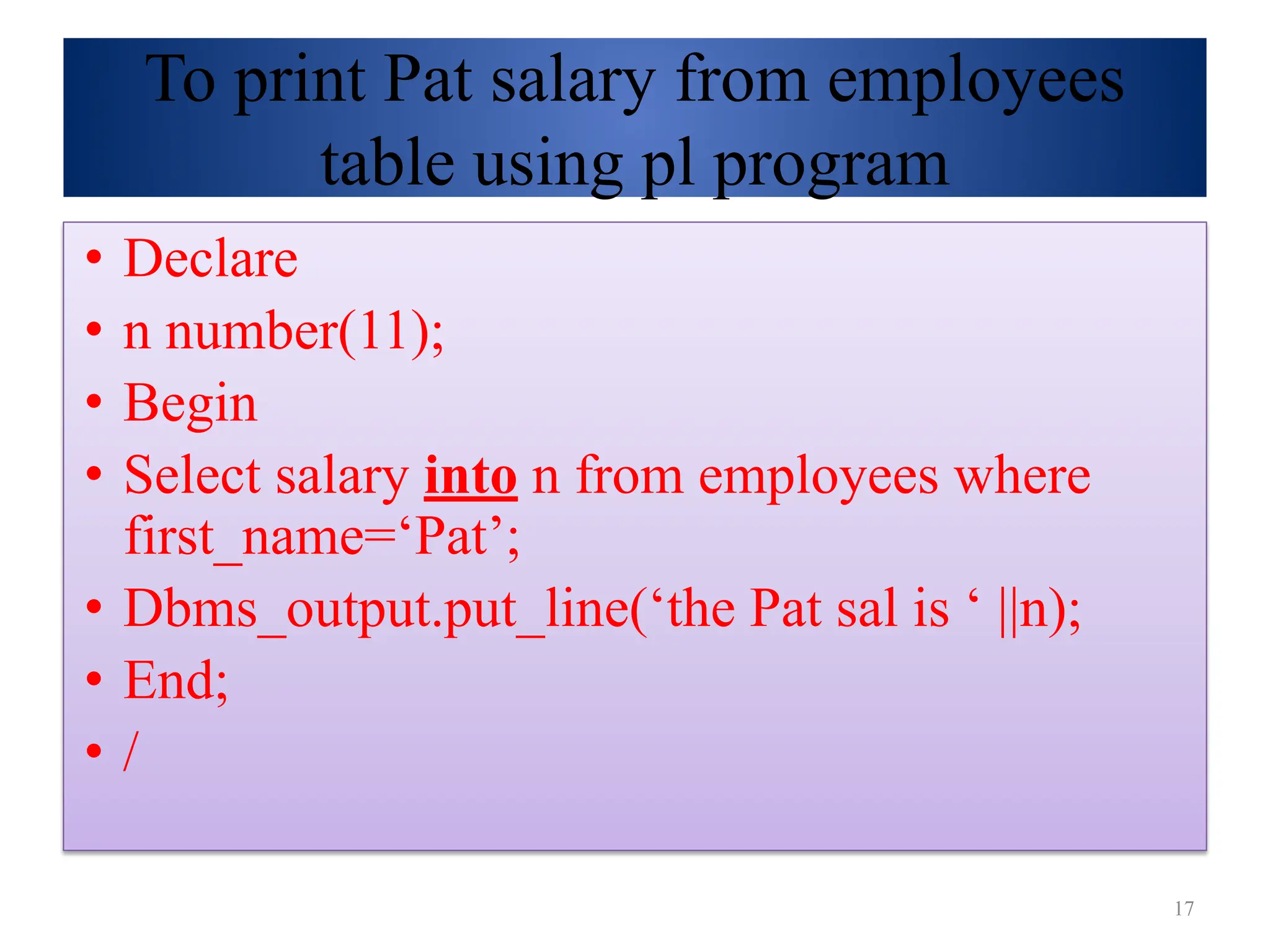
To print Pat salary from employees
table using pl program
• Declare
• n number(11);
• Begin
• Select salary into n from employees where
first_name=‘Pat’;
• Dbms_output.put_line(‘the Pat sal is ‘ ||n);
• End;
• /
17
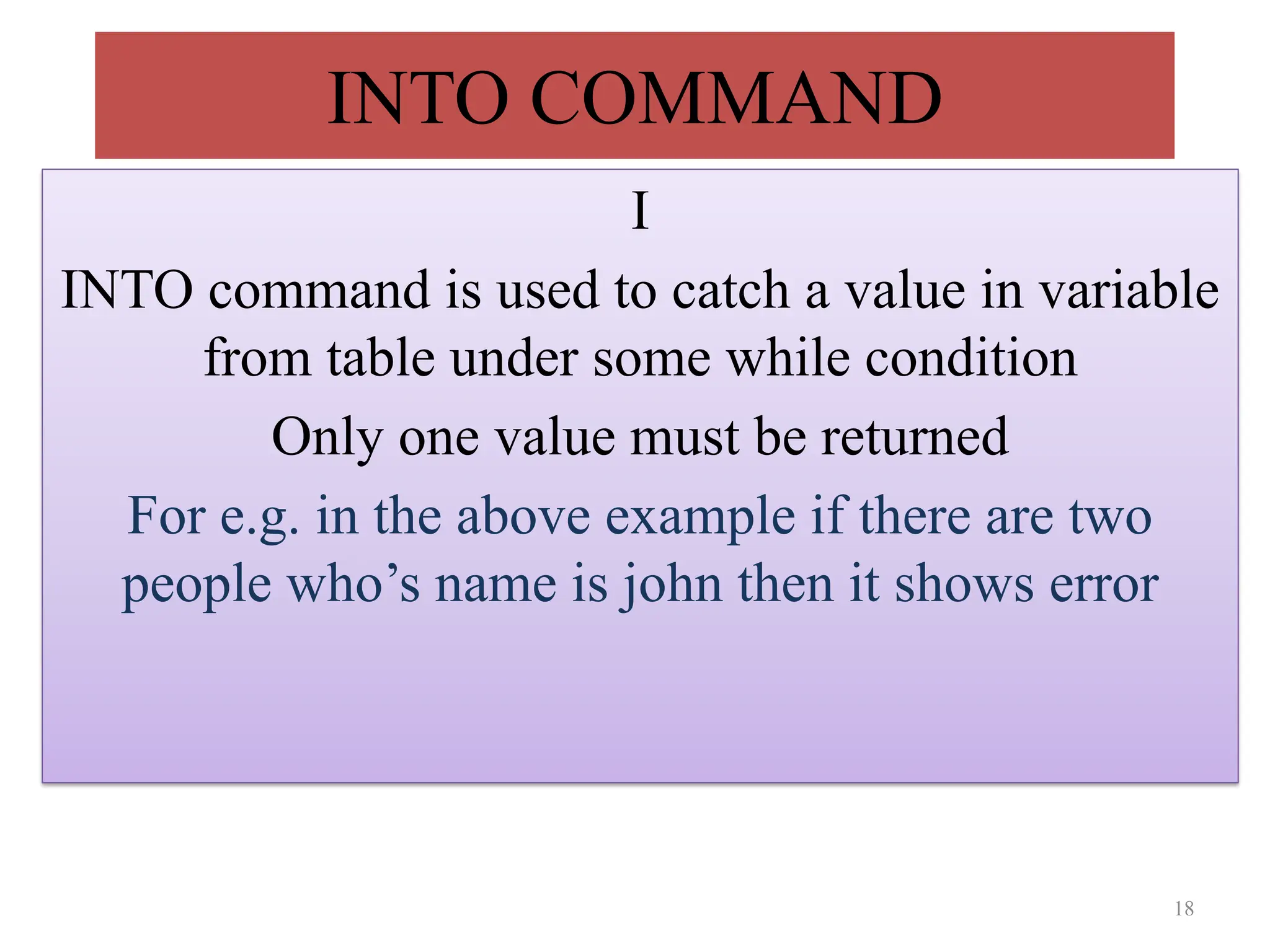
INTO COMMAND
I
INTO command is used to catch a value in variable
from table under some while condition
Only one value must be returned
For e.g. in the above example if there are two
people who’s name is john then it shows error
18
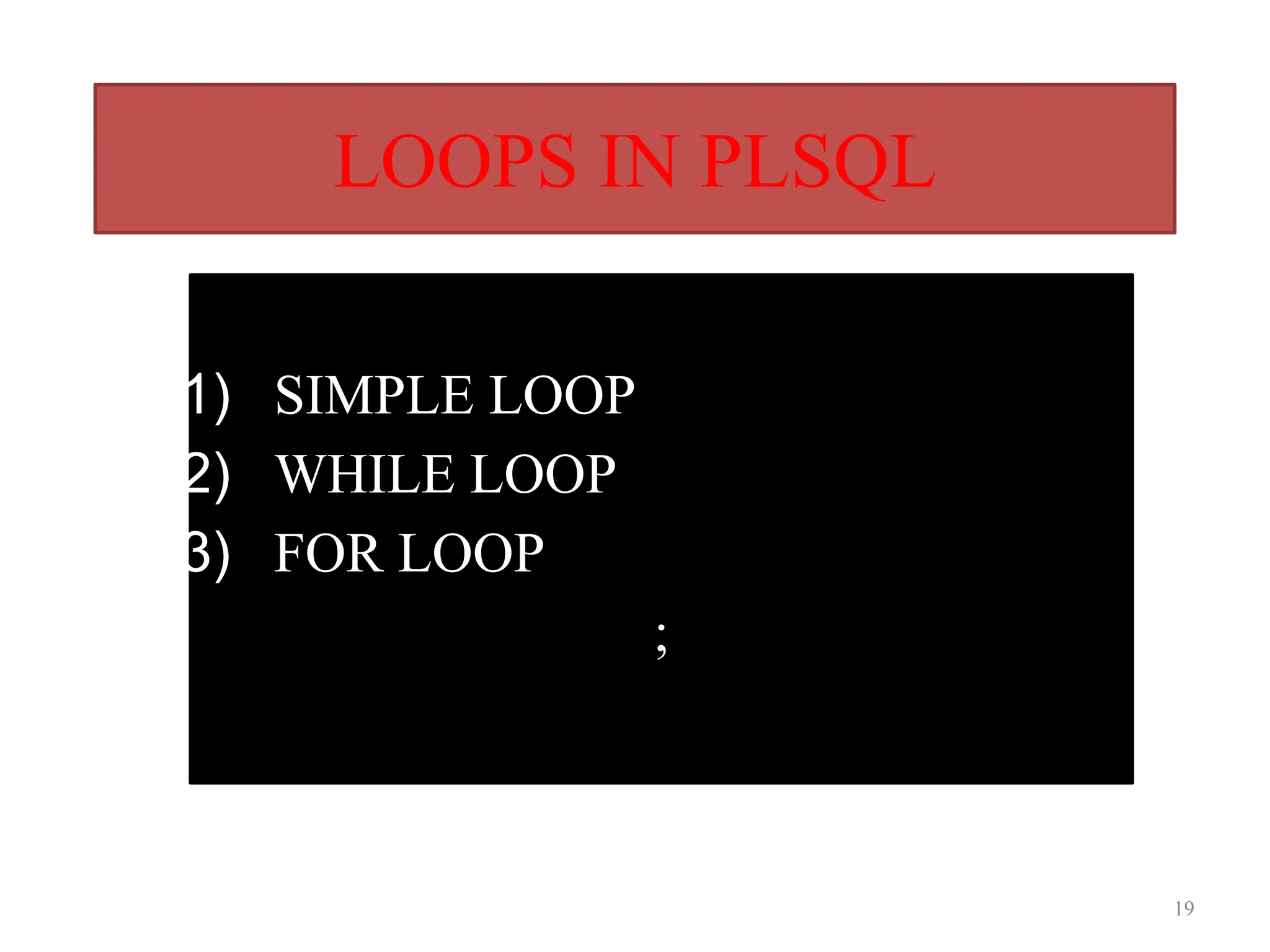
LOOPS IN PLSQL
1) SIMPLE LOOP
2) WHILE LOOP
3) FOR LOOP
;
19
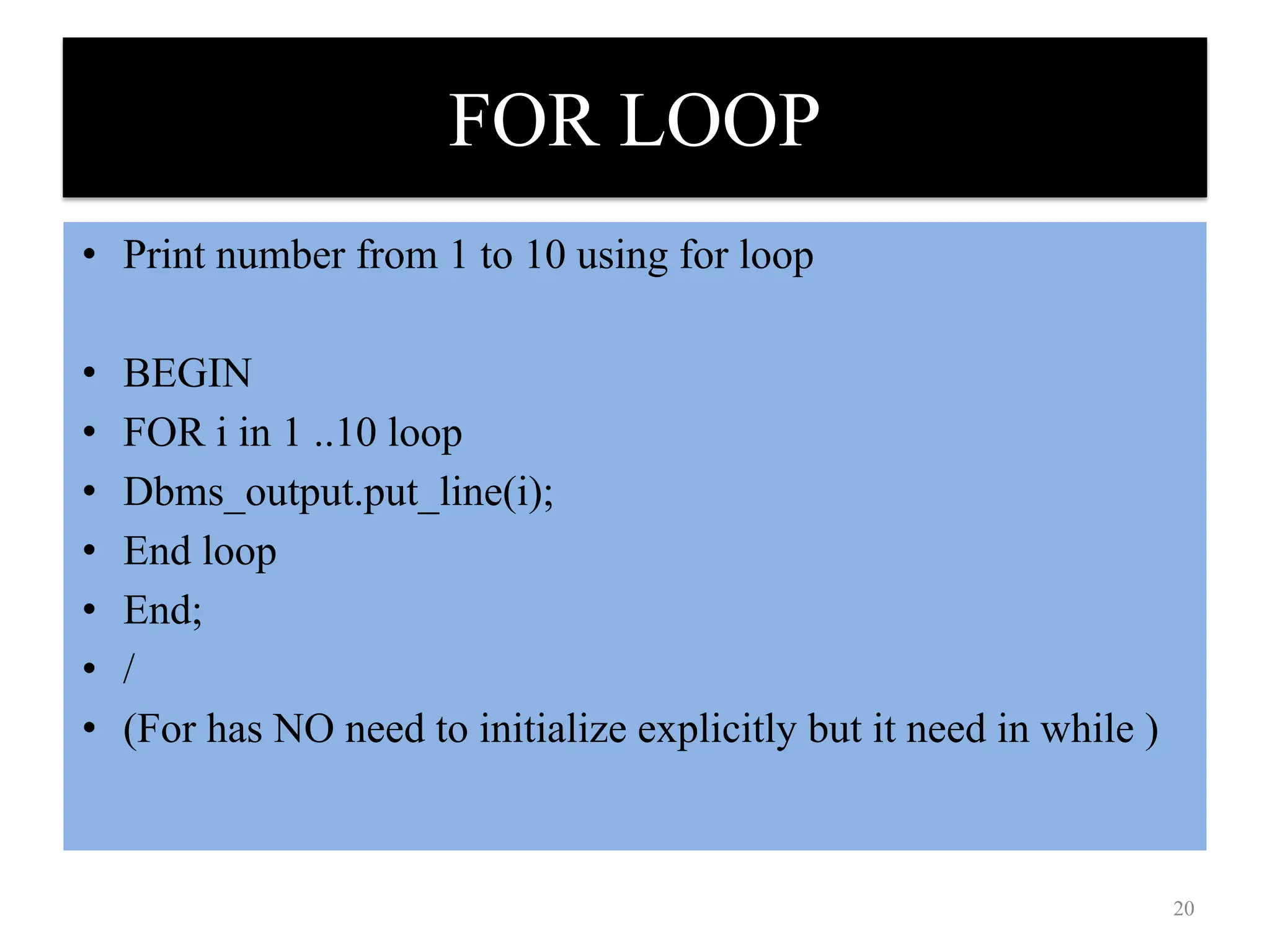
FOR LOOP
• Print number from 1 to 10 using for loop
• BEGIN
• FOR i in 1 ..10 loop
• Dbms_output.put_line(i);
• End loop
• End;
• /
• (For has NO need to initialize explicitly but it need in while )
20
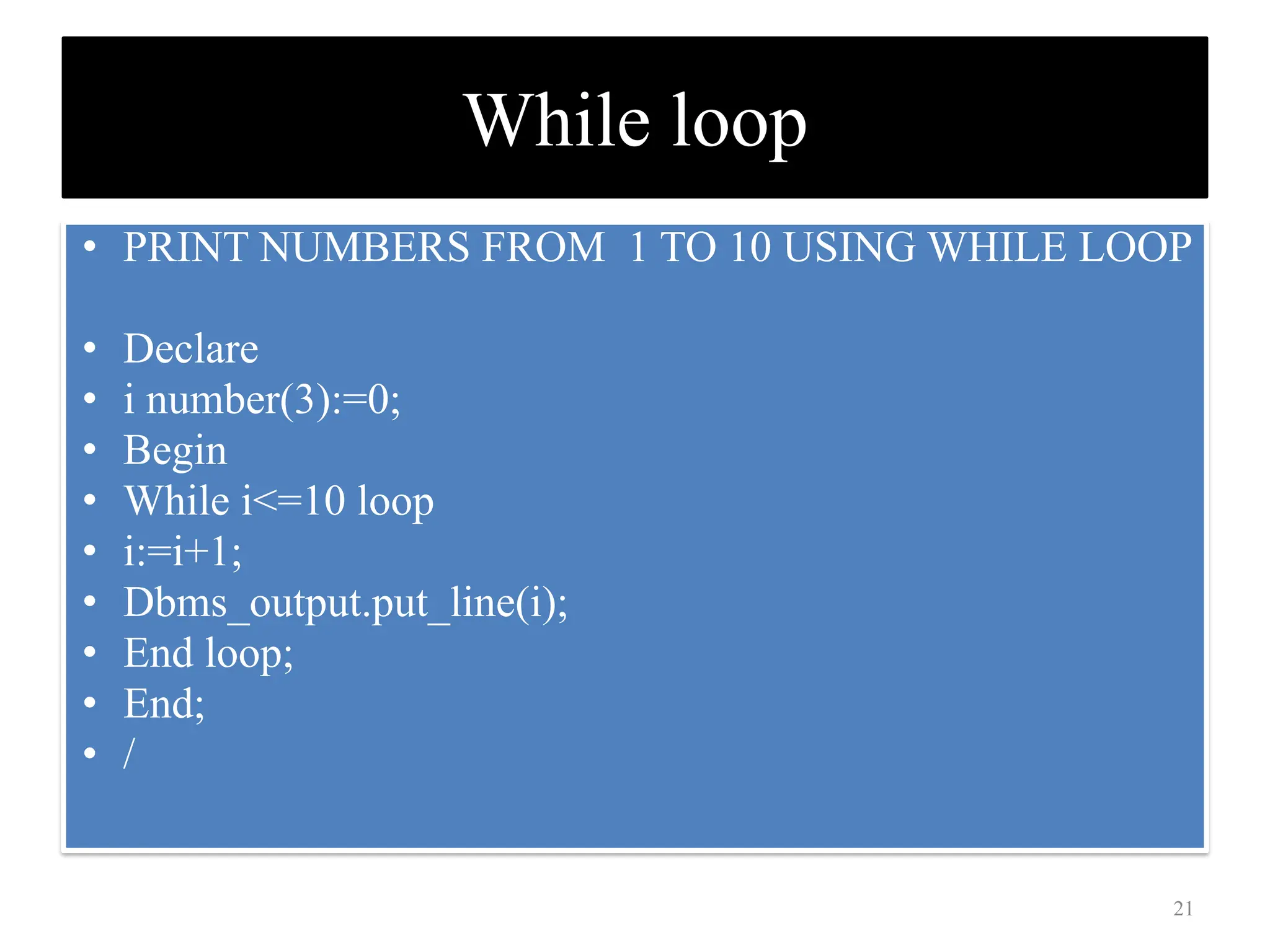
While loop
• PRINT NUMBERS FROM 1 TO 10 USING WHILE LOOP
• Declare
• i number(3):=0;
• Begin
• While i<=10 loop
• i:=i+1;
• Dbms_output.put_line(i);
• End loop;
• End;
• /
21
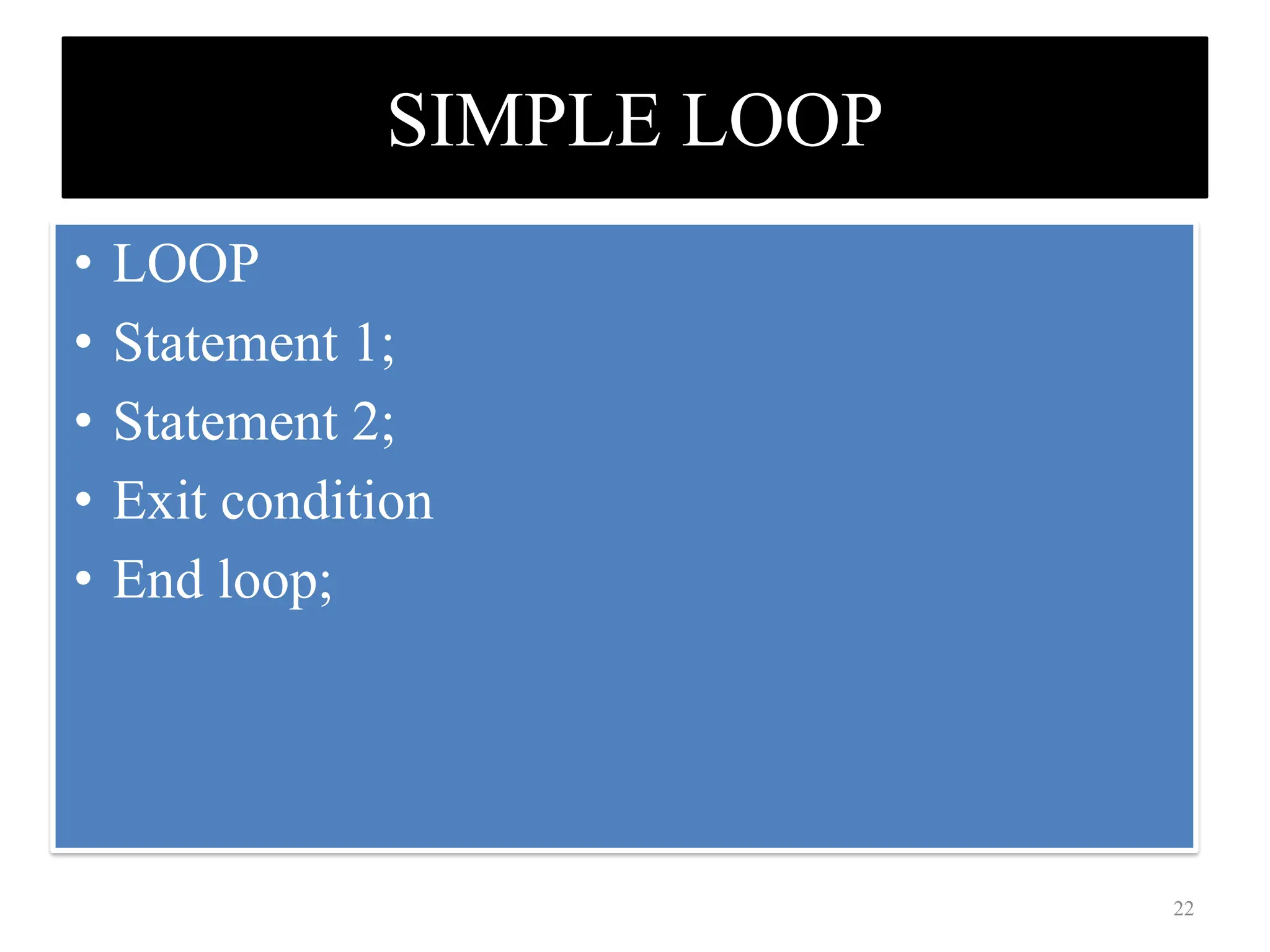
SIMPLE LOOP
• LOOP
• Statement 1;
• Statement 2;
• Exit condition
• End loop;
22
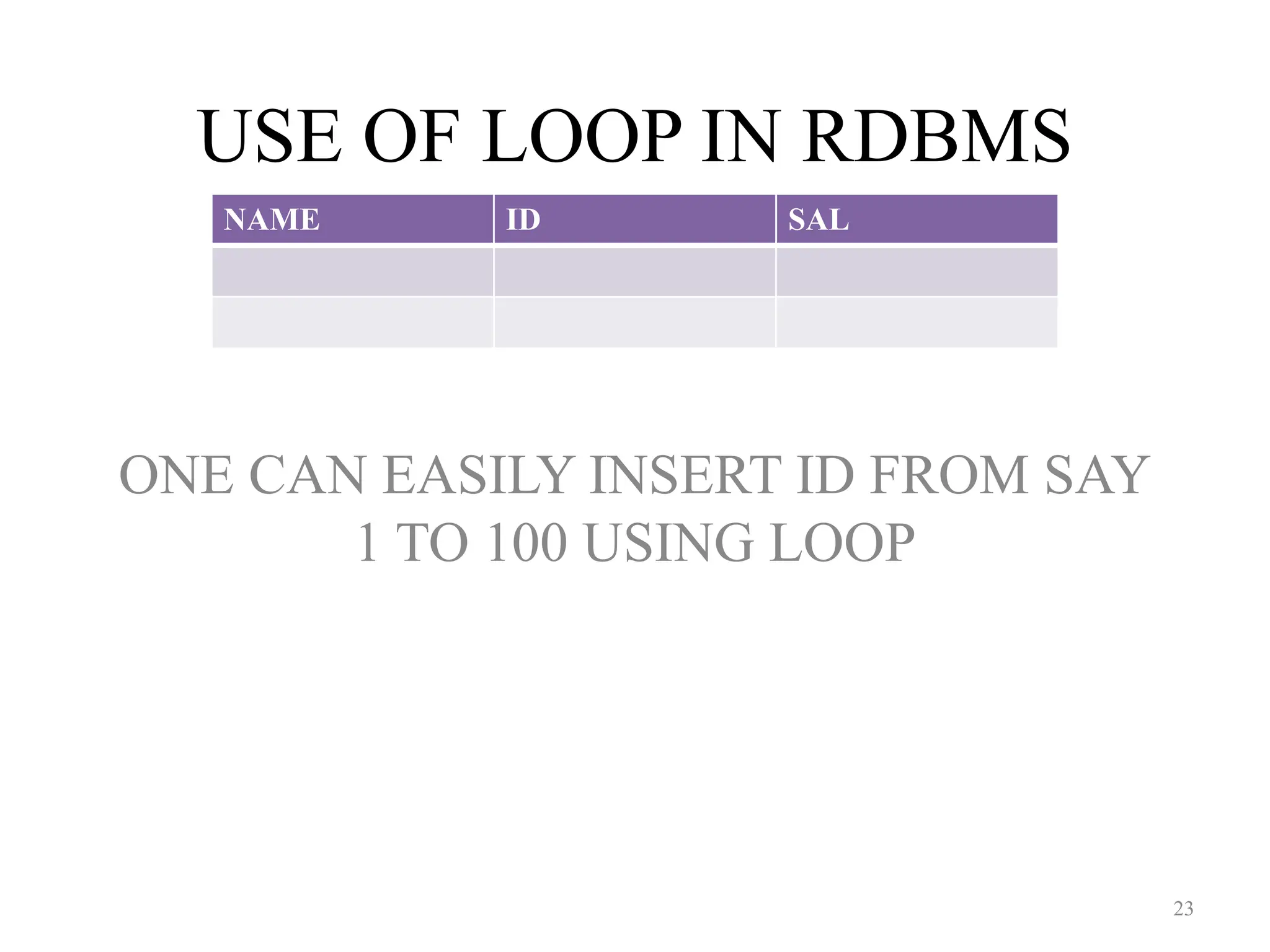
USE OF LOOP IN RDBMS
ONE CAN EASILY INSERT ID FROM SAY
1 TO 100 USING LOOP
NAME ID SAL
23
STORED PROCEDURE
• SOMETHING LIKE FUNCIONS IN C/C++.
• A stored procedure is a subroutine available to applications
that access a relational database system. A stored procedure
(sometimes called a proc, sproc, StoPro, StoredProc, sp or
SP) is actually stored in the database data dictionary.
• A procedure is similar to an anonymous PL/SQL Block but it
is named for repeated usage.
A procedure may or may not return any value
24
Common syntax
• CREATE [OR REPLACE] PROCEDURE procedure_name
• [ (parameter [,parameter]) ]
• IS
• [declaration_section]
• BEGIN
• executable_section
• [EXCEPTION exception_section]
• END [procedure_name];
25
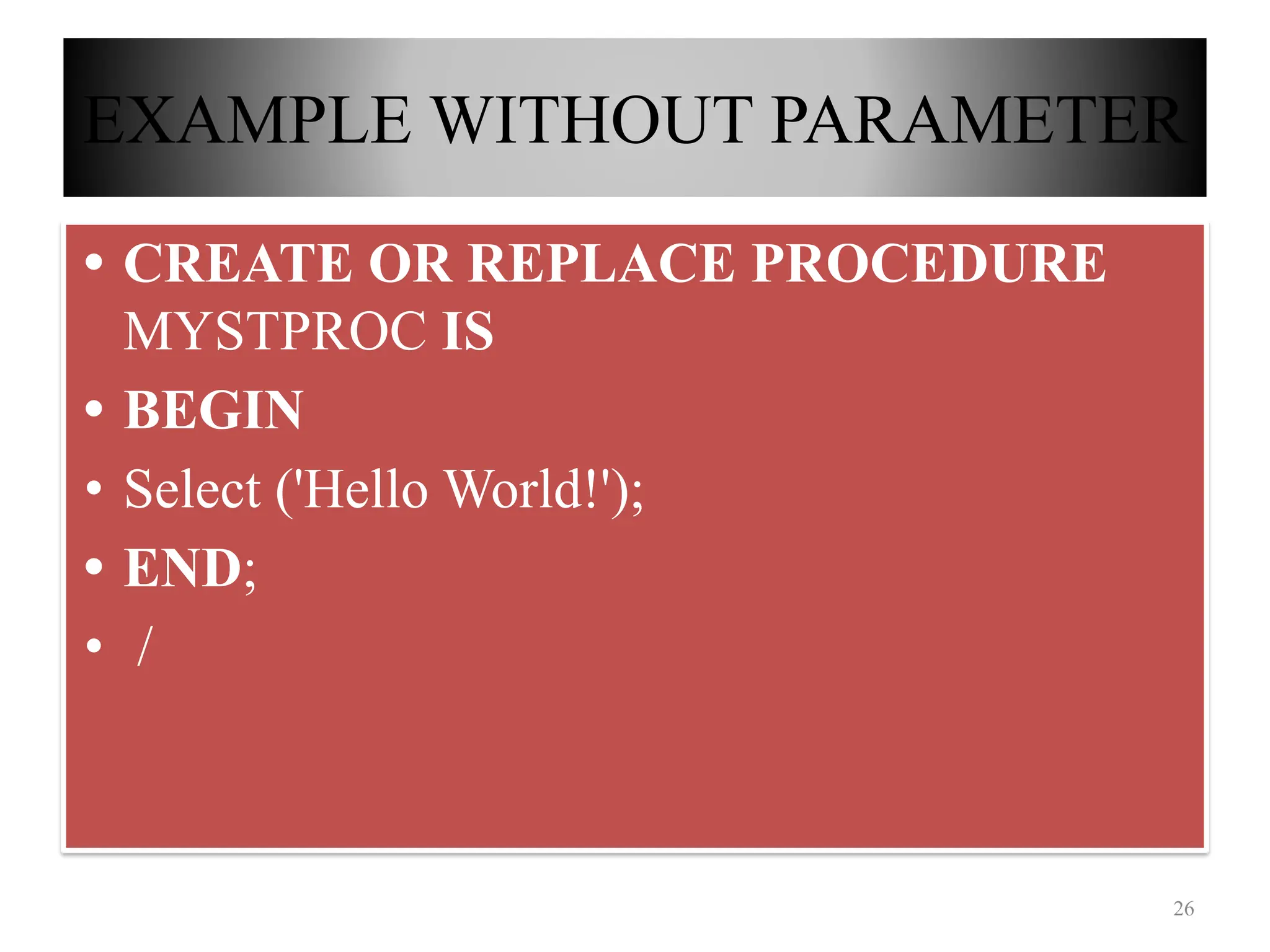
EXAMPLE WITHOUT PARAMETER
• CREATE OR REPLACE PROCEDURE
MYSTPROC IS
• BEGIN
• Select ('Hello World!');
• END;
• /
26
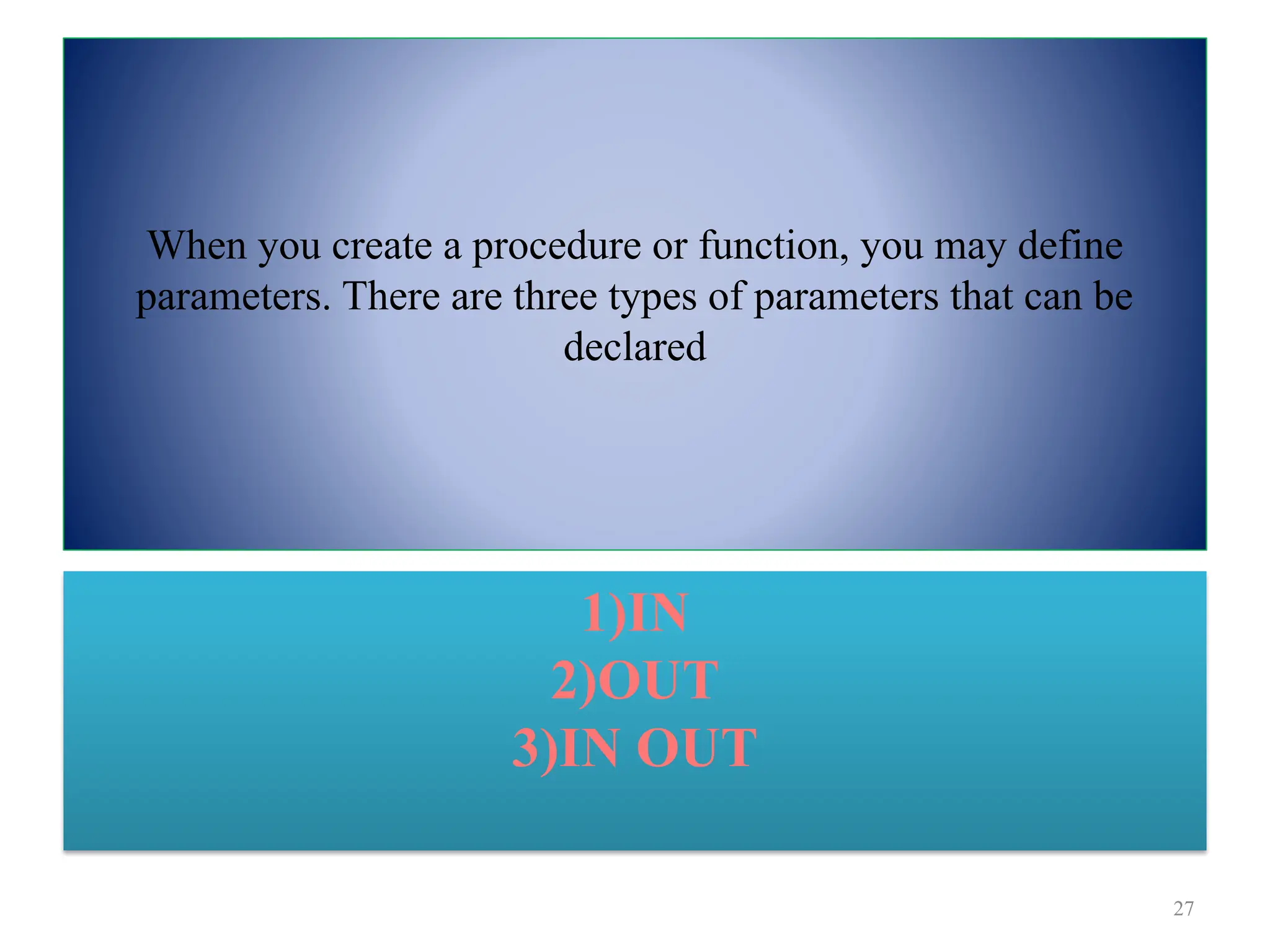
When you create a procedure or function, you may define
parameters. There are three types of parameters that can be
declared
27
1)IN
2)OUT
3)IN OUT
PARAMETER TYPES
• 1) IN type parameter: These types of parameters are used to send values
to stored procedures.
•
2) OUT type parameter: These types of parameters are used to get values
from stored procedures. This is similar to a return type in functions.
•
3) IN OUT parameter: These types of parameters are used to send values
and get values from stored procedures.
28
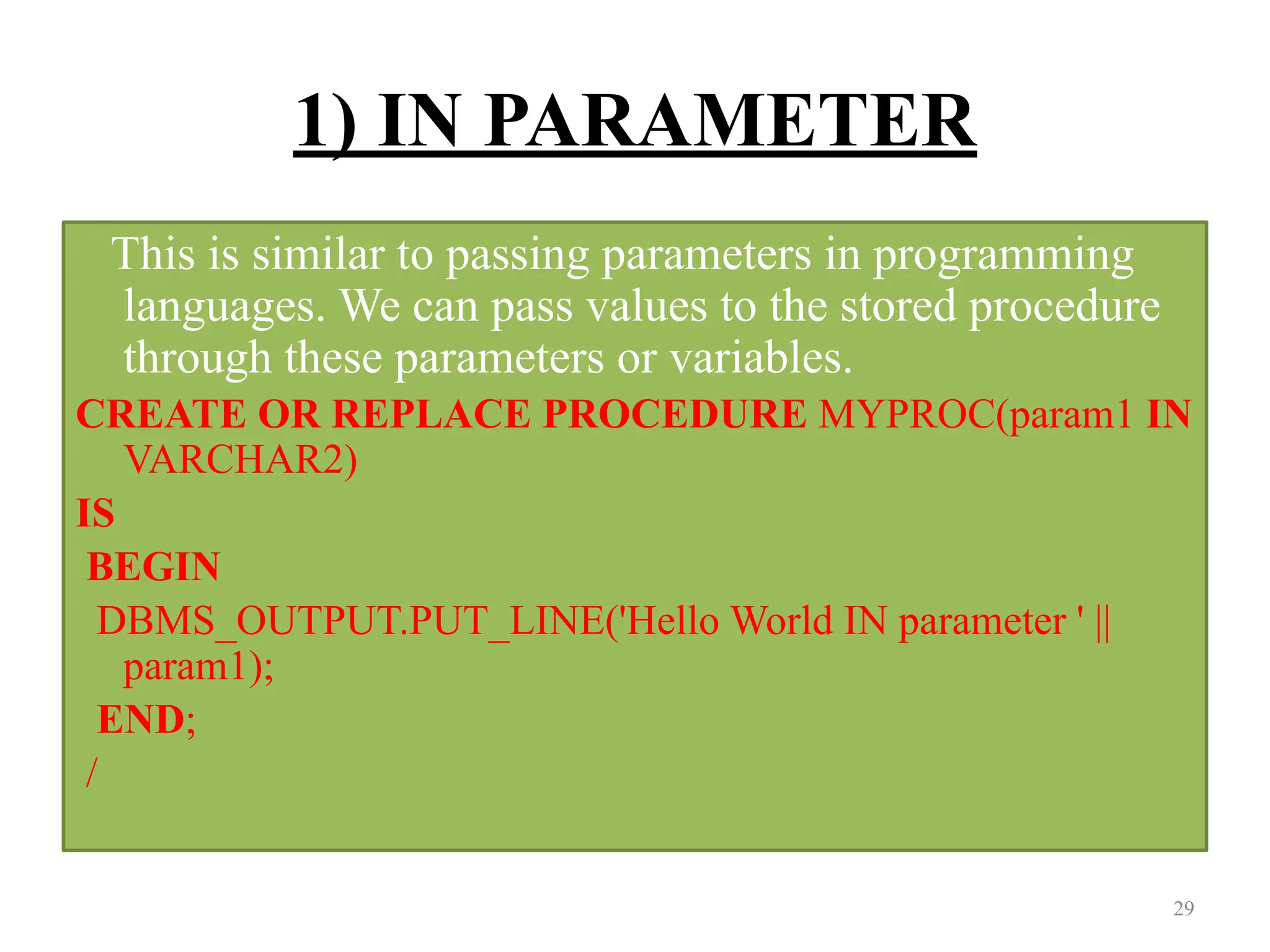
1) IN PARAMETER
This is similar to passing parameters in programming
languages. We can pass values to the stored procedure
through these parameters or variables.
CREATE OR REPLACE PROCEDURE MYPROC(param1 IN
VARCHAR2)
IS
BEGIN
DBMS_OUTPUT.PUT_LINE('Hello World IN parameter ' ||
param1);
END;
/
29
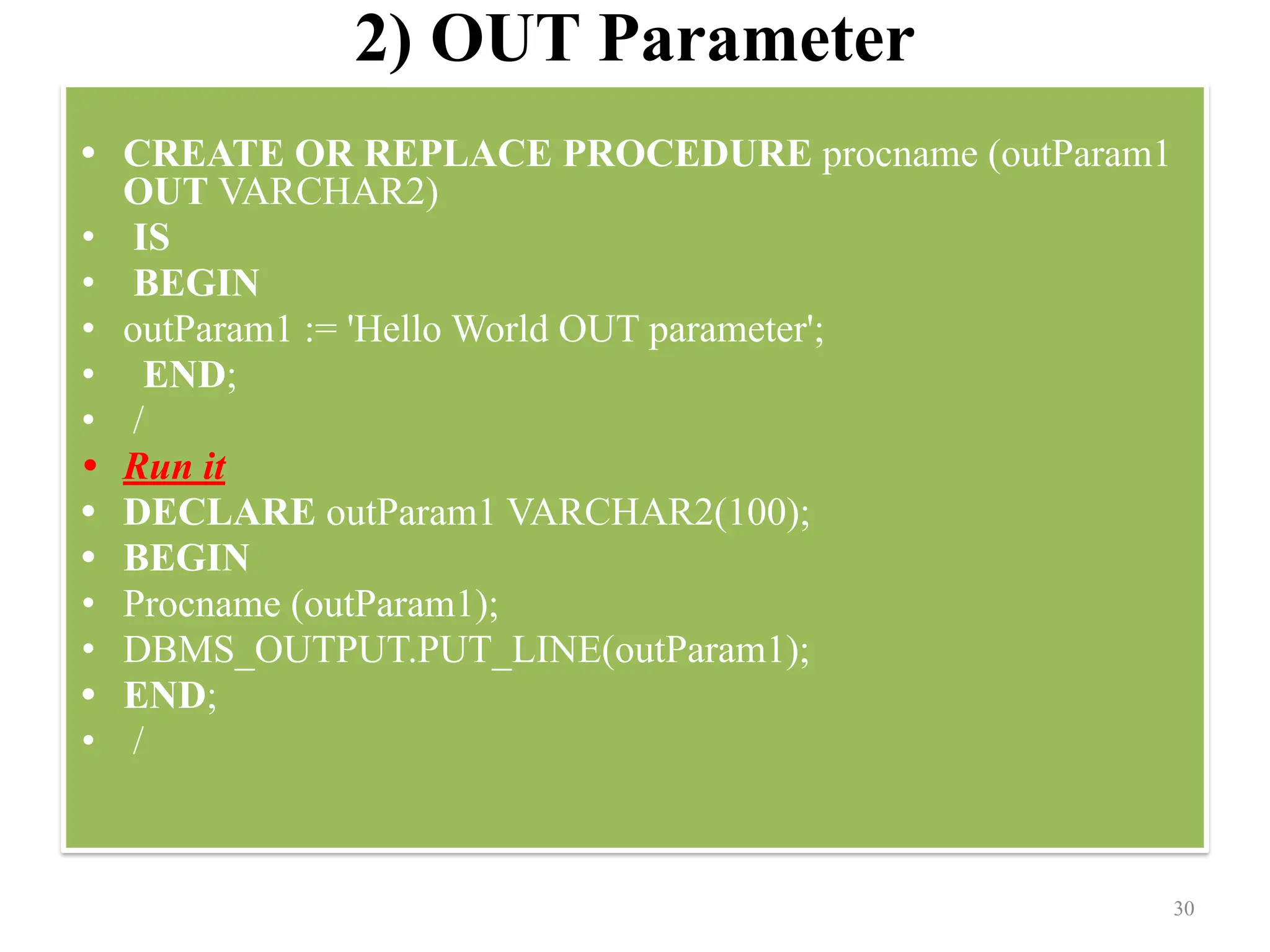
2) OUT Parameter
• CREATE OR REPLACE PROCEDURE procname (outParam1
OUT VARCHAR2)
• IS
• BEGIN
• outParam1 := 'Hello World OUT parameter';
• END;
• /
• Run it
• DECLARE outParam1 VARCHAR2(100);
• BEGIN
• Procname (outParam1);
• DBMS_OUTPUT.PUT_LINE(outParam1);
• END;
• /
30
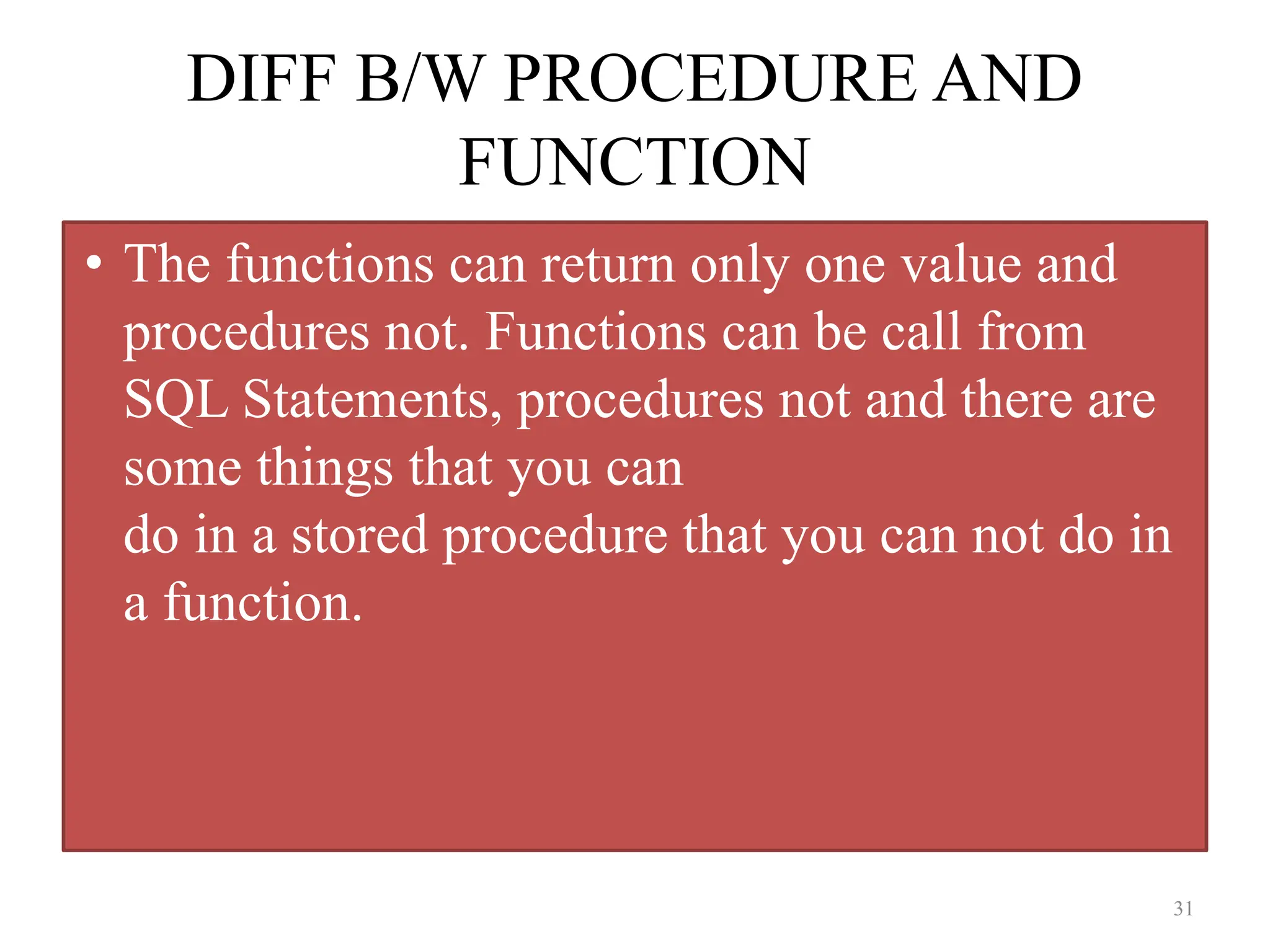
DIFF B/W PROCEDURE AND
FUNCTION
• The functions can return only one value and
procedures not. Functions can be call from
SQL Statements, procedures not and there are
some things that you can
do in a stored procedure that you can not do in
a function.
31
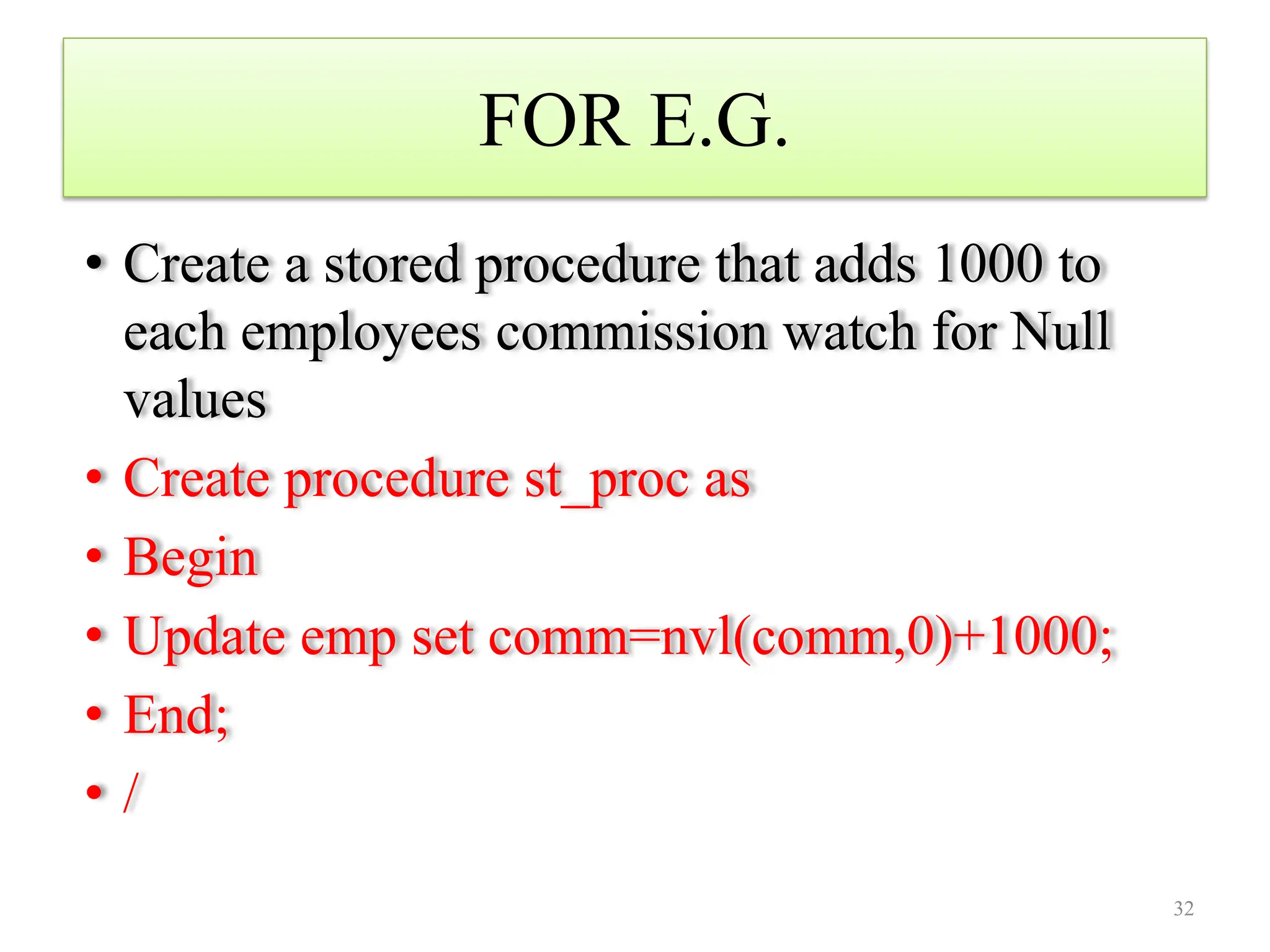
FOR E.G.
• Create a stored procedure that adds 1000 to
each employees commission watch for Null
values
• Create procedure st_proc as
• Begin
• Update emp set comm=nvl(comm,0)+1000;
• End;
• /
32
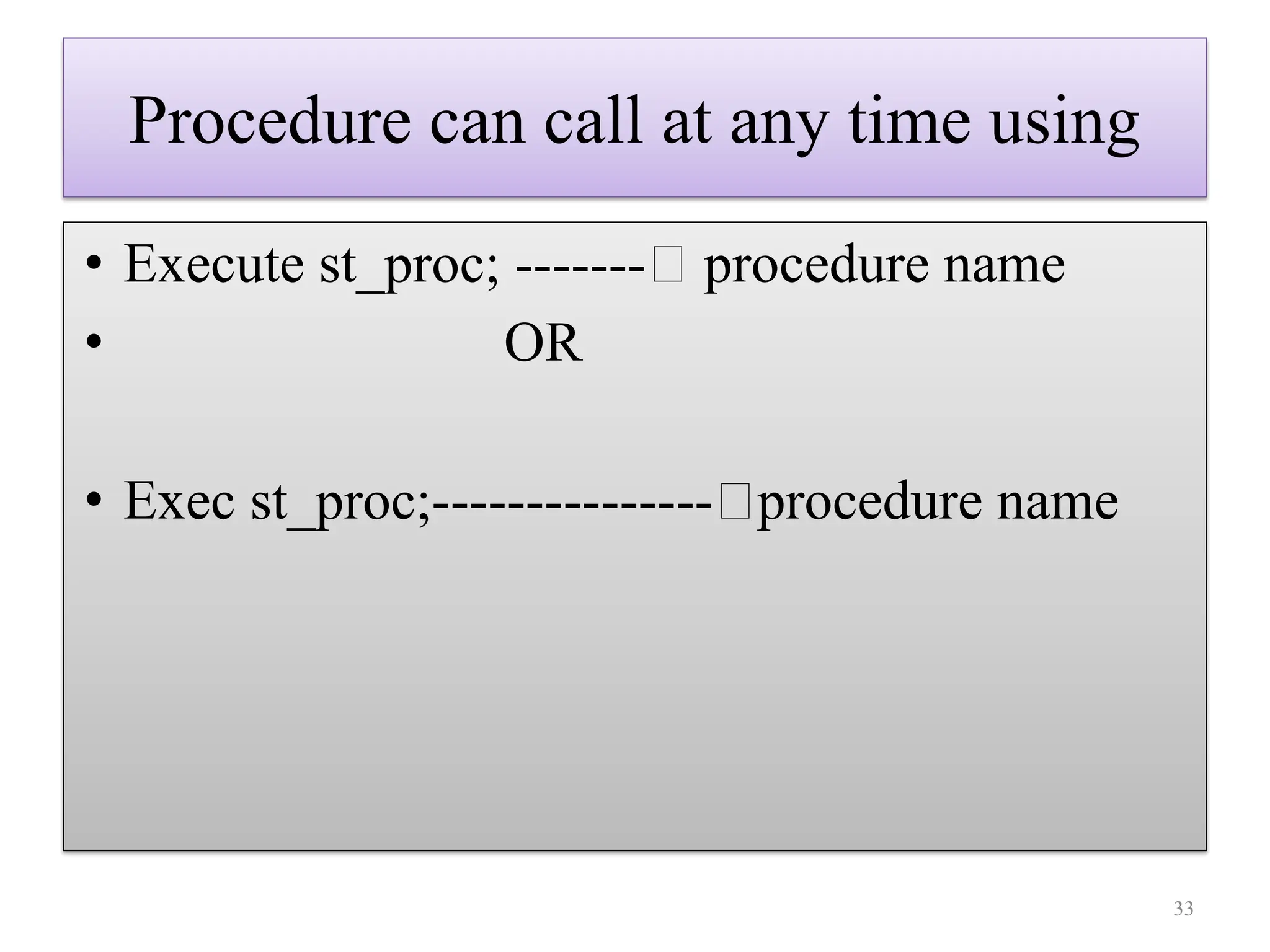
Procedure can call at any time using
• Execute st_proc; ------- procedure name
• OR
• Exec st_proc;--------------- procedure name
33
FUNCTIONS
• A function is a named PL/SQL Block which is
similar to a procedure. The major difference
between a procedure and a function is, a
function must always return a value, but a
procedure may or may not return a value.
34
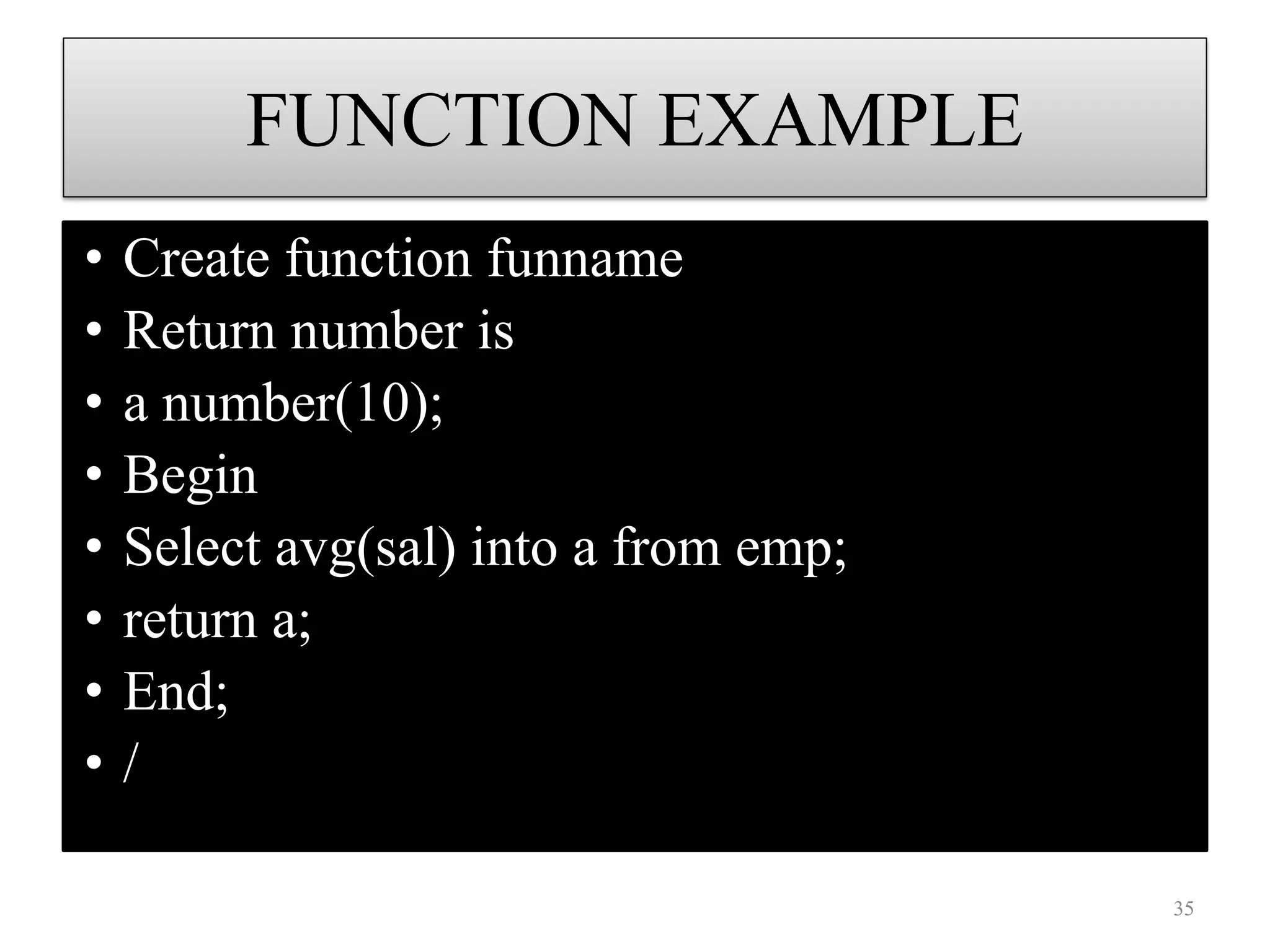
FUNCTION EXAMPLE
• Create function funname
• Return number is
• a number(10);
• Begin
• Select avg(sal) into a from emp;
• return a;
• End;
• /
35
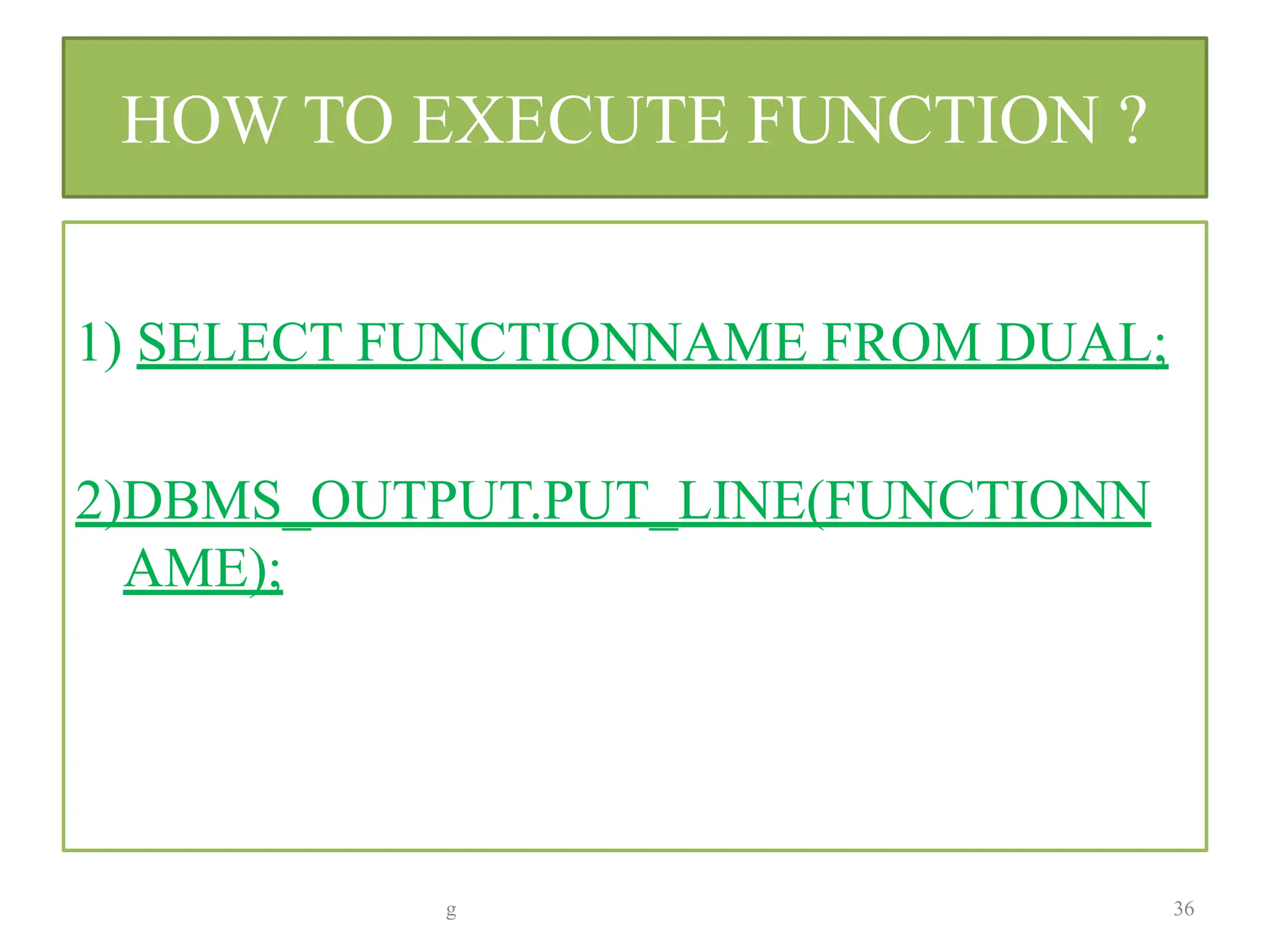
HOW TO EXECUTE FUNCTION ?
1) SELECT FUNCTIONNAME FROM DUAL;
2)DBMS_OUTPUT.PUT_LINE(FUNCTIONN
AME);
g 36
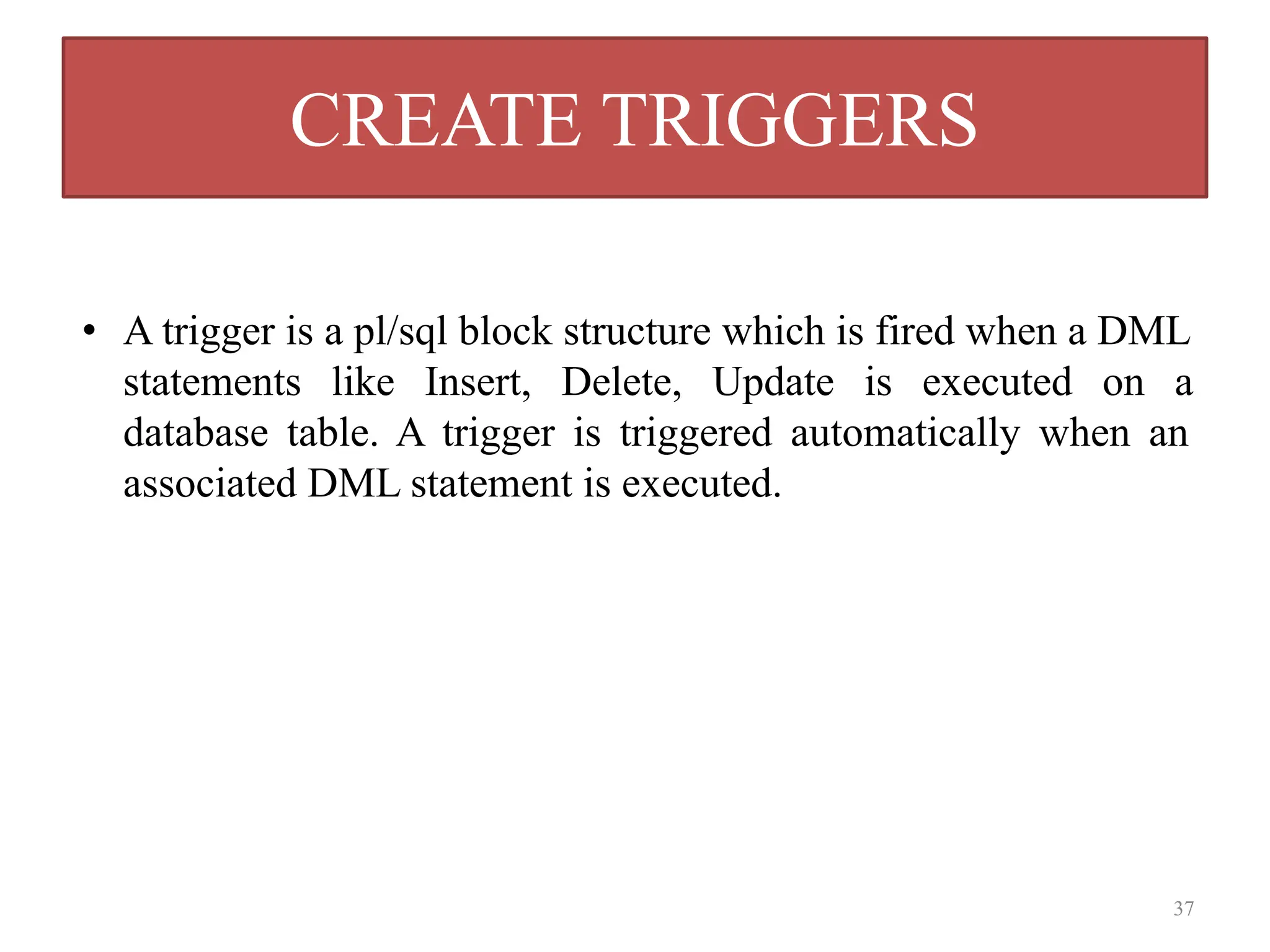
CREATE TRIGGERS
• A trigger is a pl/sql block structure which is fired when a DML
statements like Insert, Delete, Update is executed on a
database table. A trigger is triggered automatically when an
associated DML statement is executed.
37
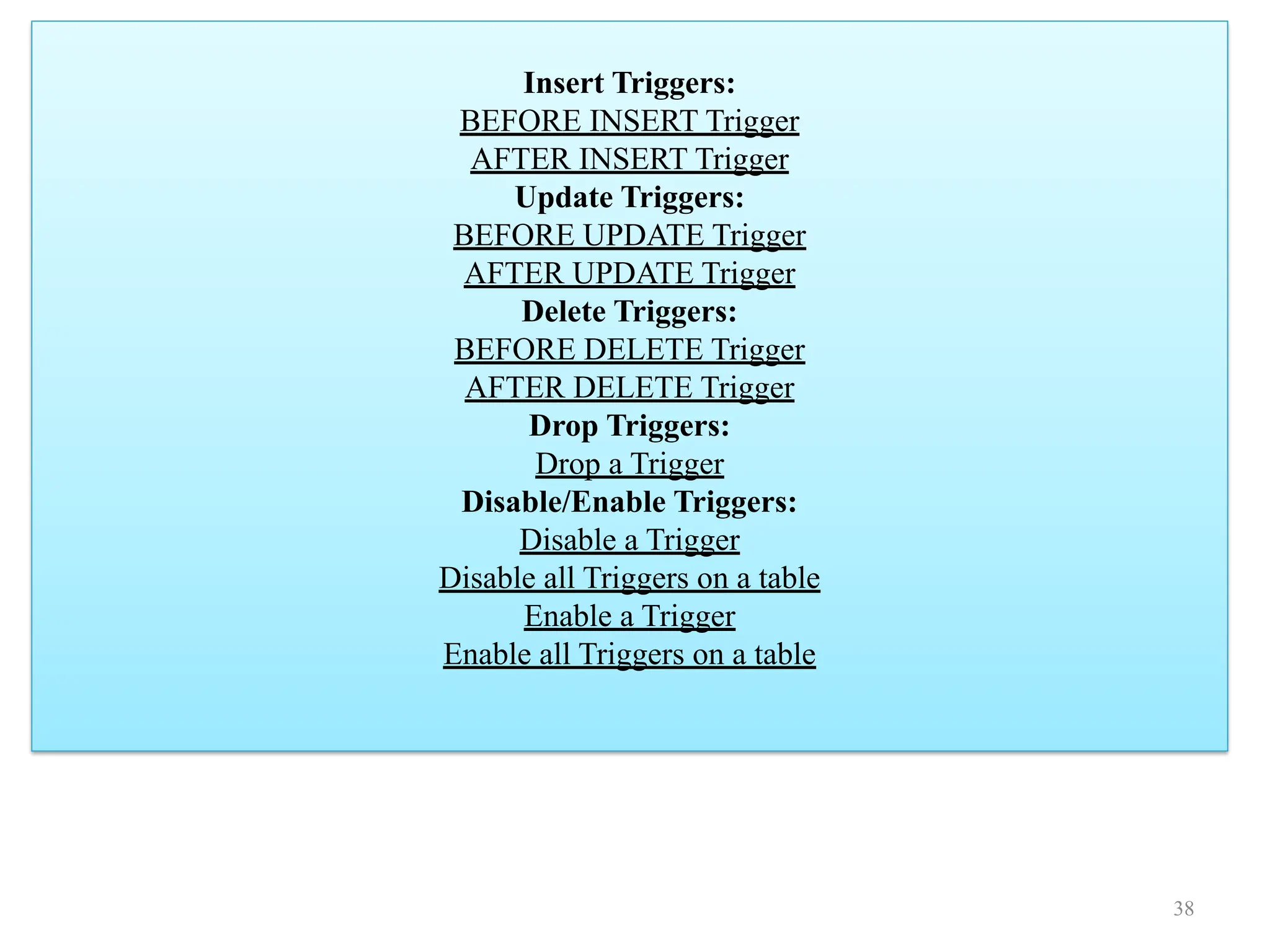
Insert Triggers:
BEFORE INSERT Trigger
AFTER INSERT Trigger
Update Triggers:
BEFORE UPDATE Trigger
AFTER UPDATE Trigger
Delete Triggers:
BEFORE DELETE Trigger
AFTER DELETE Trigger
Drop Triggers:
Drop a Trigger
Disable/Enable Triggers:
Disable a Trigger
Disable all Triggers on a table
Enable a Trigger
Enable all Triggers on a table
38
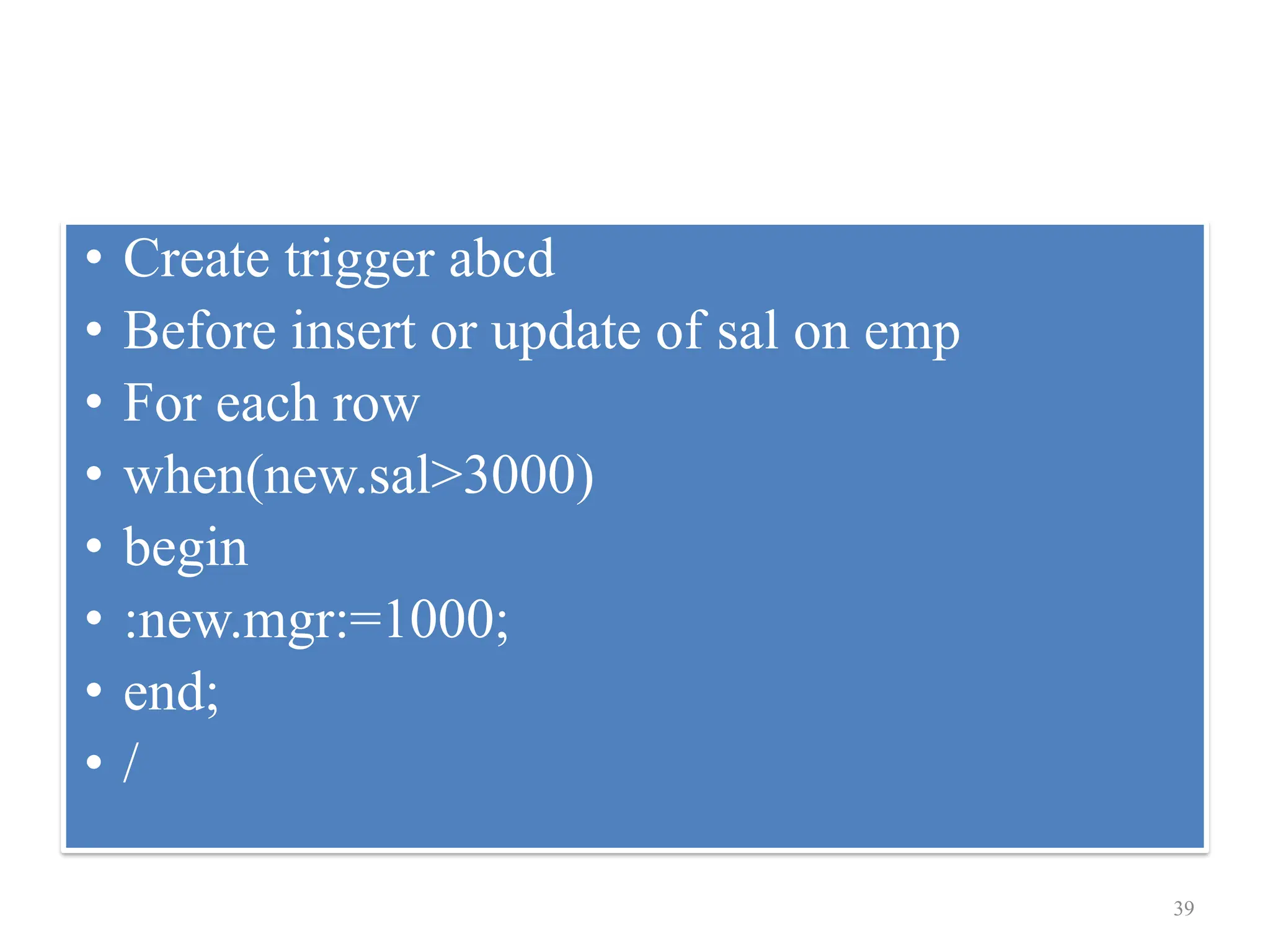
• Create trigger abcd
• Before insert or update of sal on emp
• For each row
• when(new.sal>3000)
• begin
• :new.mgr:=1000;
• end;
• /
39
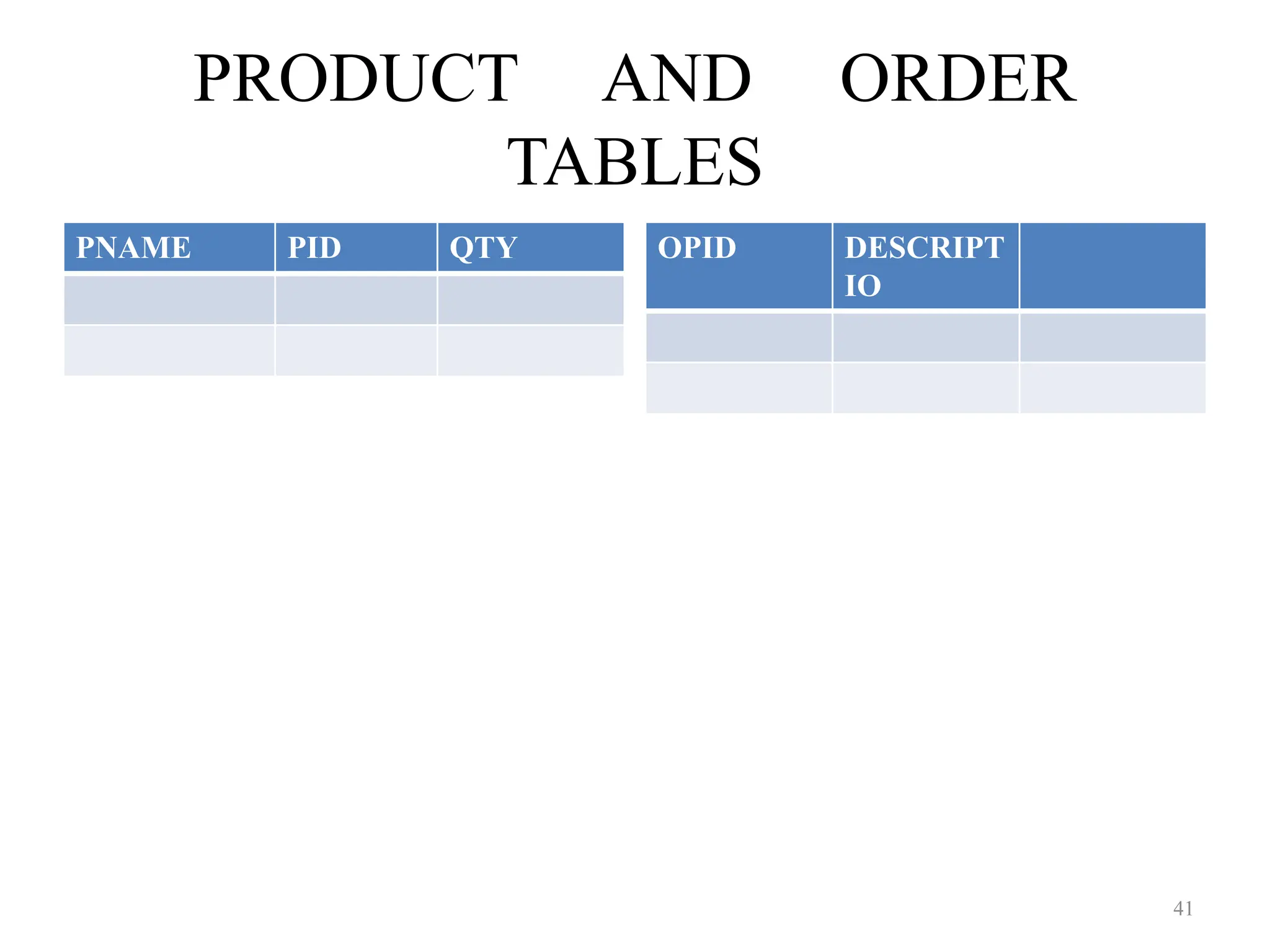
SUPPOSE WE HAVE TWO
TABLES ONE IS PRODUCT
AND OTHER IS ORDER LIKE
BIG BAZAR
40
PRODUCT AND ORDER
TABLES
PNAME PID QTY OPID DESCRIPT
IO
41
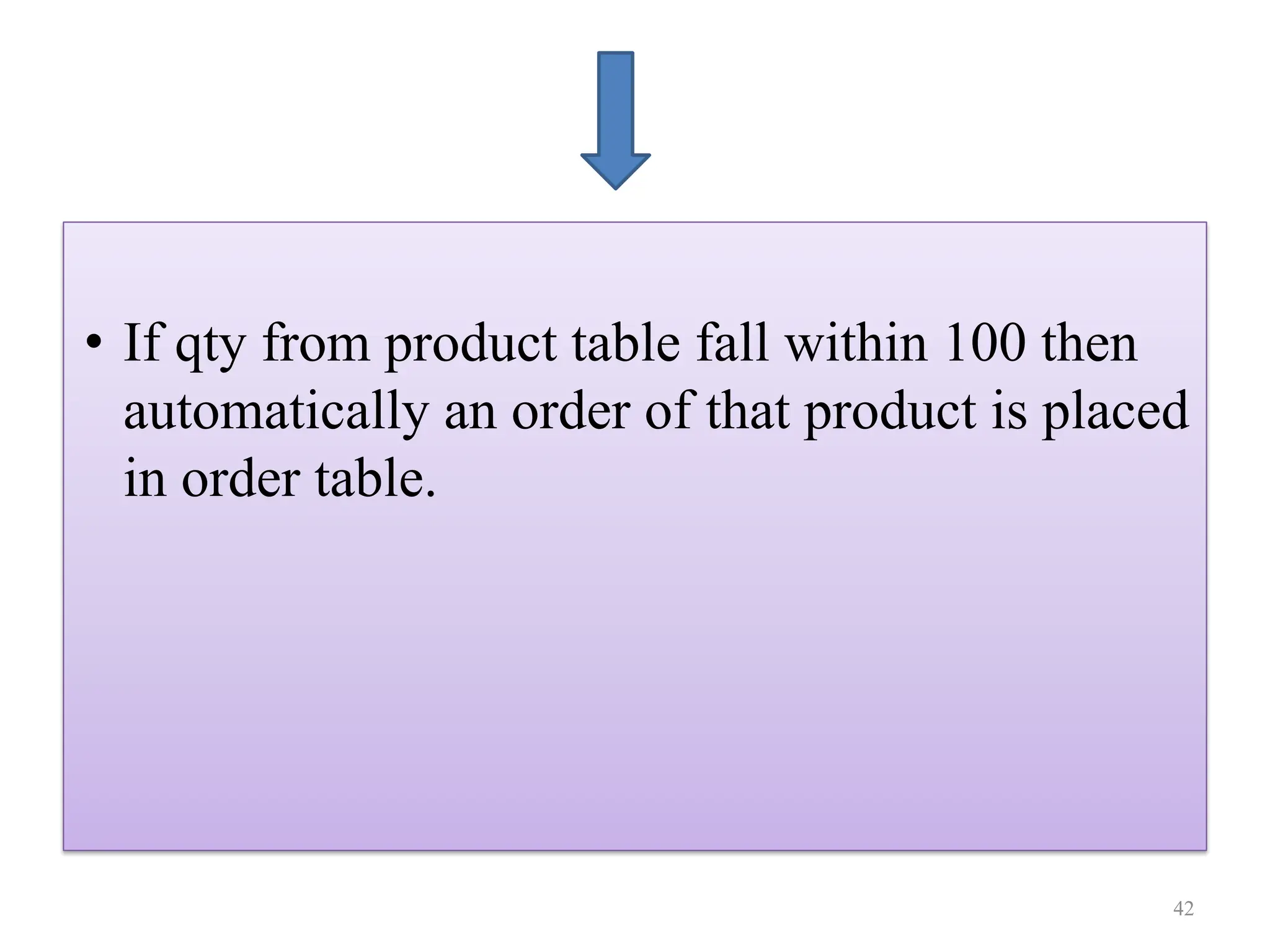
• If qty from product table fall within 100 then
automatically an order of that product is placed
in order table.
42
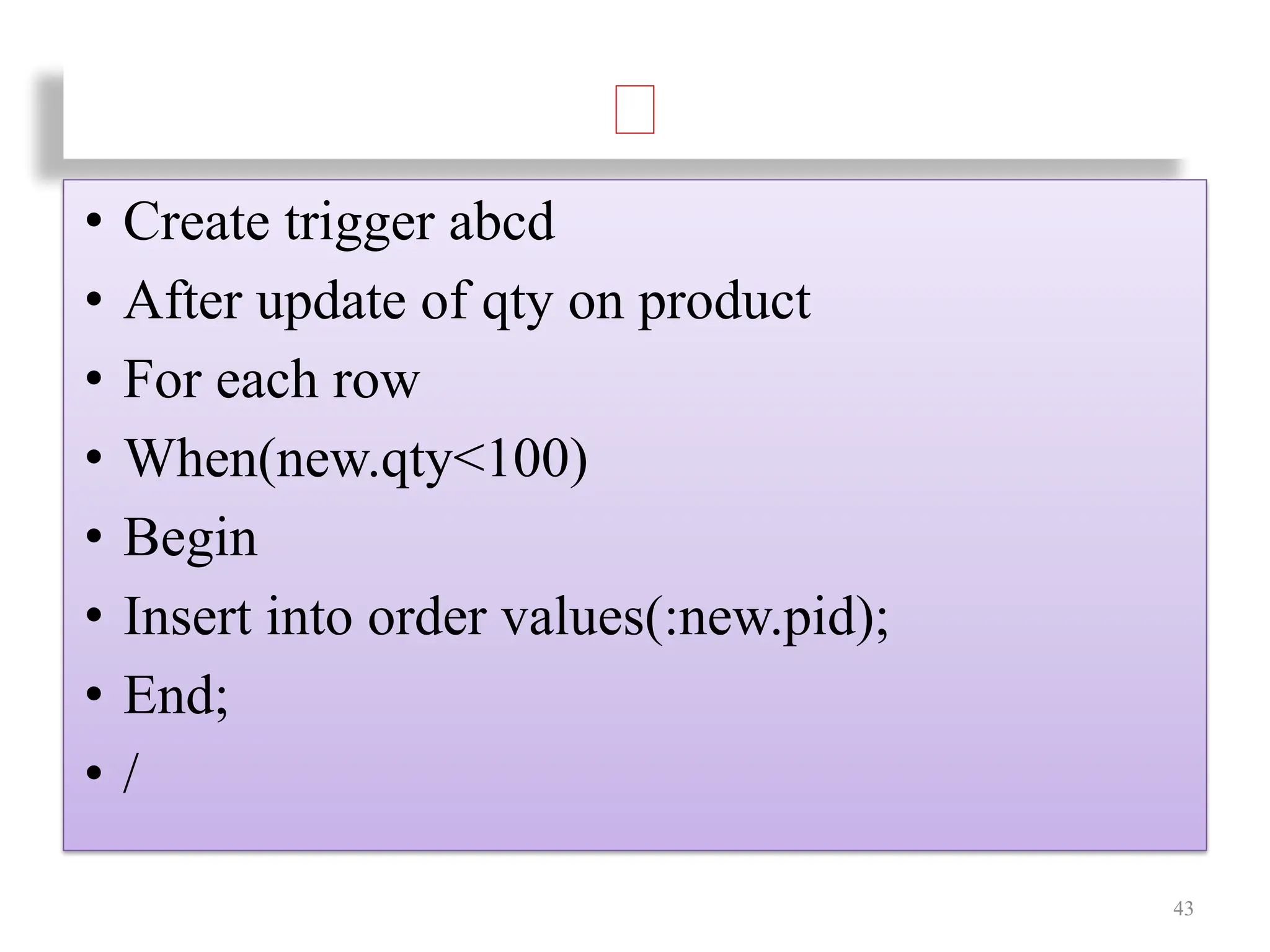
• Create trigger abcd
• After update of qty on product
• For each row
• When(new.qty<100)
• Begin
• Insert into order values(:new.pid);
• End;
• /
43
CURSORS
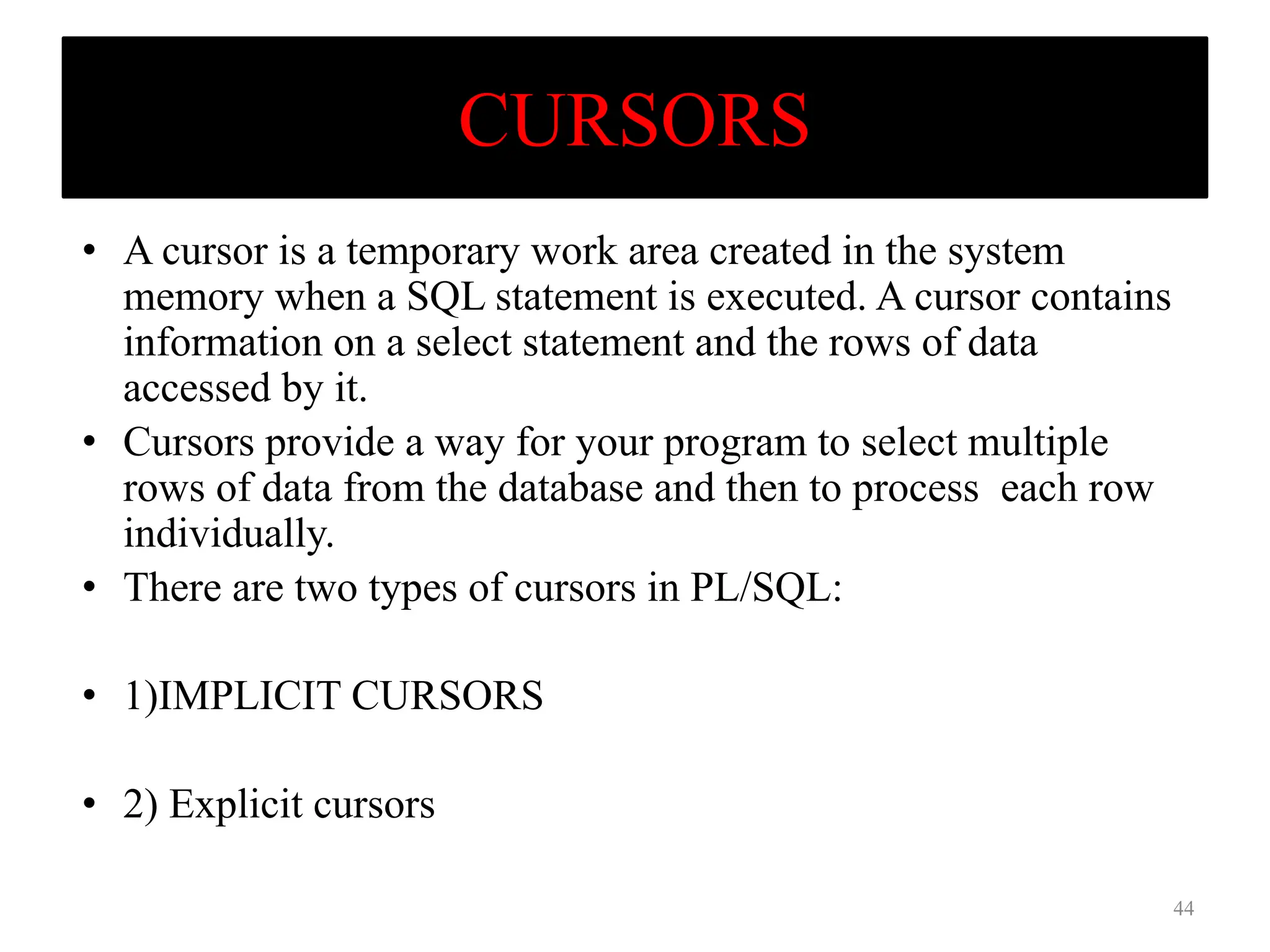
• A cursor is a temporary work area created in the system
memory when a SQL statement is executed. A cursor contains
information on a select statement and the rows of data
accessed by it.
• Cursors provide a way for your program to select multiple
rows of data from the database and then to process each row
individually.
• There are two types of cursors in PL/SQL:
• 1)IMPLICIT CURSORS
• 2) Explicit cursors
44
A CURSOR CAN HOLD MORE
THAN ONE ROW, BUT CAN
PROCESS ONLY ONE ROW
AT A TIME.
45
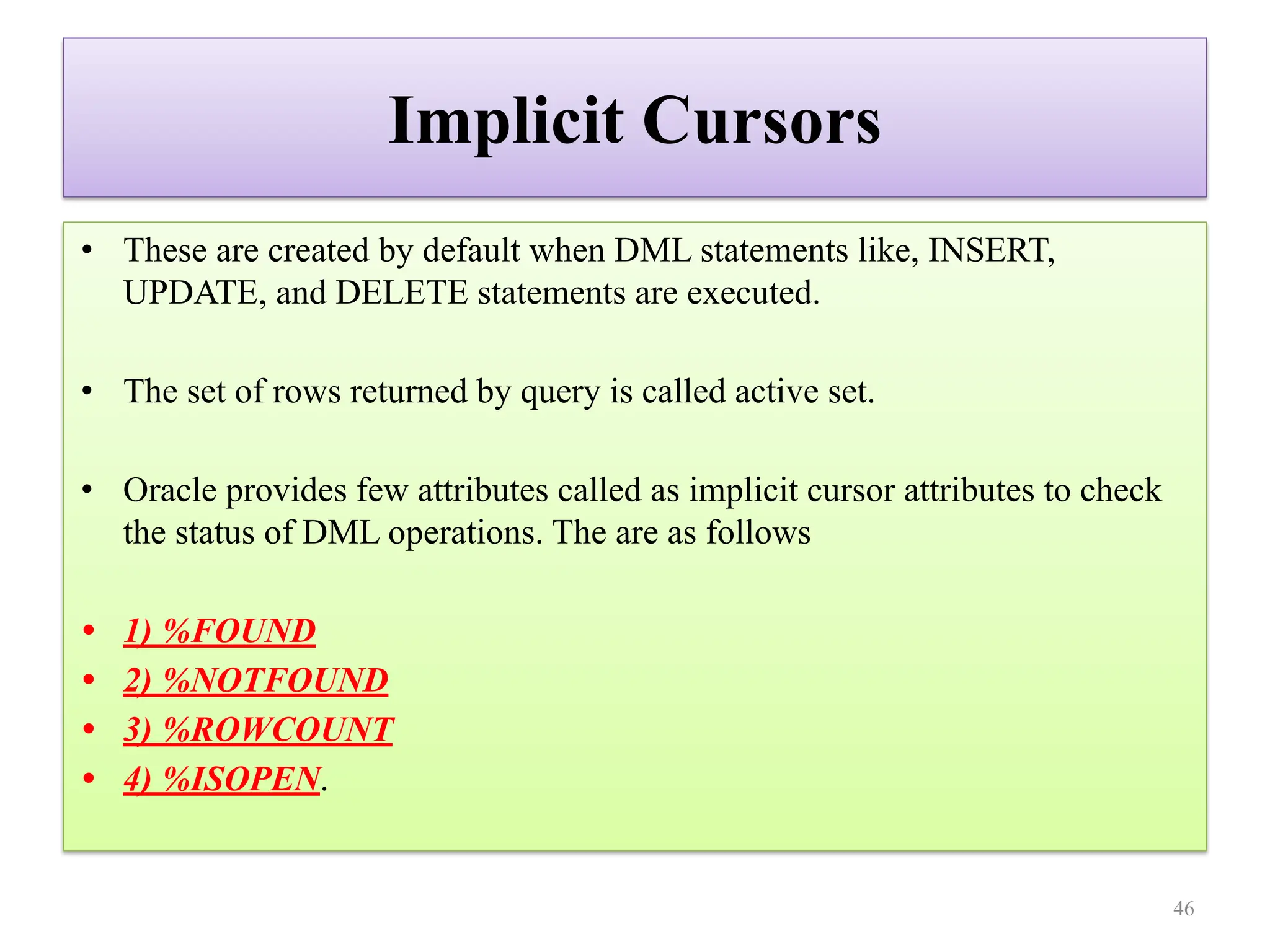
Implicit Cursors
• These are created by default when DML statements like, INSERT,
UPDATE, and DELETE statements are executed.
• The set of rows returned by query is called active set.
• Oracle provides few attributes called as implicit cursor attributes to check
the status of DML operations. The are as follows
• 1) %FOUND
• 2) %NOTFOUND
• 3) %ROWCOUNT
• 4) %ISOPEN.
46
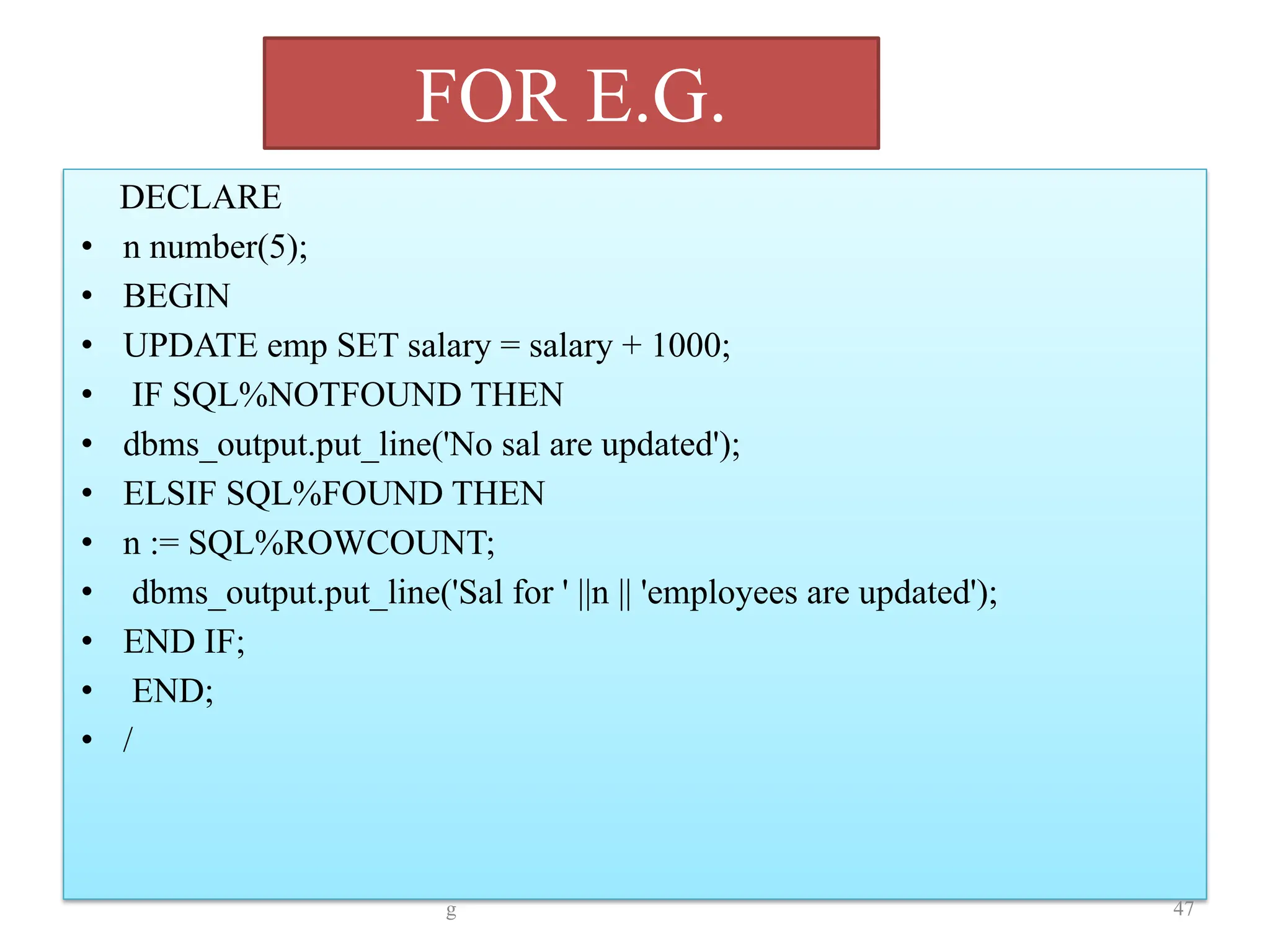
FOR E.G.
DECLARE
• n number(5);
• BEGIN
• UPDATE emp SET salary = salary + 1000;
• IF SQL%NOTFOUND THEN
• dbms_output.put_line('No sal are updated');
• ELSIF SQL%FOUND THEN
• n := SQL%ROWCOUNT;
• dbms_output.put_line('Sal for ' ||n || 'employees are updated');
• END IF;
• END;
• /
g 47
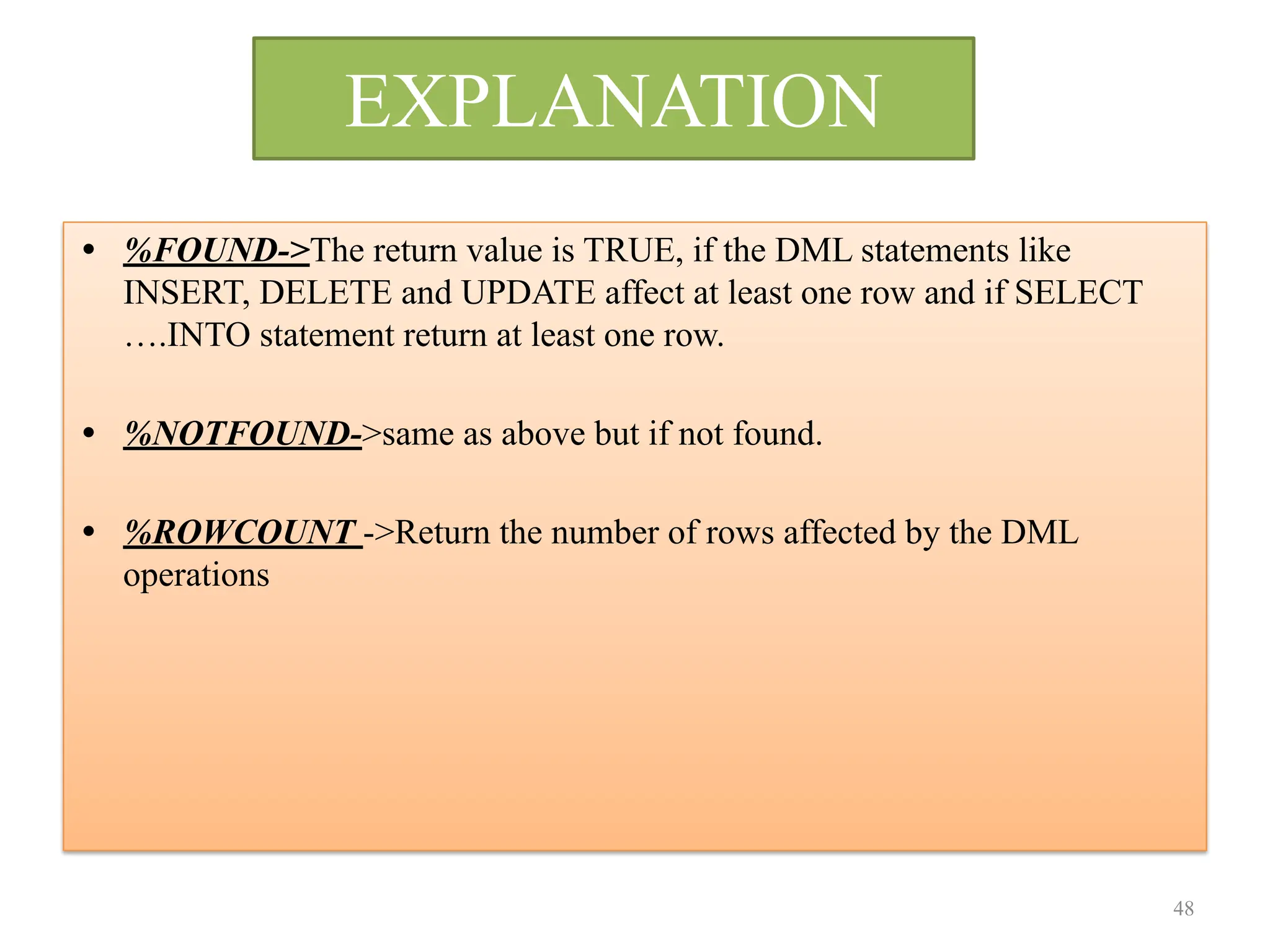
EXPLANATION
• %FOUND->The return value is TRUE, if the DML statements like
INSERT, DELETE and UPDATE affect at least one row and if SELECT
….INTO statement return at least one row.
• %NOTFOUND->same as above but if not found.
• %ROWCOUNT ->Return the number of rows affected by the DML
operations
48
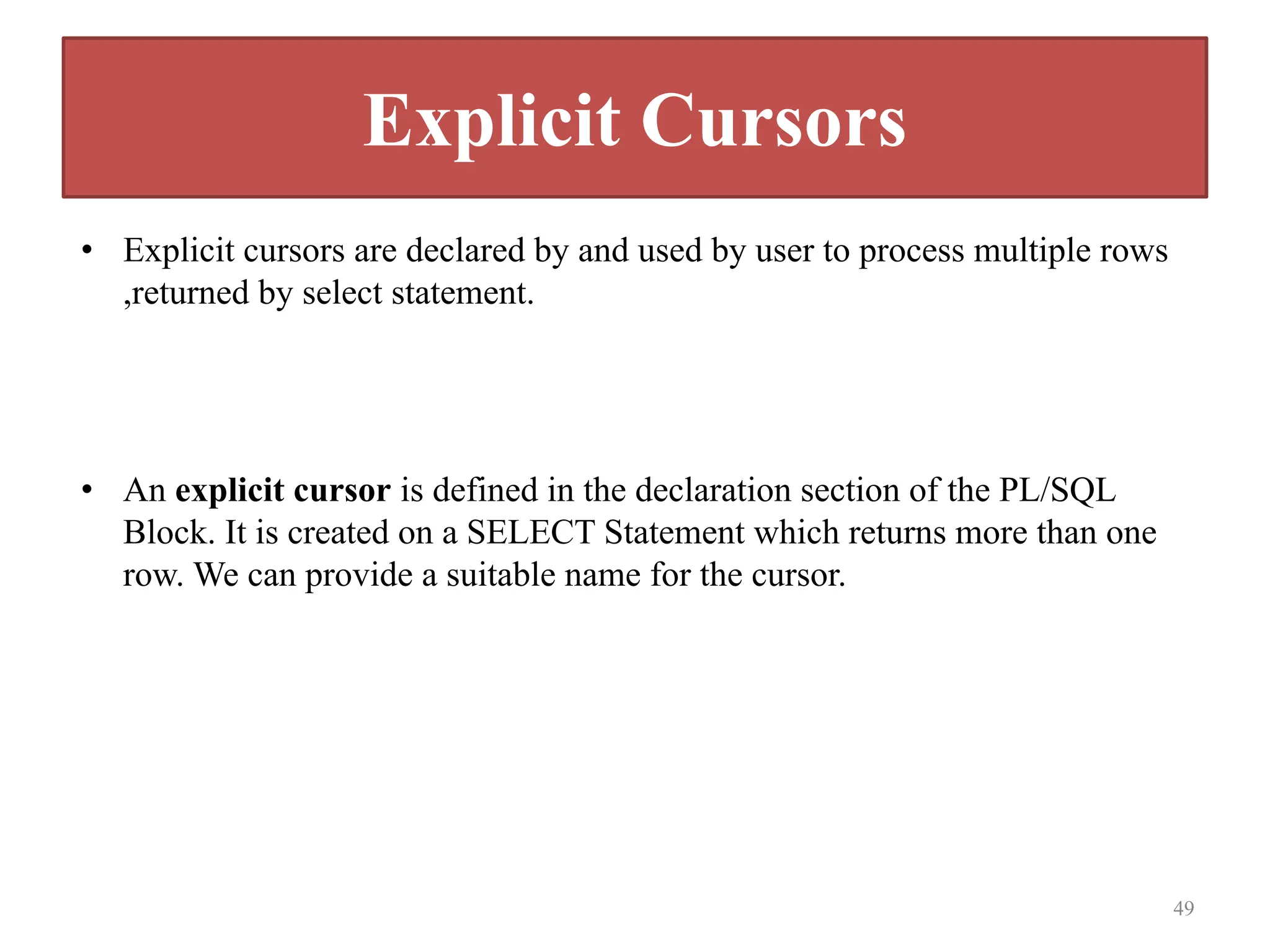
Explicit Cursors
• Explicit cursors are declared by and used by user to process multiple rows
,returned by select statement.
• An explicit cursor is defined in the declaration section of the PL/SQL
Block. It is created on a SELECT Statement which returns more than one
row. We can provide a suitable name for the cursor.
49
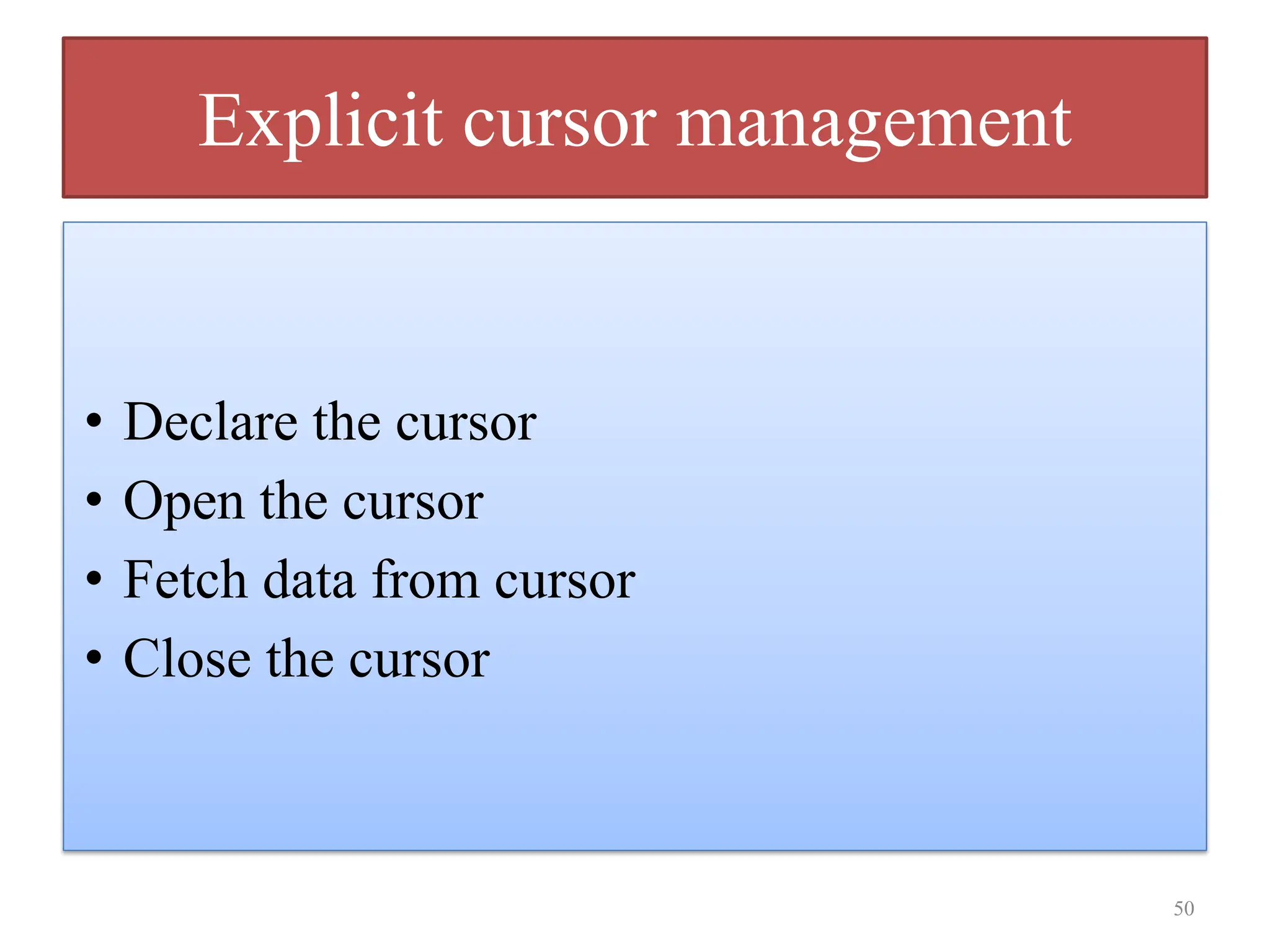
Explicit cursor management
• Declare the cursor
• Open the cursor
• Fetch data from cursor
• Close the cursor
50
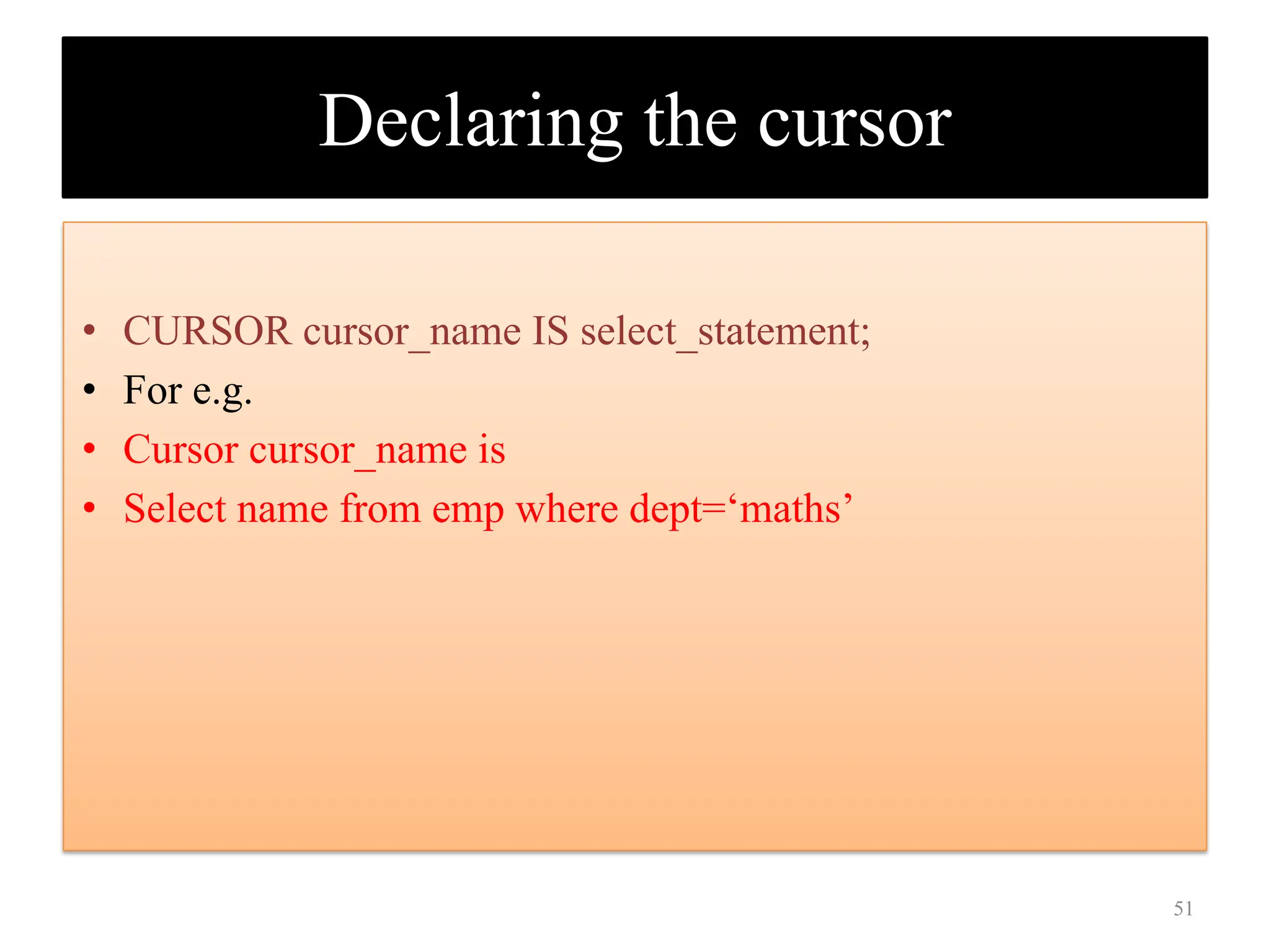
Declaring the cursor
• CURSOR cursor_name IS select_statement;
• For e.g.
• Cursor cursor_name is
• Select name from emp where dept=‘maths’
51
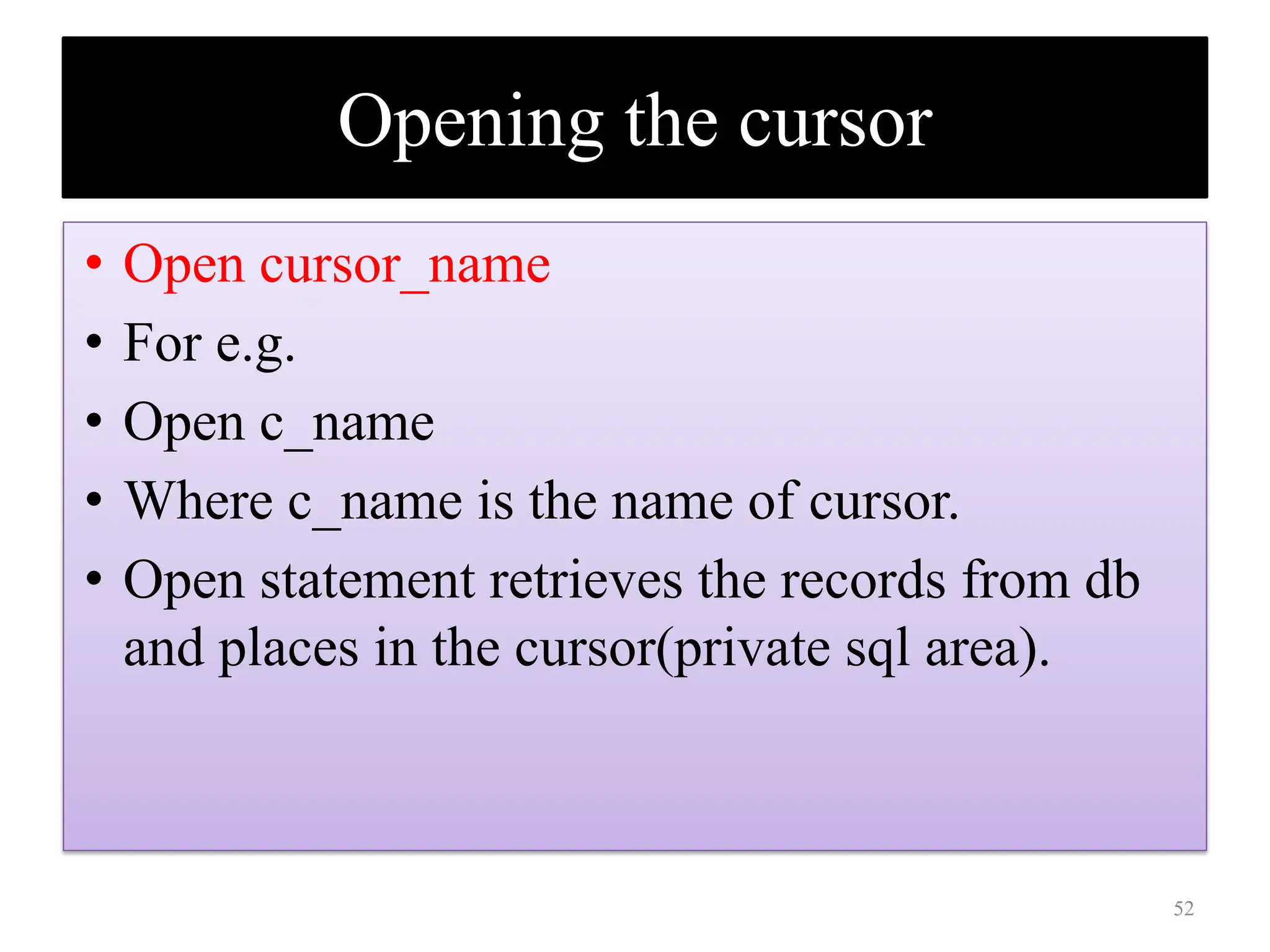
Opening the cursor
• Open cursor_name
• For e.g.
• Open c_name
• Where c_name is the name of cursor.
• Open statement retrieves the records from db
and places in the cursor(private sql area).
52
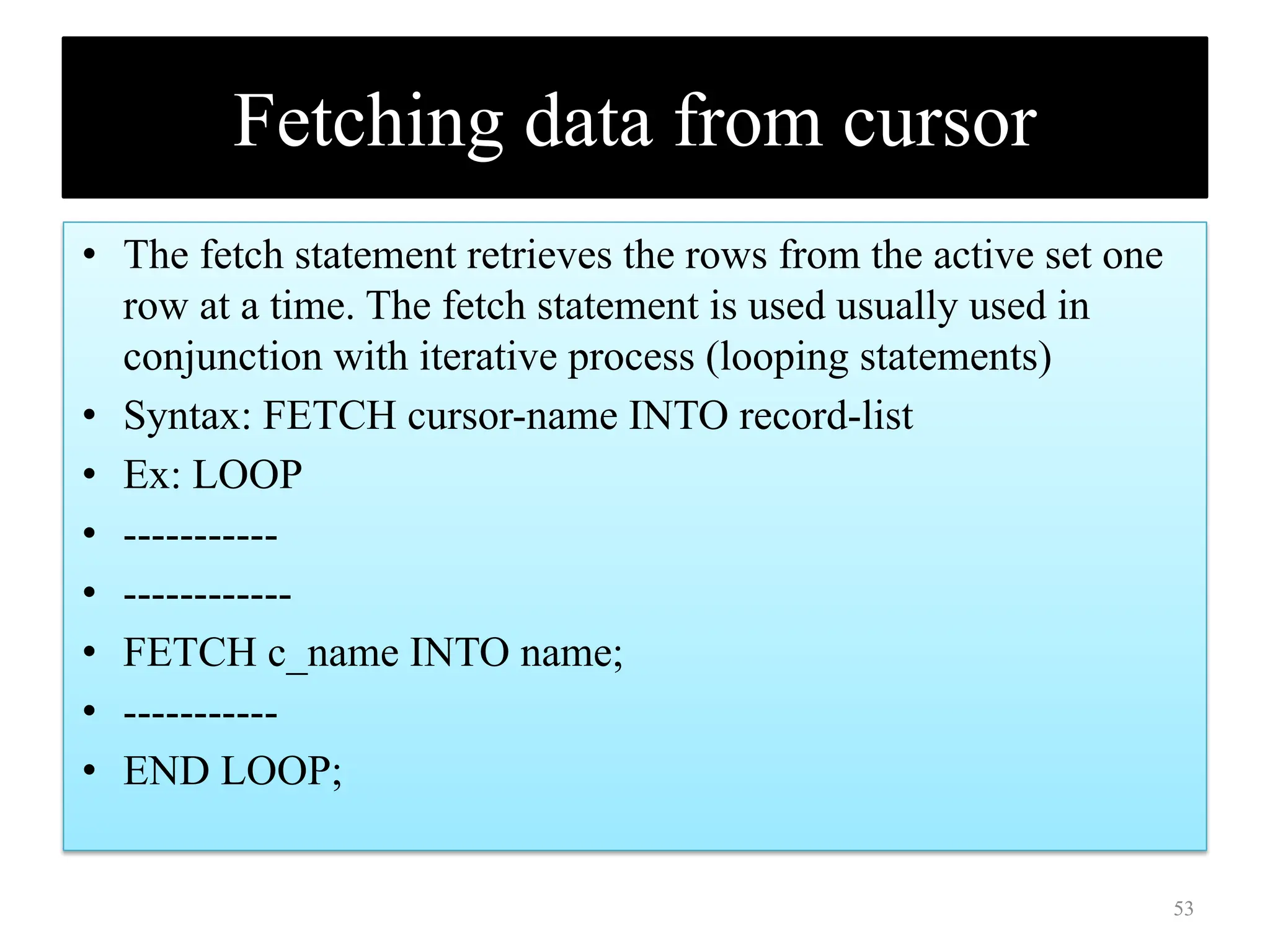
Fetching data from cursor
• The fetch statement retrieves the rows from the active set one
row at a time. The fetch statement is used usually used in
conjunction with iterative process (looping statements)
• Syntax: FETCH cursor-name INTO record-list
• Ex: LOOP
• -----------
• ------------
• FETCH c_name INTO name;
• -----------
• END LOOP;
53
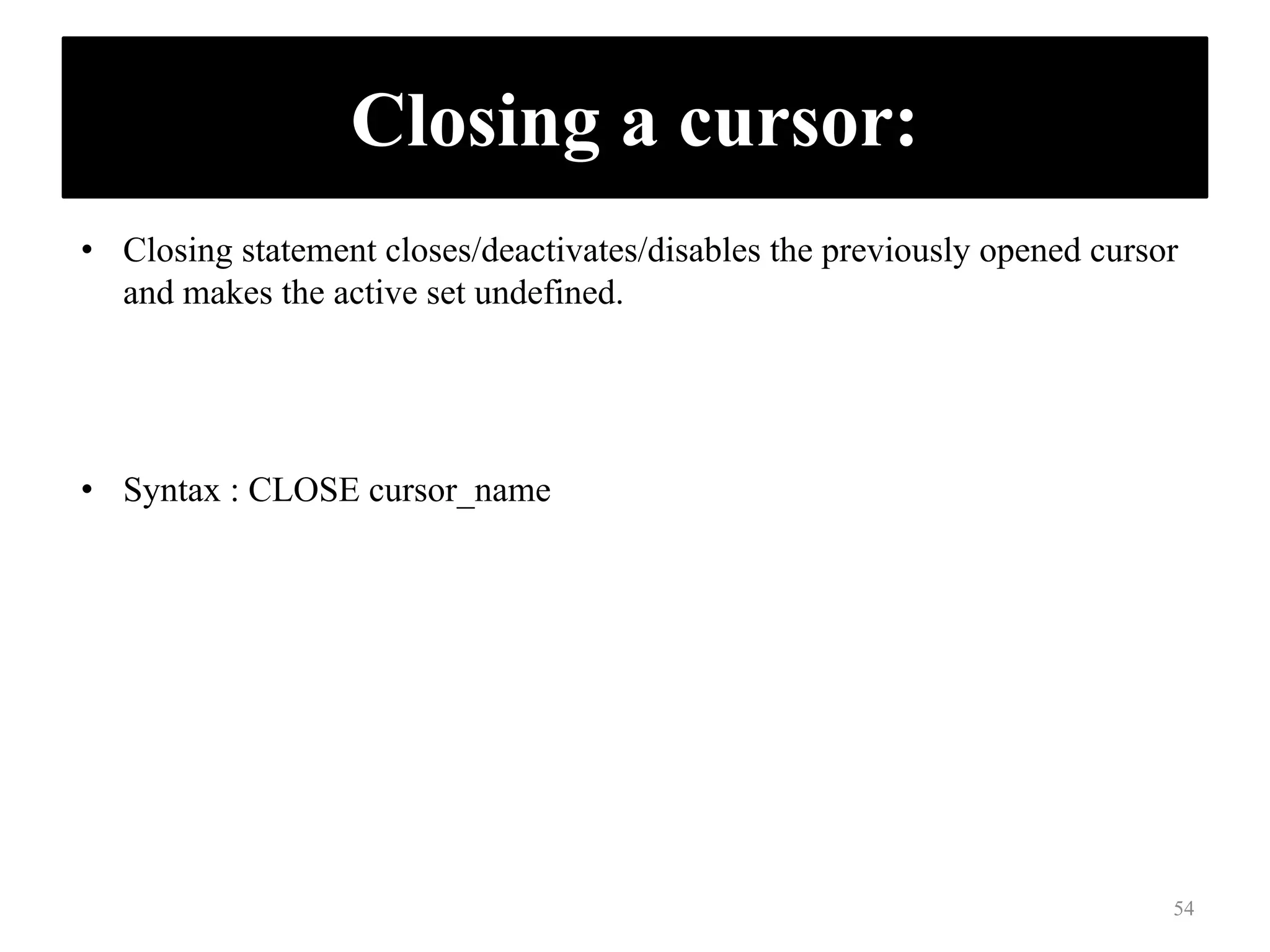
Closing a cursor:
• Closing statement closes/deactivates/disables the previously opened cursor
and makes the active set undefined.
• Syntax : CLOSE cursor_name
54
Cursor can store multiple rows at a
time but without loop cursor cannot
fetch multiple rows but only print
very first row from your result e.g.
on next slide
55
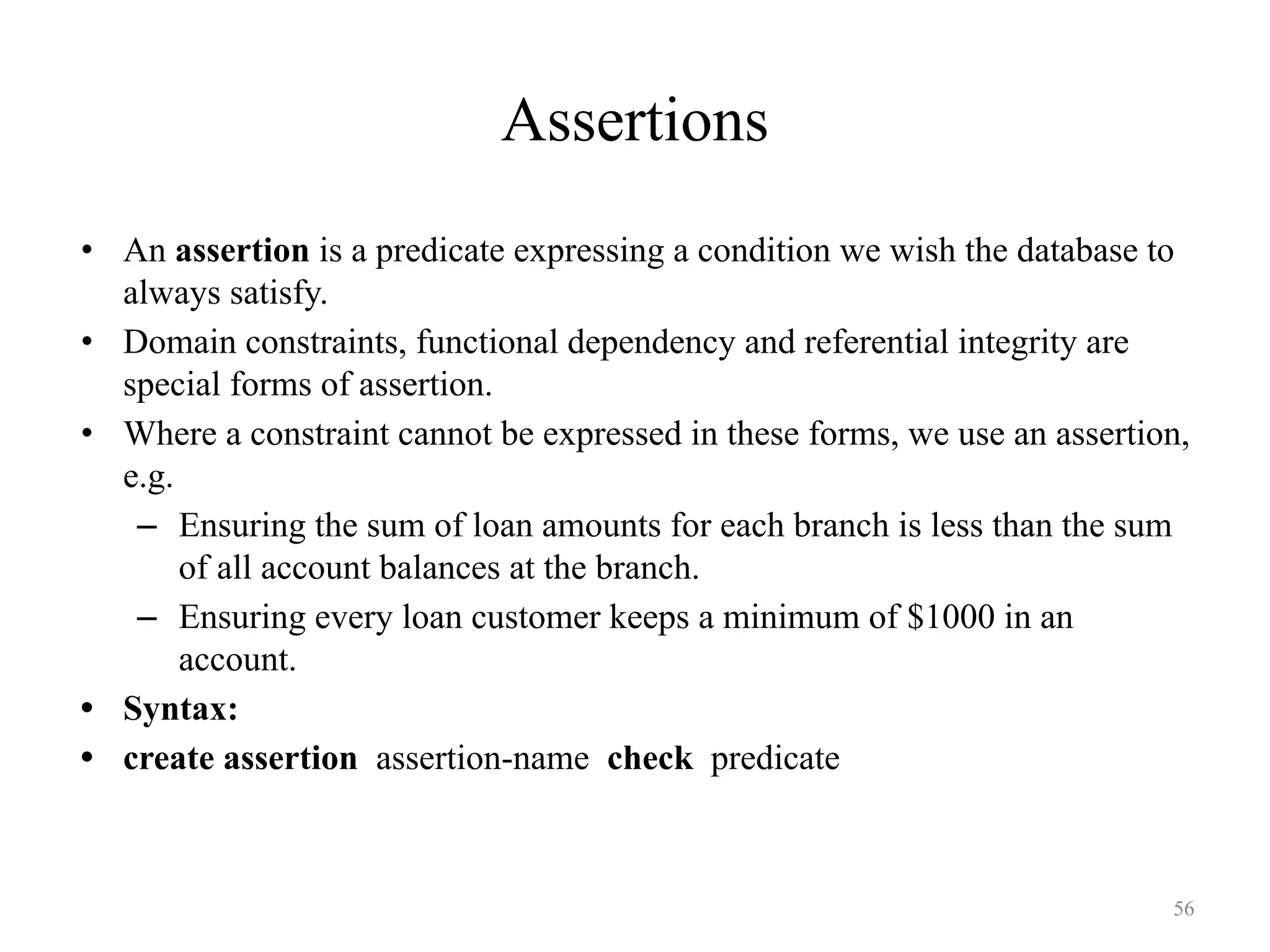
Assertions
• An assertion is a predicate expressing a condition we wish the database to
always satisfy.
• Domain constraints, functional dependency and referential integrity are
special forms of assertion.
• Where a constraint cannot be expressed in these forms, we use an assertion,
e.g.
– Ensuring the sum of loan amounts for each branch is less than the sum
of all account balances at the branch.
– Ensuring every loan customer keeps a minimum of $1000 in an
account.
• Syntax:
• create assertion assertion-name check predicate
56
Privilege
• A privilege is a right to execute a particular type of SQL statement or to
access another user's object. Some examples of privileges include
• the right to connect to the database (create a session)
• the right to create a table
• the right to select rows from another user's table
• the right to execute another user's stored procedure
57
Roles
• Oracle provides for easy and controlled privilege management through
roles.
• Roles are named groups of related privileges that you grant to users or other
roles.
• Roles are designed to ease the administration of end-user system and
object privileges.
• However, roles are not meant to be used for application developers,
because the privileges to access objects within stored programmatic
constructs need to be granted directly.
58
• Embedded / Static SQL
• This is a method for combining data manipulation capabilities of
SQL and computing power of any programming language. Then
embedded statements are in line with the program source code of the
host language.
• Embedded or Static SQL is those SQL statements that are fixed and
can't be changed at runtime in an application
• These statements are compiled at the compile-time only
ZCOER, Department of Computer
Engineering
59
Dynamic SQL
• Dynamic SQL statements are those SQL statements that are created or
executed at the run-time.
• The users can execute their own query in some application. These
statements are compiled at the run-time.
• These kinds of SQL statements are used where there is a non-uniformity in
the data stored in the database.
• It is more flexible as compared to the static SQL and can be used in some
flexible applications.
ZCOER, Department of Computer
Engineering
60
Unit II PL-SQL (2)nssjuejejhjee.pptx.pdf

  • 1.
    PL/SQL PL/SQL stands forProcedural Language extension of SQL. By MOHD MIRZA OCP(Oracle Certified Professional) 1
  • 2.
  • 3.
  • 4.
  • 5.
    •PL/SQL is acombination of SQL along with the procedural features of programming languages. Properties of programming as well as the great interaction with database. PLSQL IS NOT A CASE SENSITIVE LANG. 5
  • 6.
    ZCOER, Department ofComputer Engineering 6
  • 7.
  • 8.
  • 9.
    IMPORTANT PL SQLCONCEPTS DECLARE :- if you want to decalre a variable in plsql program then it takes place in declare section BEGIN:- is used to start the working of program and end is used to terminate the begin. Delimiter is used to run (/) 9
  • 10.
    FOR PRINT ONYOUR SCREEN USE • DBMS_OUTPUT.PUT_LINE command for e.g. if sal=10 and you want to print it • Then it looks like • dbms_output.put_line(‘the salary is ‘ ||sal); 10
  • 11.
    Value assign invariable Declare Num number(11); Begin Num:=5; 11
  • 12.
    User’s input fora variable DECALRE N NUMBER(11); BEGIN N:=&N; DBMS_OUTPUT.PUT_LINE(‘THE VALUE IS ‘||N); END; / 12
  • 13.
    Sample program toprint your ‘hello world’ BEGIN Dbms_output.put_line(‘hello world’); End; / / is used to terminate plsql program called as delimeter 13
  • 14.
    IF STATEMENT IF STATEMENTWORKS AS SIMILAR AS C OR C++ Common syntax IF condition THEN statement 1; ELSE statement 2; END IF; 14
  • 15.
    Conditional statement IFthen else • DECLARE • Age number(11); • Begin • Age:=&age; • If Age>18 then • Dbms_output.put_line(‘u can vote’); • Else • Dbms_output.put_line(‘u cannot vote’); • End if; • End; • / 15
  • 16.
    USE OF IFWITH SQL TABLE • Declare • a number(11); • Begin • Select salary into a from emp where name=‘ram’; • If a>1000 then • Update emp set bonus=bonus+1000 where name=‘ram’; • Else • Update emp set bonus=bonus+500 where name=‘ram’; • End if; • End; • / 16
  • 17.
    To print Patsalary from employees table using pl program • Declare • n number(11); • Begin • Select salary into n from employees where first_name=‘Pat’; • Dbms_output.put_line(‘the Pat sal is ‘ ||n); • End; • / 17
  • 18.
    INTO COMMAND I INTO commandis used to catch a value in variable from table under some while condition Only one value must be returned For e.g. in the above example if there are two people who’s name is john then it shows error 18
  • 19.
    LOOPS IN PLSQL 1)SIMPLE LOOP 2) WHILE LOOP 3) FOR LOOP ; 19
  • 20.
    FOR LOOP • Printnumber from 1 to 10 using for loop • BEGIN • FOR i in 1 ..10 loop • Dbms_output.put_line(i); • End loop • End; • / • (For has NO need to initialize explicitly but it need in while ) 20
  • 21.
    While loop • PRINTNUMBERS FROM 1 TO 10 USING WHILE LOOP • Declare • i number(3):=0; • Begin • While i<=10 loop • i:=i+1; • Dbms_output.put_line(i); • End loop; • End; • / 21
  • 22.
    SIMPLE LOOP • LOOP •Statement 1; • Statement 2; • Exit condition • End loop; 22
  • 23.
    USE OF LOOPIN RDBMS ONE CAN EASILY INSERT ID FROM SAY 1 TO 100 USING LOOP NAME ID SAL 23
  • 24.
    STORED PROCEDURE • SOMETHINGLIKE FUNCIONS IN C/C++. • A stored procedure is a subroutine available to applications that access a relational database system. A stored procedure (sometimes called a proc, sproc, StoPro, StoredProc, sp or SP) is actually stored in the database data dictionary. • A procedure is similar to an anonymous PL/SQL Block but it is named for repeated usage. A procedure may or may not return any value 24
  • 25.
    Common syntax • CREATE[OR REPLACE] PROCEDURE procedure_name • [ (parameter [,parameter]) ] • IS • [declaration_section] • BEGIN • executable_section • [EXCEPTION exception_section] • END [procedure_name]; 25
  • 26.
    EXAMPLE WITHOUT PARAMETER •CREATE OR REPLACE PROCEDURE MYSTPROC IS • BEGIN • Select ('Hello World!'); • END; • / 26
  • 27.
    When you createa procedure or function, you may define parameters. There are three types of parameters that can be declared 27 1)IN 2)OUT 3)IN OUT
  • 28.
    PARAMETER TYPES • 1)IN type parameter: These types of parameters are used to send values to stored procedures. • 2) OUT type parameter: These types of parameters are used to get values from stored procedures. This is similar to a return type in functions. • 3) IN OUT parameter: These types of parameters are used to send values and get values from stored procedures. 28
  • 29.
    1) IN PARAMETER Thisis similar to passing parameters in programming languages. We can pass values to the stored procedure through these parameters or variables. CREATE OR REPLACE PROCEDURE MYPROC(param1 IN VARCHAR2) IS BEGIN DBMS_OUTPUT.PUT_LINE('Hello World IN parameter ' || param1); END; / 29
  • 30.
    2) OUT Parameter •CREATE OR REPLACE PROCEDURE procname (outParam1 OUT VARCHAR2) • IS • BEGIN • outParam1 := 'Hello World OUT parameter'; • END; • / • Run it • DECLARE outParam1 VARCHAR2(100); • BEGIN • Procname (outParam1); • DBMS_OUTPUT.PUT_LINE(outParam1); • END; • / 30
  • 31.
    DIFF B/W PROCEDUREAND FUNCTION • The functions can return only one value and procedures not. Functions can be call from SQL Statements, procedures not and there are some things that you can do in a stored procedure that you can not do in a function. 31
  • 32.
    FOR E.G. • Createa stored procedure that adds 1000 to each employees commission watch for Null values • Create procedure st_proc as • Begin • Update emp set comm=nvl(comm,0)+1000; • End; • / 32
  • 33.
    Procedure can callat any time using • Execute st_proc; ------- procedure name • OR • Exec st_proc;--------------- procedure name 33
  • 34.
    FUNCTIONS • A functionis a named PL/SQL Block which is similar to a procedure. The major difference between a procedure and a function is, a function must always return a value, but a procedure may or may not return a value. 34
  • 35.
    FUNCTION EXAMPLE • Createfunction funname • Return number is • a number(10); • Begin • Select avg(sal) into a from emp; • return a; • End; • / 35
  • 36.
    HOW TO EXECUTEFUNCTION ? 1) SELECT FUNCTIONNAME FROM DUAL; 2)DBMS_OUTPUT.PUT_LINE(FUNCTIONN AME); g 36
  • 37.
    CREATE TRIGGERS • Atrigger is a pl/sql block structure which is fired when a DML statements like Insert, Delete, Update is executed on a database table. A trigger is triggered automatically when an associated DML statement is executed. 37
  • 38.
    Insert Triggers: BEFORE INSERTTrigger AFTER INSERT Trigger Update Triggers: BEFORE UPDATE Trigger AFTER UPDATE Trigger Delete Triggers: BEFORE DELETE Trigger AFTER DELETE Trigger Drop Triggers: Drop a Trigger Disable/Enable Triggers: Disable a Trigger Disable all Triggers on a table Enable a Trigger Enable all Triggers on a table 38
  • 39.
    • Create triggerabcd • Before insert or update of sal on emp • For each row • when(new.sal>3000) • begin • :new.mgr:=1000; • end; • / 39
  • 40.
    SUPPOSE WE HAVETWO TABLES ONE IS PRODUCT AND OTHER IS ORDER LIKE BIG BAZAR 40
  • 41.
    PRODUCT AND ORDER TABLES PNAMEPID QTY OPID DESCRIPT IO 41
  • 42.
    • If qtyfrom product table fall within 100 then automatically an order of that product is placed in order table. 42
  • 43.
    • Create triggerabcd • After update of qty on product • For each row • When(new.qty<100) • Begin • Insert into order values(:new.pid); • End; • / 43
  • 44.
    CURSORS • A cursoris a temporary work area created in the system memory when a SQL statement is executed. A cursor contains information on a select statement and the rows of data accessed by it. • Cursors provide a way for your program to select multiple rows of data from the database and then to process each row individually. • There are two types of cursors in PL/SQL: • 1)IMPLICIT CURSORS • 2) Explicit cursors 44
  • 45.
    A CURSOR CANHOLD MORE THAN ONE ROW, BUT CAN PROCESS ONLY ONE ROW AT A TIME. 45
  • 46.
    Implicit Cursors • Theseare created by default when DML statements like, INSERT, UPDATE, and DELETE statements are executed. • The set of rows returned by query is called active set. • Oracle provides few attributes called as implicit cursor attributes to check the status of DML operations. The are as follows • 1) %FOUND • 2) %NOTFOUND • 3) %ROWCOUNT • 4) %ISOPEN. 46
  • 47.
    FOR E.G. DECLARE • nnumber(5); • BEGIN • UPDATE emp SET salary = salary + 1000; • IF SQL%NOTFOUND THEN • dbms_output.put_line('No sal are updated'); • ELSIF SQL%FOUND THEN • n := SQL%ROWCOUNT; • dbms_output.put_line('Sal for ' ||n || 'employees are updated'); • END IF; • END; • / g 47
  • 48.
    EXPLANATION • %FOUND->The returnvalue is TRUE, if the DML statements like INSERT, DELETE and UPDATE affect at least one row and if SELECT ….INTO statement return at least one row. • %NOTFOUND->same as above but if not found. • %ROWCOUNT ->Return the number of rows affected by the DML operations 48
  • 49.
    Explicit Cursors • Explicitcursors are declared by and used by user to process multiple rows ,returned by select statement. • An explicit cursor is defined in the declaration section of the PL/SQL Block. It is created on a SELECT Statement which returns more than one row. We can provide a suitable name for the cursor. 49
  • 50.
    Explicit cursor management •Declare the cursor • Open the cursor • Fetch data from cursor • Close the cursor 50
  • 51.
    Declaring the cursor •CURSOR cursor_name IS select_statement; • For e.g. • Cursor cursor_name is • Select name from emp where dept=‘maths’ 51
  • 52.
    Opening the cursor •Open cursor_name • For e.g. • Open c_name • Where c_name is the name of cursor. • Open statement retrieves the records from db and places in the cursor(private sql area). 52
  • 53.
    Fetching data fromcursor • The fetch statement retrieves the rows from the active set one row at a time. The fetch statement is used usually used in conjunction with iterative process (looping statements) • Syntax: FETCH cursor-name INTO record-list • Ex: LOOP • ----------- • ------------ • FETCH c_name INTO name; • ----------- • END LOOP; 53
  • 54.
    Closing a cursor: •Closing statement closes/deactivates/disables the previously opened cursor and makes the active set undefined. • Syntax : CLOSE cursor_name 54
  • 55.
    Cursor can storemultiple rows at a time but without loop cursor cannot fetch multiple rows but only print very first row from your result e.g. on next slide 55
  • 56.
    Assertions • An assertionis a predicate expressing a condition we wish the database to always satisfy. • Domain constraints, functional dependency and referential integrity are special forms of assertion. • Where a constraint cannot be expressed in these forms, we use an assertion, e.g. – Ensuring the sum of loan amounts for each branch is less than the sum of all account balances at the branch. – Ensuring every loan customer keeps a minimum of $1000 in an account. • Syntax: • create assertion assertion-name check predicate 56
  • 57.
    Privilege • A privilegeis a right to execute a particular type of SQL statement or to access another user's object. Some examples of privileges include • the right to connect to the database (create a session) • the right to create a table • the right to select rows from another user's table • the right to execute another user's stored procedure 57
  • 58.
    Roles • Oracle providesfor easy and controlled privilege management through roles. • Roles are named groups of related privileges that you grant to users or other roles. • Roles are designed to ease the administration of end-user system and object privileges. • However, roles are not meant to be used for application developers, because the privileges to access objects within stored programmatic constructs need to be granted directly. 58
  • 59.
    • Embedded /Static SQL • This is a method for combining data manipulation capabilities of SQL and computing power of any programming language. Then embedded statements are in line with the program source code of the host language. • Embedded or Static SQL is those SQL statements that are fixed and can't be changed at runtime in an application • These statements are compiled at the compile-time only ZCOER, Department of Computer Engineering 59
  • 60.
    Dynamic SQL • DynamicSQL statements are those SQL statements that are created or executed at the run-time. • The users can execute their own query in some application. These statements are compiled at the run-time. • These kinds of SQL statements are used where there is a non-uniformity in the data stored in the database. • It is more flexible as compared to the static SQL and can be used in some flexible applications. ZCOER, Department of Computer Engineering 60