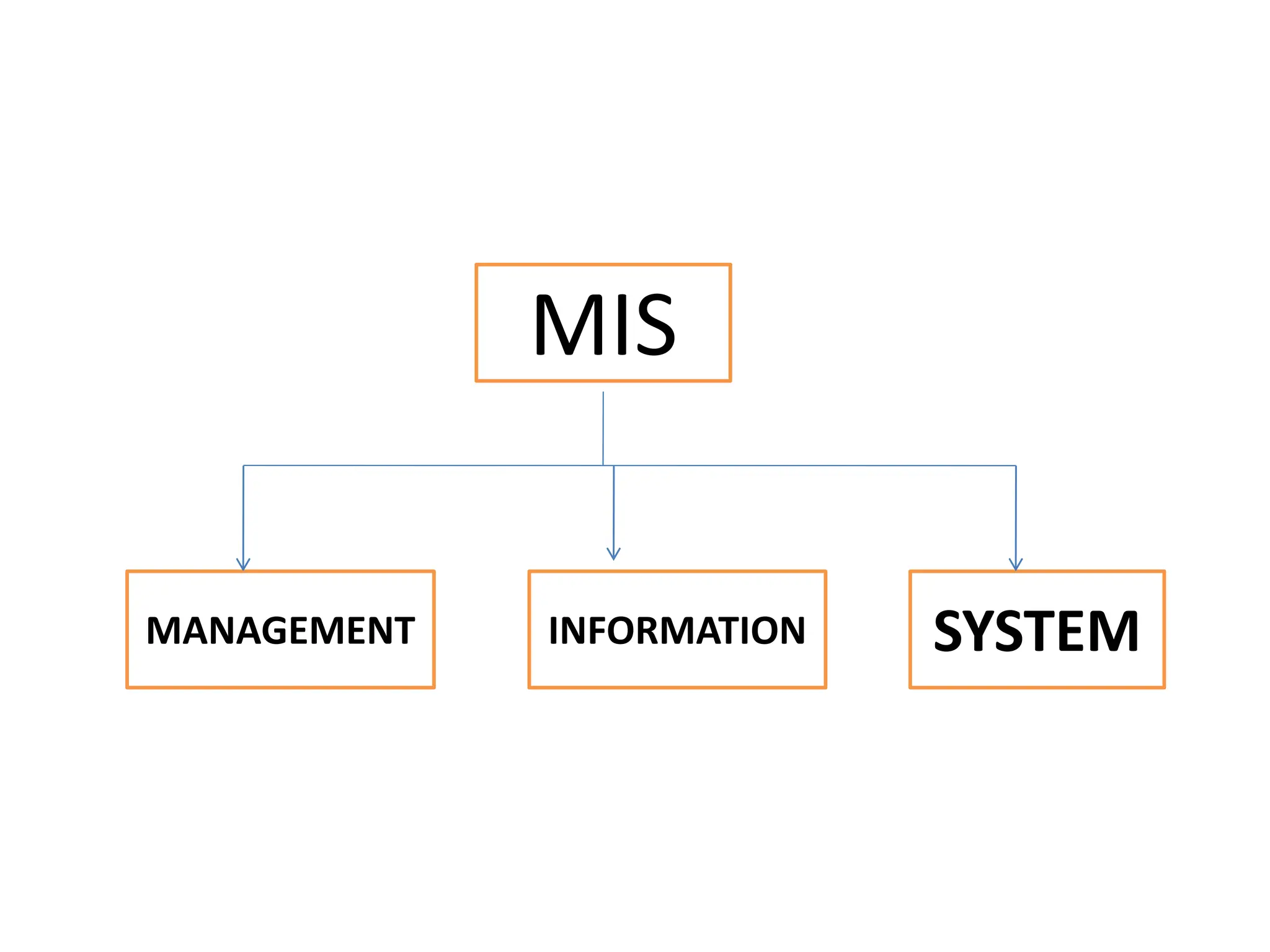
MIS
SYSTEM
INFORMATION
MANAGEMENT
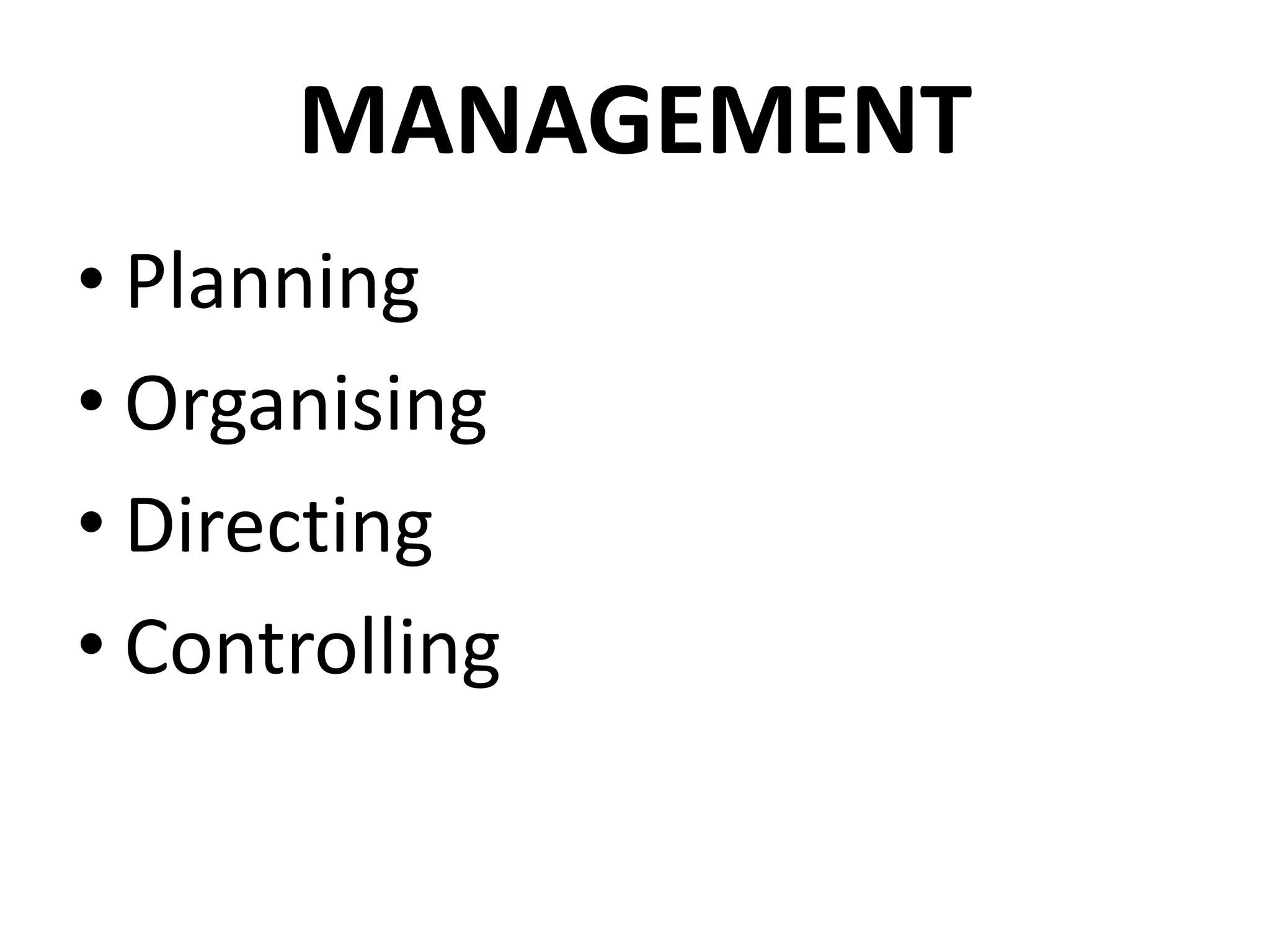
MANAGEMENT
• Planning
• Organising
• Directing
• Controlling
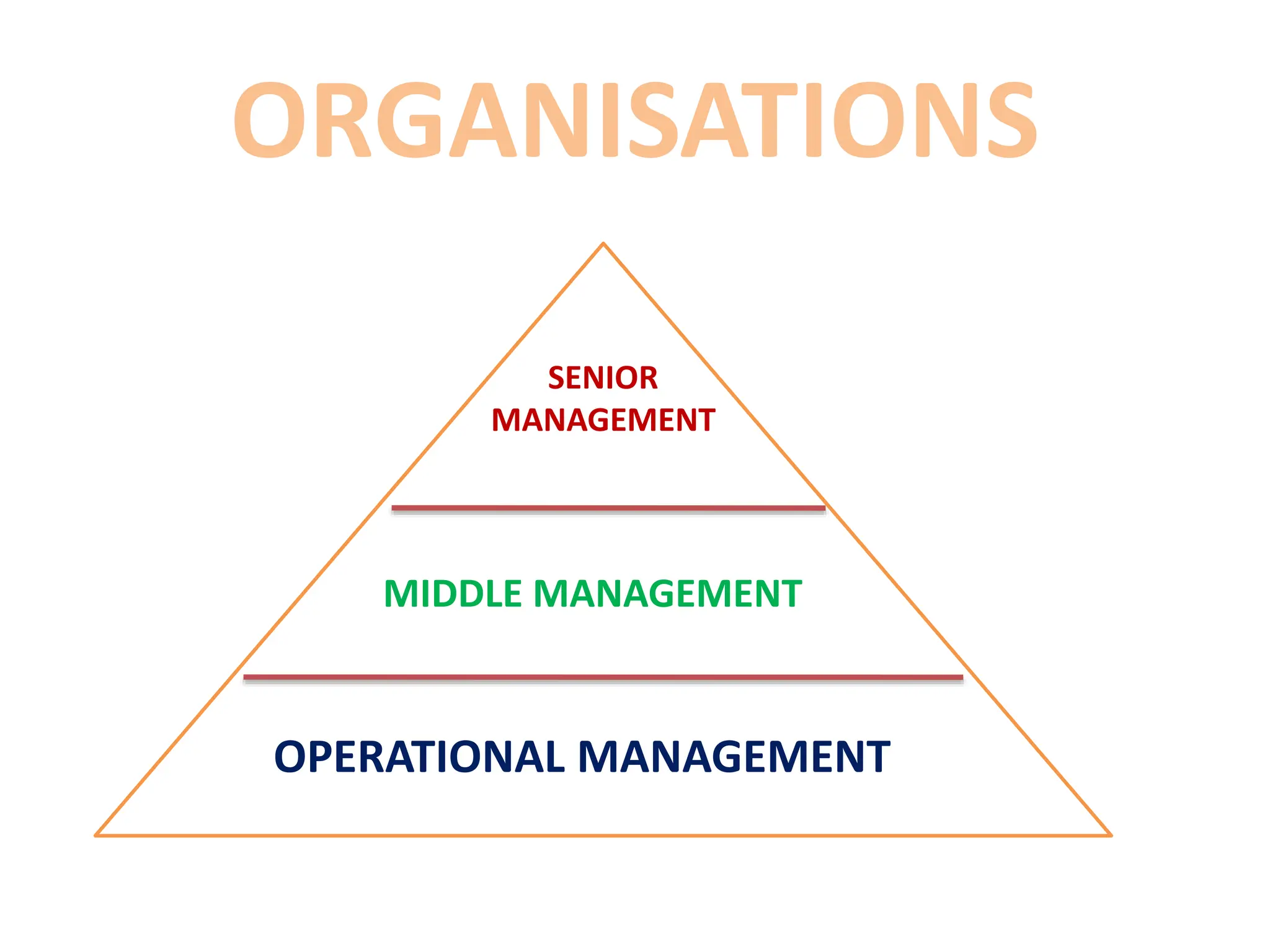
ORGANISATIONS
SENIOR
MANAGEMENT
MIDDLE MANAGEMENT
OPERATIONAL MANAGEMENT
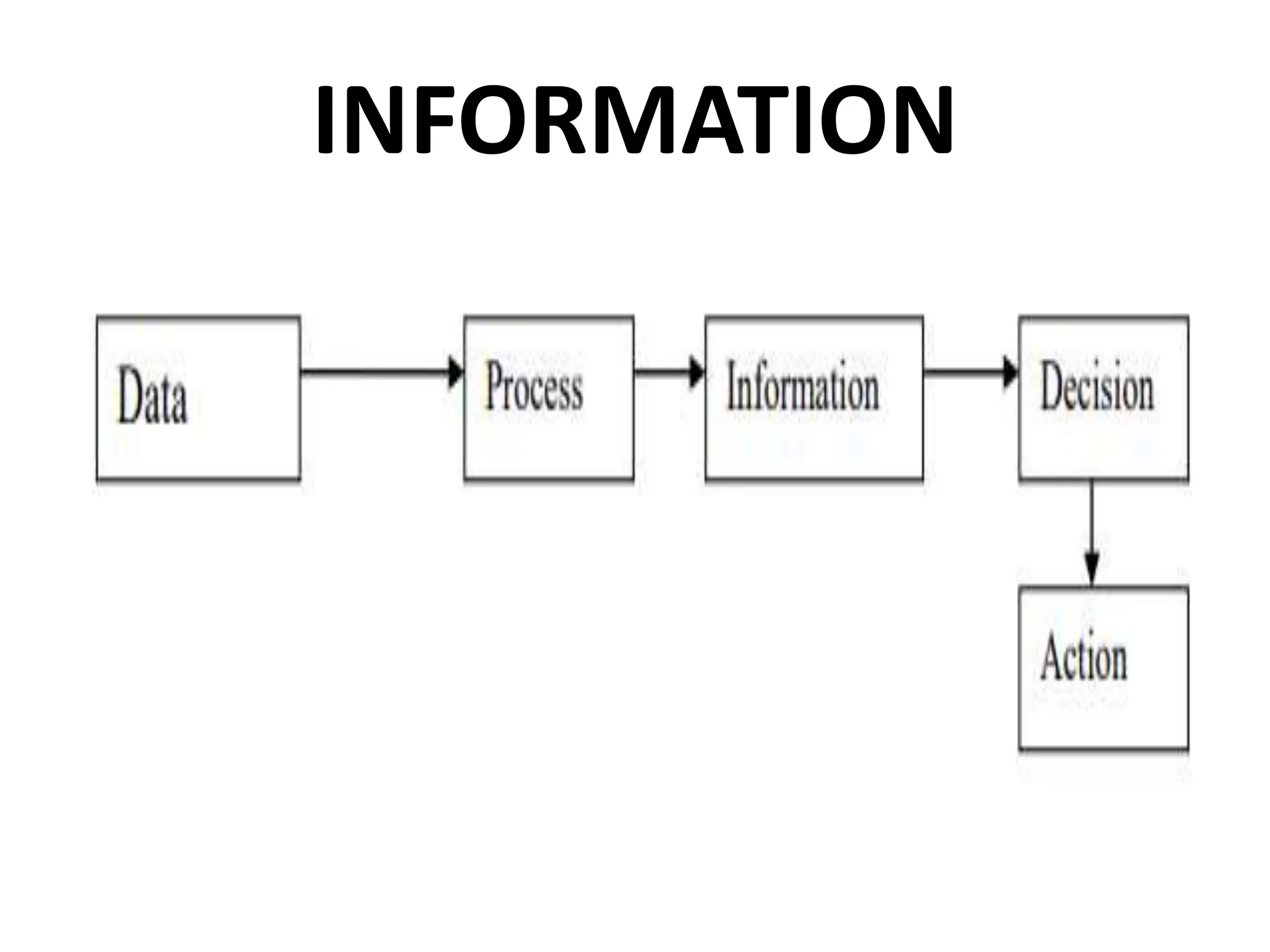
INFORMATION
INFORMATION
• Information can be defined as meaningfully
interpreted data
• Information can be recorded as signs, or
transmitted as signals. Information is any kind of
even that affects the state of a dynamic system
that can interpret the information.
• Conceptually, information is the message being
conveyed. In a general sense, information is
“knowledge communicated or received,
concerning a particular fact or circumstance”.
SYSTEM
• System defined as an orderly arrangement of a
set of interrelated and interdependent elements
that operate collectively to accomplish some
common purpose or goal.
• A computer based information system is also a
system which is a collection of people, hardware,
software, data and procedure to interact to
provide timely information to authorised people
who need it.
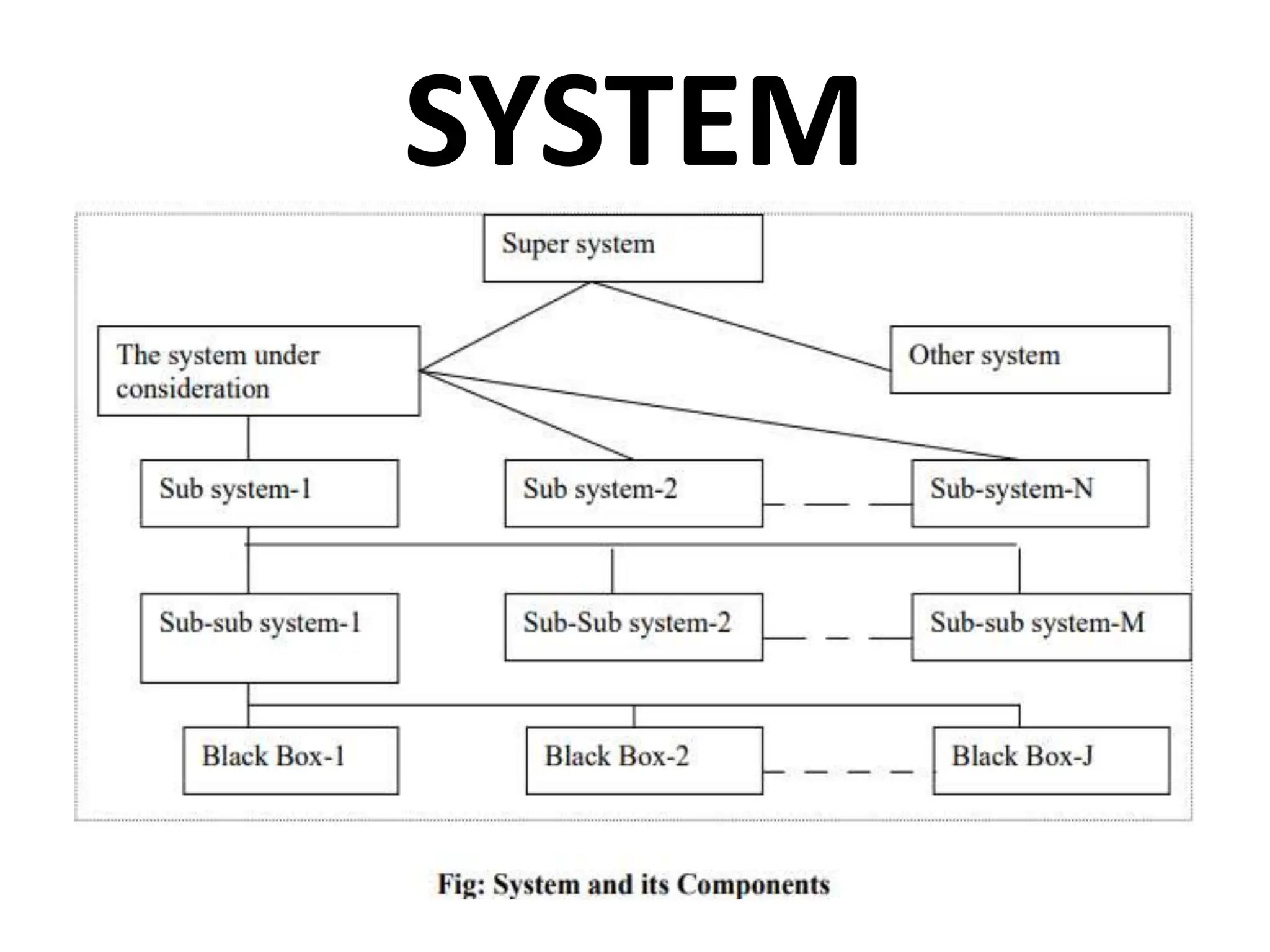
SYSTEM
MANAGEMENT INFORMATION
SYSTEM
• “an integrated user-machine system
designed for providing information to
support operational control,
management control and decision
making function is an organisation”.
•Davis and Olson
MANAGEMENT INFORMATION
SYSTEM
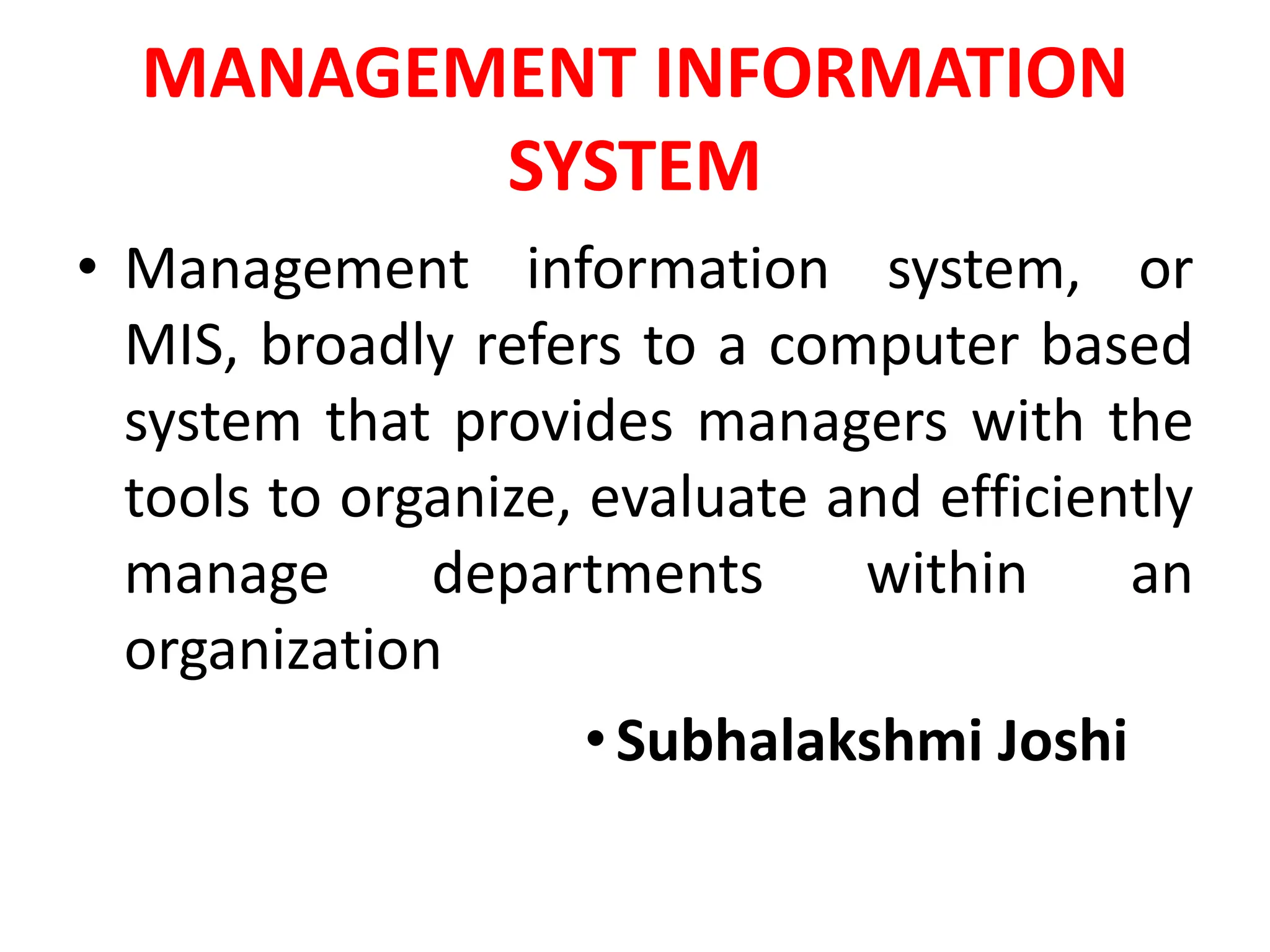
• Management information system, or
MIS, broadly refers to a computer based
system that provides managers with the
tools to organize, evaluate and efficiently
manage departments within an
organization
•Subhalakshmi Joshi
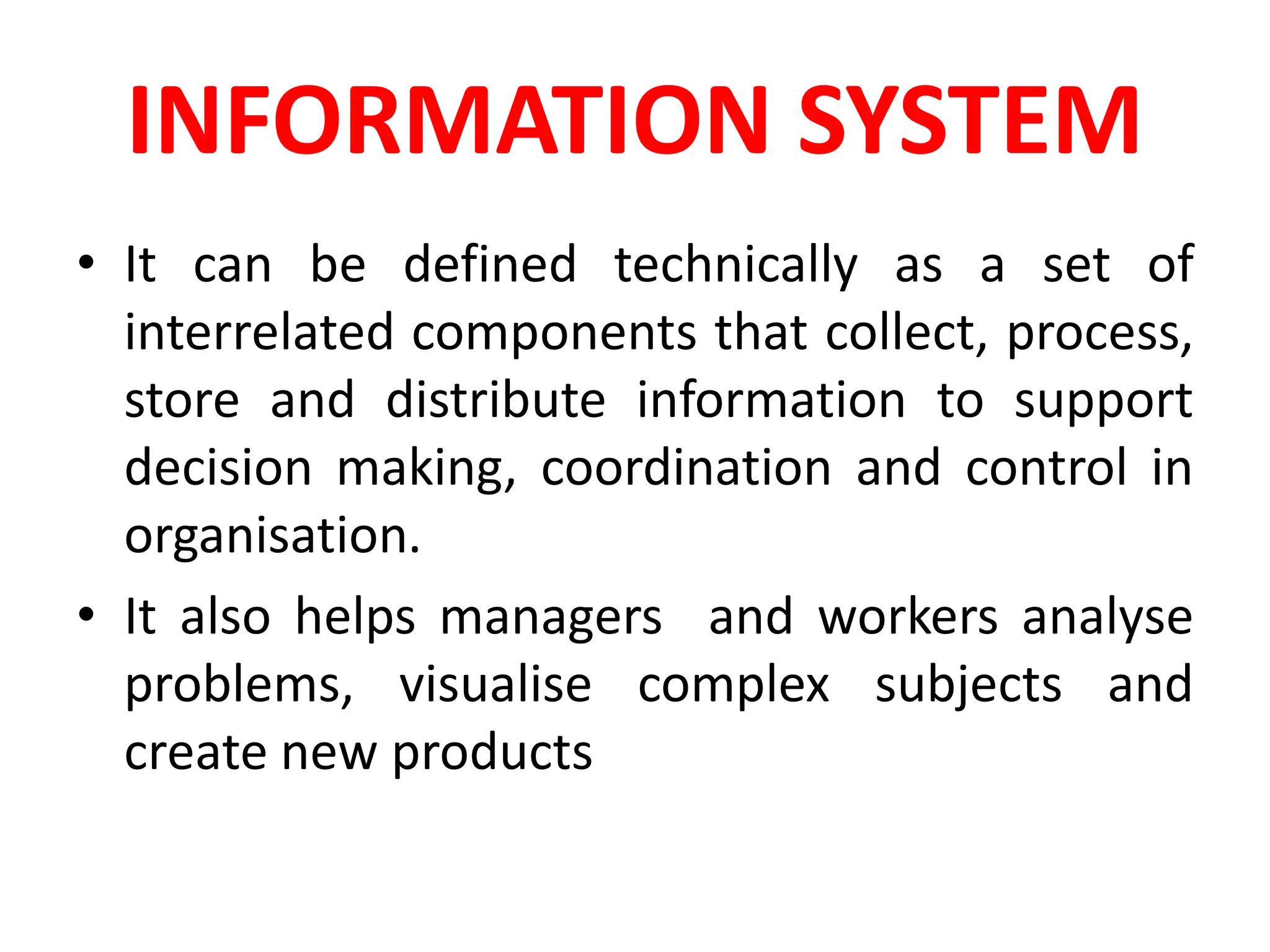
INFORMATION SYSTEM
• It can be defined technically as a set of
interrelated components that collect, process,
store and distribute information to support
decision making, coordination and control in
organisation.
• It also helps managers and workers analyse
problems, visualise complex subjects and
create new products
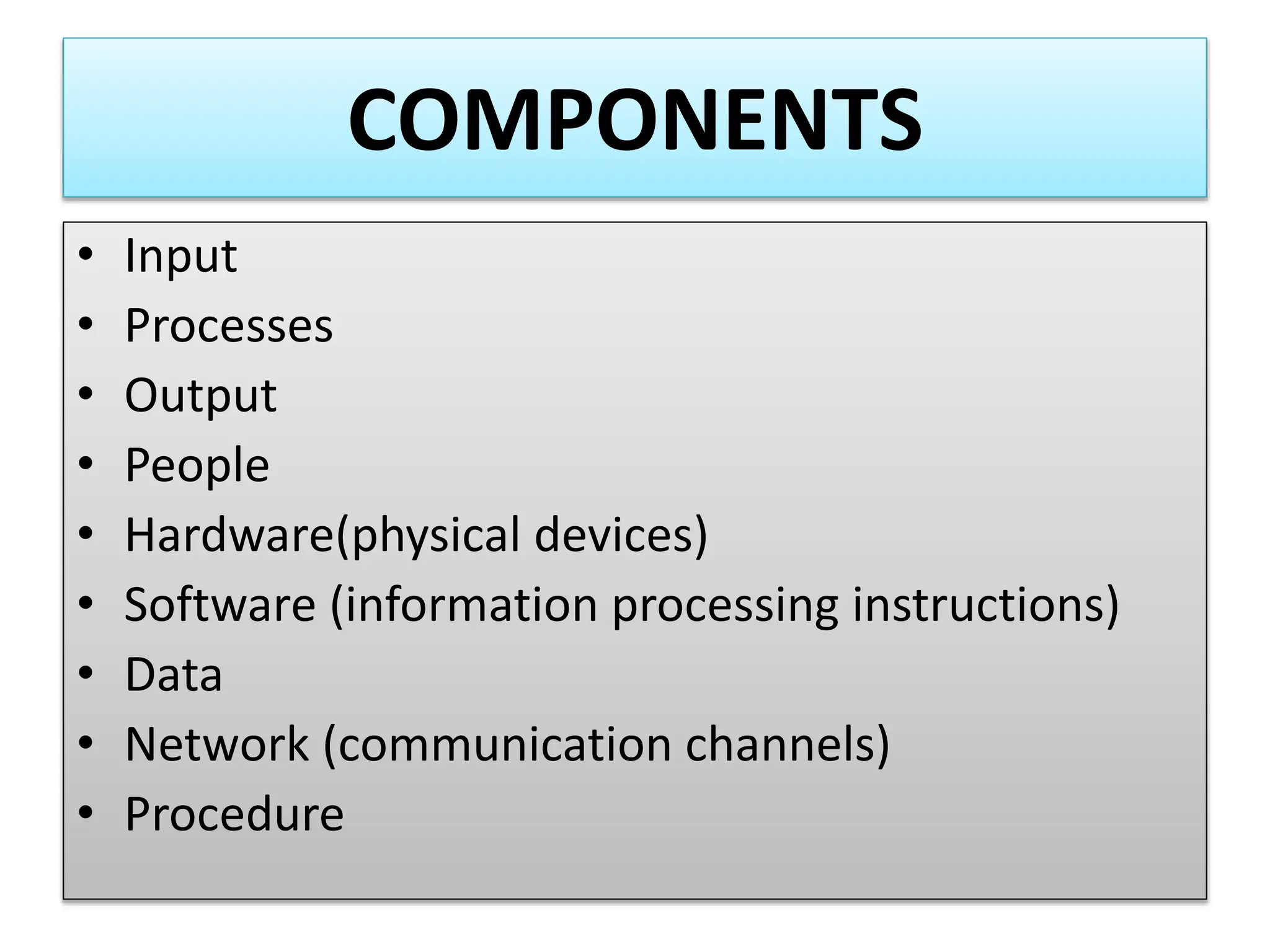
COMPONENTS
• Input
• Processes
• Output
• People
• Hardware(physical devices)
• Software (information processing instructions)
• Data
• Network (communication channels)
• Procedure
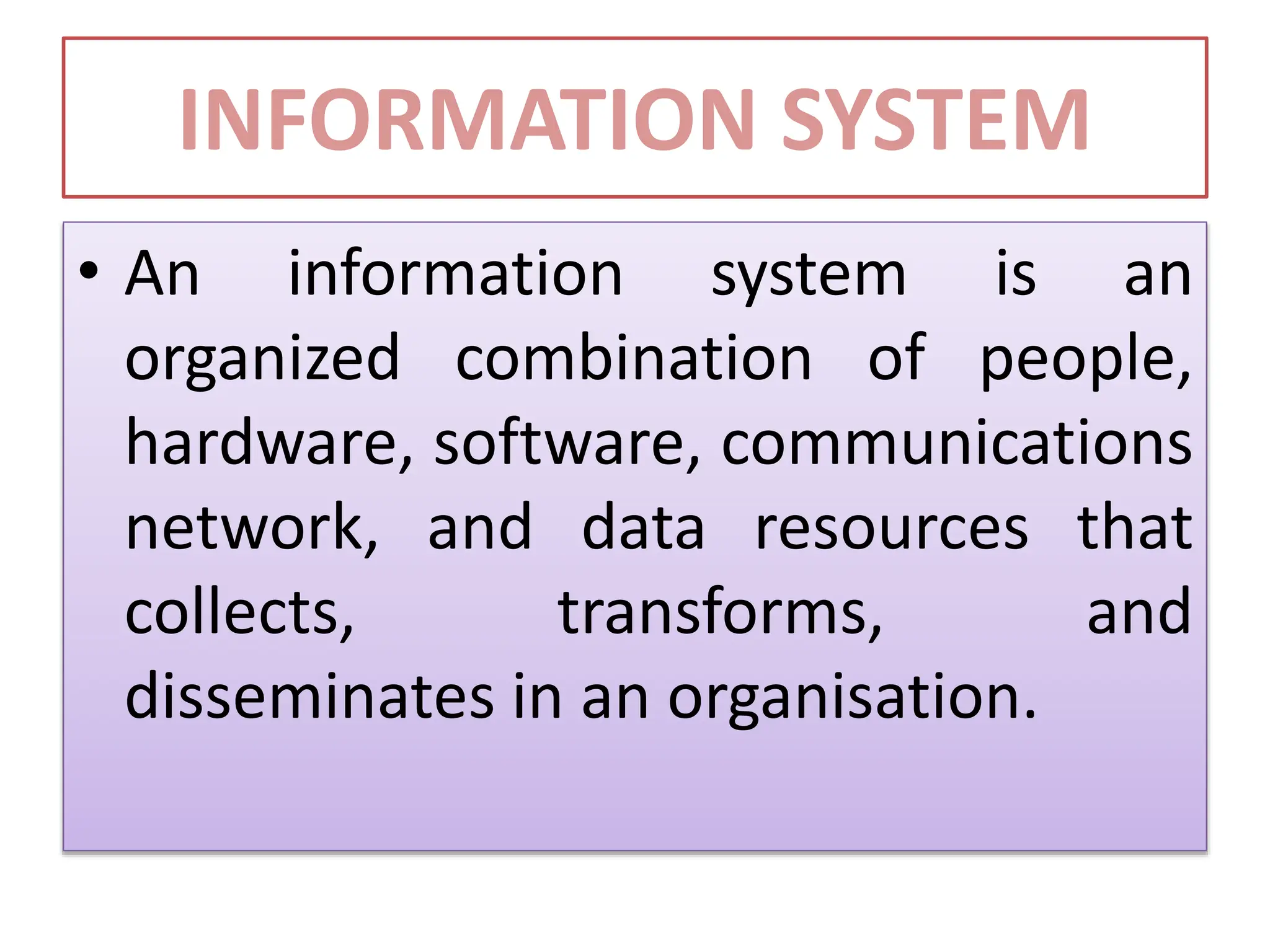
INFORMATION SYSTEM
• An information system is an
organized combination of people,
hardware, software, communications
network, and data resources that
collects, transforms, and
disseminates in an organisation.
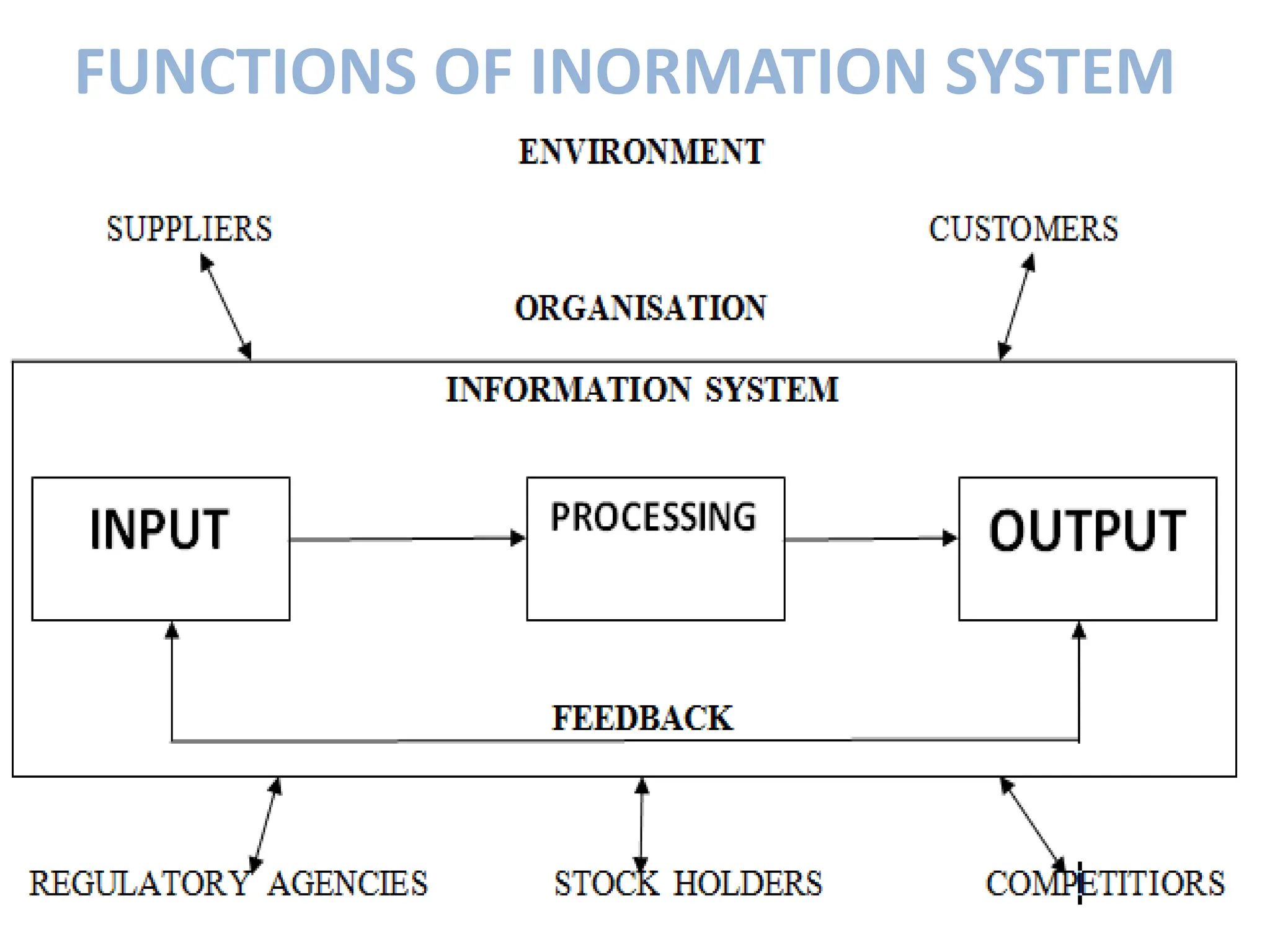
FUNCTIONS OF INORMATION SYSTEM
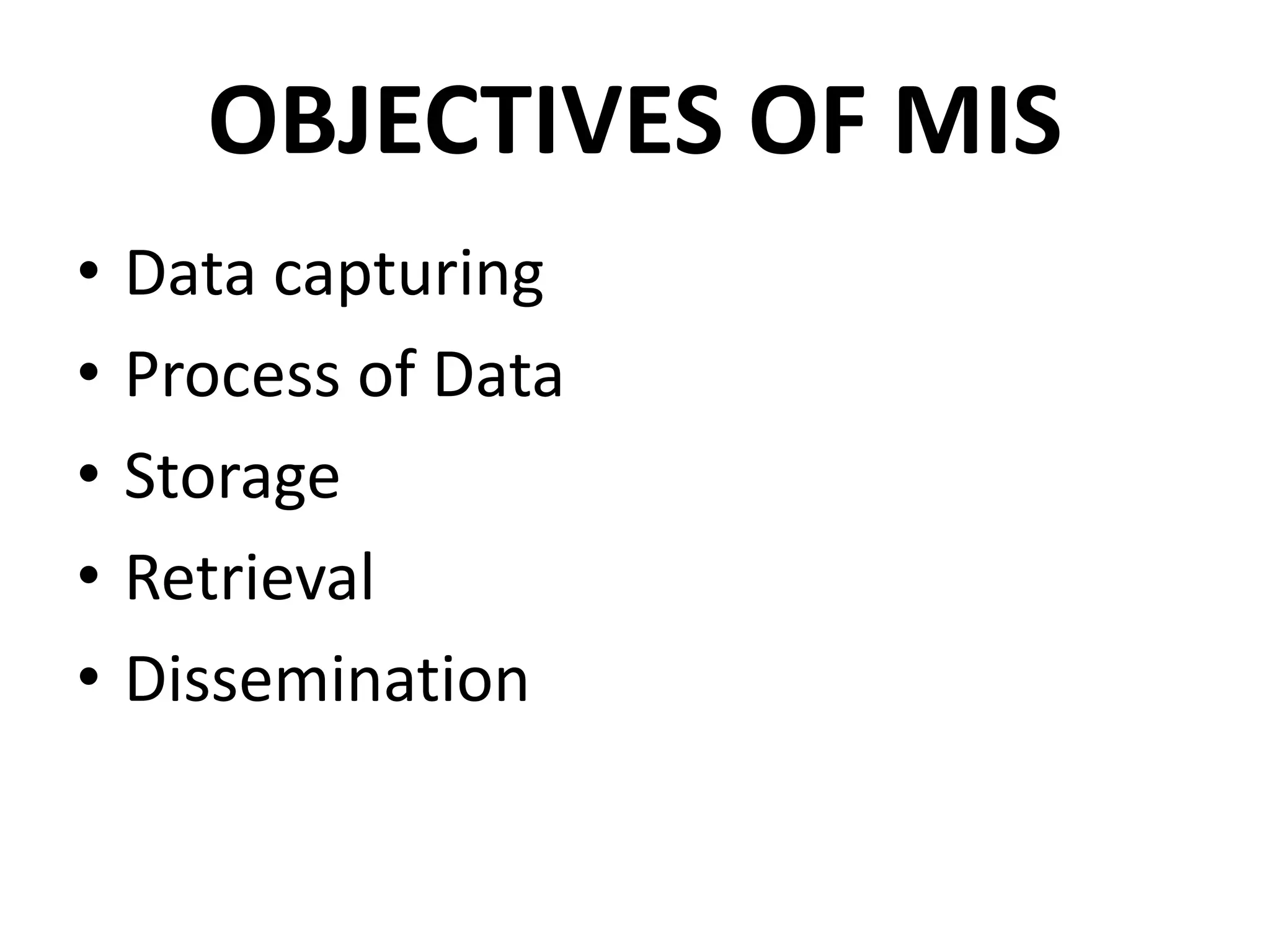
OBJECTIVES OF MIS
• Data capturing
• Process of Data
• Storage
• Retrieval
• Dissemination
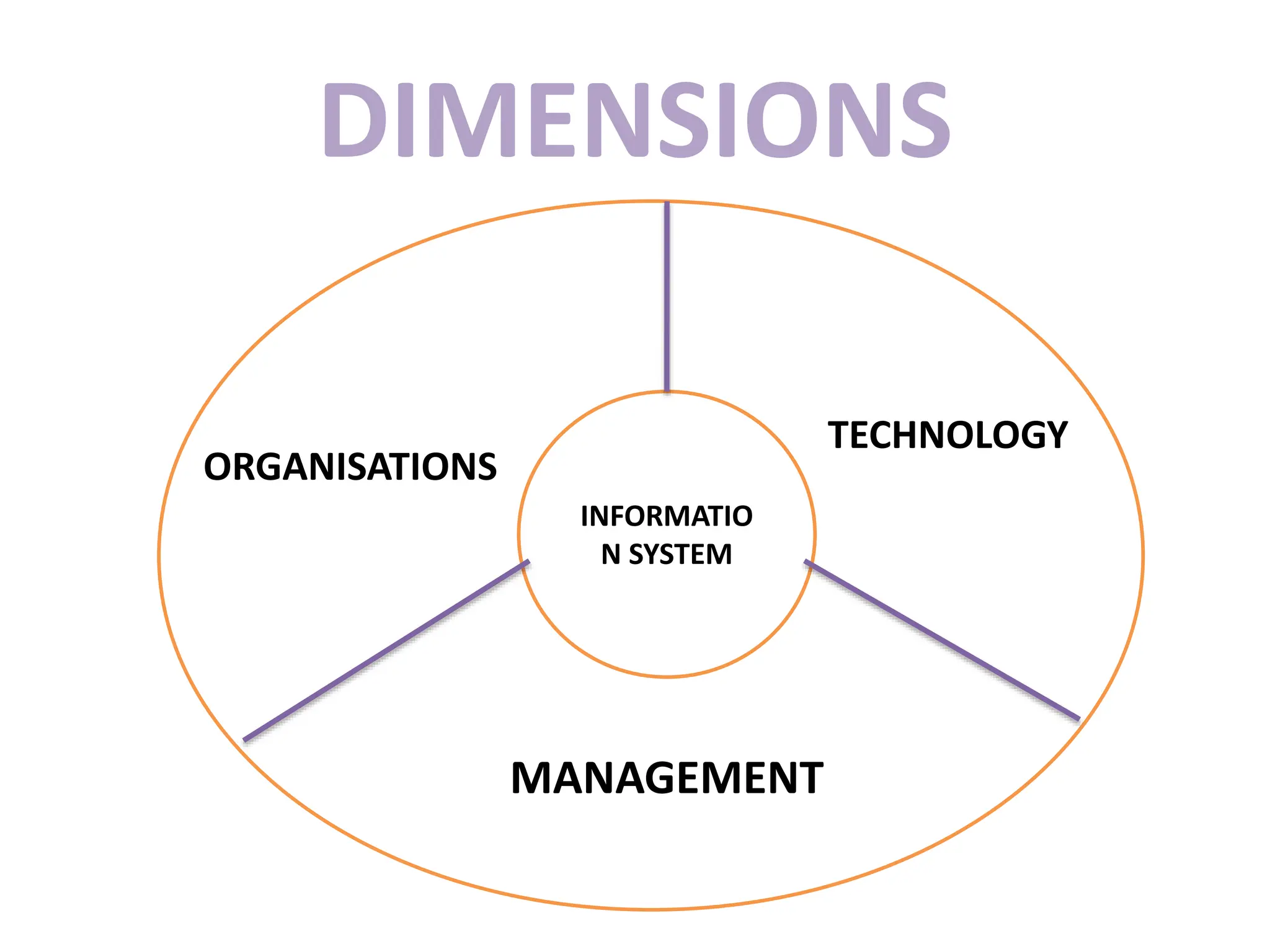
DIMENSIONS
TE
INFORMATIO
N SYSTEM
TECHNOLOGY
ORGANISATIONS
MANAGEMENT
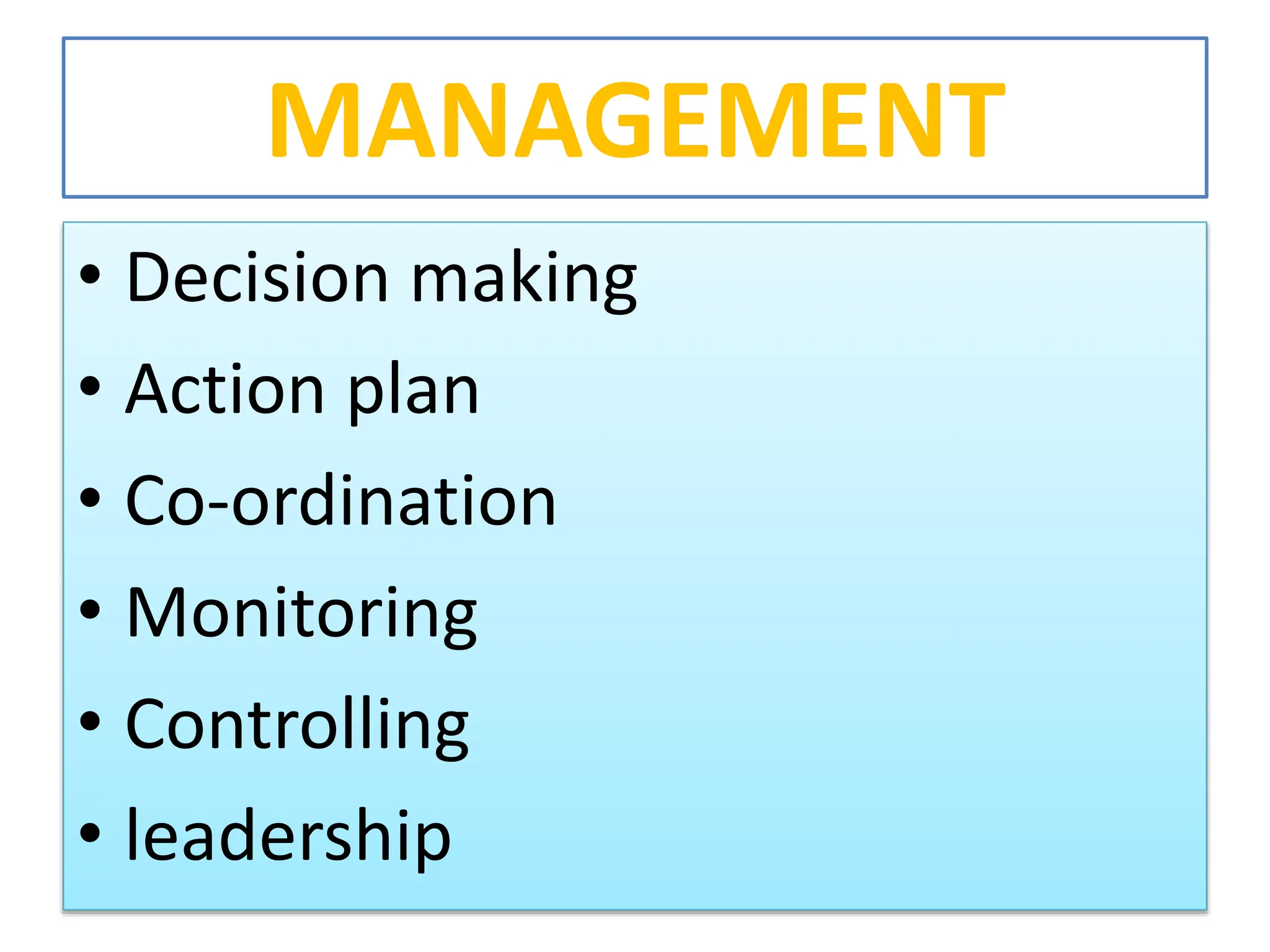
MANAGEMENT
• Decision making
• Action plan
• Co-ordination
• Monitoring
• Controlling
• leadership
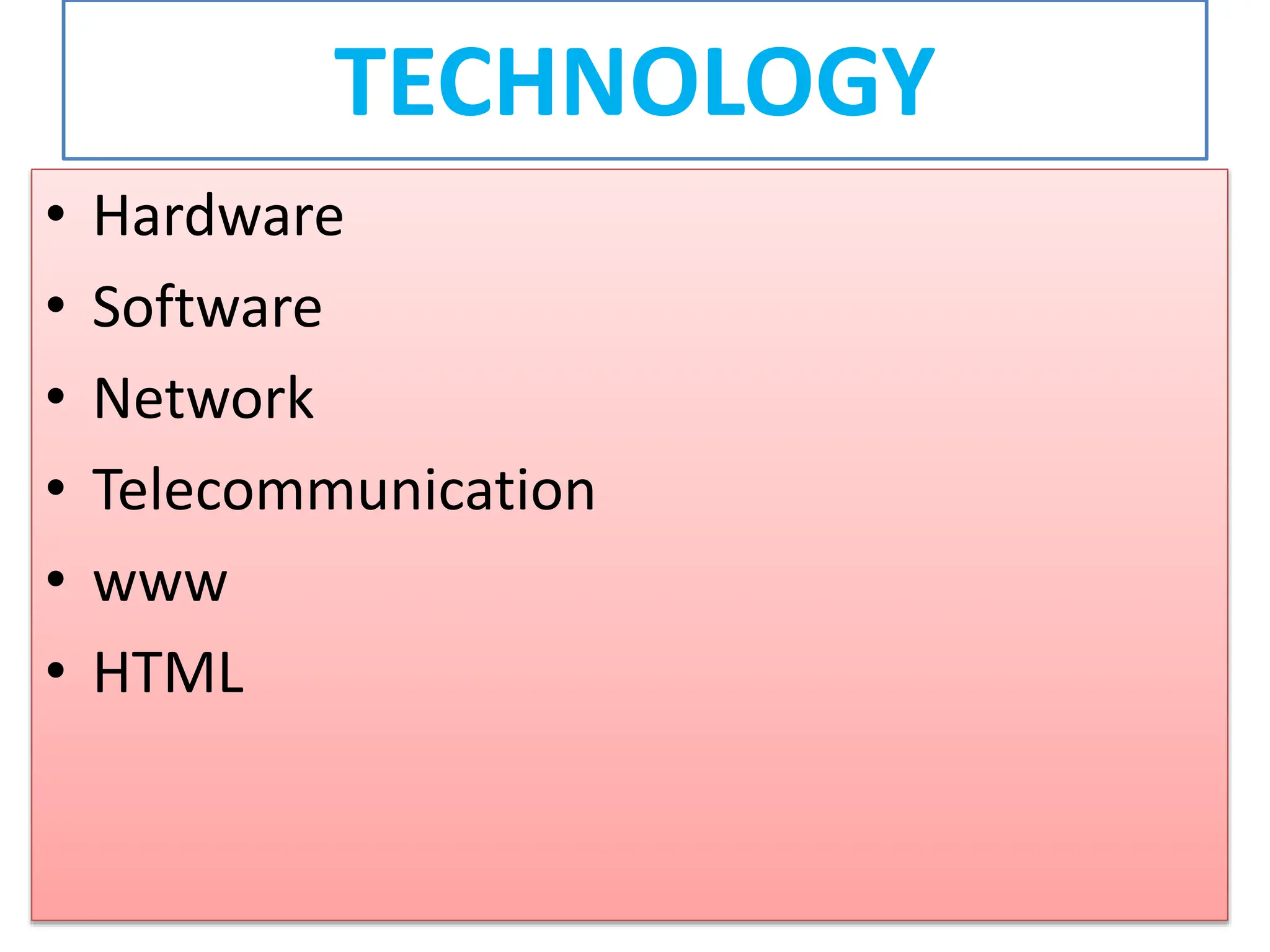
TECHNOLOGY
• Hardware
• Software
• Network
• Telecommunication
• www
• HTML
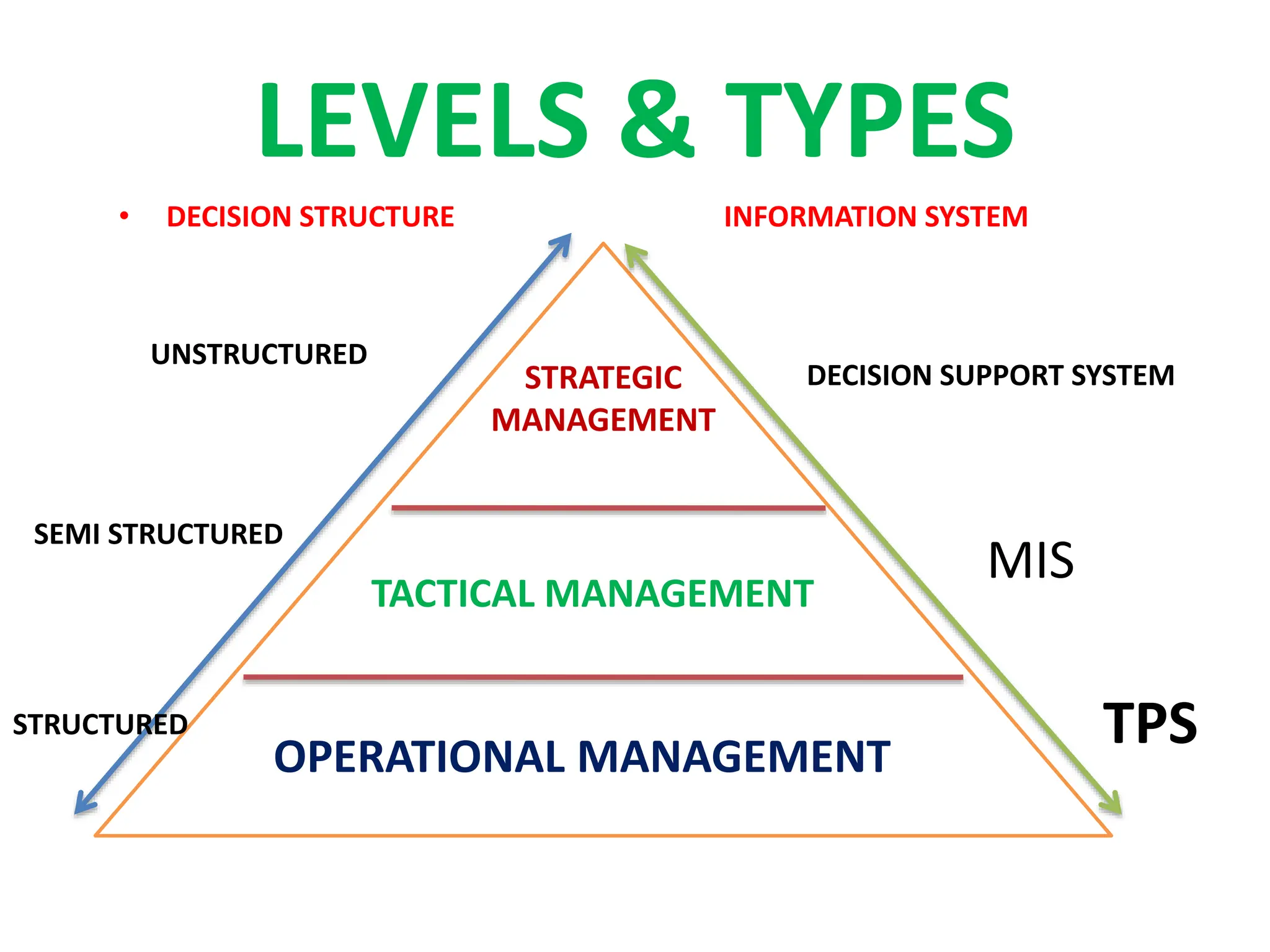
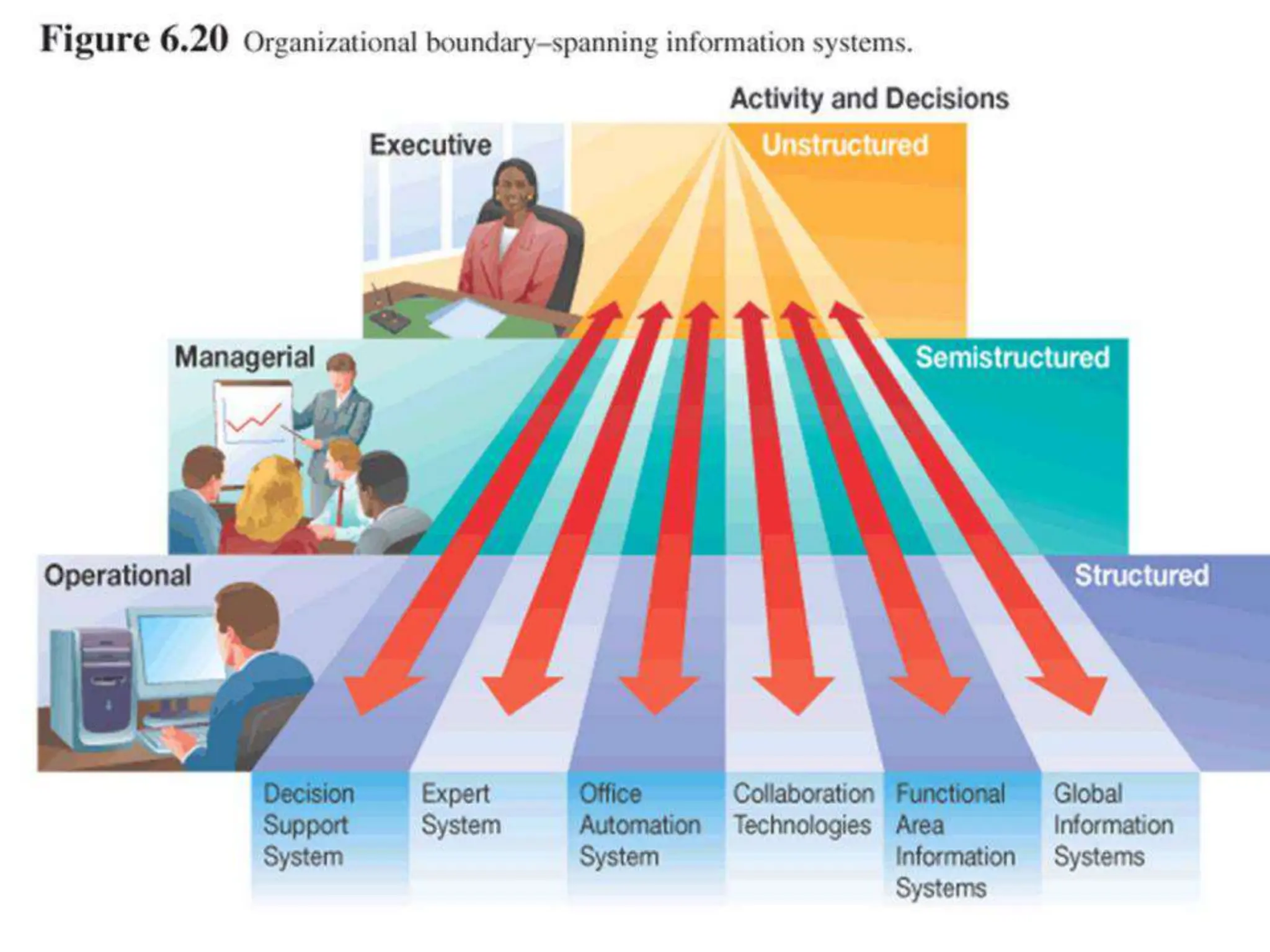
LEVELS & TYPES
STRATEGIC
MANAGEMENT
TACTICAL MANAGEMENT
OPERATIONAL MANAGEMENT
• DECISION STRUCTURE INFORMATION SYSTEM
DECISION SUPPORT SYSTEM
MIS
TPS
UNSTRUCTURED
SEMI STRUCTURED
STRUCTURED
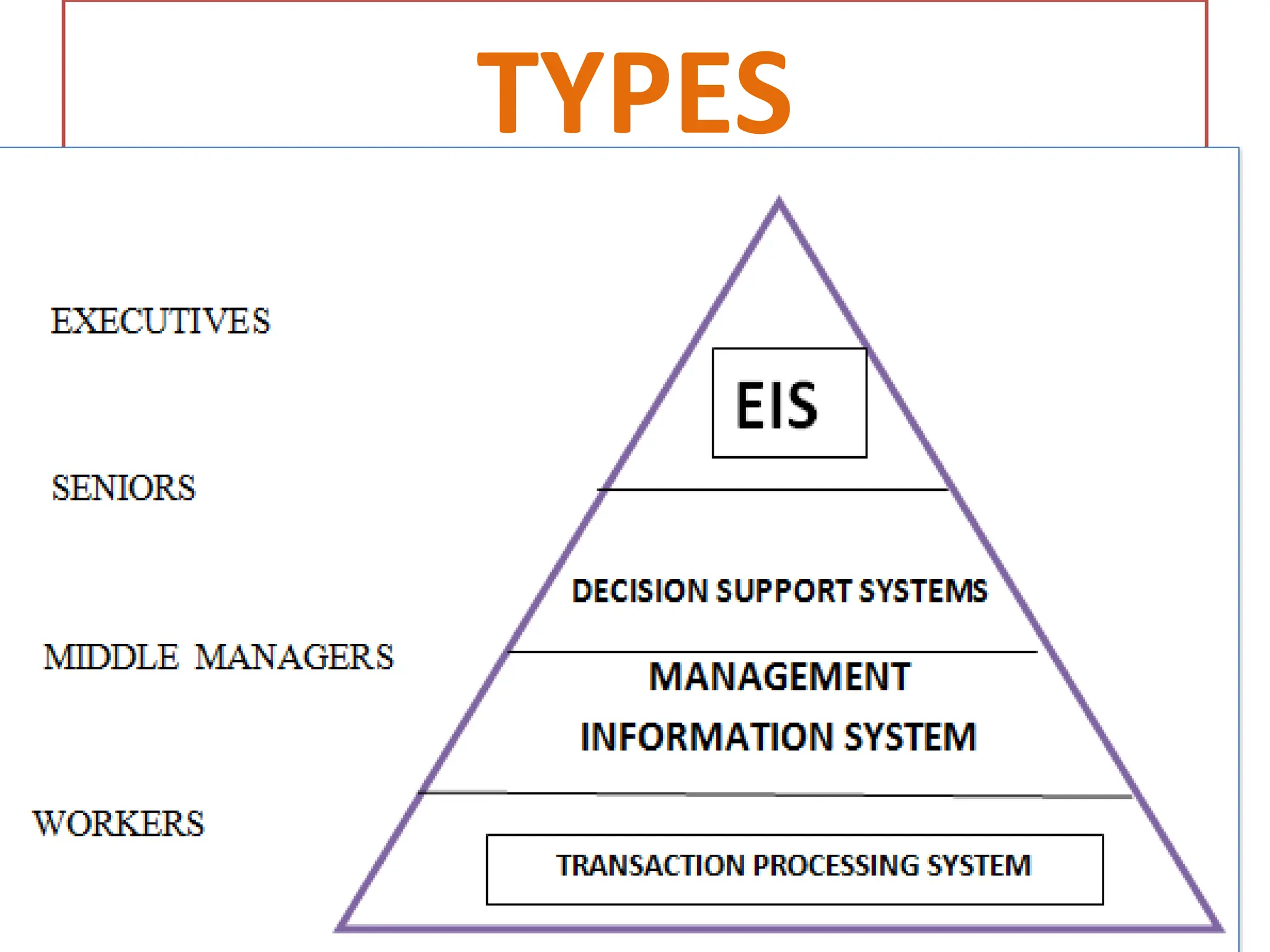
TYPES
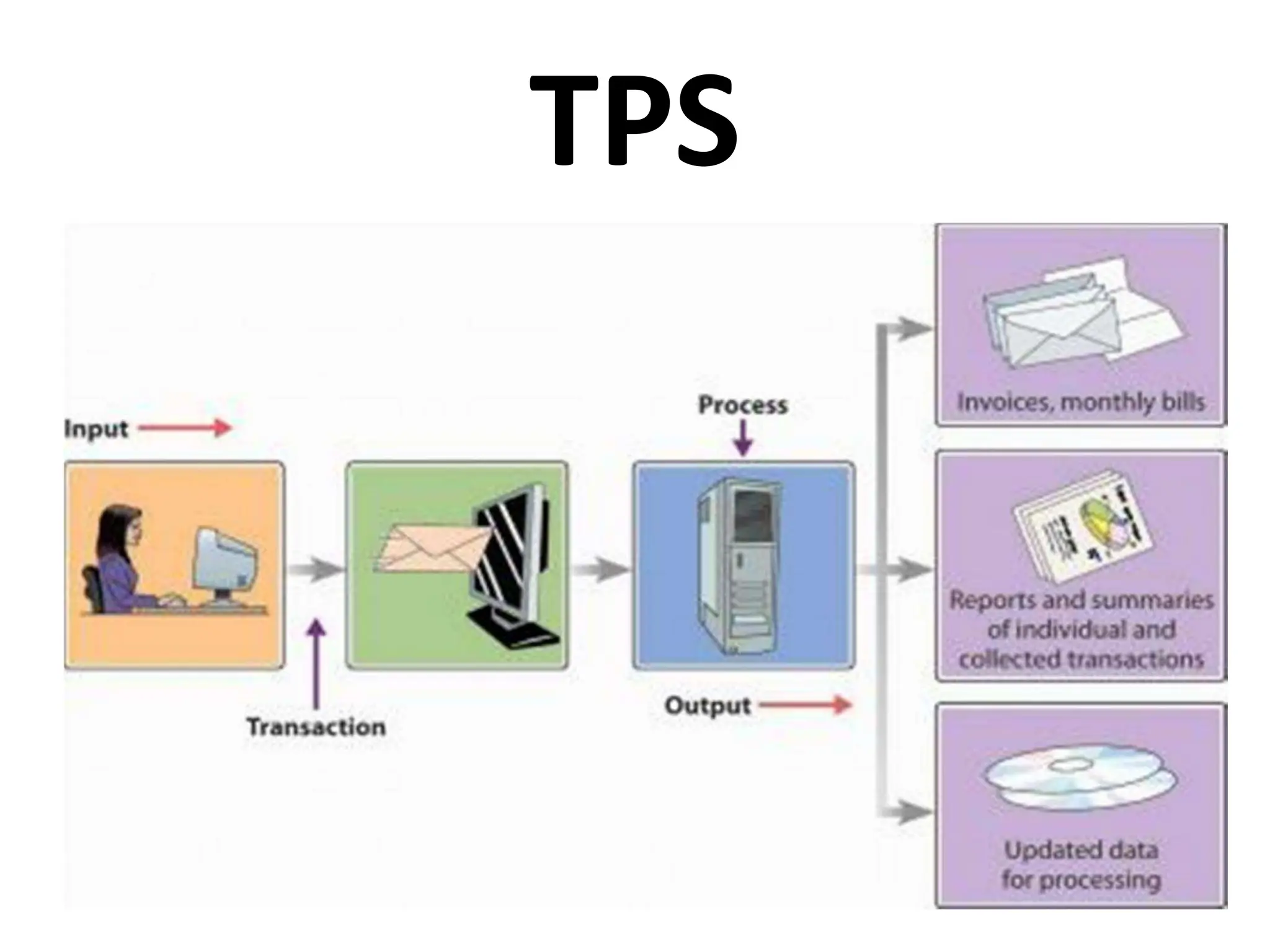
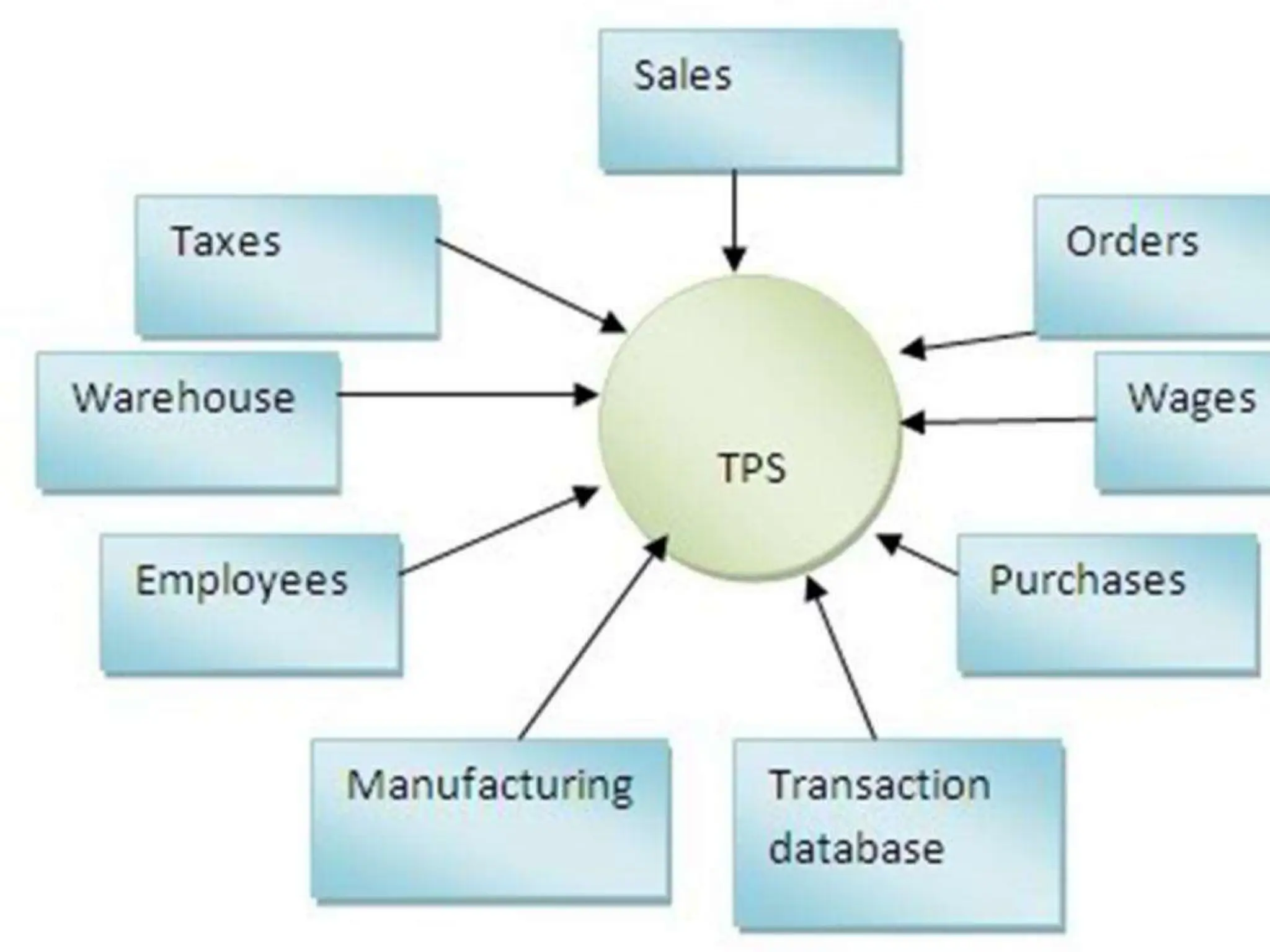
TPS
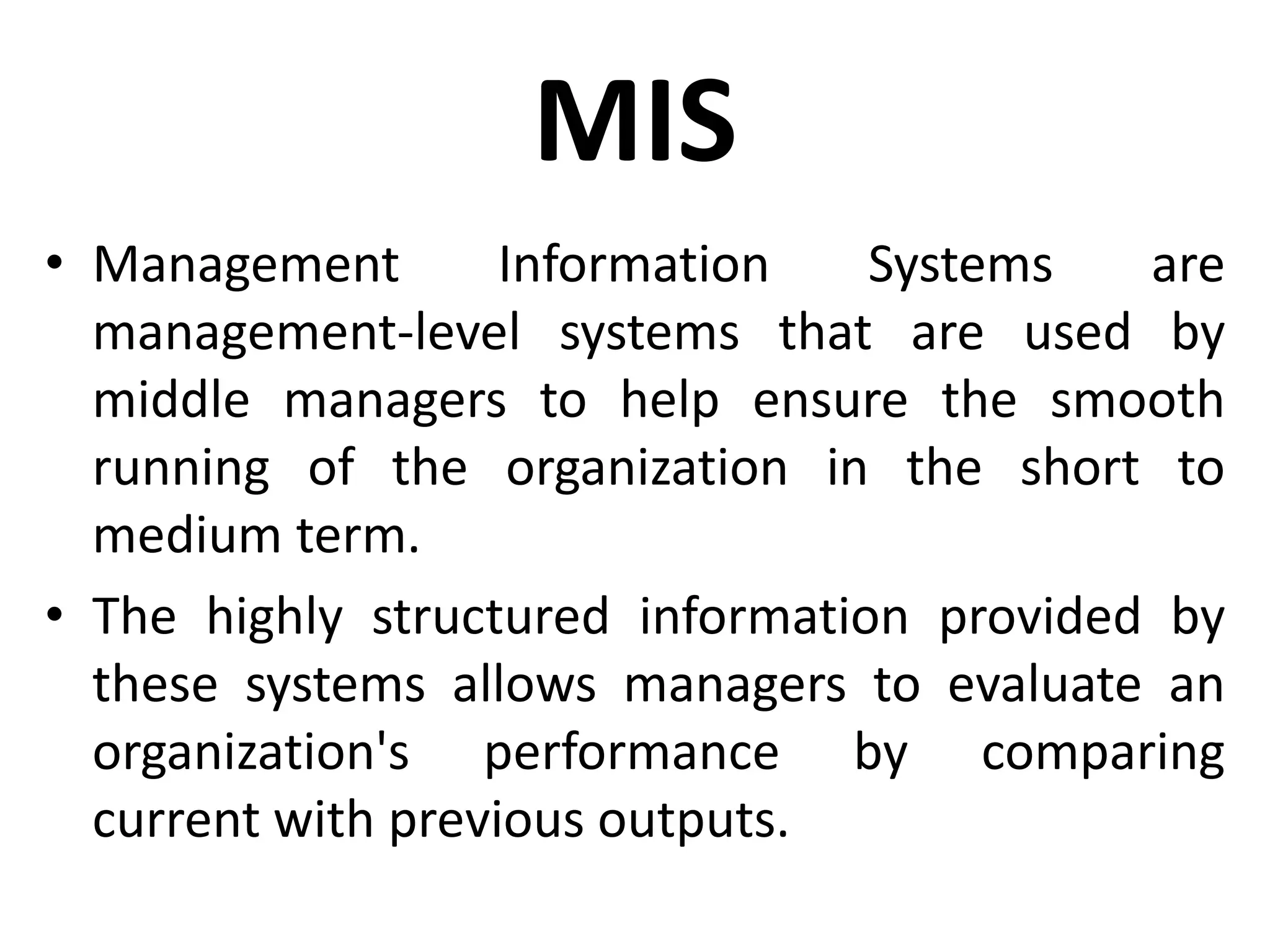
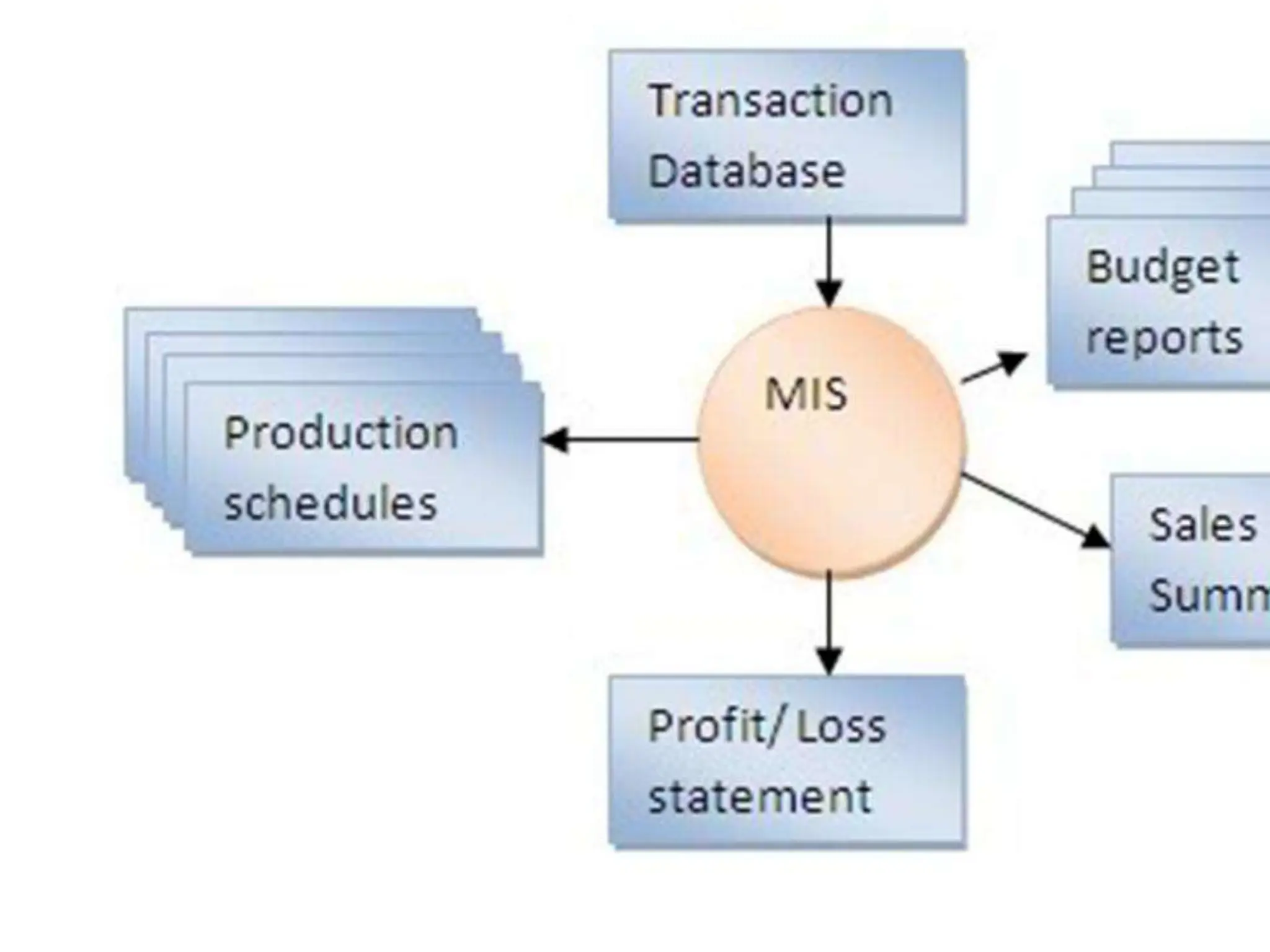
MIS
• Management Information Systems are
management-level systems that are used by
middle managers to help ensure the smooth
running of the organization in the short to
medium term.
• The highly structured information provided by
these systems allows managers to evaluate an
organization's performance by comparing
current with previous outputs.
DSS
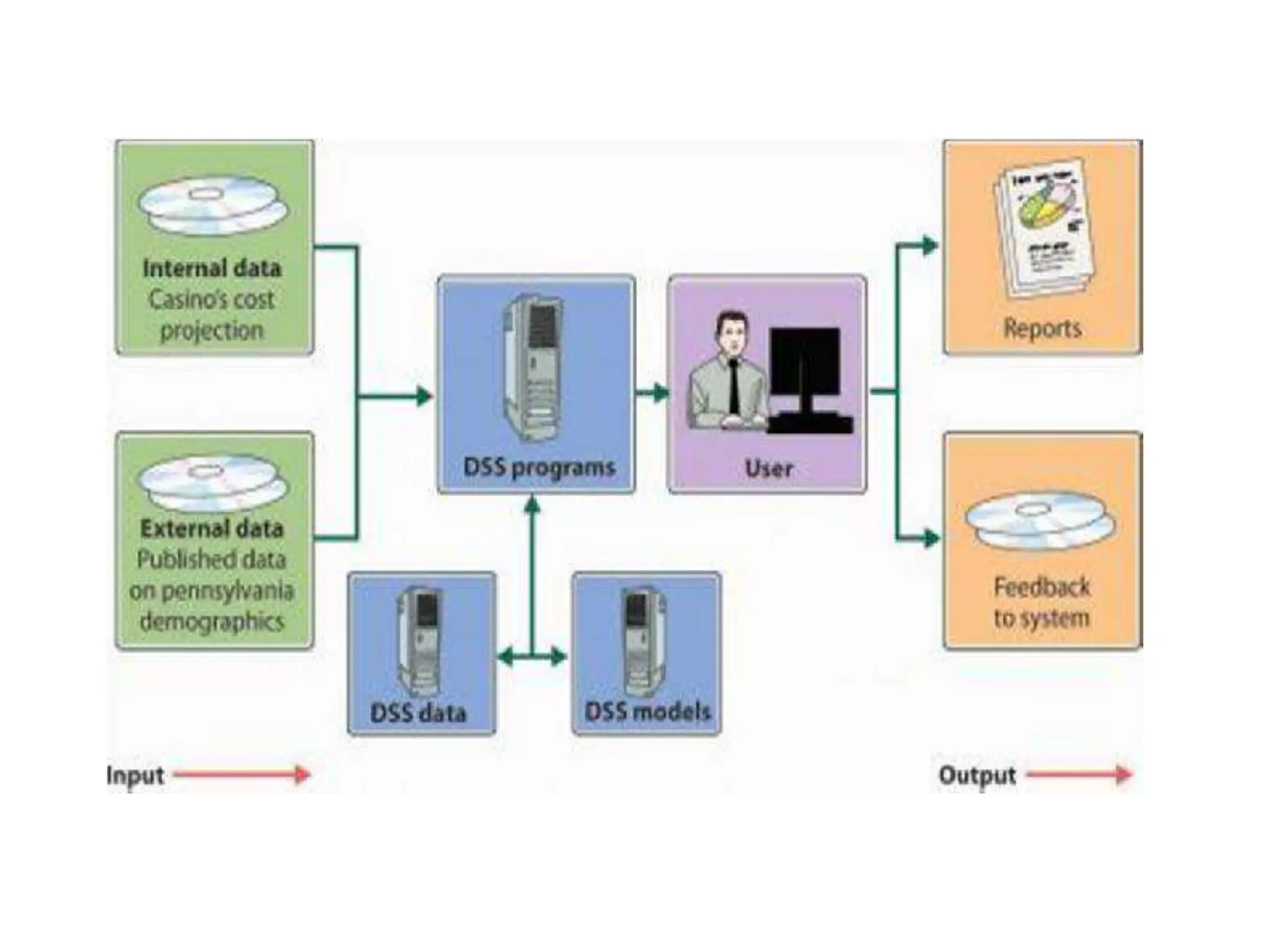
• A Decision Support System can be seen as a
knowledge based system, used by senior
managers, which facilitates the creation of
knowledge and allow its integration into the
organization.
• Access to databases, analytical tools, allow
"what if" simulations, and may support the
exchange of information within the
organization.
EIS
• Executive Information Systems are strategic-
level information systems that are found at
the top of the Pyramid. They help executives
and senior managers analyze the environment
in which the organization operates, to identify
long-term trends, and to plan appropriate
courses of action.
EXPERT SYSTEM
• Expert systems can be defined as programs that
help the computer make decisions in a similar
way as an expert in specific domain, a particular
subject area of interest.
• It aims at formalising expertise and make it
available for repetitive type of business decisions.
• It makes use of artificial intelligence to generate
knowledge out of the information, existing
theories, beliefs and experiences of managers in
various business activities.
OFFICE AUTOMATION SYSTEM
• Office automation is the integration of computer,
telecommunications and office equipment
technologies to improve the execution of
business functions through increasing the
productivity, effectiveness and working
conditions of office support.
• Encompasses the application of computer and
communication technology to improve the
productivity of all types of office workers
including clerical, administrative, professional and
executive.
OTHERS
• WORK FLOW SYSTEM
–Rule based system that direct,
coordinates and monitors
–Three systems:
• Administrative workflow
• Ad-hoc workflow
• Product workflow
OTHERS
• ENTERPRISE RESOURCE PLANNING SYSTEM:
– Business process management software that allows
an organisation to use system to integrate programs
capable of managing operations for an multi-site
and global organisation
• EXPERT SYSTEM:
– Have the ability to make suggest and act like an
expert in a particular field
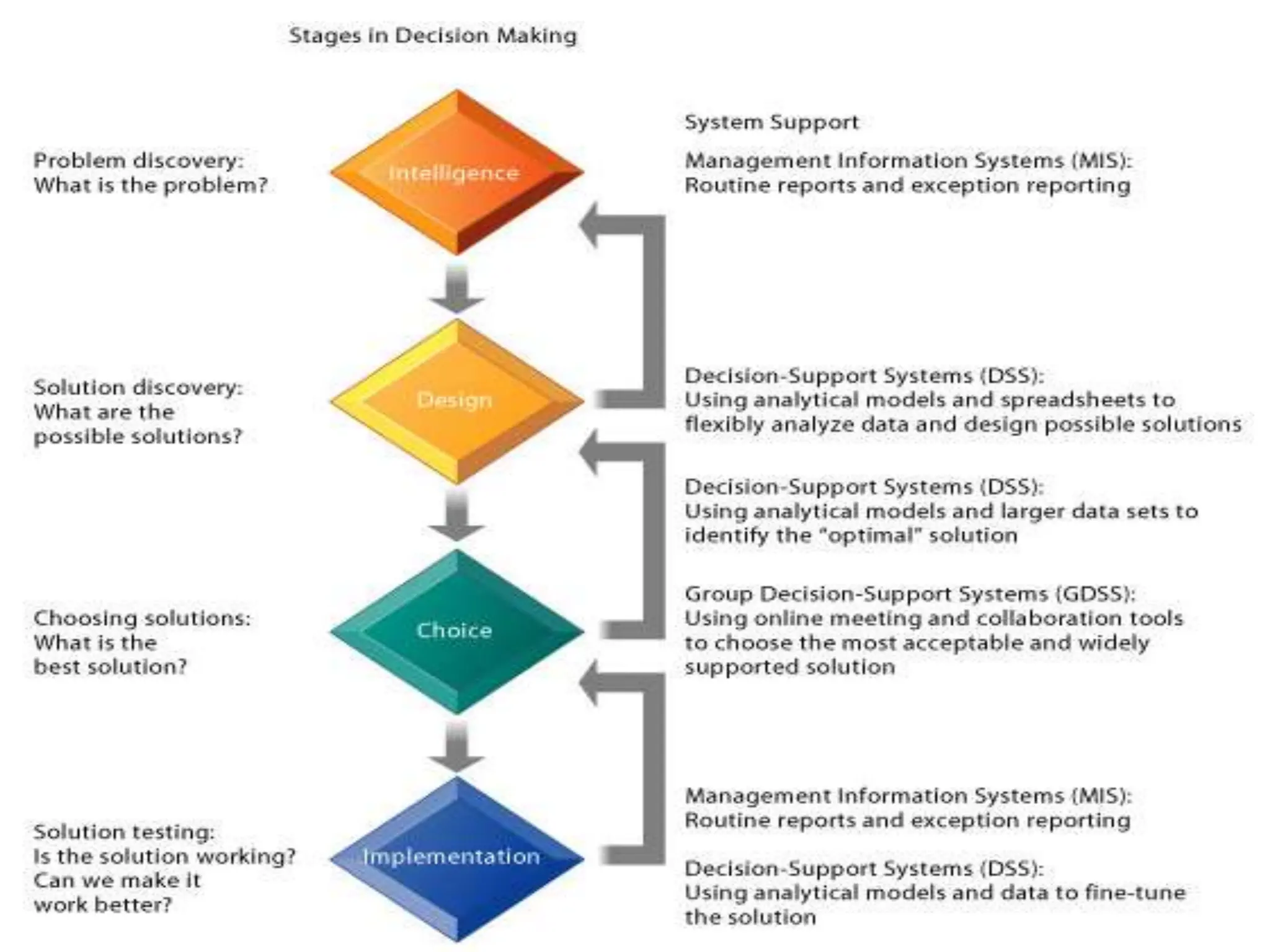
DECISION MAKING
PROCESS
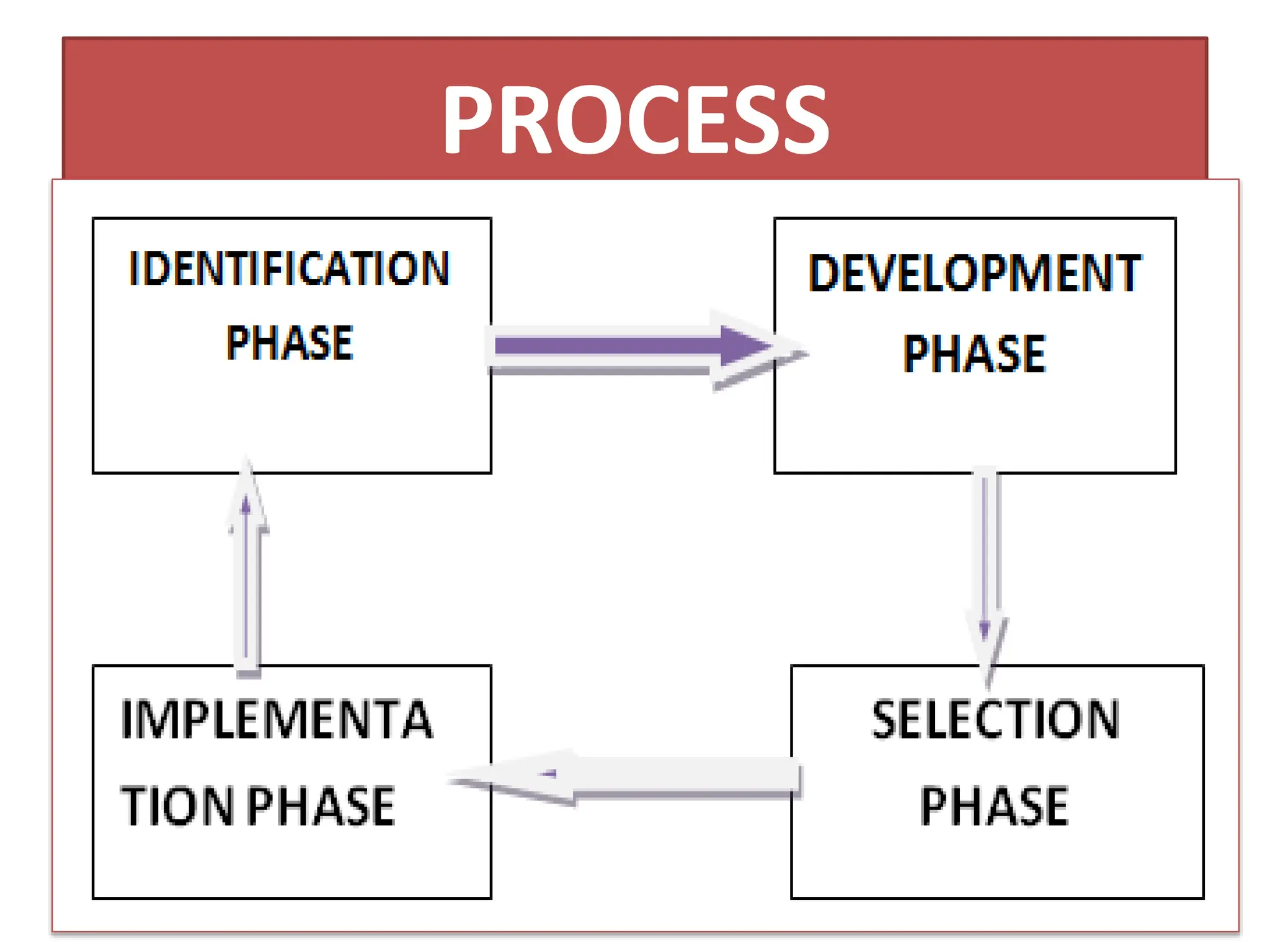
PROCESS
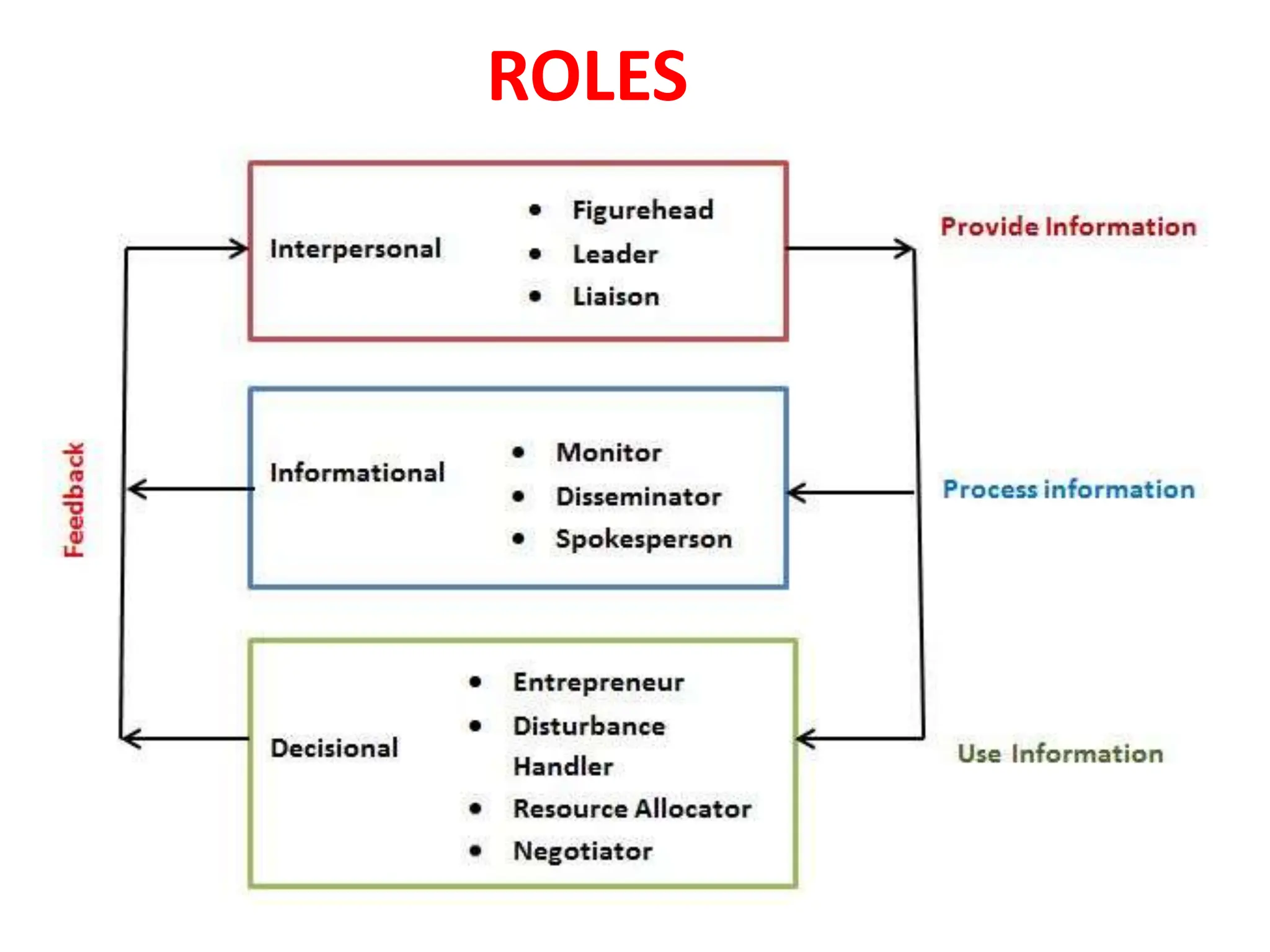
ROLES
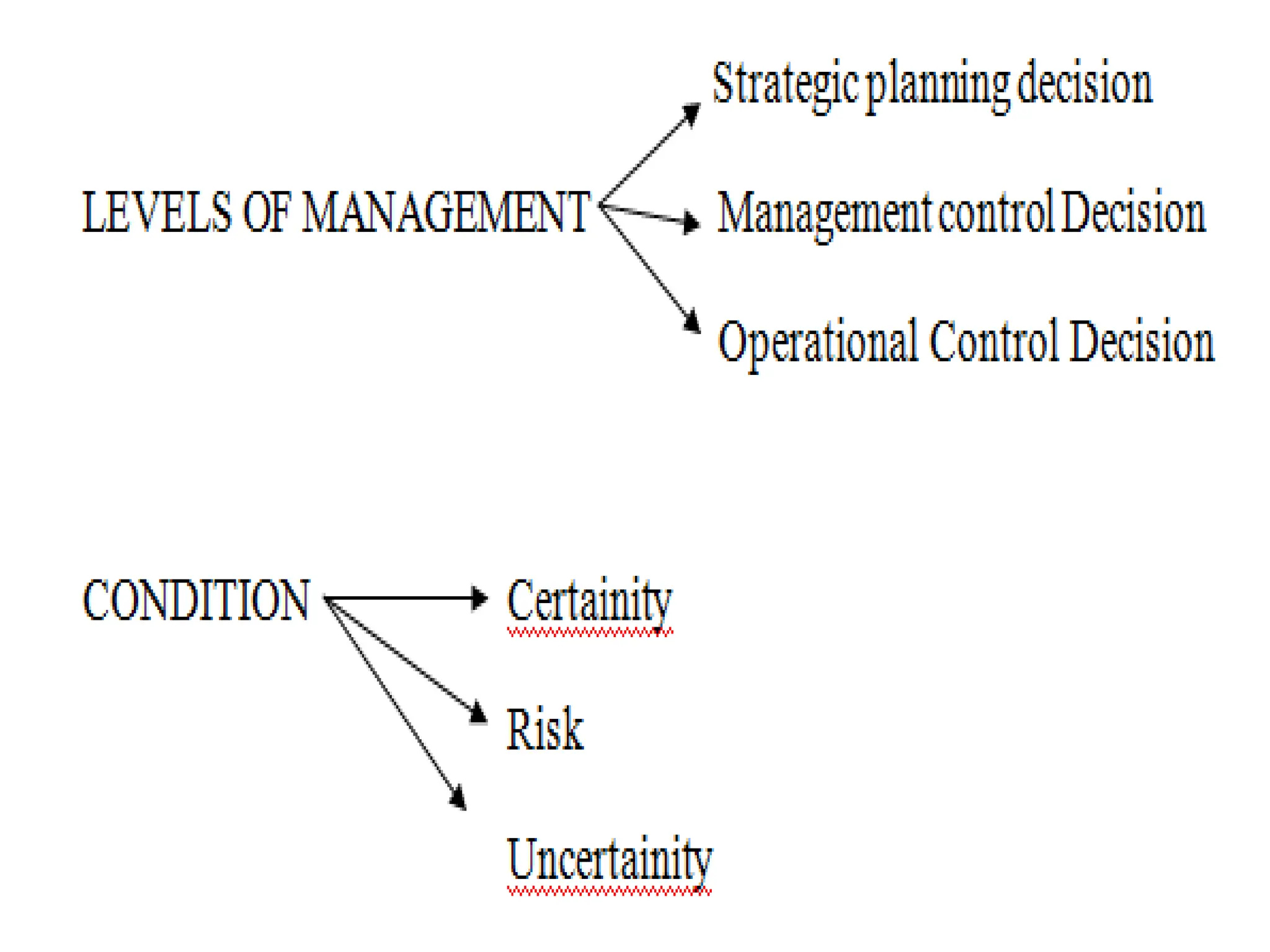
CLASSIFICATION OF MANAGERIAL
DECISIONS
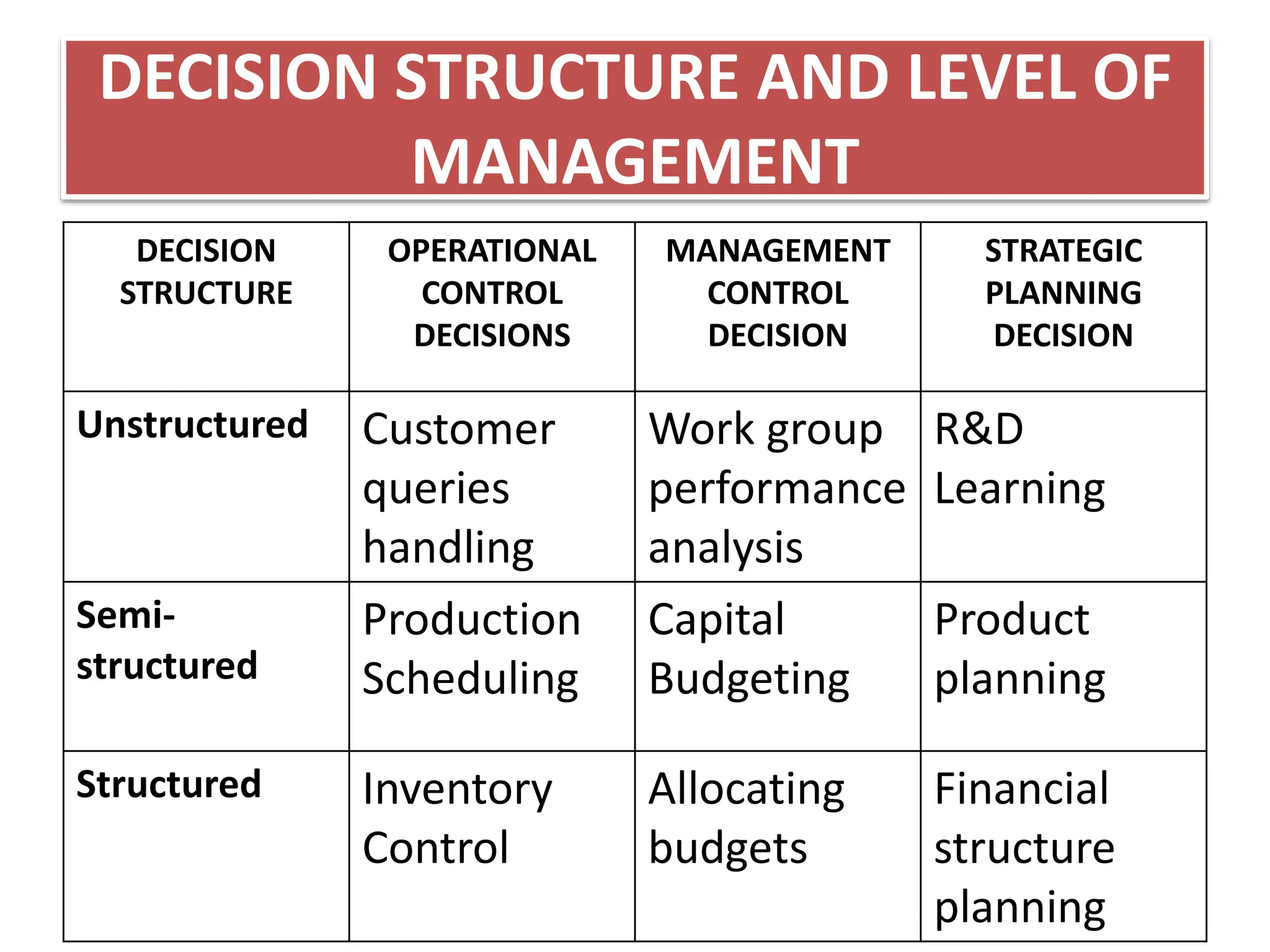
DECISION STRUCTURE AND LEVEL OF
MANAGEMENT
DECISION
STRUCTURE
OPERATIONAL
CONTROL
DECISIONS
MANAGEMENT
CONTROL
DECISION
STRATEGIC
PLANNING
DECISION
Unstructured Customer
queries
handling
Work group
performance
analysis
R&D
Learning
Semi-
structured
Production
Scheduling
Capital
Budgeting
Product
planning
Structured Inventory
Control
Allocating
budgets
Financial
structure
planning
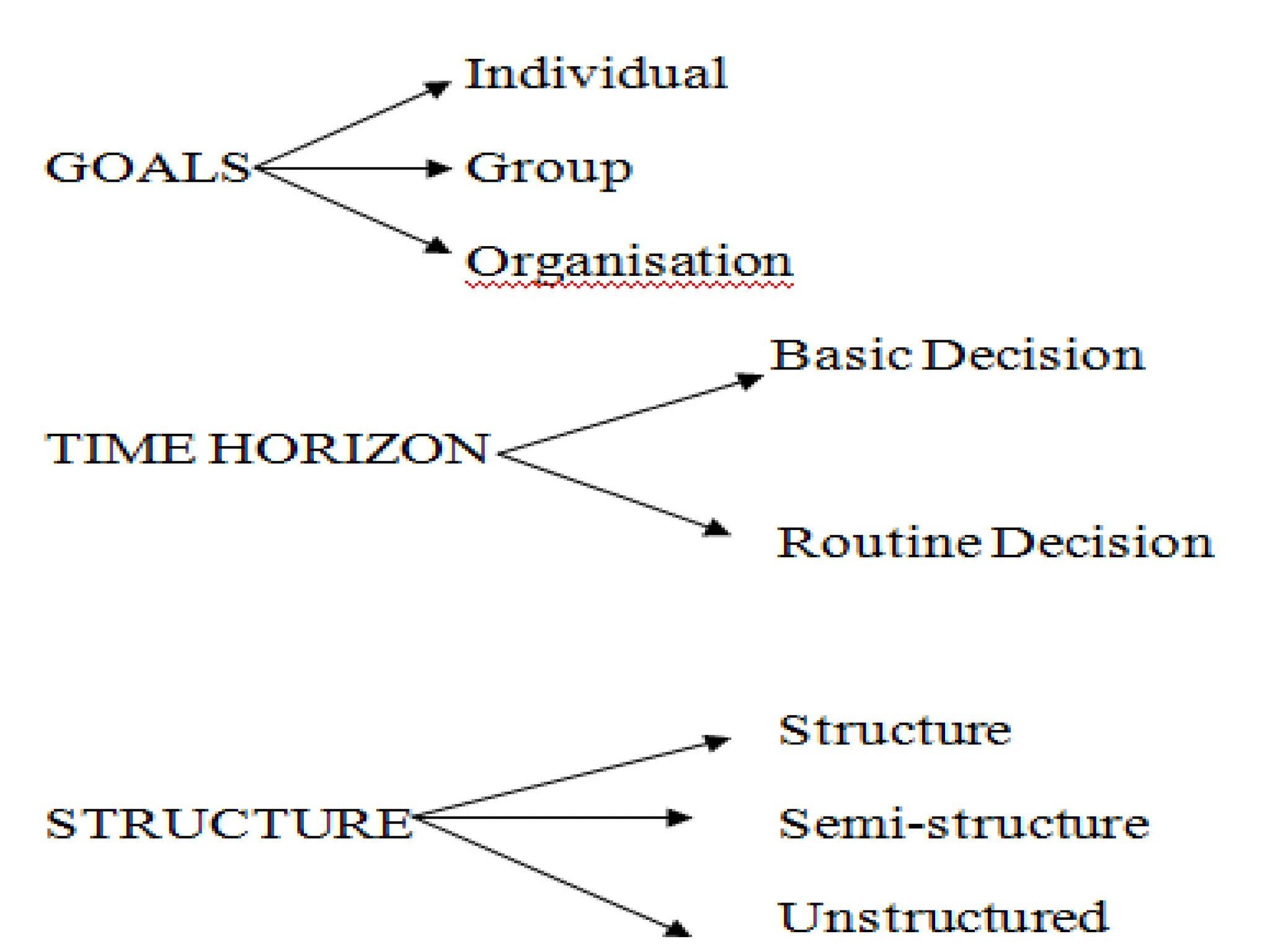
DECISION MAKING
MODELS
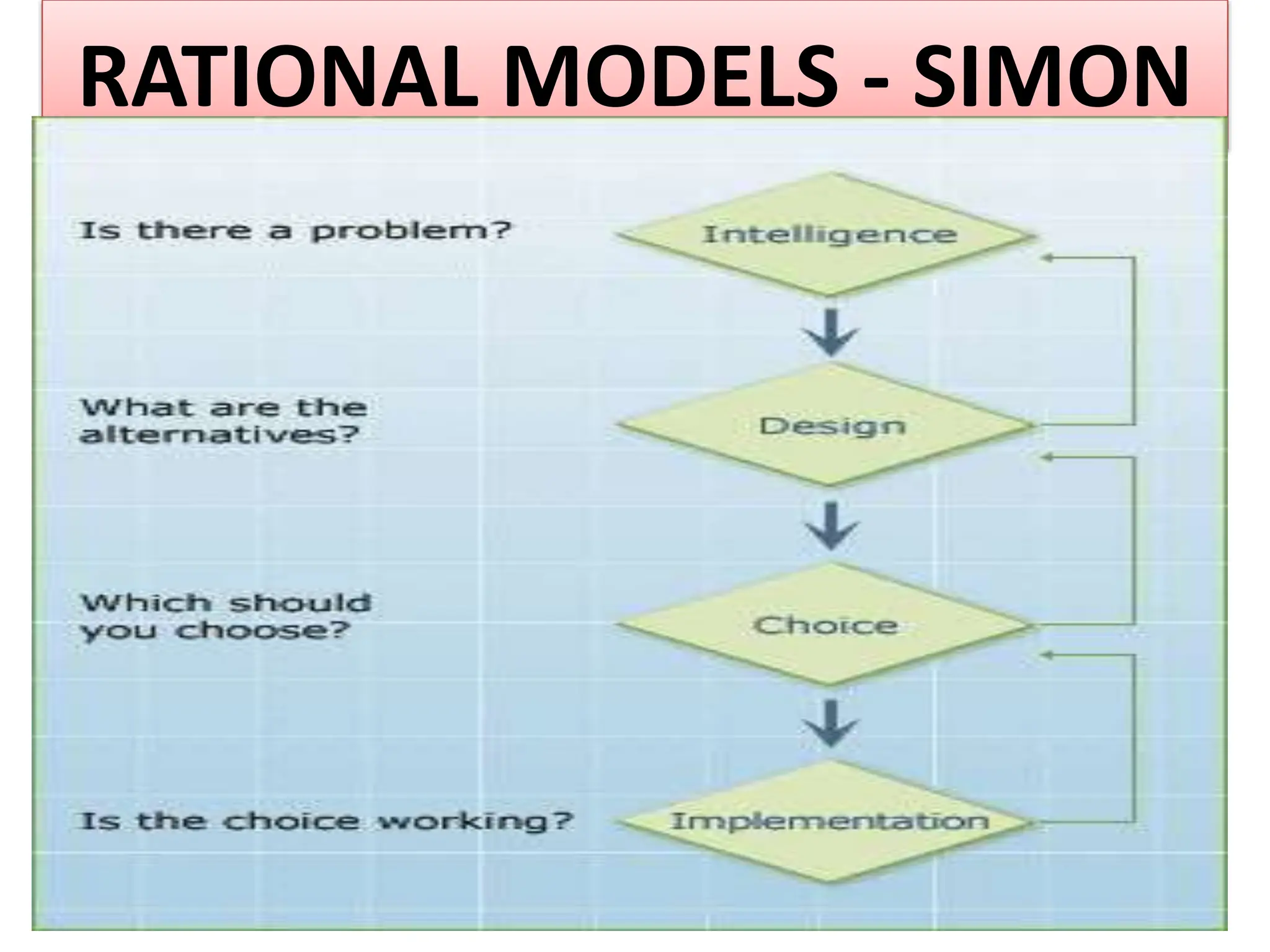
RATIONAL MODELS - SIMON
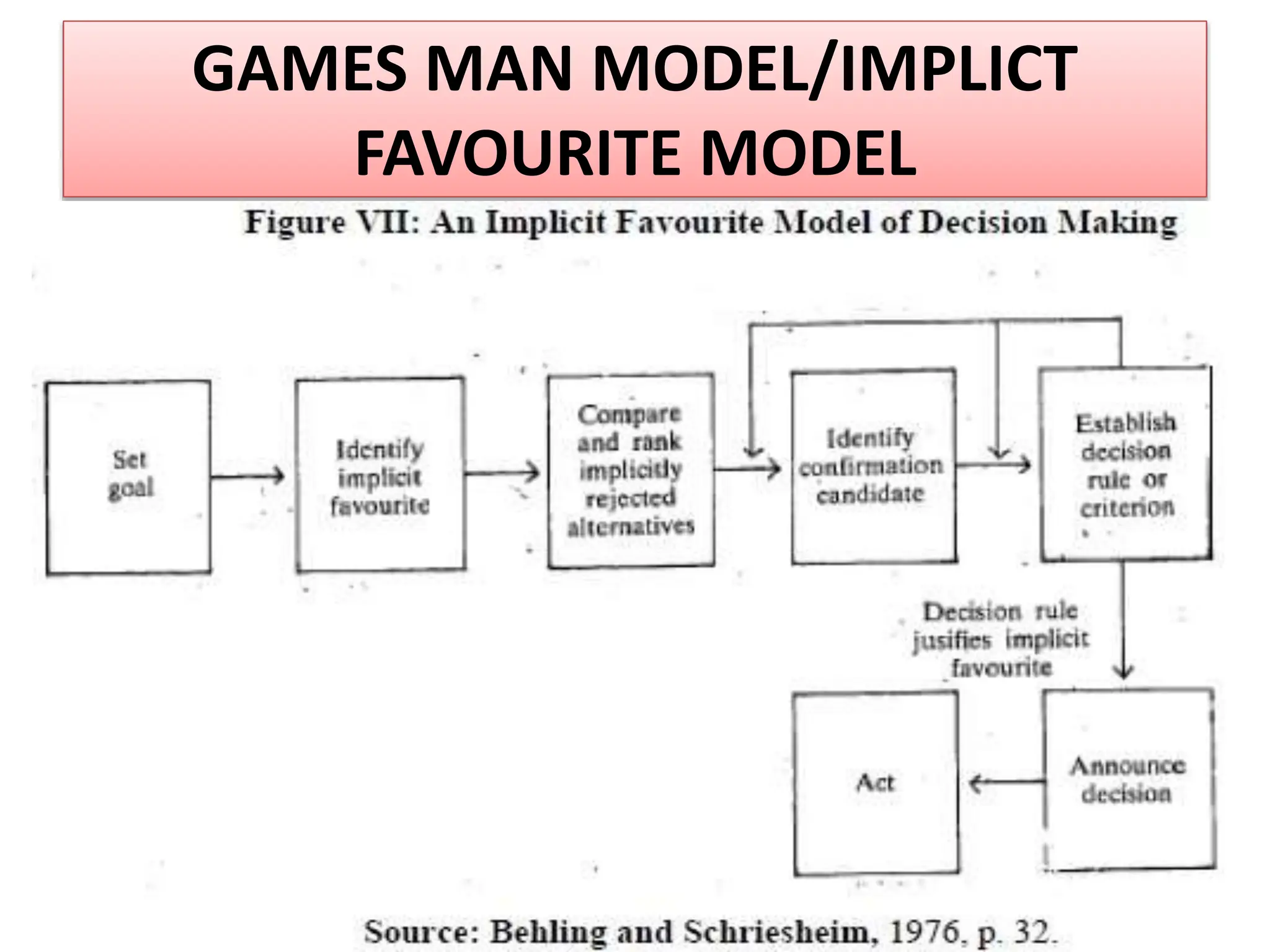
GAMES MAN MODEL/IMPLICT
FAVOURITE MODEL
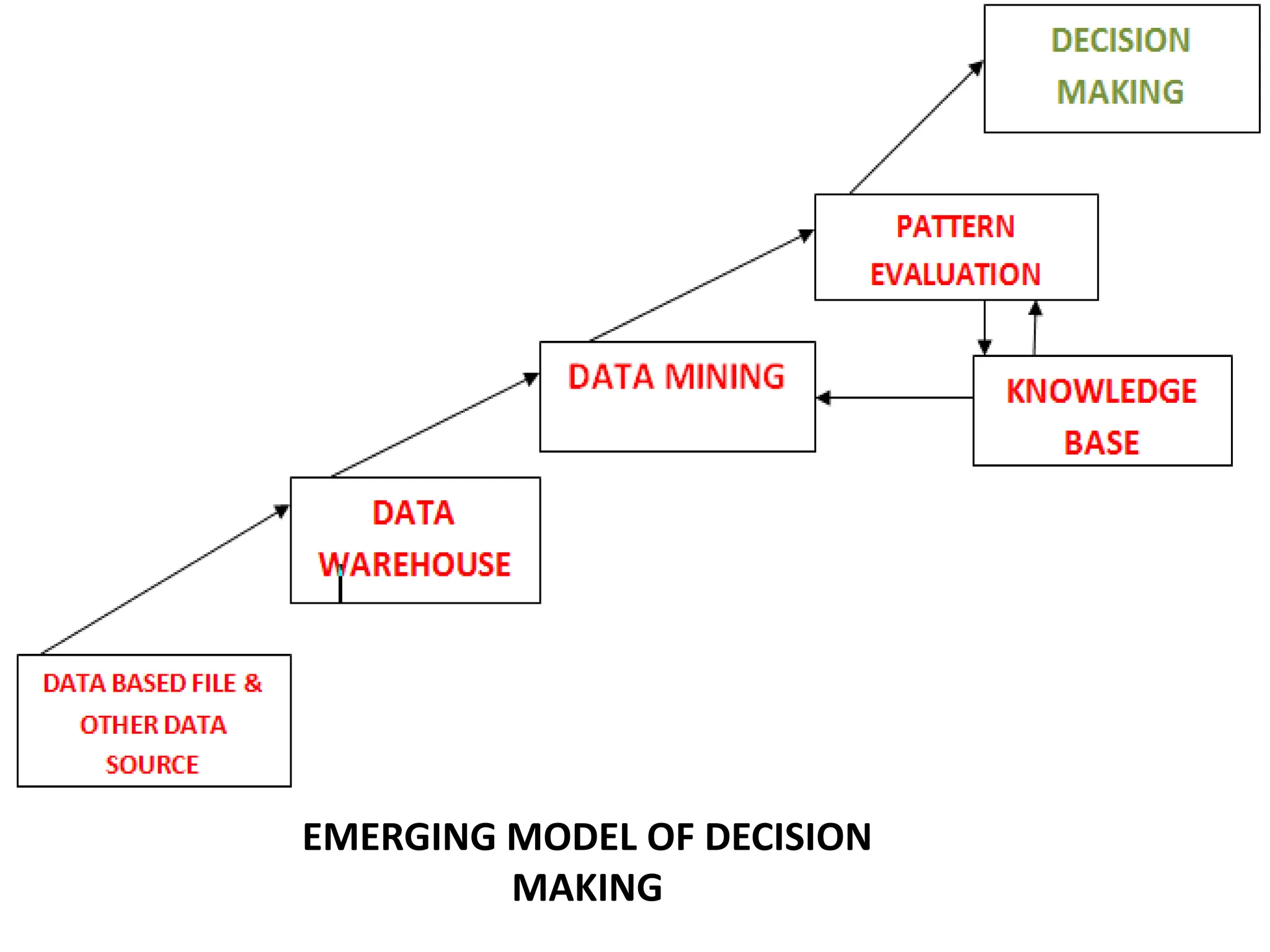
EMERGING MODEL OF DECISION
MAKING
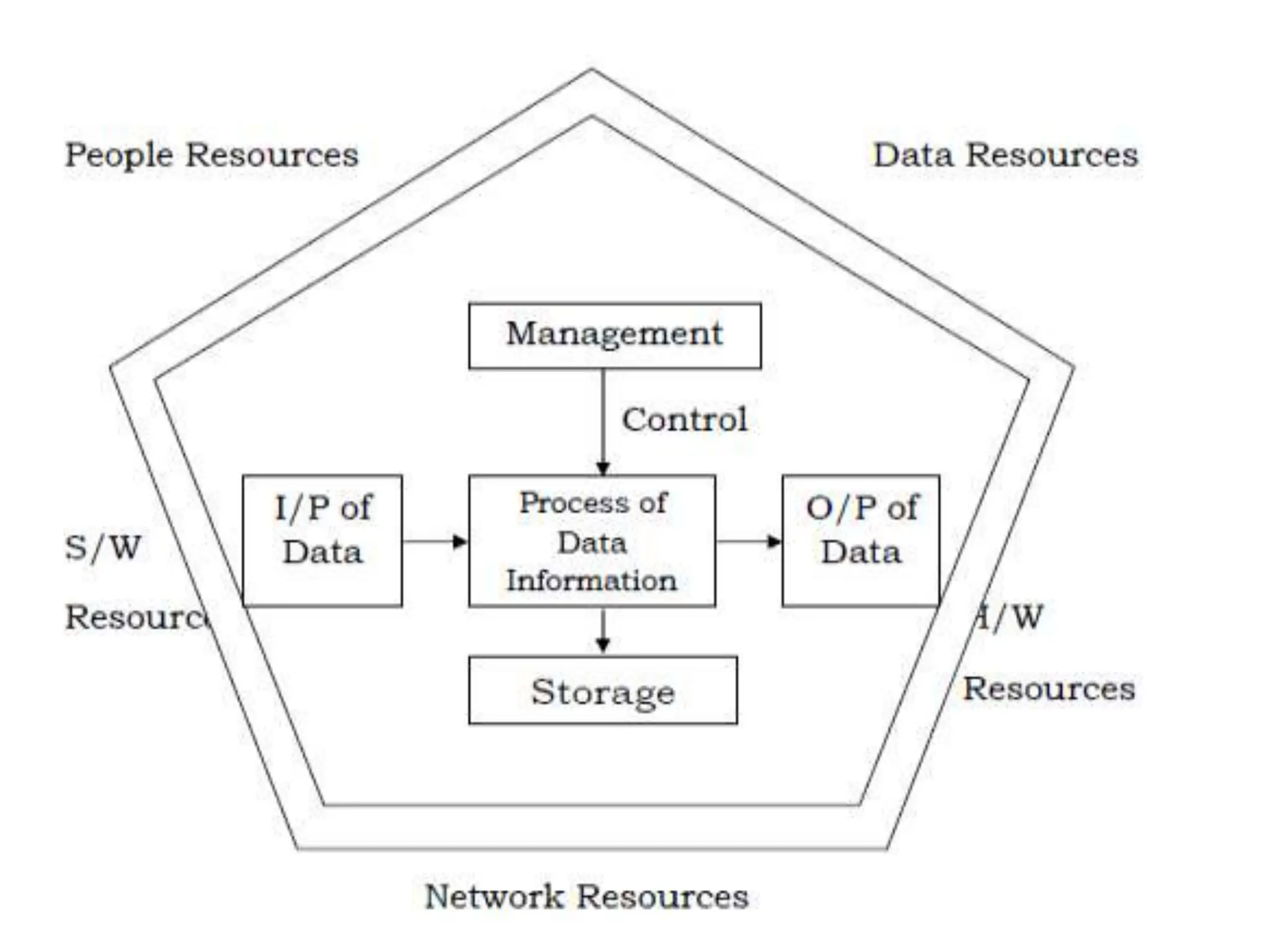
COMPONENTS MANAGING
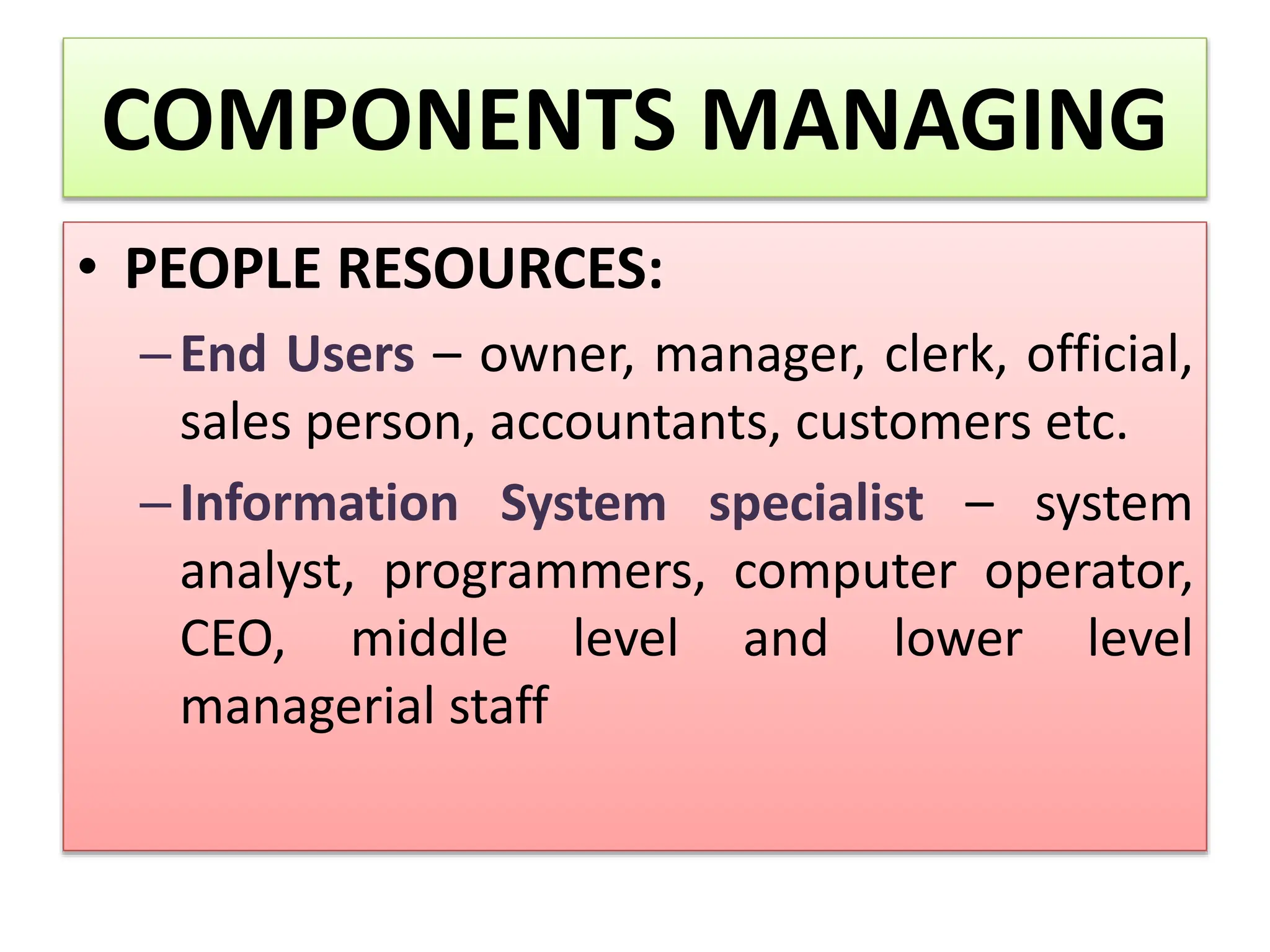
• PEOPLE RESOURCES:
–End Users – owner, manager, clerk, official,
sales person, accountants, customers etc.
–Information System specialist – system
analyst, programmers, computer operator,
CEO, middle level and lower level
managerial staff
COMPONENTS MANAGING
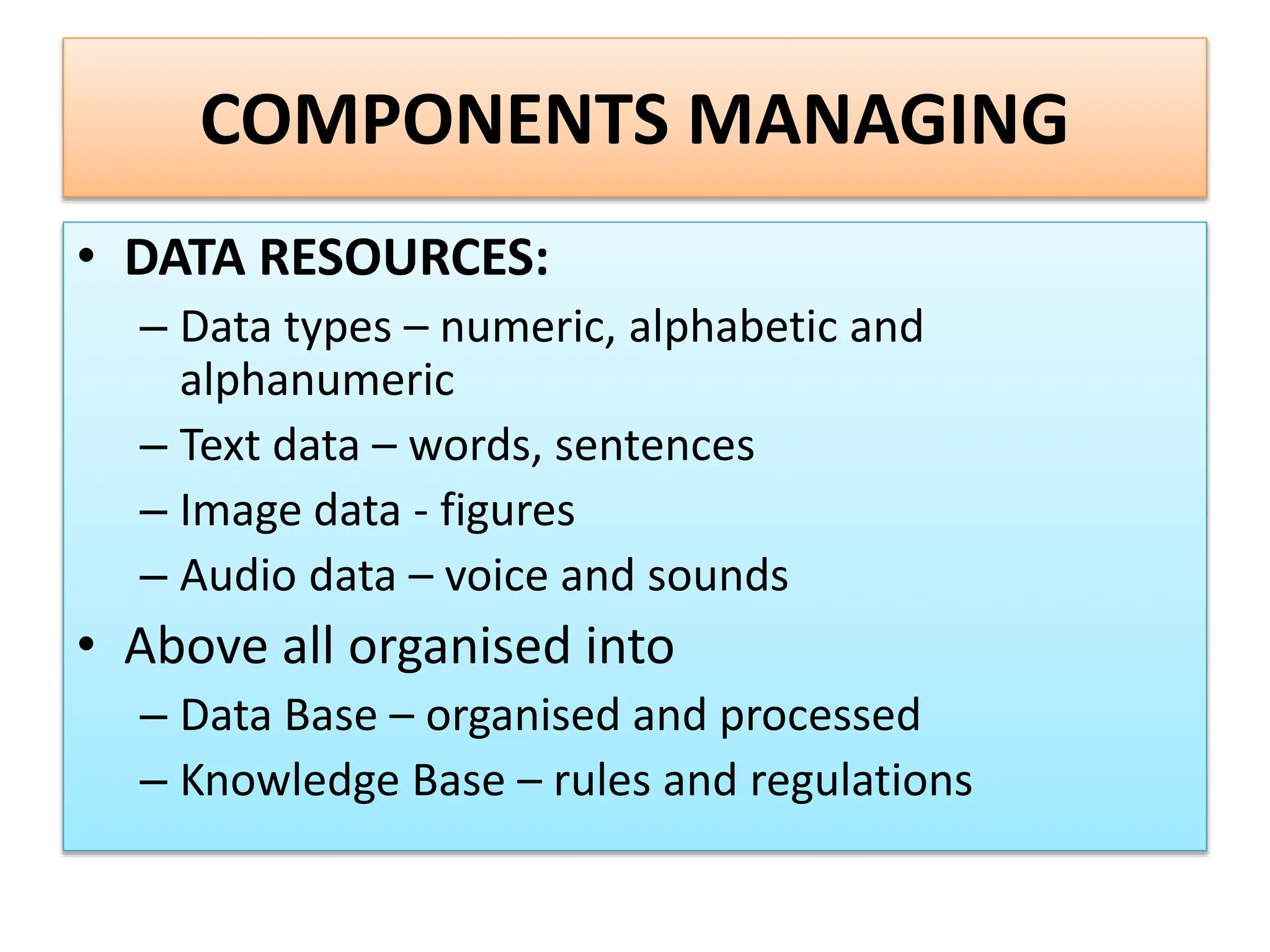
• DATA RESOURCES:
– Data types – numeric, alphabetic and
alphanumeric
– Text data – words, sentences
– Image data - figures
– Audio data – voice and sounds
• Above all organised into
– Data Base – organised and processed
– Knowledge Base – rules and regulations
COMPONENTS MANAGING
• SOFTWARE RESOURCES:
– System software
– Application software
– Procedures
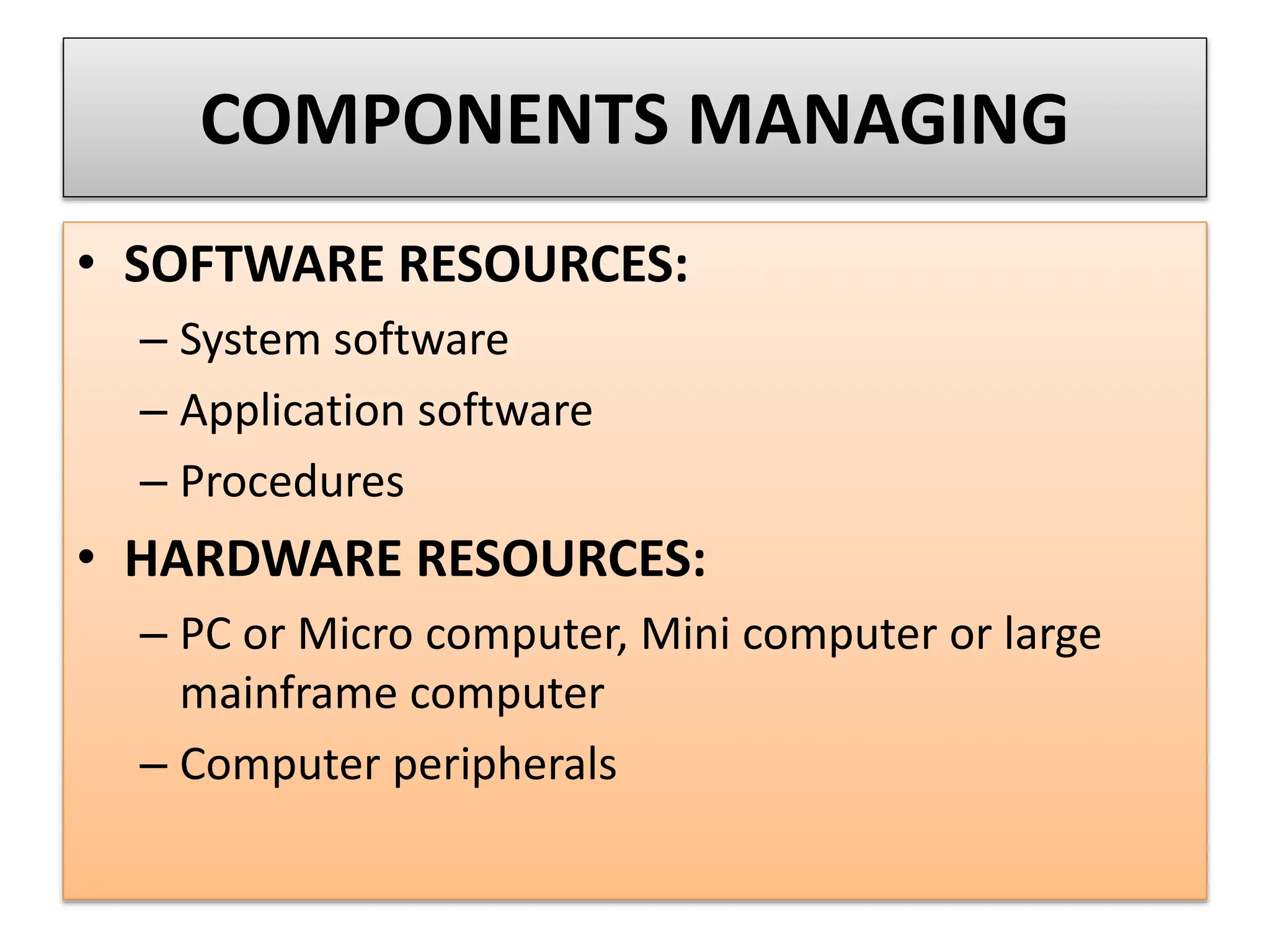
• HARDWARE RESOURCES:
– PC or Micro computer, Mini computer or large
mainframe computer
– Computer peripherals
COMPONENTS MANAGING
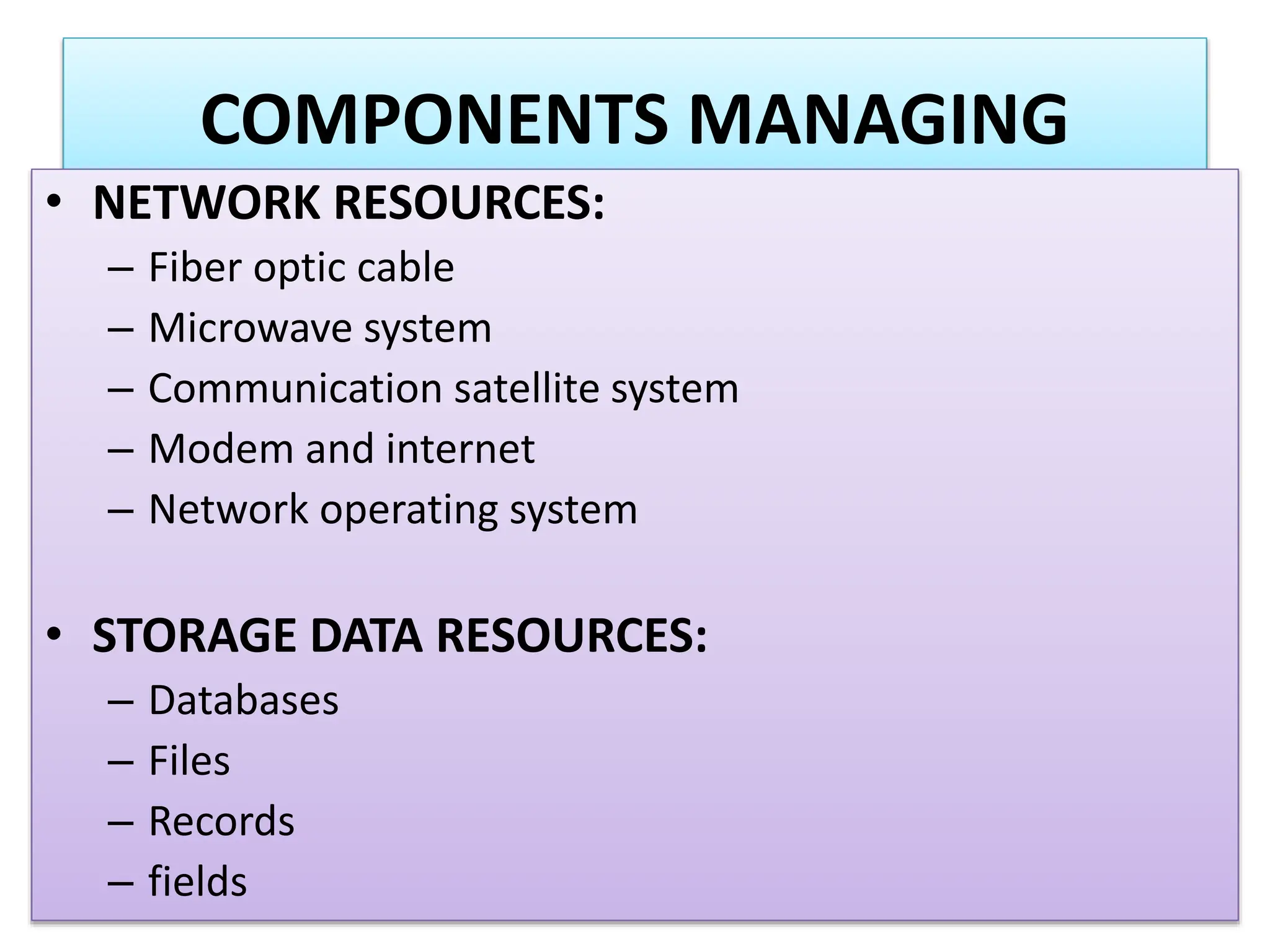
• NETWORK RESOURCES:
– Fiber optic cable
– Microwave system
– Communication satellite system
– Modem and internet
– Network operating system
• STORAGE DATA RESOURCES:
– Databases
– Files
– Records
– fields
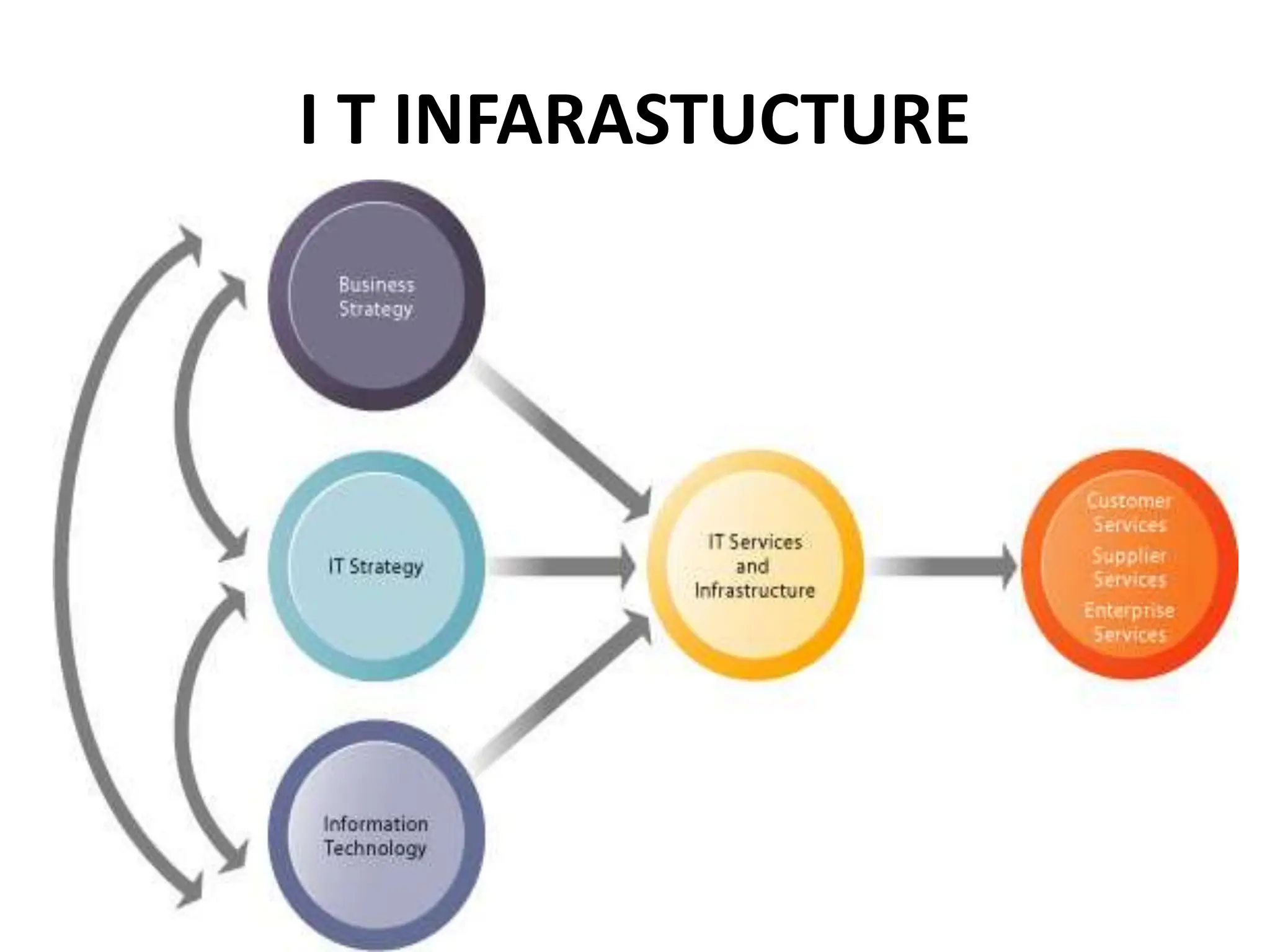
I T INFARASTUCTURE
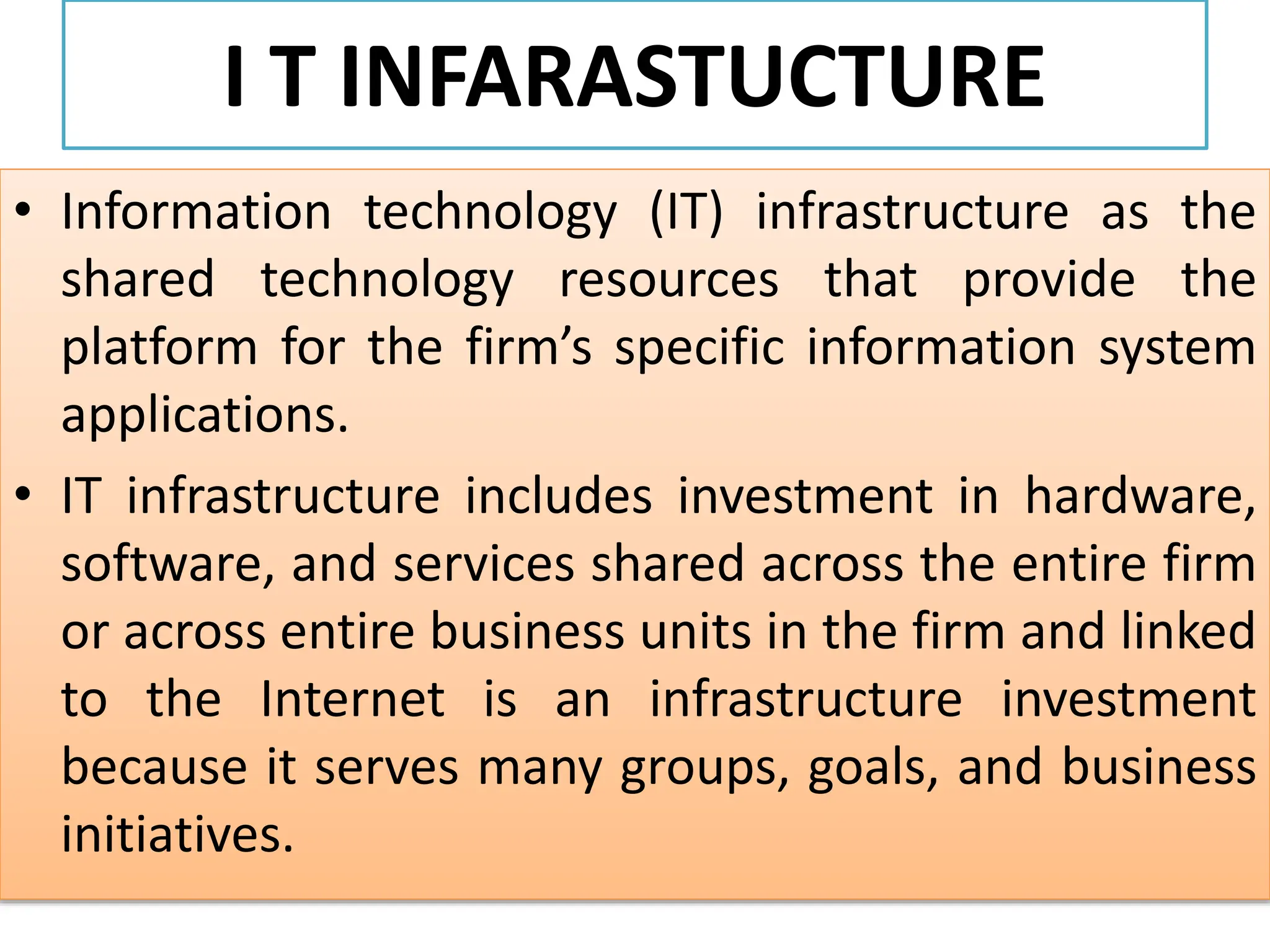
• Information technology (IT) infrastructure as the
shared technology resources that provide the
platform for the firm’s specific information system
applications.
• IT infrastructure includes investment in hardware,
software, and services shared across the entire firm
or across entire business units in the firm and linked
to the Internet is an infrastructure investment
because it serves many groups, goals, and business
initiatives.
I T INFARASTUCTURE
I T INFRASTRUCTURE
• IT infrastructure is a set of firm wide services budgeted by
management and comprising both human and technical
capabilities (Weill et al., 2002)
• The services include the following:
• Computing platforms used to provide computing services
that connect employees, customers, and suppliers into a
coherent digital environment, including large mainframes,
desktop and laptop computers, and Internet appliances.
• Telecommunications services that provide data, voice, and
video connectivity to employees, customers, and suppliers.
• Data management services that store and manage corporate
data and provide capabilities for analyzing the data.
SERVICES
• Application software services that provide enterprise-
wide capabilities such as enterprise resource planning,
customer relationship management, supply chain
management, and knowledge management systems
that are shared by all business units.
• Physical facilities management services that develop
and manage the physical installations required for
computing, telecommunications, and data
management services.
• IT management services that plan and develop the
infrastructure, coordinate with the business units for IT
services, manage accounting for the IT expenditure,
and provide project management services.
SERVICES
• IT standards services that provide the firm and its
business units with policies that determine which
information technology will be used, when, and
how.
• IT education services that provide training in system
use to employees and offer managers training in
how to plan for and manage IT investments.
• IT research and development services that provide
the firm with research on potential future IT projects
and investments that could help the firm
differentiate itself in the marketplace.
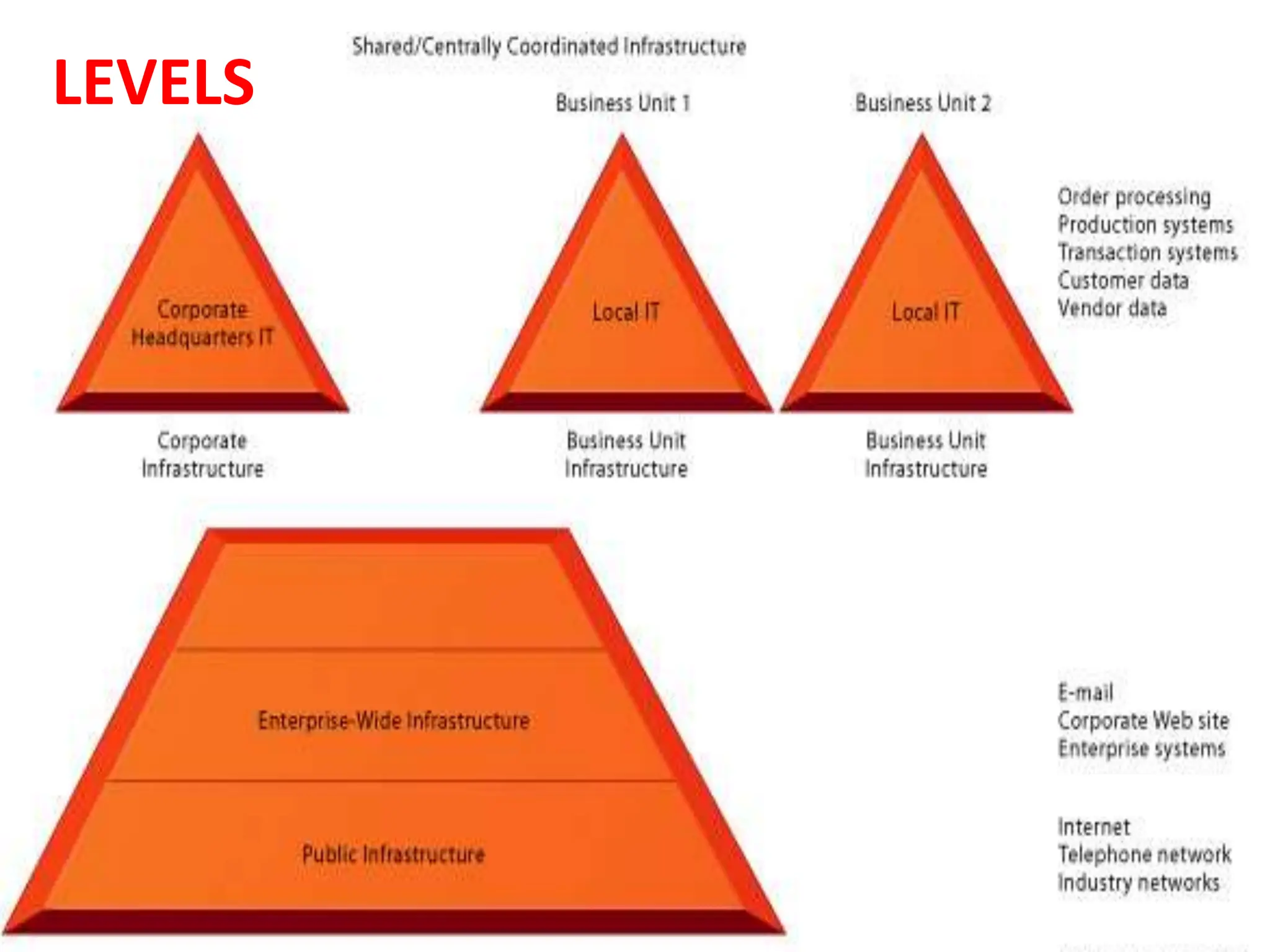
LEVELS
DIGITAL FIRM
• The Digital Firm is a general term for organizations
that have enabled core business relationships with
employees, customers, suppliers, and other
stakeholders through digital networks
• Benefits
• “Time Shifting”
• “Space Shifting“
• Create business value from technology investments
• Efficiency in inventory and supply chain
• Enhance the CRM
• Improve overall organizational productivity
MIS Model for a digital firm
• The Digital Firm: E – Commerce New Digital
Relationships
• Flattening Organizations and the Changing
Management Process
• Separating Work from Location
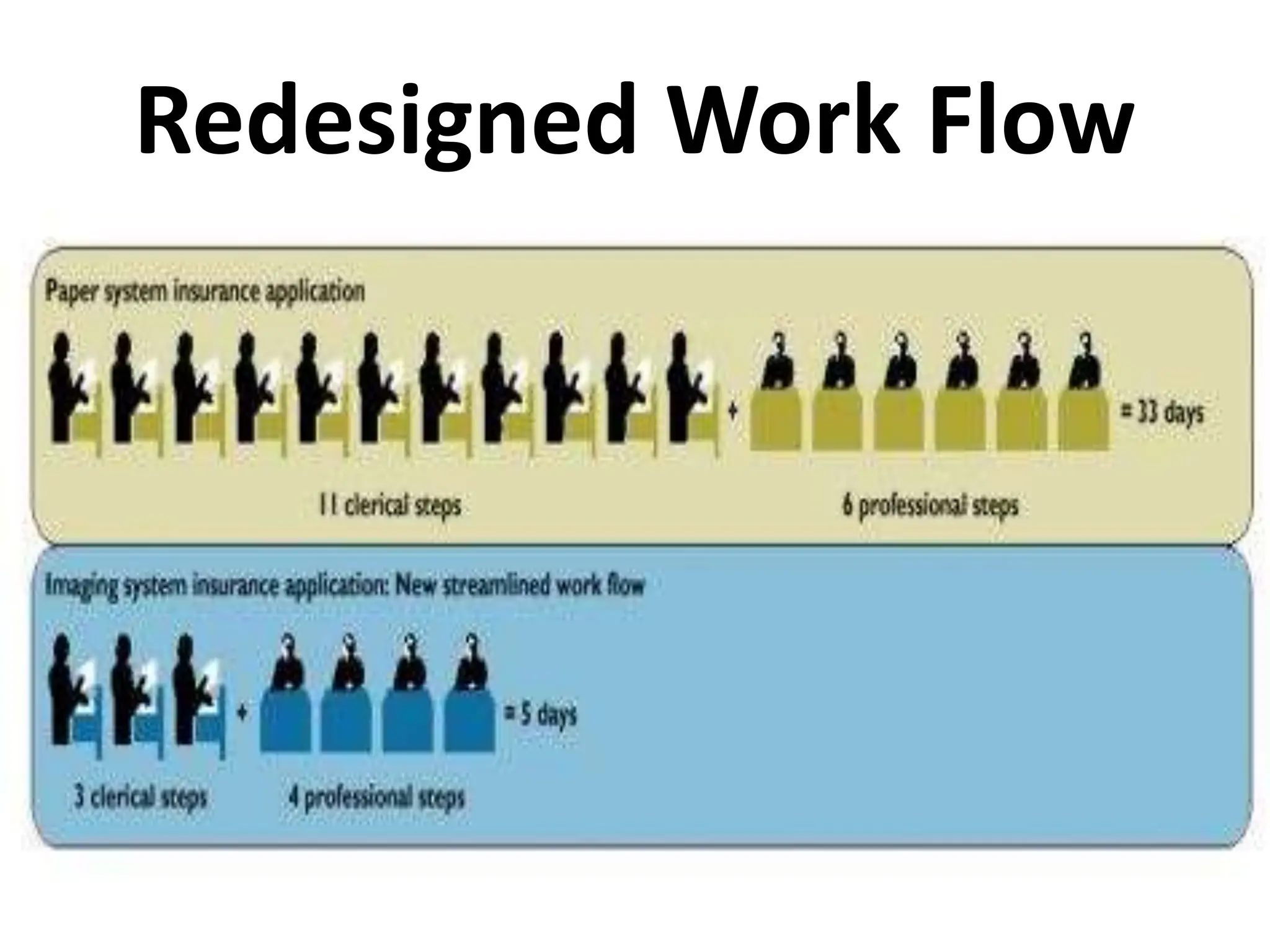
• Reorganizing Work Flows
• Increasing Flexibility of Organizations
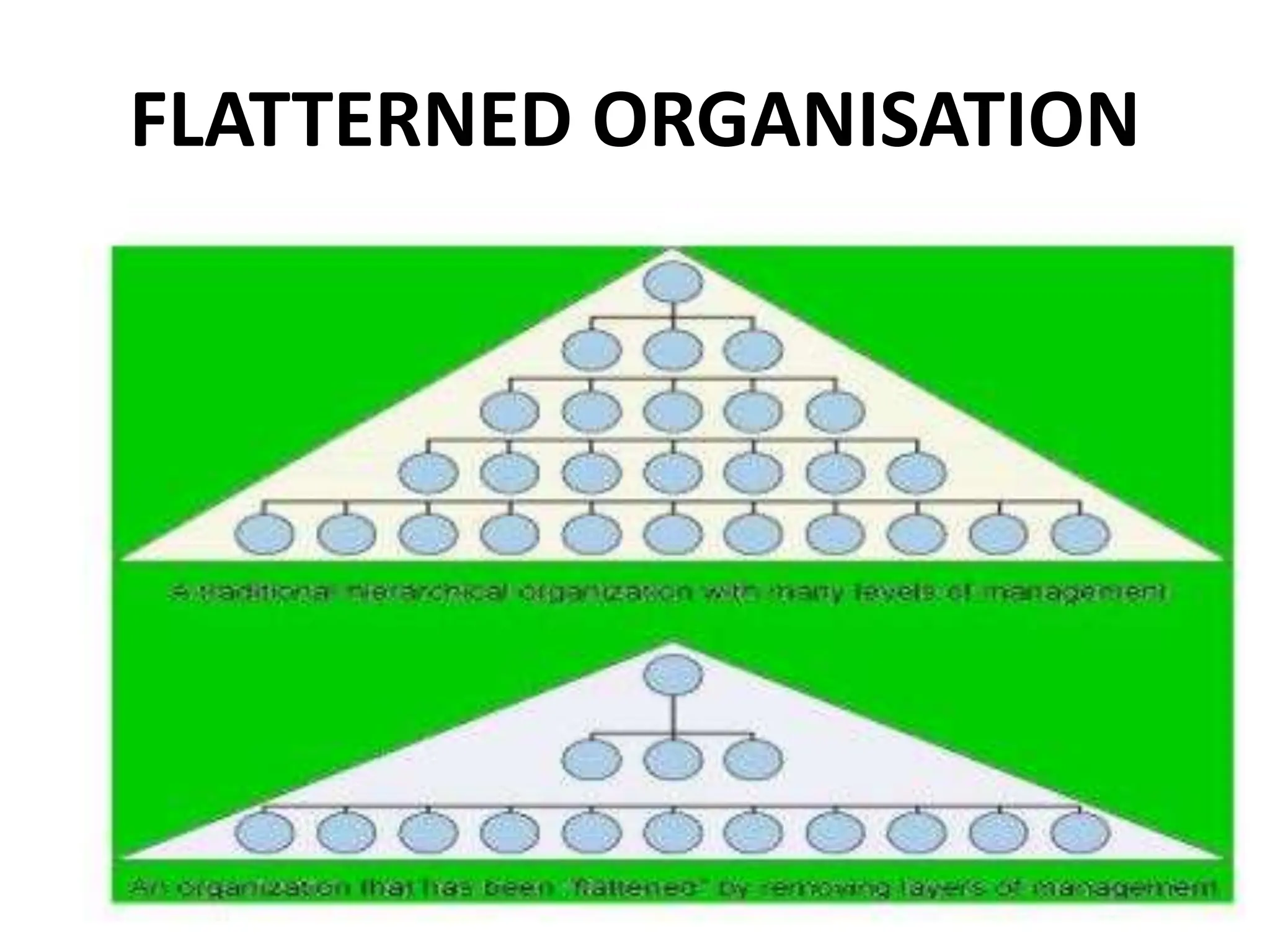
FLATTERNED ORGANISATION
Redesigned Work Flow
TRADITIONAL ORGANISATION
STRUCTURE
• A rigid hierarchical structure
• Clear division of labour
• Inflexibility in terms of responding to
need for change
• Slow to respond to potential new
markets
DIGITAL FIRM STRUCTURE
• Flatter hierarchical organization
• Balanced distribution of power among the various layers
• Delegation of decision making and power extended to the
lower layers
• Participative management
• Sense of belongingness
• No specified work hours
• Flexible hours through the use of IT
• Access to internal organizational IT infrastructure
• Employees become outcome driven
• Performance is measured against achievements
DIGITAL TECHNOLOGY PLATFORMS
• Customer Relationship Management (CRM)
• Supply Chain Management (SCM)
• Enterprise Resource Planning (ERP)
• Knowledge Management System (KMS)
• Warehouse Management System (WMS)
UNIT dkkddkkdkdkdkfkfkdkdkdkdkdkddI.pptx

UNIT dkkddkkdkdkdkfkfkdkdkdkdkdkddI.pptx

  • 1.
  • 2.
  • 3.
  • 4.
  • 5.
    INFORMATION • Information canbe defined as meaningfully interpreted data • Information can be recorded as signs, or transmitted as signals. Information is any kind of even that affects the state of a dynamic system that can interpret the information. • Conceptually, information is the message being conveyed. In a general sense, information is “knowledge communicated or received, concerning a particular fact or circumstance”.
  • 6.
    SYSTEM • System definedas an orderly arrangement of a set of interrelated and interdependent elements that operate collectively to accomplish some common purpose or goal. • A computer based information system is also a system which is a collection of people, hardware, software, data and procedure to interact to provide timely information to authorised people who need it.
  • 7.
  • 8.
    MANAGEMENT INFORMATION SYSTEM • “anintegrated user-machine system designed for providing information to support operational control, management control and decision making function is an organisation”. •Davis and Olson
  • 9.
    MANAGEMENT INFORMATION SYSTEM • Managementinformation system, or MIS, broadly refers to a computer based system that provides managers with the tools to organize, evaluate and efficiently manage departments within an organization •Subhalakshmi Joshi
  • 10.
    INFORMATION SYSTEM • Itcan be defined technically as a set of interrelated components that collect, process, store and distribute information to support decision making, coordination and control in organisation. • It also helps managers and workers analyse problems, visualise complex subjects and create new products
  • 11.
    COMPONENTS • Input • Processes •Output • People • Hardware(physical devices) • Software (information processing instructions) • Data • Network (communication channels) • Procedure
  • 12.
    INFORMATION SYSTEM • Aninformation system is an organized combination of people, hardware, software, communications network, and data resources that collects, transforms, and disseminates in an organisation.
  • 13.
  • 14.
    OBJECTIVES OF MIS •Data capturing • Process of Data • Storage • Retrieval • Dissemination
  • 15.
  • 16.
    MANAGEMENT • Decision making •Action plan • Co-ordination • Monitoring • Controlling • leadership
  • 17.
    TECHNOLOGY • Hardware • Software •Network • Telecommunication • www • HTML
  • 18.
    LEVELS & TYPES STRATEGIC MANAGEMENT TACTICALMANAGEMENT OPERATIONAL MANAGEMENT • DECISION STRUCTURE INFORMATION SYSTEM DECISION SUPPORT SYSTEM MIS TPS UNSTRUCTURED SEMI STRUCTURED STRUCTURED
  • 19.
  • 21.
  • 23.
    MIS • Management InformationSystems are management-level systems that are used by middle managers to help ensure the smooth running of the organization in the short to medium term. • The highly structured information provided by these systems allows managers to evaluate an organization's performance by comparing current with previous outputs.
  • 25.
    DSS • A DecisionSupport System can be seen as a knowledge based system, used by senior managers, which facilitates the creation of knowledge and allow its integration into the organization. • Access to databases, analytical tools, allow "what if" simulations, and may support the exchange of information within the organization.
  • 27.
    EIS • Executive InformationSystems are strategic- level information systems that are found at the top of the Pyramid. They help executives and senior managers analyze the environment in which the organization operates, to identify long-term trends, and to plan appropriate courses of action.
  • 29.
    EXPERT SYSTEM • Expertsystems can be defined as programs that help the computer make decisions in a similar way as an expert in specific domain, a particular subject area of interest. • It aims at formalising expertise and make it available for repetitive type of business decisions. • It makes use of artificial intelligence to generate knowledge out of the information, existing theories, beliefs and experiences of managers in various business activities.
  • 30.
    OFFICE AUTOMATION SYSTEM •Office automation is the integration of computer, telecommunications and office equipment technologies to improve the execution of business functions through increasing the productivity, effectiveness and working conditions of office support. • Encompasses the application of computer and communication technology to improve the productivity of all types of office workers including clerical, administrative, professional and executive.
  • 31.
    OTHERS • WORK FLOWSYSTEM –Rule based system that direct, coordinates and monitors –Three systems: • Administrative workflow • Ad-hoc workflow • Product workflow
  • 32.
    OTHERS • ENTERPRISE RESOURCEPLANNING SYSTEM: – Business process management software that allows an organisation to use system to integrate programs capable of managing operations for an multi-site and global organisation • EXPERT SYSTEM: – Have the ability to make suggest and act like an expert in a particular field
  • 33.
  • 35.
  • 36.
  • 37.
  • 40.
    DECISION STRUCTURE ANDLEVEL OF MANAGEMENT DECISION STRUCTURE OPERATIONAL CONTROL DECISIONS MANAGEMENT CONTROL DECISION STRATEGIC PLANNING DECISION Unstructured Customer queries handling Work group performance analysis R&D Learning Semi- structured Production Scheduling Capital Budgeting Product planning Structured Inventory Control Allocating budgets Financial structure planning
  • 41.
  • 42.
  • 43.
  • 44.
    EMERGING MODEL OFDECISION MAKING
  • 46.
    COMPONENTS MANAGING • PEOPLERESOURCES: –End Users – owner, manager, clerk, official, sales person, accountants, customers etc. –Information System specialist – system analyst, programmers, computer operator, CEO, middle level and lower level managerial staff
  • 47.
    COMPONENTS MANAGING • DATARESOURCES: – Data types – numeric, alphabetic and alphanumeric – Text data – words, sentences – Image data - figures – Audio data – voice and sounds • Above all organised into – Data Base – organised and processed – Knowledge Base – rules and regulations
  • 48.
    COMPONENTS MANAGING • SOFTWARERESOURCES: – System software – Application software – Procedures • HARDWARE RESOURCES: – PC or Micro computer, Mini computer or large mainframe computer – Computer peripherals
  • 49.
    COMPONENTS MANAGING • NETWORKRESOURCES: – Fiber optic cable – Microwave system – Communication satellite system – Modem and internet – Network operating system • STORAGE DATA RESOURCES: – Databases – Files – Records – fields
  • 50.
    I T INFARASTUCTURE •Information technology (IT) infrastructure as the shared technology resources that provide the platform for the firm’s specific information system applications. • IT infrastructure includes investment in hardware, software, and services shared across the entire firm or across entire business units in the firm and linked to the Internet is an infrastructure investment because it serves many groups, goals, and business initiatives.
  • 51.
  • 52.
    I T INFRASTRUCTURE •IT infrastructure is a set of firm wide services budgeted by management and comprising both human and technical capabilities (Weill et al., 2002) • The services include the following: • Computing platforms used to provide computing services that connect employees, customers, and suppliers into a coherent digital environment, including large mainframes, desktop and laptop computers, and Internet appliances. • Telecommunications services that provide data, voice, and video connectivity to employees, customers, and suppliers. • Data management services that store and manage corporate data and provide capabilities for analyzing the data.
  • 53.
    SERVICES • Application softwareservices that provide enterprise- wide capabilities such as enterprise resource planning, customer relationship management, supply chain management, and knowledge management systems that are shared by all business units. • Physical facilities management services that develop and manage the physical installations required for computing, telecommunications, and data management services. • IT management services that plan and develop the infrastructure, coordinate with the business units for IT services, manage accounting for the IT expenditure, and provide project management services.
  • 54.
    SERVICES • IT standardsservices that provide the firm and its business units with policies that determine which information technology will be used, when, and how. • IT education services that provide training in system use to employees and offer managers training in how to plan for and manage IT investments. • IT research and development services that provide the firm with research on potential future IT projects and investments that could help the firm differentiate itself in the marketplace.
  • 55.
  • 56.
    DIGITAL FIRM • TheDigital Firm is a general term for organizations that have enabled core business relationships with employees, customers, suppliers, and other stakeholders through digital networks • Benefits • “Time Shifting” • “Space Shifting“ • Create business value from technology investments • Efficiency in inventory and supply chain • Enhance the CRM • Improve overall organizational productivity
  • 57.
    MIS Model fora digital firm • The Digital Firm: E – Commerce New Digital Relationships • Flattening Organizations and the Changing Management Process • Separating Work from Location • Reorganizing Work Flows • Increasing Flexibility of Organizations
  • 58.
  • 59.
  • 60.
    TRADITIONAL ORGANISATION STRUCTURE • Arigid hierarchical structure • Clear division of labour • Inflexibility in terms of responding to need for change • Slow to respond to potential new markets
  • 61.
    DIGITAL FIRM STRUCTURE •Flatter hierarchical organization • Balanced distribution of power among the various layers • Delegation of decision making and power extended to the lower layers • Participative management • Sense of belongingness • No specified work hours • Flexible hours through the use of IT • Access to internal organizational IT infrastructure • Employees become outcome driven • Performance is measured against achievements
  • 62.
    DIGITAL TECHNOLOGY PLATFORMS •Customer Relationship Management (CRM) • Supply Chain Management (SCM) • Enterprise Resource Planning (ERP) • Knowledge Management System (KMS) • Warehouse Management System (WMS)