Reference:
Management Information Systems
Jane P. Laudon Kenneth C. Laudon
Prentice-Hall Inc
10th
edition
Management Information Systems
B.Tech in IT 4th Semester
1
Chapter
Information Systems in
Global Business Today
The Role of Information Systems in Business Today
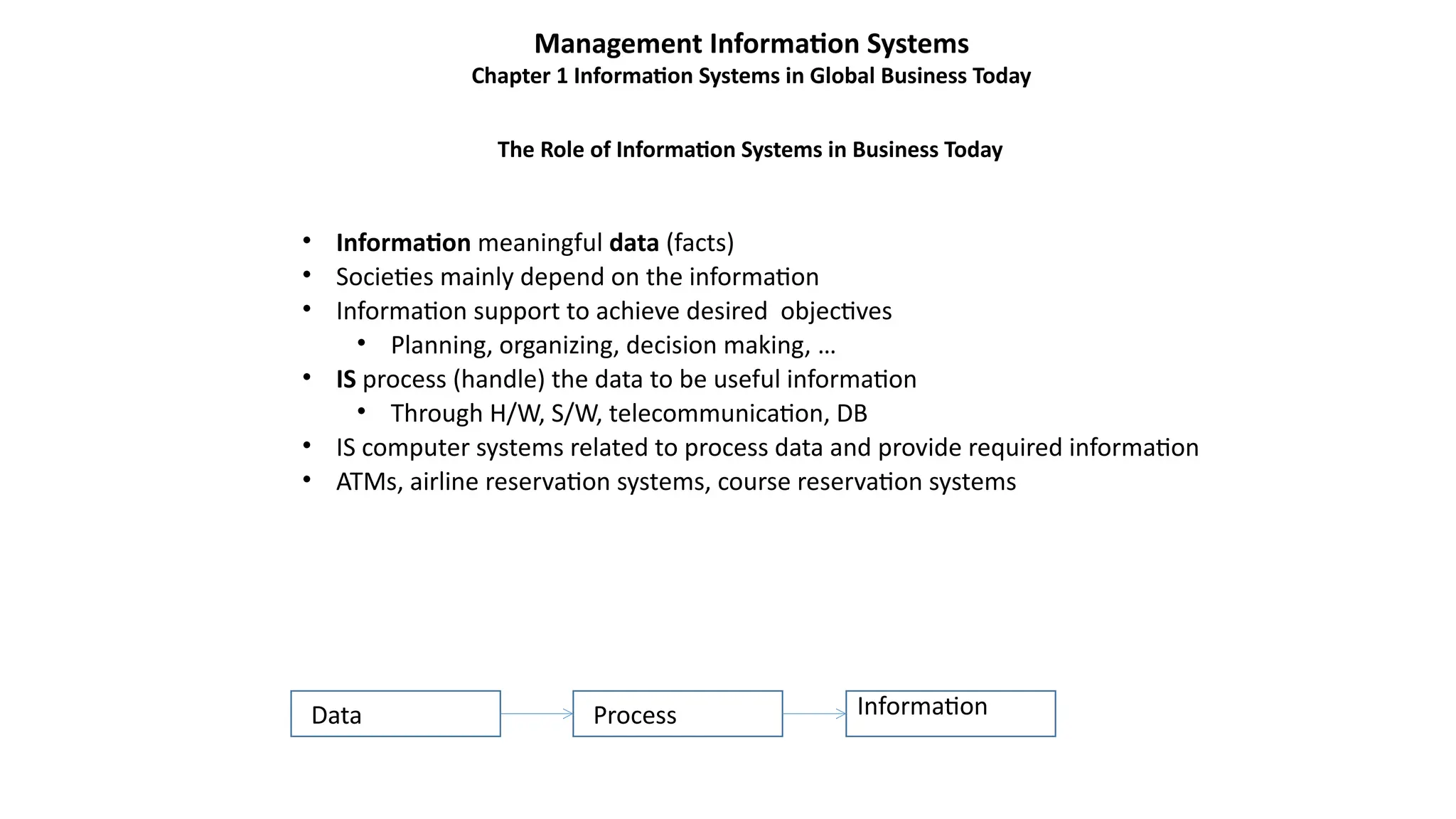
• Information meaningful data (facts)
• Societies mainly depend on the information
• Information support to achieve desired objectives
• Planning, organizing, decision making, …
• IS process (handle) the data to be useful information
• Through H/W, S/W, telecommunication, DB
• IS computer systems related to process data and provide required information
• ATMs, airline reservation systems, course reservation systems
Management Information Systems
Chapter 1 Information Systems in Global Business Today
Data Process Information
business process
• Business process : tasks, rules, behaviors that been
developed to produce business results.
• eg.
– Developing new product
– Creating market plan
– Hiring an employee
• Considered source of competitive strength
• IS automate many business process
Definitions
• Data
• Information
• System
• Information system
• Business
• Business process
Role of IS in business today
• IS transform (improve) business today. How?
1. Creating globalization opportunities: Internet reduced costs of
operating, on global scale for Customers and firms, Using foreign
markets, easily replicate service such as Google and ebay
2. Helps the emerging digital firm: The business relationships in digital
firm are digitally enabled and mediated and It’s core business
processes are accomplished through digital networks.
(Time shifting, space shifting)
Firms invest heavily in IS to achieve 6 strategic business
objectives (why firms use IS?).
1. Operational excellence
2. New products, services, and business models
3. Customer and supplier intimacy
4. Improved decision making
5. Competitive advantage
6. Survival
1. Operational excellence:
• IS Improvement of efficiency of operation to attain higher
profitability
• IT tool to achieve greater efficiency and productivity
• Examble: Wal-Mart’s RetailLink system links suppliers to stores for
superior replenishment system
3. Customer and supplier intimacy
• Serving customers well leads to customers returning, which raises
revenues and profits
• E.g. High-end hotels that use computers to track customer preferences and use
to monitor and customize environment
• Intimacy with suppliers allows them to provide vital inputs, which
lowers costs
• E.g. J.C.Penney’s information system which links sales records to contract
manufacturer
4. Improved decision-making
• Without accurate information:
• Managers must use forecasts, best guesses, luck
• Leads to:
• Overproduction, underproduction of goods and services
• Misallocation of resources
• Poor response times
• Poor outcomes raise costs, lose customers
• IS provide real-time data for making decisions
• E.g. Verizon’s Web-based digital dashboard to provide managers with
real-time data on customer complaints, network performance, line
outages, etc.
5. Competitive advantage
• Achieve higher sales and profit through using IS by:
• Doing things better
• Charging less for superior products
• real time Responding
• Using the internet is competitive advantage
• E.g. Dell: Consistent profitability over 25 years; Dell remains one of the
most efficient producer of PCs in world.
• But Dell has lost some of its advantages to fast followers-- HP
6. Survival
• Information technologies are necessity of doing business
• May be:
• Industry-level changes, e.g. Citibank’s introduction of ATMs
• Governmental regulations requiring record-keeping
• E.g. Toxic Substances Control Act, Sarbannes-Oxley Act
IS, data, information
• IS
• Set of interrelated components
• Collect, process, store, and distribute information
By computers and software as a tool
• Support decision making, coordination, control, problem analysis and
create new product
• Provide solutions to challenges in business Env.
• Information vs. data
• Data are streams of raw facts
• Information is data shaped into meaningful form
IS: input, process, output, feedback
• IS: activities produce required information
• Input: Captures raw data from organization or external environment
• Processing: Converts data into meaningful form
• Output: Transfers processed information to people or activities that use
it
• Feedback: Output returned to appropriate members of organization to
help evaluate or correct input stage
Perspectives on Information Systems
Management Information Systems
Chapter 1 Information Systems in Global Business Today
An information system contains information about an organization and its surrounding environment. Three basic activities—input, processing, and output—
produce the information organizations need. Feedback is output returned to appropriate people or activities in the organization to evaluate and refine the input.
Environmental actors, such as customers, suppliers, competitors, stockholders, and regulatory agencies, interact with the organization and its information systems.
Figure 1-4
Functions of an Information System
Computer/Computer program vs. information system
• Computers and software are technical foundation and tools to store
and process information
• similar to the material and tools used to build a house
• Cannot produce required information to a particular organization
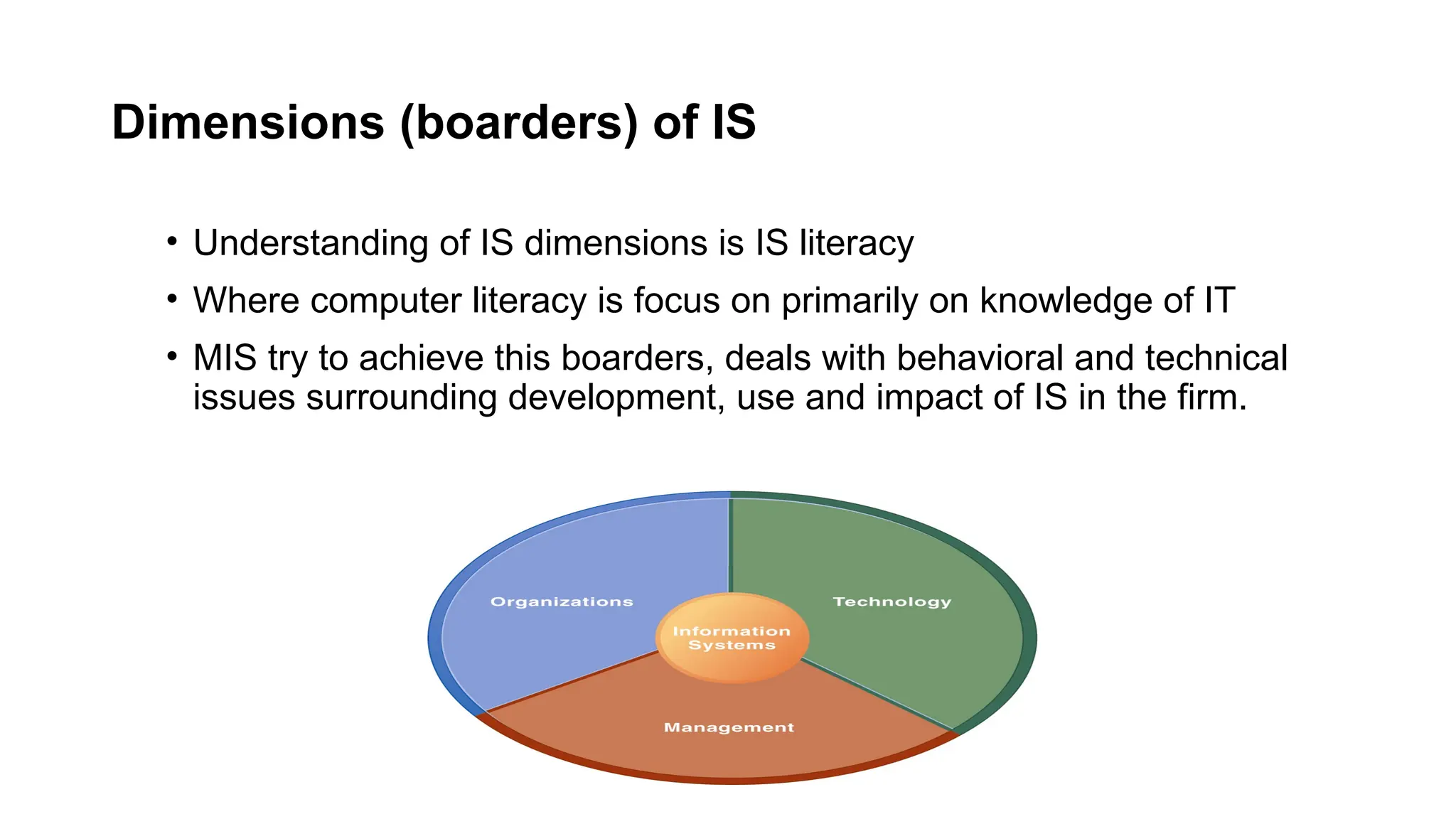
Dimensions (boarders) of IS
• Understanding of IS dimensions is IS literacy
• Where computer literacy is focus on primarily on knowledge of IT
• MIS try to achieve this boarders, deals with behavioral and technical
issues surrounding development, use and impact of IS in the firm.
1. Organizational dimension of IS
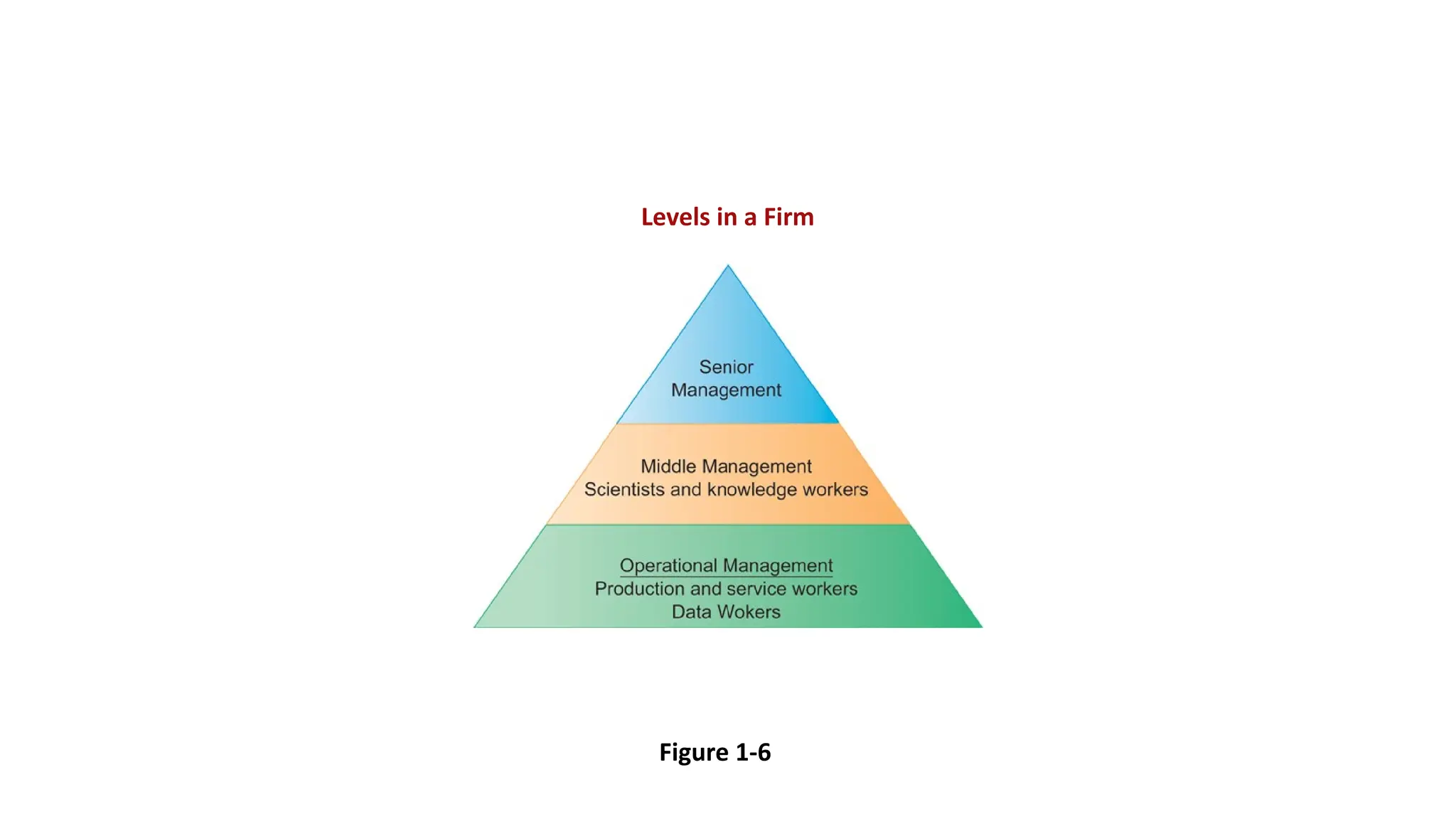
• structure: different levels and specialties
• hierarchy of authority, responsibility: Senior Middle Operational management,
Knowledge service Data workers
• business process: Organization coordinate its work through its
hierarchy and business process
• Culture : ways of doing things, part is embedded in IS.
Figure 1-6
Levels in a Firm
2. Management dimension
– Make decisions, formulate action plan and solve
organizational problem
– Managers set organizational strategy for responding to
business challenges
– In addition, managers must act creatively:
• Creation of new products and services
• Occasionally re-creating the organization
3. Technology dimension
• IT is:
– Hardware: physical component
– Software: instruction control Hardware
– Data management technology
– Network and telecommunications technology
– Network: Hardware + Software link computers
– Internet: Network to provide services
– WWW: service to store retrieve information
• IT infrastructure: platform that the firm can built on its IS
Business perspective on IS:
• IS instrument for creating value to firms
• Investments in IS result in superior returns:
• Increases productivity and revenue
• IS provides information that helps managers making better decisions
and improve the execution of business process
• Value of IS
There variation in Returns on
Information Technology Investment
• Investing in information technology does not guarantee good
returns
• Considerable variation in the returns firms receive from
systems investments
• Factors that case The variation in Returns :
– Adopting right business model according (suite) to new technology
– complementary investments (business processes, models, management
behavior and culture)
Complementary assets:
• Assets required to derive value from a primary investment
• Firms supporting their technology investments with investment in
complementary assets receive superior returns
• E.g.: invest in technology and the people to make it work properly
Contemporary Approaches to Information
Systems
Technical approach:
• Emphasizes mathematically based models
• Computer science theories of commutation ,data storage
• management science: models of DM and practices
• operations research: optimizing selected parameters of org.
Behavioral approach
• : Behavioral issues such strategic business integration,
implementation...
• Psychology: how decision makers use formal information
• Economics: how IS change the control and cost structures
• Sociology: how system affect individuals and groups
Management Information Systems MIS
• Use of computer-based information systems in business firms
• Combines work of CS, management, and operating research toward
developing system solutions to real word problems
• Concerned with behavioral issues of development, use and impact of IS
• main actors : Suppliers of hardware and software, Business firms, Managers
and employees, Firm’s environment (legal, social, cultural context)
Management Information System unit 1 notes

  • 1.
    Reference: Management Information Systems JaneP. Laudon Kenneth C. Laudon Prentice-Hall Inc 10th edition Management Information Systems B.Tech in IT 4th Semester
  • 2.
  • 3.
    The Role ofInformation Systems in Business Today • Information meaningful data (facts) • Societies mainly depend on the information • Information support to achieve desired objectives • Planning, organizing, decision making, … • IS process (handle) the data to be useful information • Through H/W, S/W, telecommunication, DB • IS computer systems related to process data and provide required information • ATMs, airline reservation systems, course reservation systems Management Information Systems Chapter 1 Information Systems in Global Business Today Data Process Information
  • 4.
    business process • Businessprocess : tasks, rules, behaviors that been developed to produce business results. • eg. – Developing new product – Creating market plan – Hiring an employee • Considered source of competitive strength • IS automate many business process
  • 5.
    Definitions • Data • Information •System • Information system • Business • Business process
  • 6.
    Role of ISin business today • IS transform (improve) business today. How? 1. Creating globalization opportunities: Internet reduced costs of operating, on global scale for Customers and firms, Using foreign markets, easily replicate service such as Google and ebay 2. Helps the emerging digital firm: The business relationships in digital firm are digitally enabled and mediated and It’s core business processes are accomplished through digital networks. (Time shifting, space shifting)
  • 7.
    Firms invest heavilyin IS to achieve 6 strategic business objectives (why firms use IS?). 1. Operational excellence 2. New products, services, and business models 3. Customer and supplier intimacy 4. Improved decision making 5. Competitive advantage 6. Survival
  • 8.
    1. Operational excellence: •IS Improvement of efficiency of operation to attain higher profitability • IT tool to achieve greater efficiency and productivity • Examble: Wal-Mart’s RetailLink system links suppliers to stores for superior replenishment system
  • 9.
    3. Customer andsupplier intimacy • Serving customers well leads to customers returning, which raises revenues and profits • E.g. High-end hotels that use computers to track customer preferences and use to monitor and customize environment • Intimacy with suppliers allows them to provide vital inputs, which lowers costs • E.g. J.C.Penney’s information system which links sales records to contract manufacturer
  • 10.
    4. Improved decision-making •Without accurate information: • Managers must use forecasts, best guesses, luck • Leads to: • Overproduction, underproduction of goods and services • Misallocation of resources • Poor response times • Poor outcomes raise costs, lose customers • IS provide real-time data for making decisions • E.g. Verizon’s Web-based digital dashboard to provide managers with real-time data on customer complaints, network performance, line outages, etc.
  • 11.
    5. Competitive advantage •Achieve higher sales and profit through using IS by: • Doing things better • Charging less for superior products • real time Responding • Using the internet is competitive advantage • E.g. Dell: Consistent profitability over 25 years; Dell remains one of the most efficient producer of PCs in world. • But Dell has lost some of its advantages to fast followers-- HP
  • 12.
    6. Survival • Informationtechnologies are necessity of doing business • May be: • Industry-level changes, e.g. Citibank’s introduction of ATMs • Governmental regulations requiring record-keeping • E.g. Toxic Substances Control Act, Sarbannes-Oxley Act
  • 13.
    IS, data, information •IS • Set of interrelated components • Collect, process, store, and distribute information By computers and software as a tool • Support decision making, coordination, control, problem analysis and create new product • Provide solutions to challenges in business Env. • Information vs. data • Data are streams of raw facts • Information is data shaped into meaningful form
  • 14.
    IS: input, process,output, feedback • IS: activities produce required information • Input: Captures raw data from organization or external environment • Processing: Converts data into meaningful form • Output: Transfers processed information to people or activities that use it • Feedback: Output returned to appropriate members of organization to help evaluate or correct input stage
  • 15.
    Perspectives on InformationSystems Management Information Systems Chapter 1 Information Systems in Global Business Today An information system contains information about an organization and its surrounding environment. Three basic activities—input, processing, and output— produce the information organizations need. Feedback is output returned to appropriate people or activities in the organization to evaluate and refine the input. Environmental actors, such as customers, suppliers, competitors, stockholders, and regulatory agencies, interact with the organization and its information systems. Figure 1-4 Functions of an Information System
  • 16.
    Computer/Computer program vs.information system • Computers and software are technical foundation and tools to store and process information • similar to the material and tools used to build a house • Cannot produce required information to a particular organization
  • 17.
    Dimensions (boarders) ofIS • Understanding of IS dimensions is IS literacy • Where computer literacy is focus on primarily on knowledge of IT • MIS try to achieve this boarders, deals with behavioral and technical issues surrounding development, use and impact of IS in the firm.
  • 18.
    1. Organizational dimensionof IS • structure: different levels and specialties • hierarchy of authority, responsibility: Senior Middle Operational management, Knowledge service Data workers • business process: Organization coordinate its work through its hierarchy and business process • Culture : ways of doing things, part is embedded in IS.
  • 19.
  • 20.
    2. Management dimension –Make decisions, formulate action plan and solve organizational problem – Managers set organizational strategy for responding to business challenges – In addition, managers must act creatively: • Creation of new products and services • Occasionally re-creating the organization
  • 21.
    3. Technology dimension •IT is: – Hardware: physical component – Software: instruction control Hardware – Data management technology – Network and telecommunications technology – Network: Hardware + Software link computers – Internet: Network to provide services – WWW: service to store retrieve information • IT infrastructure: platform that the firm can built on its IS
  • 22.
    Business perspective onIS: • IS instrument for creating value to firms • Investments in IS result in superior returns: • Increases productivity and revenue • IS provides information that helps managers making better decisions and improve the execution of business process • Value of IS
  • 23.
    There variation inReturns on Information Technology Investment • Investing in information technology does not guarantee good returns • Considerable variation in the returns firms receive from systems investments • Factors that case The variation in Returns : – Adopting right business model according (suite) to new technology – complementary investments (business processes, models, management behavior and culture)
  • 24.
    Complementary assets: • Assetsrequired to derive value from a primary investment • Firms supporting their technology investments with investment in complementary assets receive superior returns • E.g.: invest in technology and the people to make it work properly
  • 25.
    Contemporary Approaches toInformation Systems
  • 26.
    Technical approach: • Emphasizesmathematically based models • Computer science theories of commutation ,data storage • management science: models of DM and practices • operations research: optimizing selected parameters of org.
  • 27.
    Behavioral approach • :Behavioral issues such strategic business integration, implementation... • Psychology: how decision makers use formal information • Economics: how IS change the control and cost structures • Sociology: how system affect individuals and groups
  • 28.
    Management Information SystemsMIS • Use of computer-based information systems in business firms • Combines work of CS, management, and operating research toward developing system solutions to real word problems • Concerned with behavioral issues of development, use and impact of IS • main actors : Suppliers of hardware and software, Business firms, Managers and employees, Firm’s environment (legal, social, cultural context)