Advantage of pointer
Pointer reduces the code and improves the performance, it is used to
retrieving strings, trees, etc. and used with arrays, structures, and functions.
We can return multiple values from a function using the pointer.
It makes you able to access any memory location in the computer's
memory.
3.
Usage of pointer
1)Dynamic memory allocation
In c language, we can dynamically allocate memory using malloc() and calloc()
functions where the pointer is used.
2) Arrays, Functions, and Structures
Pointers in c language are widely used in arrays, functions, and structures. It
reduces the code and improves the performance.
4.
An Introduction toPointers
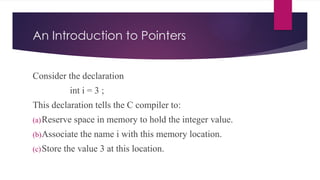
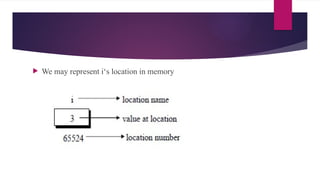
Consider the declaration
int i = 3 ;
This declaration tells the C compiler to:
(a)Reserve space in memory to hold the integer value.
(b)Associate the name i with this memory location.
(c)Store the value 3 at this location.
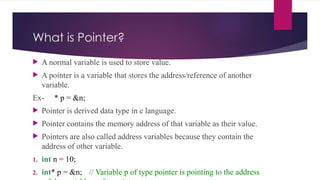
What is Pointer?
A normal variable is used to store value.
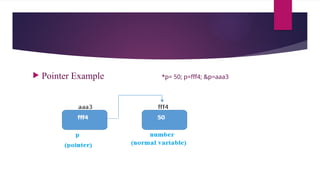
A pointer is a variable that stores the address/reference of another
variable.
Ex- * p = &n;
Pointer is derived data type in c language.
Pointer contains the memory address of that variable as their value.
Pointers are also called address variables because they contain the
address of other variable.
1. int n = 10;
2. int* p = &n; // Variable p of type pointer is pointing to the address
7.
The sizeof the pointer depends on the architecture.
However, in 32-bit architecture the size of a pointer is 2
byte.
8.
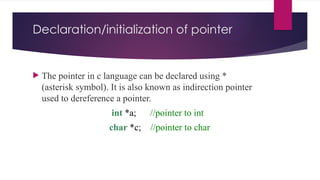
Declaration/initialization of pointer
The pointer in c language can be declared using *
(asterisk symbol). It is also known as indirection pointer
used to dereference a pointer.
int *a; //pointer to int
char *c; //pointer to char
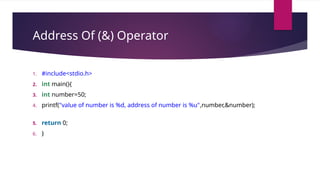
Address Of (&)Operator
1. #include<stdio.h>
2. int main(){
3. int number=50;
4. printf("value of number is %d, address of number is %u",number,&number);
5. return 0;
6. }
11.
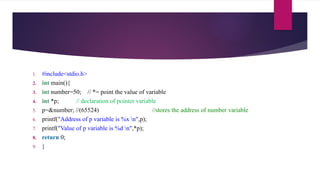
1. #include<stdio.h>
2. intmain(){
3. int number=50; // *= point the value of variable
4. int *p; // declaration of pointer variable
5. p=&number; //(65524) //stores the address of number variable
6. printf("Address of p variable is %x n",p);
7. printf("Value of p variable is %d n",*p);
8. return 0;
9. }
12.
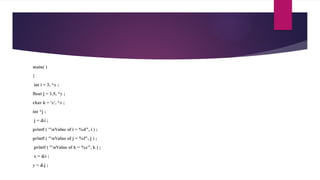
main( )
{
int i= 3, *x ;
float j = 1.5, *y ;
char k = 'c', *z ;
int *j ;
j = &i ;
printf ( "nValue of i = %d", i ) ;
printf ( "nValue of j = %f", j ) ;
printf ( "nValue of k = %c", k ) ;
x = &i ;
y = &j ;
13.
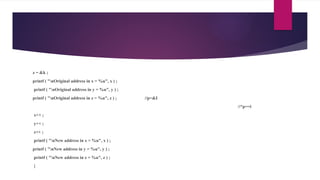
z = &k;
printf ( "nOriginal address in x = %u", x ) ;
printf ( "nOriginal address in y = %u", y ) ;
printf ( "nOriginal address in z = %u", z ) ; //p=&I
//*p==i
x++ ;
y++ ;
z++ ;
printf ( "nNew address in x = %u", x ) ;
printf ( "nNew address in y = %u", y ) ;
printf ( "nNew address in z = %u", z ) ;
}
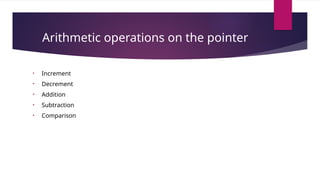
Pointer expression
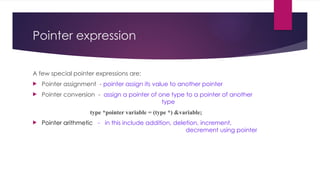
A fewspecial pointer expressions are:
Pointer assignment - pointer assign its value to another pointer
Pointer conversion - assign a pointer of one type to a pointer of another
type
type *pointer variable = (type *) &variable;
Pointer arithmetic - in this include addition, deletion, increment,
decrement using pointer
16.
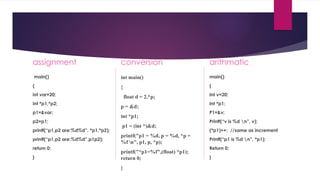
assignment
main()
{
int var=20;
int *p1,*p2;
p1=&var;
p2=p1;
printf(“p1,p2are:%d%d”, *p1,*p2);
printf(“p1,p2 are:%d%d”,p1p2);
return 0;
}
conversion
int main()
{
float d = 2,*p;
p = &d;
int *p1;
p1 = (int *)&d;
printf("p1 = %d, p = %d, *p =
%f n", p1, p, *p);
printf("*p1=%f",(float) *p1);
return 0;
}
arithmatic
main()
{
Int v=20;
Int *p1;
P1=&v;
Printf(“v is %d n”, v);
(*p1)++; //same as increment
Printf(“p1 is %d n”, *p1);
Return 0;
}
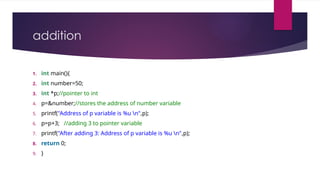
addition
1. int main(){
2.int number=50;
3. int *p;//pointer to int
4. p=&number;//stores the address of number variable
5. printf("Address of p variable is %u n",p);
6. p=p+3; //adding 3 to pointer variable
7. printf("After adding 3: Address of p variable is %u n",p);
8. return 0;
9. }
19.
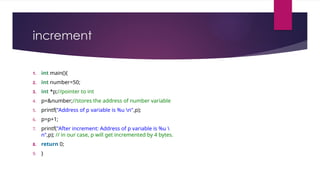
increment
1. int main(){
2.int number=50;
3. int *p;//pointer to int
4. p=&number;//stores the address of number variable
5. printf("Address of p variable is %u n",p);
6. p=p+1;
7. printf("After increment: Address of p variable is %u
n",p); // in our case, p will get incremented by 4 bytes.
8. return 0;
9. }
20.
array of pointer
“Arrayof pointers” is an array of the pointer variables. It is also known as
pointer arrays.
Syntax
int *var_name[array_size];
Example:
int *ptr[3];
ptr[i] = &arr[i];
Note:
We can make separate pointer variables which can point to the different values or we
can make one integer array of pointers that can point to all the values.
Example:
int i,*ptr[3];
21.
void main()
{
// creatingan array
int arr[3] = { 1, 2, 3 };
// we can make an integer pointer array to
// storing the address of array elements
int i, *ptr[3];
for (i = 0; i < 3; i++) {
// assigning the address of integer.
ptr[i] = &arr[i];
}
// printing values using pointer
for (i = 0; i < 3; i++) {
printf("Value of arr[%d] = %d n", i, *ptr[i]);
}
}
22.
Algorithm to printarray using pointer
Step1: start
Step2: Read array a[] with n elements
Step 3: initialize pointer p=&a[0] [or p=a]
Step 4: if i<n go to next step otherwise go to step 7
Step 5: print *(p+i)
Step 6: i=i+1 go to step 4
Step 7: stop
23.
Print array usingpointer
#include<stdio.h>
main()
{
int a[5]={5,4,6,8,9};
int *p=&a[0];
int i;
for(i=0;i<5;i++)
printf("%d ",*(p+i));
}
24.
Traversing an arrayby using pointer
1. #include<stdio.h>
2. void main ()
3. {
4. int arr[5] = {1, 2, 3, 4, 5};
5. int *p;
6. *p=arr; //int *p = arr;
7. int i;
8. printf("printing array elements...n");
9. for(i = 0; i< 5; i++)
10. {
11. printf("%d ",*(p+i));
12. }
13. }
25.
Pointer to array
Pointeris also known as array pointer
int a[3]={2,5,6};
int *ptr=a; // Variable p of type pointer is pointing to the
address of an integer array arr.
We have a pointer ptr that focuses to the 0th component of
the array. We can likewise declare a pointer that can point to
whole array rather than just a single component of the
array.
int *p[10]; // declaration of pointer type array
26.
Declaration of thepointer to an array:
Syntax
data type (*var name)[size of
array];
Example
//Pointer to array of five elements
Int (*ptr)[5]=NULL; //parenthesis to pronounce pointer to an
array
// pointer to an array of five numbers int (* ptr)[5] = NULL;
27.
int main()
{
// Pointerto an array of five numbers
int(*a)[5];
int b[5] = { 1, 2, 3, 4, 5 };
int i = 0;
// Points to the whole array b
a = &b;
for (i = 0; i < 5; i++)
printf("%d n", *(*a + i));
return 0;
}
28.
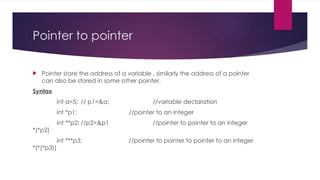
Pointer to pointer
Pointer store the address of a variable , similarly the address of a pointer
can also be stored in some other pointer.
Syntax
int a=5; // p1=&a; //variable declaration
int *p1; //pointer to an integer
int **p2; //p2=&p1 //pointer to pointer to an integer
*(*p2)
int ***p3; //pointer to pointer to pointer to an integer
*(*(*p3))
29.
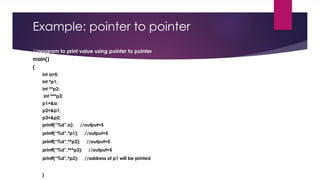
Example: pointer topointer
//program to print value using pointer to pointer
main()
{
int a=5;
int *p1;
int **p2;
int ***p3;
p1=&a;
p2=&p1;
p3=&p2;
printf(“%d”,a); //output=5
printf(“%d”,*p1); //output=5
printf(“%d”,**p2); //output=5
printf(“%d”,***p3); //output=5
printf(“%d”,*p2); //address of p1 will be printed
}
30.
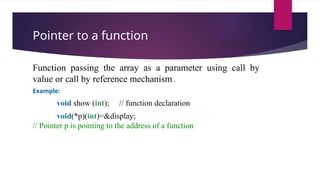
Pointer to afunction
Function passing the array as a parameter using call by
value or call by reference mechanism .
Example:
void show (int); // function declaration
void(*p)(int)=&display;
// Pointer p is pointing to the address of a function
31.
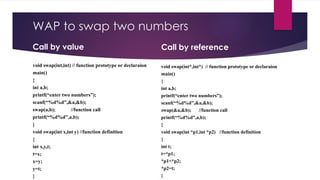
WAP to swaptwo numbers
Call by value
void swap(int,int) // function prototype or declaraion
main()
{
int a,b;
printf(“enter two numbers”);
scanf(“%d%d”,&a,&b);
swap(a,b); //function call
printf(“%d%d”,a,b);
}
void swap(int x,int y) //function definition
{
int x,y,t;
t=x;
x=y;
y=t;
}
Call by reference
void swap(int*,int*) // function prototype or declaraion
main()
{
int a,b;
printf(“enter two numbers”);
scanf(“%d%d”,&a,&b);
swap(&a,&b); //function call
printf(“%d%d”,a,b);
}
void swap(int *p1,int *p2) //function definition
{
int t;
t=*p1;
*p1=*p2;
*p2=t;
}
32.
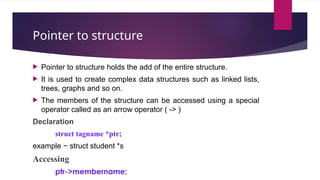
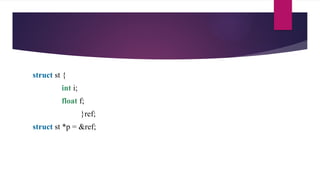
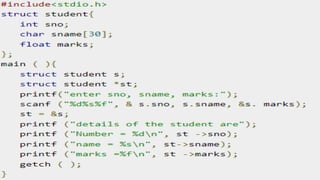
Pointer to structure
Pointer to structure holds the add of the entire structure.
It is used to create complex data structures such as linked lists,
trees, graphs and so on.
The members of the structure can be accessed using a special
operator called as an arrow operator ( -> )
Declaration
struct tagname *ptr;
example − struct student *s
Accessing
ptr->membername;
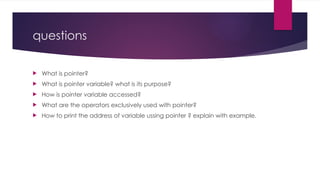
questions
What ispointer?
What is pointer variable? what is its purpose?
How is pointer variable accessed?
What are the operators exclusively used with pointer?
How to print the address of variable ussing pointer ? explain with example.

![array of pointer
“Array of pointers” is an array of the pointer variables. It is also known as
pointer arrays.
Syntax
int *var_name[array_size];
Example:
int *ptr[3];
ptr[i] = &arr[i];
Note:
We can make separate pointer variables which can point to the different values or we
can make one integer array of pointers that can point to all the values.
Example:
int i,*ptr[3];](https://image.slidesharecdn.com/unit-7pointernotes-250518093309-3b4e5ba3/85/unit-7-Pointerdesfsdfsdgsdgaa-notes-pptx-20-320.jpg)
![void main()
{
// creating an array
int arr[3] = { 1, 2, 3 };
// we can make an integer pointer array to
// storing the address of array elements
int i, *ptr[3];
for (i = 0; i < 3; i++) {
// assigning the address of integer.
ptr[i] = &arr[i];
}
// printing values using pointer
for (i = 0; i < 3; i++) {
printf("Value of arr[%d] = %d n", i, *ptr[i]);
}
}](https://image.slidesharecdn.com/unit-7pointernotes-250518093309-3b4e5ba3/85/unit-7-Pointerdesfsdfsdgsdgaa-notes-pptx-21-320.jpg)
![Algorithm to print array using pointer
Step1: start
Step2: Read array a[] with n elements
Step 3: initialize pointer p=&a[0] [or p=a]
Step 4: if i<n go to next step otherwise go to step 7
Step 5: print *(p+i)
Step 6: i=i+1 go to step 4
Step 7: stop](https://image.slidesharecdn.com/unit-7pointernotes-250518093309-3b4e5ba3/85/unit-7-Pointerdesfsdfsdgsdgaa-notes-pptx-22-320.jpg)
![Print array using pointer
#include<stdio.h>
main()
{
int a[5]={5,4,6,8,9};
int *p=&a[0];
int i;
for(i=0;i<5;i++)
printf("%d ",*(p+i));
}](https://image.slidesharecdn.com/unit-7pointernotes-250518093309-3b4e5ba3/85/unit-7-Pointerdesfsdfsdgsdgaa-notes-pptx-23-320.jpg)
![Traversing an array by using pointer
1. #include<stdio.h>
2. void main ()
3. {
4. int arr[5] = {1, 2, 3, 4, 5};
5. int *p;
6. *p=arr; //int *p = arr;
7. int i;
8. printf("printing array elements...n");
9. for(i = 0; i< 5; i++)
10. {
11. printf("%d ",*(p+i));
12. }
13. }](https://image.slidesharecdn.com/unit-7pointernotes-250518093309-3b4e5ba3/85/unit-7-Pointerdesfsdfsdgsdgaa-notes-pptx-24-320.jpg)
![Pointer to array
Pointer is also known as array pointer
int a[3]={2,5,6};
int *ptr=a; // Variable p of type pointer is pointing to the
address of an integer array arr.
We have a pointer ptr that focuses to the 0th component of
the array. We can likewise declare a pointer that can point to
whole array rather than just a single component of the
array.
int *p[10]; // declaration of pointer type array](https://image.slidesharecdn.com/unit-7pointernotes-250518093309-3b4e5ba3/85/unit-7-Pointerdesfsdfsdgsdgaa-notes-pptx-25-320.jpg)
![Declaration of the pointer to an array:
Syntax
data type (*var name)[size of
array];
Example
//Pointer to array of five elements
Int (*ptr)[5]=NULL; //parenthesis to pronounce pointer to an
array
// pointer to an array of five numbers int (* ptr)[5] = NULL;](https://image.slidesharecdn.com/unit-7pointernotes-250518093309-3b4e5ba3/85/unit-7-Pointerdesfsdfsdgsdgaa-notes-pptx-26-320.jpg)
![int main()
{
// Pointer to an array of five numbers
int(*a)[5];
int b[5] = { 1, 2, 3, 4, 5 };
int i = 0;
// Points to the whole array b
a = &b;
for (i = 0; i < 5; i++)
printf("%d n", *(*a + i));
return 0;
}](https://image.slidesharecdn.com/unit-7pointernotes-250518093309-3b4e5ba3/85/unit-7-Pointerdesfsdfsdgsdgaa-notes-pptx-27-320.jpg)