Three Branches of Government and the System of Checks and Balances By: Elizabeth Archer ED 205 on-line section Main
Main Slide About the Author Resources Three branches of government Judicial Branch Legislative Branch House of Representatives House of Representatives (pictures) Senate Senate (pictures) Executive Branch Executive Branch (pictures) System of Checks & Balances Federalism Checks and Balances Checks and Balances (pictures) Checks and Balances (overview) Video Clip Concept Map Exit
Resources www.socialstudentshelp.com www.whitehouse.gov/government/judg.html www.youtube.com Main Exit
My Name is Elizabeth Archer, I am currently a sophomore at Grand Valley.  My major is social studies and one day I wish to be a high school teacher and then possibly a college or university professor.  I am very family oriented, I have one brother who is sophomore in high school and we hang out a lot when I am, which isn’t very often. I also have four cats named Emma, Oliver, Peanut, and Tiger.  About the Author Main Exit Exit
The Three Branches of Government Judicial Branch Legislative Branch Executive Branch Main Exit
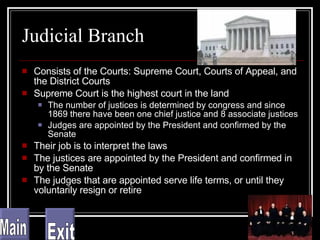
Judicial Branch Consists of the Courts: Supreme Court, Courts of Appeal, and the District Courts Supreme Court is the highest court in the land The number of justices is determined by congress and since 1869 there have been one chief justice and 8 associate justices Judges are appointed by the President and confirmed by the Senate Their job is to interpret the laws The justices are appointed by the President and confirmed in by the Senate The judges that are appointed serve life terms, or until they voluntarily resign or retire Main Exit
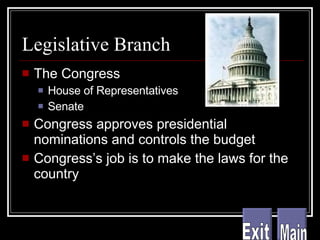
Legislative Branch The Congress House of Representatives Senate Congress approves presidential nominations and controls the budget Congress’s job is to make the laws for the country Main Exit
House of Representatives The house has 435 seats which are filled with representatives of each state, the number of reps. A state is allowed to have depends on the population of that state The representatives are elected for 2 year terms and must be at least 25 years of age Main Exit
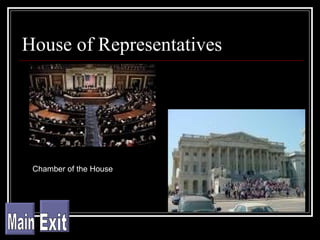
House of Representatives Chamber of the House Main Exit
Senate The Senate confirms the presidential judge nominations There are 100 seats in the Senate, 2 for each state regardless of population They are elected for 6 year terms and must be at least 30 years of age Every two years 1/3 of the Senate is up for re-election Main Exit Exit
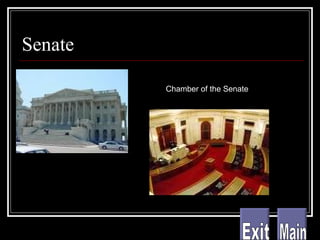
Senate Chamber of the Senate Main Exit
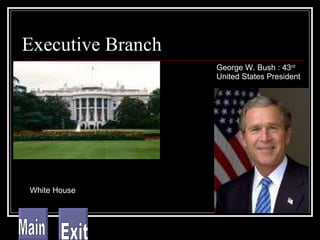
Executive Branch Consists of the President of the United States, currently George W. Bush is the 43 rd  President, the cabinet, and other independent agencies The job of this branch is to enforce and carry out the laws The president is the commander in chief of the armed forces The president must be a natural born citizen of the United States, at least 35 years of age, a resident in the United States for at least 14 years and is elected for a four year term and can only serve two terms Main Exit
Executive Branch White House George W. Bush : 43 rd  United States President Main Exit
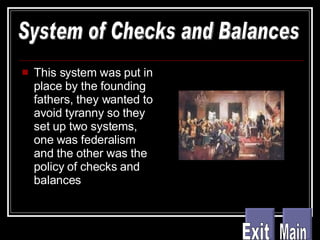
This system was put in place by the founding fathers, they wanted to avoid tyranny so they set up two systems, one was federalism and the other was the policy of checks and balances System of Checks and Balances Main Exit
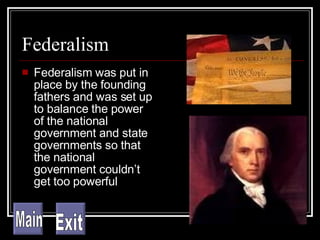
Federalism Federalism was put in place by the founding fathers and was set up to balance the power of the national government and state governments so that the national government couldn’t get too powerful Main Exit
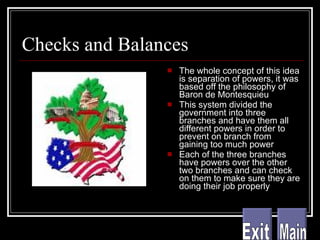
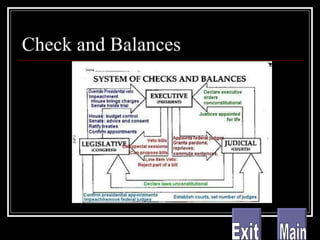
Checks and Balances The whole concept of this idea is separation of powers, it was based off the philosophy of Baron de Montesquieu This system divided the government into three branches and have them all different powers in order to prevent on branch from gaining too much power Each of the three branches have powers over the other two branches and can check on them to make sure they are doing their job properly Main Exit
Check and Balances Main Exit
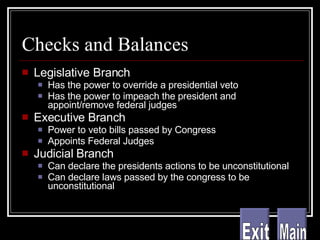
Checks and Balances Legislative Branch Has the power to override a presidential veto Has the power to impeach the president and appoint/remove federal judges Executive Branch Power to veto bills passed by Congress Appoints Federal Judges Judicial Branch Can declare the presidents actions to be unconstitutional Can declare laws passed by the congress to be unconstitutional Main Exit
Now here is a short video clip to help you understand a little more about what the Legislative Branch does and the checks the President has on them… http://www.youtube.com/watch?v=mEJL2Uuv-oQ Main Exit
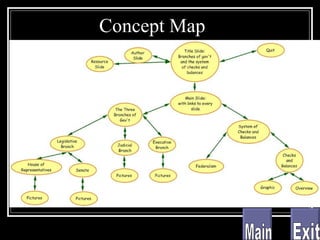
Concept Map Main Exit

Interactive Project

  • 1.
    Three Branches ofGovernment and the System of Checks and Balances By: Elizabeth Archer ED 205 on-line section Main
  • 2.
    Main Slide Aboutthe Author Resources Three branches of government Judicial Branch Legislative Branch House of Representatives House of Representatives (pictures) Senate Senate (pictures) Executive Branch Executive Branch (pictures) System of Checks & Balances Federalism Checks and Balances Checks and Balances (pictures) Checks and Balances (overview) Video Clip Concept Map Exit
  • 3.
  • 4.
    My Name isElizabeth Archer, I am currently a sophomore at Grand Valley. My major is social studies and one day I wish to be a high school teacher and then possibly a college or university professor. I am very family oriented, I have one brother who is sophomore in high school and we hang out a lot when I am, which isn’t very often. I also have four cats named Emma, Oliver, Peanut, and Tiger. About the Author Main Exit Exit
  • 5.
    The Three Branchesof Government Judicial Branch Legislative Branch Executive Branch Main Exit
  • 6.
    Judicial Branch Consistsof the Courts: Supreme Court, Courts of Appeal, and the District Courts Supreme Court is the highest court in the land The number of justices is determined by congress and since 1869 there have been one chief justice and 8 associate justices Judges are appointed by the President and confirmed by the Senate Their job is to interpret the laws The justices are appointed by the President and confirmed in by the Senate The judges that are appointed serve life terms, or until they voluntarily resign or retire Main Exit
  • 7.
    Legislative Branch TheCongress House of Representatives Senate Congress approves presidential nominations and controls the budget Congress’s job is to make the laws for the country Main Exit
  • 8.
    House of RepresentativesThe house has 435 seats which are filled with representatives of each state, the number of reps. A state is allowed to have depends on the population of that state The representatives are elected for 2 year terms and must be at least 25 years of age Main Exit
  • 9.
    House of RepresentativesChamber of the House Main Exit
  • 10.
    Senate The Senateconfirms the presidential judge nominations There are 100 seats in the Senate, 2 for each state regardless of population They are elected for 6 year terms and must be at least 30 years of age Every two years 1/3 of the Senate is up for re-election Main Exit Exit
  • 11.
    Senate Chamber ofthe Senate Main Exit
  • 12.
    Executive Branch Consistsof the President of the United States, currently George W. Bush is the 43 rd President, the cabinet, and other independent agencies The job of this branch is to enforce and carry out the laws The president is the commander in chief of the armed forces The president must be a natural born citizen of the United States, at least 35 years of age, a resident in the United States for at least 14 years and is elected for a four year term and can only serve two terms Main Exit
  • 13.
    Executive Branch WhiteHouse George W. Bush : 43 rd United States President Main Exit
  • 14.
    This system wasput in place by the founding fathers, they wanted to avoid tyranny so they set up two systems, one was federalism and the other was the policy of checks and balances System of Checks and Balances Main Exit
  • 15.
    Federalism Federalism wasput in place by the founding fathers and was set up to balance the power of the national government and state governments so that the national government couldn’t get too powerful Main Exit
  • 16.
    Checks and BalancesThe whole concept of this idea is separation of powers, it was based off the philosophy of Baron de Montesquieu This system divided the government into three branches and have them all different powers in order to prevent on branch from gaining too much power Each of the three branches have powers over the other two branches and can check on them to make sure they are doing their job properly Main Exit
  • 17.
  • 18.
    Checks and BalancesLegislative Branch Has the power to override a presidential veto Has the power to impeach the president and appoint/remove federal judges Executive Branch Power to veto bills passed by Congress Appoints Federal Judges Judicial Branch Can declare the presidents actions to be unconstitutional Can declare laws passed by the congress to be unconstitutional Main Exit
  • 19.
    Now here isa short video clip to help you understand a little more about what the Legislative Branch does and the checks the President has on them… http://www.youtube.com/watch?v=mEJL2Uuv-oQ Main Exit
  • 20.