UNIT 4
Techniques for Repair and Protection
Methods
PREPARED BY
MYTHILI D
AP CIVIL
EXCEL ENGINEERING COLLEGE
WHAT IS NON
DESTRUCTIVE TESTING?
“Non Destructive testing are non invasive
techniques to determine the integrity of a
material, component or structure or
quantitavely measure some characteristic of
an object”.
INTRODUCTION:
 For inspecting the defects on surface.
 Wide group of analysis techniques used in science
&industry.
 Saves both the time &money.
 Use of this N.D.T in specialist high risk areas such as
nuclear & sea shore structures , gas & oil pipelines.
WHYWE ARE
USING
N.D.T FOR
STRUCTURE?
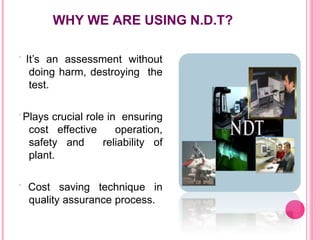
WHY WE ARE USING N.D.T?
 It’s an assessment without
doing harm, destroying the
test.
 Plays crucial role in ensuring
cost effective operation,
safety and reliability of
plant.
 Cost saving technique in
quality assurance process.
N.D.T METHODS
 Ultrasonic Testing (UT)
 Ultrasonic pulse velocity
method
 Rebound hammer test
 Radiographic Testing (RT)
 Liquid penetrate Testing
 Magnetic particle Testing
 Electromagnetic Testing (ET)
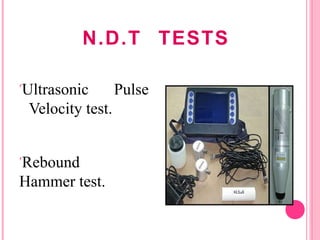
N.D.T TESTS
Ultrasonic Pulse
Velocity test.
Rebound
Hammer test.
ULTRA SONIC
PULSE
VELOCITYTEST
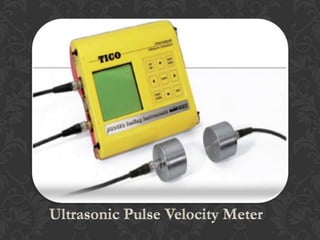
Ultrasonic Pulse Velocity Test
 It measures the time of
travel of an ultrasonic
pulse passing through
the concrete.
 The apparatus for
ultrasonic pulse
velocity measurement
consists of the
following:
(a)Electrical pulse
generator
(b)Transducer – one pair
(c)Amplifier
(d)Electronic timing
device
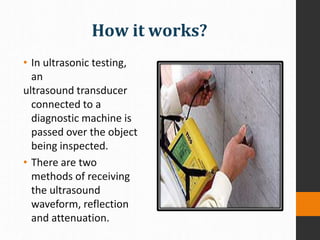
How it works?
• In ultrasonic testing,
an
ultrasound transducer
connected to a
diagnostic machine is
passed over the object
being inspected.
• There are two
methods of receiving
the ultrasound
waveform, reflection
and attenuation.
ULTRASONIC PULSE
VELOCITY TEST
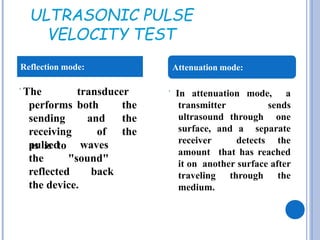
 The transducer
performs both the
pulsed waves
the "sound"
sending and the
receiving of the
as is to
reflected back
the device.
 In attenuation mode, a
transmitter sends
ultrasound through one
surface, and a separate
receiver detects the
amount that has reached
it on another surface after
traveling through the
medium.
Reflection mode: Attenuation mode:
• The pulse velocity method is an ideal tool
for establishing whether concrete is
uniform.
• Applied to both existing structures and
those under construction.
• High pulse velocity readings are generally
indicative of good quality concrete.
Interpretation
•
•
To determine the quality & homogeneity of the
concrete structures.
To determine the existence of the
flaws ,cracks & voids in concrete
structures.
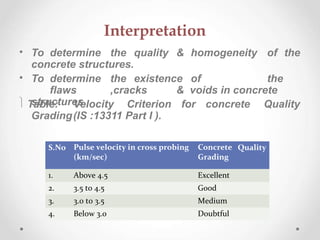
 Table: Velocity Criterion for concrete Quality
Grading(IS :13311 Part I ).
S.No Pulse velocity in cross probing
(km/sec)
Concrete
Grading
Quality
1. Above 4.5 Excellent
2. 3.5 to 4.5 Good
3. 3.0 to 3.5 Medium
4. Below 3.0 Doubtful
Ultrasonic Pulse Velocity Test
Advantages:
High
penetrating
power.
High sensitivity.
Greater
accuracy
Some capability
in estimating the
size , shape ,
nature of the
flaws.
Disadvantages:
•Manual operation
requires careful
attention by
experienced
technicians
•Difficulty in
inspecting the parts
which are irregular.
•Requirement of the
couplants.
•Test objects should
be water resistant.
REBOUND HAMMER
TEST
REBOUND HAMMER TEST
• This is a simple, handy tool, which
can be used to provide a convenient
and rapid indication of the
compressive strength of concrete.
Rebound Hammer
test:
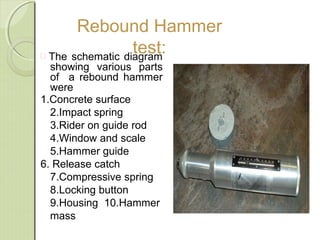
 The schematic diagram
showing various parts
of a rebound hammer
were
1.Concrete surface
2.Impact spring
3.Rider on guide rod
4.Window and scale
5.Hammer guide
6. Release catch
7.Compressive spring
8.Locking button
9.Housing 10.Hammer
mass
•The elastic mass depends on the hardness of the
surface.
•It is related to the compressive strength of the concrete.
•The rebound value is designated as the rebound number
or rebound index.
•The results are significantly affected by :
A)Mix characteristics.
B)Angle of inclination of direction of hammer.
C)Member characteristics.
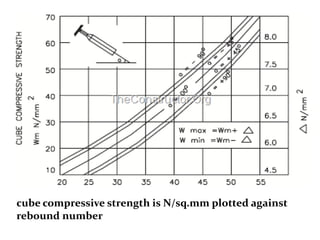
PRINCIPLE
cube compressive strength is N/sq.mm plotted against
rebound number
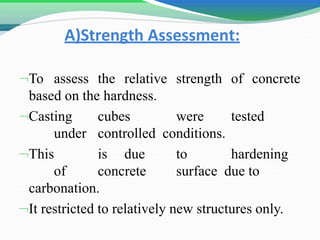
A)Strength Assessment:
To assess the relative strength of concrete
based on the hardness.
Casting cubes were tested
under controlled conditions.
This is due to hardening
of concrete surface due to
carbonation.
It restricted to relatively new structures only.
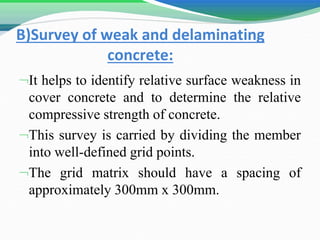
B)Survey of weak and delaminating
concrete:
It helps to identify relative surface weakness in
cover concrete and to determine the relative
compressive strength of concrete.
This survey is carried by dividing the member
into well-defined grid points.
The grid matrix should have a spacing of
approximately 300mm x 300mm.
Procedure
Should be tested against the test anvil.
Apply light pressure on the plunger and
allow it to extend to the ready position for
the test.
Apply a gradual increase in pressure until
the hammer impacts.
Take the average of about 15 readings.
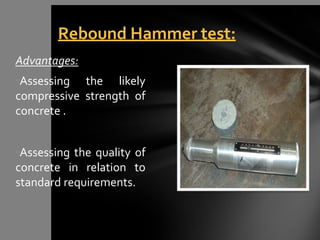
Advantages:
•Assessing the likely
compressive strength of
concrete .
•Assessing the quality of
concrete in relation to
standard requirements.
Rebound Hammer test:
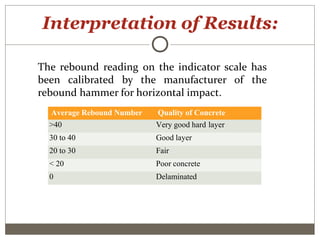
Interpretation of Results:
The rebound reading on the indicator scale has
been calibrated by the manufacturer of the
rebound hammer for horizontal impact.
Average Rebound Number Quality of Concrete
>40 Very good hard layer
30 to 40 Good layer
20 to 30 Fair
< 20 Poor concrete
0 Delaminated
CONCLUSION
For better maintenance of existing concrete
structures, there are still more tests have to be
done.
UNIT 4.ppt

UNIT 4.ppt

  • 1.
    UNIT 4 Techniques forRepair and Protection Methods PREPARED BY MYTHILI D AP CIVIL EXCEL ENGINEERING COLLEGE
  • 2.
    WHAT IS NON DESTRUCTIVETESTING? “Non Destructive testing are non invasive techniques to determine the integrity of a material, component or structure or quantitavely measure some characteristic of an object”.
  • 3.
    INTRODUCTION:  For inspectingthe defects on surface.  Wide group of analysis techniques used in science &industry.  Saves both the time &money.  Use of this N.D.T in specialist high risk areas such as nuclear & sea shore structures , gas & oil pipelines.
  • 4.
  • 5.
    WHY WE AREUSING N.D.T?  It’s an assessment without doing harm, destroying the test.  Plays crucial role in ensuring cost effective operation, safety and reliability of plant.  Cost saving technique in quality assurance process.
  • 6.
    N.D.T METHODS  UltrasonicTesting (UT)  Ultrasonic pulse velocity method  Rebound hammer test  Radiographic Testing (RT)  Liquid penetrate Testing  Magnetic particle Testing  Electromagnetic Testing (ET)
  • 7.
    N.D.T TESTS Ultrasonic Pulse Velocitytest. Rebound Hammer test.
  • 8.
  • 9.
    Ultrasonic Pulse VelocityTest  It measures the time of travel of an ultrasonic pulse passing through the concrete.  The apparatus for ultrasonic pulse velocity measurement consists of the following: (a)Electrical pulse generator (b)Transducer – one pair (c)Amplifier (d)Electronic timing device
  • 11.
    How it works? •In ultrasonic testing, an ultrasound transducer connected to a diagnostic machine is passed over the object being inspected. • There are two methods of receiving the ultrasound waveform, reflection and attenuation.
  • 12.
    ULTRASONIC PULSE VELOCITY TEST The transducer performs both the pulsed waves the "sound" sending and the receiving of the as is to reflected back the device.  In attenuation mode, a transmitter sends ultrasound through one surface, and a separate receiver detects the amount that has reached it on another surface after traveling through the medium. Reflection mode: Attenuation mode:
  • 13.
    • The pulsevelocity method is an ideal tool for establishing whether concrete is uniform. • Applied to both existing structures and those under construction. • High pulse velocity readings are generally indicative of good quality concrete.
  • 14.
    Interpretation • • To determine thequality & homogeneity of the concrete structures. To determine the existence of the flaws ,cracks & voids in concrete structures.  Table: Velocity Criterion for concrete Quality Grading(IS :13311 Part I ). S.No Pulse velocity in cross probing (km/sec) Concrete Grading Quality 1. Above 4.5 Excellent 2. 3.5 to 4.5 Good 3. 3.0 to 3.5 Medium 4. Below 3.0 Doubtful
  • 15.
    Ultrasonic Pulse VelocityTest Advantages: High penetrating power. High sensitivity. Greater accuracy Some capability in estimating the size , shape , nature of the flaws. Disadvantages: •Manual operation requires careful attention by experienced technicians •Difficulty in inspecting the parts which are irregular. •Requirement of the couplants. •Test objects should be water resistant.
  • 16.
  • 17.
    REBOUND HAMMER TEST •This is a simple, handy tool, which can be used to provide a convenient and rapid indication of the compressive strength of concrete.
  • 18.
    Rebound Hammer test:  Theschematic diagram showing various parts of a rebound hammer were 1.Concrete surface 2.Impact spring 3.Rider on guide rod 4.Window and scale 5.Hammer guide 6. Release catch 7.Compressive spring 8.Locking button 9.Housing 10.Hammer mass
  • 19.
    •The elastic massdepends on the hardness of the surface. •It is related to the compressive strength of the concrete. •The rebound value is designated as the rebound number or rebound index. •The results are significantly affected by : A)Mix characteristics. B)Angle of inclination of direction of hammer. C)Member characteristics. PRINCIPLE
  • 20.
    cube compressive strengthis N/sq.mm plotted against rebound number
  • 21.
    A)Strength Assessment: To assessthe relative strength of concrete based on the hardness. Casting cubes were tested under controlled conditions. This is due to hardening of concrete surface due to carbonation. It restricted to relatively new structures only.
  • 22.
    B)Survey of weakand delaminating concrete: It helps to identify relative surface weakness in cover concrete and to determine the relative compressive strength of concrete. This survey is carried by dividing the member into well-defined grid points. The grid matrix should have a spacing of approximately 300mm x 300mm.
  • 23.
    Procedure Should be testedagainst the test anvil. Apply light pressure on the plunger and allow it to extend to the ready position for the test. Apply a gradual increase in pressure until the hammer impacts. Take the average of about 15 readings.
  • 24.
    Advantages: •Assessing the likely compressivestrength of concrete . •Assessing the quality of concrete in relation to standard requirements. Rebound Hammer test:
  • 25.
    Interpretation of Results: Therebound reading on the indicator scale has been calibrated by the manufacturer of the rebound hammer for horizontal impact. Average Rebound Number Quality of Concrete >40 Very good hard layer 30 to 40 Good layer 20 to 30 Fair < 20 Poor concrete 0 Delaminated
  • 26.
    CONCLUSION For better maintenanceof existing concrete structures, there are still more tests have to be done.