Control System Engineering
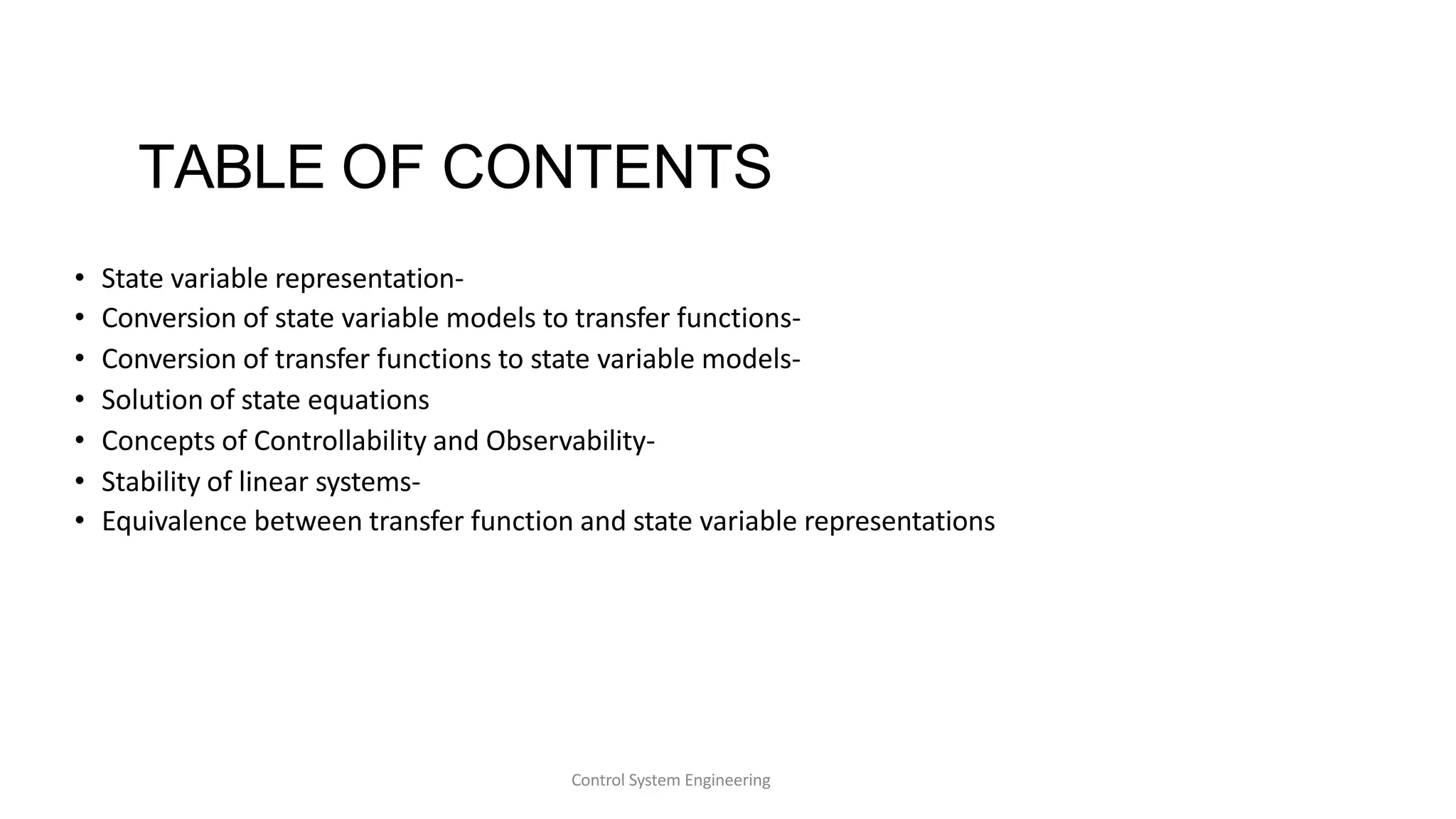
TABLEOF CONTENTS
• State variable representation-
• Conversion of state variable models to transfer functions-
• Conversion of transfer functions to state variable models-
• Solution of state equations
• Concepts of Controllability and Observability-
• Stability of linear systems-
• Equivalence between transfer function and state variable representations
3.
State Space Analysis
ControlSystem Engineering
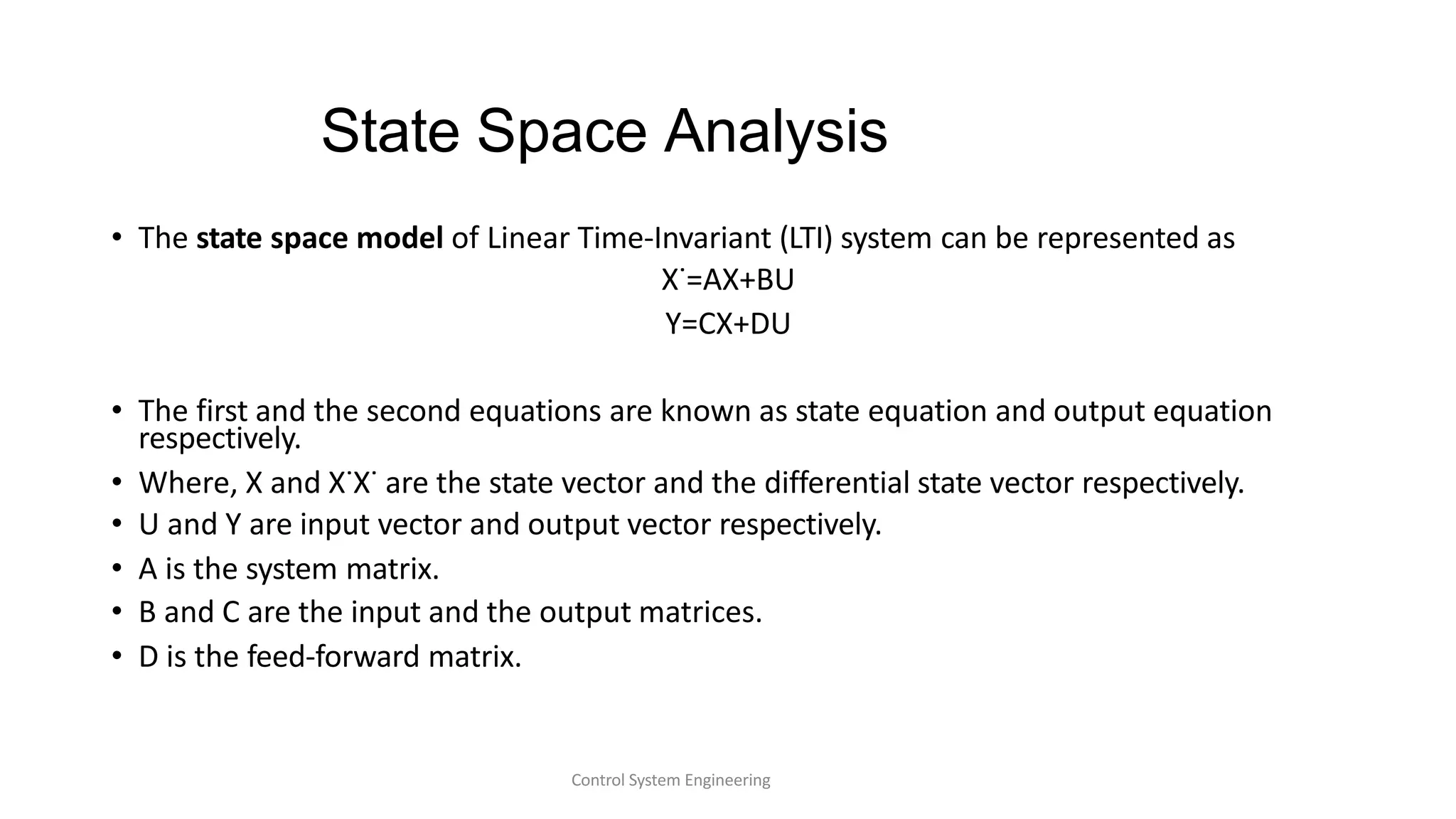
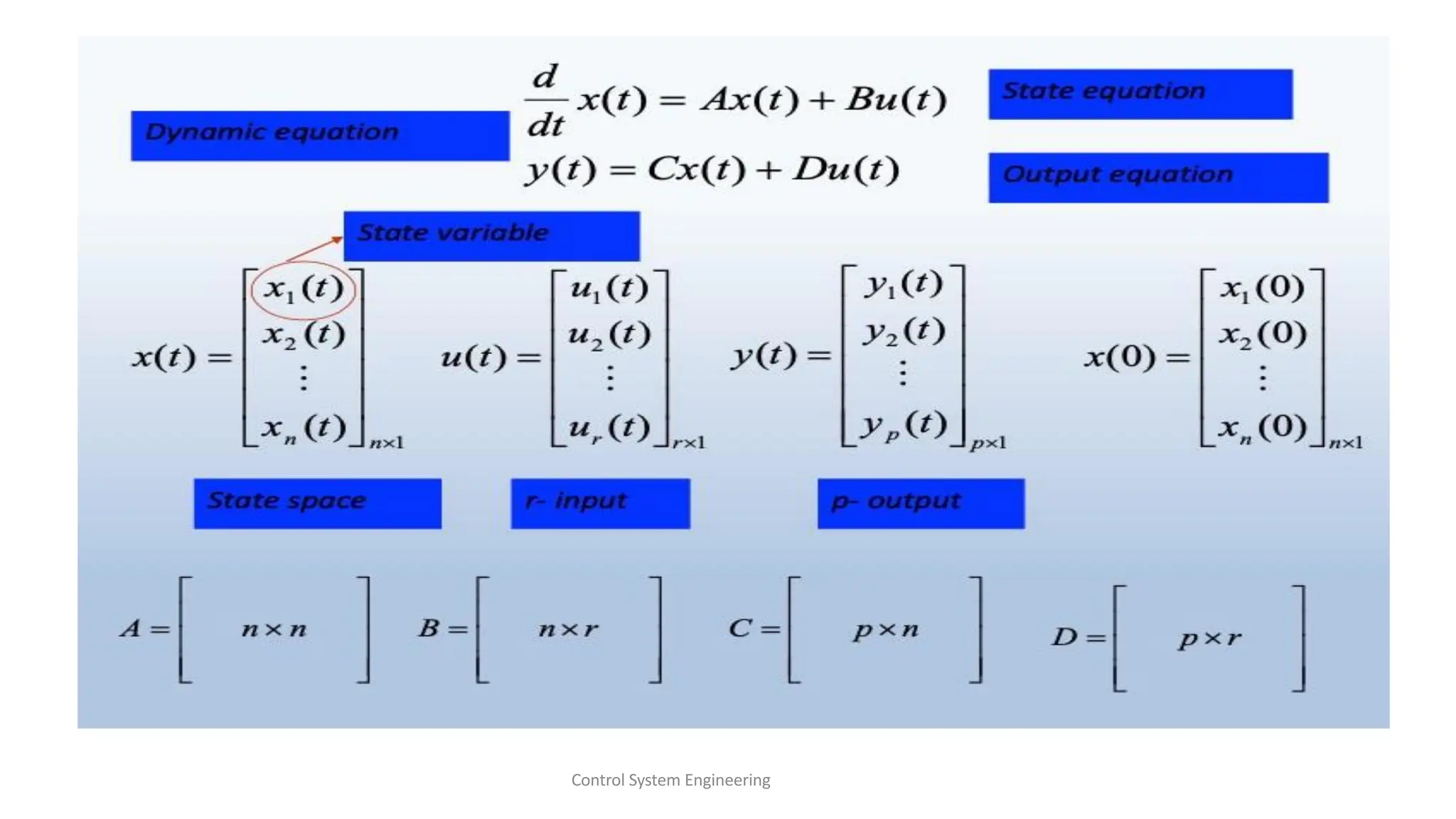
• The state space model of Linear Time-Invariant (LTI) system can be represented as
X˙=AX+BU
Y=CX+DU
• The first and the second equations are known as state equation and output equation
respectively.
• Where, X and X˙X˙ are the state vector and the differential state vector respectively.
• U and Y are input vector and output vector respectively.
• A is the system matrix.
• B and C are the input and the output matrices.
• D is the feed-forward matrix.
4.
Basic Concepts ofState Space Model
Control System Engineering
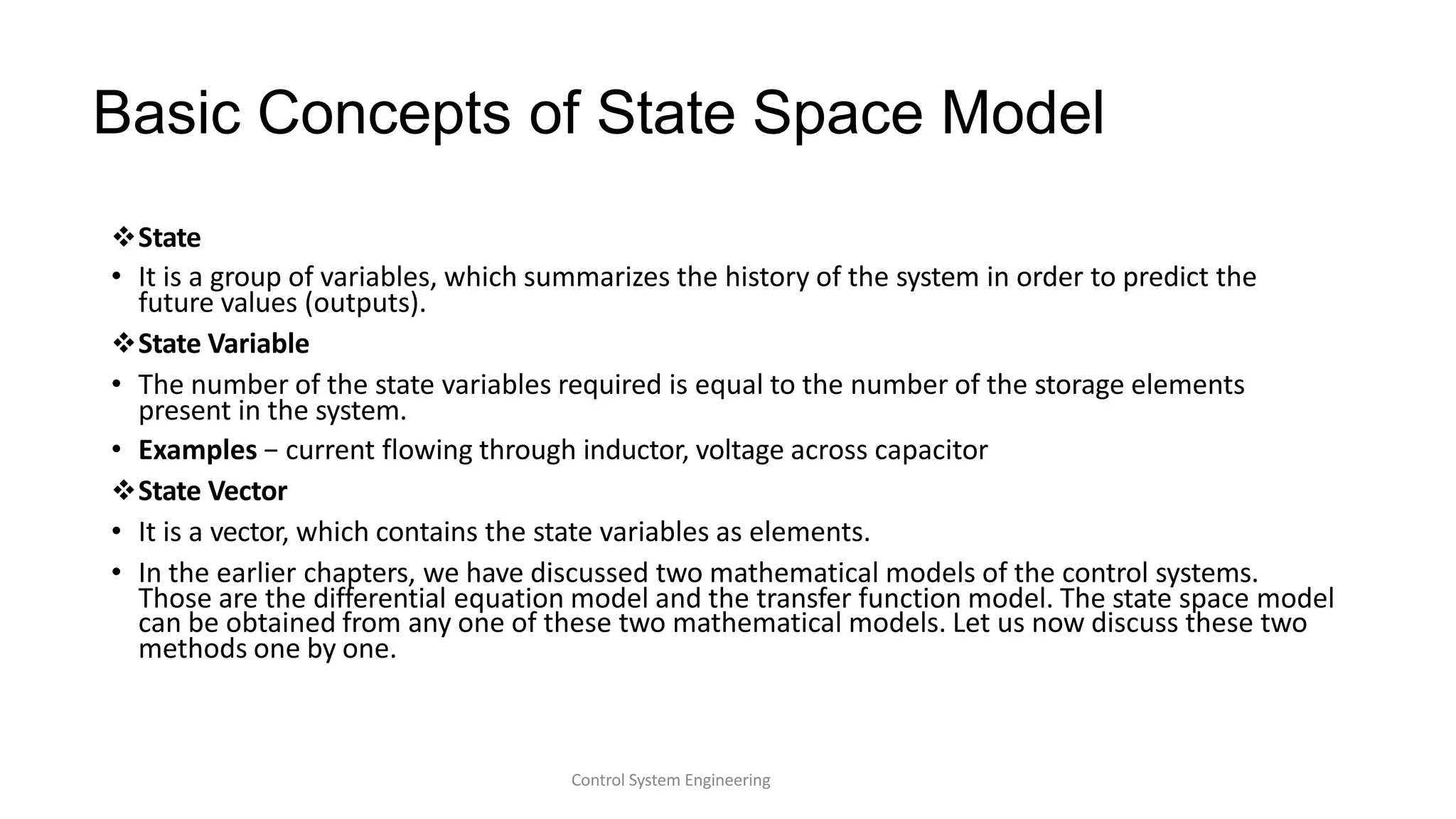
State
• It is a group of variables, which summarizes the history of the system in order to predict the
future values (outputs).
State Variable
• The number of the state variables required is equal to the number of the storage elements
present in the system.
• Examples − current flowing through inductor, voltage across capacitor
State Vector
• It is a vector, which contains the state variables as elements.
• In the earlier chapters, we have discussed two mathematical models of the control systems.
Those are the differential equation model and the transfer function model. The state space model
can be obtained from any one of these two mathematical models. Let us now discuss these two
methods one by one.
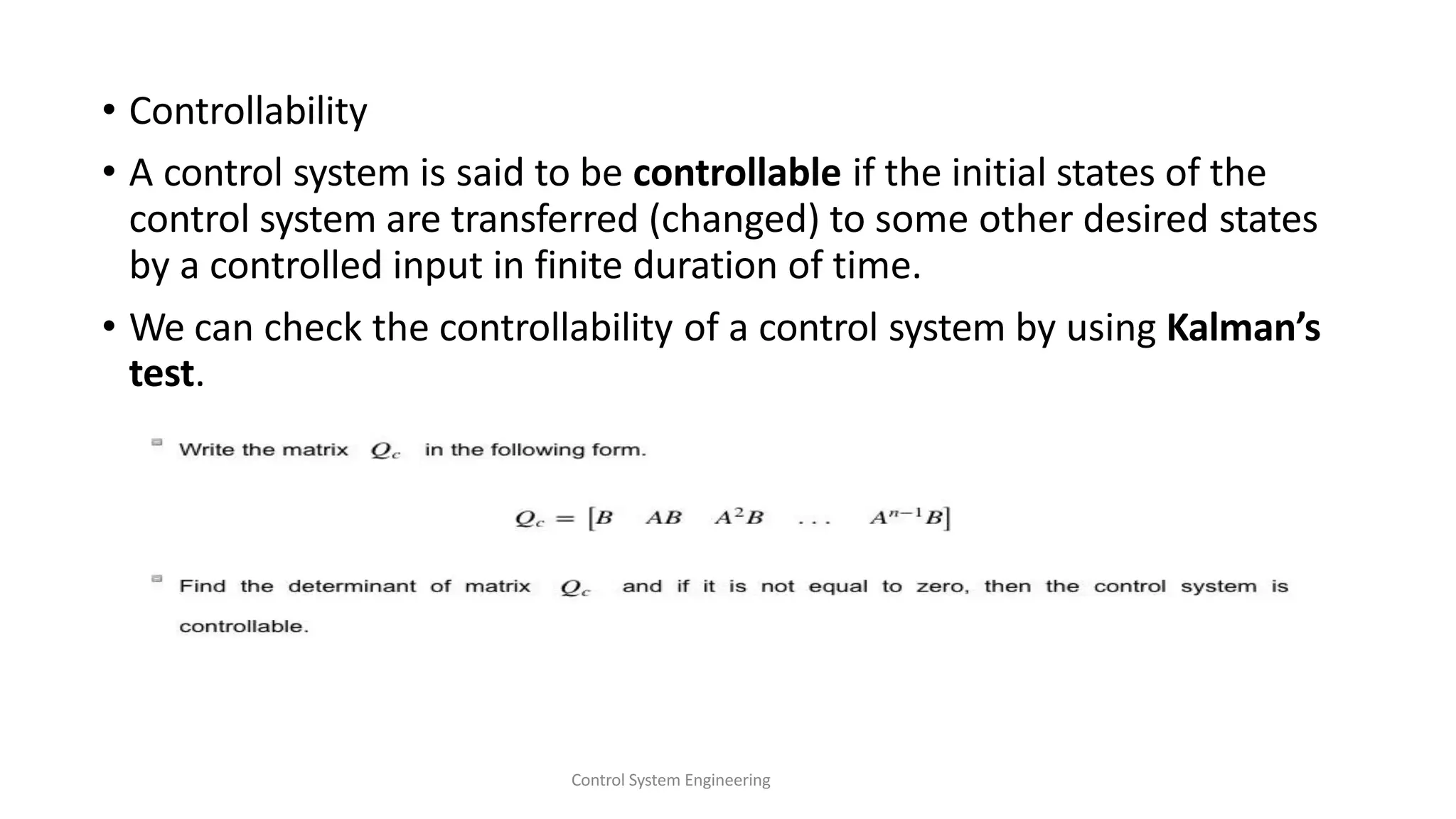
• Controllability
• Acontrol system is said to be controllable if the initial states of the
control system are transferred (changed) to some other desired states
by a controlled input in finite duration of time.
• We can check the controllability of a control system by using Kalman’s
test.
• Write the matrix QcQc in the following form.
• Qc=[BABA2B...An−1B]Qc=[BABA2B...An−1B]
• Find the determinant of matrix QcQc and if it is not equal to zero,
then the control system is controllable.
Control System Engineering
12.
• Controllability
• Acontrol system is said to be controllable if the initial states of the
control system are transferred (changed) to some other desired states
by a controlled input in finite duration of time.
• We can check the controllability of a control system by using Kalman’s
test.
Control System Engineering
13.
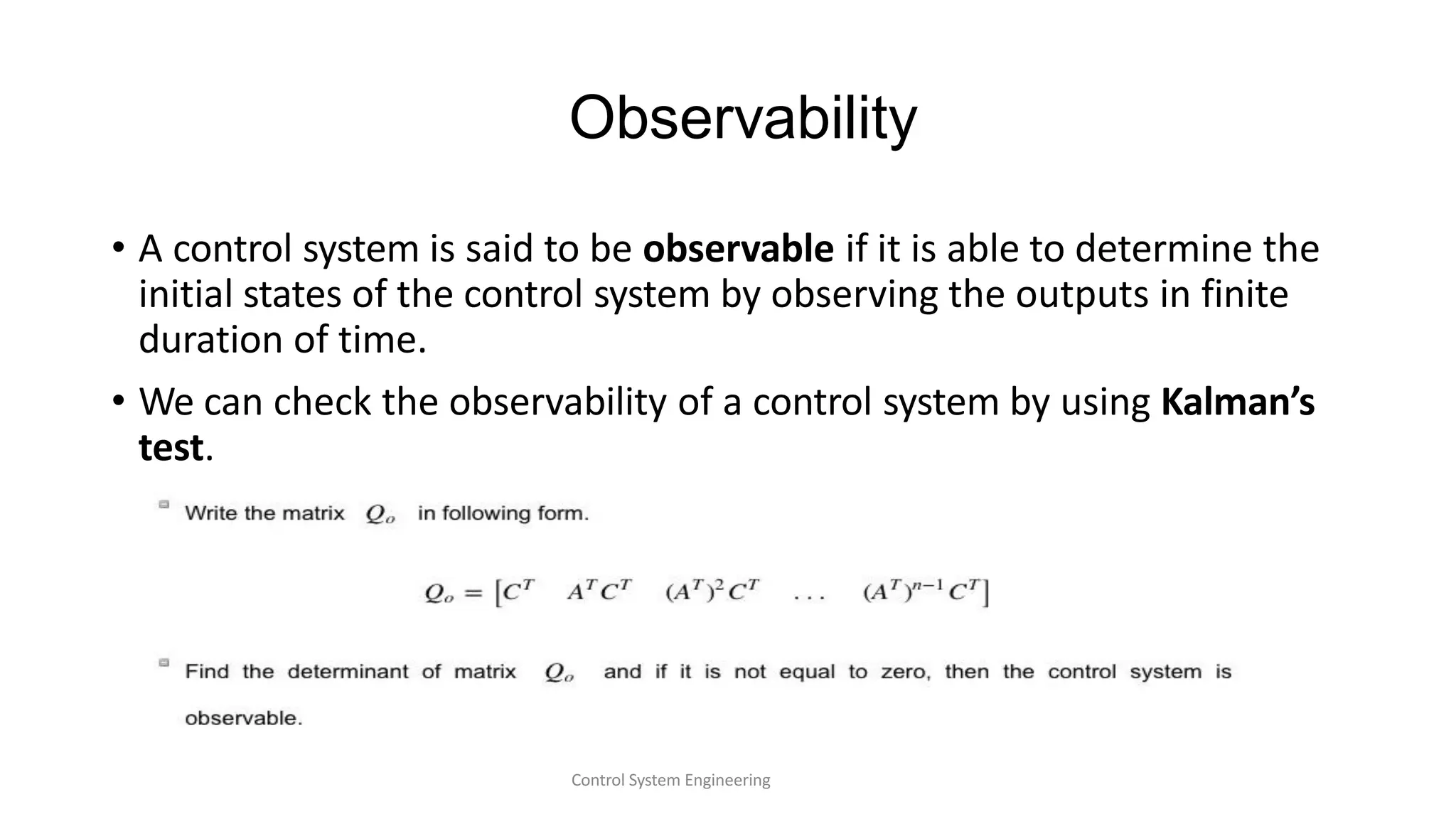
Observability
• A controlsystem is said to be observable if it is able to determine the
initial states of the control system by observing the outputs in finite
duration of time.
• We can check the observability of a control system by using Kalman’s
test.
Control System Engineering
14.
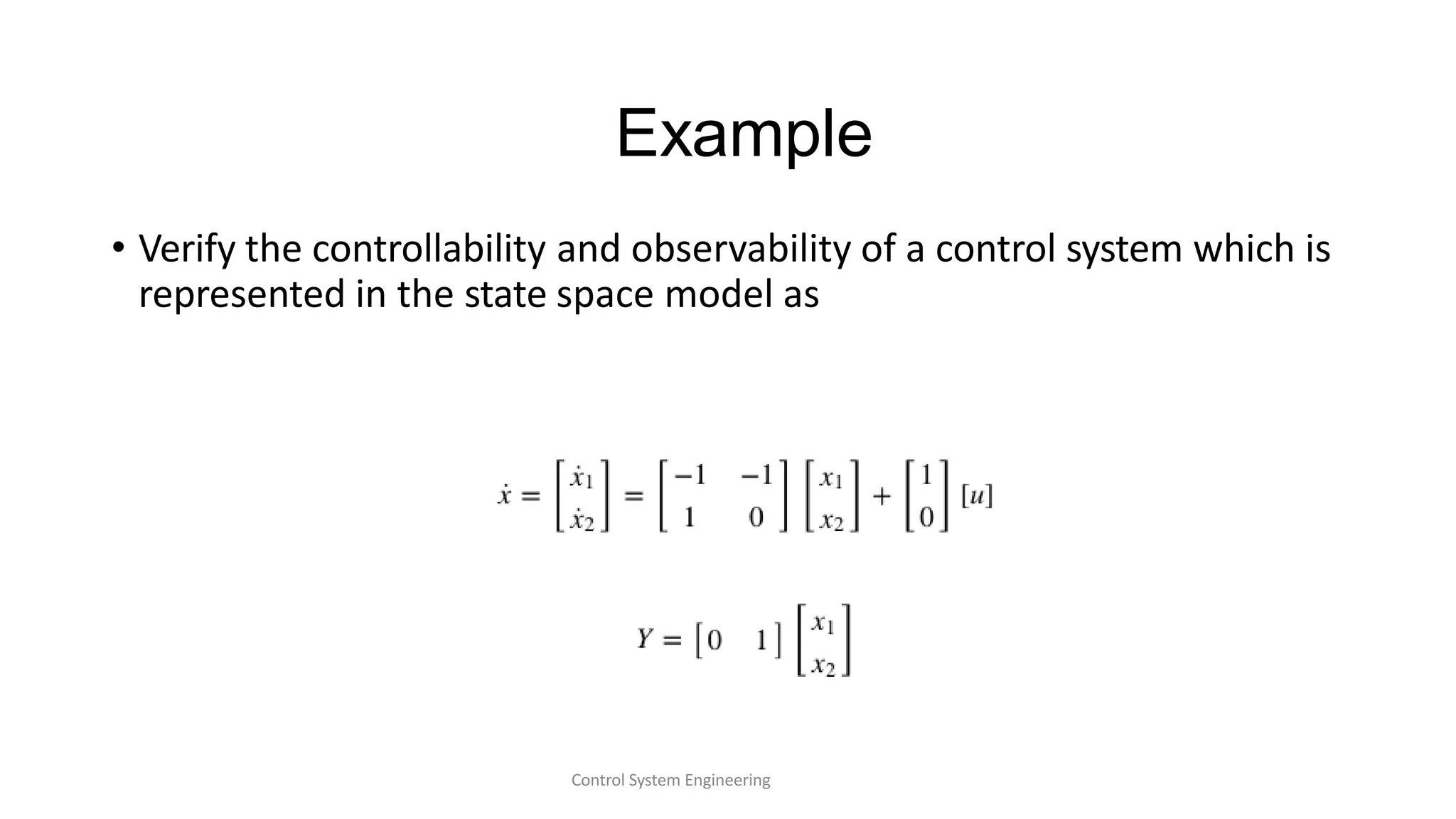
Example
• Verify thecontrollability and observability of a control system which is
represented in the state space model as
Control System Engineering

![• Controllability
• A control system is said to be controllable if the initial states of the
control system are transferred (changed) to some other desired states
by a controlled input in finite duration of time.
• We can check the controllability of a control system by using Kalman’s
test.
• Write the matrix QcQc in the following form.
• Qc=[BABA2B...An−1B]Qc=[BABA2B...An−1B]
• Find the determinant of matrix QcQc and if it is not equal to zero,
then the control system is controllable.
Control System Engineering](https://image.slidesharecdn.com/unit4-250922163434-6573ec6f/75/Unit-4-pdf-state-space-analysis-in-control-system-11-2048.jpg)


![EE3701 High Voltage Engineering HVE Unit 1 [Autosaved] [Autosaved].pptx](https://cdn.slidesharecdn.com/ss_thumbnails/ee3701highvoltageengineeringhveunit1autosavedautosaved-250916165956-ab52e806-thumbnail.jpg?width=640&height=640&fit=bounds)
![EE3701 High Voltage Engineering HVE Unit 1 [Autosaved] [Autosaved].pptx](https://cdn.slidesharecdn.com/ss_thumbnails/ee3701highvoltageengineeringhveunit1autosavedautosaved-250916170537-c9a22cd4-thumbnail.jpg?width=640&height=640&fit=bounds)


