2
Strings
• 1-d arraysof type char
• By convention, a string in C is terminated by the
end-of-string sentinel ‘0’ (null character)
• char s[21] - can have variable length string
delimited with 0
• Max length of the string that can be stored is 20 as the
size must include storage needed for the ‘0’
• String constants : “hello”, “abc”
• “abc” is a character array of size 4
3.
3
Character Arrays andStrings
char C[8] = { 'a', 'b', 'h', 'i', 'j', 'i', 't', '0' };
C[0] gets the value 'a', C[1] the value 'b', and so on. The last (7th)
location receives the null character ‘0’
Null-terminated (last character is ‘0’) character arrays are also called
strings
Strings can be initialized in an alternative way. The last declaration is
equivalent to:
char C[8] = "abhijit";
The trailing null character is missing here. C automatically puts it at
the end if you define it like this
Note also that for individual characters, C uses single quotes,
whereas for strings, it uses double quotes
4.
4
Reading strings: %sformat
void main()
{
char name[25];
scanf("%s", name);
printf("Name = %s n", name);
}
%s reads a string into a character array
given the array name or start address.
It ends the string with ‘0’
5.
5
An example
void main()
{
#defineSIZE 25
int i, count=0;
char name[SIZE];
scanf("%s", name);
printf("Name = %s n", name);
for (i=0; name[i]!='0'; i++)
if (name[i] == 'a') count++;
printf("Total a's = %dn", count);
}
Satyanarayana
Name = Satyanarayana
Total a's = 6
Note that character strings read
in %s format end with ‘0’
Seen on screen
Typed as input
Printed by program
6.
6
Differences : array& pointers
char *p = “abcde”;
The compiler allocates
space for p, puts the
string constant “abcde”
in memory somewhere
else, initializes p with
the base address of
the string constant
char s[ ] = “abcde”;
char s[ ] = {‘a’,’b’,’c’,’d’,’e’.’0’};
The compiler allocates 6 bytes
of memory for the array s
which are initialized with the
6 characters
a b c d e 0
a b c d e 0
p
S
7.
7
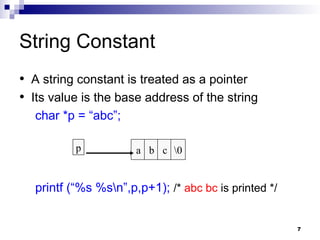
String Constant
• Astring constant is treated as a pointer
• Its value is the base address of the string
char *p = “abc”;
printf (“%s %sn”,p,p+1); /* abc bc is printed */
a b c 0
p
8.
8
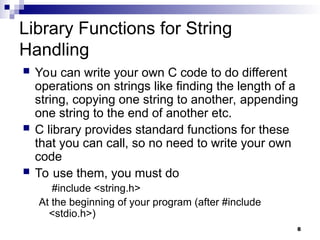
Library Functions forString
Handling
You can write your own C code to do different
operations on strings like finding the length of a
string, copying one string to another, appending
one string to the end of another etc.
C library provides standard functions for these
that you can call, so no need to write your own
code
To use them, you must do
#include <string.h>
At the beginning of your program (after #include
<stdio.h>)
9.
9
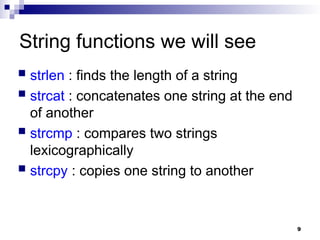
String functions wewill see
strlen : finds the length of a string
strcat : concatenates one string at the end
of another
strcmp : compares two strings
lexicographically
strcpy : copies one string to another
10.
10
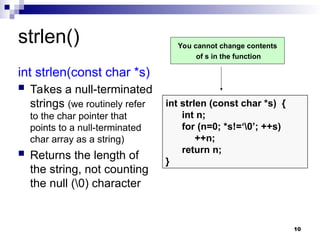
strlen()
int strlen(const char*s)
Takes a null-terminated
strings (we routinely refer
to the char pointer that
points to a null-terminated
char array as a string)
Returns the length of
the string, not counting
the null (0) character
int strlen (const char *s) {
int n;
for (n=0; *s!=‘0’; ++s)
++n;
return n;
}
You cannot change contents
of s in the function
11.
11
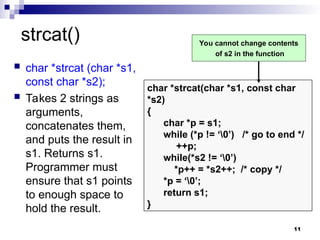
strcat()
char *strcat(char *s1,
const char *s2);
Takes 2 strings as
arguments,
concatenates them,
and puts the result in
s1. Returns s1.
Programmer must
ensure that s1 points
to enough space to
hold the result.
char *strcat(char *s1, const char
*s2)
{
char *p = s1;
while (*p != ‘0’) /* go to end */
++p;
while(*s2 != ‘0’)
*p++ = *s2++; /* copy */
*p = ‘0’;
return s1;
}
You cannot change contents
of s2 in the function
12.
12
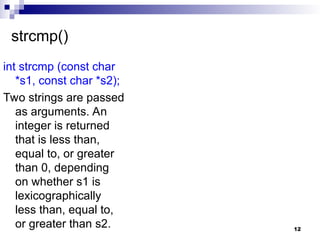
strcmp()
int strcmp (constchar
*s1, const char *s2);
Two strings are passed
as arguments. An
integer is returned
that is less than,
equal to, or greater
than 0, depending
on whether s1 is
lexicographically
less than, equal to,
or greater than s2.
13.
13
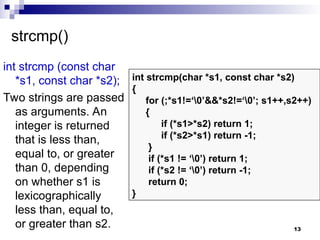
strcmp()
int strcmp (constchar
*s1, const char *s2);
Two strings are passed
as arguments. An
integer is returned
that is less than,
equal to, or greater
than 0, depending
on whether s1 is
lexicographically
less than, equal to,
or greater than s2.
int strcmp(char *s1, const char *s2)
{
for (;*s1!=‘0’&&*s2!=‘0’; s1++,s2++)
{
if (*s1>*s2) return 1;
if (*s2>*s1) return -1;
}
if (*s1 != ‘0’) return 1;
if (*s2 != ‘0’) return -1;
return 0;
}
14.
14
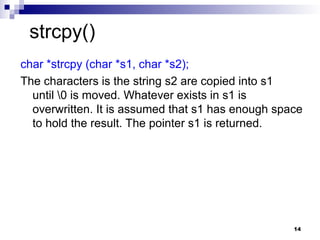
char *strcpy (char*s1, char *s2);
The characters is the string s2 are copied into s1
until 0 is moved. Whatever exists in s1 is
overwritten. It is assumed that s1 has enough space
to hold the result. The pointer s1 is returned.
strcpy()
15.
15
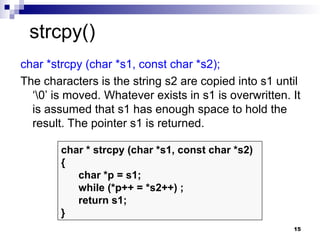
char *strcpy (char*s1, const char *s2);
The characters is the string s2 are copied into s1 until
‘0’ is moved. Whatever exists in s1 is overwritten. It
is assumed that s1 has enough space to hold the
result. The pointer s1 is returned.
char * strcpy (char *s1, const char *s2)
{
char *p = s1;
while (*p++ = *s2++) ;
return s1;
}
strcpy()
16.
16
Example: Using stringfunctions
25
9
-1
big sky country
beautiful brown cows!
int main()
{
char s1[ ] = "beautiful big sky country",
s2[ ] = "how now brown cow";
printf("%dn",strlen (s1));
printf("%dn",strlen (s2+8));
printf("%dn", strcmp(s1,s2));
printf("%sn",s1+10);
strcpy(s1+10,s2+8);
strcat(s1,"s!");
printf("%sn", s1);
return 0;
}
Output
![2
Strings
• 1-d arrays of type char
• By convention, a string in C is terminated by the
end-of-string sentinel ‘0’ (null character)
• char s[21] - can have variable length string
delimited with 0
• Max length of the string that can be stored is 20 as the
size must include storage needed for the ‘0’
• String constants : “hello”, “abc”
• “abc” is a character array of size 4](https://image.slidesharecdn.com/unit-3strings-250501184528-c42b2eae/85/Unit-3-Strings-pptreeeeeeeeeeeeeereeeeere-2-320.jpg)
![3
Character Arrays and Strings
char C[8] = { 'a', 'b', 'h', 'i', 'j', 'i', 't', '0' };
C[0] gets the value 'a', C[1] the value 'b', and so on. The last (7th)
location receives the null character ‘0’
Null-terminated (last character is ‘0’) character arrays are also called
strings
Strings can be initialized in an alternative way. The last declaration is
equivalent to:
char C[8] = "abhijit";
The trailing null character is missing here. C automatically puts it at
the end if you define it like this
Note also that for individual characters, C uses single quotes,
whereas for strings, it uses double quotes](https://image.slidesharecdn.com/unit-3strings-250501184528-c42b2eae/85/Unit-3-Strings-pptreeeeeeeeeeeeeereeeeere-3-320.jpg)
![4
Reading strings: %s format
void main()
{
char name[25];
scanf("%s", name);
printf("Name = %s n", name);
}
%s reads a string into a character array
given the array name or start address.
It ends the string with ‘0’](https://image.slidesharecdn.com/unit-3strings-250501184528-c42b2eae/85/Unit-3-Strings-pptreeeeeeeeeeeeeereeeeere-4-320.jpg)
![5
An example
void main()
{
#define SIZE 25
int i, count=0;
char name[SIZE];
scanf("%s", name);
printf("Name = %s n", name);
for (i=0; name[i]!='0'; i++)
if (name[i] == 'a') count++;
printf("Total a's = %dn", count);
}
Satyanarayana
Name = Satyanarayana
Total a's = 6
Note that character strings read
in %s format end with ‘0’
Seen on screen
Typed as input
Printed by program](https://image.slidesharecdn.com/unit-3strings-250501184528-c42b2eae/85/Unit-3-Strings-pptreeeeeeeeeeeeeereeeeere-5-320.jpg)
![6
Differences : array & pointers
char *p = “abcde”;
The compiler allocates
space for p, puts the
string constant “abcde”
in memory somewhere
else, initializes p with
the base address of
the string constant
char s[ ] = “abcde”;
char s[ ] = {‘a’,’b’,’c’,’d’,’e’.’0’};
The compiler allocates 6 bytes
of memory for the array s
which are initialized with the
6 characters
a b c d e 0
a b c d e 0
p
S](https://image.slidesharecdn.com/unit-3strings-250501184528-c42b2eae/85/Unit-3-Strings-pptreeeeeeeeeeeeeereeeeere-6-320.jpg)
![16
Example: Using string functions
25
9
-1
big sky country
beautiful brown cows!
int main()
{
char s1[ ] = "beautiful big sky country",
s2[ ] = "how now brown cow";
printf("%dn",strlen (s1));
printf("%dn",strlen (s2+8));
printf("%dn", strcmp(s1,s2));
printf("%sn",s1+10);
strcpy(s1+10,s2+8);
strcat(s1,"s!");
printf("%sn", s1);
return 0;
}
Output](https://image.slidesharecdn.com/unit-3strings-250501184528-c42b2eae/85/Unit-3-Strings-pptreeeeeeeeeeeeeereeeeere-16-320.jpg)


![[ITP - Lecture 17] Strings in C/C++](https://cdn.slidesharecdn.com/ss_thumbnails/lecture-2627strings-171215173858-thumbnail.jpg?width=640&height=640&fit=bounds)


