IAS & IFRS
UNIT 1 – ACCOUNTING STANDARDS
Meaning Of Accounting Standards
• According to ICAI, Accounting standards are “written documents,
policies, procedures issued by expert accounting body or government
or other regulatory body covering the aspects of recognition,
measurement, treatment, presentation and disclosures of accounting
transactions in the financial statement.”
• In short, an accounting standard may be regarded as a sort of law- a
guide to action, a settled ground or basis of conduct or practice, of
accounting.
• The accounting Standards deal with the issues of:
a. Recognition of events and transactions in the financial
statements;
b. Measurement of these transactions and events;
c. Presentation of these transactions and events in the financial
statements in a manner that is meaningful and understandable
to the reader; and
d. The disclosure requirements which should be there to enable
the public at large and the stakeholders and the potential
investors in particular, to get an insight into what these financial
statements are trying to reflect and thereby facilitating them to
take prudent and informed business decisions.
Need for Accounting Standards
a) In order to avoid the variance which may arise between the accounting
principles and accounting practices and also to find uniformity among
various diverse underlying principles of accounting.
b) Comparison between two firms is possible if both of them maintain the
same principle, otherwise proper comparison is not possible. For example, if
A company follows the FIFO method of valuation of stock whereas firm B
follows the LIFO method for valuing stock, the comparison between the two
firms becomes useless. The same is possible only when both of them follow
identical method of valuing closing stock.
c) To find uniformity in accounting practice while formulating financial
reports and make consistency and proper comparison of data which are
contained in financial statements for the users of accounting information.
d) To maintain fairness, consistency and transparency in accounting practices
which will satisfy the users of accounting.
e) To resolve potential conflicts of financial interest among the various
external groups that use and rely upon published financial statements.
f) Accounting standards reduce the accounting alternatives in the
preparation of financial statements within the bounds of rationality,
thereby ensuring comparability of financial statements of different
enterprises. Thus, accounting standards can be seen as providing an
important mechanism to help in the resolution of potential financial
conflicts interest between the various important groups in society.
g) To harmonize accounting policies and practices followed by different
business entities so that the diverse accounting practices adopted for
various aspects of accounting can be standardized. Objectives of
Accounting Standards:
Significance & advantages of Accounting Standards
1. They would be useful to investors in judging the yield and risk involved in
alternative investments in different companies and different countries.
2. The standards enable the public accountants (the Chartered Accountants in
India) to deal with their clients by providing rules of authority to which the
accountants have to adhere, in their job of preparing the financial statements
on a true and fair basis. This makes the accountants ensure commitments and
integrity in the profession.
3. Accounting standards raise the standards of auditing itself in its task of
reporting on the financial statements.
4. Government officials, tax authorities and other find accounting reports
produced in accordance with established standards to be reliable and
acceptable.
5. Financial statements thus produced will be reliable documents for the purpose
of analysis and interpretation by analysts, researchers and consultants for
economic forecasting and planning.
Limitations of Accounting Standards
The following are some of the limitations of setting of accounting
standards:
• Alternative solutions to certain accounting problems may each have
arguments to recommend them. Therefore, the choice between
different alternative accounting treatments may become difficult.
• There may be a trend towards rigidity and away from flexibility in
applying the accounting standards.
• Accounting Standards cannot override the statute. The standards are
required to be framed within the ambit of prevailing statutes.
Orientation to International Accounting Standards
• Modern economies rely on cross-border transactions and the free flow of international
capital. More than a third of all financial transactions occur across borders, and that
number is expected to grow.
• Investors seek diversification and investment opportunities across the world, while
companies raise capital, undertake transactions or have international operations and
subsidiaries in multiple countries.
• In the past, such cross-border activities were complicated by different countries
maintaining their own sets of national accounting standards. This patchwork of
accounting requirements often added cost, complexity and ultimately risk both to
companies preparing financial statements and investors and others using those financial
statements to make economic decisions.
• Applying national accounting standards meant amounts reported in financial statements
might be calculated on a different basis. Unpicking this complexity involved studying the
minutiae of national accounting standards, because even a small difference in
requirements could have a major impact on a company’s reported financial performance
and financial position—for example, a company may recognise profits under one set of
national accounting standards and losses under another.
• IFRS Standards address this challenge by providing a high quality,
internationally recognized set of accounting standards that bring
transparency, accountability and efficiency to financial markets
around the world.
• IFRS Standards bring transparency by enhancing the international
comparability and quality of financial information, enabling investors and
other market participants to make informed economic decisions.
• IFRS Standards strengthen accountability by reducing the information gap
between the providers of capital and the people to whom they have
entrusted their money. Our Standards provide information that is needed to
hold management to account. As a source of globally comparable
information, IFRS Standards are also of vital importance to regulators around
the world.
• And IFRS Standards contribute to economic efficiency by helping investors to
identify opportunities and risks across the world, thus improving capital
allocation. For businesses, the use of a single, trusted accounting language
lowers the cost of capital and reduces international reporting costs
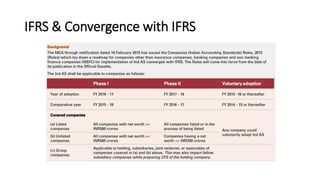
IFRS & Convergence with IFRS
Accounting Standards in Indian Context
• Accounting standards have been developed in India over time. It is also called Ind
As. Such standards need to be adopted by various corporate form and NBFCs in
India under the supervision of the Accounting Standards Board(ASB).
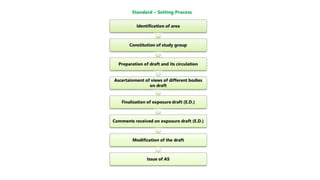
• The Accounting Standards Board was established in 1977 as a regulator and body.
ASB is a professional and autonomous body managed by the Institute of
Chartered Accountants of India (ICAI).
• Apart from this, there are other bodies such as Confederation of Indian Industry
(CII), Federation of Indian Chambers of Commerce and Industry (FICCI) and
Associated Chambers of Commerce and Industry of India(ASSOCHAM) which
regulate ASB.
• Individuals, professors and academics from the above-mentioned bodies acquire
different standards with regard to accounting. Indian accounting standards were
developed to harmonize standards related to international accounting and
reporting. International Accounting Standards comply with International Financial
Reporting Standards (IFRS). The Indian government body that recommends this
standard to the Department of Corporate Affairs is the National Advisory
Committee on Accounting Standards (NACAS).
Objectives of Indian accounting standards (Ind As):
Following are the objectives of applying Indian accounting standards:
• Ensure companies in India adopt these standards to implement internationally
recognized best practices.
• Ensure that compliance is maintained worldwide.
• Have a single framework for a single accounting system.
• The standard was developed in accordance with IFRS principles. Therefore, it
serves as a guide for the implementation of the standard.
• Accounting systems used in India can be analyzed and understood by global
companies.
• This will make the annual financial statements and company accounts
transparent.
• These standards are harmonized to ensure that companies comply with global
requirements.
• A wider scope is acceptable through this Indian accounting standard as Indian
companies have expanded their global scope as compared to the past.
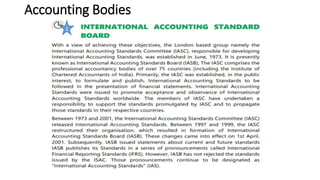
Accounting Bodies
1
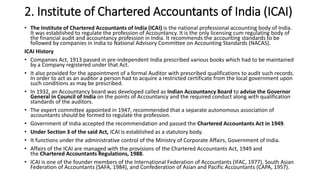
2. Institute of Chartered Accountants of India (ICAI)
• The Institute of Chartered Accountants of India (ICAI) is the national professional accounting body of India.
It was established to regulate the profession of Accountancy. It is the only licensing cum regulating body of
the financial audit and accountancy profession in India. It recommends the accounting standards to be
followed by companies in India to National Advisory Committee on Accounting Standards (NACAS).
ICAI History
• Companies Act, 1913 passed in pre-independent India prescribed various books which had to be maintained
by a Company registered under that Act.
• It also provided for the appointment of a formal Auditor with prescribed qualifications to audit such records.
In order to act as an auditor a person had to acquire a restricted certificate from the local government upon
such conditions as may be prescribed.
• In 1932, an Accountancy board was developed called as Indian Accountancy Board to advise the Governor
General in Council of India on the points of Accountancy and the required conduct along with qualification
standards of the auditors.
• The expert committee appointed in 1947, recommended that a separate autonomous association of
accountants should be formed to regulate the profession.
• Government of India accepted the recommendation and passed the Chartered Accountants Act in 1949.
• Under Section 3 of the said Act, ICAI is established as a statutory body.
• It functions under the administrative control of the Ministry of Corporate Affairs, Government of India.
• Affairs of the ICAI are managed with the provisions of the Chartered Accountants Act, 1949 and
the Chartered Accountants Regulations, 1988.
• ICAI is one of the founder members of the International Federation of Accountants (IFAC, 1977), South Asian
Federation of Accountants (SAFA, 1984), and Confederation of Asian and Pacific Accountants (CAPA, 1957).
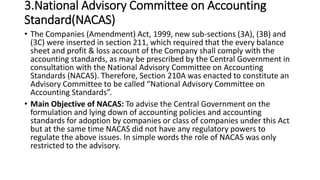
3.National Advisory Committee on Accounting
Standard(NACAS)
• The Companies (Amendment) Act, 1999, new sub-sections (3A), (3B) and
(3C) were inserted in section 211, which required that the every balance
sheet and profit & loss account of the Company shall comply with the
accounting standards, as may be prescribed by the Central Government in
consultation with the National Advisory Committee on Accounting
Standards (NACAS). Therefore, Section 210A was enacted to constitute an
Advisory Committee to be called “National Advisory Committee on
Accounting Standards”.
• Main Objective of NACAS: To advise the Central Government on the
formulation and lying down of accounting policies and accounting
standards for adoption by companies or class of companies under this Act
but at the same time NACAS did not have any regulatory powers to
regulate the above issues. In simple words the role of NACAS was only
restricted to the advisory.
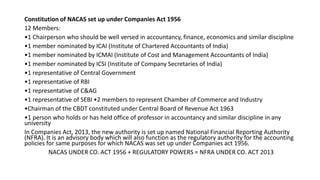
Constitution of NACAS set up under Companies Act 1956
12 Members:
•1 Chairperson who should be well versed in accountancy, finance, economics and similar discipline
•1 member nominated by ICAI (Institute of Chartered Accountants of India)
•1 member nominated by ICMAI (Institute of Cost and Management Accountants of India)
•1 member nominated by ICSI (Institute of Company Secretaries of India)
•1 representative of Central Government
•1 representative of RBI
•1 representative of C&AG
•1 representative of SEBI •2 members to represent Chamber of Commerce and Industry
•Chairman of the CBDT constituted under Central Board of Revenue Act 1963
•1 person who holds or has held office of professor in accountancy and similar discipline in any
university
In Companies Act, 2013, the new authority is set up named National Financial Reporting Authority
(NFRA). It is an advisory body which will also function as the regulatory authority for the accounting
policies for same purposes for which NACAS was set up under Companies act 1956.
NACAS UNDER CO. ACT 1956 + REGULATORY POWERS = NFRA UNDER CO. ACT 2013
4.National Financial Regulatory Authority (NFRA)
• NFRA is an Indian body provided in Companies Act 2013 for the
establishment and enforcement of accounting and auditing standards
and oversight of the work of auditors.
• As per the Companies Act, 2013 the NFRA is tasked with the job of
recommending accounting and auditing standards, ensuring
compliance with them and overseeing the quality of service of the
accounting and audit professions.
• It has also been given the power to investigate matters of professional
misconduct by chartered accountants or CA firms, impose penalty
and debar the CA or firm for up to 10 years.
Evolution of NFRA
• The world over more than 50 countries have moved away from self-regulatory
professional accountant bodies (like ICAI) and created independent audit regulators (like
NFRA).
• In India, the move to set up a new oversight body for the accounting and audit professions was
approved by a parliamentary panel. After the Satyam scandal took place in 2009, the Standing
Committee on Finance proposed the concept of the National Financial Reporting Authority (NFRA)
for the first time.
• Indian Parliament passed The Company Act 2013 (amendment) with inclusion of NFRA (section
132).
• Act states that “no other institute or body shall initiate or continue any proceedings in
such matters of misconduct where the NFRA has initiated an investigation.”
• ICAI, a self-regulatory body, has had the monopoly on training and qualifying chartered
accountants, giving them license to practice and regulating them including scrutinising
audit quality. Establishment of NFRA was a case of departing of powers from ICAI.
• Opposition by the ICAI has been a key reason why the government has delayed notifying
the NFRA rules.
Constitution of NFRA (As per section 132 of Companies Act 2013)
• Central Government may, by notification, constitute a National Financial Reporting Authority
(NFRA) to provide for matters relating to accounting and auditing standards under this Act.
• Notwithstanding anything contained in any other law for the time being in force, the National
Financial Reporting Authority shall
• Make recommendations to the Central Government on the formulation and laying down of accounting and
auditing policies and standards for adoption by companies or class of companies or their auditors.
• Monitor and enforce the compliance with accounting standards and auditing standards in such manner as
may be prescribed;
• Oversee the quality of service of the professions associated with ensuring compliance with such standards,
and suggest measures required for improvement in quality of service.
• It shall consist of a chairperson, who shall be a person of eminence and having expertise in
accountancy, auditing, finance or law to be appointed by the Central Government and such
other members not exceeding fifteen consisting of part-time and full-time members.
• It shall have the power to investigate, either suo motu or on a reference made to it by the
Central Government, for such class of bodies corporate or persons, into the matters of
professional or other misconduct committed by any member or firm of chartered accountants,
registered under the Chartered Accountants Act, 1949.
• Provided that no other institute or body shall initiate or continue any proceedings in such matters of
misconduct where the NFRA has initiated an investigation under this section.
• It shall have the same powers as are vested in a civil court under the Code of
Civil Procedure, 1908, while trying a suit in matters of:
• discovery and production of books of account and other documents;
• summoning and enforcing the attendance of persons and examining them on oath;
• Inspection of any books, registers and other documents.
• Any person aggrieved by any order of the NFRA, may prefer an appeal before the
Appellate Authority constituted under section 132(6) of Companies Act 2013.
• The Central Government may, by notification, constitute, an Appellate
Authority consisting of a chairperson and not more than two other members, for
hearing appeals arising out of the orders of the NFRA.
• The qualifications for appointment of the chairperson and members of the
Appellate Authority, the manner of selection, the terms and conditions of their
service and the requirement of the supporting staff and procedure to be followed
by the Appellate Authority shall be such as may be prescribed by Parliament.
• NFRA shall prepare its annual report giving a full account of its activities during
the financial year and forward a copy thereof to the Central Government and the
Central Government shall cause the annual report to be laid before each House of
Parliament.
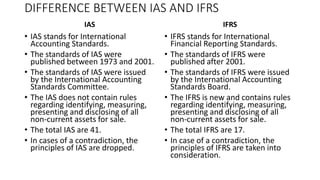
DIFFERENCE BETWEEN IAS AND IFRS
IAS
• IAS stands for International
Accounting Standards.
• The standards of IAS were
published between 1973 and 2001.
• The standards of IAS were issued
by the International Accounting
Standards Committee.
• The IAS does not contain rules
regarding identifying, measuring,
presenting and disclosing of all
non-current assets for sale.
• The total IAS are 41.
• In cases of a contradiction, the
principles of IAS are dropped.
IFRS
• IFRS stands for International
Financial Reporting Standards.
• The standards of IFRS were
published after 2001.
• The standards of IFRS were issued
by the International Accounting
Standards Board.
• The IFRS is new and contains rules
regarding identifying, measuring,
presenting and disclosing of all
non-current assets for sale.
• The total IFRS are 17.
• In case of a contradiction, the
principles of IFRS are taken into
consideration.

Unit 1.pptx

  • 1.
    IAS & IFRS UNIT1 – ACCOUNTING STANDARDS
  • 2.
    Meaning Of AccountingStandards • According to ICAI, Accounting standards are “written documents, policies, procedures issued by expert accounting body or government or other regulatory body covering the aspects of recognition, measurement, treatment, presentation and disclosures of accounting transactions in the financial statement.” • In short, an accounting standard may be regarded as a sort of law- a guide to action, a settled ground or basis of conduct or practice, of accounting.
  • 3.
    • The accountingStandards deal with the issues of: a. Recognition of events and transactions in the financial statements; b. Measurement of these transactions and events; c. Presentation of these transactions and events in the financial statements in a manner that is meaningful and understandable to the reader; and d. The disclosure requirements which should be there to enable the public at large and the stakeholders and the potential investors in particular, to get an insight into what these financial statements are trying to reflect and thereby facilitating them to take prudent and informed business decisions.
  • 4.
    Need for AccountingStandards a) In order to avoid the variance which may arise between the accounting principles and accounting practices and also to find uniformity among various diverse underlying principles of accounting. b) Comparison between two firms is possible if both of them maintain the same principle, otherwise proper comparison is not possible. For example, if A company follows the FIFO method of valuation of stock whereas firm B follows the LIFO method for valuing stock, the comparison between the two firms becomes useless. The same is possible only when both of them follow identical method of valuing closing stock. c) To find uniformity in accounting practice while formulating financial reports and make consistency and proper comparison of data which are contained in financial statements for the users of accounting information. d) To maintain fairness, consistency and transparency in accounting practices which will satisfy the users of accounting.
  • 5.
    e) To resolvepotential conflicts of financial interest among the various external groups that use and rely upon published financial statements. f) Accounting standards reduce the accounting alternatives in the preparation of financial statements within the bounds of rationality, thereby ensuring comparability of financial statements of different enterprises. Thus, accounting standards can be seen as providing an important mechanism to help in the resolution of potential financial conflicts interest between the various important groups in society. g) To harmonize accounting policies and practices followed by different business entities so that the diverse accounting practices adopted for various aspects of accounting can be standardized. Objectives of Accounting Standards:
  • 6.
    Significance & advantagesof Accounting Standards 1. They would be useful to investors in judging the yield and risk involved in alternative investments in different companies and different countries. 2. The standards enable the public accountants (the Chartered Accountants in India) to deal with their clients by providing rules of authority to which the accountants have to adhere, in their job of preparing the financial statements on a true and fair basis. This makes the accountants ensure commitments and integrity in the profession. 3. Accounting standards raise the standards of auditing itself in its task of reporting on the financial statements. 4. Government officials, tax authorities and other find accounting reports produced in accordance with established standards to be reliable and acceptable. 5. Financial statements thus produced will be reliable documents for the purpose of analysis and interpretation by analysts, researchers and consultants for economic forecasting and planning.
  • 7.
    Limitations of AccountingStandards The following are some of the limitations of setting of accounting standards: • Alternative solutions to certain accounting problems may each have arguments to recommend them. Therefore, the choice between different alternative accounting treatments may become difficult. • There may be a trend towards rigidity and away from flexibility in applying the accounting standards. • Accounting Standards cannot override the statute. The standards are required to be framed within the ambit of prevailing statutes.
  • 8.
    Orientation to InternationalAccounting Standards • Modern economies rely on cross-border transactions and the free flow of international capital. More than a third of all financial transactions occur across borders, and that number is expected to grow. • Investors seek diversification and investment opportunities across the world, while companies raise capital, undertake transactions or have international operations and subsidiaries in multiple countries. • In the past, such cross-border activities were complicated by different countries maintaining their own sets of national accounting standards. This patchwork of accounting requirements often added cost, complexity and ultimately risk both to companies preparing financial statements and investors and others using those financial statements to make economic decisions. • Applying national accounting standards meant amounts reported in financial statements might be calculated on a different basis. Unpicking this complexity involved studying the minutiae of national accounting standards, because even a small difference in requirements could have a major impact on a company’s reported financial performance and financial position—for example, a company may recognise profits under one set of national accounting standards and losses under another.
  • 9.
    • IFRS Standardsaddress this challenge by providing a high quality, internationally recognized set of accounting standards that bring transparency, accountability and efficiency to financial markets around the world. • IFRS Standards bring transparency by enhancing the international comparability and quality of financial information, enabling investors and other market participants to make informed economic decisions. • IFRS Standards strengthen accountability by reducing the information gap between the providers of capital and the people to whom they have entrusted their money. Our Standards provide information that is needed to hold management to account. As a source of globally comparable information, IFRS Standards are also of vital importance to regulators around the world. • And IFRS Standards contribute to economic efficiency by helping investors to identify opportunities and risks across the world, thus improving capital allocation. For businesses, the use of a single, trusted accounting language lowers the cost of capital and reduces international reporting costs
  • 10.
  • 11.
    Accounting Standards inIndian Context • Accounting standards have been developed in India over time. It is also called Ind As. Such standards need to be adopted by various corporate form and NBFCs in India under the supervision of the Accounting Standards Board(ASB). • The Accounting Standards Board was established in 1977 as a regulator and body. ASB is a professional and autonomous body managed by the Institute of Chartered Accountants of India (ICAI). • Apart from this, there are other bodies such as Confederation of Indian Industry (CII), Federation of Indian Chambers of Commerce and Industry (FICCI) and Associated Chambers of Commerce and Industry of India(ASSOCHAM) which regulate ASB. • Individuals, professors and academics from the above-mentioned bodies acquire different standards with regard to accounting. Indian accounting standards were developed to harmonize standards related to international accounting and reporting. International Accounting Standards comply with International Financial Reporting Standards (IFRS). The Indian government body that recommends this standard to the Department of Corporate Affairs is the National Advisory Committee on Accounting Standards (NACAS).
  • 12.
    Objectives of Indianaccounting standards (Ind As): Following are the objectives of applying Indian accounting standards: • Ensure companies in India adopt these standards to implement internationally recognized best practices. • Ensure that compliance is maintained worldwide. • Have a single framework for a single accounting system. • The standard was developed in accordance with IFRS principles. Therefore, it serves as a guide for the implementation of the standard. • Accounting systems used in India can be analyzed and understood by global companies. • This will make the annual financial statements and company accounts transparent. • These standards are harmonized to ensure that companies comply with global requirements. • A wider scope is acceptable through this Indian accounting standard as Indian companies have expanded their global scope as compared to the past.
  • 16.
  • 17.
    2. Institute ofChartered Accountants of India (ICAI) • The Institute of Chartered Accountants of India (ICAI) is the national professional accounting body of India. It was established to regulate the profession of Accountancy. It is the only licensing cum regulating body of the financial audit and accountancy profession in India. It recommends the accounting standards to be followed by companies in India to National Advisory Committee on Accounting Standards (NACAS). ICAI History • Companies Act, 1913 passed in pre-independent India prescribed various books which had to be maintained by a Company registered under that Act. • It also provided for the appointment of a formal Auditor with prescribed qualifications to audit such records. In order to act as an auditor a person had to acquire a restricted certificate from the local government upon such conditions as may be prescribed. • In 1932, an Accountancy board was developed called as Indian Accountancy Board to advise the Governor General in Council of India on the points of Accountancy and the required conduct along with qualification standards of the auditors. • The expert committee appointed in 1947, recommended that a separate autonomous association of accountants should be formed to regulate the profession. • Government of India accepted the recommendation and passed the Chartered Accountants Act in 1949. • Under Section 3 of the said Act, ICAI is established as a statutory body. • It functions under the administrative control of the Ministry of Corporate Affairs, Government of India. • Affairs of the ICAI are managed with the provisions of the Chartered Accountants Act, 1949 and the Chartered Accountants Regulations, 1988. • ICAI is one of the founder members of the International Federation of Accountants (IFAC, 1977), South Asian Federation of Accountants (SAFA, 1984), and Confederation of Asian and Pacific Accountants (CAPA, 1957).
  • 18.
    3.National Advisory Committeeon Accounting Standard(NACAS) • The Companies (Amendment) Act, 1999, new sub-sections (3A), (3B) and (3C) were inserted in section 211, which required that the every balance sheet and profit & loss account of the Company shall comply with the accounting standards, as may be prescribed by the Central Government in consultation with the National Advisory Committee on Accounting Standards (NACAS). Therefore, Section 210A was enacted to constitute an Advisory Committee to be called “National Advisory Committee on Accounting Standards”. • Main Objective of NACAS: To advise the Central Government on the formulation and lying down of accounting policies and accounting standards for adoption by companies or class of companies under this Act but at the same time NACAS did not have any regulatory powers to regulate the above issues. In simple words the role of NACAS was only restricted to the advisory.
  • 19.
    Constitution of NACASset up under Companies Act 1956 12 Members: •1 Chairperson who should be well versed in accountancy, finance, economics and similar discipline •1 member nominated by ICAI (Institute of Chartered Accountants of India) •1 member nominated by ICMAI (Institute of Cost and Management Accountants of India) •1 member nominated by ICSI (Institute of Company Secretaries of India) •1 representative of Central Government •1 representative of RBI •1 representative of C&AG •1 representative of SEBI •2 members to represent Chamber of Commerce and Industry •Chairman of the CBDT constituted under Central Board of Revenue Act 1963 •1 person who holds or has held office of professor in accountancy and similar discipline in any university In Companies Act, 2013, the new authority is set up named National Financial Reporting Authority (NFRA). It is an advisory body which will also function as the regulatory authority for the accounting policies for same purposes for which NACAS was set up under Companies act 1956. NACAS UNDER CO. ACT 1956 + REGULATORY POWERS = NFRA UNDER CO. ACT 2013
  • 20.
    4.National Financial RegulatoryAuthority (NFRA) • NFRA is an Indian body provided in Companies Act 2013 for the establishment and enforcement of accounting and auditing standards and oversight of the work of auditors. • As per the Companies Act, 2013 the NFRA is tasked with the job of recommending accounting and auditing standards, ensuring compliance with them and overseeing the quality of service of the accounting and audit professions. • It has also been given the power to investigate matters of professional misconduct by chartered accountants or CA firms, impose penalty and debar the CA or firm for up to 10 years.
  • 21.
    Evolution of NFRA •The world over more than 50 countries have moved away from self-regulatory professional accountant bodies (like ICAI) and created independent audit regulators (like NFRA). • In India, the move to set up a new oversight body for the accounting and audit professions was approved by a parliamentary panel. After the Satyam scandal took place in 2009, the Standing Committee on Finance proposed the concept of the National Financial Reporting Authority (NFRA) for the first time. • Indian Parliament passed The Company Act 2013 (amendment) with inclusion of NFRA (section 132). • Act states that “no other institute or body shall initiate or continue any proceedings in such matters of misconduct where the NFRA has initiated an investigation.” • ICAI, a self-regulatory body, has had the monopoly on training and qualifying chartered accountants, giving them license to practice and regulating them including scrutinising audit quality. Establishment of NFRA was a case of departing of powers from ICAI. • Opposition by the ICAI has been a key reason why the government has delayed notifying the NFRA rules.
  • 22.
    Constitution of NFRA(As per section 132 of Companies Act 2013) • Central Government may, by notification, constitute a National Financial Reporting Authority (NFRA) to provide for matters relating to accounting and auditing standards under this Act. • Notwithstanding anything contained in any other law for the time being in force, the National Financial Reporting Authority shall • Make recommendations to the Central Government on the formulation and laying down of accounting and auditing policies and standards for adoption by companies or class of companies or their auditors. • Monitor and enforce the compliance with accounting standards and auditing standards in such manner as may be prescribed; • Oversee the quality of service of the professions associated with ensuring compliance with such standards, and suggest measures required for improvement in quality of service. • It shall consist of a chairperson, who shall be a person of eminence and having expertise in accountancy, auditing, finance or law to be appointed by the Central Government and such other members not exceeding fifteen consisting of part-time and full-time members. • It shall have the power to investigate, either suo motu or on a reference made to it by the Central Government, for such class of bodies corporate or persons, into the matters of professional or other misconduct committed by any member or firm of chartered accountants, registered under the Chartered Accountants Act, 1949. • Provided that no other institute or body shall initiate or continue any proceedings in such matters of misconduct where the NFRA has initiated an investigation under this section.
  • 23.
    • It shallhave the same powers as are vested in a civil court under the Code of Civil Procedure, 1908, while trying a suit in matters of: • discovery and production of books of account and other documents; • summoning and enforcing the attendance of persons and examining them on oath; • Inspection of any books, registers and other documents. • Any person aggrieved by any order of the NFRA, may prefer an appeal before the Appellate Authority constituted under section 132(6) of Companies Act 2013. • The Central Government may, by notification, constitute, an Appellate Authority consisting of a chairperson and not more than two other members, for hearing appeals arising out of the orders of the NFRA. • The qualifications for appointment of the chairperson and members of the Appellate Authority, the manner of selection, the terms and conditions of their service and the requirement of the supporting staff and procedure to be followed by the Appellate Authority shall be such as may be prescribed by Parliament. • NFRA shall prepare its annual report giving a full account of its activities during the financial year and forward a copy thereof to the Central Government and the Central Government shall cause the annual report to be laid before each House of Parliament.
  • 24.
    DIFFERENCE BETWEEN IASAND IFRS IAS • IAS stands for International Accounting Standards. • The standards of IAS were published between 1973 and 2001. • The standards of IAS were issued by the International Accounting Standards Committee. • The IAS does not contain rules regarding identifying, measuring, presenting and disclosing of all non-current assets for sale. • The total IAS are 41. • In cases of a contradiction, the principles of IAS are dropped. IFRS • IFRS stands for International Financial Reporting Standards. • The standards of IFRS were published after 2001. • The standards of IFRS were issued by the International Accounting Standards Board. • The IFRS is new and contains rules regarding identifying, measuring, presenting and disclosing of all non-current assets for sale. • The total IFRS are 17. • In case of a contradiction, the principles of IFRS are taken into consideration.