Uniqueness quantifier
 denoted by ∃! or ∃1
 The notation ∃!x P(x) [or ∃1xP(x)] states “There
exists a unique x such that P(x) is true.”
 There is exactly one
 There is one and only one
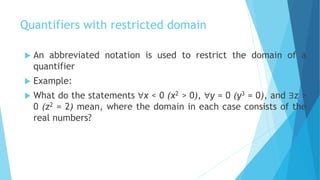
Quantifiers with restricted domain
 An abbreviated notation is used to restrict the domain of a
quantifier
 Example:
 What do the statements ∀x < 0 (x2 > 0), ∀y = 0 (y3 = 0), and ∃z >
0 (z2 = 2) mean, where the domain in each case consists of the
real numbers?
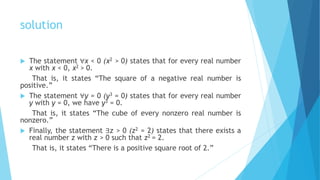
solution
 The statement ∀x < 0 (x2 > 0) states that for every real number
x with x < 0, x2 > 0.
That is, it states “The square of a negative real number is
positive.”
 The statement ∀y = 0 (y3 = 0) states that for every real number
y with y = 0, we have y3 = 0.
That is, it states “The cube of every nonzero real number is
nonzero.”
 Finally, the statement ∃z > 0 (z2 = 2) states that there exists a
real number z with z > 0 such that z2 = 2.
That is, it states “There is a positive square root of 2.”
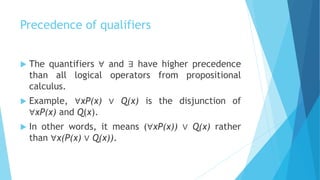
Precedence of qualifiers
 The quantifiers ∀ and ∃ have higher precedence
than all logical operators from propositional
calculus.
 Example, ∀xP(x) ∨ Q(x) is the disjunction of
∀xP(x) and Q(x).
 In other words, it means (∀xP(x)) ∨ Q(x) rather
than ∀x(P(x) ∨ Q(x)).
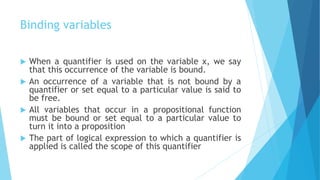
Binding variables
 When a quantifier is used on the variable x, we say
that this occurrence of the variable is bound.
 An occurrence of a variable that is not bound by a
quantifier or set equal to a particular value is said to
be free.
 All variables that occur in a propositional function
must be bound or set equal to a particular value to
turn it into a proposition
 The part of logical expression to which a quantifier is
applied is called the scope of this quantifier
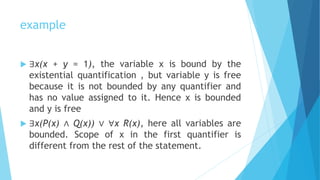
example
 ∃x(x + y = 1), the variable x is bound by the
existential quantification , but variable y is free
because it is not bounded by any quantifier and
has no value assigned to it. Hence x is bounded
and y is free
 ∃x(P(x) ∧ Q(x)) ∨ ∀x R(x), here all variables are
bounded. Scope of x in the first quantifier is
different from the rest of the statement.
Logical equivalences using quantifiers
 Statements involving predicates and quantifiers
are logically equivalent if and only if they have
the same truth value no matter which predicates
are substituted into these statements and which
domain of discourse is used for the variables in
these propositional functions.
 Denoted by S ≡ T, where S and T are two
statements involving predicates and quantifiers
example
 Show that ∀x(P(x) ∧ Q(x)) and ∀x P(x) ∧ ∀x Q(x)
are logically equivalent.
Negating quantifier expression-
universal quantification
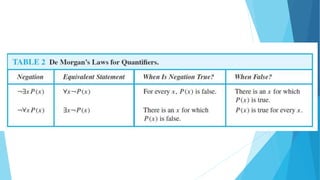
 ¬∀x P(x) ≡ ∃x ¬P(x)
 Example
 “Every student in your class has taken a course in
calculus
solution
 “It is not the case that every student in your class
has taken a course in calculus.” or
 “There is a student in your class who has not
taken a course in calculus
Existential quantification
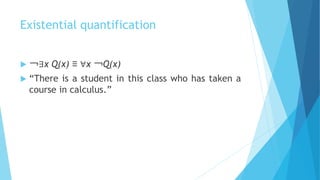
 ¬∃x Q(x) ≡ ∀x ¬Q(x)
 “There is a student in this class who has taken a
course in calculus.”
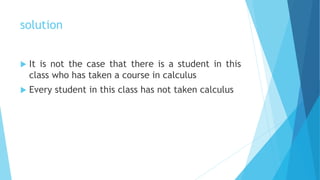
solution
 It is not the case that there is a student in this
class who has taken a course in calculus
 Every student in this class has not taken calculus
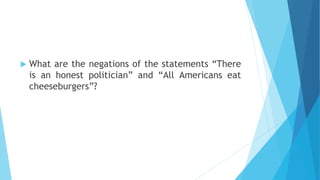
 What are the negations of the statements “There
is an honest politician” and “All Americans eat
cheeseburgers”?
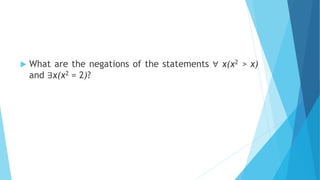
 What are the negations of the statements ∀ x(x2 > x)
and ∃x(x2 = 2)?
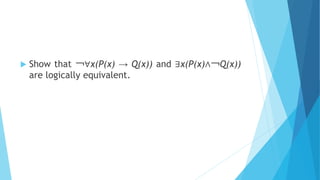
 Show that ¬∀x(P(x) → Q(x)) and ∃x(P(x)∧¬Q(x))
are logically equivalent.
Translating English into logical
expressions
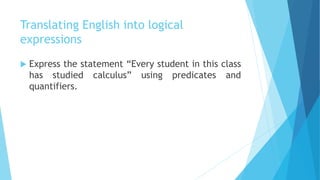
 Express the statement “Every student in this class
has studied calculus” using predicates and
quantifiers.
 Express the statements “Some student in this
class has visited Mexico” and “Every student in
this class has visited either Canada or Mexico”
using predicates and quantifiers.
Using quantifiers in system
specifications
 Use predicates and quantifiers to express the
system specifications “Every mail message larger
than one megabyte will be compressed” and “If a
user is active, at least one network link will be
available.”
Examples from Lewis Carroll
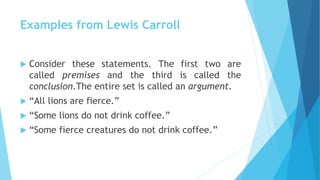
 Consider these statements. The first two are
called premises and the third is called the
conclusion.The entire set is called an argument.
 “All lions are fierce.”
 “Some lions do not drink coffee.”
 “Some fierce creatures do not drink coffee.”
 Consider these statements, of which the first
three are premises and the fourth is a valid
conclusion.
 “All hummingbirds are richly colored.”
 “No large birds live on honey.”
 “Birds that do not live on honey are dull in color.”
 “Hummingbirds are small.”
Exercise problems
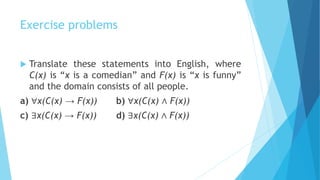
 Translate these statements into English, where
C(x) is “x is a comedian” and F(x) is “x is funny”
and the domain consists of all people.
a) ∀x(C(x) → F(x)) b) ∀x(C(x) ∧ F(x))
c) ∃x(C(x) → F(x)) d) ∃x(C(x) ∧ F(x))
homework
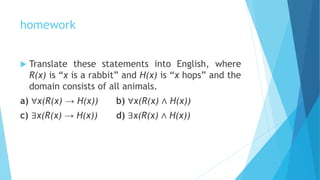
 Translate these statements into English, where
R(x) is “x is a rabbit” and H(x) is “x hops” and the
domain consists of all animals.
a) ∀x(R(x) → H(x)) b) ∀x(R(x) ∧ H(x))
c) ∃x(R(x) → H(x)) d) ∃x(R(x) ∧ H(x))
Exercise problem
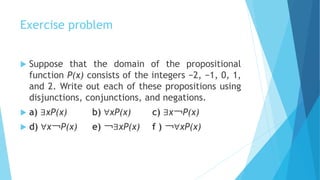
 Suppose that the domain of the propositional
function P(x) consists of the integers −2, −1, 0, 1,
and 2. Write out each of these propositions using
disjunctions, conjunctions, and negations.
 a) ∃xP(x) b) ∀xP(x) c) ∃x¬P(x)
 d) ∀x¬P(x) e) ¬∃xP(x) f ) ¬∀xP(x)
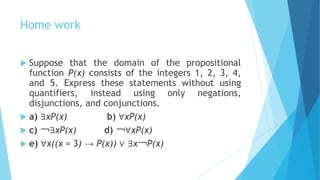
Home work
 Suppose that the domain of the propositional
function P(x) consists of the integers 1, 2, 3, 4,
and 5. Express these statements without using
quantifiers, instead using only negations,
disjunctions, and conjunctions.
 a) ∃xP(x) b) ∀xP(x)
 c) ¬∃xP(x) d) ¬∀xP(x)
 e) ∀x((x = 3) → P(x)) ∨ ∃x¬P(x)
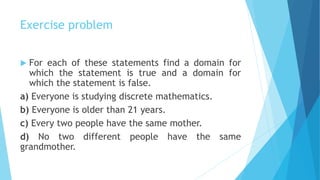
Exercise problem
 For each of these statements find a domain for
which the statement is true and a domain for
which the statement is false.
a) Everyone is studying discrete mathematics.
b) Everyone is older than 21 years.
c) Every two people have the same mother.
d) No two different people have the same
grandmother.
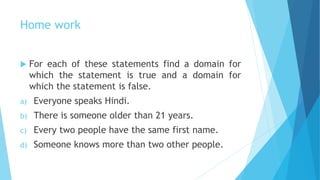
Home work
 For each of these statements find a domain for
which the statement is true and a domain for
which the statement is false.
a) Everyone speaks Hindi.
b) There is someone older than 21 years.
c) Every two people have the same first name.
d) Someone knows more than two other people.
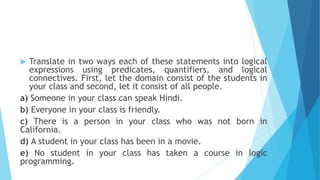
 Translate in two ways each of these statements into logical
expressions using predicates, quantifiers, and logical
connectives. First, let the domain consist of the students in
your class and second, let it consist of all people.
a) Someone in your class can speak Hindi.
b) Everyone in your class is friendly.
c) There is a person in your class who was not born in
California.
d) A student in your class has been in a movie.
e) No student in your class has taken a course in logic
programming.
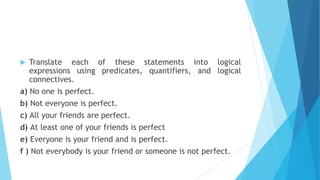
 Translate each of these statements into logical
expressions using predicates, quantifiers, and logical
connectives.
a) No one is perfect.
b) Not everyone is perfect.
c) All your friends are perfect.
d) At least one of your friends is perfect
e) Everyone is your friend and is perfect.
f ) Not everybody is your friend or someone is not perfect.
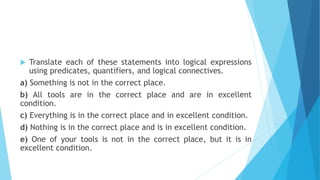
 Translate each of these statements into logical expressions
using predicates, quantifiers, and logical connectives.
a) Something is not in the correct place.
b) All tools are in the correct place and are in excellent
condition.
c) Everything is in the correct place and in excellent condition.
d) Nothing is in the correct place and is in excellent condition.
e) One of your tools is not in the correct place, but it is in
excellent condition.
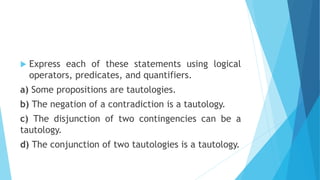
 Express each of these statements using logical
operators, predicates, and quantifiers.
a) Some propositions are tautologies.
b) The negation of a contradiction is a tautology.
c) The disjunction of two contingencies can be a
tautology.
d) The conjunction of two tautologies is a tautology.

Unit 1 quantifiers

  • 1.
    Uniqueness quantifier  denotedby ∃! or ∃1  The notation ∃!x P(x) [or ∃1xP(x)] states “There exists a unique x such that P(x) is true.”  There is exactly one  There is one and only one
  • 2.
    Quantifiers with restricteddomain  An abbreviated notation is used to restrict the domain of a quantifier  Example:  What do the statements ∀x < 0 (x2 > 0), ∀y = 0 (y3 = 0), and ∃z > 0 (z2 = 2) mean, where the domain in each case consists of the real numbers?
  • 3.
    solution  The statement∀x < 0 (x2 > 0) states that for every real number x with x < 0, x2 > 0. That is, it states “The square of a negative real number is positive.”  The statement ∀y = 0 (y3 = 0) states that for every real number y with y = 0, we have y3 = 0. That is, it states “The cube of every nonzero real number is nonzero.”  Finally, the statement ∃z > 0 (z2 = 2) states that there exists a real number z with z > 0 such that z2 = 2. That is, it states “There is a positive square root of 2.”
  • 4.
    Precedence of qualifiers The quantifiers ∀ and ∃ have higher precedence than all logical operators from propositional calculus.  Example, ∀xP(x) ∨ Q(x) is the disjunction of ∀xP(x) and Q(x).  In other words, it means (∀xP(x)) ∨ Q(x) rather than ∀x(P(x) ∨ Q(x)).
  • 5.
    Binding variables  Whena quantifier is used on the variable x, we say that this occurrence of the variable is bound.  An occurrence of a variable that is not bound by a quantifier or set equal to a particular value is said to be free.  All variables that occur in a propositional function must be bound or set equal to a particular value to turn it into a proposition  The part of logical expression to which a quantifier is applied is called the scope of this quantifier
  • 6.
    example  ∃x(x +y = 1), the variable x is bound by the existential quantification , but variable y is free because it is not bounded by any quantifier and has no value assigned to it. Hence x is bounded and y is free  ∃x(P(x) ∧ Q(x)) ∨ ∀x R(x), here all variables are bounded. Scope of x in the first quantifier is different from the rest of the statement.
  • 7.
    Logical equivalences usingquantifiers  Statements involving predicates and quantifiers are logically equivalent if and only if they have the same truth value no matter which predicates are substituted into these statements and which domain of discourse is used for the variables in these propositional functions.  Denoted by S ≡ T, where S and T are two statements involving predicates and quantifiers
  • 8.
    example  Show that∀x(P(x) ∧ Q(x)) and ∀x P(x) ∧ ∀x Q(x) are logically equivalent.
  • 9.
    Negating quantifier expression- universalquantification  ¬∀x P(x) ≡ ∃x ¬P(x)  Example  “Every student in your class has taken a course in calculus
  • 10.
    solution  “It isnot the case that every student in your class has taken a course in calculus.” or  “There is a student in your class who has not taken a course in calculus
  • 11.
    Existential quantification  ¬∃xQ(x) ≡ ∀x ¬Q(x)  “There is a student in this class who has taken a course in calculus.”
  • 12.
    solution  It isnot the case that there is a student in this class who has taken a course in calculus  Every student in this class has not taken calculus
  • 14.
     What arethe negations of the statements “There is an honest politician” and “All Americans eat cheeseburgers”?
  • 15.
     What arethe negations of the statements ∀ x(x2 > x) and ∃x(x2 = 2)?
  • 16.
     Show that¬∀x(P(x) → Q(x)) and ∃x(P(x)∧¬Q(x)) are logically equivalent.
  • 17.
    Translating English intological expressions  Express the statement “Every student in this class has studied calculus” using predicates and quantifiers.
  • 18.
     Express thestatements “Some student in this class has visited Mexico” and “Every student in this class has visited either Canada or Mexico” using predicates and quantifiers.
  • 19.
    Using quantifiers insystem specifications  Use predicates and quantifiers to express the system specifications “Every mail message larger than one megabyte will be compressed” and “If a user is active, at least one network link will be available.”
  • 20.
    Examples from LewisCarroll  Consider these statements. The first two are called premises and the third is called the conclusion.The entire set is called an argument.  “All lions are fierce.”  “Some lions do not drink coffee.”  “Some fierce creatures do not drink coffee.”
  • 21.
     Consider thesestatements, of which the first three are premises and the fourth is a valid conclusion.  “All hummingbirds are richly colored.”  “No large birds live on honey.”  “Birds that do not live on honey are dull in color.”  “Hummingbirds are small.”
  • 22.
    Exercise problems  Translatethese statements into English, where C(x) is “x is a comedian” and F(x) is “x is funny” and the domain consists of all people. a) ∀x(C(x) → F(x)) b) ∀x(C(x) ∧ F(x)) c) ∃x(C(x) → F(x)) d) ∃x(C(x) ∧ F(x))
  • 23.
    homework  Translate thesestatements into English, where R(x) is “x is a rabbit” and H(x) is “x hops” and the domain consists of all animals. a) ∀x(R(x) → H(x)) b) ∀x(R(x) ∧ H(x)) c) ∃x(R(x) → H(x)) d) ∃x(R(x) ∧ H(x))
  • 24.
    Exercise problem  Supposethat the domain of the propositional function P(x) consists of the integers −2, −1, 0, 1, and 2. Write out each of these propositions using disjunctions, conjunctions, and negations.  a) ∃xP(x) b) ∀xP(x) c) ∃x¬P(x)  d) ∀x¬P(x) e) ¬∃xP(x) f ) ¬∀xP(x)
  • 25.
    Home work  Supposethat the domain of the propositional function P(x) consists of the integers 1, 2, 3, 4, and 5. Express these statements without using quantifiers, instead using only negations, disjunctions, and conjunctions.  a) ∃xP(x) b) ∀xP(x)  c) ¬∃xP(x) d) ¬∀xP(x)  e) ∀x((x = 3) → P(x)) ∨ ∃x¬P(x)
  • 26.
    Exercise problem  Foreach of these statements find a domain for which the statement is true and a domain for which the statement is false. a) Everyone is studying discrete mathematics. b) Everyone is older than 21 years. c) Every two people have the same mother. d) No two different people have the same grandmother.
  • 27.
    Home work  Foreach of these statements find a domain for which the statement is true and a domain for which the statement is false. a) Everyone speaks Hindi. b) There is someone older than 21 years. c) Every two people have the same first name. d) Someone knows more than two other people.
  • 28.
     Translate intwo ways each of these statements into logical expressions using predicates, quantifiers, and logical connectives. First, let the domain consist of the students in your class and second, let it consist of all people. a) Someone in your class can speak Hindi. b) Everyone in your class is friendly. c) There is a person in your class who was not born in California. d) A student in your class has been in a movie. e) No student in your class has taken a course in logic programming.
  • 29.
     Translate eachof these statements into logical expressions using predicates, quantifiers, and logical connectives. a) No one is perfect. b) Not everyone is perfect. c) All your friends are perfect. d) At least one of your friends is perfect e) Everyone is your friend and is perfect. f ) Not everybody is your friend or someone is not perfect.
  • 30.
     Translate eachof these statements into logical expressions using predicates, quantifiers, and logical connectives. a) Something is not in the correct place. b) All tools are in the correct place and are in excellent condition. c) Everything is in the correct place and in excellent condition. d) Nothing is in the correct place and is in excellent condition. e) One of your tools is not in the correct place, but it is in excellent condition.
  • 31.
     Express eachof these statements using logical operators, predicates, and quantifiers. a) Some propositions are tautologies. b) The negation of a contradiction is a tautology. c) The disjunction of two contingencies can be a tautology. d) The conjunction of two tautologies is a tautology.