Rushdi Shams, Dept of CSE, KUET, Bangladesh 1
Knowledge Representation
Propositional Logic
Artificial Intelligence
Version 2.0
There are 10 types of people in this world- who understand binary
and who do not understand binary
Rushdi Shams, Dept of CSE, KUET, Bangladesh 2
Propositional Logic
Rushdi Shams, Dept of CSE, KUET, Bangladesh 3
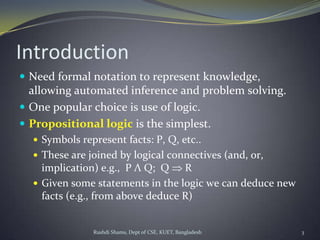
Introduction
 Need formal notation to represent knowledge,
allowing automated inference and problem solving.
 One popular choice is use of logic.
 Propositional logic is the simplest.
 Symbols represent facts: P, Q, etc..
 These are joined by logical connectives (and, or,
implication) e.g., P Λ Q; Q R
 Given some statements in the logic we can deduce new
facts (e.g., from above deduce R)
Rushdi Shams, Dept of CSE, KUET, Bangladesh 4
Syntactic Properties of
Propositional Logic
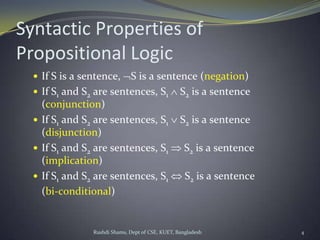
 If S is a sentence, S is a sentence (negation)
 If S1 and S2 are sentences, S1 S2 is a sentence
(conjunction)
 If S1 and S2 are sentences, S1 S2 is a sentence
(disjunction)
 If S1 and S2 are sentences, S1 S2 is a sentence
(implication)
 If S1 and S2 are sentences, S1 S2 is a sentence
(bi-conditional)
Rushdi Shams, Dept of CSE, KUET, Bangladesh 5
Semantic Properties of
Propositional Logic
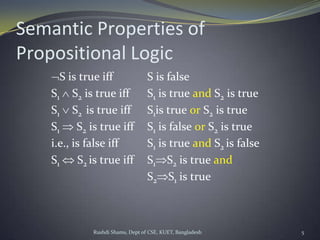
S is true iff S is false
S1 S2 is true iff S1 is true and S2 is true
S1 S2 is true iff S1is true or S2 is true
S1 S2 is true iff S1 is false or S2 is true
i.e., is false iff S1 is true and S2 is false
S1 S2 is true iff S1 S2 is true and
S2 S1 is true
Rushdi Shams, Dept of CSE, KUET, Bangladesh 6
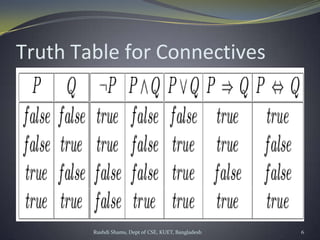
Truth Table for Connectives
Rushdi Shams, Dept of CSE, KUET, Bangladesh 7
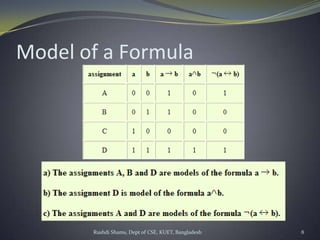
Model of a Formula
 If the value of the formula X holds 1 for the
assignment A, then the assignment A is called model
for formula X.
 That means, all assignments for which the formula X
is true are models of it.
Rushdi Shams, Dept of CSE, KUET, Bangladesh 8
Model of a Formula
Rushdi Shams, Dept of CSE, KUET, Bangladesh 9
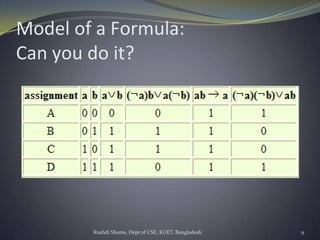
Model of a Formula:
Can you do it?
Rushdi Shams, Dept of CSE, KUET, Bangladesh 10
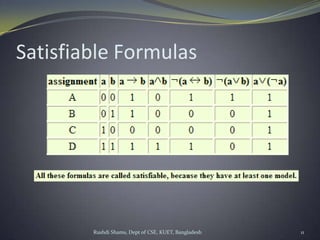
Satisfiable Formulas
 If there exist at least one model of a formula then the
formula is called satisfiable.
 The value of the formula is true for at least one
assignment. It plays no rule how many models the
formula has.
Rushdi Shams, Dept of CSE, KUET, Bangladesh 11
Satisfiable Formulas
Rushdi Shams, Dept of CSE, KUET, Bangladesh 12
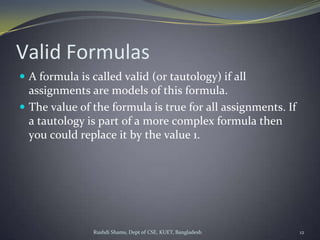
Valid Formulas
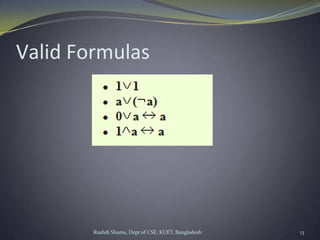
 A formula is called valid (or tautology) if all
assignments are models of this formula.
 The value of the formula is true for all assignments. If
a tautology is part of a more complex formula then
you could replace it by the value 1.
Rushdi Shams, Dept of CSE, KUET, Bangladesh 13
Valid Formulas
Rushdi Shams, Dept of CSE, KUET, Bangladesh 14
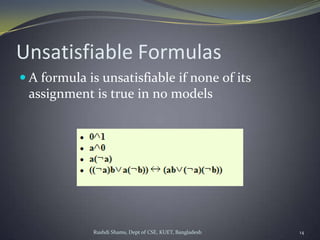
Unsatisfiable Formulas
 A formula is unsatisfiable if none of its
assignment is true in no models
Rushdi Shams, Dept of CSE, KUET, Bangladesh 15
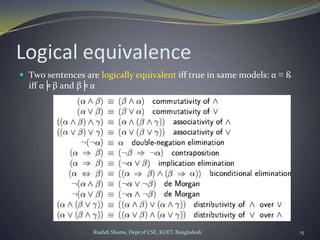
Logical equivalence
 Two sentences are logically equivalent iff true in same models: α ≡ ß
iff α╞ β and β╞ α
Rushdi Shams, Dept of CSE, KUET, Bangladesh 16
Deduction: Rule of Inference
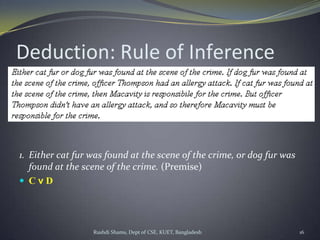
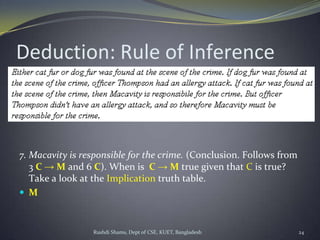
1. Either cat fur was found at the scene of the crime, or dog fur was
found at the scene of the crime. (Premise)
 C v D
Rushdi Shams, Dept of CSE, KUET, Bangladesh 17
Deduction: Rule of Inference
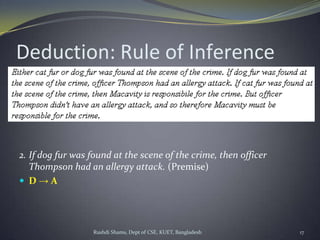
2. If dog fur was found at the scene of the crime, then officer
Thompson had an allergy attack. (Premise)
 D → A
Rushdi Shams, Dept of CSE, KUET, Bangladesh 18
Deduction: Rule of Inference
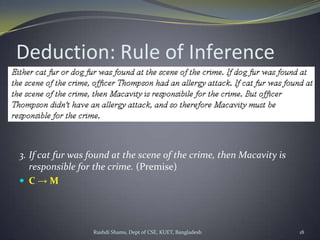
3. If cat fur was found at the scene of the crime, then Macavity is
responsible for the crime. (Premise)
 C → M
Rushdi Shams, Dept of CSE, KUET, Bangladesh 19
Deduction: Rule of Inference
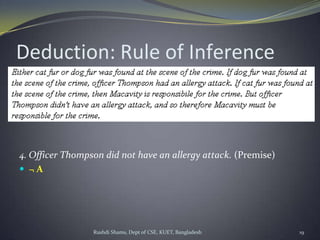
4. Officer Thompson did not have an allergy attack. (Premise)
 ¬ A
Rushdi Shams, Dept of CSE, KUET, Bangladesh 20
Deduction: Rule of Inference
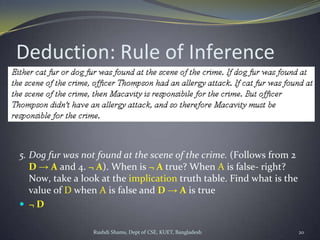
5. Dog fur was not found at the scene of the crime. (Follows from 2
D → A and 4. ¬ A). When is ¬ A true? When A is false- right?
Now, take a look at the implication truth table. Find what is the
value of D when A is false and D → A is true
 ¬ D
Rushdi Shams, Dept of CSE, KUET, Bangladesh 21
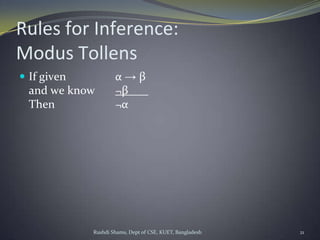
Rules for Inference:
Modus Tollens
 If given α → β
and we know ¬β
Then ¬α
Rushdi Shams, Dept of CSE, KUET, Bangladesh 22
Deduction: Rule of Inference
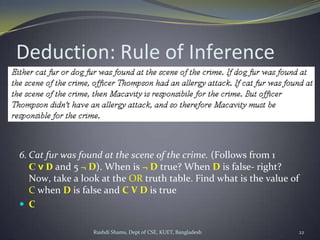
6. Cat fur was found at the scene of the crime. (Follows from 1
C v D and 5 ¬ D). When is ¬ D true? When D is false- right?
Now, take a look at the OR truth table. Find what is the value of
C when D is false and C V D is true
 C
Rushdi Shams, Dept of CSE, KUET, Bangladesh 23
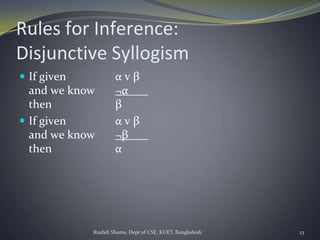
Rules for Inference:
Disjunctive Syllogism
 If given α v β
and we know ¬α
then β
 If given α v β
and we know ¬β
then α
Rushdi Shams, Dept of CSE, KUET, Bangladesh 24
Deduction: Rule of Inference
7. Macavity is responsible for the crime. (Conclusion. Follows from
3 C → M and 6 C). When is C → M true given that C is true?
Take a look at the Implication truth table.
 M
Rushdi Shams, Dept of CSE, KUET, Bangladesh 25
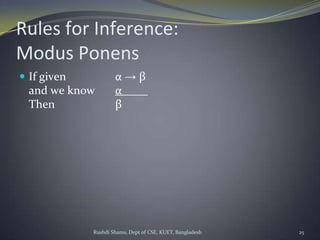
Rules for Inference:
Modus Ponens
 If given α → β
and we know α
Then β
Rushdi Shams, Dept of CSE, KUET, Bangladesh 26
References
 Artificial Intelligence: A Modern Approach (2nd
Edition)
by Russell and Norvig
Chapter 7
 http://www.iep.utm.edu/p/prop-log.htm#H5

Propositional logic

  • 1.
    Rushdi Shams, Deptof CSE, KUET, Bangladesh 1 Knowledge Representation Propositional Logic Artificial Intelligence Version 2.0 There are 10 types of people in this world- who understand binary and who do not understand binary
  • 2.
    Rushdi Shams, Deptof CSE, KUET, Bangladesh 2 Propositional Logic
  • 3.
    Rushdi Shams, Deptof CSE, KUET, Bangladesh 3 Introduction  Need formal notation to represent knowledge, allowing automated inference and problem solving.  One popular choice is use of logic.  Propositional logic is the simplest.  Symbols represent facts: P, Q, etc..  These are joined by logical connectives (and, or, implication) e.g., P Λ Q; Q R  Given some statements in the logic we can deduce new facts (e.g., from above deduce R)
  • 4.
    Rushdi Shams, Deptof CSE, KUET, Bangladesh 4 Syntactic Properties of Propositional Logic  If S is a sentence, S is a sentence (negation)  If S1 and S2 are sentences, S1 S2 is a sentence (conjunction)  If S1 and S2 are sentences, S1 S2 is a sentence (disjunction)  If S1 and S2 are sentences, S1 S2 is a sentence (implication)  If S1 and S2 are sentences, S1 S2 is a sentence (bi-conditional)
  • 5.
    Rushdi Shams, Deptof CSE, KUET, Bangladesh 5 Semantic Properties of Propositional Logic S is true iff S is false S1 S2 is true iff S1 is true and S2 is true S1 S2 is true iff S1is true or S2 is true S1 S2 is true iff S1 is false or S2 is true i.e., is false iff S1 is true and S2 is false S1 S2 is true iff S1 S2 is true and S2 S1 is true
  • 6.
    Rushdi Shams, Deptof CSE, KUET, Bangladesh 6 Truth Table for Connectives
  • 7.
    Rushdi Shams, Deptof CSE, KUET, Bangladesh 7 Model of a Formula  If the value of the formula X holds 1 for the assignment A, then the assignment A is called model for formula X.  That means, all assignments for which the formula X is true are models of it.
  • 8.
    Rushdi Shams, Deptof CSE, KUET, Bangladesh 8 Model of a Formula
  • 9.
    Rushdi Shams, Deptof CSE, KUET, Bangladesh 9 Model of a Formula: Can you do it?
  • 10.
    Rushdi Shams, Deptof CSE, KUET, Bangladesh 10 Satisfiable Formulas  If there exist at least one model of a formula then the formula is called satisfiable.  The value of the formula is true for at least one assignment. It plays no rule how many models the formula has.
  • 11.
    Rushdi Shams, Deptof CSE, KUET, Bangladesh 11 Satisfiable Formulas
  • 12.
    Rushdi Shams, Deptof CSE, KUET, Bangladesh 12 Valid Formulas  A formula is called valid (or tautology) if all assignments are models of this formula.  The value of the formula is true for all assignments. If a tautology is part of a more complex formula then you could replace it by the value 1.
  • 13.
    Rushdi Shams, Deptof CSE, KUET, Bangladesh 13 Valid Formulas
  • 14.
    Rushdi Shams, Deptof CSE, KUET, Bangladesh 14 Unsatisfiable Formulas  A formula is unsatisfiable if none of its assignment is true in no models
  • 15.
    Rushdi Shams, Deptof CSE, KUET, Bangladesh 15 Logical equivalence  Two sentences are logically equivalent iff true in same models: α ≡ ß iff α╞ β and β╞ α
  • 16.
    Rushdi Shams, Deptof CSE, KUET, Bangladesh 16 Deduction: Rule of Inference 1. Either cat fur was found at the scene of the crime, or dog fur was found at the scene of the crime. (Premise)  C v D
  • 17.
    Rushdi Shams, Deptof CSE, KUET, Bangladesh 17 Deduction: Rule of Inference 2. If dog fur was found at the scene of the crime, then officer Thompson had an allergy attack. (Premise)  D → A
  • 18.
    Rushdi Shams, Deptof CSE, KUET, Bangladesh 18 Deduction: Rule of Inference 3. If cat fur was found at the scene of the crime, then Macavity is responsible for the crime. (Premise)  C → M
  • 19.
    Rushdi Shams, Deptof CSE, KUET, Bangladesh 19 Deduction: Rule of Inference 4. Officer Thompson did not have an allergy attack. (Premise)  ¬ A
  • 20.
    Rushdi Shams, Deptof CSE, KUET, Bangladesh 20 Deduction: Rule of Inference 5. Dog fur was not found at the scene of the crime. (Follows from 2 D → A and 4. ¬ A). When is ¬ A true? When A is false- right? Now, take a look at the implication truth table. Find what is the value of D when A is false and D → A is true  ¬ D
  • 21.
    Rushdi Shams, Deptof CSE, KUET, Bangladesh 21 Rules for Inference: Modus Tollens  If given α → β and we know ¬β Then ¬α
  • 22.
    Rushdi Shams, Deptof CSE, KUET, Bangladesh 22 Deduction: Rule of Inference 6. Cat fur was found at the scene of the crime. (Follows from 1 C v D and 5 ¬ D). When is ¬ D true? When D is false- right? Now, take a look at the OR truth table. Find what is the value of C when D is false and C V D is true  C
  • 23.
    Rushdi Shams, Deptof CSE, KUET, Bangladesh 23 Rules for Inference: Disjunctive Syllogism  If given α v β and we know ¬α then β  If given α v β and we know ¬β then α
  • 24.
    Rushdi Shams, Deptof CSE, KUET, Bangladesh 24 Deduction: Rule of Inference 7. Macavity is responsible for the crime. (Conclusion. Follows from 3 C → M and 6 C). When is C → M true given that C is true? Take a look at the Implication truth table.  M
  • 25.
    Rushdi Shams, Deptof CSE, KUET, Bangladesh 25 Rules for Inference: Modus Ponens  If given α → β and we know α Then β
  • 26.
    Rushdi Shams, Deptof CSE, KUET, Bangladesh 26 References  Artificial Intelligence: A Modern Approach (2nd Edition) by Russell and Norvig Chapter 7  http://www.iep.utm.edu/p/prop-log.htm#H5