Unit 1
HRD - Concept & Definition
HUMAN RESOURCE DEVELOPMENT means developing or tapping
hidden qualities in people in order to make them accomplish new
functions leading to organization at and individual goals.
According to Nadler –“HRD is an organised learning experience
within a given period of time with the objectives of producting the
possibility of performance change.”
According to Prof T.V Rao – HRD is A process by which the
employees of an organization are helped in A continuous and planned
way to:-
 Acquire or sharpen capabilities required to perform various
functions associated with their present or expected future roles.
 Develop their general capabilities as individuals and discover and
exploit their own potential for their own and / or organizational
development purposes.
 Develop and organizational culture in which superior –
subordinate relationships team work and collaboration among
sub-unit are strong and contribute to the professional well being
motivation and pride of employees.
FEATURES of HRD
HRD is a system
HRD is a planned process
HRD involves development of competencies
HRD is an inter – disciplinary concept
GOALS
Employee Competency development
It aims at preparing people for performing roles / jobs which they may be
required to perform in the future as they go up on the organizational
hierarchy.
To identify competency gaps of employees to perform the present roles / jobs /
tasks functions effectively and create conditions to help employees bridge gaps
through development.
Employee Motivation development
Motivation development is also an aim of HRD it means the desire to work or
put in work effort it is a commitment to the job, work and the organization
Organizational Climate development
It also aims at climate development, Building free expression of ideas
& Promotion of collaborations
APPROACHES to HRD
The Strategic HR Framework Approach(1990)_ Ulrich & Lake
Imp elements are :-
Procedures & Practices, Biz Strategies and Organization Capabilities
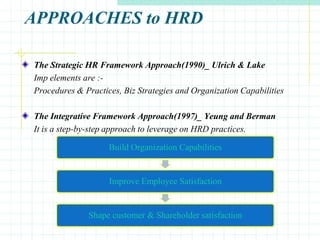
The Integrative Framework Approach(1997)_ Yeung and Berman
It is a step-by-step approach to leverage on HRD practices.
Build Organization Capabilities
Improve Employee Satisfaction
Shape customer & Shareholder satisfaction
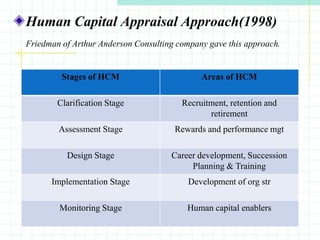
Human Capital Appraisal Approach(1998)
Friedman of Arthur Anderson Consulting company gave this approach.
Stages of HCM Areas of HCM
Clarification Stage Recruitment, retention and
retirement
Assessment Stage Rewards and performance mgt
Design Stage Career development, Succession
Planning & Training
Implementation Stage Development of org str
Monitoring Stage Human capital enablers
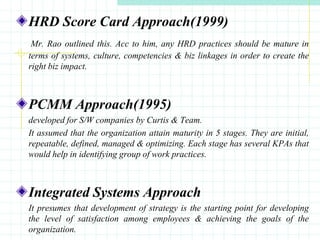
HRD Score Card Approach(1999)
Mr. Rao outlined this. Acc to him, any HRD practices should be mature in
terms of systems, culture, competencies & biz linkages in order to create the
right biz impact.
PCMM Approach(1995)
developed for S/W companies by Curtis & Team.
It assumed that the organization attain maturity in 5 stages. They are initial,
repeatable, defined, managed & optimizing. Each stage has several KPAs that
would help in identifying group of work practices.
Integrated Systems Approach
It presumes that development of strategy is the starting point for developing
the level of satisfaction among employees & achieving the goals of the
organization.
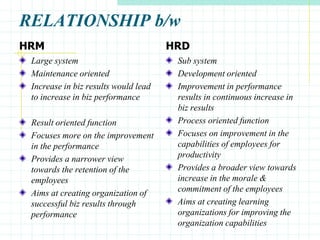
RELATIONSHIP b/w
HRM
Large system
Maintenance oriented
Increase in biz results would lead
to increase in biz performance
Result oriented function
Focuses more on the improvement
in the performance
Provides a narrower view
towards the retention of the
employees
Aims at creating organization of
successful biz results through
performance
HRD
Sub system
Development oriented
Improvement in performance
results in continuous increase in
biz results
Process oriented function
Focuses on improvement in the
capabilities of employees for
productivity
Provides a broader view towards
increase in the morale &
commitment of the employees
Aims at creating learning
organizations for improving the
organization capabilities
IMPORTANCE
Facilitates the complete utilization of human capital of the organization.
Offers a nurturing environment for higher quality of work life through job
satisfaction, career growth and development.
Facilitates more open communication among the employees and management
in any organization.
Ensures increased job satisfaction, commitment & morale of employees.
Ensures smooth functioning of all functions of hrm from recruitment, selection,
compensation till handling attrition & retirement of employees.
Practices provide an organizational culture that vibrates positive synergy for
excellence.
Facilitates better understanding of organizational goals and also helps to
synchronize the same with the personal goals of the employees of the
organization.
Helps in framing systems, policies & procedures that are dynamic in nature.
Makes the organization more adaptable to changes in the environment.
FUNCTIONS
Organizational development
Job descriptions
Staff planning and recruitment
Staff benefits and rewards
Interest groups, e.g.. Trade union
Training and development
Performance appraisal
Potential appraisal
Career development
Organizational Learning
Employee mentoring
Employee welfare and quality of work life
Human resource information system
HRD DEPARTMENT & Their Tasks
The main objective of the HRD department is to create
 a learning environment and
 development of climate in the organization.
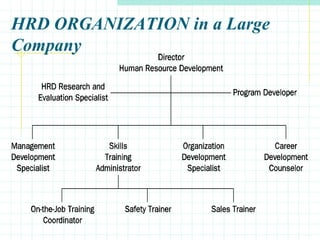
HRD ORGANIZATION in a Large
Company
The HRD department should:
Develop a HR philosophy for the entire organization and get the top
management committed to it openly and consistently.
Keep inspiring the line mangers to have a constant desire to learn and
develop.
Constantly plan and design new methods and systems of developing and
strengthening the HRD climate.
Be aware of the business / social /other goals of the organization and direct
all their HRD effort to achieve these goals.
Monitor effectively the implementation of various HRD sub-systems /
mechanisms.
Work with unions and associations and inspire them.
Conduct human process research, organizational health surveys and
renewal exercises periodically.
Influence personnel policies by providing necessary inputs to the personnel
department / top management.
ROLES of a HRD Professional
HR Strategic Advisor
HR Systems Designer and Developer
Organization Change Agent
Organization Design Consultant
The Instructor or Facilitator
The Individual Development and Career Counselor
The Performance Consultant
The Researcher
QUALITIES of HRD Professionals
Training Skills
Leadership Capabilities
Analytical Skills
Interpersonal Communication
Multi-cultural Communication Capabilities
Technical Skills
HISTORY of HRD in India
What started as a "Review Exercise of the Performance Appraisal System"
for L&T by two consultants, Prof Udai Pareek and Prof T.V. Rao from the
Indian Institute Of Management, Ahmadabad (IIMA), resulted in the
development of a new function - The HRD Function.
In the early seventies, this company, in association with IIMA the reviewed
all aspects of its operations. In 1974, the consultants studied the
organisation and prepared a new integrated system called Human
Resource Development ( HRD) System.
Based on the recommendations of the approach paper, a very high level
role was created at the Board level to give a greater thrust to the new
system. A separate HRD Department was created. A high level internal
team headed by a General Manager, monitored the progress of
implementation of the new system initially, which was subsequently handed
over to the HRD Department.
This pioneering work of Dr. Rao and Dr. Pareek lead later top the
establishment of HRD Departments in the State Bank Of India and its
Associates, and Bharat Earth Movers Limited in Bangalore in 1976 and
1978.
PRESENT STATUS of HRD in India
A study on analysis of HRD experiences of 14 organizations viz. Bank
of Baroda, Crompton Greaves, IOC, SAIL, SBI, State Bank of Patiala,
Sundaram Fasteners, TVS Iyengar and Voltas etc. reveals that
 The chief executive & the corporate teams of several of these
organizations played an active role in the implementation of HRD.
 The organizations are using the HRD instruments very frequently
to develop the competencies of its employees.
Key Points:-
HRD is too important to be left to amateurs
HRD should be a revenue producer, not a revenue user
HRD should be a central part of company
“Obstacles are those frightful
things You see, When you take
your eyes off your goal”.

Unit 1 hrd

  • 1.
  • 2.
    HRD - Concept& Definition HUMAN RESOURCE DEVELOPMENT means developing or tapping hidden qualities in people in order to make them accomplish new functions leading to organization at and individual goals. According to Nadler –“HRD is an organised learning experience within a given period of time with the objectives of producting the possibility of performance change.”
  • 3.
    According to ProfT.V Rao – HRD is A process by which the employees of an organization are helped in A continuous and planned way to:-  Acquire or sharpen capabilities required to perform various functions associated with their present or expected future roles.  Develop their general capabilities as individuals and discover and exploit their own potential for their own and / or organizational development purposes.  Develop and organizational culture in which superior – subordinate relationships team work and collaboration among sub-unit are strong and contribute to the professional well being motivation and pride of employees.
  • 4.
    FEATURES of HRD HRDis a system HRD is a planned process HRD involves development of competencies HRD is an inter – disciplinary concept
  • 5.
    GOALS Employee Competency development Itaims at preparing people for performing roles / jobs which they may be required to perform in the future as they go up on the organizational hierarchy. To identify competency gaps of employees to perform the present roles / jobs / tasks functions effectively and create conditions to help employees bridge gaps through development. Employee Motivation development Motivation development is also an aim of HRD it means the desire to work or put in work effort it is a commitment to the job, work and the organization Organizational Climate development It also aims at climate development, Building free expression of ideas & Promotion of collaborations
  • 6.
    APPROACHES to HRD TheStrategic HR Framework Approach(1990)_ Ulrich & Lake Imp elements are :- Procedures & Practices, Biz Strategies and Organization Capabilities The Integrative Framework Approach(1997)_ Yeung and Berman It is a step-by-step approach to leverage on HRD practices. Build Organization Capabilities Improve Employee Satisfaction Shape customer & Shareholder satisfaction
  • 7.
    Human Capital AppraisalApproach(1998) Friedman of Arthur Anderson Consulting company gave this approach. Stages of HCM Areas of HCM Clarification Stage Recruitment, retention and retirement Assessment Stage Rewards and performance mgt Design Stage Career development, Succession Planning & Training Implementation Stage Development of org str Monitoring Stage Human capital enablers
  • 8.
    HRD Score CardApproach(1999) Mr. Rao outlined this. Acc to him, any HRD practices should be mature in terms of systems, culture, competencies & biz linkages in order to create the right biz impact. PCMM Approach(1995) developed for S/W companies by Curtis & Team. It assumed that the organization attain maturity in 5 stages. They are initial, repeatable, defined, managed & optimizing. Each stage has several KPAs that would help in identifying group of work practices. Integrated Systems Approach It presumes that development of strategy is the starting point for developing the level of satisfaction among employees & achieving the goals of the organization.
  • 9.
    RELATIONSHIP b/w HRM Large system Maintenanceoriented Increase in biz results would lead to increase in biz performance Result oriented function Focuses more on the improvement in the performance Provides a narrower view towards the retention of the employees Aims at creating organization of successful biz results through performance HRD Sub system Development oriented Improvement in performance results in continuous increase in biz results Process oriented function Focuses on improvement in the capabilities of employees for productivity Provides a broader view towards increase in the morale & commitment of the employees Aims at creating learning organizations for improving the organization capabilities
  • 10.
    IMPORTANCE Facilitates the completeutilization of human capital of the organization. Offers a nurturing environment for higher quality of work life through job satisfaction, career growth and development. Facilitates more open communication among the employees and management in any organization. Ensures increased job satisfaction, commitment & morale of employees. Ensures smooth functioning of all functions of hrm from recruitment, selection, compensation till handling attrition & retirement of employees. Practices provide an organizational culture that vibrates positive synergy for excellence. Facilitates better understanding of organizational goals and also helps to synchronize the same with the personal goals of the employees of the organization. Helps in framing systems, policies & procedures that are dynamic in nature. Makes the organization more adaptable to changes in the environment.
  • 11.
    FUNCTIONS Organizational development Job descriptions Staffplanning and recruitment Staff benefits and rewards Interest groups, e.g.. Trade union Training and development Performance appraisal Potential appraisal Career development Organizational Learning Employee mentoring Employee welfare and quality of work life Human resource information system
  • 12.
    HRD DEPARTMENT &Their Tasks The main objective of the HRD department is to create  a learning environment and  development of climate in the organization.
  • 13.
    HRD ORGANIZATION ina Large Company
  • 14.
    The HRD departmentshould: Develop a HR philosophy for the entire organization and get the top management committed to it openly and consistently. Keep inspiring the line mangers to have a constant desire to learn and develop. Constantly plan and design new methods and systems of developing and strengthening the HRD climate. Be aware of the business / social /other goals of the organization and direct all their HRD effort to achieve these goals. Monitor effectively the implementation of various HRD sub-systems / mechanisms. Work with unions and associations and inspire them. Conduct human process research, organizational health surveys and renewal exercises periodically. Influence personnel policies by providing necessary inputs to the personnel department / top management.
  • 15.
    ROLES of aHRD Professional HR Strategic Advisor HR Systems Designer and Developer Organization Change Agent Organization Design Consultant The Instructor or Facilitator The Individual Development and Career Counselor The Performance Consultant The Researcher
  • 16.
    QUALITIES of HRDProfessionals Training Skills Leadership Capabilities Analytical Skills Interpersonal Communication Multi-cultural Communication Capabilities Technical Skills
  • 17.
    HISTORY of HRDin India What started as a "Review Exercise of the Performance Appraisal System" for L&T by two consultants, Prof Udai Pareek and Prof T.V. Rao from the Indian Institute Of Management, Ahmadabad (IIMA), resulted in the development of a new function - The HRD Function. In the early seventies, this company, in association with IIMA the reviewed all aspects of its operations. In 1974, the consultants studied the organisation and prepared a new integrated system called Human Resource Development ( HRD) System. Based on the recommendations of the approach paper, a very high level role was created at the Board level to give a greater thrust to the new system. A separate HRD Department was created. A high level internal team headed by a General Manager, monitored the progress of implementation of the new system initially, which was subsequently handed over to the HRD Department. This pioneering work of Dr. Rao and Dr. Pareek lead later top the establishment of HRD Departments in the State Bank Of India and its Associates, and Bharat Earth Movers Limited in Bangalore in 1976 and 1978.
  • 18.
    PRESENT STATUS ofHRD in India A study on analysis of HRD experiences of 14 organizations viz. Bank of Baroda, Crompton Greaves, IOC, SAIL, SBI, State Bank of Patiala, Sundaram Fasteners, TVS Iyengar and Voltas etc. reveals that  The chief executive & the corporate teams of several of these organizations played an active role in the implementation of HRD.  The organizations are using the HRD instruments very frequently to develop the competencies of its employees.
  • 19.
    Key Points:- HRD istoo important to be left to amateurs HRD should be a revenue producer, not a revenue user HRD should be a central part of company
  • 20.
    “Obstacles are thosefrightful things You see, When you take your eyes off your goal”.