WASTE MANAGEMENT
unit-1
Course Code: 19AEU02I
Google Class Code: 7v19v52
Prevailing scenario
in EH-HR-2
ATTENDANCE
SnapTalk
TOPICS TO BE DISCUSSED
 challenges and work opportunities in
the district, city and state in India.
 Demonstration: vermicompost
preparation
challenges
India faces massive waste management challenges
with rapid urbanisation,generating 62 million tons of
municipal solid waste per annum.
only 43 million tons(MT)of the waste is
collected,11.9MT is treated and 31 MT is duped in
landfill sites (government sources).
Solid waste management (SWM)is one of the basic
essential services to keep urban centres clean.
Solid waste deposited haphazardly makes for a
flawed system of waste disposal and management.
The health perspective
Urban and peri-urban areas are characterized by poor sanitation
conditions, indiscriminate dumping of wastes and open urination and
defecation.
These areas pollution and overcrowding create significant
vulnerabilities for the overall urban population, particularly the poor
Impact of poor sanitation and waste management:
 environmental impact: polution of land and water resources.
 visual impact: litter and bad odours.
The health perspective(Contd..)
Inadequate sanitation, allows for sewage or waste to
flow directly into streams, rivers, lakes and wetlands,
affecting coastal and marine ecosystems,fouling the
environment and exposing millions of young people to
disease.
The health perspective(Contd..)
Diarrheal disease is one of the leading causes of
morbidrary (illness) and mortality( death) in
developing countries, especcially among children
below five years.
Climate can affect disease transmission in a
variety of ways.
The health perspective(Contd..)
Human excreta have been implicated in the
transmission of many infectious disease including
cholera, typhoid, infectious hepatitis, polio,
cryptosporidiosis and asciriasis.
The distribution and population size of disease vectors
can be heavily affected by local climate.
For Better Environmental
Hygiene
To promote better methods of environmental hygiene,
sanitation and waste management, a number of
international and national organisations have come
together to observe specific days.
World toilet day 19th
november.
Global hand-washing day 15th
october.
Menstrual hygiene day 28th
may.
Work opportunities in environmental
hygiene, sanitation and waste
management
The fields of environmental health,sanitation and
solid waste management are rife with opportunities.
work opportunities are available at every level for
commited and passionate people.
Opportunities can be sought in a variety of
enterprises including community management,
recycling,and waste management.
Today, waste is also available in volumes large
enough to archieve the economy of scale,thus
making waste management profitable.
Contd..
The attention on sanitation and hygiene is subject
to diverse political dispensation at various levels.
In order to priortize sanitation at all levels of
governance, the Swachh Bharat Mission is taking
steps to make the journey competitive and
progressive, with a fixed deadline in sight.
Contd..
Leaders are required to various levels, from
ward to city.
They are huge opportunities to work with
the over 4500 ULBs (Urban Local Bodies)
with Swachh Bharat Mission and Swachh
Survekshan,besides other agencies.
Contd..
There is a vast scope for innovative approaches in
the field. Scientific and technological advancs have
made it easier to deal it with waste than before.
Self employment opportunities are plenty.
Creativity and job-satisfaction are all assured in
the fields of environmental hygiene, sanitation and
waste management.
Contd..
Talented and capable individuals are working in the
field of environmental hygiene,sanitation and waste
management.
Contd..
There are some stark examples of business houses
which lok at their waste as an opportunity to
recover material and at waste disposal as their
social responsibility.
Nevertheless, industries all over the world are
waking up to the business opportunities in
transforming waste to wealth.
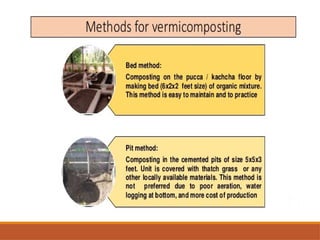
Vermicomposting
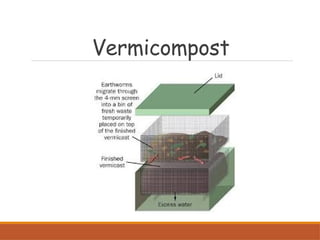
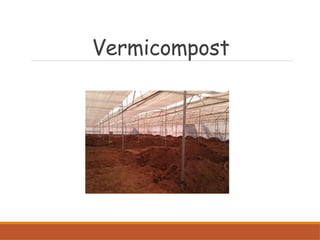
Vermicomposting is a method of preparing enriched compost with
the use of earthworms. It is one of the easiest methods to recycle
agricultural wastes and to produce quality compost.
Earthworms consume biomass and excrete it in digested form called
worm casts. Worm casts are popularly called as Black gold.
The casts are rich in nutrients, growth promoting substances,
beneficial soil micro flora and having properties of inhibiting
pathogenic microbes.
Contd..
Vermicompost is stable, fine granular organic
manure, which enriches soil quality by improving its
physicochemical and biological properties.
It is highly useful in raising seedlings and for crop
production.
Vermicompost is becoming popular as a major
component of organic farming system.
Vermicompost
Vermicompost
Next session
Culture of cleanliness (Swachh Bharat
Abhiyan), Role of habits and attitudes in
Environmental hygiene management, waste
and wastewater disposal

unit-1- 2 - challenges. waste management subject it is environmental sciences

  • 1.
    WASTE MANAGEMENT unit-1 Course Code:19AEU02I Google Class Code: 7v19v52 Prevailing scenario in EH-HR-2
  • 2.
  • 3.
  • 4.
    TOPICS TO BEDISCUSSED  challenges and work opportunities in the district, city and state in India.  Demonstration: vermicompost preparation
  • 5.
    challenges India faces massivewaste management challenges with rapid urbanisation,generating 62 million tons of municipal solid waste per annum. only 43 million tons(MT)of the waste is collected,11.9MT is treated and 31 MT is duped in landfill sites (government sources). Solid waste management (SWM)is one of the basic essential services to keep urban centres clean. Solid waste deposited haphazardly makes for a flawed system of waste disposal and management.
  • 6.
    The health perspective Urbanand peri-urban areas are characterized by poor sanitation conditions, indiscriminate dumping of wastes and open urination and defecation. These areas pollution and overcrowding create significant vulnerabilities for the overall urban population, particularly the poor Impact of poor sanitation and waste management:  environmental impact: polution of land and water resources.  visual impact: litter and bad odours.
  • 7.
    The health perspective(Contd..) Inadequatesanitation, allows for sewage or waste to flow directly into streams, rivers, lakes and wetlands, affecting coastal and marine ecosystems,fouling the environment and exposing millions of young people to disease.
  • 8.
    The health perspective(Contd..) Diarrhealdisease is one of the leading causes of morbidrary (illness) and mortality( death) in developing countries, especcially among children below five years. Climate can affect disease transmission in a variety of ways.
  • 9.
    The health perspective(Contd..) Humanexcreta have been implicated in the transmission of many infectious disease including cholera, typhoid, infectious hepatitis, polio, cryptosporidiosis and asciriasis. The distribution and population size of disease vectors can be heavily affected by local climate.
  • 10.
    For Better Environmental Hygiene Topromote better methods of environmental hygiene, sanitation and waste management, a number of international and national organisations have come together to observe specific days. World toilet day 19th november. Global hand-washing day 15th october. Menstrual hygiene day 28th may.
  • 11.
    Work opportunities inenvironmental hygiene, sanitation and waste management The fields of environmental health,sanitation and solid waste management are rife with opportunities. work opportunities are available at every level for commited and passionate people. Opportunities can be sought in a variety of enterprises including community management, recycling,and waste management. Today, waste is also available in volumes large enough to archieve the economy of scale,thus making waste management profitable.
  • 12.
    Contd.. The attention onsanitation and hygiene is subject to diverse political dispensation at various levels. In order to priortize sanitation at all levels of governance, the Swachh Bharat Mission is taking steps to make the journey competitive and progressive, with a fixed deadline in sight.
  • 13.
    Contd.. Leaders are requiredto various levels, from ward to city. They are huge opportunities to work with the over 4500 ULBs (Urban Local Bodies) with Swachh Bharat Mission and Swachh Survekshan,besides other agencies.
  • 14.
    Contd.. There is avast scope for innovative approaches in the field. Scientific and technological advancs have made it easier to deal it with waste than before. Self employment opportunities are plenty. Creativity and job-satisfaction are all assured in the fields of environmental hygiene, sanitation and waste management.
  • 15.
    Contd.. Talented and capableindividuals are working in the field of environmental hygiene,sanitation and waste management.
  • 16.
    Contd.. There are somestark examples of business houses which lok at their waste as an opportunity to recover material and at waste disposal as their social responsibility. Nevertheless, industries all over the world are waking up to the business opportunities in transforming waste to wealth.
  • 17.
    Vermicomposting Vermicomposting is amethod of preparing enriched compost with the use of earthworms. It is one of the easiest methods to recycle agricultural wastes and to produce quality compost. Earthworms consume biomass and excrete it in digested form called worm casts. Worm casts are popularly called as Black gold. The casts are rich in nutrients, growth promoting substances, beneficial soil micro flora and having properties of inhibiting pathogenic microbes.
  • 18.
    Contd.. Vermicompost is stable,fine granular organic manure, which enriches soil quality by improving its physicochemical and biological properties. It is highly useful in raising seedlings and for crop production. Vermicompost is becoming popular as a major component of organic farming system.
  • 20.
  • 21.
  • 22.
    Next session Culture ofcleanliness (Swachh Bharat Abhiyan), Role of habits and attitudes in Environmental hygiene management, waste and wastewater disposal