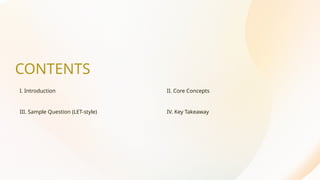
I. Introduction
1 “Understandingthe Self” is a general education subject in LET that explores
philosophical, psychological, social, and cultural views of the self.
2 Why important in LET? Because teachers must know how people grow, think,
and define themselves, so they can guide learners effectively.
4.
II. Core Concepts
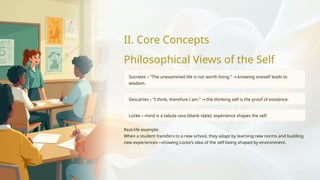
PhilosophicalViews of the Self
Socrates – “The unexamined life is not worth living.” knowing oneself leads to
→
wisdom.
Descartes – “I think, therefore I am.” the thinking self is the proof of existence.
→
Locke – mind is a tabula rasa (blank slate); experience shapes the self.
Real-life example:
When a student transfers to a new school, they adapt by learning new norms and building
new experiences—showing Locke’s idea of the self being shaped by environment.
5.
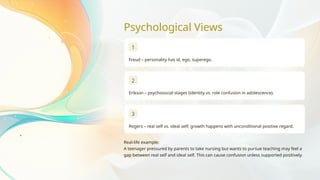
Psychological Views
1
Freud –personality has id, ego, superego.
2
Erikson – psychosocial stages (identity vs. role confusion in adolescence).
3
Rogers – real self vs. ideal self; growth happens with unconditional positive regard.
Real-life example:
A teenager pressured by parents to take nursing but wants to pursue teaching may feel a
gap between real self and ideal self. This can cause confusion unless supported positively.
6.
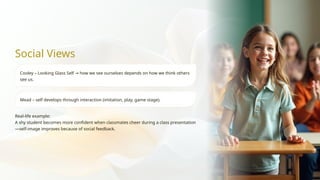
Social Views
Cooley –Looking Glass Self how we see ourselves depends on how we think others
→
see us.
Mead – self develops through interaction (imitation, play, game stage).
Real-life example:
A shy student becomes more confident when classmates cheer during a class presentation
—self-image improves because of social feedback.
7.
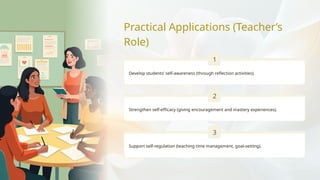
Practical Applications (Teacher’s
Role)
Developstudents’ self-awareness (through reflection activities).
Strengthen self-efficacy (giving encouragement and mastery experiences).
Support self-regulation (teaching time management, goal-setting).
1
2
3
8.
III. Sample Question(LET-style)
A student says: “I am nervous about my recitation because my classmates might think I’m not intelligent.”
This situation best illustrates:
A. Self-awareness
B. Looking-glass self
C. Self-regulation
D. Real self
✅ Answer: B. Looking-glass self
👉 Rationale: The student is worried about how others perceive them.
9.
IV. Key Takeaway
Understandingthe self is not just theory—it helps teachers guide learners to:
Know themselves better,
Accept their strengths and weaknesses, and
Grow into confident, self-regulated individuals.
1
2
3