Understanding
Your Tax
Professional
A O T A X P L A N N I N G T E A M
C L I E N T S E R V I C E S @ A O T A X . C O M
A O T A X . C O M
S Y E D H U S S A I N
Topics
• Why this topic and presentation?
• Who are the Tax Professionals?
• What your tax professional needs
from you?
• What do you need to do
regarding taxes?
• Tax Payers Bill of Rights
Why this topic and presentation
More than 78 million taxpayers paid someone to prepare their Tax Return’s in 2016.
Generally, anyone who prepares or assists in preparing a federal tax return for compensation
must have a Preparer Tax Identification Number (PTIN). They must sign in the paid
preparer's area of the return and give the taxpayer a copy of the return. Since 2012, anyone
who prepares and files 11 or more Forms 1040, 1040A, 1040EZ or 1041 during a calendar year
must use e-file.
Most tax return preparers provide outstanding service, but they have differing levels of
skills, education and expertise. Another important difference is their ability to represent
taxpayers before the Internal Revenue Service.
Representation rights, also known as practice rights, fall into two categories:
Unlimited and Limited Representation.
Return preparers with unlimited representation rights can represent their clients on any
matters including audits, payment/collection issues, and appeals. Those
with limited representation rights can only represent clients whose returns they prepared and
signed, but only before revenue agents, customer service representatives, and similar IRS
employees, including the Taxpayer Advocate Service.
Who are the Tax
Professionals.
What is an Enrolled Agent (EA)?
From National Association of Enrolled Agents:
Enrolled agents (EAs) are America's Tax Experts. EAs are the only federally licensed tax practitioners who
specialize in taxation and also have unlimited rights to represent taxpayers before the IRS.
From IRS:
An enrolled agent is a person who has earned the privilege of representing taxpayers before the Internal
Revenue Service by either passing a three-part comprehensive IRS test covering individual and business tax
returns, or through experience as a former IRS employee. Enrolled agent status is the highest credential the
IRS awards. Individuals who obtain this elite status must adhere to ethical standards and complete 72 hours of
continuing education courses every three years.
Enrolled agents, like attorneys and certified public accountants (CPAs), have unlimited practice rights. This
means they are unrestricted as to which taxpayers they can represent, what types of tax matters they can
handle, and which IRS offices they can represent clients before.
Tax
Information
Needed.
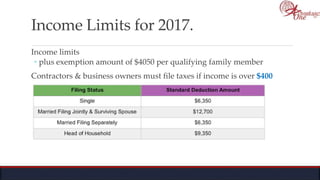
Income Limits for 2017.
Income limits
◦ plus exemption amount of $4050 per qualifying family member
Contractors & business owners must file taxes if income is over $400
Questions?
 Are you married?
 Can someone claim you as a dependent?
 Do you have any dependents and did they earn
any income, including investment income?
 Are you a Citizen/Resident or Non-resident?
 Are you an Employee or Contractor?
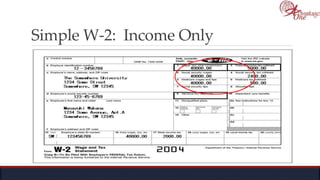
 Employee – Complete W-4 and receive W-2
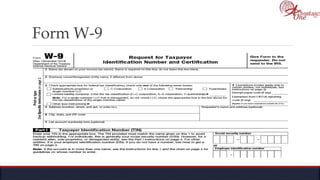
 Contractor – Complete W-9 and receive
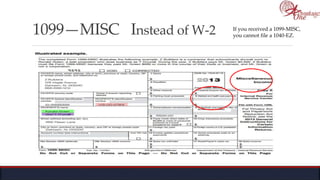
1099-MISC
Questions
 Did you pay any estimated
taxes?
 Are you a business owner?
 Other information
 Health insurance
 Home ownership
 Retirement savings (outside of
employers’ plans)
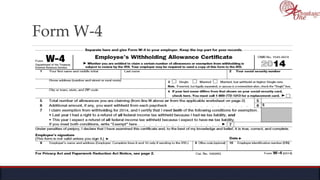
Form W-4
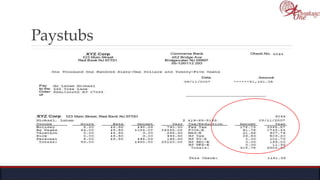
Paystubs
Simple W-2: Income Only
Form W-9
1099—MISC Instead of W-2 If you received a 1099-MISC,
you cannot file a 1040-EZ.
Tax Documents
 Income
 W-2 for wages
 1099-MISC and other revenues for
Business/Contractor
 SSA-1099 for Social Security Payments
 1099-R for pensions and IRA distributions
 Investments:
 1099-INT for bank and bond interest
 1099-DIV for dividends and some capital gains
 1099-B for stock sales (capital gains)
 Other income
 W-2G for gambling winnings
 1099-G for unemployment and state tax refunds
Tax Documents - Continued
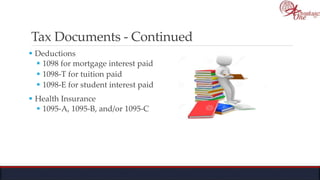
 Deductions
 1098 for mortgage interest paid
 1098-T for tuition paid
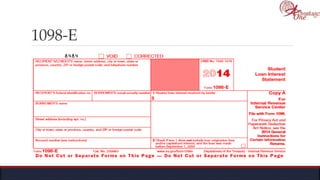
 1098-E for student interest paid
 Health Insurance
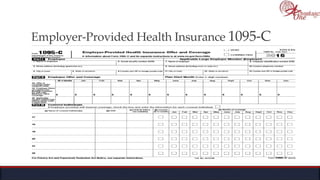
 1095-A, 1095-B, and/or 1095-C
1098-E
Employer-Provided Health Insurance 1095-C
Other Information
 Name, Address, Birthdate, Social Security Number,
Spouse (if married), & Dependents
 Real estate and excise tax paid
 Asset sales
 Home
 Art or other collectibles
 Childcare expenses
 Donations (with proof)
 Foreign bank account, business ownership, and other
assets
Tasks
For Everyone
 Tell the truth and do not withhold anything
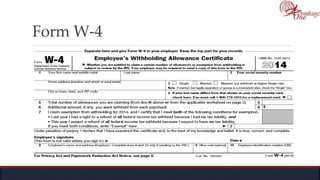
 Complete your W-4 correctly
 Tax Professional can help
 Keep records
 Check your tax return
 Ask questions
 Sign the return (spouse must also sign)
 Pay Estimated taxes if necessary
Form W-4
Record Keeping
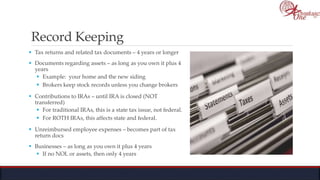
 Tax returns and related tax documents – 4 years or longer
 Documents regarding assets – as long as you own it plus 4
years
 Example: your home and the new siding
 Brokers keep stock records unless you change brokers
 Contributions to IRAs – until IRA is closed (NOT
transferred)
 For traditional IRAs, this is a state tax issue, not federal.
 For ROTH IRAs, this affects state and federal.
 Unreimbursed employee expenses – becomes part of tax
return docs
 Businesses – as long as you own it plus 4 years
 If no NOL or assets, then only 4 years
Record Keeping – Asset Example
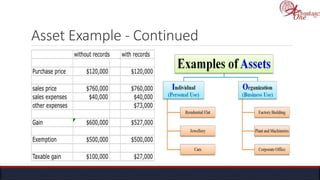
 Purchase home with spouse in June 1980 for
$120,000
 Sell home in 2017 for $760,000
 Gain of $640,000 but only $500,000 is exempt
 Expense to sell home $40,000 (realtor fees, etc)
 Invested in home
 2003 new roof for $6,000
 2006 new kitchen for $15,000
 1988 new tile flooring $7,000
 1996 new bathrooms $15,000
 1984 garage addition $30,000
Asset Example - Continued
For Everyone
 Tell the truth and do not withhold anything
 Complete your W-4 correctly
 Tax Professional can help
 Keep records
 Check your tax return – your responsibility even
if you hire a tax pro
 Ask questions
 Sign the return (spouse must also sign)
 Pay Estimated taxes if necessary
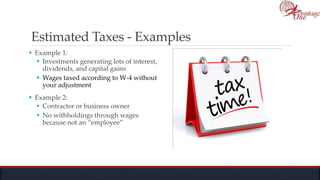
Estimated Taxes - Examples
 Example 1:
 Investments generating lots of interest,
dividends, and capital gains
 Wages taxed according to W-4 without
your adjustment
 Example 2:
 Contractor or business owner
 No withholdings through wages
because not an “employee”
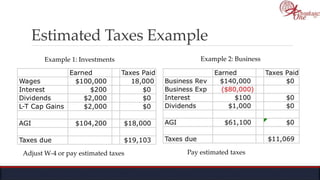
Estimated Taxes Example
Example 1: Investments Example 2: Business
Adjust W-4 or pay estimated taxes Pay estimated taxes
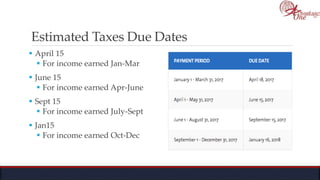
Estimated Taxes Due Dates
 April 15
 For income earned Jan-Mar
 June 15
 For income earned Apr-June
 Sept 15
 For income earned July-Sept
 Jan15
 For income earned Oct-Dec
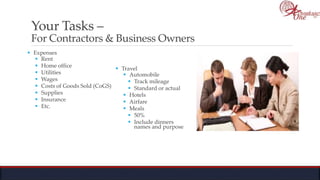
Your Tasks –
For Contractors & Business Owners
 Expenses
 Rent
 Home office
 Utilities
 Wages
 Costs of Goods Sold (CoGS)
 Supplies
 Insurance
 Etc.
 Travel
 Automobile
 Track mileage
 Standard or actual
 Hotels
 Airfare
 Meals
 50%
 Include dinners
names and purpose
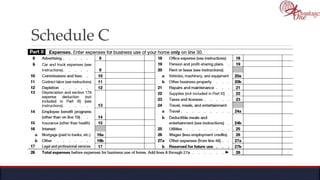
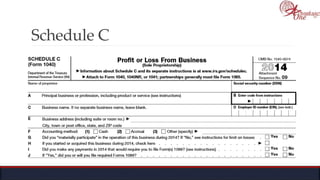
Schedule C
IRS – Tax Payers Bill of Rights
• The Right to Be Informed
• The Right to Quality Service
• The Right to Pay No More than the Correct Amount of Tax
• The Right to Challenge the IRS’s Position and Be Heard
• The Right to Appeal an IRS Decision in an Independent Forum
• The Right to Finality
• The Right to Privacy
• The Right to Confidentiality
• The Right to Retain Representation
• The Right to a Fair and Just Tax System
Back-up Slides
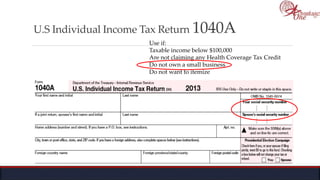
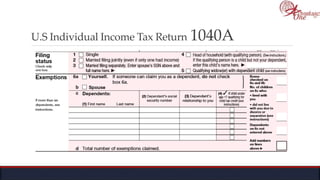
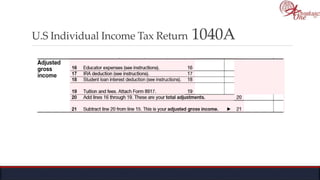
U.S Individual Income Tax Return 1040A
Use if:
Taxable income below $100,000
Are not claiming any Health Coverage Tax Credit
Do not own a small business
Do not want to itemize
U.S Individual Income Tax Return 1040A
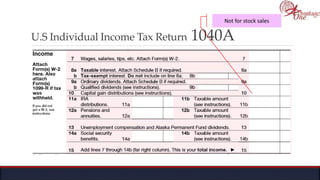
Not for stock sales
U.S Individual Income Tax Return 1040A
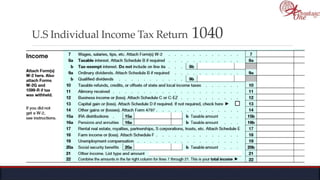
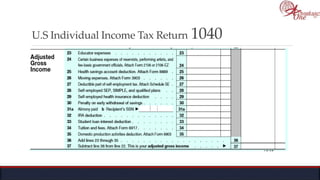
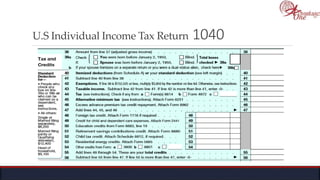
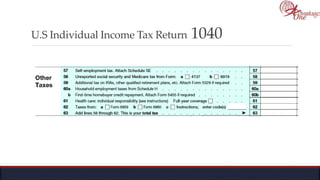
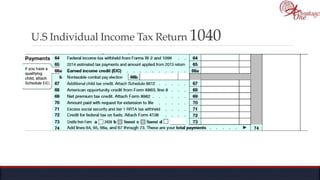
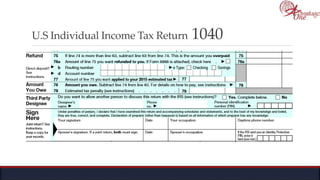
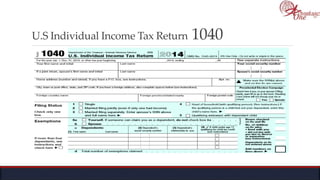
U.S Individual Income Tax Return 1040
Schedule C
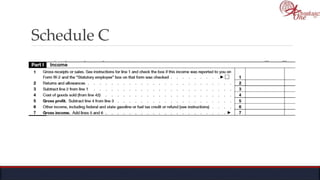
Schedule C
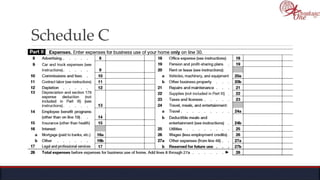
Schedule C
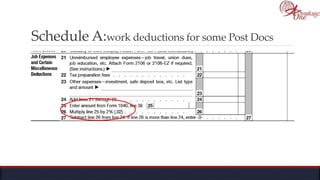
Schedule A:work deductions for some Post Docs
Healthcare Requirements
Must carry healthcare if you earn enough to file taxes
Gap of less than 3 months = no penalty
Syed Hussain
AO Tax Planning Team
Clientservices@aotax.com

Understanding your tax professional

  • 1.
    Understanding Your Tax Professional A OT A X P L A N N I N G T E A M C L I E N T S E R V I C E S @ A O T A X . C O M A O T A X . C O M S Y E D H U S S A I N
  • 2.
    Topics • Why thistopic and presentation? • Who are the Tax Professionals? • What your tax professional needs from you? • What do you need to do regarding taxes? • Tax Payers Bill of Rights
  • 3.
    Why this topicand presentation More than 78 million taxpayers paid someone to prepare their Tax Return’s in 2016. Generally, anyone who prepares or assists in preparing a federal tax return for compensation must have a Preparer Tax Identification Number (PTIN). They must sign in the paid preparer's area of the return and give the taxpayer a copy of the return. Since 2012, anyone who prepares and files 11 or more Forms 1040, 1040A, 1040EZ or 1041 during a calendar year must use e-file. Most tax return preparers provide outstanding service, but they have differing levels of skills, education and expertise. Another important difference is their ability to represent taxpayers before the Internal Revenue Service. Representation rights, also known as practice rights, fall into two categories: Unlimited and Limited Representation. Return preparers with unlimited representation rights can represent their clients on any matters including audits, payment/collection issues, and appeals. Those with limited representation rights can only represent clients whose returns they prepared and signed, but only before revenue agents, customer service representatives, and similar IRS employees, including the Taxpayer Advocate Service.
  • 4.
    Who are theTax Professionals.
  • 5.
    What is anEnrolled Agent (EA)? From National Association of Enrolled Agents: Enrolled agents (EAs) are America's Tax Experts. EAs are the only federally licensed tax practitioners who specialize in taxation and also have unlimited rights to represent taxpayers before the IRS. From IRS: An enrolled agent is a person who has earned the privilege of representing taxpayers before the Internal Revenue Service by either passing a three-part comprehensive IRS test covering individual and business tax returns, or through experience as a former IRS employee. Enrolled agent status is the highest credential the IRS awards. Individuals who obtain this elite status must adhere to ethical standards and complete 72 hours of continuing education courses every three years. Enrolled agents, like attorneys and certified public accountants (CPAs), have unlimited practice rights. This means they are unrestricted as to which taxpayers they can represent, what types of tax matters they can handle, and which IRS offices they can represent clients before.
  • 6.
  • 7.
    Income Limits for2017. Income limits ◦ plus exemption amount of $4050 per qualifying family member Contractors & business owners must file taxes if income is over $400
  • 8.
    Questions?  Are youmarried?  Can someone claim you as a dependent?  Do you have any dependents and did they earn any income, including investment income?  Are you a Citizen/Resident or Non-resident?  Are you an Employee or Contractor?  Employee – Complete W-4 and receive W-2  Contractor – Complete W-9 and receive 1099-MISC
  • 9.
    Questions  Did youpay any estimated taxes?  Are you a business owner?  Other information  Health insurance  Home ownership  Retirement savings (outside of employers’ plans)
  • 10.
  • 11.
  • 12.
  • 13.
  • 14.
    1099—MISC Instead ofW-2 If you received a 1099-MISC, you cannot file a 1040-EZ.
  • 15.
    Tax Documents  Income W-2 for wages  1099-MISC and other revenues for Business/Contractor  SSA-1099 for Social Security Payments  1099-R for pensions and IRA distributions  Investments:  1099-INT for bank and bond interest  1099-DIV for dividends and some capital gains  1099-B for stock sales (capital gains)  Other income  W-2G for gambling winnings  1099-G for unemployment and state tax refunds
  • 16.
    Tax Documents -Continued  Deductions  1098 for mortgage interest paid  1098-T for tuition paid  1098-E for student interest paid  Health Insurance  1095-A, 1095-B, and/or 1095-C
  • 17.
  • 18.
  • 19.
    Other Information  Name,Address, Birthdate, Social Security Number, Spouse (if married), & Dependents  Real estate and excise tax paid  Asset sales  Home  Art or other collectibles  Childcare expenses  Donations (with proof)  Foreign bank account, business ownership, and other assets
  • 20.
  • 21.
    For Everyone  Tellthe truth and do not withhold anything  Complete your W-4 correctly  Tax Professional can help  Keep records  Check your tax return  Ask questions  Sign the return (spouse must also sign)  Pay Estimated taxes if necessary
  • 22.
  • 23.
    Record Keeping  Taxreturns and related tax documents – 4 years or longer  Documents regarding assets – as long as you own it plus 4 years  Example: your home and the new siding  Brokers keep stock records unless you change brokers  Contributions to IRAs – until IRA is closed (NOT transferred)  For traditional IRAs, this is a state tax issue, not federal.  For ROTH IRAs, this affects state and federal.  Unreimbursed employee expenses – becomes part of tax return docs  Businesses – as long as you own it plus 4 years  If no NOL or assets, then only 4 years
  • 24.
    Record Keeping –Asset Example  Purchase home with spouse in June 1980 for $120,000  Sell home in 2017 for $760,000  Gain of $640,000 but only $500,000 is exempt  Expense to sell home $40,000 (realtor fees, etc)  Invested in home  2003 new roof for $6,000  2006 new kitchen for $15,000  1988 new tile flooring $7,000  1996 new bathrooms $15,000  1984 garage addition $30,000
  • 25.
    Asset Example -Continued
  • 26.
    For Everyone  Tellthe truth and do not withhold anything  Complete your W-4 correctly  Tax Professional can help  Keep records  Check your tax return – your responsibility even if you hire a tax pro  Ask questions  Sign the return (spouse must also sign)  Pay Estimated taxes if necessary
  • 27.
    Estimated Taxes -Examples  Example 1:  Investments generating lots of interest, dividends, and capital gains  Wages taxed according to W-4 without your adjustment  Example 2:  Contractor or business owner  No withholdings through wages because not an “employee”
  • 28.
    Estimated Taxes Example Example1: Investments Example 2: Business Adjust W-4 or pay estimated taxes Pay estimated taxes
  • 29.
    Estimated Taxes DueDates  April 15  For income earned Jan-Mar  June 15  For income earned Apr-June  Sept 15  For income earned July-Sept  Jan15  For income earned Oct-Dec
  • 30.
    Your Tasks – ForContractors & Business Owners  Expenses  Rent  Home office  Utilities  Wages  Costs of Goods Sold (CoGS)  Supplies  Insurance  Etc.  Travel  Automobile  Track mileage  Standard or actual  Hotels  Airfare  Meals  50%  Include dinners names and purpose
  • 31.
  • 32.
    IRS – TaxPayers Bill of Rights • The Right to Be Informed • The Right to Quality Service • The Right to Pay No More than the Correct Amount of Tax • The Right to Challenge the IRS’s Position and Be Heard • The Right to Appeal an IRS Decision in an Independent Forum • The Right to Finality • The Right to Privacy • The Right to Confidentiality • The Right to Retain Representation • The Right to a Fair and Just Tax System
  • 33.
  • 34.
    U.S Individual IncomeTax Return 1040A Use if: Taxable income below $100,000 Are not claiming any Health Coverage Tax Credit Do not own a small business Do not want to itemize
  • 35.
    U.S Individual IncomeTax Return 1040A
  • 36.
    U.S Individual IncomeTax Return 1040A Not for stock sales
  • 37.
    U.S Individual IncomeTax Return 1040A
  • 38.
    U.S Individual IncomeTax Return 1040
  • 39.
    U.S Individual IncomeTax Return 1040
  • 40.
    U.S Individual IncomeTax Return 1040
  • 41.
    U.S Individual IncomeTax Return 1040
  • 42.
    U.S Individual IncomeTax Return 1040
  • 43.
    U.S Individual IncomeTax Return 1040
  • 44.
    U.S Individual IncomeTax Return 1040
  • 45.
  • 46.
  • 47.
  • 48.
    Schedule A:work deductionsfor some Post Docs
  • 49.
    Healthcare Requirements Must carryhealthcare if you earn enough to file taxes Gap of less than 3 months = no penalty
  • 50.
    Syed Hussain AO TaxPlanning Team Clientservices@aotax.com