Undergraduate Mathematics For The Life Sciences
Models Processes And Directions Glenn Ledder
Timothy D Comar Jenna P Carpenter download
https://ebookbell.com/product/undergraduate-mathematics-for-the-
life-sciences-models-processes-and-directions-glenn-ledder-
timothy-d-comar-jenna-p-carpenter-42485470
Explore and download more ebooks at ebookbell.com
Here are some recommended products that we believe you will be
interested in. You can click the link to download.
Linear Algebra Gems Assets For Undergraduate Mathematics 1st Edition
Charles R Johnson Editor
https://ebookbell.com/product/linear-algebra-gems-assets-for-
undergraduate-mathematics-1st-edition-charles-r-johnson-
editor-42485168
The Lebesgue Integral For Undergraduates William Johnston
https://ebookbell.com/product/the-lebesgue-integral-for-
undergraduates-william-johnston-34618876
Linear Algebra Gems Assets For Undergraduate Mathematics David Carlson
https://ebookbell.com/product/linear-algebra-gems-assets-for-
undergraduate-mathematics-david-carlson-7185960
Mathematical Modeling For Epidemiology And Ecology Springer
Undergraduate Texts In Mathematics And Technology 2nd Ed 2nd Edition
Glenn Ledder
https://ebookbell.com/product/mathematical-modeling-for-epidemiology-
and-ecology-springer-undergraduate-texts-in-mathematics-and-
technology-2nd-ed-2nd-edition-glenn-ledder-49351600
An Introduction To Undergraduate Research In Computational And
Mathematical Biology From Birdsongs To Viscosities Foundations For
Undergraduate Research In Mathematics 1st Ed 2020 Hannah Callender
Highlander Editor
https://ebookbell.com/product/an-introduction-to-undergraduate-
research-in-computational-and-mathematical-biology-from-birdsongs-to-
viscosities-foundations-for-undergraduate-research-in-mathematics-1st-
ed-2020-hannah-callender-highlander-editor-11295208
Mathematics Volume 2 For Undergraduate Liberal Arts Universites 2
https://ebookbell.com/product/mathematics-volume-2-for-undergraduate-
liberal-arts-universites-2-47301560
Essential Mathematics For Undergraduates Simon G Chiossi
https://ebookbell.com/product/essential-mathematics-for-
undergraduates-simon-g-chiossi-38419974
Directions For Mathematics Research Experience For Undergraduates Mark
A Peterson
https://ebookbell.com/product/directions-for-mathematics-research-
experience-for-undergraduates-mark-a-peterson-5242556
Ants Bikes And Clocks Problem Solving For Undergraduates 2nd Edition
William Briggs
https://ebookbell.com/product/ants-bikes-and-clocks-problem-solving-
for-undergraduates-2nd-edition-william-briggs-2521706
Undergraduate Mathematics for the
Life Sciences
Models, Processes, and Directions
c
 2013 by
The Mathematical Association of America (Incorporated)
Library of Congress Control Number 2013942924
Print ISBN 978-0-88385-191-3
Electronic ISBN 978-1-61444-316-2
Printed in the United States of America
Current Printing (last digit):
10 9 8 7 6 5 4 3 2 1
Undergraduate Mathematics for the
Life Sciences
Models, Processes, and Directions
Edited by
Glenn Ledder
University of Nebraska-Lincoln
Jenna P. Carpenter
Louisiana Tech University
and
Timothy D. Comar
Benedictine University
Published and Distributed by
The Mathematical Association of America
The MAA Notes Series, started in 1982, addresses a broad range of topics and themes of interest to all who are involved with
undergraduate mathematics. The volumes in this series are readable, informative, and useful, and help the mathematical community
keep up with developments of importance to mathematics.
Council on Publications and Communications
Frank Farris, Chair
Committee on Books
Gerald Bryce, Chair
Notes Editorial Board
Stephen B Maurer and Michael K. May Co-Editors
Michael C. Axtell Anneke Bart
Deborah J. Bergstrand Thomas L. Drucker
Christopher L. Frenzen Louis M. Friedler
Hugh Howards Douglas E. Iannucci
Theresa Jeevanjee Elizabeth W. McMahon
MAA Notes
14. Mathematical Writing, by Donald E. Knuth, Tracy Larrabee, and Paul M. Roberts.
16. Using Writing to Teach Mathematics, Andrew Sterrett, Editor.
17. Priming the Calculus Pump: Innovations and Resources, Committee on Calculus Reform and the First Two Years, a subcomittee
of the Committee on the Undergraduate Program in Mathematics, Thomas W. Tucker, Editor.
18. Models for Undergraduate Research in Mathematics, Lester Senechal, Editor.
19. Visualization in Teaching and Learning Mathematics, Committee on Computers in Mathematics Education, Steve Cunningham
and Walter S. Zimmermann, Editors.
20. The Laboratory Approach to Teaching Calculus, L. Carl Leinbach et al., Editors.
21. Perspectives on Contemporary Statistics, David C. Hoaglin and David S. Moore, Editors.
22. Heeding the Call for Change: Suggestions for Curricular Action, Lynn A. Steen, Editor.
24. Symbolic Computation in Undergraduate Mathematics Education, Zaven A. Karian, Editor.
25. The Concept of Function: Aspects of Epistemology and Pedagogy, Guershon Harel and Ed Dubinsky, Editors.
26. Statistics for the Twenty-First Century, Florence and Sheldon Gordon, Editors.
27. Resources for Calculus Collection, Volume 1: Learning by Discovery: A Lab Manual for Calculus, Anita E. Solow, Editor.
28. Resources for Calculus Collection, Volume 2: Calculus Problems for a New Century, Robert Fraga, Editor.
29. Resources for Calculus Collection, Volume 3: Applications of Calculus, Philip Straffin, Editor.
30. Resources for Calculus Collection, Volume 4: Problems for Student Investigation, Michael B. Jackson and John R. Ramsay,
Editors.
31. Resources for Calculus Collection, Volume 5: Readings for Calculus, Underwood Dudley, Editor.
32. Essays in Humanistic Mathematics, Alvin White, Editor.
33. Research Issues in Undergraduate Mathematics Learning: Preliminary Analyses and Results, James J. Kaput and Ed Dubinsky,
Editors.
34. In Eves Circles, Joby Milo Anthony, Editor.
35. Youre the Professor, What Next? Ideas and Resources for Preparing College Teachers, The Committee on Preparation for
College Teaching, Bettye Anne Case, Editor.
36. Preparing for a New Calculus: Conference Proceedings, Anita E. Solow, Editor.
37. A Practical Guide to Cooperative Learning in Collegiate Mathematics, Nancy L. Hagelgans, Barbara E. Reynolds, SDS, Keith
Schwingendorf, Draga Vidakovic, Ed Dubinsky, Mazen Shahin, G. Joseph Wimbish, Jr.
38. Models That Work: Case Studies in Effective Undergraduate Mathematics Programs, Alan C. Tucker, Editor.
39. Calculus: The Dynamics of Change, CUPM Subcommittee on Calculus Reform and the First Two Years, A. Wayne Roberts,
Editor.
40. Vita Mathematica: Historical Research and Integration with Teaching, Ronald Calinger, Editor.
41. Geometry Turned On: Dynamic Software in Learning, Teaching, and Research, James R. King and Doris Schattschneider,
Editors.
42. Resources for Teaching Linear Algebra, David Carlson, Charles R. Johnson, David C. Lay, A. Duane Porter, Ann E. Watkins,
William Watkins, Editors.
43. Student Assessment in Calculus: A Report of the NSF Working Group on Assessment in Calculus, Alan Schoenfeld, Editor.
44. Readings in Cooperative Learning for Undergraduate Mathematics, Ed Dubinsky, David Mathews, and Barbara E. Reynolds,
Editors.
45. Confronting the Core Curriculum: Considering Change in the Undergraduate Mathematics Major, John A. Dossey, Editor.
46. Women in Mathematics: Scaling the Heights, Deborah Nolan, Editor.
47. Exemplary Programs in Introductory College Mathematics: Innovative Programs Using Technology, Susan Lenker, Editor.
48. Writing in the Teaching and Learning of Mathematics, John Meier and Thomas Rishel.
49. Assessment Practices in Undergraduate Mathematics, Bonnie Gold, Editor.
50. Revolutions in Differential Equations: Exploring ODEs with Modern Technology, Michael J. Kallaher, Editor.
51. Using History to Teach Mathematics: An International Perspective, Victor J. Katz, Editor.
52. Teaching Statistics: Resources for Undergraduate Instructors, Thomas L. Moore, Editor.
53. Geometry at Work: Papers in Applied Geometry, Catherine A. Gorini, Editor.
54. Teaching First: A Guide for New Mathematicians, Thomas W. Rishel.
55. Cooperative Learning in Undergraduate Mathematics: Issues That Matter and Strategies That Work, Elizabeth C. Rogers,
Barbara E. Reynolds, Neil A. Davidson, and Anthony D. Thomas, Editors.
56. Changing Calculus: A Report on Evaluation Efforts and National Impact from 1988 to 1998, Susan L. Ganter.
57. Learning to Teach and Teaching to Learn Mathematics: Resources for Professional Development, Matthew Delong and Dale
Winter.
58. Fractals, Graphics, and Mathematics Education, Benoit Mandelbrot and Michael Frame, Editors.
59. Linear Algebra Gems: Assets for Undergraduate Mathematics, David Carlson, Charles R. Johnson, David C. Lay, and A.
Duane Porter, Editors.
60. Innovations in Teaching Abstract Algebra, Allen C. Hibbard and Ellen J. Maycock, Editors.
61. Changing Core Mathematics, Chris Arney and Donald Small, Editors.
62. Achieving Quantitative Literacy: An Urgent Challenge for Higher Education, Lynn Arthur Steen.
64. Leading the Mathematical Sciences Department: A Resource for Chairs, Tina H. Straley, Marcia P. Sward, and Jon W. Scott,
Editors.
65. Innovations in Teaching Statistics, Joan B. Garfield, Editor.
66. Mathematics in Service to the Community: Concepts and models for service-learning in the mathematical sciences, Charles
R. Hadlock, Editor.
67. Innovative Approaches to Undergraduate Mathematics Courses Beyond Calculus, Richard J. Maher, Editor.
68. From Calculus to Computers: Using the last 200 years of mathematics history in the classroom, Amy Shell-Gellasch and Dick
Jardine, Editors.
69. A Fresh Start for Collegiate Mathematics: Rethinking the Courses below Calculus, Nancy Baxter Hastings, Editor.
70. Current Practices in Quantitative Literacy, Rick Gillman, Editor.
71. War Stories from Applied Math: Undergraduate Consultancy Projects, Robert Fraga, Editor.
72. Hands On History: A Resource for Teaching Mathematics, Amy Shell-Gellasch, Editor.
73. Making the Connection: Research and Teaching in Undergraduate Mathematics Education, Marilyn P. Carlson and Chris
Rasmussen, Editors.
74. Resources for Teaching Discrete Mathematics: Classroom Projects, History Modules, and Articles, Brian Hopkins, Editor.
75. The Moore Method: A Pathway to Learner-Centered Instruction, Charles A. Coppin, W. Ted Mahavier, E. Lee May, and G.
Edgar Parker.
76. The Beauty of Fractals: Six Different Views, Denny Gulick and Jon Scott, Editors.
77. Mathematical Time Capsules: Historical Modules for the Mathematics Classroom, Dick Jardine and Amy Shell-Gellasch,
Editors.
78. Recent Developments on Introducing a Historical Dimension in Mathematics Education, Victor J. Katz and Costas Tzanakis,
Editors.
79. Teaching Mathematics with Classroom Voting: With and Without Clickers, Kelly Cline and Holly Zullo, Editors.
80. Resources for Preparing Middle School Mathematics Teachers, Cheryl Beaver, Laurie Burton, Maria Fung, and Klay Kruczek,
Editors.
81. Undergraduate Mathematics for the Life Sciences: Models, Processes, and Directions, Glenn Ledder, Jenna P. Carpenter, and
Timothy D. Comar, Editors.
82. Applications of Mathematics in Economics, Warren Page, Editor.
MAA Service Center
P.O. Box 91112
Washington, DC 20090-1112
1-800-331-1MAA FAX: 1-301-206-9789
Foreword: Looking Backward and Moving
Forward in Undergraduate Life Science
Quantitative Education
It is a pleasure to read the contributions in this book, particularly since the importance of mathematics in biology has
only slowly been realized over the past several decades by the biological research and education community. When I
organized a Quantitative Sciences Curriculum for the Life Sciences Students workshop in 1992 for leading practitioners
of mathematical biology, there were few mathematics courses designed specifically for life science students and many
bench biologists were unconvinced of a need for quantitative education. Although I did not know it at the time,
several of the issues addressed in the 1992 and later workshops I organized had been the subject of the Cullowhee
Conference on Training in Biomathematics held in 1961 at Western Carolina University in Cullowhee, North Carolina,
and attended by many leading mathematical biologists. Issues addressed at the Cullowhee Conference still reverberate
today, including: “To what extent should mathematical courses given to biologists be different from those given to
mathematicians?” (H.D. Landahl) and “Traditional biology courses lay far too much emphasis on the direct acquisition
of information. Insufficient attention is given to the interpretation of facts or to the drawing of conclusions from
observation and experience.” (J. G. Skellam).
So have we learned anything in the fifty years since the Cullowhee Conference? This volume is a testament to a
resounding YES! Many model programs have been developed, curricular material has been assembled, biologists are
more attuned to the utility of quantitative approaches, and education research provides guidance on what works –
learning not training, research participation not canned labs, active learning and peer collaboration not listening
to lectures. We have moved beyond anecdotes to the science of science education. The diversity of models and
processes described in this book provides evidence of the need for alternative approaches to assist our students to
become “fearless biologists” in utilizing quantitative concepts and skills so that they can not only assimilate, but also
participate in modern biology.
Integrating quantitative perspectives throughout the undergraduate life science curriculum, a goal emphasized in
the 1992 Workshop, is still a work in progress. The host of reports since that time, including BIO2010 and Vision and
Change in Undergraduate Biology Education, all emphasize the benefits of an integrative, multi-disciplinary view of
modern biology with quantitative concepts and skills being a central component. This book provides evidence that
there is institutional variation in successful methods to ensure that exposure to quantitative topics for life science
students is not isolated in a few mathematics and statistics courses but are an integral part of the modern biologists’
tool-box. The developers of the examples presented here are to be lauded for their willingness to take an integrative
view of undergraduate biology education. The funding agencies that assisted them are to be encouraged by the progress
to date and urged to continue to support successful ventures in quantitative education for all our students.
Louis J. Gross
National Institute for Mathematical and Biological Synthesis
University of Tennessee, Knoxville
vii
Foreword: An Invitation to BIO SIGMAA
Although the history of mathematics and computation in biology began a long time ago, the history of this volume
begins with the formation of BIO SIGMAA. In January of 2006, Carl Cowan and Michael Pearson spoke with me about
the SIGMAAs of the MAA at the Joint Mathematics Meetings in San Antonio. Carl was President of the MAA at the
time and saw mathematical biology as an important growing area in mathematics and one that might benefit from the
SIGMAA program of the MAA. I had helped run several successful MAA PREP workshops related to mathematical
and computational biology and I suppose that put me on Carl’s list. I am also tall, which makes me easy to track down
in a crowded room.
Over the next few days, we spent time talking with other people we thought might be interested in being a part of
the SIGMAA. There was a great deal of support from people both more and less experienced than I. Somehow I found
myself organizing the effort, but I was really just collating the ideas of others. I finished the first draft of the charter in
April 2006 and after feedback, it was completed by July. In August 2006, BIO SIGMAA became the tenth SIGMAA.
Since biology can hardly be called a single field of study, mathematical and computational biology can be no less
diverse. It was important from the beginning to be as inclusive as possible, welcoming all areas of biology and all
approaches to understanding them. At the time the SIGMAA formed, there were several organizations promoting re-
search in mathematical and computational biology, but the connection to educational practices and undergraduate
research needed a broader platform and a bigger voice. BIO SIGMAA was created to strengthen the ties between
research and education and to provide a venue for sharing ideas.
From 2006 to now, many people have put in a great deal of effort into BIO SIGMAA and it has grown in both numbers
and maturity. This volume gives readers a taste of current educational practices in mathematical and computational
biology. It represents approaches taken or proposed in different areas of biology, different approaches to the study of
biology, and the relationship of these practices with different aspects of education.
There are many other ideas that did not fit into this volume and I feel sure new ideas will be motivated by those that
did. I encourage everyone to share those ideas at an upcoming BIO SIGMAA event.
Eric Marland, founding board member of BIO SIGMAA
Department of Mathematical Sciences
Appalachian State University
ix
Contents
Foreword: Looking Backward and Moving Forward in Undergraduate Life Science
Quantitative Education vii
Louis J. Gross
Foreword: An Invitation to BIO SIGMAA ix
Eric Marland
Preface xv
General Introduction xvii
Glenn Ledder
I Models 1
1 BioCalc at Illinois 5
J. Jerry Uhl and Judy Holdener
A one-semester biocalculus course at a large university, with emphasis on conceptual learning
facilitated by a computer algebra system
2 Biocalculus at Benedictine University 17
Timothy D. Comar
A two-semester biocalculus sequence at a small college
3 Implementation of First Year Biomath Courses at the Ohio State University 25
Laura Kubatko, Janet Best, Tony Nance, and Yuan Lou
A one-year sequence of biocalculus plus statistics at a large university
4 Teaching Calculus, Probability, and Statistics to Undergraduate Life Science Majors: A
Unified Approach 33
Frederick R. Adler
A one-year sequence of mixed topics designed for biology students
5 The First Year of Calculus and Statistics at Macalester College 39
Dan Flath, Tom Halverson, Danny Kaplan, and Karen Saxe
A redesigned introductory sequence for all students
6 Biology in Mathematics at the University of Richmond 45
Lester Caudill
A two-semester sequence with calculus and advanced topics
7 A Terminal Post-Calculus-I Mathematics Course for Biology Students 51
Glenn Ledder
Mathematical modeling, probability, and dynamical systems for students with a Calculus I
background
xi
xii Contents
8 Modeling Nature and the Nature of Modeling—an Integrative Modeling Approach 61
Claudia Neuhauser
Dynamical systems, partial differential equations, and stochastic processes for students with a
Calculus I background, with emphasis on modeling in Excel and Matlab
9 Mathematical Biology and Computational Algebra at the Sophomore Level 65
Rohan Attele and Dan Hrozencik
Computational linear algebra with student research projects
10 An Interdisciplinary Research Course in Theoretical Ecology for Young Undergraduates 69
Glenn Ledder, Brigitte Tenhumberg, and G. Travis Adams
A research-driven course focusing on connections between theoretical models and experimental data
11 An Interdisciplinary Course, Textbook, and Laboratory Manual in Biomathematics with
Emphasis on Current Biomedical Research 83
Raina Robeva, Robin Davies, and Michael L. Johnson
A special topics course on biomedical research
12 Teaching Bioinformatics in a Mathematics Department 89
Steven Deckelman
A mathematically-oriented bioinformatics program and its core capstone course
13 SYMBIOSIS: An Integration of Biology, Math and Statistics at the Freshman Level: Walking
Together Instead of on Opposite Sides of the Street 97
Karl H. Joplin, Edith Seier, Anant Godbole, Michel Helfgott, Istvan Karsai, Darrell Moore, and
Hugh A. Miller, III
A complex interdisciplinary freshman curriculum
II Processes 105
14 Science One: Integrating Mathematical Biology into a First-Year Program 109
Mark Mac Lean
Designing and maintaining a year-long team-taught interdisciplinary curriculum at a large institution
15 Planning for the Long Term 115
Meredith L. Greer
Retooling a course to meet changing needs and changing personnel
16 Some Lessons from Fifteen Years of Educational Initiatives at the Interface between
Mathematics and Biology: The Entry-Level Course 121
Louis J. Gross
Getting a department to embrace a course
17 A “Wet-Lab” Calculus for the Life Sciences 127
James L. Cornette, Gail B. Johnston, Ralph A. Ackerman, and Brin A. Keller
A cautionary tale about a project that died from lack of institutional support
18 Creating an Interdisciplinary Research Course in Mathematical Biology 133
Glenn Ledder and Brigitte Tenhumberg
Advice on creating interdisciplinary team-taught courses
Contents xiii
19 Bioinformatics: An Example of a Cooperative Learning Course 139
Namyong Lee and Ernest Boyd
A biology/mathematics/computer science course at a smaller MS-level institution
20 Integrating Statistics and General Biology I in a Learning Community 143
William Ardis and Sukanya Subramanian
Using learning communities to connect biology with statistics
21 Constructing an Undergraduate BioMath Curriculum at a Large University: Developing
First Year Biomath Courses at The Ohio State University 149
Tony Nance and Laura Kubatko
Curriculum reform at a very large institution
22 Initial Steps Towards an Integration of Qualitative Thinking into the Teaching of Biology at a
Large Public University 155
Carole L. Hom, Eric V. Leaver, and Martin Wilson
An introductory biological modeling course offered by a biology department
III Directions 165
23 Integrating Statistics into College Algebra to Meet the Needs of Biology Students 169
Sheldon P
. Gordon and Florence Gordon
A call for a college algebra course thought of as pre-statistics rather than pre-calculus
24 Motivating Calculus with Biology 177
Sebastian J. Schreiber
Ideas for introducing more biology and biological modeling into mathematics courses
25 Computational Systems Biology: Discrete Models of Gene Regulation Networks 189
Ana Martins, Paola Vera-Licona, and Reinhard Laubenbacher
Using Boolean network analysis to model complex systems in molecular biology
26 Creating Quantitative Biologists: The Immediate Future of SYMBIOSIS 201
Darrell Moore, Karl H. Joplin, Istvan Karsai, and Hugh A. Miller III
Making introductory biology courses that have more quantitative content and focus more on
biological thinking than biological facts
About the Editors 207
Preface
This volume contains twenty-six articles on mathematics pedagogy for life science students, representing twenty-two
institutions from large research universities to community colleges. While many of the articles discuss projects designed
to fit a particular niche at a particular institution, each emphasizes lessons learned that could be applied elsewhere. The
articles are sorted into three themes, Models, Processes, and Directions, as described in the General Introduction that
follows the table of contents, and in the editorial introductions to the three parts. Curricular development in mathematics
for biology is occurring at a variety of levels, including advanced undergraduate courses, interdisciplinary courses,
alternatives to the standard calculus sequence, and complete curricula. Articles in the Models and Processes sections
focus on curriculum projects on one of these levels. The division of the articles into two groups was motivated by the
observation, made by many of the authors, that successful innovation in mathematics pedagogy for biology requires
more than a good pedagogical idea. Several excellent projects have failed to become established because they could
not attract sufficient enrollment or have fallen into disuse because they could not be institutionalized. We wanted to
present them as outstanding models while addressing the reasons for their failure.
For the most part, articles in the Models section focus on the details of a curricular model, while articles in
the Processes section focus on the issues involved in implementation. Some articles were written as a pair, one in
each section, while others address both themes and were placed in whichever section seemed most appropriate; the
connections are noted in the general introduction and the editorial introductions. Articles in the Directions section
propose changes in emphasis and topic selection. We hoped to have articles on assessment of curricular projects as
well, but we were unable to find any assessment results that we thought were sufficiently robust and exemplary to
warrant inclusion as separate articles. A few of the articles contain assessment results, but there is clearly a need for
assessment of curriculum projects that is only beginning to be met.
Each article begins with a brief summary of the institution and the students involved in the project; where possible,
each indicates additional information accessible on the web. Other web resources can be found through the BIO
SIGMAA and Bioquest web sites.
Many of the curriculum projects discussed in this volume started as responses to the publication in 2003 of the
BIO2010 report of the National Academies. The report recommended improvements in the quantitative education of
research biologists. It received some criticism from a small number of biologists who believed (incorrectly, in my
opinion) that it was aimed primarily at medical research, but it was largely endorsed by biologists and thoroughly
embraced by mathematics educators. “All” that remained was to implement its recommendations.
The Mathematics Association of America (MAA) published Math and BIO2010, edited by Lynn Arthur Steen, in
2005. It consists primarily of essays with suggestions for mathematics curriculum reform, but has very few concrete
examples of successful programs. Simultaneously, a growing number of mathematics faculties began addressing
problems of curriculum reform for their own institutions, and some textbooks from these projects were published in
the first few years after BIO2010.
Mathematics curriculum development for biology expanded in 2006 with two developments. The first was that
the planners for the Joint Mathematics Meetings (JMM) of 2007 found themselves with three distinct proposals for
contributed paper sessions on mathematics education for biology. Two were consolidated, resulting in two distinct
sessions. One was organized by Elton Graves of Rose-Hulman Institute of Technology; I organized the other with Jack
Bookman, James Fulton, and Yajun Yang. The second development was the founding of the Biology Special Interest
Group of the MAA (BIO SIGMAA) by Eric Marland of Appalachian State University. I was among the people invited
by Eric to help form the group. I suggested that BIO SIGMAA’s first action should be to sponsor my contributed paper
session, which resulted in my selection as the first Program Director of BIO SIGMAA.
xv
xvi Preface
The mathematics-for-biology sessions at JMM 2007 were a great success. My session had so many contributors
that it had to be broken into three parts. Though some parts were scheduled at undesirable times, the talks were well
attended, with audiences ranging in size from twenty participants to more than fifty. The mathematics-for-biology
sessions also caught the interest of people involved in publishing. Shortly after JMM 2007, I received offers for
publications from PRIMUS1
editor Brian Winkel and MAA Notes editor Steve Maurer. After discussions with the
other JMM contributors, we arrived at a plan—I would edit a PRIMUS issue on ideas of small scope that could be
implemented within the context of an individual course, and Jenna Carpenter and Tim Comar would join me in editing
an MAA Notes volume on projects at the course and curriculum levels. The PRIMUS issue, published in January
2008, consisted of invited papers based on talks in my JMM session.
Jenna, Tim, and I planned this volume with help from Eric Marland. It was Eric who suggested that we should look
for articles that would describe curricular models, discuss the curriculum change process, and suggest directions for
the future. This led to the structuring of the volume in parts devoted to models, processes, and directions.
Some of the contributions for this volume were solicited from leaders in mathematics education for biology, but we
also wanted to cast a wide net. We used the BIO SIGMAA listserv to send out a call for papers. This brought us a
large number of proposals for articles, resulting in the twenty-six papers in this volume. The papers offer the reader a
wealth of accumulated experience.
It appears likely that mathematics curriculum development for biology students will affect an increasing number
of educational institutions. However, it is difficult to move from a good idea to an accepted course or curriculum.
Models that meet the needs of one institution may not work for others. New courses or curricula need to be tested and
refined at their own institution. For this reason, each article begins with a summary of the facts about the program and
the institution. To the reader who is struggling with mathematics curriculum development for biology students, these
articles offer an opportunity to make use of the experiences of those who have already faced the same challenges.
My co-editors and I want to acknowledge the valuable assistance of Steve Maurer and the team of reviewers that
read through the articles. They had a lot of work to do with the first draft, owing to the lack of experience of the volume
editors, but their critiques resulted in extensive changes for the better. While this volume has taken a long time to
reach print— because of the large number of people and revisions involved—the extra time has allowed many articles
to discuss how the projects changed over time. We hope that the information presented in this volume will inspire a
new generation of successful curriculum models.
Glenn Ledder
November, 2012
1 Problems, Resources, and Issues in Mathematics Undergraduate Studies
General Introduction
The mathematics curriculum as we know it grew out of the mathematical needs of physical science. We start with a full
course in calculus, which requires three semesters at most institutions. This is followed by courses in linear algebra,
differential equations, and calculus-based probability and statistics in some order. The latter subjects are the ones with
the broadest applications in biology, along with several discrete topics that do not occupy a place in the physics-based
mathematics curriculum. Biological applications in these courses have been rare until recently, but many authors are
now incorporating biological examples. There are some books in these traditional areas for life science students, but
there is no consensus mathematics curriculum for life science.
The standard biology curriculum includes very little mathematics, in spite of the development, beginning in the
1920s, of several important mathematical models for biology. The typical curriculum for biology majors includes just
one course in calculus and one in non-calculus-based statistics, and anything beyond two courses is rare.
The result of the gap between the extensive mathematics background that is beneficial to biologists and the minimal
mathematics background biology students acquire in their courses is an undergraduate education in biology with very
little quantitative content. Mathematics could be incorporated into biology courses such as genetics and ecology, but
this is difficult unless the biologist who teaches the course can count on students with the necessary mathematics
background.
The obvious answer, from a mathematician’s point of view, is for biology students to take the full calculus sequence
followed by courses in linear algebra, differential equations, and probability with statistics. There are two problems
with this answer. First, the courses contain almost no biology, being designed for the physical or social sciences. This
could be fixed without a major curriculum change. More serious is the problem of fitting these courses into a biology
student’s program. As it is, all biology students are essentially double majors, with enough courses in mathematics,
physics, and chemistry to encompass a major in general science, along with the major in biology. The addition of four
more mathematics courses is impractical, even for biology students who have the interest and aptitude.
In this volume, authors from a variety of institutions address some of the problems involved in reforming mathematics
curricula for biology students. The problems are sorted into three themes. We begin by examining curriculum Models.
It is straightforward for mathematicians to generate curriculum ideas for the training of mathematicians, but it is
more difficult to generate curriculum ideas for the training of biologists. A number of curriculum models have been
introduced at various institutions, and a selection of them comprise the Models section. The second theme is Processes.
Suppose we have created an outstanding course that clearly meets the needs of its students. This course amounts to
nothing unless it is institutionalized in both the biology department, as a curricular requirement, and in the mathematics
department, as a course that will be staffed even after the creator of the course is no longer on the faculty. The final
theme is Directions. Here we look to the future, with each paper laying out a case for pedagogical developments that
the authors would like to see.
There is some overlap between the Models and Processes themes. All of the Processes papers refer to some model,
although its role is sometimes peripheral. Many of the Models papers mention process issues as well. Some contributors,
such as Kubatko and Nance of Ohio State University, have pieces in both parts. Other papers were placed in whichever
part seemed to be the better fit, but for some this was almost arbitrary. The papers by MacLean, Lee and Boyd, and
Joplin et al combine almost equal doses of model and process; the first two appear in the Processes part and the last
one in the Models part.
xvii
I
Models
Introduction
One reason for the diversity of curriculum ideas for biology is that there are only a small number of slots, perhaps
only two or three, available in the packed curriculum of biology majors. A second reason is the lack of uniformity in
the biology curriculum that the mathematics curriculum is supposed to support. Physicists are generally in agreement
about what constitutes introductory learning in physics, which has led to a mathematics curriculum that varies little
among institutions, with no issues more serious than the order of linear algebra and differential equations. Biologists,
in contrast, have not yet reached a consensus on what constitutes introductory learning in biology. Accordingly, there
is no single mathematics curriculum for biology that can be applied in all institutions.
In the past decade, a number of approaches to the problem of replacing the standard calculus sequence with
something more appropriate for biologists have been made by mathematicians, with connections to various areas of
biology. This broad issue of mathematics curricula for lower-division biology students is addressed in eight of the
thirteen papers in the Modeling section, which fall into three classes.
The simplest approach, as seen in the first three papers, is to modify the courses that biology students are already
taking, but to leave them compatible with the standard sequence so that students can move between the traditional
physics-based and alternative biology-based courses. These three papers are arranged in order of increasing scope. We
begin with a paper by Jerry Uhl and Judy Holdener that describes a one-semester biocalculus course at the University
of Illinois that grew out of Jerry’s well-known Calculus with Mathematica project and features significant use of
a computer algebra system. Next is a paper by Tim Comar that describes the two-semester biocalculus sequence
at Benedictine University. The courses incorporate dynamical systems and biology applications into the standard
calculus sequence and also use computer laboratory projects. This group concludes with a paper by Laura Kubatko
and colleagues that describes a two-quarter sequence of biology-oriented calculus courses, along with a one-quarter
biology-oriented statistics course, at the Ohio State University. This group of papers offers a variety of options for
modifying the standard curriculum.
A second approach, also represented by three papers, is to create a biology-based curriculum that does not try to
be compatible with the standard curriculum. We can gain flexibility by diverging from the standard curriculum at
the beginning, but at the cost of immediate tracking of students. The three papers in this group illustrate the variety
that is made possible by abandoning the requirement of compatibility with standard courses. We have arranged these
papers in order of decreasing seniority, beginning with a paper by Fred Adler that describes the one-year mathematics-
for-biology curriculum he created at the University of Utah in the early 1990s. The Utah curriculum focuses on
dynamical systems and probability/statistics, packaged to be accessible to students who have not previously taken a
calculus course. Calculus topics are developed as needed. Next is a paper by several faculty at Macalester College that
describes their Applied Calculus and Statistical Modeling sequence. Do not be misled by the word “Applied.” Whereas
the title Applied Calculus normally is used for the brief treatments designed for business students and often foisted
on biology students, the Macalester Applied Calculus course is designed for students who have already had some
exposure to calculus. It begins with a treatment of functions and differential calculus and concludes with material on
differential equations and linear algebra. The Statistical Modeling course offers a calculus-based curriculum designed
around statistical problems in biology. In the final paper of this group, Lester Caudill describes the Scientific Calculus
sequence and a biomedical modeling course at the University of Richmond. The first semester in the Scientific Calculus
sequence adds modeling, regression, and multivariable optimization to a first-semester calculus core, while the second
semester focuses on probability, Taylor series, and dynamical systems. The third course focuses on modeling and
dynamical systems. Having a third course makes it possible for the Richmond curriculum to retain more topics from
3
4 Introduction
standard calculus than the other projects in this group. Readers interested in full-year freshman curricula will also
want to look at the article by Lou Gross in the Processes section of this volume.
Recently, there has been some interest in the intermediate strategy of a standard-curriculum-compatible one-semester
calculus course followed by a terminal one-semester course designed for biology students. This approach offers more
flexibility than the first approach without the immediate tracking of the second. In the first paper of this group, I describe
the Mathematical Methods for Biology and Medicine course that I created at the University of Nebraska. It begins
with basics of mathematical modeling, with a focus on working with parameters and fitting data to models, before
turning to probability distributions and concluding with dynamical systems. In the second paper of this group, Claudia
Neuhauser describes a course at the University of Minnesota called Modeling Nature and the Nature of Modeling.
This course focuses on discrete and continuous dynamical systems before turning to some partial differential equation
models and stochastic processes, with an emphasis on computer modeling in Excel and Matlab.
The remaining papers in the Models section concern projects that fill specific niches identified at their institutions.
Each is highly interdisciplinary and taught by a team that includes life science and mathematics faculty. Many include
student research. Three focus on topics that do not normally appear in the mathematics curriculum and one encompasses
basic biology as well as basic mathematics. They are examples of creative curriculum development in mathematical
biology.
The papers by Rohan Attele and Dan Hrozencik of Chicago State University and by Glenn Ledder, Brigitte
Tenhumberg, and Travis Adams of the University of Nebraska describe two approaches to designing a course based
more on research than on specific content. Attele and Hrozencik describe a sophomore-level course in which students
learn computational linear algebra and matrix population models before studying molecular evolution and phylogenetic
trees. Students work in interdisciplinary teams on a research problem in population demographics. Ledder, Tenhumberg,
and Adams describe a pre-college or freshman-level course centered on a research project in theoretical ecology. The
students collect data on rates of aphid birth, growth, and death, which they use to parameterize a matrix model of aphid
population growth. Another experiment collects population data used to test the predictions of the model. The lecture
portion of the course supplements the laboratory portion by teaching students the methods and concepts needed for
modeling and data analysis.
The next paper, by Raina Robeva, Robin Davies, and Michael Johnson, describes a Biomathematics course taught
at Sweet Briar College by a team of one mathematician and one biologist to mathematics and biology majors who have
taken courses in calculus, statistics, and general biology. The course employs mathematical methods to treat problems
chosen for their biological content. These include Boolean network analysis, a topic that is nicely described in a paper
by Martins, Vera-Licona, and Laubenbacher that appears in the Directions section of this volume.
In the next paper of the Models section, Steven Deckelman describes the bioinformatics program of the mathematics
department at the University of Wisconsin-Stout. It is built from courses in computer science, biology, chemistry, and
mathematics, and features a capstone course called Mathematical and Computational Foundations of Bioinformatics.
The final paper in the Models section describes an integrated year-long freshman sequence at East Tennessee
State University that is equivalent to one statistics course, one calculus course, and three biology courses. The reader
interested in interdisciplinary courses should also look at the paper by Mark MacLean in the Processes section.
The thirteen papers in the Models section do not provide a comprehensive listing of curriculum projects in math-
ematics for biology students, but they do contain a rich variety of projects that represent solutions to pedagogical
problems that are partly general and partly dependent on the institutional setting. Readers who do not find a model
here that they can adapt to their institution will at least find elements to incorporate into their own innovative model.
Three additional papers in the Processes section (one by Lee and Boyd, one by Ardis and Subramanian, and one by
Hom, Leaver, and Wilson) also contain significant descriptions of curriculum models.
1
BioCalc at Illinois
J. Jerry Uhl
Department of Mathematics, University of Illinois-Urbana
Judy Holdener1
Department of Mathematics, Kenyon College
Name of Institution University of Illinois-Urbana
Size 28000 undergraduates and 9000 graduate students
Institution Type large state university with PhD program
Student Demographic recent high school graduates with high potential and interests in
mathematics and/or biology
Department Structure Mathematics and Biology are individual departments in the College
of Arts and Sciences
Abstract
BioCalc is a Mathematica-driven calculus course for life science students. It has been taught at the University of
Illinois since the fall of 1993. In this article we describe how the course came to be, how it is structured, and how it
differs from other calculus courses. We also provide a sample of the electronic notebooks used in the course. Finally,
we report on some of BioCalc’s successes.
1.1 Course Structure
r Weeks per term: 15-week semester
r Classes per week/type/length: One or two 1-hour lecture periods
r Labs per week/length: Three or four 1-hour laboratory periods
1 holdenerj@kenyon.edu
5
6 Chapter 1 BioCalc at Illinois
r Average class size: Sections are capped at 20.
r Enrollment requirements: First-year students in the biological sciences. Students cannot enroll unless they are
life science majors.
r Faculty/dept per class, TAs: Typically taught by a graduate TA in mathematics or sometimes a faculty member.
There is also one undergraduate class assistant.
r Next course: Life science majors must take two of Calculus I, Calculus II, and Statistics, so some continue on to
Calculus II.
r Website: http://www-cm.math.uiuc.edu/
1.2 Introduction
In the late 1980s at Illinois, our Illinois-Ohio State group developed a Mathematica-based calculus course now offered
at Illinois. By the early 1990s, the Mathematica-based calculus sequence Calculus  Mathematica (CM) (Uhl et al.,
2006) had been class-tested and revised. In this revision, we decided to place heavy emphasis on life science models
because our vision of calculus had become that it is the study and measurement of growth. This led the way to an
emphasis on teaching calculus with life science models. After all, what grows? Animals, populations, and epidemics
do. As our course evolved, we could see that many students from a variety of fields, including engineering, identified
better with the life science models than they did with the physics examples that are typically used in a calculus course.
At that point a fortuitous event occurred . . .
Professor Sandra Lazarowitz of the School of Life Sciences at Illinois called one of us and said that the standard
calculus course was not connecting with the life science students, who were not interested in computing the work
done by a force or the position of a projectile. The engineering emphasis in calculus sent the signal that it had little to
do with their future careers in the biological sciences. As evidence of the disconnect, Professor Lazarowitz said that
approximately 60% of the life science majors enrolled in the traditional Calculus I course were receiving a grade of C
or lower in the course. It is a common misconception that life science students are weak in mathematics. We told her
we were working on a calculus course that might be better suited for her life science students.
In the fall of 1993, two Calculus  Mathematica sections were reserved for life science students. The pilot sections
were small (approximately 16 students each) and were taught by graduate teaching assistants Judy Holdener and Bill
Hammock in a computer lab located within the Life Sciences building.2
The ACT scores of the students suggested
that they would be at risk in traditional calculus, and many of the students had a high degree of math phobia. Despite
these disadvantages, the students flourished in the experimental CM sections. Professor Lazarowitz, who was also
the Director of the Howard Hughes Program for Undergraduate Education in the Life Sciences at Illinois, happily
reported “first year life science students [in Calculus  Mathematica sections] are studying mathematical models
normally reserved for senior math majors, and student responses have been enthusiastic.” She was encouraged by the
success rate, reporting that life science students who would likely have dropped a traditional offering of calculus were
able to earn As with the new approach. As a result of the success of the pilot sections, the Department of Mathematics
and the School of Life Sciences entered into an agreement to call the course “BioCalc” and to make it a permanent
offering for life science students.
After seventeen years, life science students continue to flourish in BioCalc. Using university records, staff at the
Howard Hughes Medical Institute assessed the course in April of 2001 and cited the following conclusions in their
report on the course (Fahrbach et al., 2001):
r The BioCalc course is equally attractive to life sciences students required to take Math 120 (the standard calculus
course at Illinois). No life sciences option is over- or underrepresented.
r BioCalc students are as well prepared for Math 130 (the second calculus course in the standardsequence) as
non-BioCalc students, as judged by the grade obtained in Math 130.
2 This lab was funded by the Howard Hughes Medical Institute (HHMI).
1.3 The Differences between BioCalc and the Standard Calculus Course 7
r BioCalc students are roughly twice as likely to take an additional math course than non-BioCalc students.
r BioCalc students (80.4%) are slightly more likely to remain in a biological science major than non-BioCalc
students (76.7%).
r CalcPrime successfully prepares for BioCalc those students who do not place into Math 120.3
1.3 The Differences between BioCalc and the Standard Calculus Course
So what is it that makes BioCalc so different from the traditional offering of calculus? Here are some differences:
Greater emphasis on applications and life science models in particular.
One of the biggest reasons for the success of BioCalc is its emphasis on life science models that reveal the relevance
of calculus and reinforce the meaning of the derivative. There are exercises examining the decay of cocaine in the
blood, models describing the spread of a disease, and data analyses investigating the correlation between cigarette
smoking and lung cancer. Students examine data relating to the U.S. and world populations, the U.S. national debt,
and the number of a space shuttle’s O-ring failures. They compute the optimal speed of a salmon swimming up a
river, and they model the growth rates of an animal’s height and weight over time. (See the next section.) In BioCalc,
life science students get enough experience to see for themselves that calculus plays a role in their lives and in
their planned careers. One BioCalc student put it this way: “What we learned applies in our classes and in our
lives.”
Greater emphasis on visualization.
The authors of the electronic notebooks used in BioCalc have gone to great lengths to help the student learn visually.
The “textbook” is a sequence of interactive electronic notebooks that introduce new ideas using graphic examples
and geometric interpretations. By working through the notebooks, students experience mathematics at their own pace
by seeing it happen and making it happen. The graphics offered by Mathematica allow students to create the mental
images necessary to understand calculus—images that students won’t always be able to create for themselves.
Less emphasis on mathematical language and proof but more emphasis on conceptual explanation.
Students in introductory calculus sometimes find the language of mathematics (i.e., the symbols and technical ter-
minology) to be impenetrable, but among life science students the language barrier tends to be endemic. BioCalc
circumvents the problem by using graphics and applications as the entry points for new material. Formal definitions
and notation are introduced only after students internalize the ideas. Because most introductory calculus students will
not choose careers involving the writing of mathematical proofs, BioCalc places a lesser emphasis on the writing of
formal proofs and a greater emphasis on the use of calculus as a tool for solving problems.
Greater emphasis on writing and communication.
Although BioCalc places less emphasis on the writing of formal proofs, it places on a greater emphasis on writing. The
electronic notebooks include numerous exercises that require students to describe what they see on the computer screen
and to analyze what is happening. The students use their own words, and the writing solidifies their understanding of
the material.
Studying the comprehensive group of models offered by BioCalc is possible only because of the computational and
graphical power offered by Mathematica. Students regard Mathematica as a professional tool, and they are delighted
to use it because most of them arrived in BioCalc knowing their hand computation skills were not at the level required
for success in a standard calculus course.
3 CalcPrime is a three-week transitional summer program for entering students at Illinois who underperform on the placement exam for MATH
120. CalcPrime students have lower Math ACT scores than other BioCalc students, and they are more likely to be non-Caucasian-American.
8 Chapter 1 BioCalc at Illinois
1.4 The Format of BioCalc
So how are the BioCalc lessons structured and what exactly do students do in and out of class? The “textbook” is
electronic, consisting of a series of interactive Mathematica notebooks, and students learn calculus by working through
tutorial problems, experimenting with built-in Mathematica routines, and explaining graphical and computational
output. Each lesson follows the same format, with four components:
r The Basics section introduces the fundamental ideas in the lesson by presenting problems and explanations, often
visual in nature. Students are encouraged to experiment with the problems by changing functions and numbers
and rerunning the Mathematica code. Many of the problems prompt students to make conjectures about the
patterns they observe in the computer output.
r The Tutorial section, like the Basics section, presents problems for the student, but the focus is on techniques and
applications that relate to the ideas presented in the Basics section.
r The Give it a Try section is the heart of the course, providing a list of problems to be solved and submitted
(electronically) by the student. Like the Tutorial section, problems are often application-based, incorporating
models from the life sciences. Information needed to solve the problems is found in the Basics and Tutorial
sections.
r The Literacy Sheets present problems to be worked out with paper and pencil. This section is completed after the
student has already completed the electronic portions of the lesson.
Although the format may vary with the instructor, most BioCalc lessons are conducted in a computer lab. On a
typical lab day, students work through the electronic notebooks at their own pace, asking questions of the instructor
as needed. On every third or fourth session, the class meets in a standard classroom for a traditional chalkboard
discussion. Students are graded on the electronic work they complete (in the Give it a Try section of the lesson) and
the written work they do on the Literacy Sheets. Exams generally have both a written component and a computer
component.
1.5 BioCalc Sampler
In this final section, we reveal the flavor of BioCalc’s electronic lessons by examining BioCalc’s coverage of the chain
rule. The chain rule is often associated with hand computation in calculus, but BioCalc students learn it in parallel with
constructing height and weight functions to model the growth of animals over time. We will illustrate below, starting
with the first mention of the chain rule. (Incidentally, BioCalc does not allow students to rely on the computer for the
computation of derivatives, among other things. A basic literacy is expected of the students.)
In introducing the chain rule, the Basics section starts by encouraging students to look for patterns in the derivatives
of compositions of functions. What follows is taken directly from the electronic notebook covering the differentiation
rules. Mathematica syntax is in bold (the code has not been executed).
- - - -
B.2) The chain rule: D[f[g[x]],x]=(f
)[g[x]] (g
)[x]
Let’s check out the derivative of the composition of two functions.
Here is the derivative of Sin[xˆ2]:
Clear[f,x];
f[x ]=Sin[xˆ2]; (f
)[x]
Or
D[Sin[xˆ2], x]
This catches your eye because the derivative of Sin[x] is Cos[x] and the derivative of xˆ2 is 2x. It seems that the
derivative of Sin[xˆ2] is manufactured from the derivative of Sin[x] and the derivative of xˆ2. Here is the derivative
of (xˆ2+ Sin[x])ˆ8:
1.5 BioCalc Sampler 9
D[(xˆ2+Sin[x])ˆ8, x]
This catches your eye because the derivative of xˆ8 is 8 xˆ7 and the derivative of xˆ2+Sin[x] is 2x+Cos[x]. It seems
that the derivative of (xˆ2+ Sin[x])ˆ8 is manufactured from the derivative of xˆ8, the derivative of Sin[x], and the
derivative of xˆ2. Here is the derivative of f[g[x]]:
Clear[f,g]; D[f[g[x]],x]
Very interesting and of undeniable importance. This formula, which says that the derivative of h[x]=f[g[x]] is
h
[x]=f
[g[x]] g
[x], is called the chain rule. Do a check:
Clear[f,g,x];
D[f[g[x]], x]==f
[g[x]]g
[x]
The chain rule tells you how to build the derivative of f[g[x]] from the derivatives of f[x] and g[x]. Here is the chain
rule in action:
If h[x]=Sin[xˆ2], then h
[x]=Cos[xˆ2] 2 x in accordance with:
D[Sin[xˆ2], x]
And if h[x]=(xˆ2+ Sin[x])ˆ8, then h
[x]=(8 (xˆ2+ Sin[x]))ˆ7 (2 x+ Cos[x]) in accordance with:
D[(xˆ2+Sin[x])ˆ8, x]
B.2.a) Give an explanation of why the derivative of f[g[x]] is f
[g[x]] g
[x].
Answer: Put h[x]=f[g[x]].
Recall that h[x] grows h
[x] times as fast as x.
But
 f[g[x]] grows f
[g[x]] times as fast as g[x]
 g[x] grows g
[x] times as fast as x.
As a result, f[g[x]] grows f
[g[x]] g
[x] times as fast as x.
This explains why the instantaneous growth rate of f[g[x]] is f
[g[x]] g
[x].
In other words, the derivative of f[g[x]] with respect to x is f
[g[x]] g
[x].
This rule is called the chain rule, and it is important.
- - - -
After presenting this explanation of the chain rule, the Basics section continues with more examples, presenting the
derivatives of sin(5x), sin(x4
), (g(x))3
, f (x3
y2
) (with respect to y), and (ex
–x2
)7
.
Later in the Tutorial section, the students examine the effects of scaling on surface area and volume and use the
chain rule to explain why the instantaneous percentage growth rate of the weight of a Bernese Mountain Dog is three
times the instantaneous percentage growth rate of the height. In the excerpt of the electronic textbook that follows, the
only Mathematica output included are the plots. The rest of the output is excluded for the sake of space.
- - - -
T.3) Linear dimension: length, area, volume and weight
The volume measurement, V[r], and the surface area measurement, S[r], of a sphere of radius r are given by
V[r]=(4 [Pi] rˆ3)/3
S[r]=4 [Pi] rˆ2.
This says that V[r] is proportional to rˆ3 and S[r] is proportional to rˆ2.
For other three-dimensional objects, the formulas for volume and surface area are not so easy to come by, but the
idea of proportionality survives. Here is the idea: A linear dimension of a given solid or shape is any length between
specified locations on the solid. The radius of a sphere or the radius of a circle is a linear dimension. The total length
of a solid, the total width, and the total height of a solid are examples of linear dimensions. The diameter of the
finger loop on a coffee cup is a linear dimension of the cup.
10 Chapter 1 BioCalc at Illinois
Next take a given shape for a solid. If it stays the same but the linear dimensions change, then it is still true that the
volume is proportional to the cube of any linear dimension and it is still true that the surface area is proportional to
the square of any linear dimension.
Here is a shape in the x-y plane and the same shape with its linear dimensions increased by a factor of 3:
T.3.a) How does the area measurement of the larger blob above compare to the area measurement of the smaller
blob?
Answer: Both are the same shape, but the linear dimensions of the larger blob are three times the linear dimensions
of the smaller blob. The upshot: The area measurement of the larger blob is 3ˆ2=9 times the area of the smaller
blob.
T.3.b) The idea of linear dimension leads to some intriguing biological implications. A giant mouse with linear
dimension ten times larger than the usual mouse would not be viable because the volume of its body would be
larger than the volume of the usual mouse by a factor of 10ˆ3, but the surface area of some of its critical supporting
organs like lungs, intestines and skin would be larger only by a factor of 10ˆ2. That big mouse would be hungry and
out of breath at all times! Similarly, there will never be a 12-foot-tall basketball player at Indiana or even at Duke.
The approximate size of an adult mammal is dictated by its shape! The same common sense applies to buildings
and other structures. An architect or engineer does not design a 200-foot-tall building by taking a design for a
20-foot-tall building and multiplying all the linear dimensions by 10. Now it’s time for a calculation.
A crystal grows in such a way that all the linear dimensions increase by 25%. How do the new surface area and new
volume compare to the old surface area and volume?
Answer:
Clear[newsurfacearea,oldsurfacearea];
newsurfacearea = 1.25ˆ2 oldsurfacearea
An increase of the linear dimensions by 25% increases the surface area by about 56%.
The percentage increase in volume is:
Clear[newvolume,oldvolume];
newvolume = 1.25ˆ3 oldvolume
An increase of the linear dimensions by 25% increases the volume by about 95%.
T.3.c.i) Calculus  Mathematica thanks Ruth Reynolds, owner of Pioneer Bernese Mountain Dog Kennel in
Greenwood, Florida, for the data used in this problem.
Dogs and other animals grow so that a linear dimension of their bodies is given by what a lot of folks call a logistic
function (b c eˆ(a t))/(b - c + c eˆ(a t)) , where t measures time in years elapsed since the birth of the animal. A good
linear dimension for a dog is the height of the dog’s body at the dog’s shoulders:
Clear[height,a,b,c,t];
height[t ]=(b c Eˆ(a t))/(b-c+c Eˆ(a t))
1.5 BioCalc Sampler 11
To see what the parameters a, b, and c mean, look at:
height[0]
This tells you that c measures the dog’s height at birth. The global scale of height[t]=(b c eˆ(a t))/(b - c +c eˆ(a t)) is
(b c eˆ(a t) eˆ(a t))/c=b. This tells you that b measures the dog’s mature height. For a typically magnificent Bernese
Mountain Dog, as owned by the actor Robert Redford, b=24 inches and c=4.5 inches; so for the Bernese Mountain
Dog, height[t] is:
b=24.0;
c=4.5;
height[t]
The parameter a is related to how fast the dog grows. At one year, a typical Bernese Mountain Dog has achieved
about 95% of its mature height. This gives you an equation to solve to get a:
equation=height[1]==0.95 (24.0)
Solve[equation,a]
Now you’ve got the height function for the typical Bernese Mountain Dog:
a=4.41078;
height[t]
Here’s a plot:
heightplot = Plot[{height[t],b,c},{t,0,2},PlotStyle-
{{Thickness[0.01]},{Brown},{Brown}},PlotRange-All,AxesLabel-
{t,height[t]}]
Looks OK.
Given that the typical mature Bernese Mountain Dog as described above weighs 85 pounds, give an approximate
plot of the dog’s weight as a function of time for the first three years and give a critique of the plot.
Answer: If you assume the dog maintains the same shape throughout the growing process, then you can say:
 weight[t] is proportional to the volume of the dog’s body at time t and
 the volume of the dog’s body at time t is proportional to height[t]ˆ3. So
weight[t] =k (height[t])ˆ3 =k ((b c eˆ(a t))/(b - c + c eˆ(a t)))ˆ3.
The global scale of weight[t] is k ((b c eˆ(a t))/(c eˆ(a t)))ˆ3=k bˆ3. For the typical Bernese Mountain Dog under
study here, k is given by:
Solve[85==bˆ3 k,k]
12 Chapter 1 BioCalc at Illinois
The weight of the typical Bernese Mountain Dog under study here t years after her birth is:
Clear[weight];
weight[t ] = 0.00614873 height[t]ˆ3
Here comes a plot:
weightplot = Plot[{weight[t],85},{t,0,2},PlotStyle-
{{Thickness[0.01]},{Brown},{Brown}},PlotRange-All,AxesLabel-
{t,weight[t]}]
See the height plot and the weight plot side by side:
Show[GraphicsArray[{heightplot,weightplot}]]
Somewhat interesting.
Now comes the bad news: The dogs do not maintain the same shape throughout their growing years; they maintain
only approximately the same shape as they grow.
The upshot: The weight plot should be regarded only as an approximation of the true story. One way to check it is
to see what it predicts the birth weight of a Bernese Mountain Dog pup is:
weight[0]
In ounces:
weight[0] 16
Not bad. The typical birth weight of a Bernese Mountain Dog pup is 14 to 20 ounces. The approximation above is
off, but not by very much.
T.3.c.ii) Here are plots of the instantaneous growth rates of the weight and height of the Bernese Mountain Dog.
Plot[{(weight
)[t],(height
[t]},{t,0,2},PlotStyle-{Thickness[0.01],Red},AxesLabel-
{t,Instantaneous growth rates}]
1.5 BioCalc Sampler 13
The height spurt happens before the weight spurt. This tells you that leggy adolescent animals are probably
mathematical facts rather than anecdotal observations. Maybe someday someone will discover the mathematics of
pimples.
Now look at plots of the instantaneous percentage growth rates of the weight and height of the Bernese Mountain
Dog.
Plot[{(100 (weight
[t])/weight[t],(100 (height
[t])/height[t]},{t,0,2},PlotRange-
All,PlotStyle-{Thickness[0.01],Red},AxesLabel-{t,Instantaneous percentage
growth rates}]
This plot looks a little suspicious.
It makes the strong suggestion that the instantaneous percentage growth rate of the weight is three times the
instantaneous percentage growth rate of the height.
Is this an accident?
Answer: Get off it. In mathematics, there are no accidents.
Remember
weight[t]=k height[t]ˆ3.
So by the chain rule
weight
[t]=3 k height[t]ˆ2 height
[t].
Consequently, the instantaneous percentage growth rate of the weight is given by
100 (weight
[t]/weight[t]
= 100 (3 k height[t]ˆ2 (height
[t])/(k height[t]ˆ3)
= 3 100 (height
[t]/height[t]
= 3 (instantaneous percentage growth rate of the height).
The upshot: No matter what the height function is, the instantaneous percentage growth rate of the weight is three
times the instantaneous percentage growth rate of the height.
A new piece of biological insight brought to you by the chain rule.
- - - -
14 Chapter 1 BioCalc at Illinois
In the Give it a Try section following the Tutorial, students are required to perform a similar analysis to model the
height and weight functions of Haflinger horses. Using these functions they determine whether or not a Haflinger horse
grows up before it grows out. Finally, the students are asked to do a similar analysis on themselves. As the students
discover, they can produce their own height and weight functions knowing just four numbers: their height at birth,
their height at maturity, the percent of mature height achieved at a given age, and their weight at maturity.
The final section of the lesson, the Literacy Sheets, consists of a list of problems to be completed by hand. The section
starts with a list of twenty-five derivatives, eighteen of which require an application of the chain rule—sometimes in
tandem with some other rule, like the product rule, quotient rule, or power rule. Other problems addressing the chain
rule are conceptual, as illustrated by these two problems:
If Jenny does trig identities A times faster than Sam and Sam does trig identities B times faster than Cal,
then Jenny does trig identities AB times faster than Cal. How is this little story related to the chain rule?
If f (x) = sin(g(x)), then f 
(x) = cos(g(x))g
(x). How do you know this is correct?
As already mentioned, students in BioCalc are asked to write explanations throughout the course.
1.6 Interested in Using the BioCalc Materials?
Because self-paced Mathematica notebooks (like the one outlined above) drive the BioCalc course, the course must
be taught in a computer-equipped classroom. However, the necessary infrastructure is minimal. Computers need only
to be capable of running Mathematica (see http://www.wolfram.com/support/).
To learn more about BioCalc and other Mathematica-driven courses offered at Illinois, see http://www-cm.math
.uiuc.edu/. The reader interested in accessing the BioCalc materials should contact the NetMath Project Director at
netmathinfo@cm.math.uiuc.edu.
In Memoriam: J. Jerry Uhl (1940–2010)
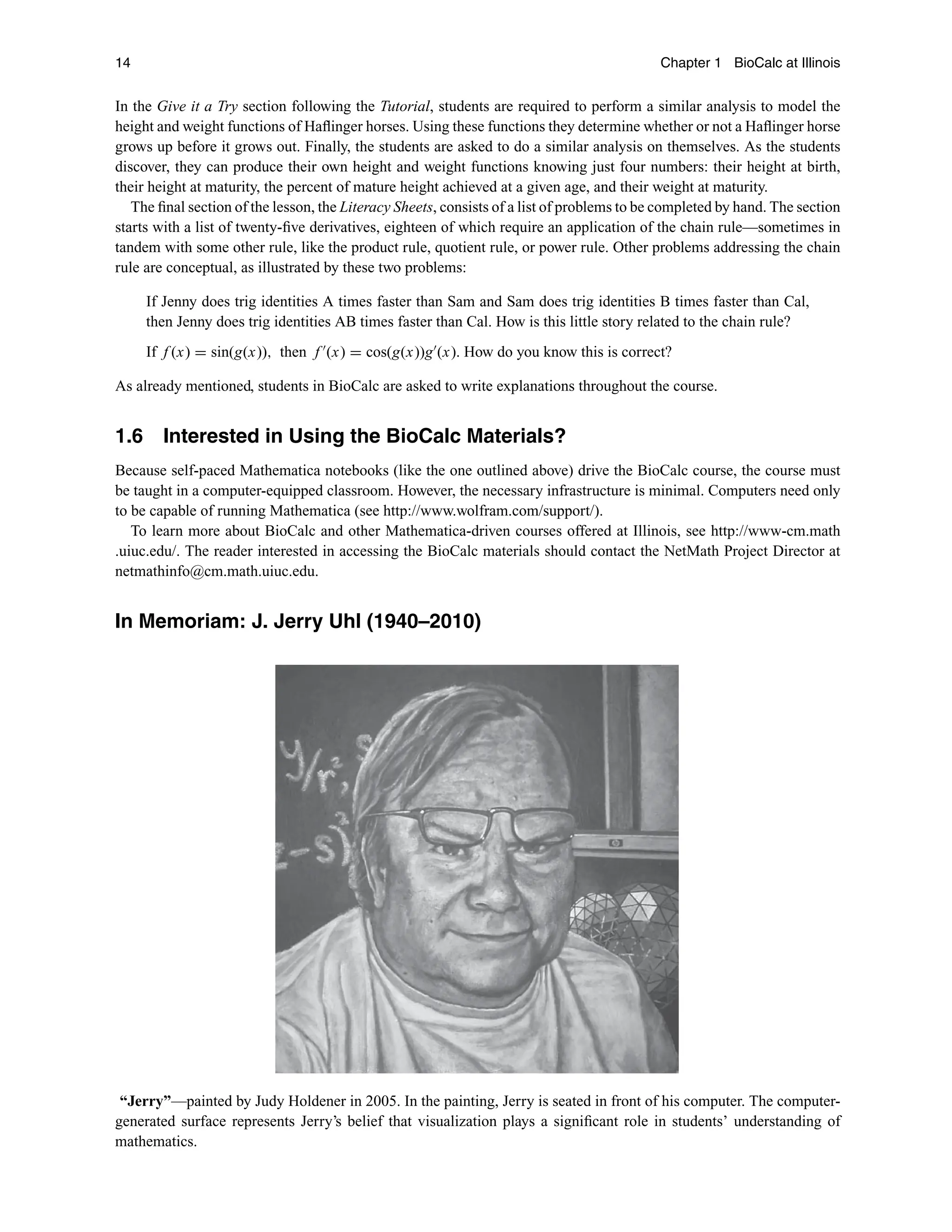
“Jerry”—painted by Judy Holdener in 2005. In the painting, Jerry is seated in front of his computer. The computer-
generated surface represents Jerry’s belief that visualization plays a significant role in students’ understanding of
mathematics.
References 15
A few words from the second author: Jerry passed away during the final revisions of this article. A beloved professor,
mentor, and friend, he played a significant role in my development as a teacher. Besides revealing the importance
of student-centered learning, he taught me to take risks in my teaching, and he continues to inspire me to be a
transformational force for my students. I will miss his humor, his playfulness, his passion, and the mischievous and
outspoken way in which he responded to bureaucratic nonsense.
References
Fahrbach, S., C. Washburn, and N. Lowery, 2001: The Impact of BioCalc on Life Sciences Undergraduates at UIUC,
a report prepared for the Howard Hughes Medical Institute, 13 pp., University of IllinoisKenyon College.
Uhl, J.J., W. Davis, and H. Porta, 2006: Calculus  Mathematica at UIUC, [available online at http://www-
cm.math.uiuc.edu/].
2
Biocalculus at Benedictine University
Timothy D. Comar1
Department of Mathematics, Benedictine University
Name of Institution Benedictine University
Size 3500 undergraduate students, 8900 students in total
Institution Type mid-sized university primarily devoted to undergraduate education
with some graduate and professional programs
Student recent high school graduates and community college transfers
Demographic with interest in pursuing medical careers
Department Mathematics and Biology are individual departments
Structure in the College of Science
Abstract
This paper describes the biocalculus course sequence at Benedictine University. Benedictine University offers a
two-semester biocalculus course sequence that integrates calculus-based mathematics, biological models, and compu-
tational software. In addition to the biocalculus courses, all first semester calculus students at Benedictine University
take a computer laboratory course, which includes several biological applications. The paper concludes with a discus-
sion of the success of the courses and of the challenges still facing them. This article is unique in that it describes a
rigorous, introductory mathematical biology course sequence that can be implemented at small to mid-sized institutions
in which only a limited number of sections of calculus are offered each year.
2.1 Course Structure
r Weeks per term: 15 weeks
r Classes per week/type/length: Biocalculus I: 4 50 minute lecture periods per week; Biocalculus II: 3 50 minute
lecture periods per week
1 tcomar@ben.edu
17
18 Chapter 2 Biocalculus at Benedictine University
r Labs per week/length: Calculus with Analytics I Lab/Biocalculus II Lab: 1 2 hour period per week
r Average class size: Biocalculus I: about 15 students in each of two sections; Biocalculus II/Biocalculus II Lab:
5–10 students in one section; Calculus with Analytics Lab: up to 20 students
r Enrollment requirements: Biocalculus I: placement exam; Biocalculus II: a grade of C in Biocalculus I or Calculus
with Analytics I
r Faculty/dept per class, TAs: One mathematics structure per class; same instructor for Biocalculus II and Biocal-
culus II Lab
r Next course: Biocalculus II/Biocalculus II Lab follows Biocalculus I. Students may take Calculus with Analytics
III group or Mathematics Research after Biocalculus II.
2.2 Introduction
Benedictine University is private, primarily undergraduate institution located in the western suburbs of Chicago. Of
the 3500 students enrolled as traditional undergraduates, over 500 are majoring in the biological and health sciences.
Benedictine University has a reputation for involving undergraduate science and mathematics majors in research and
regularly sends graduates to professional and graduate programs. The biocalculus course sequence at Benedictine was
developed in response to the Bio 2010 report (National Research Council 2003) to increase the mathematical and
quantitative training for future researchers in the biological sciences and to provide a relevant calculus experience
for biology students. There is also a recent push at Benedictine University for students to engage in interdisciplinary
research involving mathematics and biology. The course sequence is now the required mathematics sequence for
students in the research oriented Biochemistry/Molecular Biology (BMB) major, which was recently revamped in
accordance with Bio 2010 recommendations.
The course design was affected by the needs and nature of the student body and the Department of Mathematics’
ability to staff calculus courses and laboratories. We have considered students who will take only a single semester of
calculus, students who need a year of calculus-level mathematics, and students who intend to take more mathematics
courses. When the courses were designed, trigonometry was the required mathematics course for biology and health
science majors. We also have students who have been admitted into a dual acceptance program with a local pharmacy
school. These students spend only two years at Benedictine University and have room for only one semester of calculus.
Because of students who will only take one semester of calculus, it is important that the first semester biocalculus
course include biological models and biologically-oriented computer laboratory projects.
We realize that majors in the biological sciences may not have the credit hours available to take additional mathematics
courses beyond a year of calculus as undergraduates. We have chosen mathematical topics that enable students
to develop a foundation in calculus and to be able to use mathematical and computational techniques to analyze
biological mathematical models represented by systems of difference equations or differential equations by the end
of the second course. On the other hand, it is necessary at our institution to keep the biocalculus sequence and the
traditional calculus sequence at the same level of rigor so that students can switch tracks for their second course and
so that all students would be prepared to succeed in a traditional third semester calculus course.
Another significant and unique aspect of first semester calculus at Benedictine University is that all students in the
traditional first semester calculus course and the first semester biocalculus course must enroll in a common laboratory
course, Calculus with Analytics I Laboratory (hereafter, Lab I). The course schedule is flexible so that it can be
used for mixed classes of students from both versions of first-semester calculus. The course also lets us assess and
compare performance between students in Biocalculus I and the traditional Calculus with Analytics I (hereafter,
Calculus I).
Biocalculus I was first offered in Fall 2003, and Biocalculus II was first taught in Spring 2005. Enrollment levels
initially ranged from ten to sixteen students in Biocalculus I and from five to six students in Biocalculus II. Currently,
there are two sections of Biocalculus I offered each fall with average enrollment of about fifteen students, and the
spring section of Biocalculus II has enrollment of about ten students. For comparison, each fall semester there are
two sections of Calculus I with class size of about thirty students. Biocalculus I is open to all students who place into
first semester calculus and is recommended for those majoring in the BMB program, biology, or the health sciences.
2.3 Description of the Courses 19
Lab I was first offered in Spring 2005, with its first mixed class of Biocalculus I and Calculus I students in Fall 2005.
Multiple sections of Lab I with at most twenty students per section have been scheduled to accommodate the students
in both calculus courses. We also offer two sections of a year-long integrated calculus and precalculus course sequence,
Introduction to Calculus and Applications of Calculus, each year, with approximately sixty students per year divided
into two sections. Each term, we also offer one section each of traditional second and third semester calculus courses.
The biocalculus course sequence and accompanying laboratory courses are:
Course Hours
Biocalculus I 4 credit hours
Calculus with Analytics I Laboratory 1 credit hour, 2 contact hours
Biocalculus II 3 credit hours
Biocalculus II Laboratory 1 credit hour, 2 contact hours
Table 1. Biocalculus and Laboratory Courses
The reader may find detailed syllabi and laboratory projects at the author’s website:
http://www1.ben.edu/faculty/tcomar/index.htm
2.3 Description of the Courses
The philosophy behind the pedagogy of our biocalculus courses is the balance of mathematical content, rigor, and
reasoning, biologically oriented examples and modeling applications driven by the use of real data where possible, and
the use of computational tools to investigate biological and mathematical phenomena. Our presentation is infused with
the Rule of Four popularized by the calculus reform movement. (The Rule of Four is the presentation of mathematical
content symbolically, numerically, geometrically, andverbally.) Emphasis onthemultiplerepresentations of quantitative
information is important for science students because they are more likely to work with data presented numerically
or graphically in their science courses. Those who pursue avenues in which symbolic mathematical representations
are relevant will have the skills to translate between verbal descriptions of phenomena and their expressions in
mathematical notation.
2.3.1 Biocalculus I and Calculus with Analytics I Laboratory
We now describe in greater detail the Biocalculus I course and its connection with the common laboratory course. The
syllabus, listed in Table 2 for Biocalculus I, was developed to meet the needs of our students and to accommodate the
institutional considerations described above. At first glance, the course may seem not much different from a traditional
first semester calculus course. This is significant because a similar syllabus can be implemented for a course to run
concurrently with traditional calculus courses (as is done at Benedictine University) or can replace the traditional
first semester calculus course without impacting the second semester of traditional calculus (as is done at Macalaster
College (Bressoud 2004)). Table 2 includes some topics generally not found in the traditional first semester of calculus.
An obvious question is how to adjust the content of the traditional material to accommodate the additions. Part of
our solution was to move several topics, listed in Table 3, to the concurrent lab course. Other topics need to be
streamlined. For example, limits of sequences are addressed thoroughly, including a discussion of formal definitions,
before discussing limits of functions of real variables. When introducing the latter, we point out similarities between
the two collections of limit laws and have already established a context in which we can efficiently present the formal
-δ definition of a limit. Related rates are present, de-emphasized. Less time is spent on optimization application
problems because other applications occur throughout the course.
The most important addition to the syllabus in Biocalculus I is difference equations. There are several advantages
to studying these in a first semester calculus course. From the biological perspective, students can begin to understand
some basic discrete population models without significant mathematical or biological background. Students learn how
to represent discrete population models symbolically, how to implement them in Excel and Maple, and how to study
their dynamics. From the mathematical perspective, there are significant pedagogical benefits. If difference equations
are introduced before limits of functions of a real variable, students can learn about sequences early. Convergence
20 Chapter 2 Biocalculus at Benedictine University
Review of functions
Nonlinear scales and allometry
Introduction to probability
First order difference equations, sequences, and population models
Limits and continuity of functions of a real variable
Differentiation
Applications of differentiation (including stability of difference equations)
The definite integral and Riemann sums
Antidifferentiation
The fundamental theorem of calculus
Basic applications of integration
Integration by substitution
Table 2. Topics for Biocalculus I
of sequences follows naturally from how students observe limits numerically and geometrically: they can observe to
what number a sequence of numbers converges by looking at a table of values or a graph. Formal definitions of limits
of sequences can then be introduced. Locally stable equilibria can be interpreted as values to which a sequence can
converge. The limit of a function of a real variable can then be built on the limit in the discrete case. To help motivate
the definition of the derivative, we can think of differences of successive terms as difference quotients having a unit
difference between successive input values. Such differences provide a discrete approximation to the derivative. As
the difference between successive input values decreases to zero, the derivative results. The criterion for local stability
of a first order difference equation provides a nice application of differentiation, as it follows from using a tangent line
approximation to linearize the difference equation. The stability result is a nice analog to the stability result for first
order differential equations.
Conic sections
Parameter curves
Curve sketching
Numerical integration
Table 3. Calculus Topics in Calculus with Analytics I Laboratory
One of the themes discussed at the Biology CRAFTY Curriculum Foundations Project was that “Creating and ana-
lyzing computer simulations of biological systems provides a link between biological understanding and mathematical
theory” (Dilts and Salem 2004). Additionally, the Bio 2010 report asserts the importance for biologists of being able
to use computers as tools: “Computer use is a fact of life of all modern life scientists. Exposure during the early years
of their undergraduate careers will help life science students use current computer methods and learn how to exploit
emerging computer technologies as they arise” (National Research Council 2003). These needs are met in the common
laboratory course, Lab I (Comar and Townsley 2006) and through additional computational activities and projects in
the Biocalculus I course.
The laboratory course, Lab I, is required of all students enrolled in either Calculus I or Biocalculus I. It helps to
keep both first semester calculus courses at the same level and pace while providing time for content not covered in
the lecture course and to explore additional applications, including biological applications. Students are introduced
to the computer algebra system (CAS), Maple, as a calculating and graphing tool to analyze problems. (Maple is
used throughout the calculus sequence at Benedictine University.) An important feature of the laboratory course is
its collaborative nature. Students from the first semester calculus courses work together, enabling them to share their
expertise to solve problems together, corresponding to the collaborative nature of academic research environments
and industry. As much scientific research is done at the intersection of disciplines and as biological research is
becoming increasingly computational and quantitative, it is important that science and mathematics students learn
to communicate with each other. The lab experience offers biology majors and mathematics majors an opportunity
2.3 Description of the Courses 21
to work together and develop a common language. Currently, three of the weekly projects in the course investigate
biological models (see Table 4).
Data fitting, nonlinear scales, allometric relationship between tree height and diameter
Stability of first order difference equations and cobwebbing using a discrete population model
Introduction to differential equations: slope fields, phase line diagrams, and Euler’s method using the logistic
model
Table 4. Biologically-oriented Projects in Calculus with Analytics I Laboratory
One of the goals of the biocalculus course sequence is to examine a wide array of biological problems using different
computational platforms. The platform choice for a particular model depends on the ease of implemention and the
applicability to future course or research work. Maple and Excel are used in Biocalculus I. The latest version of Maple
is user-friendly and is appropriate for calculus courses. Moreover, activities can be developed in Maple so that the
students are not burdened with programming and notational complexities. Maple is one of the leading commercially
available computer algebra systems; those who pursue research are likely to encounter it or a similar computer algebra
system for symbolic computation. We frequently use Excel for difference equation models because it is easy and
convenient to implement recursion. Excel is ubiquitous and popular among biologists, so the students are likely to
encounter it after their calculus course experience.
Biocalculus I students work on several computational activities throughout the term. Each explores at least one
biological model and analyzes the effects of varying model parameters. The first project uses Maple to study a drug
dosage model that, from the mathematical perspective, enables the students to analyze discontinuous functions with
parameters. Another activity is a curve fitting problem in which the students fit a logistic curve to data measuring
the length of a growing bean leaf over time. Students learn to implement discrete population models using difference
equations in Excel and Maple. Both allow students to plot time series and cobweb diagrams and see the effects of
varying parameters. Maple is nice for showing animated diagrams that step through the cobweb process one stage at
a time and for creating bifurcation diagrams. Another activity analyzes a simple difference equation model for natural
selection and in Excel.
Although the computer laboratory activities provide deeper investigation of biological models and introduce students
to useful software programs, they take up a significant amount of class time, and more must be allotted to discussion.
Incorporation of these activities promotes breadth over depth; diminishing or eliminating less crucial topics is necessary
to allow for appropriate treatment of these time-consuming activities. The computer activities are integrated throughout
the course during class time and through assignments. The course includes six or seven group homework assignments,
two in-class exams, and a final exam, each of which has computer components.
2.3.2 Biocalculus II and Biocalculus II Laboratory
Unlike the first semester course, Biocalculus II deviates substantially from a traditional second semester calculus
course. It is a hybrid of a second semester calculus course and an introductory course in mathematical biology.
Its goal is to use calculus, related mathematical tools, and computational software to develop an understanding of
biological mathematical models using difference equations, differential equations, matrix models, systems of difference
equations, systems of differential equations, and the basics of probability. The course asks students to use mathematical
and computational tools to investigate complex biological systems as a scientist. This approach is different from that
of traditional mathematics courses, where the focus is simply on the mathematics. Topics have been chosen to
achieve two distinct objectives (see Table 5). One objective reflects our understanding that students in this course
may not be able to take another mathematics course. We present enough mathematical topics and provide experience
analyzing biological models so that students are equipped to succeed in quantitative science courses and research
experiences. The second objective is to ensure that students who complete the second semester of biocalculus will have
developed sufficient mathematical maturity and background to succeed in a traditional third semester calculus course.
Several former Biocalculus II students have successfully continued with Calculus III and additional mathematics
courses.
22 Chapter 2 Biocalculus at Benedictine University
Review of Biocalculus I and integration by substitution
Integration techniques: integration by parts, simple partial fractions, use of tables and computer algebra systems
(Optional)
Indeterminate forms, L’Hôpital’s rule, and improper integrals
Continuous probability distribution functions
Application of integration to volume calculations
First order differential equations with stability and bifurcations
Analytic geometry: vectors and equations of lines and planes
Matrix algebra: matrix properties and operations, including the determinant, the trace, eigenvalues and eigenvectors
functions of several variables
Limits of functions of several variables
Partial derivatives
Differentiability of real-valued and vector-valued functions of several variables, linearization
Nonlinear systems of difference equations
Linear and nonlinear systems of differential equations
Table 5. Biocalculus II Topics
Even though the Biocalculus II and the Biocalculus II Lab courses are separate courses, they are taught by the same
instructor and comprise an integrated experience. Like the common lab course for first semester calculus students, the
Biocalculus II Lab course is a one-credit hour course that meets for a two-hour session once a week. This provides
five contact hours each week, as compared to the four hour weekly lecture time in the traditional second semester
calculus course. We schedule projects throughout the term. They are biological and require work outside of class. The
list of project titles is in Table 6. To help prepare students for research activities, an extended project has become the
capstone of the course. The students read a research paper in mathematical biology, implement the model using an
appropriate computation platform, and prepare written and oral reports about the model and their implementation. The
workload for Biocalculus II also includes four group homework assignments, two in-class exams, a final exam in the
lecture course, and a group final exam in the laboratory course.
Taylor polynomial approximations
Improper integrals and life tables
Stability of single ordinary differential equations, bifurcations, logistic model with harvesting
The Leslie matrix model for age-structured populations
Systems of nonlinear difference equations: host-parasitoid models
Systems of linear differential equations
Systems of nonlinear differential equations I: competition and predator prey models
Systems of nonlinear differential equations II: the Fitzhugh-Nugamo model
Table 6. Biocalculus II Lab Projects
2.4 Discussion
2.4.1 Successes
The biocalculus courses at Benedictine University have proven to be a success. First semester biocalculus and traditional
calculus students perform comparably on calculus skills and in the laboratory course (Comar 2008); hence the two
courses are taught at the same level of rigor and provide the same calculus skills. Other success are the integration of
biological content into the common laboratory course and the success of students in succeeding courses and research
experiences. Most importantly, the courses are now established in the curriculum.
We have two assessments that measure the performance of students in both first semester calculus courses, which
enable us to ensure that students who successfully complete either course have demonstrated proficiency in a common
Acknowledgments 23
core of calculus concepts and skills and will be able to succeed in either second semester calculus course. The first
assessment tool is a set of common final exam problems. The second is the common laboratory course, which provides
a unique opportunity to compare first semester calculus students. Assessments in the laboratory course included the
weekly laboratory activities, a written component of the final exam covering the calculus content specific to the lab
course, and a collaborative component of the final exam testing modeling, problem solving, and use of a computer
algebra system. Our data confirm comparable success rates (Comar 2008). Two conclusions are that students can
switch between traditional calculus and biocalculus tracks and that students who complete Biocalculus I have the same
fundamental calculus skills as those in the traditional Calculus with Analytics I course. This supports the biocalculus
course as an alternative to the traditional first semester calculus course.
Students who have taken both biocalculus courses have had successful research experiences and have worked
on projects at the intersection of mathematics and biology. These are key goals of the biocalculus courses, so the
biocalculus course sequence is working. Even though the biocalculus sequence may be a terminal experience for most
students, several have taken additional mathematics courses. Ten of the twenty-nine students who have completed
Biocalculus II have registered for Calculus III. Eight of these earned grades of C or better, 1 student earned a D, and
1 student withdrew early in the term for personal reasons. Three of these eight students have become mathematics
minors and three have added mathematics as a major. Five of the twenty-nine have participated in our Summer Science
Research Program. Several others have pursued research activities during the academic year. (Research is required
of all BMB majors.) One successful Biocalculus II student completed an integrated biology and mathematics project
for the major research project in Benedictine University’s Scholar’s Program, which is the honors program at the
university. Another able student has been hired to work with mathematics and biology faculty as a research assistant on
a biocalculus textbook project. Several other biocalculus students who completed only Biocalculus I have participated
in the Summer Science Research Program and have completed research projects as undergraduates. All students who
have taken Calculus II following Biocalculus I have been successful, including two who became mathematics majors
and one who completed a minor in mathematics.
The most important success of the biocalculus courses is that the courses have been institutionalized. Before the
biocalculus courses were created, trigonometry was the only mathematics requirement for biology majors. Now, one
semester of calculus is required for Bachelor’s of Science biology majors and two semesters are required for the BMB
majors. Biocalculus I is the recommended course for the first group and Biocalculus II with the lab is required for
the second. This has contributed to the increase in enrollment in the courses and has enabled the university to offer
two sections of Biocalculus I each fall. Instructors other than the course designer have been able to teach the courses
successfully
2.4.2 Challenges
Recruitment into the biocalculus courses remains a challenge. There is a false perception that they are significantly
more difficult than the traditional calculus courses. Moreover, some parents have felt more comfortable placing their
freshmen children in a course called “Calculus” than “Biocalculus” because they are more familiar with the word
“Calculus.” Hence a significant number of biology and pre-med students still register for Calculus I. Freshman advisors
are working with the Department of Mathematics to encourage students majoring in BMB, biology, and health sciences
to take Biocalculus I. Biocalculus II consistently has a lower enrollment than Biocalculus I because fewer students are
required to take the second calculus course than the first. Moreover, not all students who complete Biocalculus I are
interested in the research orientation of course.
Acknowledgments
The author would like to thank his colleagues Drs. Lisa Townsley and Manu Kaur, who have taught the traditional
calculus courses. Dr. Townsley developed the Lab I course. The author would also like to thank the National Science
Foundation, which is supporting the biocalculus program at Benedictine University and College of DuPage through
the NSF CCLI grant #DUE-0633232.
24 Chapter 2 Biocalculus at Benedictine University
References
Bressoud, D.M., 2004: The changing face of calculus: first- and second-semester calculus as college courses. Focus,
24, No. 8, 14–16.
Comar, T.D., 2008: Integration of Biology into Calculus Courses. PRIMUS, 18, 47–70.
Comar, T.D., and L. Townsley, 2006: A common calculus laboratory course for traditional calculus and biocalculus
students. Proceedings of the 18th ICTCM, Pearson Addison Wesley, Boston, MA.
Dilts, J., and A. Salem, 2004: Biology: CRAFTY Curriculum Foundation Project, Macalester College, November
2–5, 2000. Curriculum Foundations Project: Voices of the Partner Disciplines, S. Ganter and W. Barker, Eds., The
Mathematical Association of America, 15–18.
Edelstein-Keshet, L., 2005: Adapting mathematics to the new biology. Math  Bio 2010: Linking Undergraduate
Disciplines, L. A. Steen, Ed., The Mathematical Association of America, 63–73.
National Research Council, 2003: Bio 2010: Transforming Undergraduate Education for Future Research Biologists,
National Academies Press, Washington, DC.
3
Implementation of First Year Biomath Courses
at the Ohio State University
Laura Kubatko1
Departments of Statistics and of Evolution, Ecology, and Organismal Biology,
The Ohio State University
Janet Best2
, Tony Nance3
, and Yuan Lou4
Department of Mathematics, The Ohio State University
Name of Institution The Ohio State University
Size about 38,000 undergraduate students
Institution Type large state university with PhD program
Student Demographic recent high school graduates with interests in mathematics,
statistics, and/or biology
Departments and Program
Structures
Six departments (Mathematics, Statistics, and four biology), plus
the biology major administered by the Center for Life Sciences
Education, all inside the College of Arts and Sciences
Web Pages http://www.stat.osu.edu/∼lkubatko/CAUSEwebinar
http://rumba.biosci.ohio-state.edu
Abstract
With approximately 38,000 undergraduates on the main campus in Columbus, Ohio, The Ohio State University (OSU)
is one of the largest schools in the nation, providing a significant challenge in the creation of a BioMathematics
curriculum that will adequately serve the needs of this undergraduate population. In this article, we describe our initial
steps toward this goal, namely, the development and implementation of several first-year BioMath courses for students
majoring in the Biological Sciences at OSU.
1 kubatko.2@osu.edu
2 best.82@osu.edu
3 nance.1@osu.edu
4 lou.8@osu.edu
25
26 Chapter 3 Implementation of First Year Biomath Courses at the Ohio State University
3.1 Structure of Courses
r Weeks per term: 10 weeks (will convert to semesters in 2012)
r Classes per week/type/length: three 48-min lectures, two 48-min recitations
r Average class size: Calc I = up to 120; Calc II = up to 60; Stats = up to 40
r Enrollment requirements: Calc = standard; Stats = Calc II prerequisite
r Faculty per class, TAs: each course has 1 faculty and 2, 1, 1 TA respectively
3.2 Introduction
The Ohio State University (OSU) is one of the largest schools in the nation, with over 50,000 students on the main
campus in Columbus, Ohio, approximately 38,000 of whom are undergraduates. The administrative structure of the
University consists of eighteen distinct colleges, with a total of 167 undergraduate majors. The four biological science
departments, housed within the College of the Arts and Sciences, serve approximately 2,300 undergraduates who
obtain one of eight majors. Also, OSU houses the NSF-funded Mathematical Biosciences Institute (MBI), which
provides a link between the mathematical and biological sciences.
In collaboration with the biological science departments at OSU, the Departments of Mathematics and of Statistics
have developed courses to provide a quantitative foundation for the training received by undergraduates majoring in
biological sciences (see accompanying article in this volume for details about the development of these courses). The
courses include a two-quarter sequence in calculus and a one-quarter course in statistics. The calculus courses are
taken by freshmen who have placed into calculus and who plan to obtain one of the eight biological science majors,
and are structured so that students who complete them are prepared to continue with the more traditional Calculus
III course offered by the Mathematics Department. Two sections of the calculus sequence have been offered in every
academic year since 2006–07, serving approximately 160 students each year. The course in statistics is intended to
serve as a follow-up elective course; students are recruited primarily from the calculus sequence, although any student
who has completed two quarters of any calculus can enroll. The statistics course has been offered in the Spring quarter
every year since 2007, with approximately forty students per section.
In this article, we describe each of these courses in detail. The next section describes the structure of each course,
the material covered, and projects and class activities included. The Discussion section includes reflection on what
aspects of the courses worked well and what needs improvement. We then discuss some more advanced courses that
have recently been added to our BioMath curriculum. We conclude with a discussion of our long-term vision for the
BioMath curriculum at OSU.
3.3 Description of First Year BioMath Courses at OSU
OSU followed the quarter system rather than the semester system until the Fall 2012 semester, with an academic year
thus consisted of three 10-week quarters (Fall, Winter, and Spring) with a week of final examinations following each.
Quarter courses generally comprised 3–5 credit hours of instruction per week, and often consisted of a mixture of
lecture and laboratory sections. Each of the BioMath courses we developed was offered for 5 credit hours, with three
50-minute lectures taught by a full-time faculty member and two 50-minute laboratory sessions taught by Graduate
Teaching Assistants (GTAs) per week. The lecture sessions were often large (ranging from 40 to 100 students), while
the laboratory sessions generally had no more than 30 students. Laboratory sessions were devoted to hands-on activities
and problem-solving, while lectures covered the introduction and discussion of new concepts. We now describe these
courses in detail.
3.3.1 Calculus I and II for the Life Sciences
Both calculus courses were taught from the text Calculus for Biology and Medicine by Claudia Neuhauser (2003).
The Calculus I course covered the first five chapters of the text, including sequences and difference equations (2
weeks), limits and continuity (2 weeks), and differentiation and applications (6 weeks). The Calculus II course covered
3.3 Description of First Year BioMath Courses at OSU 27
material in Chapters 6, 7, and 8: basic integration (2 weeks), advanced integration techniques (6 weeks), and differential
equations (2 weeks). Course grades were based on weekly homework and quizzes, a project, two midterm examinations,
and a comprehensive final examination.
An innovative aspect of the courses was the inclusion of group projects. During the first offering of Calculus I,
ten projects were designed by the instructors and GTAs. In subsequent quarters, projects have been developed and
supervised by post-doctoral researchers associated with the MBI. Each quarter, several post-docs developed projects
and gave a lecture advertising their projects to the students; students then selected one of the projects to study in a
group of three to five students. The post-docs arranged two additional class meetings to work with the students, who
were also expected to spend time working on their own outside of class. Each project contained several questions
to be addressed, and each student was required to write the solution to at least one of the questions. The group was
responsible for combining the solutions to the questions to form a cohesive written report for the project as a whole.
This has the advantage of giving students experience in writing in a research-like setting. The group reports contributed
the equivalent of two homework assignments to each student’s grade in the course. Here are examples of the projects.
Tumor Growth and Treatment. Differential equations can be used to model tumor growth. A tumor cell divides,
generating two daughter cells with unlimited ability to reproduce. Initial rapid growth supported by abundant nutrients
such as oxygen and glucose is followed by slower growth as the population size increases. Injecting anti-cancer drugs
that kill a fraction of tumor cells per unit time may reduce the size of the tumor cell population. The project involves
studying the differential equations to find the best strategy for reducing tumor size.
Analyzing Cartilage Health. In an osmotic loading experiment, chondrons (cartilage cells with encapsulating peri-
cellular matrix, PCM) are extracted from cartilage and placed in different external concentrations of sodium chloride
in water. Depending on the concentration of the sodium chloride, the chondron will either swell or shrink. We look at
how the volume of the PCM changes with respect to the different external concentrations of sodium chloride in water.
Fisheries Management. Humans catch fish for a variety of reasons, such as for food or for sport. While these purposes
may have merit, it is important to realize that there is not an unlimited number of fish in the sea. The National Marine
Fisheries Service was formed by the U.S. government to manage marine resources in the U.S. In order to do their job,
their scientific research teams use many tools, including mathematical models. In this project we explore a hypothetical
fishery model for a sea bass population within an enclosure.
The material given to the students consisted of an expanded verbal description followed by the formulation of a
mathematical model for the situation. The students were then asked to solve a series of problems using the model
and to interpret their results. Also, the students were provided with information concerning expectations from the
groups, both for functioning of the group as a whole and for individual interactions of each student with the group.
The principal mathematical tool for the Calculus I projects is the derivative; differential equations, when they occur,
are accompanied by solutions that the students must verify.
In the Calculus II projects, the main tools are derivatives and integrals, and many involve solving some ordinary
differential equations. Example projects are:
Brain Waves with Noise. An EEG (electroencephalogram) machine measures local field potentials in the brain by
recording from electrodes placed on a patient’s scalp. These potentials represent an electrical signal from a large number
of brain cells called neurons. Monitoring the EEG recording is useful in assessing brain activity and in diagnosing
conditions such as epilepsy, sleep disorders, and coma. This project examines brain wave power when the signal is noisy.
Grass Management. A modern method to raise cattle consists of preventing cows from grazing in a field until the
grass has reached an optimal height. When the grass is too short, it cannot recover well from being cropped. Older
grass grows more slowly, may become senescent, and is less tasty to cows. In this project we examine grass growth
and its optimal management.
Drug Absorption. Understanding therapeutic and adverse drug reactions is important in the treatment of many
diseases, particularly cancer. Two models for drug absorption and toxicity are examined to compare injected drug
therapies with a polymer delivery system.
28 Chapter 3 Implementation of First Year Biomath Courses at the Ohio State University
3.3.2 Statistics for the Life Sciences
This course, intended as an optional course to follow the calculus sequence, was taught from The Analysis of Biological
Data by M. C. Whitlock and D. Schluter (2009). Material was selected from Chapters 1 through 17, with additional
materials provided by the instructor that built on the students’ knowledge of calculus (the text does not assume Calculus).
Topics included descriptive statistics and graphical methods (1 week), probability, including Bayes Theorem (1 week),
discrete distributions and the analysis of categorical data (2.5 weeks), one- and two-sample inference for means and
variances (2.5 weeks), experimental design (1 week), and correlation and regression (1.5 weeks).
As in the calculus sequence, assessment was based on weekly homework and in-class examinations. The lectures
were in the traditional style, though activities were incorporated into a few of the sessions. The recitation sessions were
divided between problem-solving sessions and activity sessions. In the activity sessions, students used the StatCrunch
software (StatCrunch, 2012) to analyze biological data sets after being given an introduction to the biological setting.
Results of their analyses were brought into the lecture sessions and used as examples for subsequent topics in many
cases, creating continuity between the recitation sessions and the lectures. A short lab manual for the course can be
found at http://www.stat.osu.edu/∼lkubatko/CAUSEwebinar.
Examples of the data sets included in the course and with the topics they illustrate are:
Fisher’s Iris Data. A well-known data set studied by R. A. Fisher includes measurements on characteristics of three
species of irises, including sepal length, sepal width, petal length, and petal width (Anderson, 1935; Fisher, 1936).
These data were used in several ways. When the normal distribution was introduced, students used it to explore the
distribution of characteristics in the recitation session using the StatCrunch software. They examined histograms and
normal probability plots for the data when all three species are grouped together and for each species separately. The
data is later used in lecture to motivate hypothesis testing by asking whether the mean sepal width differs between
pairs of species. After an example is worked in lecture, the ideas are reinforced in recitation by carrying out hypothesis
tests using the StatCrunch software.
Population Frequencies of Human Chemokine Receptor Gene Variants. A genetic variant of the human chemokine
receptor gene appears to provide strong resistance to HIV infection. This variant is found in all European populations
with varying frequency. Lucotte and Mercier (1998) studied a sample of 2,522 people throughout Europe to determine
their genotypes, and found an overall allele frequency for the gene variant of approximately 9%. In the recitation
session, students are given this information as background to the problem (with some added discussion about what
is a genotype). They then compute the expected frequency of this gene variant in various European subpopulations,
and compare them to the observed data of Lucotte and Mercier (1998). Although hypothesis testing has not yet been
formally introduced, the students compute quantities similar to p-values by examining the probability of observing
the data given in the paper if the variant gene frequency actually is 9%. This example is used to motivate hypothesis
testing later in the lecture sessions.
Old-Growth Forest Data. This data set consists of an extensive survey of an old-growth beech-maple forest carried
out at the James H. Barrow Field Station (owned and maintained by Hiram College in northeastern Ohio) during the
summer of 1993 by Laura Kubatko. The goal of the data collection was to assess the diversity and distribution of
tree species in the forest. The data were collected by subdividing the forest into 50m × 50m plots. Within each of
sixty-seven plots, four 10m × 10m sub-plots were randomly selected to be surveyed. All tree species occurring within
the sub-plots were counted and recorded. The diameter at breast height (dbh) was measured for any tree larger than
3.0 cm dbh. An interesting feature of this data set is that the forest can be divided into four distinct areas that vary in
composition of species and size-class distributions due to various external stresses (e.g., chestnut blight and an area
affected by a tornado in the early 1970s) and physical characteristics (west-facing slopes).
These data are used in the course to give students experience with examining and comparing distributions. When
discussing summary statistics and graphical displays, students are asked to use the StatCrunch software to find graphical
displays for the counts of the number of trees of each species in various areas of the forest and for the distribution of
3.4 Discussion 29
trees among size classes (based on dbh). Later, the data are used to compare areas of the forest using hypothesis tests
and confidence intervals.
3.4 Discussion
3.4.1 Successes
Feedback from the courses has been positive. Students seemed motivated and interested in what was taught, and many
commented on its usefulness to them in their future careers. The current cohort of students in the courses is generally
well-prepared for this level of mathematics. As we look to expand the offerings to include a broader group of students,
our approaches may need to be adjusted to accommodate differing levels of preparation among our students.
The class structure (three lectures and two recitations per week) worked well for several reasons. One is that it
divides our potentially large (40–100 student) lecture sections into smaller groups, so that students can receive more
individual attention. This allows for activities (such as the calculus group projects) and computer exercises (such as
analysis of real data using StatCrunch in the statistics course) to be included. Another advantage of this format is that
the GTAs were able to get experience teaching students from the biosciences. The GTAs were involved in developing
course materials for the recitation sessions, and were therefore able to learn how to communicate with this group of
students. Since the GTAs are the next generation of instructors in biomath, the early exposure to such courses with the
guidance of a faculty mentor is very valuable. Although the GTAs were not given special training in preparation for
teaching the courses, we worked to ensure that they were interested in teaching in this setting. All GTAs were carefully
mentored throughout the quarter.
Another positive feature was the inclusion of the MBI post-docs in the calculus sequence through the development
and mentoring of the student projects. The exposure of the undergraduate students to a variety of research areas in
BioMathematics and the interaction with the BioMathematics community at OSU is beneficial in creating an interest
in and appreciation for interdisciplinary work. Several of us have had discussions with students interested in pursuing
undergraduate research projects in these areas, and we expect such interactions to continue to increase over time.
3.4.2 Challenges
One challenge in designing and implementing the courses was that of finding textbooks with an appropriate mix of
biological motivation and mathematical rigor. We were happy with the Neuhauser text used in the calculus sequence
in that it was easy to teach from, as it is similar to a traditional calculus text but infused with biological examples.
However, other books (e.g., Adler 2004) that are more oriented toward biology-driven mathematics than calculus per
se are also appealing. An important point to consider is that some students in these courses may decide to continue in
the traditional mathematics curriculum, and thus the courses need to prepare them to do so.
It was also difficult to select the topics, both biological and mathematical, that should be covered in the courses.
The topic coverage in both the calculus and the statistics courses was similar to what would be covered in traditional
courses, though the time spent on them varied somewhat. On the biological side, the students consisted largely of
freshmen who, while mathematically prepared for the courses, were just beginning their study of biology. Thus we
often had to teach a fair amount of the biology underlying our examples, as well as the mathematics, which could be
a bit overwhelming for the students (and for us!) at times. In the future, particularly as we convert our courses to the
semester system, we hope to work more closely with faculty in the biological sciences to understand the freshmen
biology curriculum better, which will allow us to use examples that utilize biological concepts to which the students
have been exposed, and to gain a further appreciation for which mathematical and statistical topics will be most relevant
for students in their future study and careers.
A final challenge is recruiting students to take the elective courses (statistics and the courses described in the next
section) following the calculus sequence. Because the students are freshmen, they are also taking laboratory courses
in biology and chemistry, which is a substantial academic load in the first year. It may be more convenient for students
to return to mathematics courses in their second or third year, when they have more flexibility in their scheduling, and
we therefore expect these courses to grow.
30 Chapter 3 Implementation of First Year Biomath Courses at the Ohio State University
3.4.3 BioMath Courses at OSU Beyond the First Year
In addition to the first-year courses, we have developed two additional courses to enhance student interest in mathemat-
ical biology at OSU. The first is an undergraduate seminar that has been developed as a result of our recently-funded
NSF UBM grant for undergraduate research in mathematical biology at OSU. As part of our program, called RUMBA
(Research for Undergraduates: adventures in Mathematical Biology and its Applications—see http://rumba.biosci.
ohio-state.edu for more information), the seminar course is offered in each academic term. It meets for one hour each
week and consists of talks or discussions led by PIs for the program and speakers from within the OSU BioMath
community. The outside speakers have included faculty in Mathematics, Statistics, and Biological Sciences, Visiting
Scholars at the MBI, and MBI post-docs. The seminar enrolls approximately fifteen undergraduates at all academic
ranks (freshmen to senior) and a variety of majors (mathematics, biology, environmental science, pre-medicine, etc.).
Student evaluations have been very positive, and we feel that the course is succeeding in its goal of increasing interest
in and awareness of the field of mathematical biology.
The second new course is titled Introduction to Mathematical Biology and was taught for the first time during
the 2009–2010 academic year. The topics included population dynamics (logistic growth model and Lotka-Volterra
predator-prey model), epidemiological modeling, competition, neuronal dynamics, and enzyme kinetics. We expect
that this course will be offered every year. We have also added a mathematical biology track within the math major. All
of these recent efforts build on our earlier curriculum development to strengthen the undergraduate BioMath program
at OSU.
3.4.4 Future BioMath Curriculum Development at OSU
Our most recent efforts in BioMath curriculum development at OSU are focused on converting our courses to the
semester system which will take effect at the start of the 2012–13 academic year. Our goal is to refine them to meet
the needs of broader groups in the biological sciences and the university as a whole. At present, our calculus sequence
accommodates a maximum of 160 students per year, which is just a fraction of entering students planning to major in
biological sciences. Students majoring in health science fields may also benefit from taking these courses rather than
the traditional calculus sequence.
One reason for our success has been the presence of a group of faculty working in mathematical biology who interact
with both the mathematical/statistical and biological communities at OSU. This has been facilitated by the MBI, several
recent joint hires between departments (including such department as Mathematics; Statistics; Evolution, Ecology,
and Organismal Biology; and Molecular Genetics), and several hires of faculty within the Mathematics Department
who work in mathematical biology. As we continue to assemble a community of interdisciplinary researchers, we hope
to build our curriculum further. Two areas of growth that have been discussed are the development of courses that
enable students in one field to obtain a major or minor in the other, and the development of interdisciplinary degree
programs, such as the BioMath concentration. The recent addition of our RUMBA program has enabled us to establish
an interdisciplinary research program for undergraduates at OSU, and has thus facilitated the continued enhancement
and expansion of our curriculum development.
Overall, we view our mission as helping undergraduate life science majors learn to think in a quantitative manner,
whether for modeling biological phenomena or analyzing experimental data. With this goal in mind, we have enjoyed
meeting the challenges of cross-department collaboration on curriculum development in a large university, and we
look forward to continuing our progress.
Acknowledgments
We would like to thank the MBI post-docs who contributed projects and mentored students in the calculus courses:
Michael Rempe, German Enciso, Brandilyn Stigler, Barbara Szomolay, Andrew Nevai, Huseyin Coskun, Yangjin Kim,
Judy Day, Paula Grajdeanu, Richard Schugart, Andrew Oster, Julia Chifman, Shu Dai, Marisa Eisenberg, Harsh Jain,
Suzanne Robertson, Deena Schmidt, Dan Siegal-Gaskins, Rebecca Tien, Yunjiao Wang, Chuan Xue, and Kun Zhao. In
addition, Statistics GTAs Yonggang Yao and Lili Zhuang developed much of the material for the recitation sessions of
the statistics course. Tony Nance’s participation in this effort is partially supported by the National Science Foundation
under Agreement No. 0112050 and Agreement No. 0635561.
References 31
References
Adler, F.A., 2004: Modeling the Dynamics of Life: Calculus and Probability for Life Scientists, 2nd ed. Brooks/Cole.
Anderson, E., 1935: The irises of the Gaspe peninsula. Bulletin of the American Iris Society, 59, 2–5.
Fisher, R.A., 1936: The use of multiple measurements in taxonomic problems. Annals of Eugenics, 7, 179–188.
Lucotte, G. and G. Mercier, 1998: Distributions of the CCR5 gene 32 bp deletion in Europe. J. Acquir. Imm. Def. Hum.
Retrov., 19, 174–177.
Neuhauser, C., 2003: Calculus for Biology and Medicine. 2nd ed. Pearson/Prentice Hall.
StatCrunch, cited 2012: StatCrunch: Data Analysis on the Web. [Available online at http://www.statcrunch.com/.]
Whitlock, M.C., and D. Shluter, 2009: The Analysis of Biological Data. Roberts.
Another Random Document on
Scribd Without Any Related Topics
Anno 887. In this year there died at Orleans abbot Hugo, who had
held and ruled manfully the duchy [of Robert the Strong, i.e.,
Francia], and the duchy was given by the emperor to Robert’s son,
Odo, who had been up to that time count of Paris, and who,
together with Gozlinus, bishop of Paris, had protected that city with
all his might against the terrible onslaughts of the Northmen....
In the month of November on St. Martin’s day [November 11, 887],
Karl [the Fat] came to Tribur and held a general diet. Now when the
nobles of the kingdom saw that the emperor was failing not only in
bodily strength, but in mind also, they joined in a conspiracy with
Arnulf, son of Karlmann, to raise him to the throne, and they fell
away from the emperor to Arnulf in such numbers that after three
days scarcely anyone was left to do the emperor even the services
demanded by common humanity.... King Arnulf, however, gave Karl
certain imperial lands in Alamannia for his sustenance, and then,
after he had settled affairs in Franconia, he himself returned to
Bavaria.
Anno 888. After the death of Karl the kingdoms which had obeyed
his rule fell apart and obeyed no longer their natural lord [i.e.,
Arnulf], but each elected a king from among its own inhabitants.
This was the cause of many wars, not because there were no longer
any princes among the Franks fitted by birth, courage, and wisdom
to rule, but because of the equality of those very traits among so
many princes, since no one of them so excelled the others that they
would be willing to obey him. For there were still many princes able
to hold together the Frankish empire, if they had not been fated to
oppose one another instead of uniting.
In Italy one portion of the people made Berengar, son of Everhard,
markgraf of Friuli, king, while another portion chose as king Guido,
son of Lambert, duke of Spoleto. Out of this division came so great a
strife and so much bloodshed that, as our Lord said, the kingdom,
divided against itself, was almost brought to desolation [Matt.
12:25]. Finally Guido was victorious and Berengar was driven from
the kingdom....
Then the people of Gaul came together, and with the consent of
Arnulf, chose duke Odo, son of Robert, a mighty man, to be their
king.... He ruled manfully and defended the kingdom against the
continual attacks of the Northmen.
About the same time, Rudolf, son of Conrad, the nephew of abbot
Hugo, seized that part of Provence between the Jura and the
Pennine Alps [Upper Burgundy], and in the presence of the nobles
and bishops, crowned himself king. ... But when Arnulf heard of this
he advanced against Rudolf, who betook himself to the most
inaccessible heights and held out there. All his life Arnulf, with his
son Zwentibold, made war on Rudolf, but could not overcome him,
because he held out in places where only the chamois could go and
where the troops of the invaders could not reach him.
23. The Coronation of Arnulf, 896.
Regino, M. G. SS. folio, I, p. 607.
Arnulf regarded himself as the successor to Karl the Great
and attempted to exercise some real authority over the whole
empire. This appears in his relations to Odo of France, to the
kings of the Burgundies, and to the claimants in Italy. The
expedition which he undertook to Italy in order to end the
disorders there resulted in his receiving the imperial crown.
Anno 896. A second time Arnulf went down into Italy and came to
Rome, and with the consent of the pope stormed the city. This was
an unheard-of thing, not having happened since Brenno and the
Gauls captured Rome many years before the birth of Christ.{54} The
mother of Lambert, whom he had left to defend the city, fled with
her troops. Arnulf was received into the city with the greatest
reverence by pope Formosus and was crowned emperor by him
before the altar of St. Peter. But as he returned from Rome he was
seized with an illness that troubled him for a long time.
{54} Not true; see no. 2, for the sack of Rome by Alaric,
410, and by Geiseric, 455.
24, 25. Rise of the Tribal Duchies in Germany, ca. 900.
24. Saxony.
Widukind, History of the Saxons, I, c. 16; M. G. SS. folio. III, p. 425.
In the beginning of the tenth century we find Germany
divided into five great duchies, Lotharingia, Franconia,
Saxony, Bavaria, and Suabia. The boundaries of the last four
corresponded pretty closely to the boundaries of old German
tribes: Franks, Saxons, Bavarians, and Alamanni. The attempt
of Karl to weld the various German tribes into one state was
successful during his reign, but that period was too brief to
extinguish the tribal feeling, and his weak successors,
occupied with schemes of selfish aggrandizement, abandoned
his larger policy. During the later Carolingian period the
impotence of the central government put the burden of ruling
upon the local officials, who under the weak rule of Ludwig
the Child usurped the title of duke in each of the large
divisions. This usurpation was successful largely because the
people in each duchy regarded their new duke as the
representative of tribal unity. In Saxony and Bavaria the
counts of the marks took the position of leaders of the nobles
and people of the whole provinces against the invasions of
Slavs and Hungarians, and were rewarded by the fidelity and
allegiance of the duchy. In Franconia and Suabia the same
position was won by local officials, but in these cases it was
as the result of struggles between rival families for supreme
position in the duchy. The references in documents to these
events are very meager, but it will be observed that dukes of
Saxony, Bavaria, Franconia, Suabia are mentioned in these
passages.
The last of the Carolingian emperors of the East Franks was Ludwig
[the Child], son of Arnulf.... This Ludwig married Liudgard, sister of
Bruno and the great duke Otto, and soon after died. These men,
Bruno and Otto, were the sons of Liudolf.... Bruno ruled the duchy of
all Saxony, but perished with his army in resisting an incursion of the
Danes, thus leaving the duchy to his younger and far abler brother
Otto. Ludwig the Child left no son, and all the people of Franconia
and Saxony tried to give Otto the crown. But he refused to
undertake the burden of ruling, on the ground that he was too old,
and by his advice Conrad, duke of Franconia, was anointed king.
25. Suabia.
Annales Alamannici, M. G. SS. folio, I, pp. 55 f.
Anno 911. Burchart, count and prince of the Alamanni, was unjustly
slain by the judgment of Anselm, and his sons Burchart and Udalrich
were driven out and his possessions and fiefs divided among his
enemies....
Anno 913. In this year Conrad the king attacked the king of
Lotharingia. A conflict arose between Conrad and Erchanger [a count
palatine in Suabia]. The Hungarians break into Alamannia; on their
return Arnulf [duke of Bavaria] and Erchanger, with Berthold and
Udalrich, attack and defeat the Hungarians. In this year peace is
made between the king and Erchanger, and the king marries the
sister of Erchanger.
Anno 914. Conrad again comes into Alamannia. Erchanger attacks
bishop Salomon and captures him. In the same year Erchanger is
captured by the king and exiled. Immediately the young Burchart
[son of Burchart] rebels against the king and devastates his own
fatherland.
Anno 915.... Erchanger returns from exile and attacks Burchart and
Berthold and conquers them at Wallwis, and is made duke of the
Alamanni [duke of Suabia].
26. Henry I and the Saxon Cities, 919–36.
Widukind, I, 35; M. G. SS. folio, III, p.432.
Henry, duke of Saxony, king of the Germans, 919–936, was
the first king of the Saxon house. He was also the first king of
the Germans to accept the feudal state and to attempt to
build up a government on that basis. He did not revive the
imperial claims on Italy, but devoted himself to strengthening
his own authority in Saxony, to defending the frontiers of the
kingdom, and to creating a German state. This selection is
from the history of the Saxons written by Widukind, a monk
in the monastery of New Corvey, who wrote in the latter part
of the tenth century. The passage illustrates the relations of
the Germans to the Slavs on the east and the origin of the
Saxon cities. The Slavs had moved as far west as the Elbe,
occupying the lands left vacant by the Germans after the
migrations. Much of this territory was gradually recovered by
the Germans from the time of Henry. Here we see the capture
of the city of Brandenburg and the reduction of Bohemia.
Following the conquest came the establishment of the marks
and the colonization and Germanizing of the land.
It lies beyond my power to relate in detail how king Henry, after he
had made a nine years’ truce with the Hungarians, undertook to
develop the defenses of his own land [Saxony] and to subdue the
barbarians; and yet this must not be passed over in silence. From
the free peasants subject to military service he chose one out of
every nine, and ordered these selected persons to move into the
fortified places and build dwellings for the others. One-third of all
the produce was to be stored up in these fortified places, and the
other peasants were to sow and reap and gather the crops and take
them there. The king also commanded all courts and meetings and
celebrations to be held in these places, that during a time of peace
the inhabitants might accustom themselves to meeting together in
them, as he wished them to do in case of an invasion. The work on
these strongholds was pushed night and day. Outside of these
fortified places there were no walled towns. While the inhabitants of
his new cities were being trained in this way, the king suddenly fell
upon the Heveldi [the Slavs who dwell on the Havel], defeated them
in several engagements, and finally captured the city of
Brandenburg. This was in the dead of winter, the besieging army
encamping on the ice and storming the city after the garrison had
been exhausted by hunger and cold. Having thus won with the
capture of Brandenburg the whole territory of the Heveldi, he
proceeded against Dalamantia, which his father had attacked on a
former occasion, and then besieged Jahna and took it after twenty
days.... Then he made an attack in force upon Prague, the fortress
of the Bohemians, and reduced the king of Bohemia to subjection.
27. The Election of Otto I, 936.
Widukind, II, 1, 2; M. G. SS. folio, III, pp. 437 ff.
This passage is also taken from Widukind. It shows the
ceremony of election and coronation in the tenth century.
Note the steps in the process: (1) designation by his father, at
which time the son was probably accepted by an assembly of
the nobles; (2) election by the general assembly after the
death of the father; the general assembly at this period
probably consisted only of nobles and high ecclesiastics; (3)
elevation to the throne by the feudal nobles, a survival of the
ancient ceremony of raising the king on the shield by the
warriors of the tribe; (4) presentation to the people by the
bishops, and acceptance; (5) solemn coronation and
anointing by the archbishops.
1. After Henry, the father of his country and the greatest and best of
kings, had died, all the people of the Franks and the Saxons chose
for their king his son Otto, whom Henry had already designated as
his successor, and they sent out notices of the coronation, which was
to take place at Aachen. ... And when all were assembled there, the
dukes and the commanders of the soldiers and other military leaders
raised Otto upon the throne, which was erected in the portico
adjoining the church of Karl the Great, and giving him their hands
and promising him their fidelity and aid against all his enemies, they
made him king according to their custom. Meanwhile the archbishop
of Mainz and the clergy and people awaited him within the church.
And when he approached the archbishop met him, ... and went with
him to the centre of the church; ... then turning to the people ... he
said: I bring you Otto, chosen by God, designated by our lord
Henry, and now made king by all the princes; if this choice pleases
you, raise your right hands. At this, the whole people raised their
right hands to heaven and hailed the new ruler with a mighty shout.
Then the archbishop advanced with the king, who was clothed with
a short tunic after the Frankish custom, to the altar, on which lay the
royal insignia, the sword and belt, the cloak and armlets, the staff
with the sceptre and diadem. The primate at this time was Hildibert,
a Frank by birth and a monk by training. He had been brought up
and educated at the monastery of Fulda, and finally was made
archbishop of Mainz.... Now when there had arisen a dispute as to
who should consecrate the king (for the honor was claimed by the
archbishops both of Trier and of Cologne, the former because his see
was the oldest and had been founded, as it were, by St. Peter, and
the latter because Aachen was in his diocese),{55} the difficulty was
settled by both of them yielding with all good will to Hildibert.
The archbishop, going up to the altar, took up the sword and belt
and, turning to the king, said: Receive this sword with which you
shall cast out all the enemies of Christ, both pagans and wicked
Christians, and receive with it the authority and power given to you
by God to rule over all the Franks for the security of all Christian
people. Then taking up the cloak and armlets he put them on the
king and said: The borders of this cloak trailing on the ground shall
remind you that you are to be zealous in the faith and to keep
peace. Finally, taking up the sceptre and staff, he said: By these
symbols you shall correct your subjects with fatherly discipline and
foster the servants of God and the widows and orphans. May the oil
of mercy never be lacking to your head, that you may be crowned
here and in the future life with an eternal reward. Then the
archbishops Hildibert of Mainz and Wicfrid of Cologne anointed him
with the sacred oil and crowned him with the golden crown, and
now that the whole coronation ceremony was completed they led
him to the throne, which he ascended. The throne was built
between two marble columns of great beauty and was so placed
that he could see all and be seen by all.
2. Then after the Te Deum and the mass, the king descended from
his throne and proceeded to the palace, where he sat down with his
bishops and people at a marble table which was adorned with royal
lavishness; and the dukes served him. Gilbert, duke of Lotharingia,
who held the office by right, superintended the preparations [i.e.,
acted as chamberlain], Eberhard, duke of Franconia, presided over
the arrangements for the king’s table [acted as seneschal], Herman,
duke of Suabia, acted as cupbearer, Arnulf, duke of Bavaria,
commanded the knights and chose the place of encampment [acted
as marshal].{56} Siegfrid, chief of the Saxons, second only to the
king, and son-in-law of the former king, ruled Saxony for Otto,
providing against attacks of the enemy and caring for the young
Henry, Otto’s brother.
{55} In the time of Leo IX (1048–1054) this quarrel was
settled in favor of the archbishop of Cologne because
Aachen was in his diocese.
{56} The famous banquet of Otto has been made much of
by many authors to show the power of Otto over the great
dukes. It is doubtful, however, if much importance should
be attached to this. The great offices of the court in
Germany were ceremonial and titular, and since they did
not become important departments of the public service,
as they did in France and England, they were allowed to
remain in the hands of the great dukes. The serving of the
dukes at the banquet cannot be made to prove their
subservience to Otto; Otto’s method of controlling the
dukes was to put his own relatives in those positions. The
four offices of the seneschal, cupbearer, chamberlain, and
marshal are the court positions of the later secular
electoral princes (see no. 160), the count palatine of the
Rhine, the king of Bohemia, the elector of Saxony, and the
margrave of Brandenburg. These princes on the breaking
up of the tribal duchies succeeded to the position of first
rank among the nobles, which had been held by the tribal
dukes.
28. Otto I and the Hungarians.
Widukind, III, chs. 44 ff; M. G. SS. folio, III, pp. 457 f.
The Hungarians appear on the borders of the empire about
the end of the ninth century. From that time they are a
continual source of trouble to the kings of Germany. Arnulf
had made an alliance with them against the Slavs; the reigns
of Ludwig the Child and Conrad I had suffered from their
attacks, and Henry I had succeeded in forcing them to make
a truce. Otto then defeated them in the battle of the Lechfeld
(955), which is narrated here, after which they settled in the
region where they are found to-day.
44. While Otto was in Saxony, ambassadors of the Hungarians came
to him, under the pretext of the old alliance and friendship, but in
reality, it was supposed, in order to discover the outcome of the civil
war in which Otto had been engaged. After he had entertained them
and sent them away with gifts, he received a message from his
brother, the duke of Bavaria, saying: Lo, the Hungarians are
overrunning your land, and are preparing to make war upon you. As
soon as the king heard this, he immediately marched against this
enemy, taking with him only a few Saxons, since the rest were
occupied at that time with a conflict against the Slavs. He pitched his
camp in the territory of the city of Augsburg and was joined there by
the army of the Franconians and Bavarians and by duke Conrad with
a large following of knights. Conrad’s arrival so encouraged the
warriors that they wished to attack the enemy immediately. Conrad
was by nature very bold, and at the same time very wise in council,
two things which are not usually found in the same man. He was
irresistible in war, whether on foot or on horseback; and was dear to
his friends in peace as well as in war. It now became apparent
through the skirmishes of the advance posts that the two armies
were not far apart. A fast was proclaimed in the camp, and all were
commanded to be ready for battle on the next morning. At the first
gleam of dawn they all arose, made peace with one another, and
promised to aid first their own leaders and then each other. Then
they marched out of the camp with standards raised, some eight
legions in all. The army was led by a steep and difficult way in order
to avoid the darts of the enemy, which they use with great effect if
they can find any bushes to hide behind. The first, second, and third
lines were composed of Bavarians led by the officers of duke Henry,
who himself was lying sick some distance from the field of battle—a
sickness from which he died not long after. The fourth legion was
composed of Franconians, under the command of duke Conrad. The
king commanded the fifth line. This was called the royal legion and
was made up of selected warriors, brave youths, who guarded the
standard of the angel, the emblem of victory. The sixth and seventh
lines were composed of Suabians, commanded by duke Burchard,
who had married the daughter of the brother of Otto [Hedwig,
daughter of Henry]. The eighth was made up of a thousand chosen
warriors of the Bohemians, whose equipment was better than their
fortune; here was the baggage and the impedimenta, because the
rear was thought to be the safest place. But it did not prove to be so
in the outcome, for the Hungarians crossed the Lech unexpectedly,
and turned the flank of the army and fell upon the rear line, first
with darts and then at close quarters. Many were slain or captured,
the whole of the baggage seized, and the line put to rout. In like
manner the Hungarians fell upon the seventh and sixth lines, slew a
great many and put the rest to flight. But when the king perceived
that there was a conflict going on in front and that the lines behind
him were also being attacked, he sent duke Conrad with the fourth
line against those in the rear. Conrad freed the captives, recovered
the booty, and drove off the enemy. Then he returned to the king,
victorious, having defeated with youthful and untried warriors an
enemy that had put to flight experienced and renowned soldiers.
46. ... When the king saw that the whole brunt of the attack was
now in front ... he seized his shield and lance, and rode out against
the enemy at the head of his followers. The braver warriors among
the enemy withstood the attack at first, but when they saw that
their companions had fled, they were overcome with dismay and
were slain. Some of the enemy sought refuge in near-by villages,
their horses being worn out; these were surrounded and burnt to
death within the walls. Others swam the river, but were drowned by
the caving in of the bank as they attempted to climb out on the
other side. The strongholds were taken and the captives released on
the day of the battle; during the next two days the remnants of the
enemy were captured in the neighboring towns, so that scarcely any
escaped. Never was so bloody a victory gained over so savage a
people.
29. The Imperial Coronation of Otto I, 962.
Continuation of Regino; M. G. SS. folio, I, p. 625.
The coronation of Otto is regarded as the restoration of the
Holy Roman Empire. From the time of the coronation of
Arnulf (896) (see no. 23) to Otto’s first expedition, 951, the
German kings had been too much occupied at home to
interfere in Italy. During these years Italy had been the scene
of a long struggle for the crown, in which the papacy had
taken part as a secular power. The result was feudal anarchy
in Italy and the degradation of the papacy. The desire to
restore order in Italy, to revive the old imperial claims, and to
reform the papacy, led Otto to accept the invitation of the
pope and to make a second expedition which ended in the
coronation. Otto thus revived the Carolingian policy which had
been handed on by Arnulf. The union of Germany and Italy to
form the mediæval empire was made certain by this
coronation. The kings of Germany were pledged to the
maintenance of their authority in Italy, a policy which caused
them to waste in Italy the strength and the opportunity which
they should have used to build up a German state.
Anno 962. King Otto celebrated Christmas at Pavia in this year [961],
and went thence to Rome, where he was made emperor by pope
John XII with the acclamation of all the Roman people and clergy.
The pope entertained him with great cordiality and promised never
to be untrue to him all the days of his life. But this promise had a
very different outcome from what was anticipated by them.
(Otto leaves Rome to attack Berengar, who claimed to be king
of Italy, and his sons Adalbert and Guido.)
963.... In the meantime pope John, forgetting his promise, fell away
from the emperor and joined the party of Berengar, and allowed
Adalbert to enter Rome. When Otto heard of this he abandoned the
siege [of San Leo] and hastened with his army to Rome. But pope
John and Adalbert, fearing to await his arrival, seized most of the
treasures of St. Peter and sought safety in flight. Now the Romans
were divided in sympathy, part favoring the emperor because of the
oppressions of the pope, and part favoring the papal cause;
nevertheless, they received him in the city with the proper respect,
and gave hostages for their complete obedience to his commands.
The emperor having entered Rome, called together there a large
number of bishops and held a synod; it was decided at this synod
that he should send an embassy after the pope to recall him to the
apostolic seat. But when John refused to come, the Roman people
unanimously elected the papal secretary Leo [VIII] to fill his place.
30–31. The Acquisition of Burgundy by the Empire,
1018–1032.
30. Thietmar of Merseburg.
M. G. SS. folio, III, p. 863.
The kingdom of Burgundy or Arles was formed by the union
of the two small kingdoms of Provence and Upper Burgundy,
the beginning of which is told in Regino (see no. 22). The
result of the acquisition of Burgundy was not to increase the
territory of Germany, but to add another kingdom to the
empire, which now included Germany, Italy, and Burgundy.
VIII, 5. Now I shall break off the relation of these negotiations in
order to tell of the good fortune which lately befell our emperor,
Henry [II]. For his mother’s brother, Rudolf, king of Burgundy, had
promised him his crown and sceptre in the presence and with the
consent of his wife and his step-sons and all his nobles, and now this
promise was repeated with an oath. This happened at Mainz in the
same year [February, 1018].
31. Wipo, Life of Conrad II.
M. G. SS. folio, XI, pp. 263 ff.
8. Rudolf, king of Burgundy, in his old age ruled his realm in a
careless fashion and thereby aroused great dissatisfaction among his
nobles. So he invited his sister’s son, the emperor Henry II, to come
to him, and he designated him as his successor and caused all the
nobles of his realm to swear fealty to him.... Now after the death of
Henry [1024], king Rudolf wished to withdraw his promise, but
Conrad [II], desiring to increase rather than to diminish the empire
and to reap the fruits of his predecessor’s efforts, seized Basel in
order to force Rudolf to keep his promise. But queen Gisela, the
daughter of Rudolf’s sister, brought about reconciliation between
them.
29. In the year of our Lord 1032, Rudolf, king of Burgundy, died, and
count Odo of Champagne, his sister’s son, invaded the kingdom and
had already seized many castles and towns, partly by treachery and
partly by force. ... In this way he gained a large part of Burgundy,
although the kingdom had been promised under oath a long time
before by Rudolf to Conrad and his son, king Henry. But while Odo
was doing this in Burgundy, emperor Conrad was engaged in a
campaign against the Slavs....
30. In the year of our Lord 1033, emperor Conrad, with his son, king
Henry, celebrated Christmas at Strassburg. From there he invaded
Burgundy by way of Solothurn, and at the monastery of Peterlingen
on the day of the purification of the Virgin Mary [February 2] he was
elected king of Burgundy by the higher and lower nobility, and was
crowned on the same day.
32. Henry III and the Eastern Frontier, 1040 to 1043.
Lambert of Hersfeld, Annals, M. G. SS. folio, V, pp. 152 f.
The expansion of Germany to the east was slow and
unstable. Poles, Bohemians, and Hungarians refused to
remain tributary, but took every opportunity to rebel against
the Germans. We give a few passages from Lambert’s Annals
to show that Henry III was aware of the policy bequeathed
him by his predecessors, although he was not very successful
in his efforts to carry it into effect.
Anno 1040. King Henry [III] led an army into Bohemia, but suffered
heavy losses. Among others, count Werner and the standard bearer
of the monastery of Fulda were slain.
Peter, king of Hungary, was expelled by his people. He fled to Henry
and asked his aid.
1041. King Henry entered Bohemia a second time and compelled
their duke, Bretislaw, to surrender. He made his territory tributary to
Henry.
Ouban, who had usurped the crown of Hungary, invaded Bavaria and
Carinthia (Kaernthen) and took much booty. But the Bavarians
united all their forces, followed them, retook the booty, killed a great
many of them, and put the rest to flight.
1042. King Henry made his first campaign against Hungary, and put
Ouban to flight. He went into Hungary as far as the Raab river, took
three great fortresses, and received the oath of fidelity from the
inhabitants of the land.
1043. The king celebrated Christmas at Goslar, where the duke of
Bohemia came to see him. He was kindly received by the king,
honorably entertained for some time, and at length sent away in
peace. Ambassadors came to him there from many peoples, and
among them those of the Rusci, who went away sad because Henry
refused to marry the daughter of their king. Ambassadors also came
from the king of Hungary and humbly sued for peace. But they did
not obtain it, because king Peter, who had been deposed and driven
out by Ouban, was there and was begging for the help of Henry
against Ouban.
II. THE PAPACY TO THE
ACCESSION OF GREGORY VII,
1073
The chief purpose of the documents offered in this section is
to illustrate the growth of the papal power and the
development of the conflicting claims of the empire and the
papacy. The organization of the church was a matter of slow
growth, and at first the bishop of Rome actually exercised
ecclesiastical authority in a decisive way only in his own
diocese. But by 1073 the organization of the church was so
developed that the supremacy of the pope over the church
and ecclesiastical affairs in the west was in a fair way of
becoming an accomplished fact. He had secured the sole right
to be called pope, universal, and apostolic.
The growth of his temporal power is even more clearly
marked. At the time of Constantine the bishop of Rome had
no temporal authority. But gradually he acquired power over
temporal matters and exercised various secular and even
imperial prerogatives, until Gregory VII found it easy to
formulate and put forth the claim that the pope was master
of the emperor and the real ruler of the world even in
temporal things. Before 1073 there was occasional friction
between the empire and the papacy, but this did not develop
into a real and definite struggle for world supremacy until
Gregory VII became pope.
Selections are here given to illustrate (1) the election of
bishops, and especially the early election of the bishop of
Rome, nos. 33, 34, 37, 38; (2) the chief means by which the
pope acquired recognition of his ecclesiastical headship in the
west, that is, his missionary work, nos. 35, 39, 40; (3) the
rebellion of the pope against the rule of the Greek emperors,
nos. 41, 42; (4) the acquisition of land and of temporal
authority by the pope, nos. 36, 43–46, 54; (5) the
development of specific conflicting claims of pope and
emperor regarding the election and consecration of the pope,
the creation and coronation of the emperor, and the exercise
of functions which had been regarded as imperial, nos. 47–
53, 55–59.
33. Legislation Concerning the Election of
Bishops, Fourth to the Ninth Century.
Corpus Juris Canonici. Dist. LXIII, c. vi, vii, and i.
In the election of the clergy, especially of the bishops, it
was some centuries before the theory and the practice
of the church entirely agreed. In theory the laity should
have nothing to do with the election of the clergy, but
in fact, they have, at various times and in different
degrees, exercised authority over such matters. Thus,
for instance, the people of Rome had a part in the
election of their bishop; the emperors at
Constantinople, at first in person, later through the
exarch at Ravenna, confirmed his election; Karl the
Great and his successors named the bishops of
Germany; Otto I and Henry III made and unmade
bishops of Rome. This state of affairs lasted well into
the eleventh century. The church strove more and more
to free itself from all outside influence, while the
emperors struggled to retain their control of it.
The Corpus Juris Canonici (Body of Canon Law), which
consists chiefly of decisions of church councils and of
papal decrees and bulls, is the code of laws by which
the church is governed. Frequent additions were made
to it until Gregory XIII (1572–85) prepared a standard
edition of it. It has been republished a great many
times. For the sake of brevity we have made use of a
few of its chapters here instead of the longer originals
from which they are taken.
C. vi. Laymen have not the right to choose those who are to
be made bishops.
(From the Council of Laodicæa, fourth century.)
C. vii. Every election of a bishop, priest, or deacon, which is
made by the nobility [that is, emperor, or others in authority],
is void, according to the rule which says: If a bishop makes
use of the secular powers to obtain a diocese, he shall be
deposed and those who supported him shall be cast out of
the church.
(From the third canon of the second council at Nicæa,
787, quoting the 30th canon of the Apostolic
Constitutions; Mansi, XVI, 748.)
C. i. No layman, whether emperor or noble, shall interfere
with the election or promotion of a patriarch, metropolitan, or
bishop, lest there should arise some unseemly disturbance or
contention; especially since it is not fitting that any layman or
person in secular authority should have any authority in such
matters.... If any emperor or nobleman, or layman of any
other rank, opposes the canonical election of any member of
the clergy, let him be anathema until he yields and accepts
the clear will of the church in the election and ordination of
the bishop.
(From the twenty-second canon of the eighth synod of
Constantinople, 869; Mansi, XVI, 174 f.)
34. The Pope must be Chosen from the Cardinal
Clergy of Rome, 769.
Enactment of a Latin council held by Stephen III, 769, Cor. Jur.
Can., Dist. LXXIX. (See also Mansi, XII, 719.)
C. iii. It is necessary that our mistress the holy Roman
Catholic church be governed properly, and in accordance with
the precedents established by St. Peter and his successors,
and that the pope be chosen from the cardinal priests or
cardinal deacons. C. iv. No one, whether layman or
clergyman, shall presume to be made pope unless he has
risen through the regular grades{57} at least to the rank of
cardinal deacon or has been made a cardinal priest.
{57} The grades are given as follows in the Cor. Jur.
Can., Dist. LXXVII, c. i. The candidate for the office
of bishop must first have been doorkeeper
(ostiarius), then reader (lector), then exorcist
(exorcista), then consecrated as an acolyte
(acolythus), then subdeacon (subdiaconus), then
deacon (diaconus), then priest (presbyter), and then
if he is elected he may be ordained bishop. The law
expressed in chap. iii, so thoroughly in the interests
of the ambitious clergy of Rome, was not long
observed, for it frequently happened that the bishop
of some other city was chosen pope. But it was in
accord with previous legislation. The church had
early declared against the removal of a clergyman
from one congregation to another. Thus the council
of Nicæa, 325, in its fifteenth canon (cf. Hefele,
Conciliengeschichte, I, pp. 418 f), forbids bishops,
priests, and deacons to move from one town
(congregation) to another, because such a practice
is against the rule of the church and has often
caused disturbances and divisions between
congregations. If any bishop, priest, or deacon
disobeys this command and removes to another
congregation, his action shall be illegal, and he shall
be sent back to the congregation which he was
serving.
35. The Petrine Theory as Stated by Leo I, 440–
61.
Migne, 64.
Leo I (440–61) made frequent use of the Petrine
theory. In brief this theory is that to Peter as the prince
of the apostles was committed the supreme power over
the church. To him the keys were intrusted in a special
manner. In this consisted his primacy, his superiority
over the other apostles. This primacy or first rank he
communicated to his successors, the bishops of Rome,
who, by virtue of being his successors, held the same
primacy over the church and over all other bishops as
Peter held over the other apostles. The passage on
which this theory is based is found in Matt. 16:18 f:
And I say unto thee, That thou art Peter, and upon this
rock I will build my church; and the gates of hell shall
not prevail against it. And I will give unto thee the keys
of the kingdom of heaven: and whatsoever thou shalt
bind on earth shall be bound in heaven: and
whatsoever thou shalt loose on earth shall be loosed in
heaven.
We offer the following detached passages from the
works of Leo I to illustrate his conception of the theory.
Col. 628. Our Lord Jesus Christ, the Saviour of the world,
caused his truth to be promulgated through the apostles. And
while this duty was placed on all the apostles, the Lord made
St. Peter the head of them all, that from him as from their
head his gifts should flow out into all the body. So that if
anyone separates himself from St. Peter he should know that
he has no share in the divine blessing.
Col. 656. If any dissensions in regard to church matters and
the clergy should arise among you, we wish you to settle
them and report to us all the terms of the settlement, so that
we may confirm all your just and reasonable decisions.
Col. 995. Constantinople has its own glory and by the mercy
of God has become the seat of the empire. But secular
matters are based on one thing, ecclesiastical matters on
another. For nothing will stand which is not built on the rock
[Peter] which the Lord laid in the foundation [Matt. 16:18]....
Your city is royal, but you cannot make it apostolic [as Rome
is, because its church was founded by St. Peter].
Col. 1031. You will learn with what reverence the bishop of
Rome treats the rules and canons of the church if you read
my letters by which I resisted the ambition of the patriarch of
Constantinople, and you will see also that I am the guardian
of the catholic faith and of the decrees of the church fathers.
Col. 991. On this account the holy and most blessed pope,
Leo, the head of the universal church, with the consent of the
holy synod, endowed with the dignity of St. Peter, who is the
foundation of the church, the rock of the faith, and the door-
keeper of heaven, through us, his vicars, deprived him of his
rank as bishop, etc. [From a letter of his legates.]
Col. 615. And because we have the care of all the churches,
and the Lord, who made Peter the prince of the apostles,
holds us responsible for it, etc.
Col. 881. Believing that it is reasonable and just that as the
holy Roman church, through St. Peter, the prince of the
apostles, is the head of all the churches of the whole world,
etc.
Col. 147. This festival should be so celebrated that in my
humble person he [Peter] should be seen and honored who
has the care over all the shepherds and the sheep committed
to him, and whose dignity is not lacking in me, his heir,
although I am unworthy.
36. The Emperor Gives the Pope Authority in
certain Secular Matters.
The Pragmatic Sanction of Justinian, 554; M. G. LL. folio, V, p. 175.
One of the chief effects of the invasions of the
barbarians was an increased lawlessness and disorder
throughout the territory in which they settled. The
administration of justice was seriously disturbed by
their presence in the country, and the machinery of
government was, to a certain extent, destroyed by
them. Under these circumstances the clergy, by virtue
of their office and character, were looked on as
representatives of law, order, and justice, and they
were quite naturally given a voice in the administration
of justice and in the general management of affairs.
The selections from the pragmatic sanction, which
Justinian issued in 554, show in part the use which he
made of the bishop of Rome to restore and secure
order and good government in Italy after the long,
destructive, and demoralizing wars which he waged
with the East Goths.
§ 12. The bishops and chief men shall elect officials for each
province who shall be qualified and able to administer its
government, etc.
§ 19. That there may be no opportunity for fraud or loss to
the provinces, we order that, in the purchase and sale of all
kinds of produce [grain, wine, oil, etc.] and in the payment
and receipt of money, only those weights and measures shall
be used which we have established and put under the control
of the pope and of the senate.
37. The Emperor has the Right to Confirm the
Election of the Bishop of Rome, ca. 650. A
Letter from the Church at Rome to the
Emperor at Constantinople, Asking him to
Confirm the Election of their Bishop.
Liber Diurnus, no. 58, Rozière’s edition, pp. 103 ff; Von Sickel’s
edition. pp. 47 ff.
For a long time the emperor at Constantinople had
exercised the right of confirming the election of the
bishop of Rome. No one could be ordained and
consecrated pope until his election had been confirmed
by the emperor.
The Liber Diurnus is a collection of letters or formulas
which were used by the papal secretaries as models in
drawing up the pope’s letters. This particular collection
was in use at the papal court from about 600 to 900
A.D. When it became necessary to write to the emperor
at Constantinople to secure his confirmation of the
election of a bishop of Rome, a secretary would copy
this letter, inserting the proper names in the
appropriate places and making such other changes in
its wording as might be necessary to fit the particular
case.
Although God himself has brought about such harmony and
unity in the election of a successor to the pope who has just
died that there is scarcely one that opposes it, it is necessary
that we humbly pour out the prayers of our petition to our
most serene and pious lord who is known to rejoice in the
harmony of his subjects and graciously to grant what they
unite in asking. Now, when our pope (name), of blessed
memory, died, we all agreed in the election of (name),
venerable archdeacon of the apostolic see, because from his
early youth he had served in this church and had shown
himself so able in all things that on the score of his merits he
deserved to be put at the head of the government of the
church; especially since he was of such a character that with
the help of Christ and by constant association with the
aforesaid most blessed pope (name), he has attained to the
same high merits with which his predecessor (name), of
blessed memory, was graced; with his eloquence, he stirred
within us a desire for the holy joys of heaven; so we
confidently believe that what we have lost in his predecessor
we have found again in him. Therefore, with tears, all your
servants beg that you, our lord, may deign to grant our
petition and accede to our wishes concerning the ordination
of him whom we have elected, and, to the glory of the realm,
authorize his ordination; that thus, after you have established
him over us as our pastor, we may constantly pray for the life
and government of our lord the emperor to the omnipotent
Lord and to St. Peter, over whose church, with your
permission, a worthy governor is now to be ordained.
Signatures of the clergy:
I, (name), by the mercy of God, priest of the holy Roman
Church, have signed this our action regarding (name),
venerable archdeacon of the holy apostolic see, our pope
elect.
Signatures of the laity:
I, (name), your servant, have with full consent signed this our
action regarding (name), venerable archdeacon of the holy
apostolic see, our pope elect.
38. A Letter from the Church at Rome to the
Exarch at Ravenna, Asking him to Confirm
the Election of their Bishop, ca. 600.
Liber Diurnus, no. 60, Rozière’s edition, pp. 110 ff; Von Sickel, pp.
50 ff.
As is clear from the preceding number, the confirmation
of the election of the bishop of Rome was in the hands
of the emperor. His residence was at Constantinople,
but he was, of course, not always to be found there.
Because of his distance from Rome it might take
several months to secure his confirmation. Such delays
interfered with the administration of the office and
were very burdensome to the Romans because the
pope had a large share in the government of the city.
Until their new bishop was confirmed the government
of the city was almost at a standstill. So, in the seventh
century, the emperor, at the request of the Romans,
commissioned his exarch at Ravenna to act for him in
this matter.
To the most excellent and exalted lord (may God graciously
preserve him to us for a long life in his high office), (name),
exarch of Italy, the priests, deacons, and all the clergy of
Rome, the magistrates, the army, and the people of Rome, as
suppliants, send greeting.
Providence is able to give aid and to change the weeping and
groaning of the sorrowing into rejoicing, that those who were
recently smitten down with affliction may afterward be fully
consoled. For the poet king, from whose prophetic heart the
Holy Spirit spoke, has said: Weeping may endure for a night,
but joy cometh in the morning [Ps. 30:5]. And again, giving
thanks to God, he sings of the greatness of his mercies, and
says: Thou hast turned for me my mourning into dancing:
thou hast put off my sackcloth, and girded me with gladness:
to the end that my glory may sing praise to thee, and not be
silent [Ps. 30: 11–12]. For he careth for us [1 Peter, 5:7] as
that chosen vessel [Peter] and our confession of faith declare.
For the things which were causing sadness He has changed
to rejoicing and has mercifully given aid to us, unworthy
sinners. Now, our pope (name) having been called from
present cares to eternal rest, as is the lot of mortals, a great
load of sorrow oppressed us, deprived, as we were, of our
guardian. But because we hoped in God, He did not permit us
long to remain in this affliction. For after we had spent three
days in prayer that He would deign to make known to all who
was worthy and should be elected pope, with the aid of his
grace which inspired our minds, we all came together in the
accustomed manner; that is, the clergy and the people of
Rome, the nobility and the army, as we say, from the least to
the greatest; and the election, with the help of God and the
aid of the holy apostles, fell upon the person of (name), most
holy archdeacon of this holy apostolic see of the church of
Rome. The holy and chaste life of this good man, beloved of
God, was so pleasing to all that no one opposed his election,
and no one dissented from it. Why should not men
unanimously agree upon him whom the incomparable and
never failing providence of God had foreordained to this
office? For without doubt this had been determined on in the
presence of God. So, solemnly fulfilling God’s decrees and
confirming the desires of our hearts with our signatures, we
have sent you our fellow-servants as the bearers of this
writing, (name), most holy bishop, (name), venerable priest,
(name), regionary notary, (name), regionary subdeacon,
(names), honorable citizens, and from the most flourishing
and successful army of Rome, (name), most eminent consul,
and (names), chief men, tribunes of the army, together most
earnestly begging and praying that you may approve our
choice. For he who has been unanimously elected by us, is,
so far as man can discern, above reproach. And therefore we
beg and beseech you to grant our petition quickly, because
there are many matters arising daily which require the
solicitous care and attention of a pope. And the affairs of the
province and all things connected therewith also need and are
awaiting some one to control them. Besides we need some
one to keep the neighboring enemy in check, a thing which
can be done only by the power of God and of the prince of
the apostles, through his vicar, the bishop of Rome. For it is
well known that at various times the bishop of Rome has
driven off our enemies by his warnings, and at others he has
turned them aside and restrained them with his prayers; so
that by his words alone, on account of their reverence for the
prince of the apostles, they have offered voluntary obedience;
and thus they whom the force of arms had not overcome
have yielded to papal threats and prayers.
Since these things are so, again and again we beseech you,
our exalted lord, with the aid and inspiration of God, to
perform the duty of your imperial office by granting our
request. And we, your humble servants, on seeing our desires
fulfilled, may then give unceasing thanks to God and to you,
and with our spiritual pastor, our bishop, enthroned on the
apostolic seat, we may pour out prayers for the life, health,
and complete victories of our most exalted and Christian
lords, (names), the great and victorious emperors, that the
merciful God may grant manifold victories to their royal
courage, and cause them to triumph over all peoples; and
that God may give them joy of heart because the ancient rule
of Rome has been restored. For we know that he whom we
have elected pope can, with his prayers, influence the divine
Omnipotence; and he has prepared a joyful increase for the
Roman empire, and he will aid you in the government of this
province of Italy which is subject to you, and he will aid and
protect all of us, your servants, through many years.
Signatures of the clergy:
I, (name), humble archpriest of the holy Roman church, have
with full consent subscribed to this document which we have
made concerning (name), most holy archdeacon, our bishop
elect.
And the signatures of the laity:
I, (name), in the name of God, consul, have with full consent
subscribed to this document which we have made concerning
(name), most holy archdeacon, our bishop elect.
39. Gregory I Sends Missionaries to the English,
596.
Bede’s Ecclesiastical History of the English, Bk. I, chs. 23 and 25.
The pope secured recognition of his supremacy largely
because much of the west was Christianized through
his efforts. The mission established by Augustine in
England was one of the most important missionary
Welcome to our website – the perfect destination for book lovers and
knowledge seekers. We believe that every book holds a new world,
offering opportunities for learning, discovery, and personal growth.
That’s why we are dedicated to bringing you a diverse collection of
books, ranging from classic literature and specialized publications to
self-development guides and children's books.
More than just a book-buying platform, we strive to be a bridge
connecting you with timeless cultural and intellectual values. With an
elegant, user-friendly interface and a smart search system, you can
quickly find the books that best suit your interests. Additionally,
our special promotions and home delivery services help you save time
and fully enjoy the joy of reading.
Join us on a journey of knowledge exploration, passion nurturing, and
personal growth every day!
ebookbell.com

Undergraduate Mathematics For The Life Sciences Models Processes And Directions Glenn Ledder Timothy D Comar Jenna P Carpenter
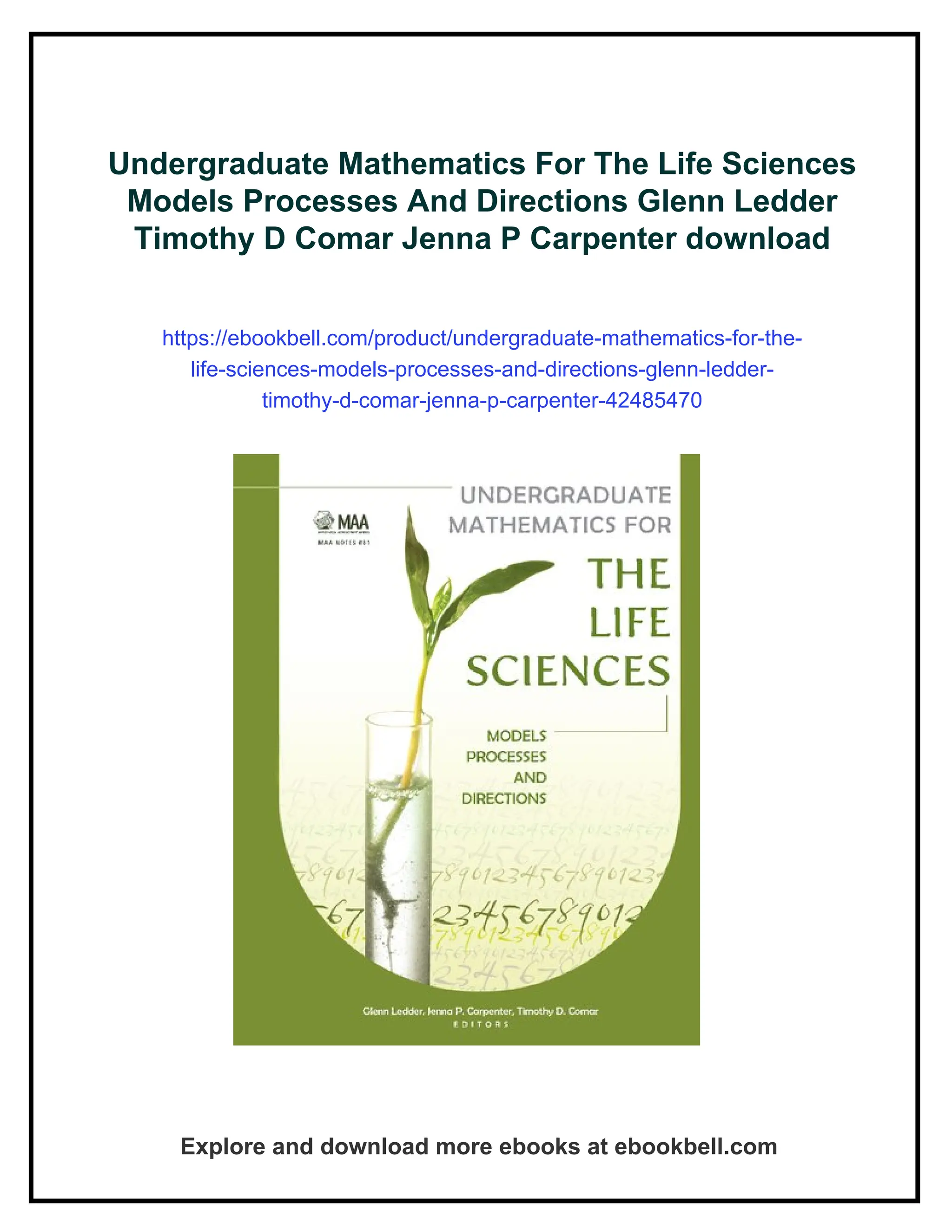
  • 1.
    Undergraduate Mathematics ForThe Life Sciences Models Processes And Directions Glenn Ledder Timothy D Comar Jenna P Carpenter download https://ebookbell.com/product/undergraduate-mathematics-for-the- life-sciences-models-processes-and-directions-glenn-ledder- timothy-d-comar-jenna-p-carpenter-42485470 Explore and download more ebooks at ebookbell.com
  • 2.
    Here are somerecommended products that we believe you will be interested in. You can click the link to download. Linear Algebra Gems Assets For Undergraduate Mathematics 1st Edition Charles R Johnson Editor https://ebookbell.com/product/linear-algebra-gems-assets-for- undergraduate-mathematics-1st-edition-charles-r-johnson- editor-42485168 The Lebesgue Integral For Undergraduates William Johnston https://ebookbell.com/product/the-lebesgue-integral-for- undergraduates-william-johnston-34618876 Linear Algebra Gems Assets For Undergraduate Mathematics David Carlson https://ebookbell.com/product/linear-algebra-gems-assets-for- undergraduate-mathematics-david-carlson-7185960 Mathematical Modeling For Epidemiology And Ecology Springer Undergraduate Texts In Mathematics And Technology 2nd Ed 2nd Edition Glenn Ledder https://ebookbell.com/product/mathematical-modeling-for-epidemiology- and-ecology-springer-undergraduate-texts-in-mathematics-and- technology-2nd-ed-2nd-edition-glenn-ledder-49351600
  • 3.
    An Introduction ToUndergraduate Research In Computational And Mathematical Biology From Birdsongs To Viscosities Foundations For Undergraduate Research In Mathematics 1st Ed 2020 Hannah Callender Highlander Editor https://ebookbell.com/product/an-introduction-to-undergraduate- research-in-computational-and-mathematical-biology-from-birdsongs-to- viscosities-foundations-for-undergraduate-research-in-mathematics-1st- ed-2020-hannah-callender-highlander-editor-11295208 Mathematics Volume 2 For Undergraduate Liberal Arts Universites 2 https://ebookbell.com/product/mathematics-volume-2-for-undergraduate- liberal-arts-universites-2-47301560 Essential Mathematics For Undergraduates Simon G Chiossi https://ebookbell.com/product/essential-mathematics-for- undergraduates-simon-g-chiossi-38419974 Directions For Mathematics Research Experience For Undergraduates Mark A Peterson https://ebookbell.com/product/directions-for-mathematics-research- experience-for-undergraduates-mark-a-peterson-5242556 Ants Bikes And Clocks Problem Solving For Undergraduates 2nd Edition William Briggs https://ebookbell.com/product/ants-bikes-and-clocks-problem-solving- for-undergraduates-2nd-edition-william-briggs-2521706
  • 6.
    Undergraduate Mathematics forthe Life Sciences Models, Processes, and Directions
  • 7.
    c 2013 by TheMathematical Association of America (Incorporated) Library of Congress Control Number 2013942924 Print ISBN 978-0-88385-191-3 Electronic ISBN 978-1-61444-316-2 Printed in the United States of America Current Printing (last digit): 10 9 8 7 6 5 4 3 2 1
  • 8.
    Undergraduate Mathematics forthe Life Sciences Models, Processes, and Directions Edited by Glenn Ledder University of Nebraska-Lincoln Jenna P. Carpenter Louisiana Tech University and Timothy D. Comar Benedictine University Published and Distributed by The Mathematical Association of America
  • 9.
    The MAA NotesSeries, started in 1982, addresses a broad range of topics and themes of interest to all who are involved with undergraduate mathematics. The volumes in this series are readable, informative, and useful, and help the mathematical community keep up with developments of importance to mathematics. Council on Publications and Communications Frank Farris, Chair Committee on Books Gerald Bryce, Chair Notes Editorial Board Stephen B Maurer and Michael K. May Co-Editors Michael C. Axtell Anneke Bart Deborah J. Bergstrand Thomas L. Drucker Christopher L. Frenzen Louis M. Friedler Hugh Howards Douglas E. Iannucci Theresa Jeevanjee Elizabeth W. McMahon MAA Notes 14. Mathematical Writing, by Donald E. Knuth, Tracy Larrabee, and Paul M. Roberts. 16. Using Writing to Teach Mathematics, Andrew Sterrett, Editor. 17. Priming the Calculus Pump: Innovations and Resources, Committee on Calculus Reform and the First Two Years, a subcomittee of the Committee on the Undergraduate Program in Mathematics, Thomas W. Tucker, Editor. 18. Models for Undergraduate Research in Mathematics, Lester Senechal, Editor. 19. Visualization in Teaching and Learning Mathematics, Committee on Computers in Mathematics Education, Steve Cunningham and Walter S. Zimmermann, Editors. 20. The Laboratory Approach to Teaching Calculus, L. Carl Leinbach et al., Editors. 21. Perspectives on Contemporary Statistics, David C. Hoaglin and David S. Moore, Editors. 22. Heeding the Call for Change: Suggestions for Curricular Action, Lynn A. Steen, Editor. 24. Symbolic Computation in Undergraduate Mathematics Education, Zaven A. Karian, Editor. 25. The Concept of Function: Aspects of Epistemology and Pedagogy, Guershon Harel and Ed Dubinsky, Editors. 26. Statistics for the Twenty-First Century, Florence and Sheldon Gordon, Editors. 27. Resources for Calculus Collection, Volume 1: Learning by Discovery: A Lab Manual for Calculus, Anita E. Solow, Editor. 28. Resources for Calculus Collection, Volume 2: Calculus Problems for a New Century, Robert Fraga, Editor. 29. Resources for Calculus Collection, Volume 3: Applications of Calculus, Philip Straffin, Editor. 30. Resources for Calculus Collection, Volume 4: Problems for Student Investigation, Michael B. Jackson and John R. Ramsay, Editors. 31. Resources for Calculus Collection, Volume 5: Readings for Calculus, Underwood Dudley, Editor. 32. Essays in Humanistic Mathematics, Alvin White, Editor. 33. Research Issues in Undergraduate Mathematics Learning: Preliminary Analyses and Results, James J. Kaput and Ed Dubinsky, Editors. 34. In Eves Circles, Joby Milo Anthony, Editor. 35. Youre the Professor, What Next? Ideas and Resources for Preparing College Teachers, The Committee on Preparation for College Teaching, Bettye Anne Case, Editor. 36. Preparing for a New Calculus: Conference Proceedings, Anita E. Solow, Editor. 37. A Practical Guide to Cooperative Learning in Collegiate Mathematics, Nancy L. Hagelgans, Barbara E. Reynolds, SDS, Keith Schwingendorf, Draga Vidakovic, Ed Dubinsky, Mazen Shahin, G. Joseph Wimbish, Jr. 38. Models That Work: Case Studies in Effective Undergraduate Mathematics Programs, Alan C. Tucker, Editor. 39. Calculus: The Dynamics of Change, CUPM Subcommittee on Calculus Reform and the First Two Years, A. Wayne Roberts, Editor. 40. Vita Mathematica: Historical Research and Integration with Teaching, Ronald Calinger, Editor. 41. Geometry Turned On: Dynamic Software in Learning, Teaching, and Research, James R. King and Doris Schattschneider, Editors. 42. Resources for Teaching Linear Algebra, David Carlson, Charles R. Johnson, David C. Lay, A. Duane Porter, Ann E. Watkins, William Watkins, Editors. 43. Student Assessment in Calculus: A Report of the NSF Working Group on Assessment in Calculus, Alan Schoenfeld, Editor.
  • 10.
    44. Readings inCooperative Learning for Undergraduate Mathematics, Ed Dubinsky, David Mathews, and Barbara E. Reynolds, Editors. 45. Confronting the Core Curriculum: Considering Change in the Undergraduate Mathematics Major, John A. Dossey, Editor. 46. Women in Mathematics: Scaling the Heights, Deborah Nolan, Editor. 47. Exemplary Programs in Introductory College Mathematics: Innovative Programs Using Technology, Susan Lenker, Editor. 48. Writing in the Teaching and Learning of Mathematics, John Meier and Thomas Rishel. 49. Assessment Practices in Undergraduate Mathematics, Bonnie Gold, Editor. 50. Revolutions in Differential Equations: Exploring ODEs with Modern Technology, Michael J. Kallaher, Editor. 51. Using History to Teach Mathematics: An International Perspective, Victor J. Katz, Editor. 52. Teaching Statistics: Resources for Undergraduate Instructors, Thomas L. Moore, Editor. 53. Geometry at Work: Papers in Applied Geometry, Catherine A. Gorini, Editor. 54. Teaching First: A Guide for New Mathematicians, Thomas W. Rishel. 55. Cooperative Learning in Undergraduate Mathematics: Issues That Matter and Strategies That Work, Elizabeth C. Rogers, Barbara E. Reynolds, Neil A. Davidson, and Anthony D. Thomas, Editors. 56. Changing Calculus: A Report on Evaluation Efforts and National Impact from 1988 to 1998, Susan L. Ganter. 57. Learning to Teach and Teaching to Learn Mathematics: Resources for Professional Development, Matthew Delong and Dale Winter. 58. Fractals, Graphics, and Mathematics Education, Benoit Mandelbrot and Michael Frame, Editors. 59. Linear Algebra Gems: Assets for Undergraduate Mathematics, David Carlson, Charles R. Johnson, David C. Lay, and A. Duane Porter, Editors. 60. Innovations in Teaching Abstract Algebra, Allen C. Hibbard and Ellen J. Maycock, Editors. 61. Changing Core Mathematics, Chris Arney and Donald Small, Editors. 62. Achieving Quantitative Literacy: An Urgent Challenge for Higher Education, Lynn Arthur Steen. 64. Leading the Mathematical Sciences Department: A Resource for Chairs, Tina H. Straley, Marcia P. Sward, and Jon W. Scott, Editors. 65. Innovations in Teaching Statistics, Joan B. Garfield, Editor. 66. Mathematics in Service to the Community: Concepts and models for service-learning in the mathematical sciences, Charles R. Hadlock, Editor. 67. Innovative Approaches to Undergraduate Mathematics Courses Beyond Calculus, Richard J. Maher, Editor. 68. From Calculus to Computers: Using the last 200 years of mathematics history in the classroom, Amy Shell-Gellasch and Dick Jardine, Editors. 69. A Fresh Start for Collegiate Mathematics: Rethinking the Courses below Calculus, Nancy Baxter Hastings, Editor. 70. Current Practices in Quantitative Literacy, Rick Gillman, Editor. 71. War Stories from Applied Math: Undergraduate Consultancy Projects, Robert Fraga, Editor. 72. Hands On History: A Resource for Teaching Mathematics, Amy Shell-Gellasch, Editor. 73. Making the Connection: Research and Teaching in Undergraduate Mathematics Education, Marilyn P. Carlson and Chris Rasmussen, Editors. 74. Resources for Teaching Discrete Mathematics: Classroom Projects, History Modules, and Articles, Brian Hopkins, Editor. 75. The Moore Method: A Pathway to Learner-Centered Instruction, Charles A. Coppin, W. Ted Mahavier, E. Lee May, and G. Edgar Parker. 76. The Beauty of Fractals: Six Different Views, Denny Gulick and Jon Scott, Editors. 77. Mathematical Time Capsules: Historical Modules for the Mathematics Classroom, Dick Jardine and Amy Shell-Gellasch, Editors. 78. Recent Developments on Introducing a Historical Dimension in Mathematics Education, Victor J. Katz and Costas Tzanakis, Editors. 79. Teaching Mathematics with Classroom Voting: With and Without Clickers, Kelly Cline and Holly Zullo, Editors. 80. Resources for Preparing Middle School Mathematics Teachers, Cheryl Beaver, Laurie Burton, Maria Fung, and Klay Kruczek, Editors. 81. Undergraduate Mathematics for the Life Sciences: Models, Processes, and Directions, Glenn Ledder, Jenna P. Carpenter, and Timothy D. Comar, Editors. 82. Applications of Mathematics in Economics, Warren Page, Editor. MAA Service Center P.O. Box 91112 Washington, DC 20090-1112 1-800-331-1MAA FAX: 1-301-206-9789
  • 12.
    Foreword: Looking Backwardand Moving Forward in Undergraduate Life Science Quantitative Education It is a pleasure to read the contributions in this book, particularly since the importance of mathematics in biology has only slowly been realized over the past several decades by the biological research and education community. When I organized a Quantitative Sciences Curriculum for the Life Sciences Students workshop in 1992 for leading practitioners of mathematical biology, there were few mathematics courses designed specifically for life science students and many bench biologists were unconvinced of a need for quantitative education. Although I did not know it at the time, several of the issues addressed in the 1992 and later workshops I organized had been the subject of the Cullowhee Conference on Training in Biomathematics held in 1961 at Western Carolina University in Cullowhee, North Carolina, and attended by many leading mathematical biologists. Issues addressed at the Cullowhee Conference still reverberate today, including: “To what extent should mathematical courses given to biologists be different from those given to mathematicians?” (H.D. Landahl) and “Traditional biology courses lay far too much emphasis on the direct acquisition of information. Insufficient attention is given to the interpretation of facts or to the drawing of conclusions from observation and experience.” (J. G. Skellam). So have we learned anything in the fifty years since the Cullowhee Conference? This volume is a testament to a resounding YES! Many model programs have been developed, curricular material has been assembled, biologists are more attuned to the utility of quantitative approaches, and education research provides guidance on what works – learning not training, research participation not canned labs, active learning and peer collaboration not listening to lectures. We have moved beyond anecdotes to the science of science education. The diversity of models and processes described in this book provides evidence of the need for alternative approaches to assist our students to become “fearless biologists” in utilizing quantitative concepts and skills so that they can not only assimilate, but also participate in modern biology. Integrating quantitative perspectives throughout the undergraduate life science curriculum, a goal emphasized in the 1992 Workshop, is still a work in progress. The host of reports since that time, including BIO2010 and Vision and Change in Undergraduate Biology Education, all emphasize the benefits of an integrative, multi-disciplinary view of modern biology with quantitative concepts and skills being a central component. This book provides evidence that there is institutional variation in successful methods to ensure that exposure to quantitative topics for life science students is not isolated in a few mathematics and statistics courses but are an integral part of the modern biologists’ tool-box. The developers of the examples presented here are to be lauded for their willingness to take an integrative view of undergraduate biology education. The funding agencies that assisted them are to be encouraged by the progress to date and urged to continue to support successful ventures in quantitative education for all our students. Louis J. Gross National Institute for Mathematical and Biological Synthesis University of Tennessee, Knoxville vii
  • 14.
    Foreword: An Invitationto BIO SIGMAA Although the history of mathematics and computation in biology began a long time ago, the history of this volume begins with the formation of BIO SIGMAA. In January of 2006, Carl Cowan and Michael Pearson spoke with me about the SIGMAAs of the MAA at the Joint Mathematics Meetings in San Antonio. Carl was President of the MAA at the time and saw mathematical biology as an important growing area in mathematics and one that might benefit from the SIGMAA program of the MAA. I had helped run several successful MAA PREP workshops related to mathematical and computational biology and I suppose that put me on Carl’s list. I am also tall, which makes me easy to track down in a crowded room. Over the next few days, we spent time talking with other people we thought might be interested in being a part of the SIGMAA. There was a great deal of support from people both more and less experienced than I. Somehow I found myself organizing the effort, but I was really just collating the ideas of others. I finished the first draft of the charter in April 2006 and after feedback, it was completed by July. In August 2006, BIO SIGMAA became the tenth SIGMAA. Since biology can hardly be called a single field of study, mathematical and computational biology can be no less diverse. It was important from the beginning to be as inclusive as possible, welcoming all areas of biology and all approaches to understanding them. At the time the SIGMAA formed, there were several organizations promoting re- search in mathematical and computational biology, but the connection to educational practices and undergraduate research needed a broader platform and a bigger voice. BIO SIGMAA was created to strengthen the ties between research and education and to provide a venue for sharing ideas. From 2006 to now, many people have put in a great deal of effort into BIO SIGMAA and it has grown in both numbers and maturity. This volume gives readers a taste of current educational practices in mathematical and computational biology. It represents approaches taken or proposed in different areas of biology, different approaches to the study of biology, and the relationship of these practices with different aspects of education. There are many other ideas that did not fit into this volume and I feel sure new ideas will be motivated by those that did. I encourage everyone to share those ideas at an upcoming BIO SIGMAA event. Eric Marland, founding board member of BIO SIGMAA Department of Mathematical Sciences Appalachian State University ix
  • 16.
    Contents Foreword: Looking Backwardand Moving Forward in Undergraduate Life Science Quantitative Education vii Louis J. Gross Foreword: An Invitation to BIO SIGMAA ix Eric Marland Preface xv General Introduction xvii Glenn Ledder I Models 1 1 BioCalc at Illinois 5 J. Jerry Uhl and Judy Holdener A one-semester biocalculus course at a large university, with emphasis on conceptual learning facilitated by a computer algebra system 2 Biocalculus at Benedictine University 17 Timothy D. Comar A two-semester biocalculus sequence at a small college 3 Implementation of First Year Biomath Courses at the Ohio State University 25 Laura Kubatko, Janet Best, Tony Nance, and Yuan Lou A one-year sequence of biocalculus plus statistics at a large university 4 Teaching Calculus, Probability, and Statistics to Undergraduate Life Science Majors: A Unified Approach 33 Frederick R. Adler A one-year sequence of mixed topics designed for biology students 5 The First Year of Calculus and Statistics at Macalester College 39 Dan Flath, Tom Halverson, Danny Kaplan, and Karen Saxe A redesigned introductory sequence for all students 6 Biology in Mathematics at the University of Richmond 45 Lester Caudill A two-semester sequence with calculus and advanced topics 7 A Terminal Post-Calculus-I Mathematics Course for Biology Students 51 Glenn Ledder Mathematical modeling, probability, and dynamical systems for students with a Calculus I background xi
  • 17.
    xii Contents 8 ModelingNature and the Nature of Modeling—an Integrative Modeling Approach 61 Claudia Neuhauser Dynamical systems, partial differential equations, and stochastic processes for students with a Calculus I background, with emphasis on modeling in Excel and Matlab 9 Mathematical Biology and Computational Algebra at the Sophomore Level 65 Rohan Attele and Dan Hrozencik Computational linear algebra with student research projects 10 An Interdisciplinary Research Course in Theoretical Ecology for Young Undergraduates 69 Glenn Ledder, Brigitte Tenhumberg, and G. Travis Adams A research-driven course focusing on connections between theoretical models and experimental data 11 An Interdisciplinary Course, Textbook, and Laboratory Manual in Biomathematics with Emphasis on Current Biomedical Research 83 Raina Robeva, Robin Davies, and Michael L. Johnson A special topics course on biomedical research 12 Teaching Bioinformatics in a Mathematics Department 89 Steven Deckelman A mathematically-oriented bioinformatics program and its core capstone course 13 SYMBIOSIS: An Integration of Biology, Math and Statistics at the Freshman Level: Walking Together Instead of on Opposite Sides of the Street 97 Karl H. Joplin, Edith Seier, Anant Godbole, Michel Helfgott, Istvan Karsai, Darrell Moore, and Hugh A. Miller, III A complex interdisciplinary freshman curriculum II Processes 105 14 Science One: Integrating Mathematical Biology into a First-Year Program 109 Mark Mac Lean Designing and maintaining a year-long team-taught interdisciplinary curriculum at a large institution 15 Planning for the Long Term 115 Meredith L. Greer Retooling a course to meet changing needs and changing personnel 16 Some Lessons from Fifteen Years of Educational Initiatives at the Interface between Mathematics and Biology: The Entry-Level Course 121 Louis J. Gross Getting a department to embrace a course 17 A “Wet-Lab” Calculus for the Life Sciences 127 James L. Cornette, Gail B. Johnston, Ralph A. Ackerman, and Brin A. Keller A cautionary tale about a project that died from lack of institutional support 18 Creating an Interdisciplinary Research Course in Mathematical Biology 133 Glenn Ledder and Brigitte Tenhumberg Advice on creating interdisciplinary team-taught courses
  • 18.
    Contents xiii 19 Bioinformatics:An Example of a Cooperative Learning Course 139 Namyong Lee and Ernest Boyd A biology/mathematics/computer science course at a smaller MS-level institution 20 Integrating Statistics and General Biology I in a Learning Community 143 William Ardis and Sukanya Subramanian Using learning communities to connect biology with statistics 21 Constructing an Undergraduate BioMath Curriculum at a Large University: Developing First Year Biomath Courses at The Ohio State University 149 Tony Nance and Laura Kubatko Curriculum reform at a very large institution 22 Initial Steps Towards an Integration of Qualitative Thinking into the Teaching of Biology at a Large Public University 155 Carole L. Hom, Eric V. Leaver, and Martin Wilson An introductory biological modeling course offered by a biology department III Directions 165 23 Integrating Statistics into College Algebra to Meet the Needs of Biology Students 169 Sheldon P . Gordon and Florence Gordon A call for a college algebra course thought of as pre-statistics rather than pre-calculus 24 Motivating Calculus with Biology 177 Sebastian J. Schreiber Ideas for introducing more biology and biological modeling into mathematics courses 25 Computational Systems Biology: Discrete Models of Gene Regulation Networks 189 Ana Martins, Paola Vera-Licona, and Reinhard Laubenbacher Using Boolean network analysis to model complex systems in molecular biology 26 Creating Quantitative Biologists: The Immediate Future of SYMBIOSIS 201 Darrell Moore, Karl H. Joplin, Istvan Karsai, and Hugh A. Miller III Making introductory biology courses that have more quantitative content and focus more on biological thinking than biological facts About the Editors 207
  • 20.
    Preface This volume containstwenty-six articles on mathematics pedagogy for life science students, representing twenty-two institutions from large research universities to community colleges. While many of the articles discuss projects designed to fit a particular niche at a particular institution, each emphasizes lessons learned that could be applied elsewhere. The articles are sorted into three themes, Models, Processes, and Directions, as described in the General Introduction that follows the table of contents, and in the editorial introductions to the three parts. Curricular development in mathematics for biology is occurring at a variety of levels, including advanced undergraduate courses, interdisciplinary courses, alternatives to the standard calculus sequence, and complete curricula. Articles in the Models and Processes sections focus on curriculum projects on one of these levels. The division of the articles into two groups was motivated by the observation, made by many of the authors, that successful innovation in mathematics pedagogy for biology requires more than a good pedagogical idea. Several excellent projects have failed to become established because they could not attract sufficient enrollment or have fallen into disuse because they could not be institutionalized. We wanted to present them as outstanding models while addressing the reasons for their failure. For the most part, articles in the Models section focus on the details of a curricular model, while articles in the Processes section focus on the issues involved in implementation. Some articles were written as a pair, one in each section, while others address both themes and were placed in whichever section seemed most appropriate; the connections are noted in the general introduction and the editorial introductions. Articles in the Directions section propose changes in emphasis and topic selection. We hoped to have articles on assessment of curricular projects as well, but we were unable to find any assessment results that we thought were sufficiently robust and exemplary to warrant inclusion as separate articles. A few of the articles contain assessment results, but there is clearly a need for assessment of curriculum projects that is only beginning to be met. Each article begins with a brief summary of the institution and the students involved in the project; where possible, each indicates additional information accessible on the web. Other web resources can be found through the BIO SIGMAA and Bioquest web sites. Many of the curriculum projects discussed in this volume started as responses to the publication in 2003 of the BIO2010 report of the National Academies. The report recommended improvements in the quantitative education of research biologists. It received some criticism from a small number of biologists who believed (incorrectly, in my opinion) that it was aimed primarily at medical research, but it was largely endorsed by biologists and thoroughly embraced by mathematics educators. “All” that remained was to implement its recommendations. The Mathematics Association of America (MAA) published Math and BIO2010, edited by Lynn Arthur Steen, in 2005. It consists primarily of essays with suggestions for mathematics curriculum reform, but has very few concrete examples of successful programs. Simultaneously, a growing number of mathematics faculties began addressing problems of curriculum reform for their own institutions, and some textbooks from these projects were published in the first few years after BIO2010. Mathematics curriculum development for biology expanded in 2006 with two developments. The first was that the planners for the Joint Mathematics Meetings (JMM) of 2007 found themselves with three distinct proposals for contributed paper sessions on mathematics education for biology. Two were consolidated, resulting in two distinct sessions. One was organized by Elton Graves of Rose-Hulman Institute of Technology; I organized the other with Jack Bookman, James Fulton, and Yajun Yang. The second development was the founding of the Biology Special Interest Group of the MAA (BIO SIGMAA) by Eric Marland of Appalachian State University. I was among the people invited by Eric to help form the group. I suggested that BIO SIGMAA’s first action should be to sponsor my contributed paper session, which resulted in my selection as the first Program Director of BIO SIGMAA. xv
  • 21.
    xvi Preface The mathematics-for-biologysessions at JMM 2007 were a great success. My session had so many contributors that it had to be broken into three parts. Though some parts were scheduled at undesirable times, the talks were well attended, with audiences ranging in size from twenty participants to more than fifty. The mathematics-for-biology sessions also caught the interest of people involved in publishing. Shortly after JMM 2007, I received offers for publications from PRIMUS1 editor Brian Winkel and MAA Notes editor Steve Maurer. After discussions with the other JMM contributors, we arrived at a plan—I would edit a PRIMUS issue on ideas of small scope that could be implemented within the context of an individual course, and Jenna Carpenter and Tim Comar would join me in editing an MAA Notes volume on projects at the course and curriculum levels. The PRIMUS issue, published in January 2008, consisted of invited papers based on talks in my JMM session. Jenna, Tim, and I planned this volume with help from Eric Marland. It was Eric who suggested that we should look for articles that would describe curricular models, discuss the curriculum change process, and suggest directions for the future. This led to the structuring of the volume in parts devoted to models, processes, and directions. Some of the contributions for this volume were solicited from leaders in mathematics education for biology, but we also wanted to cast a wide net. We used the BIO SIGMAA listserv to send out a call for papers. This brought us a large number of proposals for articles, resulting in the twenty-six papers in this volume. The papers offer the reader a wealth of accumulated experience. It appears likely that mathematics curriculum development for biology students will affect an increasing number of educational institutions. However, it is difficult to move from a good idea to an accepted course or curriculum. Models that meet the needs of one institution may not work for others. New courses or curricula need to be tested and refined at their own institution. For this reason, each article begins with a summary of the facts about the program and the institution. To the reader who is struggling with mathematics curriculum development for biology students, these articles offer an opportunity to make use of the experiences of those who have already faced the same challenges. My co-editors and I want to acknowledge the valuable assistance of Steve Maurer and the team of reviewers that read through the articles. They had a lot of work to do with the first draft, owing to the lack of experience of the volume editors, but their critiques resulted in extensive changes for the better. While this volume has taken a long time to reach print— because of the large number of people and revisions involved—the extra time has allowed many articles to discuss how the projects changed over time. We hope that the information presented in this volume will inspire a new generation of successful curriculum models. Glenn Ledder November, 2012 1 Problems, Resources, and Issues in Mathematics Undergraduate Studies
  • 22.
    General Introduction The mathematicscurriculum as we know it grew out of the mathematical needs of physical science. We start with a full course in calculus, which requires three semesters at most institutions. This is followed by courses in linear algebra, differential equations, and calculus-based probability and statistics in some order. The latter subjects are the ones with the broadest applications in biology, along with several discrete topics that do not occupy a place in the physics-based mathematics curriculum. Biological applications in these courses have been rare until recently, but many authors are now incorporating biological examples. There are some books in these traditional areas for life science students, but there is no consensus mathematics curriculum for life science. The standard biology curriculum includes very little mathematics, in spite of the development, beginning in the 1920s, of several important mathematical models for biology. The typical curriculum for biology majors includes just one course in calculus and one in non-calculus-based statistics, and anything beyond two courses is rare. The result of the gap between the extensive mathematics background that is beneficial to biologists and the minimal mathematics background biology students acquire in their courses is an undergraduate education in biology with very little quantitative content. Mathematics could be incorporated into biology courses such as genetics and ecology, but this is difficult unless the biologist who teaches the course can count on students with the necessary mathematics background. The obvious answer, from a mathematician’s point of view, is for biology students to take the full calculus sequence followed by courses in linear algebra, differential equations, and probability with statistics. There are two problems with this answer. First, the courses contain almost no biology, being designed for the physical or social sciences. This could be fixed without a major curriculum change. More serious is the problem of fitting these courses into a biology student’s program. As it is, all biology students are essentially double majors, with enough courses in mathematics, physics, and chemistry to encompass a major in general science, along with the major in biology. The addition of four more mathematics courses is impractical, even for biology students who have the interest and aptitude. In this volume, authors from a variety of institutions address some of the problems involved in reforming mathematics curricula for biology students. The problems are sorted into three themes. We begin by examining curriculum Models. It is straightforward for mathematicians to generate curriculum ideas for the training of mathematicians, but it is more difficult to generate curriculum ideas for the training of biologists. A number of curriculum models have been introduced at various institutions, and a selection of them comprise the Models section. The second theme is Processes. Suppose we have created an outstanding course that clearly meets the needs of its students. This course amounts to nothing unless it is institutionalized in both the biology department, as a curricular requirement, and in the mathematics department, as a course that will be staffed even after the creator of the course is no longer on the faculty. The final theme is Directions. Here we look to the future, with each paper laying out a case for pedagogical developments that the authors would like to see. There is some overlap between the Models and Processes themes. All of the Processes papers refer to some model, although its role is sometimes peripheral. Many of the Models papers mention process issues as well. Some contributors, such as Kubatko and Nance of Ohio State University, have pieces in both parts. Other papers were placed in whichever part seemed to be the better fit, but for some this was almost arbitrary. The papers by MacLean, Lee and Boyd, and Joplin et al combine almost equal doses of model and process; the first two appear in the Processes part and the last one in the Models part. xvii
  • 24.
  • 26.
    Introduction One reason forthe diversity of curriculum ideas for biology is that there are only a small number of slots, perhaps only two or three, available in the packed curriculum of biology majors. A second reason is the lack of uniformity in the biology curriculum that the mathematics curriculum is supposed to support. Physicists are generally in agreement about what constitutes introductory learning in physics, which has led to a mathematics curriculum that varies little among institutions, with no issues more serious than the order of linear algebra and differential equations. Biologists, in contrast, have not yet reached a consensus on what constitutes introductory learning in biology. Accordingly, there is no single mathematics curriculum for biology that can be applied in all institutions. In the past decade, a number of approaches to the problem of replacing the standard calculus sequence with something more appropriate for biologists have been made by mathematicians, with connections to various areas of biology. This broad issue of mathematics curricula for lower-division biology students is addressed in eight of the thirteen papers in the Modeling section, which fall into three classes. The simplest approach, as seen in the first three papers, is to modify the courses that biology students are already taking, but to leave them compatible with the standard sequence so that students can move between the traditional physics-based and alternative biology-based courses. These three papers are arranged in order of increasing scope. We begin with a paper by Jerry Uhl and Judy Holdener that describes a one-semester biocalculus course at the University of Illinois that grew out of Jerry’s well-known Calculus with Mathematica project and features significant use of a computer algebra system. Next is a paper by Tim Comar that describes the two-semester biocalculus sequence at Benedictine University. The courses incorporate dynamical systems and biology applications into the standard calculus sequence and also use computer laboratory projects. This group concludes with a paper by Laura Kubatko and colleagues that describes a two-quarter sequence of biology-oriented calculus courses, along with a one-quarter biology-oriented statistics course, at the Ohio State University. This group of papers offers a variety of options for modifying the standard curriculum. A second approach, also represented by three papers, is to create a biology-based curriculum that does not try to be compatible with the standard curriculum. We can gain flexibility by diverging from the standard curriculum at the beginning, but at the cost of immediate tracking of students. The three papers in this group illustrate the variety that is made possible by abandoning the requirement of compatibility with standard courses. We have arranged these papers in order of decreasing seniority, beginning with a paper by Fred Adler that describes the one-year mathematics- for-biology curriculum he created at the University of Utah in the early 1990s. The Utah curriculum focuses on dynamical systems and probability/statistics, packaged to be accessible to students who have not previously taken a calculus course. Calculus topics are developed as needed. Next is a paper by several faculty at Macalester College that describes their Applied Calculus and Statistical Modeling sequence. Do not be misled by the word “Applied.” Whereas the title Applied Calculus normally is used for the brief treatments designed for business students and often foisted on biology students, the Macalester Applied Calculus course is designed for students who have already had some exposure to calculus. It begins with a treatment of functions and differential calculus and concludes with material on differential equations and linear algebra. The Statistical Modeling course offers a calculus-based curriculum designed around statistical problems in biology. In the final paper of this group, Lester Caudill describes the Scientific Calculus sequence and a biomedical modeling course at the University of Richmond. The first semester in the Scientific Calculus sequence adds modeling, regression, and multivariable optimization to a first-semester calculus core, while the second semester focuses on probability, Taylor series, and dynamical systems. The third course focuses on modeling and dynamical systems. Having a third course makes it possible for the Richmond curriculum to retain more topics from 3
  • 27.
    4 Introduction standard calculusthan the other projects in this group. Readers interested in full-year freshman curricula will also want to look at the article by Lou Gross in the Processes section of this volume. Recently, there has been some interest in the intermediate strategy of a standard-curriculum-compatible one-semester calculus course followed by a terminal one-semester course designed for biology students. This approach offers more flexibility than the first approach without the immediate tracking of the second. In the first paper of this group, I describe the Mathematical Methods for Biology and Medicine course that I created at the University of Nebraska. It begins with basics of mathematical modeling, with a focus on working with parameters and fitting data to models, before turning to probability distributions and concluding with dynamical systems. In the second paper of this group, Claudia Neuhauser describes a course at the University of Minnesota called Modeling Nature and the Nature of Modeling. This course focuses on discrete and continuous dynamical systems before turning to some partial differential equation models and stochastic processes, with an emphasis on computer modeling in Excel and Matlab. The remaining papers in the Models section concern projects that fill specific niches identified at their institutions. Each is highly interdisciplinary and taught by a team that includes life science and mathematics faculty. Many include student research. Three focus on topics that do not normally appear in the mathematics curriculum and one encompasses basic biology as well as basic mathematics. They are examples of creative curriculum development in mathematical biology. The papers by Rohan Attele and Dan Hrozencik of Chicago State University and by Glenn Ledder, Brigitte Tenhumberg, and Travis Adams of the University of Nebraska describe two approaches to designing a course based more on research than on specific content. Attele and Hrozencik describe a sophomore-level course in which students learn computational linear algebra and matrix population models before studying molecular evolution and phylogenetic trees. Students work in interdisciplinary teams on a research problem in population demographics. Ledder, Tenhumberg, and Adams describe a pre-college or freshman-level course centered on a research project in theoretical ecology. The students collect data on rates of aphid birth, growth, and death, which they use to parameterize a matrix model of aphid population growth. Another experiment collects population data used to test the predictions of the model. The lecture portion of the course supplements the laboratory portion by teaching students the methods and concepts needed for modeling and data analysis. The next paper, by Raina Robeva, Robin Davies, and Michael Johnson, describes a Biomathematics course taught at Sweet Briar College by a team of one mathematician and one biologist to mathematics and biology majors who have taken courses in calculus, statistics, and general biology. The course employs mathematical methods to treat problems chosen for their biological content. These include Boolean network analysis, a topic that is nicely described in a paper by Martins, Vera-Licona, and Laubenbacher that appears in the Directions section of this volume. In the next paper of the Models section, Steven Deckelman describes the bioinformatics program of the mathematics department at the University of Wisconsin-Stout. It is built from courses in computer science, biology, chemistry, and mathematics, and features a capstone course called Mathematical and Computational Foundations of Bioinformatics. The final paper in the Models section describes an integrated year-long freshman sequence at East Tennessee State University that is equivalent to one statistics course, one calculus course, and three biology courses. The reader interested in interdisciplinary courses should also look at the paper by Mark MacLean in the Processes section. The thirteen papers in the Models section do not provide a comprehensive listing of curriculum projects in math- ematics for biology students, but they do contain a rich variety of projects that represent solutions to pedagogical problems that are partly general and partly dependent on the institutional setting. Readers who do not find a model here that they can adapt to their institution will at least find elements to incorporate into their own innovative model. Three additional papers in the Processes section (one by Lee and Boyd, one by Ardis and Subramanian, and one by Hom, Leaver, and Wilson) also contain significant descriptions of curriculum models.
  • 28.
    1 BioCalc at Illinois J.Jerry Uhl Department of Mathematics, University of Illinois-Urbana Judy Holdener1 Department of Mathematics, Kenyon College Name of Institution University of Illinois-Urbana Size 28000 undergraduates and 9000 graduate students Institution Type large state university with PhD program Student Demographic recent high school graduates with high potential and interests in mathematics and/or biology Department Structure Mathematics and Biology are individual departments in the College of Arts and Sciences Abstract BioCalc is a Mathematica-driven calculus course for life science students. It has been taught at the University of Illinois since the fall of 1993. In this article we describe how the course came to be, how it is structured, and how it differs from other calculus courses. We also provide a sample of the electronic notebooks used in the course. Finally, we report on some of BioCalc’s successes. 1.1 Course Structure r Weeks per term: 15-week semester r Classes per week/type/length: One or two 1-hour lecture periods r Labs per week/length: Three or four 1-hour laboratory periods 1 holdenerj@kenyon.edu 5
  • 29.
    6 Chapter 1BioCalc at Illinois r Average class size: Sections are capped at 20. r Enrollment requirements: First-year students in the biological sciences. Students cannot enroll unless they are life science majors. r Faculty/dept per class, TAs: Typically taught by a graduate TA in mathematics or sometimes a faculty member. There is also one undergraduate class assistant. r Next course: Life science majors must take two of Calculus I, Calculus II, and Statistics, so some continue on to Calculus II. r Website: http://www-cm.math.uiuc.edu/ 1.2 Introduction In the late 1980s at Illinois, our Illinois-Ohio State group developed a Mathematica-based calculus course now offered at Illinois. By the early 1990s, the Mathematica-based calculus sequence Calculus Mathematica (CM) (Uhl et al., 2006) had been class-tested and revised. In this revision, we decided to place heavy emphasis on life science models because our vision of calculus had become that it is the study and measurement of growth. This led the way to an emphasis on teaching calculus with life science models. After all, what grows? Animals, populations, and epidemics do. As our course evolved, we could see that many students from a variety of fields, including engineering, identified better with the life science models than they did with the physics examples that are typically used in a calculus course. At that point a fortuitous event occurred . . . Professor Sandra Lazarowitz of the School of Life Sciences at Illinois called one of us and said that the standard calculus course was not connecting with the life science students, who were not interested in computing the work done by a force or the position of a projectile. The engineering emphasis in calculus sent the signal that it had little to do with their future careers in the biological sciences. As evidence of the disconnect, Professor Lazarowitz said that approximately 60% of the life science majors enrolled in the traditional Calculus I course were receiving a grade of C or lower in the course. It is a common misconception that life science students are weak in mathematics. We told her we were working on a calculus course that might be better suited for her life science students. In the fall of 1993, two Calculus Mathematica sections were reserved for life science students. The pilot sections were small (approximately 16 students each) and were taught by graduate teaching assistants Judy Holdener and Bill Hammock in a computer lab located within the Life Sciences building.2 The ACT scores of the students suggested that they would be at risk in traditional calculus, and many of the students had a high degree of math phobia. Despite these disadvantages, the students flourished in the experimental CM sections. Professor Lazarowitz, who was also the Director of the Howard Hughes Program for Undergraduate Education in the Life Sciences at Illinois, happily reported “first year life science students [in Calculus Mathematica sections] are studying mathematical models normally reserved for senior math majors, and student responses have been enthusiastic.” She was encouraged by the success rate, reporting that life science students who would likely have dropped a traditional offering of calculus were able to earn As with the new approach. As a result of the success of the pilot sections, the Department of Mathematics and the School of Life Sciences entered into an agreement to call the course “BioCalc” and to make it a permanent offering for life science students. After seventeen years, life science students continue to flourish in BioCalc. Using university records, staff at the Howard Hughes Medical Institute assessed the course in April of 2001 and cited the following conclusions in their report on the course (Fahrbach et al., 2001): r The BioCalc course is equally attractive to life sciences students required to take Math 120 (the standard calculus course at Illinois). No life sciences option is over- or underrepresented. r BioCalc students are as well prepared for Math 130 (the second calculus course in the standardsequence) as non-BioCalc students, as judged by the grade obtained in Math 130. 2 This lab was funded by the Howard Hughes Medical Institute (HHMI).
  • 30.
    1.3 The Differencesbetween BioCalc and the Standard Calculus Course 7 r BioCalc students are roughly twice as likely to take an additional math course than non-BioCalc students. r BioCalc students (80.4%) are slightly more likely to remain in a biological science major than non-BioCalc students (76.7%). r CalcPrime successfully prepares for BioCalc those students who do not place into Math 120.3 1.3 The Differences between BioCalc and the Standard Calculus Course So what is it that makes BioCalc so different from the traditional offering of calculus? Here are some differences: Greater emphasis on applications and life science models in particular. One of the biggest reasons for the success of BioCalc is its emphasis on life science models that reveal the relevance of calculus and reinforce the meaning of the derivative. There are exercises examining the decay of cocaine in the blood, models describing the spread of a disease, and data analyses investigating the correlation between cigarette smoking and lung cancer. Students examine data relating to the U.S. and world populations, the U.S. national debt, and the number of a space shuttle’s O-ring failures. They compute the optimal speed of a salmon swimming up a river, and they model the growth rates of an animal’s height and weight over time. (See the next section.) In BioCalc, life science students get enough experience to see for themselves that calculus plays a role in their lives and in their planned careers. One BioCalc student put it this way: “What we learned applies in our classes and in our lives.” Greater emphasis on visualization. The authors of the electronic notebooks used in BioCalc have gone to great lengths to help the student learn visually. The “textbook” is a sequence of interactive electronic notebooks that introduce new ideas using graphic examples and geometric interpretations. By working through the notebooks, students experience mathematics at their own pace by seeing it happen and making it happen. The graphics offered by Mathematica allow students to create the mental images necessary to understand calculus—images that students won’t always be able to create for themselves. Less emphasis on mathematical language and proof but more emphasis on conceptual explanation. Students in introductory calculus sometimes find the language of mathematics (i.e., the symbols and technical ter- minology) to be impenetrable, but among life science students the language barrier tends to be endemic. BioCalc circumvents the problem by using graphics and applications as the entry points for new material. Formal definitions and notation are introduced only after students internalize the ideas. Because most introductory calculus students will not choose careers involving the writing of mathematical proofs, BioCalc places a lesser emphasis on the writing of formal proofs and a greater emphasis on the use of calculus as a tool for solving problems. Greater emphasis on writing and communication. Although BioCalc places less emphasis on the writing of formal proofs, it places on a greater emphasis on writing. The electronic notebooks include numerous exercises that require students to describe what they see on the computer screen and to analyze what is happening. The students use their own words, and the writing solidifies their understanding of the material. Studying the comprehensive group of models offered by BioCalc is possible only because of the computational and graphical power offered by Mathematica. Students regard Mathematica as a professional tool, and they are delighted to use it because most of them arrived in BioCalc knowing their hand computation skills were not at the level required for success in a standard calculus course. 3 CalcPrime is a three-week transitional summer program for entering students at Illinois who underperform on the placement exam for MATH 120. CalcPrime students have lower Math ACT scores than other BioCalc students, and they are more likely to be non-Caucasian-American.
  • 31.
    8 Chapter 1BioCalc at Illinois 1.4 The Format of BioCalc So how are the BioCalc lessons structured and what exactly do students do in and out of class? The “textbook” is electronic, consisting of a series of interactive Mathematica notebooks, and students learn calculus by working through tutorial problems, experimenting with built-in Mathematica routines, and explaining graphical and computational output. Each lesson follows the same format, with four components: r The Basics section introduces the fundamental ideas in the lesson by presenting problems and explanations, often visual in nature. Students are encouraged to experiment with the problems by changing functions and numbers and rerunning the Mathematica code. Many of the problems prompt students to make conjectures about the patterns they observe in the computer output. r The Tutorial section, like the Basics section, presents problems for the student, but the focus is on techniques and applications that relate to the ideas presented in the Basics section. r The Give it a Try section is the heart of the course, providing a list of problems to be solved and submitted (electronically) by the student. Like the Tutorial section, problems are often application-based, incorporating models from the life sciences. Information needed to solve the problems is found in the Basics and Tutorial sections. r The Literacy Sheets present problems to be worked out with paper and pencil. This section is completed after the student has already completed the electronic portions of the lesson. Although the format may vary with the instructor, most BioCalc lessons are conducted in a computer lab. On a typical lab day, students work through the electronic notebooks at their own pace, asking questions of the instructor as needed. On every third or fourth session, the class meets in a standard classroom for a traditional chalkboard discussion. Students are graded on the electronic work they complete (in the Give it a Try section of the lesson) and the written work they do on the Literacy Sheets. Exams generally have both a written component and a computer component. 1.5 BioCalc Sampler In this final section, we reveal the flavor of BioCalc’s electronic lessons by examining BioCalc’s coverage of the chain rule. The chain rule is often associated with hand computation in calculus, but BioCalc students learn it in parallel with constructing height and weight functions to model the growth of animals over time. We will illustrate below, starting with the first mention of the chain rule. (Incidentally, BioCalc does not allow students to rely on the computer for the computation of derivatives, among other things. A basic literacy is expected of the students.) In introducing the chain rule, the Basics section starts by encouraging students to look for patterns in the derivatives of compositions of functions. What follows is taken directly from the electronic notebook covering the differentiation rules. Mathematica syntax is in bold (the code has not been executed). - - - - B.2) The chain rule: D[f[g[x]],x]=(f )[g[x]] (g )[x] Let’s check out the derivative of the composition of two functions. Here is the derivative of Sin[xˆ2]: Clear[f,x]; f[x ]=Sin[xˆ2]; (f )[x] Or D[Sin[xˆ2], x] This catches your eye because the derivative of Sin[x] is Cos[x] and the derivative of xˆ2 is 2x. It seems that the derivative of Sin[xˆ2] is manufactured from the derivative of Sin[x] and the derivative of xˆ2. Here is the derivative of (xˆ2+ Sin[x])ˆ8:
  • 32.
    1.5 BioCalc Sampler9 D[(xˆ2+Sin[x])ˆ8, x] This catches your eye because the derivative of xˆ8 is 8 xˆ7 and the derivative of xˆ2+Sin[x] is 2x+Cos[x]. It seems that the derivative of (xˆ2+ Sin[x])ˆ8 is manufactured from the derivative of xˆ8, the derivative of Sin[x], and the derivative of xˆ2. Here is the derivative of f[g[x]]: Clear[f,g]; D[f[g[x]],x] Very interesting and of undeniable importance. This formula, which says that the derivative of h[x]=f[g[x]] is h [x]=f [g[x]] g [x], is called the chain rule. Do a check: Clear[f,g,x]; D[f[g[x]], x]==f [g[x]]g [x] The chain rule tells you how to build the derivative of f[g[x]] from the derivatives of f[x] and g[x]. Here is the chain rule in action: If h[x]=Sin[xˆ2], then h [x]=Cos[xˆ2] 2 x in accordance with: D[Sin[xˆ2], x] And if h[x]=(xˆ2+ Sin[x])ˆ8, then h [x]=(8 (xˆ2+ Sin[x]))ˆ7 (2 x+ Cos[x]) in accordance with: D[(xˆ2+Sin[x])ˆ8, x] B.2.a) Give an explanation of why the derivative of f[g[x]] is f [g[x]] g [x]. Answer: Put h[x]=f[g[x]]. Recall that h[x] grows h [x] times as fast as x. But f[g[x]] grows f [g[x]] times as fast as g[x] g[x] grows g [x] times as fast as x. As a result, f[g[x]] grows f [g[x]] g [x] times as fast as x. This explains why the instantaneous growth rate of f[g[x]] is f [g[x]] g [x]. In other words, the derivative of f[g[x]] with respect to x is f [g[x]] g [x]. This rule is called the chain rule, and it is important. - - - - After presenting this explanation of the chain rule, the Basics section continues with more examples, presenting the derivatives of sin(5x), sin(x4 ), (g(x))3 , f (x3 y2 ) (with respect to y), and (ex –x2 )7 . Later in the Tutorial section, the students examine the effects of scaling on surface area and volume and use the chain rule to explain why the instantaneous percentage growth rate of the weight of a Bernese Mountain Dog is three times the instantaneous percentage growth rate of the height. In the excerpt of the electronic textbook that follows, the only Mathematica output included are the plots. The rest of the output is excluded for the sake of space. - - - - T.3) Linear dimension: length, area, volume and weight The volume measurement, V[r], and the surface area measurement, S[r], of a sphere of radius r are given by V[r]=(4 [Pi] rˆ3)/3 S[r]=4 [Pi] rˆ2. This says that V[r] is proportional to rˆ3 and S[r] is proportional to rˆ2. For other three-dimensional objects, the formulas for volume and surface area are not so easy to come by, but the idea of proportionality survives. Here is the idea: A linear dimension of a given solid or shape is any length between specified locations on the solid. The radius of a sphere or the radius of a circle is a linear dimension. The total length of a solid, the total width, and the total height of a solid are examples of linear dimensions. The diameter of the finger loop on a coffee cup is a linear dimension of the cup.
  • 33.
    10 Chapter 1BioCalc at Illinois Next take a given shape for a solid. If it stays the same but the linear dimensions change, then it is still true that the volume is proportional to the cube of any linear dimension and it is still true that the surface area is proportional to the square of any linear dimension. Here is a shape in the x-y plane and the same shape with its linear dimensions increased by a factor of 3: T.3.a) How does the area measurement of the larger blob above compare to the area measurement of the smaller blob? Answer: Both are the same shape, but the linear dimensions of the larger blob are three times the linear dimensions of the smaller blob. The upshot: The area measurement of the larger blob is 3ˆ2=9 times the area of the smaller blob. T.3.b) The idea of linear dimension leads to some intriguing biological implications. A giant mouse with linear dimension ten times larger than the usual mouse would not be viable because the volume of its body would be larger than the volume of the usual mouse by a factor of 10ˆ3, but the surface area of some of its critical supporting organs like lungs, intestines and skin would be larger only by a factor of 10ˆ2. That big mouse would be hungry and out of breath at all times! Similarly, there will never be a 12-foot-tall basketball player at Indiana or even at Duke. The approximate size of an adult mammal is dictated by its shape! The same common sense applies to buildings and other structures. An architect or engineer does not design a 200-foot-tall building by taking a design for a 20-foot-tall building and multiplying all the linear dimensions by 10. Now it’s time for a calculation. A crystal grows in such a way that all the linear dimensions increase by 25%. How do the new surface area and new volume compare to the old surface area and volume? Answer: Clear[newsurfacearea,oldsurfacearea]; newsurfacearea = 1.25ˆ2 oldsurfacearea An increase of the linear dimensions by 25% increases the surface area by about 56%. The percentage increase in volume is: Clear[newvolume,oldvolume]; newvolume = 1.25ˆ3 oldvolume An increase of the linear dimensions by 25% increases the volume by about 95%. T.3.c.i) Calculus Mathematica thanks Ruth Reynolds, owner of Pioneer Bernese Mountain Dog Kennel in Greenwood, Florida, for the data used in this problem. Dogs and other animals grow so that a linear dimension of their bodies is given by what a lot of folks call a logistic function (b c eˆ(a t))/(b - c + c eˆ(a t)) , where t measures time in years elapsed since the birth of the animal. A good linear dimension for a dog is the height of the dog’s body at the dog’s shoulders: Clear[height,a,b,c,t]; height[t ]=(b c Eˆ(a t))/(b-c+c Eˆ(a t))
  • 34.
    1.5 BioCalc Sampler11 To see what the parameters a, b, and c mean, look at: height[0] This tells you that c measures the dog’s height at birth. The global scale of height[t]=(b c eˆ(a t))/(b - c +c eˆ(a t)) is (b c eˆ(a t) eˆ(a t))/c=b. This tells you that b measures the dog’s mature height. For a typically magnificent Bernese Mountain Dog, as owned by the actor Robert Redford, b=24 inches and c=4.5 inches; so for the Bernese Mountain Dog, height[t] is: b=24.0; c=4.5; height[t] The parameter a is related to how fast the dog grows. At one year, a typical Bernese Mountain Dog has achieved about 95% of its mature height. This gives you an equation to solve to get a: equation=height[1]==0.95 (24.0) Solve[equation,a] Now you’ve got the height function for the typical Bernese Mountain Dog: a=4.41078; height[t] Here’s a plot: heightplot = Plot[{height[t],b,c},{t,0,2},PlotStyle- {{Thickness[0.01]},{Brown},{Brown}},PlotRange-All,AxesLabel- {t,height[t]}] Looks OK. Given that the typical mature Bernese Mountain Dog as described above weighs 85 pounds, give an approximate plot of the dog’s weight as a function of time for the first three years and give a critique of the plot. Answer: If you assume the dog maintains the same shape throughout the growing process, then you can say: weight[t] is proportional to the volume of the dog’s body at time t and the volume of the dog’s body at time t is proportional to height[t]ˆ3. So weight[t] =k (height[t])ˆ3 =k ((b c eˆ(a t))/(b - c + c eˆ(a t)))ˆ3. The global scale of weight[t] is k ((b c eˆ(a t))/(c eˆ(a t)))ˆ3=k bˆ3. For the typical Bernese Mountain Dog under study here, k is given by: Solve[85==bˆ3 k,k]
  • 35.
    12 Chapter 1BioCalc at Illinois The weight of the typical Bernese Mountain Dog under study here t years after her birth is: Clear[weight]; weight[t ] = 0.00614873 height[t]ˆ3 Here comes a plot: weightplot = Plot[{weight[t],85},{t,0,2},PlotStyle- {{Thickness[0.01]},{Brown},{Brown}},PlotRange-All,AxesLabel- {t,weight[t]}] See the height plot and the weight plot side by side: Show[GraphicsArray[{heightplot,weightplot}]] Somewhat interesting. Now comes the bad news: The dogs do not maintain the same shape throughout their growing years; they maintain only approximately the same shape as they grow. The upshot: The weight plot should be regarded only as an approximation of the true story. One way to check it is to see what it predicts the birth weight of a Bernese Mountain Dog pup is: weight[0] In ounces: weight[0] 16 Not bad. The typical birth weight of a Bernese Mountain Dog pup is 14 to 20 ounces. The approximation above is off, but not by very much. T.3.c.ii) Here are plots of the instantaneous growth rates of the weight and height of the Bernese Mountain Dog. Plot[{(weight )[t],(height [t]},{t,0,2},PlotStyle-{Thickness[0.01],Red},AxesLabel- {t,Instantaneous growth rates}]
  • 36.
    1.5 BioCalc Sampler13 The height spurt happens before the weight spurt. This tells you that leggy adolescent animals are probably mathematical facts rather than anecdotal observations. Maybe someday someone will discover the mathematics of pimples. Now look at plots of the instantaneous percentage growth rates of the weight and height of the Bernese Mountain Dog. Plot[{(100 (weight [t])/weight[t],(100 (height [t])/height[t]},{t,0,2},PlotRange- All,PlotStyle-{Thickness[0.01],Red},AxesLabel-{t,Instantaneous percentage growth rates}] This plot looks a little suspicious. It makes the strong suggestion that the instantaneous percentage growth rate of the weight is three times the instantaneous percentage growth rate of the height. Is this an accident? Answer: Get off it. In mathematics, there are no accidents. Remember weight[t]=k height[t]ˆ3. So by the chain rule weight [t]=3 k height[t]ˆ2 height [t]. Consequently, the instantaneous percentage growth rate of the weight is given by 100 (weight [t]/weight[t] = 100 (3 k height[t]ˆ2 (height [t])/(k height[t]ˆ3) = 3 100 (height [t]/height[t] = 3 (instantaneous percentage growth rate of the height). The upshot: No matter what the height function is, the instantaneous percentage growth rate of the weight is three times the instantaneous percentage growth rate of the height. A new piece of biological insight brought to you by the chain rule. - - - -
  • 37.
    14 Chapter 1BioCalc at Illinois In the Give it a Try section following the Tutorial, students are required to perform a similar analysis to model the height and weight functions of Haflinger horses. Using these functions they determine whether or not a Haflinger horse grows up before it grows out. Finally, the students are asked to do a similar analysis on themselves. As the students discover, they can produce their own height and weight functions knowing just four numbers: their height at birth, their height at maturity, the percent of mature height achieved at a given age, and their weight at maturity. The final section of the lesson, the Literacy Sheets, consists of a list of problems to be completed by hand. The section starts with a list of twenty-five derivatives, eighteen of which require an application of the chain rule—sometimes in tandem with some other rule, like the product rule, quotient rule, or power rule. Other problems addressing the chain rule are conceptual, as illustrated by these two problems: If Jenny does trig identities A times faster than Sam and Sam does trig identities B times faster than Cal, then Jenny does trig identities AB times faster than Cal. How is this little story related to the chain rule? If f (x) = sin(g(x)), then f (x) = cos(g(x))g (x). How do you know this is correct? As already mentioned, students in BioCalc are asked to write explanations throughout the course. 1.6 Interested in Using the BioCalc Materials? Because self-paced Mathematica notebooks (like the one outlined above) drive the BioCalc course, the course must be taught in a computer-equipped classroom. However, the necessary infrastructure is minimal. Computers need only to be capable of running Mathematica (see http://www.wolfram.com/support/). To learn more about BioCalc and other Mathematica-driven courses offered at Illinois, see http://www-cm.math .uiuc.edu/. The reader interested in accessing the BioCalc materials should contact the NetMath Project Director at netmathinfo@cm.math.uiuc.edu. In Memoriam: J. Jerry Uhl (1940–2010) “Jerry”—painted by Judy Holdener in 2005. In the painting, Jerry is seated in front of his computer. The computer- generated surface represents Jerry’s belief that visualization plays a significant role in students’ understanding of mathematics.
  • 38.
    References 15 A fewwords from the second author: Jerry passed away during the final revisions of this article. A beloved professor, mentor, and friend, he played a significant role in my development as a teacher. Besides revealing the importance of student-centered learning, he taught me to take risks in my teaching, and he continues to inspire me to be a transformational force for my students. I will miss his humor, his playfulness, his passion, and the mischievous and outspoken way in which he responded to bureaucratic nonsense. References Fahrbach, S., C. Washburn, and N. Lowery, 2001: The Impact of BioCalc on Life Sciences Undergraduates at UIUC, a report prepared for the Howard Hughes Medical Institute, 13 pp., University of IllinoisKenyon College. Uhl, J.J., W. Davis, and H. Porta, 2006: Calculus Mathematica at UIUC, [available online at http://www- cm.math.uiuc.edu/].
  • 40.
    2 Biocalculus at BenedictineUniversity Timothy D. Comar1 Department of Mathematics, Benedictine University Name of Institution Benedictine University Size 3500 undergraduate students, 8900 students in total Institution Type mid-sized university primarily devoted to undergraduate education with some graduate and professional programs Student recent high school graduates and community college transfers Demographic with interest in pursuing medical careers Department Mathematics and Biology are individual departments Structure in the College of Science Abstract This paper describes the biocalculus course sequence at Benedictine University. Benedictine University offers a two-semester biocalculus course sequence that integrates calculus-based mathematics, biological models, and compu- tational software. In addition to the biocalculus courses, all first semester calculus students at Benedictine University take a computer laboratory course, which includes several biological applications. The paper concludes with a discus- sion of the success of the courses and of the challenges still facing them. This article is unique in that it describes a rigorous, introductory mathematical biology course sequence that can be implemented at small to mid-sized institutions in which only a limited number of sections of calculus are offered each year. 2.1 Course Structure r Weeks per term: 15 weeks r Classes per week/type/length: Biocalculus I: 4 50 minute lecture periods per week; Biocalculus II: 3 50 minute lecture periods per week 1 tcomar@ben.edu 17
  • 41.
    18 Chapter 2Biocalculus at Benedictine University r Labs per week/length: Calculus with Analytics I Lab/Biocalculus II Lab: 1 2 hour period per week r Average class size: Biocalculus I: about 15 students in each of two sections; Biocalculus II/Biocalculus II Lab: 5–10 students in one section; Calculus with Analytics Lab: up to 20 students r Enrollment requirements: Biocalculus I: placement exam; Biocalculus II: a grade of C in Biocalculus I or Calculus with Analytics I r Faculty/dept per class, TAs: One mathematics structure per class; same instructor for Biocalculus II and Biocal- culus II Lab r Next course: Biocalculus II/Biocalculus II Lab follows Biocalculus I. Students may take Calculus with Analytics III group or Mathematics Research after Biocalculus II. 2.2 Introduction Benedictine University is private, primarily undergraduate institution located in the western suburbs of Chicago. Of the 3500 students enrolled as traditional undergraduates, over 500 are majoring in the biological and health sciences. Benedictine University has a reputation for involving undergraduate science and mathematics majors in research and regularly sends graduates to professional and graduate programs. The biocalculus course sequence at Benedictine was developed in response to the Bio 2010 report (National Research Council 2003) to increase the mathematical and quantitative training for future researchers in the biological sciences and to provide a relevant calculus experience for biology students. There is also a recent push at Benedictine University for students to engage in interdisciplinary research involving mathematics and biology. The course sequence is now the required mathematics sequence for students in the research oriented Biochemistry/Molecular Biology (BMB) major, which was recently revamped in accordance with Bio 2010 recommendations. The course design was affected by the needs and nature of the student body and the Department of Mathematics’ ability to staff calculus courses and laboratories. We have considered students who will take only a single semester of calculus, students who need a year of calculus-level mathematics, and students who intend to take more mathematics courses. When the courses were designed, trigonometry was the required mathematics course for biology and health science majors. We also have students who have been admitted into a dual acceptance program with a local pharmacy school. These students spend only two years at Benedictine University and have room for only one semester of calculus. Because of students who will only take one semester of calculus, it is important that the first semester biocalculus course include biological models and biologically-oriented computer laboratory projects. We realize that majors in the biological sciences may not have the credit hours available to take additional mathematics courses beyond a year of calculus as undergraduates. We have chosen mathematical topics that enable students to develop a foundation in calculus and to be able to use mathematical and computational techniques to analyze biological mathematical models represented by systems of difference equations or differential equations by the end of the second course. On the other hand, it is necessary at our institution to keep the biocalculus sequence and the traditional calculus sequence at the same level of rigor so that students can switch tracks for their second course and so that all students would be prepared to succeed in a traditional third semester calculus course. Another significant and unique aspect of first semester calculus at Benedictine University is that all students in the traditional first semester calculus course and the first semester biocalculus course must enroll in a common laboratory course, Calculus with Analytics I Laboratory (hereafter, Lab I). The course schedule is flexible so that it can be used for mixed classes of students from both versions of first-semester calculus. The course also lets us assess and compare performance between students in Biocalculus I and the traditional Calculus with Analytics I (hereafter, Calculus I). Biocalculus I was first offered in Fall 2003, and Biocalculus II was first taught in Spring 2005. Enrollment levels initially ranged from ten to sixteen students in Biocalculus I and from five to six students in Biocalculus II. Currently, there are two sections of Biocalculus I offered each fall with average enrollment of about fifteen students, and the spring section of Biocalculus II has enrollment of about ten students. For comparison, each fall semester there are two sections of Calculus I with class size of about thirty students. Biocalculus I is open to all students who place into first semester calculus and is recommended for those majoring in the BMB program, biology, or the health sciences.
  • 42.
    2.3 Description ofthe Courses 19 Lab I was first offered in Spring 2005, with its first mixed class of Biocalculus I and Calculus I students in Fall 2005. Multiple sections of Lab I with at most twenty students per section have been scheduled to accommodate the students in both calculus courses. We also offer two sections of a year-long integrated calculus and precalculus course sequence, Introduction to Calculus and Applications of Calculus, each year, with approximately sixty students per year divided into two sections. Each term, we also offer one section each of traditional second and third semester calculus courses. The biocalculus course sequence and accompanying laboratory courses are: Course Hours Biocalculus I 4 credit hours Calculus with Analytics I Laboratory 1 credit hour, 2 contact hours Biocalculus II 3 credit hours Biocalculus II Laboratory 1 credit hour, 2 contact hours Table 1. Biocalculus and Laboratory Courses The reader may find detailed syllabi and laboratory projects at the author’s website: http://www1.ben.edu/faculty/tcomar/index.htm 2.3 Description of the Courses The philosophy behind the pedagogy of our biocalculus courses is the balance of mathematical content, rigor, and reasoning, biologically oriented examples and modeling applications driven by the use of real data where possible, and the use of computational tools to investigate biological and mathematical phenomena. Our presentation is infused with the Rule of Four popularized by the calculus reform movement. (The Rule of Four is the presentation of mathematical content symbolically, numerically, geometrically, andverbally.) Emphasis onthemultiplerepresentations of quantitative information is important for science students because they are more likely to work with data presented numerically or graphically in their science courses. Those who pursue avenues in which symbolic mathematical representations are relevant will have the skills to translate between verbal descriptions of phenomena and their expressions in mathematical notation. 2.3.1 Biocalculus I and Calculus with Analytics I Laboratory We now describe in greater detail the Biocalculus I course and its connection with the common laboratory course. The syllabus, listed in Table 2 for Biocalculus I, was developed to meet the needs of our students and to accommodate the institutional considerations described above. At first glance, the course may seem not much different from a traditional first semester calculus course. This is significant because a similar syllabus can be implemented for a course to run concurrently with traditional calculus courses (as is done at Benedictine University) or can replace the traditional first semester calculus course without impacting the second semester of traditional calculus (as is done at Macalaster College (Bressoud 2004)). Table 2 includes some topics generally not found in the traditional first semester of calculus. An obvious question is how to adjust the content of the traditional material to accommodate the additions. Part of our solution was to move several topics, listed in Table 3, to the concurrent lab course. Other topics need to be streamlined. For example, limits of sequences are addressed thoroughly, including a discussion of formal definitions, before discussing limits of functions of real variables. When introducing the latter, we point out similarities between the two collections of limit laws and have already established a context in which we can efficiently present the formal -δ definition of a limit. Related rates are present, de-emphasized. Less time is spent on optimization application problems because other applications occur throughout the course. The most important addition to the syllabus in Biocalculus I is difference equations. There are several advantages to studying these in a first semester calculus course. From the biological perspective, students can begin to understand some basic discrete population models without significant mathematical or biological background. Students learn how to represent discrete population models symbolically, how to implement them in Excel and Maple, and how to study their dynamics. From the mathematical perspective, there are significant pedagogical benefits. If difference equations are introduced before limits of functions of a real variable, students can learn about sequences early. Convergence
  • 43.
    20 Chapter 2Biocalculus at Benedictine University Review of functions Nonlinear scales and allometry Introduction to probability First order difference equations, sequences, and population models Limits and continuity of functions of a real variable Differentiation Applications of differentiation (including stability of difference equations) The definite integral and Riemann sums Antidifferentiation The fundamental theorem of calculus Basic applications of integration Integration by substitution Table 2. Topics for Biocalculus I of sequences follows naturally from how students observe limits numerically and geometrically: they can observe to what number a sequence of numbers converges by looking at a table of values or a graph. Formal definitions of limits of sequences can then be introduced. Locally stable equilibria can be interpreted as values to which a sequence can converge. The limit of a function of a real variable can then be built on the limit in the discrete case. To help motivate the definition of the derivative, we can think of differences of successive terms as difference quotients having a unit difference between successive input values. Such differences provide a discrete approximation to the derivative. As the difference between successive input values decreases to zero, the derivative results. The criterion for local stability of a first order difference equation provides a nice application of differentiation, as it follows from using a tangent line approximation to linearize the difference equation. The stability result is a nice analog to the stability result for first order differential equations. Conic sections Parameter curves Curve sketching Numerical integration Table 3. Calculus Topics in Calculus with Analytics I Laboratory One of the themes discussed at the Biology CRAFTY Curriculum Foundations Project was that “Creating and ana- lyzing computer simulations of biological systems provides a link between biological understanding and mathematical theory” (Dilts and Salem 2004). Additionally, the Bio 2010 report asserts the importance for biologists of being able to use computers as tools: “Computer use is a fact of life of all modern life scientists. Exposure during the early years of their undergraduate careers will help life science students use current computer methods and learn how to exploit emerging computer technologies as they arise” (National Research Council 2003). These needs are met in the common laboratory course, Lab I (Comar and Townsley 2006) and through additional computational activities and projects in the Biocalculus I course. The laboratory course, Lab I, is required of all students enrolled in either Calculus I or Biocalculus I. It helps to keep both first semester calculus courses at the same level and pace while providing time for content not covered in the lecture course and to explore additional applications, including biological applications. Students are introduced to the computer algebra system (CAS), Maple, as a calculating and graphing tool to analyze problems. (Maple is used throughout the calculus sequence at Benedictine University.) An important feature of the laboratory course is its collaborative nature. Students from the first semester calculus courses work together, enabling them to share their expertise to solve problems together, corresponding to the collaborative nature of academic research environments and industry. As much scientific research is done at the intersection of disciplines and as biological research is becoming increasingly computational and quantitative, it is important that science and mathematics students learn to communicate with each other. The lab experience offers biology majors and mathematics majors an opportunity
  • 44.
    2.3 Description ofthe Courses 21 to work together and develop a common language. Currently, three of the weekly projects in the course investigate biological models (see Table 4). Data fitting, nonlinear scales, allometric relationship between tree height and diameter Stability of first order difference equations and cobwebbing using a discrete population model Introduction to differential equations: slope fields, phase line diagrams, and Euler’s method using the logistic model Table 4. Biologically-oriented Projects in Calculus with Analytics I Laboratory One of the goals of the biocalculus course sequence is to examine a wide array of biological problems using different computational platforms. The platform choice for a particular model depends on the ease of implemention and the applicability to future course or research work. Maple and Excel are used in Biocalculus I. The latest version of Maple is user-friendly and is appropriate for calculus courses. Moreover, activities can be developed in Maple so that the students are not burdened with programming and notational complexities. Maple is one of the leading commercially available computer algebra systems; those who pursue research are likely to encounter it or a similar computer algebra system for symbolic computation. We frequently use Excel for difference equation models because it is easy and convenient to implement recursion. Excel is ubiquitous and popular among biologists, so the students are likely to encounter it after their calculus course experience. Biocalculus I students work on several computational activities throughout the term. Each explores at least one biological model and analyzes the effects of varying model parameters. The first project uses Maple to study a drug dosage model that, from the mathematical perspective, enables the students to analyze discontinuous functions with parameters. Another activity is a curve fitting problem in which the students fit a logistic curve to data measuring the length of a growing bean leaf over time. Students learn to implement discrete population models using difference equations in Excel and Maple. Both allow students to plot time series and cobweb diagrams and see the effects of varying parameters. Maple is nice for showing animated diagrams that step through the cobweb process one stage at a time and for creating bifurcation diagrams. Another activity analyzes a simple difference equation model for natural selection and in Excel. Although the computer laboratory activities provide deeper investigation of biological models and introduce students to useful software programs, they take up a significant amount of class time, and more must be allotted to discussion. Incorporation of these activities promotes breadth over depth; diminishing or eliminating less crucial topics is necessary to allow for appropriate treatment of these time-consuming activities. The computer activities are integrated throughout the course during class time and through assignments. The course includes six or seven group homework assignments, two in-class exams, and a final exam, each of which has computer components. 2.3.2 Biocalculus II and Biocalculus II Laboratory Unlike the first semester course, Biocalculus II deviates substantially from a traditional second semester calculus course. It is a hybrid of a second semester calculus course and an introductory course in mathematical biology. Its goal is to use calculus, related mathematical tools, and computational software to develop an understanding of biological mathematical models using difference equations, differential equations, matrix models, systems of difference equations, systems of differential equations, and the basics of probability. The course asks students to use mathematical and computational tools to investigate complex biological systems as a scientist. This approach is different from that of traditional mathematics courses, where the focus is simply on the mathematics. Topics have been chosen to achieve two distinct objectives (see Table 5). One objective reflects our understanding that students in this course may not be able to take another mathematics course. We present enough mathematical topics and provide experience analyzing biological models so that students are equipped to succeed in quantitative science courses and research experiences. The second objective is to ensure that students who complete the second semester of biocalculus will have developed sufficient mathematical maturity and background to succeed in a traditional third semester calculus course. Several former Biocalculus II students have successfully continued with Calculus III and additional mathematics courses.
  • 45.
    22 Chapter 2Biocalculus at Benedictine University Review of Biocalculus I and integration by substitution Integration techniques: integration by parts, simple partial fractions, use of tables and computer algebra systems (Optional) Indeterminate forms, L’Hôpital’s rule, and improper integrals Continuous probability distribution functions Application of integration to volume calculations First order differential equations with stability and bifurcations Analytic geometry: vectors and equations of lines and planes Matrix algebra: matrix properties and operations, including the determinant, the trace, eigenvalues and eigenvectors functions of several variables Limits of functions of several variables Partial derivatives Differentiability of real-valued and vector-valued functions of several variables, linearization Nonlinear systems of difference equations Linear and nonlinear systems of differential equations Table 5. Biocalculus II Topics Even though the Biocalculus II and the Biocalculus II Lab courses are separate courses, they are taught by the same instructor and comprise an integrated experience. Like the common lab course for first semester calculus students, the Biocalculus II Lab course is a one-credit hour course that meets for a two-hour session once a week. This provides five contact hours each week, as compared to the four hour weekly lecture time in the traditional second semester calculus course. We schedule projects throughout the term. They are biological and require work outside of class. The list of project titles is in Table 6. To help prepare students for research activities, an extended project has become the capstone of the course. The students read a research paper in mathematical biology, implement the model using an appropriate computation platform, and prepare written and oral reports about the model and their implementation. The workload for Biocalculus II also includes four group homework assignments, two in-class exams, a final exam in the lecture course, and a group final exam in the laboratory course. Taylor polynomial approximations Improper integrals and life tables Stability of single ordinary differential equations, bifurcations, logistic model with harvesting The Leslie matrix model for age-structured populations Systems of nonlinear difference equations: host-parasitoid models Systems of linear differential equations Systems of nonlinear differential equations I: competition and predator prey models Systems of nonlinear differential equations II: the Fitzhugh-Nugamo model Table 6. Biocalculus II Lab Projects 2.4 Discussion 2.4.1 Successes The biocalculus courses at Benedictine University have proven to be a success. First semester biocalculus and traditional calculus students perform comparably on calculus skills and in the laboratory course (Comar 2008); hence the two courses are taught at the same level of rigor and provide the same calculus skills. Other success are the integration of biological content into the common laboratory course and the success of students in succeeding courses and research experiences. Most importantly, the courses are now established in the curriculum. We have two assessments that measure the performance of students in both first semester calculus courses, which enable us to ensure that students who successfully complete either course have demonstrated proficiency in a common
  • 46.
    Acknowledgments 23 core ofcalculus concepts and skills and will be able to succeed in either second semester calculus course. The first assessment tool is a set of common final exam problems. The second is the common laboratory course, which provides a unique opportunity to compare first semester calculus students. Assessments in the laboratory course included the weekly laboratory activities, a written component of the final exam covering the calculus content specific to the lab course, and a collaborative component of the final exam testing modeling, problem solving, and use of a computer algebra system. Our data confirm comparable success rates (Comar 2008). Two conclusions are that students can switch between traditional calculus and biocalculus tracks and that students who complete Biocalculus I have the same fundamental calculus skills as those in the traditional Calculus with Analytics I course. This supports the biocalculus course as an alternative to the traditional first semester calculus course. Students who have taken both biocalculus courses have had successful research experiences and have worked on projects at the intersection of mathematics and biology. These are key goals of the biocalculus courses, so the biocalculus course sequence is working. Even though the biocalculus sequence may be a terminal experience for most students, several have taken additional mathematics courses. Ten of the twenty-nine students who have completed Biocalculus II have registered for Calculus III. Eight of these earned grades of C or better, 1 student earned a D, and 1 student withdrew early in the term for personal reasons. Three of these eight students have become mathematics minors and three have added mathematics as a major. Five of the twenty-nine have participated in our Summer Science Research Program. Several others have pursued research activities during the academic year. (Research is required of all BMB majors.) One successful Biocalculus II student completed an integrated biology and mathematics project for the major research project in Benedictine University’s Scholar’s Program, which is the honors program at the university. Another able student has been hired to work with mathematics and biology faculty as a research assistant on a biocalculus textbook project. Several other biocalculus students who completed only Biocalculus I have participated in the Summer Science Research Program and have completed research projects as undergraduates. All students who have taken Calculus II following Biocalculus I have been successful, including two who became mathematics majors and one who completed a minor in mathematics. The most important success of the biocalculus courses is that the courses have been institutionalized. Before the biocalculus courses were created, trigonometry was the only mathematics requirement for biology majors. Now, one semester of calculus is required for Bachelor’s of Science biology majors and two semesters are required for the BMB majors. Biocalculus I is the recommended course for the first group and Biocalculus II with the lab is required for the second. This has contributed to the increase in enrollment in the courses and has enabled the university to offer two sections of Biocalculus I each fall. Instructors other than the course designer have been able to teach the courses successfully 2.4.2 Challenges Recruitment into the biocalculus courses remains a challenge. There is a false perception that they are significantly more difficult than the traditional calculus courses. Moreover, some parents have felt more comfortable placing their freshmen children in a course called “Calculus” than “Biocalculus” because they are more familiar with the word “Calculus.” Hence a significant number of biology and pre-med students still register for Calculus I. Freshman advisors are working with the Department of Mathematics to encourage students majoring in BMB, biology, and health sciences to take Biocalculus I. Biocalculus II consistently has a lower enrollment than Biocalculus I because fewer students are required to take the second calculus course than the first. Moreover, not all students who complete Biocalculus I are interested in the research orientation of course. Acknowledgments The author would like to thank his colleagues Drs. Lisa Townsley and Manu Kaur, who have taught the traditional calculus courses. Dr. Townsley developed the Lab I course. The author would also like to thank the National Science Foundation, which is supporting the biocalculus program at Benedictine University and College of DuPage through the NSF CCLI grant #DUE-0633232.
  • 47.
    24 Chapter 2Biocalculus at Benedictine University References Bressoud, D.M., 2004: The changing face of calculus: first- and second-semester calculus as college courses. Focus, 24, No. 8, 14–16. Comar, T.D., 2008: Integration of Biology into Calculus Courses. PRIMUS, 18, 47–70. Comar, T.D., and L. Townsley, 2006: A common calculus laboratory course for traditional calculus and biocalculus students. Proceedings of the 18th ICTCM, Pearson Addison Wesley, Boston, MA. Dilts, J., and A. Salem, 2004: Biology: CRAFTY Curriculum Foundation Project, Macalester College, November 2–5, 2000. Curriculum Foundations Project: Voices of the Partner Disciplines, S. Ganter and W. Barker, Eds., The Mathematical Association of America, 15–18. Edelstein-Keshet, L., 2005: Adapting mathematics to the new biology. Math Bio 2010: Linking Undergraduate Disciplines, L. A. Steen, Ed., The Mathematical Association of America, 63–73. National Research Council, 2003: Bio 2010: Transforming Undergraduate Education for Future Research Biologists, National Academies Press, Washington, DC.
  • 48.
    3 Implementation of FirstYear Biomath Courses at the Ohio State University Laura Kubatko1 Departments of Statistics and of Evolution, Ecology, and Organismal Biology, The Ohio State University Janet Best2 , Tony Nance3 , and Yuan Lou4 Department of Mathematics, The Ohio State University Name of Institution The Ohio State University Size about 38,000 undergraduate students Institution Type large state university with PhD program Student Demographic recent high school graduates with interests in mathematics, statistics, and/or biology Departments and Program Structures Six departments (Mathematics, Statistics, and four biology), plus the biology major administered by the Center for Life Sciences Education, all inside the College of Arts and Sciences Web Pages http://www.stat.osu.edu/∼lkubatko/CAUSEwebinar http://rumba.biosci.ohio-state.edu Abstract With approximately 38,000 undergraduates on the main campus in Columbus, Ohio, The Ohio State University (OSU) is one of the largest schools in the nation, providing a significant challenge in the creation of a BioMathematics curriculum that will adequately serve the needs of this undergraduate population. In this article, we describe our initial steps toward this goal, namely, the development and implementation of several first-year BioMath courses for students majoring in the Biological Sciences at OSU. 1 kubatko.2@osu.edu 2 best.82@osu.edu 3 nance.1@osu.edu 4 lou.8@osu.edu 25
  • 49.
    26 Chapter 3Implementation of First Year Biomath Courses at the Ohio State University 3.1 Structure of Courses r Weeks per term: 10 weeks (will convert to semesters in 2012) r Classes per week/type/length: three 48-min lectures, two 48-min recitations r Average class size: Calc I = up to 120; Calc II = up to 60; Stats = up to 40 r Enrollment requirements: Calc = standard; Stats = Calc II prerequisite r Faculty per class, TAs: each course has 1 faculty and 2, 1, 1 TA respectively 3.2 Introduction The Ohio State University (OSU) is one of the largest schools in the nation, with over 50,000 students on the main campus in Columbus, Ohio, approximately 38,000 of whom are undergraduates. The administrative structure of the University consists of eighteen distinct colleges, with a total of 167 undergraduate majors. The four biological science departments, housed within the College of the Arts and Sciences, serve approximately 2,300 undergraduates who obtain one of eight majors. Also, OSU houses the NSF-funded Mathematical Biosciences Institute (MBI), which provides a link between the mathematical and biological sciences. In collaboration with the biological science departments at OSU, the Departments of Mathematics and of Statistics have developed courses to provide a quantitative foundation for the training received by undergraduates majoring in biological sciences (see accompanying article in this volume for details about the development of these courses). The courses include a two-quarter sequence in calculus and a one-quarter course in statistics. The calculus courses are taken by freshmen who have placed into calculus and who plan to obtain one of the eight biological science majors, and are structured so that students who complete them are prepared to continue with the more traditional Calculus III course offered by the Mathematics Department. Two sections of the calculus sequence have been offered in every academic year since 2006–07, serving approximately 160 students each year. The course in statistics is intended to serve as a follow-up elective course; students are recruited primarily from the calculus sequence, although any student who has completed two quarters of any calculus can enroll. The statistics course has been offered in the Spring quarter every year since 2007, with approximately forty students per section. In this article, we describe each of these courses in detail. The next section describes the structure of each course, the material covered, and projects and class activities included. The Discussion section includes reflection on what aspects of the courses worked well and what needs improvement. We then discuss some more advanced courses that have recently been added to our BioMath curriculum. We conclude with a discussion of our long-term vision for the BioMath curriculum at OSU. 3.3 Description of First Year BioMath Courses at OSU OSU followed the quarter system rather than the semester system until the Fall 2012 semester, with an academic year thus consisted of three 10-week quarters (Fall, Winter, and Spring) with a week of final examinations following each. Quarter courses generally comprised 3–5 credit hours of instruction per week, and often consisted of a mixture of lecture and laboratory sections. Each of the BioMath courses we developed was offered for 5 credit hours, with three 50-minute lectures taught by a full-time faculty member and two 50-minute laboratory sessions taught by Graduate Teaching Assistants (GTAs) per week. The lecture sessions were often large (ranging from 40 to 100 students), while the laboratory sessions generally had no more than 30 students. Laboratory sessions were devoted to hands-on activities and problem-solving, while lectures covered the introduction and discussion of new concepts. We now describe these courses in detail. 3.3.1 Calculus I and II for the Life Sciences Both calculus courses were taught from the text Calculus for Biology and Medicine by Claudia Neuhauser (2003). The Calculus I course covered the first five chapters of the text, including sequences and difference equations (2 weeks), limits and continuity (2 weeks), and differentiation and applications (6 weeks). The Calculus II course covered
  • 50.
    3.3 Description ofFirst Year BioMath Courses at OSU 27 material in Chapters 6, 7, and 8: basic integration (2 weeks), advanced integration techniques (6 weeks), and differential equations (2 weeks). Course grades were based on weekly homework and quizzes, a project, two midterm examinations, and a comprehensive final examination. An innovative aspect of the courses was the inclusion of group projects. During the first offering of Calculus I, ten projects were designed by the instructors and GTAs. In subsequent quarters, projects have been developed and supervised by post-doctoral researchers associated with the MBI. Each quarter, several post-docs developed projects and gave a lecture advertising their projects to the students; students then selected one of the projects to study in a group of three to five students. The post-docs arranged two additional class meetings to work with the students, who were also expected to spend time working on their own outside of class. Each project contained several questions to be addressed, and each student was required to write the solution to at least one of the questions. The group was responsible for combining the solutions to the questions to form a cohesive written report for the project as a whole. This has the advantage of giving students experience in writing in a research-like setting. The group reports contributed the equivalent of two homework assignments to each student’s grade in the course. Here are examples of the projects. Tumor Growth and Treatment. Differential equations can be used to model tumor growth. A tumor cell divides, generating two daughter cells with unlimited ability to reproduce. Initial rapid growth supported by abundant nutrients such as oxygen and glucose is followed by slower growth as the population size increases. Injecting anti-cancer drugs that kill a fraction of tumor cells per unit time may reduce the size of the tumor cell population. The project involves studying the differential equations to find the best strategy for reducing tumor size. Analyzing Cartilage Health. In an osmotic loading experiment, chondrons (cartilage cells with encapsulating peri- cellular matrix, PCM) are extracted from cartilage and placed in different external concentrations of sodium chloride in water. Depending on the concentration of the sodium chloride, the chondron will either swell or shrink. We look at how the volume of the PCM changes with respect to the different external concentrations of sodium chloride in water. Fisheries Management. Humans catch fish for a variety of reasons, such as for food or for sport. While these purposes may have merit, it is important to realize that there is not an unlimited number of fish in the sea. The National Marine Fisheries Service was formed by the U.S. government to manage marine resources in the U.S. In order to do their job, their scientific research teams use many tools, including mathematical models. In this project we explore a hypothetical fishery model for a sea bass population within an enclosure. The material given to the students consisted of an expanded verbal description followed by the formulation of a mathematical model for the situation. The students were then asked to solve a series of problems using the model and to interpret their results. Also, the students were provided with information concerning expectations from the groups, both for functioning of the group as a whole and for individual interactions of each student with the group. The principal mathematical tool for the Calculus I projects is the derivative; differential equations, when they occur, are accompanied by solutions that the students must verify. In the Calculus II projects, the main tools are derivatives and integrals, and many involve solving some ordinary differential equations. Example projects are: Brain Waves with Noise. An EEG (electroencephalogram) machine measures local field potentials in the brain by recording from electrodes placed on a patient’s scalp. These potentials represent an electrical signal from a large number of brain cells called neurons. Monitoring the EEG recording is useful in assessing brain activity and in diagnosing conditions such as epilepsy, sleep disorders, and coma. This project examines brain wave power when the signal is noisy. Grass Management. A modern method to raise cattle consists of preventing cows from grazing in a field until the grass has reached an optimal height. When the grass is too short, it cannot recover well from being cropped. Older grass grows more slowly, may become senescent, and is less tasty to cows. In this project we examine grass growth and its optimal management. Drug Absorption. Understanding therapeutic and adverse drug reactions is important in the treatment of many diseases, particularly cancer. Two models for drug absorption and toxicity are examined to compare injected drug therapies with a polymer delivery system.
  • 51.
    28 Chapter 3Implementation of First Year Biomath Courses at the Ohio State University 3.3.2 Statistics for the Life Sciences This course, intended as an optional course to follow the calculus sequence, was taught from The Analysis of Biological Data by M. C. Whitlock and D. Schluter (2009). Material was selected from Chapters 1 through 17, with additional materials provided by the instructor that built on the students’ knowledge of calculus (the text does not assume Calculus). Topics included descriptive statistics and graphical methods (1 week), probability, including Bayes Theorem (1 week), discrete distributions and the analysis of categorical data (2.5 weeks), one- and two-sample inference for means and variances (2.5 weeks), experimental design (1 week), and correlation and regression (1.5 weeks). As in the calculus sequence, assessment was based on weekly homework and in-class examinations. The lectures were in the traditional style, though activities were incorporated into a few of the sessions. The recitation sessions were divided between problem-solving sessions and activity sessions. In the activity sessions, students used the StatCrunch software (StatCrunch, 2012) to analyze biological data sets after being given an introduction to the biological setting. Results of their analyses were brought into the lecture sessions and used as examples for subsequent topics in many cases, creating continuity between the recitation sessions and the lectures. A short lab manual for the course can be found at http://www.stat.osu.edu/∼lkubatko/CAUSEwebinar. Examples of the data sets included in the course and with the topics they illustrate are: Fisher’s Iris Data. A well-known data set studied by R. A. Fisher includes measurements on characteristics of three species of irises, including sepal length, sepal width, petal length, and petal width (Anderson, 1935; Fisher, 1936). These data were used in several ways. When the normal distribution was introduced, students used it to explore the distribution of characteristics in the recitation session using the StatCrunch software. They examined histograms and normal probability plots for the data when all three species are grouped together and for each species separately. The data is later used in lecture to motivate hypothesis testing by asking whether the mean sepal width differs between pairs of species. After an example is worked in lecture, the ideas are reinforced in recitation by carrying out hypothesis tests using the StatCrunch software. Population Frequencies of Human Chemokine Receptor Gene Variants. A genetic variant of the human chemokine receptor gene appears to provide strong resistance to HIV infection. This variant is found in all European populations with varying frequency. Lucotte and Mercier (1998) studied a sample of 2,522 people throughout Europe to determine their genotypes, and found an overall allele frequency for the gene variant of approximately 9%. In the recitation session, students are given this information as background to the problem (with some added discussion about what is a genotype). They then compute the expected frequency of this gene variant in various European subpopulations, and compare them to the observed data of Lucotte and Mercier (1998). Although hypothesis testing has not yet been formally introduced, the students compute quantities similar to p-values by examining the probability of observing the data given in the paper if the variant gene frequency actually is 9%. This example is used to motivate hypothesis testing later in the lecture sessions. Old-Growth Forest Data. This data set consists of an extensive survey of an old-growth beech-maple forest carried out at the James H. Barrow Field Station (owned and maintained by Hiram College in northeastern Ohio) during the summer of 1993 by Laura Kubatko. The goal of the data collection was to assess the diversity and distribution of tree species in the forest. The data were collected by subdividing the forest into 50m × 50m plots. Within each of sixty-seven plots, four 10m × 10m sub-plots were randomly selected to be surveyed. All tree species occurring within the sub-plots were counted and recorded. The diameter at breast height (dbh) was measured for any tree larger than 3.0 cm dbh. An interesting feature of this data set is that the forest can be divided into four distinct areas that vary in composition of species and size-class distributions due to various external stresses (e.g., chestnut blight and an area affected by a tornado in the early 1970s) and physical characteristics (west-facing slopes). These data are used in the course to give students experience with examining and comparing distributions. When discussing summary statistics and graphical displays, students are asked to use the StatCrunch software to find graphical displays for the counts of the number of trees of each species in various areas of the forest and for the distribution of
  • 52.
    3.4 Discussion 29 treesamong size classes (based on dbh). Later, the data are used to compare areas of the forest using hypothesis tests and confidence intervals. 3.4 Discussion 3.4.1 Successes Feedback from the courses has been positive. Students seemed motivated and interested in what was taught, and many commented on its usefulness to them in their future careers. The current cohort of students in the courses is generally well-prepared for this level of mathematics. As we look to expand the offerings to include a broader group of students, our approaches may need to be adjusted to accommodate differing levels of preparation among our students. The class structure (three lectures and two recitations per week) worked well for several reasons. One is that it divides our potentially large (40–100 student) lecture sections into smaller groups, so that students can receive more individual attention. This allows for activities (such as the calculus group projects) and computer exercises (such as analysis of real data using StatCrunch in the statistics course) to be included. Another advantage of this format is that the GTAs were able to get experience teaching students from the biosciences. The GTAs were involved in developing course materials for the recitation sessions, and were therefore able to learn how to communicate with this group of students. Since the GTAs are the next generation of instructors in biomath, the early exposure to such courses with the guidance of a faculty mentor is very valuable. Although the GTAs were not given special training in preparation for teaching the courses, we worked to ensure that they were interested in teaching in this setting. All GTAs were carefully mentored throughout the quarter. Another positive feature was the inclusion of the MBI post-docs in the calculus sequence through the development and mentoring of the student projects. The exposure of the undergraduate students to a variety of research areas in BioMathematics and the interaction with the BioMathematics community at OSU is beneficial in creating an interest in and appreciation for interdisciplinary work. Several of us have had discussions with students interested in pursuing undergraduate research projects in these areas, and we expect such interactions to continue to increase over time. 3.4.2 Challenges One challenge in designing and implementing the courses was that of finding textbooks with an appropriate mix of biological motivation and mathematical rigor. We were happy with the Neuhauser text used in the calculus sequence in that it was easy to teach from, as it is similar to a traditional calculus text but infused with biological examples. However, other books (e.g., Adler 2004) that are more oriented toward biology-driven mathematics than calculus per se are also appealing. An important point to consider is that some students in these courses may decide to continue in the traditional mathematics curriculum, and thus the courses need to prepare them to do so. It was also difficult to select the topics, both biological and mathematical, that should be covered in the courses. The topic coverage in both the calculus and the statistics courses was similar to what would be covered in traditional courses, though the time spent on them varied somewhat. On the biological side, the students consisted largely of freshmen who, while mathematically prepared for the courses, were just beginning their study of biology. Thus we often had to teach a fair amount of the biology underlying our examples, as well as the mathematics, which could be a bit overwhelming for the students (and for us!) at times. In the future, particularly as we convert our courses to the semester system, we hope to work more closely with faculty in the biological sciences to understand the freshmen biology curriculum better, which will allow us to use examples that utilize biological concepts to which the students have been exposed, and to gain a further appreciation for which mathematical and statistical topics will be most relevant for students in their future study and careers. A final challenge is recruiting students to take the elective courses (statistics and the courses described in the next section) following the calculus sequence. Because the students are freshmen, they are also taking laboratory courses in biology and chemistry, which is a substantial academic load in the first year. It may be more convenient for students to return to mathematics courses in their second or third year, when they have more flexibility in their scheduling, and we therefore expect these courses to grow.
  • 53.
    30 Chapter 3Implementation of First Year Biomath Courses at the Ohio State University 3.4.3 BioMath Courses at OSU Beyond the First Year In addition to the first-year courses, we have developed two additional courses to enhance student interest in mathemat- ical biology at OSU. The first is an undergraduate seminar that has been developed as a result of our recently-funded NSF UBM grant for undergraduate research in mathematical biology at OSU. As part of our program, called RUMBA (Research for Undergraduates: adventures in Mathematical Biology and its Applications—see http://rumba.biosci. ohio-state.edu for more information), the seminar course is offered in each academic term. It meets for one hour each week and consists of talks or discussions led by PIs for the program and speakers from within the OSU BioMath community. The outside speakers have included faculty in Mathematics, Statistics, and Biological Sciences, Visiting Scholars at the MBI, and MBI post-docs. The seminar enrolls approximately fifteen undergraduates at all academic ranks (freshmen to senior) and a variety of majors (mathematics, biology, environmental science, pre-medicine, etc.). Student evaluations have been very positive, and we feel that the course is succeeding in its goal of increasing interest in and awareness of the field of mathematical biology. The second new course is titled Introduction to Mathematical Biology and was taught for the first time during the 2009–2010 academic year. The topics included population dynamics (logistic growth model and Lotka-Volterra predator-prey model), epidemiological modeling, competition, neuronal dynamics, and enzyme kinetics. We expect that this course will be offered every year. We have also added a mathematical biology track within the math major. All of these recent efforts build on our earlier curriculum development to strengthen the undergraduate BioMath program at OSU. 3.4.4 Future BioMath Curriculum Development at OSU Our most recent efforts in BioMath curriculum development at OSU are focused on converting our courses to the semester system which will take effect at the start of the 2012–13 academic year. Our goal is to refine them to meet the needs of broader groups in the biological sciences and the university as a whole. At present, our calculus sequence accommodates a maximum of 160 students per year, which is just a fraction of entering students planning to major in biological sciences. Students majoring in health science fields may also benefit from taking these courses rather than the traditional calculus sequence. One reason for our success has been the presence of a group of faculty working in mathematical biology who interact with both the mathematical/statistical and biological communities at OSU. This has been facilitated by the MBI, several recent joint hires between departments (including such department as Mathematics; Statistics; Evolution, Ecology, and Organismal Biology; and Molecular Genetics), and several hires of faculty within the Mathematics Department who work in mathematical biology. As we continue to assemble a community of interdisciplinary researchers, we hope to build our curriculum further. Two areas of growth that have been discussed are the development of courses that enable students in one field to obtain a major or minor in the other, and the development of interdisciplinary degree programs, such as the BioMath concentration. The recent addition of our RUMBA program has enabled us to establish an interdisciplinary research program for undergraduates at OSU, and has thus facilitated the continued enhancement and expansion of our curriculum development. Overall, we view our mission as helping undergraduate life science majors learn to think in a quantitative manner, whether for modeling biological phenomena or analyzing experimental data. With this goal in mind, we have enjoyed meeting the challenges of cross-department collaboration on curriculum development in a large university, and we look forward to continuing our progress. Acknowledgments We would like to thank the MBI post-docs who contributed projects and mentored students in the calculus courses: Michael Rempe, German Enciso, Brandilyn Stigler, Barbara Szomolay, Andrew Nevai, Huseyin Coskun, Yangjin Kim, Judy Day, Paula Grajdeanu, Richard Schugart, Andrew Oster, Julia Chifman, Shu Dai, Marisa Eisenberg, Harsh Jain, Suzanne Robertson, Deena Schmidt, Dan Siegal-Gaskins, Rebecca Tien, Yunjiao Wang, Chuan Xue, and Kun Zhao. In addition, Statistics GTAs Yonggang Yao and Lili Zhuang developed much of the material for the recitation sessions of the statistics course. Tony Nance’s participation in this effort is partially supported by the National Science Foundation under Agreement No. 0112050 and Agreement No. 0635561.
  • 54.
    References 31 References Adler, F.A.,2004: Modeling the Dynamics of Life: Calculus and Probability for Life Scientists, 2nd ed. Brooks/Cole. Anderson, E., 1935: The irises of the Gaspe peninsula. Bulletin of the American Iris Society, 59, 2–5. Fisher, R.A., 1936: The use of multiple measurements in taxonomic problems. Annals of Eugenics, 7, 179–188. Lucotte, G. and G. Mercier, 1998: Distributions of the CCR5 gene 32 bp deletion in Europe. J. Acquir. Imm. Def. Hum. Retrov., 19, 174–177. Neuhauser, C., 2003: Calculus for Biology and Medicine. 2nd ed. Pearson/Prentice Hall. StatCrunch, cited 2012: StatCrunch: Data Analysis on the Web. [Available online at http://www.statcrunch.com/.] Whitlock, M.C., and D. Shluter, 2009: The Analysis of Biological Data. Roberts.
  • 55.
    Another Random Documenton Scribd Without Any Related Topics
  • 56.
    Anno 887. Inthis year there died at Orleans abbot Hugo, who had held and ruled manfully the duchy [of Robert the Strong, i.e., Francia], and the duchy was given by the emperor to Robert’s son, Odo, who had been up to that time count of Paris, and who, together with Gozlinus, bishop of Paris, had protected that city with all his might against the terrible onslaughts of the Northmen.... In the month of November on St. Martin’s day [November 11, 887], Karl [the Fat] came to Tribur and held a general diet. Now when the nobles of the kingdom saw that the emperor was failing not only in bodily strength, but in mind also, they joined in a conspiracy with Arnulf, son of Karlmann, to raise him to the throne, and they fell away from the emperor to Arnulf in such numbers that after three days scarcely anyone was left to do the emperor even the services demanded by common humanity.... King Arnulf, however, gave Karl certain imperial lands in Alamannia for his sustenance, and then, after he had settled affairs in Franconia, he himself returned to Bavaria. Anno 888. After the death of Karl the kingdoms which had obeyed his rule fell apart and obeyed no longer their natural lord [i.e., Arnulf], but each elected a king from among its own inhabitants. This was the cause of many wars, not because there were no longer any princes among the Franks fitted by birth, courage, and wisdom to rule, but because of the equality of those very traits among so many princes, since no one of them so excelled the others that they would be willing to obey him. For there were still many princes able to hold together the Frankish empire, if they had not been fated to oppose one another instead of uniting. In Italy one portion of the people made Berengar, son of Everhard, markgraf of Friuli, king, while another portion chose as king Guido, son of Lambert, duke of Spoleto. Out of this division came so great a strife and so much bloodshed that, as our Lord said, the kingdom, divided against itself, was almost brought to desolation [Matt.
  • 57.
    12:25]. Finally Guidowas victorious and Berengar was driven from the kingdom.... Then the people of Gaul came together, and with the consent of Arnulf, chose duke Odo, son of Robert, a mighty man, to be their king.... He ruled manfully and defended the kingdom against the continual attacks of the Northmen. About the same time, Rudolf, son of Conrad, the nephew of abbot Hugo, seized that part of Provence between the Jura and the Pennine Alps [Upper Burgundy], and in the presence of the nobles and bishops, crowned himself king. ... But when Arnulf heard of this he advanced against Rudolf, who betook himself to the most inaccessible heights and held out there. All his life Arnulf, with his son Zwentibold, made war on Rudolf, but could not overcome him, because he held out in places where only the chamois could go and where the troops of the invaders could not reach him. 23. The Coronation of Arnulf, 896. Regino, M. G. SS. folio, I, p. 607. Arnulf regarded himself as the successor to Karl the Great and attempted to exercise some real authority over the whole empire. This appears in his relations to Odo of France, to the kings of the Burgundies, and to the claimants in Italy. The expedition which he undertook to Italy in order to end the disorders there resulted in his receiving the imperial crown. Anno 896. A second time Arnulf went down into Italy and came to Rome, and with the consent of the pope stormed the city. This was an unheard-of thing, not having happened since Brenno and the Gauls captured Rome many years before the birth of Christ.{54} The mother of Lambert, whom he had left to defend the city, fled with her troops. Arnulf was received into the city with the greatest
  • 58.
    reverence by popeFormosus and was crowned emperor by him before the altar of St. Peter. But as he returned from Rome he was seized with an illness that troubled him for a long time. {54} Not true; see no. 2, for the sack of Rome by Alaric, 410, and by Geiseric, 455. 24, 25. Rise of the Tribal Duchies in Germany, ca. 900. 24. Saxony. Widukind, History of the Saxons, I, c. 16; M. G. SS. folio. III, p. 425. In the beginning of the tenth century we find Germany divided into five great duchies, Lotharingia, Franconia, Saxony, Bavaria, and Suabia. The boundaries of the last four corresponded pretty closely to the boundaries of old German tribes: Franks, Saxons, Bavarians, and Alamanni. The attempt of Karl to weld the various German tribes into one state was successful during his reign, but that period was too brief to extinguish the tribal feeling, and his weak successors, occupied with schemes of selfish aggrandizement, abandoned his larger policy. During the later Carolingian period the impotence of the central government put the burden of ruling upon the local officials, who under the weak rule of Ludwig the Child usurped the title of duke in each of the large divisions. This usurpation was successful largely because the people in each duchy regarded their new duke as the representative of tribal unity. In Saxony and Bavaria the counts of the marks took the position of leaders of the nobles and people of the whole provinces against the invasions of Slavs and Hungarians, and were rewarded by the fidelity and allegiance of the duchy. In Franconia and Suabia the same position was won by local officials, but in these cases it was
  • 59.
    as the resultof struggles between rival families for supreme position in the duchy. The references in documents to these events are very meager, but it will be observed that dukes of Saxony, Bavaria, Franconia, Suabia are mentioned in these passages. The last of the Carolingian emperors of the East Franks was Ludwig [the Child], son of Arnulf.... This Ludwig married Liudgard, sister of Bruno and the great duke Otto, and soon after died. These men, Bruno and Otto, were the sons of Liudolf.... Bruno ruled the duchy of all Saxony, but perished with his army in resisting an incursion of the Danes, thus leaving the duchy to his younger and far abler brother Otto. Ludwig the Child left no son, and all the people of Franconia and Saxony tried to give Otto the crown. But he refused to undertake the burden of ruling, on the ground that he was too old, and by his advice Conrad, duke of Franconia, was anointed king. 25. Suabia. Annales Alamannici, M. G. SS. folio, I, pp. 55 f. Anno 911. Burchart, count and prince of the Alamanni, was unjustly slain by the judgment of Anselm, and his sons Burchart and Udalrich were driven out and his possessions and fiefs divided among his enemies.... Anno 913. In this year Conrad the king attacked the king of Lotharingia. A conflict arose between Conrad and Erchanger [a count palatine in Suabia]. The Hungarians break into Alamannia; on their return Arnulf [duke of Bavaria] and Erchanger, with Berthold and Udalrich, attack and defeat the Hungarians. In this year peace is made between the king and Erchanger, and the king marries the sister of Erchanger.
  • 60.
    Anno 914. Conradagain comes into Alamannia. Erchanger attacks bishop Salomon and captures him. In the same year Erchanger is captured by the king and exiled. Immediately the young Burchart [son of Burchart] rebels against the king and devastates his own fatherland. Anno 915.... Erchanger returns from exile and attacks Burchart and Berthold and conquers them at Wallwis, and is made duke of the Alamanni [duke of Suabia]. 26. Henry I and the Saxon Cities, 919–36. Widukind, I, 35; M. G. SS. folio, III, p.432. Henry, duke of Saxony, king of the Germans, 919–936, was the first king of the Saxon house. He was also the first king of the Germans to accept the feudal state and to attempt to build up a government on that basis. He did not revive the imperial claims on Italy, but devoted himself to strengthening his own authority in Saxony, to defending the frontiers of the kingdom, and to creating a German state. This selection is from the history of the Saxons written by Widukind, a monk in the monastery of New Corvey, who wrote in the latter part of the tenth century. The passage illustrates the relations of the Germans to the Slavs on the east and the origin of the Saxon cities. The Slavs had moved as far west as the Elbe, occupying the lands left vacant by the Germans after the migrations. Much of this territory was gradually recovered by the Germans from the time of Henry. Here we see the capture of the city of Brandenburg and the reduction of Bohemia. Following the conquest came the establishment of the marks and the colonization and Germanizing of the land. It lies beyond my power to relate in detail how king Henry, after he had made a nine years’ truce with the Hungarians, undertook to
  • 61.
    develop the defensesof his own land [Saxony] and to subdue the barbarians; and yet this must not be passed over in silence. From the free peasants subject to military service he chose one out of every nine, and ordered these selected persons to move into the fortified places and build dwellings for the others. One-third of all the produce was to be stored up in these fortified places, and the other peasants were to sow and reap and gather the crops and take them there. The king also commanded all courts and meetings and celebrations to be held in these places, that during a time of peace the inhabitants might accustom themselves to meeting together in them, as he wished them to do in case of an invasion. The work on these strongholds was pushed night and day. Outside of these fortified places there were no walled towns. While the inhabitants of his new cities were being trained in this way, the king suddenly fell upon the Heveldi [the Slavs who dwell on the Havel], defeated them in several engagements, and finally captured the city of Brandenburg. This was in the dead of winter, the besieging army encamping on the ice and storming the city after the garrison had been exhausted by hunger and cold. Having thus won with the capture of Brandenburg the whole territory of the Heveldi, he proceeded against Dalamantia, which his father had attacked on a former occasion, and then besieged Jahna and took it after twenty days.... Then he made an attack in force upon Prague, the fortress of the Bohemians, and reduced the king of Bohemia to subjection. 27. The Election of Otto I, 936. Widukind, II, 1, 2; M. G. SS. folio, III, pp. 437 ff. This passage is also taken from Widukind. It shows the ceremony of election and coronation in the tenth century. Note the steps in the process: (1) designation by his father, at which time the son was probably accepted by an assembly of the nobles; (2) election by the general assembly after the death of the father; the general assembly at this period
  • 62.
    probably consisted onlyof nobles and high ecclesiastics; (3) elevation to the throne by the feudal nobles, a survival of the ancient ceremony of raising the king on the shield by the warriors of the tribe; (4) presentation to the people by the bishops, and acceptance; (5) solemn coronation and anointing by the archbishops. 1. After Henry, the father of his country and the greatest and best of kings, had died, all the people of the Franks and the Saxons chose for their king his son Otto, whom Henry had already designated as his successor, and they sent out notices of the coronation, which was to take place at Aachen. ... And when all were assembled there, the dukes and the commanders of the soldiers and other military leaders raised Otto upon the throne, which was erected in the portico adjoining the church of Karl the Great, and giving him their hands and promising him their fidelity and aid against all his enemies, they made him king according to their custom. Meanwhile the archbishop of Mainz and the clergy and people awaited him within the church. And when he approached the archbishop met him, ... and went with him to the centre of the church; ... then turning to the people ... he said: I bring you Otto, chosen by God, designated by our lord Henry, and now made king by all the princes; if this choice pleases you, raise your right hands. At this, the whole people raised their right hands to heaven and hailed the new ruler with a mighty shout. Then the archbishop advanced with the king, who was clothed with a short tunic after the Frankish custom, to the altar, on which lay the royal insignia, the sword and belt, the cloak and armlets, the staff with the sceptre and diadem. The primate at this time was Hildibert, a Frank by birth and a monk by training. He had been brought up and educated at the monastery of Fulda, and finally was made archbishop of Mainz.... Now when there had arisen a dispute as to who should consecrate the king (for the honor was claimed by the archbishops both of Trier and of Cologne, the former because his see was the oldest and had been founded, as it were, by St. Peter, and the latter because Aachen was in his diocese),{55} the difficulty was settled by both of them yielding with all good will to Hildibert.
  • 63.
    The archbishop, goingup to the altar, took up the sword and belt and, turning to the king, said: Receive this sword with which you shall cast out all the enemies of Christ, both pagans and wicked Christians, and receive with it the authority and power given to you by God to rule over all the Franks for the security of all Christian people. Then taking up the cloak and armlets he put them on the king and said: The borders of this cloak trailing on the ground shall remind you that you are to be zealous in the faith and to keep peace. Finally, taking up the sceptre and staff, he said: By these symbols you shall correct your subjects with fatherly discipline and foster the servants of God and the widows and orphans. May the oil of mercy never be lacking to your head, that you may be crowned here and in the future life with an eternal reward. Then the archbishops Hildibert of Mainz and Wicfrid of Cologne anointed him with the sacred oil and crowned him with the golden crown, and now that the whole coronation ceremony was completed they led him to the throne, which he ascended. The throne was built between two marble columns of great beauty and was so placed that he could see all and be seen by all. 2. Then after the Te Deum and the mass, the king descended from his throne and proceeded to the palace, where he sat down with his bishops and people at a marble table which was adorned with royal lavishness; and the dukes served him. Gilbert, duke of Lotharingia, who held the office by right, superintended the preparations [i.e., acted as chamberlain], Eberhard, duke of Franconia, presided over the arrangements for the king’s table [acted as seneschal], Herman, duke of Suabia, acted as cupbearer, Arnulf, duke of Bavaria, commanded the knights and chose the place of encampment [acted as marshal].{56} Siegfrid, chief of the Saxons, second only to the king, and son-in-law of the former king, ruled Saxony for Otto, providing against attacks of the enemy and caring for the young Henry, Otto’s brother.
  • 64.
    {55} In thetime of Leo IX (1048–1054) this quarrel was settled in favor of the archbishop of Cologne because Aachen was in his diocese. {56} The famous banquet of Otto has been made much of by many authors to show the power of Otto over the great dukes. It is doubtful, however, if much importance should be attached to this. The great offices of the court in Germany were ceremonial and titular, and since they did not become important departments of the public service, as they did in France and England, they were allowed to remain in the hands of the great dukes. The serving of the dukes at the banquet cannot be made to prove their subservience to Otto; Otto’s method of controlling the dukes was to put his own relatives in those positions. The four offices of the seneschal, cupbearer, chamberlain, and marshal are the court positions of the later secular electoral princes (see no. 160), the count palatine of the Rhine, the king of Bohemia, the elector of Saxony, and the margrave of Brandenburg. These princes on the breaking up of the tribal duchies succeeded to the position of first rank among the nobles, which had been held by the tribal dukes. 28. Otto I and the Hungarians. Widukind, III, chs. 44 ff; M. G. SS. folio, III, pp. 457 f. The Hungarians appear on the borders of the empire about the end of the ninth century. From that time they are a continual source of trouble to the kings of Germany. Arnulf had made an alliance with them against the Slavs; the reigns of Ludwig the Child and Conrad I had suffered from their attacks, and Henry I had succeeded in forcing them to make a truce. Otto then defeated them in the battle of the Lechfeld (955), which is narrated here, after which they settled in the region where they are found to-day.
  • 65.
    44. While Ottowas in Saxony, ambassadors of the Hungarians came to him, under the pretext of the old alliance and friendship, but in reality, it was supposed, in order to discover the outcome of the civil war in which Otto had been engaged. After he had entertained them and sent them away with gifts, he received a message from his brother, the duke of Bavaria, saying: Lo, the Hungarians are overrunning your land, and are preparing to make war upon you. As soon as the king heard this, he immediately marched against this enemy, taking with him only a few Saxons, since the rest were occupied at that time with a conflict against the Slavs. He pitched his camp in the territory of the city of Augsburg and was joined there by the army of the Franconians and Bavarians and by duke Conrad with a large following of knights. Conrad’s arrival so encouraged the warriors that they wished to attack the enemy immediately. Conrad was by nature very bold, and at the same time very wise in council, two things which are not usually found in the same man. He was irresistible in war, whether on foot or on horseback; and was dear to his friends in peace as well as in war. It now became apparent through the skirmishes of the advance posts that the two armies were not far apart. A fast was proclaimed in the camp, and all were commanded to be ready for battle on the next morning. At the first gleam of dawn they all arose, made peace with one another, and promised to aid first their own leaders and then each other. Then they marched out of the camp with standards raised, some eight legions in all. The army was led by a steep and difficult way in order to avoid the darts of the enemy, which they use with great effect if they can find any bushes to hide behind. The first, second, and third lines were composed of Bavarians led by the officers of duke Henry, who himself was lying sick some distance from the field of battle—a sickness from which he died not long after. The fourth legion was composed of Franconians, under the command of duke Conrad. The king commanded the fifth line. This was called the royal legion and was made up of selected warriors, brave youths, who guarded the standard of the angel, the emblem of victory. The sixth and seventh lines were composed of Suabians, commanded by duke Burchard, who had married the daughter of the brother of Otto [Hedwig,
  • 66.
    daughter of Henry].The eighth was made up of a thousand chosen warriors of the Bohemians, whose equipment was better than their fortune; here was the baggage and the impedimenta, because the rear was thought to be the safest place. But it did not prove to be so in the outcome, for the Hungarians crossed the Lech unexpectedly, and turned the flank of the army and fell upon the rear line, first with darts and then at close quarters. Many were slain or captured, the whole of the baggage seized, and the line put to rout. In like manner the Hungarians fell upon the seventh and sixth lines, slew a great many and put the rest to flight. But when the king perceived that there was a conflict going on in front and that the lines behind him were also being attacked, he sent duke Conrad with the fourth line against those in the rear. Conrad freed the captives, recovered the booty, and drove off the enemy. Then he returned to the king, victorious, having defeated with youthful and untried warriors an enemy that had put to flight experienced and renowned soldiers. 46. ... When the king saw that the whole brunt of the attack was now in front ... he seized his shield and lance, and rode out against the enemy at the head of his followers. The braver warriors among the enemy withstood the attack at first, but when they saw that their companions had fled, they were overcome with dismay and were slain. Some of the enemy sought refuge in near-by villages, their horses being worn out; these were surrounded and burnt to death within the walls. Others swam the river, but were drowned by the caving in of the bank as they attempted to climb out on the other side. The strongholds were taken and the captives released on the day of the battle; during the next two days the remnants of the enemy were captured in the neighboring towns, so that scarcely any escaped. Never was so bloody a victory gained over so savage a people. 29. The Imperial Coronation of Otto I, 962. Continuation of Regino; M. G. SS. folio, I, p. 625.
  • 67.
    The coronation ofOtto is regarded as the restoration of the Holy Roman Empire. From the time of the coronation of Arnulf (896) (see no. 23) to Otto’s first expedition, 951, the German kings had been too much occupied at home to interfere in Italy. During these years Italy had been the scene of a long struggle for the crown, in which the papacy had taken part as a secular power. The result was feudal anarchy in Italy and the degradation of the papacy. The desire to restore order in Italy, to revive the old imperial claims, and to reform the papacy, led Otto to accept the invitation of the pope and to make a second expedition which ended in the coronation. Otto thus revived the Carolingian policy which had been handed on by Arnulf. The union of Germany and Italy to form the mediæval empire was made certain by this coronation. The kings of Germany were pledged to the maintenance of their authority in Italy, a policy which caused them to waste in Italy the strength and the opportunity which they should have used to build up a German state. Anno 962. King Otto celebrated Christmas at Pavia in this year [961], and went thence to Rome, where he was made emperor by pope John XII with the acclamation of all the Roman people and clergy. The pope entertained him with great cordiality and promised never to be untrue to him all the days of his life. But this promise had a very different outcome from what was anticipated by them. (Otto leaves Rome to attack Berengar, who claimed to be king of Italy, and his sons Adalbert and Guido.) 963.... In the meantime pope John, forgetting his promise, fell away from the emperor and joined the party of Berengar, and allowed Adalbert to enter Rome. When Otto heard of this he abandoned the siege [of San Leo] and hastened with his army to Rome. But pope John and Adalbert, fearing to await his arrival, seized most of the treasures of St. Peter and sought safety in flight. Now the Romans were divided in sympathy, part favoring the emperor because of the
  • 68.
    oppressions of thepope, and part favoring the papal cause; nevertheless, they received him in the city with the proper respect, and gave hostages for their complete obedience to his commands. The emperor having entered Rome, called together there a large number of bishops and held a synod; it was decided at this synod that he should send an embassy after the pope to recall him to the apostolic seat. But when John refused to come, the Roman people unanimously elected the papal secretary Leo [VIII] to fill his place. 30–31. The Acquisition of Burgundy by the Empire, 1018–1032. 30. Thietmar of Merseburg. M. G. SS. folio, III, p. 863. The kingdom of Burgundy or Arles was formed by the union of the two small kingdoms of Provence and Upper Burgundy, the beginning of which is told in Regino (see no. 22). The result of the acquisition of Burgundy was not to increase the territory of Germany, but to add another kingdom to the empire, which now included Germany, Italy, and Burgundy. VIII, 5. Now I shall break off the relation of these negotiations in order to tell of the good fortune which lately befell our emperor, Henry [II]. For his mother’s brother, Rudolf, king of Burgundy, had promised him his crown and sceptre in the presence and with the consent of his wife and his step-sons and all his nobles, and now this promise was repeated with an oath. This happened at Mainz in the same year [February, 1018]. 31. Wipo, Life of Conrad II.
  • 69.
    M. G. SS.folio, XI, pp. 263 ff. 8. Rudolf, king of Burgundy, in his old age ruled his realm in a careless fashion and thereby aroused great dissatisfaction among his nobles. So he invited his sister’s son, the emperor Henry II, to come to him, and he designated him as his successor and caused all the nobles of his realm to swear fealty to him.... Now after the death of Henry [1024], king Rudolf wished to withdraw his promise, but Conrad [II], desiring to increase rather than to diminish the empire and to reap the fruits of his predecessor’s efforts, seized Basel in order to force Rudolf to keep his promise. But queen Gisela, the daughter of Rudolf’s sister, brought about reconciliation between them. 29. In the year of our Lord 1032, Rudolf, king of Burgundy, died, and count Odo of Champagne, his sister’s son, invaded the kingdom and had already seized many castles and towns, partly by treachery and partly by force. ... In this way he gained a large part of Burgundy, although the kingdom had been promised under oath a long time before by Rudolf to Conrad and his son, king Henry. But while Odo was doing this in Burgundy, emperor Conrad was engaged in a campaign against the Slavs.... 30. In the year of our Lord 1033, emperor Conrad, with his son, king Henry, celebrated Christmas at Strassburg. From there he invaded Burgundy by way of Solothurn, and at the monastery of Peterlingen on the day of the purification of the Virgin Mary [February 2] he was elected king of Burgundy by the higher and lower nobility, and was crowned on the same day. 32. Henry III and the Eastern Frontier, 1040 to 1043. Lambert of Hersfeld, Annals, M. G. SS. folio, V, pp. 152 f. The expansion of Germany to the east was slow and unstable. Poles, Bohemians, and Hungarians refused to
  • 70.
    remain tributary, buttook every opportunity to rebel against the Germans. We give a few passages from Lambert’s Annals to show that Henry III was aware of the policy bequeathed him by his predecessors, although he was not very successful in his efforts to carry it into effect. Anno 1040. King Henry [III] led an army into Bohemia, but suffered heavy losses. Among others, count Werner and the standard bearer of the monastery of Fulda were slain. Peter, king of Hungary, was expelled by his people. He fled to Henry and asked his aid. 1041. King Henry entered Bohemia a second time and compelled their duke, Bretislaw, to surrender. He made his territory tributary to Henry. Ouban, who had usurped the crown of Hungary, invaded Bavaria and Carinthia (Kaernthen) and took much booty. But the Bavarians united all their forces, followed them, retook the booty, killed a great many of them, and put the rest to flight. 1042. King Henry made his first campaign against Hungary, and put Ouban to flight. He went into Hungary as far as the Raab river, took three great fortresses, and received the oath of fidelity from the inhabitants of the land. 1043. The king celebrated Christmas at Goslar, where the duke of Bohemia came to see him. He was kindly received by the king, honorably entertained for some time, and at length sent away in peace. Ambassadors came to him there from many peoples, and among them those of the Rusci, who went away sad because Henry refused to marry the daughter of their king. Ambassadors also came from the king of Hungary and humbly sued for peace. But they did not obtain it, because king Peter, who had been deposed and driven out by Ouban, was there and was begging for the help of Henry against Ouban.
  • 72.
    II. THE PAPACYTO THE ACCESSION OF GREGORY VII, 1073 The chief purpose of the documents offered in this section is to illustrate the growth of the papal power and the development of the conflicting claims of the empire and the papacy. The organization of the church was a matter of slow growth, and at first the bishop of Rome actually exercised ecclesiastical authority in a decisive way only in his own diocese. But by 1073 the organization of the church was so developed that the supremacy of the pope over the church and ecclesiastical affairs in the west was in a fair way of becoming an accomplished fact. He had secured the sole right to be called pope, universal, and apostolic. The growth of his temporal power is even more clearly marked. At the time of Constantine the bishop of Rome had no temporal authority. But gradually he acquired power over temporal matters and exercised various secular and even imperial prerogatives, until Gregory VII found it easy to formulate and put forth the claim that the pope was master of the emperor and the real ruler of the world even in temporal things. Before 1073 there was occasional friction between the empire and the papacy, but this did not develop
  • 73.
    into a realand definite struggle for world supremacy until Gregory VII became pope. Selections are here given to illustrate (1) the election of bishops, and especially the early election of the bishop of Rome, nos. 33, 34, 37, 38; (2) the chief means by which the pope acquired recognition of his ecclesiastical headship in the west, that is, his missionary work, nos. 35, 39, 40; (3) the rebellion of the pope against the rule of the Greek emperors, nos. 41, 42; (4) the acquisition of land and of temporal authority by the pope, nos. 36, 43–46, 54; (5) the development of specific conflicting claims of pope and emperor regarding the election and consecration of the pope, the creation and coronation of the emperor, and the exercise of functions which had been regarded as imperial, nos. 47– 53, 55–59. 33. Legislation Concerning the Election of Bishops, Fourth to the Ninth Century. Corpus Juris Canonici. Dist. LXIII, c. vi, vii, and i. In the election of the clergy, especially of the bishops, it was some centuries before the theory and the practice of the church entirely agreed. In theory the laity should have nothing to do with the election of the clergy, but in fact, they have, at various times and in different degrees, exercised authority over such matters. Thus, for instance, the people of Rome had a part in the election of their bishop; the emperors at Constantinople, at first in person, later through the exarch at Ravenna, confirmed his election; Karl the Great and his successors named the bishops of Germany; Otto I and Henry III made and unmade bishops of Rome. This state of affairs lasted well into
  • 74.
    the eleventh century.The church strove more and more to free itself from all outside influence, while the emperors struggled to retain their control of it. The Corpus Juris Canonici (Body of Canon Law), which consists chiefly of decisions of church councils and of papal decrees and bulls, is the code of laws by which the church is governed. Frequent additions were made to it until Gregory XIII (1572–85) prepared a standard edition of it. It has been republished a great many times. For the sake of brevity we have made use of a few of its chapters here instead of the longer originals from which they are taken. C. vi. Laymen have not the right to choose those who are to be made bishops. (From the Council of Laodicæa, fourth century.) C. vii. Every election of a bishop, priest, or deacon, which is made by the nobility [that is, emperor, or others in authority], is void, according to the rule which says: If a bishop makes use of the secular powers to obtain a diocese, he shall be deposed and those who supported him shall be cast out of the church. (From the third canon of the second council at Nicæa, 787, quoting the 30th canon of the Apostolic Constitutions; Mansi, XVI, 748.) C. i. No layman, whether emperor or noble, shall interfere with the election or promotion of a patriarch, metropolitan, or bishop, lest there should arise some unseemly disturbance or contention; especially since it is not fitting that any layman or person in secular authority should have any authority in such matters.... If any emperor or nobleman, or layman of any other rank, opposes the canonical election of any member of
  • 75.
    the clergy, lethim be anathema until he yields and accepts the clear will of the church in the election and ordination of the bishop. (From the twenty-second canon of the eighth synod of Constantinople, 869; Mansi, XVI, 174 f.) 34. The Pope must be Chosen from the Cardinal Clergy of Rome, 769. Enactment of a Latin council held by Stephen III, 769, Cor. Jur. Can., Dist. LXXIX. (See also Mansi, XII, 719.) C. iii. It is necessary that our mistress the holy Roman Catholic church be governed properly, and in accordance with the precedents established by St. Peter and his successors, and that the pope be chosen from the cardinal priests or cardinal deacons. C. iv. No one, whether layman or clergyman, shall presume to be made pope unless he has risen through the regular grades{57} at least to the rank of cardinal deacon or has been made a cardinal priest. {57} The grades are given as follows in the Cor. Jur. Can., Dist. LXXVII, c. i. The candidate for the office of bishop must first have been doorkeeper (ostiarius), then reader (lector), then exorcist (exorcista), then consecrated as an acolyte (acolythus), then subdeacon (subdiaconus), then deacon (diaconus), then priest (presbyter), and then if he is elected he may be ordained bishop. The law expressed in chap. iii, so thoroughly in the interests of the ambitious clergy of Rome, was not long observed, for it frequently happened that the bishop of some other city was chosen pope. But it was in accord with previous legislation. The church had early declared against the removal of a clergyman from one congregation to another. Thus the council
  • 76.
    of Nicæa, 325,in its fifteenth canon (cf. Hefele, Conciliengeschichte, I, pp. 418 f), forbids bishops, priests, and deacons to move from one town (congregation) to another, because such a practice is against the rule of the church and has often caused disturbances and divisions between congregations. If any bishop, priest, or deacon disobeys this command and removes to another congregation, his action shall be illegal, and he shall be sent back to the congregation which he was serving. 35. The Petrine Theory as Stated by Leo I, 440– 61. Migne, 64. Leo I (440–61) made frequent use of the Petrine theory. In brief this theory is that to Peter as the prince of the apostles was committed the supreme power over the church. To him the keys were intrusted in a special manner. In this consisted his primacy, his superiority over the other apostles. This primacy or first rank he communicated to his successors, the bishops of Rome, who, by virtue of being his successors, held the same primacy over the church and over all other bishops as Peter held over the other apostles. The passage on which this theory is based is found in Matt. 16:18 f: And I say unto thee, That thou art Peter, and upon this rock I will build my church; and the gates of hell shall not prevail against it. And I will give unto thee the keys of the kingdom of heaven: and whatsoever thou shalt bind on earth shall be bound in heaven: and whatsoever thou shalt loose on earth shall be loosed in heaven.
  • 77.
    We offer thefollowing detached passages from the works of Leo I to illustrate his conception of the theory. Col. 628. Our Lord Jesus Christ, the Saviour of the world, caused his truth to be promulgated through the apostles. And while this duty was placed on all the apostles, the Lord made St. Peter the head of them all, that from him as from their head his gifts should flow out into all the body. So that if anyone separates himself from St. Peter he should know that he has no share in the divine blessing. Col. 656. If any dissensions in regard to church matters and the clergy should arise among you, we wish you to settle them and report to us all the terms of the settlement, so that we may confirm all your just and reasonable decisions. Col. 995. Constantinople has its own glory and by the mercy of God has become the seat of the empire. But secular matters are based on one thing, ecclesiastical matters on another. For nothing will stand which is not built on the rock [Peter] which the Lord laid in the foundation [Matt. 16:18].... Your city is royal, but you cannot make it apostolic [as Rome is, because its church was founded by St. Peter]. Col. 1031. You will learn with what reverence the bishop of Rome treats the rules and canons of the church if you read my letters by which I resisted the ambition of the patriarch of Constantinople, and you will see also that I am the guardian of the catholic faith and of the decrees of the church fathers. Col. 991. On this account the holy and most blessed pope, Leo, the head of the universal church, with the consent of the holy synod, endowed with the dignity of St. Peter, who is the foundation of the church, the rock of the faith, and the door- keeper of heaven, through us, his vicars, deprived him of his rank as bishop, etc. [From a letter of his legates.]
  • 78.
    Col. 615. Andbecause we have the care of all the churches, and the Lord, who made Peter the prince of the apostles, holds us responsible for it, etc. Col. 881. Believing that it is reasonable and just that as the holy Roman church, through St. Peter, the prince of the apostles, is the head of all the churches of the whole world, etc. Col. 147. This festival should be so celebrated that in my humble person he [Peter] should be seen and honored who has the care over all the shepherds and the sheep committed to him, and whose dignity is not lacking in me, his heir, although I am unworthy. 36. The Emperor Gives the Pope Authority in certain Secular Matters. The Pragmatic Sanction of Justinian, 554; M. G. LL. folio, V, p. 175. One of the chief effects of the invasions of the barbarians was an increased lawlessness and disorder throughout the territory in which they settled. The administration of justice was seriously disturbed by their presence in the country, and the machinery of government was, to a certain extent, destroyed by them. Under these circumstances the clergy, by virtue of their office and character, were looked on as representatives of law, order, and justice, and they were quite naturally given a voice in the administration of justice and in the general management of affairs. The selections from the pragmatic sanction, which Justinian issued in 554, show in part the use which he made of the bishop of Rome to restore and secure order and good government in Italy after the long,
  • 79.
    destructive, and demoralizingwars which he waged with the East Goths. § 12. The bishops and chief men shall elect officials for each province who shall be qualified and able to administer its government, etc. § 19. That there may be no opportunity for fraud or loss to the provinces, we order that, in the purchase and sale of all kinds of produce [grain, wine, oil, etc.] and in the payment and receipt of money, only those weights and measures shall be used which we have established and put under the control of the pope and of the senate. 37. The Emperor has the Right to Confirm the Election of the Bishop of Rome, ca. 650. A Letter from the Church at Rome to the Emperor at Constantinople, Asking him to Confirm the Election of their Bishop. Liber Diurnus, no. 58, Rozière’s edition, pp. 103 ff; Von Sickel’s edition. pp. 47 ff. For a long time the emperor at Constantinople had exercised the right of confirming the election of the bishop of Rome. No one could be ordained and consecrated pope until his election had been confirmed by the emperor. The Liber Diurnus is a collection of letters or formulas which were used by the papal secretaries as models in drawing up the pope’s letters. This particular collection was in use at the papal court from about 600 to 900 A.D. When it became necessary to write to the emperor
  • 80.
    at Constantinople tosecure his confirmation of the election of a bishop of Rome, a secretary would copy this letter, inserting the proper names in the appropriate places and making such other changes in its wording as might be necessary to fit the particular case. Although God himself has brought about such harmony and unity in the election of a successor to the pope who has just died that there is scarcely one that opposes it, it is necessary that we humbly pour out the prayers of our petition to our most serene and pious lord who is known to rejoice in the harmony of his subjects and graciously to grant what they unite in asking. Now, when our pope (name), of blessed memory, died, we all agreed in the election of (name), venerable archdeacon of the apostolic see, because from his early youth he had served in this church and had shown himself so able in all things that on the score of his merits he deserved to be put at the head of the government of the church; especially since he was of such a character that with the help of Christ and by constant association with the aforesaid most blessed pope (name), he has attained to the same high merits with which his predecessor (name), of blessed memory, was graced; with his eloquence, he stirred within us a desire for the holy joys of heaven; so we confidently believe that what we have lost in his predecessor we have found again in him. Therefore, with tears, all your servants beg that you, our lord, may deign to grant our petition and accede to our wishes concerning the ordination of him whom we have elected, and, to the glory of the realm, authorize his ordination; that thus, after you have established him over us as our pastor, we may constantly pray for the life and government of our lord the emperor to the omnipotent Lord and to St. Peter, over whose church, with your permission, a worthy governor is now to be ordained.
  • 81.
    Signatures of theclergy: I, (name), by the mercy of God, priest of the holy Roman Church, have signed this our action regarding (name), venerable archdeacon of the holy apostolic see, our pope elect. Signatures of the laity: I, (name), your servant, have with full consent signed this our action regarding (name), venerable archdeacon of the holy apostolic see, our pope elect. 38. A Letter from the Church at Rome to the Exarch at Ravenna, Asking him to Confirm the Election of their Bishop, ca. 600. Liber Diurnus, no. 60, Rozière’s edition, pp. 110 ff; Von Sickel, pp. 50 ff. As is clear from the preceding number, the confirmation of the election of the bishop of Rome was in the hands of the emperor. His residence was at Constantinople, but he was, of course, not always to be found there. Because of his distance from Rome it might take several months to secure his confirmation. Such delays interfered with the administration of the office and were very burdensome to the Romans because the pope had a large share in the government of the city. Until their new bishop was confirmed the government of the city was almost at a standstill. So, in the seventh century, the emperor, at the request of the Romans, commissioned his exarch at Ravenna to act for him in this matter.
  • 82.
    To the mostexcellent and exalted lord (may God graciously preserve him to us for a long life in his high office), (name), exarch of Italy, the priests, deacons, and all the clergy of Rome, the magistrates, the army, and the people of Rome, as suppliants, send greeting. Providence is able to give aid and to change the weeping and groaning of the sorrowing into rejoicing, that those who were recently smitten down with affliction may afterward be fully consoled. For the poet king, from whose prophetic heart the Holy Spirit spoke, has said: Weeping may endure for a night, but joy cometh in the morning [Ps. 30:5]. And again, giving thanks to God, he sings of the greatness of his mercies, and says: Thou hast turned for me my mourning into dancing: thou hast put off my sackcloth, and girded me with gladness: to the end that my glory may sing praise to thee, and not be silent [Ps. 30: 11–12]. For he careth for us [1 Peter, 5:7] as that chosen vessel [Peter] and our confession of faith declare. For the things which were causing sadness He has changed to rejoicing and has mercifully given aid to us, unworthy sinners. Now, our pope (name) having been called from present cares to eternal rest, as is the lot of mortals, a great load of sorrow oppressed us, deprived, as we were, of our guardian. But because we hoped in God, He did not permit us long to remain in this affliction. For after we had spent three days in prayer that He would deign to make known to all who was worthy and should be elected pope, with the aid of his grace which inspired our minds, we all came together in the accustomed manner; that is, the clergy and the people of Rome, the nobility and the army, as we say, from the least to the greatest; and the election, with the help of God and the aid of the holy apostles, fell upon the person of (name), most holy archdeacon of this holy apostolic see of the church of Rome. The holy and chaste life of this good man, beloved of God, was so pleasing to all that no one opposed his election, and no one dissented from it. Why should not men
  • 83.
    unanimously agree uponhim whom the incomparable and never failing providence of God had foreordained to this office? For without doubt this had been determined on in the presence of God. So, solemnly fulfilling God’s decrees and confirming the desires of our hearts with our signatures, we have sent you our fellow-servants as the bearers of this writing, (name), most holy bishop, (name), venerable priest, (name), regionary notary, (name), regionary subdeacon, (names), honorable citizens, and from the most flourishing and successful army of Rome, (name), most eminent consul, and (names), chief men, tribunes of the army, together most earnestly begging and praying that you may approve our choice. For he who has been unanimously elected by us, is, so far as man can discern, above reproach. And therefore we beg and beseech you to grant our petition quickly, because there are many matters arising daily which require the solicitous care and attention of a pope. And the affairs of the province and all things connected therewith also need and are awaiting some one to control them. Besides we need some one to keep the neighboring enemy in check, a thing which can be done only by the power of God and of the prince of the apostles, through his vicar, the bishop of Rome. For it is well known that at various times the bishop of Rome has driven off our enemies by his warnings, and at others he has turned them aside and restrained them with his prayers; so that by his words alone, on account of their reverence for the prince of the apostles, they have offered voluntary obedience; and thus they whom the force of arms had not overcome have yielded to papal threats and prayers. Since these things are so, again and again we beseech you, our exalted lord, with the aid and inspiration of God, to perform the duty of your imperial office by granting our request. And we, your humble servants, on seeing our desires fulfilled, may then give unceasing thanks to God and to you, and with our spiritual pastor, our bishop, enthroned on the
  • 84.
    apostolic seat, wemay pour out prayers for the life, health, and complete victories of our most exalted and Christian lords, (names), the great and victorious emperors, that the merciful God may grant manifold victories to their royal courage, and cause them to triumph over all peoples; and that God may give them joy of heart because the ancient rule of Rome has been restored. For we know that he whom we have elected pope can, with his prayers, influence the divine Omnipotence; and he has prepared a joyful increase for the Roman empire, and he will aid you in the government of this province of Italy which is subject to you, and he will aid and protect all of us, your servants, through many years. Signatures of the clergy: I, (name), humble archpriest of the holy Roman church, have with full consent subscribed to this document which we have made concerning (name), most holy archdeacon, our bishop elect. And the signatures of the laity: I, (name), in the name of God, consul, have with full consent subscribed to this document which we have made concerning (name), most holy archdeacon, our bishop elect. 39. Gregory I Sends Missionaries to the English, 596. Bede’s Ecclesiastical History of the English, Bk. I, chs. 23 and 25. The pope secured recognition of his supremacy largely because much of the west was Christianized through his efforts. The mission established by Augustine in England was one of the most important missionary
  • 85.
    Welcome to ourwebsite – the perfect destination for book lovers and knowledge seekers. We believe that every book holds a new world, offering opportunities for learning, discovery, and personal growth. That’s why we are dedicated to bringing you a diverse collection of books, ranging from classic literature and specialized publications to self-development guides and children's books. More than just a book-buying platform, we strive to be a bridge connecting you with timeless cultural and intellectual values. With an elegant, user-friendly interface and a smart search system, you can quickly find the books that best suit your interests. Additionally, our special promotions and home delivery services help you save time and fully enjoy the joy of reading. Join us on a journey of knowledge exploration, passion nurturing, and personal growth every day! ebookbell.com