Visit https://ebookultra.com to download the full version and
explore more ebooks or textbooks
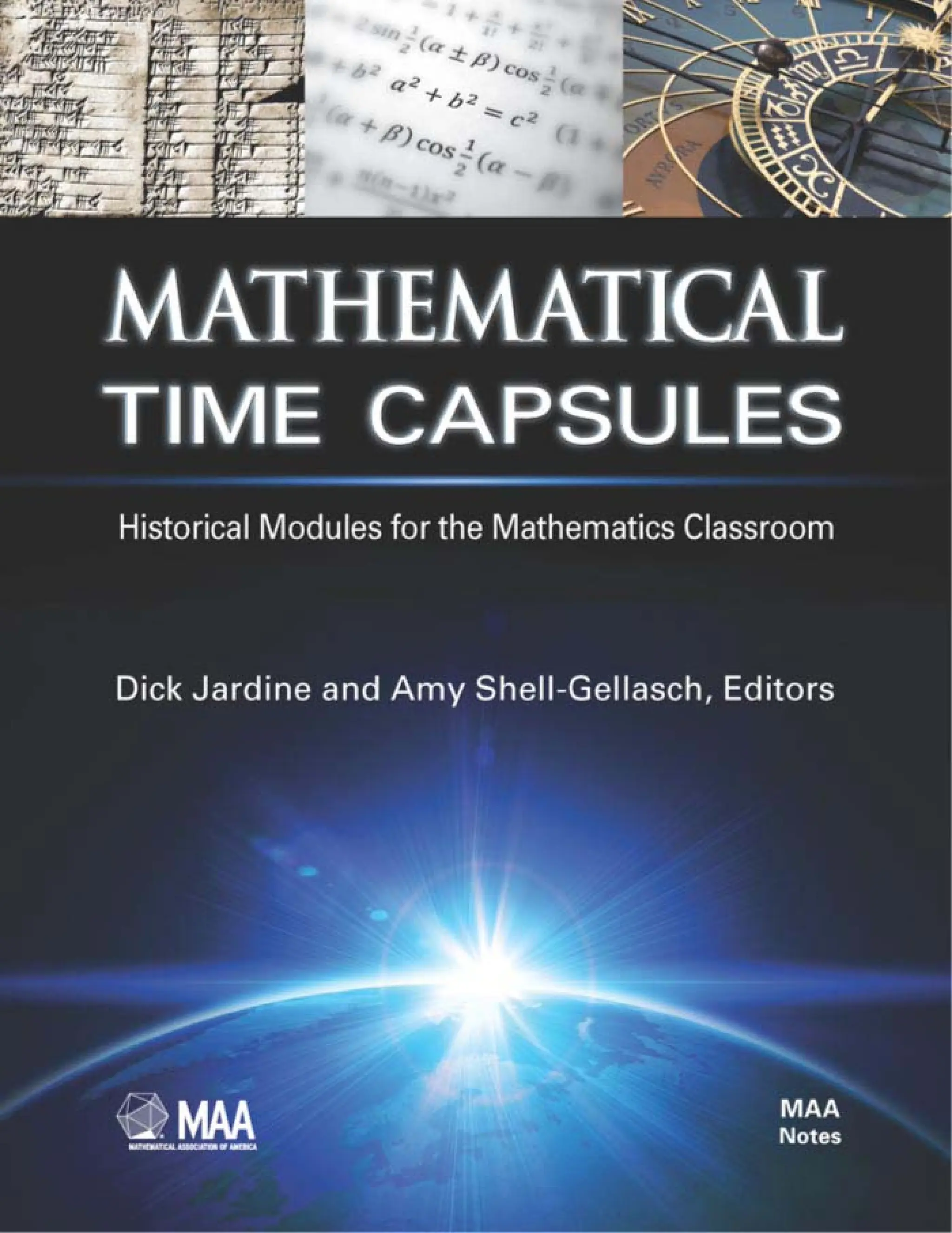
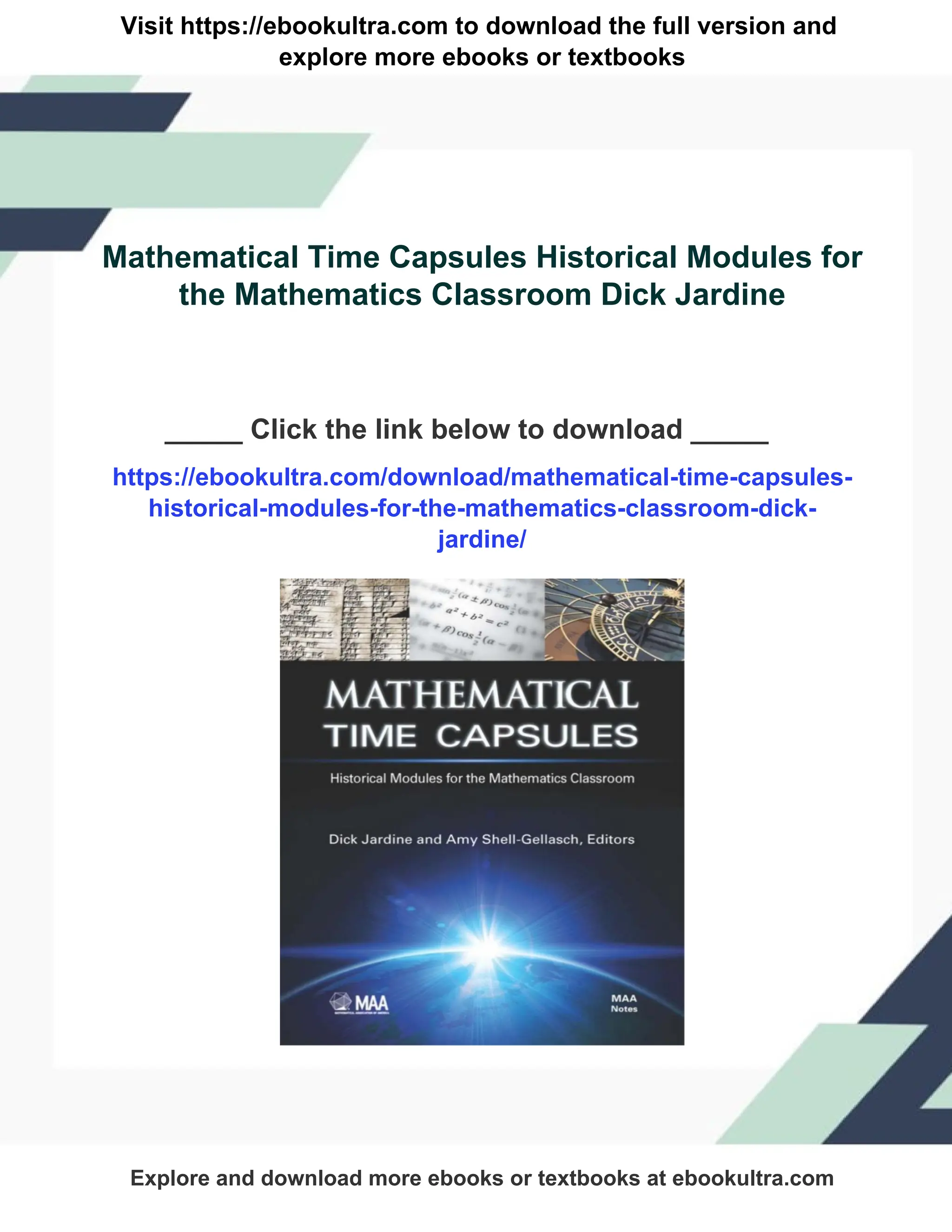
Mathematical Time Capsules Historical Modules for
the Mathematics Classroom Dick Jardine
_____ Click the link below to download _____
https://ebookultra.com/download/mathematical-time-capsules-
historical-modules-for-the-mathematics-classroom-dick-
jardine/
Explore and download more ebooks or textbooks at ebookultra.com
Here are some recommended products that we believe you will be
interested in. You can click the link to download.
Buying Time Dick Diamond
https://ebookultra.com/download/buying-time-dick-diamond/
Mathematics for the International Student Mathematical
Studies 2nd edition Edition Mal Coad
https://ebookultra.com/download/mathematics-for-the-international-
student-mathematical-studies-2nd-edition-edition-mal-coad/
Proving in the Elementary Mathematics Classroom 1st
Edition Andreas J. Stylianides
https://ebookultra.com/download/proving-in-the-elementary-mathematics-
classroom-1st-edition-andreas-j-stylianides/
Food in time and place the American Historical Association
companion to food history American Historical Association
https://ebookultra.com/download/food-in-time-and-place-the-american-
historical-association-companion-to-food-history-american-historical-
association/
Mathematics and the Divine A Historical Study 1st Edition
Teun Koetsier
https://ebookultra.com/download/mathematics-and-the-divine-a-
historical-study-1st-edition-teun-koetsier/
Visible thinking in the K 8 Mathematics Classroom 1st
Edition Ted H. Hull
https://ebookultra.com/download/visible-thinking-in-
the-k-8-mathematics-classroom-1st-edition-ted-h-hull/
NASA 50th Anniversary Proceedings NASA s First 50 Years
Historical Perspectives NASA s First 50 Years Historical
Perspectives Steven J. Dick
https://ebookultra.com/download/nasa-50th-anniversary-proceedings-
nasa-s-first-50-years-historical-perspectives-nasa-s-first-50-years-
historical-perspectives-steven-j-dick/
Psychology Modules for Active Learning 11th Edition Dennis
Coon
https://ebookultra.com/download/psychology-modules-for-active-
learning-11th-edition-dennis-coon/
ICP design methods for driven piles in sands and clays 2nd
ed Edition Richard Jardine
https://ebookultra.com/download/icp-design-methods-for-driven-piles-
in-sands-and-clays-2nd-ed-edition-richard-jardine/
Mathematical Time Capsules Historical Modules for the
Mathematics Classroom Dick Jardine Digital Instant
Download
Author(s): Dick Jardine, Amy Shell-Gellasch (eds.)
ISBN(s): 9780883859841, 088385984X
Edition: UKed
File Details: PDF, 5.89 MB
Year: 2011
Language: english
Mathematical Time Capsules
Historical Modules for the Mathematics Classroom
c 2011 by
The Mathematical Association of America (Incorporated)
Library of Congress Control Number 2011926092
Print ISBN 978-0-88385-187-6
Electronic ISBN 978-0-88385-984-1
Printed in the United States of America
Current Printing (last digit):
10 9 8 7 6 5 4 3 2 1
Mathematical Time Capsules
Historical Modules for the Mathematics Classroom
Edited by
Dick Jardine
Keene State College
and
Amy Shell-Gellasch
Beloit College
Published and Distributed by
The Mathematical Association of America
The MAA Notes Series, started in 1982, addresses a broad range of topics and themes of interest to all who are involved with
undergraduate mathematics. The volumes in this series are readable, informative, and useful, and help the mathematical community
keep up with developments of importance to mathematics.
Committee on Books
Gerald Bryce, Chair
Notes Editorial Board
Stephen B Maurer, Editor
Deborah J. Bergstrand Thomas P. Dence
Donna L. Flint Theresa Jeevanjee
Michael K. May Judith A. Palagallo
Mark Parker Susan Pustejovsky
David Rusin David J. Sprows
Joe Alyn Stickles Andrius Tamulis
MAA Notes
14. Mathematical Writing, by Donald E. Knuth, Tracy Larrabee, and Paul M. Roberts.
16. Using Writing to Teach Mathematics, Andrew Sterrett, Editor.
17. Priming the Calculus Pump: Innovations and Resources, Committee on Calculus Reform and the First Two Years, a subcomit-
tee of the Committee on the Undergraduate Program in Mathematics, Thomas W. Tucker, Editor.
18. Models for Undergraduate Research in Mathematics, Lester Senechal, Editor.
19. Visualization in Teaching and Learning Mathematics, Committee on Computers in Mathematics Education, Steve Cunning-
ham and Walter S. Zimmermann, Editors.
20. The Laboratory Approach to Teaching Calculus, L. Carl Leinbach et al., Editors.
21. Perspectives on Contemporary Statistics, David C. Hoaglin and David S. Moore, Editors.
22. Heeding the Call for Change: Suggestions for Curricular Action, Lynn A. Steen, Editor.
24. Symbolic Computation in Undergraduate Mathematics Education, Zaven A. Karian, Editor.
25. The Concept of Function: Aspects of Epistemology and Pedagogy,Guershon Harel and Ed Dubinsky, Editors.
26. Statistics for the Twenty-First Century, Florence and Sheldon Gordon, Editors.
27. Resources for Calculus Collection, Volume 1: Learning by Discovery: A Lab Manual for Calculus, Anita E. Solow, Editor.
28. Resources for Calculus Collection, Volume 2: Calculus Problems for a New Century, Robert Fraga, Editor.
29. Resources for Calculus Collection, Volume 3: Applications of Calculus, Philip Straffin, Editor.
30. Resources for Calculus Collection, Volume 4: Problems for Student Investigation, Michael B. Jackson and John R. Ramsay,
Editors.
31. Resources for Calculus Collection, Volume 5: Readings for Calculus, Underwood Dudley, Editor.
32. Essays in Humanistic Mathematics, Alvin White, Editor.
33. ResearchIssues in Undergraduate Mathematics Learning: Preliminary Analyses and Results, JamesJ. Kaput and Ed Dubinsky,
Editors.
34. In Eves Circles, Joby Milo Anthony, Editor.
35. Youre the Professor, What Next? Ideas and Resources for Preparing College Teachers, The Committee on Preparation for
College Teaching, Bettye Anne Case, Editor.
36. Preparing for a New Calculus: Conference Proceedings, Anita E. Solow, Editor.
37. A Practical Guide to Cooperative Learning in Collegiate Mathematics, Nancy L. Hagelgans, Barbara E. Reynolds, SDS, Keith
Schwingendorf, Draga Vidakovic, Ed Dubinsky, Mazen Shahin, G. Joseph Wimbish, Jr.
38. Models That Work: Case Studies in Effective Undergraduate Mathematics Programs, Alan C. Tucker, Editor.
39. Calculus: The Dynamics of Change, CUPM Subcommittee on Calculus Reform and the First Two Years, A. Wayne Roberts,
Editor.
40. Vita Mathematica: Historical Research and Integration with Teaching, Ronald Calinger, Editor.
41. Geometry Turned On: Dynamic Software in Learning, Teaching, and Research, James R. King and Doris Schattschneider,
Editors.
42. Resources for Teaching Linear Algebra, David Carlson, Charles R. Johnson, David C. Lay, A. Duane Porter, Ann E. Watkins,
William Watkins, Editors.
43. Student Assessmentin Calculus: A Report of the NSF Working Group on Assessment in Calculus, Alan Schoenfeld, Editor.
44. Readings in Cooperative Learning for Undergraduate Mathematics, Ed Dubinsky, David Mathews, and Barbara E. Reynolds,
Editors.
45. Confronting the Core Curriculum: Considering Change in the Undergraduate Mathematics Major, John A. Dossey, Editor.
46. Women in Mathematics: Scaling the Heights, Deborah Nolan, Editor.
47. Exemplary Programs in Introductory College Mathematics: Innovative Programs Using Technology, Susan Lenker, Editor.
48. Writing in the Teaching and Learning of Mathematics, John Meier and Thomas Rishel.
49. Assessment Practices in Undergraduate Mathematics, Bonnie Gold, Editor.
50. Revolutions in Differential Equations: Exploring ODEs with Modern Technology, Michael J. Kallaher, Editor.
51. Using History to Teach Mathematics: An International Perspective, Victor J. Katz, Editor.
52. Teaching Statistics: Resources for Undergraduate Instructors, Thomas L. Moore, Editor.
53. Geometry at Work: Papers in Applied Geometry, Catherine A. Gorini, Editor.
54. Teaching First: A Guide for New Mathematicians, Thomas W. Rishel.
55. Cooperative Learning in Undergraduate Mathematics: Issues That Matter and Strategies That Work, Elizabeth C. Rogers,
Barbara E. Reynolds, Neil A. Davidson, and Anthony D. Thomas, Editors.
56. Changing Calculus: A Report on Evaluation Efforts and National Impact from 1988 to 1998, Susan L. Ganter.
57. Learning to Teach and Teaching to Learn Mathematics: Resources for Professional Development, Matthew Delong and Dale
Winter.
58. Fractals, Graphics, and Mathematics Education, Benoit Mandelbrot and Michael Frame, Editors.
59. Linear Algebra Gems: Assets for Undergraduate Mathematics, David Carlson, Charles R. Johnson, David C. Lay, and A.
Duane Porter, Editors.
60. Innovations in Teaching Abstract Algebra, Allen C. Hibbard and Ellen J. Maycock, Editors.
61. Changing Core Mathematics, Chris Arney and Donald Small, Editors.
62. Achieving Quantitative Literacy: An Urgent Challenge for Higher Education, Lynn Arthur Steen.
64. Leading the Mathematical Sciences Department: A Resource for Chairs, Tina H. Straley, Marcia P. Sward, and Jon W. Scott,
Editors.
65. Innovations in Teaching Statistics, Joan B. Garfield, Editor.
66. Mathematics in Service to the Community: Concepts and models for service-learning in the mathematical sciences, Charles
R. Hadlock, Editor.
67. Innovative Approaches to Undergraduate Mathematics Courses Beyond Calculus, Richard J. Maher, Editor.
68. From Calculus to Computers: Using the last 200 years of mathematics history in the classroom, Amy Shell-Gellasch and Dick
Jardine, Editors.
69. A Fresh Start for Collegiate Mathematics: Rethinking the Courses below Calculus, Nancy Baxter Hastings, Editor.
70. Current Practices in Quantitative Literacy, Rick Gillman, Editor.
71. War Stories from Applied Math: Undergraduate Consultancy Projects, Robert Fraga, Editor.
72. Hands On History: A Resource for Teaching Mathematics, Amy Shell-Gellasch, Editor.
73. Making the Connection: Research and Teaching in Undergraduate Mathematics Education, Marilyn P. Carlson and Chris
Rasmussen, Editors.
74. Resources for Teaching Discrete Mathematics: Classroom Projects, History Modules, and Articles, Brian Hopkins, Editor.
75. The Moore Method: A Pathway to Learner-Centered Instruction, Charles A. Coppin, W. Ted Mahavier, E. Lee May, and G.
Edgar Parker.
76. The Beauty of Fractals: Six Different Views, Denny Gulick and Jon Scott, Editors.
77. Mathematical Time Capsules: Historical Modules for the Mathematics Classroom, Dick Jardine and Amy Shell-Gellasch,
Editors.
MAA Service Center
P.O. Box 91112
Washington, DC 20090-1112
1-800-331-1MAA FAX: 1-301-206-9789
Preface
Mathematical Time Capsules offers teachers historical modules for immediate use in the mathematics classroom.
Relevant history-based activities for a wide range of undergraduate and secondary mathematics courses are included.
The genesis of this volume was a Contributed Papers Session on Using History of Mathematics in Your Mathematics
Courses, organized by the editors at the Joint Mathematics Meetings, San Antonio, Texas, in January of 2006. That
session was very well attended, which prompted Andrew Sterrett from MAA publications to suggest that we put
together our second volume for the MAA Notes series.
Purpose
For a wide variety of reasons, instructors are looking for ways to include the history of mathematics in their courses.
It is not uncommon to see requests for “how to” posted to the History of Mathematics Special Interest Group of the
MAA (www.homsigmaa.org) email list, such as this 2008 posting:
...I am a newcomer to HOM. Where and how should a newcomer begin? Right now, I would liketo include
HOM in a meaningful way in the courses that we teach. Weteach courses from college arithmetic to linear
algebra.
In response to such inquiries, we hope to serve the broader mathematical community by offering practical suggestions
on how to use the history of mathematics quickly and easily in the mathematics classroom.
A time capsule can be defined as a container preserving articles and records from the past for scholars of the
future. Of course our volume does not fit that precise definition, but readers who open this book will find articles
and activities from mathematics history that enhance the learning of topics typically associated with undergraduate
or secondary mathematics curricula. Each capsule presents one topic or perhaps a few related topics, or a historical
thread that can be used throughout a course. The capsules were written by experienced practitioners to provide other
teachers with the historical background, suggested classroom activities, and further references and resources on the
chapter subject. An instructor reading a capsule will have increased confidence in engaging students with at least one
activity rich in the history of mathematics that will enhance student learning of the mathematical content of the course.
Most of the historical topics contained in a capsule can be implemented in one class period with minimal additional
preparation on the part of the teacher.
How to use Mathematical Time Capsules
Teaching styles have been categorized along a spectrum from lecture-oriented practices at one extreme to student-
centered approaches in which the teacher guides student work in the classroom. Mathematical Time Capsules respects
the diversity of teaching styles which individual teachers adopt. Some of the capsules are, in some sense, ready-
made lectures the instructor can adopt and adapt as appropriate. Examples of those include Victor Katz’s “Copernican
Trigonometry,” Roger Cooke’s “Numerical Solution of Equations,” or Jim Tattersall’s “Finding the Greatest Common
Divisor and More... .” Other capsules clearly engage the students more actively, such as Vicky Klima’s “A Different
Sort of Calculus Debate.” But the capsules should not be categorized as appropriate for one pedagogical approach or
the other. For example, “Finding the Greatest Common Divisor and More...” could be adapted for use as a student
project to be presented by the student(s) in class after the Euclidean algorithm is covered.
The reader may note that the authors of the capsules demonstrate a variety of approaches to integrating history. The
differences are consistent with the nature of this volume, created with respect for the diversity of our authors and our
vii
viii Preface
readers. We acknowledge that many teachers prefer to develop their own course materials, and we encourage readers
to modify the offerings of the authors.
Mathematical Time Capsules is organized in three sections. The first capsules have as their target mathematical
topics that are usually addressed in courses taught in secondary school, at two-year colleges, or during the first two
years of the undergraduate mathematics curriculum. These courses are not often taken by mathematics majors, and
include, for example, algebra, geometry, mathematics for elementary teachers, trigonometry, or precalculus.
The third section of capsules address topics included in courses traditionally taken by mathematics majors, such as
calculus, differential equations, number theory, abstract algebra, differential equations, and analysis.
As an interlude between the first and third, we offer some ideas that can be applied to a wide variety of courses
throughout the undergraduate (including two-year college) or secondary curriculum. These interlude capsules (15, 16,
and 17) are of a general pedagogical nature, not mathematical, and could be adapted for use in any course.
We could have arranged the capsules differently, and we ask that the reader not limit investigating the offerings in
this book thinking that lower-level material is in the front and upper-level material at the back. For example, a teacher
interested in historical ideas for a numerical methods course should consider Roger Cooke’s “Numerical Solution
of Equations,” Randy Schwartz’s “Rule of Double False Position,” Clemency Montelle’s “Roots, Rocks, and Newton-
Raphson Algorithms for Approximating
p
2 3000 Years Apart,” and Dick Jardine’s “Euler’s Method in Euler’s Words.”
Some teachers are interested in having students read original sources in the history of mathematics, and Montelle’s
“Amo, Amas, Amat! What’s the Sum of That?” and Jardine’s “Euler’s Method in Euler’s Words” provide opportunities
to do just that with brief excerpts in the words of the originators.
Where possible, we grouped the capsules within the sections according to mathematical subject area. As an example,
there are three capsules that address Pythagorean triples, but each of those capsules approaches the topic in a very
different way and from the perspective of a different era of the history of mathematics. That latter notion is significant,
as it is important for students to see the evolution of a mathematical idea and how it is viewed through a different
lens depending on how mathematics was done at various times in history. One of the goals of Mathematical Time
Capsules is to provide a vehicle for teachers to help their students learn the historical context for a mathematical
development while they are learning the specific mathematical concept. Learning the history of an idea promotes
deeper understanding of the idea.
Additional purposes—assessment and teacher certification
Beyond a teacher’s personal interest in using the history of mathematics in teaching, accrediting agencies and state
certifying agencies now require pre-service teachers to be well-versed in the history of mathematics in specific content
areas. The requirement that school teachers demonstrate understanding of the connection between a mathematics topic
and the history of that specific topic is explicitly documented in state and national standards. It is becoming an imper-
ative that many college teachers introduce the history of mathematic in their teaching of mathematics in order to pass
muster for state and national certification of teacher education programs. The National Council for Accreditation of
Teacher Education (NCATE) and the National Council of Teachers of Mathematics (NCTM) have published standards
which list within the content areas a requirement that candidates for teacher certification demonstrate their knowledge
of the historical development of that content area. For example, the current content Standard 10 is on the subject
of algebra. For certification, in addition to demonstrating expertise in the usual algebra concepts, candidates must
“Demonstrate knowledge of the historical development of algebra including contributions from diverse cultures” [2].
In this era of outcomes-based assessment, to satisfy state and national evaluators it is not sufficient to show that
history was included in the syllabus or to claim that history was included in a lecture. Actual student work (interestingly
for us interested in history, the student work is called an artifact in current assessment jargon) must be presented
to the accrediting agency or state department of education evaluators. The material presented herein will provide
teachers with actual activities that students can do. The products of these activities become the artifacts necessary
to validate that students are engaged in learning the historical development of the mathematical topic. Mathematical
Time Capsules provides materials enhancing student understanding and interest in mathematics, always keeping the
learning of mathematics clearly at the center of each capsule’s focus.
Preface ix
Acknowledgements
We could not have taken on this project without the interest and enthusiasm of the many contributors from campuses
around the world. We are indebted to the successful leadership efforts of V. Frederick Rickey and Victor Katz in
bringing together a community of educators and encouraging our passion for improving student learning through the
use of the history of mathematics. The editors of this volume met as participants in the NSF funded Institute for the
History of Mathematics and its use in Teaching, organized by Fred and Victor, which provided a sound foundation for
our work and a network of like-mindedcolleagues and friends. We also offer special thanks to Chris Arney, who led the
way as Department Head of the Department of Mathematical Sciences at the United States Military Academy at West
Point in not only documenting that the history of mathematics is a significant learning outcome at the program level in
undergraduate mathematics departments but also provided an exemplar of effective implementation. We both worked
for Chris and he made a real difference by encouraging and supporting our early use of the history of mathematics to
deepen student learning of our discipline. Finally, and perhaps most importantly, we also acknowledge the interest and
enthusiasm of our students, who let us know each semester that we teach that learning the history of mathematics is
important to them.
References
1. Amy Shell-Gellasch and D. Jardine, ed., From Calculus to Computers: Using the Last 200 Years of Mathematics
History in the Classroom, Mathematical Association of America, Washington, 2005.
2. NCATE/NCTM Program Standards (2003), Programs for Initial Preparation of Mathematics Teachers, Standards
for Secondary Mathematics Teachers
www.nctm.org/uploadedFiles/Math_Standards/,
accessed May 12, 2009.
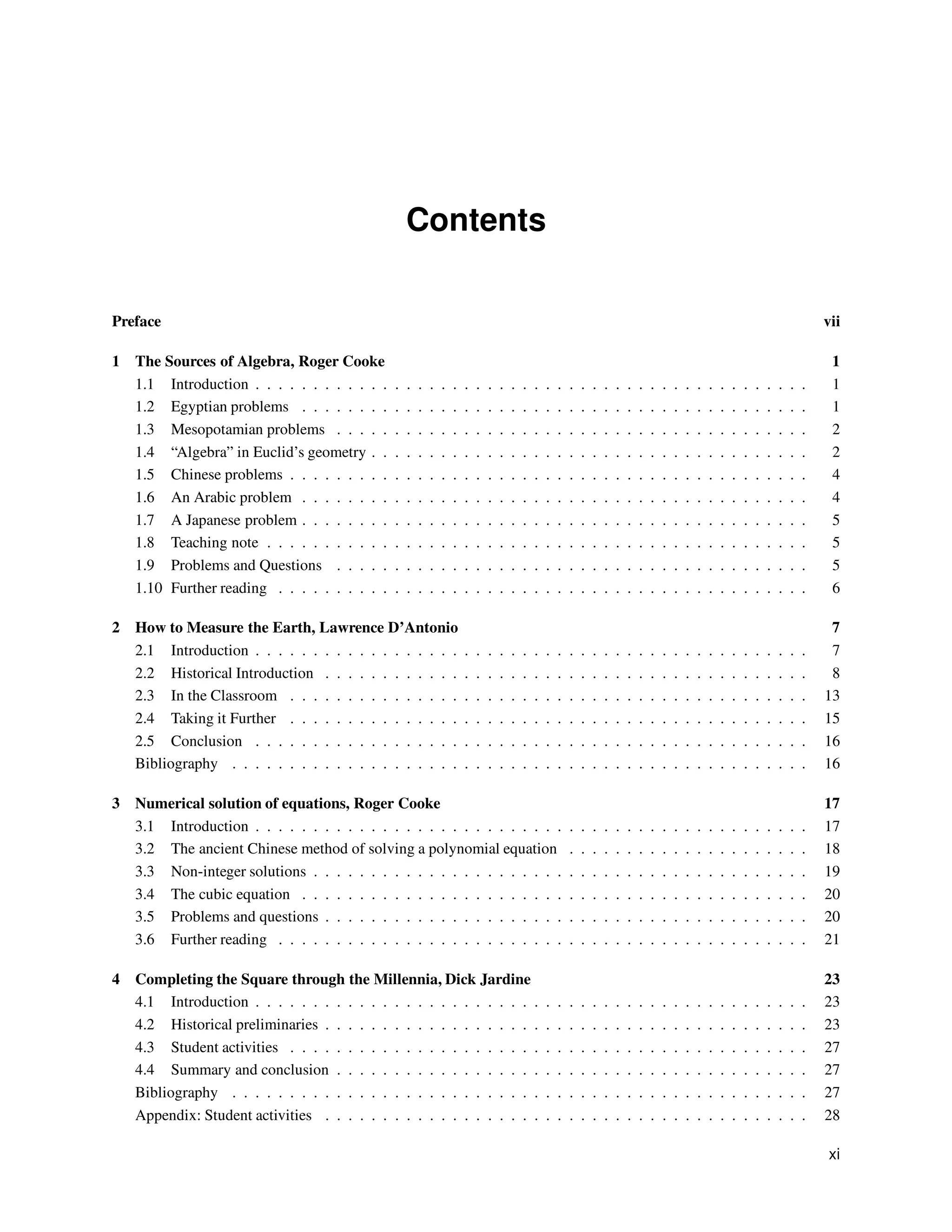
Contents
Preface vii
1 The Sources of Algebra, Roger Cooke 1
1.1 Introduction . . . . . . . . . . . . . . . . . . . . . . . . . . . . . . . . . . . . . . . . . . . . . . . . 1
1.2 Egyptian problems . . . . . . . . . . . . . . . . . . . . . . . . . . . . . . . . . . . . . . . . . . . . 1
1.3 Mesopotamian problems . . . . . . . . . . . . . . . . . . . . . . . . . . . . . . . . . . . . . . . . . 2
1.4 “Algebra” in Euclid’s geometry . . . . . . . . . . . . . . . . . . . . . . . . . . . . . . . . . . . . . . 2
1.5 Chinese problems . . . . . . . . . . . . . . . . . . . . . . . . . . . . . . . . . . . . . . . . . . . . . 4
1.6 An Arabic problem . . . . . . . . . . . . . . . . . . . . . . . . . . . . . . . . . . . . . . . . . . . . 4
1.7 A Japanese problem . . . . . . . . . . . . . . . . . . . . . . . . . . . . . . . . . . . . . . . . . . . . 5
1.8 Teaching note . . . . . . . . . . . . . . . . . . . . . . . . . . . . . . . . . . . . . . . . . . . . . . . 5
1.9 Problems and Questions . . . . . . . . . . . . . . . . . . . . . . . . . . . . . . . . . . . . . . . . . 5
1.10 Further reading . . . . . . . . . . . . . . . . . . . . . . . . . . . . . . . . . . . . . . . . . . . . . . 6
2 How to Measure the Earth, Lawrence D’Antonio 7
2.1 Introduction . . . . . . . . . . . . . . . . . . . . . . . . . . . . . . . . . . . . . . . . . . . . . . . . 7
2.2 Historical Introduction . . . . . . . . . . . . . . . . . . . . . . . . . . . . . . . . . . . . . . . . . . 8
2.3 In the Classroom . . . . . . . . . . . . . . . . . . . . . . . . . . . . . . . . . . . . . . . . . . . . . 13
2.4 Taking it Further . . . . . . . . . . . . . . . . . . . . . . . . . . . . . . . . . . . . . . . . . . . . . 15
2.5 Conclusion . . . . . . . . . . . . . . . . . . . . . . . . . . . . . . . . . . . . . . . . . . . . . . . . 16
Bibliography . . . . . . . . . . . . . . . . . . . . . . . . . . . . . . . . . . . . . . . . . . . . . . . . . . 16
3 Numerical solution of equations, Roger Cooke 17
3.1 Introduction . . . . . . . . . . . . . . . . . . . . . . . . . . . . . . . . . . . . . . . . . . . . . . . . 17
3.2 The ancient Chinese method of solving a polynomial equation . . . . . . . . . . . . . . . . . . . . . 18
3.3 Non-integer solutions . . . . . . . . . . . . . . . . . . . . . . . . . . . . . . . . . . . . . . . . . . . 19
3.4 The cubic equation . . . . . . . . . . . . . . . . . . . . . . . . . . . . . . . . . . . . . . . . . . . . 20
3.5 Problems and questions . . . . . . . . . . . . . . . . . . . . . . . . . . . . . . . . . . . . . . . . . . 20
3.6 Further reading . . . . . . . . . . . . . . . . . . . . . . . . . . . . . . . . . . . . . . . . . . . . . . 21
4 Completing the Square through the Millennia, Dick Jardine 23
4.1 Introduction . . . . . . . . . . . . . . . . . . . . . . . . . . . . . . . . . . . . . . . . . . . . . . . . 23
4.2 Historical preliminaries . . . . . . . . . . . . . . . . . . . . . . . . . . . . . . . . . . . . . . . . . . 23
4.3 Student activities . . . . . . . . . . . . . . . . . . . . . . . . . . . . . . . . . . . . . . . . . . . . . 27
4.4 Summary and conclusion . . . . . . . . . . . . . . . . . . . . . . . . . . . . . . . . . . . . . . . . . 27
Bibliography . . . . . . . . . . . . . . . . . . . . . . . . . . . . . . . . . . . . . . . . . . . . . . . . . . 27
Appendix: Student activities . . . . . . . . . . . . . . . . . . . . . . . . . . . . . . . . . . . . . . . . . . 28
xi
xii Contents
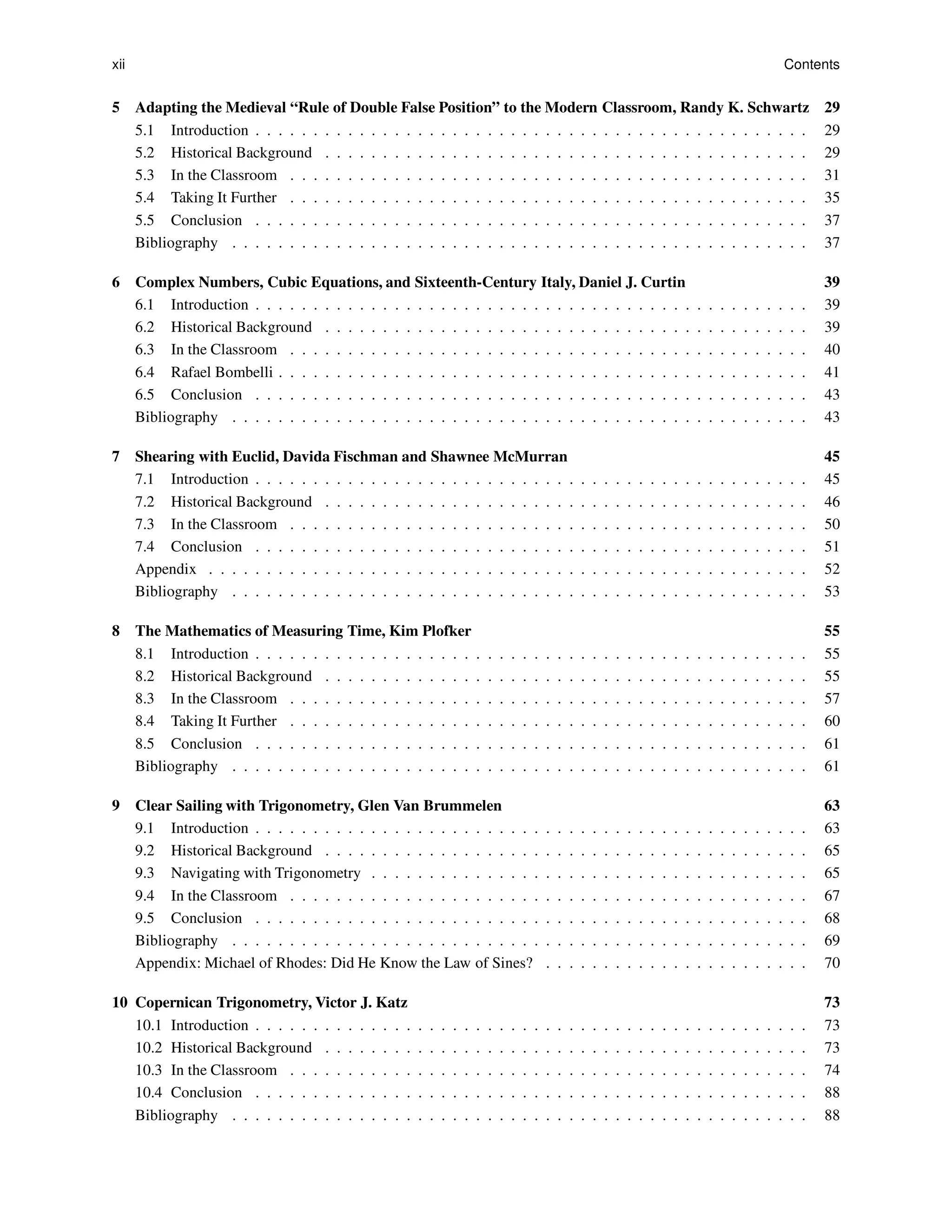
5 Adapting the Medieval “Rule of Double False Position” to the Modern Classroom, Randy K. Schwartz 29
5.1 Introduction . . . . . . . . . . . . . . . . . . . . . . . . . . . . . . . . . . . . . . . . . . . . . . . . 29
5.2 Historical Background . . . . . . . . . . . . . . . . . . . . . . . . . . . . . . . . . . . . . . . . . . 29
5.3 In the Classroom . . . . . . . . . . . . . . . . . . . . . . . . . . . . . . . . . . . . . . . . . . . . . 31
5.4 Taking It Further . . . . . . . . . . . . . . . . . . . . . . . . . . . . . . . . . . . . . . . . . . . . . 35
5.5 Conclusion . . . . . . . . . . . . . . . . . . . . . . . . . . . . . . . . . . . . . . . . . . . . . . . . 37
Bibliography . . . . . . . . . . . . . . . . . . . . . . . . . . . . . . . . . . . . . . . . . . . . . . . . . . 37
6 Complex Numbers, Cubic Equations, and Sixteenth-Century Italy, Daniel J. Curtin 39
6.1 Introduction . . . . . . . . . . . . . . . . . . . . . . . . . . . . . . . . . . . . . . . . . . . . . . . . 39
6.2 Historical Background . . . . . . . . . . . . . . . . . . . . . . . . . . . . . . . . . . . . . . . . . . 39
6.3 In the Classroom . . . . . . . . . . . . . . . . . . . . . . . . . . . . . . . . . . . . . . . . . . . . . 40
6.4 Rafael Bombelli . . . . . . . . . . . . . . . . . . . . . . . . . . . . . . . . . . . . . . . . . . . . . . 41
6.5 Conclusion . . . . . . . . . . . . . . . . . . . . . . . . . . . . . . . . . . . . . . . . . . . . . . . . 43
Bibliography . . . . . . . . . . . . . . . . . . . . . . . . . . . . . . . . . . . . . . . . . . . . . . . . . . 43
7 Shearing with Euclid, Davida Fischman and Shawnee McMurran 45
7.1 Introduction . . . . . . . . . . . . . . . . . . . . . . . . . . . . . . . . . . . . . . . . . . . . . . . . 45
7.2 Historical Background . . . . . . . . . . . . . . . . . . . . . . . . . . . . . . . . . . . . . . . . . . 46
7.3 In the Classroom . . . . . . . . . . . . . . . . . . . . . . . . . . . . . . . . . . . . . . . . . . . . . 50
7.4 Conclusion . . . . . . . . . . . . . . . . . . . . . . . . . . . . . . . . . . . . . . . . . . . . . . . . 51
Appendix . . . . . . . . . . . . . . . . . . . . . . . . . . . . . . . . . . . . . . . . . . . . . . . . . . . . 52
Bibliography . . . . . . . . . . . . . . . . . . . . . . . . . . . . . . . . . . . . . . . . . . . . . . . . . . 53
8 The Mathematics of Measuring Time, Kim Plofker 55
8.1 Introduction . . . . . . . . . . . . . . . . . . . . . . . . . . . . . . . . . . . . . . . . . . . . . . . . 55
8.2 Historical Background . . . . . . . . . . . . . . . . . . . . . . . . . . . . . . . . . . . . . . . . . . 55
8.3 In the Classroom . . . . . . . . . . . . . . . . . . . . . . . . . . . . . . . . . . . . . . . . . . . . . 57
8.4 Taking It Further . . . . . . . . . . . . . . . . . . . . . . . . . . . . . . . . . . . . . . . . . . . . . 60
8.5 Conclusion . . . . . . . . . . . . . . . . . . . . . . . . . . . . . . . . . . . . . . . . . . . . . . . . 61
Bibliography . . . . . . . . . . . . . . . . . . . . . . . . . . . . . . . . . . . . . . . . . . . . . . . . . . 61
9 Clear Sailing with Trigonometry, Glen Van Brummelen 63
9.1 Introduction . . . . . . . . . . . . . . . . . . . . . . . . . . . . . . . . . . . . . . . . . . . . . . . . 63
9.2 Historical Background . . . . . . . . . . . . . . . . . . . . . . . . . . . . . . . . . . . . . . . . . . 65
9.3 Navigating with Trigonometry . . . . . . . . . . . . . . . . . . . . . . . . . . . . . . . . . . . . . . 65
9.4 In the Classroom . . . . . . . . . . . . . . . . . . . . . . . . . . . . . . . . . . . . . . . . . . . . . 67
9.5 Conclusion . . . . . . . . . . . . . . . . . . . . . . . . . . . . . . . . . . . . . . . . . . . . . . . . 68
Bibliography . . . . . . . . . . . . . . . . . . . . . . . . . . . . . . . . . . . . . . . . . . . . . . . . . . 69
Appendix: Michael of Rhodes: Did He Know the Law of Sines? . . . . . . . . . . . . . . . . . . . . . . . 70
10 Copernican Trigonometry, Victor J. Katz 73
10.1 Introduction . . . . . . . . . . . . . . . . . . . . . . . . . . . . . . . . . . . . . . . . . . . . . . . . 73
10.2 Historical Background . . . . . . . . . . . . . . . . . . . . . . . . . . . . . . . . . . . . . . . . . . 73
10.3 In the Classroom . . . . . . . . . . . . . . . . . . . . . . . . . . . . . . . . . . . . . . . . . . . . . 74
10.4 Conclusion . . . . . . . . . . . . . . . . . . . . . . . . . . . . . . . . . . . . . . . . . . . . . . . . 88
Bibliography . . . . . . . . . . . . . . . . . . . . . . . . . . . . . . . . . . . . . . . . . . . . . . . . . . 88
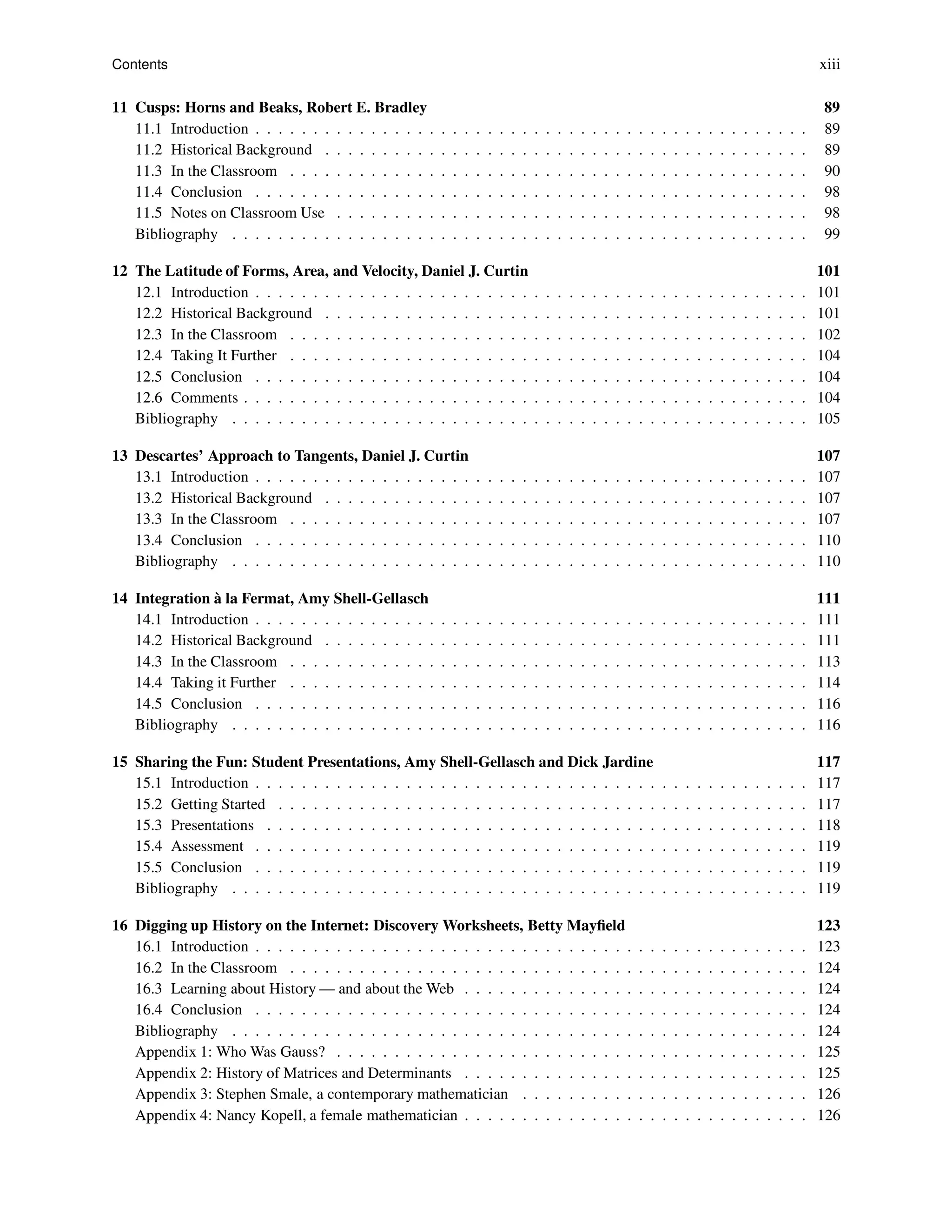
Contents xiii
11 Cusps: Horns and Beaks, Robert E. Bradley 89
11.1 Introduction . . . . . . . . . . . . . . . . . . . . . . . . . . . . . . . . . . . . . . . . . . . . . . . . 89
11.2 Historical Background . . . . . . . . . . . . . . . . . . . . . . . . . . . . . . . . . . . . . . . . . . 89
11.3 In the Classroom . . . . . . . . . . . . . . . . . . . . . . . . . . . . . . . . . . . . . . . . . . . . . 90
11.4 Conclusion . . . . . . . . . . . . . . . . . . . . . . . . . . . . . . . . . . . . . . . . . . . . . . . . 98
11.5 Notes on Classroom Use . . . . . . . . . . . . . . . . . . . . . . . . . . . . . . . . . . . . . . . . . 98
Bibliography . . . . . . . . . . . . . . . . . . . . . . . . . . . . . . . . . . . . . . . . . . . . . . . . . . 99
12 The Latitude of Forms, Area, and Velocity, Daniel J. Curtin 101
12.1 Introduction . . . . . . . . . . . . . . . . . . . . . . . . . . . . . . . . . . . . . . . . . . . . . . . . 101
12.2 Historical Background . . . . . . . . . . . . . . . . . . . . . . . . . . . . . . . . . . . . . . . . . . 101
12.3 In the Classroom . . . . . . . . . . . . . . . . . . . . . . . . . . . . . . . . . . . . . . . . . . . . . 102
12.4 Taking It Further . . . . . . . . . . . . . . . . . . . . . . . . . . . . . . . . . . . . . . . . . . . . . 104
12.5 Conclusion . . . . . . . . . . . . . . . . . . . . . . . . . . . . . . . . . . . . . . . . . . . . . . . . 104
12.6 Comments . . . . . . . . . . . . . . . . . . . . . . . . . . . . . . . . . . . . . . . . . . . . . . . . . 104
Bibliography . . . . . . . . . . . . . . . . . . . . . . . . . . . . . . . . . . . . . . . . . . . . . . . . . . 105
13 Descartes’ Approach to Tangents, Daniel J. Curtin 107
13.1 Introduction . . . . . . . . . . . . . . . . . . . . . . . . . . . . . . . . . . . . . . . . . . . . . . . . 107
13.2 Historical Background . . . . . . . . . . . . . . . . . . . . . . . . . . . . . . . . . . . . . . . . . . 107
13.3 In the Classroom . . . . . . . . . . . . . . . . . . . . . . . . . . . . . . . . . . . . . . . . . . . . . 107
13.4 Conclusion . . . . . . . . . . . . . . . . . . . . . . . . . . . . . . . . . . . . . . . . . . . . . . . . 110
Bibliography . . . . . . . . . . . . . . . . . . . . . . . . . . . . . . . . . . . . . . . . . . . . . . . . . . 110
14 Integration à la Fermat, Amy Shell-Gellasch 111
14.1 Introduction . . . . . . . . . . . . . . . . . . . . . . . . . . . . . . . . . . . . . . . . . . . . . . . . 111
14.2 Historical Background . . . . . . . . . . . . . . . . . . . . . . . . . . . . . . . . . . . . . . . . . . 111
14.3 In the Classroom . . . . . . . . . . . . . . . . . . . . . . . . . . . . . . . . . . . . . . . . . . . . . 113
14.4 Taking it Further . . . . . . . . . . . . . . . . . . . . . . . . . . . . . . . . . . . . . . . . . . . . . 114
14.5 Conclusion . . . . . . . . . . . . . . . . . . . . . . . . . . . . . . . . . . . . . . . . . . . . . . . . 116
Bibliography . . . . . . . . . . . . . . . . . . . . . . . . . . . . . . . . . . . . . . . . . . . . . . . . . . 116
15 Sharing the Fun: Student Presentations, Amy Shell-Gellasch and Dick Jardine 117
15.1 Introduction . . . . . . . . . . . . . . . . . . . . . . . . . . . . . . . . . . . . . . . . . . . . . . . . 117
15.2 Getting Started . . . . . . . . . . . . . . . . . . . . . . . . . . . . . . . . . . . . . . . . . . . . . . 117
15.3 Presentations . . . . . . . . . . . . . . . . . . . . . . . . . . . . . . . . . . . . . . . . . . . . . . . 118
15.4 Assessment . . . . . . . . . . . . . . . . . . . . . . . . . . . . . . . . . . . . . . . . . . . . . . . . 119
15.5 Conclusion . . . . . . . . . . . . . . . . . . . . . . . . . . . . . . . . . . . . . . . . . . . . . . . . 119
Bibliography . . . . . . . . . . . . . . . . . . . . . . . . . . . . . . . . . . . . . . . . . . . . . . . . . . 119
16 Digging up History on the Internet: Discovery Worksheets, Betty Mayfield 123
16.1 Introduction . . . . . . . . . . . . . . . . . . . . . . . . . . . . . . . . . . . . . . . . . . . . . . . . 123
16.2 In the Classroom . . . . . . . . . . . . . . . . . . . . . . . . . . . . . . . . . . . . . . . . . . . . . 124
16.3 Learning about History — and about the Web . . . . . . . . . . . . . . . . . . . . . . . . . . . . . . 124
16.4 Conclusion . . . . . . . . . . . . . . . . . . . . . . . . . . . . . . . . . . . . . . . . . . . . . . . . 124
Bibliography . . . . . . . . . . . . . . . . . . . . . . . . . . . . . . . . . . . . . . . . . . . . . . . . . . 124
Appendix 1: Who Was Gauss? . . . . . . . . . . . . . . . . . . . . . . . . . . . . . . . . . . . . . . . . . 125
Appendix 2: History of Matrices and Determinants . . . . . . . . . . . . . . . . . . . . . . . . . . . . . . 125
Appendix 3: Stephen Smale, a contemporary mathematician . . . . . . . . . . . . . . . . . . . . . . . . . 126
Appendix 4: Nancy Kopell, a female mathematician . . . . . . . . . . . . . . . . . . . . . . . . . . . . . . 126
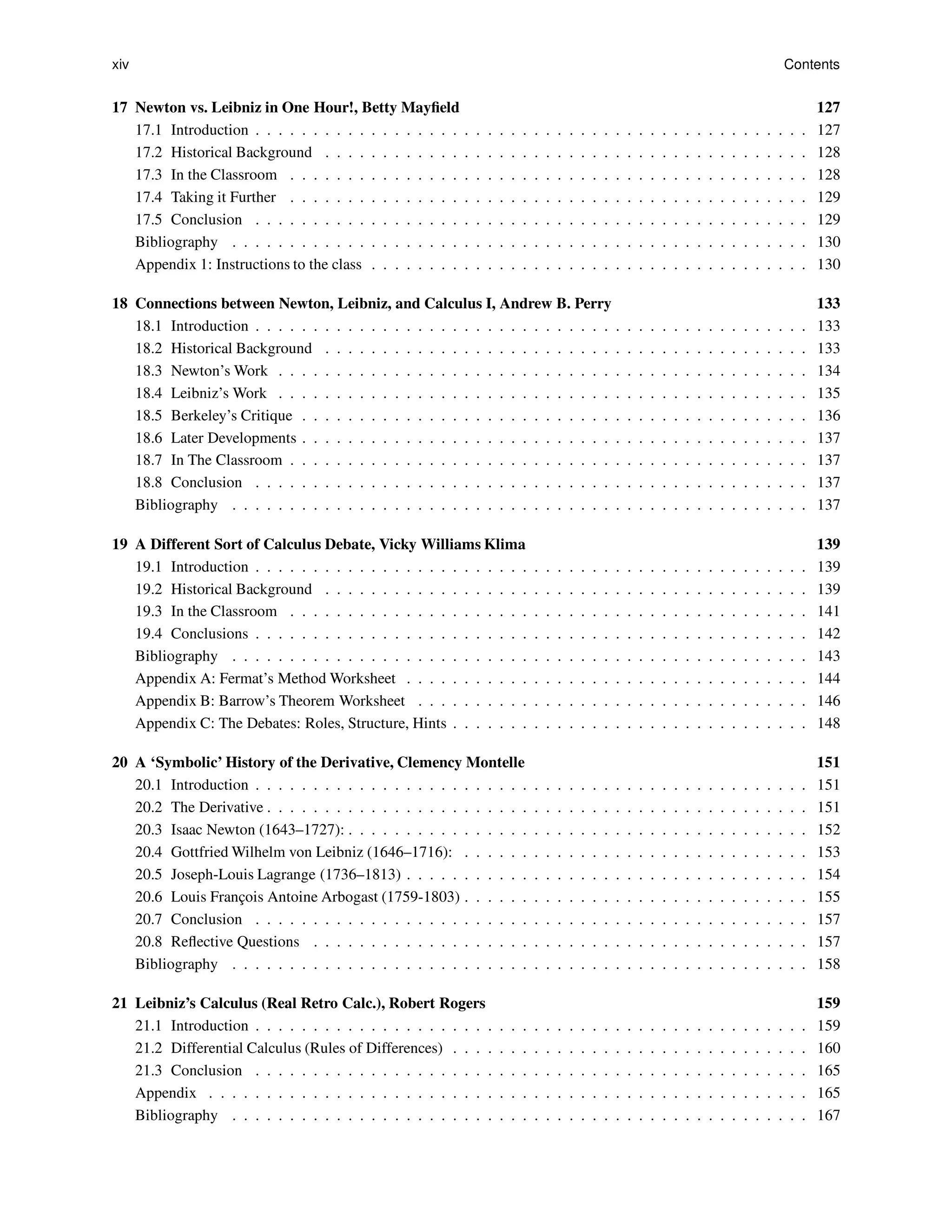
xiv Contents
17 Newton vs. Leibniz in One Hour!, Betty Mayfield 127
17.1 Introduction . . . . . . . . . . . . . . . . . . . . . . . . . . . . . . . . . . . . . . . . . . . . . . . . 127
17.2 Historical Background . . . . . . . . . . . . . . . . . . . . . . . . . . . . . . . . . . . . . . . . . . 128
17.3 In the Classroom . . . . . . . . . . . . . . . . . . . . . . . . . . . . . . . . . . . . . . . . . . . . . 128
17.4 Taking it Further . . . . . . . . . . . . . . . . . . . . . . . . . . . . . . . . . . . . . . . . . . . . . 129
17.5 Conclusion . . . . . . . . . . . . . . . . . . . . . . . . . . . . . . . . . . . . . . . . . . . . . . . . 129
Bibliography . . . . . . . . . . . . . . . . . . . . . . . . . . . . . . . . . . . . . . . . . . . . . . . . . . 130
Appendix 1: Instructions to the class . . . . . . . . . . . . . . . . . . . . . . . . . . . . . . . . . . . . . . 130
18 Connections between Newton, Leibniz, and Calculus I, Andrew B. Perry 133
18.1 Introduction . . . . . . . . . . . . . . . . . . . . . . . . . . . . . . . . . . . . . . . . . . . . . . . . 133
18.2 Historical Background . . . . . . . . . . . . . . . . . . . . . . . . . . . . . . . . . . . . . . . . . . 133
18.3 Newton’s Work . . . . . . . . . . . . . . . . . . . . . . . . . . . . . . . . . . . . . . . . . . . . . . 134
18.4 Leibniz’s Work . . . . . . . . . . . . . . . . . . . . . . . . . . . . . . . . . . . . . . . . . . . . . . 135
18.5 Berkeley’s Critique . . . . . . . . . . . . . . . . . . . . . . . . . . . . . . . . . . . . . . . . . . . . 136
18.6 Later Developments . . . . . . . . . . . . . . . . . . . . . . . . . . . . . . . . . . . . . . . . . . . . 137
18.7 In The Classroom . . . . . . . . . . . . . . . . . . . . . . . . . . . . . . . . . . . . . . . . . . . . . 137
18.8 Conclusion . . . . . . . . . . . . . . . . . . . . . . . . . . . . . . . . . . . . . . . . . . . . . . . . 137
Bibliography . . . . . . . . . . . . . . . . . . . . . . . . . . . . . . . . . . . . . . . . . . . . . . . . . . 137
19 A Different Sort of Calculus Debate, Vicky Williams Klima 139
19.1 Introduction . . . . . . . . . . . . . . . . . . . . . . . . . . . . . . . . . . . . . . . . . . . . . . . . 139
19.2 Historical Background . . . . . . . . . . . . . . . . . . . . . . . . . . . . . . . . . . . . . . . . . . 139
19.3 In the Classroom . . . . . . . . . . . . . . . . . . . . . . . . . . . . . . . . . . . . . . . . . . . . . 141
19.4 Conclusions . . . . . . . . . . . . . . . . . . . . . . . . . . . . . . . . . . . . . . . . . . . . . . . . 142
Bibliography . . . . . . . . . . . . . . . . . . . . . . . . . . . . . . . . . . . . . . . . . . . . . . . . . . 143
Appendix A: Fermat’s Method Worksheet . . . . . . . . . . . . . . . . . . . . . . . . . . . . . . . . . . . 144
Appendix B: Barrow’s Theorem Worksheet . . . . . . . . . . . . . . . . . . . . . . . . . . . . . . . . . . 146
Appendix C: The Debates: Roles, Structure, Hints . . . . . . . . . . . . . . . . . . . . . . . . . . . . . . . 148
20 A ‘Symbolic’ History of the Derivative, Clemency Montelle 151
20.1 Introduction . . . . . . . . . . . . . . . . . . . . . . . . . . . . . . . . . . . . . . . . . . . . . . . . 151
20.2 The Derivative . . . . . . . . . . . . . . . . . . . . . . . . . . . . . . . . . . . . . . . . . . . . . . . 151
20.3 Isaac Newton (1643–1727): . . . . . . . . . . . . . . . . . . . . . . . . . . . . . . . . . . . . . . . . 152
20.4 Gottfried Wilhelm von Leibniz (1646–1716): . . . . . . . . . . . . . . . . . . . . . . . . . . . . . . 153
20.5 Joseph-Louis Lagrange (1736–1813) . . . . . . . . . . . . . . . . . . . . . . . . . . . . . . . . . . . 154
20.6 Louis François Antoine Arbogast (1759-1803) . . . . . . . . . . . . . . . . . . . . . . . . . . . . . . 155
20.7 Conclusion . . . . . . . . . . . . . . . . . . . . . . . . . . . . . . . . . . . . . . . . . . . . . . . . 157
20.8 Reflective Questions . . . . . . . . . . . . . . . . . . . . . . . . . . . . . . . . . . . . . . . . . . . 157
Bibliography . . . . . . . . . . . . . . . . . . . . . . . . . . . . . . . . . . . . . . . . . . . . . . . . . . 158
21 Leibniz’s Calculus (Real Retro Calc.), Robert Rogers 159
21.1 Introduction . . . . . . . . . . . . . . . . . . . . . . . . . . . . . . . . . . . . . . . . . . . . . . . . 159
21.2 Differential Calculus (Rules of Differences) . . . . . . . . . . . . . . . . . . . . . . . . . . . . . . . 160
21.3 Conclusion . . . . . . . . . . . . . . . . . . . . . . . . . . . . . . . . . . . . . . . . . . . . . . . . 165
Appendix . . . . . . . . . . . . . . . . . . . . . . . . . . . . . . . . . . . . . . . . . . . . . . . . . . . . 165
Bibliography . . . . . . . . . . . . . . . . . . . . . . . . . . . . . . . . . . . . . . . . . . . . . . . . . . 167
Contents xv
22 An “Impossible” Problem, Courtesy of Leonhard Euler, Homer S. White 169
22.1 Introduction . . . . . . . . . . . . . . . . . . . . . . . . . . . . . . . . . . . . . . . . . . . . . . . . 169
22.2 Historical Setting . . . . . . . . . . . . . . . . . . . . . . . . . . . . . . . . . . . . . . . . . . . . . 169
22.3 In the Classroom . . . . . . . . . . . . . . . . . . . . . . . . . . . . . . . . . . . . . . . . . . . . . 171
22.4 Conclusion . . . . . . . . . . . . . . . . . . . . . . . . . . . . . . . . . . . . . . . . . . . . . . . . 176
Appendix: Remarks on Selected Exercises . . . . . . . . . . . . . . . . . . . . . . . . . . . . . . . . . . . 176
Bibliography . . . . . . . . . . . . . . . . . . . . . . . . . . . . . . . . . . . . . . . . . . . . . . . . . . 177
23 Multiple Representations of Functions in the History of Mathematics, Robert Rogers 179
23.1 Introduction (A Funny Thing Happened on the Way to Calculus) . . . . . . . . . . . . . . . . . . . . 179
23.2 Area of a Circle . . . . . . . . . . . . . . . . . . . . . . . . . . . . . . . . . . . . . . . . . . . . . . 180
23.3 Ptolemy’s Table . . . . . . . . . . . . . . . . . . . . . . . . . . . . . . . . . . . . . . . . . . . . . . 181
23.4 From Geometry to Analysis to Set Theory . . . . . . . . . . . . . . . . . . . . . . . . . . . . . . . . 184
23.5 Conclusion . . . . . . . . . . . . . . . . . . . . . . . . . . . . . . . . . . . . . . . . . . . . . . . . 187
Bibliography . . . . . . . . . . . . . . . . . . . . . . . . . . . . . . . . . . . . . . . . . . . . . . . . . . 187
24 The Unity of all Science: Karl Pearson, the Mean and the Standard Deviation, Joe Albree 189
24.1 Introduction . . . . . . . . . . . . . . . . . . . . . . . . . . . . . . . . . . . . . . . . . . . . . . . . 189
24.2 Karl Pearson: Historical preliminaries . . . . . . . . . . . . . . . . . . . . . . . . . . . . . . . . . . 189
24.3 A data set . . . . . . . . . . . . . . . . . . . . . . . . . . . . . . . . . . . . . . . . . . . . . . . . . 190
24.4 The Mean and the First Moment . . . . . . . . . . . . . . . . . . . . . . . . . . . . . . . . . . . . . 191
24.5 The Second Moment and the Standard Deviation . . . . . . . . . . . . . . . . . . . . . . . . . . . . 193
24.6 In the Classroom . . . . . . . . . . . . . . . . . . . . . . . . . . . . . . . . . . . . . . . . . . . . . 195
24.7 Conclusions . . . . . . . . . . . . . . . . . . . . . . . . . . . . . . . . . . . . . . . . . . . . . . . . 195
24.8 Activities and Questions . . . . . . . . . . . . . . . . . . . . . . . . . . . . . . . . . . . . . . . . . 195
Bibliography . . . . . . . . . . . . . . . . . . . . . . . . . . . . . . . . . . . . . . . . . . . . . . . . . . 197
25 Finding the Greatest Common Divisor, J.J. Tattersall 199
25.1 Introduction . . . . . . . . . . . . . . . . . . . . . . . . . . . . . . . . . . . . . . . . . . . . . . . . 199
25.2 Historical Background . . . . . . . . . . . . . . . . . . . . . . . . . . . . . . . . . . . . . . . . . . 199
25.3 More Historical Background . . . . . . . . . . . . . . . . . . . . . . . . . . . . . . . . . . . . . . . 201
25.4 In The classroom . . . . . . . . . . . . . . . . . . . . . . . . . . . . . . . . . . . . . . . . . . . . . 201
25.5 Conclusion . . . . . . . . . . . . . . . . . . . . . . . . . . . . . . . . . . . . . . . . . . . . . . . . 202
Bibliography . . . . . . . . . . . . . . . . . . . . . . . . . . . . . . . . . . . . . . . . . . . . . . . . . . 202
26 Two-Way Numbers and an Alternate Technique for Multiplying Two Numbers, J.J. Tattersall 203
26.1 Introduction . . . . . . . . . . . . . . . . . . . . . . . . . . . . . . . . . . . . . . . . . . . . . . . . 203
26.2 Historical Background . . . . . . . . . . . . . . . . . . . . . . . . . . . . . . . . . . . . . . . . . . 203
26.3 In The Classroom . . . . . . . . . . . . . . . . . . . . . . . . . . . . . . . . . . . . . . . . . . . . . 205
26.4 Taking It Further . . . . . . . . . . . . . . . . . . . . . . . . . . . . . . . . . . . . . . . . . . . . . 205
26.5 Conclusion . . . . . . . . . . . . . . . . . . . . . . . . . . . . . . . . . . . . . . . . . . . . . . . . 206
Bibliography . . . . . . . . . . . . . . . . . . . . . . . . . . . . . . . . . . . . . . . . . . . . . . . . . . 207
27 The Origins of Integrating Factors, Dick Jardine 209
27.1 Introduction . . . . . . . . . . . . . . . . . . . . . . . . . . . . . . . . . . . . . . . . . . . . . . . . 209
27.2 Historical preliminaries . . . . . . . . . . . . . . . . . . . . . . . . . . . . . . . . . . . . . . . . . . 209
27.3 Mathematical preliminaries: Integrating factors . . . . . . . . . . . . . . . . . . . . . . . . . . . . . 211
27.4 Bernoulli’s and Euler’s use of integrating factors . . . . . . . . . . . . . . . . . . . . . . . . . . . . . 212
27.5 Student activities . . . . . . . . . . . . . . . . . . . . . . . . . . . . . . . . . . . . . . . . . . . . . 213
27.6 Summary and conclusion . . . . . . . . . . . . . . . . . . . . . . . . . . . . . . . . . . . . . . . . . 213
Bibliography . . . . . . . . . . . . . . . . . . . . . . . . . . . . . . . . . . . . . . . . . . . . . . . . . . 213
Appendix: Student activities . . . . . . . . . . . . . . . . . . . . . . . . . . . . . . . . . . . . . . . . . . 214
xvi Contents
28 Euler’s Method in Euler’s Words, Dick Jardine 215
28.1 Introduction . . . . . . . . . . . . . . . . . . . . . . . . . . . . . . . . . . . . . . . . . . . . . . . . 215
28.2 Historical preliminaries . . . . . . . . . . . . . . . . . . . . . . . . . . . . . . . . . . . . . . . . . . 215
28.3 Euler’s description of the method . . . . . . . . . . . . . . . . . . . . . . . . . . . . . . . . . . . . . 217
28.4 Student Activities . . . . . . . . . . . . . . . . . . . . . . . . . . . . . . . . . . . . . . . . . . . . . 218
28.5 Summary and conclusion . . . . . . . . . . . . . . . . . . . . . . . . . . . . . . . . . . . . . . . . . 218
Bibliography . . . . . . . . . . . . . . . . . . . . . . . . . . . . . . . . . . . . . . . . . . . . . . . . . . 219
Appendix A: Student Assignments . . . . . . . . . . . . . . . . . . . . . . . . . . . . . . . . . . . . . . . 220
Appendix B: Original source translation . . . . . . . . . . . . . . . . . . . . . . . . . . . . . . . . . . . . 221
29 Newton’s Differential Equation
P
y
P
x
D 1 3x C y C xx C xy, Hüseyin Koçak 223
29.1 Introduction . . . . . . . . . . . . . . . . . . . . . . . . . . . . . . . . . . . . . . . . . . . . . . . . 223
29.2 Newton’s differential equation . . . . . . . . . . . . . . . . . . . . . . . . . . . . . . . . . . . . . . 223
29.3 Newton’s solution . . . . . . . . . . . . . . . . . . . . . . . . . . . . . . . . . . . . . . . . . . . . . 224
29.4 Phaser simulations . . . . . . . . . . . . . . . . . . . . . . . . . . . . . . . . . . . . . . . . . . . . 225
29.5 Remarks: Newton, Leibniz, and Euler . . . . . . . . . . . . . . . . . . . . . . . . . . . . . . . . . . 226
29.6 Suggested Explorations . . . . . . . . . . . . . . . . . . . . . . . . . . . . . . . . . . . . . . . . . . 227
Bibliography . . . . . . . . . . . . . . . . . . . . . . . . . . . . . . . . . . . . . . . . . . . . . . . . . . 228
30 Roots, Rocks, and Newton-Raphson Algorithms for Approximating
p
2 3000 Years Apart, Clemency
Montelle 229
30.1 Introduction . . . . . . . . . . . . . . . . . . . . . . . . . . . . . . . . . . . . . . . . . . . . . . . . 229
30.2 The Problem . . . . . . . . . . . . . . . . . . . . . . . . . . . . . . . . . . . . . . . . . . . . . . . . 230
30.3 Solving
p
2 — Second Millennium C.E. Style . . . . . . . . . . . . . . . . . . . . . . . . . . . . . . 230
30.4 Time Warp: Solving
p
2 — Second Millennium B.C.E. Style . . . . . . . . . . . . . . . . . . . . . . 232
30.5 Taking it Further: Final Reflections . . . . . . . . . . . . . . . . . . . . . . . . . . . . . . . . . . . . 237
30.6 Conclusion . . . . . . . . . . . . . . . . . . . . . . . . . . . . . . . . . . . . . . . . . . . . . . . . 238
Bibliography . . . . . . . . . . . . . . . . . . . . . . . . . . . . . . . . . . . . . . . . . . . . . . . . . . 239
31 Plimpton 322: The Pythagorean Theorem, More than a Thousand Years before Pythagoras, Daniel E.
Otero 241
31.1 Introduction . . . . . . . . . . . . . . . . . . . . . . . . . . . . . . . . . . . . . . . . . . . . . . . . 241
31.2 Historical Background . . . . . . . . . . . . . . . . . . . . . . . . . . . . . . . . . . . . . . . . . . 241
31.3 Reading the Tablet . . . . . . . . . . . . . . . . . . . . . . . . . . . . . . . . . . . . . . . . . . . . 242
31.4 Sexagesimal numeration . . . . . . . . . . . . . . . . . . . . . . . . . . . . . . . . . . . . . . . . . 243
31.5 So What Does It All Mean? . . . . . . . . . . . . . . . . . . . . . . . . . . . . . . . . . . . . . . . . 245
31.6 Why Tabulate These Numbers? . . . . . . . . . . . . . . . . . . . . . . . . . . . . . . . . . . . . . . 248
31.7 Plimpton 322 in the Classroom . . . . . . . . . . . . . . . . . . . . . . . . . . . . . . . . . . . . . . 248
31.8 Conclusion . . . . . . . . . . . . . . . . . . . . . . . . . . . . . . . . . . . . . . . . . . . . . . . . 250
Bibliography . . . . . . . . . . . . . . . . . . . . . . . . . . . . . . . . . . . . . . . . . . . . . . . . . . 250
32 Thomas Harriot’s Pythagorean Triples: Could He List Them All?, Janet L. Beery 251
32.1 Introduction . . . . . . . . . . . . . . . . . . . . . . . . . . . . . . . . . . . . . . . . . . . . . . . . 251
32.2 Mathematical Background . . . . . . . . . . . . . . . . . . . . . . . . . . . . . . . . . . . . . . . . 251
32.3 Historical Background . . . . . . . . . . . . . . . . . . . . . . . . . . . . . . . . . . . . . . . . . . 252
32.4 In the Classroom . . . . . . . . . . . . . . . . . . . . . . . . . . . . . . . . . . . . . . . . . . . . . 252
32.5 Conclusion . . . . . . . . . . . . . . . . . . . . . . . . . . . . . . . . . . . . . . . . . . . . . . . . 258
Bibliography . . . . . . . . . . . . . . . . . . . . . . . . . . . . . . . . . . . . . . . . . . . . . . . . . . 258
Appendix: Who Was Thomas Harriot? . . . . . . . . . . . . . . . . . . . . . . . . . . . . . . . . . . . . . 259
Contents xvii
33 Amo, Amas, Amat! What’s the sum of that?, Clemency Montelle 261
33.1 Introduction . . . . . . . . . . . . . . . . . . . . . . . . . . . . . . . . . . . . . . . . . . . . . . . . 261
33.2 The Harmonic Series . . . . . . . . . . . . . . . . . . . . . . . . . . . . . . . . . . . . . . . . . . . 262
33.3 Bernoulli and the Harmonic Series . . . . . . . . . . . . . . . . . . . . . . . . . . . . . . . . . . . . 262
33.4 The Mathematical Explanation . . . . . . . . . . . . . . . . . . . . . . . . . . . . . . . . . . . . . . 265
33.5 Conclusion . . . . . . . . . . . . . . . . . . . . . . . . . . . . . . . . . . . . . . . . . . . . . . . . 267
Bibliography . . . . . . . . . . . . . . . . . . . . . . . . . . . . . . . . . . . . . . . . . . . . . . . . . . 267
34 The Harmonic Series: A Primer, Adrian Rice 269
34.1 Introduction . . . . . . . . . . . . . . . . . . . . . . . . . . . . . . . . . . . . . . . . . . . . . . . . 269
34.2 Historical preliminaries . . . . . . . . . . . . . . . . . . . . . . . . . . . . . . . . . . . . . . . . . . 269
34.3 Introducing the harmonic series . . . . . . . . . . . . . . . . . . . . . . . . . . . . . . . . . . . . . . 271
34.4 A “prime” piece of mathematics . . . . . . . . . . . . . . . . . . . . . . . . . . . . . . . . . . . . . 273
34.5 Conclusion . . . . . . . . . . . . . . . . . . . . . . . . . . . . . . . . . . . . . . . . . . . . . . . . 275
Bibliography . . . . . . . . . . . . . . . . . . . . . . . . . . . . . . . . . . . . . . . . . . . . . . . . . . 276
35 Learning to Move with Dedekind, Fernando Q. Gouvêa 277
35.1 Historical Background: What Dedekind Did . . . . . . . . . . . . . . . . . . . . . . . . . . . . . . . 277
35.2 In the Classroom 1: Transition to Proofs . . . . . . . . . . . . . . . . . . . . . . . . . . . . . . . . . 280
35.3 In the Classroom 2: Abstract Algebra . . . . . . . . . . . . . . . . . . . . . . . . . . . . . . . . . . 282
35.4 Moving with Dedekind . . . . . . . . . . . . . . . . . . . . . . . . . . . . . . . . . . . . . . . . . . 283
Bibliography . . . . . . . . . . . . . . . . . . . . . . . . . . . . . . . . . . . . . . . . . . . . . . . . . . 283
About the Editors 285
1
The Sources of Algebra
Roger Cooke
University of Vermont
1.1 Introduction
Nowadays we recognize written algebra by the presence of letters (called variables) standing for unspecified numbers,
and especially by the presence of equations involving those letters. These two features—letters and equations—reveal
the techniques of algebra, but algebra itself is not these techniques. Rather, algebra consists of problems in which the
goal is to find a number knowing certain indirect information about it. If you were told to multiply 7 by 3, then add
26 to the product, you would be doing arithmetic, that is, you would be given not only the data, but also told which
operations you must perform (multiplication followed by addition). But if you were asked for a number having the
property that if it is multiplied by 3 and 26 is added to the product, the result is 57, you would be facing an algebra
problem. In an algebra problem, the operations and some of the data are given to you, but these operations are not for
you to perform. Rather, you assume someone else has performed them, and you need to find the number(s) on which
they were performed. Using this definition, we can recognize algebra problems in very ancient texts that contain no
equations at all.
But how do such problems arise? Why were people interested in solving them? Those are questions that any student
who looks beyond the horizon of tomorrow’s homework assignment is bound to ask. In the following paragraphs,
we shall look at some examples and see if we can answer such questions. In this article, we are going to state a
number of problems taken from “classic” textbooks, paraphrased and reformulated in plain English and in a style
reflective of contemporary textbooks. Students who have had at least one year of algebra can study these problems in
the language of xs and ys and solve them using modern methods. At the same time, students are encouraged to use
their imaginations in order to think of the motivation that led each author to believe it was worthwhile to write about
problems of this sort.
1.2 Egyptian problems
Several problems from the Rhind Mathematical Papyrus, which was written some 3500 years ago, make use of the
notion of pesu, which measures the amount to which grain is “stretched” or diluted in making bread or beer. If you get
three (standard-size) loaves of bread per hekat of grain, the pesu of that bread is 3. Obviously a high pesu means very
thin or light bread (or a very small loaf) or very weak beer. Here is Problem 73 from the Rhind Papyrus: One hundred
loaves of pesu 10 are to be traded for loaves of pesu 15. How many of the latter will there be?
1
Other documents randomly have
different content
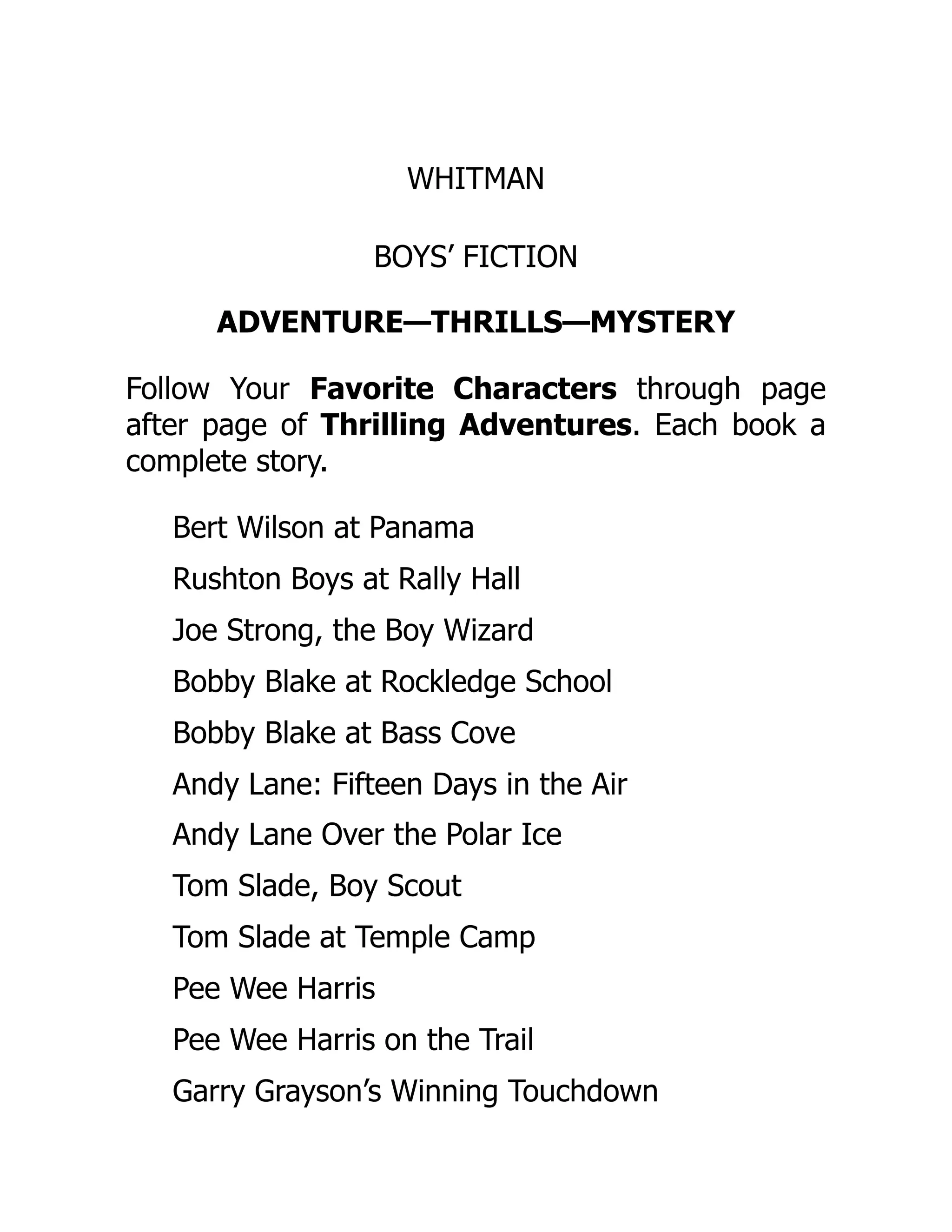
WHITMAN
BOYS’ FICTION
ADVENTURE—THRILLS—MYSTERY
Follow Your Favorite Characters through page
after page of Thrilling Adventures. Each book a
complete story.
Bert Wilson at Panama
Rushton Boys at Rally Hall
Joe Strong, the Boy Wizard
Bobby Blake at Rockledge School
Bobby Blake at Bass Cove
Andy Lane: Fifteen Days in the Air
Andy Lane Over the Polar Ice
Tom Slade, Boy Scout
Tom Slade at Temple Camp
Pee Wee Harris
Pee Wee Harris on the Trail
Garry Grayson’s Winning Touchdown
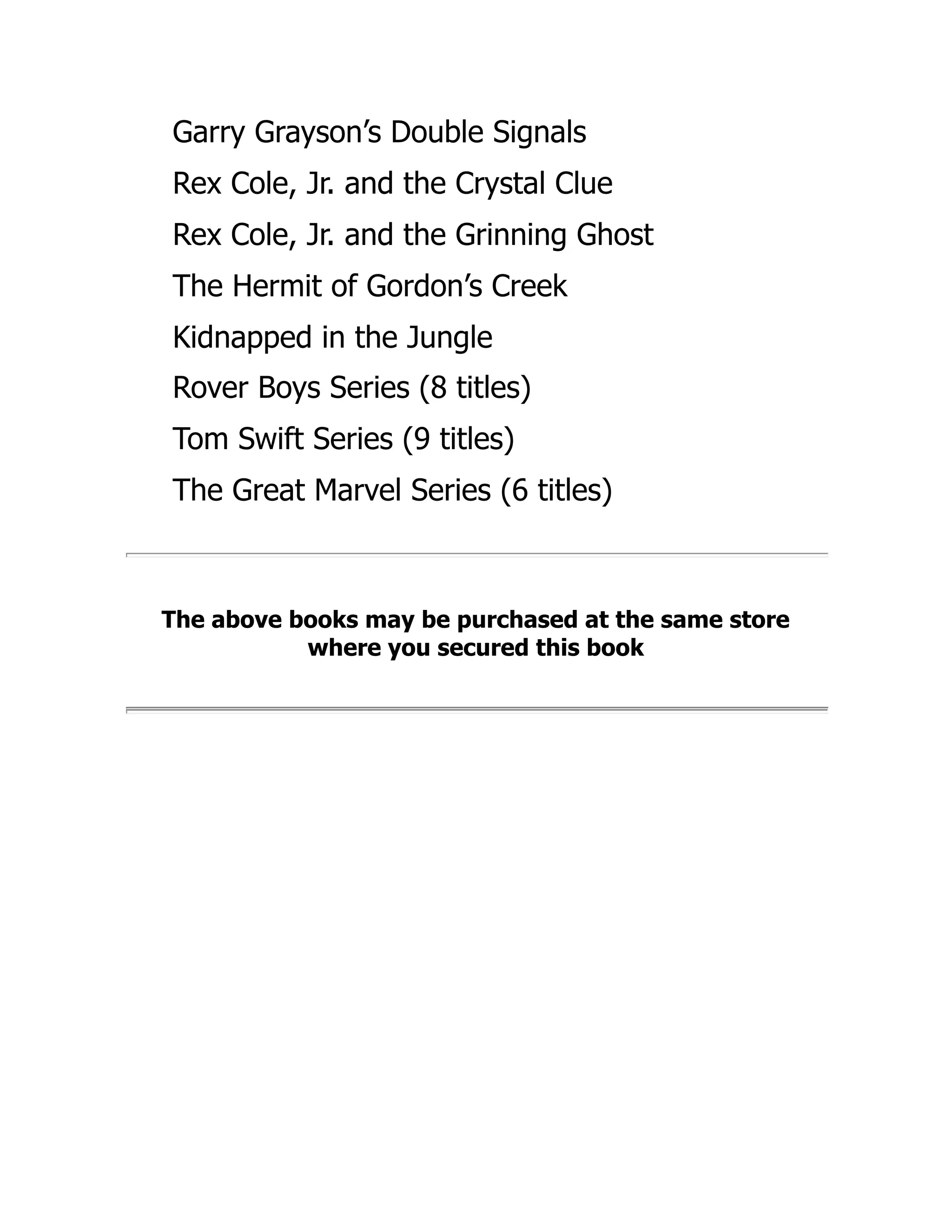
Garry Grayson’s Double Signals
Rex Cole, Jr. and the Crystal Clue
Rex Cole, Jr. and the Grinning Ghost
The Hermit of Gordon’s Creek
Kidnapped in the Jungle
Rover Boys Series (8 titles)
Tom Swift Series (9 titles)
The Great Marvel Series (6 titles)
The above books may be purchased at the same store
where you secured this book
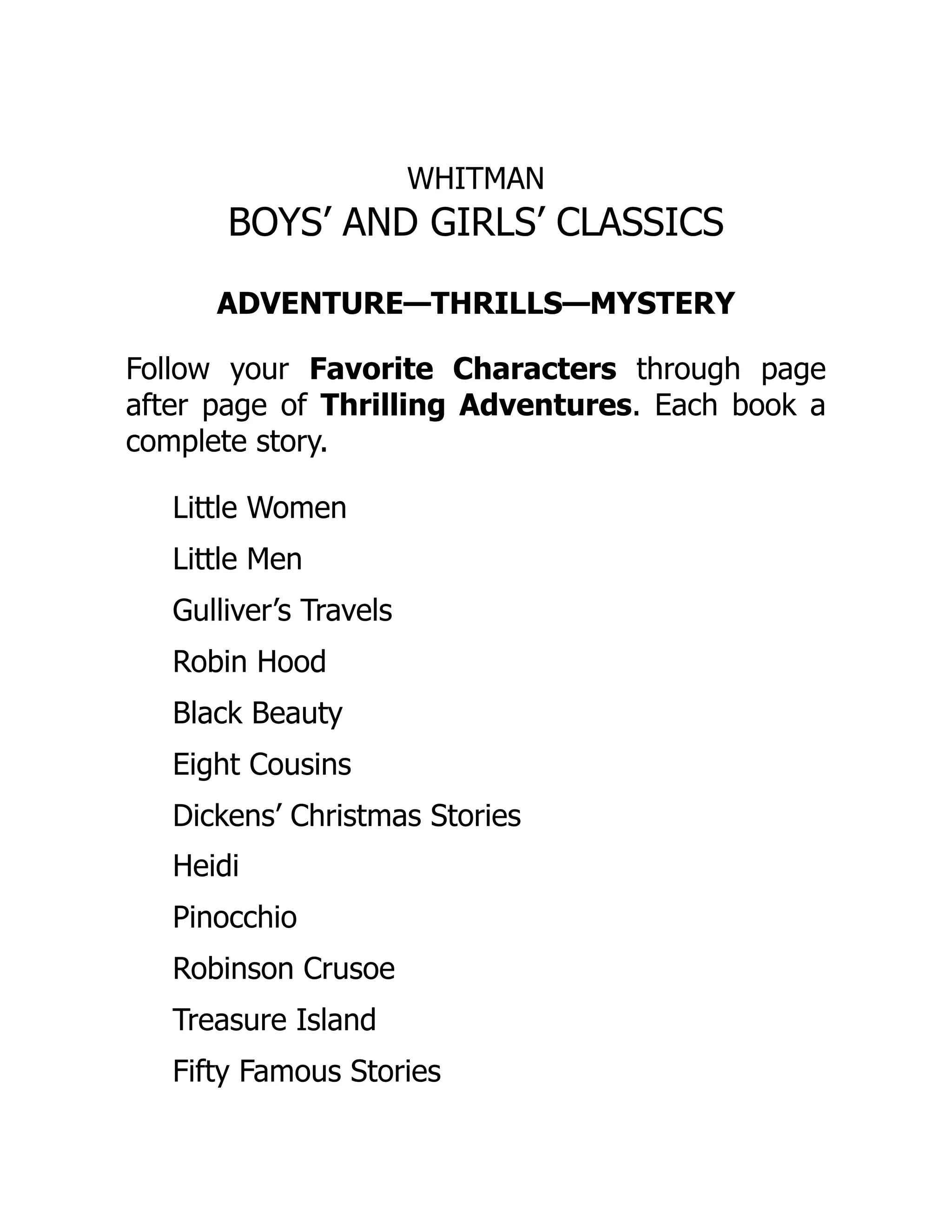
WHITMAN
BOYS’ AND GIRLS’ CLASSICS
ADVENTURE—THRILLS—MYSTERY
Follow your Favorite Characters through page
after page of Thrilling Adventures. Each book a
complete story.
Little Women
Little Men
Gulliver’s Travels
Robin Hood
Black Beauty
Eight Cousins
Dickens’ Christmas Stories
Heidi
Pinocchio
Robinson Crusoe
Treasure Island
Fifty Famous Stories
Tom Sawyer
Hans Brinker
Kidnapped
Fifty Famous Fairy Tales
Swiss Family Robinson
Mother Goose
The above books may be purchased at the same store
where you secured this book
Transcriber’s Note:
Hyphenation has been retained as it appeared
in the original publication; punctuation has been
standardised.
Page 59
exclaimed Nancy, increduously
changed to
exclaimed Nancy, incredulously
Page 81
“That one! ‘Busted’ badly!” She
mocked changed to
“That one! ‘Busted’ badly!” she mocked
Page 171
on the bedisde light changed to
on the bedside light
Page 214
repeated Nancy, increduously changed
to
repeated Nancy, incredulously
Page 241
They may be picnicing changed to
They may be picnicking
Page 278
were picnicing and frolicing around
changed to
were picnicking and frolicking around
*** END OF THE PROJECT GUTENBERG EBOOK NANCY BRANDON'S
MYSTERY ***
Updated editions will replace the previous one—the old editions
will be renamed.
Creating the works from print editions not protected by U.S.
copyright law means that no one owns a United States
copyright in these works, so the Foundation (and you!) can copy
and distribute it in the United States without permission and
without paying copyright royalties. Special rules, set forth in the
General Terms of Use part of this license, apply to copying and
distributing Project Gutenberg™ electronic works to protect the
PROJECT GUTENBERG™ concept and trademark. Project
Gutenberg is a registered trademark, and may not be used if
you charge for an eBook, except by following the terms of the
trademark license, including paying royalties for use of the
Project Gutenberg trademark. If you do not charge anything for
copies of this eBook, complying with the trademark license is
very easy. You may use this eBook for nearly any purpose such
as creation of derivative works, reports, performances and
research. Project Gutenberg eBooks may be modified and
printed and given away—you may do practically ANYTHING in
the United States with eBooks not protected by U.S. copyright
law. Redistribution is subject to the trademark license, especially
commercial redistribution.
START: FULL LICENSE
THE FULL PROJECT GUTENBERG LICENSE
PLEASE READ THIS BEFORE YOU DISTRIBUTE OR USE THIS WORK
To protect the Project Gutenberg™ mission of promoting the
free distribution of electronic works, by using or distributing this
work (or any other work associated in any way with the phrase
“Project Gutenberg”), you agree to comply with all the terms of
the Full Project Gutenberg™ License available with this file or
online at www.gutenberg.org/license.
Section 1. General Terms of Use and
Redistributing Project Gutenberg™
electronic works
1.A. By reading or using any part of this Project Gutenberg™
electronic work, you indicate that you have read, understand,
agree to and accept all the terms of this license and intellectual
property (trademark/copyright) agreement. If you do not agree
to abide by all the terms of this agreement, you must cease
using and return or destroy all copies of Project Gutenberg™
electronic works in your possession. If you paid a fee for
obtaining a copy of or access to a Project Gutenberg™
electronic work and you do not agree to be bound by the terms
of this agreement, you may obtain a refund from the person or
entity to whom you paid the fee as set forth in paragraph 1.E.8.
1.B. “Project Gutenberg” is a registered trademark. It may only
be used on or associated in any way with an electronic work by
people who agree to be bound by the terms of this agreement.
There are a few things that you can do with most Project
Gutenberg™ electronic works even without complying with the
full terms of this agreement. See paragraph 1.C below. There
are a lot of things you can do with Project Gutenberg™
electronic works if you follow the terms of this agreement and
help preserve free future access to Project Gutenberg™
electronic works. See paragraph 1.E below.
1.C. The Project Gutenberg Literary Archive Foundation (“the
Foundation” or PGLAF), owns a compilation copyright in the
collection of Project Gutenberg™ electronic works. Nearly all the
individual works in the collection are in the public domain in the
United States. If an individual work is unprotected by copyright
law in the United States and you are located in the United
States, we do not claim a right to prevent you from copying,
distributing, performing, displaying or creating derivative works
based on the work as long as all references to Project
Gutenberg are removed. Of course, we hope that you will
support the Project Gutenberg™ mission of promoting free
access to electronic works by freely sharing Project Gutenberg™
works in compliance with the terms of this agreement for
keeping the Project Gutenberg™ name associated with the
work. You can easily comply with the terms of this agreement
by keeping this work in the same format with its attached full
Project Gutenberg™ License when you share it without charge
with others.
1.D. The copyright laws of the place where you are located also
govern what you can do with this work. Copyright laws in most
countries are in a constant state of change. If you are outside
the United States, check the laws of your country in addition to
the terms of this agreement before downloading, copying,
displaying, performing, distributing or creating derivative works
based on this work or any other Project Gutenberg™ work. The
Foundation makes no representations concerning the copyright
status of any work in any country other than the United States.
1.E. Unless you have removed all references to Project
Gutenberg:
1.E.1. The following sentence, with active links to, or other
immediate access to, the full Project Gutenberg™ License must
appear prominently whenever any copy of a Project
Gutenberg™ work (any work on which the phrase “Project
Gutenberg” appears, or with which the phrase “Project
Gutenberg” is associated) is accessed, displayed, performed,
viewed, copied or distributed:
This eBook is for the use of anyone anywhere in the United
States and most other parts of the world at no cost and
with almost no restrictions whatsoever. You may copy it,
give it away or re-use it under the terms of the Project
Gutenberg License included with this eBook or online at
www.gutenberg.org. If you are not located in the United
States, you will have to check the laws of the country
where you are located before using this eBook.
1.E.2. If an individual Project Gutenberg™ electronic work is
derived from texts not protected by U.S. copyright law (does not
contain a notice indicating that it is posted with permission of
the copyright holder), the work can be copied and distributed to
anyone in the United States without paying any fees or charges.
If you are redistributing or providing access to a work with the
phrase “Project Gutenberg” associated with or appearing on the
work, you must comply either with the requirements of
paragraphs 1.E.1 through 1.E.7 or obtain permission for the use
of the work and the Project Gutenberg™ trademark as set forth
in paragraphs 1.E.8 or 1.E.9.
1.E.3. If an individual Project Gutenberg™ electronic work is
posted with the permission of the copyright holder, your use and
distribution must comply with both paragraphs 1.E.1 through
1.E.7 and any additional terms imposed by the copyright holder.
Additional terms will be linked to the Project Gutenberg™
License for all works posted with the permission of the copyright
holder found at the beginning of this work.
1.E.4. Do not unlink or detach or remove the full Project
Gutenberg™ License terms from this work, or any files
containing a part of this work or any other work associated with
Project Gutenberg™.
1.E.5. Do not copy, display, perform, distribute or redistribute
this electronic work, or any part of this electronic work, without
prominently displaying the sentence set forth in paragraph 1.E.1
with active links or immediate access to the full terms of the
Project Gutenberg™ License.
1.E.6. You may convert to and distribute this work in any binary,
compressed, marked up, nonproprietary or proprietary form,
including any word processing or hypertext form. However, if
you provide access to or distribute copies of a Project
Gutenberg™ work in a format other than “Plain Vanilla ASCII” or
other format used in the official version posted on the official
Project Gutenberg™ website (www.gutenberg.org), you must,
at no additional cost, fee or expense to the user, provide a copy,
a means of exporting a copy, or a means of obtaining a copy
upon request, of the work in its original “Plain Vanilla ASCII” or
other form. Any alternate format must include the full Project
Gutenberg™ License as specified in paragraph 1.E.1.
1.E.7. Do not charge a fee for access to, viewing, displaying,
performing, copying or distributing any Project Gutenberg™
works unless you comply with paragraph 1.E.8 or 1.E.9.
1.E.8. You may charge a reasonable fee for copies of or
providing access to or distributing Project Gutenberg™
electronic works provided that:
• You pay a royalty fee of 20% of the gross profits you derive
from the use of Project Gutenberg™ works calculated using the
method you already use to calculate your applicable taxes. The
fee is owed to the owner of the Project Gutenberg™ trademark,
but he has agreed to donate royalties under this paragraph to
the Project Gutenberg Literary Archive Foundation. Royalty
payments must be paid within 60 days following each date on
which you prepare (or are legally required to prepare) your
periodic tax returns. Royalty payments should be clearly marked
as such and sent to the Project Gutenberg Literary Archive
Foundation at the address specified in Section 4, “Information
about donations to the Project Gutenberg Literary Archive
Foundation.”
• You provide a full refund of any money paid by a user who
notifies you in writing (or by e-mail) within 30 days of receipt
that s/he does not agree to the terms of the full Project
Gutenberg™ License. You must require such a user to return or
destroy all copies of the works possessed in a physical medium
and discontinue all use of and all access to other copies of
Project Gutenberg™ works.
• You provide, in accordance with paragraph 1.F.3, a full refund of
any money paid for a work or a replacement copy, if a defect in
the electronic work is discovered and reported to you within 90
days of receipt of the work.
• You comply with all other terms of this agreement for free
distribution of Project Gutenberg™ works.
1.E.9. If you wish to charge a fee or distribute a Project
Gutenberg™ electronic work or group of works on different
terms than are set forth in this agreement, you must obtain
permission in writing from the Project Gutenberg Literary
Archive Foundation, the manager of the Project Gutenberg™
trademark. Contact the Foundation as set forth in Section 3
below.
1.F.
1.F.1. Project Gutenberg volunteers and employees expend
considerable effort to identify, do copyright research on,
transcribe and proofread works not protected by U.S. copyright
law in creating the Project Gutenberg™ collection. Despite these
efforts, Project Gutenberg™ electronic works, and the medium
on which they may be stored, may contain “Defects,” such as,
but not limited to, incomplete, inaccurate or corrupt data,
transcription errors, a copyright or other intellectual property
infringement, a defective or damaged disk or other medium, a
computer virus, or computer codes that damage or cannot be
read by your equipment.
1.F.2. LIMITED WARRANTY, DISCLAIMER OF DAMAGES - Except
for the “Right of Replacement or Refund” described in
paragraph 1.F.3, the Project Gutenberg Literary Archive
Foundation, the owner of the Project Gutenberg™ trademark,
and any other party distributing a Project Gutenberg™ electronic
work under this agreement, disclaim all liability to you for
damages, costs and expenses, including legal fees. YOU AGREE
THAT YOU HAVE NO REMEDIES FOR NEGLIGENCE, STRICT
LIABILITY, BREACH OF WARRANTY OR BREACH OF CONTRACT
EXCEPT THOSE PROVIDED IN PARAGRAPH 1.F.3. YOU AGREE
THAT THE FOUNDATION, THE TRADEMARK OWNER, AND ANY
DISTRIBUTOR UNDER THIS AGREEMENT WILL NOT BE LIABLE
TO YOU FOR ACTUAL, DIRECT, INDIRECT, CONSEQUENTIAL,
PUNITIVE OR INCIDENTAL DAMAGES EVEN IF YOU GIVE
NOTICE OF THE POSSIBILITY OF SUCH DAMAGE.
1.F.3. LIMITED RIGHT OF REPLACEMENT OR REFUND - If you
discover a defect in this electronic work within 90 days of
receiving it, you can receive a refund of the money (if any) you
paid for it by sending a written explanation to the person you
received the work from. If you received the work on a physical
medium, you must return the medium with your written
explanation. The person or entity that provided you with the
defective work may elect to provide a replacement copy in lieu
of a refund. If you received the work electronically, the person
or entity providing it to you may choose to give you a second
opportunity to receive the work electronically in lieu of a refund.
If the second copy is also defective, you may demand a refund
in writing without further opportunities to fix the problem.
1.F.4. Except for the limited right of replacement or refund set
forth in paragraph 1.F.3, this work is provided to you ‘AS-IS’,
WITH NO OTHER WARRANTIES OF ANY KIND, EXPRESS OR
IMPLIED, INCLUDING BUT NOT LIMITED TO WARRANTIES OF
MERCHANTABILITY OR FITNESS FOR ANY PURPOSE.
1.F.5. Some states do not allow disclaimers of certain implied
warranties or the exclusion or limitation of certain types of
damages. If any disclaimer or limitation set forth in this
agreement violates the law of the state applicable to this
agreement, the agreement shall be interpreted to make the
maximum disclaimer or limitation permitted by the applicable
state law. The invalidity or unenforceability of any provision of
this agreement shall not void the remaining provisions.
1.F.6. INDEMNITY - You agree to indemnify and hold the
Foundation, the trademark owner, any agent or employee of the
Foundation, anyone providing copies of Project Gutenberg™
electronic works in accordance with this agreement, and any
volunteers associated with the production, promotion and
distribution of Project Gutenberg™ electronic works, harmless
from all liability, costs and expenses, including legal fees, that
arise directly or indirectly from any of the following which you
do or cause to occur: (a) distribution of this or any Project
Gutenberg™ work, (b) alteration, modification, or additions or
deletions to any Project Gutenberg™ work, and (c) any Defect
you cause.
Section 2. Information about the Mission
of Project Gutenberg™
Project Gutenberg™ is synonymous with the free distribution of
electronic works in formats readable by the widest variety of
computers including obsolete, old, middle-aged and new
computers. It exists because of the efforts of hundreds of
volunteers and donations from people in all walks of life.
Volunteers and financial support to provide volunteers with the
assistance they need are critical to reaching Project
Gutenberg™’s goals and ensuring that the Project Gutenberg™
collection will remain freely available for generations to come. In
2001, the Project Gutenberg Literary Archive Foundation was
created to provide a secure and permanent future for Project
Gutenberg™ and future generations. To learn more about the
Project Gutenberg Literary Archive Foundation and how your
efforts and donations can help, see Sections 3 and 4 and the
Foundation information page at www.gutenberg.org.
Section 3. Information about the Project
Gutenberg Literary Archive Foundation
The Project Gutenberg Literary Archive Foundation is a non-
profit 501(c)(3) educational corporation organized under the
laws of the state of Mississippi and granted tax exempt status
by the Internal Revenue Service. The Foundation’s EIN or
federal tax identification number is 64-6221541. Contributions
to the Project Gutenberg Literary Archive Foundation are tax
deductible to the full extent permitted by U.S. federal laws and
your state’s laws.
The Foundation’s business office is located at 809 North 1500
West, Salt Lake City, UT 84116, (801) 596-1887. Email contact
links and up to date contact information can be found at the
Foundation’s website and official page at
www.gutenberg.org/contact
Section 4. Information about Donations to
the Project Gutenberg Literary Archive
Foundation
Project Gutenberg™ depends upon and cannot survive without
widespread public support and donations to carry out its mission
of increasing the number of public domain and licensed works
that can be freely distributed in machine-readable form
accessible by the widest array of equipment including outdated
equipment. Many small donations ($1 to $5,000) are particularly
important to maintaining tax exempt status with the IRS.
The Foundation is committed to complying with the laws
regulating charities and charitable donations in all 50 states of
the United States. Compliance requirements are not uniform
and it takes a considerable effort, much paperwork and many
fees to meet and keep up with these requirements. We do not
solicit donations in locations where we have not received written
confirmation of compliance. To SEND DONATIONS or determine
the status of compliance for any particular state visit
www.gutenberg.org/donate.
While we cannot and do not solicit contributions from states
where we have not met the solicitation requirements, we know
of no prohibition against accepting unsolicited donations from
donors in such states who approach us with offers to donate.
International donations are gratefully accepted, but we cannot
make any statements concerning tax treatment of donations
received from outside the United States. U.S. laws alone swamp
our small staff.
Please check the Project Gutenberg web pages for current
donation methods and addresses. Donations are accepted in a
number of other ways including checks, online payments and
credit card donations. To donate, please visit:
www.gutenberg.org/donate.
Section 5. General Information About
Project Gutenberg™ electronic works
Professor Michael S. Hart was the originator of the Project
Gutenberg™ concept of a library of electronic works that could
be freely shared with anyone. For forty years, he produced and
distributed Project Gutenberg™ eBooks with only a loose
network of volunteer support.
Project Gutenberg™ eBooks are often created from several
printed editions, all of which are confirmed as not protected by
copyright in the U.S. unless a copyright notice is included. Thus,
we do not necessarily keep eBooks in compliance with any
particular paper edition.
Most people start at our website which has the main PG search
facility: www.gutenberg.org.
This website includes information about Project Gutenberg™,
including how to make donations to the Project Gutenberg
Literary Archive Foundation, how to help produce our new
eBooks, and how to subscribe to our email newsletter to hear
about new eBooks.
Welcome to our website – the ideal destination for book lovers and
knowledge seekers. With a mission to inspire endlessly, we offer a
vast collection of books, ranging from classic literary works to
specialized publications, self-development books, and children's
literature. Each book is a new journey of discovery, expanding
knowledge and enriching the soul of the reade
Our website is not just a platform for buying books, but a bridge
connecting readers to the timeless values of culture and wisdom. With
an elegant, user-friendly interface and an intelligent search system,
we are committed to providing a quick and convenient shopping
experience. Additionally, our special promotions and home delivery
services ensure that you save time and fully enjoy the joy of reading.
Let us accompany you on the journey of exploring knowledge and
personal growth!
ebookultra.com

Mathematical Time Capsules Historical Modules for the Mathematics Classroom Dick Jardine
  • 1.
    Visit https://ebookultra.com todownload the full version and explore more ebooks or textbooks Mathematical Time Capsules Historical Modules for the Mathematics Classroom Dick Jardine _____ Click the link below to download _____ https://ebookultra.com/download/mathematical-time-capsules- historical-modules-for-the-mathematics-classroom-dick- jardine/ Explore and download more ebooks or textbooks at ebookultra.com

  • 2.
    Here are somerecommended products that we believe you will be interested in. You can click the link to download. Buying Time Dick Diamond https://ebookultra.com/download/buying-time-dick-diamond/ Mathematics for the International Student Mathematical Studies 2nd edition Edition Mal Coad https://ebookultra.com/download/mathematics-for-the-international- student-mathematical-studies-2nd-edition-edition-mal-coad/ Proving in the Elementary Mathematics Classroom 1st Edition Andreas J. Stylianides https://ebookultra.com/download/proving-in-the-elementary-mathematics- classroom-1st-edition-andreas-j-stylianides/ Food in time and place the American Historical Association companion to food history American Historical Association https://ebookultra.com/download/food-in-time-and-place-the-american- historical-association-companion-to-food-history-american-historical- association/
  • 3.
    Mathematics and theDivine A Historical Study 1st Edition Teun Koetsier https://ebookultra.com/download/mathematics-and-the-divine-a- historical-study-1st-edition-teun-koetsier/ Visible thinking in the K 8 Mathematics Classroom 1st Edition Ted H. Hull https://ebookultra.com/download/visible-thinking-in- the-k-8-mathematics-classroom-1st-edition-ted-h-hull/ NASA 50th Anniversary Proceedings NASA s First 50 Years Historical Perspectives NASA s First 50 Years Historical Perspectives Steven J. Dick https://ebookultra.com/download/nasa-50th-anniversary-proceedings- nasa-s-first-50-years-historical-perspectives-nasa-s-first-50-years- historical-perspectives-steven-j-dick/ Psychology Modules for Active Learning 11th Edition Dennis Coon https://ebookultra.com/download/psychology-modules-for-active- learning-11th-edition-dennis-coon/ ICP design methods for driven piles in sands and clays 2nd ed Edition Richard Jardine https://ebookultra.com/download/icp-design-methods-for-driven-piles- in-sands-and-clays-2nd-ed-edition-richard-jardine/
  • 5.
    Mathematical Time CapsulesHistorical Modules for the Mathematics Classroom Dick Jardine Digital Instant Download Author(s): Dick Jardine, Amy Shell-Gellasch (eds.) ISBN(s): 9780883859841, 088385984X Edition: UKed File Details: PDF, 5.89 MB Year: 2011 Language: english
  • 7.
    Mathematical Time Capsules HistoricalModules for the Mathematics Classroom
  • 8.
    c 2011 by TheMathematical Association of America (Incorporated) Library of Congress Control Number 2011926092 Print ISBN 978-0-88385-187-6 Electronic ISBN 978-0-88385-984-1 Printed in the United States of America Current Printing (last digit): 10 9 8 7 6 5 4 3 2 1
  • 9.
    Mathematical Time Capsules HistoricalModules for the Mathematics Classroom Edited by Dick Jardine Keene State College and Amy Shell-Gellasch Beloit College Published and Distributed by The Mathematical Association of America
  • 10.
    The MAA NotesSeries, started in 1982, addresses a broad range of topics and themes of interest to all who are involved with undergraduate mathematics. The volumes in this series are readable, informative, and useful, and help the mathematical community keep up with developments of importance to mathematics. Committee on Books Gerald Bryce, Chair Notes Editorial Board Stephen B Maurer, Editor Deborah J. Bergstrand Thomas P. Dence Donna L. Flint Theresa Jeevanjee Michael K. May Judith A. Palagallo Mark Parker Susan Pustejovsky David Rusin David J. Sprows Joe Alyn Stickles Andrius Tamulis MAA Notes 14. Mathematical Writing, by Donald E. Knuth, Tracy Larrabee, and Paul M. Roberts. 16. Using Writing to Teach Mathematics, Andrew Sterrett, Editor. 17. Priming the Calculus Pump: Innovations and Resources, Committee on Calculus Reform and the First Two Years, a subcomit- tee of the Committee on the Undergraduate Program in Mathematics, Thomas W. Tucker, Editor. 18. Models for Undergraduate Research in Mathematics, Lester Senechal, Editor. 19. Visualization in Teaching and Learning Mathematics, Committee on Computers in Mathematics Education, Steve Cunning- ham and Walter S. Zimmermann, Editors. 20. The Laboratory Approach to Teaching Calculus, L. Carl Leinbach et al., Editors. 21. Perspectives on Contemporary Statistics, David C. Hoaglin and David S. Moore, Editors. 22. Heeding the Call for Change: Suggestions for Curricular Action, Lynn A. Steen, Editor. 24. Symbolic Computation in Undergraduate Mathematics Education, Zaven A. Karian, Editor. 25. The Concept of Function: Aspects of Epistemology and Pedagogy,Guershon Harel and Ed Dubinsky, Editors. 26. Statistics for the Twenty-First Century, Florence and Sheldon Gordon, Editors. 27. Resources for Calculus Collection, Volume 1: Learning by Discovery: A Lab Manual for Calculus, Anita E. Solow, Editor. 28. Resources for Calculus Collection, Volume 2: Calculus Problems for a New Century, Robert Fraga, Editor. 29. Resources for Calculus Collection, Volume 3: Applications of Calculus, Philip Straffin, Editor. 30. Resources for Calculus Collection, Volume 4: Problems for Student Investigation, Michael B. Jackson and John R. Ramsay, Editors. 31. Resources for Calculus Collection, Volume 5: Readings for Calculus, Underwood Dudley, Editor. 32. Essays in Humanistic Mathematics, Alvin White, Editor. 33. ResearchIssues in Undergraduate Mathematics Learning: Preliminary Analyses and Results, JamesJ. Kaput and Ed Dubinsky, Editors. 34. In Eves Circles, Joby Milo Anthony, Editor. 35. Youre the Professor, What Next? Ideas and Resources for Preparing College Teachers, The Committee on Preparation for College Teaching, Bettye Anne Case, Editor. 36. Preparing for a New Calculus: Conference Proceedings, Anita E. Solow, Editor. 37. A Practical Guide to Cooperative Learning in Collegiate Mathematics, Nancy L. Hagelgans, Barbara E. Reynolds, SDS, Keith Schwingendorf, Draga Vidakovic, Ed Dubinsky, Mazen Shahin, G. Joseph Wimbish, Jr. 38. Models That Work: Case Studies in Effective Undergraduate Mathematics Programs, Alan C. Tucker, Editor. 39. Calculus: The Dynamics of Change, CUPM Subcommittee on Calculus Reform and the First Two Years, A. Wayne Roberts, Editor. 40. Vita Mathematica: Historical Research and Integration with Teaching, Ronald Calinger, Editor. 41. Geometry Turned On: Dynamic Software in Learning, Teaching, and Research, James R. King and Doris Schattschneider, Editors. 42. Resources for Teaching Linear Algebra, David Carlson, Charles R. Johnson, David C. Lay, A. Duane Porter, Ann E. Watkins, William Watkins, Editors. 43. Student Assessmentin Calculus: A Report of the NSF Working Group on Assessment in Calculus, Alan Schoenfeld, Editor.
  • 11.
    44. Readings inCooperative Learning for Undergraduate Mathematics, Ed Dubinsky, David Mathews, and Barbara E. Reynolds, Editors. 45. Confronting the Core Curriculum: Considering Change in the Undergraduate Mathematics Major, John A. Dossey, Editor. 46. Women in Mathematics: Scaling the Heights, Deborah Nolan, Editor. 47. Exemplary Programs in Introductory College Mathematics: Innovative Programs Using Technology, Susan Lenker, Editor. 48. Writing in the Teaching and Learning of Mathematics, John Meier and Thomas Rishel. 49. Assessment Practices in Undergraduate Mathematics, Bonnie Gold, Editor. 50. Revolutions in Differential Equations: Exploring ODEs with Modern Technology, Michael J. Kallaher, Editor. 51. Using History to Teach Mathematics: An International Perspective, Victor J. Katz, Editor. 52. Teaching Statistics: Resources for Undergraduate Instructors, Thomas L. Moore, Editor. 53. Geometry at Work: Papers in Applied Geometry, Catherine A. Gorini, Editor. 54. Teaching First: A Guide for New Mathematicians, Thomas W. Rishel. 55. Cooperative Learning in Undergraduate Mathematics: Issues That Matter and Strategies That Work, Elizabeth C. Rogers, Barbara E. Reynolds, Neil A. Davidson, and Anthony D. Thomas, Editors. 56. Changing Calculus: A Report on Evaluation Efforts and National Impact from 1988 to 1998, Susan L. Ganter. 57. Learning to Teach and Teaching to Learn Mathematics: Resources for Professional Development, Matthew Delong and Dale Winter. 58. Fractals, Graphics, and Mathematics Education, Benoit Mandelbrot and Michael Frame, Editors. 59. Linear Algebra Gems: Assets for Undergraduate Mathematics, David Carlson, Charles R. Johnson, David C. Lay, and A. Duane Porter, Editors. 60. Innovations in Teaching Abstract Algebra, Allen C. Hibbard and Ellen J. Maycock, Editors. 61. Changing Core Mathematics, Chris Arney and Donald Small, Editors. 62. Achieving Quantitative Literacy: An Urgent Challenge for Higher Education, Lynn Arthur Steen. 64. Leading the Mathematical Sciences Department: A Resource for Chairs, Tina H. Straley, Marcia P. Sward, and Jon W. Scott, Editors. 65. Innovations in Teaching Statistics, Joan B. Garfield, Editor. 66. Mathematics in Service to the Community: Concepts and models for service-learning in the mathematical sciences, Charles R. Hadlock, Editor. 67. Innovative Approaches to Undergraduate Mathematics Courses Beyond Calculus, Richard J. Maher, Editor. 68. From Calculus to Computers: Using the last 200 years of mathematics history in the classroom, Amy Shell-Gellasch and Dick Jardine, Editors. 69. A Fresh Start for Collegiate Mathematics: Rethinking the Courses below Calculus, Nancy Baxter Hastings, Editor. 70. Current Practices in Quantitative Literacy, Rick Gillman, Editor. 71. War Stories from Applied Math: Undergraduate Consultancy Projects, Robert Fraga, Editor. 72. Hands On History: A Resource for Teaching Mathematics, Amy Shell-Gellasch, Editor. 73. Making the Connection: Research and Teaching in Undergraduate Mathematics Education, Marilyn P. Carlson and Chris Rasmussen, Editors. 74. Resources for Teaching Discrete Mathematics: Classroom Projects, History Modules, and Articles, Brian Hopkins, Editor. 75. The Moore Method: A Pathway to Learner-Centered Instruction, Charles A. Coppin, W. Ted Mahavier, E. Lee May, and G. Edgar Parker. 76. The Beauty of Fractals: Six Different Views, Denny Gulick and Jon Scott, Editors. 77. Mathematical Time Capsules: Historical Modules for the Mathematics Classroom, Dick Jardine and Amy Shell-Gellasch, Editors. MAA Service Center P.O. Box 91112 Washington, DC 20090-1112 1-800-331-1MAA FAX: 1-301-206-9789
  • 13.
    Preface Mathematical Time Capsulesoffers teachers historical modules for immediate use in the mathematics classroom. Relevant history-based activities for a wide range of undergraduate and secondary mathematics courses are included. The genesis of this volume was a Contributed Papers Session on Using History of Mathematics in Your Mathematics Courses, organized by the editors at the Joint Mathematics Meetings, San Antonio, Texas, in January of 2006. That session was very well attended, which prompted Andrew Sterrett from MAA publications to suggest that we put together our second volume for the MAA Notes series. Purpose For a wide variety of reasons, instructors are looking for ways to include the history of mathematics in their courses. It is not uncommon to see requests for “how to” posted to the History of Mathematics Special Interest Group of the MAA (www.homsigmaa.org) email list, such as this 2008 posting: ...I am a newcomer to HOM. Where and how should a newcomer begin? Right now, I would liketo include HOM in a meaningful way in the courses that we teach. Weteach courses from college arithmetic to linear algebra. In response to such inquiries, we hope to serve the broader mathematical community by offering practical suggestions on how to use the history of mathematics quickly and easily in the mathematics classroom. A time capsule can be defined as a container preserving articles and records from the past for scholars of the future. Of course our volume does not fit that precise definition, but readers who open this book will find articles and activities from mathematics history that enhance the learning of topics typically associated with undergraduate or secondary mathematics curricula. Each capsule presents one topic or perhaps a few related topics, or a historical thread that can be used throughout a course. The capsules were written by experienced practitioners to provide other teachers with the historical background, suggested classroom activities, and further references and resources on the chapter subject. An instructor reading a capsule will have increased confidence in engaging students with at least one activity rich in the history of mathematics that will enhance student learning of the mathematical content of the course. Most of the historical topics contained in a capsule can be implemented in one class period with minimal additional preparation on the part of the teacher. How to use Mathematical Time Capsules Teaching styles have been categorized along a spectrum from lecture-oriented practices at one extreme to student- centered approaches in which the teacher guides student work in the classroom. Mathematical Time Capsules respects the diversity of teaching styles which individual teachers adopt. Some of the capsules are, in some sense, ready- made lectures the instructor can adopt and adapt as appropriate. Examples of those include Victor Katz’s “Copernican Trigonometry,” Roger Cooke’s “Numerical Solution of Equations,” or Jim Tattersall’s “Finding the Greatest Common Divisor and More... .” Other capsules clearly engage the students more actively, such as Vicky Klima’s “A Different Sort of Calculus Debate.” But the capsules should not be categorized as appropriate for one pedagogical approach or the other. For example, “Finding the Greatest Common Divisor and More...” could be adapted for use as a student project to be presented by the student(s) in class after the Euclidean algorithm is covered. The reader may note that the authors of the capsules demonstrate a variety of approaches to integrating history. The differences are consistent with the nature of this volume, created with respect for the diversity of our authors and our vii
  • 14.
    viii Preface readers. Weacknowledge that many teachers prefer to develop their own course materials, and we encourage readers to modify the offerings of the authors. Mathematical Time Capsules is organized in three sections. The first capsules have as their target mathematical topics that are usually addressed in courses taught in secondary school, at two-year colleges, or during the first two years of the undergraduate mathematics curriculum. These courses are not often taken by mathematics majors, and include, for example, algebra, geometry, mathematics for elementary teachers, trigonometry, or precalculus. The third section of capsules address topics included in courses traditionally taken by mathematics majors, such as calculus, differential equations, number theory, abstract algebra, differential equations, and analysis. As an interlude between the first and third, we offer some ideas that can be applied to a wide variety of courses throughout the undergraduate (including two-year college) or secondary curriculum. These interlude capsules (15, 16, and 17) are of a general pedagogical nature, not mathematical, and could be adapted for use in any course. We could have arranged the capsules differently, and we ask that the reader not limit investigating the offerings in this book thinking that lower-level material is in the front and upper-level material at the back. For example, a teacher interested in historical ideas for a numerical methods course should consider Roger Cooke’s “Numerical Solution of Equations,” Randy Schwartz’s “Rule of Double False Position,” Clemency Montelle’s “Roots, Rocks, and Newton- Raphson Algorithms for Approximating p 2 3000 Years Apart,” and Dick Jardine’s “Euler’s Method in Euler’s Words.” Some teachers are interested in having students read original sources in the history of mathematics, and Montelle’s “Amo, Amas, Amat! What’s the Sum of That?” and Jardine’s “Euler’s Method in Euler’s Words” provide opportunities to do just that with brief excerpts in the words of the originators. Where possible, we grouped the capsules within the sections according to mathematical subject area. As an example, there are three capsules that address Pythagorean triples, but each of those capsules approaches the topic in a very different way and from the perspective of a different era of the history of mathematics. That latter notion is significant, as it is important for students to see the evolution of a mathematical idea and how it is viewed through a different lens depending on how mathematics was done at various times in history. One of the goals of Mathematical Time Capsules is to provide a vehicle for teachers to help their students learn the historical context for a mathematical development while they are learning the specific mathematical concept. Learning the history of an idea promotes deeper understanding of the idea. Additional purposes—assessment and teacher certification Beyond a teacher’s personal interest in using the history of mathematics in teaching, accrediting agencies and state certifying agencies now require pre-service teachers to be well-versed in the history of mathematics in specific content areas. The requirement that school teachers demonstrate understanding of the connection between a mathematics topic and the history of that specific topic is explicitly documented in state and national standards. It is becoming an imper- ative that many college teachers introduce the history of mathematic in their teaching of mathematics in order to pass muster for state and national certification of teacher education programs. The National Council for Accreditation of Teacher Education (NCATE) and the National Council of Teachers of Mathematics (NCTM) have published standards which list within the content areas a requirement that candidates for teacher certification demonstrate their knowledge of the historical development of that content area. For example, the current content Standard 10 is on the subject of algebra. For certification, in addition to demonstrating expertise in the usual algebra concepts, candidates must “Demonstrate knowledge of the historical development of algebra including contributions from diverse cultures” [2]. In this era of outcomes-based assessment, to satisfy state and national evaluators it is not sufficient to show that history was included in the syllabus or to claim that history was included in a lecture. Actual student work (interestingly for us interested in history, the student work is called an artifact in current assessment jargon) must be presented to the accrediting agency or state department of education evaluators. The material presented herein will provide teachers with actual activities that students can do. The products of these activities become the artifacts necessary to validate that students are engaged in learning the historical development of the mathematical topic. Mathematical Time Capsules provides materials enhancing student understanding and interest in mathematics, always keeping the learning of mathematics clearly at the center of each capsule’s focus.
  • 15.
    Preface ix Acknowledgements We couldnot have taken on this project without the interest and enthusiasm of the many contributors from campuses around the world. We are indebted to the successful leadership efforts of V. Frederick Rickey and Victor Katz in bringing together a community of educators and encouraging our passion for improving student learning through the use of the history of mathematics. The editors of this volume met as participants in the NSF funded Institute for the History of Mathematics and its use in Teaching, organized by Fred and Victor, which provided a sound foundation for our work and a network of like-mindedcolleagues and friends. We also offer special thanks to Chris Arney, who led the way as Department Head of the Department of Mathematical Sciences at the United States Military Academy at West Point in not only documenting that the history of mathematics is a significant learning outcome at the program level in undergraduate mathematics departments but also provided an exemplar of effective implementation. We both worked for Chris and he made a real difference by encouraging and supporting our early use of the history of mathematics to deepen student learning of our discipline. Finally, and perhaps most importantly, we also acknowledge the interest and enthusiasm of our students, who let us know each semester that we teach that learning the history of mathematics is important to them. References 1. Amy Shell-Gellasch and D. Jardine, ed., From Calculus to Computers: Using the Last 200 Years of Mathematics History in the Classroom, Mathematical Association of America, Washington, 2005. 2. NCATE/NCTM Program Standards (2003), Programs for Initial Preparation of Mathematics Teachers, Standards for Secondary Mathematics Teachers www.nctm.org/uploadedFiles/Math_Standards/, accessed May 12, 2009.
  • 17.
    Contents Preface vii 1 TheSources of Algebra, Roger Cooke 1 1.1 Introduction . . . . . . . . . . . . . . . . . . . . . . . . . . . . . . . . . . . . . . . . . . . . . . . . 1 1.2 Egyptian problems . . . . . . . . . . . . . . . . . . . . . . . . . . . . . . . . . . . . . . . . . . . . 1 1.3 Mesopotamian problems . . . . . . . . . . . . . . . . . . . . . . . . . . . . . . . . . . . . . . . . . 2 1.4 “Algebra” in Euclid’s geometry . . . . . . . . . . . . . . . . . . . . . . . . . . . . . . . . . . . . . . 2 1.5 Chinese problems . . . . . . . . . . . . . . . . . . . . . . . . . . . . . . . . . . . . . . . . . . . . . 4 1.6 An Arabic problem . . . . . . . . . . . . . . . . . . . . . . . . . . . . . . . . . . . . . . . . . . . . 4 1.7 A Japanese problem . . . . . . . . . . . . . . . . . . . . . . . . . . . . . . . . . . . . . . . . . . . . 5 1.8 Teaching note . . . . . . . . . . . . . . . . . . . . . . . . . . . . . . . . . . . . . . . . . . . . . . . 5 1.9 Problems and Questions . . . . . . . . . . . . . . . . . . . . . . . . . . . . . . . . . . . . . . . . . 5 1.10 Further reading . . . . . . . . . . . . . . . . . . . . . . . . . . . . . . . . . . . . . . . . . . . . . . 6 2 How to Measure the Earth, Lawrence D’Antonio 7 2.1 Introduction . . . . . . . . . . . . . . . . . . . . . . . . . . . . . . . . . . . . . . . . . . . . . . . . 7 2.2 Historical Introduction . . . . . . . . . . . . . . . . . . . . . . . . . . . . . . . . . . . . . . . . . . 8 2.3 In the Classroom . . . . . . . . . . . . . . . . . . . . . . . . . . . . . . . . . . . . . . . . . . . . . 13 2.4 Taking it Further . . . . . . . . . . . . . . . . . . . . . . . . . . . . . . . . . . . . . . . . . . . . . 15 2.5 Conclusion . . . . . . . . . . . . . . . . . . . . . . . . . . . . . . . . . . . . . . . . . . . . . . . . 16 Bibliography . . . . . . . . . . . . . . . . . . . . . . . . . . . . . . . . . . . . . . . . . . . . . . . . . . 16 3 Numerical solution of equations, Roger Cooke 17 3.1 Introduction . . . . . . . . . . . . . . . . . . . . . . . . . . . . . . . . . . . . . . . . . . . . . . . . 17 3.2 The ancient Chinese method of solving a polynomial equation . . . . . . . . . . . . . . . . . . . . . 18 3.3 Non-integer solutions . . . . . . . . . . . . . . . . . . . . . . . . . . . . . . . . . . . . . . . . . . . 19 3.4 The cubic equation . . . . . . . . . . . . . . . . . . . . . . . . . . . . . . . . . . . . . . . . . . . . 20 3.5 Problems and questions . . . . . . . . . . . . . . . . . . . . . . . . . . . . . . . . . . . . . . . . . . 20 3.6 Further reading . . . . . . . . . . . . . . . . . . . . . . . . . . . . . . . . . . . . . . . . . . . . . . 21 4 Completing the Square through the Millennia, Dick Jardine 23 4.1 Introduction . . . . . . . . . . . . . . . . . . . . . . . . . . . . . . . . . . . . . . . . . . . . . . . . 23 4.2 Historical preliminaries . . . . . . . . . . . . . . . . . . . . . . . . . . . . . . . . . . . . . . . . . . 23 4.3 Student activities . . . . . . . . . . . . . . . . . . . . . . . . . . . . . . . . . . . . . . . . . . . . . 27 4.4 Summary and conclusion . . . . . . . . . . . . . . . . . . . . . . . . . . . . . . . . . . . . . . . . . 27 Bibliography . . . . . . . . . . . . . . . . . . . . . . . . . . . . . . . . . . . . . . . . . . . . . . . . . . 27 Appendix: Student activities . . . . . . . . . . . . . . . . . . . . . . . . . . . . . . . . . . . . . . . . . . 28 xi
  • 18.
    xii Contents 5 Adaptingthe Medieval “Rule of Double False Position” to the Modern Classroom, Randy K. Schwartz 29 5.1 Introduction . . . . . . . . . . . . . . . . . . . . . . . . . . . . . . . . . . . . . . . . . . . . . . . . 29 5.2 Historical Background . . . . . . . . . . . . . . . . . . . . . . . . . . . . . . . . . . . . . . . . . . 29 5.3 In the Classroom . . . . . . . . . . . . . . . . . . . . . . . . . . . . . . . . . . . . . . . . . . . . . 31 5.4 Taking It Further . . . . . . . . . . . . . . . . . . . . . . . . . . . . . . . . . . . . . . . . . . . . . 35 5.5 Conclusion . . . . . . . . . . . . . . . . . . . . . . . . . . . . . . . . . . . . . . . . . . . . . . . . 37 Bibliography . . . . . . . . . . . . . . . . . . . . . . . . . . . . . . . . . . . . . . . . . . . . . . . . . . 37 6 Complex Numbers, Cubic Equations, and Sixteenth-Century Italy, Daniel J. Curtin 39 6.1 Introduction . . . . . . . . . . . . . . . . . . . . . . . . . . . . . . . . . . . . . . . . . . . . . . . . 39 6.2 Historical Background . . . . . . . . . . . . . . . . . . . . . . . . . . . . . . . . . . . . . . . . . . 39 6.3 In the Classroom . . . . . . . . . . . . . . . . . . . . . . . . . . . . . . . . . . . . . . . . . . . . . 40 6.4 Rafael Bombelli . . . . . . . . . . . . . . . . . . . . . . . . . . . . . . . . . . . . . . . . . . . . . . 41 6.5 Conclusion . . . . . . . . . . . . . . . . . . . . . . . . . . . . . . . . . . . . . . . . . . . . . . . . 43 Bibliography . . . . . . . . . . . . . . . . . . . . . . . . . . . . . . . . . . . . . . . . . . . . . . . . . . 43 7 Shearing with Euclid, Davida Fischman and Shawnee McMurran 45 7.1 Introduction . . . . . . . . . . . . . . . . . . . . . . . . . . . . . . . . . . . . . . . . . . . . . . . . 45 7.2 Historical Background . . . . . . . . . . . . . . . . . . . . . . . . . . . . . . . . . . . . . . . . . . 46 7.3 In the Classroom . . . . . . . . . . . . . . . . . . . . . . . . . . . . . . . . . . . . . . . . . . . . . 50 7.4 Conclusion . . . . . . . . . . . . . . . . . . . . . . . . . . . . . . . . . . . . . . . . . . . . . . . . 51 Appendix . . . . . . . . . . . . . . . . . . . . . . . . . . . . . . . . . . . . . . . . . . . . . . . . . . . . 52 Bibliography . . . . . . . . . . . . . . . . . . . . . . . . . . . . . . . . . . . . . . . . . . . . . . . . . . 53 8 The Mathematics of Measuring Time, Kim Plofker 55 8.1 Introduction . . . . . . . . . . . . . . . . . . . . . . . . . . . . . . . . . . . . . . . . . . . . . . . . 55 8.2 Historical Background . . . . . . . . . . . . . . . . . . . . . . . . . . . . . . . . . . . . . . . . . . 55 8.3 In the Classroom . . . . . . . . . . . . . . . . . . . . . . . . . . . . . . . . . . . . . . . . . . . . . 57 8.4 Taking It Further . . . . . . . . . . . . . . . . . . . . . . . . . . . . . . . . . . . . . . . . . . . . . 60 8.5 Conclusion . . . . . . . . . . . . . . . . . . . . . . . . . . . . . . . . . . . . . . . . . . . . . . . . 61 Bibliography . . . . . . . . . . . . . . . . . . . . . . . . . . . . . . . . . . . . . . . . . . . . . . . . . . 61 9 Clear Sailing with Trigonometry, Glen Van Brummelen 63 9.1 Introduction . . . . . . . . . . . . . . . . . . . . . . . . . . . . . . . . . . . . . . . . . . . . . . . . 63 9.2 Historical Background . . . . . . . . . . . . . . . . . . . . . . . . . . . . . . . . . . . . . . . . . . 65 9.3 Navigating with Trigonometry . . . . . . . . . . . . . . . . . . . . . . . . . . . . . . . . . . . . . . 65 9.4 In the Classroom . . . . . . . . . . . . . . . . . . . . . . . . . . . . . . . . . . . . . . . . . . . . . 67 9.5 Conclusion . . . . . . . . . . . . . . . . . . . . . . . . . . . . . . . . . . . . . . . . . . . . . . . . 68 Bibliography . . . . . . . . . . . . . . . . . . . . . . . . . . . . . . . . . . . . . . . . . . . . . . . . . . 69 Appendix: Michael of Rhodes: Did He Know the Law of Sines? . . . . . . . . . . . . . . . . . . . . . . . 70 10 Copernican Trigonometry, Victor J. Katz 73 10.1 Introduction . . . . . . . . . . . . . . . . . . . . . . . . . . . . . . . . . . . . . . . . . . . . . . . . 73 10.2 Historical Background . . . . . . . . . . . . . . . . . . . . . . . . . . . . . . . . . . . . . . . . . . 73 10.3 In the Classroom . . . . . . . . . . . . . . . . . . . . . . . . . . . . . . . . . . . . . . . . . . . . . 74 10.4 Conclusion . . . . . . . . . . . . . . . . . . . . . . . . . . . . . . . . . . . . . . . . . . . . . . . . 88 Bibliography . . . . . . . . . . . . . . . . . . . . . . . . . . . . . . . . . . . . . . . . . . . . . . . . . . 88
  • 19.
    Contents xiii 11 Cusps:Horns and Beaks, Robert E. Bradley 89 11.1 Introduction . . . . . . . . . . . . . . . . . . . . . . . . . . . . . . . . . . . . . . . . . . . . . . . . 89 11.2 Historical Background . . . . . . . . . . . . . . . . . . . . . . . . . . . . . . . . . . . . . . . . . . 89 11.3 In the Classroom . . . . . . . . . . . . . . . . . . . . . . . . . . . . . . . . . . . . . . . . . . . . . 90 11.4 Conclusion . . . . . . . . . . . . . . . . . . . . . . . . . . . . . . . . . . . . . . . . . . . . . . . . 98 11.5 Notes on Classroom Use . . . . . . . . . . . . . . . . . . . . . . . . . . . . . . . . . . . . . . . . . 98 Bibliography . . . . . . . . . . . . . . . . . . . . . . . . . . . . . . . . . . . . . . . . . . . . . . . . . . 99 12 The Latitude of Forms, Area, and Velocity, Daniel J. Curtin 101 12.1 Introduction . . . . . . . . . . . . . . . . . . . . . . . . . . . . . . . . . . . . . . . . . . . . . . . . 101 12.2 Historical Background . . . . . . . . . . . . . . . . . . . . . . . . . . . . . . . . . . . . . . . . . . 101 12.3 In the Classroom . . . . . . . . . . . . . . . . . . . . . . . . . . . . . . . . . . . . . . . . . . . . . 102 12.4 Taking It Further . . . . . . . . . . . . . . . . . . . . . . . . . . . . . . . . . . . . . . . . . . . . . 104 12.5 Conclusion . . . . . . . . . . . . . . . . . . . . . . . . . . . . . . . . . . . . . . . . . . . . . . . . 104 12.6 Comments . . . . . . . . . . . . . . . . . . . . . . . . . . . . . . . . . . . . . . . . . . . . . . . . . 104 Bibliography . . . . . . . . . . . . . . . . . . . . . . . . . . . . . . . . . . . . . . . . . . . . . . . . . . 105 13 Descartes’ Approach to Tangents, Daniel J. Curtin 107 13.1 Introduction . . . . . . . . . . . . . . . . . . . . . . . . . . . . . . . . . . . . . . . . . . . . . . . . 107 13.2 Historical Background . . . . . . . . . . . . . . . . . . . . . . . . . . . . . . . . . . . . . . . . . . 107 13.3 In the Classroom . . . . . . . . . . . . . . . . . . . . . . . . . . . . . . . . . . . . . . . . . . . . . 107 13.4 Conclusion . . . . . . . . . . . . . . . . . . . . . . . . . . . . . . . . . . . . . . . . . . . . . . . . 110 Bibliography . . . . . . . . . . . . . . . . . . . . . . . . . . . . . . . . . . . . . . . . . . . . . . . . . . 110 14 Integration à la Fermat, Amy Shell-Gellasch 111 14.1 Introduction . . . . . . . . . . . . . . . . . . . . . . . . . . . . . . . . . . . . . . . . . . . . . . . . 111 14.2 Historical Background . . . . . . . . . . . . . . . . . . . . . . . . . . . . . . . . . . . . . . . . . . 111 14.3 In the Classroom . . . . . . . . . . . . . . . . . . . . . . . . . . . . . . . . . . . . . . . . . . . . . 113 14.4 Taking it Further . . . . . . . . . . . . . . . . . . . . . . . . . . . . . . . . . . . . . . . . . . . . . 114 14.5 Conclusion . . . . . . . . . . . . . . . . . . . . . . . . . . . . . . . . . . . . . . . . . . . . . . . . 116 Bibliography . . . . . . . . . . . . . . . . . . . . . . . . . . . . . . . . . . . . . . . . . . . . . . . . . . 116 15 Sharing the Fun: Student Presentations, Amy Shell-Gellasch and Dick Jardine 117 15.1 Introduction . . . . . . . . . . . . . . . . . . . . . . . . . . . . . . . . . . . . . . . . . . . . . . . . 117 15.2 Getting Started . . . . . . . . . . . . . . . . . . . . . . . . . . . . . . . . . . . . . . . . . . . . . . 117 15.3 Presentations . . . . . . . . . . . . . . . . . . . . . . . . . . . . . . . . . . . . . . . . . . . . . . . 118 15.4 Assessment . . . . . . . . . . . . . . . . . . . . . . . . . . . . . . . . . . . . . . . . . . . . . . . . 119 15.5 Conclusion . . . . . . . . . . . . . . . . . . . . . . . . . . . . . . . . . . . . . . . . . . . . . . . . 119 Bibliography . . . . . . . . . . . . . . . . . . . . . . . . . . . . . . . . . . . . . . . . . . . . . . . . . . 119 16 Digging up History on the Internet: Discovery Worksheets, Betty Mayfield 123 16.1 Introduction . . . . . . . . . . . . . . . . . . . . . . . . . . . . . . . . . . . . . . . . . . . . . . . . 123 16.2 In the Classroom . . . . . . . . . . . . . . . . . . . . . . . . . . . . . . . . . . . . . . . . . . . . . 124 16.3 Learning about History — and about the Web . . . . . . . . . . . . . . . . . . . . . . . . . . . . . . 124 16.4 Conclusion . . . . . . . . . . . . . . . . . . . . . . . . . . . . . . . . . . . . . . . . . . . . . . . . 124 Bibliography . . . . . . . . . . . . . . . . . . . . . . . . . . . . . . . . . . . . . . . . . . . . . . . . . . 124 Appendix 1: Who Was Gauss? . . . . . . . . . . . . . . . . . . . . . . . . . . . . . . . . . . . . . . . . . 125 Appendix 2: History of Matrices and Determinants . . . . . . . . . . . . . . . . . . . . . . . . . . . . . . 125 Appendix 3: Stephen Smale, a contemporary mathematician . . . . . . . . . . . . . . . . . . . . . . . . . 126 Appendix 4: Nancy Kopell, a female mathematician . . . . . . . . . . . . . . . . . . . . . . . . . . . . . . 126
  • 20.
    xiv Contents 17 Newtonvs. Leibniz in One Hour!, Betty Mayfield 127 17.1 Introduction . . . . . . . . . . . . . . . . . . . . . . . . . . . . . . . . . . . . . . . . . . . . . . . . 127 17.2 Historical Background . . . . . . . . . . . . . . . . . . . . . . . . . . . . . . . . . . . . . . . . . . 128 17.3 In the Classroom . . . . . . . . . . . . . . . . . . . . . . . . . . . . . . . . . . . . . . . . . . . . . 128 17.4 Taking it Further . . . . . . . . . . . . . . . . . . . . . . . . . . . . . . . . . . . . . . . . . . . . . 129 17.5 Conclusion . . . . . . . . . . . . . . . . . . . . . . . . . . . . . . . . . . . . . . . . . . . . . . . . 129 Bibliography . . . . . . . . . . . . . . . . . . . . . . . . . . . . . . . . . . . . . . . . . . . . . . . . . . 130 Appendix 1: Instructions to the class . . . . . . . . . . . . . . . . . . . . . . . . . . . . . . . . . . . . . . 130 18 Connections between Newton, Leibniz, and Calculus I, Andrew B. Perry 133 18.1 Introduction . . . . . . . . . . . . . . . . . . . . . . . . . . . . . . . . . . . . . . . . . . . . . . . . 133 18.2 Historical Background . . . . . . . . . . . . . . . . . . . . . . . . . . . . . . . . . . . . . . . . . . 133 18.3 Newton’s Work . . . . . . . . . . . . . . . . . . . . . . . . . . . . . . . . . . . . . . . . . . . . . . 134 18.4 Leibniz’s Work . . . . . . . . . . . . . . . . . . . . . . . . . . . . . . . . . . . . . . . . . . . . . . 135 18.5 Berkeley’s Critique . . . . . . . . . . . . . . . . . . . . . . . . . . . . . . . . . . . . . . . . . . . . 136 18.6 Later Developments . . . . . . . . . . . . . . . . . . . . . . . . . . . . . . . . . . . . . . . . . . . . 137 18.7 In The Classroom . . . . . . . . . . . . . . . . . . . . . . . . . . . . . . . . . . . . . . . . . . . . . 137 18.8 Conclusion . . . . . . . . . . . . . . . . . . . . . . . . . . . . . . . . . . . . . . . . . . . . . . . . 137 Bibliography . . . . . . . . . . . . . . . . . . . . . . . . . . . . . . . . . . . . . . . . . . . . . . . . . . 137 19 A Different Sort of Calculus Debate, Vicky Williams Klima 139 19.1 Introduction . . . . . . . . . . . . . . . . . . . . . . . . . . . . . . . . . . . . . . . . . . . . . . . . 139 19.2 Historical Background . . . . . . . . . . . . . . . . . . . . . . . . . . . . . . . . . . . . . . . . . . 139 19.3 In the Classroom . . . . . . . . . . . . . . . . . . . . . . . . . . . . . . . . . . . . . . . . . . . . . 141 19.4 Conclusions . . . . . . . . . . . . . . . . . . . . . . . . . . . . . . . . . . . . . . . . . . . . . . . . 142 Bibliography . . . . . . . . . . . . . . . . . . . . . . . . . . . . . . . . . . . . . . . . . . . . . . . . . . 143 Appendix A: Fermat’s Method Worksheet . . . . . . . . . . . . . . . . . . . . . . . . . . . . . . . . . . . 144 Appendix B: Barrow’s Theorem Worksheet . . . . . . . . . . . . . . . . . . . . . . . . . . . . . . . . . . 146 Appendix C: The Debates: Roles, Structure, Hints . . . . . . . . . . . . . . . . . . . . . . . . . . . . . . . 148 20 A ‘Symbolic’ History of the Derivative, Clemency Montelle 151 20.1 Introduction . . . . . . . . . . . . . . . . . . . . . . . . . . . . . . . . . . . . . . . . . . . . . . . . 151 20.2 The Derivative . . . . . . . . . . . . . . . . . . . . . . . . . . . . . . . . . . . . . . . . . . . . . . . 151 20.3 Isaac Newton (1643–1727): . . . . . . . . . . . . . . . . . . . . . . . . . . . . . . . . . . . . . . . . 152 20.4 Gottfried Wilhelm von Leibniz (1646–1716): . . . . . . . . . . . . . . . . . . . . . . . . . . . . . . 153 20.5 Joseph-Louis Lagrange (1736–1813) . . . . . . . . . . . . . . . . . . . . . . . . . . . . . . . . . . . 154 20.6 Louis François Antoine Arbogast (1759-1803) . . . . . . . . . . . . . . . . . . . . . . . . . . . . . . 155 20.7 Conclusion . . . . . . . . . . . . . . . . . . . . . . . . . . . . . . . . . . . . . . . . . . . . . . . . 157 20.8 Reflective Questions . . . . . . . . . . . . . . . . . . . . . . . . . . . . . . . . . . . . . . . . . . . 157 Bibliography . . . . . . . . . . . . . . . . . . . . . . . . . . . . . . . . . . . . . . . . . . . . . . . . . . 158 21 Leibniz’s Calculus (Real Retro Calc.), Robert Rogers 159 21.1 Introduction . . . . . . . . . . . . . . . . . . . . . . . . . . . . . . . . . . . . . . . . . . . . . . . . 159 21.2 Differential Calculus (Rules of Differences) . . . . . . . . . . . . . . . . . . . . . . . . . . . . . . . 160 21.3 Conclusion . . . . . . . . . . . . . . . . . . . . . . . . . . . . . . . . . . . . . . . . . . . . . . . . 165 Appendix . . . . . . . . . . . . . . . . . . . . . . . . . . . . . . . . . . . . . . . . . . . . . . . . . . . . 165 Bibliography . . . . . . . . . . . . . . . . . . . . . . . . . . . . . . . . . . . . . . . . . . . . . . . . . . 167
  • 21.
    Contents xv 22 An“Impossible” Problem, Courtesy of Leonhard Euler, Homer S. White 169 22.1 Introduction . . . . . . . . . . . . . . . . . . . . . . . . . . . . . . . . . . . . . . . . . . . . . . . . 169 22.2 Historical Setting . . . . . . . . . . . . . . . . . . . . . . . . . . . . . . . . . . . . . . . . . . . . . 169 22.3 In the Classroom . . . . . . . . . . . . . . . . . . . . . . . . . . . . . . . . . . . . . . . . . . . . . 171 22.4 Conclusion . . . . . . . . . . . . . . . . . . . . . . . . . . . . . . . . . . . . . . . . . . . . . . . . 176 Appendix: Remarks on Selected Exercises . . . . . . . . . . . . . . . . . . . . . . . . . . . . . . . . . . . 176 Bibliography . . . . . . . . . . . . . . . . . . . . . . . . . . . . . . . . . . . . . . . . . . . . . . . . . . 177 23 Multiple Representations of Functions in the History of Mathematics, Robert Rogers 179 23.1 Introduction (A Funny Thing Happened on the Way to Calculus) . . . . . . . . . . . . . . . . . . . . 179 23.2 Area of a Circle . . . . . . . . . . . . . . . . . . . . . . . . . . . . . . . . . . . . . . . . . . . . . . 180 23.3 Ptolemy’s Table . . . . . . . . . . . . . . . . . . . . . . . . . . . . . . . . . . . . . . . . . . . . . . 181 23.4 From Geometry to Analysis to Set Theory . . . . . . . . . . . . . . . . . . . . . . . . . . . . . . . . 184 23.5 Conclusion . . . . . . . . . . . . . . . . . . . . . . . . . . . . . . . . . . . . . . . . . . . . . . . . 187 Bibliography . . . . . . . . . . . . . . . . . . . . . . . . . . . . . . . . . . . . . . . . . . . . . . . . . . 187 24 The Unity of all Science: Karl Pearson, the Mean and the Standard Deviation, Joe Albree 189 24.1 Introduction . . . . . . . . . . . . . . . . . . . . . . . . . . . . . . . . . . . . . . . . . . . . . . . . 189 24.2 Karl Pearson: Historical preliminaries . . . . . . . . . . . . . . . . . . . . . . . . . . . . . . . . . . 189 24.3 A data set . . . . . . . . . . . . . . . . . . . . . . . . . . . . . . . . . . . . . . . . . . . . . . . . . 190 24.4 The Mean and the First Moment . . . . . . . . . . . . . . . . . . . . . . . . . . . . . . . . . . . . . 191 24.5 The Second Moment and the Standard Deviation . . . . . . . . . . . . . . . . . . . . . . . . . . . . 193 24.6 In the Classroom . . . . . . . . . . . . . . . . . . . . . . . . . . . . . . . . . . . . . . . . . . . . . 195 24.7 Conclusions . . . . . . . . . . . . . . . . . . . . . . . . . . . . . . . . . . . . . . . . . . . . . . . . 195 24.8 Activities and Questions . . . . . . . . . . . . . . . . . . . . . . . . . . . . . . . . . . . . . . . . . 195 Bibliography . . . . . . . . . . . . . . . . . . . . . . . . . . . . . . . . . . . . . . . . . . . . . . . . . . 197 25 Finding the Greatest Common Divisor, J.J. Tattersall 199 25.1 Introduction . . . . . . . . . . . . . . . . . . . . . . . . . . . . . . . . . . . . . . . . . . . . . . . . 199 25.2 Historical Background . . . . . . . . . . . . . . . . . . . . . . . . . . . . . . . . . . . . . . . . . . 199 25.3 More Historical Background . . . . . . . . . . . . . . . . . . . . . . . . . . . . . . . . . . . . . . . 201 25.4 In The classroom . . . . . . . . . . . . . . . . . . . . . . . . . . . . . . . . . . . . . . . . . . . . . 201 25.5 Conclusion . . . . . . . . . . . . . . . . . . . . . . . . . . . . . . . . . . . . . . . . . . . . . . . . 202 Bibliography . . . . . . . . . . . . . . . . . . . . . . . . . . . . . . . . . . . . . . . . . . . . . . . . . . 202 26 Two-Way Numbers and an Alternate Technique for Multiplying Two Numbers, J.J. Tattersall 203 26.1 Introduction . . . . . . . . . . . . . . . . . . . . . . . . . . . . . . . . . . . . . . . . . . . . . . . . 203 26.2 Historical Background . . . . . . . . . . . . . . . . . . . . . . . . . . . . . . . . . . . . . . . . . . 203 26.3 In The Classroom . . . . . . . . . . . . . . . . . . . . . . . . . . . . . . . . . . . . . . . . . . . . . 205 26.4 Taking It Further . . . . . . . . . . . . . . . . . . . . . . . . . . . . . . . . . . . . . . . . . . . . . 205 26.5 Conclusion . . . . . . . . . . . . . . . . . . . . . . . . . . . . . . . . . . . . . . . . . . . . . . . . 206 Bibliography . . . . . . . . . . . . . . . . . . . . . . . . . . . . . . . . . . . . . . . . . . . . . . . . . . 207 27 The Origins of Integrating Factors, Dick Jardine 209 27.1 Introduction . . . . . . . . . . . . . . . . . . . . . . . . . . . . . . . . . . . . . . . . . . . . . . . . 209 27.2 Historical preliminaries . . . . . . . . . . . . . . . . . . . . . . . . . . . . . . . . . . . . . . . . . . 209 27.3 Mathematical preliminaries: Integrating factors . . . . . . . . . . . . . . . . . . . . . . . . . . . . . 211 27.4 Bernoulli’s and Euler’s use of integrating factors . . . . . . . . . . . . . . . . . . . . . . . . . . . . . 212 27.5 Student activities . . . . . . . . . . . . . . . . . . . . . . . . . . . . . . . . . . . . . . . . . . . . . 213 27.6 Summary and conclusion . . . . . . . . . . . . . . . . . . . . . . . . . . . . . . . . . . . . . . . . . 213 Bibliography . . . . . . . . . . . . . . . . . . . . . . . . . . . . . . . . . . . . . . . . . . . . . . . . . . 213 Appendix: Student activities . . . . . . . . . . . . . . . . . . . . . . . . . . . . . . . . . . . . . . . . . . 214
  • 22.
    xvi Contents 28 Euler’sMethod in Euler’s Words, Dick Jardine 215 28.1 Introduction . . . . . . . . . . . . . . . . . . . . . . . . . . . . . . . . . . . . . . . . . . . . . . . . 215 28.2 Historical preliminaries . . . . . . . . . . . . . . . . . . . . . . . . . . . . . . . . . . . . . . . . . . 215 28.3 Euler’s description of the method . . . . . . . . . . . . . . . . . . . . . . . . . . . . . . . . . . . . . 217 28.4 Student Activities . . . . . . . . . . . . . . . . . . . . . . . . . . . . . . . . . . . . . . . . . . . . . 218 28.5 Summary and conclusion . . . . . . . . . . . . . . . . . . . . . . . . . . . . . . . . . . . . . . . . . 218 Bibliography . . . . . . . . . . . . . . . . . . . . . . . . . . . . . . . . . . . . . . . . . . . . . . . . . . 219 Appendix A: Student Assignments . . . . . . . . . . . . . . . . . . . . . . . . . . . . . . . . . . . . . . . 220 Appendix B: Original source translation . . . . . . . . . . . . . . . . . . . . . . . . . . . . . . . . . . . . 221 29 Newton’s Differential Equation P y P x D 1 3x C y C xx C xy, Hüseyin Koçak 223 29.1 Introduction . . . . . . . . . . . . . . . . . . . . . . . . . . . . . . . . . . . . . . . . . . . . . . . . 223 29.2 Newton’s differential equation . . . . . . . . . . . . . . . . . . . . . . . . . . . . . . . . . . . . . . 223 29.3 Newton’s solution . . . . . . . . . . . . . . . . . . . . . . . . . . . . . . . . . . . . . . . . . . . . . 224 29.4 Phaser simulations . . . . . . . . . . . . . . . . . . . . . . . . . . . . . . . . . . . . . . . . . . . . 225 29.5 Remarks: Newton, Leibniz, and Euler . . . . . . . . . . . . . . . . . . . . . . . . . . . . . . . . . . 226 29.6 Suggested Explorations . . . . . . . . . . . . . . . . . . . . . . . . . . . . . . . . . . . . . . . . . . 227 Bibliography . . . . . . . . . . . . . . . . . . . . . . . . . . . . . . . . . . . . . . . . . . . . . . . . . . 228 30 Roots, Rocks, and Newton-Raphson Algorithms for Approximating p 2 3000 Years Apart, Clemency Montelle 229 30.1 Introduction . . . . . . . . . . . . . . . . . . . . . . . . . . . . . . . . . . . . . . . . . . . . . . . . 229 30.2 The Problem . . . . . . . . . . . . . . . . . . . . . . . . . . . . . . . . . . . . . . . . . . . . . . . . 230 30.3 Solving p 2 — Second Millennium C.E. Style . . . . . . . . . . . . . . . . . . . . . . . . . . . . . . 230 30.4 Time Warp: Solving p 2 — Second Millennium B.C.E. Style . . . . . . . . . . . . . . . . . . . . . . 232 30.5 Taking it Further: Final Reflections . . . . . . . . . . . . . . . . . . . . . . . . . . . . . . . . . . . . 237 30.6 Conclusion . . . . . . . . . . . . . . . . . . . . . . . . . . . . . . . . . . . . . . . . . . . . . . . . 238 Bibliography . . . . . . . . . . . . . . . . . . . . . . . . . . . . . . . . . . . . . . . . . . . . . . . . . . 239 31 Plimpton 322: The Pythagorean Theorem, More than a Thousand Years before Pythagoras, Daniel E. Otero 241 31.1 Introduction . . . . . . . . . . . . . . . . . . . . . . . . . . . . . . . . . . . . . . . . . . . . . . . . 241 31.2 Historical Background . . . . . . . . . . . . . . . . . . . . . . . . . . . . . . . . . . . . . . . . . . 241 31.3 Reading the Tablet . . . . . . . . . . . . . . . . . . . . . . . . . . . . . . . . . . . . . . . . . . . . 242 31.4 Sexagesimal numeration . . . . . . . . . . . . . . . . . . . . . . . . . . . . . . . . . . . . . . . . . 243 31.5 So What Does It All Mean? . . . . . . . . . . . . . . . . . . . . . . . . . . . . . . . . . . . . . . . . 245 31.6 Why Tabulate These Numbers? . . . . . . . . . . . . . . . . . . . . . . . . . . . . . . . . . . . . . . 248 31.7 Plimpton 322 in the Classroom . . . . . . . . . . . . . . . . . . . . . . . . . . . . . . . . . . . . . . 248 31.8 Conclusion . . . . . . . . . . . . . . . . . . . . . . . . . . . . . . . . . . . . . . . . . . . . . . . . 250 Bibliography . . . . . . . . . . . . . . . . . . . . . . . . . . . . . . . . . . . . . . . . . . . . . . . . . . 250 32 Thomas Harriot’s Pythagorean Triples: Could He List Them All?, Janet L. Beery 251 32.1 Introduction . . . . . . . . . . . . . . . . . . . . . . . . . . . . . . . . . . . . . . . . . . . . . . . . 251 32.2 Mathematical Background . . . . . . . . . . . . . . . . . . . . . . . . . . . . . . . . . . . . . . . . 251 32.3 Historical Background . . . . . . . . . . . . . . . . . . . . . . . . . . . . . . . . . . . . . . . . . . 252 32.4 In the Classroom . . . . . . . . . . . . . . . . . . . . . . . . . . . . . . . . . . . . . . . . . . . . . 252 32.5 Conclusion . . . . . . . . . . . . . . . . . . . . . . . . . . . . . . . . . . . . . . . . . . . . . . . . 258 Bibliography . . . . . . . . . . . . . . . . . . . . . . . . . . . . . . . . . . . . . . . . . . . . . . . . . . 258 Appendix: Who Was Thomas Harriot? . . . . . . . . . . . . . . . . . . . . . . . . . . . . . . . . . . . . . 259
  • 23.
    Contents xvii 33 Amo,Amas, Amat! What’s the sum of that?, Clemency Montelle 261 33.1 Introduction . . . . . . . . . . . . . . . . . . . . . . . . . . . . . . . . . . . . . . . . . . . . . . . . 261 33.2 The Harmonic Series . . . . . . . . . . . . . . . . . . . . . . . . . . . . . . . . . . . . . . . . . . . 262 33.3 Bernoulli and the Harmonic Series . . . . . . . . . . . . . . . . . . . . . . . . . . . . . . . . . . . . 262 33.4 The Mathematical Explanation . . . . . . . . . . . . . . . . . . . . . . . . . . . . . . . . . . . . . . 265 33.5 Conclusion . . . . . . . . . . . . . . . . . . . . . . . . . . . . . . . . . . . . . . . . . . . . . . . . 267 Bibliography . . . . . . . . . . . . . . . . . . . . . . . . . . . . . . . . . . . . . . . . . . . . . . . . . . 267 34 The Harmonic Series: A Primer, Adrian Rice 269 34.1 Introduction . . . . . . . . . . . . . . . . . . . . . . . . . . . . . . . . . . . . . . . . . . . . . . . . 269 34.2 Historical preliminaries . . . . . . . . . . . . . . . . . . . . . . . . . . . . . . . . . . . . . . . . . . 269 34.3 Introducing the harmonic series . . . . . . . . . . . . . . . . . . . . . . . . . . . . . . . . . . . . . . 271 34.4 A “prime” piece of mathematics . . . . . . . . . . . . . . . . . . . . . . . . . . . . . . . . . . . . . 273 34.5 Conclusion . . . . . . . . . . . . . . . . . . . . . . . . . . . . . . . . . . . . . . . . . . . . . . . . 275 Bibliography . . . . . . . . . . . . . . . . . . . . . . . . . . . . . . . . . . . . . . . . . . . . . . . . . . 276 35 Learning to Move with Dedekind, Fernando Q. Gouvêa 277 35.1 Historical Background: What Dedekind Did . . . . . . . . . . . . . . . . . . . . . . . . . . . . . . . 277 35.2 In the Classroom 1: Transition to Proofs . . . . . . . . . . . . . . . . . . . . . . . . . . . . . . . . . 280 35.3 In the Classroom 2: Abstract Algebra . . . . . . . . . . . . . . . . . . . . . . . . . . . . . . . . . . 282 35.4 Moving with Dedekind . . . . . . . . . . . . . . . . . . . . . . . . . . . . . . . . . . . . . . . . . . 283 Bibliography . . . . . . . . . . . . . . . . . . . . . . . . . . . . . . . . . . . . . . . . . . . . . . . . . . 283 About the Editors 285
  • 25.
    1 The Sources ofAlgebra Roger Cooke University of Vermont 1.1 Introduction Nowadays we recognize written algebra by the presence of letters (called variables) standing for unspecified numbers, and especially by the presence of equations involving those letters. These two features—letters and equations—reveal the techniques of algebra, but algebra itself is not these techniques. Rather, algebra consists of problems in which the goal is to find a number knowing certain indirect information about it. If you were told to multiply 7 by 3, then add 26 to the product, you would be doing arithmetic, that is, you would be given not only the data, but also told which operations you must perform (multiplication followed by addition). But if you were asked for a number having the property that if it is multiplied by 3 and 26 is added to the product, the result is 57, you would be facing an algebra problem. In an algebra problem, the operations and some of the data are given to you, but these operations are not for you to perform. Rather, you assume someone else has performed them, and you need to find the number(s) on which they were performed. Using this definition, we can recognize algebra problems in very ancient texts that contain no equations at all. But how do such problems arise? Why were people interested in solving them? Those are questions that any student who looks beyond the horizon of tomorrow’s homework assignment is bound to ask. In the following paragraphs, we shall look at some examples and see if we can answer such questions. In this article, we are going to state a number of problems taken from “classic” textbooks, paraphrased and reformulated in plain English and in a style reflective of contemporary textbooks. Students who have had at least one year of algebra can study these problems in the language of xs and ys and solve them using modern methods. At the same time, students are encouraged to use their imaginations in order to think of the motivation that led each author to believe it was worthwhile to write about problems of this sort. 1.2 Egyptian problems Several problems from the Rhind Mathematical Papyrus, which was written some 3500 years ago, make use of the notion of pesu, which measures the amount to which grain is “stretched” or diluted in making bread or beer. If you get three (standard-size) loaves of bread per hekat of grain, the pesu of that bread is 3. Obviously a high pesu means very thin or light bread (or a very small loaf) or very weak beer. Here is Problem 73 from the Rhind Papyrus: One hundred loaves of pesu 10 are to be traded for loaves of pesu 15. How many of the latter will there be? 1
  • 26.
    Other documents randomlyhave different content
  • 27.
    WHITMAN BOYS’ FICTION ADVENTURE—THRILLS—MYSTERY Follow YourFavorite Characters through page after page of Thrilling Adventures. Each book a complete story. Bert Wilson at Panama Rushton Boys at Rally Hall Joe Strong, the Boy Wizard Bobby Blake at Rockledge School Bobby Blake at Bass Cove Andy Lane: Fifteen Days in the Air Andy Lane Over the Polar Ice Tom Slade, Boy Scout Tom Slade at Temple Camp Pee Wee Harris Pee Wee Harris on the Trail Garry Grayson’s Winning Touchdown
  • 28.
    Garry Grayson’s DoubleSignals Rex Cole, Jr. and the Crystal Clue Rex Cole, Jr. and the Grinning Ghost The Hermit of Gordon’s Creek Kidnapped in the Jungle Rover Boys Series (8 titles) Tom Swift Series (9 titles) The Great Marvel Series (6 titles) The above books may be purchased at the same store where you secured this book
  • 29.
    WHITMAN BOYS’ AND GIRLS’CLASSICS ADVENTURE—THRILLS—MYSTERY Follow your Favorite Characters through page after page of Thrilling Adventures. Each book a complete story. Little Women Little Men Gulliver’s Travels Robin Hood Black Beauty Eight Cousins Dickens’ Christmas Stories Heidi Pinocchio Robinson Crusoe Treasure Island Fifty Famous Stories
  • 30.
    Tom Sawyer Hans Brinker Kidnapped FiftyFamous Fairy Tales Swiss Family Robinson Mother Goose The above books may be purchased at the same store where you secured this book
  • 31.
    Transcriber’s Note: Hyphenation hasbeen retained as it appeared in the original publication; punctuation has been standardised. Page 59 exclaimed Nancy, increduously changed to exclaimed Nancy, incredulously Page 81 “That one! ‘Busted’ badly!” She mocked changed to “That one! ‘Busted’ badly!” she mocked Page 171 on the bedisde light changed to on the bedside light Page 214 repeated Nancy, increduously changed to repeated Nancy, incredulously Page 241 They may be picnicing changed to They may be picnicking Page 278 were picnicing and frolicing around changed to were picnicking and frolicking around
  • 32.
    *** END OFTHE PROJECT GUTENBERG EBOOK NANCY BRANDON'S MYSTERY *** Updated editions will replace the previous one—the old editions will be renamed. Creating the works from print editions not protected by U.S. copyright law means that no one owns a United States copyright in these works, so the Foundation (and you!) can copy and distribute it in the United States without permission and without paying copyright royalties. Special rules, set forth in the General Terms of Use part of this license, apply to copying and distributing Project Gutenberg™ electronic works to protect the PROJECT GUTENBERG™ concept and trademark. Project Gutenberg is a registered trademark, and may not be used if you charge for an eBook, except by following the terms of the trademark license, including paying royalties for use of the Project Gutenberg trademark. If you do not charge anything for copies of this eBook, complying with the trademark license is very easy. You may use this eBook for nearly any purpose such as creation of derivative works, reports, performances and research. Project Gutenberg eBooks may be modified and printed and given away—you may do practically ANYTHING in the United States with eBooks not protected by U.S. copyright law. Redistribution is subject to the trademark license, especially commercial redistribution. START: FULL LICENSE
  • 33.
    THE FULL PROJECTGUTENBERG LICENSE
  • 34.
    PLEASE READ THISBEFORE YOU DISTRIBUTE OR USE THIS WORK To protect the Project Gutenberg™ mission of promoting the free distribution of electronic works, by using or distributing this work (or any other work associated in any way with the phrase “Project Gutenberg”), you agree to comply with all the terms of the Full Project Gutenberg™ License available with this file or online at www.gutenberg.org/license. Section 1. General Terms of Use and Redistributing Project Gutenberg™ electronic works 1.A. By reading or using any part of this Project Gutenberg™ electronic work, you indicate that you have read, understand, agree to and accept all the terms of this license and intellectual property (trademark/copyright) agreement. If you do not agree to abide by all the terms of this agreement, you must cease using and return or destroy all copies of Project Gutenberg™ electronic works in your possession. If you paid a fee for obtaining a copy of or access to a Project Gutenberg™ electronic work and you do not agree to be bound by the terms of this agreement, you may obtain a refund from the person or entity to whom you paid the fee as set forth in paragraph 1.E.8. 1.B. “Project Gutenberg” is a registered trademark. It may only be used on or associated in any way with an electronic work by people who agree to be bound by the terms of this agreement. There are a few things that you can do with most Project Gutenberg™ electronic works even without complying with the full terms of this agreement. See paragraph 1.C below. There are a lot of things you can do with Project Gutenberg™ electronic works if you follow the terms of this agreement and help preserve free future access to Project Gutenberg™ electronic works. See paragraph 1.E below.
  • 35.
    1.C. The ProjectGutenberg Literary Archive Foundation (“the Foundation” or PGLAF), owns a compilation copyright in the collection of Project Gutenberg™ electronic works. Nearly all the individual works in the collection are in the public domain in the United States. If an individual work is unprotected by copyright law in the United States and you are located in the United States, we do not claim a right to prevent you from copying, distributing, performing, displaying or creating derivative works based on the work as long as all references to Project Gutenberg are removed. Of course, we hope that you will support the Project Gutenberg™ mission of promoting free access to electronic works by freely sharing Project Gutenberg™ works in compliance with the terms of this agreement for keeping the Project Gutenberg™ name associated with the work. You can easily comply with the terms of this agreement by keeping this work in the same format with its attached full Project Gutenberg™ License when you share it without charge with others. 1.D. The copyright laws of the place where you are located also govern what you can do with this work. Copyright laws in most countries are in a constant state of change. If you are outside the United States, check the laws of your country in addition to the terms of this agreement before downloading, copying, displaying, performing, distributing or creating derivative works based on this work or any other Project Gutenberg™ work. The Foundation makes no representations concerning the copyright status of any work in any country other than the United States. 1.E. Unless you have removed all references to Project Gutenberg: 1.E.1. The following sentence, with active links to, or other immediate access to, the full Project Gutenberg™ License must appear prominently whenever any copy of a Project Gutenberg™ work (any work on which the phrase “Project
  • 36.
    Gutenberg” appears, orwith which the phrase “Project Gutenberg” is associated) is accessed, displayed, performed, viewed, copied or distributed: This eBook is for the use of anyone anywhere in the United States and most other parts of the world at no cost and with almost no restrictions whatsoever. You may copy it, give it away or re-use it under the terms of the Project Gutenberg License included with this eBook or online at www.gutenberg.org. If you are not located in the United States, you will have to check the laws of the country where you are located before using this eBook. 1.E.2. If an individual Project Gutenberg™ electronic work is derived from texts not protected by U.S. copyright law (does not contain a notice indicating that it is posted with permission of the copyright holder), the work can be copied and distributed to anyone in the United States without paying any fees or charges. If you are redistributing or providing access to a work with the phrase “Project Gutenberg” associated with or appearing on the work, you must comply either with the requirements of paragraphs 1.E.1 through 1.E.7 or obtain permission for the use of the work and the Project Gutenberg™ trademark as set forth in paragraphs 1.E.8 or 1.E.9. 1.E.3. If an individual Project Gutenberg™ electronic work is posted with the permission of the copyright holder, your use and distribution must comply with both paragraphs 1.E.1 through 1.E.7 and any additional terms imposed by the copyright holder. Additional terms will be linked to the Project Gutenberg™ License for all works posted with the permission of the copyright holder found at the beginning of this work. 1.E.4. Do not unlink or detach or remove the full Project Gutenberg™ License terms from this work, or any files
  • 37.
    containing a partof this work or any other work associated with Project Gutenberg™. 1.E.5. Do not copy, display, perform, distribute or redistribute this electronic work, or any part of this electronic work, without prominently displaying the sentence set forth in paragraph 1.E.1 with active links or immediate access to the full terms of the Project Gutenberg™ License. 1.E.6. You may convert to and distribute this work in any binary, compressed, marked up, nonproprietary or proprietary form, including any word processing or hypertext form. However, if you provide access to or distribute copies of a Project Gutenberg™ work in a format other than “Plain Vanilla ASCII” or other format used in the official version posted on the official Project Gutenberg™ website (www.gutenberg.org), you must, at no additional cost, fee or expense to the user, provide a copy, a means of exporting a copy, or a means of obtaining a copy upon request, of the work in its original “Plain Vanilla ASCII” or other form. Any alternate format must include the full Project Gutenberg™ License as specified in paragraph 1.E.1. 1.E.7. Do not charge a fee for access to, viewing, displaying, performing, copying or distributing any Project Gutenberg™ works unless you comply with paragraph 1.E.8 or 1.E.9. 1.E.8. You may charge a reasonable fee for copies of or providing access to or distributing Project Gutenberg™ electronic works provided that: • You pay a royalty fee of 20% of the gross profits you derive from the use of Project Gutenberg™ works calculated using the method you already use to calculate your applicable taxes. The fee is owed to the owner of the Project Gutenberg™ trademark, but he has agreed to donate royalties under this paragraph to the Project Gutenberg Literary Archive Foundation. Royalty
  • 38.
    payments must bepaid within 60 days following each date on which you prepare (or are legally required to prepare) your periodic tax returns. Royalty payments should be clearly marked as such and sent to the Project Gutenberg Literary Archive Foundation at the address specified in Section 4, “Information about donations to the Project Gutenberg Literary Archive Foundation.” • You provide a full refund of any money paid by a user who notifies you in writing (or by e-mail) within 30 days of receipt that s/he does not agree to the terms of the full Project Gutenberg™ License. You must require such a user to return or destroy all copies of the works possessed in a physical medium and discontinue all use of and all access to other copies of Project Gutenberg™ works. • You provide, in accordance with paragraph 1.F.3, a full refund of any money paid for a work or a replacement copy, if a defect in the electronic work is discovered and reported to you within 90 days of receipt of the work. • You comply with all other terms of this agreement for free distribution of Project Gutenberg™ works. 1.E.9. If you wish to charge a fee or distribute a Project Gutenberg™ electronic work or group of works on different terms than are set forth in this agreement, you must obtain permission in writing from the Project Gutenberg Literary Archive Foundation, the manager of the Project Gutenberg™ trademark. Contact the Foundation as set forth in Section 3 below. 1.F. 1.F.1. Project Gutenberg volunteers and employees expend considerable effort to identify, do copyright research on, transcribe and proofread works not protected by U.S. copyright
  • 39.
    law in creatingthe Project Gutenberg™ collection. Despite these efforts, Project Gutenberg™ electronic works, and the medium on which they may be stored, may contain “Defects,” such as, but not limited to, incomplete, inaccurate or corrupt data, transcription errors, a copyright or other intellectual property infringement, a defective or damaged disk or other medium, a computer virus, or computer codes that damage or cannot be read by your equipment. 1.F.2. LIMITED WARRANTY, DISCLAIMER OF DAMAGES - Except for the “Right of Replacement or Refund” described in paragraph 1.F.3, the Project Gutenberg Literary Archive Foundation, the owner of the Project Gutenberg™ trademark, and any other party distributing a Project Gutenberg™ electronic work under this agreement, disclaim all liability to you for damages, costs and expenses, including legal fees. YOU AGREE THAT YOU HAVE NO REMEDIES FOR NEGLIGENCE, STRICT LIABILITY, BREACH OF WARRANTY OR BREACH OF CONTRACT EXCEPT THOSE PROVIDED IN PARAGRAPH 1.F.3. YOU AGREE THAT THE FOUNDATION, THE TRADEMARK OWNER, AND ANY DISTRIBUTOR UNDER THIS AGREEMENT WILL NOT BE LIABLE TO YOU FOR ACTUAL, DIRECT, INDIRECT, CONSEQUENTIAL, PUNITIVE OR INCIDENTAL DAMAGES EVEN IF YOU GIVE NOTICE OF THE POSSIBILITY OF SUCH DAMAGE. 1.F.3. LIMITED RIGHT OF REPLACEMENT OR REFUND - If you discover a defect in this electronic work within 90 days of receiving it, you can receive a refund of the money (if any) you paid for it by sending a written explanation to the person you received the work from. If you received the work on a physical medium, you must return the medium with your written explanation. The person or entity that provided you with the defective work may elect to provide a replacement copy in lieu of a refund. If you received the work electronically, the person or entity providing it to you may choose to give you a second opportunity to receive the work electronically in lieu of a refund.
  • 40.
    If the secondcopy is also defective, you may demand a refund in writing without further opportunities to fix the problem. 1.F.4. Except for the limited right of replacement or refund set forth in paragraph 1.F.3, this work is provided to you ‘AS-IS’, WITH NO OTHER WARRANTIES OF ANY KIND, EXPRESS OR IMPLIED, INCLUDING BUT NOT LIMITED TO WARRANTIES OF MERCHANTABILITY OR FITNESS FOR ANY PURPOSE. 1.F.5. Some states do not allow disclaimers of certain implied warranties or the exclusion or limitation of certain types of damages. If any disclaimer or limitation set forth in this agreement violates the law of the state applicable to this agreement, the agreement shall be interpreted to make the maximum disclaimer or limitation permitted by the applicable state law. The invalidity or unenforceability of any provision of this agreement shall not void the remaining provisions. 1.F.6. INDEMNITY - You agree to indemnify and hold the Foundation, the trademark owner, any agent or employee of the Foundation, anyone providing copies of Project Gutenberg™ electronic works in accordance with this agreement, and any volunteers associated with the production, promotion and distribution of Project Gutenberg™ electronic works, harmless from all liability, costs and expenses, including legal fees, that arise directly or indirectly from any of the following which you do or cause to occur: (a) distribution of this or any Project Gutenberg™ work, (b) alteration, modification, or additions or deletions to any Project Gutenberg™ work, and (c) any Defect you cause. Section 2. Information about the Mission of Project Gutenberg™
  • 41.
    Project Gutenberg™ issynonymous with the free distribution of electronic works in formats readable by the widest variety of computers including obsolete, old, middle-aged and new computers. It exists because of the efforts of hundreds of volunteers and donations from people in all walks of life. Volunteers and financial support to provide volunteers with the assistance they need are critical to reaching Project Gutenberg™’s goals and ensuring that the Project Gutenberg™ collection will remain freely available for generations to come. In 2001, the Project Gutenberg Literary Archive Foundation was created to provide a secure and permanent future for Project Gutenberg™ and future generations. To learn more about the Project Gutenberg Literary Archive Foundation and how your efforts and donations can help, see Sections 3 and 4 and the Foundation information page at www.gutenberg.org. Section 3. Information about the Project Gutenberg Literary Archive Foundation The Project Gutenberg Literary Archive Foundation is a non- profit 501(c)(3) educational corporation organized under the laws of the state of Mississippi and granted tax exempt status by the Internal Revenue Service. The Foundation’s EIN or federal tax identification number is 64-6221541. Contributions to the Project Gutenberg Literary Archive Foundation are tax deductible to the full extent permitted by U.S. federal laws and your state’s laws. The Foundation’s business office is located at 809 North 1500 West, Salt Lake City, UT 84116, (801) 596-1887. Email contact links and up to date contact information can be found at the Foundation’s website and official page at www.gutenberg.org/contact
  • 42.
    Section 4. Informationabout Donations to the Project Gutenberg Literary Archive Foundation Project Gutenberg™ depends upon and cannot survive without widespread public support and donations to carry out its mission of increasing the number of public domain and licensed works that can be freely distributed in machine-readable form accessible by the widest array of equipment including outdated equipment. Many small donations ($1 to $5,000) are particularly important to maintaining tax exempt status with the IRS. The Foundation is committed to complying with the laws regulating charities and charitable donations in all 50 states of the United States. Compliance requirements are not uniform and it takes a considerable effort, much paperwork and many fees to meet and keep up with these requirements. We do not solicit donations in locations where we have not received written confirmation of compliance. To SEND DONATIONS or determine the status of compliance for any particular state visit www.gutenberg.org/donate. While we cannot and do not solicit contributions from states where we have not met the solicitation requirements, we know of no prohibition against accepting unsolicited donations from donors in such states who approach us with offers to donate. International donations are gratefully accepted, but we cannot make any statements concerning tax treatment of donations received from outside the United States. U.S. laws alone swamp our small staff. Please check the Project Gutenberg web pages for current donation methods and addresses. Donations are accepted in a number of other ways including checks, online payments and
  • 43.
    credit card donations.To donate, please visit: www.gutenberg.org/donate. Section 5. General Information About Project Gutenberg™ electronic works Professor Michael S. Hart was the originator of the Project Gutenberg™ concept of a library of electronic works that could be freely shared with anyone. For forty years, he produced and distributed Project Gutenberg™ eBooks with only a loose network of volunteer support. Project Gutenberg™ eBooks are often created from several printed editions, all of which are confirmed as not protected by copyright in the U.S. unless a copyright notice is included. Thus, we do not necessarily keep eBooks in compliance with any particular paper edition. Most people start at our website which has the main PG search facility: www.gutenberg.org. This website includes information about Project Gutenberg™, including how to make donations to the Project Gutenberg Literary Archive Foundation, how to help produce our new eBooks, and how to subscribe to our email newsletter to hear about new eBooks.
  • 44.
    Welcome to ourwebsite – the ideal destination for book lovers and knowledge seekers. With a mission to inspire endlessly, we offer a vast collection of books, ranging from classic literary works to specialized publications, self-development books, and children's literature. Each book is a new journey of discovery, expanding knowledge and enriching the soul of the reade Our website is not just a platform for buying books, but a bridge connecting readers to the timeless values of culture and wisdom. With an elegant, user-friendly interface and an intelligent search system, we are committed to providing a quick and convenient shopping experience. Additionally, our special promotions and home delivery services ensure that you save time and fully enjoy the joy of reading. Let us accompany you on the journey of exploring knowledge and personal growth! ebookultra.com