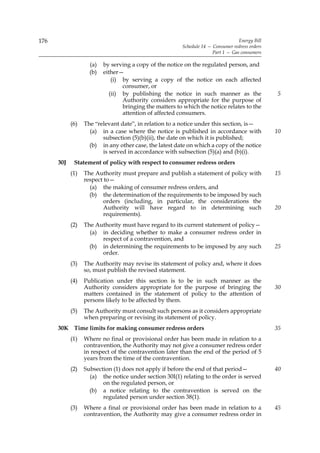
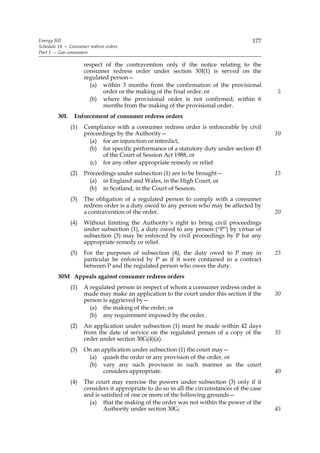
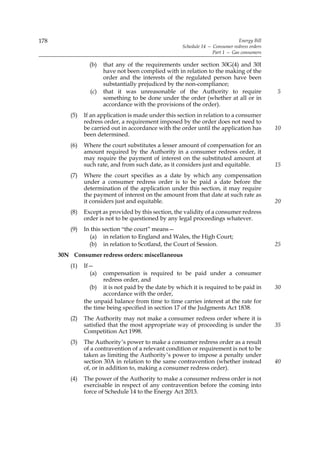
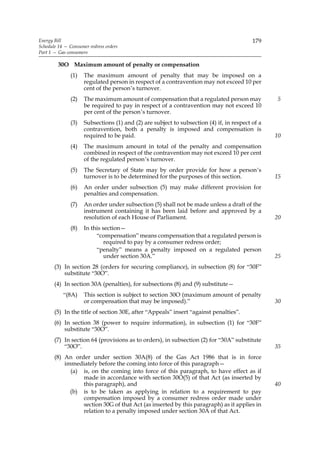
Energy Bill


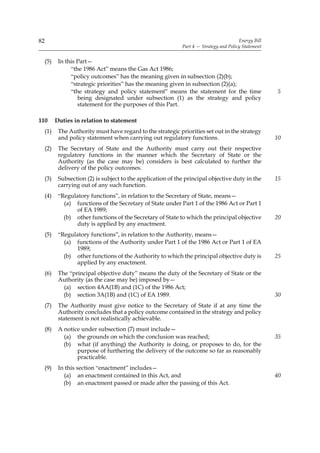
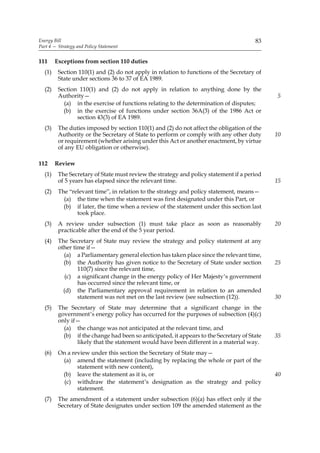
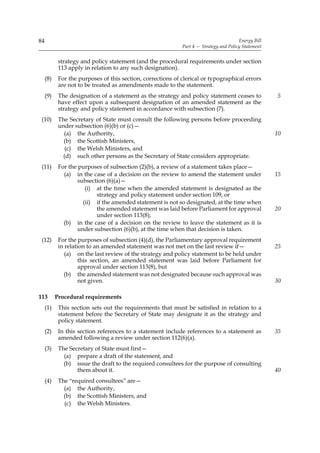
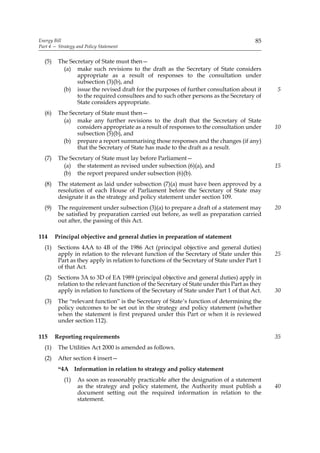
                            EXPLANATORY NOTES

Explanatory notes to the Bill, prepared by the Department of Energy and Climate
Change, are published separately as Bill 100—EN.


               EUROPEAN CONVENTION ON HUMAN RIGHTS

Secretary Edward Davey has made the following statement under section 19(1)(a) of
the Human Rights Act 1998:

In my view the provisions of the Energy Bill are compatible with the Convention
rights.


Bill 100                                                                    55/2
Energy Bill


                                     CONTENTS


                                          PART 1

                              ELECTRICITY MARKET REFORM

                                        CHAPTER 1

                                GENERAL CONSIDERATIONS

     1     General considerations relating to this Part

                                        CHAPTER 2

                               CONTRACTS FOR DIFFERENCE

     2     Regulations to encourage low carbon electricity generation
     3     Designation of a CFD counterparty
     4     Duties of a CFD counterparty
     5     Supplier obligation
     6     Direction to offer to contract
     7     Payments to electricity suppliers
     8     Application of sums held by a CFD counterparty
     9     Information and advice
    10     Functions of the Authority
    11     Regulations: further provision
    12     Enforcement
    13     Order for maximum cost and targets
    14     Consultation
    15     Shadow directors, etc.
    16     Licence modifications

                                        CHAPTER 3

                                    CAPACITY MARKET

    17     Power to make electricity capacity regulations
    18     Capacity agreements
    19     Capacity auctions
    20     Settlement body


Bill 100                                                                55/2
ii                                                                             Energy Bill


     21   Functions of the Authority or the national system operator
     22   Other requirements
     23   Electricity capacity regulations: information and advice
     24   Enforcement and dispute resolution
     25   Licence modifications for the purpose of the capacity market
     26   Amendment of enactments
     27   Principal objective and general duties
     28   Regulations under Chapter 3

                                       CHAPTER 4

              CONFLICTS OF INTEREST AND CONTINGENCY ARRANGEMENTS

     29   Modifications of transmission and other licences: business separation
     30   Power to transfer EMR functions
     31   Orders under section 30: fees and other supplementary provision
     32   Energy administration orders

                                       CHAPTER 5

                                 INVESTMENT CONTRACTS

     33   Investment contracts

                                       CHAPTER 6

                                 ACCESS TO MARKETS ETC

     34   Power to modify licence conditions etc: market participation and liquidity
     35   Power to modify licence conditions etc to facilitate investment in electricity
          generation
     36   Licence modifications under sections 34 and 35: further provisions

                                       CHAPTER 7

             THE RENEWABLES OBLIGATION: TRANSITIONAL ARRANGEMENTS

     37   Transition to certificate purchase scheme

                                       CHAPTER 8

                          EMISSIONS PERFORMANCE STANDARD

     38   Duty not to exceed annual carbon dioxide emissions limit
     39   Suspension etc of emissions limit in exceptional circumstances
     40   Monitoring and enforcement
     41   Interpretation of Chapter 8
     42   Regulations under Chapter 8

                                       CHAPTER 9

                                    MISCELLANEOUS

     43   Exemption from liability in damages
Energy Bill                                                                             iii


     44       Licence modifications: general
     45       Consequential amendments
     46       Review of Part 1

                                               PART 2

                                      NUCLEAR REGULATION

                                            CHAPTER 1

                                      THE ONR’S PURPOSES

     47       The ONR’s purposes
     48       Nuclear safety purposes
     49       Nuclear site health and safety purposes
     50       Nuclear security purposes
     51       Notice by Secretary of State to ONR specifying sensitive nuclear information
     52       Nuclear safeguards purposes
     53       Transport purposes

                                            CHAPTER 2

                                     NUCLEAR REGULATIONS

     54       Nuclear regulations
     55       Nuclear regulations: offences
     56       Civil liability for breach of nuclear regulations

                                            CHAPTER 3

                               OFFICE FOR NUCLEAR REGULATION

     57       The Office for Nuclear Regulation

                                            CHAPTER 4

                                     FUNCTIONS OF THE ONR

                                    Functions of ONR: general
     58       Principal function
     59       Codes of practice
     60       Proposals about orders and regulations
     61       Enforcement of relevant statutory provisions
     62       Inspectors
     63       Investigations
     64       Inquiries
     65       Inquiries: payments and charges

                                          Other functions
     66       Provision of information
     67       Research, training etc
     68       Provision of information or advice to relevant authorities
iv                                                                             Energy Bill


     69   Arrangements with government departments etc
     70   Provision of services or facilities

                               Exercise of functions: general
     71   Directions from Secretary of State
     72   Compliance with nuclear safeguards obligations
     73   Consent of Secretary of State for certain communications
     74   Power to arrange for exercise of functions by others
     75   Co-operation between ONR and Health and Safety Executive

                                      Information etc
     76   Power to obtain information
     77   Powers of HMRC in relation to information
     78   HMRC power to seize articles etc to facilitate ONR and inspectors
     79   Disclosure of information

                                           Fees
     80   Fees

                                       CHAPTER 5

                                    SUPPLEMENTARY

                     General duties of employers, employees and others
     81   General duty of employees at work in relation to requirements imposed on
          others
     82   Duty not to interfere with or misuse certain things provided under statutory
          requirements
     83   Duty not to charge employees for certain things

                                         Offences
     84   Offences relating to false information and deception
     85   Provision relating to offences under certain relevant statutory provisions

                                      Supplementary
     86   Reporting requirements of Secretary of State
     87   Notices etc
     88   Electronic delivery of notices etc
     89   Crown application: Part 2
     90   Interpretation of Part 2
     91   Subordinate legislation under Part 2
     92   Transitional provision etc
     93   Transfer of staff etc
     94   Minor and consequential amendments
     95   Application of Part 2
     96   Review of Part 2
Energy Bill                                                                        v


                                             PART 3

                         GOVERNMENT PIPE-LINE AND STORAGE SYSTEM

    97        Meaning of “government pipe-line and storage system”
    98        Rights in relation to the government pipe-line and storage system
    99        Right of entry
   100        Warrants for the purposes of section 99
   101        Registration of rights
   102        Compensation
   103        Right to transfer the government pipe-line and storage system
   104        Application of the Pipe-lines Act 1962
   105        Rights apart from Part 3
   106        Repeals
   107        Power to dissolve the Oil and Pipelines Agency by order
   108        Crown application: Part 3

                                             PART 4

                                 STRATEGY AND POLICY STATEMENT

   109        Designation of statement
   110        Duties in relation to statement
   111        Exceptions from section 110 duties
   112        Review
   113        Procedural requirements
   114        Principal objective and general duties in preparation of statement
   115        Reporting requirements
   116        Consequential provision

                                             PART 5

                                         MISCELLANEOUS

                                      Consumer redress orders
   117        Consumer redress orders

                                       Offshore transmission
   118        Offshore transmission systems

                                   Nuclear decommissioning costs
   119        Fees in respect of decommissioning and clean-up of nuclear sites

                                              Review
   120        Review of Part 5
vi                                                                               Energy Bill


                                            PART 6

                                             FINAL

     121   Interpretation of Act
     122   Transfer schemes
     123   Financial provisions
     124   Extent
     125   Commencement
     126   Short title


            Schedule 1   —   CFD counterparties: transfer schemes
            Schedule 2   —   Orders under section 30: transfer schemes
            Schedule 3   —   Investment contracts
                Part 1   —   Introductory
                Part 2   —   Regulations: general
                Part 3   —   Further provision about an investment contract counterparty
                             and a CFD counterparty
                Part 4   —   Transfers
                Part 5   —   Supplementary
            Schedule 4   —   Application and modification of emissions limit duty
            Schedule 5   —   Emissions limit duty: monitoring and enforcement
            Schedule 6   —   Nuclear regulations
                Part 1   —   Introductory
                Part 2   —   Examples of provision that may be made by nuclear
                             regulations
            Schedule 7   —   The Office for Nuclear Regulation
            Schedule 8   —   Inspectors
                Part 1   —   Appointment and powers of inspectors
                Part 2   —   Powers exercisable by inspectors authorised by instrument of
                             appointment: improvement notices and prohibition notices
                Part 3 —     Other powers exercisable by inspector if authorised by
                             instrument of appointment
                Part 4   —   Supplementary
            Schedule 9   —   Disclosure of information
                Part 1   —   Prohibition on disclosure of protected information
                Part 2   —   Offences relating to disclosure and use of protected
                             information
                Part 3 —     Protected information: permitted disclosures and restrictions
                             on use
                Part 4   —   General
           Schedule 10   —   Provisions relating to offences
           Schedule 11   —   Transfers to the Office for Nuclear Regulation
                Part 1   —   Introductory
                Part 2   —   Staff transfer schemes
                Part 3   —   Property transfer schemes
                Part 4   —   Procedure for making or modifying schemes under this
                             Schedule
           Schedule 12 —     Minor and consequential amendments relating to Part 2
                Part 1 —     Amendments of the Health and Safety at Work etc. Act 1974
                Part 2 —     Nuclear safety
Energy Bill                                                      vii


               Part 3   —   Nuclear security
               Part 4   —   Nuclear safeguards
               Part 5   —   Other enactments
          Schedule 13   —   Transfer schemes under section 107
          Schedule 14   —   Consumer redress orders
               Part 1   —   Gas consumers
               Part 2   —   Electricity consumers
Energy Bill                                                                             1
Part 1 — Electricity Market Reform
Chapter 1 — General considerations


                                                A


                                        BILL
                                                TO


Make provision for or in connection with reforming the electricity market for
purposes of encouraging low carbon electricity generation or ensuring
security of supply; for the establishment and functions of the Office for
Nuclear Regulation; about the government pipe-line and storage system and
rights exercisable in relation to it; about the designation of a strategy and
policy statement; for the making of orders requiring regulated persons to
provide redress to consumers of gas or electricity; about offshore transmission
of electricity during a commissioning period; for imposing further fees in
respect of nuclear decommissioning costs; and for connected purposes.


B                 by the Queen’s most Excellent Majesty, by and with the advice and
          E IT ENACTED
     consent of the Lords Spiritual and Temporal, and Commons, in this present
Parliament assembled, and by the authority of the same, as follows:—


                                              PART 1

                                     ELECTRICITY MARKET REFORM

                                            CHAPTER 1

                                      GENERAL CONSIDERATIONS

1          General considerations relating to this Part                                      5
    (1)     In exercising the function of making—
               (a) regulations under section 2;
              (b) an order under section 13;
               (c) a modification under section 16;
              (d) regulations under section 17;                                              10
               (e) a modification under section 25;
                (f) a modification under section 29;
              (g) an order under section 30;
            the Secretary of State must have regard to the matters mentioned in subsection
            (2).                                                                             15

Bill 100                                                                             55/2
2                                                                                    Energy Bill
                                                              Part 1 — Electricity Market Reform
                                                              Chapter 1 — General considerations


    (2)    The matters are—
             (a) the duties of the Secretary of State under sections 1 and 4(1)(b) of the
                  Climate Change Act 2008 (carbon targets and budgets);
             (b) ensuring the security of supply to consumers of electricity;
              (c) the likely cost to consumers of electricity;                                     5
             (d) the target set out in Article 3(1) of, and Annex 1 to, the renewables
                  directive (use of energy from renewable sources).
    (3)    In subsection (2)(d) “the renewables directive” means Directive 2009/28/EC of
           the European Parliament and of the Council of 23 April 2009 on the promotion
           of the use of energy from renewable sources.                                            10

                                         CHAPTER 2

                                CONTRACTS FOR DIFFERENCE

2         Regulations to encourage low carbon electricity generation
    (1)    The Secretary of State may for the purpose of encouraging low carbon
           electricity generation make regulations about contracts for difference between          15
           a CFD counterparty and an eligible generator.
    (2)    A contract for difference is a contract—
             (a) certain payments under which are to be funded by electricity suppliers
                  (see further section 5), and
             (b) which a CFD counterparty is required to enter into by virtue of section           20
                  6;
           and such a contract is referred to in this Chapter as a “CFD”.
    (3)    For the purposes of this Chapter—
                “CFD counterparty” is to be construed in accordance with section 3(2);
                “eligible generator” is to be construed in accordance with section 6(3);           25
                “low carbon electricity generation” means electricity generation which in
                   the opinion of the Secretary of State will contribute to a reduction in
                   emissions of greenhouse gases;
                “regulations” means regulations under this section.
    (4)    In subsection (3) “greenhouse gas” has the meaning given by section 92(1) of            30
           the Climate Change Act 2008.
    (5)    The provision which may be made by regulations includes, but is not limited
           to, the provision described in this Chapter.
    (6)    Regulations may—
             (a) include incidental, supplementary and consequential provision;                    35
             (b) make transitory or transitional provision or savings;
              (c) make different provision for different cases or circumstances or for
                  different purposes;
             (d) make provision subject to exceptions.
    (7)    Regulations are to be made by statutory instrument.                                     40
    (8)    An instrument containing regulations which make provision falling within
           section 5, 6 or 7 (whether or not also making any other provision) may not be
Energy Bill                                                                                  3
Part 1 — Electricity Market Reform
Chapter 2 — Contracts for Difference


            made unless a draft of the instrument has been laid before and approved by a
            resolution of each House of Parliament.
     (9)    Any other instrument containing regulations is subject to annulment in
            pursuance of a resolution of either House of Parliament.

3          Designation of a CFD counterparty                                                      5
     (1)    The Secretary of State may by order made by statutory instrument designate
            an eligible person to be a counterparty for contracts for difference.
     (2)    A person designated under this section is referred to in this Chapter as a “CFD
            counterparty”.
     (3)    A person is eligible if the person is—                                                10
              (a) a company formed and registered under the Companies Act 2006, or
              (b) a public authority, including any person any of whose functions are of
                   a public nature.
     (4)    A designation may be made only with the consent of the person designated.
     (5)    More than one designation may have effect under this section.                         15
     (6)    A designation ceases to have effect if—
              (a) the Secretary of State by order made by statutory instrument revokes
                   the designation, or
              (b) the person withdraws consent to the designation by giving not less than
                   28 days’ notice in writing to the Secretary of State.                          20
     (7)    At any time after the first designation has effect, the Secretary of State must, so
            far as reasonably practicable, exercise the power to designate so as to ensure
            that at least one designation has effect under this section.
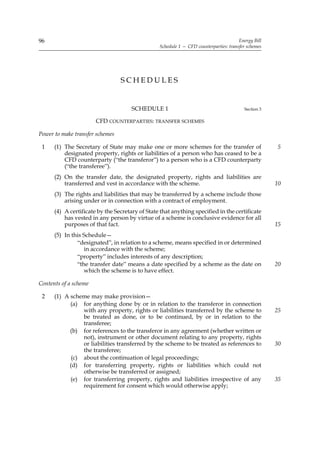
     (8)    Schedule 1 (which makes provision about schemes to transfer property, rights
            and liabilities from a person who has ceased to be a CFD counterparty to a            25
            person who is a CFD counterparty) has effect.
     (9)    As soon as reasonably practicable after a designation ceases to have effect the
            Secretary of State must make a transfer scheme under Schedule 1 to ensure the
            transfer of all rights and obligations under any CFD to which the person who
            has ceased to be a CFD counterparty was a party.                                      30
    (10)    Regulations may include provision about the period of time for which, and the
            circumstances in which, a person who has ceased to be a CFD counterparty is
            to continue to be treated as a CFD counterparty for the purposes of the
            regulations.

4          Duties of a CFD counterparty                                                           35
     (1)    A CFD counterparty must act in accordance with—
              (a) any direction given by the Secretary of State or the national system
                  operator by virtue of this Chapter;
              (b) any provision included in regulations.
     (2)    In this Chapter “national system operator” means the person operating the             40
            national transmission system for Great Britain (and for this purpose
4                                                                                         Energy Bill
                                                                   Part 1 — Electricity Market Reform
                                                                  Chapter 2 — Contracts for Difference


           “transmission system” has the same meaning as in EA 1989 - see section 4(4) of
           that Act).

5         Supplier obligation
    (1)    Regulations must make provision for electricity suppliers to pay a CFD counterparty
           for the purpose of enabling the counterparty to make payments under CFDs.                     5
    (2)    Regulations may make provision for electricity suppliers to pay a CFD counterparty
           for the purpose of enabling the counterparty—
              (a) to meet such other descriptions of its costs as the Secretary of State considers
                    appropriate;
              (b) to hold sums in reserve;                                                               10
              (c) to cover losses in the case of insolvency or default of an electricity supplier.
    (3)    Regulations may make provision to require electricity suppliers to provide financial
           collateral to a CFD counterparty (whether in cash, securities or any other form).
    (4)    Provision made by virtue of this section may include provision for—
             (a) a CFD counterparty to determine the form and terms of any financial                     15
                  collateral;
             (b) a CFD counterparty to calculate or determine, in accordance with such
                  criteria as may be provided for by or under the regulations, amounts
                  which are owed by an electricity supplier or are to be provided as
                  financial collateral by an electricity supplier;                                       20
              (c) the issuing of notices by a CFD counterparty to require the payment or
                  provision of such amounts;
             (d) the enforcement of obligations arising under such notices.
    (5)    Provision made by virtue of subsection (4)(b) may provide for anything which
           is to be calculated or determined under the regulations to be calculated or                   25
           determined by such persons, in accordance with such procedure and by
           reference to such matters and to the opinion of such persons, as may be
           specified in the regulations.
    (6)    Provision made by virtue of subsection (4)(d) may include provision—
             (a) about costs;                                                                            30
             (b) about interest on late payments under notices;
              (c) about references to arbitration;
             (d) about appeals.
    (7)    In this section “electricity supplier”, subject to any provision made by
           regulations, means a person who is a holder of a licence to supply electricity                35
           under—
             (a) section 6(1)(d) of EA 1989, or
             (b) Article 10(1)(c) of the Electricity (Northern Ireland) Order 1992 (S.I.
                  1992/231 (N.I.1)).

6         Direction to offer to contract                                                                 40
    (1)    The Secretary of State or the national system operator may, in accordance with
           provision made by regulations, direct a CFD counterparty to offer to contract
           with a person specified in the direction, on terms specified in the direction.
Energy Bill                                                                            5
Part 1 — Electricity Market Reform
Chapter 2 — Contracts for Difference


    (2)    A person may be specified in a direction under subsection (1) only if that
           person is an eligible generator.
    (3)    Regulations must make provision defining who is an “eligible generator” for
           the purposes of a direction under this section.
    (4)    Regulations may make further provision about a direction under this section      5
           and in particular about—
             (a) the circumstances in which a direction may or must be given;
             (b) the terms which may or must be specified in a direction.
    (5)    Provision falling within subsection (4) may include provision for—
             (a) the determination of a matter on a competitive basis,                      10
             (b) calculations or determinations to be made under the regulations,
                  including by such persons, in accordance with such procedure and by
                  reference to such matters and to the opinion of such persons, as may be
                  specified in the regulations.
    (6)    Regulations may make provision about appeals against a decision of the           15
           Secretary of State or the national system operator not to issue a direction by
           virtue of this section.
    (7)    A direction may not be given under this section in relation to an electricity
           generating station in Northern Ireland unless the Department of Enterprise,
           Trade and Investment consent to the direction.                                   20
    (8)    But regulations may, with the consent of that Department, include provision
           for circumstances in which consent under subsection (7) is not required.
    (9)    In subsection (7) “Northern Ireland” includes so much of the internal waters
           and territorial sea of the United Kingdom as are adjacent to Northern Ireland.

7         Payments to electricity suppliers                                                 25
    (1)    Regulations may make provision about the amounts which must be paid by a
           CFD counterparty to electricity suppliers.
    (2)    In this section “electricity supplier”, subject to any provision made by
           regulations, means a person who is a holder of a licence to supply electricity
           under—                                                                           30
             (a) section 6(1)(d) of EA 1989; or
             (b) Article 10(1)(c) of the Electricity (Northern Ireland) Order 1992 (S.I.
                  1992/231 (N.I.1)).

8         Application of sums held by a CFD counterparty
    (1)    Regulations may make provision for apportioning sums—                            35
             (a) received by a CFD counterparty from electricity suppliers under
                   provision made by virtue of section 5;
             (b) received by a CFD counterparty under a CFD,
           in circumstances where the CFD counterparty is unable fully to meet
           obligations under a CFD.                                                         40
    (2)    Provision made by virtue of subsection (1) may include provision about the
           meaning of “unable fully to meet obligations under a CFD”.
6                                                                                       Energy Bill
                                                                 Part 1 — Electricity Market Reform
                                                                Chapter 2 — Contracts for Difference


    (3)    Regulations may make provision about the application of sums held by a CFD
           counterparty.
    (4)    Provision made by virtue of subsection (3) may include provision that sums are to be
           paid, or not to be paid, into the Consolidated Fund.

9         Information and advice                                                                       5
    (1)    Regulations may make provision about the provision and publication of
           information.
    (2)    Provision made by virtue of subsection (1) may include provision—
             (a) for the Secretary of State to require the national system operator to
                  provide advice to the Secretary of State;                                            10
             (b) for the Secretary of State to require a CFD counterparty, the Authority,
                  the Northern Ireland Authority for Utility Regulation or the Northern
                  Ireland system operator to provide advice to the Secretary of State or
                  any other person specified in the regulations;
              (c) for the Secretary of State to require a CFD counterparty, the national               15
                  system operator, the Authority, the Northern Ireland Authority for
                  Utility Regulation, the Northern Ireland system operator or a generator
                  who is party to a CFD to provide information to the Secretary of State
                  or any other person specified in the regulations;
             (d) for the national system operator to require information to be provided                20
                  to it by a CFD counterparty, a generator who is party to a CFD or the
                  Northern Ireland system operator;
             (e) for a CFD counterparty to require information to be provided to it by
                  electricity suppliers or the Northern Ireland system operator;
              (f) for the classification and protection of confidential or sensitive                   25
                  information;
             (g) for the enforcement of any requirement imposed by virtue of
                  paragraphs (a) to (f).
    (3)    In subsection (2)—
             (a) “Northern Ireland system operator” means the holder of a licence                      30
                  under Article 10(1)(b) of the Electricity (Northern Ireland) Order 1992
                  (S.I. 1992/231 (N.I.1));
             (b) “electricity supplier”, subject to any provision made by regulations,
                  means a person who is a holder of a licence to supply electricity
                  under—                                                                               35
                     (i) section 6(1)(d) of EA 1989; or
                    (ii) Article 10(1)(c) of the Electricity (Northern Ireland) Order 1992
                           (S.I. 1992/231 (N.I.1)).
    (4)    The prohibition on disclosure of information by—
             (a) section 105(1) of the Utilities Act 2000;                                             40
             (b) Article 63(1) of the Energy (Northern Ireland) Order 2003 (S.I. 2003/419
                  (N.I.6));
           does not apply to a disclosure required by virtue of this section.
Energy Bill                                                                                 7
Part 1 — Electricity Market Reform
Chapter 2 — Contracts for Difference


10         Functions of the Authority
            Regulations may make provision conferring functions on the Authority for the
            purpose of offering advice to, or making determinations on behalf of, a party
            to a CFD.

11         Regulations: further provision                                                        5
     (1)    Regulations may make provision—
              (a) to require a CFD counterparty to enter into arrangements or to offer to
                   contract for purposes connected to a CFD;
              (b) specifying things that a CFD counterparty may or must do, or things
                   that a CFD counterparty may not do;                                           10
              (c) conferring on the Secretary of State further powers to direct a CFD
                   counterparty to do, or not to do, things specified in the regulations or
                   the direction.
     (2)    Provision made by virtue of subsection (1)(b) or (c) includes provision
            requiring consultation with, or the consent of, the Secretary of State in relation   15
            to—
              (a) the enforcement of obligations under a CFD;
              (b) a variation or termination of a CFD;
               (c) the settlement or compromise of a claim under a CFD;
              (d) the conduct of legal proceedings relating to a CFD;                            20
              (e) the exercise of rights under a CFD.

12         Enforcement
     (1)    Regulations may make provision for requirements under the regulations to be
            enforceable—
              (a) by the Authority as if they were relevant requirements on a regulated          25
                   person for the purposes of section 25 of EA 1989;
              (b) by the Northern Ireland Authority for Utility Regulations as if they
                   were relevant requirements on a regulated person for the purposes of
                   Article 41A of the Energy (Northern Ireland) Order 2003 (S.I 2003/419
                   (N.I. 6)).                                                                    30
     (2)    Provision made by virtue of subsection (1)(a) may include provision about the
            enforcement of requirements imposed on the national system operator.
     (3)    Provision made by virtue of subsection (1)(b) may be made in relation only to
            the enforcement of requirements imposed on the holder of a licence under
            Article 10(1)(c) of the Electricity (Northern Ireland) Order 1992 (S.I. 1992/231     35
            (N.I.1)).

13         Order for maximum cost and targets
     (1)    The Secretary of State may by order provide for—
              (a) the power to give a direction under section 6 not to be exercisable if a
                   maximum cost incurred or to be incurred by a CFD counterparty has             40
                   been reached (such cost to be calculated in accordance with provision
                   made by or under the order);
              (b) a power for the Secretary of State to direct the national system operator
                   not to give a direction by virtue of this Chapter if the Secretary of State
8                                                                                      Energy Bill
                                                                Part 1 — Electricity Market Reform
                                                               Chapter 2 — Contracts for Difference


                    believes that by virtue of the direction being given a cost greater than
                    the maximum cost provided for by the order would be incurred;
              (c)   any other targets to be met or taken into account by the national system
                    operator in the giving of directions under this Chapter.
     (2)    If more than one designation has effect under section 3, the reference in                 5
            subsection (1)(a) is a reference to all CFD counterparties.
     (3)    Provision made by virtue of subsection (1)(a) may provide for anything which
            is to be calculated under the order to be calculated by such persons, in
            accordance with such procedure and by reference to such matters and to the
            opinion of such persons, as may be specified in the order.                                10
     (4)    Provision made by virtue of subsection (1)(c) may include targets relating to—
              (a) the means by which electricity is to be generated;
              (b) the generating capacity of electricity generating stations;
              (c) the geographical location of electricity generating stations.
     (5)    An order under this section is to be made by statutory instrument and a                   15
            statutory instrument containing an order may not be made unless a draft of the
            instrument has been laid before and approved by a resolution of each House of
            Parliament.

14         Consultation
     (1)    Before making regulations under this Chapter or an order under section 13 the             20
            Secretary of State must consult—
              (a) the Scottish Ministers,
              (b) the Welsh Ministers,
               (c) the Department of Enterprise, Trade and Investment,
              (d) any person who is a holder of a licence to supply electricity under                 25
                   section 6(1)(d) of EA 1989,
              (e) any person who is a holder of a licence under Article 10(1)(b) or (c) of
                   the Electricity (Northern Ireland) Order 1992 (S.I. 1992/231 (N.I.1))
                   (transmission or supply licence),
               (f) the Authority,                                                                     30
              (g) the national system operator, and
              (h) such other persons as the Secretary of State considers it appropriate to
                   consult.
     (2)    The requirement to consult may be satisfied by consultation before, as well as
            consultation after, the passing of this Act.                                              35

15         Shadow directors, etc.
            Neither the Secretary of State nor the national system operator is, by virtue of
            the exercise of a power conferred by or by virtue of this Chapter, to be regarded
            as—
              (a) a person occupying in relation to a CFD counterparty the position of                40
                    director;
              (b) being a person in accordance with whose directions or instructions the
                    directors of a CFD counterparty are accustomed to act;
               (c) exercising any function of management in a CFD counterparty;
              (d) a principal of a CFD counterparty.                                                  45
Energy Bill                                                                                9
Part 1 — Electricity Market Reform
Chapter 2 — Contracts for Difference


16         Licence modifications
     (1)    The Secretary of State may modify—
              (a) a condition of a particular licence under section 6(1)(a), (b) or (c) of EA
                   1989 (generation, transmission and distribution licences);
              (b) the standard conditions incorporated in licences under that provision         5
                   by virtue of section 8A(1A) of that Act;
              (c) a document maintained in accordance with the conditions of licences
                   under that provision, or an agreement that gives effect to a document
                   so maintained.
     (2)    The Secretary of State may make a modification under subsection (1) only for        10
            the purpose of—
              (a) conferring functions on the national system operator in connection
                   with its functions by or by virtue of this Chapter;
              (b) allowing or requiring services to be provided to a CFD counterparty;
              (c) enforcing obligations under a CFD.                                            15
     (3)    Provision included in a licence, or in a document or agreement relating to
            licences, by virtue of the power under subsection (1) may in particular include
            provision of a kind that may be included in regulations.
     (4)    Before making a modification under this section, the Secretary of State must
            consult—                                                                            20
              (a) the Scottish Ministers,
              (b) the Welsh Ministers,
               (c) the holder of any licence being modified,
              (d) any person who is a holder of a licence to supply electricity under
                   section 6(1)(d) of EA 1989,                                                  25
              (e) any person who is a holder of a licence to supply electricity under
                   Article 10(1)(c) of the Electricity (Northern Ireland) Order 1992 (S.I.
                   1992/231 (N.I.1)),
               (f) the Department of Enterprise, Trade and Investment,
              (g) the Authority, and                                                            30
              (h) such other persons as the Secretary of State considers it appropriate to
                   consult.
     (5)    Subsection (4) may be satisfied by consultation before, as well as by
            consultation after, the passing of this Act.

                                          CHAPTER 3                                             35

                                       CAPACITY MARKET

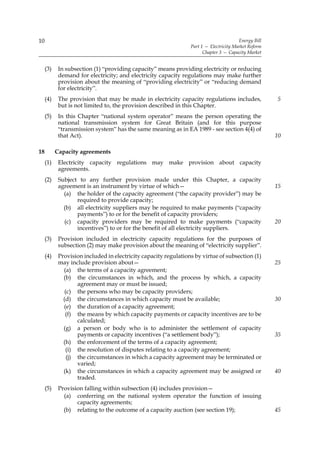
17         Power to make electricity capacity regulations
     (1)    The Secretary of State may by regulations make provision for the purpose of
            providing capacity to meet the demands of consumers for the supply of
            electricity in Great Britain.                                                       40
     (2)    Regulations under this section are referred to in this Chapter as “electricity
            capacity regulations”.
10                                                                                      Energy Bill
                                                                 Part 1 — Electricity Market Reform
                                                                       Chapter 3 — Capacity Market


     (3)    In subsection (1) “providing capacity” means providing electricity or reducing
            demand for electricity; and electricity capacity regulations may make further
            provision about the meaning of “providing electricity” or “reducing demand
            for electricity”.
     (4)    The provision that may be made in electricity capacity regulations includes,              5
            but is not limited to, the provision described in this Chapter.
     (5)    In this Chapter “national system operator” means the person operating the
            national transmission system for Great Britain (and for this purpose
            “transmission system” has the same meaning as in EA 1989 - see section 4(4) of
            that Act).                                                                                10

18         Capacity agreements
     (1)    Electricity capacity regulations may make provision about capacity
            agreements.
     (2)    Subject to any further provision made under this Chapter, a capacity
            agreement is an instrument by virtue of which—                                            15
              (a) the holder of the capacity agreement (“the capacity provider”) may be
                   required to provide capacity;
              (b) all electricity suppliers may be required to make payments (“capacity
                   payments”) to or for the benefit of capacity providers;
              (c) capacity providers may be required to make payments (“capacity                      20
                   incentives”) to or for the benefit of all electricity suppliers.
     (3)    Provision included in electricity capacity regulations for the purposes of
            subsection (2) may make provision about the meaning of “electricity supplier”.
     (4)    Provision included in electricity capacity regulations by virtue of subsection (1)
            may include provision about—                                                              25
              (a) the terms of a capacity agreement;
              (b) the circumstances in which, and the process by which, a capacity
                    agreement may or must be issued;
               (c) the persons who may be capacity providers;
              (d) the circumstances in which capacity must be available;                              30
              (e) the duration of a capacity agreement;
               (f) the means by which capacity payments or capacity incentives are to be
                    calculated;
              (g) a person or body who is to administer the settlement of capacity
                    payments or capacity incentives (“a settlement body”);                            35
              (h) the enforcement of the terms of a capacity agreement;
               (i) the resolution of disputes relating to a capacity agreement;
                (j) the circumstances in which a capacity agreement may be terminated or
                    varied;
              (k) the circumstances in which a capacity agreement may be assigned or                  40
                    traded.
     (5)    Provision falling within subsection (4) includes provision—
              (a) conferring on the national system operator the function of issuing
                   capacity agreements;
              (b) relating to the outcome of a capacity auction (see section 19);                     45
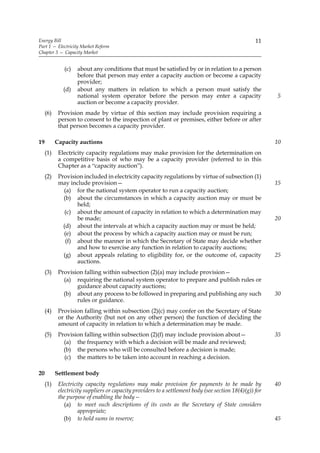
Energy Bill                                                                                         11
Part 1 — Electricity Market Reform
Chapter 3 — Capacity Market


              (c)   about any conditions that must be satisfied by or in relation to a person
                    before that person may enter a capacity auction or become a capacity
                    provider;
              (d)   about any matters in relation to which a person must satisfy the
                    national system operator before the person may enter a capacity                       5
                    auction or become a capacity provider.
     (6)    Provision made by virtue of this section may include provision requiring a
            person to consent to the inspection of plant or premises, either before or after
            that person becomes a capacity provider.

19         Capacity auctions                                                                              10
     (1)    Electricity capacity regulations may make provision for the determination on
            a competitive basis of who may be a capacity provider (referred to in this
            Chapter as a “capacity auction”).
     (2)    Provision included in electricity capacity regulations by virtue of subsection (1)
            may include provision—                                                                        15
              (a) for the national system operator to run a capacity auction;
              (b) about the circumstances in which a capacity auction may or must be
                   held;
               (c) about the amount of capacity in relation to which a determination may
                   be made;                                                                               20
              (d) about the intervals at which a capacity auction may or must be held;
              (e) about the process by which a capacity auction may or must be run;
               (f) about the manner in which the Secretary of State may decide whether
                   and how to exercise any function in relation to capacity auctions;
              (g) about appeals relating to eligibility for, or the outcome of, capacity                  25
                   auctions.
     (3)    Provision falling within subsection (2)(a) may include provision—
              (a) requiring the national system operator to prepare and publish rules or
                   guidance about capacity auctions;
              (b) about any process to be followed in preparing and publishing any such                   30
                   rules or guidance.
     (4)    Provision falling within subsection (2)(c) may confer on the Secretary of State
            or the Authority (but not on any other person) the function of deciding the
            amount of capacity in relation to which a determination may be made.
     (5)    Provision falling within subsection (2)(f) may include provision about—                       35
              (a) the frequency with which a decision will be made and reviewed;
              (b) the persons who will be consulted before a decision is made;
              (c) the matters to be taken into account in reaching a decision.

20         Settlement body
     (1)    Electricity capacity regulations may make provision for payments to be made by                40
            electricity suppliers or capacity providers to a settlement body (see section 18(4)(g)) for
            the purpose of enabling the body—
               (a) to meet such descriptions of its costs as the Secretary of State considers
                     appropriate;
               (b) to hold sums in reserve;                                                               45
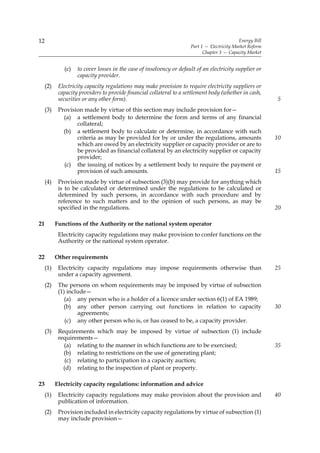
12                                                                                           Energy Bill
                                                                      Part 1 — Electricity Market Reform
                                                                            Chapter 3 — Capacity Market


              (c)   to cover losses in the case of insolvency or default of an electricity supplier or
                    capacity provider.
     (2)    Electricity capacity regulations may make provision to require electricity suppliers or
            capacity providers to provide financial collateral to a settlement body (whether in cash,
            securities or any other form).                                                                 5
     (3)    Provision made by virtue of this section may include provision for—
              (a) a settlement body to determine the form and terms of any financial
                   collateral;
              (b) a settlement body to calculate or determine, in accordance with such
                   criteria as may be provided for by or under the regulations, amounts                    10
                   which are owed by an electricity supplier or capacity provider or are to
                   be provided as financial collateral by an electricity supplier or capacity
                   provider;
              (c) the issuing of notices by a settlement body to require the payment or
                   provision of such amounts.                                                              15
     (4)    Provision made by virtue of subsection (3)(b) may provide for anything which
            is to be calculated or determined under the regulations to be calculated or
            determined by such persons, in accordance with such procedure and by
            reference to such matters and to the opinion of such persons, as may be
            specified in the regulations.                                                                  20

21         Functions of the Authority or the national system operator
            Electricity capacity regulations may make provision to confer functions on the
            Authority or the national system operator.

22         Other requirements
     (1)    Electricity capacity regulations may impose requirements otherwise than                        25
            under a capacity agreement.
     (2)    The persons on whom requirements may be imposed by virtue of subsection
            (1) include—
               (a) any person who is a holder of a licence under section 6(1) of EA 1989;
              (b) any other person carrying out functions in relation to capacity                          30
                    agreements;
               (c) any other person who is, or has ceased to be, a capacity provider.
     (3)    Requirements which may be imposed by virtue of subsection (1) include
            requirements—
              (a) relating to the manner in which functions are to be exercised;                           35
              (b) relating to restrictions on the use of generating plant;
               (c) relating to participation in a capacity auction;
              (d) relating to the inspection of plant or property.

23         Electricity capacity regulations: information and advice
     (1)    Electricity capacity regulations may make provision about the provision and                    40
            publication of information.
     (2)    Provision included in electricity capacity regulations by virtue of subsection (1)
            may include provision—
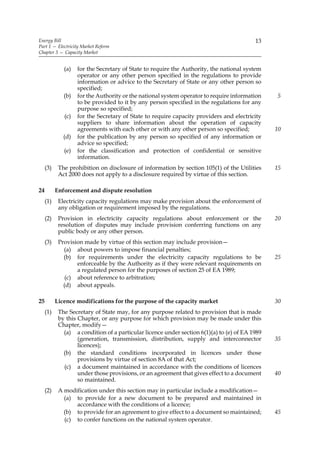
Energy Bill                                                                               13
Part 1 — Electricity Market Reform
Chapter 3 — Capacity Market


              (a)   for the Secretary of State to require the Authority, the national system
                    operator or any other person specified in the regulations to provide
                    information or advice to the Secretary of State or any other person so
                    specified;
              (b)   for the Authority or the national system operator to require information    5
                    to be provided to it by any person specified in the regulations for any
                    purpose so specified;
              (c)   for the Secretary of State to require capacity providers and electricity
                    suppliers to share information about the operation of capacity
                    agreements with each other or with any other person so specified;           10
              (d)   for the publication by any person so specified of any information or
                    advice so specified;
              (e)   for the classification and protection of confidential or sensitive
                    information.
     (3)    The prohibition on disclosure of information by section 105(1) of the Utilities     15
            Act 2000 does not apply to a disclosure required by virtue of this section.

24         Enforcement and dispute resolution
     (1)    Electricity capacity regulations may make provision about the enforcement of
            any obligation or requirement imposed by the regulations.
     (2)    Provision in electricity capacity regulations about enforcement or the              20
            resolution of disputes may include provision conferring functions on any
            public body or any other person.
     (3)    Provision made by virtue of this section may include provision—
              (a) about powers to impose financial penalties;
              (b) for requirements under the electricity capacity regulations to be             25
                   enforceable by the Authority as if they were relevant requirements on
                   a regulated person for the purposes of section 25 of EA 1989;
               (c) about reference to arbitration;
              (d) about appeals.

25         Licence modifications for the purpose of the capacity market                         30
     (1)    The Secretary of State may, for any purpose related to provision that is made
            by this Chapter, or any purpose for which provision may be made under this
            Chapter, modify—
              (a) a condition of a particular licence under section 6(1)(a) to (e) of EA 1989
                    (generation, transmission, distribution, supply and interconnector          35
                    licences);
              (b) the standard conditions incorporated in licences under those
                    provisions by virtue of section 8A of that Act;
              (c) a document maintained in accordance with the conditions of licences
                    under those provisions, or an agreement that gives effect to a document     40
                    so maintained.
     (2)    A modification under this section may in particular include a modification—
              (a) to provide for a new document to be prepared and maintained in
                  accordance with the conditions of a licence;
              (b) to provide for an agreement to give effect to a document so maintained;       45
              (c) to confer functions on the national system operator.
14                                                                                     Energy Bill
                                                                Part 1 — Electricity Market Reform
                                                                      Chapter 3 — Capacity Market


     (3)    Provision included in a licence, or in a document or agreement relating to
            licences, by virtue of the modification power may in particular include
            provision of any kind that may be included in electricity capacity regulations.
     (4)    Before making a modification under this section, the Secretary of State must
            consult—                                                                                 5
              (a) the holder of any licence being modified,
              (b) the Authority, and
              (c) such other persons as the Secretary of State considers it appropriate to
                   consult.
     (5)    Subsection (4) may be satisfied by consultation before, as well as by                    10
            consultation after, the passing of this Act.

26         Amendment of enactments
            The Secretary of State may by regulations, for the purpose of or in connection
            with any provision made by or by virtue of this Chapter—
              (a) amend or repeal section 47ZA of EA 1989 (annual report by Authority                15
                   on security of electricity supply);
              (b) amend section 172 of the Energy Act 2004 (annual report on security of
                   energy supplies);
               (c) amend section 25 of and Schedule 6A to EA 1989 (enforcement of
                   obligations of regulated persons);                                                20
              (d) make such provision amending, repealing or revoking any other
                   enactment as the Secretary of State considers appropriate in
                   consequence of provision made by or by virtue of this Chapter.

27         Principal objective and general duties
            Sections 3A to 3D of EA 1989 (principal objective and general duties) apply in           25
            relation to functions of the Authority conferred by or by virtue of this Chapter
            as they apply in relation to functions under Part 1 of that Act.

28         Regulations under Chapter 3
     (1)    Regulations under this Chapter may—
              (a) include incidental, supplementary and consequential provision;                     30
              (b) make transitory or transitional provision or savings;
               (c) make different provision for different cases or circumstances or for
                   different purposes;
              (d) make provision subject to exceptions.
     (2)    Before making any regulations under this Chapter, the Secretary of State must            35
            consult—
              (a) the Authority,
              (b) any person who is a holder of a licence to supply electricity under
                   section 6(1)(d) of EA 1989,
              (c) such other persons as the Secretary of State considers it appropriate to           40
                   consult.
     (3)    Subsection (2) may be satisfied by consultation before, as well as consultation
            after, the passing of this Act.
Energy Bill                                                                                15
Part 1 — Electricity Market Reform
Chapter 3 — Capacity Market


     (4)    Regulations under this Chapter must be made by statutory instrument.
     (5)    An instrument containing (whether alone or with other provision)—
              (a) the first set of electricity capacity regulations;
              (b) regulations which make provision amending or repealing a provision
                   of an enactment contained in primary legislation,                             5
            may not be made unless a draft of the instrument has been laid before and
            approved by a resolution of each House of Parliament.
     (6)    A statutory instrument to which subsection (5) does not apply and containing
            regulations under this Chapter is subject to annulment in pursuance of a
            resolution of either House of Parliament.                                            10

                                           CHAPTER 4

                  CONFLICTS OF INTEREST AND CONTINGENCY ARRANGEMENTS

29         Modifications of transmission and other licences: business separation
     (1)    The Secretary of State may modify—
              (a) a condition of a particular licence under section 6(1)(a) to (e) of EA 1989    15
                   (generation, transmission, distribution, supply and interconnector
                   licences);
              (b) the standard conditions incorporated in licences under those
                   provisions by virtue of section 8A of that Act;
              (c) a document maintained in accordance with the conditions of licences            20
                   under section 6(1)(a) to (e) of that Act, or an agreement that gives effect
                   to a document so maintained.
     (2)    The Secretary of State may make a modification under subsection (1) only for
            the purpose of imposing measures for or in connection with securing an
            appropriate degree of business separation between the carrying on of—                25
              (a) system operation functions (or any particular such function), and
              (b) any other functions (including, in a case where a measure relates to a
                   particular system operation function, other system operation
                   functions).
     (3)    “System operation functions” are—                                                    30
              (a) functions authorised under a transmission licence of co-ordinating and
                   directing the flow of electricity onto and over a transmission system by
                   means of which the transmission of electricity takes place, and
              (b) EMR functions.
     (4)    A degree of business separation is “appropriate” for the purposes of subsection      35
            (2) if the Secretary of State determines it to be necessary or desirable as a
            consequence of the conferral of EMR functions.
     (5)    In making that determination, the Secretary of State must have regard to the
            extent to which a measure of the kind mentioned in subsection (2) may affect
            the efficient and effective carrying on of system operation functions and other      40
            functions authorised under a transmission licence.
     (6)    The measures referred to in subsection (2) include, in particular, measures for
            or in connection with securing any of the following—
16                                                                                             Energy Bill
                                                                       Part 1 — Electricity Market Reform
                                           Chapter 4 — Conflicts of interest and contingency arrangements


              (a)   the body corporate that carries on EMR functions does not carry on
                    other functions;
              (b)   limitations are in place in respect of the control or influence that may be
                    exercised over that body by another group undertaking (within the
                    meaning of the Companies Acts - see section 1161 of the Companies Act                    5
                    2006);
              (c)   separations are in place between—
                       (i) the locations where system operation functions, and other
                            functions, are carried on;
                      (ii) the information technology systems used for the purposes of                       10
                            the carrying on of system operation functions and other
                            functions;
              (d)   the accounting arrangements in relation to system operation functions
                    are separate from those in relation to other functions;
              (e)   persons who participate in the carrying on of system operation                           15
                    functions do not participate in the carrying on of other functions;
              (f)   persons with access to information obtained in the carrying on of
                    system operation functions do not have access to information obtained
                    in the carrying on of other functions.
     (7)    The power conferred by subsection (1) may be exercised so as to impose a                         20
            requirement on a person holding a transmission licence—
              (a) to prepare annual reports about how measures within subsection (2)
                   have been put in place for the year in question, and
              (b) to submit such reports to either or both of the Secretary of State and the
                   Authority.                                                                                25
     (8)    Before making a modification under subsection (1), the Secretary of State must
            consult—
              (a) the holder of any licence being modified,
              (b) the Authority, and
              (c) such other persons as the Secretary of State considers it appropriate to                   30
                   consult.
     (9)    Subsection (8) may be satisfied by consultation before, as well as by
            consultation after, the passing of this Act.
 (10)       In this section—
                 “EMR functions” means functions conferred by or by virtue of Chapter 2                      35
                     (contracts for difference) or Chapter 3 (capacity market);
                 “transmission”, “transmission licence” and “transmission system” have
                     the same meaning as in Part 1 of EA 1989.

30         Power to transfer EMR functions
     (1)    The Secretary of State may by order provide that EMR functions carried out by                    40
            the national system operator are instead to be carried out by an alternative
            delivery body.
     (2)    An order under subsection (1) may be made only if—
             (a) the national system operator has requested the making of the order,
             (b) an energy administration order is in force in relation to the national                      45
                  system operator,
              (c) the unsatisfactory performance condition is met (see subsection (3)),
Energy Bill                                                                             17
Part 1 — Electricity Market Reform
Chapter 4 — Conflicts of interest and contingency arrangements


            (d)    it appears to the Secretary of State necessary or desirable to make the
                   order as a result of a change, occurring after the coming into force of
                   this section, in the persons having control of the national system
                   operator (see subsection (4)), or
            (e)    it otherwise appears to the Secretary of State necessary or desirable to   5
                   make the order in connection with furthering the purposes of—
                       (i) encouraging low carbon electricity generation (within the
                           meaning of Chapter 2), or
                      (ii) providing capacity to meet the demands of consumers for the
                           supply of electricity in Great Britain.                            10
  (3)    The unsatisfactory performance condition is met if—
           (a) it appears to the Secretary of State that the national system operator has
                been failing to carry out its EMR functions in an efficient and effective
                manner,
           (b) the Secretary of State has given notice in writing to the national system      15
                operator providing particulars of the failure,
            (c) a period of at least 6 months has passed since the giving of the notice,
                and
           (d) it appears to the Secretary of State that the failure so specified is
                continuing.                                                                   20
  (4)    “Control”, in relation to the national system operator, means the power of a
         person to secure—
           (a) by means of the holding of shares or the possession of voting power in
                 relation to the national system operator or any other body corporate, or
           (b) as a result of any powers conferred by the articles of association or other    25
                 document regulating the national system operator or any other body
                 corporate,
         that the affairs of the national system operator are conducted in accordance
         with the person’s wishes.
  (5)    The Secretary of State must, subject to subsection (6), consult the national         30
         system operator before making an order under subsection (1) on the grounds
         mentioned in subsection (2)(e).
  (6)    Subsection (5) does not apply where the Secretary of State considers the
         urgency of the case makes it inexpedient to consult the national system
         operator before making the order.                                                    35
  (7)    Where an EMR function has previously been transferred from the national
         system operator to an alternative delivery body by an order under subsection
         (1), the Secretary of State may by a further order provide that the function is
         instead to be carried out by—
            (a) a different alternative delivery body, or                                     40
           (b) the national system operator.
  (8)    “Alternative delivery body”, in relation to an order under subsection (1) or (7),
         means such person as may be specified in the order.
  (9)    An order under subsection (1) or (7) that specifies as the alternative delivery
         body a person other than the Secretary of State requires the consent of that         45
         person.
18                                                                                             Energy Bill
                                                                       Part 1 — Electricity Market Reform
                                           Chapter 4 — Conflicts of interest and contingency arrangements


 (10)       An order under subsection (7) providing for EMR functions to be carried out
            by the national system operator requires the consent of the national system
            operator.
 (11)       In this section—
                 “EMR functions” means functions conferred on the national system                            5
                     operator by or by virtue of Chapter 2 (contracts for difference) or
                     Chapter 3 (capacity market);
                 “energy administration order” has the same meaning as in Chapter 3 of
                     Part 3 of the Energy Act 2004 (see section 154(1) of that Act);
                 “national system operator” means the person operating the national                          10
                     transmission system for Great Britain (and for this purpose
                     “transmission system” has the same meaning as in EA 1989 - see section
                     4(4) of that Act).

31         Orders under section 30: fees and other supplementary provision
     (1)    A transfer of functions order may provide for an alternative delivery body to                    15
            require fees to be paid for, or in connection with, the performance of any EMR
            functions conferred on the body by virtue of the order.
     (2)    The amount of any such fee is the amount specified in, or determined by or in
            accordance with, the order.
     (3)    A transfer of functions order may relate—                                                        20
              (a) to all EMR functions that the national system operator or the alternative
                   delivery body is carrying out, or
              (b) only to such of those functions as are specified in the order.
     (4)    A transfer of functions order may—
              (a) include incidental, supplementary and consequential provision;                             25
              (b) make transitory or transitional provision and savings;
              (c) make different provision for different cases or circumstances or for
                   different purposes.
     (5)    Consequential provision made under subsection (4)(a) may amend, repeal or
            revoke any provision made by or under an Act, whenever passed or made                            30
            (including this Act).
     (6)    A transfer of functions order is to be made by statutory instrument.
     (7)    A statutory instrument containing a transfer of functions order is subject to
            annulment in pursuance of a resolution of either House of Parliament.
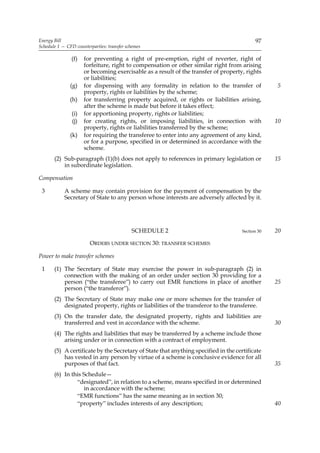
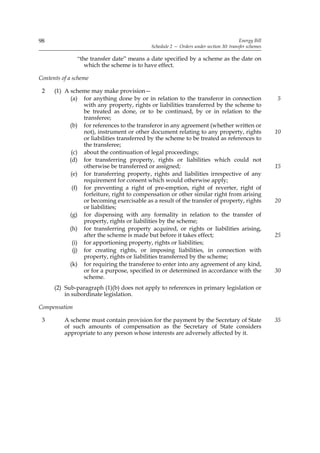
     (8)    Schedule 2 (which confers power on the Secretary of State to make transfer                       35
            schemes in connection with the making of transfer of functions orders) has
            effect.
     (9)    If the Secretary of State makes a transfer of functions order under which any
            EMR functions of the national system operator are transferred to an alternative
            delivery body, the Secretary of State must consider the extent to which (if at all)              40
            a licence modification power should be exercised as a consequence of the
            national system operator ceasing to carry out the functions that are transferred.
 (10)       In subsection (9) “licence modification power” means a power conferred by
            section 16, 25 or 29 to modify—
Energy Bill                                                                                19
Part 1 — Electricity Market Reform
Chapter 4 — Conflicts of interest and contingency arrangements


              (a)   a condition of a transmission licence granted to the national system
                    operator under section 6(1)(b) of EA 1989,
              (b)   the standard conditions incorporated in such licences under section 8A
                    of that Act, or
              (c)   a document maintained in accordance with the conditions of such              5
                    licences, or an agreement that gives effect to a document so maintained.
 (11)       In this section—
                 “alternative delivery body”, “EMR functions” and “national system
                     operator” have the same meaning as in section 30;
                 “transfer of functions order” means an order under section 30(1) or (7).        10

32         Energy administration orders
     (1)    The Energy Act 2004 is amended as follows.
     (2)    In section 154 (energy administration orders), in subsection (3) for “section 155”
            substitute “—
               (a) section 155(1), and                                                           15
              (b) section 155(9) (if and to the extent that section 155(9) applies in relation
                    to the company).”
     (3)    In section 155 (objective of an energy administration), after subsection (7)
            insert—
             “(8)   Subsection (9) applies if the company in relation to which an energy         20
                    administration order is made has functions conferred by or by virtue
                    of—
                      (a) Chapter 2 or 3 of Part 1 of the Energy Act 2013, or
                      (b) an order made under section 30 of that Act (power of Secretary
                           of State to transfer certain functions).                              25
              (9)   The objective of an energy administration (in addition to the objective
                    mentioned in subsection (1)) is to secure—
                      (a) that those functions are and continue to be carried out in an
                           efficient and effective manner; and
                      (b) that it becomes unnecessary, by one or both of the means               30
                           mentioned in subsection (2), for the energy administration
                           order to remain in force for that purpose.
             (10)   The duty under section 154(3), so far as it relates to the objective
                    mentioned in subsection (9)—
                      (a) applies only to the extent that securing that objective is not         35
                          inconsistent with securing the objective mentioned in
                          subsection (1);
                      (b) ceases to apply in respect of any function of a company if an
                          order is made under section 30 of the Energy Act 2013 as a result
                          of which the function is transferred from that company to              40
                          another person.”
20                                                                                      Energy Bill
                                                                 Part 1 — Electricity Market Reform
                                                                  Chapter 5 — Investment contracts


                                           CHAPTER 5

                                    INVESTMENT CONTRACTS

33         Investment contracts
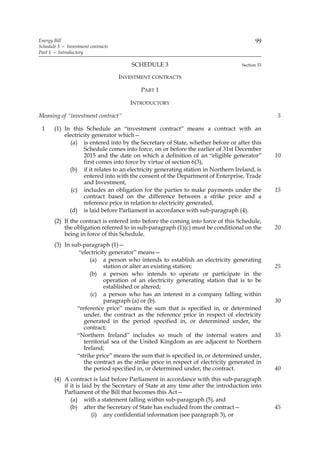
            Schedule 3 (which makes provision about investment contracts) has effect.

                                           CHAPTER 6                                                  5

                                    ACCESS TO MARKETS ETC

34         Power to modify licence conditions etc: market participation and liquidity
     (1)    The Secretary of State may modify—
              (a) a condition of a particular licence under section 6(1)(a) or (d) of EA 1989
                   (generation and supply licences);                                                  10
              (b) the standard conditions incorporated in licences under those
                   provisions by virtue of section 8A of that Act;
              (c) a document maintained in accordance with the conditions of licences
                   under section 6(1)(a) or (d) of that Act, or an agreement that gives effect
                   to a document so maintained.                                                       15
     (2)    The Secretary of State may exercise the power in subsection (1) only for the
            following purposes—
              (a) facilitating participation in the wholesale electricity market in Great
                   Britain, whether by licence holders or others;
              (b) promoting liquidity in that market.                                                 20
     (3)    Modifications made by virtue of that power may include—
             (a) provision imposing obligations in relation to the sale or purchase of
                   electricity, including, in particular, obligations as to—
                      (i) the terms on which electricity is sold or purchased, and
                     (ii) the circumstances or manner in which electricity is sold or                 25
                           purchased;
             (b) provision imposing restrictions on the sale or purchase of electricity to
                   or from group undertakings;
             (c) provision imposing obligations in relation to the disclosure or
                   publication of information.                                                        30
     (4)    For the purposes of subsection (3)(b), electricity is sold to or purchased from a
            group undertaking if the transaction is between undertakings one of which is
            a group undertaking in relation to the other.
            For this purpose, “undertaking” and “group undertaking” have the same
            meanings as in the Companies Acts (see section 1161 of the Companies Act                  35
            2006).

35         Power to modify licence conditions etc to facilitate investment in electricity
           generation
     (1)    The Secretary of State may modify—
              (a) a condition of a particular licence under section 6(1)(d) of EA 1989                40
                   (supply licences);
Energy Bill                                                                                 21
Part 1 — Electricity Market Reform
Chapter 6 — Access to markets etc


              (b)     the standard conditions incorporated in licences under that provision
                      by virtue of section 8A of that Act;
              (c)     a document maintained in accordance with the conditions of licences
                      under section 6(1)(d) of that Act, or an agreement that gives effect to a
                      document so maintained.                                                     5
     (2)    The Secretary of State may exercise the power in subsection (1) only for the
            purpose of facilitating investment in electricity generation by promoting
            availability of arrangements for the sale of electricity generated.
     (3)    Modifications made by virtue of that power may include provision imposing
            obligations in relation to arrangements for the purchase of electricity               10
            including, in particular, obligations in relation to—
              (a) the terms of any such arrangements, including the terms on which
                    electricity is purchased, and
              (b) the circumstances or manner in which any such arrangements are made
                    or offered.                                                                   15

36         Licence modifications under sections 34 and 35: further provisions
     (1)    A modification of a licence under section 34(1) or 35(1) may in particular
            include a modification—
              (a) to provide for a new document to be required to be prepared and
                   maintained in accordance with the conditions of such a licence;                20
              (b) to provide for an agreement to give effect to a document so maintained.
     (2)    Before making modifications under section 34(1) or 35(1), the Secretary of State
            must consult—
              (a) the holder of any licence being modified,
              (b) the Authority, and                                                              25
              (c) such other persons as the Secretary of State considers it appropriate to
                   consult.
     (3)    Subsection (2) may be satisfied by consultation before, as well as by
            consultation after, the passing of this Act.

                                             CHAPTER 7                                            30

                    THE RENEWABLES OBLIGATION: TRANSITIONAL ARRANGEMENTS

37         Transition to certificate purchase scheme
     (1)    EA 1989 is amended as follows.
     (2)    After section 32M insert—
            “32N The certificate purchase obligation                                              35
              (1)     The Secretary of State may make a certificate purchase order.
              (2)     A certificate purchase order is an order which imposes the certificate
                      purchase obligation on—
                        (a) the purchasing body of GB certificates;
                        (b) the purchasing body of NI certificates.                               40
              (3)     The certificate purchase obligation is that—
22                                                                                      Energy Bill
                                                              Part 1 — Electricity Market Reform
                                  Chapter 7 — The renewables obligation: transitional arrangements


               (a)   the purchasing body of GB certificates must pay the redemption
                     value of a GB certificate to the person presenting it;
               (b)   the purchasing body of NI certificates must pay the redemption
                     value of a NI certificate to the person presenting it.
       (4)   The purchasing body of GB certificates is—                                               5
               (a) the Authority, or
               (b) such other eligible person as may be designated by the order as
                   the purchasing body of GB certificates.
       (5)   The purchasing body of NI certificates is—
               (a) the Northern Ireland authority, or                                                 10
               (b) such other eligible person as may be designated by the order as
                   the purchasing body of NI certificates.
       (6)   A person is an “eligible person” for the purposes of designation under
             subsection (4)(b) if the person is—
               (a) a CFD counterparty at the time when the designation is made,                       15
                    or
               (b) the Secretary of State.
       (7)   A person is an “eligible person” for the purposes of designation under
             subsection (5)(b) if the person is a CFD counterparty at the time when
             the designation is made.                                                                 20
       (8)   Subsection (3) is subject to sections 32O to 32Z1.
     32O Further provision about the certificate purchase obligation
       (1)   A certificate purchase order may make provision generally in relation
             to the certificate purchase obligation.
       (2)   A certificate purchase order may, in particular—                                         25
               (a) specify the redemption value of certificates or provide for how
                     the redemption value is to be calculated;
               (b) provide for different redemption values for successive periods
                     of time;
                (c) authorise the adjustment of redemption values from time to                        30
                     time for inflation by a method specified in the order (including
                     by reference to a specified scale or index, as it has effect from
                     time to time, or to other specified data of any description);
               (d) require the relevant purchasing body or the Secretary of State (if
                     not the relevant purchasing body) to publish the redemption                      35
                     value of certificates by a specified deadline;
               (e) provide for the manner in which a certificate is to be presented
                     to the relevant purchasing body;
                (f) provide for the certificate purchase obligation in relation to
                     certificates issued in respect of electricity generated—                         40
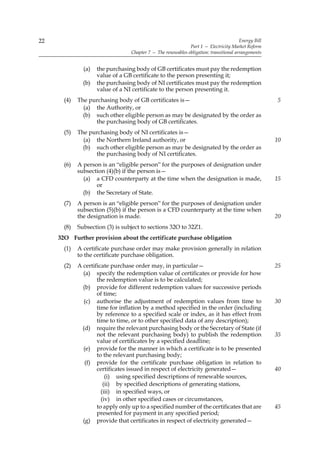
                         (i) using specified descriptions of renewable sources,
                        (ii) by specified descriptions of generating stations,
                       (iii) in specified ways, or
                       (iv) in other specified cases or circumstances,
                     to apply only up to a specified number of the certificates that are              45
                     presented for payment in any specified period;
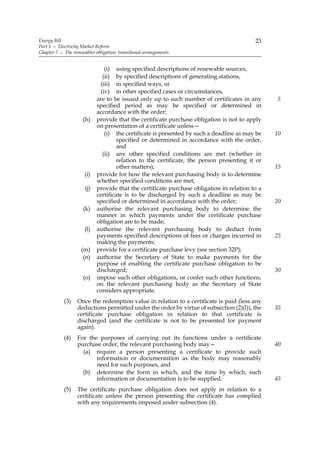
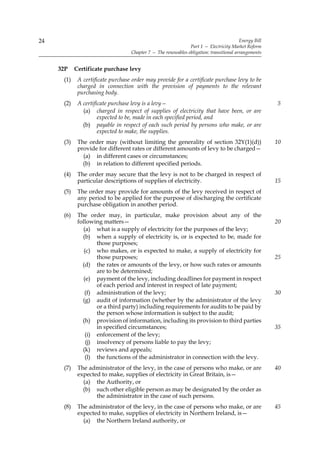
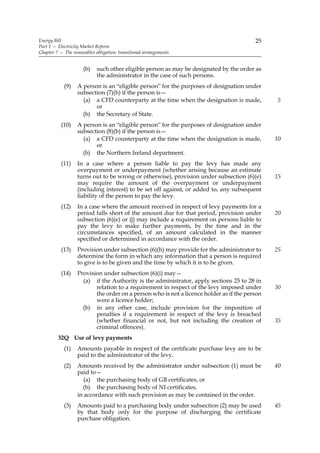
               (g) provide that certificates in respect of electricity generated—
Energy Bill                                                                               23
Part 1 — Electricity Market Reform
Chapter 7 — The renewables obligation: transitional arrangements


                               (i) using specified descriptions of renewable sources,
                              (ii) by specified descriptions of generating stations,
                             (iii) in specified ways, or
                             (iv) in other specified cases or circumstances,
                            are to be issued only up to such number of certificates in any      5
                            specified period as may be specified or determined in
                            accordance with the order;
                     (h)    provide that the certificate purchase obligation is not to apply
                            on presentation of a certificate unless—
                               (i) the certificate is presented by such a deadline as may be    10
                                     specified or determined in accordance with the order,
                                     and
                              (ii) any other specified conditions are met (whether in
                                     relation to the certificate, the person presenting it or
                                     other matters);                                            15
                      (i)   provide for how the relevant purchasing body is to determine
                            whether specified conditions are met;
                      (j)   provide that the certificate purchase obligation in relation to a
                            certificate is to be discharged by such a deadline as may be
                            specified or determined in accordance with the order;               20
                     (k)    authorise the relevant purchasing body to determine the
                            manner in which payments under the certificate purchase
                            obligation are to be made;
                      (l)   authorise the relevant purchasing body to deduct from
                            payments specified descriptions of fees or charges incurred in      25
                            making the payments;
                    (m)     provide for a certificate purchase levy (see section 32P);
                     (n)    authorise the Secretary of State to make payments for the
                            purpose of enabling the certificate purchase obligation to be
                            discharged;                                                         30
                     (o)    impose such other obligations, or confer such other functions,
                            on the relevant purchasing body as the Secretary of State
                            considers appropriate.
            (3)    Once the redemption value in relation to a certificate is paid (less any
                   deductions permitted under the order by virtue of subsection (2)(l)), the    35
                   certificate purchase obligation in relation to that certificate is
                   discharged (and the certificate is not to be presented for payment
                   again).
            (4)    For the purposes of carrying out its functions under a certificate
                   purchase order, the relevant purchasing body may—                            40
                     (a) require a person presenting a certificate to provide such
                          information or documentation as the body may reasonably
                          need for such purposes, and
                     (b) determine the form in which, and the time by which, such
                          information or documentation is to be supplied.                       45
            (5)    The certificate purchase obligation does not apply in relation to a
                   certificate unless the person presenting the certificate has complied
                   with any requirements imposed under subsection (4).
24                                                                                       Energy Bill
                                                               Part 1 — Electricity Market Reform
                                   Chapter 7 — The renewables obligation: transitional arrangements


     32P    Certificate purchase levy
      (1)    A certificate purchase order may provide for a certificate purchase levy to be
             charged in connection with the provision of payments to the relevant
             purchasing body.
      (2)    A certificate purchase levy is a levy—                                                    5
               (a) charged in respect of supplies of electricity that have been, or are
                      expected to be, made in each specified period, and
               (b) payable in respect of each such period by persons who make, or are
                      expected to make, the supplies.
      (3)    The order may (without limiting the generality of section 32Y(1)(d))                      10
             provide for different rates or different amounts of levy to be charged—
               (a) in different cases or circumstances;
               (b) in relation to different specified periods.
      (4)    The order may secure that the levy is not to be charged in respect of
             particular descriptions of supplies of electricity.                                       15
      (5)    The order may provide for amounts of the levy received in respect of
             any period to be applied for the purpose of discharging the certificate
             purchase obligation in another period.
      (6)    The order may, in particular, make provision about any of the
             following matters—                                                                        20
               (a) what is a supply of electricity for the purposes of the levy;
               (b) when a supply of electricity is, or is expected to be, made for
                     those purposes;
                (c) who makes, or is expected to make, a supply of electricity for
                     those purposes;                                                                   25
               (d) the rates or amounts of the levy, or how such rates or amounts
                     are to be determined;
                (e) payment of the levy, including deadlines for payment in respect
                     of each period and interest in respect of late payment;
                (f) administration of the levy;                                                        30
               (g) audit of information (whether by the administrator of the levy
                     or a third party) including requirements for audits to be paid by
                     the person whose information is subject to the audit;
               (h) provision of information, including its provision to third parties
                     in specified circumstances;                                                       35
                 (i) enforcement of the levy;
                 (j) insolvency of persons liable to pay the levy;
               (k) reviews and appeals;
                 (l) the functions of the administrator in connection with the levy.
      (7)    The administrator of the levy, in the case of persons who make, or are                    40
             expected to make, supplies of electricity in Great Britain, is—
               (a) the Authority, or
               (b) such other eligible person as may be designated by the order as
                    the administrator in the case of such persons.
      (8)    The administrator of the levy, in the case of persons who make, or are                    45
             expected to make, supplies of electricity in Northern Ireland, is—
               (a) the Northern Ireland authority, or
Energy Bill                                                                              25
Part 1 — Electricity Market Reform
Chapter 7 — The renewables obligation: transitional arrangements


                     (b)    such other eligible person as may be designated by the order as
                            the administrator in the case of such persons.
            (9)    A person is an “eligible person” for the purposes of designation under
                   subsection (7)(b) if the person is—
                     (a) a CFD counterparty at the time when the designation is made,          5
                          or
                     (b) the Secretary of State.
           (10)    A person is an “eligible person” for the purposes of designation under
                   subsection (8)(b) if the person is—
                     (a) a CFD counterparty at the time when the designation is made,          10
                          or
                     (b) the Northern Ireland department.
           (11)    In a case where a person liable to pay the levy has made any
                   overpayment or underpayment (whether arising because an estimate
                   turns out to be wrong or otherwise), provision under subsection (6)(e)      15
                   may require the amount of the overpayment or underpayment
                   (including interest) to be set off against, or added to, any subsequent
                   liability of the person to pay the levy.
           (12)    In a case where the amount received in respect of levy payments for a
                   period falls short of the amount due for that period, provision under       20
                   subsection (6)(e) or (j) may include a requirement on persons liable to
                   pay the levy to make further payments, by the time and in the
                   circumstances specified, of an amount calculated in the manner
                   specified or determined in accordance with the order.
           (13)    Provision under subsection (6)(h) may provide for the administrator to      25
                   determine the form in which any information that a person is required
                   to give is to be given and the time by which it is to be given.
           (14)    Provision under subsection (6)(i) may—
                     (a) if the Authority is the administrator, apply sections 25 to 28 in
                          relation to a requirement in respect of the levy imposed under       30
                          the order on a person who is not a licence holder as if the person
                          were a licence holder;
                     (b) in any other case, include provision for the imposition of
                          penalties if a requirement in respect of the levy is breached
                          (whether financial or not, but not including the creation of         35
                          criminal offences).
         32Q Use of levy payments
            (1)    Amounts payable in respect of the certificate purchase levy are to be
                   paid to the administrator of the levy.
            (2)    Amounts received by the administrator under subsection (1) must be          40
                   paid to—
                      (a) the purchasing body of GB certificates, or
                     (b) the purchasing body of NI certificates,
                   in accordance with such provision as may be contained in the order.
            (3)    Amounts paid to a purchasing body under subsection (2) may be used          45
                   by that body only for the purpose of discharging the certificate
                   purchase obligation.
26                                                                                      Energy Bill
                                                              Part 1 — Electricity Market Reform
                                  Chapter 7 — The renewables obligation: transitional arrangements


      (4)   The order may contain further provision about—
              (a) the calculation of amounts received by the administrator that
                   are to be paid to a relevant purchasing body;
              (b) the time by which the administrator must make payments of
                   such amounts to a relevant purchasing body;                                        5
               (c) the manner in which any such payments are to be made;
              (d) how amounts are to be dealt with for the purposes of subsection
                   (2) where the administrator and a relevant purchasing body to
                   whom they are to be paid are the same person.
      (5)   Subsections (2) to (4) are subject to subsections (6) to (10).                            10
      (6)   The order may provide for amounts received by the administrator
            under subsection (1) to be used by the administrator to make
            payments—
              (a) into the Consolidated Fund in respect of costs (or a proportion
                  of costs) which have been or are expected to be incurred—                           15
                      (i) by the Authority,
                     (ii) by the Secretary of State, or
                    (iii) by a relevant designated person,
                  in connection with the performance of functions conferred by or
                  under sections 32N to 32Z1;                                                         20
              (b) into the Consolidated Fund of Northern Ireland in respect of
                  costs (or a proportion of costs) which have been or are expected
                  to be incurred—
                      (i) by the Northern Ireland authority, or
                     (ii) by the Northern Ireland department,                                         25
                  in connection with the performance of functions conferred by or
                  under sections 32N to 32Z1.
      (7)   For the purposes of subsection (6)(a), “relevant designated person”
            means a person who is designated—
              (a) as the purchasing body of GB certificates by virtue of being an                     30
                   eligible person within section 32N(6)(a) (CFD counterparty);
              (b) as the purchasing body of NI certificates by virtue of being an
                   eligible person within section 32N(7) (CFD counterparty);
              (c) as an administrator of the levy by virtue of being an eligible
                   person within section 32P(9)(a) or (10)(a) (CFD counterparty).                     35
      (8)   The order—
              (a) may exclude amounts of a specified description from being
                   used as mentioned in subsection (6);
              (b) may prevent the administrator using amounts to make
                   payments in respect of costs of a specified description.                           40
      (9)   The purchasing body of GB certificates must, if directed to do so by the
            Secretary of State, pay into the Consolidated Fund any amounts
            received under subsection (2) that it would (but for the direction) be
            able to use under subsection (3) for the purpose of discharging the
            purchase obligation in respect of GB certificates.                                        45
     (10)   The purchasing body of NI certificates must, if directed to do so by the
            Secretary of State, pay into the Consolidated Fund of Northern Ireland
            any amounts received under subsection (2) that it would (but for the
Energy Bill                                                                                27
Part 1 — Electricity Market Reform
Chapter 7 — The renewables obligation: transitional arrangements


                   direction) be able to use under subsection (3) for the purpose of
                   discharging the purchase obligation in respect of NI certificates.
           (11)    In this section “the order”, in relation to the certificate purchase levy,
                   means the certificate purchase order that imposes the levy.
         32R      Designation of a CFD counterparty as purchasing body or                        5
                  administrator
            (1)    This section applies in relation to the designation of a person who is a
                   CFD counterparty—
                     (a) as a relevant purchasing body under section 32N(4)(b) or (5)(b),
                          or                                                                     10
                     (b) as the administrator of the levy under section 32P(7)(b) or (8)(b).
            (2)    A designation may be made only with the consent of the person
                   designated.
            (3)    A designation does not cease to have effect if the person’s designation
                   as a CFD counterparty ceases to have effect by virtue of section 3(6)(a)      15
                   or (b) of the Energy Act 2013.
            (4)    A designation ceases to have effect if—
                     (a) the Secretary of State by order revokes the designation, or
                     (b) the person withdraws consent to the designation by giving not
                          less than 3 months’ notice in writing to the Secretary of State.       20
            (5)    The Secretary of State may by order make transitional provision in
                   connection with a designation ceasing to have effect.
            (6)    An order under subsection (5) may in particular make provision about
                   how obligations, imposed by virtue of a certificate purchase order on a
                   person whose designation ceases to have effect, are to be discharged in       25
                   any period before or after the time when the designation ceases to have
                   effect.
            (7)    Subsection (5) is not to be taken as limiting the power to make
                   transitional provision in a certificate purchase order by virtue of section
                   32Y(1)(b).                                                                    30
         32S      GB certificates
            (1)    A certificate purchase order may (subject to subsection (3)) provide for
                   the Authority to issue from time to time, in accordance with such
                   criteria (if any) as are specified in the order, a certificate (“a GB
                   certificate”) to—                                                             35
                      (a) the operator of a generating station, or
                     (b) if the order so provides, a person of any other description
                            specified in the order.
            (2)    A GB certificate is to certify—
                     (a) the matters within subsection (4) or (5), or                            40
                     (b) if the order provides that a certificate may certify the matters
                         within subsection (6), (7), (8) or (9), the matters within that
                         subsection.
            (3)    A GB certificate certifying that an amount of electricity has been
                   generated from renewable sources in any period may not be issued if—          45
28                                                                                    Energy Bill
                                                            Part 1 — Electricity Market Reform
                                Chapter 7 — The renewables obligation: transitional arrangements


             (a)   a renewables obligation order is in force, and
             (b)   a renewables obligation certificate has been, or could be, issued
                   under the order in respect of the generation in that period of the
                   same electricity.
     (4)   The matters within this subsection are—                                                  5
             (a) that the generating station, or, in the case of a certificate issued
                 otherwise than to the operator of a generating station, a
                 generating station specified in the certificate, has generated
                 from renewable sources the amount of electricity stated in the
                 certificate, and                                                                   10
             (b) that the electricity has been supplied by an electricity supplier
                 to customers in Great Britain.
     (5)   The matters within this subsection are—
             (a) that the generating station, or, in the case of a certificate issued
                 otherwise than to the operator of a generating station, a                          15
                 generating station specified in the certificate, has generated
                 from renewable sources the amount of electricity stated in the
                 certificate,
             (b) that the generating station in question is not in Northern
                 Ireland, and                                                                       20
             (c) that the electricity has been supplied by a Northern Ireland
                 supplier to customers in Northern Ireland.
     (6)   The matters within this subsection are—
             (a) that two or more generating stations have, between them,
                 generated from renewable sources the amount of electricity                         25
                 stated in the certificate, and
             (b) that the electricity has been supplied by an electricity supplier
                 to customers in Great Britain.
     (7)   The matters within this subsection are—
             (a) that two or more generating stations have, between them,                           30
                 generated from renewable sources the amount of electricity
                 stated in the certificate,
             (b) that none of them is a generating station in Northern Ireland,
                 and
             (c) that the electricity has been supplied by a Northern Ireland                       35
                 supplier to customers in Northern Ireland.
     (8)   The matters within this subsection are—
             (a) that the generating station, or, in the case of a certificate issued
                 otherwise than to the operator of a generating station, a
                 generating station specified in the certificate, has generated                     40
                 from renewable sources the amount of electricity stated in the
                 certificate, and
             (b) that the electricity has been used in a permitted way.
     (9)   The matters within this subsection are—
             (a) that two or more generating stations have, between them,                           45
                 generated from renewable sources the amount of electricity
                 stated in the certificate, and
             (b) that the electricity has been used in a permitted way.
Energy Bill                                                                                 29
Part 1 — Electricity Market Reform
Chapter 7 — The renewables obligation: transitional arrangements


           (10)    For the purposes of subsections (8) and (9), electricity generated by a
                   generating station, or generating stations, of any description is used in
                   a permitted way if—
                     (a) it is used in one of the ways mentioned in subsection (11), and
                     (b) that way is specified in the order as a permitted way—                   5
                             (i) in relation to all generating stations, or
                            (ii) in relation to generating stations of that description.
           (11)    Those ways are—
                     (a) being consumed by the operator of the generating station or
                          generating stations by which it was generated;                          10
                     (b) being supplied to customers in Great Britain through a private
                          wire network;
                      (c) being provided to a distribution system or a transmission
                          system in circumstances in which its supply to customers
                          cannot be demonstrated;                                                 15
                     (d) being used, as respects part, as mentioned in one of paragraphs
                          (a), (b) or (c) and as respects the remainder—
                              (i) as mentioned in one of the other paragraphs, or
                            (ii) as respects part, as mentioned in one of the other
                                   paragraphs and as respects the remainder as mentioned          20
                                   in the other;
                     (e) being used, as respects part, as mentioned in paragraph (a), (b),
                          (c) or (d) and as respects the remainder by being supplied by an
                          electricity supplier to customers in Great Britain or by a
                          Northern Ireland supplier to customers in Northern Ireland, or          25
                          both.
           (12)    Subsection (11) of section 32B (meaning of supply of electricity through
                   a private wire network) applies for the purposes of subsection (11)(b)
                   as it applies for the purposes of subsection (10)(b) of that section.
         32T      NI certificates                                                                 30
            (1)    A certificate purchase order may (subject to subsection (3)) provide for
                   the Northern Ireland authority to issue from time to time, in accordance
                   with such criteria (if any) as are specified in the order, a certificate (“a
                   NI certificate”) to—
                     (a) the operator of a generating station in Northern Ireland, or             35
                     (b) if the order so provides, a person of any other description.
            (2)    A NI certificate is to certify—
                     (a) the matters within subsection (4), or
                     (b) if the order provides that a certificate may certify the matters
                          within subsection (5), (6) or (7), the matters within that              40
                          subsection.
            (3)    A NI certificate certifying that an amount of electricity has been
                   generated from renewable sources in any period may not be issued if—
                     (a) an order under Article 52 of the Energy (Northern Ireland)
                          Order 2003 is in force, and                                             45
                     (b) a Northern Ireland RO certificate has been, or could be, issued
                          under that order in respect of the same electricity.
            (4)    The matters within this subsection are—
30                                                                                     Energy Bill
                                                             Part 1 — Electricity Market Reform
                                 Chapter 7 — The renewables obligation: transitional arrangements


             (a)   that the generating station, or, in the case of a certificate issued
                   otherwise than to the operator of a generating station, a
                   generating station in Northern Ireland specified in the
                   certificate, has generated from renewable sources the amount of
                   electricity stated in the certificate, and                                        5
             (b)   that it has been supplied by a Northern Ireland supplier to
                   customers in Northern Ireland.
     (5)   The matters within this subsection are—
             (a) that two or more generating stations in Northern Ireland have,
                 between them, generated from renewable sources the amount                           10
                 of electricity stated in the certificate, and
             (b) that it has been supplied by a Northern Ireland supplier to
                 customers in Northern Ireland.
     (6)   The matters within this subsection are—
             (a) that the generating station, or, in the case of a certificate issued                15
                 otherwise than to the operator of a generating station, a
                 generating station in Northern Ireland specified in the
                 certificate, has generated from renewable sources the amount of
                 electricity stated in the certificate, and
             (b) that the electricity has been used in a permitted way.                              20
     (7)   The matters within this subsection are—
             (a) that two or more generating stations in Northern Ireland have,
                 between them, generated from renewable sources the amount
                 of electricity stated in the certificate, and
             (b) that the electricity has been used in a permitted way.                              25
     (8)   For the purposes of subsections (6) and (7), electricity generated by a
           generating station, or generating stations, of any description is used in
           a permitted way if—
             (a) it is used in one of the ways mentioned in subsection (9), and
             (b) that way is specified in the order as a permitted way—                              30
                     (i) in relation to all generating stations, or
                    (ii) in relation to generating stations of that description.
     (9)   Those ways are—
             (a) being consumed by the operator of the generating station or
                  generating stations by which it was generated;                                     35
             (b) being supplied to customers in Northern Ireland through a
                  private wire network;
              (c) being provided to a distribution system located in Northern
                  Ireland, or to transmission system located in Northern Ireland,
                  in circumstances in which its supply to customers in Northern                      40
                  Ireland cannot be demonstrated;
             (d) being used, as respects part, as mentioned in one of paragraphs
                  (a), (b) or (c) and as respects the remainder—
                     (i) as mentioned in one of the other paragraphs, or
                    (ii) as respects part, as mentioned in one of the other                          45
                           paragraphs and as respects the remainder as mentioned
                           in the other;
Energy Bill                                                                               31
Part 1 — Electricity Market Reform
Chapter 7 — The renewables obligation: transitional arrangements


                      (e)   being used, as respects part, as mentioned in paragraph (a), (b),
                            (c) or (d) and as respects the remainder by being supplied by a
                            Northern Ireland supplier to customers in Northern Ireland.
           (10)    Paragraph (9) of Article 54 of the Energy (Northern Ireland) Order 2003
                   (meaning of supply of electricity through a private wire network)            5
                   applies for the purposes of subsection (9)(b) as it applies for the
                   purposes of paragraph (8)(b) of that Article.
         32U Sections 32S and 32T: supplemental provision
            (1)    A certificate purchase order may provide—
                     (a) that no certificates are to be issued in respect of electricity        10
                           generated in specified cases or circumstances, or
                     (b) that certificates are to be issued in respect of a proportion only
                           of the electricity generated in specified cases or circumstances.
            (2)    In particular, provision made by virtue of subsection (1) may specify—
                     (a) electricity generated using specified descriptions of renewable        15
                           sources,
                     (b) electricity generated by specified descriptions of generating
                           station, or
                      (c) electricity generated in specified ways.
            (3)    Provision made by virtue of subsection (1)(b) may include—                   20
                     (a) provision about how the proportion is to be determined;
                     (b) provision about what, subject to such exceptions as may be
                          specified, constitutes sufficient evidence of any matter required
                          to be established for the purpose of determining that
                          proportion;                                                           25
                     (c) provision authorising the relevant authority, in specified
                          circumstances, to require an operator of a generating station to
                          arrange—
                             (i) for samples of any fuel used (or to be used) in the
                                  generating station, or of any gas or other substance          30
                                  produced as a result of the use of such fuel, to be taken
                                  by a person, and analysed in a manner, approved by the
                                  relevant authority, and
                            (ii) for the results of that analysis to be made available to the
                                  relevant authority.                                           35
            (4)    In the case of electricity generated by a generating station fuelled or
                   driven—
                     (a) partly by renewable sources, and
                     (b) partly by fossil fuel (other than waste which constitutes a
                           renewable source),                                                   40
                   only the proportion attributable to the renewable sources is to be
                   regarded as generated from such sources.
            (5)    A certificate purchase order may specify—
                     (a) how the proportion referred to in subsection (4) is to be
                           determined, and                                                      45
                     (b) the consequences for the issuing of certificates if a generating
                           station of the type mentioned in that subsection uses more than
                           a specified proportion of fossil fuel during a specified period.
32                                                                                       Energy Bill
                                                               Part 1 — Electricity Market Reform
                                   Chapter 7 — The renewables obligation: transitional arrangements


       (6)   Those consequences may include the consequences that no certificates
             are to be issued in respect of any electricity generated by that
             generating station during that period.
       (7)   A certificate purchase order may provide that ownership of a certificate
             may be transferred—                                                                       5
               (a) only to persons of a specified description;
               (b) only if other specified conditions are met.
       (8)   A certificate purchase order may specify circumstances in which the
             relevant authority may revoke a certificate before the certificate
             purchase obligation in respect of the certificate is discharged (whether                  10
             before or after the certificate is presented for payment).
       (9)   A certificate purchase order must—
               (a) prohibit the issue of GB certificates certifying that electricity has
                     been supplied to customers in Northern Ireland by virtue of
                     section 32S(5) or (7) where the Northern Ireland authority has                    15
                     notified the Authority that it is not satisfied that the electricity
                     in question has been supplied to customers in Northern Ireland,
                     and
               (b) require the revocation of such a certificate if the Northern
                     Ireland authority so notifies the Authority at a time between the                 20
                     issue of the certificate and its presentation for payment for the
                     purposes of the certificate purchase obligation.
      (10)   A certificate purchase order may make provision requiring a person to
             whom a certificate is issued to pay to the relevant authority an amount
             equal to any amount that has been paid in respect of the certificate                      25
             under the certificate purchase obligation if it appears to the authority
             that—
               (a) the certificate should not have been issued to that person, and
               (b) it is not possible to secure the recovery of such an amount by
                     refusing to issue another certificate to the person.                              30
      (11)   Provision under subsection (10) may include provision about
             enforcement and appeals.
      (12)   The Authority must pay any amounts it receives by virtue of subsection
             (10) into the Consolidated Fund.
      (13)   The Northern Ireland authority must pay any amounts it receives by                        35
             virtue of subsection (10) into the Consolidated Fund of Northern
             Ireland.
     32V Certificate purchase orders: amounts of electricity stated in certificates
       (1)   A certificate purchase order may specify the amount of electricity to be
             stated in each certificate, and different amounts may be specified in                     40
             relation to different cases or circumstances.
       (2)   In particular, different amounts may be specified in relation to—
               (a) electricity generated from different renewable sources;
               (b) electricity generated by different descriptions of generating
                     station;                                                                          45
                (c) electricity generated in different ways.
Energy Bill                                                                               33
Part 1 — Electricity Market Reform
Chapter 7 — The renewables obligation: transitional arrangements


            (3)    In this section “banding provision” means provision made in a
                   certificate purchase order by virtue of subsection (1).
            (4)    Before making any banding provision, the Secretary of State must have
                   regard to the following matters—
                     (a) the costs (including capital costs) associated with generating         5
                          electricity from each of the renewable sources or with
                          transmitting or distributing electricity so generated;
                     (b) the income of operators of generating stations in respect of
                          electricity generated from each of those sources or associated
                          with the generation of such electricity;                              10
                      (c) the effect of paragraph 19 of Schedule 6 to the Finance Act 2000
                          (supplies of electricity from renewable sources exempted from
                          the climate change levy) in relation to electricity generated from
                          each of those sources;
                     (d) the desirability of securing the long term growth, and economic        15
                          viability, of the industries associated with the generation of
                          electricity from renewable sources;
                     (e) the likely effect of the proposed banding provision on the
                          number of certificate issued by the relevant authority, and the
                          impact this will have on consumers;                                   20
                      (f) the potential contribution of electricity generated from each
                          renewable source to the attainment of any target which relates
                          to the generation of electricity or the production of energy and
                          is imposed by, or results from or arises out of, an EU obligation.
            (5)    For the purposes of subsection (4)(a), the costs associated with             25
                   generating electricity from a renewable source include any costs
                   associated with the production or supply of heat produced in
                   connection with that generation.
            (6)    For the purposes of subsection (4)(b), an operator’s income associated
                   with the generation of electricity from a renewable source includes any      30
                   income connected with—
                     (a) the acquisition of the renewable source;
                     (b) the supply of heat produced in connection with the generation;
                     (c) the disposal of any by-product of the generation process.
            (7)    After the first order containing banding provision is made by the            35
                   Secretary of State, no subsequent order containing such provision may
                   be made by the Secretary of State except following a review held by
                   virtue of subsection (8).
            (8)    A certificate purchase order—
                     (a) may authorise the Secretary of State to review the banding             40
                           provision at such intervals as are specified in or determined in
                           accordance with the order, and
                     (b) may authorise the Secretary of State to review the whole or any
                           part of the banding provision at any time when the Secretary of
                           State is satisfied that one or more of the specified conditions is   45
                           satisfied.
         32W Section 32V: transitional provision and savings
            (1)    This section applies where a certificate purchase order contains
                   banding provision.
34                                                                                    Energy Bill
                                                            Part 1 — Electricity Market Reform
                                Chapter 7 — The renewables obligation: transitional arrangements


     (2)   The order may provide for the effect of any banding provision made in
           an earlier such order to continue, in such circumstances as may be
           specified, in relation to—
             (a) the electricity generated by generating stations of such
                   descriptions as may be specified, or                                             5
             (b) so much of the electricity as may be determined in accordance
                   with the order.
     (3)   The order may provide for—
             (a) the effect of any banding provision made in a renewables
                  obligation order by virtue of section 32D(1) to apply, in such                    10
                  circumstances as may be specified, in relation to GB certificates
                  as it applied in relation to renewables obligation certificates;
             (b) the effect of any banding provision made in an order under
                  Article 52 of the Energy (Northern Ireland) Order 2003, by
                  virtue of Article 54B(1) of the Order, to apply, in such                          15
                  circumstances as may be specified, in relation to NI certificates
                  as it applied in relation to Northern Ireland RO certificates.
     (4)   Section 32V(4) and (7) do not apply in relation to provision of the kind
           mentioned in subsection (2) or (3) above.
     (5)   Subsection (7) applies to a generating station in respect of which a                     20
           statutory grant has been awarded if—
              (a) the generating station is of a specified description, or
             (b) the circumstances of the case meet specified requirements.
     (6)   The requirements specified under subsection (5)(b) may relate to the
           time when the grant was awarded (whether a time before or after the                      25
           coming into force of this section).
     (7)   A certificate purchase order which contains banding provision may
           provide for the operation of that provision in relation to electricity
           generated by a generating station to which this subsection applies to be
           conditional upon the operator of the station agreeing—                                   30
             (a) if the grant or any part of it has been paid, to repay to the person
                  who made the grant (“the payer”) the whole or a specified part
                  of the grant or part before the repayment date,
             (b) to pay to the payer interest on an amount repayable under
                  paragraph (a) for such period, and at such rate, as may be                        35
                  determined in accordance with the order (which may confer the
                  function of making the determination on a person), and
             (c) if the grant or any part of it has not yet been paid, to consent to
                  the cancellation of the award of the grant or part.
     (8)   For the purposes of subsection (7)—                                                      40
             (a) “the repayment date” means the date specified in or determined
                   in accordance with the order, and
             (b) the period for which interest is payable must not begin before
                   the grant was paid or, if the repayment relates to an instalment
                   of the grant, before the instalment was paid.                                    45
     (9)   In this section “statutory grant” means—
Energy Bill                                                                                  35
Part 1 — Electricity Market Reform
Chapter 7 — The renewables obligation: transitional arrangements


                     (a)    a grant awarded under section 5(1) of the Science and
                            Technology Act 1965 (grants to carry on or support scientific
                            research), or
                     (b)    any other grant which is payable out of public funds and
                            awarded under or by virtue of an Act or other statutory                5
                            provision (as defined by section 1(f) of the Interpretation Act
                            (Northern Ireland) 1954).
           (10)    This section is without prejudice to section 32Y(1)(b).
         32X      Certificate purchase orders: information
            (1)    A certificate purchase order may provide for—                                   10
                     (a) the Authority to require a person to provide it with information,
                           or with information of a particular kind, which in the
                           Authority’s opinion is relevant to the question whether a GB
                           certificate is, or was or will in future be, required to be issued to
                           the person;                                                             15
                     (b) the Northern Ireland authority to require a person to provide it
                           with information, or with information of a particular kind,
                           which in the authority’s opinion is relevant to the question
                           whether a NI certificate is, or was or will in future be, required
                           to be issued to the person.                                             20
            (2)    That information must be given to the relevant authority in whatever
                   form it requires.
            (3)    A certificate purchase order may—
                     (a) require operators of generating stations generating electricity
                           (wholly or partly) from biomass to give specified information,          25
                           or information of a specified kind, to the relevant authority;
                     (b) specify what, for this purpose, constitutes “biomass”;
                      (c) require the information to be given in a specified form and
                           within a specified period;
                     (d) authorise or require the relevant authority to postpone the issue         30
                           of certificates to the operator of a generating station who fails to
                           comply with a requirement imposed by virtue of paragraph (a)
                           or (c) until such time as the failure is remedied;
                     (e) authorise or require the relevant authority to refuse to issue
                           certificates to such a person or to refuse to issue them unless the     35
                           failure is remedied within a specified period.
            (4)    The relevant authority may publish information obtained by virtue of
                   subsection (3).
            (5)    No person is required by virtue of this section to provide any
                   information which the person could not be compelled to give in                  40
                   evidence in civil proceedings in the High Court or, in Scotland, the
                   Court of Session.
         32Y      Certificate purchase orders: general provision
            (1)    A certificate purchase order may—
                     (a) make further provision as to the functions of the relevant                45
                           authority in relation to matters dealt with by the order;
                     (b) make transitional provision and savings;
36                                                                                      Energy Bill
                                                              Part 1 — Electricity Market Reform
                                  Chapter 7 — The renewables obligation: transitional arrangements


               (c)   provide for anything falling to be calculated or otherwise
                     determined under the order to be calculated or determined by
                     such persons, in accordance with such procedure and by
                     reference to such matters and to the opinion of such persons, as
                     may be specified in the order;                                                   5
               (d)   make different provision for different cases or circumstances.
      (2)    Provision made by virtue of subsection (1)(b) may, in particular,
             include provision for—
               (a) renewables obligation certificates, issued in respect of a period
                    before the imposition of the certificate purchase obligation, to                  10
                    be treated as if they were GB certificates issued in respect of a
                    subsequent period for which the order is in force;
               (b) Northern Ireland RO certificates, issued in respect of a period
                    before the imposition of the certificate purchase obligation, to
                    be treated as if they were NI certificates issued in respect of a                 15
                    subsequent period for which the order is in force.
      (3)    Provision made by virtue of subsection (1)(d) may, in particular,
             make—
               (a) different provision in relation to different suppliers;
               (b) different provision in relation to generating stations of different                20
                    descriptions;
               (c) different provision in relation to different localities or different
                    parts of the United Kingdom.
      (4)    In subsection (3) “supplier” means an electricity supplier or a Northern
             Ireland supplier.                                                                        25
      (5)    The Authority and the Northern Ireland authority may enter into
             arrangements for the Authority to act on behalf of the Northern Ireland
             authority for, or in connection with, the carrying out of any functions
             conferred on the Northern Ireland authority under, or for the purposes
             of, a certificate purchase order.                                                        30
      (6)    The duties imposed on the Secretary of State by section 3A (principal
             objective and general duties in carrying out functions under this Part)
             do not apply in relation to the exercise of a power under section 32N to
             make a certificate purchase order so far as it is made for or in
             connection with imposing the certificate purchase obligation on the                      35
             purchasing body of NI certificates.
     32Z    Certificate purchase orders: procedure
      (1)    Before making a certificate purchase order, the Secretary of State must
             consult—
               (a) the Authority,                                                                     40
               (b) the Northern Ireland authority,
                (c) the Council,
               (d) the General Consumer Council for Northern Ireland,
               (e) such electricity suppliers and Northern Ireland suppliers that
                    may be required to pay the certificate purchase levy as the                       45
                    Secretary of State considers appropriate,
                (f) such generators of electricity from renewable sources as the
                    Secretary of State considers appropriate, and
Energy Bill                                                                                 37
Part 1 — Electricity Market Reform
Chapter 7 — The renewables obligation: transitional arrangements


                     (g)    such other persons, if any, as the Secretary of State considers
                            appropriate.
            (2)    A certificate purchase order is not to be made unless a draft of the
                   instrument containing it has been laid before and approved by a
                   resolution of each House of Parliament.                                        5
            (3)    The Secretary of State must, subject to subsection (5), consult the
                   Scottish Ministers before making a certificate purchase order that
                   extends to Scotland.
            (4)    The Secretary of State must, subject to subsection (5), obtain the consent
                   of the Northern Ireland department before making a certificate                 10
                   purchase order that extends to Northern Ireland.
            (5)    Except as provided by subsection (6), the Secretary of State is not
                   required to—
                      (a) consult the Scottish Ministers under subsection (3), or
                     (b) obtain the consent of the Northern Ireland department under              15
                          subsection (4),
                   in respect of any provision of a certificate purchase order that is made
                   by virtue of section 32O(2)(m), 32P or 32Q (which together confer
                   power to make provision about the certificate purchase levy).
            (6)    Designation of the Northern Ireland department as the administrator of         20
                   the certificate purchase levy by virtue of section 32P(8)(b) requires the
                   consent of that department.
         32Z1 Interpretation of sections 32N to 32Z1
            (1)    In this section and sections 32N to 32Z (“the relevant sections”), the
                   following terms have the meanings given in section 32M(1)—                     25
                        “fossil fuel” (but see subsection (4));
                        “generated”;
                        “Northern Ireland authority”;
                        “Northern Ireland supplier”;
                        “renewables obligation certificate”;                                      30
                        “renewables obligation order”.
            (2)    In the relevant sections—
                        “administrator”, in relation to the certificate purchase levy, is to be
                           construed in accordance with section 32P(7) to (10);
                        “banding provision” is to be construed in accordance with section         35
                           32V(3)
                        “CFD counterparty” has the same meaning as in Chapter 2 of Part
                           1 of the Energy Act 2013 (see section 3 of that Act);
                        “certificate purchase levy” is to be construed in accordance with
                           section 32P;                                                           40
                        “certificate purchase order” is to be construed in accordance with
                           section 32N;
                        “the certificate purchase obligation” is to be construed in
                           accordance with section 32N(3);
                        “distribution system” includes a distribution system within the           45
                           meaning of Part 2 of the Electricity (Northern Ireland) Order
                           1992, and “distributing” is to be construed accordingly;
38                                                                                    Energy Bill
                                                            Part 1 — Electricity Market Reform
                                Chapter 7 — The renewables obligation: transitional arrangements


                “GB certificate” is to be construed in accordance with section 32S;
                “NI certificate” is to be construed in accordance with section 32T;
                “the Northern Ireland department” means the Department of
                   Enterprise, Trade and Investment;
                “Northern Ireland RO certificate” means a certificate issued by the                 5
                   Northern Ireland authority in accordance with provision
                   included in an order under Article 52 of the Energy (Northern
                   Ireland) Order 2003;
                “the purchasing body of GB certificates” is to be construed in
                   accordance with section 32N(4);                                                  10
                “the purchasing body of NI certificates” is to be construed in
                   accordance with section 32N(5);
                “relevant authority” means—
                      (a) in relation to GB certificates, the Authority;
                     (b) in relation to NI certificates, the Northern Ireland                       15
                           authority;
                “relevant purchasing body” means—
                      (a) in relation to GB certificates, the purchasing body of GB
                           certificates;
                     (b) in relation to NI certificates, the purchasing body of NI                  20
                           certificates;
                “renewable sources” means sources of energy other than fossil fuel
                   or nuclear fuel, but includes waste of which not more than a
                   specified proportion is waste which is, or is derived from, fossil
                   fuel;                                                                            25
                “specified”, in relation to a certificate purchase order, means
                   specified in the order;
                “transmission system” includes a transmission system within the
                   meaning of Part 2 of the Electricity (Northern Ireland) Order
                   1992, and “transmitting” is to be construed accordingly.                         30
     (3)   For the purposes of the definition of “renewable sources”, a certificate
           purchase order may make provision—
             (a) about what constitutes “waste”;
             (b) about how the proportion of waste which is, or is derived from,
                  fossil fuel is to be determined;                                                  35
              (c) about what, subject to such exceptions as may be specified,
                  constitutes sufficient evidence of that proportion in any
                  particular case;
             (d) authorising the relevant authority, in specified circumstances,
                  to require an operator of a generating station to arrange—                        40
                     (i) for samples of any fuel used (or to be used) in the
                           generating station, or of any gas or other substance
                           produced as a result of the use of such fuel, to be taken
                           by a person, and analysed in a manner, approved by the
                           relevant authority;                                                      45
                    (ii) for the results of that analysis to be made available to the
                           relevant authority.
     (4)   In the application of the relevant sections to Northern Ireland, “fossil
           fuel” includes peat.
Energy Bill                                                                                  39
Part 1 — Electricity Market Reform
Chapter 7 — The renewables obligation: transitional arrangements


              (5)   In the relevant sections “Northern Ireland” does not include any part of
                    the territorial sea of the United Kingdom, but this is subject to
                    subsection (6).
              (6)   A certificate purchase order may provide that “Northern Ireland”
                    includes the territorial sea adjacent to Northern Ireland.                     5
              (7)   An Order in council under section 98(8) of the Northern Ireland Act
                    1998 (apportionment of sea areas) has effect for the purposes of this
                    section if, or to the extent that, the Order is expressed to apply—
                      (a) by virtue of this subsection, for those purposes, or
                      (b) if no provision has been made by virtue of paragraph (a), for the        10
                            general or residual purposes of that Act.
              (8)   References in the relevant sections to the supply of electricity to
                    customers in Northern Ireland are to be construed in accordance with
                    the definition of “supply” in Article 3 of the Electricity (Northern
                    Ireland) Order 1992.                                                           15
              (9)   A certificate purchase order may make provision, for the purposes of
                    the relevant sections, about the circumstances in which electricity is to
                    be regarded as having been supplied—
                      (a) to customers in Great Britain;
                      (b) to customers in Northern Ireland.”                                       20
     (3)    In section 106 (regulations and orders), in subsection (2)(b) after “32,” insert
            “32N, 32R(4),”.
     (4)    In section 113 (extent etc), in subsection (3), at the beginning of the list (before
            the entry for sections 65 to 70) insert “Sections 32N to 32Z1;”.

                                               CHAPTER 8                                           25

                               EMISSIONS PERFORMANCE STANDARD

38         Duty not to exceed annual carbon dioxide emissions limit
     (1)    The operator of any fossil fuel plant must secure that the emissions of carbon
            dioxide from it that are attributable to the use of fossil fuel do not exceed EL
            tonnes of carbon dioxide (“the emissions limit”) in any year, where—                   30


                                          EL = RxCx7.446


            and—
               R is the statutory rate of emissions, in g/kWh;
               C is the installed generating capacity, in MW, of the electricity generating
                  station comprised in the fossil fuel plant.                                      35
     (2)    Until (and including) 2044, the statutory rate of emissions is 450 g/kWh.
     (3)    In this Chapter, “fossil fuel plant” means an electricity generating station which
            satisfies the conditions in subsection (4), together with any associated
            gasification plant and any associated CCS plant.
40                                                                                        Energy Bill
                                                                   Part 1 — Electricity Market Reform
                                                          Chapter 8 — Emissions performance standard


     (4)    Those conditions are that the generating station—
              (a) is constructed pursuant to a relevant consent given or made on or after
                   the date on which subsection (1) comes into force, and
              (b) uses—
                      (i) fossil fuel, or                                                               5
                     (ii) fuel produced by gasification plant.
     (5)    Subsection (1) is subject to any provision made by or under regulations made
            under subsection (6).
     (6)    The Secretary of State may by regulations—
              (a) make provision about the interpretation of the duty imposed by                        10
                   subsection (1) (“the emissions limit duty”);
              (b) make any provision mentioned in Schedule 4 (application of emissions
                   limit duty to additional cases or subject to modifications).
     (7)    Regulations under subsection (6)(a) may, in particular, make provision—
              (a) for determining whether gasification plant or CCS plant (including any                15
                   CCS plant associated with gasification plant) is associated with a
                   generating station;
              (b) for determining the emissions from fossil fuel plant;
               (c) for the use of fossil fuel—
                       (i) for operating plant that is ancillary to a generating station for            20
                           safety purposes, or in an emergency, or
                      (ii) by a network generating station at a time when it is not
                           exporting to a network,
                   to be disregarded for any of the purposes of this Chapter;
              (d) for determining (whether by apportionment or otherwise) which                         25
                   emissions from fossil fuel plant are attributable to the use of fossil fuel;
              (e) for determining when plant ceases to be, or to be part of, fossil fuel
                   plant;
               (f) specifying the meaning of any of the following expressions—
                       (i) “operator”, in relation to fossil fuel plant;                                30
                      (ii) “installed generating capacity”;
                     (iii) “constructed pursuant to a relevant consent”, in relation to an
                           electricity generating station;
              (g) specifying any category of emissions by reference to provision made, or
                   that may from time to time be made, by or under regulations                          35
                   implementing the ETS Directive.
     (8)    Provision that may be made by virtue of subsection (7)(d) includes provision
            for treating emissions attributable to the supply of heat to customers from
            combined heat and power plant as not being attributable to the use of fossil
            fuel.                                                                                       40

39         Suspension etc of emissions limit in exceptional circumstances
     (1)    This section applies where an appropriate authority considers that there is an
            electricity shortfall, or a significant risk of an electricity shortfall.
     (2)    Where this section applies, the appropriate authority may direct that, in
            relation to relevant plant, the emissions duty is to be treated as—                         45
              (a) suspended for a period specified in the direction, or
Energy Bill                                                                            41
Part 1 — Electricity Market Reform
Chapter 8 — Emissions performance standard


           (b)    modified for a period specified in the direction.
  (3)    For the purposes of this section, there is an electricity shortfall when—
           (a) the electricity available in Great Britain is insufficient to meet demands
                 in Great Britain, or
           (b) the electricity available in Northern Ireland is insufficient to meet         5
                 demands in Northern Ireland.
  (4)    For this purpose—
           (a) electricity available in Great Britain or Northern Ireland includes
                 electricity that is available there by virtue of an electricity
                 interconnector (within the meaning of Part 1 of EA 1989), and               10
           (b) subject to that, it is for the appropriate authority to determine what is
                 to be regarded as available electricity.
  (5)    Before giving a direction under this section, the Secretary of State must
         consult—
           (a) the Scottish Ministers,                                                       15
           (b) the Welsh Ministers, and
           (c) such other persons as the Secretary of State considers it appropriate to
                consult.
  (6)    As soon as practicable after giving a direction under this section, the Secretary
         of State must lay before Parliament a document containing—                          20
            (a) a copy of the direction, and
           (b) a statement of the Secretary of State’s reasons for making the direction.
  (7)    Before giving a direction under this section, the Department of Enterprise,
         Trade and Investment must consult such persons as it considers it appropriate
         to consult.                                                                         25
  (8)    As soon as practicable after giving a direction under this section, the
         Department of Enterprise, Trade and Investment must lay before the Northern
         Ireland Assembly a document containing—
            (a) a copy of the direction, and
           (b) a statement of the Department’s reasons for making the direction.             30
  (9)    A direction under this section—
           (a) is to be made in writing;
           (b) may include incidental, supplementary and transitional provision;
           (c) may be varied or revoked by a further direction under this section.
 (10)    Provision that may be made by virtue of subsection (9)(b) includes, in              35
         particular, provision imposing requirements on enforcing authorities (within
         the meaning of Schedule 5) for Great Britain or Northern Ireland, as the case
         may be.
 (11)    Each appropriate authority—
           (a) must issue (and may from time to time revise) a statement of the              40
                Secretary of State’s or, as the case may be, that Department’s policy in
                relation to making directions under this section,
           (b) must publish the up-to-date text of the statement whenever it is issued
                or revised, and
           (c) must have regard to the statement in making any direction under this          45
                section.
42                                                                                      Energy Bill
                                                                 Part 1 — Electricity Market Reform
                                                        Chapter 8 — Emissions performance standard


 (12)       For the purposes of this section—
                 “appropriate authority” means—
                      (a) the Secretary of State, or
                      (b) the Department of Enterprise, Trade and Investment;
                 “relevant generating station” means a generating station which satisfies             5
                    paragraphs (a) and (b) of section 38(4);
                 “relevant plant” means—
                      (a) in relation to a direction by the Secretary of State, fossil fuel
                           plant which consists of or includes a relevant generating station
                           in Great Britain;                                                          10
                      (b) in relation to a direction by the Department of Enterprise, Trade
                           and Investment, fossil fuel plant which consists of or includes a
                           relevant generating station in Northern Ireland.

40         Monitoring and enforcement
     (1)    It is the duty of the appropriate national authority to make arrangements for             15
            monitoring compliance with, and enforcement of, the emissions limit duty.
     (2)    The appropriate national authority may by regulations make any provision
            mentioned in Schedule 5 (monitoring compliance with, and enforcement of,
            the emissions limit duty).
     (3)    The arrangements under subsection (1) must include arrangements for giving                20
            effect to directions under section 39 (and, in particular, for compliance by
            enforcing authorities with any requirements imposed on them under
            subsection (10) of that section).
     (4)    In this section (and Schedule 5), the “appropriate national authority” means—
              (a) in relation to England, the Secretary of State;                                     25
              (b) in relation to Scotland, the Scottish Ministers;
               (c) in relation to Wales, the Welsh Ministers;
              (d) in relation to Northern Ireland, the Department of Environment.
     (5)    Subsection (4) is subject to paragraph 5 of Schedule 5 (which provides for the
            Secretary of State to make certain provision for Scotland, Wales and Northern             30
            Ireland).

41         Interpretation of Chapter 8
     (1)    In this Chapter—
                 “carbon capture and storage technology” means technology for doing, or
                    contributing to the doing of, any of the following things—                        35
                      (a) capturing carbon dioxide (or any substance consisting
                           primarily of carbon dioxide) that has been produced by, or in
                           connection with, generation of electricity on a commercial scale;
                      (b) transporting such carbon dioxide (or substance) that has been
                           captured;                                                                  40
                      (c) disposing of such carbon dioxide (or substance) that has been
                           captured, by way of permanent storage;
                 “CCS plant” means plant that uses, or is capable of using, carbon capture
                    and storage technology;
Energy Bill                                                                                43
Part 1 — Electricity Market Reform
Chapter 8 — Emissions performance standard


                “distribution system” has the meaning given by section 4(4) of EA 1989
                   (and “distributed” is to be read accordingly);
                “emissions limit duty” means the duty imposed by section 38(1);
                “ETS Directive” means Directive 2003/87/EC of the European Parliament
                   and of the Council (as amended from time to time);                            5
                “fossil fuel” means—
                     (a) coal;
                     (b) lignite;
                      (c) peat;
                     (d) natural gas (within the meaning of the Energy Act 1976);                10
                     (e) crude liquid petroleum;
                      (f) bitumen;
                     (g) any substance which—
                               (i) is produced directly or indirectly from a substance
                                   mentioned in paragraphs (a) to (f) for use as a fuel, and     15
                              (ii) when burned, produces a greenhouse gas (within the
                                   meaning given in section 92 of the Climate Change Act
                                   2008);
                “fossil fuel plant” has the meaning given by section 38(3);
                “gasification plant” means plant which—                                          20
                     (a) uses fossil fuel, and
                     (b) produces fuel for use in an electricity generating station;
                “network generating station” means a station that exports to a network;
                “relevant consent” means—
                     (a) consent granted under section 36 of EA 1989 or Article 39 of the        25
                           Electricity (Northern Ireland) Order 1992 (S.I. 1992/231 (N.I. 1)),
                           or
                     (b) an order granting development consent under the Planning Act
                           2008;
                “transmission system” has the meaning given by section 4(4) of EA 1989;          30
                “year” means any calendar year for which the emissions limit is defined
                   by section 38.
     (2)    For the purposes of this Chapter, a generating station exports to a network
            when it is generating any electricity that is conveyed from it by means of a
            transmission system or is distributed by means of a distribution system.             35

42         Regulations under Chapter 8
     (1)    Any regulations made by the Secretary of State or the Welsh Ministers under
            this Chapter must be made by statutory instrument.
     (2)    Any power to make regulations under this Chapter that is exercisable by the
            Department of Environment is to be exercisable by statutory rule for the             40
            purposes of the Statutory Rules (Northern Ireland) Order 1979 (S.I. 1979/1573
            (N.I. 12)).
     (3)    An instrument containing—
             (a) regulations under section 38 (whether or not also containing
                   regulations by the Secretary of State under section 40), or                   45
             (b) regulations by the Secretary of State under section 40 which amend or
                   repeal any provision of primary legislation,
44                                                                                     Energy Bill
                                                                Part 1 — Electricity Market Reform
                                                       Chapter 8 — Emissions performance standard


           may not be made unless a draft has been laid before and approved by a
           resolution of each House of Parliament.
     (4)   Any other instrument containing regulations made by the Secretary of State
           under section 40 is subject to annulment in pursuance of a resolution of either
           House of Parliament.                                                                      5
     (5)   If, but for this subsection, an instrument containing regulations by the
           Secretary of State under this Chapter would be treated for the purposes of the
           standing orders of either House of Parliament as a hybrid instrument, it is to
           proceed in that House as if it were not a hybrid instrument.
     (6)   Regulations by the Scottish Ministers under section 40 are—                               10
             (a) if they amend or repeal any provision of primary legislation, subject to
                  the affirmative procedure;
             (b) otherwise, subject to the negative procedure.
     (7)   An instrument containing regulations by the Welsh Ministers under section
           40—                                                                                       15
             (a) may not be made if the regulations amend or repeal any provision of
                  primary legislation unless a draft has been laid before, and approved
                  by a resolution of, the National Assembly for Wales;
             (b) otherwise, is subject to annulment in pursuance of a resolution of the
                  National Assembly for Wales.                                                       20
     (8)   Statutory rules containing regulations by the Department of Environment
           under section 40 are—
             (a) if the regulations amend or repeal any provision of primary legislation,
                  subject to affirmative resolution (within the meaning of section 41(6) of
                  the Interpretation Act (Northern Ireland) 1954), and                               25
             (b) otherwise, subject to negative resolution (within the meaning of section
                  41(4) of that Act).
     (9)   Any regulations under this Chapter may—
            (a) include incidental, supplementary and consequential provision;
            (b) make transitory or transitional provision or savings;                                30
             (c) make different provision for different cases or circumstances or for
                 different purposes;
            (d) make provision subject to exceptions.
 (10)      Regulations under section 38 that apply in relation to Northern Ireland may be
           made only with the consent of the Department of Enterprise, Trade and                     35
           Investment.
 (11)      Before making any regulations under section 38 or 40, the Secretary of State
           must consult—
             (a) in the case of regulations under section 38 that will apply in relation to
                  Scotland or Wales, the Scottish Ministers or the Welsh Ministers,                  40
                  respectively, and
             (b) in any case, such persons (or such other persons) as the Secretary of
                  State considers it appropriate to consult.
 (12)      Before making any regulations under section 40, the Scottish Ministers or the
           Welsh Ministers must consult such persons as they think appropriate.                      45
Energy Bill                                                                              45
Part 1 — Electricity Market Reform
Chapter 8 — Emissions performance standard


 (13)       Subsections (11) and (12) may be satisfied by consultation before, as well as
            after, the passing of this Act.

                                               CHAPTER 9

                                             MISCELLANEOUS

43         Exemption from liability in damages                                                5
     (1)    The Secretary of State may include in regulations under section 2 or 17
            provision that—
               (a) the national system operator;
               (b) any director of the national system operator;
               (c) any employee, officer or agent of the national system operator,            10
            is not liable in damages for anything done or omitted in the exercise or
            purported exercise of a relevant function specified in the regulations.
     (2)    A relevant function is a function conferred by or by virtue of Chapter 2 or 3.
     (3)    Provision made by virtue of subsection (1) may not exempt a person from
            liability for an act or omission which—                                           15
               (a) is shown to be in bad faith;
               (b) is unlawful by virtue of section 6(1) of the Human Rights Act 1998
                     (public authorities not to act incompatibly with convention rights);
               (c) is a breach of a duty owed by virtue of section 27(4) of EA 1989
                     (compliance with final or provisional order under that Act).             20
     (4)    Whenever—
              (a) the Secretary of State makes or revokes regulations under section 2 or
                   17, or exercises a modification power under section 16 or 25, and
              (b) provision is not in force under subsection (1) in respect of a relevant
                   function,                                                                  25
            the Secretary of State must publish a statement of the reasons why no such
            provision is in force.
     (5)    In this section “national system operator” means the person operating the
            national transmission system for Great Britain (and for this purpose
            “transmission system” has the same meaning as in EA 1989 - see section 4(4) of    30
            that Act).

44         Licence modifications: general
     (1)    This section applies in relation to a power to make modifications conferred
            by—
              (a) section 16, 25, 29, 34 or 35, or                                            35
              (b) paragraph 19 of Schedule 3.
     (2)    Before making modifications under a power to which this section applies (“a
            relevant power”) the Secretary of State must lay a draft of the modifications
            before Parliament.
     (3)    If, within the 40-day period, either House of Parliament resolves not to          40
            approve the draft, the Secretary of State may not take any further steps in
            relation to the proposed modifications.
46                                                                                      Energy Bill
                                                                 Part 1 — Electricity Market Reform
                                                                         Chapter 9 — Miscellaneous


     (4)    If no such resolution is made within that period, the Secretary of State may
            make the modifications in the form of the draft.
     (5)    Subsection (3) does not prevent a new draft of proposed modifications being
            laid before Parliament.
     (6)    In this section “40-day period”, in relation to a draft of proposed modifications,        5
            means the period of 40 days beginning with the day on which the draft is laid
            before Parliament (or, if it is not laid before each House of Parliament on the
            same day, the later of the 2 days on which it is laid).
     (7)    For the purposes of calculating the 40-day period, no account is to be taken of
            any period during which Parliament is dissolved or prorogued or during                    10
            which both Houses are adjourned for more than 4 days.
     (8)    A relevant power—
              (a) may be exercised generally, only in relation to specified cases or subject
                   to exceptions (including provision for a case to be excepted only so long
                   as specified conditions are satisfied);                                            15
              (b) may be exercised differently in different cases or circumstances;
              (c) includes a power to make incidental, supplementary, consequential or
                   transitional modifications.
     (9)    Provision included in a licence, or in a document or agreement relating to
            licences, by virtue of a relevant power—                                                  20
               (a) may make different provision for different cases;
               (b) need not relate to the activities authorised by the licence;
               (c) may do any of the things authorised for licences of that type by section
                    7(2A), (3) or (4) of EA 1989.
 (10)       The Secretary of State must publish details of any modifications made under a             25
            relevant power as soon as reasonably practicable after they are made.
 (11)       If under a relevant power the Secretary of State makes modifications of the
            standard conditions of a licence, the Authority must—
               (a) make the same modification of those standard conditions for the
                   purposes of their incorporation in licences of that type granted after             30
                   that time, and
               (b) publish the modification.
 (12)       A modification made under a relevant power of part of a standard condition of
            a licence does not prevent any other part of the condition from continuing to
            be regarded as a standard condition for the purposes of Part 1 of EA 1989.                35
 (13)       The power conferred by a relevant power to “modify” (in relation to licence
            conditions or a document) includes a power to amend, add to or remove, and
            references to modifications are to be construed accordingly.

45         Consequential amendments
     (1)    In section 3A of EA 1989 (principal objective and general duties), in subsection          40
            (2)(b) for “or sections 26 to 29 of the Energy Act 2010” substitute “, sections 26
            to 29 of the Energy Act 2010 or Part 1 of the Energy Act 2013”.
     (2)    In section 33(1) of the Utilities Act 2000 (standard conditions of electricity
            licences)—
               (a) after paragraph (e) omit “or”;                                                     45
Energy Bill                                                                              47
Part 1 — Electricity Market Reform
Chapter 9 — Miscellaneous


              (b)   after paragraph (f) insert “or
                              (g) under the Energy Act 2013.”.
     (3)    In section 137(3) of the Energy Act 2004 (standard conditions of transmission
            licences)—
               (a) after paragraph (d) omit “or”;                                              5
               (b) after paragraph (e) insert “, or
                              (f) under the Energy Act 2013,”.
     (4)    In section 146(5) of the Energy Act 2004 (standard conditions for electricity
            interconnectors), for “or under section 98 of the Energy Act 2011” substitute “,
            under section 98 of the Energy Act 2011 or section 25 or 29 of the Energy Act      10
            2013.”.

46         Review of Part 1
     (1)    As soon as reasonably practicable after the end of the period of 5 years
            beginning with the day on which this Act is passed, the Secretary of State must
            carry out a review of the provisions of the following Chapters of this Part—       15
              (a) Chapter 2 (contracts for difference);
              (b) Chapter 3 (capacity market);
               (c) Chapter 4 (conflicts of interest and contingency arrangements);
              (d) Chapter 6 (access to markets);
              (e) Chapter 7 (the renewables obligation: transitional arrangements).            20
     (2)    The Secretary of State must set out the conclusions of the review in a report.
     (3)    The report must, in particular—
              (a) set out the objectives of the provisions of each Chapter subject to
                   review,
              (b) assess the extent to which those objectives have been achieved, and          25
              (c) assess whether those objectives remain appropriate and, if so, the
                   extent to which those objectives could be achieved in a way that
                   imposes less regulation.
     (4)    The Secretary of State must lay the report before Parliament.

                                            PART 2                                             30

                                     NUCLEAR REGULATION

                                          CHAPTER 1

                                     THE ONR’S PURPOSES

47         The ONR’s purposes
            In this Part, “the ONR’s purposes” means—                                          35
              (a) the nuclear safety purposes (see section 48),
              (b) the nuclear site health and safety purposes (see section 49),
               (c) the nuclear security purposes (see section 50),
              (d) the nuclear safeguards purposes (see section 52), and
              (e) the transport purposes (see section 53).                                     40
48                                                                                     Energy Bill
                                                                       Part 2 — Nuclear Regulation
                                                                   Chapter 1 — The ONR’s purposes


48         Nuclear safety purposes
     (1)    In this Part, the “nuclear safety purposes” means the purposes of protecting
            persons against risks of harm from ionising radiations from GB nuclear sites,
            including through—
              (a) the design and construction of relevant nuclear installations and                  5
                    associated sites,
              (b) arrangements for the operation and decommissioning of, and other
                    processes connected with, relevant nuclear installations,
               (c) arrangements for the storage and use of nuclear matter on GB nuclear
                    sites, and                                                                       10
              (d) arrangements to minimise those risks in the event of an escape or
                    release of such ionising radiations.
     (2)    For this purpose, ionising radiations from GB nuclear sites are ionising
            radiations from—
               (a) relevant nuclear installations, or                                                15
              (b) nuclear matter stored or used on a GB nuclear site;
            and an escape or release of ionising radiations from a GB nuclear site includes
            ionising radiations from nuclear matter that has escaped or been released on or
            from a GB nuclear site.
     (3)    In this section—                                                                         20
                 “GB nuclear site” means a nuclear site in England, Wales or Scotland;
                 “nuclear installation” has the same meaning as in the Nuclear Installations
                     Act 1965 (see section 26 of that Act);
                 “nuclear matter” has the same meaning as in that Act (see section 26 of
                     that Act);                                                                      25
                 “relevant nuclear installation” means a nuclear installation on a site in
                     England, Wales or Scotland for which a nuclear site licence is required
                     by virtue of the installation (and includes a proposed or former nuclear
                     installation in respect of which such a licence would be or has ever been
                     so required).                                                                   30

49         Nuclear site health and safety purposes
     (1)    In this Part, the “nuclear site health and safety purposes” means so much of the
            general purposes of Part 1 of the 1974 Act as consists of the following
            purposes—
              (a) securing the health, safety and welfare of persons at work on GB                   35
                     nuclear sites;
              (b) protecting persons, other than persons at work on GB nuclear sites,
                     against risks to health or safety arising out of or in connection with the
                     activities of persons at work on GB nuclear sites;
               (c) controlling the storage and use on GB nuclear sites of dangerous                  40
                     substances and generally preventing the unlawful acquisition,
                     possession and use of such substances on or from such sites.
     (2)    In this section—
              (a) “dangerous substances” means radioactive, explosive, highly
                     flammable or otherwise dangerous substances, other than nuclear                 45
                     matter;
              (b) “GB nuclear site” and “nuclear matter” have the same meanings as in
                     section 48.
Energy Bill                                                                               49
Part 2 — Nuclear Regulation
Chapter 1 — The ONR’s purposes


     (3)    Section 1(3) of the 1974 Act (interpretation of references to risks relating to
            persons at work) applies for the purposes of this section as it applies for the
            purposes of Part 1 of the 1974 Act.

50         Nuclear security purposes
     (1)    In this Part, the “nuclear security purposes” means the purposes of ensuring        5
            the security of—
              (a) civil nuclear premises;
              (b) nuclear material used or stored on civil nuclear premises and
                    equipment or software used or stored on such premises in connection
                    with activities involving nuclear material;                                 10
               (c) other radioactive material used or stored on civil nuclear sites and
                    equipment or software used or stored on civil nuclear sites in
                    connection with activities involving such other radioactive material;
              (d) civil nuclear construction sites and equipment used or stored on civil
                    nuclear construction sites;                                                 15
              (e) equipment or software in the United Kingdom which—
                        (i) is capable of being used in, or in connection with, the
                            enrichment of uranium, and
                       (ii) is in the possession or control of a person involved in uranium
                            enrichment activities;                                              20
               (f) sensitive nuclear information which is in the United Kingdom in the
                    possession or control of—
                        (i) a person who is involved in activities on or in relation to civil
                            nuclear premises or who is proposing or likely to become so
                            involved;                                                           25
                       (ii) a person involved in uranium enrichment activities; or
                      (iii) a person who is storing, transporting or transmitting the
                            information for or on behalf of a person falling within sub-
                            paragraph (i) or (ii);
              (g) nuclear material which is being (or is expected to be)—                       30
                        (i) transported within the United Kingdom or its territorial sea,
                       (ii) transported (outside the United Kingdom and its territorial sea)
                            to or from any civil nuclear premises in the United Kingdom, or
                      (iii) carried on board a United Kingdom ship,
                    other than material being (or expected to be) so transported or carried     35
                    for defence purposes;
              (h) information relating to the security of anything mentioned in
                    paragraphs (a) to (g).
     (2)    For the purposes of subsection (1), ensuring the security of any site or premises
            includes doing so by means of the design of, or of anything on, the site or         40
            premises.
     (3)    In this section—
                 “civil nuclear construction site” means a site—
                       (a) on which works are being carried out with a view to its
                            becoming a civil nuclear site, and                                  45
                       (b) which is situated within 5 kilometres of an existing nuclear site;
                 “civil nuclear premises” means—
                       (a) a civil nuclear site, or
50                                                                                      Energy Bill
                                                                        Part 2 — Nuclear Regulation
                                                                    Chapter 1 — The ONR’s purposes


                      (b)  other premises on which nuclear material is used or stored
                           which are not controlled or operated wholly or mainly for
                           defence purposes;
                 “civil nuclear site” means a nuclear site other than one controlled or
                    operated wholly or mainly for defence purposes;                                   5
                 “defence purposes” means the purposes of the department of the
                    Secretary of State with responsibility for defence;
                 “enrichment of uranium” means a treatment of uranium that increases the
                    proportion of isotope 235 contained in the uranium;
                 “equipment” includes equipment that has not been assembled and its                   10
                    components;
                 “nuclear material” means any fissile material in the form of—
                      (a) uranium metal, alloy or compound, or
                      (b) plutonium metal, alloy or compound,
                    or any other fissile material prescribed by regulations made by the               15
                    Secretary of State;
                 “sensitive nuclear information” means—
                      (a) information relating to, or capable of use in connection with, the
                           enrichment of uranium, or
                      (b) information of a description for the time being specified in a              20
                           notice under section 51;
                 “United Kingdom ship” means a ship registered in the United Kingdom
                    under Part 2 of the Merchant Shipping Act 1995.

51         Notice by Secretary of State to ONR specifying sensitive nuclear information
     (1)    This section applies where the Secretary of State considers that information of           25
            any description relating to activities carried out on or in relation to civil nuclear
            premises is information which needs to be protected in the interests of national
            security.
     (2)    The Secretary of State may give a notice to the ONR under this section
            specifying that description of information.                                               30
     (3)    The Secretary of State may vary or revoke any notice given under this section
            by giving a further notice to the ONR.
     (4)    Before giving a notice under this section, the Secretary of State must consult the
            ONR.
     (5)    In this section “civil nuclear premises” has the same meaning as in section 50.           35

52         Nuclear safeguards purposes
     (1)    In this Part, the “nuclear safeguards purposes” means the purposes of—
              (a) ensuring compliance by the United Kingdom or, as the case may be,
                    enabling or facilitating compliance by a Minister of the Crown, with the
                    safeguards obligations, and                                                       40
              (b) the development of any future safeguards obligations.
     (2)    In subsection (1)(a) “the safeguards obligations” has the meaning given by
            section 72.
Energy Bill                                                                                  51
Part 2 — Nuclear Regulation
Chapter 1 — The ONR’s purposes


53         Transport purposes
     (1)    In this Part, the “transport purposes” means the purposes of—
              (a) protecting against risks relating to the civil transport of radioactive
                    material in Great Britain by road, rail or inland waterway which arise
                    out of, or in connection with, the radioactive nature of the material, and     5
              (b) ensuring the security of radioactive material during civil transport in
                    Great Britain by road, rail or inland waterway.
     (2)    For this purpose—
              (a) “civil transport” means transport otherwise than for the purposes of the
                    department of the Secretary of State with responsibility for defence;          10
              (b) “radioactive material”—
                        (i) in relation to transport by road, has the same meaning as in
                            ADR,
                       (ii) in relation to transport by rail, has the same meaning as in RID,
                            and                                                                    15
                      (iii) in relation to transport by inland waterway, has the same
                            meaning as in ADN;
              (c) the transport of material begins with any preparatory process (such as
                    packaging) and continues until the material has been unloaded at its
                    destination.                                                                   20
     (3)    In subsection (2)(b)—
                 “ADN” means the Regulations annexed to the European Agreement
                    concerning the International Carriage of Dangerous Goods by Inland
                    Waterway (signed at Geneva on 26 May 2000);
                 “ADR” means Annexes A and B to the European Agreement concerning                  25
                    the International Carriage of Dangerous Goods by Road (signed at
                    Geneva on 30 September 1957);
                 “RID” means the Annex to Appendix C to the Convention concerning
                    International Carriage by Rail (signed at Berne on 9 May 1980) (the
                    Regulation concerning the International Carriage of Dangerous Goods            30
                    by Rail);
            and any reference to, or to an appendix to, an Agreement, a Convention or a
            Treaty, or to an annex to any of them, is to it as it has effect for the time being.
     (4)    The Secretary of State may by regulations modify the definition of “radioactive
            material”.                                                                             35

                                            CHAPTER 2

                                     NUCLEAR REGULATIONS

54         Nuclear regulations
     (1)    The Secretary of State may make regulations (to be known as “nuclear
            regulations”) for any of the following purposes—                                       40
              (a) the nuclear safety purposes;
              (b) the nuclear security purposes;
               (c) the nuclear safeguards purposes;
              (d) the transport purposes.
52                                                                                     Energy Bill
                                                                      Part 2 — Nuclear Regulation
                                                                   Chapter 2 — Nuclear regulations


     (2)   Schedule 6 (which gives examples of particular kinds of provision that may be
           made by nuclear regulations) has effect.
     (3)   Nuclear regulations may—
            (a) confer functions on the ONR;
            (b) create powers which inspectors may be authorised to exercise by their                5
                 instruments of appointment under paragraph 2 of Schedule 8;
             (c) create offences (as to which see section 55);
            (d) modify—
                     (i) any of the provisions of the Nuclear Installations Act 1965 that
                         are relevant statutory provisions;                                          10
                    (ii) any provision of the Nuclear Safeguards Act 2000;
            (e) provide for exemptions (including conditional exemptions) from any
                 prohibition or requirement imposed by or under any of the relevant
                 statutory provisions;
             (f) provide for defences in relation to offences under any of the relevant              15
                 statutory provisions;
            (g) provide for references in the regulations to any specified document to
                 operate as references to that document as revised or re-issued from
                 time to time.
     (4)   Provision that may be included by virtue of subsection (3)(a) includes, in                20
           particular,—
             (a) provision requiring compliance with directions by the ONR;
             (b) provision conferring power for the ONR to authorise other persons to
                  exercise functions relating to the grant of exemptions of a kind
                  mentioned in subsection (3)(e).                                                    25
     (5)   Nuclear regulations may make provision—
            (a) applying to acts done outside the United Kingdom by United Kingdom
                 persons;
            (b) for enabling offences under any of the relevant statutory provisions to
                 be treated as having been committed at any specified place for the                  30
                 purpose of conferring jurisdiction on any court in relation to any such
                 offence.
     (6)   In subsection (5) “United Kingdom person” means—
             (a) an individual who is—
                      (i) a British citizen, a British overseas territories citizen, a British       35
                          National (Overseas) or a British Overseas citizen,
                     (ii) a person who under the British Nationality Act 1981 is a British
                          subject, or
                    (iii) a British protected person within the meaning of that Act,
             (b) a Scottish partnership, or                                                          40
              (c) a body incorporated under the law of any part of the United Kingdom.
     (7)   Before making nuclear regulations, the Secretary of State must consult—
             (a) the ONR,
             (b) if the regulations would modify any provision of health and safety
                  regulations (within the meaning of Part 1 of the 1974 Act), the Health             45
                  and Safety Executive, and
             (c) such other persons (if any) as the Secretary of State considers it
                  appropriate to consult.
Energy Bill                                                                            53
Part 2 — Nuclear Regulation
Chapter 2 — Nuclear regulations


     (8)    Subsection (7)(a) does not apply if the regulations give effect, without
            modification, to proposals submitted by the ONR under section 60(1)(a)(i).
     (9)    Nuclear regulations which include any provisions to which any paragraph of
            subsection (10) applies must identify those provisions as such.
 (10)       This subsection applies to any provisions of nuclear regulations which are       5
            made for—
              (a) the nuclear security purposes,
              (b) the nuclear safeguards purposes, or
              (c) both of those purposes,
            and for no other purpose.                                                        10
 (11)       In this section (and Schedule 6) “specified” means specified in nuclear
            regulations.

55         Nuclear regulations: offences
     (1)    Nuclear regulations may provide for an offence under the regulations to be
            triable—                                                                         15
               (a) only summarily, or
               (b) either summarily or on indictment.
     (2)    Nuclear regulations may provide for an offence under the regulations that is
            triable either way to be punishable—
               (a) on conviction on indictment—                                              20
                        (i) with imprisonment for a term not exceeding the period
                            specified, which may not exceed 2 years,
                       (ii) with a fine, or
                      (iii) with both,
               (b) on summary conviction—                                                    25
                        (i) with imprisonment for a term not exceeding the period
                            specified,
                       (ii) with a fine not exceeding the amount specified (which must not
                            exceed £20,000), or
                      (iii) with both.                                                       30
     (3)    A period specified under subsection (2)(b)(i) may not exceed—
              (a) in relation to England and Wales—
                      (i) 6 months, in relation to offences committed before the date on
                           which section 154(1) of the Criminal Justice Act 2003 (general
                           limit on magistrates’ court’s power to imprison) comes into       35
                           force,
                     (ii) 12 months, in relation to offences committed after that date,
              (b) in relation to Scotland, 12 months,
              (c) in relation to Northern Ireland, 6 months.
     (4)    Nuclear regulations may provide for a summary offence under the regulations      40
            to be punishable—
               (a) with imprisonment for a term not exceeding the period specified,
              (b) with a fine not exceeding the amount specified, which must not exceed
                   level 5 on the standard scale, or
               (c) with both.                                                                45
54                                                                                    Energy Bill
                                                                     Part 2 — Nuclear Regulation
                                                                  Chapter 2 — Nuclear regulations


     (5)    A period specified under subsection (4)(a) may not exceed—
              (a) in relation to England and Wales—
                      (i) 6 months, in relation to offences committed before the date on
                           which section 281(5) of the Criminal Justice Act 2003 (alteration
                           of penalties for summary offences) comes into force, or                  5
                     (ii) 51 weeks, in relation to offences committed after that date,
              (b) in relation to Scotland, 12 months,
              (c) in relation to Northern Ireland, 6 months.
     (6)    In this section “specified” means specified in nuclear regulations.

56         Civil liability for breach of nuclear regulations                                        10
     (1)    Breach of a duty imposed by nuclear regulations is actionable to the extent that
            it causes damage (and whether or not the breach constitutes an offence).
     (2)    Any term of an agreement is void to the extent that it purports to exclude or
            restrict—
              (a) the operation of subsection (1), or                                               15
              (b) any liability arising by virtue of that subsection.
     (3)    Nuclear regulations may provide—
             (a) for subsection (1) or (2) not to apply in specified circumstances;
             (b) for any specified defence to be available in any action under subsection
                  (1).                                                                              20
     (4)    Nothing in subsection (1) or (3)(b) affects any right of action or defence which
            otherwise exists or may be available.
     (5)    In this section—
                 “damage” includes the death of any person or any personal injury;
                 “specified” means specified in nuclear regulations.                                25

                                          CHAPTER 3

                                OFFICE FOR NUCLEAR REGULATION

57         The Office for Nuclear Regulation
     (1)    There is to be a body corporate known as the Office for Nuclear Regulation.
     (2)    In this Part that body is referred to as “the ONR”.                                     30
     (3)    Schedule 7 makes further provision about the ONR.

                                          CHAPTER 4

                                    FUNCTIONS OF THE ONR

                                   Functions of ONR: general

58         Principal function                                                                       35
     (1)    The ONR must do whatever it considers appropriate for the ONR’s purposes.
Energy Bill                                                                               55
Part 2 — Nuclear Regulation
Chapter 4 — Functions of the ONR


     (2)    That includes, so far as it considers appropriate, assisting and encouraging
            others to further those purposes.

59         Codes of practice
     (1)    The ONR may, with the consent of the Secretary of State, issue codes of practice
            giving practical guidance as to the requirements of any provision of the            5
            relevant statutory provisions.
     (2)    The ONR may, with the consent of the Secretary of State, revise or withdraw a
            code of practice issued under this section.
     (3)    Before seeking the consent of the Secretary of State under subsection (1) or (2),
            the ONR must consult—                                                               10
              (a) any government department or other person that the Secretary of State
                   has directed the ONR to consult, and
              (b) any other government department or other person that the ONR
                   considers it appropriate to consult.
     (4)    A direction under subsection (3)(a) may be general or may relate to a particular    15
            code, or codes of a particular kind.
     (5)    The ONR must—
              (a) publish any code of practice issued under this section;
              (b) when it revises such a code, publish a copy of the revised code;
              (c) when it withdraws such a code, publish a notice to that effect.               20
     (6)    A code of practice (including a revised code) must specify the relevant
            statutory provisions to which it relates.
     (7)    References in this Part to an approved code of practice are references to a code
            issued under this section as it has effect for the time being.
     (8)    A person’s failure to observe any provision of an approved code of practice         25
            does not of itself make the person liable to any civil or criminal proceedings.
     (9)    But subsections (10) to (12) apply to any proceedings for an offence where—
              (a) the offence consists of failing to comply with any requirement or
                   prohibition imposed by or under any of the relevant statutory
                   provisions, and                                                              30
              (b) at the time of the alleged failure, there was an approved code of practice
                   relating to the provision.
 (10)       Any provision of the code of practice which appears to the court to be relevant
            to the alleged offence is admissible in evidence in the proceedings.
 (11)       Where—                                                                              35
              (a) in order to establish that the defendant failed to comply with the
                   requirement or prohibition, the prosecution must prove any matter,
              (b) the court is satisfied that a provision of the code of practice is relevant
                   to that matter, and
              (c) the prosecution prove that, at a material time, the defendant failed to       40
                   observe that provision of the code of practice,
            that matter is to be taken as proved unless the defendant proves that the
            requirement or prohibition was complied with in some other way.
56                                                                                     Energy Bill
                                                                      Part 2 — Nuclear Regulation
                                                                 Chapter 4 — Functions of the ONR


 (12)       A document purporting to be an approved code of practice is to be taken to be
            such an approved code unless the contrary is proved.

60         Proposals about orders and regulations
     (1)    The ONR may from time to time—
              (a) submit proposals to the Secretary of State for—                                    5
                     (i) nuclear regulations,
                    (ii) regulations under section 64,
                   (iii) regulations under section 80,
                   (iv) health and safety fees regulations, or
                    (v) orders or regulations under a relevant enactment;                            10
              (b) submit proposals to the Health and Safety Executive for relevant health
                  and safety regulations.
     (2)    In this section—
                 “health and safety fees regulations” means regulations under section 43(2)
                     of the 1974 Act in relation to fees payable for or in connection with the       15
                     performance of a function by or on behalf of—
                        (a) the ONR, or
                       (b) a health and safety inspector;
                 “relevant enactment” means—
                        (a) section 3 of the Nuclear Safeguards and Electricity (Finance) Act        20
                             1978 (regulations for giving effect to certain provisions of
                             Safeguards Agreement);
                       (b) section 3 of the Nuclear Safeguards Act 2000 (identifying
                             persons who have information);
                        (c) section 5(3) of that Act (rights of access for Agency inspectors);       25
                       (d) section 80 of the Anti-terrorism, Crime and Security Act 2001
                             (prohibition of disclosures of uranium enrichment technology);
                 “relevant health and safety regulations” means regulations under section
                     15 of the 1974 Act so far as they can be made for the nuclear site health
                     and safety purposes.                                                            30
     (3)    Before submitting any such proposal, the ONR must consult—
              (a) any government department or other person that the Secretary of State
                   has directed the ONR to consult, and
              (b) any other government department or other person that the ONR
                   considers it appropriate to consult.                                              35
     (4)    A direction under subsection (3)(a) may be general or may relate to a particular
            proposal, or to proposals of a particular kind.

61         Enforcement of relevant statutory provisions
     (1)    The ONR must make adequate arrangements for the enforcement of the
            relevant statutory provisions.                                                           40
     (2)    In this Part, “relevant statutory provisions” means—
              (a) the provisions of—
                             this Part, and
                             nuclear regulations;
Energy Bill                                                                             57
Part 2 — Nuclear Regulation
Chapter 4 — Functions of the ONR


              (b)   the provisions made by or under the following sections of the Nuclear
                    Installations Act 1965, so far as they have effect in England and Wales
                    or Scotland—
                            section 1;
                            sections 3 to 6;                                                  5
                            section 22;
                            section 24A; and
              (c)   the provisions of the Nuclear Safeguards Act 2000.

62         Inspectors
            Schedule 8 (appointment and powers of inspectors) has effect.                     10

63         Investigations
     (1)    The ONR may—
              (a) investigate and make a report (“a special report”) on any relevant
                  matter, or
              (b) authorise another person to do so.                                          15
     (2)    The ONR may publish or arrange for the publication of—
              (a) a special report, or
              (b) so much of a special report as the ONR considers appropriate.
     (3)    In this section “relevant matter” means any accident, occurrence, situation or
            other matter which the ONR considers it necessary or desirable to                 20
            investigate—
              (a) for any of the ONR’s purposes, or
              (b) with a view to the making of—
                       (i) nuclear regulations, or
                      (ii) regulations under section 15 of the 1974 Act (health and safety    25
                            regulations) so far as they can be made for the nuclear site
                            health and safety purposes.
     (4)    The ONR may pay such remuneration, expenses and allowances as it may
            determine to a person who—
              (a) is not a member or member of staff of the ONR, and                          30
              (b) investigates a relevant matter or makes a special report under
                  subsection (1), or assists in doing so.
     (5)    The ONR may make such payments as it may determine to meet the other costs
            (if any) of an investigation or special report under subsection (1).
     (6)    The ONR must consult the Office of Rail Regulation before taking any step         35
            under subsection (1) in relation to a matter which appears to the ONR to be, or
            likely to be, relevant to the railway safety purposes (within the meaning given
            in paragraph 1 of Schedule 3 to the Railways Act 2005).
     (7)    Subsection (2) is subject to section 73.
58                                                                                     Energy Bill
                                                                      Part 2 — Nuclear Regulation
                                                                 Chapter 4 — Functions of the ONR


64         Inquiries
     (1)    The ONR may, with the consent of the Secretary of State, direct an inquiry to
            be held into any matter if it considers the inquiry necessary or desirable for any
            of the ONR’s purposes.
     (2)    In this Part “ONR inquiry” means an inquiry under this section.                          5
     (3)    An ONR inquiry must be held in accordance with regulations made by the
            Secretary of State.
     (4)    Except as provided by the regulations—
              (a) an ONR inquiry is to be held in public; and
              (b) any report made by the person holding an ONR inquiry is to be                      10
                   published.
     (5)    The regulations may in particular make provision—
              (a) conferring on the person holding an ONR inquiry and any person
                   assisting that person—
                      (i) powers of entry and inspection;                                            15
                     (ii) powers of summoning witnesses to give evidence or produce
                           documents;
                    (iii) power to take evidence on oath and to administer oaths;
                    (iv) power to require the making of declarations;
              (b) as to circumstances in which—                                                      20
                      (i) an ONR inquiry or any part of it is to be held in private;
                     (ii) any report, or part of a report, made by the person holding an
                           ONR inquiry is not to be published;
               (c) conferring functions on the ONR or the Secretary of State;
              (d) creating summary offences.                                                         25
     (6)    An offence under the regulations may be made punishable with a fine not
            exceeding level 5 on the standard scale.
     (7)    Subsection (8) applies where—
              (a) the ONR directs an ONR inquiry to be held into a matter arising in
                   Scotland, and                                                                     30
              (b) the matter in question causes the death of a person.
     (8)    Unless the Lord Advocate otherwise directs, no inquiry is to be held with
            regard to the death of that person under the Fatal Accidents and Sudden
            Deaths Inquiry (Scotland) Act 1976.

65         Inquiries: payments and charges                                                           35
     (1)    The ONR may pay such remuneration, expenses and allowances as it may
            determine to—
              (a) a person holding an ONR inquiry;
              (b) any assessor appointed to assist a person holding an ONR inquiry.
     (2)    The ONR may pay to persons attending an ONR inquiry as witnesses such                    40
            expenses as it may determine.
     (3)    The ONR may make such payments as it may determine to meet the other costs
            (if any) of an ONR inquiry.
Energy Bill                                                                             59
Part 2 — Nuclear Regulation
Chapter 4 — Functions of the ONR


     (4)    The ONR may require such person or persons to make such payments to it as
            it considers appropriate in connection with an ONR inquiry.
     (5)    The aggregate of the payments required under subsection (4) must not exceed
            the ONR’s costs that are attributable to the ONR inquiry.
     (6)    No payment may be required under subsection (4) except with the consent of        5
            the Secretary of State.

                                          Other functions

66         Provision of information
     (1)    The ONR must make such arrangements as it considers appropriate for
            providing information that it holds that is relevant to the ONR’s purposes.       10
     (2)    Arrangements that may be made under subsection (1) are arrangements of any
            description, including arrangements—
              (a) for providing information to any person or category of persons
                   (whether or not concerned with matters relevant to the ONR’s
                   purposes);                                                                 15
              (b) for providing information on request or on the ONR’s initiative;
              (c) for providing only such information as the ONR considers appropriate.
     (3)    This section is subject to section 73.

67         Research, training etc
     (1)    The ONR—                                                                          20
              (a) may carry out research in connection with the ONR’s purposes, or
                  arrange for such research to be carried out on its behalf, and
              (b) must, if it considers it appropriate to do so, publish the results of any
                  such research or arrange for them to be published.
     (2)    The ONR may make payments for research to be carried out in connection with       25
            the ONR’s purposes and for the dissemination of information derived from
            such research.
     (3)    The ONR may provide, or make arrangements for the provision of, training to
            any person in connection with the ONR’s purposes.
     (4)    Arrangements under subsection (3) may include provision for payments to be        30
            made to the ONR by or on behalf of—
              (a) other parties to the arrangements,
             (b) persons to whom the training is provided.

68         Provision of information or advice to relevant authorities
     (1)    The ONR must, on request, provide a relevant authority with relevant              35
            information or relevant advice.
     (2)    Relevant information is information about the ONR’s activities which is
            requested—
              (a) in the case of information requested by a Minister of the Crown—
60                                                                                     Energy Bill
                                                                      Part 2 — Nuclear Regulation
                                                                 Chapter 4 — Functions of the ONR


                      (i)  for the purpose of monitoring the ONR’s performance of its
                           functions, or
                      (ii) for the purpose of any proceedings in Parliament,
              (b)   in any case, in connection with any matter with which the relevant
                    authority requesting it is concerned.                                            5
     (3)    The reference in subsection (2) to the ONR’s activities includes a reference to—
              (a) the activities of inspectors appointed by the ONR under—
                       (i) Schedule 8,
                      (ii) section 19 of the 1974 Act, or
                     (iii) Article 26 of the Regulatory Reform (Fire Safety) Order 2005 (S.I.        10
                           2005/2541),
                   in their capacity as such inspectors, and
              (b) the activities of enforcing officers appointed by the ONR under section
                   61(3) of the Fire (Scotland) Act 2005 (asp. 5) in their capacity as such
                   enforcing officers.                                                               15
     (4)    Relevant advice is advice on a matter with which the relevant authority
            requesting it is concerned where the matter—
              (a) is relevant to the ONR’s purposes, or
              (b) is one on which expert advice is obtainable from any member or
                   member of staff of the ONR.                                                       20
     (5)    The ONR may require a relevant authority to whom information or advice is
            provided under subsection (1) to pay a fee in respect of the ONR’s costs
            reasonably incurred in providing the authority with—
              (a) relevant information requested under subsection (2)(b), or
              (b) relevant advice.                                                                   25
     (6)    The Secretary of State may by regulations provide that subsection (5) is not to
            apply in particular cases or classes of case or in particular circumstances.
     (7)    The duty under subsection (1) is in addition to any other duty or power of the
            ONR to provide information or advice.
     (8)    In this section “relevant authority” means any of the following—                         30
              (a) a Minister of the Crown;
              (b) the Scottish Ministers;
               (c) the Welsh Ministers;
              (d) a Northern Ireland Department;
              (e) the Health and Safety Executive;                                                   35
               (f) the Health and Safety Executive for Northern Ireland;
              (g) the Civil Aviation Authority;
              (h) the Office of Rail Regulation.

69         Arrangements with government departments etc
     (1)    If the condition in subsection (2) is met, the ONR may enter into an agreement           40
            with a Minister of the Crown, a government department or a public authority
            for the ONR to perform any function exercisable by the Minister, department
            or authority.
     (2)    The condition is that—
              (a) the function is—                                                                   45
Energy Bill                                                                              61
Part 2 — Nuclear Regulation
Chapter 4 — Functions of the ONR


                      (i)  a function of the Health and Safety Executive of investigating or
                           making a special report under section 14 of the 1974 Act, or
                      (ii) a function of the Office of Rail Regulation of investigating or
                           making a special report under paragraph 4 of Schedule 3 to the
                           Railways Act 2005, or                                               5
              (b)   the Secretary of State considers that the function in question can
                    appropriately be performed by the ONR.
     (3)    The functions to which an agreement under subsection (1) may relate—
              (a) in the case of an agreement with a Minister of the Crown, include a
                   function not conferred by an enactment;                                     10
              (b) do not include any power to make regulations or other instruments of
                   a legislative character.
     (4)    An agreement under subsection (1) may provide for functions to be performed
            with or without payment.
     (5)    The ONR may provide services or facilities, with or without payment,               15
            otherwise than for the ONR’s purposes, to a government department or public
            authority in connection with the exercise of that department’s or authority’s
            functions.

70         Provision of services or facilities
     (1)    The ONR may provide services and facilities for the ONR’s purposes to any          20
            person.
     (2)    The ONR may, with the consent of the Secretary of State, provide any relevant
            services to any person, whether or not in the United Kingdom.
     (3)    In subsection (2), “relevant services” means services which—
              (a) are not relevant to the ONR’s purposes, but                                  25
              (b) are in a field in which any member or member of staff of the ONR has
                   particular expertise.
     (4)    The Secretary of State may give consent for the purposes of subsection (2)—
              (a) in relation to particular arrangements for the provision of services, or
              (b) generally in relation to such arrangements of a particular description.      30
     (5)    Arrangements for the provision of services to a person under subsection (2) are
            to be on such terms as to payment as that person and the ONR may agree.

                                   Exercise of functions: general

71         Directions from Secretary of State
     (1)    The Secretary of State may give the ONR a direction as to the exercise by it of—   35
              (a) its functions generally, or
              (b) any of its functions specifically.
     (2)    A direction given by the Secretary of State under subsection (1)—
              (a) may modify a function of the ONR, but
              (b) must not confer functions on the ONR (other than a function of which         40
                   it was deprived by a previous direction given under this section).
62                                                                                      Energy Bill
                                                                       Part 2 — Nuclear Regulation
                                                                  Chapter 4 — Functions of the ONR


     (3)    The Secretary of State may give the ONR such directions as appear to the
            Secretary of State to be necessary or desirable in the interests of national
            security.
     (4)    A direction given by the Secretary of State under subsection (3) may—
              (a) modify a function of the ONR,                                                       5
              (b) confer a function on the ONR.
     (5)    A direction under subsection (1) or (3) must not be given in relation to the
            exercise of a regulatory function in a particular case.
     (6)    If the Secretary of State is satisfied that there are exceptional circumstances
            relating to national security which justify giving a direction under this                 10
            subsection, the Secretary of State may give the ONR a direction as to the
            exercise by the ONR of a regulatory function in a particular case.
     (7)    A direction given under subsection (6) must be for the nuclear security
            purposes.
     (8)    The Secretary of State must lay before Parliament a copy of any direction given           15
            under this section.
     (9)    Subsection (8) does not apply to a direction under subsection (6) if the Secretary
            of State considers that publishing the direction would be contrary to the
            interests of national security; but, in that event, the Secretary of State must lay
            before Parliament a memorandum stating that such a direction has been given               20
            and the date on which it was given.

72         Compliance with nuclear safeguards obligations
     (1)    The ONR must do such things as it considers best calculated to secure
            compliance by the United Kingdom or, as the case may be, to enable or
            facilitate compliance by a Minister of the Crown, with the safeguards                     25
            obligations.
     (2)    For the purposes of this Part “the safeguards obligations” are—
               (a) Articles 77 to 85 of the Treaty establishing the European Atomic Energy
                     Community, signed at Rome on 25 March 1957,
              (b) the agreement made on 6 September 1976 between the United                           30
                     Kingdom, the European Atomic Energy Community and the
                     International Atomic Energy Agency for the application of safeguards
                     in the United Kingdom in connection with the Treaty on the Non-
                     Proliferation of Nuclear Weapons,
               (c) the protocol signed at Vienna on 22 September 1998 additional to the               35
                     agreement mentioned in paragraph (b), and
              (d) such other obligations, agreements or arrangements relating to nuclear
                     safeguards as may be specified in a notice given to the ONR by the
                     Secretary of State;
            and any reference in paragraphs (a) to (c) to a treaty, agreement or protocol is          40
            to it as it has effect for the time being.
     (3)    The Secretary of State may vary or revoke a notice given under subsection
            (2)(d) by giving a further notice to the ONR.
     (4)    Before giving a notice under this section, the Secretary of State must consult the
            ONR.                                                                                      45
Energy Bill                                                                                  63
Part 2 — Nuclear Regulation
Chapter 4 — Functions of the ONR


     (5)    The ONR must publish any notice given under this section.
     (6)    Subsection (1) is not to be taken to affect the generality of section 58.

73         Consent of Secretary of State for certain communications
     (1)    The ONR must not issue any communication to which this section applies
            except with the consent of the Secretary of State.                                     5
     (2)    This section applies to—
              (a) any—
                        (i) security guidance, or
                       (ii) statement of the ONR’s nuclear security policy,
                    that the ONR considers concerns any matter to which any government             10
                    policy on national security relates;
              (b) any other communication of a description that the Secretary of State has
                    directed should be submitted to the Secretary of State before being
                    issued.
            This is subject to subsection (3).                                                     15
     (3)    This section does not apply to—
              (a) a code of practice issued under section 59;
              (b) the ONR’s strategy or annual plan or a report under paragraph 24 of
                   Schedule 7.
     (4)    In this section—                                                                       20
                 “government policy on national security” means any current policy which
                     relates to national security and—
                       (a) has been published by or on behalf of Her Majesty’s
                             Government, or
                       (b) has been notified to the ONR by the Secretary of State;                 25
                 “security guidance” means any guidance to which the ONR’s nuclear
                     security policy is relevant;
                 “the ONR’s nuclear security policy” means the ONR’s policy with respect
                     to the exercise of its functions, or the functions of inspectors, so far as
                     relevant to the nuclear security purposes.                                    30
     (5)    The Secretary of State may give a direction under subsection (2)(b) in relation
            to a description of communication only if it appears to the Secretary of State—
               (a) that—
                       (i) a communication of that description might contain security
                           guidance or information about the ONR’s nuclear security                35
                           policy, or
                      (ii) the ONR’s nuclear security policy might otherwise be relevant
                           to such a communication, and
              (b) that such a communication might concern any matter to which any
                    government policy on national security relates.                                40
     (6)    The Secretary of State may give the ONR a general consent in relation to the
            issue of a particular description of communication which would otherwise fall
            within subsection (2)(a).
     (7)    If the Secretary of State has given such a general consent, the ONR need not
            seek the Secretary of State’s particular consent in relation to the issue of a         45
64                                                                                      Energy Bill
                                                                       Part 2 — Nuclear Regulation
                                                                  Chapter 4 — Functions of the ONR


            communication of that description unless directed by the Secretary of State to
            do so.

74         Power to arrange for exercise of functions by others
     (1)    If the condition in subsection (2) is satisfied, the ONR may make arrangements
            with a government department or other person for that department or person                5
            to perform any of the ONR’s functions, with or without payment.
     (2)    That condition is that the Secretary of State considers that the function or
            functions in question can appropriately be performed by the government
            department or other person.

75         Co-operation between ONR and Health and Safety Executive                                   10
     (1)    The Health and Safety Executive and the ONR must enter into and maintain
            arrangements with each other for securing co-operation and the exchange of
            information in connection with the carrying out of any of their functions.
     (2)    The Health and Safety Executive and the ONR must—
              (a) review the arrangements from time to time, and                                      15
              (b) revise them when they consider it appropriate to do so.

                                          Information etc

76         Power to obtain information
     (1)    The ONR may by notice require a person to provide information which the
            ONR needs for carrying out its functions.                                                 20
            This is subject to subsection (4).
     (2)    A notice may require information to be provided—
              (a) in a specified form or manner;
              (b) at a specified time;
              (c) in respect of a specified period.                                                   25
     (3)    In particular, a notice may require the person to whom it is given to make
            returns to the ONR containing information about matters specified in the
            notice at times or intervals so specified.
     (4)    No notice may be given under this section which imposes a requirement which
            could be imposed by a notice served by the ONR under section 2 of the Nuclear             30
            Safeguards Act 2000 (information and records for purposes of the Additional
            Protocol).
     (5)    It is an offence to refuse or fail to comply with a notice under this section.
     (6)    A person who commits an offence under this section is liable—
              (a) on summary conviction, to a fine not exceeding the statutory                        35
                   maximum, or
              (b) on conviction on indictment, to a fine.
Energy Bill                                                                                65
Part 2 — Nuclear Regulation
Chapter 4 — Functions of the ONR


77         Powers of HMRC in relation to information
     (1)    The Commissioners for Her Majesty’s Revenue and Customs may disclose
            information about imports to—
               (a) the ONR,
              (b) an inspector, or                                                               5
               (c) a health and safety inspector,
            for the purpose of facilitating the ONR, inspector or health and safety inspector
            to carry out any function.
     (2)    For this purpose, “information about imports” means information obtained or
            held by the Commissioners for the purposes of the exercise of their functions        10
            in relation to imports.
     (3)    Information may be disclosed to the ONR, an inspector or a health and safety
            inspector under subsection (1) whether or not the disclosure of the information
            has been requested by or on behalf of the ONR, inspector or health and safety
            inspector.                                                                           15

78         HMRC power to seize articles etc to facilitate ONR and inspectors
     (1)    An officer of Revenue and Customs may seize any imported article or
            substance and detain it for the purpose of facilitating the ONR or an inspector
            to carry out any function under the relevant statutory provisions.
     (2)    It is an offence for a person intentionally to obstruct an officer of Revenue and    20
            Customs in the exercise of powers under subsection (1).
     (3)    A person who commits an offence under subsection (2) is liable on summary
            conviction—
              (a) to imprisonment for a term not exceeding 51 weeks (in England and
                   Wales), 12 months (in Scotland) or 6 months (in Northern Ireland),            25
              (b) to a fine not exceeding level 5 on the standard scale, or
              (c) to both.
     (4)    In relation to an offence committed before the commencement of section 281(5)
            of the Criminal Justice Act 2003 (alteration of penalties for summary offences),
            the reference in subsection (3)(a), as it has effect in England and Wales, to 51     30
            weeks is to be read as a reference to 6 months.
     (5)    Anything seized and detained under subsection (1)—
             (a) must not be detained for more than 2 working days, and
             (b) must be dealt with during the period of detention in such manner as the
                  Commissioners for Her Majesty’s Revenue and Customs may direct.                35
     (6)    In subsection (5), the reference to 2 working days is a reference to the period of
            48 hours beginning when the article or substance in question is seized but
            disregarding any time falling on a Saturday or Sunday, or on Good Friday or
            Christmas Day or on a day which is a bank holiday in the part of the United
            Kingdom where it is seized.                                                          40

79         Disclosure of information
            Schedule 9 (disclosure of information) has effect.
66                                                                                       Energy Bill
                                                                        Part 2 — Nuclear Regulation
                                                                   Chapter 4 — Functions of the ONR


                                                Fees

80         Fees
     (1)    The Secretary of State may by regulations provide for fees to be payable for, or in
            connection with, the performance of any of the following functions (whenever
            conferred)—                                                                                5
              (a) any function of the ONR or an inspector under any of the relevant
                    statutory provisions;
              (b) any function of the ONR under regulations under section 80 of the Anti-
                    terrorism, Crime and Security Act 2001 (prohibition of disclosures of uranium
                    enrichment technology);                                                            10
              (c) any function of any other person under any of the relevant statutory
                    provisions.
     (2)    The amount of any fee under regulations under this section must be—
              (a) specified in the regulations, or
              (b) determined by or in accordance with the regulations.                                 15
     (3)    Regulations under this section may provide for the amounts of fees to be
            different in different cases and, in particular, for fees in respect of the same
            function to be of different amounts in different circumstances.
     (4)    Regulations under this section may not provide for a fee to be payable by
            anyone in the capacity of—                                                                 20
                   an employee,
                   a person seeking employment,
                   a person training for employment, or
                   a person seeking training for employment.
     (5)    For the purposes of subsection (4)—                                                        25
              (a) “employee” and “employment” have the same meanings as in Part 1 of
                    the 1974 Act, and
              (b) an industrial rehabilitation course provided by virtue of the
                    Employment and Training Act 1973 is to be treated as training for
                    employment.                                                                        30
     (6)    Before making regulations under subsection (1), the Secretary of State must
            consult—
              (a) the ONR, and
              (b) such other persons (if any) as the Secretary of State considers it
                   appropriate to consult.                                                             35
     (7)    Subsection (6)(a) does not apply if the regulations give effect, without
            modification, to any proposals submitted by the ONR under section
            60(1)(a)(iii).
Energy Bill                                                                               67
Part 2 — Nuclear Regulation
Chapter 5 — Supplementary


                                          CHAPTER 5

                                        SUPPLEMENTARY

                        General duties of employers, employees and others

81         General duty of employees at work in relation to requirements imposed on
           others                                                                               5
     (1)    Every employee, while at work, must co-operate with any person (whether or
            not the employer) on whom a requirement is imposed by or under any relevant
            provision so far as necessary to enable the requirement to be complied with.
     (2)    Failure to comply with the duty in subsection (1) is an offence.
     (3)    A person who commits an offence under subsection (2) is liable—                     10
              (a) on summary conviction—
                      (i) to imprisonment for a term not exceeding 12 months (in
                          England and Wales or Scotland) or 6 months (in Northern
                          Ireland),
                     (ii) to a fine not exceeding the statutory maximum, or                     15
                    (iii) to both;
              (b) on conviction on indictment—
                      (i) to imprisonment for a term not exceeding 2 years,
                     (ii) to a fine, or
                    (iii) to both.                                                              20
     (4)    In the application of subsection (3) to England and Wales in relation to an
            offence committed before the commencement of section 154(1) of the Criminal
            Justice Act 2003 (general limit on magistrates’ court’s power to imprison), the
            reference in subsection (3)(a)(i) to 12 months is to be read as a reference to 6
            months.                                                                             25
     (5)    In this section—
              (a) “employee” and “employer” have the same meanings as in Part 1 of the
                     1974 Act (see sections 52 and 53(1) of that Act), and
              (b) “relevant provision” means any of the relevant statutory provisions
                     other than—                                                                30
                        (i) any provision of the Nuclear Safeguards Act 2000,
                       (ii) any provision of nuclear regulations which is identified under
                             section 54(9) as having been made solely for the nuclear
                             safeguards purposes.

82         Duty not to interfere with or misuse certain things provided under statutory         35
           requirements
     (1)    It is an offence intentionally or recklessly to interfere with or misuse anything
            provided in the interests of health, safety or welfare in pursuance of any of the
            relevant statutory provisions.
     (2)    A person who commits an offence under this section is liable—                       40
              (a) on summary conviction—
68                                                                                      Energy Bill
                                                                        Part 2 — Nuclear Regulation
                                                                         Chapter 5 — Supplementary


                       (i) to imprisonment for a term not exceeding 12 months (in
                           England and Wales or Scotland) or 6 months (in Northern
                           Ireland),
                      (ii) to a fine not exceeding £20,000, or
                     (iii) to both;                                                                   5
              (b)   on conviction on indictment—
                       (i) to imprisonment for a term not exceeding 2 years,
                      (ii) to a fine, or
                     (iii) to both.
     (3)    In relation to an offence committed before the commencement of section 154(1)             10
            of the Criminal Justice Act 2003 (general limit on magistrates’ court’s powers
            to imprison), the reference in subsection (2)(a)(i), as it has effect in England and
            Wales, to 12 months is to be read as a reference to 6 months.

83         Duty not to charge employees for certain things
     (1)    It is an offence for an employer to impose a charge, or allow a charge to be              15
            imposed, on an employee in respect of anything done or provided in
            pursuance of a specific requirement imposed by or under any relevant
            provision.
     (2)    A person who commits an offence under this section is liable—
              (a) on summary conviction to a fine not exceeding £20,000;                              20
              (b) on conviction on indictment, to a fine.
     (3)    In this section—
              (a) “employer” and “employee” have the same meanings as in Part 1 of the
                     1974 Act (see section 53(1) of that Act), and
              (b) “relevant provision” has the same meaning as in section 81.                         25

                                             Offences

84         Offences relating to false information and deception
     (1)    It is an offence for a person—
               (a) to make a statement which the person knows to be false, or
               (b) recklessly to make a statement which is false,                                     30
            in the circumstances mentioned in subsection (2).
     (2)    Those circumstances are where the statement is made—
              (a) in purported compliance with any requirement to provide information
                   imposed by or under any of the relevant statutory provisions, or
              (b) for the purposes of obtaining the issue of a document under any of the              35
                   relevant statutory provisions (whether for the person making the
                   statement or anyone else).
     (3)    It is an offence for a person—
               (a) intentionally to make a false entry in a relevant document, or
               (b) with intent to deceive, to make use of any such entry which the person             40
                     knows to be false.
Energy Bill                                                                                  69
Part 2 — Nuclear Regulation
Chapter 5 — Supplementary


     (4)    In subsection (3) “relevant document” means any register, record, notice or
            other document which is required to be kept or given by or under any of the
            relevant statutory provisions.
     (5)    It is an offence for a person, with intent to deceive—
               (a) to use a relevant document,                                                     5
               (b) to make or have possession of a document so closely resembling a
                     relevant document as to be calculated to deceive.
     (6)    In subsection (5) “relevant document” means a document—
              (a) issued or authorised to be issued under any of the relevant statutory
                   provisions, or                                                                  10
              (b) required for the purpose of any of those provisions.
     (7)    A person who commits an offence under this section is liable—
              (a) on summary conviction—
                      (i) to imprisonment for a term not exceeding 12 months (in
                          England and Wales or Scotland) or 6 months (in Northern                  15
                          Ireland),
                     (ii) to a fine not exceeding £20,000, or
                    (iii) to both;
              (b) on conviction on indictment—
                      (i) to imprisonment for a term not exceeding 2 years,                        20
                     (ii) to a fine, or
                    (iii) to both.
     (8)    In relation to an offence committed before the commencement of section 154(1)
            of the Criminal Justice Act 2003 (general limit on magistrates’ court’s powers
            to imprison), the reference in subsection (7)(a)(i), as it has effect in England and   25
            Wales, to 12 months is to be read as a reference to 6 months.

85         Provision relating to offences under certain relevant statutory provisions
     (1)    Schedule 10 (provision relating to offences under certain relevant statutory
            provisions) has effect.
     (2)    That Schedule contains provision about the following matters—                          30
              (a) the place where an offence involving plant or a substance may be
                    treated as having been committed;
              (b) the extension of time for bringing summary proceedings in certain
                    cases;
               (c) the continuation of offences;                                                   35
              (d) where an offence committed by one person is due to the act or default
                    of another person, the liability of that other person;
              (e) offences by bodies corporate or partnerships;
               (f) restrictions on the persons who may institute proceedings in England
                    and Wales;                                                                     40
              (g) powers of inspectors to prosecute offences;
              (h) the burden of proof in certain cases relating to what is practicable or
                    what are the best means for doing something;
               (i) reliance on entries in a register or other document as evidence;
                (j) power of the court to order a defendant to take remedial action.               45
70                                                                                     Energy Bill
                                                                       Part 2 — Nuclear Regulation
                                                                        Chapter 5 — Supplementary


                                          Supplementary

86         Reporting requirements of Secretary of State
     (1)    As soon as reasonably practicable after the end of the financial year, the
            Secretary of State must make a report to each House of Parliament on the use
            of the Secretary of State’s powers under this Part during the year.                      5
     (2)    The Secretary of State must lay a copy of any such report before Parliament.

87         Notices etc
     (1)    In this section references to a notice are to a notice or other document that is
            required or authorised to be given to any person under a relevant provision.
     (2)    A notice to the person must be in writing.                                               10
     (3)    A notice may be given by—
              (a) delivering it to the person,
              (b) leaving it at the person’s proper address,
               (c) sending it by post to the person at that address, or
              (d) in the case of a notice to be given to the owner or occupier of any                15
                   premises (whether or not a body corporate), in accordance with
                   subsection (9), (10) or (11).
     (4)    A notice may—
              (a) in the case of a body corporate, be given in accordance with subsection
                   (3) to a director, manager, secretary or other similar officer of the body        20
                   corporate, and
              (b) in the case of a partnership, be given in accordance with subsection (3)
                   to a partner or a person having the control or management of the
                   partnership business or, in Scotland, the firm.
     (5)    For the purposes of this section and section 7 of the Interpretation Act 1978            25
            (service of documents by post) in its application to this section, the “proper
            address” is—
               (a) in the case of a notice to be given to a body corporate or an officer of the
                    body, the address of the registered or principal office of the body;
              (b) in the case of a notice to be given to a partnership, a partner or a person        30
                    having the control or management of the partnership business, the
                    address of the principal office of the partnership;
               (c) in any other case, the last known address of the person to whom the
                    notice is to be given.
     (6)    For the purposes of subsection (5), the principal office of a company registered         35
            outside the United Kingdom or of a partnership carrying on business outside
            the United Kingdom is its principal office within the United Kingdom.
     (7)    Subsection (8) applies if—
              (a) a person has specified an address in the United Kingdom as one at
                   which the person, or someone on the person’s behalf, will accept                  40
                   documents of the same description as a notice, and
              (b) the address so specified is not the person’s proper address (as
                   determined under subsection (5)).
Energy Bill                                                                                71
Part 2 — Nuclear Regulation
Chapter 5 — Supplementary


     (8)    The specified address is also to be treated as the person’s proper address for
            the purposes of this section and section 7 of the Interpretation Act 1978 in its
            application to this section.
     (9)    A notice that is to be given to the owner or occupier of any premises may be
            given by—                                                                            5
              (a) sending it by post to the person at those premises, or
              (b) addressing it by name to the person and delivering it to some
                   responsible person who is or appears to be resident or employed at the
                   premises.
 (10)       If the name or address of an owner or occupier of premises cannot be                 10
            ascertained after reasonable inquiry, a notice to the owner or occupier may be
            given by—
               (a) addressing it by the description “owner” or “occupier” of the premises
                    to which the notice relates (and describing the premises), and
               (b) delivering it to some responsible person who is or appears to be              15
                    resident or employed there.
 (11)       If there is no person as mentioned in subsection (10)(b), then the notice may be
            given by fixing it, or a copy of it, to some conspicuous part of the premises.
 (12)       This section is subject to provision made in regulations under this Part in
            respect of notices given under the regulations.                                      20
 (13)       In this section—
                 “director”, in relation to a body corporate whose affairs are managed by
                     its members, means a member of the body corporate;
                 “employed” has the same meaning as in the 1974 Act;
                 “relevant provision” means any of the relevant statutory provisions other       25
                     than a provision of the Nuclear Safeguards Act 2000;
            and references to giving a notice include similar expressions (such as serving
            or sending).

88         Electronic delivery of notices etc
     (1)    This section applies where—                                                          30
              (a) section 87 authorises the giving of a notice or other document by its
                   delivery to a particular person (“the recipient”), and
              (b) the notice or other document is transmitted to the recipient—
                       (i) by means of an electronic communications network, or
                      (ii) by other means but in a form that requires the use of apparatus       35
                           by the recipient to render it intelligible.
     (2)    The transmission has effect for the purposes of section 87 as a delivery of the
            notice or other document to the recipient, but only if the recipient has indicated
            to the person making the transmission (“the sender”) a willingness to receive
            the notice or other document in the form and manner used.                            40
     (3)    An indication to the sender for the purposes of subsection (2)—
             (a) must be given to the sender in such manner as the sender may require,
             (b) may be a general indication or an indication that is limited to notices or
                   other documents of a particular description,
              (c) must state the address to be used,                                             45
72                                                                                   Energy Bill
                                                                     Part 2 — Nuclear Regulation
                                                                      Chapter 5 — Supplementary


              (d)   must be accompanied by such other information as the sender requires
                    for the making of the transmission, and
              (e)   may be modified or withdrawn at any time by a notice given to the
                    sender in such manner as the sender may require.
     (4)    In this section “electronic communications network” has the same meaning as            5
            in the Communications Act 2003; and the reference to giving a notice is to be
            read in accordance with section 87.

89         Crown application: Part 2
     (1)    Subject as follows, this Part, and regulations made under it, bind the Crown.
     (2)    Part 2 of Schedule 8 (inspectors: improvement and prohibition notices) does            10
            not bind the Crown.
     (3)    Any other provision of, or of regulations under, this Part under which a person
            may be prosecuted for an offence—
             (a) does not bind the Crown, but
             (b) applies to persons in the public service of the Crown as it applies to            15
                  other persons.
     (4)    So far as it applies to nuclear regulations, subsection (3) is subject to any
            provision made by those regulations.
     (5)    For the purposes of this Part and regulations made under this Part, persons in
            the service of the Crown are to be treated as employees of the Crown (whether          20
            or not they would be so treated apart from this subsection).
     (6)    The Secretary of State may, by order—
              (a) amend this section so as to provide for any provision made by or under
                   this Part to apply to the Crown, or not to apply to the Crown, to any
                   extent;                                                                         25
              (b) amend any provision of sections 48 to 53 so far as it affects the extent to
                   which any of the ONR’s purposes relates to the Crown or any of the
                   purposes of the Crown.
     (7)    Provision that may be made under subsection (6) includes in particular
            provision altering whether, or the extent to which, any of the ONR’s purposes          30
            relates to—
              (a) sites or premises used or occupied by the Crown,
              (b) sites controlled or occupied to any extent for defence purposes (within
                    the meaning of section 50), or
               (c) transport for those purposes.                                                   35
     (8)    Nothing in this section authorises proceedings to be brought against Her
            Majesty in her private capacity (within the meaning of the Crown Proceedings
            Act 1947).

90         Interpretation of Part 2
     (1)    In this Part—                                                                          40
                 “the 1974 Act” means the Health and Safety at Work etc. Act 1974;
                 “approved code of practice” has the meaning given by section 59(7);
                 “financial year”, in relation to the ONR, has the meaning given by
                    paragraph 28 of Schedule 7;
Energy Bill                                                                             73
Part 2 — Nuclear Regulation
Chapter 5 — Supplementary


               “health and safety inspector” means a person appointed by the ONR
                  under section 19 of the 1974 Act;
               “improvement notice” has the meaning given by paragraph 3(2) of
                  Schedule 8;
               “inspector” means an inspector appointed under Part 1 of Schedule 8            5
                  (unless otherwise specified);
               “member of staff”, in relation to the ONR, is to be read in accordance with
                  paragraph 2(2) of Schedule 7;
               “modify” includes amend, repeal or revoke (and “modification” is to be
                  read accordingly);                                                          10
               “nuclear regulations” has the meaning given by section 54(1);
               “nuclear site” means—
                     (a) a site in respect of which a nuclear site licence is in force, or
                     (b) a site in respect of which a period of responsibility has not
                          ended;                                                              15
               “nuclear site licence” has the same meaning as in the Nuclear Installations
                  Act 1965 (see section 1 of that Act);
               “ONR” means the Office for Nuclear Regulation;
               “ONR inquiry” has the meaning given by section 64(2);
               “period of responsibility”, in relation to a site, means the period of         20
                  responsibility (within the meaning given in section 5 of the Nuclear
                  Installations Act 1965 (revocation and surrender of licences)) in respect
                  of a nuclear site licence granted at any time in respect of the site;
               “personal injury” includes—
                     (a) any disease, and                                                     25
                     (b) any impairment of a person’s physical or mental condition;
               “prohibition notice” has the meaning given by paragraph 4(2) of Schedule
                  8;
               “regulatory function”, in relation to the ONR, means—
                     (a) a function of giving or revoking permission or approval in           30
                          relation to any material, premises or activity;
                     (b) a function of imposing conditions or requirements in relation to
                          any material, premises or activity;
                      (c) a function, other than a function under section 63
                          (investigations), which relates to securing, monitoring or          35
                          investigating compliance with conditions or requirements
                          (however imposed) in relation to any material, premises or
                          activity;
                     (d) a function which relates to the enforcement of such
                          requirements;                                                       40
               “relevant power” has the meaning given by paragraph 2 of Schedule 8;
               “relevant statutory provisions” has the meaning given by section 61(2)
                  (unless otherwise specified).
  (2)    The following apply for the purposes of this Part as they apply for the purposes
         of Part 1 of the 1974 Act—                                                           45
            (a) section 52(1) of that Act (meaning of “work” and “at work”);
           (b) the power conferred by section 52(2)(a) of that Act to extend the
                 meaning of “work” and “at work”.
74                                                                                  Energy Bill
                                                                    Part 2 — Nuclear Regulation
                                                                     Chapter 5 — Supplementary


91         Subordinate legislation under Part 2
     (1)    Any power to make subordinate legislation under this Part is exercisable by
            statutory instrument.
     (2)    An instrument containing—
              (a) nuclear regulations which amend or repeal any provision of the                  5
                   Nuclear Safeguards Act 2000 (whether or not it includes other
                   provision), or
              (b) an order under section 89,
            may not be made unless a draft of the instrument has been laid before and
            approved by a resolution of each House of Parliament.                                 10
     (3)    An instrument containing an order under paragraph 26 of Schedule 7
            (payments and borrowing) may not be made unless a draft of the instrument
            has been laid before and approved by a resolution of the House of Commons.
     (4)    An instrument containing any other subordinate legislation under this Part is
            subject to annulment in pursuance of a resolution of either House of                  15
            Parliament.
     (5)    Any power to make subordinate legislation under this Part includes power—
             (a) to make different provision for different cases;
             (b) to make provision for some cases only or subject to exceptions;
              (c) to make provision generally or only in particular respects.                     20
     (6)    Any subordinate legislation under this Part may include—
             (a) consequential, incidental or supplementary provision;
             (b) transitional, transitory or saving provision.
     (7)    In this section “subordinate legislation” means an Order in Council, an order
            or regulations.                                                                       25

92         Transitional provision etc
     (1)    The Secretary of State may by order make any transitional, transitory or saving
            provision which appears appropriate in consequence of, or otherwise in
            connection with, this Part.
     (2)    The provision which may be made by virtue of subsection (1) includes                  30
            provision modifying any provision made by—
              (a) primary legislation passed before the end of the session in which this
                   Act was passed, or
              (b) an instrument made before the end of that session.
     (3)    Provision made under this section is additional, and without prejudice, to that       35
            made by or under any other provision of this Act.

93         Transfer of staff etc
            Schedule 11 (which makes provision about schemes to transfer staff etc to the
            ONR) has effect.
Energy Bill                                                                                 75
Part 2 — Nuclear Regulation
Chapter 5 — Supplementary


94         Minor and consequential amendments
     (1)    Schedule 12 (minor and consequential amendments related to Part 2) has
            effect.
     (2)    The Secretary of State may by order make such modifications of—
              (a) primary legislation passed before the end of the session in which this          5
                    Act is passed, or
              (b) an instrument made before the end of that session,
            as the Secretary of State considers appropriate in consequence of this Part.

95         Application of Part 2
     (1)    Her Majesty may by Order in Council provide that the provisions of this Part          10
            apply, so far as specified, in relation to persons, premises, activities, articles,
            substances or other matters, outside the United Kingdom as they apply within
            the United Kingdom or a specified part of the United Kingdom.
     (2)    Such an Order in Council may—
              (a) provide for any provisions of this Part to apply subject to modifications;      15
              (b) provide for any of those provisions, as applied by the Order, to apply—
                      (i) in relation to individuals, whether or not they are British
                           citizens, and
                     (ii) in relation to bodies corporate, whether or not they are
                           incorporated under the law of a part of the United Kingdom;            20
               (c) make provision for conferring jurisdiction on a specified court or courts
                   of a specified description in respect of—
                      (i) offences under this Part committed outside the United
                           Kingdom, or
                     (ii) causes of action under section 56 in respect of acts or omissions       25
                           that occur outside the United Kingdom;
              (d) make provision for questions arising out of any acts or omissions
                   mentioned in paragraph (c)(ii) to be determined in accordance with the
                   law in force in any specified part of the United Kingdom;
              (e) exclude from the operation of section 3 of the Territorial Waters               30
                   Jurisdiction Act 1878 (consents required for prosecutions) proceedings
                   for offences under any provision of this Part committed outside the
                   United Kingdom.
     (3)    In this section “specified”, in relation to an Order in Council, means specified
            in the Order.                                                                         35
     (4)    Nothing in this section affects the application outside the United Kingdom of
            any provision of, or made under, this Part which so applies otherwise than by
            virtue of an Order in Council under this section.

96         Review of Part 2
     (1)    As soon as reasonably practicable after the end of the period of 5 years              40
            beginning with the day on which section 57 comes into force, the Secretary of
            State must carry out a review of the provisions of this Part.
     (2)    The Secretary of State must set out the conclusions of the review in a report.
     (3)    The report must, in particular—
76                                                                                    Energy Bill
                                                                      Part 2 — Nuclear Regulation
                                                                       Chapter 5 — Supplementary


              (a)   set out the objectives of the provisions of this Part,
              (b)   assess the extent to which those objectives have been achieved, and
              (c)   assess whether those objectives remain appropriate and, if so, the
                    extent to which those objectives could be achieved in a way that
                    imposes less regulation.                                                        5
     (4)    The Secretary of State must lay the report before Parliament.

                                             PART 3

                         GOVERNMENT PIPE-LINE AND STORAGE SYSTEM

97         Meaning of “government pipe-line and storage system”
     (1)    In this Part “the government pipe-line and storage system” means any                    10
            property to which subsection (2), (3), (4) or (5) applies and which is vested in
            the Secretary of State, including any land held by the Secretary of State for the
            purposes of such property.
     (2)    This subsection applies to any oil installations—
              (a) which are government war works, within the meaning of the                         15
                   Requisitioned Land and War Works Act 1945, or
              (b) to which section 28 of that Act applies by virtue of section 12(4) or (5) of
                   the Requisitioned Land and War Works Act 1948.
     (3)    This subsection applies to any oil installations which have been, are being or
            are intended to be, laid, installed or constructed, in or on land acquired for the      20
            purpose by virtue of section 13(a) of the 1958 Act.
     (4)    This subsection applies to anything which has been, is being or is intended to
            be, laid, installed or constructed by virtue of a wayleave order under the 1958
            Act.
     (5)    This subsection applies to any other oil installations or other property—               25
              (a) relating to oil installations to which subsection (2) or (3) applies, or
              (b) relating to anything to which subsection (4) applies.
     (6)    In this section—
                 “the 1958 Act” means the Land Powers (Defence) Act 1958;
                 “oil installations” has the meaning given by section 25(1) of that Act.            30

98         Rights in relation to the government pipe-line and storage system
     (1)    The Secretary of State may maintain and use the government pipe-line and
            storage system or any part of it for any purpose for which it is suitable.
     (2)    The Secretary of State may remove, replace or renew the system or any part of
            it.                                                                                     35
     (3)    The Secretary of State may restore land if the system or any part of it has been
            removed or abandoned.
     (4)    The Secretary of State may inspect or survey the system, any part of it or any
            land on or under which the system or any part of it is situated.
     (5)    The rights conferred by this section include in particular the right—                   40
Energy Bill                                                                                   77
Part 3 — Government Pipe-line and Storage System


              (a)   to place, continue or renew markers for indicating the position of the
                    system or any part of it in so far as it is placed under land;
              (b)   to erect and maintain stiles, gates, bridges or culverts for the facilitation
                    of access to the system or any part of it;
              (c)   to construct works for the facilitation of maintenance or inspection, or        5
                    protection from damage, of the system or any part of it;
              (d)   temporarily to place on land on or under which the system or any part
                    of it is situated materials, plant or apparatus required in connection
                    with the system or any part of it.

99         Right of entry                                                                           10
     (1)    For the purpose of exercising a right conferred by section 98, the Secretary of
            State may enter—
              (a) any land on or under which is situated any part of the government
                   pipe-line and storage system, or
              (b) any land which is held with that land.                                            15
     (2)    The right conferred by subsection (1) is a right to enter on foot or with vehicles
            and includes a right to transport materials, plant and apparatus.
     (3)    For the purpose of accessing any land mentioned in subsection (1) (“the system
            land”), the Secretary of State may pass over any other land (“the access land”)
            so far as it is necessary to do so for that purpose.                                    20
     (4)    But the right conferred by subsection (3) may be exercised only if, and to the
            extent that, the occupier or owner of the system land is entitled to exercise a
            corresponding right of access (whether by virtue of an easement, under an
            agreement or otherwise) to pass over the access land.
     (5)    Except in an emergency the rights conferred by this section may be exercised            25
            only—
              (a) at a reasonable time and with the consent of the occupier of the land, or
              (b) under the authority of a warrant (see section 100).
     (6)    “An emergency” means that urgent action is required to prevent or limit
            serious damage to health or to the environment.                                         30
     (7)    The rights conferred by this section do not include a right to enter premises
            used wholly or mainly as a private dwelling house.

100        Warrants for the purposes of section 99
     (1)    A justice of the peace or, in Scotland, a sheriff, may issue a warrant to authorise
            entry on to land in the exercise of a right conferred by section 99 (including          35
            such a right exercisable by virtue of provision made by or under section 103).
     (2)    The justice of the peace or the sheriff must be satisfied, on information on
            oath—
              (a) that—
                       (i) at least 7 days’ notice of intention to apply for a warrant has          40
                           been given to the occupier of the land,
                      (ii) the occupier cannot be found, or
                     (iii) urgent action is required to prevent or limit serious damage to
                           health or to the environment,
78                                                                                         Energy Bill
                                                     Part 3 — Government Pipe-line and Storage System


              (b)   (except where the occupier cannot be found) that entry to the land has
                    been or is likely to be refused, and
              (c)   that there are reasonable grounds for exercising the right.
     (3)    A warrant under this section may authorise the use of reasonable force.
     (4)    It is an offence for a person intentionally to obstruct the exercise of any right            5
            conferred by a warrant under this section; and a person guilty of such an
            offence is liable on summary conviction to a fine not exceeding level 3 on the
            standard scale.
     (5)    In the application of this section to Scotland the reference to information on
            oath is to be read as a reference to evidence on oath.                                       10

101        Registration of rights
     (1)    In this section a “GPSS right” is a right conferred by section 98, 99 or 103(1).
     (2)    A GPSS right in respect of any land—
              (a) is not subject to any enactment requiring the registration or recording
                  of interests in, charges over or other obligations affecting land;                     15
              (b) binds any person who is at any time the owner or occupier of the land.
     (3)    But a GPSS right in respect of any land in England or Wales is a local land
            charge and subsection (2)(a) does not apply to subsection (2) of section 5 of the
            Local Land Charges Act 1975 (duty to register local land charge).
     (4)    For the purposes of the operation in relation to a GPSS right of the duty under              20
            that subsection to register a local land charge, the Secretary of State is the
            originating authority.
     (5)    A GPSS right in respect of any land in Scotland may be registered in the Land
            Register of Scotland or recorded in the Register of Sasines.

102        Compensation                                                                                  25
     (1)    The Secretary of State must pay compensation to a person who proves that the
            value of a relevant interest to which the person is entitled is depreciated by
            reason of the coming into force of section 98, 99 or 103.
     (2)    A “relevant interest” means an interest in land which—
              (a) comprises, or is held with, land in respect of which a right conferred by              30
                   section 98, 99 or 103 is exercisable, and
              (b) subsisted at the time of the coming into force of the section.
     (3)    The amount of compensation payable under subsection (1) is the amount that
            is equal to the amount of the depreciation.
     (4)    If a person proves loss by reason of damage to, or disturbance in the enjoyment              35
            of, any land or chattels (or in Scotland corporeal moveables) as a result of the
            exercise of any right conferred by section 98 or 99, the person on whose behalf
            the right is exercised must pay compensation in respect of that loss.
     (5)    Any dispute about entitlement to, or amount of, compensation under this
            section is to be determined by—                                                              40
              (a) in the application of this Act to England and Wales, the Upper Tribunal;
Energy Bill                                                                            79
Part 3 — Government Pipe-line and Storage System


           (b)    in the application of this Act to Scotland, the Lands Tribunal for
                  Scotland.
  (6)    In relation to the assessment of compensation under subsection (1)—
           (a) for the purposes of an interest in land in England and Wales and the
                 application of section 5A of the Land Compensation Act 1961 (relevant       5
                 valuation date) the “relevant valuation date” is the date on which the
                 section concerned comes into force;
           (b) for the purposes of an interest in land in Scotland and the operation of
                 rule 2 in section 12 of the Land Compensation (Scotland) Act 1963
                 (value of land) the valuation must be made as at the date the section       10
                 concerned comes into force.

103     Right to transfer the government pipe-line and storage system
  (1)    The Secretary of State may—
           (a) sell or lease the government pipe-line and storage system or any part of
                it;                                                                          15
           (b) transfer for valuable consideration or otherwise the ownership of the
                system or any part of it;
            (c) transfer for valuable consideration or otherwise any right relating to
                the system or any part of it (whether a right conferred by this Part or
                otherwise);                                                                  20
           (d) transfer any liability relating to the system or any part of it.
  (2)    Any sale, lease or transfer by virtue of subsection (1) may be subject to such
         conditions, if any, as the Secretary of State considers appropriate.

104     Application of the Pipe-lines Act 1962
  (1)    Subsection (3) applies in relation to any part of the government pipe-line and      25
         storage system which is for the time being owned otherwise than by the
         Secretary of State.
  (2)    In subsection (1) “owned” is to be construed in accordance with the definition
         of “owner” in section 66(1) of the Pipe-lines Act 1962.
  (3)    The following sections of that Act, namely—                                         30
            (a) section 10 (provisions for securing that a pipe-line is so used as to
                 reduce necessity for construction of others),
           (b) section 36 (notification of abandonment, cesser of use and resumption
                 of use of pipe-lines or lengths thereof),
         apply in relation to any such part as if it were a pipe-line constructed pursuant   35
         to a pipe-line construction authorisation.
  (4)    Section 40(2) of that Act (application of the electronic communications code)
         applies—
           (a) for the purposes of GPSS works as it applies for the purposes of works
                in pursuance of a compulsory rights order,                                   40
           (b) to a person executing GPSS works as it applies to a person authorised
                to execute works in pursuance of such an order.
  (5)    In subsection (4) “GPSS works” means—
80                                                                                         Energy Bill
                                                     Part 3 — Government Pipe-line and Storage System


              (a)    works for inspecting, maintaining, adjusting, repairing, altering or
                     renewing the government pipe-line and storage system or any part of
                     it;
              (b)    works for changing the position of the system or any part of it;
               (c)   works for removing the system or any part of it;                                    5
              (d)    breaking up or opening land for the purpose of works falling within
                     paragraph (a), (b) or (c), or tunnelling or boring for that purpose;
              (e)    other works incidental to anything falling within paragraph (a), (b), (c)
                     or (d).
     (6)    To the extent that anything done under or by virtue of this Part constitutes the             10
            execution of pipe-line works for the purposes of section 45 of the Pipe-lines Act
            1962 (obligation to restore agricultural land), subsection (3) of that section has
            effect as if after “this Act” there were inserted “or any provision of Part 3 of the
            Energy Act 2013”.

105        Rights apart from Part 3                                                                      15
     (1)    Nothing in this Part affects any other rights of the Secretary of State in relation
            to the government pipe-line and storage system (whether conferred under
            another enactment, by agreement or otherwise, and whether or not existing
            upon the coming into force of this section).
     (2)    For the purposes of sections 98, 99 and 103, it is immaterial whether a right                20
            corresponding to a right conferred by the section was exercisable by the
            Secretary of State before the coming into force of the section.

106        Repeals
     (1)    The provisions mentioned in subsection (2) cease to have effect.
     (2)    The provisions are—                                                                          25
              (a) section 12 of the Requisitioned Land and War Works Act 1948
                   (permanent power to maintain government oil pipe-lines);
              (b) section 13 of that Act (compensation in respect of government oil pipe-
                   lines);
               (c) section 14 of that Act (registration of rights as to government oil pipe-             30
                   lines);
              (d) section 15 of that Act (supplementary provisions as to government oil
                   pipe-lines);
              (e) section 12 of the Land Powers (Defence) Act 1958 (extension of
                   provisions of Requisitioned Land and War Works Acts).                                 35

107        Power to dissolve the Oil and Pipelines Agency by order
     (1)    The Secretary of State may provide by order for—
              (a) the repeal of the Oil and Pipelines Act 1985;
              (b) the dissolution of the Oil and Pipelines Agency.
     (2)    If the Oil and Pipelines Agency is dissolved under subsection (1), the Secretary             40
            of State may make one or more schemes for the transfer to the Secretary of State
            of property, rights and liabilities (a “transfer scheme”).
Energy Bill                                                                              81
Part 3 — Government Pipe-line and Storage System


  (3)    Schedule 13 makes further provision about any transfer scheme under
         subsection (2).
  (4)    An order under this section may—
          (a) include incidental, supplementary and consequential provision;
          (b) make transitory or transitional provision or savings;                            5
           (c) make different provision for different cases or circumstances or for
               different purposes;
          (d) make provision subject to exceptions.
  (5)    An order under this section is to be made by statutory instrument which is
         subject to annulment in pursuance of a resolution of either House of                  10
         Parliament.

108     Crown application: Part 3
  (1)    This Part binds the Crown.
  (2)    No contravention by the Crown of section 100(4) makes the Crown criminally
         liable; but the High Court or, in Scotland, the Court of Session may declare          15
         unlawful any act or omission of the Crown which constitutes such a
         contravention.
  (3)    But subsection (2) does not affect the criminal liability of persons in the service
         of the Crown.

                                               PART 4                                          20

                               STRATEGY AND POLICY STATEMENT

109     Designation of statement
  (1)    The Secretary of State may designate a statement as the strategy and policy
         statement for the purposes of this Part if the requirements set out in section 113
         are satisfied (consultation and Parliamentary procedural requirements).               25
  (2)    The strategy and policy statement is a statement prepared by the Secretary of
         State that sets out—
           (a) the strategic priorities, and other main considerations, of Her Majesty’s
                 government in formulating its energy policy for Great Britain
                 (“strategic priorities”),                                                     30
           (b) the particular outcomes to be achieved as a result of the
                 implementation of that policy (“policy outcomes”), and
           (c) the roles and responsibilities of persons (whether the Secretary of State,
                 the Authority or other persons) who are involved in implementing that
                 policy or who have other functions that are affected by it.                   35
  (3)    The Secretary of State must publish the strategy and policy statement
         (including any amended statement following a review under section 112) in
         such manner as the Secretary of State considers appropriate.
  (4)    For the purposes of this section, energy policy “for Great Britain” includes such
         policy for—                                                                           40
           (a) the territorial sea adjacent to Great Britain, and
           (b) areas designated under section 1(7) of the Continental Shelf Act 1964.
82                                                                                       Energy Bill
                                                              Part 4 — Strategy and Policy Statement


     (5)    In this Part—
                 “the 1986 Act” means the Gas Act 1986;
                 “policy outcomes” has the meaning given in subsection (2)(b);
                 “strategic priorities” has the meaning given in subsection (2)(a);
                 “the strategy and policy statement” means the statement for the time                  5
                    being designated under subsection (1) as the strategy and policy
                    statement for the purposes of this Part.

110        Duties in relation to statement
     (1)    The Authority must have regard to the strategic priorities set out in the strategy
            and policy statement when carrying out regulatory functions.                               10
     (2)    The Secretary of State and the Authority must carry out their respective
            regulatory functions in the manner which the Secretary of State or the
            Authority (as the case may be) considers is best calculated to further the
            delivery of the policy outcomes.
     (3)    Subsection (2) is subject to the application of the principal objective duty in the        15
            carrying out of any such function.
     (4)    “Regulatory functions”, in relation to the Secretary of State, means—
              (a) functions of the Secretary of State under Part 1 of the 1986 Act or Part 1
                  of EA 1989;
              (b) other functions of the Secretary of State to which the principal objective           20
                  duty is applied by any enactment.
     (5)    “Regulatory functions”, in relation to the Authority, means—
              (a) functions of the Authority under Part 1 of the 1986 Act or Part 1 of EA
                  1989;
              (b) other functions of the Authority to which the principal objective duty is            25
                  applied by any enactment.
     (6)    The “principal objective duty” means the duty of the Secretary of State or the
            Authority (as the case may be) imposed by—
              (a) section 4AA(1B) and (1C) of the 1986 Act;
              (b) section 3A(1B) and (1C) of EA 1989.                                                  30
     (7)    The Authority must give notice to the Secretary of State if at any time the
            Authority concludes that a policy outcome contained in the strategy and policy
            statement is not realistically achievable.
     (8)    A notice under subsection (7) must include—
              (a) the grounds on which the conclusion was reached;                                     35
              (b) what (if anything) the Authority is doing, or proposes to do, for the
                   purpose of furthering the delivery of the outcome so far as reasonably
                   practicable.
     (9)    In this section “enactment” includes—
              (a) an enactment contained in this Act, and                                              40
              (b) an enactment passed or made after the passing of this Act.
Energy Bill                                                                            83
Part 4 — Strategy and Policy Statement


111     Exceptions from section 110 duties
  (1)    Section 110(1) and (2) do not apply in relation to functions of the Secretary of
         State under sections 36 to 37 of EA 1989.
  (2)    Section 110(1) and (2) do not apply in relation to anything done by the
         Authority—                                                                          5
           (a) in the exercise of functions relating to the determination of disputes;
           (b) in the exercise of functions under section 36A(3) of the 1986 Act or
                section 43(3) of EA 1989.
  (3)    The duties imposed by section 110(1) and (2) do not affect the obligation of the
         Authority or the Secretary of State to perform or comply with any other duty        10
         or requirement (whether arising under this Act or another enactment, by virtue
         of any EU obligation or otherwise).

112     Review
  (1)    The Secretary of State must review the strategy and policy statement if a period
         of 5 years has elapsed since the relevant time.                                     15
  (2)    The “relevant time”, in relation to the strategy and policy statement, means—
           (a) the time when the statement was first designated under this Part, or
           (b) if later, the time when a review of the statement under this section last
                took place.
  (3)    A review under subsection (1) must take place as soon as reasonably                 20
         practicable after the end of the 5 year period.
  (4)    The Secretary of State may review the strategy and policy statement at any
         other time if—
           (a) a Parliamentary general election has taken place since the relevant time,
           (b) the Authority has given notice to the Secretary of State under section        25
                 110(7) since the relevant time,
            (c) a significant change in the energy policy of Her Majesty’s government
                 has occurred since the relevant time, or
           (d) the Parliamentary approval requirement in relation to an amended
                 statement was not met on the last review (see subsection (12)).             30
  (5)    The Secretary of State may determine that a significant change in the
         government’s energy policy has occurred for the purposes of subsection (4)(c)
         only if—
           (a) the change was not anticipated at the relevant time, and
           (b) if the change had been so anticipated, it appears to the Secretary of State   35
                likely that the statement would have been different in a material way.
  (6)    On a review under this section the Secretary of State may—
          (a) amend the statement (including by replacing the whole or part of the
                statement with new content),
          (b) leave the statement as it is, or                                               40
           (c) withdraw the statement’s designation as the strategy and policy
                statement.
  (7)    The amendment of a statement under subsection (6)(a) has effect only if the
         Secretary of State designates under section 109 the amended statement as the
84                                                                                      Energy Bill
                                                             Part 4 — Strategy and Policy Statement


            strategy and policy statement (and the procedural requirements under section
            113 apply in relation to any such designation).
     (8)    For the purposes of this section, corrections of clerical or typographical errors
            are not to be treated as amendments made to the statement.
     (9)    The designation of a statement as the strategy and policy statement ceases to             5
            have effect upon a subsequent designation of an amended statement as the
            strategy and policy statement in accordance with subsection (7).
 (10)       The Secretary of State must consult the following persons before proceeding
            under subsection (6)(b) or (c)—
              (a) the Authority,                                                                      10
              (b) the Scottish Ministers,
               (c) the Welsh Ministers, and
              (d) such other persons as the Secretary of State considers appropriate.
 (11)       For the purposes of subsection (2)(b), a review of a statement takes place—
              (a) in the case of a decision on the review to amend the statement under                15
                    subsection (6)(a)—
                       (i) at the time when the amended statement is designated as the
                           strategy and policy statement under section 109, or
                      (ii) if the amended statement is not so designated, at the time when
                           the amended statement was laid before Parliament for approval              20
                           under section 113(8);
              (b) in the case of a decision on the review to leave the statement as it is
                    under subsection (6)(b), at the time when that decision is taken.
 (12)       For the purposes of subsection (4)(d), the Parliamentary approval requirement
            in relation to an amended statement was not met on the last review if—                    25
               (a) on the last review of the strategy and policy statement to be held under
                     this section, an amended statement was laid before Parliament for
                     approval under section 113(8), but
              (b) the amended statement was not designated because such approval was
                     not given.                                                                       30

113        Procedural requirements
     (1)    This section sets out the requirements that must be satisfied in relation to a
            statement before the Secretary of State may designate it as the strategy and
            policy statement.
     (2)    In this section references to a statement include references to a statement as            35
            amended following a review under section 112(6)(a).
     (3)    The Secretary of State must first—
              (a) prepare a draft of the statement, and
              (b) issue the draft to the required consultees for the purpose of consulting
                   them about it.                                                                     40
     (4)    The “required consultees” are—
              (a) the Authority,
              (b) the Scottish Ministers, and
              (c) the Welsh Ministers.
Energy Bill                                                                              85
Part 4 — Strategy and Policy Statement


  (5)    The Secretary of State must then—
           (a) make such revisions to the draft as the Secretary of State considers
                appropriate as a result of responses to the consultation under
                subsection (3)(b), and
           (b) issue the revised draft for the purposes of further consultation about it       5
                to the required consultees and to such other persons as the Secretary of
                State considers appropriate.
  (6)    The Secretary of State must then—
           (a) make any further revisions to the draft that the Secretary of State
                considers appropriate as a result of responses to the consultation under       10
                subsection (5)(b), and
           (b) prepare a report summarising those responses and the changes (if any)
                that the Secretary of State has made to the draft as a result.
  (7)    The Secretary of State must lay before Parliament—
           (a) the statement as revised under subsection (6)(a), and                           15
           (b) the report prepared under subsection (6)(b).
  (8)    The statement as laid under subsection (7)(a) must have been approved by a
         resolution of each House of Parliament before the Secretary of State may
         designate it as the strategy and policy statement under section 109.
  (9)    The requirement under subsection (3)(a) to prepare a draft of a statement may         20
         be satisfied by preparation carried out before, as well as preparation carried
         out after, the passing of this Act.

114     Principal objective and general duties in preparation of statement
  (1)    Sections 4AA to 4B of the 1986 Act (principal objective and general duties)
         apply in relation to the relevant function of the Secretary of State under this       25
         Part as they apply in relation to functions of the Secretary of State under Part 1
         of that Act.
  (2)    Sections 3A to 3D of EA 1989 (principal objective and general duties) apply in
         relation to the relevant function of the Secretary of State under this Part as they
         apply in relation to functions of the Secretary of State under Part 1 of that Act.    30
  (3)    The “relevant function” is the Secretary of State’s function of determining the
         policy outcomes to be set out in the strategy and policy statement (whether
         when the statement is first prepared under this Part or when it is reviewed
         under section 112).

115     Reporting requirements                                                                 35
  (1)    The Utilities Act 2000 is amended as follows.
  (2)    After section 4 insert—
         “4A Information in relation to strategy and policy statement
            (1)   As soon as reasonably practicable after the designation of a statement
                  as the strategy and policy statement, the Authority must publish a           40
                  document setting out the required information in relation to the
                  statement.
86                                                                             Energy Bill
                                                    Part 4 — Strategy and Policy Statement


     (2)   The Authority must include the required information in relation to a
           strategy and policy statement in the forward work programme for each
           financial year, subject to making such modifications to the information
           as the Authority considers appropriate from the version as last
           published under this subsection.                                                  5
     (3)   The required information in relation to a strategy and policy statement
           to be set out in a document or forward work programme is—
              (a) the strategy the Authority intends to adopt for the purpose of
                   furthering the delivery of the policy outcomes contained in the
                   statement (both in respect of the year in or for which the                10
                   document or programme is issued and beyond);
             (b) the things the Authority proposes to do in implementing that
                   strategy (including when the Authority proposes to do them);
              (c) the ways in which the Authority has had regard to the strategic
                   priorities contained in the statement in setting out the                  15
                   information required under paragraphs (a) and (b).
     (4)   The duty under subsection (1) does not apply if—
             (a) the Authority does not think it reasonably practicable to publish
                 the document mentioned in that subsection before the time
                 when the Authority is next required to publish a forward work               20
                 programme, and
             (b) the Authority includes the required information in that forward
                 work programme.
     (5)   The duty under subsection (2) does not apply in relation to the first
           financial year beginning after the designation of the statement if—               25
              (a) the Authority does not think it reasonably practicable to include
                   the required information in the forward work programme for
                   that year, and
              (b) the Authority includes the required information in a document
                   published under subsection (1).                                           30
     (6)   The duty under subsection (2) does not apply in relation to a financial
           year if the Secretary of State gives notice to the Authority under this
           subsection that the statement’s designation—
             (a) will be withdrawn before the beginning of the year, or
             (b) is expected to have been withdrawn before the beginning of the              35
                   year.
     (7)   Subsections (4) to (6) of section 4 (notice requirements) apply to a
           document published under subsection (1) as they apply to a forward
           work programme.
     (8)   In this section—                                                                  40
                “designation”, in relation to a strategy and policy statement,
                    means designation of the statement by the Secretary of State
                    under Part 4 of the Energy Act 2013;
                “forward work programme” has the meaning given by section
                    4(1);                                                                    45
                “policy outcomes”, “strategic priorities” and “strategy and policy
                    statement” have the same meaning as in Part 4 of the Energy Act
                    2013.”
Energy Bill                                                                               87
Part 4 — Strategy and Policy Statement


  (3)    In section 5 (annual and other reports of Authority), after subsection (2)
         insert—
        “(2A)     The annual report for each year shall also include a report on—
                    (a) the ways in which the Authority has carried out its duties under
                        section 110(1) and (2) of the Energy Act 2013 in relation to the        5
                        strategy and policy statement (so far as the statement’s
                        designation was in effect during the whole or any part of the
                        year), and
                    (b) the extent to which the Authority has done the things set out
                        under section 4A in a forward work programme or other                   10
                        document as the things the Authority proposed to do during
                        that year in implementing its strategy for furthering the
                        delivery of the policy outcomes contained in the statement (see
                        subsection (3)(b) of that section).
          (2B)    The report mentioned in subsection (2A) must, in particular, include—         15
                    (a) the Authority’s assessment of how the carrying out of its
                         functions during the year has contributed to the delivery of the
                         policy outcomes contained in the strategy and policy statement,
                         and
                    (b) if the Authority has failed to do any of the things mentioned in        20
                         subsection (2A)(b), an explanation for the failure and the actions
                         the Authority proposes to take to remedy it.
          (2C)    In subsections (2A) and (2B)—
                       “forward work programme” has the meaning given by section
                          4(1);                                                                 25
                       “policy outcomes” and “strategy and policy statement” have the
                          same meaning as in Part 4 of the Energy Act 2013.”

116     Consequential provision
  (1)    The following provisions are repealed (guidance about the making by the
         Authority of a contribution towards the attainment of social or environmental          30
         policies)—
           (a) sections 4AB and 4B(1) of the 1986 Act, and
           (b) sections 3B and 3D(1) of EA 1989.
  (2)    In section 4AA(5) of the 1986 Act, after “(2),” insert “and to section 110(2) of the
         Energy Act 2013 (duty to carry out functions in manner best calculated to              35
         further delivery of policy outcomes)”.
  (3)    In section 3A(5) of EA 1989, after “(2),” insert “and to section 110(2) of the
         Energy Act 2013 (duty to carry out functions in manner best calculated to
         further delivery of policy outcomes)”.
88                                                                                     Energy Bill
                                                                            Part 5 — Miscellaneous


                                              PART 5

                                         MISCELLANEOUS

                                      Consumer redress orders

117        Consumer redress orders
            Schedule 14 (which enables the Authority to impose requirements on a                     5
            regulated person to take remedial action in respect of loss, damage or
            inconvenience caused to consumers of gas or electricity) has effect.

                                       Offshore transmission

118        Offshore transmission systems
     (1)    EA 1989 is amended as follows.                                                           10
     (2)    In section 4 (prohibition on unlicensed supply), after subsection (3A) insert—
           “(3AA)    Subsection (3A) is subject to section 6F (offshore transmission during
                     commissioning period).”
     (3)    After section 6E insert—
            “6F     Offshore transmission during commissioning period                                15
              (1)    For the purposes of this Part a person is not to be regarded as
                     participating in the transmission of electricity if the following four
                     conditions are met.
              (2)    The first condition is that the transmission takes place over an offshore
                     transmission system (“the system”) or anything forming part of it.              20
              (3)    The second condition is that the transmission takes place during a
                     commissioning period (see section 6G).
              (4)    The third condition is that—
                       (a) a request has been made to the Authority in accordance with the
                            tender regulations for a tender exercise to be held for the              25
                            granting of an offshore transmission licence in respect of the
                            system,
                       (b) the Authority has determined in accordance with those
                            regulations that the request relates to a qualifying project, and
                       (c) the system, or anything forming part of it, has not been                  30
                            transferred as a result of the exercise to the successful bidder.
              (5)    The fourth condition is that—
                       (a) the person who is the developer in relation to the tender
                            exercise is also the operator of a relevant generating station, and
                       (b) the construction or installation of the system is being or has            35
                            been carried out by, or by a combination of, any of the
                            following—
                               (i) the person mentioned in paragraph (a);
                              (ii) a body corporate associated with that person at any time
                                    during the period of construction or installation;               40
Energy Bill                                                                             89
Part 5 — Miscellaneous


                           (iii)   a previous developer;
                           (iv)    a body corporate associated with a previous developer
                                   at any time during the period of construction or
                                   installation.
           (6)    For the purposes of subsection (1), it does not matter whether or not the   5
                  person mentioned in that subsection is the developer in relation to the
                  tender exercise.
           (7)    For the purposes of subsection (5)(b)(iii) and (iv), a person is a
                  “previous developer” in relation to the system if—
                    (a) the person does not fall within subsection (5)(a), but                10
                    (b) at any time during the period of construction or installation, the
                         person was the developer in relation to the tender exercise.
           (8)    In this section—
                       “associated”, in relation to a body corporate, is to be construed in
                           accordance with paragraph 37 of Schedule 2A;                       15
                       “developer”, in relation to a tender exercise, means any person
                           within section 6D(2)(a) (person who makes the connection
                           request, including any person who is to be so treated by virtue
                           of section 6D(4));
                       “offshore transmission” has the meaning given by section 6C(6);        20
                       “offshore transmission licence” has the meaning given by section
                           6C(5);
                       “offshore transmission system” means a transmission system used
                           for purposes connected with offshore transmission;
                       “operator”, in relation to a generating station, means the person      25
                           who is authorised to generate electricity from that station—
                              (a) by a generation licence granted under section 6(1)(a), or
                             (b) in accordance with an exemption granted under section
                                   5(1);
                       “qualifying project” is to be construed in accordance with the         30
                           tender regulations;
                       “successful bidder” and “tender exercise” have the same meanings
                           as in section 6D;
                       “relevant generating station”, in relation to an offshore
                           transmission system, means a generating station that generates     35
                           electricity transmitted over the system;
                       “the tender regulations” means regulations made under section
                           6C.
         6G      Section 6F: meaning of “commissioning period”
           (1)    For the purposes of section 6F(3), transmission over an offshore            40
                  transmission system (or anything forming part of it) takes place during
                  a “commissioning period” if it takes place at any time—
                     (a) before a completion notice is given in respect of the system, or
                    (b) during the period of 18 months beginning with the day on
                         which such a notice is given.                                        45
           (2)    A “completion notice”, in relation to a transmission system, is a notice
                  which—
90                                                                            Energy Bill
                                                                   Part 5 — Miscellaneous


               (a)   is given to the Authority by the relevant co-ordination licence
                     holder in accordance with the co-ordination licence, and
               (b)   states that it would be possible to carry on an activity to which
                     section 4(1)(b) applies by making available for use that system.
      (3)    The Secretary of State may by order amend subsection (1) so as to              5
             specify a period of 12 months in place of the period of 18 months.
      (4)    An order under subsection (3) may be made only so as to come into
             force during the period—
               (a) beginning 2 years after the day on which section 118 of the
                    Energy Act 2013 comes into force, and                                   10
               (b) ending 5 years after that day.
      (5)    An amendment made by an order under subsection (3) does not apply
             in relation to any transmission of electricity over a transmission system
             if—
                (a) but for the making of the order, the person participating in the        15
                      transmission would, by virtue of section 6F, have been regarded
                      as not participating in the transmission, and
               (b) the determination mentioned in subsection (4)(b) of that section
                      in relation to the system was made on or before the day on
                      which the order is made.                                              20
      (6)    In this section—
                  “co-ordination licence” has the same meaning as in Schedule 2A
                      (see paragraph 38(1) of that Schedule);
                  “relevant co-ordination licence-holder” has the meaning given by
                      paragraph 13(4) of Schedule 2A.                                       25
     6H     Sections 6F and 6G: modification of codes or agreements
      (1)    The Authority may—
               (a) modify a code maintained in accordance with the conditions of
                   a transmission licence or a distribution licence;
               (b) modify an agreement that gives effect to a code so maintained.           30
      (2)    The Authority may make a modification under subsection (1) only if it
             considers it necessary or desirable for the purpose of implementing or
             facilitating the operation of section 6F or 6G.
      (3)    The power to make modifications under subsection (1) includes a
             power to make incidental, supplemental, consequential or transitional          35
             modifications.
      (4)    The Authority must consult such persons as the Authority considers
             appropriate before making a modification under subsection (1).
      (5)    Subsection (4) may be satisfied by consultation before, as well as
             consultation after, the passing of the Energy Act 2013.                        40
      (6)    As soon as reasonably practicable after making a modification under
             subsection (1), the Authority must publish a notice stating its reasons
             for making it.
      (7)    A notice under subsection (6) is to be published in such manner as the
             Authority considers appropriate for the purpose of bringing the                45
Energy Bill                                                                               91
Part 5 — Miscellaneous


                  matters to which the notice relates to the attention of persons likely to
                  be affected by it.
           (8)    A modification under subsection (1) may not be made after the end of
                  the period of 7 years beginning with the day on which section 118 of the
                  Energy Act 2013 comes into force.”                                            5
  (4)    In section 64 (interpretation of Part 1), in subsection (1B) at the end insert “and
         section 6F”.

                                Nuclear decommissioning costs

119     Fees in respect of decommissioning and clean-up of nuclear sites
  (1)    Chapter 1 of Part 3 of the Energy Act 2008 (nuclear sites: decommissioning and         10
         clean-up) is amended as follows.
  (2)    After section 45 (duty to submit funded decommissioning programme)
         insert—
         “45A Costs incurred in considering proposed programmes
           (1)    A person who informs the Secretary of State of a proposal to submit a         15
                  funded decommissioning programme under section 45 must pay to the
                  Secretary of State such fee as may be determined in accordance with
                  regulations under section 54, in respect of the costs mentioned in
                  subsection (2), at a time determined in accordance with such
                  regulations.                                                                  20
           (2)    The costs are those incurred by the Secretary of State in relation to the
                  consideration of the proposed programme (or any particular aspect of
                  it), including, in particular, the costs of obtaining advice in relation to
                  it.”
  (3)    In section 46 (approval of programme), after subsection (3G) insert—                   25
        “(3H)     Where the Secretary of State makes or amends an agreement under
                  subsection (3A), or it is proposed that such an agreement be made or
                  amended, the site operator must pay to the Secretary of State such fee
                  as may be determined in accordance with regulations under section 54,
                  in respect of the costs mentioned in subsection (3I), at a time               30
                  determined in accordance with such regulations.
          (3I)    The costs are those incurred by the Secretary of State in relation to the
                  consideration of the agreement or amendment, including, in particular,
                  the costs of obtaining advice in relation to the agreement or
                  amendment.”                                                                   35
  (4)    In section 49 (procedure for modifying approved programme)—
           (a) in subsection (3), after “made,” insert “or advice is sought from the
                 Secretary of State about the making of a proposal,”, and
           (b) in subsection (4), in the opening words after “proposal” insert “(or the
                 making of a proposal)”.                                                        40
  (5)    In section 66 (disposal of hazardous material), after subsection (3) insert—
        “(3A)     The Secretary of State may make regulations providing for a person
                  who makes a proposal to the Secretary of State to enter an agreement of
92                                                                                    Energy Bill
                                                                           Part 5 — Miscellaneous


                    the kind mentioned in subsection (1), or proposes an amendment to
                    such an agreement, to pay a fee to the Secretary of State in respect of the
                    costs incurred in relation to the consideration of the proposal,
                    including, in particular, the costs of obtaining advice in relation to it.
             (3B)   The regulations may, in particular, make provision about—                       5
                      (a) when the fee is to be paid;
                      (b) how the amount of the fee is to be determined.”

                                              Review

120        Review of Part 5
     (1)    As soon as reasonably practicable after the end of the period of 5 years                10
            beginning with the relevant commencement date, the Secretary of State must
            carry out a review of—
              (a) section 117 and Schedule 14 (consumer redress orders);
              (b) section 119 (fees in respect of decommissioning etc).
     (2)    The relevant commencement date—                                                         15
              (a) in relation to section 117 and Schedule 14, is the date on which that
                   section and Schedule come into force;
              (b) in relation to section 119, is the date on which that section comes into
                   force.
     (3)    The Secretary of State must set out the conclusions of the review in a report.          20
     (4)    The report must, in particular—
              (a) set out the objectives of the provisions subject to review,
              (b) assess the extent to which those objectives have been achieved, and
              (c) assess whether those objectives remain appropriate and, if so, the
                   extent to which those objectives could be achieved in a way that                 25
                   imposes less regulation.
     (5)    The Secretary of State must lay the report before Parliament.

                                             PART 6

                                              FINAL

121        Interpretation of Act                                                                    30
     (1)    In this Act—
                 “the Authority” means the Gas and Electricity Markets Authority;
                 “EA 1989” means the Electricity Act 1989;
                 “functions” includes powers and duties;
                 “primary legislation” means—                                                       35
                      (a) an Act of Parliament,
                      (b) an Act of the Scottish Parliament,
                       (c) an Act or Measure of the National Assembly for Wales, or
                      (d) Northern Ireland legislation.
     (2)    A reference in this Act to—                                                             40
Energy Bill                                                                                93
Part 6 — Final


            (a) the Department of Enterprise, Trade and Investment, or
            (b) the Department of Environment,
         is to that Department in Northern Ireland.

122     Transfer schemes
  (1)    This section applies in relation to a scheme made by the Secretary of State             5
         under any of the following provisions (a “transfer scheme”)—
           (a) Schedule 1;
           (b) Schedule 2;
            (c) paragraph 16 of Schedule 3;
           (d) Schedule 11;                                                                      10
           (e) Schedule 13.
  (2)    Subject to subsection (3), the Secretary of State may modify a transfer scheme.
  (3)    If a transfer under the scheme has taken effect, any modification under
         subsection (2) that relates to the transfer may be made only with the agreement
         of the person (or persons) affected by the modification.                                15
  (4)    A modification takes effect from such date as the Secretary of State may
         specify; and that date may be the date when the original scheme came into
         effect.
  (5)    A transfer scheme may—
           (a) include incidental, supplementary and consequential provision;                    20
           (b) make transitory or transitional provision or savings;
            (c) make different provision for different cases or circumstances or for
                different purposes;
           (d) make provision subject to exceptions.
  (6)    In the provisions mentioned in subsection (1), “subordinate legislation”                25
         means—
           (a) subordinate legislation within the meaning of the Interpretation Act
                1978 (see section 21(1) of that Act), or
           (b) an instrument made under—
                   (i) an Act of the Scottish Parliament,                                        30
                  (ii) an Act or Measure of the National Assembly for Wales, or
                 (iii) Northern Ireland legislation.

123     Financial provisions
  (1)    The following are to be paid out of money provided by Parliament—
           (a) any expenditure incurred by the Secretary of State by virtue of this Act;         35
           (b) any expenditure incurred by the Authority by virtue of this Act;
           (c) any increase attributable to this Act in the sums payable out of money so
                  provided under any other enactment.
  (2)    The expenditure referred to in subsection (1)(a) includes expenditure incurred by the
         Secretary of State for the purposes of, or in connection with—                          40
           (a) the establishment of a CFD counterparty;
           (b) making payments or providing financial assistance to a CFD counterparty;
94                                                                                   Energy Bill
                                                                                  Part 6 — Final


              (c)   obtaining advice and assistance in relation to the exercise of functions
                    conferred on the Secretary of State by or by virtue of Chapter 2 or 3;
              (d)   making payments or providing financial assistance to a person who is a
                    settlement body in relation to capacity agreements (see section 18(4)(g));
              (e)   making payments or providing financial assistance to the national system       5
                    operator or an alternative delivery body in connection with the exercise of
                    EMR functions.
     (3)    Financial assistance or payments includes financial assistance or payments given
            subject to such conditions as may be determined by, or in accordance with
            arrangements made by, the Secretary of State; and such conditions may in particular    10
            in the case of a grant include conditions for repayment in specified circumstances.
     (4)    In this section—
                  “alternative delivery body” and “EMR functions” have the same meaning as in
                     section 30;
                  “CFD counterparty” and “national system operator” have the same meaning as       15
                     in Chapter 2 of Part 1;
                  “financial assistance” means grants, loans, guarantees or indemnities, or any
                     other kind of financial assistance.

124        Extent
     (1)    Subject to the rest of this section, this Act extends to England and Wales and         20
            Scotland.
     (2)    The following also extend to Northern Ireland—
              (a) in Part 1—
                       (i) Chapter 1 (general considerations),
                      (ii) Chapter 2 (contracts for difference),                                   25
                     (iii) Chapter 5 (investment contracts),
                     (iv) Chapter 7 (the renewables obligation: transitional
                           arrangements),
                      (v) Chapter 8 (emissions performance standard), and
                     (vi) section 43 (exemption from liability in damages);                        30
              (b) subject to subsections (4) and (5), Part 2 (nuclear regulation);
              (c) this Part.
     (3)    Section 119 extends to England and Wales and Northern Ireland only.
     (4)    Part 2 of Schedule 8 extends to England and Wales and Scotland only.
     (5)    The amendments made by Schedule 12 have the same extent as the provisions              35
            they amend, except that—
              (a) paragraphs 18(6), 19(6), 20(2)(b) and (3) and 21 (amendments of certain
                   provisions of the Nuclear Installations Act 1965) extend to England and
                   Wales and Scotland only;
              (b) the other amendments in that Schedule of the Nuclear Installations Act           40
                   1965 extend to England and Wales, Scotland and Northern Ireland
                   only;
              (c) paragraphs 34 to 44 (amendments of the Nuclear Safeguards and
                   Electricity (Finance) Act 1978 and Nuclear Safeguards Act 2000) extend
                   to England and Wales, Scotland and Northern Ireland only;                       45
Energy Bill                                                                           95
Part 6 — Final


           (d)   paragraphs 54 to 56 (amendments of the Radioactive Substances Act
                 1993) extend to Scotland only.

125     Commencement
  (1)    The provisions of this Act come into force on such day as the Secretary of State
         may by order made by statutory instrument appoint, subject to subsections (2)      5
         and (3).
  (2)    The following provisions come into force at the end of the period of 2 months
         beginning with the day on which this Act is passed—
           (a) Chapter 4 of Part 1 (conflicts of interest and contingency
                 arrangements);                                                             10
           (b) Chapter 6 of Part 1 (access to markets);
            (c) Chapter 7 of Part 1 (renewables obligation: transitional arrangements);
           (d) Chapter 8 of Part 1 (emissions performance standard);
           (e) Part 4 (strategy and policy statement), other than section 116(1)
                 (repeals);                                                                 15
            (f) section 117 (consumer redress orders);
           (g) section 118 (offshore transmission systems);
           (h) section 119 (fees in respect of decommissioning and clean-up of nuclear
                 sites).
  (3)    The following provisions come into force on the day on which this Act is           20
         passed—
           (a) Chapter 1 of Part 1 (general considerations);
           (b) Chapter 2 of Part 1 (contracts for difference);
            (c) Chapter 3 of Part 1 (capacity market);
           (d) Chapter 5 of Part 1 (investment contracts);                                  25
           (e) Chapter 9 of Part 1 (miscellaneous);
            (f) section 91 (subordinate legislation under Part 2);
           (g) section 92(1) (power to make transitional provision in relation to Part
                 2);
           (h) section 93 (transfer of staff etc for purposes of Part 2);                   30
            (i) section 94(2) (power to make consequential amendments in relation to
                 Part 2);
             (j) section 96 (review of Part 2);
           (k) section 120 (review of Part 5);
            (l) the provisions of this Part (including this section).                       35
  (4)    An order under subsection (1) may—
          (a) appoint different days for different purposes;
          (b) make transitional provision and savings.

126     Short title
         This Act may be cited as the Energy Act 2013.                                      40
96                                                                                     Energy Bill
                                                 Schedule 1 — CFD counterparties: transfer schemes


                                 SCHEDULES


                                      SCHEDULE 1                                         Section 3

                       CFD COUNTERPARTIES: TRANSFER SCHEMES

Power to make transfer schemes

 1    (1) The Secretary of State may make one or more schemes for the transfer of                    5
          designated property, rights or liabilities of a person who has ceased to be a
          CFD counterparty (“the transferor”) to a person who is a CFD counterparty
          (“the transferee”).
      (2) On the transfer date, the designated property, rights and liabilities are
          transferred and vest in accordance with the scheme.                                        10
      (3) The rights and liabilities that may be transferred by a scheme include those
          arising under or in connection with a contract of employment.
      (4) A certificate by the Secretary of State that anything specified in the certificate
          has vested in any person by virtue of a scheme is conclusive evidence for all
          purposes of that fact.                                                                     15
      (5) In this Schedule—
               “designated”, in relation to a scheme, means specified in or determined
                  in accordance with the scheme;
               “property” includes interests of any description;
               “the transfer date” means a date specified by a scheme as the date on                 20
                  which the scheme is to have effect.

Contents of a scheme

 2    (1) A scheme may make provision—
            (a) for anything done by or in relation to the transferor in connection
                 with any property, rights or liabilities transferred by the scheme to               25
                 be treated as done, or to be continued, by or in relation to the
                 transferee;
            (b) for references to the transferor in any agreement (whether written or
                 not), instrument or other document relating to any property, rights
                 or liabilities transferred by the scheme to be treated as references to             30
                 the transferee;
             (c) about the continuation of legal proceedings;
            (d) for transferring property, rights or liabilities which could not
                 otherwise be transferred or assigned;
            (e) for transferring property, rights and liabilities irrespective of any                35
                 requirement for consent which would otherwise apply;
Energy Bill                                                                                97
Schedule 1 — CFD counterparties: transfer schemes

               (f)   for preventing a right of pre-emption, right of reverter, right of
                     forfeiture, right to compensation or other similar right from arising
                     or becoming exercisable as a result of the transfer of property, rights
                     or liabilities;
               (g)   for dispensing with any formality in relation to the transfer of             5
                     property, rights or liabilities by the scheme;
               (h)   for transferring property acquired, or rights or liabilities arising,
                     after the scheme is made but before it takes effect;
               (i)   for apportioning property, rights or liabilities;
               (j)   for creating rights, or imposing liabilities, in connection with             10
                     property, rights or liabilities transferred by the scheme;
               (k)   for requiring the transferee to enter into any agreement of any kind,
                     or for a purpose, specified in or determined in accordance with the
                     scheme.
       (2) Sub-paragraph (1)(b) does not apply to references in primary legislation or            15
           in subordinate legislation.

Compensation

 3          A scheme may contain provision for the payment of compensation by the
            Secretary of State to any person whose interests are adversely affected by it.


                                            SCHEDULE 2                               Section 30   20

                        ORDERS UNDER SECTION 30: TRANSFER SCHEMES

Power to make transfer schemes

 1     (1) The Secretary of State may exercise the power in sub-paragraph (2) in
           connection with the making of an order under section 30 providing for a
           person (“the transferee”) to carry out EMR functions in place of another               25
           person (“the transferor”).
       (2) The Secretary of State may make one or more schemes for the transfer of
           designated property, rights or liabilities of the transferor to the transferee.
       (3) On the transfer date, the designated property, rights and liabilities are
           transferred and vest in accordance with the scheme.                                    30
       (4) The rights and liabilities that may be transferred by a scheme include those
           arising under or in connection with a contract of employment.
       (5) A certificate by the Secretary of State that anything specified in the certificate
           has vested in any person by virtue of a scheme is conclusive evidence for all
           purposes of that fact.                                                                 35
       (6) In this Schedule—
                “designated”, in relation to a scheme, means specified in or determined
                   in accordance with the scheme;
                “EMR functions” has the same meaning as in section 30;
                “property” includes interests of any description;                                 40
98                                                                                     Energy Bill
                                            Schedule 2 — Orders under section 30: transfer schemes

               “the transfer date” means a date specified by a scheme as the date on
                  which the scheme is to have effect.

Contents of a scheme

 2    (1) A scheme may make provision—
            (a) for anything done by or in relation to the transferor in connection                  5
                  with any property, rights or liabilities transferred by the scheme to
                  be treated as done, or to be continued, by or in relation to the
                  transferee;
            (b) for references to the transferor in any agreement (whether written or
                  not), instrument or other document relating to any property, rights                10
                  or liabilities transferred by the scheme to be treated as references to
                  the transferee;
             (c) about the continuation of legal proceedings;
            (d) for transferring property, rights or liabilities which could not
                  otherwise be transferred or assigned;                                              15
            (e) for transferring property, rights and liabilities irrespective of any
                  requirement for consent which would otherwise apply;
             (f) for preventing a right of pre-emption, right of reverter, right of
                  forfeiture, right to compensation or other similar right from arising
                  or becoming exercisable as a result of the transfer of property, rights            20
                  or liabilities;
            (g) for dispensing with any formality in relation to the transfer of
                  property, rights or liabilities by the scheme;
            (h) for transferring property acquired, or rights or liabilities arising,
                  after the scheme is made but before it takes effect;                               25
             (i) for apportioning property, rights or liabilities;
              (j) for creating rights, or imposing liabilities, in connection with
                  property, rights or liabilities transferred by the scheme;
            (k) for requiring the transferee to enter into any agreement of any kind,
                  or for a purpose, specified in or determined in accordance with the                30
                  scheme.
      (2) Sub-paragraph (1)(b) does not apply to references in primary legislation or
          in subordinate legislation.

Compensation

 3        A scheme must contain provision for the payment by the Secretary of State                  35
          of such amounts of compensation as the Secretary of State considers
          appropriate to any person whose interests are adversely affected by it.
Energy Bill                                                                              99
Schedule 3 — Investment contracts
Part 1 — Introductory

                                        SCHEDULE 3                                 Section 33

                                    INVESTMENT CONTRACTS

                                           PART 1

                                       INTRODUCTORY

Meaning of “investment contract”                                                                5

 1     (1) In this Schedule an “investment contract” means a contract with an
           electricity generator which—
              (a) is entered into by the Secretary of State, whether before or after this
                   Schedule comes into force, on or before the earlier of 31st December
                   2015 and the date on which a definition of an “eligible generator”           10
                   first comes into force by virtue of section 6(3),
             (b) if it relates to an electricity generating station in Northern Ireland, is
                   entered into with the consent of the Department of Enterprise, Trade
                   and Investment,
              (c) includes an obligation for the parties to make payments under the             15
                   contract based on the difference between a strike price and a
                   reference price in relation to electricity generated,
             (d) is laid before Parliament in accordance with sub-paragraph (4).
       (2) If the contract is entered into before the coming into force of this Schedule,
           the obligation referred to in sub-paragraph (1)(c) must be conditional on the        20
           being in force of this Schedule.
       (3) In sub-paragraph (1)—
                 “electricity generator” means—
                      (a) a person who intends to establish an electricity generating
                            station or alter an existing station;                               25
                     (b) a person who intends to operate or participate in the
                            operation of an electricity generating station that is to be
                            established or altered;
                      (c) a person who has an interest in a company falling within
                            paragraph (a) or (b).                                               30
                “reference price” means the sum that is specified in, or determined
                   under, the contract as the reference price in respect of electricity
                   generated in the period specified in, or determined under, the
                   contract;
                “Northern Ireland” includes so much of the internal waters and                  35
                   territorial sea of the United Kingdom as are adjacent to Northern
                   Ireland;
                “strike price” means the sum that is specified in, or determined under,
                   the contract as the strike price in respect of electricity generated in
                   the period specified in, or determined under, the contract.                  40
       (4) A contract is laid before Parliament in accordance with this sub-paragraph
           if it is laid by the Secretary of State at any time after the introduction into
           Parliament of the Bill that becomes this Act—
              (a) with a statement falling within sub-paragraph (5), and
              (b) after the Secretary of State has excluded from the contract—                  45
                        (i) any confidential information (see paragraph 3), or
100                                                                                Energy Bill
                                                             Schedule 3 — Investment contracts
                                                                         Part 1 — Introductory

                    (ii)   if the investment contract does not contain any confidential
                           information, any information to which paragraph 3(3)
                           applies and which the Secretary of State considers it
                           appropriate to exclude.
      (5) A statement falls within this sub-paragraph if it is a statement—                      5
            (a) that the Secretary of State considers that payments falling within
                 paragraph 1(1)(c) which would be made under the contract would
                 encourage low carbon electricity generation,
            (b) that the Secretary of State considers that without the contract there is
                 a significant risk that the electricity generation to which the contract        10
                 relates will not occur or will be significantly delayed, and
            (c) summarising the regard that the Secretary of State has had, in
                 deciding to enter the contract, to the matters set out in subsection (2)
                 of section 1.
      (6) In sub-paragraph (5) “low carbon electricity generation” means electricity             15
          generation which in the opinion of the Secretary of State will contribute to a
          reduction in emissions of greenhouse gases; and “greenhouse gas” has the
          meaning given by section 92(1) of the Climate Change Act 2008.
      (7) The Secretary of State must publish an investment contract in the form in
          which it was laid before Parliament as soon as reasonably practicable after it         20
          is laid.

Varied investment contract

 2    (1) An investment contract is a “varied investment contract” for the purposes of
          this paragraph if the variation—
            (a) is agreed at any time before or after this Schedule comes into force,            25
                  and
            (b) will, in the opinion of the Secretary of State, materially increase the
                  likely cost to consumers of electricity.
      (2) A varied investment contract is an “investment contract” for the purposes of
          this Schedule only if it is laid before Parliament (at any time after the              30
          introduction into Parliament of the Bill that becomes this Act)—
            (a) with a statement of why, having regard to the likely cost to
                 consumers of electricity, the Secretary of State believes that the
                 variation is appropriate, and
            (b) after the Secretary of State has excluded from it—                               35
                     (i) any confidential information (see paragraph 3), or
                    (ii) if the varied investment contract does not contain any
                         confidential information, any information to which
                         paragraph 3(3) applies and which the Secretary of State
                         considers it appropriate to exclude.                                    40
      (3) The Secretary of State must publish a varied investment contract in the form
          in which it was laid before Parliament as soon as reasonably practicable after
          it is laid.
      (4) This paragraph does not apply in respect of a variation which is made in
          accordance with the terms of an investment contract.                                   45
Energy Bill                                                                             101
Schedule 3 — Investment contracts
Part 1 — Introductory

Confidential information

 3     (1) For the purposes of paragraphs 1 and 2, “confidential information” means
           specified information to which sub-paragraph (3) applies and in relation to
           which it is an initial term of the contract that it should not be disclosed.
       (2) For the purposes of sub-paragraph (1)—                                              5
             (a) a term is an initial term if it is agreed at the time the investment
                   contract is entered into or, in relation to a varied investment contract,
                   at the time the variation is agreed;
             (b) “specified” means specified in the initial term.
       (3) This sub-paragraph applies to information if it is—                                 10
             (a) not the strike price or the reference price;
             (b) information which, in the opinion of the Secretary of State at the time
                  the initial term is agreed, constitutes a trade secret;
              (c) information the disclosure of which, in the opinion of the Secretary
                  of State at that time, would or would be likely to prejudice the             15
                  commercial interests of any person;
             (d) information the disclosure of which would, in the opinion of the
                  Secretary of State at that time, constitute a breach of confidence
                  actionable by any person.

Interpretation for the purposes of this Schedule                                               20

 4     (1) In this Schedule—
                “CFD” is to be construed in accordance with section 2(2);
                “CFD counterparty” is to be construed in accordance with section 3(2);
                “electricity supplier”, subject to any provision made by regulations,
                   means a person who is a holder of a licence to supply electricity           25
                   under—
                      (a) section 6(1)(d) of EA 1989, or
                     (b) Article 10(1)(c) of the Electricity (Northern Ireland) Order
                           1992 (S.I. 1992/231 (N.I.1));
                “investment contract counterparty” is to be construed in accordance            30
                   with paragraph 5;
                “national system operator” means the person operating the national
                   transmission system for Great Britain (and for this purpose
                   “transmission system” has the same meaning as in EA 1989 - see
                   section 4(4) of that Act);                                                  35
                “regulations” means regulations made under paragraph 6.
       (2) References in this Schedule to a CFD counterparty (apart from the reference
           in paragraph 9(1)(c), 9(1)(d) and 16) are to a CFD counterparty acting as a
           counterparty in relation to an investment contract (where any property,
           rights or liabilities under the contract have been transferred to the CFD           40
           counterparty by a scheme under paragraph 16).

Investment contract counterparty

 5     (1) The Secretary of State may by order made by statutory instrument designate
           an eligible person to be a counterparty for investment contracts.
       (2) A person may be designated if the person is—                                        45
102                                                                               Energy Bill
                                                            Schedule 3 — Investment contracts
                                                                        Part 1 — Introductory

             (a)   a company formed and registered under the Companies Act 2006, or
             (b)   a public authority, including any person any of whose functions are
                   of a public nature.
      (3) A designation may be made only with the consent of the person designated.
      (4) More than one designation may have effect under this paragraph.                       5
      (5) A designation ceases to have effect if—
            (a) the Secretary of State by order made by statutory instrument revokes
                 the designation, or
            (b) the person withdraws consent to the designation by giving not less
                 than 28 days’ notice in writing to the Secretary of State.                     10
      (6) As soon as reasonably practicable after a designation ceases to have effect
          the Secretary of State must make a transfer scheme under paragraph 16 to
          ensure the transfer of all rights and obligations under any investment
          contract to which the person who has ceased to be an investment contract
          counterparty was a party.                                                             15
      (7) If necessary for the purposes of a transfer scheme required to be made by
          virtue of sub-paragraph (6), the Secretary of State must, so far as reasonably
          practicable, exercise the power to designate so as to ensure that at least one
          designation has effect under this paragraph.
      (8) Regulations may include provision about the period of time for which, and             20
          the circumstances in which, a person who has ceased to be an investment
          contract counterparty is to continue to be treated as an investment contract
          counterparty for the purposes of the regulations.

                                          PART 2

                                 REGULATIONS: GENERAL                                           25

Regulations for the purposes of investment contracts

 6    (1) The Secretary of State may by regulations make further provision about or
          in connection with investment contracts.
      (2) The provision which may be made by regulations includes, but is not limited
          to, the provision described in this Schedule.                                         30
      (3) Regulations may—
            (a) include incidental, supplementary and consequential provision;
            (b) make transitory or transitional provision or savings;
             (c) make different provision for different cases or circumstances or for
                 different purposes;                                                            35
            (d) make provision subject to exceptions.
      (4) Regulations are to be made by statutory instrument.
      (5) An instrument containing regulations which make provision falling within
          paragraph 7 or 8 (whether or not also making any other provision) may not
          be made unless a draft of the instrument has been laid before, and approved           40
          by a resolution of, each House of Parliament.
      (6) Any other instrument containing regulations is subject to annulment in
          pursuance of a resolution of either House of Parliament.
Energy Bill                                                                                   103
Schedule 3 — Investment contracts
Part 2 — Regulations: general

Supplier obligation

 7     (1) Regulations may make provision for electricity suppliers to pay the Secretary of
           State, an investment contract counterparty or a CFD counterparty for the purpose
           of enabling payments to be made under investment contracts.
       (2) Regulations may make provision for electricity suppliers to pay the Secretary of          5
           State, an investment contract counterparty or a CFD counterparty for the purpose
           of enabling the person to whom the payments are made—
              (a) to meet such other descriptions of costs as the Secretary of State considers
                    appropriate;
              (b) to hold sums in reserve;                                                           10
              (c) to cover losses in the case of insolvency or default of an electricity supplier.
       (3) Regulations may make provision to require electricity suppliers to provide financial
           collateral to the Secretary of State, an investment contract counterparty or a CFD
           counterparty (whether in cash, securities or any other form).
       (4) Provision made by virtue of this paragraph may include provision for—                     15
             (a) the Secretary of State, an investment contract counterparty or a CFD
                  counterparty to determine the form and terms of any financial
                  collateral;
             (b) the Secretary of State, an investment contract counterparty or a CFD
                  counterparty to calculate or determine, in accordance with such                    20
                  criteria as may be provided for by or under the regulations, amounts
                  which are owed by an electricity supplier or are to be provided as
                  financial collateral by an electricity supplier;
              (c) the issuing of notices by the Secretary of State, an investment
                  contract counterparty or a CFD counterparty to require the payment                 25
                  or provision of such amounts;
             (d) the enforcement of obligations arising under such notices.
       (5) Provision made by virtue of sub-paragraph (4)(b) may provide for anything
           which is to be calculated or determined under the regulations to be
           calculated or determined by such persons, in accordance with such                         30
           procedure and by reference to such matters and to the opinion of such
           persons, as may be specified in the regulations.
       (6) Provision made by virtue of sub-paragraph (4)(d) may include provision—
             (a) about costs;
             (b) about interest on late payments under notices;                                      35
              (c) about references to arbitration;
             (d) about appeals.

Payments to electricity suppliers

 8          Regulations may make provision about the amounts which must be paid by
            the Secretary of State, an investment contract counterparty or a CFD                     40
            counterparty to electricity suppliers.

Application of sums

 9     (1) Regulations may make provision for apportioning sums—
104                                                                               Energy Bill
                                                             Schedule 3 — Investment contracts
                                                                 Part 2 — Regulations: general

            (a)  received by the Secretary of State, an investment contract
                 counterparty or a CFD counterparty from electricity suppliers under
                 provision made by virtue of paragraph 7;
            (b) received by the Secretary of State, an investment contract
                 counterparty or a CFD counterparty under an investment contract,                5
             (c) received by a CFD counterparty from electricity suppliers under
                 provision made by virtue of section 5;
            (d) received by a CFD counterparty under a CFD,
          in circumstances where the Secretary of State, an investment contract
          counterparty or a CFD counterparty is unable fully to meet obligations                 10
          under an investment contract or a CFD.
      (2) Provision made by virtue of sub-paragraph (1) may include provision about
          the meaning of “unable fully to meet obligations under an investment
          contract or a CFD”.
      (3) Regulations may make provision about the application of sums held by the               15
          Secretary of State, an investment contract counterparty or a CFD
          counterparty.
      (4) Provision made by virtue of sub-paragraph (3) may include provision that
          sums are to be paid, or not to be paid, into the Consolidated Fund.

Information and advice                                                                           20

 10   (1) Regulations may make provision about the provision and publication of
          information.
      (2) Provision made by virtue of sub-paragraph (1) may include provision—
            (a) for the Secretary of State to require the national system operator to
                 provide advice to the Secretary of State;                                       25
            (b) for the Secretary of State to require an investment contract
                 counterparty, a CFD counterparty, the Authority, the Northern
                 Ireland Authority for Utility Regulation or the Northern Ireland
                 system operator to provide advice to the Secretary of State or any
                 other person specified in the regulations;                                      30
             (c) for the Secretary of State to require an investment contract
                 counterparty, a CFD counterparty, the national system operator,
                 electricity suppliers, the Authority, the Northern Ireland Authority
                 for Utility Regulation, the Northern Ireland system operator or a
                 generator who is party to an investment contract to provide                     35
                 information to the Secretary of State or any other person specified in
                 the regulations;
            (d) for the national system operator to require information to be
                 provided to it by an investment contract counterparty, a CFD
                 counterparty, a generator who is party to an investment contract or             40
                 the Northern Ireland system operator;
            (e) for an investment contract counterparty or a CFD counterparty to
                 require information to be provided to it by electricity suppliers or the
                 Northern Ireland system operator;
             (f) for the classification and protection of confidential or sensitive              45
                 information;
            (g) for the enforcement of any requirement imposed by virtue of
                 paragraphs (a) to (f).
Energy Bill                                                                           105
Schedule 3 — Investment contracts
Part 2 — Regulations: general

       (3) In sub-paragraph (2) “Northern Ireland system operator” means the holder
           of a licence under Article 10(1)(b) of the Electricity (Northern Ireland) Order
           1992 (S.I. 1992/231 (N.I.1)).
       (4) The prohibition on disclosure of information by—
             (a) section 105(1) of the Utilities Act 2000;                                   5
             (b) Article 63(1) of the Energy (Northern Ireland) Order 2003 (S.I. 2003/
                  419 (N.I.6));
           does not apply to a disclosure required by virtue of this paragraph.

Investment contracts: functions of the Authority

 11         Regulations may make provision conferring functions on the Authority for         10
            the purpose of offering advice to, or making determinations on behalf of, a
            party to an investment contract.

Enforcement

 12    (1) Regulations may include provision for requirements under the regulations
           to be enforceable—                                                                15
              (a) by the Authority as if they were relevant requirements on a regulated
                   person for the purposes of section 25 of EA 1989;
             (b) by the Northern Ireland Authority for Utility Regulations as if they
                   were relevant requirements on a regulated person for the purposes
                   of Article 41A of the Energy (Northern Ireland) Order 2003 (S.I 2003/     20
                   419 (N.I. 6)).
       (2) Provision made by virtue of sub-paragraph (1)(b) may be made in relation
           only to the enforcement of requirements imposed on the holder of a licence
           under Article 10(1)(c) of the Electricity (Northern Ireland) Order 1992 (S.I.
           1992/231 (N.I.1)).                                                                25

Consultation

 13    (1) Before making regulations the Secretary of State must consult—
             (a) the Scottish Ministers,
             (b) the Welsh Ministers,
              (c) the Department of Enterprise, Trade and Investment, and                    30
             (d) such other persons as the Secretary of State considers it appropriate
                  to consult.
       (2) Before making regulations which contain provision falling within
           paragraph 7, 8 or 14(2), the Secretary of State must also consult electricity
           suppliers.                                                                        35
       (3) Before making regulations which contain provision falling within
           paragraph 9, the Secretary of State must also consult electricity suppliers and
           any electricity generator who is party to an investment contract.
       (4) Before making regulations which contain provision falling within
           paragraph 11 or 12(1)(a), the Secretary of State must also consult the            40
           Authority.
       (5) Before making regulations which contain provision falling within
           paragraph 12(1)(a), the Secretary of State must also consult any person who
           is a holder of a licence under section 6(1)(d) of EA 1989.
106                                                                               Energy Bill
                                                             Schedule 3 — Investment contracts
                                                                 Part 2 — Regulations: general

      (6) Before making regulations which contain provision falling within
          paragraph 12(1)(b), the Secretary of State must also consult the Northern
          Ireland Authority for Utility Regulation and any person who is a holder of a
          licence under Article 10(1)(c) of the Electricity (Northern Ireland) Order 1992
          (S.I. 1992/231 (N.I.1)).                                                               5
      (7) If regulations impose requirements by virtue of paragraph 10(2), the
          Secretary of State must before making the regulations also consult any
          person upon whom a requirement is imposed.
      (8) The requirement to consult may be satisfied by consultation before, as well
          as consultation after, the passing of this Act.                                        10

                                        PART 3

  FURTHER PROVISION ABOUT AN INVESTMENT CONTRACT COUNTERPARTY AND A CFD
                                    COUNTERPARTY

Duties of an investment contract counterparty and a CFD counterparty

 14   (1) An investment contract counterparty and a CFD counterparty must act in                 15
          accordance with—
            (a) any direction given by the Secretary of State by virtue of this
                 Schedule;
            (b) any provision included in regulations.
      (2) Regulations may make provision—                                                        20
            (a) to require an investment contract counterparty or a CFD
                 counterparty to enter into arrangements or to offer to contract for
                 purposes connected to an investment contract;
            (b) specifying things that an investment contract counterparty or a CFD
                 counterparty may or must do, or things that an investment contract              25
                 counterparty or CFD counterparty may not do;
            (c) conferring on the Secretary of State further powers to direct an
                 investment contract counterparty or CFD counterparty to do, or not
                 to do, things specified in the regulations or the direction.
      (3) Provision made by virtue of sub-paragraph (2)(b) or (c) includes provision             30
          requiring consultation with, or the consent of, the Secretary of State in
          relation to—
            (a) the enforcement of obligations under an investment contract;
            (b) a variation or termination of an investment contract;
             (c) the settlement or compromise of a claim under an investment                     35
                  contract;
            (d) the conduct of legal proceedings relating to an investment contract;
             (e) the exercise of rights under an investment contract.

Shadow directors, etc.

 15       The Secretary of State is not, by virtue of the exercise of a power conferred          40
          by or by virtue of this Schedule, to be regarded as—
            (a) a person occupying in relation to an investment contract
                 counterparty or a CFD counterparty the position of director;
Energy Bill                                                                                   107
Schedule 3 — Investment contracts
Part 3 — Further provision about an investment contract counterparty and a CFD counterparty

               (b)   being a person in accordance with whose directions or instructions
                     the directors of an investment contract counterparty or a CFD
                     counterparty are accustomed to act;
               (c)   exercising any function of management in an investment contract
                     counterparty or a CFD counterparty;                                            5
               (d)   a principal of an investment contract counterparty or a CFD
                     counterparty.

                                                 PART 4

                                               TRANSFERS

Transfers                                                                                           10

 16    (1) The Secretary of State may make one or more schemes for the transfer of
           designated property, rights or liabilities under an investment contract—
             (a) from the Secretary of State (“the transferor”) to a CFD counterparty
                  (“the transferee”);
             (b) from the Secretary of State (“the transferor”) to an investment                    15
                  contract counterparty (“the transferee”);
              (c) from an investment contract counterparty (“the transferor”) to a CFD
                  counterparty (“the transferee”);
             (d) from a person who has ceased to be an investment contract
                  counterparty (“the transferor”) to a person who is an investment                  20
                  contract counterparty (“the transferee”).
       (2) If a scheme transfers liabilities under an investment contract regulations
           must make provision under paragraph 7(1) or section 5(1) for the purpose of
           enabling payments to be made under the contract.
       (3) If a scheme provides for a CFD counterparty to be the transferee, regulations            25
           may provide, to any extent considered appropriate by the Secretary of State,
           for the investment contract to be treated as a CFD for the purposes of
           provision made by or by virtue of Chapter 2 of this Act.
       (4) On the transfer date, the designated property, rights and liabilities are
           transferred and vest in accordance with the scheme.                                      30
       (5) The rights and liabilities that may be transferred by a scheme include those
           arising under or in connection with a contract of employment.
       (6) A certificate by the Secretary of State that anything specified in the certificate
           has vested in any person by virtue of a scheme is conclusive evidence for all
           purposes of that fact.                                                                   35
       (7) In this paragraph and paragraph 17—
                “designated”, in relation to a scheme, means specified in or determined
                   in accordance with the scheme;
                “property” includes interests of any description;
                “the transfer date” means a date specified by a scheme as the date on               40
                   which the scheme is to have effect.
 17    (1) A scheme may make provision—
             (a) for anything done by or in relation to the transferor in connection
                 with any property, rights or liabilities transferred by the scheme to
108                                                                                 Energy Bill
                                                              Schedule 3 — Investment contracts
                                                                             Part 4 — Transfers

                   be treated as done, or to be continued, by or in relation to the
                   transferee;
            (b)    for references to the transferor in any agreement (whether written or
                   not), instrument or other document relating to any property, rights
                   or liabilities transferred by the scheme to be treated as references to        5
                   the transferee;
             (c)   about the continuation of legal proceedings;
            (d)    for transferring property, rights or liabilities which could not
                   otherwise be transferred or assigned;
             (e)   for transferring property, rights and liabilities irrespective of any          10
                   requirement for consent which would otherwise apply;
             (f)   for preventing a right of pre-emption, right of reverter, right of
                   forfeiture, right to compensation or other similar right from arising
                   or becoming exercisable as a result of the transfer of property, rights
                   or liabilities;                                                                15
            (g)    for dispensing with any formality in relation to the transfer of
                   property, rights or liabilities by the scheme;
            (h)    for transferring property acquired, or rights or liabilities arising,
                   after the scheme is made but before it takes effect;
             (i)   for apportioning property, rights or liabilities;                              20
             (j)   for creating rights, or imposing liabilities, in connection with
                   property, rights or liabilities transferred by the scheme;
            (k)    for requiring the transferee to enter into any agreement of any kind,
                   or for a purpose, specified in or determined in accordance with the
                   scheme.                                                                        25
      (2) Sub-paragraph (1)(b) does not apply to references in primary legislation or
          in subordinate legislation.
 18       A scheme may contain provision for the payment of compensation by the
          Secretary of State to any person whose interests are adversely affected by it.

                                         PART 5                                                   30

                                    SUPPLEMENTARY

Licence modifications

 19   (1) The Secretary of State may modify—
            (a) a condition of a particular licence under section 6(1)(a), (b) or (c) of
                 EA 1989 (generation, transmission and distribution licences);                    35
            (b) the standard conditions incorporated in licences under that
                 provision by virtue of section 8A(1A) of that Act;
            (c) a document maintained in accordance with the conditions of licences
                 under that provision, or an agreement that gives effect to a document
                 so maintained.                                                                   40
      (2) The Secretary of State may make a modification under sub-paragraph (1)
          only for the purpose of—
            (a) allowing or requiring services to be provided to the Secretary of
                 State, an investment contract counterparty or a CFD counterparty;
            (b) enforcing obligations under an investment contract.                               45
Energy Bill                                                                                109
Schedule 3 — Investment contracts
Part 5 — Supplementary

       (3) Provision included in a licence, or in a document or agreement relating to
           licences, by virtue of the power under sub-paragraph (1) may in particular
           include provision of a kind that may be included in regulations.
       (4) Before making a modification under this paragraph, the Secretary of State
           must consult—                                                                           5
             (a) the Scottish Ministers,
             (b) the Welsh Ministers,
              (c) the holders of any licence being modified,
             (d) electricity suppliers,
             (e) the Department of Enterprise, Trade and Investment,                               10
              (f) the Authority, and
             (g) such other persons as the Secretary of State considers it appropriate
                  to consult.
       (5) Sub-paragraph (4) may be satisfied by consultation before, as well as by
           consultation after, the passing of this Act.                                            15

Expenditure

 20    (1) There may be paid out of money provided by Parliament expenditure incurred by the
           Secretary of State for the purpose of making payments in respect of the Secretary of
           State’s obligations under an investment contract, whether entered into before or
           after this Schedule comes into force.                                                   20
       (2) There may be paid out of money provided by Parliament expenditure incurred by the
           Secretary of State for the purpose of, or in connection with—
             (a) obtaining advice and assistance in relation to investment contracts
                   (including in relation to entering into an investment contract);
             (b) the establishment of an investment contract counterparty;                         25
             (c) making payments or providing financial assistance to an investment
                   contract counterparty.
       (3) Financial assistance or payments includes financial assistance or payments given
           subject to such conditions as may be determined by, or in accordance with
           arrangements made by, the Secretary of State; and such conditions may in particular     30
           in the case of a grant include conditions for repayment in specified circumstances.
       (4) In this paragraph, “financial assistance” means grants, loans, guarantees or
           indemnities, or any other kind of financial assistance.


                                       SCHEDULE 4                                     Section 38

                 APPLICATION AND MODIFICATION OF EMISSIONS LIMIT DUTY                              35

Application of duty: changes to main boilers

 1     (1) Regulations under section 38(6)(b) may provide for the emissions limit duty
           to apply (with or without modifications) in relation to fossil fuel plant in
           cases where—
             (a) immediately before the day on which section 38(1) came into force,                40
                  the electricity generating station in question was the subject of a
                  relevant consent, and
110                                                                                        Energy Bill
                                      Schedule 4 — Application and modification of emissions limit duty

             (b)    on or after that day—
                       (i) any main boiler of the generating station is replaced, or
                      (ii) an additional main boiler is installed for the generating
                            station.
      (2) Regulations made by virtue of this paragraph may, in particular, make                           5
          different provision in relation to different parts of fossil fuel plant.
      (3) For the purposes of sub-paragraph (1)(a), plant is to be treated as the subject
          of a relevant consent if, by virtue of a consent or approval granted before
          section 36 of EA 1989 or Article 39 of the Electricity (Northern Ireland) Order
          1992 (S.I. 1992/231 (N.I. 1)) came into force, no relevant consent was                          10
          required in respect of it.

Application of duty: generating stations not exporting to a network

 2        Regulations under section 38(6)(b) may provide for the emissions limit duty
          to apply with modifications (or not to apply) in relation to fossil fuel plant
          which does not include a network generating station.                                            15

Modifications where gasification or CCS plant associated with two or more generating stations

 3    (1) Regulations under section 38(6)(b) may provide for the emissions limit duty
          to apply with modifications in cases where—
             (a) gasification plant or CCS plant is associated with two or more
                 electricity generating stations, and                                                     20
            (b) each of those generating stations is the subject of a relevant consent.
      (2) Regulations made by virtue this paragraph may, in particular, provide for—
            (a) the installed generating capacity of any those generating stations (or
                 any part of it) to be treated as installed generating capacity of another
                 of those generating stations;                                                            25
            (b) any of the emissions from the gasification plant or CCS plant to be
                 treated as emissions from any of the generating stations.

Modifications of emissions limit for changes of circumstance during a year

 4        Regulations under section 38(6)(b) may modify the emissions limit duty in
          relation to fossil fuel plant in cases where the generating station—                            30
            (a) is used for the first time, or permanently ceases to be used, for the
                  generation of electricity, or
            (b) is altered.


                                      SCHEDULE 5                                             Section 40

                   EMISSIONS LIMIT DUTY: MONITORING AND ENFORCEMENT                                       35

Matters that may be contained in enforcement regulations

 1    (1) Provision that may be contained in enforcement regulations includes
          provision—
            (a) conferring functions for or in connection with monitoring or
                 enforcing the compliance of operators with the emissions limit duty;                     40
Energy Bill                                                                             111
Schedule 5 — Emissions limit duty: monitoring and enforcement

               (b)    determining the authorities by whom such functions are to be
                      exercisable (“enforcing authorities”);
               (c)    requiring enforcing authorities to comply with directions given by
                      the appropriate national authority in carrying out any of their
                      functions under the regulations;                                         5
              (d)     requiring enforcing authorities to comply with requirements
                      imposed on them under section 39(10);
               (e)    requiring or authorising enforcing authorities to carry out
                      consultation in connection with the carrying out of any of their
                      functions under the regulations;                                         10
               (f)    requiring enforcing authorities to publish guidance about the
                      carrying out of any of their functions under the regulations;
               (g)    about the provision, use and publication of information in relation to
                      the compliance of operators with the emissions limit duty;
               (h)    authorising the appropriate national authority to make schemes for       15
                      the charging by enforcing authorities of fees or other charges in
                      respect of or in connection with functions conferred on enforcing
                      authorities under the regulations;
               (i)    about the enforcement of contraventions of the emissions limit duty
                      through enforcement notices and financial penalties (see paragraphs      20
                      2 and 3);
                (j)   about the procedure to be followed in connection with the service of
                      enforcement notices and imposition of financial penalties (including
                      requirements for enforcement notices to be published in draft before
                      being served for the purpose of enabling representations to be made      25
                      about them);
               (k)    for the enforcement of—
                          (i) enforcement notices,
                         (ii) undertakings given in connection with such notices,
                        (iii) financial penalties, or                                          30
                        (iv) other obligations imposed on operators under the
                              regulations,
                      by proceedings in the High Court or any court of competent
                      jurisdiction in Scotland;
               (l)    conferring rights of appeal in respect of decisions made, notices        35
                      served, financial penalties imposed or other things done (or omitted
                      to be done) by enforcing authorities under the regulations (including
                      provision in relation to the making, consideration and determination
                      of such appeals);
              (m)     about the application of the regulations to the Crown.                   40
       (2) Provision under sub-paragraph (1)(a) may in particular include provision—
             (a) conferring power on enforcing authorities to take samples or to make
                  copies of information;
             (b) conferring power on enforcing authorities to arrange for
                  preventative or remedial action to be taken at the expense of                45
                  operators;
              (c) authorising enforcing authorities to appoint suitable persons to
                  exercise the functions mentioned in paragraph (a) or (b);
             (d) conferring powers on persons so appointed (which may include, so
                  far as relevant, the powers mentioned in section 108(4) of the               50
                  Environment Act 1995).
112                                                                                     Energy Bill
                                     Schedule 5 — Emissions limit duty: monitoring and enforcement

      (3) Provision under sub-paragraph (1)(g) may in particular include provision—
            (a) enabling enforcing authorities to use, for the purposes of their
                 functions conferred under the regulations in respect of fossil fuel
                 plant, information held for the purposes of their functions in relation
                 to any such plant conferred under regulations implementing the ETS                   5
                 Directive;
            (b) requiring operators, or other persons of a description specified in the
                 regulations, to provide to an enforcing authority such information,
                 and in such manner, as—
                     (i) the regulations may specify, or                                              10
                    (ii) the authority may reasonably require;
             (c) requiring or authorising enforcing authorities to publish such
                 information, and in such manner, as is specified in the regulations
                 (whether such information is held as mentioned in paragraph (a) or
                 is provided as mentioned in paragraph (b));                                          15
            (d) requiring operators to publish such information, and in such
                 manner, as—
                     (i) the regulations may specify, or
                    (ii) an enforcing authority may reasonably require.
      (4) Provision under sub-paragraph (1)(h) in relation to a scheme may—                           20
            (a) require the scheme to be so framed that the fees and charges payable
                 under the scheme are sufficient, taking one year with another, to
                 cover such expenditure (whether or not incurred by the enforcing
                 authority or other person to whom they are so payable) as is
                 specified;                                                                           25
            (b) authorise any such scheme to make different provision for different
                 cases (and specify particular kinds of such cases).

Enforcement notices

 2    (1) Enforcement regulations may authorise an enforcing authority to serve an
          enforcement notice on an operator who has breached the emissions limit                      30
          duty in respect of any fossil fuel plant—
            (a) in relation to the year in which the notice is served, or
            (b) in relation to the preceding year.
      (2) The regulations may specify the requirements that may be imposed on an
          operator under an enforcement notice.                                                       35
      (3) Those requirements may in particular include requirements—
            (a) to take such remedial action in respect of the breach as is specified in
                 the notice,
            (b) to provide such undertakings in respect of the breach as may be
                 agreed between the operator and the enforcing authority (whether                     40
                 for the taking of remedial action or otherwise), or
            (c) to comply with a modified emissions limit duty in relation to the
                 fossil fuel plant for any year to take account of excess emissions in
                 earlier years.

Financial penalties                                                                                   45

 3    (1) Enforcement regulations may authorise an enforcing authority to serve a
          notice on an operator who has breached the emissions limit duty requiring
Energy Bill                                                                            113
Schedule 5 — Emissions limit duty: monitoring and enforcement

            the operator to pay such a financial penalty in respect of the breach as is
            specified in, or calculated in accordance with, the notice or the regulations.
       (2) Enforcement regulations which provide for the imposition of financial
           penalties—
             (a) may not permit an enforcing authority to impose a financial penalty          5
                  in respect of a breach of the emissions limit duty in any year which
                  began more than 5 years before the year in which the notice imposing
                  the penalty is served;
             (b) may require enforcing authorities, in imposing such penalties, to
                  have regard to any guidance issued by the appropriate national              10
                  authority;
             (c) may provide for such penalties to be instead of, or in addition to,
                  requirements imposed under enforcement notices.

General

 4     (1) Enforcement regulations may—                                                       15
             (a) make provision which corresponds or is similar to any provision
                  made, or capable of being made, under section 2(2) of the European
                  Communities Act 1972 in connection with the ETS Directive (subject
                  to any modifications that the appropriate national authority
                  considers appropriate);                                                     20
             (b) apply or incorporate (with or without modifications) other
                  enactments relating to the prevention or control of environmental
                  pollution (including, in particular, regulations implementing the
                  ETS Directive and directly applicable EU legislation).
 5     (1) Provision included in enforcement regulations by virtue of section 42(9)(a)        25
           may affect legislation.
           This is subject to sub-paragraph (3).
       (2) For this purpose, provision affects legislation if it amends, repeals or revokes
           any provision made by or under primary legislation.
       (3) Enforcement regulations made by the Scottish Ministers, the Welsh                  30
           Ministers or the Department of Environment may not include any provision
           affecting legislation unless it is within legislative competence.
       (4) Enforcement regulations made by the Secretary of State—
             (a) may include provision affecting legislation that is made in
                  consequence of any enforcement regulations made by the Scottish             35
                  Ministers, the Welsh Ministers or the Department of Environment,
                  but
             (b) may not include any such provision that could be included in the
                  regulations mentioned in paragraph (a) except with the consent of
                  the authority making those regulations.                                     40
       (5) For this purpose, a provision of enforcement regulations is within legislative
           competence if—
             (a) in the case of regulations by the Scottish Ministers, it would be within
                   the legislative competence of the Scottish Parliament if it were
                   included in an Act of that Parliament;                                     45
114                                                                                       Energy Bill
                                       Schedule 5 — Emissions limit duty: monitoring and enforcement

             (b)   in the case of regulations by the Welsh Ministers, it would be within
                   the legislative competence of the National Assembly for Wales if it
                   were included in an Act of that Assembly;
             (c)   in the case of regulations by the Department of Environment, it
                   would be within the legislative competence of the Northern Ireland                   5
                   Assembly if it were included in an Act of that Assembly.
      (6) Provision included in enforcement regulations by virtue of section 42(9)(b)
          may include provision modifying provision made by virtue of paragraph
          2(3)(c) in cases where there is no applicable emissions limit in respect of any
          year.                                                                                         10

Interpretation

 6         In this Schedule “enforcement regulations” means regulations under section
           40.


                                      SCHEDULE 6                                           Section 54

                                 NUCLEAR REGULATIONS                                                    15

                                          PART 1

                                     INTRODUCTORY

Provision that may be made by nuclear regulations

 1         Nuclear regulations may, in particular, make provision of any of the kinds
           mentioned in Part 2 of this Schedule for any of the purposes mentioned in                    20
           section 54(1).
 2         No provision in Part 2 of this Schedule is to be regarded as limiting the
           generality of—
             (a) section 54(1), or
             (b) any other provision in that Part of this Schedule.                                     25

Interpretation

 3         In Part 2 of this Schedule, “activity” includes process, operation or act.

                                          PART 2

        EXAMPLES OF PROVISION THAT MAY BE MADE BY NUCLEAR REGULATIONS

Nuclear installations etc.                                                                              30

 4         Imposing requirements with respect to the following, in relation to any
           nuclear installation or its site—
             (a) design and construction;
             (b) siting, installation and commissioning;
              (c) operation;                                                                            35
             (d) testing, maintenance and repair;
Energy Bill                                                                         115
Schedule 6 — Nuclear regulations
Part 2 — Examples of provision that may be made by nuclear regulations

               (e)    inspection;
                (f)   alteration or adjustment;
               (g)    dismantling and decommissioning.

Research

 5           Requiring research to be carried out in connection with any activity          5
             mentioned in paragraph 4.

Import etc

 6     (1) Regulating or prohibiting the import of things of specified descriptions into
           the United Kingdom.
       (2) For this purpose “import” includes landing and unloading.                       10
       (3) Where an act or omission could constitute an offence—
             (a) under a provision of nuclear regulations made by virtue of sub-
                  paragraph (1), and
             (b) under a provision of the Customs and Excise Acts 1979,
           specifying the provision under which the offence is to be punished.             15

Transport

 7           Imposing requirements about how any radioactive material may be
             transported, including requirements about construction, testing and
             marking of packages or containers.

Licences and approvals                                                                     20

 8     (1) Prohibiting any specified activity except—
             (a) as permitted by virtue of a licence, or
             (b) with the consent or approval of a specified authority.
       (2) Providing for the grant, renewal, variation, transfer and revocation of
           licences (including the variation and revocation of conditions attached to      25
           licences).

Appointment of persons to carry out specified functions

 9     (1) Requiring, in specified circumstances, the appointment (whether in a
           specified capacity or not) of persons to perform specified functions.
       (2) Imposing duties or conferring powers on persons appointed (whether in           30
           pursuance of the regulations or not) to perform specified functions.
       (3) Imposing requirements with respect to the qualifications or experience, or
           both, of persons—
             (a) appointed pursuant to a requirement imposed by virtue of sub-
                   paragraph (1), or                                                       35
             (b) performing specified functions.

Restrictions on employment

 10          Regulating or prohibiting the employment in specified circumstances of—
116                                                                                          Energy Bill
                                                                       Schedule 6 — Nuclear regulations
                                  Part 2 — Examples of provision that may be made by nuclear regulations

               (a)   all persons, or
               (b)   persons of a specified description.

Instruction, training and supervision etc.

 11         Imposing requirements with respect to the instruction, training and
            supervision of persons at work.                                                                5

Registration, notification and records

 12         Requiring any person, premises or thing to be registered—
              (a) in any specified circumstances, or
              (b) as a condition of doing any specified activity.
 13      (1) Requiring, in specified circumstances, specified matters to be notified in a                  10
             specified manner to specified persons.
         (2) Specifying any power, to be exercisable by any inspector who may be
             authorised to exercise it by the instrument of appointment, in specified
             circumstances to require persons to provide information about measures
             they propose to take in order to comply with any of the relevant statutory                    15
             provisions.
 14         Imposing requirements with respect to making and keeping of records and
            other documents, including plans and maps.

Accidents and other occurrences

 15         Securing that persons in premises of any specified description where                           20
            persons work leave the premises in specified circumstances.
 16         Restricting, prohibiting or requiring any specified activity where any
            accident or other occurrence of a specified kind has occurred.


                                         SCHEDULE 7                                           Section 57

                           THE OFFICE FOR NUCLEAR REGULATION                                               25

Status

 1       (1) The ONR is not to be regarded as a servant or agent of the Crown or as
             enjoying any status, immunity or privilege of the Crown.
         (2) The ONR’s property is not to be regarded as the property of, or property
             held on behalf of, the Crown.                                                                 30

Membership

 2       (1) The ONR is to consist of—
               (a) not more than 4 executive members, who are employees of the ONR,
                   and
               (b) not more than 7 non-executive members, who are not members of the                       35
                   ONR’s staff.
Energy Bill                                                                             117
Schedule 7 — The Office for Nuclear Regulation

       (2) References in this Part of this Act to members of the ONR’s staff are to
           persons who—
             (a) are employees of the ONR, or
             (b) have been seconded to it.
 3          The executive members consist of—                                                  5
              (a) the Chief Nuclear Inspector,
              (b) the Chief Executive Officer, and
              (c) not more than 2 other members (or not more than 3 other members,
                   if the Chief Nuclear Inspector and the Chief Executive Officer are the
                   same person) appointed by the ONR.                                          10
 4     (1) The non-executive members consist of—
             (a) a chair appointed by the Secretary of State,
             (b) the member (if any) appointed under sub-paragraph (4), and
             (c) not more than 5 other members appointed by the Secretary of State.
       (2) The Secretary of State must, so far as practicable, ensure that at any given        15
           time there are no fewer than 5 non-executive members of the ONR.
       (3) One non-executive member must have experience of, or expertise in, matters
           relevant to the ONR’s nuclear security purposes.
       (4) The Health and Safety Executive may—
             (a) appoint a non-executive member from among the members of the                  20
                 Health and Safety Executive (an “HSE member”), or
             (b) authorise the Secretary of State to appoint a non-executive member.
       (5) The Health and Safety Executive must notify the ONR and the Secretary of
           State whenever it appoints an HSE member.
 5          Service as a member of the ONR is not service in the civil service of the State,   25
            but this is subject to paragraph 6.
 6          Members of the ONR are to be regarded as Crown servants for the purposes
            of the Official Secrets Act 1989.

Terms of appointment

 7          Subject to the following provisions of this Schedule, members of the ONR           30
            hold and vacate office in accordance with the terms of their respective
            appointments.
 8     (1) The terms of a person’s appointment as an executive member are to be
           determined by the ONR.
       (2) The terms of a person’s appointment as a non-executive member, other than           35
           an HSE member, are to be determined by the Secretary of State.
       (3) The terms of a person’s appointment as an HSE member are to be
           determined by the Health and Safety Executive.
 9     (1) An executive member—
            (a) ceases to be a member of the ONR upon ceasing to be an employee                40
                 of the ONR, and
            (b) may at any time resign from office by notice to the ONR.
118                                                                                    Energy Bill
                                                    Schedule 7 — The Office for Nuclear Regulation

      (2) A person who is—
            (a) the Chief Nuclear Inspector, or
            (b) the Chief Executive Officer,
          ceases to be a member of the ONR on ceasing to hold that appointment
          (unless the person was appointed as both Chief Nuclear Inspector and Chief                 5
          Executive Officer and continues to hold one of those appointments).
      (3) A non-executive member other than an HSE member—
            (a) ceases to be a member of the ONR upon becoming a member of the
                ONR’s staff, and
            (b) may at any time resign from office by notice to the Secretary of State.              10
      (4) An HSE member—
           (a) ceases to be a member of the ONR upon ceasing to be a member of
                the Health and Safety Executive, and
           (b) may at any time resign from office by notice to the Health and Safety
                Executive.                                                                           15
 10   (1) The Secretary of State may by notice remove any non-executive member,
          other than an HSE member, from office.
      (2) A notice may not be given under sub-paragraph (1) unless at least one of the
          conditions in sub-paragraph (3) or (4) is met.
      (3) The conditions in this sub-paragraph are that the member—                                  20
            (a) has been absent from meetings of the ONR for a period longer than
                 6 months without the permission of the ONR;
            (b) is an undischarged bankrupt or has had his or her estate sequestrated
                 without being discharged;
             (c) is a person in relation to whom a moratorium period under a debt                    25
                 relief order applies;
            (d) is subject to a bankruptcy restrictions order or an interim bankruptcy
                 restrictions order;
            (e) is subject to a debt relief restrictions order or an interim debt relief
                 restrictions order;                                                                 30
             (f) has made an arrangement with his or her creditors, or has entered
                 into a trust deed for creditors, or has made a composition contract
                 with his or her creditors;
            (g) is subject to a disqualification order or a disqualification undertaking
                 under the Company Directors Disqualification Act 1986 or                            35
                 equivalent legislation in Northern Ireland;
            (h) has been convicted of a criminal offence (but this does not apply in
                 relation to any conviction which is a spent conviction for the
                 purposes of the Rehabilitation of Offenders Act 1974 or the
                 Rehabilitation of Offenders (Northern Ireland) Order 1978 (S.I. 1978/               40
                 1908 (N.I. 27))).
      (4) The conditions in this sub-paragraph are that the Secretary of State is
          satisfied that the member—
            (a) has a financial or other interest that is likely to affect prejudicially the
                  carrying out of his or her functions as a member of the ONR;                       45
            (b) has been guilty of misbehaviour;
            (c) is otherwise incapable of carrying out, or unfit to carry out, the
                  functions of his or her office.
Energy Bill                                                                          119
Schedule 7 — The Office for Nuclear Regulation

       (5) The Health and Safety Executive may by notice remove an HSE member
           from office.
       (6) The Health and Safety Executive must notify the ONR and the Secretary of
           State whenever an HSE member—
             (a) ceases to be a member of the Health and Safety Executive,                  5
             (b) resigns from office, or
             (c) is removed from office.
       (7) In sub-paragraph (3) “debt relief order”, “debt relief restrictions order” and
           “interim debt relief restrictions order” mean the orders of those names made
           under—                                                                           10
             (a) Part 7A of the Insolvency Act 1986, or
             (b) Part 7A of the Insolvency (Northern Ireland) Order 1989.

Remuneration, allowances and pensions etc of non-executive members

 11    (1) The ONR may pay to non-executive members other than an HSE member
           such remuneration as the Secretary of State may determine.                       15
       (2) The ONR may pay to or in respect of the non-executive members such sums
           as the Secretary of State may determine by way of allowances and expenses.
       (3) The ONR may pay, or make provision for paying, to or in respect of the non-
           executive members other than an HSE member, such sums as the Secretary
           of State may determine in respect of pensions or gratuities.                     20
       (4) Where—
             (a) a person ceases, otherwise than on the expiry of his or her term of
                  office, to be a non-executive member other than an HSE member, and
             (b) it appears to the ONR that there are special circumstances that make
                  it right for that person to receive compensation,                         25
           the ONR may pay the person such amount by way of compensation as the
           Secretary of State may determine.
       (5) Where—
             (a) a non-executive member appointed under paragraph 2(3A) of
                  Schedule 2 to the 1974 Act to be a member of the Health and Safety        30
                  Executive (the “ONR member of the HSE”)—
                      (i) ceases to be the ONR member of the HSE otherwise than on
                           the expiry of his or her term of office as ONR member of the
                           HSE, but
                     (ii) does not cease to be a non-executive member of the ONR, and       35
             (b) it appears to the ONR that there are special circumstances that make
                  it right for that person to receive compensation,
           the ONR may make pay the person such amount by way of compensation as
           the Secretary of State may determine.

Employees and other members of staff                                                        40

 12    (1) The ONR may appoint persons to serve as its employees.
       (2) A person appointed to serve as an employee of the ONR is to be employed
           on such terms and conditions, including terms and conditions as to
           remuneration, as the ONR may determine.
120                                                                                  Energy Bill
                                                  Schedule 7 — The Office for Nuclear Regulation

      (3) One employee of the ONR is to be appointed as the Chief Nuclear Inspector.
      (4) One employee of the ONR is to be appointed as the Chief Executive Officer.
      (5) The appointment of the Chief Nuclear Inspector or the Chief Executive
          Officer also requires the approval of the Secretary of State.
      (6) A person may be both the Chief Nuclear Inspector and the Chief Executive                 5
          Officer.
      (7) The ONR may make arrangements for persons to be seconded to the ONR
          to serve as members of the ONR’s staff.
      (8) A period of secondment to the ONR does not affect the continuity of a
          person’s employment with the employer from whose service he or she is                    10
          seconded.
 13   (1) The ONR may pay to or in respect of an employee sums by way of or in
          respect of allowances, expenses, pensions, gratuities or compensation for
          loss of employment.
      (2) The ONR may pay to or in respect of a person seconded to it sums by way                  15
          of or in respect of allowances, expenses, pensions or gratuities.
      (3) An executive member may not take part in the determination of the amount
          of any remuneration, allowance, expense, pension, gratuity or compensation
          payable to or in respect of him or her.
 14   (1) Service as an employee of the ONR is not service in the civil service of the             20
          State.
      (2) A person employed in the civil service of the State continues to be employed
          in the civil service of the State during any period of secondment to the ONR.
      (3) Members of the ONR’s staff are to be regarded as Crown servants for the
          purposes of the Official Secrets Act 1989.                                               25
      (4) Employment by the ONR is not Crown employment for the purposes of the
          Trade Union and Labour Relations (Consolidation) Act 1992 (see section 273
          of that Act).
 15   (1) The persons to whom section 1 of the Superannuation Act 1972 (persons to
          or in respect of whom benefits may be provided by schemes under that                     30
          section) applies are to include the employees of the ONR.
      (2) Accordingly, in Schedule 1 to that Act (employment to which
          superannuation schemes may extend), in the list of other bodies, at the
          appropriate place insert—
            “Office for Nuclear Regulation.”                                                       35
      (3) The ONR must pay to the Minister for the Civil Service, at such times as that
          Minister may direct, such sums as that Minister may determine in respect of
          the increase attributable to sub-paragraph (1) in the sums payable out of
          money provided by Parliament under that Act.

Committees                                                                                         40

 16   (1) The ONR may establish committees, and any committee may establish sub-
          committees.
Energy Bill                                                                         121
Schedule 7 — The Office for Nuclear Regulation

       (2) The members of a committee may include persons who are not members of
           the ONR or the ONR’s staff (and the members of a sub-committee of a
           committee may include persons who are not members of the committee or
           members of the ONR or the ONR’s staff).
       (3) The ONR may make arrangements for the payment of such remuneration,             5
           allowances and expenses as it considers appropriate to any person who—
              (a) is a member of a committee or sub-committee, but
              (b) is not a member of the ONR or of the ONR’s staff.
       (4) Payments made by the ONR under sub-paragraph (3) are to be of such
           amounts as may be determined by the Secretary of State.                         10

Procedure

 17    (1) The ONR may make such provision as it considers appropriate to regulate—
             (a) its own proceedings (including quorum), and
             (b) the proceedings (including quorum) of its committees and sub-
                 committees.                                                               15
       (2) The ONR may, to any extent, permit any of its committees and sub-
           committees to regulate their own proceedings (including quorum).
       (3) The validity of any proceedings of the ONR is not affected by any vacancy
           among the members or by any defect in the appointment of a member.
       (4) The ONR must from time to time publish a summary of its rules and               20
           procedures.

Performance of functions

 18    (1) The ONR may authorise—
             (a) a member of the ONR,
             (b) a member of the ONR’s staff,                                              25
              (c) a health and safety inspector, or
             (d) a committee of the ONR,
           to do anything required or authorised to be done by the ONR (and such
           authorisation may include authorisation to exercise the power conferred on
           the ONR by this paragraph).                                                     30
           This sub-paragraph is subject to sub-paragraphs (2) and (3).
       (2) The ONR must give an authorisation or authorisations under this paragraph
           in respect of all its functions which consist of the exercise of a regulatory
           function in a particular case.
       (3) Only the following may be authorised under this paragraph to do anything        35
           in the exercise of a regulatory function in a particular case—
              (a) a member of the ONR’s staff;
             (b) a health and safety inspector;
              (c) a committee of the ONR of which every member is a member of the
                   ONR’s staff or a health and safety inspector.                           40
       (4) An authorisation under this paragraph—
            (a) may be general or specific;
122                                                                                   Energy Bill
                                                   Schedule 7 — The Office for Nuclear Regulation

              (b)   does not affect the ability of the ONR to exercise the function in
                    question.
      (5) Any authorisations given by the ONR under this paragraph must be in
          writing.
      (6) The ONR must publish any authorisations which it gives under this                         5
          paragraph.

Payment of allowances and expenses

 19       The ONR may pay allowances or expenses to any person in connection with
          the performance of any of its functions.

Indemnities                                                                                         10

 20   (1) The ONR may, in the circumstances specified in sub-paragraph (2),
          indemnify persons who are ONR officers against all or any part of any
          liability which they incur in the execution, or purported execution, of their
          functions as such ONR officers.
      (2) Those circumstances are that the ONR is satisfied that the person in question             15
          honestly believed that the act giving rise to the liability—
            (a) was within the person’s relevant powers, and
            (b) was one that the person was required or entitled to do by virtue of
                 the person’s position as an ONR officer.
      (3) Sub-paragraph (1)—                                                                        20
            (a) applies only so far as the ONR is not otherwise required to indemnify
                ONR officers, and
            (b) is not to be taken to affect any other powers that the ONR has to
                indemnify its members or members of staff or persons appointed by
                it.                                                                                 25
      (4) In this paragraph—
               “liability” includes damages, costs and expenses (and a reference to
                  liability incurred by a person includes a reference to any such sums
                  which the person is ordered to pay);
               “ONR officer” means—                                                                 30
                     (a) an inspector appointed under Schedule 8;
                     (b) an enforcing officer appointed by the ONR under section
                           61(3) of the Fire (Scotland) Act 2005 (asp. 5) (enforcing
                           authorities);
                      (c) an inspector appointed by the ONR under article 26(1) of the              35
                           Regulatory Reform (Fire Safety) Order 2005 (S.I. 2005/1541)
                           (enforcement of Order);
                     (d) a member of staff of the ONR who is authorised by the
                           Secretary of State under section 4(2)(b) of the Employers’
                           Liability (Compulsory Insurance) Act 1969 (certificates of               40
                           insurance);
               “relevant powers”—
                     (a) in relation to a person within paragraph (a), (b) or (c) of the
                           definition of “ONR officer”, means the powers which the
                           person has in the capacity of an inspector or enforcing officer          45
                           of the kind in question;
Energy Bill                                                                               123
Schedule 7 — The Office for Nuclear Regulation

                        (b)    in relation to a person within paragraph (d) of that definition
                               means the person’s powers under the Employers’ Liability
                               (Compulsory Insurance) Act 1969.

Accounts

 21    (1) It is the duty of the ONR—                                                            5
              (a) to keep proper accounts and proper records in relation to the
                    accounts;
              (b) to prepare in respect of each financial year a statement of accounts in
                    such form as the Secretary of State, with the approval of the
                    Treasury, may direct;                                                        10
               (c) to send copies of the statement to the Secretary of State and the
                    Comptroller and Auditor General before the end of November next
                    following the financial year to which the statement relates.
       (2) The Comptroller and the Auditor General must examine, certify and report
           on the statement and must lay copies of the statement and of the report on it         15
           before Parliament.

Strategy

 22    (1) The ONR must prepare a strategy for carrying out its functions, including
           any general priorities it will apply, or principal objectives to which it will
           have regard, in carrying out its functions.                                           20
       (2) The ONR must act in accordance with its strategy, or any revision of it,
           approved under sub-paragraph (7).
       (3) Before preparing or revising its strategy the ONR must consult such persons
           as it considers it appropriate to consult.
       (4) The first proposal for the ONR’s strategy must be submitted to the Secretary          25
           of State within 8 months beginning with the day on which this paragraph
           comes into force.
       (5) The ONR—
             (a) may review its strategy at any time, and
             (b) must do so—                                                                     30
                   (i) within 5 years beginning with the day on which its strategy
                       is first published, and
                  (ii) within 5 years beginning with the most recent review of its
                       strategy.
       (6) The ONR—                                                                              35
             (a) may revise its strategy following a review under sub-paragraph (5),
                 and
             (b) must submit any revision of its strategy to the Secretary of State.
       (7) The Secretary of State may approve the ONR’s strategy, or any revision of it,
           with or without modifications.                                                        40
       (8) The Secretary of State must consult the ONR before approving with
           modifications the ONR’s strategy or any revision of it.
124                                                                                  Energy Bill
                                                  Schedule 7 — The Office for Nuclear Regulation

Annual plan

 23   (1) The ONR—
            (a) must prepare, for each financial year, a plan for the performance
                during that year of its functions (“the annual plan”), and
            (b) may revise the annual plan.                                                        5
      (2) The ONR must take all reasonable steps to act in accordance with the annual
          plan, or any revision of it, approved under sub-paragraph (4).
      (3) The ONR must submit the proposed annual plan and any revision of it to the
          Secretary of State.
      (4) The Secretary of State may approve the annual plan and any revision of it                10
          with or without modifications.
      (5) The Secretary of State must consult the ONR before approving with
          modifications the ONR’s annual plan or any revision of it.

Reporting requirements of the ONR

 24   (1) As soon as reasonably practicable after the end of each financial year, the              15
          ONR must make a report to the Secretary of State on the performance of the
          ONR’s functions during the year.
      (2) The report for a financial year must contain—
            (a) a general description of what the ONR has done in the exercise of its
                 functions during the year,                                                        20
            (b) a description of how, and the extent to which, what the ONR has
                 done during the year has enabled it to—
                    (i) act in accordance with its strategy in force during the year,
                         and
                   (ii) meet any objectives set out in its annual plan, and                        25
            (c) a description of any relevant services provided by the ONR during
                 the year to any person, whether or not in the United Kingdom, under
                 section 70(2) (provision of services or facilities).

Laying and publication

 25   (1) This paragraph applies to—                                                               30
            (a) the ONR’s strategy, and any revision of it, approved under
                 paragraph 22(7),
            (b) the ONR’s annual plan, and any revision of it, approved under
                 paragraph 23(4), and
            (c) a report made to the Secretary of State under paragraph 24.                        35
      (2) The documents mentioned in sub-paragraph (1) are referred to in this
          paragraph as “relevant documents”.
      (3) The Secretary of State must lay a copy of each relevant document before
          Parliament, together with a statement as to whether any matter has been
          excluded from that copy in accordance with sub-paragraph (4).                            40
      (4) If it appears to the Secretary of State, after consultation with the ONR, that
          the publication of any matter in a relevant document would be contrary to
Energy Bill                                                                           125
Schedule 7 — The Office for Nuclear Regulation

            the interests of national security, the Secretary of State may exclude that
            matter from the copy of it as laid before Parliament.
       (5) The ONR must arrange for a relevant document to be published in the form
           in which it was laid before Parliament under sub-paragraph (3).

Payments and borrowing                                                                       5

 26    (1) The Secretary of State must pay to the ONR such sums as are approved by the
           Treasury and as the Secretary of State considers appropriate for the purpose of
           enabling the ONR to perform its functions.
       (2) The ONR may, with the consent of the Secretary of State, borrow money.
       (3) The ONR may not borrow money if the effect of the borrowing would be to           10
           cause the aggregate amount outstanding in respect of the principal of sums
           borrowed by the ONR to be, or to remain, in excess of the ONR’s borrowing
           limit.
       (4) The ONR’s borrowing limit is £35 million.
       (5) The Secretary of State may by order amend sub-paragraph (4) so as to              15
           substitute, for the sum for the time being specified in that sub-paragraph, the
           sum specified in the order, which must not be—
             (a) less than £35 million, or
             (b) greater than £80 million.
       (6) Before making an order under this paragraph, the Secretary of State must          20
           consult the ONR.

Supplementary powers

 27    (1) The ONR may do anything which is calculated to facilitate, or is conducive
           or incidental to, the performance of its functions.
       (2) The power in sub-paragraph (1) is subject to any restrictions imposed by or       25
           under any provision of any enactment.

Financial year

 28    (1) In this Part of this Act “financial year” means a period of 12 months ending
           with 31st March.
       (2) But the first financial year of the ONR is—                                       30
             (a) the period beginning with the date on which section 57 comes into
                  force and ending with the following 31st March, or
             (b) if the Secretary of State so directs, such other period not exceeding 2
                  years as may be specified in the direction.
126                                                                                 Energy Bill
                                                                        Schedule 8 — Inspectors
                                                   Part 1 — Appointment and powers of inspectors

                                     SCHEDULE 8                                       Section 62

                                      INSPECTORS

                                        PART 1

                       APPOINTMENT AND POWERS OF INSPECTORS

Appointment of inspectors                                                                          5

 1    (1) The ONR may appoint persons (referred to in this Part of this Act as
          “inspectors”) to carry into effect the relevant statutory provisions.
      (2) A person appointed as an inspector must be someone who appears to the
          ONR to be suitably qualified to carry out the functions that the ONR
          authorises the person to carry out.                                                      10
      (3) The appointment of an inspector under this paragraph is to be on such terms
          as the ONR may determine and may be ended by the ONR at any time.
      (4) Any appointment of an inspector under this paragraph must be made by a
          written instrument.
      (5) References in this Schedule to carrying into effect the relevant statutory               15
          provisions include in particular assisting the ONR to fulfil its functions
          under the relevant statutory provisions.

Powers of inspectors

 2    (1) An inspector’s instrument of appointment may authorise the inspector to
          exercise any relevant power.                                                             20
      (2) Authority to exercise a relevant power may be given—
           (a) without restriction, or
           (b) only to a limited extent or for limited purposes.
      (3) The authority conferred by an inspector’s instrument of appointment to
          exercise any relevant powers may be varied by the ONR by a further                       25
          instrument in writing varying the instrument of appointment.
      (4) For the purposes of this Schedule, an inspector is “authorised”, in relation to
          a power, if and so far as the inspector is authorised by the instrument of
          appointment to exercise the power.
      (5) In this Part, “relevant power” means a power conferred by any of the                     30
          relevant statutory provisions on an inspector if and so far as so authorised.
      (6) When exercising or seeking to exercise any relevant power, an inspector
          must, if asked, produce the instrument of appointment (including any
          instrument varying it) or a duly authenticated copy.
Energy Bill                                                                                              127
Schedule 8 — Inspectors
Part 2 — Powers exercisable by inspectors authorised by instrument of appointment: improvement notices and
prohibition notices

                                                 PART 2

  POWERS EXERCISABLE BY INSPECTORS AUTHORISED BY INSTRUMENT OF APPOINTMENT:
                       IMPROVEMENT NOTICES AND PROHIBITION NOTICES

Improvement notices

 3     (1) This paragraph applies where an inspector is of the opinion that a person—                          5
             (a) is contravening one or more applicable provisions, or
             (b) has contravened one or more of those provisions in circumstances
                  that make it likely that the contravention will continue or be
                  repeated.
       (2) The inspector may, if authorised, give the person a notice (an “improvement                         10
           notice”) requiring the person to remedy—
             (a) the contravention, or
             (b) as the case may be, the matters giving rise to the notice,
           within the period specified in the notice.
       (3) The improvement notice must—                                                                        15
             (a) specify the applicable provision or provisions in question, and
             (b) state that the inspector is of the opinion mentioned in sub-paragraph
                 (1), and why.
       (4) The period specified under sub-paragraph (2) must end no earlier than the
           period within which an appeal against the notice may be brought under                               20
           paragraph 6.
       (5) In this paragraph “applicable provision” means—
             (a) any of the relevant statutory provisions other than—
                      (i) a provision of the Nuclear Safeguards Act 2000, or
                     (ii) any provision of nuclear regulations identified in accordance                        25
                          with section 54(9) (requirement for provisions made for
                          nuclear security purposes or nuclear safeguards purposes, or
                          both, to be identified as such), or
             (b) any condition attached to a nuclear site licence under section 4 of the
                   Nuclear Installations Act 1965 relating to a site in England, Wales or                      30
                   Scotland.

Prohibition notices

 4     (1) This paragraph applies where an inspector is of the opinion that—
             (a) relevant activities, as they are being carried on by or under the
                  control of a person, involve a risk of serious personal injury, or                           35
             (b) relevant activities which are likely to be carried on by or under the
                  control of a person will, as so carried on, involve a risk of serious
                  personal injury.
       (2) The inspector may, if authorised, give the person a notice (“a prohibition
           notice”) directing that the activities to which the notice relates must not be                      40
           carried on by or under the control of the person unless the following have
           been remedied—
             (a) the matters specified in the notice under sub-paragraph (3)(b), and
128                                                                                                  Energy Bill
                                                                                         Schedule 8 — Inspectors
     Part 2 — Powers exercisable by inspectors authorised by instrument of appointment: improvement notices and
                                                                                              prohibition notices

                 (b)   any associated contraventions of provisions specified under sub-
                       paragraph (3)(c).
         (3) A prohibition notice must—
               (a) state that the inspector is of the opinion mentioned in sub-paragraph
                   (1);                                                                                             5
               (b) specify the matters which in the inspector’s opinion give, or, as the
                   case may be, will give rise to the risk mentioned in that sub-
                   paragraph;
               (c) where in the inspector’s opinion any of those matters involves or, as
                   the case may be, will involve a contravention of any applicable                                  10
                   provision—
                       (i) specify the provision or provisions in question, and
                      (ii) state that the inspector is of that opinion, and why.
         (4) A prohibition notice takes effect—
               (a) at the end of the period specified in the notice, or                                             15
               (b) if the notice so specifies, immediately.
         (5) In this paragraph—
                  “applicable provision” has the same meaning as in paragraph 3;
                  “relevant activities” means any activities in relation to which any
                     applicable provision applies (or would apply if they were being                                20
                     carried on).

Improvement and prohibition notices: supplementary

 5       (1) In this paragraph “a notice” means an improvement notice or a prohibition
             notice.
         (2) A notice may (but need not) include directions as to the measures to be taken                          25
             to remedy any contravention or matter to which the notice relates.
         (3) Any such directions—
              (a) may be expressed by reference to any approved code of practice, and
              (b) may afford the person to whom the notice is given a choice between
                   different ways of remedying the contravention or matter.                                         30
         (4) Sub-paragraph (5) applies where—
               (a) any of the applicable provisions applies to a building or any matter
                    connected with a building, and
               (b) an inspector proposes to serve an improvement notice relating to a
                    contravention of that provision in connection with the building or                              35
                    matter.
             For this purpose “applicable provision” has the same meaning as in
             paragraph 3.
         (5) The notice must not direct any measures to be taken to remedy the
             contravention that are more onerous than any measures that would be                                    40
             necessary to secure conformity with—
               (a) current new-build requirements, or
               (b) if the provision in question imposes specific requirements that are
                    more onerous than the requirements of any current new-build
                    requirements, those specific requirements.                                                      45
Energy Bill                                                                                              129
Schedule 8 — Inspectors
Part 2 — Powers exercisable by inspectors authorised by instrument of appointment: improvement notices and
prohibition notices

       (6) In sub-paragraph (5), “current new-build requirements”, in relation to a
           building, or matter connected with a building, means the requirements of
           any building regulations for the time being in force to which the building or
           matter would be required to conform if the relevant building were being
           newly erected.                                                                                      5
       (7) In sub-paragraph (6), “building regulations”, in relation to Scotland, has the
           meaning given by section 1 of the Building (Scotland) Act 2003 (asp 8).
       (8) Where an improvement notice or a prohibition notice which is not to take
           immediate effect has been given—
             (a) the notice may be withdrawn by an inspector at any time before the                            10
                 end of the period specified in it under paragraph 3(2) or 4(4)(a), and
             (b) the period so specified may be extended or further extended by an
                 inspector at any time when an appeal against the notice is not
                 pending.

Appeal against improvement or prohibition notice                                                               15

 6     (1) In this paragraph, “a notice” means an improvement notice or a prohibition
           notice.
       (2) A person to whom a notice is given may appeal within such period after the
           notice is given as may be prescribed by regulations made by the Secretary of
           State (“the prescribed period”).                                                                    20
       (3) An appeal under this paragraph lies to an employment tribunal.
       (4) On an appeal, the tribunal may—
            (a) cancel the notice, or
            (b) confirm it—
                    (i) in its original form, or                                                               25
                   (ii) with such modifications as, in the circumstances, the tribunal
                         considers appropriate.
       (5) Where an appeal under this paragraph is brought against an improvement
           notice within the prescribed period, the operation of the notice is suspended
           until the appeal is withdrawn or finally disposed of.                                               30
       (6) Where—
             (a) an appeal under this paragraph is brought against a prohibition
                   notice within the prescribed period, and
             (b) on the application of the appellant, the tribunal, so directs,
           the operation of the notice is suspended from the time the direction is given                       35
           until the appeal is withdrawn or finally disposed of.
       (7) One or more assessors may be appointed for the purposes of any
           proceedings brought before an employment tribunal under this paragraph.

Improvement and prohibition notices: offences

 7     (1) It is an offence to contravene any requirement or prohibition imposed by an                         40
           improvement notice or a prohibition notice.
       (2) A person who commits an offence under this paragraph is liable—
             (a) on summary conviction—
130                                                                                                  Energy Bill
                                                                                         Schedule 8 — Inspectors
     Part 2 — Powers exercisable by inspectors authorised by instrument of appointment: improvement notices and
                                                                                              prohibition notices

                           (i)to imprisonment for a term not exceeding 12 months (in
                              England and Wales and Scotland),
                         (ii) to a fine not exceeding £20,000, or
                        (iii) to both;
                 (b)   on conviction on indictment—                                                                 5
                          (i) to imprisonment for a term not exceeding 2 years, or
                         (ii) to a fine, or
                        (iii) to both.
         (3) In relation to an offence committed before the commencement of section
             154(1) of the Criminal Justice Act 2003 (general limit on magistrates’ court’s                         10
             powers to imprison), the reference in sub-paragraph (2)(a)(i), as it has effect
             in England and Wales, to 12 months is to be read as a reference to 6 months.

                                                    PART 3

        OTHER POWERS EXERCISABLE BY INSPECTOR IF AUTHORISED BY INSTRUMENT OF
                                                APPOINTMENT                                                         15

Power of entry

 8       (1) An inspector may, if authorised, enter any premises which the inspector has
             reason to believe it is necessary for the inspector to enter for the relevant
             purpose—
               (a) at any reasonable time, or                                                                       20
               (b) at any time, in a situation—
                       (i) which in the inspector’s opinion is or may be dangerous, or
                      (ii) in which, in the inspector’s opinion, delay would or might be
                            prejudicial to the nuclear security purposes.
         (2) In relation to domestic premises, the power may be exercised only—                                     25
               (a) in accordance with a warrant issued by a justice of the peace, or
               (b) in a situation which in the inspector’s opinion is or may be
                     dangerous.
         (3) A justice of the peace may issue a warrant under sub-paragraph (2)(a) only
             if satisfied, on the application of the inspector,—                                                    30
                (a) that—
                         (i) there are reasonable grounds to believe that a contravention
                              of a relevant statutory provision is occurring on the premises,
                              or
                        (ii) the inspector has been refused consent to enter the premises                           35
                              for the relevant purpose or there are reasonable grounds to
                              believe that such consent will be refused, and
                (b) that it is reasonable in the circumstances to issue a warrant to the
                      inspector.
         (4) The reference to premises in sub-paragraph (1) includes any ship outside the                           40
             United Kingdom or its territorial sea.
         (5) For the purposes of this paragraph, “domestic premises” means premises
             used wholly or mainly as a private dwelling.
Energy Bill                                                                                 131
Schedule 8 — Inspectors
Part 3 — Other powers exercisable by inspector if authorised by instrument of appointment

Power to take persons and equipment etc onto premises

 9          In exercising the power of entry mentioned in paragraph 8, an inspector
            may—
              (a) be accompanied—
                       (i) by any person approved by the ONR for the purpose, and                 5
                      (ii) if the inspector has reasonable cause to expect any serious
                           obstruction in the exercise of any of the inspector’s powers,
                           by a constable, and
              (b) take along any equipment and materials required for any purpose
                   for which the inspector is exercising the power of entry.                      10

Power to deal with cause of imminent danger

 10    (1) Sub-paragraph (2) applies where an inspector finds any article or substance
           in relevant premises in circumstances in which the inspector has reasonable
           cause to believe it is a cause of imminent danger of serious personal injury.
       (2) The inspector may, if authorised, do any of the following—                             15
             (a) seize the article or substance;
             (b) cause it to be made harmless or the risk of harm from it to be reduced
                  (in either case, by destruction or otherwise);
             (c) for the purpose mentioned in paragraph (b), seize any other article or
                  substance.                                                                      20
       (3) Before any article that forms part of a batch of similar articles, or any
           substance, is dealt with under sub-paragraph (2)(b), the inspector must, if it
           is practicable,—
              (a) take a sample, and
              (b) give a portion of the sample, marked so as to be identifiable, to a             25
                   responsible person.
       (4) As soon as practicable after seizing or dealing with any article or substance
           under sub-paragraph (2), the inspector must make and sign a written report
           setting out the circumstances in which the article or substance was seized or
           so dealt with.                                                                         30
       (5) The inspector must give a signed copy of the report to a responsible person.
       (6) If that person is not the owner of the article or substance, the inspector must
           also—
              (a) give a signed copy of the report to the owner, or
              (b) if that is not possible because—                                                35
                       (i) the inspector cannot find out the owner’s name or address
                            after making reasonable enquiries, and
                      (ii) the owner has not indicated a willingness in accordance with
                            section 88 to receive a signed copy of the report by any means
                            mentioned in subsection (1)(b) of that section,                       40
                    give a further signed copy of the report to that responsible person.
       (7) For the purposes of this paragraph—
             (a) “responsible person”, in relation to any article or substance, means a
                   responsible person at the premises in which the inspector finds the
                   article or substance;                                                          45
132                                                                                               Energy Bill
                                                                                     Schedule 8 — Inspectors
                   Part 3 — Other powers exercisable by inspector if authorised by instrument of appointment

             (b)   in the case of a report in electronic form, any signature required on
                   the report or a copy of it may be an electronic signature (within the
                   meaning given in section 7(2) of the Electronic Communications Act
                   2000).

Powers exercisable in relation to particular articles or substances or in particular                            5
circumstances

 11   (1) An authorised inspector may cause any article or substance in relevant
          premises—
            (a) to be dismantled;
            (b) to be tested;                                                                                   10
            (c) to have any other process applied to it.
      (2) The inspector may exercise any of those powers only if it appears to the
          inspector—
            (a) that the article or substance has caused, or is likely to cause, danger
                 to health or safety, or                                                                        15
            (b) that it is desirable to do so for the nuclear security purposes.
      (3) Before exercising a power in this paragraph, the inspector must consult
          anyone whom the inspector considers it appropriate to consult about the
          dangers (if any) of what is proposed.
      (4) Anything done to the article or substance under this paragraph must not                               20
          damage or destroy it unless in the circumstances that is unavoidable for the
          relevant purpose.
      (5) If requested by a person who has responsibilities in relation to the relevant
          premises, and is on the premises, the inspector must allow anything done to
          the article or substance under this paragraph to be done in that person’s                             25
          presence, unless the inspector considers that that would be prejudicial to
          national security.
 12   (1) An authorised inspector may take possession of any article or substance
          found on relevant premises and retain it for as long as necessary—
            (a) for it to be examined;                                                                          30
            (b) for anything to be done to it which the inspector may cause to be
                 done under paragraph 11;
             (c) to ensure that it is not tampered with before any examination or
                 other procedure mentioned in paragraph (a) or (b) is complete;
            (d) to ensure that it is available for use in—                                                      35
                    (i) any proceedings for an offence under any of the relevant
                         statutory provisions, or
                   (ii) any proceedings relating to an improvement notice or a
                         prohibition notice.
      (2) The inspector may exercise that power only if it appears to the inspector—                            40
            (a) that it is desirable to do so for the nuclear security purposes, or
            (b) that the article or substance has caused, or is likely to cause, danger
                 to health or safety.
      (3) Before taking possession of any substance under this paragraph, the
          inspector must, if it is practicable,—                                                                45
            (a) take a sample of it, and
Energy Bill                                                                                 133
Schedule 8 — Inspectors
Part 3 — Other powers exercisable by inspector if authorised by instrument of appointment

               (b)    give a portion of the sample, marked so as to be identifiable, to a
                      responsible person at the premises.
       (4) An inspector who takes possession of any article or substance under this
           paragraph must—
             (a) if it is practicable to do so, give a notice to that effect to a responsible     5
                  person at the premises;
             (b) otherwise, fix such a notice in a conspicuous position at the premises.
       (5) The notice must include sufficient information about the article or substance
           to identify it.

Powers of inspection and examination and to take samples                                          10

 13    (1) An authorised inspector may carry out any examination or investigation
           necessary for the relevant purpose and, in doing so, may—
             (a) take measurements and photographs, and
             (b) make recordings.
       (2) An authorised inspector may take and deal with samples of—                             15
            (a) any article or substance found in relevant premises, or
            (b) the atmosphere in or in the vicinity of relevant premises.
       (3) The Secretary of State may by regulations make provision about—
             (a) the procedure to be followed in taking any such samples, and
             (b) the way in which any such samples are to be dealt with.                          20
 14    (1) An authorised inspector may direct that any relevant premises, or any article
           or substance in them, must be left undisturbed for as long as reasonably
           necessary for the purposes of any examination or investigation necessary for
           the purpose of any of the relevant statutory provisions.
       (2) A direction under sub-paragraph (1)—                                                   25
             (a) may relate to part of any relevant premises;
             (b) may relate to particular aspects of any premises or article or
                  substance.

Powers to require information and documents

 15    (1) An authorised inspector may require any person who the inspector has                   30
           reasonable cause to believe is able to give any information relevant to any
           examination or investigation under paragraph 13—
             (a) to answer any question the inspector thinks fit, and
             (b) to sign a declaration of the truth of the person’s answers.
       (2) Where a person required to answer questions under this paragraph has                   35
           nominated another person to be present, the person may not be required to
           answer questions except in the presence of the nominated person (if any).
       (3) When exercising the power in this paragraph, an inspector may allow
           another person to be present (in addition to the nominated person (if any)).
       (4) No answer given by a person by virtue of this paragraph is admissible in               40
           evidence against the person, or the person’s spouse or civil partner, in any
           proceedings.
134                                                                                             Energy Bill
                                                                                   Schedule 8 — Inspectors
                 Part 3 — Other powers exercisable by inspector if authorised by instrument of appointment

 16   (1) An authorised inspector may—
           (a) require any relevant documents to be produced, and
           (b) inspect and take copies of (or of any information in) any relevant
                documents.
      (2) For this purpose—                                                                                   5
            (a) “document” includes information recorded in any form;
            (b) “relevant document” means a record or other document which—
                     (i) is required to be kept by virtue of any of the relevant
                         statutory provisions, or
                    (ii) the inspector needs to see for the purposes of any                                   10
                         examination or investigation under paragraph 13.
      (3) In the case of a relevant document that consists of information held in
          electronic form, the inspector may—
             (a) require it to be produced—
                     (i) in a legible form, or                                                                15
                    (ii) in a form from which it can readily be produced in a legible
                         form, and
            (b) require access to, and inspect and check the operation of, any
                  computer and any associated apparatus or material which is or has
                  been used in connection with the relevant document.                                         20

Offences

 17   (1) It is an offence for a person to contravene any requirement imposed by an
          inspector under this Part of this Schedule.
      (2) It is an offence for a person to prevent or attempt to prevent any other person
          from—                                                                                               25
              (a) appearing before an inspector, or
             (b) answering any question to which an inspector may require an
                   answer by virtue of paragraph 15.
      (3) A person who commits an offence under this paragraph is liable—
            (a) on summary conviction—                                                                        30
                    (i) to imprisonment for a term not exceeding 12 months (in
                        England and Wales or Scotland) or 6 months (in Northern
                        Ireland),
                   (ii) to a fine not exceeding £20,000, or
                  (iii) to both;                                                                              35
            (b) on conviction on indictment—
                    (i) to imprisonment for a term not exceeding 2 years,
                   (ii) to a fine, or
                  (iii) to both.
      (4) In relation to an offence committed before the commencement of section                              40
          154(1) of the Criminal Justice Act 2003 (general limit on magistrates’ court’s
          powers to imprison), the reference in sub-paragraph (3)(a)(i), as it has effect
          in England and Wales, to 12 months is to be read as a reference to 6 months.
 18   (1) It is an offence for a person intentionally to obstruct an inspector in the
          exercise or performance of the inspector’s functions.                                               45
Energy Bill                                                                                 135
Schedule 8 — Inspectors
Part 3 — Other powers exercisable by inspector if authorised by instrument of appointment

       (2) A person who commits an offence under this paragraph is liable on
           summary conviction—
             (a) to imprisonment for a term not exceeding 51 weeks (in England and
                 Wales), 12 months (in Scotland) or 6 months (in Northern Ireland),
             (b) to a fine not exceeding level 5 on the standard scale, or                        5
             (c) to both.
       (3) In relation to an offence committed before the commencement of section
           281(5) of the Criminal Justice Act 2003 (alteration of penalties for summary
           offences), the reference in sub-paragraph (2)(a), as it has effect in England
           and Wales, to 51 weeks is to be read as a reference to 6 months.                       10
 19    (1) It is an offence for a person falsely to pretend to be an inspector.
       (2) A person who commits an offence under this paragraph is liable on
           summary conviction to a fine not exceeding level 5 on the standard scale.

Supplementary powers

 20         A power conferred by this Schedule includes power to require any person to            15
            provide any facilities or assistance relating to matters or things—
              (a) within the person’s control, or
              (b) in relation to which the person has responsibilities,
            which are needed in order to enable an authorised inspector to exercise the
            power.                                                                                20
 21         A power conferred by this Schedule includes power to do anything
            incidental that is necessary for the relevant purpose.

Protection for documents subject to legal professional privilege etc

 22         Nothing in this Part of this Schedule is to be taken to confer power to compel
            the production by any person of a document or information in respect of               25
            which—
              (a) in England and Wales or Northern Ireland, a claim to legal
                   professional privilege, or
              (b) in Scotland, a claim to confidentiality of communications,
            could be maintained in legal proceedings.                                             30

                                                   PART 4

                                             SUPPLEMENTARY

Duty to provide information to employees or their representatives

 23    (1) An inspector must provide to people employed at any premises (or their
           representatives) any relevant information that needs to be provided in order           35
           for them (or their representatives) to be kept adequately informed about
           matters affecting their health, safety or welfare.
       (2) Where information is provided to employees (or their representatives)
           under sub-paragraph (1), the inspector must provide the same information
           to their employer.                                                                     40
       (3) For this purpose—
136                                                                             Energy Bill
                                                                    Schedule 8 — Inspectors
                                                                    Part 4 — Supplementary

             (a)   “relevant information”, in relation to any premises, means—
                      (i) factual information which is protected information within
                           the meaning of Schedule 9 and is relevant to the premises,
                           and
                     (ii) information about action which the inspector has taken or           5
                           proposes to take in relation to the premises, and
             (b)   “employee”, “employer” and “employed” have the same meanings
                   as in Part 1 of the 1974 Act.

Interpretation

 24   (1) In this Schedule—                                                                   10
               “authorised” is to be read in accordance with paragraph 2(4);
               “offshore installation” means any installation which is intended for
                  underwater exploitation of mineral resources or exploration with a
                  view to such exploitation;
               “premises” includes any place and, in particular, includes—                    15
                     (a) any vehicle, ship or aircraft,
                     (b) any installation on land (including the foreshore and other
                          land intermittently covered by water), any offshore
                          installation, and any other installation (whether floating, or
                          resting on the seabed or its subsoil, or resting on other land      20
                          covered with water or its subsoil), and
                     (c) any tent or movable structure;
               “relevant premises”, in relation to an inspector, means premises which
                  the inspector has entered—
                     (a) with the consent of a person who reasonably appeared to the          25
                          inspector to be an appropriate person to give consent, or
                     (b) in exercise of the power in paragraph 8;
               “the relevant purpose”, in relation to a power, means—
                     (a) if an instrument of appointment authorises the inspector to
                          exercise the power only for limited purposes, that purpose;         30
                     (b) in any other case, the purpose of carrying into effect the
                          relevant statutory provisions;
               “ship” includes every description of vessel used in navigation;
               “substance” means any natural or artificial substance, whether solid or
                  liquid or in the form of a gas or vapour.                                   35
      (2) In this Schedule, references to an inspector, in relation to any power, are to
          the inspector exercising or proposing to exercise the power.
Energy Bill                                                                            137
Schedule 9 — Disclosure of information
Part 1 — Prohibition on disclosure of protected information

                                               SCHEDULE 9                         Section 79

                                     DISCLOSURE OF INFORMATION

                                                   PART 1

                   PROHIBITION ON DISCLOSURE OF PROTECTED INFORMATION

Meaning of “protected information” and related terms                                           5

 1     (1) In this Schedule “protected information” means information which has
           been—
             (a) obtained by the ONR under section 76,
             (b) provided to the ONR or an inspector under section 77,
              (c) obtained by an inspector as a result of the exercise of any relevant         10
                  power,
             (d) obtained by a health and safety inspector in the exercise of any
                  power under section 20 of the 1974 Act (powers of persons appointed
                  under section 19 of that Act),
             (e) obtained by an ONR inquiry official as a result of the exercise of an         15
                  ONR inquiry power,
              (f) provided to a person pursuant to a requirement imposed by any of
                  the relevant statutory provisions, or
             (g) provided to the ONR or a health and safety inspector pursuant to a
                  requirement imposed by any provision which is one of the relevant            20
                  statutory provisions for the purposes of Part 1 of the 1974 Act.
       (2) Information is not protected information for the purposes of this Schedule if
           it has been—
              (a) disclosed as mentioned in paragraph 16, or
              (b) otherwise made available to the public—                                      25
                      (i) by virtue of a disclosure in accordance with Part 3 of this
                          Schedule, or
                     (ii) lawfully from other sources.
       (3) Information received by virtue of a disclosure under paragraph 20
           (anonymised information) is not protected information.                              30
       (4) Protected information includes, in particular, information with respect to a
           trade secret which an inspector, a health and safety inspector or an ONR
           inquiry official has obtained as a result of entering premises in exercise of a
           relevant power, a power conferred under section 20 of the 1974 Act or an
           ONR inquiry power.                                                                  35
       (5) In this Schedule—
                “ONR inquiry official” means a person on whom functions are
                   conferred under section 64(5)(a);
                “ONR inquiry power” means a power conferred by regulations under
                   under section 64(5)(a);                                                     40
                “the original holder” of protected information means the person who
                   obtained the information, or to whom it was provided, as mentioned
                   in sub-paragraph (1).
138                                                                                              Energy Bill
                                                                   Schedule 9 — Disclosure of information
                                  Part 2 — Offences relating to disclosure and use of protected information

                                             PART 2

       OFFENCES RELATING TO DISCLOSURE AND USE OF PROTECTED INFORMATION

Prohibition on disclosing protected information

 2         Protected information must not be disclosed—
             (a) by the original holder of the information, or                                                 5
             (b) by any other person holding it who has received it directly or
                   indirectly from the original holder by virtue of a disclosure, or
                   disclosures, in accordance with this Schedule,
           except in accordance with Part 3 of this Schedule.

Offence of disclosing protected information in contravention of paragraph 2                                    10

 3         It is an offence for a person to disclose information in contravention of
           paragraph 2.

Offence of using protected information in contravention of a restriction in Part 3

 4         It is an offence for a person to use protected information in contravention of
           a restriction under paragraph 10(3), 11(2), 12(2), 13(2), 14(2) or 15(2).                           15

Defence to offences under paragraph 3 and 4

 5         It is a defence for a person charged with an offence under paragraph 3 or 4
           to prove—
              (a) that the person did not know and had no reason to suspect that the
                    information was protected information, or                                                  20
              (b) that the person took all reasonable precautions and exercised all due
                    diligence to avoid committing the offence.

Penalty for offences under paragraph 3 and 4

 6    (1) A person who commits an offence under paragraph 3 or 4 is liable—
            (a) on summary conviction—                                                                         25
                    (i) to imprisonment for a term not exceeding 12 months (in
                        England and Wales or Scotland) or 6 months (in Northern
                        Ireland),
                   (ii) to a fine not exceeding the statutory maximum, or
                  (iii) to both;                                                                               30
            (b) on conviction on indictment—
                    (i) to imprisonment for a term not exceeding 2 years,
                   (ii) to a fine, or
                  (iii) to both.
      (2) In the application of sub-paragraph (1) to England and Wales in relation to                          35
          an offence committed before the commencement of section 154(1) of the
          Criminal Justice Act 2003 (general limit on magistrates’ court’s power to
          imprison), the reference in sub-paragraph (1)(a)(i) to 12 months is to be read
          as a reference to 6 months.
Energy Bill                                                                         139
Schedule 9 — Disclosure of information
Part 3 — Protected information: permitted disclosures and restrictions on use

                                                    PART 3

      PROTECTED INFORMATION: PERMITTED DISCLOSURES AND RESTRICTIONS ON USE

Disclosure with appropriate consent

 7     (1) Paragraph 2 does not prohibit a disclosure of protected information if it is
           made with the appropriate consent.                                              5
       (2) For this purpose “the appropriate consent” means—
             (a) if the information was obtained as mentioned in paragraph 1(1) as a
                   result of any premises being entered—
                       (i) by an inspector in exercise of a relevant power,
                      (ii) by a health and safety inspector in exercise of a power under   10
                           section 20 of the 1974 Act, or
                     (iii) by an ONR inquiry official in exercise of an ONR inquiry
                           power,
                   the consent of a person having responsibilities in relation to the
                   premises;                                                               15
             (b) in any other case, the consent of the person from whom the
                   information was obtained, or who provided it, as mentioned in
                   paragraph 1(1).

Disclosure by ONR, inspectors etc

 8           Paragraph 2 does not prohibit a disclosure of protected information by—       20
               (a) the ONR,
               (b) an inspector,
                (c) a health and safety inspector, or
               (d) an ONR inquiry official,
             for the purposes of any of that person’s functions.                           25

Disclosure to the ONR, inspectors etc.

 9           Paragraph 2 does not prohibit a disclosure of protected information to—
               (a) the ONR,
               (b) an officer of the ONR,
                (c) a person or body performing any functions of the ONR on its behalf     30
                    by virtue of section 74,
               (d) an officer of such a body,
               (e) a person providing advice to the ONR,
                (f) an inspector, or
               (g) a health and safety inspector.                                          35

Ministers, government departments and certain authorities

 10    (1) Paragraph 2 does not prohibit the following disclosures of protected
           information—
             (a) a disclosure to—
                     (i) a relevant authority, or                                          40
                    (ii) an officer of a relevant authority, or
140                                                                                            Energy Bill
                                                                 Schedule 9 — Disclosure of information
                             Part 3 — Protected information: permitted disclosures and restrictions on use

             (b)   a disclosure by a person within paragraph (a) which is necessary for
                   any of the purposes of the relevant authority in question.
      (2) For this purpose, “relevant authority” means—
            (a) a Minister of the Crown,
            (b) the Scottish Ministers,                                                                      5
             (c) the Welsh Ministers,
            (d) a Northern Ireland Department,
            (e) the Environment Agency,
             (f) the Scottish Environment Protection Agency,
            (g) the Office of Rail Regulation,                                                               10
            (h) the Civil Aviation Authority, or
             (i) any other government department.
      (3) A person within sub-paragraph (1)(a) to whom protected information is
          disclosed by virtue of any provision of this Schedule may not use the
          information for a purpose other than any of the purposes of the relevant                           15
          authority in question.

Health and safety etc

 11   (1) Paragraph 2 does not prohibit the following disclosures of protected
          information—
            (a) a disclosure to a health and safety authority, or                                            20
            (b) a disclosure by a health and safety authority which is—
                    (i) made by or with the consent of the Health and Safety
                        Executive, and
                   (ii) necessary for any of the purposes of the Health and Safety
                        Executive.                                                                           25
      (2) A health and safety authority to whom protected information is disclosed by
          virtue of any provision of this Schedule may not use the information for any
          purpose other than any of the purposes of the Health and Safety Executive.
      (3) For this purpose, “health and safety authority” means—
            (a) the Health and Safety Executive,                                                             30
            (b) an officer of the Health and Safety Executive,
             (c) a person or body performing any functions of the Health and Safety
                  Executive on its behalf by virtue of section 13(3) of the 1974 Act,
            (d) an officer of such a body,
            (e) an adviser appointed by that Executive under section 13(7) of that                           35
                  Act, and
             (f) a person appointed by that Executive under section 19 of that Act as
                  an inspector within the meaning given in that section.
 12   (1) Paragraph 2 does not prohibit the following disclosures of protected
          information—                                                                                       40
            (a) a disclosure to a person with enforcement responsibilities;
            (b) a disclosure by such a person which is—
                    (i) made by or with the consent of the enforcing authority in
                        question, and
Energy Bill                                                                           141
Schedule 9 — Disclosure of information
Part 3 — Protected information: permitted disclosures and restrictions on use

                         (ii)   is necessary for the purposes of any function which the
                                enforcing authority in question has in its capacity as an
                                enforcing authority.
       (2) A person with enforcement responsibilities to whom protected information
           is disclosed by virtue of any provision of this Schedule may not use the          5
           information otherwise than for the purposes of any function which the
           enforcing authority in question has in its capacity as such.
       (3) For this purpose, “person with enforcement responsibilities” means—
             (a) an enforcing authority within the meaning of the 1974 Act, other than
                   the ONR or the Health and Safety Executive;                               10
             (b) an officer of an authority within paragraph (a);
             (c) a person appointed by such an authority under section 19 of that Act
                   as an inspector within the meaning given in that section.
 13    (1) Paragraph 2 does not prohibit the following disclosures of protected
           information—                                                                      15
             (a) a disclosure to a Northern Ireland health and safety authority;
             (b) a disclosure by a Northern Ireland health and safety authority which
                  is—
                     (i) made by or with the consent of the Health and Safety
                         Executive for Northern Ireland, and                                 20
                    (ii) necessary for any of the purposes of the Health and Safety
                         Executive for Northern Ireland.
       (2) A Northern Ireland health and safety authority to whom protected
           information is disclosed by virtue of any provision of this Schedule may not
           use the information for any purpose other than any of the purposes of the         25
           Health and Safety Executive for Northern Ireland.
       (3) For this purpose, Northern Ireland health and safety authority means—
             (a) the Health and Safety Executive for Northern Ireland,
             (b) an officer of the Health and Safety Executive for Northern Ireland,
              (c) a person or body performing any functions of the Health and Safety         30
                   Executive for Northern Ireland on its behalf by virtue of Article
                   15(1)(a) of the Health and Safety at Work (Northern Ireland) Order
                   1978 (S.I. 1978/1039 (N.I. 9)),
             (d) an officer of such a body,
             (e) an adviser appointed by that Executive under Article 15(1)(c) of that       35
                   Order, and
              (f) a person appointed by that Executive under Article 21 of that Order
                   as an inspector within the meaning of that Article.

Local authorities and water authorities etc

 14    (1) Paragraph 2 does not prohibit the following disclosures of protected              40
           information—
             (a) a disclosure by the original holder to an officer of a local authority or
                  relevant water authority who is authorised by the authority to
                  receive the information;
             (b) a disclosure by an officer of a local authority or relevant water           45
                  authority to whom the information is disclosed by virtue of
                  paragraph (a) which is necessary for a relevant purpose.
142                                                                                              Energy Bill
                                                                   Schedule 9 — Disclosure of information
                               Part 3 — Protected information: permitted disclosures and restrictions on use

         (2) A person to whom information is disclosed by virtue of sub-paragraph (1)(a)
             must not use the information for a purpose other than a relevant purpose.
         (3) For the purposes of this paragraph—
                  “local authority” includes the following—
                       (a) a joint authority established by Part 4 of the Local                                5
                            Government Act 1985;
                       (b) an authority established for an area in England by an order
                            under section 207 of the Local Government and Public
                            Involvement in Health Act 2007 (joint waste authorities);
                        (c) an economic prosperity board established under section 88 of                       10
                            the Local Democracy, Economic Development and
                            Construction Act 2009,
                       (d) a combined authority established under section 103 of that
                            Act,
                        (e) the London Fire and Emergency Planning Authority;                                  15
                        (f) the Broads Authority;
                       (g) a National Park authority;
                  “relevant water authority” means—
                       (a) a water undertaker,
                       (b) a sewerage undertaker,                                                              20
                        (c) a water authority,
                       (d) a water development board, or
                        (e) Scottish Water;
                  “relevant purpose” in relation to an officer of a local authority or
                     relevant water authority, means any purpose of the authority in                           25
                     connection with—
                       (a) any of the relevant statutory provisions or any of the
                            provisions which are relevant statutory provisions for the
                            purposes of Part 1 of the 1974 Act, or
                       (b) any provision of, or made under, primary legislation which                          30
                            relates to public health, public safety or the protection of the
                            environment.

Police

 15      (1) Paragraph 2 does not prohibit the following disclosures of protected
             information—                                                                                      35
               (a) a disclosure by the original holder to a constable authorised by a
                    chief officer of police to receive it;
               (b) a disclosure by a constable to whom it is disclosed by virtue of
                    paragraph (a) which is necessary for any of the purposes of the police
                    in connection with—                                                                        40
                       (i) the relevant statutory provisions, or
                      (ii) any provision of, or made under, primary legislation which
                            relates to public health, public safety or national security.
         (2) A constable to whom information is disclosed by virtue of sub-paragraph (1)
             must not use the information for a purpose other than a purpose of the police                     45
             in connection with—
Energy Bill                                                                            143
Schedule 9 — Disclosure of information
Part 3 — Protected information: permitted disclosures and restrictions on use

                (a)   any of the relevant statutory provisions or any of the provisions
                      which are relevant statutory provisions for the purposes of Part 1 of
                      the 1974 Act, or
                (b)   any provision of, or made under, primary legislation which relates to
                      public health, public safety or national security.                      5

Disclosure required under legislation

 16          Paragraph 2 does not prohibit a disclosure of protected information which
             is made in accordance with an obligation under—
                (a) the Freedom of Information Act 2000,
                (b) the Freedom of Information (Scotland) Act 2002, or                        10
                (c) environmental information regulations within the meaning given in
                    section 39(1A) of the Freedom of Information Act 2000.

Legal proceedings, inquiries and investigations

 17          Paragraph 2 does not prohibit a disclosure of protected information for the
             purposes of—                                                                     15
               (a) any legal proceedings,
               (b) an ONR inquiry,
                (c) an inquiry under section 14(2A) of the 1974 Act which is relevant to
                    the ONR’s purposes,
               (d) an investigation held by virtue of section 63,                             20
               (e) any report of such proceedings, ONR inquiry or inquiry under
                    section 14(2A) of the 1974 Act or any special report under section 63.
 18          Paragraph 2 does not prohibit a disclosure of protected information which
             is made—
                (a) by an inspector, a health and safety inspector or an ONR inquiry          25
                    official,
                (b) to a person who appears to the person making the disclosure to be
                    likely to be a party to any civil proceedings arising out of any
                    accident, occurrence, situation or other matter, and
                (c) in the form of a written statement of relevant facts observed by the      30
                    person making the disclosure in the course of exercising a relevant
                    power, a power under section 20 of the 1974 Act or an ONR inquiry
                    power.

Disclosure for safeguards purposes

 19          Paragraph 2 does not prohibit a disclosure of protected information which        35
             is made for the purposes of any of the safeguards obligations.

Anonymised information

 20          Paragraph 2 does not prohibit a disclosure of protected information which
             is made in a form calculated to prevent the information from being
             identified as relating to a particular person or case.                           40
144                                                                                     Energy Bill
                                                            Schedule 9 — Disclosure of information
                                                                                Part 4 — General

                                           PART 4

                                          GENERAL

Interaction with other legislation

 21         The prohibition in paragraph 2 is to be disregarded for the purposes of—
              (a) section 44 of the Freedom of Information Act 2000, and                              5
              (b) section 26 of the Freedom of Information (Scotland) Act 2002,
            (which provide for exemptions from disclosure requirements under those
            Acts for information subject to statutory prohibitions on disclosure).
 22         Nothing in this Part of this Act is to be taken to permit or require a disclosure
            of information which is prohibited by or under any provision of primary                   10
            legislation (including, in particular, section 79 or 80 of the Anti-terrorism,
            Crime and Security Act 2001 (prohibition on disclosure of information
            relating to nuclear security)).


                                       SCHEDULE 10                                       Section 85

                            PROVISIONS RELATING TO OFFENCES                                           15

Interpretation

 1          In this Schedule—
                 “offence” means an offence created by or under a relevant provision;
                 “relevant provision” means any of the relevant statutory provisions
                    other than any provision made by or under the Nuclear Safeguards                  20
                    Act 2000.

Venue

 2      (1) If an offence is committed in connection with any plant or substance, the
            offence may be treated as having been committed at the place where the
            plant or substance is for the time being.                                                 25
        (2) Sub-paragraph (1) applies only if it is necessary to treat the offence as having
            been committed there for the purpose of conferring jurisdiction on any court
            to entertain proceedings for the offence.
        (3) In this paragraph—
                 “plant” includes any machinery, equipment or appliance;                              30
                 “substance” means any natural or artificial substance, whether in solid
                    or liquid form or in the form of a gas or vapour.
        (4) This paragraph is subject to any provision made in nuclear regulations by
            virtue of section 54(5)(b) (treatment of offences as having been committed at
            a specified place).                                                                       35

Extension of time for bringing summary proceedings

 3      (1) This paragraph applies where—
              (a) a special report on a matter is made under section 63(1);
Energy Bill                                                                              145
Schedule 10 — Provisions relating to offences

               (b)    a report is made by a person holding an ONR inquiry;
                (c)   a coroner’s inquest is held into a relevant death; or
               (d)    a public inquiry under the Fatal Accidents and Sudden Deaths
                      Inquiry (Scotland) Act 1976 is held into a relevant death.
       (2) A “relevant death” is the death of any person which may have been                    5
           caused—
             (a) by an accident which happened while at work,
             (b) by a disease which the person contracted (or probably contracted)
                  while at work, or
             (c) by an accident, act or omission which occurred in connection with              10
                  the work of any person.
       (3) Sub-paragraph (4) applies if it appears from—
             (a) the report mentioned in sub-paragraph (1)(a) or (b),
             (b) the inquest mentioned in sub-paragraph (1)(c), or
              (c) the proceedings at the inquiry mentioned in sub-paragraph (1)(d),             15
           that a relevant provision was contravened at a time which is material in
           relation to the subject-matter of the report, inquest or inquiry.
       (4) Summary proceedings against any person liable to be proceeded against in
           respect of the contravention may be commenced at any time within 3
           months of—                                                                           20
             (a) the making of the report in question, or
             (b) (as the case may be) the conclusion of the inquest or inquiry.
 4     (1) This paragraph applies to any offence that a person commits as a result of a
           provision or requirement that the person is subject to as the designer,
           manufacturer, importer or supplier of any thing.                                     25
       (2) Summary proceedings for the offence may be commenced at any time
           within 6 months from the date on which there comes to the knowledge of the
           ONR evidence that appears sufficient to the ONR—
             (a) to justify a prosecution for the offence, or
             (b) in relation to an offence in Scotland, to justify a report to the Lord         30
                  Advocate with a view to consideration of the question for
                  prosecution.
       (3) For this purpose—
             (a) a certificate of the ONR stating that such evidence came to its
                   knowledge on a specified date is to be taken as conclusive evidence          35
                   of that fact,
             (b) a document purporting to be such a certificate, and to be signed on
                   behalf of the ONR, is to be presumed to be such a certificate unless
                   the contrary is proved, and
             (c) in relation to an offence in Scotland, section 136(3) of the Criminal          40
                   Procedure (Scotland) Act 1995 (date of commencement of
                   proceedings) has effect as it has effect for the purposes of that section.

Continuation of offences

 5     (1) This paragraph applies where an offence is committed as a result of a failure
           to do something at or within a time fixed by or under a relevant provision.          45
       (2) The offence is to be deemed to continue until the thing is done.
146                                                                                     Energy Bill
                                                       Schedule 10 — Provisions relating to offences

Offences due to fault of other person

 6    (1) A person (“A”) is guilty of an offence if—
            (a) another person (“B”) commits the offence, and
            (b) B’s commission of the offence is due to the act or default of A,
          and A is liable to be proceeded against and dealt with accordingly.                          5
      (2) For this purpose it does not matter whether or not proceedings are taken
          against B.
      (3) A person (“A”) is guilty of an offence if—
            (a) A is a person other than the Crown,
            (b) the offence would have been committed by the Crown but for the fact                    10
                 that the provision under which the offence is committed does not
                 bind the Crown, and
            (c) the Crown’s commission of the offence would have been due to the
                 act or default of A,
          and A is liable to be proceeded against and dealt with accordingly.                          15
      (4) This paragraph is subject to any provision made in nuclear regulations.

Offences by bodies corporate

 7    (1) Where an offence committed by a body corporate is proved—
             (a) to have been committed with the consent or connivance of an officer
                  of the body corporate, or                                                            20
            (b) to be attributable to neglect on the part of an officer of the body
                  corporate,
          that officer (as well as the body corporate) is guilty of the offence and is liable
          to be proceeded against and dealt with accordingly.
      (2) In sub-paragraph (1) “officer”, in relation to a body corporate, means—                      25
            (a) any director, manager, secretary or other similar officer of the body
                 corporate, or
            (b) any person purporting to act in any such capacity.
      (3) In sub-paragraph (2) “director”, in relation to a body corporate whose affairs
          are managed by its members, means a member of the body corporate.                            30

Offences by partnerships

 8    (1) Proceedings for an offence alleged to have been committed by a partnership
          may be brought in the name of the partnership.
      (2) Rules of court relating to the service of documents have effect in relation to
          proceedings for an offence as if the partnership were a body corporate.                      35
      (3) For the purposes of such proceedings the following provisions apply as they
          apply in relation to a body corporate—
            (a) section 33 of the Criminal Justice Act 1925 and Schedule 3 to the
                  Magistrates’ Courts Act 1980, and
            (b) section 18 of the Criminal Justice Act (Northern Ireland) 1945 and                     40
                  Schedule 4 to the Magistrates’ Courts (Northern Ireland) Order 1981.
Energy Bill                                                                              147
Schedule 10 — Provisions relating to offences

       (4) A fine imposed on a partnership on its conviction for an offence is to be paid
           out of the partnership assets.
       (5) Where an offence committed by a partnership is proved—
             (a) to have been committed with the consent or connivance of a partner,
                   or                                                                           5
             (b) to be attributable to neglect on the part of a partner,
           the partner (as well as the partnership) is guilty of the offence and is liable to
           be proceeded against and dealt with accordingly.
       (6) In this paragraph “partner” includes a person purporting to act as a partner.

Restriction on institution of proceedings in England and Wales                                  10

 9           Proceedings for an offence in England and Wales may only be instituted—
               (a) by the ONR or an inspector, or
               (b) by, or with the consent of, the Director of Public Prosecutions.

Prosecutions by inspectors in England and Wales

 10          An inspector may prosecute proceedings for an offence before a magistrates’        15
             court in England and Wales if authorised to do so by the inspector’s
             instrument of appointment (see paragraph 2 of Schedule 8).

Onus of proving limits of what is practicable etc

 11    (1) This paragraph applies if regulations under this Part create an offence
           consisting of—                                                                       20
             (a) a failure to comply with a duty or requirement to do something so far
                   as practicable (or reasonably practicable), or
             (b) a failure to use the best means do something.
       (2) The regulations may provide that it is for the defendant to prove that—
             (a) it was not practicable (or reasonably practicable) to do more than             25
                  was in fact done to satisfy the duty or requirement, or
             (b) there was no better practicable means than was in fact used to satisfy
                  the duty or requirement.

Evidence

 12    (1) This paragraph applies where a requirement is imposed by a relevant                  30
           provision for an entry to be made in any register or other record.
       (2) If the entry is made, it is—
              (a) admissible in evidence, or
              (b) in Scotland, sufficient evidence of the facts stated in the entry,
           against the person by or on whose behalf the entry is made.                          35
       (3) If the entry is not made, and the requirement relates to making the entry in
           respect of observance with a relevant provision, the fact that the entry is not
           made—
              (a) is admissible in evidence, or
              (b) in Scotland, sufficient evidence that the provision has not been              40
                   observed.
148                                                                                        Energy Bill
                                                          Schedule 10 — Provisions relating to offences

Power of court to order cause of offence to be remedied

 13   (1) This paragraph applies where—
            (a) a person (“P”) is convicted of an offence, and
            (b) it appears to the court that the matters in respect of which P is
                 convicted are matters that are within P’s power to remedy.                               5
      (2) The court may (in addition to, or instead of, imposing any punishment)
          order P to take such steps as the order may specify for the purpose of
          remedying those matters.
      (3) The steps are to be taken within such time as may be fixed by the order (“the
          remedial period”).                                                                              10
      (4) The court may extend or further extend the remedial period on an
          application.
      (5) An application under sub-paragraph (4) must be made—
           (a) before the end of the remedial period, or
           (b) before the end of that period as extended on a previous application.                       15
      (6) Where P is ordered to remedy any matters by an order under this
          paragraph—
            (a) it is an offence for P to fail to comply with the order, but
            (b) P is not liable under any relevant provision in respect of those
                 matters to the extent that they continue during—                                         20
                    (i) the remedial period, or
                   (ii) any extension of that period granted under sub-paragraph
                         (4).
      (7) A person who commits an offence under this paragraph is liable—
            (a) on summary conviction—                                                                    25
                    (i) to imprisonment for a term not exceeding 12 months (in
                        England and Wales or Scotland) or 6 months (in Northern
                        Ireland),
                   (ii) to a fine not exceeding £20,000, or
                  (iii) to both;                                                                          30
            (b) on conviction on indictment—
                    (i) to imprisonment for a term not exceeding 2 years,
                   (ii) to a fine, or
                  (iii) to both.
      (8) In the application of sub-paragraph (7) to England and Wales in relation to                     35
          an offence committed before the commencement of section 154(1) of the
          Criminal Justice Act 2003 (general limit on magistrates’ court’s powers to
          imprison), the reference in sub-paragraph (7)(a)(i) to 12 months is to be read
          as a reference to 6 months.
Energy Bill                                                                         149
Schedule 11 — Transfers to the Office for Nuclear Regulation
Part 1 — Introductory

                                             SCHEDULE 11                       Section 93

                     TRANSFERS TO THE OFFICE FOR NUCLEAR REGULATION

                                                   PART 1

                                             INTRODUCTORY

 1          In this Schedule—                                                               5
                 “the HSE” means the Health and Safety Executive;
                 “the interim ONR” means the agency of the HSE currently known as
                    the Office for Nuclear Regulation;
                 “TUPE regulations” means the Transfer of Undertakings (Protection of
                    Employment) Regulations 2006 (S.I. 2006/246).                           10

                                                   PART 2

                                       STAFF TRANSFER SCHEMES

Power to make staff transfer schemes

 2     (1) The Secretary of State may make one or more schemes under which an
           employee to whom the scheme applies becomes an employee of the ONR               15
           (but this is subject to provision contained in the scheme by virtue of
           paragraph 6).
       (2) A scheme under sub-paragraph (1) is referred to in this Schedule as a “staff
           transfer scheme”.

Staff to whom a transfer may apply                                                          20

 3     (1) The employees to whom a transfer scheme may apply are those employees
           who fall within sub-paragraph (2).
       (2) An employee falls within this sub-paragraph if, immediately before the staff
           transfer scheme takes effect, the employee—
              (a) was employed by the HSE under a contract of employment, and               25
             (b) was assigned to work in the interim ONR.
       (3) Sub-paragraph (4) applies for the purposes of determining whether an
           employee was assigned as mentioned in sub-paragraph (2) where,
           immediately before the transfer scheme takes effect, the employee—
             (a) is on secondment,                                                          30
             (b) is temporarily assigned to work in another part of the HSE, or
             (c) is otherwise temporarily absent.
       (4) That sub-paragraph is to be read as if it operated immediately before the
           date of the secondment or temporary assignment, or the date when the
           absence began, instead of immediately before the date on which the scheme        35
           takes effect.
150                                                                                        Energy Bill
                                          Schedule 11 — Transfers to the Office for Nuclear Regulation
                                                                       Part 2 — Staff transfer schemes

Content of a staff transfer scheme

 4    (1) A staff transfer scheme may make provision for giving full effect to an
          employee’s transfer into the employment of the ONR as a result of the
          scheme.
      (2) Provision made by virtue of sub-paragraph (1) may include provision—                           5
            (a) that has the same or similar effect as the TUPE regulations (so far as
                 those regulations do not apply in relation to the transfer);
            (b) modifying the law (including provision made by an Act or
                 subordinate legislation) applicable to the employee’s employment;
            (c) about the pension entitlements of the employee enjoyed                                   10
                 immediately before the transfer.
 5    (1) A staff transfer scheme may apply to all, or to any specified class or
          description of, the employees falling within paragraph 4(2) or to specified
          employees so falling.
      (2) “Specified” means specified in the scheme.                                                     15
 6    (1) A staff transfer scheme may make provision enabling an employee to object
          to the transfer which would otherwise be effected by the scheme including
          provision as to how such an objection is to be made and as to the
          consequences of it.
      (2) A staff transfer scheme may make provision allowing an employee to be                          20
          treated as being temporarily assigned to the ONR for a period limited by the
          scheme, whether at the employee’s election or in the exercise of a discretion
          conferred on the Secretary of State by the scheme.
      (3) Provision made by virtue of sub-paragraph (2) may include provision—
            (a) allowing the employee to elect to end the period of temporary                            25
                 assignment by agreeing to become an employee of the ONR or by
                 objecting to the transfer under sub-paragraph (1);
            (b) as to the consequences of the expiry of the period of temporary
                 assignment without such an election having been made;
            (c) as to the employee’s pay (and the liability to pay it) and the terms                     30
                 and conditions on which the employee is engaged.

                                          PART 3

                               PROPERTY TRANSFER SCHEMES

Power to make property transfer schemes

 7    (1) The Secretary of State may make one or more schemes transferring                               35
          qualifying property, rights and liabilities of the HSE to the ONR.
      (2) The Secretary of State may make one or more schemes transferring
          qualifying property, rights and liabilities of the Secretary of State to the
          ONR.
      (3) A scheme under sub-paragraph (1) or (2) is referred to in this Schedule as a                   40
          “property transfer scheme”.
 8         The HSE may submit to the Secretary of State proposals about the exercise
           of the power to make property transfer schemes.
Energy Bill                                                                            151
Schedule 11 — Transfers to the Office for Nuclear Regulation
Part 3 — Property transfer schemes

Qualifying property

 9     (1) References in this Part to “qualifying property, rights and liabilities” are to
           property held, and rights and liabilities arising, in connection with—
             (a) functions under any enactment which were functions of the
                  Secretary of State or the HSE and as a result of this Act have or are to    5
                  become functions of the ONR;
             (b) functions which were functions of the Secretary of State or the HSE
                  which have been or are to be replaced by a function of the ONR
                  under this Act;
             (c) functions which were carried out by the HSE under an agreement               10
                  under section 13 of the 1974 Act and which are to be carried out by
                  ONR under an agreement under section 69.
       (2) Rights and liabilities arising under or in connection with a contract of
           employment in effect when the scheme comes into force are excluded from
           the rights and liabilities which may be transferred under a property transfer      15
           scheme.

Content of a property transfer scheme

 10    (1) A property transfer scheme may, in particular, make provision—
             (a) for anything done by or in relation to the HSE or the Secretary of
                   State in connection with any property, rights or liabilities transferred   20
                   by the scheme to be treated as done, or to be continued, by or in
                   relation to the ONR;
             (b) for references to the HSE or the Secretary of State in any agreement
                   (whether written or not), instrument or other document relating to
                   any property, rights or liabilities transferred by the scheme to be        25
                   treated as references to the ONR;
              (c) about the continuation of legal proceedings;
             (d) for transferring property, rights or liabilities which could not
                   otherwise be transferred or assigned;
             (e) for transferring property, rights and liabilities irrespective of any        30
                   requirement for consent which would otherwise apply;
              (f) for preventing a right of pre-emption, right of reverter, right of
                   forfeiture, right to compensation or other similar right from arising
                   or becoming exercisable as a result of the transfer of property, rights
                   or liabilities;                                                            35
             (g) for dispensing with any formality in relation to the transfer of
                   property, rights or liabilities by the scheme
             (h) for transferring property acquired, or rights or liabilities arising,
                   after the scheme is made but before it takes effect;
              (i) for apportioning property, rights or liabilities;                           40
               (j) for creating rights, or imposing liabilities, in connection with
                   property, rights or liabilities transferred by the scheme;
             (k) for requiring the ONR to enter into any agreement of any kind, or for
                   a purpose, specified in or determined in accordance with the scheme.
       (2) Sub-paragraph (1)(b) does not apply to references in primary legislation or        45
           in subordinate legislation.
       (3) In this Part “property” includes interests of any description.
152                                                                                        Energy Bill
                                          Schedule 11 — Transfers to the Office for Nuclear Regulation
                                                                  Part 3 — Property transfer schemes

Compensation

 11       A scheme may contain provision for the payment of compensation by the
          Secretary of State to any person whose interests are adversely affected by it.

                                          PART 4

       PROCEDURE FOR MAKING OR MODIFYING SCHEMES UNDER THIS SCHEDULE                                     5

 12   (1) Before making a staff transfer scheme or a property transfer scheme, the
          Secretary of State must be satisfied that—
            (a) those persons that the Secretary of State considers likely to be
                 affected by the making of the scheme, and
            (b) such other persons as appear to the Secretary of State to represent the                  10
                 interests of such persons,
          have been consulted (whether by the Secretary of State or another person)
          and must have regard to the results of the consultation in determining
          whether to make the scheme.
      (2) Sub-paragraph (3) applies where—                                                               15
            (a) the Secretary of State is proposing to make a modification to a staff
                transfer scheme or a property transfer scheme under section 122,
            (b) it appears to the Secretary of State that the modification is likely to
                have a material effect on any person, and
            (c) the Secretary of State is not required under subsection (3) of that                      20
                section to obtain the agreement of those persons before making the
                modification.
      (3) Before making the modification, the Secretary of State must be satisfied
          that—
            (a) any person or persons falling within sub-paragraph (2)(b), and                           25
            (b) such other persons as appear to the Secretary of State to represent the
                 interests of such persons,
          have been consulted (whether by the Secretary of State or another person)
          and must have regard to the results of the consultation in determining
          whether to make the modification.                                                              30
      (4) For the purposes of this paragraph it does not matter whether consultation
          takes place before or after the passing of this Act.


                                     SCHEDULE 12                                            Section 12

            MINOR AND CONSEQUENTIAL AMENDMENTS RELATING TO PART 2

                                          PART 1                                                         35

          AMENDMENTS OF THE HEALTH AND SAFETY AT WORK ETC. ACT 1974

Health and Safety at Work etc. Act 1974 (c.37)

 1        The Health and Safety at Work etc. Act 1974 is amended as follows.
Energy Bill                                                                           153
Schedule 12 — Minor and consequential amendments relating to Part 2
Part 1 — Amendments of the Health and Safety at Work etc. Act 1974

 2     (1) Section 11 (functions of the Health and Safety Executive) is amended as
           follows.
       (2) In subsection (4)—
             (a) in paragraph (a), for “the railway safety purposes” substitute “any of
                  the transferred purposes”, and                                             5
             (b) in paragraph (b), for the words following “made” substitute “—
                                    (i) for any of the transferred purposes, or
                                   (ii) under section 43 and concern fees relating to
                                         nuclear site regulation.”
       (3) After that subsection insert—                                                     10
           “(4A)     In subsection (4)—
                       (a) “the transferred purposes” means—
                                (i) the railway safety purposes;
                               (ii) the nuclear safety purposes;
                              (iii) the nuclear security purposes;                           15
                              (iv) the nuclear safeguards purposes;
                               (v) the radioactive material transport purposes;
                       (b) “fees relating to nuclear site regulation” means fees payable
                            for or in connection with the performance of a function by or
                            on behalf of—                                                    20
                                (i) the Office for Nuclear Regulation, or
                               (ii) any inspector appointed by the Office for Nuclear
                                    Regulation.
             (4B)    The Executive may submit to the Secretary of State any proposal
                     submitted to it by the Office for Nuclear Regulation under section 60   25
                     of the Energy Act 2013 (proposals about orders and regulations).”
 3          In section 13 (powers of the Executive), after subsection (6) insert—
           “(6A)     The reference in subsection (6) to the general purposes of this Part
                     does not include a reference to any of the following—
                       (a) the nuclear safety purposes;                                      30
                       (b) the nuclear security purposes;
                        (c) the nuclear safeguards purposes;
                       (d) the radioactive material transport purposes.”
 4     (1) Section 14 (power of the Executive to direct investigations and inquiries) is
           amended as follows.                                                               35
       (2) In subsection (1)(a), after “railway safety purposes” insert “or the ONR’s
           purposes”.
       (3) After subsection (4) insert—
           “(4A)     Provision that may be made by virtue of subsection (4)(a) includes in
                     particular, provision conferring functions on the Office for Nuclear    40
                     Regulation in relation to powers of entry and inspection in relation
                     to any premises for which it is an enforcing authority.”
 5     (1) Section 15 (health and safety regulations) is amended as follows.
154                                                                                      Energy Bill
                                 Schedule 12 — Minor and consequential amendments relating to Part 2
                                  Part 1 — Amendments of the Health and Safety at Work etc. Act 1974

      (2) After subsection (1) insert—
         “(1A)    In subsection (1), the reference to the general purposes of this Part
                  does not include a reference to any of the following—
                    (a) the nuclear safety purposes;
                    (b) the nuclear security purposes;                                                 5
                     (c) the nuclear safeguards purposes;
                    (d) the radioactive material transport purposes.
           (1B)   Subsection (1A) does not preclude health and safety regulations
                  from including provision merely because the provision could be
                  made for any of the purposes mentioned in paragraphs (a) to (d) of                   10
                  that subsection.”
      (3) In subsection (2), for “the preceding subsection” substitute “subsection (1)”.
      (4) In subsection (3)(c), after “may” insert “, subject to subsection (3A),”.
      (5) After subsection (3) insert—
         “(3A)    Nothing in this section is to be taken to permit health and safety                   15
                  regulations to make provision about responsibility for the
                  enforcement of any of the relevant statutory provisions as they apply
                  in relation to any GB nuclear site.
           (3B)   Subsection (3A) does not prevent health and safety regulations
                  providing for the Office of Rail Regulation to be responsible for the                20
                  enforcement, in relation to GB nuclear sites, of any of the relevant
                  statutory provisions that are made for the railway safety purposes.
          (3C)    In subsections (3A) and (3B), “GB nuclear site” has the same meaning
                  as in section 48 of the Energy Act 2013 (nuclear safety purposes).”
 6    (1) Section 18 (authorities responsible for enforcement of the relevant statutory                25
          provisions) is amended as follows.
      (2) After subsection (1) insert—
         “(1A)    The Office for Nuclear Regulation is responsible for the enforcement
                  of the relevant statutory provisions as they apply in relation to GB
                  nuclear sites (within the meaning given in section 48 of the Energy                  30
                  Act 2013 (nuclear safety purposes)).
           (1B)   Subsection (1A) is subject to any provision of health and safety
                  regulations making the Office of Rail Regulation responsible for the
                  enforcement of any of the relevant statutory provisions to any extent
                  in relation to such sites.”                                                          35
      (3) In subsection (2)—
            (a) before paragraph (a) insert—
                         “(za) make the Office for Nuclear Regulation responsible
                               for the enforcement of the relevant statutory
                               provisions to such extent as may be prescribed (and                     40
                               may in particular provide for any site or matter in
                               relation to which the Office for Nuclear Regulation is
                               made so responsible to be determined by the
                               Secretary of State or the Office for Nuclear Regulation
                               under the regulations);”;                                               45
Energy Bill                                                                            155
Schedule 12 — Minor and consequential amendments relating to Part 2
Part 1 — Amendments of the Health and Safety at Work etc. Act 1974

               (b)   in paragraph (b), before sub-paragraph (i) insert—
                                     “(zi) transferred from the Executive or local
                                            authorities to the Office for Nuclear
                                            Regulation, or from the Office for Nuclear
                                            Regulation to the Executive or local              5
                                            authorities;”;
               (c)   in paragraph (b)(ii)—
                        (i) after “Executive” insert “, to the Office for Nuclear
                            Regulation”;
                       (ii) after “by virtue of” insert “subsection (1A) or”.                 10
       (4) After subsection (3) insert—
           “(3A)     Regulations under subsection (2)(a) may not make local authorities
                     enforcing authorities in relation to any site in relation to which the
                     Office for Nuclear Regulation is an enforcing authority.
             (3B)    Where the Office for Nuclear Regulation is, by or under subsection       15
                     (1A) or (2), made responsible for the enforcement of any of the
                     relevant statutory provisions to any extent, it must make adequate
                     arrangements for the enforcement of those provisions to that extent.”
       (5) In subsection (5) in the opening words, after “the Executive” insert “, the
           Office for Nuclear Regulation”.                                                    20
       (6) In subsection (7), in the words following paragraph (b)—
             (a) after “section 13” insert “of this Act or section 74 of the Energy Act
                  2013 (power for Office for Nuclear Regulation to arrange for exercise
                  of functions by others)”;
             (b) after “the Executive” (in the first and third places) insert “or the         25
                  Office for Nuclear Regulation”;
              (c) after “the Executive” (in the second place) insert “or the Office for
                  Nuclear Regulation (as the case may be)”;
             (d) for “under that subsection” substitute “or arrangements under the
                  provision in question”.                                                     30
 7          In section 27 (obtaining of information by the Executive, enforcing
            authorities etc), in subsection (1)(b), after “an enforcing authority” insert
            “other than the Office for Nuclear Regulation”.
 8          In section 27A (information communicated by Commissioners for Revenue
            and Customs), in subsection (2), at the end insert “, other than the Office for   35
            Nuclear Regulation or an inspector appointed by the Office for Nuclear
            Regulation”.
 9     (1) Section 28 (restrictions on disclosure of information) is amended as follows.
       (2) In subsection (1)(a), after “to any person” insert “, other than the Office for
           Nuclear Regulation (or an inspector appointed by it),”.                            40
       (3) In subsection (3)(a), after “Executive” insert “, the Office for Nuclear
           Regulation,”.
       (4) In subsection (4)—
             (a) in the opening words—
                     (i) after “Executive” (in the first place), insert “, the Office for     45
                          Nuclear Regulation,”;
156                                                                                      Energy Bill
                                 Schedule 12 — Minor and consequential amendments relating to Part 2
                                  Part 1 — Amendments of the Health and Safety at Work etc. Act 1974

                    (ii) after “Executive” (in the second place), insert “or the Office
                         for Nuclear Regulation”;
            (b)   in paragraph (a), after “Executive” insert “or Office for Nuclear
                  Regulation” and after “section 13(3)” insert “of this Act or, as the case
                  may be, section 74 of the Energy Act 2013”;                                          5
            (c)   in paragraph (c), at the end insert “or, in the case of the Office for
                  Nuclear Regulation, a person providing advice to that body.”.
      (5) In subsection (5)(a), after “Executive” insert “, of the Office for Nuclear
          Regulation”.
      (6) After subsection (9A) insert—                                                                10
          “(9B)   Nothing in subsection (7) or (9) applies to a person appointed as an
                  inspector by the Office for Nuclear Regulation in relation to
                  functions which the person has by virtue of that appointment.”
 10   (1) Section 44 (appeals in connection with licensing provisions in the relevant
          statutory provisions) is amended as follows.                                                 15
      (2) In subsection (1), omit “(other than nuclear site licences”).
      (3) In subsection (7)—
            (a) in paragraph (a) omit “other than a nuclear site licence”;
            (b) omit paragraph (b).
      (4) Omit subsection (8).                                                                         20
 11   (1) Section 50 (regulations under the relevant statutory provisions) is amended
          as follows.
      (2) In subsection (1AA), for the words following “unless” substitute “the
          Secretary of State has consulted—
                    (a) the Executive,                                                                 25
                    (b) the Office for Nuclear Regulation, and
                    (c) such other bodies as appear to the Secretary of State to be
                         appropriate.”
      (3) In subsection (2), for “the Executive” substitute “—
                    (a) the Executive, and                                                             30
                   (b) the Office for Nuclear Regulation.”
      (4) In subsection (3), before paragraph (a) insert—
                 “(za) the Office for Nuclear Regulation;”.
      (5) After subsection (3) insert—
           “(4)   If the Executive has consulted the Office for Nuclear Regulation                     35
                  under subsection (3) in relation to a proposal under section 11(3) for
                  regulations under any of the relevant statutory provisions, it must,
                  when it submits the proposal (with or without modification) to the
                  Secretary of State, also submit—
                     (a) any representations made by the Office for Nuclear                            40
                         Regulation in response to the consultation, and
                     (b) any response to those representations given by the Executive
                         to the Office for Nuclear Regulation.
Energy Bill                                                                              157
Schedule 12 — Minor and consequential amendments relating to Part 2
Part 1 — Amendments of the Health and Safety at Work etc. Act 1974

               (5)   The preceding provisions of this section do not apply to the exercise
                     of the power in section 43 to make ONR fees regulations, but the
                     Secretary of State must consult the Office for Nuclear Regulation
                     before—
                       (a) making ONR fees regulations independently of any                     5
                            proposals submitted by the Office for Nuclear Regulation
                            under section 60(1) of the Energy Act 2013, or
                       (b) making ONR fees regulations which give effect to such
                            proposals but with modifications.
               (6)   In subsection (5) “ONR fees regulations” means regulations under           10
                     section 43 so far as they make provision in relation to fees payable for
                     or in connection with the performance of a function by or on behalf
                     of—
                       (a) the Office for Nuclear Regulation, or
                       (b) any inspector appointed by the Office for Nuclear                    15
                             Regulation.”
 12         In section 53(1) (general interpretation of Part 1)—
              (a) after the definition of “micro-organism” insert—
                                 ““nuclear safeguards purposes” has the same meaning
                                    as in Part 2 of the Energy Act 2013 (nuclear regulation     20
                                    etc.) (see section 52 of that Act);
                                 “nuclear safety purposes” has the same meaning as in
                                    that Part of that Act (see section 48 of that Act);
                                 “nuclear security purposes” has the same meaning as in
                                    that Part of that Act (see section 50 of that Act);”;       25
              (b) after the definition of “offshore installation” insert—
                                 ““the ONR’s purposes” has the same meaning as in Part
                                    2 of the Energy Act 2013 (see section 47 of that Act);”;
               (c) after the definition of “prohibition notice” insert—
                                 ““the radioactive material transport purposes” means           30
                                    the transport purposes within the meaning of Part 2
                                    of the Energy Act 2013 (see section 53 of that Act);”.
 13         In Schedule 1 (existing enactments which are relevant statutory provisions),
            omit the entry relating to the Nuclear Installations Act 1965.
 14    (1) Schedule 2 (constitution etc. of the Health and Safety Executive) is amended         35
           as follows.
       (2) In paragraph 1(b) for “eleven” substitute “twelve”.
       (3) In paragraph 2(2), at the beginning insert “Subject to sub-paragraph (3A),”.
       (4) After paragraph 2(3) insert—
                “(3A) The Office for Nuclear Regulation may appoint a member from               40
                      among the non-executive members of the Office for Nuclear
                      Regulation (“an ONR member”).
                  (3B) The Office for Nuclear Regulation must notify the Executive and
                       the Secretary of State whenever it appoints an ONR member.”.
       (5) In paragraph 3, after “4” insert “, 4A”.                                             45
       (6) In paragraph 4, after “Executive” insert “, other than an ONR member,”.
158                                                                                       Energy Bill
                                  Schedule 12 — Minor and consequential amendments relating to Part 2
                                   Part 1 — Amendments of the Health and Safety at Work etc. Act 1974

       (7) After paragraph 4 insert—
            “4A (1) An ONR member may at any time resign from office by giving
                    notice in writing to the Office for Nuclear Regulation.
                 (2) An ONR member ceases to be a member of the Executive upon
                     ceasing to be a non-executive member of the Office for Nuclear                     5
                     Regulation.
                 (3) The Office for Nuclear Regulation may remove an ONR member
                     from office by giving notice in writing.
                 (4) The Office for Nuclear Regulation must notify the Executive and
                     the Secretary of State whenever an ONR member—                                     10
                       (a) resigns from office,
                       (b) ceases to be a non-executive member of the Office for
                            Nuclear Regulation, or
                       (c) is removed from office.”.
       (8) In paragraph 5, after “member” insert “, other than an ONR member,”.                         15
       (9) Paragraph 6 is amended as follows.
      (10) In sub-paragraph (1), for the words following “pay” substitute “—
                       (a) to each member, other than an ONR member, such
                           remuneration, and
                      (b) to each member such travelling and other allowances,                          20
                    as may be determined by the Secretary of State.”
      (11) In sub-paragraph (2), after “member” insert “other than an ONR member”.
      (12) In sub-paragraph (3), after “member” insert “other than an ONR member”.
      (13) After that sub-paragraph insert—
                “(4) Where—                                                                             25
                       (a) a member appointed under paragraph 4(4)(a) of Schedule
                            7 to the Energy Act 2013 to be a member of the Office for
                            Nuclear Regulation (the “HSE member of the ONR”)—
                                (i) ceases to be the HSE member of the ONR otherwise
                                    than on the expiry of his or her term of office as                  30
                                    HSE member of the ONR, but
                               (ii) does not cease to be a member of the Executive, and
                       (b) it appears to the Executive that there are special
                            circumstances that make it right for that person to receive
                            compensation,                                                               35
                     the Executive may pay the member such amount by way of
                     compensation as the Secretary of State may determine.”

                                           PART 2

                                     NUCLEAR SAFETY

Nuclear Installations Act 1965 (c. 57)                                                                  40

 15       The Nuclear Installations Act 1965 is amended as follows.
Energy Bill                                                                            159
Schedule 12 — Minor and consequential amendments relating to Part 2
Part 2 — Nuclear safety

 16    (1) Section 1 (restriction of certain nuclear installations to licensed sites) is
           amended as follows.
       (2) In subsection (1), for “Minister” substitute “appropriate national authority”.
       (3) In subsection (3), at the end insert “and liable—
                     (a) on conviction on indictment to imprisonment for a term not           5
                          exceeding 2 years, or a fine, or both;
                    (b) on summary conviction to imprisonment for a term not
                          exceeding 12 months (in England and Wales or Scotland) or
                          6 months (in Northern Ireland), or a fine not exceeding
                          £20,000, or both.                                                   10
             (7A)    In relation to an offence committed before the commencement of
                     section 154(1) of the Criminal Justice Act 2003 (general limit on
                     magistrates’ court’s power to imprison), the reference to 12 months
                     in subsection (3)(b), as it has effect in England and Wales, is to be
                     read as a reference to 6 months.”                                        15
 17    (1) Section 3 (grant and variation of nuclear site licences) is amended as follows.
       (2) For subsection (1A) substitute—
           “(1A)     The appropriate national authority must consult the appropriate
                     environment authority before granting a nuclear site licence.”
       (3) In subsection (2), for “Minister” substitute “appropriate national authority”.     20
       (4) In subsection (3)—
             (a) for “Minister”, in each place where it appears, substitute
                  “appropriate national authority”;
             (b) for “he”, in each place where it appears, substitute “it”.
       (5) In subsection (6) for “Minister”, in both places where it appears, substitute      25
           “appropriate national authority”.
       (6) For subsection (6A) substitute—
           “(6A)     The appropriate national authority must consult the appropriate
                     environment authority before varying a nuclear site licence if the
                     variation relates to or affects the creation, accumulation or disposal   30
                     of radioactive waste.
             (6B)    In subsection (6A), “radioactive waste”—
                       (a) in relation to a site in England or Wales, has same meaning as
                            in the Environmental Permitting (England and Wales)
                            Regulations 2010 (S.I. 2010/675);                                 35
                       (b) in relation to a site in Scotland or Northern Ireland, has the
                            same meaning as in the Radioactive Substances Act 1993.”
 18    (1) Section 4 (attachment of conditions to licences) is amended as follows.
       (2) In subsections (1) to (3) for “Minister”, in each place where it appears,
           substitute “appropriate national authority”.                                       40
       (3) For subsection (3A) substitute—
           “(3A)     The appropriate national authority must consult the appropriate
                     environment authority before—
160                                                                                    Energy Bill
                                Schedule 12 — Minor and consequential amendments relating to Part 2
                                                                           Part 2 — Nuclear safety

                    (a)   attaching any condition to a nuclear site licence, or
                    (b)   varying or revoking any condition attached to a nuclear site
                          licence,
                  if the condition relates to or affects the creation, accumulation or
                  disposal of radioactive waste.                                                      5
          (3B)    In subsection (3A), “radioactive waste”—
                    (a) in relation to a site in England or Wales, has same meaning as
                         in the Environmental Permitting (England and Wales)
                         Regulations 2010 (S.I. 2010/675);
                    (b) in relation to a site in Scotland or Northern Ireland, has the                10
                         same meaning as in the Radioactive Substances Act 1993.”
      (4) In subsection (4)—
            (a) for “Minister” substitute “appropriate national authority”;
            (b) for “him”, in both places where it appears, substitute “it”;
             (c) for “his” substitute “its”.                                                          15
      (5) Omit subsection (5) (requirement to display licence conditions on site).
      (6) For subsection (6) substitute—
           “(6)   Where a condition attached to a nuclear site licence by virtue of this
                  section is contravened, each person within subsection (7) is guilty of
                  an offence and liable—                                                              20
                    (a) on conviction on indictment to imprisonment for a term not
                          exceeding 2 years, or a fine, or both;
                    (b) on summary conviction to imprisonment for a term not
                          exceeding 12 months, or a fine not exceeding £20,000, or both.
            (7)   Those persons are—                                                                  25
                    (a) the licensee, and
                    (b) any person having duties upon the site in question who
                         committed the contravention.
            (8)   In relation to an offence committed before the commencement of
                  section 154(1) of the Criminal Justice Act 2003 (general limit on                   30
                  magistrates’ court’s power to imprison), the reference to 12 months
                  in subsection (6)(b), as it has effect in England and Wales, is to be
                  read as a reference to 6 months.”
 19   (1) Section 5 (revocation and surrender of licences) is amended as follows.
      (2) In subsection (1) for “Minister” substitute “appropriate national authority”.               35
      (3) For subsection (1A) substitute—
         “(1A)    The appropriate national authority must consult the appropriate
                  environment authority before revoking a nuclear site licence.”
      (4) In subsection (2) for “Minister”, in each place where it appears, substitute
          “appropriate national authority”.                                                           40
      (5) In subsection (3)—
            (a) for “Minister”, in each place where it appears, substitute
                 “appropriate national authority”;
Energy Bill                                                                              161
Schedule 12 — Minor and consequential amendments relating to Part 2
Part 2 — Nuclear safety

               (b)   after paragraph (b) insert—
                              “(c) the date when the following conditions have both
                                   become satisfied—
                                       (i) the site in question or, as the case may be, that
                                            part of it is used or occupied by or on behalf of   5
                                            the Crown, and
                                      (ii) a nuclear site licence has ceased to be required
                                            in respect of that site or part,”.
       (6) In subsection (4)—
             (a) the words following “offence” in the first place it appears become             10
                  subsection (4B);
             (b) at the end of subsection (4) (as so amended) insert “and liable—
                             (a) on conviction on indictment to imprisonment for a
                                  term not exceeding 2 years, or a fine, or both;
                             (b) on summary conviction to imprisonment for a term               15
                                  not exceeding 12 months, or a fine not exceeding
                                  £20,000, or both.”;
              (c) after that subsection (as so amended) insert—
                     “(4A)  In relation to an offence committed before the
                            commencement of section 154(1) of the Criminal Justice Act          20
                            2003 (general limit on magistrates’ court’s power to
                            imprison), the reference to 12 months in subsection (4)(b), as
                            it has effect in England and Wales, is to be read as a reference
                            to 6 months.”;
              (d)    for “and any” at the beginning of subsection (4B) substitute “Any”.        25
 20    (1) Section 22 (reporting of and inquiries into dangerous occurrences) is
           amended as follows.
       (2) In subsection (2)—
             (a) for “Minister” substitute “appropriate national authority”;
             (b) at the end insert “and liable—                                                 30
                            (a) on conviction on indictment to imprisonment for a
                                term not exceeding 2 years, or a fine, or both;
                            (b) on summary conviction to imprisonment for a term
                                not exceeding 12 months, or a fine not exceeding
                                £20,000, or both.”                                              35
       (3) After that subsection insert—
           “(2A)     In relation to an offence committed before the commencement of
                     section 154(1) of the Criminal Justice Act 2003 (general limit on
                     magistrates’ court’s power to imprison), the reference to 12 months
                     in subsection (2)(b), as it has effect in England and Wales, is to be      40
                     read as a reference to 6 months.”
 21         In section 24 (inspectors), for “provisions which are mentioned in Schedule
            1 to the Health and Safety at Work etc. Act 1974” substitute “sections 1, 3 to
            6, 22 and 24A of this Act”.
 22    (1) Section 24A (recovery of expenses by Health and Safety Executive) is                 45
           amended as follows.
       (2) In subsection (1)—
162                                                                                    Energy Bill
                                Schedule 12 — Minor and consequential amendments relating to Part 2
                                                                           Part 2 — Nuclear safety

            (a)   for “Health and Safety Executive (“the Executive”) which the
                  Executive may” substitute “ONR which the ONR may”;
            (b)   in paragraph (a) for “such of the provisions of this Act as are
                  mentioned in Schedule 1 to the Health and Safety at Work etc Act
                  1974” substitute “sections 1, 3 to 6 and 22, and this section of this               5
                  Act”.
      (3) In subsection (2)—
            (a) for “Executive” substitute “ONR”;
            (b) for “the Health and Safety at Work etc. Act 1974” substitute
                 “Schedule 8 to the Energy Act 2013”.                                                 10
      (4) In subsections (3), (4) and (6) to (8) for “Executive”, in each place where it
          appears, substitute “ONR”.
      (5) In the heading, for “Health and Safety Executive” substitute “ONR”.
 23   (1) Section 26 (interpretation) is amended as follows.
      (2) For the definition of “the appropriate Agency” substitute—                                  15
                       “the appropriate environment authority” means—
                            (a) in the case of a site in England or Wales, the
                                  Environment Agency;
                            (b) in the case of a site in Scotland, the Scottish
                                  Environment Protection Agency;                                      20
                            (c) in the case of a site in Northern Ireland, the
                                  Department of Environment in Northern Ireland;
                       “the appropriate national authority” means—
                            (a) in relation to England and Wales and Scotland, the
                                  ONR;                                                                25
                            (b) in relation to Northern Ireland, the Secretary of
                                  State;”.
      (3) For the definition of “inspector” substitute—
                       ““inspector” in sections 4(5) and 5(2) of this Act means—
                            (a) in relation to England and Wales and Scotland, an                     30
                                  inspector appointed by the ONR under Schedule 8 to
                                  the Energy Act 2013 (inspectors);
                            (b) in relation to Northern Ireland, an inspector
                                  appointed under section 24 of this Act;”.
      (4) After the definition of “occurrence” insert—                                                35
                       “ONR” means the Office for Nuclear Regulation;”.
 24       In section 27 (Northern Ireland) omit subsection (1)(b).
 25       In Schedule 1 (security provisions applicable by order under section 2), in
          paragraph 3(2)(cc), for “section 19 of the Health and Safety at Work etc. Act
          1974” substitute “Schedule 8 to the Energy Act 2013”.                                       40
Energy Bill                                                                               163
Schedule 12 — Minor and consequential amendments relating to Part 2
Part 3 — Nuclear security

                                                PART 3

                                         NUCLEAR SECURITY

Anti-terrorism, Crime and Security Act 2001 (c. 24)

 26         The Anti-terrorism, Crime and Security Act 2001 is amended as follows.
 27    (1) Section 77 (regulation of security of civil nuclear industry) is amended as           5
           follows.
       (2) In subsection (3)(a)(ii), for the words following “term” substitute “not
           exceeding 12 months (in England and Wales or Scotland) or 6 months (in
           Northern Ireland), or a fine not exceeding £20,000, or both”.
       (3) After that subsection insert—                                                         10
           “(3A)     In relation to an offence committed before the commencement of
                     section 154(1) of the Criminal Justice Act 2003 (general limit on
                     magistrates’ court’s power to imprison), the reference to 12 months
                     in subsection (3)(a)(ii), as it has effect in England and Wales, is to be
                     read as a reference to 6 months.”                                           15
       (4) In subsection (5)(a), for “the Health and Safety Executive” substitute “the
           Office for Nuclear Regulation”.
 28    (1) Section 80 (prohibition of disclosures of uranium enrichment technology), is
           amended as follows.
       (2) In subsection (4)(b), after “the Secretary of State” insert “or the Office for        20
           Nuclear Regulation”.
       (3) After subsection (7) insert—
           “(7A)     The Secretary of State must consult the Office for Nuclear Regulation
                     before laying a draft of the regulations, unless they give effect,
                     without modification, to any proposals for them submitted by the            25
                     Office for Nuclear Regulation under section 60(1)(a)(v) of the Energy
                     Act 2013.”

                                                PART 4

                                       NUCLEAR SAFEGUARDS

Atomic Energy Act 1946 (c. 80)                                                                   30

 29         The Atomic Energy Act 1946 is amended as follows.
 30    (1) Section 4 (power to obtain information of materials, plants and processes) is
           amended as follows.
       (2) In subsection (1), at the beginning insert “Subject to subsection (1A)”.
       (3) After subsection (1) insert—                                                          35
           “(1A)     No notice may be served under subsection (1) which imposes a
                     requirement which could be imposed—
164                                                                                      Energy Bill
                                  Schedule 12 — Minor and consequential amendments relating to Part 2
                                                                         Part 4 — Nuclear safeguards

                     (a)   by a notice served by the Office for Nuclear Regulation under
                           section 76 of the Energy Act 2013 (power of ONR to obtain
                           information), or
                    (b)    by an authorised inspector under paragraph 15 of Schedule 8
                           to that Act (power of inspectors to require information and                  5
                           documents).”.
 31   (1) Section 5 (power of entry and inspection) is amended as follows.
      (2) In subsection (1), at the beginning insert “Subject to subsection (1A)”.
      (3) After subsection (1) insert—
          “(1A)   No authorisation to enter or inspect any premises may be given by                     10
                  the Minister to any person under subsection (1) if such authorisation
                  could be given by the Office for Nuclear Regulation to an inspector
                  under Part 1 of Schedule 8 to the Energy Act 2013 (appointment and
                  powers of inspectors).”.
 32       In section 11 (restriction on disclosure of information relating to plant), after             15
          subsection (2) insert—
          “(2A)   The communication of information is not an offence under this
                  section if it is—
                    (a) communication to the Office for Nuclear Regulation of
                          information required under section 76 of the Energy Act 2013                  20
                          (power of ONR to obtain information), or any subsequent
                          communication of that information by the Office for Nuclear
                          Regulation, or
                    (b) communication to an authorised inspector of information
                          required by the inspector under paragraph 15 of Schedule 8                    25
                          to that Act (power of inspectors to require information and
                          documents), or any subsequent communication of that
                          information by an inspector.”.
 33       In section 18 (definitions), in subsection (1), after the definition of “atomic
          energy” insert—                                                                               30
                       ““inspector” means an inspector appointed under Schedule 8 to
                          the Energy Act 2013; and “authorised”, in relation to such an
                          inspector, is to be construed in accordance with paragraph
                          2(4) of that Schedule;”.

Nuclear Safeguards and Electricity (Finance) Act 1978 (c. 25)                                           35

 34       The Nuclear Safeguards and Electricity (Finance) Act 1978 is amended as
          follows.
 35       In section 2 (rights of International Atomic Energy Agency inspectors), in
          subsection (8) for “Secretary of State” substitute “Office for Nuclear
          Regulation”.                                                                                  40
 36       In section 3 (regulations for giving effect to certain provisions of Safeguards
          Agreement) —
            (a) after subsection (1) insert—
                  “(1A)    Regulations under this section may in particular modify
                           functions of, or confer functions on, the Office for Nuclear                 45
                           Regulation.”;
Energy Bill                                                                            165
Schedule 12 — Minor and consequential amendments relating to Part 2
Part 4 — Nuclear safeguards

               (b)   after subsection (2) insert—
                     “(2A)    The Secretary of State must consult the Office for Nuclear
                              Regulation before making regulations under this section
                              unless the regulations give effect, without modification, to
                              any proposals for them submitted by the Office for Nuclear      5
                              Regulation under section 60(1)(a)(v) of the Energy Act 2013.”

Nuclear Safeguards Act 2000 (c. 5)

 37         The Nuclear Safeguards Act 2000 is amended as follows.
 38    (1) Section 1(1) (interpretation) is amended as follows.
       (2) In the definition of “Additional Protocol information” after “Secretary of         10
           State” insert “or the Office for Nuclear Regulation”.
       (3) In the definition of “authorised officer” for “Secretary of State” substitute
           “Office for Nuclear Regulation”.
 39    (1) Section 2 (information and records for purposes of the Additional Protocol)
           is amended as follows.                                                             15
       (2) In subsection (1), for “Secretary of State” substitute “Office for Nuclear
           Regulation”.
       (3) In subsection (2), for “Secretary of State”, in both places where it appears,
           substitute “Office for Nuclear Regulation”.
       (4) In subsection (3)(a) for “Secretary of State” substitute “Office for Nuclear       20
           Regulation”.
 40    (1) Section 3 (identifying persons who have information) is amended as follows.
       (2) In subsection (1), for “him” substitute “the Office for Nuclear Regulation”.
       (3) In subsection (2)(b), for “Secretary of State” substitute “Office for Nuclear
           Regulation”.                                                                       25
       (4) In subsection (3)(a), for “Secretary of State” substitute “Office for Nuclear
           Regulation”.
       (5) After subsection (3) insert—
           “(3A)     The Secretary of State must consult the Office for Nuclear Regulation
                     before making regulations under this section unless the regulations      30
                     give effect, without modification, to any proposals for them
                     submitted by the Office for Nuclear Regulation under section
                     60(1)(a)(v) of the Energy Act 2013.”
       (6) In subsection (5), for “Secretary of State” substitute “Office for Nuclear
           Regulation”.                                                                       35
 41    (1) Section 4 (powers of entry in relation to Additional Protocol information) is
           repealed.
       (2) Sub-paragraph (1) does not affect the power in section 12(4) of the Nuclear
           Safeguards Act 2000 to extend section 4 of that Act outside the United
           Kingdom.                                                                           40
 42    (1) Section 5 (rights of access etc. for Agency inspectors) is amended as follows.
166                                                                                     Energy Bill
                                 Schedule 12 — Minor and consequential amendments relating to Part 2
                                                                        Part 4 — Nuclear safeguards

      (2) After subsection (3) insert—
         “(3A)    The Secretary of State must consult the Office for Nuclear Regulation
                  before making an order under subsection (3) unless the order gives
                  effect, without modification, to any proposals for such an order
                  submitted by the Office for Nuclear Regulation under section                         5
                  60(1)(a)(v) of the Energy Act 2013.”
      (3) In subsection (6) for “Secretary of State” substitute “Office for Nuclear
          Regulation”.
 43       In section 6 (restriction on disclosure), after subsection (3) insert—
         “(3A)    It is not an offence under this section to disclose information held by              10
                  the Office for Nuclear Regulation if the disclosure is not in
                  contravention of Part 2 of the Energy Act 2013.”.
 44       In section 7 (giving false or misleading information), in paragraphs (a) and
          (b) for “Secretary of State” substitute “Office for Nuclear Regulation”.

                                          PART 5                                                       15

                                  OTHER ENACTMENTS

Parliamentary Commissioner Act 1967 (c. 13)

 45       In Schedule 2 to the Parliamentary Commissioner Act 1967 (departments etc
          subject to investigation), at the appropriate place insert—
                         “Office for Nuclear Regulation.”                                              20

House of Commons Disqualification Act 1975 (c. 24)

 46   (1) Schedule 1 to the House of Commons Disqualification Act 1975 is amended
          as follows.
      (2) In Part 2 (bodies of which all members are disqualified), at the appropriate
          place insert—                                                                                25
                         “The Office for Nuclear Regulation.”
      (3) In Part 3 (other disqualifying offices), at the appropriate place insert—
                          “Member of staff of the Office for Nuclear Regulation (within
                          the meaning of Part 2 of the Energy Act 2013).”

Northern Ireland Assembly Disqualification Act 1975 (c. 25)                                            30

 47   (1) Schedule 1 to the Northern Ireland Assembly Disqualification Act 1975 is
          amended as follows.
      (2) In Part 2 (bodies of which all members are disqualified), at the appropriate
          place insert—
                         “The Office for Nuclear Regulation.”                                          35
      (3) In Part 3 (other disqualifying offices), at the appropriate place insert—
                          “Member of staff of the Office for Nuclear Regulation (within
                          the meaning of Part 2 of the Energy Act 2013).”
Energy Bill                                                                               167
Schedule 12 — Minor and consequential amendments relating to Part 2
Part 5 — Other enactments

Employment Protection Act 1975 (c.71)

 48         In Schedule 15 to the Employment Protection Act 1975, omit paragraph 13
            (amendments of section 44 of the Health and Safety at Work etc. Act 1974).

Civil Aviation Act 1982 (c. 16)

 49         In section 23 of the Civil Aviation Act 1982 (disclosure of information), in         5
            subsection (4), after paragraph (b) insert—
                    “(ba) by the CAA or a member or employee of the CAA—
                               (i) to, or to a member of, the Office for Nuclear
                                    Regulation, or
                              (ii) to a member of staff of the Office for Nuclear                10
                                    Regulation (within the meaning of Part 2 of the
                                    Energy Act 2013);”.

Water Act 1989 (c. 15)

 50         In section 174 of the Water Act 1989 (general restrictions on disclosure of
            information), in subsection (2), after paragraph (g) insert—                         15
                    “(ga) for the purpose of facilitating the carrying out by the Office
                           for Nuclear Regulation of any of its functions under any
                           enactment;”.

Radioactive Material (Road Transport) Act 1991 (c. 27)

 51    (1) The Radioactive Material (Road Transport) Act 1991, apart from section 1(1),          20
           is repealed.
       (2) In section 1(1) of that Act, for “In this Act” substitute “In this subsection
           (which applies for the purposes of section E5 of Part 2 of Schedule 5 to the
           Scotland Act 1998)”.

Water Industry Act 1991 (c. 56)                                                                  25

 52         In section 206 of the Water Industry Act 1991 (restriction on disclosure of
            information), in subsection (3), after paragraph (g) insert—
                    “(ga) for the purpose of facilitating the carrying out by the Office
                           for Nuclear Regulation of any of its functions under any
                           enactment;”.                                                          30

Water Resources Act 1991 (c. 57)

 53         In section 204 of the Water Resources Act 1991 (restriction on disclosure of
            information), in subsection (2), after paragraph (g) insert—
                    “(ga) for the purpose of facilitating the carrying out by the Office
                           for Nuclear Regulation of any of its functions under any              35
                           enactment;”.

Radioactive Substances Act 1993 (c. 12)

 54         The Radioactive Substances Act 1993 is amended as follows.
 55         In section 16 (grant of authorisations), as it has effect in relation to Scotland,
            in subsection (4A)—                                                                  40
168                                                                                     Energy Bill
                                 Schedule 12 — Minor and consequential amendments relating to Part 2
                                                                         Part 5 — Other enactments

            (a)   in the opening words, omit “in any part of Great Britain”;
            (b)   in paragraph (a) for “Health and Safety Executive” substitute “Office
                  for Nuclear Regulation”.
 56       In section 17 (revocation and variation of authorisations), as it has effect in
          relation to Scotland, in subsection (2A)—                                                    5
            (a) in the opening words omit “in any part of Great Britain”;
            (b) in paragraph (a) for “Health and Safety Executive” substitute “Office
                  for Nuclear Regulation”.

Railways Act 1993 (c. 43)

 57       In section 145 of the Railways Act 1993 (general restrictions on disclosure of               10
          information), in subsection (2), after paragraph (e) insert—
                  “(ea) for the purpose of facilitating the carrying out by the Office
                          for Nuclear Regulation of any of its functions under any
                          enactment;”.

Coal Industry Act 1994 (c. 21)                                                                         15

 58       In section 59(3)(e) of the Coal Industry Act 1994 (relevant authorities in
          relation to all of their functions), after sub-paragraph (ii) insert—
                           “(iia) the Office for Nuclear Regulation;”.

Scotland Act 1998 (c. 46)

 59       In Part 2 of Schedule 5 (specific reservations), in section D4 (nuclear energy),             20
          after “occurrences.” insert—
                          “The Office for Nuclear Regulation.”

Greater London Authority Act 1999 (c. 29)

 60       In section 235 of the Greater London Authority Act 1999 (restrictions on
          disclosure of information), in subsection (2), after paragraph (f) insert—                   25
                  “(fa) for the purpose of facilitating the carrying out by the Office
                          for Nuclear Regulation of any of its functions under any
                          enactment;”.

Regulation of Investigatory Powers Act 2000 (c. 23)

 61       In Part 1 of Schedule 1 to the Regulation of Investigatory Powers Act 2000                   30
          (relevant authorities for the purposes of sections 28 and 29), after paragraph
          20G insert—
           “20H      The Office for Nuclear Regulation.”

Freedom of Information Act 2000 (c. 36)

 62       In Part 6 of Schedule 1 to the Freedom of Information Act 2000 (public                       35
          authorities), at the appropriate place insert—
                           “The Office for Nuclear Regulation.”
Energy Bill                                                                            169
Schedule 12 — Minor and consequential amendments relating to Part 2
Part 5 — Other enactments

Transport Act 2000 (c. 38)

 63         In Schedule 9 to the Transport Act 2000 (air traffic: information), in
            paragraph 3(1), after paragraph (f) insert—
                     “(fa) for the purpose of facilitating the carrying out by the Office
                             for Nuclear Regulation of any of its functions under any         5
                             enactment;”.

Civil Contingencies Act 2004 (c. 36)

 64         In Part 1 of Schedule 1 to the Civil Contingencies Act 2004 (category 1
            responders: general), before paragraph 12 insert—
             “11B       The Office for Nuclear Regulation.”                                   10

Fire (Scotland) Act 2005 (asp. 5)

 65    (1) Section 61 of the Fire (Scotland) Act 2005 (enforcing authorities) is amended
           as follows.
       (2) In subsection (7), for “Health and Safety Executive” (in both places)
           substitute “appropriate body”.                                                     15
       (3) After that subsection insert—
           “(7A)     For the purposes of subsection (7), “appropriate body” means—
                       (a) in relation to a workplace which is, or is on, premises for
                             which it is the enforcing authority, the Office for Nuclear
                             Regulation;                                                      20
                       (b) in relation to any other workplace, the Health and Safety
                             Executive.
       (4) Subsection (9) is amended as follows.
       (5) In paragraph (za)—
             (a) omit sub-paragraphs (i) and (ii);                                            25
             (b) for sub-paragraph (iv) substitute—
                                “(iv) which are a workplace which is, or is on, a
                                       construction site, other than one in relation to
                                       which the Office for Nuclear Regulation is
                                       responsible     for    health    and      safety       30
                                       enforcement;”.
       (6) After that paragraph insert—
                  “(zaa) in relation to relevant premises—
                              (i) for which a licence is required by virtue of section 1 of
                                  the Nuclear Installations Act 1965 or for which a           35
                                  permit is required by virtue of section 2 of that Act;
                             (ii) for which such a licence or permit would be required
                                  but for the fact that the premises are used by, or on
                                  behalf of, the Crown; or
                            (iii) which are a workplace which is, or is on, a                 40
                                  construction site in relation to which the Office for
                                  Nuclear Regulation is responsible for health and
                                  safety enforcement,
                          the Office for Nuclear Regulation;”.
170                                                                                      Energy Bill
                                  Schedule 12 — Minor and consequential amendments relating to Part 2
                                                                          Part 5 — Other enactments

      (7) In paragraph (b)—
            (a) in sub-paragraph (i), for “(za)(ii), (iii)” substitute “(za)(iii), (zaa)(ii)”;
            (b) in sub-paragraph (ii), for “(za)(ii)” substitute “(zaa)(ii)”.
      (8) After subsection (9) insert—
         “(9A)    For the purposes of subsection (9)—                                                   5
                    (a) “construction site” means a construction site, as defined in
                          regulation 2(1) of the Construction (Design and
                          Management) Regulations 2007, to which those Regulations
                          apply, other than one to which regulation 46(1) of those
                          Regulations applies;                                                          10
                    (b) the Office for Nuclear Regulation is responsible for health
                          and safety enforcement in relation to a construction site if, by
                          virtue of regulations under section 18(2) of the Health and
                          Safety at Work etc. Act 1974 (enforcement), it is responsible
                          for the enforcement of any of the relevant statutory                          15
                          provisions (within the meaning of that Act) in relation to the
                          site.”
      (9) In subsection (10), after “(9)” insert “or (9A)”.

Regulatory Reform (Fire Safety) Order 2005 (S.I. 2005/1541)

 66       The Regulatory Reform (Fire Safety) Order 2005 (S.I. 2005/2541) is amended                    20
          as follows.
 67   (1) Article 25 (enforcing authorities) is amended as follows.
      (2) That Article becomes paragraph (1) and is amended as follows.
      (3) In paragraph (b)—
            (a) omit sub-paragraphs (i) and (ii);                                                       25
            (b) for sub-paragraph (iv) substitute—
                               “(iv) any workplace which is, or is on, a
                                      construction site, other than one in relation to
                                      which the Office for Nuclear Regulation is
                                      responsible     for    health    and      safety                  30
                                      enforcement;”.
      (4) After that paragraph insert—
                  “(bb) the Office for Nuclear Regulation in relation to—
                            (i) any premises for which a licence is required by virtue
                                of section 1 of the Nuclear Installations Act 1965 or for               35
                                which a permit is required by virtue of section 2 of
                                that Act;
                           (ii) any premises for which such a licence or permit
                                would be required but for the fact that the premises
                                are used by, or on behalf of, the Crown;                                40
                          (iii) any workplace which is, or is on, a construction site in
                                relation to which the Office for Nuclear Regulation is
                                responsible for health and safety enforcement;”.
      (5) In paragraph (e)—
            (a) in sub-paragraph (i), for “(b)(ii)” substitute “(bb)(ii)”;                              45
            (b) in sub-paragraph (ii), for “(b)(ii)” substitute “(bb)(ii)”.
Energy Bill                                                                              171
Schedule 12 — Minor and consequential amendments relating to Part 2
Part 5 — Other enactments

       (6) After Article 25(1) insert—
             “(2)    For the purposes of paragraph (1)—
                       (a) “construction site” means a construction site, as defined in
                             regulation 2(1) of the Construction (Design and
                             Management) Regulations 2007, to which those Regulations           5
                             apply, other than one to which regulation 46(1) of those
                             Regulations applies;
                       (b) the Office for Nuclear Regulation is responsible for health
                             and safety enforcement in relation to a construction site if, by
                             virtue of regulations under section 18(2) of the Health and        10
                             Safety at Work etc. Act 1974 (enforcement), it is responsible
                             for the enforcement of any of the relevant statutory
                             provisions (within the meaning of that Act) in relation to the
                             site.”
 68         In Article 26 (enforcement of Order), in paragraph (3), after “Health and           15
            Safety Executive” (in both places) insert “, Office for Nuclear Regulation”.

Government of Wales Act 2006 (c. 32)

 69         In Schedule 7 to the Government of Wales Act 2006 (subjects to which Acts
            of the Assembly may relate), in Part 1, in the exceptions to paragraph 4
            (economic development), after “nuclear installations” insert “and the Office        20
            for Nuclear Regulation”.

Road Safety Act 2006 (c. 49)

 70         Section 57 of the Road Safety Act 2006 (which amends section 2 of the
            Radioactive Material (Road Transport) Act 1991) is repealed.

Regulatory Enforcement and Sanctions Act 2008 (c. 13)                                           25

 71         In Schedule 6 to the Regulatory Enforcement and Sanctions Act 2008
            (enactments specified for the purposes of orders under Part 3), the entry for
            sections 2 to 6 of the Radioactive Material (Road Transport) Act 1991 is
            repealed.

Borders, Citizenship and Immigration Act 2009 (c. 11)                                           30

 72    (1) Part 1 of the Borders, Citizenship and Immigration Act 2009 (which provides
           for certain functions of the Commissioners for Her Majesty’s Revenue and
           Customs to be exercisable concurrently by the Secretary of State or the
           Director of Border Revenue) is amended as follows.
       (2) In section 1 (general customs functions of the Secretary of State), in               35
           subsection (6), after paragraph (a) (but before the “and” immediately
           following it) insert—
                   “(aa) sections 77 and 78 of the Energy Act 2012 (HMRC functions
                           in relation to Office for Nuclear Regulation etc.),”.
       (3) In section 7 (customs revenue functions of the Director of Border Revenue)           40
           in subsection (7), after paragraph (a) (but before the “and” immediately
           following it) insert—
                   “(aa) sections 77 and 78 of the Energy Act 2012 (HMRC functions
                           in relation to Office for Nuclear Regulation etc.),”.
172                                                                                       Energy Bill
                                   Schedule 12 — Minor and consequential amendments relating to Part 2
                                                                           Part 5 — Other enactments

Equality Act 2010 (c. 15)

 73       In Schedule 19 to the Equality Act 2010 (public authorities: general), after the
          entry for the Health and Safety Executive insert—
                         “The Office for Nuclear Regulation.”


                                       SCHEDULE 13                                         Section 107   5

                            TRANSFER SCHEMES UNDER SECTION 107

 1    (1) On the transfer date, the designated property, rights and liabilities that are
          to be transferred from the Oil and Pipelines Agency (“the transferor”) to the
          Secretary of State (“the transferee”) are transferred and vest in accordance
          with the scheme.                                                                               10
      (2) The rights and liabilities that may be transferred by a scheme include those
          arising under or in connection with a contract of employment.
      (3) A certificate by the Secretary of State that anything specified in the certificate
          has vested in the Secretary of State by virtue of a scheme is conclusive
          evidence for all purposes of that fact.                                                        15
      (4) In this Schedule—
               “civil service” means the civil service of the state;
               “designated”, in relation to a scheme, means specified in or determined
                  in accordance with the scheme;
               “property” includes interests of any description;                                         20
               “the transfer date” means a date specified by a scheme as the date on
                  which the scheme is to have effect;
               “TUPE regulations” means the Transfer of Undertakings (Protection of
                  Employment) Regulations 2006 (S.I. 2006/246).
 2    (1) A scheme may make provision—                                                                   25
            (a) for anything done by or in relation to the transferor in connection
                 with any property, rights or liabilities transferred by the scheme to
                 be treated as done, or to be continued, by or in relation to the
                 transferee;
            (b) for references to the transferor in any agreement (whether written or                    30
                 not), instrument or other document relating to any property, rights
                 or liabilities transferred by the scheme to be treated as references to
                 the transferee;
             (c) about the continuation of legal proceedings;
            (d) for transferring property, rights or liabilities which could not                         35
                 otherwise be transferred or assigned;
            (e) for transferring property, rights and liabilities irrespective of any
                 requirement for consent which would otherwise apply;
             (f) for preventing a right of pre-emption, right of reverter, right of
                 forfeiture, right to compensation or other similar right from arising                   40
                 or becoming exercisable as a result of the transfer of property, rights
                 or liabilities;
            (g) for dispensing with any formality in relation to the transfer of
                 property, rights or liabilities by the scheme;
Energy Bill                                                                             173
Schedule 13 — Transfer schemes under section 107

               (h)   for transferring property acquired, or rights or liabilities arising,
                     after the scheme is made but before it takes effect;
               (i)   for apportioning property, rights or liabilities;
               (j)   for creating rights, or imposing liabilities, in connection with
                     property, rights or liabilities transferred by the scheme;                 5
               (k)   for requiring the transferee to enter into any agreement of any kind,
                     or for a purpose, specified in or determined in accordance with the
                     scheme;
               (l)   if the TUPE regulations do not apply in relation to the transfer, make
                     provision which is the same or similar.                                    10
       (2) Sub-paragraph (1)(b) does not apply to references in primary legislation or
           in subordinate legislation.
 3          For the purposes of this Schedule—
              (a) an individual who holds employment in the civil service is to be
                    treated as employed by virtue of a contract of employment, and              15
              (b) the terms of the individual’s employment in the civil service are to be
                    regarded as constituting the terms of the contract of employment.


                                           SCHEDULE 14                            Section 117

                                    CONSUMER REDRESS ORDERS

                                                   PART 1                                       20

                                           GAS CONSUMERS

 1     (1) The Gas Act 1986 is amended as set out in sub-paragraphs (2) to (7).
       (2) After section 30F insert—
         “30G Consumer redress orders
               (1)   This section applies where the Authority is satisfied that—                25
                       (a) a regulated person has contravened, or is contravening, any
                            relevant condition or requirement, and
                       (b) as a result of the contravention, one or more consumers have
                            suffered loss or damage or been caused inconvenience.
               (2)   The Authority may make an order (a “consumer redress order”)               30
                     requiring the regulated person to do such things as appear to the
                     Authority necessary for the purposes of—
                       (a) remedying the consequences of the contravention, or
                       (b) preventing a contravention of the same or a similar kind from
                            being repeated.                                                     35
               (3)   A consumer redress order must specify the following—
                       (a) the regulated person to whom the order applies;
                       (b) the contravention in respect of which the order is made;
                        (c) the affected consumers, or a description of such consumers;
                       (d) the requirements imposed by the order;                               40
174                                                                              Energy Bill
                                                       Schedule 14 — Consumer redress orders
                                                                     Part 1 — Gas consumers

                  (e)   the date by which the regulated person must comply with
                        such requirements.
          (4)   As soon as practicable after making a consumer redress order, the
                Authority must—
                  (a) serve a copy of the order on the regulated person to whom                5
                      the order applies, and
                 (b) either—
                          (i) serve a copy of the order on each affected consumer,
                              or
                         (ii) publish the order in such manner as the Authority                10
                              considers appropriate for the purpose of bringing it to
                              the attention of affected consumers.
          (5)   The date specified in a consumer redress order under subsection
                (3)(e) may not be earlier than the end of the period of 7 days from the
                date of the service of a copy of the order on the regulated person.            15
          (6)   Different dates may be specified under subsection (3)(e) in relation to
                different requirements imposed by the order.
          (7)   This section is subject to sections 30H to 30O.
          (8)   In this section and in sections 30H to 30O—
                     “affected consumers”, in relation to a consumer redress order             20
                         (or proposed order), are those consumers that the Authority
                         is satisfied have suffered loss or damage, or been caused
                         inconvenience, as a result of the contravention in respect of
                         which the order is (or would be) made;
                     “consumers” means consumers in relation to gas conveyed                   25
                         through pipes;
                     “consumer redress order” means an order under subsection (2).
      30H Remedial action under a consumer redress order
          (1)   The things mentioned in section 30G(2) that a regulated person may
                be required to do under a consumer redress order (“the required                30
                remedial action”) include, in particular—
                  (a) paying an amount to each affected consumer by way of
                       compensation for the loss or damage suffered, or for the
                       inconvenience caused, as a result of the contravention;
                  (b) preparing and distributing a written statement setting out the           35
                       contravention and its consequences;
                  (c) terminating or varying any contracts entered into between
                       the regulated person and affected consumers.
          (2)   Where the required remedial action includes the payment of
                compensation, the order must specify—                                          40
                  (a) the amount of compensation to be paid, and
                  (b) the affected consumers, or a description of such consumers,
                      to whom it is to be paid.
          (3)   Where the required remedial action includes the preparation and
                distribution of a statement, the order may specify the information to          45
                be contained in the statement and the form and manner in which it is
                to be distributed.
Energy Bill                                                                             175
Schedule 14 — Consumer redress orders
Part 1 — Gas consumers

               (4)   The manner so specified may in particular include—
                       (a) sending a copy of the statement to each affected consumer;
                       (b) publishing the statement in such manner as the Authority
                           considers appropriate for the purpose of bringing the
                           statement to the attention of those consumers.                     5
               (5)   Where the required remedial action includes the termination or
                     variation of a contract with an affected consumer—
                       (a) the order may specify the terms on which the contract is to be
                             terminated or the way in which it is to be varied,
                       (b) the requirement has effect only if, and to the extent that, the    10
                             affected consumer consents to the termination of the contract
                             on those terms or to its variation in that way, and
                       (c) the order may specify the steps to be taken by the regulated
                             person for the purpose of enabling the affected consumer to
                             give such consent.                                               15
         30I    Other procedural requirements in relation to consumer redress orders
               (1)   Before making a consumer redress order the Authority must give
                     notice stating that it proposes to make the order.
               (2)   A notice under subsection (1) must specify—
                       (a) the regulated person to whom the order will apply,                 20
                       (b) the contravention in respect of which the order is to be made,
                        (c) the affected consumers, or a description of such consumers,
                       (d) the requirements to be imposed by the order and the period
                            within which such requirements are to be complied with, and
                       (e) the time (not being less than 21 days from the relevant date)      25
                            by which representations or objections with respect to the
                            proposed order may be made,
                     and the Authority must consider any representations or objections
                     which are duly made and not withdrawn.
               (3)   Before varying any proposal stated in a notice under subsection (1)      30
                     the Authority must give notice specifying—
                       (a) the proposed variation and the reasons for it, and
                       (b) the time (not being less than 21 days from the relevant date)
                            by which representations or objections with respect to the
                            proposed variation may be made,                                   35
                     and the Authority must consider any representations or objections
                     which are duly made and not withdrawn.
               (4)   Before revoking a consumer redress order the Authority must give
                     notice—
                       (a) stating that it proposes to revoke the order and the reasons       40
                            for doing so, and
                       (b) specifying the time (not being less than 21 days from the
                            relevant date) within which representations or objections to
                            the proposed revocation may be made,
                     and the Authority must consider any representations or objections        45
                     which are duly made and not withdrawn.
               (5)   A notice required to be given under this section is to be given—
176                                                                                Energy Bill
                                                         Schedule 14 — Consumer redress orders
                                                                       Part 1 — Gas consumers

                    (a)   by serving a copy of the notice on the regulated person, and
                    (b)   either—
                              (i) by serving a copy of the notice on each affected
                                  consumer, or
                             (ii) by publishing the notice in such manner as the                 5
                                  Authority considers appropriate for the purpose of
                                  bringing the matters to which the notice relates to the
                                  attention of affected consumers.
            (6)   The “relevant date”, in relation to a notice under this section, is—
                    (a) in a case where the notice is published in accordance with               10
                         subsection (5)(b)(ii), the date on which it is published;
                    (b) in any other case, the latest date on which a copy of the notice
                         is served in accordance with subsection (5)(a) and (b)(i).
      30J    Statement of policy with respect to consumer redress orders
            (1)   The Authority must prepare and publish a statement of policy with              15
                  respect to—
                    (a) the making of consumer redress orders, and
                    (b) the determination of the requirements to be imposed by such
                          orders (including, in particular, the considerations the
                          Authority will have regard to in determining such                      20
                          requirements).
            (2)   The Authority must have regard to its current statement of policy—
                    (a) in deciding whether to make a consumer redress order in
                        respect of a contravention, and
                    (b) in determining the requirements to be imposed by any such                25
                        order.
            (3)   The Authority may revise its statement of policy and, where it does
                  so, must publish the revised statement.
            (4)   Publication under this section is to be in such manner as the
                  Authority considers appropriate for the purpose of bringing the                30
                  matters contained in the statement of policy to the attention of
                  persons likely to be affected by them.
            (5)   The Authority must consult such persons as it considers appropriate
                  when preparing or revising its statement of policy.
      30K Time limits for making consumer redress orders                                         35
            (1)   Where no final or provisional order has been made in relation to a
                  contravention, the Authority may not give a consumer redress order
                  in respect of the contravention later than the end of the period of 5
                  years from the time of the contravention.
            (2)   Subsection (1) does not apply if before the end of that period—                40
                    (a) the notice under section 30I(1) relating to the order is served
                         on the regulated person, or
                    (b) a notice relating to the contravention is served on the
                         regulated person under section 38(1).
            (3)   Where a final or provisional order has been made in relation to a              45
                  contravention, the Authority may give a consumer redress order in
Energy Bill                                                                            177
Schedule 14 — Consumer redress orders
Part 1 — Gas consumers

                     respect of the contravention only if the notice relating to the
                     consumer redress order under section 30I(1) is served on the
                     regulated person—
                       (a) within 3 months from the confirmation of the provisional
                            order or the making of the final order, or                        5
                       (b) where the provisional order is not confirmed, within 6
                            months from the making of the provisional order.
         30L    Enforcement of consumer redress orders
               (1)   Compliance with a consumer redress order is enforceable by civil
                     proceedings by the Authority—                                            10
                       (a) for an injunction or interdict,
                       (b) for specific performance of a statutory duty under section 45
                            of the Court of Session Act 1988, or
                       (c) for any other appropriate remedy or relief.
               (2)   Proceedings under subsection (1) are to be brought—                      15
                       (a) in England and Wales, in the High Court, or
                       (b) in Scotland, in the Court of Session.
               (3)   The obligation of a regulated person to comply with a consumer
                     redress order is a duty owed to any person who may be affected by
                     a contravention of the order.                                            20
               (4)   Without limiting the Authority’s right to bring civil proceedings
                     under subsection (1), a duty owed to any person (“P”) by virtue of
                     subsection (3) may be enforced by civil proceedings by P for any
                     appropriate remedy or relief.
               (5)   For the purposes of subsection (4), the duty owed to P may in            25
                     particular be enforced by P as if it were contained in a contract
                     between P and the regulated person who owes the duty.
         30M Appeals against consumer redress orders
               (1)   A regulated person in respect of whom a consumer redress order is
                     made may make an application to the court under this section if the      30
                     person is aggrieved by—
                       (a) the making of the order, or
                       (b) any requirement imposed by the order.
               (2)   An application under subsection (1) must be made within 42 days
                     from the date of service on the regulated person of a copy of the        35
                     order under section 30G(4)(a).
               (3)   On an application under subsection (1) the court may—
                      (a) quash the order or any provision of the order, or
                      (b) vary any such provision in such manner as the court
                            considers appropriate.                                            40
               (4)   The court may exercise the powers under subsection (3) only if it
                     considers it appropriate to do so in all the circumstances of the case
                     and is satisfied of one or more of the following grounds—
                       (a) that the making of the order was not within the power of the
                             Authority under section 30G;                                     45
178                                                                             Energy Bill
                                                      Schedule 14 — Consumer redress orders
                                                                    Part 1 — Gas consumers

                  (b)   that any of the requirements under section 30G(4) and 30I
                        have not been complied with in relation to the making of the
                        order and the interests of the regulated person have been
                        substantially prejudiced by the non-compliance;
                  (c)   that it was unreasonable of the Authority to require                  5
                        something to be done under the order (whether at all or in
                        accordance with the provisions of the order).
          (5)   If an application is made under this section in relation to a consumer
                redress order, a requirement imposed by the order does not need to
                be carried out in accordance with the order until the application has         10
                been determined.
          (6)   Where the court substitutes a lesser amount of compensation for an
                amount required by the Authority in a consumer redress order, it
                may require the payment of interest on the substituted amount at
                such rate, and from such date, as it considers just and equitable.            15
          (7)   Where the court specifies as a date by which any compensation
                under a consumer redress order is to be paid a date before the
                determination of the application under this section, it may require
                the payment of interest on the amount from that date at such rate as
                it considers just and equitable.                                              20
          (8)   Except as provided by this section, the validity of a consumer redress
                order is not to be questioned by any legal proceedings whatever.
          (9)   In this section “the court” means—
                  (a) in relation to England and Wales, the High Court;
                  (b) in relation to Scotland, the Court of Session.                          25
      30N Consumer redress orders: miscellaneous
          (1)   If—
                  (a)  compensation is required to be paid under a consumer
                       redress order, and
                  (b) it is not paid by the date by which it is required to be paid in        30
                       accordance with the order,
                the unpaid balance from time to time carries interest at the rate for
                the time being specified in section 17 of the Judgments Act 1838.
          (2)   The Authority may not make a consumer redress order where it is
                satisfied that the most appropriate way of proceeding is under the            35
                Competition Act 1998.
          (3)   The Authority’s power to make a consumer redress order as a result
                of a contravention of a relevant condition or requirement is not to be
                taken as limiting the Authority’s power to impose a penalty under
                section 30A in relation to the same contravention (whether instead            40
                of, or in addition to, making a consumer redress order).
          (4)   The power of the Authority to make a consumer redress order is not
                exercisable in respect of any contravention before the coming into
                force of Schedule 14 to the Energy Act 2013.
Energy Bill                                                                               179
Schedule 14 — Consumer redress orders
Part 1 — Gas consumers

         30O Maximum amount of penalty or compensation
              (1)    The maximum amount of penalty that may be imposed on a
                     regulated person in respect of a contravention may not exceed 10 per
                     cent of the person’s turnover.
              (2)    The maximum amount of compensation that a regulated person may              5
                     be required to pay in respect of a contravention may not exceed 10
                     per cent of the person’s turnover.
              (3)    Subsections (1) and (2) are subject to subsection (4) if, in respect of a
                     contravention, both a penalty is imposed and compensation is
                     required to be paid.                                                        10
              (4)    The maximum amount in total of the penalty and compensation
                     combined in respect of the contravention may not exceed 10 per cent
                     of the regulated person’s turnover.
              (5)    The Secretary of State may by order provide for how a person’s
                     turnover is to be determined for the purposes of this section.              15
              (6)    An order under subsection (5) may make different provision for
                     penalties and compensation.
              (7)    An order under subsection (5) shall not be made unless a draft of the
                     instrument containing it has been laid before and approved by a
                     resolution of each House of Parliament.                                     20
              (8)    In this section—
                          “compensation” means compensation that a regulated person is
                              required to pay by a consumer redress order;
                          “penalty” means a penalty imposed on a regulated person
                              under section 30A.”                                                25
       (3) In section 28 (orders for securing compliance), in subsection (8) for “30F”
           substitute “30O”.
       (4) In section 30A (penalties), for subsections (8) and (9) substitute—
           “(8A)     This section is subject to section 30O (maximum amount of penalty
                     or compensation that may be imposed).”                                      30
       (5) In the title of section 30E, after “Appeals” insert “against penalties”.
       (6) In section 38 (power to require information), in subsection (1) for “30F”
           substitute “30O”.
       (7) In section 64 (provisions as to orders), in subsection (2) for “30A” substitute
           “30O”.                                                                                35
       (8) An order under section 30A(8) of the Gas Act 1986 that is in force
           immediately before the coming into force of this paragraph—
             (a) is, on the coming into force of this paragraph, to have effect as if
                 made in accordance with section 30O(5) of that Act (as inserted by
                 this paragraph), and                                                            40
             (b) is to be taken as applying in relation to a requirement to pay
                 compensation imposed by a consumer redress order made under
                 section 30G of that Act (as inserted by this paragraph) as it applies in
                 relation to a penalty imposed under section 30A of that Act.
180                                                                                Energy Bill
                                                         Schedule 14 — Consumer redress orders
                                                                       Part 1 — Gas consumers


                                        PART 2

                               ELECTRICITY CONSUMERS

 2    (1) EA 1989 is amended as set out in sub-paragraphs (2) to (6).
      (2) After section 27F insert—
       “27G Consumer redress orders                                                              5
            (1)   This section applies where the Authority is satisfied that—
                    (a) a regulated person has contravened, or is contravening, any
                         relevant condition or requirement, and
                    (b) as a result of the contravention, one or more consumers have
                         suffered loss or damage or been caused inconvenience.                   10
            (2)   The Authority may make an order (a “consumer redress order”)
                  requiring the regulated person to do such things as appear to the
                  Authority necessary for the purposes of—
                    (a) remedying the consequences of the contravention, or
                    (b) preventing a contravention of the same or a similar kind from            15
                         being repeated.
            (3)   A consumer redress order must specify the following—
                    (a) the regulated person to whom the order applies;
                    (b) the contravention in respect of which the order is made;
                     (c) the affected consumers, or a description of such consumers;             20
                    (d) the requirements imposed by the order;
                    (e) the date by which the regulated person must comply with
                         such requirements.
            (4)   As soon as practicable after making a consumer redress order, the
                  Authority must—                                                                25
                    (a) serve a copy of the order on the regulated person to whom
                        the order applies, and
                   (b) either—
                            (i) serve a copy of the order on each affected consumer,
                                or                                                               30
                           (ii) publish the order in such manner as the Authority
                                considers appropriate for the purpose of bringing it to
                                the attention of affected consumers.
            (5)   The date specified in a consumer redress order under subsection
                  (3)(e) may not be earlier than the end of the period of 7 days from the        35
                  date of the service of a copy of the order on the regulated person.
            (6)   Different dates may be specified under subsection (3)(e) in relation to
                  different requirements imposed by the order.
            (7)   This section is subject to sections 27H to 27O.
            (8)   In this section and in sections 27H to 27O—                                    40
                       “affected consumers”, in relation to a consumer redress order
                           (or proposed order), are those consumers that the Authority
Energy Bill                                                                           181
Schedule 14 — Consumer redress orders
Part 2 — Electricity consumers

                             is satisfied have suffered loss or damage, or been caused
                             inconvenience, as a result of the contravention in respect of
                             which the order is (or would be) made;
                           “consumers” means consumers in relation to electricity
                             conveyed by distribution systems or transmission systems;       5
                           “consumer redress order” means an order under subsection (2).
         27H Remedial action under a consumer redress order
               (1)   The things mentioned in section 27G(2) that a regulated person may
                     be required to do under a consumer redress order (“the required
                     remedial action”) include, in particular—                               10
                       (a) paying an amount to each affected consumer by way of
                            compensation for the loss or damage suffered, or for the
                            inconvenience caused, as a result of the contravention;
                       (b) preparing and distributing a written statement setting out the
                            contravention and its consequences;                              15
                       (c) terminating or varying any contracts entered into between
                            the regulated person and affected consumers.
               (2)   Where the required remedial action includes the payment of
                     compensation, the order must specify—
                       (a) the amount of compensation to be paid, and                        20
                       (b) the affected consumers, or a description of such consumers,
                           to whom it is to be paid.
               (3)   Where the required remedial action includes the preparation and
                     distribution of a statement, the order may specify the information to
                     be contained in the statement and the form and manner in which it is    25
                     to be distributed.
               (4)   The manner so specified may in particular include—
                       (a) sending a copy of the statement to each affected consumer;
                       (b) publishing the statement in such manner as the Authority
                           considers appropriate for the purpose of bringing the             30
                           statement to the attention of those consumers.
               (5)   Where the required remedial action includes the termination or
                     variation of a contract with an affected consumer—
                       (a) the order may specify the terms on which the contract is to be
                             terminated or the way in which it is to be varied,              35
                       (b) the requirement has effect only if, and to the extent that, the
                             affected consumer consents to the termination of the contract
                             on those terms or to its variation in that way, and
                       (c) the order may specify the steps to be taken by the regulated
                             person for the purpose of enabling the affected consumer to     40
                             give such consent.
         27I    Other procedural requirements in relation to consumer redress orders
               (1)   Before making a consumer redress order the Authority must give
                     notice stating that it proposes to make the order.
               (2)   A notice under subsection (1) must specify—                             45
                       (a) the regulated person to whom the order will apply,
                       (b) the contravention in respect of which the order is to be made,
182                                                                                 Energy Bill
                                                        Schedule 14 — Consumer redress orders
                                                                Part 2 — Electricity consumers

                     (c) the affected consumers, or a description of such consumers,
                    (d)  the requirements to be imposed by the order and the period
                         within which such requirements are to be complied with, and
                    (e) the time (not being less than 21 days from the relevant date)
                         by which representations or objections with respect to the               5
                         proposed order may be made,
                  and the Authority must consider any representations or objections
                  which are duly made and not withdrawn.
            (3)   Before varying any proposal stated in a notice under subsection (1)
                  the Authority must give notice specifying—                                      10
                    (a) the proposed variation and the reasons for it, and
                    (b) the time (not being less than 21 days from the relevant date)
                         by which representations or objections with respect to the
                         proposed variation may be made,
                  and the Authority must consider any representations or objections               15
                  which are duly made and not withdrawn.
            (4)   Before revoking a consumer redress order the Authority must give
                  notice—
                    (a) stating that it proposes to revoke the order and the reasons
                         for doing so, and                                                        20
                    (b) specifying the time (not being less than 21 days from the
                         relevant date) within which representations or objections to
                         the proposed revocation may be made,
                  and the Authority must consider any representations or objections
                  which are duly made and not withdrawn.                                          25
            (5)   A notice required to be given under this section is to be given—
                    (a) by serving a copy of the notice on the regulated person, and
                    (b) either—
                             (i) by serving a copy of the notice on each affected
                                 consumer, or                                                     30
                            (ii) by publishing the notice in such manner as the
                                 Authority considers appropriate for the purpose of
                                 bringing the matters to which the notice relates to the
                                 attention of affected consumers.
            (6)   The “relevant date”, in relation to a notice under this section, is—            35
                    (a) in a case where the notice is published in accordance with
                         subsection (5)(b)(ii), the date on which it is published;
                    (b) in any other case, the latest date on which a copy of the notice
                         is served in accordance with subsection (5)(a) and (b)(i).
      27J    Statement of policy with respect to consumer redress orders                          40
            (1)   The Authority must prepare and publish a statement of policy with
                  respect to—
                    (a) the making of consumer redress orders, and
                    (b) the determination of the requirements to be imposed by such
                          orders (including, in particular, the considerations the                45
                          Authority will have regard to in determining such
                          requirements).
            (2)   The Authority must have regard to its current statement of policy—
Energy Bill                                                                           183
Schedule 14 — Consumer redress orders
Part 2 — Electricity consumers

                        (a)   in deciding whether to make a consumer redress order in
                              respect of a contravention, and
                       (b)    in determining the requirements to be imposed by any such
                              order.
               (3)   The Authority may revise its statement of policy and, where it does     5
                     so, must publish the revised statement.
               (4)   Publication under this section is to be in such manner as the
                     Authority considers appropriate for the purpose of bringing the
                     matters contained in the statement of policy to the attention of
                     persons likely to be affected by them.                                  10
               (5)   The Authority must consult such persons as it considers appropriate
                     when preparing or revising its statement of policy.
         27K Time limits for making consumer redress orders
               (1)   Where no final or provisional order has been made in relation to a
                     contravention, the Authority may not give a consumer redress order      15
                     in respect of the contravention later than the end of the period of 5
                     years from the time of the contravention.
               (2)   Subsection (1) does not apply if before the end of that period—
                       (a) the notice under section 27I(1) relating to the order is served
                            on the regulated person, or                                      20
                       (b) a notice relating to the contravention is served on the
                            regulated person under section 28(2).
               (3)   Where a final or provisional order has been made in relation to a
                     contravention, the Authority may give a consumer redress order in
                     respect of the contravention only if the notice relating to the         25
                     consumer redress order under section 27I(1) is served on the
                     regulated person—
                       (a) within 3 months from the confirmation of the provisional
                            order or the making of the final order, or
                       (b) where the provisional order is not confirmed, within 6            30
                            months from the making of the provisional order.
         27L    Enforcement of consumer redress orders
               (1)   Compliance with a consumer redress order is enforceable by civil
                     proceedings by the Authority—
                       (a) for an injunction or interdict,                                   35
                       (b) for specific performance of a statutory duty under section 45
                            of the Court of Session Act 1988, or
                       (c) for any other appropriate remedy or relief.
               (2)   Proceedings under subsection (1) are to be brought—
                       (a) in England and Wales, in the High Court, or                       40
                       (b) in Scotland, in the Court of Session.
               (3)   The obligation of a regulated person to comply with a consumer
                     redress order is a duty owed to any person who may be affected by
                     a contravention of the order.
184                                                                               Energy Bill
                                                      Schedule 14 — Consumer redress orders
                                                              Part 2 — Electricity consumers

          (4)   Without limiting the Authority’s right to bring civil proceedings
                under subsection (1), a duty owed to any person (“P”) by virtue of
                subsection (3) may be enforced by civil proceedings by P for any
                appropriate remedy or relief.
          (5)   For the purposes of subsection (4), the duty owed to P may in                   5
                particular be enforced by P as if it were contained in a contract
                between P and the regulated person who owes the duty.
      27M Appeals against consumer redress orders
          (1)   A regulated person in respect of whom a consumer redress order is
                made may make an application to the court under this section if the             10
                person is aggrieved by—
                  (a) the making of the order, or
                  (b) any requirement imposed by the order.
          (2)   An application under subsection (1) must be made within 42 days
                from the date of service on the regulated person of a copy of the               15
                order under section 27G(4)(a).
          (3)   On an application under subsection (1) the court may—
                 (a) quash the order or any provision of the order, or
                 (b) vary any such provision in such manner as the court
                       considers appropriate.                                                   20
          (4)   The court may exercise the powers under subsection (3) only if it
                considers it appropriate to do so in all the circumstances of the case
                and is satisfied of one or more of the following grounds—
                  (a) that the making of the order was not within the power of the
                        Authority under section 27G;                                            25
                  (b) that any of the requirements under sections 27G(4) and 27I
                        have not been complied with in relation to the making of the
                        order and the interests of the regulated person have been
                        substantially prejudiced by the non-compliance;
                  (c) that it was unreasonable of the Authority to require                      30
                        something to be done under the order (whether at all or in
                        accordance with the provisions of the order).
          (5)   If an application is made under this section in relation to a consumer
                redress order, a requirement imposed by the order does not need to
                be carried out in accordance with the order until the application has           35
                been determined.
          (6)   Where the court substitutes a lesser amount of compensation for an
                amount required by the Authority in a consumer redress order, it
                may require the payment of interest on the substituted amount at
                such rate, and from such date, as it considers just and equitable.              40
          (7)   Where the court specifies as a date by which any compensation
                under a consumer redress order is to be paid a date before the
                determination of the application under this section, it may require
                the payment of interest on the amount from that date at such rate as
                it considers just and equitable.                                                45
          (8)   Except as provided by this section, the validity of a consumer redress
                order is not to be questioned by any legal proceedings whatever.
Energy Bill                                                                               185
Schedule 14 — Consumer redress orders
Part 2 — Electricity consumers

              (9)    In this section “the court” means—
                       (a) in relation to England and Wales, the High Court;
                       (b) in relation to Scotland, the Court of Session.
         27N Consumer redress orders: miscellaneous
              (1)    If—                                                                         5
                       (a)  compensation is required to be paid under a consumer
                            redress order, and
                       (b) it is not paid by the date by which it is required to be paid in
                            accordance with the order,
                     the unpaid balance from time to time carries interest at the rate for       10
                     the time being specified in section 17 of the Judgments Act 1838.
              (2)    The Authority may not make a consumer redress order where it is
                     satisfied that the most appropriate way of proceeding is under the
                     Competition Act 1998.
              (3)    The Authority’s power to make a consumer redress order as a result          15
                     of a contravention of a relevant condition or requirement is not to be
                     taken as limiting the Authority’s power to impose a penalty under
                     section 27A in relation to the same contravention (whether instead
                     of, or in addition to, making a consumer redress order).
              (4)    The power of the Authority to make a consumer redress order is not          20
                     exercisable in respect of any contravention before the coming into
                     force of Schedule 14 to the Energy Act 2013.
         27O Maximum amount of penalty or compensation
              (1)    The maximum amount of penalty that may be imposed on a
                     regulated person in respect of a contravention may not exceed 10 per        25
                     cent of the person’s turnover.
              (2)    The maximum amount of compensation that a regulated person may
                     be required to pay in respect of a contravention may not exceed 10
                     per cent of the person’s turnover.
              (3)    Subsections (1) and (2) are subject to subsection (4) if, in respect of a   30
                     contravention, both a penalty is imposed and compensation is
                     required to be paid.
              (4)    The maximum amount in total of the penalty and compensation
                     combined in respect of the contravention may not exceed 10 per cent
                     of the turnover of the regulated person.                                    35
              (5)    The Secretary of State may by order provide for how a person’s
                     turnover is to be determined for the purposes of this section.
              (6)    An order under subsection (5) may make different provision for
                     penalties and compensation.
              (7)    An order under subsection (5) shall not be made unless a draft of the       40
                     instrument containing it has been laid before and approved by a
                     resolution of each House of Parliament.
              (8)    In this section—
                          “compensation” means compensation that a regulated person is
                              required to pay by a consumer redress order;                       45
186                                                                                   Energy Bill
                                                          Schedule 14 — Consumer redress orders
                                                                  Part 2 — Electricity consumers

                       “penalty” means a penalty imposed on a regulated person
                         under section 27A.”
      (3) In section 27A (penalties), for subsections (8) and (9) substitute—
         “(8A)    This section is subject to section 27O (maximum amount of penalty
                  or compensation that may be imposed).”                                            5
      (4) In the title of section 27E, after “Appeals” insert “against penalties”.
      (5) In section 28 (power to require information), in subsection (1) for “27F”
          substitute “27O”.
      (6) In section 106 (regulations and orders), in subsection (2)(b) for “27A”
          substitute “27O”.                                                                         10
      (7) An order under section 27A(8) of EA 1989 that is in force immediately before
          the coming into force of this paragraph—
            (a) is, on the coming into force of this paragraph, to have effect as if
                 made in accordance with section 27O(5) of that Act (as inserted by
                 this paragraph), and                                                               15
            (b) is to be taken as applying in relation to a requirement to pay
                 compensation imposed by a consumer redress order made under
                 section 27G of that Act (as inserted by this paragraph) as it applies in
                 relation to a penalty imposed under section 27A of that Act.
Energy Bill


                                                      A


                                         BILL
To make provision for or in connection with reforming the electricity market
for purposes of encouraging low carbon electricity generation or ensuring
security of supply; for the establishment and functions of the Office for
Nuclear Regulation; about the government pipe-line and storage system and
rights exercisable in relation to it; about the designation of a strategy and
policy statement; for the making of orders requiring regulated persons to
provide redress to consumers of gas or electricity; about offshore transmission
of electricity during a commissioning period; for imposing further fees in
respect of nuclear decommissioning costs; and for connected purposes.

                              Presented by Secretary Edward Davey,
                                           supported by
                         The Prime Minister, The Deputy Prime Minister,
                                     Secretary William Hague,
                                 Mr Chancellor of the Exchequer,
                                    Secretary Philip Hammond,
                          Secretary Vince Cable, Secretary Eric Pickles,
                             Secretary Owen Paterson, Oliver Letwin,
                               Gregory Barker and Mr John Hayes.


                             Ordered, by The House of Commons,
                               to be Printed, 29 November 2012.


                           © Parliamentary copyright House of Commons 2012
   This publication may be reproduced under the terms of the Open Parliament Licence, which is published at
                                www.parliament.uk/site-information/copyright.

                    PUBLISHED BY AUTHORITY OF THE HOUSE OF COMMONS
                        LONDON — THE STATIONERY OFFICE LIMITED
                               Printed in the United Kingdom by
                                 The Stationery Office Limited
                                              £x.xx

Bill 100                                            (xxxxxx)                                             55/2
                                                                                                      xxxbarxxx

UK Energybill

  • 1.
    Energy Bill EXPLANATORY NOTES Explanatory notes to the Bill, prepared by the Department of Energy and Climate Change, are published separately as Bill 100—EN. EUROPEAN CONVENTION ON HUMAN RIGHTS Secretary Edward Davey has made the following statement under section 19(1)(a) of the Human Rights Act 1998: In my view the provisions of the Energy Bill are compatible with the Convention rights. Bill 100 55/2
  • 2.
    Energy Bill CONTENTS PART 1 ELECTRICITY MARKET REFORM CHAPTER 1 GENERAL CONSIDERATIONS 1 General considerations relating to this Part CHAPTER 2 CONTRACTS FOR DIFFERENCE 2 Regulations to encourage low carbon electricity generation 3 Designation of a CFD counterparty 4 Duties of a CFD counterparty 5 Supplier obligation 6 Direction to offer to contract 7 Payments to electricity suppliers 8 Application of sums held by a CFD counterparty 9 Information and advice 10 Functions of the Authority 11 Regulations: further provision 12 Enforcement 13 Order for maximum cost and targets 14 Consultation 15 Shadow directors, etc. 16 Licence modifications CHAPTER 3 CAPACITY MARKET 17 Power to make electricity capacity regulations 18 Capacity agreements 19 Capacity auctions 20 Settlement body Bill 100 55/2
  • 3.
    ii Energy Bill 21 Functions of the Authority or the national system operator 22 Other requirements 23 Electricity capacity regulations: information and advice 24 Enforcement and dispute resolution 25 Licence modifications for the purpose of the capacity market 26 Amendment of enactments 27 Principal objective and general duties 28 Regulations under Chapter 3 CHAPTER 4 CONFLICTS OF INTEREST AND CONTINGENCY ARRANGEMENTS 29 Modifications of transmission and other licences: business separation 30 Power to transfer EMR functions 31 Orders under section 30: fees and other supplementary provision 32 Energy administration orders CHAPTER 5 INVESTMENT CONTRACTS 33 Investment contracts CHAPTER 6 ACCESS TO MARKETS ETC 34 Power to modify licence conditions etc: market participation and liquidity 35 Power to modify licence conditions etc to facilitate investment in electricity generation 36 Licence modifications under sections 34 and 35: further provisions CHAPTER 7 THE RENEWABLES OBLIGATION: TRANSITIONAL ARRANGEMENTS 37 Transition to certificate purchase scheme CHAPTER 8 EMISSIONS PERFORMANCE STANDARD 38 Duty not to exceed annual carbon dioxide emissions limit 39 Suspension etc of emissions limit in exceptional circumstances 40 Monitoring and enforcement 41 Interpretation of Chapter 8 42 Regulations under Chapter 8 CHAPTER 9 MISCELLANEOUS 43 Exemption from liability in damages
  • 4.
    Energy Bill iii 44 Licence modifications: general 45 Consequential amendments 46 Review of Part 1 PART 2 NUCLEAR REGULATION CHAPTER 1 THE ONR’S PURPOSES 47 The ONR’s purposes 48 Nuclear safety purposes 49 Nuclear site health and safety purposes 50 Nuclear security purposes 51 Notice by Secretary of State to ONR specifying sensitive nuclear information 52 Nuclear safeguards purposes 53 Transport purposes CHAPTER 2 NUCLEAR REGULATIONS 54 Nuclear regulations 55 Nuclear regulations: offences 56 Civil liability for breach of nuclear regulations CHAPTER 3 OFFICE FOR NUCLEAR REGULATION 57 The Office for Nuclear Regulation CHAPTER 4 FUNCTIONS OF THE ONR Functions of ONR: general 58 Principal function 59 Codes of practice 60 Proposals about orders and regulations 61 Enforcement of relevant statutory provisions 62 Inspectors 63 Investigations 64 Inquiries 65 Inquiries: payments and charges Other functions 66 Provision of information 67 Research, training etc 68 Provision of information or advice to relevant authorities
  • 5.
    iv Energy Bill 69 Arrangements with government departments etc 70 Provision of services or facilities Exercise of functions: general 71 Directions from Secretary of State 72 Compliance with nuclear safeguards obligations 73 Consent of Secretary of State for certain communications 74 Power to arrange for exercise of functions by others 75 Co-operation between ONR and Health and Safety Executive Information etc 76 Power to obtain information 77 Powers of HMRC in relation to information 78 HMRC power to seize articles etc to facilitate ONR and inspectors 79 Disclosure of information Fees 80 Fees CHAPTER 5 SUPPLEMENTARY General duties of employers, employees and others 81 General duty of employees at work in relation to requirements imposed on others 82 Duty not to interfere with or misuse certain things provided under statutory requirements 83 Duty not to charge employees for certain things Offences 84 Offences relating to false information and deception 85 Provision relating to offences under certain relevant statutory provisions Supplementary 86 Reporting requirements of Secretary of State 87 Notices etc 88 Electronic delivery of notices etc 89 Crown application: Part 2 90 Interpretation of Part 2 91 Subordinate legislation under Part 2 92 Transitional provision etc 93 Transfer of staff etc 94 Minor and consequential amendments 95 Application of Part 2 96 Review of Part 2
  • 6.
    Energy Bill v PART 3 GOVERNMENT PIPE-LINE AND STORAGE SYSTEM 97 Meaning of “government pipe-line and storage system” 98 Rights in relation to the government pipe-line and storage system 99 Right of entry 100 Warrants for the purposes of section 99 101 Registration of rights 102 Compensation 103 Right to transfer the government pipe-line and storage system 104 Application of the Pipe-lines Act 1962 105 Rights apart from Part 3 106 Repeals 107 Power to dissolve the Oil and Pipelines Agency by order 108 Crown application: Part 3 PART 4 STRATEGY AND POLICY STATEMENT 109 Designation of statement 110 Duties in relation to statement 111 Exceptions from section 110 duties 112 Review 113 Procedural requirements 114 Principal objective and general duties in preparation of statement 115 Reporting requirements 116 Consequential provision PART 5 MISCELLANEOUS Consumer redress orders 117 Consumer redress orders Offshore transmission 118 Offshore transmission systems Nuclear decommissioning costs 119 Fees in respect of decommissioning and clean-up of nuclear sites Review 120 Review of Part 5
  • 7.
    vi Energy Bill PART 6 FINAL 121 Interpretation of Act 122 Transfer schemes 123 Financial provisions 124 Extent 125 Commencement 126 Short title Schedule 1 — CFD counterparties: transfer schemes Schedule 2 — Orders under section 30: transfer schemes Schedule 3 — Investment contracts Part 1 — Introductory Part 2 — Regulations: general Part 3 — Further provision about an investment contract counterparty and a CFD counterparty Part 4 — Transfers Part 5 — Supplementary Schedule 4 — Application and modification of emissions limit duty Schedule 5 — Emissions limit duty: monitoring and enforcement Schedule 6 — Nuclear regulations Part 1 — Introductory Part 2 — Examples of provision that may be made by nuclear regulations Schedule 7 — The Office for Nuclear Regulation Schedule 8 — Inspectors Part 1 — Appointment and powers of inspectors Part 2 — Powers exercisable by inspectors authorised by instrument of appointment: improvement notices and prohibition notices Part 3 — Other powers exercisable by inspector if authorised by instrument of appointment Part 4 — Supplementary Schedule 9 — Disclosure of information Part 1 — Prohibition on disclosure of protected information Part 2 — Offences relating to disclosure and use of protected information Part 3 — Protected information: permitted disclosures and restrictions on use Part 4 — General Schedule 10 — Provisions relating to offences Schedule 11 — Transfers to the Office for Nuclear Regulation Part 1 — Introductory Part 2 — Staff transfer schemes Part 3 — Property transfer schemes Part 4 — Procedure for making or modifying schemes under this Schedule Schedule 12 — Minor and consequential amendments relating to Part 2 Part 1 — Amendments of the Health and Safety at Work etc. Act 1974 Part 2 — Nuclear safety
  • 8.
    Energy Bill vii Part 3 — Nuclear security Part 4 — Nuclear safeguards Part 5 — Other enactments Schedule 13 — Transfer schemes under section 107 Schedule 14 — Consumer redress orders Part 1 — Gas consumers Part 2 — Electricity consumers
  • 9.
    Energy Bill 1 Part 1 — Electricity Market Reform Chapter 1 — General considerations A BILL TO Make provision for or in connection with reforming the electricity market for purposes of encouraging low carbon electricity generation or ensuring security of supply; for the establishment and functions of the Office for Nuclear Regulation; about the government pipe-line and storage system and rights exercisable in relation to it; about the designation of a strategy and policy statement; for the making of orders requiring regulated persons to provide redress to consumers of gas or electricity; about offshore transmission of electricity during a commissioning period; for imposing further fees in respect of nuclear decommissioning costs; and for connected purposes. B by the Queen’s most Excellent Majesty, by and with the advice and E IT ENACTED consent of the Lords Spiritual and Temporal, and Commons, in this present Parliament assembled, and by the authority of the same, as follows:— PART 1 ELECTRICITY MARKET REFORM CHAPTER 1 GENERAL CONSIDERATIONS 1 General considerations relating to this Part 5 (1) In exercising the function of making— (a) regulations under section 2; (b) an order under section 13; (c) a modification under section 16; (d) regulations under section 17; 10 (e) a modification under section 25; (f) a modification under section 29; (g) an order under section 30; the Secretary of State must have regard to the matters mentioned in subsection (2). 15 Bill 100 55/2
  • 10.
    2 Energy Bill Part 1 — Electricity Market Reform Chapter 1 — General considerations (2) The matters are— (a) the duties of the Secretary of State under sections 1 and 4(1)(b) of the Climate Change Act 2008 (carbon targets and budgets); (b) ensuring the security of supply to consumers of electricity; (c) the likely cost to consumers of electricity; 5 (d) the target set out in Article 3(1) of, and Annex 1 to, the renewables directive (use of energy from renewable sources). (3) In subsection (2)(d) “the renewables directive” means Directive 2009/28/EC of the European Parliament and of the Council of 23 April 2009 on the promotion of the use of energy from renewable sources. 10 CHAPTER 2 CONTRACTS FOR DIFFERENCE 2 Regulations to encourage low carbon electricity generation (1) The Secretary of State may for the purpose of encouraging low carbon electricity generation make regulations about contracts for difference between 15 a CFD counterparty and an eligible generator. (2) A contract for difference is a contract— (a) certain payments under which are to be funded by electricity suppliers (see further section 5), and (b) which a CFD counterparty is required to enter into by virtue of section 20 6; and such a contract is referred to in this Chapter as a “CFD”. (3) For the purposes of this Chapter— “CFD counterparty” is to be construed in accordance with section 3(2); “eligible generator” is to be construed in accordance with section 6(3); 25 “low carbon electricity generation” means electricity generation which in the opinion of the Secretary of State will contribute to a reduction in emissions of greenhouse gases; “regulations” means regulations under this section. (4) In subsection (3) “greenhouse gas” has the meaning given by section 92(1) of 30 the Climate Change Act 2008. (5) The provision which may be made by regulations includes, but is not limited to, the provision described in this Chapter. (6) Regulations may— (a) include incidental, supplementary and consequential provision; 35 (b) make transitory or transitional provision or savings; (c) make different provision for different cases or circumstances or for different purposes; (d) make provision subject to exceptions. (7) Regulations are to be made by statutory instrument. 40 (8) An instrument containing regulations which make provision falling within section 5, 6 or 7 (whether or not also making any other provision) may not be
  • 11.
    Energy Bill 3 Part 1 — Electricity Market Reform Chapter 2 — Contracts for Difference made unless a draft of the instrument has been laid before and approved by a resolution of each House of Parliament. (9) Any other instrument containing regulations is subject to annulment in pursuance of a resolution of either House of Parliament. 3 Designation of a CFD counterparty 5 (1) The Secretary of State may by order made by statutory instrument designate an eligible person to be a counterparty for contracts for difference. (2) A person designated under this section is referred to in this Chapter as a “CFD counterparty”. (3) A person is eligible if the person is— 10 (a) a company formed and registered under the Companies Act 2006, or (b) a public authority, including any person any of whose functions are of a public nature. (4) A designation may be made only with the consent of the person designated. (5) More than one designation may have effect under this section. 15 (6) A designation ceases to have effect if— (a) the Secretary of State by order made by statutory instrument revokes the designation, or (b) the person withdraws consent to the designation by giving not less than 28 days’ notice in writing to the Secretary of State. 20 (7) At any time after the first designation has effect, the Secretary of State must, so far as reasonably practicable, exercise the power to designate so as to ensure that at least one designation has effect under this section. (8) Schedule 1 (which makes provision about schemes to transfer property, rights and liabilities from a person who has ceased to be a CFD counterparty to a 25 person who is a CFD counterparty) has effect. (9) As soon as reasonably practicable after a designation ceases to have effect the Secretary of State must make a transfer scheme under Schedule 1 to ensure the transfer of all rights and obligations under any CFD to which the person who has ceased to be a CFD counterparty was a party. 30 (10) Regulations may include provision about the period of time for which, and the circumstances in which, a person who has ceased to be a CFD counterparty is to continue to be treated as a CFD counterparty for the purposes of the regulations. 4 Duties of a CFD counterparty 35 (1) A CFD counterparty must act in accordance with— (a) any direction given by the Secretary of State or the national system operator by virtue of this Chapter; (b) any provision included in regulations. (2) In this Chapter “national system operator” means the person operating the 40 national transmission system for Great Britain (and for this purpose
  • 12.
    4 Energy Bill Part 1 — Electricity Market Reform Chapter 2 — Contracts for Difference “transmission system” has the same meaning as in EA 1989 - see section 4(4) of that Act). 5 Supplier obligation (1) Regulations must make provision for electricity suppliers to pay a CFD counterparty for the purpose of enabling the counterparty to make payments under CFDs. 5 (2) Regulations may make provision for electricity suppliers to pay a CFD counterparty for the purpose of enabling the counterparty— (a) to meet such other descriptions of its costs as the Secretary of State considers appropriate; (b) to hold sums in reserve; 10 (c) to cover losses in the case of insolvency or default of an electricity supplier. (3) Regulations may make provision to require electricity suppliers to provide financial collateral to a CFD counterparty (whether in cash, securities or any other form). (4) Provision made by virtue of this section may include provision for— (a) a CFD counterparty to determine the form and terms of any financial 15 collateral; (b) a CFD counterparty to calculate or determine, in accordance with such criteria as may be provided for by or under the regulations, amounts which are owed by an electricity supplier or are to be provided as financial collateral by an electricity supplier; 20 (c) the issuing of notices by a CFD counterparty to require the payment or provision of such amounts; (d) the enforcement of obligations arising under such notices. (5) Provision made by virtue of subsection (4)(b) may provide for anything which is to be calculated or determined under the regulations to be calculated or 25 determined by such persons, in accordance with such procedure and by reference to such matters and to the opinion of such persons, as may be specified in the regulations. (6) Provision made by virtue of subsection (4)(d) may include provision— (a) about costs; 30 (b) about interest on late payments under notices; (c) about references to arbitration; (d) about appeals. (7) In this section “electricity supplier”, subject to any provision made by regulations, means a person who is a holder of a licence to supply electricity 35 under— (a) section 6(1)(d) of EA 1989, or (b) Article 10(1)(c) of the Electricity (Northern Ireland) Order 1992 (S.I. 1992/231 (N.I.1)). 6 Direction to offer to contract 40 (1) The Secretary of State or the national system operator may, in accordance with provision made by regulations, direct a CFD counterparty to offer to contract with a person specified in the direction, on terms specified in the direction.
  • 13.
    Energy Bill 5 Part 1 — Electricity Market Reform Chapter 2 — Contracts for Difference (2) A person may be specified in a direction under subsection (1) only if that person is an eligible generator. (3) Regulations must make provision defining who is an “eligible generator” for the purposes of a direction under this section. (4) Regulations may make further provision about a direction under this section 5 and in particular about— (a) the circumstances in which a direction may or must be given; (b) the terms which may or must be specified in a direction. (5) Provision falling within subsection (4) may include provision for— (a) the determination of a matter on a competitive basis, 10 (b) calculations or determinations to be made under the regulations, including by such persons, in accordance with such procedure and by reference to such matters and to the opinion of such persons, as may be specified in the regulations. (6) Regulations may make provision about appeals against a decision of the 15 Secretary of State or the national system operator not to issue a direction by virtue of this section. (7) A direction may not be given under this section in relation to an electricity generating station in Northern Ireland unless the Department of Enterprise, Trade and Investment consent to the direction. 20 (8) But regulations may, with the consent of that Department, include provision for circumstances in which consent under subsection (7) is not required. (9) In subsection (7) “Northern Ireland” includes so much of the internal waters and territorial sea of the United Kingdom as are adjacent to Northern Ireland. 7 Payments to electricity suppliers 25 (1) Regulations may make provision about the amounts which must be paid by a CFD counterparty to electricity suppliers. (2) In this section “electricity supplier”, subject to any provision made by regulations, means a person who is a holder of a licence to supply electricity under— 30 (a) section 6(1)(d) of EA 1989; or (b) Article 10(1)(c) of the Electricity (Northern Ireland) Order 1992 (S.I. 1992/231 (N.I.1)). 8 Application of sums held by a CFD counterparty (1) Regulations may make provision for apportioning sums— 35 (a) received by a CFD counterparty from electricity suppliers under provision made by virtue of section 5; (b) received by a CFD counterparty under a CFD, in circumstances where the CFD counterparty is unable fully to meet obligations under a CFD. 40 (2) Provision made by virtue of subsection (1) may include provision about the meaning of “unable fully to meet obligations under a CFD”.
  • 14.
    6 Energy Bill Part 1 — Electricity Market Reform Chapter 2 — Contracts for Difference (3) Regulations may make provision about the application of sums held by a CFD counterparty. (4) Provision made by virtue of subsection (3) may include provision that sums are to be paid, or not to be paid, into the Consolidated Fund. 9 Information and advice 5 (1) Regulations may make provision about the provision and publication of information. (2) Provision made by virtue of subsection (1) may include provision— (a) for the Secretary of State to require the national system operator to provide advice to the Secretary of State; 10 (b) for the Secretary of State to require a CFD counterparty, the Authority, the Northern Ireland Authority for Utility Regulation or the Northern Ireland system operator to provide advice to the Secretary of State or any other person specified in the regulations; (c) for the Secretary of State to require a CFD counterparty, the national 15 system operator, the Authority, the Northern Ireland Authority for Utility Regulation, the Northern Ireland system operator or a generator who is party to a CFD to provide information to the Secretary of State or any other person specified in the regulations; (d) for the national system operator to require information to be provided 20 to it by a CFD counterparty, a generator who is party to a CFD or the Northern Ireland system operator; (e) for a CFD counterparty to require information to be provided to it by electricity suppliers or the Northern Ireland system operator; (f) for the classification and protection of confidential or sensitive 25 information; (g) for the enforcement of any requirement imposed by virtue of paragraphs (a) to (f). (3) In subsection (2)— (a) “Northern Ireland system operator” means the holder of a licence 30 under Article 10(1)(b) of the Electricity (Northern Ireland) Order 1992 (S.I. 1992/231 (N.I.1)); (b) “electricity supplier”, subject to any provision made by regulations, means a person who is a holder of a licence to supply electricity under— 35 (i) section 6(1)(d) of EA 1989; or (ii) Article 10(1)(c) of the Electricity (Northern Ireland) Order 1992 (S.I. 1992/231 (N.I.1)). (4) The prohibition on disclosure of information by— (a) section 105(1) of the Utilities Act 2000; 40 (b) Article 63(1) of the Energy (Northern Ireland) Order 2003 (S.I. 2003/419 (N.I.6)); does not apply to a disclosure required by virtue of this section.
  • 15.
    Energy Bill 7 Part 1 — Electricity Market Reform Chapter 2 — Contracts for Difference 10 Functions of the Authority Regulations may make provision conferring functions on the Authority for the purpose of offering advice to, or making determinations on behalf of, a party to a CFD. 11 Regulations: further provision 5 (1) Regulations may make provision— (a) to require a CFD counterparty to enter into arrangements or to offer to contract for purposes connected to a CFD; (b) specifying things that a CFD counterparty may or must do, or things that a CFD counterparty may not do; 10 (c) conferring on the Secretary of State further powers to direct a CFD counterparty to do, or not to do, things specified in the regulations or the direction. (2) Provision made by virtue of subsection (1)(b) or (c) includes provision requiring consultation with, or the consent of, the Secretary of State in relation 15 to— (a) the enforcement of obligations under a CFD; (b) a variation or termination of a CFD; (c) the settlement or compromise of a claim under a CFD; (d) the conduct of legal proceedings relating to a CFD; 20 (e) the exercise of rights under a CFD. 12 Enforcement (1) Regulations may make provision for requirements under the regulations to be enforceable— (a) by the Authority as if they were relevant requirements on a regulated 25 person for the purposes of section 25 of EA 1989; (b) by the Northern Ireland Authority for Utility Regulations as if they were relevant requirements on a regulated person for the purposes of Article 41A of the Energy (Northern Ireland) Order 2003 (S.I 2003/419 (N.I. 6)). 30 (2) Provision made by virtue of subsection (1)(a) may include provision about the enforcement of requirements imposed on the national system operator. (3) Provision made by virtue of subsection (1)(b) may be made in relation only to the enforcement of requirements imposed on the holder of a licence under Article 10(1)(c) of the Electricity (Northern Ireland) Order 1992 (S.I. 1992/231 35 (N.I.1)). 13 Order for maximum cost and targets (1) The Secretary of State may by order provide for— (a) the power to give a direction under section 6 not to be exercisable if a maximum cost incurred or to be incurred by a CFD counterparty has 40 been reached (such cost to be calculated in accordance with provision made by or under the order); (b) a power for the Secretary of State to direct the national system operator not to give a direction by virtue of this Chapter if the Secretary of State
  • 16.
    8 Energy Bill Part 1 — Electricity Market Reform Chapter 2 — Contracts for Difference believes that by virtue of the direction being given a cost greater than the maximum cost provided for by the order would be incurred; (c) any other targets to be met or taken into account by the national system operator in the giving of directions under this Chapter. (2) If more than one designation has effect under section 3, the reference in 5 subsection (1)(a) is a reference to all CFD counterparties. (3) Provision made by virtue of subsection (1)(a) may provide for anything which is to be calculated under the order to be calculated by such persons, in accordance with such procedure and by reference to such matters and to the opinion of such persons, as may be specified in the order. 10 (4) Provision made by virtue of subsection (1)(c) may include targets relating to— (a) the means by which electricity is to be generated; (b) the generating capacity of electricity generating stations; (c) the geographical location of electricity generating stations. (5) An order under this section is to be made by statutory instrument and a 15 statutory instrument containing an order may not be made unless a draft of the instrument has been laid before and approved by a resolution of each House of Parliament. 14 Consultation (1) Before making regulations under this Chapter or an order under section 13 the 20 Secretary of State must consult— (a) the Scottish Ministers, (b) the Welsh Ministers, (c) the Department of Enterprise, Trade and Investment, (d) any person who is a holder of a licence to supply electricity under 25 section 6(1)(d) of EA 1989, (e) any person who is a holder of a licence under Article 10(1)(b) or (c) of the Electricity (Northern Ireland) Order 1992 (S.I. 1992/231 (N.I.1)) (transmission or supply licence), (f) the Authority, 30 (g) the national system operator, and (h) such other persons as the Secretary of State considers it appropriate to consult. (2) The requirement to consult may be satisfied by consultation before, as well as consultation after, the passing of this Act. 35 15 Shadow directors, etc. Neither the Secretary of State nor the national system operator is, by virtue of the exercise of a power conferred by or by virtue of this Chapter, to be regarded as— (a) a person occupying in relation to a CFD counterparty the position of 40 director; (b) being a person in accordance with whose directions or instructions the directors of a CFD counterparty are accustomed to act; (c) exercising any function of management in a CFD counterparty; (d) a principal of a CFD counterparty. 45
  • 17.
    Energy Bill 9 Part 1 — Electricity Market Reform Chapter 2 — Contracts for Difference 16 Licence modifications (1) The Secretary of State may modify— (a) a condition of a particular licence under section 6(1)(a), (b) or (c) of EA 1989 (generation, transmission and distribution licences); (b) the standard conditions incorporated in licences under that provision 5 by virtue of section 8A(1A) of that Act; (c) a document maintained in accordance with the conditions of licences under that provision, or an agreement that gives effect to a document so maintained. (2) The Secretary of State may make a modification under subsection (1) only for 10 the purpose of— (a) conferring functions on the national system operator in connection with its functions by or by virtue of this Chapter; (b) allowing or requiring services to be provided to a CFD counterparty; (c) enforcing obligations under a CFD. 15 (3) Provision included in a licence, or in a document or agreement relating to licences, by virtue of the power under subsection (1) may in particular include provision of a kind that may be included in regulations. (4) Before making a modification under this section, the Secretary of State must consult— 20 (a) the Scottish Ministers, (b) the Welsh Ministers, (c) the holder of any licence being modified, (d) any person who is a holder of a licence to supply electricity under section 6(1)(d) of EA 1989, 25 (e) any person who is a holder of a licence to supply electricity under Article 10(1)(c) of the Electricity (Northern Ireland) Order 1992 (S.I. 1992/231 (N.I.1)), (f) the Department of Enterprise, Trade and Investment, (g) the Authority, and 30 (h) such other persons as the Secretary of State considers it appropriate to consult. (5) Subsection (4) may be satisfied by consultation before, as well as by consultation after, the passing of this Act. CHAPTER 3 35 CAPACITY MARKET 17 Power to make electricity capacity regulations (1) The Secretary of State may by regulations make provision for the purpose of providing capacity to meet the demands of consumers for the supply of electricity in Great Britain. 40 (2) Regulations under this section are referred to in this Chapter as “electricity capacity regulations”.
  • 18.
    10 Energy Bill Part 1 — Electricity Market Reform Chapter 3 — Capacity Market (3) In subsection (1) “providing capacity” means providing electricity or reducing demand for electricity; and electricity capacity regulations may make further provision about the meaning of “providing electricity” or “reducing demand for electricity”. (4) The provision that may be made in electricity capacity regulations includes, 5 but is not limited to, the provision described in this Chapter. (5) In this Chapter “national system operator” means the person operating the national transmission system for Great Britain (and for this purpose “transmission system” has the same meaning as in EA 1989 - see section 4(4) of that Act). 10 18 Capacity agreements (1) Electricity capacity regulations may make provision about capacity agreements. (2) Subject to any further provision made under this Chapter, a capacity agreement is an instrument by virtue of which— 15 (a) the holder of the capacity agreement (“the capacity provider”) may be required to provide capacity; (b) all electricity suppliers may be required to make payments (“capacity payments”) to or for the benefit of capacity providers; (c) capacity providers may be required to make payments (“capacity 20 incentives”) to or for the benefit of all electricity suppliers. (3) Provision included in electricity capacity regulations for the purposes of subsection (2) may make provision about the meaning of “electricity supplier”. (4) Provision included in electricity capacity regulations by virtue of subsection (1) may include provision about— 25 (a) the terms of a capacity agreement; (b) the circumstances in which, and the process by which, a capacity agreement may or must be issued; (c) the persons who may be capacity providers; (d) the circumstances in which capacity must be available; 30 (e) the duration of a capacity agreement; (f) the means by which capacity payments or capacity incentives are to be calculated; (g) a person or body who is to administer the settlement of capacity payments or capacity incentives (“a settlement body”); 35 (h) the enforcement of the terms of a capacity agreement; (i) the resolution of disputes relating to a capacity agreement; (j) the circumstances in which a capacity agreement may be terminated or varied; (k) the circumstances in which a capacity agreement may be assigned or 40 traded. (5) Provision falling within subsection (4) includes provision— (a) conferring on the national system operator the function of issuing capacity agreements; (b) relating to the outcome of a capacity auction (see section 19); 45
  • 19.
    Energy Bill 11 Part 1 — Electricity Market Reform Chapter 3 — Capacity Market (c) about any conditions that must be satisfied by or in relation to a person before that person may enter a capacity auction or become a capacity provider; (d) about any matters in relation to which a person must satisfy the national system operator before the person may enter a capacity 5 auction or become a capacity provider. (6) Provision made by virtue of this section may include provision requiring a person to consent to the inspection of plant or premises, either before or after that person becomes a capacity provider. 19 Capacity auctions 10 (1) Electricity capacity regulations may make provision for the determination on a competitive basis of who may be a capacity provider (referred to in this Chapter as a “capacity auction”). (2) Provision included in electricity capacity regulations by virtue of subsection (1) may include provision— 15 (a) for the national system operator to run a capacity auction; (b) about the circumstances in which a capacity auction may or must be held; (c) about the amount of capacity in relation to which a determination may be made; 20 (d) about the intervals at which a capacity auction may or must be held; (e) about the process by which a capacity auction may or must be run; (f) about the manner in which the Secretary of State may decide whether and how to exercise any function in relation to capacity auctions; (g) about appeals relating to eligibility for, or the outcome of, capacity 25 auctions. (3) Provision falling within subsection (2)(a) may include provision— (a) requiring the national system operator to prepare and publish rules or guidance about capacity auctions; (b) about any process to be followed in preparing and publishing any such 30 rules or guidance. (4) Provision falling within subsection (2)(c) may confer on the Secretary of State or the Authority (but not on any other person) the function of deciding the amount of capacity in relation to which a determination may be made. (5) Provision falling within subsection (2)(f) may include provision about— 35 (a) the frequency with which a decision will be made and reviewed; (b) the persons who will be consulted before a decision is made; (c) the matters to be taken into account in reaching a decision. 20 Settlement body (1) Electricity capacity regulations may make provision for payments to be made by 40 electricity suppliers or capacity providers to a settlement body (see section 18(4)(g)) for the purpose of enabling the body— (a) to meet such descriptions of its costs as the Secretary of State considers appropriate; (b) to hold sums in reserve; 45
  • 20.
    12 Energy Bill Part 1 — Electricity Market Reform Chapter 3 — Capacity Market (c) to cover losses in the case of insolvency or default of an electricity supplier or capacity provider. (2) Electricity capacity regulations may make provision to require electricity suppliers or capacity providers to provide financial collateral to a settlement body (whether in cash, securities or any other form). 5 (3) Provision made by virtue of this section may include provision for— (a) a settlement body to determine the form and terms of any financial collateral; (b) a settlement body to calculate or determine, in accordance with such criteria as may be provided for by or under the regulations, amounts 10 which are owed by an electricity supplier or capacity provider or are to be provided as financial collateral by an electricity supplier or capacity provider; (c) the issuing of notices by a settlement body to require the payment or provision of such amounts. 15 (4) Provision made by virtue of subsection (3)(b) may provide for anything which is to be calculated or determined under the regulations to be calculated or determined by such persons, in accordance with such procedure and by reference to such matters and to the opinion of such persons, as may be specified in the regulations. 20 21 Functions of the Authority or the national system operator Electricity capacity regulations may make provision to confer functions on the Authority or the national system operator. 22 Other requirements (1) Electricity capacity regulations may impose requirements otherwise than 25 under a capacity agreement. (2) The persons on whom requirements may be imposed by virtue of subsection (1) include— (a) any person who is a holder of a licence under section 6(1) of EA 1989; (b) any other person carrying out functions in relation to capacity 30 agreements; (c) any other person who is, or has ceased to be, a capacity provider. (3) Requirements which may be imposed by virtue of subsection (1) include requirements— (a) relating to the manner in which functions are to be exercised; 35 (b) relating to restrictions on the use of generating plant; (c) relating to participation in a capacity auction; (d) relating to the inspection of plant or property. 23 Electricity capacity regulations: information and advice (1) Electricity capacity regulations may make provision about the provision and 40 publication of information. (2) Provision included in electricity capacity regulations by virtue of subsection (1) may include provision—
  • 21.
    Energy Bill 13 Part 1 — Electricity Market Reform Chapter 3 — Capacity Market (a) for the Secretary of State to require the Authority, the national system operator or any other person specified in the regulations to provide information or advice to the Secretary of State or any other person so specified; (b) for the Authority or the national system operator to require information 5 to be provided to it by any person specified in the regulations for any purpose so specified; (c) for the Secretary of State to require capacity providers and electricity suppliers to share information about the operation of capacity agreements with each other or with any other person so specified; 10 (d) for the publication by any person so specified of any information or advice so specified; (e) for the classification and protection of confidential or sensitive information. (3) The prohibition on disclosure of information by section 105(1) of the Utilities 15 Act 2000 does not apply to a disclosure required by virtue of this section. 24 Enforcement and dispute resolution (1) Electricity capacity regulations may make provision about the enforcement of any obligation or requirement imposed by the regulations. (2) Provision in electricity capacity regulations about enforcement or the 20 resolution of disputes may include provision conferring functions on any public body or any other person. (3) Provision made by virtue of this section may include provision— (a) about powers to impose financial penalties; (b) for requirements under the electricity capacity regulations to be 25 enforceable by the Authority as if they were relevant requirements on a regulated person for the purposes of section 25 of EA 1989; (c) about reference to arbitration; (d) about appeals. 25 Licence modifications for the purpose of the capacity market 30 (1) The Secretary of State may, for any purpose related to provision that is made by this Chapter, or any purpose for which provision may be made under this Chapter, modify— (a) a condition of a particular licence under section 6(1)(a) to (e) of EA 1989 (generation, transmission, distribution, supply and interconnector 35 licences); (b) the standard conditions incorporated in licences under those provisions by virtue of section 8A of that Act; (c) a document maintained in accordance with the conditions of licences under those provisions, or an agreement that gives effect to a document 40 so maintained. (2) A modification under this section may in particular include a modification— (a) to provide for a new document to be prepared and maintained in accordance with the conditions of a licence; (b) to provide for an agreement to give effect to a document so maintained; 45 (c) to confer functions on the national system operator.
  • 22.
    14 Energy Bill Part 1 — Electricity Market Reform Chapter 3 — Capacity Market (3) Provision included in a licence, or in a document or agreement relating to licences, by virtue of the modification power may in particular include provision of any kind that may be included in electricity capacity regulations. (4) Before making a modification under this section, the Secretary of State must consult— 5 (a) the holder of any licence being modified, (b) the Authority, and (c) such other persons as the Secretary of State considers it appropriate to consult. (5) Subsection (4) may be satisfied by consultation before, as well as by 10 consultation after, the passing of this Act. 26 Amendment of enactments The Secretary of State may by regulations, for the purpose of or in connection with any provision made by or by virtue of this Chapter— (a) amend or repeal section 47ZA of EA 1989 (annual report by Authority 15 on security of electricity supply); (b) amend section 172 of the Energy Act 2004 (annual report on security of energy supplies); (c) amend section 25 of and Schedule 6A to EA 1989 (enforcement of obligations of regulated persons); 20 (d) make such provision amending, repealing or revoking any other enactment as the Secretary of State considers appropriate in consequence of provision made by or by virtue of this Chapter. 27 Principal objective and general duties Sections 3A to 3D of EA 1989 (principal objective and general duties) apply in 25 relation to functions of the Authority conferred by or by virtue of this Chapter as they apply in relation to functions under Part 1 of that Act. 28 Regulations under Chapter 3 (1) Regulations under this Chapter may— (a) include incidental, supplementary and consequential provision; 30 (b) make transitory or transitional provision or savings; (c) make different provision for different cases or circumstances or for different purposes; (d) make provision subject to exceptions. (2) Before making any regulations under this Chapter, the Secretary of State must 35 consult— (a) the Authority, (b) any person who is a holder of a licence to supply electricity under section 6(1)(d) of EA 1989, (c) such other persons as the Secretary of State considers it appropriate to 40 consult. (3) Subsection (2) may be satisfied by consultation before, as well as consultation after, the passing of this Act.
  • 23.
    Energy Bill 15 Part 1 — Electricity Market Reform Chapter 3 — Capacity Market (4) Regulations under this Chapter must be made by statutory instrument. (5) An instrument containing (whether alone or with other provision)— (a) the first set of electricity capacity regulations; (b) regulations which make provision amending or repealing a provision of an enactment contained in primary legislation, 5 may not be made unless a draft of the instrument has been laid before and approved by a resolution of each House of Parliament. (6) A statutory instrument to which subsection (5) does not apply and containing regulations under this Chapter is subject to annulment in pursuance of a resolution of either House of Parliament. 10 CHAPTER 4 CONFLICTS OF INTEREST AND CONTINGENCY ARRANGEMENTS 29 Modifications of transmission and other licences: business separation (1) The Secretary of State may modify— (a) a condition of a particular licence under section 6(1)(a) to (e) of EA 1989 15 (generation, transmission, distribution, supply and interconnector licences); (b) the standard conditions incorporated in licences under those provisions by virtue of section 8A of that Act; (c) a document maintained in accordance with the conditions of licences 20 under section 6(1)(a) to (e) of that Act, or an agreement that gives effect to a document so maintained. (2) The Secretary of State may make a modification under subsection (1) only for the purpose of imposing measures for or in connection with securing an appropriate degree of business separation between the carrying on of— 25 (a) system operation functions (or any particular such function), and (b) any other functions (including, in a case where a measure relates to a particular system operation function, other system operation functions). (3) “System operation functions” are— 30 (a) functions authorised under a transmission licence of co-ordinating and directing the flow of electricity onto and over a transmission system by means of which the transmission of electricity takes place, and (b) EMR functions. (4) A degree of business separation is “appropriate” for the purposes of subsection 35 (2) if the Secretary of State determines it to be necessary or desirable as a consequence of the conferral of EMR functions. (5) In making that determination, the Secretary of State must have regard to the extent to which a measure of the kind mentioned in subsection (2) may affect the efficient and effective carrying on of system operation functions and other 40 functions authorised under a transmission licence. (6) The measures referred to in subsection (2) include, in particular, measures for or in connection with securing any of the following—
  • 24.
    16 Energy Bill Part 1 — Electricity Market Reform Chapter 4 — Conflicts of interest and contingency arrangements (a) the body corporate that carries on EMR functions does not carry on other functions; (b) limitations are in place in respect of the control or influence that may be exercised over that body by another group undertaking (within the meaning of the Companies Acts - see section 1161 of the Companies Act 5 2006); (c) separations are in place between— (i) the locations where system operation functions, and other functions, are carried on; (ii) the information technology systems used for the purposes of 10 the carrying on of system operation functions and other functions; (d) the accounting arrangements in relation to system operation functions are separate from those in relation to other functions; (e) persons who participate in the carrying on of system operation 15 functions do not participate in the carrying on of other functions; (f) persons with access to information obtained in the carrying on of system operation functions do not have access to information obtained in the carrying on of other functions. (7) The power conferred by subsection (1) may be exercised so as to impose a 20 requirement on a person holding a transmission licence— (a) to prepare annual reports about how measures within subsection (2) have been put in place for the year in question, and (b) to submit such reports to either or both of the Secretary of State and the Authority. 25 (8) Before making a modification under subsection (1), the Secretary of State must consult— (a) the holder of any licence being modified, (b) the Authority, and (c) such other persons as the Secretary of State considers it appropriate to 30 consult. (9) Subsection (8) may be satisfied by consultation before, as well as by consultation after, the passing of this Act. (10) In this section— “EMR functions” means functions conferred by or by virtue of Chapter 2 35 (contracts for difference) or Chapter 3 (capacity market); “transmission”, “transmission licence” and “transmission system” have the same meaning as in Part 1 of EA 1989. 30 Power to transfer EMR functions (1) The Secretary of State may by order provide that EMR functions carried out by 40 the national system operator are instead to be carried out by an alternative delivery body. (2) An order under subsection (1) may be made only if— (a) the national system operator has requested the making of the order, (b) an energy administration order is in force in relation to the national 45 system operator, (c) the unsatisfactory performance condition is met (see subsection (3)),
  • 25.
    Energy Bill 17 Part 1 — Electricity Market Reform Chapter 4 — Conflicts of interest and contingency arrangements (d) it appears to the Secretary of State necessary or desirable to make the order as a result of a change, occurring after the coming into force of this section, in the persons having control of the national system operator (see subsection (4)), or (e) it otherwise appears to the Secretary of State necessary or desirable to 5 make the order in connection with furthering the purposes of— (i) encouraging low carbon electricity generation (within the meaning of Chapter 2), or (ii) providing capacity to meet the demands of consumers for the supply of electricity in Great Britain. 10 (3) The unsatisfactory performance condition is met if— (a) it appears to the Secretary of State that the national system operator has been failing to carry out its EMR functions in an efficient and effective manner, (b) the Secretary of State has given notice in writing to the national system 15 operator providing particulars of the failure, (c) a period of at least 6 months has passed since the giving of the notice, and (d) it appears to the Secretary of State that the failure so specified is continuing. 20 (4) “Control”, in relation to the national system operator, means the power of a person to secure— (a) by means of the holding of shares or the possession of voting power in relation to the national system operator or any other body corporate, or (b) as a result of any powers conferred by the articles of association or other 25 document regulating the national system operator or any other body corporate, that the affairs of the national system operator are conducted in accordance with the person’s wishes. (5) The Secretary of State must, subject to subsection (6), consult the national 30 system operator before making an order under subsection (1) on the grounds mentioned in subsection (2)(e). (6) Subsection (5) does not apply where the Secretary of State considers the urgency of the case makes it inexpedient to consult the national system operator before making the order. 35 (7) Where an EMR function has previously been transferred from the national system operator to an alternative delivery body by an order under subsection (1), the Secretary of State may by a further order provide that the function is instead to be carried out by— (a) a different alternative delivery body, or 40 (b) the national system operator. (8) “Alternative delivery body”, in relation to an order under subsection (1) or (7), means such person as may be specified in the order. (9) An order under subsection (1) or (7) that specifies as the alternative delivery body a person other than the Secretary of State requires the consent of that 45 person.
  • 26.
    18 Energy Bill Part 1 — Electricity Market Reform Chapter 4 — Conflicts of interest and contingency arrangements (10) An order under subsection (7) providing for EMR functions to be carried out by the national system operator requires the consent of the national system operator. (11) In this section— “EMR functions” means functions conferred on the national system 5 operator by or by virtue of Chapter 2 (contracts for difference) or Chapter 3 (capacity market); “energy administration order” has the same meaning as in Chapter 3 of Part 3 of the Energy Act 2004 (see section 154(1) of that Act); “national system operator” means the person operating the national 10 transmission system for Great Britain (and for this purpose “transmission system” has the same meaning as in EA 1989 - see section 4(4) of that Act). 31 Orders under section 30: fees and other supplementary provision (1) A transfer of functions order may provide for an alternative delivery body to 15 require fees to be paid for, or in connection with, the performance of any EMR functions conferred on the body by virtue of the order. (2) The amount of any such fee is the amount specified in, or determined by or in accordance with, the order. (3) A transfer of functions order may relate— 20 (a) to all EMR functions that the national system operator or the alternative delivery body is carrying out, or (b) only to such of those functions as are specified in the order. (4) A transfer of functions order may— (a) include incidental, supplementary and consequential provision; 25 (b) make transitory or transitional provision and savings; (c) make different provision for different cases or circumstances or for different purposes. (5) Consequential provision made under subsection (4)(a) may amend, repeal or revoke any provision made by or under an Act, whenever passed or made 30 (including this Act). (6) A transfer of functions order is to be made by statutory instrument. (7) A statutory instrument containing a transfer of functions order is subject to annulment in pursuance of a resolution of either House of Parliament. (8) Schedule 2 (which confers power on the Secretary of State to make transfer 35 schemes in connection with the making of transfer of functions orders) has effect. (9) If the Secretary of State makes a transfer of functions order under which any EMR functions of the national system operator are transferred to an alternative delivery body, the Secretary of State must consider the extent to which (if at all) 40 a licence modification power should be exercised as a consequence of the national system operator ceasing to carry out the functions that are transferred. (10) In subsection (9) “licence modification power” means a power conferred by section 16, 25 or 29 to modify—
  • 27.
    Energy Bill 19 Part 1 — Electricity Market Reform Chapter 4 — Conflicts of interest and contingency arrangements (a) a condition of a transmission licence granted to the national system operator under section 6(1)(b) of EA 1989, (b) the standard conditions incorporated in such licences under section 8A of that Act, or (c) a document maintained in accordance with the conditions of such 5 licences, or an agreement that gives effect to a document so maintained. (11) In this section— “alternative delivery body”, “EMR functions” and “national system operator” have the same meaning as in section 30; “transfer of functions order” means an order under section 30(1) or (7). 10 32 Energy administration orders (1) The Energy Act 2004 is amended as follows. (2) In section 154 (energy administration orders), in subsection (3) for “section 155” substitute “— (a) section 155(1), and 15 (b) section 155(9) (if and to the extent that section 155(9) applies in relation to the company).” (3) In section 155 (objective of an energy administration), after subsection (7) insert— “(8) Subsection (9) applies if the company in relation to which an energy 20 administration order is made has functions conferred by or by virtue of— (a) Chapter 2 or 3 of Part 1 of the Energy Act 2013, or (b) an order made under section 30 of that Act (power of Secretary of State to transfer certain functions). 25 (9) The objective of an energy administration (in addition to the objective mentioned in subsection (1)) is to secure— (a) that those functions are and continue to be carried out in an efficient and effective manner; and (b) that it becomes unnecessary, by one or both of the means 30 mentioned in subsection (2), for the energy administration order to remain in force for that purpose. (10) The duty under section 154(3), so far as it relates to the objective mentioned in subsection (9)— (a) applies only to the extent that securing that objective is not 35 inconsistent with securing the objective mentioned in subsection (1); (b) ceases to apply in respect of any function of a company if an order is made under section 30 of the Energy Act 2013 as a result of which the function is transferred from that company to 40 another person.”
  • 28.
    20 Energy Bill Part 1 — Electricity Market Reform Chapter 5 — Investment contracts CHAPTER 5 INVESTMENT CONTRACTS 33 Investment contracts Schedule 3 (which makes provision about investment contracts) has effect. CHAPTER 6 5 ACCESS TO MARKETS ETC 34 Power to modify licence conditions etc: market participation and liquidity (1) The Secretary of State may modify— (a) a condition of a particular licence under section 6(1)(a) or (d) of EA 1989 (generation and supply licences); 10 (b) the standard conditions incorporated in licences under those provisions by virtue of section 8A of that Act; (c) a document maintained in accordance with the conditions of licences under section 6(1)(a) or (d) of that Act, or an agreement that gives effect to a document so maintained. 15 (2) The Secretary of State may exercise the power in subsection (1) only for the following purposes— (a) facilitating participation in the wholesale electricity market in Great Britain, whether by licence holders or others; (b) promoting liquidity in that market. 20 (3) Modifications made by virtue of that power may include— (a) provision imposing obligations in relation to the sale or purchase of electricity, including, in particular, obligations as to— (i) the terms on which electricity is sold or purchased, and (ii) the circumstances or manner in which electricity is sold or 25 purchased; (b) provision imposing restrictions on the sale or purchase of electricity to or from group undertakings; (c) provision imposing obligations in relation to the disclosure or publication of information. 30 (4) For the purposes of subsection (3)(b), electricity is sold to or purchased from a group undertaking if the transaction is between undertakings one of which is a group undertaking in relation to the other. For this purpose, “undertaking” and “group undertaking” have the same meanings as in the Companies Acts (see section 1161 of the Companies Act 35 2006). 35 Power to modify licence conditions etc to facilitate investment in electricity generation (1) The Secretary of State may modify— (a) a condition of a particular licence under section 6(1)(d) of EA 1989 40 (supply licences);
  • 29.
    Energy Bill 21 Part 1 — Electricity Market Reform Chapter 6 — Access to markets etc (b) the standard conditions incorporated in licences under that provision by virtue of section 8A of that Act; (c) a document maintained in accordance with the conditions of licences under section 6(1)(d) of that Act, or an agreement that gives effect to a document so maintained. 5 (2) The Secretary of State may exercise the power in subsection (1) only for the purpose of facilitating investment in electricity generation by promoting availability of arrangements for the sale of electricity generated. (3) Modifications made by virtue of that power may include provision imposing obligations in relation to arrangements for the purchase of electricity 10 including, in particular, obligations in relation to— (a) the terms of any such arrangements, including the terms on which electricity is purchased, and (b) the circumstances or manner in which any such arrangements are made or offered. 15 36 Licence modifications under sections 34 and 35: further provisions (1) A modification of a licence under section 34(1) or 35(1) may in particular include a modification— (a) to provide for a new document to be required to be prepared and maintained in accordance with the conditions of such a licence; 20 (b) to provide for an agreement to give effect to a document so maintained. (2) Before making modifications under section 34(1) or 35(1), the Secretary of State must consult— (a) the holder of any licence being modified, (b) the Authority, and 25 (c) such other persons as the Secretary of State considers it appropriate to consult. (3) Subsection (2) may be satisfied by consultation before, as well as by consultation after, the passing of this Act. CHAPTER 7 30 THE RENEWABLES OBLIGATION: TRANSITIONAL ARRANGEMENTS 37 Transition to certificate purchase scheme (1) EA 1989 is amended as follows. (2) After section 32M insert— “32N The certificate purchase obligation 35 (1) The Secretary of State may make a certificate purchase order. (2) A certificate purchase order is an order which imposes the certificate purchase obligation on— (a) the purchasing body of GB certificates; (b) the purchasing body of NI certificates. 40 (3) The certificate purchase obligation is that—
  • 30.
    22 Energy Bill Part 1 — Electricity Market Reform Chapter 7 — The renewables obligation: transitional arrangements (a) the purchasing body of GB certificates must pay the redemption value of a GB certificate to the person presenting it; (b) the purchasing body of NI certificates must pay the redemption value of a NI certificate to the person presenting it. (4) The purchasing body of GB certificates is— 5 (a) the Authority, or (b) such other eligible person as may be designated by the order as the purchasing body of GB certificates. (5) The purchasing body of NI certificates is— (a) the Northern Ireland authority, or 10 (b) such other eligible person as may be designated by the order as the purchasing body of NI certificates. (6) A person is an “eligible person” for the purposes of designation under subsection (4)(b) if the person is— (a) a CFD counterparty at the time when the designation is made, 15 or (b) the Secretary of State. (7) A person is an “eligible person” for the purposes of designation under subsection (5)(b) if the person is a CFD counterparty at the time when the designation is made. 20 (8) Subsection (3) is subject to sections 32O to 32Z1. 32O Further provision about the certificate purchase obligation (1) A certificate purchase order may make provision generally in relation to the certificate purchase obligation. (2) A certificate purchase order may, in particular— 25 (a) specify the redemption value of certificates or provide for how the redemption value is to be calculated; (b) provide for different redemption values for successive periods of time; (c) authorise the adjustment of redemption values from time to 30 time for inflation by a method specified in the order (including by reference to a specified scale or index, as it has effect from time to time, or to other specified data of any description); (d) require the relevant purchasing body or the Secretary of State (if not the relevant purchasing body) to publish the redemption 35 value of certificates by a specified deadline; (e) provide for the manner in which a certificate is to be presented to the relevant purchasing body; (f) provide for the certificate purchase obligation in relation to certificates issued in respect of electricity generated— 40 (i) using specified descriptions of renewable sources, (ii) by specified descriptions of generating stations, (iii) in specified ways, or (iv) in other specified cases or circumstances, to apply only up to a specified number of the certificates that are 45 presented for payment in any specified period; (g) provide that certificates in respect of electricity generated—
  • 31.
    Energy Bill 23 Part 1 — Electricity Market Reform Chapter 7 — The renewables obligation: transitional arrangements (i) using specified descriptions of renewable sources, (ii) by specified descriptions of generating stations, (iii) in specified ways, or (iv) in other specified cases or circumstances, are to be issued only up to such number of certificates in any 5 specified period as may be specified or determined in accordance with the order; (h) provide that the certificate purchase obligation is not to apply on presentation of a certificate unless— (i) the certificate is presented by such a deadline as may be 10 specified or determined in accordance with the order, and (ii) any other specified conditions are met (whether in relation to the certificate, the person presenting it or other matters); 15 (i) provide for how the relevant purchasing body is to determine whether specified conditions are met; (j) provide that the certificate purchase obligation in relation to a certificate is to be discharged by such a deadline as may be specified or determined in accordance with the order; 20 (k) authorise the relevant purchasing body to determine the manner in which payments under the certificate purchase obligation are to be made; (l) authorise the relevant purchasing body to deduct from payments specified descriptions of fees or charges incurred in 25 making the payments; (m) provide for a certificate purchase levy (see section 32P); (n) authorise the Secretary of State to make payments for the purpose of enabling the certificate purchase obligation to be discharged; 30 (o) impose such other obligations, or confer such other functions, on the relevant purchasing body as the Secretary of State considers appropriate. (3) Once the redemption value in relation to a certificate is paid (less any deductions permitted under the order by virtue of subsection (2)(l)), the 35 certificate purchase obligation in relation to that certificate is discharged (and the certificate is not to be presented for payment again). (4) For the purposes of carrying out its functions under a certificate purchase order, the relevant purchasing body may— 40 (a) require a person presenting a certificate to provide such information or documentation as the body may reasonably need for such purposes, and (b) determine the form in which, and the time by which, such information or documentation is to be supplied. 45 (5) The certificate purchase obligation does not apply in relation to a certificate unless the person presenting the certificate has complied with any requirements imposed under subsection (4).
  • 32.
    24 Energy Bill Part 1 — Electricity Market Reform Chapter 7 — The renewables obligation: transitional arrangements 32P Certificate purchase levy (1) A certificate purchase order may provide for a certificate purchase levy to be charged in connection with the provision of payments to the relevant purchasing body. (2) A certificate purchase levy is a levy— 5 (a) charged in respect of supplies of electricity that have been, or are expected to be, made in each specified period, and (b) payable in respect of each such period by persons who make, or are expected to make, the supplies. (3) The order may (without limiting the generality of section 32Y(1)(d)) 10 provide for different rates or different amounts of levy to be charged— (a) in different cases or circumstances; (b) in relation to different specified periods. (4) The order may secure that the levy is not to be charged in respect of particular descriptions of supplies of electricity. 15 (5) The order may provide for amounts of the levy received in respect of any period to be applied for the purpose of discharging the certificate purchase obligation in another period. (6) The order may, in particular, make provision about any of the following matters— 20 (a) what is a supply of electricity for the purposes of the levy; (b) when a supply of electricity is, or is expected to be, made for those purposes; (c) who makes, or is expected to make, a supply of electricity for those purposes; 25 (d) the rates or amounts of the levy, or how such rates or amounts are to be determined; (e) payment of the levy, including deadlines for payment in respect of each period and interest in respect of late payment; (f) administration of the levy; 30 (g) audit of information (whether by the administrator of the levy or a third party) including requirements for audits to be paid by the person whose information is subject to the audit; (h) provision of information, including its provision to third parties in specified circumstances; 35 (i) enforcement of the levy; (j) insolvency of persons liable to pay the levy; (k) reviews and appeals; (l) the functions of the administrator in connection with the levy. (7) The administrator of the levy, in the case of persons who make, or are 40 expected to make, supplies of electricity in Great Britain, is— (a) the Authority, or (b) such other eligible person as may be designated by the order as the administrator in the case of such persons. (8) The administrator of the levy, in the case of persons who make, or are 45 expected to make, supplies of electricity in Northern Ireland, is— (a) the Northern Ireland authority, or
  • 33.
    Energy Bill 25 Part 1 — Electricity Market Reform Chapter 7 — The renewables obligation: transitional arrangements (b) such other eligible person as may be designated by the order as the administrator in the case of such persons. (9) A person is an “eligible person” for the purposes of designation under subsection (7)(b) if the person is— (a) a CFD counterparty at the time when the designation is made, 5 or (b) the Secretary of State. (10) A person is an “eligible person” for the purposes of designation under subsection (8)(b) if the person is— (a) a CFD counterparty at the time when the designation is made, 10 or (b) the Northern Ireland department. (11) In a case where a person liable to pay the levy has made any overpayment or underpayment (whether arising because an estimate turns out to be wrong or otherwise), provision under subsection (6)(e) 15 may require the amount of the overpayment or underpayment (including interest) to be set off against, or added to, any subsequent liability of the person to pay the levy. (12) In a case where the amount received in respect of levy payments for a period falls short of the amount due for that period, provision under 20 subsection (6)(e) or (j) may include a requirement on persons liable to pay the levy to make further payments, by the time and in the circumstances specified, of an amount calculated in the manner specified or determined in accordance with the order. (13) Provision under subsection (6)(h) may provide for the administrator to 25 determine the form in which any information that a person is required to give is to be given and the time by which it is to be given. (14) Provision under subsection (6)(i) may— (a) if the Authority is the administrator, apply sections 25 to 28 in relation to a requirement in respect of the levy imposed under 30 the order on a person who is not a licence holder as if the person were a licence holder; (b) in any other case, include provision for the imposition of penalties if a requirement in respect of the levy is breached (whether financial or not, but not including the creation of 35 criminal offences). 32Q Use of levy payments (1) Amounts payable in respect of the certificate purchase levy are to be paid to the administrator of the levy. (2) Amounts received by the administrator under subsection (1) must be 40 paid to— (a) the purchasing body of GB certificates, or (b) the purchasing body of NI certificates, in accordance with such provision as may be contained in the order. (3) Amounts paid to a purchasing body under subsection (2) may be used 45 by that body only for the purpose of discharging the certificate purchase obligation.
  • 34.
    26 Energy Bill Part 1 — Electricity Market Reform Chapter 7 — The renewables obligation: transitional arrangements (4) The order may contain further provision about— (a) the calculation of amounts received by the administrator that are to be paid to a relevant purchasing body; (b) the time by which the administrator must make payments of such amounts to a relevant purchasing body; 5 (c) the manner in which any such payments are to be made; (d) how amounts are to be dealt with for the purposes of subsection (2) where the administrator and a relevant purchasing body to whom they are to be paid are the same person. (5) Subsections (2) to (4) are subject to subsections (6) to (10). 10 (6) The order may provide for amounts received by the administrator under subsection (1) to be used by the administrator to make payments— (a) into the Consolidated Fund in respect of costs (or a proportion of costs) which have been or are expected to be incurred— 15 (i) by the Authority, (ii) by the Secretary of State, or (iii) by a relevant designated person, in connection with the performance of functions conferred by or under sections 32N to 32Z1; 20 (b) into the Consolidated Fund of Northern Ireland in respect of costs (or a proportion of costs) which have been or are expected to be incurred— (i) by the Northern Ireland authority, or (ii) by the Northern Ireland department, 25 in connection with the performance of functions conferred by or under sections 32N to 32Z1. (7) For the purposes of subsection (6)(a), “relevant designated person” means a person who is designated— (a) as the purchasing body of GB certificates by virtue of being an 30 eligible person within section 32N(6)(a) (CFD counterparty); (b) as the purchasing body of NI certificates by virtue of being an eligible person within section 32N(7) (CFD counterparty); (c) as an administrator of the levy by virtue of being an eligible person within section 32P(9)(a) or (10)(a) (CFD counterparty). 35 (8) The order— (a) may exclude amounts of a specified description from being used as mentioned in subsection (6); (b) may prevent the administrator using amounts to make payments in respect of costs of a specified description. 40 (9) The purchasing body of GB certificates must, if directed to do so by the Secretary of State, pay into the Consolidated Fund any amounts received under subsection (2) that it would (but for the direction) be able to use under subsection (3) for the purpose of discharging the purchase obligation in respect of GB certificates. 45 (10) The purchasing body of NI certificates must, if directed to do so by the Secretary of State, pay into the Consolidated Fund of Northern Ireland any amounts received under subsection (2) that it would (but for the
  • 35.
    Energy Bill 27 Part 1 — Electricity Market Reform Chapter 7 — The renewables obligation: transitional arrangements direction) be able to use under subsection (3) for the purpose of discharging the purchase obligation in respect of NI certificates. (11) In this section “the order”, in relation to the certificate purchase levy, means the certificate purchase order that imposes the levy. 32R Designation of a CFD counterparty as purchasing body or 5 administrator (1) This section applies in relation to the designation of a person who is a CFD counterparty— (a) as a relevant purchasing body under section 32N(4)(b) or (5)(b), or 10 (b) as the administrator of the levy under section 32P(7)(b) or (8)(b). (2) A designation may be made only with the consent of the person designated. (3) A designation does not cease to have effect if the person’s designation as a CFD counterparty ceases to have effect by virtue of section 3(6)(a) 15 or (b) of the Energy Act 2013. (4) A designation ceases to have effect if— (a) the Secretary of State by order revokes the designation, or (b) the person withdraws consent to the designation by giving not less than 3 months’ notice in writing to the Secretary of State. 20 (5) The Secretary of State may by order make transitional provision in connection with a designation ceasing to have effect. (6) An order under subsection (5) may in particular make provision about how obligations, imposed by virtue of a certificate purchase order on a person whose designation ceases to have effect, are to be discharged in 25 any period before or after the time when the designation ceases to have effect. (7) Subsection (5) is not to be taken as limiting the power to make transitional provision in a certificate purchase order by virtue of section 32Y(1)(b). 30 32S GB certificates (1) A certificate purchase order may (subject to subsection (3)) provide for the Authority to issue from time to time, in accordance with such criteria (if any) as are specified in the order, a certificate (“a GB certificate”) to— 35 (a) the operator of a generating station, or (b) if the order so provides, a person of any other description specified in the order. (2) A GB certificate is to certify— (a) the matters within subsection (4) or (5), or 40 (b) if the order provides that a certificate may certify the matters within subsection (6), (7), (8) or (9), the matters within that subsection. (3) A GB certificate certifying that an amount of electricity has been generated from renewable sources in any period may not be issued if— 45
  • 36.
    28 Energy Bill Part 1 — Electricity Market Reform Chapter 7 — The renewables obligation: transitional arrangements (a) a renewables obligation order is in force, and (b) a renewables obligation certificate has been, or could be, issued under the order in respect of the generation in that period of the same electricity. (4) The matters within this subsection are— 5 (a) that the generating station, or, in the case of a certificate issued otherwise than to the operator of a generating station, a generating station specified in the certificate, has generated from renewable sources the amount of electricity stated in the certificate, and 10 (b) that the electricity has been supplied by an electricity supplier to customers in Great Britain. (5) The matters within this subsection are— (a) that the generating station, or, in the case of a certificate issued otherwise than to the operator of a generating station, a 15 generating station specified in the certificate, has generated from renewable sources the amount of electricity stated in the certificate, (b) that the generating station in question is not in Northern Ireland, and 20 (c) that the electricity has been supplied by a Northern Ireland supplier to customers in Northern Ireland. (6) The matters within this subsection are— (a) that two or more generating stations have, between them, generated from renewable sources the amount of electricity 25 stated in the certificate, and (b) that the electricity has been supplied by an electricity supplier to customers in Great Britain. (7) The matters within this subsection are— (a) that two or more generating stations have, between them, 30 generated from renewable sources the amount of electricity stated in the certificate, (b) that none of them is a generating station in Northern Ireland, and (c) that the electricity has been supplied by a Northern Ireland 35 supplier to customers in Northern Ireland. (8) The matters within this subsection are— (a) that the generating station, or, in the case of a certificate issued otherwise than to the operator of a generating station, a generating station specified in the certificate, has generated 40 from renewable sources the amount of electricity stated in the certificate, and (b) that the electricity has been used in a permitted way. (9) The matters within this subsection are— (a) that two or more generating stations have, between them, 45 generated from renewable sources the amount of electricity stated in the certificate, and (b) that the electricity has been used in a permitted way.
  • 37.
    Energy Bill 29 Part 1 — Electricity Market Reform Chapter 7 — The renewables obligation: transitional arrangements (10) For the purposes of subsections (8) and (9), electricity generated by a generating station, or generating stations, of any description is used in a permitted way if— (a) it is used in one of the ways mentioned in subsection (11), and (b) that way is specified in the order as a permitted way— 5 (i) in relation to all generating stations, or (ii) in relation to generating stations of that description. (11) Those ways are— (a) being consumed by the operator of the generating station or generating stations by which it was generated; 10 (b) being supplied to customers in Great Britain through a private wire network; (c) being provided to a distribution system or a transmission system in circumstances in which its supply to customers cannot be demonstrated; 15 (d) being used, as respects part, as mentioned in one of paragraphs (a), (b) or (c) and as respects the remainder— (i) as mentioned in one of the other paragraphs, or (ii) as respects part, as mentioned in one of the other paragraphs and as respects the remainder as mentioned 20 in the other; (e) being used, as respects part, as mentioned in paragraph (a), (b), (c) or (d) and as respects the remainder by being supplied by an electricity supplier to customers in Great Britain or by a Northern Ireland supplier to customers in Northern Ireland, or 25 both. (12) Subsection (11) of section 32B (meaning of supply of electricity through a private wire network) applies for the purposes of subsection (11)(b) as it applies for the purposes of subsection (10)(b) of that section. 32T NI certificates 30 (1) A certificate purchase order may (subject to subsection (3)) provide for the Northern Ireland authority to issue from time to time, in accordance with such criteria (if any) as are specified in the order, a certificate (“a NI certificate”) to— (a) the operator of a generating station in Northern Ireland, or 35 (b) if the order so provides, a person of any other description. (2) A NI certificate is to certify— (a) the matters within subsection (4), or (b) if the order provides that a certificate may certify the matters within subsection (5), (6) or (7), the matters within that 40 subsection. (3) A NI certificate certifying that an amount of electricity has been generated from renewable sources in any period may not be issued if— (a) an order under Article 52 of the Energy (Northern Ireland) Order 2003 is in force, and 45 (b) a Northern Ireland RO certificate has been, or could be, issued under that order in respect of the same electricity. (4) The matters within this subsection are—
  • 38.
    30 Energy Bill Part 1 — Electricity Market Reform Chapter 7 — The renewables obligation: transitional arrangements (a) that the generating station, or, in the case of a certificate issued otherwise than to the operator of a generating station, a generating station in Northern Ireland specified in the certificate, has generated from renewable sources the amount of electricity stated in the certificate, and 5 (b) that it has been supplied by a Northern Ireland supplier to customers in Northern Ireland. (5) The matters within this subsection are— (a) that two or more generating stations in Northern Ireland have, between them, generated from renewable sources the amount 10 of electricity stated in the certificate, and (b) that it has been supplied by a Northern Ireland supplier to customers in Northern Ireland. (6) The matters within this subsection are— (a) that the generating station, or, in the case of a certificate issued 15 otherwise than to the operator of a generating station, a generating station in Northern Ireland specified in the certificate, has generated from renewable sources the amount of electricity stated in the certificate, and (b) that the electricity has been used in a permitted way. 20 (7) The matters within this subsection are— (a) that two or more generating stations in Northern Ireland have, between them, generated from renewable sources the amount of electricity stated in the certificate, and (b) that the electricity has been used in a permitted way. 25 (8) For the purposes of subsections (6) and (7), electricity generated by a generating station, or generating stations, of any description is used in a permitted way if— (a) it is used in one of the ways mentioned in subsection (9), and (b) that way is specified in the order as a permitted way— 30 (i) in relation to all generating stations, or (ii) in relation to generating stations of that description. (9) Those ways are— (a) being consumed by the operator of the generating station or generating stations by which it was generated; 35 (b) being supplied to customers in Northern Ireland through a private wire network; (c) being provided to a distribution system located in Northern Ireland, or to transmission system located in Northern Ireland, in circumstances in which its supply to customers in Northern 40 Ireland cannot be demonstrated; (d) being used, as respects part, as mentioned in one of paragraphs (a), (b) or (c) and as respects the remainder— (i) as mentioned in one of the other paragraphs, or (ii) as respects part, as mentioned in one of the other 45 paragraphs and as respects the remainder as mentioned in the other;
  • 39.
    Energy Bill 31 Part 1 — Electricity Market Reform Chapter 7 — The renewables obligation: transitional arrangements (e) being used, as respects part, as mentioned in paragraph (a), (b), (c) or (d) and as respects the remainder by being supplied by a Northern Ireland supplier to customers in Northern Ireland. (10) Paragraph (9) of Article 54 of the Energy (Northern Ireland) Order 2003 (meaning of supply of electricity through a private wire network) 5 applies for the purposes of subsection (9)(b) as it applies for the purposes of paragraph (8)(b) of that Article. 32U Sections 32S and 32T: supplemental provision (1) A certificate purchase order may provide— (a) that no certificates are to be issued in respect of electricity 10 generated in specified cases or circumstances, or (b) that certificates are to be issued in respect of a proportion only of the electricity generated in specified cases or circumstances. (2) In particular, provision made by virtue of subsection (1) may specify— (a) electricity generated using specified descriptions of renewable 15 sources, (b) electricity generated by specified descriptions of generating station, or (c) electricity generated in specified ways. (3) Provision made by virtue of subsection (1)(b) may include— 20 (a) provision about how the proportion is to be determined; (b) provision about what, subject to such exceptions as may be specified, constitutes sufficient evidence of any matter required to be established for the purpose of determining that proportion; 25 (c) provision authorising the relevant authority, in specified circumstances, to require an operator of a generating station to arrange— (i) for samples of any fuel used (or to be used) in the generating station, or of any gas or other substance 30 produced as a result of the use of such fuel, to be taken by a person, and analysed in a manner, approved by the relevant authority, and (ii) for the results of that analysis to be made available to the relevant authority. 35 (4) In the case of electricity generated by a generating station fuelled or driven— (a) partly by renewable sources, and (b) partly by fossil fuel (other than waste which constitutes a renewable source), 40 only the proportion attributable to the renewable sources is to be regarded as generated from such sources. (5) A certificate purchase order may specify— (a) how the proportion referred to in subsection (4) is to be determined, and 45 (b) the consequences for the issuing of certificates if a generating station of the type mentioned in that subsection uses more than a specified proportion of fossil fuel during a specified period.
  • 40.
    32 Energy Bill Part 1 — Electricity Market Reform Chapter 7 — The renewables obligation: transitional arrangements (6) Those consequences may include the consequences that no certificates are to be issued in respect of any electricity generated by that generating station during that period. (7) A certificate purchase order may provide that ownership of a certificate may be transferred— 5 (a) only to persons of a specified description; (b) only if other specified conditions are met. (8) A certificate purchase order may specify circumstances in which the relevant authority may revoke a certificate before the certificate purchase obligation in respect of the certificate is discharged (whether 10 before or after the certificate is presented for payment). (9) A certificate purchase order must— (a) prohibit the issue of GB certificates certifying that electricity has been supplied to customers in Northern Ireland by virtue of section 32S(5) or (7) where the Northern Ireland authority has 15 notified the Authority that it is not satisfied that the electricity in question has been supplied to customers in Northern Ireland, and (b) require the revocation of such a certificate if the Northern Ireland authority so notifies the Authority at a time between the 20 issue of the certificate and its presentation for payment for the purposes of the certificate purchase obligation. (10) A certificate purchase order may make provision requiring a person to whom a certificate is issued to pay to the relevant authority an amount equal to any amount that has been paid in respect of the certificate 25 under the certificate purchase obligation if it appears to the authority that— (a) the certificate should not have been issued to that person, and (b) it is not possible to secure the recovery of such an amount by refusing to issue another certificate to the person. 30 (11) Provision under subsection (10) may include provision about enforcement and appeals. (12) The Authority must pay any amounts it receives by virtue of subsection (10) into the Consolidated Fund. (13) The Northern Ireland authority must pay any amounts it receives by 35 virtue of subsection (10) into the Consolidated Fund of Northern Ireland. 32V Certificate purchase orders: amounts of electricity stated in certificates (1) A certificate purchase order may specify the amount of electricity to be stated in each certificate, and different amounts may be specified in 40 relation to different cases or circumstances. (2) In particular, different amounts may be specified in relation to— (a) electricity generated from different renewable sources; (b) electricity generated by different descriptions of generating station; 45 (c) electricity generated in different ways.
  • 41.
    Energy Bill 33 Part 1 — Electricity Market Reform Chapter 7 — The renewables obligation: transitional arrangements (3) In this section “banding provision” means provision made in a certificate purchase order by virtue of subsection (1). (4) Before making any banding provision, the Secretary of State must have regard to the following matters— (a) the costs (including capital costs) associated with generating 5 electricity from each of the renewable sources or with transmitting or distributing electricity so generated; (b) the income of operators of generating stations in respect of electricity generated from each of those sources or associated with the generation of such electricity; 10 (c) the effect of paragraph 19 of Schedule 6 to the Finance Act 2000 (supplies of electricity from renewable sources exempted from the climate change levy) in relation to electricity generated from each of those sources; (d) the desirability of securing the long term growth, and economic 15 viability, of the industries associated with the generation of electricity from renewable sources; (e) the likely effect of the proposed banding provision on the number of certificate issued by the relevant authority, and the impact this will have on consumers; 20 (f) the potential contribution of electricity generated from each renewable source to the attainment of any target which relates to the generation of electricity or the production of energy and is imposed by, or results from or arises out of, an EU obligation. (5) For the purposes of subsection (4)(a), the costs associated with 25 generating electricity from a renewable source include any costs associated with the production or supply of heat produced in connection with that generation. (6) For the purposes of subsection (4)(b), an operator’s income associated with the generation of electricity from a renewable source includes any 30 income connected with— (a) the acquisition of the renewable source; (b) the supply of heat produced in connection with the generation; (c) the disposal of any by-product of the generation process. (7) After the first order containing banding provision is made by the 35 Secretary of State, no subsequent order containing such provision may be made by the Secretary of State except following a review held by virtue of subsection (8). (8) A certificate purchase order— (a) may authorise the Secretary of State to review the banding 40 provision at such intervals as are specified in or determined in accordance with the order, and (b) may authorise the Secretary of State to review the whole or any part of the banding provision at any time when the Secretary of State is satisfied that one or more of the specified conditions is 45 satisfied. 32W Section 32V: transitional provision and savings (1) This section applies where a certificate purchase order contains banding provision.
  • 42.
    34 Energy Bill Part 1 — Electricity Market Reform Chapter 7 — The renewables obligation: transitional arrangements (2) The order may provide for the effect of any banding provision made in an earlier such order to continue, in such circumstances as may be specified, in relation to— (a) the electricity generated by generating stations of such descriptions as may be specified, or 5 (b) so much of the electricity as may be determined in accordance with the order. (3) The order may provide for— (a) the effect of any banding provision made in a renewables obligation order by virtue of section 32D(1) to apply, in such 10 circumstances as may be specified, in relation to GB certificates as it applied in relation to renewables obligation certificates; (b) the effect of any banding provision made in an order under Article 52 of the Energy (Northern Ireland) Order 2003, by virtue of Article 54B(1) of the Order, to apply, in such 15 circumstances as may be specified, in relation to NI certificates as it applied in relation to Northern Ireland RO certificates. (4) Section 32V(4) and (7) do not apply in relation to provision of the kind mentioned in subsection (2) or (3) above. (5) Subsection (7) applies to a generating station in respect of which a 20 statutory grant has been awarded if— (a) the generating station is of a specified description, or (b) the circumstances of the case meet specified requirements. (6) The requirements specified under subsection (5)(b) may relate to the time when the grant was awarded (whether a time before or after the 25 coming into force of this section). (7) A certificate purchase order which contains banding provision may provide for the operation of that provision in relation to electricity generated by a generating station to which this subsection applies to be conditional upon the operator of the station agreeing— 30 (a) if the grant or any part of it has been paid, to repay to the person who made the grant (“the payer”) the whole or a specified part of the grant or part before the repayment date, (b) to pay to the payer interest on an amount repayable under paragraph (a) for such period, and at such rate, as may be 35 determined in accordance with the order (which may confer the function of making the determination on a person), and (c) if the grant or any part of it has not yet been paid, to consent to the cancellation of the award of the grant or part. (8) For the purposes of subsection (7)— 40 (a) “the repayment date” means the date specified in or determined in accordance with the order, and (b) the period for which interest is payable must not begin before the grant was paid or, if the repayment relates to an instalment of the grant, before the instalment was paid. 45 (9) In this section “statutory grant” means—
  • 43.
    Energy Bill 35 Part 1 — Electricity Market Reform Chapter 7 — The renewables obligation: transitional arrangements (a) a grant awarded under section 5(1) of the Science and Technology Act 1965 (grants to carry on or support scientific research), or (b) any other grant which is payable out of public funds and awarded under or by virtue of an Act or other statutory 5 provision (as defined by section 1(f) of the Interpretation Act (Northern Ireland) 1954). (10) This section is without prejudice to section 32Y(1)(b). 32X Certificate purchase orders: information (1) A certificate purchase order may provide for— 10 (a) the Authority to require a person to provide it with information, or with information of a particular kind, which in the Authority’s opinion is relevant to the question whether a GB certificate is, or was or will in future be, required to be issued to the person; 15 (b) the Northern Ireland authority to require a person to provide it with information, or with information of a particular kind, which in the authority’s opinion is relevant to the question whether a NI certificate is, or was or will in future be, required to be issued to the person. 20 (2) That information must be given to the relevant authority in whatever form it requires. (3) A certificate purchase order may— (a) require operators of generating stations generating electricity (wholly or partly) from biomass to give specified information, 25 or information of a specified kind, to the relevant authority; (b) specify what, for this purpose, constitutes “biomass”; (c) require the information to be given in a specified form and within a specified period; (d) authorise or require the relevant authority to postpone the issue 30 of certificates to the operator of a generating station who fails to comply with a requirement imposed by virtue of paragraph (a) or (c) until such time as the failure is remedied; (e) authorise or require the relevant authority to refuse to issue certificates to such a person or to refuse to issue them unless the 35 failure is remedied within a specified period. (4) The relevant authority may publish information obtained by virtue of subsection (3). (5) No person is required by virtue of this section to provide any information which the person could not be compelled to give in 40 evidence in civil proceedings in the High Court or, in Scotland, the Court of Session. 32Y Certificate purchase orders: general provision (1) A certificate purchase order may— (a) make further provision as to the functions of the relevant 45 authority in relation to matters dealt with by the order; (b) make transitional provision and savings;
  • 44.
    36 Energy Bill Part 1 — Electricity Market Reform Chapter 7 — The renewables obligation: transitional arrangements (c) provide for anything falling to be calculated or otherwise determined under the order to be calculated or determined by such persons, in accordance with such procedure and by reference to such matters and to the opinion of such persons, as may be specified in the order; 5 (d) make different provision for different cases or circumstances. (2) Provision made by virtue of subsection (1)(b) may, in particular, include provision for— (a) renewables obligation certificates, issued in respect of a period before the imposition of the certificate purchase obligation, to 10 be treated as if they were GB certificates issued in respect of a subsequent period for which the order is in force; (b) Northern Ireland RO certificates, issued in respect of a period before the imposition of the certificate purchase obligation, to be treated as if they were NI certificates issued in respect of a 15 subsequent period for which the order is in force. (3) Provision made by virtue of subsection (1)(d) may, in particular, make— (a) different provision in relation to different suppliers; (b) different provision in relation to generating stations of different 20 descriptions; (c) different provision in relation to different localities or different parts of the United Kingdom. (4) In subsection (3) “supplier” means an electricity supplier or a Northern Ireland supplier. 25 (5) The Authority and the Northern Ireland authority may enter into arrangements for the Authority to act on behalf of the Northern Ireland authority for, or in connection with, the carrying out of any functions conferred on the Northern Ireland authority under, or for the purposes of, a certificate purchase order. 30 (6) The duties imposed on the Secretary of State by section 3A (principal objective and general duties in carrying out functions under this Part) do not apply in relation to the exercise of a power under section 32N to make a certificate purchase order so far as it is made for or in connection with imposing the certificate purchase obligation on the 35 purchasing body of NI certificates. 32Z Certificate purchase orders: procedure (1) Before making a certificate purchase order, the Secretary of State must consult— (a) the Authority, 40 (b) the Northern Ireland authority, (c) the Council, (d) the General Consumer Council for Northern Ireland, (e) such electricity suppliers and Northern Ireland suppliers that may be required to pay the certificate purchase levy as the 45 Secretary of State considers appropriate, (f) such generators of electricity from renewable sources as the Secretary of State considers appropriate, and
  • 45.
    Energy Bill 37 Part 1 — Electricity Market Reform Chapter 7 — The renewables obligation: transitional arrangements (g) such other persons, if any, as the Secretary of State considers appropriate. (2) A certificate purchase order is not to be made unless a draft of the instrument containing it has been laid before and approved by a resolution of each House of Parliament. 5 (3) The Secretary of State must, subject to subsection (5), consult the Scottish Ministers before making a certificate purchase order that extends to Scotland. (4) The Secretary of State must, subject to subsection (5), obtain the consent of the Northern Ireland department before making a certificate 10 purchase order that extends to Northern Ireland. (5) Except as provided by subsection (6), the Secretary of State is not required to— (a) consult the Scottish Ministers under subsection (3), or (b) obtain the consent of the Northern Ireland department under 15 subsection (4), in respect of any provision of a certificate purchase order that is made by virtue of section 32O(2)(m), 32P or 32Q (which together confer power to make provision about the certificate purchase levy). (6) Designation of the Northern Ireland department as the administrator of 20 the certificate purchase levy by virtue of section 32P(8)(b) requires the consent of that department. 32Z1 Interpretation of sections 32N to 32Z1 (1) In this section and sections 32N to 32Z (“the relevant sections”), the following terms have the meanings given in section 32M(1)— 25 “fossil fuel” (but see subsection (4)); “generated”; “Northern Ireland authority”; “Northern Ireland supplier”; “renewables obligation certificate”; 30 “renewables obligation order”. (2) In the relevant sections— “administrator”, in relation to the certificate purchase levy, is to be construed in accordance with section 32P(7) to (10); “banding provision” is to be construed in accordance with section 35 32V(3) “CFD counterparty” has the same meaning as in Chapter 2 of Part 1 of the Energy Act 2013 (see section 3 of that Act); “certificate purchase levy” is to be construed in accordance with section 32P; 40 “certificate purchase order” is to be construed in accordance with section 32N; “the certificate purchase obligation” is to be construed in accordance with section 32N(3); “distribution system” includes a distribution system within the 45 meaning of Part 2 of the Electricity (Northern Ireland) Order 1992, and “distributing” is to be construed accordingly;
  • 46.
    38 Energy Bill Part 1 — Electricity Market Reform Chapter 7 — The renewables obligation: transitional arrangements “GB certificate” is to be construed in accordance with section 32S; “NI certificate” is to be construed in accordance with section 32T; “the Northern Ireland department” means the Department of Enterprise, Trade and Investment; “Northern Ireland RO certificate” means a certificate issued by the 5 Northern Ireland authority in accordance with provision included in an order under Article 52 of the Energy (Northern Ireland) Order 2003; “the purchasing body of GB certificates” is to be construed in accordance with section 32N(4); 10 “the purchasing body of NI certificates” is to be construed in accordance with section 32N(5); “relevant authority” means— (a) in relation to GB certificates, the Authority; (b) in relation to NI certificates, the Northern Ireland 15 authority; “relevant purchasing body” means— (a) in relation to GB certificates, the purchasing body of GB certificates; (b) in relation to NI certificates, the purchasing body of NI 20 certificates; “renewable sources” means sources of energy other than fossil fuel or nuclear fuel, but includes waste of which not more than a specified proportion is waste which is, or is derived from, fossil fuel; 25 “specified”, in relation to a certificate purchase order, means specified in the order; “transmission system” includes a transmission system within the meaning of Part 2 of the Electricity (Northern Ireland) Order 1992, and “transmitting” is to be construed accordingly. 30 (3) For the purposes of the definition of “renewable sources”, a certificate purchase order may make provision— (a) about what constitutes “waste”; (b) about how the proportion of waste which is, or is derived from, fossil fuel is to be determined; 35 (c) about what, subject to such exceptions as may be specified, constitutes sufficient evidence of that proportion in any particular case; (d) authorising the relevant authority, in specified circumstances, to require an operator of a generating station to arrange— 40 (i) for samples of any fuel used (or to be used) in the generating station, or of any gas or other substance produced as a result of the use of such fuel, to be taken by a person, and analysed in a manner, approved by the relevant authority; 45 (ii) for the results of that analysis to be made available to the relevant authority. (4) In the application of the relevant sections to Northern Ireland, “fossil fuel” includes peat.
  • 47.
    Energy Bill 39 Part 1 — Electricity Market Reform Chapter 7 — The renewables obligation: transitional arrangements (5) In the relevant sections “Northern Ireland” does not include any part of the territorial sea of the United Kingdom, but this is subject to subsection (6). (6) A certificate purchase order may provide that “Northern Ireland” includes the territorial sea adjacent to Northern Ireland. 5 (7) An Order in council under section 98(8) of the Northern Ireland Act 1998 (apportionment of sea areas) has effect for the purposes of this section if, or to the extent that, the Order is expressed to apply— (a) by virtue of this subsection, for those purposes, or (b) if no provision has been made by virtue of paragraph (a), for the 10 general or residual purposes of that Act. (8) References in the relevant sections to the supply of electricity to customers in Northern Ireland are to be construed in accordance with the definition of “supply” in Article 3 of the Electricity (Northern Ireland) Order 1992. 15 (9) A certificate purchase order may make provision, for the purposes of the relevant sections, about the circumstances in which electricity is to be regarded as having been supplied— (a) to customers in Great Britain; (b) to customers in Northern Ireland.” 20 (3) In section 106 (regulations and orders), in subsection (2)(b) after “32,” insert “32N, 32R(4),”. (4) In section 113 (extent etc), in subsection (3), at the beginning of the list (before the entry for sections 65 to 70) insert “Sections 32N to 32Z1;”. CHAPTER 8 25 EMISSIONS PERFORMANCE STANDARD 38 Duty not to exceed annual carbon dioxide emissions limit (1) The operator of any fossil fuel plant must secure that the emissions of carbon dioxide from it that are attributable to the use of fossil fuel do not exceed EL tonnes of carbon dioxide (“the emissions limit”) in any year, where— 30 EL = RxCx7.446 and— R is the statutory rate of emissions, in g/kWh; C is the installed generating capacity, in MW, of the electricity generating station comprised in the fossil fuel plant. 35 (2) Until (and including) 2044, the statutory rate of emissions is 450 g/kWh. (3) In this Chapter, “fossil fuel plant” means an electricity generating station which satisfies the conditions in subsection (4), together with any associated gasification plant and any associated CCS plant.
  • 48.
    40 Energy Bill Part 1 — Electricity Market Reform Chapter 8 — Emissions performance standard (4) Those conditions are that the generating station— (a) is constructed pursuant to a relevant consent given or made on or after the date on which subsection (1) comes into force, and (b) uses— (i) fossil fuel, or 5 (ii) fuel produced by gasification plant. (5) Subsection (1) is subject to any provision made by or under regulations made under subsection (6). (6) The Secretary of State may by regulations— (a) make provision about the interpretation of the duty imposed by 10 subsection (1) (“the emissions limit duty”); (b) make any provision mentioned in Schedule 4 (application of emissions limit duty to additional cases or subject to modifications). (7) Regulations under subsection (6)(a) may, in particular, make provision— (a) for determining whether gasification plant or CCS plant (including any 15 CCS plant associated with gasification plant) is associated with a generating station; (b) for determining the emissions from fossil fuel plant; (c) for the use of fossil fuel— (i) for operating plant that is ancillary to a generating station for 20 safety purposes, or in an emergency, or (ii) by a network generating station at a time when it is not exporting to a network, to be disregarded for any of the purposes of this Chapter; (d) for determining (whether by apportionment or otherwise) which 25 emissions from fossil fuel plant are attributable to the use of fossil fuel; (e) for determining when plant ceases to be, or to be part of, fossil fuel plant; (f) specifying the meaning of any of the following expressions— (i) “operator”, in relation to fossil fuel plant; 30 (ii) “installed generating capacity”; (iii) “constructed pursuant to a relevant consent”, in relation to an electricity generating station; (g) specifying any category of emissions by reference to provision made, or that may from time to time be made, by or under regulations 35 implementing the ETS Directive. (8) Provision that may be made by virtue of subsection (7)(d) includes provision for treating emissions attributable to the supply of heat to customers from combined heat and power plant as not being attributable to the use of fossil fuel. 40 39 Suspension etc of emissions limit in exceptional circumstances (1) This section applies where an appropriate authority considers that there is an electricity shortfall, or a significant risk of an electricity shortfall. (2) Where this section applies, the appropriate authority may direct that, in relation to relevant plant, the emissions duty is to be treated as— 45 (a) suspended for a period specified in the direction, or
  • 49.
    Energy Bill 41 Part 1 — Electricity Market Reform Chapter 8 — Emissions performance standard (b) modified for a period specified in the direction. (3) For the purposes of this section, there is an electricity shortfall when— (a) the electricity available in Great Britain is insufficient to meet demands in Great Britain, or (b) the electricity available in Northern Ireland is insufficient to meet 5 demands in Northern Ireland. (4) For this purpose— (a) electricity available in Great Britain or Northern Ireland includes electricity that is available there by virtue of an electricity interconnector (within the meaning of Part 1 of EA 1989), and 10 (b) subject to that, it is for the appropriate authority to determine what is to be regarded as available electricity. (5) Before giving a direction under this section, the Secretary of State must consult— (a) the Scottish Ministers, 15 (b) the Welsh Ministers, and (c) such other persons as the Secretary of State considers it appropriate to consult. (6) As soon as practicable after giving a direction under this section, the Secretary of State must lay before Parliament a document containing— 20 (a) a copy of the direction, and (b) a statement of the Secretary of State’s reasons for making the direction. (7) Before giving a direction under this section, the Department of Enterprise, Trade and Investment must consult such persons as it considers it appropriate to consult. 25 (8) As soon as practicable after giving a direction under this section, the Department of Enterprise, Trade and Investment must lay before the Northern Ireland Assembly a document containing— (a) a copy of the direction, and (b) a statement of the Department’s reasons for making the direction. 30 (9) A direction under this section— (a) is to be made in writing; (b) may include incidental, supplementary and transitional provision; (c) may be varied or revoked by a further direction under this section. (10) Provision that may be made by virtue of subsection (9)(b) includes, in 35 particular, provision imposing requirements on enforcing authorities (within the meaning of Schedule 5) for Great Britain or Northern Ireland, as the case may be. (11) Each appropriate authority— (a) must issue (and may from time to time revise) a statement of the 40 Secretary of State’s or, as the case may be, that Department’s policy in relation to making directions under this section, (b) must publish the up-to-date text of the statement whenever it is issued or revised, and (c) must have regard to the statement in making any direction under this 45 section.
  • 50.
    42 Energy Bill Part 1 — Electricity Market Reform Chapter 8 — Emissions performance standard (12) For the purposes of this section— “appropriate authority” means— (a) the Secretary of State, or (b) the Department of Enterprise, Trade and Investment; “relevant generating station” means a generating station which satisfies 5 paragraphs (a) and (b) of section 38(4); “relevant plant” means— (a) in relation to a direction by the Secretary of State, fossil fuel plant which consists of or includes a relevant generating station in Great Britain; 10 (b) in relation to a direction by the Department of Enterprise, Trade and Investment, fossil fuel plant which consists of or includes a relevant generating station in Northern Ireland. 40 Monitoring and enforcement (1) It is the duty of the appropriate national authority to make arrangements for 15 monitoring compliance with, and enforcement of, the emissions limit duty. (2) The appropriate national authority may by regulations make any provision mentioned in Schedule 5 (monitoring compliance with, and enforcement of, the emissions limit duty). (3) The arrangements under subsection (1) must include arrangements for giving 20 effect to directions under section 39 (and, in particular, for compliance by enforcing authorities with any requirements imposed on them under subsection (10) of that section). (4) In this section (and Schedule 5), the “appropriate national authority” means— (a) in relation to England, the Secretary of State; 25 (b) in relation to Scotland, the Scottish Ministers; (c) in relation to Wales, the Welsh Ministers; (d) in relation to Northern Ireland, the Department of Environment. (5) Subsection (4) is subject to paragraph 5 of Schedule 5 (which provides for the Secretary of State to make certain provision for Scotland, Wales and Northern 30 Ireland). 41 Interpretation of Chapter 8 (1) In this Chapter— “carbon capture and storage technology” means technology for doing, or contributing to the doing of, any of the following things— 35 (a) capturing carbon dioxide (or any substance consisting primarily of carbon dioxide) that has been produced by, or in connection with, generation of electricity on a commercial scale; (b) transporting such carbon dioxide (or substance) that has been captured; 40 (c) disposing of such carbon dioxide (or substance) that has been captured, by way of permanent storage; “CCS plant” means plant that uses, or is capable of using, carbon capture and storage technology;
  • 51.
    Energy Bill 43 Part 1 — Electricity Market Reform Chapter 8 — Emissions performance standard “distribution system” has the meaning given by section 4(4) of EA 1989 (and “distributed” is to be read accordingly); “emissions limit duty” means the duty imposed by section 38(1); “ETS Directive” means Directive 2003/87/EC of the European Parliament and of the Council (as amended from time to time); 5 “fossil fuel” means— (a) coal; (b) lignite; (c) peat; (d) natural gas (within the meaning of the Energy Act 1976); 10 (e) crude liquid petroleum; (f) bitumen; (g) any substance which— (i) is produced directly or indirectly from a substance mentioned in paragraphs (a) to (f) for use as a fuel, and 15 (ii) when burned, produces a greenhouse gas (within the meaning given in section 92 of the Climate Change Act 2008); “fossil fuel plant” has the meaning given by section 38(3); “gasification plant” means plant which— 20 (a) uses fossil fuel, and (b) produces fuel for use in an electricity generating station; “network generating station” means a station that exports to a network; “relevant consent” means— (a) consent granted under section 36 of EA 1989 or Article 39 of the 25 Electricity (Northern Ireland) Order 1992 (S.I. 1992/231 (N.I. 1)), or (b) an order granting development consent under the Planning Act 2008; “transmission system” has the meaning given by section 4(4) of EA 1989; 30 “year” means any calendar year for which the emissions limit is defined by section 38. (2) For the purposes of this Chapter, a generating station exports to a network when it is generating any electricity that is conveyed from it by means of a transmission system or is distributed by means of a distribution system. 35 42 Regulations under Chapter 8 (1) Any regulations made by the Secretary of State or the Welsh Ministers under this Chapter must be made by statutory instrument. (2) Any power to make regulations under this Chapter that is exercisable by the Department of Environment is to be exercisable by statutory rule for the 40 purposes of the Statutory Rules (Northern Ireland) Order 1979 (S.I. 1979/1573 (N.I. 12)). (3) An instrument containing— (a) regulations under section 38 (whether or not also containing regulations by the Secretary of State under section 40), or 45 (b) regulations by the Secretary of State under section 40 which amend or repeal any provision of primary legislation,
  • 52.
    44 Energy Bill Part 1 — Electricity Market Reform Chapter 8 — Emissions performance standard may not be made unless a draft has been laid before and approved by a resolution of each House of Parliament. (4) Any other instrument containing regulations made by the Secretary of State under section 40 is subject to annulment in pursuance of a resolution of either House of Parliament. 5 (5) If, but for this subsection, an instrument containing regulations by the Secretary of State under this Chapter would be treated for the purposes of the standing orders of either House of Parliament as a hybrid instrument, it is to proceed in that House as if it were not a hybrid instrument. (6) Regulations by the Scottish Ministers under section 40 are— 10 (a) if they amend or repeal any provision of primary legislation, subject to the affirmative procedure; (b) otherwise, subject to the negative procedure. (7) An instrument containing regulations by the Welsh Ministers under section 40— 15 (a) may not be made if the regulations amend or repeal any provision of primary legislation unless a draft has been laid before, and approved by a resolution of, the National Assembly for Wales; (b) otherwise, is subject to annulment in pursuance of a resolution of the National Assembly for Wales. 20 (8) Statutory rules containing regulations by the Department of Environment under section 40 are— (a) if the regulations amend or repeal any provision of primary legislation, subject to affirmative resolution (within the meaning of section 41(6) of the Interpretation Act (Northern Ireland) 1954), and 25 (b) otherwise, subject to negative resolution (within the meaning of section 41(4) of that Act). (9) Any regulations under this Chapter may— (a) include incidental, supplementary and consequential provision; (b) make transitory or transitional provision or savings; 30 (c) make different provision for different cases or circumstances or for different purposes; (d) make provision subject to exceptions. (10) Regulations under section 38 that apply in relation to Northern Ireland may be made only with the consent of the Department of Enterprise, Trade and 35 Investment. (11) Before making any regulations under section 38 or 40, the Secretary of State must consult— (a) in the case of regulations under section 38 that will apply in relation to Scotland or Wales, the Scottish Ministers or the Welsh Ministers, 40 respectively, and (b) in any case, such persons (or such other persons) as the Secretary of State considers it appropriate to consult. (12) Before making any regulations under section 40, the Scottish Ministers or the Welsh Ministers must consult such persons as they think appropriate. 45
  • 53.
    Energy Bill 45 Part 1 — Electricity Market Reform Chapter 8 — Emissions performance standard (13) Subsections (11) and (12) may be satisfied by consultation before, as well as after, the passing of this Act. CHAPTER 9 MISCELLANEOUS 43 Exemption from liability in damages 5 (1) The Secretary of State may include in regulations under section 2 or 17 provision that— (a) the national system operator; (b) any director of the national system operator; (c) any employee, officer or agent of the national system operator, 10 is not liable in damages for anything done or omitted in the exercise or purported exercise of a relevant function specified in the regulations. (2) A relevant function is a function conferred by or by virtue of Chapter 2 or 3. (3) Provision made by virtue of subsection (1) may not exempt a person from liability for an act or omission which— 15 (a) is shown to be in bad faith; (b) is unlawful by virtue of section 6(1) of the Human Rights Act 1998 (public authorities not to act incompatibly with convention rights); (c) is a breach of a duty owed by virtue of section 27(4) of EA 1989 (compliance with final or provisional order under that Act). 20 (4) Whenever— (a) the Secretary of State makes or revokes regulations under section 2 or 17, or exercises a modification power under section 16 or 25, and (b) provision is not in force under subsection (1) in respect of a relevant function, 25 the Secretary of State must publish a statement of the reasons why no such provision is in force. (5) In this section “national system operator” means the person operating the national transmission system for Great Britain (and for this purpose “transmission system” has the same meaning as in EA 1989 - see section 4(4) of 30 that Act). 44 Licence modifications: general (1) This section applies in relation to a power to make modifications conferred by— (a) section 16, 25, 29, 34 or 35, or 35 (b) paragraph 19 of Schedule 3. (2) Before making modifications under a power to which this section applies (“a relevant power”) the Secretary of State must lay a draft of the modifications before Parliament. (3) If, within the 40-day period, either House of Parliament resolves not to 40 approve the draft, the Secretary of State may not take any further steps in relation to the proposed modifications.
  • 54.
    46 Energy Bill Part 1 — Electricity Market Reform Chapter 9 — Miscellaneous (4) If no such resolution is made within that period, the Secretary of State may make the modifications in the form of the draft. (5) Subsection (3) does not prevent a new draft of proposed modifications being laid before Parliament. (6) In this section “40-day period”, in relation to a draft of proposed modifications, 5 means the period of 40 days beginning with the day on which the draft is laid before Parliament (or, if it is not laid before each House of Parliament on the same day, the later of the 2 days on which it is laid). (7) For the purposes of calculating the 40-day period, no account is to be taken of any period during which Parliament is dissolved or prorogued or during 10 which both Houses are adjourned for more than 4 days. (8) A relevant power— (a) may be exercised generally, only in relation to specified cases or subject to exceptions (including provision for a case to be excepted only so long as specified conditions are satisfied); 15 (b) may be exercised differently in different cases or circumstances; (c) includes a power to make incidental, supplementary, consequential or transitional modifications. (9) Provision included in a licence, or in a document or agreement relating to licences, by virtue of a relevant power— 20 (a) may make different provision for different cases; (b) need not relate to the activities authorised by the licence; (c) may do any of the things authorised for licences of that type by section 7(2A), (3) or (4) of EA 1989. (10) The Secretary of State must publish details of any modifications made under a 25 relevant power as soon as reasonably practicable after they are made. (11) If under a relevant power the Secretary of State makes modifications of the standard conditions of a licence, the Authority must— (a) make the same modification of those standard conditions for the purposes of their incorporation in licences of that type granted after 30 that time, and (b) publish the modification. (12) A modification made under a relevant power of part of a standard condition of a licence does not prevent any other part of the condition from continuing to be regarded as a standard condition for the purposes of Part 1 of EA 1989. 35 (13) The power conferred by a relevant power to “modify” (in relation to licence conditions or a document) includes a power to amend, add to or remove, and references to modifications are to be construed accordingly. 45 Consequential amendments (1) In section 3A of EA 1989 (principal objective and general duties), in subsection 40 (2)(b) for “or sections 26 to 29 of the Energy Act 2010” substitute “, sections 26 to 29 of the Energy Act 2010 or Part 1 of the Energy Act 2013”. (2) In section 33(1) of the Utilities Act 2000 (standard conditions of electricity licences)— (a) after paragraph (e) omit “or”; 45
  • 55.
    Energy Bill 47 Part 1 — Electricity Market Reform Chapter 9 — Miscellaneous (b) after paragraph (f) insert “or (g) under the Energy Act 2013.”. (3) In section 137(3) of the Energy Act 2004 (standard conditions of transmission licences)— (a) after paragraph (d) omit “or”; 5 (b) after paragraph (e) insert “, or (f) under the Energy Act 2013,”. (4) In section 146(5) of the Energy Act 2004 (standard conditions for electricity interconnectors), for “or under section 98 of the Energy Act 2011” substitute “, under section 98 of the Energy Act 2011 or section 25 or 29 of the Energy Act 10 2013.”. 46 Review of Part 1 (1) As soon as reasonably practicable after the end of the period of 5 years beginning with the day on which this Act is passed, the Secretary of State must carry out a review of the provisions of the following Chapters of this Part— 15 (a) Chapter 2 (contracts for difference); (b) Chapter 3 (capacity market); (c) Chapter 4 (conflicts of interest and contingency arrangements); (d) Chapter 6 (access to markets); (e) Chapter 7 (the renewables obligation: transitional arrangements). 20 (2) The Secretary of State must set out the conclusions of the review in a report. (3) The report must, in particular— (a) set out the objectives of the provisions of each Chapter subject to review, (b) assess the extent to which those objectives have been achieved, and 25 (c) assess whether those objectives remain appropriate and, if so, the extent to which those objectives could be achieved in a way that imposes less regulation. (4) The Secretary of State must lay the report before Parliament. PART 2 30 NUCLEAR REGULATION CHAPTER 1 THE ONR’S PURPOSES 47 The ONR’s purposes In this Part, “the ONR’s purposes” means— 35 (a) the nuclear safety purposes (see section 48), (b) the nuclear site health and safety purposes (see section 49), (c) the nuclear security purposes (see section 50), (d) the nuclear safeguards purposes (see section 52), and (e) the transport purposes (see section 53). 40
  • 56.
    48 Energy Bill Part 2 — Nuclear Regulation Chapter 1 — The ONR’s purposes 48 Nuclear safety purposes (1) In this Part, the “nuclear safety purposes” means the purposes of protecting persons against risks of harm from ionising radiations from GB nuclear sites, including through— (a) the design and construction of relevant nuclear installations and 5 associated sites, (b) arrangements for the operation and decommissioning of, and other processes connected with, relevant nuclear installations, (c) arrangements for the storage and use of nuclear matter on GB nuclear sites, and 10 (d) arrangements to minimise those risks in the event of an escape or release of such ionising radiations. (2) For this purpose, ionising radiations from GB nuclear sites are ionising radiations from— (a) relevant nuclear installations, or 15 (b) nuclear matter stored or used on a GB nuclear site; and an escape or release of ionising radiations from a GB nuclear site includes ionising radiations from nuclear matter that has escaped or been released on or from a GB nuclear site. (3) In this section— 20 “GB nuclear site” means a nuclear site in England, Wales or Scotland; “nuclear installation” has the same meaning as in the Nuclear Installations Act 1965 (see section 26 of that Act); “nuclear matter” has the same meaning as in that Act (see section 26 of that Act); 25 “relevant nuclear installation” means a nuclear installation on a site in England, Wales or Scotland for which a nuclear site licence is required by virtue of the installation (and includes a proposed or former nuclear installation in respect of which such a licence would be or has ever been so required). 30 49 Nuclear site health and safety purposes (1) In this Part, the “nuclear site health and safety purposes” means so much of the general purposes of Part 1 of the 1974 Act as consists of the following purposes— (a) securing the health, safety and welfare of persons at work on GB 35 nuclear sites; (b) protecting persons, other than persons at work on GB nuclear sites, against risks to health or safety arising out of or in connection with the activities of persons at work on GB nuclear sites; (c) controlling the storage and use on GB nuclear sites of dangerous 40 substances and generally preventing the unlawful acquisition, possession and use of such substances on or from such sites. (2) In this section— (a) “dangerous substances” means radioactive, explosive, highly flammable or otherwise dangerous substances, other than nuclear 45 matter; (b) “GB nuclear site” and “nuclear matter” have the same meanings as in section 48.
  • 57.
    Energy Bill 49 Part 2 — Nuclear Regulation Chapter 1 — The ONR’s purposes (3) Section 1(3) of the 1974 Act (interpretation of references to risks relating to persons at work) applies for the purposes of this section as it applies for the purposes of Part 1 of the 1974 Act. 50 Nuclear security purposes (1) In this Part, the “nuclear security purposes” means the purposes of ensuring 5 the security of— (a) civil nuclear premises; (b) nuclear material used or stored on civil nuclear premises and equipment or software used or stored on such premises in connection with activities involving nuclear material; 10 (c) other radioactive material used or stored on civil nuclear sites and equipment or software used or stored on civil nuclear sites in connection with activities involving such other radioactive material; (d) civil nuclear construction sites and equipment used or stored on civil nuclear construction sites; 15 (e) equipment or software in the United Kingdom which— (i) is capable of being used in, or in connection with, the enrichment of uranium, and (ii) is in the possession or control of a person involved in uranium enrichment activities; 20 (f) sensitive nuclear information which is in the United Kingdom in the possession or control of— (i) a person who is involved in activities on or in relation to civil nuclear premises or who is proposing or likely to become so involved; 25 (ii) a person involved in uranium enrichment activities; or (iii) a person who is storing, transporting or transmitting the information for or on behalf of a person falling within sub- paragraph (i) or (ii); (g) nuclear material which is being (or is expected to be)— 30 (i) transported within the United Kingdom or its territorial sea, (ii) transported (outside the United Kingdom and its territorial sea) to or from any civil nuclear premises in the United Kingdom, or (iii) carried on board a United Kingdom ship, other than material being (or expected to be) so transported or carried 35 for defence purposes; (h) information relating to the security of anything mentioned in paragraphs (a) to (g). (2) For the purposes of subsection (1), ensuring the security of any site or premises includes doing so by means of the design of, or of anything on, the site or 40 premises. (3) In this section— “civil nuclear construction site” means a site— (a) on which works are being carried out with a view to its becoming a civil nuclear site, and 45 (b) which is situated within 5 kilometres of an existing nuclear site; “civil nuclear premises” means— (a) a civil nuclear site, or
  • 58.
    50 Energy Bill Part 2 — Nuclear Regulation Chapter 1 — The ONR’s purposes (b) other premises on which nuclear material is used or stored which are not controlled or operated wholly or mainly for defence purposes; “civil nuclear site” means a nuclear site other than one controlled or operated wholly or mainly for defence purposes; 5 “defence purposes” means the purposes of the department of the Secretary of State with responsibility for defence; “enrichment of uranium” means a treatment of uranium that increases the proportion of isotope 235 contained in the uranium; “equipment” includes equipment that has not been assembled and its 10 components; “nuclear material” means any fissile material in the form of— (a) uranium metal, alloy or compound, or (b) plutonium metal, alloy or compound, or any other fissile material prescribed by regulations made by the 15 Secretary of State; “sensitive nuclear information” means— (a) information relating to, or capable of use in connection with, the enrichment of uranium, or (b) information of a description for the time being specified in a 20 notice under section 51; “United Kingdom ship” means a ship registered in the United Kingdom under Part 2 of the Merchant Shipping Act 1995. 51 Notice by Secretary of State to ONR specifying sensitive nuclear information (1) This section applies where the Secretary of State considers that information of 25 any description relating to activities carried out on or in relation to civil nuclear premises is information which needs to be protected in the interests of national security. (2) The Secretary of State may give a notice to the ONR under this section specifying that description of information. 30 (3) The Secretary of State may vary or revoke any notice given under this section by giving a further notice to the ONR. (4) Before giving a notice under this section, the Secretary of State must consult the ONR. (5) In this section “civil nuclear premises” has the same meaning as in section 50. 35 52 Nuclear safeguards purposes (1) In this Part, the “nuclear safeguards purposes” means the purposes of— (a) ensuring compliance by the United Kingdom or, as the case may be, enabling or facilitating compliance by a Minister of the Crown, with the safeguards obligations, and 40 (b) the development of any future safeguards obligations. (2) In subsection (1)(a) “the safeguards obligations” has the meaning given by section 72.
  • 59.
    Energy Bill 51 Part 2 — Nuclear Regulation Chapter 1 — The ONR’s purposes 53 Transport purposes (1) In this Part, the “transport purposes” means the purposes of— (a) protecting against risks relating to the civil transport of radioactive material in Great Britain by road, rail or inland waterway which arise out of, or in connection with, the radioactive nature of the material, and 5 (b) ensuring the security of radioactive material during civil transport in Great Britain by road, rail or inland waterway. (2) For this purpose— (a) “civil transport” means transport otherwise than for the purposes of the department of the Secretary of State with responsibility for defence; 10 (b) “radioactive material”— (i) in relation to transport by road, has the same meaning as in ADR, (ii) in relation to transport by rail, has the same meaning as in RID, and 15 (iii) in relation to transport by inland waterway, has the same meaning as in ADN; (c) the transport of material begins with any preparatory process (such as packaging) and continues until the material has been unloaded at its destination. 20 (3) In subsection (2)(b)— “ADN” means the Regulations annexed to the European Agreement concerning the International Carriage of Dangerous Goods by Inland Waterway (signed at Geneva on 26 May 2000); “ADR” means Annexes A and B to the European Agreement concerning 25 the International Carriage of Dangerous Goods by Road (signed at Geneva on 30 September 1957); “RID” means the Annex to Appendix C to the Convention concerning International Carriage by Rail (signed at Berne on 9 May 1980) (the Regulation concerning the International Carriage of Dangerous Goods 30 by Rail); and any reference to, or to an appendix to, an Agreement, a Convention or a Treaty, or to an annex to any of them, is to it as it has effect for the time being. (4) The Secretary of State may by regulations modify the definition of “radioactive material”. 35 CHAPTER 2 NUCLEAR REGULATIONS 54 Nuclear regulations (1) The Secretary of State may make regulations (to be known as “nuclear regulations”) for any of the following purposes— 40 (a) the nuclear safety purposes; (b) the nuclear security purposes; (c) the nuclear safeguards purposes; (d) the transport purposes.
  • 60.
    52 Energy Bill Part 2 — Nuclear Regulation Chapter 2 — Nuclear regulations (2) Schedule 6 (which gives examples of particular kinds of provision that may be made by nuclear regulations) has effect. (3) Nuclear regulations may— (a) confer functions on the ONR; (b) create powers which inspectors may be authorised to exercise by their 5 instruments of appointment under paragraph 2 of Schedule 8; (c) create offences (as to which see section 55); (d) modify— (i) any of the provisions of the Nuclear Installations Act 1965 that are relevant statutory provisions; 10 (ii) any provision of the Nuclear Safeguards Act 2000; (e) provide for exemptions (including conditional exemptions) from any prohibition or requirement imposed by or under any of the relevant statutory provisions; (f) provide for defences in relation to offences under any of the relevant 15 statutory provisions; (g) provide for references in the regulations to any specified document to operate as references to that document as revised or re-issued from time to time. (4) Provision that may be included by virtue of subsection (3)(a) includes, in 20 particular,— (a) provision requiring compliance with directions by the ONR; (b) provision conferring power for the ONR to authorise other persons to exercise functions relating to the grant of exemptions of a kind mentioned in subsection (3)(e). 25 (5) Nuclear regulations may make provision— (a) applying to acts done outside the United Kingdom by United Kingdom persons; (b) for enabling offences under any of the relevant statutory provisions to be treated as having been committed at any specified place for the 30 purpose of conferring jurisdiction on any court in relation to any such offence. (6) In subsection (5) “United Kingdom person” means— (a) an individual who is— (i) a British citizen, a British overseas territories citizen, a British 35 National (Overseas) or a British Overseas citizen, (ii) a person who under the British Nationality Act 1981 is a British subject, or (iii) a British protected person within the meaning of that Act, (b) a Scottish partnership, or 40 (c) a body incorporated under the law of any part of the United Kingdom. (7) Before making nuclear regulations, the Secretary of State must consult— (a) the ONR, (b) if the regulations would modify any provision of health and safety regulations (within the meaning of Part 1 of the 1974 Act), the Health 45 and Safety Executive, and (c) such other persons (if any) as the Secretary of State considers it appropriate to consult.
  • 61.
    Energy Bill 53 Part 2 — Nuclear Regulation Chapter 2 — Nuclear regulations (8) Subsection (7)(a) does not apply if the regulations give effect, without modification, to proposals submitted by the ONR under section 60(1)(a)(i). (9) Nuclear regulations which include any provisions to which any paragraph of subsection (10) applies must identify those provisions as such. (10) This subsection applies to any provisions of nuclear regulations which are 5 made for— (a) the nuclear security purposes, (b) the nuclear safeguards purposes, or (c) both of those purposes, and for no other purpose. 10 (11) In this section (and Schedule 6) “specified” means specified in nuclear regulations. 55 Nuclear regulations: offences (1) Nuclear regulations may provide for an offence under the regulations to be triable— 15 (a) only summarily, or (b) either summarily or on indictment. (2) Nuclear regulations may provide for an offence under the regulations that is triable either way to be punishable— (a) on conviction on indictment— 20 (i) with imprisonment for a term not exceeding the period specified, which may not exceed 2 years, (ii) with a fine, or (iii) with both, (b) on summary conviction— 25 (i) with imprisonment for a term not exceeding the period specified, (ii) with a fine not exceeding the amount specified (which must not exceed £20,000), or (iii) with both. 30 (3) A period specified under subsection (2)(b)(i) may not exceed— (a) in relation to England and Wales— (i) 6 months, in relation to offences committed before the date on which section 154(1) of the Criminal Justice Act 2003 (general limit on magistrates’ court’s power to imprison) comes into 35 force, (ii) 12 months, in relation to offences committed after that date, (b) in relation to Scotland, 12 months, (c) in relation to Northern Ireland, 6 months. (4) Nuclear regulations may provide for a summary offence under the regulations 40 to be punishable— (a) with imprisonment for a term not exceeding the period specified, (b) with a fine not exceeding the amount specified, which must not exceed level 5 on the standard scale, or (c) with both. 45
  • 62.
    54 Energy Bill Part 2 — Nuclear Regulation Chapter 2 — Nuclear regulations (5) A period specified under subsection (4)(a) may not exceed— (a) in relation to England and Wales— (i) 6 months, in relation to offences committed before the date on which section 281(5) of the Criminal Justice Act 2003 (alteration of penalties for summary offences) comes into force, or 5 (ii) 51 weeks, in relation to offences committed after that date, (b) in relation to Scotland, 12 months, (c) in relation to Northern Ireland, 6 months. (6) In this section “specified” means specified in nuclear regulations. 56 Civil liability for breach of nuclear regulations 10 (1) Breach of a duty imposed by nuclear regulations is actionable to the extent that it causes damage (and whether or not the breach constitutes an offence). (2) Any term of an agreement is void to the extent that it purports to exclude or restrict— (a) the operation of subsection (1), or 15 (b) any liability arising by virtue of that subsection. (3) Nuclear regulations may provide— (a) for subsection (1) or (2) not to apply in specified circumstances; (b) for any specified defence to be available in any action under subsection (1). 20 (4) Nothing in subsection (1) or (3)(b) affects any right of action or defence which otherwise exists or may be available. (5) In this section— “damage” includes the death of any person or any personal injury; “specified” means specified in nuclear regulations. 25 CHAPTER 3 OFFICE FOR NUCLEAR REGULATION 57 The Office for Nuclear Regulation (1) There is to be a body corporate known as the Office for Nuclear Regulation. (2) In this Part that body is referred to as “the ONR”. 30 (3) Schedule 7 makes further provision about the ONR. CHAPTER 4 FUNCTIONS OF THE ONR Functions of ONR: general 58 Principal function 35 (1) The ONR must do whatever it considers appropriate for the ONR’s purposes.
  • 63.
    Energy Bill 55 Part 2 — Nuclear Regulation Chapter 4 — Functions of the ONR (2) That includes, so far as it considers appropriate, assisting and encouraging others to further those purposes. 59 Codes of practice (1) The ONR may, with the consent of the Secretary of State, issue codes of practice giving practical guidance as to the requirements of any provision of the 5 relevant statutory provisions. (2) The ONR may, with the consent of the Secretary of State, revise or withdraw a code of practice issued under this section. (3) Before seeking the consent of the Secretary of State under subsection (1) or (2), the ONR must consult— 10 (a) any government department or other person that the Secretary of State has directed the ONR to consult, and (b) any other government department or other person that the ONR considers it appropriate to consult. (4) A direction under subsection (3)(a) may be general or may relate to a particular 15 code, or codes of a particular kind. (5) The ONR must— (a) publish any code of practice issued under this section; (b) when it revises such a code, publish a copy of the revised code; (c) when it withdraws such a code, publish a notice to that effect. 20 (6) A code of practice (including a revised code) must specify the relevant statutory provisions to which it relates. (7) References in this Part to an approved code of practice are references to a code issued under this section as it has effect for the time being. (8) A person’s failure to observe any provision of an approved code of practice 25 does not of itself make the person liable to any civil or criminal proceedings. (9) But subsections (10) to (12) apply to any proceedings for an offence where— (a) the offence consists of failing to comply with any requirement or prohibition imposed by or under any of the relevant statutory provisions, and 30 (b) at the time of the alleged failure, there was an approved code of practice relating to the provision. (10) Any provision of the code of practice which appears to the court to be relevant to the alleged offence is admissible in evidence in the proceedings. (11) Where— 35 (a) in order to establish that the defendant failed to comply with the requirement or prohibition, the prosecution must prove any matter, (b) the court is satisfied that a provision of the code of practice is relevant to that matter, and (c) the prosecution prove that, at a material time, the defendant failed to 40 observe that provision of the code of practice, that matter is to be taken as proved unless the defendant proves that the requirement or prohibition was complied with in some other way.
  • 64.
    56 Energy Bill Part 2 — Nuclear Regulation Chapter 4 — Functions of the ONR (12) A document purporting to be an approved code of practice is to be taken to be such an approved code unless the contrary is proved. 60 Proposals about orders and regulations (1) The ONR may from time to time— (a) submit proposals to the Secretary of State for— 5 (i) nuclear regulations, (ii) regulations under section 64, (iii) regulations under section 80, (iv) health and safety fees regulations, or (v) orders or regulations under a relevant enactment; 10 (b) submit proposals to the Health and Safety Executive for relevant health and safety regulations. (2) In this section— “health and safety fees regulations” means regulations under section 43(2) of the 1974 Act in relation to fees payable for or in connection with the 15 performance of a function by or on behalf of— (a) the ONR, or (b) a health and safety inspector; “relevant enactment” means— (a) section 3 of the Nuclear Safeguards and Electricity (Finance) Act 20 1978 (regulations for giving effect to certain provisions of Safeguards Agreement); (b) section 3 of the Nuclear Safeguards Act 2000 (identifying persons who have information); (c) section 5(3) of that Act (rights of access for Agency inspectors); 25 (d) section 80 of the Anti-terrorism, Crime and Security Act 2001 (prohibition of disclosures of uranium enrichment technology); “relevant health and safety regulations” means regulations under section 15 of the 1974 Act so far as they can be made for the nuclear site health and safety purposes. 30 (3) Before submitting any such proposal, the ONR must consult— (a) any government department or other person that the Secretary of State has directed the ONR to consult, and (b) any other government department or other person that the ONR considers it appropriate to consult. 35 (4) A direction under subsection (3)(a) may be general or may relate to a particular proposal, or to proposals of a particular kind. 61 Enforcement of relevant statutory provisions (1) The ONR must make adequate arrangements for the enforcement of the relevant statutory provisions. 40 (2) In this Part, “relevant statutory provisions” means— (a) the provisions of— this Part, and nuclear regulations;
  • 65.
    Energy Bill 57 Part 2 — Nuclear Regulation Chapter 4 — Functions of the ONR (b) the provisions made by or under the following sections of the Nuclear Installations Act 1965, so far as they have effect in England and Wales or Scotland— section 1; sections 3 to 6; 5 section 22; section 24A; and (c) the provisions of the Nuclear Safeguards Act 2000. 62 Inspectors Schedule 8 (appointment and powers of inspectors) has effect. 10 63 Investigations (1) The ONR may— (a) investigate and make a report (“a special report”) on any relevant matter, or (b) authorise another person to do so. 15 (2) The ONR may publish or arrange for the publication of— (a) a special report, or (b) so much of a special report as the ONR considers appropriate. (3) In this section “relevant matter” means any accident, occurrence, situation or other matter which the ONR considers it necessary or desirable to 20 investigate— (a) for any of the ONR’s purposes, or (b) with a view to the making of— (i) nuclear regulations, or (ii) regulations under section 15 of the 1974 Act (health and safety 25 regulations) so far as they can be made for the nuclear site health and safety purposes. (4) The ONR may pay such remuneration, expenses and allowances as it may determine to a person who— (a) is not a member or member of staff of the ONR, and 30 (b) investigates a relevant matter or makes a special report under subsection (1), or assists in doing so. (5) The ONR may make such payments as it may determine to meet the other costs (if any) of an investigation or special report under subsection (1). (6) The ONR must consult the Office of Rail Regulation before taking any step 35 under subsection (1) in relation to a matter which appears to the ONR to be, or likely to be, relevant to the railway safety purposes (within the meaning given in paragraph 1 of Schedule 3 to the Railways Act 2005). (7) Subsection (2) is subject to section 73.
  • 66.
    58 Energy Bill Part 2 — Nuclear Regulation Chapter 4 — Functions of the ONR 64 Inquiries (1) The ONR may, with the consent of the Secretary of State, direct an inquiry to be held into any matter if it considers the inquiry necessary or desirable for any of the ONR’s purposes. (2) In this Part “ONR inquiry” means an inquiry under this section. 5 (3) An ONR inquiry must be held in accordance with regulations made by the Secretary of State. (4) Except as provided by the regulations— (a) an ONR inquiry is to be held in public; and (b) any report made by the person holding an ONR inquiry is to be 10 published. (5) The regulations may in particular make provision— (a) conferring on the person holding an ONR inquiry and any person assisting that person— (i) powers of entry and inspection; 15 (ii) powers of summoning witnesses to give evidence or produce documents; (iii) power to take evidence on oath and to administer oaths; (iv) power to require the making of declarations; (b) as to circumstances in which— 20 (i) an ONR inquiry or any part of it is to be held in private; (ii) any report, or part of a report, made by the person holding an ONR inquiry is not to be published; (c) conferring functions on the ONR or the Secretary of State; (d) creating summary offences. 25 (6) An offence under the regulations may be made punishable with a fine not exceeding level 5 on the standard scale. (7) Subsection (8) applies where— (a) the ONR directs an ONR inquiry to be held into a matter arising in Scotland, and 30 (b) the matter in question causes the death of a person. (8) Unless the Lord Advocate otherwise directs, no inquiry is to be held with regard to the death of that person under the Fatal Accidents and Sudden Deaths Inquiry (Scotland) Act 1976. 65 Inquiries: payments and charges 35 (1) The ONR may pay such remuneration, expenses and allowances as it may determine to— (a) a person holding an ONR inquiry; (b) any assessor appointed to assist a person holding an ONR inquiry. (2) The ONR may pay to persons attending an ONR inquiry as witnesses such 40 expenses as it may determine. (3) The ONR may make such payments as it may determine to meet the other costs (if any) of an ONR inquiry.
  • 67.
    Energy Bill 59 Part 2 — Nuclear Regulation Chapter 4 — Functions of the ONR (4) The ONR may require such person or persons to make such payments to it as it considers appropriate in connection with an ONR inquiry. (5) The aggregate of the payments required under subsection (4) must not exceed the ONR’s costs that are attributable to the ONR inquiry. (6) No payment may be required under subsection (4) except with the consent of 5 the Secretary of State. Other functions 66 Provision of information (1) The ONR must make such arrangements as it considers appropriate for providing information that it holds that is relevant to the ONR’s purposes. 10 (2) Arrangements that may be made under subsection (1) are arrangements of any description, including arrangements— (a) for providing information to any person or category of persons (whether or not concerned with matters relevant to the ONR’s purposes); 15 (b) for providing information on request or on the ONR’s initiative; (c) for providing only such information as the ONR considers appropriate. (3) This section is subject to section 73. 67 Research, training etc (1) The ONR— 20 (a) may carry out research in connection with the ONR’s purposes, or arrange for such research to be carried out on its behalf, and (b) must, if it considers it appropriate to do so, publish the results of any such research or arrange for them to be published. (2) The ONR may make payments for research to be carried out in connection with 25 the ONR’s purposes and for the dissemination of information derived from such research. (3) The ONR may provide, or make arrangements for the provision of, training to any person in connection with the ONR’s purposes. (4) Arrangements under subsection (3) may include provision for payments to be 30 made to the ONR by or on behalf of— (a) other parties to the arrangements, (b) persons to whom the training is provided. 68 Provision of information or advice to relevant authorities (1) The ONR must, on request, provide a relevant authority with relevant 35 information or relevant advice. (2) Relevant information is information about the ONR’s activities which is requested— (a) in the case of information requested by a Minister of the Crown—
  • 68.
    60 Energy Bill Part 2 — Nuclear Regulation Chapter 4 — Functions of the ONR (i) for the purpose of monitoring the ONR’s performance of its functions, or (ii) for the purpose of any proceedings in Parliament, (b) in any case, in connection with any matter with which the relevant authority requesting it is concerned. 5 (3) The reference in subsection (2) to the ONR’s activities includes a reference to— (a) the activities of inspectors appointed by the ONR under— (i) Schedule 8, (ii) section 19 of the 1974 Act, or (iii) Article 26 of the Regulatory Reform (Fire Safety) Order 2005 (S.I. 10 2005/2541), in their capacity as such inspectors, and (b) the activities of enforcing officers appointed by the ONR under section 61(3) of the Fire (Scotland) Act 2005 (asp. 5) in their capacity as such enforcing officers. 15 (4) Relevant advice is advice on a matter with which the relevant authority requesting it is concerned where the matter— (a) is relevant to the ONR’s purposes, or (b) is one on which expert advice is obtainable from any member or member of staff of the ONR. 20 (5) The ONR may require a relevant authority to whom information or advice is provided under subsection (1) to pay a fee in respect of the ONR’s costs reasonably incurred in providing the authority with— (a) relevant information requested under subsection (2)(b), or (b) relevant advice. 25 (6) The Secretary of State may by regulations provide that subsection (5) is not to apply in particular cases or classes of case or in particular circumstances. (7) The duty under subsection (1) is in addition to any other duty or power of the ONR to provide information or advice. (8) In this section “relevant authority” means any of the following— 30 (a) a Minister of the Crown; (b) the Scottish Ministers; (c) the Welsh Ministers; (d) a Northern Ireland Department; (e) the Health and Safety Executive; 35 (f) the Health and Safety Executive for Northern Ireland; (g) the Civil Aviation Authority; (h) the Office of Rail Regulation. 69 Arrangements with government departments etc (1) If the condition in subsection (2) is met, the ONR may enter into an agreement 40 with a Minister of the Crown, a government department or a public authority for the ONR to perform any function exercisable by the Minister, department or authority. (2) The condition is that— (a) the function is— 45
  • 69.
    Energy Bill 61 Part 2 — Nuclear Regulation Chapter 4 — Functions of the ONR (i) a function of the Health and Safety Executive of investigating or making a special report under section 14 of the 1974 Act, or (ii) a function of the Office of Rail Regulation of investigating or making a special report under paragraph 4 of Schedule 3 to the Railways Act 2005, or 5 (b) the Secretary of State considers that the function in question can appropriately be performed by the ONR. (3) The functions to which an agreement under subsection (1) may relate— (a) in the case of an agreement with a Minister of the Crown, include a function not conferred by an enactment; 10 (b) do not include any power to make regulations or other instruments of a legislative character. (4) An agreement under subsection (1) may provide for functions to be performed with or without payment. (5) The ONR may provide services or facilities, with or without payment, 15 otherwise than for the ONR’s purposes, to a government department or public authority in connection with the exercise of that department’s or authority’s functions. 70 Provision of services or facilities (1) The ONR may provide services and facilities for the ONR’s purposes to any 20 person. (2) The ONR may, with the consent of the Secretary of State, provide any relevant services to any person, whether or not in the United Kingdom. (3) In subsection (2), “relevant services” means services which— (a) are not relevant to the ONR’s purposes, but 25 (b) are in a field in which any member or member of staff of the ONR has particular expertise. (4) The Secretary of State may give consent for the purposes of subsection (2)— (a) in relation to particular arrangements for the provision of services, or (b) generally in relation to such arrangements of a particular description. 30 (5) Arrangements for the provision of services to a person under subsection (2) are to be on such terms as to payment as that person and the ONR may agree. Exercise of functions: general 71 Directions from Secretary of State (1) The Secretary of State may give the ONR a direction as to the exercise by it of— 35 (a) its functions generally, or (b) any of its functions specifically. (2) A direction given by the Secretary of State under subsection (1)— (a) may modify a function of the ONR, but (b) must not confer functions on the ONR (other than a function of which 40 it was deprived by a previous direction given under this section).
  • 70.
    62 Energy Bill Part 2 — Nuclear Regulation Chapter 4 — Functions of the ONR (3) The Secretary of State may give the ONR such directions as appear to the Secretary of State to be necessary or desirable in the interests of national security. (4) A direction given by the Secretary of State under subsection (3) may— (a) modify a function of the ONR, 5 (b) confer a function on the ONR. (5) A direction under subsection (1) or (3) must not be given in relation to the exercise of a regulatory function in a particular case. (6) If the Secretary of State is satisfied that there are exceptional circumstances relating to national security which justify giving a direction under this 10 subsection, the Secretary of State may give the ONR a direction as to the exercise by the ONR of a regulatory function in a particular case. (7) A direction given under subsection (6) must be for the nuclear security purposes. (8) The Secretary of State must lay before Parliament a copy of any direction given 15 under this section. (9) Subsection (8) does not apply to a direction under subsection (6) if the Secretary of State considers that publishing the direction would be contrary to the interests of national security; but, in that event, the Secretary of State must lay before Parliament a memorandum stating that such a direction has been given 20 and the date on which it was given. 72 Compliance with nuclear safeguards obligations (1) The ONR must do such things as it considers best calculated to secure compliance by the United Kingdom or, as the case may be, to enable or facilitate compliance by a Minister of the Crown, with the safeguards 25 obligations. (2) For the purposes of this Part “the safeguards obligations” are— (a) Articles 77 to 85 of the Treaty establishing the European Atomic Energy Community, signed at Rome on 25 March 1957, (b) the agreement made on 6 September 1976 between the United 30 Kingdom, the European Atomic Energy Community and the International Atomic Energy Agency for the application of safeguards in the United Kingdom in connection with the Treaty on the Non- Proliferation of Nuclear Weapons, (c) the protocol signed at Vienna on 22 September 1998 additional to the 35 agreement mentioned in paragraph (b), and (d) such other obligations, agreements or arrangements relating to nuclear safeguards as may be specified in a notice given to the ONR by the Secretary of State; and any reference in paragraphs (a) to (c) to a treaty, agreement or protocol is 40 to it as it has effect for the time being. (3) The Secretary of State may vary or revoke a notice given under subsection (2)(d) by giving a further notice to the ONR. (4) Before giving a notice under this section, the Secretary of State must consult the ONR. 45
  • 71.
    Energy Bill 63 Part 2 — Nuclear Regulation Chapter 4 — Functions of the ONR (5) The ONR must publish any notice given under this section. (6) Subsection (1) is not to be taken to affect the generality of section 58. 73 Consent of Secretary of State for certain communications (1) The ONR must not issue any communication to which this section applies except with the consent of the Secretary of State. 5 (2) This section applies to— (a) any— (i) security guidance, or (ii) statement of the ONR’s nuclear security policy, that the ONR considers concerns any matter to which any government 10 policy on national security relates; (b) any other communication of a description that the Secretary of State has directed should be submitted to the Secretary of State before being issued. This is subject to subsection (3). 15 (3) This section does not apply to— (a) a code of practice issued under section 59; (b) the ONR’s strategy or annual plan or a report under paragraph 24 of Schedule 7. (4) In this section— 20 “government policy on national security” means any current policy which relates to national security and— (a) has been published by or on behalf of Her Majesty’s Government, or (b) has been notified to the ONR by the Secretary of State; 25 “security guidance” means any guidance to which the ONR’s nuclear security policy is relevant; “the ONR’s nuclear security policy” means the ONR’s policy with respect to the exercise of its functions, or the functions of inspectors, so far as relevant to the nuclear security purposes. 30 (5) The Secretary of State may give a direction under subsection (2)(b) in relation to a description of communication only if it appears to the Secretary of State— (a) that— (i) a communication of that description might contain security guidance or information about the ONR’s nuclear security 35 policy, or (ii) the ONR’s nuclear security policy might otherwise be relevant to such a communication, and (b) that such a communication might concern any matter to which any government policy on national security relates. 40 (6) The Secretary of State may give the ONR a general consent in relation to the issue of a particular description of communication which would otherwise fall within subsection (2)(a). (7) If the Secretary of State has given such a general consent, the ONR need not seek the Secretary of State’s particular consent in relation to the issue of a 45
  • 72.
    64 Energy Bill Part 2 — Nuclear Regulation Chapter 4 — Functions of the ONR communication of that description unless directed by the Secretary of State to do so. 74 Power to arrange for exercise of functions by others (1) If the condition in subsection (2) is satisfied, the ONR may make arrangements with a government department or other person for that department or person 5 to perform any of the ONR’s functions, with or without payment. (2) That condition is that the Secretary of State considers that the function or functions in question can appropriately be performed by the government department or other person. 75 Co-operation between ONR and Health and Safety Executive 10 (1) The Health and Safety Executive and the ONR must enter into and maintain arrangements with each other for securing co-operation and the exchange of information in connection with the carrying out of any of their functions. (2) The Health and Safety Executive and the ONR must— (a) review the arrangements from time to time, and 15 (b) revise them when they consider it appropriate to do so. Information etc 76 Power to obtain information (1) The ONR may by notice require a person to provide information which the ONR needs for carrying out its functions. 20 This is subject to subsection (4). (2) A notice may require information to be provided— (a) in a specified form or manner; (b) at a specified time; (c) in respect of a specified period. 25 (3) In particular, a notice may require the person to whom it is given to make returns to the ONR containing information about matters specified in the notice at times or intervals so specified. (4) No notice may be given under this section which imposes a requirement which could be imposed by a notice served by the ONR under section 2 of the Nuclear 30 Safeguards Act 2000 (information and records for purposes of the Additional Protocol). (5) It is an offence to refuse or fail to comply with a notice under this section. (6) A person who commits an offence under this section is liable— (a) on summary conviction, to a fine not exceeding the statutory 35 maximum, or (b) on conviction on indictment, to a fine.
  • 73.
    Energy Bill 65 Part 2 — Nuclear Regulation Chapter 4 — Functions of the ONR 77 Powers of HMRC in relation to information (1) The Commissioners for Her Majesty’s Revenue and Customs may disclose information about imports to— (a) the ONR, (b) an inspector, or 5 (c) a health and safety inspector, for the purpose of facilitating the ONR, inspector or health and safety inspector to carry out any function. (2) For this purpose, “information about imports” means information obtained or held by the Commissioners for the purposes of the exercise of their functions 10 in relation to imports. (3) Information may be disclosed to the ONR, an inspector or a health and safety inspector under subsection (1) whether or not the disclosure of the information has been requested by or on behalf of the ONR, inspector or health and safety inspector. 15 78 HMRC power to seize articles etc to facilitate ONR and inspectors (1) An officer of Revenue and Customs may seize any imported article or substance and detain it for the purpose of facilitating the ONR or an inspector to carry out any function under the relevant statutory provisions. (2) It is an offence for a person intentionally to obstruct an officer of Revenue and 20 Customs in the exercise of powers under subsection (1). (3) A person who commits an offence under subsection (2) is liable on summary conviction— (a) to imprisonment for a term not exceeding 51 weeks (in England and Wales), 12 months (in Scotland) or 6 months (in Northern Ireland), 25 (b) to a fine not exceeding level 5 on the standard scale, or (c) to both. (4) In relation to an offence committed before the commencement of section 281(5) of the Criminal Justice Act 2003 (alteration of penalties for summary offences), the reference in subsection (3)(a), as it has effect in England and Wales, to 51 30 weeks is to be read as a reference to 6 months. (5) Anything seized and detained under subsection (1)— (a) must not be detained for more than 2 working days, and (b) must be dealt with during the period of detention in such manner as the Commissioners for Her Majesty’s Revenue and Customs may direct. 35 (6) In subsection (5), the reference to 2 working days is a reference to the period of 48 hours beginning when the article or substance in question is seized but disregarding any time falling on a Saturday or Sunday, or on Good Friday or Christmas Day or on a day which is a bank holiday in the part of the United Kingdom where it is seized. 40 79 Disclosure of information Schedule 9 (disclosure of information) has effect.
  • 74.
    66 Energy Bill Part 2 — Nuclear Regulation Chapter 4 — Functions of the ONR Fees 80 Fees (1) The Secretary of State may by regulations provide for fees to be payable for, or in connection with, the performance of any of the following functions (whenever conferred)— 5 (a) any function of the ONR or an inspector under any of the relevant statutory provisions; (b) any function of the ONR under regulations under section 80 of the Anti- terrorism, Crime and Security Act 2001 (prohibition of disclosures of uranium enrichment technology); 10 (c) any function of any other person under any of the relevant statutory provisions. (2) The amount of any fee under regulations under this section must be— (a) specified in the regulations, or (b) determined by or in accordance with the regulations. 15 (3) Regulations under this section may provide for the amounts of fees to be different in different cases and, in particular, for fees in respect of the same function to be of different amounts in different circumstances. (4) Regulations under this section may not provide for a fee to be payable by anyone in the capacity of— 20 an employee, a person seeking employment, a person training for employment, or a person seeking training for employment. (5) For the purposes of subsection (4)— 25 (a) “employee” and “employment” have the same meanings as in Part 1 of the 1974 Act, and (b) an industrial rehabilitation course provided by virtue of the Employment and Training Act 1973 is to be treated as training for employment. 30 (6) Before making regulations under subsection (1), the Secretary of State must consult— (a) the ONR, and (b) such other persons (if any) as the Secretary of State considers it appropriate to consult. 35 (7) Subsection (6)(a) does not apply if the regulations give effect, without modification, to any proposals submitted by the ONR under section 60(1)(a)(iii).
  • 75.
    Energy Bill 67 Part 2 — Nuclear Regulation Chapter 5 — Supplementary CHAPTER 5 SUPPLEMENTARY General duties of employers, employees and others 81 General duty of employees at work in relation to requirements imposed on others 5 (1) Every employee, while at work, must co-operate with any person (whether or not the employer) on whom a requirement is imposed by or under any relevant provision so far as necessary to enable the requirement to be complied with. (2) Failure to comply with the duty in subsection (1) is an offence. (3) A person who commits an offence under subsection (2) is liable— 10 (a) on summary conviction— (i) to imprisonment for a term not exceeding 12 months (in England and Wales or Scotland) or 6 months (in Northern Ireland), (ii) to a fine not exceeding the statutory maximum, or 15 (iii) to both; (b) on conviction on indictment— (i) to imprisonment for a term not exceeding 2 years, (ii) to a fine, or (iii) to both. 20 (4) In the application of subsection (3) to England and Wales in relation to an offence committed before the commencement of section 154(1) of the Criminal Justice Act 2003 (general limit on magistrates’ court’s power to imprison), the reference in subsection (3)(a)(i) to 12 months is to be read as a reference to 6 months. 25 (5) In this section— (a) “employee” and “employer” have the same meanings as in Part 1 of the 1974 Act (see sections 52 and 53(1) of that Act), and (b) “relevant provision” means any of the relevant statutory provisions other than— 30 (i) any provision of the Nuclear Safeguards Act 2000, (ii) any provision of nuclear regulations which is identified under section 54(9) as having been made solely for the nuclear safeguards purposes. 82 Duty not to interfere with or misuse certain things provided under statutory 35 requirements (1) It is an offence intentionally or recklessly to interfere with or misuse anything provided in the interests of health, safety or welfare in pursuance of any of the relevant statutory provisions. (2) A person who commits an offence under this section is liable— 40 (a) on summary conviction—
  • 76.
    68 Energy Bill Part 2 — Nuclear Regulation Chapter 5 — Supplementary (i) to imprisonment for a term not exceeding 12 months (in England and Wales or Scotland) or 6 months (in Northern Ireland), (ii) to a fine not exceeding £20,000, or (iii) to both; 5 (b) on conviction on indictment— (i) to imprisonment for a term not exceeding 2 years, (ii) to a fine, or (iii) to both. (3) In relation to an offence committed before the commencement of section 154(1) 10 of the Criminal Justice Act 2003 (general limit on magistrates’ court’s powers to imprison), the reference in subsection (2)(a)(i), as it has effect in England and Wales, to 12 months is to be read as a reference to 6 months. 83 Duty not to charge employees for certain things (1) It is an offence for an employer to impose a charge, or allow a charge to be 15 imposed, on an employee in respect of anything done or provided in pursuance of a specific requirement imposed by or under any relevant provision. (2) A person who commits an offence under this section is liable— (a) on summary conviction to a fine not exceeding £20,000; 20 (b) on conviction on indictment, to a fine. (3) In this section— (a) “employer” and “employee” have the same meanings as in Part 1 of the 1974 Act (see section 53(1) of that Act), and (b) “relevant provision” has the same meaning as in section 81. 25 Offences 84 Offences relating to false information and deception (1) It is an offence for a person— (a) to make a statement which the person knows to be false, or (b) recklessly to make a statement which is false, 30 in the circumstances mentioned in subsection (2). (2) Those circumstances are where the statement is made— (a) in purported compliance with any requirement to provide information imposed by or under any of the relevant statutory provisions, or (b) for the purposes of obtaining the issue of a document under any of the 35 relevant statutory provisions (whether for the person making the statement or anyone else). (3) It is an offence for a person— (a) intentionally to make a false entry in a relevant document, or (b) with intent to deceive, to make use of any such entry which the person 40 knows to be false.
  • 77.
    Energy Bill 69 Part 2 — Nuclear Regulation Chapter 5 — Supplementary (4) In subsection (3) “relevant document” means any register, record, notice or other document which is required to be kept or given by or under any of the relevant statutory provisions. (5) It is an offence for a person, with intent to deceive— (a) to use a relevant document, 5 (b) to make or have possession of a document so closely resembling a relevant document as to be calculated to deceive. (6) In subsection (5) “relevant document” means a document— (a) issued or authorised to be issued under any of the relevant statutory provisions, or 10 (b) required for the purpose of any of those provisions. (7) A person who commits an offence under this section is liable— (a) on summary conviction— (i) to imprisonment for a term not exceeding 12 months (in England and Wales or Scotland) or 6 months (in Northern 15 Ireland), (ii) to a fine not exceeding £20,000, or (iii) to both; (b) on conviction on indictment— (i) to imprisonment for a term not exceeding 2 years, 20 (ii) to a fine, or (iii) to both. (8) In relation to an offence committed before the commencement of section 154(1) of the Criminal Justice Act 2003 (general limit on magistrates’ court’s powers to imprison), the reference in subsection (7)(a)(i), as it has effect in England and 25 Wales, to 12 months is to be read as a reference to 6 months. 85 Provision relating to offences under certain relevant statutory provisions (1) Schedule 10 (provision relating to offences under certain relevant statutory provisions) has effect. (2) That Schedule contains provision about the following matters— 30 (a) the place where an offence involving plant or a substance may be treated as having been committed; (b) the extension of time for bringing summary proceedings in certain cases; (c) the continuation of offences; 35 (d) where an offence committed by one person is due to the act or default of another person, the liability of that other person; (e) offences by bodies corporate or partnerships; (f) restrictions on the persons who may institute proceedings in England and Wales; 40 (g) powers of inspectors to prosecute offences; (h) the burden of proof in certain cases relating to what is practicable or what are the best means for doing something; (i) reliance on entries in a register or other document as evidence; (j) power of the court to order a defendant to take remedial action. 45
  • 78.
    70 Energy Bill Part 2 — Nuclear Regulation Chapter 5 — Supplementary Supplementary 86 Reporting requirements of Secretary of State (1) As soon as reasonably practicable after the end of the financial year, the Secretary of State must make a report to each House of Parliament on the use of the Secretary of State’s powers under this Part during the year. 5 (2) The Secretary of State must lay a copy of any such report before Parliament. 87 Notices etc (1) In this section references to a notice are to a notice or other document that is required or authorised to be given to any person under a relevant provision. (2) A notice to the person must be in writing. 10 (3) A notice may be given by— (a) delivering it to the person, (b) leaving it at the person’s proper address, (c) sending it by post to the person at that address, or (d) in the case of a notice to be given to the owner or occupier of any 15 premises (whether or not a body corporate), in accordance with subsection (9), (10) or (11). (4) A notice may— (a) in the case of a body corporate, be given in accordance with subsection (3) to a director, manager, secretary or other similar officer of the body 20 corporate, and (b) in the case of a partnership, be given in accordance with subsection (3) to a partner or a person having the control or management of the partnership business or, in Scotland, the firm. (5) For the purposes of this section and section 7 of the Interpretation Act 1978 25 (service of documents by post) in its application to this section, the “proper address” is— (a) in the case of a notice to be given to a body corporate or an officer of the body, the address of the registered or principal office of the body; (b) in the case of a notice to be given to a partnership, a partner or a person 30 having the control or management of the partnership business, the address of the principal office of the partnership; (c) in any other case, the last known address of the person to whom the notice is to be given. (6) For the purposes of subsection (5), the principal office of a company registered 35 outside the United Kingdom or of a partnership carrying on business outside the United Kingdom is its principal office within the United Kingdom. (7) Subsection (8) applies if— (a) a person has specified an address in the United Kingdom as one at which the person, or someone on the person’s behalf, will accept 40 documents of the same description as a notice, and (b) the address so specified is not the person’s proper address (as determined under subsection (5)).
  • 79.
    Energy Bill 71 Part 2 — Nuclear Regulation Chapter 5 — Supplementary (8) The specified address is also to be treated as the person’s proper address for the purposes of this section and section 7 of the Interpretation Act 1978 in its application to this section. (9) A notice that is to be given to the owner or occupier of any premises may be given by— 5 (a) sending it by post to the person at those premises, or (b) addressing it by name to the person and delivering it to some responsible person who is or appears to be resident or employed at the premises. (10) If the name or address of an owner or occupier of premises cannot be 10 ascertained after reasonable inquiry, a notice to the owner or occupier may be given by— (a) addressing it by the description “owner” or “occupier” of the premises to which the notice relates (and describing the premises), and (b) delivering it to some responsible person who is or appears to be 15 resident or employed there. (11) If there is no person as mentioned in subsection (10)(b), then the notice may be given by fixing it, or a copy of it, to some conspicuous part of the premises. (12) This section is subject to provision made in regulations under this Part in respect of notices given under the regulations. 20 (13) In this section— “director”, in relation to a body corporate whose affairs are managed by its members, means a member of the body corporate; “employed” has the same meaning as in the 1974 Act; “relevant provision” means any of the relevant statutory provisions other 25 than a provision of the Nuclear Safeguards Act 2000; and references to giving a notice include similar expressions (such as serving or sending). 88 Electronic delivery of notices etc (1) This section applies where— 30 (a) section 87 authorises the giving of a notice or other document by its delivery to a particular person (“the recipient”), and (b) the notice or other document is transmitted to the recipient— (i) by means of an electronic communications network, or (ii) by other means but in a form that requires the use of apparatus 35 by the recipient to render it intelligible. (2) The transmission has effect for the purposes of section 87 as a delivery of the notice or other document to the recipient, but only if the recipient has indicated to the person making the transmission (“the sender”) a willingness to receive the notice or other document in the form and manner used. 40 (3) An indication to the sender for the purposes of subsection (2)— (a) must be given to the sender in such manner as the sender may require, (b) may be a general indication or an indication that is limited to notices or other documents of a particular description, (c) must state the address to be used, 45
  • 80.
    72 Energy Bill Part 2 — Nuclear Regulation Chapter 5 — Supplementary (d) must be accompanied by such other information as the sender requires for the making of the transmission, and (e) may be modified or withdrawn at any time by a notice given to the sender in such manner as the sender may require. (4) In this section “electronic communications network” has the same meaning as 5 in the Communications Act 2003; and the reference to giving a notice is to be read in accordance with section 87. 89 Crown application: Part 2 (1) Subject as follows, this Part, and regulations made under it, bind the Crown. (2) Part 2 of Schedule 8 (inspectors: improvement and prohibition notices) does 10 not bind the Crown. (3) Any other provision of, or of regulations under, this Part under which a person may be prosecuted for an offence— (a) does not bind the Crown, but (b) applies to persons in the public service of the Crown as it applies to 15 other persons. (4) So far as it applies to nuclear regulations, subsection (3) is subject to any provision made by those regulations. (5) For the purposes of this Part and regulations made under this Part, persons in the service of the Crown are to be treated as employees of the Crown (whether 20 or not they would be so treated apart from this subsection). (6) The Secretary of State may, by order— (a) amend this section so as to provide for any provision made by or under this Part to apply to the Crown, or not to apply to the Crown, to any extent; 25 (b) amend any provision of sections 48 to 53 so far as it affects the extent to which any of the ONR’s purposes relates to the Crown or any of the purposes of the Crown. (7) Provision that may be made under subsection (6) includes in particular provision altering whether, or the extent to which, any of the ONR’s purposes 30 relates to— (a) sites or premises used or occupied by the Crown, (b) sites controlled or occupied to any extent for defence purposes (within the meaning of section 50), or (c) transport for those purposes. 35 (8) Nothing in this section authorises proceedings to be brought against Her Majesty in her private capacity (within the meaning of the Crown Proceedings Act 1947). 90 Interpretation of Part 2 (1) In this Part— 40 “the 1974 Act” means the Health and Safety at Work etc. Act 1974; “approved code of practice” has the meaning given by section 59(7); “financial year”, in relation to the ONR, has the meaning given by paragraph 28 of Schedule 7;
  • 81.
    Energy Bill 73 Part 2 — Nuclear Regulation Chapter 5 — Supplementary “health and safety inspector” means a person appointed by the ONR under section 19 of the 1974 Act; “improvement notice” has the meaning given by paragraph 3(2) of Schedule 8; “inspector” means an inspector appointed under Part 1 of Schedule 8 5 (unless otherwise specified); “member of staff”, in relation to the ONR, is to be read in accordance with paragraph 2(2) of Schedule 7; “modify” includes amend, repeal or revoke (and “modification” is to be read accordingly); 10 “nuclear regulations” has the meaning given by section 54(1); “nuclear site” means— (a) a site in respect of which a nuclear site licence is in force, or (b) a site in respect of which a period of responsibility has not ended; 15 “nuclear site licence” has the same meaning as in the Nuclear Installations Act 1965 (see section 1 of that Act); “ONR” means the Office for Nuclear Regulation; “ONR inquiry” has the meaning given by section 64(2); “period of responsibility”, in relation to a site, means the period of 20 responsibility (within the meaning given in section 5 of the Nuclear Installations Act 1965 (revocation and surrender of licences)) in respect of a nuclear site licence granted at any time in respect of the site; “personal injury” includes— (a) any disease, and 25 (b) any impairment of a person’s physical or mental condition; “prohibition notice” has the meaning given by paragraph 4(2) of Schedule 8; “regulatory function”, in relation to the ONR, means— (a) a function of giving or revoking permission or approval in 30 relation to any material, premises or activity; (b) a function of imposing conditions or requirements in relation to any material, premises or activity; (c) a function, other than a function under section 63 (investigations), which relates to securing, monitoring or 35 investigating compliance with conditions or requirements (however imposed) in relation to any material, premises or activity; (d) a function which relates to the enforcement of such requirements; 40 “relevant power” has the meaning given by paragraph 2 of Schedule 8; “relevant statutory provisions” has the meaning given by section 61(2) (unless otherwise specified). (2) The following apply for the purposes of this Part as they apply for the purposes of Part 1 of the 1974 Act— 45 (a) section 52(1) of that Act (meaning of “work” and “at work”); (b) the power conferred by section 52(2)(a) of that Act to extend the meaning of “work” and “at work”.
  • 82.
    74 Energy Bill Part 2 — Nuclear Regulation Chapter 5 — Supplementary 91 Subordinate legislation under Part 2 (1) Any power to make subordinate legislation under this Part is exercisable by statutory instrument. (2) An instrument containing— (a) nuclear regulations which amend or repeal any provision of the 5 Nuclear Safeguards Act 2000 (whether or not it includes other provision), or (b) an order under section 89, may not be made unless a draft of the instrument has been laid before and approved by a resolution of each House of Parliament. 10 (3) An instrument containing an order under paragraph 26 of Schedule 7 (payments and borrowing) may not be made unless a draft of the instrument has been laid before and approved by a resolution of the House of Commons. (4) An instrument containing any other subordinate legislation under this Part is subject to annulment in pursuance of a resolution of either House of 15 Parliament. (5) Any power to make subordinate legislation under this Part includes power— (a) to make different provision for different cases; (b) to make provision for some cases only or subject to exceptions; (c) to make provision generally or only in particular respects. 20 (6) Any subordinate legislation under this Part may include— (a) consequential, incidental or supplementary provision; (b) transitional, transitory or saving provision. (7) In this section “subordinate legislation” means an Order in Council, an order or regulations. 25 92 Transitional provision etc (1) The Secretary of State may by order make any transitional, transitory or saving provision which appears appropriate in consequence of, or otherwise in connection with, this Part. (2) The provision which may be made by virtue of subsection (1) includes 30 provision modifying any provision made by— (a) primary legislation passed before the end of the session in which this Act was passed, or (b) an instrument made before the end of that session. (3) Provision made under this section is additional, and without prejudice, to that 35 made by or under any other provision of this Act. 93 Transfer of staff etc Schedule 11 (which makes provision about schemes to transfer staff etc to the ONR) has effect.
  • 83.
    Energy Bill 75 Part 2 — Nuclear Regulation Chapter 5 — Supplementary 94 Minor and consequential amendments (1) Schedule 12 (minor and consequential amendments related to Part 2) has effect. (2) The Secretary of State may by order make such modifications of— (a) primary legislation passed before the end of the session in which this 5 Act is passed, or (b) an instrument made before the end of that session, as the Secretary of State considers appropriate in consequence of this Part. 95 Application of Part 2 (1) Her Majesty may by Order in Council provide that the provisions of this Part 10 apply, so far as specified, in relation to persons, premises, activities, articles, substances or other matters, outside the United Kingdom as they apply within the United Kingdom or a specified part of the United Kingdom. (2) Such an Order in Council may— (a) provide for any provisions of this Part to apply subject to modifications; 15 (b) provide for any of those provisions, as applied by the Order, to apply— (i) in relation to individuals, whether or not they are British citizens, and (ii) in relation to bodies corporate, whether or not they are incorporated under the law of a part of the United Kingdom; 20 (c) make provision for conferring jurisdiction on a specified court or courts of a specified description in respect of— (i) offences under this Part committed outside the United Kingdom, or (ii) causes of action under section 56 in respect of acts or omissions 25 that occur outside the United Kingdom; (d) make provision for questions arising out of any acts or omissions mentioned in paragraph (c)(ii) to be determined in accordance with the law in force in any specified part of the United Kingdom; (e) exclude from the operation of section 3 of the Territorial Waters 30 Jurisdiction Act 1878 (consents required for prosecutions) proceedings for offences under any provision of this Part committed outside the United Kingdom. (3) In this section “specified”, in relation to an Order in Council, means specified in the Order. 35 (4) Nothing in this section affects the application outside the United Kingdom of any provision of, or made under, this Part which so applies otherwise than by virtue of an Order in Council under this section. 96 Review of Part 2 (1) As soon as reasonably practicable after the end of the period of 5 years 40 beginning with the day on which section 57 comes into force, the Secretary of State must carry out a review of the provisions of this Part. (2) The Secretary of State must set out the conclusions of the review in a report. (3) The report must, in particular—
  • 84.
    76 Energy Bill Part 2 — Nuclear Regulation Chapter 5 — Supplementary (a) set out the objectives of the provisions of this Part, (b) assess the extent to which those objectives have been achieved, and (c) assess whether those objectives remain appropriate and, if so, the extent to which those objectives could be achieved in a way that imposes less regulation. 5 (4) The Secretary of State must lay the report before Parliament. PART 3 GOVERNMENT PIPE-LINE AND STORAGE SYSTEM 97 Meaning of “government pipe-line and storage system” (1) In this Part “the government pipe-line and storage system” means any 10 property to which subsection (2), (3), (4) or (5) applies and which is vested in the Secretary of State, including any land held by the Secretary of State for the purposes of such property. (2) This subsection applies to any oil installations— (a) which are government war works, within the meaning of the 15 Requisitioned Land and War Works Act 1945, or (b) to which section 28 of that Act applies by virtue of section 12(4) or (5) of the Requisitioned Land and War Works Act 1948. (3) This subsection applies to any oil installations which have been, are being or are intended to be, laid, installed or constructed, in or on land acquired for the 20 purpose by virtue of section 13(a) of the 1958 Act. (4) This subsection applies to anything which has been, is being or is intended to be, laid, installed or constructed by virtue of a wayleave order under the 1958 Act. (5) This subsection applies to any other oil installations or other property— 25 (a) relating to oil installations to which subsection (2) or (3) applies, or (b) relating to anything to which subsection (4) applies. (6) In this section— “the 1958 Act” means the Land Powers (Defence) Act 1958; “oil installations” has the meaning given by section 25(1) of that Act. 30 98 Rights in relation to the government pipe-line and storage system (1) The Secretary of State may maintain and use the government pipe-line and storage system or any part of it for any purpose for which it is suitable. (2) The Secretary of State may remove, replace or renew the system or any part of it. 35 (3) The Secretary of State may restore land if the system or any part of it has been removed or abandoned. (4) The Secretary of State may inspect or survey the system, any part of it or any land on or under which the system or any part of it is situated. (5) The rights conferred by this section include in particular the right— 40
  • 85.
    Energy Bill 77 Part 3 — Government Pipe-line and Storage System (a) to place, continue or renew markers for indicating the position of the system or any part of it in so far as it is placed under land; (b) to erect and maintain stiles, gates, bridges or culverts for the facilitation of access to the system or any part of it; (c) to construct works for the facilitation of maintenance or inspection, or 5 protection from damage, of the system or any part of it; (d) temporarily to place on land on or under which the system or any part of it is situated materials, plant or apparatus required in connection with the system or any part of it. 99 Right of entry 10 (1) For the purpose of exercising a right conferred by section 98, the Secretary of State may enter— (a) any land on or under which is situated any part of the government pipe-line and storage system, or (b) any land which is held with that land. 15 (2) The right conferred by subsection (1) is a right to enter on foot or with vehicles and includes a right to transport materials, plant and apparatus. (3) For the purpose of accessing any land mentioned in subsection (1) (“the system land”), the Secretary of State may pass over any other land (“the access land”) so far as it is necessary to do so for that purpose. 20 (4) But the right conferred by subsection (3) may be exercised only if, and to the extent that, the occupier or owner of the system land is entitled to exercise a corresponding right of access (whether by virtue of an easement, under an agreement or otherwise) to pass over the access land. (5) Except in an emergency the rights conferred by this section may be exercised 25 only— (a) at a reasonable time and with the consent of the occupier of the land, or (b) under the authority of a warrant (see section 100). (6) “An emergency” means that urgent action is required to prevent or limit serious damage to health or to the environment. 30 (7) The rights conferred by this section do not include a right to enter premises used wholly or mainly as a private dwelling house. 100 Warrants for the purposes of section 99 (1) A justice of the peace or, in Scotland, a sheriff, may issue a warrant to authorise entry on to land in the exercise of a right conferred by section 99 (including 35 such a right exercisable by virtue of provision made by or under section 103). (2) The justice of the peace or the sheriff must be satisfied, on information on oath— (a) that— (i) at least 7 days’ notice of intention to apply for a warrant has 40 been given to the occupier of the land, (ii) the occupier cannot be found, or (iii) urgent action is required to prevent or limit serious damage to health or to the environment,
  • 86.
    78 Energy Bill Part 3 — Government Pipe-line and Storage System (b) (except where the occupier cannot be found) that entry to the land has been or is likely to be refused, and (c) that there are reasonable grounds for exercising the right. (3) A warrant under this section may authorise the use of reasonable force. (4) It is an offence for a person intentionally to obstruct the exercise of any right 5 conferred by a warrant under this section; and a person guilty of such an offence is liable on summary conviction to a fine not exceeding level 3 on the standard scale. (5) In the application of this section to Scotland the reference to information on oath is to be read as a reference to evidence on oath. 10 101 Registration of rights (1) In this section a “GPSS right” is a right conferred by section 98, 99 or 103(1). (2) A GPSS right in respect of any land— (a) is not subject to any enactment requiring the registration or recording of interests in, charges over or other obligations affecting land; 15 (b) binds any person who is at any time the owner or occupier of the land. (3) But a GPSS right in respect of any land in England or Wales is a local land charge and subsection (2)(a) does not apply to subsection (2) of section 5 of the Local Land Charges Act 1975 (duty to register local land charge). (4) For the purposes of the operation in relation to a GPSS right of the duty under 20 that subsection to register a local land charge, the Secretary of State is the originating authority. (5) A GPSS right in respect of any land in Scotland may be registered in the Land Register of Scotland or recorded in the Register of Sasines. 102 Compensation 25 (1) The Secretary of State must pay compensation to a person who proves that the value of a relevant interest to which the person is entitled is depreciated by reason of the coming into force of section 98, 99 or 103. (2) A “relevant interest” means an interest in land which— (a) comprises, or is held with, land in respect of which a right conferred by 30 section 98, 99 or 103 is exercisable, and (b) subsisted at the time of the coming into force of the section. (3) The amount of compensation payable under subsection (1) is the amount that is equal to the amount of the depreciation. (4) If a person proves loss by reason of damage to, or disturbance in the enjoyment 35 of, any land or chattels (or in Scotland corporeal moveables) as a result of the exercise of any right conferred by section 98 or 99, the person on whose behalf the right is exercised must pay compensation in respect of that loss. (5) Any dispute about entitlement to, or amount of, compensation under this section is to be determined by— 40 (a) in the application of this Act to England and Wales, the Upper Tribunal;
  • 87.
    Energy Bill 79 Part 3 — Government Pipe-line and Storage System (b) in the application of this Act to Scotland, the Lands Tribunal for Scotland. (6) In relation to the assessment of compensation under subsection (1)— (a) for the purposes of an interest in land in England and Wales and the application of section 5A of the Land Compensation Act 1961 (relevant 5 valuation date) the “relevant valuation date” is the date on which the section concerned comes into force; (b) for the purposes of an interest in land in Scotland and the operation of rule 2 in section 12 of the Land Compensation (Scotland) Act 1963 (value of land) the valuation must be made as at the date the section 10 concerned comes into force. 103 Right to transfer the government pipe-line and storage system (1) The Secretary of State may— (a) sell or lease the government pipe-line and storage system or any part of it; 15 (b) transfer for valuable consideration or otherwise the ownership of the system or any part of it; (c) transfer for valuable consideration or otherwise any right relating to the system or any part of it (whether a right conferred by this Part or otherwise); 20 (d) transfer any liability relating to the system or any part of it. (2) Any sale, lease or transfer by virtue of subsection (1) may be subject to such conditions, if any, as the Secretary of State considers appropriate. 104 Application of the Pipe-lines Act 1962 (1) Subsection (3) applies in relation to any part of the government pipe-line and 25 storage system which is for the time being owned otherwise than by the Secretary of State. (2) In subsection (1) “owned” is to be construed in accordance with the definition of “owner” in section 66(1) of the Pipe-lines Act 1962. (3) The following sections of that Act, namely— 30 (a) section 10 (provisions for securing that a pipe-line is so used as to reduce necessity for construction of others), (b) section 36 (notification of abandonment, cesser of use and resumption of use of pipe-lines or lengths thereof), apply in relation to any such part as if it were a pipe-line constructed pursuant 35 to a pipe-line construction authorisation. (4) Section 40(2) of that Act (application of the electronic communications code) applies— (a) for the purposes of GPSS works as it applies for the purposes of works in pursuance of a compulsory rights order, 40 (b) to a person executing GPSS works as it applies to a person authorised to execute works in pursuance of such an order. (5) In subsection (4) “GPSS works” means—
  • 88.
    80 Energy Bill Part 3 — Government Pipe-line and Storage System (a) works for inspecting, maintaining, adjusting, repairing, altering or renewing the government pipe-line and storage system or any part of it; (b) works for changing the position of the system or any part of it; (c) works for removing the system or any part of it; 5 (d) breaking up or opening land for the purpose of works falling within paragraph (a), (b) or (c), or tunnelling or boring for that purpose; (e) other works incidental to anything falling within paragraph (a), (b), (c) or (d). (6) To the extent that anything done under or by virtue of this Part constitutes the 10 execution of pipe-line works for the purposes of section 45 of the Pipe-lines Act 1962 (obligation to restore agricultural land), subsection (3) of that section has effect as if after “this Act” there were inserted “or any provision of Part 3 of the Energy Act 2013”. 105 Rights apart from Part 3 15 (1) Nothing in this Part affects any other rights of the Secretary of State in relation to the government pipe-line and storage system (whether conferred under another enactment, by agreement or otherwise, and whether or not existing upon the coming into force of this section). (2) For the purposes of sections 98, 99 and 103, it is immaterial whether a right 20 corresponding to a right conferred by the section was exercisable by the Secretary of State before the coming into force of the section. 106 Repeals (1) The provisions mentioned in subsection (2) cease to have effect. (2) The provisions are— 25 (a) section 12 of the Requisitioned Land and War Works Act 1948 (permanent power to maintain government oil pipe-lines); (b) section 13 of that Act (compensation in respect of government oil pipe- lines); (c) section 14 of that Act (registration of rights as to government oil pipe- 30 lines); (d) section 15 of that Act (supplementary provisions as to government oil pipe-lines); (e) section 12 of the Land Powers (Defence) Act 1958 (extension of provisions of Requisitioned Land and War Works Acts). 35 107 Power to dissolve the Oil and Pipelines Agency by order (1) The Secretary of State may provide by order for— (a) the repeal of the Oil and Pipelines Act 1985; (b) the dissolution of the Oil and Pipelines Agency. (2) If the Oil and Pipelines Agency is dissolved under subsection (1), the Secretary 40 of State may make one or more schemes for the transfer to the Secretary of State of property, rights and liabilities (a “transfer scheme”).
  • 89.
    Energy Bill 81 Part 3 — Government Pipe-line and Storage System (3) Schedule 13 makes further provision about any transfer scheme under subsection (2). (4) An order under this section may— (a) include incidental, supplementary and consequential provision; (b) make transitory or transitional provision or savings; 5 (c) make different provision for different cases or circumstances or for different purposes; (d) make provision subject to exceptions. (5) An order under this section is to be made by statutory instrument which is subject to annulment in pursuance of a resolution of either House of 10 Parliament. 108 Crown application: Part 3 (1) This Part binds the Crown. (2) No contravention by the Crown of section 100(4) makes the Crown criminally liable; but the High Court or, in Scotland, the Court of Session may declare 15 unlawful any act or omission of the Crown which constitutes such a contravention. (3) But subsection (2) does not affect the criminal liability of persons in the service of the Crown. PART 4 20 STRATEGY AND POLICY STATEMENT 109 Designation of statement (1) The Secretary of State may designate a statement as the strategy and policy statement for the purposes of this Part if the requirements set out in section 113 are satisfied (consultation and Parliamentary procedural requirements). 25 (2) The strategy and policy statement is a statement prepared by the Secretary of State that sets out— (a) the strategic priorities, and other main considerations, of Her Majesty’s government in formulating its energy policy for Great Britain (“strategic priorities”), 30 (b) the particular outcomes to be achieved as a result of the implementation of that policy (“policy outcomes”), and (c) the roles and responsibilities of persons (whether the Secretary of State, the Authority or other persons) who are involved in implementing that policy or who have other functions that are affected by it. 35 (3) The Secretary of State must publish the strategy and policy statement (including any amended statement following a review under section 112) in such manner as the Secretary of State considers appropriate. (4) For the purposes of this section, energy policy “for Great Britain” includes such policy for— 40 (a) the territorial sea adjacent to Great Britain, and (b) areas designated under section 1(7) of the Continental Shelf Act 1964.
  • 90.
    82 Energy Bill Part 4 — Strategy and Policy Statement (5) In this Part— “the 1986 Act” means the Gas Act 1986; “policy outcomes” has the meaning given in subsection (2)(b); “strategic priorities” has the meaning given in subsection (2)(a); “the strategy and policy statement” means the statement for the time 5 being designated under subsection (1) as the strategy and policy statement for the purposes of this Part. 110 Duties in relation to statement (1) The Authority must have regard to the strategic priorities set out in the strategy and policy statement when carrying out regulatory functions. 10 (2) The Secretary of State and the Authority must carry out their respective regulatory functions in the manner which the Secretary of State or the Authority (as the case may be) considers is best calculated to further the delivery of the policy outcomes. (3) Subsection (2) is subject to the application of the principal objective duty in the 15 carrying out of any such function. (4) “Regulatory functions”, in relation to the Secretary of State, means— (a) functions of the Secretary of State under Part 1 of the 1986 Act or Part 1 of EA 1989; (b) other functions of the Secretary of State to which the principal objective 20 duty is applied by any enactment. (5) “Regulatory functions”, in relation to the Authority, means— (a) functions of the Authority under Part 1 of the 1986 Act or Part 1 of EA 1989; (b) other functions of the Authority to which the principal objective duty is 25 applied by any enactment. (6) The “principal objective duty” means the duty of the Secretary of State or the Authority (as the case may be) imposed by— (a) section 4AA(1B) and (1C) of the 1986 Act; (b) section 3A(1B) and (1C) of EA 1989. 30 (7) The Authority must give notice to the Secretary of State if at any time the Authority concludes that a policy outcome contained in the strategy and policy statement is not realistically achievable. (8) A notice under subsection (7) must include— (a) the grounds on which the conclusion was reached; 35 (b) what (if anything) the Authority is doing, or proposes to do, for the purpose of furthering the delivery of the outcome so far as reasonably practicable. (9) In this section “enactment” includes— (a) an enactment contained in this Act, and 40 (b) an enactment passed or made after the passing of this Act.
  • 91.
    Energy Bill 83 Part 4 — Strategy and Policy Statement 111 Exceptions from section 110 duties (1) Section 110(1) and (2) do not apply in relation to functions of the Secretary of State under sections 36 to 37 of EA 1989. (2) Section 110(1) and (2) do not apply in relation to anything done by the Authority— 5 (a) in the exercise of functions relating to the determination of disputes; (b) in the exercise of functions under section 36A(3) of the 1986 Act or section 43(3) of EA 1989. (3) The duties imposed by section 110(1) and (2) do not affect the obligation of the Authority or the Secretary of State to perform or comply with any other duty 10 or requirement (whether arising under this Act or another enactment, by virtue of any EU obligation or otherwise). 112 Review (1) The Secretary of State must review the strategy and policy statement if a period of 5 years has elapsed since the relevant time. 15 (2) The “relevant time”, in relation to the strategy and policy statement, means— (a) the time when the statement was first designated under this Part, or (b) if later, the time when a review of the statement under this section last took place. (3) A review under subsection (1) must take place as soon as reasonably 20 practicable after the end of the 5 year period. (4) The Secretary of State may review the strategy and policy statement at any other time if— (a) a Parliamentary general election has taken place since the relevant time, (b) the Authority has given notice to the Secretary of State under section 25 110(7) since the relevant time, (c) a significant change in the energy policy of Her Majesty’s government has occurred since the relevant time, or (d) the Parliamentary approval requirement in relation to an amended statement was not met on the last review (see subsection (12)). 30 (5) The Secretary of State may determine that a significant change in the government’s energy policy has occurred for the purposes of subsection (4)(c) only if— (a) the change was not anticipated at the relevant time, and (b) if the change had been so anticipated, it appears to the Secretary of State 35 likely that the statement would have been different in a material way. (6) On a review under this section the Secretary of State may— (a) amend the statement (including by replacing the whole or part of the statement with new content), (b) leave the statement as it is, or 40 (c) withdraw the statement’s designation as the strategy and policy statement. (7) The amendment of a statement under subsection (6)(a) has effect only if the Secretary of State designates under section 109 the amended statement as the
  • 92.
    84 Energy Bill Part 4 — Strategy and Policy Statement strategy and policy statement (and the procedural requirements under section 113 apply in relation to any such designation). (8) For the purposes of this section, corrections of clerical or typographical errors are not to be treated as amendments made to the statement. (9) The designation of a statement as the strategy and policy statement ceases to 5 have effect upon a subsequent designation of an amended statement as the strategy and policy statement in accordance with subsection (7). (10) The Secretary of State must consult the following persons before proceeding under subsection (6)(b) or (c)— (a) the Authority, 10 (b) the Scottish Ministers, (c) the Welsh Ministers, and (d) such other persons as the Secretary of State considers appropriate. (11) For the purposes of subsection (2)(b), a review of a statement takes place— (a) in the case of a decision on the review to amend the statement under 15 subsection (6)(a)— (i) at the time when the amended statement is designated as the strategy and policy statement under section 109, or (ii) if the amended statement is not so designated, at the time when the amended statement was laid before Parliament for approval 20 under section 113(8); (b) in the case of a decision on the review to leave the statement as it is under subsection (6)(b), at the time when that decision is taken. (12) For the purposes of subsection (4)(d), the Parliamentary approval requirement in relation to an amended statement was not met on the last review if— 25 (a) on the last review of the strategy and policy statement to be held under this section, an amended statement was laid before Parliament for approval under section 113(8), but (b) the amended statement was not designated because such approval was not given. 30 113 Procedural requirements (1) This section sets out the requirements that must be satisfied in relation to a statement before the Secretary of State may designate it as the strategy and policy statement. (2) In this section references to a statement include references to a statement as 35 amended following a review under section 112(6)(a). (3) The Secretary of State must first— (a) prepare a draft of the statement, and (b) issue the draft to the required consultees for the purpose of consulting them about it. 40 (4) The “required consultees” are— (a) the Authority, (b) the Scottish Ministers, and (c) the Welsh Ministers.
  • 93.
    Energy Bill 85 Part 4 — Strategy and Policy Statement (5) The Secretary of State must then— (a) make such revisions to the draft as the Secretary of State considers appropriate as a result of responses to the consultation under subsection (3)(b), and (b) issue the revised draft for the purposes of further consultation about it 5 to the required consultees and to such other persons as the Secretary of State considers appropriate. (6) The Secretary of State must then— (a) make any further revisions to the draft that the Secretary of State considers appropriate as a result of responses to the consultation under 10 subsection (5)(b), and (b) prepare a report summarising those responses and the changes (if any) that the Secretary of State has made to the draft as a result. (7) The Secretary of State must lay before Parliament— (a) the statement as revised under subsection (6)(a), and 15 (b) the report prepared under subsection (6)(b). (8) The statement as laid under subsection (7)(a) must have been approved by a resolution of each House of Parliament before the Secretary of State may designate it as the strategy and policy statement under section 109. (9) The requirement under subsection (3)(a) to prepare a draft of a statement may 20 be satisfied by preparation carried out before, as well as preparation carried out after, the passing of this Act. 114 Principal objective and general duties in preparation of statement (1) Sections 4AA to 4B of the 1986 Act (principal objective and general duties) apply in relation to the relevant function of the Secretary of State under this 25 Part as they apply in relation to functions of the Secretary of State under Part 1 of that Act. (2) Sections 3A to 3D of EA 1989 (principal objective and general duties) apply in relation to the relevant function of the Secretary of State under this Part as they apply in relation to functions of the Secretary of State under Part 1 of that Act. 30 (3) The “relevant function” is the Secretary of State’s function of determining the policy outcomes to be set out in the strategy and policy statement (whether when the statement is first prepared under this Part or when it is reviewed under section 112). 115 Reporting requirements 35 (1) The Utilities Act 2000 is amended as follows. (2) After section 4 insert— “4A Information in relation to strategy and policy statement (1) As soon as reasonably practicable after the designation of a statement as the strategy and policy statement, the Authority must publish a 40 document setting out the required information in relation to the statement.
  • 94.
    86 Energy Bill Part 4 — Strategy and Policy Statement (2) The Authority must include the required information in relation to a strategy and policy statement in the forward work programme for each financial year, subject to making such modifications to the information as the Authority considers appropriate from the version as last published under this subsection. 5 (3) The required information in relation to a strategy and policy statement to be set out in a document or forward work programme is— (a) the strategy the Authority intends to adopt for the purpose of furthering the delivery of the policy outcomes contained in the statement (both in respect of the year in or for which the 10 document or programme is issued and beyond); (b) the things the Authority proposes to do in implementing that strategy (including when the Authority proposes to do them); (c) the ways in which the Authority has had regard to the strategic priorities contained in the statement in setting out the 15 information required under paragraphs (a) and (b). (4) The duty under subsection (1) does not apply if— (a) the Authority does not think it reasonably practicable to publish the document mentioned in that subsection before the time when the Authority is next required to publish a forward work 20 programme, and (b) the Authority includes the required information in that forward work programme. (5) The duty under subsection (2) does not apply in relation to the first financial year beginning after the designation of the statement if— 25 (a) the Authority does not think it reasonably practicable to include the required information in the forward work programme for that year, and (b) the Authority includes the required information in a document published under subsection (1). 30 (6) The duty under subsection (2) does not apply in relation to a financial year if the Secretary of State gives notice to the Authority under this subsection that the statement’s designation— (a) will be withdrawn before the beginning of the year, or (b) is expected to have been withdrawn before the beginning of the 35 year. (7) Subsections (4) to (6) of section 4 (notice requirements) apply to a document published under subsection (1) as they apply to a forward work programme. (8) In this section— 40 “designation”, in relation to a strategy and policy statement, means designation of the statement by the Secretary of State under Part 4 of the Energy Act 2013; “forward work programme” has the meaning given by section 4(1); 45 “policy outcomes”, “strategic priorities” and “strategy and policy statement” have the same meaning as in Part 4 of the Energy Act 2013.”
  • 95.
    Energy Bill 87 Part 4 — Strategy and Policy Statement (3) In section 5 (annual and other reports of Authority), after subsection (2) insert— “(2A) The annual report for each year shall also include a report on— (a) the ways in which the Authority has carried out its duties under section 110(1) and (2) of the Energy Act 2013 in relation to the 5 strategy and policy statement (so far as the statement’s designation was in effect during the whole or any part of the year), and (b) the extent to which the Authority has done the things set out under section 4A in a forward work programme or other 10 document as the things the Authority proposed to do during that year in implementing its strategy for furthering the delivery of the policy outcomes contained in the statement (see subsection (3)(b) of that section). (2B) The report mentioned in subsection (2A) must, in particular, include— 15 (a) the Authority’s assessment of how the carrying out of its functions during the year has contributed to the delivery of the policy outcomes contained in the strategy and policy statement, and (b) if the Authority has failed to do any of the things mentioned in 20 subsection (2A)(b), an explanation for the failure and the actions the Authority proposes to take to remedy it. (2C) In subsections (2A) and (2B)— “forward work programme” has the meaning given by section 4(1); 25 “policy outcomes” and “strategy and policy statement” have the same meaning as in Part 4 of the Energy Act 2013.” 116 Consequential provision (1) The following provisions are repealed (guidance about the making by the Authority of a contribution towards the attainment of social or environmental 30 policies)— (a) sections 4AB and 4B(1) of the 1986 Act, and (b) sections 3B and 3D(1) of EA 1989. (2) In section 4AA(5) of the 1986 Act, after “(2),” insert “and to section 110(2) of the Energy Act 2013 (duty to carry out functions in manner best calculated to 35 further delivery of policy outcomes)”. (3) In section 3A(5) of EA 1989, after “(2),” insert “and to section 110(2) of the Energy Act 2013 (duty to carry out functions in manner best calculated to further delivery of policy outcomes)”.
  • 96.
    88 Energy Bill Part 5 — Miscellaneous PART 5 MISCELLANEOUS Consumer redress orders 117 Consumer redress orders Schedule 14 (which enables the Authority to impose requirements on a 5 regulated person to take remedial action in respect of loss, damage or inconvenience caused to consumers of gas or electricity) has effect. Offshore transmission 118 Offshore transmission systems (1) EA 1989 is amended as follows. 10 (2) In section 4 (prohibition on unlicensed supply), after subsection (3A) insert— “(3AA) Subsection (3A) is subject to section 6F (offshore transmission during commissioning period).” (3) After section 6E insert— “6F Offshore transmission during commissioning period 15 (1) For the purposes of this Part a person is not to be regarded as participating in the transmission of electricity if the following four conditions are met. (2) The first condition is that the transmission takes place over an offshore transmission system (“the system”) or anything forming part of it. 20 (3) The second condition is that the transmission takes place during a commissioning period (see section 6G). (4) The third condition is that— (a) a request has been made to the Authority in accordance with the tender regulations for a tender exercise to be held for the 25 granting of an offshore transmission licence in respect of the system, (b) the Authority has determined in accordance with those regulations that the request relates to a qualifying project, and (c) the system, or anything forming part of it, has not been 30 transferred as a result of the exercise to the successful bidder. (5) The fourth condition is that— (a) the person who is the developer in relation to the tender exercise is also the operator of a relevant generating station, and (b) the construction or installation of the system is being or has 35 been carried out by, or by a combination of, any of the following— (i) the person mentioned in paragraph (a); (ii) a body corporate associated with that person at any time during the period of construction or installation; 40
  • 97.
    Energy Bill 89 Part 5 — Miscellaneous (iii) a previous developer; (iv) a body corporate associated with a previous developer at any time during the period of construction or installation. (6) For the purposes of subsection (1), it does not matter whether or not the 5 person mentioned in that subsection is the developer in relation to the tender exercise. (7) For the purposes of subsection (5)(b)(iii) and (iv), a person is a “previous developer” in relation to the system if— (a) the person does not fall within subsection (5)(a), but 10 (b) at any time during the period of construction or installation, the person was the developer in relation to the tender exercise. (8) In this section— “associated”, in relation to a body corporate, is to be construed in accordance with paragraph 37 of Schedule 2A; 15 “developer”, in relation to a tender exercise, means any person within section 6D(2)(a) (person who makes the connection request, including any person who is to be so treated by virtue of section 6D(4)); “offshore transmission” has the meaning given by section 6C(6); 20 “offshore transmission licence” has the meaning given by section 6C(5); “offshore transmission system” means a transmission system used for purposes connected with offshore transmission; “operator”, in relation to a generating station, means the person 25 who is authorised to generate electricity from that station— (a) by a generation licence granted under section 6(1)(a), or (b) in accordance with an exemption granted under section 5(1); “qualifying project” is to be construed in accordance with the 30 tender regulations; “successful bidder” and “tender exercise” have the same meanings as in section 6D; “relevant generating station”, in relation to an offshore transmission system, means a generating station that generates 35 electricity transmitted over the system; “the tender regulations” means regulations made under section 6C. 6G Section 6F: meaning of “commissioning period” (1) For the purposes of section 6F(3), transmission over an offshore 40 transmission system (or anything forming part of it) takes place during a “commissioning period” if it takes place at any time— (a) before a completion notice is given in respect of the system, or (b) during the period of 18 months beginning with the day on which such a notice is given. 45 (2) A “completion notice”, in relation to a transmission system, is a notice which—
  • 98.
    90 Energy Bill Part 5 — Miscellaneous (a) is given to the Authority by the relevant co-ordination licence holder in accordance with the co-ordination licence, and (b) states that it would be possible to carry on an activity to which section 4(1)(b) applies by making available for use that system. (3) The Secretary of State may by order amend subsection (1) so as to 5 specify a period of 12 months in place of the period of 18 months. (4) An order under subsection (3) may be made only so as to come into force during the period— (a) beginning 2 years after the day on which section 118 of the Energy Act 2013 comes into force, and 10 (b) ending 5 years after that day. (5) An amendment made by an order under subsection (3) does not apply in relation to any transmission of electricity over a transmission system if— (a) but for the making of the order, the person participating in the 15 transmission would, by virtue of section 6F, have been regarded as not participating in the transmission, and (b) the determination mentioned in subsection (4)(b) of that section in relation to the system was made on or before the day on which the order is made. 20 (6) In this section— “co-ordination licence” has the same meaning as in Schedule 2A (see paragraph 38(1) of that Schedule); “relevant co-ordination licence-holder” has the meaning given by paragraph 13(4) of Schedule 2A. 25 6H Sections 6F and 6G: modification of codes or agreements (1) The Authority may— (a) modify a code maintained in accordance with the conditions of a transmission licence or a distribution licence; (b) modify an agreement that gives effect to a code so maintained. 30 (2) The Authority may make a modification under subsection (1) only if it considers it necessary or desirable for the purpose of implementing or facilitating the operation of section 6F or 6G. (3) The power to make modifications under subsection (1) includes a power to make incidental, supplemental, consequential or transitional 35 modifications. (4) The Authority must consult such persons as the Authority considers appropriate before making a modification under subsection (1). (5) Subsection (4) may be satisfied by consultation before, as well as consultation after, the passing of the Energy Act 2013. 40 (6) As soon as reasonably practicable after making a modification under subsection (1), the Authority must publish a notice stating its reasons for making it. (7) A notice under subsection (6) is to be published in such manner as the Authority considers appropriate for the purpose of bringing the 45
  • 99.
    Energy Bill 91 Part 5 — Miscellaneous matters to which the notice relates to the attention of persons likely to be affected by it. (8) A modification under subsection (1) may not be made after the end of the period of 7 years beginning with the day on which section 118 of the Energy Act 2013 comes into force.” 5 (4) In section 64 (interpretation of Part 1), in subsection (1B) at the end insert “and section 6F”. Nuclear decommissioning costs 119 Fees in respect of decommissioning and clean-up of nuclear sites (1) Chapter 1 of Part 3 of the Energy Act 2008 (nuclear sites: decommissioning and 10 clean-up) is amended as follows. (2) After section 45 (duty to submit funded decommissioning programme) insert— “45A Costs incurred in considering proposed programmes (1) A person who informs the Secretary of State of a proposal to submit a 15 funded decommissioning programme under section 45 must pay to the Secretary of State such fee as may be determined in accordance with regulations under section 54, in respect of the costs mentioned in subsection (2), at a time determined in accordance with such regulations. 20 (2) The costs are those incurred by the Secretary of State in relation to the consideration of the proposed programme (or any particular aspect of it), including, in particular, the costs of obtaining advice in relation to it.” (3) In section 46 (approval of programme), after subsection (3G) insert— 25 “(3H) Where the Secretary of State makes or amends an agreement under subsection (3A), or it is proposed that such an agreement be made or amended, the site operator must pay to the Secretary of State such fee as may be determined in accordance with regulations under section 54, in respect of the costs mentioned in subsection (3I), at a time 30 determined in accordance with such regulations. (3I) The costs are those incurred by the Secretary of State in relation to the consideration of the agreement or amendment, including, in particular, the costs of obtaining advice in relation to the agreement or amendment.” 35 (4) In section 49 (procedure for modifying approved programme)— (a) in subsection (3), after “made,” insert “or advice is sought from the Secretary of State about the making of a proposal,”, and (b) in subsection (4), in the opening words after “proposal” insert “(or the making of a proposal)”. 40 (5) In section 66 (disposal of hazardous material), after subsection (3) insert— “(3A) The Secretary of State may make regulations providing for a person who makes a proposal to the Secretary of State to enter an agreement of
  • 100.
    92 Energy Bill Part 5 — Miscellaneous the kind mentioned in subsection (1), or proposes an amendment to such an agreement, to pay a fee to the Secretary of State in respect of the costs incurred in relation to the consideration of the proposal, including, in particular, the costs of obtaining advice in relation to it. (3B) The regulations may, in particular, make provision about— 5 (a) when the fee is to be paid; (b) how the amount of the fee is to be determined.” Review 120 Review of Part 5 (1) As soon as reasonably practicable after the end of the period of 5 years 10 beginning with the relevant commencement date, the Secretary of State must carry out a review of— (a) section 117 and Schedule 14 (consumer redress orders); (b) section 119 (fees in respect of decommissioning etc). (2) The relevant commencement date— 15 (a) in relation to section 117 and Schedule 14, is the date on which that section and Schedule come into force; (b) in relation to section 119, is the date on which that section comes into force. (3) The Secretary of State must set out the conclusions of the review in a report. 20 (4) The report must, in particular— (a) set out the objectives of the provisions subject to review, (b) assess the extent to which those objectives have been achieved, and (c) assess whether those objectives remain appropriate and, if so, the extent to which those objectives could be achieved in a way that 25 imposes less regulation. (5) The Secretary of State must lay the report before Parliament. PART 6 FINAL 121 Interpretation of Act 30 (1) In this Act— “the Authority” means the Gas and Electricity Markets Authority; “EA 1989” means the Electricity Act 1989; “functions” includes powers and duties; “primary legislation” means— 35 (a) an Act of Parliament, (b) an Act of the Scottish Parliament, (c) an Act or Measure of the National Assembly for Wales, or (d) Northern Ireland legislation. (2) A reference in this Act to— 40
  • 101.
    Energy Bill 93 Part 6 — Final (a) the Department of Enterprise, Trade and Investment, or (b) the Department of Environment, is to that Department in Northern Ireland. 122 Transfer schemes (1) This section applies in relation to a scheme made by the Secretary of State 5 under any of the following provisions (a “transfer scheme”)— (a) Schedule 1; (b) Schedule 2; (c) paragraph 16 of Schedule 3; (d) Schedule 11; 10 (e) Schedule 13. (2) Subject to subsection (3), the Secretary of State may modify a transfer scheme. (3) If a transfer under the scheme has taken effect, any modification under subsection (2) that relates to the transfer may be made only with the agreement of the person (or persons) affected by the modification. 15 (4) A modification takes effect from such date as the Secretary of State may specify; and that date may be the date when the original scheme came into effect. (5) A transfer scheme may— (a) include incidental, supplementary and consequential provision; 20 (b) make transitory or transitional provision or savings; (c) make different provision for different cases or circumstances or for different purposes; (d) make provision subject to exceptions. (6) In the provisions mentioned in subsection (1), “subordinate legislation” 25 means— (a) subordinate legislation within the meaning of the Interpretation Act 1978 (see section 21(1) of that Act), or (b) an instrument made under— (i) an Act of the Scottish Parliament, 30 (ii) an Act or Measure of the National Assembly for Wales, or (iii) Northern Ireland legislation. 123 Financial provisions (1) The following are to be paid out of money provided by Parliament— (a) any expenditure incurred by the Secretary of State by virtue of this Act; 35 (b) any expenditure incurred by the Authority by virtue of this Act; (c) any increase attributable to this Act in the sums payable out of money so provided under any other enactment. (2) The expenditure referred to in subsection (1)(a) includes expenditure incurred by the Secretary of State for the purposes of, or in connection with— 40 (a) the establishment of a CFD counterparty; (b) making payments or providing financial assistance to a CFD counterparty;
  • 102.
    94 Energy Bill Part 6 — Final (c) obtaining advice and assistance in relation to the exercise of functions conferred on the Secretary of State by or by virtue of Chapter 2 or 3; (d) making payments or providing financial assistance to a person who is a settlement body in relation to capacity agreements (see section 18(4)(g)); (e) making payments or providing financial assistance to the national system 5 operator or an alternative delivery body in connection with the exercise of EMR functions. (3) Financial assistance or payments includes financial assistance or payments given subject to such conditions as may be determined by, or in accordance with arrangements made by, the Secretary of State; and such conditions may in particular 10 in the case of a grant include conditions for repayment in specified circumstances. (4) In this section— “alternative delivery body” and “EMR functions” have the same meaning as in section 30; “CFD counterparty” and “national system operator” have the same meaning as 15 in Chapter 2 of Part 1; “financial assistance” means grants, loans, guarantees or indemnities, or any other kind of financial assistance. 124 Extent (1) Subject to the rest of this section, this Act extends to England and Wales and 20 Scotland. (2) The following also extend to Northern Ireland— (a) in Part 1— (i) Chapter 1 (general considerations), (ii) Chapter 2 (contracts for difference), 25 (iii) Chapter 5 (investment contracts), (iv) Chapter 7 (the renewables obligation: transitional arrangements), (v) Chapter 8 (emissions performance standard), and (vi) section 43 (exemption from liability in damages); 30 (b) subject to subsections (4) and (5), Part 2 (nuclear regulation); (c) this Part. (3) Section 119 extends to England and Wales and Northern Ireland only. (4) Part 2 of Schedule 8 extends to England and Wales and Scotland only. (5) The amendments made by Schedule 12 have the same extent as the provisions 35 they amend, except that— (a) paragraphs 18(6), 19(6), 20(2)(b) and (3) and 21 (amendments of certain provisions of the Nuclear Installations Act 1965) extend to England and Wales and Scotland only; (b) the other amendments in that Schedule of the Nuclear Installations Act 40 1965 extend to England and Wales, Scotland and Northern Ireland only; (c) paragraphs 34 to 44 (amendments of the Nuclear Safeguards and Electricity (Finance) Act 1978 and Nuclear Safeguards Act 2000) extend to England and Wales, Scotland and Northern Ireland only; 45
  • 103.
    Energy Bill 95 Part 6 — Final (d) paragraphs 54 to 56 (amendments of the Radioactive Substances Act 1993) extend to Scotland only. 125 Commencement (1) The provisions of this Act come into force on such day as the Secretary of State may by order made by statutory instrument appoint, subject to subsections (2) 5 and (3). (2) The following provisions come into force at the end of the period of 2 months beginning with the day on which this Act is passed— (a) Chapter 4 of Part 1 (conflicts of interest and contingency arrangements); 10 (b) Chapter 6 of Part 1 (access to markets); (c) Chapter 7 of Part 1 (renewables obligation: transitional arrangements); (d) Chapter 8 of Part 1 (emissions performance standard); (e) Part 4 (strategy and policy statement), other than section 116(1) (repeals); 15 (f) section 117 (consumer redress orders); (g) section 118 (offshore transmission systems); (h) section 119 (fees in respect of decommissioning and clean-up of nuclear sites). (3) The following provisions come into force on the day on which this Act is 20 passed— (a) Chapter 1 of Part 1 (general considerations); (b) Chapter 2 of Part 1 (contracts for difference); (c) Chapter 3 of Part 1 (capacity market); (d) Chapter 5 of Part 1 (investment contracts); 25 (e) Chapter 9 of Part 1 (miscellaneous); (f) section 91 (subordinate legislation under Part 2); (g) section 92(1) (power to make transitional provision in relation to Part 2); (h) section 93 (transfer of staff etc for purposes of Part 2); 30 (i) section 94(2) (power to make consequential amendments in relation to Part 2); (j) section 96 (review of Part 2); (k) section 120 (review of Part 5); (l) the provisions of this Part (including this section). 35 (4) An order under subsection (1) may— (a) appoint different days for different purposes; (b) make transitional provision and savings. 126 Short title This Act may be cited as the Energy Act 2013. 40
  • 104.
    96 Energy Bill Schedule 1 — CFD counterparties: transfer schemes SCHEDULES SCHEDULE 1 Section 3 CFD COUNTERPARTIES: TRANSFER SCHEMES Power to make transfer schemes 1 (1) The Secretary of State may make one or more schemes for the transfer of 5 designated property, rights or liabilities of a person who has ceased to be a CFD counterparty (“the transferor”) to a person who is a CFD counterparty (“the transferee”). (2) On the transfer date, the designated property, rights and liabilities are transferred and vest in accordance with the scheme. 10 (3) The rights and liabilities that may be transferred by a scheme include those arising under or in connection with a contract of employment. (4) A certificate by the Secretary of State that anything specified in the certificate has vested in any person by virtue of a scheme is conclusive evidence for all purposes of that fact. 15 (5) In this Schedule— “designated”, in relation to a scheme, means specified in or determined in accordance with the scheme; “property” includes interests of any description; “the transfer date” means a date specified by a scheme as the date on 20 which the scheme is to have effect. Contents of a scheme 2 (1) A scheme may make provision— (a) for anything done by or in relation to the transferor in connection with any property, rights or liabilities transferred by the scheme to 25 be treated as done, or to be continued, by or in relation to the transferee; (b) for references to the transferor in any agreement (whether written or not), instrument or other document relating to any property, rights or liabilities transferred by the scheme to be treated as references to 30 the transferee; (c) about the continuation of legal proceedings; (d) for transferring property, rights or liabilities which could not otherwise be transferred or assigned; (e) for transferring property, rights and liabilities irrespective of any 35 requirement for consent which would otherwise apply;
  • 105.
    Energy Bill 97 Schedule 1 — CFD counterparties: transfer schemes (f) for preventing a right of pre-emption, right of reverter, right of forfeiture, right to compensation or other similar right from arising or becoming exercisable as a result of the transfer of property, rights or liabilities; (g) for dispensing with any formality in relation to the transfer of 5 property, rights or liabilities by the scheme; (h) for transferring property acquired, or rights or liabilities arising, after the scheme is made but before it takes effect; (i) for apportioning property, rights or liabilities; (j) for creating rights, or imposing liabilities, in connection with 10 property, rights or liabilities transferred by the scheme; (k) for requiring the transferee to enter into any agreement of any kind, or for a purpose, specified in or determined in accordance with the scheme. (2) Sub-paragraph (1)(b) does not apply to references in primary legislation or 15 in subordinate legislation. Compensation 3 A scheme may contain provision for the payment of compensation by the Secretary of State to any person whose interests are adversely affected by it. SCHEDULE 2 Section 30 20 ORDERS UNDER SECTION 30: TRANSFER SCHEMES Power to make transfer schemes 1 (1) The Secretary of State may exercise the power in sub-paragraph (2) in connection with the making of an order under section 30 providing for a person (“the transferee”) to carry out EMR functions in place of another 25 person (“the transferor”). (2) The Secretary of State may make one or more schemes for the transfer of designated property, rights or liabilities of the transferor to the transferee. (3) On the transfer date, the designated property, rights and liabilities are transferred and vest in accordance with the scheme. 30 (4) The rights and liabilities that may be transferred by a scheme include those arising under or in connection with a contract of employment. (5) A certificate by the Secretary of State that anything specified in the certificate has vested in any person by virtue of a scheme is conclusive evidence for all purposes of that fact. 35 (6) In this Schedule— “designated”, in relation to a scheme, means specified in or determined in accordance with the scheme; “EMR functions” has the same meaning as in section 30; “property” includes interests of any description; 40
  • 106.
    98 Energy Bill Schedule 2 — Orders under section 30: transfer schemes “the transfer date” means a date specified by a scheme as the date on which the scheme is to have effect. Contents of a scheme 2 (1) A scheme may make provision— (a) for anything done by or in relation to the transferor in connection 5 with any property, rights or liabilities transferred by the scheme to be treated as done, or to be continued, by or in relation to the transferee; (b) for references to the transferor in any agreement (whether written or not), instrument or other document relating to any property, rights 10 or liabilities transferred by the scheme to be treated as references to the transferee; (c) about the continuation of legal proceedings; (d) for transferring property, rights or liabilities which could not otherwise be transferred or assigned; 15 (e) for transferring property, rights and liabilities irrespective of any requirement for consent which would otherwise apply; (f) for preventing a right of pre-emption, right of reverter, right of forfeiture, right to compensation or other similar right from arising or becoming exercisable as a result of the transfer of property, rights 20 or liabilities; (g) for dispensing with any formality in relation to the transfer of property, rights or liabilities by the scheme; (h) for transferring property acquired, or rights or liabilities arising, after the scheme is made but before it takes effect; 25 (i) for apportioning property, rights or liabilities; (j) for creating rights, or imposing liabilities, in connection with property, rights or liabilities transferred by the scheme; (k) for requiring the transferee to enter into any agreement of any kind, or for a purpose, specified in or determined in accordance with the 30 scheme. (2) Sub-paragraph (1)(b) does not apply to references in primary legislation or in subordinate legislation. Compensation 3 A scheme must contain provision for the payment by the Secretary of State 35 of such amounts of compensation as the Secretary of State considers appropriate to any person whose interests are adversely affected by it.
  • 107.
    Energy Bill 99 Schedule 3 — Investment contracts Part 1 — Introductory SCHEDULE 3 Section 33 INVESTMENT CONTRACTS PART 1 INTRODUCTORY Meaning of “investment contract” 5 1 (1) In this Schedule an “investment contract” means a contract with an electricity generator which— (a) is entered into by the Secretary of State, whether before or after this Schedule comes into force, on or before the earlier of 31st December 2015 and the date on which a definition of an “eligible generator” 10 first comes into force by virtue of section 6(3), (b) if it relates to an electricity generating station in Northern Ireland, is entered into with the consent of the Department of Enterprise, Trade and Investment, (c) includes an obligation for the parties to make payments under the 15 contract based on the difference between a strike price and a reference price in relation to electricity generated, (d) is laid before Parliament in accordance with sub-paragraph (4). (2) If the contract is entered into before the coming into force of this Schedule, the obligation referred to in sub-paragraph (1)(c) must be conditional on the 20 being in force of this Schedule. (3) In sub-paragraph (1)— “electricity generator” means— (a) a person who intends to establish an electricity generating station or alter an existing station; 25 (b) a person who intends to operate or participate in the operation of an electricity generating station that is to be established or altered; (c) a person who has an interest in a company falling within paragraph (a) or (b). 30 “reference price” means the sum that is specified in, or determined under, the contract as the reference price in respect of electricity generated in the period specified in, or determined under, the contract; “Northern Ireland” includes so much of the internal waters and 35 territorial sea of the United Kingdom as are adjacent to Northern Ireland; “strike price” means the sum that is specified in, or determined under, the contract as the strike price in respect of electricity generated in the period specified in, or determined under, the contract. 40 (4) A contract is laid before Parliament in accordance with this sub-paragraph if it is laid by the Secretary of State at any time after the introduction into Parliament of the Bill that becomes this Act— (a) with a statement falling within sub-paragraph (5), and (b) after the Secretary of State has excluded from the contract— 45 (i) any confidential information (see paragraph 3), or
  • 108.
    100 Energy Bill Schedule 3 — Investment contracts Part 1 — Introductory (ii) if the investment contract does not contain any confidential information, any information to which paragraph 3(3) applies and which the Secretary of State considers it appropriate to exclude. (5) A statement falls within this sub-paragraph if it is a statement— 5 (a) that the Secretary of State considers that payments falling within paragraph 1(1)(c) which would be made under the contract would encourage low carbon electricity generation, (b) that the Secretary of State considers that without the contract there is a significant risk that the electricity generation to which the contract 10 relates will not occur or will be significantly delayed, and (c) summarising the regard that the Secretary of State has had, in deciding to enter the contract, to the matters set out in subsection (2) of section 1. (6) In sub-paragraph (5) “low carbon electricity generation” means electricity 15 generation which in the opinion of the Secretary of State will contribute to a reduction in emissions of greenhouse gases; and “greenhouse gas” has the meaning given by section 92(1) of the Climate Change Act 2008. (7) The Secretary of State must publish an investment contract in the form in which it was laid before Parliament as soon as reasonably practicable after it 20 is laid. Varied investment contract 2 (1) An investment contract is a “varied investment contract” for the purposes of this paragraph if the variation— (a) is agreed at any time before or after this Schedule comes into force, 25 and (b) will, in the opinion of the Secretary of State, materially increase the likely cost to consumers of electricity. (2) A varied investment contract is an “investment contract” for the purposes of this Schedule only if it is laid before Parliament (at any time after the 30 introduction into Parliament of the Bill that becomes this Act)— (a) with a statement of why, having regard to the likely cost to consumers of electricity, the Secretary of State believes that the variation is appropriate, and (b) after the Secretary of State has excluded from it— 35 (i) any confidential information (see paragraph 3), or (ii) if the varied investment contract does not contain any confidential information, any information to which paragraph 3(3) applies and which the Secretary of State considers it appropriate to exclude. 40 (3) The Secretary of State must publish a varied investment contract in the form in which it was laid before Parliament as soon as reasonably practicable after it is laid. (4) This paragraph does not apply in respect of a variation which is made in accordance with the terms of an investment contract. 45
  • 109.
    Energy Bill 101 Schedule 3 — Investment contracts Part 1 — Introductory Confidential information 3 (1) For the purposes of paragraphs 1 and 2, “confidential information” means specified information to which sub-paragraph (3) applies and in relation to which it is an initial term of the contract that it should not be disclosed. (2) For the purposes of sub-paragraph (1)— 5 (a) a term is an initial term if it is agreed at the time the investment contract is entered into or, in relation to a varied investment contract, at the time the variation is agreed; (b) “specified” means specified in the initial term. (3) This sub-paragraph applies to information if it is— 10 (a) not the strike price or the reference price; (b) information which, in the opinion of the Secretary of State at the time the initial term is agreed, constitutes a trade secret; (c) information the disclosure of which, in the opinion of the Secretary of State at that time, would or would be likely to prejudice the 15 commercial interests of any person; (d) information the disclosure of which would, in the opinion of the Secretary of State at that time, constitute a breach of confidence actionable by any person. Interpretation for the purposes of this Schedule 20 4 (1) In this Schedule— “CFD” is to be construed in accordance with section 2(2); “CFD counterparty” is to be construed in accordance with section 3(2); “electricity supplier”, subject to any provision made by regulations, means a person who is a holder of a licence to supply electricity 25 under— (a) section 6(1)(d) of EA 1989, or (b) Article 10(1)(c) of the Electricity (Northern Ireland) Order 1992 (S.I. 1992/231 (N.I.1)); “investment contract counterparty” is to be construed in accordance 30 with paragraph 5; “national system operator” means the person operating the national transmission system for Great Britain (and for this purpose “transmission system” has the same meaning as in EA 1989 - see section 4(4) of that Act); 35 “regulations” means regulations made under paragraph 6. (2) References in this Schedule to a CFD counterparty (apart from the reference in paragraph 9(1)(c), 9(1)(d) and 16) are to a CFD counterparty acting as a counterparty in relation to an investment contract (where any property, rights or liabilities under the contract have been transferred to the CFD 40 counterparty by a scheme under paragraph 16). Investment contract counterparty 5 (1) The Secretary of State may by order made by statutory instrument designate an eligible person to be a counterparty for investment contracts. (2) A person may be designated if the person is— 45
  • 110.
    102 Energy Bill Schedule 3 — Investment contracts Part 1 — Introductory (a) a company formed and registered under the Companies Act 2006, or (b) a public authority, including any person any of whose functions are of a public nature. (3) A designation may be made only with the consent of the person designated. (4) More than one designation may have effect under this paragraph. 5 (5) A designation ceases to have effect if— (a) the Secretary of State by order made by statutory instrument revokes the designation, or (b) the person withdraws consent to the designation by giving not less than 28 days’ notice in writing to the Secretary of State. 10 (6) As soon as reasonably practicable after a designation ceases to have effect the Secretary of State must make a transfer scheme under paragraph 16 to ensure the transfer of all rights and obligations under any investment contract to which the person who has ceased to be an investment contract counterparty was a party. 15 (7) If necessary for the purposes of a transfer scheme required to be made by virtue of sub-paragraph (6), the Secretary of State must, so far as reasonably practicable, exercise the power to designate so as to ensure that at least one designation has effect under this paragraph. (8) Regulations may include provision about the period of time for which, and 20 the circumstances in which, a person who has ceased to be an investment contract counterparty is to continue to be treated as an investment contract counterparty for the purposes of the regulations. PART 2 REGULATIONS: GENERAL 25 Regulations for the purposes of investment contracts 6 (1) The Secretary of State may by regulations make further provision about or in connection with investment contracts. (2) The provision which may be made by regulations includes, but is not limited to, the provision described in this Schedule. 30 (3) Regulations may— (a) include incidental, supplementary and consequential provision; (b) make transitory or transitional provision or savings; (c) make different provision for different cases or circumstances or for different purposes; 35 (d) make provision subject to exceptions. (4) Regulations are to be made by statutory instrument. (5) An instrument containing regulations which make provision falling within paragraph 7 or 8 (whether or not also making any other provision) may not be made unless a draft of the instrument has been laid before, and approved 40 by a resolution of, each House of Parliament. (6) Any other instrument containing regulations is subject to annulment in pursuance of a resolution of either House of Parliament.
  • 111.
    Energy Bill 103 Schedule 3 — Investment contracts Part 2 — Regulations: general Supplier obligation 7 (1) Regulations may make provision for electricity suppliers to pay the Secretary of State, an investment contract counterparty or a CFD counterparty for the purpose of enabling payments to be made under investment contracts. (2) Regulations may make provision for electricity suppliers to pay the Secretary of 5 State, an investment contract counterparty or a CFD counterparty for the purpose of enabling the person to whom the payments are made— (a) to meet such other descriptions of costs as the Secretary of State considers appropriate; (b) to hold sums in reserve; 10 (c) to cover losses in the case of insolvency or default of an electricity supplier. (3) Regulations may make provision to require electricity suppliers to provide financial collateral to the Secretary of State, an investment contract counterparty or a CFD counterparty (whether in cash, securities or any other form). (4) Provision made by virtue of this paragraph may include provision for— 15 (a) the Secretary of State, an investment contract counterparty or a CFD counterparty to determine the form and terms of any financial collateral; (b) the Secretary of State, an investment contract counterparty or a CFD counterparty to calculate or determine, in accordance with such 20 criteria as may be provided for by or under the regulations, amounts which are owed by an electricity supplier or are to be provided as financial collateral by an electricity supplier; (c) the issuing of notices by the Secretary of State, an investment contract counterparty or a CFD counterparty to require the payment 25 or provision of such amounts; (d) the enforcement of obligations arising under such notices. (5) Provision made by virtue of sub-paragraph (4)(b) may provide for anything which is to be calculated or determined under the regulations to be calculated or determined by such persons, in accordance with such 30 procedure and by reference to such matters and to the opinion of such persons, as may be specified in the regulations. (6) Provision made by virtue of sub-paragraph (4)(d) may include provision— (a) about costs; (b) about interest on late payments under notices; 35 (c) about references to arbitration; (d) about appeals. Payments to electricity suppliers 8 Regulations may make provision about the amounts which must be paid by the Secretary of State, an investment contract counterparty or a CFD 40 counterparty to electricity suppliers. Application of sums 9 (1) Regulations may make provision for apportioning sums—
  • 112.
    104 Energy Bill Schedule 3 — Investment contracts Part 2 — Regulations: general (a) received by the Secretary of State, an investment contract counterparty or a CFD counterparty from electricity suppliers under provision made by virtue of paragraph 7; (b) received by the Secretary of State, an investment contract counterparty or a CFD counterparty under an investment contract, 5 (c) received by a CFD counterparty from electricity suppliers under provision made by virtue of section 5; (d) received by a CFD counterparty under a CFD, in circumstances where the Secretary of State, an investment contract counterparty or a CFD counterparty is unable fully to meet obligations 10 under an investment contract or a CFD. (2) Provision made by virtue of sub-paragraph (1) may include provision about the meaning of “unable fully to meet obligations under an investment contract or a CFD”. (3) Regulations may make provision about the application of sums held by the 15 Secretary of State, an investment contract counterparty or a CFD counterparty. (4) Provision made by virtue of sub-paragraph (3) may include provision that sums are to be paid, or not to be paid, into the Consolidated Fund. Information and advice 20 10 (1) Regulations may make provision about the provision and publication of information. (2) Provision made by virtue of sub-paragraph (1) may include provision— (a) for the Secretary of State to require the national system operator to provide advice to the Secretary of State; 25 (b) for the Secretary of State to require an investment contract counterparty, a CFD counterparty, the Authority, the Northern Ireland Authority for Utility Regulation or the Northern Ireland system operator to provide advice to the Secretary of State or any other person specified in the regulations; 30 (c) for the Secretary of State to require an investment contract counterparty, a CFD counterparty, the national system operator, electricity suppliers, the Authority, the Northern Ireland Authority for Utility Regulation, the Northern Ireland system operator or a generator who is party to an investment contract to provide 35 information to the Secretary of State or any other person specified in the regulations; (d) for the national system operator to require information to be provided to it by an investment contract counterparty, a CFD counterparty, a generator who is party to an investment contract or 40 the Northern Ireland system operator; (e) for an investment contract counterparty or a CFD counterparty to require information to be provided to it by electricity suppliers or the Northern Ireland system operator; (f) for the classification and protection of confidential or sensitive 45 information; (g) for the enforcement of any requirement imposed by virtue of paragraphs (a) to (f).
  • 113.
    Energy Bill 105 Schedule 3 — Investment contracts Part 2 — Regulations: general (3) In sub-paragraph (2) “Northern Ireland system operator” means the holder of a licence under Article 10(1)(b) of the Electricity (Northern Ireland) Order 1992 (S.I. 1992/231 (N.I.1)). (4) The prohibition on disclosure of information by— (a) section 105(1) of the Utilities Act 2000; 5 (b) Article 63(1) of the Energy (Northern Ireland) Order 2003 (S.I. 2003/ 419 (N.I.6)); does not apply to a disclosure required by virtue of this paragraph. Investment contracts: functions of the Authority 11 Regulations may make provision conferring functions on the Authority for 10 the purpose of offering advice to, or making determinations on behalf of, a party to an investment contract. Enforcement 12 (1) Regulations may include provision for requirements under the regulations to be enforceable— 15 (a) by the Authority as if they were relevant requirements on a regulated person for the purposes of section 25 of EA 1989; (b) by the Northern Ireland Authority for Utility Regulations as if they were relevant requirements on a regulated person for the purposes of Article 41A of the Energy (Northern Ireland) Order 2003 (S.I 2003/ 20 419 (N.I. 6)). (2) Provision made by virtue of sub-paragraph (1)(b) may be made in relation only to the enforcement of requirements imposed on the holder of a licence under Article 10(1)(c) of the Electricity (Northern Ireland) Order 1992 (S.I. 1992/231 (N.I.1)). 25 Consultation 13 (1) Before making regulations the Secretary of State must consult— (a) the Scottish Ministers, (b) the Welsh Ministers, (c) the Department of Enterprise, Trade and Investment, and 30 (d) such other persons as the Secretary of State considers it appropriate to consult. (2) Before making regulations which contain provision falling within paragraph 7, 8 or 14(2), the Secretary of State must also consult electricity suppliers. 35 (3) Before making regulations which contain provision falling within paragraph 9, the Secretary of State must also consult electricity suppliers and any electricity generator who is party to an investment contract. (4) Before making regulations which contain provision falling within paragraph 11 or 12(1)(a), the Secretary of State must also consult the 40 Authority. (5) Before making regulations which contain provision falling within paragraph 12(1)(a), the Secretary of State must also consult any person who is a holder of a licence under section 6(1)(d) of EA 1989.
  • 114.
    106 Energy Bill Schedule 3 — Investment contracts Part 2 — Regulations: general (6) Before making regulations which contain provision falling within paragraph 12(1)(b), the Secretary of State must also consult the Northern Ireland Authority for Utility Regulation and any person who is a holder of a licence under Article 10(1)(c) of the Electricity (Northern Ireland) Order 1992 (S.I. 1992/231 (N.I.1)). 5 (7) If regulations impose requirements by virtue of paragraph 10(2), the Secretary of State must before making the regulations also consult any person upon whom a requirement is imposed. (8) The requirement to consult may be satisfied by consultation before, as well as consultation after, the passing of this Act. 10 PART 3 FURTHER PROVISION ABOUT AN INVESTMENT CONTRACT COUNTERPARTY AND A CFD COUNTERPARTY Duties of an investment contract counterparty and a CFD counterparty 14 (1) An investment contract counterparty and a CFD counterparty must act in 15 accordance with— (a) any direction given by the Secretary of State by virtue of this Schedule; (b) any provision included in regulations. (2) Regulations may make provision— 20 (a) to require an investment contract counterparty or a CFD counterparty to enter into arrangements or to offer to contract for purposes connected to an investment contract; (b) specifying things that an investment contract counterparty or a CFD counterparty may or must do, or things that an investment contract 25 counterparty or CFD counterparty may not do; (c) conferring on the Secretary of State further powers to direct an investment contract counterparty or CFD counterparty to do, or not to do, things specified in the regulations or the direction. (3) Provision made by virtue of sub-paragraph (2)(b) or (c) includes provision 30 requiring consultation with, or the consent of, the Secretary of State in relation to— (a) the enforcement of obligations under an investment contract; (b) a variation or termination of an investment contract; (c) the settlement or compromise of a claim under an investment 35 contract; (d) the conduct of legal proceedings relating to an investment contract; (e) the exercise of rights under an investment contract. Shadow directors, etc. 15 The Secretary of State is not, by virtue of the exercise of a power conferred 40 by or by virtue of this Schedule, to be regarded as— (a) a person occupying in relation to an investment contract counterparty or a CFD counterparty the position of director;
  • 115.
    Energy Bill 107 Schedule 3 — Investment contracts Part 3 — Further provision about an investment contract counterparty and a CFD counterparty (b) being a person in accordance with whose directions or instructions the directors of an investment contract counterparty or a CFD counterparty are accustomed to act; (c) exercising any function of management in an investment contract counterparty or a CFD counterparty; 5 (d) a principal of an investment contract counterparty or a CFD counterparty. PART 4 TRANSFERS Transfers 10 16 (1) The Secretary of State may make one or more schemes for the transfer of designated property, rights or liabilities under an investment contract— (a) from the Secretary of State (“the transferor”) to a CFD counterparty (“the transferee”); (b) from the Secretary of State (“the transferor”) to an investment 15 contract counterparty (“the transferee”); (c) from an investment contract counterparty (“the transferor”) to a CFD counterparty (“the transferee”); (d) from a person who has ceased to be an investment contract counterparty (“the transferor”) to a person who is an investment 20 contract counterparty (“the transferee”). (2) If a scheme transfers liabilities under an investment contract regulations must make provision under paragraph 7(1) or section 5(1) for the purpose of enabling payments to be made under the contract. (3) If a scheme provides for a CFD counterparty to be the transferee, regulations 25 may provide, to any extent considered appropriate by the Secretary of State, for the investment contract to be treated as a CFD for the purposes of provision made by or by virtue of Chapter 2 of this Act. (4) On the transfer date, the designated property, rights and liabilities are transferred and vest in accordance with the scheme. 30 (5) The rights and liabilities that may be transferred by a scheme include those arising under or in connection with a contract of employment. (6) A certificate by the Secretary of State that anything specified in the certificate has vested in any person by virtue of a scheme is conclusive evidence for all purposes of that fact. 35 (7) In this paragraph and paragraph 17— “designated”, in relation to a scheme, means specified in or determined in accordance with the scheme; “property” includes interests of any description; “the transfer date” means a date specified by a scheme as the date on 40 which the scheme is to have effect. 17 (1) A scheme may make provision— (a) for anything done by or in relation to the transferor in connection with any property, rights or liabilities transferred by the scheme to
  • 116.
    108 Energy Bill Schedule 3 — Investment contracts Part 4 — Transfers be treated as done, or to be continued, by or in relation to the transferee; (b) for references to the transferor in any agreement (whether written or not), instrument or other document relating to any property, rights or liabilities transferred by the scheme to be treated as references to 5 the transferee; (c) about the continuation of legal proceedings; (d) for transferring property, rights or liabilities which could not otherwise be transferred or assigned; (e) for transferring property, rights and liabilities irrespective of any 10 requirement for consent which would otherwise apply; (f) for preventing a right of pre-emption, right of reverter, right of forfeiture, right to compensation or other similar right from arising or becoming exercisable as a result of the transfer of property, rights or liabilities; 15 (g) for dispensing with any formality in relation to the transfer of property, rights or liabilities by the scheme; (h) for transferring property acquired, or rights or liabilities arising, after the scheme is made but before it takes effect; (i) for apportioning property, rights or liabilities; 20 (j) for creating rights, or imposing liabilities, in connection with property, rights or liabilities transferred by the scheme; (k) for requiring the transferee to enter into any agreement of any kind, or for a purpose, specified in or determined in accordance with the scheme. 25 (2) Sub-paragraph (1)(b) does not apply to references in primary legislation or in subordinate legislation. 18 A scheme may contain provision for the payment of compensation by the Secretary of State to any person whose interests are adversely affected by it. PART 5 30 SUPPLEMENTARY Licence modifications 19 (1) The Secretary of State may modify— (a) a condition of a particular licence under section 6(1)(a), (b) or (c) of EA 1989 (generation, transmission and distribution licences); 35 (b) the standard conditions incorporated in licences under that provision by virtue of section 8A(1A) of that Act; (c) a document maintained in accordance with the conditions of licences under that provision, or an agreement that gives effect to a document so maintained. 40 (2) The Secretary of State may make a modification under sub-paragraph (1) only for the purpose of— (a) allowing or requiring services to be provided to the Secretary of State, an investment contract counterparty or a CFD counterparty; (b) enforcing obligations under an investment contract. 45
  • 117.
    Energy Bill 109 Schedule 3 — Investment contracts Part 5 — Supplementary (3) Provision included in a licence, or in a document or agreement relating to licences, by virtue of the power under sub-paragraph (1) may in particular include provision of a kind that may be included in regulations. (4) Before making a modification under this paragraph, the Secretary of State must consult— 5 (a) the Scottish Ministers, (b) the Welsh Ministers, (c) the holders of any licence being modified, (d) electricity suppliers, (e) the Department of Enterprise, Trade and Investment, 10 (f) the Authority, and (g) such other persons as the Secretary of State considers it appropriate to consult. (5) Sub-paragraph (4) may be satisfied by consultation before, as well as by consultation after, the passing of this Act. 15 Expenditure 20 (1) There may be paid out of money provided by Parliament expenditure incurred by the Secretary of State for the purpose of making payments in respect of the Secretary of State’s obligations under an investment contract, whether entered into before or after this Schedule comes into force. 20 (2) There may be paid out of money provided by Parliament expenditure incurred by the Secretary of State for the purpose of, or in connection with— (a) obtaining advice and assistance in relation to investment contracts (including in relation to entering into an investment contract); (b) the establishment of an investment contract counterparty; 25 (c) making payments or providing financial assistance to an investment contract counterparty. (3) Financial assistance or payments includes financial assistance or payments given subject to such conditions as may be determined by, or in accordance with arrangements made by, the Secretary of State; and such conditions may in particular 30 in the case of a grant include conditions for repayment in specified circumstances. (4) In this paragraph, “financial assistance” means grants, loans, guarantees or indemnities, or any other kind of financial assistance. SCHEDULE 4 Section 38 APPLICATION AND MODIFICATION OF EMISSIONS LIMIT DUTY 35 Application of duty: changes to main boilers 1 (1) Regulations under section 38(6)(b) may provide for the emissions limit duty to apply (with or without modifications) in relation to fossil fuel plant in cases where— (a) immediately before the day on which section 38(1) came into force, 40 the electricity generating station in question was the subject of a relevant consent, and
  • 118.
    110 Energy Bill Schedule 4 — Application and modification of emissions limit duty (b) on or after that day— (i) any main boiler of the generating station is replaced, or (ii) an additional main boiler is installed for the generating station. (2) Regulations made by virtue of this paragraph may, in particular, make 5 different provision in relation to different parts of fossil fuel plant. (3) For the purposes of sub-paragraph (1)(a), plant is to be treated as the subject of a relevant consent if, by virtue of a consent or approval granted before section 36 of EA 1989 or Article 39 of the Electricity (Northern Ireland) Order 1992 (S.I. 1992/231 (N.I. 1)) came into force, no relevant consent was 10 required in respect of it. Application of duty: generating stations not exporting to a network 2 Regulations under section 38(6)(b) may provide for the emissions limit duty to apply with modifications (or not to apply) in relation to fossil fuel plant which does not include a network generating station. 15 Modifications where gasification or CCS plant associated with two or more generating stations 3 (1) Regulations under section 38(6)(b) may provide for the emissions limit duty to apply with modifications in cases where— (a) gasification plant or CCS plant is associated with two or more electricity generating stations, and 20 (b) each of those generating stations is the subject of a relevant consent. (2) Regulations made by virtue this paragraph may, in particular, provide for— (a) the installed generating capacity of any those generating stations (or any part of it) to be treated as installed generating capacity of another of those generating stations; 25 (b) any of the emissions from the gasification plant or CCS plant to be treated as emissions from any of the generating stations. Modifications of emissions limit for changes of circumstance during a year 4 Regulations under section 38(6)(b) may modify the emissions limit duty in relation to fossil fuel plant in cases where the generating station— 30 (a) is used for the first time, or permanently ceases to be used, for the generation of electricity, or (b) is altered. SCHEDULE 5 Section 40 EMISSIONS LIMIT DUTY: MONITORING AND ENFORCEMENT 35 Matters that may be contained in enforcement regulations 1 (1) Provision that may be contained in enforcement regulations includes provision— (a) conferring functions for or in connection with monitoring or enforcing the compliance of operators with the emissions limit duty; 40
  • 119.
    Energy Bill 111 Schedule 5 — Emissions limit duty: monitoring and enforcement (b) determining the authorities by whom such functions are to be exercisable (“enforcing authorities”); (c) requiring enforcing authorities to comply with directions given by the appropriate national authority in carrying out any of their functions under the regulations; 5 (d) requiring enforcing authorities to comply with requirements imposed on them under section 39(10); (e) requiring or authorising enforcing authorities to carry out consultation in connection with the carrying out of any of their functions under the regulations; 10 (f) requiring enforcing authorities to publish guidance about the carrying out of any of their functions under the regulations; (g) about the provision, use and publication of information in relation to the compliance of operators with the emissions limit duty; (h) authorising the appropriate national authority to make schemes for 15 the charging by enforcing authorities of fees or other charges in respect of or in connection with functions conferred on enforcing authorities under the regulations; (i) about the enforcement of contraventions of the emissions limit duty through enforcement notices and financial penalties (see paragraphs 20 2 and 3); (j) about the procedure to be followed in connection with the service of enforcement notices and imposition of financial penalties (including requirements for enforcement notices to be published in draft before being served for the purpose of enabling representations to be made 25 about them); (k) for the enforcement of— (i) enforcement notices, (ii) undertakings given in connection with such notices, (iii) financial penalties, or 30 (iv) other obligations imposed on operators under the regulations, by proceedings in the High Court or any court of competent jurisdiction in Scotland; (l) conferring rights of appeal in respect of decisions made, notices 35 served, financial penalties imposed or other things done (or omitted to be done) by enforcing authorities under the regulations (including provision in relation to the making, consideration and determination of such appeals); (m) about the application of the regulations to the Crown. 40 (2) Provision under sub-paragraph (1)(a) may in particular include provision— (a) conferring power on enforcing authorities to take samples or to make copies of information; (b) conferring power on enforcing authorities to arrange for preventative or remedial action to be taken at the expense of 45 operators; (c) authorising enforcing authorities to appoint suitable persons to exercise the functions mentioned in paragraph (a) or (b); (d) conferring powers on persons so appointed (which may include, so far as relevant, the powers mentioned in section 108(4) of the 50 Environment Act 1995).
  • 120.
    112 Energy Bill Schedule 5 — Emissions limit duty: monitoring and enforcement (3) Provision under sub-paragraph (1)(g) may in particular include provision— (a) enabling enforcing authorities to use, for the purposes of their functions conferred under the regulations in respect of fossil fuel plant, information held for the purposes of their functions in relation to any such plant conferred under regulations implementing the ETS 5 Directive; (b) requiring operators, or other persons of a description specified in the regulations, to provide to an enforcing authority such information, and in such manner, as— (i) the regulations may specify, or 10 (ii) the authority may reasonably require; (c) requiring or authorising enforcing authorities to publish such information, and in such manner, as is specified in the regulations (whether such information is held as mentioned in paragraph (a) or is provided as mentioned in paragraph (b)); 15 (d) requiring operators to publish such information, and in such manner, as— (i) the regulations may specify, or (ii) an enforcing authority may reasonably require. (4) Provision under sub-paragraph (1)(h) in relation to a scheme may— 20 (a) require the scheme to be so framed that the fees and charges payable under the scheme are sufficient, taking one year with another, to cover such expenditure (whether or not incurred by the enforcing authority or other person to whom they are so payable) as is specified; 25 (b) authorise any such scheme to make different provision for different cases (and specify particular kinds of such cases). Enforcement notices 2 (1) Enforcement regulations may authorise an enforcing authority to serve an enforcement notice on an operator who has breached the emissions limit 30 duty in respect of any fossil fuel plant— (a) in relation to the year in which the notice is served, or (b) in relation to the preceding year. (2) The regulations may specify the requirements that may be imposed on an operator under an enforcement notice. 35 (3) Those requirements may in particular include requirements— (a) to take such remedial action in respect of the breach as is specified in the notice, (b) to provide such undertakings in respect of the breach as may be agreed between the operator and the enforcing authority (whether 40 for the taking of remedial action or otherwise), or (c) to comply with a modified emissions limit duty in relation to the fossil fuel plant for any year to take account of excess emissions in earlier years. Financial penalties 45 3 (1) Enforcement regulations may authorise an enforcing authority to serve a notice on an operator who has breached the emissions limit duty requiring
  • 121.
    Energy Bill 113 Schedule 5 — Emissions limit duty: monitoring and enforcement the operator to pay such a financial penalty in respect of the breach as is specified in, or calculated in accordance with, the notice or the regulations. (2) Enforcement regulations which provide for the imposition of financial penalties— (a) may not permit an enforcing authority to impose a financial penalty 5 in respect of a breach of the emissions limit duty in any year which began more than 5 years before the year in which the notice imposing the penalty is served; (b) may require enforcing authorities, in imposing such penalties, to have regard to any guidance issued by the appropriate national 10 authority; (c) may provide for such penalties to be instead of, or in addition to, requirements imposed under enforcement notices. General 4 (1) Enforcement regulations may— 15 (a) make provision which corresponds or is similar to any provision made, or capable of being made, under section 2(2) of the European Communities Act 1972 in connection with the ETS Directive (subject to any modifications that the appropriate national authority considers appropriate); 20 (b) apply or incorporate (with or without modifications) other enactments relating to the prevention or control of environmental pollution (including, in particular, regulations implementing the ETS Directive and directly applicable EU legislation). 5 (1) Provision included in enforcement regulations by virtue of section 42(9)(a) 25 may affect legislation. This is subject to sub-paragraph (3). (2) For this purpose, provision affects legislation if it amends, repeals or revokes any provision made by or under primary legislation. (3) Enforcement regulations made by the Scottish Ministers, the Welsh 30 Ministers or the Department of Environment may not include any provision affecting legislation unless it is within legislative competence. (4) Enforcement regulations made by the Secretary of State— (a) may include provision affecting legislation that is made in consequence of any enforcement regulations made by the Scottish 35 Ministers, the Welsh Ministers or the Department of Environment, but (b) may not include any such provision that could be included in the regulations mentioned in paragraph (a) except with the consent of the authority making those regulations. 40 (5) For this purpose, a provision of enforcement regulations is within legislative competence if— (a) in the case of regulations by the Scottish Ministers, it would be within the legislative competence of the Scottish Parliament if it were included in an Act of that Parliament; 45
  • 122.
    114 Energy Bill Schedule 5 — Emissions limit duty: monitoring and enforcement (b) in the case of regulations by the Welsh Ministers, it would be within the legislative competence of the National Assembly for Wales if it were included in an Act of that Assembly; (c) in the case of regulations by the Department of Environment, it would be within the legislative competence of the Northern Ireland 5 Assembly if it were included in an Act of that Assembly. (6) Provision included in enforcement regulations by virtue of section 42(9)(b) may include provision modifying provision made by virtue of paragraph 2(3)(c) in cases where there is no applicable emissions limit in respect of any year. 10 Interpretation 6 In this Schedule “enforcement regulations” means regulations under section 40. SCHEDULE 6 Section 54 NUCLEAR REGULATIONS 15 PART 1 INTRODUCTORY Provision that may be made by nuclear regulations 1 Nuclear regulations may, in particular, make provision of any of the kinds mentioned in Part 2 of this Schedule for any of the purposes mentioned in 20 section 54(1). 2 No provision in Part 2 of this Schedule is to be regarded as limiting the generality of— (a) section 54(1), or (b) any other provision in that Part of this Schedule. 25 Interpretation 3 In Part 2 of this Schedule, “activity” includes process, operation or act. PART 2 EXAMPLES OF PROVISION THAT MAY BE MADE BY NUCLEAR REGULATIONS Nuclear installations etc. 30 4 Imposing requirements with respect to the following, in relation to any nuclear installation or its site— (a) design and construction; (b) siting, installation and commissioning; (c) operation; 35 (d) testing, maintenance and repair;
  • 123.
    Energy Bill 115 Schedule 6 — Nuclear regulations Part 2 — Examples of provision that may be made by nuclear regulations (e) inspection; (f) alteration or adjustment; (g) dismantling and decommissioning. Research 5 Requiring research to be carried out in connection with any activity 5 mentioned in paragraph 4. Import etc 6 (1) Regulating or prohibiting the import of things of specified descriptions into the United Kingdom. (2) For this purpose “import” includes landing and unloading. 10 (3) Where an act or omission could constitute an offence— (a) under a provision of nuclear regulations made by virtue of sub- paragraph (1), and (b) under a provision of the Customs and Excise Acts 1979, specifying the provision under which the offence is to be punished. 15 Transport 7 Imposing requirements about how any radioactive material may be transported, including requirements about construction, testing and marking of packages or containers. Licences and approvals 20 8 (1) Prohibiting any specified activity except— (a) as permitted by virtue of a licence, or (b) with the consent or approval of a specified authority. (2) Providing for the grant, renewal, variation, transfer and revocation of licences (including the variation and revocation of conditions attached to 25 licences). Appointment of persons to carry out specified functions 9 (1) Requiring, in specified circumstances, the appointment (whether in a specified capacity or not) of persons to perform specified functions. (2) Imposing duties or conferring powers on persons appointed (whether in 30 pursuance of the regulations or not) to perform specified functions. (3) Imposing requirements with respect to the qualifications or experience, or both, of persons— (a) appointed pursuant to a requirement imposed by virtue of sub- paragraph (1), or 35 (b) performing specified functions. Restrictions on employment 10 Regulating or prohibiting the employment in specified circumstances of—
  • 124.
    116 Energy Bill Schedule 6 — Nuclear regulations Part 2 — Examples of provision that may be made by nuclear regulations (a) all persons, or (b) persons of a specified description. Instruction, training and supervision etc. 11 Imposing requirements with respect to the instruction, training and supervision of persons at work. 5 Registration, notification and records 12 Requiring any person, premises or thing to be registered— (a) in any specified circumstances, or (b) as a condition of doing any specified activity. 13 (1) Requiring, in specified circumstances, specified matters to be notified in a 10 specified manner to specified persons. (2) Specifying any power, to be exercisable by any inspector who may be authorised to exercise it by the instrument of appointment, in specified circumstances to require persons to provide information about measures they propose to take in order to comply with any of the relevant statutory 15 provisions. 14 Imposing requirements with respect to making and keeping of records and other documents, including plans and maps. Accidents and other occurrences 15 Securing that persons in premises of any specified description where 20 persons work leave the premises in specified circumstances. 16 Restricting, prohibiting or requiring any specified activity where any accident or other occurrence of a specified kind has occurred. SCHEDULE 7 Section 57 THE OFFICE FOR NUCLEAR REGULATION 25 Status 1 (1) The ONR is not to be regarded as a servant or agent of the Crown or as enjoying any status, immunity or privilege of the Crown. (2) The ONR’s property is not to be regarded as the property of, or property held on behalf of, the Crown. 30 Membership 2 (1) The ONR is to consist of— (a) not more than 4 executive members, who are employees of the ONR, and (b) not more than 7 non-executive members, who are not members of the 35 ONR’s staff.
  • 125.
    Energy Bill 117 Schedule 7 — The Office for Nuclear Regulation (2) References in this Part of this Act to members of the ONR’s staff are to persons who— (a) are employees of the ONR, or (b) have been seconded to it. 3 The executive members consist of— 5 (a) the Chief Nuclear Inspector, (b) the Chief Executive Officer, and (c) not more than 2 other members (or not more than 3 other members, if the Chief Nuclear Inspector and the Chief Executive Officer are the same person) appointed by the ONR. 10 4 (1) The non-executive members consist of— (a) a chair appointed by the Secretary of State, (b) the member (if any) appointed under sub-paragraph (4), and (c) not more than 5 other members appointed by the Secretary of State. (2) The Secretary of State must, so far as practicable, ensure that at any given 15 time there are no fewer than 5 non-executive members of the ONR. (3) One non-executive member must have experience of, or expertise in, matters relevant to the ONR’s nuclear security purposes. (4) The Health and Safety Executive may— (a) appoint a non-executive member from among the members of the 20 Health and Safety Executive (an “HSE member”), or (b) authorise the Secretary of State to appoint a non-executive member. (5) The Health and Safety Executive must notify the ONR and the Secretary of State whenever it appoints an HSE member. 5 Service as a member of the ONR is not service in the civil service of the State, 25 but this is subject to paragraph 6. 6 Members of the ONR are to be regarded as Crown servants for the purposes of the Official Secrets Act 1989. Terms of appointment 7 Subject to the following provisions of this Schedule, members of the ONR 30 hold and vacate office in accordance with the terms of their respective appointments. 8 (1) The terms of a person’s appointment as an executive member are to be determined by the ONR. (2) The terms of a person’s appointment as a non-executive member, other than 35 an HSE member, are to be determined by the Secretary of State. (3) The terms of a person’s appointment as an HSE member are to be determined by the Health and Safety Executive. 9 (1) An executive member— (a) ceases to be a member of the ONR upon ceasing to be an employee 40 of the ONR, and (b) may at any time resign from office by notice to the ONR.
  • 126.
    118 Energy Bill Schedule 7 — The Office for Nuclear Regulation (2) A person who is— (a) the Chief Nuclear Inspector, or (b) the Chief Executive Officer, ceases to be a member of the ONR on ceasing to hold that appointment (unless the person was appointed as both Chief Nuclear Inspector and Chief 5 Executive Officer and continues to hold one of those appointments). (3) A non-executive member other than an HSE member— (a) ceases to be a member of the ONR upon becoming a member of the ONR’s staff, and (b) may at any time resign from office by notice to the Secretary of State. 10 (4) An HSE member— (a) ceases to be a member of the ONR upon ceasing to be a member of the Health and Safety Executive, and (b) may at any time resign from office by notice to the Health and Safety Executive. 15 10 (1) The Secretary of State may by notice remove any non-executive member, other than an HSE member, from office. (2) A notice may not be given under sub-paragraph (1) unless at least one of the conditions in sub-paragraph (3) or (4) is met. (3) The conditions in this sub-paragraph are that the member— 20 (a) has been absent from meetings of the ONR for a period longer than 6 months without the permission of the ONR; (b) is an undischarged bankrupt or has had his or her estate sequestrated without being discharged; (c) is a person in relation to whom a moratorium period under a debt 25 relief order applies; (d) is subject to a bankruptcy restrictions order or an interim bankruptcy restrictions order; (e) is subject to a debt relief restrictions order or an interim debt relief restrictions order; 30 (f) has made an arrangement with his or her creditors, or has entered into a trust deed for creditors, or has made a composition contract with his or her creditors; (g) is subject to a disqualification order or a disqualification undertaking under the Company Directors Disqualification Act 1986 or 35 equivalent legislation in Northern Ireland; (h) has been convicted of a criminal offence (but this does not apply in relation to any conviction which is a spent conviction for the purposes of the Rehabilitation of Offenders Act 1974 or the Rehabilitation of Offenders (Northern Ireland) Order 1978 (S.I. 1978/ 40 1908 (N.I. 27))). (4) The conditions in this sub-paragraph are that the Secretary of State is satisfied that the member— (a) has a financial or other interest that is likely to affect prejudicially the carrying out of his or her functions as a member of the ONR; 45 (b) has been guilty of misbehaviour; (c) is otherwise incapable of carrying out, or unfit to carry out, the functions of his or her office.
  • 127.
    Energy Bill 119 Schedule 7 — The Office for Nuclear Regulation (5) The Health and Safety Executive may by notice remove an HSE member from office. (6) The Health and Safety Executive must notify the ONR and the Secretary of State whenever an HSE member— (a) ceases to be a member of the Health and Safety Executive, 5 (b) resigns from office, or (c) is removed from office. (7) In sub-paragraph (3) “debt relief order”, “debt relief restrictions order” and “interim debt relief restrictions order” mean the orders of those names made under— 10 (a) Part 7A of the Insolvency Act 1986, or (b) Part 7A of the Insolvency (Northern Ireland) Order 1989. Remuneration, allowances and pensions etc of non-executive members 11 (1) The ONR may pay to non-executive members other than an HSE member such remuneration as the Secretary of State may determine. 15 (2) The ONR may pay to or in respect of the non-executive members such sums as the Secretary of State may determine by way of allowances and expenses. (3) The ONR may pay, or make provision for paying, to or in respect of the non- executive members other than an HSE member, such sums as the Secretary of State may determine in respect of pensions or gratuities. 20 (4) Where— (a) a person ceases, otherwise than on the expiry of his or her term of office, to be a non-executive member other than an HSE member, and (b) it appears to the ONR that there are special circumstances that make it right for that person to receive compensation, 25 the ONR may pay the person such amount by way of compensation as the Secretary of State may determine. (5) Where— (a) a non-executive member appointed under paragraph 2(3A) of Schedule 2 to the 1974 Act to be a member of the Health and Safety 30 Executive (the “ONR member of the HSE”)— (i) ceases to be the ONR member of the HSE otherwise than on the expiry of his or her term of office as ONR member of the HSE, but (ii) does not cease to be a non-executive member of the ONR, and 35 (b) it appears to the ONR that there are special circumstances that make it right for that person to receive compensation, the ONR may make pay the person such amount by way of compensation as the Secretary of State may determine. Employees and other members of staff 40 12 (1) The ONR may appoint persons to serve as its employees. (2) A person appointed to serve as an employee of the ONR is to be employed on such terms and conditions, including terms and conditions as to remuneration, as the ONR may determine.
  • 128.
    120 Energy Bill Schedule 7 — The Office for Nuclear Regulation (3) One employee of the ONR is to be appointed as the Chief Nuclear Inspector. (4) One employee of the ONR is to be appointed as the Chief Executive Officer. (5) The appointment of the Chief Nuclear Inspector or the Chief Executive Officer also requires the approval of the Secretary of State. (6) A person may be both the Chief Nuclear Inspector and the Chief Executive 5 Officer. (7) The ONR may make arrangements for persons to be seconded to the ONR to serve as members of the ONR’s staff. (8) A period of secondment to the ONR does not affect the continuity of a person’s employment with the employer from whose service he or she is 10 seconded. 13 (1) The ONR may pay to or in respect of an employee sums by way of or in respect of allowances, expenses, pensions, gratuities or compensation for loss of employment. (2) The ONR may pay to or in respect of a person seconded to it sums by way 15 of or in respect of allowances, expenses, pensions or gratuities. (3) An executive member may not take part in the determination of the amount of any remuneration, allowance, expense, pension, gratuity or compensation payable to or in respect of him or her. 14 (1) Service as an employee of the ONR is not service in the civil service of the 20 State. (2) A person employed in the civil service of the State continues to be employed in the civil service of the State during any period of secondment to the ONR. (3) Members of the ONR’s staff are to be regarded as Crown servants for the purposes of the Official Secrets Act 1989. 25 (4) Employment by the ONR is not Crown employment for the purposes of the Trade Union and Labour Relations (Consolidation) Act 1992 (see section 273 of that Act). 15 (1) The persons to whom section 1 of the Superannuation Act 1972 (persons to or in respect of whom benefits may be provided by schemes under that 30 section) applies are to include the employees of the ONR. (2) Accordingly, in Schedule 1 to that Act (employment to which superannuation schemes may extend), in the list of other bodies, at the appropriate place insert— “Office for Nuclear Regulation.” 35 (3) The ONR must pay to the Minister for the Civil Service, at such times as that Minister may direct, such sums as that Minister may determine in respect of the increase attributable to sub-paragraph (1) in the sums payable out of money provided by Parliament under that Act. Committees 40 16 (1) The ONR may establish committees, and any committee may establish sub- committees.
  • 129.
    Energy Bill 121 Schedule 7 — The Office for Nuclear Regulation (2) The members of a committee may include persons who are not members of the ONR or the ONR’s staff (and the members of a sub-committee of a committee may include persons who are not members of the committee or members of the ONR or the ONR’s staff). (3) The ONR may make arrangements for the payment of such remuneration, 5 allowances and expenses as it considers appropriate to any person who— (a) is a member of a committee or sub-committee, but (b) is not a member of the ONR or of the ONR’s staff. (4) Payments made by the ONR under sub-paragraph (3) are to be of such amounts as may be determined by the Secretary of State. 10 Procedure 17 (1) The ONR may make such provision as it considers appropriate to regulate— (a) its own proceedings (including quorum), and (b) the proceedings (including quorum) of its committees and sub- committees. 15 (2) The ONR may, to any extent, permit any of its committees and sub- committees to regulate their own proceedings (including quorum). (3) The validity of any proceedings of the ONR is not affected by any vacancy among the members or by any defect in the appointment of a member. (4) The ONR must from time to time publish a summary of its rules and 20 procedures. Performance of functions 18 (1) The ONR may authorise— (a) a member of the ONR, (b) a member of the ONR’s staff, 25 (c) a health and safety inspector, or (d) a committee of the ONR, to do anything required or authorised to be done by the ONR (and such authorisation may include authorisation to exercise the power conferred on the ONR by this paragraph). 30 This sub-paragraph is subject to sub-paragraphs (2) and (3). (2) The ONR must give an authorisation or authorisations under this paragraph in respect of all its functions which consist of the exercise of a regulatory function in a particular case. (3) Only the following may be authorised under this paragraph to do anything 35 in the exercise of a regulatory function in a particular case— (a) a member of the ONR’s staff; (b) a health and safety inspector; (c) a committee of the ONR of which every member is a member of the ONR’s staff or a health and safety inspector. 40 (4) An authorisation under this paragraph— (a) may be general or specific;
  • 130.
    122 Energy Bill Schedule 7 — The Office for Nuclear Regulation (b) does not affect the ability of the ONR to exercise the function in question. (5) Any authorisations given by the ONR under this paragraph must be in writing. (6) The ONR must publish any authorisations which it gives under this 5 paragraph. Payment of allowances and expenses 19 The ONR may pay allowances or expenses to any person in connection with the performance of any of its functions. Indemnities 10 20 (1) The ONR may, in the circumstances specified in sub-paragraph (2), indemnify persons who are ONR officers against all or any part of any liability which they incur in the execution, or purported execution, of their functions as such ONR officers. (2) Those circumstances are that the ONR is satisfied that the person in question 15 honestly believed that the act giving rise to the liability— (a) was within the person’s relevant powers, and (b) was one that the person was required or entitled to do by virtue of the person’s position as an ONR officer. (3) Sub-paragraph (1)— 20 (a) applies only so far as the ONR is not otherwise required to indemnify ONR officers, and (b) is not to be taken to affect any other powers that the ONR has to indemnify its members or members of staff or persons appointed by it. 25 (4) In this paragraph— “liability” includes damages, costs and expenses (and a reference to liability incurred by a person includes a reference to any such sums which the person is ordered to pay); “ONR officer” means— 30 (a) an inspector appointed under Schedule 8; (b) an enforcing officer appointed by the ONR under section 61(3) of the Fire (Scotland) Act 2005 (asp. 5) (enforcing authorities); (c) an inspector appointed by the ONR under article 26(1) of the 35 Regulatory Reform (Fire Safety) Order 2005 (S.I. 2005/1541) (enforcement of Order); (d) a member of staff of the ONR who is authorised by the Secretary of State under section 4(2)(b) of the Employers’ Liability (Compulsory Insurance) Act 1969 (certificates of 40 insurance); “relevant powers”— (a) in relation to a person within paragraph (a), (b) or (c) of the definition of “ONR officer”, means the powers which the person has in the capacity of an inspector or enforcing officer 45 of the kind in question;
  • 131.
    Energy Bill 123 Schedule 7 — The Office for Nuclear Regulation (b) in relation to a person within paragraph (d) of that definition means the person’s powers under the Employers’ Liability (Compulsory Insurance) Act 1969. Accounts 21 (1) It is the duty of the ONR— 5 (a) to keep proper accounts and proper records in relation to the accounts; (b) to prepare in respect of each financial year a statement of accounts in such form as the Secretary of State, with the approval of the Treasury, may direct; 10 (c) to send copies of the statement to the Secretary of State and the Comptroller and Auditor General before the end of November next following the financial year to which the statement relates. (2) The Comptroller and the Auditor General must examine, certify and report on the statement and must lay copies of the statement and of the report on it 15 before Parliament. Strategy 22 (1) The ONR must prepare a strategy for carrying out its functions, including any general priorities it will apply, or principal objectives to which it will have regard, in carrying out its functions. 20 (2) The ONR must act in accordance with its strategy, or any revision of it, approved under sub-paragraph (7). (3) Before preparing or revising its strategy the ONR must consult such persons as it considers it appropriate to consult. (4) The first proposal for the ONR’s strategy must be submitted to the Secretary 25 of State within 8 months beginning with the day on which this paragraph comes into force. (5) The ONR— (a) may review its strategy at any time, and (b) must do so— 30 (i) within 5 years beginning with the day on which its strategy is first published, and (ii) within 5 years beginning with the most recent review of its strategy. (6) The ONR— 35 (a) may revise its strategy following a review under sub-paragraph (5), and (b) must submit any revision of its strategy to the Secretary of State. (7) The Secretary of State may approve the ONR’s strategy, or any revision of it, with or without modifications. 40 (8) The Secretary of State must consult the ONR before approving with modifications the ONR’s strategy or any revision of it.
  • 132.
    124 Energy Bill Schedule 7 — The Office for Nuclear Regulation Annual plan 23 (1) The ONR— (a) must prepare, for each financial year, a plan for the performance during that year of its functions (“the annual plan”), and (b) may revise the annual plan. 5 (2) The ONR must take all reasonable steps to act in accordance with the annual plan, or any revision of it, approved under sub-paragraph (4). (3) The ONR must submit the proposed annual plan and any revision of it to the Secretary of State. (4) The Secretary of State may approve the annual plan and any revision of it 10 with or without modifications. (5) The Secretary of State must consult the ONR before approving with modifications the ONR’s annual plan or any revision of it. Reporting requirements of the ONR 24 (1) As soon as reasonably practicable after the end of each financial year, the 15 ONR must make a report to the Secretary of State on the performance of the ONR’s functions during the year. (2) The report for a financial year must contain— (a) a general description of what the ONR has done in the exercise of its functions during the year, 20 (b) a description of how, and the extent to which, what the ONR has done during the year has enabled it to— (i) act in accordance with its strategy in force during the year, and (ii) meet any objectives set out in its annual plan, and 25 (c) a description of any relevant services provided by the ONR during the year to any person, whether or not in the United Kingdom, under section 70(2) (provision of services or facilities). Laying and publication 25 (1) This paragraph applies to— 30 (a) the ONR’s strategy, and any revision of it, approved under paragraph 22(7), (b) the ONR’s annual plan, and any revision of it, approved under paragraph 23(4), and (c) a report made to the Secretary of State under paragraph 24. 35 (2) The documents mentioned in sub-paragraph (1) are referred to in this paragraph as “relevant documents”. (3) The Secretary of State must lay a copy of each relevant document before Parliament, together with a statement as to whether any matter has been excluded from that copy in accordance with sub-paragraph (4). 40 (4) If it appears to the Secretary of State, after consultation with the ONR, that the publication of any matter in a relevant document would be contrary to
  • 133.
    Energy Bill 125 Schedule 7 — The Office for Nuclear Regulation the interests of national security, the Secretary of State may exclude that matter from the copy of it as laid before Parliament. (5) The ONR must arrange for a relevant document to be published in the form in which it was laid before Parliament under sub-paragraph (3). Payments and borrowing 5 26 (1) The Secretary of State must pay to the ONR such sums as are approved by the Treasury and as the Secretary of State considers appropriate for the purpose of enabling the ONR to perform its functions. (2) The ONR may, with the consent of the Secretary of State, borrow money. (3) The ONR may not borrow money if the effect of the borrowing would be to 10 cause the aggregate amount outstanding in respect of the principal of sums borrowed by the ONR to be, or to remain, in excess of the ONR’s borrowing limit. (4) The ONR’s borrowing limit is £35 million. (5) The Secretary of State may by order amend sub-paragraph (4) so as to 15 substitute, for the sum for the time being specified in that sub-paragraph, the sum specified in the order, which must not be— (a) less than £35 million, or (b) greater than £80 million. (6) Before making an order under this paragraph, the Secretary of State must 20 consult the ONR. Supplementary powers 27 (1) The ONR may do anything which is calculated to facilitate, or is conducive or incidental to, the performance of its functions. (2) The power in sub-paragraph (1) is subject to any restrictions imposed by or 25 under any provision of any enactment. Financial year 28 (1) In this Part of this Act “financial year” means a period of 12 months ending with 31st March. (2) But the first financial year of the ONR is— 30 (a) the period beginning with the date on which section 57 comes into force and ending with the following 31st March, or (b) if the Secretary of State so directs, such other period not exceeding 2 years as may be specified in the direction.
  • 134.
    126 Energy Bill Schedule 8 — Inspectors Part 1 — Appointment and powers of inspectors SCHEDULE 8 Section 62 INSPECTORS PART 1 APPOINTMENT AND POWERS OF INSPECTORS Appointment of inspectors 5 1 (1) The ONR may appoint persons (referred to in this Part of this Act as “inspectors”) to carry into effect the relevant statutory provisions. (2) A person appointed as an inspector must be someone who appears to the ONR to be suitably qualified to carry out the functions that the ONR authorises the person to carry out. 10 (3) The appointment of an inspector under this paragraph is to be on such terms as the ONR may determine and may be ended by the ONR at any time. (4) Any appointment of an inspector under this paragraph must be made by a written instrument. (5) References in this Schedule to carrying into effect the relevant statutory 15 provisions include in particular assisting the ONR to fulfil its functions under the relevant statutory provisions. Powers of inspectors 2 (1) An inspector’s instrument of appointment may authorise the inspector to exercise any relevant power. 20 (2) Authority to exercise a relevant power may be given— (a) without restriction, or (b) only to a limited extent or for limited purposes. (3) The authority conferred by an inspector’s instrument of appointment to exercise any relevant powers may be varied by the ONR by a further 25 instrument in writing varying the instrument of appointment. (4) For the purposes of this Schedule, an inspector is “authorised”, in relation to a power, if and so far as the inspector is authorised by the instrument of appointment to exercise the power. (5) In this Part, “relevant power” means a power conferred by any of the 30 relevant statutory provisions on an inspector if and so far as so authorised. (6) When exercising or seeking to exercise any relevant power, an inspector must, if asked, produce the instrument of appointment (including any instrument varying it) or a duly authenticated copy.
  • 135.
    Energy Bill 127 Schedule 8 — Inspectors Part 2 — Powers exercisable by inspectors authorised by instrument of appointment: improvement notices and prohibition notices PART 2 POWERS EXERCISABLE BY INSPECTORS AUTHORISED BY INSTRUMENT OF APPOINTMENT: IMPROVEMENT NOTICES AND PROHIBITION NOTICES Improvement notices 3 (1) This paragraph applies where an inspector is of the opinion that a person— 5 (a) is contravening one or more applicable provisions, or (b) has contravened one or more of those provisions in circumstances that make it likely that the contravention will continue or be repeated. (2) The inspector may, if authorised, give the person a notice (an “improvement 10 notice”) requiring the person to remedy— (a) the contravention, or (b) as the case may be, the matters giving rise to the notice, within the period specified in the notice. (3) The improvement notice must— 15 (a) specify the applicable provision or provisions in question, and (b) state that the inspector is of the opinion mentioned in sub-paragraph (1), and why. (4) The period specified under sub-paragraph (2) must end no earlier than the period within which an appeal against the notice may be brought under 20 paragraph 6. (5) In this paragraph “applicable provision” means— (a) any of the relevant statutory provisions other than— (i) a provision of the Nuclear Safeguards Act 2000, or (ii) any provision of nuclear regulations identified in accordance 25 with section 54(9) (requirement for provisions made for nuclear security purposes or nuclear safeguards purposes, or both, to be identified as such), or (b) any condition attached to a nuclear site licence under section 4 of the Nuclear Installations Act 1965 relating to a site in England, Wales or 30 Scotland. Prohibition notices 4 (1) This paragraph applies where an inspector is of the opinion that— (a) relevant activities, as they are being carried on by or under the control of a person, involve a risk of serious personal injury, or 35 (b) relevant activities which are likely to be carried on by or under the control of a person will, as so carried on, involve a risk of serious personal injury. (2) The inspector may, if authorised, give the person a notice (“a prohibition notice”) directing that the activities to which the notice relates must not be 40 carried on by or under the control of the person unless the following have been remedied— (a) the matters specified in the notice under sub-paragraph (3)(b), and
  • 136.
    128 Energy Bill Schedule 8 — Inspectors Part 2 — Powers exercisable by inspectors authorised by instrument of appointment: improvement notices and prohibition notices (b) any associated contraventions of provisions specified under sub- paragraph (3)(c). (3) A prohibition notice must— (a) state that the inspector is of the opinion mentioned in sub-paragraph (1); 5 (b) specify the matters which in the inspector’s opinion give, or, as the case may be, will give rise to the risk mentioned in that sub- paragraph; (c) where in the inspector’s opinion any of those matters involves or, as the case may be, will involve a contravention of any applicable 10 provision— (i) specify the provision or provisions in question, and (ii) state that the inspector is of that opinion, and why. (4) A prohibition notice takes effect— (a) at the end of the period specified in the notice, or 15 (b) if the notice so specifies, immediately. (5) In this paragraph— “applicable provision” has the same meaning as in paragraph 3; “relevant activities” means any activities in relation to which any applicable provision applies (or would apply if they were being 20 carried on). Improvement and prohibition notices: supplementary 5 (1) In this paragraph “a notice” means an improvement notice or a prohibition notice. (2) A notice may (but need not) include directions as to the measures to be taken 25 to remedy any contravention or matter to which the notice relates. (3) Any such directions— (a) may be expressed by reference to any approved code of practice, and (b) may afford the person to whom the notice is given a choice between different ways of remedying the contravention or matter. 30 (4) Sub-paragraph (5) applies where— (a) any of the applicable provisions applies to a building or any matter connected with a building, and (b) an inspector proposes to serve an improvement notice relating to a contravention of that provision in connection with the building or 35 matter. For this purpose “applicable provision” has the same meaning as in paragraph 3. (5) The notice must not direct any measures to be taken to remedy the contravention that are more onerous than any measures that would be 40 necessary to secure conformity with— (a) current new-build requirements, or (b) if the provision in question imposes specific requirements that are more onerous than the requirements of any current new-build requirements, those specific requirements. 45
  • 137.
    Energy Bill 129 Schedule 8 — Inspectors Part 2 — Powers exercisable by inspectors authorised by instrument of appointment: improvement notices and prohibition notices (6) In sub-paragraph (5), “current new-build requirements”, in relation to a building, or matter connected with a building, means the requirements of any building regulations for the time being in force to which the building or matter would be required to conform if the relevant building were being newly erected. 5 (7) In sub-paragraph (6), “building regulations”, in relation to Scotland, has the meaning given by section 1 of the Building (Scotland) Act 2003 (asp 8). (8) Where an improvement notice or a prohibition notice which is not to take immediate effect has been given— (a) the notice may be withdrawn by an inspector at any time before the 10 end of the period specified in it under paragraph 3(2) or 4(4)(a), and (b) the period so specified may be extended or further extended by an inspector at any time when an appeal against the notice is not pending. Appeal against improvement or prohibition notice 15 6 (1) In this paragraph, “a notice” means an improvement notice or a prohibition notice. (2) A person to whom a notice is given may appeal within such period after the notice is given as may be prescribed by regulations made by the Secretary of State (“the prescribed period”). 20 (3) An appeal under this paragraph lies to an employment tribunal. (4) On an appeal, the tribunal may— (a) cancel the notice, or (b) confirm it— (i) in its original form, or 25 (ii) with such modifications as, in the circumstances, the tribunal considers appropriate. (5) Where an appeal under this paragraph is brought against an improvement notice within the prescribed period, the operation of the notice is suspended until the appeal is withdrawn or finally disposed of. 30 (6) Where— (a) an appeal under this paragraph is brought against a prohibition notice within the prescribed period, and (b) on the application of the appellant, the tribunal, so directs, the operation of the notice is suspended from the time the direction is given 35 until the appeal is withdrawn or finally disposed of. (7) One or more assessors may be appointed for the purposes of any proceedings brought before an employment tribunal under this paragraph. Improvement and prohibition notices: offences 7 (1) It is an offence to contravene any requirement or prohibition imposed by an 40 improvement notice or a prohibition notice. (2) A person who commits an offence under this paragraph is liable— (a) on summary conviction—
  • 138.
    130 Energy Bill Schedule 8 — Inspectors Part 2 — Powers exercisable by inspectors authorised by instrument of appointment: improvement notices and prohibition notices (i)to imprisonment for a term not exceeding 12 months (in England and Wales and Scotland), (ii) to a fine not exceeding £20,000, or (iii) to both; (b) on conviction on indictment— 5 (i) to imprisonment for a term not exceeding 2 years, or (ii) to a fine, or (iii) to both. (3) In relation to an offence committed before the commencement of section 154(1) of the Criminal Justice Act 2003 (general limit on magistrates’ court’s 10 powers to imprison), the reference in sub-paragraph (2)(a)(i), as it has effect in England and Wales, to 12 months is to be read as a reference to 6 months. PART 3 OTHER POWERS EXERCISABLE BY INSPECTOR IF AUTHORISED BY INSTRUMENT OF APPOINTMENT 15 Power of entry 8 (1) An inspector may, if authorised, enter any premises which the inspector has reason to believe it is necessary for the inspector to enter for the relevant purpose— (a) at any reasonable time, or 20 (b) at any time, in a situation— (i) which in the inspector’s opinion is or may be dangerous, or (ii) in which, in the inspector’s opinion, delay would or might be prejudicial to the nuclear security purposes. (2) In relation to domestic premises, the power may be exercised only— 25 (a) in accordance with a warrant issued by a justice of the peace, or (b) in a situation which in the inspector’s opinion is or may be dangerous. (3) A justice of the peace may issue a warrant under sub-paragraph (2)(a) only if satisfied, on the application of the inspector,— 30 (a) that— (i) there are reasonable grounds to believe that a contravention of a relevant statutory provision is occurring on the premises, or (ii) the inspector has been refused consent to enter the premises 35 for the relevant purpose or there are reasonable grounds to believe that such consent will be refused, and (b) that it is reasonable in the circumstances to issue a warrant to the inspector. (4) The reference to premises in sub-paragraph (1) includes any ship outside the 40 United Kingdom or its territorial sea. (5) For the purposes of this paragraph, “domestic premises” means premises used wholly or mainly as a private dwelling.
  • 139.
    Energy Bill 131 Schedule 8 — Inspectors Part 3 — Other powers exercisable by inspector if authorised by instrument of appointment Power to take persons and equipment etc onto premises 9 In exercising the power of entry mentioned in paragraph 8, an inspector may— (a) be accompanied— (i) by any person approved by the ONR for the purpose, and 5 (ii) if the inspector has reasonable cause to expect any serious obstruction in the exercise of any of the inspector’s powers, by a constable, and (b) take along any equipment and materials required for any purpose for which the inspector is exercising the power of entry. 10 Power to deal with cause of imminent danger 10 (1) Sub-paragraph (2) applies where an inspector finds any article or substance in relevant premises in circumstances in which the inspector has reasonable cause to believe it is a cause of imminent danger of serious personal injury. (2) The inspector may, if authorised, do any of the following— 15 (a) seize the article or substance; (b) cause it to be made harmless or the risk of harm from it to be reduced (in either case, by destruction or otherwise); (c) for the purpose mentioned in paragraph (b), seize any other article or substance. 20 (3) Before any article that forms part of a batch of similar articles, or any substance, is dealt with under sub-paragraph (2)(b), the inspector must, if it is practicable,— (a) take a sample, and (b) give a portion of the sample, marked so as to be identifiable, to a 25 responsible person. (4) As soon as practicable after seizing or dealing with any article or substance under sub-paragraph (2), the inspector must make and sign a written report setting out the circumstances in which the article or substance was seized or so dealt with. 30 (5) The inspector must give a signed copy of the report to a responsible person. (6) If that person is not the owner of the article or substance, the inspector must also— (a) give a signed copy of the report to the owner, or (b) if that is not possible because— 35 (i) the inspector cannot find out the owner’s name or address after making reasonable enquiries, and (ii) the owner has not indicated a willingness in accordance with section 88 to receive a signed copy of the report by any means mentioned in subsection (1)(b) of that section, 40 give a further signed copy of the report to that responsible person. (7) For the purposes of this paragraph— (a) “responsible person”, in relation to any article or substance, means a responsible person at the premises in which the inspector finds the article or substance; 45
  • 140.
    132 Energy Bill Schedule 8 — Inspectors Part 3 — Other powers exercisable by inspector if authorised by instrument of appointment (b) in the case of a report in electronic form, any signature required on the report or a copy of it may be an electronic signature (within the meaning given in section 7(2) of the Electronic Communications Act 2000). Powers exercisable in relation to particular articles or substances or in particular 5 circumstances 11 (1) An authorised inspector may cause any article or substance in relevant premises— (a) to be dismantled; (b) to be tested; 10 (c) to have any other process applied to it. (2) The inspector may exercise any of those powers only if it appears to the inspector— (a) that the article or substance has caused, or is likely to cause, danger to health or safety, or 15 (b) that it is desirable to do so for the nuclear security purposes. (3) Before exercising a power in this paragraph, the inspector must consult anyone whom the inspector considers it appropriate to consult about the dangers (if any) of what is proposed. (4) Anything done to the article or substance under this paragraph must not 20 damage or destroy it unless in the circumstances that is unavoidable for the relevant purpose. (5) If requested by a person who has responsibilities in relation to the relevant premises, and is on the premises, the inspector must allow anything done to the article or substance under this paragraph to be done in that person’s 25 presence, unless the inspector considers that that would be prejudicial to national security. 12 (1) An authorised inspector may take possession of any article or substance found on relevant premises and retain it for as long as necessary— (a) for it to be examined; 30 (b) for anything to be done to it which the inspector may cause to be done under paragraph 11; (c) to ensure that it is not tampered with before any examination or other procedure mentioned in paragraph (a) or (b) is complete; (d) to ensure that it is available for use in— 35 (i) any proceedings for an offence under any of the relevant statutory provisions, or (ii) any proceedings relating to an improvement notice or a prohibition notice. (2) The inspector may exercise that power only if it appears to the inspector— 40 (a) that it is desirable to do so for the nuclear security purposes, or (b) that the article or substance has caused, or is likely to cause, danger to health or safety. (3) Before taking possession of any substance under this paragraph, the inspector must, if it is practicable,— 45 (a) take a sample of it, and
  • 141.
    Energy Bill 133 Schedule 8 — Inspectors Part 3 — Other powers exercisable by inspector if authorised by instrument of appointment (b) give a portion of the sample, marked so as to be identifiable, to a responsible person at the premises. (4) An inspector who takes possession of any article or substance under this paragraph must— (a) if it is practicable to do so, give a notice to that effect to a responsible 5 person at the premises; (b) otherwise, fix such a notice in a conspicuous position at the premises. (5) The notice must include sufficient information about the article or substance to identify it. Powers of inspection and examination and to take samples 10 13 (1) An authorised inspector may carry out any examination or investigation necessary for the relevant purpose and, in doing so, may— (a) take measurements and photographs, and (b) make recordings. (2) An authorised inspector may take and deal with samples of— 15 (a) any article or substance found in relevant premises, or (b) the atmosphere in or in the vicinity of relevant premises. (3) The Secretary of State may by regulations make provision about— (a) the procedure to be followed in taking any such samples, and (b) the way in which any such samples are to be dealt with. 20 14 (1) An authorised inspector may direct that any relevant premises, or any article or substance in them, must be left undisturbed for as long as reasonably necessary for the purposes of any examination or investigation necessary for the purpose of any of the relevant statutory provisions. (2) A direction under sub-paragraph (1)— 25 (a) may relate to part of any relevant premises; (b) may relate to particular aspects of any premises or article or substance. Powers to require information and documents 15 (1) An authorised inspector may require any person who the inspector has 30 reasonable cause to believe is able to give any information relevant to any examination or investigation under paragraph 13— (a) to answer any question the inspector thinks fit, and (b) to sign a declaration of the truth of the person’s answers. (2) Where a person required to answer questions under this paragraph has 35 nominated another person to be present, the person may not be required to answer questions except in the presence of the nominated person (if any). (3) When exercising the power in this paragraph, an inspector may allow another person to be present (in addition to the nominated person (if any)). (4) No answer given by a person by virtue of this paragraph is admissible in 40 evidence against the person, or the person’s spouse or civil partner, in any proceedings.
  • 142.
    134 Energy Bill Schedule 8 — Inspectors Part 3 — Other powers exercisable by inspector if authorised by instrument of appointment 16 (1) An authorised inspector may— (a) require any relevant documents to be produced, and (b) inspect and take copies of (or of any information in) any relevant documents. (2) For this purpose— 5 (a) “document” includes information recorded in any form; (b) “relevant document” means a record or other document which— (i) is required to be kept by virtue of any of the relevant statutory provisions, or (ii) the inspector needs to see for the purposes of any 10 examination or investigation under paragraph 13. (3) In the case of a relevant document that consists of information held in electronic form, the inspector may— (a) require it to be produced— (i) in a legible form, or 15 (ii) in a form from which it can readily be produced in a legible form, and (b) require access to, and inspect and check the operation of, any computer and any associated apparatus or material which is or has been used in connection with the relevant document. 20 Offences 17 (1) It is an offence for a person to contravene any requirement imposed by an inspector under this Part of this Schedule. (2) It is an offence for a person to prevent or attempt to prevent any other person from— 25 (a) appearing before an inspector, or (b) answering any question to which an inspector may require an answer by virtue of paragraph 15. (3) A person who commits an offence under this paragraph is liable— (a) on summary conviction— 30 (i) to imprisonment for a term not exceeding 12 months (in England and Wales or Scotland) or 6 months (in Northern Ireland), (ii) to a fine not exceeding £20,000, or (iii) to both; 35 (b) on conviction on indictment— (i) to imprisonment for a term not exceeding 2 years, (ii) to a fine, or (iii) to both. (4) In relation to an offence committed before the commencement of section 40 154(1) of the Criminal Justice Act 2003 (general limit on magistrates’ court’s powers to imprison), the reference in sub-paragraph (3)(a)(i), as it has effect in England and Wales, to 12 months is to be read as a reference to 6 months. 18 (1) It is an offence for a person intentionally to obstruct an inspector in the exercise or performance of the inspector’s functions. 45
  • 143.
    Energy Bill 135 Schedule 8 — Inspectors Part 3 — Other powers exercisable by inspector if authorised by instrument of appointment (2) A person who commits an offence under this paragraph is liable on summary conviction— (a) to imprisonment for a term not exceeding 51 weeks (in England and Wales), 12 months (in Scotland) or 6 months (in Northern Ireland), (b) to a fine not exceeding level 5 on the standard scale, or 5 (c) to both. (3) In relation to an offence committed before the commencement of section 281(5) of the Criminal Justice Act 2003 (alteration of penalties for summary offences), the reference in sub-paragraph (2)(a), as it has effect in England and Wales, to 51 weeks is to be read as a reference to 6 months. 10 19 (1) It is an offence for a person falsely to pretend to be an inspector. (2) A person who commits an offence under this paragraph is liable on summary conviction to a fine not exceeding level 5 on the standard scale. Supplementary powers 20 A power conferred by this Schedule includes power to require any person to 15 provide any facilities or assistance relating to matters or things— (a) within the person’s control, or (b) in relation to which the person has responsibilities, which are needed in order to enable an authorised inspector to exercise the power. 20 21 A power conferred by this Schedule includes power to do anything incidental that is necessary for the relevant purpose. Protection for documents subject to legal professional privilege etc 22 Nothing in this Part of this Schedule is to be taken to confer power to compel the production by any person of a document or information in respect of 25 which— (a) in England and Wales or Northern Ireland, a claim to legal professional privilege, or (b) in Scotland, a claim to confidentiality of communications, could be maintained in legal proceedings. 30 PART 4 SUPPLEMENTARY Duty to provide information to employees or their representatives 23 (1) An inspector must provide to people employed at any premises (or their representatives) any relevant information that needs to be provided in order 35 for them (or their representatives) to be kept adequately informed about matters affecting their health, safety or welfare. (2) Where information is provided to employees (or their representatives) under sub-paragraph (1), the inspector must provide the same information to their employer. 40 (3) For this purpose—
  • 144.
    136 Energy Bill Schedule 8 — Inspectors Part 4 — Supplementary (a) “relevant information”, in relation to any premises, means— (i) factual information which is protected information within the meaning of Schedule 9 and is relevant to the premises, and (ii) information about action which the inspector has taken or 5 proposes to take in relation to the premises, and (b) “employee”, “employer” and “employed” have the same meanings as in Part 1 of the 1974 Act. Interpretation 24 (1) In this Schedule— 10 “authorised” is to be read in accordance with paragraph 2(4); “offshore installation” means any installation which is intended for underwater exploitation of mineral resources or exploration with a view to such exploitation; “premises” includes any place and, in particular, includes— 15 (a) any vehicle, ship or aircraft, (b) any installation on land (including the foreshore and other land intermittently covered by water), any offshore installation, and any other installation (whether floating, or resting on the seabed or its subsoil, or resting on other land 20 covered with water or its subsoil), and (c) any tent or movable structure; “relevant premises”, in relation to an inspector, means premises which the inspector has entered— (a) with the consent of a person who reasonably appeared to the 25 inspector to be an appropriate person to give consent, or (b) in exercise of the power in paragraph 8; “the relevant purpose”, in relation to a power, means— (a) if an instrument of appointment authorises the inspector to exercise the power only for limited purposes, that purpose; 30 (b) in any other case, the purpose of carrying into effect the relevant statutory provisions; “ship” includes every description of vessel used in navigation; “substance” means any natural or artificial substance, whether solid or liquid or in the form of a gas or vapour. 35 (2) In this Schedule, references to an inspector, in relation to any power, are to the inspector exercising or proposing to exercise the power.
  • 145.
    Energy Bill 137 Schedule 9 — Disclosure of information Part 1 — Prohibition on disclosure of protected information SCHEDULE 9 Section 79 DISCLOSURE OF INFORMATION PART 1 PROHIBITION ON DISCLOSURE OF PROTECTED INFORMATION Meaning of “protected information” and related terms 5 1 (1) In this Schedule “protected information” means information which has been— (a) obtained by the ONR under section 76, (b) provided to the ONR or an inspector under section 77, (c) obtained by an inspector as a result of the exercise of any relevant 10 power, (d) obtained by a health and safety inspector in the exercise of any power under section 20 of the 1974 Act (powers of persons appointed under section 19 of that Act), (e) obtained by an ONR inquiry official as a result of the exercise of an 15 ONR inquiry power, (f) provided to a person pursuant to a requirement imposed by any of the relevant statutory provisions, or (g) provided to the ONR or a health and safety inspector pursuant to a requirement imposed by any provision which is one of the relevant 20 statutory provisions for the purposes of Part 1 of the 1974 Act. (2) Information is not protected information for the purposes of this Schedule if it has been— (a) disclosed as mentioned in paragraph 16, or (b) otherwise made available to the public— 25 (i) by virtue of a disclosure in accordance with Part 3 of this Schedule, or (ii) lawfully from other sources. (3) Information received by virtue of a disclosure under paragraph 20 (anonymised information) is not protected information. 30 (4) Protected information includes, in particular, information with respect to a trade secret which an inspector, a health and safety inspector or an ONR inquiry official has obtained as a result of entering premises in exercise of a relevant power, a power conferred under section 20 of the 1974 Act or an ONR inquiry power. 35 (5) In this Schedule— “ONR inquiry official” means a person on whom functions are conferred under section 64(5)(a); “ONR inquiry power” means a power conferred by regulations under under section 64(5)(a); 40 “the original holder” of protected information means the person who obtained the information, or to whom it was provided, as mentioned in sub-paragraph (1).
  • 146.
    138 Energy Bill Schedule 9 — Disclosure of information Part 2 — Offences relating to disclosure and use of protected information PART 2 OFFENCES RELATING TO DISCLOSURE AND USE OF PROTECTED INFORMATION Prohibition on disclosing protected information 2 Protected information must not be disclosed— (a) by the original holder of the information, or 5 (b) by any other person holding it who has received it directly or indirectly from the original holder by virtue of a disclosure, or disclosures, in accordance with this Schedule, except in accordance with Part 3 of this Schedule. Offence of disclosing protected information in contravention of paragraph 2 10 3 It is an offence for a person to disclose information in contravention of paragraph 2. Offence of using protected information in contravention of a restriction in Part 3 4 It is an offence for a person to use protected information in contravention of a restriction under paragraph 10(3), 11(2), 12(2), 13(2), 14(2) or 15(2). 15 Defence to offences under paragraph 3 and 4 5 It is a defence for a person charged with an offence under paragraph 3 or 4 to prove— (a) that the person did not know and had no reason to suspect that the information was protected information, or 20 (b) that the person took all reasonable precautions and exercised all due diligence to avoid committing the offence. Penalty for offences under paragraph 3 and 4 6 (1) A person who commits an offence under paragraph 3 or 4 is liable— (a) on summary conviction— 25 (i) to imprisonment for a term not exceeding 12 months (in England and Wales or Scotland) or 6 months (in Northern Ireland), (ii) to a fine not exceeding the statutory maximum, or (iii) to both; 30 (b) on conviction on indictment— (i) to imprisonment for a term not exceeding 2 years, (ii) to a fine, or (iii) to both. (2) In the application of sub-paragraph (1) to England and Wales in relation to 35 an offence committed before the commencement of section 154(1) of the Criminal Justice Act 2003 (general limit on magistrates’ court’s power to imprison), the reference in sub-paragraph (1)(a)(i) to 12 months is to be read as a reference to 6 months.
  • 147.
    Energy Bill 139 Schedule 9 — Disclosure of information Part 3 — Protected information: permitted disclosures and restrictions on use PART 3 PROTECTED INFORMATION: PERMITTED DISCLOSURES AND RESTRICTIONS ON USE Disclosure with appropriate consent 7 (1) Paragraph 2 does not prohibit a disclosure of protected information if it is made with the appropriate consent. 5 (2) For this purpose “the appropriate consent” means— (a) if the information was obtained as mentioned in paragraph 1(1) as a result of any premises being entered— (i) by an inspector in exercise of a relevant power, (ii) by a health and safety inspector in exercise of a power under 10 section 20 of the 1974 Act, or (iii) by an ONR inquiry official in exercise of an ONR inquiry power, the consent of a person having responsibilities in relation to the premises; 15 (b) in any other case, the consent of the person from whom the information was obtained, or who provided it, as mentioned in paragraph 1(1). Disclosure by ONR, inspectors etc 8 Paragraph 2 does not prohibit a disclosure of protected information by— 20 (a) the ONR, (b) an inspector, (c) a health and safety inspector, or (d) an ONR inquiry official, for the purposes of any of that person’s functions. 25 Disclosure to the ONR, inspectors etc. 9 Paragraph 2 does not prohibit a disclosure of protected information to— (a) the ONR, (b) an officer of the ONR, (c) a person or body performing any functions of the ONR on its behalf 30 by virtue of section 74, (d) an officer of such a body, (e) a person providing advice to the ONR, (f) an inspector, or (g) a health and safety inspector. 35 Ministers, government departments and certain authorities 10 (1) Paragraph 2 does not prohibit the following disclosures of protected information— (a) a disclosure to— (i) a relevant authority, or 40 (ii) an officer of a relevant authority, or
  • 148.
    140 Energy Bill Schedule 9 — Disclosure of information Part 3 — Protected information: permitted disclosures and restrictions on use (b) a disclosure by a person within paragraph (a) which is necessary for any of the purposes of the relevant authority in question. (2) For this purpose, “relevant authority” means— (a) a Minister of the Crown, (b) the Scottish Ministers, 5 (c) the Welsh Ministers, (d) a Northern Ireland Department, (e) the Environment Agency, (f) the Scottish Environment Protection Agency, (g) the Office of Rail Regulation, 10 (h) the Civil Aviation Authority, or (i) any other government department. (3) A person within sub-paragraph (1)(a) to whom protected information is disclosed by virtue of any provision of this Schedule may not use the information for a purpose other than any of the purposes of the relevant 15 authority in question. Health and safety etc 11 (1) Paragraph 2 does not prohibit the following disclosures of protected information— (a) a disclosure to a health and safety authority, or 20 (b) a disclosure by a health and safety authority which is— (i) made by or with the consent of the Health and Safety Executive, and (ii) necessary for any of the purposes of the Health and Safety Executive. 25 (2) A health and safety authority to whom protected information is disclosed by virtue of any provision of this Schedule may not use the information for any purpose other than any of the purposes of the Health and Safety Executive. (3) For this purpose, “health and safety authority” means— (a) the Health and Safety Executive, 30 (b) an officer of the Health and Safety Executive, (c) a person or body performing any functions of the Health and Safety Executive on its behalf by virtue of section 13(3) of the 1974 Act, (d) an officer of such a body, (e) an adviser appointed by that Executive under section 13(7) of that 35 Act, and (f) a person appointed by that Executive under section 19 of that Act as an inspector within the meaning given in that section. 12 (1) Paragraph 2 does not prohibit the following disclosures of protected information— 40 (a) a disclosure to a person with enforcement responsibilities; (b) a disclosure by such a person which is— (i) made by or with the consent of the enforcing authority in question, and
  • 149.
    Energy Bill 141 Schedule 9 — Disclosure of information Part 3 — Protected information: permitted disclosures and restrictions on use (ii) is necessary for the purposes of any function which the enforcing authority in question has in its capacity as an enforcing authority. (2) A person with enforcement responsibilities to whom protected information is disclosed by virtue of any provision of this Schedule may not use the 5 information otherwise than for the purposes of any function which the enforcing authority in question has in its capacity as such. (3) For this purpose, “person with enforcement responsibilities” means— (a) an enforcing authority within the meaning of the 1974 Act, other than the ONR or the Health and Safety Executive; 10 (b) an officer of an authority within paragraph (a); (c) a person appointed by such an authority under section 19 of that Act as an inspector within the meaning given in that section. 13 (1) Paragraph 2 does not prohibit the following disclosures of protected information— 15 (a) a disclosure to a Northern Ireland health and safety authority; (b) a disclosure by a Northern Ireland health and safety authority which is— (i) made by or with the consent of the Health and Safety Executive for Northern Ireland, and 20 (ii) necessary for any of the purposes of the Health and Safety Executive for Northern Ireland. (2) A Northern Ireland health and safety authority to whom protected information is disclosed by virtue of any provision of this Schedule may not use the information for any purpose other than any of the purposes of the 25 Health and Safety Executive for Northern Ireland. (3) For this purpose, Northern Ireland health and safety authority means— (a) the Health and Safety Executive for Northern Ireland, (b) an officer of the Health and Safety Executive for Northern Ireland, (c) a person or body performing any functions of the Health and Safety 30 Executive for Northern Ireland on its behalf by virtue of Article 15(1)(a) of the Health and Safety at Work (Northern Ireland) Order 1978 (S.I. 1978/1039 (N.I. 9)), (d) an officer of such a body, (e) an adviser appointed by that Executive under Article 15(1)(c) of that 35 Order, and (f) a person appointed by that Executive under Article 21 of that Order as an inspector within the meaning of that Article. Local authorities and water authorities etc 14 (1) Paragraph 2 does not prohibit the following disclosures of protected 40 information— (a) a disclosure by the original holder to an officer of a local authority or relevant water authority who is authorised by the authority to receive the information; (b) a disclosure by an officer of a local authority or relevant water 45 authority to whom the information is disclosed by virtue of paragraph (a) which is necessary for a relevant purpose.
  • 150.
    142 Energy Bill Schedule 9 — Disclosure of information Part 3 — Protected information: permitted disclosures and restrictions on use (2) A person to whom information is disclosed by virtue of sub-paragraph (1)(a) must not use the information for a purpose other than a relevant purpose. (3) For the purposes of this paragraph— “local authority” includes the following— (a) a joint authority established by Part 4 of the Local 5 Government Act 1985; (b) an authority established for an area in England by an order under section 207 of the Local Government and Public Involvement in Health Act 2007 (joint waste authorities); (c) an economic prosperity board established under section 88 of 10 the Local Democracy, Economic Development and Construction Act 2009, (d) a combined authority established under section 103 of that Act, (e) the London Fire and Emergency Planning Authority; 15 (f) the Broads Authority; (g) a National Park authority; “relevant water authority” means— (a) a water undertaker, (b) a sewerage undertaker, 20 (c) a water authority, (d) a water development board, or (e) Scottish Water; “relevant purpose” in relation to an officer of a local authority or relevant water authority, means any purpose of the authority in 25 connection with— (a) any of the relevant statutory provisions or any of the provisions which are relevant statutory provisions for the purposes of Part 1 of the 1974 Act, or (b) any provision of, or made under, primary legislation which 30 relates to public health, public safety or the protection of the environment. Police 15 (1) Paragraph 2 does not prohibit the following disclosures of protected information— 35 (a) a disclosure by the original holder to a constable authorised by a chief officer of police to receive it; (b) a disclosure by a constable to whom it is disclosed by virtue of paragraph (a) which is necessary for any of the purposes of the police in connection with— 40 (i) the relevant statutory provisions, or (ii) any provision of, or made under, primary legislation which relates to public health, public safety or national security. (2) A constable to whom information is disclosed by virtue of sub-paragraph (1) must not use the information for a purpose other than a purpose of the police 45 in connection with—
  • 151.
    Energy Bill 143 Schedule 9 — Disclosure of information Part 3 — Protected information: permitted disclosures and restrictions on use (a) any of the relevant statutory provisions or any of the provisions which are relevant statutory provisions for the purposes of Part 1 of the 1974 Act, or (b) any provision of, or made under, primary legislation which relates to public health, public safety or national security. 5 Disclosure required under legislation 16 Paragraph 2 does not prohibit a disclosure of protected information which is made in accordance with an obligation under— (a) the Freedom of Information Act 2000, (b) the Freedom of Information (Scotland) Act 2002, or 10 (c) environmental information regulations within the meaning given in section 39(1A) of the Freedom of Information Act 2000. Legal proceedings, inquiries and investigations 17 Paragraph 2 does not prohibit a disclosure of protected information for the purposes of— 15 (a) any legal proceedings, (b) an ONR inquiry, (c) an inquiry under section 14(2A) of the 1974 Act which is relevant to the ONR’s purposes, (d) an investigation held by virtue of section 63, 20 (e) any report of such proceedings, ONR inquiry or inquiry under section 14(2A) of the 1974 Act or any special report under section 63. 18 Paragraph 2 does not prohibit a disclosure of protected information which is made— (a) by an inspector, a health and safety inspector or an ONR inquiry 25 official, (b) to a person who appears to the person making the disclosure to be likely to be a party to any civil proceedings arising out of any accident, occurrence, situation or other matter, and (c) in the form of a written statement of relevant facts observed by the 30 person making the disclosure in the course of exercising a relevant power, a power under section 20 of the 1974 Act or an ONR inquiry power. Disclosure for safeguards purposes 19 Paragraph 2 does not prohibit a disclosure of protected information which 35 is made for the purposes of any of the safeguards obligations. Anonymised information 20 Paragraph 2 does not prohibit a disclosure of protected information which is made in a form calculated to prevent the information from being identified as relating to a particular person or case. 40
  • 152.
    144 Energy Bill Schedule 9 — Disclosure of information Part 4 — General PART 4 GENERAL Interaction with other legislation 21 The prohibition in paragraph 2 is to be disregarded for the purposes of— (a) section 44 of the Freedom of Information Act 2000, and 5 (b) section 26 of the Freedom of Information (Scotland) Act 2002, (which provide for exemptions from disclosure requirements under those Acts for information subject to statutory prohibitions on disclosure). 22 Nothing in this Part of this Act is to be taken to permit or require a disclosure of information which is prohibited by or under any provision of primary 10 legislation (including, in particular, section 79 or 80 of the Anti-terrorism, Crime and Security Act 2001 (prohibition on disclosure of information relating to nuclear security)). SCHEDULE 10 Section 85 PROVISIONS RELATING TO OFFENCES 15 Interpretation 1 In this Schedule— “offence” means an offence created by or under a relevant provision; “relevant provision” means any of the relevant statutory provisions other than any provision made by or under the Nuclear Safeguards 20 Act 2000. Venue 2 (1) If an offence is committed in connection with any plant or substance, the offence may be treated as having been committed at the place where the plant or substance is for the time being. 25 (2) Sub-paragraph (1) applies only if it is necessary to treat the offence as having been committed there for the purpose of conferring jurisdiction on any court to entertain proceedings for the offence. (3) In this paragraph— “plant” includes any machinery, equipment or appliance; 30 “substance” means any natural or artificial substance, whether in solid or liquid form or in the form of a gas or vapour. (4) This paragraph is subject to any provision made in nuclear regulations by virtue of section 54(5)(b) (treatment of offences as having been committed at a specified place). 35 Extension of time for bringing summary proceedings 3 (1) This paragraph applies where— (a) a special report on a matter is made under section 63(1);
  • 153.
    Energy Bill 145 Schedule 10 — Provisions relating to offences (b) a report is made by a person holding an ONR inquiry; (c) a coroner’s inquest is held into a relevant death; or (d) a public inquiry under the Fatal Accidents and Sudden Deaths Inquiry (Scotland) Act 1976 is held into a relevant death. (2) A “relevant death” is the death of any person which may have been 5 caused— (a) by an accident which happened while at work, (b) by a disease which the person contracted (or probably contracted) while at work, or (c) by an accident, act or omission which occurred in connection with 10 the work of any person. (3) Sub-paragraph (4) applies if it appears from— (a) the report mentioned in sub-paragraph (1)(a) or (b), (b) the inquest mentioned in sub-paragraph (1)(c), or (c) the proceedings at the inquiry mentioned in sub-paragraph (1)(d), 15 that a relevant provision was contravened at a time which is material in relation to the subject-matter of the report, inquest or inquiry. (4) Summary proceedings against any person liable to be proceeded against in respect of the contravention may be commenced at any time within 3 months of— 20 (a) the making of the report in question, or (b) (as the case may be) the conclusion of the inquest or inquiry. 4 (1) This paragraph applies to any offence that a person commits as a result of a provision or requirement that the person is subject to as the designer, manufacturer, importer or supplier of any thing. 25 (2) Summary proceedings for the offence may be commenced at any time within 6 months from the date on which there comes to the knowledge of the ONR evidence that appears sufficient to the ONR— (a) to justify a prosecution for the offence, or (b) in relation to an offence in Scotland, to justify a report to the Lord 30 Advocate with a view to consideration of the question for prosecution. (3) For this purpose— (a) a certificate of the ONR stating that such evidence came to its knowledge on a specified date is to be taken as conclusive evidence 35 of that fact, (b) a document purporting to be such a certificate, and to be signed on behalf of the ONR, is to be presumed to be such a certificate unless the contrary is proved, and (c) in relation to an offence in Scotland, section 136(3) of the Criminal 40 Procedure (Scotland) Act 1995 (date of commencement of proceedings) has effect as it has effect for the purposes of that section. Continuation of offences 5 (1) This paragraph applies where an offence is committed as a result of a failure to do something at or within a time fixed by or under a relevant provision. 45 (2) The offence is to be deemed to continue until the thing is done.
  • 154.
    146 Energy Bill Schedule 10 — Provisions relating to offences Offences due to fault of other person 6 (1) A person (“A”) is guilty of an offence if— (a) another person (“B”) commits the offence, and (b) B’s commission of the offence is due to the act or default of A, and A is liable to be proceeded against and dealt with accordingly. 5 (2) For this purpose it does not matter whether or not proceedings are taken against B. (3) A person (“A”) is guilty of an offence if— (a) A is a person other than the Crown, (b) the offence would have been committed by the Crown but for the fact 10 that the provision under which the offence is committed does not bind the Crown, and (c) the Crown’s commission of the offence would have been due to the act or default of A, and A is liable to be proceeded against and dealt with accordingly. 15 (4) This paragraph is subject to any provision made in nuclear regulations. Offences by bodies corporate 7 (1) Where an offence committed by a body corporate is proved— (a) to have been committed with the consent or connivance of an officer of the body corporate, or 20 (b) to be attributable to neglect on the part of an officer of the body corporate, that officer (as well as the body corporate) is guilty of the offence and is liable to be proceeded against and dealt with accordingly. (2) In sub-paragraph (1) “officer”, in relation to a body corporate, means— 25 (a) any director, manager, secretary or other similar officer of the body corporate, or (b) any person purporting to act in any such capacity. (3) In sub-paragraph (2) “director”, in relation to a body corporate whose affairs are managed by its members, means a member of the body corporate. 30 Offences by partnerships 8 (1) Proceedings for an offence alleged to have been committed by a partnership may be brought in the name of the partnership. (2) Rules of court relating to the service of documents have effect in relation to proceedings for an offence as if the partnership were a body corporate. 35 (3) For the purposes of such proceedings the following provisions apply as they apply in relation to a body corporate— (a) section 33 of the Criminal Justice Act 1925 and Schedule 3 to the Magistrates’ Courts Act 1980, and (b) section 18 of the Criminal Justice Act (Northern Ireland) 1945 and 40 Schedule 4 to the Magistrates’ Courts (Northern Ireland) Order 1981.
  • 155.
    Energy Bill 147 Schedule 10 — Provisions relating to offences (4) A fine imposed on a partnership on its conviction for an offence is to be paid out of the partnership assets. (5) Where an offence committed by a partnership is proved— (a) to have been committed with the consent or connivance of a partner, or 5 (b) to be attributable to neglect on the part of a partner, the partner (as well as the partnership) is guilty of the offence and is liable to be proceeded against and dealt with accordingly. (6) In this paragraph “partner” includes a person purporting to act as a partner. Restriction on institution of proceedings in England and Wales 10 9 Proceedings for an offence in England and Wales may only be instituted— (a) by the ONR or an inspector, or (b) by, or with the consent of, the Director of Public Prosecutions. Prosecutions by inspectors in England and Wales 10 An inspector may prosecute proceedings for an offence before a magistrates’ 15 court in England and Wales if authorised to do so by the inspector’s instrument of appointment (see paragraph 2 of Schedule 8). Onus of proving limits of what is practicable etc 11 (1) This paragraph applies if regulations under this Part create an offence consisting of— 20 (a) a failure to comply with a duty or requirement to do something so far as practicable (or reasonably practicable), or (b) a failure to use the best means do something. (2) The regulations may provide that it is for the defendant to prove that— (a) it was not practicable (or reasonably practicable) to do more than 25 was in fact done to satisfy the duty or requirement, or (b) there was no better practicable means than was in fact used to satisfy the duty or requirement. Evidence 12 (1) This paragraph applies where a requirement is imposed by a relevant 30 provision for an entry to be made in any register or other record. (2) If the entry is made, it is— (a) admissible in evidence, or (b) in Scotland, sufficient evidence of the facts stated in the entry, against the person by or on whose behalf the entry is made. 35 (3) If the entry is not made, and the requirement relates to making the entry in respect of observance with a relevant provision, the fact that the entry is not made— (a) is admissible in evidence, or (b) in Scotland, sufficient evidence that the provision has not been 40 observed.
  • 156.
    148 Energy Bill Schedule 10 — Provisions relating to offences Power of court to order cause of offence to be remedied 13 (1) This paragraph applies where— (a) a person (“P”) is convicted of an offence, and (b) it appears to the court that the matters in respect of which P is convicted are matters that are within P’s power to remedy. 5 (2) The court may (in addition to, or instead of, imposing any punishment) order P to take such steps as the order may specify for the purpose of remedying those matters. (3) The steps are to be taken within such time as may be fixed by the order (“the remedial period”). 10 (4) The court may extend or further extend the remedial period on an application. (5) An application under sub-paragraph (4) must be made— (a) before the end of the remedial period, or (b) before the end of that period as extended on a previous application. 15 (6) Where P is ordered to remedy any matters by an order under this paragraph— (a) it is an offence for P to fail to comply with the order, but (b) P is not liable under any relevant provision in respect of those matters to the extent that they continue during— 20 (i) the remedial period, or (ii) any extension of that period granted under sub-paragraph (4). (7) A person who commits an offence under this paragraph is liable— (a) on summary conviction— 25 (i) to imprisonment for a term not exceeding 12 months (in England and Wales or Scotland) or 6 months (in Northern Ireland), (ii) to a fine not exceeding £20,000, or (iii) to both; 30 (b) on conviction on indictment— (i) to imprisonment for a term not exceeding 2 years, (ii) to a fine, or (iii) to both. (8) In the application of sub-paragraph (7) to England and Wales in relation to 35 an offence committed before the commencement of section 154(1) of the Criminal Justice Act 2003 (general limit on magistrates’ court’s powers to imprison), the reference in sub-paragraph (7)(a)(i) to 12 months is to be read as a reference to 6 months.
  • 157.
    Energy Bill 149 Schedule 11 — Transfers to the Office for Nuclear Regulation Part 1 — Introductory SCHEDULE 11 Section 93 TRANSFERS TO THE OFFICE FOR NUCLEAR REGULATION PART 1 INTRODUCTORY 1 In this Schedule— 5 “the HSE” means the Health and Safety Executive; “the interim ONR” means the agency of the HSE currently known as the Office for Nuclear Regulation; “TUPE regulations” means the Transfer of Undertakings (Protection of Employment) Regulations 2006 (S.I. 2006/246). 10 PART 2 STAFF TRANSFER SCHEMES Power to make staff transfer schemes 2 (1) The Secretary of State may make one or more schemes under which an employee to whom the scheme applies becomes an employee of the ONR 15 (but this is subject to provision contained in the scheme by virtue of paragraph 6). (2) A scheme under sub-paragraph (1) is referred to in this Schedule as a “staff transfer scheme”. Staff to whom a transfer may apply 20 3 (1) The employees to whom a transfer scheme may apply are those employees who fall within sub-paragraph (2). (2) An employee falls within this sub-paragraph if, immediately before the staff transfer scheme takes effect, the employee— (a) was employed by the HSE under a contract of employment, and 25 (b) was assigned to work in the interim ONR. (3) Sub-paragraph (4) applies for the purposes of determining whether an employee was assigned as mentioned in sub-paragraph (2) where, immediately before the transfer scheme takes effect, the employee— (a) is on secondment, 30 (b) is temporarily assigned to work in another part of the HSE, or (c) is otherwise temporarily absent. (4) That sub-paragraph is to be read as if it operated immediately before the date of the secondment or temporary assignment, or the date when the absence began, instead of immediately before the date on which the scheme 35 takes effect.
  • 158.
    150 Energy Bill Schedule 11 — Transfers to the Office for Nuclear Regulation Part 2 — Staff transfer schemes Content of a staff transfer scheme 4 (1) A staff transfer scheme may make provision for giving full effect to an employee’s transfer into the employment of the ONR as a result of the scheme. (2) Provision made by virtue of sub-paragraph (1) may include provision— 5 (a) that has the same or similar effect as the TUPE regulations (so far as those regulations do not apply in relation to the transfer); (b) modifying the law (including provision made by an Act or subordinate legislation) applicable to the employee’s employment; (c) about the pension entitlements of the employee enjoyed 10 immediately before the transfer. 5 (1) A staff transfer scheme may apply to all, or to any specified class or description of, the employees falling within paragraph 4(2) or to specified employees so falling. (2) “Specified” means specified in the scheme. 15 6 (1) A staff transfer scheme may make provision enabling an employee to object to the transfer which would otherwise be effected by the scheme including provision as to how such an objection is to be made and as to the consequences of it. (2) A staff transfer scheme may make provision allowing an employee to be 20 treated as being temporarily assigned to the ONR for a period limited by the scheme, whether at the employee’s election or in the exercise of a discretion conferred on the Secretary of State by the scheme. (3) Provision made by virtue of sub-paragraph (2) may include provision— (a) allowing the employee to elect to end the period of temporary 25 assignment by agreeing to become an employee of the ONR or by objecting to the transfer under sub-paragraph (1); (b) as to the consequences of the expiry of the period of temporary assignment without such an election having been made; (c) as to the employee’s pay (and the liability to pay it) and the terms 30 and conditions on which the employee is engaged. PART 3 PROPERTY TRANSFER SCHEMES Power to make property transfer schemes 7 (1) The Secretary of State may make one or more schemes transferring 35 qualifying property, rights and liabilities of the HSE to the ONR. (2) The Secretary of State may make one or more schemes transferring qualifying property, rights and liabilities of the Secretary of State to the ONR. (3) A scheme under sub-paragraph (1) or (2) is referred to in this Schedule as a 40 “property transfer scheme”. 8 The HSE may submit to the Secretary of State proposals about the exercise of the power to make property transfer schemes.
  • 159.
    Energy Bill 151 Schedule 11 — Transfers to the Office for Nuclear Regulation Part 3 — Property transfer schemes Qualifying property 9 (1) References in this Part to “qualifying property, rights and liabilities” are to property held, and rights and liabilities arising, in connection with— (a) functions under any enactment which were functions of the Secretary of State or the HSE and as a result of this Act have or are to 5 become functions of the ONR; (b) functions which were functions of the Secretary of State or the HSE which have been or are to be replaced by a function of the ONR under this Act; (c) functions which were carried out by the HSE under an agreement 10 under section 13 of the 1974 Act and which are to be carried out by ONR under an agreement under section 69. (2) Rights and liabilities arising under or in connection with a contract of employment in effect when the scheme comes into force are excluded from the rights and liabilities which may be transferred under a property transfer 15 scheme. Content of a property transfer scheme 10 (1) A property transfer scheme may, in particular, make provision— (a) for anything done by or in relation to the HSE or the Secretary of State in connection with any property, rights or liabilities transferred 20 by the scheme to be treated as done, or to be continued, by or in relation to the ONR; (b) for references to the HSE or the Secretary of State in any agreement (whether written or not), instrument or other document relating to any property, rights or liabilities transferred by the scheme to be 25 treated as references to the ONR; (c) about the continuation of legal proceedings; (d) for transferring property, rights or liabilities which could not otherwise be transferred or assigned; (e) for transferring property, rights and liabilities irrespective of any 30 requirement for consent which would otherwise apply; (f) for preventing a right of pre-emption, right of reverter, right of forfeiture, right to compensation or other similar right from arising or becoming exercisable as a result of the transfer of property, rights or liabilities; 35 (g) for dispensing with any formality in relation to the transfer of property, rights or liabilities by the scheme (h) for transferring property acquired, or rights or liabilities arising, after the scheme is made but before it takes effect; (i) for apportioning property, rights or liabilities; 40 (j) for creating rights, or imposing liabilities, in connection with property, rights or liabilities transferred by the scheme; (k) for requiring the ONR to enter into any agreement of any kind, or for a purpose, specified in or determined in accordance with the scheme. (2) Sub-paragraph (1)(b) does not apply to references in primary legislation or 45 in subordinate legislation. (3) In this Part “property” includes interests of any description.
  • 160.
    152 Energy Bill Schedule 11 — Transfers to the Office for Nuclear Regulation Part 3 — Property transfer schemes Compensation 11 A scheme may contain provision for the payment of compensation by the Secretary of State to any person whose interests are adversely affected by it. PART 4 PROCEDURE FOR MAKING OR MODIFYING SCHEMES UNDER THIS SCHEDULE 5 12 (1) Before making a staff transfer scheme or a property transfer scheme, the Secretary of State must be satisfied that— (a) those persons that the Secretary of State considers likely to be affected by the making of the scheme, and (b) such other persons as appear to the Secretary of State to represent the 10 interests of such persons, have been consulted (whether by the Secretary of State or another person) and must have regard to the results of the consultation in determining whether to make the scheme. (2) Sub-paragraph (3) applies where— 15 (a) the Secretary of State is proposing to make a modification to a staff transfer scheme or a property transfer scheme under section 122, (b) it appears to the Secretary of State that the modification is likely to have a material effect on any person, and (c) the Secretary of State is not required under subsection (3) of that 20 section to obtain the agreement of those persons before making the modification. (3) Before making the modification, the Secretary of State must be satisfied that— (a) any person or persons falling within sub-paragraph (2)(b), and 25 (b) such other persons as appear to the Secretary of State to represent the interests of such persons, have been consulted (whether by the Secretary of State or another person) and must have regard to the results of the consultation in determining whether to make the modification. 30 (4) For the purposes of this paragraph it does not matter whether consultation takes place before or after the passing of this Act. SCHEDULE 12 Section 12 MINOR AND CONSEQUENTIAL AMENDMENTS RELATING TO PART 2 PART 1 35 AMENDMENTS OF THE HEALTH AND SAFETY AT WORK ETC. ACT 1974 Health and Safety at Work etc. Act 1974 (c.37) 1 The Health and Safety at Work etc. Act 1974 is amended as follows.
  • 161.
    Energy Bill 153 Schedule 12 — Minor and consequential amendments relating to Part 2 Part 1 — Amendments of the Health and Safety at Work etc. Act 1974 2 (1) Section 11 (functions of the Health and Safety Executive) is amended as follows. (2) In subsection (4)— (a) in paragraph (a), for “the railway safety purposes” substitute “any of the transferred purposes”, and 5 (b) in paragraph (b), for the words following “made” substitute “— (i) for any of the transferred purposes, or (ii) under section 43 and concern fees relating to nuclear site regulation.” (3) After that subsection insert— 10 “(4A) In subsection (4)— (a) “the transferred purposes” means— (i) the railway safety purposes; (ii) the nuclear safety purposes; (iii) the nuclear security purposes; 15 (iv) the nuclear safeguards purposes; (v) the radioactive material transport purposes; (b) “fees relating to nuclear site regulation” means fees payable for or in connection with the performance of a function by or on behalf of— 20 (i) the Office for Nuclear Regulation, or (ii) any inspector appointed by the Office for Nuclear Regulation. (4B) The Executive may submit to the Secretary of State any proposal submitted to it by the Office for Nuclear Regulation under section 60 25 of the Energy Act 2013 (proposals about orders and regulations).” 3 In section 13 (powers of the Executive), after subsection (6) insert— “(6A) The reference in subsection (6) to the general purposes of this Part does not include a reference to any of the following— (a) the nuclear safety purposes; 30 (b) the nuclear security purposes; (c) the nuclear safeguards purposes; (d) the radioactive material transport purposes.” 4 (1) Section 14 (power of the Executive to direct investigations and inquiries) is amended as follows. 35 (2) In subsection (1)(a), after “railway safety purposes” insert “or the ONR’s purposes”. (3) After subsection (4) insert— “(4A) Provision that may be made by virtue of subsection (4)(a) includes in particular, provision conferring functions on the Office for Nuclear 40 Regulation in relation to powers of entry and inspection in relation to any premises for which it is an enforcing authority.” 5 (1) Section 15 (health and safety regulations) is amended as follows.
  • 162.
    154 Energy Bill Schedule 12 — Minor and consequential amendments relating to Part 2 Part 1 — Amendments of the Health and Safety at Work etc. Act 1974 (2) After subsection (1) insert— “(1A) In subsection (1), the reference to the general purposes of this Part does not include a reference to any of the following— (a) the nuclear safety purposes; (b) the nuclear security purposes; 5 (c) the nuclear safeguards purposes; (d) the radioactive material transport purposes. (1B) Subsection (1A) does not preclude health and safety regulations from including provision merely because the provision could be made for any of the purposes mentioned in paragraphs (a) to (d) of 10 that subsection.” (3) In subsection (2), for “the preceding subsection” substitute “subsection (1)”. (4) In subsection (3)(c), after “may” insert “, subject to subsection (3A),”. (5) After subsection (3) insert— “(3A) Nothing in this section is to be taken to permit health and safety 15 regulations to make provision about responsibility for the enforcement of any of the relevant statutory provisions as they apply in relation to any GB nuclear site. (3B) Subsection (3A) does not prevent health and safety regulations providing for the Office of Rail Regulation to be responsible for the 20 enforcement, in relation to GB nuclear sites, of any of the relevant statutory provisions that are made for the railway safety purposes. (3C) In subsections (3A) and (3B), “GB nuclear site” has the same meaning as in section 48 of the Energy Act 2013 (nuclear safety purposes).” 6 (1) Section 18 (authorities responsible for enforcement of the relevant statutory 25 provisions) is amended as follows. (2) After subsection (1) insert— “(1A) The Office for Nuclear Regulation is responsible for the enforcement of the relevant statutory provisions as they apply in relation to GB nuclear sites (within the meaning given in section 48 of the Energy 30 Act 2013 (nuclear safety purposes)). (1B) Subsection (1A) is subject to any provision of health and safety regulations making the Office of Rail Regulation responsible for the enforcement of any of the relevant statutory provisions to any extent in relation to such sites.” 35 (3) In subsection (2)— (a) before paragraph (a) insert— “(za) make the Office for Nuclear Regulation responsible for the enforcement of the relevant statutory provisions to such extent as may be prescribed (and 40 may in particular provide for any site or matter in relation to which the Office for Nuclear Regulation is made so responsible to be determined by the Secretary of State or the Office for Nuclear Regulation under the regulations);”; 45
  • 163.
    Energy Bill 155 Schedule 12 — Minor and consequential amendments relating to Part 2 Part 1 — Amendments of the Health and Safety at Work etc. Act 1974 (b) in paragraph (b), before sub-paragraph (i) insert— “(zi) transferred from the Executive or local authorities to the Office for Nuclear Regulation, or from the Office for Nuclear Regulation to the Executive or local 5 authorities;”; (c) in paragraph (b)(ii)— (i) after “Executive” insert “, to the Office for Nuclear Regulation”; (ii) after “by virtue of” insert “subsection (1A) or”. 10 (4) After subsection (3) insert— “(3A) Regulations under subsection (2)(a) may not make local authorities enforcing authorities in relation to any site in relation to which the Office for Nuclear Regulation is an enforcing authority. (3B) Where the Office for Nuclear Regulation is, by or under subsection 15 (1A) or (2), made responsible for the enforcement of any of the relevant statutory provisions to any extent, it must make adequate arrangements for the enforcement of those provisions to that extent.” (5) In subsection (5) in the opening words, after “the Executive” insert “, the Office for Nuclear Regulation”. 20 (6) In subsection (7), in the words following paragraph (b)— (a) after “section 13” insert “of this Act or section 74 of the Energy Act 2013 (power for Office for Nuclear Regulation to arrange for exercise of functions by others)”; (b) after “the Executive” (in the first and third places) insert “or the 25 Office for Nuclear Regulation”; (c) after “the Executive” (in the second place) insert “or the Office for Nuclear Regulation (as the case may be)”; (d) for “under that subsection” substitute “or arrangements under the provision in question”. 30 7 In section 27 (obtaining of information by the Executive, enforcing authorities etc), in subsection (1)(b), after “an enforcing authority” insert “other than the Office for Nuclear Regulation”. 8 In section 27A (information communicated by Commissioners for Revenue and Customs), in subsection (2), at the end insert “, other than the Office for 35 Nuclear Regulation or an inspector appointed by the Office for Nuclear Regulation”. 9 (1) Section 28 (restrictions on disclosure of information) is amended as follows. (2) In subsection (1)(a), after “to any person” insert “, other than the Office for Nuclear Regulation (or an inspector appointed by it),”. 40 (3) In subsection (3)(a), after “Executive” insert “, the Office for Nuclear Regulation,”. (4) In subsection (4)— (a) in the opening words— (i) after “Executive” (in the first place), insert “, the Office for 45 Nuclear Regulation,”;
  • 164.
    156 Energy Bill Schedule 12 — Minor and consequential amendments relating to Part 2 Part 1 — Amendments of the Health and Safety at Work etc. Act 1974 (ii) after “Executive” (in the second place), insert “or the Office for Nuclear Regulation”; (b) in paragraph (a), after “Executive” insert “or Office for Nuclear Regulation” and after “section 13(3)” insert “of this Act or, as the case may be, section 74 of the Energy Act 2013”; 5 (c) in paragraph (c), at the end insert “or, in the case of the Office for Nuclear Regulation, a person providing advice to that body.”. (5) In subsection (5)(a), after “Executive” insert “, of the Office for Nuclear Regulation”. (6) After subsection (9A) insert— 10 “(9B) Nothing in subsection (7) or (9) applies to a person appointed as an inspector by the Office for Nuclear Regulation in relation to functions which the person has by virtue of that appointment.” 10 (1) Section 44 (appeals in connection with licensing provisions in the relevant statutory provisions) is amended as follows. 15 (2) In subsection (1), omit “(other than nuclear site licences”). (3) In subsection (7)— (a) in paragraph (a) omit “other than a nuclear site licence”; (b) omit paragraph (b). (4) Omit subsection (8). 20 11 (1) Section 50 (regulations under the relevant statutory provisions) is amended as follows. (2) In subsection (1AA), for the words following “unless” substitute “the Secretary of State has consulted— (a) the Executive, 25 (b) the Office for Nuclear Regulation, and (c) such other bodies as appear to the Secretary of State to be appropriate.” (3) In subsection (2), for “the Executive” substitute “— (a) the Executive, and 30 (b) the Office for Nuclear Regulation.” (4) In subsection (3), before paragraph (a) insert— “(za) the Office for Nuclear Regulation;”. (5) After subsection (3) insert— “(4) If the Executive has consulted the Office for Nuclear Regulation 35 under subsection (3) in relation to a proposal under section 11(3) for regulations under any of the relevant statutory provisions, it must, when it submits the proposal (with or without modification) to the Secretary of State, also submit— (a) any representations made by the Office for Nuclear 40 Regulation in response to the consultation, and (b) any response to those representations given by the Executive to the Office for Nuclear Regulation.
  • 165.
    Energy Bill 157 Schedule 12 — Minor and consequential amendments relating to Part 2 Part 1 — Amendments of the Health and Safety at Work etc. Act 1974 (5) The preceding provisions of this section do not apply to the exercise of the power in section 43 to make ONR fees regulations, but the Secretary of State must consult the Office for Nuclear Regulation before— (a) making ONR fees regulations independently of any 5 proposals submitted by the Office for Nuclear Regulation under section 60(1) of the Energy Act 2013, or (b) making ONR fees regulations which give effect to such proposals but with modifications. (6) In subsection (5) “ONR fees regulations” means regulations under 10 section 43 so far as they make provision in relation to fees payable for or in connection with the performance of a function by or on behalf of— (a) the Office for Nuclear Regulation, or (b) any inspector appointed by the Office for Nuclear 15 Regulation.” 12 In section 53(1) (general interpretation of Part 1)— (a) after the definition of “micro-organism” insert— ““nuclear safeguards purposes” has the same meaning as in Part 2 of the Energy Act 2013 (nuclear regulation 20 etc.) (see section 52 of that Act); “nuclear safety purposes” has the same meaning as in that Part of that Act (see section 48 of that Act); “nuclear security purposes” has the same meaning as in that Part of that Act (see section 50 of that Act);”; 25 (b) after the definition of “offshore installation” insert— ““the ONR’s purposes” has the same meaning as in Part 2 of the Energy Act 2013 (see section 47 of that Act);”; (c) after the definition of “prohibition notice” insert— ““the radioactive material transport purposes” means 30 the transport purposes within the meaning of Part 2 of the Energy Act 2013 (see section 53 of that Act);”. 13 In Schedule 1 (existing enactments which are relevant statutory provisions), omit the entry relating to the Nuclear Installations Act 1965. 14 (1) Schedule 2 (constitution etc. of the Health and Safety Executive) is amended 35 as follows. (2) In paragraph 1(b) for “eleven” substitute “twelve”. (3) In paragraph 2(2), at the beginning insert “Subject to sub-paragraph (3A),”. (4) After paragraph 2(3) insert— “(3A) The Office for Nuclear Regulation may appoint a member from 40 among the non-executive members of the Office for Nuclear Regulation (“an ONR member”). (3B) The Office for Nuclear Regulation must notify the Executive and the Secretary of State whenever it appoints an ONR member.”. (5) In paragraph 3, after “4” insert “, 4A”. 45 (6) In paragraph 4, after “Executive” insert “, other than an ONR member,”.
  • 166.
    158 Energy Bill Schedule 12 — Minor and consequential amendments relating to Part 2 Part 1 — Amendments of the Health and Safety at Work etc. Act 1974 (7) After paragraph 4 insert— “4A (1) An ONR member may at any time resign from office by giving notice in writing to the Office for Nuclear Regulation. (2) An ONR member ceases to be a member of the Executive upon ceasing to be a non-executive member of the Office for Nuclear 5 Regulation. (3) The Office for Nuclear Regulation may remove an ONR member from office by giving notice in writing. (4) The Office for Nuclear Regulation must notify the Executive and the Secretary of State whenever an ONR member— 10 (a) resigns from office, (b) ceases to be a non-executive member of the Office for Nuclear Regulation, or (c) is removed from office.”. (8) In paragraph 5, after “member” insert “, other than an ONR member,”. 15 (9) Paragraph 6 is amended as follows. (10) In sub-paragraph (1), for the words following “pay” substitute “— (a) to each member, other than an ONR member, such remuneration, and (b) to each member such travelling and other allowances, 20 as may be determined by the Secretary of State.” (11) In sub-paragraph (2), after “member” insert “other than an ONR member”. (12) In sub-paragraph (3), after “member” insert “other than an ONR member”. (13) After that sub-paragraph insert— “(4) Where— 25 (a) a member appointed under paragraph 4(4)(a) of Schedule 7 to the Energy Act 2013 to be a member of the Office for Nuclear Regulation (the “HSE member of the ONR”)— (i) ceases to be the HSE member of the ONR otherwise than on the expiry of his or her term of office as 30 HSE member of the ONR, but (ii) does not cease to be a member of the Executive, and (b) it appears to the Executive that there are special circumstances that make it right for that person to receive compensation, 35 the Executive may pay the member such amount by way of compensation as the Secretary of State may determine.” PART 2 NUCLEAR SAFETY Nuclear Installations Act 1965 (c. 57) 40 15 The Nuclear Installations Act 1965 is amended as follows.
  • 167.
    Energy Bill 159 Schedule 12 — Minor and consequential amendments relating to Part 2 Part 2 — Nuclear safety 16 (1) Section 1 (restriction of certain nuclear installations to licensed sites) is amended as follows. (2) In subsection (1), for “Minister” substitute “appropriate national authority”. (3) In subsection (3), at the end insert “and liable— (a) on conviction on indictment to imprisonment for a term not 5 exceeding 2 years, or a fine, or both; (b) on summary conviction to imprisonment for a term not exceeding 12 months (in England and Wales or Scotland) or 6 months (in Northern Ireland), or a fine not exceeding £20,000, or both. 10 (7A) In relation to an offence committed before the commencement of section 154(1) of the Criminal Justice Act 2003 (general limit on magistrates’ court’s power to imprison), the reference to 12 months in subsection (3)(b), as it has effect in England and Wales, is to be read as a reference to 6 months.” 15 17 (1) Section 3 (grant and variation of nuclear site licences) is amended as follows. (2) For subsection (1A) substitute— “(1A) The appropriate national authority must consult the appropriate environment authority before granting a nuclear site licence.” (3) In subsection (2), for “Minister” substitute “appropriate national authority”. 20 (4) In subsection (3)— (a) for “Minister”, in each place where it appears, substitute “appropriate national authority”; (b) for “he”, in each place where it appears, substitute “it”. (5) In subsection (6) for “Minister”, in both places where it appears, substitute 25 “appropriate national authority”. (6) For subsection (6A) substitute— “(6A) The appropriate national authority must consult the appropriate environment authority before varying a nuclear site licence if the variation relates to or affects the creation, accumulation or disposal 30 of radioactive waste. (6B) In subsection (6A), “radioactive waste”— (a) in relation to a site in England or Wales, has same meaning as in the Environmental Permitting (England and Wales) Regulations 2010 (S.I. 2010/675); 35 (b) in relation to a site in Scotland or Northern Ireland, has the same meaning as in the Radioactive Substances Act 1993.” 18 (1) Section 4 (attachment of conditions to licences) is amended as follows. (2) In subsections (1) to (3) for “Minister”, in each place where it appears, substitute “appropriate national authority”. 40 (3) For subsection (3A) substitute— “(3A) The appropriate national authority must consult the appropriate environment authority before—
  • 168.
    160 Energy Bill Schedule 12 — Minor and consequential amendments relating to Part 2 Part 2 — Nuclear safety (a) attaching any condition to a nuclear site licence, or (b) varying or revoking any condition attached to a nuclear site licence, if the condition relates to or affects the creation, accumulation or disposal of radioactive waste. 5 (3B) In subsection (3A), “radioactive waste”— (a) in relation to a site in England or Wales, has same meaning as in the Environmental Permitting (England and Wales) Regulations 2010 (S.I. 2010/675); (b) in relation to a site in Scotland or Northern Ireland, has the 10 same meaning as in the Radioactive Substances Act 1993.” (4) In subsection (4)— (a) for “Minister” substitute “appropriate national authority”; (b) for “him”, in both places where it appears, substitute “it”; (c) for “his” substitute “its”. 15 (5) Omit subsection (5) (requirement to display licence conditions on site). (6) For subsection (6) substitute— “(6) Where a condition attached to a nuclear site licence by virtue of this section is contravened, each person within subsection (7) is guilty of an offence and liable— 20 (a) on conviction on indictment to imprisonment for a term not exceeding 2 years, or a fine, or both; (b) on summary conviction to imprisonment for a term not exceeding 12 months, or a fine not exceeding £20,000, or both. (7) Those persons are— 25 (a) the licensee, and (b) any person having duties upon the site in question who committed the contravention. (8) In relation to an offence committed before the commencement of section 154(1) of the Criminal Justice Act 2003 (general limit on 30 magistrates’ court’s power to imprison), the reference to 12 months in subsection (6)(b), as it has effect in England and Wales, is to be read as a reference to 6 months.” 19 (1) Section 5 (revocation and surrender of licences) is amended as follows. (2) In subsection (1) for “Minister” substitute “appropriate national authority”. 35 (3) For subsection (1A) substitute— “(1A) The appropriate national authority must consult the appropriate environment authority before revoking a nuclear site licence.” (4) In subsection (2) for “Minister”, in each place where it appears, substitute “appropriate national authority”. 40 (5) In subsection (3)— (a) for “Minister”, in each place where it appears, substitute “appropriate national authority”;
  • 169.
    Energy Bill 161 Schedule 12 — Minor and consequential amendments relating to Part 2 Part 2 — Nuclear safety (b) after paragraph (b) insert— “(c) the date when the following conditions have both become satisfied— (i) the site in question or, as the case may be, that part of it is used or occupied by or on behalf of 5 the Crown, and (ii) a nuclear site licence has ceased to be required in respect of that site or part,”. (6) In subsection (4)— (a) the words following “offence” in the first place it appears become 10 subsection (4B); (b) at the end of subsection (4) (as so amended) insert “and liable— (a) on conviction on indictment to imprisonment for a term not exceeding 2 years, or a fine, or both; (b) on summary conviction to imprisonment for a term 15 not exceeding 12 months, or a fine not exceeding £20,000, or both.”; (c) after that subsection (as so amended) insert— “(4A) In relation to an offence committed before the commencement of section 154(1) of the Criminal Justice Act 20 2003 (general limit on magistrates’ court’s power to imprison), the reference to 12 months in subsection (4)(b), as it has effect in England and Wales, is to be read as a reference to 6 months.”; (d) for “and any” at the beginning of subsection (4B) substitute “Any”. 25 20 (1) Section 22 (reporting of and inquiries into dangerous occurrences) is amended as follows. (2) In subsection (2)— (a) for “Minister” substitute “appropriate national authority”; (b) at the end insert “and liable— 30 (a) on conviction on indictment to imprisonment for a term not exceeding 2 years, or a fine, or both; (b) on summary conviction to imprisonment for a term not exceeding 12 months, or a fine not exceeding £20,000, or both.” 35 (3) After that subsection insert— “(2A) In relation to an offence committed before the commencement of section 154(1) of the Criminal Justice Act 2003 (general limit on magistrates’ court’s power to imprison), the reference to 12 months in subsection (2)(b), as it has effect in England and Wales, is to be 40 read as a reference to 6 months.” 21 In section 24 (inspectors), for “provisions which are mentioned in Schedule 1 to the Health and Safety at Work etc. Act 1974” substitute “sections 1, 3 to 6, 22 and 24A of this Act”. 22 (1) Section 24A (recovery of expenses by Health and Safety Executive) is 45 amended as follows. (2) In subsection (1)—
  • 170.
    162 Energy Bill Schedule 12 — Minor and consequential amendments relating to Part 2 Part 2 — Nuclear safety (a) for “Health and Safety Executive (“the Executive”) which the Executive may” substitute “ONR which the ONR may”; (b) in paragraph (a) for “such of the provisions of this Act as are mentioned in Schedule 1 to the Health and Safety at Work etc Act 1974” substitute “sections 1, 3 to 6 and 22, and this section of this 5 Act”. (3) In subsection (2)— (a) for “Executive” substitute “ONR”; (b) for “the Health and Safety at Work etc. Act 1974” substitute “Schedule 8 to the Energy Act 2013”. 10 (4) In subsections (3), (4) and (6) to (8) for “Executive”, in each place where it appears, substitute “ONR”. (5) In the heading, for “Health and Safety Executive” substitute “ONR”. 23 (1) Section 26 (interpretation) is amended as follows. (2) For the definition of “the appropriate Agency” substitute— 15 “the appropriate environment authority” means— (a) in the case of a site in England or Wales, the Environment Agency; (b) in the case of a site in Scotland, the Scottish Environment Protection Agency; 20 (c) in the case of a site in Northern Ireland, the Department of Environment in Northern Ireland; “the appropriate national authority” means— (a) in relation to England and Wales and Scotland, the ONR; 25 (b) in relation to Northern Ireland, the Secretary of State;”. (3) For the definition of “inspector” substitute— ““inspector” in sections 4(5) and 5(2) of this Act means— (a) in relation to England and Wales and Scotland, an 30 inspector appointed by the ONR under Schedule 8 to the Energy Act 2013 (inspectors); (b) in relation to Northern Ireland, an inspector appointed under section 24 of this Act;”. (4) After the definition of “occurrence” insert— 35 “ONR” means the Office for Nuclear Regulation;”. 24 In section 27 (Northern Ireland) omit subsection (1)(b). 25 In Schedule 1 (security provisions applicable by order under section 2), in paragraph 3(2)(cc), for “section 19 of the Health and Safety at Work etc. Act 1974” substitute “Schedule 8 to the Energy Act 2013”. 40
  • 171.
    Energy Bill 163 Schedule 12 — Minor and consequential amendments relating to Part 2 Part 3 — Nuclear security PART 3 NUCLEAR SECURITY Anti-terrorism, Crime and Security Act 2001 (c. 24) 26 The Anti-terrorism, Crime and Security Act 2001 is amended as follows. 27 (1) Section 77 (regulation of security of civil nuclear industry) is amended as 5 follows. (2) In subsection (3)(a)(ii), for the words following “term” substitute “not exceeding 12 months (in England and Wales or Scotland) or 6 months (in Northern Ireland), or a fine not exceeding £20,000, or both”. (3) After that subsection insert— 10 “(3A) In relation to an offence committed before the commencement of section 154(1) of the Criminal Justice Act 2003 (general limit on magistrates’ court’s power to imprison), the reference to 12 months in subsection (3)(a)(ii), as it has effect in England and Wales, is to be read as a reference to 6 months.” 15 (4) In subsection (5)(a), for “the Health and Safety Executive” substitute “the Office for Nuclear Regulation”. 28 (1) Section 80 (prohibition of disclosures of uranium enrichment technology), is amended as follows. (2) In subsection (4)(b), after “the Secretary of State” insert “or the Office for 20 Nuclear Regulation”. (3) After subsection (7) insert— “(7A) The Secretary of State must consult the Office for Nuclear Regulation before laying a draft of the regulations, unless they give effect, without modification, to any proposals for them submitted by the 25 Office for Nuclear Regulation under section 60(1)(a)(v) of the Energy Act 2013.” PART 4 NUCLEAR SAFEGUARDS Atomic Energy Act 1946 (c. 80) 30 29 The Atomic Energy Act 1946 is amended as follows. 30 (1) Section 4 (power to obtain information of materials, plants and processes) is amended as follows. (2) In subsection (1), at the beginning insert “Subject to subsection (1A)”. (3) After subsection (1) insert— 35 “(1A) No notice may be served under subsection (1) which imposes a requirement which could be imposed—
  • 172.
    164 Energy Bill Schedule 12 — Minor and consequential amendments relating to Part 2 Part 4 — Nuclear safeguards (a) by a notice served by the Office for Nuclear Regulation under section 76 of the Energy Act 2013 (power of ONR to obtain information), or (b) by an authorised inspector under paragraph 15 of Schedule 8 to that Act (power of inspectors to require information and 5 documents).”. 31 (1) Section 5 (power of entry and inspection) is amended as follows. (2) In subsection (1), at the beginning insert “Subject to subsection (1A)”. (3) After subsection (1) insert— “(1A) No authorisation to enter or inspect any premises may be given by 10 the Minister to any person under subsection (1) if such authorisation could be given by the Office for Nuclear Regulation to an inspector under Part 1 of Schedule 8 to the Energy Act 2013 (appointment and powers of inspectors).”. 32 In section 11 (restriction on disclosure of information relating to plant), after 15 subsection (2) insert— “(2A) The communication of information is not an offence under this section if it is— (a) communication to the Office for Nuclear Regulation of information required under section 76 of the Energy Act 2013 20 (power of ONR to obtain information), or any subsequent communication of that information by the Office for Nuclear Regulation, or (b) communication to an authorised inspector of information required by the inspector under paragraph 15 of Schedule 8 25 to that Act (power of inspectors to require information and documents), or any subsequent communication of that information by an inspector.”. 33 In section 18 (definitions), in subsection (1), after the definition of “atomic energy” insert— 30 ““inspector” means an inspector appointed under Schedule 8 to the Energy Act 2013; and “authorised”, in relation to such an inspector, is to be construed in accordance with paragraph 2(4) of that Schedule;”. Nuclear Safeguards and Electricity (Finance) Act 1978 (c. 25) 35 34 The Nuclear Safeguards and Electricity (Finance) Act 1978 is amended as follows. 35 In section 2 (rights of International Atomic Energy Agency inspectors), in subsection (8) for “Secretary of State” substitute “Office for Nuclear Regulation”. 40 36 In section 3 (regulations for giving effect to certain provisions of Safeguards Agreement) — (a) after subsection (1) insert— “(1A) Regulations under this section may in particular modify functions of, or confer functions on, the Office for Nuclear 45 Regulation.”;
  • 173.
    Energy Bill 165 Schedule 12 — Minor and consequential amendments relating to Part 2 Part 4 — Nuclear safeguards (b) after subsection (2) insert— “(2A) The Secretary of State must consult the Office for Nuclear Regulation before making regulations under this section unless the regulations give effect, without modification, to any proposals for them submitted by the Office for Nuclear 5 Regulation under section 60(1)(a)(v) of the Energy Act 2013.” Nuclear Safeguards Act 2000 (c. 5) 37 The Nuclear Safeguards Act 2000 is amended as follows. 38 (1) Section 1(1) (interpretation) is amended as follows. (2) In the definition of “Additional Protocol information” after “Secretary of 10 State” insert “or the Office for Nuclear Regulation”. (3) In the definition of “authorised officer” for “Secretary of State” substitute “Office for Nuclear Regulation”. 39 (1) Section 2 (information and records for purposes of the Additional Protocol) is amended as follows. 15 (2) In subsection (1), for “Secretary of State” substitute “Office for Nuclear Regulation”. (3) In subsection (2), for “Secretary of State”, in both places where it appears, substitute “Office for Nuclear Regulation”. (4) In subsection (3)(a) for “Secretary of State” substitute “Office for Nuclear 20 Regulation”. 40 (1) Section 3 (identifying persons who have information) is amended as follows. (2) In subsection (1), for “him” substitute “the Office for Nuclear Regulation”. (3) In subsection (2)(b), for “Secretary of State” substitute “Office for Nuclear Regulation”. 25 (4) In subsection (3)(a), for “Secretary of State” substitute “Office for Nuclear Regulation”. (5) After subsection (3) insert— “(3A) The Secretary of State must consult the Office for Nuclear Regulation before making regulations under this section unless the regulations 30 give effect, without modification, to any proposals for them submitted by the Office for Nuclear Regulation under section 60(1)(a)(v) of the Energy Act 2013.” (6) In subsection (5), for “Secretary of State” substitute “Office for Nuclear Regulation”. 35 41 (1) Section 4 (powers of entry in relation to Additional Protocol information) is repealed. (2) Sub-paragraph (1) does not affect the power in section 12(4) of the Nuclear Safeguards Act 2000 to extend section 4 of that Act outside the United Kingdom. 40 42 (1) Section 5 (rights of access etc. for Agency inspectors) is amended as follows.
  • 174.
    166 Energy Bill Schedule 12 — Minor and consequential amendments relating to Part 2 Part 4 — Nuclear safeguards (2) After subsection (3) insert— “(3A) The Secretary of State must consult the Office for Nuclear Regulation before making an order under subsection (3) unless the order gives effect, without modification, to any proposals for such an order submitted by the Office for Nuclear Regulation under section 5 60(1)(a)(v) of the Energy Act 2013.” (3) In subsection (6) for “Secretary of State” substitute “Office for Nuclear Regulation”. 43 In section 6 (restriction on disclosure), after subsection (3) insert— “(3A) It is not an offence under this section to disclose information held by 10 the Office for Nuclear Regulation if the disclosure is not in contravention of Part 2 of the Energy Act 2013.”. 44 In section 7 (giving false or misleading information), in paragraphs (a) and (b) for “Secretary of State” substitute “Office for Nuclear Regulation”. PART 5 15 OTHER ENACTMENTS Parliamentary Commissioner Act 1967 (c. 13) 45 In Schedule 2 to the Parliamentary Commissioner Act 1967 (departments etc subject to investigation), at the appropriate place insert— “Office for Nuclear Regulation.” 20 House of Commons Disqualification Act 1975 (c. 24) 46 (1) Schedule 1 to the House of Commons Disqualification Act 1975 is amended as follows. (2) In Part 2 (bodies of which all members are disqualified), at the appropriate place insert— 25 “The Office for Nuclear Regulation.” (3) In Part 3 (other disqualifying offices), at the appropriate place insert— “Member of staff of the Office for Nuclear Regulation (within the meaning of Part 2 of the Energy Act 2013).” Northern Ireland Assembly Disqualification Act 1975 (c. 25) 30 47 (1) Schedule 1 to the Northern Ireland Assembly Disqualification Act 1975 is amended as follows. (2) In Part 2 (bodies of which all members are disqualified), at the appropriate place insert— “The Office for Nuclear Regulation.” 35 (3) In Part 3 (other disqualifying offices), at the appropriate place insert— “Member of staff of the Office for Nuclear Regulation (within the meaning of Part 2 of the Energy Act 2013).”
  • 175.
    Energy Bill 167 Schedule 12 — Minor and consequential amendments relating to Part 2 Part 5 — Other enactments Employment Protection Act 1975 (c.71) 48 In Schedule 15 to the Employment Protection Act 1975, omit paragraph 13 (amendments of section 44 of the Health and Safety at Work etc. Act 1974). Civil Aviation Act 1982 (c. 16) 49 In section 23 of the Civil Aviation Act 1982 (disclosure of information), in 5 subsection (4), after paragraph (b) insert— “(ba) by the CAA or a member or employee of the CAA— (i) to, or to a member of, the Office for Nuclear Regulation, or (ii) to a member of staff of the Office for Nuclear 10 Regulation (within the meaning of Part 2 of the Energy Act 2013);”. Water Act 1989 (c. 15) 50 In section 174 of the Water Act 1989 (general restrictions on disclosure of information), in subsection (2), after paragraph (g) insert— 15 “(ga) for the purpose of facilitating the carrying out by the Office for Nuclear Regulation of any of its functions under any enactment;”. Radioactive Material (Road Transport) Act 1991 (c. 27) 51 (1) The Radioactive Material (Road Transport) Act 1991, apart from section 1(1), 20 is repealed. (2) In section 1(1) of that Act, for “In this Act” substitute “In this subsection (which applies for the purposes of section E5 of Part 2 of Schedule 5 to the Scotland Act 1998)”. Water Industry Act 1991 (c. 56) 25 52 In section 206 of the Water Industry Act 1991 (restriction on disclosure of information), in subsection (3), after paragraph (g) insert— “(ga) for the purpose of facilitating the carrying out by the Office for Nuclear Regulation of any of its functions under any enactment;”. 30 Water Resources Act 1991 (c. 57) 53 In section 204 of the Water Resources Act 1991 (restriction on disclosure of information), in subsection (2), after paragraph (g) insert— “(ga) for the purpose of facilitating the carrying out by the Office for Nuclear Regulation of any of its functions under any 35 enactment;”. Radioactive Substances Act 1993 (c. 12) 54 The Radioactive Substances Act 1993 is amended as follows. 55 In section 16 (grant of authorisations), as it has effect in relation to Scotland, in subsection (4A)— 40
  • 176.
    168 Energy Bill Schedule 12 — Minor and consequential amendments relating to Part 2 Part 5 — Other enactments (a) in the opening words, omit “in any part of Great Britain”; (b) in paragraph (a) for “Health and Safety Executive” substitute “Office for Nuclear Regulation”. 56 In section 17 (revocation and variation of authorisations), as it has effect in relation to Scotland, in subsection (2A)— 5 (a) in the opening words omit “in any part of Great Britain”; (b) in paragraph (a) for “Health and Safety Executive” substitute “Office for Nuclear Regulation”. Railways Act 1993 (c. 43) 57 In section 145 of the Railways Act 1993 (general restrictions on disclosure of 10 information), in subsection (2), after paragraph (e) insert— “(ea) for the purpose of facilitating the carrying out by the Office for Nuclear Regulation of any of its functions under any enactment;”. Coal Industry Act 1994 (c. 21) 15 58 In section 59(3)(e) of the Coal Industry Act 1994 (relevant authorities in relation to all of their functions), after sub-paragraph (ii) insert— “(iia) the Office for Nuclear Regulation;”. Scotland Act 1998 (c. 46) 59 In Part 2 of Schedule 5 (specific reservations), in section D4 (nuclear energy), 20 after “occurrences.” insert— “The Office for Nuclear Regulation.” Greater London Authority Act 1999 (c. 29) 60 In section 235 of the Greater London Authority Act 1999 (restrictions on disclosure of information), in subsection (2), after paragraph (f) insert— 25 “(fa) for the purpose of facilitating the carrying out by the Office for Nuclear Regulation of any of its functions under any enactment;”. Regulation of Investigatory Powers Act 2000 (c. 23) 61 In Part 1 of Schedule 1 to the Regulation of Investigatory Powers Act 2000 30 (relevant authorities for the purposes of sections 28 and 29), after paragraph 20G insert— “20H The Office for Nuclear Regulation.” Freedom of Information Act 2000 (c. 36) 62 In Part 6 of Schedule 1 to the Freedom of Information Act 2000 (public 35 authorities), at the appropriate place insert— “The Office for Nuclear Regulation.”
  • 177.
    Energy Bill 169 Schedule 12 — Minor and consequential amendments relating to Part 2 Part 5 — Other enactments Transport Act 2000 (c. 38) 63 In Schedule 9 to the Transport Act 2000 (air traffic: information), in paragraph 3(1), after paragraph (f) insert— “(fa) for the purpose of facilitating the carrying out by the Office for Nuclear Regulation of any of its functions under any 5 enactment;”. Civil Contingencies Act 2004 (c. 36) 64 In Part 1 of Schedule 1 to the Civil Contingencies Act 2004 (category 1 responders: general), before paragraph 12 insert— “11B The Office for Nuclear Regulation.” 10 Fire (Scotland) Act 2005 (asp. 5) 65 (1) Section 61 of the Fire (Scotland) Act 2005 (enforcing authorities) is amended as follows. (2) In subsection (7), for “Health and Safety Executive” (in both places) substitute “appropriate body”. 15 (3) After that subsection insert— “(7A) For the purposes of subsection (7), “appropriate body” means— (a) in relation to a workplace which is, or is on, premises for which it is the enforcing authority, the Office for Nuclear Regulation; 20 (b) in relation to any other workplace, the Health and Safety Executive. (4) Subsection (9) is amended as follows. (5) In paragraph (za)— (a) omit sub-paragraphs (i) and (ii); 25 (b) for sub-paragraph (iv) substitute— “(iv) which are a workplace which is, or is on, a construction site, other than one in relation to which the Office for Nuclear Regulation is responsible for health and safety 30 enforcement;”. (6) After that paragraph insert— “(zaa) in relation to relevant premises— (i) for which a licence is required by virtue of section 1 of the Nuclear Installations Act 1965 or for which a 35 permit is required by virtue of section 2 of that Act; (ii) for which such a licence or permit would be required but for the fact that the premises are used by, or on behalf of, the Crown; or (iii) which are a workplace which is, or is on, a 40 construction site in relation to which the Office for Nuclear Regulation is responsible for health and safety enforcement, the Office for Nuclear Regulation;”.
  • 178.
    170 Energy Bill Schedule 12 — Minor and consequential amendments relating to Part 2 Part 5 — Other enactments (7) In paragraph (b)— (a) in sub-paragraph (i), for “(za)(ii), (iii)” substitute “(za)(iii), (zaa)(ii)”; (b) in sub-paragraph (ii), for “(za)(ii)” substitute “(zaa)(ii)”. (8) After subsection (9) insert— “(9A) For the purposes of subsection (9)— 5 (a) “construction site” means a construction site, as defined in regulation 2(1) of the Construction (Design and Management) Regulations 2007, to which those Regulations apply, other than one to which regulation 46(1) of those Regulations applies; 10 (b) the Office for Nuclear Regulation is responsible for health and safety enforcement in relation to a construction site if, by virtue of regulations under section 18(2) of the Health and Safety at Work etc. Act 1974 (enforcement), it is responsible for the enforcement of any of the relevant statutory 15 provisions (within the meaning of that Act) in relation to the site.” (9) In subsection (10), after “(9)” insert “or (9A)”. Regulatory Reform (Fire Safety) Order 2005 (S.I. 2005/1541) 66 The Regulatory Reform (Fire Safety) Order 2005 (S.I. 2005/2541) is amended 20 as follows. 67 (1) Article 25 (enforcing authorities) is amended as follows. (2) That Article becomes paragraph (1) and is amended as follows. (3) In paragraph (b)— (a) omit sub-paragraphs (i) and (ii); 25 (b) for sub-paragraph (iv) substitute— “(iv) any workplace which is, or is on, a construction site, other than one in relation to which the Office for Nuclear Regulation is responsible for health and safety 30 enforcement;”. (4) After that paragraph insert— “(bb) the Office for Nuclear Regulation in relation to— (i) any premises for which a licence is required by virtue of section 1 of the Nuclear Installations Act 1965 or for 35 which a permit is required by virtue of section 2 of that Act; (ii) any premises for which such a licence or permit would be required but for the fact that the premises are used by, or on behalf of, the Crown; 40 (iii) any workplace which is, or is on, a construction site in relation to which the Office for Nuclear Regulation is responsible for health and safety enforcement;”. (5) In paragraph (e)— (a) in sub-paragraph (i), for “(b)(ii)” substitute “(bb)(ii)”; 45 (b) in sub-paragraph (ii), for “(b)(ii)” substitute “(bb)(ii)”.
  • 179.
    Energy Bill 171 Schedule 12 — Minor and consequential amendments relating to Part 2 Part 5 — Other enactments (6) After Article 25(1) insert— “(2) For the purposes of paragraph (1)— (a) “construction site” means a construction site, as defined in regulation 2(1) of the Construction (Design and Management) Regulations 2007, to which those Regulations 5 apply, other than one to which regulation 46(1) of those Regulations applies; (b) the Office for Nuclear Regulation is responsible for health and safety enforcement in relation to a construction site if, by virtue of regulations under section 18(2) of the Health and 10 Safety at Work etc. Act 1974 (enforcement), it is responsible for the enforcement of any of the relevant statutory provisions (within the meaning of that Act) in relation to the site.” 68 In Article 26 (enforcement of Order), in paragraph (3), after “Health and 15 Safety Executive” (in both places) insert “, Office for Nuclear Regulation”. Government of Wales Act 2006 (c. 32) 69 In Schedule 7 to the Government of Wales Act 2006 (subjects to which Acts of the Assembly may relate), in Part 1, in the exceptions to paragraph 4 (economic development), after “nuclear installations” insert “and the Office 20 for Nuclear Regulation”. Road Safety Act 2006 (c. 49) 70 Section 57 of the Road Safety Act 2006 (which amends section 2 of the Radioactive Material (Road Transport) Act 1991) is repealed. Regulatory Enforcement and Sanctions Act 2008 (c. 13) 25 71 In Schedule 6 to the Regulatory Enforcement and Sanctions Act 2008 (enactments specified for the purposes of orders under Part 3), the entry for sections 2 to 6 of the Radioactive Material (Road Transport) Act 1991 is repealed. Borders, Citizenship and Immigration Act 2009 (c. 11) 30 72 (1) Part 1 of the Borders, Citizenship and Immigration Act 2009 (which provides for certain functions of the Commissioners for Her Majesty’s Revenue and Customs to be exercisable concurrently by the Secretary of State or the Director of Border Revenue) is amended as follows. (2) In section 1 (general customs functions of the Secretary of State), in 35 subsection (6), after paragraph (a) (but before the “and” immediately following it) insert— “(aa) sections 77 and 78 of the Energy Act 2012 (HMRC functions in relation to Office for Nuclear Regulation etc.),”. (3) In section 7 (customs revenue functions of the Director of Border Revenue) 40 in subsection (7), after paragraph (a) (but before the “and” immediately following it) insert— “(aa) sections 77 and 78 of the Energy Act 2012 (HMRC functions in relation to Office for Nuclear Regulation etc.),”.
  • 180.
    172 Energy Bill Schedule 12 — Minor and consequential amendments relating to Part 2 Part 5 — Other enactments Equality Act 2010 (c. 15) 73 In Schedule 19 to the Equality Act 2010 (public authorities: general), after the entry for the Health and Safety Executive insert— “The Office for Nuclear Regulation.” SCHEDULE 13 Section 107 5 TRANSFER SCHEMES UNDER SECTION 107 1 (1) On the transfer date, the designated property, rights and liabilities that are to be transferred from the Oil and Pipelines Agency (“the transferor”) to the Secretary of State (“the transferee”) are transferred and vest in accordance with the scheme. 10 (2) The rights and liabilities that may be transferred by a scheme include those arising under or in connection with a contract of employment. (3) A certificate by the Secretary of State that anything specified in the certificate has vested in the Secretary of State by virtue of a scheme is conclusive evidence for all purposes of that fact. 15 (4) In this Schedule— “civil service” means the civil service of the state; “designated”, in relation to a scheme, means specified in or determined in accordance with the scheme; “property” includes interests of any description; 20 “the transfer date” means a date specified by a scheme as the date on which the scheme is to have effect; “TUPE regulations” means the Transfer of Undertakings (Protection of Employment) Regulations 2006 (S.I. 2006/246). 2 (1) A scheme may make provision— 25 (a) for anything done by or in relation to the transferor in connection with any property, rights or liabilities transferred by the scheme to be treated as done, or to be continued, by or in relation to the transferee; (b) for references to the transferor in any agreement (whether written or 30 not), instrument or other document relating to any property, rights or liabilities transferred by the scheme to be treated as references to the transferee; (c) about the continuation of legal proceedings; (d) for transferring property, rights or liabilities which could not 35 otherwise be transferred or assigned; (e) for transferring property, rights and liabilities irrespective of any requirement for consent which would otherwise apply; (f) for preventing a right of pre-emption, right of reverter, right of forfeiture, right to compensation or other similar right from arising 40 or becoming exercisable as a result of the transfer of property, rights or liabilities; (g) for dispensing with any formality in relation to the transfer of property, rights or liabilities by the scheme;
  • 181.
    Energy Bill 173 Schedule 13 — Transfer schemes under section 107 (h) for transferring property acquired, or rights or liabilities arising, after the scheme is made but before it takes effect; (i) for apportioning property, rights or liabilities; (j) for creating rights, or imposing liabilities, in connection with property, rights or liabilities transferred by the scheme; 5 (k) for requiring the transferee to enter into any agreement of any kind, or for a purpose, specified in or determined in accordance with the scheme; (l) if the TUPE regulations do not apply in relation to the transfer, make provision which is the same or similar. 10 (2) Sub-paragraph (1)(b) does not apply to references in primary legislation or in subordinate legislation. 3 For the purposes of this Schedule— (a) an individual who holds employment in the civil service is to be treated as employed by virtue of a contract of employment, and 15 (b) the terms of the individual’s employment in the civil service are to be regarded as constituting the terms of the contract of employment. SCHEDULE 14 Section 117 CONSUMER REDRESS ORDERS PART 1 20 GAS CONSUMERS 1 (1) The Gas Act 1986 is amended as set out in sub-paragraphs (2) to (7). (2) After section 30F insert— “30G Consumer redress orders (1) This section applies where the Authority is satisfied that— 25 (a) a regulated person has contravened, or is contravening, any relevant condition or requirement, and (b) as a result of the contravention, one or more consumers have suffered loss or damage or been caused inconvenience. (2) The Authority may make an order (a “consumer redress order”) 30 requiring the regulated person to do such things as appear to the Authority necessary for the purposes of— (a) remedying the consequences of the contravention, or (b) preventing a contravention of the same or a similar kind from being repeated. 35 (3) A consumer redress order must specify the following— (a) the regulated person to whom the order applies; (b) the contravention in respect of which the order is made; (c) the affected consumers, or a description of such consumers; (d) the requirements imposed by the order; 40
  • 182.
    174 Energy Bill Schedule 14 — Consumer redress orders Part 1 — Gas consumers (e) the date by which the regulated person must comply with such requirements. (4) As soon as practicable after making a consumer redress order, the Authority must— (a) serve a copy of the order on the regulated person to whom 5 the order applies, and (b) either— (i) serve a copy of the order on each affected consumer, or (ii) publish the order in such manner as the Authority 10 considers appropriate for the purpose of bringing it to the attention of affected consumers. (5) The date specified in a consumer redress order under subsection (3)(e) may not be earlier than the end of the period of 7 days from the date of the service of a copy of the order on the regulated person. 15 (6) Different dates may be specified under subsection (3)(e) in relation to different requirements imposed by the order. (7) This section is subject to sections 30H to 30O. (8) In this section and in sections 30H to 30O— “affected consumers”, in relation to a consumer redress order 20 (or proposed order), are those consumers that the Authority is satisfied have suffered loss or damage, or been caused inconvenience, as a result of the contravention in respect of which the order is (or would be) made; “consumers” means consumers in relation to gas conveyed 25 through pipes; “consumer redress order” means an order under subsection (2). 30H Remedial action under a consumer redress order (1) The things mentioned in section 30G(2) that a regulated person may be required to do under a consumer redress order (“the required 30 remedial action”) include, in particular— (a) paying an amount to each affected consumer by way of compensation for the loss or damage suffered, or for the inconvenience caused, as a result of the contravention; (b) preparing and distributing a written statement setting out the 35 contravention and its consequences; (c) terminating or varying any contracts entered into between the regulated person and affected consumers. (2) Where the required remedial action includes the payment of compensation, the order must specify— 40 (a) the amount of compensation to be paid, and (b) the affected consumers, or a description of such consumers, to whom it is to be paid. (3) Where the required remedial action includes the preparation and distribution of a statement, the order may specify the information to 45 be contained in the statement and the form and manner in which it is to be distributed.
  • 183.
    Energy Bill 175 Schedule 14 — Consumer redress orders Part 1 — Gas consumers (4) The manner so specified may in particular include— (a) sending a copy of the statement to each affected consumer; (b) publishing the statement in such manner as the Authority considers appropriate for the purpose of bringing the statement to the attention of those consumers. 5 (5) Where the required remedial action includes the termination or variation of a contract with an affected consumer— (a) the order may specify the terms on which the contract is to be terminated or the way in which it is to be varied, (b) the requirement has effect only if, and to the extent that, the 10 affected consumer consents to the termination of the contract on those terms or to its variation in that way, and (c) the order may specify the steps to be taken by the regulated person for the purpose of enabling the affected consumer to give such consent. 15 30I Other procedural requirements in relation to consumer redress orders (1) Before making a consumer redress order the Authority must give notice stating that it proposes to make the order. (2) A notice under subsection (1) must specify— (a) the regulated person to whom the order will apply, 20 (b) the contravention in respect of which the order is to be made, (c) the affected consumers, or a description of such consumers, (d) the requirements to be imposed by the order and the period within which such requirements are to be complied with, and (e) the time (not being less than 21 days from the relevant date) 25 by which representations or objections with respect to the proposed order may be made, and the Authority must consider any representations or objections which are duly made and not withdrawn. (3) Before varying any proposal stated in a notice under subsection (1) 30 the Authority must give notice specifying— (a) the proposed variation and the reasons for it, and (b) the time (not being less than 21 days from the relevant date) by which representations or objections with respect to the proposed variation may be made, 35 and the Authority must consider any representations or objections which are duly made and not withdrawn. (4) Before revoking a consumer redress order the Authority must give notice— (a) stating that it proposes to revoke the order and the reasons 40 for doing so, and (b) specifying the time (not being less than 21 days from the relevant date) within which representations or objections to the proposed revocation may be made, and the Authority must consider any representations or objections 45 which are duly made and not withdrawn. (5) A notice required to be given under this section is to be given—
  • 184.
    176 Energy Bill Schedule 14 — Consumer redress orders Part 1 — Gas consumers (a) by serving a copy of the notice on the regulated person, and (b) either— (i) by serving a copy of the notice on each affected consumer, or (ii) by publishing the notice in such manner as the 5 Authority considers appropriate for the purpose of bringing the matters to which the notice relates to the attention of affected consumers. (6) The “relevant date”, in relation to a notice under this section, is— (a) in a case where the notice is published in accordance with 10 subsection (5)(b)(ii), the date on which it is published; (b) in any other case, the latest date on which a copy of the notice is served in accordance with subsection (5)(a) and (b)(i). 30J Statement of policy with respect to consumer redress orders (1) The Authority must prepare and publish a statement of policy with 15 respect to— (a) the making of consumer redress orders, and (b) the determination of the requirements to be imposed by such orders (including, in particular, the considerations the Authority will have regard to in determining such 20 requirements). (2) The Authority must have regard to its current statement of policy— (a) in deciding whether to make a consumer redress order in respect of a contravention, and (b) in determining the requirements to be imposed by any such 25 order. (3) The Authority may revise its statement of policy and, where it does so, must publish the revised statement. (4) Publication under this section is to be in such manner as the Authority considers appropriate for the purpose of bringing the 30 matters contained in the statement of policy to the attention of persons likely to be affected by them. (5) The Authority must consult such persons as it considers appropriate when preparing or revising its statement of policy. 30K Time limits for making consumer redress orders 35 (1) Where no final or provisional order has been made in relation to a contravention, the Authority may not give a consumer redress order in respect of the contravention later than the end of the period of 5 years from the time of the contravention. (2) Subsection (1) does not apply if before the end of that period— 40 (a) the notice under section 30I(1) relating to the order is served on the regulated person, or (b) a notice relating to the contravention is served on the regulated person under section 38(1). (3) Where a final or provisional order has been made in relation to a 45 contravention, the Authority may give a consumer redress order in
  • 185.
    Energy Bill 177 Schedule 14 — Consumer redress orders Part 1 — Gas consumers respect of the contravention only if the notice relating to the consumer redress order under section 30I(1) is served on the regulated person— (a) within 3 months from the confirmation of the provisional order or the making of the final order, or 5 (b) where the provisional order is not confirmed, within 6 months from the making of the provisional order. 30L Enforcement of consumer redress orders (1) Compliance with a consumer redress order is enforceable by civil proceedings by the Authority— 10 (a) for an injunction or interdict, (b) for specific performance of a statutory duty under section 45 of the Court of Session Act 1988, or (c) for any other appropriate remedy or relief. (2) Proceedings under subsection (1) are to be brought— 15 (a) in England and Wales, in the High Court, or (b) in Scotland, in the Court of Session. (3) The obligation of a regulated person to comply with a consumer redress order is a duty owed to any person who may be affected by a contravention of the order. 20 (4) Without limiting the Authority’s right to bring civil proceedings under subsection (1), a duty owed to any person (“P”) by virtue of subsection (3) may be enforced by civil proceedings by P for any appropriate remedy or relief. (5) For the purposes of subsection (4), the duty owed to P may in 25 particular be enforced by P as if it were contained in a contract between P and the regulated person who owes the duty. 30M Appeals against consumer redress orders (1) A regulated person in respect of whom a consumer redress order is made may make an application to the court under this section if the 30 person is aggrieved by— (a) the making of the order, or (b) any requirement imposed by the order. (2) An application under subsection (1) must be made within 42 days from the date of service on the regulated person of a copy of the 35 order under section 30G(4)(a). (3) On an application under subsection (1) the court may— (a) quash the order or any provision of the order, or (b) vary any such provision in such manner as the court considers appropriate. 40 (4) The court may exercise the powers under subsection (3) only if it considers it appropriate to do so in all the circumstances of the case and is satisfied of one or more of the following grounds— (a) that the making of the order was not within the power of the Authority under section 30G; 45
  • 186.
    178 Energy Bill Schedule 14 — Consumer redress orders Part 1 — Gas consumers (b) that any of the requirements under section 30G(4) and 30I have not been complied with in relation to the making of the order and the interests of the regulated person have been substantially prejudiced by the non-compliance; (c) that it was unreasonable of the Authority to require 5 something to be done under the order (whether at all or in accordance with the provisions of the order). (5) If an application is made under this section in relation to a consumer redress order, a requirement imposed by the order does not need to be carried out in accordance with the order until the application has 10 been determined. (6) Where the court substitutes a lesser amount of compensation for an amount required by the Authority in a consumer redress order, it may require the payment of interest on the substituted amount at such rate, and from such date, as it considers just and equitable. 15 (7) Where the court specifies as a date by which any compensation under a consumer redress order is to be paid a date before the determination of the application under this section, it may require the payment of interest on the amount from that date at such rate as it considers just and equitable. 20 (8) Except as provided by this section, the validity of a consumer redress order is not to be questioned by any legal proceedings whatever. (9) In this section “the court” means— (a) in relation to England and Wales, the High Court; (b) in relation to Scotland, the Court of Session. 25 30N Consumer redress orders: miscellaneous (1) If— (a) compensation is required to be paid under a consumer redress order, and (b) it is not paid by the date by which it is required to be paid in 30 accordance with the order, the unpaid balance from time to time carries interest at the rate for the time being specified in section 17 of the Judgments Act 1838. (2) The Authority may not make a consumer redress order where it is satisfied that the most appropriate way of proceeding is under the 35 Competition Act 1998. (3) The Authority’s power to make a consumer redress order as a result of a contravention of a relevant condition or requirement is not to be taken as limiting the Authority’s power to impose a penalty under section 30A in relation to the same contravention (whether instead 40 of, or in addition to, making a consumer redress order). (4) The power of the Authority to make a consumer redress order is not exercisable in respect of any contravention before the coming into force of Schedule 14 to the Energy Act 2013.
  • 187.
    Energy Bill 179 Schedule 14 — Consumer redress orders Part 1 — Gas consumers 30O Maximum amount of penalty or compensation (1) The maximum amount of penalty that may be imposed on a regulated person in respect of a contravention may not exceed 10 per cent of the person’s turnover. (2) The maximum amount of compensation that a regulated person may 5 be required to pay in respect of a contravention may not exceed 10 per cent of the person’s turnover. (3) Subsections (1) and (2) are subject to subsection (4) if, in respect of a contravention, both a penalty is imposed and compensation is required to be paid. 10 (4) The maximum amount in total of the penalty and compensation combined in respect of the contravention may not exceed 10 per cent of the regulated person’s turnover. (5) The Secretary of State may by order provide for how a person’s turnover is to be determined for the purposes of this section. 15 (6) An order under subsection (5) may make different provision for penalties and compensation. (7) An order under subsection (5) shall not be made unless a draft of the instrument containing it has been laid before and approved by a resolution of each House of Parliament. 20 (8) In this section— “compensation” means compensation that a regulated person is required to pay by a consumer redress order; “penalty” means a penalty imposed on a regulated person under section 30A.” 25 (3) In section 28 (orders for securing compliance), in subsection (8) for “30F” substitute “30O”. (4) In section 30A (penalties), for subsections (8) and (9) substitute— “(8A) This section is subject to section 30O (maximum amount of penalty or compensation that may be imposed).” 30 (5) In the title of section 30E, after “Appeals” insert “against penalties”. (6) In section 38 (power to require information), in subsection (1) for “30F” substitute “30O”. (7) In section 64 (provisions as to orders), in subsection (2) for “30A” substitute “30O”. 35 (8) An order under section 30A(8) of the Gas Act 1986 that is in force immediately before the coming into force of this paragraph— (a) is, on the coming into force of this paragraph, to have effect as if made in accordance with section 30O(5) of that Act (as inserted by this paragraph), and 40 (b) is to be taken as applying in relation to a requirement to pay compensation imposed by a consumer redress order made under section 30G of that Act (as inserted by this paragraph) as it applies in relation to a penalty imposed under section 30A of that Act.
  • 188.
    180 Energy Bill Schedule 14 — Consumer redress orders Part 1 — Gas consumers PART 2 ELECTRICITY CONSUMERS 2 (1) EA 1989 is amended as set out in sub-paragraphs (2) to (6). (2) After section 27F insert— “27G Consumer redress orders 5 (1) This section applies where the Authority is satisfied that— (a) a regulated person has contravened, or is contravening, any relevant condition or requirement, and (b) as a result of the contravention, one or more consumers have suffered loss or damage or been caused inconvenience. 10 (2) The Authority may make an order (a “consumer redress order”) requiring the regulated person to do such things as appear to the Authority necessary for the purposes of— (a) remedying the consequences of the contravention, or (b) preventing a contravention of the same or a similar kind from 15 being repeated. (3) A consumer redress order must specify the following— (a) the regulated person to whom the order applies; (b) the contravention in respect of which the order is made; (c) the affected consumers, or a description of such consumers; 20 (d) the requirements imposed by the order; (e) the date by which the regulated person must comply with such requirements. (4) As soon as practicable after making a consumer redress order, the Authority must— 25 (a) serve a copy of the order on the regulated person to whom the order applies, and (b) either— (i) serve a copy of the order on each affected consumer, or 30 (ii) publish the order in such manner as the Authority considers appropriate for the purpose of bringing it to the attention of affected consumers. (5) The date specified in a consumer redress order under subsection (3)(e) may not be earlier than the end of the period of 7 days from the 35 date of the service of a copy of the order on the regulated person. (6) Different dates may be specified under subsection (3)(e) in relation to different requirements imposed by the order. (7) This section is subject to sections 27H to 27O. (8) In this section and in sections 27H to 27O— 40 “affected consumers”, in relation to a consumer redress order (or proposed order), are those consumers that the Authority
  • 189.
    Energy Bill 181 Schedule 14 — Consumer redress orders Part 2 — Electricity consumers is satisfied have suffered loss or damage, or been caused inconvenience, as a result of the contravention in respect of which the order is (or would be) made; “consumers” means consumers in relation to electricity conveyed by distribution systems or transmission systems; 5 “consumer redress order” means an order under subsection (2). 27H Remedial action under a consumer redress order (1) The things mentioned in section 27G(2) that a regulated person may be required to do under a consumer redress order (“the required remedial action”) include, in particular— 10 (a) paying an amount to each affected consumer by way of compensation for the loss or damage suffered, or for the inconvenience caused, as a result of the contravention; (b) preparing and distributing a written statement setting out the contravention and its consequences; 15 (c) terminating or varying any contracts entered into between the regulated person and affected consumers. (2) Where the required remedial action includes the payment of compensation, the order must specify— (a) the amount of compensation to be paid, and 20 (b) the affected consumers, or a description of such consumers, to whom it is to be paid. (3) Where the required remedial action includes the preparation and distribution of a statement, the order may specify the information to be contained in the statement and the form and manner in which it is 25 to be distributed. (4) The manner so specified may in particular include— (a) sending a copy of the statement to each affected consumer; (b) publishing the statement in such manner as the Authority considers appropriate for the purpose of bringing the 30 statement to the attention of those consumers. (5) Where the required remedial action includes the termination or variation of a contract with an affected consumer— (a) the order may specify the terms on which the contract is to be terminated or the way in which it is to be varied, 35 (b) the requirement has effect only if, and to the extent that, the affected consumer consents to the termination of the contract on those terms or to its variation in that way, and (c) the order may specify the steps to be taken by the regulated person for the purpose of enabling the affected consumer to 40 give such consent. 27I Other procedural requirements in relation to consumer redress orders (1) Before making a consumer redress order the Authority must give notice stating that it proposes to make the order. (2) A notice under subsection (1) must specify— 45 (a) the regulated person to whom the order will apply, (b) the contravention in respect of which the order is to be made,
  • 190.
    182 Energy Bill Schedule 14 — Consumer redress orders Part 2 — Electricity consumers (c) the affected consumers, or a description of such consumers, (d) the requirements to be imposed by the order and the period within which such requirements are to be complied with, and (e) the time (not being less than 21 days from the relevant date) by which representations or objections with respect to the 5 proposed order may be made, and the Authority must consider any representations or objections which are duly made and not withdrawn. (3) Before varying any proposal stated in a notice under subsection (1) the Authority must give notice specifying— 10 (a) the proposed variation and the reasons for it, and (b) the time (not being less than 21 days from the relevant date) by which representations or objections with respect to the proposed variation may be made, and the Authority must consider any representations or objections 15 which are duly made and not withdrawn. (4) Before revoking a consumer redress order the Authority must give notice— (a) stating that it proposes to revoke the order and the reasons for doing so, and 20 (b) specifying the time (not being less than 21 days from the relevant date) within which representations or objections to the proposed revocation may be made, and the Authority must consider any representations or objections which are duly made and not withdrawn. 25 (5) A notice required to be given under this section is to be given— (a) by serving a copy of the notice on the regulated person, and (b) either— (i) by serving a copy of the notice on each affected consumer, or 30 (ii) by publishing the notice in such manner as the Authority considers appropriate for the purpose of bringing the matters to which the notice relates to the attention of affected consumers. (6) The “relevant date”, in relation to a notice under this section, is— 35 (a) in a case where the notice is published in accordance with subsection (5)(b)(ii), the date on which it is published; (b) in any other case, the latest date on which a copy of the notice is served in accordance with subsection (5)(a) and (b)(i). 27J Statement of policy with respect to consumer redress orders 40 (1) The Authority must prepare and publish a statement of policy with respect to— (a) the making of consumer redress orders, and (b) the determination of the requirements to be imposed by such orders (including, in particular, the considerations the 45 Authority will have regard to in determining such requirements). (2) The Authority must have regard to its current statement of policy—
  • 191.
    Energy Bill 183 Schedule 14 — Consumer redress orders Part 2 — Electricity consumers (a) in deciding whether to make a consumer redress order in respect of a contravention, and (b) in determining the requirements to be imposed by any such order. (3) The Authority may revise its statement of policy and, where it does 5 so, must publish the revised statement. (4) Publication under this section is to be in such manner as the Authority considers appropriate for the purpose of bringing the matters contained in the statement of policy to the attention of persons likely to be affected by them. 10 (5) The Authority must consult such persons as it considers appropriate when preparing or revising its statement of policy. 27K Time limits for making consumer redress orders (1) Where no final or provisional order has been made in relation to a contravention, the Authority may not give a consumer redress order 15 in respect of the contravention later than the end of the period of 5 years from the time of the contravention. (2) Subsection (1) does not apply if before the end of that period— (a) the notice under section 27I(1) relating to the order is served on the regulated person, or 20 (b) a notice relating to the contravention is served on the regulated person under section 28(2). (3) Where a final or provisional order has been made in relation to a contravention, the Authority may give a consumer redress order in respect of the contravention only if the notice relating to the 25 consumer redress order under section 27I(1) is served on the regulated person— (a) within 3 months from the confirmation of the provisional order or the making of the final order, or (b) where the provisional order is not confirmed, within 6 30 months from the making of the provisional order. 27L Enforcement of consumer redress orders (1) Compliance with a consumer redress order is enforceable by civil proceedings by the Authority— (a) for an injunction or interdict, 35 (b) for specific performance of a statutory duty under section 45 of the Court of Session Act 1988, or (c) for any other appropriate remedy or relief. (2) Proceedings under subsection (1) are to be brought— (a) in England and Wales, in the High Court, or 40 (b) in Scotland, in the Court of Session. (3) The obligation of a regulated person to comply with a consumer redress order is a duty owed to any person who may be affected by a contravention of the order.
  • 192.
    184 Energy Bill Schedule 14 — Consumer redress orders Part 2 — Electricity consumers (4) Without limiting the Authority’s right to bring civil proceedings under subsection (1), a duty owed to any person (“P”) by virtue of subsection (3) may be enforced by civil proceedings by P for any appropriate remedy or relief. (5) For the purposes of subsection (4), the duty owed to P may in 5 particular be enforced by P as if it were contained in a contract between P and the regulated person who owes the duty. 27M Appeals against consumer redress orders (1) A regulated person in respect of whom a consumer redress order is made may make an application to the court under this section if the 10 person is aggrieved by— (a) the making of the order, or (b) any requirement imposed by the order. (2) An application under subsection (1) must be made within 42 days from the date of service on the regulated person of a copy of the 15 order under section 27G(4)(a). (3) On an application under subsection (1) the court may— (a) quash the order or any provision of the order, or (b) vary any such provision in such manner as the court considers appropriate. 20 (4) The court may exercise the powers under subsection (3) only if it considers it appropriate to do so in all the circumstances of the case and is satisfied of one or more of the following grounds— (a) that the making of the order was not within the power of the Authority under section 27G; 25 (b) that any of the requirements under sections 27G(4) and 27I have not been complied with in relation to the making of the order and the interests of the regulated person have been substantially prejudiced by the non-compliance; (c) that it was unreasonable of the Authority to require 30 something to be done under the order (whether at all or in accordance with the provisions of the order). (5) If an application is made under this section in relation to a consumer redress order, a requirement imposed by the order does not need to be carried out in accordance with the order until the application has 35 been determined. (6) Where the court substitutes a lesser amount of compensation for an amount required by the Authority in a consumer redress order, it may require the payment of interest on the substituted amount at such rate, and from such date, as it considers just and equitable. 40 (7) Where the court specifies as a date by which any compensation under a consumer redress order is to be paid a date before the determination of the application under this section, it may require the payment of interest on the amount from that date at such rate as it considers just and equitable. 45 (8) Except as provided by this section, the validity of a consumer redress order is not to be questioned by any legal proceedings whatever.
  • 193.
    Energy Bill 185 Schedule 14 — Consumer redress orders Part 2 — Electricity consumers (9) In this section “the court” means— (a) in relation to England and Wales, the High Court; (b) in relation to Scotland, the Court of Session. 27N Consumer redress orders: miscellaneous (1) If— 5 (a) compensation is required to be paid under a consumer redress order, and (b) it is not paid by the date by which it is required to be paid in accordance with the order, the unpaid balance from time to time carries interest at the rate for 10 the time being specified in section 17 of the Judgments Act 1838. (2) The Authority may not make a consumer redress order where it is satisfied that the most appropriate way of proceeding is under the Competition Act 1998. (3) The Authority’s power to make a consumer redress order as a result 15 of a contravention of a relevant condition or requirement is not to be taken as limiting the Authority’s power to impose a penalty under section 27A in relation to the same contravention (whether instead of, or in addition to, making a consumer redress order). (4) The power of the Authority to make a consumer redress order is not 20 exercisable in respect of any contravention before the coming into force of Schedule 14 to the Energy Act 2013. 27O Maximum amount of penalty or compensation (1) The maximum amount of penalty that may be imposed on a regulated person in respect of a contravention may not exceed 10 per 25 cent of the person’s turnover. (2) The maximum amount of compensation that a regulated person may be required to pay in respect of a contravention may not exceed 10 per cent of the person’s turnover. (3) Subsections (1) and (2) are subject to subsection (4) if, in respect of a 30 contravention, both a penalty is imposed and compensation is required to be paid. (4) The maximum amount in total of the penalty and compensation combined in respect of the contravention may not exceed 10 per cent of the turnover of the regulated person. 35 (5) The Secretary of State may by order provide for how a person’s turnover is to be determined for the purposes of this section. (6) An order under subsection (5) may make different provision for penalties and compensation. (7) An order under subsection (5) shall not be made unless a draft of the 40 instrument containing it has been laid before and approved by a resolution of each House of Parliament. (8) In this section— “compensation” means compensation that a regulated person is required to pay by a consumer redress order; 45
  • 194.
    186 Energy Bill Schedule 14 — Consumer redress orders Part 2 — Electricity consumers “penalty” means a penalty imposed on a regulated person under section 27A.” (3) In section 27A (penalties), for subsections (8) and (9) substitute— “(8A) This section is subject to section 27O (maximum amount of penalty or compensation that may be imposed).” 5 (4) In the title of section 27E, after “Appeals” insert “against penalties”. (5) In section 28 (power to require information), in subsection (1) for “27F” substitute “27O”. (6) In section 106 (regulations and orders), in subsection (2)(b) for “27A” substitute “27O”. 10 (7) An order under section 27A(8) of EA 1989 that is in force immediately before the coming into force of this paragraph— (a) is, on the coming into force of this paragraph, to have effect as if made in accordance with section 27O(5) of that Act (as inserted by this paragraph), and 15 (b) is to be taken as applying in relation to a requirement to pay compensation imposed by a consumer redress order made under section 27G of that Act (as inserted by this paragraph) as it applies in relation to a penalty imposed under section 27A of that Act.
  • 195.
    Energy Bill A BILL To make provision for or in connection with reforming the electricity market for purposes of encouraging low carbon electricity generation or ensuring security of supply; for the establishment and functions of the Office for Nuclear Regulation; about the government pipe-line and storage system and rights exercisable in relation to it; about the designation of a strategy and policy statement; for the making of orders requiring regulated persons to provide redress to consumers of gas or electricity; about offshore transmission of electricity during a commissioning period; for imposing further fees in respect of nuclear decommissioning costs; and for connected purposes. Presented by Secretary Edward Davey, supported by The Prime Minister, The Deputy Prime Minister, Secretary William Hague, Mr Chancellor of the Exchequer, Secretary Philip Hammond, Secretary Vince Cable, Secretary Eric Pickles, Secretary Owen Paterson, Oliver Letwin, Gregory Barker and Mr John Hayes. Ordered, by The House of Commons, to be Printed, 29 November 2012. © Parliamentary copyright House of Commons 2012 This publication may be reproduced under the terms of the Open Parliament Licence, which is published at www.parliament.uk/site-information/copyright. PUBLISHED BY AUTHORITY OF THE HOUSE OF COMMONS LONDON — THE STATIONERY OFFICE LIMITED Printed in the United Kingdom by The Stationery Office Limited £x.xx Bill 100 (xxxxxx) 55/2 xxxbarxxx