Make a copy and edit in
Google Slides.
1. On the menu bar, click File and
then Make a copy and Entire
Presentation.
2. Type a name for the file.
3. Choose where to save it on your
Google Drive.
4. Click Ok.
5. A new tab will open. Wait for the
file to be completely loaded on a
new tab.
6. Once the file has loaded, edit this
presentation using Google Slides.
Download an offline copy
and edit in Microsoft
PowerPoint.
1. On the menu bar, click File and then
Download as.
2. Choose a file type. Select Microsoft
PowerPoint (.pptx).
3. Wait for the file to be downloaded to
your local disk.
4. Once completely downloaded, open
the file and edit it using Microsoft
PowerPoint or any offline
presentation program.
Do You Want to Edit This Presentation?
Unit 5
Human Biocultural and Social
Evolution
Understanding Culture, Society, and Politics
LEARNING TARGETS
At the end of this unit, you should be able to do the
following:
● Trace the biological and cultural evolution of early to modern
humans.
● Explore the significance of human material remains and artifactual
evidence in interpreting cultural and social, including political and
economic, processes.
● Recognize national, local, and specialized museums and
archaeological and historical sites as venues to appreciate and
reflect on the complexities of biocultural and social evolution as
part of being and becoming human.
VALUES AND ATTITUDES
● Explore and learn new things.
● Increase resourcefulness, creativity, and productivity.
● Exercise intellectual curiosity.
In this unit, you should be able to do the following:
A Visit to the
National Museum
CONTEMPORARY EXPERIENCE
UNIT STIMULUS
E
V
O
L
U
T
I
O
N
How did humans and
society evolve biologically,
culturally, and socially?
CENTRAL QUESTION
Biological Evolution of Man
Lesson 1
Unit 5| Human Biocultural and Social Evolution
Understanding Culture, Society, and Politics
The Meaning and Significance of Human Biological Evolution
Evolution is the process of
developing physical and
biological characteristics
over a period of time.
The Meaning and Significance of Human Biological Evolution
The theory of evolution proposed that
the current human race spurred
from a line of primates that evolved
through the “survival of the fittest,”
wherein primitive species competed
with each other for survival.
Charles Darwin
Transition from Early to Modern Humans
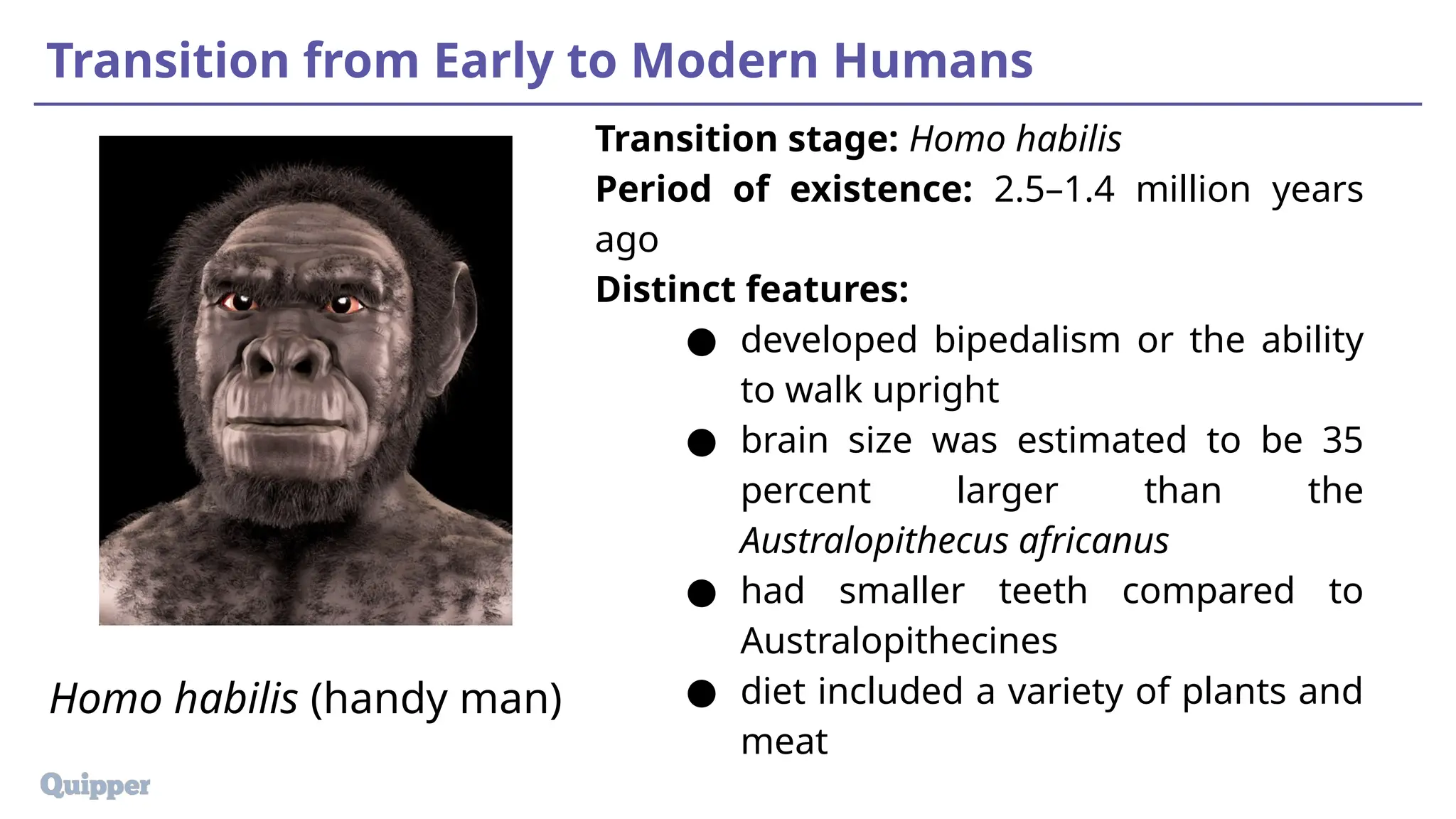
Transition stage: Homo habilis
Period of existence: 2.5–1.4 million years
ago
Distinct features:
● developed bipedalism or the ability
to walk upright
● brain size was estimated to be 35
percent larger than the
Australopithecus africanus
● had smaller teeth compared to
Australopithecines
● diet included a variety of plants and
meat
Homo habilis (handy man)
Transition from Early to Modern Humans
Transition stage: Homo erectus
Period of existence: 1.9 million years ago
Distinct features:
● further enhanced bipedal activities
● characterized by bigger bodies,
strong muscles at the back of the
neck, shallow forehead, and
elongated brain case
● diet included an increased
consumption of meat
Homo erectus
(the upright man)
Transition from Early to Modern Humans
Transition stage: Homo sapiens
Period of existence: 400,000 years ago to
the present
Distinct features:
● average brain capacity of 82 cubic
inches
● characterized by a high forehead,
small teeth and jaw, and defined
chin
● constructed and used tools for
survival
● developed a symbolic
communication system
Homo sapiens
(the wise man)
The Significance of Artifactual Evidence in Understanding Evolution
Artifactual evidence is the
only source of knowledge
in understanding the
lifestyle and developments
that occurred in each
transitional stage of
human evolution.
Appreciating the Past through the Present
It is important for
modern humans to
learn about their
origins and
developments.
Why Archaeology and
Artifacts Matter?
PERSPECTIVE-AT-WORK
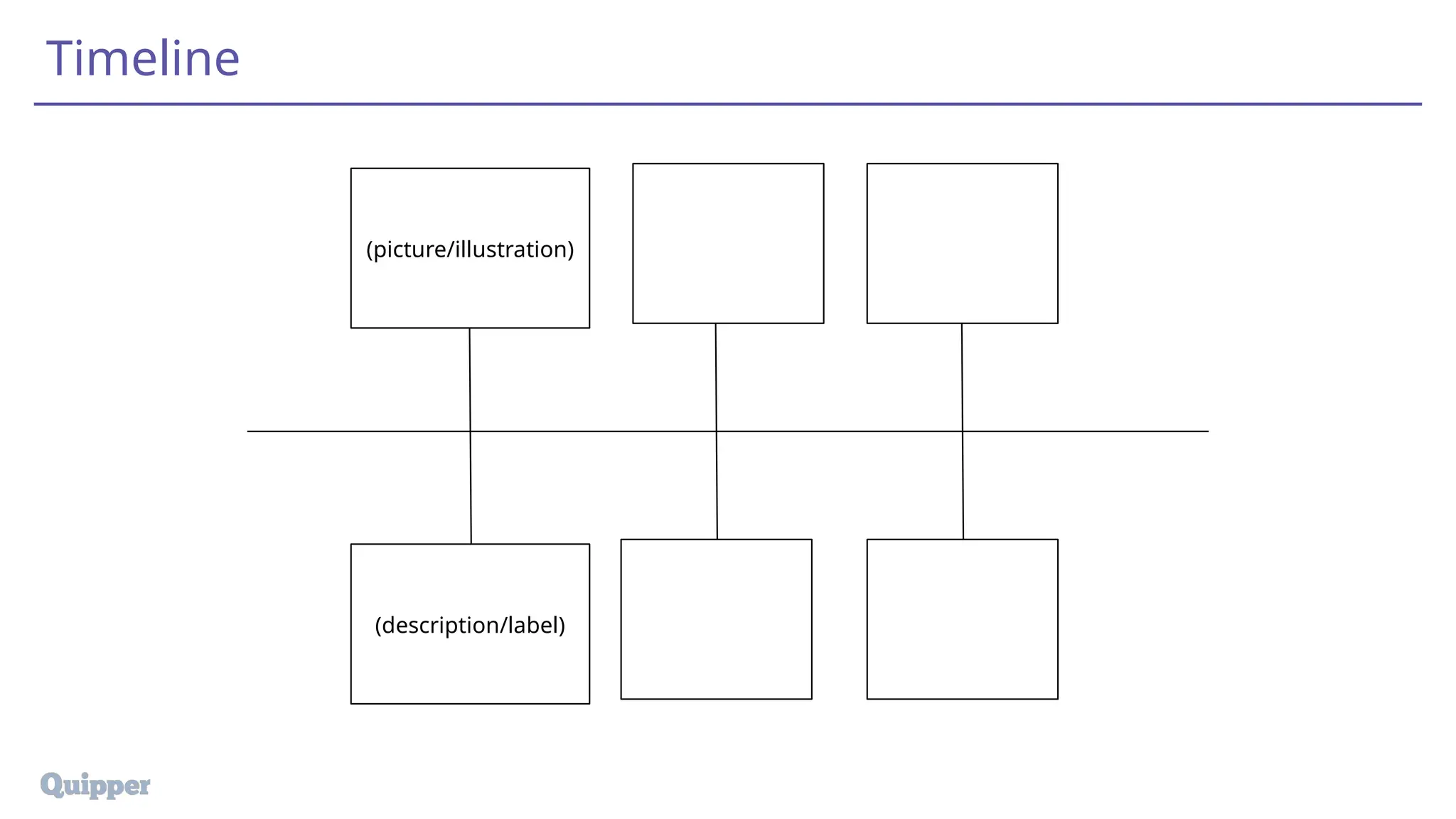
Timeline
Let us create a timeline
showing the biological
evolution of man.
Timeline
1. Read the study guide and/or
conduct further research about
the biological evolution of man.
2. Create a timeline showing the
biological evolution of man or the
transition stages from early to
modern humans.
3. Write or include brief
descriptions, illustrations, or
pictures for each stage.
Timeline
(picture/illustration)
(description/label)
1. Based on currently available archaeological evidences, what are
the main transition stages in the human biological evolution?
2. What are the biological characteristics that differentiate each
transition stage from their ancestors?
3. What makes the study of the human biological evolution relevant
to contemporary times?
Activation
Timeline
Environmental Evolution
Stoplight
STOP START
CONTINUE
PHOTO CREDITS
Slide 5: National Museum of Natural History (Manila) by Manager27 is licensed under CC BY-SA 4.0 via
Wikimedia Commons.
Slide 10: Photograph of Charles Darwin taken around 1874 by Leonard Darwin by Craigboy is in the public domain
via Wikimedia Commons.
Slide 11: Homo habilis - forensic facial reconstruction/approximation by Cicero Moraes is licensed under
CC BY-SA 4.0 via Wikimedia Commons.
Slide 12: Homo Erectus Adult Female by Tim Evanson is licensed under CC BY-SA 2.0 via flickr.
Slide 13: Homo Sapiens Neolithic Reconstruction by MUSE - Science Museum is licensed under CC BY 3.0 via
Wikimedia Commons.
REFERENCES
Barrett, John C. Archaeology and its Discontents: Why Archaeology Matters (1st ed.). Routledge, 2021.
https://doi.org/10.4324/9781003096115.
De Guzman, Chad. April 11, 2019. “Meet the Filipino professor who led the discovery of a new human-linked
species.” CNN Philippines.
https://www.cnnphilippines.com/news/2019/4/11/Armand-Mijares-Filipino-archaeologist-Homo-luzon
ensis.html
.
Encarnacion, Andre DP. “UP-led international team discovers new human species in the Philippines.”
University of the Philippines. April 11, 2019.
https://up.edu.ph/up-led-international-team-discovers-new-human-species-in-the-philippines/.
Gascon, Melvin. April 12, 2019. “Philippine cave discovery: Meet ‘Homo luzonensis’.” Philippine Daily Inquirer.
https://newsinfo.inquirer.net/1106031/philippine-cave-discovery-meet-homo-luzonensis.
International Democracy and Electoral Assistance (IDEA). “Democracy Talks in Manila – The Role of Youth
Voices in Philippine Democracy. ” IDEA. December 8, 2020.
https://www.idea.int/news-media/events/democracy-talks-manila-%E2%80%93-role-youth-voices-phili
ppine-democracy
.
REFERENCES
Mijares, Armand, et. al. “New evidence for a 67,000-year-old human presence at Callao Cave, Luzon,
Philippines. Journal of Human Evolution Volume 59, No. 1, 2010: 124-132.
https://doi.org/10.1016/j.jhevol.2010.04.008.
National Museum. “History.” Accessed December 10, 2022.
https://www.nationalmuseum.gov.ph/about-us/history/.
Office of the Wyoming State Archaeologists. “Why Archaeology Matters” Accessed December 12, 2022.
https://wyoarchaeo.wyo.gov/index.php/wyoming-archaeology/why-archaeology-matters.
Teehankee, Julio C. and Calimbalin, Cleo Anne A. “Mapping the Philippines’ Defective Democracy.” Asian
Affairs: An American Review 47, no. 2 (December 27, 2019): 97–125.
https://doi.org/10.1080/00927678.2019.1702801.
School of Archaeology - University of Oxford. “Why Archaeology Matters.” Accessed December 12, 2022.
https://www.arch.ox.ac.uk/why-archaeology-matters#:~:text=Archaeology%20gives%20us%20the%20t
ools,countries%2C%20places%20and%20cultures%20interact
.
School of Archaeology - University of the Philippines. “Armand B. Mijares.” Accessed December 10, 2022.
https://asp.upd.edu.ph/faculty/armandmijares.html.

UCSP 11_12 Q1 0501 Biological Evolution of Man PS.pptx

  • 1.
    Make a copyand edit in Google Slides. 1. On the menu bar, click File and then Make a copy and Entire Presentation. 2. Type a name for the file. 3. Choose where to save it on your Google Drive. 4. Click Ok. 5. A new tab will open. Wait for the file to be completely loaded on a new tab. 6. Once the file has loaded, edit this presentation using Google Slides. Download an offline copy and edit in Microsoft PowerPoint. 1. On the menu bar, click File and then Download as. 2. Choose a file type. Select Microsoft PowerPoint (.pptx). 3. Wait for the file to be downloaded to your local disk. 4. Once completely downloaded, open the file and edit it using Microsoft PowerPoint or any offline presentation program. Do You Want to Edit This Presentation?
  • 2.
    Unit 5 Human Bioculturaland Social Evolution Understanding Culture, Society, and Politics
  • 3.
    LEARNING TARGETS At theend of this unit, you should be able to do the following: ● Trace the biological and cultural evolution of early to modern humans. ● Explore the significance of human material remains and artifactual evidence in interpreting cultural and social, including political and economic, processes. ● Recognize national, local, and specialized museums and archaeological and historical sites as venues to appreciate and reflect on the complexities of biocultural and social evolution as part of being and becoming human.
  • 4.
    VALUES AND ATTITUDES ●Explore and learn new things. ● Increase resourcefulness, creativity, and productivity. ● Exercise intellectual curiosity. In this unit, you should be able to do the following:
  • 5.
    A Visit tothe National Museum CONTEMPORARY EXPERIENCE
  • 6.
  • 7.
    How did humansand society evolve biologically, culturally, and socially? CENTRAL QUESTION
  • 8.
    Biological Evolution ofMan Lesson 1 Unit 5| Human Biocultural and Social Evolution Understanding Culture, Society, and Politics
  • 9.
    The Meaning andSignificance of Human Biological Evolution Evolution is the process of developing physical and biological characteristics over a period of time.
  • 10.
    The Meaning andSignificance of Human Biological Evolution The theory of evolution proposed that the current human race spurred from a line of primates that evolved through the “survival of the fittest,” wherein primitive species competed with each other for survival. Charles Darwin
  • 11.
    Transition from Earlyto Modern Humans Transition stage: Homo habilis Period of existence: 2.5–1.4 million years ago Distinct features: ● developed bipedalism or the ability to walk upright ● brain size was estimated to be 35 percent larger than the Australopithecus africanus ● had smaller teeth compared to Australopithecines ● diet included a variety of plants and meat Homo habilis (handy man)
  • 12.
    Transition from Earlyto Modern Humans Transition stage: Homo erectus Period of existence: 1.9 million years ago Distinct features: ● further enhanced bipedal activities ● characterized by bigger bodies, strong muscles at the back of the neck, shallow forehead, and elongated brain case ● diet included an increased consumption of meat Homo erectus (the upright man)
  • 13.
    Transition from Earlyto Modern Humans Transition stage: Homo sapiens Period of existence: 400,000 years ago to the present Distinct features: ● average brain capacity of 82 cubic inches ● characterized by a high forehead, small teeth and jaw, and defined chin ● constructed and used tools for survival ● developed a symbolic communication system Homo sapiens (the wise man)
  • 14.
    The Significance ofArtifactual Evidence in Understanding Evolution Artifactual evidence is the only source of knowledge in understanding the lifestyle and developments that occurred in each transitional stage of human evolution.
  • 15.
    Appreciating the Pastthrough the Present It is important for modern humans to learn about their origins and developments.
  • 16.
    Why Archaeology and ArtifactsMatter? PERSPECTIVE-AT-WORK
  • 17.
    Timeline Let us createa timeline showing the biological evolution of man.
  • 18.
    Timeline 1. Read thestudy guide and/or conduct further research about the biological evolution of man. 2. Create a timeline showing the biological evolution of man or the transition stages from early to modern humans. 3. Write or include brief descriptions, illustrations, or pictures for each stage.
  • 19.
  • 20.
    1. Based oncurrently available archaeological evidences, what are the main transition stages in the human biological evolution? 2. What are the biological characteristics that differentiate each transition stage from their ancestors? 3. What makes the study of the human biological evolution relevant to contemporary times? Activation Timeline
  • 21.
  • 25.
  • 26.
    PHOTO CREDITS Slide 5:National Museum of Natural History (Manila) by Manager27 is licensed under CC BY-SA 4.0 via Wikimedia Commons. Slide 10: Photograph of Charles Darwin taken around 1874 by Leonard Darwin by Craigboy is in the public domain via Wikimedia Commons. Slide 11: Homo habilis - forensic facial reconstruction/approximation by Cicero Moraes is licensed under CC BY-SA 4.0 via Wikimedia Commons. Slide 12: Homo Erectus Adult Female by Tim Evanson is licensed under CC BY-SA 2.0 via flickr. Slide 13: Homo Sapiens Neolithic Reconstruction by MUSE - Science Museum is licensed under CC BY 3.0 via Wikimedia Commons.
  • 27.
    REFERENCES Barrett, John C.Archaeology and its Discontents: Why Archaeology Matters (1st ed.). Routledge, 2021. https://doi.org/10.4324/9781003096115. De Guzman, Chad. April 11, 2019. “Meet the Filipino professor who led the discovery of a new human-linked species.” CNN Philippines. https://www.cnnphilippines.com/news/2019/4/11/Armand-Mijares-Filipino-archaeologist-Homo-luzon ensis.html . Encarnacion, Andre DP. “UP-led international team discovers new human species in the Philippines.” University of the Philippines. April 11, 2019. https://up.edu.ph/up-led-international-team-discovers-new-human-species-in-the-philippines/. Gascon, Melvin. April 12, 2019. “Philippine cave discovery: Meet ‘Homo luzonensis’.” Philippine Daily Inquirer. https://newsinfo.inquirer.net/1106031/philippine-cave-discovery-meet-homo-luzonensis. International Democracy and Electoral Assistance (IDEA). “Democracy Talks in Manila – The Role of Youth Voices in Philippine Democracy. ” IDEA. December 8, 2020. https://www.idea.int/news-media/events/democracy-talks-manila-%E2%80%93-role-youth-voices-phili ppine-democracy .
  • 28.
    REFERENCES Mijares, Armand, et.al. “New evidence for a 67,000-year-old human presence at Callao Cave, Luzon, Philippines. Journal of Human Evolution Volume 59, No. 1, 2010: 124-132. https://doi.org/10.1016/j.jhevol.2010.04.008. National Museum. “History.” Accessed December 10, 2022. https://www.nationalmuseum.gov.ph/about-us/history/. Office of the Wyoming State Archaeologists. “Why Archaeology Matters” Accessed December 12, 2022. https://wyoarchaeo.wyo.gov/index.php/wyoming-archaeology/why-archaeology-matters. Teehankee, Julio C. and Calimbalin, Cleo Anne A. “Mapping the Philippines’ Defective Democracy.” Asian Affairs: An American Review 47, no. 2 (December 27, 2019): 97–125. https://doi.org/10.1080/00927678.2019.1702801. School of Archaeology - University of Oxford. “Why Archaeology Matters.” Accessed December 12, 2022. https://www.arch.ox.ac.uk/why-archaeology-matters#:~:text=Archaeology%20gives%20us%20the%20t ools,countries%2C%20places%20and%20cultures%20interact . School of Archaeology - University of the Philippines. “Armand B. Mijares.” Accessed December 10, 2022. https://asp.upd.edu.ph/faculty/armandmijares.html.

Editor's Notes

  • #2 Teacher’s script: “Welcome to the fifth unit of Understanding Culture, Society, and Politics. In this unit, we will discuss human development from biological, cultural and sociopolitical perspectives.”
  • #3 Teacher’s script: “Here are the learning targets for this unit. I will give you two minutes to go through them silently. Let me know if you have any questions.”
  • #4 Teacher’s script: “Listed here are what you are expected to do as part of your values and attitudes integration. You have two minutes to go through them silently. Let me know if you have any questions.”
  • #5 Teacher’s script: “Have you ever visited the National Museum of the Philippines? One way to experience the past is to visit a museum. In the Philippines, we have the National Museum of the Philippines to help us look beyond the country's prehistoric and historical past. The National Museum of the Philippines is mandated to manage and develop museums and collections significant to the country's art, cultural, and natural history. Visit these museums, get a free pass, earn an appreciation of what "was," and get a look at what "is" and what "will be." Note: You may refer to the Contemporary Experience section of the teaching guide on page 2.
  • #6 Teacher’s script: Use this prompt to introduce the activity: “What comes to mind when you hear the word evolution?” Provide this instruction to the class: Describe the word evolution with a word or phrase using the letters of the word. Note: The activity may be done individually or as a class.
  • #7 Teacher’s script: “Would anyone like to answer the central question?” Note: Allow some of the learners to volunteer their answers. “Thank you for your answers. Let us check if you are correct as we go along our lessons. This unit will explore man’s long prehistory and the history of biocultural and social evolution that brought us where we are today.”
  • #8 Teacher’s script: “In our first lesson, we will tackle the biological evolution of humans.”
  • #9 Teacher’s script: Ask the following questions to introduce the topic: Picture yourself living two million years ago when societies were not established yet and humans have not developed into their modern biological states. Given this, how would you describe life back then? What challenges did early humans have to go through in order to survive? Discuss it further. “Natural changes and events forced different species to adapt to the environment, while some faced extinction for being unable to do so.” Note: You may refer to the discussions on pages 5–6 of the study guide.
  • #10 Teacher’s script: Ask a learner to read the sentence and reflect on what it means. Give this example. “The concept of ‘survival of the fittest’ suggests that different species existed, but only those that evolved and adapted to their environments remained.” Ask the learners this question. “Do you think that humans are superior beings because they survived the harsh competition among species?” Note: Use the learners’ answers to explain further the meaning of evolution.
  • #11 Teacher’s script: Use this prompt to introduce the discussion: “The Homo habilis was one of the earliest species of the genus Homo.” Ask a learner to read the features presented in the slide. Explain the transition stage further. Note: You may refer to the discussions on pages 7–8 of the study guide.
  • #12 Teacher’s script: Use this prompt to introduce the discussion: “The full development of bipedalism peaked with the Homo erectus, thus gaining the nickname the upright man.” Ask a learner to read the features presented in the slide. Explain the transition stage further. Note: You may refer to the discussions on pages 7–8 of the study guide.
  • #13 Teacher’s script: Use this prompt to introduce the discussion: “All present human beings belong to the species Homo sapiens.” Ask a learner to read the features presented in the slide. Explain the transition stage further. Note: You may refer to the discussions on pages 7–8 of the study guide.
  • #14 Teacher’s script: Use this prompt to introduce the discussion: “Early human species are discovered through fossils which are remains hardened in rock. Scientists study the structure, shape, and development of skeletal properties including head shape and teeth to determine biological differences across early to modern species.” Ask the following questions to the class: Can you give examples of artifactual evidence found in the world? Can you give the importance of such finds in the world of knowledge? Use the learners’ answers to explain the concepts further. Note: You may refer to the discussions on pages 8–9 of the study guide.
  • #15 Teacher’s script: Use this prompt to introduce the discussion: “It is important for modern humans to learn about their origins and developments. Do you agree or disagree? Explain your answer.” Ask these questions to the class: Can you give concrete ways on how a person can show his or her appreciation towards learning about the distant past? Can you provide websites or apps where one can learn more about archaeology or the distant past? Use the learners’ answers to explain the concepts further. Note: You may refer to the discussions on pages 9–10 of the study guide.
  • #16 Teacher’s script: Use this prompt to introduce this topic: “As archaeology and its artifacts shed light on the distant past and the underlying significance of every find, there is a persistent question about its relevance in the curriculum, especially in these modern times of advanced technology where everything feels borderless and limitless.” Ask the learners this question: Why do archaeology and artifacts matter? Provide some expert answers: The University of Oxford (2022) says, “Archaeology gives us the tools to examine and explain human behavior, understand how society functions, learn from the past and apply those lessons to the present, and analyze the drivers and implications of a changing world and how different countries, places, and cultures interact.” Barrett (2021) argues that archaeology matters “precisely because of the insights it can offer into the development of human diversity.” According to the Office of the Wyoming State Archaeologists, “if we can understand how and why cultures changed in the past, we will have a better grasp of human behavior and how we shape our world.” Note: Read more in Perspective-at-Work on page 7 of the teaching guide.
  • #17 Teacher’s script: “Let us apply the theories we learned today through this activity.”
  • #18 Teacher’s script: “Read the instructions.”
  • #19 Teacher’s script: Provide the following instructions to the class: Use this format for your timeline. You are free to express your creativity in designing the timeline using computer softwares or paper-based materials.
  • #20 Teacher’s script: Ask the following questions to process the activity: Based on currently available archaeological evidences, what are the main transition stages in the human biological evolution? Possible answer: “Based on the currently available archeological evidences, human biological evolution went through three transition stages: Homo habilis, Homo erectus, and Homo sapiens.” What are the biological characteristics that differentiate each transition stage from their ancestors? Possible answer: “There are physical developments characterizing each transition stage. Homo habilis developed bipedalism, while Homo erectus evidently had increased body and brain size. Homo sapiens developed characteristics that are closer to the biological features of humans today, such as smaller teeth and jaw and a defined chin.” What makes the study of the human biological evolution relevant to contemporary times? Possible answer: “Modern humans need to learn about their origins and appreciate how each species developed their biological characteristics to adapt to their environment.”
  • #25 Teacher’s script: Randomly call learners for their key takeaways. Use the following questions as your guide: What are the things that you will stop doing? What are the things that you will continue doing? What are the things that you will start doing?