PERSONAL STATEMENT
WORKSHOP
2ND JUNE 2016
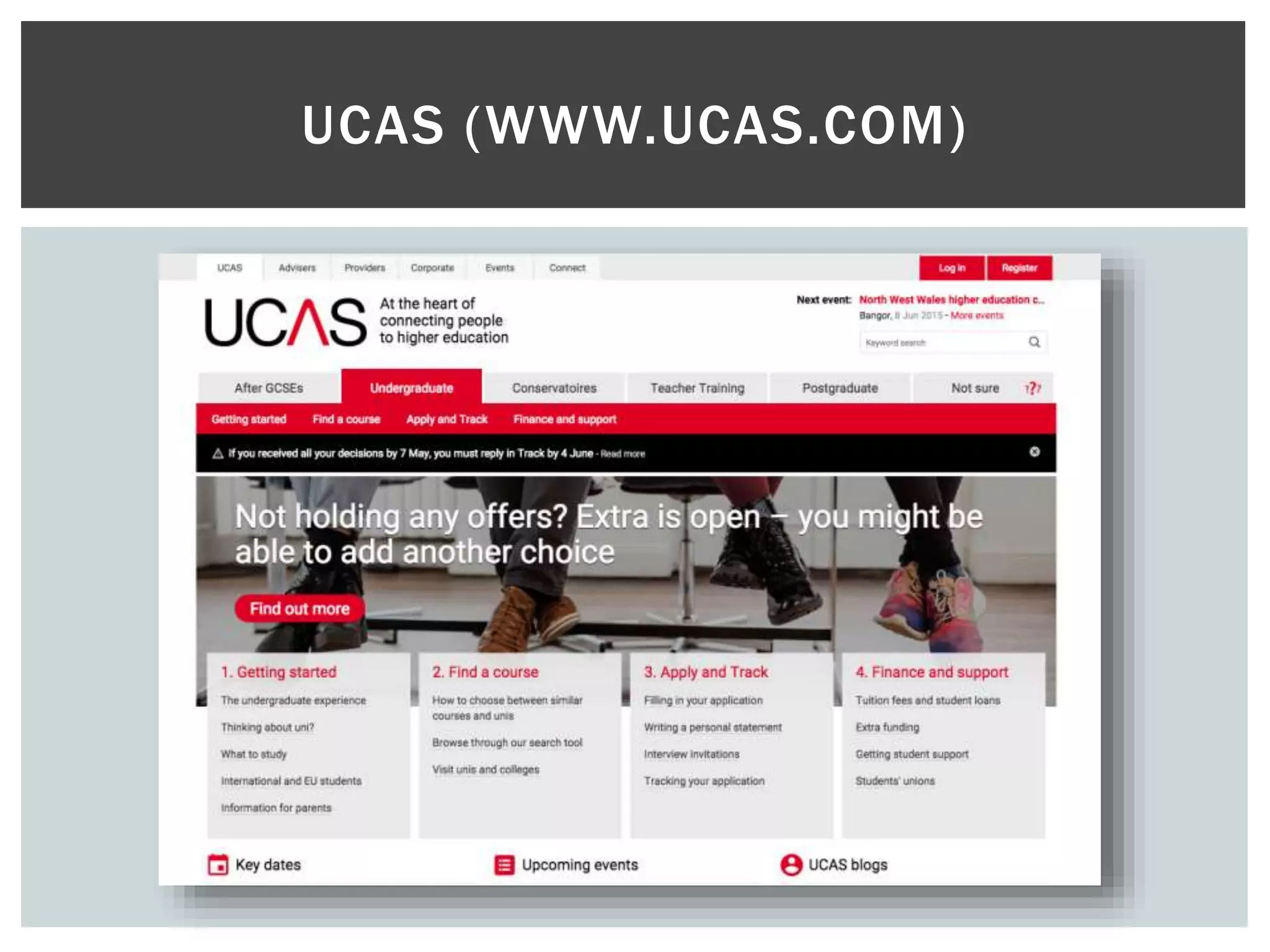
UCAS (WWW.UCAS.COM)
UCAS Application
(5 choices)
Teacher Reference
(teacher survey?)
IB Predicted Grades
Your Personal
Statement
UCAS APPLICATIONS
+
Make sure your teacher knows
he/she is writing a UK Reference!
An Introduction to the Personal Statement
What to Include
What not to Include
Some Tips and Advice
A Suggested Framework + Example
Mistakes Students Make
Questions and Answers
Useful Resources
WORKSHOP AGENDA
 Fun
 Dynamic teacher
 Interactive
 Popcorn!
US COLLEGE ESSAY WORKSHOP
Dark, wet and cold
Gets dark at like 2pm
Shops close at 3pm
No such thing as a
warm fuzzy
Endless exotic,
nutritional daily diet
of deep fried Fish and
Chips
In short, life is
miserable & bleak
YOU’RE GOING TO THE U.K.
More Conservative
Focused on your suitability for
your particular program of choice
Read by subject
tutors/professors
COMPARED TO THE US STYLE ESSAY
Three key ideas
THE BASICS
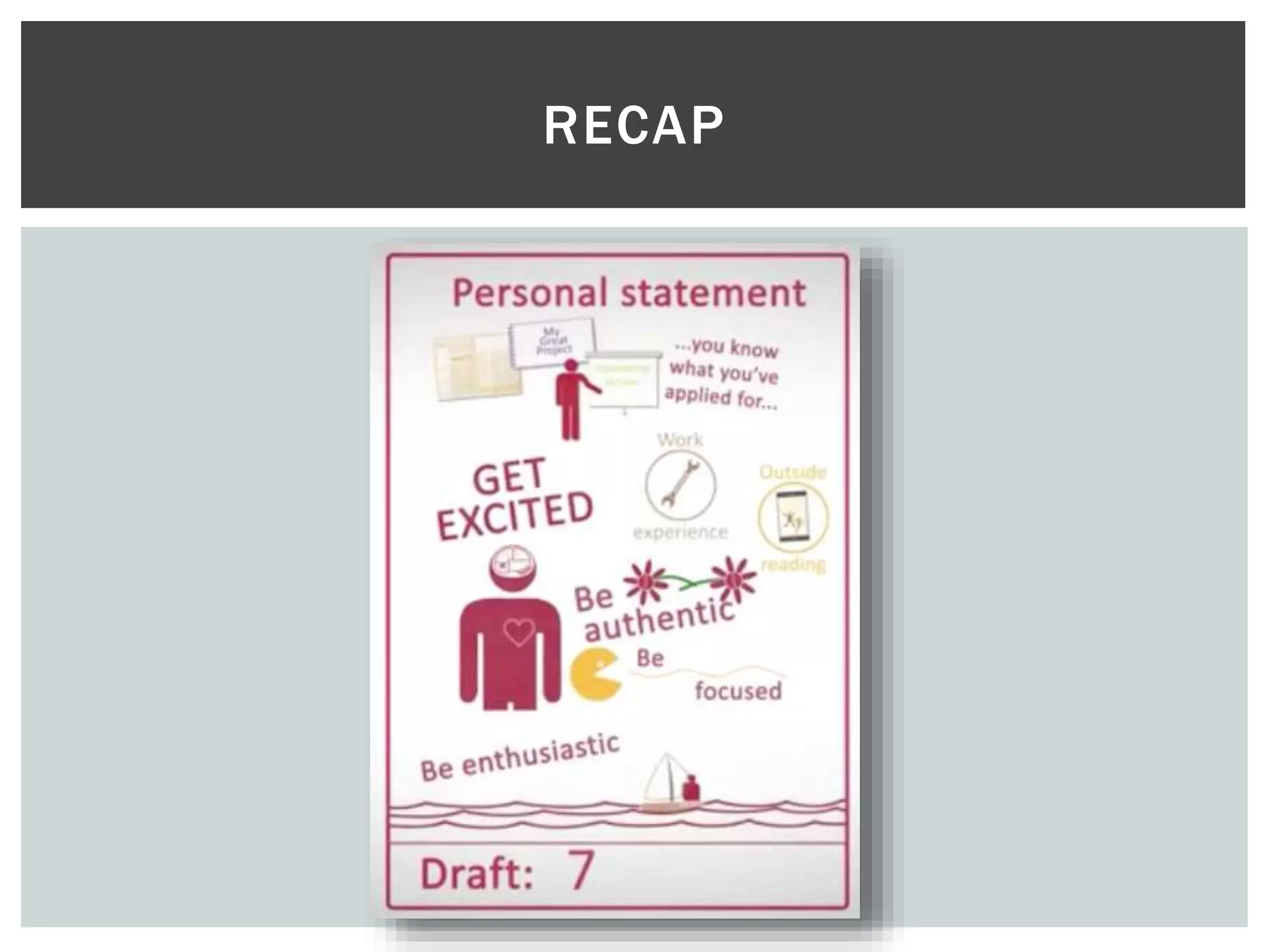
RECAP
 Punchy Opening Paragraph
 Why you’re so excited to study the subject
 Communicate how you really understand the course and
what you are getting to
 Evidence
 To prove your interest in a particular course
 “Sprinkle” in all your skills and good qualities to show you
can do it
 The End Bit
 The Personal Touch
 You are unique…things you are interested in that will help
you fit into university life as a whole
“WHAT MAKES YOU STAND OUT”
 Your chance to stand out from other applicants
 The one part of the process where you are in
complete control
 More conservative than a US College Essay
 You start with a blank piece of paper not a
response to a prompt (unlike the Common
Application)
 The same personal statement is sent to all of your
chosen universities
THE PERSONAL STATEMENT
XXXXXXXXXXXXXXXXX
 Four thousand characters maximum including all
punctuation and spaces
 Approximately five six-line paragraphs
 Must be succinct with no repetition or padding
 Everything that you choose to include should be
there for a reason
 It will require several re-writes (share it)
 Eventually you will copy and paste it into your
UCAS application
FOUR THOUSAND CHARACTERS
 Partly about you but mostly about your suitability
for a particular subject
 75% of it should be academically focused with 25%
about the all round student
 It should focus on particular skills and aptitudes
that will help you succeed
 Try to demonstrate a commitment to a subject or
subject area
WHAT TO INCLUDE
This is why it is so difficult, if not impossible to apply to different subject areas with your
UK universities.
 Why do you want to study that subject?
 When did you first realize this?
 What academic skills make you be a good fit for
that subject?
 The skills will depend on the course you have
applied to study
 What is it that they are they looking for?
ACADEMIC ATTRIBUTES
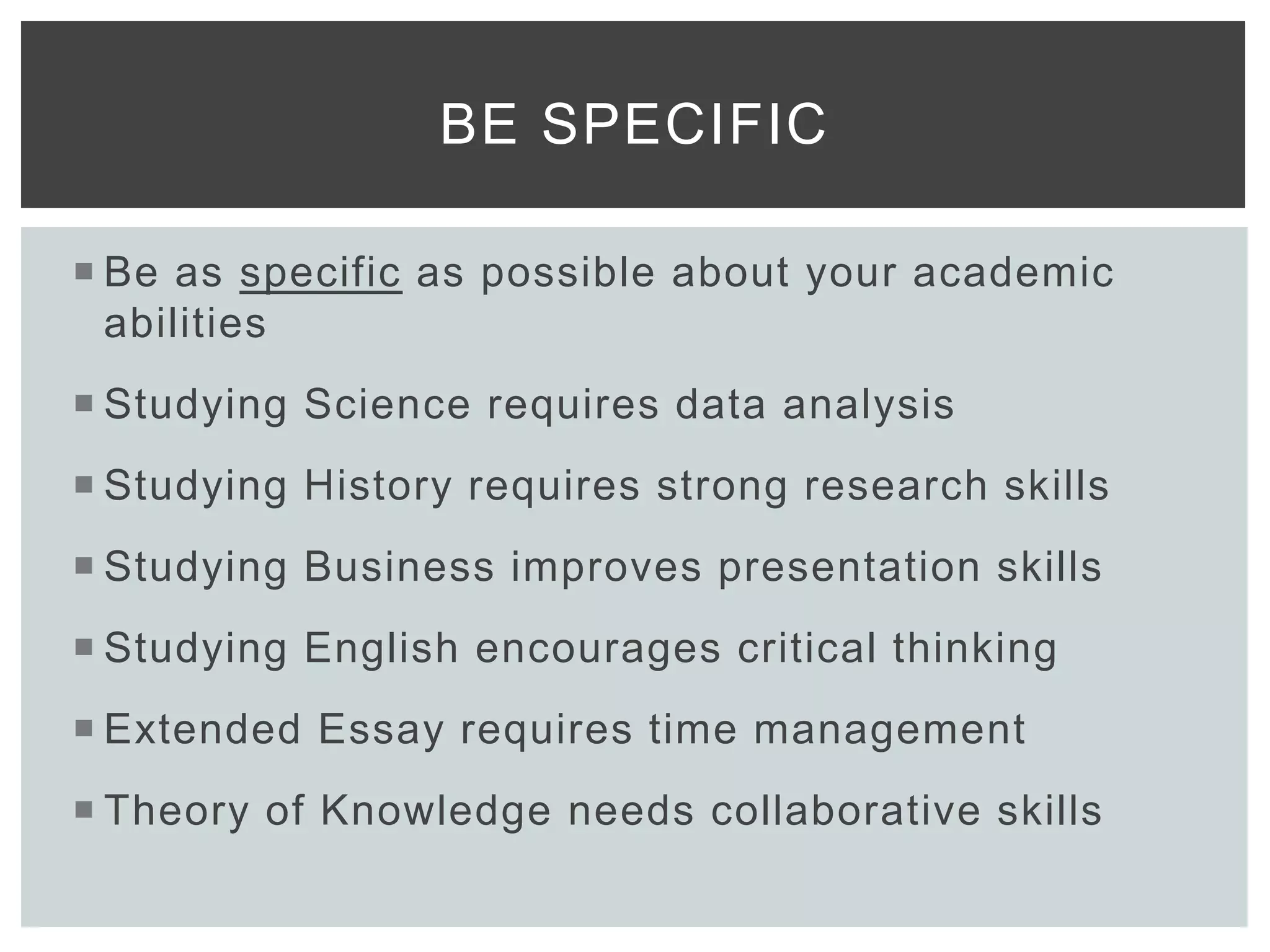
 Be as specific as possible about your academic
abilities
 Studying Science requires data analysis
 Studying History requires strong research skills
 Studying Business improves presentation skills
 Studying English encourages critical thinking
 Extended Essay requires time management
 Theory of Knowledge needs collaborative skills
BE SPECIFIC
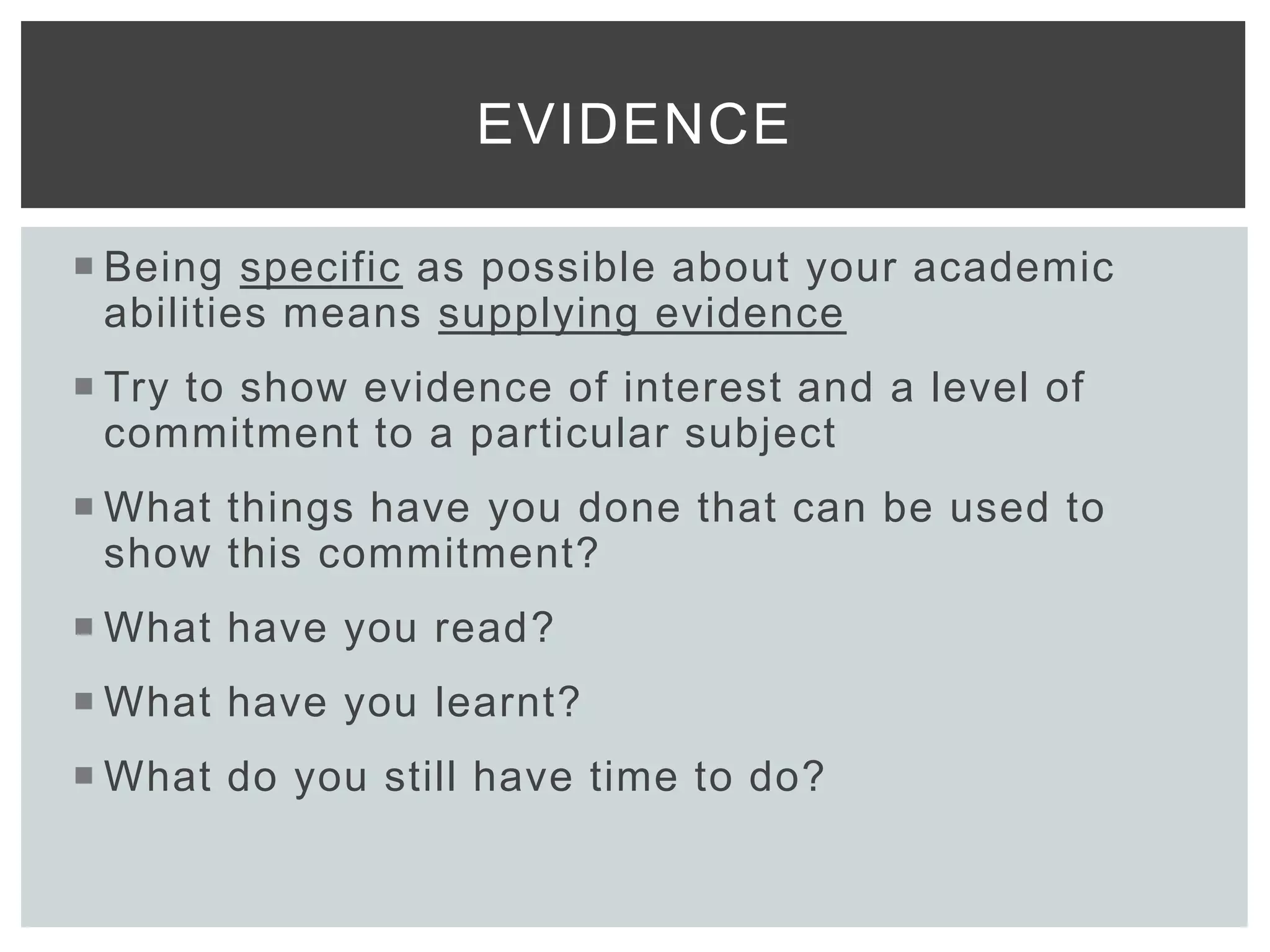
 Being specific as possible about your academic
abilities means supplying evidence
 Try to show evidence of interest and a level of
commitment to a particular subject
 What things have you done that can be used to
show this commitment?
 What have you read?
 What have you learnt?
 What do you still have time to do?
EVIDENCE
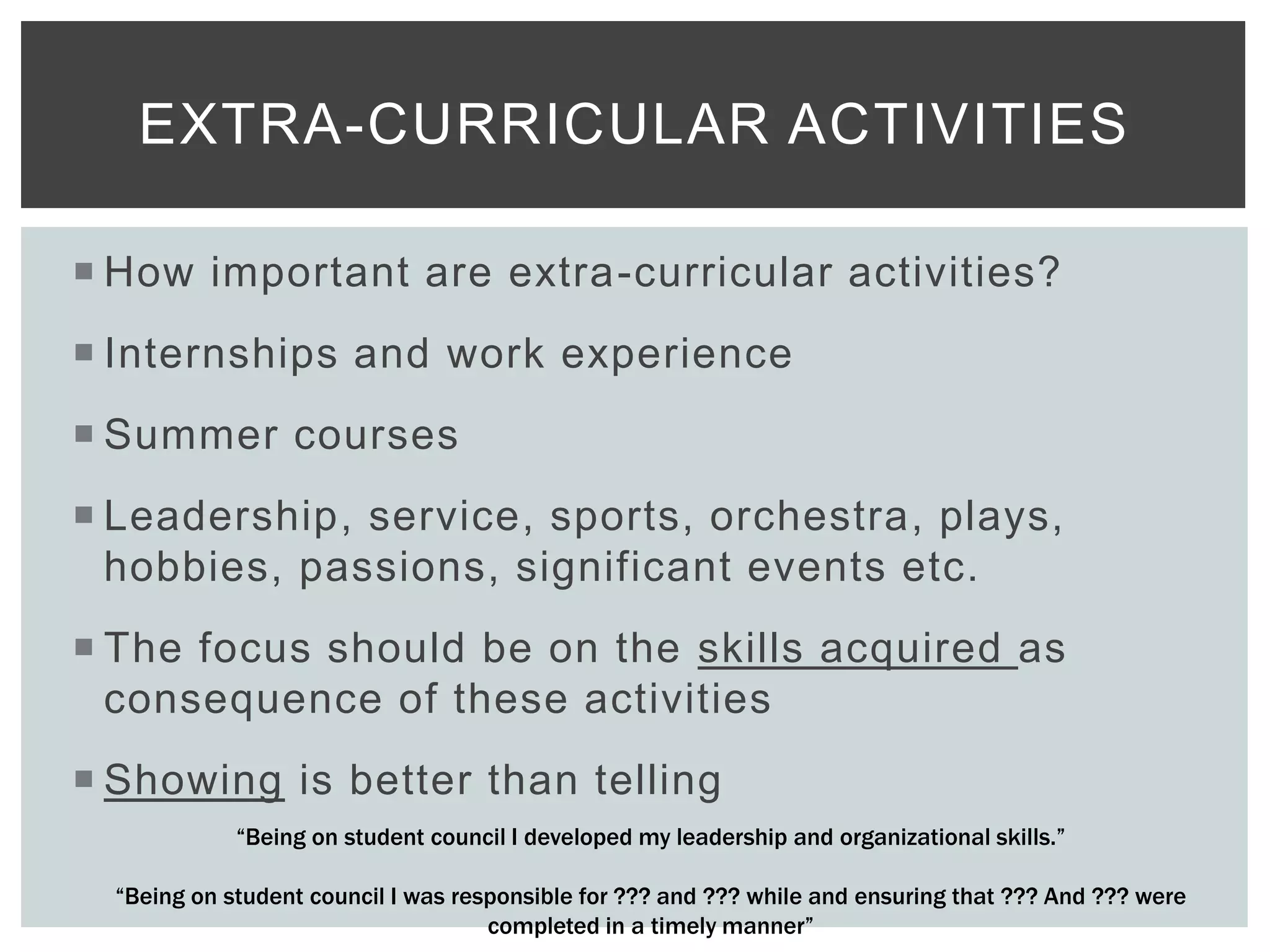
 How important are extra-curricular activities?
 Internships and work experience
 Summer courses
 Leadership, service, sports, orchestra, plays,
hobbies, passions, significant events etc.
 The focus should be on the skills acquired as
consequence of these activities
 Showing is better than telling
EXTRA-CURRICULAR ACTIVITIES
“Being on student council I developed my leadership and organizational skills.”
“Being on student council I was responsible for ??? and ??? while and ensuring that ??? And ??? were
completed in a timely manner”
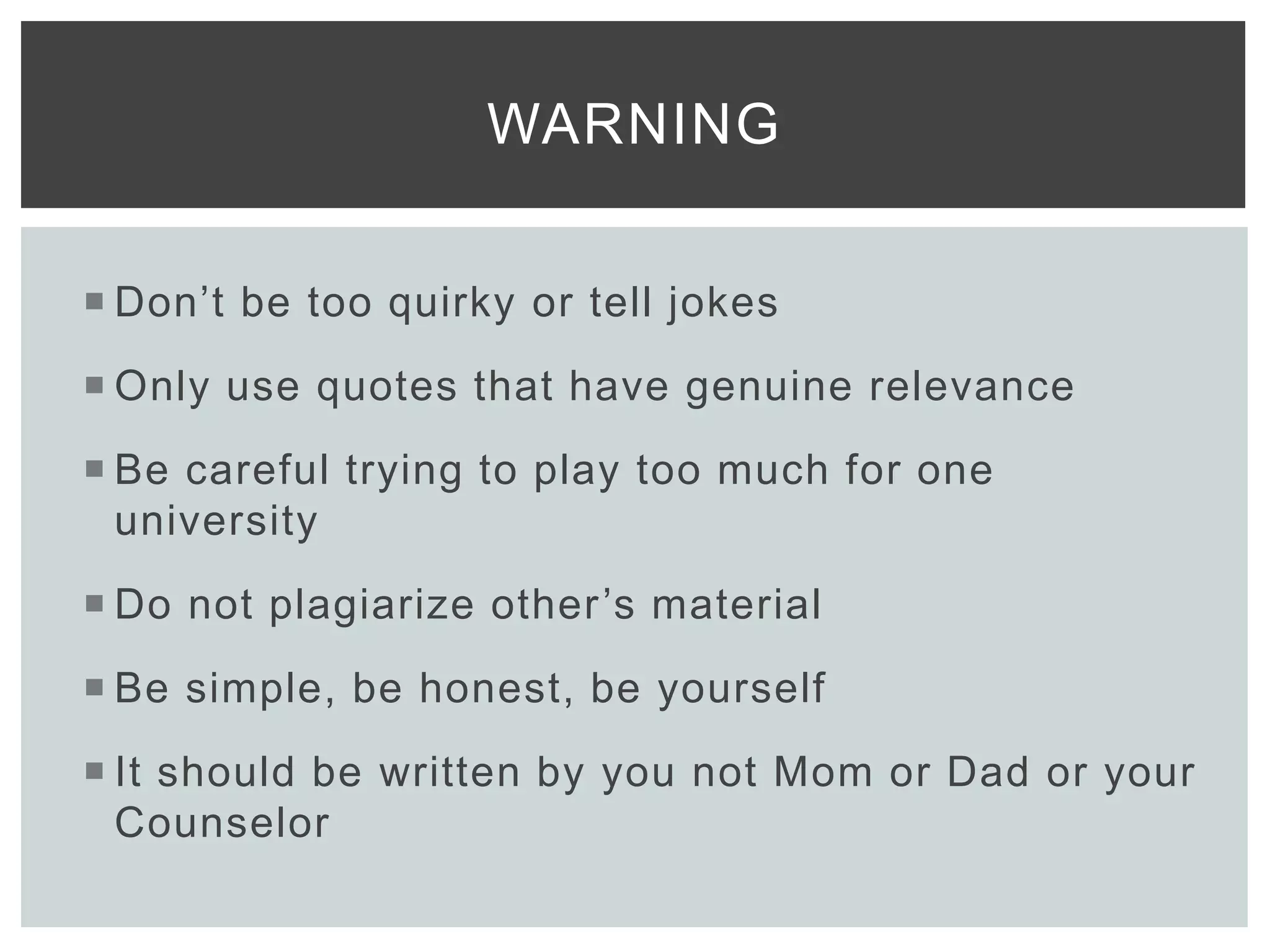
 Don’t be too quirky or tell jokes
 Only use quotes that have genuine relevance
 Be careful trying to play too much for one
university
 Do not plagiarize other’s material
 Be simple, be honest, be yourself
 It should be written by you not Mom or Dad or your
Counselor
WARNING
 Avoid providing information held elsewhere
 Spelling, punctuation and grammar
 Make sure every sentence counts
 Avoid name dropping to impress, ahead of
including things that are more important
 Don’t Lie
 Keep it positive
 Be smart about word choice and don’t be overly
wordy/poetic
TIPS AND STRATEGIES
WHAT DO PROFESSORS SAY?
A SUGGESTED FORMAT (5 PARAGRAPHS)
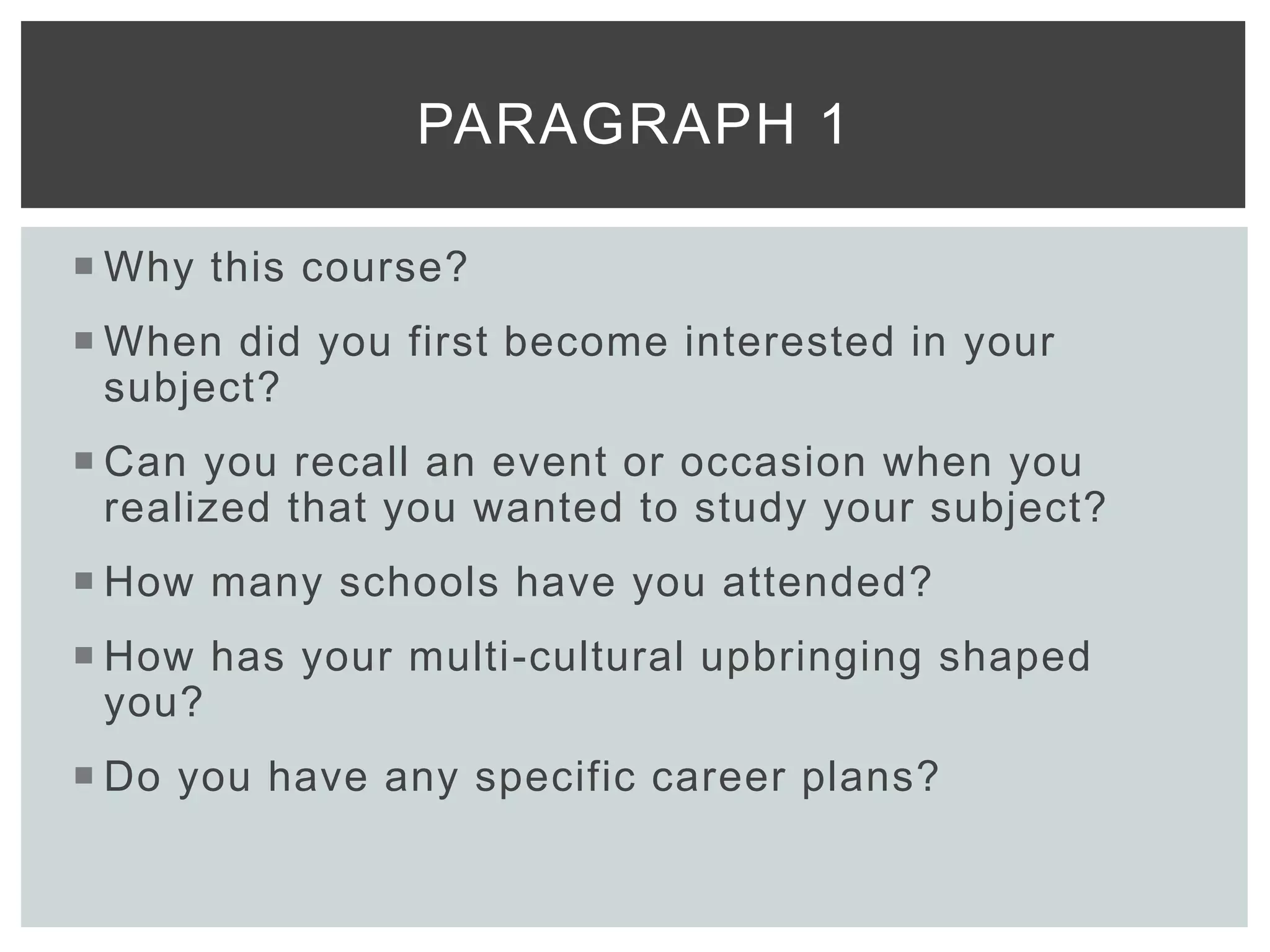
 Why this course?
 When did you first become interested in your
subject?
 Can you recall an event or occasion when you
realized that you wanted to study your subject?
 How many schools have you attended?
 How has your multi-cultural upbringing shaped
you?
 Do you have any specific career plans?
PARAGRAPH 1
 Are you an IB Diploma student?
 What motivated your choice of subjects?
 What have you learned from your higher level
subjects?
 Give evidence to demonstrate this learning
 What have you enjoyed?
 What interests and motivates you?
PARAGRAPH 2
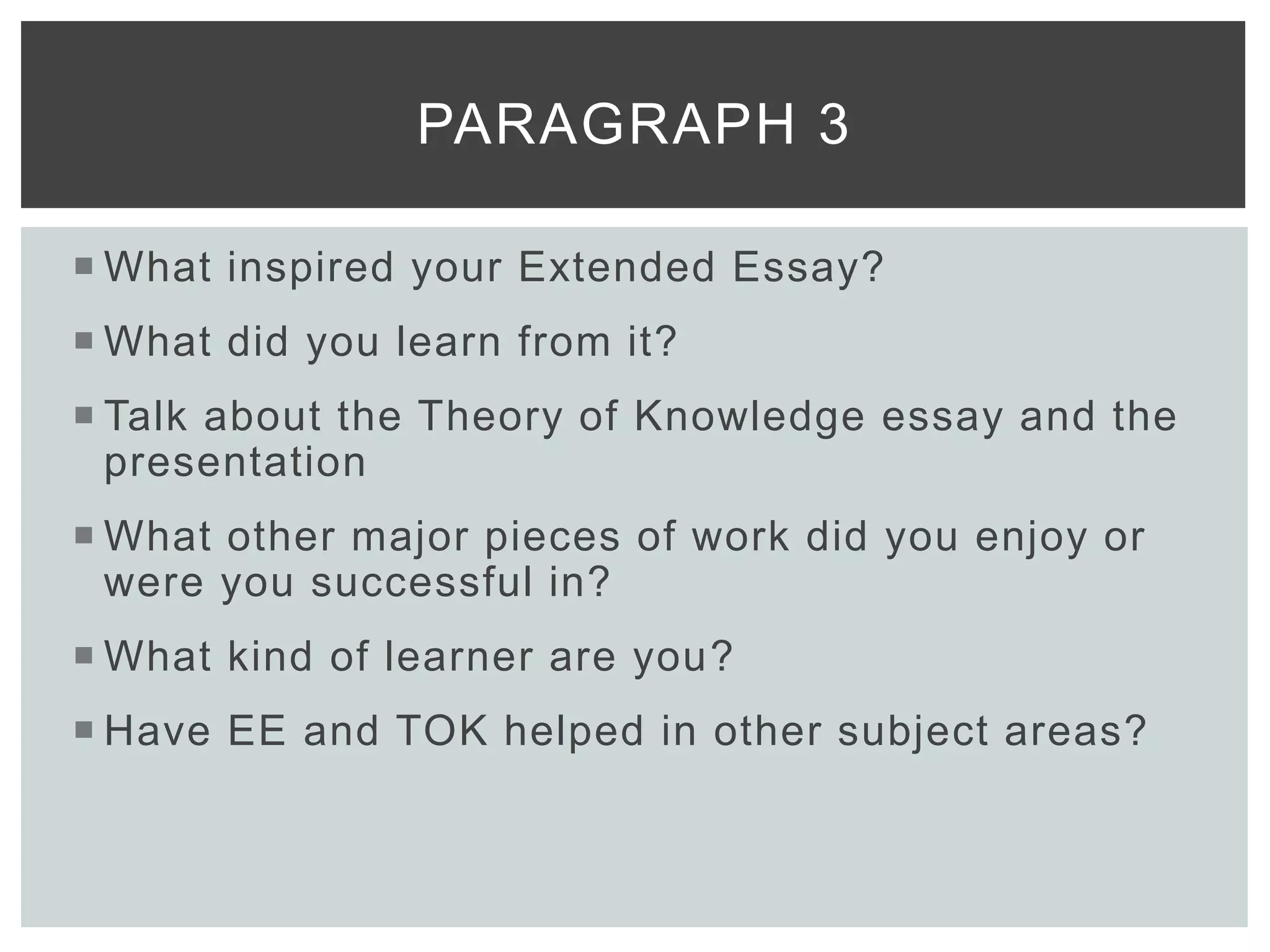
 What inspired your Extended Essay?
 What did you learn from it?
 Talk about the Theory of Knowledge essay and the
presentation
 What other major pieces of work did you enjoy or
were you successful in?
 What kind of learner are you?
 Have EE and TOK helped in other subject areas?
PARAGRAPH 3
 Extra curricular activities
 Class Councils and clubs
 Individual or team sports
 Dance, Drama, Music
 Hobbies outside of school
 CAS, ICare and service learning
 Less can be more
PARAGRAPH 4
Skills acquired that are
transferable to your
course of study and study
at the university level in
general
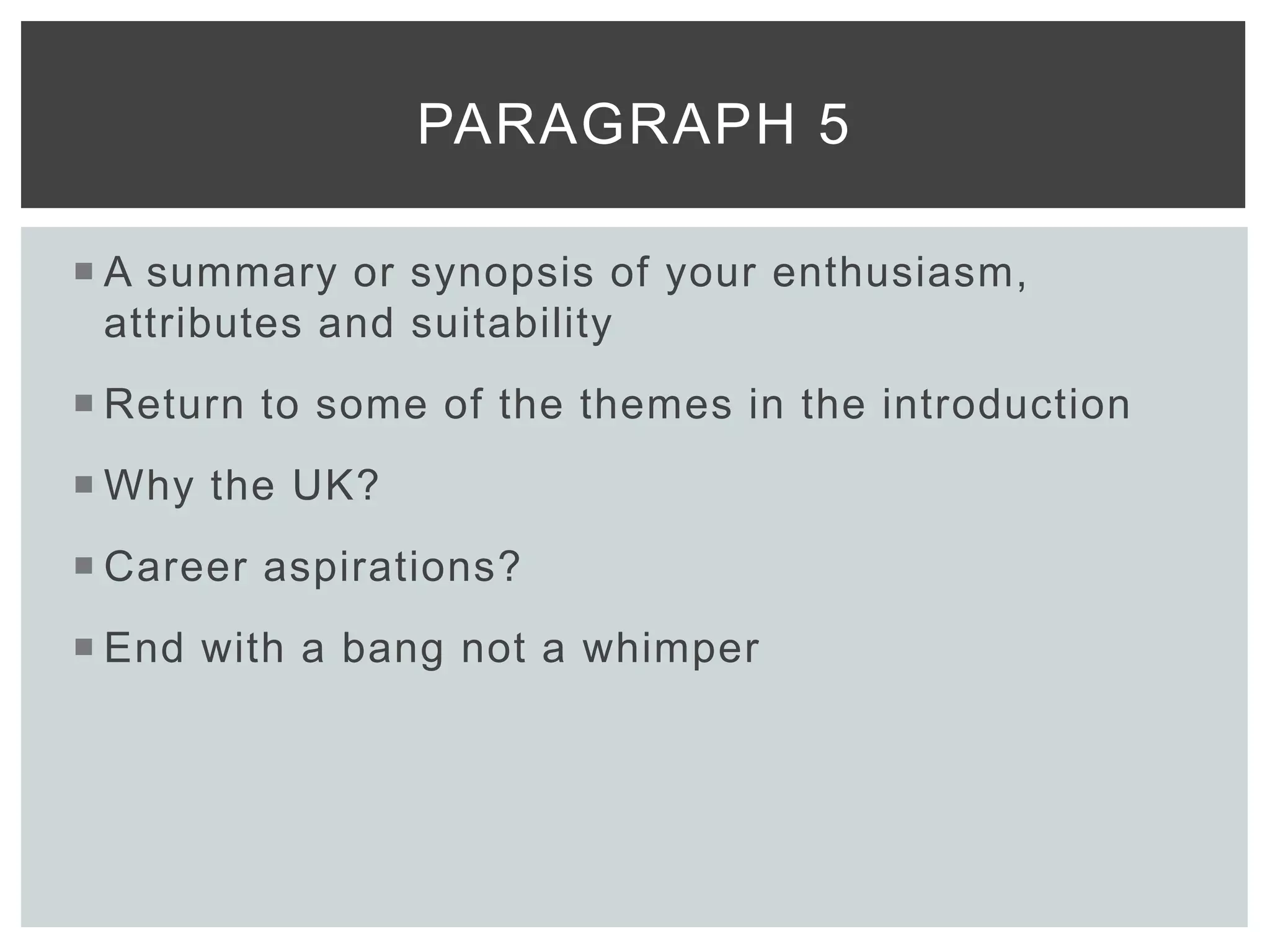
 A summary or synopsis of your enthusiasm,
attributes and suitability
 Return to some of the themes in the introduction
 Why the UK?
 Career aspirations?
 End with a bang not a whimper
PARAGRAPH 5
ONE REAL EXAMPLE
PARAGRAPH 1
• Why History?
• An event that contributed to wanting to study the subject
further
• The importance of History in his life
PARAGRAPH 2
• Where he’s studied and how that has helped him
• Historical connection to the countries he’s lived in (rich
historical backgrounds)
• Resiliency, adaptability, wider perspectives
• IB Diploma program and its benefits
PARAGRAPH 3
• Choice of Subjects for IB / Extended Essay Topic
• Highlighting what was learned / personal strengths
• Skills learned that are immediately applicable to university study
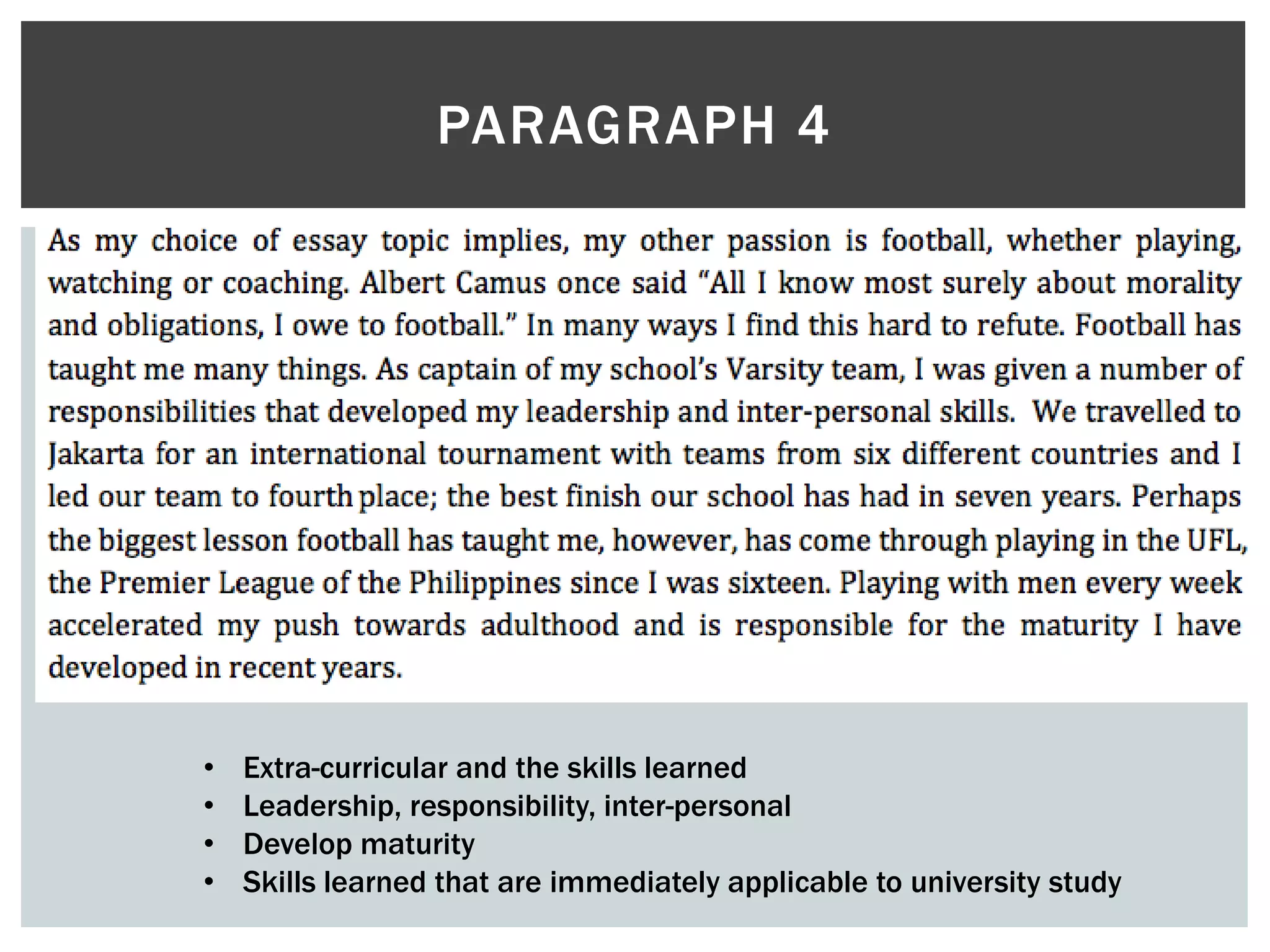
PARAGRAPH 4
• Extra-curricular and the skills learned
• Leadership, responsibility, inter-personal
• Develop maturity
• Skills learned that are immediately applicable to university study
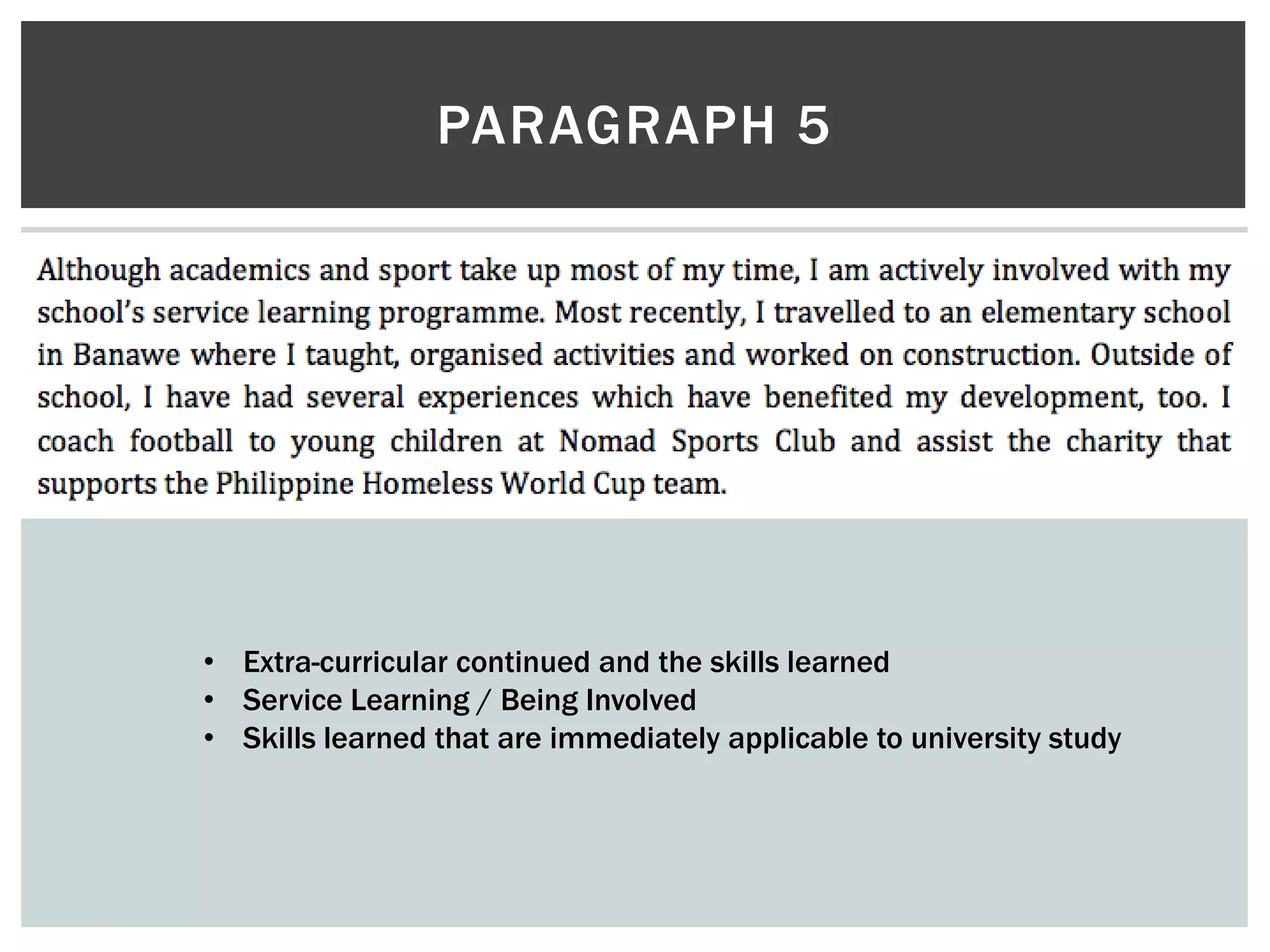
PARAGRAPH 5
• Extra-curricular continued and the skills learned
• Service Learning / Being Involved
• Skills learned that are immediately applicable to university study
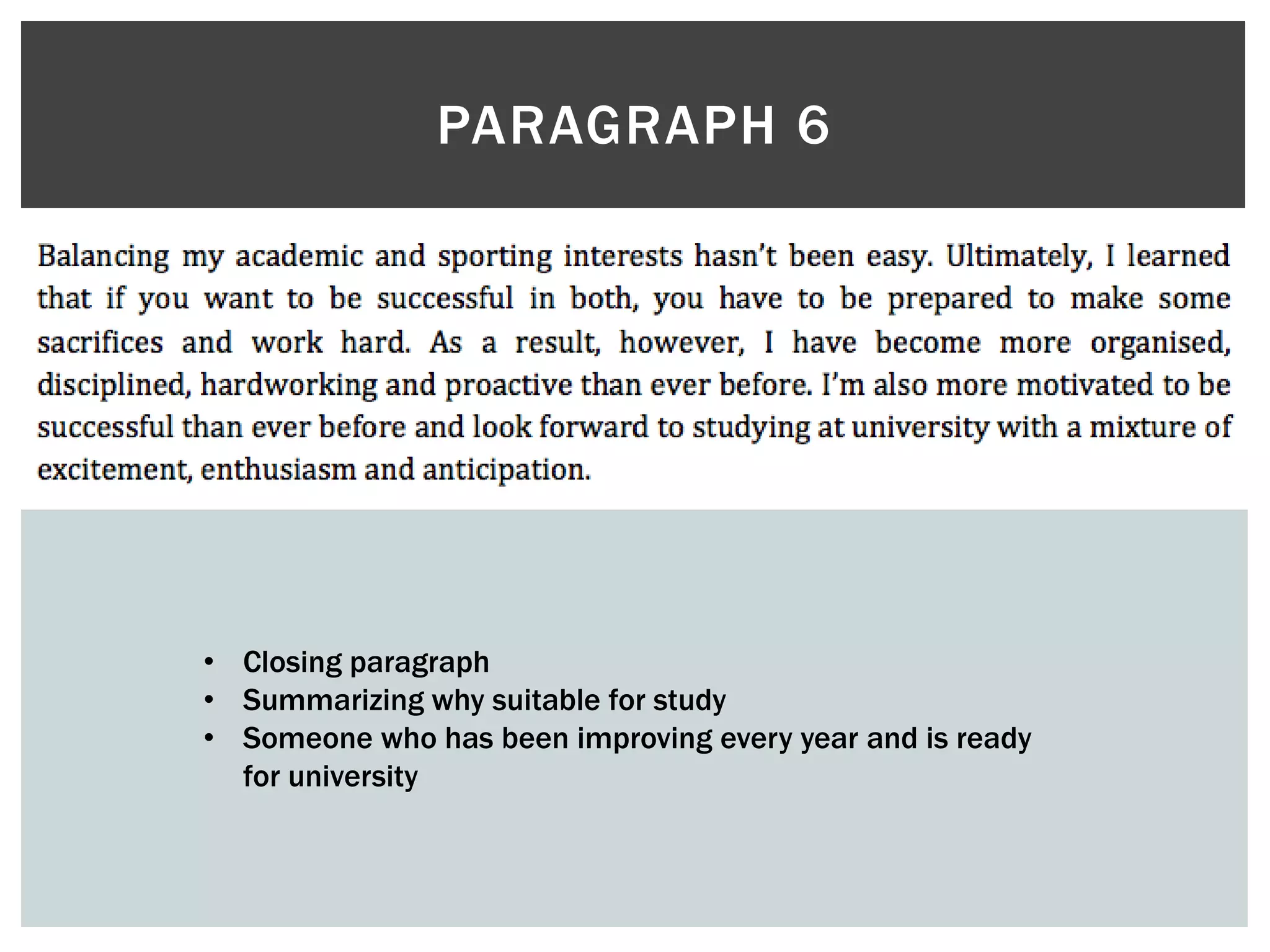
PARAGRAPH 6
• Closing paragraph
• Summarizing why suitable for study
• Someone who has been improving every year and is ready
for university
 Plagiarism
 Lying
 Applying Late
 Lack of Clarity
 Lack of Enthusiasm
 Not Enough Research
 Lack of Evidence
 Poor Attributes
 No Extra-Curricular
Stuff
 Lack of Work
Experience
 Underselling Yourself
 Spellcheck and
Grammar
 Malapropisms
 Factual Inaccuracies
 Evidence of Reading
 Making Lists
 Misjudged Humor
 Too Short
 Omitting Relevant
Material
 Weak Conclusion
20 PERSONAL STATEMENT MISTAKES
 From a young age I have (always) been interested in …
 For as long as I can remember I have…
 I am applying for this course because…
 I have always been interested in…
 Throughout my life I have always enjoyed…
 Reflecting on my educational experiences…
 ??? is a very challenging and demanding
(career/profession/course)…
 Academically, I have always been…
 I have always wanted to pursue a career in…
 I have always been passionate about…
TOP 10 MOST COMMON OPENING LINES
(UCAS 2015)
Mary Curnock Cook, UCAS’ Chief Executive said: “The personal statement is supposed to
be personal. Learning to write about yourself in a compelling way is a vital skill when
applying for jobs; using hackneyed phrases is not the best way to stand out.”
QUESTIONS
WHAT’S NEXT?
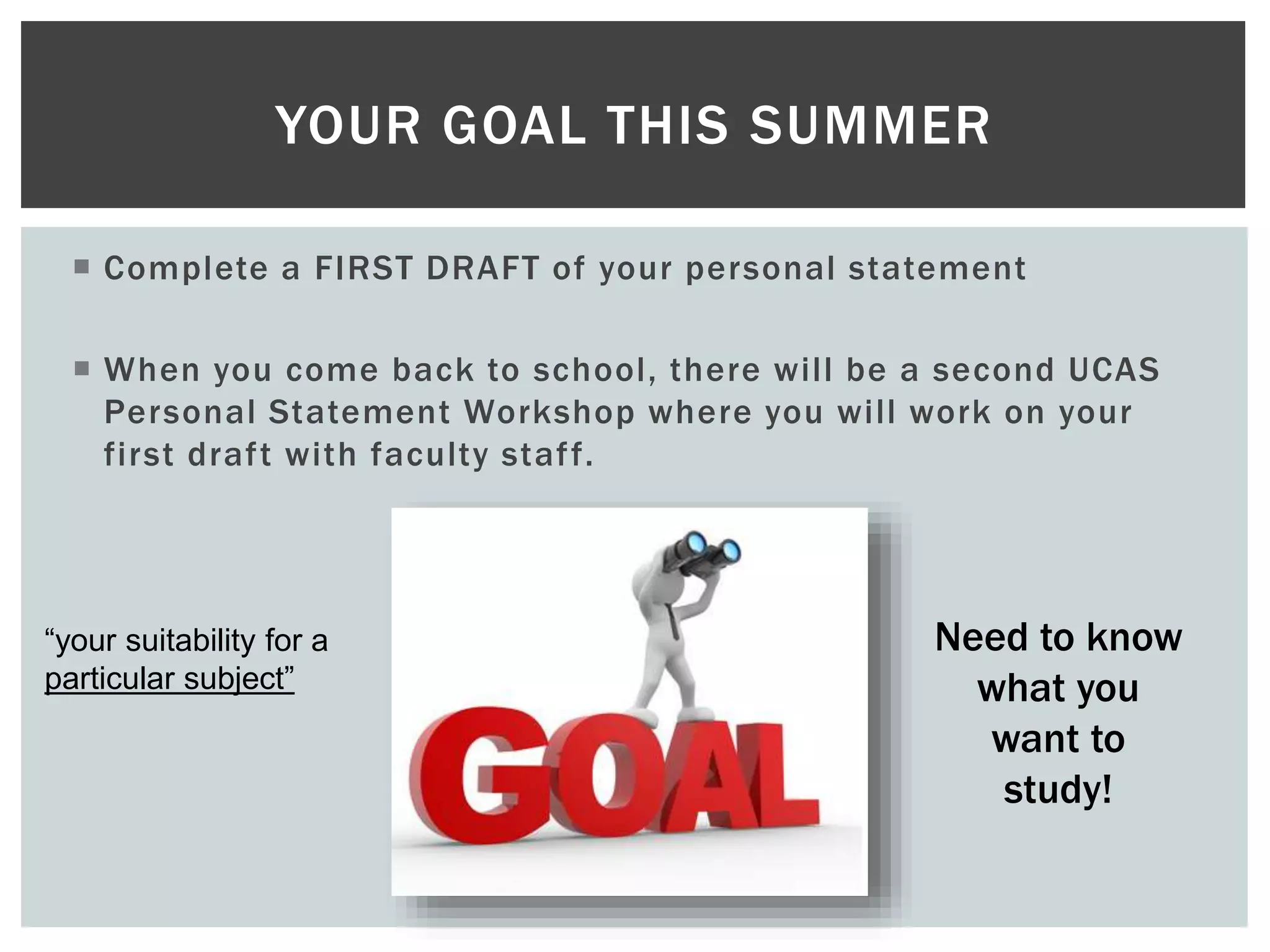
 Complete a FIRST DRAFT of your personal statement
 When you come back to school, there will be a second UCAS
Personal Statement Workshop where you will work on your
first draft with faculty staff.
YOUR GOAL THIS SUMMER
Need to know
what you
want to
study!
“your suitability for a
particular subject”
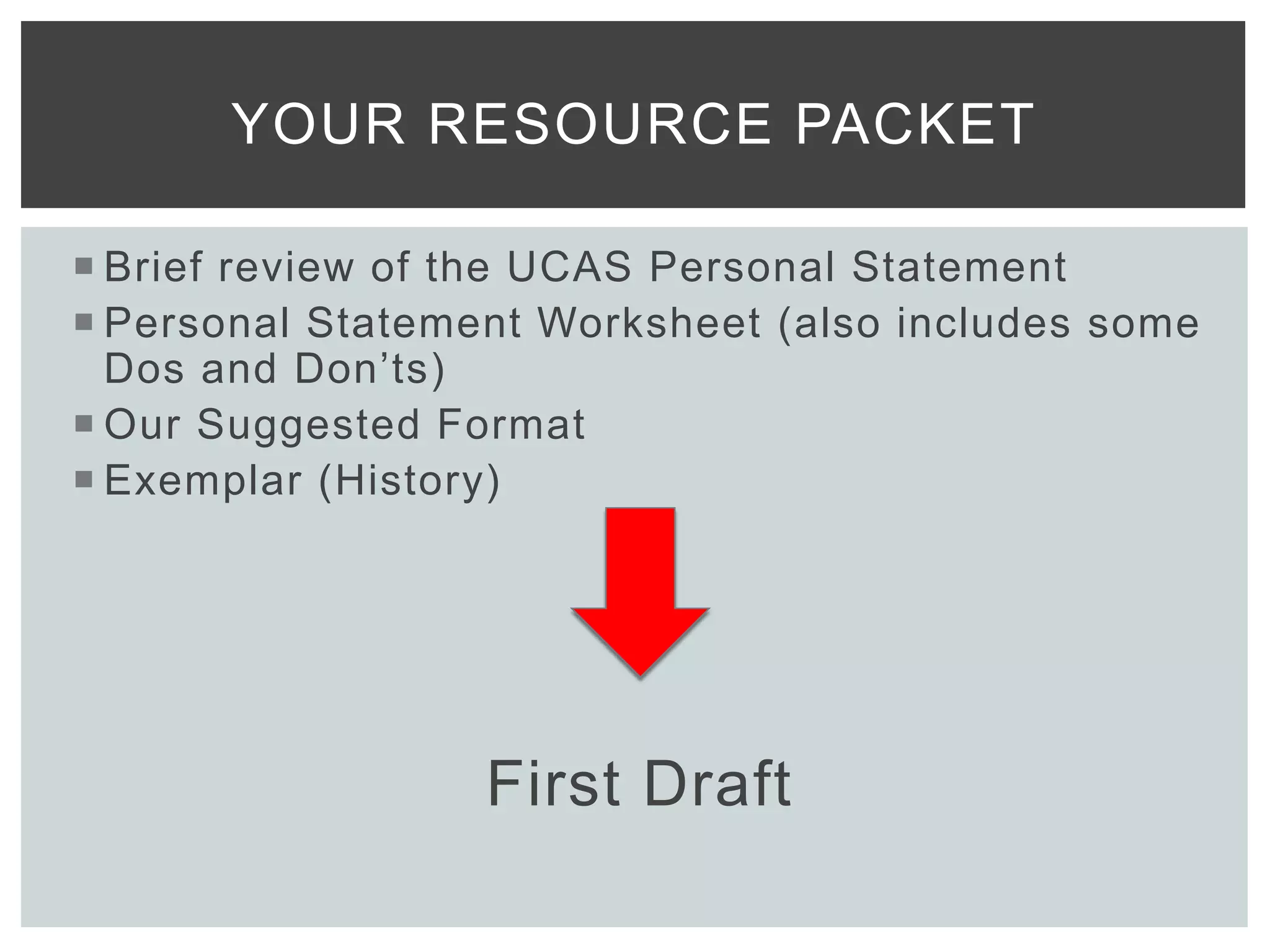
 Brief review of the UCAS Personal Statement
 Personal Statement Worksheet (also includes some
Dos and Don’ts)
 Our Suggested Format
 Exemplar (History)
First Draft
YOUR RESOURCE PACKET
 UCAS
https://www.ucas.com/ucas/undergraduate/getting-
started/when-apply/writing-personal-statement
 The Student Room
http://www.thestudentroom.co.uk/wiki/Personal_statement_
help
 ISM Counselors
ADDITIONAL RESOURCES
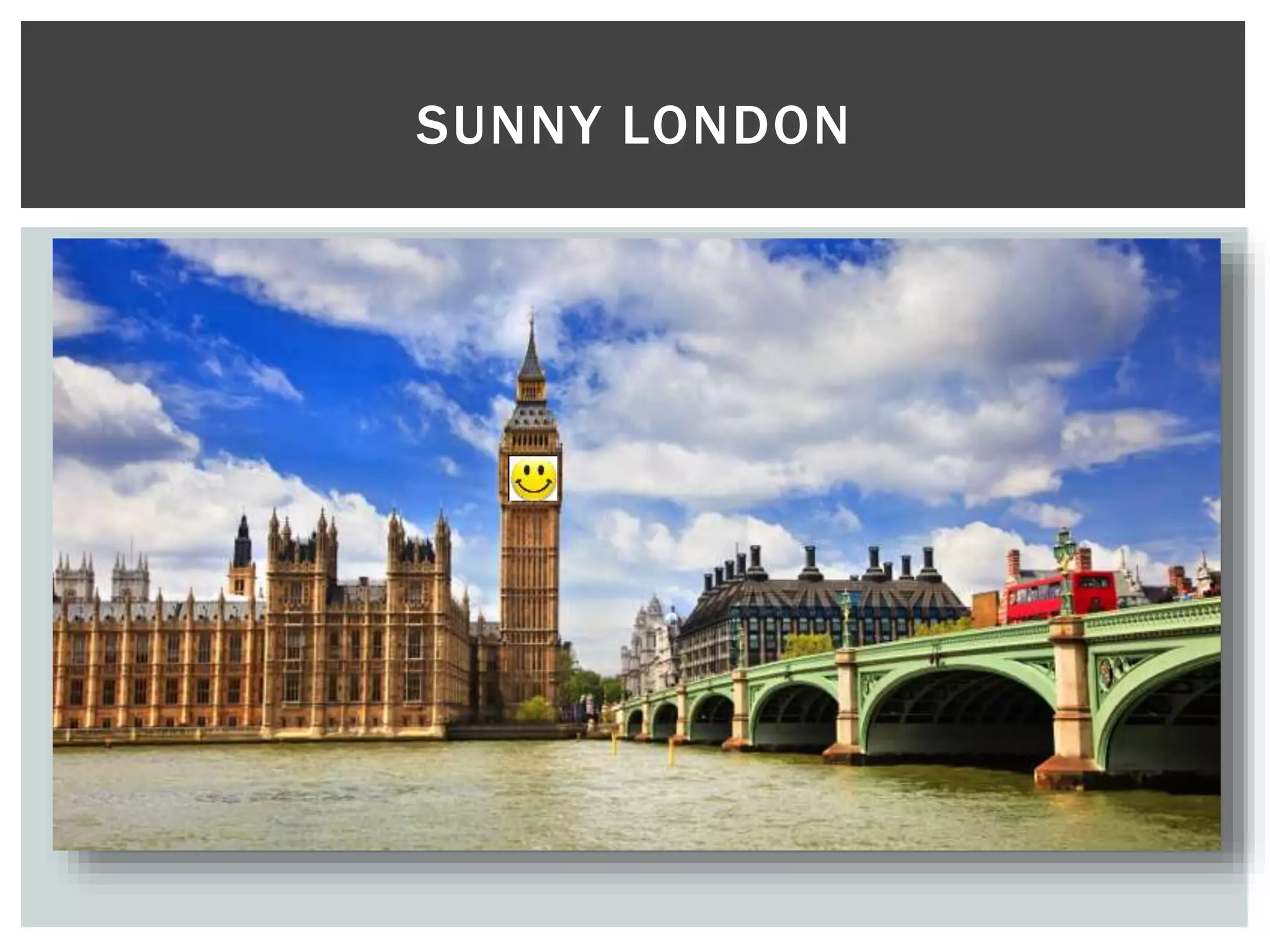
SUNNY LONDON

UCAS Personal Statement Workshop 2016

  • 1.
  • 2.
  • 3.
    UCAS Application (5 choices) TeacherReference (teacher survey?) IB Predicted Grades Your Personal Statement UCAS APPLICATIONS + Make sure your teacher knows he/she is writing a UK Reference!
  • 4.
    An Introduction tothe Personal Statement What to Include What not to Include Some Tips and Advice A Suggested Framework + Example Mistakes Students Make Questions and Answers Useful Resources WORKSHOP AGENDA
  • 5.
     Fun  Dynamicteacher  Interactive  Popcorn! US COLLEGE ESSAY WORKSHOP
  • 6.
    Dark, wet andcold Gets dark at like 2pm Shops close at 3pm No such thing as a warm fuzzy Endless exotic, nutritional daily diet of deep fried Fish and Chips In short, life is miserable & bleak YOU’RE GOING TO THE U.K.
  • 7.
    More Conservative Focused onyour suitability for your particular program of choice Read by subject tutors/professors COMPARED TO THE US STYLE ESSAY Three key ideas
  • 8.
  • 9.
  • 10.
     Punchy OpeningParagraph  Why you’re so excited to study the subject  Communicate how you really understand the course and what you are getting to  Evidence  To prove your interest in a particular course  “Sprinkle” in all your skills and good qualities to show you can do it  The End Bit  The Personal Touch  You are unique…things you are interested in that will help you fit into university life as a whole “WHAT MAKES YOU STAND OUT”
  • 11.
     Your chanceto stand out from other applicants  The one part of the process where you are in complete control  More conservative than a US College Essay  You start with a blank piece of paper not a response to a prompt (unlike the Common Application)  The same personal statement is sent to all of your chosen universities THE PERSONAL STATEMENT XXXXXXXXXXXXXXXXX
  • 12.
     Four thousandcharacters maximum including all punctuation and spaces  Approximately five six-line paragraphs  Must be succinct with no repetition or padding  Everything that you choose to include should be there for a reason  It will require several re-writes (share it)  Eventually you will copy and paste it into your UCAS application FOUR THOUSAND CHARACTERS
  • 13.
     Partly aboutyou but mostly about your suitability for a particular subject  75% of it should be academically focused with 25% about the all round student  It should focus on particular skills and aptitudes that will help you succeed  Try to demonstrate a commitment to a subject or subject area WHAT TO INCLUDE This is why it is so difficult, if not impossible to apply to different subject areas with your UK universities.
  • 14.
     Why doyou want to study that subject?  When did you first realize this?  What academic skills make you be a good fit for that subject?  The skills will depend on the course you have applied to study  What is it that they are they looking for? ACADEMIC ATTRIBUTES
  • 15.
     Be asspecific as possible about your academic abilities  Studying Science requires data analysis  Studying History requires strong research skills  Studying Business improves presentation skills  Studying English encourages critical thinking  Extended Essay requires time management  Theory of Knowledge needs collaborative skills BE SPECIFIC
  • 16.
     Being specificas possible about your academic abilities means supplying evidence  Try to show evidence of interest and a level of commitment to a particular subject  What things have you done that can be used to show this commitment?  What have you read?  What have you learnt?  What do you still have time to do? EVIDENCE
  • 17.
     How importantare extra-curricular activities?  Internships and work experience  Summer courses  Leadership, service, sports, orchestra, plays, hobbies, passions, significant events etc.  The focus should be on the skills acquired as consequence of these activities  Showing is better than telling EXTRA-CURRICULAR ACTIVITIES “Being on student council I developed my leadership and organizational skills.” “Being on student council I was responsible for ??? and ??? while and ensuring that ??? And ??? were completed in a timely manner”
  • 18.
     Don’t betoo quirky or tell jokes  Only use quotes that have genuine relevance  Be careful trying to play too much for one university  Do not plagiarize other’s material  Be simple, be honest, be yourself  It should be written by you not Mom or Dad or your Counselor WARNING
  • 19.
     Avoid providinginformation held elsewhere  Spelling, punctuation and grammar  Make sure every sentence counts  Avoid name dropping to impress, ahead of including things that are more important  Don’t Lie  Keep it positive  Be smart about word choice and don’t be overly wordy/poetic TIPS AND STRATEGIES
  • 20.
  • 21.
    A SUGGESTED FORMAT(5 PARAGRAPHS)
  • 22.
     Why thiscourse?  When did you first become interested in your subject?  Can you recall an event or occasion when you realized that you wanted to study your subject?  How many schools have you attended?  How has your multi-cultural upbringing shaped you?  Do you have any specific career plans? PARAGRAPH 1
  • 23.
     Are youan IB Diploma student?  What motivated your choice of subjects?  What have you learned from your higher level subjects?  Give evidence to demonstrate this learning  What have you enjoyed?  What interests and motivates you? PARAGRAPH 2
  • 24.
     What inspiredyour Extended Essay?  What did you learn from it?  Talk about the Theory of Knowledge essay and the presentation  What other major pieces of work did you enjoy or were you successful in?  What kind of learner are you?  Have EE and TOK helped in other subject areas? PARAGRAPH 3
  • 25.
     Extra curricularactivities  Class Councils and clubs  Individual or team sports  Dance, Drama, Music  Hobbies outside of school  CAS, ICare and service learning  Less can be more PARAGRAPH 4 Skills acquired that are transferable to your course of study and study at the university level in general
  • 26.
     A summaryor synopsis of your enthusiasm, attributes and suitability  Return to some of the themes in the introduction  Why the UK?  Career aspirations?  End with a bang not a whimper PARAGRAPH 5
  • 27.
  • 28.
    PARAGRAPH 1 • WhyHistory? • An event that contributed to wanting to study the subject further • The importance of History in his life
  • 29.
    PARAGRAPH 2 • Wherehe’s studied and how that has helped him • Historical connection to the countries he’s lived in (rich historical backgrounds) • Resiliency, adaptability, wider perspectives • IB Diploma program and its benefits
  • 30.
    PARAGRAPH 3 • Choiceof Subjects for IB / Extended Essay Topic • Highlighting what was learned / personal strengths • Skills learned that are immediately applicable to university study
  • 31.
    PARAGRAPH 4 • Extra-curricularand the skills learned • Leadership, responsibility, inter-personal • Develop maturity • Skills learned that are immediately applicable to university study
  • 32.
    PARAGRAPH 5 • Extra-curricularcontinued and the skills learned • Service Learning / Being Involved • Skills learned that are immediately applicable to university study
  • 33.
    PARAGRAPH 6 • Closingparagraph • Summarizing why suitable for study • Someone who has been improving every year and is ready for university
  • 34.
     Plagiarism  Lying Applying Late  Lack of Clarity  Lack of Enthusiasm  Not Enough Research  Lack of Evidence  Poor Attributes  No Extra-Curricular Stuff  Lack of Work Experience  Underselling Yourself  Spellcheck and Grammar  Malapropisms  Factual Inaccuracies  Evidence of Reading  Making Lists  Misjudged Humor  Too Short  Omitting Relevant Material  Weak Conclusion 20 PERSONAL STATEMENT MISTAKES
  • 35.
     From ayoung age I have (always) been interested in …  For as long as I can remember I have…  I am applying for this course because…  I have always been interested in…  Throughout my life I have always enjoyed…  Reflecting on my educational experiences…  ??? is a very challenging and demanding (career/profession/course)…  Academically, I have always been…  I have always wanted to pursue a career in…  I have always been passionate about… TOP 10 MOST COMMON OPENING LINES (UCAS 2015) Mary Curnock Cook, UCAS’ Chief Executive said: “The personal statement is supposed to be personal. Learning to write about yourself in a compelling way is a vital skill when applying for jobs; using hackneyed phrases is not the best way to stand out.”
  • 36.
  • 37.
  • 38.
     Complete aFIRST DRAFT of your personal statement  When you come back to school, there will be a second UCAS Personal Statement Workshop where you will work on your first draft with faculty staff. YOUR GOAL THIS SUMMER Need to know what you want to study! “your suitability for a particular subject”
  • 39.
     Brief reviewof the UCAS Personal Statement  Personal Statement Worksheet (also includes some Dos and Don’ts)  Our Suggested Format  Exemplar (History) First Draft YOUR RESOURCE PACKET
  • 40.
     UCAS https://www.ucas.com/ucas/undergraduate/getting- started/when-apply/writing-personal-statement  TheStudent Room http://www.thestudentroom.co.uk/wiki/Personal_statement_ help  ISM Counselors ADDITIONAL RESOURCES
  • 41.