U- FACTOR
CALCULATION
INTRODUCTION
 DEFINITION:
• The U-factor is defined as the thermal transmittance of a material or
assembly, measured in watts per square meter per degree Celsius
(W/m²·°C).
• It represents the amount of heat (in watts) that passes through one square
meter of the material or assembly for every degree Celsius difference in
temperature between the indoor and outdoor environments.
INTRODUCTION
 LOWER U-FACTOR:
• A lower U-factor indicates better insulation properties.
• It means the material or assembly resists heat flow better, leading to
reduced heat loss or gain through the building element.
INTRODUCTION
 APPLICATION:
• U-factor is commonly used to evaluate and compare the thermal
efficiency of building components such as windows, doors, walls, roofs,
and floors.
• It helps architects, engineers, and builders design energy-efficient
buildings by selecting materials and assemblies that minimize energy
consumption for heating and cooling.
INTRODUCTION
 FACTORS AFFECTING U-FACTOR:
• The U-factor of a building component depends on several factors,
including the type and thickness of materials used, the number of layers
(e.g., single-pane vs. double-pane windows), presence of air gaps or
insulation, and the overall design of the assembly.
INTRODUCTION
 In summary, the U-factor is a critical metric in building design and energy
efficiency, providing a standardized way to quantify and compare the
thermal performance of building materials and assemblies.
U-FACTOR DETERMINATION
1. Overall U-Factor Calculation:
• Use the area weighted method as specified in § 4.1.3 of ISO 15099 for
calculating the overall U-factor of the fenestration product, which
includes the sash and frame.
2. Environmental Conditions:
• For U-factor calculations in India, adhere to the following
environmental conditions specified in § 8.2 of ISO 15099:
U-FACTOR DETERMINATION
• Indoor temperature (Tin): 24°C
• Outdoor temperature (Tout): 32°C
• Wind speed (V): 3.35 m/s
• Radiant temperature of outdoor surroundings (Trm,out): Tout
• Radiant temperature of indoor surroundings (Trm,in): Tin
• Solar radiation (Is): 0 W/m² (assuming no solar radiation influence for U-
factor calculation)
U-FACTOR DETERMINATION
 Material Properties:
• Determine material conductivities and emissivity in accordance with
Indian standards, as referenced in § 6.4 of ISO 15099.
 Convective Film Coefficients:
• Apply convective film coefficients based on indoor and outdoor
conditions as specified in § 8.3 of ISO 15099. Use the heat transfer
coefficient based on the center of glass temperature and the entire
window height for indoor surfaces, including frame sections, and apply
the formula from § 8.3.2 for all outdoor exposed surfaces.
U-FACTOR DETERMINATION
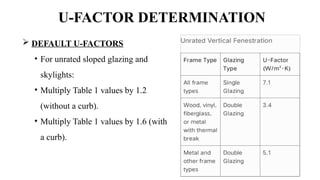
 DEFAULT U-FACTORS
• For unrated sloped glazing and
skylights:
• Multiply Table 1 values by 1.2
(without a curb).
• Multiply Table 1 values by 1.6 (with
a curb).
TYPICAL ROOF CONSTRUCTIONS
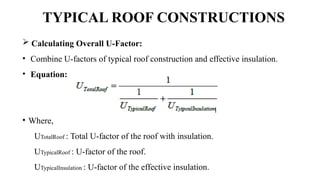
 Calculating Overall U-Factor:
• Combine U-factors of typical roof construction and effective insulation.
• Equation:
• Where,
UTotalRoof : Total U-factor of the roof with insulation.
UTypicalRoof : U-factor of the roof.
UTypicalInsulation : U-factor of the effective insulation.
TYPICAL WALL CONSTRUCTIONS
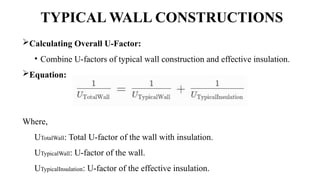
Calculating Overall U-Factor:
• Combine U-factors of typical wall construction and effective insulation.
Equation:
Where,
UTotalWall: Total U-factor of the wall with insulation.
UTypicalWall: U-factor of the wall.
UTypicalInsulation: U-factor of the effective insulation.
THANK YOU

U factor lecture note powerpoint presentation.pptx

  • 1.
  • 2.
    INTRODUCTION  DEFINITION: • TheU-factor is defined as the thermal transmittance of a material or assembly, measured in watts per square meter per degree Celsius (W/m²·°C). • It represents the amount of heat (in watts) that passes through one square meter of the material or assembly for every degree Celsius difference in temperature between the indoor and outdoor environments.
  • 3.
    INTRODUCTION  LOWER U-FACTOR: •A lower U-factor indicates better insulation properties. • It means the material or assembly resists heat flow better, leading to reduced heat loss or gain through the building element.
  • 4.
    INTRODUCTION  APPLICATION: • U-factoris commonly used to evaluate and compare the thermal efficiency of building components such as windows, doors, walls, roofs, and floors. • It helps architects, engineers, and builders design energy-efficient buildings by selecting materials and assemblies that minimize energy consumption for heating and cooling.
  • 5.
    INTRODUCTION  FACTORS AFFECTINGU-FACTOR: • The U-factor of a building component depends on several factors, including the type and thickness of materials used, the number of layers (e.g., single-pane vs. double-pane windows), presence of air gaps or insulation, and the overall design of the assembly.
  • 6.
    INTRODUCTION  In summary,the U-factor is a critical metric in building design and energy efficiency, providing a standardized way to quantify and compare the thermal performance of building materials and assemblies.
  • 7.
    U-FACTOR DETERMINATION 1. OverallU-Factor Calculation: • Use the area weighted method as specified in § 4.1.3 of ISO 15099 for calculating the overall U-factor of the fenestration product, which includes the sash and frame. 2. Environmental Conditions: • For U-factor calculations in India, adhere to the following environmental conditions specified in § 8.2 of ISO 15099:
  • 8.
    U-FACTOR DETERMINATION • Indoortemperature (Tin): 24°C • Outdoor temperature (Tout): 32°C • Wind speed (V): 3.35 m/s • Radiant temperature of outdoor surroundings (Trm,out): Tout • Radiant temperature of indoor surroundings (Trm,in): Tin • Solar radiation (Is): 0 W/m² (assuming no solar radiation influence for U- factor calculation)
  • 9.
    U-FACTOR DETERMINATION  MaterialProperties: • Determine material conductivities and emissivity in accordance with Indian standards, as referenced in § 6.4 of ISO 15099.  Convective Film Coefficients: • Apply convective film coefficients based on indoor and outdoor conditions as specified in § 8.3 of ISO 15099. Use the heat transfer coefficient based on the center of glass temperature and the entire window height for indoor surfaces, including frame sections, and apply the formula from § 8.3.2 for all outdoor exposed surfaces.
  • 10.
    U-FACTOR DETERMINATION  DEFAULTU-FACTORS • For unrated sloped glazing and skylights: • Multiply Table 1 values by 1.2 (without a curb). • Multiply Table 1 values by 1.6 (with a curb).
  • 11.
    TYPICAL ROOF CONSTRUCTIONS Calculating Overall U-Factor: • Combine U-factors of typical roof construction and effective insulation. • Equation: • Where, UTotalRoof : Total U-factor of the roof with insulation. UTypicalRoof : U-factor of the roof. UTypicalInsulation : U-factor of the effective insulation.
  • 12.
    TYPICAL WALL CONSTRUCTIONS CalculatingOverall U-Factor: • Combine U-factors of typical wall construction and effective insulation. Equation: Where, UTotalWall: Total U-factor of the wall with insulation. UTypicalWall: U-factor of the wall. UTypicalInsulation: U-factor of the effective insulation.
  • 13.