Raghavendra Institute of Pharmaceutical Education and Research - Autonomous
K.R.Palli Cross, Chiyyedu, Anantapuramu, A. P- 515721
Types of Electrophoresis
A Seminar as a part of curricular requirement for
M . Pharmacy I year I Semester
Presented by
Aggim Sumashree
(20L81S0102)
Dept. of. Pharmacology
Under the guidance of
Mr. A .Sudheer Kumar M.Pharm, (Ph.D)
Assistant Professor
Dept. of. Pharmacology
RIPER
AUTONOMOUS
NAAC &
NBA (UG)
SIRO- DSIR
Raghavendra Institute of Pharmaceutical Education and Research - Autonomous
K.R.Palli Cross, Chiyyedu, Anantapuramu, A. P- 515721
Contents:
• Introduction
• Types of electrophoresis (flow chart)
• Zone electrophoresis
• Moving boundary electrophoresis
• Applications
• References
2
RIPER
AUTONOMOUS
NAAC &
NBA (UG)
SIRO- DSIR
Raghavendra Institute of Pharmaceutical Education and Research - Autonomous
K.R.Palli Cross, Chiyyedu, Anantapuramu, A. P- 515721 3
Introduction:
 Electrophoresis is the movement of scattered particles comparative with a fluid
under the influence of a uniform electric field.
 The electrophoresis of positively charged particles (cations) is sometimes called
as cataphoresis, whereas the electrophoresis of negatively charged particles
(anions) is called as anaphoresis.
RIPER
AUTONOMOUS
NAAC &
NBA (UG)
SIRO- DSIR
Raghavendra Institute of Pharmaceutical Education and Research - Autonomous
K.R.Palli Cross, Chiyyedu, Anantapuramu, A. P- 515721 4
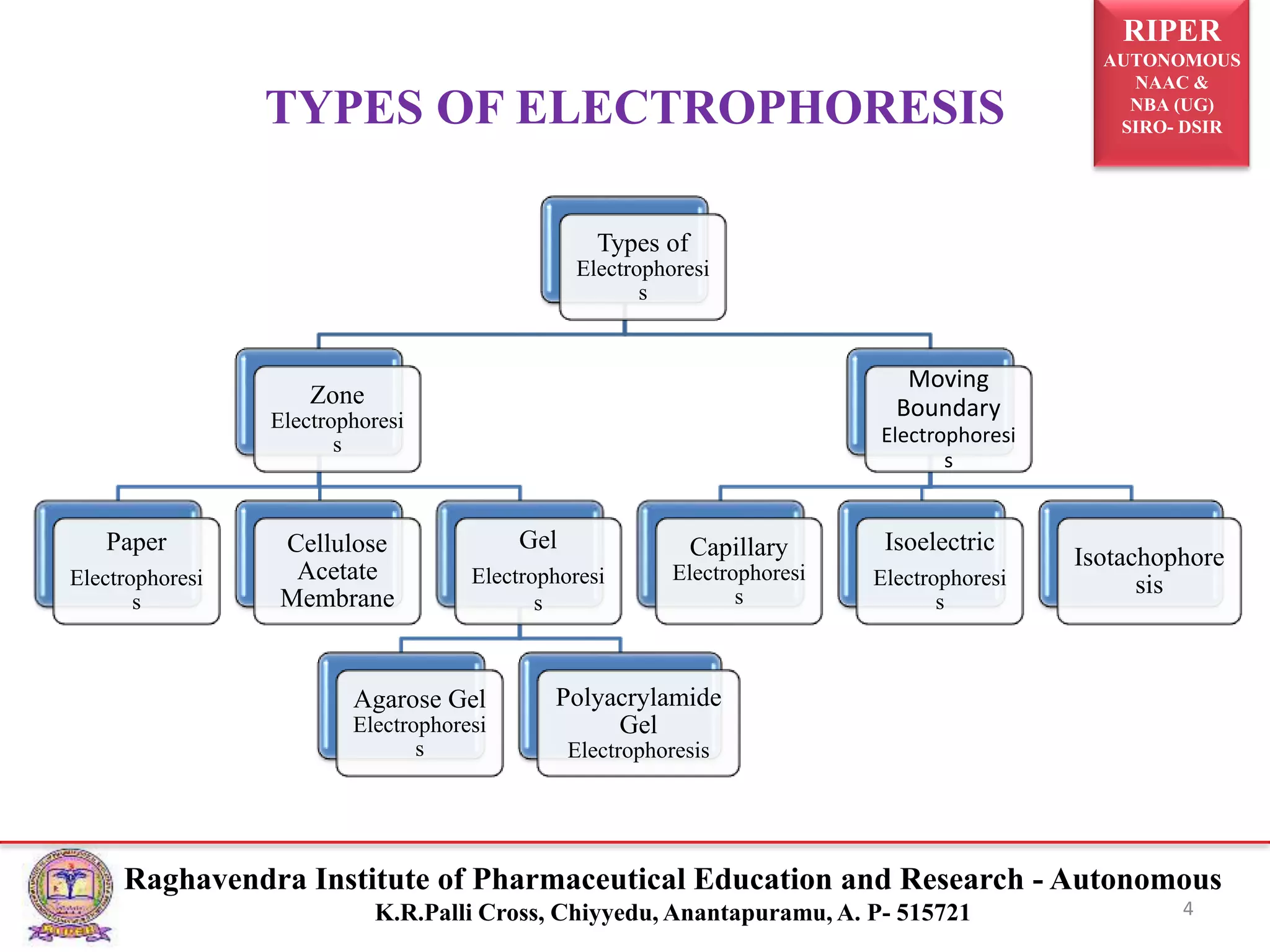
Types of
Electrophoresi
s
Zone
Electrophoresi
s
Paper
Electrophoresi
s
Cellulose
Acetate
Membrane
Gel
Electrophoresi
s
Agarose Gel
Electrophoresi
s
Polyacrylamide
Gel
Electrophoresis
Moving
Boundary
Electrophoresi
s
Capillary
Electrophoresi
s
Isoelectric
Electrophoresi
s
Isotachophore
sis
TYPES OF ELECTROPHORESIS
RIPER
AUTONOMOUS
NAAC &
NBA (UG)
SIRO- DSIR
Raghavendra Institute of Pharmaceutical Education and Research - Autonomous
K.R.Palli Cross, Chiyyedu, Anantapuramu, A. P- 515721 5
Zone electrophoresis
 Zone electrophoresis includes methods that produce more or less differentiated
zones completely of individual components that are being separated.
 It involves the migration of the charged particles on the supporting media like
(paper, cellulose acetate membrane, starch gel, polyacrylamide).
 Components that are separated are distributed into discrete zones on the support
media.
This supporting media is saturated with buffer solution in a small volume of
samples and is being applied as a narrow band.
RIPER
AUTONOMOUS
NAAC &
NBA (UG)
SIRO- DSIR
Raghavendra Institute of Pharmaceutical Education and Research - Autonomous
K.R.Palli Cross, Chiyyedu, Anantapuramu, A. P- 515721 6
Paper electrophoresis:
 Paper electrophoresis (PE) is useful for the separation of small-charged
molecules, such as amino acids and small proteins, using a strip of paper
(chromatographic paper).
 For this purpose, the strip paper that is used must contain at least α-cellulose at a
percent of (95%) and should have a slight adsorption capacity.
 In this technique, the occurrence motion of a colloidal particle of solution leads
to subsequent separation along the paper strip.
RIPER
AUTONOMOUS
NAAC &
NBA (UG)
SIRO- DSIR
Raghavendra Institute of Pharmaceutical Education and Research - Autonomous
K.R.Palli Cross, Chiyyedu, Anantapuramu, A. P- 515721 7
 Paper electrophoresis is easier in comparison to gel electrophoresis
because it does not require much matrix preparation, and it does not
contain charges that interfere with the separation of compounds
RIPER
AUTONOMOUS
NAAC &
NBA (UG)
SIRO- DSIR
Raghavendra Institute of Pharmaceutical Education and Research - Autonomous
K.R.Palli Cross, Chiyyedu, Anantapuramu, A. P- 515721 8
Cellulose acetate membranes
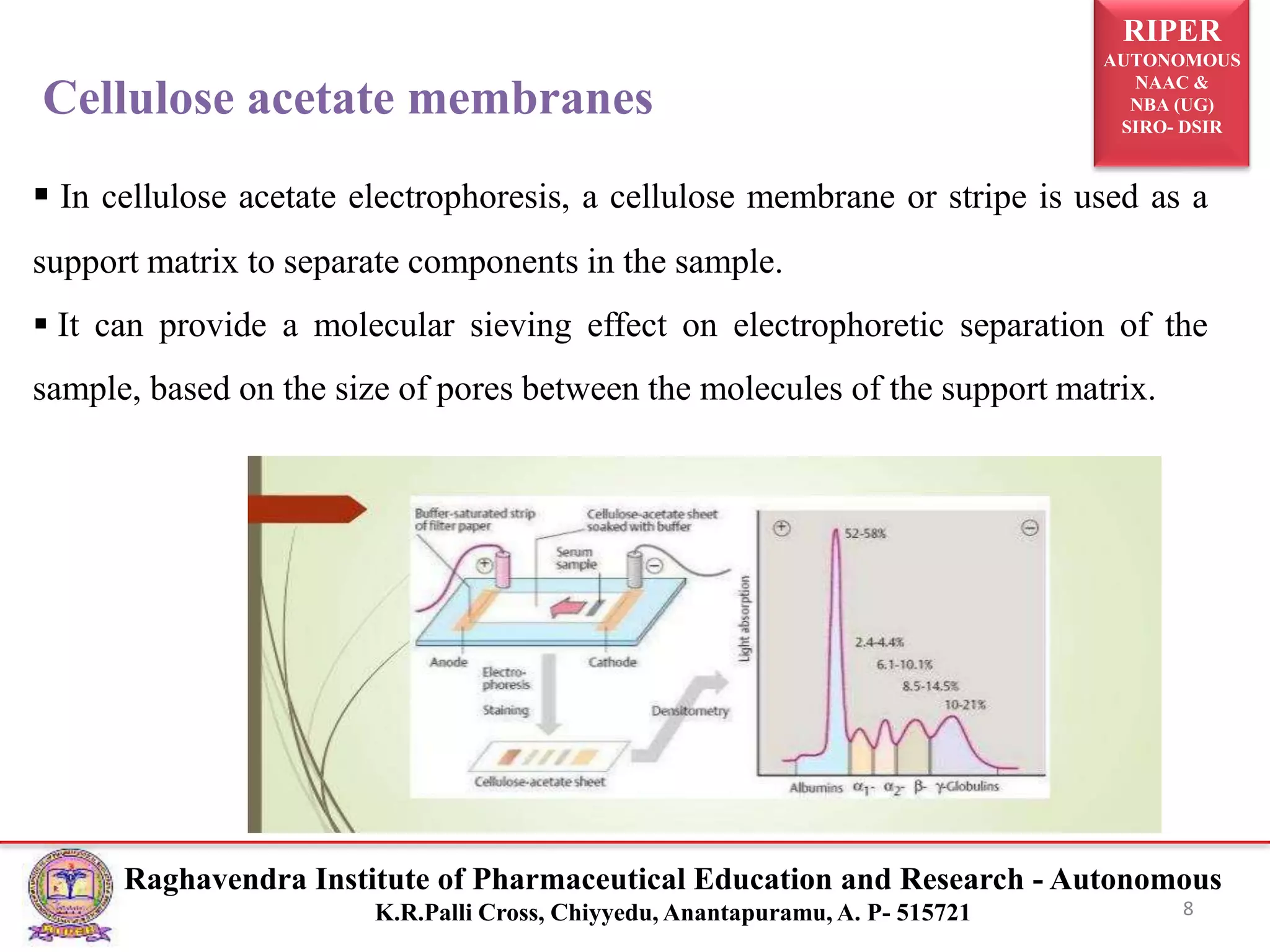
 In cellulose acetate electrophoresis, a cellulose membrane or stripe is used as a
support matrix to separate components in the sample.
 It can provide a molecular sieving effect on electrophoretic separation of the
sample, based on the size of pores between the molecules of the support matrix.
RIPER
AUTONOMOUS
NAAC &
NBA (UG)
SIRO- DSIR
Raghavendra Institute of Pharmaceutical Education and Research - Autonomous
K.R.Palli Cross, Chiyyedu, Anantapuramu, A. P- 515721 9
Gel electrophoresis
 Gel electrophoresis separates DNA fragments by size in a solid support medium
(an agarose gel).
 The rate of migration is proportional to size: smaller fragments move more
quickly, and wind up at the bottom of the gel.
 DNA is visualized by including in the gel an intercalating dye, ethidium
bromide.
 Gel electrophoresis is of two types:
 → Agarose gel electrophoresis.
 → Polyacrylamide gel electrophoresis.
RIPER
AUTONOMOUS
NAAC &
NBA (UG)
SIRO- DSIR
Raghavendra Institute of Pharmaceutical Education and Research - Autonomous
K.R.Palli Cross, Chiyyedu, Anantapuramu, A. P- 515721 10
RIPER
AUTONOMOUS
NAAC &
NBA (UG)
SIRO- DSIR
Raghavendra Institute of Pharmaceutical Education and Research - Autonomous
K.R.Palli Cross, Chiyyedu, Anantapuramu, A. P- 515721 11
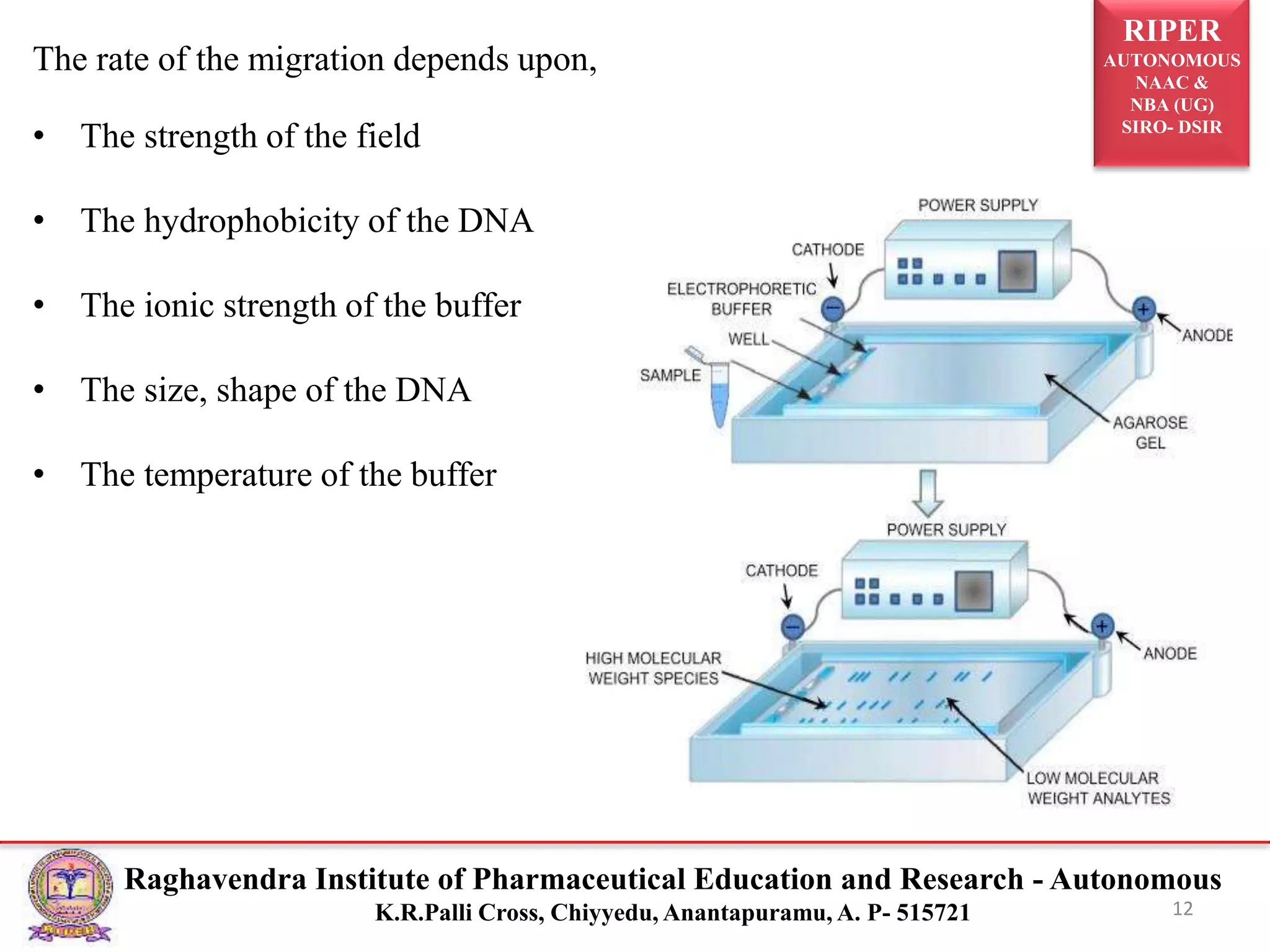
Agarose gel electrophoresis:
 Gel electrophoresis separates DNA fragments by its size in a solid support
medium such as an agarose gel.
 Sample (DNA) is pipetted into sample wells, followed by the application of
electric current at the anodal, negative end, which causes the negatively-charged
DNA to migrate towards the bottom (cathodal, positive) end.
 The rate of migration is proportional to the size where smaller fragments move
more quickly and wind up at the bottom of the gel.
RIPER
AUTONOMOUS
NAAC &
NBA (UG)
SIRO- DSIR
Raghavendra Institute of Pharmaceutical Education and Research - Autonomous
K.R.Palli Cross, Chiyyedu, Anantapuramu, A. P- 515721 12
The rate of the migration depends upon,
• The strength of the field
• The hydrophobicity of the DNA
• The ionic strength of the buffer
• The size, shape of the DNA
• The temperature of the buffer
RIPER
AUTONOMOUS
NAAC &
NBA (UG)
SIRO- DSIR
Raghavendra Institute of Pharmaceutical Education and Research - Autonomous
K.R.Palli Cross, Chiyyedu, Anantapuramu, A. P- 515721 13
Polyacrylamide gel electrophoresis:
 There are two types of polyacrylamide gels, commonly named dissociating and
non dissociating gels.
 A non-dissociating gel is a gel that separates the proteins in their native form to
conserve the protein structures, functions, and activities.
 A dissociating gel denatures the protein into its constituent polypeptides to
determine the polypeptide composition of the sample.
 Native gel electrophoresis is a non-denaturing gel that has a higher resolving
power than that of the SDS-PAGE when used for protein separations.
RIPER
AUTONOMOUS
NAAC &
NBA (UG)
SIRO- DSIR
Raghavendra Institute of Pharmaceutical Education and Research - Autonomous
K.R.Palli Cross, Chiyyedu, Anantapuramu, A. P- 515721 14
 SDS-PAGE (Polyacrylamide Gel Electrophoresis), this is an
analytical method that is used to separate components of a protein mixture based
on their size.
 The technique is based upon the principle that a charged molecule will migrate in
an electric field towards an electrode stating with an opposite sign.
 Here the general electrophoresis techniques cannot be used to determine the
molecular weight of biological molecules because the mobility of a substance in
the gel depends on both charge and size.
RIPER
AUTONOMOUS
NAAC &
NBA (UG)
SIRO- DSIR
Raghavendra Institute of Pharmaceutical Education and Research - Autonomous
K.R.Palli Cross, Chiyyedu, Anantapuramu, A. P- 515721 15
• For this purpose, the biological samples need to be treated so
that they acquire a uniform charge; then the electrophoresis
mobility depends primarily on size.
RIPER
AUTONOMOUS
NAAC &
NBA (UG)
SIRO- DSIR
Raghavendra Institute of Pharmaceutical Education and Research - Autonomous
K.R.Palli Cross, Chiyyedu, Anantapuramu, A. P- 515721
Moving Boundary Electrophoresis
• The moving boundary electrophoresis is the method that allows the
charged species to migrate within a free moving solution without
any need for a supporting medium.
16
RIPER
AUTONOMOUS
NAAC &
NBA (UG)
SIRO- DSIR
Raghavendra Institute of Pharmaceutical Education and Research - Autonomous
K.R.Palli Cross, Chiyyedu, Anantapuramu, A. P- 515721 17
Capillary electrophoresis
 Capillary electrophoresis an analytical technique that is used to separate the ions
based on their electrophoretic mobility with the use of a high applied voltage.
 It is dependent upon the charge of the molecule, the viscosity, and the atom's
radius.
 The rate at which the particle moves is directly proportional to that of the
applied electric field.
 The greater is the field strength, the faster the mobility.
RIPER
AUTONOMOUS
NAAC &
NBA (UG)
SIRO- DSIR
Raghavendra Institute of Pharmaceutical Education and Research - Autonomous
K.R.Palli Cross, Chiyyedu, Anantapuramu, A. P- 515721 18
RIPER
AUTONOMOUS
NAAC &
NBA (UG)
SIRO- DSIR
Raghavendra Institute of Pharmaceutical Education and Research - Autonomous
K.R.Palli Cross, Chiyyedu, Anantapuramu, A. P- 515721 19
 Neutral species are not affected, where ions only move with the
electric field.
Types in capillary electrophoresis:
 capillary zone electrophoresis (CZE),
 capillary gel electrophoresis (CGE),
 Micellar electrokinetic capillary chromatography (MEKC),
 capillary electrochromatography (CEC),
 capillary isoelectric focusing (CIEF),
 capillary isotachophoresis (CITP).
RIPER
AUTONOMOUS
NAAC &
NBA (UG)
SIRO- DSIR
Raghavendra Institute of Pharmaceutical Education and Research - Autonomous
K.R.Palli Cross, Chiyyedu, Anantapuramu, A. P- 515721 20
Hypernations of capillary electrophoresis:
 Capillary electrophoresis -Mass specrtrosopy (CE-MS).
 Capillary electrophoresis –Inductive coupled plasma –mass spectroscopy (CE-
ICP-MS).
 Capillary electrophoresis –Ionization mass spectroscopy(CE-ESI-MS)
 Capillary electrophoresis –Matrix assisted laser desorption ionization –Mass
spectroscopy(CE-MALDI-MS).
 Capillary electrophoresis –Nuclear magnetic resonance(CE-NMR)
RIPER
AUTONOMOUS
NAAC &
NBA (UG)
SIRO- DSIR
Raghavendra Institute of Pharmaceutical Education and Research - Autonomous
K.R.Palli Cross, Chiyyedu, Anantapuramu, A. P- 515721 21
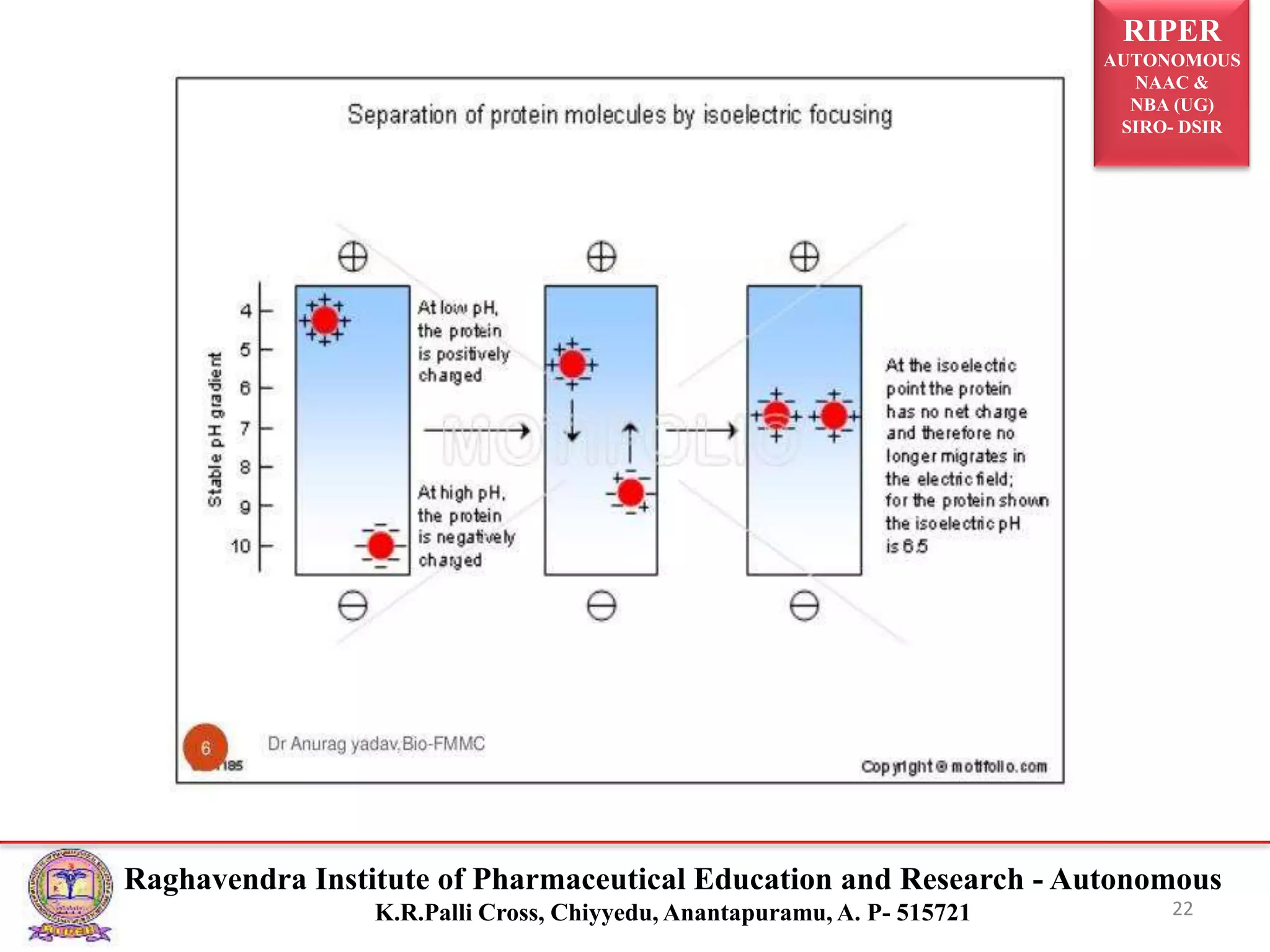
Isoelectric electrophoresis:
 IEF, also known simply as electrofocusing, is a technique for separating charged
molecules, usually proteins or peptides, on the basis of their isoelectric point (pI),
i.e., the pH at which the molecule has no charge.
 IEF works because in an electric field molecules in a pH gradient will migrate
towards their pI.
RIPER
AUTONOMOUS
NAAC &
NBA (UG)
SIRO- DSIR
Raghavendra Institute of Pharmaceutical Education and Research - Autonomous
K.R.Palli Cross, Chiyyedu, Anantapuramu, A. P- 515721 22
RIPER
AUTONOMOUS
NAAC &
NBA (UG)
SIRO- DSIR
Raghavendra Institute of Pharmaceutical Education and Research - Autonomous
K.R.Palli Cross, Chiyyedu, Anantapuramu, A. P- 515721 23
Isotachophoresis:
 Isotachophoresis (ITP) is a technique in analytical chemistry used for
selective separation and concentration of ionic analytes.
 It is a form of electrophoresis; charged analytes are separated based on
ionic mobility, a quantity which tells how fast an ion migrates through an
electric field.
RIPER
AUTONOMOUS
NAAC &
NBA (UG)
SIRO- DSIR
Raghavendra Institute of Pharmaceutical Education and Research - Autonomous
K.R.Palli Cross, Chiyyedu, Anantapuramu, A. P- 515721
Applications:
 It is used for the estimation of the size of DNA molecules.
 It is also used in the analysis of PCR products, e.g., in molecular genetics
diagnosis or genetic fingerprinting.
 It is used in the separation of restricted genomic DNA before Southern
analysis or RNA before Northern analysis.
 The agarose gel electrophoresis is widely employed to estimate the size of
DNA fragments after digesting with the restriction enzymes, e.g., in
restriction mapping of cloned DNA.
 Agarose gel electrophoresis was used to resolve circular DNA with
different supercoiling topology and to resolve fragments that differ due to
DNA synthesis.
24
RIPER
AUTONOMOUS
NAAC &
NBA (UG)
SIRO- DSIR
Raghavendra Institute of Pharmaceutical Education and Research - Autonomous
K.R.Palli Cross, Chiyyedu, Anantapuramu, A. P- 515721
• It is commonly used in the diagnosis of several diseases such as
thalassemia, sickle cell anemia, hemophilia, cystic fibrosis, and other
mutation analysis.
• Estimation of protein size.
• It is used in the determination of protein subunits or aggregation structures
and estimation of protein purity.
• It is used to study homogeneity of a macromolecular system and in the
analysis of complex biological mixtures.
25
RIPER
AUTONOMOUS
NAAC &
NBA (UG)
SIRO- DSIR
Raghavendra Institute of Pharmaceutical Education and Research - Autonomous
K.R.Palli Cross, Chiyyedu, Anantapuramu, A. P- 515721 26
References:
 Gummadi and Kandula, International journal of pharmaceutical
sciences and research 2020 vol 11(12).
 Donald A. Skoog , Donald M. West, F. James Holler and Stanley R.
Crouch text book of fundamentals of analytical chemistry 9th edition
2014.
RIPER
AUTONOMOUS
NAAC &
NBA (UG)
SIRO- DSIR
Raghavendra Institute of Pharmaceutical Education and Research - Autonomous
K.R.Palli Cross, Chiyyedu, Anantapuramu, A. P- 515721 27

TYPES OF ELECTROPHORESIS

  • 1.
    Raghavendra Institute ofPharmaceutical Education and Research - Autonomous K.R.Palli Cross, Chiyyedu, Anantapuramu, A. P- 515721 Types of Electrophoresis A Seminar as a part of curricular requirement for M . Pharmacy I year I Semester Presented by Aggim Sumashree (20L81S0102) Dept. of. Pharmacology Under the guidance of Mr. A .Sudheer Kumar M.Pharm, (Ph.D) Assistant Professor Dept. of. Pharmacology
  • 2.
    RIPER AUTONOMOUS NAAC & NBA (UG) SIRO-DSIR Raghavendra Institute of Pharmaceutical Education and Research - Autonomous K.R.Palli Cross, Chiyyedu, Anantapuramu, A. P- 515721 Contents: • Introduction • Types of electrophoresis (flow chart) • Zone electrophoresis • Moving boundary electrophoresis • Applications • References 2
  • 3.
    RIPER AUTONOMOUS NAAC & NBA (UG) SIRO-DSIR Raghavendra Institute of Pharmaceutical Education and Research - Autonomous K.R.Palli Cross, Chiyyedu, Anantapuramu, A. P- 515721 3 Introduction:  Electrophoresis is the movement of scattered particles comparative with a fluid under the influence of a uniform electric field.  The electrophoresis of positively charged particles (cations) is sometimes called as cataphoresis, whereas the electrophoresis of negatively charged particles (anions) is called as anaphoresis.
  • 4.
    RIPER AUTONOMOUS NAAC & NBA (UG) SIRO-DSIR Raghavendra Institute of Pharmaceutical Education and Research - Autonomous K.R.Palli Cross, Chiyyedu, Anantapuramu, A. P- 515721 4 Types of Electrophoresi s Zone Electrophoresi s Paper Electrophoresi s Cellulose Acetate Membrane Gel Electrophoresi s Agarose Gel Electrophoresi s Polyacrylamide Gel Electrophoresis Moving Boundary Electrophoresi s Capillary Electrophoresi s Isoelectric Electrophoresi s Isotachophore sis TYPES OF ELECTROPHORESIS
  • 5.
    RIPER AUTONOMOUS NAAC & NBA (UG) SIRO-DSIR Raghavendra Institute of Pharmaceutical Education and Research - Autonomous K.R.Palli Cross, Chiyyedu, Anantapuramu, A. P- 515721 5 Zone electrophoresis  Zone electrophoresis includes methods that produce more or less differentiated zones completely of individual components that are being separated.  It involves the migration of the charged particles on the supporting media like (paper, cellulose acetate membrane, starch gel, polyacrylamide).  Components that are separated are distributed into discrete zones on the support media. This supporting media is saturated with buffer solution in a small volume of samples and is being applied as a narrow band.
  • 6.
    RIPER AUTONOMOUS NAAC & NBA (UG) SIRO-DSIR Raghavendra Institute of Pharmaceutical Education and Research - Autonomous K.R.Palli Cross, Chiyyedu, Anantapuramu, A. P- 515721 6 Paper electrophoresis:  Paper electrophoresis (PE) is useful for the separation of small-charged molecules, such as amino acids and small proteins, using a strip of paper (chromatographic paper).  For this purpose, the strip paper that is used must contain at least α-cellulose at a percent of (95%) and should have a slight adsorption capacity.  In this technique, the occurrence motion of a colloidal particle of solution leads to subsequent separation along the paper strip.
  • 7.
    RIPER AUTONOMOUS NAAC & NBA (UG) SIRO-DSIR Raghavendra Institute of Pharmaceutical Education and Research - Autonomous K.R.Palli Cross, Chiyyedu, Anantapuramu, A. P- 515721 7  Paper electrophoresis is easier in comparison to gel electrophoresis because it does not require much matrix preparation, and it does not contain charges that interfere with the separation of compounds
  • 8.
    RIPER AUTONOMOUS NAAC & NBA (UG) SIRO-DSIR Raghavendra Institute of Pharmaceutical Education and Research - Autonomous K.R.Palli Cross, Chiyyedu, Anantapuramu, A. P- 515721 8 Cellulose acetate membranes  In cellulose acetate electrophoresis, a cellulose membrane or stripe is used as a support matrix to separate components in the sample.  It can provide a molecular sieving effect on electrophoretic separation of the sample, based on the size of pores between the molecules of the support matrix.
  • 9.
    RIPER AUTONOMOUS NAAC & NBA (UG) SIRO-DSIR Raghavendra Institute of Pharmaceutical Education and Research - Autonomous K.R.Palli Cross, Chiyyedu, Anantapuramu, A. P- 515721 9 Gel electrophoresis  Gel electrophoresis separates DNA fragments by size in a solid support medium (an agarose gel).  The rate of migration is proportional to size: smaller fragments move more quickly, and wind up at the bottom of the gel.  DNA is visualized by including in the gel an intercalating dye, ethidium bromide.  Gel electrophoresis is of two types:  → Agarose gel electrophoresis.  → Polyacrylamide gel electrophoresis.
  • 10.
    RIPER AUTONOMOUS NAAC & NBA (UG) SIRO-DSIR Raghavendra Institute of Pharmaceutical Education and Research - Autonomous K.R.Palli Cross, Chiyyedu, Anantapuramu, A. P- 515721 10
  • 11.
    RIPER AUTONOMOUS NAAC & NBA (UG) SIRO-DSIR Raghavendra Institute of Pharmaceutical Education and Research - Autonomous K.R.Palli Cross, Chiyyedu, Anantapuramu, A. P- 515721 11 Agarose gel electrophoresis:  Gel electrophoresis separates DNA fragments by its size in a solid support medium such as an agarose gel.  Sample (DNA) is pipetted into sample wells, followed by the application of electric current at the anodal, negative end, which causes the negatively-charged DNA to migrate towards the bottom (cathodal, positive) end.  The rate of migration is proportional to the size where smaller fragments move more quickly and wind up at the bottom of the gel.
  • 12.
    RIPER AUTONOMOUS NAAC & NBA (UG) SIRO-DSIR Raghavendra Institute of Pharmaceutical Education and Research - Autonomous K.R.Palli Cross, Chiyyedu, Anantapuramu, A. P- 515721 12 The rate of the migration depends upon, • The strength of the field • The hydrophobicity of the DNA • The ionic strength of the buffer • The size, shape of the DNA • The temperature of the buffer
  • 13.
    RIPER AUTONOMOUS NAAC & NBA (UG) SIRO-DSIR Raghavendra Institute of Pharmaceutical Education and Research - Autonomous K.R.Palli Cross, Chiyyedu, Anantapuramu, A. P- 515721 13 Polyacrylamide gel electrophoresis:  There are two types of polyacrylamide gels, commonly named dissociating and non dissociating gels.  A non-dissociating gel is a gel that separates the proteins in their native form to conserve the protein structures, functions, and activities.  A dissociating gel denatures the protein into its constituent polypeptides to determine the polypeptide composition of the sample.  Native gel electrophoresis is a non-denaturing gel that has a higher resolving power than that of the SDS-PAGE when used for protein separations.
  • 14.
    RIPER AUTONOMOUS NAAC & NBA (UG) SIRO-DSIR Raghavendra Institute of Pharmaceutical Education and Research - Autonomous K.R.Palli Cross, Chiyyedu, Anantapuramu, A. P- 515721 14  SDS-PAGE (Polyacrylamide Gel Electrophoresis), this is an analytical method that is used to separate components of a protein mixture based on their size.  The technique is based upon the principle that a charged molecule will migrate in an electric field towards an electrode stating with an opposite sign.  Here the general electrophoresis techniques cannot be used to determine the molecular weight of biological molecules because the mobility of a substance in the gel depends on both charge and size.
  • 15.
    RIPER AUTONOMOUS NAAC & NBA (UG) SIRO-DSIR Raghavendra Institute of Pharmaceutical Education and Research - Autonomous K.R.Palli Cross, Chiyyedu, Anantapuramu, A. P- 515721 15 • For this purpose, the biological samples need to be treated so that they acquire a uniform charge; then the electrophoresis mobility depends primarily on size.
  • 16.
    RIPER AUTONOMOUS NAAC & NBA (UG) SIRO-DSIR Raghavendra Institute of Pharmaceutical Education and Research - Autonomous K.R.Palli Cross, Chiyyedu, Anantapuramu, A. P- 515721 Moving Boundary Electrophoresis • The moving boundary electrophoresis is the method that allows the charged species to migrate within a free moving solution without any need for a supporting medium. 16
  • 17.
    RIPER AUTONOMOUS NAAC & NBA (UG) SIRO-DSIR Raghavendra Institute of Pharmaceutical Education and Research - Autonomous K.R.Palli Cross, Chiyyedu, Anantapuramu, A. P- 515721 17 Capillary electrophoresis  Capillary electrophoresis an analytical technique that is used to separate the ions based on their electrophoretic mobility with the use of a high applied voltage.  It is dependent upon the charge of the molecule, the viscosity, and the atom's radius.  The rate at which the particle moves is directly proportional to that of the applied electric field.  The greater is the field strength, the faster the mobility.
  • 18.
    RIPER AUTONOMOUS NAAC & NBA (UG) SIRO-DSIR Raghavendra Institute of Pharmaceutical Education and Research - Autonomous K.R.Palli Cross, Chiyyedu, Anantapuramu, A. P- 515721 18
  • 19.
    RIPER AUTONOMOUS NAAC & NBA (UG) SIRO-DSIR Raghavendra Institute of Pharmaceutical Education and Research - Autonomous K.R.Palli Cross, Chiyyedu, Anantapuramu, A. P- 515721 19  Neutral species are not affected, where ions only move with the electric field. Types in capillary electrophoresis:  capillary zone electrophoresis (CZE),  capillary gel electrophoresis (CGE),  Micellar electrokinetic capillary chromatography (MEKC),  capillary electrochromatography (CEC),  capillary isoelectric focusing (CIEF),  capillary isotachophoresis (CITP).
  • 20.
    RIPER AUTONOMOUS NAAC & NBA (UG) SIRO-DSIR Raghavendra Institute of Pharmaceutical Education and Research - Autonomous K.R.Palli Cross, Chiyyedu, Anantapuramu, A. P- 515721 20 Hypernations of capillary electrophoresis:  Capillary electrophoresis -Mass specrtrosopy (CE-MS).  Capillary electrophoresis –Inductive coupled plasma –mass spectroscopy (CE- ICP-MS).  Capillary electrophoresis –Ionization mass spectroscopy(CE-ESI-MS)  Capillary electrophoresis –Matrix assisted laser desorption ionization –Mass spectroscopy(CE-MALDI-MS).  Capillary electrophoresis –Nuclear magnetic resonance(CE-NMR)
  • 21.
    RIPER AUTONOMOUS NAAC & NBA (UG) SIRO-DSIR Raghavendra Institute of Pharmaceutical Education and Research - Autonomous K.R.Palli Cross, Chiyyedu, Anantapuramu, A. P- 515721 21 Isoelectric electrophoresis:  IEF, also known simply as electrofocusing, is a technique for separating charged molecules, usually proteins or peptides, on the basis of their isoelectric point (pI), i.e., the pH at which the molecule has no charge.  IEF works because in an electric field molecules in a pH gradient will migrate towards their pI.
  • 22.
    RIPER AUTONOMOUS NAAC & NBA (UG) SIRO-DSIR Raghavendra Institute of Pharmaceutical Education and Research - Autonomous K.R.Palli Cross, Chiyyedu, Anantapuramu, A. P- 515721 22
  • 23.
    RIPER AUTONOMOUS NAAC & NBA (UG) SIRO-DSIR Raghavendra Institute of Pharmaceutical Education and Research - Autonomous K.R.Palli Cross, Chiyyedu, Anantapuramu, A. P- 515721 23 Isotachophoresis:  Isotachophoresis (ITP) is a technique in analytical chemistry used for selective separation and concentration of ionic analytes.  It is a form of electrophoresis; charged analytes are separated based on ionic mobility, a quantity which tells how fast an ion migrates through an electric field.
  • 24.
    RIPER AUTONOMOUS NAAC & NBA (UG) SIRO-DSIR Raghavendra Institute of Pharmaceutical Education and Research - Autonomous K.R.Palli Cross, Chiyyedu, Anantapuramu, A. P- 515721 Applications:  It is used for the estimation of the size of DNA molecules.  It is also used in the analysis of PCR products, e.g., in molecular genetics diagnosis or genetic fingerprinting.  It is used in the separation of restricted genomic DNA before Southern analysis or RNA before Northern analysis.  The agarose gel electrophoresis is widely employed to estimate the size of DNA fragments after digesting with the restriction enzymes, e.g., in restriction mapping of cloned DNA.  Agarose gel electrophoresis was used to resolve circular DNA with different supercoiling topology and to resolve fragments that differ due to DNA synthesis. 24
  • 25.
    RIPER AUTONOMOUS NAAC & NBA (UG) SIRO-DSIR Raghavendra Institute of Pharmaceutical Education and Research - Autonomous K.R.Palli Cross, Chiyyedu, Anantapuramu, A. P- 515721 • It is commonly used in the diagnosis of several diseases such as thalassemia, sickle cell anemia, hemophilia, cystic fibrosis, and other mutation analysis. • Estimation of protein size. • It is used in the determination of protein subunits or aggregation structures and estimation of protein purity. • It is used to study homogeneity of a macromolecular system and in the analysis of complex biological mixtures. 25
  • 26.
    RIPER AUTONOMOUS NAAC & NBA (UG) SIRO-DSIR Raghavendra Institute of Pharmaceutical Education and Research - Autonomous K.R.Palli Cross, Chiyyedu, Anantapuramu, A. P- 515721 26 References:  Gummadi and Kandula, International journal of pharmaceutical sciences and research 2020 vol 11(12).  Donald A. Skoog , Donald M. West, F. James Holler and Stanley R. Crouch text book of fundamentals of analytical chemistry 9th edition 2014.
  • 27.
    RIPER AUTONOMOUS NAAC & NBA (UG) SIRO-DSIR Raghavendra Institute of Pharmaceutical Education and Research - Autonomous K.R.Palli Cross, Chiyyedu, Anantapuramu, A. P- 515721 27