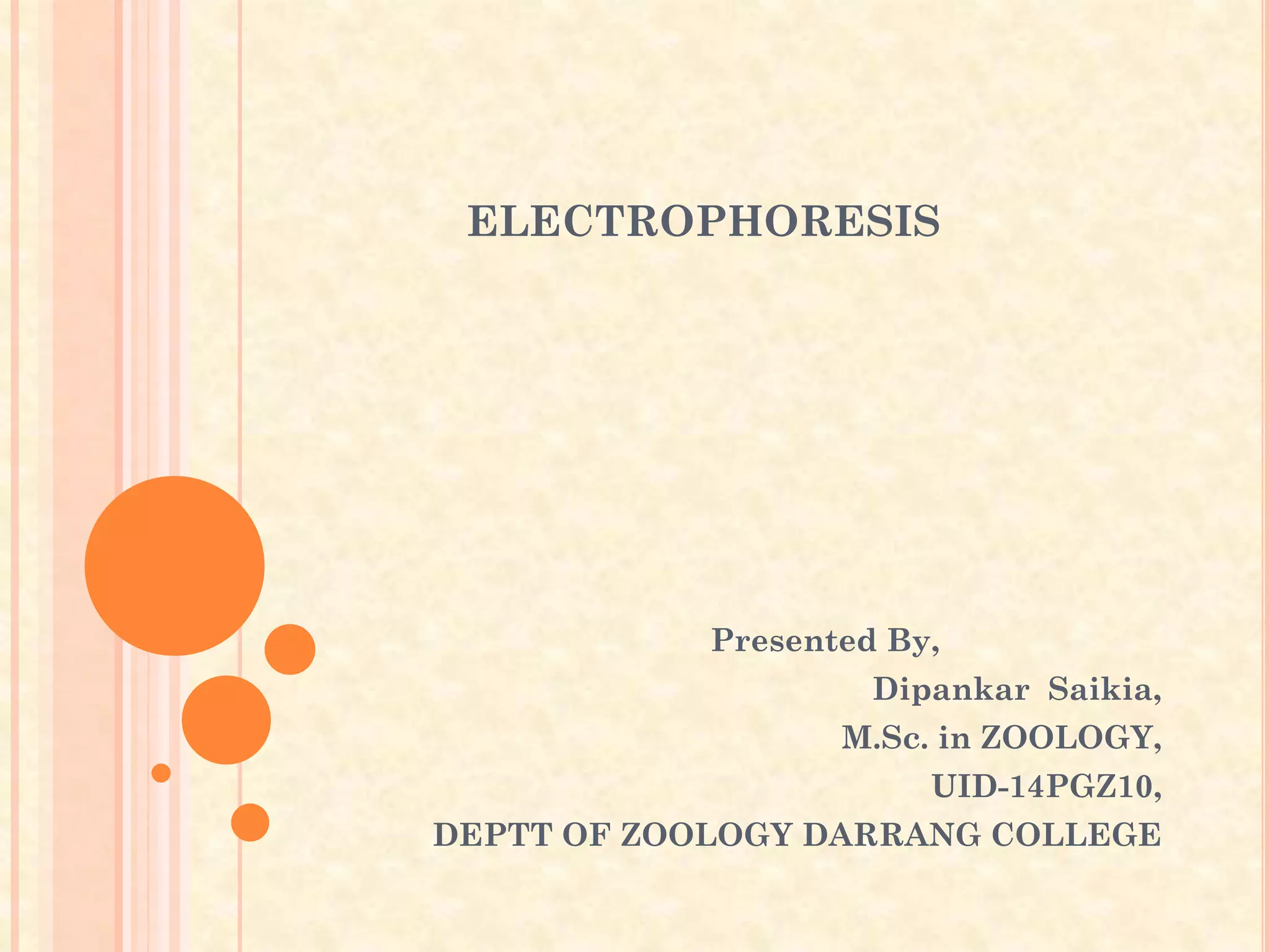
Electrophoresis is a separation technique that uses an electric field to move charged particles, allowing for the separation of molecules based on size, shape, and charge. Several types of electrophoresis are outlined, including agarose gel, poly-acrylamide gel, SDS-PAGE, and two-dimensional poly-acrylamide gel electrophoresis, each with specific principles for separating biomolecules. Applications of electrophoresis encompass DNA analysis, protein molecular weight determination, and forensic science.

![TYPES OF ELECTROPHORESIS
1. Agarose gel electrophoresis ;
2. Poly-acryl amide gel electrophoresis[PAGE];
3. Sodium do-decyl sulphate Poly- acrylamide gel
electrophoresis[SDS-PAGE] ;
4. Two dimensional –Poly-acrylamide gel
electrophoresis[2D-PAGE];
5. Pulse field gel electrophoresis[PFGE];
6. Capillary gel electrophoresis[CGE]; and
7. Disc electrophoresis for Protein.](https://image.slidesharecdn.com/electrophoresisanditsapplication-170220091319/75/Electrophoresis-and-its-application-3-2048.jpg)

![POLY-ACRYLAMIDE GEL ELECTROPHORESIS
[PAGE]
PRINCIPLE:
1.It is a vertical gel electrophoresis.
2.Negatively charged (-ve ) DNA and RNA molecule
can be separated.
3.Molecules are separated on the basis of size ,
shapes and molecular weight.](https://image.slidesharecdn.com/electrophoresisanditsapplication-170220091319/75/Electrophoresis-and-its-application-6-2048.jpg)
![Fig: Poly- acryl amide gel electrophoresis. [PAGE].
Source: http://www.google.com/image](https://image.slidesharecdn.com/electrophoresisanditsapplication-170220091319/75/Electrophoresis-and-its-application-7-2048.jpg)
![SODIUM DO-DECYL –POLYACRYL AMIDE
GEL ELECTROPHOERESIS[SDS-PAGE]
PRINCIPLE:
1.Negatively charged Protein sample can be
separated.
2.SDS detergent is used to give negative charge to the
positively charged protein molecule.
3.Hydrocarbon tail of the SDS molecule is bind with
the hydrophobic region of the protein molecule.](https://image.slidesharecdn.com/electrophoresisanditsapplication-170220091319/75/Electrophoresis-and-its-application-8-2048.jpg)

![TWO DIMENSIONAL POLY-ACRYL GEL
ELECTROPHORESIS[2D-PAGE [2D-PAGE]
PRINCIPLE:
1. It is a separation technique for Protein.
2. The proteins which have same molecular
weight and iso-electric point can be separate.
3. The first dimension of it is vertical and second
dimension is normal PAGE.](https://image.slidesharecdn.com/electrophoresisanditsapplication-170220091319/75/Electrophoresis-and-its-application-10-2048.jpg)

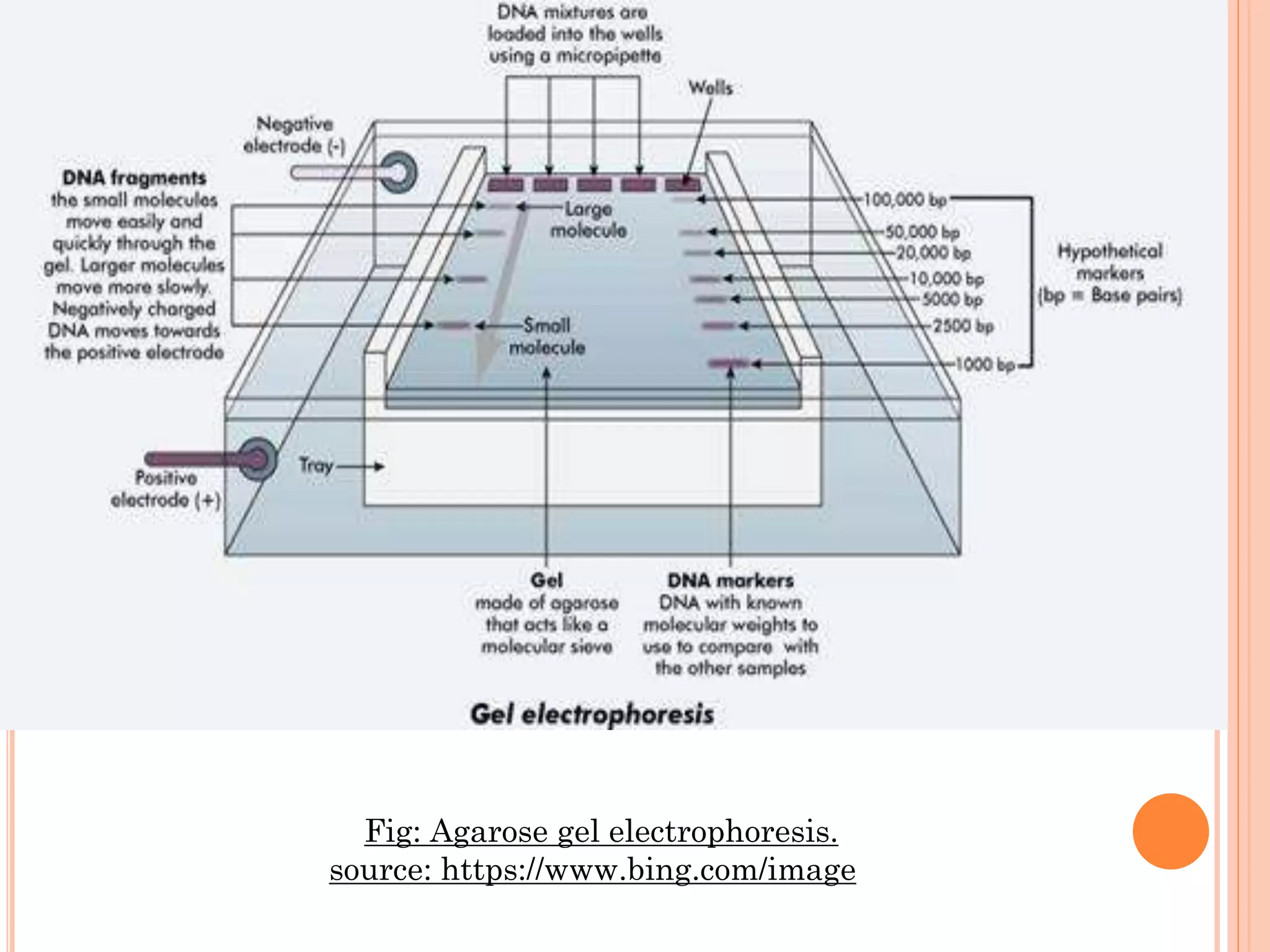
![PULSE FIELD GEL ELECTROPHORESIS
[PFGE]
PRINCIPLE:
1. Negatively charged large DNA molecule can be
separated.
2. Above the length of 30-50 Kb molecules can be
separated.
3. Here field direction is different.](https://image.slidesharecdn.com/electrophoresisanditsapplication-170220091319/75/Electrophoresis-and-its-application-12-2048.jpg)
![CAPILLARY GEL
ELECTROPHORESIS[CGE]
PRINCIPLE:
1.It vertical electrophoresis.
2.Besed on shape, size, molecular weight, and
electric charge.](https://image.slidesharecdn.com/electrophoresisanditsapplication-170220091319/75/Electrophoresis-and-its-application-14-2048.jpg)

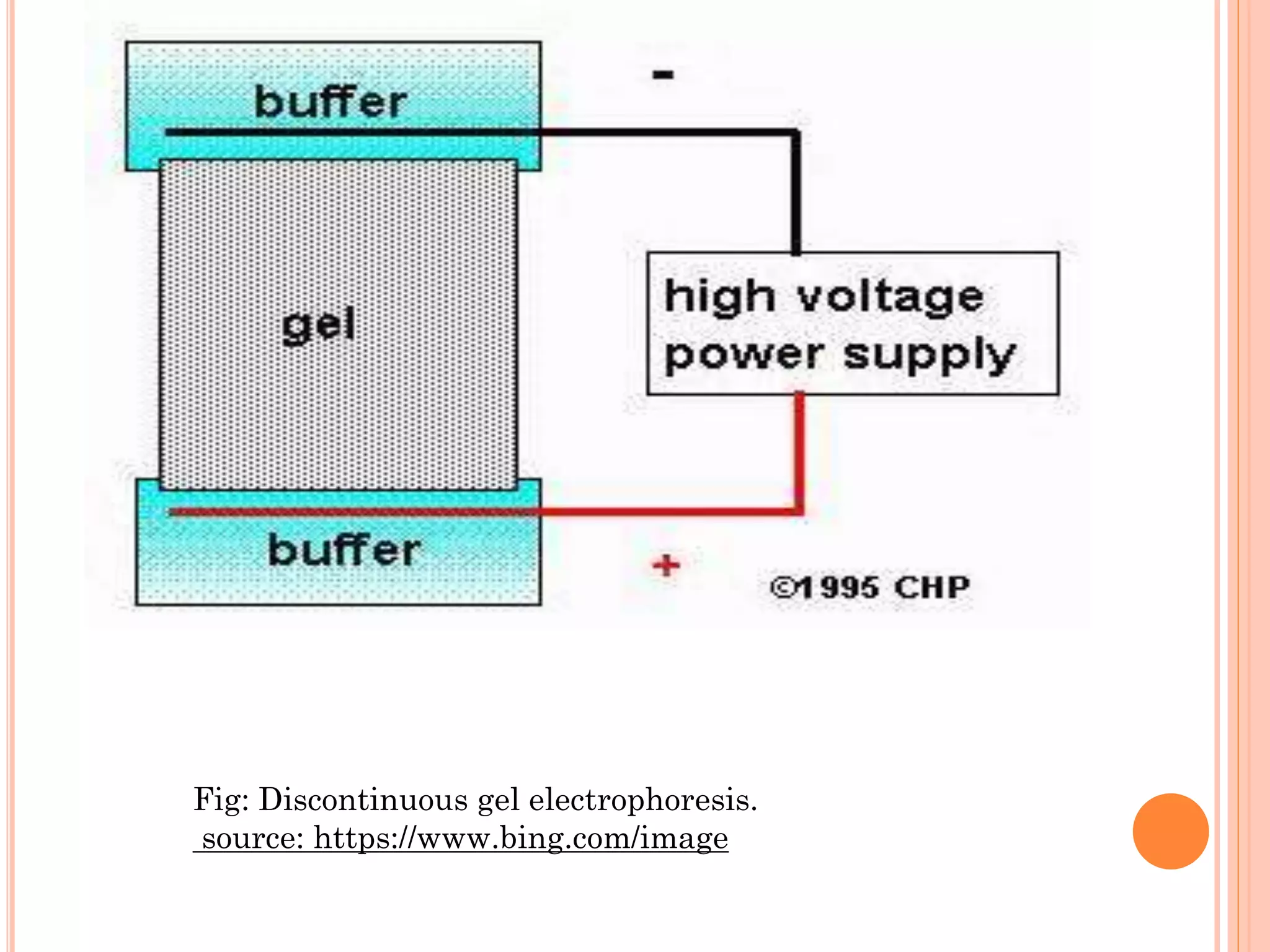
![DISCONTINUOUS[DISC]
ELECTROPHRESIS
PRINCIPLE:
1.It is a protein electrophoresis.
2.It solve the problem of aggregation and precipitation
of protein.
3. Discontinuity is based on –
*the gel structure;
*the pH value and ionic streangth of the buffer;
*the nature of the ion in the and the electrode
buffer.](https://image.slidesharecdn.com/electrophoresisanditsapplication-170220091319/75/Electrophoresis-and-its-application-16-2048.jpg)
![APPLICATION OF ELECTROPHORESIS
1. Estimation of the DNA molecule.[ Agarose , PAGE ]
2. Analysis of PCR product.[ Agarose ]
3. Separation of restricted genomic DNA and RNA.[Agarose
and PAGE respectively]
4. Conformation of newly isolated DNA .[Agarose]
5. Separation of most small fragments of DNA.[PAGE]
6. In forensic science.[Agarose , PAGE, SDS-PAGE, 2D PAGE
,Capillary gel electrophoresis , PFGE]
8. In determining molecular wt. of protein.[SDS-PAGE].etc](https://image.slidesharecdn.com/electrophoresisanditsapplication-170220091319/75/Electrophoresis-and-its-application-18-2048.jpg)