Copyright 2014, Teich Technical
and Marketing Communications
Lessons Learned from 20
Years (almost) in the Self-
Employment Trenches
Thea Teich
Teich Technical and Marketing Communications
Thea@TeichTMC.com
Copyright 2014, Teich Technical
and Marketing Communications
Something about me...
20 years in the “self-employment trenches” in 2015
22 years in corporations, government, and nonprofits in
Cincinnati, OH, and Pittsburgh, PA
Former STC president, 2003-2004
On STC Board of Directors for 7 years, 1998-2005
Past President, VP, treasurer, and Competitions Manager
for Southwestern Ohio Chapter
BS-Univ. of Michigan; MS-Univ. of Wisconsin; MBA-
Xavier Univ., Cincinnati
Brought up in northern New Jersey (my h. s. overlooked
the back side of the Statue of Liberty)
Lived in Cincinnati, OH, since 1980
Copyright 2014, Teich Technical
and Marketing Communications
What will be covered
How the organization of work has been changing in
recent year and its impact on being self-employed
Why and how technical communicators are positioned to
take advantage of these changes—and why self-
employment may be a good thing to consider
Why self-employment is good—and why and when it’s
not so good
Lessons learned from my (nearly) 20 years in the self-
employment trenches
The Big Picture:
Major Lessons Learned
Copyright 2014, Teich Technical
and Marketing Communications
Become part of the client’s team…because
that’s how work gets done—and that’s how
you get repeat business.
David Lewis, of Express Employment
Professionals, says the workplace of the near
future will be
A “Results Only Work Environment” (ROWE)
You’ll be judged on what you get done and not on
how long you worked to get it done.
In other words, you’ve met the deadline.
Pay based on project value, not a 40-hour work week
Even captive employees will be geographically
dispersed.
Adaptability will be even more necessary and
valuable.
Copyright 2014, Teich Technical
and Marketing Communications
Copyright 2014, Teich Technical
and Marketing Communications
Chartered Management Institute
Scenarios about Work in 2018
1,000 global corporate executives’ predictions
74% expected “virtual teams of employees” to be the
norm (geographically dispersed)
65% expected “multi-employment” among talented
people
60% said “job hopping” would be commonplace
55% said routine tasks would be automated
67% predicted increased customer participation in
business decisions
67% predicted products with longer life cycles
reduce carbon footprint
Copyright 2014, Teich Technical
and Marketing Communications
Chartered Management Institute
Scenarios about Work in 2018
A world ruled by [the most capable] employees
A world run by robots (decision-making
software)
A world without the rat race—at least less
commuting.
Sounds like working independently to me!!
Copyright 2014, Teich Technical
and Marketing Communications
The Result
Blurring of boundaries between work/career and
everything else
Proliferation of “virtual” employment
Rise of project-based employment
Call it “the rise of the independently employed.”
Free agency
Flexibility
Engagements, instead of 9 to 5
Leveraging knowledge, instead of “doing a job”
More interesting work perhaps, but less security
Can we live with that?
Copyright 2014, Teich Technical
and Marketing Communications
Why is this Happening?
Demographics
77 million baby boomers, with only 44 million in
Generation X coming along behind
Retirement of senior mgt., skilled technical people
Outsourcing, off-shoring, re-engineering won’t fill
the gaps fully.
But there will be 8.5 billion on the planet in less than
20 years.
Technology
Alternatives to the way work was done are now easy
to do.
Necessity
Not enough office space
Too many people needing to get somewhere else.
Copyright 2014, Teich Technical
and Marketing Communications
The Big Picture:
becoming part of the client’s team
According to Daniel Pink (Free Agent Nation: How
America’s Independent Workers are Transforming the
Way We Live):
...the bargain between employee and employer was
that the employee gave loyalty and the employer
gave security...
The bargain now is that the individual gives talent
and the organization provides opportunities.
Nothing new here, however:
Free agency in sports teams
Movie industry—temporary production companies
Freelancers—or “e-lancers” (Doug Florzak)
Sounds like working independently to me!
Copyright 2014, Teich Technical
and Marketing Communications
Technical Communicators:
You are Able
Reasons for “going independent” from Daniel Pink’s
interviews with “free agents:”
Greater security
Greater creative expression
Greater schedule flexibility
More money
Reasons TC-ers are “able:”
Comfortable with the technology that makes it
possible
Already building the independent employee economy
Distance learning
Training/instructional materials
Writing—a “natural” for SOHO
Copyright 2014, Teich Technical
and Marketing Communications
Technical Communicators:
But are you ready? Are you willing?
In early 2008, Linda Stewart, writing for Boston
Herald.com’s Business Today, said:
...project-based workers at all levels are the fastest
growing segment in the marketplace and will make up 25%
of the work force in the next five years.
And:
To take full advantage of the independently employed
market, companies must make a significant institutional
leap by learning to trust accomplished free agents with
important strategic assignments.
But:
How has the economic volatility of the past several
years changed all of the above—or made it even
more relevant?
Copyright 2014, Teich Technical
and Marketing Communications
Technical Communicators:
But are you ready? Are you willing?
Issues of importance to us all
Need for an integrated marketplace to find/offer talent
Need for standards
To save time, effort, and money
Avoid re-inventing the wheel: contracts, negotiations,
specifications
Need to change public policy
Health insurance—ACA is likely to handle all that, when we
get past the learning curve.
Retirement savings systems
Access to capital: redefining “small business” with the SBA
Taxes
Contractors vs. independents
Self-employment tax vs. Social Security (FICA)
Company type
Copyright 2014, Teich Technical
and Marketing Communications
The View from TTMC:
Lessons Learned
There’s really very little that requires rocket science.
Be nice to everyone—as much as you can.
Can-do attitude.
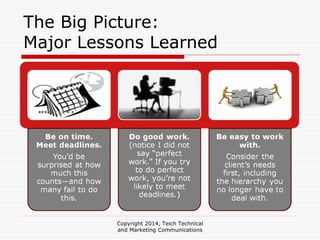
Do good work (notice, I did not say “perfect work.”).
Be easy to work with.
Meet deadlines. Be reliable (it’s the 11th commandment)
Pay attention to:
People and your relationships with them (People do
business with people, not other businesses.)
Don’t worry so much about:
Hardware and software (Buy what you need when you
need it—and not before.)
Accounting/Taxes: find a good accountant
Copyright 2014, Teich Technical
and Marketing Communications
The View from TTMC:
Lessons Learned
Clients don’t always know what they want or need.
So revisions are inevitable.
Don’t take it personally. You are not a mind reader.
Decide which battles are worth fighting. Most are not.
Clients are people.
They are different from each other, so how you work with
one may not carry over to another.
You now have many bosses.
And they can change what they want with no warning.
Be ready for it.
Copyright 2014, Teich Technical
and Marketing Communications
Problem Areas
Everyone Talks About
Setting Rates
Rounding Up Your Consultants
Finding Clients
Getting Paid
Dealing with Money (e.g., taxes)
Managing Time
Preventing Isolation
Copyright 2014, Teich Technical
and Marketing Communications
Setting Rates
Set One Hourly Rate
Despite the project, the client stills gets your services
Half of what you make goes to taxes
Discount Hours, not Dollars
Find Out What Others are Charging in Your Area
Don’t Undervalue Yourself
Copyright 2014, Teich Technical
and Marketing Communications
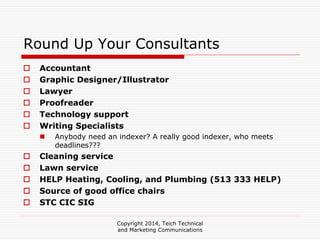
Round Up Your Consultants
Accountant
Graphic Designer/Illustrator
Lawyer
Proofreader
Technology support
Writing Specialists
Anybody need an indexer? A really good indexer, who meets
deadlines???
Cleaning service
Lawn service
HELP Heating, Cooling, and Plumbing (513 333 HELP)
Source of good office chairs
STC CIC SIG
Copyright 2014, Teich Technical
and Marketing Communications
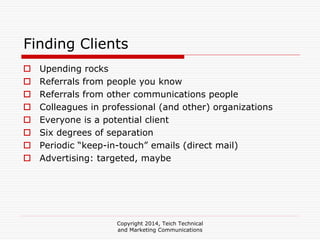
Finding Clients
Upending rocks
Referrals from people you know
Referrals from other communications people
Colleagues in professional (and other) organizations
Everyone is a potential client
Six degrees of separation
Periodic “keep-in-touch” emails (direct mail)
Advertising: targeted, maybe
Copyright 2014, Teich Technical
and Marketing Communications
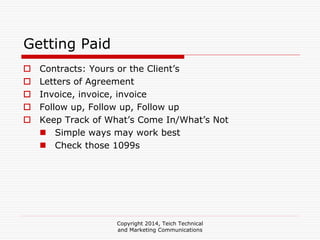
Getting Paid
Contracts: Yours or the Client’s
Letters of Agreement
Invoice, invoice, invoice
Follow up, Follow up, Follow up
Keep Track of What’s Come In/What’s Not
Simple ways may work best
Check those 1099s
Copyright 2014, Teich Technical
and Marketing Communications
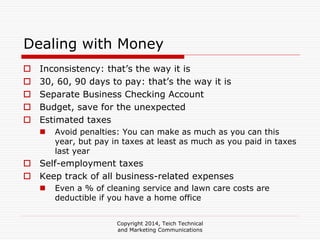
Dealing with Money
Inconsistency: that’s the way it is
30, 60, 90 days to pay: that’s the way it is
Separate Business Checking Account
Budget, save for the unexpected
Estimated taxes
Avoid penalties: You can make as much as you can this
year, but pay in taxes at least as much as you paid in taxes
last year
Self-employment taxes
Keep track of all business-related expenses
Even a % of cleaning service and lawn care costs are
deductible if you have a home office
Copyright 2014, Teich Technical
and Marketing Communications
And...
Managing time
It’s a 24/7 world
You may not be able to stop work at 5pm every day
That’s the way it is
Preventing isolation
Planning and scheduling
Lunching out
STC becomes even more important
Take on a chapter/SIG job to increase your involvement,
prevent isolation and (ta-da!!) GET YOUR NAME OUT
THERE!!
Copyright 2014, Teich Technical
and Marketing Communications
Finally...
Your Personality—Can You Handle
Juggling?
Balancing?
Flexibility is a two-way street
The Unknown?
Discipline?
The Need to Focus?
Professional Development responsibilities?
Copyright 2014, Teich Technical
and Marketing Communications
What I miss about corporate America
Benefits that appear to be paid by someone else
More of a standard schedule— sometimes
Camaraderie of colleagues every day
Availability of resources, like the mail room, the copy
machine, and the IT department
No cats on the keyboard
Copyright 2014, Teich Technical
and Marketing Communications
What I enjoy about working
independently
Not having to be somewhere everyday at a specific time
and (at least) until a certain other time
No office “politics”
Not dealing with as many difficult people
More variety in the work
Working harder and longer hours, and sometimes,
working less hard and fewer hours
More flexibility about when and how the work gets done
Working for moi (no one telling me my job has been
eliminated—except me)
Cats on the keyboard
Copyright 2014, Teich Technical
and Marketing Communications
Sources
Barker, Thomas and Kathryn Poe. “Changing world of the independent: a broader
perspective,” Technical Communication, 49:2, May 2002, p. 151-153
Carvel, John. “Wave goodbye to the nine to five, and say hello to virtual
enterprise, Guardian.co.uk, March 14, 2008. Accessed November 3, 2008
Florzak, Doug. “Are you ready for the e-lance economy?,” Technical
Communication, 49:2, May, 2002, p. 162-170.
Kahan, Seth. “New rules for mass collaboration,” FastCompany.com, September
25, 2008. Accessed September 30, 2008.
Lewis, David. “The (not so) future workplace,” Mensa Bulletin, March 2014.
Poe, Stephen D. “Technical communication consulting as a business,” Technical
Communication, 49:2, May 2002, p. 171-180.
Stewart, Linda. “Independently employed are the next wave,” BostonHerald.com,
Business Today, February 1, 2008. Accessed October 15, 2008.
Vliestra, K. “Encouraging self-employment should be a focal point of the new SBA
director.” HuffingtonPost:Small Business, www.huffiningtonpost.com/news/what-
is-working-small-businesses/, accessed 23 April 2014.

Twenty years self-employment-forsldshr

  • 1.
    Copyright 2014, TeichTechnical and Marketing Communications Lessons Learned from 20 Years (almost) in the Self- Employment Trenches Thea Teich Teich Technical and Marketing Communications Thea@TeichTMC.com
  • 2.
    Copyright 2014, TeichTechnical and Marketing Communications Something about me... 20 years in the “self-employment trenches” in 2015 22 years in corporations, government, and nonprofits in Cincinnati, OH, and Pittsburgh, PA Former STC president, 2003-2004 On STC Board of Directors for 7 years, 1998-2005 Past President, VP, treasurer, and Competitions Manager for Southwestern Ohio Chapter BS-Univ. of Michigan; MS-Univ. of Wisconsin; MBA- Xavier Univ., Cincinnati Brought up in northern New Jersey (my h. s. overlooked the back side of the Statue of Liberty) Lived in Cincinnati, OH, since 1980
  • 3.
    Copyright 2014, TeichTechnical and Marketing Communications What will be covered How the organization of work has been changing in recent year and its impact on being self-employed Why and how technical communicators are positioned to take advantage of these changes—and why self- employment may be a good thing to consider Why self-employment is good—and why and when it’s not so good Lessons learned from my (nearly) 20 years in the self- employment trenches
  • 4.
    The Big Picture: MajorLessons Learned Copyright 2014, Teich Technical and Marketing Communications
  • 5.
    Become part ofthe client’s team…because that’s how work gets done—and that’s how you get repeat business. David Lewis, of Express Employment Professionals, says the workplace of the near future will be A “Results Only Work Environment” (ROWE) You’ll be judged on what you get done and not on how long you worked to get it done. In other words, you’ve met the deadline. Pay based on project value, not a 40-hour work week Even captive employees will be geographically dispersed. Adaptability will be even more necessary and valuable. Copyright 2014, Teich Technical and Marketing Communications
  • 6.
    Copyright 2014, TeichTechnical and Marketing Communications Chartered Management Institute Scenarios about Work in 2018 1,000 global corporate executives’ predictions 74% expected “virtual teams of employees” to be the norm (geographically dispersed) 65% expected “multi-employment” among talented people 60% said “job hopping” would be commonplace 55% said routine tasks would be automated 67% predicted increased customer participation in business decisions 67% predicted products with longer life cycles reduce carbon footprint
  • 7.
    Copyright 2014, TeichTechnical and Marketing Communications Chartered Management Institute Scenarios about Work in 2018 A world ruled by [the most capable] employees A world run by robots (decision-making software) A world without the rat race—at least less commuting. Sounds like working independently to me!!
  • 8.
    Copyright 2014, TeichTechnical and Marketing Communications The Result Blurring of boundaries between work/career and everything else Proliferation of “virtual” employment Rise of project-based employment Call it “the rise of the independently employed.” Free agency Flexibility Engagements, instead of 9 to 5 Leveraging knowledge, instead of “doing a job” More interesting work perhaps, but less security Can we live with that?
  • 9.
    Copyright 2014, TeichTechnical and Marketing Communications Why is this Happening? Demographics 77 million baby boomers, with only 44 million in Generation X coming along behind Retirement of senior mgt., skilled technical people Outsourcing, off-shoring, re-engineering won’t fill the gaps fully. But there will be 8.5 billion on the planet in less than 20 years. Technology Alternatives to the way work was done are now easy to do. Necessity Not enough office space Too many people needing to get somewhere else.
  • 10.
    Copyright 2014, TeichTechnical and Marketing Communications The Big Picture: becoming part of the client’s team According to Daniel Pink (Free Agent Nation: How America’s Independent Workers are Transforming the Way We Live): ...the bargain between employee and employer was that the employee gave loyalty and the employer gave security... The bargain now is that the individual gives talent and the organization provides opportunities. Nothing new here, however: Free agency in sports teams Movie industry—temporary production companies Freelancers—or “e-lancers” (Doug Florzak) Sounds like working independently to me!
  • 11.
    Copyright 2014, TeichTechnical and Marketing Communications Technical Communicators: You are Able Reasons for “going independent” from Daniel Pink’s interviews with “free agents:” Greater security Greater creative expression Greater schedule flexibility More money Reasons TC-ers are “able:” Comfortable with the technology that makes it possible Already building the independent employee economy Distance learning Training/instructional materials Writing—a “natural” for SOHO
  • 12.
    Copyright 2014, TeichTechnical and Marketing Communications Technical Communicators: But are you ready? Are you willing? In early 2008, Linda Stewart, writing for Boston Herald.com’s Business Today, said: ...project-based workers at all levels are the fastest growing segment in the marketplace and will make up 25% of the work force in the next five years. And: To take full advantage of the independently employed market, companies must make a significant institutional leap by learning to trust accomplished free agents with important strategic assignments. But: How has the economic volatility of the past several years changed all of the above—or made it even more relevant?
  • 13.
    Copyright 2014, TeichTechnical and Marketing Communications Technical Communicators: But are you ready? Are you willing? Issues of importance to us all Need for an integrated marketplace to find/offer talent Need for standards To save time, effort, and money Avoid re-inventing the wheel: contracts, negotiations, specifications Need to change public policy Health insurance—ACA is likely to handle all that, when we get past the learning curve. Retirement savings systems Access to capital: redefining “small business” with the SBA Taxes Contractors vs. independents Self-employment tax vs. Social Security (FICA) Company type
  • 14.
    Copyright 2014, TeichTechnical and Marketing Communications The View from TTMC: Lessons Learned There’s really very little that requires rocket science. Be nice to everyone—as much as you can. Can-do attitude. Do good work (notice, I did not say “perfect work.”). Be easy to work with. Meet deadlines. Be reliable (it’s the 11th commandment) Pay attention to: People and your relationships with them (People do business with people, not other businesses.) Don’t worry so much about: Hardware and software (Buy what you need when you need it—and not before.) Accounting/Taxes: find a good accountant
  • 15.
    Copyright 2014, TeichTechnical and Marketing Communications The View from TTMC: Lessons Learned Clients don’t always know what they want or need. So revisions are inevitable. Don’t take it personally. You are not a mind reader. Decide which battles are worth fighting. Most are not. Clients are people. They are different from each other, so how you work with one may not carry over to another. You now have many bosses. And they can change what they want with no warning. Be ready for it.
  • 16.
    Copyright 2014, TeichTechnical and Marketing Communications Problem Areas Everyone Talks About Setting Rates Rounding Up Your Consultants Finding Clients Getting Paid Dealing with Money (e.g., taxes) Managing Time Preventing Isolation
  • 17.
    Copyright 2014, TeichTechnical and Marketing Communications Setting Rates Set One Hourly Rate Despite the project, the client stills gets your services Half of what you make goes to taxes Discount Hours, not Dollars Find Out What Others are Charging in Your Area Don’t Undervalue Yourself
  • 18.
    Copyright 2014, TeichTechnical and Marketing Communications Round Up Your Consultants Accountant Graphic Designer/Illustrator Lawyer Proofreader Technology support Writing Specialists Anybody need an indexer? A really good indexer, who meets deadlines??? Cleaning service Lawn service HELP Heating, Cooling, and Plumbing (513 333 HELP) Source of good office chairs STC CIC SIG
  • 19.
    Copyright 2014, TeichTechnical and Marketing Communications Finding Clients Upending rocks Referrals from people you know Referrals from other communications people Colleagues in professional (and other) organizations Everyone is a potential client Six degrees of separation Periodic “keep-in-touch” emails (direct mail) Advertising: targeted, maybe
  • 20.
    Copyright 2014, TeichTechnical and Marketing Communications Getting Paid Contracts: Yours or the Client’s Letters of Agreement Invoice, invoice, invoice Follow up, Follow up, Follow up Keep Track of What’s Come In/What’s Not Simple ways may work best Check those 1099s
  • 21.
    Copyright 2014, TeichTechnical and Marketing Communications Dealing with Money Inconsistency: that’s the way it is 30, 60, 90 days to pay: that’s the way it is Separate Business Checking Account Budget, save for the unexpected Estimated taxes Avoid penalties: You can make as much as you can this year, but pay in taxes at least as much as you paid in taxes last year Self-employment taxes Keep track of all business-related expenses Even a % of cleaning service and lawn care costs are deductible if you have a home office
  • 22.
    Copyright 2014, TeichTechnical and Marketing Communications And... Managing time It’s a 24/7 world You may not be able to stop work at 5pm every day That’s the way it is Preventing isolation Planning and scheduling Lunching out STC becomes even more important Take on a chapter/SIG job to increase your involvement, prevent isolation and (ta-da!!) GET YOUR NAME OUT THERE!!
  • 23.
    Copyright 2014, TeichTechnical and Marketing Communications Finally... Your Personality—Can You Handle Juggling? Balancing? Flexibility is a two-way street The Unknown? Discipline? The Need to Focus? Professional Development responsibilities?
  • 24.
    Copyright 2014, TeichTechnical and Marketing Communications What I miss about corporate America Benefits that appear to be paid by someone else More of a standard schedule— sometimes Camaraderie of colleagues every day Availability of resources, like the mail room, the copy machine, and the IT department No cats on the keyboard
  • 25.
    Copyright 2014, TeichTechnical and Marketing Communications What I enjoy about working independently Not having to be somewhere everyday at a specific time and (at least) until a certain other time No office “politics” Not dealing with as many difficult people More variety in the work Working harder and longer hours, and sometimes, working less hard and fewer hours More flexibility about when and how the work gets done Working for moi (no one telling me my job has been eliminated—except me) Cats on the keyboard
  • 26.
    Copyright 2014, TeichTechnical and Marketing Communications Sources Barker, Thomas and Kathryn Poe. “Changing world of the independent: a broader perspective,” Technical Communication, 49:2, May 2002, p. 151-153 Carvel, John. “Wave goodbye to the nine to five, and say hello to virtual enterprise, Guardian.co.uk, March 14, 2008. Accessed November 3, 2008 Florzak, Doug. “Are you ready for the e-lance economy?,” Technical Communication, 49:2, May, 2002, p. 162-170. Kahan, Seth. “New rules for mass collaboration,” FastCompany.com, September 25, 2008. Accessed September 30, 2008. Lewis, David. “The (not so) future workplace,” Mensa Bulletin, March 2014. Poe, Stephen D. “Technical communication consulting as a business,” Technical Communication, 49:2, May 2002, p. 171-180. Stewart, Linda. “Independently employed are the next wave,” BostonHerald.com, Business Today, February 1, 2008. Accessed October 15, 2008. Vliestra, K. “Encouraging self-employment should be a focal point of the new SBA director.” HuffingtonPost:Small Business, www.huffiningtonpost.com/news/what- is-working-small-businesses/, accessed 23 April 2014.