Tweak the Tweet User Testing Who/Where:  Linda, Stian, Christine, Katy, Jon / Toronto What/Why? Tweak the Tweet is a tool developed at RhoK 1.0 to turn tweets into actionable data during emergencies, crises, and disasters, making it easier to share, process and redistribute the information back to the public. Our challenge was to do user testing on TtT, to learn more about the usability issues of the syntax itself, the instructions, and the sense-making tools (spreadsheets and maps). Solution: What did you Create? We evolved the TtT code fixing bugs and making it more scalable and faster. We also  identified end user challenges and recommended solutions.
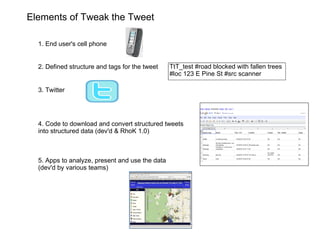
Elements of Tweak the Tweet 1. End user's cell phone 2. Defined structure and tags for the tweet 3. Twitter 4. Code to download and convert structured tweets into structured data (dev'd & RhoK 1.0) 5. Apps to analyze, present and use the data (dev'd by various teams)  TtT_test #road blocked with fallen trees #loc 123 E Pine St #src scanner
RhoK 2.0 Toronto focused primarily on End User Experience Our testing identified five major end user challenges to address 1. Significant training required 2. Data structure too complex for non-expert users 3. Somewhat cumbersome due to multiple steps We also identified and addressed challenges to the code/data users 1. Delay between tweet and data availability 2. Need to make it accessible and easy to read and add to 3. Challenges with geo-tagging
The first challenge for users was the training Many people don't naturally think in structured data Currently use of the tool requires training on how to structure the tweets Emergency workers and community organizations are often volunteers or busy staff who don't have time for training on tools like this.  Simple user input tools will make Tweak the Tweet more feasible and more broadly used. Options considered: 1. Web Interface  accessible from computer or mobile browser - prototype exists ( http://epic.cs.colorado.edu/TtT/editors/haiti/ ) - supports all computers & data-capable phones 2. Mobile apps for smartphones - simplifies further for smartphone users 3. Interactive Voice Response (IVR)  - can use same logic as web interface - enables access by those who can't access internet
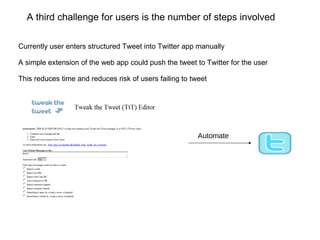
Currently user enters structured Tweet into Twitter app manually A simple extension of the web app could push the tweet to Twitter for the user This reduces time and reduces risk of users failing to tweet A third challenge for users is the number of steps involved Automate
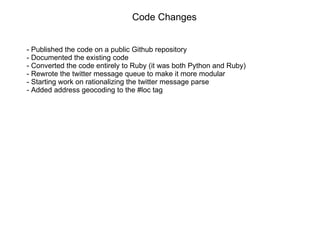
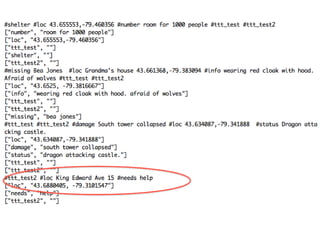
Code Changes - Published the code on a public Github repository - Documented the existing code - Converted the code entirely to Ruby (it was both Python and Ruby) - Rewrote the twitter message queue to make it more modular - Starting work on rationalizing the twitter message parse - Added address geocoding to the #loc tag
 
 
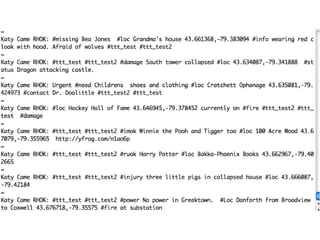
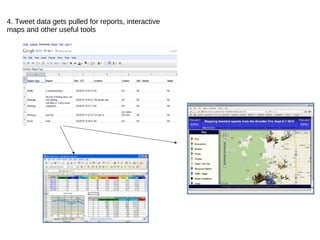
4. Tweet data gets pulled for reports, interactive maps and other useful tools
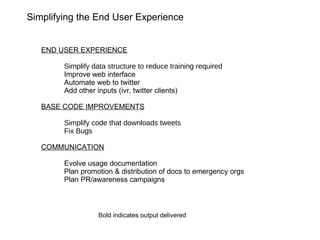
END USER EXPERIENCE Simplify data structure to reduce training required Improve web interface Automate web to twitter Add other inputs (ivr, twitter clients) BASE CODE IMPROVEMENTS Simplify code that downloads tweets Fix Bugs COMMUNICATION Evolve usage documentation Plan promotion & distribution of docs to emergency orgs Plan PR/awareness campaigns Simplifying the End User Experience Bold  indicates output delivered

Tweakthetweet

  • 1.
    Tweak the TweetUser Testing Who/Where: Linda, Stian, Christine, Katy, Jon / Toronto What/Why? Tweak the Tweet is a tool developed at RhoK 1.0 to turn tweets into actionable data during emergencies, crises, and disasters, making it easier to share, process and redistribute the information back to the public. Our challenge was to do user testing on TtT, to learn more about the usability issues of the syntax itself, the instructions, and the sense-making tools (spreadsheets and maps). Solution: What did you Create? We evolved the TtT code fixing bugs and making it more scalable and faster. We also identified end user challenges and recommended solutions.
  • 2.
    Elements of Tweakthe Tweet 1. End user's cell phone 2. Defined structure and tags for the tweet 3. Twitter 4. Code to download and convert structured tweets into structured data (dev'd & RhoK 1.0) 5. Apps to analyze, present and use the data (dev'd by various teams) TtT_test #road blocked with fallen trees #loc 123 E Pine St #src scanner
  • 3.
    RhoK 2.0 Torontofocused primarily on End User Experience Our testing identified five major end user challenges to address 1. Significant training required 2. Data structure too complex for non-expert users 3. Somewhat cumbersome due to multiple steps We also identified and addressed challenges to the code/data users 1. Delay between tweet and data availability 2. Need to make it accessible and easy to read and add to 3. Challenges with geo-tagging
  • 4.
    The first challengefor users was the training Many people don't naturally think in structured data Currently use of the tool requires training on how to structure the tweets Emergency workers and community organizations are often volunteers or busy staff who don't have time for training on tools like this. Simple user input tools will make Tweak the Tweet more feasible and more broadly used. Options considered: 1. Web Interface accessible from computer or mobile browser - prototype exists ( http://epic.cs.colorado.edu/TtT/editors/haiti/ ) - supports all computers & data-capable phones 2. Mobile apps for smartphones - simplifies further for smartphone users 3. Interactive Voice Response (IVR) - can use same logic as web interface - enables access by those who can't access internet
  • 5.
    Currently user entersstructured Tweet into Twitter app manually A simple extension of the web app could push the tweet to Twitter for the user This reduces time and reduces risk of users failing to tweet A third challenge for users is the number of steps involved Automate
  • 6.
    Code Changes -Published the code on a public Github repository - Documented the existing code - Converted the code entirely to Ruby (it was both Python and Ruby) - Rewrote the twitter message queue to make it more modular - Starting work on rationalizing the twitter message parse - Added address geocoding to the #loc tag
  • 7.
  • 8.
  • 9.
    4. Tweet datagets pulled for reports, interactive maps and other useful tools
  • 10.
    END USER EXPERIENCESimplify data structure to reduce training required Improve web interface Automate web to twitter Add other inputs (ivr, twitter clients) BASE CODE IMPROVEMENTS Simplify code that downloads tweets Fix Bugs COMMUNICATION Evolve usage documentation Plan promotion & distribution of docs to emergency orgs Plan PR/awareness campaigns Simplifying the End User Experience Bold indicates output delivered