


TV Discovery & Enjoy
a New Approach to Help Users Finding
the Right TV Program to Watch
http://socialitv.web.ua.pt
Jorge Abreu* | Pedro Almeida* | Bruno Teles*
Other team members: Márcio Reis*, BernardoCardoso**, HerlanderSantos**
*CETAC.media| Universidadede Aveiro | Portugal
**PT Inovação e Sistemas
#live
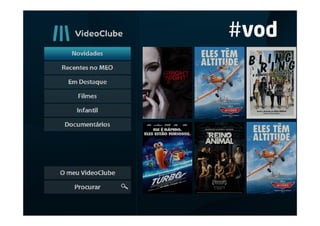
#vod
#timeshift
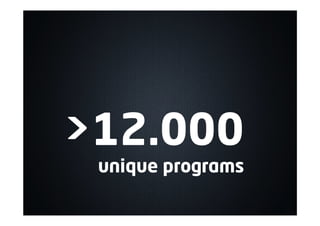
>12.000
unique programs
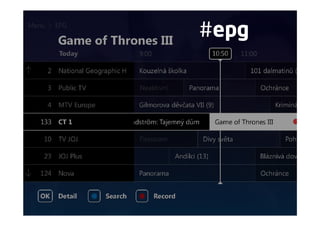
#epg
#epg
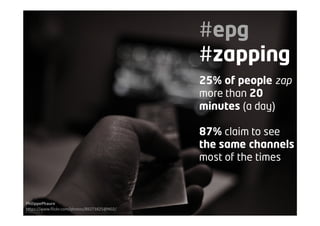
#zapping
25% of people zap
more than 20
minutes (a day)
87% claim to see
the same channels
most of the times
PhilippePhaure
https://www.flickr.com/photos/89273825@N02/
previous work
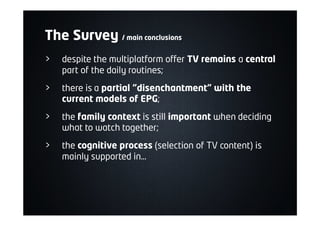
> despite the multiplatform offer TV remains a central
part of the daily routines;
> there is a partial "disenchantment" with the
current models of EPG;
> the family context is still important when deciding
what to watch together;
> the cognitive process (selection of TV content) is
mainly supported in…
The Survey / main conclusions
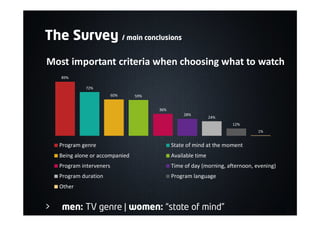
Most important criteria when choosing what to watch
89%
72%
60% 59%
36%
28%
24%
12%
1%
Program genre State of mind at the moment
Being alone or accompanied Available time
Program interveners Time of day (morning, afternoon, evening)
Program duration Program language
Other
> men: TV genre | women: “state of mind”
TV Discovery & Enjoy
the prototype
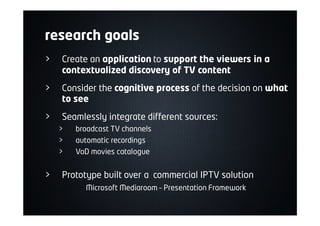
research goals
> Create an application to support the viewers in a
contextualized discovery of TV content
> Consider the cognitive process of the decision on what
to see
> Seamlessly integrate different sources:
> broadcast TV channels
> automatic recordings
> VoD movies catalogue
> Prototype built over a commercial IPTV solution
Microsoft Mediaroom – Presentation Framework
We have the criteria
What about metadata?
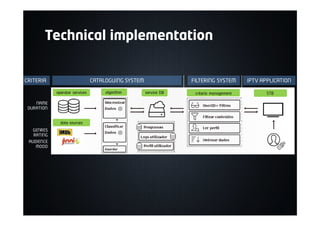
algorithm service DB criteria management STBoperator services
data sources
algorithm service DB criteria management STB
CATALOGUING SYSTEM
operator services
data sources
FILTERING SYSTEM IPTV APPLICATION
GENRES
RATING
AUDIENCE
MOOD
NAME
DURATION
CRITERIA
Technical implementation
how it works?
Looking for something to watch…
after some (mindless) zapping…
… a background algorithm detects it
and suggests TvDE
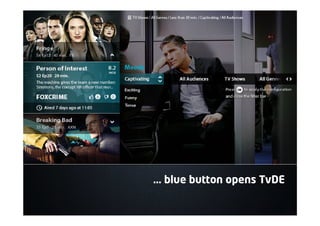
… blue button opens TvDE
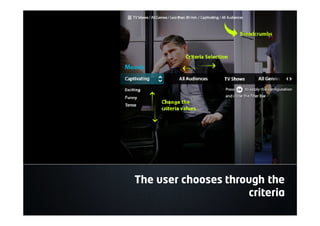
The user chooses through the
criteria
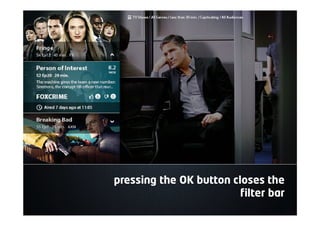
pressing the OK button closes the
filter bar
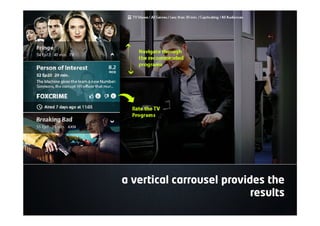
a vertical carrousel provides the
results
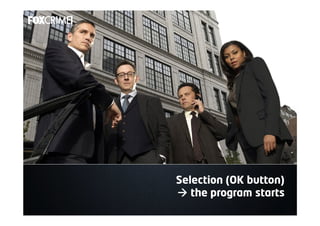
Selection (OK button)
à the program starts
the
evaluation
The evaluation goals
Lab evaluation to:
> validate the suitability of the functional solutions and
criteria vs the preliminary survey results
> evaluate the application usability
> determine the suitability of the recommendations to
the chosen criteria
> evaluate the user experience and the expectations
towards the use of the application.
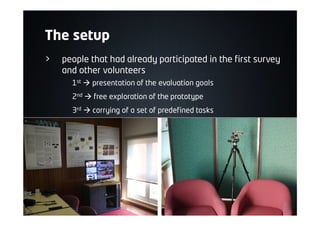
The setup
> people that had already participated in the first survey
and other volunteers
1st à presentation of the evaluation goals
2nd à free exploration of the prototype
3rd à carrying of a set of predefined tasks
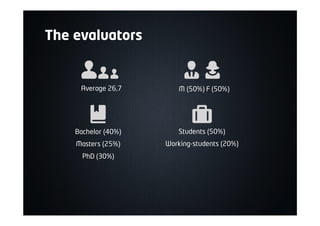
The evaluators
Average 26,7 M (50%) F (50%)
Bachelor (40%)
Masters (25%)
PhD (30%)
Students (50%)
Working-students (20%)
The evaluators
High percentage of timeshifted TV consumption
Using other media devices apart from regular TV
Low frequency of use of the TV providers services (DVR,
Vod,…)
2 groups of 10 users each:
LC lower TV consumption
HC higher TV consumption
the evaluation results …
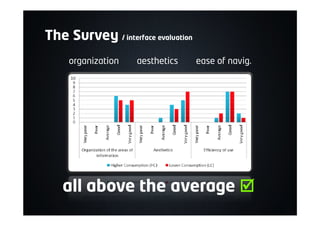
The Survey / interface evaluation
organization aesthetics ease of navig.
all above the average þ
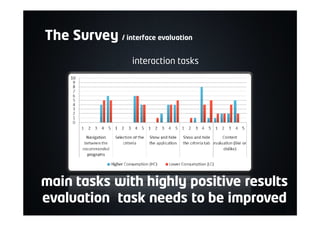
The Survey / interface evaluation
interaction tasks
main tasks with highly positive results
evaluation task needs to be improved
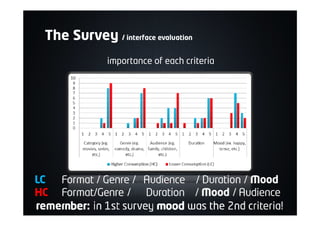
The Survey / interface evaluation
importance of each criteria
remember: in 1st survey mood was the 2nd criteria!
LC Format / Genre / Audience / Duration / Mood
HC Format/Genre / Duration / Mood / Audience
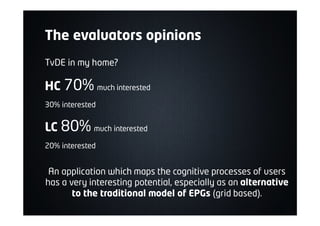
The evaluators opinions
TvDE in my home?
HC 70% much interested
30% interested
LC 80% much interested
20% interested
An application which maps the cognitive processes of users
has a very interesting potential, especially as an alternative
to the traditional model of EPGs (grid based).
discovery on TV þ
what about 2nd screen?
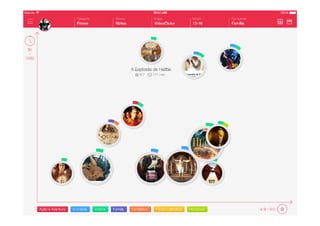
Aplicação Tablet
More info
http://socialitv.web.ua.pt
Jorge Abreu* | Pedro Almeida* | Bruno Teles*
Other team members: Márcio Reis*, BernardoCardoso**, HerlanderSantos**
*CETAC.media| Universidadede Aveiro | Portugal
**PT Inovação e Sistemas

TV Discovery & Enjoy - a New Approach to Help Users Finding the Right TV Program to Watch

  • 1.
    TV Discovery &Enjoy a New Approach to Help Users Finding the Right TV Program to Watch http://socialitv.web.ua.pt Jorge Abreu* | Pedro Almeida* | Bruno Teles* Other team members: Márcio Reis*, BernardoCardoso**, HerlanderSantos** *CETAC.media| Universidadede Aveiro | Portugal **PT Inovação e Sistemas
  • 2.
  • 3.
  • 4.
  • 5.
  • 6.
  • 7.
    #epg #zapping 25% of peoplezap more than 20 minutes (a day) 87% claim to see the same channels most of the times PhilippePhaure https://www.flickr.com/photos/89273825@N02/
  • 8.
  • 10.
    > despite themultiplatform offer TV remains a central part of the daily routines; > there is a partial "disenchantment" with the current models of EPG; > the family context is still important when deciding what to watch together; > the cognitive process (selection of TV content) is mainly supported in… The Survey / main conclusions
  • 11.
    The Survey /main conclusions Most important criteria when choosing what to watch 89% 72% 60% 59% 36% 28% 24% 12% 1% Program genre State of mind at the moment Being alone or accompanied Available time Program interveners Time of day (morning, afternoon, evening) Program duration Program language Other > men: TV genre | women: “state of mind”
  • 12.
    TV Discovery &Enjoy the prototype
  • 13.
    research goals > Createan application to support the viewers in a contextualized discovery of TV content > Consider the cognitive process of the decision on what to see > Seamlessly integrate different sources: > broadcast TV channels > automatic recordings > VoD movies catalogue > Prototype built over a commercial IPTV solution Microsoft Mediaroom – Presentation Framework
  • 14.
    We have thecriteria What about metadata?
  • 15.
    algorithm service DBcriteria management STBoperator services data sources algorithm service DB criteria management STB CATALOGUING SYSTEM operator services data sources FILTERING SYSTEM IPTV APPLICATION GENRES RATING AUDIENCE MOOD NAME DURATION CRITERIA Technical implementation
  • 16.
  • 17.
  • 18.
  • 19.
    … a backgroundalgorithm detects it and suggests TvDE
  • 20.
    … blue buttonopens TvDE
  • 21.
    The user choosesthrough the criteria
  • 22.
    pressing the OKbutton closes the filter bar
  • 23.
    a vertical carrouselprovides the results
  • 24.
    Selection (OK button) àthe program starts
  • 25.
  • 26.
    The evaluation goals Labevaluation to: > validate the suitability of the functional solutions and criteria vs the preliminary survey results > evaluate the application usability > determine the suitability of the recommendations to the chosen criteria > evaluate the user experience and the expectations towards the use of the application.
  • 27.
    The setup > peoplethat had already participated in the first survey and other volunteers 1st à presentation of the evaluation goals 2nd à free exploration of the prototype 3rd à carrying of a set of predefined tasks
  • 28.
    The evaluators Average 26,7M (50%) F (50%) Bachelor (40%) Masters (25%) PhD (30%) Students (50%) Working-students (20%)
  • 29.
    The evaluators High percentageof timeshifted TV consumption Using other media devices apart from regular TV Low frequency of use of the TV providers services (DVR, Vod,…) 2 groups of 10 users each: LC lower TV consumption HC higher TV consumption
  • 30.
  • 31.
    The Survey /interface evaluation organization aesthetics ease of navig. all above the average þ
  • 32.
    The Survey /interface evaluation interaction tasks main tasks with highly positive results evaluation task needs to be improved
  • 33.
    The Survey /interface evaluation importance of each criteria remember: in 1st survey mood was the 2nd criteria! LC Format / Genre / Audience / Duration / Mood HC Format/Genre / Duration / Mood / Audience
  • 34.
    The evaluators opinions TvDEin my home? HC 70% much interested 30% interested LC 80% much interested 20% interested An application which maps the cognitive processes of users has a very interesting potential, especially as an alternative to the traditional model of EPGs (grid based).
  • 35.
    discovery on TVþ what about 2nd screen?
  • 36.
  • 37.
    More info http://socialitv.web.ua.pt Jorge Abreu*| Pedro Almeida* | Bruno Teles* Other team members: Márcio Reis*, BernardoCardoso**, HerlanderSantos** *CETAC.media| Universidadede Aveiro | Portugal **PT Inovação e Sistemas

Editor's Notes

  • #8 digitalsmiths
  • #12 To establish a ranking of the most relevant criteria a non-parametric statistical test was performed using a Durbin and Skillings-Mack test (Table 2). The test corroborates that there is a significant difference between the presented criteria confirming, with a confidence level higher than 99,99%, that viewers prioritize some features of the content or of the viewing context over others when having to decide what to watch. The test confirms that the “program genre” leads the preferences of viewers, the “state of mind” or mood follows and “being alone or accompanied” and the “available time” split the 3rd place. The other criteria are less relevant for spectators. Doing a cross analysis of these data with the gender of the respondents, we can conclude that the order of the criteria is the same for both genders. Nevertheless we can notice that man have slightly higher preference for the “program genre” and women for the “state of mind”. Considering the age groups, we can conclude that for the younger group and the older one the available time is more important than the fact of being alone or accompanied. With some additional correlations it can be seen that viewers who watch among friends pick the state of mind or mood as the main criterion. Additionally when considering the average time viewers take to select the program it can be seen that those who take more than 10 minutes to choose what to see point to “Being alone or accompanied “ as the most important criterion.
  • #13 Com base nestas conclusões, reuniram-se os dados necessários para avançar para a implementação de uma aplicação de TV interativa
  • #15 Com base nestas conclusões, reuniram-se os dados necessários para avançar para a implementação de uma aplicação de TV interativa
  • #17 Explicando o funcionamento da app
  • #25 Arranjar imagem do person of interest
  • #27 Quanto às formas utilizadas para mudar de canais de TV 36% of the sample point to a mid-level in a scale from “I never know” to “I always know”. Women more often declare they know in advance what they want to see. When asked about the time taken, on average, to choose what program to watch, more than half (51%) say they take between “1-3 minutes” and about 31% "less than 1 minute." In these situations, men appear to be faster. Also ZON customers emerge as the fastest finding what they want to see on TV.
  • #28 Quanto às formas utilizadas para mudar de canais de TV 36% of the sample point to a mid-level in a scale from “I never know” to “I always know”. Women more often declare they know in advance what they want to see. When asked about the time taken, on average, to choose what program to watch, more than half (51%) say they take between “1-3 minutes” and about 31% "less than 1 minute." In these situations, men appear to be faster. Also ZON customers emerge as the fastest finding what they want to see on TV.
  • #29 Quanto às formas utilizadas para mudar de canais de TV 36% of the sample point to a mid-level in a scale from “I never know” to “I always know”. Women more often declare they know in advance what they want to see. When asked about the time taken, on average, to choose what program to watch, more than half (51%) say they take between “1-3 minutes” and about 31% "less than 1 minute." In these situations, men appear to be faster. Also ZON customers emerge as the fastest finding what they want to see on TV.
  • #31 Quanto às formas utilizadas para mudar de canais de TV 36% of the sample point to a mid-level in a scale from “I never know” to “I always know”. Women more often declare they know in advance what they want to see. When asked about the time taken, on average, to choose what program to watch, more than half (51%) say they take between “1-3 minutes” and about 31% "less than 1 minute." In these situations, men appear to be faster. Also ZON customers emerge as the fastest finding what they want to see on TV.
  • #33 To establish a ranking of the most relevant criteria a non-parametric statistical test was performed using a Durbin and Skillings-Mack test (Table 2). The test corroborates that there is a significant difference between the presented criteria confirming, with a confidence level higher than 99,99%, that viewers prioritize some features of the content or of the viewing context over others when having to decide what to watch. The test confirms that the “program genre” leads the preferences of viewers, the “state of mind” or mood follows and “being alone or accompanied” and the “available time” split the 3rd place. The other criteria are less relevant for spectators. Doing a cross analysis of these data with the gender of the respondents, we can conclude that the order of the criteria is the same for both genders. Nevertheless we can notice that man have slightly higher preference for the “program genre” and women for the “state of mind”. Considering the age groups, we can conclude that for the younger group and the older one the available time is more important than the fact of being alone or accompanied. With some additional correlations it can be seen that viewers who watch among friends pick the state of mind or mood as the main criterion. Additionally when considering the average time viewers take to select the program it can be seen that those who take more than 10 minutes to choose what to see point to “Being alone or accompanied “ as the most important criterion.
  • #34 navigation between recommended programs and the definition of the criteria were the features that had better appreciation by the users of both group
  • #36 Quanto às formas utilizadas para mudar de canais de TV 36% of the sample point to a mid-level in a scale from “I never know” to “I always know”. Women more often declare they know in advance what they want to see. When asked about the time taken, on average, to choose what program to watch, more than half (51%) say they take between “1-3 minutes” and about 31% "less than 1 minute." In these situations, men appear to be faster. Also ZON customers emerge as the fastest finding what they want to see on TV.